𝗙𝗨𝗟𝗟 𝗦𝗧𝗢𝗥𝗬 The Orange X on My Fallout Shelter Was the First Sign the HOA Needed Something Buried Before Friday
𝗙𝗨𝗟𝗟 𝗦𝗧𝗢𝗥𝗬
Then back at Diane.
“You listed my shelter as an HOA asset?”
“It was part of the original civil defense system.”
“That wasn’t my question.”
“The structure connects to common property.”
“That still wasn’t my question.”
Her expression tightened.
“Nathan, this doesn’t need to become confrontational.”
“You brought demolition contractors into my yard before sunrise.”
“They’re not demolition contractors.”
The younger man slowly lowered the orange spray paint.
I looked at him.
Then at her.
“Then why did you ask him to mark the hatch for demolition?”
Nobody answered.
Eight years earlier, I bought the house at 214 Juniper Trace because I wanted quiet.
I had spent eleven years in the Army as an ordnance and mechanical technician.
My work involved generators, hydraulic systems, vehicle components, field equipment, and machines that punished anyone careless enough to believe metal had sympathy.
I liked that kind of work.
A broken machine did not care about office politics.
It did not care whether you were popular.
If you diagnosed the problem correctly and repaired it correctly, it worked.
If you did not, it didn’t.
After I left the service, I wanted the same simplicity from the rest of my life.
I found a civilian equipment-repair job outside Sacramento and bought the last house on the western edge of Fairbrook Ridge.
The property was less than a third of an acre.
Behind it ran a narrow HOA greenbelt.
And beneath six feet of soil behind my house sat a fifteen-by-twenty-foot concrete fallout shelter built in 1963.
The main entrance was in my backyard.
Two galvanized ventilation pipes rose beside it.
A narrow emergency shaft ran from the shelter’s western wall beneath the rear portion of my property before ending at a capped steel opening inside the greenbelt.
When I bought the house, the bunker appeared on every survey.
There was nothing secret about it.
I turned it into a workshop.
One steel bench held a small diesel generator I had been rebuilding.
Another held carburetors, gauges, injectors, filters, brackets, and military surplus mechanical parts.
I installed LED lights.
Restored the old ventilation fan.
Cleaned fifty years of oxidation from the steel stairs.
Sealed minor wall cracks.
Installed shelves.
Some men bought fishing boats.
Some disappeared into golf every weekend.
I needed a concrete room where every wrench stayed exactly where I left it.
That was all.
But two months before Diane appeared in my yard, I had bought a crate of surplus diesel parts from a county liquidation auction.
The wooden crate still had old military stenciling on the side.
I unloaded it after dark because rain was coming.
Apparently, someone saw me.
A box containing filters, injector pumps, brackets, and one alternator heavy enough to destroy my lower back became neighborhood gossip.
Diane looked toward the ventilation pipes.
“There are families within fifteen feet of this structure.”
“There are families fifteen feet from most houses in this subdivision.”
“People have reported military equipment being carried underground at night.”
“Engine parts.”
“You served in ordnance.”
“I repaired equipment.”
“You understand why people are concerned.”
I felt the conversation shift.
This was no longer about a reserve schedule.
She was building a story.
A former ordnance technician.
Military crates.
An underground bunker.
Secrecy.
Fear can turn ordinary facts into something dramatic if you arrange them correctly.
“What exactly do you think is down there?”
“I didn’t say I think anything.”
“Then why are you standing in my yard with contractors?”
“The board has a duty to investigate potential hazards.”
“If you believe there is an immediate hazard, call the fire marshal.”
Her jaw shifted.
“Or the county.”
Nothing.
“Or the sheriff.”
Still nothing.
“Do not send landscapers into my yard and call it emergency authority.”
The older contractor looked at Diane.
She tapped the yellow sentence on the notice.
“The annual reserve review is Friday. If this asset remains on the schedule, the association has to verify its condition.”
“This asset?”
“Yes.”
“You keep calling my property yours.”
“The board has been discussing this for months.”
“That is not the same thing as talking to me.”
I photographed the notice.
Then the contractors.
Their truck.
The open gate.
The orange paint.
“Leave.”
The contractors did.
Diane stayed.
For a moment, neither of us spoke.
Then she said something I would spend the next four days trying to understand.
“You don’t understand what has already been spent on that shelter.”
I stared at her.
“What does that mean?”
She turned away.
“Friday, Nathan.”
“Diane.”
But she was already walking through my gate.
By 7:10, I had locked it, saved footage from my security cameras, and covered my kitchen table with every document from the purchase of my house.
Deed.
Survey.
Title report.
Old plats.
Inspection photographs.
The shelter was entirely within my parcel except for the final portion of the emergency shaft, which extended beneath the greenbelt.
The title report referenced a 1964 civil defense access easement created by the original developer.
That was probably what Diane was relying on.
Then I saw the next entry.
RELEASE AND TERMINATION OF CIVIL DEFENSE ACCESS RIGHTS.
I ordered a certified copy from the county recorder.
Forty-three minutes later, it arrived by email.
I read it slowly.
The neighborhood’s civil defense program had been abandoned.
The secondary access obligation had ended.
Control of the underground shelter improvements returned to the residential parcel owner.
The greenbelt cap could remain for ventilation and emergency egress.
But neither the original developer nor any successor association retained a right to enter, inspect, control, or operate the shelter.
Fairbrook Ridge HOA, in its modern form, did not even exist when the document was signed.
That should have ended the property question.
It did not explain why my bunker appeared on an HOA reserve schedule.
And it definitely did not explain Diane’s comment.
What has already been spent.
At 9:30, I called the county building division.
A permit technician named Elena Ruiz answered.
I gave her my address and read the HOA notice.
I heard typing.
“We have the original shelter plan,” she said. “A residential addition permit from 1987 and the property survey associated with your purchase.”
“Is there a county demolition order?”
“No.”
“Is the bunker considered unregistered?”
“It appears in the historic property file.”
“So no.”
“I would phrase it more carefully than that.”
That answer made me trust her immediately.
Government records were complicated.
People who knew what they were doing rarely pretended otherwise.
“It is documented,” she continued. “That doesn’t automatically answer every current-use issue, but I do not see an active demolition order.”
“Can the county inspect it?”
“Yes.”
“Please.”
She transferred me to a building safety inspector named Marisol Vega.
I told Marisol exactly how I used the shelter.
“Any ammunition?”
“No.”
“Explosives?”
“No.”
“Fuel?”
“One drained generator tank.”
“Compressed gas?”
“No.”
“Solvents?”
“Parts washer solvent is stored in my detached garage.”
“Oil?”
“Two sealed quarts.”
“Good. Don’t move anything before I arrive.”
“When can you come?”
“Wednesday morning.”
I emailed Diane the certified 1989 release and the county confirmation.
I also requested every HOA document connected to “Community Emergency Asset 3.”
Reserve schedules.
Invoices.
Inspection reports.
Maps.
Work orders.
Board votes.
Vendor contracts.
Photographs.
Her answer arrived twenty minutes later.
The board will provide documents through the established member records process. The Friday review remains scheduled. Continued obstruction may result in additional enforcement.
She did not mention the release.
That afternoon, my neighbor Walt Higgins knocked on my door.
Walt was sixty-two, retired, and normally the sort of man who could turn returning a borrowed ladder into a forty-minute conversation.
That afternoon, he looked uncomfortable.
“Nathan, I think I may have started part of this.”
I let him inside.
“What part?”
“The crate.”
He explained that he had seen me unloading it months earlier.
He mentioned it to his wife.
Then someone else.
At a holiday committee meeting, another neighbor remembered I had served in ordnance.
The story grew.
“Did Diane ask you about it?”
“Yeah.”
“When?”
“Late November.”
“How many times?”
“Two or three.”
“What did she ask?”
“The size. Markings. Whether there were warning labels.”
“What did you tell her?”
“That I didn’t see any.”
I looked at the calendar.
Late November.
The violation notice was April.
If Diane truly believed I had dangerous military material underground beside six homes, she had waited almost five months before contacting me.
No fire department.
No sheriff.
No county.
No emergency inspection.
Nothing.
People do not postpone emergencies until accounting week.
I asked Walt to email me the dates while he still remembered them.
He did it from my driveway.
That night, at 11:43, my rear security camera woke me.
Motion detected.
The camera covered the back fence and the greenbelt.
On my phone, a narrow flashlight beam moved through the trees.
Toward the old emergency shaft.
I pulled on boots and went outside.
Three sections of greenbelt path lighting were dark.
About forty yards west of my yard, someone was kneeling beside the circular steel cap with a socket wrench.
“Leave the bolts where they are.”
The person stood.
Diane.
She wore dark pants and a black windbreaker.
In one hand was the wrench.
In the other was a small brass plate.
I knew that plate.
It had been bolted to the cap for decades.
SECONDARY EGRESS — SHELTER 3
DO NOT OBSTRUCT
I had photographs from my home inspection eight years earlier.
“What are you doing?”
“That marker belongs to the association.”
“The release says this cap remains part of my shelter system.”
“The cap sits on common property.”
“Then why are you removing a safety marker at midnight?”
She glanced toward the greenbelt.
“Residents keep tripping near it.”
I looked at the ground.
There was no path within ten feet.
No worn grass.
No disturbed soil.
No bench.
Nothing.
“Put it back.”
“Maintenance will document it tomorrow.”
“You are maintenance tonight.”
Her polished tone cracked.
“You have turned a straightforward safety review into a personal war.”
I stared at the wrench.
“I was asleep.”
She said nothing.
“You brought the wrench.”
She set the brass plate on top of the cap.
Did not reinstall it.
Then walked away.
I photographed everything.
The loose bolts.
Tool marks.
Dead path lights.
The brass plate.
I saved the camera video in three places.
Wednesday morning, Marisol Vega arrived at 8:15.
Before opening the bunker, I showed her everything.
Deed.
Survey.
Release.
HOA notice.
The previous night’s photographs.
She listened without taking sides.
Then she inspected.
Forty-five minutes.
Stairs.
Hatch.
Ventilation.
Electrical panel.
Moisture.
Shelving.
Drain.
Generator.
Parts.
The military crate.
She opened it herself.
Inside were filters, metal brackets, injector pumps, hoses, and the alternator.
She looked at me.
“This is what caused the rumor?”
“Apparently.”
She lifted one bracket.
“Terrifying.”
It was the only joke she made.
Then she asked about the secondary egress.
I opened the interior steel door.
A narrow concrete passage extended west.
Normally, faint daylight should have shown around the exterior cap.
It didn’t.
Marisol turned on her flashlight.
We walked closer.
The internal release lever was still there.
I pulled it.
The mechanism moved about two inches.
Stopped.
Metal struck metal.
Marisol crouched.
“Again.”
I pulled.
Clank.
She climbed closer to the end and shone her light upward.
Then she looked at me.
“Somebody installed a crossbar over the exterior release.”
“What?”
“The bolts look recent.”
I squeezed past her.
She was right.
The shaft was sixty years old.
The new steel was not.
Clean galvanized bolts.
Fresh washers.
Bright threads.
“Did you install this?”
“No.”
“Can you open the cap from inside?”
I pulled harder.
The lever stopped against the crossbar.
No.
The HOA had spent months calling my bunker unsafe.
Someone operating from HOA property had physically disabled its second exit.
Marisol photographed the entire mechanism.
Then called her supervisor.
When she finished, she spoke carefully.
“I can document two things.”
“Okay.”
“First, I observed no immediate hazardous material condition inside this workshop.”
I exhaled.
“Second, the secondary egress is obstructed externally.”
“Does the shelter need to be demolished?”
“I see no county basis for emergency demolition today.”
I looked toward the blocked shaft.
“Who is responsible?”
“That depends on ownership and who installed the obstruction.”
Fair.
She was not there to hand me the conclusion I wanted.
She was there to record what existed.
Later that afternoon, she issued a written field observation.
The report was balanced.
Ventilation motor should be serviced.
Illuminated exit marker recommended.
Secondary egress should be restored if I intended to use it as an emergency route.
Normal things.
Fixable things.
Nothing resembling Diane’s emergency demolition language.
But the inspection had created a new question.
Who installed the crossbar?
And why?
At noon, I submitted a formal records request to the HOA management office.
Twelve categories.
All narrow.
Reserve study pages.
Invoices.
Canceled checks.
Project maps.
Inspection notes.
Vendor bids.
Work orders.
Emails relating to Shelter 3.
Thomas Bell, the property manager, read the list.
“This is a lot.”
“The hearing is Friday.”
He looked uncomfortable.
“Thursday.”
“What?”
“Diane moved it up.”
“When?”
“This morning.”
I stared at him.
He lowered his voice.
“Off the record?”
I waited.
“Ask for the reserve study site photographs.”
“Why?”
“Because I’ve never seen one taken inside your shelter.”
Then he stood up and opened his office door.
Conversation over.
That afternoon, Diane sent a settlement agreement.
The HOA would withdraw enforcement if I granted a ten-year access license allowing Fairbrook Ridge to inspect and designate the bunker as an emergency shelter during declared events.
The HOA would maintain the greenbelt exit.
I would receive no payment.
The license would bind future owners.
I called her.
“If the bunker is too dangerous to exist, why do you want a ten-year license to use it?”
Silence.
Then:
“Remediation may be more economical than removal.”
“Your contractors had a demolition worksheet.”
“The board is evaluating options.”
“What about the reserve review?”
“Association business.”
“You listed my bunker as an association asset.”
“That doesn’t make reserve accounting your business.”
“It makes the use of my address my business.”
Her voice chilled.
“Sign the license, Nathan.”
“No.”
“The violation disappears.”
“No.”
“The hearing disappears.”
“No.”
“We restore the greenbelt exit.”
I stopped.
“Who installed the crossbar?”
She hung up.
That was when I stopped believing Friday was simply a deadline.
Diane needed one of two things before someone opened the reserve file.
Either she needed my signature creating present-day HOA rights over the bunker.
Or she needed the bunker officially classified as something being removed.
Both outcomes would explain why an HOA reserve schedule contained a private shelter nobody had legally accessed.
At 4:26, I received an email from Priya Anand.
Priya was the HOA treasurer.
We had spoken maybe twice in eight years.
Her message contained one sentence.
You are asking about a project I never approved in the form that was ultimately paid.
Attached was one page.
Reserve Schedule.
Line 12B.
COMMUNITY EMERGENCY ASSET 3
SHELTER VENTILATION, EGRESS STABILIZATION & PATH LIGHTING
$47,200
COMPLETE
Project location:
214 Juniper Trace.
My home.
I stared at the page.
No HOA contractor had repaired my ventilation.
No contractor had entered my bunker.
The egress was not stabilized.
It had been blocked.
Several path lights did not even work.
Yet the HOA books said $47,200 had been spent on completed work associated with my property.
Diane’s demolition notice suddenly made sense.
Anyone inspecting the bunker would discover the work did not exist.
I called Priya.
“How did my address get onto this?”
“I’ve been trying to figure that out.”
“What did the board actually approve?”
“A safety project last March.”
“Specifically?”
“Path lights. Playground emergency call box. Pond fencing. A condition survey of older greenbelt structures.”
“My bunker?”
“Not in the packet I received.”
I sat down.
“What changed?”
“After the vote, Diane and management consolidated line items.”
“And my address appeared?”
“Yes.”
“Was Shelter 3 listed as an HOA asset?”
“Not in my version.”
“Did you object?”
“Yes.”
“What did Diane say?”
“That an old civil defense map established association control and legal had already reviewed it.”
“Did you see the legal opinion?”
“No.”
I emailed Priya the 1989 release.
She went silent.
When she finally spoke, her voice was different.
“This was not in the board packet.”
That sentence mattered.
Boards made bad decisions all the time because someone missed something.
But if a relevant document had been withheld, that was different.
Priya agreed to meet me at a coffee shop across town.
She brought records she was entitled to access as treasurer.
The original project allocation was straightforward.
Fourteen greenbelt path lights: $9,400.
Playground call box and pond fencing: $5,600.
Legacy greenbelt structure assessment and safety improvements: $32,200.
No private residential address appeared.
Then we reviewed the checks.
$9,400 to Northgate Electrical.
$31,800 to Hearthstone Grounds.
$6,000 to the reserve consultant.
“The call box contractor?” I asked.
“Never paid.”
“What did Hearthstone build?”
Priya opened photographs.
Stone pillars.
Low walls.
Flagstone.
Decorative lighting.
Drainage gravel.
Seating.
I recognized the location.
Larksburg Court.
Diane’s cul-de-sac.
A year earlier, the northern greenbelt behind Larksburg had been grass, two oak trees, and a dirt maintenance trail.
Now it had a landscaped entrance and a flagstone seating area.
The HOA newsletter called it the Larksburg Gathering Point.
I assumed the five houses on that street had funded it privately.
They had not.
“Is this open to every resident?”
“Technically.”
“What does technically mean?”
“The finished entrance is beside Diane’s driveway.”
“And from the greenbelt?”
“Dirt path.”
I looked at the photographs.
The project may have sat on common land.
But it functioned like a private amenity for one cul-de-sac.
More importantly, it was not work performed at my house.
Priya showed me the reserve consultant’s site map.
A faded 1964 civil defense drawing.
My shelter was labeled Station 3.
The shaft crossed into what later became the greenbelt.
The 1989 release was missing.
“Who provided this?”
“Diane.”
“Who told the consultant Shelter 3 was still an HOA asset?”
“Diane.”
“Who approved the completed line?”
“Management entered it. Diane electronically approved the certification.”
I sat back.
That still did not automatically prove theft.
The gathering point existed.
Contractors had done real work.
Reserve funds had paid for something.
But the accounting tied that money to improvements that did not exist at my property.
“Why is Friday so important?”
Priya folded her hands.
“Fairbrook Ridge is refinancing the clubhouse repair.”
“And?”
“Master insurance renewal.”
“So?”
“The reserve consultant is verifying high-risk assets.”
I understood before she finished.
“Asset Three.”
“Yes.”
“No interior photos.”
“No closeout documents.”
“No owner access agreement.”
“If I sign Diane’s license—”
“The access problem disappears.”
“And if she retires the bunker?”
“The consultant can close the line as an asset-disposal issue instead of asking why completed improvements cannot be verified.”
There it was.
For the first time, everything formed one shape.
The rumors.
The demolition worksheet.
The access license.
The blocked exit.
The midnight removal of the brass marker.
The accelerated hearing.
The reserve review.
Diane did not need my bunker gone because she feared what was inside it.
She needed paperwork that explained why $47,200 of alleged work could not be inspected.
The next morning, Priya used her authority as treasurer to request original invoices from Northgate and Hearthstone.
Both responded.
Northgate had replaced five path lights.
Not fourteen.
The invoice explained that the remaining underground cable was damaged and required separate trenching approval.
That approval never came.
Hearthstone’s invoice listed the Larksburg common area.
Stone entry columns.
Grading.
Flagstone.
Drainage.
Seating walls.
Nothing about Juniper Trace.
Nothing about bunker ventilation.
Nothing about egress stabilization.
Nothing about Shelter 3.
The contractors had not falsified their invoices.
Someone inside the association had changed the coding afterward.
Priya sent everything to the full board and association counsel.
Within an hour, Thomas Bell issued a preservation notice.
No director.
No staff member.
No vendor.
No manager.
Nobody was to delete emails, destroy records, or alter project files.
At 2:17 that afternoon, my phone rang.
Luis Ortega.
HOA maintenance supervisor.
“I installed the crossbar.”
I stopped what I was doing.
“When?”
“December twelfth.”
“Why?”
“The work order said the shaft was abandoned.”
“Who issued it?”
“Diane.”
My hand tightened around the phone.
“Send me the work order.”
“I will.”
“Did you know the shaft connected to my bunker?”
“No.”
His voice sounded embarrassed.
“I should have checked.”
“You followed an HOA work order on HOA property.”
“That doesn’t mean it was a good work order.”
I respected that answer.
The document arrived five minutes later.
SECURE ABANDONED EGRESS AGAINST UNAUTHORIZED ENTRY PENDING ASSET RETIREMENT.
Signed electronically:
Diane Worth.
Attached was a photograph of the brass plate still bolted to the cap.
Special instruction:
REMOVE IDENTIFYING MARKER AFTER FINAL BOARD AUTHORIZATION.
There had never been final board authorization.
That was why Diane came with a wrench at midnight.
She was finishing the instruction herself before Friday.
By Wednesday evening, the dispute was no longer contained to board emails.
Diane sent a “Safety Clarification” to all ninety-six homes.
She did not say explosives.
She did not need to.
She referenced an undisclosed underground workshop.
Military surplus equipment.
Obstructed association access.
An owner refusing cooperative inspection.
Within two hours, the neighborhood forum exploded.
One resident asked whether the six nearest homes should temporarily evacuate.
Another demanded the fire department enter immediately.
Someone else wrote that “military ordnance should never be stored beneath residential property.”
Walt responded.
He explained what the crate actually contained.
His comment disappeared twenty minutes later.
I saved screenshots.
That night, a woman walking with two children saw me near my mailbox.
For years, she had waved.
This time, she crossed the street.
That hurt more than I expected.
I could respond to a bad survey.
I could respond to a false reserve entry.
I could fix a blocked hatch.
But fear creates images faster than facts can remove them.
I posted one message.
The county inspected the shelter today. No explosives, ammunition, or immediate hazardous material condition were found. The HOA has received the report. I will address the ownership and financial records at tomorrow’s hearing.
Then I logged out.
Rumors do not improve through repetition.
At 8:40 that night, Diane called.
“You are exposing the association unnecessarily.”
“The association used my address to claim forty-seven thousand dollars in completed work.”
“That reserve line consolidates related projects.”
“Then why does it identify my shelter?”
“The emergency shaft connects to common property.”
“The access rights ended in 1989.”
“Our counsel has not accepted your interpretation.”
“Your counsel issued a preservation notice.”
Silence.
Then her voice changed.
Less ceremonial.
More tired.
“If the reserve review fails, the clubhouse financing could be delayed.”
“Okay.”
“Insurance may broaden its inspection.”
“Okay.”
“Assessments could rise.”
That was the first real argument she had made.
Ninety-six families could pay for mistakes they did not create.
I knew what special assessments did to people.
Priya had already explained Tom Higgins was not the only resident struggling financially.
But protecting neighbors did not require pretending my property belonged to them.
“Withdraw the enforcement notice,” I said.
“Nathan—”
“Restore the exit.”
“The board—”
“Correct the reserve schedule.”
She was silent.
“Then explain the money.”
“Sign the license.”
“No.”
“Then tomorrow becomes public.”
“You made it public this afternoon.”
She ended the call.
The Fairbrook Ridge clubhouse comfortably held eighty people.
By 6:45 Thursday evening, one hundred twelve residents were inside.
Another dozen stood near the doors.
Diane sat in the middle of the board table.
Red suit.
Straight posture.
Folder aligned perfectly with the table edge.
Priya sat two chairs away with a banker’s box beside her.
Thomas Bell sat near association counsel, Mara Chen.
The agenda had two items.
Enforcement concerning the underground structure at 214 Juniper Trace.
Then:
Review of discrepancies in Reserve Project 12B and possible action concerning responsible officers.
Diane had put the bunker first.
She began with photographs.
My hatch.
Ventilation pipes.
Military crate.
She spoke calmly.
No dramatic accusations.
No raised voice.
She described unresolved safety concerns.
Denied access.
An underground structure connected to common property.
A former military technician storing surplus equipment.
Everything she said was carefully framed.
That was why Diane had stayed president so long.
She knew how to make control sound responsible.
When she finished, Mara Chen addressed the room.
“This is not a county demolition proceeding.”
The room shifted.
“The association is deciding whether to continue internal enforcement, seek judicial relief, negotiate access, or suspend action pending further review.”
That one sentence stripped most of the power from Diane’s original notice.
Then I was given the floor.
I did not begin with the money.
I began with safety.
Marisol’s report appeared on the projector.
Photographs showed my workshop exactly as she found it.
Clean benches.
Generator.
Parts.
Ventilation.
No explosives.
No ammunition.
No immediate hazardous condition.
I read her conclusion.
No county basis for emergency demolition observed.
Then I displayed the secondary shaft.
Old interior release.
New crossbar.
December work order.
Diane’s electronic signature.
Luis Ortega’s statement.
The room became quiet.
“The HOA called this shelter unsafe,” I said, “after its own maintenance order disabled the second exit.”
Diane leaned toward her microphone.
“The crossbar was installed because the exterior shaft was believed abandoned.”
I nodded.
“Four months before anyone notified me.”
She stopped.
I placed the 1964 access easement beside the certified 1989 release.
“One created limited civil defense access.”
Next slide.
“One terminated it.”
Board member Cliff Bannister leaned forward.
“Did legal review this release before Monday’s notice?”
Diane answered carefully.
“The release was not in the file available to us.”
Cliff looked at her.
“Nathan emailed it Monday morning.”
“Yes.”
“Before you moved the hearing forward?”
Diane did not answer.
“And before the community safety email?”
Still no answer.
I displayed the ten-year access agreement.
“Monday morning, the shelter was described as too dangerous to remain.”
I looked toward the residents.
“Tuesday afternoon, the HOA offered to withdraw enforcement if I gave it a ten-year right to use the same shelter.”
Diane interrupted.
“Adaptive reuse was one option.”
“For an asset you did not own.”
Mara raised one hand.
“Let Mr. Cole finish.”
I closed the property folder.
“I am asking the board to suspend enforcement because the county found no emergency basis for demolition, because the HOA itself blocked the secondary egress, because the recorded access right ended decades ago, and because the proposed solution was not a safety repair.”
I looked at Diane.
“It was my signature on a new access license.”
Then Priya stood.
She carried the banker’s box to the table.
No accusation.
No speech about corruption.
She did something more effective.
She reconciled the money.
“The board approved forty-seven thousand two hundred dollars for three categories.”
The original schedule appeared.
Path lighting.
Emergency equipment and fencing.
Legacy greenbelt structure assessment and improvements.
Then the invoices.
Northgate Electrical.
Five lights.
Hearthstone Grounds.
Larksburg gathering point.
Reserve consultant.
Then the final project code.
$47,200 complete.
Location:
Shelter Asset 3.
214 Juniper Trace.
Priya placed Hearthstone’s invoice on the projector.
LOCATION: LARKSBURG COURT COMMON AREA.
Then Thomas displayed the management coding email.
The sender was Diane.
Consolidate Larksburg hardscape and northern safety work under Project 12B. Use Shelter Asset 3 as controlling location so expenditure remains within approved reserve category. Do not attach owner release document until counsel confirms whether it affects asset continuity.
Six weeks earlier.
The room went silent enough that I could hear the air-conditioning compressor.
That email mattered more than anything else.
The issue was no longer simply that an old release had been overlooked.
Diane knew there was a release.
And she had instructed management not to attach it while reserve work was being coded.
She had turned my bunker into an accounting location.
Diane read the email on the screen.
Her hands remained still.
“That message is being shown without context.”
Priya answered.
“Then provide the context.”
“The Larksburg project improved common property.”
“No one disputes that.”
“Shelter 3 belonged to the same northern safety corridor.”
“Then why does the completed line say ventilation and egress stabilization?”
“Those were contemplated components.”
Priya’s voice stayed calm.
“Were they completed?”
“Access was denied.”
I leaned toward the microphone.
“No one asked me for access until Monday.”
Residents began asking questions.
Not shouting.
Questions were worse.
Why were only five lights repaired?
Why had the call box never been fixed?
Why was the gathering point coded to Juniper Trace?
Why did its only paved entrance sit beside Diane’s driveway?
Why did the reserve consultant receive a 1964 map but not a 1989 release?
A woman in the second row asked whether reserve funds could be moved that way without another vote.
Mara refused to improvise a legal opinion.
“The governing documents, meeting notices, reserve requirements, and management agreement need independent review.”
That was enough.
Cliff Bannister made four motions.
First:
Suspend all enforcement concerning my bunker pending completion of the property and financial review.
Passed four to one.
Second:
Restore the secondary egress using a neutral contractor under county observation, and prohibit further entry onto my parcel without written permission or lawful authority.
Passed four to one.
Third:
Appoint an independent accountant and outside counsel to investigate Reserve Project 12B, the Larksburg work, and all changes in project coding.
Passed four to one.
Fourth:
Remove Diane from the office of board president pending that review.
Not from her elected director seat.
That required a separate process.
Passed four to one.
Diane cast every opposing vote.
Nobody applauded.
I was grateful.
I did not want revenge theater.
I wanted nobody showing up at my house with a demolition worksheet again.
Friday morning, the reserve consultant arrived at my property with Priya, Thomas, and the new interim president.
I let them inspect the bunker.
Voluntarily.
That distinction mattered.
Permission after disclosure is not the same thing as authority taken before anyone asks.
The consultant photographed the ventilation system.
My LED fixtures.
The generator.
The emergency shaft.
The interior release.
He compared equipment serial numbers to the vendor records.
There were no matches.
Because reserve-funded equipment had never been installed in my shelter.
That afternoon, he revised the schedule.
Community Emergency Asset 3 was removed.
The bunker became:
PRIVATELY OWNED PRE-ASSOCIATION STRUCTURE — NO CURRENT HOA ACCESS RIGHT.
Project 12B was changed from Complete to Under Audit.
And then something even more important happened.
Nothing catastrophic.
The clubhouse financing did not evaporate.
The insurer did not cancel Fairbrook Ridge.
Property values did not collapse overnight.
The lender requested corrected reserve documents and the independent audit.
Closing was delayed twenty-three days.
Professional fees increased.
Inconvenient?
Yes.
Disaster?
No.
For a week, Diane had convinced people that questioning the records would destroy the neighborhood.
In reality, the greatest danger had been allowing bad records to survive because someone feared a deadline.
The independent audit took seven weeks.
I read the final report twice.
Hearthstone Grounds had not falsified anything.
Neither had Northgate Electrical.
They performed the work they were hired to perform.
The problem was internal.
$31,800 in reserve funds had paid for the Larksburg gathering point without the classification and notice required for that type of work.
Northgate received $9,400 for the five path lights actually replaced, but the remaining light repairs were never authorized.
The call box work was never completed.
The pond fencing project had been delayed.
The reserve consultant had been given the 1964 civil defense map without the 1989 release.
And the report concluded that Diane directed management to code unrelated work under my shelter after Priya questioned whether the Larksburg improvements qualified for the reserve category.
There were no agents at Diane’s door.
No dramatic arrest.
No handcuffs.
Real consequences rarely arrive with background music.
Diane resigned her director seat three days before the scheduled recall vote.
Under a civil settlement reviewed by association counsel, she reimbursed a substantial share of the improperly allocated cost.
The management company and the HOA’s fidelity carrier resolved the remaining accounting loss.
Residents did not receive a special assessment for the discrepancy.
The stone gathering point remained.
But the entrance beside Diane’s driveway was redesigned.
A proper public path connected it to the main greenbelt.
It finally became the community amenity the paperwork had claimed it was.
Northgate repaired all fourteen path lights.
The playground call box received a new battery and weatherproof enclosure.
The pond fence was replaced before summer.
Then Luis Ortega came to my house with Marisol present.
He removed the crossbar.
The release lever moved smoothly.
The exterior cap opened.
Fresh air entered the concrete shaft.
Luis reinstalled the brass marker using stainless bolts.
He held up the old crossbar.
“You want this?”
I looked at it.
For months, it had been the physical proof that somebody could call a structure dangerous while making it less safe.
“No.”
“Scrap?”
“Scrap it.”
I did not need a trophy.
The HOA added the 1989 release to its permanent property records.
A new policy required current title support before any privately owned structure could be listed as an association asset.
Reserve project locations could not be changed after approval without sign-off from two directors and management.
I declined every suggestion that the bunker become an official community shelter.
That surprised some people.
After everything, they assumed I would want to prove a point by opening it permanently.
I didn’t.
Emergency occupancy involves ventilation, capacity, liability, maintenance, access, and inspection.
Those questions deserved more than an emotional vote at the end of a scandal.
My workshop stayed private.
But something else changed.
On the first Saturday of every month, I started inviting a few neighbors down.
Not the entire community.
Just people who had something broken and wanted to learn.
Walt brought over a generator that had not run in three years.
The carburetor looked like it had been filled with syrup.
We cleaned it together.
Frank Delgado rolled a riding mower down my driveway with a fuel-delivery problem.
Two teenagers from the next block learned to use a multimeter without electrocuting themselves or destroying the meter.
Someone brought an old pressure washer.
Someone else brought a chainsaw.
We fixed one thing at a time.
Walt apologized to me again about the military-crate rumor.
I told him he had already apologized.
“I still feel stupid.”
“You saw a military crate.”
“I told people.”
“You told your wife.”
“And Gary.”
“Everybody tells Gary everything.”
He laughed.
Then he looked around the bunker.
“I really thought there’d be more mystery down here.”
I pointed toward the shelf.
“See that fuel injector?”
“Yeah.”
“That’s about as exciting as it gets.”
One night after everyone left, I went downstairs alone.
The new exit sign glowed above the secondary shaft.
I switched off the LED lights.
Darkness filled the room.
Then I saw it.
A thin line of moonlight around the far cap.
Exactly where it should have been.
For months, Diane had treated the bunker as three different things depending on what she needed.
When fear helped her, it was a public danger.
When reserve accounting helped her, it was a community asset.
When documentation became inconvenient, it was a structure needing retirement.
But property does not change identity because somebody changes the label in a spreadsheet.
The bunker was not an HOA asset because an old map called it Station 3.
It was not dangerous because a rumor sounded dramatic.
It was not community property because one end of a ventilation shaft reached common land.
It was a concrete room beneath my property.
If the HOA wanted to enter it, they had to ask.
If they wanted to spend association money on it, they needed legal authority.
If they believed it was unsafe, they needed evidence from someone qualified to say so.
That might sound like paperwork.
I do not think it is.
I think it is the difference between concern and control.
Concern asks a question.
Concern accepts an answer supported by evidence.
Concern changes direction when the facts change.
Control decides the answer first.
Then it searches for a document willing to repeat it.
Diane’s mistake was not being concerned about a sixty-year-old underground shelter.
Old structures should be inspected.
Her mistake was believing concern gave her permission to disable an exit, hide a release, recode expenditures, enter private property, and demand a signature she had never earned.
The shelter survived the Cold War without ever serving its original purpose.
More than sixty years later, it survived something smaller.
Less dramatic.
And in some ways more familiar.
People looking at an old line on a map and mistaking it for permission.
Sometimes I still find the first violation notice in my records cabinet.
The yellow-highlighted sentence is there.
COMMUNITY EMERGENCY ASSET 3 MUST BE RETIRED BEFORE THE ANNUAL RESERVE REVIEW.
I used to think the most important word in that sentence was “retired.”
Now I think it was “community.”
Because repeating that word often enough had allowed Diane to treat private property as though it belonged to everyone except the person who owned it.
The last time I read the notice, I carried it downstairs.
I stood beside the steel bench.
The old diesel generator was running again.
Smooth idle.
No smoke.
No strange vibration.
The military crate sat against the wall.
Inside it were exactly the same boring parts that had started half the rumor.
And at the far end of the room, moonlight showed around the restored emergency cap.
I folded the notice.
Put it back in the file.
Then I shut the cabinet.
The hatch above me was still mine.
The room beneath it was still mine.
And for the first time in months, nobody needed me to prove either one.
What do you think of this story? Please leave a like and share your thoughts in the comments. Your support means a lot to us and inspires us to keep writing more meaningful and powerful stories. Thank you! 👍
𝗧𝗛𝗘 𝗘𝗡𝗗
The Orange X on My Fallout Shelter Was the First Sign the HOA Needed Something Buried Before Friday
The HOA president was standing on top of my fallout shelter when I came home from a run.
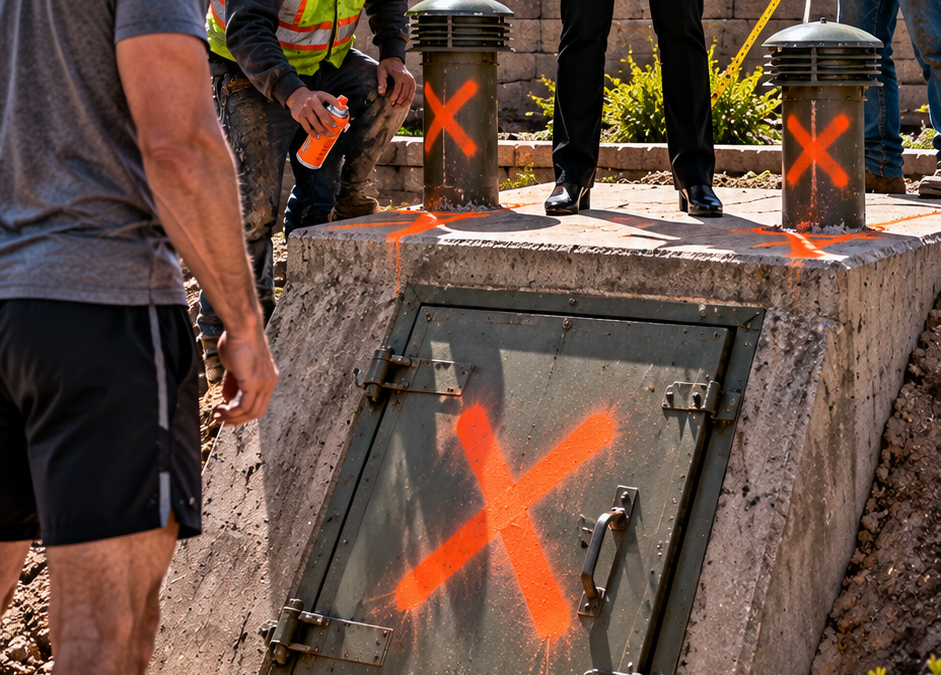
She had two contractors measuring the steel hatch, a can of orange marking paint in one man’s hand, and a demolition worksheet clipped beneath her fingers.
What disturbed me most was not that she had entered my yard without permission—it was the sentence on her paperwork calling my private bunker a community asset.
My name is Nathan Cole.
I was thirty-eight years old when Fairbrook Ridge tried to claim a concrete room buried beneath my backyard.
Until that Monday morning, my worst disagreement with the homeowners association had been a two-hundred-dollar fine over a trash bin I left beside my garage four hours longer than the rules allowed.
Annoying?
Yes.
Life-changing?
No.
I paid it because fighting over a trash bin felt like donating weeks of my life to prove I was technically correct.
The bunker was different.
At 6:18 that morning, I turned onto Juniper Trace after a three-mile run and immediately noticed my side gate standing open.
I never left it open.
Then I saw two unfamiliar men in work boots behind my house.
One carried a laser measure.
The other stood over the slanted steel access hatch with a can of fluorescent orange paint.
Between them stood Diane Worth.
Diane had been president of the Fairbrook Ridge HOA for six years.
She wore a red blazer, black slacks, and the kind of expression that suggested she considered every conversation a meeting she already chaired.
“Mark the access panel,” she told the younger contractor. “And both ventilation risers. The board needs the demolition estimate before Friday.”
I stepped through the gate.
“Put the paint down.”
The younger man froze.
Diane did not.
She slowly turned toward me.
“Nathan.”
“You’re in my yard.”
“This is an authorized safety assessment.”
“Authorized by whom?”
“The association.”
“I am not the association.”
The older contractor lowered his laser.
Diane lifted a clipboard and removed a sheet of paper.
“This underground structure has been identified as an unsafe, unregistered emergency asset. You have five days to provide inspection access. If you refuse, the board will proceed with enforcement.”
She handed me the notice.
I read it standing beside the hatch.
There was no county order.
No engineering report.
No fire marshal finding.
No permit number.
Only Diane’s signature and one sentence highlighted in yellow.
COMMUNITY EMERGENCY ASSET 3 MUST BE RETIRED BEFORE THE ANNUAL RESERVE REVIEW.
I read it twice.
Then I looked at her.
“What is Community Emergency Asset Three?”
For the first time, she did not answer immediately.
Her eyes moved toward the contractors.
The younger one spoke before she could stop him.
“According to the worksheet, it’s this bunker.”
I looked at the concrete mound beneath our feet.
Then back at Diane.
“You listed my shelter as an HOA asset?”
“It was part of the original civil defense system.”
“That wasn’t my question.”
“The structure connects to common property.”
“That still wasn’t my question.”
Her expression tightened.
“Nathan, this doesn’t need to become confrontational.”
“You brought demolition contractors into my yard before sunrise.”
“They’re not demolition contractors.”
The younger man slowly lowered the orange spray paint.
I looked at him.
Then at her.
“Then why did you ask him to mark the hatch for demolition?”
Nobody answered.
Eight years earlier, I bought the house at 214 Juniper Trace because I wanted quiet.
I had spent eleven years in the Army as an ordnance and mechanical technician.
My work involved generators, hydraulic systems, vehicle components, field equipment, and machines that punished anyone careless enough to believe metal had sympathy.
I liked that kind of work.
A broken machine did not care about office politics.
It did not care whether you were popular.
If you diagnosed the problem correctly and repaired it correctly, it worked.
If you did not, it didn’t.
After I left the service, I wanted the same simplicity from the rest of my life.
I found a civilian equipment-repair job outside Sacramento and bought the last house on the western edge of Fairbrook Ridge.
The property was less than a third of an acre.
Behind it ran a narrow HOA greenbelt.
And beneath six feet of soil behind my house sat a fifteen-by-twenty-foot concrete fallout shelter built in 1963.
The main entrance was in my backyard.
Two galvanized ventilation pipes rose beside it.
A narrow emergency shaft ran from the shelter’s western wall beneath the rear portion of my property before ending at a capped steel opening inside the greenbelt.
When I bought the house, the bunker appeared on every survey.
There was nothing secret about it.
I turned it into a workshop.
One steel bench held a small diesel generator I had been rebuilding.
Another held carburetors, gauges, injectors, filters, brackets, and military surplus mechanical parts.
I installed LED lights.
Restored the old ventilation fan.
Cleaned fifty years of oxidation from the steel stairs.
Sealed minor wall cracks.
Installed shelves.
Some men bought fishing boats.
Some disappeared into golf every weekend.
I needed a concrete room where every wrench stayed exactly where I left it.
That was all.
But two months before Diane appeared in my yard, I had bought a crate of surplus diesel parts from a county liquidation auction.
The wooden crate still had old military stenciling on the side.
I unloaded it after dark because rain was coming.
Apparently, someone saw me.
A box containing filters, injector pumps, brackets, and one alternator heavy enough to destroy my lower back became neighborhood gossip.
Diane looked toward the ventilation pipes.
“There are families within fifteen feet of this structure.”
“There are families fifteen feet from most houses in this subdivision.”
“People have reported military equipment being carried underground at night.”
“Engine parts.”
“You served in ordnance.”
“I repaired equipment.”
“You understand why people are concerned.”
I felt the conversation shift.
This was no longer about a reserve schedule.
She was building a story.
A former ordnance technician.
Military crates.
An underground bunker.
Secrecy.
Fear can turn ordinary facts into something dramatic if you arrange them correctly.
“What exactly do you think is down there?”
“I didn’t say I think anything.”
“Then why are you standing in my yard with contractors?”
“The board has a duty to investigate potential hazards.”
“If you believe there is an immediate hazard, call the fire marshal.”
Her jaw shifted.
“Or the county.”
Nothing.
“Or the sheriff.”
Still nothing.
“Do not send landscapers into my yard and call it emergency authority.”
The older contractor looked at Diane.
She tapped the yellow sentence on the notice.
“The annual reserve review is Friday. If this asset remains on the schedule, the association has to verify its condition.”
“This asset?”
“Yes.”
“You keep calling my property yours.”
“The board has been discussing this for months.”
“That is not the same thing as talking to me.”
I photographed the notice.
Then the contractors.
Their truck.
The open gate.
The orange paint.
“Leave.”
The contractors did.
Diane stayed.
For a moment, neither of us spoke.
Then she said something I would spend the next four days trying to understand.
“You don’t understand what has already been spent on that shelter.”
I stared at her.
“What does that mean?”
She turned away.
“Friday, Nathan.”
“Diane.”
But she was already walking through my gate.
By 7:10, I had locked it, saved footage from my security cameras, and covered my kitchen table with every document from the purchase of my house.
Deed.
Survey.
Title report.
Old plats.
Inspection photographs.
The shelter was entirely within my parcel except for the final portion of the emergency shaft, which extended beneath the greenbelt.
The title report referenced a 1964 civil defense access easement created by the original developer.
That was probably what Diane was relying on.
Then I saw the next entry.
RELEASE AND TERMINATION OF CIVIL DEFENSE ACCESS RIGHTS.
I ordered a certified copy from the county recorder.
Forty-three minutes later, it arrived by email.
I read it slowly.
The neighborhood’s civil defense program had been abandoned.
The secondary access obligation had ended.
Control of the underground shelter improvements returned to the residential parcel owner.
The greenbelt cap could remain for ventilation and emergency egress.
But neither the original developer nor any successor association retained a right to enter, inspect, control, or operate the shelter.
Fairbrook Ridge HOA, in its modern form, did not even exist when the document was signed.
That should have ended the property question.
It did not explain why my bunker appeared on an HOA reserve schedule.
And it definitely did not explain Diane’s comment.
What has already been spent.
At 9:30, I called the county building division.
A permit technician named Elena Ruiz answered.
I gave her my address and read the HOA notice.
I heard typing.
“We have the original shelter plan,” she said. “A residential addition permit from 1987 and the property survey associated with your purchase.”
“Is there a county demolition order?”
“No.”
“Is the bunker considered unregistered?”
“It appears in the historic property file.”
“So no.”
“I would phrase it more carefully than that.”
That answer made me trust her immediately.
Government records were complicated.
People who knew what they were doing rarely pretended otherwise.
“It is documented,” she continued. “That doesn’t automatically answer every current-use issue, but I do not see an active demolition order.”
“Can the county inspect it?”
“Yes.”
“Please.”
She transferred me to a building safety inspector named Marisol Vega.
I told Marisol exactly how I used the shelter.
“Any ammunition?”
“No.”
“Explosives?”
“No.”
“Fuel?”
“One drained generator tank.”
“Compressed gas?”
“No.”
“Solvents?”
“Parts washer solvent is stored in my detached garage.”
“Oil?”
“Two sealed quarts.”
“Good. Don’t move anything before I arrive.”
“When can you come?”
“Wednesday morning.”
I emailed Diane the certified 1989 release and the county confirmation.
I also requested every HOA document connected to “Community Emergency Asset 3.”
Reserve schedules.
Invoices.
Inspection reports.
Maps.
Work orders.
Board votes.
Vendor contracts.
Photographs.
Her answer arrived twenty minutes later.
The board will provide documents through the established member records process. The Friday review remains scheduled. Continued obstruction may result in additional enforcement.
She did not mention the release.
That afternoon, my neighbor Walt Higgins knocked on my door.
Walt was sixty-two, retired, and normally the sort of man who could turn returning a borrowed ladder into a forty-minute conversation.
That afternoon, he looked uncomfortable.
“Nathan, I think I may have started part of this.”
I let him inside.
“What part?”
“The crate.”
He explained that he had seen me unloading it months earlier.
He mentioned it to his wife.
Then someone else.
At a holiday committee meeting, another neighbor remembered I had served in ordnance.
The story grew.
“Did Diane ask you about it?”
“Yeah.”
“When?”
“Late November.”
“How many times?”
“Two or three.”
“What did she ask?”
“The size. Markings. Whether there were warning labels.”
“What did you tell her?”
“That I didn’t see any.”
I looked at the calendar.
Late November.
The violation notice was April.
If Diane truly believed I had dangerous military material underground beside six homes, she had waited almost five months before contacting me.
No fire department.
No sheriff.
No county.
No emergency inspection.
Nothing.
People do not postpone emergencies until accounting week.
I asked Walt to email me the dates while he still remembered them.
He did it from my driveway.
That night, at 11:43, my rear security camera woke me.
Motion detected.
The camera covered the back fence and the greenbelt.
On my phone, a narrow flashlight beam moved through the trees.
Toward the old emergency shaft.
I pulled on boots and went outside.
Three sections of greenbelt path lighting were dark.
About forty yards west of my yard, someone was kneeling beside the circular steel cap with a socket wrench.
“Leave the bolts where they are.”
The person stood.
Diane.
She wore dark pants and a black windbreaker.
In one hand was the wrench.
In the other was a small brass plate.
I knew that plate.
It had been bolted to the cap for decades.
SECONDARY EGRESS — SHELTER 3
DO NOT OBSTRUCT
I had photographs from my home inspection eight years earlier.
“What are you doing?”
“That marker belongs to the association.”
“The release says this cap remains part of my shelter system.”
“The cap sits on common property.”
“Then why are you removing a safety marker at midnight?”
She glanced toward the greenbelt.
“Residents keep tripping near it.”
I looked at the ground.
There was no path within ten feet.
No worn grass.
No disturbed soil.
No bench.
Nothing.
“Put it back.”
“Maintenance will document it tomorrow.”
“You are maintenance tonight.”
Her polished tone cracked.
“You have turned a straightforward safety review into a personal war.”
I stared at the wrench.
“I was asleep.”
She said nothing.
“You brought the wrench.”
She set the brass plate on top of the cap.
Did not reinstall it.
Then walked away.
I photographed everything.
The loose bolts.
Tool marks.
Dead path lights.
The brass plate.
I saved the camera video in three places.
Wednesday morning, Marisol Vega arrived at 8:15.
Before opening the bunker, I showed her everything.
Deed.
Survey.
Release.
HOA notice.
The previous night’s photographs.
She listened without taking sides.
Then she inspected.
Forty-five minutes.
Stairs.
Hatch.
Ventilation.
Electrical panel.
Moisture.
Shelving.
Drain.
Generator.
Parts.
The military crate.
She opened it herself.
Inside were filters, metal brackets, injector pumps, hoses, and the alternator.
She looked at me.
“This is what caused the rumor?”
“Apparently.”
She lifted one bracket.
“Terrifying.”
It was the only joke she made.
Then she asked about the secondary egress.
I opened the interior steel door.
A narrow concrete passage extended west.
Normally, faint daylight should have shown around the exterior cap.
It didn’t.
Marisol turned on her flashlight.
We walked closer.
The internal release lever was still there.
I pulled it.
The mechanism moved about two inches.
Stopped.
Metal struck metal.
Marisol crouched.
“Again.”
I pulled.
Clank.
She climbed closer to the end and shone her light upward.
Then she looked at me.
“Somebody installed a crossbar over the exterior release.”
“What?”
“The bolts look recent.”
I squeezed past her.
She was right.
The shaft was sixty years old.
The new steel was not.
Clean galvanized bolts.
Fresh washers.
Bright threads.
“Did you install this?”
“No.”
“Can you open the cap from inside?”
I pulled harder.
The lever stopped against the crossbar.
No.
The HOA had spent months calling my bunker unsafe.
Someone operating from HOA property had physically disabled its second exit.
Marisol photographed the entire mechanism.
Then called her supervisor.
When she finished, she spoke carefully.
“I can document two things.”
“Okay.”
“First, I observed no immediate hazardous material condition inside this workshop.”
I exhaled.
“Second, the secondary egress is obstructed externally.”
“Does the shelter need to be demolished?”
“I see no county basis for emergency demolition today.”
I looked toward the blocked shaft.
“Who is responsible?”
“That depends on ownership and who installed the obstruction.”
Fair.
She was not there to hand me the conclusion I wanted.
She was there to record what existed.
Later that afternoon, she issued a written field observation.
The report was balanced.
Ventilation motor should be serviced.
Illuminated exit marker recommended.
Secondary egress should be restored if I intended to use it as an emergency route.
Normal things.
Fixable things.
Nothing resembling Diane’s emergency demolition language.
But the inspection had created a new question.
Who installed the crossbar?
And why?
At noon, I submitted a formal records request to the HOA management office.
Twelve categories.
All narrow.
Reserve study pages.
Invoices.
Canceled checks.
Project maps.
Inspection notes.
Vendor bids.
Work orders.
Emails relating to Shelter 3.
Thomas Bell, the property manager, read the list.
“This is a lot.”
“The hearing is Friday.”
He looked uncomfortable.
“Thursday.”
“What?”
“Diane moved it up.”
“When?”
“This morning.”
I stared at him.
He lowered his voice.
“Off the record?”
I waited.
“Ask for the reserve study site photographs.”
“Why?”
“Because I’ve never seen one taken inside your shelter.”
Then he stood up and opened his office door.
Conversation over.
That afternoon, Diane sent a settlement agreement.
The HOA would withdraw enforcement if I granted a ten-year access license allowing Fairbrook Ridge to inspect and designate the bunker as an emergency shelter during declared events.
The HOA would maintain the greenbelt exit.
I would receive no payment.
The license would bind future owners.
I called her.
“If the bunker is too dangerous to exist, why do you want a ten-year license to use it?”
Silence.
Then:
“Remediation may be more economical than removal.”
“Your contractors had a demolition worksheet.”
“The board is evaluating options.”
“What about the reserve review?”
“Association business.”
“You listed my bunker as an association asset.”
“That doesn’t make reserve accounting your business.”
“It makes the use of my address my business.”
Her voice chilled.
“Sign the license, Nathan.”
“No.”
“The violation disappears.”
“No.”
“The hearing disappears.”
“No.”
“We restore the greenbelt exit.”
I stopped.
“Who installed the crossbar?”
She hung up.
That was when I stopped believing Friday was simply a deadline.
Diane needed one of two things before someone opened the reserve file.
Either she needed my signature creating present-day HOA rights over the bunker.
Or she needed the bunker officially classified as something being removed.
Both outcomes would explain why an HOA reserve schedule contained a private shelter nobody had legally accessed.
At 4:26, I received an email from Priya Anand.
Priya was the HOA treasurer.
We had spoken maybe twice in eight years.
Her message contained one sentence.
You are asking about a project I never approved in the form that was ultimately paid.
Attached was one page.
Reserve Schedule.
Line 12B.
COMMUNITY EMERGENCY ASSET 3
SHELTER VENTILATION, EGRESS STABILIZATION & PATH LIGHTING
$47,200
COMPLETE
Project location:
214 Juniper Trace.
My home.
I stared at the page.
No HOA contractor had repaired my ventilation.
No contractor had entered my bunker.
The egress was not stabilized.
It had been blocked.
Several path lights did not even work.
Yet the HOA books said $47,200 had been spent on completed work associated with my property.
Diane’s demolition notice suddenly made sense.
Anyone inspecting the bunker would discover the work did not exist.
I called Priya.
“How did my address get onto this?”
“I’ve been trying to figure that out.”
“What did the board actually approve?”
“A safety project last March.”
“Specifically?”
“Path lights. Playground emergency call box. Pond fencing. A condition survey of older greenbelt structures.”
“My bunker?”
“Not in the packet I received.”
I sat down.
“What changed?”
“After the vote, Diane and management consolidated line items.”
“And my address appeared?”
“Yes.”
“Was Shelter 3 listed as an HOA asset?”
“Not in my version.”
“Did you object?”
“Yes.”
“What did Diane say?”
“That an old civil defense map established association control and legal had already reviewed it.”
“Did you see the legal opinion?”
“No.”
I emailed Priya the 1989 release.
She went silent.
When she finally spoke, her voice was different.
“This was not in the board packet.”
That sentence mattered.
Boards made bad decisions all the time because someone missed something.
But if a relevant document had been withheld, that was different.
Priya agreed to meet me at a coffee shop across town.
She brought records she was entitled to access as treasurer.
The original project allocation was straightforward.
Fourteen greenbelt path lights: $9,400.
Playground call box and pond fencing: $5,600.
Legacy greenbelt structure assessment and safety improvements: $32,200.
No private residential address appeared.
Then we reviewed the checks.
$9,400 to Northgate Electrical.
$31,800 to Hearthstone Grounds.
$6,000 to the reserve consultant.
“The call box contractor?” I asked.
“Never paid.”
“What did Hearthstone build?”
Priya opened photographs.
Stone pillars.
Low walls.
Flagstone.
Decorative lighting.
Drainage gravel.
Seating.
I recognized the location.
Larksburg Court.
Diane’s cul-de-sac.
A year earlier, the northern greenbelt behind Larksburg had been grass, two oak trees, and a dirt maintenance trail.
Now it had a landscaped entrance and a flagstone seating area.
The HOA newsletter called it the Larksburg Gathering Point.
I assumed the five houses on that street had funded it privately.
They had not.
“Is this open to every resident?”
“Technically.”
“What does technically mean?”
“The finished entrance is beside Diane’s driveway.”
“And from the greenbelt?”
“Dirt path.”
I looked at the photographs.
The project may have sat on common land.
But it functioned like a private amenity for one cul-de-sac.
More importantly, it was not work performed at my house.
Priya showed me the reserve consultant’s site map.
A faded 1964 civil defense drawing.
My shelter was labeled Station 3.
The shaft crossed into what later became the greenbelt.
The 1989 release was missing.
“Who provided this?”
“Diane.”
“Who told the consultant Shelter 3 was still an HOA asset?”
“Diane.”
“Who approved the completed line?”
“Management entered it. Diane electronically approved the certification.”
I sat back.
That still did not automatically prove theft.
The gathering point existed.
Contractors had done real work.
Reserve funds had paid for something.
But the accounting tied that money to improvements that did not exist at my property.
“Why is Friday so important?”
Priya folded her hands.
“Fairbrook Ridge is refinancing the clubhouse repair.”
“And?”
“Master insurance renewal.”
“So?”
“The reserve consultant is verifying high-risk assets.”
I understood before she finished.
“Asset Three.”
“Yes.”
“No interior photos.”
“No closeout documents.”
“No owner access agreement.”
“If I sign Diane’s license—”
“The access problem disappears.”
“And if she retires the bunker?”
“The consultant can close the line as an asset-disposal issue instead of asking why completed improvements cannot be verified.”
There it was.
For the first time, everything formed one shape.
The rumors.
The demolition worksheet.
The access license.
The blocked exit.
The midnight removal of the brass marker.
The accelerated hearing.
The reserve review.
Diane did not need my bunker gone because she feared what was inside it.
She needed paperwork that explained why $47,200 of alleged work could not be inspected.
The next morning, Priya used her authority as treasurer to request original invoices from Northgate and Hearthstone.
Both responded.
Northgate had replaced five path lights.
Not fourteen.
The invoice explained that the remaining underground cable was damaged and required separate trenching approval.
That approval never came.
Hearthstone’s invoice listed the Larksburg common area.
Stone entry columns.
Grading.
Flagstone.
Drainage.
Seating walls.
Nothing about Juniper Trace.
Nothing about bunker ventilation.
Nothing about egress stabilization.
Nothing about Shelter 3.
The contractors had not falsified their invoices.
Someone inside the association had changed the coding afterward.
Priya sent everything to the full board and association counsel.
Within an hour, Thomas Bell issued a preservation notice.
No director.
No staff member.
No vendor.
No manager.
Nobody was to delete emails, destroy records, or alter project files.
At 2:17 that afternoon, my phone rang.
Luis Ortega.
HOA maintenance supervisor.
“I installed the crossbar.”
I stopped what I was doing.
“When?”
“December twelfth.”
“Why?”
“The work order said the shaft was abandoned.”
“Who issued it?”
“Diane.”
My hand tightened around the phone.
“Send me the work order.”
“I will.”
“Did you know the shaft connected to my bunker?”
“No.”
His voice sounded embarrassed.
“I should have checked.”
“You followed an HOA work order on HOA property.”
“That doesn’t mean it was a good work order.”
I respected that answer.
The document arrived five minutes later.
SECURE ABANDONED EGRESS AGAINST UNAUTHORIZED ENTRY PENDING ASSET RETIREMENT.
Signed electronically:
Diane Worth.
Attached was a photograph of the brass plate still bolted to the cap.
Special instruction:
REMOVE IDENTIFYING MARKER AFTER FINAL BOARD AUTHORIZATION.
There had never been final board authorization.
That was why Diane came with a wrench at midnight.
She was finishing the instruction herself before Friday.
By Wednesday evening, the dispute was no longer contained to board emails.
Diane sent a “Safety Clarification” to all ninety-six homes.
She did not say explosives.
She did not need to.
She referenced an undisclosed underground workshop.
Military surplus equipment.
Obstructed association access.
An owner refusing cooperative inspection.
Within two hours, the neighborhood forum exploded.
One resident asked whether the six nearest homes should temporarily evacuate.
Another demanded the fire department enter immediately.
Someone else wrote that “military ordnance should never be stored beneath residential property.”
Walt responded.
He explained what the crate actually contained.
His comment disappeared twenty minutes later.
I saved screenshots.
That night, a woman walking with two children saw me near my mailbox.
For years, she had waved.
This time, she crossed the street.
That hurt more than I expected.
I could respond to a bad survey.
I could respond to a false reserve entry.
I could fix a blocked hatch.
But fear creates images faster than facts can remove them.
I posted one message.
The county inspected the shelter today. No explosives, ammunition, or immediate hazardous material condition were found. The HOA has received the report. I will address the ownership and financial records at tomorrow’s hearing.
Then I logged out.
Rumors do not improve through repetition.
At 8:40 that night, Diane called.
“You are exposing the association unnecessarily.”
“The association used my address to claim forty-seven thousand dollars in completed work.”
“That reserve line consolidates related projects.”
“Then why does it identify my shelter?”
“The emergency shaft connects to common property.”
“The access rights ended in 1989.”
“Our counsel has not accepted your interpretation.”
“Your counsel issued a preservation notice.”
Silence.
Then her voice changed.
Less ceremonial.
More tired.
“If the reserve review fails, the clubhouse financing could be delayed.”
“Okay.”
“Insurance may broaden its inspection.”
“Okay.”
“Assessments could rise.”
That was the first real argument she had made.
Ninety-six families could pay for mistakes they did not create.
I knew what special assessments did to people.
Priya had already explained Tom Higgins was not the only resident struggling financially.
But protecting neighbors did not require pretending my property belonged to them.
“Withdraw the enforcement notice,” I said.
“Nathan—”
“Restore the exit.”
“The board—”
“Correct the reserve schedule.”
She was silent.
“Then explain the money.”
“Sign the license.”
“No.”
“Then tomorrow becomes public.”
“You made it public this afternoon.”
She ended the call.
The Fairbrook Ridge clubhouse comfortably held eighty people.
By 6:45 Thursday evening, one hundred twelve residents were inside.
Another dozen stood near the doors.
Diane sat in the middle of the board table.
Red suit.
Straight posture.
Folder aligned perfectly with the table edge.
Priya sat two chairs away with a banker’s box beside her.
Thomas Bell sat near association counsel, Mara Chen.
The agenda had two items.
Enforcement concerning the underground structure at 214 Juniper Trace.
Then:
Review of discrepancies in Reserve Project 12B and possible action concerning responsible officers.
Diane had put the bunker first.
She began with photographs.
My hatch.
Ventilation pipes.
Military crate.
She spoke calmly.
No dramatic accusations.
No raised voice.
She described unresolved safety concerns.
Denied access.
An underground structure connected to common property.
A former military technician storing surplus equipment.
Everything she said was carefully framed.
That was why Diane had stayed president so long.
She knew how to make control sound responsible.
When she finished, Mara Chen addressed the room.
“This is not a county demolition proceeding.”
The room shifted.
“The association is deciding whether to continue internal enforcement, seek judicial relief, negotiate access, or suspend action pending further review.”
That one sentence stripped most of the power from Diane’s original notice.
Then I was given the floor.
I did not begin with the money.
I began with safety.
Marisol’s report appeared on the projector.
Photographs showed my workshop exactly as she found it.
Clean benches.
Generator.
Parts.
Ventilation.
No explosives.
No ammunition.
No immediate hazardous condition.
I read her conclusion.
No county basis for emergency demolition observed.
Then I displayed the secondary shaft.
Old interior release.
New crossbar.
December work order.
Diane’s electronic signature.
Luis Ortega’s statement.
The room became quiet.
“The HOA called this shelter unsafe,” I said, “after its own maintenance order disabled the second exit.”
Diane leaned toward her microphone.
“The crossbar was installed because the exterior shaft was believed abandoned.”
I nodded.
“Four months before anyone notified me.”
She stopped.
I placed the 1964 access easement beside the certified 1989 release.
“One created limited civil defense access.”
Next slide.
“One terminated it.”
Board member Cliff Bannister leaned forward.
“Did legal review this release before Monday’s notice?”
Diane answered carefully.
“The release was not in the file available to us.”
Cliff looked at her.
“Nathan emailed it Monday morning.”
“Yes.”
“Before you moved the hearing forward?”
Diane did not answer.
“And before the community safety email?”
Still no answer.
I displayed the ten-year access agreement.
“Monday morning, the shelter was described as too dangerous to remain.”
I looked toward the residents.
“Tuesday afternoon, the HOA offered to withdraw enforcement if I gave it a ten-year right to use the same shelter.”
Diane interrupted.
“Adaptive reuse was one option.”
“For an asset you did not own.”
Mara raised one hand.
“Let Mr. Cole finish.”
I closed the property folder.
“I am asking the board to suspend enforcement because the county found no emergency basis for demolition, because the HOA itself blocked the secondary egress, because the recorded access right ended decades ago, and because the proposed solution was not a safety repair.”
I looked at Diane.
“It was my signature on a new access license.”
Then Priya stood.
She carried the banker’s box to the table.
No accusation.
No speech about corruption.
She did something more effective.
She reconciled the money.
“The board approved forty-seven thousand two hundred dollars for three categories.”
The original schedule appeared.
Path lighting.
Emergency equipment and fencing.
Legacy greenbelt structure assessment and improvements.
Then the invoices.
Northgate Electrical.
Five lights.
Hearthstone Grounds.
Larksburg gathering point.
Reserve consultant.
Then the final project code.
$47,200 complete.
Location:
Shelter Asset 3.
214 Juniper Trace.
Priya placed Hearthstone’s invoice on the projector.
LOCATION: LARKSBURG COURT COMMON AREA.
Then Thomas displayed the management coding email.
The sender was Diane.
Consolidate Larksburg hardscape and northern safety work under Project 12B. Use Shelter Asset 3 as controlling location so expenditure remains within approved reserve category. Do not attach owner release document until counsel confirms whether it affects asset continuity.
Six weeks earlier.
The room went silent enough that I could hear the air-conditioning compressor.
That email mattered more than anything else.
The issue was no longer simply that an old release had been overlooked.
Diane knew there was a release.
And she had instructed management not to attach it while reserve work was being coded.
She had turned my bunker into an accounting location.
Diane read the email on the screen.
Her hands remained still.
“That message is being shown without context.”
Priya answered.
“Then provide the context.”
“The Larksburg project improved common property.”
“No one disputes that.”
“Shelter 3 belonged to the same northern safety corridor.”
“Then why does the completed line say ventilation and egress stabilization?”
“Those were contemplated components.”
Priya’s voice stayed calm.
“Were they completed?”
“Access was denied.”
I leaned toward the microphone.
“No one asked me for access until Monday.”
Residents began asking questions.
Not shouting.
Questions were worse.
Why were only five lights repaired?
Why had the call box never been fixed?
Why was the gathering point coded to Juniper Trace?
Why did its only paved entrance sit beside Diane’s driveway?
Why did the reserve consultant receive a 1964 map but not a 1989 release?
A woman in the second row asked whether reserve funds could be moved that way without another vote.
Mara refused to improvise a legal opinion.
“The governing documents, meeting notices, reserve requirements, and management agreement need independent review.”
That was enough.
Cliff Bannister made four motions.
First:
Suspend all enforcement concerning my bunker pending completion of the property and financial review.
Passed four to one.
Second:
Restore the secondary egress using a neutral contractor under county observation, and prohibit further entry onto my parcel without written permission or lawful authority.
Passed four to one.
Third:
Appoint an independent accountant and outside counsel to investigate Reserve Project 12B, the Larksburg work, and all changes in project coding.
Passed four to one.
Fourth:
Remove Diane from the office of board president pending that review.
Not from her elected director seat.
That required a separate process.
Passed four to one.
Diane cast every opposing vote.
Nobody applauded.
I was grateful.
I did not want revenge theater.
I wanted nobody showing up at my house with a demolition worksheet again.
Friday morning, the reserve consultant arrived at my property with Priya, Thomas, and the new interim president.
I let them inspect the bunker.
Voluntarily.
That distinction mattered.
Permission after disclosure is not the same thing as authority taken before anyone asks.
The consultant photographed the ventilation system.
My LED fixtures.
The generator.
The emergency shaft.
The interior release.
He compared equipment serial numbers to the vendor records.
There were no matches.
Because reserve-funded equipment had never been installed in my shelter.
That afternoon, he revised the schedule.
Community Emergency Asset 3 was removed.
The bunker became:
PRIVATELY OWNED PRE-ASSOCIATION STRUCTURE — NO CURRENT HOA ACCESS RIGHT.
Project 12B was changed from Complete to Under Audit.
And then something even more important happened.
Nothing catastrophic.
The clubhouse financing did not evaporate.
The insurer did not cancel Fairbrook Ridge.
Property values did not collapse overnight.
The lender requested corrected reserve documents and the independent audit.
Closing was delayed twenty-three days.
Professional fees increased.
Inconvenient?
Yes.
Disaster?
No.
For a week, Diane had convinced people that questioning the records would destroy the neighborhood.
In reality, the greatest danger had been allowing bad records to survive because someone feared a deadline.
The independent audit took seven weeks.
I read the final report twice.
Hearthstone Grounds had not falsified anything.
Neither had Northgate Electrical.
They performed the work they were hired to perform.
The problem was internal.
$31,800 in reserve funds had paid for the Larksburg gathering point without the classification and notice required for that type of work.
Northgate received $9,400 for the five path lights actually replaced, but the remaining light repairs were never authorized.
The call box work was never completed.
The pond fencing project had been delayed.
The reserve consultant had been given the 1964 civil defense map without the 1989 release.
And the report concluded that Diane directed management to code unrelated work under my shelter after Priya questioned whether the Larksburg improvements qualified for the reserve category.
There were no agents at Diane’s door.
No dramatic arrest.
No handcuffs.
Real consequences rarely arrive with background music.
Diane resigned her director seat three days before the scheduled recall vote.
Under a civil settlement reviewed by association counsel, she reimbursed a substantial share of the improperly allocated cost.
The management company and the HOA’s fidelity carrier resolved the remaining accounting loss.
Residents did not receive a special assessment for the discrepancy.
The stone gathering point remained.
But the entrance beside Diane’s driveway was redesigned.
A proper public path connected it to the main greenbelt.
It finally became the community amenity the paperwork had claimed it was.
Northgate repaired all fourteen path lights.
The playground call box received a new battery and weatherproof enclosure.
The pond fence was replaced before summer.
Then Luis Ortega came to my house with Marisol present.
He removed the crossbar.
The release lever moved smoothly.
The exterior cap opened.
Fresh air entered the concrete shaft.
Luis reinstalled the brass marker using stainless bolts.
He held up the old crossbar.
“You want this?”
I looked at it.
For months, it had been the physical proof that somebody could call a structure dangerous while making it less safe.
“No.”
“Scrap?”
“Scrap it.”
I did not need a trophy.
The HOA added the 1989 release to its permanent property records.
A new policy required current title support before any privately owned structure could be listed as an association asset.
Reserve project locations could not be changed after approval without sign-off from two directors and management.
I declined every suggestion that the bunker become an official community shelter.
That surprised some people.
After everything, they assumed I would want to prove a point by opening it permanently.
I didn’t.
Emergency occupancy involves ventilation, capacity, liability, maintenance, access, and inspection.
Those questions deserved more than an emotional vote at the end of a scandal.
My workshop stayed private.
But something else changed.
On the first Saturday of every month, I started inviting a few neighbors down.
Not the entire community.
Just people who had something broken and wanted to learn.
Walt brought over a generator that had not run in three years.
The carburetor looked like it had been filled with syrup.
We cleaned it together.
Frank Delgado rolled a riding mower down my driveway with a fuel-delivery problem.
Two teenagers from the next block learned to use a multimeter without electrocuting themselves or destroying the meter.
Someone brought an old pressure washer.
Someone else brought a chainsaw.
We fixed one thing at a time.
Walt apologized to me again about the military-crate rumor.
I told him he had already apologized.
“I still feel stupid.”
“You saw a military crate.”
“I told people.”
“You told your wife.”
“And Gary.”
“Everybody tells Gary everything.”
He laughed.
Then he looked around the bunker.
“I really thought there’d be more mystery down here.”
I pointed toward the shelf.
“See that fuel injector?”
“Yeah.”
“That’s about as exciting as it gets.”
One night after everyone left, I went downstairs alone.
The new exit sign glowed above the secondary shaft.
I switched off the LED lights.
Darkness filled the room.
Then I saw it.
A thin line of moonlight around the far cap.
Exactly where it should have been.
For months, Diane had treated the bunker as three different things depending on what she needed.
When fear helped her, it was a public danger.
When reserve accounting helped her, it was a community asset.
When documentation became inconvenient, it was a structure needing retirement.
But property does not change identity because somebody changes the label in a spreadsheet.
The bunker was not an HOA asset because an old map called it Station 3.
It was not dangerous because a rumor sounded dramatic.
It was not community property because one end of a ventilation shaft reached common land.
It was a concrete room beneath my property.
If the HOA wanted to enter it, they had to ask.
If they wanted to spend association money on it, they needed legal authority.
If they believed it was unsafe, they needed evidence from someone qualified to say so.
That might sound like paperwork.
I do not think it is.
I think it is the difference between concern and control.
Concern asks a question.
Concern accepts an answer supported by evidence.
Concern changes direction when the facts change.
Control decides the answer first.
Then it searches for a document willing to repeat it.
Diane’s mistake was not being concerned about a sixty-year-old underground shelter.
Old structures should be inspected.
Her mistake was believing concern gave her permission to disable an exit, hide a release, recode expenditures, enter private property, and demand a signature she had never earned.
The shelter survived the Cold War without ever serving its original purpose.
More than sixty years later, it survived something smaller.
Less dramatic.
And in some ways more familiar.
People looking at an old line on a map and mistaking it for permission.
Sometimes I still find the first violation notice in my records cabinet.
The yellow-highlighted sentence is there.
COMMUNITY EMERGENCY ASSET 3 MUST BE RETIRED BEFORE THE ANNUAL RESERVE REVIEW.
I used to think the most important word in that sentence was “retired.”
Now I think it was “community.”
Because repeating that word often enough had allowed Diane to treat private property as though it belonged to everyone except the person who owned it.
The last time I read the notice, I carried it downstairs.
I stood beside the steel bench.
The old diesel generator was running again.
Smooth idle.
No smoke.
No strange vibration.
The military crate sat against the wall.
Inside it were exactly the same boring parts that had started half the rumor.
And at the far end of the room, moonlight showed around the restored emergency cap.
I folded the notice.
Put it back in the file.
Then I shut the cabinet.
The hatch above me was still mine.
The room beneath it was still mine.
And for the first time in months, nobody needed me to prove either one.

