𝗙𝗨𝗟𝗟 𝗦𝗧𝗢𝗥𝗬 The Orange Mark on My Grandfather’s Oak Told Me the HOA Had Come for More Than a Firebreak
𝗙𝗨𝗟𝗟 𝗦𝗧𝗢𝗥𝗬
I looked at her.
Then I looked back at the log decks.
Walnut.
White oak.
Poplar.
Sorted by value.
Not by hazard.
Not by fuel class.
Not by fire behavior.
By value.
I opened the truck door.
“Stay in the vehicle,” Ranata said.
“No.”
“This is an active work zone.”
“This is Mabry Ridge.”
“This operation has been authorized.”
“By whom?”
“Lakewood Pines.”
I almost thought I had misheard her.
“Lakewood Pines doesn’t own this land.”
“The Wildland Safety Corridor includes this area.”
“There is no Wildland Safety Corridor on my deed.”
She stood straighter.
“The corridor exists to protect the community.”
I pointed toward the trailers.
“Then why are you taking only the expensive timber?”
For the first time, she did not answer immediately.
The loader picked up another black walnut log.
Placed it carefully on a trailer.
Behind it, piles of brush remained untouched.
Young red maple.
Mountain laurel.
Dense understory.
The kind of fine and ladder fuels that actually matter during wildfire behavior.
I looked back at Ranata.
“This isn’t a firebreak.”
“Mr. Mabry—”
“You’re harvesting my land.”
Her jaw tightened.
“Turn off the camera.”
I had not realized until then that I had pulled out my phone.
I raised it higher.
“No.”
“You are obstructing an authorized emergency operation.”
“Good.”
“Excuse me?”
“Then somebody should be able to show me the authorization.”
Three days earlier, Ranata had come to my house in a spotless white SUV.
She had worn a slate-gray suit and a laminated badge clipped near her lapel.
She had stood at the end of my drive with the expression of someone accustomed to having documents end arguments.
“Your timber activity violates Lakewood Pines Community Standard 412,” she had said.
I had looked at the packet.
“My timber activity?”
“The eastern ridge presents an unacceptable wildfire condition.”
The notice identified roughly forty acres of Mabry Ridge as the Lakewood Pines Wildland Safety Corridor.
It ordered me to submit a wildfire remediation plan within fourteen days.
I had read it carefully.
Then I looked at her.
“I’m not a member of Lakewood Pines.”
“The corridor protects the entire community. Participation is not optional.”
“Where is it recorded?”
That was the first moment her eyes had moved away from mine.
“All relevant authority is cited in the notice.”
It wasn’t.
I checked every page after she left.
Internal HOA rules.
Board policy.
Community Standard 412.
But no deed easement.
No county order.
No state forestry notice.
No fire marshal directive.
No recorded agreement.
Nothing giving Lakewood Pines control over an inch of Mabry Ridge.
My deed was recorded in Book 47, Page 312.
My latest survey was nine years old.
The Lakewood Pines subdivision plat ended west of a drainage swale.
My closest corner monument stood another thirteen hundred feet east.
There was no overlap.
No shared road.
No common parcel.
No ambiguity.
I had called my attorney, Dora Phelps, the same afternoon.
“Send me the notice,” she said.
“I already scanned it.”
“Deed too.”
“Done.”
“Survey.”
“I’ll send it.”
“And the subdivision plat if you have it.”
“I do.”
She planned to respond the following Monday.
That would still have been well inside the fourteen-day deadline Ranata herself had given me.
But Ranata did not wait for Monday.
She did not wait for my response deadline.
She did not even wait for sunrise.
Now I stood on my ridge while machines cut trees eleven days before my supposed time to comply had expired.
I parked my pickup sideways across the temporary haul road.
Then I called the sheriff’s non-emergency number.
After that, I began recording properly.
Wide shot first.
The clearing.
Machines.
Floodlights.
Trailers.
Orange paint.
Ranata.
Then the access route.
Fresh tracks crossing my posted gate.
My steel chain lying in two pieces in the ditch.
I narrated the time.
Location.
Weather.
I filmed every truck plate I could see.
Ranata came toward me.
“Move your vehicle.”
“No.”
“You are blocking an authorized safety operation.”
“Show me the county authorization.”
She held up a plastic folder but did not hand it over.
Through the clear cover, I could see a one-page work order.
Ranata’s signature.
Douglas Harker’s signature.
Douglas was president of Lakewood Pines.
The work description read:
HAZARDOUS FUEL REDUCTION.
Then I saw the payment section.
Three words.
TIMBER SALVAGE CREDIT.
I zoomed my camera toward it.
Ranata immediately pulled the folder against her chest.
That movement did not prove everything.
It did not prove theft.
It did not establish intent.
But it told me she understood that the payment language was not something she wanted me examining closely.
The feller buncher shut down.
A heavyset man wearing an orange helmet walked toward us.
He introduced himself as Dale Puit, owner of Ridgeline Land Services.
“I have a signed contract,” he said.
“You crossed a locked gate.”
“They told me this was HOA-controlled property.”
“Who told you?”
He looked at Ranata.
She answered.
“The jurisdiction issue has already been reviewed.”
“Then reviewing it again should be easy.”
Deputy Elena Ruiz arrived seventeen minutes later.
I remember the exact time because I had been recording continuously.
She did exactly what I hoped she would do.
She did not arrive pretending she could resolve a property dispute from the hood of a patrol car.
She asked questions.
She photographed documents.
I showed her my deed and survey.
Ranata showed her the HOA work order.
Deputy Ruiz asked Dale for his contract.
“Read the parcel number,” she said.
He did.
I recognized it before he finished.
It was the Lakewood Pines clubhouse parcel.
Dale looked at the page.
Then at Ranata.
Ranata said, “That’s an administrative reference number. It isn’t the work location.”
Deputy Ruiz asked another question.
“Does anyone have a county fire marshal order?”
Silence.
“A county permit?”
Nothing.
“A state forestry directive?”
No one produced one.
She turned to Dale.
“I’m not determining title here. But you have now been put on notice that ownership is disputed and that this owner is producing recorded documents inconsistent with your authorization.”
Dale looked toward the machinery.
“What does that mean for us?”
“It means continuing to cut after receiving that notice may increase your exposure.”
He did not need to hear it twice.
He shut down the remaining equipment.
Then he ordered his drivers off the ridge.
Before the first loaded trailer moved, I walked behind it and photographed the load ticket clipped near the rear plate.
Destination:
Bellweather Timber Exchange.
Fifty-eight miles south.
Fourteen black walnut logs on that trailer alone.
Then I looked uphill.
The Sentinel was still standing.
That was what my grandfather had called the white oak near the highest point of the eastern ridge.
It had been old when he bought the property.
He first photographed it in 1952.
My father continued taking a picture from the same flat stone every ten years.
I had continued after my father died.
The trunk measured almost fifty-two inches across at breast height.
And now a bright orange slash had been painted across its bark.
Marked for cutting.
I stood there staring at it.
If I had arrived an hour later, maybe less, I might have watched it fall.
Dora reached the ridge shortly after eight.
She stepped out of her car.
Looked across the eleven cleared acres.
And said nothing.
For nearly a minute.
Then:
“How much?”
“Approximately eleven acres completed.”
“And marked?”
“Almost forty.”
“Did you touch equipment?”
“No.”
“Threaten anyone?”
“No.”
“Did timber leave the property?”
I handed her my phone.
“At least two trailers before I got here.”
She enlarged the load ticket photograph.
Read the destination.
Then looked at me.
“This stopped being only a boundary dispute before breakfast.”
We spent the rest of that day preserving what still existed.
Harold Fitch, a licensed surveyor with thirty-one years in the county, came out before noon.
He found the monuments.
Set flagged stakes.
Used survey-grade equipment.
Measured the shortest distance between the actual clearing and the Lakewood Pines subdivision boundary.
One thousand three hundred forty-two feet.
Not thirteen.
Not thirty.
Not one fence line.
One thousand three hundred forty-two feet.
The logging crew had crossed my posted gate.
Driven my internal road.
And cut almost a quarter mile inside property Lakewood Pines had never owned.
Harold prepared a preliminary overlay.
Lakewood Pines in blue.
Mabry Ridge in red.
Between the two:
The drainage swale.
County utility land.
Part of an unrelated pasture.
The HOA’s so-called safety corridor existed only on the map Ranata had delivered.
Then Harold noticed something.
He put the official subdivision plat beside the HOA version.
“Look here.”
The recorded eastern boundary bent west around the drainage swale.
On Ranata’s map, that bend disappeared.
The line had been straightened.
Extended directly toward my ridge.
The county recording box had also been removed.
So had the surveyor’s seal.
I stared at the two maps.
One showed property.
The other showed a story.
That difference became the center of everything that followed.
Dora sent preservation notices that evening.
Lakewood Pines.
Ridgeline Land Services.
Bellweather Timber Exchange.
The property management company.
She demanded preservation of emails, texts, maps, invoices, contractor records, security footage, banking records, load tickets, and anything related to the operation.
She also sent a formal cease-and-desist notice.
The next morning at 9:16, Ranata answered.
One sentence.
Lakewood Pines intends to complete the emergency corridor within seventy-two hours.
Dora read it twice.
Then looked at me.
“That was a mistake.”
“Why?”
“Because now they have written notice from counsel, a disputed boundary, a sheriff’s report, and a surveyor on the ground.”
“And they’re still threatening to come back.”
“Yes.”
“What does that tell you?”
She folded the paper.
“That whatever they expect to gain from finishing this is important to them.”
The next clue was painted on the trees.
I walked the marked acreage with Stuart Cain, a consulting forester and timber appraiser.
Stuart had been evaluating hardwood stands for more than twenty years.
He carried a diameter tape, increment borer, and tablet loaded with regional pricing data.
But he did not begin with stumpage values.
He studied what had been left standing.
After twenty minutes, he said, “This isn’t a firebreak prescription.”
“Explain.”
He pointed at a dense thicket of young red maple and mountain laurel.
“That is ladder fuel.”
Then he pointed at a mature black walnut beside it.
Orange paint.
Marked.
“If wildfire behavior is the main concern, why leave the fine fuels and remove the merchantable overstory?”
We walked another hundred yards.
Same pattern.
Young brush left.
Low-value hollow trees left.
Healthy walnut marked.
White oak marked.
Tulip poplar marked.
Stuart stopped.
“They selected for value.”
“Not hazard?”
“Not from what I’m seeing.”
We counted fresh stumps across the first eleven acres.
Two hundred eighty-seven.
Stuart compared them against my last timber inventory.
Estimated removed stumpage value:
Just over $118,000.
If the crew had finished all 38.6 marked acres, the projected merchantable value exceeded $400,000.
Then Stuart bored three standing trees that had been marked for removal.
Healthy recent growth.
No sign of the beetle outbreak described in Ranata’s paperwork.
That did not mean Mabry Ridge was free of every possible forestry concern.
No forest is.
But the physical stand conditions did not match the emergency they had described.
At noon, Lakewood Pines posted a notice to its residents.
An emergency firebreak, it said, had been temporarily delayed by an adjacent landowner.
The message warned that my refusal was placing ninety-six families at risk.
By two o’clock, seven angry voicemails were waiting on my phone.
One man called me selfish.
Another said I was letting money matter more than safety.
One woman told me that if a child died in a wildfire, the blood would be on my hands.
That one stayed with me.
My younger brother had been a volunteer firefighter.
I had spent years maintaining access lanes.
Thinning hazardous understory.
Keeping equipment routes open.
Creating defensible areas around structures.
The HOA was not merely taking my trees.
They were using fear to turn people against me.
And fear moves faster than survey records.
I refused to argue online.
Instead, I posted one image.
Harold’s sealed survey overlay beside the altered HOA map.
Under it I wrote:
The disputed operation is 1,342 feet beyond the recorded Lakewood Pines boundary. A licensed forestry assessment is underway. I will release verified information when available.
Then I turned off my phone.
Twenty minutes later, I received a private message from Lena Park.
I serve on the Lakewood Pines finance committee.
The board never told us it planned to sell timber.
Call me from another number.
We met at a twenty-four-hour diner near the interstate.
Lena was forty-three.
An accountant.
The kind of person who looked angry without raising her voice.
She placed three documents on the table.
The first was Lakewood Pines’s annual budget.
Reserves:
$246,000.
The second was a capital estimate.
Clubhouse roof replacement.
Pool deck repairs.
Retaining wall reconstruction.
Total projected cost:
$684,000.
The third document was a slide from a closed executive-session presentation.
ALTERNATIVE CAPITAL RECOVERY.
At the bottom:
EASTERN CORRIDOR BIOMASS CREDIT — $312,000.
“Biomass?” I asked.
“That’s what Douglas called it.”
“Brush?”
“Brush. Hazardous material. Supposedly from HOA-controlled land.”
I slid Ranata’s map across the table.
“Did he show you this?”
Lena studied it.
“No.”
“What did you see?”
“A green rectangle. No owner name. No parcel number.”
“Who said the legal issue had been cleared?”
“Douglas.”
“By whom?”
“He said counsel.”
“Was counsel in the meeting?”
Lena looked at me.
“The association attorney resigned two days before the vote.”
I leaned back.
Now the picture was sharper.
The timber was not a side effect of a safety project.
It was part of the financing.
Six months earlier, Lakewood Pines residents had attended a polished town hall.
Douglas Harker stood in front of architectural renderings.
New fitness room.
Expanded pool deck.
Stone entrance walls.
New roof.
No special assessment.
Residents applauded.
What they had not been told was that the reserves covered barely a third of the promised work.
“Where did he say the rest was coming from?” I asked.
“A land management partnership.”
“Ranata?”
“She gave the presentation.”
Dora listened by phone as Lena explained what she had.
Then Dora asked:
“These documents were provided to you through your committee work?”
“Yes.”
“You were authorized to receive them?”
“Yes.”
“Do not take anything else outside your authorized access.”
Lena nodded.
“Preserve the originals.”
“I will.”
“And document when and how you received them.”
That caution mattered later.
Truth is not strengthened by collecting evidence illegally.
By Sunday morning, the HOA’s seventy-two-hour threat had expired.
No machinery returned.
Dora had obtained a temporary restraining order.
No entry.
No cutting.
No transport.
No timber sale.
No work on Mabry Ridge until ownership and authority could be reviewed.
Ranata called the order an interference with community safety.
The judge called it preservation of the status quo.
I preferred the judge’s wording.
On Monday, Bellweather Timber Exchange answered Dora’s preservation notice.
Four loads from Mabry Ridge had reached the mill before I stopped the operation.
Forty-six walnut logs.
Sixty-three white oak.
Twenty-one tulip poplar.
The mill had not processed them.
Why?
The scale tickets and seller certification did not match.
Lakewood Pines was not listed as the seller.
The seller was a company I had never heard of.
Eastern Ridge Resource Partners, LLC.
Authorized representative:
Douglas Harker.
The company had been formed eleven weeks earlier.
Its address was a mailbox store.
Its registered manager was Mason Harker.
Douglas’s brother-in-law.
Dora stopped me before I could say what I was thinking.
“A family connection is not proof that Douglas received money.”
“I know what it looks like.”
“Looking suspicious and proving misconduct are different.”
“I understand.”
“Good. Stay there.”
But the question had changed.
Why did an HOA president need a private company controlled by his brother-in-law positioned between my trees and a clubhouse renovation?
Dale Puit answered part of it.
His attorney requested a meeting.
Dale came to Dora’s office carrying a thick project folder.
Without his crew around him, he looked tired.
“I was told the association controlled the parcel.”
Dora asked, “By whom?”
“Ranata and Douglas.”
“You verified ownership?”
He looked down.
“No.”
It was the cleanest answer he gave all day.
No excuses.
No decoration.
I respected that more than I expected to.
But honesty after cutting two hundred eighty-seven trees is not the same thing as diligence before cutting a gate chain.
Dale’s contract priced the project at $187,000.
Lakewood Pines would pay only $25,000 cash.
The rest would come through timber.
Eastern Ridge Resource Partners would receive title to all marketable logs as a salvage credit.
Then it would pay Ridgeline’s remaining contract balance from the timber sale.
Projected gross timber revenue:
$380,000 to $430,000.
“Who calculated that?” I asked.
“Mason Harker.”
“He inspected my stand?”
“He had a timber cruise.”
Dale reached into the folder.
The moment I saw the cover, something inside me tightened.
LAKEWOOD PINES EASTERN CORRIDOR INVENTORY.
But I recognized the material underneath.
The species tables.
The diameter classes.
The management notes.
Then I turned to the final page.
My father’s old forest map.
I knew that document.
It was my 2008 timber cruise.
There was even a coffee stain along the lower edge.
My coffee stain.
Someone had taken my forestry records.
Removed my name.
Retitled them.
And used my own inventory to price the trees they planned to cut.
That angered me more than the fake boundary.
The fake map was crude.
This was careful.
Somebody had studied decades of management and converted it into a shopping list.
I tried to understand where they could have obtained it.
There had been no break-in.
No missing office files.
Then I remembered.
Eighteen months earlier, a utility company had studied a possible transmission route.
I had provided the county planning department with a copy of my survey and timber inventory.
Public planning file.
Accessible.
Somebody had found it.
Dale produced another document.
An email from Ranata.
Twelve days before the cutting.
Prioritize walnut and merchantable oak during Phase 1.
Revenue performance must be demonstrated before the board’s December financing review.
No mention of brush.
No mention of ladder fuels.
No mention of emergency access.
No mention of wildfire behavior.
Dora read it twice.
“This explains why they didn’t wait fourteen days.”
I looked at her.
“They needed mill tickets.”
“They needed revenue evidence.”
“So the fourteen-day notice—”
“Wasn’t designed to let you comply.”
She tapped the email.
“It was designed to make the operation look procedural.”
Dora amended the case.
Trespass.
Wrongful timber cutting.
Conversion.
Gate damage.
Road damage.
And enhanced damages if the conduct proved knowing or willful under state law.
Defendants:
Lakewood Pines.
Ridgeline Land Services.
Eastern Ridge Resource Partners.
Ranata Voss.
Douglas Harker.
Mason Harker.
They were allegations.
Not convictions.
That distinction mattered to me.
It should matter to anyone.
A strong case becomes weaker when you exaggerate what you have proven.
The defendants responded in different directions.
Ridgeline admitted it had entered under faulty authorization and opened settlement discussions.
Eastern Ridge claimed reliance on HOA rights.
Lakewood Pines claimed Ranata and Douglas exceeded their authority.
Ranata and Douglas said the board approved everything.
Dora almost smiled when she read the responses.
“What?”
“They’re giving us incompatible stories.”
“Isn’t that bad?”
“For them.”
The next Lakewood Pines board meeting drew more than seventy residents.
Dora advised me not to attend because litigation was active.
Lena recorded the public portion.
Douglas called the lawsuit opportunistic.
Ranata described Mabry Ridge as an unmanaged hazard bordering Lakewood Pines.
Then a resident named Frank Delaney raised his hand.
“How can it border us if the survey says it’s thirteen hundred feet away?”
Ranata answered:
“The measurement ignores the functional boundary of the wildland interface.”
Then Lena stood.
“Did the board authorize Eastern Ridge Resource Partners to sell the timber?”
Douglas stopped turning pages.
“Financial negotiations are confidential.”
“Is Eastern Ridge managed by your brother-in-law?”
The room changed.
You could hear it on the recording.
Chairs shifting.
People whispering.
Someone saying, “What company?”
Douglas ended the meeting six minutes later.
But forty-one homeowners remained in the parking lot.
They compared budget notices.
Emails.
Renovation promises.
By midnight, they had formed a recall committee.
That mattered to me because the residents had never been my enemy.
They had been frightened.
They had been told a neighboring landowner was putting their families at risk.
Once evidence gave them another explanation, they reconsidered.
The court allowed expedited discovery.
Lakewood Pines produced emails.
Board minutes.
Map files.
Contractor communications.
Payment records.
A digital drive and two banker’s boxes.
The altered map history came first.
The original file had been created on Ranata’s office computer.
Version one showed my true boundary in red.
Version two removed the red line and placed a green rectangle across Mabry Ridge.
PROPOSED HARVEST AREA.
Version three changed the label.
WILDFIRE SAFETY CORRIDOR.
Twenty-three minutes separated the versions.
Between version two and three came an email from Douglas.
Do not use harvest language in anything residents may request. Safety corridor is easier to defend, and the owner will negotiate once the work has started.
I read that sentence alone in Dora’s office.
Again.
Then again.
The strategy had never depended on believing they owned my land.
They expected irreversible damage to create leverage.
Cut first.
Negotiate later.
But the next document was worse.
An arborist report.
Signed by Dr. Naomi Bell.
A respected forest pathologist at the state university.
The report described advanced oak decline.
Beetle activity.
Immediate fire danger across my eastern ridge.
It was dated two days before Ranata delivered the notice.
There was one problem.
Dr. Bell had never been on Mabry Ridge.
Her real inspection had taken place seven months earlier.
At Lakewood Pines.
She had examined ornamental trees around the clubhouse.
Her actual report recommended removing three declining trees near the pool.
Someone had copied her letterhead.
Kept the signature image.
Replaced the body.
Dora called her.
Eleven minutes later, Dr. Bell called back with university counsel.
“That is not my report.”
Her voice was controlled.
“I did not inspect Mr. Mabry’s property. I did not write these findings. I did not authorize use of my signature on this document.”
That discovery changed the case again.
A misleading planning map can be blamed on confusion.
A boundary mistake can be called negligence.
A fabricated expert report bearing another professional’s signature is harder to explain away.
The university preserved Dr. Bell’s original file and metadata.
Dora notified the court.
The insurer.
And the appropriate state authorities.
She did not announce criminal charges.
None had been filed.
She simply moved authenticated evidence into the hands of people responsible for determining what came next.
The HOA’s insurer issued a reservation-of-rights letter.
It would continue defending the association while investigating whether intentional conduct, undisclosed financial conflicts, or falsified records might fall outside coverage.
Douglas sent homeowners an email blaming “clerical irregularities.”
Dr. Bell responded publicly with four words.
My signature was copied.
By sunset, the recall petition had sixty-eight signatures.
Then the bank records arrived.
Bellweather had advanced $74,000 against the first four timber loads.
Within twenty-four hours, Eastern Ridge transferred $48,000 to a consulting company owned by Douglas Harker’s wife.
Memo:
PROJECT COORDINATION.
Another $12,000 went to Mason Harker.
Nine thousand dollars went toward an overdue invoice from the clubhouse architect.
Five thousand remained in the account.
My timber had not merely been identified as future funding.
The money had already started moving.
Douglas’s attorney said his wife’s company had performed legitimate planning work.
Dora requested the consulting agreement.
None.
Invoices?
None.
Time records?
None.
Work product?
Nothing produced.
Mason said his $12,000 reimbursed expenses.
He could not identify the expenses.
Then the architect confirmed Douglas had personally promised payment “as soon as the Eastern Land Project produced revenue.”
That changed how even I saw the renovation.
At first, I had assumed the clubhouse project was the motive.
It was more complicated.
The renovation was real.
Some of the money was intended for the HOA.
But the first money out had gone toward Douglas’s family.
The association removed Douglas as president during an emergency meeting.
Ranata was placed on administrative leave by the management company.
Three directors resigned.
The remaining directors appointed Lena interim treasurer.
Then they voted to cooperate with the investigation.
Before Ranata surrendered her office computer, she deleted a folder.
EAST RIDGE.
A forensic technician recovered most of it from synchronized storage.
Inside were copies of my county planning records.
Draft maps.
Projected timber prices.
And a spreadsheet titled:
RESISTANCE SCENARIOS.
My name appeared in the first column.
Across the top:
ACCEPTS PAYMENT.
SEEKS INJUNCTION.
CONTACTS MEDIA.
BLOCKS EQUIPMENT.
Under SEEKS INJUNCTION:
Estimated twelve-day delay.
Under BLOCKS EQUIPMENT:
Use resident safety notice.
They had anticipated what I might do.
They simply miscalculated how quickly Dora would move.
How quickly the sheriff would document the dispute.
How much evidence the first timber loads would create.
Then I saw a photograph inside the folder.
The Sentinel.
A red circle around the trunk.
Beside it, Mason had typed:
PREMIUM VENEER POTENTIAL.
I closed the laptop.
Walked outside Dora’s office.
And stood on the sidewalk for a long time.
Until then, I had protected myself emotionally by talking about the Sentinel in numbers.
Fifty-two inches across.
More than one hundred sixty years old.
White oak.
Visible from the county road.
Numbers are safe.
Measurements do not hurt.
But the Sentinel had never been just diameter.
My grandfather used to rest his lunch bucket against that tree.
My father took my graduation photograph beneath it.
After my wife died, I sometimes walked there alone because the space beneath that canopy was large enough to hold grief without asking me to explain it.
And somebody had looked at the same tree and written:
Premium veneer potential.
It was still standing only because I had heard another oak fall at 5:42 in the morning.
That was the moment the case changed for me personally.
A settlement check could replace timber value.
It could repair my gate.
Regrade the haul road.
Control erosion.
Plant seedlings.
But if all we did was exchange damage for money, everyone involved could eventually call what happened a business dispute.
I wanted more.
I wanted the boundary recorded so clearly that no later HOA board could revive the fake corridor.
I wanted the false fire report publicly withdrawn.
I wanted the remaining timber protected.
And I wanted every dollar generated from the removed trees traced back to the ridge.
The first major settlement offer arrived in late February.
$625,000.
Gate repair.
Mutual confidentiality.
No admission of wrongdoing.
I would surrender claims to the recovered timber.
Agree not to discuss the altered map.
The false expert report.
The family payments.
Dora put the offer in front of me.
“It’s real money.”
“I know.”
“There is always risk in litigation.”
“I know.”
“If you continue, there are no guarantees.”
I looked through the terms.
“Will the boundary agreement be recorded?”
“No.”
“Will Dr. Bell’s report be publicly corrected?”
“No.”
“Restoration trust?”
“No. Restoration would come out of the settlement.”
I pushed the papers back.
“They aren’t offering to fix the ridge.”
“What do you think they’re offering?”
“To buy silence.”
I rejected it.
Maybe there was pride in that decision.
Probably.
I do not trust anyone who claims pride never affects them.
But the practical problem mattered more.
A confidential settlement would close the past.
It would not prevent another board from finding the same altered map ten years later.
The court scheduled an evidentiary hearing on longer-term injunctive relief.
The courtroom was ordinary.
Wood benches.
Beige walls.
Fluorescent lights.
No dramatic architecture.
No television cameras.
Some of the most important moments in property disputes happen in rooms designed to make every human feeling look administrative.
Harold Fitch testified first.
Recorded plat.
Sealed survey overlay.
Physical monuments.
One thousand three hundred forty-two feet.
Stuart Cain followed.
He explained wildfire fuel structure.
Merchantable selection.
Why leaving dense ladder fuels while removing mature high-value timber did not match a defensible-space prescription.
Then Dr. Bell testified.
Her genuine report appeared beside the fabricated version.
The defense attorney asked:
“Can you rule out every possible wildfire risk on Mabry Ridge?”
She answered without hesitation.
“No responsible scientist would make that statement without inspecting the property.”
Then she pointed toward the fake report.
“But I can tell you I did not inspect Mabry Ridge, and this document says that I did.”
Dale testified after her.
He described the salvage-credit agreement.
Admitted he failed to verify ownership.
Dora put his work order on the screen.
“What parcel number appears here?”
“The Lakewood Pines clubhouse.”
“Is that clubhouse on Mabry Ridge?”
“No.”
“Did Mr. Mabry authorize you to cross his gate?”
“No.”
“Did Ms. Voss tell you he had?”
Dale paused.
“She told me his objections had been legally resolved.”
Ranata testified that she relied on Douglas and Mason.
Douglas testified that Ranata handled operational details.
Mason said board authorization came through Douglas.
Then Dora displayed the resistance-scenario spreadsheet.
Ranata’s initials appeared in the file history.
Douglas had commented on two cells.
Mason had uploaded the Sentinel photograph.
Three separate defenses had collapsed into one shared file.
The judge granted the injunction.
No defendant could enter Mabry Ridge.
No defendant could claim enforcement authority over it.
No detained timber could be sold.
No further proceeds could be distributed.
And Lakewood Pines had to issue a corrected resident notice stating that no public agency had declared Mabry Ridge a wildfire emergency.
The judge did not decide final damages that day.
He did something more important in the short term.
He froze the lie.
Outside the courthouse, Douglas tried to leave through a side door.
Several Lakewood Pines residents were waiting near the steps.
They did not shout.
Lena simply handed him a recall certification.
Seventy-two owners had voted to remove him from the board.
Lakewood Pines contained ninety-six homes.
Three-quarters of the community he had repeatedly used as a shield had now signed their names to a document separating themselves from his decisions.
The case continued.
But the balance had shifted.
Ridgeline’s insurer agreed to pay road repair, erosion control, and part of the timber loss in exchange for resolving claims against Dale’s company.
Dale turned over equipment logs.
Contracts.
Communications.
And testimony.
Every unsold log under his control came back.
Bellweather released the four detained loads.
I could not put those trees back into the soil.
So I chose the most useful thing I could do with them.
A local mill processed some of the white oak into beams for a forestry education pavilion we planned on the ridge.
The walnut was stored.
One broad board from a tree my grandfather had planted became the table where the restoration documents were eventually signed.
Lakewood Pines’s crime policy and the management company’s coverage applied to some losses according to their terms.
Other conduct remained disputed.
With the altered files authenticated, the bank transfers documented, the expert report exposed, and the recall complete, the remaining defendants returned to mediation.
The final civil settlement totaled $1,480,000 across available insurance coverage, recovered timber value, company payments, and individual contributions.
The number was not invented by multiplying damages for dramatic effect.
It reflected documented categories.
Appraised timber loss.
Road repair.
Gate replacement.
Erosion control.
Restoration.
Professional costs.
And litigation exposure under the state law Dora believed applied.
Douglas and Mason returned the money transferred through their companies.
Ranata gave up her severance claim and contributed through a separate agreement.
The civil settlement did not establish criminal guilt.
The false report and financial records remained with the authorities responsible for any separate review.
Most importantly to me, the agreement did not require silence.
Lakewood Pines recorded a formal boundary acknowledgement referencing Harold’s sealed survey.
The association disclaimed any easement.
Any enforcement corridor.
Any wildfire management zone.
Any ownership or other interest in Mabry Ridge.
Future HOA disclosure packages had to include that acknowledgement.
No later board would be able to pull the old green rectangle out of a file and pretend it was real.
The association also funded a twenty-year restoration trust.
Independent forester.
Restricted use.
Slope stabilization.
Invasive control.
Replanting.
Monitoring.
Nothing else.
The residents of Lakewood Pines did not lose their homes.
The HOA did not collapse.
They elected a new board.
Postponed the clubhouse expansion.
Repaired only the roof section that was actually dangerous.
And adopted a rule requiring a recorded property interest and independent legal review before authorizing work beyond association-owned land.
That ending mattered to me.
Ninety-six families had not cut my gate.
They had not fabricated Dr. Bell’s report.
Most of them had not even known Eastern Ridge Resource Partners existed.
A handful of people had used the institution.
Eventually, the homeowners used records and votes to take it back.
Restoration began the following autumn.
We did not plant the cleared acres in neat rows.
A ridge is not a parking lot.
We stabilized the haul road.
Cut water bars across the steepest sections.
Left selected woody debris in place to protect soil.
White oak and black walnut went back in irregular groups.
Young trees were protected against deer.
Lena came on the first planting day.
So did twelve Lakewood Pines families.
Frank Delaney was there.
He was the man who had left the voicemail telling me a child’s death would be on my conscience if wildfire reached the subdivision.
He brought two shovels.
We worked beside each other for nearly an hour before he finally said:
“I owe you an apology.”
I kept digging.
“I believed the notice.”
“You believed people you had elected.”
“That doesn’t make what I said right.”
“No.”
He stopped.
Looked across the open slope.
“I’m sorry.”
I nodded.
“That is not the same thing as wanting this.”
He looked at the seedlings.
“How long until this looks like forest again?”
“Longer than either of us wants.”
He smiled sadly.
“That’s honest.”
“It is forestry.”
The Sentinel still stands at the highest point of the eastern ridge.
The orange paint faded through the first winter.
By the second summer, new bark had nearly swallowed it.
I deliberately left one small rectangle visible on the north side.
Not because I wanted the tree to carry a wound forever.
Because I wanted to remember how close a spreadsheet came to deciding what that tree was
𝗧𝗛𝗘 𝗘𝗡𝗗
The Orange Mark on My Grandfather’s Oak Told Me the HOA Had Come for More Than a Firebreak
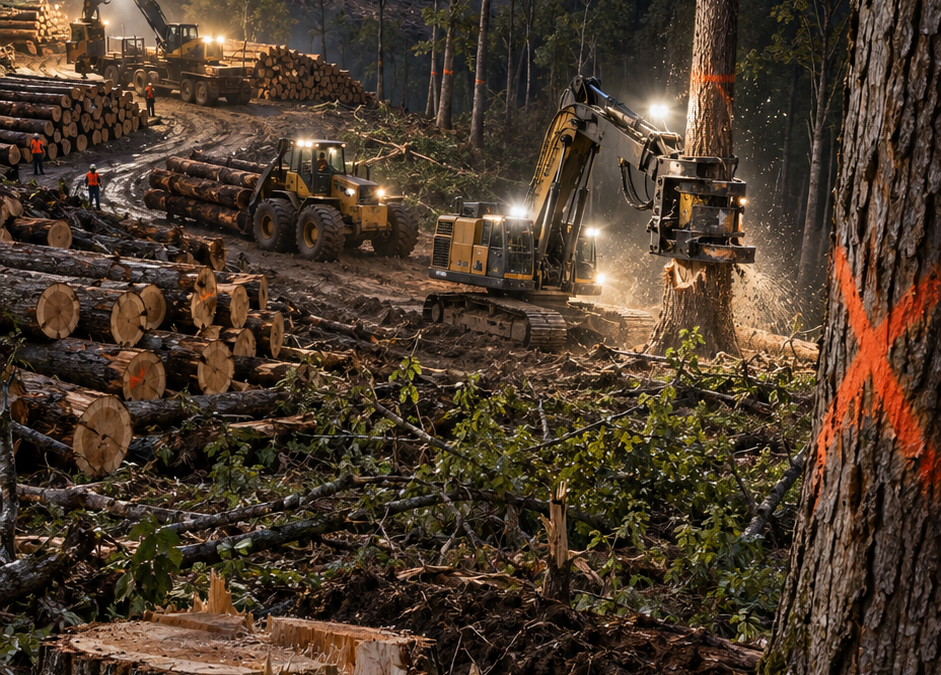
Eleven acres of my forest were already gone before sunrise.
The brush they claimed was dangerous was still standing, while the most valuable walnut and oak had been stacked neatly beside the road.
And halfway up the ridge, someone had painted a bright orange slash across the white oak my grandfather had protected for more than seventy years.
At 5:42 on a Thursday morning, I heard a white oak hit the ground.
You do not mistake that sound when you have spent most of your life around timber.
First comes the crack.
Low and deep.
Almost like ice breaking across a frozen lake.
Then comes the tearing as branches rip through the surrounding canopy.
Then the trunk lands.
A mature hardwood does not simply fall.
It strikes the earth.
You feel it through the soil.
I was standing in my kitchen with a cup of coffee when the vibration reached the house.
For half a second, I told myself it might have been a dead snag coming down naturally.
Then I heard an engine.
Then another.
Heavy diesel.
Hydraulics.
Steel tracks.
I set the coffee down.
My name is Cfield Mabry.
I was sixty-one years old that morning, and Mabry Ridge had been in my family since 1947.
Three hundred forty acres in the eastern foothills.
Mixed hardwood forest across the upper slopes.
A creek running through the north hollow.
Hay meadow near the county road.
Logging roads my father had cut by hand and widened over the years.
Boundary monuments I could find in the dark.
And trees my family had managed long enough that I knew some of them individually.
I had studied forestry at the state university and spent eight years working for a timber management company before coming home.
I was not one of those people who believed cutting any tree was a moral failure.
Good forestry requires cutting.
Trees mature.
They decline.
Some become hazardous.
Some need to be thinned so younger stands can develop.
Sometimes the best thing you can do for a forest is remove the right tree at the right time.
My grandfather understood that.
But he also understood something else.
A forest is not a warehouse.
If all you see when you look at a ridge is immediate board footage, you will destroy more value than you harvest.
He used to say that a man who plants black walnut is making a promise to somebody he may never meet.
He had planted dozens along the eastern ridge.
My father managed them.
I managed the next generation.
That was how our family thought about timber.
Longer than a bank quarter.
Longer than an election.
Longer than one person’s life.
When I stepped outside that Thursday morning, I heard another tree fall.
I did not bother changing clothes.
I pulled on boots, grabbed my keys, and drove east.
The first thing I saw was light.
Portable floodlights.
White beams cutting through the darkness below the ridge.
Then machinery.
A tracked feller buncher.
A skidder.
A loader.
At least three logging machines were moving across my property.
Orange paint marked trunks in every direction.
Nearly forty acres.
I drove faster.
Then I reached the first opening.
My stomach dropped.
Eleven acres of forest were already gone.
Not damaged.
Not selectively thinned.
Gone.
Fresh stumps caught the floodlights like pale circles across the exposed ground.
Tree tops lay twisted in the mud.
Slash piles had been pushed aside.
The soil was torn open where equipment had turned.
But the thing that stopped me was not the clearing.
It was the sorting.
Cheap wood had been dropped into the mud.
Low-grade stems.
Crooked material.
Small trunks.
The black walnut was stacked separately.
So was the best white oak.
Merchantable tulip poplar sat in another pile.
Two trailers were already loaded.
That was when a woman in a red field coat stepped in front of my pickup.
She raised one hand.
“Mr. Mabry, stop.”
I braked.
She walked toward my driver’s side window.
Her name was Ranata Voss.
She worked for Lakewood Pines, a homeowners association whose nearest recorded boundary sat more than a quarter mile from my property.
“Stay behind the cones,” she said.
I looked past her.
Another machine moved toward an oak.
“What are you doing?”
“The association has declared this an emergency wildfire operation.”
I looked at her.
Then I looked back at the log decks.
Walnut.
White oak.
Poplar.
Sorted by value.
Not by hazard.
Not by fuel class.
Not by fire behavior.
By value.
I opened the truck door.
“Stay in the vehicle,” Ranata said.
“No.”
“This is an active work zone.”
“This is Mabry Ridge.”
“This operation has been authorized.”
“By whom?”
“Lakewood Pines.”
I almost thought I had misheard her.
“Lakewood Pines doesn’t own this land.”
“The Wildland Safety Corridor includes this area.”
“There is no Wildland Safety Corridor on my deed.”
She stood straighter.
“The corridor exists to protect the community.”
I pointed toward the trailers.
“Then why are you taking only the expensive timber?”
For the first time, she did not answer immediately.
The loader picked up another black walnut log.
Placed it carefully on a trailer.
Behind it, piles of brush remained untouched.
Young red maple.
Mountain laurel.
Dense understory.
The kind of fine and ladder fuels that actually matter during wildfire behavior.
I looked back at Ranata.
“This isn’t a firebreak.”
“Mr. Mabry—”
“You’re harvesting my land.”
Her jaw tightened.
“Turn off the camera.”
I had not realized until then that I had pulled out my phone.
I raised it higher.
“No.”
“You are obstructing an authorized emergency operation.”
“Good.”
“Excuse me?”
“Then somebody should be able to show me the authorization.”
Three days earlier, Ranata had come to my house in a spotless white SUV.
She had worn a slate-gray suit and a laminated badge clipped near her lapel.
She had stood at the end of my drive with the expression of someone accustomed to having documents end arguments.
“Your timber activity violates Lakewood Pines Community Standard 412,” she had said.
I had looked at the packet.
“My timber activity?”
“The eastern ridge presents an unacceptable wildfire condition.”
The notice identified roughly forty acres of Mabry Ridge as the Lakewood Pines Wildland Safety Corridor.
It ordered me to submit a wildfire remediation plan within fourteen days.
I had read it carefully.
Then I looked at her.
“I’m not a member of Lakewood Pines.”
“The corridor protects the entire community. Participation is not optional.”
“Where is it recorded?”
That was the first moment her eyes had moved away from mine.
“All relevant authority is cited in the notice.”
It wasn’t.
I checked every page after she left.
Internal HOA rules.
Board policy.
Community Standard 412.
But no deed easement.
No county order.
No state forestry notice.
No fire marshal directive.
No recorded agreement.
Nothing giving Lakewood Pines control over an inch of Mabry Ridge.
My deed was recorded in Book 47, Page 312.
My latest survey was nine years old.
The Lakewood Pines subdivision plat ended west of a drainage swale.
My closest corner monument stood another thirteen hundred feet east.
There was no overlap.
No shared road.
No common parcel.
No ambiguity.
I had called my attorney, Dora Phelps, the same afternoon.
“Send me the notice,” she said.
“I already scanned it.”
“Deed too.”
“Done.”
“Survey.”
“I’ll send it.”
“And the subdivision plat if you have it.”
“I do.”
She planned to respond the following Monday.
That would still have been well inside the fourteen-day deadline Ranata herself had given me.
But Ranata did not wait for Monday.
She did not wait for my response deadline.
She did not even wait for sunrise.
Now I stood on my ridge while machines cut trees eleven days before my supposed time to comply had expired.
I parked my pickup sideways across the temporary haul road.
Then I called the sheriff’s non-emergency number.
After that, I began recording properly.
Wide shot first.
The clearing.
Machines.
Floodlights.
Trailers.
Orange paint.
Ranata.
Then the access route.
Fresh tracks crossing my posted gate.
My steel chain lying in two pieces in the ditch.
I narrated the time.
Location.
Weather.
I filmed every truck plate I could see.
Ranata came toward me.
“Move your vehicle.”
“No.”
“You are blocking an authorized safety operation.”
“Show me the county authorization.”
She held up a plastic folder but did not hand it over.
Through the clear cover, I could see a one-page work order.
Ranata’s signature.
Douglas Harker’s signature.
Douglas was president of Lakewood Pines.
The work description read:
HAZARDOUS FUEL REDUCTION.
Then I saw the payment section.
Three words.
TIMBER SALVAGE CREDIT.
I zoomed my camera toward it.
Ranata immediately pulled the folder against her chest.
That movement did not prove everything.
It did not prove theft.
It did not establish intent.
But it told me she understood that the payment language was not something she wanted me examining closely.
The feller buncher shut down.
A heavyset man wearing an orange helmet walked toward us.
He introduced himself as Dale Puit, owner of Ridgeline Land Services.
“I have a signed contract,” he said.
“You crossed a locked gate.”
“They told me this was HOA-controlled property.”
“Who told you?”
He looked at Ranata.
She answered.
“The jurisdiction issue has already been reviewed.”
“Then reviewing it again should be easy.”
Deputy Elena Ruiz arrived seventeen minutes later.
I remember the exact time because I had been recording continuously.
She did exactly what I hoped she would do.
She did not arrive pretending she could resolve a property dispute from the hood of a patrol car.
She asked questions.
She photographed documents.
I showed her my deed and survey.
Ranata showed her the HOA work order.
Deputy Ruiz asked Dale for his contract.
“Read the parcel number,” she said.
He did.
I recognized it before he finished.
It was the Lakewood Pines clubhouse parcel.
Dale looked at the page.
Then at Ranata.
Ranata said, “That’s an administrative reference number. It isn’t the work location.”
Deputy Ruiz asked another question.
“Does anyone have a county fire marshal order?”
Silence.
“A county permit?”
Nothing.
“A state forestry directive?”
No one produced one.
She turned to Dale.
“I’m not determining title here. But you have now been put on notice that ownership is disputed and that this owner is producing recorded documents inconsistent with your authorization.”
Dale looked toward the machinery.
“What does that mean for us?”
“It means continuing to cut after receiving that notice may increase your exposure.”
He did not need to hear it twice.
He shut down the remaining equipment.
Then he ordered his drivers off the ridge.
Before the first loaded trailer moved, I walked behind it and photographed the load ticket clipped near the rear plate.
Destination:
Bellweather Timber Exchange.
Fifty-eight miles south.
Fourteen black walnut logs on that trailer alone.
Then I looked uphill.
The Sentinel was still standing.
That was what my grandfather had called the white oak near the highest point of the eastern ridge.
It had been old when he bought the property.
He first photographed it in 1952.
My father continued taking a picture from the same flat stone every ten years.
I had continued after my father died.
The trunk measured almost fifty-two inches across at breast height.
And now a bright orange slash had been painted across its bark.
Marked for cutting.
I stood there staring at it.
If I had arrived an hour later, maybe less, I might have watched it fall.
Dora reached the ridge shortly after eight.
She stepped out of her car.
Looked across the eleven cleared acres.
And said nothing.
For nearly a minute.
Then:
“How much?”
“Approximately eleven acres completed.”
“And marked?”
“Almost forty.”
“Did you touch equipment?”
“No.”
“Threaten anyone?”
“No.”
“Did timber leave the property?”
I handed her my phone.
“At least two trailers before I got here.”
She enlarged the load ticket photograph.
Read the destination.
Then looked at me.
“This stopped being only a boundary dispute before breakfast.”
We spent the rest of that day preserving what still existed.
Harold Fitch, a licensed surveyor with thirty-one years in the county, came out before noon.
He found the monuments.
Set flagged stakes.
Used survey-grade equipment.
Measured the shortest distance between the actual clearing and the Lakewood Pines subdivision boundary.
One thousand three hundred forty-two feet.
Not thirteen.
Not thirty.
Not one fence line.
One thousand three hundred forty-two feet.
The logging crew had crossed my posted gate.
Driven my internal road.
And cut almost a quarter mile inside property Lakewood Pines had never owned.
Harold prepared a preliminary overlay.
Lakewood Pines in blue.
Mabry Ridge in red.
Between the two:
The drainage swale.
County utility land.
Part of an unrelated pasture.
The HOA’s so-called safety corridor existed only on the map Ranata had delivered.
Then Harold noticed something.
He put the official subdivision plat beside the HOA version.
“Look here.”
The recorded eastern boundary bent west around the drainage swale.
On Ranata’s map, that bend disappeared.
The line had been straightened.
Extended directly toward my ridge.
The county recording box had also been removed.
So had the surveyor’s seal.
I stared at the two maps.
One showed property.
The other showed a story.
That difference became the center of everything that followed.
Dora sent preservation notices that evening.
Lakewood Pines.
Ridgeline Land Services.
Bellweather Timber Exchange.
The property management company.
She demanded preservation of emails, texts, maps, invoices, contractor records, security footage, banking records, load tickets, and anything related to the operation.
She also sent a formal cease-and-desist notice.
The next morning at 9:16, Ranata answered.
One sentence.
Lakewood Pines intends to complete the emergency corridor within seventy-two hours.
Dora read it twice.
Then looked at me.
“That was a mistake.”
“Why?”
“Because now they have written notice from counsel, a disputed boundary, a sheriff’s report, and a surveyor on the ground.”
“And they’re still threatening to come back.”
“Yes.”
“What does that tell you?”
She folded the paper.
“That whatever they expect to gain from finishing this is important to them.”
The next clue was painted on the trees.
I walked the marked acreage with Stuart Cain, a consulting forester and timber appraiser.
Stuart had been evaluating hardwood stands for more than twenty years.
He carried a diameter tape, increment borer, and tablet loaded with regional pricing data.
But he did not begin with stumpage values.
He studied what had been left standing.
After twenty minutes, he said, “This isn’t a firebreak prescription.”
“Explain.”
He pointed at a dense thicket of young red maple and mountain laurel.
“That is ladder fuel.”
Then he pointed at a mature black walnut beside it.
Orange paint.
Marked.
“If wildfire behavior is the main concern, why leave the fine fuels and remove the merchantable overstory?”
We walked another hundred yards.
Same pattern.
Young brush left.
Low-value hollow trees left.
Healthy walnut marked.
White oak marked.
Tulip poplar marked.
Stuart stopped.
“They selected for value.”
“Not hazard?”
“Not from what I’m seeing.”
We counted fresh stumps across the first eleven acres.
Two hundred eighty-seven.
Stuart compared them against my last timber inventory.
Estimated removed stumpage value:
Just over $118,000.
If the crew had finished all 38.6 marked acres, the projected merchantable value exceeded $400,000.
Then Stuart bored three standing trees that had been marked for removal.
Healthy recent growth.
No sign of the beetle outbreak described in Ranata’s paperwork.
That did not mean Mabry Ridge was free of every possible forestry concern.
No forest is.
But the physical stand conditions did not match the emergency they had described.
At noon, Lakewood Pines posted a notice to its residents.
An emergency firebreak, it said, had been temporarily delayed by an adjacent landowner.
The message warned that my refusal was placing ninety-six families at risk.
By two o’clock, seven angry voicemails were waiting on my phone.
One man called me selfish.
Another said I was letting money matter more than safety.
One woman told me that if a child died in a wildfire, the blood would be on my hands.
That one stayed with me.
My younger brother had been a volunteer firefighter.
I had spent years maintaining access lanes.
Thinning hazardous understory.
Keeping equipment routes open.
Creating defensible areas around structures.
The HOA was not merely taking my trees.
They were using fear to turn people against me.
And fear moves faster than survey records.
I refused to argue online.
Instead, I posted one image.
Harold’s sealed survey overlay beside the altered HOA map.
Under it I wrote:
The disputed operation is 1,342 feet beyond the recorded Lakewood Pines boundary. A licensed forestry assessment is underway. I will release verified information when available.
Then I turned off my phone.
Twenty minutes later, I received a private message from Lena Park.
I serve on the Lakewood Pines finance committee.
The board never told us it planned to sell timber.
Call me from another number.
We met at a twenty-four-hour diner near the interstate.
Lena was forty-three.
An accountant.
The kind of person who looked angry without raising her voice.
She placed three documents on the table.
The first was Lakewood Pines’s annual budget.
Reserves:
$246,000.
The second was a capital estimate.
Clubhouse roof replacement.
Pool deck repairs.
Retaining wall reconstruction.
Total projected cost:
$684,000.
The third document was a slide from a closed executive-session presentation.
ALTERNATIVE CAPITAL RECOVERY.
At the bottom:
EASTERN CORRIDOR BIOMASS CREDIT — $312,000.
“Biomass?” I asked.
“That’s what Douglas called it.”
“Brush?”
“Brush. Hazardous material. Supposedly from HOA-controlled land.”
I slid Ranata’s map across the table.
“Did he show you this?”
Lena studied it.
“No.”
“What did you see?”
“A green rectangle. No owner name. No parcel number.”
“Who said the legal issue had been cleared?”
“Douglas.”
“By whom?”
“He said counsel.”
“Was counsel in the meeting?”
Lena looked at me.
“The association attorney resigned two days before the vote.”
I leaned back.
Now the picture was sharper.
The timber was not a side effect of a safety project.
It was part of the financing.
Six months earlier, Lakewood Pines residents had attended a polished town hall.
Douglas Harker stood in front of architectural renderings.
New fitness room.
Expanded pool deck.
Stone entrance walls.
New roof.
No special assessment.
Residents applauded.
What they had not been told was that the reserves covered barely a third of the promised work.
“Where did he say the rest was coming from?” I asked.
“A land management partnership.”
“Ranata?”
“She gave the presentation.”
Dora listened by phone as Lena explained what she had.
Then Dora asked:
“These documents were provided to you through your committee work?”
“Yes.”
“You were authorized to receive them?”
“Yes.”
“Do not take anything else outside your authorized access.”
Lena nodded.
“Preserve the originals.”
“I will.”
“And document when and how you received them.”
That caution mattered later.
Truth is not strengthened by collecting evidence illegally.
By Sunday morning, the HOA’s seventy-two-hour threat had expired.
No machinery returned.
Dora had obtained a temporary restraining order.
No entry.
No cutting.
No transport.
No timber sale.
No work on Mabry Ridge until ownership and authority could be reviewed.
Ranata called the order an interference with community safety.
The judge called it preservation of the status quo.
I preferred the judge’s wording.
On Monday, Bellweather Timber Exchange answered Dora’s preservation notice.
Four loads from Mabry Ridge had reached the mill before I stopped the operation.
Forty-six walnut logs.
Sixty-three white oak.
Twenty-one tulip poplar.
The mill had not processed them.
Why?
The scale tickets and seller certification did not match.
Lakewood Pines was not listed as the seller.
The seller was a company I had never heard of.
Eastern Ridge Resource Partners, LLC.
Authorized representative:
Douglas Harker.
The company had been formed eleven weeks earlier.
Its address was a mailbox store.
Its registered manager was Mason Harker.
Douglas’s brother-in-law.
Dora stopped me before I could say what I was thinking.
“A family connection is not proof that Douglas received money.”
“I know what it looks like.”
“Looking suspicious and proving misconduct are different.”
“I understand.”
“Good. Stay there.”
But the question had changed.
Why did an HOA president need a private company controlled by his brother-in-law positioned between my trees and a clubhouse renovation?
Dale Puit answered part of it.
His attorney requested a meeting.
Dale came to Dora’s office carrying a thick project folder.
Without his crew around him, he looked tired.
“I was told the association controlled the parcel.”
Dora asked, “By whom?”
“Ranata and Douglas.”
“You verified ownership?”
He looked down.
“No.”
It was the cleanest answer he gave all day.
No excuses.
No decoration.
I respected that more than I expected to.
But honesty after cutting two hundred eighty-seven trees is not the same thing as diligence before cutting a gate chain.
Dale’s contract priced the project at $187,000.
Lakewood Pines would pay only $25,000 cash.
The rest would come through timber.
Eastern Ridge Resource Partners would receive title to all marketable logs as a salvage credit.
Then it would pay Ridgeline’s remaining contract balance from the timber sale.
Projected gross timber revenue:
$380,000 to $430,000.
“Who calculated that?” I asked.
“Mason Harker.”
“He inspected my stand?”
“He had a timber cruise.”
Dale reached into the folder.
The moment I saw the cover, something inside me tightened.
LAKEWOOD PINES EASTERN CORRIDOR INVENTORY.
But I recognized the material underneath.
The species tables.
The diameter classes.
The management notes.
Then I turned to the final page.
My father’s old forest map.
I knew that document.
It was my 2008 timber cruise.
There was even a coffee stain along the lower edge.
My coffee stain.
Someone had taken my forestry records.
Removed my name.
Retitled them.
And used my own inventory to price the trees they planned to cut.
That angered me more than the fake boundary.
The fake map was crude.
This was careful.
Somebody had studied decades of management and converted it into a shopping list.
I tried to understand where they could have obtained it.
There had been no break-in.
No missing office files.
Then I remembered.
Eighteen months earlier, a utility company had studied a possible transmission route.
I had provided the county planning department with a copy of my survey and timber inventory.
Public planning file.
Accessible.
Somebody had found it.
Dale produced another document.
An email from Ranata.
Twelve days before the cutting.
Prioritize walnut and merchantable oak during Phase 1.
Revenue performance must be demonstrated before the board’s December financing review.
No mention of brush.
No mention of ladder fuels.
No mention of emergency access.
No mention of wildfire behavior.
Dora read it twice.
“This explains why they didn’t wait fourteen days.”
I looked at her.
“They needed mill tickets.”
“They needed revenue evidence.”
“So the fourteen-day notice—”
“Wasn’t designed to let you comply.”
She tapped the email.
“It was designed to make the operation look procedural.”
Dora amended the case.
Trespass.
Wrongful timber cutting.
Conversion.
Gate damage.
Road damage.
And enhanced damages if the conduct proved knowing or willful under state law.
Defendants:
Lakewood Pines.
Ridgeline Land Services.
Eastern Ridge Resource Partners.
Ranata Voss.
Douglas Harker.
Mason Harker.
They were allegations.
Not convictions.
That distinction mattered to me.
It should matter to anyone.
A strong case becomes weaker when you exaggerate what you have proven.
The defendants responded in different directions.
Ridgeline admitted it had entered under faulty authorization and opened settlement discussions.
Eastern Ridge claimed reliance on HOA rights.
Lakewood Pines claimed Ranata and Douglas exceeded their authority.
Ranata and Douglas said the board approved everything.
Dora almost smiled when she read the responses.
“What?”
“They’re giving us incompatible stories.”
“Isn’t that bad?”
“For them.”
The next Lakewood Pines board meeting drew more than seventy residents.
Dora advised me not to attend because litigation was active.
Lena recorded the public portion.
Douglas called the lawsuit opportunistic.
Ranata described Mabry Ridge as an unmanaged hazard bordering Lakewood Pines.
Then a resident named Frank Delaney raised his hand.
“How can it border us if the survey says it’s thirteen hundred feet away?”
Ranata answered:
“The measurement ignores the functional boundary of the wildland interface.”
Then Lena stood.
“Did the board authorize Eastern Ridge Resource Partners to sell the timber?”
Douglas stopped turning pages.
“Financial negotiations are confidential.”
“Is Eastern Ridge managed by your brother-in-law?”
The room changed.
You could hear it on the recording.
Chairs shifting.
People whispering.
Someone saying, “What company?”
Douglas ended the meeting six minutes later.
But forty-one homeowners remained in the parking lot.
They compared budget notices.
Emails.
Renovation promises.
By midnight, they had formed a recall committee.
That mattered to me because the residents had never been my enemy.
They had been frightened.
They had been told a neighboring landowner was putting their families at risk.
Once evidence gave them another explanation, they reconsidered.
The court allowed expedited discovery.
Lakewood Pines produced emails.
Board minutes.
Map files.
Contractor communications.
Payment records.
A digital drive and two banker’s boxes.
The altered map history came first.
The original file had been created on Ranata’s office computer.
Version one showed my true boundary in red.
Version two removed the red line and placed a green rectangle across Mabry Ridge.
PROPOSED HARVEST AREA.
Version three changed the label.
WILDFIRE SAFETY CORRIDOR.
Twenty-three minutes separated the versions.
Between version two and three came an email from Douglas.
Do not use harvest language in anything residents may request. Safety corridor is easier to defend, and the owner will negotiate once the work has started.
I read that sentence alone in Dora’s office.
Again.
Then again.
The strategy had never depended on believing they owned my land.
They expected irreversible damage to create leverage.
Cut first.
Negotiate later.
But the next document was worse.
An arborist report.
Signed by Dr. Naomi Bell.
A respected forest pathologist at the state university.
The report described advanced oak decline.
Beetle activity.
Immediate fire danger across my eastern ridge.
It was dated two days before Ranata delivered the notice.
There was one problem.
Dr. Bell had never been on Mabry Ridge.
Her real inspection had taken place seven months earlier.
At Lakewood Pines.
She had examined ornamental trees around the clubhouse.
Her actual report recommended removing three declining trees near the pool.
Someone had copied her letterhead.
Kept the signature image.
Replaced the body.
Dora called her.
Eleven minutes later, Dr. Bell called back with university counsel.
“That is not my report.”
Her voice was controlled.
“I did not inspect Mr. Mabry’s property. I did not write these findings. I did not authorize use of my signature on this document.”
That discovery changed the case again.
A misleading planning map can be blamed on confusion.
A boundary mistake can be called negligence.
A fabricated expert report bearing another professional’s signature is harder to explain away.
The university preserved Dr. Bell’s original file and metadata.
Dora notified the court.
The insurer.
And the appropriate state authorities.
She did not announce criminal charges.
None had been filed.
She simply moved authenticated evidence into the hands of people responsible for determining what came next.
The HOA’s insurer issued a reservation-of-rights letter.
It would continue defending the association while investigating whether intentional conduct, undisclosed financial conflicts, or falsified records might fall outside coverage.
Douglas sent homeowners an email blaming “clerical irregularities.”
Dr. Bell responded publicly with four words.
My signature was copied.
By sunset, the recall petition had sixty-eight signatures.
Then the bank records arrived.
Bellweather had advanced $74,000 against the first four timber loads.
Within twenty-four hours, Eastern Ridge transferred $48,000 to a consulting company owned by Douglas Harker’s wife.
Memo:
PROJECT COORDINATION.
Another $12,000 went to Mason Harker.
Nine thousand dollars went toward an overdue invoice from the clubhouse architect.
Five thousand remained in the account.
My timber had not merely been identified as future funding.
The money had already started moving.
Douglas’s attorney said his wife’s company had performed legitimate planning work.
Dora requested the consulting agreement.
None.
Invoices?
None.
Time records?
None.
Work product?
Nothing produced.
Mason said his $12,000 reimbursed expenses.
He could not identify the expenses.
Then the architect confirmed Douglas had personally promised payment “as soon as the Eastern Land Project produced revenue.”
That changed how even I saw the renovation.
At first, I had assumed the clubhouse project was the motive.
It was more complicated.
The renovation was real.
Some of the money was intended for the HOA.
But the first money out had gone toward Douglas’s family.
The association removed Douglas as president during an emergency meeting.
Ranata was placed on administrative leave by the management company.
Three directors resigned.
The remaining directors appointed Lena interim treasurer.
Then they voted to cooperate with the investigation.
Before Ranata surrendered her office computer, she deleted a folder.
EAST RIDGE.
A forensic technician recovered most of it from synchronized storage.
Inside were copies of my county planning records.
Draft maps.
Projected timber prices.
And a spreadsheet titled:
RESISTANCE SCENARIOS.
My name appeared in the first column.
Across the top:
ACCEPTS PAYMENT.
SEEKS INJUNCTION.
CONTACTS MEDIA.
BLOCKS EQUIPMENT.
Under SEEKS INJUNCTION:
Estimated twelve-day delay.
Under BLOCKS EQUIPMENT:
Use resident safety notice.
They had anticipated what I might do.
They simply miscalculated how quickly Dora would move.
How quickly the sheriff would document the dispute.
How much evidence the first timber loads would create.
Then I saw a photograph inside the folder.
The Sentinel.
A red circle around the trunk.
Beside it, Mason had typed:
PREMIUM VENEER POTENTIAL.
I closed the laptop.
Walked outside Dora’s office.
And stood on the sidewalk for a long time.
Until then, I had protected myself emotionally by talking about the Sentinel in numbers.
Fifty-two inches across.
More than one hundred sixty years old.
White oak.
Visible from the county road.
Numbers are safe.
Measurements do not hurt.
But the Sentinel had never been just diameter.
My grandfather used to rest his lunch bucket against that tree.
My father took my graduation photograph beneath it.
After my wife died, I sometimes walked there alone because the space beneath that canopy was large enough to hold grief without asking me to explain it.
And somebody had looked at the same tree and written:
Premium veneer potential.
It was still standing only because I had heard another oak fall at 5:42 in the morning.
That was the moment the case changed for me personally.
A settlement check could replace timber value.
It could repair my gate.
Regrade the haul road.
Control erosion.
Plant seedlings.
But if all we did was exchange damage for money, everyone involved could eventually call what happened a business dispute.
I wanted more.
I wanted the boundary recorded so clearly that no later HOA board could revive the fake corridor.
I wanted the false fire report publicly withdrawn.
I wanted the remaining timber protected.
And I wanted every dollar generated from the removed trees traced back to the ridge.
The first major settlement offer arrived in late February.
$625,000.
Gate repair.
Mutual confidentiality.
No admission of wrongdoing.
I would surrender claims to the recovered timber.
Agree not to discuss the altered map.
The false expert report.
The family payments.
Dora put the offer in front of me.
“It’s real money.”
“I know.”
“There is always risk in litigation.”
“I know.”
“If you continue, there are no guarantees.”
I looked through the terms.
“Will the boundary agreement be recorded?”
“No.”
“Will Dr. Bell’s report be publicly corrected?”
“No.”
“Restoration trust?”
“No. Restoration would come out of the settlement.”
I pushed the papers back.
“They aren’t offering to fix the ridge.”
“What do you think they’re offering?”
“To buy silence.”
I rejected it.
Maybe there was pride in that decision.
Probably.
I do not trust anyone who claims pride never affects them.
But the practical problem mattered more.
A confidential settlement would close the past.
It would not prevent another board from finding the same altered map ten years later.
The court scheduled an evidentiary hearing on longer-term injunctive relief.
The courtroom was ordinary.
Wood benches.
Beige walls.
Fluorescent lights.
No dramatic architecture.
No television cameras.
Some of the most important moments in property disputes happen in rooms designed to make every human feeling look administrative.
Harold Fitch testified first.
Recorded plat.
Sealed survey overlay.
Physical monuments.
One thousand three hundred forty-two feet.
Stuart Cain followed.
He explained wildfire fuel structure.
Merchantable selection.
Why leaving dense ladder fuels while removing mature high-value timber did not match a defensible-space prescription.
Then Dr. Bell testified.
Her genuine report appeared beside the fabricated version.
The defense attorney asked:
“Can you rule out every possible wildfire risk on Mabry Ridge?”
She answered without hesitation.
“No responsible scientist would make that statement without inspecting the property.”
Then she pointed toward the fake report.
“But I can tell you I did not inspect Mabry Ridge, and this document says that I did.”
Dale testified after her.
He described the salvage-credit agreement.
Admitted he failed to verify ownership.
Dora put his work order on the screen.
“What parcel number appears here?”
“The Lakewood Pines clubhouse.”
“Is that clubhouse on Mabry Ridge?”
“No.”
“Did Mr. Mabry authorize you to cross his gate?”
“No.”
“Did Ms. Voss tell you he had?”
Dale paused.
“She told me his objections had been legally resolved.”
Ranata testified that she relied on Douglas and Mason.
Douglas testified that Ranata handled operational details.
Mason said board authorization came through Douglas.
Then Dora displayed the resistance-scenario spreadsheet.
Ranata’s initials appeared in the file history.
Douglas had commented on two cells.
Mason had uploaded the Sentinel photograph.
Three separate defenses had collapsed into one shared file.
The judge granted the injunction.
No defendant could enter Mabry Ridge.
No defendant could claim enforcement authority over it.
No detained timber could be sold.
No further proceeds could be distributed.
And Lakewood Pines had to issue a corrected resident notice stating that no public agency had declared Mabry Ridge a wildfire emergency.
The judge did not decide final damages that day.
He did something more important in the short term.
He froze the lie.
Outside the courthouse, Douglas tried to leave through a side door.
Several Lakewood Pines residents were waiting near the steps.
They did not shout.
Lena simply handed him a recall certification.
Seventy-two owners had voted to remove him from the board.
Lakewood Pines contained ninety-six homes.
Three-quarters of the community he had repeatedly used as a shield had now signed their names to a document separating themselves from his decisions.
The case continued.
But the balance had shifted.
Ridgeline’s insurer agreed to pay road repair, erosion control, and part of the timber loss in exchange for resolving claims against Dale’s company.
Dale turned over equipment logs.
Contracts.
Communications.
And testimony.
Every unsold log under his control came back.
Bellweather released the four detained loads.
I could not put those trees back into the soil.
So I chose the most useful thing I could do with them.
A local mill processed some of the white oak into beams for a forestry education pavilion we planned on the ridge.
The walnut was stored.
One broad board from a tree my grandfather had planted became the table where the restoration documents were eventually signed.
Lakewood Pines’s crime policy and the management company’s coverage applied to some losses according to their terms.
Other conduct remained disputed.
With the altered files authenticated, the bank transfers documented, the expert report exposed, and the recall complete, the remaining defendants returned to mediation.
The final civil settlement totaled $1,480,000 across available insurance coverage, recovered timber value, company payments, and individual contributions.
The number was not invented by multiplying damages for dramatic effect.
It reflected documented categories.
Appraised timber loss.
Road repair.
Gate replacement.
Erosion control.
Restoration.
Professional costs.
And litigation exposure under the state law Dora believed applied.
Douglas and Mason returned the money transferred through their companies.
Ranata gave up her severance claim and contributed through a separate agreement.
The civil settlement did not establish criminal guilt.
The false report and financial records remained with the authorities responsible for any separate review.
Most importantly to me, the agreement did not require silence.
Lakewood Pines recorded a formal boundary acknowledgement referencing Harold’s sealed survey.
The association disclaimed any easement.
Any enforcement corridor.
Any wildfire management zone.
Any ownership or other interest in Mabry Ridge.
Future HOA disclosure packages had to include that acknowledgement.
No later board would be able to pull the old green rectangle out of a file and pretend it was real.
The association also funded a twenty-year restoration trust.
Independent forester.
Restricted use.
Slope stabilization.
Invasive control.
Replanting.
Monitoring.
Nothing else.
The residents of Lakewood Pines did not lose their homes.
The HOA did not collapse.
They elected a new board.
Postponed the clubhouse expansion.
Repaired only the roof section that was actually dangerous.
And adopted a rule requiring a recorded property interest and independent legal review before authorizing work beyond association-owned land.
That ending mattered to me.
Ninety-six families had not cut my gate.
They had not fabricated Dr. Bell’s report.
Most of them had not even known Eastern Ridge Resource Partners existed.
A handful of people had used the institution.
Eventually, the homeowners used records and votes to take it back.
Restoration began the following autumn.
We did not plant the cleared acres in neat rows.
A ridge is not a parking lot.
We stabilized the haul road.
Cut water bars across the steepest sections.
Left selected woody debris in place to protect soil.
White oak and black walnut went back in irregular groups.
Young trees were protected against deer.
Lena came on the first planting day.
So did twelve Lakewood Pines families.
Frank Delaney was there.
He was the man who had left the voicemail telling me a child’s death would be on my conscience if wildfire reached the subdivision.
He brought two shovels.
We worked beside each other for nearly an hour before he finally said:
“I owe you an apology.”
I kept digging.
“I believed the notice.”
“You believed people you had elected.”
“That doesn’t make what I said right.”
“No.”
He stopped.
Looked across the open slope.
“I’m sorry.”
I nodded.
“That is not the same thing as wanting this.”
He looked at the seedlings.
“How long until this looks like forest again?”
“Longer than either of us wants.”
He smiled sadly.
“That’s honest.”
“It is forestry.”
The Sentinel still stands at the highest point of the eastern ridge.
The orange paint faded through the first winter.
By the second summer, new bark had nearly swallowed it.
I deliberately left one small rectangle visible on the north side.
Not because I wanted the tree to carry a wound forever.
Because I wanted to remember how close a spreadsheet came to deciding what that tree was

