𝗙𝗨𝗟𝗟 𝗦𝗧𝗢𝗥𝗬 The Old Mine Map Under My Hand Was the One Thing Crown Ridge Couldn’t Afford to Let Anyone Read
𝗣𝗔𝗥𝗧 𝟮
Crown Ridge remained under developer control, and Vanessa was one of the development company’s managing partners.
That meant she influenced construction budgets, sales schedules, design changes, and the board that would eventually represent people buying homes there.
She had survived a previous resort development that nearly collapsed financially after delays scared investors.
She learned something from that experience.
Unfortunately, it was not caution.
It was presentation.
Vanessa believed problems became dangerous when people could see them.
So she managed appearances.
If a report contained uncertainty, she shortened the report.
If an engineering requirement threatened a deadline, she looked for another consultant.
If a design reduced the number of sellable lots, she treated the design as negotiable.
Four months after the original stabilization plan was issued, Crown Ridge hired another geotechnical consultant for what was described as a limited review.
Three test borings were drilled on the western side of the property.
All three encountered competent limestone.
None penetrated the mapped chambers beneath the central ridge.
The resulting technical language said the investigated locations showed competent material and described the old workings as historically inactive.
Then Crown Ridge’s final development memorandum used a stronger phrase.
Structurally irrelevant to proposed construction.
The county warning never changed.
The mine did not change.
But the site plan did.
Ten premium lots returned.
The clubhouse moved east.
Four homes gained underground wine cellars.
The infinity pool shifted closer to Chamber Nine.
And approximately seventy percent of the original subsurface stabilization work disappeared from the budget.
I placed the revised site plan over my family’s mine survey.
Then I stared at it.
Red circles covered the page.
The new design was not merely failing to avoid the mine.
It was placing some of the most expensive construction directly over it.
I requested time at the next board meeting.
Vanessa allowed me five minutes.
I brought copies of the 1958 mine survey.
The original engineering plan.
The revised development plan.
I placed all three on the conference table.
“Put that old map away, Daniel.”
Vanessa did not even lower her voice.
The room contained board members, attorneys, development staff, and two representatives from the sales team.
I kept my palm against the yellowed paper.
“This isn’t an old family photograph.”
“The mine is inactive.”
“Inactive isn’t the same as filled.”
“Our consultant evaluated it.”
“Three borings west of the mapped chambers are not an evaluation of the central workings.”
She leaned back.
“Crown Ridge has permits, buyers, and twenty-six homes already under contract.”
“That doesn’t change the geology.”
“I am not sacrificing ten premium lots because your grandfather left holes under a hill.”
One of the board members looked uncomfortable.
He asked, “Has the county approved the current plan?”
Vanessa answered before I could.
“Every required permit.”
I pointed toward the overlay.
“Your clubhouse is above the Chamber Seven corridor. Your pool is near Nine. Six homes cross mapped workings.”
Vanessa smiled slightly.
“Daniel is emotionally connected to this property.”
I looked at her.
“He grew up with stories about the mine. His family worked there. I respect that history.”
There it was.
She did not call me incompetent.
That would have required challenging my engineering.
Instead, she called me sentimental.
It gave everyone else permission to stop listening.
“This isn’t sentiment,” I said.
She pushed the mine map toward me.
“We are done.”
“The mine chambers are still open.”
“That is your opinion.”
“No.”
I tapped the map.
“That is the condition recorded when the mine closed.”
Her expression hardened.
“Your five minutes are over.”
That was the last warning she allowed me to finish.
Two days later, Crown Ridge security stopped me near a survey corridor accessible from a public trail.
A certified letter arrived the next morning accusing me of interfering with construction.
Another threatened a ten-thousand-dollar civil claim if I entered any marked development parcel.
A safety dispute had become a trespassing dispute.
Construction accelerated.
Trucks climbed the ridge from sunrise until dark.
Concrete arrived by the convoy.
Stone walls appeared.
Foundations rose.
Ventilation collars left from the old mine were broken down and buried because prospective buyers had begun asking why circular concrete structures protruded from landscaped areas.
The western shaft was covered with loose stone, gravel, and topsoil.
No permanent inspection access was preserved.
That decision brought Elliot Barnes to my front door.
Elliot was seventy-four.
He had bowed knees, thick shoulders, white stubble, and hands that still looked like they belonged to a man half his age.
He had worked underground beside my father during the mine’s final years.
When Elliot was twenty-one, a roof fall killed his closest friend.
After that, Elliot did not use the word safe carelessly.
He placed a black-and-white photograph on my kitchen table.
Three miners stood beside a timbered opening.
A number was painted above it.
“That chamber was open the day we locked the lower gate,” he said.
“What about Eight?”
“Open.”
“Nine?”
“Open.”
“Backfill?”
He shook his head.
“Pillars.”
“Could those pillars support houses?”
Elliot looked at me as if I had asked whether an old wooden bridge could carry a locomotive.
“They supported rock the way we cut it in fifty-eight.”
He tapped the photograph.
“Nobody designed them for mansions, pools, roads, and whatever else they’ve put up there.”
Then he told me something my father had never mentioned.
“Your dad tried to make the owners fill the central section before he died.”
I looked at him.
“When?”
“Years ago.”
“What happened?”
“They said it cost too much.”
That hurt more than I expected.
My father had carried that map to county meetings.
Called landowners.
Written letters.
I had always assumed he did it because he was stubborn.
I had not understood that he spent the last years of his life believing he had failed to make anyone listen.
Now I was doing the same thing.
And the difference between us was supposed to be that I had licenses, degrees, field experience, and decades of engineering reports behind me.
So far, those credentials had only taught Vanessa how carefully she needed to exclude me.
By early autumn, Crown Ridge looked finished.
Twenty-six pale-stone mansions curved along a landscaped boulevard.
A glass-fronted clubhouse overlooked the valley.
The spa sat behind ornamental maples.
The infinity pool seemed to disappear into the horizon.
The homes sold for between $4.2 million and $5.6 million.
Harold and June Barrett bought Mansion Fourteen.
Harold was a retired railroad dispatcher.
He labeled everything.
Contracts.
Tax records.
Appliance warranties.
Insurance correspondence.
June had been a school librarian for thirty-five years.
She had the rare ability to make frightened people feel calmer without pretending there was nothing to fear.
They planned to retire at Crown Ridge because their daughter lived nearby with two children.
Before closing, Harold asked directly about the old mine.
His sales package mentioned historic quarry activity in the surrounding region.
He wanted more.
A Crown Ridge representative assured him that every relevant working beneath the development had been evaluated and stabilized according to approved engineering plans.
Harold asked for that statement in writing.
They gave it to him.
They did not give him my grandfather’s map.
They did not show him the first stabilization plan.
They did not tell him the stabilization budget had been cut.
For almost a year, nothing dramatic happened.
That was probably the most dangerous period.
Every quiet month strengthened Vanessa’s position.
People drove over level pavement.
They held birthday parties beside the pool.
They watched sunsets from stone terraces.
Wine cellar doors opened and closed.
No buildings fell.
No roads cracked in half.
The warning began to look foolish.
Vanessa started referring to me publicly as the man who wanted Crown Ridge to fail.
I stopped trying to convince homeowners directly.
They were not my enemies.
They had paid professionals to evaluate risk.
They had trusted county permits, licensed consultants, disclosures, inspections, and a developer selling homes for more money than many people earned in a lifetime.
Blaming them would have been satisfying.
It also would have been wrong.
Instead, I watched from places I could legally stand.
I photographed drainage outlets from the county road.
Marked the locations of every completed structure on a clean mine survey.
Requested public copies of the grading plans.
Foundation schedules.
Stabilization certifications.
One sentence in the certification bothered me.
Required subsurface treatment completed in accordance with revised geotechnical recommendations.
It sounded authoritative.
It proved almost nothing.
No grout quantities.
No borehole coordinates.
No pressure logs.
No dated field sequence.
No identification of which revised recommendation had supposedly governed the work.
I requested the supporting documentation.
Crown Ridge sent forty-three pages.
Cover sheets.
Invoices.
Photographs of drilling equipment sitting near the upper entrance.
Billing summaries.
Not one photograph showed grout entering a borehole.
Not one log documented grout pressure.
The borehole diagram used numbers but no coordinates I could reliably tie to the old mine survey.
I asked for the missing field records.
Vanessa’s attorney responded that proprietary construction documents were not available for public review.
That told me something.
They knew which records mattered.
Then the rain started.
For nineteen days, slow autumn storms crossed the ridge.
Not violent storms.
Steady rain.
The kind that finds every fracture.
Water moved downward through grading soil and into openings in the limestone.
Abandoned mines do not always collapse suddenly.
Sometimes soil migrates through cracks into the empty room below.
A hidden void develops above the mine roof.
It grows upward.
The surface continues carrying loads until the bridge of soil and rock becomes too thin.
Then the ground gives way.
The first signs at Crown Ridge were easy to dismiss.
At Mansion Eight, the driveway edge settled three-quarters of an inch below the garage slab.
Maintenance workers added repair compound.
Near the clubhouse, a hairline crack crossed six limestone terrace tiles.
Workers filled it with color-matched sealant.
One underground wine cellar door began closing by itself.
A carpenter adjusted the hinges.
Two weeks later, it started again.
Then the infinity pool began losing water.
Nearly nine hundred gallons a day.
Technicians pressure-tested the plumbing.
No leak large enough to explain the loss was found.
Individually, none of those problems proved mine subsidence.
Together, their locations mattered.
I placed each maintenance site over the old survey.
A line appeared.
Chamber Seven.
Main haul tunnel.
Toward Nine.
I wrote Vanessa requesting an immediate microgravity survey, confirmation borings, and camera inspection through any accessible shaft.
I copied the county building office and development company counsel.
Six hours later, Vanessa replied.
Crown Ridge has evaluated the minor cosmetic conditions referenced in your correspondence. No evidence supports your repeated claim of an active subsurface emergency.
I stared at the phrase.
Active subsurface emergency.
I had not used it.
I had asked for an investigation.
Vanessa transformed a request to collect evidence into an allegation of catastrophe, then rejected the catastrophe she had invented.
Maintenance continued.
Fresh sod covered a depression behind the spa.
Decorative planters appeared along repaired clubhouse tiles.
Then Harold Barrett called me.
“I need to ask you something.”
“Go ahead.”
“Can a crack move without getting much wider?”
“Yes.”
“How?”
“One side can settle vertically. Or slide slightly. Why?”
“Can you meet me?”
We met outside the north gate where residents were allowed to receive visitors.
Harold carried his phone and a small ruler.
For seventeen days, he had photographed a hairline crack across the corner of his garage floor.
He marked the ends with pencil.
Wrote the date beside them.
The crack had extended only half an inch.
But a coin placed across it now rocked.
One side of the slab was lower.
“Maintenance ground off my first marks,” he said.
“What did they tell you?”
“Shrinkage crack.”
“Did they inspect outside?”
“They sealed the floor and adjusted the garage door.”
“Why the door?”
“It started rubbing.”
I looked at his photographs.
A vertical mortar joint near the rear wall had opened during the same period.
The garage opening itself was changing shape.
“Save the originals somewhere off your Crown Ridge accounts.”
“You think the house is collapsing?”
“I didn’t say that.”
His face tightened.
“I need you to tell me the truth.”
“I am.”
I pointed to the photograph.
“I cannot prove subsidence from this. But two related movements deserve investigation before somebody covers them.”
June arrived holding a thin folder.
Inside was their written sales assurance regarding stabilized mine workings.
She looked at me.
“If they already fixed the mine, why won’t they show us where?”
I had no better question.
The next morning, Harold emailed his photographs to the Crown Ridge board and copied twelve neighbors.
Vanessa responded before lunch.
She did not address the measurements.
She warned residents against spreading unverified structural concerns that could damage community values.
That afternoon, maintenance offered Harold a free decorative epoxy finish across his entire garage floor.
One condition.
He had to sign a completion form stating the crack had been resolved.
He refused.
That changed everything.
Until Harold, Vanessa’s problem had been me.
An outside engineer.
A family connection to the mine.
A man she could describe as emotionally invested.
Now a homeowner with no connection to my family had created a dated photographic record.
He had measured movement.
And he refused to let it be painted over.
Around the same time, Crown Ridge announced a three-day VIP sales weekend for the final six homes.
Valet parking.
Luxury vehicles.
Private tours.
Catering.
A sunset reception beside the infinity pool.
The event was designed to reassure buyers.
More importantly, it was designed to reassure lenders before the financial quarter closed.
Five days before the event, Megan Cole called me.
Megan was the assistant property manager.
Thirty-four.
Quiet.
Efficient.
The kind of employee powerful people underestimate because she rarely interrupted them.
She asked me to meet at a diner outside town.
When she arrived, she ordered coffee and placed her phone between us.
“I can’t give you company files.”
“I didn’t ask you to.”
“I need you to look at something.”
She showed me twelve photographs.
Driveway settlement.
Cracked pool tile.
A retaining wall separating from backfill.
A circular depression near an irrigation box.
Each photograph had a date and work-order number.
I wrote the locations on a paper napkin.
Then drew a rough line.
Megan stared at it.
“That’s almost exactly the order the complaints came in.”
“Do the original images still exist?”
“Yes.”
“Keep them.”
“What else?”
“Preserve every work order. Every instruction to repair the surface without investigating below.”
“Should I send them to you?”
“No.”
She looked surprised.
“Why?”
“Because if you take files you are not authorized to take, the entire argument becomes about you.”
“So I just wait?”
“You preserve what you are responsible for preserving.”
She looked frustrated.
“That’s all?”
“That’s how evidence survives.”
People often destroy good evidence because they are impatient for dramatic evidence.
The next morning, Elliot and I walked the public drainage easement along the western boundary.
He remembered where Ventilation Shaft Four had emerged.
Contractors had buried it months earlier beneath gravel and fill.
The surface now formed a shallow bowl nearly five inches deep.
Rainwater sat in the center.
Every few minutes, a bubble broke the muddy surface.
I pushed a marked steel rod into the edge.
Twenty inches.
Resistance.
I tried the opposite side.
The rod dropped nearly three feet.
Elliot stepped backward.
“That fill’s moving.”
We photographed everything.
Rod depths.
Drainage path.
Slope.
Coordinates.
Then I sent the material to county engineer Rachel Kim.
That afternoon, she called.
“I reviewed the historic plan.”
“And?”
“I’m requesting access to Crown Ridge before the sales event.”
It was the first time someone outside the development had independently confirmed the pattern deserved immediate examination.
Less than an hour later, I received another call.
Dr. Nathan Price.
His name appeared on Crown Ridge’s revised geotechnical memorandum.
“Did you send my office the 1958 mine map?”
“Six months ago.”
Silence.
“I never received it.”
I sat down.
Nathan explained the scope of his firm’s work.
Three limited borings.
Western area.
Competent limestone at those locations.
No investigation of the mapped central chambers.
“The words historically inactive came from my technical report,” he said.
“And structurally irrelevant?”
“They did not.”
I opened the final memorandum on my computer.
“Your electronic signature is on it.”
“I signed an appendix.”
He emailed his original draft.
Same project number.
Same date.
But one sentence had disappeared from the final version.
No conclusion is offered regarding unmapped or unverified workings beyond the limited boring locations. Existing mine records should be reconciled before final structure placement.
I read it twice.
“Did you challenge the final wording?”
“Yes.”
“What happened?”
“They told me counsel had reviewed it and the historic mine map did not meet modern survey standards.”
“And you let your name remain?”
A long pause.
“Yes.”
There was shame in his voice.
I did not need to add any.
“Do you have your correspondence?”
“Yes.”
“Preserve it.”
“I can send it to you.”
“Send it to Rachel Kim.”
He agreed.
Nathan was not suddenly a hero.
He had allowed stronger language to remain attached to his work longer than it should have.
But his draft established one crucial fact.
Crown Ridge had been explicitly told to reconcile the historic mine information before final building placement.
Vanessa had not misunderstood a clean engineering approval.
She had transformed a limited review into one.
Rachel requested immediate access.
Crown Ridge did not refuse.
That would have looked bad.
Instead, Vanessa scheduled the inspection for Monday.
After the VIP weekend.
County counsel objected.
Crown Ridge attorneys argued there was no declared emergency.
They claimed they needed time to assemble documents.
The county issued a written notice requiring Crown Ridge to report any accelerating movement immediately.
Vanessa treated that delay like permission.
Friday night, crews pressure-washed the clubhouse terrace.
Fresh mulch covered disturbed soil beside the boulevard.
Two large planters were positioned over the repaired pool-area crack.
And a wooden gazebo was moved six feet to improve the view from the sales tent.
At 6:12 Saturday morning, a landscaper named Luis Ortega noticed a dip beside that gazebo.
He placed two orange cones around it.
At 6:27, one cone tilted inward.
At 6:34, a curved crack opened through the grass.
At 6:38, Luis began recording on his phone.
The first video I later watched was only eleven seconds long.
The gazebo post sank several inches.
The grass folded downward.
Dark soil disappeared through an opening about the size of a dinner plate.
Then the hole widened.
The gazebo twisted.
One anchor tore free.
The next seconds happened quickly.
The ground collapsed.
The gazebo vanished.
A portion of lawn followed.
The hole widened to nearly thirty feet.
The edge of the valet parking area fractured.
A sheet of asphalt hung above darkness.
Luis ran toward the clubhouse screaming for people to move uphill.
The first invited buyers had already arrived.
Vanessa came outside wearing a red suit and low black heels.
She looked into the crater.
Then made the decision that ended whatever control she still had.
“Move the valet entrance.”
Luis stared at her.
“What?”
“Keep guests on the west side.”
“That is not an irrigation leak.”
“We don’t know what it is.”
“The ground swallowed a gazebo.”
“You are not qualified to determine the cause.”
Neither was she.
At 6:51, Megan called emergency services.
Then she called me.
“The ground opened beside the clubhouse.”
“How large?”
“Thirty feet. Maybe more.”
“Get everyone away from the boulevard and pool.”
“Vanessa’s trying to continue the event.”
“Do not stand between the crater and any building. I’m calling Rachel.”
By the time I arrived, fire crews had replaced VIP signs with barricades.
Guests stood beside expensive cars holding phones.
Vanessa argued with a fire captain.
I stayed outside the restricted area.
Rachel opened the 1958 survey across the hood of her county vehicle.
I pointed.
“The crater is near this crosscut.”
“Seven to Eight?”
“Yes.”
Then someone screamed from the eastern boulevard.
A dark line moved across the pavement.
At first it looked like an old repaired seam opening.
Then the curb dropped.
One inch.
Nearly two.
A second crack appeared near Mansion Eleven.
Across the corridor, a garage slab near Mansion Eighteen settled.
Rachel compared the locations to the map.
“These aren’t separate failures.”
“No.”
“They’re tracing the haul tunnel.”
Vanessa approached us.
“You cannot evacuate twenty-six homes because an antique drawing resembles a few cracks.”
Rachel folded the map once.
“I’m not evacuating anyone because of a drawing.”
She pointed toward the road.
“I’m evacuating them because the ground is moving.”
At 7:19, the infinity pool made the argument irrelevant.
A fracture crossed the eastern end of the shell.
Water began escaping through a narrow seam.
Then the deck dropped.
The crack opened.
Thousands of gallons poured into the ground beside the clubhouse.
Water carried soil downward.
Terrace stones tilted.
One glass railing tore free.
A section of pool deck separated and fell into a second cavity.
People screamed.
Firefighters expanded the evacuation zone.
Residents were told to take medications.
Identification.
Pets.
Anything they could carry quickly.
Nothing else.
I found Harold Barrett in his garage.
He held two document boxes.
June stood beside him with their cat inside a carrier.
“Which road?” he asked.
The main boulevard crossed above Chamber Eight.
I traced the service route in my head.
“North maintenance exit.”
“Boulevard?”
“Do not use it.”
“Where do we turn?”
“Left at the retaining wall. Keep going until you’re beyond the upper gate.”
He nodded.
Months earlier, Harold had believed I was threatening his retirement investment.
Now he trusted my family’s map to get his wife out safely.
I did not feel vindicated.
People misunderstand what being right feels like during a disaster.
When families are carrying medication, pet carriers, photographs, and documents out of homes they trusted, being right feels very small.
At 8:03, another fracture crossed the boulevard.
A parked sedan tilted backward as pavement dropped beneath its rear wheels.
Firefighters retreated.
Utilities were shut off.
The road sagged in three steps.
Then Chamber Eight’s roof failed.
The sound was not like an explosion.
It came from underneath us.
Deep.
Rolling.
Stone grinding against stone.
Then pavement, soil, water, landscaping, and three luxury vehicles disappeared into the opening.
Nearly one hundred feet of boulevard collapsed.
Ornamental walls broke apart.
A terrace slid toward the crater.
The guest wing of Mansion Twelve remained hanging over empty space for several seconds.
I remember everyone watching it.
No one spoke.
Then one corner folded.
Most of the structure fell.
No one was inside.
Two neighboring mansions remained standing but visibly leaned toward the collapse.
A broken water main poured into the void until county crews isolated it.
Where the boulevard had been, the ridge was open.
Rough limestone walls.
Old timber.
A black tunnel disappearing beneath the development.
The mine Vanessa had called irrelevant was visible from the center of Crown Ridge.
By noon, photographs were everywhere.
Vanessa issued a statement describing the event as an unexpected natural karst collapse unrelated to known historic mine workings.
The language was deliberate.
A natural cavern could be called unpredictable.
A mapped mine created questions.
Why had stabilization been reduced?
Why had structures been shifted?
Why had the original exclusion zones disappeared?
Why had repairs been hidden?
Why had homes continued selling?
I did not argue through reporters.
The ground was already making the argument.
County mine-safety specialists identified an old western portal outside the active collapse zone.
Air quality was tested.
Roof conditions were evaluated.
A limited inspection was approved.
Rachel entered with a mine-safety engineer.
Elliot and I were allowed to accompany them through the stable section.
The air smelled like wet limestone and rust.
Faded red markings remained on the walls.
Tool cuts ran straight through the stone.
At the first intersection, Elliot stopped.
He pointed toward a pillar.
“Seven.”
The number was faint.
Still there.
It matched my grandfather’s map.
So did the tunnel direction.
Survey equipment tied the underground workings directly to the crater above.
There was no mysterious natural cavity.
The boulevard had collapsed into chambers mapped in 1958.
That was only the first major discovery.
Under a county preservation order, Megan turned over the complete maintenance archive.
Dated photographs.
Repeat repair requests.
Pool water-loss reports.
Sticking doors.
Driveway settlement.
Cracking terraces.
And written instructions.
One email from Vanessa’s office had been sent six days before the collapse.
Complete all visible surface corrections before VIP event.
Avoid speculative references to subsurface conditions in resident communications.
I read those sentences sitting beside Rachel’s desk.
Vanessa’s office had not simply failed to recognize warning signs.
It had managed the vocabulary used to describe them.
Investigators then compared the original stabilization plan with the construction records.
The first plan required more than one thousand cubic yards of pressure grout.
Twenty-eight deep foundation elements.
Three permanent exclusion zones.
The final construction package claimed approximately six hundred ten cubic yards had been placed under the revised program.
The daily drilling logs supported less than two hundred.
Several dates listed major underground treatment.
No matching equipment record existed.
Supplier quantities did not align.
Boreholes listed as completed lacked pressure charts.
No spoil photographs.
No reliable field documentation.
Then investigators found the delivery tickets.
Four hundred twenty cubic yards billed to subsurface stabilization had not gone under the Crown Ridge homes.
Truck dispatch logs showed another destination.
Vanessa Sloan’s private ridge parcel.
Gate-camera images confirmed the trucks.
The material had gone into her decorative motor court.
A massive retaining wall.
And the foundation platform beneath her private infinity pool.
I sat in silence when Rachel showed me the records.
Homeowners had been told the mine was stabilized.
A large part of the material billed to support that claim had been used where Vanessa could look at it from her bedroom.
Mistakes happen.
People misread plans.
Invoices are coded incorrectly.
Field conditions change.
But mistakes do not usually repeat themselves across delivery tickets, schedules, approvals, and altered scopes.
Vanessa’s signature appeared on cost revisions.
Her approval appeared on the shifted clubhouse location.
Her initials appeared beside removal of the largest exclusion zone.
Then investigators found a handwritten note from an investor packet.
10 restored ridge lots protect fourth quarter margin. Do not reopen mine scope without executive approval.
The mine had never been irrelevant.
It had been expensive.
The county closed all of Crown Ridge.
Occupancy certificates were suspended throughout the mapped subsidence corridor.
Engineers installed movement monitors.
Confirmation borings were drilled.
The evacuation boundary expanded whenever instruments recorded new movement.
Residents began organizing paperwork.
Harold had more than most.
His labeled folders contained sales disclosures, inspection reports, emails, repair requests, and the written assurance that the mine workings relevant to his house had been stabilized.
June found the original brochure.
Mansion Fourteen’s underground wine cellar was advertised as being “carved into stable native limestone.”
She handed the brochure to me.
“Is that technically true?”
I looked at the mine map.
The cellar sat above a tunnel.
“Not in the way they wanted you to understand it.”
She nodded slowly.
“I used to teach children to read carefully.”
“You were reading what they gave you.”
“That doesn’t feel like much comfort.”
“No.”
Megan compared buyer files.
Every buyer had received a general disclosure referring to historic quarry activity “in the surrounding region.”
No one received a parcel-specific map.
No one received the original stabilization plan.
No one received documentation showing where the mapped rooms actually ran.
Even buyers signing contracts after the pool began losing water received the same unchanged disclosure.
Two prospective buyers attending the VIP weekend had transferred deposits Friday afternoon.
Less than eighteen hours before the first crater opened.
Internal messages showed a sales manager had asked whether the unexplained pool water loss and repaired terrace crack should be added to property condition documents.
Vanessa answered personally.
Routine maintenance is not a disclosure event. Do not introduce mine speculation into active transactions.
That sentence explained the pressure washing.
The new mulch.
The planters.
The delayed county inspection.
Crown Ridge did not need the hill to remain stable forever.
It needed the hill to look stable through the weekend.
The two VIP deposits were returned.
Existing homeowners faced a much harder reality.
Mortgages remained attached to homes they could not occupy.
Insurance companies asked whether losses came from excluded earth movement.
Negligent construction.
Misrepresentation.
Design error.
Or some combination.
Families received letters full of language written for attorneys while they were sleeping in hotels.
Temporary housing authorizations came in thirty-day blocks.
Storage required separate approval.
Some people were prohibited from reentering their homes while adjusters demanded inventories of possessions inside them.
Harold called me from a hotel room.
I could hear papers moving.
“They all want proof from us.”
“Who?”
“Insurance. Mortgage company. Lawyers.”
He laughed once without humor.
“The people who built this place had the proof.”
“Yes.”
“And now we have to prove what they knew?”
“That’s why nobody does this alone.”
The residents created a shared chronology.
Megan preserved maintenance records she was authorized to provide.
Rachel provided closure orders.
Homeowners contributed contracts.
Disclosures.
Photographs.
Inspection reports.
Repair records.
Hotel bills.
Moving expenses.
Storage costs.
The evidence stopped looking like twenty-six separate homeowner problems.
It became one chain.
Mapped mine workings.
Reduced stabilization.
Missing grout.
Surface movement.
Repeated cosmetic repairs.
Controlled language.
Continued sales.
Delayed inspection.
Collapse.
Once that chain existed, the development could no longer describe what happened as one surprising hole.
Residents moved to remove Vanessa from the HOA board as soon as emergency court supervision allowed them to challenge developer control.
Crown Ridge Development Company was ordered to preserve assets.
An interim relocation fund was established.
Insurers began pursuing design professionals and entities involved with inaccurate construction certifications.
Evidence involving false construction records was referred to state investigators.
Civil fraud claims followed.
None of it happened in one dramatic afternoon.
Real accountability rarely does.
It moves slowly.
Depositions.
Expert reports.
Insurance reservations.
Court motions.
Audits.
Settlement conferences.
But something important had already changed.
Vanessa no longer controlled the records.
She no longer controlled the board.
Most importantly, she no longer controlled the explanation.
Six weeks after the collapse, a county hearing was held.
Vanessa sat at the end of a long table.
No red jacket.
Her attorney argued Crown Ridge had relied on licensed engineers.
“No single executive,” he said, “can reasonably be held responsible for every aspect of a complex geotechnical development.”
Rachel projected three images.
The 1958 mine map.
The original stabilization plan.
The final site plan.
Then she displayed the grout delivery tickets.
No one spoke for several seconds.
Vanessa finally looked at me.
“You wanted this project stopped from the beginning.”
I answered carefully.
“I wanted the chambers treated like chambers.”
“You opposed development.”
“No.”
“You repeatedly predicted failure.”
“I repeatedly requested verification.”
“You wanted those ten lots removed.”
“I wanted the empty space beneath them stabilized.”
She leaned forward.
“The houses passed inspections.”
“Inspections verify what can be observed and what records say was built.”
I pointed toward the grout documentation.
“They cannot make missing material appear underground.”
Harold and June sat behind me with other displaced homeowners.
That was why I refused to turn the hearing into revenge.
They did not need me to humiliate Vanessa.
They needed someone to help make sure their savings did not disappear with the boulevard.
The final engineering investigation took four months.
Teams mapped accessible mine chambers.
Drilled suspected voids.
Tested pillars.
Installed movement instrumentation.
Compared modern survey coordinates with my grandfather’s drawings.
The conclusion was complicated.
Crown Ridge did not need to be completely demolished.
But almost one-third of the developed area could not be economically certified for continued residential occupancy.
The collapsed boulevard was abandoned.
The clubhouse entered controlled demolition.
Six mansions and several heavily affected lots were added to the exclusion zone.
Other homes underwent individual foundation review.
Drainage systems were redesigned.
Monitoring wells became permanent.
Settlement points were installed.
And every future geotechnical report had to be provided in full to property owners.
No more sales-office summaries.
No more edited assurances.
No more “historic quarry activity in the region.”
If a chamber ran beneath a property, the owner had a right to know.
Court-supervised funds, insurance proceeds, and developer assets financed buybacks for families whose homes could no longer be occupied.
Temporary housing.
Storage.
Moving expenses.
Legal support.
No check could replace what those families lost.
Harold and June had expected Mansion Fourteen to be their last home.
Their retirement.
Their grandchildren’s sleepovers.
June’s reading room.
Harold’s workshop.
The place where they expected to grow old.
But they did not lose their retirement savings with it.
Eventually, they bought a smaller brick house several miles away.
Verified stable ground.
The first time I visited, Harold met me in the basement.
He had a flashlight in his hand.
“I checked every wall.”
June called from the stairs.
“He checked them twice.”
Harold ignored her.
“No cracks.”
I looked around.
“No underground mine either.”
“Best feature in the house.”
June laughed.
Their new place had no infinity pool.
No private spa.
No dramatic ridge view.
It had level floors.
A small library.
A backyard.
Their grandchildren played there without orange barricades.
Megan stayed at Crown Ridge.
Under the new resident board, she became records-compliance director.
Every structural complaint remained attached to its original photographs.
Repeated movement could not be closed as a cosmetic repair without engineering review.
Major reports were published to all owners.
Luis Ortega’s phone video became part of the official failure timeline.
The landscaper Vanessa had dismissed as unqualified had recorded the exact moment appearance stopped winning against physics.
Elliot lived long enough to walk the new open-space boundary with me.
Native grass covered several former premium lots.
Locked inspection points marked two ventilation shafts.
They would never be buried again.
Small signs explained the old room-and-pillar workings.
One sentence appeared on each.
ABANDONED DOES NOT MEAN FILLED.
Elliot read it.
Then smiled.
“Your dad would’ve liked that.”
I looked away for a moment.
“I think he would’ve been angry it took this long.”
“He was angry most of the time anyway.”
I laughed.
That sounded like my father.
The strongest reminder stood on Vanessa’s former property.
Her private house and infinity pool were eventually demolished after monitoring found continuing movement near Chamber Nine.
The decorative retaining wall built with material billed to Crown Ridge stabilization remained temporarily.
Investigators photographed it.
Sampled it.
Measured it.
Entered everything into evidence.
Then it too was removed.
The land became a fenced stabilization zone.
Vanessa had fought to make every foot of Crown Ridge sellable.
In the end, one of the most valuable ridge parcels became safest when nobody lived there.
A year after the collapse, I stood beside the exclusion boundary holding my grandfather’s map.
For most of my life, I thought the map represented unfinished family business.
My father believed he had failed.
He tried to warn earlier owners.
They dismissed the cost.
He died believing those empty chambers were still waiting for somebody’s mistake.
Then I inherited that fear.
I believed that if Crown Ridge ignored me, it would mean I had failed him too.
But standing there, I understood something different.
Warnings are not failures just because powerful people ignore them.
Evidence cannot force people to act.
What it can do is remain true long enough to matter.
My grandfather drew that map before I was born.
My father protected it.
I digitized it.
Rachel placed modern coordinates against it.
Elliot walked the tunnels and recognized the old marks.
Harold used it to leave safely.
And eventually, engineers rebuilt the future of Crown Ridge around it.
The map outlasted every person who found it inconvenient.
No one died.
That fact mattered more to me than anything else.
Families were displaced.
People lost months of peace.
Some lost homes they loved.
But nobody was buried beneath the clubhouse.
No child was inside Mansion Twelve when the guest wing fell.
No valet was standing on the boulevard when Chamber Eight failed.
The homeowners received compensation.
Unsafe buildings came down.
The homes that remained were monitored honestly.
And people finally stopped referring to me as the man who wanted Crown Ridge destroyed.
I never wanted it destroyed.
I wanted it built honestly.
There is a difference.
What I remember most is not the photograph of luxury cars at the bottom of the crater.
It is not Vanessa sitting at the county hearing without her red jacket.
It is not even the moment Chamber Eight opened beneath the boulevard.
I remember the evacuation.
June carrying her terrified cat.
Harold carrying two boxes of documents.
An elderly man stuffing medication into a grocery bag because he could not find his suitcase.
A woman standing on the sidewalk holding framed photographs because she had thirty seconds to decide which pieces of her life could fit into her arms.
Those people were not foolish.
They did not ignore an obvious danger because they wanted granite countertops.
They asked questions.
They hired inspectors.
They read disclosures.
They trusted licensed professionals.
They trusted permits.
They trusted a development company selling houses for five million dollars to know whether there was empty ground beneath them.
They paid other people specifically to understand risks they could not evaluate themselves.
And crucial information was kept from them.
That distinction matters.
Justice is not always watching the person who lied lose power.
Sometimes justice is making sure the people who were denied the truth do not lose everything because of it.
I still keep my grandfather’s map in the same steel chest.
The paper is fragile now.
The folds are worn.
The red pencil marks are fading.
I have digital copies.
County engineers have certified overlays.
Modern surveys are more accurate.
There is no practical reason to keep unfolding the original.
But once every few months, I do.
I run my finger along Chamber Seven.
Eight.
Nine.
The main haul tunnel.
The crosscut beneath what used to be the boulevard.
Then I think about the first meeting.
Vanessa’s hand pushing that map across the table.
“Put that old map away, Daniel.”
She believed the mine became irrelevant when people could no longer see its entrances.
She believed burying ventilation collars made buyers forget what was underground.
She believed changing language in reports could change the physical meaning of empty space.
She believed the hill only needed to appear stable until contracts were signed.
But the ground does not understand marketing.
Empty remains empty.
Missing work remains missing.
Water still moves downhill.
Rock still carries only the loads it can carry.
And truth does not stop being true because somebody has enough money to make ignoring it profitable.
My grandfather knew that.
My father knew it.
It took Crown Ridge a crater nearly one hundred feet wide to learn the same lesson.
The last time I visited Harold and June, their grandchildren were running through the backyard.
Harold came outside with two coffees.
He handed me one.
“I used to think you hated Crown Ridge,” he said.
“I know.”
“I told June you wanted the development stopped because it was your family’s land.”
“I know that too.”
He looked embarrassed.
“I was wrong.”
“You believed what you were given.”
“I should’ve listened sooner.”
I looked toward the children.
“You listened before the road disappeared.”
“Barely.”
“Still counts.”
He nodded.
Then he asked me something I had asked myself many times.
“Why did you help us?”
“What do you mean?”
“After the collapse.”
“You needed help.”
“We were the people who didn’t believe you.”
I looked at him.
“No. Vanessa was the person who had the records.”
“That’s not an answer.”
“It is.”
I set the coffee on the porch rail.
“You bought a house. You didn’t alter a mine map.”
He said nothing.
“You trusted the people whose job was to tell you whether the ground was safe. That does not make you responsible for what they hid.”
Harold looked toward his grandchildren.
After a moment, he said, “Your father would’ve helped too?”
“Yes.”
“How do you know?”
“Because he spent half his life worrying about people he hadn’t met yet.”
Harold smiled.
“So this is hereditary.”
“Unfortunately.”
We both laughed.
Later, driving home, I thought about the map in the steel chest.
For decades, my family saw it as a burden.
A warning nobody wanted.
Proof of an old industrial wound beneath land everyone else wanted to reinvent.
I do not see it that way anymore.
It is simply a record.
A truthful one.
And sometimes that is enough.
Because beautiful buildings eventually age.
Sales brochures disappear.
Boards change.
Executives leave.
Concrete cracks.
Websites are redesigned.
But the ground keeps its own records.
And eventually, one way or another, it makes everyone read them.
What do you think of this story? Please leave a like and share your thoughts in the comments. Your support means a lot to us and inspires us to keep writing more meaningful and powerful stories. Thank you! 👍
𝗧𝗛𝗘 𝗘𝗡𝗗
The Old Mine Map Under My Hand Was the One Thing Crown Ridge Couldn’t Afford to Let Anyone Read
Vanessa Sloan told me the mine had been inactive for seventy years as if time could somehow fill an empty chamber with solid rock.
I had one hand on my grandfather’s yellowed map while she talked about permits, premium lots, and twenty-six homes already under contract, but all I could see were the red lines beneath her clubhouse, her pool, and the houses people were preparing to trust with their life savings.
Three months later, when the ridge finally began to move, I learned that the most dangerous thing beneath Crown Ridge was not the darkness underground—it was everything someone had done to keep that darkness off the paperwork.
My name is Daniel Mercer.
I was fifty-three years old when Crown Ridge Estates began to collapse.
By then, I had spent twenty-six years as a geotechnical engineer studying the parts of construction most people never see.
Soil.
Rock.
Groundwater.
Buried waste.
Old foundations.
Fractured slopes.
Abandoned tunnels.
The hidden things beneath beautiful buildings.
Over the years, I had been called to construction sites after retaining walls leaned, after homes settled, after roads split, and after people discovered that the land they had purchased was not as permanent as the sales brochure promised.
The work teaches humility.
A marble kitchen does not impress limestone.
A million-dollar swimming pool does not persuade groundwater to change direction.
And the ground does not care whether a mistake was made by a laborer with a shovel or an executive carrying a seven-figure development budget.
Gravity applies the same rule to everyone.
Crown Ridge Estates covered approximately one hundred eighty wooded acres outside a small Pennsylvania town in the Appalachian foothills.
From the valley road, the ridge looked almost designed for luxury homes.
Mature trees covered the slopes.
The upper shelf offered long views across the valley.
The sunsets were spectacular.
And much of the ridge sat over thick limestone.
That limestone was the reason my family knew the land differently.
My grandfather, George Mercer, and two of his brothers had operated a room-and-pillar limestone mine there until 1958.
They cut broad chambers deep into the hill while leaving thick pillars of stone between them to carry the weight of the roof.
Long haul tunnels connected the chambers.
Smaller crosscuts connected those tunnels.
Ventilation shafts reached the surface.
In some places, the underground rooms were tall enough for a work truck to turn around.
When the mine closed, the portals were blocked.
The mine itself was not filled.
That distinction mattered.
My father understood it.
So did my grandfather.
Before the company dissolved, my grandfather brought home the mine survey.
It stayed inside a steel document chest in my father’s basement for decades.
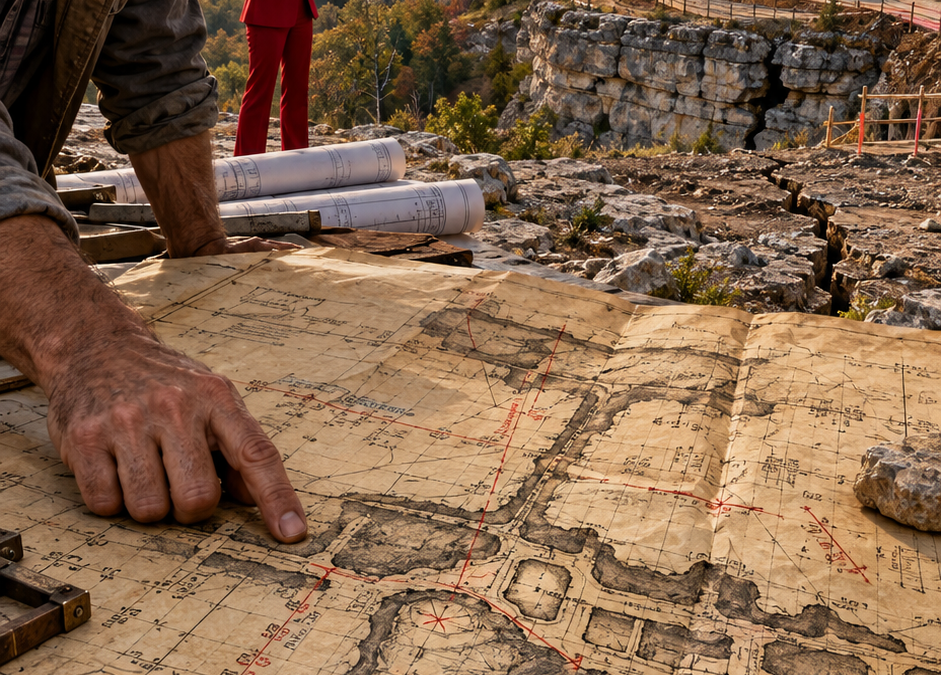
Every major room was marked by hand.
Pillars.
Crosscuts.
Shafts.
Extraction chambers.
Numbers written in red pencil.
Chamber Seven.
Chamber Eight.
Chamber Nine.
My father treated that map like other families treated birth certificates.
Not because he was sentimental.
Because it was useful.
Because empty space beneath a hill remains empty space whether anyone remembers it or not.
The county planning file contained the same warning in more formal language.
KNOWN SUBSURFACE WORKINGS.
HEAVY DEVELOPMENT PROHIBITED WITHOUT ENGINEERED STABILIZATION.
When Crown Ridge was first proposed, the developer’s engineering team took the mine seriously.
The original design required extensive pressure grouting beneath several construction zones.
Deep foundation elements were specified near two of the larger chambers.
The weakest portion of the mine was designated permanent open space.
Ten premium ridge lots were removed from the plan.
The clubhouse was positioned farther west.
The pool was moved away from Chamber Nine.
It was conservative.
Expensive.
And, from an engineering standpoint, defensible.
Then Vanessa Sloan arrived.
Vanessa was fifty-six.
Tall.
Pale blond hair.
Sharp gray eyes.
And almost always dressed in a vivid red suit at HOA meetings.
She was not simply the future HOA president.
Crown Ridge remained under developer control, and Vanessa was one of the development company’s managing partners.
That meant she influenced construction budgets, sales schedules, design changes, and the board that would eventually represent people buying homes there.
She had survived a previous resort development that nearly collapsed financially after delays scared investors.
She learned something from that experience.
Unfortunately, it was not caution.
It was presentation.
Vanessa believed problems became dangerous when people could see them.
So she managed appearances.
If a report contained uncertainty, she shortened the report.
If an engineering requirement threatened a deadline, she looked for another consultant.
If a design reduced the number of sellable lots, she treated the design as negotiable.
Four months after the original stabilization plan was issued, Crown Ridge hired another geotechnical consultant for what was described as a limited review.
Three test borings were drilled on the western side of the property.
All three encountered competent limestone.
None penetrated the mapped chambers beneath the central ridge.
The resulting technical language said the investigated locations showed competent material and described the old workings as historically inactive.
Then Crown Ridge’s final development memorandum used a stronger phrase.
Structurally irrelevant to proposed construction.
The county warning never changed.
The mine did not change.
But the site plan did.
Ten premium lots returned.
The clubhouse moved east.
Four homes gained underground wine cellars.
The infinity pool shifted closer to Chamber Nine.
And approximately seventy percent of the original subsurface stabilization work disappeared from the budget.
I placed the revised site plan over my family’s mine survey.
Then I stared at it.
Red circles covered the page.
The new design was not merely failing to avoid the mine.
It was placing some of the most expensive construction directly over it.
I requested time at the next board meeting.
Vanessa allowed me five minutes.
I brought copies of the 1958 mine survey.
The original engineering plan.
The revised development plan.
I placed all three on the conference table.
“Put that old map away, Daniel.”
Vanessa did not even lower her voice.
The room contained board members, attorneys, development staff, and two representatives from the sales team.
I kept my palm against the yellowed paper.
“This isn’t an old family photograph.”
“The mine is inactive.”
“Inactive isn’t the same as filled.”
“Our consultant evaluated it.”
“Three borings west of the mapped chambers are not an evaluation of the central workings.”
She leaned back.
“Crown Ridge has permits, buyers, and twenty-six homes already under contract.”
“That doesn’t change the geology.”
“I am not sacrificing ten premium lots because your grandfather left holes under a hill.”
One of the board members looked uncomfortable.
He asked, “Has the county approved the current plan?”
Vanessa answered before I could.
“Every required permit.”
I pointed toward the overlay.
“Your clubhouse is above the Chamber Seven corridor. Your pool is near Nine. Six homes cross mapped workings.”
Vanessa smiled slightly.
“Daniel is emotionally connected to this property.”
I looked at her.
“He grew up with stories about the mine. His family worked there. I respect that history.”
There it was.
She did not call me incompetent.
That would have required challenging my engineering.
Instead, she called me sentimental.
It gave everyone else permission to stop listening.
“This isn’t sentiment,” I said.
She pushed the mine map toward me.
“We are done.”
“The mine chambers are still open.”
“That is your opinion.”
“No.”
I tapped the map.
“That is the condition recorded when the mine closed.”
Her expression hardened.
“Your five minutes are over.”
That was the last warning she allowed me to finish.
Two days later, Crown Ridge security stopped me near a survey corridor accessible from a public trail.
A certified letter arrived the next morning accusing me of interfering with construction.
Another threatened a ten-thousand-dollar civil claim if I entered any marked development parcel.
A safety dispute had become a trespassing dispute.
Construction accelerated.
Trucks climbed the ridge from sunrise until dark.
Concrete arrived by the convoy.
Stone walls appeared.
Foundations rose.
Ventilation collars left from the old mine were broken down and buried because prospective buyers had begun asking why circular concrete structures protruded from landscaped areas.
The western shaft was covered with loose stone, gravel, and topsoil.
No permanent inspection access was preserved.
That decision brought Elliot Barnes to my front door.
Elliot was seventy-four.
He had bowed knees, thick shoulders, white stubble, and hands that still looked like they belonged to a man half his age.
He had worked underground beside my father during the mine’s final years.
When Elliot was twenty-one, a roof fall killed his closest friend.
After that, Elliot did not use the word safe carelessly.
He placed a black-and-white photograph on my kitchen table.
Three miners stood beside a timbered opening.
A number was painted above it.
“That chamber was open the day we locked the lower gate,” he said.
“What about Eight?”
“Open.”
“Nine?”
“Open.”
“Backfill?”
He shook his head.
“Pillars.”
“Could those pillars support houses?”
Elliot looked at me as if I had asked whether an old wooden bridge could carry a locomotive.
“They supported rock the way we cut it in fifty-eight.”
He tapped the photograph.
“Nobody designed them for mansions, pools, roads, and whatever else they’ve put up there.”
Then he told me something my father had never mentioned.
“Your dad tried to make the owners fill the central section before he died.”
I looked at him.
“When?”
“Years ago.”
“What happened?”
“They said it cost too much.”
That hurt more than I expected.
My father had carried that map to county meetings.
Called landowners.
Written letters.
I had always assumed he did it because he was stubborn.
I had not understood that he spent the last years of his life believing he had failed to make anyone listen.
Now I was doing the same thing.
And the difference between us was supposed to be that I had licenses, degrees, field experience, and decades of engineering reports behind me.
So far, those credentials had only taught Vanessa how carefully she needed to exclude me.
By early autumn, Crown Ridge looked finished.
Twenty-six pale-stone mansions curved along a landscaped boulevard.
A glass-fronted clubhouse overlooked the valley.
The spa sat behind ornamental maples.
The infinity pool seemed to disappear into the horizon.
The homes sold for between $4.2 million and $5.6 million.
Harold and June Barrett bought Mansion Fourteen.
Harold was a retired railroad dispatcher.
He labeled everything.
Contracts.
Tax records.
Appliance warranties.
Insurance correspondence.
June had been a school librarian for thirty-five years.
She had the rare ability to make frightened people feel calmer without pretending there was nothing to fear.
They planned to retire at Crown Ridge because their daughter lived nearby with two children.
Before closing, Harold asked directly about the old mine.
His sales package mentioned historic quarry activity in the surrounding region.
He wanted more.
A Crown Ridge representative assured him that every relevant working beneath the development had been evaluated and stabilized according to approved engineering plans.
Harold asked for that statement in writing.
They gave it to him.
They did not give him my grandfather’s map.
They did not show him the first stabilization plan.
They did not tell him the stabilization budget had been cut.
For almost a year, nothing dramatic happened.
That was probably the most dangerous period.
Every quiet month strengthened Vanessa’s position.
People drove over level pavement.
They held birthday parties beside the pool.
They watched sunsets from stone terraces.
Wine cellar doors opened and closed.
No buildings fell.
No roads cracked in half.
The warning began to look foolish.
Vanessa started referring to me publicly as the man who wanted Crown Ridge to fail.
I stopped trying to convince homeowners directly.
They were not my enemies.
They had paid professionals to evaluate risk.
They had trusted county permits, licensed consultants, disclosures, inspections, and a developer selling homes for more money than many people earned in a lifetime.
Blaming them would have been satisfying.
It also would have been wrong.
Instead, I watched from places I could legally stand.
I photographed drainage outlets from the county road.
Marked the locations of every completed structure on a clean mine survey.
Requested public copies of the grading plans.
Foundation schedules.
Stabilization certifications.
One sentence in the certification bothered me.
Required subsurface treatment completed in accordance with revised geotechnical recommendations.
It sounded authoritative.
It proved almost nothing.
No grout quantities.
No borehole coordinates.
No pressure logs.
No dated field sequence.
No identification of which revised recommendation had supposedly governed the work.
I requested the supporting documentation.
Crown Ridge sent forty-three pages.
Cover sheets.
Invoices.
Photographs of drilling equipment sitting near the upper entrance.
Billing summaries.
Not one photograph showed grout entering a borehole.
Not one log documented grout pressure.
The borehole diagram used numbers but no coordinates I could reliably tie to the old mine survey.
I asked for the missing field records.
Vanessa’s attorney responded that proprietary construction documents were not available for public review.
That told me something.
They knew which records mattered.
Then the rain started.
For nineteen days, slow autumn storms crossed the ridge.
Not violent storms.
Steady rain.
The kind that finds every fracture.
Water moved downward through grading soil and into openings in the limestone.
Abandoned mines do not always collapse suddenly.
Sometimes soil migrates through cracks into the empty room below.
A hidden void develops above the mine roof.
It grows upward.
The surface continues carrying loads until the bridge of soil and rock becomes too thin.
Then the ground gives way.
The first signs at Crown Ridge were easy to dismiss.
At Mansion Eight, the driveway edge settled three-quarters of an inch below the garage slab.
Maintenance workers added repair compound.
Near the clubhouse, a hairline crack crossed six limestone terrace tiles.
Workers filled it with color-matched sealant.
One underground wine cellar door began closing by itself.
A carpenter adjusted the hinges.
Two weeks later, it started again.
Then the infinity pool began losing water.
Nearly nine hundred gallons a day.
Technicians pressure-tested the plumbing.
No leak large enough to explain the loss was found.
Individually, none of those problems proved mine subsidence.
Together, their locations mattered.
I placed each maintenance site over the old survey.
A line appeared.
Chamber Seven.
Main haul tunnel.
Toward Nine.
I wrote Vanessa requesting an immediate microgravity survey, confirmation borings, and camera inspection through any accessible shaft.
I copied the county building office and development company counsel.
Six hours later, Vanessa replied.
Crown Ridge has evaluated the minor cosmetic conditions referenced in your correspondence. No evidence supports your repeated claim of an active subsurface emergency.
I stared at the phrase.
Active subsurface emergency.
I had not used it.
I had asked for an investigation.
Vanessa transformed a request to collect evidence into an allegation of catastrophe, then rejected the catastrophe she had invented.
Maintenance continued.
Fresh sod covered a depression behind the spa.
Decorative planters appeared along repaired clubhouse tiles.
Then Harold Barrett called me.
“I need to ask you something.”
“Go ahead.”
“Can a crack move without getting much wider?”
“Yes.”
“How?”
“One side can settle vertically. Or slide slightly. Why?”
“Can you meet me?”
We met outside the north gate where residents were allowed to receive visitors.
Harold carried his phone and a small ruler.
For seventeen days, he had photographed a hairline crack across the corner of his garage floor.
He marked the ends with pencil.
Wrote the date beside them.
The crack had extended only half an inch.
But a coin placed across it now rocked.
One side of the slab was lower.
“Maintenance ground off my first marks,” he said.
“What did they tell you?”
“Shrinkage crack.”
“Did they inspect outside?”
“They sealed the floor and adjusted the garage door.”
“Why the door?”
“It started rubbing.”
I looked at his photographs.
A vertical mortar joint near the rear wall had opened during the same period.
The garage opening itself was changing shape.
“Save the originals somewhere off your Crown Ridge accounts.”
“You think the house is collapsing?”
“I didn’t say that.”
His face tightened.
“I need you to tell me the truth.”
“I am.”
I pointed to the photograph.
“I cannot prove subsidence from this. But two related movements deserve investigation before somebody covers them.”
June arrived holding a thin folder.
Inside was their written sales assurance regarding stabilized mine workings.
She looked at me.
“If they already fixed the mine, why won’t they show us where?”
I had no better question.
The next morning, Harold emailed his photographs to the Crown Ridge board and copied twelve neighbors.
Vanessa responded before lunch.
She did not address the measurements.
She warned residents against spreading unverified structural concerns that could damage community values.
That afternoon, maintenance offered Harold a free decorative epoxy finish across his entire garage floor.
One condition.
He had to sign a completion form stating the crack had been resolved.
He refused.
That changed everything.
Until Harold, Vanessa’s problem had been me.
An outside engineer.
A family connection to the mine.
A man she could describe as emotionally invested.
Now a homeowner with no connection to my family had created a dated photographic record.
He had measured movement.
And he refused to let it be painted over.
Around the same time, Crown Ridge announced a three-day VIP sales weekend for the final six homes.
Valet parking.
Luxury vehicles.
Private tours.
Catering.
A sunset reception beside the infinity pool.
The event was designed to reassure buyers.
More importantly, it was designed to reassure lenders before the financial quarter closed.
Five days before the event, Megan Cole called me.
Megan was the assistant property manager.
Thirty-four.
Quiet.
Efficient.
The kind of employee powerful people underestimate because she rarely interrupted them.
She asked me to meet at a diner outside town.
When she arrived, she ordered coffee and placed her phone between us.
“I can’t give you company files.”
“I didn’t ask you to.”
“I need you to look at something.”
She showed me twelve photographs.
Driveway settlement.
Cracked pool tile.
A retaining wall separating from backfill.
A circular depression near an irrigation box.
Each photograph had a date and work-order number.
I wrote the locations on a paper napkin.
Then drew a rough line.
Megan stared at it.
“That’s almost exactly the order the complaints came in.”
“Do the original images still exist?”
“Yes.”
“Keep them.”
“What else?”
“Preserve every work order. Every instruction to repair the surface without investigating below.”
“Should I send them to you?”
“No.”
She looked surprised.
“Why?”
“Because if you take files you are not authorized to take, the entire argument becomes about you.”
“So I just wait?”
“You preserve what you are responsible for preserving.”
She looked frustrated.
“That’s all?”
“That’s how evidence survives.”
People often destroy good evidence because they are impatient for dramatic evidence.
The next morning, Elliot and I walked the public drainage easement along the western boundary.
He remembered where Ventilation Shaft Four had emerged.
Contractors had buried it months earlier beneath gravel and fill.
The surface now formed a shallow bowl nearly five inches deep.
Rainwater sat in the center.
Every few minutes, a bubble broke the muddy surface.
I pushed a marked steel rod into the edge.
Twenty inches.
Resistance.
I tried the opposite side.
The rod dropped nearly three feet.
Elliot stepped backward.
“That fill’s moving.”
We photographed everything.
Rod depths.
Drainage path.
Slope.
Coordinates.
Then I sent the material to county engineer Rachel Kim.
That afternoon, she called.
“I reviewed the historic plan.”
“And?”
“I’m requesting access to Crown Ridge before the sales event.”
It was the first time someone outside the development had independently confirmed the pattern deserved immediate examination.
Less than an hour later, I received another call.
Dr. Nathan Price.
His name appeared on Crown Ridge’s revised geotechnical memorandum.
“Did you send my office the 1958 mine map?”
“Six months ago.”
Silence.
“I never received it.”
I sat down.
Nathan explained the scope of his firm’s work.
Three limited borings.
Western area.
Competent limestone at those locations.
No investigation of the mapped central chambers.
“The words historically inactive came from my technical report,” he said.
“And structurally irrelevant?”
“They did not.”
I opened the final memorandum on my computer.
“Your electronic signature is on it.”
“I signed an appendix.”
He emailed his original draft.
Same project number.
Same date.
But one sentence had disappeared from the final version.
No conclusion is offered regarding unmapped or unverified workings beyond the limited boring locations. Existing mine records should be reconciled before final structure placement.
I read it twice.
“Did you challenge the final wording?”
“Yes.”
“What happened?”
“They told me counsel had reviewed it and the historic mine map did not meet modern survey standards.”
“And you let your name remain?”
A long pause.
“Yes.”
There was shame in his voice.
I did not need to add any.
“Do you have your correspondence?”
“Yes.”
“Preserve it.”
“I can send it to you.”
“Send it to Rachel Kim.”
He agreed.
Nathan was not suddenly a hero.
He had allowed stronger language to remain attached to his work longer than it should have.
But his draft established one crucial fact.
Crown Ridge had been explicitly told to reconcile the historic mine information before final building placement.
Vanessa had not misunderstood a clean engineering approval.
She had transformed a limited review into one.
Rachel requested immediate access.
Crown Ridge did not refuse.
That would have looked bad.
Instead, Vanessa scheduled the inspection for Monday.
After the VIP weekend.
County counsel objected.
Crown Ridge attorneys argued there was no declared emergency.
They claimed they needed time to assemble documents.
The county issued a written notice requiring Crown Ridge to report any accelerating movement immediately.
Vanessa treated that delay like permission.
Friday night, crews pressure-washed the clubhouse terrace.
Fresh mulch covered disturbed soil beside the boulevard.
Two large planters were positioned over the repaired pool-area crack.
And a wooden gazebo was moved six feet to improve the view from the sales tent.
At 6:12 Saturday morning, a landscaper named Luis Ortega noticed a dip beside that gazebo.
He placed two orange cones around it.
At 6:27, one cone tilted inward.
At 6:34, a curved crack opened through the grass.
At 6:38, Luis began recording on his phone.
The first video I later watched was only eleven seconds long.
The gazebo post sank several inches.
The grass folded downward.
Dark soil disappeared through an opening about the size of a dinner plate.
Then the hole widened.
The gazebo twisted.
One anchor tore free.
The next seconds happened quickly.
The ground collapsed.
The gazebo vanished.
A portion of lawn followed.
The hole widened to nearly thirty feet.
The edge of the valet parking area fractured.
A sheet of asphalt hung above darkness.
Luis ran toward the clubhouse screaming for people to move uphill.
The first invited buyers had already arrived.
Vanessa came outside wearing a red suit and low black heels.
She looked into the crater.
Then made the decision that ended whatever control she still had.
“Move the valet entrance.”
Luis stared at her.
“What?”
“Keep guests on the west side.”
“That is not an irrigation leak.”
“We don’t know what it is.”
“The ground swallowed a gazebo.”
“You are not qualified to determine the cause.”
Neither was she.
At 6:51, Megan called emergency services.
Then she called me.
“The ground opened beside the clubhouse.”
“How large?”
“Thirty feet. Maybe more.”
“Get everyone away from the boulevard and pool.”
“Vanessa’s trying to continue the event.”
“Do not stand between the crater and any building. I’m calling Rachel.”
By the time I arrived, fire crews had replaced VIP signs with barricades.
Guests stood beside expensive cars holding phones.
Vanessa argued with a fire captain.
I stayed outside the restricted area.
Rachel opened the 1958 survey across the hood of her county vehicle.
I pointed.
“The crater is near this crosscut.”
“Seven to Eight?”
“Yes.”
Then someone screamed from the eastern boulevard.
A dark line moved across the pavement.
At first it looked like an old repaired seam opening.
Then the curb dropped.
One inch.
Nearly two.
A second crack appeared near Mansion Eleven.
Across the corridor, a garage slab near Mansion Eighteen settled.
Rachel compared the locations to the map.
“These aren’t separate failures.”
“No.”
“They’re tracing the haul tunnel.”
Vanessa approached us.
“You cannot evacuate twenty-six homes because an antique drawing resembles a few cracks.”
Rachel folded the map once.
“I’m not evacuating anyone because of a drawing.”
She pointed toward the road.
“I’m evacuating them because the ground is moving.”
At 7:19, the infinity pool made the argument irrelevant.
A fracture crossed the eastern end of the shell.
Water began escaping through a narrow seam.
Then the deck dropped.
The crack opened.
Thousands of gallons poured into the ground beside the clubhouse.
Water carried soil downward.
Terrace stones tilted.
One glass railing tore free.
A section of pool deck separated and fell into a second cavity.
People screamed.
Firefighters expanded the evacuation zone.
Residents were told to take medications.
Identification.
Pets.
Anything they could carry quickly.
Nothing else.
I found Harold Barrett in his garage.
He held two document boxes.
June stood beside him with their cat inside a carrier.
“Which road?” he asked.
The main boulevard crossed above Chamber Eight.
I traced the service route in my head.
“North maintenance exit.”
“Boulevard?”
“Do not use it.”
“Where do we turn?”
“Left at the retaining wall. Keep going until you’re beyond the upper gate.”
He nodded.
Months earlier, Harold had believed I was threatening his retirement investment.
Now he trusted my family’s map to get his wife out safely.
I did not feel vindicated.
People misunderstand what being right feels like during a disaster.
When families are carrying medication, pet carriers, photographs, and documents out of homes they trusted, being right feels very small.
At 8:03, another fracture crossed the boulevard.
A parked sedan tilted backward as pavement dropped beneath its rear wheels.
Firefighters retreated.
Utilities were shut off.
The road sagged in three steps.
Then Chamber Eight’s roof failed.
The sound was not like an explosion.
It came from underneath us.
Deep.
Rolling.
Stone grinding against stone.
Then pavement, soil, water, landscaping, and three luxury vehicles disappeared into the opening.
Nearly one hundred feet of boulevard collapsed.
Ornamental walls broke apart.
A terrace slid toward the crater.
The guest wing of Mansion Twelve remained hanging over empty space for several seconds.
I remember everyone watching it.
No one spoke.
Then one corner folded.
Most of the structure fell.
No one was inside.
Two neighboring mansions remained standing but visibly leaned toward the collapse.
A broken water main poured into the void until county crews isolated it.
Where the boulevard had been, the ridge was open.
Rough limestone walls.
Old timber.
A black tunnel disappearing beneath the development.
The mine Vanessa had called irrelevant was visible from the center of Crown Ridge.
By noon, photographs were everywhere.
Vanessa issued a statement describing the event as an unexpected natural karst collapse unrelated to known historic mine workings.
The language was deliberate.
A natural cavern could be called unpredictable.
A mapped mine created questions.
Why had stabilization been reduced?
Why had structures been shifted?
Why had the original exclusion zones disappeared?
Why had repairs been hidden?
Why had homes continued selling?
I did not argue through reporters.
The ground was already making the argument.
County mine-safety specialists identified an old western portal outside the active collapse zone.
Air quality was tested.
Roof conditions were evaluated.
A limited inspection was approved.
Rachel entered with a mine-safety engineer.
Elliot and I were allowed to accompany them through the stable section.
The air smelled like wet limestone and rust.
Faded red markings remained on the walls.
Tool cuts ran straight through the stone.
At the first intersection, Elliot stopped.
He pointed toward a pillar.
“Seven.”
The number was faint.
Still there.
It matched my grandfather’s map.
So did the tunnel direction.
Survey equipment tied the underground workings directly to the crater above.
There was no mysterious natural cavity.
The boulevard had collapsed into chambers mapped in 1958.
That was only the first major discovery.
Under a county preservation order, Megan turned over the complete maintenance archive.
Dated photographs.
Repeat repair requests.
Pool water-loss reports.
Sticking doors.
Driveway settlement.
Cracking terraces.
And written instructions.
One email from Vanessa’s office had been sent six days before the collapse.
Complete all visible surface corrections before VIP event.
Avoid speculative references to subsurface conditions in resident communications.
I read those sentences sitting beside Rachel’s desk.
Vanessa’s office had not simply failed to recognize warning signs.
It had managed the vocabulary used to describe them.
Investigators then compared the original stabilization plan with the construction records.
The first plan required more than one thousand cubic yards of pressure grout.
Twenty-eight deep foundation elements.
Three permanent exclusion zones.
The final construction package claimed approximately six hundred ten cubic yards had been placed under the revised program.
The daily drilling logs supported less than two hundred.
Several dates listed major underground treatment.
No matching equipment record existed.
Supplier quantities did not align.
Boreholes listed as completed lacked pressure charts.
No spoil photographs.
No reliable field documentation.
Then investigators found the delivery tickets.
Four hundred twenty cubic yards billed to subsurface stabilization had not gone under the Crown Ridge homes.
Truck dispatch logs showed another destination.
Vanessa Sloan’s private ridge parcel.
Gate-camera images confirmed the trucks.
The material had gone into her decorative motor court.
A massive retaining wall.
And the foundation platform beneath her private infinity pool.
I sat in silence when Rachel showed me the records.
Homeowners had been told the mine was stabilized.
A large part of the material billed to support that claim had been used where Vanessa could look at it from her bedroom.
Mistakes happen.
People misread plans.
Invoices are coded incorrectly.
Field conditions change.
But mistakes do not usually repeat themselves across delivery tickets, schedules, approvals, and altered scopes.
Vanessa’s signature appeared on cost revisions.
Her approval appeared on the shifted clubhouse location.
Her initials appeared beside removal of the largest exclusion zone.
Then investigators found a handwritten note from an investor packet.
10 restored ridge lots protect fourth quarter margin. Do not reopen mine scope without executive approval.
The mine had never been irrelevant.
It had been expensive.
The county closed all of Crown Ridge.
Occupancy certificates were suspended throughout the mapped subsidence corridor.
Engineers installed movement monitors.
Confirmation borings were drilled.
The evacuation boundary expanded whenever instruments recorded new movement.
Residents began organizing paperwork.
Harold had more than most.
His labeled folders contained sales disclosures, inspection reports, emails, repair requests, and the written assurance that the mine workings relevant to his house had been stabilized.
June found the original brochure.
Mansion Fourteen’s underground wine cellar was advertised as being “carved into stable native limestone.”
She handed the brochure to me.
“Is that technically true?”
I looked at the mine map.
The cellar sat above a tunnel.
“Not in the way they wanted you to understand it.”
She nodded slowly.
“I used to teach children to read carefully.”
“You were reading what they gave you.”
“That doesn’t feel like much comfort.”
“No.”
Megan compared buyer files.
Every buyer had received a general disclosure referring to historic quarry activity “in the surrounding region.”
No one received a parcel-specific map.
No one received the original stabilization plan.
No one received documentation showing where the mapped rooms actually ran.
Even buyers signing contracts after the pool began losing water received the same unchanged disclosure.
Two prospective buyers attending the VIP weekend had transferred deposits Friday afternoon.
Less than eighteen hours before the first crater opened.
Internal messages showed a sales manager had asked whether the unexplained pool water loss and repaired terrace crack should be added to property condition documents.
Vanessa answered personally.
Routine maintenance is not a disclosure event. Do not introduce mine speculation into active transactions.
That sentence explained the pressure washing.
The new mulch.
The planters.
The delayed county inspection.
Crown Ridge did not need the hill to remain stable forever.
It needed the hill to look stable through the weekend.
The two VIP deposits were returned.
Existing homeowners faced a much harder reality.
Mortgages remained attached to homes they could not occupy.
Insurance companies asked whether losses came from excluded earth movement.
Negligent construction.
Misrepresentation.
Design error.
Or some combination.
Families received letters full of language written for attorneys while they were sleeping in hotels.
Temporary housing authorizations came in thirty-day blocks.
Storage required separate approval.
Some people were prohibited from reentering their homes while adjusters demanded inventories of possessions inside them.
Harold called me from a hotel room.
I could hear papers moving.
“They all want proof from us.”
“Who?”
“Insurance. Mortgage company. Lawyers.”
He laughed once without humor.
“The people who built this place had the proof.”
“Yes.”
“And now we have to prove what they knew?”
“That’s why nobody does this alone.”
The residents created a shared chronology.
Megan preserved maintenance records she was authorized to provide.
Rachel provided closure orders.
Homeowners contributed contracts.
Disclosures.
Photographs.
Inspection reports.
Repair records.
Hotel bills.
Moving expenses.
Storage costs.
The evidence stopped looking like twenty-six separate homeowner problems.
It became one chain.
Mapped mine workings.
Reduced stabilization.
Missing grout.
Surface movement.
Repeated cosmetic repairs.
Controlled language.
Continued sales.
Delayed inspection.
Collapse.
Once that chain existed, the development could no longer describe what happened as one surprising hole.
Residents moved to remove Vanessa from the HOA board as soon as emergency court supervision allowed them to challenge developer control.
Crown Ridge Development Company was ordered to preserve assets.
An interim relocation fund was established.
Insurers began pursuing design professionals and entities involved with inaccurate construction certifications.
Evidence involving false construction records was referred to state investigators.
Civil fraud claims followed.
None of it happened in one dramatic afternoon.
Real accountability rarely does.
It moves slowly.
Depositions.
Expert reports.
Insurance reservations.
Court motions.
Audits.
Settlement conferences.
But something important had already changed.
Vanessa no longer controlled the records.
She no longer controlled the board.
Most importantly, she no longer controlled the explanation.
Six weeks after the collapse, a county hearing was held.
Vanessa sat at the end of a long table.
No red jacket.
Her attorney argued Crown Ridge had relied on licensed engineers.
“No single executive,” he said, “can reasonably be held responsible for every aspect of a complex geotechnical development.”
Rachel projected three images.
The 1958 mine map.
The original stabilization plan.
The final site plan.
Then she displayed the grout delivery tickets.
No one spoke for several seconds.
Vanessa finally looked at me.
“You wanted this project stopped from the beginning.”
I answered carefully.
“I wanted the chambers treated like chambers.”
“You opposed development.”
“No.”
“You repeatedly predicted failure.”
“I repeatedly requested verification.”
“You wanted those ten lots removed.”
“I wanted the empty space beneath them stabilized.”
She leaned forward.
“The houses passed inspections.”
“Inspections verify what can be observed and what records say was built.”
I pointed toward the grout documentation.
“They cannot make missing material appear underground.”
Harold and June sat behind me with other displaced homeowners.
That was why I refused to turn the hearing into revenge.
They did not need me to humiliate Vanessa.
They needed someone to help make sure their savings did not disappear with the boulevard.
The final engineering investigation took four months.
Teams mapped accessible mine chambers.
Drilled suspected voids.
Tested pillars.
Installed movement instrumentation.
Compared modern survey coordinates with my grandfather’s drawings.
The conclusion was complicated.
Crown Ridge did not need to be completely demolished.
But almost one-third of the developed area could not be economically certified for continued residential occupancy.
The collapsed boulevard was abandoned.
The clubhouse entered controlled demolition.
Six mansions and several heavily affected lots were added to the exclusion zone.
Other homes underwent individual foundation review.
Drainage systems were redesigned.
Monitoring wells became permanent.
Settlement points were installed.
And every future geotechnical report had to be provided in full to property owners.
No more sales-office summaries.
No more edited assurances.
No more “historic quarry activity in the region.”
If a chamber ran beneath a property, the owner had a right to know.
Court-supervised funds, insurance proceeds, and developer assets financed buybacks for families whose homes could no longer be occupied.
Temporary housing.
Storage.
Moving expenses.
Legal support.
No check could replace what those families lost.
Harold and June had expected Mansion Fourteen to be their last home.
Their retirement.
Their grandchildren’s sleepovers.
June’s reading room.
Harold’s workshop.
The place where they expected to grow old.
But they did not lose their retirement savings with it.
Eventually, they bought a smaller brick house several miles away.
Verified stable ground.
The first time I visited, Harold met me in the basement.
He had a flashlight in his hand.
“I checked every wall.”
June called from the stairs.
“He checked them twice.”
Harold ignored her.
“No cracks.”
I looked around.
“No underground mine either.”
“Best feature in the house.”
June laughed.
Their new place had no infinity pool.
No private spa.
No dramatic ridge view.
It had level floors.
A small library.
A backyard.
Their grandchildren played there without orange barricades.
Megan stayed at Crown Ridge.
Under the new resident board, she became records-compliance director.
Every structural complaint remained attached to its original photographs.
Repeated movement could not be closed as a cosmetic repair without engineering review.
Major reports were published to all owners.
Luis Ortega’s phone video became part of the official failure timeline.
The landscaper Vanessa had dismissed as unqualified had recorded the exact moment appearance stopped winning against physics.
Elliot lived long enough to walk the new open-space boundary with me.
Native grass covered several former premium lots.
Locked inspection points marked two ventilation shafts.
They would never be buried again.
Small signs explained the old room-and-pillar workings.
One sentence appeared on each.
ABANDONED DOES NOT MEAN FILLED.
Elliot read it.
Then smiled.
“Your dad would’ve liked that.”
I looked away for a moment.
“I think he would’ve been angry it took this long.”
“He was angry most of the time anyway.”
I laughed.
That sounded like my father.
The strongest reminder stood on Vanessa’s former property.
Her private house and infinity pool were eventually demolished after monitoring found continuing movement near Chamber Nine.
The decorative retaining wall built with material billed to Crown Ridge stabilization remained temporarily.
Investigators photographed it.
Sampled it.
Measured it.
Entered everything into evidence.
Then it too was removed.
The land became a fenced stabilization zone.
Vanessa had fought to make every foot of Crown Ridge sellable.
In the end, one of the most valuable ridge parcels became safest when nobody lived there.
A year after the collapse, I stood beside the exclusion boundary holding my grandfather’s map.
For most of my life, I thought the map represented unfinished family business.
My father believed he had failed.
He tried to warn earlier owners.
They dismissed the cost.
He died believing those empty chambers were still waiting for somebody’s mistake.
Then I inherited that fear.
I believed that if Crown Ridge ignored me, it would mean I had failed him too.
But standing there, I understood something different.
Warnings are not failures just because powerful people ignore them.
Evidence cannot force people to act.
What it can do is remain true long enough to matter.
My grandfather drew that map before I was born.
My father protected it.
I digitized it.
Rachel placed modern coordinates against it.
Elliot walked the tunnels and recognized the old marks.
Harold used it to leave safely.
And eventually, engineers rebuilt the future of Crown Ridge around it.
The map outlasted every person who found it inconvenient.
No one died.
That fact mattered more to me than anything else.
Families were displaced.
People lost months of peace.
Some lost homes they loved.
But nobody was buried beneath the clubhouse.
No child was inside Mansion Twelve when the guest wing fell.
No valet was standing on the boulevard when Chamber Eight failed.
The homeowners received compensation.
Unsafe buildings came down.
The homes that remained were monitored honestly.
And people finally stopped referring to me as the man who wanted Crown Ridge destroyed.
I never wanted it destroyed.
I wanted it built honestly.
There is a difference.
What I remember most is not the photograph of luxury cars at the bottom of the crater.
It is not Vanessa sitting at the county hearing without her red jacket.
It is not even the moment Chamber Eight opened beneath the boulevard.
I remember the evacuation.
June carrying her terrified cat.
Harold carrying two boxes of documents.
An elderly man stuffing medication into a grocery bag because he could not find his suitcase.
A woman standing on the sidewalk holding framed photographs because she had thirty seconds to decide which pieces of her life could fit into her arms.
Those people were not foolish.
They did not ignore an obvious danger because they wanted granite countertops.
They asked questions.
They hired inspectors.
They read disclosures.
They trusted licensed professionals.
They trusted permits.
They trusted a development company selling houses for five million dollars to know whether there was empty ground beneath them.
They paid other people specifically to understand risks they could not evaluate themselves.
And crucial information was kept from them.
That distinction matters.
Justice is not always watching the person who lied lose power.
Sometimes justice is making sure the people who were denied the truth do not lose everything because of it.
I still keep my grandfather’s map in the same steel chest.
The paper is fragile now.
The folds are worn.
The red pencil marks are fading.
I have digital copies.
County engineers have certified overlays.
Modern surveys are more accurate.
There is no practical reason to keep unfolding the original.
But once every few months, I do.
I run my finger along Chamber Seven.
Eight.
Nine.
The main haul tunnel.
The crosscut beneath what used to be the boulevard.
Then I think about the first meeting.
Vanessa’s hand pushing that map across the table.
“Put that old map away, Daniel.”
She believed the mine became irrelevant when people could no longer see its entrances.
She believed burying ventilation collars made buyers forget what was underground.
She believed changing language in reports could change the physical meaning of empty space.
She believed the hill only needed to appear stable until contracts were signed.
But the ground does not understand marketing.
Empty remains empty.
Missing work remains missing.
Water still moves downhill.
Rock still carries only the loads it can carry.
And truth does not stop being true because somebody has enough money to make ignoring it profitable.
My grandfather knew that.
My father knew it.
It took Crown Ridge a crater nearly one hundred feet wide to learn the same lesson.
The last time I visited Harold and June, their grandchildren were running through the backyard.
Harold came outside with two coffees.
He handed me one.
“I used to think you hated Crown Ridge,” he said.
“I know.”
“I told June you wanted the development stopped because it was your family’s land.”
“I know that too.”
He looked embarrassed.
“I was wrong.”
“You believed what you were given.”
“I should’ve listened sooner.”
I looked toward the children.
“You listened before the road disappeared.”
“Barely.”
“Still counts.”
He nodded.
Then he asked me something I had asked myself many times.
“Why did you help us?”
“What do you mean?”
“After the collapse.”
“You needed help.”
“We were the people who didn’t believe you.”
I looked at him.
“No. Vanessa was the person who had the records.”
“That’s not an answer.”
“It is.”
I set the coffee on the porch rail.
“You bought a house. You didn’t alter a mine map.”
He said nothing.
“You trusted the people whose job was to tell you whether the ground was safe. That does not make you responsible for what they hid.”
Harold looked toward his grandchildren.
After a moment, he said, “Your father would’ve helped too?”
“Yes.”
“How do you know?”
“Because he spent half his life worrying about people he hadn’t met yet.”
Harold smiled.
“So this is hereditary.”
“Unfortunately.”
We both laughed.
Later, driving home, I thought about the map in the steel chest.
For decades, my family saw it as a burden.
A warning nobody wanted.
Proof of an old industrial wound beneath land everyone else wanted to reinvent.
I do not see it that way anymore.
It is simply a record.
A truthful one.
And sometimes that is enough.
Because beautiful buildings eventually age.
Sales brochures disappear.
Boards change.
Executives leave.
Concrete cracks.
Websites are redesigned.
But the ground keeps its own records.
And eventually, one way or another, it makes everyone read them.

