𝗙𝗨𝗟𝗟 𝗦𝗧𝗢𝗥𝗬 The Old Golden Dog in the Last Kennel Looked at Me Like He Had Been Waiting Eight Years
𝗙𝗨𝗟𝗟 𝗦𝗧𝗢𝗥𝗬
He braided my hair badly when I was little.
He gave me the better half of whatever dessert we received.
When I had nightmares, I crossed the hall and climbed into his bed, even though we were supposed to stay in our own rooms.
He never sent me back.
“You’re okay,” he would whisper.
“What if they get mad?”
“Let them.”
“What if they separate us?”
“They won’t.”
“How do you know?”
“I won’t let them.”
Daniel said things like that when we were young.
He believed them because I needed him to.
We didn’t have parents.
We had each other.
For a long time, that seemed like enough.
Balou entered our lives almost by accident.
He was a tiny golden puppy then.
Someone found him near the service road behind the orphanage during a cold spring morning.
One of the groundskeepers discovered him under a broken wooden pallet, soaked from rain and shaking.
The orphanage didn’t allow pets.
At least officially.
But Balou was so small that rules became negotiable.
The director said he could stay for a few days until someone from an animal rescue organization collected him.
A few days became a week.
Then two.
Daniel and I fed him scraps from the kitchen.
We made him a bed from old towels.
He slept in a storage room at first, but eventually one of the staff members gave up pretending she didn’t know we sneaked him into the dormitory.
Balou became everyone’s dog.
But mostly, he became ours.
I don’t know who named him.
Daniel claimed I did.
I claimed Daniel did.
The truth is probably that one of us said the word and it stayed.
Balou followed Daniel everywhere.
If Daniel sat on the steps, Balou sat beside him.
If Daniel walked across the courtyard, Balou trotted behind.
If I cried, Balou climbed into my lap.
Sometimes all three of us would sit behind the old gym building where adults rarely bothered us.
Daniel would throw a stick.
Balou would retrieve something else entirely.
A leaf.
A shoe.
Once, somebody’s sock.
“He is possibly the stupidest dog alive,” Daniel said.
“Don’t say that.”
“I’m being affectionate.”
“He understands you.”
“Then he’s offended.”
I covered Balou’s ears.
“Don’t listen to him.”
Daniel laughed.
Those are the memories that hurt most.
Not the terrible ones.
The good ones.
Painful memories announce themselves.
Happy memories wait quietly and then cut you open when you least expect it.
For years, Daniel, Balou, and I existed as our own little family.
Then a couple came to the orphanage and asked to meet me.
I was old enough to understand what that meant.
Adoption.
At first, I didn’t want to go into the meeting room.
Daniel pushed me gently toward the door.
“Go.”
“What if they like me?”
“That’s the point.”
“What if they take me?”
His expression changed.
Just for a second.
Then he smiled.
“Then you’ll have a home.”
“We have a home.”
“No.”
He looked around the hallway.
“We have a building.”
I lowered my voice.
“What about you?”
Daniel was already older.
Everyone knew older children were harder to place.
Prospective parents wanted babies.
Toddlers.
Little children.
Daniel was entering the age when people stopped imagining him as someone they could raise and started seeing him as someone whose personality was already formed.
“I’ll be fine.”
“You don’t know that.”
“I know everything.”
“You don’t.”
“Mostly everything.”
I almost smiled.
That was what he wanted.
The couple’s names were Susan and Mark.
They were kind.
Patient.
They didn’t pressure me to call them Mom and Dad.
They brought books because someone had told them I loved reading.
They came back the next week.
Then again.
Each visit made the possibility more real.
I began to want it.
That made me hate myself.
At night, I lay awake beside Balou and wondered whether wanting parents meant betraying Daniel.
One evening, I finally said it.
“If I go, I’m leaving you.”
Daniel was sitting on the floor repairing one of his shoes.
“No.”
“Yes.”
“You’re getting adopted.”
“Without you.”
His hands stopped moving.
That was the truth neither of us knew how to survive.
“They asked about you,” I said.
Daniel looked up quickly.
My stomach tightened.
“But they said—”
“What?”
I couldn’t say it.
He understood anyway.
“I’m too old.”
“They didn’t say it like that.”
“They didn’t have to.”
“I’m sorry.”
“Why are you apologizing?”
“Because they want me.”
Daniel stared at me.
Then he threw the shoe aside and crossed the room.
He grabbed my shoulders.
“Listen to me.”
His eyes were wet.
“You do not apologize because somebody loves you.”
“But—”
“No.”
His voice cracked.
“You hear me?”
I nodded.
“If you get a chance to get out of here, you take it.”
“What about you?”
“I’ll come find you.”
“You promise?”
“I promise.”
We had learned young that promises could be dangerous.
Adults made them.
I’ll visit.
I’ll come back.
We’ll see.
Maybe next month.
Still, I believed Daniel.
Because if I couldn’t believe him, I had nothing.
The adoption became official near the end of winter.
I remember that day more clearly than almost anything else from childhood.
The sky was gray.
Old snow remained along the edges of the courtyard.
My suitcase was small.
Everything I owned fit inside it.
Some clothes.
Two books.
A photograph of Daniel and me.
A drawing.
A ribbon.
I stood near the gates while Susan and Mark waited by their car.
Daniel stood on the other side.
Balou was in his arms.
By then, Balou was no longer a tiny puppy.
He had grown into a lanky young dog with enormous paws.
I wanted to take him.
Susan and Mark had even said we could discuss it.
But when I looked at Daniel, I knew.
If Balou came with me, Daniel would have nothing.
No parents.
No sister.
No dog waiting at the end of the day.
So I made one of the hardest decisions a child should never have to make.
I touched Balou’s face.
“Stay with Daniel.”
Balou licked my fingers.
Daniel looked at me.
“Take him.”
I shook my head.
“He needs you.”
“You love him too.”
“I know.”
“Then take him.”
“No.”
My voice broke.
“You keep him.”
Daniel pulled Balou closer.
Tears were running down my face.
“He’ll wait with you.”
Daniel didn’t answer.
I stepped closer.
“Promise me you’ll take care of each other.”
He finally nodded.
“You too.”
“What?”
“Take care of yourself.”
I wanted to hug him.
Instead, I stood frozen.
Sometimes grief is too large for movement.
Daniel solved it.
He put Balou down and wrapped his arms around me.
I buried my face against his jacket.
“I don’t want to go.”
“Yes, you do.”
“I don’t.”
“You do.”
“Come with me.”
He held me tighter.
“I can’t.”
“Then I won’t.”
Daniel pulled back and looked directly into my face.
“Don’t do that.”
“What?”
“Don’t make yourself unhappy because you’re scared I’ll be unhappy.”
I was crying too hard to respond.
He wiped my face with his sleeve.
“Go.”
I kissed Balou between the ears.
Then I picked up my suitcase.
Halfway to the car, I turned.
Daniel was still at the gate.
Balou beside him.
Neither moved.
That image stayed with me for eight years.
My brother.
My dog.
The place I’d called home.
All getting smaller through the rear window of a car.
At first, I wrote constantly.
Every week.
Sometimes twice.
Susan helped me buy stamps.
Daniel wrote back.
His handwriting was terrible.
He told me about school.
About Balou.
About which staff members had left.
About a new boy who snored so loudly nobody in the dorm could sleep.
I told him about my new room.
My school.
My parents.
Calling Susan and Mark my parents felt strange at first.
Then natural.
That made me feel guilty.
I didn’t tell Daniel that.
The first year, we spoke often.
The second, less.
The third, even less.
There wasn’t one moment when we stopped being brother and sister.
That’s what makes what happened harder to explain.
Nothing dramatic occurred.
No fight.
No betrayal.
No single slammed door.
Life simply stretched between us.
I changed schools.
Daniel aged out of the orphanage.
Susan and Mark moved because of Mark’s job.
Our phone numbers changed.
Daniel worked different jobs.
Letters began arriving late.
Then not at all.
Sometimes months passed.
Whenever too much time passed, calling became more difficult.
What do you say after three months?
Sorry I disappeared.
Then six months.
Then a year.
At some point, guilt itself became another reason not to call.
I told myself Daniel was building his own life.
Maybe he didn’t need me.
Maybe hearing from me would remind him of everything he hadn’t received.
Maybe he resented me.
Those thoughts weren’t based on anything Daniel had said.
Fear is talented at creating evidence where none exists.
Three years before the day I walked into the shelter, our contact stopped completely.
I didn’t know his address.
I didn’t know whether he was dating someone.
Married.
Happy.
Struggling.
I didn’t even know whether Balou was still alive.
I searched for Daniel online more than once.
I found people with his name.
None clearly him.
Sometimes I typed a message to an old number.
Then deleted it.
Sometimes I stared at the photograph from the orphanage.
Daniel in the middle.
Me beside him.
Balou in front of us.
I always told myself the same thing.
Tomorrow.
I’ll try tomorrow.
Tomorrow became three years.
A few months before my twenty-first birthday, I moved into my own apartment.
Susan and Mark helped.
They were wonderful parents.
That is important.
They never asked me to erase where I’d come from.
They never told me Daniel belonged to my old life.
If anything, Susan encouraged me to look for him.
“You should call the orphanage,” she said once.
“I will.”
“When?”
“Soon.”
She knew better than to push.
My apartment was nice.
Small.
Quiet.
Too quiet.
For the first time in my life, I was truly living alone.
At the orphanage, privacy didn’t exist.
With Susan and Mark, someone was always home eventually.
Now I woke alone.
Ate alone.
Returned from work to dark rooms.
I worked at a library and loved it, but evenings stretched.
Three months after moving in, I decided I wanted a dog.
Maybe that sounds like an impulsive reason to adopt.
But it wasn’t only loneliness.
I wanted something to care for.
Something waiting at home.
Something whose needs would pull me outside my own head.
On a Saturday morning, I drove to an animal shelter on the other side of town.
I remember feeling hopeful.
Nervous.
I told myself I wouldn’t choose immediately.
I would meet several dogs.
Think carefully.
Make a responsible decision.
Then I reached the last section of the hallway.
And saw Balou.
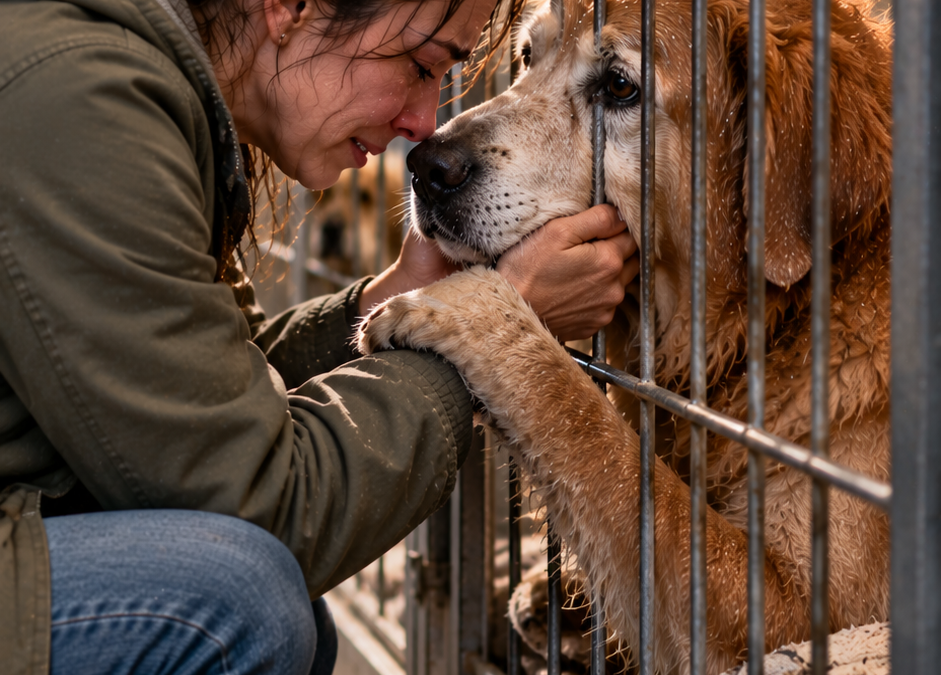
Now I was kneeling in front of his kennel, crying so hard I could barely breathe.
A shelter employee walking past slowed down.
“Ma’am?”
I looked up.
He was young, maybe in his twenties, carrying a clipboard.
“Are you okay?”
“This dog.”
He looked at Balou.
“What about him?”
“What’s his name?”
The employee glanced at the paper clipped outside the kennel.
“Balou.”
My chest tightened.
Even though I already knew, hearing it confirmed felt like being struck.
“How did he get here?”
“Do you know him?”
I wiped my face.
“I think I’ve known him most of my life.”
The employee frowned.
“What?”
“Please.”
I stood.
My knees shook.
“Who brought him here?”
He hesitated.
“I’d have to check.”
“When?”
“About three months ago.”
Three months.
The same length of time I’d been living alone.
The coincidence made the room tilt.
“Was it a man?”
“I think so.”
“What was his name?”
“Ma’am—”
“Please.”
Something in my voice made him stop.
“This matters.”
He studied me.
Then looked at Balou.
“Let me check the intake record.”
He walked away.
I remained beside the kennel.
Balou pressed his body against the bars.
I touched his face through them.
“You got old.”
His eyes closed.
“So did I.”
That was ridiculous.
I was twenty-one.
But compared with the little girl he’d known, I probably smelled like an entirely different lifetime.
“Where’s Daniel?”
Balou opened his eyes.
“Where is he?”
He couldn’t answer.
That terrified me.
Maybe Daniel was dead.
The thought came suddenly and without mercy.
Why else would Balou be here?
Daniel would never surrender him.
Not willingly.
Balou was the one thing we’d shared after I left.
The one piece of childhood Daniel had kept.
If he had brought Balou here himself, something had happened.
I felt sick.
The employee returned.
He was holding another sheet of paper.
“You were right.”
My heart hammered.
“The person who surrendered Balou was a man.”
“Name?”
He glanced down.
“Daniel Ryan.”
I stopped breathing.
For several seconds, all I heard was blood rushing in my ears.
“Daniel.”
“Yes.”
“My brother.”
The employee looked startled.
“He said he couldn’t keep the dog anymore.”
“Why?”
“The record says he was leaving his apartment.”
“Leaving where?”
“I don’t know.”
“Did he say where he was going?”
“No.”
“Was he sick?”
“Not that I know.”
“Did he leave a phone number?”
The employee hesitated again.
“I can’t usually give out personal information.”
“Please.”
“I understand, but—”
“That’s my brother.”
My voice broke.
“I haven’t seen him in eight years.”
He stared at me.
“And that’s our dog.”
Balou pressed closer to the kennel gate.
“I left Balou with Daniel when I was adopted.”
The employee looked from me to Balou.
“Eight years ago?”
“Yes.”
He softened.
“I remember the guy.”
“You do?”
“I wasn’t the one who handled the full intake, but I saw him.”
“What was he like?”
“Upset.”
“Upset how?”
“He stayed with Balou a long time.”
My eyes filled again.
“He kept apologizing to him.”
I closed my eyes.
Of course he did.
“He almost left twice and came back.”
“Why would Daniel do this?”
“I don’t know.”
The employee lowered his voice.
“But he did leave something unusual.”
“What?”
“Instructions.”
My eyes opened.
“What instructions?”
“He told us that if someone ever came asking about Balou—specifically a young woman who seemed to know him—we should contact him.”
My skin went cold.
“What?”
“He said her name might be Emily.”
That was me.
I grabbed the edge of the counter beside us.
“He used my name?”
“Yes.”
“Why didn’t anyone contact me?”
“We didn’t have your information.”
I stared at Balou.
Daniel had left him here expecting me.
But how?
He couldn’t possibly know I would decide to adopt a dog.
He couldn’t know I would choose this shelter.
It made no logical sense.
And yet he’d left my name.
“Did Daniel leave contact information?”
The employee nodded slowly.
“An address and a number.”
“Please give them to me.”
“I need to ask my supervisor.”
“Ask.”
He left again.
This time, I opened the small access panel in the kennel door after another volunteer gave permission.
Balou came out.
Slowly.
His hips were stiff.
But once he reached me, he pushed his head against my legs.
I sank to the floor.
“Hi, old man.”
He licked my chin.
I laughed through tears.
“You remember me.”
His tail moved.
“You really remember me.”
I hugged him carefully.
“I left you.”
The words came out before I could stop them.
“I told you to stay with Daniel.”
Balou rested his head against my shoulder.
“I thought I was doing the right thing.”
My voice shook.
“Was he good to you?”
Of course he was.
I knew Daniel.
Whatever else had happened in those eight years, I knew that.
“If he gave you up, he must’ve had a reason.”
The shelter employee returned with an older woman who introduced herself as the manager.
After I explained everything, she listened in silence.
Finally, she handed me a slip of paper.
“We normally protect surrendering owners’ information.”
“I understand.”
“But Daniel specifically authorized us to give this address to someone matching your description who recognized Balou.”
My hand shook as I took it.
There was an address.
A phone number.
The address was local.
“How long ago did he leave this?”
“Three months.”
“Could he still be there?”
“I don’t know.”
I looked down at Balou.
“I want to adopt him.”
The manager smiled faintly.
“I thought you might.”
“Today.”
“We can start the paperwork.”
“I don’t want him spending another night here.”
Balou looked up at me.
The manager nodded.
“Then let’s get him home.”
Home.
I hadn’t expected the word to hurt.
An hour later, Balou sat in the back seat of my car.
I had bought him a leash, a bag of food, and a ridiculous blue blanket from the shelter shop.
His adoption papers lay on the passenger seat.
Daniel’s address was in my hand.
I should have been happy.
Instead, I was terrified.
I typed the number into my phone.
My thumb hovered over the call button.
Then stopped.
What would I say?
Hi, Daniel. It’s your sister. Sorry about the eight years. I found our dog.
No sentence was large enough.
I put the phone down.
“We’re going there.”
Balou rested his head between the front seats.
“You ready?”
His eyes looked strangely calm.
Mine weren’t.
The drive took twenty-five minutes.
Every traffic light felt too long.
With each mile, memories came faster.
Daniel stealing extra bread for me when the orphanage dinner was bad.
Daniel punching a boy who called me unwanted.
Daniel sitting beside me when I had a fever.
Daniel watching me leave.
Eight years.
How had I allowed eight years to exist between us?
I had excuses.
I had many.
I was a child when we separated.
My adoptive family moved.
Numbers changed.
Daniel aged out of the system.
We hadn’t been taught how to maintain family because neither of us had ever had a stable one.
At the orphanage, people disappeared constantly.
Children were adopted.
Staff changed.
Friends were transferred.
Adults promised visits and didn’t return.
We learned early that attachment was temporary.
You loved people while they were there.
Then you survived when they weren’t.
Maybe Daniel and I had accidentally carried that lesson into adulthood.
Maybe when distance appeared, both of us interpreted it as inevitable.
People leave.
That’s what people do.
But sitting in the car with Balou breathing behind me, I finally saw the lie.
Distance wasn’t the same as absence.
Silence wasn’t proof that love had ended.
I had been scared.
That was the truth.
Scared Daniel resented me.
Scared he’d built a life without me.
Scared that contacting him would force us to confront how much time we’d wasted.
So I did nothing.
Nothing is often easier than risking rejection.
Until you realize how expensive nothing can become.
The address led me to an aging apartment building in an older part of the city.
Brick walls.
Rusting balcony railings.
Paint peeling around the windows.
I parked across the street.
Then I sat there.
Five minutes.
Maybe ten.
Balou became restless.
He stood in the back seat and nudged my shoulder.
“I know.”
I didn’t move.
He nudged me again.
“You’ve waited eight years. Give me a minute.”
Balou whined.
I laughed nervously.
“Fine.”
I got out.
The stairs inside the building smelled like dust, cooking oil, and old wood.
Balou climbed slowly but confidently.
Third floor.
Apartment 12.
There was a small plastic label beside the door.
RYAN.
My last name.
His last name.
A name we had once shared every day.
I raised my hand.
Couldn’t knock.
Balou sat beside me.
His tail touched the floor once.
“Do you think he’s in there?”
Balou looked at the door.
I knocked.
Nothing.
I waited.
Knocked again.
Still nothing.
My fear exploded.
Maybe he’d moved.
Maybe the address was old.
Maybe something had happened.
I pulled out my phone.
Dialed the number.
From inside the apartment, a phone began ringing.
My heart stopped.
Footsteps.
Slow.
A lock turned.
The door opened several inches.
Daniel stood behind it.
For a moment, I didn’t recognize him.
Not fully.
He was thin.
Too thin.
His beard was uneven.
His hair had grown longer.
Dark circles sat beneath his eyes.
He wore an old T-shirt and sweatpants.
Then I saw his eyes.
Blue.
Exactly the same.
Daniel looked at me.
Then at Balou.
Then back at me.
His face emptied of color.
Neither of us spoke.
Balou solved that.
He barked once.
Daniel’s mouth opened.
“Balou?”
The dog surged forward.
Daniel opened the door just in time.
Balou pushed inside and jumped against him with a burst of energy that seemed impossible for an old dog.
Daniel dropped to his knees.
“Hey.”
His voice broke.
“Oh, buddy.”
Balou licked his face.
Daniel buried both hands in his fur.
“No.”
He started crying.
Not quietly.
His shoulders shook.
“I thought I’d never see you again.”
I stood in the hallway watching my brother hold our dog.
Then Daniel looked up at me.
For the first time, the years between us became visible.
“I knew you’d come.”
I didn’t know whether to laugh or cry.
“You knew?”
His eyes closed.
“Not exactly.”
“What does that mean?”
He looked embarrassed.
“I hoped.”
I stepped inside.
The apartment was almost empty.
A table.
One chair.
A couch.
A stack of books.
Tools against one wall.
Several cardboard boxes.
No decorations except photographs.
I walked closer.
There we were.
Three children in one picture.
Daniel.
Me.
Balou.
The photograph had yellowed.
He had kept it.
All those years.
I touched the frame.
“You still have this.”
Daniel stood slowly.
“Of course.”
I turned.
“Why did you leave Balou at the shelter?”
His expression changed.
“Emily—”
“Why?”
“I couldn’t keep him.”
“Why not?”
He looked down.
“I was losing the apartment.”
“What?”
“I was behind on rent.”
My chest tightened.
“For how long?”
“Doesn’t matter.”
“It matters to me.”
Daniel shook his head.
“I lost work for a while. I got another job, but by then…”
He gestured around the room.
“The landlord gave me notice.”
“Where were you going?”
“I didn’t know.”
“And you gave up Balou?”
His face twisted.
“Don’t say it like that.”
I immediately regretted the words.
“I’m sorry.”
“He was thirteen.”
Daniel rubbed his eyes.
“Old. Arthritis. Needed medication.”
He looked at Balou.
“I couldn’t take him to a shelter for people. I couldn’t sleep in my car with him. I couldn’t feed myself some weeks.”
My throat closed.
“So you found a rescue.”
“I visited three.”
“You left him there.”
Daniel nodded.
“It nearly killed me.”
Balou pressed against his leg.
“I sat outside in the parking lot for two hours afterward.”
“Why didn’t you call me?”
Daniel laughed once.
There was no humor in it.
“With what?”
“A phone.”
“You know what I mean.”
“No, I don’t.”
He looked at me.
“What was I supposed to say?”
“‘Emily, I’m in trouble.'”
“You hadn’t called me in three years.”
“Neither had you.”
The words landed hard.
Silence.
Daniel looked away.
“Exactly.”
I swallowed.
“So instead, you left Balou there hoping I’d somehow find him?”
“It sounds stupid when you say it.”
“It is stupid.”
“I know.”
“Daniel, I could have never walked into that shelter.”
“I know.”
“I could have adopted another dog.”
“I know.”
“I could have moved to another state.”
“I know!”
His voice cracked through the room.
Balou flinched.
Daniel immediately lowered his voice.
“I’m sorry.”
I stared.
Daniel rubbed both hands over his face.
“I didn’t have a plan.”
“Then why my name?”
“Because I had nothing else.”
I couldn’t speak.
He continued.
“I had your old information. None of it worked. I searched for you online. I found too many people with your name. I didn’t know which was you.”
“You could’ve contacted Susan and Mark.”
“I tried.”
My stomach dropped.
“What?”
“The number I had was disconnected.”
“They moved.”
“I know that now.”
He sat on the couch.
Balou immediately lowered himself beside him.
Daniel scratched behind his ears.
“I thought about hiring someone to find you.”
“Why didn’t you?”
He looked at me.
“I couldn’t pay rent.”
The answer shamed me.
Not because Daniel meant it cruelly.
Because while I had spent evenings complaining that my apartment was too quiet, my brother had been choosing between rent and food.
And I hadn’t known.
“I should have looked harder.”
Daniel shook his head.
“So should I.”
“I had more resources.”
“You were a kid when you left.”
“I’m not a kid now.”
“Neither am I.”
His voice softened.
“We both disappeared.”
I sat on the floor across from him.
Balou looked between us.
“I thought you might hate me.”
Daniel frowned.
“For what?”
“For leaving.”
“You were adopted.”
“I still left.”
“You were eleven.”
“I could’ve kept calling.”
“So could I.”
“I had a family.”
“So?”
“You didn’t.”
Daniel stared.
I wiped my face.
“Every time something good happened to me, part of me felt guilty.”
His expression softened.
“I went to college.”
“I’m glad.”
“I got birthday cakes.”
“You should have.”
“We went on vacations.”
“Good.”
“I had parents.”
His jaw tightened.
“Emily.”
“I thought if I told you those things, I’d be showing you everything you didn’t have.”
Daniel looked down.
“Do you know what I thought?”
“What?”
“That you were ashamed of me.”
My chest hurt.
“Never.”
“I pictured you living in some nice house with parents who introduced you as their daughter.”
“They did.”
“And I thought maybe people asked whether you had siblings.”
“They did.”
“What did you say?”
I started crying.
“I said I had a brother.”
Daniel looked at me.
“Every time.”
His eyes filled.
“I never stopped being your sister.”
“Then why didn’t you call?”
“Because I was a coward.”
The honesty surprised both of us.
I laughed weakly through tears.
“I kept waiting for some perfect moment where enough time hadn’t passed to make it awkward.”
Daniel nodded.
“I did the same.”
“Then enough time passed that every day made it worse.”
“Yeah.”
We sat there.
Eight years in one room.
All the unanswered questions.
All the imagined resentments.
All the things fear had said for us.
Balou stood and moved between us.
He rested his head on my knee.
Then turned and put one paw against Daniel’s leg.
Daniel smiled through tears.
“Still trying to keep us together.”
I touched Balou’s white muzzle.
“He always did.”
Daniel looked at me.
“Did you really just happen to walk into that shelter?”
“Yes.”
“You weren’t looking for him?”
“I didn’t even know he was alive.”
Daniel let out a shaky breath.
“That’s insane.”
“I wanted to adopt a dog.”
“And you found ours.”
“At the end of the hallway.”
He shook his head slowly.
“I don’t believe in much anymore.”
“Me neither.”
“But that…”
He couldn’t finish.
I looked at Balou.
For eight years, Daniel and I had failed to find our way back to each other.
Balou had done it in one afternoon.
Not intentionally, of course.
He was a dog.
He hadn’t engineered anything.
But love doesn’t always need intention to have direction.
Sometimes something simply survives long enough to become a bridge.
We talked for hours.
At first, carefully.
Then faster.
Years spilled out.
Daniel told me what happened after I left the orphanage.
He had waited for letters obsessively.
On mail days, he’d check twice.
Sometimes three times.
When my letters became less frequent, he assumed my new life was becoming more important.
“I was jealous,” he admitted.
“Of me?”
“Of your parents.”
“You had every right.”
“No.”
“Daniel.”
“I hated people I’d never met because they got to hear you laugh at breakfast.”
That broke me.
“I’m sorry.”
“Stop saying that.”
“But—”
“They loved you.”
He looked at me.
“I wanted somebody to.”
I covered my face.
Daniel moved to the floor beside me.
“No. Emily, look at me.”
I did.
“If they’d been bad to you, I would’ve hated them.”
“They were good.”
“Then I’m grateful.”
“You mean that?”
“Yes.”
He hesitated.
“Mostly.”
I laughed.
He smiled.
There he was.
My brother.
Not the exhausted man who opened the door.
Not the abandoned teenager I imagined.
Daniel.
The boy who stole bread.
The boy who lied that he knew everything.
The boy who promised he would find me.
“You didn’t find me,” I said.
“What?”
“You promised.”
He knew immediately.
At the gate.
Eight years earlier.
I’ll come find you.
Daniel closed his eyes.
“I know.”
“Technically, Balou did.”
He looked at the dog.
“Cheater.”
Balou’s tail moved.
I laughed harder.
Daniel did too.
For the first time that day, the laughter didn’t hurt.
Later, he told me about aging out.
At eighteen, the orphanage gave him paperwork, some clothes, a small amount of money, and information about transitional housing.
“They try,” he said.
“I’m not saying nobody cared.”
“But?”
“But suddenly you’re outside.”
He stared at the wall.
“And everybody expects you to know how to be an adult.”
Balou had gone with him.
They lived in a rented room.
Then a basement apartment.
Then another place.
Daniel worked construction.
Warehouses.
Moving jobs.
Eventually, carpentry.
That was what he loved.
He pointed toward the table.
“I made that.”
I looked at it more carefully.
The wood was beautifully joined.
“You made this?”
“Yeah.”
“It’s incredible.”
He shrugged.
“No.”
“Daniel.”
“It’s a table.”
“You built it.”
“That’s usually how tables happen.”
I laughed.
“You haven’t changed.”
“Unfortunately.”
I ran my fingers along the surface.
“You could sell these.”
“I do sometimes.”
“Sometimes?”
“When people ask.”
“Why don’t you make more?”
“Because lumber costs money.”
“Right.”
I hated how often money entered his story as a wall.
Eventually, I told him about my life.
Susan.
Mark.
School.
College.
My job at the library.
My apartment.
The things I’d been afraid to share years earlier.
Daniel didn’t look resentful.
He looked proud.
“You work in a library?”
“Yes.”
“You always carried books everywhere.”
“I still do.”
“Remember when you stole that giant dictionary?”
“I borrowed it.”
“You hid it under your bed.”
“I was eight.”
“For four months.”
“I was studying.”
“You couldn’t lift it.”
“That’s irrelevant.”
Daniel laughed.
Balou woke at the sound.
For a few hours, the apartment changed.
It stopped feeling poor.
Stopped feeling empty.
It became a room where a brother and sister were finally speaking.
Night arrived without either of us noticing.
My stomach growled.
Daniel looked toward the kitchen.
“I have bread.”
“That’s depressing.”
“I have eggs.”
“Still depressing.”
I pulled out my phone.
“Pizza.”
“I can’t—”
“I’m buying dinner.”
“Emily.”
“If you argue, I’m ordering pineapple.”
His face hardened.
“You wouldn’t.”
“Test me.”
He surrendered immediately.
We ordered two pizzas.
We ate on the floor because there wasn’t enough seating.
Balou sat between us watching every bite with the concentration of a surgeon.
“Don’t feed him pizza,” Daniel said.
“I know.”
“He’ll stare.”
“I know.”
“He’ll make you think he’s dying.”
Balou placed one paw on my leg.
“Oh, my God.”
“See?”
“He’s starving.”
“He ate an hour ago.”
“Look at him.”
“Do not fall for it.”
I gave Balou a tiny piece of plain crust.
Daniel pointed.
“You’ve been back six hours and already undermining me.”
“Sibling privilege.”
Balou swallowed and immediately turned to Daniel.
“Traitor,” I said.
For the first time since I was a child, I stayed awake until almost sunrise talking to my brother.
Not because something was wrong.
Because we had too much to say.
At three in the morning, Daniel brought out a small box.
“I kept these.”
Inside were my letters.
Every one.
Some written in childish handwriting.
Some on stationery Susan bought me.
Some decorated with stickers.
Daniel had tied them with string.
“You kept all of them.”
“Yeah.”
I picked up the earliest one.
Dear Danny,
My room is blue. I have a window. Susan said I can paint it another color if I want. Mark made pancakes. Please tell Balou I love him.
I stopped reading.
“Why did I stop?”
Daniel didn’t answer.
I found the last letter.
Shorter.
Busy.
Teenage handwriting.
School is crazy. I’ll call this weekend.
I hadn’t.
Daniel watched me.
“I kept waiting for the weekend.”
“I’m sorry.”
“You were growing up.”
“So were you.”
“Yeah.”
Neither of us excused it anymore.
Maybe forgiveness doesn’t require pretending something didn’t hurt.
Sometimes it requires admitting that it did.
At five in the morning, Balou was asleep with his head across both our feet.
I looked around the apartment.
The boxes.
The nearly empty shelves.
“Where are you going after you leave here?”
Daniel became still.
“I’ll figure it out.”
“That’s not an answer.”
“I have a friend.”
“Where?”
“He said I can stay on his couch for a little while.”
“How long?”
Daniel shrugged.
“And then?”
“I said I’ll figure it out.”
“No.”
He looked at me.
“No what?”
“Come live with me.”
His expression almost made me laugh.
“No.”
“Why?”
“Because I’m not moving into my little sister’s apartment.”
“Why not?”
“Because that’s pathetic.”
“No. What’s pathetic is sleeping on somebody’s couch because you’re too proud to accept help from family.”
“Emily.”
“Daniel.”
His eyes narrowed.
“You got bossy.”
“I learned from you.”
“I am not living off you.”
“I didn’t say live off me.”
“I need to handle my own life.”
“You have been handling your own life since you were thirteen.”
He flinched.
I softened.
“Probably younger.”
Daniel looked away.
“You don’t have to prove anything to me.”
“I do to myself.”
“Then prove you can let someone help.”
He laughed bitterly.
“That’s convenient.”
“I’m serious.”
“You’re twenty-one.”
“So?”
“I should be helping you.”
“Why?”
“Because I’m your older brother.”
“Congratulations. You were born first.”
“Emily.”
“You took care of me for years.”
“That was different.”
“How?”
“We were kids.”
“Exactly.”
I moved closer.
“You were a kid too, Daniel.”
He went quiet.
Nobody had probably said that to him often enough.
“You didn’t owe me all the things you did.”
“Yes, I did.”
“No.”
“You were my sister.”
“And you’re my brother.”
His eyes filled.
I pointed at Balou.
“He comes with me.”
Daniel smiled faintly.
“Obviously.”
“And you come with him.”
“You’re using my dog against me.”
“Our dog.”
“He’s legally yours now.”
“Then I have leverage.”
Daniel laughed.
Then he cried.
Quietly this time.
He turned his face away.
I reached for his hand.
He didn’t pull back.
“We’ve already lost eight years.”
My voice shook.
“I’m not voluntarily losing another eight because we’re both too proud to need each other.”
Daniel squeezed my hand.
“What if we drive each other crazy?”
“We will.”
“What if it doesn’t work?”
“Then we’ll deal with it.”
“What if—”
“Daniel.”
He looked at me.
“Come home.”
That was the word that finally broke him.
Home.
He bowed his head.
Balou woke, lifted his muzzle, and rested it in Daniel’s lap.
Daniel stroked the dog’s white fur.
“Three weeks.”
“What?”
“I’ll try it for three weeks.”
I smiled.
“Fine.”
“If it doesn’t work—”
“It’ll work.”
“You don’t know that.”
“I know everything.”
Daniel stared at me.
Then laughed.
“You remember.”
“Mostly everything.”
Three weeks later, he moved in.
Those weeks were chaotic.
Daniel hated accepting anything.
When I bought groceries, he tried paying for half.
When I refused, he fixed a broken cabinet.
Then another cabinet that hadn’t been broken.
Then built shelves.
He repaired my dining chair.
Installed a better lock.
Reorganized the tiny storage closet so efficiently that I accused him of witchcraft.
“You don’t have to earn your room,” I told him.
“I’m not.”
“You built an entire bookcase yesterday.”
“You needed one.”
“I already had one.”
“It was terrible.”
“It held books.”
“Technically.”
Balou adjusted faster than either of us.
During the day, he followed Daniel around.
At night, he slept beside my bed.
Sometimes he positioned himself in the hallway between our rooms.
As if he still believed his job was to make sure neither of us disappeared.
The apartment changed.
There was music.
Food cooking.
Tools everywhere.
Daniel humming badly while sanding wood on the balcony.
Balou’s nails clicking against the floor.
Arguments about dishes.
Arguments about thermostat settings.
Arguments about whether Balou was allowed on the couch.
“He is absolutely not allowed,” Daniel said.
Balou climbed onto the couch beside me.
I scratched his ears.
“Seems unclear.”
“You are ruining eight years of training.”
“You surrendered him to a shelter.”
Daniel pointed at me.
“Low blow.”
I covered Balou’s ears.
“Don’t listen to him.”
Daniel froze.
So did I.
We had said those exact words as children.
For a second, nobody moved.
Then Daniel sat beside us.
He placed one hand on Balou.
“Some things don’t change.”
“No.”
I looked at my brother.
“Some things survive.”
Daniel found steady carpentry work.
Then he started accepting private projects.
A table for one of my coworkers.
Shelves for the library.
A dining bench for Susan and Mark.
The first time he met my adoptive parents again, I was terrified.
Not because I thought they would reject him.
Because I didn’t know what Daniel would feel.
Susan opened the door.
Saw him.
Then started crying.
Daniel looked at me in panic.
“What do I do?”
“You’re asking me?”
Susan solved it by hugging him.
“You got so tall,” she said.
Daniel stood stiffly.
Then slowly hugged her back.
Mark shook his hand.
“I’ve heard about you for eight years.”
Daniel glanced at me.
“Good things?”
“Mostly.”
“Emily.”
I smiled.
Dinner was awkward for twenty minutes.
Then Mark asked about woodworking.
That was enough.
By dessert, Daniel and Mark were arguing about table saws.
Susan pulled me aside.
“You found him.”
I looked toward the dining room.
“No.”
She followed my gaze to Balou asleep near Daniel’s chair.
“He found us.”
Months passed.
Daniel eventually moved into his own place.
Not far.
That mattered.
We didn’t mistake closeness for dependence anymore.
He needed his own life.
So did I.
But this time, distance didn’t become silence.
We had rules.
Sunday dinner.
One phone call during the week, minimum.
If one of us became angry, we were allowed to say we needed time.
We were not allowed to disappear.
That rule mattered most.
Balou divided his time between us without consulting anyone.
Some nights with Daniel.
Some with me.
He had beds in both apartments.
He ignored both beds and slept wherever he wanted.
Age was catching up with him.
His walks became shorter.
Stairs harder.
Daniel built a small ramp for my couch.
I mocked the design.
He redesigned it.
“You criticized version one.”
“I said it looked like a highway overpass.”
“It was structurally sound.”
“It occupied half my living room.”
“The dog liked it.”
Balou used the new ramp once.
Then barked until Daniel lifted him onto the couch.
I laughed for five minutes.
“He respects craftsmanship,” Daniel said.
“He respects servants.”
Balou’s thirteenth year changed slowly.
A little less appetite.
Longer naps.
More white around his eyes.
The veterinarian told us what we already knew.
“He is an old dog.”
I hated the sentence.
After everything Balou had survived, part of me wanted age to make an exception.
It didn’t.
One evening, Daniel and I sat on my balcony with Balou between us.
The sunset turned the buildings orange.
Daniel was quiet.
“What?” I asked.
He shook his head.
“Nothing.”
“You’re terrible at nothing.”
He smiled.
Then looked at Balou.
“You know what they taught us without meaning to?”
“At the orphanage?”
“Yeah.”
I waited.
“Don’t get attached.”
My chest tightened.
“Nobody said it.”
“No.”
“But you learned.”
“Everyone left.”
He counted quietly.
“Kids. Staff. Volunteers. Foster parents.”
“Us.”
He nodded.
“So you learn not to hold too tightly.”
Balou rested his head across Daniel’s foot.
Daniel looked down.
“For years, I thought that was survival.”
“What changed?”
He looked at me.
“This.”
He gestured between us.
“Maybe survival isn’t learning how not to need people.”
I swallowed.
“Maybe it’s finding people worth needing.”
Daniel smiled.
“That sounds like something from one of your books.”
“It probably is.”
“I’ll pretend you invented it.”
I reached for his hand.
Balou shifted until his head rested partly across both our knees.
“He waited.”
Daniel rubbed his ear.
“Who?”
“Balou.”
“For what?”
“For us to stop being idiots.”
Daniel laughed.
“That’s a long wait.”
“Eight years.”
“He’s patient.”
We watched the sun disappear.
I thought about all the things that had almost prevented that moment.
If I had chosen a different shelter.
If I’d gone a week later.
If Balou had been adopted by someone else.
If Daniel hadn’t left my name.
If the shelter employee hadn’t remembered.
If.
If.
If.
For most of my life, I’d used that word to punish myself.
If I had called.
If I had written.
If I hadn’t left.
Now I understood something else.
You can spend your entire life examining the roads you didn’t take and never notice the one you’re standing on.
I couldn’t change the eight lost years.
Neither could Daniel.
We could only decide what the next eight would look like.
Balou taught us that without understanding any of it.
Or maybe he understood more than we did.
He didn’t care who had failed to call.
He didn’t care who had left first.
He didn’t count years.
When he saw me at the shelter, he came to the bars.
When he saw Daniel behind that apartment door, he ran inside.
No trial.
No interrogation.
No demand for explanations.
He recognized us.
He loved us.
He stayed.
That was enough.
One rainy night months later, I woke around two.
Balou was standing near my bedroom door.
“Hey.”
He looked toward the hallway.
I got up.
Daniel was sleeping on my couch because we’d stayed too late watching an old movie.
Balou walked to him.
Then back to me.
He stood between us.
I understood.
“We’re both here.”
His tail moved.
I knelt.
“Nobody left.”
Balou leaned into my hand.
I stayed there until he lay down.
The memory of the orphanage came unexpectedly.
Two children in separate beds.
Listening for each other.
Afraid morning might take one away.
I realized Balou hadn’t only reunited us.
He had given us a chance to rewrite that fear.
Doors could open and people could still return.
Someone could move out without disappearing.
Someone could build another life and still remain your family.
Love didn’t require constant proximity.
It required intention.
Calls.
Visits.
Showing up.
Saying difficult things before silence turned them into impossible things.
A year after I found Balou, Daniel gave me a small wooden box.
He’d made it himself.
Dark walnut.
My initials carved inside the lid.
“What is this?”
“Open it.”
Inside were copies of our old photographs.
The orphanage.
Balou as a puppy.
Daniel and me sitting on the steps.
My adoption day.
The first dinner at my apartment after we reunited.
Balou asleep between us.
At the bottom was a folded piece of paper.
I opened it.
Daniel had written:
For all the years we thought were lost.
They weren’t lost.
They brought us here.
I read it twice.
Then looked at him.
“That’s disgustingly sentimental.”
“I knew you’d hate it.”
“I do.”
I hugged him.
He laughed against my shoulder.
Balou barked because we were touching without including him.
We crouched and pulled him into the hug.
“Happy now?”
His tail wagged.
Daniel said, “Still controlling the family.”
“He always did.”
Balou grew older.
That part of the story doesn’t become easier just because the rest is beautiful.
His legs weakened.
His hearing faded.
One eye clouded slightly.
Sometimes he woke confused.
But when Daniel entered a room, Balou knew.
When I said his name, he turned.
When we sat together, he found the space between us.
Always.
I began to understand that Balou had become a living timeline.
He had known us before adoption.
Before careers.
Before apartments.
Before the eight-year silence.
He carried continuity when Daniel and I had lost it.
His aging frightened me because it felt like losing the last witness to who we’d been.
I told Daniel that once.
He shook his head.
“No.”
“What?”
“We remember now.”
I looked at him.
“We don’t need Balou to remember for us anymore.”
The words hurt.
But they also healed something.
He was right.
Balou had carried the connection until we were strong enough to carry it ourselves.
One evening, when Balou was lying across my feet, Daniel said quietly, “Do you ever regret being adopted?”
I turned.
“No.”
He nodded.
“Good.”
“Do you regret that I was?”
He looked almost offended.
“Never.”
“Even then?”
“Especially then.”
“I left you.”
“You got a family.”
“So did you.”
Daniel frowned.
“What do you mean?”
I pointed to myself.
Then Balou.
Daniel looked away.
His eyes filled.
“You took your time.”
“Eight years.”
“Terrible service.”
“I’d like to speak to management.”
He laughed.
Then he reached over and squeezed my hand.
“I used to think the day you left was the day our family ended.”
I looked at Balou.
“What do you think now?”
Daniel smiled faintly.
“It was the day it changed shape.”
That became one of the most important things anyone ever said to me.
Families change shape.
Children leave institutions.
Siblings live apart.
Parents arrive through adoption.
Dogs grow old.
People lose contact.
People return.
What matters isn’t preserving one perfect form forever.
It’s recognizing each other when life finally puts you in the same room again.
Today, Daniel lives fifteen minutes from me.
He runs a small woodworking business.
His tables are much better than the first one in that nearly empty apartment, although I don’t tell him that often enough.
Susan keeps trying to convince him to make cabinets for her kitchen.
Mark treats him like the son-in-law he never asked for.
And Balou?
Balou is very old now.
On good mornings, he walks to the balcony by himself.
On harder mornings, Daniel or I carry him.
His golden coat has faded.
His muzzle is white.
His steps are careful.
But his eyes are still the same.
Sometimes I sit beside him and remember the shelter.
That long hallway.
The cages.
The blanket.
The instant he looked at me.
People like to say I rescued Balou that day.
I didn’t.
The shelter had already rescued him.
Daniel had loved him for nearly his entire life.
If anyone was rescued, it was us.
I had walked into that building because my apartment was too quiet.
I thought I needed a dog.
What I really needed was courage.
Courage to look backward.
Courage to admit that silence had become a choice.
Courage to knock on a door after eight years and risk discovering what waited behind it.
Balou gave me a reason to knock.
One afternoon recently, the three of us sat on my balcony.
Daniel had brought takeout.
Balou slept with his head on my lap.
The sky was turning pink.
No one spoke for a long time.
Then Daniel said, “Do you remember the gate?”
I knew which one.
“Yes.”
“You told Balou to stay with me.”
“I remember.”
“I was angry.”
I looked at him.
“At me?”
“At everybody.”
“Why didn’t you say anything?”
“I was thirteen.”
“Fair.”
He smiled.
“I thought you were choosing them.”
“Susan and Mark?”
“Yeah.”
“Instead of you.”
My heart hurt.
“I never did.”
“I know that now.”
I stroked Balou’s ears.
“I thought leaving Balou with you was the only way I could leave part of myself behind.”
Daniel looked down.
“It worked.”
“For eight years.”
“Longer.”
He touched Balou’s head.
“He kept me alive sometimes.”
I looked at him sharply.
Daniel didn’t elaborate.
He didn’t have to.
I squeezed his hand.
Then he said, “And apparently he wasn’t finished.”
“No.”
“He waited until he was old and tired, then decided to fix our lives.”
“Very dramatic of him.”
“Always was.”
Balou sighed.
We laughed.
The sunset disappeared.
Daniel stayed for dinner.
Then overnight.
Balou slept between our rooms.
And sometime after midnight, I dreamed about the orphanage.
I’ve had versions of that dream for years.
Usually, I’m standing at the gate.
Daniel is behind me.
Someone is calling me toward the car.
I turn.
Daniel gets farther away.
I try to run back but can’t.
In this dream, something changed.
I was still a little girl.
Daniel was still a boy.
Balou was still a puppy.
The gate stood open.
But nobody was pulling me away.
I walked through.
Then turned.
Daniel followed.
Balou ran between us.
We kept walking.
No one disappeared.
When I woke, early sunlight filled the room.
For a few seconds, I didn’t know where I was.
Then I heard Daniel moving in the kitchen.
Coffee.
Cupboards.
Balou snoring near the bed.
Ordinary sounds.
Family sounds.
I lay there listening.
Eight years earlier, I had believed family was something people gave you or took away.
Parents.
Courts.
Institutions.
Adoption papers.
Addresses.
I understand it differently now.
Family can begin through blood.
Or adoption.
Or loyalty.
But it survives through something much less dramatic.
Returning.
Calling.
Answering.
Showing up after silence.
Opening the door.
Making room.
And sometimes forgiving somebody before they know how to forgive themselves.
Balou didn’t restore the childhood Daniel and I lost.
Nothing could.
He didn’t erase eight years.
He didn’t magically heal every wound left by growing up without parents.
What he gave us was simpler.
Another chance.
The chance to stop treating loss as destiny.
The chance to learn that people can leave and still come back.
The chance to become adults who didn’t repeat everything frightened children had learned.
For most of our lives, Daniel and I believed survival meant needing less.
Don’t depend.
Don’t expect.
Don’t hold too tightly.
That way, when people leave, maybe it won’t hurt as much.
We were wrong.
It still hurts.
The only thing that philosophy accomplishes is making sure you’re alone before anybody has actually left.
Balou knew better.
He attached himself completely.
To Daniel.
To me.
To whatever place contained the people he loved.
He risked loss simply by loving.
And when he lost something, he loved again.
That wasn’t weakness.
It was courage.
Sometimes I still open the wooden box Daniel made me.
I look at the photograph from the orphanage.
Daniel is thin and serious.
I’m smiling too widely.
Balou is young enough that his ears haven’t decided what direction to point.
I used to look at that photograph and think of everything that came afterward.
The separation.
The silence.
The wasted years.
Now I see something else.
A beginning that survived its own interruption.
We didn’t stay together the way those children wanted.
Life didn’t give us that.
But we found each other again.
Not because we deserved some perfect ending.
Not because the universe owes anyone restoration.
Because when a door finally appeared, we walked through it.
Balou is sleeping beside me as I write this.
Daniel is in the kitchen making dinner.
He insists he’s a better cook.
He is.
I will never tell him.
The apartment smells like garlic and bread.
Occasionally, I hear Daniel talking to Balou.
“You hungry, old man?”
Tail thump.
“No begging.”
Another thump.
“You’re shameless.”
I smile every time.
There are still days when guilt returns.
Why didn’t I search sooner?
Why didn’t I call?
Why did I allow three years of total silence?
I don’t try to erase those questions anymore.
I answer them.
I was afraid.
I was young.
I had learned the wrong lessons about love.
Then I learned better.
That’s all any of us can do.
Daniel learned too.
He stopped treating help as humiliation.
I stopped treating independence as proof I was okay.
We became brother and sister again in the present instead of simply two people connected by childhood.
And Balou finally got what I promised him beside the orphanage gate.
He stayed with Daniel.
He waited.
Then somehow, after eight years, he brought me back.
The old golden dog I found in the last kennel wasn’t simply the animal I’d left behind.
He was the piece of our family that had refused to disappear.
He had aged.
He had suffered.
He had been forced to wait in places neither Daniel nor I wanted him to be.
But when I whispered his name, he remembered.
And when Daniel opened his door, Balou remembered him too.
Maybe that’s what love really is.
Not never losing each other.
Not never failing.
Not never allowing years to pass.
Maybe love is the part that remembers the way home even after we don’t.
Tonight, after dinner, Daniel and I will take Balou onto the balcony.
We’ll sit on either side of him.
He’ll probably fall asleep before the sun goes down.
Daniel will say something sarcastic.
I’ll tell him he’s annoying.
He’ll remind me I’m younger.
I’ll remind him I have the bigger apartment.
Balou will sigh as if we’re exhausting.
And for a little while, none of the missing years will matter.
Because we’re here.
All three of us.
No gate between us.
No institution deciding who stays.
No car waiting to take one child away.
No unanswered letters.
No disconnected numbers.
No shelter bars.
Just a brother.
A sister.
And an old dog who carried our family across eight years until we were finally brave enough to carry it ourselves.
This time, nobody is leaving without saying goodbye.
This time, we know how to come back.
And this time, when Balou closes his eyes between us, he doesn’t have to wait for anything.
We’re already home.

