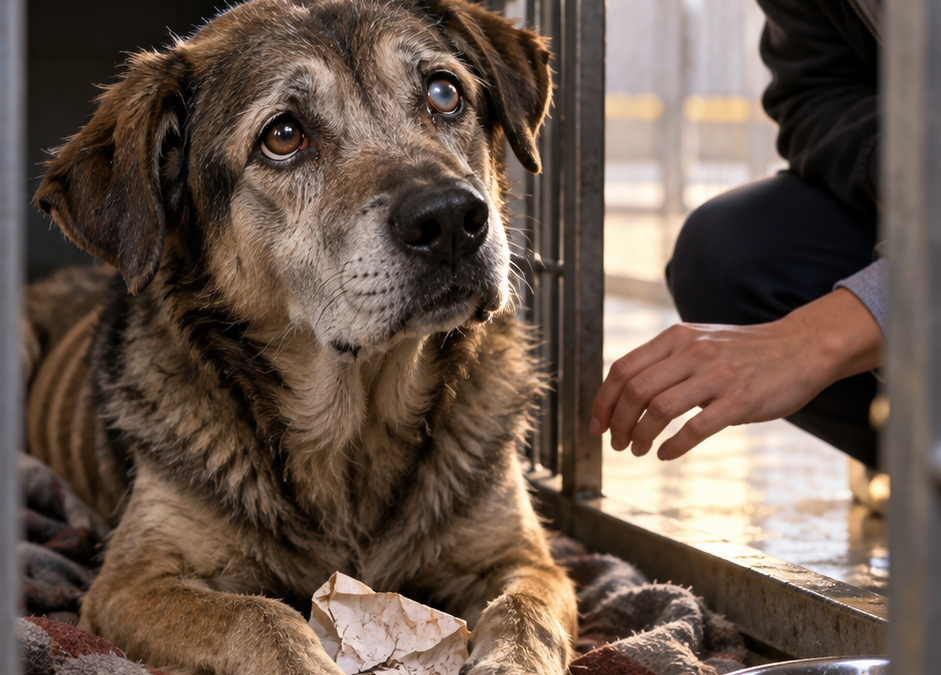
𝗙𝗨𝗟𝗟 𝗦𝗧𝗢𝗥𝗬 The Old Dog Had Stopped Eating, but He Wouldn’t Let Me Touch the Crumpled Paper Beneath His Paws
𝗙𝗨𝗟𝗟 𝗦𝗧𝗢𝗥𝗬
He licked my fingers.
Not the chicken.
My fingers.
Then rested his head on his paws.
I remember looking at him and feeling the first real fear.
Shelter workers become good at recognizing decline.
Sometimes too good.
We see the moment an old animal begins letting go.
The eyes change.
The body becomes less interested in the world.
Food stops mattering.
Movement stops mattering.
The animal becomes quieter than sleep.
Max was doing some of those things.
But not all.
That confused me.
Because several times a day, he still got up and walked to the kennel gate when someone entered the building.
Every time the front door opened.
Every time footsteps sounded in the hallway.
Every time a woman’s voice carried from reception.
He would struggle to stand.
Walk forward.
Look.
Then slowly return to the corner.
I mentioned it to Emily Parker, our shelter director.
Emily had run the place for fourteen years.
She was the kind of woman who remembered every animal we had ever lost and pretended she did not.
She came into Max’s kennel on the fourth morning.
He barely acknowledged her.
“That bad?”
“He ate maybe two tablespoons yesterday.”
Emily sat beside me.
Max’s eyes remained on the hallway.
“We may need to talk about quality of life if this continues.”
I knew.
But hearing the words made my stomach tighten.
“He’s not there yet.”
“I didn’t say he was.”
“He still gets up.”
“I know.”
“He watches the doors.”
Emily looked at Max.
“He always has.”
I nodded.
Maybe that was the problem.
Maybe we had all been watching the same behavior for three years without asking what it meant.
That night, after the shelter closed, I stayed late.
I told myself I had paperwork.
That was partly true.
Mostly, I did not want Max alone.
His food bowl sat untouched.
I warmed some broth.
He drank a little water but would not take the food.
I changed his bedding.
That was when I first saw the corner of the paper.
A small brown-gray edge beneath his front paws.
At first, I thought it was part of a food wrapper.
“Max.”
I reached toward it.
His head lifted instantly.
It was the fastest I had seen him move all week.
I stopped.
His eyes locked onto my hand.
“Okay.”
I pulled back.
He lowered his head.
I waited.
Then reached again, slower.
Max shifted his chest over the object.
Not growling.
Not baring teeth.
Just covering it.
Protecting it.
“What do you have?”
His eyes stayed on mine.
The paper looked old.
Very old.
Soft at the edges.
Folded several times.
Stained.
It should not have been inside his kennel.
We cleaned that space every day.
Blankets went through laundry.
Floors were sanitized.
Bowls washed.
Yet somehow the paper had remained with him.
Maybe inside a seam of his bedding.
Maybe hidden beneath the raised cot.
Maybe moved each time we cleaned without anyone noticing.
I felt a strange chill.
“Can I see it?”
Max did not move.
I sat on the floor.
For twenty minutes, I did nothing.
Eventually, he placed his head on my thigh.
I scratched behind his ear.
His body relaxed.
Then, with one hand still touching his neck, I slid two fingers toward the paper.
Max tensed.
“Easy.”
I moved slowly.
The paper came free.
He raised his head.
For a second, he looked almost panicked.
“I’m not taking it away.”
I unfolded it carefully.
The paper was brittle along one edge.
Most of the ink had faded.
Some words had disappeared completely where moisture or time had worn them away.
The handwriting was uneven.
Large loops.
Letters written with the pressure of a child holding a blue ballpoint pen too tightly.
I brought it beneath the kennel light.
There were only fragments left.
Max…
you are my best…
I promise…
I’ll come back…
wait for me.
I stopped breathing.
Not literally.
But for several seconds it felt that way.
I looked at Max.
He was watching my face.
I had worked with animals long enough to know the danger of inventing human meanings for every expression.
Dogs do not explain themselves with sentences.
They do not write stories in their eyes just because we want them to.
But there are moments when interpretation feels unnecessary.
Max looked from the paper to me.
Then toward the door.
Paper.
Me.
Door.
Again.
Something inside me shifted.
“Oh, Max.”
His tail moved once.
Just once.
I unfolded the note completely.
One line near the bottom was darker than the rest.
Wait for me.
I suddenly remembered something from his original intake.
Someone had supposedly left him temporarily.
I had not read the entire record in years.
Max was an old resident.
We all thought we knew him.
But shelter histories become compressed over time.
People remember the current version.
Not the beginning.
I looked at the food bowl.
Then at the door.
Then at the note.
He was not refusing because the chicken tasted wrong.
He was waiting.
The thought sounded ridiculous at first.
Three years?
Could a dog wait for someone for three years?
Then I looked at the worn paper.
Somehow, Max had kept it.
Three years.
He had carried, hidden, or protected a piece of paper containing a promise.
I put it in my pocket.
Max stood immediately.
“No, no.”
He looked at the pocket.
“I’m keeping it safe.”
He followed me to the kennel gate.
That was more movement than I had seen from him all day.
I understood.
I took the paper out.
Held it in front of him.
“See?”
His nose touched it.
Then my hand.
“I need this, Max.”
I looked directly into his tired eyes.
“I need to find whoever wrote it.”
I do not know whether he understood one word.
Maybe only my tone.
But he stepped back.
I folded the note carefully and placed it in an evidence sleeve we normally used for medical documents that needed protection.
Then I went to the records room.
Our older shelter records had never been completely digitized.
Newer intakes lived inside a database.
Old files remained in boxes and binders because converting them always ranked below emergencies.
Nobody enjoyed the archive room.
It smelled like dust, bleach, and cardboard.
I found the year Max arrived.
Then the month.
I ran my finger down the intake ledger.
Finally:
MAX
Male mixed breed
Estimated age: 7–8
Condition: moderate
Intake source: owner surrender/temporary placement
Contact: Jessica Wright.
I pulled the corresponding folder.
The intake narrative was short.
Jessica Wright brought dog to shelter reporting temporary inability to keep animal. Stated family emergency requiring immediate travel. Requested seven-day temporary hold. Promised to return within one week.
One week.
My hand tightened around the file.
There was a phone number.
Disconnected.
An address.
Across town.
Then a handwritten note from an employee who no longer worked with us.
Owner did not return. Multiple attempts to contact. Number inactive after second week. Dog converted to shelter custody after statutory hold.
I closed my eyes.
The paper Max had protected contained the same promise.
I’ll come back.
Wait for me.
I checked the clock.
Almost nine.
Too late to drive to a stranger’s address and start knocking.
I tried the phone number anyway.
Disconnected.
I searched public directories using the shelter computer.
Nothing current.
Social media gave me several Jessica Wrights and no reliable way to know which one.
I went back to Max.
He had returned to the corner.
His head rested on his paws.
The place beneath his feet was empty now.
Because I had the note.
The sight hurt more than I expected.
For three years, that paper may have been the last physical thing connecting him to the person he waited for.
Now I had taken it.
“What have I done?”
Max lifted his eyes.
I went into the supply closet.
Found an old sleeping bag.
Then returned to his kennel.
I spread it on the concrete.
Emily would have scolded me if she knew I planned to sleep there.
I did not care.
I gave Max his water.
Offered food again.
Nothing.
Then I lay beside him.
For several minutes, he stayed rigid.
Max was affectionate in his own quiet way, but he had never been a dog who climbed into laps.
I rested one hand on the floor near him.
Eventually, he moved.
Slowly.
One paw.
Then another.
He lowered his head onto my thigh.
I felt the weight of him.
Lighter than it should have been.
I touched the gray fur around his ears.
“I’m going to find her.”
The promise left my mouth before I thought about it.
“I don’t know how.”
Max breathed out.
A long exhausted sigh.
“But I’m going to try.”
I reached into my pocket and touched the sleeve containing the note.
“I promise.”
The instant I said the word, I regretted it.
Promise.
Maybe that was exactly what had kept him waiting.
What right did I have to give him another one?
I changed the sentence.
“No.”
Max opened one eye.
“I’m not promising I’ll find her.”
I swallowed.
“I’m promising I won’t stop at the first closed door.”
That felt more honest.
I slept badly.
At 5:30, one of the morning attendants found me curled beside Max.
She looked at me.
Then the sleeping bag.
Then Max.
“I’m not asking.”
“Good.”
“Emily is going to ask.”
“She usually does.”
Emily arrived at seven.
She stood outside the kennel with both hands on her hips.
“Sarah.”
“I need today off.”
That was not what she expected.
“You never take days off.”
“I know.”
“What happened?”
I handed her the note.
She read it.
Her expression changed.
Then I gave her Max’s original intake record.
Emily sat on the edge of the kennel cot.
“He’s been waiting for someone?”
“I think so.”
“For three years?”
“I know how it sounds.”
Emily looked at Max.
He was awake now.
Watching us.
“Where are you going?”
“The old address.”
“You have no idea if she’s there.”
“No.”
“You have no idea what happened.”
“No.”
“She may have intentionally abandoned him.”
“I know.”
“She may not want him.”
“I know.”
“And you still want the day off.”
“Yes.”
Emily handed back the note.
“Go.”
I blinked.
“That easy?”
“No.”
Her eyes were wet.
“That’s why I’m not looking at you.”
I almost smiled.
Emily stood.
“I’ll cover your shift.”
“Thank you.”
“Sarah.”
I turned.
“If Jessica is not who you hope she is, don’t protect Max from the truth by lying to yourself.”
That was Emily.
Even compassion came with reality attached.
“I won’t.”
I drove to the address listed in Max’s intake file.
The house sat in an older neighborhood on the other side of town.
Small red-brick place.
Overgrown yard.
One broken front window covered from the inside with plywood.
No car.
No curtains.
I knocked.
Nothing.
Again.
Still nothing.
The house looked abandoned.
I stood on the porch feeling foolish.
Three years was a long time.
People moved.
Lives broke apart.
Records became useless.
I walked toward my car.
“Looking for somebody?”
I turned.
An elderly woman stood on the neighboring porch.
Gray hair.
Thick glasses.
A yellow cardigan.
“Jessica Wright?”
The woman’s expression changed.
“Jessica doesn’t live there anymore.”
“You knew her?”
“I was her neighbor.”
I crossed the small yard.
“My name is Sarah. I work at the animal shelter.”
At the word shelter, she stared at me.
“Is this about Max?”
My heart slammed.
“You remember him?”
“Oh, honey.”
She covered her mouth.
For a moment, she looked genuinely shaken.
“Yes. I remember that dog.”
“Do you know where Jessica went?”
The woman opened her door.
“Come inside.”
Her name was Eleanor Hayes.
She made coffee even though I told her I did not need any.
Older people sometimes use hospitality to organize difficult thoughts.
I let her.
Jessica, she explained, had lived next door with her mother, Margaret.
Jessica had been young.
Early twenties.
No husband.
No siblings nearby.
Max had belonged to her since she was a teenager.
“They were inseparable,” Eleanor said. “That dog followed her everywhere.”
“What happened?”
“Margaret got sick.”
“How sick?”
“At first, nobody knew.”
She set the coffee in front of me.
“One morning Margaret collapsed in the kitchen. Jessica called an ambulance. Hospital discovered several problems. Neurological issues. Heart trouble. It was complicated.”
“And Jessica?”
“Went with her.”
“She left Max at our shelter.”
Eleanor nodded.
“She told me it would only be a few days.”
“Why didn’t she come back?”
Eleanor looked toward the old house through her window.
“She intended to.”
“What happened?”
“Margaret was transferred.”
“Where?”
“A hospital almost two hours away. Then a long-term care facility nearby.”
“Jessica never came back for her belongings?”
“Once.”
“When?”
“Months later.”
That confused me.
“If she came back, why didn’t she go to the shelter?”
Eleanor shook her head.
“She didn’t stay long. She came with a hired van, took a few boxes, and left again. I barely spoke with her.”
“Did she mention Max?”
“Yes.”
My grip tightened around the coffee mug.
“What did she say?”
“She thought someone had adopted him.”
I stared at her.
“Why?”
“She told me she had lost her phone during the first trip. She was barely sleeping. Margaret needed constant help. Jessica said she tried calling places from memory but couldn’t remember exactly where she had left Max.”
My first reaction was disbelief.
How could someone forget the shelter?
Then I remembered the intake circumstances.
Emergency placement.
No formal surrender.
A frightened young woman.
A sick mother.
Maybe someone else had driven her.
Maybe memory was not as clean during crisis as it looked afterward.
Eleanor continued.
“She cried about him.”
“Did she ever search?”
“I don’t know how hard.”
That mattered.
I appreciated Eleanor’s honesty.
“She believed he’d been adopted?”
“She said she hoped so. She said maybe someone better had him.”
“Do you know where she is now?”
Eleanor disappeared into another room.
She returned with her phone.
For ten minutes, she searched old messages.
Finally:
“There.”
She turned the screen toward me.
An address.
Not a residence.
A medical facility.
“This is where Margaret was transferred.”
“Is she still there?”
“I don’t know.”
“Do you know whether Jessica stayed?”
“She practically lived with her mother.”
I stood.
“Can I take the address?”
“Of course.”
Eleanor watched me write it.
“Is Max alive?”
“Yes.”
Her face softened.
“How is he?”
I hesitated.
“Not well.”
“What happened?”
“He stopped eating.”
“Oh.”
“And he still had this.”
I removed the note from its sleeve.
Eleanor did not touch it.
She read the visible lines.
Tears came immediately.
“I remember that.”
“You’ve seen it?”
“Jessica wrote it when she left him.”
I stared.
“You were there?”
“I drove them.”
The room went still.
“You drove Jessica and Max to the shelter?”
“Yes.”
“Then she knew exactly which shelter.”
“At the time, yes.”
My hope collapsed slightly.
Eleanor understood.
“You’re thinking she could have come back.”
“I’m thinking Max waited three years.”
“She was drowning too, sweetheart.”
“That doesn’t make what happened to him disappear.”
“No.”
Eleanor met my eyes.
“It doesn’t.”
That answer softened something in me.
She was not defending Jessica by pretending Max’s suffering did not matter.
“I watched her write that note in my car,” Eleanor said. “She told Max she would be back in one week. She cried the whole drive to the hospital afterward.”
“Why put the note with him?”
“She said he always slept with one of her shirts when she left the house. She didn’t have a shirt to spare.”
I looked at the faded paper again.
A handwritten promise because a frightened young woman had nothing else to leave.
“How did it survive?”
Eleanor shook her head.
“Max was always strange about things that smelled like Jessica.”
I slid the note back into the sleeve.
“Thank you.”
“Sarah?”
I stopped at the door.
“If you find her, tell her I’m sorry.”
“For what?”
“I should have checked on the dog myself.”
“You weren’t responsible.”
“No.”
She looked toward the abandoned house.
“But sometimes not being responsible doesn’t mean there wasn’t something kind you could have done.”
I carried that sentence with me all the way to the car.
The medical facility was almost two hours away.
I stopped halfway for coffee.
I was too tired to drive safely without it.
At a small roadside café, I sat alone in a booth with Max’s note on the table.
Outside, trucks passed on the highway.
Inside, a waitress refilled my cup twice.
I kept thinking about him.
Every morning at the gate.
Every woman’s voice.
Every time someone entered reception.
Three years of doors opening.
Three years of doors closing.
Had Max really understood time?
Probably not the way we do.
Maybe that made it worse.
Dogs do not mark calendars.
They live through repetition.
Morning.
Food.
Footsteps.
Door.
No Jessica.
Sleep.
Morning again.
How many times could hope survive disappointment before it changed into something else?
I thought about Max licking my fingers instead of eating.
He had not stopped wanting connection.
He had stopped wanting food.
That distinction frightened me.
I drove the remaining distance.
The medical complex was larger than I expected.
White building.
Three connected wings.
A rehabilitation center attached to a long-term care residence.
I went to reception.
The woman behind the desk wore a badge that read KAREN MILLER.
“I’m looking for Jessica Wright.”
Karen’s expression immediately became cautious.
“Are you family?”
“No. My name is Sarah Collins. I work at an animal shelter.”
That was not the sentence she expected.
“An animal shelter?”
“Yes.”
“I can’t give out resident information.”
“I understand.”
I pulled out my shelter identification.
“I don’t need private medical information. I just need you to tell Jessica that someone is here about Max.”
Karen went completely still.
“Max?”
“You know the name?”
“Oh my God.”
She stared at me.
“What happened?”
“He’s alive.”
Karen closed her eyes.
When she opened them, they were shining.
“She talks about that dog all the time.”
“Jessica is here?”
“Yes.”
Relief hit so hard I had to grip the desk.
“She’s still here?”
“Her mother is still a resident. Jessica rents a small room nearby, but she spends most days here.”
“Can I see her?”
Karen hesitated.
“I’ll ask.”
“Please.”
She stepped away.
Then turned back.
“Is Max okay?”
I could have softened the truth.
I did not.
“No.”
Karen’s face fell.
“He hasn’t eaten properly in almost a week.”
“Why?”
“I think because he’s waiting for her.”
Karen stared at me.
Then walked away quickly.
Five minutes later, she returned.
“Come with me.”
We walked down a long hallway.
The smell of disinfectant was familiar enough to make me think of veterinary clinics.
Different patients.
Same human attempt to make illness feel clean.
Soft music played from one room.
Television from another.
Karen stopped outside a partly open door.
“She doesn’t know exactly why you’re here.”
“Okay.”
“Margaret is sleeping.”
I nodded.
Karen touched my arm.
“Be gentle.”
I stepped inside.
Jessica Wright sat beside the window holding knitting needles.
She looked older than the age in Max’s intake record.
Not old.
Tired.
Very thin.
Pale skin.
Dark circles beneath her eyes.
Her hair had been pulled into a loose knot.
An older woman slept in a medical bed beside her.
Jessica looked up.
“You’re Sarah?”
“Yes.”
“Karen said you work at an animal shelter.”
I closed the door softly behind me.
“Yes.”
Her hands stopped moving.
I did not want to drag it out.
“I came about Max.”
The knitting needles fell.
One hit the floor.
Jessica did not reach for it.
For several seconds, she seemed unable to breathe.
“Max?”
“Yes.”
She covered her mouth.
Then whispered:
“Please don’t tell me he died.”
“He’s alive.”
Her shoulders collapsed.
A sound came out of her that I cannot describe.
Half sob.
Half breath.
She turned her face away from her sleeping mother.
“He’s alive?”
“Yes.”
“How?”
The question confused me.
“He stayed at the shelter.”
“No.”
She shook her head.
“No, they told me—”
“Who told you what?”
“I called.”
“When?”
“Months later. I called shelters.”
“Which one?”
“I didn’t know.”
Her voice broke.
“I couldn’t remember.”
I sat across from her.
“Jessica.”
She pressed both hands against her face.
“I thought somebody adopted him.”
“He was never adopted.”
She started crying silently.
Not dramatic crying.
No wailing.
Tears simply kept running.
I removed the note.
Placed it on the table.
Jessica saw the blue writing.
Her entire body froze.
“Where did you get that?”
“Under his paws.”
She reached for it with shaking fingers.
“He kept it?”
“For three years.”
“No.”
She touched the sleeve.
“No, no, no.”
“He kept it.”
Jessica bent over the table.
I waited.
Eventually, she whispered:
“I promised him one week.”
“I know.”
“My mother collapsed.”
“I know some of it.”
“She almost died.”
Her words came faster now.
“I left Max because the hospital wouldn’t allow him and I didn’t know anyone who could take him. Eleanor drove me. I thought one week. Maybe two. Then they transferred Mom. Then she had surgery. Then another complication. I lost my phone somewhere between hospitals.”
“Why didn’t you go back?”
“I tried.”
“When?”
“Not soon enough.”
Her answer was immediate.
No defense.
That mattered.
“I came back months later.”
“Eleanor told me.”
“The house was already in foreclosure. Everything was falling apart.”
“And Max?”
Jessica closed her eyes.
“I went to the wrong shelter first.”
I said nothing.
“They said they didn’t have him.”
“Then?”
“I called another.”
Her hands tightened.
“I kept getting transferred. Somebody told me older dogs usually get adopted or moved to rescue partners.”
“So you assumed.”
“I hoped.”
She looked directly at me.
“I hoped because I was a coward.”
The bluntness surprised me.
“I was afraid to find out he had died waiting.”
Her voice cracked.
“So I told myself someone adopted him.”
“That isn’t the same as knowing.”
“I know.”
“You stopped searching.”
“Yes.”
No excuse.
Just yes.
I thought of Emily’s warning.
Do not protect Max from the truth by lying to yourself.
Jessica looked at the note again.
“Does he hate me?”
The question was so human that despite everything, my heart hurt for her.
“I don’t think dogs wait three years for people they hate.”
That broke her again.
She cried into both hands.
“I dreamed about him.”
I sat quietly.
“Every night?”
“Not every night.”
She wiped her face.
“Enough.”
“What happened in the dreams?”
“He was always behind a door.”
I felt cold.
“I could hear him scratching.”
She looked toward the sleeping woman in the bed.
“I kept thinking I would fix Mom first.”
Her mother stirred slightly.
Jessica lowered her voice.
“Every time I thought things were stable, something else happened.”
“You’ve been here three years?”
“Almost.”
“Living like this?”
She nodded.
“I work remote medical billing at night. Sleep here sometimes. Karen lets me shower in the staff changing room when I’m too tired to drive.”
I looked around.
The half-finished knitting.
Paper cup of coffee.
A folded blanket beside the chair.
Suddenly I understood that Jessica’s life had also stopped.
Not in the same way.
But stopped.
“I’m not telling you that excuses Max.”
She looked at me.
“It doesn’t.”
“No.”
“I know.”
“He suffered.”
“I know.”
“He waited.”
Jessica pressed her lips together.
“I know.”
“He stopped eating six days ago.”
She stood so fast the chair scraped backward.
“What?”
“He is very weak.”
“Take me to him.”
“Jessica—”
“Now.”
She turned toward her mother.
Then stopped.
Margaret slept with oxygen tubing beneath her nose.
Jessica’s face twisted.
“I can’t leave her.”
Karen appeared in the doorway.
“I’ll stay.”
Jessica turned.
“Karen—”
“I’ll stay.”
“You’re working.”
“I finish in forty minutes.”
“My mother wakes confused.”
“I know.”
“She needs her evening medication.”
“Nurse Patel has it.”
Jessica shook her head.
“I can’t just—”
Karen stepped closer.
“You have spent three years not leaving this building because every time you left, you thought something terrible might happen to your mother.”
Jessica looked down.
Karen continued softly.
“Something terrible is happening to Max.”
Silence.
Margaret moved.
Her eyes opened halfway.
“Jess?”
Jessica immediately went to her.
“I’m here, Mom.”
Margaret looked toward me.
“Who?”
“This is Sarah.”
“Friend?”
Jessica could not answer.
Karen did.
“She came about Max.”
Margaret’s tired face changed.
“The dog?”
Jessica nodded.
“He’s alive.”
Margaret stared at her daughter.
Then, in a weak but completely clear voice, said:
“Go.”
Jessica began crying again.
“Mom—”
“Go get your dog.”
“I’ll come back tonight.”
Margaret closed her eyes.
“You better.”
It was the first hint of humor in the room.
Jessica kissed her forehead.
Then grabbed her coat.
The drive back to the shelter took almost two hours.
Jessica barely spoke.
She held Max’s note in both hands.
At one point, I asked whether she wanted music.
“No.”
Twenty minutes later she said:
“What if he doesn’t recognize me?”
“He might need time.”
“What if he does and he’s afraid of me?”
“I don’t know.”
“What if seeing me makes him worse?”
“I don’t know.”
She looked out the window.
“You say that a lot.”
“I work with animals. Anyone who says they always know what an animal will do is someone I don’t trust.”
That earned the smallest possible smile.
Then she looked at the note again.
“I was seventeen when I wrote like that.”
“You were seventeen?”
“I had terrible handwriting.”
“You still do?”
“Yes.”
For the first time, Max’s story felt less like an abandoned dog and more like a relationship with a beginning.
“How old was he when you got him?”
“A puppy.”
“Where?”
“Outside a grocery store.”
She laughed quietly.
“A man was giving away a litter from the back of a pickup. My mother said absolutely not.”
“And?”
“I brought Max home.”
“Your mother changed her mind?”
“No. Max changed it for her.”
Jessica stared through the windshield.
“He slept beside my bed every night.”
“What about the note?”
“I wrote it because I didn’t have anything else.”
“You knew he couldn’t read.”
“I was seventeen.”
She gave me a tired look.
“I thought maybe he would smell me on it.”
I remembered Eleanor saying the same.
“He probably did.”
Jessica’s eyes filled again.
“Not after three years.”
“Maybe not.”
She turned the sleeve in her hands.
“Then why keep it?”
That question followed us the rest of the way.
We arrived after dark.
The shelter lights were still on.
Emily waited near the entrance.
When Jessica got out of the car, she almost ran.
Emily stopped her gently.
“You’re Jessica?”
“Yes.”
“I’m Emily Parker, director.”
“How is he?”
“Stable. Weak.”
“Can I see him?”
“Yes.”
Emily looked at me.
Then back at Jessica.
“But slowly.”
Jessica nodded repeatedly.
We walked down the kennel corridor.
Several dogs began barking.
Max did not.
His kennel was at the far end.
Jessica’s steps slowed as we approached.
By the time we reached the gate, she had stopped entirely.
Max lay in his corner.
Head on his paws.
Eyes closed.
His food remained untouched.
Jessica pressed one hand over her mouth.
“Oh my God.”
I opened the kennel.
“You can go in.”
She shook her head.
“I can’t.”
“What?”
“What if he thinks I’m leaving again?”
The question destroyed whatever remained of my professional composure.
I stepped beside her.
“Then don’t leave tonight.”
Jessica looked at me.
I opened the gate wider.
She entered.
Slowly.
Max did not move.
Jessica knelt several feet away.
Her knees hit the concrete.
She did not speak.
I had expected her to call his name.
She did not.
She simply extended one hand.
Max’s nose moved.
Barely.
Then again.
His head lifted an inch.
Jessica froze.
Max smelled the air.
His ears shifted forward.
He opened his eyes.
For one long second, he stared at her without recognition.
Jessica’s face crumpled.
“It’s okay.”
Her voice was almost inaudible.
“It’s okay if you don’t remember me.”
Max lifted his head higher.
He smelled the air again.
Something changed.
Not dramatically at first.
His eyes sharpened.
His ears moved.
His body became still in a different way.
Alert.
Jessica whispered:
“Max.”
His tail moved.
Once.
She sucked in a breath.
“Max.”
The tail moved again.
Faster.
He tried to stand.
His back legs slipped.
Jessica crawled toward him.
“No, baby, stay down.”
Max stood anyway.
Old bones.
Weak muscles.
Six days without food.
He took one unsteady step.
Then another.
His nose reached her hand.
He smelled her fingers.
Her wrist.
Her sleeve.
Then he made a sound.
I had never heard a dog make that sound before.
It was not a bark.
Not a whine.
It came from deep in his chest.
A long broken breath filled with something that sounded almost like grief.
Jessica collapsed forward.
“Max.”
He pushed his face against her neck.
She wrapped both arms around him.
“I’m here.”
Max began licking her face.
Her chin.
Her eyes.
Her hair.
His tail hit the floor again and again.
Jessica cried into his fur.
“I came back.”
Max whined.
“I’m sorry.”
He licked her.
“I’m so sorry.”
Max tried to climb into her lap.
His legs failed.
She lowered herself completely to the floor.
He crawled across her.
Like he had been waiting three years for permission to stop holding himself together.
Around me, the hallway had become silent.
Emily stood near the door crying openly.
Two kennel attendants had gathered behind her.
Dr. Patel had come from the treatment room.
Nobody spoke.
There was nothing useful to say.
A woman and an old dog were holding each other after three years.
Sometimes silence is the only respectful response.
Max eventually exhausted himself.
He lay with his head across Jessica’s legs.
His eyes remained fixed on her face.
Every time she shifted, his head came up.
“I’m not going anywhere.”
She repeated it over and over.
“I’m here.”
I brought his food.
Jessica looked at the bowl.
“He hasn’t eaten?”
“Almost nothing.”
She placed it near him.
Max smelled it.
Turned away.
Her face fell.
“Max.”
He looked at her.
She picked up one piece of chicken.
Held it in her fingers.
“Please.”
He smelled her hand.
Then ate the chicken.
Jessica stopped breathing.
I stopped breathing with her.
She offered another.
He chewed slowly.
Swallowed.
Another.
Then Max looked at the bowl.
For the first time in almost a week, he lowered his head and began eating on his own.
Slowly at first.
Then faster.
Jessica laughed through tears.
“Easy.”
Max kept eating.
“Slow down, sweetheart.”
He stopped once.
Looked at her.
She placed a hand on his back.
“I’m here.”
He returned to the food.
That was when I knew something fundamental had changed.
Not that he was safe.
We still had medical concerns.
A starving older dog could not simply eat unlimited food without risk.
Dr. Patel immediately stepped in and portioned the meal.
But Max wanted food again.
He wanted something after six days of turning away from everything we offered.
Jessica stayed all night.
We gave her a folding cot.
She ignored it and slept on the kennel floor.
Max slept with his head against her stomach.
Every few hours, she woke and checked whether he was breathing.
I recognized that behavior.
People who have spent too long beside illness stop trusting sleep.
By morning, Max ate another small meal.
Then drank water.
When Jessica stood to use the restroom, Max panicked.
He struggled to follow.
She crouched.
“I’m coming back.”
The words hung in the air.
Jessica froze when she heard herself.
Max stared at her.
She looked at me.
“I can’t say that.”
“Yes, you can.”
“What if—”
“Jessica.”
I pointed toward the hallway.
“You are walking twenty feet to a bathroom.”
She laughed weakly.
“Right.”
“Come back.”
“I will.”
She did.
Max watched the door the entire time.
When Jessica returned, his tail moved.
That became the beginning of rebuilding something neither of them should have had to rebuild.
The next two weeks changed Max faster than any medication we had tried.
He regained appetite.
Then weight.
At first, Jessica visited from morning until evening.
She drove back to her mother at night.
Then returned before breakfast.
Max learned the pattern reluctantly.
The first evening she left, he refused dinner until I sat beside him.
I placed the old note near the bowl.
“Look.”
He smelled it.
Then me.
“She comes back tomorrow.”
I did not know whether he understood.
But Jessica did come back.
Every day.
Same time.
For the first week, Max stood at the front of his kennel thirty minutes before her usual arrival.
On day eight, Jessica was late because of traffic.
Max paced.
At forty minutes, he began staring down the hallway.
I sat with him.
“She’s coming.”
I felt foolish saying it.
Then the front door opened.
Jessica’s voice carried from reception.
“I’m sorry!”
Max barked.
A full bark.
Loud enough that three dogs answered.
I laughed.
“Okay, okay.”
Jessica appeared.
Max practically dragged me toward her.
He still could not run properly.
But he tried.
Jessica started helping at the shelter during those days.
At first, because she refused to leave Max.
Then because she noticed the other animals.
She cleaned kennels.
Folded blankets.
Walked smaller dogs.
Sat with frightened newcomers.
She asked questions about medications.
Adoption applications.
Foster systems.
One afternoon, I found her sitting beside a terrified hound who had been surrendered that morning.
Jessica was reading aloud from a magazine.
I leaned against the kennel entrance.
“You know he can’t understand the article.”
She looked up.
“It’s about municipal bond financing. I barely understand it.”
“Then why?”
“He likes the voice.”
The hound’s head rested against her shoe.
I smiled.
“You may be dangerous here.”
“How?”
“We’re going to hire you.”
She laughed.
“I already have a job.”
“Then we’ll exploit your guilt as a volunteer.”
“Fair.”
Max spent increasingly long periods in the courtyard.
He had always liked the bench beneath the maple tree.
Now Jessica sat there with him every afternoon.
He would climb slowly onto the bench.
Turn once.
Then rest his head in her lap.
Exactly the way he had rested his head on me the night I found the note.
But something in his face was different.
Before Jessica came, even during peaceful moments, Max seemed to be listening for something.
Now he slept.
Deeply.
Completely.
Sometimes his legs twitched as he dreamed.
Jessica would run one hand along his back.
“He never slept like this when I was a teenager.”
“Maybe you were louder.”
“I was definitely louder.”
She smiled.
Then became serious.
“Sarah?”
“Yeah?”
“Do you hate me?”
The question surprised me.
“No.”
“You did.”
“I didn’t know you.”
“You were angry.”
“Yes.”
“You should’ve been.”
I sat beside her.
“Max suffered.”
“I know.”
“That matters.”
“I know.”
“So does what happened to you.”
She looked down at him.
“I don’t want what happened to me to become an excuse.”
“It doesn’t have to.”
“I abandoned him.”
“You failed him.”
Her eyes filled.
I kept going.
“There’s a difference between saying that and saying you never loved him.”
Jessica nodded slowly.
“People keep trying to make things simple because simple hurts less.”
She looked at me.
“You can love someone and still fail them.”
“That’s worse.”
“Sometimes.”
She touched the gray fur along Max’s face.
“What do I do with that?”
“Do better while you still can.”
She looked at Max.
“I can do that.”
Two weeks after the reunion, Dr. Patel examined Max again.
Weight up.
Hydration improved.
Bloodwork better.
Energy significantly increased.
His arthritis remained.
His cloudy eye remained.
Age remained.
Jessica hovered through the entire exam.
Finally Dr. Patel smiled.
“He can go home.”
Jessica stared at her.
“What?”
“He can be discharged.”
“You mean adopted?”
“Technically, yes.”
Jessica looked at me.
The happiness disappeared almost immediately.
“My apartment doesn’t allow dogs.”
I knew.
We had been avoiding that problem.
“And my mother is still in care.”
I nodded.
“I don’t know where to take him.”
Dr. Patel glanced at me.
I let Jessica continue.
“I can’t lose him again.”
“You’re not.”
“What am I supposed to do?”
“Talk to your mother.”
Jessica laughed once.
“My mother lives in a care residence.”
“Some facilities allow companion animals under certain conditions.”
“Not hers.”
“Have you asked?”
“No.”
“Then ask.”
Jessica left that afternoon looking terrified.
Not because she feared rejection from the facility.
Because I think some part of her had learned to expect that every good thing came with another door closing.
The next morning, she arrived before eight.
She was crying.
I braced myself.
“What happened?”
“My mother said yes.”
“That’s good.”
“No.”
She laughed through the tears.
“She said more than yes.”
Jessica handed me her phone.
There was an email from the care residence administrator.
After review, they had agreed Max could live with Jessica in the small family-support apartment attached to Margaret’s unit, provided Jessica assumed all care and veterinary responsibility.
I looked at her.
“How?”
“Karen talked to administration.”
“Of course she did.”
“And Mom’s physician wrote that having Max nearby might actually help her emotionally.”
Jessica laughed again.
“She said Max might give Mom a reason to leave her room.”
“That sounds like Max.”
Jessica wiped her eyes.
“I get to take him home.”
“Yes.”
She walked into his kennel.
Max stood immediately.
She knelt.
“We’re leaving.”
He licked her cheek.
“No, you don’t understand.”
Her voice shook.
“You’re coming with me.”
His tail moved faster.
I watched from the doorway.
Then remembered the note.
I took it from the locked office drawer where we had been keeping it protected.
Jessica saw it.
“I want you to have this.”
She shook her head.
“No.”
“It’s yours.”
“It belongs to him.”
“He can’t exactly file it.”
She smiled.
I placed the sleeve in her hands.
“Keep it.”
“I will.”
“Not in a drawer.”
She looked at me.
“Somewhere you’ll see it.”
“Why?”
“So that on the hard days, you remember what waiting cost.”
Jessica’s smile disappeared.
I worried I had been too harsh.
Then she nodded.
“You’re right.”
I hugged her.
For the first time.
“Promise me one more thing.”
She stiffened slightly at the word promise.
I felt it too.
So I changed it.
“Actually, don’t promise.”
She smiled.
“Okay.”
“Just come visit.”
“I will.”
“And if things get bad again, call us before disappearing.”
“I will.”
“That one sounded like a promise.”
“Maybe a small one.”
Max left the shelter that afternoon.
We all came outside.
Emily pretended she was checking paperwork.
Dr. Patel stood near the door.
Two volunteers cried openly.
Max wore a new blue collar Jessica had bought that morning.
His old joints made the walk slow.
But his head was high.
His tail moved continuously.
At the car, he stopped.
Turned around.
Looked toward us.
Then toward the shelter.
For almost three years, that building had been his entire world.
Food.
Safety.
Loneliness.
People who cared for him.
Doors through which Jessica never came.
Until she did.
I crouched.
“Go home, Max.”
His ears lifted.
Jessica opened the car door.
He climbed in with help.
Then looked at me through the window.
I put one hand against the glass.
“Goodbye, handsome.”
His nose touched the other side.
Jessica started crying again.
“You’re going to make me crash before we leave the parking lot.”
“Then stop crying.”
“You’re crying.”
“I work here. We’re allowed.”
She laughed.
Then drove away.
For several days, his empty kennel bothered me.
That is the strange cruelty of successful shelter work.
You spend months or years hoping an animal leaves.
Then one finally does, and the empty space feels like grief.
I still looked toward his kennel every morning.
At seven.
Habit.
No gray face.
No slow tail.
Just clean bedding waiting for another dog.
A week later, Jessica sent a photograph.
Max was lying beside Margaret’s chair.
The older woman had one hand resting on his back.
Jessica wrote:
Mom left her room for breakfast today because Max refused to eat until she came with us.
I laughed so loudly Emily came into my office.
“What?”
I showed her.
Emily looked at the photograph.
“That dog is manipulative.”
“Extremely.”
Another photograph came two weeks later.
Max sleeping in front of a fireplace.
Jessica beside him.
His head across her legs.
He had gained several more pounds.
His coat looked brighter.
But what caught my attention was the wall behind them.
Framed beneath glass was the note.
Jessica had flattened it carefully.
The faded words were still difficult to read.
Below the original paper, she had added a small typed card reproducing the message as she remembered writing it:
Max, you are my best friend.
I promise I’ll come back.
Wait for me.
I stared at the photograph for a long time.
Then I zoomed in.
There was another line beneath the frame.
Jessica had added it later.
He did.
I sat alone in the office holding my phone.
For three years, Max had waited.
That sentence sounds beautiful now because we know how the story ended.
It was not beautiful while he was living it.
Waiting hurt him.
Loyalty almost killed him.
Love did not protect Max from hunger.
It did not explain where Jessica had gone.
It did not stop him from growing old in a kennel.
I think that matters.
People like to turn stories about animals into simple lessons because animals make us want the world to be simple.
Love conquers everything.
Dogs never forget.
Promises always find their way home.
I no longer believe it works exactly like that.
Love can survive distance.
Yes.
But it can also survive beside failure.
Jessica loved Max and still failed him.
Max loved Jessica and nearly starved while waiting.
I cared for Max for years without understanding what he needed most.
Eleanor loved them both and spent years wishing she had checked.
Nobody in the story was powerful enough to make the past disappear.
What changed everything was not love alone.
It was someone finally acting on it.
A shelter worker opening a piece of paper.
An old neighbor searching through her phone.
A receptionist walking down a hallway.
A caregiver offering to stay beside a sick mother.
Jessica getting into my car.
Max standing when his body barely had the strength.
Small actions.
One after another.
That is how most reunions actually happen.
Not because fate suddenly becomes kind.
Because enough people decide not to stop at the first obstacle.
Months passed.
Max became something of a legend at the shelter.
New volunteers heard the story.
I tried to keep them from romanticizing it too much.
“He almost died,” I reminded them.
“He waited three years.”
That usually quieted people.
One afternoon, Jessica came to visit.
She walked through the front entrance with Max beside her.
For one second, every dog in the building started barking.
Max froze.
I worried the shelter smell might frighten him.
Instead, he looked around.
Then walked directly toward me.
I knelt.
He pressed his forehead against my chest.
“Oh, don’t do this.”
Jessica smiled.
“He missed you.”
“I thought he only had room for one person.”
“Apparently he has expanded.”
Max’s tail hit my leg.
I scratched his neck.
“You look fat.”
Jessica gasped.
“He is not fat.”
“He’s definitely not starving.”
“That was the goal.”
Emily came from the back office.
Max saw her.
His tail went wild.
“Traitor,” Jessica said.
Emily hugged him.
“How’s Margaret?”
Jessica smiled.
“Better.”
“Because of Max?”
“Partly.”
Margaret had started spending afternoons in the common room because residents wanted to see him.
Max had become unofficially shared among patients.
He visited people who rarely had family.
Sat beside wheelchairs.
Slept under tables during card games.
One elderly man who had stopped speaking regularly began asking every morning whether “the brown dog” was coming.
Jessica told me Max had somehow become useful to everyone.
That did not surprise me.
Dogs rarely understand how little they are supposed to matter.
Before Jessica left that day, we sat together on the courtyard bench.
Max’s head rested between us.
“Do you ever think about what would’ve happened if you didn’t find the note?” Jessica asked.
“Yes.”
“So do I.”
I looked at her.
“You can’t live there.”
“I know.”
“He had the paper for years. You found him before he stopped eating?”
She nodded.
“I think he was always waiting.”
“Probably.”
“Why then?”
I had wondered too.
Why after three years did Max suddenly refuse food?
There was no definite answer.
Maybe age.
Maybe declining health.
Maybe something triggered a stronger memory.
Maybe the loss of another long-term shelter dog from the kennel beside him changed his routine.
Maybe one day he simply became tired of waiting.
Animals do not give us neat explanations.
“I don’t know.”
Jessica rubbed his ear.
“What if he decided he was done?”
“Then we found you before he finished deciding.”
She smiled sadly.
“That sounds like something you tell yourself.”
“It is.”
“Does it help?”
“Sometimes.”
Max lifted his head.
Looked at us.
Then yawned.
Jessica laughed.
“He thinks we’re dramatic.”
“He’s right.”
She became serious again.
“Sarah?”
“Yeah?”
“Thank you.”
“You already thanked me.”
“I know.”
“You don’t owe me the rest of your life.”
“I know.”
“Good.”
She stared toward the shelter building.
“I think I owe him mine.”
I looked at Max.
“No.”
Jessica frowned.
“No?”
“You owe him tomorrow.”
She watched me.
“And then?”
“The next day.”
I scratched his chest.
“That’s how you make up for three years. Not with one giant promise.”
Jessica nodded slowly.
“One day at a time.”
“Exactly.”
That became something we both remembered.
Max lived almost three more years.
I did not know that then.
None of us did.
We only knew the days we had.
Jessica sent pictures constantly.
Max at the lake.
Max asleep beside Margaret.
Max wearing a ridiculous holiday sweater.
Max refusing to come inside during the first snow.
Max stealing toast from Margaret’s breakfast tray.
Max lying in a patch of sunlight.
Ordinary photographs.
That was what made them precious.
His life no longer needed a dramatic story.
He had a home.
A person.
A routine.
When Margaret died the following year, Jessica called me.
Her voice was broken.
“I don’t know how to tell Max.”
“You don’t have to.”
“He keeps waiting outside her room.”
“He’ll understand something changed.”
“He loved her.”
“I know.”
“He was there when she died.”
“That matters.”
Jessica was silent.
Then said, “He keeps lying beside her chair.”
For several weeks, Max grieved.
He ate, but less.
Slept near Margaret’s empty room.
Jessica recognized the signs immediately.
This time, she did not let him wait alone.
She moved his bed beside hers.
Took him to work when possible.
Brought him to the shelter to visit.
Let him form new routines.
Max recovered.
Slowly.
That experience changed Jessica too.
One afternoon she told me:
“I used to think loyalty meant never moving on.”
“What do you think now?”
“Maybe it means carrying someone while you keep moving.”
I liked that.
Max taught us both things none of us had intended to learn.
By the time he was truly old, his muzzle had gone almost completely white.
His arthritis worsened.
He slept more.
But he ate.
He still looked for Jessica whenever she left a room.
The difference was that he no longer looked frightened.
Because she always returned.
Eventually, Dr. Patel became his veterinarian outside the shelter too.
When his final decline came, it was gentle.
Jessica called me before making the decision.
“He can’t stand without help.”
Her voice shook.
“He didn’t eat breakfast.”
My heart tightened at those words.
Not eating had started everything.
“Is he waiting?”
“No.”
That answer mattered.
“He’s just tired.”
I drove to Jessica’s apartment.
Emily came too.
Max lay on a blanket beside the fireplace.
The framed note still hung above him.
Jessica sat on the floor with one hand on his chest.
He lifted his head when he saw me.
His tail moved once.
Two slow sweeps.
The same greeting he had given me every morning years earlier.
“Morning, handsome.”
I knelt beside him.
Jessica smiled through tears.
“He knows you.”
“I know.”
She looked at the note.
“I used to hate that paper.”
“Why?”
“Because it proved how long he waited.”
“And now?”
“It proves I came back before it was too late.”
I considered correcting her.
Technically, three years had been too long.
But this was not the moment for technical truth.
Max rested his head in her lap.
Dr. Patel arrived later.
Jessica stayed beside him.
She whispered into his ear.
“I’m here.”
Not:
I’ll come back.
Not:
Wait for me.
Just:
I’m here.
Those were the last words Max heard.
He died with his head in the lap of the person he had spent three years waiting to see.
Afterward, Jessica gave me a copy of the note.
Not the original.
The original remained framed in her home.
The copy hangs near my desk at the shelter now.
New volunteers sometimes ask about it.
I tell them Max’s story.
But not the short version.
The short version says:
An old dog stopped eating because he missed his owner.
A shelter worker found a note.
They reunited.
The dog ate again.
Beautiful.
But incomplete.
The real story is messier.
A young woman made a promise she could not keep.
A dog waited longer than anyone realized.
A shelter cared for him without understanding the thing he guarded.
A family medical crisis swallowed three years.
A phone was lost.
Addresses changed.
Fear became avoidance.
Hope became habit.
And one faded sheet of paper survived all of it.
That is the story I remember.
Not because it proves love fixes everything.
It does not.
Love needs action.
Love needs courage.
Love needs someone willing to pick up the phone after too much time has passed.
Someone willing to knock on a door.
Someone willing to admit:
I failed you.
Someone willing to come back anyway.
Max taught me that returning late is not the same as never returning.
Jessica taught me that guilt can become another form of abandonment if you let shame convince you that you no longer deserve to repair what you broke.
And the shelter taught me something I should have known already.
Never assume you fully understand what an animal is waiting for.
Sometimes the thing beneath their paws looks like trash.
Sometimes it is the last piece of home they have left.
Years have passed since Max died.
Jessica still volunteers with us twice a month.
She is especially good with older dogs.
Of course she is.
Whenever someone walks past a gray-faced dog because they want a puppy, Jessica never pressures them.
She simply sits beside the old dog.
Talks to him.
Lets people notice what patience looks like.
She eventually became one of our foster coordinators.
Her apartment is larger now.
Dog-friendly.
There is almost always one senior foster sleeping somewhere inside.
Above the fireplace hangs Max’s note.
Still protected beneath glass.
Still faded.
Still imperfect.
The ink is disappearing more every year.
But the words we can read remain enough.
Max.
Best friend.
I promise.
I’ll come back.
Wait for me.
Once, I asked Jessica whether she regretted framing it.
She looked surprised.
“No.”
“Doesn’t it hurt?”
“Yes.”
“Then why keep it?”
She smiled.
“Because love isn’t only the part that feels good.”
That sounded like Max too.
I sometimes think about the night before I found the paper.
Max lying in his kennel.
Food untouched.
Head on his paws.
Watching a door that had disappointed him thousands of times.
If I could go back, I would sit beside him sooner.
I would ask more questions about the old intake record.
I would wonder why a dog stayed focused on every woman entering the hallway.
I would notice the paper earlier.
But regret can become arrogant if you let it.
It assumes the past should have been obvious simply because the present finally makes sense.
It was not obvious then.
We did the best we understood until we understood more.
Then we did better.
Maybe that is all any of us can do.
There is one image of Max I keep on my phone.
Not the reunion.
Not the dramatic moment when he recognized Jessica.
Not his first meal afterward.
It was taken months later.
Jessica is sitting on a bench outside Margaret’s care facility.
The afternoon sun is low.
Max lies beside her.
His eyes are closed.
Jessica is reading.
Nothing is happening.
No one is crying.
No one is searching.
No one is waiting.
That is why it is my favorite.
For most of his life, Max had been defined by waiting.
In that photograph, he finally had nowhere else he needed to be.
He was home.
And sometimes, after everything complicated has passed, that is what love looks like.
Not a miracle.
Not a promise.
Just someone still there when you open your eyes.
What do you think of this story? Please leave a like and share your thoughts in the comments. Your support means a lot to us and inspires us to keep writing more meaningful and powerful stories. Thank you! 👍

