𝗙𝗨𝗟𝗟 𝗦𝗧𝗢𝗥𝗬 The Number on My Well Meter Told Me Someone Had Been Stealing From Me Long Before My Faucets Ran Dry
𝗙𝗨𝗟𝗟 𝗦𝗧𝗢𝗥𝗬
My domestic well had been feeding something far larger than my house.
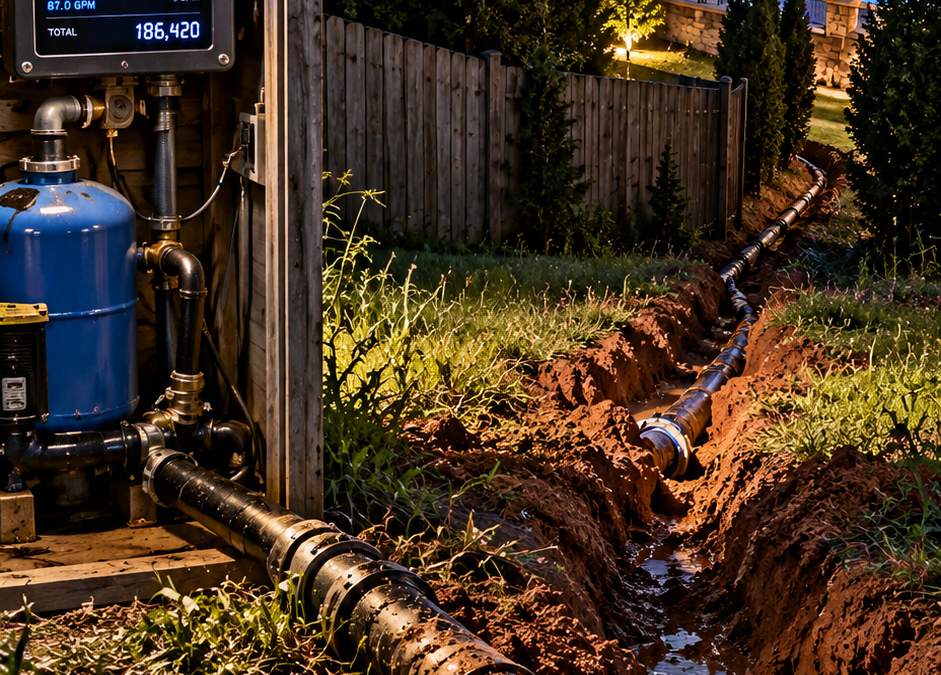
I followed the discharge pipe out of the wellhouse.
Twenty feet beyond the cedar line, my flashlight caught fresh red clay.
A trench.
Recently packed.
Tire marks ran through a section of fence that had been removed and screwed back into place.
New screws.
New soil.
New disturbance.
My heart started beating harder.
I crossed toward the fence.
On the other side stood the Stonebridge clubhouse.
Three contractors were coiling hoses near the pool equipment room.
A four-inch blue pipe rose from the ground beside them.
Water gleamed on its surface.
And standing in the middle of the contractors, dressed in a scarlet suit that looked nearly black before sunrise, was Vanessa Crowe.
President of the Stonebridge Heights Homeowners Association.
She saw me.
She didn’t look surprised.
“Caleb.”
She said my name as if we had scheduled this meeting.
I pointed toward the blue pipe.
“Why is my well feeding your pool?”
One contractor stopped coiling hose.
Vanessa barely looked at him.
“The association activated its emergency utility access.”
I stared at her.
“You did what?”
“The connection is temporary.”
“There is no water access across my property.”
“Our recorded easement says otherwise.”
She pulled a folded document from a leather folder.
Even in the weak light, I could see a yellow strip running diagonally across what looked like an old survey.
The line started near my wellhouse.
It ended behind the clubhouse.
I recognized the underlying drawing immediately.
I had signed the original survey fifteen years earlier.
The developer had needed an electrical and communications corridor along the eastern edge of my property.
Buried cable.
Telephone.
Fiber.
That was all.
I looked at Vanessa.
“That easement doesn’t give you water.”
“The board was advised that the utility sleeve forms part of the shared infrastructure system.”
“You put a commercial four-inch line on a private domestic well.”
“The connection is temporary.”
“No meter.”
“Caleb—”
“No backflow assembly.”
She folded her arms.
“We had a time-sensitive failure in the association’s municipal connection. This prevented damage to a community asset.”
I looked behind her.
The infinity pool glowed under underwater lights.
Perfect blue.
Filled almost to the edge.
“That isn’t an emergency.”
Her face tightened.
“It’s an opening date.”
She didn’t answer.
She did not need to.
Memorial Day weekend was six days away.
Stonebridge had spent months promising residents a grand opening.
There were already photographs on the HOA portal.
Families smiling beside renderings.
Barbecue tables.
Pool chairs.
Decorative umbrellas.
The neighborhood had been sold a summer centerpiece.
Now I understood why people had been working before dawn.
Vanessa raised the document again.
“Do not interfere with the connection.”
I stared at her.
“What did you just say?”
“Interfering with shared utility infrastructure could expose you to liability. Our attorney will send supporting documentation by noon.”
I pointed toward my wellhouse.
“Your shared utility just burned up my pump.”
For the first time, she looked past me.
The motor inside the wellhouse began grinding.
Low at first.
Then louder.
Vanessa’s face changed.
Only slightly.
But I saw it.
The automatic fill valve inside the pool equipment room clicked open.
Somewhere beneath us, pressure dropped.
My damaged pump tried to respond.
The lights inside the wellhouse flickered.
The motor screamed once.
Then stopped.
Completely.
Vanessa turned sharply.
“Shut off the temporary draw.”
The youngest contractor moved toward the equipment room.
“Nobody touches anything.”
Every head turned toward me.
I held up my phone.
“Not until I photograph it.”
Vanessa stepped between me and the blue pipe.
“This is HOA property.”
“The water isn’t.”
“Caleb—”
“The pipe leading here crosses my parcel. My pump just died. Nobody changes this installation until it’s documented.”
Her voice hardened.
“You cannot dictate operations on association property.”
“And you cannot take water from my well because you want a ribbon cutting.”
That was the moment I knew this wasn’t a misunderstanding.
Misunderstandings stop when somebody discovers machinery is breaking.
They apologize.
They turn things off.
They ask how to fix the damage.
Vanessa was still guarding the valve.
So I photographed everything.
The blue pipe.
The wet fittings.
The trench.
The removed fence panel.
The screws.
The contractor trucks.
License plates.
The controller time.
The pool level.
The clubhouse.
Vanessa.
Then I walked back across my property toward a house with no running water.
And called the county.
Anna and I had bought those nine acres in 1998.
The farmhouse wasn’t impressive when we found it.
The porch sagged.
Two windows leaked.
The kitchen floor leaned enough that a marble could roll from one wall to the other.
Anna loved it immediately.
I asked her why.
She stood in what would later become her courtyard garden and said, “Because nobody has ruined it yet.”
That was Anna.
She could look at something unfinished and see possibility instead of defects.
We restored the house ourselves.
Weekends.
Evenings.
Vacations.
I did plumbing and electrical work.
Anna stripped paint, repaired woodwork, and somehow turned a neglected square of dirt into a courtyard filled with stone paths, herbs, lavender, climbing roses, and a small fountain.
When the old hand-dug well began pulling sediment, we drilled the deep well.
Four hundred twenty feet.
Clean water.
Strong yield.
Reliable pressure.
Stonebridge arrived ten years later.
Two hundred twelve homes.
Clubhouse.
Walking paths.
Decorative ponds.
Eventually, the pool.
The developer bought most of the surrounding fields.
He asked more than once whether we wanted to sell.
Anna always gave him the same answer.
“Build around us.”
So he did.
Our nine acres became an island of pasture and old trees beside polished entrances and matched mailboxes.
But we remained outside the HOA.
That mattered.
Stonebridge could regulate paint colors, driveway parking, landscaping, fences, and whatever else its residents had voluntarily agreed to inside its boundary.
It could not regulate me.
After Anna died, the house became quieter than I thought a house could become.
I kept her courtyard almost exactly as she left it.
Not because I believed plants could preserve a person.
They can’t.
But grief makes you protective of ordinary things.
A rosemary bush.
A chipped stone basin.
The sound of water passing over flat rocks outside the kitchen window.
Some things deserve to change slowly.
By seven that morning, my kitchen was full of bottled water.
At seven-thirty, Nate Collins arrived.
Nate was a licensed well contractor I had known for years.
He opened the control box, tested the overload, checked the motor circuit, then lowered a probe.
After twenty minutes, he looked at me.
“Motor windings are cooked.”
I nodded.
“I figured.”
“Static level is down almost thirty feet too.”
That bothered me more.
“Recovery?”
“Probably.”
“Probably?”
“If nobody keeps pulling eighty gallons a minute from it.”
He looked toward Stonebridge.
“But this pump is finished.”
“How much?”
He took a breath.
“Replacement pump, cable, labor, camera inspection, temporary household tank?”
“Nate.”
“Probably eighteen-four.”
“Eighteen thousand four hundred.”
“That’s my best estimate.”
“How long?”
“Five days if I can get the motor.”
“And if you can’t?”
“Seven.”
I looked toward the cedar trees.
Memorial Day was six days away.
Vanessa had a deadline.
So did I.
Her deadline was a pool opening.
Mine was having water in my house.
At 9:42 that morning, an email arrived from Stonebridge’s law firm.
The subject line read:
TEMPORARY COMMUNITY UTILITY ACCESS — NOTICE OF ACTIVATION.
The letter said Stonebridge possessed a recorded right to install and maintain utilities within a twenty-foot corridor along my eastern boundary.
It described the pool connection as temporary emergency use while the permanent municipal supply underwent final certification.
Attached was the map Vanessa had shown me.
A yellow strip crossed directly toward my well.
At first glance, it looked convincing.
Official title.
Survey markings.
My name.
My signature.
Then I enlarged it.
Something was wrong.
The underlying map was faded.
The yellow line wasn’t.
The words WATER ACCESS CORRIDOR were typed in a font that did not appear anywhere else.
I checked the title block.
June 14, 2008.
I knew what I had signed in 2008.
I walked to the hall closet, pulled down our fireproof document box, and found the original recorded easement.
Page one.
Ten-foot corridor.
Underground electrical.
Telephone.
Fiber optic access.
Page two.
No surface structures.
No interference with the owner’s water, septic, or agricultural systems.
Page three.
My signature.
No Exhibit B.
No twenty-foot water corridor.
No right to draw from my well.
I looked again at the document the HOA’s attorneys had sent.
My signature appeared at the bottom of their supposed Exhibit B.
Copied onto a map I had never signed.
I called the law firm.
The attorney whose name appeared on the letter was unavailable.
His assistant answered.
“Your office just sent me a document claiming I granted Stonebridge water rights.”
“I can take a message.”
“Did your office verify the recording number?”
A pause.
“I can’t discuss our client’s file.”
“Then tell your client the waterline shown in that file destroyed an eighteen-thousand-dollar pump.”
Vanessa called at 10:15.
“I understand you’re alleging that the exhibit is inaccurate.”
“I’m not alleging anything. I’m holding the recorded easement in my hand.”
“The board acted in good faith based on information provided to us.”
“Who provided it?”
“Our management consultant assembled the utility package.”
“Name.”
“Caleb, turning this into a personal accusation isn’t going to restore your water.”
“Neither will pretending my signature belongs on a map I never signed.”
She exhaled.
“Let us solve the immediate problem.”
“I’m listening.”
“The HOA will contribute eighty-five hundred dollars toward the pump replacement.”
I almost laughed.
“Contribute?”
“We will also provide a portable household water tank today.”
“You destroyed an eighteen-thousand-dollar pump.”
“That conclusion hasn’t been established.”
“Then why are you offering eighty-five hundred?”
Another pause.
“In exchange, you would sign a temporary access acknowledgement through June thirtieth.”
There it was.
Not compensation.
A trade.
“Send it in writing.”
“Does that mean you’ll consider it?”
“It means I want a record.”
The proposal arrived nineteen minutes later.
I read it once.
Then again.
Then a third time.
It did not merely grant Stonebridge temporary permission through June.
Buried in the second paragraph was language acknowledging that the HOA’s “existing utility rights included water conveyance and extraction.”
If I signed it, I would not be giving them permission for one month.
I would be admitting they had always possessed permission.
Vanessa was not trying to buy time.
She was trying to manufacture the legal document she had needed before the pipe went into the ground.
At noon, I drove to the county recorder’s office.
The clerk searched every recorded filing tied to my parcel and the Stonebridge clubhouse lot.
The 2008 electrical easement.
Two drainage agreements.
A road dedication.
A landscaping covenant.
Nothing else.
“No water easement?” I asked.
“No.”
“Shared well agreement?”
“No.”
“Temporary utility right?”
She shook her head.
“No.”
“I need certified copies.”
As she stamped the pages, she looked at the document Stonebridge had sent me.
“If somebody is circulating a different exhibit with your signature, preserve exactly what you received.”
“I already did.”
“Good.”
From there, I drove to environmental health.
That’s where I met Lena Ortiz.
Groundwater specialist.
Quiet voice.
No drama.
She had the best professional habit I know.
One question at a time.
She did not pretend she could decide every legal issue.
She looked at what the county regulated.
My well permit authorized domestic use on my parcel.
Stonebridge’s pool permit listed a future connection to the Dry Creek Municipal System.
My well appeared nowhere in the application.
No temporary private supply.
No emergency source.
No cross-connection application.
No inspection of the blue line.
No backflow prevention test.
I showed Lena the photographs.
She studied them.
“Is that dangerous?” I asked.
“A direct connection between a chlorinated pool system and a private domestic well can create a contamination path if pressure reverses.”
“Did that happen?”
“I don’t know.”
That answer mattered.
She didn’t exaggerate.
“I can’t say contamination occurred until we test. But what you photographed is not the system described in their permit.”
“When can you inspect?”
She checked her schedule.
“Wednesday morning.”
“That’s two days.”
“Forty-four hours.”
Wednesday was the last available inspection before Memorial Day weekend.
Stonebridge still needed final operating approval.
If that connection failed inspection, the pool didn’t open.
Vanessa had forty-four hours to explain a system she had already ordered me not to touch.
When I got home, two Stonebridge security vehicles were parked beside my fence.
A laminated notice had been zip-tied to my gate.
UNAUTHORIZED INTERFERENCE WITH COMMUNITY INFRASTRUCTURE PROHIBITED.
It warned that anyone closing valves, disabling pumps, or obstructing access could be held liable for property damage and public safety expenses.
My gate.
My fence.
My well.
Their warning.
I photographed the notice.
Then I cut the zip tie and stored the paper with the other documents.
I installed three temporary cameras.
One faced the wellhouse.
One faced the trench.
One faced the property line.
At 4:30, Nate delivered a five-hundred-gallon temporary household tank.
We were connecting it when a man approached from the Stonebridge side.
Gray work shirt.
Sunburned neck.
Forties.
He stopped at the fence.
“Mr. Mercer?”
“Yes.”
“Ben Harlo. Harlo Site Services.”
I recognized the company name from the trucks.
“My crew installed the line.”
“I photographed your truck.”
“I figured.”
He held a folder but did not cross my fence.
“I need you to understand what we were told.”
“I’m listening.”
“The work order described an existing shared sleeve and an approved temporary connection. We were not hired to drill your well. We weren’t supposed to enter your wellhouse. We tied into what we were told was an existing lateral near the old utility trench.”
That changed one piece of the story.
The route might have been old.
The water connection was not necessarily old.
“Who showed you the lateral?”
“Vanessa Crowe and the property manager.”
“Douglas Pike?”
“Yes.”
“Did they show you a permit?”
Ben looked down.
“I saw the same exhibit you did.”
“That wasn’t my question.”
He nodded slowly.
“No. I did not see a permit.”
“Then why did you perform the work?”
“It was classified as repair work on existing infrastructure.”
He handed me the work order.
The client authorization line carried Vanessa Crowe’s electronic signature.
The scope read:
ACTIVATE EXISTING 4-INCH EMERGENCY WATER LATERAL BETWEEN MERCER CORRIDOR AND STONEBRIDGE CLUBHOUSE.
COMPLETE BEFORE MAY 20.
NIGHT WORK AUTHORIZED TO AVOID RESIDENT DISRUPTION.
I looked up.
“Why night work?”
“She said the parking lot needed to stay open during the day.”
I looked toward the clubhouse.
The parking lot was on the opposite side.
“What made you come talk to me?”
Ben pointed toward my temporary water tank.
“I was told that line connected to a shared supply.”
He looked at the tank again.
“Shared supplies don’t usually leave one house hauling water.”
“Do you have installation photographs?”
“Every job. Insurance requirement.”
“Keep the originals.”
“Already backed them up.”
That night, messages started arriving.
Residents.
People I knew only by sight.
People I had never met.
Vanessa had posted an announcement on the Stonebridge HOA portal.
NEIGHBORING OWNER THREATENS MEMORIAL DAY POOL OPENING.
She did not use my name.
She didn’t need to.
There was only one neighboring private owner with a well.
One message called me selfish.
Another said more than two hundred families should not lose an amenity because one man wanted leverage.
Someone asked whether I was trying to force Stonebridge to buy my property.
Then a woman named Rachel Kim sent me something different.
“My closing documents say the pool uses city water. Are we connected to your private well?”
She had posted that question publicly.
Vanessa deleted it within three minutes.
Rachel had taken a screenshot.
I studied it.
The deletion bothered me more than the angry messages.
If Vanessa honestly believed Stonebridge had a legitimate water right, there was an easy answer.
Yes, temporarily, under our easement.
Instead, she removed the first resident question identifying the source.
That Monday night, I sat at the dining table with documents spread around me.
Anna used to complain that I could turn any flat surface into an engineering office.
That night, I wished she had been there to complain again.
I exported ninety days of flow data from the monitor.
At first, I thought I was looking for one massive event.
The pool fill.
I was wrong.
The unexplained draw began February 17.
Small by comparison.
Six thousand gallons.
Seven thousand.
Usually between two and four in the morning.
Then more frequent.
By April, it happened four nights a week.
The largest single draw occurred the night the pump failed.
41,680 gallons.
I added everything.
186,420.
Then I checked the pool specifications.
Approximate capacity:
118,000 gallons.
I stared at the calculator.
That left more than sixty-eight thousand gallons.
I pulled up Stonebridge construction updates.
Rachel sent me saved HOA announcements.
New clubhouse sod.
Pressure tests.
Landscape completion.
Pool preparation.
I overlaid the dates.
The early water withdrawals matched landscaping.
Later withdrawals matched pressure tests.
The final spike matched the pool fill.
I leaned back from the table.
This had never been a forty-eight-hour emergency.
Stonebridge had been drawing water from my well for ninety-three days.
Unmetered.
Unpermitted.
Without asking.
Tuesday morning, I called Vanessa.
“You authorized the night work February sixteenth.”
A pause.
“I authorized activation of an existing utility.”
“The first unauthorized draw started six hours later.”
“Then your issue is with whoever designed the original system.”
“My issue is with the person who told contractors to open the valve.”
“Caleb, I am trying to keep this community from absorbing a catastrophic expense because of a temporary connection.”
There.
Finally.
Not public safety.
Not an emergency.
Money.
“What expense?”
“The permanent connection required revisions after the city updated capacity requirements.”
“How much?”
“That is association financial information.”
“Then I’ll ask the homeowners paying for it.”
Her voice dropped.
“If you create panic before the board can address this responsibly, you could hurt people who had nothing to do with the original construction.”
For the first time, she had made an argument I could respect.
Not agree with.
Respect.
Two hundred twelve households had not installed that line.
A special assessment would affect teachers.
Retirees.
Young families.
People living paycheck to paycheck.
Vanessa was using them as a shield.
But that did not make them imaginary.
“You had ninety-three days to address it responsibly,” I said.
“Caleb—”
“You chose to hide the meter.”
She ended the call.
By noon, Rachel had pulled six months of board packets from Stonebridge’s document portal.
Buried in the March finance report was one line.
Aquatic infrastructure contingency.
$284,000.
Another page showed an expected developer contribution.
$150,000.
But that money was payable only if the pool received final operating approval before Memorial Day weekend.
I added the figures.
Four hundred thirty-four thousand dollars.
Vanessa was staring at a $434,000 problem.
And a board election six weeks away.
My water had made the problem disappear temporarily.
No city connection needed before opening.
No missed developer contribution.
No delayed pool.
No immediate explanation to two hundred twelve homeowners.
Then Rachel found the document that changed everything.
An email attachment.
Three months old.
From Stonebridge’s own attorney.
Four paragraphs.
The third paragraph said the 2008 recorded utility corridor did not authorize water withdrawal, well access, or connection to any private supply.
Any such use would require a new written agreement signed by Caleb Mercer and recorded with the county.
The memo was addressed to Vanessa Crowe and Douglas Pike.
I read it twice.
Then Rachel sent the next page.
Vanessa’s reply.
We cannot take a $434,000 hit over language drafted before the pool existed. Use the existing sleeve as a temporary source while legal works on an acknowledgement. Once water is flowing, Mercer will have every reason to settle.
I stared at those words.
Once water is flowing.
There it was.
The strategy.
She knew the easement did not grant water access.
She knew she needed my signature.
She decided to take the water first.
Then create enough pressure that signing afterward would feel easier than fighting.
The full pool.
The opening date.
The residents.
The pump damage.
The money.
The fake Exhibit B.
None of it was an old misunderstanding.
The missing legal authority was supposed to be repaired after the physical reality already existed.
I did not post the email.
Not yet.
The county inspection was still a day away.
If Vanessa knew we had the internal memo, she might order the line removed before inspectors documented it.
Rachel preserved the original file.
I sent a copy to Lena.
Then we waited.
Tuesday afternoon, Lena called.
“The county found the contractor notification for Stonebridge’s equipment upgrade.”
“What does it say?”
“Replacement of an internal fill line.”
“No excavation?”
“Nothing across a neighboring parcel.”
“So tomorrow?”
“We inspect the entire route.”
“Should I close anything?”
“No.”
Her answer came quickly.
“Do not operate any valve. Leave the configuration exactly as it is.”
“Vanessa told me the same thing.”
“For a different reason.”
“Yes.”
“I’ll put mine in writing.”
At 11:38 that night, one of my new cameras sent a movement alert.
Two figures crossed the cedar line.
Tools in hand.
One wore a Stonebridge maintenance jacket.
The other was Douglas Pike.
I turned on the exterior floodlights.
Then I called the sheriff’s non-emergency line.
By the time I stepped outside, both men were beside the trench.
“Can I help you?”
Douglas froze.
“We’re securing association infrastructure ahead of tomorrow’s inspection.”
“You’re on my parcel after midnight.”
“The utility corridor gives us access.”
“Not for water.”
He raised a wrench.
“The president instructed us to isolate the temporary line.”
“The county instructed me to preserve the current configuration.”
Douglas took a step toward the blue pipe.
“You don’t understand—”
“You can explain it to the deputy.”
The maintenance worker set his tools down.
Douglas didn’t.
He looked toward the road.
Then toward the pipe.
He was calculating.
Could he finish before law enforcement arrived?
He couldn’t.
The deputy arrived six minutes later.
He did not decide the easement dispute.
He did not threaten arrests.
He documented.
Time.
Tools.
Location.
Names.
Douglas’s stated purpose.
My refusal to give permission.
The county inspection scheduled for morning.
Then he told both men to leave the property until the inspection.
As Douglas walked away, he muttered something.
“You have no idea what this will cost them.”
I watched him disappear through the cedar trees.
Actually, I did.
$434,000.
What he still did not seem to understand was what it had already cost me.
Wednesday morning was gray and warm.
Lena arrived with county plumbing inspector Marcus Bell.
Nate joined us.
Ben Harlo came with his tablet, installation photographs, and the original work order.
Vanessa arrived with Douglas, the HOA attorney, and three board members.
Judging by their expressions, at least two of those board members had learned what was happening very recently.
Lena stood beside the wellhouse.
“Before anybody touches a valve, we document the system from source to termination.”
Nobody objected.
We began at my well.
Nate showed the burned motor readings.
Pressure history.
Water-level drop.
Then Marcus traced the private discharge line toward the east side.
Near the old electrical trench, he found a tee hidden beneath a removable panel.
New.
Very new.
Ben checked his invoice.
“The manufacturing stamp matches the batch we installed in February.”
Vanessa had called the connection existing.
The sleeve was old.
The water connection was not.
Ben opened his first installation photograph.
It showed the sleeve before his crew began work.
Capped.
No water pipe entering it.
The next image showed his crew cutting into my private discharge line and installing the new tee.
One of the board members, Alan Price, removed his glasses.
Alan was a retired teacher.
He looked at Vanessa.
“You told us they were opening an old valve.”
“That was how the project was described to me.”
Ben looked at her.
He did not raise his voice.
“I described the work in the invoice your office approved.”
He turned his tablet toward the board.
“New tee. New isolation valve. New four-inch lateral.”
Douglas stepped forward.
“We’re not here to debate administrative wording.”
I looked at him.
“Administrative wording is why we’re standing in a trench.”
Marcus followed the blue pipe toward Stonebridge.
Halfway across the property line, he stopped at a black assembly inside a shallow box.
“This the backflow device?”
Ben shook his head.
“Pressure reducer.”
“Where’s the backflow protection?”
“We were told the clubhouse system already had it.”
Inside the pool equipment room, Marcus found the approved backflow assembly.
On the municipal connection.
The blue pipe bypassed it.
It entered downstream.
Near the chemical feed system.
Marcus shut off the chlorine pump.
Then photographed the connection.
“In this configuration,” he said, “a pressure reversal could pull treated pool water toward the private line.”
I felt my stomach tighten.
“Did that happen?”
Marcus looked at me.
“I am not saying contamination occurred.”
He pointed toward the connection.
“I am saying the required separation is absent.”
Again, precision.
Evidence of risk.
Not proof of contamination.
There was no need to make it worse than it was.
It was serious enough.
Lena collected water samples from my kitchen, the wellhead, and the clubhouse line.
Then she asked Vanessa for the permit authorizing the private source.
Vanessa handed her Exhibit B.
The altered map.
Lena placed it beside the certified county copy I had brought.
“This drawing isn’t recorded.”
“It was provided as a working exhibit,” Vanessa said.
“By whom?”
“The management office assembled the utility documents.”
Douglas turned toward her.
Lena looked at him.
“Did your office create this overlay?”
Douglas swallowed.
“We prepared a visual summary from historical plans.”
“Who added Mr. Mercer’s signature?”
Silence.
The HOA attorney asked for a private conference.
Lena allowed them to step outside.
She did not stop the inspection.
Through the pool equipment room window, I watched Vanessa talking with both hands.
Douglas kept shaking his head.
The attorney barely moved.
When they returned, Vanessa’s voice had changed.
“The association will voluntarily suspend use of the line pending document review.”
Marcus looked up from his inspection card.
“The county is ordering that.”
Vanessa said nothing.
“This connection is not part of the approved pool system. The pool cannot operate until an approved water source and proper cross-connection protection are verified.”
At 10:37 a.m., Marcus wrote two words across the final inspection card.
NOT APPROVED.
Outside the clubhouse, the Memorial Day banners moved in the wind.
Vanessa looked through the glass toward them.
For the first time all week, she seemed to understand that the opening might actually be gone.
But the inspection wasn’t finished.
There were still sixty-eight thousand gallons missing.
Ben’s plans showed a branch in the blue line before it entered the pool equipment room.
Douglas said it supplied a future drinking fountain.
Marcus followed it.
Under the clubhouse walkway.
Into an irrigation control vault.
Four valves.
Clubhouse lawn.
Entrance landscaping.
Shrubs.
Model homes.
Each had a manual counter.
Marcus read them.
Lena wrote the numbers.
We added them.
67,980 gallons.
Less than one percent different from what my well monitor showed after accounting for the pool.
I stood staring into that irrigation vault.
There was the entire story.
Not metaphorically.
Physically.
Divided into pipes.
My water had gone into sod.
Shrubs.
Pressure testing.
Landscaping.
And finally the pool.
Ninety-three days.
No agreement.
No legal easement.
No meter bill.
No permit.
Alan Price looked at Vanessa.
“Did the board authorize this?”
“The board authorized completion of the amenity package within the approved budget.”
“That is not what I asked.”
Alan’s voice remained calm.
“Did the board vote to take water from Caleb Mercer’s private well?”
“Operational details were delegated.”
Rachel had gathered with several residents outside the fence.
She held up her phone.
“Before or after your attorney told you the easement didn’t permit it?”
Vanessa turned.
“You are releasing privileged association communications.”
I answered before Rachel could.
“I’m preserving evidence concerning my property.”
Then I held up Exhibit B.
“And someone attached my signature to a document I never signed.”
The HOA attorney closed his folder.
“My firm did not prepare that exhibit.”
Everyone looked at him.
He continued.
“And our prior advice did not authorize this connection.”
It was not dramatic.
He did not accuse Vanessa.
He did not pound the table.
He simply removed the last professional shelter she had.
Before leaving, Lena issued written orders.
The unauthorized connection would remain isolated.
The pool would remain closed.
Stonebridge had to submit a corrective plan.
My well would be retested after recovery.
The association had to preserve the physical installation until county review was complete.
Later that day, the water sample results began coming back.
No chlorine contamination.
No dangerous bacterial contamination.
My well had been stressed.
It had not been poisoned.
I sat alone in my kitchen when Lena told me.
For the first time all week, I had to put the phone down.
My eyes burned.
Not because I had won anything.
Because I had been afraid to say out loud what losing that water would mean.
I could replace a pump.
I could rebuild a fence.
I could sue over money.
But Anna had chosen that house.
She had planted that courtyard.
She had spent almost twenty years listening to water move over those stones outside the kitchen window.
I did not want the last chapter of that place to be contamination caused by somebody else’s pool.
By Wednesday afternoon, Stonebridge residents were furious.
Not merely because the pool was closed.
That had become the smallest part of it.
They had been told one hostile neighboring owner threatened their opening.
Now they knew the president had received legal advice saying the easement did not include water.
They knew the connection had operated for months.
They knew the county permit required city water.
They knew my house had gone dry.
They knew Exhibit B was not recorded.
The board scheduled an emergency meeting for Thursday night.
Before the meeting, Vanessa sent me one final proposal.
Stonebridge would pay the entire pump replacement.
Temporary water tank.
Estimated water value.
Fence restoration.
Attorney fees.
Total:
$72,400.
In exchange, I would describe the situation publicly as a documentation error.
I would withdraw any allegation of intentional misconduct.
And I would grant Stonebridge a sixty-day temporary water license until the city connection was completed.
I sat at my table reading the number.
Four days earlier, they had offered $8,500.
Now it was $72,400.
Nothing about my damage had changed enough to explain the difference.
Only the evidence had changed.
I could have taken it.
The money covered every direct loss and more.
But a sixty-day license would put demand back on a recovering aquifer and a new pump.
And the confidentiality language would allow Vanessa to tell the neighborhood whatever version protected her.
I declined.
Not because I wanted revenge.
Because the problem had never been only a water bill.
The real problem was that one person had received a legal warning, authorized nighttime excavation, relied on an altered document, blamed an outsider when the plan was threatened, and then tried to obtain permission after the fact.
Money could replace my pump.
Silence could not fix that.
The Stonebridge clubhouse was packed an hour before the Thursday meeting.
Parents stood against the walls.
Retirees brought folding chairs.
Residents who had sent me angry messages Monday avoided my eyes.
Vanessa sat at the center of the board table.
Same red suit.
Thick binder in front of her.
Douglas sat two seats away.
The HOA attorney sat at the far end beside the other directors.
Not beside Vanessa.
Alan Price opened the meeting.
“Tonight we are addressing the unauthorized water connection between Stonebridge property and the Mercer parcel, resulting property damage, and the accuracy of representations made to this board and residents.”
Vanessa interrupted.
“I object to the word unauthorized before the document review is complete.”
Alan looked down the table.
“The county determined the connection was not part of the permitted pool system. The recorder confirmed there is no water easement.”
He paused.
“Authorized by whom?”
Vanessa did not answer directly.
She explained the financial crisis.
The municipal connection had become more expensive.
The developer grant was at risk.
The pool belonged to every homeowner.
The old utility sleeve, she argued, created ambiguity.
Management believed temporary use could be documented afterward.
Every decision had been made to protect Stonebridge from financial disaster.
Some residents nodded.
I understood why.
Vanessa was effective because she understood fear.
Tell two hundred families they might lose thousands of dollars each, and a lot of questionable decisions begin sounding practical.
Then Alan gave me the floor.
I stood.
I did not begin with Vanessa.
I began with my kitchen faucet.
“At 5:17 Monday morning, I turned on the water and got air.”
The room settled.
“I walked to my wellhouse. Pressure was twelve PSI. It should have been fifty-eight. The pump was overheated. My monitor showed eighty-seven gallons per minute leaving my system.”
I put Nate’s repair estimate on the screen.
“Eighteen thousand four hundred dollars.”
Then I explained what that volume does to a domestic well.
I did not use complicated language.
A household system is not designed to feed a commercial-scale four-inch line for hours.
Then came the documents.
One by one.
Original recorded easement.
Electrical.
Telephone.
Fiber.
No water rights.
The unrecorded Exhibit B.
Ben’s February work order.
Night excavation authorized.
The photograph of the original capped sleeve.
The photograph of the new tee cutting into my discharge line.
The manufacturing stamp proving it was new.
Ninety-three days of flow data.
186,420 gallons.
The irrigation counters.
67,980 gallons.
Stonebridge’s pool permit identifying city water.
The $284,000 permanent connection problem.
The $150,000 developer contribution tied to the Memorial Day deadline.
The attorney’s memo stating that a new signed agreement from me was required.
Then Vanessa’s email.
I put the sentence on the screen.
Once water is flowing, Mercer will have every reason to settle.
Nobody moved.
Then I displayed the $72,400 offer I had received that afternoon.
I never called Vanessa a thief.
I never said she belonged in jail.
I did not need adjectives.
I had dates.
Gallons.
Photographs.
Permits.
Invoices.
Emails.
So I asked one question.
“At what point in this sequence was I supposed to have agreed?”
Silence.
Vanessa opened her binder.
“You benefited from the original development’s utility improvements, including electrical service along the corridor.”
“Shared geography isn’t shared ownership.”
Her voice sharpened.
“Leadership does not occur in a vacuum, Caleb. Had we missed the deadline, every household could have faced more than two thousand dollars in combined costs and lost funding. I chose a temporary solution while negotiations were completed.”
“You didn’t negotiate.”
“I attempted to.”
“No.”
I looked at her.
“You took the water first and wrote the acknowledgement afterward.”
Douglas leaned toward his microphone.
“The exhibit was intended only as a conceptual summary.”
Rachel stood in the second row.
“Then why did the HOA’s law firm send it to Caleb as evidence of a recorded right?”
Douglas opened his mouth.
The attorney at the far end spoke first.
“Our office received the exhibit inside a folder labeled ‘Recorded Utility Documents.’ We were not informed it was conceptual.”
Douglas looked toward Vanessa.
She did not look back.
Alan asked him directly.
“Who created the yellow overlay?”
Douglas hesitated.
“Our office assembled it using historical site plans.”
“Who added Mr. Mercer’s signature?”
“The signature layer was already present in a digital file supplied by the president.”
Every eye moved toward Vanessa.
She shook her head.
“I sent the full survey archive. I don’t know how the layers were combined.”
For four days, Vanessa and Douglas had spoken almost as one voice.
Now, under one precise question, that voice broke apart.
Then Ben Harlo stood.
“I have the original work package.”
His tablet had preserved the file metadata from Vanessa’s February 15 email.
He connected it to the room display.
The supposed Exhibit B had been created at 10:14 that morning.
Not 2008.
Not during the original development.
The day before excavation.
The author field showed:
VCRO_BOARD.
Vanessa stared at the screen.
“Usernames do not establish authorship.”
“No,” I said.
“They don’t.”
I put up the email.
The same account had sent the document to Ben forty-two minutes later.
The message read:
This exhibit confirms access. Proceed discreetly. We will secure Mercer’s acknowledgement before public opening.
The room became completely still.
Somebody near the back finally spoke.
A woman.
I never learned her name.
“If you were protecting us, why did you tell us Caleb was the problem?”
Vanessa looked toward the residents.
When she answered, her voice was quiet.
Because by then the project could not survive public uncertainty, she said.
She needed the opening to remain on schedule while the access issue was resolved.
She believed public opposition could destroy confidence and increase costs.
It was not a confession to every accusation.
But it was enough.
She had decided protecting the project meant controlling the story.
My dry house had become an inconvenience.
My signature had become a tool.
My consent had become something to obtain later.
The six-member board voted.
Five to one.
Vanessa was removed as president pending a full records investigation.
Vanessa cast the only opposing vote.
Douglas Pike’s authority to act for the association was terminated.
The altered exhibit was referred to independent counsel and the county for review.
Nobody was marched out in handcuffs.
There was no theatrical arrest.
No cheering.
Real accountability was quieter.
Document holds.
Insurance notifications.
Professional reviews.
Civil claims.
Votes recorded in minutes.
Systems Vanessa no longer controlled.
The board then voted unanimously to accept responsibility for the physical damage and verified water use.
They did not vote to keep my pipe.
The next morning, under county supervision, Nate isolated the unauthorized connection.
Ben’s crew cut out the blue lateral.
My contractor selected the replacement section.
Marcus Bell watched the pressure gauges.
The line was capped.
Tested.
Documented.
Then the final valve closed.
Inside Stonebridge’s pool equipment room, the automatic fill controller dropped to zero.
I stood looking at the number.
Zero.
No arguments.
No interpretations.
No easement language.
No executive-session explanations.
Stonebridge’s water had been coming from my well.
Now it wasn’t.
The HOA paid for my new pump.
Temporary tank.
Electrical repairs.
Water testing.
Fence repairs.
The full 186,420 gallons valued at the county’s documented bulk-water rate.
It also paid the contractor costs required to remove the unauthorized line.
Stonebridge still had to face the $284,000 city connection.
The developer contribution deadline passed.
Residents eventually approved a staged municipal connection after the entire cost was disclosed.
The pool opened seven weeks late.
No grand Memorial Day ribbon cutting.
No secret private well.
Water entered through a legal municipal meter.
My new pump went online nine days after the failure.
Nate stood beside the pressure tank while the system climbed.
Forty.
Forty-eight.
Fifty-five.
Fifty-eight PSI.
“Try the kitchen.”
I walked inside.
For a moment, I stood in front of the faucet without touching it.
Then I turned the handle.
The pipe sputtered once.
A pocket of trapped air.
Then water came out.
Clear.
Cold.
Steady.
I put my hand beneath it.
I stayed there longer than necessary.
Outside the kitchen window, Anna’s courtyard fountain began to refill.
The basin rose slowly.
Then the small pump caught.
Water climbed over the first flat stone.
Then the second.
Then ran across the dark surface with that uneven sound I had heard through our kitchen window for nearly twenty years.
I closed my eyes.
For nine days, every part of the dispute had been numbers.
186,420 gallons.
Eighty-seven gallons per minute.
Ninety-three days.
$18,400.
$284,000.
$150,000.
$434,000.
$72,400.
But standing there listening to Anna’s fountain, the only number that mattered was fifty-eight.
Normal pressure.
The house had its water back.
The board recorded a formal release confirming that the 2008 corridor granted no water rights.
Permanent boundary markers were installed.
Any future project crossing private property would require two board signatures and documented authority before work began.
Vanessa resigned from the board three weeks later.
An independent review concluded that she had knowingly exceeded her authority and used an altered exhibit to obtain contractor access.
Whatever consequences followed beyond that belonged to the civil process and county review.
I did not need to decorate the ending.
The documents said enough.
People later asked me why I did not shut the valve the moment I found the connection.
Technically, I could have.
My well.
My power.
My damaged pump.
I knew exactly how to isolate it.
Thirty-one years in municipal water had taught me more than enough to stop the flow.
But if I had shut that valve before photographing the system, Vanessa could have told two hundred twelve families that one angry neighboring landowner had destroyed their Memorial Day opening.
The hidden pipe could have disappeared.
Exhibit B could have become a harmless drafting mistake.
The ninety-three days of water use could have turned into an argument over estimates.
The trench could have been filled.
The tee replaced.
The counters reset.
The physical story could have vanished.
Instead, we measured everything.
The flow.
The pressure.
The dates.
The pipe.
The manufacturing stamp.
The permits.
The water levels.
The irrigation counters.
The invoices.
The emails.
The signature.
The money.
Every time somebody tried to turn the dispute into a question of personality, another number brought it back to fact.
That was the lesson I carried from the entire experience.
Property rights are not protected because somebody shouts louder at a fence.
They are not protected because someone has the title of president.
Or manager.
Or attorney.
Or because two hundred houses sit on one side of a property line and one old farmhouse sits on the other.
They survive because boundaries are recorded.
Because permission has meaning.
Because an easement says what it says.
Because a signature cannot ethically be treated as decoration.
Because evidence gives ordinary people something stronger than authority used carelessly.
Vanessa had believed that once the water started flowing, I would have every reason to settle.
She was right about one thing.
Once the water started flowing, there was a record.
A record of every gallon.
And in the end, that record was the one thing she could not negotiate away.
What do you think of this story? Please leave a like and share your thoughts in the comments. Your support means a lot to us and inspires us to keep writing more meaningful and powerful stories. Thank you! 👍𝗧𝗛𝗘 𝗘𝗡𝗗
The Number on My Well Meter Told Me Someone Had Been Stealing From Me Long Before My Faucets Ran Dry
At 5:17 on a Monday morning, every faucet in my house coughed air.
Not low pressure.
Not rusty water.
Air.
Across nine acres of dark pasture, the brand-new infinity pool at Stonebridge Heights was glowing electric blue for the first time.
And when I reached my wellhouse, the meter showed a number that made me stop breathing for a second.
186,420 gallons.
My name is Caleb Mercer.
I was sixty-one that spring, three years retired from the Dry Creek Municipal Water Department, and I had spent most of my adult life dealing with water systems nobody noticed until something went wrong.
A main breaks under a road, people notice.
A pump fails, people notice.
A laboratory sample comes back contaminated, people notice.
But when everything works?
Water becomes invisible.
You turn a handle.
It appears.
You flush a toilet.
It disappears.
You water a garden without thinking about where those gallons came from or what had to happen underground to make them arrive.
That invisibility makes water easy to take for granted.
It also makes it dangerously easy for confident people to misuse.
That Monday morning, I stood barefoot in my kitchen with one hand beneath a dry faucet, listening to the plumbing knock inside the walls.
I tried the sink again.
Nothing.
The pipes shuddered.
Air hissed out.
Then silence.
I looked through the kitchen window.
Beyond the pasture and the line of cedar trees separating my property from Stonebridge Heights, construction lights were still burning around the clubhouse.
For months, Stonebridge had advertised its new infinity pool.
Memorial Day grand opening.
Family barbecue.
Summer starts here.
The banners were already hanging at the neighborhood entrance.
And for the first time, that pool was full.
I pulled on jeans and boots, grabbed a flashlight, and walked toward the wellhouse.
My property had only one private well.
It was four hundred twenty feet deep and unusually productive for a domestic system because it had originally been drilled to support small-scale irrigation.
It supplied my house, my workshop, and the courtyard garden my late wife, Anna, had designed herself.
The closer I got to the wellhouse, the worse my stomach felt.
You work around pumps for thirty-one years, you learn how machines sound when something is wrong.
Even before I opened the door, I could hear it.
A low mechanical strain.
Not normal cycling.
Not normal pressure recovery.
Something had been running too long.
I opened the wellhouse.
The pressure gauge sat at twelve pounds per square inch.
It should have been fifty-eight.
I touched the pump housing.
I pulled my hand away almost immediately.
Hot.
Far too hot.
Then I looked at the digital flow monitor.
186,420 gallons above my normal ninety-day use.
I stared at the display.
Then I checked it again.
The monitor wasn’t decorative.
I had installed it myself.
It counted every gallon moving through the discharge line.
It stored pressure readings every thirty seconds.
It recorded time.
Flow.
Duration.
It did not guess.
At 9:08 the previous evening, flow had jumped from zero to eighty-seven gallons per minute.
And stayed there.
For nearly eight hours.
My domestic well had been feeding something far larger than my house.
I followed the discharge pipe out of the wellhouse.
Twenty feet beyond the cedar line, my flashlight caught fresh red clay.
A trench.
Recently packed.
Tire marks ran through a section of fence that had been removed and screwed back into place.
New screws.
New soil.
New disturbance.
My heart started beating harder.
I crossed toward the fence.
On the other side stood the Stonebridge clubhouse.
Three contractors were coiling hoses near the pool equipment room.
A four-inch blue pipe rose from the ground beside them.
Water gleamed on its surface.
And standing in the middle of the contractors, dressed in a scarlet suit that looked nearly black before sunrise, was Vanessa Crowe.
President of the Stonebridge Heights Homeowners Association.
She saw me.
She didn’t look surprised.
“Caleb.”
She said my name as if we had scheduled this meeting.
I pointed toward the blue pipe.
“Why is my well feeding your pool?”
One contractor stopped coiling hose.
Vanessa barely looked at him.
“The association activated its emergency utility access.”
I stared at her.
“You did what?”
“The connection is temporary.”
“There is no water access across my property.”
“Our recorded easement says otherwise.”
She pulled a folded document from a leather folder.
Even in the weak light, I could see a yellow strip running diagonally across what looked like an old survey.
The line started near my wellhouse.
It ended behind the clubhouse.
I recognized the underlying drawing immediately.
I had signed the original survey fifteen years earlier.
The developer had needed an electrical and communications corridor along the eastern edge of my property.
Buried cable.
Telephone.
Fiber.
That was all.
I looked at Vanessa.
“That easement doesn’t give you water.”
“The board was advised that the utility sleeve forms part of the shared infrastructure system.”
“You put a commercial four-inch line on a private domestic well.”
“The connection is temporary.”
“No meter.”
“Caleb—”
“No backflow assembly.”
She folded her arms.
“We had a time-sensitive failure in the association’s municipal connection. This prevented damage to a community asset.”
I looked behind her.
The infinity pool glowed under underwater lights.
Perfect blue.
Filled almost to the edge.
“That isn’t an emergency.”
Her face tightened.
“It’s an opening date.”
She didn’t answer.
She did not need to.
Memorial Day weekend was six days away.
Stonebridge had spent months promising residents a grand opening.
There were already photographs on the HOA portal.
Families smiling beside renderings.
Barbecue tables.
Pool chairs.
Decorative umbrellas.
The neighborhood had been sold a summer centerpiece.
Now I understood why people had been working before dawn.
Vanessa raised the document again.
“Do not interfere with the connection.”
I stared at her.
“What did you just say?”
“Interfering with shared utility infrastructure could expose you to liability. Our attorney will send supporting documentation by noon.”
I pointed toward my wellhouse.
“Your shared utility just burned up my pump.”
For the first time, she looked past me.
The motor inside the wellhouse began grinding.
Low at first.
Then louder.
Vanessa’s face changed.
Only slightly.
But I saw it.
The automatic fill valve inside the pool equipment room clicked open.
Somewhere beneath us, pressure dropped.
My damaged pump tried to respond.
The lights inside the wellhouse flickered.
The motor screamed once.
Then stopped.
Completely.
Vanessa turned sharply.
“Shut off the temporary draw.”
The youngest contractor moved toward the equipment room.
“Nobody touches anything.”
Every head turned toward me.
I held up my phone.
“Not until I photograph it.”
Vanessa stepped between me and the blue pipe.
“This is HOA property.”
“The water isn’t.”
“Caleb—”
“The pipe leading here crosses my parcel. My pump just died. Nobody changes this installation until it’s documented.”
Her voice hardened.
“You cannot dictate operations on association property.”
“And you cannot take water from my well because you want a ribbon cutting.”
That was the moment I knew this wasn’t a misunderstanding.
Misunderstandings stop when somebody discovers machinery is breaking.
They apologize.
They turn things off.
They ask how to fix the damage.
Vanessa was still guarding the valve.
So I photographed everything.
The blue pipe.
The wet fittings.
The trench.
The removed fence panel.
The screws.
The contractor trucks.
License plates.
The controller time.
The pool level.
The clubhouse.
Vanessa.
Then I walked back across my property toward a house with no running water.
And called the county.
Anna and I had bought those nine acres in 1998.
The farmhouse wasn’t impressive when we found it.
The porch sagged.
Two windows leaked.
The kitchen floor leaned enough that a marble could roll from one wall to the other.
Anna loved it immediately.
I asked her why.
She stood in what would later become her courtyard garden and said, “Because nobody has ruined it yet.”
That was Anna.
She could look at something unfinished and see possibility instead of defects.
We restored the house ourselves.
Weekends.
Evenings.
Vacations.
I did plumbing and electrical work.
Anna stripped paint, repaired woodwork, and somehow turned a neglected square of dirt into a courtyard filled with stone paths, herbs, lavender, climbing roses, and a small fountain.
When the old hand-dug well began pulling sediment, we drilled the deep well.
Four hundred twenty feet.
Clean water.
Strong yield.
Reliable pressure.
Stonebridge arrived ten years later.
Two hundred twelve homes.
Clubhouse.
Walking paths.
Decorative ponds.
Eventually, the pool.
The developer bought most of the surrounding fields.
He asked more than once whether we wanted to sell.
Anna always gave him the same answer.
“Build around us.”
So he did.
Our nine acres became an island of pasture and old trees beside polished entrances and matched mailboxes.
But we remained outside the HOA.
That mattered.
Stonebridge could regulate paint colors, driveway parking, landscaping, fences, and whatever else its residents had voluntarily agreed to inside its boundary.
It could not regulate me.
After Anna died, the house became quieter than I thought a house could become.
I kept her courtyard almost exactly as she left it.
Not because I believed plants could preserve a person.
They can’t.
But grief makes you protective of ordinary things.
A rosemary bush.
A chipped stone basin.
The sound of water passing over flat rocks outside the kitchen window.
Some things deserve to change slowly.
By seven that morning, my kitchen was full of bottled water.
At seven-thirty, Nate Collins arrived.
Nate was a licensed well contractor I had known for years.
He opened the control box, tested the overload, checked the motor circuit, then lowered a probe.
After twenty minutes, he looked at me.
“Motor windings are cooked.”
I nodded.
“I figured.”
“Static level is down almost thirty feet too.”
That bothered me more.
“Recovery?”
“Probably.”
“Probably?”
“If nobody keeps pulling eighty gallons a minute from it.”
He looked toward Stonebridge.
“But this pump is finished.”
“How much?”
He took a breath.
“Replacement pump, cable, labor, camera inspection, temporary household tank?”
“Nate.”
“Probably eighteen-four.”
“Eighteen thousand four hundred.”
“That’s my best estimate.”
“How long?”
“Five days if I can get the motor.”
“And if you can’t?”
“Seven.”
I looked toward the cedar trees.
Memorial Day was six days away.
Vanessa had a deadline.
So did I.
Her deadline was a pool opening.
Mine was having water in my house.
At 9:42 that morning, an email arrived from Stonebridge’s law firm.
The subject line read:
TEMPORARY COMMUNITY UTILITY ACCESS — NOTICE OF ACTIVATION.
The letter said Stonebridge possessed a recorded right to install and maintain utilities within a twenty-foot corridor along my eastern boundary.
It described the pool connection as temporary emergency use while the permanent municipal supply underwent final certification.
Attached was the map Vanessa had shown me.
A yellow strip crossed directly toward my well.
At first glance, it looked convincing.
Official title.
Survey markings.
My name.
My signature.
Then I enlarged it.
Something was wrong.
The underlying map was faded.
The yellow line wasn’t.
The words WATER ACCESS CORRIDOR were typed in a font that did not appear anywhere else.
I checked the title block.
June 14, 2008.
I knew what I had signed in 2008.
I walked to the hall closet, pulled down our fireproof document box, and found the original recorded easement.
Page one.
Ten-foot corridor.
Underground electrical.
Telephone.
Fiber optic access.
Page two.
No surface structures.
No interference with the owner’s water, septic, or agricultural systems.
Page three.
My signature.
No Exhibit B.
No twenty-foot water corridor.
No right to draw from my well.
I looked again at the document the HOA’s attorneys had sent.
My signature appeared at the bottom of their supposed Exhibit B.
Copied onto a map I had never signed.
I called the law firm.
The attorney whose name appeared on the letter was unavailable.
His assistant answered.
“Your office just sent me a document claiming I granted Stonebridge water rights.”
“I can take a message.”
“Did your office verify the recording number?”
A pause.
“I can’t discuss our client’s file.”
“Then tell your client the waterline shown in that file destroyed an eighteen-thousand-dollar pump.”
Vanessa called at 10:15.
“I understand you’re alleging that the exhibit is inaccurate.”
“I’m not alleging anything. I’m holding the recorded easement in my hand.”
“The board acted in good faith based on information provided to us.”
“Who provided it?”
“Our management consultant assembled the utility package.”
“Name.”
“Caleb, turning this into a personal accusation isn’t going to restore your water.”
“Neither will pretending my signature belongs on a map I never signed.”
She exhaled.
“Let us solve the immediate problem.”
“I’m listening.”
“The HOA will contribute eighty-five hundred dollars toward the pump replacement.”
I almost laughed.
“Contribute?”
“We will also provide a portable household water tank today.”
“You destroyed an eighteen-thousand-dollar pump.”
“That conclusion hasn’t been established.”
“Then why are you offering eighty-five hundred?”
Another pause.
“In exchange, you would sign a temporary access acknowledgement through June thirtieth.”
There it was.
Not compensation.
A trade.
“Send it in writing.”
“Does that mean you’ll consider it?”
“It means I want a record.”
The proposal arrived nineteen minutes later.
I read it once.
Then again.
Then a third time.
It did not merely grant Stonebridge temporary permission through June.
Buried in the second paragraph was language acknowledging that the HOA’s “existing utility rights included water conveyance and extraction.”
If I signed it, I would not be giving them permission for one month.
I would be admitting they had always possessed permission.
Vanessa was not trying to buy time.
She was trying to manufacture the legal document she had needed before the pipe went into the ground.
At noon, I drove to the county recorder’s office.
The clerk searched every recorded filing tied to my parcel and the Stonebridge clubhouse lot.
The 2008 electrical easement.
Two drainage agreements.
A road dedication.
A landscaping covenant.
Nothing else.
“No water easement?” I asked.
“No.”
“Shared well agreement?”
“No.”
“Temporary utility right?”
She shook her head.
“No.”
“I need certified copies.”
As she stamped the pages, she looked at the document Stonebridge had sent me.
“If somebody is circulating a different exhibit with your signature, preserve exactly what you received.”
“I already did.”
“Good.”
From there, I drove to environmental health.
That’s where I met Lena Ortiz.
Groundwater specialist.
Quiet voice.
No drama.
She had the best professional habit I know.
One question at a time.
She did not pretend she could decide every legal issue.
She looked at what the county regulated.
My well permit authorized domestic use on my parcel.
Stonebridge’s pool permit listed a future connection to the Dry Creek Municipal System.
My well appeared nowhere in the application.
No temporary private supply.
No emergency source.
No cross-connection application.
No inspection of the blue line.
No backflow prevention test.
I showed Lena the photographs.
She studied them.
“Is that dangerous?” I asked.
“A direct connection between a chlorinated pool system and a private domestic well can create a contamination path if pressure reverses.”
“Did that happen?”
“I don’t know.”
That answer mattered.
She didn’t exaggerate.
“I can’t say contamination occurred until we test. But what you photographed is not the system described in their permit.”
“When can you inspect?”
She checked her schedule.
“Wednesday morning.”
“That’s two days.”
“Forty-four hours.”
Wednesday was the last available inspection before Memorial Day weekend.
Stonebridge still needed final operating approval.
If that connection failed inspection, the pool didn’t open.
Vanessa had forty-four hours to explain a system she had already ordered me not to touch.
When I got home, two Stonebridge security vehicles were parked beside my fence.
A laminated notice had been zip-tied to my gate.
UNAUTHORIZED INTERFERENCE WITH COMMUNITY INFRASTRUCTURE PROHIBITED.
It warned that anyone closing valves, disabling pumps, or obstructing access could be held liable for property damage and public safety expenses.
My gate.
My fence.
My well.
Their warning.
I photographed the notice.
Then I cut the zip tie and stored the paper with the other documents.
I installed three temporary cameras.
One faced the wellhouse.
One faced the trench.
One faced the property line.
At 4:30, Nate delivered a five-hundred-gallon temporary household tank.
We were connecting it when a man approached from the Stonebridge side.
Gray work shirt.
Sunburned neck.
Forties.
He stopped at the fence.
“Mr. Mercer?”
“Yes.”
“Ben Harlo. Harlo Site Services.”
I recognized the company name from the trucks.
“My crew installed the line.”
“I photographed your truck.”
“I figured.”
He held a folder but did not cross my fence.
“I need you to understand what we were told.”
“I’m listening.”
“The work order described an existing shared sleeve and an approved temporary connection. We were not hired to drill your well. We weren’t supposed to enter your wellhouse. We tied into what we were told was an existing lateral near the old utility trench.”
That changed one piece of the story.
The route might have been old.
The water connection was not necessarily old.
“Who showed you the lateral?”
“Vanessa Crowe and the property manager.”
“Douglas Pike?”
“Yes.”
“Did they show you a permit?”
Ben looked down.
“I saw the same exhibit you did.”
“That wasn’t my question.”
He nodded slowly.
“No. I did not see a permit.”
“Then why did you perform the work?”
“It was classified as repair work on existing infrastructure.”
He handed me the work order.
The client authorization line carried Vanessa Crowe’s electronic signature.
The scope read:
ACTIVATE EXISTING 4-INCH EMERGENCY WATER LATERAL BETWEEN MERCER CORRIDOR AND STONEBRIDGE CLUBHOUSE.
COMPLETE BEFORE MAY 20.
NIGHT WORK AUTHORIZED TO AVOID RESIDENT DISRUPTION.
I looked up.
“Why night work?”
“She said the parking lot needed to stay open during the day.”
I looked toward the clubhouse.
The parking lot was on the opposite side.
“What made you come talk to me?”
Ben pointed toward my temporary water tank.
“I was told that line connected to a shared supply.”
He looked at the tank again.
“Shared supplies don’t usually leave one house hauling water.”
“Do you have installation photographs?”
“Every job. Insurance requirement.”
“Keep the originals.”
“Already backed them up.”
That night, messages started arriving.
Residents.
People I knew only by sight.
People I had never met.
Vanessa had posted an announcement on the Stonebridge HOA portal.
NEIGHBORING OWNER THREATENS MEMORIAL DAY POOL OPENING.
She did not use my name.
She didn’t need to.
There was only one neighboring private owner with a well.
One message called me selfish.
Another said more than two hundred families should not lose an amenity because one man wanted leverage.
Someone asked whether I was trying to force Stonebridge to buy my property.
Then a woman named Rachel Kim sent me something different.
“My closing documents say the pool uses city water. Are we connected to your private well?”
She had posted that question publicly.
Vanessa deleted it within three minutes.
Rachel had taken a screenshot.
I studied it.
The deletion bothered me more than the angry messages.
If Vanessa honestly believed Stonebridge had a legitimate water right, there was an easy answer.
Yes, temporarily, under our easement.
Instead, she removed the first resident question identifying the source.
That Monday night, I sat at the dining table with documents spread around me.
Anna used to complain that I could turn any flat surface into an engineering office.
That night, I wished she had been there to complain again.
I exported ninety days of flow data from the monitor.
At first, I thought I was looking for one massive event.
The pool fill.
I was wrong.
The unexplained draw began February 17.
Small by comparison.
Six thousand gallons.
Seven thousand.
Usually between two and four in the morning.
Then more frequent.
By April, it happened four nights a week.
The largest single draw occurred the night the pump failed.
41,680 gallons.
I added everything.
186,420.
Then I checked the pool specifications.
Approximate capacity:
118,000 gallons.
I stared at the calculator.
That left more than sixty-eight thousand gallons.
I pulled up Stonebridge construction updates.
Rachel sent me saved HOA announcements.
New clubhouse sod.
Pressure tests.
Landscape completion.
Pool preparation.
I overlaid the dates.
The early water withdrawals matched landscaping.
Later withdrawals matched pressure tests.
The final spike matched the pool fill.
I leaned back from the table.
This had never been a forty-eight-hour emergency.
Stonebridge had been drawing water from my well for ninety-three days.
Unmetered.
Unpermitted.
Without asking.
Tuesday morning, I called Vanessa.
“You authorized the night work February sixteenth.”
A pause.
“I authorized activation of an existing utility.”
“The first unauthorized draw started six hours later.”
“Then your issue is with whoever designed the original system.”
“My issue is with the person who told contractors to open the valve.”
“Caleb, I am trying to keep this community from absorbing a catastrophic expense because of a temporary connection.”
There.
Finally.
Not public safety.
Not an emergency.
Money.
“What expense?”
“The permanent connection required revisions after the city updated capacity requirements.”
“How much?”
“That is association financial information.”
“Then I’ll ask the homeowners paying for it.”
Her voice dropped.
“If you create panic before the board can address this responsibly, you could hurt people who had nothing to do with the original construction.”
For the first time, she had made an argument I could respect.
Not agree with.
Respect.
Two hundred twelve households had not installed that line.
A special assessment would affect teachers.
Retirees.
Young families.
People living paycheck to paycheck.
Vanessa was using them as a shield.
But that did not make them imaginary.
“You had ninety-three days to address it responsibly,” I said.
“Caleb—”
“You chose to hide the meter.”
She ended the call.
By noon, Rachel had pulled six months of board packets from Stonebridge’s document portal.
Buried in the March finance report was one line.
Aquatic infrastructure contingency.
$284,000.
Another page showed an expected developer contribution.
$150,000.
But that money was payable only if the pool received final operating approval before Memorial Day weekend.
I added the figures.
Four hundred thirty-four thousand dollars.
Vanessa was staring at a $434,000 problem.
And a board election six weeks away.
My water had made the problem disappear temporarily.
No city connection needed before opening.
No missed developer contribution.
No delayed pool.
No immediate explanation to two hundred twelve homeowners.
Then Rachel found the document that changed everything.
An email attachment.
Three months old.
From Stonebridge’s own attorney.
Four paragraphs.
The third paragraph said the 2008 recorded utility corridor did not authorize water withdrawal, well access, or connection to any private supply.
Any such use would require a new written agreement signed by Caleb Mercer and recorded with the county.
The memo was addressed to Vanessa Crowe and Douglas Pike.
I read it twice.
Then Rachel sent the next page.
Vanessa’s reply.
We cannot take a $434,000 hit over language drafted before the pool existed. Use the existing sleeve as a temporary source while legal works on an acknowledgement. Once water is flowing, Mercer will have every reason to settle.
I stared at those words.
Once water is flowing.
There it was.
The strategy.
She knew the easement did not grant water access.
She knew she needed my signature.
She decided to take the water first.
Then create enough pressure that signing afterward would feel easier than fighting.
The full pool.
The opening date.
The residents.
The pump damage.
The money.
The fake Exhibit B.
None of it was an old misunderstanding.
The missing legal authority was supposed to be repaired after the physical reality already existed.
I did not post the email.
Not yet.
The county inspection was still a day away.
If Vanessa knew we had the internal memo, she might order the line removed before inspectors documented it.
Rachel preserved the original file.
I sent a copy to Lena.
Then we waited.
Tuesday afternoon, Lena called.
“The county found the contractor notification for Stonebridge’s equipment upgrade.”
“What does it say?”
“Replacement of an internal fill line.”
“No excavation?”
“Nothing across a neighboring parcel.”
“So tomorrow?”
“We inspect the entire route.”
“Should I close anything?”
“No.”
Her answer came quickly.
“Do not operate any valve. Leave the configuration exactly as it is.”
“Vanessa told me the same thing.”
“For a different reason.”
“Yes.”
“I’ll put mine in writing.”
At 11:38 that night, one of my new cameras sent a movement alert.
Two figures crossed the cedar line.
Tools in hand.
One wore a Stonebridge maintenance jacket.
The other was Douglas Pike.
I turned on the exterior floodlights.
Then I called the sheriff’s non-emergency line.
By the time I stepped outside, both men were beside the trench.
“Can I help you?”
Douglas froze.
“We’re securing association infrastructure ahead of tomorrow’s inspection.”
“You’re on my parcel after midnight.”
“The utility corridor gives us access.”
“Not for water.”
He raised a wrench.
“The president instructed us to isolate the temporary line.”
“The county instructed me to preserve the current configuration.”
Douglas took a step toward the blue pipe.
“You don’t understand—”
“You can explain it to the deputy.”
The maintenance worker set his tools down.
Douglas didn’t.
He looked toward the road.
Then toward the pipe.
He was calculating.
Could he finish before law enforcement arrived?
He couldn’t.
The deputy arrived six minutes later.
He did not decide the easement dispute.
He did not threaten arrests.
He documented.
Time.
Tools.
Location.
Names.
Douglas’s stated purpose.
My refusal to give permission.
The county inspection scheduled for morning.
Then he told both men to leave the property until the inspection.
As Douglas walked away, he muttered something.
“You have no idea what this will cost them.”
I watched him disappear through the cedar trees.
Actually, I did.
$434,000.
What he still did not seem to understand was what it had already cost me.
Wednesday morning was gray and warm.
Lena arrived with county plumbing inspector Marcus Bell.
Nate joined us.
Ben Harlo came with his tablet, installation photographs, and the original work order.
Vanessa arrived with Douglas, the HOA attorney, and three board members.
Judging by their expressions, at least two of those board members had learned what was happening very recently.
Lena stood beside the wellhouse.
“Before anybody touches a valve, we document the system from source to termination.”
Nobody objected.
We began at my well.
Nate showed the burned motor readings.
Pressure history.
Water-level drop.
Then Marcus traced the private discharge line toward the east side.
Near the old electrical trench, he found a tee hidden beneath a removable panel.
New.
Very new.
Ben checked his invoice.
“The manufacturing stamp matches the batch we installed in February.”
Vanessa had called the connection existing.
The sleeve was old.
The water connection was not.
Ben opened his first installation photograph.
It showed the sleeve before his crew began work.
Capped.
No water pipe entering it.
The next image showed his crew cutting into my private discharge line and installing the new tee.
One of the board members, Alan Price, removed his glasses.
Alan was a retired teacher.
He looked at Vanessa.
“You told us they were opening an old valve.”
“That was how the project was described to me.”
Ben looked at her.
He did not raise his voice.
“I described the work in the invoice your office approved.”
He turned his tablet toward the board.
“New tee. New isolation valve. New four-inch lateral.”
Douglas stepped forward.
“We’re not here to debate administrative wording.”
I looked at him.
“Administrative wording is why we’re standing in a trench.”
Marcus followed the blue pipe toward Stonebridge.
Halfway across the property line, he stopped at a black assembly inside a shallow box.
“This the backflow device?”
Ben shook his head.
“Pressure reducer.”
“Where’s the backflow protection?”
“We were told the clubhouse system already had it.”
Inside the pool equipment room, Marcus found the approved backflow assembly.
On the municipal connection.
The blue pipe bypassed it.
It entered downstream.
Near the chemical feed system.
Marcus shut off the chlorine pump.
Then photographed the connection.
“In this configuration,” he said, “a pressure reversal could pull treated pool water toward the private line.”
I felt my stomach tighten.
“Did that happen?”
Marcus looked at me.
“I am not saying contamination occurred.”
He pointed toward the connection.
“I am saying the required separation is absent.”
Again, precision.
Evidence of risk.
Not proof of contamination.
There was no need to make it worse than it was.
It was serious enough.
Lena collected water samples from my kitchen, the wellhead, and the clubhouse line.
Then she asked Vanessa for the permit authorizing the private source.
Vanessa handed her Exhibit B.
The altered map.
Lena placed it beside the certified county copy I had brought.
“This drawing isn’t recorded.”
“It was provided as a working exhibit,” Vanessa said.
“By whom?”
“The management office assembled the utility documents.”
Douglas turned toward her.
Lena looked at him.
“Did your office create this overlay?”
Douglas swallowed.
“We prepared a visual summary from historical plans.”
“Who added Mr. Mercer’s signature?”
Silence.
The HOA attorney asked for a private conference.
Lena allowed them to step outside.
She did not stop the inspection.
Through the pool equipment room window, I watched Vanessa talking with both hands.
Douglas kept shaking his head.
The attorney barely moved.
When they returned, Vanessa’s voice had changed.
“The association will voluntarily suspend use of the line pending document review.”
Marcus looked up from his inspection card.
“The county is ordering that.”
Vanessa said nothing.
“This connection is not part of the approved pool system. The pool cannot operate until an approved water source and proper cross-connection protection are verified.”
At 10:37 a.m., Marcus wrote two words across the final inspection card.
NOT APPROVED.
Outside the clubhouse, the Memorial Day banners moved in the wind.
Vanessa looked through the glass toward them.
For the first time all week, she seemed to understand that the opening might actually be gone.
But the inspection wasn’t finished.
There were still sixty-eight thousand gallons missing.
Ben’s plans showed a branch in the blue line before it entered the pool equipment room.
Douglas said it supplied a future drinking fountain.
Marcus followed it.
Under the clubhouse walkway.
Into an irrigation control vault.
Four valves.
Clubhouse lawn.
Entrance landscaping.
Shrubs.
Model homes.
Each had a manual counter.
Marcus read them.
Lena wrote the numbers.
We added them.
67,980 gallons.
Less than one percent different from what my well monitor showed after accounting for the pool.
I stood staring into that irrigation vault.
There was the entire story.
Not metaphorically.
Physically.
Divided into pipes.
My water had gone into sod.
Shrubs.
Pressure testing.
Landscaping.
And finally the pool.
Ninety-three days.
No agreement.
No legal easement.
No meter bill.
No permit.
Alan Price looked at Vanessa.
“Did the board authorize this?”
“The board authorized completion of the amenity package within the approved budget.”
“That is not what I asked.”
Alan’s voice remained calm.
“Did the board vote to take water from Caleb Mercer’s private well?”
“Operational details were delegated.”
Rachel had gathered with several residents outside the fence.
She held up her phone.
“Before or after your attorney told you the easement didn’t permit it?”
Vanessa turned.
“You are releasing privileged association communications.”
I answered before Rachel could.
“I’m preserving evidence concerning my property.”
Then I held up Exhibit B.
“And someone attached my signature to a document I never signed.”
The HOA attorney closed his folder.
“My firm did not prepare that exhibit.”
Everyone looked at him.
He continued.
“And our prior advice did not authorize this connection.”
It was not dramatic.
He did not accuse Vanessa.
He did not pound the table.
He simply removed the last professional shelter she had.
Before leaving, Lena issued written orders.
The unauthorized connection would remain isolated.
The pool would remain closed.
Stonebridge had to submit a corrective plan.
My well would be retested after recovery.
The association had to preserve the physical installation until county review was complete.
Later that day, the water sample results began coming back.
No chlorine contamination.
No dangerous bacterial contamination.
My well had been stressed.
It had not been poisoned.
I sat alone in my kitchen when Lena told me.
For the first time all week, I had to put the phone down.
My eyes burned.
Not because I had won anything.
Because I had been afraid to say out loud what losing that water would mean.
I could replace a pump.
I could rebuild a fence.
I could sue over money.
But Anna had chosen that house.
She had planted that courtyard.
She had spent almost twenty years listening to water move over those stones outside the kitchen window.
I did not want the last chapter of that place to be contamination caused by somebody else’s pool.
By Wednesday afternoon, Stonebridge residents were furious.
Not merely because the pool was closed.
That had become the smallest part of it.
They had been told one hostile neighboring owner threatened their opening.
Now they knew the president had received legal advice saying the easement did not include water.
They knew the connection had operated for months.
They knew the county permit required city water.
They knew my house had gone dry.
They knew Exhibit B was not recorded.
The board scheduled an emergency meeting for Thursday night.
Before the meeting, Vanessa sent me one final proposal.
Stonebridge would pay the entire pump replacement.
Temporary water tank.
Estimated water value.
Fence restoration.
Attorney fees.
Total:
$72,400.
In exchange, I would describe the situation publicly as a documentation error.
I would withdraw any allegation of intentional misconduct.
And I would grant Stonebridge a sixty-day temporary water license until the city connection was completed.
I sat at my table reading the number.
Four days earlier, they had offered $8,500.
Now it was $72,400.
Nothing about my damage had changed enough to explain the difference.
Only the evidence had changed.
I could have taken it.
The money covered every direct loss and more.
But a sixty-day license would put demand back on a recovering aquifer and a new pump.
And the confidentiality language would allow Vanessa to tell the neighborhood whatever version protected her.
I declined.
Not because I wanted revenge.
Because the problem had never been only a water bill.
The real problem was that one person had received a legal warning, authorized nighttime excavation, relied on an altered document, blamed an outsider when the plan was threatened, and then tried to obtain permission after the fact.
Money could replace my pump.
Silence could not fix that.
The Stonebridge clubhouse was packed an hour before the Thursday meeting.
Parents stood against the walls.
Retirees brought folding chairs.
Residents who had sent me angry messages Monday avoided my eyes.
Vanessa sat at the center of the board table.
Same red suit.
Thick binder in front of her.
Douglas sat two seats away.
The HOA attorney sat at the far end beside the other directors.
Not beside Vanessa.
Alan Price opened the meeting.
“Tonight we are addressing the unauthorized water connection between Stonebridge property and the Mercer parcel, resulting property damage, and the accuracy of representations made to this board and residents.”
Vanessa interrupted.
“I object to the word unauthorized before the document review is complete.”
Alan looked down the table.
“The county determined the connection was not part of the permitted pool system. The recorder confirmed there is no water easement.”
He paused.
“Authorized by whom?”
Vanessa did not answer directly.
She explained the financial crisis.
The municipal connection had become more expensive.
The developer grant was at risk.
The pool belonged to every homeowner.
The old utility sleeve, she argued, created ambiguity.
Management believed temporary use could be documented afterward.
Every decision had been made to protect Stonebridge from financial disaster.
Some residents nodded.
I understood why.
Vanessa was effective because she understood fear.
Tell two hundred families they might lose thousands of dollars each, and a lot of questionable decisions begin sounding practical.
Then Alan gave me the floor.
I stood.
I did not begin with Vanessa.
I began with my kitchen faucet.
“At 5:17 Monday morning, I turned on the water and got air.”
The room settled.
“I walked to my wellhouse. Pressure was twelve PSI. It should have been fifty-eight. The pump was overheated. My monitor showed eighty-seven gallons per minute leaving my system.”
I put Nate’s repair estimate on the screen.
“Eighteen thousand four hundred dollars.”
Then I explained what that volume does to a domestic well.
I did not use complicated language.
A household system is not designed to feed a commercial-scale four-inch line for hours.
Then came the documents.
One by one.
Original recorded easement.
Electrical.
Telephone.
Fiber.
No water rights.
The unrecorded Exhibit B.
Ben’s February work order.
Night excavation authorized.
The photograph of the original capped sleeve.
The photograph of the new tee cutting into my discharge line.
The manufacturing stamp proving it was new.
Ninety-three days of flow data.
186,420 gallons.
The irrigation counters.
67,980 gallons.
Stonebridge’s pool permit identifying city water.
The $284,000 permanent connection problem.
The $150,000 developer contribution tied to the Memorial Day deadline.
The attorney’s memo stating that a new signed agreement from me was required.
Then Vanessa’s email.
I put the sentence on the screen.
Once water is flowing, Mercer will have every reason to settle.
Nobody moved.
Then I displayed the $72,400 offer I had received that afternoon.
I never called Vanessa a thief.
I never said she belonged in jail.
I did not need adjectives.
I had dates.
Gallons.
Photographs.
Permits.
Invoices.
Emails.
So I asked one question.
“At what point in this sequence was I supposed to have agreed?”
Silence.
Vanessa opened her binder.
“You benefited from the original development’s utility improvements, including electrical service along the corridor.”
“Shared geography isn’t shared ownership.”
Her voice sharpened.
“Leadership does not occur in a vacuum, Caleb. Had we missed the deadline, every household could have faced more than two thousand dollars in combined costs and lost funding. I chose a temporary solution while negotiations were completed.”
“You didn’t negotiate.”
“I attempted to.”
“No.”
I looked at her.
“You took the water first and wrote the acknowledgement afterward.”
Douglas leaned toward his microphone.
“The exhibit was intended only as a conceptual summary.”
Rachel stood in the second row.
“Then why did the HOA’s law firm send it to Caleb as evidence of a recorded right?”
Douglas opened his mouth.
The attorney at the far end spoke first.
“Our office received the exhibit inside a folder labeled ‘Recorded Utility Documents.’ We were not informed it was conceptual.”
Douglas looked toward Vanessa.
She did not look back.
Alan asked him directly.
“Who created the yellow overlay?”
Douglas hesitated.
“Our office assembled it using historical site plans.”
“Who added Mr. Mercer’s signature?”
“The signature layer was already present in a digital file supplied by the president.”
Every eye moved toward Vanessa.
She shook her head.
“I sent the full survey archive. I don’t know how the layers were combined.”
For four days, Vanessa and Douglas had spoken almost as one voice.
Now, under one precise question, that voice broke apart.
Then Ben Harlo stood.
“I have the original work package.”
His tablet had preserved the file metadata from Vanessa’s February 15 email.
He connected it to the room display.
The supposed Exhibit B had been created at 10:14 that morning.
Not 2008.
Not during the original development.
The day before excavation.
The author field showed:
VCRO_BOARD.
Vanessa stared at the screen.
“Usernames do not establish authorship.”
“No,” I said.
“They don’t.”
I put up the email.
The same account had sent the document to Ben forty-two minutes later.
The message read:
This exhibit confirms access. Proceed discreetly. We will secure Mercer’s acknowledgement before public opening.
The room became completely still.
Somebody near the back finally spoke.
A woman.
I never learned her name.
“If you were protecting us, why did you tell us Caleb was the problem?”
Vanessa looked toward the residents.
When she answered, her voice was quiet.
Because by then the project could not survive public uncertainty, she said.
She needed the opening to remain on schedule while the access issue was resolved.
She believed public opposition could destroy confidence and increase costs.
It was not a confession to every accusation.
But it was enough.
She had decided protecting the project meant controlling the story.
My dry house had become an inconvenience.
My signature had become a tool.
My consent had become something to obtain later.
The six-member board voted.
Five to one.
Vanessa was removed as president pending a full records investigation.
Vanessa cast the only opposing vote.
Douglas Pike’s authority to act for the association was terminated.
The altered exhibit was referred to independent counsel and the county for review.
Nobody was marched out in handcuffs.
There was no theatrical arrest.
No cheering.
Real accountability was quieter.
Document holds.
Insurance notifications.
Professional reviews.
Civil claims.
Votes recorded in minutes.
Systems Vanessa no longer controlled.
The board then voted unanimously to accept responsibility for the physical damage and verified water use.
They did not vote to keep my pipe.
The next morning, under county supervision, Nate isolated the unauthorized connection.
Ben’s crew cut out the blue lateral.
My contractor selected the replacement section.
Marcus Bell watched the pressure gauges.
The line was capped.
Tested.
Documented.
Then the final valve closed.
Inside Stonebridge’s pool equipment room, the automatic fill controller dropped to zero.
I stood looking at the number.
Zero.
No arguments.
No interpretations.
No easement language.
No executive-session explanations.
Stonebridge’s water had been coming from my well.
Now it wasn’t.
The HOA paid for my new pump.
Temporary tank.
Electrical repairs.
Water testing.
Fence repairs.
The full 186,420 gallons valued at the county’s documented bulk-water rate.
It also paid the contractor costs required to remove the unauthorized line.
Stonebridge still had to face the $284,000 city connection.
The developer contribution deadline passed.
Residents eventually approved a staged municipal connection after the entire cost was disclosed.
The pool opened seven weeks late.
No grand Memorial Day ribbon cutting.
No secret private well.
Water entered through a legal municipal meter.
My new pump went online nine days after the failure.
Nate stood beside the pressure tank while the system climbed.
Forty.
Forty-eight.
Fifty-five.
Fifty-eight PSI.
“Try the kitchen.”
I walked inside.
For a moment, I stood in front of the faucet without touching it.
Then I turned the handle.
The pipe sputtered once.
A pocket of trapped air.
Then water came out.
Clear.
Cold.
Steady.
I put my hand beneath it.
I stayed there longer than necessary.
Outside the kitchen window, Anna’s courtyard fountain began to refill.
The basin rose slowly.
Then the small pump caught.
Water climbed over the first flat stone.
Then the second.
Then ran across the dark surface with that uneven sound I had heard through our kitchen window for nearly twenty years.
I closed my eyes.
For nine days, every part of the dispute had been numbers.
186,420 gallons.
Eighty-seven gallons per minute.
Ninety-three days.
$18,400.
$284,000.
$150,000.
$434,000.
$72,400.
But standing there listening to Anna’s fountain, the only number that mattered was fifty-eight.
Normal pressure.
The house had its water back.
The board recorded a formal release confirming that the 2008 corridor granted no water rights.
Permanent boundary markers were installed.
Any future project crossing private property would require two board signatures and documented authority before work began.
Vanessa resigned from the board three weeks later.
An independent review concluded that she had knowingly exceeded her authority and used an altered exhibit to obtain contractor access.
Whatever consequences followed beyond that belonged to the civil process and county review.
I did not need to decorate the ending.
The documents said enough.
People later asked me why I did not shut the valve the moment I found the connection.
Technically, I could have.
My well.
My power.
My damaged pump.
I knew exactly how to isolate it.
Thirty-one years in municipal water had taught me more than enough to stop the flow.
But if I had shut that valve before photographing the system, Vanessa could have told two hundred twelve families that one angry neighboring landowner had destroyed their Memorial Day opening.
The hidden pipe could have disappeared.
Exhibit B could have become a harmless drafting mistake.
The ninety-three days of water use could have turned into an argument over estimates.
The trench could have been filled.
The tee replaced.
The counters reset.
The physical story could have vanished.
Instead, we measured everything.
The flow.
The pressure.
The dates.
The pipe.
The manufacturing stamp.
The permits.
The water levels.
The irrigation counters.
The invoices.
The emails.
The signature.
The money.
Every time somebody tried to turn the dispute into a question of personality, another number brought it back to fact.
That was the lesson I carried from the entire experience.
Property rights are not protected because somebody shouts louder at a fence.
They are not protected because someone has the title of president.
Or manager.
Or attorney.
Or because two hundred houses sit on one side of a property line and one old farmhouse sits on the other.
They survive because boundaries are recorded.
Because permission has meaning.
Because an easement says what it says.
Because a signature cannot ethically be treated as decoration.
Because evidence gives ordinary people something stronger than authority used carelessly.
Vanessa had believed that once the water started flowing, I would have every reason to settle.
She was right about one thing.
Once the water started flowing, there was a record.
A record of every gallon.
And in the end, that record was the one thing she could not negotiate away.

