The New Lock on Grandma’s Door Told Me My Brother Had Been Planning My Absence for a Long Time
The New Lock on Grandma’s Door Told Me My Brother Had Been Planning My Absence for a Long Time
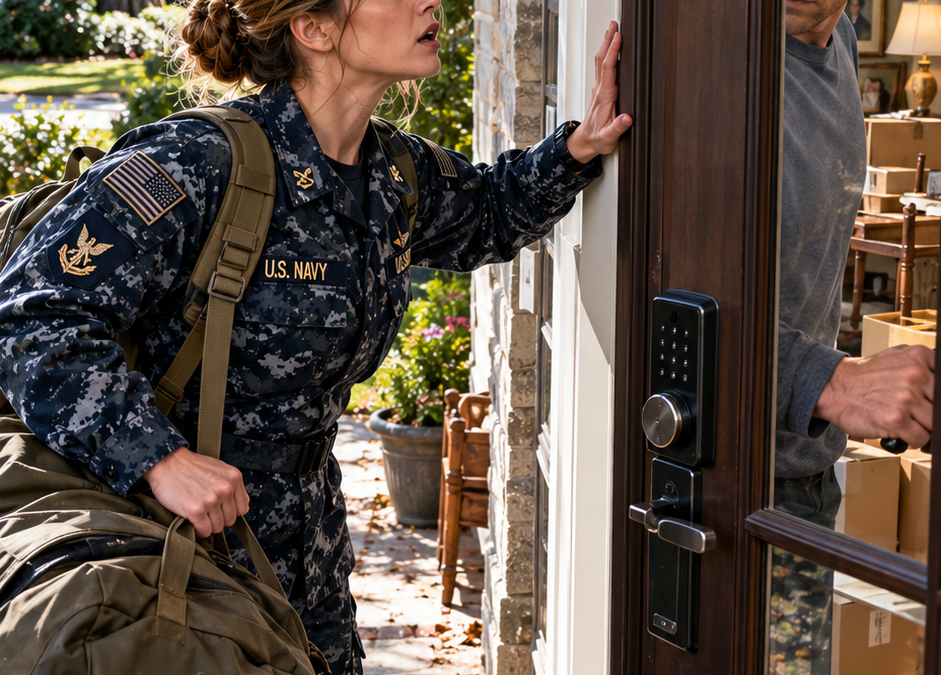
The front door slammed shut inches from my face, and my brother looked at me through the glass as if I had never belonged there.
I had crossed an ocean to come home, still carrying my deployment bag, only to discover that someone had stripped my grandmother’s house while I was away.
What Ethan did not know was that Grandma Margaret had been preparing for this moment long before either of us understood why.
My name is Claire Whitmore.
I had spent twenty-two years in the United States Navy, and by the time I came home from my final extended overseas assignment, I thought I understood the difference between hostile territory and home.
I was wrong.
There are places where danger announces itself.
Alarms.
Orders.
Raised voices.
Locked compartments.
Restricted areas.
And then there are dangers that sit across from you at Christmas dinner, pass the potatoes, ask about your deployment, and quietly calculate what they might own if you stay away long enough.
My brother Ethan belonged to the second kind.
I just did not know it yet.
The morning I came home, I was still wearing my navy service jacket because I had gone almost directly from travel processing to the cemetery and then to Grandma Margaret’s house.
I had barely slept.
My shoulders hurt from carrying my bag through terminals.
My body still felt as if it were operating several time zones away from the rest of me.
But none of that mattered when I turned onto Oak Park Drive.
I knew every tree on that street.
Every cracked section of sidewalk.
Every mailbox.
The Whitmore house sat near the end of the block beneath an enormous oak whose roots had lifted one corner of the front walk decades earlier.
Grandma always refused to repair it.
“That tree was here before the sidewalk,” she used to say. “The concrete can adjust.”
That was Margaret Whitmore.
Eighty-five years old.
Five feet four inches on a generous day.
More stubborn than most admirals I had served under.
She had built a life from almost nothing.
Her parents had struggled.
Her marriage to my grandfather had never made them rich.
But she understood money, property, records, and permanence.
She kept receipts from appliances purchased before I was born.
She labeled photographs.
She knew which chair had belonged to which aunt.
She could tell you where a serving spoon came from in 1963 and why you were not allowed to put it in the dishwasher.
Her house was not impressive in the way wealthy people use that word.
It was better.
It had history.
The cedar smell of the study.
Old hardwood floors.
The blue ceramic bowl beside the entryway where she kept peppermints.
The roll-top desk my grandfather had restored by hand.
Her favorite reading chair near the fireplace.
The garden out back where she grew tomatoes, roses, lavender, and enough zucchini every summer to threaten the entire neighborhood.
For thirty years, that house had been my second home.
When my parents argued, I went there.
When Dad died, I went there.
When Mom’s health began failing years later, I went there.
When I was seventeen and terrified about leaving home, Grandma sat beside me on the porch until midnight and never once told me I was being foolish.
When I returned from difficult assignments and did not know how to explain what I had seen, she did not demand an explanation.
She made coffee.
Opened the back door.
Pointed toward the garden.
“Pull weeds until you feel human again.”
It worked more often than I would admit.
Three years before the day Ethan locked me out, Grandma and I had sat on that same porch before I left for my final long overseas assignment.
She was eighty-two then.
Her hands were thinner, but her mind was still sharp enough to catch me whenever I tried to avoid a difficult subject.
“I don’t like leaving you alone this long,” I told her.
“I’ve been alone before.”
“That isn’t the point.”
“Then what is?”
I looked toward the house.
“The place is getting harder for you to manage.”
She raised one eyebrow.
“Are you calling me old?”
“I am calling the gutters high.”
“That is what ladders are for.”
“Grandma.”
She smiled.
Then she reached over and placed her hand on mine.
“I know what you’re worried about.”
“Do you?”
“Yes.”
She looked through the screen door toward the hallway.
“Your brother.”
I turned toward her.
“I didn’t say that.”
“You didn’t need to.”
Ethan had already begun having financial problems by then.
He called them investments.
Other people called them gambling with technology.
Cryptocurrency.
Leveraged accounts.
Speculative trades.
He had done well for a while.
Very well.
Then he became convinced that doing well meant he understood the market better than everyone else.
I had seen that type of confidence before.
Success begins as evidence.
Then, in the wrong personality, it becomes immunity.
Grandma never trusted his financial judgment.
But she loved him.
That distinction mattered.
“I’ll protect this place until I come home,” I told her.
She squeezed my fingers.
“I know you will, sweetheart.”
Then she smiled.
“That’s why it’s yours to protect.”
At the time, I thought she meant emotionally.
The family history.
The memories.
The responsibility.
I did not realize she was telling me something literal.
Three years later, I stood on the porch with my deployment bag beside my boots and stared at a new deadbolt.
I tried my old brass key again.
It stopped halfway.
Before I could knock, the door opened.
Ethan stood there.
He looked different.
Expensive shirt.
New watch.
Thinner face.
Same eyes.
For half a second, I almost stepped forward to hug him.
Then I saw his expression.
Not grief.
Not relief that his sister had come home.
Possession.
“Claire.”
“Ethan.”
He looked at my bag.
“You just got in?”
“Last night.”
“And you came straight here?”
“I buried Grandma this morning.”
His jaw tightened.
I waited for him to say something about her.
Anything.
He did not.
Instead, he said, “This really isn’t a good time.”
I looked past him.
“What happened to the entry bench?”
“What?”
“Grandpa’s bench.”
He glanced over his shoulder.
“We cleaned things up.”
“Where is it?”
“Claire.”
Then he stepped backward and began closing the door.
I instinctively moved forward.
“What are you doing?”
“You’re not welcome here anymore.”
The door slammed.
I froze.
For several seconds, I simply stared at the wood.
Then I knocked.
Once.
Hard.
Ethan appeared behind the glass panel.
He did not open it.
I could hear him through the door.
“You need to leave.”
I stared through the glass.
“Open the door.”
“No.”
“This is Grandma’s house.”
“She’s gone.”
The words hit me harder than they should have.
Not because they were untrue.
Because of how casually he said them.
Like death was a transfer date.
Like the moment Grandma stopped breathing, the life she had built became inventory.
“The house belongs to the family now,” Ethan said. “I’ve already handled everything.”
Handled everything.
I felt my exhaustion disappear.
Not physically.
Something more useful happened.
My mind became clear.
Twenty-two years of service had taught me to listen differently when people used vague language around specific assets.
Handled.
Resolved.
Processed.
Taken care of.
Those words often meant someone had acted first and intended questions to arrive later.
I stepped back enough to see through the larger living-room window.
The room looked wrong.
Grandma’s reading chair was missing.
The antique side table was gone.
The framed lake painting that had hung near the staircase since my childhood was gone.
Even the grandfather clock had disappeared.
I looked back at Ethan.
“What did you do?”
He finally opened the door a few inches.
“I told you. I handled the estate.”
“You handled whose estate?”
“Our grandmother’s.”
“You are not the executor.”
His expression flickered.
“Circumstances changed.”
“What circumstances?”
“You were gone.”
I stared.
“That does not answer the question.”
Behind him, Rachel appeared.
My sister-in-law carried several folders against her chest.
“Claire.”
“Rachel.”
Her smile looked rehearsed.
“Please don’t make this difficult.”
I almost laughed.
“Make what difficult?”
“You’ve been overseas for years.”
“I’m aware.”
“You weren’t here.”
“That also tends to happen during overseas assignments.”
Her mouth tightened.
“You weren’t here when things changed.”
“What things?”
She looked at Ethan.
Just once.
Fast.
But I caught it.
The Navy had spent two decades teaching me to notice hesitation before people disguised it.
“What things?” I repeated.
Ethan opened the door wider.
“Grandma got frail.”
“Frail?”
“Yes.”
“She drove herself to the grocery store two months ago.”
“She shouldn’t have.”
“She planted tomatoes this spring.”
“That doesn’t mean she was mentally competent to handle an estate.”
The sentence landed.
I looked at him carefully.
“Who said anything about mental competence?”
Silence.
Rachel shifted the folders.
Ethan recovered.
“You know what I mean.”
“No.”
I shook my head.
“I really don’t.”
He stepped onto the porch.
“Claire, you left. We were here.”
“I deployed.”
“Same result.”
“No.”
“Yes.”
His voice sharpened.
“You got to disappear into your Navy world while the rest of us dealt with real life.”
For the first time that morning, anger touched me.
Not enough to control me.
Enough to focus me.
“I did not disappear.”
“You were thousands of miles away.”
“I called Grandma twice a week.”
“Calls aren’t care.”
“I paid for the roof repair.”
“That isn’t care either.”
“I arranged the home-health assessment she refused after two visits.”
“She hated that.”
“I know.”
“I drove her to appointments.”
“So did I when I was home.”
He rolled his eyes.
“There it is.”
“What?”
“The uniform.”
I looked down at my jacket.
“What about it?”
“You always come home acting like service makes you the responsible one.”
I stared at him.
“I have not mentioned my service once.”
“You don’t have to.”
He gestured toward me.
“You wear it.”
That sentence hurt more than I wanted it to.
I did not need Ethan to admire the Navy.
I did not need anyone in my family to thank me.
But I had missed twenty-two years of ordinary life.
Birthdays.
Christmas mornings.
Funerals.
Hospital visits.
Sunday dinners.
I had called from ships.
From bases.
From temporary quarters.
From rooms where every wall was the same shade of government beige.
I had mailed Grandma birthday cards weeks early because I did not know whether I would have communications when the actual day came.
Absence had been part of my service.
Ethan had converted it into evidence against my belonging.
“You think the uniform means I came back to take something from you?” I asked.
“That’s exactly what you’re doing.”
“I came home to bury Grandma.”
“And now you want the house.”
“I have not asked for the house.”
“You don’t have to.”
He smiled.
“She signed everything.”
My fingers stopped moving.
I had been reaching into my bag for my phone.
“She signed what?”
Rachel looked away.
A tiny movement.
But enough.
Something was wrong.
Very wrong.
“Where are Grandma’s documents?” I asked.
“Taken care of.”
“By whom?”
“Me.”
“You aren’t an attorney.”
“Never said I was.”
“Then let me be specific.”
I took out my phone.
“Where is Sylvia Grant?”
Ethan laughed.
“Call her.”
“I intend to.”
“Good.”
He moved closer.
“She’ll tell you the same thing.”
“What thing?”
“That Grandma made decisions while you were gone.”
I looked at him.
“Then you shouldn’t mind if I hear that from the attorney who represented her for more than thirty years.”
His confidence did not move.
“Go ahead.”
I called Sylvia.
She answered on the fourth ring.
“Claire?”
Her voice softened immediately.
“I heard you got back.”
“I’m at Grandma’s house.”
Silence.
“Are you inside?”
“No.”
Another silence.
“Why not?”
“Ethan changed the locks.”
I heard her breathe in.
Slowly.
“Claire, do not leave.”
“What?”
“Stay exactly where you are.”
“Sylvia—”
“I’m coming.”
The call ended.
Ethan raised his eyebrows.
“Well?”
“She’s coming.”
“Great.”
He pointed toward the sidewalk.
“You can wait out there.”
“No.”
“This is private property.”
I looked at him.
“Yes.”
Something in the way I said it bothered him.
“What is that supposed to mean?”
“Nothing yet.”
I set my deployment bag beside the porch column and waited.
Forty minutes.
Ethan stayed near the doorway.
Rachel went in and out.
Neither invited me inside.
I watched the house.
The longer I stood there, the more I noticed.
The brass umbrella stand was gone.
Grandma’s porcelain lamp was gone.
Several family photographs had been removed.
The small mahogany table beneath the front window had vanished.
The room looked sanitized.
Not cleaned.
Stripped.
I remembered the study.
The roll-top desk.
Grandma’s handwritten ledger.
The cedar box where she stored original deeds, old property records, heirloom jewelry, and family documents dating back generations.
A cold thought entered my mind.
“What happened to the study?”
Ethan looked at me.
“What?”
“Grandma’s study.”
“Nothing.”
“The roll-top desk still there?”
He did not answer quickly enough.
“Ethan.”
“Why do you care about a desk?”
I stared.
“Because Grandpa restored it.”
“It was furniture.”
“It was his.”
“He’s been dead twenty-six years.”
I felt my jaw tighten.
“So?”
“Things don’t become sacred because dead people touched them.”
I looked through the window again.
That sentence explained the whole room.
To Ethan, memory had no ownership.
Only market value.
A black sedan finally turned into the driveway.
Sylvia Grant stepped out carrying the same worn leather briefcase I remembered from my grandfather’s probate years earlier.
She was seventy-three.
Silver hair.
Wire-rimmed glasses.
Sensible shoes.
She walked toward me without acknowledging Ethan.
“Claire.”
I met her at the bottom step.
Her eyes moved over my face.
“I’m sorry.”
“For Grandma?”
“For the fact that you had to discover any of this on the porch.”
My stomach tightened.
“What happened?”
Ethan stepped down.
“Ms. Grant, this is a family matter.”
Sylvia turned.
For the first time, she looked directly at him.
“No, Mr. Whitmore.”
She placed the briefcase on the porch rail.
“This is a legal matter.”
His expression changed.
Only slightly.
But the confidence weakened.
Sylvia opened the case.
Inside were certified documents, folders, and one sealed envelope.
My name was written across the front.
CLAIRE.
Grandma’s handwriting.
My throat closed.
Sylvia handed it to me.
“Your grandmother instructed me to give you this only after her death and only when you were physically present.”
Ethan moved closer.
“What’s in it?”
Sylvia did not look at him.
“Something addressed to your sister.”
I opened the envelope.
My hands were steady until I unfolded the first page.
Then they were not.
My dearest Claire,
If you are reading this, I am gone, and someone has tried to take from you what was always meant to be yours.
I stopped.
For three days, I had not cried properly.
I had traveled.
Signed leave documents.
Coordinated funeral arrangements.
Spoken to relatives.
Chosen flowers.
Stood beside Grandma’s grave and held myself upright because there were things that still needed doing.
Those words broke through all of it.
Grandma had anticipated not merely her death.
She had anticipated conflict after it.
I kept reading.
You always thought this house belonged to everyone because I made everyone welcome.
A home can welcome many people and still belong to one.
Three years ago, before your final deployment, I made my decision.
I looked up.
“Sylvia?”
She already had another document in her hand.
A certified deed.
“The transfer was completed three years ago.”
I stared.
“What transfer?”
“Margaret transferred the property to you before you deployed.”
The porch seemed to tilt.
“To me?”
“Yes.”
“Why didn’t I know?”
“Because she retained a lifetime right of occupancy and instructed me not to burden you with the legal details while you were preparing to leave.”
I looked down at the deed.
My name.
Claire M. Whitmore.
Recorded.
Certified.
Real.
Behind me, Ethan whispered, “No.”
Sylvia looked at him.
“Yes.”
“That’s impossible.”
“It is a matter of public record.”
“She changed it.”
“She did not.”
“She signed something later.”
Sylvia’s face became very still.
“What exactly are you claiming she signed?”
Ethan looked toward Rachel.
Rachel went pale.
That was when fear finally appeared.
Not anger.
Not arrogance.
Fear.
Sylvia opened another folder.
“Your grandmother anticipated that someone might attempt to create conflicting paperwork.”
Ethan stepped backward.
I looked from him to Sylvia.
“What did he file?”
“A provisional claim asserting that Margaret intended to transfer control of the property through later estate instruments.”
“Based on what?”
“Documents currently under review.”
Ethan snapped, “They’re valid.”
Sylvia did not blink.
“That will be determined by the appropriate authorities.”
I looked through the front window.
Then back at my brother.
“You cleared out the study.”
He swallowed.
“I don’t know what you’re talking about.”
“The roll-top desk.”
Nothing.
“Grandma’s ledger.”
Nothing.
“The cedar box.”
Rachel forced a laugh.
“We cleaned out clutter.”
I turned toward her.
“Clutter?”
“She kept everything, Claire. Old papers. Old furniture. Junk no one used.”
“It wasn’t junk.”
Sylvia’s voice cut through the porch.
“Mrs. Whitmore maintained an itemized inventory of the furnishings, records, and heirlooms in this house.”
Rachel stopped.
Sylvia continued.
“Many of those items were specifically included in supplementary trust documentation connected to Claire.”
I looked through the empty living room again.
The missing chair.
The missing paintings.
The missing clock.
“What did you do with them?”
Rachel looked at Ethan.
He said, “We sold a few things.”
“A few?”
“Things nobody needed.”
“The roll-top desk?”
“It was taking space.”
My chest tightened.
Grandpa had restored that desk with his own hands.
I remembered sitting underneath it as a child while he worked.
The smell of varnish.
Grandma laughing because I kept stealing his sanding cloths.
“You sold it.”
Ethan raised his voice.
“You weren’t here!”
There it was again.
The defense behind everything.
I was away.
Therefore I forfeited history.
I stepped closer.
“Your crypto accounts collapsed last spring.”
His face changed.
Mom had told me before she died that Ethan was in trouble.
Margin calls.
Loans.
Money moving too quickly.
I had not understood how bad it was.
“You needed cash,” I said.
“Shut up.”
“You thought Grandma’s estate would cover your losses.”
“You have no idea what you’re talking about.”
“You started selling her things before I got home.”
“She wasn’t using them!”
“She was alive.”
Silence.
Rachel whispered, “Ethan…”
He turned on her.
“Stay out of it.”
Her face hardened.
“You told me everything had been legally transferred.”
“Rachel.”
“You said Aunt Sarah had signed off.”
Sylvia looked toward her.
“Aunt Sarah had no authority to transfer Margaret’s property.”
Rachel’s face drained.
“You said she did.”
Ethan snapped, “Shut up.”
Watching them turn on each other should have felt satisfying.
It did not.
It felt empty.
They had stood inside Grandma’s house while she was dying and reduced generations of memory to things that could be loaded into trucks.
Sylvia reached into her briefcase again.
She removed a bound packet.
“Mr. Whitmore, the auction house on Maple Street has already provided copies of its inventory.”
Ethan stopped breathing for a second.
“And,” Sylvia continued, “your signed payout receipts.”
Rachel looked at him.
“What?”
Sylvia handed me the first page.
Furniture descriptions.
Dates.
Lot numbers.
Payment amounts.
My eyes moved down the list.
Grandfather clock.
Porcelain lamp.
Antique desk.
Two framed oils.
Silver tea service.
Grandma’s reading chair.
My hands shook.
“You sold her chair?”
Ethan scoffed.
“It was an old chair.”
I looked at him.
“That is where she sat every morning for thirty-seven years.”
“It’s furniture.”
“No.”
My voice dropped.
“It was memory you did not own.”
He rolled his eyes.
“You’re being sentimental.”
“Yes.”
For once, I did not defend myself from the accusation.
“I am.”
I stepped closer.
“She was my grandmother.”
“She was mine too!”
“Then why are her possessions sitting in auction records with your signature at the bottom?”
He said nothing.
Rachel began shaking her head.
“You told me we had authorization.”
Ethan turned.
“Stop talking.”
“You said everything was ours.”
“Rachel.”
“You told me Claire had no claim because she abandoned the family.”
The words landed harder than any legal document.
Abandoned.
That was the story he had built.
Not deployed.
Not serving.
Abandoned.
I looked at him.
“Is that what you told people?”
He stared back.
“You left.”
“I was under orders.”
“You always had an excuse.”
I felt something break quietly inside me.
For years, I had carried guilt about being away.
Grandma never used it against me.
Not once.
Neither had my parents.
Only Ethan.
He had discovered the easiest place to hurt me and built an argument around it.
Sylvia interrupted.
“We need to move away from personal accusations and back to the property.”
Her calm saved me.
She pulled out another document.
“This is an injunction notice prepared under the protections Margaret established.”
She handed me a pen.
“Signing authorizes us to challenge any attempted listing, sale, lien, or development agreement Ethan filed concerning the property and to pursue tracing of proceeds from unauthorized sales of trust-designated contents.”
I read it.
Every page.
Grandma had taught me that too.
Never sign what you have not read.
When I reached the last page, I signed.
Captain Claire M. Whitmore.
Ethan stared at the pen.
His posture changed completely.
“Claire.”
I capped it.
“We’re family.”
I almost smiled.
Now.
Now we were family.
“We don’t need this,” he said.
“This?”
“Lawyers. Court. Police. All this drama.”
“The drama started before I landed.”
“We can fix it ourselves.”
“How?”
He took a step toward me.
“We sit down. Like adults.”
“At Grandma’s kitchen table?”
“Yes.”
I looked past him toward the kitchen.
“The same table where you promised Grandma you would pay back those college loans?”
His jaw clenched.
“That has nothing to do with this.”
“The same kitchen where she asked you to stop borrowing against things you did not own?”
“Claire.”
“You had years to sit at that table honestly.”
His face hardened again.
“You think you’re better than me because you’re a captain.”
“No.”
That surprised him.
“I think you took property that was not yours.”
Nothing.
“And my rank has nothing to do with it.”
I took my old brass key from my pocket.
“Try this lock again,” Sylvia said quietly.
I looked at her.
She nodded toward the door.
Ethan stiffened.
I inserted the key.
It did not fit the new deadbolt.
Of course it did not.
Sylvia looked at Ethan.
“Who authorized the lock change?”
He said nothing.
She handed me a second key.
Newer.
I frowned.
“What is this?”
“Your grandmother had the rear entry re-keyed six months ago after she became concerned about missing records.”
I stared at her.
“She knew?”
“She suspected.”
We walked around the side of the house.
Ethan followed.
Rachel stayed behind.
The new key opened the rear door.
I stepped into Grandma’s kitchen.
The smell hit me first.
Cedar.
Old wood.
A faint trace of lavender.
Home.
For one second, I forgot everything else.
I put one hand on the counter.
Grandma should have been there.
She should have been complaining that I was too thin.
She should have been asking whether sailors still drank terrible coffee.
She should have been alive.
Instead, the house held only echoes.
I looked into the living room.
Empty spaces everywhere.
They had taken the surface.
But not the foundation.
Behind me, Ethan said, “You can’t just throw me out.”
I turned.
“Do you live here?”
“No.”
“Then why are you acting like this is your residence?”
“I’ve been managing it.”
“Without authority.”
“That’s your interpretation.”
Sylvia stepped inside.
“It is also mine.”
He looked at her.
“And the recorded deed.”
Nothing.
“And the trust documents.”
Nothing.
“And, eventually, a court’s if necessary.”
Ethan’s face reddened.
Rachel entered through the back.
She looked around the room.
For the first time, she seemed to notice how empty it was.
“What happens now?” I asked Sylvia.
“We preserve the property. We document what is missing. We stop any pending transactions.”
“And Ethan?”
“That depends on the evidence.”
He laughed bitterly.
“Evidence?”
Sylvia looked at him.
“Yes.”
“You have auction receipts. That proves I sold furniture.”
“It proves more than that.”
His expression shifted.
Sylvia opened her briefcase once more.
She removed a small manila envelope.
“What is that?” I asked.
“Your grandmother’s insurance policy against arrogance.”
Even in grief, I almost smiled.
That sounded exactly like Margaret.
Sylvia held up a flash drive.
“Six months ago, Margaret noticed papers disappearing from her study.”
Ethan went still.
“She believed someone was searching her filing cabinets.”
Rachel looked at him.
Sylvia continued.
“She had me arrange secure digital backups of her estate records.”
“That proves nothing,” Ethan said.
“No.”
Sylvia nodded.
“But the cameras might.”
His face changed.
“What cameras?”
I turned toward him.
Grandma had a smart doorbell.
Ethan knew about it.
I remembered him complaining that the light was too bright.
“I disconnected that thing,” he said.
Sylvia smiled faintly.
“Yes.”
Ethan stopped.
“You cut the visible wiring.”
Silence.
“Margaret was quite offended.”
Despite everything, a laugh escaped me.
Of course she was.
“So she installed a backup camera in the porch light fixture.”
Ethan’s face went white.
Rachel whispered, “You told me the cameras were off.”
Sylvia continued.
“The backup system recorded activity at the front entry, driveway, and porch.”
I looked at her.
“Did it capture the furniture?”
“All of it.”
I closed my eyes.
Grandma.
Eighty-five years old.
Watching her grandson dig through files.
Realizing what might happen.
Not confronting him emotionally.
Documenting.
Backing up.
Protecting the house.
She would have made a good intelligence officer.
“Audio?” I asked.
“Some.”
Ethan stepped toward Sylvia.
“You recorded private conversations?”
She did not move.
“The security system recorded events on Margaret’s property.”
“Give me that drive.”
“No.”
His voice rose.
“That’s family property.”
Sylvia looked at him.
“No, Ethan.”
For the first time, she used his first name.
“It is evidence.”
Rachel backed away.
“What did we say?”
Ethan turned toward her.
“Nothing.”
“What did you say?”
“Nothing.”
“Ethan.”
“Stop.”
She stared.
“You told me we could sell everything before Claire came home.”
He lunged verbally, not physically.
“Shut your mouth.”
The words echoed through the empty living room.
I looked at him.
There it was.
The truth, not yet in court, not yet organized into findings, but finally free of its disguise.
Before Claire came home.
That had been the timeline.
My deployment was not incidental.
It was the opportunity.
I felt the old guilt rise again.
Then something different replaced it.
Clarity.
I had not caused this by serving.
Ethan had chosen to exploit my absence.
Those were not the same thing.
“What was the rush?” I asked.
He looked away.
“The market.”
“What market?”
“Real estate.”
“You were going to sell the house.”
Silence.
Rachel answered for him.
“He had a developer interested.”
Ethan turned on her.
“Rachel!”
She flinched.
“You told me the deal was legal.”
Sylvia made a note.
“What developer?”
Rachel named a local company.
Sylvia wrote it down.
Ethan looked as though the room was shrinking around him.
“You’re ruining me,” he whispered.
I stared.
“No.”
“You know what happens if they freeze my accounts?”
“No.”
“I lose everything.”
“You already lost money.”
He said nothing.
“You were trying to replace it with Grandma’s.”
His face twisted.
“You think you understand?”
“Explain it.”
“The market collapsed.”
“So?”
“I had loans.”
“So?”
“People wanted payment.”
“And your answer was Grandma’s house?”
“I was going to put it back.”
That sentence stunned me more than denial.
“You were going to put it back?”
“When things recovered.”
“You sold her chair.”
“It was just furniture!”
I stepped closer.
“No.”
My voice stayed low.
“You keep saying that because if everything is just furniture, then you did not steal a life.”
He stared at me.
“But you did.”
His eyes filled with anger.
“She was dead!”
“Some of it was sold before she died.”
Silence.
Sylvia’s expression sharpened.
That mattered.
Rachel covered her mouth.
I looked at Ethan.
“You started while she was alive.”
He said nothing.
I felt sick.
Not because of the money.
Because Grandma had spent her final months watching people remove pieces of the home she had built.
“Get out,” I said.
Ethan laughed.
“You don’t get to—”
“Get out.”
“You think because some deed—”
“The deed is recorded.”
Nothing.
“You do not live here.”
Nothing.
“You do not have permission to remain.”
Nothing.
“And if you believe you have a legal right, your attorney can speak with Sylvia.”
His eyes narrowed.
“Don’t use your military voice on me.”
I felt something almost like pity.
He still needed this to be about rank.
Because rank was easier to resent than law.
“My military authority ends where my civilian life begins.”
I pointed toward the back door.
“This is not an order from a Navy captain.”
I looked directly at my brother.
“It is the property owner telling you to leave.”
That finally silenced him.
Rachel touched his arm.
“Ethan.”
He pulled away.
“We’re not done.”
“No.”
I nodded.
“The lawyers probably aren’t.”
They left.
Not dramatically.
No police cars.
No shouting down the street.
Just two people walking to a luxury sedan carrying the first weight of consequences.
I closed the door.
Then I stood in Grandma’s kitchen.
For the first time since returning home, there was no task directly in front of me.
No confrontation.
No paperwork.
No one asking a question.
The silence rushed in.
I put both hands on the counter.
Then I cried.
Not quietly.
Not with military restraint.
I cried for Grandma.
For Grandpa.
For Mom.
For Dad.
For twenty-two years of coming home and believing the house would always be there exactly as I remembered it.
Sylvia stood several feet away.
She did not touch me.
I appreciated that.
After a while, she said, “Margaret was proud of you.”
I wiped my face.
“I wasn’t here.”
“She knew why.”
“I should have come back sooner.”
“No.”
I looked at her.
“She never blamed you for serving.”
“I blamed myself.”
“I know.”
“How?”
“She knew you.”
That almost broke me again.
Sylvia walked toward the mantel.
One framed photograph remained.
Grandma smiling beside the garden.
I touched the frame.
“I told her I’d protect the place.”
Sylvia looked around the stripped room.
“You still can.”
The next several weeks were not dramatic.
They were tedious.
And that was how the truth became useful.
Inventories.
Receipts.
Auction records.
Bank records.
Property filings.
Photographs.
Security footage.
Copies.
Dates.
Serial numbers.
The legal world did not care how angry I was.
It cared what could be established.
That suited me.
We documented every missing item Grandma had recorded.
The roll-top desk.
The reading chair.
Paintings.
Silver.
The clock.
Family jewelry.
Historic papers.
The cedar box.
Several items had been sold through an auction house.
Others went through consignment shops.
A few appeared in online transactions.
The security footage showed Ethan and hired movers carrying pieces through the front door.
Audio captured fragments of conversations.
Enough for Sylvia to identify transactions worth examining.
Enough for lawyers and investigators to follow.
The attempted property claims collapsed quickly once the recorded deed was produced.
The house had been transferred to me three years earlier.
Grandma had retained the right to live there.
Ethan had no ownership interest simply because he was her grandson.
His efforts to control or sell the property did not create ownership where none existed.
The more investigators looked, the worse it became.
False asset-transfer paperwork.
Unauthorized sales.
Money routed into accounts tied to Ethan.
Records showing how urgently he had been trying to cover his financial losses.
Rachel cooperated once she obtained separate counsel.
I learned that much later.
At first, I hated her almost as much as I hated what Ethan had done.
Then the records showed something more complicated.
She had participated.
She had helped clear the house.
She had benefited.
But Ethan had also lied to her about the underlying ownership and authorization.
That did not make her innocent.
It made responsibility more precise.
Grandma always liked precise things.
Three weeks after my return, Ethan’s legal challenge to the deed failed.
The court accepted the recorded transfer.
The disputed property transactions were halted.
Accounts connected to the unauthorized sales were frozen while the money was traced.
Criminal charges followed from the evidence surrounding the removal and sale of estate property and related documents.
The exact consequences were no longer mine to invent.
That mattered to me.
I had spent enough of my career understanding what happened when people confused anger with authority.
I gave investigators what I had.
I testified when required.
Then I let the process belong to them.
My extended family reacted exactly as families often do when accountability becomes public.
Phones rang.
Messages arrived.
Aunt Sarah left a voicemail while crying.
“Claire, please. Ethan is under enormous pressure. He made mistakes, but he’s still your brother.”
I listened.
“He was going through financial problems. You know how desperate people get. You could tell them you want this handled privately.”
I deleted the message.
Then another relative texted.
Family shouldn’t destroy family over money.
I stared at that sentence for a long time.
Then I put the phone down.
The irony was too complete to answer.
The dispute had never begun because I wanted money.
It began because Ethan believed being family meant he could take without asking and be forgiven before consequences arrived.
I did not hate him.
That surprised me.
Hate requires energy.
What I felt was grief.
Grief for the brother who used to climb the oak tree with me.
The boy who once broke his arm trying to jump from the garage roof because I dared him.
The teenager who drove three hours to pick me up when my first car died.
Those memories were real.
So was what he had done.
One truth did not erase the other.
Six months after I came home, Grandma’s house began looking like itself again.
Not perfectly.
Some things never returned.
A few pieces had gone to buyers who were difficult to trace.
One painting had been resold twice.
Several smaller heirlooms disappeared into private transactions.
But most of the major pieces came home.
The roll-top desk returned first.
I stood in the study while movers carried it through the doorway.
The wood had a new scratch along one side.
I ran my fingers over it.
For a moment, I could see Grandpa again.
Sanding.
Cursing softly when a drawer stuck.
Pretending not to notice six-year-old me hiding underneath.
Grandma’s reading chair came back two weeks later.
I put it beside the fireplace.
Exactly where it had been.
The grandfather clock required repair.
The porcelain lamp survived without damage.
The cedar box came back through an auction dealer who had kept detailed purchase records.
Inside were old documents Ethan apparently had not realized were valuable.
Family letters.
Property maps.
Grandpa’s service papers.
Grandma’s handwritten notes.
I sat on the study floor that night and read until two in the morning.
Near the bottom of the box, I found a small index card in Grandma’s handwriting.
Claire—
If you are reorganizing this box, you are doing it wrong.
I laughed so loudly the empty house threw the sound back at me.
Then I cried again.
Healing did that.
It made grief unpredictable.
By spring, the garden had gone wild.
Grandma would have been furious.
I spent weekends restoring it.
Not because I had become sentimental about property.
Because the work made sense.
Pull weed.
Turn soil.
Repair fence.
Plant.
Water.
Simple tasks.
No attorneys.
No statements.
No family arguments.
One Saturday morning, I stood on the front porch wearing jeans and an old plaid shirt.
Black coffee in my hand.
The oak tree had filled with new leaves.
The wind smelled like wet soil and lilacs.
For the first time since coming home, the property felt peaceful.
A black sedan turned into the driveway.
Sylvia stepped out holding a folder.
Behind her came Master Chief Vance.
He was on short terminal leave and had volunteered to help me improve the physical security around the property.
He carried a toolbox in one hand and a wooden sign in the other.
“Morning, Captain.”
“Morning, Vance.”
He looked at the porch.
“Locks are done.”
“Cameras?”
“Redundant.”
I smiled.
“Grandma would approve.”
“I’ve heard enough about your grandmother to know she probably installed a backup for my backup.”
“Probably.”
He lifted the sign.
“Where do you want this?”
I pointed toward the stone pillar beside the driveway.
“There.”
He carried it over.
The sign was cedar.
Simple.
Solid.
It marked the property as Margaret Whitmore’s estate, secured and managed by me.
Nothing grand.
Nothing threatening.
Just clear.
Vance bolted it into place.
I walked down the steps and ran my fingers over the wood.
Sylvia joined me.
“Margaret would have liked that.”
“She would have complained that I spent too much.”
“Also true.”
We stood together for a moment.
Then Sylvia handed me the final closing documents related to the restored property records and recovered assets.
“You’re done,” she said.
I looked at her.
“Done?”
“With the major estate work.”
“That sounds suspicious.”
She smiled.
“Lawyers occasionally allow things to end.”
I signed where necessary.
Then I looked toward the house.
My deployment bag was finally unpacked.
The uniform had been cleaned and stored.
The study had its desk.
The living room had Grandma’s chair.
The garden was alive again.
Not identical.
Never identical.
Because Grandma was gone.
That truth remained at the center of everything.
I had spent the first months trying to restore the house as if enough recovered objects might somehow reverse death.
Eventually, I understood the difference.
Preservation is not resurrection.
The goal was not to freeze the house on the last day Grandma lived there.
The goal was to make sure what she deliberately protected was not erased by someone else’s greed.
I walked inside.
The house smelled like coffee and cedar again.
On the mantel, Grandma’s photograph was still there.
I picked it up.
Her eyes in the picture carried that familiar expression.
Half love.
Half judgment.
I smiled.
“You knew.”
Of course she had.
She had seen Ethan’s problems before I did.
She had seen my guilt before I admitted it.
She had known I would confuse being away with abandoning people.
And she had arranged everything so that when the moment came, facts would exist even if I doubted myself.
That may have been her greatest gift.
Not the house.
Not the antiques.
Not the property.
Evidence.
The certainty that I had not imagined belonging there.
I thought back to the morning I came home.
Ethan behind the glass.
You’re not welcome here anymore.
For a moment, I had believed him.
Not legally.
Emotionally.
That was the part that hurt.
I had looked at my deployment bag and wondered whether he was right.
Whether twenty-two years away had made me less family.
Whether service had cost me my claim to ordinary things.
Grandma had answered that question before I ever asked it.
Absence is not abandonment when people know why you left and still know where your heart is.
I had called.
Written.
Returned whenever I could.
Loved imperfectly from far away.
That counted.
Ethan had been physically close.
And still managed to betray her.
Distance had never been the measure.
Choice was.
I carried Grandma’s photograph onto the porch.
The afternoon sun stretched long shadows across the lawn.
I sat in her chair, the one I had moved outside temporarily because I wanted to repair a small section underneath.
For years, I had imagined my final major mission would be overseas.
Something important.
Something wearing the shape of military service.
Instead, the hardest perimeter I ever had to defend was a wooden house beneath an old oak tree.
Not from strangers.
From family.
That changed how I understood loyalty.
Loyalty is not silence.
It is not allowing someone to cross every line because they share your blood.
It is not pretending theft is desperation, fraud is confusion, or entitlement is grief.
And it is not sacrificing the dead person’s wishes so the living can avoid discomfort.
Grandma had trusted me with the house because she believed I would protect what she had chosen.
Not because I was a captain.
Not because I had spent twenty-two years in uniform.
Because, long before the Navy taught me anything about duty, she had taught me that stewardship meant protecting something even when nobody applauded you for it.
The legal case eventually ended.
Ethan faced consequences for the property he had taken and the transactions he had made.
Some assets were sold or seized to satisfy judgments and restitution.
His financial collapse became his problem rather than Grandma’s estate’s responsibility.
Rachel moved away.
We did not speak again.
Several relatives remained angry with me.
Others quietly admitted they had suspected Ethan’s behavior for years.
I stopped trying to persuade any of them.
People who wanted facts had them.
People who wanted a family myth would build one no matter what I said.
I learned to let them.
One evening, more than a year after I returned, I found an old voicemail from Ethan that I had never deleted.
It was from four years earlier.
Before the financial collapse.
Before Grandma died.
Before the house became a battlefield.
“Hey, Claire. Call me when you can. Grandma made that weird lemon chicken thing and says you’re the only one who likes it. I told her nobody likes it, you’re just polite. Anyway. Stay safe.”
I listened twice.
Then deleted it.
Not angrily.
Just because it was time.
The brother in that message had existed.
So had the man who sold Grandma’s chair.
Life rarely gives us the comfort of making one version completely false.
The people who hurt us may once have loved us.
Sometimes they still do.
Love does not automatically make them safe.
That was a lesson I wished I had never needed.
By my second spring back home, the oak tree had leafed out again.
The garden was full.
Tomatoes in neat rows.
Lavender along the fence.
Roses climbing the trellis.
I kept one corner messy because Grandma always did.
She claimed pollinators preferred disorder.
I suspected she simply hated weeding that section.
Master Chief Vance stopped by one Saturday while passing through town.
He looked at the garden.
“You’re getting domestic, Captain.”
“Watch your mouth.”
He laughed.
Then he pointed toward the cedar sign.
“Still holding.”
“It better. You used enough bolts to secure a bridge.”
“Threat environment justified it.”
I handed him coffee.
We sat on the porch.
No crisis.
No lawyers.
No brother behind the glass.
Just morning.
Eventually he asked, “You staying here?”
I looked at the house.
“I think so.”
“For good?”
“I don’t know what for good means anymore.”
He nodded.
Fair answer.
I had learned not to promise permanence simply because I wanted comfort.
The house might someday belong to someone else.
Maybe a child in the family.
Maybe a trust.
Maybe it would be sold decades from now.
That was not the point.
Grandma had never asked me to turn the property into a shrine.
She asked me, in her own quiet way, to make sure the decision remained honest.
That was what Ethan tried to steal more than anything.
Not wood.
Not antiques.
Not money.
Choice.
Grandma’s choice about her own property.
My choice about whether to preserve it.
The family’s choice to remember her accurately.
He tried to replace all of those with the simple fact that he got there first.
For a while, he almost succeeded.
But first possession is not truth.
Confidence is not authority.
A changed lock does not rewrite a recorded deed.
That knowledge stayed with me.
Years earlier, young officers under me sometimes believed leadership meant entering a room and immediately proving control.
I used to tell them the opposite.
Authority that has to announce itself every thirty seconds is usually insecure.
Real authority can survive verification.
Documents.
Rules.
Questions.
Accountability.
Grandma understood that better than anyone.
She did not confront Ethan with a dramatic speech.
She built backups.
Filed the deed.
Maintained inventories.
Protected records.
Kept evidence.
Then trusted that eventually, truth would outlast confidence.
Standing on the porch in the spring sunlight, I finally understood the full meaning of what she had told me before my deployment.
That’s why it’s yours to protect.
She had not been giving me a reward.
She had been assigning stewardship.
And stewardship was never about owning more.
It was about refusing to let ownership become an excuse to erase what came before.
I finished my coffee.
Went inside.
Passed the restored roll-top desk.
Touched the back of Grandma’s reading chair.
Stopped in front of her photograph.
“I’m home, Grandma.”
The house stayed quiet.
I smiled.
Then added the words I had whispered the first day I finally crossed the threshold again.
“I’ve got the watch.”
Outside, leaves moved through the old oak.
The cedar sign stood firm beside the driveway.
The locks were secure.
The records were complete.
The things we could recover had been returned.
The things we could not recover had finally been mourned.
And for the first time since deployment ended, I no longer felt like I was arriving from somewhere else.
I was simply home.
What do you think of this story? Please leave a like and share your thoughts in the comments. Your support means a lot to us and inspires us to keep writing more meaningful and powerful stories. Thank you! 👍
𝗧𝗛𝗘 𝗘𝗡𝗗
The New Lock on Grandma’s Door Told Me My Brother Had Been Planning My Absence for a Long Time
The front door slammed shut inches from my face, and my brother looked at me through the glass as if I had never belonged there.
I had crossed an ocean to come home, still carrying my deployment bag, only to discover that someone had stripped my grandmother’s house while I was away.
What Ethan did not know was that Grandma Margaret had been preparing for this moment long before either of us understood why.
My name is Claire Whitmore.
I had spent twenty-two years in the United States Navy, and by the time I came home from my final extended overseas assignment, I thought I understood the difference between hostile territory and home.
I was wrong.
There are places where danger announces itself.
Alarms.
Orders.
Raised voices.
Locked compartments.
Restricted areas.
And then there are dangers that sit across from you at Christmas dinner, pass the potatoes, ask about your deployment, and quietly calculate what they might own if you stay away long enough.
My brother Ethan belonged to the second kind.
I just did not know it yet.
The morning I came home, I was still wearing my navy service jacket because I had gone almost directly from travel processing to the cemetery and then to Grandma Margaret’s house.
I had barely slept.
My shoulders hurt from carrying my bag through terminals.
My body still felt as if it were operating several time zones away from the rest of me.
But none of that mattered when I turned onto Oak Park Drive.
I knew every tree on that street.
Every cracked section of sidewalk.
Every mailbox.
The Whitmore house sat near the end of the block beneath an enormous oak whose roots had lifted one corner of the front walk decades earlier.
Grandma always refused to repair it.
“That tree was here before the sidewalk,” she used to say. “The concrete can adjust.”
That was Margaret Whitmore.
Eighty-five years old.
Five feet four inches on a generous day.
More stubborn than most admirals I had served under.
She had built a life from almost nothing.
Her parents had struggled.
Her marriage to my grandfather had never made them rich.
But she understood money, property, records, and permanence.
She kept receipts from appliances purchased before I was born.
She labeled photographs.
She knew which chair had belonged to which aunt.
She could tell you where a serving spoon came from in 1963 and why you were not allowed to put it in the dishwasher.
Her house was not impressive in the way wealthy people use that word.
It was better.
It had history.
The cedar smell of the study.
Old hardwood floors.
The blue ceramic bowl beside the entryway where she kept peppermints.
The roll-top desk my grandfather had restored by hand.
Her favorite reading chair near the fireplace.
The garden out back where she grew tomatoes, roses, lavender, and enough zucchini every summer to threaten the entire neighborhood.
For thirty years, that house had been my second home.
When my parents argued, I went there.
When Dad died, I went there.
When Mom’s health began failing years later, I went there.
When I was seventeen and terrified about leaving home, Grandma sat beside me on the porch until midnight and never once told me I was being foolish.
When I returned from difficult assignments and did not know how to explain what I had seen, she did not demand an explanation.
She made coffee.
Opened the back door.
Pointed toward the garden.
“Pull weeds until you feel human again.”
It worked more often than I would admit.
Three years before the day Ethan locked me out, Grandma and I had sat on that same porch before I left for my final long overseas assignment.
She was eighty-two then.
Her hands were thinner, but her mind was still sharp enough to catch me whenever I tried to avoid a difficult subject.
“I don’t like leaving you alone this long,” I told her.
“I’ve been alone before.”
“That isn’t the point.”
“Then what is?”
I looked toward the house.
“The place is getting harder for you to manage.”
She raised one eyebrow.
“Are you calling me old?”
“I am calling the gutters high.”
“That is what ladders are for.”
“Grandma.”
She smiled.
Then she reached over and placed her hand on mine.
“I know what you’re worried about.”
“Do you?”
“Yes.”
She looked through the screen door toward the hallway.
“Your brother.”
I turned toward her.
“I didn’t say that.”
“You didn’t need to.”
Ethan had already begun having financial problems by then.
He called them investments.
Other people called them gambling with technology.
Cryptocurrency.
Leveraged accounts.
Speculative trades.
He had done well for a while.
Very well.
Then he became convinced that doing well meant he understood the market better than everyone else.
I had seen that type of confidence before.
Success begins as evidence.
Then, in the wrong personality, it becomes immunity.
Grandma never trusted his financial judgment.
But she loved him.
That distinction mattered.
“I’ll protect this place until I come home,” I told her.
She squeezed my fingers.
“I know you will, sweetheart.”
Then she smiled.
“That’s why it’s yours to protect.”
At the time, I thought she meant emotionally.
The family history.
The memories.
The responsibility.
I did not realize she was telling me something literal.
Three years later, I stood on the porch with my deployment bag beside my boots and stared at a new deadbolt.
I tried my old brass key again.
It stopped halfway.
Before I could knock, the door opened.
Ethan stood there.
He looked different.
Expensive shirt.
New watch.
Thinner face.
Same eyes.
For half a second, I almost stepped forward to hug him.
Then I saw his expression.
Not grief.
Not relief that his sister had come home.
Possession.
“Claire.”
“Ethan.”
He looked at my bag.
“You just got in?”
“Last night.”
“And you came straight here?”
“I buried Grandma this morning.”
His jaw tightened.
I waited for him to say something about her.
Anything.
He did not.
Instead, he said, “This really isn’t a good time.”
I looked past him.
“What happened to the entry bench?”
“What?”
“Grandpa’s bench.”
He glanced over his shoulder.
“We cleaned things up.”
“Where is it?”
“Claire.”
Then he stepped backward and began closing the door.
I instinctively moved forward.
“What are you doing?”
“You’re not welcome here anymore.”
The door slammed.
I froze.
For several seconds, I simply stared at the wood.
Then I knocked.
Once.
Hard.
Ethan appeared behind the glass panel.
He did not open it.
I could hear him through the door.
“You need to leave.”
I stared through the glass.
“Open the door.”
“No.”
“This is Grandma’s house.”
“She’s gone.”
The words hit me harder than they should have.
Not because they were untrue.
Because of how casually he said them.
Like death was a transfer date.
Like the moment Grandma stopped breathing, the life she had built became inventory.
“The house belongs to the family now,” Ethan said. “I’ve already handled everything.”
Handled everything.
I felt my exhaustion disappear.
Not physically.
Something more useful happened.
My mind became clear.
Twenty-two years of service had taught me to listen differently when people used vague language around specific assets.
Handled.
Resolved.
Processed.
Taken care of.
Those words often meant someone had acted first and intended questions to arrive later.
I stepped back enough to see through the larger living-room window.
The room looked wrong.
Grandma’s reading chair was missing.
The antique side table was gone.
The framed lake painting that had hung near the staircase since my childhood was gone.
Even the grandfather clock had disappeared.
I looked back at Ethan.
“What did you do?”
He finally opened the door a few inches.
“I told you. I handled the estate.”
“You handled whose estate?”
“Our grandmother’s.”
“You are not the executor.”
His expression flickered.
“Circumstances changed.”
“What circumstances?”
“You were gone.”
I stared.
“That does not answer the question.”
Behind him, Rachel appeared.
My sister-in-law carried several folders against her chest.
“Claire.”
“Rachel.”
Her smile looked rehearsed.
“Please don’t make this difficult.”
I almost laughed.
“Make what difficult?”
“You’ve been overseas for years.”
“I’m aware.”
“You weren’t here.”
“That also tends to happen during overseas assignments.”
Her mouth tightened.
“You weren’t here when things changed.”
“What things?”
She looked at Ethan.
Just once.
Fast.
But I caught it.
The Navy had spent two decades teaching me to notice hesitation before people disguised it.
“What things?” I repeated.
Ethan opened the door wider.
“Grandma got frail.”
“Frail?”
“Yes.”
“She drove herself to the grocery store two months ago.”
“She shouldn’t have.”
“She planted tomatoes this spring.”
“That doesn’t mean she was mentally competent to handle an estate.”
The sentence landed.
I looked at him carefully.
“Who said anything about mental competence?”
Silence.
Rachel shifted the folders.
Ethan recovered.
“You know what I mean.”
“No.”
I shook my head.
“I really don’t.”
He stepped onto the porch.
“Claire, you left. We were here.”
“I deployed.”
“Same result.”
“No.”
“Yes.”
His voice sharpened.
“You got to disappear into your Navy world while the rest of us dealt with real life.”
For the first time that morning, anger touched me.
Not enough to control me.
Enough to focus me.
“I did not disappear.”
“You were thousands of miles away.”
“I called Grandma twice a week.”
“Calls aren’t care.”
“I paid for the roof repair.”
“That isn’t care either.”
“I arranged the home-health assessment she refused after two visits.”
“She hated that.”
“I know.”
“I drove her to appointments.”
“So did I when I was home.”
He rolled his eyes.
“There it is.”
“What?”
“The uniform.”
I looked down at my jacket.
“What about it?”
“You always come home acting like service makes you the responsible one.”
I stared at him.
“I have not mentioned my service once.”
“You don’t have to.”
He gestured toward me.
“You wear it.”
That sentence hurt more than I wanted it to.
I did not need Ethan to admire the Navy.
I did not need anyone in my family to thank me.
But I had missed twenty-two years of ordinary life.
Birthdays.
Christmas mornings.
Funerals.
Hospital visits.
Sunday dinners.
I had called from ships.
From bases.
From temporary quarters.
From rooms where every wall was the same shade of government beige.
I had mailed Grandma birthday cards weeks early because I did not know whether I would have communications when the actual day came.
Absence had been part of my service.
Ethan had converted it into evidence against my belonging.
“You think the uniform means I came back to take something from you?” I asked.
“That’s exactly what you’re doing.”
“I came home to bury Grandma.”
“And now you want the house.”
“I have not asked for the house.”
“You don’t have to.”
He smiled.
“She signed everything.”
My fingers stopped moving.
I had been reaching into my bag for my phone.
“She signed what?”
Rachel looked away.
A tiny movement.
But enough.
Something was wrong.
Very wrong.
“Where are Grandma’s documents?” I asked.
“Taken care of.”
“By whom?”
“Me.”
“You aren’t an attorney.”
“Never said I was.”
“Then let me be specific.”
I took out my phone.
“Where is Sylvia Grant?”
Ethan laughed.
“Call her.”
“I intend to.”
“Good.”
He moved closer.
“She’ll tell you the same thing.”
“What thing?”
“That Grandma made decisions while you were gone.”
I looked at him.
“Then you shouldn’t mind if I hear that from the attorney who represented her for more than thirty years.”
His confidence did not move.
“Go ahead.”
I called Sylvia.
She answered on the fourth ring.
“Claire?”
Her voice softened immediately.
“I heard you got back.”
“I’m at Grandma’s house.”
Silence.
“Are you inside?”
“No.”
Another silence.
“Why not?”
“Ethan changed the locks.”
I heard her breathe in.
Slowly.
“Claire, do not leave.”
“What?”
“Stay exactly where you are.”
“Sylvia—”
“I’m coming.”
The call ended.
Ethan raised his eyebrows.
“Well?”
“She’s coming.”
“Great.”
He pointed toward the sidewalk.
“You can wait out there.”
“No.”
“This is private property.”
I looked at him.
“Yes.”
Something in the way I said it bothered him.
“What is that supposed to mean?”
“Nothing yet.”
I set my deployment bag beside the porch column and waited.
Forty minutes.
Ethan stayed near the doorway.
Rachel went in and out.
Neither invited me inside.
I watched the house.
The longer I stood there, the more I noticed.
The brass umbrella stand was gone.
Grandma’s porcelain lamp was gone.
Several family photographs had been removed.
The small mahogany table beneath the front window had vanished.
The room looked sanitized.
Not cleaned.
Stripped.
I remembered the study.
The roll-top desk.
Grandma’s handwritten ledger.
The cedar box where she stored original deeds, old property records, heirloom jewelry, and family documents dating back generations.
A cold thought entered my mind.
“What happened to the study?”
Ethan looked at me.
“What?”
“Grandma’s study.”
“Nothing.”
“The roll-top desk still there?”
He did not answer quickly enough.
“Ethan.”
“Why do you care about a desk?”
I stared.
“Because Grandpa restored it.”
“It was furniture.”
“It was his.”
“He’s been dead twenty-six years.”
I felt my jaw tighten.
“So?”
“Things don’t become sacred because dead people touched them.”
I looked through the window again.
That sentence explained the whole room.
To Ethan, memory had no ownership.
Only market value.
A black sedan finally turned into the driveway.
Sylvia Grant stepped out carrying the same worn leather briefcase I remembered from my grandfather’s probate years earlier.
She was seventy-three.
Silver hair.
Wire-rimmed glasses.
Sensible shoes.
She walked toward me without acknowledging Ethan.
“Claire.”
I met her at the bottom step.
Her eyes moved over my face.
“I’m sorry.”
“For Grandma?”
“For the fact that you had to discover any of this on the porch.”
My stomach tightened.
“What happened?”
Ethan stepped down.
“Ms. Grant, this is a family matter.”
Sylvia turned.
For the first time, she looked directly at him.
“No, Mr. Whitmore.”
She placed the briefcase on the porch rail.
“This is a legal matter.”
His expression changed.
Only slightly.
But the confidence weakened.
Sylvia opened the case.
Inside were certified documents, folders, and one sealed envelope.
My name was written across the front.
CLAIRE.
Grandma’s handwriting.
My throat closed.
Sylvia handed it to me.
“Your grandmother instructed me to give you this only after her death and only when you were physically present.”
Ethan moved closer.
“What’s in it?”
Sylvia did not look at him.
“Something addressed to your sister.”
I opened the envelope.
My hands were steady until I unfolded the first page.
Then they were not.
My dearest Claire,
If you are reading this, I am gone, and someone has tried to take from you what was always meant to be yours.
I stopped.
For three days, I had not cried properly.
I had traveled.
Signed leave documents.
Coordinated funeral arrangements.
Spoken to relatives.
Chosen flowers.
Stood beside Grandma’s grave and held myself upright because there were things that still needed doing.
Those words broke through all of it.
Grandma had anticipated not merely her death.
She had anticipated conflict after it.
I kept reading.
You always thought this house belonged to everyone because I made everyone welcome.
A home can welcome many people and still belong to one.
Three years ago, before your final deployment, I made my decision.
I looked up.
“Sylvia?”
She already had another document in her hand.
A certified deed.
“The transfer was completed three years ago.”
I stared.
“What transfer?”
“Margaret transferred the property to you before you deployed.”
The porch seemed to tilt.
“To me?”
“Yes.”
“Why didn’t I know?”
“Because she retained a lifetime right of occupancy and instructed me not to burden you with the legal details while you were preparing to leave.”
I looked down at the deed.
My name.
Claire M. Whitmore.
Recorded.
Certified.
Real.
Behind me, Ethan whispered, “No.”
Sylvia looked at him.
“Yes.”
“That’s impossible.”
“It is a matter of public record.”
“She changed it.”
“She did not.”
“She signed something later.”
Sylvia’s face became very still.
“What exactly are you claiming she signed?”
Ethan looked toward Rachel.
Rachel went pale.
That was when fear finally appeared.
Not anger.
Not arrogance.
Fear.
Sylvia opened another folder.
“Your grandmother anticipated that someone might attempt to create conflicting paperwork.”
Ethan stepped backward.
I looked from him to Sylvia.
“What did he file?”
“A provisional claim asserting that Margaret intended to transfer control of the property through later estate instruments.”
“Based on what?”
“Documents currently under review.”
Ethan snapped, “They’re valid.”
Sylvia did not blink.
“That will be determined by the appropriate authorities.”
I looked through the front window.
Then back at my brother.
“You cleared out the study.”
He swallowed.
“I don’t know what you’re talking about.”
“The roll-top desk.”
Nothing.
“Grandma’s ledger.”
Nothing.
“The cedar box.”
Rachel forced a laugh.
“We cleaned out clutter.”
I turned toward her.
“Clutter?”
“She kept everything, Claire. Old papers. Old furniture. Junk no one used.”
“It wasn’t junk.”
Sylvia’s voice cut through the porch.
“Mrs. Whitmore maintained an itemized inventory of the furnishings, records, and heirlooms in this house.”
Rachel stopped.
Sylvia continued.
“Many of those items were specifically included in supplementary trust documentation connected to Claire.”
I looked through the empty living room again.
The missing chair.
The missing paintings.
The missing clock.
“What did you do with them?”
Rachel looked at Ethan.
He said, “We sold a few things.”
“A few?”
“Things nobody needed.”
“The roll-top desk?”
“It was taking space.”
My chest tightened.
Grandpa had restored that desk with his own hands.
I remembered sitting underneath it as a child while he worked.
The smell of varnish.
Grandma laughing because I kept stealing his sanding cloths.
“You sold it.”
Ethan raised his voice.
“You weren’t here!”
There it was again.
The defense behind everything.
I was away.
Therefore I forfeited history.
I stepped closer.
“Your crypto accounts collapsed last spring.”
His face changed.
Mom had told me before she died that Ethan was in trouble.
Margin calls.
Loans.
Money moving too quickly.
I had not understood how bad it was.
“You needed cash,” I said.
“Shut up.”
“You thought Grandma’s estate would cover your losses.”
“You have no idea what you’re talking about.”
“You started selling her things before I got home.”
“She wasn’t using them!”
“She was alive.”
Silence.
Rachel whispered, “Ethan…”
He turned on her.
“Stay out of it.”
Her face hardened.
“You told me everything had been legally transferred.”
“Rachel.”
“You said Aunt Sarah had signed off.”
Sylvia looked toward her.
“Aunt Sarah had no authority to transfer Margaret’s property.”
Rachel’s face drained.
“You said she did.”
Ethan snapped, “Shut up.”
Watching them turn on each other should have felt satisfying.
It did not.
It felt empty.
They had stood inside Grandma’s house while she was dying and reduced generations of memory to things that could be loaded into trucks.
Sylvia reached into her briefcase again.
She removed a bound packet.
“Mr. Whitmore, the auction house on Maple Street has already provided copies of its inventory.”
Ethan stopped breathing for a second.
“And,” Sylvia continued, “your signed payout receipts.”
Rachel looked at him.
“What?”
Sylvia handed me the first page.
Furniture descriptions.
Dates.
Lot numbers.
Payment amounts.
My eyes moved down the list.
Grandfather clock.
Porcelain lamp.
Antique desk.
Two framed oils.
Silver tea service.
Grandma’s reading chair.
My hands shook.
“You sold her chair?”
Ethan scoffed.
“It was an old chair.”
I looked at him.
“That is where she sat every morning for thirty-seven years.”
“It’s furniture.”
“No.”
My voice dropped.
“It was memory you did not own.”
He rolled his eyes.
“You’re being sentimental.”
“Yes.”
For once, I did not defend myself from the accusation.
“I am.”
I stepped closer.
“She was my grandmother.”
“She was mine too!”
“Then why are her possessions sitting in auction records with your signature at the bottom?”
He said nothing.
Rachel began shaking her head.
“You told me we had authorization.”
Ethan turned.
“Stop talking.”
“You said everything was ours.”
“Rachel.”
“You told me Claire had no claim because she abandoned the family.”
The words landed harder than any legal document.
Abandoned.
That was the story he had built.
Not deployed.
Not serving.
Abandoned.
I looked at him.
“Is that what you told people?”
He stared back.
“You left.”
“I was under orders.”
“You always had an excuse.”
I felt something break quietly inside me.
For years, I had carried guilt about being away.
Grandma never used it against me.
Not once.
Neither had my parents.
Only Ethan.
He had discovered the easiest place to hurt me and built an argument around it.
Sylvia interrupted.
“We need to move away from personal accusations and back to the property.”
Her calm saved me.
She pulled out another document.
“This is an injunction notice prepared under the protections Margaret established.”
She handed me a pen.
“Signing authorizes us to challenge any attempted listing, sale, lien, or development agreement Ethan filed concerning the property and to pursue tracing of proceeds from unauthorized sales of trust-designated contents.”
I read it.
Every page.
Grandma had taught me that too.
Never sign what you have not read.
When I reached the last page, I signed.
Captain Claire M. Whitmore.
Ethan stared at the pen.
His posture changed completely.
“Claire.”
I capped it.
“We’re family.”
I almost smiled.
Now.
Now we were family.
“We don’t need this,” he said.
“This?”
“Lawyers. Court. Police. All this drama.”
“The drama started before I landed.”
“We can fix it ourselves.”
“How?”
He took a step toward me.
“We sit down. Like adults.”
“At Grandma’s kitchen table?”
“Yes.”
I looked past him toward the kitchen.
“The same table where you promised Grandma you would pay back those college loans?”
His jaw clenched.
“That has nothing to do with this.”
“The same kitchen where she asked you to stop borrowing against things you did not own?”
“Claire.”
“You had years to sit at that table honestly.”
His face hardened again.
“You think you’re better than me because you’re a captain.”
“No.”
That surprised him.
“I think you took property that was not yours.”
Nothing.
“And my rank has nothing to do with it.”
I took my old brass key from my pocket.
“Try this lock again,” Sylvia said quietly.
I looked at her.
She nodded toward the door.
Ethan stiffened.
I inserted the key.
It did not fit the new deadbolt.
Of course it did not.
Sylvia looked at Ethan.
“Who authorized the lock change?”
He said nothing.
She handed me a second key.
Newer.
I frowned.
“What is this?”
“Your grandmother had the rear entry re-keyed six months ago after she became concerned about missing records.”
I stared at her.
“She knew?”
“She suspected.”
We walked around the side of the house.
Ethan followed.
Rachel stayed behind.
The new key opened the rear door.
I stepped into Grandma’s kitchen.
The smell hit me first.
Cedar.
Old wood.
A faint trace of lavender.
Home.
For one second, I forgot everything else.
I put one hand on the counter.
Grandma should have been there.
She should have been complaining that I was too thin.
She should have been asking whether sailors still drank terrible coffee.
She should have been alive.
Instead, the house held only echoes.
I looked into the living room.
Empty spaces everywhere.
They had taken the surface.
But not the foundation.
Behind me, Ethan said, “You can’t just throw me out.”
I turned.
“Do you live here?”
“No.”
“Then why are you acting like this is your residence?”
“I’ve been managing it.”
“Without authority.”
“That’s your interpretation.”
Sylvia stepped inside.
“It is also mine.”
He looked at her.
“And the recorded deed.”
Nothing.
“And the trust documents.”
Nothing.
“And, eventually, a court’s if necessary.”
Ethan’s face reddened.
Rachel entered through the back.
She looked around the room.
For the first time, she seemed to notice how empty it was.
“What happens now?” I asked Sylvia.
“We preserve the property. We document what is missing. We stop any pending transactions.”
“And Ethan?”
“That depends on the evidence.”
He laughed bitterly.
“Evidence?”
Sylvia looked at him.
“Yes.”
“You have auction receipts. That proves I sold furniture.”
“It proves more than that.”
His expression shifted.
Sylvia opened her briefcase once more.
She removed a small manila envelope.
“What is that?” I asked.
“Your grandmother’s insurance policy against arrogance.”
Even in grief, I almost smiled.
That sounded exactly like Margaret.
Sylvia held up a flash drive.
“Six months ago, Margaret noticed papers disappearing from her study.”
Ethan went still.
“She believed someone was searching her filing cabinets.”
Rachel looked at him.
Sylvia continued.
“She had me arrange secure digital backups of her estate records.”
“That proves nothing,” Ethan said.
“No.”
Sylvia nodded.
“But the cameras might.”
His face changed.
“What cameras?”
I turned toward him.
Grandma had a smart doorbell.
Ethan knew about it.
I remembered him complaining that the light was too bright.
“I disconnected that thing,” he said.
Sylvia smiled faintly.
“Yes.”
Ethan stopped.
“You cut the visible wiring.”
Silence.
“Margaret was quite offended.”
Despite everything, a laugh escaped me.
Of course she was.
“So she installed a backup camera in the porch light fixture.”
Ethan’s face went white.
Rachel whispered, “You told me the cameras were off.”
Sylvia continued.
“The backup system recorded activity at the front entry, driveway, and porch.”
I looked at her.
“Did it capture the furniture?”
“All of it.”
I closed my eyes.
Grandma.
Eighty-five years old.
Watching her grandson dig through files.
Realizing what might happen.
Not confronting him emotionally.
Documenting.
Backing up.
Protecting the house.
She would have made a good intelligence officer.
“Audio?” I asked.
“Some.”
Ethan stepped toward Sylvia.
“You recorded private conversations?”
She did not move.
“The security system recorded events on Margaret’s property.”
“Give me that drive.”
“No.”
His voice rose.
“That’s family property.”
Sylvia looked at him.
“No, Ethan.”
For the first time, she used his first name.
“It is evidence.”
Rachel backed away.
“What did we say?”
Ethan turned toward her.
“Nothing.”
“What did you say?”
“Nothing.”
“Ethan.”
“Stop.”
She stared.
“You told me we could sell everything before Claire came home.”
He lunged verbally, not physically.
“Shut your mouth.”
The words echoed through the empty living room.
I looked at him.
There it was.
The truth, not yet in court, not yet organized into findings, but finally free of its disguise.
Before Claire came home.
That had been the timeline.
My deployment was not incidental.
It was the opportunity.
I felt the old guilt rise again.
Then something different replaced it.
Clarity.
I had not caused this by serving.
Ethan had chosen to exploit my absence.
Those were not the same thing.
“What was the rush?” I asked.
He looked away.
“The market.”
“What market?”
“Real estate.”
“You were going to sell the house.”
Silence.
Rachel answered for him.
“He had a developer interested.”
Ethan turned on her.
“Rachel!”
She flinched.
“You told me the deal was legal.”
Sylvia made a note.
“What developer?”
Rachel named a local company.
Sylvia wrote it down.
Ethan looked as though the room was shrinking around him.
“You’re ruining me,” he whispered.
I stared.
“No.”
“You know what happens if they freeze my accounts?”
“No.”
“I lose everything.”
“You already lost money.”
He said nothing.
“You were trying to replace it with Grandma’s.”
His face twisted.
“You think you understand?”
“Explain it.”
“The market collapsed.”
“So?”
“I had loans.”
“So?”
“People wanted payment.”
“And your answer was Grandma’s house?”
“I was going to put it back.”
That sentence stunned me more than denial.
“You were going to put it back?”
“When things recovered.”
“You sold her chair.”
“It was just furniture!”
I stepped closer.
“No.”
My voice stayed low.
“You keep saying that because if everything is just furniture, then you did not steal a life.”
He stared at me.
“But you did.”
His eyes filled with anger.
“She was dead!”
“Some of it was sold before she died.”
Silence.
Sylvia’s expression sharpened.
That mattered.
Rachel covered her mouth.
I looked at Ethan.
“You started while she was alive.”
He said nothing.
I felt sick.
Not because of the money.
Because Grandma had spent her final months watching people remove pieces of the home she had built.
“Get out,” I said.
Ethan laughed.
“You don’t get to—”
“Get out.”
“You think because some deed—”
“The deed is recorded.”
Nothing.
“You do not live here.”
Nothing.
“You do not have permission to remain.”
Nothing.
“And if you believe you have a legal right, your attorney can speak with Sylvia.”
His eyes narrowed.
“Don’t use your military voice on me.”
I felt something almost like pity.
He still needed this to be about rank.
Because rank was easier to resent than law.
“My military authority ends where my civilian life begins.”
I pointed toward the back door.
“This is not an order from a Navy captain.”
I looked directly at my brother.
“It is the property owner telling you to leave.”
That finally silenced him.
Rachel touched his arm.
“Ethan.”
He pulled away.
“We’re not done.”
“No.”
I nodded.
“The lawyers probably aren’t.”
They left.
Not dramatically.
No police cars.
No shouting down the street.
Just two people walking to a luxury sedan carrying the first weight of consequences.
I closed the door.
Then I stood in Grandma’s kitchen.
For the first time since returning home, there was no task directly in front of me.
No confrontation.
No paperwork.
No one asking a question.
The silence rushed in.
I put both hands on the counter.
Then I cried.
Not quietly.
Not with military restraint.
I cried for Grandma.
For Grandpa.
For Mom.
For Dad.
For twenty-two years of coming home and believing the house would always be there exactly as I remembered it.
Sylvia stood several feet away.
She did not touch me.
I appreciated that.
After a while, she said, “Margaret was proud of you.”
I wiped my face.
“I wasn’t here.”
“She knew why.”
“I should have come back sooner.”
“No.”
I looked at her.
“She never blamed you for serving.”
“I blamed myself.”
“I know.”
“How?”
“She knew you.”
That almost broke me again.
Sylvia walked toward the mantel.
One framed photograph remained.
Grandma smiling beside the garden.
I touched the frame.
“I told her I’d protect the place.”
Sylvia looked around the stripped room.
“You still can.”
The next several weeks were not dramatic.
They were tedious.
And that was how the truth became useful.
Inventories.
Receipts.
Auction records.
Bank records.
Property filings.
Photographs.
Security footage.
Copies.
Dates.
Serial numbers.
The legal world did not care how angry I was.
It cared what could be established.
That suited me.
We documented every missing item Grandma had recorded.
The roll-top desk.
The reading chair.
Paintings.
Silver.
The clock.
Family jewelry.
Historic papers.
The cedar box.
Several items had been sold through an auction house.
Others went through consignment shops.
A few appeared in online transactions.
The security footage showed Ethan and hired movers carrying pieces through the front door.
Audio captured fragments of conversations.
Enough for Sylvia to identify transactions worth examining.
Enough for lawyers and investigators to follow.
The attempted property claims collapsed quickly once the recorded deed was produced.
The house had been transferred to me three years earlier.
Grandma had retained the right to live there.
Ethan had no ownership interest simply because he was her grandson.
His efforts to control or sell the property did not create ownership where none existed.
The more investigators looked, the worse it became.
False asset-transfer paperwork.
Unauthorized sales.
Money routed into accounts tied to Ethan.
Records showing how urgently he had been trying to cover his financial losses.
Rachel cooperated once she obtained separate counsel.
I learned that much later.
At first, I hated her almost as much as I hated what Ethan had done.
Then the records showed something more complicated.
She had participated.
She had helped clear the house.
She had benefited.
But Ethan had also lied to her about the underlying ownership and authorization.
That did not make her innocent.
It made responsibility more precise.
Grandma always liked precise things.
Three weeks after my return, Ethan’s legal challenge to the deed failed.
The court accepted the recorded transfer.
The disputed property transactions were halted.
Accounts connected to the unauthorized sales were frozen while the money was traced.
Criminal charges followed from the evidence surrounding the removal and sale of estate property and related documents.
The exact consequences were no longer mine to invent.
That mattered to me.
I had spent enough of my career understanding what happened when people confused anger with authority.
I gave investigators what I had.
I testified when required.
Then I let the process belong to them.
My extended family reacted exactly as families often do when accountability becomes public.
Phones rang.
Messages arrived.
Aunt Sarah left a voicemail while crying.
“Claire, please. Ethan is under enormous pressure. He made mistakes, but he’s still your brother.”
I listened.
“He was going through financial problems. You know how desperate people get. You could tell them you want this handled privately.”
I deleted the message.
Then another relative texted.
Family shouldn’t destroy family over money.
I stared at that sentence for a long time.
Then I put the phone down.
The irony was too complete to answer.
The dispute had never begun because I wanted money.
It began because Ethan believed being family meant he could take without asking and be forgiven before consequences arrived.
I did not hate him.
That surprised me.
Hate requires energy.
What I felt was grief.
Grief for the brother who used to climb the oak tree with me.
The boy who once broke his arm trying to jump from the garage roof because I dared him.
The teenager who drove three hours to pick me up when my first car died.
Those memories were real.
So was what he had done.
One truth did not erase the other.
Six months after I came home, Grandma’s house began looking like itself again.
Not perfectly.
Some things never returned.
A few pieces had gone to buyers who were difficult to trace.
One painting had been resold twice.
Several smaller heirlooms disappeared into private transactions.
But most of the major pieces came home.
The roll-top desk returned first.
I stood in the study while movers carried it through the doorway.
The wood had a new scratch along one side.
I ran my fingers over it.
For a moment, I could see Grandpa again.
Sanding.
Cursing softly when a drawer stuck.
Pretending not to notice six-year-old me hiding underneath.
Grandma’s reading chair came back two weeks later.
I put it beside the fireplace.
Exactly where it had been.
The grandfather clock required repair.
The porcelain lamp survived without damage.
The cedar box came back through an auction dealer who had kept detailed purchase records.
Inside were old documents Ethan apparently had not realized were valuable.
Family letters.
Property maps.
Grandpa’s service papers.
Grandma’s handwritten notes.
I sat on the study floor that night and read until two in the morning.
Near the bottom of the box, I found a small index card in Grandma’s handwriting.
Claire—
If you are reorganizing this box, you are doing it wrong.
I laughed so loudly the empty house threw the sound back at me.
Then I cried again.
Healing did that.
It made grief unpredictable.
By spring, the garden had gone wild.
Grandma would have been furious.
I spent weekends restoring it.
Not because I had become sentimental about property.
Because the work made sense.
Pull weed.
Turn soil.
Repair fence.
Plant.
Water.
Simple tasks.
No attorneys.
No statements.
No family arguments.
One Saturday morning, I stood on the front porch wearing jeans and an old plaid shirt.
Black coffee in my hand.
The oak tree had filled with new leaves.
The wind smelled like wet soil and lilacs.
For the first time since coming home, the property felt peaceful.
A black sedan turned into the driveway.
Sylvia stepped out holding a folder.
Behind her came Master Chief Vance.
He was on short terminal leave and had volunteered to help me improve the physical security around the property.
He carried a toolbox in one hand and a wooden sign in the other.
“Morning, Captain.”
“Morning, Vance.”
He looked at the porch.
“Locks are done.”
“Cameras?”
“Redundant.”
I smiled.
“Grandma would approve.”
“I’ve heard enough about your grandmother to know she probably installed a backup for my backup.”
“Probably.”
He lifted the sign.
“Where do you want this?”
I pointed toward the stone pillar beside the driveway.
“There.”
He carried it over.
The sign was cedar.
Simple.
Solid.
It marked the property as Margaret Whitmore’s estate, secured and managed by me.
Nothing grand.
Nothing threatening.
Just clear.
Vance bolted it into place.
I walked down the steps and ran my fingers over the wood.
Sylvia joined me.
“Margaret would have liked that.”
“She would have complained that I spent too much.”
“Also true.”
We stood together for a moment.
Then Sylvia handed me the final closing documents related to the restored property records and recovered assets.
“You’re done,” she said.
I looked at her.
“Done?”
“With the major estate work.”
“That sounds suspicious.”
She smiled.
“Lawyers occasionally allow things to end.”
I signed where necessary.
Then I looked toward the house.
My deployment bag was finally unpacked.
The uniform had been cleaned and stored.
The study had its desk.
The living room had Grandma’s chair.
The garden was alive again.
Not identical.
Never identical.
Because Grandma was gone.
That truth remained at the center of everything.
I had spent the first months trying to restore the house as if enough recovered objects might somehow reverse death.
Eventually, I understood the difference.
Preservation is not resurrection.
The goal was not to freeze the house on the last day Grandma lived there.
The goal was to make sure what she deliberately protected was not erased by someone else’s greed.
I walked inside.
The house smelled like coffee and cedar again.
On the mantel, Grandma’s photograph was still there.
I picked it up.
Her eyes in the picture carried that familiar expression.
Half love.
Half judgment.
I smiled.
“You knew.”
Of course she had.
She had seen Ethan’s problems before I did.
She had seen my guilt before I admitted it.
She had known I would confuse being away with abandoning people.
And she had arranged everything so that when the moment came, facts would exist even if I doubted myself.
That may have been her greatest gift.
Not the house.
Not the antiques.
Not the property.
Evidence.
The certainty that I had not imagined belonging there.
I thought back to the morning I came home.
Ethan behind the glass.
You’re not welcome here anymore.
For a moment, I had believed him.
Not legally.
Emotionally.
That was the part that hurt.
I had looked at my deployment bag and wondered whether he was right.
Whether twenty-two years away had made me less family.
Whether service had cost me my claim to ordinary things.
Grandma had answered that question before I ever asked it.
Absence is not abandonment when people know why you left and still know where your heart is.
I had called.
Written.
Returned whenever I could.
Loved imperfectly from far away.
That counted.
Ethan had been physically close.
And still managed to betray her.
Distance had never been the measure.
Choice was.
I carried Grandma’s photograph onto the porch.
The afternoon sun stretched long shadows across the lawn.
I sat in her chair, the one I had moved outside temporarily because I wanted to repair a small section underneath.
For years, I had imagined my final major mission would be overseas.
Something important.
Something wearing the shape of military service.
Instead, the hardest perimeter I ever had to defend was a wooden house beneath an old oak tree.
Not from strangers.
From family.
That changed how I understood loyalty.
Loyalty is not silence.
It is not allowing someone to cross every line because they share your blood.
It is not pretending theft is desperation, fraud is confusion, or entitlement is grief.
And it is not sacrificing the dead person’s wishes so the living can avoid discomfort.
Grandma had trusted me with the house because she believed I would protect what she had chosen.
Not because I was a captain.
Not because I had spent twenty-two years in uniform.
Because, long before the Navy taught me anything about duty, she had taught me that stewardship meant protecting something even when nobody applauded you for it.
The legal case eventually ended.
Ethan faced consequences for the property he had taken and the transactions he had made.
Some assets were sold or seized to satisfy judgments and restitution.
His financial collapse became his problem rather than Grandma’s estate’s responsibility.
Rachel moved away.
We did not speak again.
Several relatives remained angry with me.
Others quietly admitted they had suspected Ethan’s behavior for years.
I stopped trying to persuade any of them.
People who wanted facts had them.
People who wanted a family myth would build one no matter what I said.
I learned to let them.
One evening, more than a year after I returned, I found an old voicemail from Ethan that I had never deleted.
It was from four years earlier.
Before the financial collapse.
Before Grandma died.
Before the house became a battlefield.
“Hey, Claire. Call me when you can. Grandma made that weird lemon chicken thing and says you’re the only one who likes it. I told her nobody likes it, you’re just polite. Anyway. Stay safe.”
I listened twice.
Then deleted it.
Not angrily.
Just because it was time.
The brother in that message had existed.
So had the man who sold Grandma’s chair.
Life rarely gives us the comfort of making one version completely false.
The people who hurt us may once have loved us.
Sometimes they still do.
Love does not automatically make them safe.
That was a lesson I wished I had never needed.
By my second spring back home, the oak tree had leafed out again.
The garden was full.
Tomatoes in neat rows.
Lavender along the fence.
Roses climbing the trellis.
I kept one corner messy because Grandma always did.
She claimed pollinators preferred disorder.
I suspected she simply hated weeding that section.
Master Chief Vance stopped by one Saturday while passing through town.
He looked at the garden.
“You’re getting domestic, Captain.”
“Watch your mouth.”
He laughed.
Then he pointed toward the cedar sign.
“Still holding.”
“It better. You used enough bolts to secure a bridge.”
“Threat environment justified it.”
I handed him coffee.
We sat on the porch.
No crisis.
No lawyers.
No brother behind the glass.
Just morning.
Eventually he asked, “You staying here?”
I looked at the house.
“I think so.”
“For good?”
“I don’t know what for good means anymore.”
He nodded.
Fair answer.
I had learned not to promise permanence simply because I wanted comfort.
The house might someday belong to someone else.
Maybe a child in the family.
Maybe a trust.
Maybe it would be sold decades from now.
That was not the point.
Grandma had never asked me to turn the property into a shrine.
She asked me, in her own quiet way, to make sure the decision remained honest.
That was what Ethan tried to steal more than anything.
Not wood.
Not antiques.
Not money.
Choice.
Grandma’s choice about her own property.
My choice about whether to preserve it.
The family’s choice to remember her accurately.
He tried to replace all of those with the simple fact that he got there first.
For a while, he almost succeeded.
But first possession is not truth.
Confidence is not authority.
A changed lock does not rewrite a recorded deed.
That knowledge stayed with me.
Years earlier, young officers under me sometimes believed leadership meant entering a room and immediately proving control.
I used to tell them the opposite.
Authority that has to announce itself every thirty seconds is usually insecure.
Real authority can survive verification.
Documents.
Rules.
Questions.
Accountability.
Grandma understood that better than anyone.
She did not confront Ethan with a dramatic speech.
She built backups.
Filed the deed.
Maintained inventories.
Protected records.
Kept evidence.
Then trusted that eventually, truth would outlast confidence.
Standing on the porch in the spring sunlight, I finally understood the full meaning of what she had told me before my deployment.
That’s why it’s yours to protect.
She had not been giving me a reward.
She had been assigning stewardship.
And stewardship was never about owning more.
It was about refusing to let ownership become an excuse to erase what came before.
I finished my coffee.
Went inside.
Passed the restored roll-top desk.
Touched the back of Grandma’s reading chair.
Stopped in front of her photograph.
“I’m home, Grandma.”
The house stayed quiet.
I smiled.
Then added the words I had whispered the first day I finally crossed the threshold again.
“I’ve got the watch.”
Outside, leaves moved through the old oak.
The cedar sign stood firm beside the driveway.
The locks were secure.
The records were complete.
The things we could recover had been returned.
The things we could not recover had finally been mourned.
And for the first time since deployment ended, I no longer felt like I was arriving from somewhere else.
I was simply home.

