𝗙𝗨𝗟𝗟 𝗦𝗧𝗢𝗥𝗬 The Morning the HOA President Bulldozed My Grandfather’s Fence
𝗙𝗨𝗟𝗟 𝗦𝗧𝗢𝗥𝗬
Something cold moved through me.
Not fear.
Not yet.
The kind of stillness that comes right before a person decides she will not be pushed one inch farther.
I pulled out my phone.
Patrick’s eyes followed the movement.
“What are you doing?”
“Recording.”
His mouth flattened.
“That is unnecessary.”
“So is bulldozing my grandfather’s fence at six in the morning.”
I started filming.
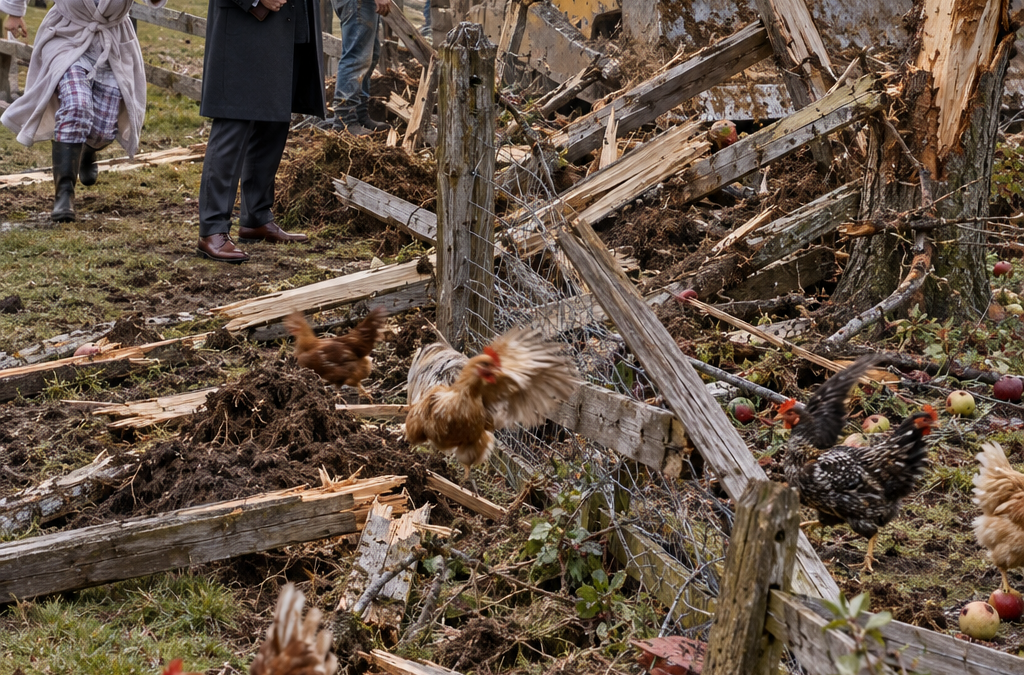
Every broken post.
Every crushed wire.
Every panicked hen.
Every tire mark.
Every splinter of my apple tree.
Every worker standing on land they had no recorded right to enter.
And Patrick Voss, polished and calm, holding the clipboard he believed made him untouchable.
Three weeks earlier, I never would have imagined any of this.
Three weeks earlier, I was just Deborah Bell, a widow living on five acres at the edge of Maple Hollow Estates in northern Georgia, trying to keep my tomatoes alive through another unpredictable spring.
My land was the last lot zoned for private farming before the subdivision swallowed everything else whole.
That was how my father used to say it.
“Suburbia keeps chewing,” he would tell me, standing at the old fence line, “but this piece still has teeth.”
The land had been in my family since my grandfather bought it when the road was still gravel and Maple Hollow was mostly pasture. He built the original fence line himself. Not pretty, but strong. Cedar posts. Wire. Gate hinges heavy enough to outlast people.
My husband later built the barn behind the house with his own hands.
Red siding.
Tin roof.
Wide double doors.
A workbench along the back wall where he kept jars of screws labeled in handwriting that got shakier as he aged. After Samuel died, I could not bring myself to move the jars. Sometimes I went into the barn just to touch them.
I raised chickens in the side coop.
Grew tomatoes, okra, peppers, and beans.
Kept apple trees, blueberry bushes, and a half-wild patch of rosemary that refused to die no matter how badly I neglected it.
None of that should have been HOA business.
That was what I believed.
Belief, I learned, does not hold up against a man with power, money, and a clipboard full of violations.
Maple Hollow Estates had grown around my property in stages.
First came a row of brick houses across the road.
Then a cul-de-sac.
Then a second phase with a pool and clubhouse.
Then a sign at the subdivision entrance with carved letters, decorative stones, and flowers replaced three times a year by whatever landscaping company the board had hired.
I never joined the HOA voluntarily.
My property sat outside the original covenant boundaries, though a narrow strip near the access road was subject to an old utility easement that allowed county maintenance vehicles to reach a drainage ditch farther down. That was it.
No architectural control over my barn.
No authority over my garden.
No right to my chicken coop.
For years, nobody bothered me much.
Neighbors bought eggs from me.
Children waved at the chickens.
People slowed down in summer to look at the tomato rows.
Then Patrick Voss became HOA president.
He had been president for six years by the time he bulldozed my fence.
Neighbors joked, half seriously, that he inspected lawns the way airport security inspected luggage.
Patrick did not rush.
That was part of his act.
He moved with expensive patience.
His clothes were always immaculate: pressed shirts, tailored jackets, polished shoes, a watch that flashed when he lifted his hand to make a point. He spoke softly, but every soft word carried ownership.
He made ordinary residents feel as if they were trespassing in a neighborhood he personally allowed them to occupy.
He had a particular gift for turning rules into weapons and calling the wound “community standards.”
My first warning letter came on a Monday.
Unsightly vegetable rows visible from community road.
I stared at the line for a full minute.
Vegetable rows.
Unsightly.
Apparently, my tomatoes could be seen from the cul-de-sac if someone leaned over the split-rail fence, squinted hard, and decided food growing in soil was offensive.
The fine was fifty dollars.
I should have thrown it away.
Instead, I paid it.
I was tired that week.
One of the hens had been sick.
The barn roof had started leaking near the south wall.
A pipe under the kitchen sink was dripping into a pan.
Fifty dollars felt like less trouble than fighting a man who clearly enjoyed paperwork.
That was my first mistake.
Two weeks later, a second letter arrived.
This one cited my chicken coop as an unapproved accessory structure.
The coop had been built twelve years before Maple Hollow Estates existed.
Samuel had built it himself from leftover barn lumber, and my grandson had painted a crooked white chicken on the door when he was seven.
I took the original deed, the tax records, and old photographs to the HOA office expecting the matter to end there.
Patrick was waiting behind the front desk as though he had known I would come.
The office smelled like lemon polish and printer toner. Behind him, framed community awards lined the wall. He wore a pale blue shirt, no tie, sleeves buttoned at the wrist, silver cufflinks catching the fluorescent light.
“Deborah,” he said. “Come in.”
I placed the folder on the desk.
“My chicken coop predates your HOA.”
He opened the folder but barely looked at it.
“These documents are historic.”
“Yes. That is the point.”
He smiled.
“Rules apply retroactively now.”
I blinked.
“What?”
“The board updated its interpretation of existing community impact standards.”
“Interpretation does not change my deed.”
“It changes enforcement.”
“You can’t approve a rule today and use it to punish a structure from fifteen years ago.”
Patrick folded his hands.
“Deborah, rural habits can create visual friction when subdivisions mature around them.”
Visual friction.
That was what he called my dead husband’s chicken coop.
I leaned forward.
“My chickens are not HOA business.”
His expression did not change.
“Everything visible from the community affects the community.”
The sentence should have set off alarms.
But I was still new to the arithmetic of small-town power trips.
I thought facts would matter.
The fines climbed fast.
Two hundred dollars.
Then five hundred.
Then late fees.
Each letter stapled to a photo snapped at dawn from someone’s phone.
My chicken coop.
My tomato rows.
My barn door.
My compost bins.
My apple trees.
Each picture felt more invasive than the last.
Someone was walking the edge of my property while I slept, collecting angles of my life and turning them into violations.
Then came the letter that changed everything.
An official notice of intent to place a lien on my property for unpaid assessments going back years.
Unpaid assessments.
On a house I had never missed paying for.
I had twelve years of canceled checks, bank statements, and printed receipts sitting neatly in my filing cabinet. Samuel had taught me to keep records. “Paper remembers what people deny,” he used to say.
I called the HOA treasurer.
His name was Ray Mullins, though everyone called him Ry for reasons I never understood. He was a nervous man with thinning hair and a soft voice that always sounded apologetic before he said anything.
“Ry,” I said, “why does this notice claim I missed assessments?”
He sighed.
“Deborah—”
“My name is Deborah. Try again.”
“I’m sorry. Patrick’s spreadsheet shows a balance.”
“Patrick’s spreadsheet?”
“That is what the ledger reflects.”
“I have canceled checks.”
“I understand.”
“Then why does your ledger say I owe money?”
A pause.
When he spoke again, his voice was lower.
“The numbers came from Patrick’s spreadsheet, not mine.”
That sentence stayed with me.
Funny thing about spreadsheets.
They lie beautifully when the person typing them controls every column, row, and total.
At the next open meeting, I stood in front of forty neighbors with my folder in both hands.
The clubhouse was full.
Parents, retirees, young couples, people I recognized from mailbox conversations and egg pickups. Most sat quietly, faces turned toward Patrick at the front table like students waiting for a strict principal.
Patrick sat in the center chair, polished as always, a dark blazer over a white shirt, sunglasses folded neatly beside his clipboard.
When homeowner comments opened, I stood.
“I’d like to know why my paid assessments do not match the HOA ledger.”
Patrick’s eyes lifted slowly.
“Deborah, your account is under review.”
“I have twelve years of canceled checks.”
“We are aware you claim documentation.”
“I do not claim it. I brought it.”
A few heads turned.
Patrick’s smile did not move.
“The discrepancy is under review.”
“Then let’s review it now.”
“That would not be appropriate in an open meeting.”
“This is an open meeting, and your office sent me a lien notice.”
His fingers tightened around his pen.
“We will not litigate individual account matters tonight.”
“I am not litigating. I am asking why your spreadsheet says I owe money I already paid.”
Patrick stood.
“This meeting is adjourned for executive review.”
He closed it before I could finish my sentence.
That was the first time the room saw him run.
Not physically.
Patrick never moved quickly enough to look desperate.
But he ran all the same.
That night, Frank knocked on my door.
He lived across the road in a low brick house with a magnolia tree out front and a garage full of tools he kept cleaner than most kitchens. He was in his late sixties, built solid, with weathered hands and tired eyes.
He had been the HOA’s landscaping contractor for years until Patrick fired him.
At the time, Patrick claimed Frank’s work no longer met community standards.
Frank never argued publicly.
He simply packed his mower trailer, stopped attending meetings, and waved at people like nothing had happened.
That night, he stood on my porch holding a manila folder.
“I should’ve given you this sooner,” he said.
“What is it?”
“Something I was afraid to show anyone.”
I let him in.
We sat at my kitchen table under the yellow light while he opened the folder.
Inside were printed emails.
Months of them.
Patrick Voss.
Frank.
And a developer called Kesler Group.
The subject lines made my stomach tighten.
Parcel consolidation strategy.
Underused residential edges.
Bell property access possibility.
My name was there.
My address.
My lot number.
My five acres described as “underutilized private farm parcel adjacent to future expansion corridor.”
I read the first email.
Then the next.
Then the next.
Patrick had been discussing my land with Kesler Group for months.
Not casually.
Not hypothetically.
Strategically.
The vegetable violation was not about tomatoes.
The chicken coop was not about architecture.
The lien was not about assessments.
It was the opening move in a slow, deliberate push toward foreclosure and a forced sale.
Frank watched me read.
His jaw worked once.
“I got fired because Patrick told me to bill hours I never worked.”
I looked up.
“What?”
“He wanted inflated maintenance invoices tied to the expansion corridor. Said the board needed flexibility.”
“You refused.”
“I refused.”
“So he fired you.”
“And hired a company Kesler recommended.”
I sat back.
The retroactive rules.
The phantom assessments.
The surprise lien on a paid-off house.
The developer emails.
All of it lined up like dominoes someone had carefully, patiently arranged.
I laughed.
It was not a happy sound.
It was bitter and sharp and almost frightening in my own kitchen.
“I have been blaming myself for growing peppers too close to a fence line.”
Frank looked down at the folder.
“It was never the peppers.”
The very next morning, before a single phone call or warning, the bulldozer came.
They knocked down forty feet of my grandfather’s fence line and claimed the HOA had easement rights to clear brush for a drainage project.
As far as county records showed, that drainage project did not exist anywhere.
My chickens scattered into the road.
My heirloom apple tree lay splintered and broken in the dirt.
Patrick stood there in polished shoes and called it unavoidable disturbance.
I filmed everything.
Every splinter.
Every broken post.
Every terrified hen darting across the pavement.
Every worker stepping over my property line.
Every orange mark sprayed across my grass.
Then I sent the footage to my attorney before breakfast was even over.
Her name was Rosalind Grant.
Sharp.
Direct.
No patience for theatrical nonsense.
She was the kind of woman who read a document like it had personally offended her.
She called me thirty minutes after receiving the video.
“Deborah,” she said, “they just handed us the whole case.”
My hands were still shaking.
“They destroyed the fence.”
“I saw.”
“They hit Samuel’s apple tree.”
“I saw that too.”
“What do I do?”
“You do not speak to Patrick again without me. You do not sign anything. You do not let another worker onto that land. And you keep filming if anyone returns.”
My breath caught.
“Can they claim easement rights?”
“Not from what you sent me. Property damage on private land, well outside any recorded easement, is not a misunderstanding. It is trespass, plain and simple.”
She paused.
“And trespass always has a price tag.”
For the first time that morning, my hands steadied.
We filed suit within seventy-two hours.
Trespass.
Property damage.
Fraudulent lien.
Interference with property rights.
Compensation for the fence, the apple tree, the chicken coop repairs, and emotional distress.
Rosalind also demanded preservation of HOA records, emails, ledgers, board minutes, vendor contracts, and communications with Kesler Group.
Patrick responded exactly as powerful men do when they have mistaken intimidation for law.
He dismissed me.
The response leaked through Ry, who was already unraveling under pressure.
A group text to the board.
She can’t afford a real lawyer. This will blow over.
He was wrong about the lawyer.
He was even more wrong about the neighbors.
Because once people saw the bulldozer footage, they started showing up.
At first, one at a time.
A woman with a fine for a porch swing.
A retired couple cited for a “nonstandard garden border.”
A young family threatened over a shed they had county permits to build.
Then more.
People arrived at my kitchen table with old letters, emails, notices, photographs, checks, and stories they had swallowed for years because they thought they were alone.
It turned out I was not the only “problem resident.”
Patrick had quietly and systematically targeted anyone whose parcel caught Kesler Group’s greedy attention.
His method was simple.
Find a property that mattered.
Invent a violation.
Increase pressure.
Question payment history.
Threaten liens.
Wait for fear to soften the owner.
Then talk about development potential.
At the emergency board hearing, Rosalind did not raise her voice.
She did not need to.
She laid Frank’s printed emails across the table one by one, like cards nobody in that room expected to see.
Patrick sat at the head of the table, glossy and controlled, his blazer perfectly fitted, his expression carved from stone.
His face did not move.
But his hands did.
They shuffled papers that suddenly, visibly had nowhere useful left to go.
Rosalind placed the first email on the table.
Then the second.
Then the map marked with my lot number.
Then the lien notice.
Then the bulldozer invoice.
Then the county record showing no drainage project.
“Mr. Voss,” she said, “did the board authorize entry onto Ms. Bell’s land?”
Patrick’s smile appeared.
“The board authorized necessary drainage preparation.”
“Where is the drainage plan?”
“It is in development.”
“Where is the recorded easement?”
“The association has longstanding access rights.”
“Show them.”
His hands stilled.
The room went quiet.
Then came the third twist.
A county clerk confirmed the drainage easement document Patrick had produced had been notarized using a stamp reported stolen two full years earlier.
Forged paperwork.
Printed on county letterhead.
Used to justify tearing down a private fence.
That was not HOA overreach anymore.
That was a straight-up felony.
The district attorney’s office opened a formal investigation within the week.
And Patrick’s cool composure finally cracked in front of the entire watching neighborhood.
Not dramatically.
No shouting.
No confession.
Just one blink too long.
One swallow.
One moment where the polished, untouchable president looked like a man suddenly hearing footsteps behind him.
At the courthouse, he tried the same tired trick that had worked on ordinary residents for years.
Icy condescension.
He stood beside his attorney in a tailored navy suit and explained that community management required difficult decisions. That my property had created longstanding compliance concerns. That residents sometimes misunderstood easements. That emotions were clouding the issue.
The judge let him speak for about two minutes.
Then she cut him off mid-sentence.
“Mr. Voss, this court is not interested in your philosophy of community management. It is interested in legal authority. Do you have a recorded easement allowing demolition of Ms. Bell’s fence?”
Patrick’s attorney shifted.
“Your Honor, the association relied on—”
The judge held up one hand.
“I did not ask what the association relied on. I asked whether there is a valid recorded easement.”
Silence.
Rosalind stood.
“No, Your Honor.”
The judge looked at the forged document, then at Patrick.
“And this notary stamp was reported stolen?”
“Yes, Your Honor,” Rosalind said.
The judge’s face hardened.
The ruling came down with the force of a gate slamming shut.
Full compensation for every inch of property damage.
Replacement cost for the fence.
Damages for the apple tree.
Repairs to the chicken coop.
Legal fees.
Steep punitive damages for the fraudulent lien and forged easement.
A temporary restraining order preventing the HOA, Patrick, Kesler Group, or any affiliated vendor from entering my land without court approval.
And a formal referral to the district attorney.
Patrick was removed from the board that same afternoon.
The remaining board members voted in emergency session, shaking in their chairs as neighbors packed the clubhouse wall to wall.
His name was struck from active HOA records before sunset.
The man who had treated Maple Hollow like his private kingdom lost his throne in less than an hour.
Two months later, Patrick Voss was formally charged with forgery and embezzlement of HOA reserve funds.
The number climbed past sixty thousand stolen dollars.
Ry testified against him in exchange for immunity.
The nervous treasurer who had mumbled through phone calls finally sat under oath and explained how Patrick had forced him to falsify spreadsheets for years.
False balances.
Inflated assessments.
Vendor payments redirected.
Kesler Group communications hidden.
Violation fees shifted into accounts nobody on the board had properly reviewed.
Frank testified too.
So did I.
So did six other homeowners whose parcels had appeared in Kesler Group’s internal development notes.
Patrick’s overcoat and sunglasses did not help him there.
Neither did his careful voice.
In a courtroom, performance lasts only until evidence speaks.
The board hired outside management after that.
Real audits.
Open records.
Recorded votes.
No more presidential spreadsheets.
No more retroactive rules.
No more phantom drainage projects.
Maple Hollow Estates was still an HOA, but it no longer felt like Patrick’s mouth speaking through official letterhead.
I rebuilt the fence with the settlement money.
Not vinyl.
Not decorative HOA-approved composite.
Cedar.
Strong cedar posts sunk deep.
Wire pulled tight.
A gate wide enough for my mower and narrow enough to remind people this was private land.
The contractor asked if I wanted the line moved slightly inward to avoid future disputes.
I told him no.
“Build it exactly where my grandfather built it.”
So he did.
The apple tree could not be saved.
That hurt more than I expected, though I had known it the moment I saw the split trunk. Rosalind included its value in damages, but money is a poor language for living things.
So I planted a new apple sapling exactly where the old one fell.
I knelt beside it with dirt under my fingernails and thought of Samuel’s hands on pruning shears.
“You would have hated all this,” I whispered.
Then I smiled.
“No. You would have hated Patrick.”
The chickens came back.
Every last one, though Mabel spent two days hiding under Frank’s porch like a traumatized fugitive.
My tomatoes kept growing.
My peppers recovered.
The barn still stands, red siding faded, tin roof patched, Samuel’s labeled jars still lined along the back wall.
And Patrick Voss finally learned the hard way that some land was never his to take.
The last time I saw him before sentencing, he was leaving the courthouse without sunglasses.
He looked older.
Less polished.
Smaller somehow, without a clipboard or a board table in front of him.
He glanced at me once.
I expected anger.
Maybe contempt.
What I saw was confusion.
As if he still could not understand how the woman with chickens and tomatoes had cost him everything.
He never understood the simplest part.
I did not beat him because I was powerful.
I beat him because the land was mine, the records were real, and enough people finally stopped being afraid of his version of the truth.
Now, when I stand at the rebuilt fence line in the evening, I can see Maple Hollow Estates glowing beyond the road.
Porch lights.
Trimmed lawns.
Garage doors closing.
The suburb still presses close, the way my father said it would.
Suburbia keeps chewing.
But this piece still has teeth.
My grandfather’s fence line is back.
My apple sapling is taking root.
My chickens scratch wherever they please.
My tomatoes are unbothered by anyone’s clipboard.
And if another HOA president ever forgets where my land begins, the new cedar posts will be there to remind him.
So will I.
𝗧𝗛𝗘 𝗘𝗡𝗗
The Morning the HOA President Bulldozed My Grandfather’s Fence
They came for my fence before the sun was fully up, and by noon my lawyer was already on the phone with a judge.
The sound woke me before I understood what it was.
At first, it came through the bedroom window as a deep mechanical growl, low enough to rattle the glass in the frame. I opened my eyes in the gray light before dawn, still caught between sleep and alarm, and listened.
Another sound followed.
A crack.
Wood splitting.
Not a branch.
Not a fallen limb.
Something older.
Something built by human hands.
I threw back the quilt and ran barefoot to the window.
At the edge of my five acres, where my grandfather’s fence line had stood longer than most of the houses in Maple Hollow Estates, a yellow bulldozer was pushing through the cedar posts like they were weeds.
For three seconds, I could not move.
Then I saw the chickens.
My chickens were scattering across the yard in wild bursts of feathers, shrieking and flapping toward the gravel road. One of the hens, a red one named Mabel, slipped under the broken bottom rail and darted straight toward the pavement.
I grabbed my robe from the chair, shoved my feet into boots without socks, and ran.
By the time I reached the side yard, two sections of fence were already down.
The old posts my grandfather had set by hand leaned cracked and crooked in the dirt. Wire twisted under the bulldozer blade. Splintered cedar lay across the grass. My heirloom apple tree, the one my husband used to prune every winter before his hands got too stiff from arthritis, had been struck at the trunk and split open like a wound.
And standing ten feet from the destruction, wearing polished brown loafers and a charcoal overcoat that had no business near mud, was Patrick Voss.
President of the Maple Hollow Estates HOA.
He was fifty, maybe a little older, tall and carefully groomed, with silver at his temples and a face that looked as if it had been trained never to show doubt. His sunglasses sat on top of his head even though the sun had not fully risen. A leather clipboard rested in his left hand. His right hand pointed toward my property like he was directing a military operation.
“Stop!” I shouted.
The bulldozer kept moving.
“Stop the machine!”
One of the workers looked toward Patrick.
Patrick did not look at me.
He lifted one hand, slow and irritated, and the machine finally idled.
The sudden quiet rang in my ears.
I crossed the yard, stepping over broken wire and crushed weeds.
“What are you doing?”
Patrick turned then, slowly, as if I were the interruption.
“Good morning, Deborah.”
I was breathing hard, my robe pulled tight around me, my boots slick with dew and mud.
“That is my fence.”
He smiled.
Not warmly.
Never warmly.
Patrick Voss had a smile that belonged on expensive brochures and courtroom lies.
“This is an authorized clearance action.”
“Authorized by who?”
“The association.”
“The association does not own my land.”
His smile tightened by one precise degree.
“That is under review.”
“No,” I said. “It is not under review. This is my property. This fence was here before your subdivision existed.”
He glanced toward the fallen cedar posts.
“The fence obstructs drainage access.”
“There is no drainage project here.”
“We have documentation.”
“Show it to me.”
Patrick tapped the clipboard.
“In due course.”
That was when I saw the old apple tree.
The bulldozer blade had clipped the trunk low and hard, breaking it open. Half the tree sagged toward the ground, its spring leaves trembling in the morning air.
For a moment, everything else went silent.
That tree had been there when my husband, Samuel, was still alive.
He used to stand under it in late summer with his hat tipped back, inspecting the small green apples as if they were a crop large enough to feed the county. He had planted the second row of tomatoes ten feet from that tree because he said the afternoon shade was kind to tired roots.
Samuel had been gone four years.
That tree was one of the last living things in my yard that still felt like his hands.
I turned back to Patrick.
“You hit my apple tree.”
He looked at it, then back at me.
“Unfortunately, corrective work sometimes creates unavoidable disturbance.”
Something cold moved through me.
Not fear.
Not yet.
The kind of stillness that comes right before a person decides she will not be pushed one inch farther.
I pulled out my phone.
Patrick’s eyes followed the movement.
“What are you doing?”
“Recording.”
His mouth flattened.
“That is unnecessary.”
“So is bulldozing my grandfather’s fence at six in the morning.”
I started filming.
Every broken post.
Every crushed wire.
Every panicked hen.
Every tire mark.
Every splinter of my apple tree.
Every worker standing on land they had no recorded right to enter.
And Patrick Voss, polished and calm, holding the clipboard he believed made him untouchable.
Three weeks earlier, I never would have imagined any of this.
Three weeks earlier, I was just Deborah Bell, a widow living on five acres at the edge of Maple Hollow Estates in northern Georgia, trying to keep my tomatoes alive through another unpredictable spring.
My land was the last lot zoned for private farming before the subdivision swallowed everything else whole.
That was how my father used to say it.
“Suburbia keeps chewing,” he would tell me, standing at the old fence line, “but this piece still has teeth.”
The land had been in my family since my grandfather bought it when the road was still gravel and Maple Hollow was mostly pasture. He built the original fence line himself. Not pretty, but strong. Cedar posts. Wire. Gate hinges heavy enough to outlast people.
My husband later built the barn behind the house with his own hands.
Red siding.
Tin roof.
Wide double doors.
A workbench along the back wall where he kept jars of screws labeled in handwriting that got shakier as he aged. After Samuel died, I could not bring myself to move the jars. Sometimes I went into the barn just to touch them.
I raised chickens in the side coop.
Grew tomatoes, okra, peppers, and beans.
Kept apple trees, blueberry bushes, and a half-wild patch of rosemary that refused to die no matter how badly I neglected it.
None of that should have been HOA business.
That was what I believed.
Belief, I learned, does not hold up against a man with power, money, and a clipboard full of violations.
Maple Hollow Estates had grown around my property in stages.
First came a row of brick houses across the road.
Then a cul-de-sac.
Then a second phase with a pool and clubhouse.
Then a sign at the subdivision entrance with carved letters, decorative stones, and flowers replaced three times a year by whatever landscaping company the board had hired.
I never joined the HOA voluntarily.
My property sat outside the original covenant boundaries, though a narrow strip near the access road was subject to an old utility easement that allowed county maintenance vehicles to reach a drainage ditch farther down. That was it.
No architectural control over my barn.
No authority over my garden.
No right to my chicken coop.
For years, nobody bothered me much.
Neighbors bought eggs from me.
Children waved at the chickens.
People slowed down in summer to look at the tomato rows.
Then Patrick Voss became HOA president.
He had been president for six years by the time he bulldozed my fence.
Neighbors joked, half seriously, that he inspected lawns the way airport security inspected luggage.
Patrick did not rush.
That was part of his act.
He moved with expensive patience.
His clothes were always immaculate: pressed shirts, tailored jackets, polished shoes, a watch that flashed when he lifted his hand to make a point. He spoke softly, but every soft word carried ownership.
He made ordinary residents feel as if they were trespassing in a neighborhood he personally allowed them to occupy.
He had a particular gift for turning rules into weapons and calling the wound “community standards.”
My first warning letter came on a Monday.
Unsightly vegetable rows visible from community road.
I stared at the line for a full minute.
Vegetable rows.
Unsightly.
Apparently, my tomatoes could be seen from the cul-de-sac if someone leaned over the split-rail fence, squinted hard, and decided food growing in soil was offensive.
The fine was fifty dollars.
I should have thrown it away.
Instead, I paid it.
I was tired that week.
One of the hens had been sick.
The barn roof had started leaking near the south wall.
A pipe under the kitchen sink was dripping into a pan.
Fifty dollars felt like less trouble than fighting a man who clearly enjoyed paperwork.
That was my first mistake.
Two weeks later, a second letter arrived.
This one cited my chicken coop as an unapproved accessory structure.
The coop had been built twelve years before Maple Hollow Estates existed.
Samuel had built it himself from leftover barn lumber, and my grandson had painted a crooked white chicken on the door when he was seven.
I took the original deed, the tax records, and old photographs to the HOA office expecting the matter to end there.
Patrick was waiting behind the front desk as though he had known I would come.
The office smelled like lemon polish and printer toner. Behind him, framed community awards lined the wall. He wore a pale blue shirt, no tie, sleeves buttoned at the wrist, silver cufflinks catching the fluorescent light.
“Deborah,” he said. “Come in.”
I placed the folder on the desk.
“My chicken coop predates your HOA.”
He opened the folder but barely looked at it.
“These documents are historic.”
“Yes. That is the point.”
He smiled.
“Rules apply retroactively now.”
I blinked.
“What?”
“The board updated its interpretation of existing community impact standards.”
“Interpretation does not change my deed.”
“It changes enforcement.”
“You can’t approve a rule today and use it to punish a structure from fifteen years ago.”
Patrick folded his hands.
“Deborah, rural habits can create visual friction when subdivisions mature around them.”
Visual friction.
That was what he called my dead husband’s chicken coop.
I leaned forward.
“My chickens are not HOA business.”
His expression did not change.
“Everything visible from the community affects the community.”
The sentence should have set off alarms.
But I was still new to the arithmetic of small-town power trips.
I thought facts would matter.
The fines climbed fast.
Two hundred dollars.
Then five hundred.
Then late fees.
Each letter stapled to a photo snapped at dawn from someone’s phone.
My chicken coop.
My tomato rows.
My barn door.
My compost bins.
My apple trees.
Each picture felt more invasive than the last.
Someone was walking the edge of my property while I slept, collecting angles of my life and turning them into violations.
Then came the letter that changed everything.
An official notice of intent to place a lien on my property for unpaid assessments going back years.
Unpaid assessments.
On a house I had never missed paying for.
I had twelve years of canceled checks, bank statements, and printed receipts sitting neatly in my filing cabinet. Samuel had taught me to keep records. “Paper remembers what people deny,” he used to say.
I called the HOA treasurer.
His name was Ray Mullins, though everyone called him Ry for reasons I never understood. He was a nervous man with thinning hair and a soft voice that always sounded apologetic before he said anything.
“Ry,” I said, “why does this notice claim I missed assessments?”
He sighed.
“Deborah—”
“My name is Deborah. Try again.”
“I’m sorry. Patrick’s spreadsheet shows a balance.”
“Patrick’s spreadsheet?”
“That is what the ledger reflects.”
“I have canceled checks.”
“I understand.”
“Then why does your ledger say I owe money?”
A pause.
When he spoke again, his voice was lower.
“The numbers came from Patrick’s spreadsheet, not mine.”
That sentence stayed with me.
Funny thing about spreadsheets.
They lie beautifully when the person typing them controls every column, row, and total.
At the next open meeting, I stood in front of forty neighbors with my folder in both hands.
The clubhouse was full.
Parents, retirees, young couples, people I recognized from mailbox conversations and egg pickups. Most sat quietly, faces turned toward Patrick at the front table like students waiting for a strict principal.
Patrick sat in the center chair, polished as always, a dark blazer over a white shirt, sunglasses folded neatly beside his clipboard.
When homeowner comments opened, I stood.
“I’d like to know why my paid assessments do not match the HOA ledger.”
Patrick’s eyes lifted slowly.
“Deborah, your account is under review.”
“I have twelve years of canceled checks.”
“We are aware you claim documentation.”
“I do not claim it. I brought it.”
A few heads turned.
Patrick’s smile did not move.
“The discrepancy is under review.”
“Then let’s review it now.”
“That would not be appropriate in an open meeting.”
“This is an open meeting, and your office sent me a lien notice.”
His fingers tightened around his pen.
“We will not litigate individual account matters tonight.”
“I am not litigating. I am asking why your spreadsheet says I owe money I already paid.”
Patrick stood.
“This meeting is adjourned for executive review.”
He closed it before I could finish my sentence.
That was the first time the room saw him run.
Not physically.
Patrick never moved quickly enough to look desperate.
But he ran all the same.
That night, Frank knocked on my door.
He lived across the road in a low brick house with a magnolia tree out front and a garage full of tools he kept cleaner than most kitchens. He was in his late sixties, built solid, with weathered hands and tired eyes.
He had been the HOA’s landscaping contractor for years until Patrick fired him.
At the time, Patrick claimed Frank’s work no longer met community standards.
Frank never argued publicly.
He simply packed his mower trailer, stopped attending meetings, and waved at people like nothing had happened.
That night, he stood on my porch holding a manila folder.
“I should’ve given you this sooner,” he said.
“What is it?”
“Something I was afraid to show anyone.”
I let him in.
We sat at my kitchen table under the yellow light while he opened the folder.
Inside were printed emails.
Months of them.
Patrick Voss.
Frank.
And a developer called Kesler Group.
The subject lines made my stomach tighten.
Parcel consolidation strategy.
Underused residential edges.
Bell property access possibility.
My name was there.
My address.
My lot number.
My five acres described as “underutilized private farm parcel adjacent to future expansion corridor.”
I read the first email.
Then the next.
Then the next.
Patrick had been discussing my land with Kesler Group for months.
Not casually.
Not hypothetically.
Strategically.
The vegetable violation was not about tomatoes.
The chicken coop was not about architecture.
The lien was not about assessments.
It was the opening move in a slow, deliberate push toward foreclosure and a forced sale.
Frank watched me read.
His jaw worked once.
“I got fired because Patrick told me to bill hours I never worked.”
I looked up.
“What?”
“He wanted inflated maintenance invoices tied to the expansion corridor. Said the board needed flexibility.”
“You refused.”
“I refused.”
“So he fired you.”
“And hired a company Kesler recommended.”
I sat back.
The retroactive rules.
The phantom assessments.
The surprise lien on a paid-off house.
The developer emails.
All of it lined up like dominoes someone had carefully, patiently arranged.
I laughed.
It was not a happy sound.
It was bitter and sharp and almost frightening in my own kitchen.
“I have been blaming myself for growing peppers too close to a fence line.”
Frank looked down at the folder.
“It was never the peppers.”
The very next morning, before a single phone call or warning, the bulldozer came.
They knocked down forty feet of my grandfather’s fence line and claimed the HOA had easement rights to clear brush for a drainage project.
As far as county records showed, that drainage project did not exist anywhere.
My chickens scattered into the road.
My heirloom apple tree lay splintered and broken in the dirt.
Patrick stood there in polished shoes and called it unavoidable disturbance.
I filmed everything.
Every splinter.
Every broken post.
Every terrified hen darting across the pavement.
Every worker stepping over my property line.
Every orange mark sprayed across my grass.
Then I sent the footage to my attorney before breakfast was even over.
Her name was Rosalind Grant.
Sharp.
Direct.
No patience for theatrical nonsense.
She was the kind of woman who read a document like it had personally offended her.
She called me thirty minutes after receiving the video.
“Deborah,” she said, “they just handed us the whole case.”
My hands were still shaking.
“They destroyed the fence.”
“I saw.”
“They hit Samuel’s apple tree.”
“I saw that too.”
“What do I do?”
“You do not speak to Patrick again without me. You do not sign anything. You do not let another worker onto that land. And you keep filming if anyone returns.”
My breath caught.
“Can they claim easement rights?”
“Not from what you sent me. Property damage on private land, well outside any recorded easement, is not a misunderstanding. It is trespass, plain and simple.”
She paused.
“And trespass always has a price tag.”
For the first time that morning, my hands steadied.
We filed suit within seventy-two hours.
Trespass.
Property damage.
Fraudulent lien.
Interference with property rights.
Compensation for the fence, the apple tree, the chicken coop repairs, and emotional distress.
Rosalind also demanded preservation of HOA records, emails, ledgers, board minutes, vendor contracts, and communications with Kesler Group.
Patrick responded exactly as powerful men do when they have mistaken intimidation for law.
He dismissed me.
The response leaked through Ry, who was already unraveling under pressure.
A group text to the board.
She can’t afford a real lawyer. This will blow over.
He was wrong about the lawyer.
He was even more wrong about the neighbors.
Because once people saw the bulldozer footage, they started showing up.
At first, one at a time.
A woman with a fine for a porch swing.
A retired couple cited for a “nonstandard garden border.”
A young family threatened over a shed they had county permits to build.
Then more.
People arrived at my kitchen table with old letters, emails, notices, photographs, checks, and stories they had swallowed for years because they thought they were alone.
It turned out I was not the only “problem resident.”
Patrick had quietly and systematically targeted anyone whose parcel caught Kesler Group’s greedy attention.
His method was simple.
Find a property that mattered.
Invent a violation.
Increase pressure.
Question payment history.
Threaten liens.
Wait for fear to soften the owner.
Then talk about development potential.
At the emergency board hearing, Rosalind did not raise her voice.
She did not need to.
She laid Frank’s printed emails across the table one by one, like cards nobody in that room expected to see.
Patrick sat at the head of the table, glossy and controlled, his blazer perfectly fitted, his expression carved from stone.
His face did not move.
But his hands did.
They shuffled papers that suddenly, visibly had nowhere useful left to go.
Rosalind placed the first email on the table.
Then the second.
Then the map marked with my lot number.
Then the lien notice.
Then the bulldozer invoice.
Then the county record showing no drainage project.
“Mr. Voss,” she said, “did the board authorize entry onto Ms. Bell’s land?”
Patrick’s smile appeared.
“The board authorized necessary drainage preparation.”
“Where is the drainage plan?”
“It is in development.”
“Where is the recorded easement?”
“The association has longstanding access rights.”
“Show them.”
His hands stilled.
The room went quiet.
Then came the third twist.
A county clerk confirmed the drainage easement document Patrick had produced had been notarized using a stamp reported stolen two full years earlier.
Forged paperwork.
Printed on county letterhead.
Used to justify tearing down a private fence.
That was not HOA overreach anymore.
That was a straight-up felony.
The district attorney’s office opened a formal investigation within the week.
And Patrick’s cool composure finally cracked in front of the entire watching neighborhood.
Not dramatically.
No shouting.
No confession.
Just one blink too long.
One swallow.
One moment where the polished, untouchable president looked like a man suddenly hearing footsteps behind him.
At the courthouse, he tried the same tired trick that had worked on ordinary residents for years.
Icy condescension.
He stood beside his attorney in a tailored navy suit and explained that community management required difficult decisions. That my property had created longstanding compliance concerns. That residents sometimes misunderstood easements. That emotions were clouding the issue.
The judge let him speak for about two minutes.
Then she cut him off mid-sentence.
“Mr. Voss, this court is not interested in your philosophy of community management. It is interested in legal authority. Do you have a recorded easement allowing demolition of Ms. Bell’s fence?”
Patrick’s attorney shifted.
“Your Honor, the association relied on—”
The judge held up one hand.
“I did not ask what the association relied on. I asked whether there is a valid recorded easement.”
Silence.
Rosalind stood.
“No, Your Honor.”
The judge looked at the forged document, then at Patrick.
“And this notary stamp was reported stolen?”
“Yes, Your Honor,” Rosalind said.
The judge’s face hardened.
The ruling came down with the force of a gate slamming shut.
Full compensation for every inch of property damage.
Replacement cost for the fence.
Damages for the apple tree.
Repairs to the chicken coop.
Legal fees.
Steep punitive damages for the fraudulent lien and forged easement.
A temporary restraining order preventing the HOA, Patrick, Kesler Group, or any affiliated vendor from entering my land without court approval.
And a formal referral to the district attorney.
Patrick was removed from the board that same afternoon.
The remaining board members voted in emergency session, shaking in their chairs as neighbors packed the clubhouse wall to wall.
His name was struck from active HOA records before sunset.
The man who had treated Maple Hollow like his private kingdom lost his throne in less than an hour.
Two months later, Patrick Voss was formally charged with forgery and embezzlement of HOA reserve funds.
The number climbed past sixty thousand stolen dollars.
Ry testified against him in exchange for immunity.
The nervous treasurer who had mumbled through phone calls finally sat under oath and explained how Patrick had forced him to falsify spreadsheets for years.
False balances.
Inflated assessments.
Vendor payments redirected.
Kesler Group communications hidden.
Violation fees shifted into accounts nobody on the board had properly reviewed.
Frank testified too.
So did I.
So did six other homeowners whose parcels had appeared in Kesler Group’s internal development notes.
Patrick’s overcoat and sunglasses did not help him there.
Neither did his careful voice.
In a courtroom, performance lasts only until evidence speaks.
The board hired outside management after that.
Real audits.
Open records.
Recorded votes.
No more presidential spreadsheets.
No more retroactive rules.
No more phantom drainage projects.
Maple Hollow Estates was still an HOA, but it no longer felt like Patrick’s mouth speaking through official letterhead.
I rebuilt the fence with the settlement money.
Not vinyl.
Not decorative HOA-approved composite.
Cedar.
Strong cedar posts sunk deep.
Wire pulled tight.
A gate wide enough for my mower and narrow enough to remind people this was private land.
The contractor asked if I wanted the line moved slightly inward to avoid future disputes.
I told him no.
“Build it exactly where my grandfather built it.”
So he did.
The apple tree could not be saved.
That hurt more than I expected, though I had known it the moment I saw the split trunk. Rosalind included its value in damages, but money is a poor language for living things.
So I planted a new apple sapling exactly where the old one fell.
I knelt beside it with dirt under my fingernails and thought of Samuel’s hands on pruning shears.
“You would have hated all this,” I whispered.
Then I smiled.
“No. You would have hated Patrick.”
The chickens came back.
Every last one, though Mabel spent two days hiding under Frank’s porch like a traumatized fugitive.
My tomatoes kept growing.
My peppers recovered.
The barn still stands, red siding faded, tin roof patched, Samuel’s labeled jars still lined along the back wall.
And Patrick Voss finally learned the hard way that some land was never his to take.
The last time I saw him before sentencing, he was leaving the courthouse without sunglasses.
He looked older.
Less polished.
Smaller somehow, without a clipboard or a board table in front of him.
He glanced at me once.
I expected anger.
Maybe contempt.
What I saw was confusion.
As if he still could not understand how the woman with chickens and tomatoes had cost him everything.
He never understood the simplest part.
I did not beat him because I was powerful.
I beat him because the land was mine, the records were real, and enough people finally stopped being afraid of his version of the truth.
Now, when I stand at the rebuilt fence line in the evening, I can see Maple Hollow Estates glowing beyond the road.
Porch lights.
Trimmed lawns.
Garage doors closing.
The suburb still presses close, the way my father said it would.
Suburbia keeps chewing.
But this piece still has teeth.
My grandfather’s fence line is back.
My apple sapling is taking root.
My chickens scratch wherever they please.
My tomatoes are unbothered by anyone’s clipboard.
And if another HOA president ever forgets where my land begins, the new cedar posts will be there to remind him.
So will I.

