𝗙𝗨𝗟𝗟 𝗦𝗧𝗢𝗥𝗬 The Moment Bailey Entered the Courtroom, Jacob Stopped Breathing
𝗙𝗨𝗟𝗟 𝗦𝗧𝗢𝗥𝗬
A few jurors looked away.
I remember writing two words in my notebook.
He surrendered.
That was what it looked like.
Not guilt.
Exhaustion.
Jacob did not know how to fight a story that seemed stronger than his memory.
He tried.
But every answer he gave created another question.
Every question made him sound less certain.
And uncertainty is dangerous in a courtroom.
Jurors do not like uncertainty from defendants.
They expect innocent people to sound certain.
Angry.
Defiant.
Clear.
Jacob sounded scared.
The jury convicted him.
His mother made a sound I still remember.
Not a scream.
Not exactly.
More like the sound a person makes when the future collapses all at once.
Jacob stood perfectly still while the clerk read the verdict.
Guilty.
Guilty.
Guilty.
His lawyer touched his shoulder.
Jacob did not react.
Then he looked toward his parents.
His father lowered his head.
Margaret covered her mouth.
Jacob’s lips moved.
I could not hear the words from the press section.
Later, Thomas told me what his son had said.
“I didn’t do this.”
Jacob was sentenced and taken away.
For most reporters, that was the end of the story.
For me, it should have been too.
Convictions come.
Appeals follow.
Cases move through the system.
There is always another hearing.
Another indictment.
Another family waiting outside another courtroom.
But Jacob stayed with me.
Partly because he was so young.
Partly because of his parents.
Mostly because of that dog.
It was absurd.
I knew that.
Yet every time I reviewed my notes, I stopped at the same line.
Small golden dog. Approached Jacob. Did not bark.
I never published it.
There was no reason to.
But I never crossed it out either.
A year passed.
Jacob spent that year behind bars.
I covered other cases.
A homicide in Dorchester.
A fraud trial involving a nonprofit director.
A police corruption hearing.
A custody case that became national news for reasons I still think were undeserved.
Then one Tuesday morning, my editor walked past my desk and dropped a thin folder beside my coffee.
“Miller case reopened.”
I looked up.
“Jacob Miller?”
“The burglary case.”
I opened the folder immediately.
“What happened?”
“New evidence.”
“What kind?”
“DNA problems. Defense filed for review.”
I stopped reading.
“DNA?”
He shrugged.
“Apparently material recovered from the victim’s clothing was retested. Doesn’t match Miller.”
That sentence changed the temperature of the room.
“Why wasn’t it tested properly the first time?”
“Ask the lab.”
“I will.”
He pointed at me.
“I knew you would.”
Within forty minutes, I was outside the courthouse.
By noon, I had read the defense motion.
The new DNA evidence was significant.
Not conclusive by itself, according to the prosecution, but significant.
Trace biological material collected during the original investigation had produced a partial profile inconsistent with Jacob.
The state argued that contamination or an unrelated transfer could explain it.
The defense argued the opposite.
Someone else had been in close physical proximity to Benson during the attack.
Someone investigators had never identified.
That alone was enough to reopen questions surrounding the conviction.
But there was another change.
Jacob had a new lawyer.
Elizabeth Harvey.
Every courthouse has attorneys whose names alter the mood of a room.
Elizabeth was one of them.
She was not theatrical.
She did not shout.
She did not perform for cameras.
That made her more dangerous.
Her reputation came from finding details other lawyers dismissed.
A timestamp six seconds off.
A witness statement that changed one adjective.
A medical report filed under the wrong date.
A surveillance camera with a field of view prosecutors had exaggerated.
She was known for asking questions that initially sounded irrelevant and later became impossible to ignore.
When she took Jacob’s case, people noticed.
I requested an interview.
She declined.
I requested another.
She sent back four words.
“Come to the hearing.”
So I did.
Jacob looked different when he entered court the second time.
One year in custody had changed his body.
His shoulders were broader.
His face was leaner.
His hair was shorter.
The frightened boy from the first trial had hardened around the edges.
But when he looked toward his parents, I saw the same person.
Margaret was crying before proceedings even began.
Thomas sat beside her, one hand resting on the back of her neck.
Jacob’s eyes remained there until a deputy told him to face forward.
Elizabeth sat next to him.
She leaned over and whispered something.
Jacob nodded.
Then the courtroom doors opened.
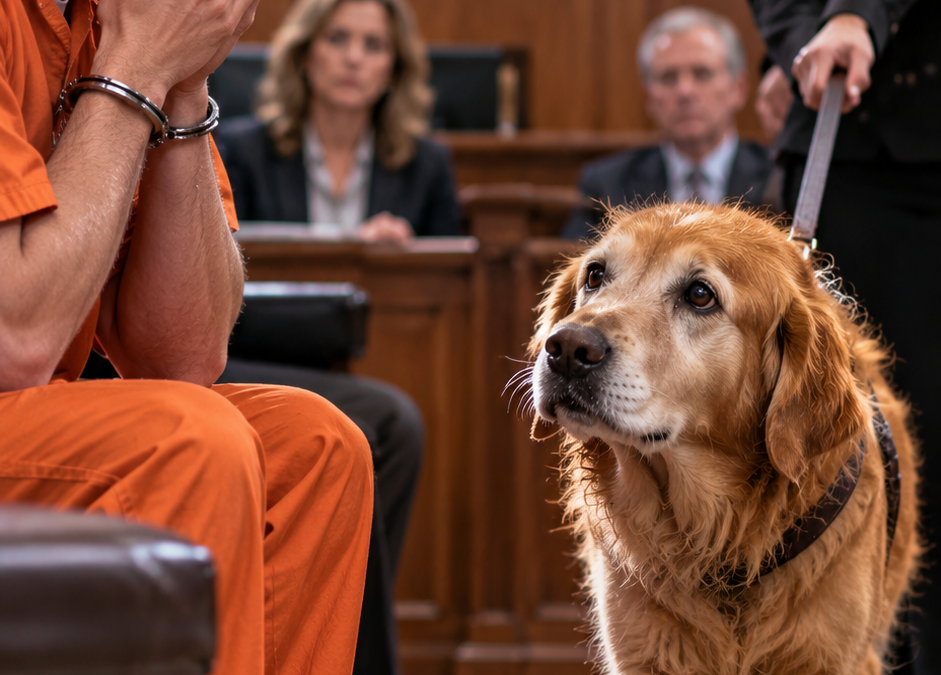
A woman entered carrying a small dog.
At first I thought I had misunderstood what I was seeing.
The dog was golden.
Not a retriever.
Too small.
Some kind of mixed breed with floppy ears, bright dark eyes, and a tail moving so rapidly that its entire back end seemed involved.
The courtroom reacted immediately.
People whispered.
One reporter beside me muttered, “You have got to be kidding.”
I looked at Jacob.
His face changed.
Completely.
The guarded expression disappeared.
His eyes widened.
His mouth opened slightly.
Then he whispered one word.
“Bailey.”
The dog stopped.
Its ears lifted.
Jacob leaned forward.
“Bailey.”
The tail exploded into motion.
The woman holding the leash almost lost her balance as the little dog pulled toward the defense table.
The judge looked over his glasses.
“Ms. Harvey?”
Elizabeth stood.
“Your Honor, this is Bailey.”
“I gathered that.”
A few people laughed.
The judge did not.
“And why,” he continued, “is Bailey in my courtroom?”
Elizabeth glanced at Jacob.
“Because Bailey may be one of the only living witnesses connected to the disputed events who has never previously been examined.”
The prosecutor stood immediately.
“Your Honor—”
“I know,” the judge said, raising a hand. “I am already regretting asking.”
More nervous laughter.
Elizabeth remained calm.
“We are not asking the court to accept an animal’s behavior as direct proof of innocence. We are asking permission to document a behavioral response that may be relevant when considered with the newly admitted forensic evidence.”
The prosecutor shook his head.
“This is theater.”
“No,” Elizabeth said. “Theater would be simpler.”
The judge stared at her.
Then at the dog.
Then at Jacob.
“What exactly are you proposing?”
Elizabeth gestured toward Bailey’s handler.
“We allow Bailey to approach Mr. Miller under controlled conditions.”
“That’s it?”
“For now.”
The judge leaned back.
“Mr. Dawson?”
The prosecutor rose.
“I object to the entire exercise.”
“On what grounds?”
“Relevance, reliability, prejudice, common sense.”
That produced a few smiles.
The judge rubbed his forehead.
“Ms. Harvey, you have five minutes to convince me I should allow this.”
“I need two.”
I sat forward.
Elizabeth approached the bench.
“Your Honor, during the original investigation, my client repeatedly reported encountering a small golden dog in the immediate area. Investigators never followed that lead.”
“Because it was a dog.”
“Because they assumed it had no evidentiary value.”
“Are you claiming it does?”
“I’m claiming they never determined whether it did.”
She continued.
“Bailey belonged to a resident connected to that neighborhood at the time. Veterinary and ownership records establish his identity. The dog’s behavioral history is also documented. According to his former owner and neighbors, Bailey reacted strongly to unfamiliar people entering the property.”
The judge looked toward Jacob.
“And Mr. Miller claims Bailey did not react negatively to him?”
“Correct.”
“That proves what?”
“By itself? Very little.”
I glanced at the prosecutor.
That answer surprised him.
Elizabeth continued.
“But combined with new DNA evidence indicating another person was present during the attack, and additional questions about the reliability of the original identification, Bailey becomes potentially relevant.”
The judge frowned.
“How?”
“Because dogs distinguish humans primarily through scent.”
The prosecutor rose.
“Your Honor, counsel is about to turn this courtroom into an obedience school.”
“Sit down, Mr. Dawson.”
He did.
The judge looked back at Elizabeth.
“You may proceed cautiously.”
“Thank you.”
The woman holding Bailey walked toward the defense table.
Jacob stopped breathing.
I could see it.
He had gone rigid.
Not afraid.
Overwhelmed.
Bailey reached him and immediately began sniffing.
Shoes.
Pant legs.
Hands.
Jacob lowered himself carefully beside the dog.
“Hey, little guy.”
Bailey’s tail whipped against the leg of the table.
Jacob laughed once.
It was the first time I had ever heard him laugh.
Then Bailey pressed his nose into Jacob’s jail-issued clothing.
He sniffed again.
Longer this time.
His ears shifted.
His tail slowed.
The dog stepped backward.
Jacob looked at Elizabeth.
“What?”
She raised a hand.
“Just stay still.”
Bailey circled him.
Sniffed his shoes again.
Then moved close.
For one second, absolutely nothing happened.
Then Bailey urinated directly against Jacob’s pant leg.
The courtroom exploded.
Someone gasped.
Someone laughed.
A reporter behind me swore.
Jacob jerked backward.
Margaret covered her mouth.
Even one of the deputies turned his face away to hide a smile.
The judge slammed his gavel.
“Order!”
The laughter continued.
“Order!”
Jacob stared down at his pants.
Bailey looked up at him, apparently unconcerned with the constitutional crisis he had just caused.
Then Jacob slowly raised his eyes toward Elizabeth.
She wasn’t laughing.
Neither was he.
Something passed between them.
Recognition.
Not the dog’s.
Jacob’s.
He whispered, “That’s different.”
Elizabeth stepped closer.
“What is?”
“He didn’t do that before.”
The room quieted.
Elizabeth looked at Bailey.
Then at the judge.
“Your Honor, I would like the court to note the animal’s reaction.”
The prosecutor threw up his hands.
“The animal urinated.”
“Yes.”
“On your client.”
“Yes.”
“And somehow that helps you?”
Elizabeth turned toward him.
“It may.”
That ended the laughter.
I picked up my pen.
Elizabeth faced the judge.
“Canine scent recognition is far more sophisticated than ordinary human perception. Dogs can retain odor associations for extended periods and distinguish among individuals even where physical appearance is similar.”
The prosecutor started to object again.
Elizabeth raised a hand.
“I am not asking the court to accept my statement as expert testimony. We have a qualified canine behavioral specialist available.”
That was when I understood.
This had not been improvised.
Bailey urinating on Jacob had been unexpected.
But Bailey being there had not.
Elizabeth had prepared for every question surrounding him.
The judge looked toward the back of the courtroom.
“You brought an expert?”
“Yes, Your Honor.”
“Of course you did.”
A woman in her fifties approached the witness stand.
Dr. Karen Whitmore.
Canine behavior specialist.
Former law-enforcement scent consultant.
Twenty-three years of experience.
The prosecutor’s expression changed.
He was no longer amused.
Dr. Whitmore explained the basics carefully.
Dogs do not interpret people the way humans do.
Sight matters.
Voice matters.
Movement matters.
But scent is central.
A human being leaves behind a complex chemical signature.
Skin cells.
Sweat.
Environmental residue.
Products.
Diet.
Hormonal changes.
Stress.
Clothing.
Animals can form associations with those odor patterns.
But Dr. Whitmore was equally careful about limitations.
“Can Bailey tell us who committed a burglary?” Elizabeth asked.
“No.”
“Can Bailey understand the concept of guilt?”
“No.”
“Can a dog’s spontaneous behavior replace DNA evidence?”
“Absolutely not.”
The prosecutor nodded as if she had just proven his point.
Then Elizabeth asked, “Can a dog show differential recognition between two human scent profiles?”
“Yes.”
“Can that difference be tested?”
“Under controlled conditions, behavioral responses can be documented.”
“Can such testing independently prove innocence?”
“No.”
“Can it generate or support an investigative lead?”
“Yes.”
There it was.
Elizabeth was not asking the court to believe Bailey had solved the case.
She was asking the court to admit that investigators had ignored something they should have examined.
The judge leaned forward.
“What about the urination?”
Dr. Whitmore smiled faintly.
“Dogs urinate for many reasons. Marking. Arousal. Anxiety. Excitement. Social uncertainty. Stress.”
“So it means?”
“By itself, very little.”
A murmur moved through the room.
Elizabeth nodded.
“Would you agree, then, that we should not claim Bailey urinated because he knew Mr. Miller was innocent?”
“Absolutely.”
That surprised almost everyone.
Including me.
Elizabeth continued.
“But would you also agree that Bailey’s overall response can be compared against responses to controlled scent samples?”
“Yes.”
“And that those results can then be considered alongside other forensic evidence?”
“Yes.”
The judge looked at the prosecutor.
Mr. Dawson stood slowly.
“This is becoming dangerously speculative.”
Elizabeth answered before the judge could.
“Then test it.”
Silence.
She repeated it.
“Test it.”
Mr. Dawson stared at her.
“If Bailey’s responses are meaningless, controlled testing will show that. If they’re inconsistent, we discard them. If they’re reproducible, we investigate why.”
The judge sat back.
That was the moment the case changed.
Not when Bailey urinated on Jacob.
Not when people laughed.
When Elizabeth refused to turn the dog into a miracle.
She turned him into a question.
And good investigations begin with questions.
The court authorized a limited independent evaluation.
It took three days.
I attended every session allowed to the press.
The procedure was far less dramatic than the public imagined.
No barking dog charging across a room.
No theatrical identification.
No Bailey pointing one paw toward a criminal like something out of television.
Samples were handled by people unaware of which belonged to whom.
Containers were randomized.
Controls were introduced.
Jacob’s known scent was included.
Other unrelated samples were included.
Then investigators added preserved evidence-associated materials from the original case.
That was where things became interesting.
Bailey showed no meaningful positive recognition toward Jacob’s scent.
Sometimes he sniffed.
Sometimes he moved on.
Once he sat down and scratched his ear.
But a specific evidence-associated sample repeatedly produced a stronger behavioral response.
Alertness.
Extended sniffing.
Attempts to remain near the sample.
Increased movement.
The results did not identify a person.
But they established enough consistency to justify further forensic comparison.
Then came the DNA.
The partial profile recovered from evidence linked to the struggle was tested again using improved methods.
It excluded Jacob.
The prosecution still argued that another person could have been present without being the attacker.
Elizabeth answered with the rest of the case.
The neighbor identification was reexamined.
Mrs. Price had originally told police she saw “a slim young man in a dark jacket.”
Hours later, after police had Jacob’s name, her confidence increased.
By trial, she testified that she was “almost certain” it was him.
Elizabeth placed the three statements side by side.
The surveillance footage was also reviewed.
The figure’s height estimate had a margin of error larger than prosecutors originally emphasized.
The body type could match thousands of young men.
Then came the fingerprint.
Jacob’s print on the exterior handle remained real.
But new timeline evidence supported his claim that he had passed through the area before the burglary window investigators originally used.
The state’s perfect story began coming apart.
One piece at a time.
I watched Jacob through all of it.
On the first day, he hardly moved.
On the second, he began whispering to Elizabeth.
On the third, he smiled at his mother.
It was a small smile.
But Margaret immediately started crying.
Thomas put his arm around her.
I found them outside during recess.
Margaret was standing near a courthouse window.
Thomas held two coffees.
Neither was drinking.
“Mrs. Miller?”
She turned.
“You remember me?”
“I covered the first trial.”
Her face changed.
“I remember.”
There was no accusation in her voice.
That made it worse.
“May I ask you something?”
She looked at Thomas.
He nodded.
“What was the last year like?”
Margaret stared at me.
Then she gave the only truthful answer.
“You don’t have enough paper.”
I closed my notebook.
“Then don’t give me a quote.”
That surprised her.
We stood there quietly.
Finally she said, “Every Sunday, we drove to see him.”
Thomas looked down.
“Sometimes he talked,” she continued. “Sometimes he barely said anything.”
“Did he ever doubt himself?” I asked.
Thomas answered.
“No.”
Then he corrected himself.
“Not exactly.”
Margaret wiped her eyes.
“He doubted whether anybody would ever believe him.”
That distinction stayed with me.
There are people who survive injustice because they believe truth will eventually prevail.
Jacob had apparently learned something harsher.
Truth can exist without being believed.
“What did he say about the dog?” I asked.
Margaret laughed through her tears.
“Bailey?”
“Yes.”
“For months.”
“Even in prison?”
“Especially in prison.”
Thomas handed her a tissue.
“He kept saying the dog mattered,” he told me. “I thought he was desperate.”
“Did you tell him that?”
“Yes.”
His voice broke.
“I told my son to stop talking about the damn dog.”
He stared at the floor.
“I thought it made him sound guilty.”
Margaret reached for his hand.
Thomas continued.
“He said, ‘Dad, I know what happened. I just don’t know why it matters yet.’”
I swallowed.
“What changed?”
“Elizabeth.”
Margaret answered that one.
“She listened.”
That afternoon, I finally understood why Jacob had attached so much meaning to Bailey.
It came out during a defense interview that later became part of the hearing record.
A year earlier, when Jacob encountered Bailey, the dog had approached him calmly.
That seemed ordinary.
What Jacob learned later was not.
Bailey had belonged to a man named Daniel Cross, who lived two streets from the Benson property at the time.
Cross shared the house with his younger brother, Evan.
Evan Cross was approximately Jacob’s height.
Approximately Jacob’s weight.
And, according to witnesses, frequently wore a black hooded jacket almost identical to the one seen in the grainy surveillance footage.
Jacob had never met him.
But Bailey had lived around him.
Suddenly Jacob’s strange memory made more sense.
The night of the crime, Bailey approached Jacob and sniffed him repeatedly.
Jacob had originally interpreted the dog’s lack of aggression as friendliness.
Months later, after learning Bailey was normally suspicious of strangers, he began wondering whether the dog had approached him because something about Jacob seemed confusingly familiar.
Not identical.
Familiar.
Similar clothing.
Similar physical presentation.
Environmental odors from the neighborhood.
Perhaps some overlapping scent carried by contact with objects or locations.
No one could say exactly why.
And Elizabeth refused to overstate it.
What mattered was that Bailey’s existence connected investigators to the Cross household.
That connection had never been investigated during the original case.
Once police looked, they found more.
Evan Cross had left Boston less than two weeks after the burglary.
He had told friends he was moving for work.
There was no job.
He had sold a watch shortly after the crime.
The description matched one missing from Harold Benson’s home.
Then investigators obtained a DNA sample.
I was in the courthouse hallway when I heard.
A detective passed Elizabeth a document.
She read it.
Then read it again.
Jacob stood several feet away between two deputies.
“What?” he asked.
Elizabeth looked at him.
For the first time since I met her, she appeared unable to control her expression.
“It’s a match.”
Jacob did not move.
“To what?”
“The unknown profile.”
His face emptied.
“What does that mean?”
“It means the biological material recovered from the scene is consistent with Evan Cross.”
Jacob stared at her.
“No.”
Elizabeth stepped closer.
“Yes.”
“No.”
“Jacob.”
He started shaking his head.
Not because he doubted her.
Because hope after prolonged despair can feel dangerous.
People think good news is easy to receive.
It is not when you have been punished for believing before.
Jacob looked toward his parents.
Margaret was already standing.
“What happened?” she called.
Jacob opened his mouth.
Nothing came out.
Elizabeth turned toward her.
“The DNA points to someone else.”
Margaret froze.
Thomas’s coffee fell from his hand.
The paper cup hit the floor.
Nobody noticed.
Margaret crossed the hallway before a deputy could stop her.
“Can I touch my son?”
The deputy hesitated.
Then stepped aside.
She wrapped both arms around Jacob.
He folded against her.
Not like a twenty-two-year-old man.
Like a child.
Thomas joined them.
I looked away.
There are moments a reporter should record.
There are others a reporter should allow people to own.
I gave them that one.
The final hearing occurred the next morning.
The courtroom filled before nine.
Every seat was taken.
Reporters lined the back wall.
Television crews waited outside.
Bailey was there too.
This time Jacob smiled when he saw him.
“You caused a lot of trouble,” he whispered.
Bailey wagged his tail.
The judge entered.
Everyone stood.
My hands were shaking slightly as I opened my notebook.
I knew what was likely to happen.
Still, I had learned enough not to assume.
The judge reviewed the record.
The new DNA analysis.
The flaws in the witness identification.
The surveillance limitations.
The evidence connecting Evan Cross to stolen property.
The investigative failures.
And yes, the canine scent work.
But he was careful.
Very careful.
“The court does not base its decision on an animal’s isolated behavior in this courtroom,” he said.
I saw Elizabeth nod.
“The canine evidence was useful to the extent that it supported further investigation and led counsel and investigators to examine a previously overlooked connection. The decisive factors are the cumulative forensic and evidentiary developments now before the court.”
Jacob stared straight ahead.
Margaret held Thomas’s hand.
The judge looked down at the papers.
Then back up.
“In light of the newly developed DNA evidence and the substantial questions regarding the reliability of the original identification evidence, this court finds that confidence in the prior conviction has been fundamentally undermined.”
No one breathed.
“The conviction of Jacob Miller is vacated.”
Margaret made that sound again.
The same sound I had heard a year before.
But this time it meant the opposite.
Jacob’s head dropped.
The judge continued.
“The Commonwealth has informed the court that, based on the current evidentiary record, it will not seek to retry Mr. Miller at this time.”
A sob broke from somewhere behind me.
“Mr. Miller is ordered released.”
The room erupted.
The judge struck his gavel.
It did nothing.
People were crying.
Reporters were speaking into phones.
Margaret buried her face against Thomas’s chest.
Elizabeth closed her eyes.
Jacob remained motionless.
A deputy unlocked his restraints.
That sound was louder to me than the applause.
One click.
Then another.
Jacob looked down at his wrists.
He rubbed them slowly.
As if he could not understand why nothing was holding them anymore.
Then Bailey began whining.
Jacob turned.
The little dog was pulling toward him.
Elizabeth looked at the handler.
The handler nodded.
Bailey was released.
He ran directly to Jacob.
This time there was no awkward sniffing.
No confusion.
No courtroom laughter.
Jacob dropped to his knees.
Bailey jumped against his chest.
Jacob buried his face in the dog’s fur.
His shoulders shook.
“You little idiot,” he whispered.
Bailey licked his face.
Jacob laughed and cried at once.
“You actually came back.”
Margaret knelt beside them.
Thomas stood behind her, wiping his eyes.
I remained in the press section.
For once, I did not write anything.
There was nothing a sentence could improve.
After the courtroom emptied, I found Jacob near the hallway doors.
He was wearing ordinary clothes for the first time since I had known him.
Jeans.
A gray sweatshirt.
Shoes his father had brought.
Bailey sat near his feet.
Elizabeth was speaking to another attorney a few yards away.
“Jacob?”
He turned.
He recognized me.
“You were at the first trial.”
“Yes.”
“I remember you.”
I wasn’t sure whether that was good.
“Can I ask you something?”
He looked tired.
But not imprisoned anymore.
“Sure.”
“How did you know Bailey mattered?”
He looked down at the dog.
“I didn’t.”
That surprised me.
“You didn’t?”
“I knew something about him mattered.”
“What?”
Jacob crouched and rubbed Bailey behind the ears.
“That night, I was terrified even before the police arrested me. I knew I had been somewhere I wasn’t supposed to be. I knew I had touched things. I knew how it would look.”
He paused.
“But Bailey stayed in my head.”
“Why?”
“Because he came straight toward me.”
Jacob looked at me.
“I found out later he didn’t like strangers.”
“How?”
“My dad talked to people in the neighborhood after the trial.”
Thomas, standing nearby, nodded.
“Bailey barked at delivery drivers,” Jacob continued. “He barked at contractors. He barked at people walking too close to the yard. But not me.”
“So you thought he recognized you?”
“No.”
Jacob shook his head.
“I knew he couldn’t. I’d never seen him before.”
“Then what did you think?”
“I thought he recognized something.”
I waited.
“Maybe my jacket. Maybe where I’d walked. Maybe another smell. I didn’t know.”
He looked down again.
“But I kept thinking about the way he sniffed me. Like he was trying to solve something.”
“And Elizabeth believed you?”
“She didn’t believe my theory.”
I raised an eyebrow.
Jacob smiled.
“She believed the detail.”
That sounded exactly like Elizabeth Harvey.
“She said, ‘Don’t tell me what you think the dog proved. Tell me exactly what happened.’”
“What did you tell her?”
“That Bailey walked up, sniffed me for a long time, circled me twice, and didn’t bark.”
“And that led her to the Cross brothers?”
“Not directly.”
He pointed toward Elizabeth.
“She found Bailey’s owner first. Then she found out who else lived in the house.”
“And Evan.”
Jacob nodded.
“When she showed me his photo…”
He stopped.
“What?”
“He looked enough like me that I got sick.”
I understood.
Not identical.
He did not need to be.
At midnight, through rain, through poor lighting, in grainy video, similarity can become certainty if everyone wants certainty badly enough.
“Did you hate him?” I asked.
Jacob looked at me.
“Evan?”
“Yes.”
He thought for a long time.
“I don’t know yet.”
It was the most truthful answer possible.
A week later, Evan Cross was arrested.
The stolen watch transaction became important.
So did the DNA.
Additional property linked to the burglary was recovered through an associate.
Faced with the evidence, Evan eventually admitted entering Benson’s home.
His account explained details investigators had previously forced into their theory of Jacob’s guilt.
He had known the area.
He knew the Benson residence.
He panicked when Benson woke.
The confrontation became violent.
Then he fled.
Bailey had not identified Evan in court.
The truth was less magical than that.
And more important.
Bailey had preserved a forgotten thread.
Jacob remembered the dog.
Elizabeth took the memory seriously.
That led her to the household.
The household led to Evan.
Evan led to the DNA.
The DNA led back to the truth.
One month after Jacob’s release, I drove to his parents’ house.
The backyard was larger than I expected.
I heard barking before I reached the gate.
Then Bailey came racing across the grass.
Jacob followed.
He looked younger outside prison.
That sounds impossible, but it was true.
Freedom had changed his face.
Not entirely.
There were still shadows beneath his eyes.
He still glanced toward sudden noises.
He still sometimes stopped mid-sentence as if he had lost track of where he was.
A year is not erased because a judge says you may go home.
But he was healing.
Bailey skidded to a stop beside me.
“Careful,” Jacob said. “He has a history of inappropriate courtroom behavior.”
I laughed.
“So I’ve heard.”
Bailey sniffed my shoes.
“Should I be nervous?”
“Depends what your conscience looks like.”
“Journalist.”
“That bad?”
“Worse.”
Jacob laughed.
It was easier now.
I sat with him on a wooden bench near the garden.
Bailey dropped a tennis ball at his feet.
Jacob threw it.
The dog ran.
“Is he yours now?” I asked.
Jacob smiled.
“Officially.”
“How did that happen?”
“His previous owner couldn’t keep him after moving.”
“And you volunteered.”
“I think my mom volunteered me.”
From the house, Margaret shouted, “You’re welcome!”
Jacob shook his head.
“She has supernatural hearing.”
“I’m a mother!” Margaret called.
He laughed again.
Bailey returned with the ball.
Jacob scratched his chest.
“After everything, I couldn’t let him disappear from my life.”
“Does he know what he did?”
“No.”
“You don’t think so?”
Jacob looked at the dog.
“He knows when dinner is. He knows where the treats are. He knows my dad pretends not to feed him from the table.”
From inside the house, Thomas called, “Lies!”
Jacob smiled.
“But justice?”
He shook his head.
“No.”
I watched Bailey roll onto his back.
Jacob rubbed his stomach.
“He doesn’t know what a conviction is. He doesn’t know what DNA means. He definitely doesn’t understand appellate procedure.”
“Neither do half the people covering court.”
“That’s comforting.”
“But you still think Bailey saved you.”
Jacob considered it.
“No.”
That surprised me.
“He didn’t?”
“He helped people find the truth.”
“What’s the difference?”
Jacob stopped rubbing Bailey’s chest.
“If I say Bailey saved me, then it sounds like nothing else mattered.”
He counted on his fingers.
“Elizabeth mattered. The DNA mattered. My parents refusing to stop mattered. Somebody retesting evidence mattered. The judge being willing to reopen the case mattered.”
He looked at me.
“And Bailey mattered.”
I nodded.
“But none of it works alone.”
“No.”
“That’s what scares me.”
“What?”
“How close it was.”
The smile disappeared.
“If nobody had retested that sample…”
He let the sentence die.
“If Elizabeth had laughed when I talked about the dog…”
Another unfinished sentence.
“If my parents had stopped fighting…”
He looked toward the house.
“I might still be in there.”
Neither of us spoke for a while.
That was the part of the story people liked least.
The public wanted Bailey.
They wanted the funny courtroom accident.
They wanted the little golden dog humiliating the justice system with one badly timed bladder.
It made a perfect headline.
A perfect video clip.
A perfect story to repeat over dinner.
But the true story was more uncomfortable.
Jacob had not been convicted because one evil person framed him.
He had been convicted because several ordinary things pointed in the same direction.
A witness became too confident.
A blurry image looked persuasive.
A fingerprint seemed damning without enough context.
A young man behaved nervously.
Police formed a theory.
Prosecutors inherited it.
Jurors accepted it.
And once the story became coherent, every new fact was interpreted through it.
That is how mistakes become convictions.
Not always through corruption.
Sometimes through certainty.
Bailey mattered because Bailey made certainty look foolish for a moment.
A little dog walked into court and reminded everyone there were still unanswered questions.
Jacob threw the tennis ball again.
Bailey sprinted after it.
“You know what Elizabeth told me?” he asked.
“What?”
“She said the most important sentence in my case wasn’t ‘Jacob is innocent.’”
“What was it?”
“‘What if we’re wrong?’”
I wrote that down.
Jacob noticed.
“That one’s going in the article?”
“Yes.”
“Do I get paid?”
“No.”
“Terrible profession.”
“I agree.”
Bailey returned.
Instead of dropping the ball, he jumped onto the bench between us.
Jacob pushed him gently.
“Personal space.”
Bailey ignored him.
I scratched the dog’s head.
“You caused quite a scene.”
Bailey yawned.
Jacob looked toward the afternoon sun.
“I used to think innocence was enough.”
His voice changed.
Quieter now.
“I really did.”
I said nothing.
“You hear people say, ‘If you didn’t do anything wrong, you have nothing to worry about.’”
He laughed without humor.
“I believed that.”
“And now?”
“Now I think innocence needs help.”
“From what?”
“People willing to question themselves.”
I closed my notebook.
For once, I did not need more.
Before leaving, Margaret insisted I come inside for coffee.
Thomas showed me the stack of legal documents they had kept from the case.
Every motion.
Every letter.
Every rejected request.
Every appeal.
Margaret had organized them by date.
On top sat a photograph.
Jacob kneeling in the courtroom.
Bailey in his arms.
I recognized the moment immediately.
“Who took this?”
“One of your photographers,” Margaret said.
She touched the edge of the frame.
“I hated that courtroom.”
Thomas stood beside her.
“So did I.”
“And now?”
She looked at the photograph.
“I still hate it.”
That answer surprised me.
“I thought you might say it gave Jacob back to you.”
“No.”
Her expression hardened.
“That courtroom didn’t give him back.”
Thomas placed a hand on her shoulder.
“It admitted it should never have taken him.”
I looked at her.
The difference mattered.
People often speak about wrongful convictions as though exoneration restores balance.
It does not.
You cannot return a year to a twenty-one-year-old man.
You cannot give his parents back the nights they woke imagining him alone in a cell.
You cannot erase the word guilty from people who read only the first headline.
Freedom is not the same as restoration.
Justice after injustice is still late.
When I stepped outside, Jacob and Bailey were near the gate.
“You heading out?” he asked.
“Yes.”
Bailey sat beside him.
For a moment, the image seemed almost ordinary.
A young man.
A dog.
A quiet suburban yard.
Nothing about it suggested fingerprints, prison uniforms, DNA reports, court motions, or twelve months stolen by a mistake.
Perhaps that was what made it powerful.
Life was becoming ordinary again.
Jacob leaned down and scratched Bailey’s ears.
“You know what’s weird?”
“What?”
“I spent a year thinking about this dog.”
Bailey looked up.
“And now?”
“Now he steals my socks.”
“Justice has many forms.”
Jacob laughed.
I opened the gate.
“Amanda?”
I turned.
His expression had become serious.
“Don’t write that the dog proved I was innocent.”
I paused.
That was the headline everyone wanted.
“Why not?”
“Because that’s not what happened.”
I waited.
“He helped them look again.”
Jacob glanced down at Bailey.
“That’s what saved me.”
I nodded.
“Then that’s what I’ll write.”
He smiled.
“Thanks.”
I walked toward my car.
Halfway there, Bailey barked.
I turned.
Jacob was standing with one hand raised.
Bailey’s tail moved beneath the late-afternoon sun.
For the next several weeks, I wrote and rewrote the story.
My editor wanted the dramatic opening.
Of course he did.
“Dog pees on defendant, proves innocence.”
“No.”
He stared at me.
“That headline writes itself.”
“It’s also wrong.”
“The dog was part of the exoneration.”
“Part.”
“A very entertaining part.”
“Still wrong.”
He leaned back.
“You’re becoming difficult.”
“Fifth generation.”
He sighed.
“What’s your headline?”
I gave it to him.
He frowned.
“Less funny.”
“More true.”
He eventually gave in.
The article became one of the most widely read pieces of my career.
Not because of anything brilliant I wrote.
Because people responded to Bailey.
Some laughed.
Some cried.
Some focused on the legal failure.
Some focused on the science.
Some accused the court of accepting unreliable animal evidence even though the ruling explicitly did not do that.
Others turned Bailey into a hero.
Jacob received letters from strangers.
So did Elizabeth.
The shelter that had helped coordinate Bailey’s care received donations.
But the message that stayed with me came from a retired public defender.
It contained one sentence.
A strange fact is not useless merely because we do not yet understand why it matters.
I printed it.
It still hangs near my desk.
Months later, I returned to the courthouse for another trial.
Different defendant.
Different judge.
Different crime.
As I passed the courtroom where Jacob had been released, I stopped.
For a moment, I could hear that day again.
The laughter.
The gavel.
The prosecutor objecting.
Elizabeth saying, “Then test it.”
Jacob asking what the DNA match meant.
His mother crying.
The restraints opening.
Bailey whining from across the room.
I had covered courts long enough to know that justice rarely arrives cleanly.
Sometimes it comes through impeccable forensic work.
Sometimes through a witness who finally speaks.
Sometimes through a lawyer who notices what everyone else ignored.
And sometimes the first crack in certainty comes from something so ridiculous that the entire room laughs at it.
A little golden dog urinating on the wrong man.
That moment did not prove Jacob Miller’s innocence.
DNA did more.
The stolen property did more.
The collapse of the original identification did more.
The confession did more.
But Bailey did something no legal brief had managed to do until then.
He made people question the story they thought they already understood.
And once they questioned it, they began looking again.
That was enough.
Because truth does not always need a miracle.
Sometimes it only needs someone to stop laughing long enough to investigate.
Years into my career, I had believed my job was to watch justice happen and explain it afterward.
Jacob changed that for me.
Now I understood something more unsettling.
My job was also to watch for the moments when justice looked too certain.
Too convenient.
Too complete.
The cases where every road supposedly led to one person.
Because sometimes the most important road is the one nobody bothered to follow.
Jacob had pointed toward that road from the beginning.
He had told police about Bailey.
He told his first lawyer.
He mentioned the dog at trial.
People heard him.
That was not the problem.
The problem was that nobody listened.
Elizabeth Harvey listened.
That simple act changed everything.
A year after Jacob’s release, I visited him one more time.
Not for an article.
I was nearby and called ahead.
He was working again.
Not at the old auto shop.
He had enrolled in community college and taken a part-time job with an animal rescue organization.
I teased him about the obvious influence.
He blamed Bailey.
“You realize most dogs do not participate in criminal appeals,” I said.
“Disappointing.”
Bailey was older.
A little heavier.
Still shamelessly affectionate.
He climbed halfway into my lap.
Jacob laughed.
“He likes journalists.”
“That demonstrates poor judgment.”
We sat on the porch.
“How are you?” I asked.
Not the reporter version.
The real question.
Jacob looked across the yard.
“Better.”
“Good.”
“Not fixed.”
“I didn’t ask if you were fixed.”
He nodded.
“I still hate locked doors.”
I waited.
“I don’t like people standing behind me.”
Another pause.
“If I see a police car, my stomach drops even when I know I haven’t done anything.”
He rubbed his palms together.
“But I sleep better.”
“That matters.”
“Yeah.”
Bailey rested his head on Jacob’s shoe.
Jacob smiled down at him.
“I used to think the worst thing was prison.”
“What was worse?”
“Knowing the truth and being unable to make anyone care.”
I felt that sentence settle inside me.
He continued.
“In prison, everything is controlled. When you eat. When doors open. When doors close. Where you stand.”
His fingers moved through Bailey’s fur.
“But the thing that really gets you is realizing your own voice doesn’t have enough weight.”
I said nothing.
“When Elizabeth listened to me talk about Bailey, she didn’t say I was right.”
He looked at me.
“She just said, ‘Let’s find out.’”
A faint smile.
“That was the first time in months I felt like a person again.”
Not a defendant.
Not a prisoner.
A person.
I had written thousands of words about his case.
That sentence was the one I wished every prosecutor, defense attorney, detective, judge, and journalist could hear.
Listening does not mean believing everything.
Questioning does not mean abandoning evidence.
Doubt is not weakness.
Sometimes doubt is the only thing separating investigation from assumption.
Bailey shifted in his sleep.
Jacob laughed.
“Look at him.”
“What?”
“He has no idea.”
“No.”
“He just thinks everyone likes him.”
“Maybe everyone does.”
Jacob considered it.
“Probably.”
When I finally stood to leave, Bailey followed me to the steps.
I bent and touched his head.
“Stay out of courtrooms.”
He licked my wrist.
“No promises,” Jacob said.
I walked toward my car.
Behind me, I heard Jacob call Bailey back.
The dog’s nails clicked across the porch.
Ordinary sounds.
That is what stayed with me.
Not the gavel.
Not the applause.
Not even the moment Jacob’s restraints opened.
The ordinary sounds afterward.
A dog running through grass.
A mother calling from the kitchen.
A father pretending not to feed scraps beneath the table.
A young man laughing in his own backyard.
Those were the things a wrongful conviction almost erased.
And those were the things no court could truly return.
Jacob had to rebuild them himself.
Bailey simply stayed near him while he did.
I have covered hundreds of defendants since then.
Some guilty.
Some acquitted.
Some cases obvious.
Others impossible to understand cleanly even after months of testimony.
But whenever evidence appears too perfect, I think about Jacob.
Whenever a witness becomes more certain with time instead of less, I remember Mrs. Price.
Whenever a blurry image is treated like a fingerprint, I remember the black jacket.
Whenever someone dismisses a strange detail because it does not fit the existing theory, I think about a small golden dog wandering through a yard late at night.
And whenever anyone tells me justice is about certainty, I remember Elizabeth Harvey standing in that courtroom after everyone laughed.
Then test it.
Three words.
No drama.
No speech about innocence.
Just a demand to find out.
That was the real turning point.
Bailey did not understand the law.
He did not know Jacob had spent a year behind bars.
He did not know Evan Cross’s name.
He did not understand DNA profiles or reasonable doubt.
He had instincts.
Memory.
Scent.
Reactions.
Nothing more.
The humans had to do the rest.
Maybe that is why the story affected me so deeply.
Because the dog did not perform justice for us.
He exposed how badly we wanted easy answers.
At the first trial, prosecutors had a complete story.
At the second hearing, Elizabeth brought them an incomplete one.
A dog behaved strangely.
A scent connection might matter.
An unknown DNA profile existed.
A witness might have been mistaken.
A video might prove less than people assumed.
Nothing was neat anymore.
And that mess saved Jacob.
Truth often looks like that.
Messy.
Incomplete.
Annoying.
Full of details that refuse to cooperate.
I used to believe good courtroom reporting meant reducing complicated evidence into something readers could understand.
I still believe that.
But Jacob taught me another responsibility.
Never simplify a story so much that uncertainty disappears.
Uncertainty is where mistakes hide.
It is also where innocence sometimes survives.
If I close my eyes now, I can still picture Jacob the moment Bailey entered the courtroom.
He had spent a year learning not to hope.
Then one little dog walked through the door.
Jacob whispered his name.
Bailey wagged his tail.
For just a second, Jacob looked twenty-one again.
Then came the sniffing.
The confusion.
The ridiculous accident.
The laughter.
The gavel.
And finally the question.
Why did he react differently?
That question led to another.
Then another.
Until the case everyone thought had been solved became impossible to defend in its original form.
That is why, when people ask me about the strangest case I ever covered, I do not tell them a dog proved a young man innocent.
He didn’t.
I tell them something better.
A frightened young man remembered one small detail that everyone else thought was meaningless.
A lawyer respected him enough to examine it.
A dog reacted in a way nobody expected.
Scientists tested what could be tested.
Investigators followed the new lead.
DNA exposed the mistake.
And a court finally corrected what it had once accepted as certain.
That is not a miracle.
It is what justice is supposed to do.
It is slower than miracles.
More complicated.
Far less elegant.
But real.
The last photograph I have from Jacob’s story sits inside the notebook I used during his final hearing.
It was taken months after his release.
Jacob is sitting on the grass.
Bailey is beside him.
The dog’s head rests across Jacob’s knee.
Jacob is not looking at the camera.
He is looking at Bailey.
There is no courtroom.
No lawyer.
No judge.
No restraints.
No orange or peach-colored jail uniform.
Just a young man and the strange little dog whose presence kept one unanswered question alive long enough for someone to notice.
Whenever I find that photograph, I remember something Jacob said to me in his backyard.
“Innocence needs help.”
At first, I hated the sentence.
I wanted innocence to be enough.
I wanted truth to possess some natural gravity that pulled people toward it.
But after twelve years in courtrooms, and after watching what happened to Jacob Miller, I knew better.
Truth can be buried beneath good intentions.
Beneath assumptions.
Beneath convincing witnesses.
Beneath poor science.
Beneath fear.
Beneath the human desire to finish a story and move on.
Sometimes truth survives because someone refuses to ignore the one detail that does not fit.
For Jacob, that detail had four paws, golden fur, a wet nose, and absolutely no respect for courtroom decorum.
Bailey never knew what he had started.
That may be the best part.
He never needed to.
He simply reacted honestly.
The people around him finally did the harder thing.
They questioned themselves.
And once they did, Jacob Miller walked out of court a free man.
Not because a dog understood justice.
Because, for one crucial moment, a dog reminded the rest of us how easily human certainty can be wrong.

