The Message My Father Sent From the Airport Was Meant to Put Me Back in My Place
The Message My Father Sent From the Airport Was Meant to Put Me Back in My Place
My father canceled my plane ticket after dropping me at the airport because he wanted to remind me who had the power in our family.
What he did not understand was that almost everything waiting for them in California existed because I had quietly paid for it.
And by the time he realized what his punishment had actually set in motion, I was already learning how much of my family’s love had been built around my usefulness.
The airline employee looked more uncomfortable than I felt.
At least at first.
She stared at her monitor, clicked something, frowned, then looked up at me.
“I’m sorry, Ms. Parker. Your reservation was canceled online forty-seven minutes ago.”
I blinked.
“Canceled?”
“Yes.”
“That’s impossible. I checked in this morning.”
“I can see that. But the original purchaser accessed the reservation and canceled your ticket afterward.”
For several seconds, I just stood there at the counter inside Seattle-Tacoma International Airport with my carry-on beside my leg and my phone still in my hand.
Around me, the terminal moved like nothing had happened.
Suitcases rolled across polished floors. Families hurried toward security. A little boy was crying because his mother would not let him carry a cup of orange juice without a lid. Somewhere behind me, an announcement echoed about a gate change.
Normal life.
Ten minutes earlier, mine had still felt normal too.
Dad had dropped us at departures.
Mom was turning sixty, and we were supposed to spend the weekend in California together. My younger brother, Evan, and my younger sister, Chloe, had flown with us on family trips before, but this one had been different because I had arranged most of it.
A house in Carmel.
A seven-passenger rental SUV.
A prepaid coastal excursion Mom had been talking about for months.
I had found the house.
I had made the reservation.
I had paid the deposit.
Actually, I had paid for almost all of it.
Dad had bought the airline tickets.
At the time, I had thought that seemed fair.
Now I stared at the employee.
“Who canceled it?”
Her expression tightened.
“I’m not allowed to give you account details beyond what appears on your reservation, but the cancellation was made using the purchaser’s credentials.”
My father.
I stepped away from the counter.
Then I called him.
Voicemail.
I called Mom.
Nothing.
Evan.
Nothing.
Chloe.
Nothing.
For one irrational second, I wondered whether there had been some emergency.
Then my phone vibrated.
Dad.
Not a call.
A text.
Two words.
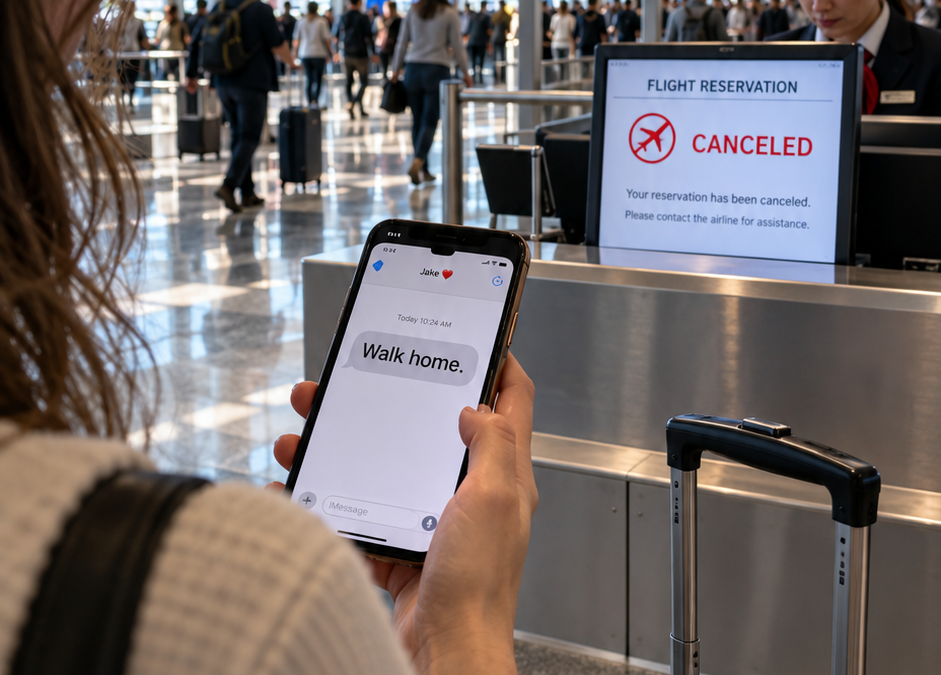
“Walk home.”
I read it three times.
The first time, I thought I had misunderstood.
The second time, I understood perfectly.
The third time, something inside me went very quiet.
Two weeks earlier, Dad had asked me to co-sign a commercial expansion loan for Parker Custom Signs, the business he had spent most of his adult life building.
He wanted to buy a new large-format printer, upgrade some equipment, and take on bigger commercial contracts.
The way he described it, the expansion was inevitable.
The numbers said otherwise.
I worked with financial data for a living. I was not a commercial underwriter, but I knew enough to recognize unstable revenue, rising debt, questionable projections, and a business owner counting future sales before they existed.
The lender clearly knew it too.
That was why Dad needed me.
Not my expertise.
My salary.
My credit.
My savings.
My name standing behind his debt.
When I told him no, he stared at me like I had slapped him.
“You didn’t even think about it.”
“I did think about it.”
“For what, five minutes?”
“For several days.”
“And?”
“And I’m not signing.”
His jaw tightened.
“Family helps family.”
“I have helped this family.”
“That’s not what I asked.”
“No. You asked me to become legally responsible for a business loan I don’t control.”
“It’s not going to fail.”
“Then you shouldn’t need me to guarantee it.”
That ended the conversation badly.
He called me selfish.
I called him unrealistic.
Mom tried to smooth it over.
Evan disappeared into the kitchen.
Chloe suddenly found something fascinating on her phone.
It was the usual Parker family choreography.
Dad got angry.
Mom minimized it.
Everyone else waited for the weather to pass.
I thought the argument had ended there.
Apparently, Dad had decided I needed a lesson.
And apparently that lesson involved canceling my flight after delivering me to the airport, leaving me stranded while the rest of my family continued to California for a vacation I was mostly funding.
I stared at his message again.
Walk home.
Anger rose slowly.
Then something interrupted it.
A thought.
The Carmel house.
My reservation.
The rental SUV.
My reservation.
The excursion.
Mine again.
I opened the travel app on my phone.
Everything was still there.
Everything was still under my name.
For the first time since the airline employee had told me my ticket was gone, I smiled.
I typed a reply.
“You sure about that?”
His first call came less than two minutes later.
I ignored it.
Then another.
Then another.
I walked toward the rideshare pickup area while my phone kept vibrating.
Through the terminal windows, I eventually saw the family SUV coming back toward departures.
Dad had turned around.
That part almost made me laugh.
He had expected me to panic.
He had expected me to beg.
He had expected me to call him and ask what I needed to do to get my ticket restored.
Instead, he was racing back to the airport.
Too late.
I got into a rideshare.
By the time we merged onto the highway, Dad had called eleven times.
I opened the Carmel reservation.
Still refundable.
Cancel.
A confirmation appeared.
Then the SUV.
Cancel.
Then the coastal excursion.
That one could not be refunded completely, but I could convert it into future travel credit.
Done.
I did not touch their airline tickets.
I did not cancel anything they had paid for.
I did not move their money.
I did not access anyone else’s account.
I simply stopped paying for a vacation I had just been deliberately excluded from.
That distinction mattered to me.
It would matter even more later.
The driver glanced at me through the mirror when my phone buzzed again.
“Busy day?”
“You could say that.”
I looked outside.
Then I called Aunt Renee.
She was Dad’s older sister and one of the only people in our family who never seemed intimidated by him.
She answered immediately.
“Claire?”
“Did Dad say anything to you about this trip?”
There was a pause.
Not confusion.
Recognition.
My stomach tightened.
“Renee?”
She sighed.
“Did Grant really go through with it?”
I sat straighter.
“Go through with what?”
Another silence.
Then she said, “Where are you?”
“In a rideshare.”
“Where’s everybody else?”
“At the airport, I assume.”
“And you?”
“Going home.”
“Good.”
“Renee.”
“I know.”
“What did he tell you?”
She exhaled slowly.
“Two days ago he said you were being difficult about the business loan.”
“That’s not new.”
“No. But then he said you needed to remember what family had done for you.”
I looked down at Dad’s text.
Walk home.
“What else?”
“He said maybe a little discomfort would help change your attitude.”
My chest went cold.
“This was planned?”
“I told him not to play games with you.”
“That isn’t an answer.”
“Yes, Claire. It sounds like it was planned.”
The anger that had been rising inside me suddenly changed shape.
Before that moment, I could still have told myself Dad had lost his temper.
Maybe he had canceled the ticket impulsively.
Maybe he had wanted to scare me for ten minutes.
Cruel, yes.
Immature, absolutely.
But impulsive.
Aunt Renee destroyed that possibility.
He had discussed it beforehand.
He had imagined it.
He had decided I needed humiliation.
He wanted me uncomfortable enough to become compliant.
I looked out the window as Seattle slid past.
For years, I had explained my family to myself in the gentlest possible language.
Dad was proud.
Dad struggled to ask for help.
Dad came from a generation that thought money was a private subject.
Mom hated conflict.
Chloe was still getting established.
Evan just needed time.
There was always a softer explanation.
Then I thought about the previous four years.
Chloe was training in respiratory therapy. I had paid part of her tuition more than once.
Dad had fallen behind on the payment for one of the company trucks. I stepped in.
My parents had missed part of a property-tax obligation. I helped.
Evan wanted to start a mobile bicycle-repair business. I put the equipment deposit on my card because he promised he would repay me gradually once the business became profitable.
Whenever they needed help, the situation was temporary.
Whenever I tried to establish a limit, my personality suddenly became the problem.
I was selfish.
Cold.
Too focused on money.
Too independent.
Too suspicious.
Too successful to understand what normal people dealt with.
I sat in the back of that rideshare and realized something I should have understood years earlier.
My family no longer saw my help as generosity.
They saw it as infrastructure.
Something permanent.
Something underneath their lives that was simply supposed to remain there.
They planned around it.
Expected it.
Resented me whenever I reminded them it belonged to me.
So I began removing myself.
Not revenge.
Not theft.
Not sabotage.
Withdrawal.
Chloe’s next tuition payment had not been sent yet.
Canceled.
Dad’s truck payment was no longer my responsibility.
Stopped.
The money I had mentally set aside to help my parents with another property-tax shortfall stayed where it was.
Evan’s equipment deposit was still within the refund window.
I requested the refund to my own card.
I took nothing back that had already been given.
I demanded repayment from no one.
I simply stopped volunteering my money.
Dad left a voicemail while I was doing it.
His voice sounded completely different from the man who had texted me two words from a moving car.
“Claire, this was supposed to teach you something. Put the reservations back. We’ll talk when you get to California.”
I listened twice.
Not because I needed clarification.
Because I wanted to hear whether I had somehow missed the apology.
I had not.
He still expected me to reach California.
Somehow.
After he canceled my flight.
Then Mom texted.
“Can you please restore the Carmel reservation before we take off?”
I stared at it.
Not:
Are you okay?
Not:
Where are you?
Not:
Your father went too far.
The house.
She wanted the house.
I replied with one word.
“No.”
She called instantly.
I declined it.
Chloe texted next.
“Wait. Did you cancel my tuition payment too?”
That one hurt.
More than Dad’s command.
More than Mom asking about the house.
Because it meant she had checked.
Thirty minutes earlier, my family had been willing to leave me standing at an airport because my father wanted to punish me.
Now everybody suddenly wanted access to me.
Evan called.
Dad called.
Mom called.
Chloe called.
I silenced the phone.
Their plane left without me.
And while they flew south expecting me to calm down, restore everything, apologize for overreacting, and somehow appear in California by dinner, I went home with one decision already becoming solid inside me.
The vacation was over.
So was the financial arrangement my family had mistaken for love.
By the time I reached my apartment in Ballard, I had thirty-eight missed calls.
Thirty-eight.
Dad had called seventeen times.
Mom nine.
Chloe six.
Evan four.
Renee twice.
I put my keys in the blue ceramic dish near the door and stood there without taking off my shoes.
My suitcase still had an airline tag attached.
I was wearing jeans, a black sweater, and the comfortable sneakers I had chosen because I thought we would be walking around Carmel that afternoon.
Instead, I had not even made it through security.
My phone vibrated again.
Dad.
Then a text.
“Answer your damn phone.”
Another.
“You’re making this worse.”
Mom followed.
“Claire, the kids are upset.”
I actually laughed.
Evan was thirty-two.
Chloe was twenty-six.
The kids.
I made coffee because I did not know what else to do with my hands.
The machine sputtered while I leaned against the kitchen counter trying to understand how an ordinary family trip had turned into the strangest confrontation of my adult life.
Then Renee texted.
“Don’t answer Grant until you know what else he did.”
I called her immediately.
She answered before the first ring had fully finished.
“Tell me you’re home.”
“I’m home.”
“Door locked?”
“Renee.”
“Claire. Lock the door.”
I walked back and turned the deadbolt.
“Locked.”
“Good.”
“What else did he do?”
She paused.
“He called me Tuesday.”
“About the airport?”
“About you.”
I gripped the coffee pot.
“He said you were being difficult. Said you needed to remember family comes first.”
“That sounds like him.”
“Then he said something else.”
“What?”
“I wrote it down because it bothered me.”
I waited.
Renee’s voice hardened.
“He said, ‘Claire thinks she can say no because she’s comfortable. She needs to sit with discomfort.’”
Coffee spilled over the rim of the pot and splashed onto the counter.
I barely noticed.
“He actually said that?”
“Exactly that.”
“So he planned this.”
“Yes.”
“Did Mom know?”
Renee went quiet.
My stomach tightened again.
“Did Mom know?”
“She knew he was angry.”
“That isn’t what I asked.”
“She knew he was going to cancel something related to the trip.”
I stopped moving.
“What?”
“She told me Thursday night she hoped he didn’t go too far.”
I looked across the apartment at my suitcase.
A paperback was sticking out of the front pocket, some ridiculous beach mystery I had grabbed at the last minute.
There was a woman in a red hat on the cover.
For some reason, that detail almost broke me.
Mom knew enough to worry.
But she had still gotten into the car.
Still watched me walk into the terminal.
Still boarded the plane.
“So she knew,” I whispered.
“She knew enough.”
My phone buzzed.
Mom.
Renee said, “Don’t answer yet.”
“I’m not going to.”
“And Claire?”
“What?”
“If Grant starts telling you how much you owe the family, ask him for the list.”
I frowned.
“What list?”
“He told me he keeps records.”
“Records of what?”
“Everything he spent raising you.”
I thought she was joking.
She wasn’t.
“He said if you wanted to treat family like a bank, he could show you the balance sheet.”
For a moment, I could not speak.
Then a memory arrived from nowhere.
Seventh grade.
Dad buying me soccer cleats and complaining during the drive home because my feet had grown again.
Cleats.
He was going to invoice me emotionally for cleats.
“Send me anything you wrote down.”
“Already did.”
My email chimed before she finished saying it.
Their flight landed in San Jose at 1:42 that afternoon.
Mom texted at 1:46.
“We landed. Please send the Carmel check-in code.”
I was sitting on my living room floor with my laptop open and my suitcase still packed near the door.
I replied:
“There is no check-in code. The reservation is canceled.”
Three dots appeared.
Disappeared.
Appeared again.
Then Dad called.
I let it ring.
Mom wrote:
“Claire, we are tired. This is not the time.”
I stared at that sentence for almost a full minute.
Then I typed:
“I agree. The time was before you left me at the airport.”
Chloe responded next.
“Are you seriously doing this on Mom’s birthday weekend?”
My first reply was angry.
I deleted it.
Then I wrote:
“Ask Dad why Mom’s birthday weekend depended on me paying for it after he canceled my ticket.”
Silence from Chloe.
Evan texted.
“Look, Dad screwed up, but canceling everything is nuclear.”
Nuclear.
That was our family logic perfectly summarized.
Dad could launch the missile.
I was cruel for moving out of the blast zone.
I asked Evan one question.
“Did you know he was canceling my ticket before we got to the airport?”
“No.”
I believed him.
Evan had never been good at lying.
Then another message arrived.
“I knew he wanted to talk to you in California about the loan.”
I sat up.
“What talk?”
“He said he wanted everybody together so we could help you understand.”
Help me understand.
I called him.
He answered immediately.
“Claire, before you start—”
“What was supposed to happen in California?”
“Nothing. Just a conversation.”
“Evan.”
He sighed.
Airport noise filled the background.
“I think he brought papers.”
“What papers?”
“Loan papers.”
I felt something heavy settle in my stomach.
“You knew he was bringing loan paperwork to Mom’s birthday trip?”
“I didn’t know what he planned to do. He said he wanted everyone together.”
“To pressure me.”
“I didn’t say that.”
“You didn’t have to.”
“Claire, you know how Dad is.”
There it was.
The sentence we had all used for years.
You know how he is.
He yells?
You know how he is.
He borrows money and becomes offended when asked about repayment?
You know how he is.
He embarrasses somebody?
You know how he is.
As if personality were a natural disaster.
As if being predictable made damage acceptable.
“Where’s Mom?”
“Baggage claim.”
“Put me on speaker.”
“That’s probably not—”
“Evan. Speaker.”
A few seconds later, Mom’s voice came through.
“Claire.”
“Did you know Dad was canceling my ticket?”
Silence.
“Mom.”
“I knew he was upset.”
“Did you know?”
“I didn’t think he would actually leave you there.”
I closed my eyes.
“But you got on the plane.”
“Your father said you would calm down and buy another ticket.”
“With what house waiting for me? What car? What reservation?”
“That is why we’re calling.”
I nearly laughed.
At least she had finally said the truth by accident.
They did not need me in California.
They needed my reservations.
At 2:18, Dad sent another message.
“You have no idea what you are doing to this family.”
I replied:
“Send me the papers you brought.”
Nothing.
I sent it again.
“Send the papers.”
Five minutes later, Evan sent me a photograph.
It was crooked and blurry, taken over someone’s knee.
The top of the page read:
PARKER CUSTOM SIGNS LLC
COMMERCIAL CREDIT EXPANSION AGREEMENT
Below it was my name.
CLAIRE M. PARKER.
Guarantor.
My stomach tightened.
I zoomed in.
The borrower was Dad’s company.
I was listed as guarantor.
Then I saw another line.
Projected Guarantor Contribution:
$85,000 liquid assets available upon request.
I stared at the number.
I had savings.
I had a retirement account.
I had a down-payment fund I had spent years building because I wanted to buy a place of my own.
But I did not have eighty-five thousand dollars sitting around “available upon request” for my father’s business.
More photos arrived.
My address.
My employer.
My salary.
Pieces of personal information I had shared with my parents at different points over the years because they were my parents.
Then page six appeared.
Consent to Credit Review.
My name was printed underneath.
Beside it was a signature.
Claire Parker.
I stared at it.
It was not mine.
Not even close.
My signature has always been ugly. My C loops too wide, and the rest of my name collapses into an impatient line.
The signature on the form was smooth.
Careful.
Almost decorative.
Fake.
I stood so quickly my laptop slipped from my knees.
I called Dad.
He answered immediately.
“What did you sign?”
No greeting.
No introduction.
He said, “You need to stop involving your brother.”
“What did you sign?”
“You’re acting hysterical.”
“Did you sign my name on a credit authorization?”
Silence.
Behind him, I heard Mom say, “Grant, don’t.”
That was enough.
“Dad.”
“You gave verbal approval.”
“No, I didn’t.”
“You said you would think about it.”
“That is not approval.”
“You’re splitting hairs.”
“Did you sign my name?”
Another pause.
Then he said something I will probably remember for the rest of my life.
“I did what I had to do to keep the business alive.”
My voice dropped.
“You forged my signature.”
“Don’t use that word.”
“What word would you prefer?”
“You were going to say no out of spite.”
“I did say no.”
“That’s exactly what I mean.”
“I said no to the lender too.”
The silence changed.
“You contacted Martin?”
“He contacted me. You gave him my information without asking.”
“You embarrassed me.”
I looked around my apartment as though I needed proof there was still a normal world outside this conversation.
“You left me at an airport.”
“And you stranded your mother in California.”
“No. You stranded her. You built her birthday trip around my money and then decided to punish the person paying for it.”
He started talking over me.
About respect.
About sacrifice.
About everything parents do for children.
Christmas gifts.
Braces.
School.
Food.
A roof.
At one point he mentioned carrying me when I was sick as a child.
Then he said, “After everything I paid for, you owe—”
“Send me the list.”
He stopped.
“What?”
“The list Renee told me about.”
“You’re being ridiculous.”
“Send me the invoice for my childhood.”
I heard Mom say something in the background.
Dad snapped, “Linda, stay out of it.”
Four words.
That was their marriage compressed into a sentence.
And even then, some reflex inside me wanted to protect my mother.
I hated that reflex.
I said, “Here’s what happens now. I’m contacting Harborline. I’m sending them my original refusal email. I’m telling them I did not sign that form. If you submitted anything under my name or accessed my credit, I will dispute it.”
“You wouldn’t do that.”
“You canceled my ticket and texted ‘Walk home’ because I refused to assume your debt. You no longer get to tell me what I would do.”
“You’re my daughter.”
The words came out of me before I planned them.
“Then spell my middle name.”
“What?”
“My middle name. It’s on the document you signed.”
Silence.
He knew the initial.
M.
But he did not know whether it stood for Marie, Margaret, Michelle, or something else without checking.
That tiny fact hurt worse than it should have.
He had filled out pages about my income and credit.
He had represented me as financially available.
He had copied my personal information.
But he could not immediately name the middle name he had given me.
Mom came closer to the phone.
“Claire, please.”
I said, “Put your husband in a hotel.”
Then I hung up.
At 3:07, I called Martin Kell at Harborline Commercial Funding.
I expected voicemail.
Instead, a tired-sounding man answered.
“Harborline. This is Martin.”
“This is Claire Parker.”
There was a rustle of paper.
“Ms. Parker.”
He knew exactly who I was.
“I did not authorize a credit review. I did not sign guarantor paperwork. I refused participation by email thirteen days ago.”
“Yes,” he said.
I gripped the phone.
“You received that email?”
“Yes.”
“Then why does my father have paperwork with my name on it?”
Martin exhaled.
“Your father told me there had been a family misunderstanding. He said you would sign in person this weekend.”
“In California?”
“Yes.”
“Did you pull my credit?”
“No.”
The answer hit me so hard with relief that I sat down.
“We did not proceed after your written refusal,” Martin explained. “Mr. Parker was informed that direct verification from you would be required before any credit review or guarantor agreement. The paperwork provided to him was draft documentation.”
“It has a signature.”
“I’m sorry?”
“He signed my name.”
Silence.
Then more paper.
“Do you have a copy?”
“I have photographs.”
“Send them to me.”
“Why?”
“Because if any signed authorization is presented to us, we need to know it is invalid. And if he attempts to submit it through another channel, we need a record that you dispute it.”
I swallowed.
“Can you confirm in writing that I’m not connected to the loan?”
“Yes.”
“Today?”
“Yes.”
Then his voice softened.
“For what it’s worth, Ms. Parker, your participation would not have guaranteed approval anyway.”
I frowned.
“What?”
“The company’s current debt load is significant. The expansion projections were not sufficiently supported. Your father was told additional collateral would likely be required.”
I looked at the photograph of my fake signature.
So the entire scheme had been even more desperate than I realized.
Dad had tried to corner me into guaranteeing a loan that might still have been rejected.
Martin sent the email fourteen minutes later.
It confirmed Harborline had no active guarantor agreement with me, had not obtained my authorization to pull my credit, and would not accept documentation bearing my signature without direct verification.
I saved the email in three places.
Then I froze my credit with all three bureaus.
It took almost an hour.
By that evening, the tone of my family’s messages had changed.
The commands disappeared.
Panic replaced them.
Mom:
“We found a motel in Salinas. It’s not ideal.”
Chloe:
“I don’t know how I’m supposed to finish school now.”
Evan:
“Dad says you’re trying to ruin him legally.”
Dad was silent for almost two hours.
That bothered me more than the shouting.
At 7:03, he sent a screenshot.
A motel receipt.
Two rooms.
One night.
$312.48.
Beneath it:
“Happy now?”
I studied the receipt.
The credit card was his.
The name was his.
Grant Parker.
He had paid.
He could pay.
Maybe he could not afford the Carmel house I had booked.
Maybe he could not afford the big SUV and the polished version of Mom’s birthday weekend.
But when there was no daughter standing in front of him with her wallet open, he had found a solution.
That realization mattered.
For years, every financial emergency had arrived at my feet presented as unavoidable.
This one had proved otherwise.
At 8:11, Mom called again.
Renee had texted earlier:
“If Linda calls without him around, answer once.”
So I did.
Mom sounded different.
Small.
Not innocent.
Just small.
“Claire?”
“Yeah.”
“He’s outside.”
“Who?”
“Your father. Evan’s with him. They’re arguing.”
I waited.
A television murmured in the background.
Then Mom asked quietly, “Are you okay?”
It was the first time anyone in my immediate family had asked me that all day.
I hated how much I wanted to accept the concern.
“No,” I said.
She breathed in.
“I’m sorry.”
“For what?”
I needed specifics.
Not because I wanted to humiliate her.
Because our family had survived too many years on vague apologies.
“I’m sorry for letting him do that.”
“And?”
“For getting on the plane.”
“And?”
She started crying.
Quietly.
“For asking about the house before I asked about you.”
I sat on the kitchen floor.
The tile felt cold through my sweatpants.
“Did you know about the paperwork?”
“I knew he wanted you to sign something. I didn’t know he had signed your name.”
“But you knew he wanted to corner me.”
“Yes.”
The word hurt.
Simple.
Clean.
“Why didn’t you warn me?”
Mom was silent for a long time.
Then she said, “Because when your father gets angry, I look for the fastest way to get to tomorrow.”
I stared at a dried coffee stain near my knee.
For most of my life, I would have accepted that explanation.
I would have translated it into something kinder.
Mom is scared of conflict.
Mom is trying to keep the peace.
Mom has been married to him a long time.
But peace purchased by offering someone else to the angry person is not peace.
“That isn’t good enough anymore,” I said.
“I know.”
I did not tell her it was okay.
Because it was not.
“What happens now?” she asked.
“Now you come home on your own tickets. You don’t ask me for hotel money. You don’t ask me to rebuild the trip. And when you come back, you and Dad figure out your finances without me.”
“Claire—”
“No.”
That word came more easily the second time.
Then the third.
“Dad forged my signature. If he uses my information again, I’ll report it. I don’t care if Thanksgiving becomes uncomfortable.”
A strange little laugh escaped her through her tears.
“Thanksgiving is already uncomfortable.”
Despite everything, I smiled.
“Then I guess we’re ahead of schedule.”
They came home early.
Mom’s birthday weekend lasted one night in a motel, breakfast at a diner where Chloe apparently refused to speak to Dad, and one tense drive along the coast before they changed their flights.
Mom texted me a photograph of the ocean.
I did not respond.
Sunday night, Dad finally sent me the list.
The email subject said:
Since you asked.
Attached was a spreadsheet.
I opened it.
There were columns.
Date.
Expense.
Amount.
Notes.
I almost admired the commitment to insanity.
Some entries were ordinary costs of raising a child.
School clothes.
Dental bills.
Summer camp.
Then the smaller items began.
Movie with friends, 2008 — $20.
Gas driving Claire to debate tournament — $14.
Prom dress contribution — $75.
College application fees.
Sports costs.
School supplies.
At one point I saw:
Food, age 0–18 — $41,000.
A perfectly round number.
Apparently, I had consumed exactly forty-one thousand dollars of food during childhood.
At the bottom:
Total parental investment: $128,914.00.
Below that:
Less gifts from Claire: $39,260.00.
Balance remaining: $89,654.00.
I stared at it until my eyes started burning.
He had deducted my gifts.
My help with taxes.
Truck payments.
Money for family emergencies.
As if we were reconciling accounts.
As if feeding a child were an investment expected to produce financial returns.
As if parenting were a loan agreement I had signed before learning to speak.
Then I started laughing.
It was not happy laughter.
It turned into crying halfway through.
I hated crying over a spreadsheet.
I forwarded it to Renee.
She called almost immediately.
“He put food?”
“Forty-one thousand.”
“Exactly?”
“Apparently.”
“That cheap bastard.”
I laughed again.
“What are you going to do?” she asked.
I opened a new email.
This time, my hands were shaking.
Dad,
I do not accept an invoice for being raised.
I will not co-sign loans, guarantee debt, pay business expenses, cover property taxes, fund tuition, reserve vacations, or serve as emergency cash.
Do not use my name, signature, employer, income, credit, or personal information for any financial product.
If you do, I will treat it as fraud.
For the next ninety days, do not contact me unless there is a genuine emergency involving Mom.
Claire
I read it twice.
Then I sent it.
The next afternoon after work, I found Dad standing outside my apartment building.
He was leaning against his white company truck.
PARKER CUSTOM SIGNS was printed across the side in blue vinyl.
I had paid the March payment on that truck.
$684.22.
The exact number came back to me immediately.
He straightened when he saw me.
“Claire.”
I kept walking.
“No.”
“You don’t even know what I’m going to say.”
“I know the category.”
He followed me up the walkway.
Not close enough to touch me.
Close enough to make my shoulders tighten.
“I didn’t raise you to act like this.”
I stopped.
That sentence had controlled me for years.
I didn’t raise you to be selfish.
I didn’t raise you to abandon family.
I didn’t raise you to think money matters more than people.
Every version meant the same thing.
Obey.
I turned around.
“No,” I said. “You raised me to be useful. You’re angry because I finally noticed.”
Something changed in his face.
“You think you’re better than us.”
There was the trap.
If I succeeded, I thought I was better.
If I shared the benefits of that success, it became obligation.
If I stopped, it became proof I had never loved them.
“I don’t think I’m better than you.”
“Then act like family.”
“I did.”
He opened his mouth.
I continued.
“For years.”
He stared at me.
“I paid bills I didn’t owe. I helped Chloe. I helped Evan. I helped you. I helped Mom. I planned trips. I fixed emergencies. And the first time I refused to risk my financial future for your business, you decided I needed punishment.”
“It wasn’t like that.”
“You canceled my flight.”
“You were supposed to cool off.”
“You forged my signature.”
“I was trying to save what I built.”
“And you were willing to put what I built underneath it.”
His face reddened.
The building door opened behind me.
Mr. Fischer from 2B stepped outside holding a trash bag.
He was in his seventies and knew everybody’s business whether they wanted him to or not.
Normally I found that exhausting.
That afternoon, I was grateful.
“You okay, Claire?” he asked.
Dad glanced at him.
I met Dad’s eyes.
“I am.”
Mr. Fischer did not move.
Dad lowered his voice.
“This isn’t over.”
“It is for me.”
He pointed toward the truck.
“You know what happens if that business goes under?”
I looked at the blue letters.
The truck I had helped keep.
The business I had been asked to guarantee.
The company Dad had turned into a family emergency.
“You get a job working for somebody else.”
His face went red.
I unlocked the building door.
Mr. Fischer held it open and watched Dad over the top of his trash bag.
Inside, my mailbox was full of grocery flyers and a dentist reminder.
Normal things.
I stood there holding them and felt an absurd amount of gratitude for ordinary junk mail.
Eleven days later, Chloe called.
I almost ignored it.
Then I answered.
She did not mention tuition.
That helped.
“I’m sorry,” she said.
I sat on the edge of my bed.
“For which part?”
A tiny laugh.
“Fair.”
Then she became serious.
“Dad admitted he signed your name.”
I closed my eyes.
“He admitted it?”
“Evan told him he was going to call Martin if he didn’t tell the truth.”
That surprised me.
“What happened?”
“Mom moved into the guest room.”
“And Evan?”
“He returned the bicycle equipment before the refund deadline. He got a weekend job at a repair shop.”
Something loosened inside my chest.
Not because I wanted Evan to struggle.
Because for the first time, he was solving something without assuming I would absorb the risk.
Chloe continued.
“I found something else.”
My body went still.
“What?”
“Dad had a folder.”
“What kind of folder?”
“Family financial stuff.”
I stood up.
“My name?”
“Yours. Mine. Evan’s. Mom’s.”
Photos began arriving.
Life-insurance brochures.
Credit-card offers.
Handwritten notes.
Then I saw my name.
CLAIRE.
Beside it, in Dad’s block handwriting:
High income.
Good credit.
Emotional resistance.
Use Linda.
I stared.
Use Linda.
Not ask Claire.
Not respect Claire.
Not convince Claire.
Use Linda.
My mother was not his wife in that note.
She was leverage.
And I was not his daughter.
I was a financial resource with an emotional obstacle attached.
Chloe was crying.
“I thought you were being harsh,” she whispered. “I really did. I thought Dad was stressed and you were punishing everybody.”
“I know.”
“I’m sorry.”
For once, I did not ask her to explain.
“Thank you.”
Then the last photograph arrived.
A yellow legal pad.
Dated three days before the airport.
At the top, Dad had written:
Carmel plan.
Underneath:
Cancel C ticket after drop-off.
She panics.
Linda calls from gate.
Everyone explains loan.
Have docs ready.
Do not let her leave conversation.
I read the list once.
Then again.
My apartment became completely silent.
The refrigerator clicked on behind me.
That was all.
There it was.
Not a temper tantrum.
Not a misunderstanding.
Not a father making one stupid decision in a moment of anger.
A plan.
He had planned my panic.
He had planned to isolate me.
He had planned to let me believe I was stranded, then use Mom and my siblings to pressure me while the loan documents waited in California.
He believed embarrassment would make me easier to control.
He believed family pressure would become consent.
And the saddest part was that, before that weekend, he might have been right.
Maybe I would have gotten another ticket.
Maybe I would have restored the house.
Maybe I would have sat in that living room in Carmel while four people told me I was hurting Dad.
Maybe Mom would have cried.
Maybe Chloe would have talked about school.
Maybe Evan would have told me Dad just needed one chance.
Maybe I would have looked at everyone and wondered whether protecting myself really was selfish.
Maybe I would have signed something just to make the room quiet.
That possibility frightened me more than Dad’s plan.
Because I finally understood how boundaries get erased.
Not always by force.
Sometimes by exhaustion.
Sometimes by guilt.
Sometimes by making one person responsible for everybody else’s comfort.
I saved the photograph.
Then I sent it to Martin.
I sent it to Aunt Renee.
And finally, I sent it to Mom.
She called me after midnight.
I answered.
For several seconds, neither of us spoke.
Then Mom said, “I’m leaving him.”
I looked toward the suitcase that was still sitting near my closet.
I had never completely unpacked it.
“Okay.”
“I don’t know how.”
Her voice was terrified.
For one dangerous second, my old instinct returned.
Find apartment.
Pay deposit.
Move Mom.
Fix problem.
I could feel the entire machinery of my old role starting up inside me.
Then I stopped it.
“We’ll figure out what you can do,” I said.
She was silent.
I continued.
“Not what I can pay for. What you can do.”
Mom began to cry.
This time, I let her.
Not cruelly.
Not coldly.
But I did not rescue her from the consequences of decisions she had spent years helping maintain.
I could support her emotionally.
I could help her think.
I could tell her where to look.
But I was done proving my love by absorbing somebody else’s financial life.
The next morning, I finally opened my travel app again.
Carmel.
For a while, I stared at the destination.
I had imagined Mom walking near the ocean.
Chloe taking too many pictures.
Evan complaining about tourist prices.
Dad pretending not to enjoy himself.
That trip was gone.
Maybe it had never existed outside my imagination.
So I booked another one.
September.
One person.
A cheap room six blocks from the water.
A small rental car.
Nothing luxurious.
Nothing designed to impress anyone.
I used the credit from the canceled excursion for a whale-watching tour.
Then I remembered the paperback in my suitcase.
The woman in the ridiculous red hat.
For reasons I could not explain, I went online and bought the dumbest red hat I could find.
When it arrived, the shipping box was absurdly large.
I put the hat on while making coffee.
I stood alone in my apartment wearing sweatpants, a ridiculous red hat, and no makeup.
And for ten minutes, I felt lighter than I had in years.
I did not send anyone a photograph.
I did not need anyone to approve of the trip.
I did not need Dad to call it irresponsible.
I did not need Mom to tell me whether the hat suited me.
I did not need Chloe to ask whether I could cover something before I left.
I did not need Evan to promise repayment.
For most of my adult life, I had believed independence meant being capable enough to save the people I loved.
That weekend taught me something different.
Independence also meant allowing capable adults to experience the weight of their own choices.
It meant understanding that generosity without boundaries eventually stops feeling like generosity to the people receiving it.
It becomes expectation.
Then entitlement.
Then anger when the supply disappears.
Dad had wanted me to sit with discomfort.
In the end, I did.
I sat with the discomfort of seeing my family clearly.
I sat with the grief of realizing Mom had known enough to warn me and had chosen silence.
I sat with the humiliation of seeing my financial life reduced to notes in Dad’s folder.
High income.
Good credit.
Emotional resistance.
Use Linda.
I sat with the fact that my father had calculated the cost of feeding me as a child and called it an investment.
I sat with the realization that my siblings had grown comfortable depending on me because I had helped teach them that I would always be available.
And I sat with something else too.
Relief.
Because once I stopped asking whether I had the right to say no, the answer became embarrassingly simple.
My money was mine.
My signature was mine.
My credit was mine.
My future was mine.
And love that required access to those things was not the kind of love I wanted to spend the rest of my life buying.
The week before my September trip, Mom called.
She had found a small apartment.
Nothing fancy.
She sounded nervous when she told me the rent.
Old Claire would immediately have calculated whether I could cover part of it.
New Claire asked, “Can you afford it?”
There was a pause.
“I think so.”
“Then make a budget before you sign.”
She laughed softly.
“You sound like your father.”
“No. Dad would tell you what to sign.”
That quieted both of us.
Then Mom said, “I deserved that.”
“I wasn’t trying to hurt you.”
“I know.”
Another silence.
Then she said, “I’m trying to learn.”
“So am I.”
We did not become perfect after that.
There was no miraculous family reunion.
Dad did not suddenly understand everything he had done.
As far as I knew, he still believed I had betrayed him.
He told relatives I abandoned the family during a business crisis.
Aunt Renee corrected that version whenever it reached her.
Evan kept working at the bicycle shop and eventually started taking repair appointments on weekends using tools he bought gradually with his own pay.
Chloe arranged a payment plan through her school and picked up additional weekend shifts.
She complained.
Then she apologized for complaining to me.
Our relationship improved slowly, not because I resumed paying, but because we finally had conversations that were not quietly organized around what I could provide.
Mom began separating her finances.
Dad’s business survived the immediate crisis, although the expansion did not happen.
The giant printer he believed would change everything remained someone else’s machine.
And Parker Custom Signs kept operating at a smaller scale.
Nobody starved.
Nobody became homeless.
Nobody’s life ended because Claire Parker stopped paying.
That may have been the most important lesson of all.
They adapted.
The emergencies that had always required my money somehow developed alternatives when my money was unavailable.
When September finally came, I flew to California alone.
At the airport, I stood at the counter for a moment longer than necessary.
The employee checked my identification.
“Carmel?” she asked.
“Yeah.”
“Vacation?”
I thought about it.
“Yes.”
This time, the ticket was purchased by me.
The reservation belonged to me.
Nobody else had access.
I walked through security carrying the same suitcase I had packed for Mom’s birthday.
I had finally unpacked and repacked it.
The mystery novel came with me.
So did the red hat.
The first morning in Carmel, I woke before sunrise and walked toward the water.
The streets were quiet.
The air smelled like salt and wet pavement.
I bought coffee from a little shop and carried it down toward the beach.
When the ocean came into view, I stopped.
For a long time, I just stood there.
I had expected triumph.
Maybe anger.
Some dramatic sense that I had won.
Instead, I felt grief.
Because setting a boundary does not erase the fact that you wanted the people on the other side of it to love you differently.
I wished Dad had never sent that message.
I wished Mom had turned around before boarding.
I wished Chloe’s first thought had been about me instead of tuition.
I wished Evan had told Dad the plan was wrong before it happened.
I wished our family could have reached the truth without having to break something first.
But wishing did not change what had happened.
So I drank my coffee.
I put on the ridiculous red hat.
And I walked along the water.
Later that morning, my phone buzzed.
A message from Mom.
“Hope you made it safely.”
I smiled.
“I did.”
A few minutes later:
“Have fun.”
No request.
No crisis.
No mention of money.
Just two words.
Have fun.
I put my phone away.
The whale-watching boat left that afternoon.
As we moved beyond the harbor, the coastline slowly pulled away behind us.
I stood near the railing with wind pushing the hat against my head.
For once, nobody needed anything from me.
Nobody was angry because I had said no.
Nobody was waiting for me to repair the consequences of a decision I had not made.
I could simply stand there.
The guide shouted that there had been a sighting off the starboard side.
Everyone moved toward the railing.
A dark shape surfaced in the distance.
Then another.
For a few seconds, the entire boat became quiet.
The whales rose, breathed, and disappeared beneath the water again.
I watched the place where they had been.
And I thought about the message that had started everything.
Walk home.
Dad had meant it as humiliation.
A punishment.
A reminder that he believed he could still remove something from my life and make me come back asking for his approval.
Instead, he had accidentally given me the clearest direction he ever had.
Go home.
Go back to your own life.
Stop financing everyone else’s.
Stop calling control love.
Stop mistaking guilt for obligation.
Stop letting the fear of disappointing people become stronger than the responsibility to protect yourself.
For years, I had thought family loyalty meant never letting anyone fall.
Now I understood that sometimes the most destructive thing you can do is keep catching people who are deliberately jumping because they assume you will always be underneath them.
My father tried to teach me a lesson at the airport.
He succeeded.
Just not the one he intended.
I finally learned that I could love my family without belonging to them.
I could care without surrendering.
I could help without becoming responsible.
And I could say no without becoming the villain in my own life.
The coastline remained behind us as the boat moved farther into open water.
I reached up, held the red hat against the wind, and smiled.
For the first time in a very long time, everything I was carrying belonged to me.
𝗧𝗛𝗘 𝗘𝗡𝗗
The Message My Father Sent From the Airport Was Meant to Put Me Back in My Place
My father canceled my plane ticket after dropping me at the airport because he wanted to remind me who had the power in our family.
What he did not understand was that almost everything waiting for them in California existed because I had quietly paid for it.
And by the time he realized what his punishment had actually set in motion, I was already learning how much of my family’s love had been built around my usefulness.
The airline employee looked more uncomfortable than I felt.
At least at first.
She stared at her monitor, clicked something, frowned, then looked up at me.
“I’m sorry, Ms. Parker. Your reservation was canceled online forty-seven minutes ago.”
I blinked.
“Canceled?”
“Yes.”
“That’s impossible. I checked in this morning.”
“I can see that. But the original purchaser accessed the reservation and canceled your ticket afterward.”
For several seconds, I just stood there at the counter inside Seattle-Tacoma International Airport with my carry-on beside my leg and my phone still in my hand.
Around me, the terminal moved like nothing had happened.
Suitcases rolled across polished floors. Families hurried toward security. A little boy was crying because his mother would not let him carry a cup of orange juice without a lid. Somewhere behind me, an announcement echoed about a gate change.
Normal life.
Ten minutes earlier, mine had still felt normal too.
Dad had dropped us at departures.
Mom was turning sixty, and we were supposed to spend the weekend in California together. My younger brother, Evan, and my younger sister, Chloe, had flown with us on family trips before, but this one had been different because I had arranged most of it.
A house in Carmel.
A seven-passenger rental SUV.
A prepaid coastal excursion Mom had been talking about for months.
I had found the house.
I had made the reservation.
I had paid the deposit.
Actually, I had paid for almost all of it.
Dad had bought the airline tickets.
At the time, I had thought that seemed fair.
Now I stared at the employee.
“Who canceled it?”
Her expression tightened.
“I’m not allowed to give you account details beyond what appears on your reservation, but the cancellation was made using the purchaser’s credentials.”
My father.
I stepped away from the counter.
Then I called him.
Voicemail.
I called Mom.
Nothing.
Evan.
Nothing.
Chloe.
Nothing.
For one irrational second, I wondered whether there had been some emergency.
Then my phone vibrated.
Dad.
Not a call.
A text.
Two words.
“Walk home.”
I read it three times.
The first time, I thought I had misunderstood.
The second time, I understood perfectly.
The third time, something inside me went very quiet.
Two weeks earlier, Dad had asked me to co-sign a commercial expansion loan for Parker Custom Signs, the business he had spent most of his adult life building.
He wanted to buy a new large-format printer, upgrade some equipment, and take on bigger commercial contracts.
The way he described it, the expansion was inevitable.
The numbers said otherwise.
I worked with financial data for a living. I was not a commercial underwriter, but I knew enough to recognize unstable revenue, rising debt, questionable projections, and a business owner counting future sales before they existed.
The lender clearly knew it too.
That was why Dad needed me.
Not my expertise.
My salary.
My credit.
My savings.
My name standing behind his debt.
When I told him no, he stared at me like I had slapped him.
“You didn’t even think about it.”
“I did think about it.”
“For what, five minutes?”
“For several days.”
“And?”
“And I’m not signing.”
His jaw tightened.
“Family helps family.”
“I have helped this family.”
“That’s not what I asked.”
“No. You asked me to become legally responsible for a business loan I don’t control.”
“It’s not going to fail.”
“Then you shouldn’t need me to guarantee it.”
That ended the conversation badly.
He called me selfish.
I called him unrealistic.
Mom tried to smooth it over.
Evan disappeared into the kitchen.
Chloe suddenly found something fascinating on her phone.
It was the usual Parker family choreography.
Dad got angry.
Mom minimized it.
Everyone else waited for the weather to pass.
I thought the argument had ended there.
Apparently, Dad had decided I needed a lesson.
And apparently that lesson involved canceling my flight after delivering me to the airport, leaving me stranded while the rest of my family continued to California for a vacation I was mostly funding.
I stared at his message again.
Walk home.
Anger rose slowly.
Then something interrupted it.
A thought.
The Carmel house.
My reservation.
The rental SUV.
My reservation.
The excursion.
Mine again.
I opened the travel app on my phone.
Everything was still there.
Everything was still under my name.
For the first time since the airline employee had told me my ticket was gone, I smiled.
I typed a reply.
“You sure about that?”
His first call came less than two minutes later.
I ignored it.
Then another.
Then another.
I walked toward the rideshare pickup area while my phone kept vibrating.
Through the terminal windows, I eventually saw the family SUV coming back toward departures.
Dad had turned around.
That part almost made me laugh.
He had expected me to panic.
He had expected me to beg.
He had expected me to call him and ask what I needed to do to get my ticket restored.
Instead, he was racing back to the airport.
Too late.
I got into a rideshare.
By the time we merged onto the highway, Dad had called eleven times.
I opened the Carmel reservation.
Still refundable.
Cancel.
A confirmation appeared.
Then the SUV.
Cancel.
Then the coastal excursion.
That one could not be refunded completely, but I could convert it into future travel credit.
Done.
I did not touch their airline tickets.
I did not cancel anything they had paid for.
I did not move their money.
I did not access anyone else’s account.
I simply stopped paying for a vacation I had just been deliberately excluded from.
That distinction mattered to me.
It would matter even more later.
The driver glanced at me through the mirror when my phone buzzed again.
“Busy day?”
“You could say that.”
I looked outside.
Then I called Aunt Renee.
She was Dad’s older sister and one of the only people in our family who never seemed intimidated by him.
She answered immediately.
“Claire?”
“Did Dad say anything to you about this trip?”
There was a pause.
Not confusion.
Recognition.
My stomach tightened.
“Renee?”
She sighed.
“Did Grant really go through with it?”
I sat straighter.
“Go through with what?”
Another silence.
Then she said, “Where are you?”
“In a rideshare.”
“Where’s everybody else?”
“At the airport, I assume.”
“And you?”
“Going home.”
“Good.”
“Renee.”
“I know.”
“What did he tell you?”
She exhaled slowly.
“Two days ago he said you were being difficult about the business loan.”
“That’s not new.”
“No. But then he said you needed to remember what family had done for you.”
I looked down at Dad’s text.
Walk home.
“What else?”
“He said maybe a little discomfort would help change your attitude.”
My chest went cold.
“This was planned?”
“I told him not to play games with you.”
“That isn’t an answer.”
“Yes, Claire. It sounds like it was planned.”
The anger that had been rising inside me suddenly changed shape.
Before that moment, I could still have told myself Dad had lost his temper.
Maybe he had canceled the ticket impulsively.
Maybe he had wanted to scare me for ten minutes.
Cruel, yes.
Immature, absolutely.
But impulsive.
Aunt Renee destroyed that possibility.
He had discussed it beforehand.
He had imagined it.
He had decided I needed humiliation.
He wanted me uncomfortable enough to become compliant.
I looked out the window as Seattle slid past.
For years, I had explained my family to myself in the gentlest possible language.
Dad was proud.
Dad struggled to ask for help.
Dad came from a generation that thought money was a private subject.
Mom hated conflict.
Chloe was still getting established.
Evan just needed time.
There was always a softer explanation.
Then I thought about the previous four years.
Chloe was training in respiratory therapy. I had paid part of her tuition more than once.
Dad had fallen behind on the payment for one of the company trucks. I stepped in.
My parents had missed part of a property-tax obligation. I helped.
Evan wanted to start a mobile bicycle-repair business. I put the equipment deposit on my card because he promised he would repay me gradually once the business became profitable.
Whenever they needed help, the situation was temporary.
Whenever I tried to establish a limit, my personality suddenly became the problem.
I was selfish.
Cold.
Too focused on money.
Too independent.
Too suspicious.
Too successful to understand what normal people dealt with.
I sat in the back of that rideshare and realized something I should have understood years earlier.
My family no longer saw my help as generosity.
They saw it as infrastructure.
Something permanent.
Something underneath their lives that was simply supposed to remain there.
They planned around it.
Expected it.
Resented me whenever I reminded them it belonged to me.
So I began removing myself.
Not revenge.
Not theft.
Not sabotage.
Withdrawal.
Chloe’s next tuition payment had not been sent yet.
Canceled.
Dad’s truck payment was no longer my responsibility.
Stopped.
The money I had mentally set aside to help my parents with another property-tax shortfall stayed where it was.
Evan’s equipment deposit was still within the refund window.
I requested the refund to my own card.
I took nothing back that had already been given.
I demanded repayment from no one.
I simply stopped volunteering my money.
Dad left a voicemail while I was doing it.
His voice sounded completely different from the man who had texted me two words from a moving car.
“Claire, this was supposed to teach you something. Put the reservations back. We’ll talk when you get to California.”
I listened twice.
Not because I needed clarification.
Because I wanted to hear whether I had somehow missed the apology.
I had not.
He still expected me to reach California.
Somehow.
After he canceled my flight.
Then Mom texted.
“Can you please restore the Carmel reservation before we take off?”
I stared at it.
Not:
Are you okay?
Not:
Where are you?
Not:
Your father went too far.
The house.
She wanted the house.
I replied with one word.
“No.”
She called instantly.
I declined it.
Chloe texted next.
“Wait. Did you cancel my tuition payment too?”
That one hurt.
More than Dad’s command.
More than Mom asking about the house.
Because it meant she had checked.
Thirty minutes earlier, my family had been willing to leave me standing at an airport because my father wanted to punish me.
Now everybody suddenly wanted access to me.
Evan called.
Dad called.
Mom called.
Chloe called.
I silenced the phone.
Their plane left without me.
And while they flew south expecting me to calm down, restore everything, apologize for overreacting, and somehow appear in California by dinner, I went home with one decision already becoming solid inside me.
The vacation was over.
So was the financial arrangement my family had mistaken for love.
By the time I reached my apartment in Ballard, I had thirty-eight missed calls.
Thirty-eight.
Dad had called seventeen times.
Mom nine.
Chloe six.
Evan four.
Renee twice.
I put my keys in the blue ceramic dish near the door and stood there without taking off my shoes.
My suitcase still had an airline tag attached.
I was wearing jeans, a black sweater, and the comfortable sneakers I had chosen because I thought we would be walking around Carmel that afternoon.
Instead, I had not even made it through security.
My phone vibrated again.
Dad.
Then a text.
“Answer your damn phone.”
Another.
“You’re making this worse.”
Mom followed.
“Claire, the kids are upset.”
I actually laughed.
Evan was thirty-two.
Chloe was twenty-six.
The kids.
I made coffee because I did not know what else to do with my hands.
The machine sputtered while I leaned against the kitchen counter trying to understand how an ordinary family trip had turned into the strangest confrontation of my adult life.
Then Renee texted.
“Don’t answer Grant until you know what else he did.”
I called her immediately.
She answered before the first ring had fully finished.
“Tell me you’re home.”
“I’m home.”
“Door locked?”
“Renee.”
“Claire. Lock the door.”
I walked back and turned the deadbolt.
“Locked.”
“Good.”
“What else did he do?”
She paused.
“He called me Tuesday.”
“About the airport?”
“About you.”
I gripped the coffee pot.
“He said you were being difficult. Said you needed to remember family comes first.”
“That sounds like him.”
“Then he said something else.”
“What?”
“I wrote it down because it bothered me.”
I waited.
Renee’s voice hardened.
“He said, ‘Claire thinks she can say no because she’s comfortable. She needs to sit with discomfort.’”
Coffee spilled over the rim of the pot and splashed onto the counter.
I barely noticed.
“He actually said that?”
“Exactly that.”
“So he planned this.”
“Yes.”
“Did Mom know?”
Renee went quiet.
My stomach tightened again.
“Did Mom know?”
“She knew he was angry.”
“That isn’t what I asked.”
“She knew he was going to cancel something related to the trip.”
I stopped moving.
“What?”
“She told me Thursday night she hoped he didn’t go too far.”
I looked across the apartment at my suitcase.
A paperback was sticking out of the front pocket, some ridiculous beach mystery I had grabbed at the last minute.
There was a woman in a red hat on the cover.
For some reason, that detail almost broke me.
Mom knew enough to worry.
But she had still gotten into the car.
Still watched me walk into the terminal.
Still boarded the plane.
“So she knew,” I whispered.
“She knew enough.”
My phone buzzed.
Mom.
Renee said, “Don’t answer yet.”
“I’m not going to.”
“And Claire?”
“What?”
“If Grant starts telling you how much you owe the family, ask him for the list.”
I frowned.
“What list?”
“He told me he keeps records.”
“Records of what?”
“Everything he spent raising you.”
I thought she was joking.
She wasn’t.
“He said if you wanted to treat family like a bank, he could show you the balance sheet.”
For a moment, I could not speak.
Then a memory arrived from nowhere.
Seventh grade.
Dad buying me soccer cleats and complaining during the drive home because my feet had grown again.
Cleats.
He was going to invoice me emotionally for cleats.
“Send me anything you wrote down.”
“Already did.”
My email chimed before she finished saying it.
Their flight landed in San Jose at 1:42 that afternoon.
Mom texted at 1:46.
“We landed. Please send the Carmel check-in code.”
I was sitting on my living room floor with my laptop open and my suitcase still packed near the door.
I replied:
“There is no check-in code. The reservation is canceled.”
Three dots appeared.
Disappeared.
Appeared again.
Then Dad called.
I let it ring.
Mom wrote:
“Claire, we are tired. This is not the time.”
I stared at that sentence for almost a full minute.
Then I typed:
“I agree. The time was before you left me at the airport.”
Chloe responded next.
“Are you seriously doing this on Mom’s birthday weekend?”
My first reply was angry.
I deleted it.
Then I wrote:
“Ask Dad why Mom’s birthday weekend depended on me paying for it after he canceled my ticket.”
Silence from Chloe.
Evan texted.
“Look, Dad screwed up, but canceling everything is nuclear.”
Nuclear.
That was our family logic perfectly summarized.
Dad could launch the missile.
I was cruel for moving out of the blast zone.
I asked Evan one question.
“Did you know he was canceling my ticket before we got to the airport?”
“No.”
I believed him.
Evan had never been good at lying.
Then another message arrived.
“I knew he wanted to talk to you in California about the loan.”
I sat up.
“What talk?”
“He said he wanted everybody together so we could help you understand.”
Help me understand.
I called him.
He answered immediately.
“Claire, before you start—”
“What was supposed to happen in California?”
“Nothing. Just a conversation.”
“Evan.”
He sighed.
Airport noise filled the background.
“I think he brought papers.”
“What papers?”
“Loan papers.”
I felt something heavy settle in my stomach.
“You knew he was bringing loan paperwork to Mom’s birthday trip?”
“I didn’t know what he planned to do. He said he wanted everyone together.”
“To pressure me.”
“I didn’t say that.”
“You didn’t have to.”
“Claire, you know how Dad is.”
There it was.
The sentence we had all used for years.
You know how he is.
He yells?
You know how he is.
He borrows money and becomes offended when asked about repayment?
You know how he is.
He embarrasses somebody?
You know how he is.
As if personality were a natural disaster.
As if being predictable made damage acceptable.
“Where’s Mom?”
“Baggage claim.”
“Put me on speaker.”
“That’s probably not—”
“Evan. Speaker.”
A few seconds later, Mom’s voice came through.
“Claire.”
“Did you know Dad was canceling my ticket?”
Silence.
“Mom.”
“I knew he was upset.”
“Did you know?”
“I didn’t think he would actually leave you there.”
I closed my eyes.
“But you got on the plane.”
“Your father said you would calm down and buy another ticket.”
“With what house waiting for me? What car? What reservation?”
“That is why we’re calling.”
I nearly laughed.
At least she had finally said the truth by accident.
They did not need me in California.
They needed my reservations.
At 2:18, Dad sent another message.
“You have no idea what you are doing to this family.”
I replied:
“Send me the papers you brought.”
Nothing.
I sent it again.
“Send the papers.”
Five minutes later, Evan sent me a photograph.
It was crooked and blurry, taken over someone’s knee.
The top of the page read:
PARKER CUSTOM SIGNS LLC
COMMERCIAL CREDIT EXPANSION AGREEMENT
Below it was my name.
CLAIRE M. PARKER.
Guarantor.
My stomach tightened.
I zoomed in.
The borrower was Dad’s company.
I was listed as guarantor.
Then I saw another line.
Projected Guarantor Contribution:
$85,000 liquid assets available upon request.
I stared at the number.
I had savings.
I had a retirement account.
I had a down-payment fund I had spent years building because I wanted to buy a place of my own.
But I did not have eighty-five thousand dollars sitting around “available upon request” for my father’s business.
More photos arrived.
My address.
My employer.
My salary.
Pieces of personal information I had shared with my parents at different points over the years because they were my parents.
Then page six appeared.
Consent to Credit Review.
My name was printed underneath.
Beside it was a signature.
Claire Parker.
I stared at it.
It was not mine.
Not even close.
My signature has always been ugly. My C loops too wide, and the rest of my name collapses into an impatient line.
The signature on the form was smooth.
Careful.
Almost decorative.
Fake.
I stood so quickly my laptop slipped from my knees.
I called Dad.
He answered immediately.
“What did you sign?”
No greeting.
No introduction.
He said, “You need to stop involving your brother.”
“What did you sign?”
“You’re acting hysterical.”
“Did you sign my name on a credit authorization?”
Silence.
Behind him, I heard Mom say, “Grant, don’t.”
That was enough.
“Dad.”
“You gave verbal approval.”
“No, I didn’t.”
“You said you would think about it.”
“That is not approval.”
“You’re splitting hairs.”
“Did you sign my name?”
Another pause.
Then he said something I will probably remember for the rest of my life.
“I did what I had to do to keep the business alive.”
My voice dropped.
“You forged my signature.”
“Don’t use that word.”
“What word would you prefer?”
“You were going to say no out of spite.”
“I did say no.”
“That’s exactly what I mean.”
“I said no to the lender too.”
The silence changed.
“You contacted Martin?”
“He contacted me. You gave him my information without asking.”
“You embarrassed me.”
I looked around my apartment as though I needed proof there was still a normal world outside this conversation.
“You left me at an airport.”
“And you stranded your mother in California.”
“No. You stranded her. You built her birthday trip around my money and then decided to punish the person paying for it.”
He started talking over me.
About respect.
About sacrifice.
About everything parents do for children.
Christmas gifts.
Braces.
School.
Food.
A roof.
At one point he mentioned carrying me when I was sick as a child.
Then he said, “After everything I paid for, you owe—”
“Send me the list.”
He stopped.
“What?”
“The list Renee told me about.”
“You’re being ridiculous.”
“Send me the invoice for my childhood.”
I heard Mom say something in the background.
Dad snapped, “Linda, stay out of it.”
Four words.
That was their marriage compressed into a sentence.
And even then, some reflex inside me wanted to protect my mother.
I hated that reflex.
I said, “Here’s what happens now. I’m contacting Harborline. I’m sending them my original refusal email. I’m telling them I did not sign that form. If you submitted anything under my name or accessed my credit, I will dispute it.”
“You wouldn’t do that.”
“You canceled my ticket and texted ‘Walk home’ because I refused to assume your debt. You no longer get to tell me what I would do.”
“You’re my daughter.”
The words came out of me before I planned them.
“Then spell my middle name.”
“What?”
“My middle name. It’s on the document you signed.”
Silence.
He knew the initial.
M.
But he did not know whether it stood for Marie, Margaret, Michelle, or something else without checking.
That tiny fact hurt worse than it should have.
He had filled out pages about my income and credit.
He had represented me as financially available.
He had copied my personal information.
But he could not immediately name the middle name he had given me.
Mom came closer to the phone.
“Claire, please.”
I said, “Put your husband in a hotel.”
Then I hung up.
At 3:07, I called Martin Kell at Harborline Commercial Funding.
I expected voicemail.
Instead, a tired-sounding man answered.
“Harborline. This is Martin.”
“This is Claire Parker.”
There was a rustle of paper.
“Ms. Parker.”
He knew exactly who I was.
“I did not authorize a credit review. I did not sign guarantor paperwork. I refused participation by email thirteen days ago.”
“Yes,” he said.
I gripped the phone.
“You received that email?”
“Yes.”
“Then why does my father have paperwork with my name on it?”
Martin exhaled.
“Your father told me there had been a family misunderstanding. He said you would sign in person this weekend.”
“In California?”
“Yes.”
“Did you pull my credit?”
“No.”
The answer hit me so hard with relief that I sat down.
“We did not proceed after your written refusal,” Martin explained. “Mr. Parker was informed that direct verification from you would be required before any credit review or guarantor agreement. The paperwork provided to him was draft documentation.”
“It has a signature.”
“I’m sorry?”
“He signed my name.”
Silence.
Then more paper.
“Do you have a copy?”
“I have photographs.”
“Send them to me.”
“Why?”
“Because if any signed authorization is presented to us, we need to know it is invalid. And if he attempts to submit it through another channel, we need a record that you dispute it.”
I swallowed.
“Can you confirm in writing that I’m not connected to the loan?”
“Yes.”
“Today?”
“Yes.”
Then his voice softened.
“For what it’s worth, Ms. Parker, your participation would not have guaranteed approval anyway.”
I frowned.
“What?”
“The company’s current debt load is significant. The expansion projections were not sufficiently supported. Your father was told additional collateral would likely be required.”
I looked at the photograph of my fake signature.
So the entire scheme had been even more desperate than I realized.
Dad had tried to corner me into guaranteeing a loan that might still have been rejected.
Martin sent the email fourteen minutes later.
It confirmed Harborline had no active guarantor agreement with me, had not obtained my authorization to pull my credit, and would not accept documentation bearing my signature without direct verification.
I saved the email in three places.
Then I froze my credit with all three bureaus.
It took almost an hour.
By that evening, the tone of my family’s messages had changed.
The commands disappeared.
Panic replaced them.
Mom:
“We found a motel in Salinas. It’s not ideal.”
Chloe:
“I don’t know how I’m supposed to finish school now.”
Evan:
“Dad says you’re trying to ruin him legally.”
Dad was silent for almost two hours.
That bothered me more than the shouting.
At 7:03, he sent a screenshot.
A motel receipt.
Two rooms.
One night.
$312.48.
Beneath it:
“Happy now?”
I studied the receipt.
The credit card was his.
The name was his.
Grant Parker.
He had paid.
He could pay.
Maybe he could not afford the Carmel house I had booked.
Maybe he could not afford the big SUV and the polished version of Mom’s birthday weekend.
But when there was no daughter standing in front of him with her wallet open, he had found a solution.
That realization mattered.
For years, every financial emergency had arrived at my feet presented as unavoidable.
This one had proved otherwise.
At 8:11, Mom called again.
Renee had texted earlier:
“If Linda calls without him around, answer once.”
So I did.
Mom sounded different.
Small.
Not innocent.
Just small.
“Claire?”
“Yeah.”
“He’s outside.”
“Who?”
“Your father. Evan’s with him. They’re arguing.”
I waited.
A television murmured in the background.
Then Mom asked quietly, “Are you okay?”
It was the first time anyone in my immediate family had asked me that all day.
I hated how much I wanted to accept the concern.
“No,” I said.
She breathed in.
“I’m sorry.”
“For what?”
I needed specifics.
Not because I wanted to humiliate her.
Because our family had survived too many years on vague apologies.
“I’m sorry for letting him do that.”
“And?”
“For getting on the plane.”
“And?”
She started crying.
Quietly.
“For asking about the house before I asked about you.”
I sat on the kitchen floor.
The tile felt cold through my sweatpants.
“Did you know about the paperwork?”
“I knew he wanted you to sign something. I didn’t know he had signed your name.”
“But you knew he wanted to corner me.”
“Yes.”
The word hurt.
Simple.
Clean.
“Why didn’t you warn me?”
Mom was silent for a long time.
Then she said, “Because when your father gets angry, I look for the fastest way to get to tomorrow.”
I stared at a dried coffee stain near my knee.
For most of my life, I would have accepted that explanation.
I would have translated it into something kinder.
Mom is scared of conflict.
Mom is trying to keep the peace.
Mom has been married to him a long time.
But peace purchased by offering someone else to the angry person is not peace.
“That isn’t good enough anymore,” I said.
“I know.”
I did not tell her it was okay.
Because it was not.
“What happens now?” she asked.
“Now you come home on your own tickets. You don’t ask me for hotel money. You don’t ask me to rebuild the trip. And when you come back, you and Dad figure out your finances without me.”
“Claire—”
“No.”
That word came more easily the second time.
Then the third.
“Dad forged my signature. If he uses my information again, I’ll report it. I don’t care if Thanksgiving becomes uncomfortable.”
A strange little laugh escaped her through her tears.
“Thanksgiving is already uncomfortable.”
Despite everything, I smiled.
“Then I guess we’re ahead of schedule.”
They came home early.
Mom’s birthday weekend lasted one night in a motel, breakfast at a diner where Chloe apparently refused to speak to Dad, and one tense drive along the coast before they changed their flights.
Mom texted me a photograph of the ocean.
I did not respond.
Sunday night, Dad finally sent me the list.
The email subject said:
Since you asked.
Attached was a spreadsheet.
I opened it.
There were columns.
Date.
Expense.
Amount.
Notes.
I almost admired the commitment to insanity.
Some entries were ordinary costs of raising a child.
School clothes.
Dental bills.
Summer camp.
Then the smaller items began.
Movie with friends, 2008 — $20.
Gas driving Claire to debate tournament — $14.
Prom dress contribution — $75.
College application fees.
Sports costs.
School supplies.
At one point I saw:
Food, age 0–18 — $41,000.
A perfectly round number.
Apparently, I had consumed exactly forty-one thousand dollars of food during childhood.
At the bottom:
Total parental investment: $128,914.00.
Below that:
Less gifts from Claire: $39,260.00.
Balance remaining: $89,654.00.
I stared at it until my eyes started burning.
He had deducted my gifts.
My help with taxes.
Truck payments.
Money for family emergencies.
As if we were reconciling accounts.
As if feeding a child were an investment expected to produce financial returns.
As if parenting were a loan agreement I had signed before learning to speak.
Then I started laughing.
It was not happy laughter.
It turned into crying halfway through.
I hated crying over a spreadsheet.
I forwarded it to Renee.
She called almost immediately.
“He put food?”
“Forty-one thousand.”
“Exactly?”
“Apparently.”
“That cheap bastard.”
I laughed again.
“What are you going to do?” she asked.
I opened a new email.
This time, my hands were shaking.
Dad,
I do not accept an invoice for being raised.
I will not co-sign loans, guarantee debt, pay business expenses, cover property taxes, fund tuition, reserve vacations, or serve as emergency cash.
Do not use my name, signature, employer, income, credit, or personal information for any financial product.
If you do, I will treat it as fraud.
For the next ninety days, do not contact me unless there is a genuine emergency involving Mom.
Claire
I read it twice.
Then I sent it.
The next afternoon after work, I found Dad standing outside my apartment building.
He was leaning against his white company truck.
PARKER CUSTOM SIGNS was printed across the side in blue vinyl.
I had paid the March payment on that truck.
$684.22.
The exact number came back to me immediately.
He straightened when he saw me.
“Claire.”
I kept walking.
“No.”
“You don’t even know what I’m going to say.”
“I know the category.”
He followed me up the walkway.
Not close enough to touch me.
Close enough to make my shoulders tighten.
“I didn’t raise you to act like this.”
I stopped.
That sentence had controlled me for years.
I didn’t raise you to be selfish.
I didn’t raise you to abandon family.
I didn’t raise you to think money matters more than people.
Every version meant the same thing.
Obey.
I turned around.
“No,” I said. “You raised me to be useful. You’re angry because I finally noticed.”
Something changed in his face.
“You think you’re better than us.”
There was the trap.
If I succeeded, I thought I was better.
If I shared the benefits of that success, it became obligation.
If I stopped, it became proof I had never loved them.
“I don’t think I’m better than you.”
“Then act like family.”
“I did.”
He opened his mouth.
I continued.
“For years.”
He stared at me.
“I paid bills I didn’t owe. I helped Chloe. I helped Evan. I helped you. I helped Mom. I planned trips. I fixed emergencies. And the first time I refused to risk my financial future for your business, you decided I needed punishment.”
“It wasn’t like that.”
“You canceled my flight.”
“You were supposed to cool off.”
“You forged my signature.”
“I was trying to save what I built.”
“And you were willing to put what I built underneath it.”
His face reddened.
The building door opened behind me.
Mr. Fischer from 2B stepped outside holding a trash bag.
He was in his seventies and knew everybody’s business whether they wanted him to or not.
Normally I found that exhausting.
That afternoon, I was grateful.
“You okay, Claire?” he asked.
Dad glanced at him.
I met Dad’s eyes.
“I am.”
Mr. Fischer did not move.
Dad lowered his voice.
“This isn’t over.”
“It is for me.”
He pointed toward the truck.
“You know what happens if that business goes under?”
I looked at the blue letters.
The truck I had helped keep.
The business I had been asked to guarantee.
The company Dad had turned into a family emergency.
“You get a job working for somebody else.”
His face went red.
I unlocked the building door.
Mr. Fischer held it open and watched Dad over the top of his trash bag.
Inside, my mailbox was full of grocery flyers and a dentist reminder.
Normal things.
I stood there holding them and felt an absurd amount of gratitude for ordinary junk mail.
Eleven days later, Chloe called.
I almost ignored it.
Then I answered.
She did not mention tuition.
That helped.
“I’m sorry,” she said.
I sat on the edge of my bed.
“For which part?”
A tiny laugh.
“Fair.”
Then she became serious.
“Dad admitted he signed your name.”
I closed my eyes.
“He admitted it?”
“Evan told him he was going to call Martin if he didn’t tell the truth.”
That surprised me.
“What happened?”
“Mom moved into the guest room.”
“And Evan?”
“He returned the bicycle equipment before the refund deadline. He got a weekend job at a repair shop.”
Something loosened inside my chest.
Not because I wanted Evan to struggle.
Because for the first time, he was solving something without assuming I would absorb the risk.
Chloe continued.
“I found something else.”
My body went still.
“What?”
“Dad had a folder.”
“What kind of folder?”
“Family financial stuff.”
I stood up.
“My name?”
“Yours. Mine. Evan’s. Mom’s.”
Photos began arriving.
Life-insurance brochures.
Credit-card offers.
Handwritten notes.
Then I saw my name.
CLAIRE.
Beside it, in Dad’s block handwriting:
High income.
Good credit.
Emotional resistance.
Use Linda.
I stared.
Use Linda.
Not ask Claire.
Not respect Claire.
Not convince Claire.
Use Linda.
My mother was not his wife in that note.
She was leverage.
And I was not his daughter.
I was a financial resource with an emotional obstacle attached.
Chloe was crying.
“I thought you were being harsh,” she whispered. “I really did. I thought Dad was stressed and you were punishing everybody.”
“I know.”
“I’m sorry.”
For once, I did not ask her to explain.
“Thank you.”
Then the last photograph arrived.
A yellow legal pad.
Dated three days before the airport.
At the top, Dad had written:
Carmel plan.
Underneath:
Cancel C ticket after drop-off.
She panics.
Linda calls from gate.
Everyone explains loan.
Have docs ready.
Do not let her leave conversation.
I read the list once.
Then again.
My apartment became completely silent.
The refrigerator clicked on behind me.
That was all.
There it was.
Not a temper tantrum.
Not a misunderstanding.
Not a father making one stupid decision in a moment of anger.
A plan.
He had planned my panic.
He had planned to isolate me.
He had planned to let me believe I was stranded, then use Mom and my siblings to pressure me while the loan documents waited in California.
He believed embarrassment would make me easier to control.
He believed family pressure would become consent.
And the saddest part was that, before that weekend, he might have been right.
Maybe I would have gotten another ticket.
Maybe I would have restored the house.
Maybe I would have sat in that living room in Carmel while four people told me I was hurting Dad.
Maybe Mom would have cried.
Maybe Chloe would have talked about school.
Maybe Evan would have told me Dad just needed one chance.
Maybe I would have looked at everyone and wondered whether protecting myself really was selfish.
Maybe I would have signed something just to make the room quiet.
That possibility frightened me more than Dad’s plan.
Because I finally understood how boundaries get erased.
Not always by force.
Sometimes by exhaustion.
Sometimes by guilt.
Sometimes by making one person responsible for everybody else’s comfort.
I saved the photograph.
Then I sent it to Martin.
I sent it to Aunt Renee.
And finally, I sent it to Mom.
She called me after midnight.
I answered.
For several seconds, neither of us spoke.
Then Mom said, “I’m leaving him.”
I looked toward the suitcase that was still sitting near my closet.
I had never completely unpacked it.
“Okay.”
“I don’t know how.”
Her voice was terrified.
For one dangerous second, my old instinct returned.
Find apartment.
Pay deposit.
Move Mom.
Fix problem.
I could feel the entire machinery of my old role starting up inside me.
Then I stopped it.
“We’ll figure out what you can do,” I said.
She was silent.
I continued.
“Not what I can pay for. What you can do.”
Mom began to cry.
This time, I let her.
Not cruelly.
Not coldly.
But I did not rescue her from the consequences of decisions she had spent years helping maintain.
I could support her emotionally.
I could help her think.
I could tell her where to look.
But I was done proving my love by absorbing somebody else’s financial life.
The next morning, I finally opened my travel app again.
Carmel.
For a while, I stared at the destination.
I had imagined Mom walking near the ocean.
Chloe taking too many pictures.
Evan complaining about tourist prices.
Dad pretending not to enjoy himself.
That trip was gone.
Maybe it had never existed outside my imagination.
So I booked another one.
September.
One person.
A cheap room six blocks from the water.
A small rental car.
Nothing luxurious.
Nothing designed to impress anyone.
I used the credit from the canceled excursion for a whale-watching tour.
Then I remembered the paperback in my suitcase.
The woman in the ridiculous red hat.
For reasons I could not explain, I went online and bought the dumbest red hat I could find.
When it arrived, the shipping box was absurdly large.
I put the hat on while making coffee.
I stood alone in my apartment wearing sweatpants, a ridiculous red hat, and no makeup.
And for ten minutes, I felt lighter than I had in years.
I did not send anyone a photograph.
I did not need anyone to approve of the trip.
I did not need Dad to call it irresponsible.
I did not need Mom to tell me whether the hat suited me.
I did not need Chloe to ask whether I could cover something before I left.
I did not need Evan to promise repayment.
For most of my adult life, I had believed independence meant being capable enough to save the people I loved.
That weekend taught me something different.
Independence also meant allowing capable adults to experience the weight of their own choices.
It meant understanding that generosity without boundaries eventually stops feeling like generosity to the people receiving it.
It becomes expectation.
Then entitlement.
Then anger when the supply disappears.
Dad had wanted me to sit with discomfort.
In the end, I did.
I sat with the discomfort of seeing my family clearly.
I sat with the grief of realizing Mom had known enough to warn me and had chosen silence.
I sat with the humiliation of seeing my financial life reduced to notes in Dad’s folder.
High income.
Good credit.
Emotional resistance.
Use Linda.
I sat with the fact that my father had calculated the cost of feeding me as a child and called it an investment.
I sat with the realization that my siblings had grown comfortable depending on me because I had helped teach them that I would always be available.
And I sat with something else too.
Relief.
Because once I stopped asking whether I had the right to say no, the answer became embarrassingly simple.
My money was mine.
My signature was mine.
My credit was mine.
My future was mine.
And love that required access to those things was not the kind of love I wanted to spend the rest of my life buying.
The week before my September trip, Mom called.
She had found a small apartment.
Nothing fancy.
She sounded nervous when she told me the rent.
Old Claire would immediately have calculated whether I could cover part of it.
New Claire asked, “Can you afford it?”
There was a pause.
“I think so.”
“Then make a budget before you sign.”
She laughed softly.
“You sound like your father.”
“No. Dad would tell you what to sign.”
That quieted both of us.
Then Mom said, “I deserved that.”
“I wasn’t trying to hurt you.”
“I know.”
Another silence.
Then she said, “I’m trying to learn.”
“So am I.”
We did not become perfect after that.
There was no miraculous family reunion.
Dad did not suddenly understand everything he had done.
As far as I knew, he still believed I had betrayed him.
He told relatives I abandoned the family during a business crisis.
Aunt Renee corrected that version whenever it reached her.
Evan kept working at the bicycle shop and eventually started taking repair appointments on weekends using tools he bought gradually with his own pay.
Chloe arranged a payment plan through her school and picked up additional weekend shifts.
She complained.
Then she apologized for complaining to me.
Our relationship improved slowly, not because I resumed paying, but because we finally had conversations that were not quietly organized around what I could provide.
Mom began separating her finances.
Dad’s business survived the immediate crisis, although the expansion did not happen.
The giant printer he believed would change everything remained someone else’s machine.
And Parker Custom Signs kept operating at a smaller scale.
Nobody starved.
Nobody became homeless.
Nobody’s life ended because Claire Parker stopped paying.
That may have been the most important lesson of all.
They adapted.
The emergencies that had always required my money somehow developed alternatives when my money was unavailable.
When September finally came, I flew to California alone.
At the airport, I stood at the counter for a moment longer than necessary.
The employee checked my identification.
“Carmel?” she asked.
“Yeah.”
“Vacation?”
I thought about it.
“Yes.”
This time, the ticket was purchased by me.
The reservation belonged to me.
Nobody else had access.
I walked through security carrying the same suitcase I had packed for Mom’s birthday.
I had finally unpacked and repacked it.
The mystery novel came with me.
So did the red hat.
The first morning in Carmel, I woke before sunrise and walked toward the water.
The streets were quiet.
The air smelled like salt and wet pavement.
I bought coffee from a little shop and carried it down toward the beach.
When the ocean came into view, I stopped.
For a long time, I just stood there.
I had expected triumph.
Maybe anger.
Some dramatic sense that I had won.
Instead, I felt grief.
Because setting a boundary does not erase the fact that you wanted the people on the other side of it to love you differently.
I wished Dad had never sent that message.
I wished Mom had turned around before boarding.
I wished Chloe’s first thought had been about me instead of tuition.
I wished Evan had told Dad the plan was wrong before it happened.
I wished our family could have reached the truth without having to break something first.
But wishing did not change what had happened.
So I drank my coffee.
I put on the ridiculous red hat.
And I walked along the water.
Later that morning, my phone buzzed.
A message from Mom.
“Hope you made it safely.”
I smiled.
“I did.”
A few minutes later:
“Have fun.”
No request.
No crisis.
No mention of money.
Just two words.
Have fun.
I put my phone away.
The whale-watching boat left that afternoon.
As we moved beyond the harbor, the coastline slowly pulled away behind us.
I stood near the railing with wind pushing the hat against my head.
For once, nobody needed anything from me.
Nobody was angry because I had said no.
Nobody was waiting for me to repair the consequences of a decision I had not made.
I could simply stand there.
The guide shouted that there had been a sighting off the starboard side.
Everyone moved toward the railing.
A dark shape surfaced in the distance.
Then another.
For a few seconds, the entire boat became quiet.
The whales rose, breathed, and disappeared beneath the water again.
I watched the place where they had been.
And I thought about the message that had started everything.
Walk home.
Dad had meant it as humiliation.
A punishment.
A reminder that he believed he could still remove something from my life and make me come back asking for his approval.
Instead, he had accidentally given me the clearest direction he ever had.
Go home.
Go back to your own life.
Stop financing everyone else’s.
Stop calling control love.
Stop mistaking guilt for obligation.
Stop letting the fear of disappointing people become stronger than the responsibility to protect yourself.
For years, I had thought family loyalty meant never letting anyone fall.
Now I understood that sometimes the most destructive thing you can do is keep catching people who are deliberately jumping because they assume you will always be underneath them.
My father tried to teach me a lesson at the airport.
He succeeded.
Just not the one he intended.
I finally learned that I could love my family without belonging to them.
I could care without surrendering.
I could help without becoming responsible.
And I could say no without becoming the villain in my own life.
The coastline remained behind us as the boat moved farther into open water.
I reached up, held the red hat against the wind, and smiled.
For the first time in a very long time, everything I was carrying belonged to me.

