The Medal on His Tuxedo Was the First Thing in Grandma’s House That Didn’t Belong There
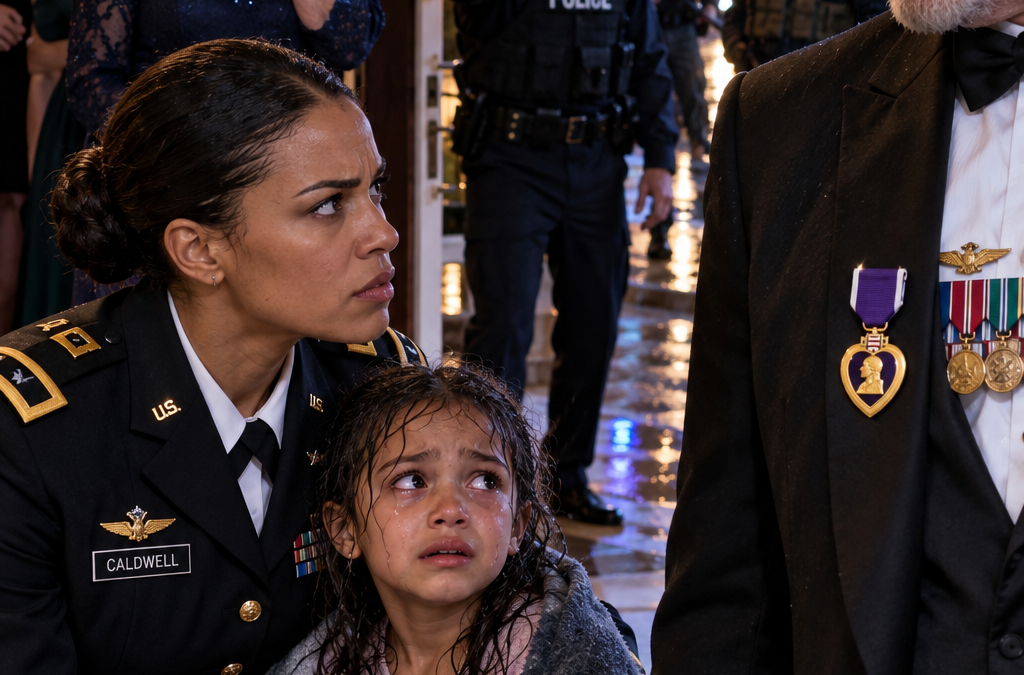
The Medal on His Tuxedo Was the First Thing in Grandma’s House That Didn’t Belong There
The moment my sister shoved my seven-year-old daughter into the rain, nearly everyone at my grandmother’s birthday dinner pretended not to see it.
Ten minutes later, two police cruisers and an unmarked military vehicle stopped outside the house, and an officer asked who had put their hands on my child.
But the first real warning had come much earlier, when I noticed my dead father’s medal pinned to the tuxedo of a man whose military stories had never sounded right.
My name is Maren Caldwell.
I was thirty-five years old, a Chief Warrant Officer in the United States Army, a Black Hawk pilot, and the mother of a seven-year-old girl named Sadie who had inherited nearly every quality I loved most about my father.
His stubbornness.
His compassion.
His habit of watching people closely.
And, unfortunately for certain members of my family, his refusal to ignore something simply because every adult in the room preferred silence.
My grandmother, Eleanor Caldwell, turned eighty on a cold Saturday in November.
For nearly forty years, Grandma Eleanor had worked as a civilian nurse at Fort Liberty. She had held frightened nineteen-year-old soldiers’ hands before surgery. She had sat with spouses waiting for casualty updates. She had delivered babies, changed dressings, translated medical language into ordinary English, and spent enough nights in hospital corridors that my father used to joke half the Army owed her a birthday card.
To Sadie, though, none of that mattered.
Grandma was simply the woman who always kept strawberry candy in the blue bowl beside her chair, who remembered every school project, and who never answered a child’s question with, “You’re too young to understand.”
Sadie adored her.
For two weeks before the party, she worked on a scrapbook.
She covered the dining-room table in photographs, glue sticks, markers, glitter stars, and scraps of colored paper. She asked me how to spell “adventure,” “brave,” and “beautiful.” She spent twenty minutes deciding which photograph of Grandma holding her as a baby should go on the first page.
On the final page, she wrote in careful second-grade handwriting:
Great-Grandma, you make everyone feel safe. That is your superpower.
When she showed it to me, I had to turn away.
“What?” Sadie asked.
“Nothing.”
“You’re crying.”
“I’m not crying.”
“You are.”
I wiped beneath one eye.
“Your grandfather would’ve loved this.”
She smiled.
“Would Grandpa have liked glitter?”
“No.”
“How do you know?”
“Because he hated glitter with military precision.”
She giggled.
I smiled too.
My father, Colonel Daniel Caldwell, had served twenty-six years in the Army.
Two deployments to Iraq.
One to Afghanistan.
More time away from home than he ever wanted to admit.
He had survived roadside bombs, mortar attacks, and more dangerous situations than he was willing to describe to me.
Then a drunk driver killed him three miles from home.
There are losses so absurd that your mind rejects them.
My father could fly into combat zones, stand beneath incoming fire, and come home.
But he could not survive a man crossing the center line on a rainy Tuesday evening.
That was eleven years before Grandma’s eightieth birthday.
I had followed him into the Army.
I never knew whether that made him proud or terrified.
Probably both.
By the time of Grandma’s party, I had recently returned from a nine-month deployment.
I had missed birthdays.
School events.
Sadie losing her second front tooth.
Three parent-teacher conferences.
The week she decided she hated peanut butter.
The week after that when she decided she loved it again.
Coming home after deployment is not the joyful movie scene people imagine.
You hug everyone.
You cry.
You sleep in your own bed.
Then you realize the family learned how to function without you.
The refrigerator is arranged differently.
Your child has inside jokes you do not understand.
Someone has changed the streaming passwords.
You are home, but part of you is still trying to catch up.
Grandma’s birthday was supposed to be my first peaceful family gathering since returning.
Sadie had been counting down the days.
We arrived at Grandma’s brick house shortly after six.
Rain fell steadily.
The driveway was lined with expensive cars.
Warm golden light glowed through every window.
Through the glass, I could see people moving beneath chandeliers.
My older sister Vanessa had organized everything.
Vanessa and I had never been close.
That sentence sounds simple.
The truth was more complicated.
Growing up, Vanessa needed to be admired.
Not loved.
Admired.
There was a difference.
If I brought home an A, she wanted an award.
If I made a team, she wanted to be captain of hers.
If Dad praised me, she found a reason his praise did not count.
She was three years older, beautiful in the precise way people notice immediately, and gifted at turning cruelty into concern.
She never said, “You look terrible.”
She said, “Maren, are you sleeping enough? You look exhausted.”
She never said, “Your daughter is annoying.”
She said, “Sadie seems unusually energetic. Have you considered whether she struggles with boundaries?”
Vanessa managed private charity events for wealthy donors.
She was good at it.
Very good.
She knew flowers.
Menus.
Seating arrangements.
Fundraising language.
The exact tone required to make a rich person feel generous without implying generosity was expected.
That night, she opened the door wearing a dark red designer dress and diamond earrings.
Her eyes went immediately to the clock behind me.
“You’re late.”
I checked my watch.
“It’s six minutes after six.”
“Dinner was scheduled for six.”
Sadie stepped forward holding the scrapbook against her chest.
“Hi, Aunt Vanessa.”
Vanessa looked down.
Sadie wore yellow tights beneath a navy birthday dress.
And rain boots.
Bright yellow rain boots.
Vanessa stared at them.
“Those shoes are wet.”
Sadie looked confused.
“It’s raining.”
I almost laughed.
Vanessa did not.
“We’ll leave them at the door,” I said.
Before my sister could reply, Grandma appeared behind her.
“There are my girls!”
Sadie’s entire face changed.
“Great-Grandma!”
She ran forward.
Grandma hugged her.
“You being here is the best present I could get.”
Sadie held up the scrapbook.
“I made you something.”
“No! Don’t show me yet. I want to open it after dinner.”
“Okay.”
Grandma kissed her forehead.
I watched them.
Then I noticed Grandma’s hand.
It trembled.
Only slightly.
Enough.
She had always had steady hands.
Nurses notice other people’s tremors.
Pilots do too.
I hugged her.
She felt thinner.
“You okay?”
“Of course.”
“You look tired.”
“That’s because I’m eighty.”
“You weren’t eighty yesterday?”
She smiled.
“Seventy-nine was much easier.”
I smiled, but the uneasiness stayed.
Nearly thirty guests filled the house.
Family.
Neighbors.
Retired military officers.
Old hospital friends.
Several wealthy donors Vanessa clearly wanted to impress.
A string quartet played beside the fireplace.
A photographer circulated.
Silver candles stood on every table.
Everything was elegant.
Everything was controlled.
And Grandma seemed lost inside her own party.
Twice during our first conversation, she forgot what she was saying halfway through a sentence.
The second time, I touched her arm.
“Grandma.”
She blinked.
“What?”
“You were telling me about your neighbor.”
“Oh.”
She frowned.
“I forgot.”
“That’s okay.”
“No.”
She looked irritated with herself.
“I’ve been doing that.”
“Doing what?”
“Losing things.”
“Have you seen a doctor?”
Before she could answer, Vanessa appeared.
“She’s fine.”
I turned.
“What medication is she taking?”
Vanessa’s eyes sharpened.
“We don’t need to discuss Grandma’s medical history in front of guests.”
“I wasn’t asking the guests.”
“Maren.”
“What?”
“She’s eighty.”
“That doesn’t answer my question.”
A man stepped beside Vanessa holding two glasses of champagne.
“Maybe tonight isn’t the time.”
Grant Mercer.
Vanessa’s fiancé.
They had been together eight months.
I had met him twice.
Both times, he talked about military service within ten minutes.
Not naturally.
Performatively.
He claimed he had served in Special Forces.
Then said he had worked with Rangers.
Then mentioned “black operations” that prevented him from giving dates.
People who actually serve usually understand the difference between privacy and nonsense.
The first time we met, he told me he had completed classified operations with the 75th Ranger Regiment.
I asked which battalion.
He changed the subject.
That evening, Grant wore a black tuxedo.
Something silver gleamed near his lapel.
I stared at it.
My stomach tightened.
It was a miniature Distinguished Service Cross.
My father’s Distinguished Service Cross.
I knew the scratch along the lower edge.
Dad had dropped the presentation case the day he received it.
The medal itself had struck the wooden corner.
Tiny mark.
Almost invisible.
I had run my thumb over it hundreds of times as a teenager.
I stepped closer.
“Where did you get that?”
Grant touched the decoration.
“This?”
“Yes.”
Vanessa answered for him.
“I gave it to him.”
My eyes went to her.
“You what?”
“It was sitting in a drawer.”
“It belonged to Dad.”
“And Grant is honoring him.”
I stared.
“By wearing a decoration he didn’t earn?”
Nearby conversation stopped.
Grant smiled.
“I served too.”
“Then wear your own.”
His smile disappeared.
Vanessa stepped closer.
“Not tonight.”
“I want Dad’s medal returned.”
“Grandma gave it to me.”
I looked at Grandma.
She was talking to a retired nurse across the room and had not heard us.
“Did she?”
Vanessa grabbed my arm and pulled me toward the hallway.
“You have been here fifteen minutes.”
“Take your hand off me.”
She released me.
“You’re already ruining everything.”
“Because I don’t want your fiancé wearing Dad’s medal?”
“Because you always have to make something about you.”
I laughed.
“This has nothing to do with me.”
“It always does.”
Her voice dropped.
“You disappear for nine months, come home, and suddenly think you run this family.”
“I was deployed.”
“You always say that like it excuses everything.”
I stared at her.
“It explains why I wasn’t here.”
“And meanwhile other people deal with your responsibilities.”
Her eyes shifted past me.
Toward Sadie.
Something in me hardened.
“My daughter is not your responsibility.”
“Then teach her not to wander through other people’s houses.”
I turned.
Sadie stood near the staircase.
She immediately looked away.
“What happened?”
“Nothing.”
“Vanessa.”
“Keep her downstairs.”
Then she walked away.
I went to Sadie.
“Hey.”
She kept looking toward the floor.
“Did you go upstairs?”
A small nod.
“Why?”
“Great-Grandma said she was cold.”
“And?”
“I went looking for her blue sweater.”
“You should’ve asked me.”
“I know.”
She sounded frightened.
Not guilty.
There is a difference every parent knows.
“Did something happen upstairs?”
She looked across the room.
Grant was watching us.
Sadie whispered, “No.”
I took her hand.
Her fingers were cold.
“Sadie.”
“Mom, please.”
That stopped me.
“Okay.”
I squeezed her hand.
“We’ll talk later.”
Dinner began at seven.
Grandma sat at the head of the table beneath a gold banner that read HAPPY 80TH, ELEANOR.
Sadie sat beside me.
She barely ate.
Across from us, Grant entertained guests with a story about Afghanistan.
Apparently, during one operation, he had rappelled from a Black Hawk while it hovered at thirty thousand feet.
I looked at him.
He looked at me.
Thirty thousand feet.
I flew Black Hawks.
He knew I flew Black Hawks.
He knew I knew how ridiculous that statement was.
He smiled anyway.
That told me something about him.
He did not merely lie.
He enjoyed seeing how much he could make other people tolerate.
Dessert arrived.
Vanessa stood.
She lifted her champagne glass.
“To Grandma Eleanor.”
Everyone quieted.
Vanessa smiled beautifully.
“The heart of this family.”
Applause.
Grandma gave a tired smile.
“For the past year,” Vanessa continued, “I’ve had the privilege of helping Grandma manage the house, medical appointments, and finances.”
My fork stopped halfway to the plate.
This was no longer a birthday toast.
Vanessa continued.
“And because families need to plan responsibly, Grandma has decided that I’ll continue overseeing her affairs permanently.”
Grandma looked up.
“I decided what?”
The table went silent.
Vanessa placed a hand on her shoulder.
“We discussed the power-of-attorney paperwork.”
Grandma frowned.
“I don’t remember signing a power of attorney.”
Vanessa laughed lightly.
“That’s why we made arrangements. You shouldn’t have to worry about details.”
I stood.
“What documents?”
My sister’s smile vanished.
“Maren.”
“What documents?”
“Sit down.”
“Grandma just said she doesn’t remember signing anything.”
“She forgets things.”
“Because of the medication?”
Grant leaned forward.
“This really isn’t appropriate.”
I looked at him.
“You don’t get to tell me when I can ask questions about my grandmother.”
Sadie pulled gently on my sleeve.
“Mom.”
“Not now, sweetheart.”
“But—”
Vanessa slammed her champagne glass onto the table.
“That child has interrupted enough tonight.”
Sadie flinched.
I turned.
“Do not speak to her like that.”
“She has been sneaking upstairs, opening drawers, and taking things.”
“I didn’t take anything!” Sadie cried.
Grant’s chair scraped backward.
Too quickly.
“What did she open?” I asked.
“No one is talking to you,” Vanessa snapped.
Sadie reached into the pocket of her dress.
“I found this under Great-Grandma’s bed.”
She placed a small digital voice recorder on the table.
Grant’s entire posture changed.
He lunged.
I grabbed the recorder first.
“Give me that.”
“Why?”
“It’s mine.”
“You store your property under Grandma’s bed?”
“Maren.”
Vanessa came around the table.
She seized Sadie’s wrist.
Sadie screamed.
I moved instantly.
“Let her go!”
Grant stepped between us.
He was larger than me.
That never impressed me much.
Large people rely on size until they meet someone trained not to.
But I could not see Sadie for two seconds.
Two seconds was enough.
Vanessa dragged her into the hall.
The front door opened.
I heard Sadie cry.
Then a thud.
“Vanessa!”
By the time I moved around Grant, my sister had shoved my seven-year-old daughter onto the porch.
The scrapbook flew from Sadie’s hands.
It landed in a puddle.
Vanessa slammed the door.
Locked it.
No one moved.
Thirty people.
Family.
Friends.
Retired officers.
Hospital colleagues.
People who had known Sadie since birth.
No one moved.
My mother looked down.
My uncle lifted his drink.
Someone at the far end of the table stared at his plate.
I looked at Vanessa.
“Open the door.”
“She needs to learn that actions have consequences.”
I had flown under fire.
I had landed a damaged aircraft at night with wounded soldiers aboard.
I had experienced mechanical failures that left me with seconds to make decisions.
None of those moments felt like this.
Because combat fear is clean.
Your body understands the danger.
This was different.
This was watching people who claimed to love my child decide her pain was socially inconvenient.
“Open the door.”
Grant reached toward me.
I twisted away and drove my shoulder into his chest.
He stumbled into the wall.
I unlocked the dead bolt.
Ran outside.
The porch was empty.
“Sadie?”
Rain blew across the driveway.
The scrapbook lay open in water.
Ink ran across the pages.
Glitter floated away in silver streaks.
“Sadie!”
Nothing.
I searched beside the shrubs.
Along the side yard.
Under the porch.
Behind Vanessa’s car.
Nothing.
My daughter was gone.
I called 911.
“My seven-year-old daughter was forced out of a residence, and now I can’t find her.”
Vanessa stepped onto the porch.
“Oh, stop.”
I turned.
“She’s hiding because she knows she did something wrong.”
The dispatcher asked for the address.
Then Sadie’s description.
Yellow tights.
Navy dress.
Brown hair.
No shoes.
Her rain boots were still by the front door.
That realization almost stopped my heart.
Then I saw movement near the stone wall beside the road.
General Peter Harlan.
Retired.
He had served with my father.
He was kneeling.
I ran.
Sadie was crouched behind the wall.
Bare feet in wet grass.
Shaking so hard her teeth clicked.
Harlan had wrapped his coat around her.
I dropped into the mud.
“Baby.”
She collapsed against me.
“I’m sorry.”
“No.”
“I’m sorry.”
“No, no, no.”
Her wrist had turned red where Vanessa grabbed her.
Then I saw her upper arm.
Dark bruises.
Finger marks.
Not Vanessa’s.
Too old.
Already purple.
My entire body went still.
“Sadie.”
She looked at me.
“Who did that?”
She glanced toward the house.
“Mr. Grant.”
I heard my own heartbeat.
“When?”
“Upstairs.”
General Harlan crouched beside us.
“What happened?”
Sadie swallowed.
“I went to get Great-Grandma’s sweater.”
“Okay.”
“Mr. Grant was in her room.”
My skin turned cold.
“What was he doing?”
“He had papers.”
“What kind?”
“They had Great-Grandma’s name. He was putting them in a black bag.”
She paused.
“And there were little bottles on the bed.”
Medication.
Documents.
“When he saw me, he grabbed my arm.”
Sadie touched the bruises.
“He said I wasn’t supposed to be there.”
“What else?”
Her eyes filled.
“He said not to tell.”
“Did he threaten you?”
She nodded.
“What did he say?”
“Soldiers know how to make people disappear.”
General Harlan’s face changed.
There are moments when an old soldier becomes young again.
His back straightened.
His eyes sharpened.
He removed his phone.
“Did he touch you anywhere else?” I asked.
“No.”
“Did anyone else?”
“No.”
Sirens approached.
Two police cruisers turned into the driveway.
Behind them came an unmarked dark SUV.
Major Elena Ruiz stepped out.
Army Criminal Investigation Division.
General Harlan had called her before I reached the wall.
A uniformed officer crouched beside Sadie.
A paramedic came behind him.
The officer looked at the bruises.
Then toward the porch.
Vanessa stood beneath the light.
Grant behind her.
The officer stood.
“Who put their hands on this child?”
Vanessa went white.
Grant backed away.
Not toward us.
Toward the kitchen.
“Don’t let him leave!”
He ran.
Ruiz and an officer followed.
A crash sounded inside.
Then breaking glass.
Guests screamed.
I stayed with Sadie until a female paramedic arrived.
General Harlan promised not to move from her side.
Only then did I go back inside.
Grant was on the kitchen floor.
Cuffed.
A black leather bag lay open beside him.
Papers covered the tile.
Prescription bottles.
Credit cards.
Military memorabilia.
And my father’s Distinguished Service Cross.
Vanessa stood against the counter.
“This is insane.”
Nobody answered.
“This is completely insane.”
Major Ruiz picked up a document.
“Mrs. Caldwell?”
Grandma came into the kitchen supported by my uncle.
Ruiz held up the paper.
It was a revised will.
Under it, Grandma left the house to Vanessa.
Retirement accounts.
Investments.
Most personal property.
Another document granted Vanessa broad financial and medical authority.
The signatures looked like Grandma’s.
The dates bothered me.
Grandma had been hospitalized that week.
“She signed them beforehand,” Vanessa said quickly.
Grandma looked at her.
“No.”
Every head turned.
Vanessa stepped forward.
“Grandma.”
“I did not.”
“You don’t remember.”
“I remember enough.”
“Your memory has been getting worse.”
Grandma’s voice strengthened.
“I am not confused about giving away my life.”
Ruiz examined the pill bottles.
Some labels were missing.
Others carried Grant’s name.
Sedatives.
Anti-anxiety medication.
“Mrs. Caldwell, have you knowingly taken these?”
Grandma looked frightened.
“I don’t know.”
“You don’t know?”
“Vanessa organizes my pills.”
My sister started crying.
Instantly.
“I was helping her.”
I stared at her.
“She leaves the stove on. She forgets appointments. I gave up my entire life.”
Grandma looked at her.
“No.”
Vanessa stopped crying.
“I paid you.”
Silence.
Grandma looked toward me.
“For six months, Vanessa told me you didn’t call.”
My heart tightened.
“What?”
“She said you were too busy with the Army.”
“I called every Sunday.”
Grandma stared.
“I never got those calls.”
“I sent letters.”
“She said you stopped.”
I looked at Vanessa.
Her tears disappeared.
“She needed stability.”
“By cutting me off?”
“Every time you contacted her, she became emotional.”
Grandma shook her head.
“No.”
Vanessa turned.
“Grandma—”
“Every time Maren contacted me, I started asking questions.”
That silenced my sister.
Major Ruiz opened Grant’s bag wider.
Bank records.
Transfers.
Repeated payments from Grandma’s accounts.
The destination was a company called Mercer Strategic Solutions.
Grant had described it as a security consultancy.
Investigators later discovered it had no office.
No employees.
No legitimate contracts.
Nearly four hundred thousand dollars had moved into it over eleven months.
Grant said nothing.
Vanessa pointed at him.
“He handled the finances.”
Grant laughed from the floor.
“That’s what you’re going with?”
“I trusted you!”
“You introduced me to the accounts.”
“You told me the investments were legal.”
“You forged the signatures.”
Their alliance collapsed in less than a minute.
Vanessa accused him of manipulation.
Grant accused her of planning everything.
She had complained that Grandma’s estate would be divided among too many relatives.
She wanted control first.
He claimed Vanessa had started putting additional sedatives into Grandma’s evening tea.
Vanessa screamed that it had been his idea.
Neither understood that every accusation made the case worse for both of them.
Then I remembered the recorder.
I handed it to Ruiz.
“Sadie found this under Grandma’s bed.”
She put on gloves.
“Mrs. Caldwell, is this yours?”
Grandma looked at it.
“Yes.”
Vanessa stared at her.
Ruiz asked, “Why did you have a recorder under your bed?”
Grandma’s hands began trembling.
“Because I knew something was wrong.”
My throat tightened.
“I kept waking up unable to remember conversations.”
She looked at me.
“Vanessa said I was developing dementia.”
Vanessa whispered, “You were confused.”
Grandma ignored her.
“Grant kept bringing papers.”
She swallowed.
“I started recording the room after I took my nighttime medicine.”
“You knew?” I asked.
“I suspected.”
“Why didn’t you call me?”
“I tried.”
She looked toward Vanessa.
“Every time I tried, someone was listening.”
Ruiz pressed play.
Static.
Then Vanessa’s voice filled the kitchen.
“She’s asking about Maren again.”
Grant answered.
“Block the new number too.”
My stomach turned.
“What if she calls the bank?”
“She won’t.”
A pause.
“Increase the evening dose.”
Nobody moved.
The next recording began.
Grant:
“Once the house transfers, sell it.”
Vanessa:
“And the accounts?”
“Empty before anyone checks.”
Then:
“What if she dies before the paperwork is finished?”
The kitchen seemed to stop breathing.
Grant’s recorded voice answered.
“At her age, nobody will ask many questions.”
My uncle sat down.
One of Grandma’s oldest friends began crying.
Vanessa stared at the recorder.
“I never agreed to hurt her.”
Her own voice answered from the machine.
“Just make sure she stays confused until everything is signed.”
She closed her eyes.
Then came the final recording.
Earlier that evening.
Grant entering Grandma’s bedroom.
Papers.
Pill bottles.
Then Sadie.
“What are you doing?”
“You shouldn’t be in here.”
“I’m getting Great-Grandma’s sweater.”
Movement.
Sadie crying out.
Then Grant’s voice.
Low.
Close.
“You didn’t see anything.”
My hands curled.
“Do you understand?”
Silence.
“Soldiers know how to make people disappear.”
I turned away.
Not because I was ashamed of crying.
Because Grant was ten feet from me.
And I had spent my adult life learning that anger does not give you permission to stop thinking.
My father taught me that.
The Army reinforced it.
My daughter needed a mother.
Not another defendant.
Major Ruiz stopped the recording.
She looked at Grant.
“You told this family you served Special Forces?”
He said nothing.
“We checked your name.”
His face changed.
Ruiz continued.
“Eleven months as a supply specialist. Entry-level separation. No combat deployment. No Ranger Regiment. No Special Forces qualification.”
General Harlan entered behind me.
His eyes dropped to the Distinguished Service Cross on the tile.
He walked toward it.
“That medal belongs to Colonel Daniel Caldwell.”
Grant looked away.
“I know because I was there.”
Harlan’s voice was calm.
“Daniel Caldwell walked through enemy fire to help evacuate wounded soldiers.”
Grant lowered his head.
“You threatened a seven-year-old girl while wearing his medal.”
No one spoke.
“You are not a soldier.”
Harlan’s voice tightened.
“You are a coward wearing a dead man’s courage.”
Grant was arrested that night.
Vanessa was arrested two days later.
For the first forty-eight hours, she claimed Grant manipulated her.
Then investigators recovered the messages.
Hundreds.
Messages about Grandma’s bank accounts.
Medical providers.
Intercepting calls.
Changing contact information.
Sedatives.
Documents.
One message had been sent three months before Grandma’s birthday.
Once everyone believes she has dementia, anything she says will sound confused.
I read it twice.
Then stopped.
Some betrayals hurt less when you understand them.
That one became worse.
Vanessa did not lose control in one desperate moment.
She had constructed a reality around Grandma.
Isolate her.
Drug her.
Call the drugging dementia.
Block the people who might notice.
Then use the confusion as proof that more control was necessary.
It was systematic.
Grandma moved into my house while the investigation continued.
The first weeks were hard.
Doctors had to correct her medication carefully.
The unnecessary sedatives could not simply be stopped without supervision.
Her balance improved.
Then her concentration.
Then her memory.
One morning, she walked into the kitchen and said, “I know where my glasses are.”
I looked at her.
She laughed.
“You don’t understand. For six months, I have spent every morning looking for something.”
She started crying.
So did I.
She did not have dementia.
She had been drugged.
Sadie struggled too.
For months, she would not enter a room if the door closed behind her.
If an adult raised a voice, she froze.
In grocery stores, if I turned a corner before she saw me move, she panicked.
The first time it happened, she found me in the next aisle and hit my stomach with both hands.
“Don’t leave!”
I crouched.
“I didn’t.”
“You disappeared.”
“I was six feet away.”
“You disappeared!”
So I learned.
Trauma does not care about distance.
We found a counselor who specialized in military families and children who had experienced frightening events.
Sadie hated the first appointment.
“Am I broken?”
“No.”
“Then why do I need therapy?”
“Because something happened that your brain is still trying to understand.”
“Your brain handles scary things.”
“Sometimes.”
“Because you’re Army.”
I shook my head.
“No.”
I sat beside her.
“The Army doesn’t make people immune to being scared.”
“Grandpa wasn’t scared.”
“You didn’t know Grandpa.”
She frowned.
“You talk like you did.”
“I did.”
“And?”
“He was scared plenty.”
“No way.”
“He just learned what to do while he was scared.”
That became something we repeated.
Fear is a feeling.
Not an instruction.
Sadie eventually gave a recorded forensic interview so she would not have to face Grant directly in court.
The prosecutor asked why she had taken the recorder.
“Because Great-Grandma looked scared.”
“And?”
“Grown-ups kept saying she was confused.”
“Were you frightened when you found it?”
“Yes.”
“Why bring it downstairs?”
Sadie thought.
Then said:
“Being scared doesn’t mean you leave someone alone.”
When I heard that, I had to walk out of the room.
My father would have understood her perfectly.
General Harlan attended every court hearing.
So did six soldiers who had served with Dad.
They never called themselves an honor guard.
Never wore matching uniforms.
Never made speeches.
They simply appeared.
Coffee in hand.
Jackets buttoned.
Sitting quietly.
On the final day, they stood behind us in the courthouse hallway.
Grant was brought through in custody.
He saw them.
For the first time since I had met him, he did not look large.
He looked ordinary.
Small, even.
That taught me something.
Some people seem powerful only because everyone else agrees to stand farther away.
Grant received a prison sentence.
Vanessa eventually accepted a plea agreement.
She also received a custodial sentence, followed by probation and restrictions that permanently prevented her from managing Grandma’s finances.
She was prohibited from contacting Sadie.
My mother struggled with that.
One afternoon, she came to my house.
Grandma was at a medical appointment.
Sadie was at school.
My mother sat at the kitchen table and cried.
“She’s your sister.”
I said nothing.
“Maren.”
“I heard you.”
“She made a terrible mistake.”
I stared at her.
“A mistake?”
“She got involved with the wrong man.”
“She helped drug Grandma.”
My mother looked down.
“She stole from her.”
Silence.
“She grabbed my daughter and threw her into the rain.”
“Maren—”
“To protect herself.”
My mother cried harder.
“She’s still your sister.”
“And Sadie is still my daughter.”
“She’s sorry.”
“Maybe.”
“Doesn’t that matter?”
“Yes.”
My mother looked hopeful.
“It matters to Vanessa.”
Her face fell.
“It does not obligate me to give her access to my child.”
“What about forgiveness?”
I leaned back.
For years, my family used forgiveness as a synonym for pretending nothing happened.
Grandma forgave people.
Dad forgave people.
My mother forgave people.
Then everyone expected the same doors to reopen.
“I can forgive Vanessa someday without putting Sadie in a room with her.”
My mother said nothing.
“Forgiveness is not access.”
She looked at me.
“It doesn’t require reopening a door for someone who already proved they are willing to destroy everyone inside.”
She left crying.
I cried after she was gone.
Boundaries are painful when you love the people standing outside them.
That does not make the boundary wrong.
About a month after the birthday dinner, I came home and found Grandma and Sadie sitting together at the kitchen table.
Between them was the scrapbook.
I stopped.
I had thought Sadie threw it away.
Rain had destroyed it.
Or so I believed.
The pages were warped.
Photographs stained.
Ink blurred.
Purple glitter had dissolved into pale streaks.
Sadie was carefully repairing one page with tape.
“I’m fixing it.”
Grandma touched the edge.
“It was already perfect.”
“No.”
Sadie shook her head.
“It got ruined.”
Grandma smiled.
“No, sweetheart.”
She ran one finger over the rippled paper.
“It survived the rain.”
Sadie looked at her.
“That is different from being ruined.”
I had to turn away.
Later, Sadie added something beneath the last sentence.
The original message read:
Great-Grandma, you make everyone feel safe. That is your superpower.
Underneath, in purple marker, she wrote:
And brave people help other people tell the truth.
That night, after everyone went to bed, I sat at the kitchen table with the scrapbook open in front of me.
I cried until my face hurt.
Not because everything was fixed.
It wasn’t.
Grandma still woke from nightmares.
Sadie still panicked around locked doors.
I still replayed the moment Vanessa threw my daughter outside and remembered all the people who looked away.
But survival had started becoming something else.
Not forgetting.
Not pretending.
Integration.
The ruined pages stayed ruined.
Sadie did not replace them.
That mattered.
She repaired them without erasing what happened.
A year after Grandma’s eightieth birthday, we celebrated her eighty-first.
No string quartet.
No photographer.
No chandeliers.
No designer invitations.
My backyard.
Hamburgers.
Paper plates.
Potato salad.
A chocolate cake Sadie decorated herself.
It leaned slightly left.
Grandma called it architectural character.
General Harlan came.
So did Major Ruiz.
The paramedic who helped Sadie.
Dad’s old Army friends.
Several neighbors.
People who had supported Grandma through court.
Before we cut the cake, Grandma tapped a spoon against her glass.
Everyone quieted.
“I spent most of my life around soldiers.”
Her voice had become stronger over the year.
“I’ve seen courage in many forms.”
She looked toward me.
“Sometimes courage wears a uniform.”
I smiled.
“Sometimes it looks like a pilot bringing a damaged helicopter home.”
I looked down.
Then Grandma turned toward Sadie.
“And sometimes it looks like a seven-year-old girl carrying the truth downstairs in her pocket.”
Everyone looked at Sadie.
Her cheeks turned pink.
“Great-Grandma.”
Grandma held up a small velvet box.
I recognized it immediately.
Dad’s Distinguished Service Cross.
It had been returned after the trial.
Grandma opened the box.
Silver caught the porch light.
Sadie stared.
Grandma did not pin it to her.
My father had respected what military decorations represented.
They were not family jewelry.
They were not costumes.
They were specific recognitions of specific acts.
Grandma closed the box.
Then placed it into Sadie’s hands.
“This belongs to your grandfather.”
Sadie held it carefully.
“When you’re older, your mother will tell you everything he did to earn it.”
She glanced toward me.
“Until then, I want you to know he would have been proud of you.”
Sadie looked at the box.
“Can we put it in the living room?”
I asked, “Why?”
“So nobody can hide it in a drawer again.”
People laughed.
Some cried.
We placed the medal on the mantel beside a photograph of Dad in uniform.
Then Grandma opened the scrapbook.
The final page remained wrinkled.
The original words were still readable.
Great-Grandma, you make everyone feel safe. That is your superpower.
Grandma read Sadie’s addition.
And brave people help other people tell the truth.
Then she hugged her.
“No.”
Her voice broke.
“You helped save me.”
I watched my daughter close her eyes in her great-grandmother’s arms beneath the warm porch lights.
A year earlier, she had stood barefoot in the rain while adults inside a beautiful house decided silence was easier.
Now those same people understood what silence costs.
Vanessa believed a seven-year-old would be too frightened to speak.
Grant believed a borrowed medal, fabricated military stories, and a large body would make everyone believe him.
They were wrong.
Because courage does not always announce itself.
It does not always wear combat boots.
It does not always come with rank.
Sometimes courage is a child noticing that someone she loves looks afraid.
Sometimes it is a small hand reaching beneath a bed and finding the thing adults hoped would remain hidden.
Sometimes it is carrying that truth downstairs even when a grown man has threatened you.
And sometimes courage belongs to the person who finally says, “No more,” after a lifetime of being told that family loyalty means looking away.
For months after the trial, I was angry at everyone who had remained seated when Vanessa dragged Sadie toward the door.
My mother.
My uncle.
Family friends.
People who loved us.
Good people, mostly.
That was the most difficult part.
If they had all been monsters, I could have dismissed them.
They weren’t.
They were ordinary people who froze because confrontation felt dangerous.
They saw Vanessa furious.
Grant standing beside her.
A dinner full of guests.
And they made one silent calculation.
Maybe someone else will handle it.
That is how cruelty grows in families.
Not because everyone agrees with it.
Because enough people decide intervention belongs to someone else.
My father used to say something whenever junior soldiers asked him about courage.
I did not understand it when I was young.
He said, “Most people know what the right thing is. Courage is how quickly you stop negotiating with yourself about doing it.”
Sadie never negotiated long.
That night, she saw Grandma afraid.
She found the recorder.
Grant threatened her.
Vanessa humiliated her.
She was terrified.
And still, she carried the recorder downstairs.
Sometimes I wondered whether I had failed her by allowing her into that house.
My therapist told me not to ask impossible questions.
I asked them anyway.
What if I had challenged Vanessa sooner?
What if I had investigated Grandma’s medication before dinner?
What if I had taken Grant’s lies more seriously?
What if I had refused to attend?
What if?
What if?
What if?
There is no end to those questions.
Eventually, Grandma stopped me one afternoon.
She was sitting beside the kitchen window while Sadie colored nearby.
“You’re doing it again.”
“What?”
“Blaming yourself.”
“I’m not.”
“You have your father’s face when you lie.”
I smiled despite myself.
“What face?”
“That one.”
She pointed.
“You think because you fly helicopters, you’re supposed to see every danger before it arrives.”
“I should’ve noticed more.”
“You noticed.”
“Not enough.”
Grandma reached for my hand.
“I was in that house every day and did not fully understand what was happening to me.”
“You were medicated.”
“And you were overseas.”
I looked away.
“Vanessa chose this.”
Grandma squeezed my hand.
“Grant chose this.”
Her voice hardened.
“They do not get to make you responsible for noticing their crimes faster.”
That sentence stayed with me.
So did something else.
The first night Grandma slept at my house, she stood outside the guest room for almost five minutes.
“What’s wrong?”
She looked at the bed.
“I don’t know.”
“Do you want another room?”
“No.”
Then she whispered:
“I don’t remember what happened in my own room anymore.”
I had no answer.
So I sat on the bed with her.
We talked until nearly two in the morning.
About Dad.
About nursing.
About Sadie.
About stupid family vacations.
Anything except Vanessa.
Sometimes safety returns through ordinary conversation.
Not grand gestures.
No speeches.
Just someone staying.
Sadie learned that too.
Over time, she stopped checking every locked door.
She stopped panicking when I left an aisle at the grocery store.
She began sleeping without the hallway light on.
The first time she attended another family gathering, she refused to take off her shoes.
I looked at her rain boots.
Bright yellow.
Too small now.
“You want to wear those inside?”
“Yes.”
“Okay.”
No argument.
No rule mattered enough.
Six months later, she donated the boots herself.
“I don’t need them.”
“You sure?”
“Yes.”
She looked at me.
“But I want new yellow ones.”
I laughed.
“Of course you do.”
Life did not become perfect.
Grandma lost money that investigators could not recover.
Our extended family fractured.
Some relatives blamed Vanessa completely.
Some blamed Grant.
Some blamed me for “making everything public,” as though criminal prosecution had been a social-media choice.
I stopped arguing.
People who need lies will always find a reason to resent evidence.
Vanessa wrote letters from custody.
I read the first two.
The first blamed Grant.
The second blamed childhood jealousy.
Neither mentioned Sadie until the final paragraph.
I stopped reading.
Years earlier, I would have believed refusing those letters made me cruel.
Now I understood.
You do not owe unlimited access to someone simply because they share your blood.
My job as Sadie’s mother was not to preserve the appearance of family.
It was to protect the child inside it.
That was the lesson I carried from Grandma’s eightieth birthday.
Not revenge.
Not triumph.
Responsibility.
A family can have polished silverware, military medals, expensive flowers, and thirty respectable guests and still be unsafe.
A house can look beautiful while something terrible happens upstairs.
A person can use words like “caregiving” while taking control.
A man can wear a hero’s medal while behaving like a coward.
And a frightened child can understand more about courage than every adult at the table.
The last time General Harlan visited, he stood in front of Dad’s photograph for a long time.
Sadie wandered over.
“Did you know my grandpa?”
Harlan smiled.
“Very well.”
“Was he brave?”
“Yes.”
“Was he ever scared?”
He looked at me.
I knew what he remembered.
Then he crouched beside Sadie.
“All the time.”
Her eyes widened.
“Really?”
“Really.”
“But he was a colonel.”
“That doesn’t cure fear.”
She thought about it.
“What did he do when he was scared?”
Harlan smiled.
“He tried to remember who needed him more than he needed to be comfortable.”
Sadie nodded slowly.
Then looked at the medal.
“I was scared when I took the recorder.”
“I know.”
“Does that mean I was brave?”
Harlan looked at her.
“That is usually when bravery matters.”
She smiled.
Then ran outside.
Harlan stood.
“Daniel would have loved her.”
“I know.”
For years, hearing that sentence hurt.
That day, it did not.
I watched Sadie through the window.
Grandma was outside too, showing her how to cut dead flowers from the garden.
Both of them were laughing.
Alive.
Safe.
Together.
That was enough.
When I think about Grandma’s eightieth birthday now, I do not first remember Grant in handcuffs.
I do not remember Vanessa crying.
I do not remember the bank records.
Or the pills.
Or even the recording.
I remember Sadie’s scrapbook in the rain.
Pages soaked.
Ink bleeding.
Pictures warped.
At the time, I thought it had been destroyed.
Sadie thought so too.
Grandma understood better.
It survived.
That is different from being ruined.
Our family survived.
Not intact.
Intact is overrated.
Some things should break.
Silence should break.
False loyalty should break.
The habit of protecting adults at the expense of children should break.
What remained afterward was smaller than the family we had before.
But it was more honest.
Grandma.
Sadie.
Me.
A few relatives who learned to speak sooner.
Dad’s friends.
People who showed up when it mattered.
And my father’s medal sitting openly on the mantel where anyone could see it.
Not worn.
Not borrowed.
Not used to create authority someone had not earned.
Simply remembered.
One evening, I caught Sadie standing in front of it.
“What are you doing?”
“Nothing.”
“You’ve been staring at that picture for five minutes.”
She shrugged.
“Do I look like Grandpa?”
I smiled.
“A little.”
“How?”
“The eyes.”
She squinted at the photograph.
“We don’t have the same eyes.”
“Not literally.”
“What does that mean?”
I stood beside her.
“He noticed things.”
“So?”
“So do you.”
She smiled.
“Is that good?”
“Usually.”
“Usually?”
“Sometimes it gets you thrown out of birthday parties.”
She laughed.
I laughed too.
Then she leaned against me.
I put my arm around her.
There was a time after that night when I wanted to teach Sadie to be more careful.
Less curious.
Less trusting.
Less likely to interfere.
Fear does that to parents.
We confuse safety with making our children smaller.
I stopped myself.
Grant had already tried to teach her that lesson.
See something dangerous?
Stay quiet.
Powerful adult tells you to leave?
Obey.
Family gets angry?
Doubt yourself.
No.
That was not the child I wanted to raise.
So I taught her something else.
Trust your instincts.
Ask questions.
Find safe adults.
Tell the truth.
And if someone tells you that keeping a secret protects the family, ask who the secret is actually protecting.
She is older now.
The scrapbook still sits on Grandma’s shelf.
We never replaced it.
The stains remain.
The pages bend.
Glitter is missing.
The handwriting has faded slightly.
But the final page is still readable.
Great-Grandma, you make everyone feel safe. That is your superpower.
And beneath it:
And brave people help other people tell the truth.
If I could return to that November night, there are a hundred things I would change.
I would arrive earlier.
I would take Grandma aside immediately.
I would remove Dad’s medal from Grant’s tuxedo with my own hands.
I would listen when Sadie first told me she had been upstairs.
I would never let Vanessa come close enough to grab her wrist.
But there is one thing I would not change.
I would not take away my daughter’s choice to tell the truth.
Because that choice belonged to her.
That was her courage.
And nobody—not Vanessa, not Grant, not me—gets to rewrite it.
The adults at that birthday dinner thought Sadie was the weakest person in the room.
Seven years old.
Barefoot.
Crying.
Holding a glitter-covered scrapbook.
They were wrong.
The weakest people were the ones who knew something was wrong and chose silence because speaking felt uncomfortable.
Sadie was afraid too.
She spoke anyway.
That is what I remember when people ask what courage looks like.
Sometimes it looks like my father crossing a dangerous battlefield to reach wounded soldiers.
Sometimes it looks like a Black Hawk pilot staying calm when warning lights begin flashing over hostile terrain.
And sometimes it looks like a little girl walking downstairs with a recorder in her pocket because her great-grandmother looked scared.
Courage does not belong to uniforms.
It does not belong to rank.
And it certainly does not belong to the person wearing somebody else’s medal.
It belongs to the person who sees what everyone else has agreed not to see—
and refuses to look away.
What do you think of this story? Please leave a like and share your thoughts in the comments. Your support means a lot to us and inspires us to keep writing more meaningful and powerful stories. Thank you! 👍
𝗧𝗛𝗘 𝗘𝗡𝗗
The Medal on His Tuxedo Was the First Thing in Grandma’s House That Didn’t Belong There
The moment my sister shoved my seven-year-old daughter into the rain, nearly everyone at my grandmother’s birthday dinner pretended not to see it.
Ten minutes later, two police cruisers and an unmarked military vehicle stopped outside the house, and an officer asked who had put their hands on my child.
But the first real warning had come much earlier, when I noticed my dead father’s medal pinned to the tuxedo of a man whose military stories had never sounded right.
My name is Maren Caldwell.
I was thirty-five years old, a Chief Warrant Officer in the United States Army, a Black Hawk pilot, and the mother of a seven-year-old girl named Sadie who had inherited nearly every quality I loved most about my father.
His stubbornness.
His compassion.
His habit of watching people closely.
And, unfortunately for certain members of my family, his refusal to ignore something simply because every adult in the room preferred silence.
My grandmother, Eleanor Caldwell, turned eighty on a cold Saturday in November.
For nearly forty years, Grandma Eleanor had worked as a civilian nurse at Fort Liberty. She had held frightened nineteen-year-old soldiers’ hands before surgery. She had sat with spouses waiting for casualty updates. She had delivered babies, changed dressings, translated medical language into ordinary English, and spent enough nights in hospital corridors that my father used to joke half the Army owed her a birthday card.
To Sadie, though, none of that mattered.
Grandma was simply the woman who always kept strawberry candy in the blue bowl beside her chair, who remembered every school project, and who never answered a child’s question with, “You’re too young to understand.”
Sadie adored her.
For two weeks before the party, she worked on a scrapbook.
She covered the dining-room table in photographs, glue sticks, markers, glitter stars, and scraps of colored paper. She asked me how to spell “adventure,” “brave,” and “beautiful.” She spent twenty minutes deciding which photograph of Grandma holding her as a baby should go on the first page.
On the final page, she wrote in careful second-grade handwriting:
Great-Grandma, you make everyone feel safe. That is your superpower.
When she showed it to me, I had to turn away.
“What?” Sadie asked.
“Nothing.”
“You’re crying.”
“I’m not crying.”
“You are.”
I wiped beneath one eye.
“Your grandfather would’ve loved this.”
She smiled.
“Would Grandpa have liked glitter?”
“No.”
“How do you know?”
“Because he hated glitter with military precision.”
She giggled.
I smiled too.
My father, Colonel Daniel Caldwell, had served twenty-six years in the Army.
Two deployments to Iraq.
One to Afghanistan.
More time away from home than he ever wanted to admit.
He had survived roadside bombs, mortar attacks, and more dangerous situations than he was willing to describe to me.
Then a drunk driver killed him three miles from home.
There are losses so absurd that your mind rejects them.
My father could fly into combat zones, stand beneath incoming fire, and come home.
But he could not survive a man crossing the center line on a rainy Tuesday evening.
That was eleven years before Grandma’s eightieth birthday.
I had followed him into the Army.
I never knew whether that made him proud or terrified.
Probably both.
By the time of Grandma’s party, I had recently returned from a nine-month deployment.
I had missed birthdays.
School events.
Sadie losing her second front tooth.
Three parent-teacher conferences.
The week she decided she hated peanut butter.
The week after that when she decided she loved it again.
Coming home after deployment is not the joyful movie scene people imagine.
You hug everyone.
You cry.
You sleep in your own bed.
Then you realize the family learned how to function without you.
The refrigerator is arranged differently.
Your child has inside jokes you do not understand.
Someone has changed the streaming passwords.
You are home, but part of you is still trying to catch up.
Grandma’s birthday was supposed to be my first peaceful family gathering since returning.
Sadie had been counting down the days.
We arrived at Grandma’s brick house shortly after six.
Rain fell steadily.
The driveway was lined with expensive cars.
Warm golden light glowed through every window.
Through the glass, I could see people moving beneath chandeliers.
My older sister Vanessa had organized everything.
Vanessa and I had never been close.
That sentence sounds simple.
The truth was more complicated.
Growing up, Vanessa needed to be admired.
Not loved.
Admired.
There was a difference.
If I brought home an A, she wanted an award.
If I made a team, she wanted to be captain of hers.
If Dad praised me, she found a reason his praise did not count.
She was three years older, beautiful in the precise way people notice immediately, and gifted at turning cruelty into concern.
She never said, “You look terrible.”
She said, “Maren, are you sleeping enough? You look exhausted.”
She never said, “Your daughter is annoying.”
She said, “Sadie seems unusually energetic. Have you considered whether she struggles with boundaries?”
Vanessa managed private charity events for wealthy donors.
She was good at it.
Very good.
She knew flowers.
Menus.
Seating arrangements.
Fundraising language.
The exact tone required to make a rich person feel generous without implying generosity was expected.
That night, she opened the door wearing a dark red designer dress and diamond earrings.
Her eyes went immediately to the clock behind me.
“You’re late.”
I checked my watch.
“It’s six minutes after six.”
“Dinner was scheduled for six.”
Sadie stepped forward holding the scrapbook against her chest.
“Hi, Aunt Vanessa.”
Vanessa looked down.
Sadie wore yellow tights beneath a navy birthday dress.
And rain boots.
Bright yellow rain boots.
Vanessa stared at them.
“Those shoes are wet.”
Sadie looked confused.
“It’s raining.”
I almost laughed.
Vanessa did not.
“We’ll leave them at the door,” I said.
Before my sister could reply, Grandma appeared behind her.
“There are my girls!”
Sadie’s entire face changed.
“Great-Grandma!”
She ran forward.
Grandma hugged her.
“You being here is the best present I could get.”
Sadie held up the scrapbook.
“I made you something.”
“No! Don’t show me yet. I want to open it after dinner.”
“Okay.”
Grandma kissed her forehead.
I watched them.
Then I noticed Grandma’s hand.
It trembled.
Only slightly.
Enough.
She had always had steady hands.
Nurses notice other people’s tremors.
Pilots do too.
I hugged her.
She felt thinner.
“You okay?”
“Of course.”
“You look tired.”
“That’s because I’m eighty.”
“You weren’t eighty yesterday?”
She smiled.
“Seventy-nine was much easier.”
I smiled, but the uneasiness stayed.
Nearly thirty guests filled the house.
Family.
Neighbors.
Retired military officers.
Old hospital friends.
Several wealthy donors Vanessa clearly wanted to impress.
A string quartet played beside the fireplace.
A photographer circulated.
Silver candles stood on every table.
Everything was elegant.
Everything was controlled.
And Grandma seemed lost inside her own party.
Twice during our first conversation, she forgot what she was saying halfway through a sentence.
The second time, I touched her arm.
“Grandma.”
She blinked.
“What?”
“You were telling me about your neighbor.”
“Oh.”
She frowned.
“I forgot.”
“That’s okay.”
“No.”
She looked irritated with herself.
“I’ve been doing that.”
“Doing what?”
“Losing things.”
“Have you seen a doctor?”
Before she could answer, Vanessa appeared.
“She’s fine.”
I turned.
“What medication is she taking?”
Vanessa’s eyes sharpened.
“We don’t need to discuss Grandma’s medical history in front of guests.”
“I wasn’t asking the guests.”
“Maren.”
“What?”
“She’s eighty.”
“That doesn’t answer my question.”
A man stepped beside Vanessa holding two glasses of champagne.
“Maybe tonight isn’t the time.”
Grant Mercer.
Vanessa’s fiancé.
They had been together eight months.
I had met him twice.
Both times, he talked about military service within ten minutes.
Not naturally.
Performatively.
He claimed he had served in Special Forces.
Then said he had worked with Rangers.
Then mentioned “black operations” that prevented him from giving dates.
People who actually serve usually understand the difference between privacy and nonsense.
The first time we met, he told me he had completed classified operations with the 75th Ranger Regiment.
I asked which battalion.
He changed the subject.
That evening, Grant wore a black tuxedo.
Something silver gleamed near his lapel.
I stared at it.
My stomach tightened.
It was a miniature Distinguished Service Cross.
My father’s Distinguished Service Cross.
I knew the scratch along the lower edge.
Dad had dropped the presentation case the day he received it.
The medal itself had struck the wooden corner.
Tiny mark.
Almost invisible.
I had run my thumb over it hundreds of times as a teenager.
I stepped closer.
“Where did you get that?”
Grant touched the decoration.
“This?”
“Yes.”
Vanessa answered for him.
“I gave it to him.”
My eyes went to her.
“You what?”
“It was sitting in a drawer.”
“It belonged to Dad.”
“And Grant is honoring him.”
I stared.
“By wearing a decoration he didn’t earn?”
Nearby conversation stopped.
Grant smiled.
“I served too.”
“Then wear your own.”
His smile disappeared.
Vanessa stepped closer.
“Not tonight.”
“I want Dad’s medal returned.”
“Grandma gave it to me.”
I looked at Grandma.
She was talking to a retired nurse across the room and had not heard us.
“Did she?”
Vanessa grabbed my arm and pulled me toward the hallway.
“You have been here fifteen minutes.”
“Take your hand off me.”
She released me.
“You’re already ruining everything.”
“Because I don’t want your fiancé wearing Dad’s medal?”
“Because you always have to make something about you.”
I laughed.
“This has nothing to do with me.”
“It always does.”
Her voice dropped.
“You disappear for nine months, come home, and suddenly think you run this family.”
“I was deployed.”
“You always say that like it excuses everything.”
I stared at her.
“It explains why I wasn’t here.”
“And meanwhile other people deal with your responsibilities.”
Her eyes shifted past me.
Toward Sadie.
Something in me hardened.
“My daughter is not your responsibility.”
“Then teach her not to wander through other people’s houses.”
I turned.
Sadie stood near the staircase.
She immediately looked away.
“What happened?”
“Nothing.”
“Vanessa.”
“Keep her downstairs.”
Then she walked away.
I went to Sadie.
“Hey.”
She kept looking toward the floor.
“Did you go upstairs?”
A small nod.
“Why?”
“Great-Grandma said she was cold.”
“And?”
“I went looking for her blue sweater.”
“You should’ve asked me.”
“I know.”
She sounded frightened.
Not guilty.
There is a difference every parent knows.
“Did something happen upstairs?”
She looked across the room.
Grant was watching us.
Sadie whispered, “No.”
I took her hand.
Her fingers were cold.
“Sadie.”
“Mom, please.”
That stopped me.
“Okay.”
I squeezed her hand.
“We’ll talk later.”
Dinner began at seven.
Grandma sat at the head of the table beneath a gold banner that read HAPPY 80TH, ELEANOR.
Sadie sat beside me.
She barely ate.
Across from us, Grant entertained guests with a story about Afghanistan.
Apparently, during one operation, he had rappelled from a Black Hawk while it hovered at thirty thousand feet.
I looked at him.
He looked at me.
Thirty thousand feet.
I flew Black Hawks.
He knew I flew Black Hawks.
He knew I knew how ridiculous that statement was.
He smiled anyway.
That told me something about him.
He did not merely lie.
He enjoyed seeing how much he could make other people tolerate.
Dessert arrived.
Vanessa stood.
She lifted her champagne glass.
“To Grandma Eleanor.”
Everyone quieted.
Vanessa smiled beautifully.
“The heart of this family.”
Applause.
Grandma gave a tired smile.
“For the past year,” Vanessa continued, “I’ve had the privilege of helping Grandma manage the house, medical appointments, and finances.”
My fork stopped halfway to the plate.
This was no longer a birthday toast.
Vanessa continued.
“And because families need to plan responsibly, Grandma has decided that I’ll continue overseeing her affairs permanently.”
Grandma looked up.
“I decided what?”
The table went silent.
Vanessa placed a hand on her shoulder.
“We discussed the power-of-attorney paperwork.”
Grandma frowned.
“I don’t remember signing a power of attorney.”
Vanessa laughed lightly.
“That’s why we made arrangements. You shouldn’t have to worry about details.”
I stood.
“What documents?”
My sister’s smile vanished.
“Maren.”
“What documents?”
“Sit down.”
“Grandma just said she doesn’t remember signing anything.”
“She forgets things.”
“Because of the medication?”
Grant leaned forward.
“This really isn’t appropriate.”
I looked at him.
“You don’t get to tell me when I can ask questions about my grandmother.”
Sadie pulled gently on my sleeve.
“Mom.”
“Not now, sweetheart.”
“But—”
Vanessa slammed her champagne glass onto the table.
“That child has interrupted enough tonight.”
Sadie flinched.
I turned.
“Do not speak to her like that.”
“She has been sneaking upstairs, opening drawers, and taking things.”
“I didn’t take anything!” Sadie cried.
Grant’s chair scraped backward.
Too quickly.
“What did she open?” I asked.
“No one is talking to you,” Vanessa snapped.
Sadie reached into the pocket of her dress.
“I found this under Great-Grandma’s bed.”
She placed a small digital voice recorder on the table.
Grant’s entire posture changed.
He lunged.
I grabbed the recorder first.
“Give me that.”
“Why?”
“It’s mine.”
“You store your property under Grandma’s bed?”
“Maren.”
Vanessa came around the table.
She seized Sadie’s wrist.
Sadie screamed.
I moved instantly.
“Let her go!”
Grant stepped between us.
He was larger than me.
That never impressed me much.
Large people rely on size until they meet someone trained not to.
But I could not see Sadie for two seconds.
Two seconds was enough.
Vanessa dragged her into the hall.
The front door opened.
I heard Sadie cry.
Then a thud.
“Vanessa!”
By the time I moved around Grant, my sister had shoved my seven-year-old daughter onto the porch.
The scrapbook flew from Sadie’s hands.
It landed in a puddle.
Vanessa slammed the door.
Locked it.
No one moved.
Thirty people.
Family.
Friends.
Retired officers.
Hospital colleagues.
People who had known Sadie since birth.
No one moved.
My mother looked down.
My uncle lifted his drink.
Someone at the far end of the table stared at his plate.
I looked at Vanessa.
“Open the door.”
“She needs to learn that actions have consequences.”
I had flown under fire.
I had landed a damaged aircraft at night with wounded soldiers aboard.
I had experienced mechanical failures that left me with seconds to make decisions.
None of those moments felt like this.
Because combat fear is clean.
Your body understands the danger.
This was different.
This was watching people who claimed to love my child decide her pain was socially inconvenient.
“Open the door.”
Grant reached toward me.
I twisted away and drove my shoulder into his chest.
He stumbled into the wall.
I unlocked the dead bolt.
Ran outside.
The porch was empty.
“Sadie?”
Rain blew across the driveway.
The scrapbook lay open in water.
Ink ran across the pages.
Glitter floated away in silver streaks.
“Sadie!”
Nothing.
I searched beside the shrubs.
Along the side yard.
Under the porch.
Behind Vanessa’s car.
Nothing.
My daughter was gone.
I called 911.
“My seven-year-old daughter was forced out of a residence, and now I can’t find her.”
Vanessa stepped onto the porch.
“Oh, stop.”
I turned.
“She’s hiding because she knows she did something wrong.”
The dispatcher asked for the address.
Then Sadie’s description.
Yellow tights.
Navy dress.
Brown hair.
No shoes.
Her rain boots were still by the front door.
That realization almost stopped my heart.
Then I saw movement near the stone wall beside the road.
General Peter Harlan.
Retired.
He had served with my father.
He was kneeling.
I ran.
Sadie was crouched behind the wall.
Bare feet in wet grass.
Shaking so hard her teeth clicked.
Harlan had wrapped his coat around her.
I dropped into the mud.
“Baby.”
She collapsed against me.
“I’m sorry.”
“No.”
“I’m sorry.”
“No, no, no.”
Her wrist had turned red where Vanessa grabbed her.
Then I saw her upper arm.
Dark bruises.
Finger marks.
Not Vanessa’s.
Too old.
Already purple.
My entire body went still.
“Sadie.”
She looked at me.
“Who did that?”
She glanced toward the house.
“Mr. Grant.”
I heard my own heartbeat.
“When?”
“Upstairs.”
General Harlan crouched beside us.
“What happened?”
Sadie swallowed.
“I went to get Great-Grandma’s sweater.”
“Okay.”
“Mr. Grant was in her room.”
My skin turned cold.
“What was he doing?”
“He had papers.”
“What kind?”
“They had Great-Grandma’s name. He was putting them in a black bag.”
She paused.
“And there were little bottles on the bed.”
Medication.
Documents.
“When he saw me, he grabbed my arm.”
Sadie touched the bruises.
“He said I wasn’t supposed to be there.”
“What else?”
Her eyes filled.
“He said not to tell.”
“Did he threaten you?”
She nodded.
“What did he say?”
“Soldiers know how to make people disappear.”
General Harlan’s face changed.
There are moments when an old soldier becomes young again.
His back straightened.
His eyes sharpened.
He removed his phone.
“Did he touch you anywhere else?” I asked.
“No.”
“Did anyone else?”
“No.”
Sirens approached.
Two police cruisers turned into the driveway.
Behind them came an unmarked dark SUV.
Major Elena Ruiz stepped out.
Army Criminal Investigation Division.
General Harlan had called her before I reached the wall.
A uniformed officer crouched beside Sadie.
A paramedic came behind him.
The officer looked at the bruises.
Then toward the porch.
Vanessa stood beneath the light.
Grant behind her.
The officer stood.
“Who put their hands on this child?”
Vanessa went white.
Grant backed away.
Not toward us.
Toward the kitchen.
“Don’t let him leave!”
He ran.
Ruiz and an officer followed.
A crash sounded inside.
Then breaking glass.
Guests screamed.
I stayed with Sadie until a female paramedic arrived.
General Harlan promised not to move from her side.
Only then did I go back inside.
Grant was on the kitchen floor.
Cuffed.
A black leather bag lay open beside him.
Papers covered the tile.
Prescription bottles.
Credit cards.
Military memorabilia.
And my father’s Distinguished Service Cross.
Vanessa stood against the counter.
“This is insane.”
Nobody answered.
“This is completely insane.”
Major Ruiz picked up a document.
“Mrs. Caldwell?”
Grandma came into the kitchen supported by my uncle.
Ruiz held up the paper.
It was a revised will.
Under it, Grandma left the house to Vanessa.
Retirement accounts.
Investments.
Most personal property.
Another document granted Vanessa broad financial and medical authority.
The signatures looked like Grandma’s.
The dates bothered me.
Grandma had been hospitalized that week.
“She signed them beforehand,” Vanessa said quickly.
Grandma looked at her.
“No.”
Every head turned.
Vanessa stepped forward.
“Grandma.”
“I did not.”
“You don’t remember.”
“I remember enough.”
“Your memory has been getting worse.”
Grandma’s voice strengthened.
“I am not confused about giving away my life.”
Ruiz examined the pill bottles.
Some labels were missing.
Others carried Grant’s name.
Sedatives.
Anti-anxiety medication.
“Mrs. Caldwell, have you knowingly taken these?”
Grandma looked frightened.
“I don’t know.”
“You don’t know?”
“Vanessa organizes my pills.”
My sister started crying.
Instantly.
“I was helping her.”
I stared at her.
“She leaves the stove on. She forgets appointments. I gave up my entire life.”
Grandma looked at her.
“No.”
Vanessa stopped crying.
“I paid you.”
Silence.
Grandma looked toward me.
“For six months, Vanessa told me you didn’t call.”
My heart tightened.
“What?”
“She said you were too busy with the Army.”
“I called every Sunday.”
Grandma stared.
“I never got those calls.”
“I sent letters.”
“She said you stopped.”
I looked at Vanessa.
Her tears disappeared.
“She needed stability.”
“By cutting me off?”
“Every time you contacted her, she became emotional.”
Grandma shook her head.
“No.”
Vanessa turned.
“Grandma—”
“Every time Maren contacted me, I started asking questions.”
That silenced my sister.
Major Ruiz opened Grant’s bag wider.
Bank records.
Transfers.
Repeated payments from Grandma’s accounts.
The destination was a company called Mercer Strategic Solutions.
Grant had described it as a security consultancy.
Investigators later discovered it had no office.
No employees.
No legitimate contracts.
Nearly four hundred thousand dollars had moved into it over eleven months.
Grant said nothing.
Vanessa pointed at him.
“He handled the finances.”
Grant laughed from the floor.
“That’s what you’re going with?”
“I trusted you!”
“You introduced me to the accounts.”
“You told me the investments were legal.”
“You forged the signatures.”
Their alliance collapsed in less than a minute.
Vanessa accused him of manipulation.
Grant accused her of planning everything.
She had complained that Grandma’s estate would be divided among too many relatives.
She wanted control first.
He claimed Vanessa had started putting additional sedatives into Grandma’s evening tea.
Vanessa screamed that it had been his idea.
Neither understood that every accusation made the case worse for both of them.
Then I remembered the recorder.
I handed it to Ruiz.
“Sadie found this under Grandma’s bed.”
She put on gloves.
“Mrs. Caldwell, is this yours?”
Grandma looked at it.
“Yes.”
Vanessa stared at her.
Ruiz asked, “Why did you have a recorder under your bed?”
Grandma’s hands began trembling.
“Because I knew something was wrong.”
My throat tightened.
“I kept waking up unable to remember conversations.”
She looked at me.
“Vanessa said I was developing dementia.”
Vanessa whispered, “You were confused.”
Grandma ignored her.
“Grant kept bringing papers.”
She swallowed.
“I started recording the room after I took my nighttime medicine.”
“You knew?” I asked.
“I suspected.”
“Why didn’t you call me?”
“I tried.”
She looked toward Vanessa.
“Every time I tried, someone was listening.”
Ruiz pressed play.
Static.
Then Vanessa’s voice filled the kitchen.
“She’s asking about Maren again.”
Grant answered.
“Block the new number too.”
My stomach turned.
“What if she calls the bank?”
“She won’t.”
A pause.
“Increase the evening dose.”
Nobody moved.
The next recording began.
Grant:
“Once the house transfers, sell it.”
Vanessa:
“And the accounts?”
“Empty before anyone checks.”
Then:
“What if she dies before the paperwork is finished?”
The kitchen seemed to stop breathing.
Grant’s recorded voice answered.
“At her age, nobody will ask many questions.”
My uncle sat down.
One of Grandma’s oldest friends began crying.
Vanessa stared at the recorder.
“I never agreed to hurt her.”
Her own voice answered from the machine.
“Just make sure she stays confused until everything is signed.”
She closed her eyes.
Then came the final recording.
Earlier that evening.
Grant entering Grandma’s bedroom.
Papers.
Pill bottles.
Then Sadie.
“What are you doing?”
“You shouldn’t be in here.”
“I’m getting Great-Grandma’s sweater.”
Movement.
Sadie crying out.
Then Grant’s voice.
Low.
Close.
“You didn’t see anything.”
My hands curled.
“Do you understand?”
Silence.
“Soldiers know how to make people disappear.”
I turned away.
Not because I was ashamed of crying.
Because Grant was ten feet from me.
And I had spent my adult life learning that anger does not give you permission to stop thinking.
My father taught me that.
The Army reinforced it.
My daughter needed a mother.
Not another defendant.
Major Ruiz stopped the recording.
She looked at Grant.
“You told this family you served Special Forces?”
He said nothing.
“We checked your name.”
His face changed.
Ruiz continued.
“Eleven months as a supply specialist. Entry-level separation. No combat deployment. No Ranger Regiment. No Special Forces qualification.”
General Harlan entered behind me.
His eyes dropped to the Distinguished Service Cross on the tile.
He walked toward it.
“That medal belongs to Colonel Daniel Caldwell.”
Grant looked away.
“I know because I was there.”
Harlan’s voice was calm.
“Daniel Caldwell walked through enemy fire to help evacuate wounded soldiers.”
Grant lowered his head.
“You threatened a seven-year-old girl while wearing his medal.”
No one spoke.
“You are not a soldier.”
Harlan’s voice tightened.
“You are a coward wearing a dead man’s courage.”
Grant was arrested that night.
Vanessa was arrested two days later.
For the first forty-eight hours, she claimed Grant manipulated her.
Then investigators recovered the messages.
Hundreds.
Messages about Grandma’s bank accounts.
Medical providers.
Intercepting calls.
Changing contact information.
Sedatives.
Documents.
One message had been sent three months before Grandma’s birthday.
Once everyone believes she has dementia, anything she says will sound confused.
I read it twice.
Then stopped.
Some betrayals hurt less when you understand them.
That one became worse.
Vanessa did not lose control in one desperate moment.
She had constructed a reality around Grandma.
Isolate her.
Drug her.
Call the drugging dementia.
Block the people who might notice.
Then use the confusion as proof that more control was necessary.
It was systematic.
Grandma moved into my house while the investigation continued.
The first weeks were hard.
Doctors had to correct her medication carefully.
The unnecessary sedatives could not simply be stopped without supervision.
Her balance improved.
Then her concentration.
Then her memory.
One morning, she walked into the kitchen and said, “I know where my glasses are.”
I looked at her.
She laughed.
“You don’t understand. For six months, I have spent every morning looking for something.”
She started crying.
So did I.
She did not have dementia.
She had been drugged.
Sadie struggled too.
For months, she would not enter a room if the door closed behind her.
If an adult raised a voice, she froze.
In grocery stores, if I turned a corner before she saw me move, she panicked.
The first time it happened, she found me in the next aisle and hit my stomach with both hands.
“Don’t leave!”
I crouched.
“I didn’t.”
“You disappeared.”
“I was six feet away.”
“You disappeared!”
So I learned.
Trauma does not care about distance.
We found a counselor who specialized in military families and children who had experienced frightening events.
Sadie hated the first appointment.
“Am I broken?”
“No.”
“Then why do I need therapy?”
“Because something happened that your brain is still trying to understand.”
“Your brain handles scary things.”
“Sometimes.”
“Because you’re Army.”
I shook my head.
“No.”
I sat beside her.
“The Army doesn’t make people immune to being scared.”
“Grandpa wasn’t scared.”
“You didn’t know Grandpa.”
She frowned.
“You talk like you did.”
“I did.”
“And?”
“He was scared plenty.”
“No way.”
“He just learned what to do while he was scared.”
That became something we repeated.
Fear is a feeling.
Not an instruction.
Sadie eventually gave a recorded forensic interview so she would not have to face Grant directly in court.
The prosecutor asked why she had taken the recorder.
“Because Great-Grandma looked scared.”
“And?”
“Grown-ups kept saying she was confused.”
“Were you frightened when you found it?”
“Yes.”
“Why bring it downstairs?”
Sadie thought.
Then said:
“Being scared doesn’t mean you leave someone alone.”
When I heard that, I had to walk out of the room.
My father would have understood her perfectly.
General Harlan attended every court hearing.
So did six soldiers who had served with Dad.
They never called themselves an honor guard.
Never wore matching uniforms.
Never made speeches.
They simply appeared.
Coffee in hand.
Jackets buttoned.
Sitting quietly.
On the final day, they stood behind us in the courthouse hallway.
Grant was brought through in custody.
He saw them.
For the first time since I had met him, he did not look large.
He looked ordinary.
Small, even.
That taught me something.
Some people seem powerful only because everyone else agrees to stand farther away.
Grant received a prison sentence.
Vanessa eventually accepted a plea agreement.
She also received a custodial sentence, followed by probation and restrictions that permanently prevented her from managing Grandma’s finances.
She was prohibited from contacting Sadie.
My mother struggled with that.
One afternoon, she came to my house.
Grandma was at a medical appointment.
Sadie was at school.
My mother sat at the kitchen table and cried.
“She’s your sister.”
I said nothing.
“Maren.”
“I heard you.”
“She made a terrible mistake.”
I stared at her.
“A mistake?”
“She got involved with the wrong man.”
“She helped drug Grandma.”
My mother looked down.
“She stole from her.”
Silence.
“She grabbed my daughter and threw her into the rain.”
“Maren—”
“To protect herself.”
My mother cried harder.
“She’s still your sister.”
“And Sadie is still my daughter.”
“She’s sorry.”
“Maybe.”
“Doesn’t that matter?”
“Yes.”
My mother looked hopeful.
“It matters to Vanessa.”
Her face fell.
“It does not obligate me to give her access to my child.”
“What about forgiveness?”
I leaned back.
For years, my family used forgiveness as a synonym for pretending nothing happened.
Grandma forgave people.
Dad forgave people.
My mother forgave people.
Then everyone expected the same doors to reopen.
“I can forgive Vanessa someday without putting Sadie in a room with her.”
My mother said nothing.
“Forgiveness is not access.”
She looked at me.
“It doesn’t require reopening a door for someone who already proved they are willing to destroy everyone inside.”
She left crying.
I cried after she was gone.
Boundaries are painful when you love the people standing outside them.
That does not make the boundary wrong.
About a month after the birthday dinner, I came home and found Grandma and Sadie sitting together at the kitchen table.
Between them was the scrapbook.
I stopped.
I had thought Sadie threw it away.
Rain had destroyed it.
Or so I believed.
The pages were warped.
Photographs stained.
Ink blurred.
Purple glitter had dissolved into pale streaks.
Sadie was carefully repairing one page with tape.
“I’m fixing it.”
Grandma touched the edge.
“It was already perfect.”
“No.”
Sadie shook her head.
“It got ruined.”
Grandma smiled.
“No, sweetheart.”
She ran one finger over the rippled paper.
“It survived the rain.”
Sadie looked at her.
“That is different from being ruined.”
I had to turn away.
Later, Sadie added something beneath the last sentence.
The original message read:
Great-Grandma, you make everyone feel safe. That is your superpower.
Underneath, in purple marker, she wrote:
And brave people help other people tell the truth.
That night, after everyone went to bed, I sat at the kitchen table with the scrapbook open in front of me.
I cried until my face hurt.
Not because everything was fixed.
It wasn’t.
Grandma still woke from nightmares.
Sadie still panicked around locked doors.
I still replayed the moment Vanessa threw my daughter outside and remembered all the people who looked away.
But survival had started becoming something else.
Not forgetting.
Not pretending.
Integration.
The ruined pages stayed ruined.
Sadie did not replace them.
That mattered.
She repaired them without erasing what happened.
A year after Grandma’s eightieth birthday, we celebrated her eighty-first.
No string quartet.
No photographer.
No chandeliers.
No designer invitations.
My backyard.
Hamburgers.
Paper plates.
Potato salad.
A chocolate cake Sadie decorated herself.
It leaned slightly left.
Grandma called it architectural character.
General Harlan came.
So did Major Ruiz.
The paramedic who helped Sadie.
Dad’s old Army friends.
Several neighbors.
People who had supported Grandma through court.
Before we cut the cake, Grandma tapped a spoon against her glass.
Everyone quieted.
“I spent most of my life around soldiers.”
Her voice had become stronger over the year.
“I’ve seen courage in many forms.”
She looked toward me.
“Sometimes courage wears a uniform.”
I smiled.
“Sometimes it looks like a pilot bringing a damaged helicopter home.”
I looked down.
Then Grandma turned toward Sadie.
“And sometimes it looks like a seven-year-old girl carrying the truth downstairs in her pocket.”
Everyone looked at Sadie.
Her cheeks turned pink.
“Great-Grandma.”
Grandma held up a small velvet box.
I recognized it immediately.
Dad’s Distinguished Service Cross.
It had been returned after the trial.
Grandma opened the box.
Silver caught the porch light.
Sadie stared.
Grandma did not pin it to her.
My father had respected what military decorations represented.
They were not family jewelry.
They were not costumes.
They were specific recognitions of specific acts.
Grandma closed the box.
Then placed it into Sadie’s hands.
“This belongs to your grandfather.”
Sadie held it carefully.
“When you’re older, your mother will tell you everything he did to earn it.”
She glanced toward me.
“Until then, I want you to know he would have been proud of you.”
Sadie looked at the box.
“Can we put it in the living room?”
I asked, “Why?”
“So nobody can hide it in a drawer again.”
People laughed.
Some cried.
We placed the medal on the mantel beside a photograph of Dad in uniform.
Then Grandma opened the scrapbook.
The final page remained wrinkled.
The original words were still readable.
Great-Grandma, you make everyone feel safe. That is your superpower.
Grandma read Sadie’s addition.
And brave people help other people tell the truth.
Then she hugged her.
“No.”
Her voice broke.
“You helped save me.”
I watched my daughter close her eyes in her great-grandmother’s arms beneath the warm porch lights.
A year earlier, she had stood barefoot in the rain while adults inside a beautiful house decided silence was easier.
Now those same people understood what silence costs.
Vanessa believed a seven-year-old would be too frightened to speak.
Grant believed a borrowed medal, fabricated military stories, and a large body would make everyone believe him.
They were wrong.
Because courage does not always announce itself.
It does not always wear combat boots.
It does not always come with rank.
Sometimes courage is a child noticing that someone she loves looks afraid.
Sometimes it is a small hand reaching beneath a bed and finding the thing adults hoped would remain hidden.
Sometimes it is carrying that truth downstairs even when a grown man has threatened you.
And sometimes courage belongs to the person who finally says, “No more,” after a lifetime of being told that family loyalty means looking away.
For months after the trial, I was angry at everyone who had remained seated when Vanessa dragged Sadie toward the door.
My mother.
My uncle.
Family friends.
People who loved us.
Good people, mostly.
That was the most difficult part.
If they had all been monsters, I could have dismissed them.
They weren’t.
They were ordinary people who froze because confrontation felt dangerous.
They saw Vanessa furious.
Grant standing beside her.
A dinner full of guests.
And they made one silent calculation.
Maybe someone else will handle it.
That is how cruelty grows in families.
Not because everyone agrees with it.
Because enough people decide intervention belongs to someone else.
My father used to say something whenever junior soldiers asked him about courage.
I did not understand it when I was young.
He said, “Most people know what the right thing is. Courage is how quickly you stop negotiating with yourself about doing it.”
Sadie never negotiated long.
That night, she saw Grandma afraid.
She found the recorder.
Grant threatened her.
Vanessa humiliated her.
She was terrified.
And still, she carried the recorder downstairs.
Sometimes I wondered whether I had failed her by allowing her into that house.
My therapist told me not to ask impossible questions.
I asked them anyway.
What if I had challenged Vanessa sooner?
What if I had investigated Grandma’s medication before dinner?
What if I had taken Grant’s lies more seriously?
What if I had refused to attend?
What if?
What if?
What if?
There is no end to those questions.
Eventually, Grandma stopped me one afternoon.
She was sitting beside the kitchen window while Sadie colored nearby.
“You’re doing it again.”
“What?”
“Blaming yourself.”
“I’m not.”
“You have your father’s face when you lie.”
I smiled despite myself.
“What face?”
“That one.”
She pointed.
“You think because you fly helicopters, you’re supposed to see every danger before it arrives.”
“I should’ve noticed more.”
“You noticed.”
“Not enough.”
Grandma reached for my hand.
“I was in that house every day and did not fully understand what was happening to me.”
“You were medicated.”
“And you were overseas.”
I looked away.
“Vanessa chose this.”
Grandma squeezed my hand.
“Grant chose this.”
Her voice hardened.
“They do not get to make you responsible for noticing their crimes faster.”
That sentence stayed with me.
So did something else.
The first night Grandma slept at my house, she stood outside the guest room for almost five minutes.
“What’s wrong?”
She looked at the bed.
“I don’t know.”
“Do you want another room?”
“No.”
Then she whispered:
“I don’t remember what happened in my own room anymore.”
I had no answer.
So I sat on the bed with her.
We talked until nearly two in the morning.
About Dad.
About nursing.
About Sadie.
About stupid family vacations.
Anything except Vanessa.
Sometimes safety returns through ordinary conversation.
Not grand gestures.
No speeches.
Just someone staying.
Sadie learned that too.
Over time, she stopped checking every locked door.
She stopped panicking when I left an aisle at the grocery store.
She began sleeping without the hallway light on.
The first time she attended another family gathering, she refused to take off her shoes.
I looked at her rain boots.
Bright yellow.
Too small now.
“You want to wear those inside?”
“Yes.”
“Okay.”
No argument.
No rule mattered enough.
Six months later, she donated the boots herself.
“I don’t need them.”
“You sure?”
“Yes.”
She looked at me.
“But I want new yellow ones.”
I laughed.
“Of course you do.”
Life did not become perfect.
Grandma lost money that investigators could not recover.
Our extended family fractured.
Some relatives blamed Vanessa completely.
Some blamed Grant.
Some blamed me for “making everything public,” as though criminal prosecution had been a social-media choice.
I stopped arguing.
People who need lies will always find a reason to resent evidence.
Vanessa wrote letters from custody.
I read the first two.
The first blamed Grant.
The second blamed childhood jealousy.
Neither mentioned Sadie until the final paragraph.
I stopped reading.
Years earlier, I would have believed refusing those letters made me cruel.
Now I understood.
You do not owe unlimited access to someone simply because they share your blood.
My job as Sadie’s mother was not to preserve the appearance of family.
It was to protect the child inside it.
That was the lesson I carried from Grandma’s eightieth birthday.
Not revenge.
Not triumph.
Responsibility.
A family can have polished silverware, military medals, expensive flowers, and thirty respectable guests and still be unsafe.
A house can look beautiful while something terrible happens upstairs.
A person can use words like “caregiving” while taking control.
A man can wear a hero’s medal while behaving like a coward.
And a frightened child can understand more about courage than every adult at the table.
The last time General Harlan visited, he stood in front of Dad’s photograph for a long time.
Sadie wandered over.
“Did you know my grandpa?”
Harlan smiled.
“Very well.”
“Was he brave?”
“Yes.”
“Was he ever scared?”
He looked at me.
I knew what he remembered.
Then he crouched beside Sadie.
“All the time.”
Her eyes widened.
“Really?”
“Really.”
“But he was a colonel.”
“That doesn’t cure fear.”
She thought about it.
“What did he do when he was scared?”
Harlan smiled.
“He tried to remember who needed him more than he needed to be comfortable.”
Sadie nodded slowly.
Then looked at the medal.
“I was scared when I took the recorder.”
“I know.”
“Does that mean I was brave?”
Harlan looked at her.
“That is usually when bravery matters.”
She smiled.
Then ran outside.
Harlan stood.
“Daniel would have loved her.”
“I know.”
For years, hearing that sentence hurt.
That day, it did not.
I watched Sadie through the window.
Grandma was outside too, showing her how to cut dead flowers from the garden.
Both of them were laughing.
Alive.
Safe.
Together.
That was enough.
When I think about Grandma’s eightieth birthday now, I do not first remember Grant in handcuffs.
I do not remember Vanessa crying.
I do not remember the bank records.
Or the pills.
Or even the recording.
I remember Sadie’s scrapbook in the rain.
Pages soaked.
Ink bleeding.
Pictures warped.
At the time, I thought it had been destroyed.
Sadie thought so too.
Grandma understood better.
It survived.
That is different from being ruined.
Our family survived.
Not intact.
Intact is overrated.
Some things should break.
Silence should break.
False loyalty should break.
The habit of protecting adults at the expense of children should break.
What remained afterward was smaller than the family we had before.
But it was more honest.
Grandma.
Sadie.
Me.
A few relatives who learned to speak sooner.
Dad’s friends.
People who showed up when it mattered.
And my father’s medal sitting openly on the mantel where anyone could see it.
Not worn.
Not borrowed.
Not used to create authority someone had not earned.
Simply remembered.
One evening, I caught Sadie standing in front of it.
“What are you doing?”
“Nothing.”
“You’ve been staring at that picture for five minutes.”
She shrugged.
“Do I look like Grandpa?”
I smiled.
“A little.”
“How?”
“The eyes.”
She squinted at the photograph.
“We don’t have the same eyes.”
“Not literally.”
“What does that mean?”
I stood beside her.
“He noticed things.”
“So?”
“So do you.”
She smiled.
“Is that good?”
“Usually.”
“Usually?”
“Sometimes it gets you thrown out of birthday parties.”
She laughed.
I laughed too.
Then she leaned against me.
I put my arm around her.
There was a time after that night when I wanted to teach Sadie to be more careful.
Less curious.
Less trusting.
Less likely to interfere.
Fear does that to parents.
We confuse safety with making our children smaller.
I stopped myself.
Grant had already tried to teach her that lesson.
See something dangerous?
Stay quiet.
Powerful adult tells you to leave?
Obey.
Family gets angry?
Doubt yourself.
No.
That was not the child I wanted to raise.
So I taught her something else.
Trust your instincts.
Ask questions.
Find safe adults.
Tell the truth.
And if someone tells you that keeping a secret protects the family, ask who the secret is actually protecting.
She is older now.
The scrapbook still sits on Grandma’s shelf.
We never replaced it.
The stains remain.
The pages bend.
Glitter is missing.
The handwriting has faded slightly.
But the final page is still readable.
Great-Grandma, you make everyone feel safe. That is your superpower.
And beneath it:
And brave people help other people tell the truth.
If I could return to that November night, there are a hundred things I would change.
I would arrive earlier.
I would take Grandma aside immediately.
I would remove Dad’s medal from Grant’s tuxedo with my own hands.
I would listen when Sadie first told me she had been upstairs.
I would never let Vanessa come close enough to grab her wrist.
But there is one thing I would not change.
I would not take away my daughter’s choice to tell the truth.
Because that choice belonged to her.
That was her courage.
And nobody—not Vanessa, not Grant, not me—gets to rewrite it.
The adults at that birthday dinner thought Sadie was the weakest person in the room.
Seven years old.
Barefoot.
Crying.
Holding a glitter-covered scrapbook.
They were wrong.
The weakest people were the ones who knew something was wrong and chose silence because speaking felt uncomfortable.
Sadie was afraid too.
She spoke anyway.
That is what I remember when people ask what courage looks like.
Sometimes it looks like my father crossing a dangerous battlefield to reach wounded soldiers.
Sometimes it looks like a Black Hawk pilot staying calm when warning lights begin flashing over hostile terrain.
And sometimes it looks like a little girl walking downstairs with a recorder in her pocket because her great-grandmother looked scared.
Courage does not belong to uniforms.
It does not belong to rank.
And it certainly does not belong to the person wearing somebody else’s medal.
It belongs to the person who sees what everyone else has agreed not to see—
and refuses to look away.

