𝗙𝗨𝗟𝗟 𝗦𝗧𝗢𝗥𝗬 The Line on Their Map Was Never Supposed to Reach My Grandfather’s Arena
𝗙𝗨𝗟𝗟 𝗦𝗧𝗢𝗥𝗬
That finally made her turn.
Margaret Collins was probably in her mid-fifties.
Polished.
Controlled.
The kind of person who could make an insult sound administrative.
“Your property is within the Ridge View development boundary.”
“No, it isn’t.”
She walked toward me.
“You have been repeatedly instructed to remove this eyesore.”
“It’s a private ranch arena.”
“It negatively affects the neighborhood.”
“The neighborhood ends at my fence.”
“Not according to our map.”
I looked at the excavator.
The operator had stopped moving.
He was watching us through the cab glass.
I pointed toward the machine.
“Shut it down.”
Margaret’s jaw tightened.
“Stop interfering with authorized contractors.”
“Get that machine off my land.”
“I’m warning you, Jack.”
“No, Margaret. I’m warning you.”
She looked over her shoulder.
Then made the decision that eventually cost Ridge View more than she could have imagined.
“Continue.”
The operator hesitated.
Margaret pointed.
“Keep going.”
The excavator arm moved.
I walked toward the machine.
Not under the bucket.
Not close enough to be struck.
But directly into the operator’s clear line of sight.
He stopped immediately.
Margaret shouted.
“Move!”
“No.”
“Get out of the way!”
“Tell your operator to leave.”
“You are obstructing lawful enforcement.”
“This is private property.”
“You have no proof.”
I stared at her.
“I have the deed.”
“Then take it to court.”
“I may take you there personally.”
She came closer.
“You have no idea who you’re dealing with.”
Then she jabbed one finger into my chest.
I knocked her hand away.
“Do not touch me.”
Her expression changed instantly.
“Officer!”
I looked toward the gate.
Two sheriff’s deputies were walking into the pasture.
Behind them came Sheriff Daniels.
I had called his office before about cattle on the road and one equipment theft years earlier.
He knew the ranch.
He knew me.
Margaret rushed toward him.
“Sheriff, arrest him.”
Sheriff Daniels stopped.
“For what?”
“He is obstructing an authorized demolition.”
Daniels looked toward the damaged arena.
Then toward me.
“Whose property are we standing on?”
Margaret answered before I could.
“HOA property.”
I laughed.
It came out sharper than I intended.
Margaret spun toward me.
“What?”
“You heard me.”
I went back to my truck and removed a document folder from the glove compartment.
My father had taught me to keep copies of important property records in two places.
Grandpa had taught him.
At the top was a certified copy of our deed.
I handed it to Daniels.
He read the legal description.
Margaret crossed her arms.
“That document does not override our subdivision map.”
Daniels looked at her.
“Who authorized the demolition?”
“The HOA board.”
“Show me.”
She opened a leather folder.
“We have complete authorization.”
Daniels looked through the documents.
Then he raised his head.
“Was a county building inspector here?”
“Our private inspector approved the removal.”
“Private inspector?”
“Yes.”
His expression hardened slightly.
Margaret noticed.
So did I.
He turned toward me.
“Jack, can you prove this is your property?”
“Yes.”
Then he looked at Margaret.
“And can you prove Ridge View owns the ground beneath that arena?”
She hesitated.
Only for a moment.
But that moment mattered.
“Our subdivision map clearly shows—”
“I didn’t ask what your map shows.”
Daniels looked directly at her.
“I asked who owns the ground.”
Margaret had no answer.
That was the first crack.
At the time, I thought it meant she had made a bad assumption.
I had no idea we were standing on top of an $8 million mistake.
Margaret finally told the contractors to stop.
The excavator operator looked relieved.
He backed away from the debris.
The trucks began turning toward the road.
Before Margaret left, she walked close enough that only I could hear her.
“You’ll pay for this.”
I looked past her at the broken arena.
“No.”
She smiled.
“You think that piece of paper is going to beat an entire HOA?”
I looked at the deed in Sheriff Daniels’s hand.
“Maybe not.”
Then I looked back at her.
“But my lawyer might.”
Her smile disappeared.
She walked to her SUV.
I watched her drive toward Ridge View.
Then I called Renee Castillo.
Renee had represented my family before.
She handled a boundary dispute involving the creek fifteen years earlier and helped my father update an agricultural access agreement.
She was the kind of attorney who never needed to raise her voice because she prepared too well to depend on volume.
She answered after two rings.
“Jack?”
“Renee, somebody just demolished half my arena.”
There was a pause.
“What do you mean somebody?”
“Ridge View HOA.”
Another pause.
This one longer.
“Start from the beginning.”
I told her.
The notices.
Margaret.
The excavator.
The sheriff.
The subdivision map.
When I finished, Renee asked one question.
“Did they actually damage the structure?”
“Yes.”
“How much?”
“Half the eastern side is down.”
“Did they enter through your ranch gate?”
“Yes.”
“Did Margaret personally claim the HOA owned the ground?”
“Yes.”
“Good.”
I stared at the wreckage.
“Good?”
“Do not repair anything.”
“Why?”
“Because right now the arena is not just damaged property.”
Her voice became quieter.
“It is evidence.”
Renee arrived two hours later.
She wore jeans, boots, and a navy raincoat.
The first thing she did was photograph the gate.
Then the tracks.
Then the fence.
Then every piece of the arena the excavator had touched.
She placed a measuring tape beside damaged posts.
Photographed the impressions left by the tracks.
Recorded where boards had fallen.
Took close-ups of bolts, fasteners, crushed railings, and broken footing.
I watched her for almost forty minutes.
Finally I asked, “Are we suing?”
She did not stop photographing.
“Maybe.”
“That sounds less certain than I expected.”
“A lawsuit is a tool.”
She stood.
“I’m more interested in knowing why an HOA president was confident enough to bring heavy equipment onto land your family has owned for decades.”
That afternoon, we spread every property document I could find across my kitchen table.
The 1958 deed.
A 1974 survey.
Tax records.
Agricultural records.
Fence receipts.
Insurance records.
Old aerial photographs.
My grandfather’s hand-drawn ranch maps.
Renee studied the old survey.
Then she picked up a current Ridge View map from Margaret’s folder.
She placed them beside each other.
“Jack.”
“What?”
“Come here.”
I stood beside her.
She pointed to the eastern boundary of Holloway Creek Ranch.
“Where does your survey put the line?”
I followed it.
“Along the old fence.”
“Correct.”
Then she moved her finger to the Ridge View subdivision map.
The HOA boundary extended west.
Deep into my property.
I leaned closer.
“How far?”
Renee found a ruler.
“Approximately seventy feet.”
“That’s impossible.”
“Why?”
“Because we never sold them seventy feet.”
She looked at me.
“Exactly.”
I sat down slowly.
The arena was located inside that seventy-foot strip.
According to our deed and survey, the arena was on Holloway Creek Ranch.
According to Ridge View’s amended map, it sat inside the subdivision.
“Can a map change ownership?” I asked.
“No.”
“Then how is this even possible?”
“That’s what we need to find out.”
Renee opened her laptop and searched the county property index.
“No deed.”
“Meaning?”
“I don’t see any recorded conveyance transferring this strip from the Holloway family.”
“Could there be another kind of document?”
“Easement? Annexation consent? Boundary-line agreement? Possibly.”
She kept searching.
“Nothing.”
Then she looked at the amended subdivision map.
“Seven years ago.”
I knew the period.
“That’s when Ridge View expanded.”
She nodded.
The original development had been smaller.
Then Ridge View added another phase of luxury homes along the eastern ridge.
I remembered construction trucks.
County meetings.
Survey flags.
I also remembered my father complaining that developers were getting too close to the ranch.
At the time, I assumed he simply disliked new houses.
“Who approved this amendment?” I asked.
“County planning.”
“Who submitted it?”
“Ridge View Estates.”
“And who owned the land they showed inside their new line?”
Renee looked at me.
“You.”
Silence filled the kitchen.
It was one of those moments when a problem grows larger while you are looking at it.
The HOA had not merely trespassed.
Its official subdivision map appeared to absorb part of my ranch despite no deed transferring ownership.
Then Renee found another document.
A development agreement connected to the seven-year-old expansion.
She read it.
Then read one paragraph again.
“What?”
She turned the laptop toward me.
“Estimated development value of the disputed strip.”
I followed the line.
$8,000,000.
For several seconds, I thought I had misunderstood.
“Eight million?”
“Projected development value.”
“For seventy feet?”
“Not just frontage. Look at the design.”
She opened another exhibit.
Several planned luxury lots depended on the disputed strip.
Access.
Setback calculations.
View corridors.
Infrastructure.
The arena occupied land Ridge View’s documents treated as available for future development.
“They weren’t trying to remove an eyesore,” I said.
Renee said nothing.
“They wanted the land.”
Her expression was serious.
“I’m not ready to say what they intended.”
“But?”
“The financial documents give them a reason to care about that boundary.”
That night, I walked through the damaged arena alone.
Renee had told me not to touch anything.
So I stepped around broken beams.
The sun was dropping behind the western fields.
Dust had settled over the footing.
One of the old gate panels leaned inward.
I found a small piece of wood beneath the collapsed wall.
Pencil marks.
JACK — 11.
A beam from the childhood height measurements.
It had split through the middle of my name.
I sat on an overturned bucket.
For years, I had treated the arena as though it were simply part of the ranch.
Always there.
Useful.
Familiar.
I had not understood how much of my grandfather remained inside it until someone started destroying it.
After his death, people told me grief faded.
That was never the right word.
Grief changes shape.
Some days it is heavy.
Other days you can carry it without thinking.
Then a machine tears through an old wall and suddenly you are nine years old again, hearing your grandfather tell you to keep your heels down and stop squeezing the reins.
I picked up the broken piece.
Then remembered Renee’s warning.
Evidence.
I put it back exactly where I found it.
The next morning, Margaret called.
“You need to meet with the board.”
“I have nothing to discuss.”
“You are interfering with an active Ridge View project.”
“On my ranch.”
“We have legal documentation.”
“So do I.”
“Your arena was unauthorized.”
“You destroyed private property.”
“You received notice.”
“You never had ownership.”
Silence.
Then Margaret said something I never forgot.
“Ownership isn’t always as simple as you think.”
I smiled.
“That’s almost exactly what my attorney said.”
She hung up.
Three hours later, Ridge View’s attorneys sent a formal demand letter.
It ordered me to stop interfering with the HOA boundary.
It threatened litigation.
It demanded access for inspection.
Renee read the letter in my kitchen.
Then she laughed.
I had rarely heard her laugh at legal correspondence.
“What?”
“They made a mistake.”
“What mistake?”
She tapped one paragraph.
“Their attorney just stated that the disputed land is essential to the Ridge View development plan.”
“So?”
“So now their own lawyer has tied the boundary dispute directly to the project.”
She slid the letter toward me.
“They put motive into the record.”
That afternoon, Renee requested certified county files.
Then she called David Mercer.
David was a licensed surveyor with almost thirty years of experience.
He spent two days studying the old plats.
On the third morning, he asked us to meet him at the county records office.
Six maps covered a conference table.
David stood at one end.
“Let’s make this simple.”
He pointed to the original Holloway Creek survey.
“Your ranch begins here.”
Then to the original Ridge View subdivision plat.
“Ridge View ended here.”
The two lines matched.
No overlap.
Then he placed the amended Ridge View map beside them.
Seven years later, the HOA boundary moved west.
Seventy feet.
Renee leaned closer.
“Who signed the amended plat?”
David pointed.
“The county planning director approved the subdivision filing.”
“Who submitted it?”
“Ridge View Estates HOA.”
“And who owned the affected strip?”
He looked at me.
“Holloway Creek Ranch.”
“So the county changed ownership?”
“No.”
“What did it change?”
“The map.”
Renee nodded.
“That’s the issue.”
David continued.
“A subdivision plat can describe land interests. It can create certain dedications when statutory requirements are met. But this file contains no deed from your family, no boundary agreement, no signed conveyance, and no owner consent that I can find for this seventy-foot strip.”
“So Ridge View drew its boundary across my land.”
“That appears to be what happened.”
Renee leaned back.
“And then acted as though the drawing transferred title.”
David nodded.
“That’s how I see it.”
We drove back to the ranch.
David spent most of the afternoon along the eastern fence.
Near a patch of tall grass, his metal detector sounded.
He knelt.
Dug carefully.
Then exposed an old metal monument.
He brushed away dirt.
His expression changed.
“What?”
He pointed to the stamped lettering.
HOLLOWAY CREEK RANCH.
My grandfather’s original boundary marker.
Still there.
Still seventy feet west of where Ridge View’s amended map claimed the ownership line sat.
Renee stood over it.
“That stays untouched.”
David nodded.
“I’ll document the coordinates.”
For the first time since the arena came down, I felt something other than anger.
Not relief.
Something steadier.
The marker had been buried for decades.
No speeches.
No board meetings.
No expensive HOA maps.
It did not care what Margaret believed.
It simply remained where the original survey placed it.
Renee filed for emergency injunctive relief that afternoon.
Ridge View responded aggressively.
Margaret arrived at the courthouse with three board members and two attorneys.
She wore a dark blue suit this time.
No sunglasses.
When she saw me in the hallway, she walked straight toward me.
“You’ve made a serious mistake.”
“No.”
“You have no idea what is at stake.”
I looked at her.
“Eight million dollars?”
Her face changed.
Just for a second.
It was enough.
I smiled.
“That’s what I thought.”
One of her attorneys immediately leaned close to her.
Margaret turned toward Renee.
“How did you get that number?”
Renee’s voice remained calm.
“Your documents.”
“You weren’t supposed to have those.”
“They were filed with the county.”
Margaret looked as though she wanted to say more.
Her attorney touched her arm.
She stopped.
The hearing began that afternoon.
Ridge View argued that the amended subdivision map established the relevant boundary.
Renee began with our deed.
Then the 1974 survey.
Then the county tax records.
Then David’s new boundary survey.
Finally, she put the Ridge View development documents on the table.
The judge spent several minutes reading.
Then he looked at the HOA attorney.
“Where is the deed transferring the property?”
The attorney paused.
“There is no separate deed, Your Honor.”
The courtroom became very quiet.
The judge looked at the amended map.
“So your position is that the subdivision amendment transferred ownership?”
“The HOA relied on the approved boundary.”
“That was not my question.”
The attorney shifted.
“The plat was accepted by the county.”
The judge looked toward Renee.
She stood.
“Your Honor, the amended map changed a boundary representation. It did not convey Mr. Holloway’s title.”
The judge looked back at Ridge View’s attorney.
“Where is the conveyance?”
Silence.
“Boundary agreement?”
“No, Your Honor.”
“Executed deed?”
“No.”
“Owner consent?”
The attorney hesitated.
“Not in a separate instrument.”
The judge removed his glasses.
“And yet your client authorized demolition of a structure on the disputed strip?”
The attorney began, “According to the approved map—”
“That is not what I asked.”
Silence again.
The judge turned toward me.
“Mr. Holloway, was this arena built before Ridge View Estates existed?”
“Yes, Your Honor.”
“How long has your family owned this parcel?”
“Since before the subdivision was created.”
“The arena?”
“My grandfather built the original structure decades ago. My father and I maintained it.”
“And title remained in your family?”
“Yes.”
The judge looked toward Margaret.
“Mrs. Collins, did the association verify title ownership before authorizing demolition?”
Margaret looked at her attorney.
The judge repeated the question.
“Did the HOA verify ownership of the ground beneath the arena?”
Margaret swallowed.
“Our inspector verified the HOA map.”
The judge’s expression hardened.
“You verified a map.”
“Yes.”
“Not title.”
Margaret did not answer.
The judge issued a temporary order stopping Ridge View from entering, developing, selling, grading, or altering the disputed strip until the title issue could be fully examined.
I thought that would be the end of the hearing.
Renee did not.
She stood again.
“One additional exhibit, Your Honor.”
She placed a financial projection on the clerk’s table.
The document showed planned luxury lots.
Projected infrastructure.
Sales forecasts.
Estimated profit.
Total projected value connected to the disputed development land:
Eight million dollars.
Ridge View’s attorney stood.
“Objection. Counsel is speculating as to motive.”
Renee shook her head.
“I’m not offering my speculation.”
She pointed toward the top of the document.
“This report was prepared by Ridge View’s development consultant.”
The judge accepted it for the limited purpose of understanding the development plan.
He read.
Then he looked directly at Margaret.
“Why was this property included in the project?”
She had stayed controlled all afternoon.
That was the moment she lost it.
“Because everyone knew that boundary belonged to Ridge View.”
The judge’s voice stayed calm.
“Everyone except the recorded owner.”
Margaret slammed one hand onto the table.
“This is ridiculous.”
“Mrs. Collins.”
“He is trying to take millions of dollars from our homeowners.”
I stood before Renee could stop me.
“Your HOA already took my land.”
Margaret pointed toward me.
“You don’t deserve that property.”
Renee turned.
“Margaret.”
“This man is manipulating everyone.”
Sheriff Daniels had been standing near the courtroom door.
He stepped forward.
“Mrs. Collins. Calm down.”
She turned on him.
“You’re taking his side too?”
Daniels looked toward the table covered in deeds, surveys, and county records.
“No.”
Then he said the sentence I would remember long after the hearing.
“I’m taking the law’s side.”
Margaret finally sat.
Weeks passed.
Experts reviewed the plats.
Title records were examined.
Old county approvals were pulled from storage.
Ridge View argued that the boundary amendment had been relied upon for years.
Renee never disputed that.
Reliance was not ownership.
A mistake repeated for seven years was still a mistake.
Eventually, the court issued its ruling.
The amended HOA map had not transferred title.
The seventy-foot strip belonged to Holloway Creek Ranch.
Ridge View had no deed.
No valid conveyance.
No owner consent.
No authority to demolish my arena.
The court ordered Ridge View to compensate me for the destroyed structure.
Repair damaged fencing.
Pay documented property losses.
And correct the records connected to the disputed boundary.
That alone would have been enough for me.
It was not the end.
Once the court confirmed the map problem, the county reopened the entire Ridge View boundary amendment.
Planning officials wanted to know how privately owned land had appeared inside an approved subdivision map without a corresponding deed.
Surveyors were brought in.
Title records were checked.
Then Ridge View homeowners began asking questions about their own lots.
Some found differences between their legal descriptions and HOA maps.
Others discovered easements they had never understood.
One board member resigned.
Then another.
County officials froze development approvals connected to the disputed area.
The luxury lots planned around my ranch never moved forward.
The eight-million-dollar development projection disappeared.
Margaret stopped answering calls.
Renee told me not to celebrate.
“Why?”
“Because there are homeowners over there who had nothing to do with what she did.”
I knew she was right.
That part was uncomfortable.
Ridge View was not one person.
Hundreds of families lived there.
Some had children.
Mortgages.
Retirement savings tied to property values.
Most had never seen the boundary amendment.
Most assumed their board had verified basic ownership before sending an excavator into someone else’s ranch.
I did not want their lives damaged because Margaret refused to ask the most important question before demolition.
Who actually owns this ground?
The settlement discussions reflected that.
I did not demand control of Ridge View.
I did not try to punish every resident.
I wanted the arena rebuilt.
The fence repaired.
My expenses covered.
And the title record corrected so no future board could point to the same map and begin the argument again.
Ridge View’s insurer covered portions of the structural damage.
The HOA paid additional documented costs.
The subdivision map was corrected.
A new survey was recorded.
The old Holloway Creek marker remained exactly where David found it.
I had it professionally exposed and protected.
Not moved.
Not replaced.
The original stayed.
Months later, construction began on the new arena.
The contractor asked if I wanted the replacement to look exactly like the old one.
I stood beside the pile of salvaged material.
“Mostly.”
“Mostly?”
I picked up one damaged beam.
The piece carrying part of my childhood height mark.
JACK — 11.
“This goes back.”
He examined the split.
“We can brace it. It shouldn’t carry a primary load.”
“Then put it somewhere visible.”
He nodded.
We reused every original beam that could safely remain.
The new structural members were stronger.
Drainage improved.
We replaced old wiring.
Widened one gate.
Added lighting my father would have complained was unnecessary.
But the basic shape remained.
Same orientation.
Same eastern entrance.
Same view across the pasture.
The day we raised the last major frame, I found myself thinking about my grandfather.
He never liked Ridge View.
Not because he hated people.
He hated the idea that neat landscaping automatically meant better land stewardship.
Whenever developers talked about improving the area, he would look across his pasture and say, “Improving it for whom?”
As a teenager, I thought that question was cynical.
At forty-eight, I understood it better.
The Ridge View expansion was not evil because it made money.
Development is not theft simply because someone profits.
People need homes.
Communities change.
Roads appear.
Land uses shift.
The problem begins when another person’s ownership becomes an inconvenience to be edited out of the plan.
That was what Margaret never understood.
Or refused to understand.
A line on a map is powerful.
But only when the law behind it is real.
One afternoon, while workers were finishing the new arena roof, Sheriff Daniels stopped by.
He stood beside the eastern gate.
“Looks good.”
“Better roof.”
“Your grandfather would complain.”
I laughed.
“Probably.”
Daniels walked toward the original boundary marker.
“You leaving that exposed?”
“Yes.”
“Most people would put a new monument in.”
“David put updated markers at the corners.”
I looked down at the old metal cap.
“This one stays.”
Daniels nodded.
“Reminds you?”
“Of what?”
“That maps aren’t ownership.”
I smiled.
“That too.”
He looked toward Ridge View.
The nearest homes were visible beyond the fence.
“You know, Margaret told everyone you were going to sue the HOA into bankruptcy.”
“I never wanted that.”
“I figured.”
He kicked lightly at the grass.
“She was convinced you were after the eight million.”
“That money never existed.”
“Projected value.”
“Exactly.”
I looked toward the rebuilt arena.
“I wanted what was already mine.”
That difference mattered.
For months, Ridge View had treated my refusal to surrender land as if I were demanding something from them.
I was not.
The ranch had belonged to my family before their neighborhood existed.
Keeping your own property is not the same thing as taking someone else’s opportunity.
Eventually, most homeowners understood that.
A few came to the ranch themselves.
One was an older man named Paul Greene.
He lived near the Ridge View entrance.
He arrived carrying a folder.
“I owe you an apology.”
“You don’t owe me anything.”
“I voted for Margaret.”
“That’s not a crime.”
“No.”
He looked uncomfortable.
“But I believed what she said about your arena.”
“What did she say?”
“That you built it after the subdivision expanded. That you knew it violated the boundary and refused to comply.”
I looked at him.
“The arena is older than Ridge View.”
“I know that now.”
He held out the folder.
Inside were copies of old HOA newsletters.
One article called my ranch an “unresolved edge parcel.”
Another described future “boundary integration.”
The language was careful.
No direct claim that I had agreed.
No deed.
Just repetition.
A story repeated often enough that residents eventually assumed ownership had already been settled.
Paul looked embarrassed.
“I never checked.”
“Why would you?”
He looked surprised.
“The board told you it was theirs.”
“Yes.”
“Most people don’t perform a title search every time an HOA president presents a map.”
His shoulders relaxed.
“What happens now?”
“The record gets corrected.”
“And the development?”
“That isn’t my decision.”
He looked toward the arena.
“Margaret said you destroyed eight million dollars in community value.”
“No.”
I shook my head.
“The plan depended on land Ridge View never owned.”
There is an important difference between losing something and discovering it was never yours.
Margaret had spent years treating those ideas as the same.
The new arena was finished in early spring.
On the first morning after the contractor left, I saddled a horse named Copper.
He was twelve.
Calm enough to forgive me for being out of practice.
I opened the eastern gate.
For several seconds, I stood there holding the reins.
The new boards were lighter than the old ones.
Steel brackets still shined.
The footing had not yet been fully packed by months of use.
But the shape was familiar.
I mounted.
Copper walked into the arena.
I could almost hear my grandfather.
Heels down.
Look where you’re going.
Stop fighting the horse.
I rode one slow circle.
Then another.
When I passed the western side, I saw the salvaged beam.
JACK — 11.
The contractor had mounted it beside the old gate.
Below the childhood mark, I had added one small brass plate.
BUILT BY HOLLOWAYS.
OWNED BY HOLLOWAYS.
I did not put Margaret’s name anywhere.
She did not deserve permanent space in my grandfather’s arena.
But I did keep one thing from the demolition.
A broken section of the original eastern rail.
The excavator bucket had split it lengthwise.
I mounted it in the tack room.
Not as a trophy.
Not because I wanted to remain angry.
Because forgetting is how bad assumptions become future facts.
If someone asked why it was there, I told them.
“An HOA once demolished half this arena because its map showed land it did not own.”
Most people laughed at first.
Then they realized I was serious.
After the legal case ended, I reviewed the notices Margaret had sent before demolition.
The language looked different now.
FINAL COMPLIANCE.
AUTHORIZED ENFORCEMENT.
BOUNDARY VIOLATION.
COMMUNITY STANDARDS.
Words designed to sound as though every question had already been answered.
None answered the only question that mattered.
Who owns the land?
Margaret had an HOA map.
I had a deed.
She had violation letters.
I had the recorded chain of title.
She had a private inspector.
I had the original survey monument.
She had confidence.
I had ownership.
Confidence feels powerful right up until someone asks for the document underneath it.
That became the lesson I carried from the entire dispute.
Not that HOAs are always wrong.
Not that developers are always dishonest.
Not that old documents are automatically superior to new ones.
The lesson was simpler.
Authority must come from somewhere.
A deed.
A statute.
A valid contract.
A court order.
Consent.
Not from repetition.
Not from a board title.
Not from the size of a development.
Not from the fact that one side can afford heavier equipment.
And certainly not because a line was drawn on a map.
One evening, months after the arena reopened, I walked the eastern fence.
The sun was dropping behind the ranch.
Ridge View’s rooftops caught the last orange light.
The neighborhood looked peaceful.
Families were eating dinner.
Kids were riding bikes.
Someone had a grill going.
I could hear a dog barking.
For all the conflict, it was still just a neighborhood full of people trying to live their lives.
I stopped beside my grandfather’s old boundary marker.
Most of the metal remained below ground.
Only the top showed.
HOLLOWAY CREEK RANCH.
I brushed grass away with my boot.
Margaret had once told me ownership was not as simple as I thought.
In a narrow sense, she was right.
Property law can become complicated.
Surveys conflict.
Descriptions are imperfect.
Roads move.
Rivers move.
Historical filings contain errors.
People die.
Records get lost.
Boundaries sometimes require experts and judges to interpret.
But she had used complexity as permission.
That was the mistake.
When the records are uncertain, you investigate.
You do not bulldoze first and demand that the owner prove himself afterward.
I thought again about the morning she brought the excavator.
The cream jacket.
The sunglasses.
The way she stood beside the machine as if the destruction were already legally settled.
“You’ll pay for this,” she had told me.
In one sense, she was right.
Someone paid.
The HOA paid for the damage.
Its insurer paid part.
The development plan lost the disputed land.
County officials spent months repairing records.
Board members lost positions.
Attorneys billed hours.
Surveyors returned to boundaries no one should have ignored.
But the largest cost was not financial.
It was credibility.
Once homeowners discovered the HOA had demolished a structure without verifying title, every old assumption became a question.
Every map had to be checked.
Every easement examined.
Every development promise reconsidered.
Trust takes years to build because it is made from hundreds of small moments when people do what they say they have the authority to do.
It can disappear in one morning.
One excavator.
One wrong boundary.
That was Margaret’s real $8 million mistake.
She believed the value of the proposed development made her claim stronger.
It did not.
It only made the failure to verify ownership more expensive.
I never enjoyed watching Ridge View’s project collapse.
That surprises some people.
They expect revenge to feel cleaner.
The truth is messier.
Workers lost contracts.
Residents became angry.
People who had nothing to do with Margaret’s decision had to sit through meetings and uncertainty.
I did not celebrate that.
What I celebrated was quieter.
The first time Copper’s hooves crossed the rebuilt arena footing.
The first time the eastern gate swung shut again.
The first rainstorm when the new roof did not leak.
The afternoon I rehung my grandfather’s old tack hooks.
The day David Mercer returned for the final survey verification and told me, “Everything is exactly where it belongs.”
Those things mattered.
Because they were restoration rather than punishment.
Years earlier, when I was sixteen, my grandfather and I replaced a fence along the creek.
I wanted to set the posts by eye.
He made me use a line.
I complained.
He ignored me.
Finally I said, “It’s just a fence.”
He stopped digging.
“No.”
He pointed toward the corner monument.
“The fence is where we think the line is. The monument tells us where the line actually is.”
I remember rolling my eyes.
Grandpa continued.
“If you build from what you think instead of what you know, every mistake after that gets farther from the truth.”
At sixteen, I thought he was talking about fence posts.
At forty-eight, I realized he had given me the entire Ridge View case in one sentence.
Margaret started with the wrong line.
Then every decision moved farther from the truth.
The violation letters.
The demolition order.
The development projection.
The claim that my arena was illegal.
The belief that the HOA map was equivalent to title.
Each new step depended on never returning to the first question.
Where is the actual boundary?
Once David found my grandfather’s marker, everything else began collapsing.
Not immediately.
Law does not usually move that way.
But steadily.
The original survey led to the deed.
The deed exposed the map problem.
The map problem exposed the development interest.
The development documents explained why the disputed land mattered.
The demolition showed Ridge View had acted before verifying ownership.
And Margaret’s own courtroom statements revealed how completely she had confused administrative confidence with legal authority.
My grandfather would have hated every meeting.
He distrusted conference rooms.
He said people only put water in tiny bottles when they planned to talk too long.
But he would have understood the final result.
The land stayed where it was.
The arena returned.
The marker remained.
That was enough.
A year later, I found another old photograph in the ranch house.
Grandpa stood inside the arena beside my father.
The original structure was little more than posts, rails, and a partial roof.
On the back, in Grandpa’s handwriting, were six words.
Build it right. Then maintain it.
I put the photograph in a frame.
It hangs inside the rebuilt tack room now.
Beside the broken rail.
Beside the childhood height marks.
People sometimes ask whether I would ever sell the disputed seventy-foot strip if another developer approached me.
The answer is not never.
Ownership includes the right to sell.
It includes the right to negotiate.
The right to say yes.
The right to say no.
That is exactly the point Margaret missed.
Maybe one day someone will bring me a legitimate proposal.
A fair price.
A proper survey.
A deed.
A real contract.
Maybe the ranch will change.
Everything changes eventually.
But no one gets to skip the part where the owner consents.
No map can replace that.
No HOA vote can replace it.
No development projection can replace it.
No excavator can manufacture it after the fact.
Some mornings I still ride through the eastern gate before breakfast.
The pasture is quiet.
The arena boards have weathered enough that the new construction no longer looks new.
Grass has grown back where the contractor trucks once parked.
Most of the tire marks are gone.
If you did not know what happened, you might never guess an excavator tore through the building.
Except for the old damaged beam.
I kept that visible.
JACK — 11.
The pencil mark is faded.
The wood is scarred.
But it is still there.
I like that.
My grandfather taught me that repair does not always mean hiding damage.
Sometimes the scar is part of what makes the repair worth respecting.
Every time I pass that beam, I remember the dust.
The machine.
Margaret standing beside it.
And the strange confidence in her voice when she told me the HOA map proved the land belonged to Ridge View.
She had already decided what was true.
She thought ownership followed the drawing.
She thought the county stamp on the subdivision plan outweighed decades of title.
She thought a rancher with an old arena would be easier to push aside than an $8 million development.
She thought wrong.
Not because I shouted louder.
Not because Sheriff Daniels chose me over her.
Not because Renee found some clever loophole.
She was wrong because the land had never been transferred.
My grandfather’s deed said so.
The old survey said so.
The county’s title records said so.
The buried boundary marker said so.
And eventually, after all the arguments and maps and lawyers were finished, the court said so too.
The morning Margaret demolished my arena, she believed she was clearing an obstacle.
What she actually did was expose the one question Ridge View should have answered before it ever drew the line.
Who owns this land?
The answer had been sitting beneath the grass for decades.
Holloway Creek Ranch.
It still is.
𝗧𝗛𝗘 𝗘𝗡𝗗
The Line on Their Map Was Never Supposed to Reach My Grandfather’s Arena
The first thing I saw that morning was dust hanging over my eastern pasture.
Then I heard metal grinding through wood, followed by the hollow crash of beams my grandfather had set by hand decades before I was born.
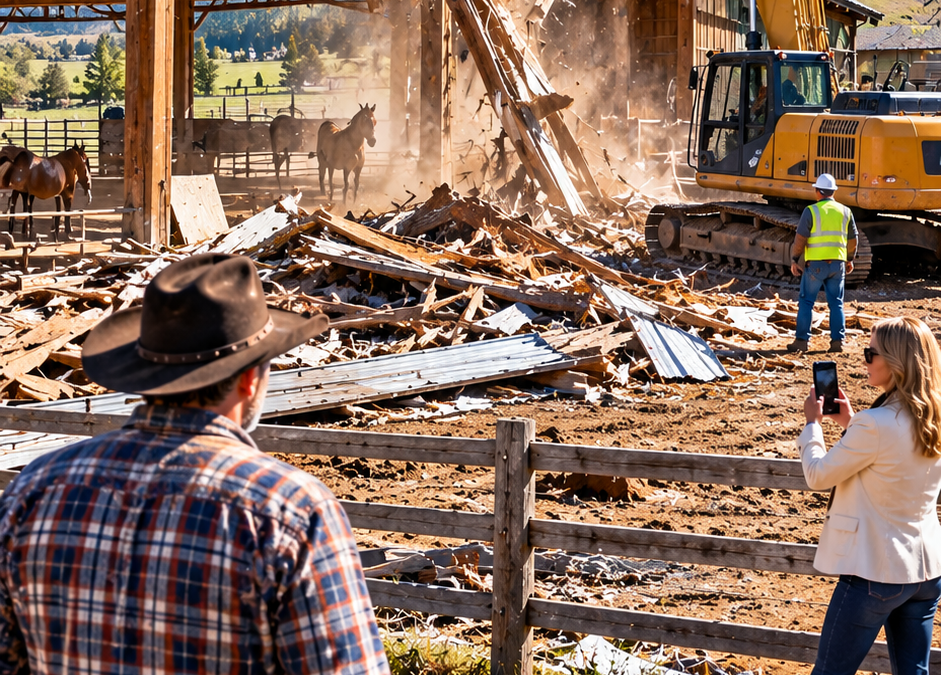
By the time I reached the arena, an excavator was already tearing through a piece of my family history while the woman who ordered it stood beside the fence filming as if she had every right to be there.
My name is Jack Holloway.
I was forty-eight years old that summer, and Holloway Creek Ranch had been in my family longer than Ridge View Estates had existed on any county map.
My grandfather bought the original acreage when the road beside us was still gravel.
My father grew up there.
So did I.
The ranch had never been glamorous.
We had no stone entrance.
No fountains.
No decorative ponds shaped by landscape architects.
No private security patrol driving slowly through the neighborhood after dark.
We had pasture.
Fences.
A creek that ran high after spring storms.
A weathered barn.
A few old cottonwoods.
And the horse arena my grandfather built with his own hands.
That arena was where I learned to ride.
It was where my father trained colts.
It was where my grandfather taught me that frightened animals usually needed patience more than force.
I remember being nine years old, sitting on a nervous bay gelding while Grandpa stood in the center of the ring.
My hands were shaking.
The horse could feel it.
Grandpa looked up at me and said, “You don’t have to pretend you’re not scared, Jack. You just have to stop letting fear make the decisions.”
I had forgotten that sentence for years.
I remembered it the morning Margaret Collins brought an excavator onto my land.
I was in the ranch house when I heard the machinery.
Heavy equipment has a particular sound when it does not belong.
The ranch was familiar enough that I knew every normal noise.
Tractor.
Feed truck.
Livestock trailer.
Neighbor’s mower.
The hydraulic growl coming from the east pasture was none of those.
I stepped onto the porch.
A cloud of brown dust hung above the fence.
Then came another crash.
I did not stop to call anyone.
I grabbed my boots, my phone, and the keys to my pickup.
The truck fishtailed slightly on the gravel as I drove toward the eastern field.
When I came over the rise, I hit the brakes.
Three contractor trucks were parked near my gate.
A section of fence had been pulled aside.
Inside my property was a yellow excavator.
And the horse arena was already half destroyed.
For several seconds, I could not understand what I was seeing.
The eastern wall was gone.
Two support posts leaned inward.
The roof above the tack side had collapsed.
One steel panel was twisted beneath the excavator bucket.
Dust moved across the field like smoke.
I shut off the truck.
The silence inside the cab felt heavier than the machine outside.
That arena had never been just wood and steel.
My grandfather had built the first version in the 1960s.
My father expanded it years later.
I had replaced roofing.
Repaired gates.
Repacked footing.
Added drainage.
Every generation changed something.
But the shape remained.
The old posts near the western end still carried marks where Grandpa measured my height as a child.
He used a carpenter’s pencil.
JACK — 8.
JACK — 11.
JACK — 14.
The last mark had an arrow beside it.
FINALLY TALL ENOUGH TO QUIT COMPLAINING.
I still laughed every time I saw it.
Now half the wall containing those marks lay beneath splintered boards.
Standing beside the excavator was Margaret Collins.
President of the Ridge View Estates Homeowners Association.
She wore an expensive cream-colored jacket, dark pants, sunglasses, and the expression of someone supervising a landscaping job she had paid for.
I got out of the truck.
“What are you doing?”
She did not turn.
“Removing an illegal structure.”
I thought I had misheard her.
“That’s my horse arena.”
“Not according to our records.”
“You didn’t call me.”
“We sent notices.”
“You sent HOA violation letters.”
“Correct.”
“I don’t belong to your HOA.”
That finally made her turn.
Margaret Collins was probably in her mid-fifties.
Polished.
Controlled.
The kind of person who could make an insult sound administrative.
“Your property is within the Ridge View development boundary.”
“No, it isn’t.”
She walked toward me.
“You have been repeatedly instructed to remove this eyesore.”
“It’s a private ranch arena.”
“It negatively affects the neighborhood.”
“The neighborhood ends at my fence.”
“Not according to our map.”
I looked at the excavator.
The operator had stopped moving.
He was watching us through the cab glass.
I pointed toward the machine.
“Shut it down.”
Margaret’s jaw tightened.
“Stop interfering with authorized contractors.”
“Get that machine off my land.”
“I’m warning you, Jack.”
“No, Margaret. I’m warning you.”
She looked over her shoulder.
Then made the decision that eventually cost Ridge View more than she could have imagined.
“Continue.”
The operator hesitated.
Margaret pointed.
“Keep going.”
The excavator arm moved.
I walked toward the machine.
Not under the bucket.
Not close enough to be struck.
But directly into the operator’s clear line of sight.
He stopped immediately.
Margaret shouted.
“Move!”
“No.”
“Get out of the way!”
“Tell your operator to leave.”
“You are obstructing lawful enforcement.”
“This is private property.”
“You have no proof.”
I stared at her.
“I have the deed.”
“Then take it to court.”
“I may take you there personally.”
She came closer.
“You have no idea who you’re dealing with.”
Then she jabbed one finger into my chest.
I knocked her hand away.
“Do not touch me.”
Her expression changed instantly.
“Officer!”
I looked toward the gate.
Two sheriff’s deputies were walking into the pasture.
Behind them came Sheriff Daniels.
I had called his office before about cattle on the road and one equipment theft years earlier.
He knew the ranch.
He knew me.
Margaret rushed toward him.
“Sheriff, arrest him.”
Sheriff Daniels stopped.
“For what?”
“He is obstructing an authorized demolition.”
Daniels looked toward the damaged arena.
Then toward me.
“Whose property are we standing on?”
Margaret answered before I could.
“HOA property.”
I laughed.
It came out sharper than I intended.
Margaret spun toward me.
“What?”
“You heard me.”
I went back to my truck and removed a document folder from the glove compartment.
My father had taught me to keep copies of important property records in two places.
Grandpa had taught him.
At the top was a certified copy of our deed.
I handed it to Daniels.
He read the legal description.
Margaret crossed her arms.
“That document does not override our subdivision map.”
Daniels looked at her.
“Who authorized the demolition?”
“The HOA board.”
“Show me.”
She opened a leather folder.
“We have complete authorization.”
Daniels looked through the documents.
Then he raised his head.
“Was a county building inspector here?”
“Our private inspector approved the removal.”
“Private inspector?”
“Yes.”
His expression hardened slightly.
Margaret noticed.
So did I.
He turned toward me.
“Jack, can you prove this is your property?”
“Yes.”
Then he looked at Margaret.
“And can you prove Ridge View owns the ground beneath that arena?”
She hesitated.
Only for a moment.
But that moment mattered.
“Our subdivision map clearly shows—”
“I didn’t ask what your map shows.”
Daniels looked directly at her.
“I asked who owns the ground.”
Margaret had no answer.
That was the first crack.
At the time, I thought it meant she had made a bad assumption.
I had no idea we were standing on top of an $8 million mistake.
Margaret finally told the contractors to stop.
The excavator operator looked relieved.
He backed away from the debris.
The trucks began turning toward the road.
Before Margaret left, she walked close enough that only I could hear her.
“You’ll pay for this.”
I looked past her at the broken arena.
“No.”
She smiled.
“You think that piece of paper is going to beat an entire HOA?”
I looked at the deed in Sheriff Daniels’s hand.
“Maybe not.”
Then I looked back at her.
“But my lawyer might.”
Her smile disappeared.
She walked to her SUV.
I watched her drive toward Ridge View.
Then I called Renee Castillo.
Renee had represented my family before.
She handled a boundary dispute involving the creek fifteen years earlier and helped my father update an agricultural access agreement.
She was the kind of attorney who never needed to raise her voice because she prepared too well to depend on volume.
She answered after two rings.
“Jack?”
“Renee, somebody just demolished half my arena.”
There was a pause.
“What do you mean somebody?”
“Ridge View HOA.”
Another pause.
This one longer.
“Start from the beginning.”
I told her.
The notices.
Margaret.
The excavator.
The sheriff.
The subdivision map.
When I finished, Renee asked one question.
“Did they actually damage the structure?”
“Yes.”
“How much?”
“Half the eastern side is down.”
“Did they enter through your ranch gate?”
“Yes.”
“Did Margaret personally claim the HOA owned the ground?”
“Yes.”
“Good.”
I stared at the wreckage.
“Good?”
“Do not repair anything.”
“Why?”
“Because right now the arena is not just damaged property.”
Her voice became quieter.
“It is evidence.”
Renee arrived two hours later.
She wore jeans, boots, and a navy raincoat.
The first thing she did was photograph the gate.
Then the tracks.
Then the fence.
Then every piece of the arena the excavator had touched.
She placed a measuring tape beside damaged posts.
Photographed the impressions left by the tracks.
Recorded where boards had fallen.
Took close-ups of bolts, fasteners, crushed railings, and broken footing.
I watched her for almost forty minutes.
Finally I asked, “Are we suing?”
She did not stop photographing.
“Maybe.”
“That sounds less certain than I expected.”
“A lawsuit is a tool.”
She stood.
“I’m more interested in knowing why an HOA president was confident enough to bring heavy equipment onto land your family has owned for decades.”
That afternoon, we spread every property document I could find across my kitchen table.
The 1958 deed.
A 1974 survey.
Tax records.
Agricultural records.
Fence receipts.
Insurance records.
Old aerial photographs.
My grandfather’s hand-drawn ranch maps.
Renee studied the old survey.
Then she picked up a current Ridge View map from Margaret’s folder.
She placed them beside each other.
“Jack.”
“What?”
“Come here.”
I stood beside her.
She pointed to the eastern boundary of Holloway Creek Ranch.
“Where does your survey put the line?”
I followed it.
“Along the old fence.”
“Correct.”
Then she moved her finger to the Ridge View subdivision map.
The HOA boundary extended west.
Deep into my property.
I leaned closer.
“How far?”
Renee found a ruler.
“Approximately seventy feet.”
“That’s impossible.”
“Why?”
“Because we never sold them seventy feet.”
She looked at me.
“Exactly.”
I sat down slowly.
The arena was located inside that seventy-foot strip.
According to our deed and survey, the arena was on Holloway Creek Ranch.
According to Ridge View’s amended map, it sat inside the subdivision.
“Can a map change ownership?” I asked.
“No.”
“Then how is this even possible?”
“That’s what we need to find out.”
Renee opened her laptop and searched the county property index.
“No deed.”
“Meaning?”
“I don’t see any recorded conveyance transferring this strip from the Holloway family.”
“Could there be another kind of document?”
“Easement? Annexation consent? Boundary-line agreement? Possibly.”
She kept searching.
“Nothing.”
Then she looked at the amended subdivision map.
“Seven years ago.”
I knew the period.
“That’s when Ridge View expanded.”
She nodded.
The original development had been smaller.
Then Ridge View added another phase of luxury homes along the eastern ridge.
I remembered construction trucks.
County meetings.
Survey flags.
I also remembered my father complaining that developers were getting too close to the ranch.
At the time, I assumed he simply disliked new houses.
“Who approved this amendment?” I asked.
“County planning.”
“Who submitted it?”
“Ridge View Estates.”
“And who owned the land they showed inside their new line?”
Renee looked at me.
“You.”
Silence filled the kitchen.
It was one of those moments when a problem grows larger while you are looking at it.
The HOA had not merely trespassed.
Its official subdivision map appeared to absorb part of my ranch despite no deed transferring ownership.
Then Renee found another document.
A development agreement connected to the seven-year-old expansion.
She read it.
Then read one paragraph again.
“What?”
She turned the laptop toward me.
“Estimated development value of the disputed strip.”
I followed the line.
$8,000,000.
For several seconds, I thought I had misunderstood.
“Eight million?”
“Projected development value.”
“For seventy feet?”
“Not just frontage. Look at the design.”
She opened another exhibit.
Several planned luxury lots depended on the disputed strip.
Access.
Setback calculations.
View corridors.
Infrastructure.
The arena occupied land Ridge View’s documents treated as available for future development.
“They weren’t trying to remove an eyesore,” I said.
Renee said nothing.
“They wanted the land.”
Her expression was serious.
“I’m not ready to say what they intended.”
“But?”
“The financial documents give them a reason to care about that boundary.”
That night, I walked through the damaged arena alone.
Renee had told me not to touch anything.
So I stepped around broken beams.
The sun was dropping behind the western fields.
Dust had settled over the footing.
One of the old gate panels leaned inward.
I found a small piece of wood beneath the collapsed wall.
Pencil marks.
JACK — 11.
A beam from the childhood height measurements.
It had split through the middle of my name.
I sat on an overturned bucket.
For years, I had treated the arena as though it were simply part of the ranch.
Always there.
Useful.
Familiar.
I had not understood how much of my grandfather remained inside it until someone started destroying it.
After his death, people told me grief faded.
That was never the right word.
Grief changes shape.
Some days it is heavy.
Other days you can carry it without thinking.
Then a machine tears through an old wall and suddenly you are nine years old again, hearing your grandfather tell you to keep your heels down and stop squeezing the reins.
I picked up the broken piece.
Then remembered Renee’s warning.
Evidence.
I put it back exactly where I found it.
The next morning, Margaret called.
“You need to meet with the board.”
“I have nothing to discuss.”
“You are interfering with an active Ridge View project.”
“On my ranch.”
“We have legal documentation.”
“So do I.”
“Your arena was unauthorized.”
“You destroyed private property.”
“You received notice.”
“You never had ownership.”
Silence.
Then Margaret said something I never forgot.
“Ownership isn’t always as simple as you think.”
I smiled.
“That’s almost exactly what my attorney said.”
She hung up.
Three hours later, Ridge View’s attorneys sent a formal demand letter.
It ordered me to stop interfering with the HOA boundary.
It threatened litigation.
It demanded access for inspection.
Renee read the letter in my kitchen.
Then she laughed.
I had rarely heard her laugh at legal correspondence.
“What?”
“They made a mistake.”
“What mistake?”
She tapped one paragraph.
“Their attorney just stated that the disputed land is essential to the Ridge View development plan.”
“So?”
“So now their own lawyer has tied the boundary dispute directly to the project.”
She slid the letter toward me.
“They put motive into the record.”
That afternoon, Renee requested certified county files.
Then she called David Mercer.
David was a licensed surveyor with almost thirty years of experience.
He spent two days studying the old plats.
On the third morning, he asked us to meet him at the county records office.
Six maps covered a conference table.
David stood at one end.
“Let’s make this simple.”
He pointed to the original Holloway Creek survey.
“Your ranch begins here.”
Then to the original Ridge View subdivision plat.
“Ridge View ended here.”
The two lines matched.
No overlap.
Then he placed the amended Ridge View map beside them.
Seven years later, the HOA boundary moved west.
Seventy feet.
Renee leaned closer.
“Who signed the amended plat?”
David pointed.
“The county planning director approved the subdivision filing.”
“Who submitted it?”
“Ridge View Estates HOA.”
“And who owned the affected strip?”
He looked at me.
“Holloway Creek Ranch.”
“So the county changed ownership?”
“No.”
“What did it change?”
“The map.”
Renee nodded.
“That’s the issue.”
David continued.
“A subdivision plat can describe land interests. It can create certain dedications when statutory requirements are met. But this file contains no deed from your family, no boundary agreement, no signed conveyance, and no owner consent that I can find for this seventy-foot strip.”
“So Ridge View drew its boundary across my land.”
“That appears to be what happened.”
Renee leaned back.
“And then acted as though the drawing transferred title.”
David nodded.
“That’s how I see it.”
We drove back to the ranch.
David spent most of the afternoon along the eastern fence.
Near a patch of tall grass, his metal detector sounded.
He knelt.
Dug carefully.
Then exposed an old metal monument.
He brushed away dirt.
His expression changed.
“What?”
He pointed to the stamped lettering.
HOLLOWAY CREEK RANCH.
My grandfather’s original boundary marker.
Still there.
Still seventy feet west of where Ridge View’s amended map claimed the ownership line sat.
Renee stood over it.
“That stays untouched.”
David nodded.
“I’ll document the coordinates.”
For the first time since the arena came down, I felt something other than anger.
Not relief.
Something steadier.
The marker had been buried for decades.
No speeches.
No board meetings.
No expensive HOA maps.
It did not care what Margaret believed.
It simply remained where the original survey placed it.
Renee filed for emergency injunctive relief that afternoon.
Ridge View responded aggressively.
Margaret arrived at the courthouse with three board members and two attorneys.
She wore a dark blue suit this time.
No sunglasses.
When she saw me in the hallway, she walked straight toward me.
“You’ve made a serious mistake.”
“No.”
“You have no idea what is at stake.”
I looked at her.
“Eight million dollars?”
Her face changed.
Just for a second.
It was enough.
I smiled.
“That’s what I thought.”
One of her attorneys immediately leaned close to her.
Margaret turned toward Renee.
“How did you get that number?”
Renee’s voice remained calm.
“Your documents.”
“You weren’t supposed to have those.”
“They were filed with the county.”
Margaret looked as though she wanted to say more.
Her attorney touched her arm.
She stopped.
The hearing began that afternoon.
Ridge View argued that the amended subdivision map established the relevant boundary.
Renee began with our deed.
Then the 1974 survey.
Then the county tax records.
Then David’s new boundary survey.
Finally, she put the Ridge View development documents on the table.
The judge spent several minutes reading.
Then he looked at the HOA attorney.
“Where is the deed transferring the property?”
The attorney paused.
“There is no separate deed, Your Honor.”
The courtroom became very quiet.
The judge looked at the amended map.
“So your position is that the subdivision amendment transferred ownership?”
“The HOA relied on the approved boundary.”
“That was not my question.”
The attorney shifted.
“The plat was accepted by the county.”
The judge looked toward Renee.
She stood.
“Your Honor, the amended map changed a boundary representation. It did not convey Mr. Holloway’s title.”
The judge looked back at Ridge View’s attorney.
“Where is the conveyance?”
Silence.
“Boundary agreement?”
“No, Your Honor.”
“Executed deed?”
“No.”
“Owner consent?”
The attorney hesitated.
“Not in a separate instrument.”
The judge removed his glasses.
“And yet your client authorized demolition of a structure on the disputed strip?”
The attorney began, “According to the approved map—”
“That is not what I asked.”
Silence again.
The judge turned toward me.
“Mr. Holloway, was this arena built before Ridge View Estates existed?”
“Yes, Your Honor.”
“How long has your family owned this parcel?”
“Since before the subdivision was created.”
“The arena?”
“My grandfather built the original structure decades ago. My father and I maintained it.”
“And title remained in your family?”
“Yes.”
The judge looked toward Margaret.
“Mrs. Collins, did the association verify title ownership before authorizing demolition?”
Margaret looked at her attorney.
The judge repeated the question.
“Did the HOA verify ownership of the ground beneath the arena?”
Margaret swallowed.
“Our inspector verified the HOA map.”
The judge’s expression hardened.
“You verified a map.”
“Yes.”
“Not title.”
Margaret did not answer.
The judge issued a temporary order stopping Ridge View from entering, developing, selling, grading, or altering the disputed strip until the title issue could be fully examined.
I thought that would be the end of the hearing.
Renee did not.
She stood again.
“One additional exhibit, Your Honor.”
She placed a financial projection on the clerk’s table.
The document showed planned luxury lots.
Projected infrastructure.
Sales forecasts.
Estimated profit.
Total projected value connected to the disputed development land:
Eight million dollars.
Ridge View’s attorney stood.
“Objection. Counsel is speculating as to motive.”
Renee shook her head.
“I’m not offering my speculation.”
She pointed toward the top of the document.
“This report was prepared by Ridge View’s development consultant.”
The judge accepted it for the limited purpose of understanding the development plan.
He read.
Then he looked directly at Margaret.
“Why was this property included in the project?”
She had stayed controlled all afternoon.
That was the moment she lost it.
“Because everyone knew that boundary belonged to Ridge View.”
The judge’s voice stayed calm.
“Everyone except the recorded owner.”
Margaret slammed one hand onto the table.
“This is ridiculous.”
“Mrs. Collins.”
“He is trying to take millions of dollars from our homeowners.”
I stood before Renee could stop me.
“Your HOA already took my land.”
Margaret pointed toward me.
“You don’t deserve that property.”
Renee turned.
“Margaret.”
“This man is manipulating everyone.”
Sheriff Daniels had been standing near the courtroom door.
He stepped forward.
“Mrs. Collins. Calm down.”
She turned on him.
“You’re taking his side too?”
Daniels looked toward the table covered in deeds, surveys, and county records.
“No.”
Then he said the sentence I would remember long after the hearing.
“I’m taking the law’s side.”
Margaret finally sat.
Weeks passed.
Experts reviewed the plats.
Title records were examined.
Old county approvals were pulled from storage.
Ridge View argued that the boundary amendment had been relied upon for years.
Renee never disputed that.
Reliance was not ownership.
A mistake repeated for seven years was still a mistake.
Eventually, the court issued its ruling.
The amended HOA map had not transferred title.
The seventy-foot strip belonged to Holloway Creek Ranch.
Ridge View had no deed.
No valid conveyance.
No owner consent.
No authority to demolish my arena.
The court ordered Ridge View to compensate me for the destroyed structure.
Repair damaged fencing.
Pay documented property losses.
And correct the records connected to the disputed boundary.
That alone would have been enough for me.
It was not the end.
Once the court confirmed the map problem, the county reopened the entire Ridge View boundary amendment.
Planning officials wanted to know how privately owned land had appeared inside an approved subdivision map without a corresponding deed.
Surveyors were brought in.
Title records were checked.
Then Ridge View homeowners began asking questions about their own lots.
Some found differences between their legal descriptions and HOA maps.
Others discovered easements they had never understood.
One board member resigned.
Then another.
County officials froze development approvals connected to the disputed area.
The luxury lots planned around my ranch never moved forward.
The eight-million-dollar development projection disappeared.
Margaret stopped answering calls.
Renee told me not to celebrate.
“Why?”
“Because there are homeowners over there who had nothing to do with what she did.”
I knew she was right.
That part was uncomfortable.
Ridge View was not one person.
Hundreds of families lived there.
Some had children.
Mortgages.
Retirement savings tied to property values.
Most had never seen the boundary amendment.
Most assumed their board had verified basic ownership before sending an excavator into someone else’s ranch.
I did not want their lives damaged because Margaret refused to ask the most important question before demolition.
Who actually owns this ground?
The settlement discussions reflected that.
I did not demand control of Ridge View.
I did not try to punish every resident.
I wanted the arena rebuilt.
The fence repaired.
My expenses covered.
And the title record corrected so no future board could point to the same map and begin the argument again.
Ridge View’s insurer covered portions of the structural damage.
The HOA paid additional documented costs.
The subdivision map was corrected.
A new survey was recorded.
The old Holloway Creek marker remained exactly where David found it.
I had it professionally exposed and protected.
Not moved.
Not replaced.
The original stayed.
Months later, construction began on the new arena.
The contractor asked if I wanted the replacement to look exactly like the old one.
I stood beside the pile of salvaged material.
“Mostly.”
“Mostly?”
I picked up one damaged beam.
The piece carrying part of my childhood height mark.
JACK — 11.
“This goes back.”
He examined the split.
“We can brace it. It shouldn’t carry a primary load.”
“Then put it somewhere visible.”
He nodded.
We reused every original beam that could safely remain.
The new structural members were stronger.
Drainage improved.
We replaced old wiring.
Widened one gate.
Added lighting my father would have complained was unnecessary.
But the basic shape remained.
Same orientation.
Same eastern entrance.
Same view across the pasture.
The day we raised the last major frame, I found myself thinking about my grandfather.
He never liked Ridge View.
Not because he hated people.
He hated the idea that neat landscaping automatically meant better land stewardship.
Whenever developers talked about improving the area, he would look across his pasture and say, “Improving it for whom?”
As a teenager, I thought that question was cynical.
At forty-eight, I understood it better.
The Ridge View expansion was not evil because it made money.
Development is not theft simply because someone profits.
People need homes.
Communities change.
Roads appear.
Land uses shift.
The problem begins when another person’s ownership becomes an inconvenience to be edited out of the plan.
That was what Margaret never understood.
Or refused to understand.
A line on a map is powerful.
But only when the law behind it is real.
One afternoon, while workers were finishing the new arena roof, Sheriff Daniels stopped by.
He stood beside the eastern gate.
“Looks good.”
“Better roof.”
“Your grandfather would complain.”
I laughed.
“Probably.”
Daniels walked toward the original boundary marker.
“You leaving that exposed?”
“Yes.”
“Most people would put a new monument in.”
“David put updated markers at the corners.”
I looked down at the old metal cap.
“This one stays.”
Daniels nodded.
“Reminds you?”
“Of what?”
“That maps aren’t ownership.”
I smiled.
“That too.”
He looked toward Ridge View.
The nearest homes were visible beyond the fence.
“You know, Margaret told everyone you were going to sue the HOA into bankruptcy.”
“I never wanted that.”
“I figured.”
He kicked lightly at the grass.
“She was convinced you were after the eight million.”
“That money never existed.”
“Projected value.”
“Exactly.”
I looked toward the rebuilt arena.
“I wanted what was already mine.”
That difference mattered.
For months, Ridge View had treated my refusal to surrender land as if I were demanding something from them.
I was not.
The ranch had belonged to my family before their neighborhood existed.
Keeping your own property is not the same thing as taking someone else’s opportunity.
Eventually, most homeowners understood that.
A few came to the ranch themselves.
One was an older man named Paul Greene.
He lived near the Ridge View entrance.
He arrived carrying a folder.
“I owe you an apology.”
“You don’t owe me anything.”
“I voted for Margaret.”
“That’s not a crime.”
“No.”
He looked uncomfortable.
“But I believed what she said about your arena.”
“What did she say?”
“That you built it after the subdivision expanded. That you knew it violated the boundary and refused to comply.”
I looked at him.
“The arena is older than Ridge View.”
“I know that now.”
He held out the folder.
Inside were copies of old HOA newsletters.
One article called my ranch an “unresolved edge parcel.”
Another described future “boundary integration.”
The language was careful.
No direct claim that I had agreed.
No deed.
Just repetition.
A story repeated often enough that residents eventually assumed ownership had already been settled.
Paul looked embarrassed.
“I never checked.”
“Why would you?”
He looked surprised.
“The board told you it was theirs.”
“Yes.”
“Most people don’t perform a title search every time an HOA president presents a map.”
His shoulders relaxed.
“What happens now?”
“The record gets corrected.”
“And the development?”
“That isn’t my decision.”
He looked toward the arena.
“Margaret said you destroyed eight million dollars in community value.”
“No.”
I shook my head.
“The plan depended on land Ridge View never owned.”
There is an important difference between losing something and discovering it was never yours.
Margaret had spent years treating those ideas as the same.
The new arena was finished in early spring.
On the first morning after the contractor left, I saddled a horse named Copper.
He was twelve.
Calm enough to forgive me for being out of practice.
I opened the eastern gate.
For several seconds, I stood there holding the reins.
The new boards were lighter than the old ones.
Steel brackets still shined.
The footing had not yet been fully packed by months of use.
But the shape was familiar.
I mounted.
Copper walked into the arena.
I could almost hear my grandfather.
Heels down.
Look where you’re going.
Stop fighting the horse.
I rode one slow circle.
Then another.
When I passed the western side, I saw the salvaged beam.
JACK — 11.
The contractor had mounted it beside the old gate.
Below the childhood mark, I had added one small brass plate.
BUILT BY HOLLOWAYS.
OWNED BY HOLLOWAYS.
I did not put Margaret’s name anywhere.
She did not deserve permanent space in my grandfather’s arena.
But I did keep one thing from the demolition.
A broken section of the original eastern rail.
The excavator bucket had split it lengthwise.
I mounted it in the tack room.
Not as a trophy.
Not because I wanted to remain angry.
Because forgetting is how bad assumptions become future facts.
If someone asked why it was there, I told them.
“An HOA once demolished half this arena because its map showed land it did not own.”
Most people laughed at first.
Then they realized I was serious.
After the legal case ended, I reviewed the notices Margaret had sent before demolition.
The language looked different now.
FINAL COMPLIANCE.
AUTHORIZED ENFORCEMENT.
BOUNDARY VIOLATION.
COMMUNITY STANDARDS.
Words designed to sound as though every question had already been answered.
None answered the only question that mattered.
Who owns the land?
Margaret had an HOA map.
I had a deed.
She had violation letters.
I had the recorded chain of title.
She had a private inspector.
I had the original survey monument.
She had confidence.
I had ownership.
Confidence feels powerful right up until someone asks for the document underneath it.
That became the lesson I carried from the entire dispute.
Not that HOAs are always wrong.
Not that developers are always dishonest.
Not that old documents are automatically superior to new ones.
The lesson was simpler.
Authority must come from somewhere.
A deed.
A statute.
A valid contract.
A court order.
Consent.
Not from repetition.
Not from a board title.
Not from the size of a development.
Not from the fact that one side can afford heavier equipment.
And certainly not because a line was drawn on a map.
One evening, months after the arena reopened, I walked the eastern fence.
The sun was dropping behind the ranch.
Ridge View’s rooftops caught the last orange light.
The neighborhood looked peaceful.
Families were eating dinner.
Kids were riding bikes.
Someone had a grill going.
I could hear a dog barking.
For all the conflict, it was still just a neighborhood full of people trying to live their lives.
I stopped beside my grandfather’s old boundary marker.
Most of the metal remained below ground.
Only the top showed.
HOLLOWAY CREEK RANCH.
I brushed grass away with my boot.
Margaret had once told me ownership was not as simple as I thought.
In a narrow sense, she was right.
Property law can become complicated.
Surveys conflict.
Descriptions are imperfect.
Roads move.
Rivers move.
Historical filings contain errors.
People die.
Records get lost.
Boundaries sometimes require experts and judges to interpret.
But she had used complexity as permission.
That was the mistake.
When the records are uncertain, you investigate.
You do not bulldoze first and demand that the owner prove himself afterward.
I thought again about the morning she brought the excavator.
The cream jacket.
The sunglasses.
The way she stood beside the machine as if the destruction were already legally settled.
“You’ll pay for this,” she had told me.
In one sense, she was right.
Someone paid.
The HOA paid for the damage.
Its insurer paid part.
The development plan lost the disputed land.
County officials spent months repairing records.
Board members lost positions.
Attorneys billed hours.
Surveyors returned to boundaries no one should have ignored.
But the largest cost was not financial.
It was credibility.
Once homeowners discovered the HOA had demolished a structure without verifying title, every old assumption became a question.
Every map had to be checked.
Every easement examined.
Every development promise reconsidered.
Trust takes years to build because it is made from hundreds of small moments when people do what they say they have the authority to do.
It can disappear in one morning.
One excavator.
One wrong boundary.
That was Margaret’s real $8 million mistake.
She believed the value of the proposed development made her claim stronger.
It did not.
It only made the failure to verify ownership more expensive.
I never enjoyed watching Ridge View’s project collapse.
That surprises some people.
They expect revenge to feel cleaner.
The truth is messier.
Workers lost contracts.
Residents became angry.
People who had nothing to do with Margaret’s decision had to sit through meetings and uncertainty.
I did not celebrate that.
What I celebrated was quieter.
The first time Copper’s hooves crossed the rebuilt arena footing.
The first time the eastern gate swung shut again.
The first rainstorm when the new roof did not leak.
The afternoon I rehung my grandfather’s old tack hooks.
The day David Mercer returned for the final survey verification and told me, “Everything is exactly where it belongs.”
Those things mattered.
Because they were restoration rather than punishment.
Years earlier, when I was sixteen, my grandfather and I replaced a fence along the creek.
I wanted to set the posts by eye.
He made me use a line.
I complained.
He ignored me.
Finally I said, “It’s just a fence.”
He stopped digging.
“No.”
He pointed toward the corner monument.
“The fence is where we think the line is. The monument tells us where the line actually is.”
I remember rolling my eyes.
Grandpa continued.
“If you build from what you think instead of what you know, every mistake after that gets farther from the truth.”
At sixteen, I thought he was talking about fence posts.
At forty-eight, I realized he had given me the entire Ridge View case in one sentence.
Margaret started with the wrong line.
Then every decision moved farther from the truth.
The violation letters.
The demolition order.
The development projection.
The claim that my arena was illegal.
The belief that the HOA map was equivalent to title.
Each new step depended on never returning to the first question.
Where is the actual boundary?
Once David found my grandfather’s marker, everything else began collapsing.
Not immediately.
Law does not usually move that way.
But steadily.
The original survey led to the deed.
The deed exposed the map problem.
The map problem exposed the development interest.
The development documents explained why the disputed land mattered.
The demolition showed Ridge View had acted before verifying ownership.
And Margaret’s own courtroom statements revealed how completely she had confused administrative confidence with legal authority.
My grandfather would have hated every meeting.
He distrusted conference rooms.
He said people only put water in tiny bottles when they planned to talk too long.
But he would have understood the final result.
The land stayed where it was.
The arena returned.
The marker remained.
That was enough.
A year later, I found another old photograph in the ranch house.
Grandpa stood inside the arena beside my father.
The original structure was little more than posts, rails, and a partial roof.
On the back, in Grandpa’s handwriting, were six words.
Build it right. Then maintain it.
I put the photograph in a frame.
It hangs inside the rebuilt tack room now.
Beside the broken rail.
Beside the childhood height marks.
People sometimes ask whether I would ever sell the disputed seventy-foot strip if another developer approached me.
The answer is not never.
Ownership includes the right to sell.
It includes the right to negotiate.
The right to say yes.
The right to say no.
That is exactly the point Margaret missed.
Maybe one day someone will bring me a legitimate proposal.
A fair price.
A proper survey.
A deed.
A real contract.
Maybe the ranch will change.
Everything changes eventually.
But no one gets to skip the part where the owner consents.
No map can replace that.
No HOA vote can replace it.
No development projection can replace it.
No excavator can manufacture it after the fact.
Some mornings I still ride through the eastern gate before breakfast.
The pasture is quiet.
The arena boards have weathered enough that the new construction no longer looks new.
Grass has grown back where the contractor trucks once parked.
Most of the tire marks are gone.
If you did not know what happened, you might never guess an excavator tore through the building.
Except for the old damaged beam.
I kept that visible.
JACK — 11.
The pencil mark is faded.
The wood is scarred.
But it is still there.
I like that.
My grandfather taught me that repair does not always mean hiding damage.
Sometimes the scar is part of what makes the repair worth respecting.
Every time I pass that beam, I remember the dust.
The machine.
Margaret standing beside it.
And the strange confidence in her voice when she told me the HOA map proved the land belonged to Ridge View.
She had already decided what was true.
She thought ownership followed the drawing.
She thought the county stamp on the subdivision plan outweighed decades of title.
She thought a rancher with an old arena would be easier to push aside than an $8 million development.
She thought wrong.
Not because I shouted louder.
Not because Sheriff Daniels chose me over her.
Not because Renee found some clever loophole.
She was wrong because the land had never been transferred.
My grandfather’s deed said so.
The old survey said so.
The county’s title records said so.
The buried boundary marker said so.
And eventually, after all the arguments and maps and lawyers were finished, the court said so too.
The morning Margaret demolished my arena, she believed she was clearing an obstacle.
What she actually did was expose the one question Ridge View should have answered before it ever drew the line.
Who owns this land?
The answer had been sitting beneath the grass for decades.
Holloway Creek Ranch.
It still is.

