The Lieutenant Looked at My Bare Ribbon Rack and Decided Who I Was Before He Ever Asked My Name
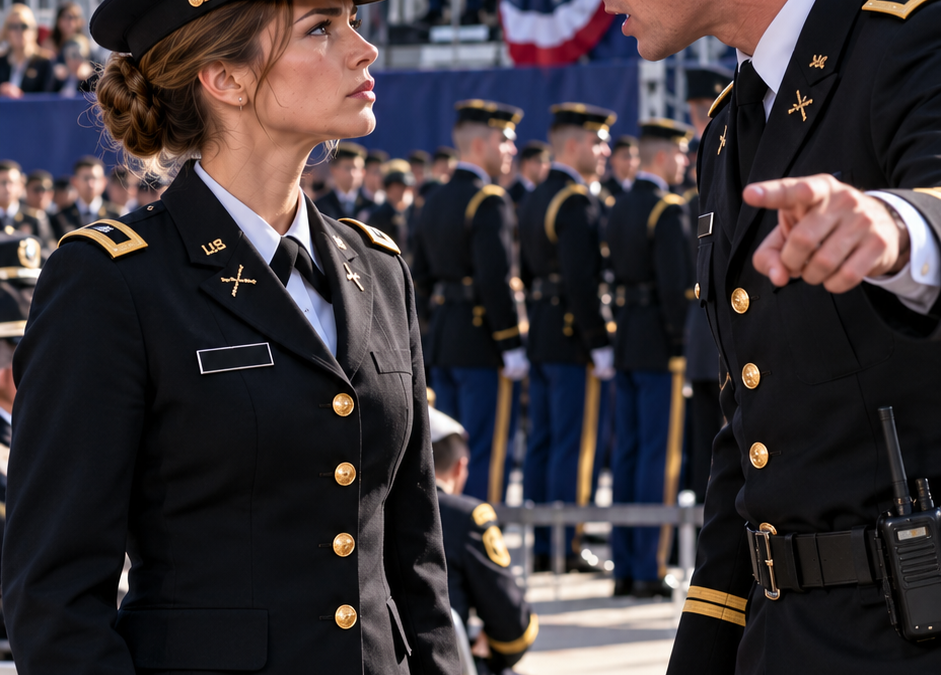
The Lieutenant Looked at My Bare Ribbon Rack and Decided Who I Was Before He Ever Asked My Name
The lieutenant looked at my uniform.
Then at my face.
Then back at the space on my chest where he apparently expected to see enough metal to justify my presence.
“Ma’am,” he said, lowering his voice as if he were trying to save me from embarrassment, “you need to leave this section.”
For a moment, I honestly thought I had misunderstood him.
Hundreds of soldiers were moving across the parade field behind us. Boots struck pavement in measured rhythm. Flags snapped in the North Carolina wind. Families leaned over barricades taking photographs. Commands carried sharply across the open ground.
Everything around me represented the institution I had given twelve years of my life to.
And yet I was standing inside Fort Liberty in my dress uniform, holding a formal invitation, while a young officer explained that I did not belong.
“Excuse me?”
He shifted his weight.
“This section is reserved for decorated officers and invited guests.”
I looked down at the invitation in my hand.
Then back at him.
“I am an invited guest.”
“I understand, ma’am.”
“Do you?”
His expression tightened.
A few soldiers nearby began pretending not to listen.
Anyone who has spent time in the military knows that particular kind of pretending.
Eyes straight.
Faces neutral.
Ears wide open.
The lieutenant lowered his voice another degree.
“I’m not trying to be disrespectful.”
That sentence has introduced a surprising amount of disrespect in my life.
I kept my voice calm.
“Then what exactly are you trying to do?”
“Avoid confusion.”
“What confusion?”
He hesitated.
His eyes moved over my uniform again.
My rank.
My nameplate.
My age.
My gender.
And finally the absence of the kind of visible decoration he apparently expected from someone seated near senior command.
That hesitation told me more than an explanation would have.
He had already decided what I was.
A relatively young female officer.
Probably inexperienced.
Probably invited because of somebody else.
Probably standing in the wrong place.
I had seen that calculation before.
“I’m Captain Emily Carter.”
That got a reaction.
Small.
But real.
“Captain?”
“Yes.”
He checked my nameplate as if I might have borrowed the uniform.
“Captain Carter, this section is for special recognition guests.”
“I know.”
“Then…”
He stopped.
Because there was no polite way to finish the sentence.
Then why don’t you look like one?
My name is Emily Carter.
I was thirty-four that morning.
I had served twelve years in the United States Army.
I joined partly because of my father.
He never pushed me toward the military. In fact, he did the opposite. He made sure I understood that wearing a uniform did not magically make someone honorable.
Dad had been an Army mechanic.
Never a senior officer.
Never a famous veteran.
Never the subject of newspaper stories or ceremonies.
He fixed engines, kept vehicles moving, came home with grease under his fingernails, and believed that most people talked too much about things they should simply do.
When I was seventeen and told him I wanted to enlist, he sat with me at the kitchen table for almost an hour.
Finally he said, “Emily, that uniform will not make you important.”
I remember being offended.
“I didn’t say it would.”
“You were thinking it.”
“I was not.”
He gave me that look fathers give daughters when both know the daughter is lying.
Then he said, “What you do while wearing it is what matters. Remember that.”
I did.
Through training.
Through deployments.
Through promotions.
Through every room where I was the youngest officer.
Through every briefing where someone assumed the man beside me was in charge.
Through every moment someone mistook quiet for uncertainty.
I learned that respect could not be demanded into existence.
It had to be earned.
And, if I am being completely truthful, I learned something else too.
Sometimes you can earn it and still not receive it.
That morning at Fort Liberty was supposed to be ceremonial.
Easy.
The base was recognizing soldiers whose actions during previous operations demonstrated unusual courage and leadership. General Nathan Brooks, the installation commander, would personally recognize several service members.
My name had been added to the guest list.
Not by me.
I would never have done it.
I almost declined the invitation.
Ceremonies made me uncomfortable.
Standing under lights while someone listed things I had done felt unnatural. I preferred finishing the work, signing the report, checking on my soldiers, and moving on.
But at the bottom of the invitation was one handwritten sentence.
Some heroes deserve to be remembered.
I had stared at it for several minutes.
I did not know who wrote it.
I assumed it referred to someone else.
That was my first mistake of the morning.
My second was believing I could arrive quietly.
I had come twenty minutes early.
The morning sun reflected off polished shoes, brass insignia, ceremonial sabers, and freshly pressed uniforms. Young soldiers stood in formation trying not to move. Children waved small flags. Veterans shook hands. Spouses took pictures.
It should have felt familiar.
Instead, after the lieutenant stopped me, the whole field seemed slightly different.
“Maybe there has been a mistake,” he said.
I smiled politely.
“Maybe.”
His shoulders loosened.
“Thank you for understanding.”
Then he pointed.
“The public seating is over there.”
I followed his hand.
Families.
Visitors.
Spectators.
I looked back at him.
“You want me to sit in public seating?”
“I’m just following protocol.”
That almost made me laugh.
I had spent twelve years following protocol.
I knew what it looked like.
This was not protocol.
This was an assumption wearing a uniform.
Before I answered, another officer approached.
A major.
Female.
Older than the lieutenant by at least ten years.
She looked from him to me.
“Problem?”
He straightened.
“Ma’am, Captain Carter says she’s assigned to special recognition seating.”
“I didn’t say assigned. I said invited.”
The major held out her hand.
“Invitation?”
I gave it to her.
She checked it.
Then looked at me.
“Identification?”
I handed that over too.
She examined it carefully before returning it.
“Everything appears correct.”
The lieutenant looked confused.
“So she can enter?”
The major glanced toward the stage.
“Command staff isn’t here yet.”
I understood immediately.
They wanted someone with enough authority to confirm that my paperwork meant what it clearly said.
I looked at both officers.
“How long?”
The major hesitated.
“Probably ten minutes.”
I could have argued.
I could have cited the invitation.
I could have asked for names.
Instead, I stepped away.
“I’ll stand.”
“Captain—”
“I’m fine.”
I moved toward the edge of the seating area.
I was not angry.
That distinction matters.
I was disappointed.
Anger burns hot and fast.
Disappointment settles deeper.
From where I stood, I watched young soldiers preparing for the ceremony.
Some looked barely old enough to shave.
Others stood with the practiced stillness of people already several years into service.
They reminded me of myself.
Ambitious.
Terrified.
Trying desperately not to look terrified.
Trying to prove they belonged.
I wondered how many of them had been told, directly or indirectly, that they did not.
How many women had walked into rooms and been mistaken for assistants.
How many young officers had been ignored until an older voice repeated their idea.
How many soldiers had been judged by an empty space on a uniform because the important things they had done were not stitched onto cloth.
The ceremony began.
Music rolled across the field.
Flags rose.
The crowd stood.
Then the announcer’s voice came through the speakers.
“Ladies and gentlemen, please welcome the commanding officer of Fort Liberty, General Nathan Brooks.”
Everything changed.
Soldiers straightened.
Officers saluted.
A line of senior commanders walked toward the platform.
Then I saw him.
Nathan Brooks.
Older.
More gray in his hair.
A general now.
But the eyes were the same.
I had not seen him in eight years.
Not since the mission.
Not since the night neither of us expected to survive.
For a second, the field disappeared.
I saw darkness.
Rain.
Metal twisted around a damaged vehicle.
Blood on my gloves.
Static coming through a dead radio.
Then the parade field returned.
General Brooks moved toward the platform.
I expected him to pass.
Why would he notice me?
There were hundreds of people present.
Eight years had passed.
I was one officer among many.
Then his eyes moved across the field.
Stopped.
His entire body stopped with them.
The officer beside him nearly took another step before realizing the general was no longer moving.
Brooks stared at me.
The lieutenant who had stopped me noticed.
The major noticed.
Everyone near the front noticed.
Generals do not freeze in the middle of formal ceremonies.
Not without a reason.
Then Nathan Brooks stepped away from the platform.
He began walking toward me.
The lieutenant looked from the general to me.
Then back again.
Brooks kept coming.
The crowd quieted gradually, confusion moving through it like wind through tall grass.
He stopped directly in front of me.
His eyes dropped briefly to my captain’s bars.
Then returned to my face.
His expression changed.
Recognition.
Memory.
Something heavier.
“Captain Carter.”
I saluted.
“General.”
For a moment, neither of us moved.
Then Nathan Brooks did something I never expected.
He raised his hand.
And saluted me first.
The field went silent.
I returned the salute automatically.
When he lowered his hand, his voice was quiet.
“Been a long time.”
“Yes, sir.”
“Eight years.”
“Yes, sir.”
Then he looked over my shoulder.
His eyes landed briefly on the lieutenant.
The young man’s face had lost most of its color.
General Brooks looked back at me.
“You were standing out here?”
“Yes, sir.”
“Why?”
I could have told him.
I could have embarrassed the lieutenant in front of hundreds of soldiers.
Instead, I said, “Seating confusion.”
Brooks studied me.
He knew me well enough to understand that answer contained more than it revealed.
Then he turned toward the audience.
“Everyone here should know something.”
My stomach dropped.
“Sir.”
He ignored me.
That was also familiar.
“Captain Emily Carter is the reason I am alive today.”
Silence.
Not polite ceremonial silence.
Shock.
I looked at him.
“General.”
His eyes softened.
“It’s time.”
I disagreed.
Strongly.
But I also knew that look.
Once Nathan Brooks decided something belonged to the mission rather than his ego, moving him was nearly impossible.
The lieutenant stood frozen.
The major stared at me.
Hundreds of people were looking our direction.
And suddenly I was no longer on a parade field.
I was twenty-six again.
Eight years earlier, Nathan Brooks was not a general.
He was Colonel Brooks.
My commander.
I had just been promoted to captain.
Young enough that half the people around me quietly wondered whether I was ready.
Old enough to know they were wondering.
Our mission was supposed to be straightforward.
Reconnaissance.
Small team.
Limited duration.
Quick extraction.
Nothing heroic.
Nothing worth remembering.
But anybody who has served long enough knows plans are clearest before the first unexpected thing happens.
Once boots hit the ground, certainty becomes expensive.
Communications problems started first.
Then weather.
Then unexpected resistance changed the route.
Extraction became uncertain.
The mission objective narrowed rapidly until the only thing that truly mattered was getting our people home.
Colonel Brooks had one rule he repeated so often we mocked him behind his back.
Nobody gets left behind.
He said it during briefings.
During training.
During movements.
Nobody.
Not one person.
Not ever.
That night, the temperature dropped hard.
Rain came sideways.
My team had lost reliable contact with command.
Radio traffic became static.
No updates.
No clear instruction.
Then we heard an explosion.
Less than a mile away.
Every person on my team stopped.
Nobody needed to say anything.
We knew.
We moved toward it.
The vehicle had taken severe damage.
Several soldiers were injured.
And Colonel Brooks was trapped.
Part of the vehicle structure had pinned his leg.
He was conscious.
Barely.
I dropped beside him.
“Sir?”
His eyes opened.
“Captain Carter.”
“Stay with me.”
He looked past me.
At the team.
Then at the surrounding terrain.
“Get them out.”
I thought I had misheard him.
“Sir?”
“That’s an order.”
We were exposed.
The weather was worsening.
Communications remained unreliable.
The correct tactical choice was obvious.
Move the mobile personnel.
Call for extraction.
Do not sacrifice an entire team for one trapped commander.
Brooks knew that.
I knew that.
Everybody knew it.
“Captain.”
His voice became sharper.
“Move your people.”
I looked at him.
He had spent months telling us leadership did not mean deciding which soldier mattered enough to save.
He had trained that idea into us.
Now, because he was the one trapped, he wanted an exception.
“No, sir.”
His eyes narrowed.
“What?”
“We’re getting you out.”
“Captain Carter, that is a direct order.”
“Yes, sir.”
“Then follow it.”
“No, sir.”
The soldiers nearest me went completely still.
It was the first time in my career I openly refused an order from a superior officer.
One of my soldiers whispered, “Emily.”
I stood.
“We’re taking him.”
“We don’t have time.”
“Then we make time.”
“Captain, the area is compromised.”
“I know.”
“So what are we doing?”
I looked at every face around me.
“We are doing what he trained us to do.”
Then I looked down at Brooks.
“Nobody gets left behind.”
For a moment, he seemed angry.
Then tired.
Then something close to resigned.
The next forty minutes felt like four hours.
We worked against damaged metal.
Cold rain.
Fatigue.
Every sound made us stop and listen.
Every movement beyond our visibility reminded us how vulnerable we were.
But my team kept working.
Not because Brooks was a colonel.
Because he was ours.
Rank stopped mattering the second his body became another injured body in the mud.
Eventually the weight shifted.
We freed his leg.
That should have felt like victory.
It was only the beginning.
He could not walk.
The extraction point remained far away.
So we carried him.
Not elegantly.
Not like the heroic images people imagine afterward.
We stumbled.
Slipped.
Changed positions.
Swore.
Breathed too hard.
Stopped when we had to.
Moved again.
At one point Brooks had an arm over my shoulder while another soldier supported him on the opposite side.
His weight felt impossible.
“Captain.”
“Still here, sir.”
“Why are you doing this?”
I almost laughed.
“Because you’re my soldier too.”
He looked at me.
I meant it.
He might have commanded the unit.
He might have outranked everyone around him.
But in that moment, he was a wounded soldier who needed us.
We reached extraction just before sunrise.
Everybody came home.
That was all I cared about.
The official report was almost boring.
Teamwork.
Coordination.
Recovery under adverse conditions.
Successful extraction.
No dramatic paragraph about refusing to leave.
No heroic description of carrying a commander through darkness.
That was partly my choice.
Mostly Brooks’s.
When he recovered, officers began talking about recognition.
Nathan Brooks shut it down.
“Do not turn this into a story about me.”
Someone argued that my actions required individual recognition.
He shook his head.
“Captain Carter saved my life.”
Then he looked around the room.
“But every soldier on that team brought me home.”
That was Brooks.
He understood how badly organizations want simple heroes.
One face.
One name.
One clean story.
Real missions are rarely clean.
The story disappeared.
Awards were offered.
I declined several.
Recognition events came.
I avoided them.
I told myself it was humility.
That was only partly true.
The deeper truth was that I had seen what happened when institutions became obsessed with individual heroes.
The team vanished.
The person on the poster became larger than the people who had stood beside them.
The soldiers who did not receive headlines began wondering if their part mattered.
I wanted none of that.
So I stayed quiet.
Eight years later, standing on the parade field, General Brooks apparently decided my silence had lasted long enough.
“The reason I am standing here today,” he told the crowd, “is because Captain Carter understood something every leader should understand.”
His eyes found mine.
“Rank does not make someone valuable.”
He paused.
“Character does.”
I wanted the earth to open.
Instead, the lieutenant who had stopped me stepped forward.
“Captain.”
I turned.
His face was red.
“Ma’am, I owe you an apology.”
I studied him.
He looked miserable.
“I thought…”
He stopped.
“Go on.”
“I thought you were in the wrong section.”
“I know.”
“I assumed…”
Again he stopped.
It was difficult watching him struggle because I knew the feeling.
The moment you realize your own judgment has betrayed you is uncomfortable.
It should be.
“I assumed you weren’t one of the recognition guests.”
“Yes.”
“I was wrong.”
“Yes.”
He looked surprised.
Perhaps he expected me to make it easier.
To tell him it was fine.
It was not fine.
But it also did not need to become cruelty.
“Everyone makes mistakes, Lieutenant.”
He nodded.
“The question is what you do after you realize you made one.”
“Yes, ma’am.”
General Brooks turned toward the crowd again.
“There’s something else you should know.”
I sighed.
“Sir.”
He almost smiled.
“Captain Carter has spent eight years refusing recognition.”
A few people laughed.
I did not.
“Sir.”
“She declined awards.”
I closed my eyes briefly.
“She refused ceremonies.”
More laughter.
“She asked that her name be removed from more than one public recognition event.”
Brooks looked directly at me.
“Why?”
He knew the answer.
He wanted me to say it.
I looked across the field.
Young soldiers.
Families.
Veterans.
People waiting.
“Because everyone came home.”
The field went quiet.
“That was enough.”
Brooks nodded slowly.
Then he reached inside his uniform.
He removed an old envelope.
My breath caught.
I recognized it before I understood why.
The paper was worn at the corners.
My name was written on the front.
In my handwriting.
“General…”
“I kept this.”
“What is it?”
“You really don’t remember?”
I opened the envelope.
The moment I saw the first line, memory returned.
I had written it after the mission.
When we still did not know whether complications would take someone from us later.
When I was exhausted enough to believe I might not have another chance to say what mattered.
If something happens to me, tell my team they did everything right.
Tell them I was proud to serve beside them.
Tell them the mission was never about medals.
It was always about people.
My eyes burned.
“I thought this was destroyed.”
“It wasn’t.”
Brooks looked toward the soldiers.
“I kept it because I wanted to remember something.”
His voice lowered.
“Not how close I came to dying.”
Then he looked at me.
“How close you came to losing everything and still thought first about your team.”
The applause started somewhere behind us.
I hated it.
And, for the first time, I also understood it.
Not every applause is worship.
Sometimes people are simply trying to say:
We saw what you did.
The ceremony continued.
I expected to return quietly to my seat.
Brooks had other plans.
Later, he called my name again.
“Captain Emily Carter, front and center.”
I muttered something under my breath.
The officer next to me almost smiled.
I walked forward.
Hundreds of people watched.
That morning, some of them had looked at me and wondered why I was there.
Now they were looking for a story.
Brooks waited until I stood beside him.
“Eight years ago, Captain Carter saved my life.”
He paused.
“But that is not why she is here today.”
I looked at him.
That surprised even me.
He continued.
“She is here because of what she did afterward.”
Afterward.
Nobody talked about that.
After the mission, attention came quickly.
Awards.
Transfer opportunities.
Positions with more prestige.
Brooks told the audience about one.
“Captain Carter was offered a transfer into a highly regarded command track.”
I knew exactly where he was going.
“Sir.”
“She refused.”
The lieutenant from earlier actually whispered, “Why?”
Brooks heard him.
“So did I.”
A few people laughed.
Brooks looked at me.
“Tell them.”
I took a slow breath.
“At the time, I had soldiers I believed still needed me.”
“That was your entire explanation.”
“It was enough.”
Brooks turned back to the crowd.
“She told me leadership was not always about moving higher.”
He paused.
“She said sometimes leadership means staying where you’re needed.”
That had been the sentence.
I had forgotten saying it.
Hearing it now made me uncomfortable because it sounded wiser than I remembered feeling.
The truth was simpler.
I loved training soldiers.
I loved watching someone arrive uncertain and leave capable.
I loved seeing a young private discover discipline.
A lieutenant learn humility.
A sergeant realize leadership did not mean volume.
Those things felt more important to me than another line on a biography.
Brooks reached toward the podium.
Another soldier approached carrying a framed document.
My stomach dropped.
“No.”
Brooks smiled.
“Yes.”
“Sir, we discussed this.”
“We did.”
“I was clear.”
“You were.”
“And?”
“I ignored you.”
The crowd laughed.
Even I smiled.
The framed document was placed in front of us.
Brooks’s tone shifted.
Formal.
“Captain Emily Carter.”
I straightened.
“Sir.”
“For extraordinary courage, leadership, and devotion to those under your command…”
I stared straight ahead.
“For refusing to abandon a wounded commander…”
My throat tightened.
“For placing the lives of others before personal recognition…”
I thought of the team.
Not myself.
“And for continuing to lead with integrity long after that mission ended…”
He paused.
“Fort Liberty recognizes your service.”
The applause came hard.
I barely heard it.
I saw faces.
Not the people standing in front of me.
People from eight years earlier.
Wet.
Exhausted.
Carrying Brooks beside me.
Those were the people who belonged on that stage.
Afterward, soldiers approached.
Veterans.
Spouses.
Families.
I shook hands until my palm hurt.
The lieutenant waited until almost everyone had left.
His name was Daniel Foster.
He stood several feet away until I noticed him.
“Lieutenant.”
“Captain Carter.”
His posture had changed.
Not afraid.
Respectful.
“I wanted to apologize again.”
“You already did.”
“I know.”
He swallowed.
“I want to do it correctly.”
That got my attention.
“All right.”
“I judged you before I knew anything about you.”
I waited.
“I saw that you were young.”
Nothing.
“And a woman.”
I appreciated the honesty.
“And you weren’t wearing the kind of medals I expected.”
He looked embarrassed.
“I decided you weren’t important.”
There it was.
A real apology.
Not an excuse.
I looked at him.
“Lieutenant Foster.”
“Yes, ma’am.”
“Never confuse appearance with experience.”
“I won’t.”
“And understand something else.”
“Yes?”
“Some of the best soldiers you will ever meet will never tell you what they have done.”
He listened closely.
“Not because they don’t have stories.”
I looked toward the field.
“Because they have too many.”
Later that evening, after most of the base had quieted, I sat near the memorial wall.
Flags moved gently in the wind.
Names filled the stone.
Those were the people I had always considered heroes.
People who did not get to stand through ceremonies.
People whose families received folded flags instead of invitations.
Brooks found me there.
Of course he did.
“You knew I’d come here.”
“Yes.”
He sat beside me.
For a while, we said nothing.
Then he asked, “Do you regret it?”
“What?”
“Staying silent all these years.”
I thought about that.
About being underestimated.
About being mistaken for someone else.
About declining awards.
About avoiding rooms where people wanted to say my name.
“No.”
He nodded.
“I expected that.”
“But…”
He looked over.
“But?”
I watched the flag above the memorial.
“I think I should have told one person.”
“Who?”
I smiled faintly.
“Myself.”
Brooks frowned.
“I spent a lot of years making sure everyone around me knew they mattered.”
I swallowed.
“I’m not sure I ever learned to say that about myself.”
The general became quiet.
Then he said, “There’s something else.”
I groaned.
“Sir.”
He laughed.
“This one is not a medal.”
“Good.”
He reached into a folder he had brought with him.
New.
Official-looking.
He handed it over.
Inside were letters.
Dozens.
I looked at him.
“What is this?”
“Read.”
The first was from a sergeant I had trained six years earlier.
Captain Carter believed in me before I believed in myself.
The second was from a former lieutenant.
She taught me that leadership means taking responsibility before taking credit.
Another:
I almost left the Army. Captain Carter convinced me that one bad leader did not define the whole institution.
Another:
She never asked us to do anything she wouldn’t do herself.
Another:
She remembered my wife’s name when my own chain of command forgot I was married.
My hands began trembling.
“Where did these come from?”
“Your old unit.”
“Why?”
Brooks smiled.
“They started collecting them years ago.”
“For what?”
“For today.”
I looked down.
“Why would they do that?”
“Because apparently everybody but you knew this day was coming.”
For the first time in years, I let myself feel proud.
Not superior.
Not heroic.
Proud.
There is a difference.
Then I noticed one letter that did not belong with the others.
Different envelope.
Different handwriting.
I read the name.
Sergeant Michael Reed.
My breathing stopped.
I knew that name.
Everyone from the operation knew it.
Michael had been twenty-three.
One of the youngest sergeants on the team.
Confident when people were watching.
Full of questions when they were not.
After the mission, he changed.
He became quiet.
Withdrew.
Eventually our paths separated.
I had not heard from him in years.
I looked at Brooks.
“Why is this here?”
His expression changed.
“Emily.”
“Why is Michael writing to me?”
“He asked me to keep something from you.”
My grip tightened on the letter.
“What?”
“He believed the mission was his fault.”
I stared.
“He was twenty-three.”
“I know.”
“He did not cause what happened.”
“He did not believe that.”
I opened the letter.
Captain Carter,
I don’t know if you will ever read this.
For eight years, I have rewritten these words in my head.
For eight years, I have wondered whether I was strong enough to say them.
But after hearing about the ceremony, I realized something.
You spent your career protecting people from burdens that were never theirs to carry.
So it’s time someone tried to do the same for you.
I looked up.
“What is he talking about?”
Brooks nodded toward the letter.
“Keep reading.”
You remember that night as the mission where you saved Colonel Brooks.
You remember refusing to leave him.
You remember carrying him.
I remember something else.
I remember almost giving up.
I stopped.
My mind returned to that night.
Michael.
Radio.
Static.
His face pale in the darkness.
The letter continued.
When the vehicle was hit, I was responsible for the communication problem.
I made the wrong call.
I believed for years that my mistake exposed the team.
I believed if I had been better, smarter, stronger, none of you would have been in that position.
I looked at Brooks.
“He blamed himself for all of it?”
“Yes.”
“Why didn’t anyone tell me?”
“He didn’t want you to know.”
“Why?”
“Because he thought you had already carried enough.”
I closed my eyes.
Michael had always said the same thing after the mission.
I’m fine, Captain.
The oldest lie in the military.
Sometimes the oldest lie among human beings.
I kept reading.
You never treated me like the mistake.
You never called me the reason things went wrong.
You treated me like a soldier.
You made me come to every debrief.
You made me lead again.
You trusted me before I trusted myself.
My eyes burned.
I remembered.
Michael avoiding eye contact.
Me assigning him responsibilities he did not want.
Him asking once, “Why are you doing this?”
Me answering, “Because you’re still here.”
I had forgotten.
He had not.
Captain Carter, you saved Colonel Brooks’s life that night.
But you saved mine afterward.
Not because you fixed what happened.
You couldn’t.
You taught me that leadership isn’t never making mistakes.
It is knowing that mistakes do not erase a person’s value.
I stopped reading.
The memorial wall blurred.
For eight years, I had thought the important part of that mission was physical.
Metal.
Cold.
Weight.
Extraction.
Survival.
But Michael remembered something else.
He remembered being allowed to remain part of the team after he believed he had failed it.
General Brooks sat quietly beside me.
Finally I said, “The mission wasn’t about me saving anybody.”
“No.”
“It was everybody saving everybody.”
“Yes.”
I folded the letter carefully.
“That’s why you wanted this ceremony.”
“Partly.”
“Partly?”
Brooks looked toward the empty field.
“We have a problem.”
“The Army?”
“Yes.”
“That narrows it down.”
He laughed.
Then became serious.
“We teach soldiers to fight.”
I waited.
“We teach them to survive.”
Nothing.
“We teach resilience.”
Another pause.
“But sometimes we are terrible at teaching them that their value survives failure.”
I thought about Michael.
Brooks continued.
“People think heroes are people who never struggle.”
He shook his head.
“They’re wrong.”
“What are they?”
“People who struggle and still find a way to carry someone else.”
A few days later, I returned to Fort Liberty.
This time, no one questioned my invitation.
That should have felt satisfying.
It mostly felt strange.
Lieutenant Foster found me near the administration building.
“Captain Carter.”
“Lieutenant.”
He stood straighter.
“I wanted to tell you something.”
“Go ahead.”
“I used to think respect came from rank.”
I watched him.
“Then I watched General Brooks salute you.”
“That isn’t why you should respect me.”
“I know.”
Good answer.
He continued.
“I realized respect comes from what people do when no one is watching.”
I nodded.
“That’s a better lesson.”
“I learned it from you.”
“No.”
He looked confused.
“You learned it from your mistake.”
I smiled slightly.
“Those lessons tend to stay longer.”
Months passed.
Life returned to something resembling normal.
Then Brooks invited me to another ceremony.
I nearly refused automatically.
The email sat open on my computer.
My finger hovered over decline.
Then I thought about Michael Reed.
About Daniel Foster.
About the young soldiers standing in formation that morning.
For years, I believed refusing recognition protected me from ego.
Sometimes it did.
But maybe I had confused invisibility with humility.
Being seen does not always mean making yourself the center.
Sometimes people need examples.
Sometimes the story is useful even if the person inside the story would rather remain quiet.
So I went.
The ceremony was smaller.
No press.
No huge crowd.
Mostly soldiers.
That helped.
Brooks stood at the front.
“Today we’re recognizing someone who has spent years trying not to be recognized.”
People laughed.
I shook my head.
“General.”
“Still true.”
Then his expression became serious.
“Captain Emily Carter represents something I want every soldier here to remember.”
He looked toward the youngest troops.
“Your value does not begin when someone notices you.”
Silence.
“It does not increase when someone applauds.”
He looked at me.
“And it does not disappear when someone overlooks you.”
Then he stepped away from the microphone.
“Captain.”
I stared at him.
“No.”
More laughter.
“Yes.”
“I did not agree to speak.”
“You showed up. I’m counting that as progress.”
I walked to the microphone.
Young soldiers watched me.
Some looked exactly like I had twelve years earlier.
Determined.
Nervous.
Trying desperately to become worthy of the uniform before realizing the uniform was only the beginning.
I thought about Lieutenant Foster looking at my chest and deciding I did not belong.
I thought about Brooks trapped beneath twisted metal.
Michael blaming himself.
The letters.
My father.
The sentence he had given me before I ever joined.
The uniform doesn’t make you important.
What you do while wearing it does.
I looked at the soldiers.
“When I joined the Army, I thought being strong meant never needing anyone.”
The room stayed quiet.
“I was wrong.”
I paused.
“Strength is knowing when someone else needs yours.”
I looked toward the younger troops.
“It is carrying someone when they cannot walk.”
“Speaking when someone else cannot.”
“Standing beside someone who thinks one mistake erased everything good about them.”
I thought about Michael.
“And sometimes…”
I took a breath.
“Sometimes strength means accepting help when you are the one who needs it.”
That sentence was the hardest.
Because it was the one I had spent twelve years avoiding.
After the ceremony, I walked alone toward the edge of the parade field.
The sun was setting.
The same place where months earlier I had been told I did not belong looked completely ordinary.
Grass.
Pavement.
Flags.
Buildings.
Nothing had changed.
Except me.
People might recognize me now.
Or not.
They might know the story.
Or forget it.
They might see ribbons.
Rank.
Gender.
Age.
Whatever they were trained by their own assumptions to notice first.
I could not control that.
For years, I thought quiet service meant not needing anyone else to know the truth.
Eventually, I learned something more difficult.
I needed to know it too.
I had spent so much time avoiding pride that I had almost turned self-erasure into a virtue.
That was not humility.
Humility does not require pretending your life had no value.
My father had never told me to disappear.
He told me the uniform did not create importance.
He never said the person inside it should deny what she had done.
Years later, people told the story in a simple way.
A young female captain arrived at a ceremony without enough visible decorations to impress the officers guarding the reserved section.
A lieutenant told her she did not belong.
Then the commanding general saw her, walked across the field, saluted her, and told everyone she had saved his life.
It is a good story.
Clean.
Satisfying.
The kind people like because judgment receives immediate correction.
But it is not the whole story.
The important moment did not happen when General Brooks saluted me.
It happened eight years earlier in freezing rain when a group of exhausted soldiers decided another human being was worth the effort of bringing home.
It happened afterward when Michael Reed believed one bad decision had destroyed his worth and somebody refused to let him disappear inside that belief.
It happened every time a soldier I trained found enough confidence to lead someone else.
It happened when Lieutenant Foster admitted the truth about why he had judged me.
And maybe it happened most quietly when I finally sat near a memorial wall and allowed myself to understand that I mattered too.
Heroes do not always look impressive.
Some never tell you what happened.
Some wear fewer medals because they declined the ceremony.
Some stand at the back.
Some make mistakes.
Some need to be carried.
Some spend years believing they failed before realizing the people beside them never defined them by that failure.
Leadership is not being the person everyone notices.
It is making sure the people no one notices understand that they still count.
That is what Brooks taught me.
What Michael taught me.
What my father had been trying to tell me from the beginning.
And when the sun went down over Fort Liberty that evening, I stood on the same field where someone had once decided I did not belong.
I no longer felt the need to prove him wrong.
The general’s salute had not made me worthy.
The ceremony had not made me worthy.
The letters had not made me worthy.
They had only forced me to finally see what had already been true.
I knew who I was.
I knew what I had done.
And, more importantly, I knew why I had done it.
Not for ribbons.
Not for applause.
Not so a general would someday say my name in front of hundreds of people.
I had done it because when another person could not walk, someone had to help carry them.
Because when a young soldier believed one mistake had ended his value, someone had to stand beside him long enough for him to learn otherwise.
Because everybody matters before anyone notices.
I adjusted my jacket and started walking back toward the parking lot.
No crowd.
No music.
No one watching.
That was fine.
Some of the most important moments of my life had happened exactly that way.
And for the first time, I did not need invisibility to prove they were real.
What do you think of this story? Please leave a like and share your thoughts in the comments. Your support means a lot to us and inspires us to keep writing more meaningful and powerful stories. Thank you! 👍
𝗧𝗛𝗘 𝗘𝗡𝗗
The Lieutenant Looked at My Bare Ribbon Rack and Decided Who I Was Before He Ever Asked My Name
The lieutenant looked at my uniform.
Then at my face.
Then back at the space on my chest where he apparently expected to see enough metal to justify my presence.
“Ma’am,” he said, lowering his voice as if he were trying to save me from embarrassment, “you need to leave this section.”
For a moment, I honestly thought I had misunderstood him.
Hundreds of soldiers were moving across the parade field behind us. Boots struck pavement in measured rhythm. Flags snapped in the North Carolina wind. Families leaned over barricades taking photographs. Commands carried sharply across the open ground.
Everything around me represented the institution I had given twelve years of my life to.
And yet I was standing inside Fort Liberty in my dress uniform, holding a formal invitation, while a young officer explained that I did not belong.
“Excuse me?”
He shifted his weight.
“This section is reserved for decorated officers and invited guests.”
I looked down at the invitation in my hand.
Then back at him.
“I am an invited guest.”
“I understand, ma’am.”
“Do you?”
His expression tightened.
A few soldiers nearby began pretending not to listen.
Anyone who has spent time in the military knows that particular kind of pretending.
Eyes straight.
Faces neutral.
Ears wide open.
The lieutenant lowered his voice another degree.
“I’m not trying to be disrespectful.”
That sentence has introduced a surprising amount of disrespect in my life.
I kept my voice calm.
“Then what exactly are you trying to do?”
“Avoid confusion.”
“What confusion?”
He hesitated.
His eyes moved over my uniform again.
My rank.
My nameplate.
My age.
My gender.
And finally the absence of the kind of visible decoration he apparently expected from someone seated near senior command.
That hesitation told me more than an explanation would have.
He had already decided what I was.
A relatively young female officer.
Probably inexperienced.
Probably invited because of somebody else.
Probably standing in the wrong place.
I had seen that calculation before.
“I’m Captain Emily Carter.”
That got a reaction.
Small.
But real.
“Captain?”
“Yes.”
He checked my nameplate as if I might have borrowed the uniform.
“Captain Carter, this section is for special recognition guests.”
“I know.”
“Then…”
He stopped.
Because there was no polite way to finish the sentence.
Then why don’t you look like one?
My name is Emily Carter.
I was thirty-four that morning.
I had served twelve years in the United States Army.
I joined partly because of my father.
He never pushed me toward the military. In fact, he did the opposite. He made sure I understood that wearing a uniform did not magically make someone honorable.
Dad had been an Army mechanic.
Never a senior officer.
Never a famous veteran.
Never the subject of newspaper stories or ceremonies.
He fixed engines, kept vehicles moving, came home with grease under his fingernails, and believed that most people talked too much about things they should simply do.
When I was seventeen and told him I wanted to enlist, he sat with me at the kitchen table for almost an hour.
Finally he said, “Emily, that uniform will not make you important.”
I remember being offended.
“I didn’t say it would.”
“You were thinking it.”
“I was not.”
He gave me that look fathers give daughters when both know the daughter is lying.
Then he said, “What you do while wearing it is what matters. Remember that.”
I did.
Through training.
Through deployments.
Through promotions.
Through every room where I was the youngest officer.
Through every briefing where someone assumed the man beside me was in charge.
Through every moment someone mistook quiet for uncertainty.
I learned that respect could not be demanded into existence.
It had to be earned.
And, if I am being completely truthful, I learned something else too.
Sometimes you can earn it and still not receive it.
That morning at Fort Liberty was supposed to be ceremonial.
Easy.
The base was recognizing soldiers whose actions during previous operations demonstrated unusual courage and leadership. General Nathan Brooks, the installation commander, would personally recognize several service members.
My name had been added to the guest list.
Not by me.
I would never have done it.
I almost declined the invitation.
Ceremonies made me uncomfortable.
Standing under lights while someone listed things I had done felt unnatural. I preferred finishing the work, signing the report, checking on my soldiers, and moving on.
But at the bottom of the invitation was one handwritten sentence.
Some heroes deserve to be remembered.
I had stared at it for several minutes.
I did not know who wrote it.
I assumed it referred to someone else.
That was my first mistake of the morning.
My second was believing I could arrive quietly.
I had come twenty minutes early.
The morning sun reflected off polished shoes, brass insignia, ceremonial sabers, and freshly pressed uniforms. Young soldiers stood in formation trying not to move. Children waved small flags. Veterans shook hands. Spouses took pictures.
It should have felt familiar.
Instead, after the lieutenant stopped me, the whole field seemed slightly different.
“Maybe there has been a mistake,” he said.
I smiled politely.
“Maybe.”
His shoulders loosened.
“Thank you for understanding.”
Then he pointed.
“The public seating is over there.”
I followed his hand.
Families.
Visitors.
Spectators.
I looked back at him.
“You want me to sit in public seating?”
“I’m just following protocol.”
That almost made me laugh.
I had spent twelve years following protocol.
I knew what it looked like.
This was not protocol.
This was an assumption wearing a uniform.
Before I answered, another officer approached.
A major.
Female.
Older than the lieutenant by at least ten years.
She looked from him to me.
“Problem?”
He straightened.
“Ma’am, Captain Carter says she’s assigned to special recognition seating.”
“I didn’t say assigned. I said invited.”
The major held out her hand.
“Invitation?”
I gave it to her.
She checked it.
Then looked at me.
“Identification?”
I handed that over too.
She examined it carefully before returning it.
“Everything appears correct.”
The lieutenant looked confused.
“So she can enter?”
The major glanced toward the stage.
“Command staff isn’t here yet.”
I understood immediately.
They wanted someone with enough authority to confirm that my paperwork meant what it clearly said.
I looked at both officers.
“How long?”
The major hesitated.
“Probably ten minutes.”
I could have argued.
I could have cited the invitation.
I could have asked for names.
Instead, I stepped away.
“I’ll stand.”
“Captain—”
“I’m fine.”
I moved toward the edge of the seating area.
I was not angry.
That distinction matters.
I was disappointed.
Anger burns hot and fast.
Disappointment settles deeper.
From where I stood, I watched young soldiers preparing for the ceremony.
Some looked barely old enough to shave.
Others stood with the practiced stillness of people already several years into service.
They reminded me of myself.
Ambitious.
Terrified.
Trying desperately not to look terrified.
Trying to prove they belonged.
I wondered how many of them had been told, directly or indirectly, that they did not.
How many women had walked into rooms and been mistaken for assistants.
How many young officers had been ignored until an older voice repeated their idea.
How many soldiers had been judged by an empty space on a uniform because the important things they had done were not stitched onto cloth.
The ceremony began.
Music rolled across the field.
Flags rose.
The crowd stood.
Then the announcer’s voice came through the speakers.
“Ladies and gentlemen, please welcome the commanding officer of Fort Liberty, General Nathan Brooks.”
Everything changed.
Soldiers straightened.
Officers saluted.
A line of senior commanders walked toward the platform.
Then I saw him.
Nathan Brooks.
Older.
More gray in his hair.
A general now.
But the eyes were the same.
I had not seen him in eight years.
Not since the mission.
Not since the night neither of us expected to survive.
For a second, the field disappeared.
I saw darkness.
Rain.
Metal twisted around a damaged vehicle.
Blood on my gloves.
Static coming through a dead radio.
Then the parade field returned.
General Brooks moved toward the platform.
I expected him to pass.
Why would he notice me?
There were hundreds of people present.
Eight years had passed.
I was one officer among many.
Then his eyes moved across the field.
Stopped.
His entire body stopped with them.
The officer beside him nearly took another step before realizing the general was no longer moving.
Brooks stared at me.
The lieutenant who had stopped me noticed.
The major noticed.
Everyone near the front noticed.
Generals do not freeze in the middle of formal ceremonies.
Not without a reason.
Then Nathan Brooks stepped away from the platform.
He began walking toward me.
The lieutenant looked from the general to me.
Then back again.
Brooks kept coming.
The crowd quieted gradually, confusion moving through it like wind through tall grass.
He stopped directly in front of me.
His eyes dropped briefly to my captain’s bars.
Then returned to my face.
His expression changed.
Recognition.
Memory.
Something heavier.
“Captain Carter.”
I saluted.
“General.”
For a moment, neither of us moved.
Then Nathan Brooks did something I never expected.
He raised his hand.
And saluted me first.
The field went silent.
I returned the salute automatically.
When he lowered his hand, his voice was quiet.
“Been a long time.”
“Yes, sir.”
“Eight years.”
“Yes, sir.”
Then he looked over my shoulder.
His eyes landed briefly on the lieutenant.
The young man’s face had lost most of its color.
General Brooks looked back at me.
“You were standing out here?”
“Yes, sir.”
“Why?”
I could have told him.
I could have embarrassed the lieutenant in front of hundreds of soldiers.
Instead, I said, “Seating confusion.”
Brooks studied me.
He knew me well enough to understand that answer contained more than it revealed.
Then he turned toward the audience.
“Everyone here should know something.”
My stomach dropped.
“Sir.”
He ignored me.
That was also familiar.
“Captain Emily Carter is the reason I am alive today.”
Silence.
Not polite ceremonial silence.
Shock.
I looked at him.
“General.”
His eyes softened.
“It’s time.”
I disagreed.
Strongly.
But I also knew that look.
Once Nathan Brooks decided something belonged to the mission rather than his ego, moving him was nearly impossible.
The lieutenant stood frozen.
The major stared at me.
Hundreds of people were looking our direction.
And suddenly I was no longer on a parade field.
I was twenty-six again.
Eight years earlier, Nathan Brooks was not a general.
He was Colonel Brooks.
My commander.
I had just been promoted to captain.
Young enough that half the people around me quietly wondered whether I was ready.
Old enough to know they were wondering.
Our mission was supposed to be straightforward.
Reconnaissance.
Small team.
Limited duration.
Quick extraction.
Nothing heroic.
Nothing worth remembering.
But anybody who has served long enough knows plans are clearest before the first unexpected thing happens.
Once boots hit the ground, certainty becomes expensive.
Communications problems started first.
Then weather.
Then unexpected resistance changed the route.
Extraction became uncertain.
The mission objective narrowed rapidly until the only thing that truly mattered was getting our people home.
Colonel Brooks had one rule he repeated so often we mocked him behind his back.
Nobody gets left behind.
He said it during briefings.
During training.
During movements.
Nobody.
Not one person.
Not ever.
That night, the temperature dropped hard.
Rain came sideways.
My team had lost reliable contact with command.
Radio traffic became static.
No updates.
No clear instruction.
Then we heard an explosion.
Less than a mile away.
Every person on my team stopped.
Nobody needed to say anything.
We knew.
We moved toward it.
The vehicle had taken severe damage.
Several soldiers were injured.
And Colonel Brooks was trapped.
Part of the vehicle structure had pinned his leg.
He was conscious.
Barely.
I dropped beside him.
“Sir?”
His eyes opened.
“Captain Carter.”
“Stay with me.”
He looked past me.
At the team.
Then at the surrounding terrain.
“Get them out.”
I thought I had misheard him.
“Sir?”
“That’s an order.”
We were exposed.
The weather was worsening.
Communications remained unreliable.
The correct tactical choice was obvious.
Move the mobile personnel.
Call for extraction.
Do not sacrifice an entire team for one trapped commander.
Brooks knew that.
I knew that.
Everybody knew it.
“Captain.”
His voice became sharper.
“Move your people.”
I looked at him.
He had spent months telling us leadership did not mean deciding which soldier mattered enough to save.
He had trained that idea into us.
Now, because he was the one trapped, he wanted an exception.
“No, sir.”
His eyes narrowed.
“What?”
“We’re getting you out.”
“Captain Carter, that is a direct order.”
“Yes, sir.”
“Then follow it.”
“No, sir.”
The soldiers nearest me went completely still.
It was the first time in my career I openly refused an order from a superior officer.
One of my soldiers whispered, “Emily.”
I stood.
“We’re taking him.”
“We don’t have time.”
“Then we make time.”
“Captain, the area is compromised.”
“I know.”
“So what are we doing?”
I looked at every face around me.
“We are doing what he trained us to do.”
Then I looked down at Brooks.
“Nobody gets left behind.”
For a moment, he seemed angry.
Then tired.
Then something close to resigned.
The next forty minutes felt like four hours.
We worked against damaged metal.
Cold rain.
Fatigue.
Every sound made us stop and listen.
Every movement beyond our visibility reminded us how vulnerable we were.
But my team kept working.
Not because Brooks was a colonel.
Because he was ours.
Rank stopped mattering the second his body became another injured body in the mud.
Eventually the weight shifted.
We freed his leg.
That should have felt like victory.
It was only the beginning.
He could not walk.
The extraction point remained far away.
So we carried him.
Not elegantly.
Not like the heroic images people imagine afterward.
We stumbled.
Slipped.
Changed positions.
Swore.
Breathed too hard.
Stopped when we had to.
Moved again.
At one point Brooks had an arm over my shoulder while another soldier supported him on the opposite side.
His weight felt impossible.
“Captain.”
“Still here, sir.”
“Why are you doing this?”
I almost laughed.
“Because you’re my soldier too.”
He looked at me.
I meant it.
He might have commanded the unit.
He might have outranked everyone around him.
But in that moment, he was a wounded soldier who needed us.
We reached extraction just before sunrise.
Everybody came home.
That was all I cared about.
The official report was almost boring.
Teamwork.
Coordination.
Recovery under adverse conditions.
Successful extraction.
No dramatic paragraph about refusing to leave.
No heroic description of carrying a commander through darkness.
That was partly my choice.
Mostly Brooks’s.
When he recovered, officers began talking about recognition.
Nathan Brooks shut it down.
“Do not turn this into a story about me.”
Someone argued that my actions required individual recognition.
He shook his head.
“Captain Carter saved my life.”
Then he looked around the room.
“But every soldier on that team brought me home.”
That was Brooks.
He understood how badly organizations want simple heroes.
One face.
One name.
One clean story.
Real missions are rarely clean.
The story disappeared.
Awards were offered.
I declined several.
Recognition events came.
I avoided them.
I told myself it was humility.
That was only partly true.
The deeper truth was that I had seen what happened when institutions became obsessed with individual heroes.
The team vanished.
The person on the poster became larger than the people who had stood beside them.
The soldiers who did not receive headlines began wondering if their part mattered.
I wanted none of that.
So I stayed quiet.
Eight years later, standing on the parade field, General Brooks apparently decided my silence had lasted long enough.
“The reason I am standing here today,” he told the crowd, “is because Captain Carter understood something every leader should understand.”
His eyes found mine.
“Rank does not make someone valuable.”
He paused.
“Character does.”
I wanted the earth to open.
Instead, the lieutenant who had stopped me stepped forward.
“Captain.”
I turned.
His face was red.
“Ma’am, I owe you an apology.”
I studied him.
He looked miserable.
“I thought…”
He stopped.
“Go on.”
“I thought you were in the wrong section.”
“I know.”
“I assumed…”
Again he stopped.
It was difficult watching him struggle because I knew the feeling.
The moment you realize your own judgment has betrayed you is uncomfortable.
It should be.
“I assumed you weren’t one of the recognition guests.”
“Yes.”
“I was wrong.”
“Yes.”
He looked surprised.
Perhaps he expected me to make it easier.
To tell him it was fine.
It was not fine.
But it also did not need to become cruelty.
“Everyone makes mistakes, Lieutenant.”
He nodded.
“The question is what you do after you realize you made one.”
“Yes, ma’am.”
General Brooks turned toward the crowd again.
“There’s something else you should know.”
I sighed.
“Sir.”
He almost smiled.
“Captain Carter has spent eight years refusing recognition.”
A few people laughed.
I did not.
“Sir.”
“She declined awards.”
I closed my eyes briefly.
“She refused ceremonies.”
More laughter.
“She asked that her name be removed from more than one public recognition event.”
Brooks looked directly at me.
“Why?”
He knew the answer.
He wanted me to say it.
I looked across the field.
Young soldiers.
Families.
Veterans.
People waiting.
“Because everyone came home.”
The field went quiet.
“That was enough.”
Brooks nodded slowly.
Then he reached inside his uniform.
He removed an old envelope.
My breath caught.
I recognized it before I understood why.
The paper was worn at the corners.
My name was written on the front.
In my handwriting.
“General…”
“I kept this.”
“What is it?”
“You really don’t remember?”
I opened the envelope.
The moment I saw the first line, memory returned.
I had written it after the mission.
When we still did not know whether complications would take someone from us later.
When I was exhausted enough to believe I might not have another chance to say what mattered.
If something happens to me, tell my team they did everything right.
Tell them I was proud to serve beside them.
Tell them the mission was never about medals.
It was always about people.
My eyes burned.
“I thought this was destroyed.”
“It wasn’t.”
Brooks looked toward the soldiers.
“I kept it because I wanted to remember something.”
His voice lowered.
“Not how close I came to dying.”
Then he looked at me.
“How close you came to losing everything and still thought first about your team.”
The applause started somewhere behind us.
I hated it.
And, for the first time, I also understood it.
Not every applause is worship.
Sometimes people are simply trying to say:
We saw what you did.
The ceremony continued.
I expected to return quietly to my seat.
Brooks had other plans.
Later, he called my name again.
“Captain Emily Carter, front and center.”
I muttered something under my breath.
The officer next to me almost smiled.
I walked forward.
Hundreds of people watched.
That morning, some of them had looked at me and wondered why I was there.
Now they were looking for a story.
Brooks waited until I stood beside him.
“Eight years ago, Captain Carter saved my life.”
He paused.
“But that is not why she is here today.”
I looked at him.
That surprised even me.
He continued.
“She is here because of what she did afterward.”
Afterward.
Nobody talked about that.
After the mission, attention came quickly.
Awards.
Transfer opportunities.
Positions with more prestige.
Brooks told the audience about one.
“Captain Carter was offered a transfer into a highly regarded command track.”
I knew exactly where he was going.
“Sir.”
“She refused.”
The lieutenant from earlier actually whispered, “Why?”
Brooks heard him.
“So did I.”
A few people laughed.
Brooks looked at me.
“Tell them.”
I took a slow breath.
“At the time, I had soldiers I believed still needed me.”
“That was your entire explanation.”
“It was enough.”
Brooks turned back to the crowd.
“She told me leadership was not always about moving higher.”
He paused.
“She said sometimes leadership means staying where you’re needed.”
That had been the sentence.
I had forgotten saying it.
Hearing it now made me uncomfortable because it sounded wiser than I remembered feeling.
The truth was simpler.
I loved training soldiers.
I loved watching someone arrive uncertain and leave capable.
I loved seeing a young private discover discipline.
A lieutenant learn humility.
A sergeant realize leadership did not mean volume.
Those things felt more important to me than another line on a biography.
Brooks reached toward the podium.
Another soldier approached carrying a framed document.
My stomach dropped.
“No.”
Brooks smiled.
“Yes.”
“Sir, we discussed this.”
“We did.”
“I was clear.”
“You were.”
“And?”
“I ignored you.”
The crowd laughed.
Even I smiled.
The framed document was placed in front of us.
Brooks’s tone shifted.
Formal.
“Captain Emily Carter.”
I straightened.
“Sir.”
“For extraordinary courage, leadership, and devotion to those under your command…”
I stared straight ahead.
“For refusing to abandon a wounded commander…”
My throat tightened.
“For placing the lives of others before personal recognition…”
I thought of the team.
Not myself.
“And for continuing to lead with integrity long after that mission ended…”
He paused.
“Fort Liberty recognizes your service.”
The applause came hard.
I barely heard it.
I saw faces.
Not the people standing in front of me.
People from eight years earlier.
Wet.
Exhausted.
Carrying Brooks beside me.
Those were the people who belonged on that stage.
Afterward, soldiers approached.
Veterans.
Spouses.
Families.
I shook hands until my palm hurt.
The lieutenant waited until almost everyone had left.
His name was Daniel Foster.
He stood several feet away until I noticed him.
“Lieutenant.”
“Captain Carter.”
His posture had changed.
Not afraid.
Respectful.
“I wanted to apologize again.”
“You already did.”
“I know.”
He swallowed.
“I want to do it correctly.”
That got my attention.
“All right.”
“I judged you before I knew anything about you.”
I waited.
“I saw that you were young.”
Nothing.
“And a woman.”
I appreciated the honesty.
“And you weren’t wearing the kind of medals I expected.”
He looked embarrassed.
“I decided you weren’t important.”
There it was.
A real apology.
Not an excuse.
I looked at him.
“Lieutenant Foster.”
“Yes, ma’am.”
“Never confuse appearance with experience.”
“I won’t.”
“And understand something else.”
“Yes?”
“Some of the best soldiers you will ever meet will never tell you what they have done.”
He listened closely.
“Not because they don’t have stories.”
I looked toward the field.
“Because they have too many.”
Later that evening, after most of the base had quieted, I sat near the memorial wall.
Flags moved gently in the wind.
Names filled the stone.
Those were the people I had always considered heroes.
People who did not get to stand through ceremonies.
People whose families received folded flags instead of invitations.
Brooks found me there.
Of course he did.
“You knew I’d come here.”
“Yes.”
He sat beside me.
For a while, we said nothing.
Then he asked, “Do you regret it?”
“What?”
“Staying silent all these years.”
I thought about that.
About being underestimated.
About being mistaken for someone else.
About declining awards.
About avoiding rooms where people wanted to say my name.
“No.”
He nodded.
“I expected that.”
“But…”
He looked over.
“But?”
I watched the flag above the memorial.
“I think I should have told one person.”
“Who?”
I smiled faintly.
“Myself.”
Brooks frowned.
“I spent a lot of years making sure everyone around me knew they mattered.”
I swallowed.
“I’m not sure I ever learned to say that about myself.”
The general became quiet.
Then he said, “There’s something else.”
I groaned.
“Sir.”
He laughed.
“This one is not a medal.”
“Good.”
He reached into a folder he had brought with him.
New.
Official-looking.
He handed it over.
Inside were letters.
Dozens.
I looked at him.
“What is this?”
“Read.”
The first was from a sergeant I had trained six years earlier.
Captain Carter believed in me before I believed in myself.
The second was from a former lieutenant.
She taught me that leadership means taking responsibility before taking credit.
Another:
I almost left the Army. Captain Carter convinced me that one bad leader did not define the whole institution.
Another:
She never asked us to do anything she wouldn’t do herself.
Another:
She remembered my wife’s name when my own chain of command forgot I was married.
My hands began trembling.
“Where did these come from?”
“Your old unit.”
“Why?”
Brooks smiled.
“They started collecting them years ago.”
“For what?”
“For today.”
I looked down.
“Why would they do that?”
“Because apparently everybody but you knew this day was coming.”
For the first time in years, I let myself feel proud.
Not superior.
Not heroic.
Proud.
There is a difference.
Then I noticed one letter that did not belong with the others.
Different envelope.
Different handwriting.
I read the name.
Sergeant Michael Reed.
My breathing stopped.
I knew that name.
Everyone from the operation knew it.
Michael had been twenty-three.
One of the youngest sergeants on the team.
Confident when people were watching.
Full of questions when they were not.
After the mission, he changed.
He became quiet.
Withdrew.
Eventually our paths separated.
I had not heard from him in years.
I looked at Brooks.
“Why is this here?”
His expression changed.
“Emily.”
“Why is Michael writing to me?”
“He asked me to keep something from you.”
My grip tightened on the letter.
“What?”
“He believed the mission was his fault.”
I stared.
“He was twenty-three.”
“I know.”
“He did not cause what happened.”
“He did not believe that.”
I opened the letter.
Captain Carter,
I don’t know if you will ever read this.
For eight years, I have rewritten these words in my head.
For eight years, I have wondered whether I was strong enough to say them.
But after hearing about the ceremony, I realized something.
You spent your career protecting people from burdens that were never theirs to carry.
So it’s time someone tried to do the same for you.
I looked up.
“What is he talking about?”
Brooks nodded toward the letter.
“Keep reading.”
You remember that night as the mission where you saved Colonel Brooks.
You remember refusing to leave him.
You remember carrying him.
I remember something else.
I remember almost giving up.
I stopped.
My mind returned to that night.
Michael.
Radio.
Static.
His face pale in the darkness.
The letter continued.
When the vehicle was hit, I was responsible for the communication problem.
I made the wrong call.
I believed for years that my mistake exposed the team.
I believed if I had been better, smarter, stronger, none of you would have been in that position.
I looked at Brooks.
“He blamed himself for all of it?”
“Yes.”
“Why didn’t anyone tell me?”
“He didn’t want you to know.”
“Why?”
“Because he thought you had already carried enough.”
I closed my eyes.
Michael had always said the same thing after the mission.
I’m fine, Captain.
The oldest lie in the military.
Sometimes the oldest lie among human beings.
I kept reading.
You never treated me like the mistake.
You never called me the reason things went wrong.
You treated me like a soldier.
You made me come to every debrief.
You made me lead again.
You trusted me before I trusted myself.
My eyes burned.
I remembered.
Michael avoiding eye contact.
Me assigning him responsibilities he did not want.
Him asking once, “Why are you doing this?”
Me answering, “Because you’re still here.”
I had forgotten.
He had not.
Captain Carter, you saved Colonel Brooks’s life that night.
But you saved mine afterward.
Not because you fixed what happened.
You couldn’t.
You taught me that leadership isn’t never making mistakes.
It is knowing that mistakes do not erase a person’s value.
I stopped reading.
The memorial wall blurred.
For eight years, I had thought the important part of that mission was physical.
Metal.
Cold.
Weight.
Extraction.
Survival.
But Michael remembered something else.
He remembered being allowed to remain part of the team after he believed he had failed it.
General Brooks sat quietly beside me.
Finally I said, “The mission wasn’t about me saving anybody.”
“No.”
“It was everybody saving everybody.”
“Yes.”
I folded the letter carefully.
“That’s why you wanted this ceremony.”
“Partly.”
“Partly?”
Brooks looked toward the empty field.
“We have a problem.”
“The Army?”
“Yes.”
“That narrows it down.”
He laughed.
Then became serious.
“We teach soldiers to fight.”
I waited.
“We teach them to survive.”
Nothing.
“We teach resilience.”
Another pause.
“But sometimes we are terrible at teaching them that their value survives failure.”
I thought about Michael.
Brooks continued.
“People think heroes are people who never struggle.”
He shook his head.
“They’re wrong.”
“What are they?”
“People who struggle and still find a way to carry someone else.”
A few days later, I returned to Fort Liberty.
This time, no one questioned my invitation.
That should have felt satisfying.
It mostly felt strange.
Lieutenant Foster found me near the administration building.
“Captain Carter.”
“Lieutenant.”
He stood straighter.
“I wanted to tell you something.”
“Go ahead.”
“I used to think respect came from rank.”
I watched him.
“Then I watched General Brooks salute you.”
“That isn’t why you should respect me.”
“I know.”
Good answer.
He continued.
“I realized respect comes from what people do when no one is watching.”
I nodded.
“That’s a better lesson.”
“I learned it from you.”
“No.”
He looked confused.
“You learned it from your mistake.”
I smiled slightly.
“Those lessons tend to stay longer.”
Months passed.
Life returned to something resembling normal.
Then Brooks invited me to another ceremony.
I nearly refused automatically.
The email sat open on my computer.
My finger hovered over decline.
Then I thought about Michael Reed.
About Daniel Foster.
About the young soldiers standing in formation that morning.
For years, I believed refusing recognition protected me from ego.
Sometimes it did.
But maybe I had confused invisibility with humility.
Being seen does not always mean making yourself the center.
Sometimes people need examples.
Sometimes the story is useful even if the person inside the story would rather remain quiet.
So I went.
The ceremony was smaller.
No press.
No huge crowd.
Mostly soldiers.
That helped.
Brooks stood at the front.
“Today we’re recognizing someone who has spent years trying not to be recognized.”
People laughed.
I shook my head.
“General.”
“Still true.”
Then his expression became serious.
“Captain Emily Carter represents something I want every soldier here to remember.”
He looked toward the youngest troops.
“Your value does not begin when someone notices you.”
Silence.
“It does not increase when someone applauds.”
He looked at me.
“And it does not disappear when someone overlooks you.”
Then he stepped away from the microphone.
“Captain.”
I stared at him.
“No.”
More laughter.
“Yes.”
“I did not agree to speak.”
“You showed up. I’m counting that as progress.”
I walked to the microphone.
Young soldiers watched me.
Some looked exactly like I had twelve years earlier.
Determined.
Nervous.
Trying desperately to become worthy of the uniform before realizing the uniform was only the beginning.
I thought about Lieutenant Foster looking at my chest and deciding I did not belong.
I thought about Brooks trapped beneath twisted metal.
Michael blaming himself.
The letters.
My father.
The sentence he had given me before I ever joined.
The uniform doesn’t make you important.
What you do while wearing it does.
I looked at the soldiers.
“When I joined the Army, I thought being strong meant never needing anyone.”
The room stayed quiet.
“I was wrong.”
I paused.
“Strength is knowing when someone else needs yours.”
I looked toward the younger troops.
“It is carrying someone when they cannot walk.”
“Speaking when someone else cannot.”
“Standing beside someone who thinks one mistake erased everything good about them.”
I thought about Michael.
“And sometimes…”
I took a breath.
“Sometimes strength means accepting help when you are the one who needs it.”
That sentence was the hardest.
Because it was the one I had spent twelve years avoiding.
After the ceremony, I walked alone toward the edge of the parade field.
The sun was setting.
The same place where months earlier I had been told I did not belong looked completely ordinary.
Grass.
Pavement.
Flags.
Buildings.
Nothing had changed.
Except me.
People might recognize me now.
Or not.
They might know the story.
Or forget it.
They might see ribbons.
Rank.
Gender.
Age.
Whatever they were trained by their own assumptions to notice first.
I could not control that.
For years, I thought quiet service meant not needing anyone else to know the truth.
Eventually, I learned something more difficult.
I needed to know it too.
I had spent so much time avoiding pride that I had almost turned self-erasure into a virtue.
That was not humility.
Humility does not require pretending your life had no value.
My father had never told me to disappear.
He told me the uniform did not create importance.
He never said the person inside it should deny what she had done.
Years later, people told the story in a simple way.
A young female captain arrived at a ceremony without enough visible decorations to impress the officers guarding the reserved section.
A lieutenant told her she did not belong.
Then the commanding general saw her, walked across the field, saluted her, and told everyone she had saved his life.
It is a good story.
Clean.
Satisfying.
The kind people like because judgment receives immediate correction.
But it is not the whole story.
The important moment did not happen when General Brooks saluted me.
It happened eight years earlier in freezing rain when a group of exhausted soldiers decided another human being was worth the effort of bringing home.
It happened afterward when Michael Reed believed one bad decision had destroyed his worth and somebody refused to let him disappear inside that belief.
It happened every time a soldier I trained found enough confidence to lead someone else.
It happened when Lieutenant Foster admitted the truth about why he had judged me.
And maybe it happened most quietly when I finally sat near a memorial wall and allowed myself to understand that I mattered too.
Heroes do not always look impressive.
Some never tell you what happened.
Some wear fewer medals because they declined the ceremony.
Some stand at the back.
Some make mistakes.
Some need to be carried.
Some spend years believing they failed before realizing the people beside them never defined them by that failure.
Leadership is not being the person everyone notices.
It is making sure the people no one notices understand that they still count.
That is what Brooks taught me.
What Michael taught me.
What my father had been trying to tell me from the beginning.
And when the sun went down over Fort Liberty that evening, I stood on the same field where someone had once decided I did not belong.
I no longer felt the need to prove him wrong.
The general’s salute had not made me worthy.
The ceremony had not made me worthy.
The letters had not made me worthy.
They had only forced me to finally see what had already been true.
I knew who I was.
I knew what I had done.
And, more importantly, I knew why I had done it.
Not for ribbons.
Not for applause.
Not so a general would someday say my name in front of hundreds of people.
I had done it because when another person could not walk, someone had to help carry them.
Because when a young soldier believed one mistake had ended his value, someone had to stand beside him long enough for him to learn otherwise.
Because everybody matters before anyone notices.
I adjusted my jacket and started walking back toward the parking lot.
No crowd.
No music.
No one watching.
That was fine.
Some of the most important moments of my life had happened exactly that way.
And for the first time, I did not need invisibility to prove they were real.

