𝗙𝗨𝗟𝗟 𝗦𝗧𝗢𝗥𝗬 The Letter Said I Had Thirty Days to Tear $18,000 Off My Roof
𝗙𝗨𝗟𝗟 𝗦𝗧𝗢𝗥𝗬
I became the kind of person who knew far more about photovoltaic panels than any normal neighbor wanted to hear.
I read homeowner forums.
Installer reviews.
Warranty terms.
Panel-degradation numbers.
Inverter specifications.
Utility-rate structures.
Financing options.
Roof penetration systems.
Production estimates.
I watched installation videos late at night until Sarah finally said, “You know watching people install solar isn’t the same as installing solar, right?”
“I’m researching.”
“You’ve been researching for eighteen months.”
“I want to do it right.”
“You want to research until panels become obsolete.”
She was probably right.
I talked with three installers.
One wanted to cover every usable part of the roof.
Another pushed a battery system we did not need.
The third company actually listened.
We reviewed twelve months of electricity use.
Looked at roof orientation.
Shade.
Utility rates.
Financing.
The sales representative recommended a modest system rather than the largest one he could sell me.
Eight panels.
Rear roof slope.
Good sun exposure.
Barely visible from public view.
Estimated production enough to cut the worst summer bills dramatically without turning the entire roof into equipment.
The price was $18,000 financed.
It was not small money.
I knew that.
Sarah knew that better.
We sat at the same kitchen table where I had opened the electric bill.
“Six years?” she asked.
“That’s the estimated break-even.”
“Assuming the production is right.”
“Yes.”
“And assuming electricity keeps getting more expensive.”
“Yes.”
She smiled.
“That assumption feels safe.”
I laughed.
Then she became serious.
“Do you really think we’re staying in this house that long?”
It was a fair question.
We had talked occasionally about moving after our youngest finished college.
Not because we hated Sunridge Meadows.
We did not.
It was quiet.
Clean.
Close to Sarah’s work.
Neighbors watched each other’s houses when people traveled.
Children rode bicycles around the cul-de-sacs until sunset.
The HOA could be irritating, but mostly in ordinary ways.
Mailbox colors.
Trash cans left out overnight.
Landscaping notices.
The sort of thing you complain about for thirty seconds and then forget.
“I think six years is realistic,” I said.
Sarah looked at the numbers again.
Then pushed the contract toward me.
“Do it.”
The installation happened in April.
One day.
The crew arrived before eight.
By late afternoon, eight dark panels sat neatly on the back roof slope.
The wiring ran cleanly.
The inverter was mounted where we had planned.
There were no panels hanging over ridgelines.
No equipment on the front elevation.
No giant battery cabinet.
Nothing that made our home look radically different.
I remember stepping into the backyard after the crew finished.
The panels looked better than I expected.
Sarah came outside.
“That’s it?”
“That’s it.”
“I thought it would look more…”
“Solar?”
“I was going to say ugly.”
“Thank you.”
She smiled.
“You know what I mean.”
I did.
Our neighbor across the street, Mike, happened to be getting his mail.
He looked toward the house.
Then gave me a thumbs-up.
“Finally did it?”
“Finally.”
“What did Sarah have to do, sign the contract while you were sleeping?”
“Almost.”
For eleven days, nothing happened.
I checked production numbers more often than I care to admit.
Every time the system generated electricity, I felt absurdly pleased.
Then the certified letter arrived.
Sarah came home about twenty minutes after I opened it.
She found me at the kitchen table with the notice spread beside the installation agreement.
“What happened?”
I handed it over.
She read silently.
Then looked toward the ceiling, as though she might somehow see through the house to the panels.
“They want us to remove them?”
“Yes.”
“All of them?”
“Yes.”
“For what?”
“Visual uniformity.”
She walked to the front window.
“You can’t even see them.”
“I know.”
She came back.
“How much to take them down?”
“I don’t know.”
“And what happens to the financing?”
“I still owe it.”
Her face changed.
That was when the problem became real.
The HOA was not ordering us to return something to a store.
Removing solar meant labor.
Roof repair.
Possible warranty problems.
Financing for equipment we might no longer be able to use.
Then summer electric bills on top of that.
Sarah sat across from me.
“Can they do this?”
“I don’t know.”
That answer bothered me.
Not because I was ashamed to say it.
Because the people who sent the letter clearly believed I would assume the answer was yes.
The next morning, I called the installation company.
The person who answered transferred me twice before I reached someone who handled homeowner problems.
I explained the notice.
He sighed.
Not surprised.
Just tired.
“We see HOA conflicts sometimes.”
“So what happens?”
“Depends on the association.”
“They want complete removal.”
Another sigh.
“Honestly? You might be better off taking them down.”
I thought I had misheard him.
“You’re the solar company.”
“I know.”
“You installed them.”
“I know.”
“And your advice is to remove them?”
“I’m telling you HOA fights get expensive. They have lawyers. Sometimes it’s cheaper to comply.”
“Cheaper for who?”
Silence.
Then he said, “I understand why you’re angry.”
“I’m not asking whether you understand.”
I tried to control my voice.
“I paid your company eighteen thousand dollars eleven days ago.”
“Yes.”
“Did anyone check whether these were prohibited?”
“Our permitting team checked city and utility requirements.”
“What about the HOA?”
“That responsibility is usually on the homeowner unless architectural approval is part of the contract.”
I looked at the papers.
It was.
Buried in the language I had signed.
Homeowner responsible for association approvals.
I felt stupid.
Not because I believed I had done something wrong.
Because after two years of research, I had missed one page that now seemed like the only page that mattered.
The employee said again, “If you want my practical advice, removing them may cost less than a legal fight.”
I thanked him.
Hung up.
Then spent ten minutes staring at my phone.
Sarah found me outside that evening.
“You look like you want to throw something.”
“The installer says take them off.”
“What?”
“They say HOAs usually win.”
Sarah folded her arms.
“Do they?”
“I don’t know.”
“There’s that answer again.”
“I know.”
She sat on the patio chair beside me.
For a while, neither of us spoke.
Then she said, “Before we spend another dollar doing anything, can we at least make them prove they’re allowed to demand it?”
That sentence changed the way I approached the problem.
Not fight them.
Not threaten them.
Make them prove it.
I sent a short email to the HOA management company.
I asked for the exact covenant language supporting the removal order.
The current Architectural Review Committee guidelines.
Any written solar policy.
And the board decision or ARC decision specifically addressing our installation.
I was polite.
No accusations.
No legal arguments.
Just documents.
Four days later, an envelope appeared in our mailbox.
Inside was a photocopy of the community covenants.
Section 4.2(B) had been highlighted in yellow.
Exterior modifications affecting the visual uniformity of the development required approval and could be prohibited if inconsistent with community standards.
There was also a three-page ARC guideline document.
Solar did not appear anywhere.
At the bottom of the cover letter, someone had written by hand:
We suggest you comply promptly. Fines begin on Day 31.
The signature beneath it belonged to the board president.
His name was Martin Keller.
I had seen him around.
Late sixties.
Retired insurance executive, according to neighborhood gossip.
Always wore reading glasses on a cord around his neck.
He had served on the board for years.
The handwritten sentence bothered Sarah more than the original notice.
“They couldn’t just type that?”
“I think the handwriting is supposed to feel personal.”
“It feels smug.”
“I wasn’t going to say it.”
“You were thinking it.”
“Yes.”
Two doors down lived Thomas Green.
The year before, he had built a pergola in his backyard.
The HOA ordered him to remove it because the roof angle and stain color had not been approved.
He fought for several weeks.
Eventually, the pergola disappeared.
I walked over that evening.
Thomas was trimming a hedge.
“You got a minute?”
He shut off the trimmer.
“That tone sounds expensive.”
I showed him the letter.
He read it.
Then handed it back.
“Take them down.”
“That fast?”
“I fought these people for three weeks.”
“Over the pergola?”
“Yep.”
“What happened?”
“They kept sending letters. Then a lawyer sent one. I had a lawyer look at it.”
“And?”
“My lawyer wanted twenty-five hundred dollars just to start.”
He shrugged.
“The pergola cost less.”
“You think they’re right?”
Thomas shook his head.
“That wasn’t the question.”
He leaned on the trimmer.
“They have counsel on retainer. You’re paying for their lawyer through your dues while paying your own lawyer to fight him.”
He pointed toward my roof.
“You paid eighteen grand for those?”
“Yes.”
He whistled.
“That makes it harder.”
“What would you do?”
Thomas thought.
Then said, “I’d probably get mad for a week and eventually take them down.”
He looked almost embarrassed.
“It’s not worth it.”
That night, I understood why HOAs can feel more powerful than they actually are.
It is not always because the board has extraordinary legal authority.
It is because they already have infrastructure.
Letterhead.
Management companies.
Filing systems.
Rules.
Regular meetings.
Association counsel.
Money collected from hundreds of homeowners.
If you receive a formal notice from an organization like that, the natural assumption is that somebody has already checked the law.
Why would they send it otherwise?
Meanwhile, you are sitting at your kitchen table after work trying to decide whether one paragraph in a thirty-year-old covenant can force you to dismantle eighteen thousand dollars of equipment.
The imbalance is psychological before it is legal.
I felt it.
For about forty-eight hours, I considered giving up.
I requested a removal estimate.
The installer warned that removing and reinstalling the panels would involve labor, roof work, and possible inspection costs.
Even if I could later put them back, the number would be painful.
If I removed them permanently, I would still have financing obligations.
Then there were the summer power bills waiting for us.
I opened a spreadsheet.
Solar payment.
Removal estimate.
Roof repair.
Electricity.
Potential HOA fines.
Potential lawyer costs.
No version looked good.
Sarah came into the kitchen after eleven one night.
I was still staring at the numbers.
“You coming to bed?”
“In a minute.”
“You said that forty minutes ago.”
“I’m thinking.”
“You’re spiraling.”
“Researching.”
“You’re definitely spiraling.”
She kissed the top of my head.
“Whatever you decide, we’ll deal with it.”
Then she went upstairs.
At eleven that Tuesday night, I stopped calculating money and started searching law.
Not general HOA advice.
Not message boards full of people arguing.
Statutes.
Cases.
I searched combinations of terms.
Solar panels homeowners association.
HOA solar restrictions.
State solar access law.
Solar rights statute.
Rooftop solar covenant enforcement.
It took less than an hour before I found something I should have looked for before installation.
My state had a solar-rights statute.
The language was not vague.
A homeowners association could impose certain reasonable restrictions concerning placement and appearance.
It could not use covenants or architectural rules to prohibit solar installations altogether.
Restrictions that functioned as practical bans could be unenforceable.
There were limits on what an association could require when its preferred placement would substantially increase system cost or reduce performance.
I read the statute once.
Then again.
Then I opened every cross-reference.
I found guidance material explaining how the rule applied to community associations.
I found two state cases involving disputes between homeowners and associations over rooftop solar.
The facts were not identical to mine.
That mattered.
But both cases made something clear.
An HOA could not simply say “aesthetics” and treat that word as unlimited authority.
The association needed a legitimate restriction consistent with state law.
I walked upstairs at almost two in the morning.
Sarah was awake.
“You’re glowing.”
“That’s the laptop.”
“No. Your face.”
I sat on the edge of the bed.
“I found something.”
She pushed herself upright.
“What?”
“A state law.”
Her eyes narrowed.
“What kind?”
“Solar rights.”
I explained what I had read.
She listened.
Then said, “So they can’t make us remove them?”
“I don’t know yet.”
“Daniel.”
“I’m not doing that thing again. I’m not assuming.”
I pulled the statute up on my phone.
“But I think their position has a problem.”
That was the first night since the certified letter arrived that I slept normally.
The next morning, I kept researching.
I found a state agency that accepted consumer complaints concerning certain solar-access disputes.
I downloaded the complaint form.
Then I found a real estate attorney whose website specifically mentioned HOA covenant disputes.
Her name was Rebecca Sloan.
She offered a short initial consultation.
I expected to spend the entire fifteen minutes explaining solar panels.
I got about halfway through my story.
She interrupted.
“Wait.”
I stopped.
“Your panels are on the rear roof slope?”
“Yes.”
“Street visible?”
“No.”
“Did the association identify any structural concern?”
“No.”
“Glare?”
“No.”
“Electrical safety?”
“No.”
“Roof damage?”
“No.”
“Setback?”
“They’re on the roof.”
“Did they offer an alternative placement?”
“No. They ordered removal.”
“Complete removal?”
“Yes.”
Rebecca was silent for a moment.
Then she said, “I need to review your documents before giving you formal advice, but based on what you’re describing, their position appears very difficult to defend under the state solar statute.”
That sentence felt different from what I had read online.
Not because lawyers are magical.
Because she was willing to separate what she knew from what she needed to verify.
I sent her the HOA letter.
Covenants.
ARC guidelines.
Installation layout.
Photographs from the street.
The contract.
The next afternoon, she called.
“Your instincts were right.”
I sat down.
“What does that mean?”
“The association can regulate within the statute. They cannot simply prohibit the system because they dislike rooftop solar.”
“What about Section 4.2?”
“A covenant does not override state law.”
I let out a breath I did not realize I had been holding.
“So they can’t fine me?”
“I did not say that.”
My stomach tightened again.
“They can issue fines. Whether those fines survive challenge is another question.”
“So what do we do?”
“We respond before Day 31.”
Rebecca helped me draft a formal letter.
It was nothing like the angry message I had written in my head.
No insults.
No accusation that Martin was on a power trip.
No threat to expose anybody online.
The letter cited the state solar-access statute.
It explained why a blanket removal order conflicted with that law.
It noted that the panels were placed on the rear-facing roof specifically to minimize visibility.
It attached photographs proving the installation could not reasonably be seen from the subdivision streets.
It cited the relevant cases.
Then it addressed the fine schedule.
Any enforcement action based on an unlawful prohibition would be contested.
The HOA had fourteen days to withdraw the removal demand.
If it refused, we would consider the available administrative complaint process and legal remedies.
I read the letter twice.
It sounded calm.
That somehow made it stronger.
Sarah read it.
“This is much nicer than the version you wrote.”
“You saw that?”
“You left it open on your laptop.”
“That was private.”
“It started, ‘To the seven people pretending to be Congress.’”
“I was emotional.”
She smiled.
“Send Rebecca’s version.”
I sent it certified mail.
Return receipt requested.
Then we waited.
Day one.
Nothing.
Day two.
Nothing.
Day three.
I checked the mailbox twice.
Sarah noticed.
“You know certified responses do not arrive faster because you stare at the street.”
“I’m aware.”
Day four.
Nothing.
On day six, I received an email from the management company.
The board has requested your presence at the next regular meeting to discuss the architectural enforcement matter.
No mention of withdrawing the violation.
No mention of the statute.
No fine cancellation.
Just a meeting.
My first reaction was relief.
My second was dread.
I hate meetings where everybody except one person already knows the procedure.
The board knew the room.
The agenda.
The rules.
The attorney.
I would be the homeowner sitting on the opposite side of the table trying not to look nervous.
Rebecca said she did not need to attend unless I wanted her there.
Her recommendation was to go calmly.
Bring the documents.
Do not turn it into a speech.
Let their lawyer advise them.
The meeting was scheduled for seven on a Thursday night.
I arrived at 6:45.
The Sunridge Meadows clubhouse had the same artificial lemon smell it always did.
Seven board members sat behind two folding tables pushed together.
Martin Keller was in the center.
Reading glasses hanging from their cord.
A stack of papers in front of him.
I recognized two other board members.
Susan Morales from the landscaping committee.
Greg Whitmore, who lived near the west pool.
The others were people I had seen but never spoken with.
A speakerphone sat in the middle of the table.
The HOA attorney was attending remotely.
There were about fifteen residents in folding chairs behind me.
I had not expected an audience.
That made my palms sweat.
Martin looked at the clock.
Then at me.
“Mr. Mercer.”
“Good evening.”
“We received your correspondence.”
“I know.”
He gestured toward a chair facing the table.
“Please.”
I sat.
Then placed a folder in front of me.
Printed copy of Rebecca’s letter.
State statute.
Case citations.
Street-view photographs.
System layout.
Utility approval.
Everything tabbed.
I did not need most of it.
Having it there made me feel better.
Martin opened with the original issue.
The Architectural Review Committee had not approved my solar panels before installation.
I acknowledged that.
That mattered to me.
I had failed to request ARC review.
I was not going to pretend otherwise.
“I should have submitted the installation first.”
Martin nodded.
“Then we agree there was a violation.”
“We agree I did not request approval.”
“That is the violation.”
“The removal order is the dispute.”
One board member shifted in her seat.
Martin picked up the covenant.
“The association has broad authority over exterior modifications.”
“Subject to state law.”
His expression changed slightly.
“We are aware of your interpretation.”
I slid a copy of the statute toward him.
“It isn’t my interpretation.”
Before he answered, a voice came from the speakerphone.
The attorney.
His name was Charles Bennett.
“I’ve reviewed the materials Mr. Mercer submitted.”
Martin looked toward the phone.
“And?”
A pause.
Then Charles said, carefully, “I believe the association’s current position may be difficult to maintain.”
Nobody said anything.
I looked down because I was afraid Sarah would have laughed if she had been there.
Difficult to maintain.
It was exactly the kind of phrase a lawyer uses when everybody understands the sentence beneath it but nobody wants to say it first.
Martin leaned closer to the phone.
“Because of the statute?”
“Yes.”
“Our covenants predate that statute.”
“That does not necessarily preserve enforcement authority where later state law limits private restrictions.”
Susan Morales asked, “Can we require him to relocate the panels?”
Charles answered.
“Potentially, if the alternative restriction is reasonable and complies with the statute.”
Martin looked at me.
“Would you relocate them?”
“To where?”
He hesitated.
“The garage-facing section.”
I opened the production estimate.
“That area receives less sun.”
“How much less?”
“According to the installer’s model, enough to reduce system output significantly.”
Charles spoke again.
“That creates another issue.”
Martin sat back.
I could see frustration in his face now.
Not anger.
Something more complicated.
The kind of frustration people feel when authority they assumed was simple turns out to have boundaries.
Greg Whitmore looked at the photographs.
“You really can’t see these from the street?”
“No.”
He held up one image.
“This is your house?”
“Yes.”
He passed it down.
Susan looked at another.
“Where are the panels?”
“Exactly.”
One of the residents behind me made a quiet sound that might have been a laugh.
Martin did not appreciate it.
He removed his glasses.
“The concern is precedent.”
There it was.
Not my roof.
Not my system.
Precedent.
“If we make an exception here, every homeowner may install whatever they want.”
I shook my head.
“I’m not asking for permission to install whatever I want.”
“You installed without approval.”
“And I admitted that.”
“Then what are you asking?”
“For the association to apply its rules within the law.”
His jaw tightened.
“From the board’s perspective, that distinction is not as simple as you’re presenting it.”
Charles interrupted.
“Martin, I think we should separate the procedural violation from the remedy.”
That changed the room.
The board could potentially address my failure to apply beforehand without pretending it had authority to order complete removal.
Susan asked whether they could issue some form of warning instead.
Another board member wanted updated solar guidelines.
Greg said that if the installation was legal and invisible, removing it seemed excessive.
Martin kept returning to consistency.
“What happens when the next homeowner puts twenty panels on the front roof?”
Charles answered.
“Then you evaluate that application under the statute and whatever lawful guidelines the board adopts.”
“But we lose uniformity.”
“You may have to accept some degree of visual variation where state law protects the underlying installation.”
Martin leaned back.
For the first time since I walked in, nobody was looking at me.
They were looking at one another.
That was when I realized something.
I had spent almost three weeks imagining the HOA as one solid thing.
A machine.
Seven board members.
A management company.
A lawyer.
One intention.
But the people sitting there did not all agree.
Some had probably never thought about solar rights before my letter arrived.
Some were hearing the legal issue for the first time.
The authority that had looked enormous from my kitchen table was made of ordinary people reading documents under fluorescent lights.
Susan made the motion.
“Rescind the removal notice.”
Martin frowned.
“Entirely?”
“Withdraw the removal requirement and suspend the fine schedule.”
Greg seconded.
The vote was five to two.
Martin was one of the two against.
The secretary recorded it.
I sat there for a second longer than necessary.
I had spent so much time preparing for a fight that I did not immediately understand the fight had ended.
Martin looked toward me.
“The board will send written confirmation.”
“Thank you.”
“I would remind you, Mr. Mercer, that architectural applications are required before future exterior changes.”
“I understand.”
“And this vote should not be interpreted as blanket approval of all solar configurations in Sunridge Meadows.”
“I understand that too.”
I gathered my papers.
No speech.
No celebration.
I walked outside.
The night air was still warm.
My phone vibrated before I reached the parking lot.
Sarah.
Did it work?
I typed three words.
Panels are staying.
Her response came immediately.
THANK GOD.
Then another.
Also I told you so.
I laughed in the empty parking lot.
The formal letter arrived three days later.
The removal demand was rescinded.
No daily fines would be assessed.
The HOA requested that I submit an after-the-fact architectural application for its files.
Rebecca reviewed the form before I signed anything.
The approval followed.
That could have been the end of the story.
In practical terms, it was.
But the part that stayed with me came afterward.
A month later, I saw Thomas Green, the neighbor who had removed his pergola.
He was standing beside his driveway.
“How’d the solar fight go?”
“They stayed.”
He stared at me.
“What?”
“The board withdrew the removal order.”
“You sued?”
“No.”
“Lawyer letter?”
“One.”
“How much?”
“Much less than removing the panels.”
He shook his head.
“I should’ve fought the pergola.”
“Maybe.”
He looked toward his backyard.
“No. I should’ve at least checked whether they were right.”
That was the real lesson for me too.
Not that HOAs are always wrong.
They are not.
Not that covenants are meaningless.
They are not.
I bought into a planned community.
I knew there were architectural rules.
Those rules can protect residents from genuinely unreasonable changes.
I also knew I had skipped the approval process.
If the board had issued a procedural warning, asked for drawings, required safe placement, or imposed a lawful restriction consistent with state law, the story would have been very different.
What bothered me was the assumption behind the first letter.
Remove it.
Thirty days.
One hundred dollars per day.
No conversation.
No attempt to distinguish between a reasonable solar guideline and a total prohibition.
The letter was designed to make compliance feel cheaper than questioning the board.
For many homeowners, that would work.
It almost worked on me.
Seven months after installation, I opened our electric statement.
Sixty-seven dollars.
I stared at the number.
Then took the bill to Sarah.
She was reading on the couch.
“Guess.”
She did not look up.
“One eighty.”
“Lower.”
“One forty.”
“Lower.”
Now she looked at me.
“One hundred?”
I handed her the statement.
She read it.
“Sixty-seven?”
“Sixty-seven.”
She looked toward the ceiling.
“I suddenly love those ugly panels.”
“You said they weren’t ugly.”
“I was being supportive.”
We laughed.
The financial estimate still showed a break-even around six years, depending on electric rates and system production.
I stopped obsessively checking output after the first few months.
The novelty faded.
That was good.
The panels became what I originally wanted them to be.
Infrastructure.
Quiet.
Useful.
Easy to forget.
The HOA changed too.
The board formed a small committee to update the architectural rules concerning rooftop solar.
This time, Charles Bennett participated before the rules were distributed.
The new policy required applications.
It addressed conduit color.
Panel placement.
Roof setbacks.
Safety.
It encouraged homeowners to reduce street visibility when practical.
But it also acknowledged the state-law limitations on what the association could prohibit.
Martin remained president until the end of his term.
We never became friends.
We did not become enemies either.
A few months after the meeting, I saw him near the mailboxes.
He nodded.
I nodded.
Then he said, “System working?”
I was surprised.
“Yes.”
“Saving what you expected?”
“So far.”
He looked toward my house.
“I still don’t like the way rooftop solar changes neighborhoods.”
I smiled.
“You still can’t see mine.”
He almost smiled back.
“Fair point.”
Then he walked away.
I respected that conversation more than I expected.
He had not suddenly changed his opinion.
He did not need to.
The issue was never whether Martin liked solar panels.
The issue was whether his preference had the force of law.
That distinction is easy to lose when you are the person holding a letter with an official logo at the top.
I keep the original certified notice in a file drawer.
Not framed.
Not displayed.
I do not need a trophy.
But every once in a while, when another HOA envelope arrives, I remember what that first one felt like.
Your first instinct when you receive official-looking paper is usually emotional.
Fear.
Anger.
Embarrassment.
A desire to make the problem disappear quickly.
Institutions understand that, even if they do not consciously exploit it.
Deadlines matter.
Fine schedules matter.
Words like violation, lien, enforcement, legal fees, and noncompliance matter.
They change the way a homeowner reads the next sentence.
For two days, I read Sunridge Meadows’ authority as bigger than it was because the letter told me to.
Only after I slowed down did I separate the questions.
Did I skip architectural approval?
Yes.
Did that automatically give the HOA power to order complete removal?
No.
Was the covenant real?
Yes.
Did that mean every possible application of it was lawful?
No.
Was the HOA allowed to regulate solar?
Within limits, yes.
Could it act as though state law did not exist?
No.
Those distinctions saved me.
Not anger.
Not cleverness.
Distinctions.
I also learned something uncomfortable about myself.
Before this happened, I had watched neighbors receive HOA violations and assumed there was probably more to the story.
Sometimes there was.
Sometimes there was not.
Thomas and his pergola became a good example.
Maybe his structure genuinely violated lawful rules.
Maybe removal was justified.
I still do not know.
The mistake was assuming that because an HOA sent the letter, somebody else had already done all the thinking.
Organizations make mistakes.
Boards misunderstand statutes.
Management companies use templates.
Attorneys sometimes do not see a matter until after enforcement begins.
Rules become outdated.
People inherit policies and continue them because nobody ever asks why.
The system depends on somebody eventually asking.
That does not require screaming.
In fact, screaming usually makes the useful part harder.
The most effective thing I did in the entire dispute was boring.
I asked for the document.
Then I read it.
I found the law.
Then I paid someone qualified to tell me whether I understood it correctly.
Rebecca never told me to storm into the clubhouse.
She never promised to destroy the HOA.
She told me to answer the specific enforcement action with the specific legal rule that limited it.
That was enough.
A year later, another homeowner in Sunridge Meadows installed solar.
Twelve panels.
More visible than mine.
The board reviewed the application.
Requested a small layout change that preserved most of the system performance.
Approved it.
No certified removal notice.
No hundred-dollar daily fine.
No clubhouse confrontation.
That result felt better than winning my own argument.
Because a good resolution does more than help the person already fighting.
It makes the next fight unnecessary.
One evening, Sarah and I were sitting in the backyard while the sun dropped behind the block wall.
The panels above us were producing the last little bit of electricity for the day.
She looked toward the roof.
“You know what’s funny?”
“What?”
“If the HOA had approved these immediately, you would have spent the next six months boring everyone with solar-production numbers.”
“I do not bore people.”
“You absolutely do.”
“I educate.”
“You gave Mike a twelve-minute explanation of inverter efficiency while he was trying to take his trash out.”
“He asked how the system worked.”
“He said, ‘How’s the solar?’”
“That is an open-ended question.”
She laughed.
Then grew quiet.
“Were you scared?”
“Of what?”
“The fines.”
I considered lying.
“No.”
She raised an eyebrow.
“Yes.”
“How scared?”
“Enough that I almost called the installer and scheduled removal.”
She looked surprised.
“You never told me that.”
“I didn’t want you worried.”
“I was already worried.”
“I know.”
“What stopped you?”
I thought about the question.
“The number.”
“What number?”
“One hundred dollars a day.”
She frowned.
“That scared you.”
“It did.”
“But it also made me wonder why they needed that much pressure.”
If the panels were obviously unlawful, why not explain the law?
Why jump immediately to an amount large enough to become financially frightening?
Maybe there was no sinister reason.
Maybe one hundred dollars was simply the association’s standard daily fine.
But it had an effect.
It made obedience feel urgent.
Once I recognized that feeling, I wanted to know whether the urgency was legitimate.
That instinct probably protected the system more than anything else.
Years earlier, my father once received a tax notice claiming he owed money on land he had sold.
He did not yell.
He did not ignore it.
He drove downtown with a folder.
I remember asking him why he was not angry.
He said, “Paper can be wrong without being fake.”
I did not understand that as a teenager.
I understand it now.
The HOA’s certified letter was real.
The covenant was real.
The board was real.
The threatened fine schedule was real.
None of those facts automatically made the removal demand legally correct.
That is a difficult thing to remember when official paper has your name printed at the top.
By the following summer, our energy bills remained dramatically lower than they had been before the panels.
The exact savings changed with weather.
Clouds mattered.
Heat mattered.
Utility rates changed.
Some months were better than others.
But the system did what we had bought it to do.
It turned part of the sunlight hitting a roof we already owned into electricity we no longer had to buy.
Simple.
No protest signs.
No political argument.
No grand statement.
Just eight panels doing their job.
The roof never became a neighborhood crisis.
Property values did not collapse.
Sunridge Meadows did not become visually chaotic.
Most residents probably forgot the dispute within weeks.
That, in its own way, proved how unnecessary the original threat had been.
The neighborhood survived eight solar panels.
So did the HOA.
So did I.
I sometimes think about how differently everything might have gone if Martin’s first letter had said:
We noticed your solar installation was completed without ARC approval. Please submit the plans so we can review them for compliance with community standards and applicable state law.
I would have filled out the form.
The board would have reviewed the rear placement.
Maybe asked a question about conduit.
Maybe required a minor cosmetic change.
The panels would have stayed.
Nobody would have paid a lawyer.
Nobody would have spent evenings reading statutes.
Nobody would have sat across from seven board members beneath fluorescent clubhouse lights.
The conflict did not begin because rules existed.
It began because enforcement went farther than the rule could lawfully support.
That distinction became important to me.
I do not tell this story because I think every homeowner should fight every HOA letter.
Sometimes the HOA is correct.
Sometimes the homeowner is the one who ignored clear rules.
Sometimes a quick correction is cheaper and fairer than turning a small issue into a legal war.
But there is a difference between correcting a violation and surrendering because official language frightened you.
I came close to confusing those things.
The installer told me it was not worth fighting.
Thomas told me the board had lawyers and I did not.
The certified letter gave me thirty days.
The handwritten note reminded me that fines were coming.
Every part of the situation pushed toward speed.
Research required the opposite.
Slow down.
Read.
Separate the rule from the remedy.
Find out whether another law sits above the covenant.
Ask someone qualified.
Keep the response narrow.
Do not turn uncertainty into panic.
That is what I wish I had understood the day the letter arrived.
Not that I had some secret weapon.
I did not.
I had a statute the HOA should have considered before sending the notice.
That is much less dramatic.
It is also much more useful.
The solar panels are still on the roof.
From my driveway, I still cannot see them.
When Mike across the street stands beside his mailbox, he still cannot see them either.
One afternoon, months after everything ended, he yelled across the road.
“Panels still legal?”
“So far.”
“You checking the statutes every morning?”
“Twice a day.”
He laughed.
Then pointed toward his own roof.
“My wife wants some now.”
“Tell her to submit the ARC application first.”
That made him laugh harder.
But I meant it.
Knowing your rights does not mean pretending rules do not apply to you.
It means knowing where those rules end.
That was the part Sunridge Meadows had forgotten.
For eleven days, I thought I had bought an energy system.
Then the certified letter taught me I had also bought a reason to learn exactly how much authority my HOA did and did not have.
The lesson cost me one attorney consultation, several sleepless nights, and more irritation than I wanted.
But the roof stayed intact.
The fines never started.
And every month when the electric bill arrives, I am reminded of the same thing.
The most powerful part of that fight was never the panels.
It was the moment I stopped assuming the letter knew more than I did.
𝗧𝗛𝗘 𝗘𝗡𝗗
The Letter Said I Had Thirty Days to Tear $18,000 Off My Roof
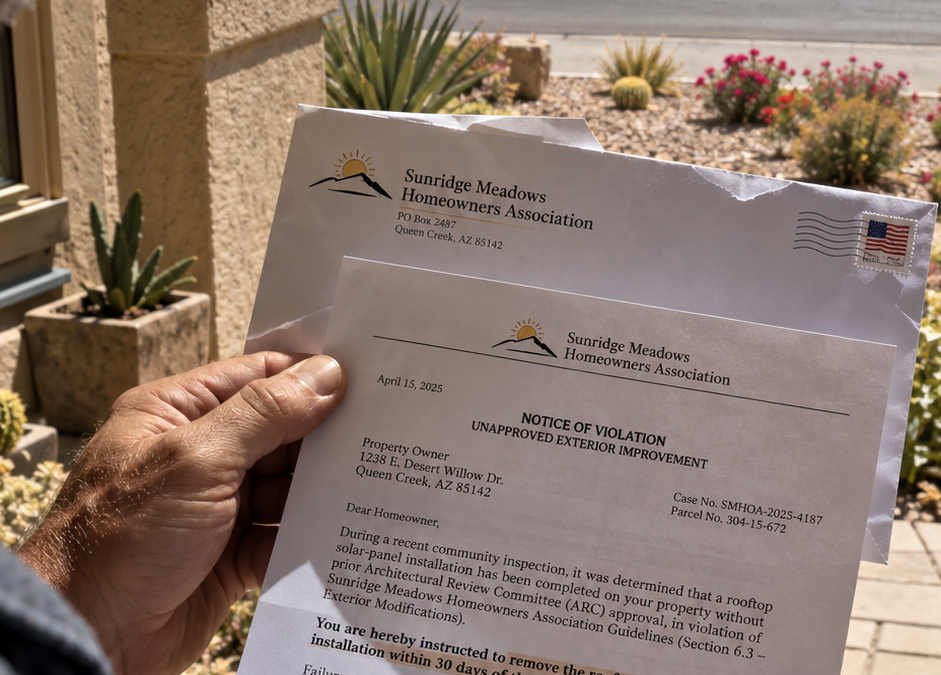
Eleven days after eight solar panels went onto the back slope of my roof, I had to sign for a certified letter from my homeowners association.
I knew before I opened it that nobody had spent certified-mail money to congratulate me.
I stood on my front porch with the envelope in one hand while the afternoon sun reflected off the houses across the street.
The return address read:
SUNRIDGE MEADOWS HOMEOWNERS ASSOCIATION.
Inside was one page of official-looking language.
Dear Homeowner:
It has come to the attention of the Architectural Review Committee that modifications have been made to the exterior of your property without prior approval.
Specifically: rooftop solar-panel installation.
I stopped there.
Then I read the sentence again.
The letter continued.
The panels violated Section 4.2(B) of the community covenants because alterations to the roofline were prohibited when they affected the “visual uniformity of the neighborhood aesthetic.”
I looked up from the paper.
From where I stood, I could not see a single panel.
That had been intentional.
All eight were on the rear slope.
They were not visible from the front sidewalk.
Not from the street.
Not from the subdivision entrance.
Unless somebody climbed into my backyard or stood on a neighboring roof, there was almost nothing to look at.
I kept reading.
I had thirty days to remove the entire installation.
After that, Sunridge Meadows would begin assessing fines of one hundred dollars per day until I complied.
I read the letter three times.
One hundred dollars per day.
Three thousand dollars a month.
For panels that had cost me eighteen thousand dollars.
Panels I had spent almost two years researching.
Panels installed eleven days earlier.
I remember standing there thinking that somewhere inside our clubhouse, seven people had apparently decided they could make eighteen thousand dollars disappear with one sheet of paper.
My name is Daniel Mercer.
At the time, I was forty-six years old, married, with a house in a planned community in the Southwest where summer heat does not arrive politely.
It settles in.
By May, the air conditioner runs every afternoon.
By June, it can feel like the outside air is trying to get inside and finish an argument.
July is worse.
August makes July seem reasonable.
Our electric bill had been climbing for years.
First two hundred dollars.
Then two-fifty.
Then close to three hundred.
That spring, I sat at the kitchen table holding a bill for $342.
My wife, Sarah, was standing at the refrigerator looking at our monthly expenses written on a magnetic notepad.
“Three forty-two?”
“That’s what it says.”
“That’s April.”
“I know.”
She gave me the look married people develop after years together.
The one that means, Do not explain the obvious part. Explain the part I actually care about.
“What happens in July?”
I looked at the bill again.
“That’s the problem.”
Our house was not huge.
Three bedrooms.
Single story.
Stucco.
Tile roof.
Pretty much the same shape and color as half the neighborhood.
The air conditioner was older but maintained.
We kept the thermostat reasonable.
We had already replaced windows on the west side and added attic insulation.
Still, every summer, money left our bank account in exchange for something we had to buy again the following month.
That was what finally bothered me.
I was not angry at the power company.
Electricity costs money.
Air conditioning uses electricity.
That part was simple.
But I kept thinking about how little of those payments built anything for us.
No asset.
No equity.
Nothing that stayed behind after the bill was paid.
For almost two years, I had been researching rooftop solar.
Not casually.
I became the kind of person who knew far more about photovoltaic panels than any normal neighbor wanted to hear.
I read homeowner forums.
Installer reviews.
Warranty terms.
Panel-degradation numbers.
Inverter specifications.
Utility-rate structures.
Financing options.
Roof penetration systems.
Production estimates.
I watched installation videos late at night until Sarah finally said, “You know watching people install solar isn’t the same as installing solar, right?”
“I’m researching.”
“You’ve been researching for eighteen months.”
“I want to do it right.”
“You want to research until panels become obsolete.”
She was probably right.
I talked with three installers.
One wanted to cover every usable part of the roof.
Another pushed a battery system we did not need.
The third company actually listened.
We reviewed twelve months of electricity use.
Looked at roof orientation.
Shade.
Utility rates.
Financing.
The sales representative recommended a modest system rather than the largest one he could sell me.
Eight panels.
Rear roof slope.
Good sun exposure.
Barely visible from public view.
Estimated production enough to cut the worst summer bills dramatically without turning the entire roof into equipment.
The price was $18,000 financed.
It was not small money.
I knew that.
Sarah knew that better.
We sat at the same kitchen table where I had opened the electric bill.
“Six years?” she asked.
“That’s the estimated break-even.”
“Assuming the production is right.”
“Yes.”
“And assuming electricity keeps getting more expensive.”
“Yes.”
She smiled.
“That assumption feels safe.”
I laughed.
Then she became serious.
“Do you really think we’re staying in this house that long?”
It was a fair question.
We had talked occasionally about moving after our youngest finished college.
Not because we hated Sunridge Meadows.
We did not.
It was quiet.
Clean.
Close to Sarah’s work.
Neighbors watched each other’s houses when people traveled.
Children rode bicycles around the cul-de-sacs until sunset.
The HOA could be irritating, but mostly in ordinary ways.
Mailbox colors.
Trash cans left out overnight.
Landscaping notices.
The sort of thing you complain about for thirty seconds and then forget.
“I think six years is realistic,” I said.
Sarah looked at the numbers again.
Then pushed the contract toward me.
“Do it.”
The installation happened in April.
One day.
The crew arrived before eight.
By late afternoon, eight dark panels sat neatly on the back roof slope.
The wiring ran cleanly.
The inverter was mounted where we had planned.
There were no panels hanging over ridgelines.
No equipment on the front elevation.
No giant battery cabinet.
Nothing that made our home look radically different.
I remember stepping into the backyard after the crew finished.
The panels looked better than I expected.
Sarah came outside.
“That’s it?”
“That’s it.”
“I thought it would look more…”
“Solar?”
“I was going to say ugly.”
“Thank you.”
She smiled.
“You know what I mean.”
I did.
Our neighbor across the street, Mike, happened to be getting his mail.
He looked toward the house.
Then gave me a thumbs-up.
“Finally did it?”
“Finally.”
“What did Sarah have to do, sign the contract while you were sleeping?”
“Almost.”
For eleven days, nothing happened.
I checked production numbers more often than I care to admit.
Every time the system generated electricity, I felt absurdly pleased.
Then the certified letter arrived.
Sarah came home about twenty minutes after I opened it.
She found me at the kitchen table with the notice spread beside the installation agreement.
“What happened?”
I handed it over.
She read silently.
Then looked toward the ceiling, as though she might somehow see through the house to the panels.
“They want us to remove them?”
“Yes.”
“All of them?”
“Yes.”
“For what?”
“Visual uniformity.”
She walked to the front window.
“You can’t even see them.”
“I know.”
She came back.
“How much to take them down?”
“I don’t know.”
“And what happens to the financing?”
“I still owe it.”
Her face changed.
That was when the problem became real.
The HOA was not ordering us to return something to a store.
Removing solar meant labor.
Roof repair.
Possible warranty problems.
Financing for equipment we might no longer be able to use.
Then summer electric bills on top of that.
Sarah sat across from me.
“Can they do this?”
“I don’t know.”
That answer bothered me.
Not because I was ashamed to say it.
Because the people who sent the letter clearly believed I would assume the answer was yes.
The next morning, I called the installation company.
The person who answered transferred me twice before I reached someone who handled homeowner problems.
I explained the notice.
He sighed.
Not surprised.
Just tired.
“We see HOA conflicts sometimes.”
“So what happens?”
“Depends on the association.”
“They want complete removal.”
Another sigh.
“Honestly? You might be better off taking them down.”
I thought I had misheard him.
“You’re the solar company.”
“I know.”
“You installed them.”
“I know.”
“And your advice is to remove them?”
“I’m telling you HOA fights get expensive. They have lawyers. Sometimes it’s cheaper to comply.”
“Cheaper for who?”
Silence.
Then he said, “I understand why you’re angry.”
“I’m not asking whether you understand.”
I tried to control my voice.
“I paid your company eighteen thousand dollars eleven days ago.”
“Yes.”
“Did anyone check whether these were prohibited?”
“Our permitting team checked city and utility requirements.”
“What about the HOA?”
“That responsibility is usually on the homeowner unless architectural approval is part of the contract.”
I looked at the papers.
It was.
Buried in the language I had signed.
Homeowner responsible for association approvals.
I felt stupid.
Not because I believed I had done something wrong.
Because after two years of research, I had missed one page that now seemed like the only page that mattered.
The employee said again, “If you want my practical advice, removing them may cost less than a legal fight.”
I thanked him.
Hung up.
Then spent ten minutes staring at my phone.
Sarah found me outside that evening.
“You look like you want to throw something.”
“The installer says take them off.”
“What?”
“They say HOAs usually win.”
Sarah folded her arms.
“Do they?”
“I don’t know.”
“There’s that answer again.”
“I know.”
She sat on the patio chair beside me.
For a while, neither of us spoke.
Then she said, “Before we spend another dollar doing anything, can we at least make them prove they’re allowed to demand it?”
That sentence changed the way I approached the problem.
Not fight them.
Not threaten them.
Make them prove it.
I sent a short email to the HOA management company.
I asked for the exact covenant language supporting the removal order.
The current Architectural Review Committee guidelines.
Any written solar policy.
And the board decision or ARC decision specifically addressing our installation.
I was polite.
No accusations.
No legal arguments.
Just documents.
Four days later, an envelope appeared in our mailbox.
Inside was a photocopy of the community covenants.
Section 4.2(B) had been highlighted in yellow.
Exterior modifications affecting the visual uniformity of the development required approval and could be prohibited if inconsistent with community standards.
There was also a three-page ARC guideline document.
Solar did not appear anywhere.
At the bottom of the cover letter, someone had written by hand:
We suggest you comply promptly. Fines begin on Day 31.
The signature beneath it belonged to the board president.
His name was Martin Keller.
I had seen him around.
Late sixties.
Retired insurance executive, according to neighborhood gossip.
Always wore reading glasses on a cord around his neck.
He had served on the board for years.
The handwritten sentence bothered Sarah more than the original notice.
“They couldn’t just type that?”
“I think the handwriting is supposed to feel personal.”
“It feels smug.”
“I wasn’t going to say it.”
“You were thinking it.”
“Yes.”
Two doors down lived Thomas Green.
The year before, he had built a pergola in his backyard.
The HOA ordered him to remove it because the roof angle and stain color had not been approved.
He fought for several weeks.
Eventually, the pergola disappeared.
I walked over that evening.
Thomas was trimming a hedge.
“You got a minute?”
He shut off the trimmer.
“That tone sounds expensive.”
I showed him the letter.
He read it.
Then handed it back.
“Take them down.”
“That fast?”
“I fought these people for three weeks.”
“Over the pergola?”
“Yep.”
“What happened?”
“They kept sending letters. Then a lawyer sent one. I had a lawyer look at it.”
“And?”
“My lawyer wanted twenty-five hundred dollars just to start.”
He shrugged.
“The pergola cost less.”
“You think they’re right?”
Thomas shook his head.
“That wasn’t the question.”
He leaned on the trimmer.
“They have counsel on retainer. You’re paying for their lawyer through your dues while paying your own lawyer to fight him.”
He pointed toward my roof.
“You paid eighteen grand for those?”
“Yes.”
He whistled.
“That makes it harder.”
“What would you do?”
Thomas thought.
Then said, “I’d probably get mad for a week and eventually take them down.”
He looked almost embarrassed.
“It’s not worth it.”
That night, I understood why HOAs can feel more powerful than they actually are.
It is not always because the board has extraordinary legal authority.
It is because they already have infrastructure.
Letterhead.
Management companies.
Filing systems.
Rules.
Regular meetings.
Association counsel.
Money collected from hundreds of homeowners.
If you receive a formal notice from an organization like that, the natural assumption is that somebody has already checked the law.
Why would they send it otherwise?
Meanwhile, you are sitting at your kitchen table after work trying to decide whether one paragraph in a thirty-year-old covenant can force you to dismantle eighteen thousand dollars of equipment.
The imbalance is psychological before it is legal.
I felt it.
For about forty-eight hours, I considered giving up.
I requested a removal estimate.
The installer warned that removing and reinstalling the panels would involve labor, roof work, and possible inspection costs.
Even if I could later put them back, the number would be painful.
If I removed them permanently, I would still have financing obligations.
Then there were the summer power bills waiting for us.
I opened a spreadsheet.
Solar payment.
Removal estimate.
Roof repair.
Electricity.
Potential HOA fines.
Potential lawyer costs.
No version looked good.
Sarah came into the kitchen after eleven one night.
I was still staring at the numbers.
“You coming to bed?”
“In a minute.”
“You said that forty minutes ago.”
“I’m thinking.”
“You’re spiraling.”
“Researching.”
“You’re definitely spiraling.”
She kissed the top of my head.
“Whatever you decide, we’ll deal with it.”
Then she went upstairs.
At eleven that Tuesday night, I stopped calculating money and started searching law.
Not general HOA advice.
Not message boards full of people arguing.
Statutes.
Cases.
I searched combinations of terms.
Solar panels homeowners association.
HOA solar restrictions.
State solar access law.
Solar rights statute.
Rooftop solar covenant enforcement.
It took less than an hour before I found something I should have looked for before installation.
My state had a solar-rights statute.
The language was not vague.
A homeowners association could impose certain reasonable restrictions concerning placement and appearance.
It could not use covenants or architectural rules to prohibit solar installations altogether.
Restrictions that functioned as practical bans could be unenforceable.
There were limits on what an association could require when its preferred placement would substantially increase system cost or reduce performance.
I read the statute once.
Then again.
Then I opened every cross-reference.
I found guidance material explaining how the rule applied to community associations.
I found two state cases involving disputes between homeowners and associations over rooftop solar.
The facts were not identical to mine.
That mattered.
But both cases made something clear.
An HOA could not simply say “aesthetics” and treat that word as unlimited authority.
The association needed a legitimate restriction consistent with state law.
I walked upstairs at almost two in the morning.
Sarah was awake.
“You’re glowing.”
“That’s the laptop.”
“No. Your face.”
I sat on the edge of the bed.
“I found something.”
She pushed herself upright.
“What?”
“A state law.”
Her eyes narrowed.
“What kind?”
“Solar rights.”
I explained what I had read.
She listened.
Then said, “So they can’t make us remove them?”
“I don’t know yet.”
“Daniel.”
“I’m not doing that thing again. I’m not assuming.”
I pulled the statute up on my phone.
“But I think their position has a problem.”
That was the first night since the certified letter arrived that I slept normally.
The next morning, I kept researching.
I found a state agency that accepted consumer complaints concerning certain solar-access disputes.
I downloaded the complaint form.
Then I found a real estate attorney whose website specifically mentioned HOA covenant disputes.
Her name was Rebecca Sloan.
She offered a short initial consultation.
I expected to spend the entire fifteen minutes explaining solar panels.
I got about halfway through my story.
She interrupted.
“Wait.”
I stopped.
“Your panels are on the rear roof slope?”
“Yes.”
“Street visible?”
“No.”
“Did the association identify any structural concern?”
“No.”
“Glare?”
“No.”
“Electrical safety?”
“No.”
“Roof damage?”
“No.”
“Setback?”
“They’re on the roof.”
“Did they offer an alternative placement?”
“No. They ordered removal.”
“Complete removal?”
“Yes.”
Rebecca was silent for a moment.
Then she said, “I need to review your documents before giving you formal advice, but based on what you’re describing, their position appears very difficult to defend under the state solar statute.”
That sentence felt different from what I had read online.
Not because lawyers are magical.
Because she was willing to separate what she knew from what she needed to verify.
I sent her the HOA letter.
Covenants.
ARC guidelines.
Installation layout.
Photographs from the street.
The contract.
The next afternoon, she called.
“Your instincts were right.”
I sat down.
“What does that mean?”
“The association can regulate within the statute. They cannot simply prohibit the system because they dislike rooftop solar.”
“What about Section 4.2?”
“A covenant does not override state law.”
I let out a breath I did not realize I had been holding.
“So they can’t fine me?”
“I did not say that.”
My stomach tightened again.
“They can issue fines. Whether those fines survive challenge is another question.”
“So what do we do?”
“We respond before Day 31.”
Rebecca helped me draft a formal letter.
It was nothing like the angry message I had written in my head.
No insults.
No accusation that Martin was on a power trip.
No threat to expose anybody online.
The letter cited the state solar-access statute.
It explained why a blanket removal order conflicted with that law.
It noted that the panels were placed on the rear-facing roof specifically to minimize visibility.
It attached photographs proving the installation could not reasonably be seen from the subdivision streets.
It cited the relevant cases.
Then it addressed the fine schedule.
Any enforcement action based on an unlawful prohibition would be contested.
The HOA had fourteen days to withdraw the removal demand.
If it refused, we would consider the available administrative complaint process and legal remedies.
I read the letter twice.
It sounded calm.
That somehow made it stronger.
Sarah read it.
“This is much nicer than the version you wrote.”
“You saw that?”
“You left it open on your laptop.”
“That was private.”
“It started, ‘To the seven people pretending to be Congress.’”
“I was emotional.”
She smiled.
“Send Rebecca’s version.”
I sent it certified mail.
Return receipt requested.
Then we waited.
Day one.
Nothing.
Day two.
Nothing.
Day three.
I checked the mailbox twice.
Sarah noticed.
“You know certified responses do not arrive faster because you stare at the street.”
“I’m aware.”
Day four.
Nothing.
On day six, I received an email from the management company.
The board has requested your presence at the next regular meeting to discuss the architectural enforcement matter.
No mention of withdrawing the violation.
No mention of the statute.
No fine cancellation.
Just a meeting.
My first reaction was relief.
My second was dread.
I hate meetings where everybody except one person already knows the procedure.
The board knew the room.
The agenda.
The rules.
The attorney.
I would be the homeowner sitting on the opposite side of the table trying not to look nervous.
Rebecca said she did not need to attend unless I wanted her there.
Her recommendation was to go calmly.
Bring the documents.
Do not turn it into a speech.
Let their lawyer advise them.
The meeting was scheduled for seven on a Thursday night.
I arrived at 6:45.
The Sunridge Meadows clubhouse had the same artificial lemon smell it always did.
Seven board members sat behind two folding tables pushed together.
Martin Keller was in the center.
Reading glasses hanging from their cord.
A stack of papers in front of him.
I recognized two other board members.
Susan Morales from the landscaping committee.
Greg Whitmore, who lived near the west pool.
The others were people I had seen but never spoken with.
A speakerphone sat in the middle of the table.
The HOA attorney was attending remotely.
There were about fifteen residents in folding chairs behind me.
I had not expected an audience.
That made my palms sweat.
Martin looked at the clock.
Then at me.
“Mr. Mercer.”
“Good evening.”
“We received your correspondence.”
“I know.”
He gestured toward a chair facing the table.
“Please.”
I sat.
Then placed a folder in front of me.
Printed copy of Rebecca’s letter.
State statute.
Case citations.
Street-view photographs.
System layout.
Utility approval.
Everything tabbed.
I did not need most of it.
Having it there made me feel better.
Martin opened with the original issue.
The Architectural Review Committee had not approved my solar panels before installation.
I acknowledged that.
That mattered to me.
I had failed to request ARC review.
I was not going to pretend otherwise.
“I should have submitted the installation first.”
Martin nodded.
“Then we agree there was a violation.”
“We agree I did not request approval.”
“That is the violation.”
“The removal order is the dispute.”
One board member shifted in her seat.
Martin picked up the covenant.
“The association has broad authority over exterior modifications.”
“Subject to state law.”
His expression changed slightly.
“We are aware of your interpretation.”
I slid a copy of the statute toward him.
“It isn’t my interpretation.”
Before he answered, a voice came from the speakerphone.
The attorney.
His name was Charles Bennett.
“I’ve reviewed the materials Mr. Mercer submitted.”
Martin looked toward the phone.
“And?”
A pause.
Then Charles said, carefully, “I believe the association’s current position may be difficult to maintain.”
Nobody said anything.
I looked down because I was afraid Sarah would have laughed if she had been there.
Difficult to maintain.
It was exactly the kind of phrase a lawyer uses when everybody understands the sentence beneath it but nobody wants to say it first.
Martin leaned closer to the phone.
“Because of the statute?”
“Yes.”
“Our covenants predate that statute.”
“That does not necessarily preserve enforcement authority where later state law limits private restrictions.”
Susan Morales asked, “Can we require him to relocate the panels?”
Charles answered.
“Potentially, if the alternative restriction is reasonable and complies with the statute.”
Martin looked at me.
“Would you relocate them?”
“To where?”
He hesitated.
“The garage-facing section.”
I opened the production estimate.
“That area receives less sun.”
“How much less?”
“According to the installer’s model, enough to reduce system output significantly.”
Charles spoke again.
“That creates another issue.”
Martin sat back.
I could see frustration in his face now.
Not anger.
Something more complicated.
The kind of frustration people feel when authority they assumed was simple turns out to have boundaries.
Greg Whitmore looked at the photographs.
“You really can’t see these from the street?”
“No.”
He held up one image.
“This is your house?”
“Yes.”
He passed it down.
Susan looked at another.
“Where are the panels?”
“Exactly.”
One of the residents behind me made a quiet sound that might have been a laugh.
Martin did not appreciate it.
He removed his glasses.
“The concern is precedent.”
There it was.
Not my roof.
Not my system.
Precedent.
“If we make an exception here, every homeowner may install whatever they want.”
I shook my head.
“I’m not asking for permission to install whatever I want.”
“You installed without approval.”
“And I admitted that.”
“Then what are you asking?”
“For the association to apply its rules within the law.”
His jaw tightened.
“From the board’s perspective, that distinction is not as simple as you’re presenting it.”
Charles interrupted.
“Martin, I think we should separate the procedural violation from the remedy.”
That changed the room.
The board could potentially address my failure to apply beforehand without pretending it had authority to order complete removal.
Susan asked whether they could issue some form of warning instead.
Another board member wanted updated solar guidelines.
Greg said that if the installation was legal and invisible, removing it seemed excessive.
Martin kept returning to consistency.
“What happens when the next homeowner puts twenty panels on the front roof?”
Charles answered.
“Then you evaluate that application under the statute and whatever lawful guidelines the board adopts.”
“But we lose uniformity.”
“You may have to accept some degree of visual variation where state law protects the underlying installation.”
Martin leaned back.
For the first time since I walked in, nobody was looking at me.
They were looking at one another.
That was when I realized something.
I had spent almost three weeks imagining the HOA as one solid thing.
A machine.
Seven board members.
A management company.
A lawyer.
One intention.
But the people sitting there did not all agree.
Some had probably never thought about solar rights before my letter arrived.
Some were hearing the legal issue for the first time.
The authority that had looked enormous from my kitchen table was made of ordinary people reading documents under fluorescent lights.
Susan made the motion.
“Rescind the removal notice.”
Martin frowned.
“Entirely?”
“Withdraw the removal requirement and suspend the fine schedule.”
Greg seconded.
The vote was five to two.
Martin was one of the two against.
The secretary recorded it.
I sat there for a second longer than necessary.
I had spent so much time preparing for a fight that I did not immediately understand the fight had ended.
Martin looked toward me.
“The board will send written confirmation.”
“Thank you.”
“I would remind you, Mr. Mercer, that architectural applications are required before future exterior changes.”
“I understand.”
“And this vote should not be interpreted as blanket approval of all solar configurations in Sunridge Meadows.”
“I understand that too.”
I gathered my papers.
No speech.
No celebration.
I walked outside.
The night air was still warm.
My phone vibrated before I reached the parking lot.
Sarah.
Did it work?
I typed three words.
Panels are staying.
Her response came immediately.
THANK GOD.
Then another.
Also I told you so.
I laughed in the empty parking lot.
The formal letter arrived three days later.
The removal demand was rescinded.
No daily fines would be assessed.
The HOA requested that I submit an after-the-fact architectural application for its files.
Rebecca reviewed the form before I signed anything.
The approval followed.
That could have been the end of the story.
In practical terms, it was.
But the part that stayed with me came afterward.
A month later, I saw Thomas Green, the neighbor who had removed his pergola.
He was standing beside his driveway.
“How’d the solar fight go?”
“They stayed.”
He stared at me.
“What?”
“The board withdrew the removal order.”
“You sued?”
“No.”
“Lawyer letter?”
“One.”
“How much?”
“Much less than removing the panels.”
He shook his head.
“I should’ve fought the pergola.”
“Maybe.”
He looked toward his backyard.
“No. I should’ve at least checked whether they were right.”
That was the real lesson for me too.
Not that HOAs are always wrong.
They are not.
Not that covenants are meaningless.
They are not.
I bought into a planned community.
I knew there were architectural rules.
Those rules can protect residents from genuinely unreasonable changes.
I also knew I had skipped the approval process.
If the board had issued a procedural warning, asked for drawings, required safe placement, or imposed a lawful restriction consistent with state law, the story would have been very different.
What bothered me was the assumption behind the first letter.
Remove it.
Thirty days.
One hundred dollars per day.
No conversation.
No attempt to distinguish between a reasonable solar guideline and a total prohibition.
The letter was designed to make compliance feel cheaper than questioning the board.
For many homeowners, that would work.
It almost worked on me.
Seven months after installation, I opened our electric statement.
Sixty-seven dollars.
I stared at the number.
Then took the bill to Sarah.
She was reading on the couch.
“Guess.”
She did not look up.
“One eighty.”
“Lower.”
“One forty.”
“Lower.”
Now she looked at me.
“One hundred?”
I handed her the statement.
She read it.
“Sixty-seven?”
“Sixty-seven.”
She looked toward the ceiling.
“I suddenly love those ugly panels.”
“You said they weren’t ugly.”
“I was being supportive.”
We laughed.
The financial estimate still showed a break-even around six years, depending on electric rates and system production.
I stopped obsessively checking output after the first few months.
The novelty faded.
That was good.
The panels became what I originally wanted them to be.
Infrastructure.
Quiet.
Useful.
Easy to forget.
The HOA changed too.
The board formed a small committee to update the architectural rules concerning rooftop solar.
This time, Charles Bennett participated before the rules were distributed.
The new policy required applications.
It addressed conduit color.
Panel placement.
Roof setbacks.
Safety.
It encouraged homeowners to reduce street visibility when practical.
But it also acknowledged the state-law limitations on what the association could prohibit.
Martin remained president until the end of his term.
We never became friends.
We did not become enemies either.
A few months after the meeting, I saw him near the mailboxes.
He nodded.
I nodded.
Then he said, “System working?”
I was surprised.
“Yes.”
“Saving what you expected?”
“So far.”
He looked toward my house.
“I still don’t like the way rooftop solar changes neighborhoods.”
I smiled.
“You still can’t see mine.”
He almost smiled back.
“Fair point.”
Then he walked away.
I respected that conversation more than I expected.
He had not suddenly changed his opinion.
He did not need to.
The issue was never whether Martin liked solar panels.
The issue was whether his preference had the force of law.
That distinction is easy to lose when you are the person holding a letter with an official logo at the top.
I keep the original certified notice in a file drawer.
Not framed.
Not displayed.
I do not need a trophy.
But every once in a while, when another HOA envelope arrives, I remember what that first one felt like.
Your first instinct when you receive official-looking paper is usually emotional.
Fear.
Anger.
Embarrassment.
A desire to make the problem disappear quickly.
Institutions understand that, even if they do not consciously exploit it.
Deadlines matter.
Fine schedules matter.
Words like violation, lien, enforcement, legal fees, and noncompliance matter.
They change the way a homeowner reads the next sentence.
For two days, I read Sunridge Meadows’ authority as bigger than it was because the letter told me to.
Only after I slowed down did I separate the questions.
Did I skip architectural approval?
Yes.
Did that automatically give the HOA power to order complete removal?
No.
Was the covenant real?
Yes.
Did that mean every possible application of it was lawful?
No.
Was the HOA allowed to regulate solar?
Within limits, yes.
Could it act as though state law did not exist?
No.
Those distinctions saved me.
Not anger.
Not cleverness.
Distinctions.
I also learned something uncomfortable about myself.
Before this happened, I had watched neighbors receive HOA violations and assumed there was probably more to the story.
Sometimes there was.
Sometimes there was not.
Thomas and his pergola became a good example.
Maybe his structure genuinely violated lawful rules.
Maybe removal was justified.
I still do not know.
The mistake was assuming that because an HOA sent the letter, somebody else had already done all the thinking.
Organizations make mistakes.
Boards misunderstand statutes.
Management companies use templates.
Attorneys sometimes do not see a matter until after enforcement begins.
Rules become outdated.
People inherit policies and continue them because nobody ever asks why.
The system depends on somebody eventually asking.
That does not require screaming.
In fact, screaming usually makes the useful part harder.
The most effective thing I did in the entire dispute was boring.
I asked for the document.
Then I read it.
I found the law.
Then I paid someone qualified to tell me whether I understood it correctly.
Rebecca never told me to storm into the clubhouse.
She never promised to destroy the HOA.
She told me to answer the specific enforcement action with the specific legal rule that limited it.
That was enough.
A year later, another homeowner in Sunridge Meadows installed solar.
Twelve panels.
More visible than mine.
The board reviewed the application.
Requested a small layout change that preserved most of the system performance.
Approved it.
No certified removal notice.
No hundred-dollar daily fine.
No clubhouse confrontation.
That result felt better than winning my own argument.
Because a good resolution does more than help the person already fighting.
It makes the next fight unnecessary.
One evening, Sarah and I were sitting in the backyard while the sun dropped behind the block wall.
The panels above us were producing the last little bit of electricity for the day.
She looked toward the roof.
“You know what’s funny?”
“What?”
“If the HOA had approved these immediately, you would have spent the next six months boring everyone with solar-production numbers.”
“I do not bore people.”
“You absolutely do.”
“I educate.”
“You gave Mike a twelve-minute explanation of inverter efficiency while he was trying to take his trash out.”
“He asked how the system worked.”
“He said, ‘How’s the solar?’”
“That is an open-ended question.”
She laughed.
Then grew quiet.
“Were you scared?”
“Of what?”
“The fines.”
I considered lying.
“No.”
She raised an eyebrow.
“Yes.”
“How scared?”
“Enough that I almost called the installer and scheduled removal.”
She looked surprised.
“You never told me that.”
“I didn’t want you worried.”
“I was already worried.”
“I know.”
“What stopped you?”
I thought about the question.
“The number.”
“What number?”
“One hundred dollars a day.”
She frowned.
“That scared you.”
“It did.”
“But it also made me wonder why they needed that much pressure.”
If the panels were obviously unlawful, why not explain the law?
Why jump immediately to an amount large enough to become financially frightening?
Maybe there was no sinister reason.
Maybe one hundred dollars was simply the association’s standard daily fine.
But it had an effect.
It made obedience feel urgent.
Once I recognized that feeling, I wanted to know whether the urgency was legitimate.
That instinct probably protected the system more than anything else.
Years earlier, my father once received a tax notice claiming he owed money on land he had sold.
He did not yell.
He did not ignore it.
He drove downtown with a folder.
I remember asking him why he was not angry.
He said, “Paper can be wrong without being fake.”
I did not understand that as a teenager.
I understand it now.
The HOA’s certified letter was real.
The covenant was real.
The board was real.
The threatened fine schedule was real.
None of those facts automatically made the removal demand legally correct.
That is a difficult thing to remember when official paper has your name printed at the top.
By the following summer, our energy bills remained dramatically lower than they had been before the panels.
The exact savings changed with weather.
Clouds mattered.
Heat mattered.
Utility rates changed.
Some months were better than others.
But the system did what we had bought it to do.
It turned part of the sunlight hitting a roof we already owned into electricity we no longer had to buy.
Simple.
No protest signs.
No political argument.
No grand statement.
Just eight panels doing their job.
The roof never became a neighborhood crisis.
Property values did not collapse.
Sunridge Meadows did not become visually chaotic.
Most residents probably forgot the dispute within weeks.
That, in its own way, proved how unnecessary the original threat had been.
The neighborhood survived eight solar panels.
So did the HOA.
So did I.
I sometimes think about how differently everything might have gone if Martin’s first letter had said:
We noticed your solar installation was completed without ARC approval. Please submit the plans so we can review them for compliance with community standards and applicable state law.
I would have filled out the form.
The board would have reviewed the rear placement.
Maybe asked a question about conduit.
Maybe required a minor cosmetic change.
The panels would have stayed.
Nobody would have paid a lawyer.
Nobody would have spent evenings reading statutes.
Nobody would have sat across from seven board members beneath fluorescent clubhouse lights.
The conflict did not begin because rules existed.
It began because enforcement went farther than the rule could lawfully support.
That distinction became important to me.
I do not tell this story because I think every homeowner should fight every HOA letter.
Sometimes the HOA is correct.
Sometimes the homeowner is the one who ignored clear rules.
Sometimes a quick correction is cheaper and fairer than turning a small issue into a legal war.
But there is a difference between correcting a violation and surrendering because official language frightened you.
I came close to confusing those things.
The installer told me it was not worth fighting.
Thomas told me the board had lawyers and I did not.
The certified letter gave me thirty days.
The handwritten note reminded me that fines were coming.
Every part of the situation pushed toward speed.
Research required the opposite.
Slow down.
Read.
Separate the rule from the remedy.
Find out whether another law sits above the covenant.
Ask someone qualified.
Keep the response narrow.
Do not turn uncertainty into panic.
That is what I wish I had understood the day the letter arrived.
Not that I had some secret weapon.
I did not.
I had a statute the HOA should have considered before sending the notice.
That is much less dramatic.
It is also much more useful.
The solar panels are still on the roof.
From my driveway, I still cannot see them.
When Mike across the street stands beside his mailbox, he still cannot see them either.
One afternoon, months after everything ended, he yelled across the road.
“Panels still legal?”
“So far.”
“You checking the statutes every morning?”
“Twice a day.”
He laughed.
Then pointed toward his own roof.
“My wife wants some now.”
“Tell her to submit the ARC application first.”
That made him laugh harder.
But I meant it.
Knowing your rights does not mean pretending rules do not apply to you.
It means knowing where those rules end.
That was the part Sunridge Meadows had forgotten.
For eleven days, I thought I had bought an energy system.
Then the certified letter taught me I had also bought a reason to learn exactly how much authority my HOA did and did not have.
The lesson cost me one attorney consultation, several sleepless nights, and more irritation than I wanted.
But the roof stayed intact.
The fines never started.
And every month when the electric bill arrives, I am reminded of the same thing.
The most powerful part of that fight was never the panels.
It was the moment I stopped assuming the letter knew more than I did.

