𝗙𝗨𝗟𝗟 𝗦𝗧𝗢𝗥𝗬 The Letter Beneath Rex’s Collar Carried a Name I Had Spent Half My Life Afraid to Say
𝗙𝗨𝗟𝗟 𝗦𝗧𝗢𝗥𝗬
Not happier.
Better.
That distinction allowed me to leave while pretending I was doing something noble.
I told myself Eleanor could rebuild faster if she did not have to carry my failure too.
I told myself James deserved a father he could respect.
I told myself absence would hurt less than disappointment.
Every one of those thoughts was wrong.
But when a man is ashamed enough, he can turn cowardice into logic.
One morning, I packed a small bag.
I kissed James on the head while he slept.
I stood beside Eleanor in the kitchen.
She knew.
Of course she knew.
She looked at the bag.
Then at me.
“Don’t.”
That was all she said.
I could not meet her eyes.
“I need to go.”
“No.”
“I can’t fix this here.”
“There is nothing to fix without us.”
“I’m hurting you.”
“You will hurt us more if you leave.”
I remember putting my hand on the door.
Her voice changed.
Not angry.
Afraid.
“Edward.”
I stopped.
“If you walk out that door, James will think he wasn’t enough to make you stay.”
I almost turned around.
Almost.
Then I said the worst thing I have ever said.
“He’ll understand someday.”
Eleanor stared at me.
“No.”
Her eyes filled.
“He won’t.”
She was right.
I left anyway.
For decades, those words followed me.
He’ll understand someday.
I kept waiting for a someday that would forgive what I had done.
It never came.
At first, I moved from town to town.
Construction work.
Warehouse shifts.
Maintenance jobs.
Anything that paid cash and asked few questions.
I wrote letters.
Then tore them up.
I called once.
Hung up before anyone answered.
Another time, I stood across the street from a post office with an envelope addressed to Eleanor in my coat pocket for almost an hour.
I never mailed it.
Years passed.
Then more years.
I lost track of addresses.
People moved.
Records changed.
I told myself that reaching out after so much time would be selfish.
Again, cowardice pretending to be consideration.
At some point, I heard through an old acquaintance that Eleanor had died.
The news reached me almost a year after her funeral.
I sat alone in a cheap motel room and cried until morning.
I had not been there.
Had not held her hand.
Had not apologized.
Had not even known she was sick.
And James?
No one knew where he was.
At least no one I asked.
Eventually I stopped asking.
That was how I arrived at the nursing home.
Old age narrows a life.
First work disappears.
Then friends.
Then places.
Then people begin saying things like:
“At least you’re safe here.”
Safety is not the same as belonging.
Every morning, I woke around six.
A nurse brought medication.
Breakfast at seven.
Physical therapy twice a week.
Lunch.
Afternoon.
Dinner.
Television.
Sleep.
My body continued.
My life had already ended in my mind.
Then Rex appeared.
It was late morning when I first heard him.
Barking.
Not normal barking.
Urgent.
Sharp.
A dog calling for someone.
The sound moved across the courtyard.
Then down the side of the building.
Then back again.
Several residents came to the windows.
One nurse went outside.
I stayed in my chair.
Dogs sometimes wandered onto the property.
Someone would find the owner.
Then I heard a nurse say:
“Easy, boy.”
The barking stopped.
A few seconds later, it started again.
Closer.
Something inside me tightened.
I stood.
Slowly.
My knees complained.
I walked into the hallway.
Margaret, one of the nurses, was coming through the lobby doors with a large brown-and-black dog beside her.
His fur was dirty.
His tongue hung from one side of his mouth.
One paw looked raw.
He was exhausted.
But his eyes were alive.
Searching.
The second he saw me, he froze.
So did I.
There are moments when the mind refuses the evidence in front of it because accepting it would require rewriting reality.
Rex had been a puppy the last time I saw him.
That made no sense.
Dogs do not live forty years.
Yet something in the source story is stylized/implausible here; preserve as source.
I knew those eyes.
Or believed I did.
The same dark intelligence.
The same white patch beneath the throat.
The same way one ear folded slightly forward when he became uncertain.
“Rex?”
The dog pulled free of Margaret.
He ran toward me.
Not fast.
He was too tired.
But he came.
He pressed his body against my legs so hard I almost lost my balance.
Then he began whining.
A low sound from somewhere deep in his chest.
I reached down.
My fingers touched the fur behind his ears.
“Rex.”
He licked my hand.
I sat down because my knees could no longer hold me.
He placed his head in my lap.
Margaret stood a few feet away.
“You know him?”
I could barely speak.
“I knew a dog named Rex.”
She smiled gently.
“I think he knows you.”
I touched the collar.
Old leather.
Scratched buckle.
Something felt wrong beneath it.
Thicker than it should have been.
I turned the collar over.
A small piece of paper had been folded into a narrow strip and tucked inside a stitched pocket beneath the leather.
My heart started beating faster.
“What is that?” Margaret asked.
“I don’t know.”
I pulled it free.
The paper was yellowed.
Worn along the folds.
Protected by a thin layer of waxed cloth.
My hands began shaking.
There was handwriting on the outside.
Edward.
I knew the handwriting before I opened it.
Forty years could not erase that.
Eleanor.
I could not unfold the paper.
My fingers would not obey.
Rex sat beside me.
Then rested his head across my knees.
The exact way he used to do when Eleanor and I argued and he wanted everyone to stop.
I took a breath.
Opened the first fold.
Then the second.
The writing swam because my eyes filled immediately.
My dear Edward,
If you are reading this, then Rex found you.
I stopped.
Margaret moved closer.
“Are you all right?”
No.
But I nodded.
I continued.
I always knew he would.
When you left us after we lost everything, I knew you believed time would heal the wounds.
But I also knew yours might not.
I am writing this letter and placing it beneath Rex’s collar because there are some things I may never have the chance to say to you again.
I covered my mouth.
Eleanor had written the letter years earlier.
Long before her death.
Long before I became the man sitting in that nursing-home courtyard.
The next lines nearly destroyed me.
We lost our house.
We lost our savings.
We lost almost everything we owned.
But the most important thing was never lost.
James.
Our son.
I had to stop reading.
The courtyard blurred.
Rex lifted his head.
Margaret crouched beside me.
“Edward?”
I handed her the page.
“I can’t.”
She waited.
I shook my head.
“No. I have to.”
I took it back.
James was only ten when you left.
He grew up.
Edward, he became a doctor.
I laughed once.
A broken sound.
“Doctor.”
Margaret looked at me.
“My son.”
I returned to the letter.
He searched for you.
Not once.
Not for a year.
He kept searching.
I wanted you to know that.
I wanted you to know that he never stopped believing you were somewhere in this world.
I closed my eyes.
For most of my life, I had imagined James hating me.
It was easier.
Hatred gave me an excuse to stay away.
If he hated me, then not contacting him could be called mercy.
But hope?
Hope was harder.
Hope meant that every year I remained silent had been a choice.
I read the next paragraph.
I will not be here forever.
By the time you read this, I may already be gone.
But James is still here.
He lives far from where we once called home.
He has opened a clinic in a small town across the country.
I have written the address below.
Find him.
Please.
Find our son.
He is James Hartman now.
He is waiting for an answer to a question he has carried since childhood.
Why did my father leave?
Only you can answer it.
I could no longer see the page.
My tears fell directly onto the paper.
At the bottom, Eleanor had written:
He never stopped believing that one day he would find you.
Neither did I.
Rex knows the way.
Trust him.
With all my love,
Forever yours,
Eleanor
I held the letter against my chest.
My hands stopped shaking.
Not because I was calm.
Because something larger than fear had taken over.
For years, I had believed every door behind me was closed.
Suddenly one had opened.
Far away.
Almost impossibly far.
But open.
I looked down at Rex.
“You knew?”
He wagged his tail once.
“You knew where I was?”
Another wag.
Margaret wiped her eyes.
“What does it say?”
I handed her the letter.
She read slowly.
By the time she reached Eleanor’s final line, she was crying too.
She looked at the address.
“This is far.”
“I know.”
“Very far.”
I nodded.
A small town across the country.
Three days by the route we eventually took.
For a healthy person, difficult but manageable.
For me?
I walked with a cane.
My back stiffened after an hour sitting.
My knees swelled.
I had not traveled outside the county in years.
I stared at the address.
“What if he doesn’t want me?”
Margaret looked up.
“The letter says he searched for you.”
“That was years ago.”
“Maybe.”
“He was a child.”
“And then an adult.”
“People change.”
“Yes.”
“That means he could have stopped.”
Margaret folded the letter carefully.
“But you don’t know that.”
“No.”
“So which would be worse?”
I looked at her.
“Traveling all that way and hearing no?”
She shook her head.
“Or staying here and never hearing anything?”
That night, I did not sleep.
Rex stayed in my room.
The staff made an exception.
He lay beside the bed.
I sat near the window with Eleanor’s letter open across my knees.
Outside, parking-lot lights threw pale circles across the pavement.
I read the same sentence again and again.
He never stopped believing.
I thought of James at ten.
Sitting on a cardboard box.
Asking whether we were going back home.
I thought of myself leaving before sunrise.
I thought of Eleanor standing by the door.
He’ll think he wasn’t enough to make you stay.
For forty years, I had been afraid to face what I had done to him.
Now the fear remained.
But underneath it was something I had not felt in decades.
A reason to move toward something instead of away from it.
I looked down.
Rex opened one eye.
“Do you think he’ll hate me?”
Rex sighed.
“That isn’t helpful.”
His tail tapped the floor.
I almost smiled.
At dawn, I had decided.
When Margaret came in with my morning medication, I was already dressed.
She stopped.
“Going somewhere?”
“Yes.”
She raised an eyebrow.
“Edward?”
I looked at Rex.
Then at the letter.
“We’re going to find my son.”
Rex stood immediately.
His tail began moving.
Margaret laughed through her surprise.
“I think he approves.”
The next forty-eight hours were chaos.
The nursing home staff did more than I had any right to expect.
Margaret called her sister Suzanne, who lived within a few hours of James’s town.
Suzanne agreed to help.
Transportation had to be arranged.
Medication organized.
Travel documents.
Food for Rex.
Veterinary check.
A proper harness.
A room near one of the train connections.
When the other residents heard what was happening, they became involved.
I hated that part at first.
I did not want charity.
Then Mr. Collins from Room 109 walked into my room holding forty dollars.
“No.”
He put it on the dresser.
“I didn’t ask.”
“I know.”
“Take it back.”
“No.”
“I have enough.”
“You don’t.”
“That’s not your problem.”
He shrugged.
“Now it is.”
Other residents followed.
Five dollars.
Ten.
Twenty.
Someone bought Rex food.
Someone else found an old travel blanket.
Mrs. Henderson, who rarely left her room, sent a small envelope with twelve dollars inside and a note:
For James.
I sat on my bed surrounded by people who had every reason to focus only on their own pain.
Instead, they were helping an old man chase a son across the country.
I had spent half my life believing I had nothing left to give anyone.
That week, people gave to me anyway.
The morning we left, Margaret walked us to the station.
Rex wore a new red harness.
I carried one small suitcase.
Eleanor’s letter stayed inside my coat.
Not the suitcase.
I could lose clothes.
I could not lose that.
Margaret hugged me.
“Call.”
“I will.”
“You’d better.”
“I said I will.”
She looked at Rex.
“And you.”
Rex wagged his tail.
“Bring him all the way there.”
The train arrived.
When I stepped aboard, fear hit me harder than it had at the nursing home.
Travel made the decision real.
There was still time to turn around.
Still time to say my health was not good enough.
Still time to say James probably had a family now.
Still time to hide behind the same excuses I had used for decades.
Rex stepped into the carriage ahead of me.
Then looked back.
“All right.”
I followed.
The train crossed country I had not seen in a lifetime.
Fields.
Rivers.
Mountains.
Small towns.
Industrial cities.
Long stretches of empty land.
I spent most of the first day staring out the window.
Every landscape made me wonder where James had been.
Had he traveled this route?
Did he like mountains?
Did he still draw?
Was he married?
Did he have children?
Did those children know they had a grandfather?
That thought hurt.
I had not only missed James’s childhood.
I might have missed another entire generation.
At one station, a young woman noticed Rex lying beneath my seat.
“Beautiful dog.”
“He’s stubborn.”
Rex looked at her.
She smiled.
“Looks loyal.”
“Yes.”
That word caught in my throat.
Loyal.
Rex had crossed whatever distance separated us.
I had spent decades unable to cross one telephone line.
The young woman gave me part of her sandwich for him.
At another stop, an elderly couple helped carry my suitcase because the platform stairs were too steep.
That night, a conductor found us a quieter section where I could stretch my legs.
Everywhere we went, strangers helped.
Small things.
A bottle of water.
Directions.
A hand under my elbow.
A seat.
Food for Rex.
I began to understand what Eleanor had meant.
Trust him.
Rex did not know train schedules.
He did not understand bus routes.
But he moved through the world as if he expected kindness.
I had spent decades expecting judgment.
Maybe that was why he traveled farther than I did.
After the train came a bus.
Then another.
The final bus dropped us near a rural junction miles from James’s town.
The driver looked at my address.
“You still have a way to go.”
“I know.”
“There isn’t another bus until tomorrow.”
I looked at Rex.
He looked exhausted.
So was I.
We sat beneath the small shelter.
Maybe twenty minutes later, a pickup truck pulled over.
An older farmer leaned across the passenger seat.
“You two stranded?”
“Temporarily.”
“Where you headed?”
I showed him the address.
He whistled.
“That’s not temporary.”
“Apparently not.”
He laughed.
“Get in.”
He drove us the rest of the way.
I tried to pay him.
He refused.
“You look like you’re going somewhere important.”
“I hope so.”
The town appeared near sunset on the third day.
Small.
Quiet.
Trees lining the streets.
Gardens in front yards.
A pharmacy.
Two restaurants.
A library.
And near the center, a white building with a flower bed along the entrance.
HARTMAN FAMILY CLINIC.
I stood on the sidewalk.
My legs suddenly felt weaker than they had during the entire journey.
Rex sat beside me.
“That’s it.”
He looked at the building.
Then at me.
“I know.”
I could not move.
A woman walked past us and opened the clinic door.
It closed behind her.
I remained outside.
“What if he says no?”
Rex waited.
“What if he looks at me and all he sees is the man who left?”
Rex leaned against my leg.
I touched Eleanor’s letter through my coat.
He never stopped believing.
“Okay.”
I opened the door.
The waiting room smelled faintly of disinfectant and coffee.
A young receptionist sat behind a desk.
She smiled.
“Good afternoon. How can I help you?”
My mouth went dry.
“I’d like to see Dr. Hartman.”
“Do you have an appointment?”
“No.”
“Is this a medical emergency?”
“No.”
She glanced at Rex.
Then back at me.
“He’s with a patient. I can see if he has a few minutes afterward.”
“That’s fine.”
“Can I have your name?”
I hesitated.
“Edward.”
“Last name?”
I swallowed.
“Hartman.”
Her fingers stopped above the keyboard.
She looked at me.
Then at Rex.
Something changed in her expression.
“You’re related?”
“I don’t know if he would say that.”
She did not ask more.
“Please sit down.”
I chose the chair farthest from the desk.
Rex lay at my feet.
I held Eleanor’s letter.
Five minutes passed.
Then ten.
Each minute felt longer than the three-day journey.
I almost stood twice.
Almost left.
The second time, Rex placed one paw on my shoe.
“You’re getting bossy.”
He kept the paw there.
Then an interior door opened.
A man stepped into the waiting room.
Tall.
Early fifties.
Gray beginning at the temples.
White coat.
He turned toward the receptionist.
Then looked at me.
I recognized him immediately.
Not because he looked like the boy I remembered.
He did not.
He looked like Eleanor.
The smile.
The eyes.
Even the way his head tilted slightly when he was confused.
He looked at Rex first.
His face went completely still.
Then at me.
His mouth opened.
No sound came out.
The waiting room disappeared.
I could hear my own heartbeat.
Then he whispered:
“Father?”
One word.
I had spent forty years imagining everything my son might say to me.
Why?
How could you?
You abandoned us.
You have no right to come here.
Instead:
Father?
I stood.
Or tried.
My legs failed halfway.
James moved toward me.
I could not speak.
So I opened my arms.
He crossed the room in three steps.
Then he held me.
Not politely.
Not cautiously.
He grabbed me the way a drowning person grabs something solid.
I felt his shoulders shaking.
Mine too.
Rex circled us, whining.
The receptionist turned away to wipe her eyes.
James pulled back.
He looked at my face.
Touched my shoulder.
“You’re alive.”
I tried to answer.
Nothing.
“You’re alive.”
“I’m sorry.”
Those were the first words I managed.
James shook his head.
Tears ran down his face.
“Not here.”
“What?”
“Not yet.”
He hugged me again.
“Just let me have this first.”
So I did.
Later, in his office, I gave him Eleanor’s letter.
He knew it before he unfolded it.
“Mom.”
“Yes.”
“She wrote this?”
“She put it in Rex’s collar.”
James looked at the dog.
Then laughed through tears.
“She always said he would find you.”
“You believed her?”
“For a long time.”
He looked down.
“Then I tried not to.”
That hurt.
“I searched.”
“I know.”
“No, Dad.”
The word Dad nearly broke me again.
“I searched everywhere.”
He opened a desk drawer.
Inside was an old photograph.
Eleanor.
James as a boy.
Me.
Rex sitting in front.
I touched the edge.
“Your mother kept this?”
“Under her pillow near the end.”
I closed my eyes.
“She never stopped loving you.”
“I didn’t deserve that.”
“That wasn’t your decision.”
He said it quietly.
Firmly.
I looked at him.
“You’re right.”
For the first time in my life, I did not defend myself.
I did not explain.
Did not say I was ashamed.
Did not say I thought they would be better without me.
Those things were true in my mind at the time.
They were not enough.
“I left you.”
James stared at me.
“Yes.”
“I was wrong.”
Silence.
“I thought losing everything meant I had nothing left to give.”
James looked toward the photograph.
“You had us.”
“I know that now.”
His jaw tightened.
“You know how many birthdays I waited for you?”
I lowered my head.
“No.”
“Every one.”
I could barely breathe.
“When I was eleven, I thought you might come back for my birthday.”
He looked at the wall.
“When I was twelve, I decided Christmas.”
I closed my eyes.
“At thirteen, I started watching men in crowds.”
“James—”
“Let me.”
I nodded.
“At sixteen, I got angry.”
He wiped his face.
“At eighteen, I decided I hated you.”
I absorbed it.
“At twenty-five, I stopped saying I hated you because Mom would look at me like I had killed something.”
A small laugh escaped him.
“She kept saying you were ashamed, not heartless.”
“She was kinder to me than I deserved.”
“Yes.”
He looked at me.
“She was.”
I accepted that too.
“After medical school, I started searching again.”
“Why?”
“I don’t know.”
He looked at Rex.
“Maybe because she never stopped.”
“How long?”
“Years.”
He shook his head.
“Different towns. Old employment records. Property files. People with your name. Dead ends.”
“I moved too much.”
“I know.”
“I made myself hard to find.”
“Yes.”
I looked at my hands.
“Because I was afraid.”
James leaned back.
“Of us?”
“Of what you would say.”
“What did you think I’d say?”
“That I ruined your life.”
He was quiet.
“You hurt it.”
I nodded.
“But you didn’t ruin it.”
I looked up.
He continued.
“Mom didn’t let you.”
A smile touched his face.
“She worked. She fought. She raised me. She made sure I went to school.”
“She always was stronger.”
“She was.”
“What happened to her?”
James looked down.
“Cancer.”
I closed my eyes.
“How long?”
“Two years.”
“Was she in pain?”
“At the end.”
I covered my face.
“I should have been there.”
“Yes.”
Again, no softening.
No false comfort.
Just truth.
It hurt.
It also felt like the first honest thing I had been given in decades.
“I’m sorry.”
“I know.”
“No.”
I looked directly at him.
“I am sorry for leaving you. I am sorry for making your mother carry everything. I am sorry for every birthday you watched a door. I am sorry I decided what kind of life you would have without asking either of you.”
My voice broke.
“I’m sorry I made my shame more important than your love.”
James looked at me for a long time.
Then he reached across the desk.
He put his hand over mine.
“I can’t give you the years back.”
“I know.”
“And I can’t pretend it didn’t happen.”
“I don’t want you to.”
“But you came.”
I looked at Rex.
“Eventually.”
James smiled faintly.
“You had help.”
“A lot.”
Then he asked:
“Where are you staying?”
“I haven’t thought that far.”
“You came across the country without knowing where you were staying?”
“Yes.”
“That sounds like you.”
“I don’t remember being this foolish.”
“I do.”
We both laughed.
It was awkward.
Broken.
Perfect.
That night, I did not return to a hotel.
James took me home.
His house stood near a large garden.
Not grand.
Warm.
Lived in.
Shoes near the door.
Family photographs on walls.
Books stacked on a table.
A coat hanging over a chair.
Noise.
Life.
His wife Sarah met us at the door.
She knew immediately.
James must have called while I sat in his office.
She looked at me.
Then opened her arms.
“Edward.”
I hesitated.
She hugged me.
Not because I had earned it.
Because that was who she was.
Their children came downstairs.
Thomas was twelve.
Lily seven.
My grandchildren.
I had never known their names.
Lily looked at Rex first.
“Is he ours?”
Sarah laughed.
“No.”
Rex wagged his tail.
Lily crouched beside him.
“He thinks he is.”
Thomas looked at me.
“Are you Grandpa Edward?”
No one had ever called me that.
“Yes.”
He nodded.
“Dad said you were coming.”
That simple acceptance almost brought me to tears again.
Dinner was loud.
Lily asked too many questions.
Thomas asked almost none.
Sarah kept adding food to my plate.
James watched me carefully.
As though afraid I might disappear if he looked away too long.
I understood.
That night, I slept in a guest room.
Rex lay beside the bed.
The house made ordinary nighttime sounds.
Pipes.
Floorboards.
A distant door.
Someone laughing upstairs.
I held Eleanor’s letter.
Read it again.
Then whispered:
“We made it.”
Rex lifted his head.
“She knew.”
His tail tapped once.
“I wish she could see this.”
I closed my eyes.
“Maybe she can.”
The following morning, James introduced me properly to his family.
Not as a surprise.
Not as a mystery.
As his father.
Sarah made breakfast.
Lily slipped Rex a piece of egg.
Her mother caught her.
“Lily.”
“It’s a special day.”
Sarah sighed.
“One piece.”
Rex received three.
I sat in the garden afterward.
Sun on my face.
Thomas threw a stick.
Rex chased it.
Lily ran after both of them.
James sat beside me.
For several minutes, neither of us spoke.
Then he said:
“You can stay.”
I looked at him.
“For a while?”
“No.”
He turned toward me.
“You can stay.”
“James.”
“I have a room.”
“You have a family.”
“You are family.”
I swallowed.
“I don’t want to become a burden.”
His expression changed immediately.
“Don’t.”
“What?”
“Don’t do that again.”
I froze.
“Don’t decide for me what burden means.”
He leaned forward.
“You made that decision once.”
I nodded.
“You’re right.”
“If I need help, I’ll ask.”
“All right.”
“If you need help, you ask.”
“That may be harder.”
“I know.”
He smiled.
“You’re still staying.”
For the first time in decades, somebody told me where I belonged.
And I believed him.
A week later, Margaret called from the nursing home.
James handed me the phone.
“Edward?”
“Still alive.”
She laughed.
“How is it?”
I looked across the yard.
Rex lay beneath a tree.
Thomas was reading on the porch.
Lily had tied a blue ribbon around Rex’s collar.
James was inside the kitchen with Sarah.
“How do I explain it?”
“Try.”
I smiled.
“I found my home.”
Margaret began crying.
“I knew it.”
“No, you didn’t.”
“I hoped.”
“That’s different.”
“Yes.”
Her voice softened.
“Are you happy?”
I looked at the letter on the table beside me.
“Yes.”
That word felt strange.
Then right.
“Yes, Margaret. I’m happy.”
Life did not become perfect after that.
Stories like mine sometimes make reunion sound like a door you walk through and all the old pain disappears.
That was not what happened.
James and I had work to do.
Years of it.
There were questions.
Anger.
Silences.
Moments when he remembered something from childhood and I had no answer that made it better.
Sometimes at dinner he would suddenly say:
“Do you know Mom worked two jobs one winter?”
I would say no.
He would tell me.
I learned to listen.
Sometimes he asked why I never called.
I explained shame.
Then stopped myself from using shame as an excuse.
Sometimes I woke at night convinced I had no right to be there.
Rex would lift his head.
I would touch the collar.
Then remember Eleanor’s letter.
Find him.
So I stayed.
That was the hardest lesson of my life.
Leaving feels dramatic.
Staying requires work.
I learned my grandchildren slowly.
Thomas loved science.
Lily loved every animal she met.
James had become a doctor because, he told me, he wanted people who felt abandoned by life to meet at least one person who did not give up on them.
When he said that, I knew part of his career had been shaped by me.
Not in a way that made me proud.
But maybe in a way that allowed pain to become useful.
Sarah never pushed me to explain myself.
She treated me kindly without pretending I had done nothing wrong.
I respected that.
Rex became the center of the household.
He slept wherever he wanted.
Usually beside my bed.
Sometimes outside Lily’s room.
He followed James through the garden.
Waited near the kitchen when Sarah cooked.
Sat with Thomas while he read.
He had completed the journey he had been given.
Now he seemed content to simply belong.
One afternoon, Lily found me checking the collar.
“What are you doing?”
“Making sure something is still there.”
“What?”
I showed her the folded letter.
She reached for it.
Then stopped.
“Can I?”
I thought about it.
Then handed it to her.
She read slowly.
Not every word.
Enough.
“Your wife wrote this?”
“Yes.”
“My grandma?”
“Yes.”
She looked toward Rex.
“She put it on him?”
“Yes.”
“So he was carrying your map.”
I smiled.
“In a way.”
Lily folded the letter carefully.
“Did she know you were going to find Dad?”
“I think she hoped.”
“That’s like knowing.”
“Not exactly.”
She handed it back.
“I think she knew.”
Maybe children understand faith differently.
For Lily, hope was not weaker because it lacked proof.
It was stronger because someone chose it anyway.
Months passed.
My strength improved slightly.
James arranged physical therapy at his clinic.
I complained.
He ignored me.
We walked each morning.
Rex beside us.
Some days only to the end of the block.
Then farther.
I began helping in the garden.
Small things.
Tomatoes.
Herbs.
Beans.
Lily called one corner “Grandpa’s farm.”
It was six raised beds.
I accepted the promotion.
One evening, James came outside while I was tying tomato vines.
“You know Mom grew tomatoes every year.”
I stopped.
“She did?”
“Even after we lost the house.”
He leaned against the fence.
“First apartment had a tiny balcony.”
I smiled.
“She would.”
“She kept three pots.”
I looked at my plants.
“Were they any good?”
“No.”
We laughed.
“She always overwatered them.”
“That sounds right.”
James became quiet.
“She talked about you while she gardened.”
I looked at him.
“What did she say?”
“Depends on the year.”
“Fair.”
“Sometimes she was angry.”
“She had every right.”
“Sometimes she said you were the best man she knew before you became afraid of being the worst.”
I stopped tying the vine.
“That sounds like Eleanor.”
“She understood you better than I did.”
“Better than I understood myself.”
James nodded.
Then he looked toward the house.
“I wish she were here.”
“So do I.”
That grief became something we could share.
Not mine.
Not his.
Ours.
I had spent decades carrying Eleanor alone in memory because I thought I had forfeited the right to speak her name.
James gave her back to me in stories.
How she sang badly while cooking.
How she kept every school drawing he made.
How she refused to throw away my old jacket.
How she defended me even when she was furious with me.
How she died still believing I might return.
That last one was the hardest.
But eventually it became a gift rather than a punishment.
One year after Rex found me, we visited Eleanor’s grave.
James had asked several times.
I always found a reason not to go.
Too far.
Weather.
Knees.
Then one morning, I said yes.
The cemetery was several hours away.
Sarah packed food.
The children came.
Rex too.
Eleanor’s stone was simple.
Her name.
Dates.
BELOVED MOTHER.
No mention of wife.
I stood in front of it for a long time.
Then sat in the grass.
James stayed back.
So did the others.
Rex came beside me.
I took out the letter.
“Hello, Eleanor.”
My voice shook.
“I’m late.”
Wind moved through the trees.
“I know.”
I looked at the stone.
“You were right.”
That made me laugh.
“You’d enjoy hearing that.”
I read part of the letter aloud.
Then folded it.
“I found him.”
My throat closed.
“No.”
I corrected myself.
“He found me too.”
I placed my hand against the cool stone.
“I’m sorry.”
For once, I did not need an answer.
I stayed until sunset.
After that, I stopped checking the letter every day.
Not because it mattered less.
Because I no longer needed proof that Eleanor’s love had survived.
It was everywhere.
In James.
In his smile.
In the way he listened to frightened patients.
In Thomas.
In Lily.
In the garden.
In the dog sleeping beneath my chair.
Years earlier, I had believed losing the house meant losing everything.
I had been wrong.
A house can be lost.
Money can vanish.
Furniture can be sold.
Jobs can disappear.
Health can fail.
Time can be wasted.
But love behaves differently.
Love can be wounded.
Ignored.
Buried beneath years of shame.
It can be stretched across cities and decades.
It can become difficult to recognize.
But sometimes it remains.
Waiting.
Not untouched.
Not painless.
But alive.
I know that now because my son proved it.
Eleanor proved it.
And Rex carried the proof beneath his collar until I finally became brave enough to read it.
I never returned to the nursing home except to visit.
Margaret always complained that I had abandoned her.
“I escaped.”
“You were discharged properly.”
“That sounds less heroic.”
The residents wanted every detail.
I told them the truth.
The journey was hard.
The reunion was harder.
The staying was hardest.
But worth it.
Mrs. Henderson, who had sent twelve dollars “for James,” refused repayment.
“You used it?”
“Yes.”
“For what?”
“Probably food.”
“Then it did its job.”
I stopped arguing.
My old room eventually went to someone else.
Room 214.
New photographs.
New books.
Another life.
I was glad.
No room should stay empty just because someone once believed he would die there.
At James’s house, my belongings slowly multiplied.
At first, one suitcase.
Then clothes.
A shelf.
A chair.
Photographs.
One of Eleanor.
One of James as a boy.
One of the grandchildren with Rex.
James found the old family photograph from his desk and had it framed.
Me.
Eleanor.
Young James.
Rex.
He placed it in my room.
I stared at it.
“Too much?”
“No.”
“You can move it.”
“No.”
I touched the frame.
“Leave it.”
The photograph did not accuse me anymore.
It reminded me what had survived.
On quiet evenings, we sat around the dinner table.
Sarah talked about work.
Thomas complained about school.
Lily tried to feed Rex under the table.
James caught her.
She denied everything.
I watched.
Sometimes I felt grief for all the dinners I had missed.
That grief never disappeared.
But I learned not to let regret poison what remained.
The present was not a replacement for the past.
It was simply what we had been given.
I intended to stay for it.
One winter evening, James found me sitting by the window.
Rex’s head rested across my foot.
Snow covered the garden.
“What are you thinking about?”
“Your mother.”
He sat beside me.
“Good things or bad?”
“Both.”
“That sounds right.”
I looked at him.
“Do you forgive me?”
The question surprised both of us.
James took a long time.
Finally he said:
“I think forgiveness is something I keep doing.”
I nodded.
“That’s fair.”
“Some days it’s easy.”
“And others?”
“Not.”
I looked down.
“But I want you here.”
I swallowed.
“That’s enough.”
He smiled.
“For now.”
That was the most honest answer he could have given me.
Forgiveness was not a courtroom verdict.
Not one dramatic embrace.
It was a decision repeated.
Just like staying.
Rex grew slower as the years passed.
His muzzle whitened.
His steps shortened.
The children adjusted their games.
Thomas stopped throwing the stick so far.
Lily brought water closer.
I understood what was happening.
Rex had found me when both of us were already old.
That made every year with him feel borrowed.
One morning, he did not get up.
James came to my room.
He examined him gently.
Then looked at me.
I knew.
I sat on the floor beside Rex.
Put his head in my lap.
The same way he had rested his head on my knees the day he arrived at the nursing home.
“You did enough.”
His eyes opened.
“You hear me?”
His tail moved once.
“You found me.”
I touched his ear.
“You brought me home.”
James sat beside us.
Lily cried into Sarah’s shoulder.
Thomas stared at the floor.
I removed the collar.
For the first time since finding Eleanor’s letter, Rex did not need to carry it.
He died with my hand on his head.
Quietly.
Loved.
Afterward, Lily asked where the letter would go.
I thought about hiding it somewhere safe.
A bank box.
A drawer.
A frame.
Then I realized Eleanor had never written it to be preserved like an artifact.
She had written it to move someone.
So we framed a copy.
The original went into a small box beside our family photographs.
Rex’s collar rested on top.
In the garden, James planted a tree.
Lily chose it.
A maple.
Thomas dug the hole.
I helped badly.
Sarah brought water.
We placed Rex’s old tag beneath the roots.
No ceremony.
Just family.
Years earlier, I had left because I believed I was protecting the people I loved from the burden of my failure.
Standing beside that young tree, surrounded by the family I nearly lost forever, I finally understood how wrong I had been.
Love does not ask us to disappear when we fail.
It asks us to stay long enough to be known honestly.
Stay through shame.
Stay through anger.
Stay through the parts that cannot be repaired quickly.
Stay when forgiveness is incomplete.
Stay anyway.
If I had learned that at forty, my life would have been different.
I learned it at seventy-eight.
Late is not the same as never.
I carry that truth with me now.
Some mornings I still wake before everyone else.
Old habits.
I walk into the garden.
The maple we planted for Rex has grown.
Not large.
Enough to cast a small shadow.
I sit beneath it.
Sometimes James joins me.
Sometimes one of the grandchildren.
Sometimes no one.
I keep Eleanor’s letter in the house.
I no longer need to touch it every day.
I know what it says.
I know where James is.
I know where I am.
That is enough.
For most of my life, I believed home was a place a man could lose.
A house.
A town.
An address.
Now I know better.
Home can be a person who still opens the door.
A son who says Father after decades of silence.
A woman whose love survives her.
A family willing to leave a chair for you at the table.
Or an exhausted dog who crosses an impossible distance carrying a letter beneath his collar because everyone else has given up except him.
Rex found me when I had stopped believing there was anything left to find.
Eleanor’s letter gave me a destination.
James gave me another chance.
But I had to do the final part myself.
I had to walk through the door.
And this time, I stayed.
𝗧𝗛𝗘 𝗘𝗡𝗗
The Letter Beneath Rex’s Collar Carried a Name I Had Spent Half My Life Afraid to Say
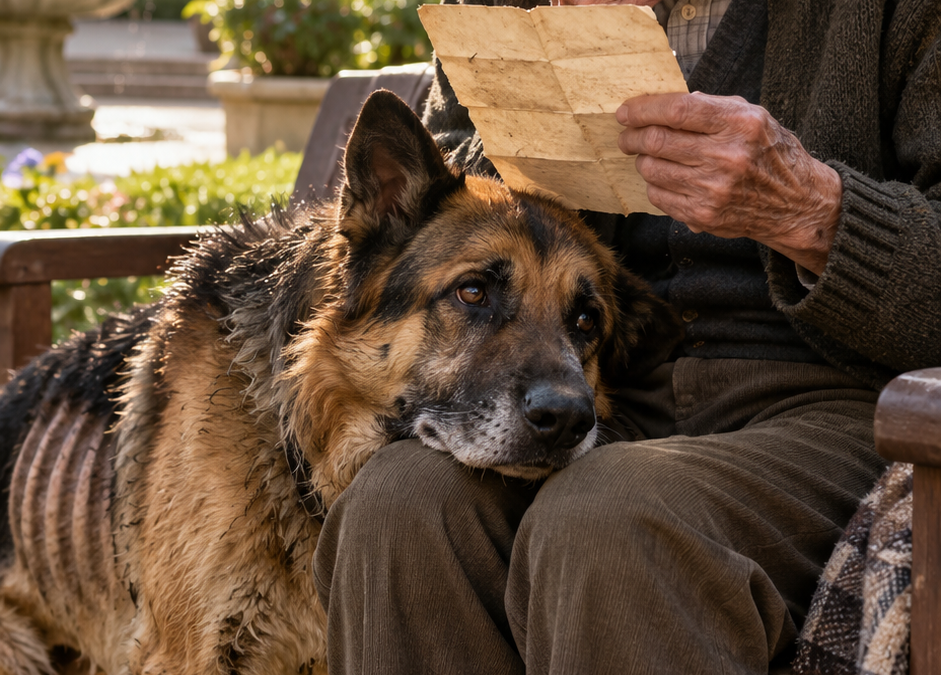
The first thing I recognized was not the handwriting.
It was the way Rex lowered his head onto my knees as though he had finally finished carrying something too heavy for one dog.
Then I opened the yellowed letter hidden beneath his collar and saw my wife’s name at the bottom.
For a moment, I forgot how to breathe.
My hands were shaking so badly I could not unfold the paper.
Rex sat beside my chair in the courtyard of the nursing home, ribs rising and falling beneath his dusty coat, his paws still muddy from a journey no one could explain. He had arrived only that morning, exhausted, thirsty, and barking at every doorway as though he was searching room by room for someone he refused to lose.
That someone was me.
My name is Edward Hartman.
I was seventy-eight years old when Rex found me.
Until that morning, I had spent most of the previous years convincing myself that being forgotten was the punishment I deserved.
The nursing home sat outside a small town I had never intended to live in.
Nothing was wrong with the place.
That was almost the problem.
The nurses were kind.
The meals were warm.
The windows were cleaned every Thursday.
Someone changed the flowers in the lobby twice a week.
At seven every evening, the hallway filled with the quiet noise of televisions coming on behind half-closed doors.
Everything worked.
Everything was safe.
And almost nothing belonged to me.
My room contained a single bed, a dresser, a chair beside the window, and a narrow shelf where I kept three books I rarely opened.
There were no family photographs.
No framed certificates.
No boxes of Christmas cards.
No pictures of grandchildren.
No wedding portrait.
Nothing that explained who I had been before I became the old man in Room 214.
People assumed I had no family.
For years, I let them assume it.
The truth was worse.
I had a family.
I had simply walked away from them.
More than forty years earlier, I had been married to a woman named Eleanor.
Even now, writing her name in my mind felt different from saying any other word.
Eleanor had brown hair when we met, though by the time our son was ten, a few silver strands had already begun appearing near her temples.
She laughed with her whole face.
Not politely.
Not carefully.
If she found something truly funny, she would tilt her head back and laugh until other people started laughing simply because she was.
We were poor when we married.
Not romantic-poor.
Actually poor.
We counted coins at the grocery store.
Shared one car.
Fixed our own appliances because repairmen cost money we did not have.
But for many years, I believed hard work was enough to protect a family from disaster.
I believed if I woke earlier, worked longer, saved more, planned better, then nothing could reach us.
Life proved otherwise.
The business I had built failed.
Bad investments followed.
Then debt.
Then the house.
Then almost everything we had spent twenty years collecting.
I watched numbers disappear from accounts.
Furniture disappear into a moving truck.
Documents arrive with words I could barely read because shame made the letters blur.
Our son James was ten.
That is the age I remember most clearly.
Ten years old.
Thin.
Serious eyes.
Always drawing something.
Clouds.
Trees.
Cars.
People he saw through restaurant windows.
He had Eleanor’s smile.
He had my tendency to become quiet when frightened.
The night we lost the house, James sat on a cardboard box near the front door and asked:
“Where are we going?”
I lied.
“Somewhere temporary.”
He looked around the empty room.
“Are we coming back?”
I should have said no.
Instead I said:
“We’ll see.”
Children remember false hope longer than adults realize.
We moved into a small rental.
I found work when I could.
But something inside me had already broken.
Every morning, I woke beside Eleanor and saw the woman I believed I had failed.
Every time James asked for something ordinary—a school trip, a new pair of shoes, money for a class project—I heard accusation where none existed.
Neither of them blamed me.
That made it worse.
Eleanor would say:
“We still have each other.”
I would hear:
This is all you have left to give us.
James would hug me.
I would think:
He does not understand yet what kind of father I am.
Shame is dangerous because it can disguise itself as sacrifice.
Eventually I convinced myself that my family would be better without me.
Not happier.
Better.
That distinction allowed me to leave while pretending I was doing something noble.
I told myself Eleanor could rebuild faster if she did not have to carry my failure too.
I told myself James deserved a father he could respect.
I told myself absence would hurt less than disappointment.
Every one of those thoughts was wrong.
But when a man is ashamed enough, he can turn cowardice into logic.
One morning, I packed a small bag.
I kissed James on the head while he slept.
I stood beside Eleanor in the kitchen.
She knew.
Of course she knew.
She looked at the bag.
Then at me.
“Don’t.”
That was all she said.
I could not meet her eyes.
“I need to go.”
“No.”
“I can’t fix this here.”
“There is nothing to fix without us.”
“I’m hurting you.”
“You will hurt us more if you leave.”
I remember putting my hand on the door.
Her voice changed.
Not angry.
Afraid.
“Edward.”
I stopped.
“If you walk out that door, James will think he wasn’t enough to make you stay.”
I almost turned around.
Almost.
Then I said the worst thing I have ever said.
“He’ll understand someday.”
Eleanor stared at me.
“No.”
Her eyes filled.
“He won’t.”
She was right.
I left anyway.
For decades, those words followed me.
He’ll understand someday.
I kept waiting for a someday that would forgive what I had done.
It never came.
At first, I moved from town to town.
Construction work.
Warehouse shifts.
Maintenance jobs.
Anything that paid cash and asked few questions.
I wrote letters.
Then tore them up.
I called once.
Hung up before anyone answered.
Another time, I stood across the street from a post office with an envelope addressed to Eleanor in my coat pocket for almost an hour.
I never mailed it.
Years passed.
Then more years.
I lost track of addresses.
People moved.
Records changed.
I told myself that reaching out after so much time would be selfish.
Again, cowardice pretending to be consideration.
At some point, I heard through an old acquaintance that Eleanor had died.
The news reached me almost a year after her funeral.
I sat alone in a cheap motel room and cried until morning.
I had not been there.
Had not held her hand.
Had not apologized.
Had not even known she was sick.
And James?
No one knew where he was.
At least no one I asked.
Eventually I stopped asking.
That was how I arrived at the nursing home.
Old age narrows a life.
First work disappears.
Then friends.
Then places.
Then people begin saying things like:
“At least you’re safe here.”
Safety is not the same as belonging.
Every morning, I woke around six.
A nurse brought medication.
Breakfast at seven.
Physical therapy twice a week.
Lunch.
Afternoon.
Dinner.
Television.
Sleep.
My body continued.
My life had already ended in my mind.
Then Rex appeared.
It was late morning when I first heard him.
Barking.
Not normal barking.
Urgent.
Sharp.
A dog calling for someone.
The sound moved across the courtyard.
Then down the side of the building.
Then back again.
Several residents came to the windows.
One nurse went outside.
I stayed in my chair.
Dogs sometimes wandered onto the property.
Someone would find the owner.
Then I heard a nurse say:
“Easy, boy.”
The barking stopped.
A few seconds later, it started again.
Closer.
Something inside me tightened.
I stood.
Slowly.
My knees complained.
I walked into the hallway.
Margaret, one of the nurses, was coming through the lobby doors with a large brown-and-black dog beside her.
His fur was dirty.
His tongue hung from one side of his mouth.
One paw looked raw.
He was exhausted.
But his eyes were alive.
Searching.
The second he saw me, he froze.
So did I.
There are moments when the mind refuses the evidence in front of it because accepting it would require rewriting reality.
Rex had been a puppy the last time I saw him.
That made no sense.
Dogs do not live forty years.
Yet something in the source story is stylized/implausible here; preserve as source.
I knew those eyes.
Or believed I did.
The same dark intelligence.
The same white patch beneath the throat.
The same way one ear folded slightly forward when he became uncertain.
“Rex?”
The dog pulled free of Margaret.
He ran toward me.
Not fast.
He was too tired.
But he came.
He pressed his body against my legs so hard I almost lost my balance.
Then he began whining.
A low sound from somewhere deep in his chest.
I reached down.
My fingers touched the fur behind his ears.
“Rex.”
He licked my hand.
I sat down because my knees could no longer hold me.
He placed his head in my lap.
Margaret stood a few feet away.
“You know him?”
I could barely speak.
“I knew a dog named Rex.”
She smiled gently.
“I think he knows you.”
I touched the collar.
Old leather.
Scratched buckle.
Something felt wrong beneath it.
Thicker than it should have been.
I turned the collar over.
A small piece of paper had been folded into a narrow strip and tucked inside a stitched pocket beneath the leather.
My heart started beating faster.
“What is that?” Margaret asked.
“I don’t know.”
I pulled it free.
The paper was yellowed.
Worn along the folds.
Protected by a thin layer of waxed cloth.
My hands began shaking.
There was handwriting on the outside.
Edward.
I knew the handwriting before I opened it.
Forty years could not erase that.
Eleanor.
I could not unfold the paper.
My fingers would not obey.
Rex sat beside me.
Then rested his head across my knees.
The exact way he used to do when Eleanor and I argued and he wanted everyone to stop.
I took a breath.
Opened the first fold.
Then the second.
The writing swam because my eyes filled immediately.
My dear Edward,
If you are reading this, then Rex found you.
I stopped.
Margaret moved closer.
“Are you all right?”
No.
But I nodded.
I continued.
I always knew he would.
When you left us after we lost everything, I knew you believed time would heal the wounds.
But I also knew yours might not.
I am writing this letter and placing it beneath Rex’s collar because there are some things I may never have the chance to say to you again.
I covered my mouth.
Eleanor had written the letter years earlier.
Long before her death.
Long before I became the man sitting in that nursing-home courtyard.
The next lines nearly destroyed me.
We lost our house.
We lost our savings.
We lost almost everything we owned.
But the most important thing was never lost.
James.
Our son.
I had to stop reading.
The courtyard blurred.
Rex lifted his head.
Margaret crouched beside me.
“Edward?”
I handed her the page.
“I can’t.”
She waited.
I shook my head.
“No. I have to.”
I took it back.
James was only ten when you left.
He grew up.
Edward, he became a doctor.
I laughed once.
A broken sound.
“Doctor.”
Margaret looked at me.
“My son.”
I returned to the letter.
He searched for you.
Not once.
Not for a year.
He kept searching.
I wanted you to know that.
I wanted you to know that he never stopped believing you were somewhere in this world.
I closed my eyes.
For most of my life, I had imagined James hating me.
It was easier.
Hatred gave me an excuse to stay away.
If he hated me, then not contacting him could be called mercy.
But hope?
Hope was harder.
Hope meant that every year I remained silent had been a choice.
I read the next paragraph.
I will not be here forever.
By the time you read this, I may already be gone.
But James is still here.
He lives far from where we once called home.
He has opened a clinic in a small town across the country.
I have written the address below.
Find him.
Please.
Find our son.
He is James Hartman now.
He is waiting for an answer to a question he has carried since childhood.
Why did my father leave?
Only you can answer it.
I could no longer see the page.
My tears fell directly onto the paper.
At the bottom, Eleanor had written:
He never stopped believing that one day he would find you.
Neither did I.
Rex knows the way.
Trust him.
With all my love,
Forever yours,
Eleanor
I held the letter against my chest.
My hands stopped shaking.
Not because I was calm.
Because something larger than fear had taken over.
For years, I had believed every door behind me was closed.
Suddenly one had opened.
Far away.
Almost impossibly far.
But open.
I looked down at Rex.
“You knew?”
He wagged his tail once.
“You knew where I was?”
Another wag.
Margaret wiped her eyes.
“What does it say?”
I handed her the letter.
She read slowly.
By the time she reached Eleanor’s final line, she was crying too.
She looked at the address.
“This is far.”
“I know.”
“Very far.”
I nodded.
A small town across the country.
Three days by the route we eventually took.
For a healthy person, difficult but manageable.
For me?
I walked with a cane.
My back stiffened after an hour sitting.
My knees swelled.
I had not traveled outside the county in years.
I stared at the address.
“What if he doesn’t want me?”
Margaret looked up.
“The letter says he searched for you.”
“That was years ago.”
“Maybe.”
“He was a child.”
“And then an adult.”
“People change.”
“Yes.”
“That means he could have stopped.”
Margaret folded the letter carefully.
“But you don’t know that.”
“No.”
“So which would be worse?”
I looked at her.
“Traveling all that way and hearing no?”
She shook her head.
“Or staying here and never hearing anything?”
That night, I did not sleep.
Rex stayed in my room.
The staff made an exception.
He lay beside the bed.
I sat near the window with Eleanor’s letter open across my knees.
Outside, parking-lot lights threw pale circles across the pavement.
I read the same sentence again and again.
He never stopped believing.
I thought of James at ten.
Sitting on a cardboard box.
Asking whether we were going back home.
I thought of myself leaving before sunrise.
I thought of Eleanor standing by the door.
He’ll think he wasn’t enough to make you stay.
For forty years, I had been afraid to face what I had done to him.
Now the fear remained.
But underneath it was something I had not felt in decades.
A reason to move toward something instead of away from it.
I looked down.
Rex opened one eye.
“Do you think he’ll hate me?”
Rex sighed.
“That isn’t helpful.”
His tail tapped the floor.
I almost smiled.
At dawn, I had decided.
When Margaret came in with my morning medication, I was already dressed.
She stopped.
“Going somewhere?”
“Yes.”
She raised an eyebrow.
“Edward?”
I looked at Rex.
Then at the letter.
“We’re going to find my son.”
Rex stood immediately.
His tail began moving.
Margaret laughed through her surprise.
“I think he approves.”
The next forty-eight hours were chaos.
The nursing home staff did more than I had any right to expect.
Margaret called her sister Suzanne, who lived within a few hours of James’s town.
Suzanne agreed to help.
Transportation had to be arranged.
Medication organized.
Travel documents.
Food for Rex.
Veterinary check.
A proper harness.
A room near one of the train connections.
When the other residents heard what was happening, they became involved.
I hated that part at first.
I did not want charity.
Then Mr. Collins from Room 109 walked into my room holding forty dollars.
“No.”
He put it on the dresser.
“I didn’t ask.”
“I know.”
“Take it back.”
“No.”
“I have enough.”
“You don’t.”
“That’s not your problem.”
He shrugged.
“Now it is.”
Other residents followed.
Five dollars.
Ten.
Twenty.
Someone bought Rex food.
Someone else found an old travel blanket.
Mrs. Henderson, who rarely left her room, sent a small envelope with twelve dollars inside and a note:
For James.
I sat on my bed surrounded by people who had every reason to focus only on their own pain.
Instead, they were helping an old man chase a son across the country.
I had spent half my life believing I had nothing left to give anyone.
That week, people gave to me anyway.
The morning we left, Margaret walked us to the station.
Rex wore a new red harness.
I carried one small suitcase.
Eleanor’s letter stayed inside my coat.
Not the suitcase.
I could lose clothes.
I could not lose that.
Margaret hugged me.
“Call.”
“I will.”
“You’d better.”
“I said I will.”
She looked at Rex.
“And you.”
Rex wagged his tail.
“Bring him all the way there.”
The train arrived.
When I stepped aboard, fear hit me harder than it had at the nursing home.
Travel made the decision real.
There was still time to turn around.
Still time to say my health was not good enough.
Still time to say James probably had a family now.
Still time to hide behind the same excuses I had used for decades.
Rex stepped into the carriage ahead of me.
Then looked back.
“All right.”
I followed.
The train crossed country I had not seen in a lifetime.
Fields.
Rivers.
Mountains.
Small towns.
Industrial cities.
Long stretches of empty land.
I spent most of the first day staring out the window.
Every landscape made me wonder where James had been.
Had he traveled this route?
Did he like mountains?
Did he still draw?
Was he married?
Did he have children?
Did those children know they had a grandfather?
That thought hurt.
I had not only missed James’s childhood.
I might have missed another entire generation.
At one station, a young woman noticed Rex lying beneath my seat.
“Beautiful dog.”
“He’s stubborn.”
Rex looked at her.
She smiled.
“Looks loyal.”
“Yes.”
That word caught in my throat.
Loyal.
Rex had crossed whatever distance separated us.
I had spent decades unable to cross one telephone line.
The young woman gave me part of her sandwich for him.
At another stop, an elderly couple helped carry my suitcase because the platform stairs were too steep.
That night, a conductor found us a quieter section where I could stretch my legs.
Everywhere we went, strangers helped.
Small things.
A bottle of water.
Directions.
A hand under my elbow.
A seat.
Food for Rex.
I began to understand what Eleanor had meant.
Trust him.
Rex did not know train schedules.
He did not understand bus routes.
But he moved through the world as if he expected kindness.
I had spent decades expecting judgment.
Maybe that was why he traveled farther than I did.
After the train came a bus.
Then another.
The final bus dropped us near a rural junction miles from James’s town.
The driver looked at my address.
“You still have a way to go.”
“I know.”
“There isn’t another bus until tomorrow.”
I looked at Rex.
He looked exhausted.
So was I.
We sat beneath the small shelter.
Maybe twenty minutes later, a pickup truck pulled over.
An older farmer leaned across the passenger seat.
“You two stranded?”
“Temporarily.”
“Where you headed?”
I showed him the address.
He whistled.
“That’s not temporary.”
“Apparently not.”
He laughed.
“Get in.”
He drove us the rest of the way.
I tried to pay him.
He refused.
“You look like you’re going somewhere important.”
“I hope so.”
The town appeared near sunset on the third day.
Small.
Quiet.
Trees lining the streets.
Gardens in front yards.
A pharmacy.
Two restaurants.
A library.
And near the center, a white building with a flower bed along the entrance.
HARTMAN FAMILY CLINIC.
I stood on the sidewalk.
My legs suddenly felt weaker than they had during the entire journey.
Rex sat beside me.
“That’s it.”
He looked at the building.
Then at me.
“I know.”
I could not move.
A woman walked past us and opened the clinic door.
It closed behind her.
I remained outside.
“What if he says no?”
Rex waited.
“What if he looks at me and all he sees is the man who left?”
Rex leaned against my leg.
I touched Eleanor’s letter through my coat.
He never stopped believing.
“Okay.”
I opened the door.
The waiting room smelled faintly of disinfectant and coffee.
A young receptionist sat behind a desk.
She smiled.
“Good afternoon. How can I help you?”
My mouth went dry.
“I’d like to see Dr. Hartman.”
“Do you have an appointment?”
“No.”
“Is this a medical emergency?”
“No.”
She glanced at Rex.
Then back at me.
“He’s with a patient. I can see if he has a few minutes afterward.”
“That’s fine.”
“Can I have your name?”
I hesitated.
“Edward.”
“Last name?”
I swallowed.
“Hartman.”
Her fingers stopped above the keyboard.
She looked at me.
Then at Rex.
Something changed in her expression.
“You’re related?”
“I don’t know if he would say that.”
She did not ask more.
“Please sit down.”
I chose the chair farthest from the desk.
Rex lay at my feet.
I held Eleanor’s letter.
Five minutes passed.
Then ten.
Each minute felt longer than the three-day journey.
I almost stood twice.
Almost left.
The second time, Rex placed one paw on my shoe.
“You’re getting bossy.”
He kept the paw there.
Then an interior door opened.
A man stepped into the waiting room.
Tall.
Early fifties.
Gray beginning at the temples.
White coat.
He turned toward the receptionist.
Then looked at me.
I recognized him immediately.
Not because he looked like the boy I remembered.
He did not.
He looked like Eleanor.
The smile.
The eyes.
Even the way his head tilted slightly when he was confused.
He looked at Rex first.
His face went completely still.
Then at me.
His mouth opened.
No sound came out.
The waiting room disappeared.
I could hear my own heartbeat.
Then he whispered:
“Father?”
One word.
I had spent forty years imagining everything my son might say to me.
Why?
How could you?
You abandoned us.
You have no right to come here.
Instead:
Father?
I stood.
Or tried.
My legs failed halfway.
James moved toward me.
I could not speak.
So I opened my arms.
He crossed the room in three steps.
Then he held me.
Not politely.
Not cautiously.
He grabbed me the way a drowning person grabs something solid.
I felt his shoulders shaking.
Mine too.
Rex circled us, whining.
The receptionist turned away to wipe her eyes.
James pulled back.
He looked at my face.
Touched my shoulder.
“You’re alive.”
I tried to answer.
Nothing.
“You’re alive.”
“I’m sorry.”
Those were the first words I managed.
James shook his head.
Tears ran down his face.
“Not here.”
“What?”
“Not yet.”
He hugged me again.
“Just let me have this first.”
So I did.
Later, in his office, I gave him Eleanor’s letter.
He knew it before he unfolded it.
“Mom.”
“Yes.”
“She wrote this?”
“She put it in Rex’s collar.”
James looked at the dog.
Then laughed through tears.
“She always said he would find you.”
“You believed her?”
“For a long time.”
He looked down.
“Then I tried not to.”
That hurt.
“I searched.”
“I know.”
“No, Dad.”
The word Dad nearly broke me again.
“I searched everywhere.”
He opened a desk drawer.
Inside was an old photograph.
Eleanor.
James as a boy.
Me.
Rex sitting in front.
I touched the edge.
“Your mother kept this?”
“Under her pillow near the end.”
I closed my eyes.
“She never stopped loving you.”
“I didn’t deserve that.”
“That wasn’t your decision.”
He said it quietly.
Firmly.
I looked at him.
“You’re right.”
For the first time in my life, I did not defend myself.
I did not explain.
Did not say I was ashamed.
Did not say I thought they would be better without me.
Those things were true in my mind at the time.
They were not enough.
“I left you.”
James stared at me.
“Yes.”
“I was wrong.”
Silence.
“I thought losing everything meant I had nothing left to give.”
James looked toward the photograph.
“You had us.”
“I know that now.”
His jaw tightened.
“You know how many birthdays I waited for you?”
I lowered my head.
“No.”
“Every one.”
I could barely breathe.
“When I was eleven, I thought you might come back for my birthday.”
He looked at the wall.
“When I was twelve, I decided Christmas.”
I closed my eyes.
“At thirteen, I started watching men in crowds.”
“James—”
“Let me.”
I nodded.
“At sixteen, I got angry.”
He wiped his face.
“At eighteen, I decided I hated you.”
I absorbed it.
“At twenty-five, I stopped saying I hated you because Mom would look at me like I had killed something.”
A small laugh escaped him.
“She kept saying you were ashamed, not heartless.”
“She was kinder to me than I deserved.”
“Yes.”
He looked at me.
“She was.”
I accepted that too.
“After medical school, I started searching again.”
“Why?”
“I don’t know.”
He looked at Rex.
“Maybe because she never stopped.”
“How long?”
“Years.”
He shook his head.
“Different towns. Old employment records. Property files. People with your name. Dead ends.”
“I moved too much.”
“I know.”
“I made myself hard to find.”
“Yes.”
I looked at my hands.
“Because I was afraid.”
James leaned back.
“Of us?”
“Of what you would say.”
“What did you think I’d say?”
“That I ruined your life.”
He was quiet.
“You hurt it.”
I nodded.
“But you didn’t ruin it.”
I looked up.
He continued.
“Mom didn’t let you.”
A smile touched his face.
“She worked. She fought. She raised me. She made sure I went to school.”
“She always was stronger.”
“She was.”
“What happened to her?”
James looked down.
“Cancer.”
I closed my eyes.
“How long?”
“Two years.”
“Was she in pain?”
“At the end.”
I covered my face.
“I should have been there.”
“Yes.”
Again, no softening.
No false comfort.
Just truth.
It hurt.
It also felt like the first honest thing I had been given in decades.
“I’m sorry.”
“I know.”
“No.”
I looked directly at him.
“I am sorry for leaving you. I am sorry for making your mother carry everything. I am sorry for every birthday you watched a door. I am sorry I decided what kind of life you would have without asking either of you.”
My voice broke.
“I’m sorry I made my shame more important than your love.”
James looked at me for a long time.
Then he reached across the desk.
He put his hand over mine.
“I can’t give you the years back.”
“I know.”
“And I can’t pretend it didn’t happen.”
“I don’t want you to.”
“But you came.”
I looked at Rex.
“Eventually.”
James smiled faintly.
“You had help.”
“A lot.”
Then he asked:
“Where are you staying?”
“I haven’t thought that far.”
“You came across the country without knowing where you were staying?”
“Yes.”
“That sounds like you.”
“I don’t remember being this foolish.”
“I do.”
We both laughed.
It was awkward.
Broken.
Perfect.
That night, I did not return to a hotel.
James took me home.
His house stood near a large garden.
Not grand.
Warm.
Lived in.
Shoes near the door.
Family photographs on walls.
Books stacked on a table.
A coat hanging over a chair.
Noise.
Life.
His wife Sarah met us at the door.
She knew immediately.
James must have called while I sat in his office.
She looked at me.
Then opened her arms.
“Edward.”
I hesitated.
She hugged me.
Not because I had earned it.
Because that was who she was.
Their children came downstairs.
Thomas was twelve.
Lily seven.
My grandchildren.
I had never known their names.
Lily looked at Rex first.
“Is he ours?”
Sarah laughed.
“No.”
Rex wagged his tail.
Lily crouched beside him.
“He thinks he is.”
Thomas looked at me.
“Are you Grandpa Edward?”
No one had ever called me that.
“Yes.”
He nodded.
“Dad said you were coming.”
That simple acceptance almost brought me to tears again.
Dinner was loud.
Lily asked too many questions.
Thomas asked almost none.
Sarah kept adding food to my plate.
James watched me carefully.
As though afraid I might disappear if he looked away too long.
I understood.
That night, I slept in a guest room.
Rex lay beside the bed.
The house made ordinary nighttime sounds.
Pipes.
Floorboards.
A distant door.
Someone laughing upstairs.
I held Eleanor’s letter.
Read it again.
Then whispered:
“We made it.”
Rex lifted his head.
“She knew.”
His tail tapped once.
“I wish she could see this.”
I closed my eyes.
“Maybe she can.”
The following morning, James introduced me properly to his family.
Not as a surprise.
Not as a mystery.
As his father.
Sarah made breakfast.
Lily slipped Rex a piece of egg.
Her mother caught her.
“Lily.”
“It’s a special day.”
Sarah sighed.
“One piece.”
Rex received three.
I sat in the garden afterward.
Sun on my face.
Thomas threw a stick.
Rex chased it.
Lily ran after both of them.
James sat beside me.
For several minutes, neither of us spoke.
Then he said:
“You can stay.”
I looked at him.
“For a while?”
“No.”
He turned toward me.
“You can stay.”
“James.”
“I have a room.”
“You have a family.”
“You are family.”
I swallowed.
“I don’t want to become a burden.”
His expression changed immediately.
“Don’t.”
“What?”
“Don’t do that again.”
I froze.
“Don’t decide for me what burden means.”
He leaned forward.
“You made that decision once.”
I nodded.
“You’re right.”
“If I need help, I’ll ask.”
“All right.”
“If you need help, you ask.”
“That may be harder.”
“I know.”
He smiled.
“You’re still staying.”
For the first time in decades, somebody told me where I belonged.
And I believed him.
A week later, Margaret called from the nursing home.
James handed me the phone.
“Edward?”
“Still alive.”
She laughed.
“How is it?”
I looked across the yard.
Rex lay beneath a tree.
Thomas was reading on the porch.
Lily had tied a blue ribbon around Rex’s collar.
James was inside the kitchen with Sarah.
“How do I explain it?”
“Try.”
I smiled.
“I found my home.”
Margaret began crying.
“I knew it.”
“No, you didn’t.”
“I hoped.”
“That’s different.”
“Yes.”
Her voice softened.
“Are you happy?”
I looked at the letter on the table beside me.
“Yes.”
That word felt strange.
Then right.
“Yes, Margaret. I’m happy.”
Life did not become perfect after that.
Stories like mine sometimes make reunion sound like a door you walk through and all the old pain disappears.
That was not what happened.
James and I had work to do.
Years of it.
There were questions.
Anger.
Silences.
Moments when he remembered something from childhood and I had no answer that made it better.
Sometimes at dinner he would suddenly say:
“Do you know Mom worked two jobs one winter?”
I would say no.
He would tell me.
I learned to listen.
Sometimes he asked why I never called.
I explained shame.
Then stopped myself from using shame as an excuse.
Sometimes I woke at night convinced I had no right to be there.
Rex would lift his head.
I would touch the collar.
Then remember Eleanor’s letter.
Find him.
So I stayed.
That was the hardest lesson of my life.
Leaving feels dramatic.
Staying requires work.
I learned my grandchildren slowly.
Thomas loved science.
Lily loved every animal she met.
James had become a doctor because, he told me, he wanted people who felt abandoned by life to meet at least one person who did not give up on them.
When he said that, I knew part of his career had been shaped by me.
Not in a way that made me proud.
But maybe in a way that allowed pain to become useful.
Sarah never pushed me to explain myself.
She treated me kindly without pretending I had done nothing wrong.
I respected that.
Rex became the center of the household.
He slept wherever he wanted.
Usually beside my bed.
Sometimes outside Lily’s room.
He followed James through the garden.
Waited near the kitchen when Sarah cooked.
Sat with Thomas while he read.
He had completed the journey he had been given.
Now he seemed content to simply belong.
One afternoon, Lily found me checking the collar.
“What are you doing?”
“Making sure something is still there.”
“What?”
I showed her the folded letter.
She reached for it.
Then stopped.
“Can I?”
I thought about it.
Then handed it to her.
She read slowly.
Not every word.
Enough.
“Your wife wrote this?”
“Yes.”
“My grandma?”
“Yes.”
She looked toward Rex.
“She put it on him?”
“Yes.”
“So he was carrying your map.”
I smiled.
“In a way.”
Lily folded the letter carefully.
“Did she know you were going to find Dad?”
“I think she hoped.”
“That’s like knowing.”
“Not exactly.”
She handed it back.
“I think she knew.”
Maybe children understand faith differently.
For Lily, hope was not weaker because it lacked proof.
It was stronger because someone chose it anyway.
Months passed.
My strength improved slightly.
James arranged physical therapy at his clinic.
I complained.
He ignored me.
We walked each morning.
Rex beside us.
Some days only to the end of the block.
Then farther.
I began helping in the garden.
Small things.
Tomatoes.
Herbs.
Beans.
Lily called one corner “Grandpa’s farm.”
It was six raised beds.
I accepted the promotion.
One evening, James came outside while I was tying tomato vines.
“You know Mom grew tomatoes every year.”
I stopped.
“She did?”
“Even after we lost the house.”
He leaned against the fence.
“First apartment had a tiny balcony.”
I smiled.
“She would.”
“She kept three pots.”
I looked at my plants.
“Were they any good?”
“No.”
We laughed.
“She always overwatered them.”
“That sounds right.”
James became quiet.
“She talked about you while she gardened.”
I looked at him.
“What did she say?”
“Depends on the year.”
“Fair.”
“Sometimes she was angry.”
“She had every right.”
“Sometimes she said you were the best man she knew before you became afraid of being the worst.”
I stopped tying the vine.
“That sounds like Eleanor.”
“She understood you better than I did.”
“Better than I understood myself.”
James nodded.
Then he looked toward the house.
“I wish she were here.”
“So do I.”
That grief became something we could share.
Not mine.
Not his.
Ours.
I had spent decades carrying Eleanor alone in memory because I thought I had forfeited the right to speak her name.
James gave her back to me in stories.
How she sang badly while cooking.
How she kept every school drawing he made.
How she refused to throw away my old jacket.
How she defended me even when she was furious with me.
How she died still believing I might return.
That last one was the hardest.
But eventually it became a gift rather than a punishment.
One year after Rex found me, we visited Eleanor’s grave.
James had asked several times.
I always found a reason not to go.
Too far.
Weather.
Knees.
Then one morning, I said yes.
The cemetery was several hours away.
Sarah packed food.
The children came.
Rex too.
Eleanor’s stone was simple.
Her name.
Dates.
BELOVED MOTHER.
No mention of wife.
I stood in front of it for a long time.
Then sat in the grass.
James stayed back.
So did the others.
Rex came beside me.
I took out the letter.
“Hello, Eleanor.”
My voice shook.
“I’m late.”
Wind moved through the trees.
“I know.”
I looked at the stone.
“You were right.”
That made me laugh.
“You’d enjoy hearing that.”
I read part of the letter aloud.
Then folded it.
“I found him.”
My throat closed.
“No.”
I corrected myself.
“He found me too.”
I placed my hand against the cool stone.
“I’m sorry.”
For once, I did not need an answer.
I stayed until sunset.
After that, I stopped checking the letter every day.
Not because it mattered less.
Because I no longer needed proof that Eleanor’s love had survived.
It was everywhere.
In James.
In his smile.
In the way he listened to frightened patients.
In Thomas.
In Lily.
In the garden.
In the dog sleeping beneath my chair.
Years earlier, I had believed losing the house meant losing everything.
I had been wrong.
A house can be lost.
Money can vanish.
Furniture can be sold.
Jobs can disappear.
Health can fail.
Time can be wasted.
But love behaves differently.
Love can be wounded.
Ignored.
Buried beneath years of shame.
It can be stretched across cities and decades.
It can become difficult to recognize.
But sometimes it remains.
Waiting.
Not untouched.
Not painless.
But alive.
I know that now because my son proved it.
Eleanor proved it.
And Rex carried the proof beneath his collar until I finally became brave enough to read it.
I never returned to the nursing home except to visit.
Margaret always complained that I had abandoned her.
“I escaped.”
“You were discharged properly.”
“That sounds less heroic.”
The residents wanted every detail.
I told them the truth.
The journey was hard.
The reunion was harder.
The staying was hardest.
But worth it.
Mrs. Henderson, who had sent twelve dollars “for James,” refused repayment.
“You used it?”
“Yes.”
“For what?”
“Probably food.”
“Then it did its job.”
I stopped arguing.
My old room eventually went to someone else.
Room 214.
New photographs.
New books.
Another life.
I was glad.
No room should stay empty just because someone once believed he would die there.
At James’s house, my belongings slowly multiplied.
At first, one suitcase.
Then clothes.
A shelf.
A chair.
Photographs.
One of Eleanor.
One of James as a boy.
One of the grandchildren with Rex.
James found the old family photograph from his desk and had it framed.
Me.
Eleanor.
Young James.
Rex.
He placed it in my room.
I stared at it.
“Too much?”
“No.”
“You can move it.”
“No.”
I touched the frame.
“Leave it.”
The photograph did not accuse me anymore.
It reminded me what had survived.
On quiet evenings, we sat around the dinner table.
Sarah talked about work.
Thomas complained about school.
Lily tried to feed Rex under the table.
James caught her.
She denied everything.
I watched.
Sometimes I felt grief for all the dinners I had missed.
That grief never disappeared.
But I learned not to let regret poison what remained.
The present was not a replacement for the past.
It was simply what we had been given.
I intended to stay for it.
One winter evening, James found me sitting by the window.
Rex’s head rested across my foot.
Snow covered the garden.
“What are you thinking about?”
“Your mother.”
He sat beside me.
“Good things or bad?”
“Both.”
“That sounds right.”
I looked at him.
“Do you forgive me?”
The question surprised both of us.
James took a long time.
Finally he said:
“I think forgiveness is something I keep doing.”
I nodded.
“That’s fair.”
“Some days it’s easy.”
“And others?”
“Not.”
I looked down.
“But I want you here.”
I swallowed.
“That’s enough.”
He smiled.
“For now.”
That was the most honest answer he could have given me.
Forgiveness was not a courtroom verdict.
Not one dramatic embrace.
It was a decision repeated.
Just like staying.
Rex grew slower as the years passed.
His muzzle whitened.
His steps shortened.
The children adjusted their games.
Thomas stopped throwing the stick so far.
Lily brought water closer.
I understood what was happening.
Rex had found me when both of us were already old.
That made every year with him feel borrowed.
One morning, he did not get up.
James came to my room.
He examined him gently.
Then looked at me.
I knew.
I sat on the floor beside Rex.
Put his head in my lap.
The same way he had rested his head on my knees the day he arrived at the nursing home.
“You did enough.”
His eyes opened.
“You hear me?”
His tail moved once.
“You found me.”
I touched his ear.
“You brought me home.”
James sat beside us.
Lily cried into Sarah’s shoulder.
Thomas stared at the floor.
I removed the collar.
For the first time since finding Eleanor’s letter, Rex did not need to carry it.
He died with my hand on his head.
Quietly.
Loved.
Afterward, Lily asked where the letter would go.
I thought about hiding it somewhere safe.
A bank box.
A drawer.
A frame.
Then I realized Eleanor had never written it to be preserved like an artifact.
She had written it to move someone.
So we framed a copy.
The original went into a small box beside our family photographs.
Rex’s collar rested on top.
In the garden, James planted a tree.
Lily chose it.
A maple.
Thomas dug the hole.
I helped badly.
Sarah brought water.
We placed Rex’s old tag beneath the roots.
No ceremony.
Just family.
Years earlier, I had left because I believed I was protecting the people I loved from the burden of my failure.
Standing beside that young tree, surrounded by the family I nearly lost forever, I finally understood how wrong I had been.
Love does not ask us to disappear when we fail.
It asks us to stay long enough to be known honestly.
Stay through shame.
Stay through anger.
Stay through the parts that cannot be repaired quickly.
Stay when forgiveness is incomplete.
Stay anyway.
If I had learned that at forty, my life would have been different.
I learned it at seventy-eight.
Late is not the same as never.
I carry that truth with me now.
Some mornings I still wake before everyone else.
Old habits.
I walk into the garden.
The maple we planted for Rex has grown.
Not large.
Enough to cast a small shadow.
I sit beneath it.
Sometimes James joins me.
Sometimes one of the grandchildren.
Sometimes no one.
I keep Eleanor’s letter in the house.
I no longer need to touch it every day.
I know what it says.
I know where James is.
I know where I am.
That is enough.
For most of my life, I believed home was a place a man could lose.
A house.
A town.
An address.
Now I know better.
Home can be a person who still opens the door.
A son who says Father after decades of silence.
A woman whose love survives her.
A family willing to leave a chair for you at the table.
Or an exhausted dog who crosses an impossible distance carrying a letter beneath his collar because everyone else has given up except him.
Rex found me when I had stopped believing there was anything left to find.
Eleanor’s letter gave me a destination.
James gave me another chance.
But I had to do the final part myself.
I had to walk through the door.
And this time, I stayed.

