The Interpreter Changed One Sentence, and Seven Years of Silence Suddenly Felt Dangerous
The Interpreter Changed One Sentence, and Seven Years of Silence Suddenly Felt Dangerous
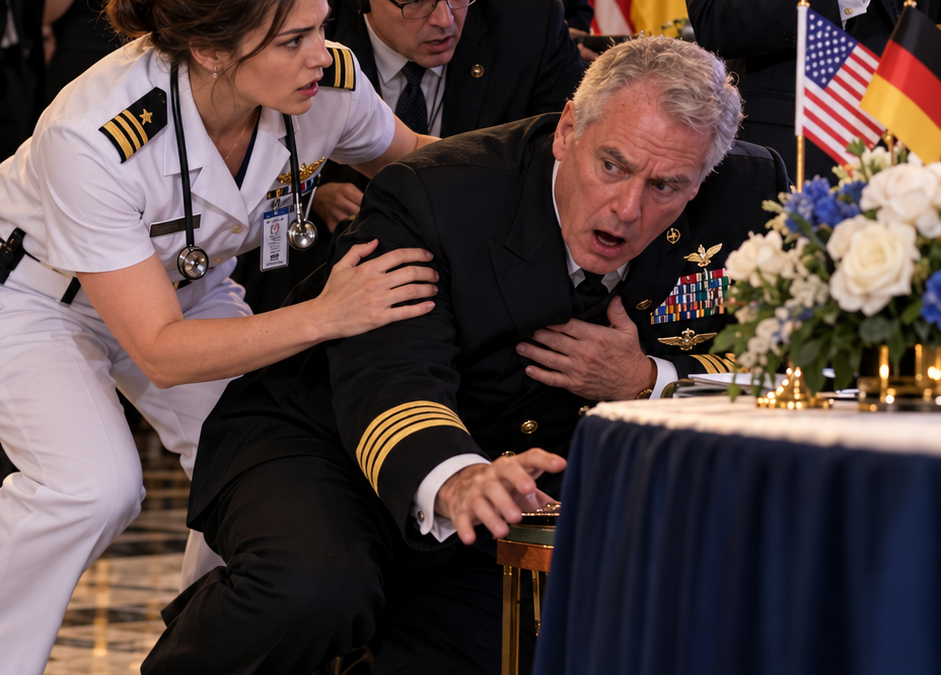
The admiral’s glass hit the marble floor before anyone in the ballroom understood that something was wrong.
I had already heard the interpreter alter one sentence that could change a billion-dollar defense agreement, and I had been dismissed when I tried to warn the man now collapsing in front of me.
Then someone across the room looked at me with the recognition of a man who knew a name I had buried seven years earlier.
My name is Evelyn Carter.
At thirty-eight, I had become very good at being forgettable.
That may sound strange coming from a woman who worked as a Navy civilian nurse, but forgettable was exactly what I wanted.
Competent enough to be trusted.
Quiet enough to be overlooked.
Useful without becoming interesting.
For seven years, I built my life around those principles.
I worked long shifts.
I treated sailors with infected wounds, officers who ignored chest pain until it frightened their spouses, young enlisted men who discovered that dehydration could defeat them faster than pride, and retirees who still called every nurse “ma’am” even while arguing about their medication.
I lived in a modest apartment.
I drove a car no one would remember.
I had coworkers who knew I liked dark coffee and disliked hospital birthday cake.
They knew I spoke German.
They did not know why.
They knew I had traveled in Europe when I was younger.
They did not know under which names.
They knew there was a scar beneath my left shoulder blade.
They did not know it came from broken glass in a hotel room in Vienna while a man died six feet away from me.
That was the point.
Evelyn Carter had a medical license, a Navy identification badge, a retirement account, and no secrets anyone needed to care about.
Agent Rowan had belonged to another life.
I intended to keep it that way.
The defense meeting at the Norfolk Naval Officers’ Club should have been ordinary by the standards of the people attending it.
The ballroom had been polished until the marble reflected the chandeliers.
American and German flags stood behind the signing table.
Naval officers moved through clusters of civilian officials, defense representatives, attorneys, analysts, and diplomatic staff.
The evening centered around a proposed radar cooperation agreement involving the United States and a German defense consortium.
Most of the technical material meant little to the guests drinking champagne near the windows.
But one clause mattered enormously.
Source-code audit access.
How much one government could inspect.
Under what circumstances.
With whose authorization.
Those details could determine who controlled verification rights over technology worth more money than most people in that ballroom would see in a thousand lifetimes.
I was there for medical standby.
Nothing more.
At least, that was what my badge said.
The medical station had been established discreetly near a service corridor.
Commander Paul Hensley was the senior physician on duty.
Two corpsmen rotated with us.
My job was simple.
Remain available.
Stay invisible.
Intervene only if someone became sick or injured.
I had no official reason to listen to the negotiations.
Unfortunately, German was not something I could turn off.
General Lukas Adler, the senior member of the German delegation, was speaking quietly with Admiral Daniel Whitmore and several advisers when I heard the sentence.
“Unsere Regierung verlangt vollständige Prüfrechte für den Quellcode.”
Our government requires complete audit rights to the source code.
Martin Keller, the official interpreter, smiled professionally.
Then translated:
“The German government requests limited verification rights under the current technical framework.”
I looked up from the medical inventory sheet in my hand.
Limited verification rights.
That was not what Adler had said.
Maybe Keller had summarized.
Interpreters occasionally adjusted phrasing for diplomatic flow.
But those two phrases were not equivalent.
Complete audit rights.
Limited verification rights.
One could authorize deep inspection.
The other could preserve restrictions worth enormous commercial leverage.
I watched Keller.
He did not look uncertain.
He did not glance toward Adler for clarification.
He translated smoothly.
Too smoothly.
A few minutes later, another technical sentence came.
Again, Keller softened it.
This time he changed a condition from mandatory to discretionary.
My old instincts woke up.
I hated how familiar the sensation felt.
You do not forget pattern recognition.
You only stop admitting that you are using it.
I watched the room.
Who looked at Keller?
Who looked away?
Who appeared relieved?
Who touched a phone after the translation?
A civilian representative near the American legal table lowered his eyes and typed something.
A defense-industry attorney exchanged a glance with another man.
Could have meant nothing.
Most things mean nothing.
That is what makes intelligence work exhausting.
The danger is assuming significance where none exists.
The greater danger is ignoring the one detail that does.
I waited until Whitmore separated from the delegation and moved toward the reception line.
Then I approached.
“Admiral.”
He glanced at my badge.
“Yes?”
“Sir, I need thirty seconds.”
His eyes shifted toward the guests waiting for him.
“This is medical?”
“No, sir.”
That annoyed him immediately.
“What is it?”
“The interpreter is changing portions of General Adler’s statements.”
Whitmore stared at me.
I continued before he could dismiss me.
“Specifically the technical language concerning source-code access. The general said his government requires complete audit rights. Keller translated that as limited verification rights.”
“Are you fluent in German?”
“Yes.”
“How fluent?”
Fluent enough to have spent nine years lying in it.
I did not say that.
“Fluent.”
Whitmore’s expression remained skeptical.
“Ms. Carter, the translation team was cleared well before tonight.”
“Then someone should compare the original German with the official English transcript before anything is signed.”
He exhaled slowly.
Not angry.
Impatient.
There is a difference, though it feels similar when you are the person being dismissed.
“I hired linguists for diplomacy and nurses for emergencies.”
The sentence landed harder than it should have.
Maybe because seven years earlier another man had looked at me with exactly the opposite expectation.
Rowan, you’re intelligence first. Everything else second.
I had spent seven years proving that no, I was not.
I looked at Admiral Whitmore.
“Yes, sir.”
Then I stepped away.
I could not force him to listen.
I could only remember that I had tried.
An hour later, the toast began.
Whitmore stood beneath the chandeliers beside General Adler.
Glasses were distributed.
Cameras lifted.
The signing table waited behind them with several diplomatic cases resting nearby.
Whitmore raised his drink.
“To continued cooperation between allies who understand that security is strongest when trust is matched by accountability.”
I remember those words because they became ironic approximately three seconds later.
His glass slipped.
It struck the marble.
Crystal shattered.
Whitmore’s right arm went rigid.
His face emptied of color.
Then he collapsed sideways into the signing table.
“Admiral!”
People surged forward.
I was already moving.
Training exists for the second before panic organizes itself.
I reached him before his head struck the floor.
His body was stiffening.
His breathing came in short, broken pulls.
I lowered him onto his back.
“Move away.”
Several officials ignored me.
I raised my voice.
“Back. Now.”
Something in my tone worked.
Commander Hensley pushed through the crowd carrying the emergency kit.
“Possible stroke.”
“It isn’t a stroke.”
He looked at me as though I had violated the natural order of the room.
“Nurse Carter, step aside.”
I ignored him.
Whitmore’s pupils were wrong.
His mouth had too much saliva.
Muscle contractions were beginning in his fingers.
I turned over his left hand.
Between the middle and ring fingers was a tiny red puncture.
Everything inside me became cold.
Vienna.
Seven years earlier.
A hotel room.
A source on the floor.
Convulsions.
Saliva.
Pupils.
A puncture hidden where an emergency physician might not immediately look.
The agent inside me had spent years learning to sleep.
She woke up instantly.
Behind me, someone whispered in German.
“Das war nicht geplant.”
That was not planned.
I looked up.
Martin Keller.
The interpreter.
His face had gone pale.
He realized I was watching him.
Hensley opened a medication case and prepared a syringe.
“What are you giving him?”
“Epinephrine.”
“No.”
He stared at me.
“Excuse me?”
“Do not inject that.”
“Nurse Carter, move.”
I caught his wrist.
Every conversation in the ballroom stopped.
Hensley looked down at my hand.
Then at me.
A Navy captain near the table stepped forward.
“Carter. Release the doctor.”
“If he injects that without understanding the toxic syndrome, Whitmore may not make it to the ambulance.”
Hensley tried to pull free.
I held him.
“How would you know?”
Because I had watched almost the same death once before.
Because before I was a nurse, I spent nine years with the Defense Intelligence Agency working counterproliferation networks across Central Europe.
Because some people used poison when bullets attracted too much attention.
Because I knew how covert operators concealed injection sites.
Because a man named Marcus Vale had taught me never to assume a medical event was medical just because everyone wanted it to be.
I could say none of that.
Not there.
Not yet.
“Look at his pupils,” I said. “Look at the secretions. Look at his muscle response. Then look at the puncture between his fingers.”
Hensley’s eyes dropped.
He hesitated.
That hesitation saved Admiral Whitmore.
“Toxic exposure,” I said. “Get the emergency antidote kit.”
A corpsman responded before Hensley did.
He moved.
Across the ballroom, I saw Keller’s reflection in a silver serving tray.
His right hand slipped inside his jacket.
“Security!”
Keller ran.
Two officers moved toward him.
A chair overturned.
Someone screamed.
He slammed through the service doors.
I started to rise.
Whitmore’s left hand clamped weakly around my sleeve.
His eyes opened.
“Carter.”
His voice was barely more than air.
“What… do you know?”
Before I could answer, something crashed in the service corridor.
A security officer stumbled backward through the doorway.
Blood ran from a cut over his eyebrow.
Keller appeared behind him.
A compact black pistol was pressed against the officer’s ribs.
Guests scattered.
Weapons came up.
Keller locked eyes with me.
And smiled.
“You should have stayed a nurse.”
I stopped.
Not because of the gun.
Because of the recognition in his face.
Then he said the name.
“Agent Rowan.”
The ballroom disappeared.
Seven years collapsed into one second.
Only a handful of people had ever known that operational name.
Two were dead.
Several had retired under agreements that ensured they would never casually speak it.
And one man had vanished during the Vienna operation that ended my career.
Marcus Vale.
Keller knew Rowan.
Which meant the poisoning of Admiral Whitmore was not an isolated act.
It meant someone had reached into a life I had buried and dragged something back out.
General Adler stared at me.
“Who is Rowan?”
“No one.”
Keller laughed.
“She was DIA.”
The room erupted in whispers.
“Central Europe. Counterproliferation. Very effective.”
My eyes remained on the pistol.
“Martin.”
He smiled more broadly.
“Three networks collapsed after she entered them. Then one operation went bad and Agent Rowan suddenly decided she wanted to spend her life taking temperatures.”
“You came for the agreement,” I said.
He laughed once.
“Still guessing.”
His answer bothered me immediately.
If Keller had expected me to be part of the evening, he would have enjoyed the reveal more.
Instead, he looked surprised by my presence.
“You didn’t know I’d be here.”
Something shifted behind his eyes.
That was enough.
Someone else had planned this operation.
Someone who knew I might be relevant but had not predicted I would be assigned medical standby.
“Put the weapon down.”
Keller shoved the wounded officer toward us.
The man stumbled.
I caught him.
Keller disappeared through the service corridor.
I passed the officer to another security agent.
Then ran.
“Carter!” Hensley shouted.
I did not stop.
The corridor ran past storage rooms and industrial kitchens.
Keller overturned a cart behind him.
I cleared the corner.
A door slammed.
Loading dock.
I hit the release bar and entered a concrete service bay.
Cold air.
Diesel smell.
A delivery truck idled near the far opening.
Keller was gone.
The driver stood beside the rear doors.
Gray uniform.
Baseball cap.
Clean shoes.
Too clean.
He did not look at my face.
He looked at my hands.
Training recognizes training.
I stopped.
He drew a knife.
No hesitation.
He crossed the space quickly.
The blade came toward my ribs.
I turned.
Caught his forearm.
Drove my shoulder into his chest.
We hit the truck hard enough to rattle the doors.
His elbow caught my cheek.
White flashed across my vision.
Seven years of civilian life disappeared.
My body remembered before my conscience could object.
He came again.
I trapped the wrist holding the knife against the truck door.
Struck the nerve above his elbow.
The blade fell.
He grabbed my hair and pulled me backward.
My spine struck plastic crates.
Pain shot down my back.
I kicked his knee.
His balance broke.
I swept the ankle and took him down.
He hit the concrete.
I pinned one arm behind him.
“Who sent you?”
Nothing.
“Who?”
A click sounded behind me.
Gun.
I froze.
Keller stood ten feet away.
Pistol aimed at my head.
The driver under me laughed.
“You always did move too fast, Rowan.”
I slowly raised my hands.
Keller took a step closer.
Then a voice exploded from the loading-dock entrance.
“Drop it!”
General Adler stood there with two Naval security officers.
Keller turned.
One officer fired a stun round.
It hit Keller high in the shoulder.
He crashed against the side of the truck.
The pistol fell.
Security moved in.
For approximately three seconds, I believed we had control.
Then the man on the ground beneath me bit down.
Hard.
His face changed.
His body convulsed.
“No.”
I rolled him onto his back.
“Medical!”
Foam appeared at his mouth.
His pulse disappeared.
Whatever capsule he had carried worked quickly.
Too quickly.
I started compressions.
Nothing.
Keller stared at him.
For the first time, genuine horror crossed the interpreter’s face.
“That wasn’t supposed to happen.”
I looked up.
“What?”
Security tried to pull me away.
I grabbed Keller’s jacket.
“What wasn’t supposed to happen?”
“They told me nobody would die.”
“Who told you?”
His breathing came fast.
“Crownwell.”
I knew the name.
Crownwell Defense.
A private defense corporation with enormous interests across Europe and the Middle East.
“What did they pay you to do?”
“Change the translation.”
“How much?”
“One million.”
General Adler swore quietly in German.
“Why?”
“Delay the agreement. Make the Americans and Germans fight over what was negotiated.”
“And Whitmore?”
Keller shook his head.
“That wasn’t mine.”
“Who poisoned him?”
“I don’t know.”
I believed him.
That terrified me more than a confession would have.
If Keller was the translator and someone else had poisoned Whitmore, then the operation had layers.
Layers mean planning.
Layers mean redundancy.
Layers mean the thing you see is rarely the actual objective.
Security escorted Keller back toward the ballroom.
I followed.
Whitmore was conscious.
Barely.
The antidote protocol was working.
General Adler ordered all negotiation materials secured immediately.
Guests were separated into adjoining rooms.
Naval security began controlling exits.
I looked toward the signing table.
Something was wrong.
Then I saw it.
The black diplomatic case containing the encrypted technical annex stood open.
Empty.
The annex was not simply another copy of the agreement.
It contained technical details.
Encryption protocols.
Audit mechanisms.
Protected specifications.
Exactly the kind of material a defense competitor might pay millions to obtain.
I turned toward Hensley.
“Where’s the annex?”
He looked at me.
“What annex?”
The answer was too quick.
The physician had remained beside Whitmore during the entire emergency.
Close enough to the admiral.
Close enough to the signing table.
Close enough to the case.
My gaze dropped to his medical tray.
One syringe slot was empty.
Not the syringe he had almost administered after Whitmore collapsed.
Another slot.
Empty.
Hensley saw me looking.
His face changed.
Then every light in the ballroom went out.
Darkness swallowed the room.
Someone screamed.
A chair scraped across marble.
Then I heard a hard case snap closed.
“Hensley!”
Emergency lights flickered red along the baseboards.
He was no longer beside Whitmore.
Twenty feet away, a figure ran toward the conference-wing exit.
The diplomatic case was under his arm.
I chased him.
He shoved a German aide into my path.
I caught the man before he hit the floor.
Lost two seconds.
Hensley reached the stairwell.
The door slammed.
I drove my shoulder into it.
It opened hard enough to strike the wall.
Hensley was already halfway down the first flight.
“Stop!”
He looked back.
Then threw the case over the central railing.
My body moved before thought.
I lunged.
My hand caught the handle.
The case swung over three floors of open stairwell.
For a moment, its full weight pulled at my shoulder.
Then Hensley hit me.
We slammed against the rail.
His forearm pressed into my throat.
“You should have let Whitmore die.”
I drove my palm into his sternum.
Created space.
Twisted.
He swung.
I ducked.
Caught his wrist.
Used his movement to put him hard onto the landing.
He reached inside his coat.
I pinned his hand against the concrete.
“No more needles.”
His face changed.
The fight went out of him.
Not physically.
Emotionally.
“You don’t understand.”
“Then explain.”
“They own everything.”
“Who?”
He laughed.
Bitter.
Defeated.
“Ask your old boss.”
The words hit somewhere deeper than the blow to my cheek.
“What did you say?”
He looked at me.
I already knew.
I did not want to.
“Marcus Vale?”
Hensley’s eyes answered.
For seven years, I had believed Marcus Vale disappeared during the Vienna operation.
He had been my DIA supervisor.
Mentor.
Recruiter.
The person who taught me how to become Rowan.
He knew every cover identity I had ever used.
Every vulnerability.
Every source.
Every mistake.
Seven years earlier, during an operation targeting a procurement network moving controlled chemical technology through private European companies, one of our sources had been compromised.
I found him convulsing on a hotel floor in Vienna.
The poison had mimicked a neurological crisis.
We were too late.
Hours later, Marcus disappeared.
The official assumption was that the network had captured or killed him.
The operation collapsed.
My source died.
Another asset vanished.
I left intelligence work within the year.
The guilt did not leave with me.
“Hensley.”
My voice sounded unfamiliar.
“Where is Vale?”
He smiled weakly.
“He was never captured.”
Naval security reached us seconds later.
They took Hensley into custody.
I carried the diplomatic case upstairs myself.
The encrypted annex was still inside.
So was Hensley’s phone.
One incoming message remained visible.
Deliver the annex.
Keller is expendable.
Rowan is priority.
I stared at those final three words.
Rowan is priority.
Not Evelyn.
Not Nurse Carter.
Rowan.
Seven years of ordinary life had not erased me from Marcus Vale’s world.
It had only made me easier to locate once someone finally looked.
Federal investigators traced the sender through a temporary relay.
The path led to a private aviation hangar outside Richmond.
Agents reached the facility before dawn.
Marcus Vale was preparing to board a jet registered through a subsidiary connected to Crownwell Defense.
They arrested him on the tarmac.
When they told me, I expected satisfaction.
Instead, I sat in an empty interview room and felt something close to grief.
Because there is a particular kind of betrayal reserved for people who taught you how to survive.
The investigation took the rest of the night and most of the next morning to establish the immediate picture.
Vale had not been captured in Vienna.
He had defected from the life we believed he served.
Not to a foreign intelligence service in the traditional sense.
To money.
After leaving government service secretly, he constructed a private intelligence network designed to serve corporations with geopolitical interests too sensitive for ordinary consultants.
Crownwell Defense became one of his largest clients.
The German-American radar agreement threatened several of Crownwell’s most profitable contracts.
If the partnership went forward under the German government’s demanded audit provisions, Crownwell risked losing technical leverage and future sales.
Keller’s role was simple.
Corrupt the translation.
Turn firm German demands into softer language.
Create disputes later.
Delay signing.
Undermine trust.
If necessary, allow Crownwell to claim the parties never actually agreed to the same terms.
But Keller was only layer one.
Hensley was layer two.
Gambling debt.
Private loans.
Then blackmail.
Vale’s network had identified him as financially vulnerable.
Hensley performed a routine pre-event medical check on Admiral Whitmore.
During that examination, he used a concealed needle to introduce a synthetic toxic compound through the skin between Whitmore’s fingers.
The agent was selected because the resulting symptoms could initially resemble an acute neurological or vascular emergency.
Hensley knew the gala’s emergency response plan.
He also knew where the diplomatic material would be placed.
His assignment was to create a medical crisis, remain close enough to manipulate treatment if needed, then remove the encrypted annex during the confusion.
Keller did not know the poisoning details.
That separation was deliberate.
Compartmentalization.
Vale had taught me the concept himself.
Never allow one compromised asset to destroy the operation.
The driver on the loading dock was Vale’s cleanup man.
He had been placed there in case Keller panicked.
His job was to remove Keller if necessary.
And me.
Apparently, Vale had recently received information that Evelyn Carter—the civilian nurse—might once have been Agent Rowan.
He gave Keller my old photograph as a contingency.
Keller never expected to encounter me.
But when he saw me identify the poisoning, he understood who I was.
Vale had planned for the possibility that Rowan might reappear.
I had not planned for the possibility that Marcus Vale was still alive.
That imbalance nearly got me killed.
By sunrise, Admiral Whitmore was stable enough for transfer and close monitoring.
Keller was in custody.
Hensley was in custody.
Vale was in federal custody outside Richmond.
The cleanup operative was dead.
The radar annex was secure.
The signing was postponed.
And Evelyn Carter no longer existed in quite the same way she had twenty-four hours earlier.
There is no graceful method for discovering that the past you buried never agreed to remain buried.
I spent most of the next two days answering questions.
DIA investigators.
Naval Criminal Investigative Service.
Federal prosecutors.
Counterintelligence personnel.
Medical investigators.
Security review teams.
Each person wanted a different version of the same night.
What did you see?
When did you identify Keller?
What exact German phrasing was altered?
Why did you recognize Whitmore’s symptoms?
Why did you pursue Keller without authorization?
Why did the loading-dock attacker refer to you as Rowan?
When did you last have contact with Marcus Vale?
Did you have prior knowledge of Crownwell?
Did you suspect Hensley before noticing the missing syringe?
There were questions I could answer.
Questions I could not.
And questions whose answers had spent seven years decaying somewhere inside me.
My old DIA personnel file was partially reopened for the investigation.
That frightened me more than I wanted to admit.
I had worked hard to become Evelyn.
Not because Rowan had been fake.
Because she had been too real.
Rowan could enter a hotel under one passport and leave under another.
She could sit across from men involved in illegal weapons procurement and convince them she knew less than she did.
She could memorize license plates after seeing them once.
She could detect when someone used language designed to create deniability.
She could watch people die and continue working because the mission did not pause for grief.
I had been very good at that life.
Too good.
Then Vienna happened.
My source was named Emil Novak.
Not his real name.
I still will not use that.
He provided information on a procurement network moving restricted chemical precursors through commercial fronts.
For eleven months, Emil took risks for us.
For me.
Marcus supervised the operation.
I met Emil in cafés, rail stations, hotel lobbies.
He had a daughter studying architecture.
He collected fountain pens.
He hated American coffee.
None of those facts belonged in an intelligence report.
Those were the things that made his death impossible to reduce to operational language.
When I entered the Vienna hotel room that night, I found him on the floor.
Muscles contracting.
Unable to breathe properly.
A puncture hidden between two fingers.
Exactly like Whitmore.
I tried everything available.
It was not enough.
Marcus disappeared that same night.
For years, part of me believed I failed both of them.
Emil because I could not save him.
Marcus because I could not find him.
Now one of those griefs had changed shape.
Marcus had never needed saving.
He had needed stopping.
Three days after the gala, I visited Admiral Whitmore at Naval Medical Center Portsmouth.
He looked smaller in the hospital bed.
Powerful men often do.
Uniforms and podiums create distance.
Hospital gowns remove it.
He was pale but alert.
When I entered, he looked toward the door.
“Ms. Carter.”
“Admiral.”
“Or should I say Agent Rowan?”
“No.”
That answer came faster than I expected.
He watched me.
“No?”
“Rowan was an operational identity. Evelyn Carter is my name.”
He nodded.
“Understood.”
I checked his monitor almost automatically.
“Your numbers look better.”
“I hear I have you to thank for that.”
“You have an entire emergency team to thank.”
“I also hear Commander Hensley nearly convinced them to treat me for the wrong problem.”
I said nothing.
Whitmore looked at his hands.
The puncture had nearly disappeared.
“I owe you an apology.”
“You owe your medical team some rest.”
“I dismissed you.”
I looked at him.
He continued.
“You came to me with relevant information before the incident. I dismissed it because you were wearing a nurse’s badge.”
“That wasn’t the real reason.”
He raised his eyebrows.
“You dismissed me because you believed you already understood what kind of information someone like me could possess.”
Whitmore considered that.
“That is worse.”
“Yes.”
He laughed once.
Then winced.
“Pain?”
“A little.”
I checked his chart.
He watched me work.
“I’ve spent forty years telling officers not to dismiss information because of rank.”
“Rank isn’t the only hierarchy people use.”
“No.”
He looked toward the window.
“I suppose not.”
For a moment, neither of us spoke.
Then he said, “You saved my life.”
I hated the phrase.
Maybe because of Emil.
Maybe because nurses learn quickly that outcomes belong to teams.
Maybe because Rowan once thought every death was evidence of personal failure.
“I recognized something.”
“You acted on it.”
“So did others.”
Whitmore smiled faintly.
“You’re determined not to let me thank you.”
“I’m determined to let you thank the right number of people.”
“That sounds exhausting.”
“It is.”
Later that afternoon, General Lukas Adler arrived.
He carried a small box.
I immediately disliked that.
“No.”
He smiled.
“You do not yet know what I am giving you.”
“Anything in a presentation case creates paperwork.”
Whitmore laughed from the bed.
Adler opened it.
Inside was a German military friendship medallion.
Not an official decoration, he explained carefully.
A personal symbol from members of his delegation.
“For hearing our words correctly when others preferred a different version.”
I looked at the medallion.
“General—”
“And for preventing a diplomatic misunderstanding that was not, in fact, a misunderstanding.”
I accepted it.
Mostly because refusing would have turned a quiet moment into a ceremony, and I disliked ceremonies more than medals.
Three weeks later, the DIA contacted me.
The meeting took place in a federal office with no identifying sign on the door.
The woman across from me was younger than I expected.
Deputy Director Melissa Grant.
She had read my old file.
I could tell.
People look at you differently after reading things you spent years trying not to remember.
“We want you back.”
“No.”
She blinked.
Most people apparently made her work harder for rejections.
“You haven’t heard the offer.”
“I spent nine years in intelligence. You were not going to invite me here to discuss hospital benefits.”
A faint smile.
“Full reinstatement isn’t the only option.”
“I’m not returning to operations.”
“Why?”
I almost said because Rowan is dead.
But that was no longer true.
That was the uncomfortable part.
Rowan had walked through the Norfolk ballroom the moment I heard Keller corrupt the German sentence.
She knelt beside Whitmore.
She saw the puncture.
She recognized the assassin on the loading dock before he moved.
I had not killed Rowan.
I had integrated her so deeply into Evelyn that I stopped noticing where one ended and the other began.
“I’m a nurse.”
Grant nodded.
“Yes.”
“I like being a nurse.”
“That sounded defensive.”
“It wasn’t.”
She studied me.
“What if nobody asks you to stop?”
I said nothing.
Grant slid a folder across the table.
Part-time medical-intelligence advisory position.
Training.
Threat recognition.
Consultation on covert toxic exposures.
Medical-security vulnerabilities at defense facilities.
No undercover work.
No false identities.
No unilateral field assignments.
I read the first page twice.
“You created this position?”
“No.”
“How long has it existed?”
“Technically? About four days.”
I looked up.
She smiled.
“We noticed a capability gap.”
“Convenient.”
“Government occasionally learns.”
“Slowly.”
“Painfully.”
“That part I believe.”
I took the folder home.
It sat on my kitchen table for three nights.
I went to work.
Started IVs.
Changed dressings.
Argued with a retired chief petty officer who insisted his blood pressure was only high because the cuff annoyed him.
I felt normal.
Then I would look at the folder.
For seven years, I had believed healing required separation.
There was the woman I had been.
And the woman I became.
Rowan.
Evelyn.
Intelligence officer.
Nurse.
One had to remain buried so the other could live.
But that belief came from fear, not truth.
Rowan had skills.
Evelyn had limits.
Rowan noticed threats.
Evelyn knew people were more than operational assets.
Rowan could enter danger.
Evelyn understood that surviving danger did not make someone invulnerable.
Maybe I did not have to choose.
I accepted the advisory position.
Part time.
My first training session was at a military medical center.
Twenty-seven physicians, nurses, corpsmen, and security personnel sat in a classroom.
I stood in front wearing civilian clothes.
No DIA badge visible.
No dramatic introduction.
I projected a photograph of a hand onto the screen.
Between the fingers was a tiny red puncture mark.
“What do you see?”
A physician raised his hand.
“Injection site.”
“Maybe.”
Another said, “Insect bite?”
“Possible.”
A corpsman said, “Depends on symptoms.”
I nodded.
“Exactly.”
Then I showed them a second slide.
Pupillary changes.
Secretions.
Muscle response.
Respiratory pattern.
“Medicine teaches you to identify likely diagnoses.”
I looked around the room.
“Security teaches you to ask whether the likely diagnosis was created deliberately.”
Nobody wrote for a moment.
Then pens started moving.
I thought about Whitmore.
About Emil.
About how one death and one survival could share the same tiny mark.
At the end of the session, a young Navy nurse stayed behind.
“Ms. Carter?”
“Yes?”
“Were you actually intelligence?”
I smiled.
“Today I’m the person teaching you to check between the fingers.”
She laughed.
That answer was enough.
Marcus Vale eventually faced charges tied to the Crownwell operation and other conduct uncovered after his arrest.
The details stretched far beyond what happened in Norfolk.
Financial networks.
Illegal intelligence collection.
Corporate espionage.
Obstruction.
Activities connected to investigations that were still sensitive enough that I never received the complete picture.
For a long time, I wanted to ask why.
Not why he wanted money.
Money is rarely intellectually interesting.
I wanted to know when he stopped believing in the work.
When did sources become expendable?
When did national service become a marketable skill?
When did people become assets in the ugliest sense of the word?
Months after his arrest, I was given the opportunity to speak with him under controlled conditions.
I almost refused.
Then I went.
Marcus sat behind a table in a secure interview room.
Older.
Thinner.
Still composed.
The first thing he said was:
“You became a nurse.”
I sat down.
“You became a traitor.”
His mouth tightened.
“Still direct.”
“Still alive.”
“That was always one of your strengths.”
“No. You taught me survival was a skill. Then you confused it with morality.”
He looked at me carefully.
“I wondered whether you would understand eventually.”
“Understand what?”
“That institutions use people exactly the way corporations do. Crownwell simply paid honestly.”
I laughed.
He frowned.
“You think this is funny?”
“No.”
I leaned forward.
“I think it’s convenient.”
His face hardened.
“You didn’t become some enlightened realist, Marcus. You discovered that cynicism let you put a price on every betrayal.”
“You were always sentimental about assets.”
“People.”
“Sources are assets.”
“There.”
I nodded.
“That’s when it happened.”
“What?”
“When you stopped hearing yourself.”
Marcus stared at me.
I thought about Emil.
“Did you know they were going to kill him?”
Silence.
That was enough.
My chest tightened.
“Did you know?”
“Emil had become compromised.”
I had imagined many possible answers over seven years.
None prepared me for the calmness.
“He had a daughter.”
“He entered the arrangement voluntarily.”
“So did we.”
Marcus said nothing.
I stood.
He looked almost disappointed.
“That’s it?”
“Yes.”
“You spent seven years wondering what happened to me.”
“I spent seven years blaming myself.”
His expression changed slightly.
I continued.
“That was the last thing you took from me.”
I walked toward the door.
“Rowan.”
I stopped.
Did not turn.
“You were the best officer I ever trained.”
I looked back.
“My name is Evelyn.”
Then I left.
For the first time since Vienna, Emil’s death felt like grief instead of evidence against me.
That distinction changed something.
I still thought about him.
Still remembered the ugly hotel carpet.
The sound his shoes made when his body convulsed against the floor.
Still remembered calling for help I already knew might come too late.
But Marcus had carried responsibility I unknowingly stored inside myself.
I finally returned it.
Admiral Whitmore recovered.
Not instantly.
The poison left him weak for months.
He underwent rehabilitation and returned to limited duty before eventually retiring.
The German-American radar agreement survived too.
Every translated clause was reexamined.
Independent interpreters reviewed the negotiation history.
The technical language was corrected.
General Adler insisted on a new translation protocol.
Whitmore agreed without argument.
When the agreement was finally signed, I was not invited.
I was grateful.
Public recognition had never been what I wanted.
A week after the signing, an envelope arrived at the hospital.
Inside was a photograph.
Whitmore and Adler shaking hands over the agreement.
On the back, Whitmore had written:
We used two interpreters.
I laughed so loudly the nurse beside me asked what was wrong.
“Nothing.”
For once, that was true.
Commander Paul Hensley’s betrayal affected me differently.
Marcus had belonged to the old life.
Hensley belonged to the new one.
He had taken an oath to treat people.
Then debt, pressure, and fear turned his medical access into a weapon.
I spent months examining every physician around me more carefully than I should have.
Every syringe.
Every unexplained medication.
Every moment someone stood too close to a patient.
Trauma does that.
It takes a single true danger and teaches your nervous system to manufacture thousands of possible copies.
I started therapy.
That confession would have embarrassed Rowan.
Evelyn understood better.
The therapist was a retired military psychologist named Dr. Helen Price.
During our third session, she asked:
“What exactly are you trying to protect?”
“Patients.”
“No.”
I hated when therapists said no.
“Myself?”
“Closer.”
“From what?”
“Being fooled again.”
I sat there.
Marcus.
Hensley.
Keller.
Vienna.
Norfolk.
She continued.
“You were trained to believe missing a threat meant failing.”
“It can.”
“In intelligence.”
“Yes.”
“And nursing?”
“Sometimes.”
“Marriage?”
“I’m not married.”
“Friendship?”
I said nothing.
She leaned back.
“You built an entire identity around noticing what other people miss.”
“That kept Whitmore alive.”
“Yes.”
“And it also makes ordinary trust feel irresponsible.”
I disliked her for approximately six minutes.
Then I realized she was right.
Healing did not mean becoming less observant.
It meant allowing observation to stop becoming suspicion when evidence did not support it.
That was harder than fighting the man at the loading dock.
There is no dramatic training exercise for learning to relax.
No medal for sitting in a restaurant with your back to the door.
No commendation for letting another person carry the room.
But I practiced.
Small things.
I stopped choosing seats based only on exit visibility.
Sometimes.
I let coworkers surprise me with a birthday cake.
I hated the cake.
I appreciated the surprise.
I told one of my closest nursing colleagues, Angela, a little more about my past.
Not classified details.
Enough.
She stared at me for almost thirty seconds.
Then said:
“You let me complain about my HOA for forty-five minutes last month when you used to catch spies?”
“I never said catch.”
“Whatever. You could have stopped me.”
“You seemed committed.”
She laughed until she cried.
That might have been the first moment my two lives felt truly compatible.
Months became a year.
My advisory work expanded.
I helped military hospitals create procedures for suspicious toxic exposures.
We trained medical teams to preserve evidence without delaying treatment.
We taught clinicians how to recognize when a medical emergency might also be a security incident.
We worked with protective details.
Emergency departments.
Deployment medicine programs.
I kept nursing.
That mattered most.
Sometimes intelligence people treated medical professionals as sensors.
Sometimes medical professionals treated security as someone else’s problem.
I understood both languages.
That made me useful in a way Rowan never had been alone.
One afternoon, during a training event, a young intelligence officer approached me.
“Can I ask something personal?”
“You can ask.”
“Why did you leave DIA?”
I considered lying.
Habit.
Then decided against it.
“Because someone died and I thought leaving would make me stop being the person who failed him.”
The officer shifted.
“Did it?”
“No.”
“What did?”
“Finding out failure wasn’t the only true thing about what happened.”
He frowned.
I understood.
At his age, I would have wanted something cleaner.
So I added:
“Be careful when guilt starts giving you an exaggerated idea of your own power.”
He looked even more confused.
“If something goes wrong, learn from what you controlled.”
I tapped the table.
“But don’t claim ownership over everything you couldn’t.”
Years earlier, I would not have been able to say that.
Emil taught me.
Whitmore reinforced it.
Even Marcus, in the ugliest possible way, helped me understand.
People sometimes ask whether I regret hiding my intelligence background.
No.
I needed those seven years.
I needed Evelyn Carter to exist without Rowan watching over her shoulder.
I needed patients whose biggest secrets were hidden cigarettes and ignored dietary restrictions.
I needed ordinary mornings.
Coffee.
Shift reports.
Bad cafeteria food.
I needed to learn that saving a person did not require understanding an entire geopolitical network around them.
Sometimes it simply required listening.
Sometimes it required changing a dressing.
Sometimes it meant sitting beside someone after surgery because their family had not arrived.
The nurse did not replace the intelligence officer.
She taught her something.
People are not information.
They are not access.
They are not leverage.
They are not pieces on an operational map.
Marcus forgot that.
I almost did too.
Two years after the Norfolk meeting, I attended a small retirement dinner for Admiral Whitmore.
I nearly declined.
Then he personally called.
“You are coming.”
“Is that an order?”
“I’m retired. It’s a threat.”
So I went.
The room was small.
Family.
Old colleagues.
Several senior officers.
General Adler sent a recorded message from Germany.
No reporters.
No defense contractors.
Halfway through dinner, Whitmore approached my table.
He held two drinks.
“Water.”
I took it.
“You’re learning.”
“I’m never touching champagne near you again.”
We sat.
For a while, we watched other people talk.
Then he said, “You know the part I remember most?”
“Collapsing?”
“No.”
“The conversation before.”
I knew immediately.
I hired linguists for diplomacy and nurses for emergencies.
“You remembered that?”
“Every word.”
“That sounds unhealthy.”
“It probably is.”
He looked at me.
“I spent a lot of my career believing expertise arrived wearing the correct title.”
I said nothing.
“You taught me otherwise.”
“I tried to tell you before you collapsed.”
“Yes.”
“I want that preserved in the historical record.”
He laughed.
Then became serious.
“What do you call yourself now?”
“A nurse.”
“That’s all?”
I thought about the advisory badge in my bag.
About Rowan.
About Evelyn.
“Enough.”
Whitmore smiled.
“That may be the most military answer you’ve ever given.”
I shook my head.
“No. The military answer would have more acronyms.”
He laughed again.
Later, as I was leaving, I stopped outside beneath the portico.
Night air rolled in from the water.
For a second, I remembered the ballroom two years earlier.
The broken glass.
Whitmore falling.
Keller’s voice.
Agent Rowan.
The name no longer frightened me.
That surprised me.
Some identities become dangerous because we keep them locked in rooms inside ourselves.
You start believing opening the door will release the person you were and destroy the person you became.
But identity does not work that way.
I had been Rowan.
I was Evelyn.
Both statements could be true without either controlling me.
The woman who learned to read a hostile room did not disappear when I became a nurse.
The nurse who learned to see patients as human beings did not make me weaker at intelligence work.
I had spent seven years believing reinvention required burial.
It did not.
It required integration.
That realization became clearest several months later.
I was working an ordinary evening shift when a young sailor came into the emergency department complaining of dizziness.
Twenty-two years old.
Healthy.
Embarrassed to be there.
He kept saying he probably needed water.
His vital signs were almost normal.
Something bothered me.
Not intelligence instinct.
Nursing instinct.
His speech had changed slightly.
His girlfriend mentioned he had been complaining of strange muscle weakness after working in a maintenance space.
We escalated immediately.
Possible toxic exposure.
No conspiracy.
No spy.
No assassination attempt.
A ventilation failure had exposed several sailors to an industrial chemical.
Because we recognized the pattern quickly, treatment began before the worst symptoms developed.
Four sailors recovered.
No dramatic ballroom.
No secret identity.
No gun.
No one called me Rowan.
At the end of the shift, I sat alone in the break room drinking terrible coffee.
And I realized I was happier about those four sailors than I had ever been about dismantling an intelligence network.
That did not diminish my old work.
It simply told me who I had become.
Three years after Norfolk, I was asked to give a lecture to a combined group of military physicians, nurses, intelligence officers, and protective-service personnel.
The title assigned by someone else was:
SEEING THE THREAT NO ONE ELSE SEES.
I hated it immediately.
Too dramatic.
I changed the first slide.
It read:
LISTEN BEFORE YOU DECIDE WHAT SOMEONE CAN KNOW.
I told them about the German sentence.
Not the classified portions.
Just enough.
A nurse heard an interpreter change meaning.
An admiral dismissed her.
Then the medical emergency happened.
I did not tell the story to make myself look clever.
I told it because everyone in the room had hierarchies in their heads.
Doctor over nurse.
Officer over enlisted.
Intelligence officer over support staff.
Technical expert over outsider.
Native speaker over incidental listener.
Rank helps organizations function.
Assumptions can make them blind.
At the end, someone asked:
“What is the most important intelligence tool you ever used?”
The audience probably expected an answer involving surveillance technology.
I said:
“Attention.”
A few people smiled.
I continued.
“People tell you what is happening constantly. Not always with words.”
Keller’s face when he saw the puncture.
Hensley’s second missing syringe.
The driver looking at my hands.
Whitmore’s symptoms.
The altered translation.
“Attention comes before analysis.”
I looked across the room.
“And humility comes before attention, because if you’ve already decided who matters, you stop noticing what everyone else knows.”
That lesson had cost almost everything at the Norfolk meeting.
I kept teaching it.
Years later, the scar beneath my shoulder blade remained.
So did the memory of Vienna.
So did the medallion from General Adler, tucked inside a drawer because I still disliked displaying things.
The DIA advisory work became a permanent part of my career, but never the whole thing.
I remained Evelyn Carter.
Nurse.
Adviser.
Former intelligence officer when the past mattered.
Nothing more dramatic than that.
Occasionally someone inside government still called me Rowan.
Usually someone who had read the old file.
Each time, I corrected them.
Not angrily.
“My name is Evelyn.”
It became less about rejecting the past.
More about choosing the present.
The last time I saw Marcus Vale was from the back of a courtroom.
He never saw me.
I preferred it that way.
He looked older.
Smaller.
Not because prison or prosecution magically transformed him into a different physical man.
Because distance strips mythology from people.
For years, Marcus existed in my mind as the missing mentor.
Then the hidden traitor.
Then the architect of Norfolk.
Eventually, he became what he had always been.
A human being who made choices.
Terrible ones.
That mattered.
We sometimes make villains too large because it helps explain the damage they cause.
Marcus was not a force of nature.
Neither was Keller.
Neither was Hensley.
They were people.
People making decisions.
Money.
Fear.
Resentment.
Self-preservation.
Ambition.
Those choices nearly killed an admiral.
They killed the man on the loading dock.
They corrupted an international agreement.
They reached back into my life and reopened Vienna.
But they did not own the ending.
After the hearing, I went to work.
Literally.
Night shift.
Angela saw me enter the nurses’ station.
“You came straight from federal court?”
“Yes.”
“You have problems.”
“I’m aware.”
She handed me a chart.
“Room twelve needs antibiotics.”
I took it.
Ordinary work.
Beautifully ordinary.
That night, around 2:00 a.m., I stood beside an elderly retired sailor while he complained that the hospital blankets were too thin.
I found another.
He complained that one was too warm.
I changed it again.
He looked at me suspiciously.
“You always this patient?”
“No.”
He smiled.
“Good.”
I checked his IV.
Outside the room, no one was negotiating radar agreements.
No one was carrying poisoned needles.
No one knew Agent Rowan.
I was simply the nurse standing beside a patient.
Years earlier, I would have interpreted that as becoming smaller.
I understood better now.
There are forms of importance no one notices because nothing explodes when they are done correctly.
A correct medication.
A changed translation.
A tiny puncture between two fingers.
A person listening when somebody else decides you have nothing worth saying.
That was ultimately what the Norfolk night taught me.
Not that I should have stayed in intelligence.
Not that I should have remained hidden.
Not even that the past always returns.
It taught me that no identity is wasted simply because you leave it behind.
Everything we survive becomes part of how we see.
I had been trained to notice lies.
Nursing trained me to notice suffering.
That night required both.
If I had been only Rowan, I might have chased Keller and missed what Whitmore’s body was telling me.
If I had been only the version of Evelyn I was trying to become, I might have accepted “stroke,” stepped aside, and let someone else decide.
I needed both women.
The one who understood poison.
And the one who knelt beside a patient before chasing the man who caused it.
For seven years, I thought healing meant choosing between them.
I was wrong.
A life is not a series of people we have to kill off in order to become someone new.
Sometimes survival means letting every version of yourself finally stand in the same room.
Years after the gala, I returned to the Norfolk Naval Officers’ Club for an unrelated medical readiness event.
Different chandeliers.
Same marble.
Or maybe they only looked different because memory had changed them.
During a break, I walked into the old ballroom.
Empty.
No flags.
No negotiation table.
No security perimeter.
Just chairs stacked near one wall.
I found the place where Whitmore had fallen.
Nothing marked it.
Of course not.
Buildings do not remember for us.
I stood there for a moment.
Seven years before Norfolk, Agent Rowan had watched a man die in Vienna.
At Norfolk, Evelyn Carter recognized the same kind of threat quickly enough to keep another man alive.
For a long time, I thought those two events formed a judgment.
Failure.
Redemption.
I no longer believe that.
Emil did not die so Whitmore could live.
Whitmore did not survive to absolve me.
Human lives are not entries in some moral ledger.
One tragedy does not get balanced by another rescue.
There is only what happened.
And what we choose to do with what it taught us.
I looked toward the service doors Keller had run through.
Then toward the signing table that was no longer there.
A maintenance worker entered pushing a cart.
He saw me standing alone.
“Ma’am, event doesn’t start for another hour.”
“I know.”
“You need something?”
I thought about the question.
“No.”
Then I smiled.
“I’m exactly where I’m supposed to be.”
I left the ballroom.
My medical badge was clipped to my waist.
The advisory credentials were inside my bag.
Neither explained the entire person carrying them.
That felt right.
Because the most important thing I learned from disappearing into ordinary life was also the lesson Admiral Whitmore almost learned too late.
Never assume you understand someone because you recognize their uniform.
Never assume the quiet person in the corner has nothing to say.
And never mistake being overlooked for being powerless.
Sometimes the person everyone forgets to watch is the only one in the room still paying attention.
What do you think of this story? Please leave a like and share your thoughts in the comments. Your support means a lot to us and inspires us to keep writing more meaningful and powerful stories. Thank you! 👍

