𝗙𝗨𝗟𝗟 𝗦𝗧𝗢𝗥𝗬 The HOA’s Only Bridge Crossed My 2,400 Acres, and Their President Laughed When I Asked to See the Easement
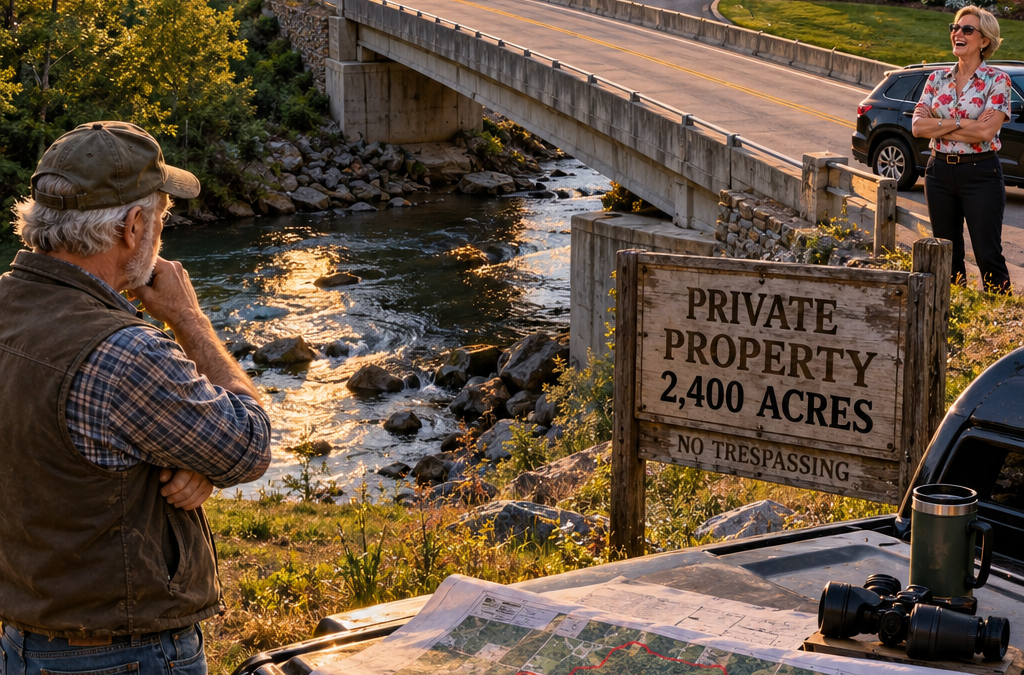
𝗙𝗨𝗟𝗟 𝗦𝗧𝗢𝗥𝗬
Several old logging roads could be rehabilitated cheaply.
And the asking assumptions seemed to treat the irregular shape as a liability when, to me, it was simply geometry.
I attended the auction with a maximum number in my head.
The bidding started low.
A timber company participated for a while.
A regional developer dropped out early.
One cattle operator went another few rounds.
Then it was just me and a man representing an investment group.
He stopped.
I won.
For less than half what I believed the property would be worth with proper management.
I signed preliminary paperwork before lunch.
By midafternoon, I was driving the land.
I remember the first evening clearly.
It had rained the night before, so the old access road was soft.
My boots were covered in mud.
The sun was low enough to turn the upper ridges orange.
I walked down toward the creek carrying coffee that had gone cold an hour earlier.
I stood near the water and listened.
No traffic.
No equipment.
No phones.
Nothing except moving water and birds settling into the trees.
I thought, This is it.
This is where I stay.
I had no idea I was standing less than half a mile from the most valuable legal problem I would ever own.
Whispering Pines was east of my parcel.
I knew about the development.
You could hardly miss it on aerial imagery.
Three hundred forty homes behind a landscaped entrance.
Private security booth.
Community center.
Swimming pool.
Tennis courts.
Decorative stone signs.
The place had been built twenty-two years earlier.
It was nice, if you liked that kind of thing.
Wide streets.
Large lots.
Consistent landscaping.
Everything neat.
Everything governed.
That last part mattered.
Whispering Pines had an HOA with a reputation for being active.
Monthly newsletters.
Architectural review.
Parking rules.
Landscaping rules.
Fence rules.
Exterior paint approvals.
People voluntarily bought into that system.
I didn’t.
I had no issue with them.
Their land was theirs.
Mine was mine.
At least that was how property was supposed to work.
About a week after closing, I began walking boundary lines.
I always do that with land.
A survey can tell you where a line is mathematically.
Walking it tells you what that line means physically.
Fence.
Ridge.
Ditch.
Tree line.
Creek.
Road.
Problem.
I started along the southern edge, then worked north.
On the third day, I reached the eastern projection.
That section narrowed as it approached Whispering Pines.
I had noticed a road on the aerial map but assumed it was county right-of-way.
Then I came through the trees and saw the bridge.
Two lanes.
Concrete deck.
Guardrails.
Stone-faced entrance columns on the neighborhood side.
The road crossed the creek and continued directly into Whispering Pines.
Vehicles passed every few minutes.
Residents.
Delivery vans.
A school bus.
A landscaping truck.
I stood there watching.
Something bothered me.
Not the bridge itself.
The alignment.
I pulled the survey from my pack.
Found the eastern boundary call.
Then the creek.
Then the road.
I looked at the bridge.
Back at the survey.
I walked to the near approach.
Found one monument.
Then another.
I paced the distance.
Checked my GPS.
Then walked the opposite bank.
My first reaction was that I had misread something.
That happens.
Even engineers make mistakes when standing in mud with folded paper.
I checked again.
The property line did not stop before the bridge.
It wrapped around it.
The bridge was inside my parcel.
Not partly.
Not one abutment.
Not a strip beneath one approach.
The entire structure.
Both ends.
The creek bed under it.
The approaches immediately connected to it.
Every inch appeared to sit within land I had just purchased.
I remember standing beside the guardrail while a woman in an SUV drove past.
She smiled.
Probably thought I was inspecting the bridge.
In a way, I was.
I called my attorney.
Carl Benton had handled the auction closing.
He answered with the sound of papers moving in the background.
“Marcus.”
“Quick property question.”
“Those are never quick when you say that.”
“If a structure sits entirely inside a recorded parcel boundary, and there’s no separate ownership instrument or easement, who owns the structure?”
Silence.
Then:
“Generally, the parcel owner, depending on how the structure was constructed and any rights attached to it.”
“Let’s make it simpler.”
“Please.”
“A private road bridge. Built twenty years ago. No easement on my title commitment.”
“Who uses it?”
“Three hundred forty homes.”
Longer silence.
“Marcus.”
“Yeah?”
“Why are you asking?”
I looked at the Whispering Pines entrance.
“I think I bought their bridge.”
Carl did not laugh.
That told me immediately this was serious.
“Do not do anything.”
“I wasn’t planning to.”
“Do not block it.”
“I know.”
“Do not post anything.”
“I know.”
“Send me the survey.”
“I will.”
“And the title policy.”
“Already have it.”
“Of course you do.”
The title search took two weeks.
We went backward through every deed we could find.
Original development documents.
Subdivision plats.
County road records.
Recorded easements.
Utility access.
Bridge permits.
Maintenance files.
Insurance documents where available.
The history was messier than the clean entrance to Whispering Pines suggested.
The development had been approved in the early 2000s.
The developer needed access across the creek.
At the time, the strip where the bridge was constructed was part of an old remnant tract created through inconsistent historical conveyances.
The county did not own it.
The developer did not clearly own it.
But people involved in the project apparently assumed the road connection crossed land that would either become county-controlled or be absorbed into the subdivision through later conveyance.
The bridge was built in 2002.
The expected cleanup never happened.
No permanent access easement was recorded.
No deed transferred the bridge footprint to Whispering Pines.
No right-of-way dedication was accepted by the county.
The legal ambiguity sat there for more than two decades because nobody forced anyone to resolve it.
Then the remnant acreage was consolidated into the larger parcel that eventually went to auction.
And I bought it.
Carl called me after confirming the chain.
“You sitting?”
“Everyone keeps asking me that lately.”
“Sit anyway.”
I sat at my kitchen table.
“What’s the verdict?”
“The bridge is within your recorded parcel.”
“All of it?”
“Yes.”
“Recorded easement?”
“None that we’ve found.”
“Prescriptive access?”
“That’s what their lawyer is going to argue.”
“So they have something.”
“They have arguments. That’s different.”
“Explain.”
Carl paused.
“They’ve used it openly for more than twenty years.”
“I noticed.”
“They maintain it?”
“Looks that way.”
“Insure it?”
“Probably.”
“That history matters. They’re going to claim prescriptive rights, implied easement, easement by necessity, estoppel, maybe several theories at once.”
“But?”
“But none of those is something I’d assume automatically succeeds.”
“Why?”
“Because the development history is unusual, and because they may have known the title was unresolved.”
That last sentence caught me.
“Known?”
“I’m still digging.”
I looked toward the east through my window, even though I couldn’t see the bridge from the house.
“So what do I own?”
“At minimum, you own the underlying parcel. There is a strong argument the bridge structure itself belongs with it, subject to whatever rights a court may determine others have.”
“Can I charge them?”
“Marcus.”
“What?”
“Do not turn into a cartoon villain.”
“I asked a legal question.”
“And I’m giving you life advice.”
I smiled.
“What should I do?”
“Talk to them.”
That was exactly what I intended.
I had no desire to trap 340 families behind a locked gate.
I didn’t want to block ambulances.
School buses.
Workers.
Deliveries.
This wasn’t a hostage situation.
It was a title defect.
A serious one.
I wanted a recorded access agreement.
Insurance obligations.
Maintenance standards.
Indemnity.
Clear responsibility if the bridge ever failed.
The kind of things that should have existed from the beginning.
I drove to the Whispering Pines management office on a Tuesday afternoon.
The building sat near the clubhouse.
Brick.
White columns.
Flower beds maintained to military precision.
A woman behind the front desk introduced herself as Marla Jensen, the community property manager.
I explained who I was.
“I recently purchased the twenty-four-hundred-acre parcel west of the development.”
Her expression changed slightly.
“Oh.”
Not hostile.
Not friendly either.
I placed a folder on the desk.
“I need to discuss the bridge.”
“What about it?”
“It sits on my parcel.”
She smiled as though I had made a minor factual error.
“No, it doesn’t.”
I opened the survey.
“Here’s the recorded boundary.”
She glanced at it.
“That bridge has belonged to Whispering Pines since the community was built.”
“Do you have a deed?”
“We maintain it.”
“That’s not what I asked.”
“We insure it.”
“I understand.”
“The HOA has used it for over twenty years.”
“I understand that too.”
She finally looked closely at the survey.
I slid the title summary beside it.
“My attorney found no recorded easement granting Whispering Pines road access across this parcel.”
She looked up.
“Sir, that bridge has been there for more than twenty years.”
“Yes.”
“Three hundred forty families use it every day.”
“I know.”
“We aren’t signing some new agreement because a piece of neighboring land changed owners.”
I kept my voice calm.
“I am not asking you to stop using it.”
“Then what exactly are you asking?”
“To formalize the access you’re already using.”
Her mouth curved into a smile.
Then she laughed.
Not loudly.
But unmistakably.
“Mr. Hail, with respect, I think you may be misunderstanding how established access works.”
“I’m a civil engineer.”
“I didn’t ask what you do.”
“I know.”
That quieted her for a second.
I continued.
“I spent seventeen years working with rights-of-way, subdivision plats, and infrastructure easements. I understand the difference between long-term use and recorded rights.”
“Our attorney will disagree.”
“That’s fine.”
“We’re not paying for access to our own bridge.”
“You’re not listening.”
“No, I understand perfectly.”
She pushed the folder back.
“This sounds like an attempt to extract money from the association after purchasing neighboring land.”
I felt my jaw tighten.
“No.”
“Then there should be no problem.”
“There is a problem because your only access route crosses land you do not have a recorded right to cross.”
She stood.
“Our legal counsel can address any correspondence.”
I closed the folder.
“That’s probably best.”
As I turned toward the door, she said:
“For what it’s worth, I would strongly advise you not to interfere with resident access.”
I looked back.
“I haven’t.”
“Good.”
“I came here to make sure it stays that way.”
She folded her arms.
“We’ve managed for twenty-two years.”
I nodded.
“Then you should have no trouble showing me the paperwork.”
I left.
The meeting had been recorded.
Tennessee law allowed me to preserve the conversation under the circumstances, and Carl had advised documentation from the beginning.
When I played it for him later, he stopped at the part where Marla laughed.
“Useful?”
“Not legally decisive.”
“But?”
“Humanly memorable.”
He looked at me.
“Now we notify them formally.”
We sent letters.
HOA board.
Management company.
Insurance carrier.
The letters were careful.
No threats to shut the bridge.
No demand for outrageous payment.
They stated the parcel ownership.
The title findings.
The absence of a recorded easement.
My willingness to negotiate a permanent access agreement.
And my reservation of all property rights.
Thirty days later, I posted signs.
PRIVATE PROPERTY.
ACCESS SUBJECT TO DISPUTED TITLE RIGHTS.
NO ENTRY OUTSIDE EXISTING ROADWAY.
That last line mattered.
I was not telling residents they couldn’t cross.
I was telling everyone not to wander elsewhere onto the parcel and pretending no dispute existed.
The HOA responded as if I had declared war.
First came a letter accusing me of harassing residents.
Then another claiming my signs created an unsafe distraction.
Then a complaint to the county about unpermitted roadside signage.
The county inspector came out, measured everything, and found no violation.
A week later, someone filed a noise complaint about my truck.
My truck was a stock diesel used mostly on my own roads.
The deputy who visited looked embarrassed.
“You rev this thing at night?”
“No.”
“Race up and down by the HOA entrance?”
“No.”
“Thought so.”
He closed his notebook.
“Seems like everybody’s tense over there.”
“Seems that way.”
Then Whispering Pines hired a law firm.
Their attorney sent twenty pages.
Adverse possession.
Prescriptive easement.
Easement by implication.
Easement by necessity.
Equitable estoppel.
Reliance.
Public policy.
Emergency-access considerations.
Community safety.
Carl responded in four pages.
He later summarized it to me over coffee.
“What did you tell them?”
“That throwing six theories at a title defect doesn’t automatically create one good theory.”
“More politely?”
“Slightly.”
The board also began messaging residents.
I saw one notice after a homeowner sent it to me anonymously.
It described me as a “hostile outside landowner attempting to interfere with long-established community access.”
That angered me.
I had never blocked one car.
I had never threatened to.
I had gone to them first.
Calmly.
With documents.
They laughed.
Now I was hostile because I refused to pretend the problem did not exist.
Carl suggested we file for declaratory relief and an injunction addressing trespass and access.
I hesitated.
“Could that shut the bridge?”
“The court can structure relief. We’re not asking a judge to trap people.”
“Then what are we asking?”
“To force the legal issue into the open.”
That was what I wanted.
Not revenge.
Clarity.
We filed.
The hearing was scheduled for a Thursday.
By Wednesday afternoon, Whispering Pines was boiling.
Apparently most residents had been told very little.
They knew there was some dispute with the man who bought the western land.
They did not understand that the dispute involved the only bridge they used to reach the county road.
Then someone posted the filing in the community forum.
By evening, the HOA called an emergency meeting.
I did not attend.
I was not a member.
But several residents contacted me afterward.
One was Patricia Lane.
She called the next morning.
“Mr. Hail?”
“Marcus is fine.”
“My name is Patricia Lane. I’ve lived in Whispering Pines twenty years.”
“Okay.”
“I was at the board meeting last night.”
“I heard it was busy.”
“Three hundred people.”
I whistled.
“Our community room holds one-eighty.”
“So where’d the rest go?”
“Hallway. Parking lot. People standing outside the doors.”
I waited.
She continued.
“I think you should know something before your hearing.”
My posture changed.
“What?”
“Gerald knew.”
Gerald Foss was the HOA president.
I had never met him personally.
“What did he know?”
“About the easement.”
“How do you know?”
“Because I used to be a title paralegal.”
That was not the answer I expected.
Patricia continued.
“When this started, I asked management for old infrastructure files.”
“They gave them to you?”
“Homeowners can inspect association records.”
“And?”
“I found an email from 2019.”
I stood.
“Who sent it?”
“Previous property manager.”
“To whom?”
“Gerald and the board.”
“What does it say?”
Patricia took a breath.
“It says a title review related to bridge insurance found no recorded permanent access easement across the western tract.”
I said nothing.
“Manager recommended the board hire title counsel and pursue quiet title or negotiate an easement before ownership of the neighboring tract changed.”
My grip tightened around the phone.
“And Gerald?”
“He replied.”
“What did he say?”
“‘Let’s table this. It’s not a priority right now.'”
For several seconds I could hear only my refrigerator running.
“When was this?”
“September 2019.”
“They knew three years before the auction.”
“At least Gerald did.”
“Did residents know?”
“No.”
“Was it disclosed in resale packages?”
“Not that I can find.”
“Did anyone resolve it?”
“Obviously not.”
I sat.
“Why are you telling me?”
“Because last night Gerald told three hundred homeowners this problem appeared only after you bought the property.”
I closed my eyes.
Patricia’s voice tightened.
“That wasn’t true.”
“What happened when you asked him about the email?”
“The room exploded.”
She told me the story.
Gerald stood at the front beside Marla and the HOA attorney.
Residents demanded answers.
Would the bridge close?
Could school buses cross?
What about emergency services?
Why hadn’t access been recorded when the development was built?
Gerald insisted the HOA possessed long-established rights.
Then Patricia stood.
She did not yell.
She asked one question.
“Mr. Foss, when did you first become aware that the Whispering Pines bridge lacked a recorded access easement?”
Gerald hesitated.
One second.
Maybe two.
Then he said he could not recall exactly.
Patricia held up the email.
September 2019.
The previous manager’s warning.
His response.
LET’S TABLE THIS. IT’S NOT A PRIORITY RIGHT NOW.
The room went silent.
Then people understood.
Homeowners had bought houses.
Refinanced.
Sold.
Changed lenders.
Paid HOA dues.
Paid bridge maintenance assessments.
All while the president had known the legal foundation of their only vehicle access was unresolved.
A man in the back reportedly shouted:
“You knew?”
Another resident asked:
“What else haven’t you told us?”
Gerald tried to explain that historical use protected access.
Patricia asked why, if he believed that, the property manager had recommended legal action in 2019.
No answer.
Someone demanded his resignation.
Others demanded the entire board step down.
The meeting stopped being about me.
That was the moment everything changed.
Carl called before the hearing.
“Their attorney wants to talk.”
“About what?”
“Settlement.”
“That fast?”
“The 2019 email is a problem.”
“For them.”
“Very much.”
“Do we still go to court?”
“Unless they give us a reason not to.”
The hearing happened anyway.
Whispering Pines argued the bridge had been openly used for more than two decades and that residents had relied on it as their sole access route.
Our side did not pretend otherwise.
Carl stood and said something I will always remember.
“Your Honor, this case is not about whether three hundred forty families need access. They obviously do. It is about whether a private association may ignore a known title defect for years, then claim the burden created by its own inaction should be imposed entirely on an uninvolved landowner.”
That was the case in one sentence.
The judge did not close the bridge.
I never wanted that.
Instead, the court preserved existing residential access temporarily while ordering the parties into expedited negotiations and allowing the ownership and easement questions to continue.
That relieved residents.
It also removed the HOA’s favorite argument that I was threatening public safety.
I wasn’t.
I wanted a lawful agreement.
Now everyone knew it.
Negotiations lasted six weeks.
The HOA’s first proposal was insulting.
They wanted me to grant a perpetual access easement for one dollar.
In return, they would release claims that they already possessed rights over the bridge.
Carl read the proposal.
Then looked at me.
“Thoughts?”
“I’d rather frame it.”
He laughed.
“They’re arguing the access has no monetary value because they’ve used it so long.”
“They have three hundred forty houses whose only road crosses it.”
“I know.”
“Seems like value.”
“Quite a bit.”
I did not want to bankrupt Whispering Pines.
That mattered.
Most homeowners had done nothing wrong.
They had purchased homes believing the bridge issue was settled.
Some probably never even saw the bridge as a legal object.
It was just how they got home.
So my terms were not designed to punish residents.
They were designed to make sure I would never be responsible for a bridge serving hundreds of people without clear protection.
I wanted a permanent recorded easement limited to the existing bridge and road corridor.
The HOA would remain responsible for all maintenance.
All inspections.
All repairs.
All insurance.
All improvements required for continued safe operation.
They would indemnify me for claims arising from community use of the crossing except where caused by my own intentional wrongdoing.
No expansion beyond the recorded corridor without my written agreement.
No right to enter the remainder of my 2,400 acres.
No claim that granting access made me a member of the HOA.
No architectural restrictions.
No assessments.
No governance rights over my land.
And yes, compensation.
A one-time easement payment.
Plus annual payments toward monitoring, administrative burden, and any obligations tied to the infrastructure crossing my property.
Their attorney objected.
“The association has maintained this bridge for twenty-two years.”
Carl answered:
“Then they should appreciate the value of a permanent recorded right to continue doing so.”
“The amount is unreasonable.”
I asked, “Compared to what?”
Nobody answered.
We had commissioned an independent valuation.
It considered the number of homes dependent on the crossing.
The cost of constructing alternate access.
The effect on property values if access remained legally uncertain.
The burden placed on my land.
Whispering Pines did not like the number.
That did not make the number imaginary.
During one mediation session, Gerald finally attended.
It was the first time I met him.
He was in his sixties.
Gray hair.
Expensive watch.
The exhausted look of a man who had spent several weeks discovering that his title meant less than he thought.
He sat across from me.
“You understand these families didn’t create this problem.”
“I do.”
“Then why make them pay?”
I looked at him.
“Who do you think should pay?”
“The access has existed for decades.”
“That isn’t an answer.”
“It was part of the original development.”
“Without an easement.”
“The developer made mistakes.”
“Then you inherited one.”
Gerald leaned forward.
“You bought that parcel knowing there was a bridge.”
“No.”
“You expect me to believe a civil engineer didn’t see it?”
“I knew there was a bridge on an aerial map. I did not know the entire structure was inside the parcel until I walked the recorded boundary.”
He stared at me.
I continued.
“You knew in 2019.”
His expression hardened.
“I knew someone raised a technical issue.”
“No. You received a written warning that there was no recorded permanent easement.”
“Our counsel believed long-term use protected us.”
“Then why did your property manager recommend quiet title?”
Gerald said nothing.
I leaned back.
“This isn’t about me charging your residents for driving to work.”
“Then what is it?”
“You had three years to fix this before I existed in your life.”
His jaw tightened.
“You chose not to.”
“We had priorities.”
“Now this is one.”
That ended the conversation.
By the fourth week, residents were pressuring the board to settle.
Home sales had started slowing because title companies and lenders were asking questions.
The very uncertainty Gerald had ignored had become visible.
Patricia contacted me again.
She had become one of the loudest advocates for resolving the problem properly.
“People are angry,” she said.
“At me?”
“Some.”
“Fair enough.”
“But mostly at the board.”
“That seems healthier.”
“Gerald keeps saying your terms are extortion.”
“They’re based on an appraisal.”
“I know.”
“Does everyone know?”
“They do now.”
She paused.
“Can I ask you something?”
“Sure.”
“Would you ever actually close the bridge?”
I thought carefully.
“No.”
“Never?”
“If a court declared I had the absolute right tomorrow, I still wouldn’t wake up and trap families behind a creek.”
I heard her exhale.
“Thank you.”
“But I also wouldn’t pretend the title defect doesn’t exist.”
“I understand.”
“An ambulance shouldn’t depend on somebody’s goodwill, Patricia.”
“Exactly.”
“Neither should a house closing.”
“Exactly.”
“We need paper.”
She laughed.
“You really are an engineer.”
“Unfortunately.”
The settlement came together in week six.
The HOA accepted a one-time easement payment.
They accepted annual maintenance-related payments.
They accepted all maintenance and insurance obligations.
They accepted the corridor limitations.
The easement would be permanent and recorded with the county.
Emergency access was explicitly protected.
Residents could cross without individual permission.
The HOA received the certainty it should have obtained twenty-two years earlier.
I received compensation and legal protection for having critical infrastructure on my land.
There was one condition I insisted on at the end.
The agreement had to state clearly that the easement granted no HOA jurisdiction over the remainder of my parcel.
Their attorney asked why that was necessary.
I looked at him.
“Because I read HOA disputes for fun now.”
He smiled despite himself.
The papers were signed.
The bridge never closed for a single day.
Not one resident missed work because of me.
Not one school bus was blocked.
Not one ambulance was delayed.
All the drama had come from paperwork.
Or more accurately, from the absence of it.
Gerald resigned before the next election.
He said the controversy had become a distraction from community governance.
That was one way to describe it.
Several other directors ran again.
They lost.
Patricia was elected board president by an overwhelming margin.
The first time she called me in that role, she said:
“I suppose we’re neighbors officially now.”
“We were always neighbors.”
“You know what I mean.”
“Congratulations.”
“I may regret this.”
“You will.”
Her first major board action was to commission a full title and infrastructure audit.
Roads.
Drainage easements.
Utilities.
Common property.
Access rights.
Every document.
No assumptions.
“If the association says it owns something,” Patricia told residents, “we’re going to make sure there’s a recorded reason.”
That sounded obvious.
It wasn’t.
The one-time easement payment was significant.
I could have invested it.
Bought more acreage.
Put up a larger shop.
Instead, I built a cabin.
Not large.
About forty yards from the creek.
Far enough from the bridge for privacy.
Close enough that I could see it through the trees.
Carl thought that was hilarious.
“You realize what this looks like.”
“What?”
“You’re building a porch where you can watch the HOA drive across your bridge.”
“I was building a cabin here before this mess.”
“You were?”
“No.”
He laughed.
The cabin had a wide covered porch.
Wood stove.
One bedroom.
Small kitchen.
Nothing extravagant.
I spend more mornings there than at the main house.
Coffee.
Creek.
Traffic in the distance.
People from Whispering Pines wave sometimes.
At first, I thought they were being sarcastic.
They weren’t.
A few residents stopped to speak when I was near the road.
One man rolled down his window.
“Marcus?”
“Yeah?”
“Thanks.”
“For what?”
“Not closing it.”
“I was never going to.”
“I know that now.”
He hesitated.
“And thanks for forcing them to fix it.”
That surprised me.
“You don’t have to thank me.”
“My wife and I bought our place in 2020.”
I understood immediately.
After Gerald knew.
“Nobody disclosed any access issue.”
“I’m sorry.”
“Not your fault.”
He drove away.
Another woman stopped a week later.
“You really own the bridge?”
“The land under it.”
“Close enough.”
She smiled.
“My kids call it Marcus Bridge now.”
“Please make them stop.”
She laughed and drove away.
The strangest part was how quickly the hostility faded once the truth became clear.
During the dispute, the HOA had portrayed me as someone trying to cut off a neighborhood.
Afterward, people saw the actual agreement.
Permanent access.
Maintenance obligations.
Insurance.
Clear rights.
Nothing about it was radical.
It was the document that should have been recorded when the bridge was built.
That was all.
I also did something unrelated to Whispering Pines but important to me.
The northern three hundred acres of my property contained mature forest, steep ravines, and habitat that would have been difficult to develop responsibly.
I donated a conservation interest to a land trust.
Protected permanently.
No subdivision.
No commercial development.
No future road network.
Carl looked at the paperwork and said:
“You’re aware you’re voluntarily putting restrictions on your land after spending a year fighting an HOA over property rights.”
“These are my restrictions.”
“Fair distinction.”
That was exactly the distinction.
Freedom does not mean refusing every limitation.
It means choosing obligations instead of having strangers invent them for you.
I wanted those three hundred acres left alone.
So I put that intention into recorded documents.
The same thing Whispering Pines should have done with the bridge.
People sometimes ask whether I planned the whole thing.
Buy the parcel.
Discover the bridge.
Pressure the HOA.
Collect money.
Build my cabin.
No.
That version makes me sound far more calculating than I was.
I bought land.
I walked the boundary.
I found a problem.
Then I treated it the way I had treated infrastructure problems for seventeen years.
Find the record.
Identify the responsible parties.
Define the risk.
Create a durable solution.
The only reason it became a war was because the first people I approached thought confidence could substitute for documentation.
Marla laughed because the bridge had been there for twenty-two years.
Gerald postponed the issue because it had not hurt anyone yet.
Those decisions came from the same mistake.
Nothing bad has happened, therefore nothing is wrong.
Engineers learn the opposite.
Sometimes nothing bad has happened because the failure condition has not arrived.
A retaining wall can lean for twenty years before it falls.
A culvert can work perfectly until the hundred-year storm.
A bridge can carry every resident home for decades while the legal right beneath it remains defective.
Time does not automatically correct errors.
Sometimes it only makes the consequences larger.
A year after the settlement, Patricia invited me to a Whispering Pines community meeting.
I declined.
She called again.
“Why?”
“I don’t belong to your HOA.”
“You’re not joining. We’re recognizing people who helped resolve the bridge issue.”
“I caused half the issue.”
“No. You found it.”
“Same result.”
“Marcus.”
“No.”
She sighed.
“Fine. I’ll come to your cabin afterward and steal your coffee.”
“That works.”
She did.
We sat on the porch.
Cars crossed the bridge.
Patricia handed me a folder.
“What’s this?”
“Annual bridge inspection.”
I opened it.
Structural condition.
Deck.
Railings.
Abutments.
Drainage.
No major deficiencies.
“Why are you showing me?”
“Agreement says we provide you a copy.”
“I know.”
“I wanted to deliver it personally.”
I turned the page.
“Maintenance schedule looks good.”
“New board approved reserve funding specifically for the bridge.”
“Good.”
“No more pretending it will take care of itself.”
I smiled.
“You’re becoming an engineer.”
“Don’t insult me.”
We watched a school bus cross.
Then Patricia became serious.
“I still can’t believe Gerald knew.”
“People postpone uncomfortable problems.”
“Three years.”
“Longer, probably.”
“If that email hadn’t existed…”
“You still would’ve had a title defect.”
“But residents might have blamed you forever.”
“Maybe.”
She shook her head.
“He let people buy homes.”
That was the part that bothered her most.
I understood.
In 2019, Gerald had been warned.
He could have acted.
Even if litigation were necessary, the HOA would have been dealing with the problem before a new owner purchased the western parcel.
Instead, he chose delay.
Why?
Because there was no immediate pain.
The bridge worked.
Cars crossed.
Nobody complained.
Legal cleanup cost money.
Quiet title took effort.
Meetings.
Lawyers.
Possibly negotiation with whoever held the neighboring tract.
Easier to table it.
Then ownership changed.
I arrived.
And suddenly the cost of not acting became far higher than the cost of acting would have been.
That happens everywhere.
Not just HOAs.
Companies.
Governments.
Families.
People postpone defects because defects are quiet.
Then one day they stop being quiet.
I kept the original survey framed in the cabin.
Not the whole thing.
Just the eastern portion.
Carl thought that was ridiculous too.
On the map, the bridge is a small symbol crossing blue creek lines.
The property boundary wraps around it.
Simple.
Obvious.
Now.
But I sometimes stare at that drawing and think about the hundreds of lives tied to those few inches of paper.
Kids going to school.
Nurses working night shifts.
Families buying groceries.
Fire trucks.
Delivery drivers.
People coming home after funerals.
People leaving for weddings.
All using one bridge.
All assuming somebody, somewhere, had handled the paperwork.
Nobody had.
That is what made me angry during the dispute.
Not that the HOA used the bridge.
They had done so openly for decades.
Not that residents depended on it.
Of course they did.
What angered me was the arrogance of assuming dependency erased ownership.
They needed the bridge, therefore I had no right to ask questions.
They maintained it, therefore documents did not matter.
They had always used it, therefore they could laugh when the landowner asked for an agreement.
That logic is dangerous.
Need creates urgency.
It does not automatically create ownership.
The final easement solved that.
Whispering Pines now has something better than assumption.
A recorded legal right.
I have something better than resentment.
Defined obligations.
And the bridge itself is probably safer than it has ever been.
The HOA conducts regular engineering inspections now.
Repairs are budgeted.
Insurance names all appropriate parties.
Drainage near the approaches was improved.
Guardrails were replaced.
A small erosion issue near the west abutment was corrected before it became structural.
That’s what proper ownership documentation can do.
It forces people to identify responsibility.
Nobody gets to say:
I thought somebody else was handling it.
Several years have passed.
The twenty-four hundred acres look better now than they did when I bought them.
I selectively harvested one timber section and replanted.
Rehabilitated several old logging roads.
Improved creek crossings away from Whispering Pines.
Built a larger workshop near the main house.
The conservation acreage remains untouched.
Whispering Pines still has 340 homes.
Maybe a few more after some infill.
The entrance landscaping has changed.
Security guards rotate.
The pool gets renovated every few years.
Patricia still sends me the annual bridge inspection.
Marla no longer manages the community.
I never asked why.
Gerald moved out about eighteen months after resigning.
His house sold quickly.
I saw him one last time before he left.
I was checking drainage near the bridge after a storm.
A sedan stopped on the Whispering Pines side.
Gerald got out.
For a moment, I thought he had car trouble.
Then he walked toward me.
“Marcus.”
“Gerald.”
He looked older.
Maybe I did too.
“How’s the bridge?”
“Still standing.”
He nodded.
“I heard Patricia has them inspecting it every year.”
“That’s the agreement.”
Another nod.
Traffic passed behind him.
Finally he said:
“You made your point.”
That sentence surprised me.
“What point?”
“That we should’ve dealt with the title problem.”
“I wasn’t trying to make a point.”
He smiled without humor.
“Come on.”
“I’m serious.”
“You filed against us.”
“After your management office laughed at me.”
He looked away.
“That wasn’t handled well.”
“No.”
“I didn’t know she’d do that.”
“You knew about the missing easement.”
His face tightened.
“We believed we had prescriptive rights.”
“Then why table quiet title in 2019?”
He sighed.
“We had other problems.”
“There are always other problems.”
“You’ve never served on a board.”
“No.”
“You don’t understand.”
“Maybe.”
He looked toward the bridge.
“You know what legal counsel would’ve cost back then?”
“Less than it cost later.”
That landed.
For several seconds, the only sound was tires crossing expansion joints.
Gerald shoved his hands into his pockets.
“I should’ve fixed it.”
There it was.
Not an apology.
Not quite.
But close enough.
“Yes.”
He nodded once.
Then walked back to his car.
I never saw him again.
I could have said more.
Reminded him about homeowners who bought without disclosure.
The emergency meeting.
The legal fees.
The board being voted out.
But there was no need.
He knew.
That was enough.
People sometimes call the story poetic justice.
Engineer buys land.
Engineer discovers bridge.
HOA mocks engineer.
Engineer forces HOA to pay.
That version is entertaining.
But it misses what mattered.
I didn’t want Whispering Pines upside down.
I wanted certainty.
Their residents deserved certainty too.
Imagine spending half a million dollars on a house and discovering the only way to reach it depended on a twenty-two-year-old paperwork mistake.
Imagine learning your board knew and said nothing.
The anger at that emergency meeting wasn’t really about me.
It was about trust.
Residents had trusted people to manage the things ordinary homeowners never think about.
Insurance.
Roads.
Reserves.
Drainage.
Title.
The boring infrastructure of community life.
Gerald treated one of those things as unimportant because it wasn’t immediately visible.
Then the day came when it was the only thing anyone could see.
That taught me something too.
I had spent years believing engineering was mostly about physical systems.
Concrete.
Steel.
Water.
Soil.
Loads.
Grades.
But property is a system.
Documents are infrastructure.
An easement can be as important as a bridge girder.
Without the girder, cars fall.
Without the easement, the right to put cars there can collapse.
Both matter.
My cabin porch faces the creek.
Forty yards away, vehicles still cross the bridge every day.
Some drivers wave.
Most don’t.
That’s fine.
I don’t need them to.
Sometimes I sit there before sunrise with coffee.
The bridge lights glow faintly through the trees.
Then headlights begin.
First people working early shifts.
Then contractors.
Then school traffic.
By eight, it’s steady.
I don’t look at those cars and think trespassers.
That ended when the easement was recorded.
Now they have a right.
Clear.
Permanent.
Paid for.
Documented.
Exactly as it should be.
The bridge is still on my land.
But access belongs to them.
Both things can be true.
That is what Gerald and Marla failed to understand at first.
Property rights do not always require one side to destroy the other.
Sometimes they require adults to sit down and define the boundary.
I tried that on day one.
They laughed.
Eventually, the paperwork made the same request with a judge behind it.
That time, they listened.
And every so often, when someone asks what I got out of the whole fight, I look toward the bridge and think about the answer.
A cabin.
An easement payment.
Annual fees.
Clear title.
Three hundred protected acres.
Sure.
But none of those is the part I value most.
What I got was proof of something I had believed my entire career.
Lines matter.
People treat boundaries like abstract things until something important crosses one.
A road.
A pipe.
A bridge.
Authority.
The moment that happens, the line becomes real.
Whispering Pines had spent twenty-two years crossing one without properly recording the right.
I happened to be the man who bought the other side and knew how to read the map.
That was all.
I never blocked their bridge.
I never wanted their neighborhood.
I never wanted to control 340 families.
I simply refused to let 340 families’ dependence become an excuse for pretending my ownership did not exist.
Today the bridge belongs inside a recorded legal framework.
The HOA knows exactly what it is responsible for.
I know exactly what I am responsible for.
Residents know their access cannot disappear because somebody forgot to finish a title file.
And when I sit on the porch watching them cross the creek each morning, I sometimes think back to Marla laughing in that office.
“That bridge has been there for over twenty years.”
She meant that time had settled the question.
It hadn’t.
Time had only hidden it.
The survey settled the question.
The title records exposed it.
The 2019 email explained why it had been ignored.
And the final easement fixed it.
Twenty-two years late.
But fixed.
I bought 2,400 acres because I wanted peace and quiet.
I ended up owning the most important fifty yards of road in somebody else’s life.
I could not have planned that.
I would not have wanted to.
But once I found it, I knew there was only one responsible way forward.
Put the rights on paper.
Put the obligations on paper.
Record it.
Maintain the bridge.
And never again let an entire community’s future depend on somebody saying, “Let’s table this. It’s not a priority right now.”
𝗧𝗛𝗘 𝗘𝗡𝗗
The HOA’s Only Bridge Crossed My 2,400 Acres, and Their President Laughed When I Asked to See the Easement
I bought 2,400 acres for the timber, the creek, and the kind of silence I had spent seventeen years promising myself I would someday earn.
I had no idea that the only bridge connecting 340 homes to the outside world sat entirely inside my property lines—or that the HOA had known for years there was no recorded easement giving them the right to use it.
My name is Marcus Hail.
For seventeen years, I worked as a civil engineer.
Not the kind who spent every day standing beside skyscrapers in a hard hat for photographs.
My work was quieter.
Road alignments.
Drainage.
Bridge approaches.
Utility corridors.
Right-of-way maps.
Subdivision plats.
Floodplain studies.
Title exhibits.
Survey disputes.
I spent enough time looking at lines on paper that eventually I stopped seeing lines.
I saw consequences.
A bearing two degrees off could put a retaining wall on the wrong parcel.
A forgotten easement could kill a road project.
A drainage swale drawn six feet from where it belonged could turn somebody’s backyard into a pond during the first serious storm.
Most people look at a property map and see shapes.
I see obligations.
That habit followed me into retirement.
I was forty-nine when I left full-time engineering.
Not because I hated the work.
I still liked solving problems.
What I hated was how little of my life belonged to me.
By the end, I was spending more time in conference calls discussing projects than actually engineering them.
Budgets.
Procurement.
Risk reviews.
Stakeholder meetings.
Meetings to prepare for meetings.
I began dreaming about land.
Real land.
Enough that I could walk for an hour without hearing another person’s lawn mower.
Enough timber to manage.
A creek.
Maybe a cabin.
A workshop.
Somewhere I could drink coffee in the morning without looking at a screen.
Then the auction notice appeared.
Twenty-four hundred acres in rural Tennessee.
Timber.
Creek bottom.
Rolling hills.
An irregular boundary.
The parcel had been assembled from several older tracts over time, which made the legal description look ugly.
There were odd corners.
Long metes-and-bounds calls.
A creek cutting through the middle.
A narrow eastern projection reaching toward an existing residential development.
Most buyers hated that kind of complexity.
I loved it.
Complicated land is often discounted because people are frightened by paperwork.
Paper never frightened me.
I downloaded every document available before the auction.
Tax maps.
Historic plats.
Topographic data.
Aerial photographs.
Timber estimates.
County road maps.
Floodplain information.
The more I looked, the more interested I became.
The timber alone carried significant value.
The northern ridge had excellent cabin sites.
The creek crossed almost two miles of the property.
Several old logging roads could be rehabilitated cheaply.
And the asking assumptions seemed to treat the irregular shape as a liability when, to me, it was simply geometry.
I attended the auction with a maximum number in my head.
The bidding started low.
A timber company participated for a while.
A regional developer dropped out early.
One cattle operator went another few rounds.
Then it was just me and a man representing an investment group.
He stopped.
I won.
For less than half what I believed the property would be worth with proper management.
I signed preliminary paperwork before lunch.
By midafternoon, I was driving the land.
I remember the first evening clearly.
It had rained the night before, so the old access road was soft.
My boots were covered in mud.
The sun was low enough to turn the upper ridges orange.
I walked down toward the creek carrying coffee that had gone cold an hour earlier.
I stood near the water and listened.
No traffic.
No equipment.
No phones.
Nothing except moving water and birds settling into the trees.
I thought, This is it.
This is where I stay.
I had no idea I was standing less than half a mile from the most valuable legal problem I would ever own.
Whispering Pines was east of my parcel.
I knew about the development.
You could hardly miss it on aerial imagery.
Three hundred forty homes behind a landscaped entrance.
Private security booth.
Community center.
Swimming pool.
Tennis courts.
Decorative stone signs.
The place had been built twenty-two years earlier.
It was nice, if you liked that kind of thing.
Wide streets.
Large lots.
Consistent landscaping.
Everything neat.
Everything governed.
That last part mattered.
Whispering Pines had an HOA with a reputation for being active.
Monthly newsletters.
Architectural review.
Parking rules.
Landscaping rules.
Fence rules.
Exterior paint approvals.
People voluntarily bought into that system.
I didn’t.
I had no issue with them.
Their land was theirs.
Mine was mine.
At least that was how property was supposed to work.
About a week after closing, I began walking boundary lines.
I always do that with land.
A survey can tell you where a line is mathematically.
Walking it tells you what that line means physically.
Fence.
Ridge.
Ditch.
Tree line.
Creek.
Road.
Problem.
I started along the southern edge, then worked north.
On the third day, I reached the eastern projection.
That section narrowed as it approached Whispering Pines.
I had noticed a road on the aerial map but assumed it was county right-of-way.
Then I came through the trees and saw the bridge.
Two lanes.
Concrete deck.
Guardrails.
Stone-faced entrance columns on the neighborhood side.
The road crossed the creek and continued directly into Whispering Pines.
Vehicles passed every few minutes.
Residents.
Delivery vans.
A school bus.
A landscaping truck.
I stood there watching.
Something bothered me.
Not the bridge itself.
The alignment.
I pulled the survey from my pack.
Found the eastern boundary call.
Then the creek.
Then the road.
I looked at the bridge.
Back at the survey.
I walked to the near approach.
Found one monument.
Then another.
I paced the distance.
Checked my GPS.
Then walked the opposite bank.
My first reaction was that I had misread something.
That happens.
Even engineers make mistakes when standing in mud with folded paper.
I checked again.
The property line did not stop before the bridge.
It wrapped around it.
The bridge was inside my parcel.
Not partly.
Not one abutment.
Not a strip beneath one approach.
The entire structure.
Both ends.
The creek bed under it.
The approaches immediately connected to it.
Every inch appeared to sit within land I had just purchased.
I remember standing beside the guardrail while a woman in an SUV drove past.
She smiled.
Probably thought I was inspecting the bridge.
In a way, I was.
I called my attorney.
Carl Benton had handled the auction closing.
He answered with the sound of papers moving in the background.
“Marcus.”
“Quick property question.”
“Those are never quick when you say that.”
“If a structure sits entirely inside a recorded parcel boundary, and there’s no separate ownership instrument or easement, who owns the structure?”
Silence.
Then:
“Generally, the parcel owner, depending on how the structure was constructed and any rights attached to it.”
“Let’s make it simpler.”
“Please.”
“A private road bridge. Built twenty years ago. No easement on my title commitment.”
“Who uses it?”
“Three hundred forty homes.”
Longer silence.
“Marcus.”
“Yeah?”
“Why are you asking?”
I looked at the Whispering Pines entrance.
“I think I bought their bridge.”
Carl did not laugh.
That told me immediately this was serious.
“Do not do anything.”
“I wasn’t planning to.”
“Do not block it.”
“I know.”
“Do not post anything.”
“I know.”
“Send me the survey.”
“I will.”
“And the title policy.”
“Already have it.”
“Of course you do.”
The title search took two weeks.
We went backward through every deed we could find.
Original development documents.
Subdivision plats.
County road records.
Recorded easements.
Utility access.
Bridge permits.
Maintenance files.
Insurance documents where available.
The history was messier than the clean entrance to Whispering Pines suggested.
The development had been approved in the early 2000s.
The developer needed access across the creek.
At the time, the strip where the bridge was constructed was part of an old remnant tract created through inconsistent historical conveyances.
The county did not own it.
The developer did not clearly own it.
But people involved in the project apparently assumed the road connection crossed land that would either become county-controlled or be absorbed into the subdivision through later conveyance.
The bridge was built in 2002.
The expected cleanup never happened.
No permanent access easement was recorded.
No deed transferred the bridge footprint to Whispering Pines.
No right-of-way dedication was accepted by the county.
The legal ambiguity sat there for more than two decades because nobody forced anyone to resolve it.
Then the remnant acreage was consolidated into the larger parcel that eventually went to auction.
And I bought it.
Carl called me after confirming the chain.
“You sitting?”
“Everyone keeps asking me that lately.”
“Sit anyway.”
I sat at my kitchen table.
“What’s the verdict?”
“The bridge is within your recorded parcel.”
“All of it?”
“Yes.”
“Recorded easement?”
“None that we’ve found.”
“Prescriptive access?”
“That’s what their lawyer is going to argue.”
“So they have something.”
“They have arguments. That’s different.”
“Explain.”
Carl paused.
“They’ve used it openly for more than twenty years.”
“I noticed.”
“They maintain it?”
“Looks that way.”
“Insure it?”
“Probably.”
“That history matters. They’re going to claim prescriptive rights, implied easement, easement by necessity, estoppel, maybe several theories at once.”
“But?”
“But none of those is something I’d assume automatically succeeds.”
“Why?”
“Because the development history is unusual, and because they may have known the title was unresolved.”
That last sentence caught me.
“Known?”
“I’m still digging.”
I looked toward the east through my window, even though I couldn’t see the bridge from the house.
“So what do I own?”
“At minimum, you own the underlying parcel. There is a strong argument the bridge structure itself belongs with it, subject to whatever rights a court may determine others have.”
“Can I charge them?”
“Marcus.”
“What?”
“Do not turn into a cartoon villain.”
“I asked a legal question.”
“And I’m giving you life advice.”
I smiled.
“What should I do?”
“Talk to them.”
That was exactly what I intended.
I had no desire to trap 340 families behind a locked gate.
I didn’t want to block ambulances.
School buses.
Workers.
Deliveries.
This wasn’t a hostage situation.
It was a title defect.
A serious one.
I wanted a recorded access agreement.
Insurance obligations.
Maintenance standards.
Indemnity.
Clear responsibility if the bridge ever failed.
The kind of things that should have existed from the beginning.
I drove to the Whispering Pines management office on a Tuesday afternoon.
The building sat near the clubhouse.
Brick.
White columns.
Flower beds maintained to military precision.
A woman behind the front desk introduced herself as Marla Jensen, the community property manager.
I explained who I was.
“I recently purchased the twenty-four-hundred-acre parcel west of the development.”
Her expression changed slightly.
“Oh.”
Not hostile.
Not friendly either.
I placed a folder on the desk.
“I need to discuss the bridge.”
“What about it?”
“It sits on my parcel.”
She smiled as though I had made a minor factual error.
“No, it doesn’t.”
I opened the survey.
“Here’s the recorded boundary.”
She glanced at it.
“That bridge has belonged to Whispering Pines since the community was built.”
“Do you have a deed?”
“We maintain it.”
“That’s not what I asked.”
“We insure it.”
“I understand.”
“The HOA has used it for over twenty years.”
“I understand that too.”
She finally looked closely at the survey.
I slid the title summary beside it.
“My attorney found no recorded easement granting Whispering Pines road access across this parcel.”
She looked up.
“Sir, that bridge has been there for more than twenty years.”
“Yes.”
“Three hundred forty families use it every day.”
“I know.”
“We aren’t signing some new agreement because a piece of neighboring land changed owners.”
I kept my voice calm.
“I am not asking you to stop using it.”
“Then what exactly are you asking?”
“To formalize the access you’re already using.”
Her mouth curved into a smile.
Then she laughed.
Not loudly.
But unmistakably.
“Mr. Hail, with respect, I think you may be misunderstanding how established access works.”
“I’m a civil engineer.”
“I didn’t ask what you do.”
“I know.”
That quieted her for a second.
I continued.
“I spent seventeen years working with rights-of-way, subdivision plats, and infrastructure easements. I understand the difference between long-term use and recorded rights.”
“Our attorney will disagree.”
“That’s fine.”
“We’re not paying for access to our own bridge.”
“You’re not listening.”
“No, I understand perfectly.”
She pushed the folder back.
“This sounds like an attempt to extract money from the association after purchasing neighboring land.”
I felt my jaw tighten.
“No.”
“Then there should be no problem.”
“There is a problem because your only access route crosses land you do not have a recorded right to cross.”
She stood.
“Our legal counsel can address any correspondence.”
I closed the folder.
“That’s probably best.”
As I turned toward the door, she said:
“For what it’s worth, I would strongly advise you not to interfere with resident access.”
I looked back.
“I haven’t.”
“Good.”
“I came here to make sure it stays that way.”
She folded her arms.
“We’ve managed for twenty-two years.”
I nodded.
“Then you should have no trouble showing me the paperwork.”
I left.
The meeting had been recorded.
Tennessee law allowed me to preserve the conversation under the circumstances, and Carl had advised documentation from the beginning.
When I played it for him later, he stopped at the part where Marla laughed.
“Useful?”
“Not legally decisive.”
“But?”
“Humanly memorable.”
He looked at me.
“Now we notify them formally.”
We sent letters.
HOA board.
Management company.
Insurance carrier.
The letters were careful.
No threats to shut the bridge.
No demand for outrageous payment.
They stated the parcel ownership.
The title findings.
The absence of a recorded easement.
My willingness to negotiate a permanent access agreement.
And my reservation of all property rights.
Thirty days later, I posted signs.
PRIVATE PROPERTY.
ACCESS SUBJECT TO DISPUTED TITLE RIGHTS.
NO ENTRY OUTSIDE EXISTING ROADWAY.
That last line mattered.
I was not telling residents they couldn’t cross.
I was telling everyone not to wander elsewhere onto the parcel and pretending no dispute existed.
The HOA responded as if I had declared war.
First came a letter accusing me of harassing residents.
Then another claiming my signs created an unsafe distraction.
Then a complaint to the county about unpermitted roadside signage.
The county inspector came out, measured everything, and found no violation.
A week later, someone filed a noise complaint about my truck.
My truck was a stock diesel used mostly on my own roads.
The deputy who visited looked embarrassed.
“You rev this thing at night?”
“No.”
“Race up and down by the HOA entrance?”
“No.”
“Thought so.”
He closed his notebook.
“Seems like everybody’s tense over there.”
“Seems that way.”
Then Whispering Pines hired a law firm.
Their attorney sent twenty pages.
Adverse possession.
Prescriptive easement.
Easement by implication.
Easement by necessity.
Equitable estoppel.
Reliance.
Public policy.
Emergency-access considerations.
Community safety.
Carl responded in four pages.
He later summarized it to me over coffee.
“What did you tell them?”
“That throwing six theories at a title defect doesn’t automatically create one good theory.”
“More politely?”
“Slightly.”
The board also began messaging residents.
I saw one notice after a homeowner sent it to me anonymously.
It described me as a “hostile outside landowner attempting to interfere with long-established community access.”
That angered me.
I had never blocked one car.
I had never threatened to.
I had gone to them first.
Calmly.
With documents.
They laughed.
Now I was hostile because I refused to pretend the problem did not exist.
Carl suggested we file for declaratory relief and an injunction addressing trespass and access.
I hesitated.
“Could that shut the bridge?”
“The court can structure relief. We’re not asking a judge to trap people.”
“Then what are we asking?”
“To force the legal issue into the open.”
That was what I wanted.
Not revenge.
Clarity.
We filed.
The hearing was scheduled for a Thursday.
By Wednesday afternoon, Whispering Pines was boiling.
Apparently most residents had been told very little.
They knew there was some dispute with the man who bought the western land.
They did not understand that the dispute involved the only bridge they used to reach the county road.
Then someone posted the filing in the community forum.
By evening, the HOA called an emergency meeting.
I did not attend.
I was not a member.
But several residents contacted me afterward.
One was Patricia Lane.
She called the next morning.
“Mr. Hail?”
“Marcus is fine.”
“My name is Patricia Lane. I’ve lived in Whispering Pines twenty years.”
“Okay.”
“I was at the board meeting last night.”
“I heard it was busy.”
“Three hundred people.”
I whistled.
“Our community room holds one-eighty.”
“So where’d the rest go?”
“Hallway. Parking lot. People standing outside the doors.”
I waited.
She continued.
“I think you should know something before your hearing.”
My posture changed.
“What?”
“Gerald knew.”
Gerald Foss was the HOA president.
I had never met him personally.
“What did he know?”
“About the easement.”
“How do you know?”
“Because I used to be a title paralegal.”
That was not the answer I expected.
Patricia continued.
“When this started, I asked management for old infrastructure files.”
“They gave them to you?”
“Homeowners can inspect association records.”
“And?”
“I found an email from 2019.”
I stood.
“Who sent it?”
“Previous property manager.”
“To whom?”
“Gerald and the board.”
“What does it say?”
Patricia took a breath.
“It says a title review related to bridge insurance found no recorded permanent access easement across the western tract.”
I said nothing.
“Manager recommended the board hire title counsel and pursue quiet title or negotiate an easement before ownership of the neighboring tract changed.”
My grip tightened around the phone.
“And Gerald?”
“He replied.”
“What did he say?”
“‘Let’s table this. It’s not a priority right now.'”
For several seconds I could hear only my refrigerator running.
“When was this?”
“September 2019.”
“They knew three years before the auction.”
“At least Gerald did.”
“Did residents know?”
“No.”
“Was it disclosed in resale packages?”
“Not that I can find.”
“Did anyone resolve it?”
“Obviously not.”
I sat.
“Why are you telling me?”
“Because last night Gerald told three hundred homeowners this problem appeared only after you bought the property.”
I closed my eyes.
Patricia’s voice tightened.
“That wasn’t true.”
“What happened when you asked him about the email?”
“The room exploded.”
She told me the story.
Gerald stood at the front beside Marla and the HOA attorney.
Residents demanded answers.
Would the bridge close?
Could school buses cross?
What about emergency services?
Why hadn’t access been recorded when the development was built?
Gerald insisted the HOA possessed long-established rights.
Then Patricia stood.
She did not yell.
She asked one question.
“Mr. Foss, when did you first become aware that the Whispering Pines bridge lacked a recorded access easement?”
Gerald hesitated.
One second.
Maybe two.
Then he said he could not recall exactly.
Patricia held up the email.
September 2019.
The previous manager’s warning.
His response.
LET’S TABLE THIS. IT’S NOT A PRIORITY RIGHT NOW.
The room went silent.
Then people understood.
Homeowners had bought houses.
Refinanced.
Sold.
Changed lenders.
Paid HOA dues.
Paid bridge maintenance assessments.
All while the president had known the legal foundation of their only vehicle access was unresolved.
A man in the back reportedly shouted:
“You knew?”
Another resident asked:
“What else haven’t you told us?”
Gerald tried to explain that historical use protected access.
Patricia asked why, if he believed that, the property manager had recommended legal action in 2019.
No answer.
Someone demanded his resignation.
Others demanded the entire board step down.
The meeting stopped being about me.
That was the moment everything changed.
Carl called before the hearing.
“Their attorney wants to talk.”
“About what?”
“Settlement.”
“That fast?”
“The 2019 email is a problem.”
“For them.”
“Very much.”
“Do we still go to court?”
“Unless they give us a reason not to.”
The hearing happened anyway.
Whispering Pines argued the bridge had been openly used for more than two decades and that residents had relied on it as their sole access route.
Our side did not pretend otherwise.
Carl stood and said something I will always remember.
“Your Honor, this case is not about whether three hundred forty families need access. They obviously do. It is about whether a private association may ignore a known title defect for years, then claim the burden created by its own inaction should be imposed entirely on an uninvolved landowner.”
That was the case in one sentence.
The judge did not close the bridge.
I never wanted that.
Instead, the court preserved existing residential access temporarily while ordering the parties into expedited negotiations and allowing the ownership and easement questions to continue.
That relieved residents.
It also removed the HOA’s favorite argument that I was threatening public safety.
I wasn’t.
I wanted a lawful agreement.
Now everyone knew it.
Negotiations lasted six weeks.
The HOA’s first proposal was insulting.
They wanted me to grant a perpetual access easement for one dollar.
In return, they would release claims that they already possessed rights over the bridge.
Carl read the proposal.
Then looked at me.
“Thoughts?”
“I’d rather frame it.”
He laughed.
“They’re arguing the access has no monetary value because they’ve used it so long.”
“They have three hundred forty houses whose only road crosses it.”
“I know.”
“Seems like value.”
“Quite a bit.”
I did not want to bankrupt Whispering Pines.
That mattered.
Most homeowners had done nothing wrong.
They had purchased homes believing the bridge issue was settled.
Some probably never even saw the bridge as a legal object.
It was just how they got home.
So my terms were not designed to punish residents.
They were designed to make sure I would never be responsible for a bridge serving hundreds of people without clear protection.
I wanted a permanent recorded easement limited to the existing bridge and road corridor.
The HOA would remain responsible for all maintenance.
All inspections.
All repairs.
All insurance.
All improvements required for continued safe operation.
They would indemnify me for claims arising from community use of the crossing except where caused by my own intentional wrongdoing.
No expansion beyond the recorded corridor without my written agreement.
No right to enter the remainder of my 2,400 acres.
No claim that granting access made me a member of the HOA.
No architectural restrictions.
No assessments.
No governance rights over my land.
And yes, compensation.
A one-time easement payment.
Plus annual payments toward monitoring, administrative burden, and any obligations tied to the infrastructure crossing my property.
Their attorney objected.
“The association has maintained this bridge for twenty-two years.”
Carl answered:
“Then they should appreciate the value of a permanent recorded right to continue doing so.”
“The amount is unreasonable.”
I asked, “Compared to what?”
Nobody answered.
We had commissioned an independent valuation.
It considered the number of homes dependent on the crossing.
The cost of constructing alternate access.
The effect on property values if access remained legally uncertain.
The burden placed on my land.
Whispering Pines did not like the number.
That did not make the number imaginary.
During one mediation session, Gerald finally attended.
It was the first time I met him.
He was in his sixties.
Gray hair.
Expensive watch.
The exhausted look of a man who had spent several weeks discovering that his title meant less than he thought.
He sat across from me.
“You understand these families didn’t create this problem.”
“I do.”
“Then why make them pay?”
I looked at him.
“Who do you think should pay?”
“The access has existed for decades.”
“That isn’t an answer.”
“It was part of the original development.”
“Without an easement.”
“The developer made mistakes.”
“Then you inherited one.”
Gerald leaned forward.
“You bought that parcel knowing there was a bridge.”
“No.”
“You expect me to believe a civil engineer didn’t see it?”
“I knew there was a bridge on an aerial map. I did not know the entire structure was inside the parcel until I walked the recorded boundary.”
He stared at me.
I continued.
“You knew in 2019.”
His expression hardened.
“I knew someone raised a technical issue.”
“No. You received a written warning that there was no recorded permanent easement.”
“Our counsel believed long-term use protected us.”
“Then why did your property manager recommend quiet title?”
Gerald said nothing.
I leaned back.
“This isn’t about me charging your residents for driving to work.”
“Then what is it?”
“You had three years to fix this before I existed in your life.”
His jaw tightened.
“You chose not to.”
“We had priorities.”
“Now this is one.”
That ended the conversation.
By the fourth week, residents were pressuring the board to settle.
Home sales had started slowing because title companies and lenders were asking questions.
The very uncertainty Gerald had ignored had become visible.
Patricia contacted me again.
She had become one of the loudest advocates for resolving the problem properly.
“People are angry,” she said.
“At me?”
“Some.”
“Fair enough.”
“But mostly at the board.”
“That seems healthier.”
“Gerald keeps saying your terms are extortion.”
“They’re based on an appraisal.”
“I know.”
“Does everyone know?”
“They do now.”
She paused.
“Can I ask you something?”
“Sure.”
“Would you ever actually close the bridge?”
I thought carefully.
“No.”
“Never?”
“If a court declared I had the absolute right tomorrow, I still wouldn’t wake up and trap families behind a creek.”
I heard her exhale.
“Thank you.”
“But I also wouldn’t pretend the title defect doesn’t exist.”
“I understand.”
“An ambulance shouldn’t depend on somebody’s goodwill, Patricia.”
“Exactly.”
“Neither should a house closing.”
“Exactly.”
“We need paper.”
She laughed.
“You really are an engineer.”
“Unfortunately.”
The settlement came together in week six.
The HOA accepted a one-time easement payment.
They accepted annual maintenance-related payments.
They accepted all maintenance and insurance obligations.
They accepted the corridor limitations.
The easement would be permanent and recorded with the county.
Emergency access was explicitly protected.
Residents could cross without individual permission.
The HOA received the certainty it should have obtained twenty-two years earlier.
I received compensation and legal protection for having critical infrastructure on my land.
There was one condition I insisted on at the end.
The agreement had to state clearly that the easement granted no HOA jurisdiction over the remainder of my parcel.
Their attorney asked why that was necessary.
I looked at him.
“Because I read HOA disputes for fun now.”
He smiled despite himself.
The papers were signed.
The bridge never closed for a single day.
Not one resident missed work because of me.
Not one school bus was blocked.
Not one ambulance was delayed.
All the drama had come from paperwork.
Or more accurately, from the absence of it.
Gerald resigned before the next election.
He said the controversy had become a distraction from community governance.
That was one way to describe it.
Several other directors ran again.
They lost.
Patricia was elected board president by an overwhelming margin.
The first time she called me in that role, she said:
“I suppose we’re neighbors officially now.”
“We were always neighbors.”
“You know what I mean.”
“Congratulations.”
“I may regret this.”
“You will.”
Her first major board action was to commission a full title and infrastructure audit.
Roads.
Drainage easements.
Utilities.
Common property.
Access rights.
Every document.
No assumptions.
“If the association says it owns something,” Patricia told residents, “we’re going to make sure there’s a recorded reason.”
That sounded obvious.
It wasn’t.
The one-time easement payment was significant.
I could have invested it.
Bought more acreage.
Put up a larger shop.
Instead, I built a cabin.
Not large.
About forty yards from the creek.
Far enough from the bridge for privacy.
Close enough that I could see it through the trees.
Carl thought that was hilarious.
“You realize what this looks like.”
“What?”
“You’re building a porch where you can watch the HOA drive across your bridge.”
“I was building a cabin here before this mess.”
“You were?”
“No.”
He laughed.
The cabin had a wide covered porch.
Wood stove.
One bedroom.
Small kitchen.
Nothing extravagant.
I spend more mornings there than at the main house.
Coffee.
Creek.
Traffic in the distance.
People from Whispering Pines wave sometimes.
At first, I thought they were being sarcastic.
They weren’t.
A few residents stopped to speak when I was near the road.
One man rolled down his window.
“Marcus?”
“Yeah?”
“Thanks.”
“For what?”
“Not closing it.”
“I was never going to.”
“I know that now.”
He hesitated.
“And thanks for forcing them to fix it.”
That surprised me.
“You don’t have to thank me.”
“My wife and I bought our place in 2020.”
I understood immediately.
After Gerald knew.
“Nobody disclosed any access issue.”
“I’m sorry.”
“Not your fault.”
He drove away.
Another woman stopped a week later.
“You really own the bridge?”
“The land under it.”
“Close enough.”
She smiled.
“My kids call it Marcus Bridge now.”
“Please make them stop.”
She laughed and drove away.
The strangest part was how quickly the hostility faded once the truth became clear.
During the dispute, the HOA had portrayed me as someone trying to cut off a neighborhood.
Afterward, people saw the actual agreement.
Permanent access.
Maintenance obligations.
Insurance.
Clear rights.
Nothing about it was radical.
It was the document that should have been recorded when the bridge was built.
That was all.
I also did something unrelated to Whispering Pines but important to me.
The northern three hundred acres of my property contained mature forest, steep ravines, and habitat that would have been difficult to develop responsibly.
I donated a conservation interest to a land trust.
Protected permanently.
No subdivision.
No commercial development.
No future road network.
Carl looked at the paperwork and said:
“You’re aware you’re voluntarily putting restrictions on your land after spending a year fighting an HOA over property rights.”
“These are my restrictions.”
“Fair distinction.”
That was exactly the distinction.
Freedom does not mean refusing every limitation.
It means choosing obligations instead of having strangers invent them for you.
I wanted those three hundred acres left alone.
So I put that intention into recorded documents.
The same thing Whispering Pines should have done with the bridge.
People sometimes ask whether I planned the whole thing.
Buy the parcel.
Discover the bridge.
Pressure the HOA.
Collect money.
Build my cabin.
No.
That version makes me sound far more calculating than I was.
I bought land.
I walked the boundary.
I found a problem.
Then I treated it the way I had treated infrastructure problems for seventeen years.
Find the record.
Identify the responsible parties.
Define the risk.
Create a durable solution.
The only reason it became a war was because the first people I approached thought confidence could substitute for documentation.
Marla laughed because the bridge had been there for twenty-two years.
Gerald postponed the issue because it had not hurt anyone yet.
Those decisions came from the same mistake.
Nothing bad has happened, therefore nothing is wrong.
Engineers learn the opposite.
Sometimes nothing bad has happened because the failure condition has not arrived.
A retaining wall can lean for twenty years before it falls.
A culvert can work perfectly until the hundred-year storm.
A bridge can carry every resident home for decades while the legal right beneath it remains defective.
Time does not automatically correct errors.
Sometimes it only makes the consequences larger.
A year after the settlement, Patricia invited me to a Whispering Pines community meeting.
I declined.
She called again.
“Why?”
“I don’t belong to your HOA.”
“You’re not joining. We’re recognizing people who helped resolve the bridge issue.”
“I caused half the issue.”
“No. You found it.”
“Same result.”
“Marcus.”
“No.”
She sighed.
“Fine. I’ll come to your cabin afterward and steal your coffee.”
“That works.”
She did.
We sat on the porch.
Cars crossed the bridge.
Patricia handed me a folder.
“What’s this?”
“Annual bridge inspection.”
I opened it.
Structural condition.
Deck.
Railings.
Abutments.
Drainage.
No major deficiencies.
“Why are you showing me?”
“Agreement says we provide you a copy.”
“I know.”
“I wanted to deliver it personally.”
I turned the page.
“Maintenance schedule looks good.”
“New board approved reserve funding specifically for the bridge.”
“Good.”
“No more pretending it will take care of itself.”
I smiled.
“You’re becoming an engineer.”
“Don’t insult me.”
We watched a school bus cross.
Then Patricia became serious.
“I still can’t believe Gerald knew.”
“People postpone uncomfortable problems.”
“Three years.”
“Longer, probably.”
“If that email hadn’t existed…”
“You still would’ve had a title defect.”
“But residents might have blamed you forever.”
“Maybe.”
She shook her head.
“He let people buy homes.”
That was the part that bothered her most.
I understood.
In 2019, Gerald had been warned.
He could have acted.
Even if litigation were necessary, the HOA would have been dealing with the problem before a new owner purchased the western parcel.
Instead, he chose delay.
Why?
Because there was no immediate pain.
The bridge worked.
Cars crossed.
Nobody complained.
Legal cleanup cost money.
Quiet title took effort.
Meetings.
Lawyers.
Possibly negotiation with whoever held the neighboring tract.
Easier to table it.
Then ownership changed.
I arrived.
And suddenly the cost of not acting became far higher than the cost of acting would have been.
That happens everywhere.
Not just HOAs.
Companies.
Governments.
Families.
People postpone defects because defects are quiet.
Then one day they stop being quiet.
I kept the original survey framed in the cabin.
Not the whole thing.
Just the eastern portion.
Carl thought that was ridiculous too.
On the map, the bridge is a small symbol crossing blue creek lines.
The property boundary wraps around it.
Simple.
Obvious.
Now.
But I sometimes stare at that drawing and think about the hundreds of lives tied to those few inches of paper.
Kids going to school.
Nurses working night shifts.
Families buying groceries.
Fire trucks.
Delivery drivers.
People coming home after funerals.
People leaving for weddings.
All using one bridge.
All assuming somebody, somewhere, had handled the paperwork.
Nobody had.
That is what made me angry during the dispute.
Not that the HOA used the bridge.
They had done so openly for decades.
Not that residents depended on it.
Of course they did.
What angered me was the arrogance of assuming dependency erased ownership.
They needed the bridge, therefore I had no right to ask questions.
They maintained it, therefore documents did not matter.
They had always used it, therefore they could laugh when the landowner asked for an agreement.
That logic is dangerous.
Need creates urgency.
It does not automatically create ownership.
The final easement solved that.
Whispering Pines now has something better than assumption.
A recorded legal right.
I have something better than resentment.
Defined obligations.
And the bridge itself is probably safer than it has ever been.
The HOA conducts regular engineering inspections now.
Repairs are budgeted.
Insurance names all appropriate parties.
Drainage near the approaches was improved.
Guardrails were replaced.
A small erosion issue near the west abutment was corrected before it became structural.
That’s what proper ownership documentation can do.
It forces people to identify responsibility.
Nobody gets to say:
I thought somebody else was handling it.
Several years have passed.
The twenty-four hundred acres look better now than they did when I bought them.
I selectively harvested one timber section and replanted.
Rehabilitated several old logging roads.
Improved creek crossings away from Whispering Pines.
Built a larger workshop near the main house.
The conservation acreage remains untouched.
Whispering Pines still has 340 homes.
Maybe a few more after some infill.
The entrance landscaping has changed.
Security guards rotate.
The pool gets renovated every few years.
Patricia still sends me the annual bridge inspection.
Marla no longer manages the community.
I never asked why.
Gerald moved out about eighteen months after resigning.
His house sold quickly.
I saw him one last time before he left.
I was checking drainage near the bridge after a storm.
A sedan stopped on the Whispering Pines side.
Gerald got out.
For a moment, I thought he had car trouble.
Then he walked toward me.
“Marcus.”
“Gerald.”
He looked older.
Maybe I did too.
“How’s the bridge?”
“Still standing.”
He nodded.
“I heard Patricia has them inspecting it every year.”
“That’s the agreement.”
Another nod.
Traffic passed behind him.
Finally he said:
“You made your point.”
That sentence surprised me.
“What point?”
“That we should’ve dealt with the title problem.”
“I wasn’t trying to make a point.”
He smiled without humor.
“Come on.”
“I’m serious.”
“You filed against us.”
“After your management office laughed at me.”
He looked away.
“That wasn’t handled well.”
“No.”
“I didn’t know she’d do that.”
“You knew about the missing easement.”
His face tightened.
“We believed we had prescriptive rights.”
“Then why table quiet title in 2019?”
He sighed.
“We had other problems.”
“There are always other problems.”
“You’ve never served on a board.”
“No.”
“You don’t understand.”
“Maybe.”
He looked toward the bridge.
“You know what legal counsel would’ve cost back then?”
“Less than it cost later.”
That landed.
For several seconds, the only sound was tires crossing expansion joints.
Gerald shoved his hands into his pockets.
“I should’ve fixed it.”
There it was.
Not an apology.
Not quite.
But close enough.
“Yes.”
He nodded once.
Then walked back to his car.
I never saw him again.
I could have said more.
Reminded him about homeowners who bought without disclosure.
The emergency meeting.
The legal fees.
The board being voted out.
But there was no need.
He knew.
That was enough.
People sometimes call the story poetic justice.
Engineer buys land.
Engineer discovers bridge.
HOA mocks engineer.
Engineer forces HOA to pay.
That version is entertaining.
But it misses what mattered.
I didn’t want Whispering Pines upside down.
I wanted certainty.
Their residents deserved certainty too.
Imagine spending half a million dollars on a house and discovering the only way to reach it depended on a twenty-two-year-old paperwork mistake.
Imagine learning your board knew and said nothing.
The anger at that emergency meeting wasn’t really about me.
It was about trust.
Residents had trusted people to manage the things ordinary homeowners never think about.
Insurance.
Roads.
Reserves.
Drainage.
Title.
The boring infrastructure of community life.
Gerald treated one of those things as unimportant because it wasn’t immediately visible.
Then the day came when it was the only thing anyone could see.
That taught me something too.
I had spent years believing engineering was mostly about physical systems.
Concrete.
Steel.
Water.
Soil.
Loads.
Grades.
But property is a system.
Documents are infrastructure.
An easement can be as important as a bridge girder.
Without the girder, cars fall.
Without the easement, the right to put cars there can collapse.
Both matter.
My cabin porch faces the creek.
Forty yards away, vehicles still cross the bridge every day.
Some drivers wave.
Most don’t.
That’s fine.
I don’t need them to.
Sometimes I sit there before sunrise with coffee.
The bridge lights glow faintly through the trees.
Then headlights begin.
First people working early shifts.
Then contractors.
Then school traffic.
By eight, it’s steady.
I don’t look at those cars and think trespassers.
That ended when the easement was recorded.
Now they have a right.
Clear.
Permanent.
Paid for.
Documented.
Exactly as it should be.
The bridge is still on my land.
But access belongs to them.
Both things can be true.
That is what Gerald and Marla failed to understand at first.
Property rights do not always require one side to destroy the other.
Sometimes they require adults to sit down and define the boundary.
I tried that on day one.
They laughed.
Eventually, the paperwork made the same request with a judge behind it.
That time, they listened.
And every so often, when someone asks what I got out of the whole fight, I look toward the bridge and think about the answer.
A cabin.
An easement payment.
Annual fees.
Clear title.
Three hundred protected acres.
Sure.
But none of those is the part I value most.
What I got was proof of something I had believed my entire career.
Lines matter.
People treat boundaries like abstract things until something important crosses one.
A road.
A pipe.
A bridge.
Authority.
The moment that happens, the line becomes real.
Whispering Pines had spent twenty-two years crossing one without properly recording the right.
I happened to be the man who bought the other side and knew how to read the map.
That was all.
I never blocked their bridge.
I never wanted their neighborhood.
I never wanted to control 340 families.
I simply refused to let 340 families’ dependence become an excuse for pretending my ownership did not exist.
Today the bridge belongs inside a recorded legal framework.
The HOA knows exactly what it is responsible for.
I know exactly what I am responsible for.
Residents know their access cannot disappear because somebody forgot to finish a title file.
And when I sit on the porch watching them cross the creek each morning, I sometimes think back to Marla laughing in that office.
“That bridge has been there for over twenty years.”
She meant that time had settled the question.
It hadn’t.
Time had only hidden it.
The survey settled the question.
The title records exposed it.
The 2019 email explained why it had been ignored.
And the final easement fixed it.
Twenty-two years late.
But fixed.
I bought 2,400 acres because I wanted peace and quiet.
I ended up owning the most important fifty yards of road in somebody else’s life.
I could not have planned that.
I would not have wanted to.
But once I found it, I knew there was only one responsible way forward.
Put the rights on paper.
Put the obligations on paper.
Record it.
Maintain the bridge.
And never again let an entire community’s future depend on somebody saying, “Let’s table this. It’s not a priority right now.”

