FULL ENDING The HOA Queen Thought She Could Fine Me Off My Own Land, So I Bought the Company She Used to Harass Me
F𝗙𝗨𝗟𝗟 𝗦𝗧𝗢𝗥𝗬
A week later, Karen showed up at our front gate.
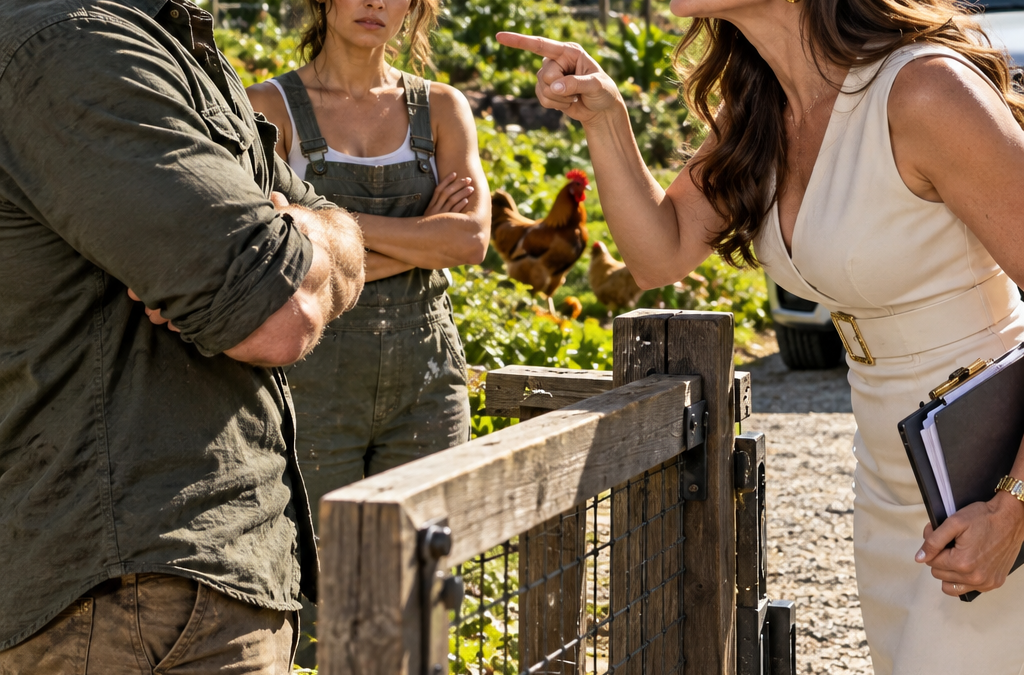
I was repairing a drip line in the garden when I heard the crunch of tires on gravel. I looked up and saw a white SUV idling outside the gate, spotless despite the dusty road. Karen stepped out wearing oversized sunglasses, a sleeveless cream dress, wedge sandals, and a smile so polished it felt less like an expression and more like a tool.
She did not open with hello.
“So,” she said, resting one manicured hand on the gate, “you’re the people dragging down everyone’s property values.”
I wiped my hands on a rag and walked over slowly.
“You must be Karen.”
Her smile sharpened. “President Whitcomb, actually.”
I looked around at my own land. “Not here.”
For half a second, her face went still.
Then she laughed.
It was a pretty laugh. Light. Controlled. Completely fake.
“I can see we got off on the wrong foot,” she said. “I’m here to help you understand the situation.”
“I understand it.”
“I don’t think you do.”
“Our land is not in your HOA.”
Karen tilted her head the way someone might look at a slow child. “That’s what everyone says when they don’t want to comply. But Paradise Grove surrounds your property on three sides. Your choices affect our community image.”
“Our choices affect our property.”
“Your property is visible from ours.”
“That doesn’t give you authority over it.”
Her smile thinned.
“You know,” she said, looking past me toward the house, the solar panels, the chicken run, the garden beds, “I understand that some people enjoy this rustic lifestyle. It can be charming in the right context. But Paradise Grove is an upscale residential community. Buyers expect a certain standard.”
“We are not selling to your buyers.”
“You’re lowering values.”
“Our property was here before your developer poured the first road.”
“And now circumstances have changed.”
The breeze moved through the banana leaves behind me. Somewhere near the coop, Clarence screamed like a tiny war criminal.
Karen’s eyes flicked toward the sound with open disgust.
“Livestock,” she said softly. “Compost toilets. Water barrels. Panels everywhere. You must understand how this looks.”
“It looks like our legal, permitted home.”
“It looks like a hippie compound.”
My jaw tightened.
Behind me, I heard the front door open. Maya stepped onto the porch, arms crossed. She did not speak, but I felt her presence like a hand on my back.
Karen noticed her and smiled brighter.
“Oh, good. Your wife. Maybe she’ll understand this from a community perspective.”
Maya walked down the path toward us, barefoot, paint on one wrist from a project she had been working on.
“I understand property lines,” Maya said. “Do you?”
Karen’s eyes cooled.
For the first time, I saw what lived underneath the charm.
Control.
Not confidence. Not pride. Control.
Karen did not want cooperation. She wanted surrender. She wanted every fence straight, every lawn trimmed, every neighbor nervous, every meeting obedient, every person within sight arranged according to her taste. Our property offended her not because it was ugly, but because it existed outside her reach.
“You will comply eventually,” she said, looking at me again. “The covenants run with the land in this area.”
“No, they don’t.”
“They do when your property impacts the community.”
“That is not how law works.”
Karen leaned closer to the gate. Her perfume floated between us, expensive and suffocating.
“Laws can be interpreted,” she said.
“Deeds can’t.”
Her face flushed lightly under her makeup.
“You’ll be hearing from our attorney.”
“I’ll look forward to forwarding their letter to mine.”
The mask cracked then. Just a little. Her lips tightened. Her eyes went hard.
“You think you’re very clever.”
“No. I think I own five acres you don’t control.”
Karen put her sunglasses back on.
“We’ll see.”
Then she turned, got into her SUV, and drove away in a spray of dust.
Maya came to stand beside me at the gate.
“She’s going to be a nightmare,” she said.
“Probably.”
“No,” Maya said, watching the SUV disappear around the bend. “Not probably. Definitely.”
She was right.
Over the next few months, the notices came faster.
Two per week sometimes.
They fined us for the chickens again. Then for the greenhouse again. Then for the solar panels again. Then for “unapproved exterior structures,” which apparently meant our rain barrels. Then for “odor nuisance,” which was interesting because the prevailing wind blew from Paradise Grove toward us, not the other way around. Then for “visual disharmony,” a phrase so stupid I had to sit down after reading it.
The total on their invoices climbed past four thousand dollars.
We ignored the invoices, but not the pattern.
Maya started a folder labeled Karen’s Fan Mail. Inside, she kept every notice, every envelope, every certified mail receipt, every email, every photograph of our property showing the date and condition of the supposedly offensive items. I created digital backups. Our attorney, Priya, reviewed everything and sent a formal cease and desist letter.
Priya was not a loud person. She did not need to be. Her letters had the calm, precise brutality of a surgeon’s knife.
She wrote that our property was not subject to HOA authority, that all fines were invalid, that further attempts to enforce nonexistent covenants could be considered harassment, and that any effort to cloud our title or interfere with our use of the property would result in legal action.
For two months, silence.
Beautiful silence.
No notices. No letters. No SUVs at the gate.
Maya started to believe maybe the attorney letter had worked.
I wanted to believe it too.
Then the county health department called.
Someone had filed a complaint about our composting toilet system.
The same day, the building inspector contacted us about a complaint regarding our solar panels and greenhouse.
Then animal control called about our chickens.
Three separate complaints. All filed within hours of each other.
Maya stood in the kitchen holding her phone after the third call, her face pale with anger.
“She’s trying to exhaust us,” she said.
I leaned against the counter, staring out at the garden we had built from bare dirt.
“She can’t win legally, so she’s using bureaucracy.”
The inspections took a full day.
The health inspector arrived first, expecting a disaster and finding instead a meticulously maintained composting setup permitted through the county. He actually asked me questions about the design because he wanted to recommend similar systems in rural builds.
The building inspector checked the solar installation, the greenhouse, the battery storage, the electrical permits, the structural approvals. He signed off on everything and told me our solar setup was one of the cleanest residential systems he had seen.
Animal control inspected the coop, counted the chickens, checked feed, water, shade, spacing, and zoning. The officer scratched Clarence’s head through the fence, somehow earning the only gentle sound that demon bird had ever made, and said, “You’re well within the allowable limit.”
Every complaint was unfounded.
Every inspector left satisfied.
But that was not the point.
The point was that Maya lost client time. I lost work time. We spent hours digging out documents, walking inspectors around the property, answering questions we had already answered when the permits were issued. The point was stress. Disruption. The constant sense that our home could be invaded by paperwork whenever Karen felt bored or threatened.
That night, Maya and I sat on the porch in the dark, listening to insects and distant construction noise from Paradise Grove.
“I hate that I’m starting to feel tense every time a car slows down,” she said.
I reached for her hand.
“I know.”
“This is our home.”
“I know.”
“She wants us to feel like guests on our own land.”
That sentence stayed with me.
Because that was exactly it.
Karen could not legally own us, so she wanted us unsettled. She wanted us watching the road. She wanted us second-guessing whether the garden beds were too visible or the chickens too loud or the water barrels too close to the fence. She wanted her rules living in our heads even if they could not live in our deed.
Then she went nuclear.
A notice arrived from the land registry.
The HOA had placed a lien on our property for unpaid fines.
I stood in my office reading the document twice, then a third time, because my brain refused to accept the stupidity of it.
They had placed a lien on land that was not in their association.
For fines they had no authority to issue.
On a debt that did not exist.
Maya found me still holding the paper.
“What is it?”
I handed it to her.
I watched her face as she read.
First confusion. Then disbelief. Then a kind of cold fury I had only seen from her once before, when a client tried not to pay her for three months of work.
“They did not,” she whispered.
“They did.”
“She put a lien on our home?”
“The HOA did.”
“No,” Maya said. “Karen did.”
Priya was livid.
I had known her for years, and I had never heard her actually swear until that phone call.
She filed immediately to have the lien removed. The hearing was short and brutal. The judge was not amused. Paradise Grove’s attorney tried to dress the action up in language about community impact and shared boundaries, but every question from the bench peeled that nonsense down to bone.
Was our parcel included in the HOA? No.
Had we signed covenants? No.
Were the fines valid under any recorded instrument? No.
Did the HOA have any legal authority to place the lien? No.
The lien was thrown out. The HOA was ordered to pay our legal fees for that action, about three thousand dollars. The judge also warned their attorney that further attempts to assert jurisdiction over non-member properties would be treated as frivolous.
I thought maybe that would finally stop Karen.
I underestimated the depth of her need to win.
A week after the lien was removed, I stopped at a gas station in town. I was filling the truck when Karen appeared beside the pump like a designer-clad ghost of municipal overreach.
She wore a black fitted dress, sunglasses, red lipstick, and the kind of smile that meant she had rehearsed the confrontation.
“This isn’t over,” she said.
I looked at the gas nozzle in my hand, then at her.
“Good morning to you too.”
Her sunglasses hid her eyes, but her jaw was tight.
“You embarrassed this community.”
“No. You embarrassed yourself in court.”
Her nostrils flared.
“You think because some judge slapped our wrist, you’re safe?”
“I think because the law says you don’t control my land, you don’t control my land.”
She stepped closer.
People like Karen understand space as a weapon. She liked invading it, especially with men, especially with that practiced mixture of beauty and threat. She lowered her voice, and for anyone watching from a distance, she might have looked like she was flirting.
Up close, she looked venomous.
“As long as I am running Paradise Grove,” she said, “your little off-grid fantasy is going to follow our standards.”
“No, it isn’t.”
“I can make life very difficult for you.”
“You already tried.”
“I can do worse.”
There it was.
Not implied. Not dressed up in board language. A threat.
I looked at her for a long moment.
Until then, I had been defensive. Patient. Legal. Reasonable. I had let Priya handle things because I believed the system, slow and irritating as it was, would eventually force Karen to stop.
But standing there at a gas pump, with her perfume cutting through the smell of fuel and hot pavement, watching her smile while she promised to make my wife feel unsafe in our own home, something in me shifted.
She wanted compliance.
Fine.
I would comply.
Just not the way she expected.
“You should be careful,” I said.
Karen laughed softly. “Is that a threat?”
“No,” I said, putting the nozzle back into the pump. “It’s advice.”
She smiled.
“I don’t take advice from men who live in chicken coops.”
Then she walked away.
That night, I poured two drinks and told Maya what had happened.
Maya listened without interrupting. When I finished, she sat very still, glass untouched.
“She threatened us.”
“Yes.”
“What are you thinking?”
“Something stupid.”
Her eyes narrowed slightly. “How stupid?”
“Possibly expensive stupid.”
“That look on your face is making me nervous.”
I leaned back in my chair.
“Community Steward Services.”
“The management company?”
“They’re the ones sending the notices. They’re the ones administering the HOA. They’re the operational arm.”
Maya waited.
“I started looking into them.”
“Of course you did.”
“They’re small. One owner. Part-time office manager. Two compliance officers. About a dozen HOA contracts. Thin margins. Stable revenue, but not huge.”
Maya’s expression changed.
She knew me too well.
“No.”
“I didn’t say anything yet.”
“You didn’t have to.”
“The owner is in his mid-sixties,” I continued. “Apparently he wants to retire.”
“Are you telling me you want to buy the company that has been harassing us?”
“I’m telling you I want to explore whether buying it would give us leverage.”
Maya stared at me.
Then she looked out the window toward the dark outline of the solar panels.
Then back at me.
“That is either the smartest thing you’ve ever said or the beginning of a documentary about a man losing his mind.”
“Could be both.”
She finally took a sip of her drink.
“What does Priya think?”
“She doesn’t know yet.”
Maya gave me a long look.
“Call her before you start playing corporate chess with a woman who files fake liens.”
So I did.
Priya’s first response was silence.
Then: “Please tell me this is hypothetical.”
“At the moment.”
“Do you have the money?”
“Yes.”
“Would you use your own name?”
“No. I’d form a new LLC.”
“Would the seller know who you are?”
“Not initially.”
She sighed.
It was the sigh of an attorney realizing her client had moved from victim to potential menace.
“Send me everything you have on the company,” she said.
Over the next few weeks, we moved quietly.
I formed a new LLC. Priya brought in a business attorney she trusted. A broker contacted the owner of Community Steward Services on behalf of the LLC. The owner was interested. More than interested, actually. He was tired. HOA management had become, in his words, “babysitting adults with checkbooks.” His health was not great, and he wanted out.
The asking price was significant but doable.
Fifteen years in software, smart investments, and a life with low overhead had left us with savings most people did not expect from a man who owned compost bins and chickens. Maya and I talked about the risk for nights. We ran numbers. We argued. We made spreadsheets. We considered the possibility that this was emotionally satisfying but financially foolish.
Then Priya got the management contracts.
That was when everything changed.
The contract between Community Steward Services and Paradise Grove Estates was absurdly favorable to the management company. Karen had signed it herself the year she became HOA president, apparently without reading it carefully because she was too busy measuring other people’s lawn ornaments.
The company had broad operational authority. It could conduct audits. Review vendor contracts. Present financial information directly to homeowners. Call meetings. Make operational recommendations the board had to formally vote to override. It also had an eighteen-month termination notice requirement and a termination fee equal to two years of management fees.
Priya read the contract twice, then looked at me across her conference table.
“She signed away the keys to the kingdom.”
I smiled for the first time in weeks.
“Did she?”
“She did.”
Maya, sitting beside me, whispered, “Oh my God.”
Priya pointed at me with a pen.
“Listen carefully. If you do this, you do it cleanly. No revenge stunts that create liability. No harassment. No theatrical nonsense that undermines your position.”
“I understand.”
“You become the adult in the room.”
“That sounds disappointing.”
“I’m serious.”
“So am I.”
She studied my face.
“Are you?”
I thought about Karen at my gate. Karen at the gas station. Maya tense every time a car slowed down. The lien notice sitting like poison on my desk.
“Yes,” I said. “I’m serious.”
The sale closed three months after the first broker conversation.
On a humid Friday afternoon, in a quiet law office, I became the sole owner of Community Steward Services, the management company that had spent nearly two years mailing illegal violation notices to my home.
When I got back, Maya was on the porch with two glasses waiting.
“How did it go?” she asked.
I held up the folder.
“We own an HOA management company.”
She handed me a drink.
“This is insane.”
“Probably.”
“I’m proud of you.”
“That sounds unhealthy.”
“It might be.”
We clinked glasses as Clarence screamed in the distance, perhaps sensing war.
I did not announce the ownership change immediately.
That would have been satisfying, but satisfaction was not the goal.
Control was.
For the first week, I lived inside records. Emails, invoices, violation logs, meeting minutes, bank statements, vendor agreements, internal notes, compliance reports. Maya helped build spreadsheets and timelines because she could organize chaos with terrifying elegance.
What we found was worse than I expected.
Karen and her inner circle had been treating Paradise Grove’s treasury like a private convenience fund. Not cartoon embezzlement with bags of cash, but death by a thousand entitled cuts.
A “landscape consulting fee” paid monthly to a company owned by Karen’s brother-in-law.
Community outreach expenses that appeared to be expensive dinners with wine.
Security equipment purchases that turned out to be a home theater system installed in the clubhouse, which was conveniently reserved for “board functions” almost every weekend.
Decorative upgrades billed to common areas but delivered to Karen’s street.
Legal fees related to pursuing us, hidden under vague administrative categories.
The questionable spending totaled more than forty-two thousand dollars over two years.
Then I reviewed our file.
The compliance officers had noted, repeatedly, that our property was not part of the HOA and should not receive violation notices. One wrote, “Parcel appears outside association boundaries. Continued enforcement may expose company and board to liability.” Another wrote, “President Whitcomb instructed notices continue despite boundary issue.”
There it was.
In writing.
Karen had known.
Or at least she had been told often enough that “I didn’t know” would never survive daylight.
I called the two compliance officers into the office the following Monday.
They looked nervous when they sat down across from me. I could not blame them. New owners usually mean layoffs, restructuring, or motivational posters. Sometimes all three.
“I’ve reviewed the Paradise Grove files,” I said.
They exchanged a glance.
One of them, an older man named Daniel, exhaled slowly.
“Okay.”
“You both flagged that my property was outside the HOA.”
Daniel blinked.
“Your property?”
I let that sit.
Then I told them who I was.
The younger officer, Mateo, leaned back in his chair. “Oh, damn.”
“Yeah.”
Daniel rubbed a hand over his face. “For what it’s worth, we told them to stop. Multiple times.”
“I saw.”
“The old owner didn’t want to lose the contract.”
“I saw that too.”
Mateo looked genuinely upset. “We hated sending those notices.”
“Then you’ll be happy to know it stops immediately.”
Daniel’s shoulders dropped.
“Thank God,” he said. “I’ve been waiting for someone to shut that woman down.”
I slid a memo across the desk.
“No violation notices will be issued to any non-member parcel. Any board instruction that conflicts with recorded boundaries gets escalated. No exceptions.”
Both men signed.
Then I gave them raises.
Not huge ones, but enough to matter. They had been underpaid to absorb abuse from boards who treated them like hired spies.
“If we’re going to enforce rules,” I told them, “we start with our own.”
Paradise Grove’s quarterly HOA meeting was scheduled for the following Thursday night.
As the management company owner, I had the right to attend and report.
Normally, the old owner or office manager would sit at a side table, read boring administrative updates, answer questions, and go home. This time, I went myself.
I wore a blazer.
Maya said it made me look like I was either attending a deposition or selling ethically questionable software.
“Perfect,” I said.
She adjusted my collar.
“Do not smirk.”
“I would never.”
“You absolutely would.”
“Only internally.”
When I walked into the Paradise Grove clubhouse, thirty or forty homeowners were already there. That was a lot for an HOA meeting. Word had gotten around that the board planned to escalate action against “noncompliant adjacent properties.” People wanted drama.
They were going to get it.
Karen stood at the front of the room arranging papers with theatrical importance. She wore a fitted navy dress, pearl earrings, and heels sharp enough to qualify as weapons. Her hair fell over one shoulder in glossy waves. She looked beautiful, composed, powerful.
Then she glanced at me.
At first, nothing.
She saw a man in a blazer at the management company table and looked away.
Then her eyes snapped back.
Recognition moved across her face like a power outage.
Her smile vanished.
I sat down calmly and opened my folder.
The meeting began with the usual rituals. Approval of previous minutes. Treasury report, which Karen rushed through. Old business. Pool repairs, still unresolved. Landscaping complaints, dismissed vaguely. Clubhouse scheduling, brushed aside.
Then new business.
Karen stepped forward.
“As many of you know,” she began, voice rich and controlled, “our community has faced ongoing challenges from certain adjacent properties whose owners refuse to respect the standards that protect all of our investments.”
Her eyes flicked toward me.
I looked at my notes.
“These properties create visual disruption, potential sanitation concerns, and negative impressions for prospective buyers. Your board has been patient, but patience should not be mistaken for weakness. We are exploring additional legal remedies to bring these nuisance properties into alignment with Paradise Grove standards.”
A man in the second row raised his hand.
Karen’s smile tightened.
“Yes, Mr. Lawson?”
“How much have we spent trying to enforce rules against properties that aren’t actually in the HOA?”
A murmur moved through the room.
Karen’s head tilted.
“That number is not relevant to tonight’s discussion.”
“It feels relevant if it’s our dues.”
“Legal strategy is confidential.”
“Is the amount confidential too?”
Karen’s eyes flashed.
“That is enough.”
It was my cue.
I stood.
The room turned toward me.
Karen’s face hardened instantly.
“Mr. Carter,” she said, using my name like an accusation. “This is a closed board matter.”
I smiled politely.
“Actually, tonight I’m here in my professional capacity.”
Her mouth tightened.
“As what?”
“As the new owner of Community Steward Services, Paradise Grove’s management company.”
The silence was exquisite.
For one long second, nobody moved.
Then whispers erupted.
Karen stared at me as if I had just walked into her bedroom.
“That’s impossible.”
“It closed last Friday.”
“You can’t do that.”
“I can. I did.”
“This is a conflict of interest.”
“No, President Whitcomb. A conflict of interest would be using HOA funds to benefit your relatives without proper disclosure.”
Her face drained of color.
Someone in the audience said, “What?”
I opened my folder.
“As part of a routine ownership transition audit, Community Steward Services reviewed the financial and operational records of all managed associations, including Paradise Grove Estates. Under Section 8.2 of the management contract signed by President Whitcomb, the management company has explicit authority to conduct audits and present operational findings directly to homeowners.”
Karen stepped forward.
“You do not have approval to—”
I lifted the contract.
“You gave approval when you signed this.”
She stopped.
I read the relevant section aloud.
Every word landed like a hammer.
The room shifted. People sat up. Arms unfolded. Phones came out. Karen looked from me to the homeowners, then to the other board members, searching for control and finding none.
I began with the money.
I had prepared a clean summary. Dates, amounts, vendors, categories, supporting documents. I did not speculate. I did not insult. I let the records speak.
Landscape consulting fees to a company owned by Karen’s brother-in-law.
A wave of sound moved through the room.
Community outreach dinners at restaurants nowhere near the community.
Security equipment that was actually entertainment equipment for the clubhouse.
Clubhouse “board functions” blocking resident use.
Legal expenses tied to actions against non-member properties.
I saw faces change.
Confusion became anger. Anger became recognition. People began turning to one another with expressions that said, You too? You noticed too?
Karen tried to interrupt three times.
Each time, I returned to the contract.
Then I moved to our property.
“Internal compliance records show that Community Steward Services staff repeatedly documented that my parcel is outside Paradise Grove’s HOA boundaries. Staff recommended no violation notices be issued. Those recommendations were overruled by President Whitcomb.”
Karen’s voice cracked across the room.
“That is a lie.”
I held up the printed internal notes.
“It is in writing.”
Her eyes went wide with rage.
“You bought this company to sabotage us.”
“No,” I said. “I bought this company because you used it to harass my wife and me after being told you had no authority over our land. The audit uncovered the rest.”
She laughed, but it came out wrong.
Desperate.
“You people are unbelievable.”
Maya, sitting quietly in the back row, raised one eyebrow.
Karen saw her and flushed.
One homeowner stood.
It was a woman in her sixties with silver hair and a voice that shook with anger.
“My dues went up last year, and the pool has been broken for six months. But you spent money suing a man who isn’t even in our HOA?”
Karen pointed at me.
“He is manipulating you.”
A man near the back stood next.
“Why is your brother-in-law getting landscaping money when the common areas look like garbage?”
Another homeowner rose.
“Why couldn’t I book the clubhouse for my daughter’s birthday? I was told it was unavailable every weekend.”
Someone else said, “Because Karen uses it for wine nights.”
The room exploded.
Karen banged the table with her palm.
“Order! This meeting will come to order!”
Nobody listened.
For years, she had ruled them through fear, fines, social pressure, and the quiet threat of retaliation. But bullies survive by isolating people. They make each victim believe they are alone. That night, Karen’s mistake was letting them all hear the truth together.
A man crossed his arms and called out, “How much did she spend?”
I answered.
“Questionable expenditures identified so far total just over forty-two thousand dollars.”
The sound that followed was not a murmur.
It was a roar.
Karen’s face went scarlet.
“I am terminating Community Steward Services immediately.”
I turned one page in the contract.
“You may initiate termination with eighteen months’ notice and a termination fee equal to two years of management fees.”
Her lips parted.
“You signed the contract,” I said. “I’m just honoring it.”
That was the line that broke her.
For nearly two years, Karen had told me I would comply with community standards one way or another.
So I did.
I complied with her own contract.
Her own rules.
Her own signature.
And now every person in that clubhouse understood what her arrogance had cost them.
One of the board members, a nervous man who looked like he had aged ten years in ten minutes, turned to Karen.
“Did you actually sign those terms?”
Karen spun toward him.
“Do not start with me, Alan.”
“Did you?”
She did not answer.
That was answer enough.
Mr. Lawson stood again.
“Under the bylaws, homeowners present can call for a special vote of no confidence, correct?”
I said nothing.
I did not need to.
A woman in the front row held up a copy of the bylaws. “Yes. Section 4.7. Majority of homeowners present at a general meeting can trigger a special election to remove board members.”
Karen’s head snapped toward her.
“You are out of order.”
“No,” the woman said. “You are.”
That was when the meeting truly stopped being Karen’s.
The homeowners moved fast. Faster than I expected. Anger sharpened them. People who had been afraid for years suddenly found courage in numbers. They nominated a temporary chair for the vote. Karen shouted objections. I remained at the side table, answering procedural questions only when asked.
The vote of no confidence passed overwhelmingly.
Twenty-eight to four.
Karen and two of her closest allies were removed from their board positions pending the special election process. The room erupted again, but this time the sound had relief inside it.
Karen stood at the front, breathing hard, her hands gripping the table edge.
Her perfect hair had fallen slightly out of place. Her lipstick looked too bright against her pale face. For the first time since I had met her, she did not look untouchable.
She looked small.
Not because she was powerless.
Because everyone had stopped pretending she was powerful.
“This is illegal,” she hissed.
Mr. Lawson smiled without warmth.
“Then sue us.”
Someone in the back added, “Just don’t use our dues this time.”
A few people laughed.
Karen grabbed her bag.
“You’ll regret this,” she said, sweeping her gaze across the room. “All of you.”
Then she stormed out.
Through the clubhouse windows, we could see her husband waiting in their car. She yanked open the passenger door so hard it bounced. He said something. She exploded in a flurry of gestures. Even through the glass, we could see him shrink back.
Maya came to stand beside me.
“You didn’t smirk,” she said quietly.
“Internally, I was unbearable.”
“I know.”
The weeks after that meeting were messy but satisfying.
The remaining board members worked with homeowner volunteers to form an interim board. A full financial reconciliation confirmed just over forty-two thousand dollars in questionable spending. The new board voted to pursue recovery from Karen and the former board members involved.
Karen hired an attorney.
From what I heard, once that attorney reviewed the documents, the advice was simple: settle quickly and quietly.
Karen repaid a large portion personally. The other former board members covered the rest. Her brother-in-law’s landscape consulting arrangement ended immediately. A real landscaping company was hired at nearly half the cost, and within a month the common areas looked better than they had in years.
The pool, which Karen had claimed required complex budgeting delays, was fixed in two weeks.
It turned out to be a pump replacement.
The clubhouse calendar opened to residents again. The home theater system stayed, but now actual families used it for movie nights instead of Karen’s private gatherings. The new board started sending transparent monthly financial summaries. Dues were reviewed. Vendor contracts were rebid.
People began waving when they passed our gate.
Not all of them. Some still looked embarrassed, as if our solar panels had personally witnessed their silence. But many stopped to apologize. A few admitted Karen had fined them for nonsense too: a garden hose visible from the street, a door wreath she disliked, a shade of exterior paint half a tone off her preferred palette.
“She made everyone afraid,” one woman told Maya near the gate one morning. “I’m sorry we didn’t see what she was doing to you.”
Maya accepted the apology with more grace than I might have.
The new board passed a formal resolution acknowledging that our parcel was not part of Paradise Grove Estates, had never been part of the HOA, and would not be issued violation notices, fines, or enforcement letters now or in the future.
All outstanding fines were voided.
Not that they had ever been valid.
Karen sold her house six months later.
The official reason, according to neighborhood gossip, was that she and her husband wanted “a fresh start.” The unofficial reason was that it is hard to remain queen of a kingdom after your subjects watch you dragged out by your own bylaws.
The day the moving truck came, I was repairing a fence post near our driveway. Karen’s SUV rolled past slowly.
For a moment, I thought she would stop.
Part of me wanted her to.
Part of me wanted the apology I knew would never come. Not because I needed it to move on, but because some stubborn corner of my mind still wanted proof that consequences had taught her something.
She slowed near our gate.
Her window lowered.
She looked the same and not the same. Still beautiful. Still polished. Still expensive. But the shine had thinned. Her eyes moved over the solar panels, the chickens, the greenhouse, the rain barrels, the house she had tried so hard to make disappear.
Then she looked at me.
“You must be very proud of yourself,” she said.
I leaned on the fence post.
“I sleep fine.”
Her mouth twisted.
“You destroyed a community.”
“No,” I said. “I exposed what you were doing to it.”
She laughed once, bitterly.
“You think they like you? They used you because you were useful.”
“Maybe.”
That seemed to surprise her.
I shrugged.
“I didn’t do it to be liked.”
“Then why?”
I looked past her toward Paradise Grove, where children were riding bikes near the now-working pool and two men were arguing cheerfully over a grill near the clubhouse.
“Because you came after my wife in our home.”
Her face changed.
Just for a second.
Not remorse, exactly.
Recognition, maybe.
Then the wall came back up.
“You’re still living in a chicken coop,” she said.
Clarence chose that exact moment to leap onto a stump and scream with the force of a creature possessed by ancient evil.
I smiled.
“And you’re still leaving.”
Karen’s eyes narrowed.
Then she rolled up the window and drove away.
I watched until her SUV disappeared beyond the trees.
Maya came out of the greenhouse holding a basket of herbs.
“Was that her?”
“Yeah.”
“Did she apologize?”
“No.”
“Of course not.”
“She called our house a chicken coop again.”
Maya looked toward Clarence, who was now attacking a leaf.
“Well,” she said, “he is very committed to the brand.”
I laughed.
And for the first time in a long time, the laugh had no anger in it.
I ran Community Steward Services for about a year after buying it.
To my surprise, it became a decent little business once we removed the nonsense. We cleaned up processes, standardized boundary checks, required written legal review before any enforcement involving adjacent properties, raised staff pay, and shifted the company’s culture away from being a weapon for petty tyrants.
Most HOAs were not evil.
That was the strangest thing I learned.
Most homeowners just wanted common areas maintained, funds handled honestly, and neighbors kept from doing genuinely dangerous or destructive things. The problem was never rules by themselves. The problem was people like Karen, who saw rules not as agreements, but as weapons waiting for the right hand.
Eventually, I sold the company to Daniel, the compliance officer who had once written that our case looked like harassment. He was good at the work, fair, and allergic to drama. Under him, Paradise Grove continued to improve. The board focused on boring, healthy things: transparent finances, vendor accountability, pool maintenance, community events, and not terrorizing people over garden hoses.
As for us, our life returned to what we had wanted all along.
Quiet.
The solar panels still catch the morning light. The rain barrels still fill during storms. The greenhouse smells like basil and damp soil. Clarence still behaves like a feathered dictator, though thankfully one with no lien authority. Maya still works from her studio, sometimes pausing to look out at the garden with that soft expression that tells me she remembers how close we came to letting someone else’s madness steal our peace.
Sometimes people ask if buying the management company was worth it.
Financially, yes. Barely, but yes.
Emotionally, absolutely.
Not because revenge healed everything. It did not. For months, Maya still stiffened when unfamiliar cars slowed near the gate. I still opened official-looking envelopes with a knot in my stomach. Legal harassment leaves residue. It turns ordinary mail into a threat and property lines into battle lines.
But there is a particular kind of peace that comes from refusing to be bullied off your own ground.
Karen thought power meant making other people afraid.
She thought leadership meant control.
She thought beauty, charm, money, and a title could turn lies into law if she repeated them loudly enough.
What she never understood was that real power is quieter than that.
Sometimes it looks like permits in a folder.
Sometimes it looks like an attorney who knows exactly where to place a knife.
Sometimes it looks like homeowners finally realizing they outnumber the person who has been scaring them.
And sometimes it looks like buying the company your enemy used as a weapon, opening the records, and letting her own signature do the damage.
Karen wanted me to comply with community standards.
In the end, I did.
I complied with the contract she signed, the bylaws she ignored, the financial rules she broke, and the law she thought she could bend.
She wanted our little off-grid home brought into line.
Instead, her entire kingdom was.
Now, when the sun goes down over our five acres, the batteries hum softly, the chickens settle, and the lights in Paradise Grove flicker on beyond the trees. Their lawns are trimmed. Their pool works. Their clubhouse is open. Their finances are transparent. Their board minutes are public.
And our property remains exactly what it always was.
Ours.
No covenants.
No fines.
No Karen at the gate.
Just the life we built, still standing in the sunlight she tried to take away.
𝗧𝗛𝗘 𝗘𝗡𝗗
The HOA Queen Thought She Could Fine Me Off My Own Land, So I Bought the Company She Used to Harass Me
Karen smiled at my gate like she already owned my land, my silence, and every inch of sunlight hitting my solar panels.
She thought a clipboard, a designer dress, and three little letters—HOA—could scare me into tearing apart the life my wife and I had built with our own hands.
By the time she realized who really controlled her precious community, she was standing in front of the neighbors she had bullied for years, watching her kingdom burn down around her.
My wife and I bought our five acres because we wanted quiet.
Not luxury. Not status. Not a house designed to impress people we didn’t even like. We wanted space, trees, good soil, clean water, and mornings where the loudest thing outside our bedroom window was a rooster acting like he personally invented the sunrise.
For privacy, I’ll keep the country vague, but this happened in a semi-rural area in Southeast Asia where a lot of foreigners, retirees, digital workers, and wealthy locals had begun buying land. When we found our property, it sat at the edge of what was then mostly undeveloped countryside. Our closest neighbor was a cattle ranch about half a mile away. At night, the sky was dark enough to see stars I had forgotten existed. During the rainy season, the whole place smelled like wet earth and mango leaves.
We bought it because we wanted to live off-grid.
Not in a bunker, canned-beans, end-of-the-world kind of way. More like a tired-of-utility-bills, tired-of-noise, tired-of-having-someone-else-control-every-basic-thing kind of way. I had spent fifteen years in software development, burned myself down in front of glowing screens, and done well enough that we could finally choose a different life. My wife, Maya, was a freelance graphic designer. As long as she had a reliable satellite internet connection, she could work from anywhere.
So we built the life we wanted.
Our house was not some leaning shack hidden behind banana trees. It was a custom passive-solar home with clean lines, good materials, and permits for everything. We had a large solar array with battery storage, a well for water, rainwater collection barrels, a composting toilet system, gray-water recycling for the garden, chickens, raised vegetable beds, and a small greenhouse where Maya grew herbs with the devotion of a scientist and the emotional intensity of a poet.
Everything was legal. Everything was inspected. Everything was documented in folders so obsessively organized that our attorney once laughed and told us we had “courtroom energy.”
For the first few years, life was peaceful.
Then the developer arrived.
A company bought the land surrounding us on three sides and began turning the countryside into a planned community. Roads went in first. Then rows of nearly identical houses. Then a clubhouse, a pool, decorative gates, streetlights, and signs with a name so blandly aspirational I still refuse to say it without sarcasm. For this story, I’ll call it Paradise Grove Estates, because every place like that seems required by law to have a name that sounds like a perfume ad.
When the development formed its homeowners association, Maya and I double-checked everything again. Our deed had no covenants. No restrictions. No HOA membership. No obligation to follow Paradise Grove’s rules. Our attorney confirmed it in writing. Twice.
We were not part of their community.
We were here first.
At first, most of the new neighbors were fine. Some were even friendly. People walking their dogs would stop by the gate and ask about the solar panels or the garden. Maya gave extra basil to one couple. I helped another guy understand battery storage because he was curious about installing backup power. We minded our business. They minded theirs.
Then Karen Whitcomb got elected HOA president.
Karen was about forty, American, stunning in the way that expensive maintenance can be stunning. Long dark hair always blown smooth, bright white smile, fitted linen dresses, gold jewelry, perfume that reached you three seconds before she did. She had the kind of confidence that came from discovering early in life that beauty, money, and a sharp voice could make most people step backward.
She was charming when she wanted something.
She was vicious when she was denied it.
The first violation notice arrived on a Tuesday.
It said our solar panels violated Paradise Grove community aesthetic guidelines and needed to be removed or screened from view within thirty days.
There was a fifty-dollar fine attached.
Maya read it once, looked at me, and burst out laughing.
I laughed too.
Then we threw it away.
Part 2
Two weeks later, another notice came.
This one said livestock was prohibited within community boundaries, and our chickens had to be removed immediately. Another fifty-dollar fine.
“Our chickens are not in their community,” Maya said, holding the letter between two fingers like it smelled bad.
“Maybe the chickens secretly signed the HOA agreement,” I said.
She snorted. “Clarence would. He looks like a man who would join a board.”
Clarence was our most aggressive rooster and had the moral character of a parking enforcement officer.
We threw that notice away too.
Then came the third, fourth, and fifth.
Our compost bins were apparently a health hazard. Our rainwater barrels were an eyesore. Our greenhouse was an unauthorized structure. The fines escalated from seventy-five dollars to one hundred, then one hundred and fifty.
That was when I decided ignoring them might be satisfying but not smart.
I wrote a polite letter explaining that our property was not part of Paradise Grove Estates, had never been part of Paradise Grove Estates, and was not subject to the authority of its homeowners association. I included copies of our deed, parcel map, permit documents, and a letter from our attorney confirming that no HOA covenants applied to our land. I mailed it certified to the HOA board and to the management company handling their operations, a small outfit I’ll call Community Steward Services.
A week later, Karen showed up at our front gate.
I was repairing a drip line in the garden when I heard the crunch of tires on gravel. I looked up and saw a white SUV idling outside the gate, spotless despite the dusty road. Karen stepped out wearing oversized sunglasses, a sleeveless cream dress, wedge sandals, and a smile so polished it felt less like an expression and more like a tool.
She did not open with hello.
“So,” she said, resting one manicured hand on the gate, “you’re the people dragging down everyone’s property values.”
I wiped my hands on a rag and walked over slowly.
“You must be Karen.”
Her smile sharpened. “President Whitcomb, actually.”
I looked around at my own land. “Not here.”
For half a second, her face went still.
Then she laughed.
It was a pretty laugh. Light. Controlled. Completely fake.
“I can see we got off on the wrong foot,” she said. “I’m here to help you understand the situation.”
“I understand it.”
“I don’t think you do.”
“Our land is not in your HOA.”
Karen tilted her head the way someone might look at a slow child. “That’s what everyone says when they don’t want to comply. But Paradise Grove surrounds your property on three sides. Your choices affect our community image.”
“Our choices affect our property.”
“Your property is visible from ours.”
“That doesn’t give you authority over it.”
Her smile thinned.
“You know,” she said, looking past me toward the house, the solar panels, the chicken run, the garden beds, “I understand that some people enjoy this rustic lifestyle. It can be charming in the right context. But Paradise Grove is an upscale residential community. Buyers expect a certain standard.”
“We are not selling to your buyers.”
“You’re lowering values.”
“Our property was here before your developer poured the first road.”
“And now circumstances have changed.”
The breeze moved through the banana leaves behind me. Somewhere near the coop, Clarence screamed like a tiny war criminal.
Karen’s eyes flicked toward the sound with open disgust.
“Livestock,” she said softly. “Compost toilets. Water barrels. Panels everywhere. You must understand how this looks.”
“It looks like our legal, permitted home.”
“It looks like a hippie compound.”
My jaw tightened.
Behind me, I heard the front door open. Maya stepped onto the porch, arms crossed. She did not speak, but I felt her presence like a hand on my back.
Karen noticed her and smiled brighter.
“Oh, good. Your wife. Maybe she’ll understand this from a community perspective.”
Maya walked down the path toward us, barefoot, paint on one wrist from a project she had been working on.
“I understand property lines,” Maya said. “Do you?”
Karen’s eyes cooled.
For the first time, I saw what lived underneath the charm.
Control.
Not confidence. Not pride. Control.
Karen did not want cooperation. She wanted surrender. She wanted every fence straight, every lawn trimmed, every neighbor nervous, every meeting obedient, every person within sight arranged according to her taste. Our property offended her not because it was ugly, but because it existed outside her reach.
“You will comply eventually,” she said, looking at me again. “The covenants run with the land in this area.”
“No, they don’t.”
“They do when your property impacts the community.”
“That is not how law works.”
Karen leaned closer to the gate. Her perfume floated between us, expensive and suffocating.
“Laws can be interpreted,” she said.
“Deeds can’t.”
Her face flushed lightly under her makeup.
“You’ll be hearing from our attorney.”
“I’ll look forward to forwarding their letter to mine.”
The mask cracked then. Just a little. Her lips tightened. Her eyes went hard.
“You think you’re very clever.”
“No. I think I own five acres you don’t control.”
Karen put her sunglasses back on.
“We’ll see.”
Then she turned, got into her SUV, and drove away in a spray of dust.
Maya came to stand beside me at the gate.
“She’s going to be a nightmare,” she said.
“Probably.”
“No,” Maya said, watching the SUV disappear around the bend. “Not probably. Definitely.”
She was right.
Over the next few months, the notices came faster.
Two per week sometimes.
They fined us for the chickens again. Then for the greenhouse again. Then for the solar panels again. Then for “unapproved exterior structures,” which apparently meant our rain barrels. Then for “odor nuisance,” which was interesting because the prevailing wind blew from Paradise Grove toward us, not the other way around. Then for “visual disharmony,” a phrase so stupid I had to sit down after reading it.
The total on their invoices climbed past four thousand dollars.
We ignored the invoices, but not the pattern.
Maya started a folder labeled Karen’s Fan Mail. Inside, she kept every notice, every envelope, every certified mail receipt, every email, every photograph of our property showing the date and condition of the supposedly offensive items. I created digital backups. Our attorney, Priya, reviewed everything and sent a formal cease and desist letter.
Priya was not a loud person. She did not need to be. Her letters had the calm, precise brutality of a surgeon’s knife.
She wrote that our property was not subject to HOA authority, that all fines were invalid, that further attempts to enforce nonexistent covenants could be considered harassment, and that any effort to cloud our title or interfere with our use of the property would result in legal action.
For two months, silence.
Beautiful silence.
No notices. No letters. No SUVs at the gate.
Maya started to believe maybe the attorney letter had worked.
I wanted to believe it too.
Then the county health department called.
Someone had filed a complaint about our composting toilet system.
The same day, the building inspector contacted us about a complaint regarding our solar panels and greenhouse.
Then animal control called about our chickens.
Three separate complaints. All filed within hours of each other.
Maya stood in the kitchen holding her phone after the third call, her face pale with anger.
“She’s trying to exhaust us,” she said.
I leaned against the counter, staring out at the garden we had built from bare dirt.
“She can’t win legally, so she’s using bureaucracy.”
The inspections took a full day.
The health inspector arrived first, expecting a disaster and finding instead a meticulously maintained composting setup permitted through the county. He actually asked me questions about the design because he wanted to recommend similar systems in rural builds.
The building inspector checked the solar installation, the greenhouse, the battery storage, the electrical permits, the structural approvals. He signed off on everything and told me our solar setup was one of the cleanest residential systems he had seen.
Animal control inspected the coop, counted the chickens, checked feed, water, shade, spacing, and zoning. The officer scratched Clarence’s head through the fence, somehow earning the only gentle sound that demon bird had ever made, and said, “You’re well within the allowable limit.”
Every complaint was unfounded.
Every inspector left satisfied.
But that was not the point.
The point was that Maya lost client time. I lost work time. We spent hours digging out documents, walking inspectors around the property, answering questions we had already answered when the permits were issued. The point was stress. Disruption. The constant sense that our home could be invaded by paperwork whenever Karen felt bored or threatened.
That night, Maya and I sat on the porch in the dark, listening to insects and distant construction noise from Paradise Grove.
“I hate that I’m starting to feel tense every time a car slows down,” she said.
I reached for her hand.
“I know.”
“This is our home.”
“I know.”
“She wants us to feel like guests on our own land.”
That sentence stayed with me.
Because that was exactly it.
Karen could not legally own us, so she wanted us unsettled. She wanted us watching the road. She wanted us second-guessing whether the garden beds were too visible or the chickens too loud or the water barrels too close to the fence. She wanted her rules living in our heads even if they could not live in our deed.
Then she went nuclear.
A notice arrived from the land registry.
The HOA had placed a lien on our property for unpaid fines.
I stood in my office reading the document twice, then a third time, because my brain refused to accept the stupidity of it.
They had placed a lien on land that was not in their association.
For fines they had no authority to issue.
On a debt that did not exist.
Maya found me still holding the paper.
“What is it?”
I handed it to her.
I watched her face as she read.
First confusion. Then disbelief. Then a kind of cold fury I had only seen from her once before, when a client tried not to pay her for three months of work.
“They did not,” she whispered.
“They did.”
“She put a lien on our home?”
“The HOA did.”
“No,” Maya said. “Karen did.”
Priya was livid.
I had known her for years, and I had never heard her actually swear until that phone call.
She filed immediately to have the lien removed. The hearing was short and brutal. The judge was not amused. Paradise Grove’s attorney tried to dress the action up in language about community impact and shared boundaries, but every question from the bench peeled that nonsense down to bone.
Was our parcel included in the HOA? No.
Had we signed covenants? No.
Were the fines valid under any recorded instrument? No.
Did the HOA have any legal authority to place the lien? No.
The lien was thrown out. The HOA was ordered to pay our legal fees for that action, about three thousand dollars. The judge also warned their attorney that further attempts to assert jurisdiction over non-member properties would be treated as frivolous.
I thought maybe that would finally stop Karen.
I underestimated the depth of her need to win.
A week after the lien was removed, I stopped at a gas station in town. I was filling the truck when Karen appeared beside the pump like a designer-clad ghost of municipal overreach.
She wore a black fitted dress, sunglasses, red lipstick, and the kind of smile that meant she had rehearsed the confrontation.
“This isn’t over,” she said.
I looked at the gas nozzle in my hand, then at her.
“Good morning to you too.”
Her sunglasses hid her eyes, but her jaw was tight.
“You embarrassed this community.”
“No. You embarrassed yourself in court.”
Her nostrils flared.
“You think because some judge slapped our wrist, you’re safe?”
“I think because the law says you don’t control my land, you don’t control my land.”
She stepped closer.
People like Karen understand space as a weapon. She liked invading it, especially with men, especially with that practiced mixture of beauty and threat. She lowered her voice, and for anyone watching from a distance, she might have looked like she was flirting.
Up close, she looked venomous.
“As long as I am running Paradise Grove,” she said, “your little off-grid fantasy is going to follow our standards.”
“No, it isn’t.”
“I can make life very difficult for you.”
“You already tried.”
“I can do worse.”
There it was.
Not implied. Not dressed up in board language. A threat.
I looked at her for a long moment.
Until then, I had been defensive. Patient. Legal. Reasonable. I had let Priya handle things because I believed the system, slow and irritating as it was, would eventually force Karen to stop.
But standing there at a gas pump, with her perfume cutting through the smell of fuel and hot pavement, watching her smile while she promised to make my wife feel unsafe in our own home, something in me shifted.
She wanted compliance.
Fine.
I would comply.
Just not the way she expected.
“You should be careful,” I said.
Karen laughed softly. “Is that a threat?”
“No,” I said, putting the nozzle back into the pump. “It’s advice.”
She smiled.
“I don’t take advice from men who live in chicken coops.”
Then she walked away.
That night, I poured two drinks and told Maya what had happened.
Maya listened without interrupting. When I finished, she sat very still, glass untouched.
“She threatened us.”
“Yes.”
“What are you thinking?”
“Something stupid.”
Her eyes narrowed slightly. “How stupid?”
“Possibly expensive stupid.”
“That look on your face is making me nervous.”
I leaned back in my chair.
“Community Steward Services.”
“The management company?”
“They’re the ones sending the notices. They’re the ones administering the HOA. They’re the operational arm.”
Maya waited.
“I started looking into them.”
“Of course you did.”
“They’re small. One owner. Part-time office manager. Two compliance officers. About a dozen HOA contracts. Thin margins. Stable revenue, but not huge.”
Maya’s expression changed.
She knew me too well.
“No.”
“I didn’t say anything yet.”
“You didn’t have to.”
“The owner is in his mid-sixties,” I continued. “Apparently he wants to retire.”
“Are you telling me you want to buy the company that has been harassing us?”
“I’m telling you I want to explore whether buying it would give us leverage.”
Maya stared at me.
Then she looked out the window toward the dark outline of the solar panels.
Then back at me.
“That is either the smartest thing you’ve ever said or the beginning of a documentary about a man losing his mind.”
“Could be both.”
She finally took a sip of her drink.
“What does Priya think?”
“She doesn’t know yet.”
Maya gave me a long look.
“Call her before you start playing corporate chess with a woman who files fake liens.”
So I did.
Priya’s first response was silence.
Then: “Please tell me this is hypothetical.”
“At the moment.”
“Do you have the money?”
“Yes.”
“Would you use your own name?”
“No. I’d form a new LLC.”
“Would the seller know who you are?”
“Not initially.”
She sighed.
It was the sigh of an attorney realizing her client had moved from victim to potential menace.
“Send me everything you have on the company,” she said.
Over the next few weeks, we moved quietly.
I formed a new LLC. Priya brought in a business attorney she trusted. A broker contacted the owner of Community Steward Services on behalf of the LLC. The owner was interested. More than interested, actually. He was tired. HOA management had become, in his words, “babysitting adults with checkbooks.” His health was not great, and he wanted out.
The asking price was significant but doable.
Fifteen years in software, smart investments, and a life with low overhead had left us with savings most people did not expect from a man who owned compost bins and chickens. Maya and I talked about the risk for nights. We ran numbers. We argued. We made spreadsheets. We considered the possibility that this was emotionally satisfying but financially foolish.
Then Priya got the management contracts.
That was when everything changed.
The contract between Community Steward Services and Paradise Grove Estates was absurdly favorable to the management company. Karen had signed it herself the year she became HOA president, apparently without reading it carefully because she was too busy measuring other people’s lawn ornaments.
The company had broad operational authority. It could conduct audits. Review vendor contracts. Present financial information directly to homeowners. Call meetings. Make operational recommendations the board had to formally vote to override. It also had an eighteen-month termination notice requirement and a termination fee equal to two years of management fees.
Priya read the contract twice, then looked at me across her conference table.
“She signed away the keys to the kingdom.”
I smiled for the first time in weeks.
“Did she?”
“She did.”
Maya, sitting beside me, whispered, “Oh my God.”
Priya pointed at me with a pen.
“Listen carefully. If you do this, you do it cleanly. No revenge stunts that create liability. No harassment. No theatrical nonsense that undermines your position.”
“I understand.”
“You become the adult in the room.”
“That sounds disappointing.”
“I’m serious.”
“So am I.”
She studied my face.
“Are you?”
I thought about Karen at my gate. Karen at the gas station. Maya tense every time a car slowed down. The lien notice sitting like poison on my desk.
“Yes,” I said. “I’m serious.”
The sale closed three months after the first broker conversation.
On a humid Friday afternoon, in a quiet law office, I became the sole owner of Community Steward Services, the management company that had spent nearly two years mailing illegal violation notices to my home.
When I got back, Maya was on the porch with two glasses waiting.
“How did it go?” she asked.
I held up the folder.
“We own an HOA management company.”
She handed me a drink.
“This is insane.”
“Probably.”
“I’m proud of you.”
“That sounds unhealthy.”
“It might be.”
We clinked glasses as Clarence screamed in the distance, perhaps sensing war.
I did not announce the ownership change immediately.
That would have been satisfying, but satisfaction was not the goal.
Control was.
For the first week, I lived inside records. Emails, invoices, violation logs, meeting minutes, bank statements, vendor agreements, internal notes, compliance reports. Maya helped build spreadsheets and timelines because she could organize chaos with terrifying elegance.
What we found was worse than I expected.
Karen and her inner circle had been treating Paradise Grove’s treasury like a private convenience fund. Not cartoon embezzlement with bags of cash, but death by a thousand entitled cuts.
A “landscape consulting fee” paid monthly to a company owned by Karen’s brother-in-law.
Community outreach expenses that appeared to be expensive dinners with wine.
Security equipment purchases that turned out to be a home theater system installed in the clubhouse, which was conveniently reserved for “board functions” almost every weekend.
Decorative upgrades billed to common areas but delivered to Karen’s street.
Legal fees related to pursuing us, hidden under vague administrative categories.
The questionable spending totaled more than forty-two thousand dollars over two years.
Then I reviewed our file.
The compliance officers had noted, repeatedly, that our property was not part of the HOA and should not receive violation notices. One wrote, “Parcel appears outside association boundaries. Continued enforcement may expose company and board to liability.” Another wrote, “President Whitcomb instructed notices continue despite boundary issue.”
There it was.
In writing.
Karen had known.
Or at least she had been told often enough that “I didn’t know” would never survive daylight.
I called the two compliance officers into the office the following Monday.
They looked nervous when they sat down across from me. I could not blame them. New owners usually mean layoffs, restructuring, or motivational posters. Sometimes all three.
“I’ve reviewed the Paradise Grove files,” I said.
They exchanged a glance.
One of them, an older man named Daniel, exhaled slowly.
“Okay.”
“You both flagged that my property was outside the HOA.”
Daniel blinked.
“Your property?”
I let that sit.
Then I told them who I was.
The younger officer, Mateo, leaned back in his chair. “Oh, damn.”
“Yeah.”
Daniel rubbed a hand over his face. “For what it’s worth, we told them to stop. Multiple times.”
“I saw.”
“The old owner didn’t want to lose the contract.”
“I saw that too.”
Mateo looked genuinely upset. “We hated sending those notices.”
“Then you’ll be happy to know it stops immediately.”
Daniel’s shoulders dropped.
“Thank God,” he said. “I’ve been waiting for someone to shut that woman down.”
I slid a memo across the desk.
“No violation notices will be issued to any non-member parcel. Any board instruction that conflicts with recorded boundaries gets escalated. No exceptions.”
Both men signed.
Then I gave them raises.
Not huge ones, but enough to matter. They had been underpaid to absorb abuse from boards who treated them like hired spies.
“If we’re going to enforce rules,” I told them, “we start with our own.”
Paradise Grove’s quarterly HOA meeting was scheduled for the following Thursday night.
As the management company owner, I had the right to attend and report.
Normally, the old owner or office manager would sit at a side table, read boring administrative updates, answer questions, and go home. This time, I went myself.
I wore a blazer.
Maya said it made me look like I was either attending a deposition or selling ethically questionable software.
“Perfect,” I said.
She adjusted my collar.
“Do not smirk.”
“I would never.”
“You absolutely would.”
“Only internally.”
When I walked into the Paradise Grove clubhouse, thirty or forty homeowners were already there. That was a lot for an HOA meeting. Word had gotten around that the board planned to escalate action against “noncompliant adjacent properties.” People wanted drama.
They were going to get it.
Karen stood at the front of the room arranging papers with theatrical importance. She wore a fitted navy dress, pearl earrings, and heels sharp enough to qualify as weapons. Her hair fell over one shoulder in glossy waves. She looked beautiful, composed, powerful.
Then she glanced at me.
At first, nothing.
She saw a man in a blazer at the management company table and looked away.
Then her eyes snapped back.
Recognition moved across her face like a power outage.
Her smile vanished.
I sat down calmly and opened my folder.
The meeting began with the usual rituals. Approval of previous minutes. Treasury report, which Karen rushed through. Old business. Pool repairs, still unresolved. Landscaping complaints, dismissed vaguely. Clubhouse scheduling, brushed aside.
Then new business.
Karen stepped forward.
“As many of you know,” she began, voice rich and controlled, “our community has faced ongoing challenges from certain adjacent properties whose owners refuse to respect the standards that protect all of our investments.”
Her eyes flicked toward me.
I looked at my notes.
“These properties create visual disruption, potential sanitation concerns, and negative impressions for prospective buyers. Your board has been patient, but patience should not be mistaken for weakness. We are exploring additional legal remedies to bring these nuisance properties into alignment with Paradise Grove standards.”
A man in the second row raised his hand.
Karen’s smile tightened.
“Yes, Mr. Lawson?”
“How much have we spent trying to enforce rules against properties that aren’t actually in the HOA?”
A murmur moved through the room.
Karen’s head tilted.
“That number is not relevant to tonight’s discussion.”
“It feels relevant if it’s our dues.”
“Legal strategy is confidential.”
“Is the amount confidential too?”
Karen’s eyes flashed.
“That is enough.”
It was my cue.
I stood.
The room turned toward me.
Karen’s face hardened instantly.
“Mr. Carter,” she said, using my name like an accusation. “This is a closed board matter.”
I smiled politely.
“Actually, tonight I’m here in my professional capacity.”
Her mouth tightened.
“As what?”
“As the new owner of Community Steward Services, Paradise Grove’s management company.”
The silence was exquisite.
For one long second, nobody moved.
Then whispers erupted.
Karen stared at me as if I had just walked into her bedroom.
“That’s impossible.”
“It closed last Friday.”
“You can’t do that.”
“I can. I did.”
“This is a conflict of interest.”
“No, President Whitcomb. A conflict of interest would be using HOA funds to benefit your relatives without proper disclosure.”
Her face drained of color.
Someone in the audience said, “What?”
I opened my folder.
“As part of a routine ownership transition audit, Community Steward Services reviewed the financial and operational records of all managed associations, including Paradise Grove Estates. Under Section 8.2 of the management contract signed by President Whitcomb, the management company has explicit authority to conduct audits and present operational findings directly to homeowners.”
Karen stepped forward.
“You do not have approval to—”
I lifted the contract.
“You gave approval when you signed this.”
She stopped.
I read the relevant section aloud.
Every word landed like a hammer.
The room shifted. People sat up. Arms unfolded. Phones came out. Karen looked from me to the homeowners, then to the other board members, searching for control and finding none.
I began with the money.
I had prepared a clean summary. Dates, amounts, vendors, categories, supporting documents. I did not speculate. I did not insult. I let the records speak.
Landscape consulting fees to a company owned by Karen’s brother-in-law.
A wave of sound moved through the room.
Community outreach dinners at restaurants nowhere near the community.
Security equipment that was actually entertainment equipment for the clubhouse.
Clubhouse “board functions” blocking resident use.
Legal expenses tied to actions against non-member properties.
I saw faces change.
Confusion became anger. Anger became recognition. People began turning to one another with expressions that said, You too? You noticed too?
Karen tried to interrupt three times.
Each time, I returned to the contract.
Then I moved to our property.
“Internal compliance records show that Community Steward Services staff repeatedly documented that my parcel is outside Paradise Grove’s HOA boundaries. Staff recommended no violation notices be issued. Those recommendations were overruled by President Whitcomb.”
Karen’s voice cracked across the room.
“That is a lie.”
I held up the printed internal notes.
“It is in writing.”
Her eyes went wide with rage.
“You bought this company to sabotage us.”
“No,” I said. “I bought this company because you used it to harass my wife and me after being told you had no authority over our land. The audit uncovered the rest.”
She laughed, but it came out wrong.
Desperate.
“You people are unbelievable.”
Maya, sitting quietly in the back row, raised one eyebrow.
Karen saw her and flushed.
One homeowner stood.
It was a woman in her sixties with silver hair and a voice that shook with anger.
“My dues went up last year, and the pool has been broken for six months. But you spent money suing a man who isn’t even in our HOA?”
Karen pointed at me.
“He is manipulating you.”
A man near the back stood next.
“Why is your brother-in-law getting landscaping money when the common areas look like garbage?”
Another homeowner rose.
“Why couldn’t I book the clubhouse for my daughter’s birthday? I was told it was unavailable every weekend.”
Someone else said, “Because Karen uses it for wine nights.”
The room exploded.
Karen banged the table with her palm.
“Order! This meeting will come to order!”
Nobody listened.
For years, she had ruled them through fear, fines, social pressure, and the quiet threat of retaliation. But bullies survive by isolating people. They make each victim believe they are alone. That night, Karen’s mistake was letting them all hear the truth together.
A man crossed his arms and called out, “How much did she spend?”
I answered.
“Questionable expenditures identified so far total just over forty-two thousand dollars.”
The sound that followed was not a murmur.
It was a roar.
Karen’s face went scarlet.
“I am terminating Community Steward Services immediately.”
I turned one page in the contract.
“You may initiate termination with eighteen months’ notice and a termination fee equal to two years of management fees.”
Her lips parted.
“You signed the contract,” I said. “I’m just honoring it.”
That was the line that broke her.
For nearly two years, Karen had told me I would comply with community standards one way or another.
So I did.
I complied with her own contract.
Her own rules.
Her own signature.
And now every person in that clubhouse understood what her arrogance had cost them.
One of the board members, a nervous man who looked like he had aged ten years in ten minutes, turned to Karen.
“Did you actually sign those terms?”
Karen spun toward him.
“Do not start with me, Alan.”
“Did you?”
She did not answer.
That was answer enough.
Mr. Lawson stood again.
“Under the bylaws, homeowners present can call for a special vote of no confidence, correct?”
I said nothing.
I did not need to.
A woman in the front row held up a copy of the bylaws. “Yes. Section 4.7. Majority of homeowners present at a general meeting can trigger a special election to remove board members.”
Karen’s head snapped toward her.
“You are out of order.”
“No,” the woman said. “You are.”
That was when the meeting truly stopped being Karen’s.
The homeowners moved fast. Faster than I expected. Anger sharpened them. People who had been afraid for years suddenly found courage in numbers. They nominated a temporary chair for the vote. Karen shouted objections. I remained at the side table, answering procedural questions only when asked.
The vote of no confidence passed overwhelmingly.
Twenty-eight to four.
Karen and two of her closest allies were removed from their board positions pending the special election process. The room erupted again, but this time the sound had relief inside it.
Karen stood at the front, breathing hard, her hands gripping the table edge.
Her perfect hair had fallen slightly out of place. Her lipstick looked too bright against her pale face. For the first time since I had met her, she did not look untouchable.
She looked small.
Not because she was powerless.
Because everyone had stopped pretending she was powerful.
“This is illegal,” she hissed.
Mr. Lawson smiled without warmth.
“Then sue us.”
Someone in the back added, “Just don’t use our dues this time.”
A few people laughed.
Karen grabbed her bag.
“You’ll regret this,” she said, sweeping her gaze across the room. “All of you.”
Then she stormed out.
Through the clubhouse windows, we could see her husband waiting in their car. She yanked open the passenger door so hard it bounced. He said something. She exploded in a flurry of gestures. Even through the glass, we could see him shrink back.
Maya came to stand beside me.
“You didn’t smirk,” she said quietly.
“Internally, I was unbearable.”
“I know.”
The weeks after that meeting were messy but satisfying.
The remaining board members worked with homeowner volunteers to form an interim board. A full financial reconciliation confirmed just over forty-two thousand dollars in questionable spending. The new board voted to pursue recovery from Karen and the former board members involved.
Karen hired an attorney.
From what I heard, once that attorney reviewed the documents, the advice was simple: settle quickly and quietly.
Karen repaid a large portion personally. The other former board members covered the rest. Her brother-in-law’s landscape consulting arrangement ended immediately. A real landscaping company was hired at nearly half the cost, and within a month the common areas looked better than they had in years.
The pool, which Karen had claimed required complex budgeting delays, was fixed in two weeks.
It turned out to be a pump replacement.
The clubhouse calendar opened to residents again. The home theater system stayed, but now actual families used it for movie nights instead of Karen’s private gatherings. The new board started sending transparent monthly financial summaries. Dues were reviewed. Vendor contracts were rebid.
People began waving when they passed our gate.
Not all of them. Some still looked embarrassed, as if our solar panels had personally witnessed their silence. But many stopped to apologize. A few admitted Karen had fined them for nonsense too: a garden hose visible from the street, a door wreath she disliked, a shade of exterior paint half a tone off her preferred palette.
“She made everyone afraid,” one woman told Maya near the gate one morning. “I’m sorry we didn’t see what she was doing to you.”
Maya accepted the apology with more grace than I might have.
The new board passed a formal resolution acknowledging that our parcel was not part of Paradise Grove Estates, had never been part of the HOA, and would not be issued violation notices, fines, or enforcement letters now or in the future.
All outstanding fines were voided.
Not that they had ever been valid.
Karen sold her house six months later.
The official reason, according to neighborhood gossip, was that she and her husband wanted “a fresh start.” The unofficial reason was that it is hard to remain queen of a kingdom after your subjects watch you dragged out by your own bylaws.
The day the moving truck came, I was repairing a fence post near our driveway. Karen’s SUV rolled past slowly.
For a moment, I thought she would stop.
Part of me wanted her to.
Part of me wanted the apology I knew would never come. Not because I needed it to move on, but because some stubborn corner of my mind still wanted proof that consequences had taught her something.
She slowed near our gate.
Her window lowered.
She looked the same and not the same. Still beautiful. Still polished. Still expensive. But the shine had thinned. Her eyes moved over the solar panels, the chickens, the greenhouse, the rain barrels, the house she had tried so hard to make disappear.
Then she looked at me.
“You must be very proud of yourself,” she said.
I leaned on the fence post.
“I sleep fine.”
Her mouth twisted.
“You destroyed a community.”
“No,” I said. “I exposed what you were doing to it.”
She laughed once, bitterly.
“You think they like you? They used you because you were useful.”
“Maybe.”
That seemed to surprise her.
I shrugged.
“I didn’t do it to be liked.”
“Then why?”
I looked past her toward Paradise Grove, where children were riding bikes near the now-working pool and two men were arguing cheerfully over a grill near the clubhouse.
“Because you came after my wife in our home.”
Her face changed.
Just for a second.
Not remorse, exactly.
Recognition, maybe.
Then the wall came back up.
“You’re still living in a chicken coop,” she said.
Clarence chose that exact moment to leap onto a stump and scream with the force of a creature possessed by ancient evil.
I smiled.
“And you’re still leaving.”
Karen’s eyes narrowed.
Then she rolled up the window and drove away.
I watched until her SUV disappeared beyond the trees.
Maya came out of the greenhouse holding a basket of herbs.
“Was that her?”
“Yeah.”
“Did she apologize?”
“No.”
“Of course not.”
“She called our house a chicken coop again.”
Maya looked toward Clarence, who was now attacking a leaf.
“Well,” she said, “he is very committed to the brand.”
I laughed.
And for the first time in a long time, the laugh had no anger in it.
I ran Community Steward Services for about a year after buying it.
To my surprise, it became a decent little business once we removed the nonsense. We cleaned up processes, standardized boundary checks, required written legal review before any enforcement involving adjacent properties, raised staff pay, and shifted the company’s culture away from being a weapon for petty tyrants.
Most HOAs were not evil.
That was the strangest thing I learned.
Most homeowners just wanted common areas maintained, funds handled honestly, and neighbors kept from doing genuinely dangerous or destructive things. The problem was never rules by themselves. The problem was people like Karen, who saw rules not as agreements, but as weapons waiting for the right hand.
Eventually, I sold the company to Daniel, the compliance officer who had once written that our case looked like harassment. He was good at the work, fair, and allergic to drama. Under him, Paradise Grove continued to improve. The board focused on boring, healthy things: transparent finances, vendor accountability, pool maintenance, community events, and not terrorizing people over garden hoses.
As for us, our life returned to what we had wanted all along.
Quiet.
The solar panels still catch the morning light. The rain barrels still fill during storms. The greenhouse smells like basil and damp soil. Clarence still behaves like a feathered dictator, though thankfully one with no lien authority. Maya still works from her studio, sometimes pausing to look out at the garden with that soft expression that tells me she remembers how close we came to letting someone else’s madness steal our peace.
Sometimes people ask if buying the management company was worth it.
Financially, yes. Barely, but yes.
Emotionally, absolutely.
Not because revenge healed everything. It did not. For months, Maya still stiffened when unfamiliar cars slowed near the gate. I still opened official-looking envelopes with a knot in my stomach. Legal harassment leaves residue. It turns ordinary mail into a threat and property lines into battle lines.
But there is a particular kind of peace that comes from refusing to be bullied off your own ground.
Karen thought power meant making other people afraid.
She thought leadership meant control.
She thought beauty, charm, money, and a title could turn lies into law if she repeated them loudly enough.
What she never understood was that real power is quieter than that.
Sometimes it looks like permits in a folder.
Sometimes it looks like an attorney who knows exactly where to place a knife.
Sometimes it looks like homeowners finally realizing they outnumber the person who has been scaring them.
And sometimes it looks like buying the company your enemy used as a weapon, opening the records, and letting her own signature do the damage.
Karen wanted me to comply with community standards.
In the end, I did.
I complied with the contract she signed, the bylaws she ignored, the financial rules she broke, and the law she thought she could bend.
She wanted our little off-grid home brought into line.
Instead, her entire kingdom was.
Now, when the sun goes down over our five acres, the batteries hum softly, the chickens settle, and the lights in Paradise Grove flicker on beyond the trees. Their lawns are trimmed. Their pool works. Their clubhouse is open. Their finances are transparent. Their board minutes are public.
And our property remains exactly what it always was.
Ours.
No covenants.
No fines.
No Karen at the gate.
Just the life we built, still standing in the sunlight she tried to take away.

