𝗙𝗨𝗟𝗟 𝗦𝗧𝗢𝗥𝗬 The HOA President Dug Up My Front Yard on Live News Before Anyone Asked Who Owned the Evidence
𝗙𝗨𝗟𝗟 𝗦𝗧𝗢𝗥𝗬
The picture showed a ruler pressed into my lawn near the sidewalk.
I stood at the mailbox staring at it and actually laughed.
That evening, I drank beers with my neighbor Tom on his back patio and told him Maplewood apparently had a grass police force.
Tom smiled, but not as much as I expected.
He was a quiet guy in his early sixties, with gray hair, narrow glasses, and the kind of calm that made you think he had already seen everything foolish humans were capable of.
“You pay it?” he asked.
“Yeah,” I said. “I’m not going to war over half an inch of grass.”
Tom took a sip of beer.
“Sometimes paying just tells them you’re trainable.”
I laughed because I thought he was joking.
He wasn’t.
Two weeks later, a fine arrived for my porch’s unapproved shade of white.
That one confused me.
Before repainting the porch rail, I had checked the HOA handbook. The approved exterior trim color was listed as Maplewood White, code MW-114. I bought that exact paint from the approved supplier listed in the handbook. I even kept the receipt because my auditing brain believed documentation was a form of oxygen.
When I called the HOA office, Deborah’s assistant told me the color chart had recently been updated.
“Recently?” I asked.
“Yes, Mr. Alvarez.”
“When?”
“I don’t have that date in front of me.”
“I used the handbook given to me at closing.”
“The online version controls.”
“The online version changed after I painted.”
“I can only tell you what the current standard is.”
I asked to speak to Deborah.
The assistant said Deborah was unavailable.
I filed an appeal.
It was denied within forty-eight hours.
No hearing.
No explanation.
Just a message in the portal:
Decision upheld. Noncompliance remains.
Then came the real shot across the bow.
A letter threatening a lien against my house over unpaid fines I had never even received notice of.
The balance claimed late fees, administrative penalties, and three “continuing violations” I did not recognize.
The amount was not huge yet, but the language mattered.
Lien.
Collection.
Enforcement.
Property interest.
Those are not words a homeowner reads lightly.
That night, after Marisol and Sofia went to bed, I sat at the kitchen table with my laptop open and started digging through the HOA’s public financial filings.
That was not normal homeowner behavior, maybe, but it was normal for me.
Before moving into internal operations at my company, I had spent years as an auditor. Numbers tell stories. They also tell on people who think no one is listening.
At first, the HOA records looked ordinary.
Monthly dues.
Landscape maintenance.
Pool expenses.
Insurance.
Legal fees.
Then I noticed the late fees.
They were compounding at rates no state statute allowed for HOA penalties.
I checked again.
Then again.
The math was not sloppy.
It was designed.
Small fines became large balances through unauthorized compounding schedules.
I kept reading.
Three special assessments had no proper board vote attached.
No minutes.
No quorum records.
No resolution.
Just money collected and categorized under “Community Beautification and Grounds Support.”
That phrase appeared several times.
Too many times.
I traced vendor payments attached to the same category.
A landscaping company kept appearing.
Whitfield Exterior Services LLC.
I searched the state business registry.
Registered agent: Craig Whitfield.
Deborah’s husband.
The first twist landed quietly.
No dramatic sound.
No flashing warning.
Just a page on a state website showing that Deborah was not only enforcing fines.
She was quietly funneling assessment money into a company tied to her own household.
I sat back in my chair.
Suddenly the grass fine, the paint dispute, the phantom late fees—they looked different.
Not random.
Not annoying.
Profitable.
I said nothing.
Not to Deborah.
Not to the board.
Not even to most of the neighbors.
I smiled at meetings.
Took notes.
Asked polite questions.
Let Deborah think I was another beaten-down homeowner trying not to make waves.
But at home, I built a binder.
Marisol noticed.
Of course she did.
She came into the kitchen one night and found me photographing a portal transaction with my phone while the printer spat out receipts.
“Richard,” she said, “what are you doing?”
“Documenting.”
“You’ve been saying that for two weeks.”
“I know.”
She looked at the binder.
Then at me.
“You paid another fine today.”
“I did.”
She folded her arms.
“You thanked Deborah for sending it.”
“I did that too.”
“I’m worried you’ve lost your mind.”
I almost smiled.
“Karma needs receipts,” I said. “And I’m building a whole binder.”
She didn’t laugh.
“This woman is walking around our yard with a tape measure. Sofia asked me why the scary lady keeps coming by.”
That hurt.
I had tried to keep it away from Sofia.
But children notice the temperature of a house faster than adults think.
They hear names repeated.
They see parents checking windows.
They know when mail is no longer just mail.
“I’m handling it,” I said.
Marisol’s eyes softened, but her voice stayed firm.
“Make sure it doesn’t handle us first.”
Then Deborah escalated again.
She claimed my sprinkler system violated a drought ordinance that did not even apply to homes built before 2015.
My house was built in 2008.
I found the city ordinance in six minutes.
The exemption was clear.
I printed it.
Filed it.
Appealed.
Denied.
Then I found survey stakes hammered into my flower beds without permission.
Orange flags dotted the front yard like wounds.
A note was taped to my door.
Cooperation with inspection is mandatory. Failure to permit further investigation may result in additional penalties.
I called city code enforcement.
An actual city inspector named Paul came out the next morning.
He wore faded work pants, a reflective vest, and the expression of a man who had already had enough nonsense before breakfast.
I showed him the survey stakes and the HOA note.
He read it.
Then laughed.
Not politely.
A real laugh.
“Mr. Alvarez, your HOA has zero legal authority to survey private land like this.”
“They can’t just put stakes in my yard?”
“No.”
“They said it was mandatory.”
He handed the note back.
“They can say the moon belongs to them. Doesn’t make it true.”
I called Deborah that afternoon and told her what code enforcement had said.
Her response was chilling.
“The board makes its own rules here, sweetheart. That’s what you signed up for.”
She said it lightly.
Almost affectionately.
Like I was slow to understand the natural order of things.
I hung up without answering.
Then I wrote down the exact quote, date, time, and context.
Deborah had no idea how much of herself she was handing me.
That same evening, the second twist landed over the fence.
I was in the backyard replacing a broken sprinkler head when Tom leaned over from his side.
“Richard.”
I looked up.
“Yeah?”
He glanced toward the street.
Then said, “You ready to stop playing defense?”
I stood slowly.
“What does that mean?”
He pushed his glasses up his nose.
“I’m a semi-retired real estate attorney.”
I stared at him.
“You’re what?”
“Semi-retired. Not dead.”
“You’ve been watching me get fined for weeks and didn’t mention that?”
“I’ve been collecting on Deborah for two years,” he said quietly. “Waiting for someone brave enough to go first.”
I looked at him over the fence.
“Tom, I’m not brave. I’m irritated.”
“That’ll do.”
He invited me over.
His dining room table was already covered in folders.
Deborah’s letters.
Old board notices.
Copies of HOA budgets.
Property records.
Vendor registrations.
Emails from other homeowners.
Tom had been watching longer than I had.
Quietly.
Carefully.
He had the kind of patience only lawyers and spiders possess.
“She’s dirty,” he said.
“I found the landscaping company.”
He nodded.
“Craig Whitfield’s LLC.”
“You knew?”
“I suspected. You found confirmation.”
“Why didn’t you sue her?”
“Because suspicion isn’t evidence, and one old attorney with a grudge looks like a crank. A current target with financial records, improper fines, city confirmation, and a paper trail looks like a case.”
Together, we requested official HOA financial records under state disclosure law.
Bank statements.
Vendor contracts.
Board minutes.
Special assessment approvals.
Fine ledgers.
Payment allocations.
Conflict-of-interest disclosures.
Deborah denied the request outright.
Her written response cited a “board policy protecting sensitive operational records from disruptive homeowner access.”
Tom read that line twice and smiled.
“There is no such policy in the bylaws.”
“That denial helps us?”
“That denial is beautiful.”
He placed it in a folder.
“It proves obstruction.”
From that point on, everything Deborah did became evidence.
The phantom drought ordinance.
The rigged paint chart.
The illegal late fees.
The survey stakes.
The denial of records.
The special assessments without votes.
The vendor tied to her husband.
And still, the fines kept coming.
Absurd and relentless.
Mailbox flag too shiny.
Garden gnome deemed offensive.
Car parked eleven inches over a line no one could identify.
I paid every single one.
Smiling.
Thanking Deborah when I saw her.
Documenting each transaction with a photo and timestamp.
Every check.
Every portal receipt.
Every email.
Every denial.
My wife still thought I was too calm.
Maybe I was.
But rage without structure becomes noise.
I wanted structure.
Then Deborah made her fatal mistake.
The one that brought the backhoe to my lawn.
The notice arrived late on a Friday afternoon.
It referenced a “resident tip” and “potential buried contraband or illegally installed utility materials” on my property.
It demanded cooperation with excavation.
No permit attached.
No city order.
No warrant.
No board vote.
Tom read it and immediately told me not to respond until Monday.
“She’s fishing,” he said.
“For what?”
“For a reaction.”
I didn’t give her one.
Monday morning, I left early to take Sofia to school and then stopped by the hardware store for mulch.
When I turned back onto Maplewood Lane around 8:00 a.m., the news van was already outside my house.
The backhoe was already tearing into my front lawn.
Deborah had tipped off the local news herself.
She wanted the neighborhood to watch me be exposed.
She wanted cameras rolling when her rented machine found whatever she had convinced herself would justify months of harassment.
“Buried treasure,” she actually said to the reporter, smiling near my destroyed roses. “Possible illegal materials hidden by the homeowner. The HOA has a duty to protect residents.”
I walked into a live broadcast of my own humiliation.
My roses uprooted.
My daughter’s old sandbox smashed.
My front yard carved open.
My wife arrived ten minutes after I called her, pale and furious.
Sofia was still at school, thank God.
Tom arrived two minutes later with his legal bag and his phone already in his hand.
He looked at the backhoe.
Then at Deborah.
Then at me.
“Don’t touch anyone,” he said calmly.
“That’s your legal advice?”
“For the next thirty seconds, yes.”
He began making calls from his truck.
Emergency injunction.
Trespass.
Property destruction.
Unlawful excavation.
Meanwhile, the backhoe bucket struck something solid.
The metallic thud cut through the noise.
Deborah’s face lit up.
I will never forget it.
Pure triumph.
She looked at the camera as if the universe had finally confirmed her authority.
“Stop!” she shouted to the operator. “There. Carefully.”
The reporter stepped closer.
The cameraman zoomed in.
The operator scraped away more soil.
A rectangular metal box appeared beneath the dirt.
Old.
Weathered.
Sealed.
My stomach tightened.
For half a second, I wondered if Deborah had planted something.
Then the operator lifted the box enough for all of us to see the engraved brass plate on top.
Maplewood Estates Time Capsule — 1987 Original Homeowners
The silence that followed was almost holy.
Then the reporter whispered, “Is that a time capsule?”
The cameraman kept filming.
Deborah’s excitement curdled into horror in real time.
Her smile faded.
Her mouth opened slightly.
She stared at the box as though it had betrayed her.
It was not contraband.
It was not illegal utility burial.
It was not evidence against me.
It was a decades-old historical time capsule from the home’s original owners, sealed and clearly labeled, buried long before I ever bought the property.
And Deborah had destroyed half my yard to find it.
The reporter turned toward her.
“Ms. Whitfield, did the HOA have a permit to excavate this property?”
Deborah blinked.
“We had resident tip evidence.”
“That wasn’t my question.”
Tom was already filing the emergency injunction from his truck, phone in one hand, dash cam footage recording everything.
The operator shut off the backhoe when Tom ordered him, loudly enough for the news microphone to catch.
“This excavation is unauthorized. Every person participating has now been placed on notice.”
The two HOA volunteers stepped back immediately.
Deborah did not.
She tried to recover.
“The board acted in good faith.”
I looked at my roses.
My daughter’s sandbox.
The hole in my lawn.
The time capsule lying in the dirt like a witness.
“No,” I said. “You acted like you owned my house.”
That clip ran on the evening news.
All of it.
Deborah smiling about buried treasure.
The bucket hitting the box.
The time capsule plate.
Her face changing.
Tom placing everyone on notice.
Me standing in my destroyed yard, trying not to shake.
By the next morning, my phone would not stop buzzing.
Neighbors texted.
Coworkers called.
People from two streets over came by to see the hole for themselves.
Some brought coffee.
Some brought anger.
One elderly woman from the next block stood at the edge of my yard and said, “She fined me for sunflowers in 2019.”
I had no idea what to say to that.
Tom did.
“Do you still have the letter?”
She did.
By the end of the week, three more homeowners had brought over their own files.
We sued for trespass, property destruction, breach of fiduciary duty, and abusive enforcement.
Through the lawsuit, we subpoenaed every financial record Deborah had hidden for years.
The paper trail Tom and I had built matched perfectly.
Fake assessments.
Her husband’s landscaping kickbacks.
Forged board minutes dating back three years.
Illegal late fee schedules.
Denied record requests.
Selective enforcement.
Unauthorized excavation.
The more we pulled, the worse it got.
One special assessment had supposedly funded “common area drainage support.”
No project existed.
Another paid for “seasonal landscape stabilization.”
That money went to Whitfield Exterior Services.
The board minutes authorizing those payments contained signatures from two members who swore under oath they had never attended that meeting.
One had been out of state.
Tom looked at those statements and said, “This is no longer an HOA dispute. This is a buffet.”
“A buffet?”
“For prosecutors.”
At the hearing, Deborah tried her usual trick.
She wore a navy blazer, pearl earrings, and an expression of injured dignity.
Her attorney argued the board had acted within its authority to protect the community from suspected unlawful installations.
The judge listened for a while.
Then interrupted.
“Counsel, was there a permit?”
Deborah’s attorney hesitated.
“No, Your Honor, but the HOA—”
“Was there a court order?”
“No.”
“Was there consent from the homeowner?”
“No, but—”
“Was there an imminent public safety emergency confirmed by a public agency?”
“No, Your Honor.”
The judge leaned back.
“Then there is no authority that permits a private citizen to excavate a neighbor’s yard on a rumor.”
The words landed hard.
Deborah’s face went stiff.
The ruling came down faster than I expected.
Fifteen thousand dollars in immediate damages for property destruction and trespass.
An order requiring restoration of my yard.
Immediate removal of Deborah from active HOA authority pending further proceedings.
And a formal referral for financial fraud investigation based on the records produced.
That last part changed everything.
Neighbors who had been silently fined for years finally spoke up.
Three more lawsuits followed within the month.
Against Deborah personally.
Not just the HOA.
Personally.
The board, desperate to distance itself, voted to remove her as president.
For the first time since I had moved into Maplewood Estates, Deborah Whitfield was not the voice of the neighborhood.
Watching her carry a cardboard box out of the clubhouse was, I will admit, deeply satisfying.
It was raining lightly that afternoon.
Not enough to soak anyone, just enough to make the sidewalk shine.
She came out through the front doors holding a box filled with framed certificates, binders, and at least four board president mugs.
I had not known one person could own that many mugs celebrating their own authority.
Tom stood beside me near the parking lot.
“You enjoying this?” he asked.
“A little.”
“You’re allowed.”
Deborah saw us.
For a second, her face twisted like she wanted to say something.
Then she looked toward the news camera across the street and thought better of it.
She loaded the box into her Lexus and drove away.
The vanity plate caught the light as she turned.
RULES1.
Tom laughed under his breath.
“Not anymore.”
The financial investigation took longer.
Those things always do.
But once investigators had the records, Deborah’s story collapsed quickly.
Whitfield Exterior Services had received payments without proper competitive bids.
Special assessments had been imposed without valid votes.
Late fees had been compounded unlawfully.
Board minutes had been altered.
Several enforcement actions appeared retaliatory.
Deborah eventually faced civil liability and a separate financial fraud investigation.
Her husband’s company was named in the inquiry.
The HOA’s insurer refused to cover intentional misconduct.
That was when people finally understood that Deborah’s power had always depended on everyone else paying for her confidence.
The time capsule survived.
Barely.
The box was dented, but not broken.
Inside were photographs of the original Maplewood Estates groundbreaking, a 1987 newspaper clipping, a handwritten letter from the first homeowners, a cassette tape no one knew how to play, a small flag, and a list of every family who lived on the block that year.
The original owners of my house had included a note.
To whoever lives here next: take care of the yard. We planted roses in front because every street needs something worth slowing down for.
Marisol cried when she read that.
So did I, though I pretended it was dust from the excavation.
We restored the box, had a local historical society document it, and reburied it properly near the community clubhouse with actual permission, a permit, and witnesses.
Sofia insisted on adding something new.
A photo of our family standing in the restored yard.
And a note in her handwriting:
Do not dig this up because of gossip.
The whole neighborhood voted to include it.
My yard took months to heal.
Topsoil.
New sod.
A rebuilt flower bed.
A new sandbox area, even though Sofia insisted she was too old for it.
I rebuilt it anyway, smaller, near the maple tree.
She rolled her eyes when she saw it.
Then sat on the edge for twenty minutes that evening, pretending she wasn’t glad.
The roses came back too.
Not the original bushes.
Those were too damaged.
But Marisol and I planted new ones.
Deep red.
Strong stems.
The kind that look delicate until you try to pull them out.
Tom helped me reset the stone border.
He complained about my spacing the entire time.
“You audit numbers better than you place stones,” he said.
“You want to do it?”
“No. I want to criticize.”
“Typical attorney.”
“Semi-retired attorney.”
The new HOA board was elected that fall.
Different people.
Better rules.
Mandatory financial disclosures.
Open record access.
No single-person control over violation notices.
No fines without documented rule citations.
No vendor contracts involving relatives without disclosure, competitive bids, and homeowner review.
No excavation without actual legal authority, which everyone agreed should not have required clarification but apparently did.
The first new board meeting lasted three hours because people had years of questions stored up.
But nobody was silenced.
Nobody was smiled into submission.
Nobody was told the board made its own rules.
When the new president, a soft-spoken teacher named Angela Reeves, opened the meeting, she said something that made the room go quiet.
“The HOA exists to serve the homeowners. It does not own them.”
People applauded.
Tom looked over at me and nodded once.
My yard is healing now.
The roses are back.
The grass is filling in.
The flower bed no longer looks like a crime scene.
Sofia’s sandbox has fresh cedar boards.
The porch is still the same allegedly wrong shade of white.
Nobody has mentioned it.
Sometimes I stand in the driveway and remember the morning I came home to find Deborah commanding a backhoe across my lawn.
I remember the camera crew.
The broken roses.
The smashed sandbox.
The shame she expected me to feel.
That was her mistake.
She thought public humiliation would make me fold.
Instead, she created witnesses.
She thought a rumor would justify destruction.
Instead, it exposed fraud.
She thought I was another homeowner who would pay quietly, apologize politely, and hope she moved on.
Instead, I had receipts.
A whole binder of them.
My name is Richard Alvarez.
I moved into Maplewood Estates chasing the American dream.
A quiet cul-de-sac.
Good schools.
A fence I could finally call mine.
I did not expect to fight a woman with a clipboard, a backhoe, and a talent for turning rules into weapons.
But I learned something important.
A home is not protected by silence.
It is protected by records.
By neighbors who finally speak.
By laws stronger than HOA letterhead.
By the courage to stand in your torn-up yard and say, out loud, you had no right.
Deborah Whitfield once told me Maplewood had standards.
She was right.
We do now.
And the first one is simple.
Read the rulebook before enforcing it.
The second is even simpler.
Stay off my lawn.
𝗧𝗛𝗘 𝗘𝗡𝗗
The HOA President Dug Up My Front Yard on Live News Before Anyone Asked Who Owned the Evidence
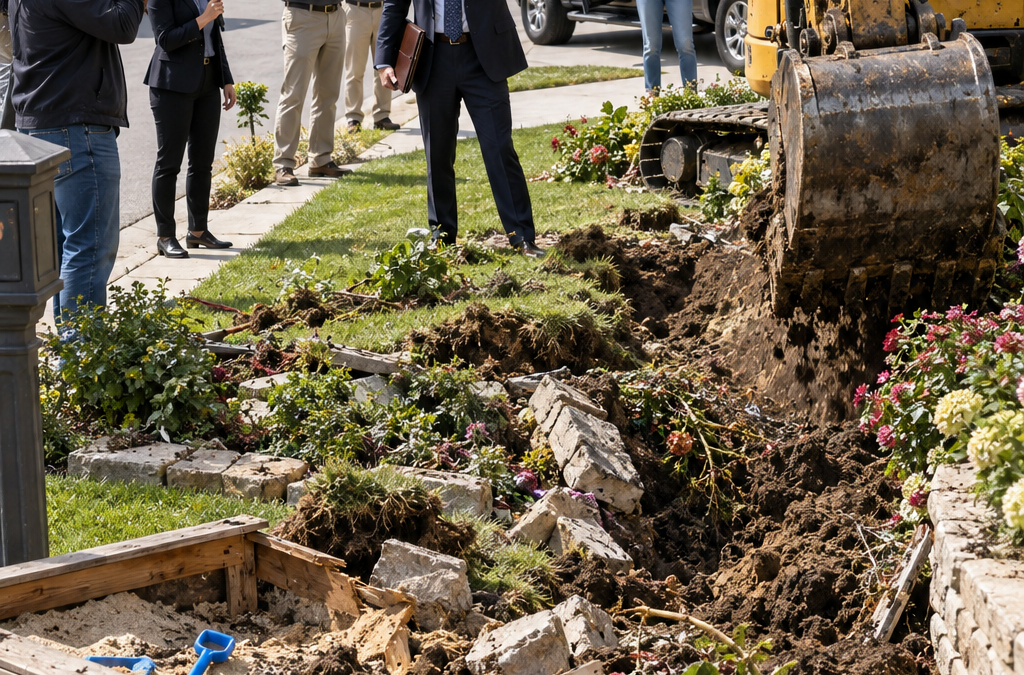
The backhoe was already tearing through my front lawn when I turned into the driveway. Deborah Whitfield had brought cameras, volunteers, and a rented machine to expose me—but all she really uncovered was herself.
By the time I pulled onto Maplewood Lane that morning, half my front yard was gone.
At first, my brain refused to understand what I was seeing.
There was a backhoe sitting where my rose bushes used to be, its bucket biting into the soil with slow, brutal scoops. Wet dirt spilled over the side of the trench. My flower bed had been flattened under tire tracks. The little stone border my wife and I had placed by hand the first weekend after we moved in was cracked in three places.
A man in an orange vest shouted something over the engine.
Two women from the HOA stood near the sidewalk holding clipboards like they had been deputized for war.
And in the middle of it all, standing directly on top of my crushed flower bed in white sneakers that were somehow still spotless, was Deborah Whitfield.
Our HOA president.
She was pointing toward my lawn with one hand and holding her clipboard in the other, directing the machine like a general ordering artillery.
I slammed the truck into park.
For one second, I just sat there gripping the steering wheel.
Then I saw the camera crew.
A local news van was parked at the curb.
A reporter stood near the mailbox with a microphone, watching the backhoe chew into my property while her cameraman filmed every second.
My stomach dropped like a stone.
I opened the truck door so hard it bounced back on the hinges.
“What the hell are you doing?”
The backhoe kept moving.
Deborah turned her head slowly, as though my arrival was an inconvenience she had expected but did not respect.
“Mr. Alvarez,” she said, not even looking guilty. “This is for your own good.”
I walked toward her, stepping over broken rose stems and chunks of upturned grass.
“My own good?”
“We suspect illegal utility burial.”
I stared at her.
“You suspect what?”
Her sunglasses sat on top of her head like a crown. Her blouse was crisp. Her lipstick was perfect. She looked as if she had dressed for a ribbon-cutting, not the destruction of a man’s front yard.
“Possible buried contraband,” she added, louder this time, glancing toward the news camera. “The board received a resident tip.”
The reporter turned slightly, microphone raised.
I felt heat climb up my neck.
“You brought a news crew to my house because of an anonymous tip?”
Deborah gave me the kind of smile she used at HOA meetings when she wanted the room to know someone had already lost.
“Transparency matters in Maplewood Estates.”
Behind her, the backhoe bucket dropped again.
Wood cracked.
I turned toward the sound and saw the remains of my daughter’s old sandbox splintering under the machine.
My daughter, Sofia, had outgrown that sandbox years ago, but I hadn’t removed it. It sat near the front side yard under the small maple tree, half-filled with old toys she no longer used. Sometimes she still sat on the edge of it when she wanted to talk to me while I worked outside.
Now one side was crushed flat.
The little blue plastic shovel she had loved when she was five lay half-buried in the dirt.
Something inside me went still.
Not calm.
Not peaceful.
Still in the way a locked door is still.
Three weeks earlier, none of this madness would have seemed remotely possible.
Three weeks earlier, I was just Richard Alvarez, a husband, a father, and a homeowner who thought Maplewood Estates was the place where my family could finally breathe.
We moved there chasing the American dream, or at least our version of it.
A quiet cul-de-sac.
Good schools.
A fence I could finally call mine.
A garage big enough for my tools.
A backyard where my daughter could run barefoot without us listening for traffic every five seconds.
For years, my wife Marisol and I had rented a cramped townhouse near a busy road. We had noisy neighbors on one side, a landlord who answered maintenance calls like he was doing us a personal favor, and a tiny patch of grass behind the building that the lease generously called a yard.
When Sofia was little, she used to ask why we could not plant flowers there.
I would tell her, “Because it isn’t ours.”
That answer bothered me every time.
So we saved.
We skipped vacations.
I took extra weekend audit work when I could get it. Marisol picked up extra shifts at the dental office. We drove the same aging SUV long after the air conditioning began making a noise like loose coins in a blender.
When we finally bought the house in Maplewood Estates, Sofia was eleven.
She ran through the empty rooms on closing day, calling out what each one should become.
“This is the office. This is my room. This is where we put the Christmas tree. This is where Mom should put the big mirror.”
When she reached the backyard, she stopped.
Then she turned around with both hands over her mouth.
“We own this?”
I laughed.
“Technically, the bank owns a lot of it.”
Marisol slapped my arm.
“Richard.”
I smiled at Sofia.
“Yes, baby. It’s ours.”
She ran straight into the yard.
That moment stayed with me.
It became the thing I thought about whenever the mortgage felt heavy or the repairs cost more than expected.
The house was not just wood and drywall.
It was proof that years of working and saving had become something solid.
Then the welcome basket arrived.
At first, it looked thoughtful.
A small wicker basket on the porch with banana bread, two Maplewood Estates coffee mugs, a keychain shaped like a maple leaf, and a seventy-page HOA rulebook thicker than my mortgage paperwork.
A white card sat on top.
Welcome to Maplewood Estates. Community standards protect community value.
Signed,
Deborah Whitfield, HOA President
I should have paid more attention to that sentence.
Protect.
Value.
Standards.
Words that sound reasonable until someone like Deborah uses them as weapons.
Deborah ran the Maplewood Estates HOA like her own personal kingdom.
Everyone on the street knew it, though most people spoke about her in nervous half-jokes.
“Don’t let Deborah see that.”
“Better move your trash cans before Deborah writes you up.”
“Careful, the queen is making rounds.”
She drove through the neighborhood in a pearl-white Lexus and walked the sidewalks with a clipboard tucked under one arm. Her hair was always curled. Her white sneakers were always clean. Her sunglasses were always either on her face or perched on her head, even indoors.
At board meetings, she sat in the center chair beneath the framed community mission statement and spoke as though she had been elected president of a small nation.
The first time I saw her in action, she fined a retired man named Mr. Jacobs for leaving his recycling bin visible behind a shrub.
He tried to explain that his wife had just come home from surgery and he had forgotten.
Deborah smiled and said, “Hardship does not suspend standards.”
People went quiet after that.
My first offense was laughable.
Grass at four inches instead of the approved three and a half.
A two-hundred-dollar fine appeared in my mailbox with a photograph attached.
The picture showed a ruler pressed into my lawn near the sidewalk.
I stood at the mailbox staring at it and actually laughed.
That evening, I drank beers with my neighbor Tom on his back patio and told him Maplewood apparently had a grass police force.
Tom smiled, but not as much as I expected.
He was a quiet guy in his early sixties, with gray hair, narrow glasses, and the kind of calm that made you think he had already seen everything foolish humans were capable of.
“You pay it?” he asked.
“Yeah,” I said. “I’m not going to war over half an inch of grass.”
Tom took a sip of beer.
“Sometimes paying just tells them you’re trainable.”
I laughed because I thought he was joking.
He wasn’t.
Two weeks later, a fine arrived for my porch’s unapproved shade of white.
That one confused me.
Before repainting the porch rail, I had checked the HOA handbook. The approved exterior trim color was listed as Maplewood White, code MW-114. I bought that exact paint from the approved supplier listed in the handbook. I even kept the receipt because my auditing brain believed documentation was a form of oxygen.
When I called the HOA office, Deborah’s assistant told me the color chart had recently been updated.
“Recently?” I asked.
“Yes, Mr. Alvarez.”
“When?”
“I don’t have that date in front of me.”
“I used the handbook given to me at closing.”
“The online version controls.”
“The online version changed after I painted.”
“I can only tell you what the current standard is.”
I asked to speak to Deborah.
The assistant said Deborah was unavailable.
I filed an appeal.
It was denied within forty-eight hours.
No hearing.
No explanation.
Just a message in the portal:
Decision upheld. Noncompliance remains.
Then came the real shot across the bow.
A letter threatening a lien against my house over unpaid fines I had never even received notice of.
The balance claimed late fees, administrative penalties, and three “continuing violations” I did not recognize.
The amount was not huge yet, but the language mattered.
Lien.
Collection.
Enforcement.
Property interest.
Those are not words a homeowner reads lightly.
That night, after Marisol and Sofia went to bed, I sat at the kitchen table with my laptop open and started digging through the HOA’s public financial filings.
That was not normal homeowner behavior, maybe, but it was normal for me.
Before moving into internal operations at my company, I had spent years as an auditor. Numbers tell stories. They also tell on people who think no one is listening.
At first, the HOA records looked ordinary.
Monthly dues.
Landscape maintenance.
Pool expenses.
Insurance.
Legal fees.
Then I noticed the late fees.
They were compounding at rates no state statute allowed for HOA penalties.
I checked again.
Then again.
The math was not sloppy.
It was designed.
Small fines became large balances through unauthorized compounding schedules.
I kept reading.
Three special assessments had no proper board vote attached.
No minutes.
No quorum records.
No resolution.
Just money collected and categorized under “Community Beautification and Grounds Support.”
That phrase appeared several times.
Too many times.
I traced vendor payments attached to the same category.
A landscaping company kept appearing.
Whitfield Exterior Services LLC.
I searched the state business registry.
Registered agent: Craig Whitfield.
Deborah’s husband.
The first twist landed quietly.
No dramatic sound.
No flashing warning.
Just a page on a state website showing that Deborah was not only enforcing fines.
She was quietly funneling assessment money into a company tied to her own household.
I sat back in my chair.
Suddenly the grass fine, the paint dispute, the phantom late fees—they looked different.
Not random.
Not annoying.
Profitable.
I said nothing.
Not to Deborah.
Not to the board.
Not even to most of the neighbors.
I smiled at meetings.
Took notes.
Asked polite questions.
Let Deborah think I was another beaten-down homeowner trying not to make waves.
But at home, I built a binder.
Marisol noticed.
Of course she did.
She came into the kitchen one night and found me photographing a portal transaction with my phone while the printer spat out receipts.
“Richard,” she said, “what are you doing?”
“Documenting.”
“You’ve been saying that for two weeks.”
“I know.”
She looked at the binder.
Then at me.
“You paid another fine today.”
“I did.”
She folded her arms.
“You thanked Deborah for sending it.”
“I did that too.”
“I’m worried you’ve lost your mind.”
I almost smiled.
“Karma needs receipts,” I said. “And I’m building a whole binder.”
She didn’t laugh.
“This woman is walking around our yard with a tape measure. Sofia asked me why the scary lady keeps coming by.”
That hurt.
I had tried to keep it away from Sofia.
But children notice the temperature of a house faster than adults think.
They hear names repeated.
They see parents checking windows.
They know when mail is no longer just mail.
“I’m handling it,” I said.
Marisol’s eyes softened, but her voice stayed firm.
“Make sure it doesn’t handle us first.”
Then Deborah escalated again.
She claimed my sprinkler system violated a drought ordinance that did not even apply to homes built before 2015.
My house was built in 2008.
I found the city ordinance in six minutes.
The exemption was clear.
I printed it.
Filed it.
Appealed.
Denied.
Then I found survey stakes hammered into my flower beds without permission.
Orange flags dotted the front yard like wounds.
A note was taped to my door.
Cooperation with inspection is mandatory. Failure to permit further investigation may result in additional penalties.
I called city code enforcement.
An actual city inspector named Paul came out the next morning.
He wore faded work pants, a reflective vest, and the expression of a man who had already had enough nonsense before breakfast.
I showed him the survey stakes and the HOA note.
He read it.
Then laughed.
Not politely.
A real laugh.
“Mr. Alvarez, your HOA has zero legal authority to survey private land like this.”
“They can’t just put stakes in my yard?”
“No.”
“They said it was mandatory.”
He handed the note back.
“They can say the moon belongs to them. Doesn’t make it true.”
I called Deborah that afternoon and told her what code enforcement had said.
Her response was chilling.
“The board makes its own rules here, sweetheart. That’s what you signed up for.”
She said it lightly.
Almost affectionately.
Like I was slow to understand the natural order of things.
I hung up without answering.
Then I wrote down the exact quote, date, time, and context.
Deborah had no idea how much of herself she was handing me.
That same evening, the second twist landed over the fence.
I was in the backyard replacing a broken sprinkler head when Tom leaned over from his side.
“Richard.”
I looked up.
“Yeah?”
He glanced toward the street.
Then said, “You ready to stop playing defense?”
I stood slowly.
“What does that mean?”
He pushed his glasses up his nose.
“I’m a semi-retired real estate attorney.”
I stared at him.
“You’re what?”
“Semi-retired. Not dead.”
“You’ve been watching me get fined for weeks and didn’t mention that?”
“I’ve been collecting on Deborah for two years,” he said quietly. “Waiting for someone brave enough to go first.”
I looked at him over the fence.
“Tom, I’m not brave. I’m irritated.”
“That’ll do.”
He invited me over.
His dining room table was already covered in folders.
Deborah’s letters.
Old board notices.
Copies of HOA budgets.
Property records.
Vendor registrations.
Emails from other homeowners.
Tom had been watching longer than I had.
Quietly.
Carefully.
He had the kind of patience only lawyers and spiders possess.
“She’s dirty,” he said.
“I found the landscaping company.”
He nodded.
“Craig Whitfield’s LLC.”
“You knew?”
“I suspected. You found confirmation.”
“Why didn’t you sue her?”
“Because suspicion isn’t evidence, and one old attorney with a grudge looks like a crank. A current target with financial records, improper fines, city confirmation, and a paper trail looks like a case.”
Together, we requested official HOA financial records under state disclosure law.
Bank statements.
Vendor contracts.
Board minutes.
Special assessment approvals.
Fine ledgers.
Payment allocations.
Conflict-of-interest disclosures.
Deborah denied the request outright.
Her written response cited a “board policy protecting sensitive operational records from disruptive homeowner access.”
Tom read that line twice and smiled.
“There is no such policy in the bylaws.”
“That denial helps us?”
“That denial is beautiful.”
He placed it in a folder.
“It proves obstruction.”
From that point on, everything Deborah did became evidence.
The phantom drought ordinance.
The rigged paint chart.
The illegal late fees.
The survey stakes.
The denial of records.
The special assessments without votes.
The vendor tied to her husband.
And still, the fines kept coming.
Absurd and relentless.
Mailbox flag too shiny.
Garden gnome deemed offensive.
Car parked eleven inches over a line no one could identify.
I paid every single one.
Smiling.
Thanking Deborah when I saw her.
Documenting each transaction with a photo and timestamp.
Every check.
Every portal receipt.
Every email.
Every denial.
My wife still thought I was too calm.
Maybe I was.
But rage without structure becomes noise.
I wanted structure.
Then Deborah made her fatal mistake.
The one that brought the backhoe to my lawn.
The notice arrived late on a Friday afternoon.
It referenced a “resident tip” and “potential buried contraband or illegally installed utility materials” on my property.
It demanded cooperation with excavation.
No permit attached.
No city order.
No warrant.
No board vote.
Tom read it and immediately told me not to respond until Monday.
“She’s fishing,” he said.
“For what?”
“For a reaction.”
I didn’t give her one.
Monday morning, I left early to take Sofia to school and then stopped by the hardware store for mulch.
When I turned back onto Maplewood Lane around 8:00 a.m., the news van was already outside my house.
The backhoe was already tearing into my front lawn.
Deborah had tipped off the local news herself.
She wanted the neighborhood to watch me be exposed.
She wanted cameras rolling when her rented machine found whatever she had convinced herself would justify months of harassment.
“Buried treasure,” she actually said to the reporter, smiling near my destroyed roses. “Possible illegal materials hidden by the homeowner. The HOA has a duty to protect residents.”
I walked into a live broadcast of my own humiliation.
My roses uprooted.
My daughter’s old sandbox smashed.
My front yard carved open.
My wife arrived ten minutes after I called her, pale and furious.
Sofia was still at school, thank God.
Tom arrived two minutes later with his legal bag and his phone already in his hand.
He looked at the backhoe.
Then at Deborah.
Then at me.
“Don’t touch anyone,” he said calmly.
“That’s your legal advice?”
“For the next thirty seconds, yes.”
He began making calls from his truck.
Emergency injunction.
Trespass.
Property destruction.
Unlawful excavation.
Meanwhile, the backhoe bucket struck something solid.
The metallic thud cut through the noise.
Deborah’s face lit up.
I will never forget it.
Pure triumph.
She looked at the camera as if the universe had finally confirmed her authority.
“Stop!” she shouted to the operator. “There. Carefully.”
The reporter stepped closer.
The cameraman zoomed in.
The operator scraped away more soil.
A rectangular metal box appeared beneath the dirt.
Old.
Weathered.
Sealed.
My stomach tightened.
For half a second, I wondered if Deborah had planted something.
Then the operator lifted the box enough for all of us to see the engraved brass plate on top.
Maplewood Estates Time Capsule — 1987 Original Homeowners
The silence that followed was almost holy.
Then the reporter whispered, “Is that a time capsule?”
The cameraman kept filming.
Deborah’s excitement curdled into horror in real time.
Her smile faded.
Her mouth opened slightly.
She stared at the box as though it had betrayed her.
It was not contraband.
It was not illegal utility burial.
It was not evidence against me.
It was a decades-old historical time capsule from the home’s original owners, sealed and clearly labeled, buried long before I ever bought the property.
And Deborah had destroyed half my yard to find it.
The reporter turned toward her.
“Ms. Whitfield, did the HOA have a permit to excavate this property?”
Deborah blinked.
“We had resident tip evidence.”
“That wasn’t my question.”
Tom was already filing the emergency injunction from his truck, phone in one hand, dash cam footage recording everything.
The operator shut off the backhoe when Tom ordered him, loudly enough for the news microphone to catch.
“This excavation is unauthorized. Every person participating has now been placed on notice.”
The two HOA volunteers stepped back immediately.
Deborah did not.
She tried to recover.
“The board acted in good faith.”
I looked at my roses.
My daughter’s sandbox.
The hole in my lawn.
The time capsule lying in the dirt like a witness.
“No,” I said. “You acted like you owned my house.”
That clip ran on the evening news.
All of it.
Deborah smiling about buried treasure.
The bucket hitting the box.
The time capsule plate.
Her face changing.
Tom placing everyone on notice.
Me standing in my destroyed yard, trying not to shake.
By the next morning, my phone would not stop buzzing.
Neighbors texted.
Coworkers called.
People from two streets over came by to see the hole for themselves.
Some brought coffee.
Some brought anger.
One elderly woman from the next block stood at the edge of my yard and said, “She fined me for sunflowers in 2019.”
I had no idea what to say to that.
Tom did.
“Do you still have the letter?”
She did.
By the end of the week, three more homeowners had brought over their own files.
We sued for trespass, property destruction, breach of fiduciary duty, and abusive enforcement.
Through the lawsuit, we subpoenaed every financial record Deborah had hidden for years.
The paper trail Tom and I had built matched perfectly.
Fake assessments.
Her husband’s landscaping kickbacks.
Forged board minutes dating back three years.
Illegal late fee schedules.
Denied record requests.
Selective enforcement.
Unauthorized excavation.
The more we pulled, the worse it got.
One special assessment had supposedly funded “common area drainage support.”
No project existed.
Another paid for “seasonal landscape stabilization.”
That money went to Whitfield Exterior Services.
The board minutes authorizing those payments contained signatures from two members who swore under oath they had never attended that meeting.
One had been out of state.
Tom looked at those statements and said, “This is no longer an HOA dispute. This is a buffet.”
“A buffet?”
“For prosecutors.”
At the hearing, Deborah tried her usual trick.
She wore a navy blazer, pearl earrings, and an expression of injured dignity.
Her attorney argued the board had acted within its authority to protect the community from suspected unlawful installations.
The judge listened for a while.
Then interrupted.
“Counsel, was there a permit?”
Deborah’s attorney hesitated.
“No, Your Honor, but the HOA—”
“Was there a court order?”
“No.”
“Was there consent from the homeowner?”
“No, but—”
“Was there an imminent public safety emergency confirmed by a public agency?”
“No, Your Honor.”
The judge leaned back.
“Then there is no authority that permits a private citizen to excavate a neighbor’s yard on a rumor.”
The words landed hard.
Deborah’s face went stiff.
The ruling came down faster than I expected.
Fifteen thousand dollars in immediate damages for property destruction and trespass.
An order requiring restoration of my yard.
Immediate removal of Deborah from active HOA authority pending further proceedings.
And a formal referral for financial fraud investigation based on the records produced.
That last part changed everything.
Neighbors who had been silently fined for years finally spoke up.
Three more lawsuits followed within the month.
Against Deborah personally.
Not just the HOA.
Personally.
The board, desperate to distance itself, voted to remove her as president.
For the first time since I had moved into Maplewood Estates, Deborah Whitfield was not the voice of the neighborhood.
Watching her carry a cardboard box out of the clubhouse was, I will admit, deeply satisfying.
It was raining lightly that afternoon.
Not enough to soak anyone, just enough to make the sidewalk shine.
She came out through the front doors holding a box filled with framed certificates, binders, and at least four board president mugs.
I had not known one person could own that many mugs celebrating their own authority.
Tom stood beside me near the parking lot.
“You enjoying this?” he asked.
“A little.”
“You’re allowed.”
Deborah saw us.
For a second, her face twisted like she wanted to say something.
Then she looked toward the news camera across the street and thought better of it.
She loaded the box into her Lexus and drove away.
The vanity plate caught the light as she turned.
RULES1.
Tom laughed under his breath.
“Not anymore.”
The financial investigation took longer.
Those things always do.
But once investigators had the records, Deborah’s story collapsed quickly.
Whitfield Exterior Services had received payments without proper competitive bids.
Special assessments had been imposed without valid votes.
Late fees had been compounded unlawfully.
Board minutes had been altered.
Several enforcement actions appeared retaliatory.
Deborah eventually faced civil liability and a separate financial fraud investigation.
Her husband’s company was named in the inquiry.
The HOA’s insurer refused to cover intentional misconduct.
That was when people finally understood that Deborah’s power had always depended on everyone else paying for her confidence.
The time capsule survived.
Barely.
The box was dented, but not broken.
Inside were photographs of the original Maplewood Estates groundbreaking, a 1987 newspaper clipping, a handwritten letter from the first homeowners, a cassette tape no one knew how to play, a small flag, and a list of every family who lived on the block that year.
The original owners of my house had included a note.
To whoever lives here next: take care of the yard. We planted roses in front because every street needs something worth slowing down for.
Marisol cried when she read that.
So did I, though I pretended it was dust from the excavation.
We restored the box, had a local historical society document it, and reburied it properly near the community clubhouse with actual permission, a permit, and witnesses.
Sofia insisted on adding something new.
A photo of our family standing in the restored yard.
And a note in her handwriting:
Do not dig this up because of gossip.
The whole neighborhood voted to include it.
My yard took months to heal.
Topsoil.
New sod.
A rebuilt flower bed.
A new sandbox area, even though Sofia insisted she was too old for it.
I rebuilt it anyway, smaller, near the maple tree.
She rolled her eyes when she saw it.
Then sat on the edge for twenty minutes that evening, pretending she wasn’t glad.
The roses came back too.
Not the original bushes.
Those were too damaged.
But Marisol and I planted new ones.
Deep red.
Strong stems.
The kind that look delicate until you try to pull them out.
Tom helped me reset the stone border.
He complained about my spacing the entire time.
“You audit numbers better than you place stones,” he said.
“You want to do it?”
“No. I want to criticize.”
“Typical attorney.”
“Semi-retired attorney.”
The new HOA board was elected that fall.
Different people.
Better rules.
Mandatory financial disclosures.
Open record access.
No single-person control over violation notices.
No fines without documented rule citations.
No vendor contracts involving relatives without disclosure, competitive bids, and homeowner review.
No excavation without actual legal authority, which everyone agreed should not have required clarification but apparently did.
The first new board meeting lasted three hours because people had years of questions stored up.
But nobody was silenced.
Nobody was smiled into submission.
Nobody was told the board made its own rules.
When the new president, a soft-spoken teacher named Angela Reeves, opened the meeting, she said something that made the room go quiet.
“The HOA exists to serve the homeowners. It does not own them.”
People applauded.
Tom looked over at me and nodded once.
My yard is healing now.
The roses are back.
The grass is filling in.
The flower bed no longer looks like a crime scene.
Sofia’s sandbox has fresh cedar boards.
The porch is still the same allegedly wrong shade of white.
Nobody has mentioned it.
Sometimes I stand in the driveway and remember the morning I came home to find Deborah commanding a backhoe across my lawn.
I remember the camera crew.
The broken roses.
The smashed sandbox.
The shame she expected me to feel.
That was her mistake.
She thought public humiliation would make me fold.
Instead, she created witnesses.
She thought a rumor would justify destruction.
Instead, it exposed fraud.
She thought I was another homeowner who would pay quietly, apologize politely, and hope she moved on.
Instead, I had receipts.
A whole binder of them.
My name is Richard Alvarez.
I moved into Maplewood Estates chasing the American dream.
A quiet cul-de-sac.
Good schools.
A fence I could finally call mine.
I did not expect to fight a woman with a clipboard, a backhoe, and a talent for turning rules into weapons.
But I learned something important.
A home is not protected by silence.
It is protected by records.
By neighbors who finally speak.
By laws stronger than HOA letterhead.
By the courage to stand in your torn-up yard and say, out loud, you had no right.
Deborah Whitfield once told me Maplewood had standards.
She was right.
We do now.
And the first one is simple.
Read the rulebook before enforcing it.
The second is even simpler.
Stay off my lawn.

