𝗙𝗨𝗟𝗟 𝗦𝗧𝗢𝗥𝗬 The HOA Applauded the Bid That Was About to Cost Them Far More Than the Land
𝗙𝗨𝗟𝗟 𝗦𝗧𝗢𝗥𝗬
Lenora had served as president of Crest View Reserve for nine years.
I knew that because her name appeared on nearly every letter the HOA sent me.
She was fifty-three, polished, intelligent, and very good at making her preferences sound like collective decisions.
To be fair, she had accomplished things.
The HOA clubhouse had been renovated under her leadership.
The ballroom looked better.
A commercial kitchen had been installed.
They had built a stone terrace overlooking the artificial lake.
Events were well attended.
Property values had risen.
A lot of residents believed Lenora was the reason.
Maybe in part she was.
That was also her problem.
She had succeeded often enough that she began treating disagreement as evidence that other people did not understand what she understood.
Six months before the auction, she unveiled a project called Crest View Grand Commons.
I saw the rendering later.
It showed an outdoor pavilion, a landscaped event lawn, sixty parking spaces, walking paths, and a row of small retail suites.
It looked expensive.
It also looked impressive.
All of it was drawn on Lot 17B.
There were only two problems.
The HOA did not own Lot 17B.
And nobody had confirmed they could legally build most of what was shown.
At the unveiling, according to people who later described the meeting to me, nearly eighty homeowners packed the clubhouse ballroom.
Lenora stood beside a display board six feet tall.
She talked about holiday markets.
Outdoor concerts.
Weddings.
Rental income.
Community pride.
Reduced dues.
Mallorie Vance, the HOA vice president, asked what would happen if someone else tried to buy the property at auction.
Lenora apparently smiled and said, “Then we outbid them.”
The room applauded.
That sentence changed everything.
Once she said it publicly, Lot 17B stopped being real estate.
It became a test of whether Lenora could deliver something she had already promised.
A week later, a letter arrived at my office asking me, in the interest of neighborhood cooperation, not to participate in the auction.
I read it twice.
Then filed it.
I did not answer.
Seven days later, Crest View sent me a violation notice.
It said my dump trucks were visible from the subdivision and ordered me to install screening vegetation.
The letter threatened daily fines.
There was a problem.
My property was not inside Crest View Reserve.
It had never been subject to the HOA declaration.
I wrote one sentence beneath the notice.
Please identify the recorded covenant granting Crest View Reserve authority over Parcel 48C.
I sent it back by certified mail.
No covenant arrived.
A noise complaint did.
Then a dust complaint.
Then a notice about my company sign.
Every letter looked official.
Every letter lacked authority.
I saved all of them.
The envelopes.
The photographs.
The delivery records.
Everything.
People sometimes believe keeping records means you expect a lawsuit.
That is not why I did it.
I kept records because memory becomes very flexible once money and embarrassment enter the room.
Lenora began telling the board I was openly defying the community.
In reality, I had never attended one of their meetings.
I had never threatened her.
I had spoken her name only once to my attorney.
Everett Boone had handled my real estate work for eleven years.
He was fifty-seven, patient, exact, and deeply suspicious of emotional decisions made around land.
When the auction notice appeared, Everett and I spent an entire morning at the county records office.
We checked zoning.
Tax status.
Utility service.
Flood zones.
Road access.
Recorded easements.
Near the center of the plat, I noticed two wide dashed lines crossing the parcel diagonally.
“What are those?”
The clerk, Delia Prescott, enlarged the map.
“Drainage easement and underground utility corridor.”
Together, they covered almost forty percent of Lot 17B.
I studied the dimensions.
The restrictions did not destroy the property’s value to me.
A properly engineered road could still cross an approved section.
But permanent structures inside the corridor were another matter.
So were large gatherings.
So were parking areas that interfered with stormwater flow or utility access.
Everett unfolded a printed copy of Crest View’s Grand Commons rendering.
The proposed pavilion sat almost directly over the utility corridor.
Most of the parking crossed restricted land.
I said nothing.
The restrictions were public.
Any serious buyer could find them.
Then I noticed another symbol on the county system.
This one was not on Lot 17B.
It was on the Crest View clubhouse parcel.
Tax certificate.
Redemption pending.
I leaned closer.
The balance due was $143,870.62.
The final redemption deadline was the same day as the auction.
I looked at Delia.
“Have they been notified?”
She opened the file.
“Six times.”
“Certified?”
“Twice.”
She pulled up the delivery record.
One receipt carried Lenora Wickham’s signature.
I remember sitting back in the chair.
The clubhouse debt had started four years earlier when Crest View converted part of the building into a commercial event venue.
That triggered a reassessment.
The HOA appealed.
While the appeal was pending, Lenora stopped paying the disputed amount.
Apparently she believed the appeal suspended collection.
It did not.
The appeal failed.
Interest accumulated.
Then penalties.
Publication expenses.
Administrative fees.
Eventually, the county sold a tax certificate and began the statutory process that could end with a tax deed if the debt remained unpaid.
I studied the certificate number.
Something about it looked familiar.
I had seen the first six digits before.
Eighteen months earlier, one of my holding companies, Black Ridge Land Recovery LLC, had purchased a portfolio of tax certificates from an investor retiring to Arizona.
There had been dozens of certificates in that package.
I had reviewed the portfolio value and risk categories, but a servicing company handled notices, deadlines, and routine administration.
I never connected any one certificate to Crest View.
Not until that morning.
Everett verified the assignment chain.
The certificate belonged to my company.
More importantly, every relevant event had begun before I acquired it.
The reassessment.
The missed payments.
The appeal.
The first delinquency notices.
All of it predated my ownership.
I did not create Crest View’s debt.
I did not choose its deadline.
I did not even know I held the certificate when Lenora started sending HOA notices to my business.
Everett closed the file.
“Do not contact them about this.”
“I wasn’t planning to.”
“Do not mention it in connection with the auction.”
“I won’t.”
“Do not threaten to use it.”
“I understand.”
He looked at me.
“If they ask directly?”
“I tell the truth.”
“Good.”
Then he tapped the Lot 17B plat.
“Now forget their clubhouse. Decide what this parcel is worth to you.”
That was exactly what I did.
Over fifteen years, direct highway access could save my company hundreds of thousands of dollars.
Fuel.
Labor.
Maintenance.
Delayed contracts.
Bridge risk.
School-zone routing.
I did not value Lot 17B as raw land.
I valued what it solved.
My accountant prepared the numbers.
I reviewed them.
Then, on the first page of my auction folder, I wrote my maximum bid.
$405,000.
I dated it.
Signed it.
Emailed a copy to Everett.
That number mattered later because Lenora would eventually accuse me of bidding purely to damage the HOA.
The file showed otherwise.
Inside Crest View, the financial discussion was very different.
I did not know the details until later.
Their treasurer, Tobias Kemp, did.
Tobias was sixty-one and had spent most of his career as a corporate accountant.
Six weeks before the auction, the HOA reserve account held $552,274.
At a closed board meeting, Tobias recommended transferring $150,000 into a restricted account immediately.
“That money protects the clubhouse,” he told them.
“Anything left after redemption can be used for Lot 17B.”
Lenora refused.
She said the county would probably extend the deadline.
Tobias asked whether she had that in writing.
She did not.
He explained that the failed tax appeal did not stop the process.
She said the penalties could be negotiated later.
Tobias answered, “Later is after four o’clock on auction day. There may not be a later.”
Mallorie asked whether the homeowners knew the clubhouse was at risk.
Lenora said disclosure would create unnecessary panic before an important acquisition.
I did not hear that sentence until months later.
When I did, it bothered me more than almost anything else in the case.
People make bad predictions.
People misunderstand deadlines.
People overestimate themselves.
But hiding a known financial danger because telling the truth might weaken support for your plan is different.
Tobias sent three written warnings.
The clearest one stated that any auction expenditure above roughly $408,000, once fees were considered, could leave Crest View unable to redeem the clubhouse.
Lenora replied with eight words.
Acquiring Lot 17B remains the board’s first priority.
At the next meeting, she asked for authority to bid up to $450,000.
The clubhouse debt did not appear in the homeowner presentation.
Five directors voted yes.
Tobias and one other voted no.
Then Lenora added money for closing expenses and signed authorization to use the reserve account.
Mallorie hesitated.
Then she signed the minutes.
I later learned that she had supported Grand Commons from the beginning.
By then, questioning the project meant admitting she might have helped sell something the board had not investigated properly.
That is how committees get into trouble.
Not everyone has to be dishonest.
Sometimes one person is certain.
Another is embarrassed.
A third is tired.
A fourth does not want to be the first voice in the room saying the leader may be wrong.
During the final week before the auction, Lenora intensified everything.
A banner appeared inside the clubhouse.
OUR LAND. OUR FUTURE.
She told residents my company planned to send heavy trucks near their back fences.
She went on local radio to talk about Grand Commons as though construction was practically approved.
She organized a petition asking the county to exclude industrial bidders.
More than one hundred residents signed it.
The county rejected the request because the auction was public.
Lenora told residents only that the county was reviewing their concerns.
I got a copy of the actual response because the petition named my company.
Everett advised me not to answer publicly.
Instead, I asked Luis to photograph the actual road alignment we intended to use if we bought the land.
It was hundreds of feet from the nearest house.
A natural rise and a line of trees separated the route from Crest View.
No trucks beside backyard fences.
No industrial road through the neighborhood.
But that image did not help Lenora’s campaign.
So residents never saw it.
The night before the auction, she emailed the board.
Tomorrow Crest View finally defeats Calder.
Tobias replied.
Please protect the clubhouse before you bid.
She never answered.
The auction began at 9:30 the next morning.
I arrived alone.
Everett sat three rows behind me.
Lenora came with Mallorie, four directors, a real estate adviser, and the HOA photographer.
Scarlet blazer.
Blue folder.
She sat near the center aisle where everybody could see her group.
Lot 17B opened at $118,000.
Two outside investors participated.
One dropped out around $210,000.
The second stopped at $265,000.
Then it was Lenora and me.
$280,000.
She answered with $300,000.
I went to $325,000.
She said $340,000.
At $360,000, people began turning around.
At $380,000, the auctioneer slowed down.
I opened my folder and checked the numbers again.
The price was far above what the dirt alone was worth.
But it was still within the documented value of the access savings to my company.
“Three ninety-five.”
Lenora turned and looked directly at me.
“Four hundred.”
The Crest View directors started whispering.
Mallorie leaned close to her.
I could not hear the words then.
Later she admitted she had asked, “Should we stop?”
Lenora kept her eyes on me.
I made one last bid.
“Four hundred five.”
The exact number in my file.
Not one dollar more.
The auctioneer repeated it.
“Four hundred and five thousand dollars.”
Lenora raised her card.
“Four hundred and twenty.”
The room went quiet.
I lowered mine.
The auctioneer looked at me.
I did nothing.
“Going once.”
Lenora held her card against her chest.
“Going twice.”
Nobody moved.
“Sold.”
That was when the cheering started.
From where I sat, the victory looked complete.
They had the land.
They had the photograph.
They had beaten me in front of everyone.
What they did not have was enough money left to save their own clubhouse.
The buyer’s premium came to $16,800.
Recording and administrative costs added roughly another $1,800.
The total cash requirement became $438,600.
After payment, the reserve balance fell to $113,674.
The clubhouse redemption amount was $143,870.62.
They were short by a little more than thirty thousand dollars.
At 10:47 that morning, Tobias put those numbers next to each other.
The deadline was four o’clock.
Five hours and thirteen minutes remained.
Lenora initially treated it like a minor cash-flow problem.
“Move money from operations.”
Tobias showed her the operating account and payroll obligations.
“Use the roof reserve.”
“The insurer requires it.”
“Call the bank.”
“I already did.”
The line of credit Lenora had spoken about in meetings had never been approved.
It had been an informal conversation.
No bank was going to deliver same-day money secured by a clubhouse already inside a tax-deed process.
For the first time that morning, according to Tobias, Lenora stopped smiling.
At 11:25, she proposed an emergency special assessment.
The bylaws required notice.
A vote.
A collection period.
There was no mechanism to pull thirty thousand dollars from homeowners before four o’clock.
At noon, the HOA photographer emailed the auction picture to the board.
Subject line:
WE DID IT.
Nobody replied.
At 12:18, Mallorie asked a question that should have been asked six weeks earlier.
“Why wasn’t the redemption deadline in the homeowner packet?”
Lenora said they needed solutions, not blame.
Tobias opened his laptop.
He showed Mallorie his three warnings.
“The solution was setting aside one hundred fifty thousand dollars.”
His voice was quiet.
“You called it panic.”
Mallorie had been copied on the emails.
She read them again.
Silence had felt easier when the plan seemed successful.
It felt different once the numbers were visible.
At 1:05, Lenora called the county treasurer demanding a forty-eight-hour extension.
Delia Prescott told her the deadline was controlled by the recorded process.
Lenora threatened litigation over inadequate notice.
Delia read the notice dates aloud.
Then she read the name on one certified receipt.
Lenora Wickham.
At 1:42, Lenora called several wealthy homeowners.
She described the problem as temporary.
She asked each for a short-term advance.
Two declined.
The third, Priscilla Doyle, was a retired attorney.
She asked Lenora one question.
“Did you know about the deadline before you spent the reserve?”
Lenora did not answer directly.
Priscilla declined.
At 2:05, my phone rang.
I was in the equipment yard beside a loader.
Lenora Wickham.
I stared at the screen before answering.
“Grant Calder.”
Her voice was controlled.
“Mr. Calder, Crest View needs a short-term bridge loan.”
“How much?”
“Forty thousand.”
“How long?”
“Forty-eight hours.”
I waited.
“We can resolve several unnecessary disputes involving your property in exchange.”
I looked across the yard at the trucks she had claimed the authority to regulate.
“Which disputes?”
Silence.
Then, “The outstanding enforcement matters.”
“Your association has no recorded authority over my land.”
Another pause.
Her voice lowered.
“Do you know what happens at four o’clock?”
Everett’s advice came back to me.
If asked directly, tell the truth.
“Yes.”
“Then you understand that thirty thousand dollars can prevent a disaster.”
“You had thirty thousand dollars this morning.”
Her voice sharpened.
“You forced the auction price higher.”
“No.”
“You kept bidding.”
“Until my maximum.”
“You knew we wanted the parcel.”
“You knew I wanted it too.”
“You made us pay more.”
“I stopped.”
I could hear her breathing.
Then I said, “Have your attorney check the recorded assignment for Certificate CR00001.”
Silence.
“Why?”
“Because Black Ridge Land Recovery owns it.”
More silence.
Finally:
“Who owns Black Ridge Land Recovery?”
“I do.”
For several seconds, there was nothing on the line.
When she spoke again, the confidence had disappeared.
“You set this up.”
“No.”
“You bought our debt.”
“I bought a portfolio eighteen months ago. Your first delinquency predates that. Your failed appeal predates that. Your notices predate that. The assignment date is public.”
“You can stop it.”
“Your board could have stopped it six weeks ago.”
“Grant—”
“Or yesterday.”
“You are going to take our clubhouse over thirty thousand dollars?”
“You had the full redemption amount before the auction.”
“That money was committed.”
“You committed it.”
“You knew what would happen if we won the land.”
“I knew what time the deadline expired.”
She went quiet again.
“Give us forty-eight hours.”
I looked at the brass key from my first truck through the open office door.
For years, I had made decisions based on what I could afford to lose.
Lenora had made hers based on what she expected other people to rescue.
“No.”
Her breath caught.
“You’d rather destroy an entire community?”
“No. I’m refusing to make a private deal in the last two hours of a statutory process.”
“You can trade us time for Lot 17B.”
“No.”
That part mattered.
I did not want a bargain tying the certificate to the auction.
It would have created exactly the story Lenora later tried to tell.
That I had used the clubhouse debt to manipulate the land sale.
“I’m not trading anything,” I said. “Call your lawyer.”
Then I hung up.
At 2:30, Crest View’s attorney confirmed my company held the certificate.
He also confirmed the assignment date.
Routine servicing records showed that notices had continued without any special direction from me.
Lenora then argued that my auction bidding had deliberately depleted the HOA reserve.
Her lawyer asked whether she had evidence of my motive.
She had none.
At 3:12, board members asked if they could undo the auction.
They could not.
The sale was final.
Payment had already been transmitted.
At 3:37, Tobias gathered every immediately available dollar.
A delayed vendor payment.
Two voluntary advances.
Every permissible cash source.
They were still short by $27,614.
At 3:55, Tobias entered the county building carrying a cashier’s check.
Delia reviewed it.
“It’s not enough.”
“Take it anyway.”
“I can’t accept partial redemption.”
“Can we wire the rest?”
“Not without the rest.”
He called Lenora.
“We are short twenty-seven thousand six hundred fourteen dollars.”
“Submit it.”
“They won’t.”
“Make them.”
At 3:59, Tobias stood at the counter watching the clock.
At four o’clock, Delia closed the file.
“The redemption period has expired.”
That was it.
No gavel.
No applause.
No dramatic announcement.
A county employee closed a file because a deadline printed on six notices had passed.
Tobias carried the unused check back to his car.
The next morning, Lenora told the board the missed deadline was probably a technical problem that could be fixed with late payment.
Their attorney disagreed.
All statutory waiting periods had run.
Required notices had been sent.
Fees paid.
Final redemption had expired.
At 9:14 a.m., the county system updated.
TAX DEED ISSUANCE APPROVED.
The clubhouse had been appraised around $1.3 million.
Crest View had allowed its redemption right to expire over less than thirty thousand dollars.
The board authorized an emergency lawsuit.
They sought an injunction.
Their claims included inadequate notice, excessive fees, unfair forfeiture, and manipulation by me.
Everett was almost pleased.
Not because he enjoyed the fight.
Because litigation meant discovery.
And discovery meant internal records.
Before the lawsuit, only a handful of people knew what Lenora had hidden.
After discovery, nobody could pretend not to know.
The first production contained more than two thousand pages.
Most were boring.
Invoices.
Meeting packets.
Vendor emails.
Insurance documents.
Then Everett found a draft slide Tobias had prepared three weeks before the auction.
It showed the clubhouse tax obligation in red.
It displayed the reserve before redemption.
Then the reserve after.
Twelve minutes after Tobias sent the slide, Lenora replied:
Remove slide 14. It will undermine confidence in the acquisition.
Tobias answered:
The obligation is material to the vote.
Lenora replied:
The board has authority to manage timing. Homeowners do not need every unfinished dispute.
I read that exchange twice.
Then a third time.
That ended any idea that the clubhouse problem had simply slipped through the cracks.
Lenora had seen the number.
She had seen it clearly enough to know that showing it to homeowners might make them less willing to support Lot 17B.
So she removed it.
Discovery revealed another problem.
Ten days before the auction, the HOA’s real estate adviser had sent Lenora a preliminary title commitment for Lot 17B.
Page seven listed the drainage easement and underground utility corridor.
Lenora forwarded only the cover page to the rest of the board.
When questioned later, she said she expected the adviser to highlight anything significant.
The adviser produced an email.
He had.
It recommended an engineering review before bidding.
Lenora’s response said the auction schedule left no time.
One warning about the clubhouse.
One warning about the land.
Two separate risks.
Two separate decisions not to slow down.
Mallorie called an emergency homeowner meeting.
More than one hundred residents came.
The ballroom could not hold everyone.
People stood in the lobby.
Others lined the terrace.
Lenora opened with a prepared statement blaming the county process and what she called an opportunistic neighboring investor.
Tobias interrupted her.
People told me later it was the first time they had ever seen him do that.
He connected his laptop to the projector.
Then he displayed the reserve ledger.
The redemption notice.
His written warnings.
Lenora’s reply.
The auction authorization.
The post-auction bank statement.
One homeowner raised his hand.
“When did you learn the clubhouse was at risk?”
Lenora said, “The situation evolved over time.”
Tobias enlarged the certified-mail receipt.
Her signature appeared on the wall behind her.
Another resident asked why the debt had not been disclosed before the board sought homeowner support for the auction.
Lenora answered, “I wanted to avoid panic.”
The room reacted immediately.
Walter Higby, a retired building inspector, stood near the back.
“You didn’t avoid panic.”
Lenora looked toward him.
“You delayed it until after the money was gone.”
That sentence ended her presentation.
Then Walter asked another question.
“Where is the engineering report for Grand Commons?”
There was none.
The board hired an independent civil engineer.
Three days later, he walked Lot 17B with utility maps, survey flags, drainage records, and the plat.
His conclusion made the $420,000 purchase look worse.
The drainage and utility restrictions covered almost forty percent of the parcel.
The Grand Commons pavilion had been drawn inside a no-build area.
The event lawn interfered with the stormwater corridor.
More than half of the proposed parking spaces overlapped utility access.
The project was not impossible.
But it could not be built as advertised.
It would require a major redesign.
Multiple approvals.
Uncertain variances.
Possibly fewer parking spaces.
Possibly no pavilion in the location residents had been shown.
The rendering that convinced them to spend nearly half a million dollars was not an engineering plan.
It was artwork.
Nine days later, we were in court.
The benches were full of Crest View residents.
Lenora wore the same scarlet blazer I remembered from the auction.
That morning, surrounded by bank statements and signed delivery notices, it looked different.
Less like authority.
More like armor.
Crest View’s attorney argued that losing a $1.3 million clubhouse over a much smaller tax obligation would impose an extreme hardship on innocent homeowners.
He challenged several fees.
Asked the judge to reopen the redemption period.
Requested an injunction preventing deed issuance until the association could tender payment.
The county presented its timeline.
Every notice.
Every date.
Every address.
Every delivery record.
The servicing company produced its log.
My LLC records established exactly when I acquired the certificate portfolio.
Then Lenora’s attorney turned to me.
His theory was simple.
I had driven up the auction price knowing Crest View needed the reserve for the clubhouse.
In other words, I had engineered their failure.
Everett stood.
He placed one page on the courtroom screen.
My valuation memorandum.
Dated before the auction.
Fuel.
Driver hours.
Bridge delays.
Maintenance.
Lost contracts.
Fifteen-year savings.
Maximum authorized bid:
$405,000.
Then Everett displayed the auction log.
My final bid.
$405,000.
Lenora’s final bid.
$420,000.
Everett looked at the judge.
“Mr. Calder did not make Crest View spend four hundred twenty thousand dollars.”
He paused.
“He made a lower offer and lost.”
The judge asked Lenora whether she knew about the redemption deadline before the auction.
She said she believed an extension was possible.
“Did the county promise one?”
“No.”
“Did your treasurer advise you to reserve the full redemption amount?”
“Yes.”
“Did homeowners receive that information before being asked to support the acquisition?”
Her attorney objected.
The judge overruled him.
Lenora’s answer came quietly.
“No.”
The court denied emergency relief.
The judge found no evidence that I had created the tax debt.
No evidence I interfered with notice.
No evidence I controlled the statutory deadline.
No evidence I forced Crest View’s final auction bid.
Other claims could continue through ordinary litigation.
But the court would not halt the deed based on accusations contradicted by Crest View’s own records.
Outside the courthouse, Lenora caught up with me on the stone steps.
Residents and reporters were moving around us.
She looked exhausted.
“You’re taking a million-dollar clubhouse over twenty-seven thousand dollars.”
I looked at her.
Not the blazer.
Not the image.
Her.
“You spent that twenty-seven thousand trying to beat me.”
Then I walked away.
By the time I reached my truck, somebody had already repeated the quote.
Lenora still refused to resign.
She proposed a $4,800 special assessment per household.
Selling Lot 17B.
Continuing litigation against me.
Raising money to repurchase the clubhouse.
But the board was no longer hers.
Mallorie called another emergency meeting.
This one took place in a hotel conference room because ownership of the clubhouse was in transition.
The location itself said enough.
Tobias presented the damage in plain numbers.
$438,600 spent acquiring Lot 17B.
More than $143,000 left unredeemed.
Legal fees approaching $40,000.
A clubhouse worth roughly $1.3 million moving through the tax-deed process.
A newly acquired parcel that could not support the development plan used to justify buying it.
Then Mallorie stood.
She made a motion to remove Lenora Wickham as president.
One by one, the directors voted.
Yes.
Yes.
Yes.
Yes.
Yes.
Yes.
Lenora voted no.
Six to one.
For nine years, she had occupied the center seat.
Now she gathered her binder in silence.
Nobody applauded.
I was not there.
I heard about it afterward.
I was glad I had not been invited.
My dispute was with documents and property.
Their reckoning had to be with each other.
The new board ordered an independent audit.
It also disclosed every major financial obligation to homeowners.
The insurer began investigating whether Lenora’s decisions had breached fiduciary duties.
Civil claims remained possible.
But the consequence that seemed to matter most came immediately.
She lost the authority she had spent years protecting.
The audit showed another uncomfortable truth.
Crest View could not simply collect one large assessment and restore everything.
The HOA had upcoming roof work.
Lake pump repairs.
Insurance renewal.
Attorney fees.
Vendor contracts.
Reserves were badly weakened.
Selling Lot 17B would recover only part of the damage.
Some residents demanded that every director who supported Lenora reimburse the association personally.
Others wanted to dissolve the HOA entirely.
A third group argued that destroying common services would punish hundreds of families who never saw the hidden financial information.
At one of the meetings, Mallorie stood before the residents and said something I respected.
“I saw Tobias’s warnings.”
The room went quiet.
“I told myself Lenora understood something I didn’t.”
She swallowed.
“That was easier than asking questions in public.”
Then she said:
“I voted yes. I was wrong.”
That did not erase her vote.
But it changed the tone of the room.
She was the first director to admit failure without blaming the county, the lawyer, me, the economy, or the deadline.
Walter Higby proposed an independent finance committee.
Priscilla Doyle offered to review governance rules at no charge.
Within a week, more than forty homeowners volunteered for work Lenora had always implied only she could manage.
That was one of the strangest lessons in the whole situation.
For years, Crest View had treated Lenora as indispensable.
The moment she was gone, the community became more involved.
The new board listed Lot 17B for sale.
The highest outside offer was $226,000.
That number surprised some residents.
It did not surprise me.
Buyers saw the easements.
The drainage restrictions.
The development limits.
They valued the actual parcel.
Not Lenora’s rendering.
I offered $235,000.
Cash.
No financing contingency.
Quick closing.
Several residents objected.
They did not want to sell the property to the man they believed had somehow benefited from the whole collapse.
Tobias gave them the answer.
“We do not have enough money to choose an emotional buyer.”
The board accepted my offer.
Less than two months after celebrating the day they outbid me, Crest View sold me Lot 17B for almost two hundred thousand dollars less than what they had paid.
Once the deed recorded, I did what I had planned from the beginning.
I hired an engineer.
We designed the road around the drainage restrictions.
Obtained approvals.
Protected the utility corridor.
Installed proper stormwater controls.
Then Calder Grading built the access route to County Route 18.
Our trucks stopped using the narrow school route.
Luis no longer had to cross that bridge with a full trailer.
I planted a thick evergreen buffer along the side facing Crest View.
The HOA had no authority to require it.
I did it anyway.
I did not need their residents looking at trucks every morning to prove I owned the land.
The trees cost less than years of unnecessary resentment.
That decision surprised people.
Lenora had spent months telling them I wanted heavy equipment against their back fences.
The road never went near those fences.
The buffer made it even less visible.
Meanwhile, the tax deed for the clubhouse eventually recorded to Black Ridge Land Recovery LLC.
The remaining challenges failed.
On paper, the outcome looked extraordinary.
I controlled the land I originally wanted.
I also controlled the building from which Lenora had tried to control me.
There were residents who expected me to lock the clubhouse.
Some were certain I would.
A few probably believed they deserved it.
I did not.
Several hundred homeowners had not hidden Tobias’s warnings.
They had not cropped title documents.
They had not bid $420,000.
They had not sent false violation notices to my business.
Punishing all of them would have given me a satisfying story and a terrible long-term relationship with the people living beside my property.
So I offered the reorganized HOA a three-year commercial lease.
The rent was based on documented market value.
Not punishment.
Part of each payment could be credited toward a future repurchase if Crest View rebuilt its reserves and met strict financial requirements.
I had three non-negotiable conditions.
First, every enforcement notice Crest View had ever issued against Calder property would be formally rescinded.
Second, the HOA would acknowledge in writing that it had no authority over my land.
Third, it would make no claim against Lot 17B or the new access road.
The board accepted unanimously.
That agreement mattered more to me than owning the clubhouse.
I did not need their ballroom.
I needed the false authority campaign to end.
Lenora sold her house within the year.
She left Crest View.
The Grand Commons banner disappeared.
The auction celebration photograph never made it into the newsletter.
Tobias remained treasurer long enough to change the financial rules.
Under the new policy, any proposed expenditure above fifty thousand dollars required certification from both the treasurer and an independent accountant that all tax, insurance, reserve, and legal obligations had been reviewed.
Residents jokingly called it the Lenora Rule.
Mallorie eventually became president.
At her first annual meeting, she refused to sit in Lenora’s old chair.
Instead, she stood beside a one-page financial dashboard projected behind the podium.
Every debt.
Every deadline.
Every restricted reserve.
Every major pending contract.
Plain language.
No hidden slide.
No polished rendering without numbers beside it.
“If the numbers frighten us,” she told the room, “hiding them will not make us safer.”
Months later, Tobias came to my office.
He carried the final recorded deed for Lot 17B.
Through the window behind my desk, we could see Calder trucks using the new access road.
No bridge.
No school buses.
No extra six-mile detour.
He placed the deed beside a copy of the old auction log.
For a while, neither of us spoke.
Then he asked me something.
“When she bid four hundred twenty thousand, did you know this was how it would end?”
I shook my head.
“No.”
“You knew about the clubhouse deadline.”
“Yes.”
“You knew you held the certificate.”
“Yes.”
“You knew she might spend too much.”
“I knew what the land was worth to me.”
I tapped the auction log.
“I knew my limit.”
Then I looked toward the tree line where the Crest View clubhouse stood beyond Lot 17B.
“And I knew what time the redemption deadline expired.”
Tobias smiled faintly.
“You lost the auction.”
“Yes.”
“And ended up with both properties.”
I opened my desk drawer and took out the bidder card I had used that morning.
I had kept it beside the brass key from my first truck.
“Winning the bid was never the same thing as winning.”
He looked at the card.
Then out the window.
I thought about that conversation for a long time afterward.
Because the part people remember is usually the dramatic part.
The applause.
The $420,000 bid.
The tax deed.
The courtroom.
Lenora losing the presidency.
Me buying the land later for $235,000.
Those are easy moments to tell.
They sound like reversals.
Like revenge.
Like the universe balancing itself.
But that is not how I remember it.
I remember a foreman named Luis standing on a narrow bridge while a school bus approached.
I remember calculating fuel and labor because I wanted a safer route for nineteen employees.
I remember asking one simple question after the HOA sent a violation notice.
Show me the recorded covenant.
I remember sitting in the county records office and finding restrictions anyone could have found.
I remember seeing Lenora’s signature on the tax notice.
I remember Everett telling me not to turn knowledge into a threat.
I remember writing $405,000 on a page before the auction and refusing to go higher.
Most of all, I remember the sound of applause as I walked out of the auction hall.
At that moment, Lenora had everything she thought victory required.
The winning bid.
The crowd.
The photographer.
The board behind her.
The land she had promised.
And me leaving.
From the outside, it looked complete.
What nobody applauding had checked was the reserve balance.
The tax deadline.
The title restrictions.
The engineering risk.
The cost of being wrong.
That was Lenora’s real mistake.
She thought winning meant forcing the world to acknowledge her confidence.
I had spent too many years in construction to believe confidence could carry a load it was not engineered to support.
Sooner or later, the ground asks for numbers.
The bank asks for numbers.
The county asks for dates.
A judge asks for records.
And paperwork does not care who received the louder applause.
Crest View survived.
That matters to me.
The community did not collapse.
Families still use the clubhouse.
People still hold weddings there.
Children still swim in the lake.
The HOA eventually rebuilt part of its reserve.
They have not yet repurchased the building, but the option remains if they meet the financial terms.
Calder Grading still uses the road across Lot 17B every workday.
Sometimes I stand outside my office in the morning and watch trucks turn toward County Route 18.
The movement is simple.
A truck leaves the yard.
Crosses the parcel.
Turns onto the highway.
No bridge.
No school.
No six-mile detour.
No drama.
That was all I wanted before Lenora ever learned my name.
The clubhouse is visible through the trees from the far end of the property.
When I see it, I do not think of it as a trophy.
I think of it as an expensive reminder.
Land does not become valuable because somebody puts a beautiful rendering on an easel.
Authority does not become real because it appears on HOA letterhead.
Debt does not disappear because discussing it would damage confidence.
And a deadline does not care whether a room full of people believes it should be extended.
Lenora was never defeated by a secret document that appeared at the last second.
Nothing important was hidden from her.
That is what makes the story harder.
The tax notices existed.
She received them.
Tobias warned her.
She read his emails.
The title commitment existed.
She received it.
The engineering concern existed.
Her adviser raised it.
The county restrictions were public.
The auction price was voluntary.
My final bid was lower than hers.
At every important point, she had a chance to slow down.
She chose not to.
I have made bad business decisions in my life.
More than I like to remember.
I have bought equipment that broke too often.
Hired people I should not have hired.
Underbid projects.
Overestimated clients.
Trusted schedules that were too tight.
But the mistakes that taught me the most all had one thing in common.
At some point before they became expensive, there had been a number, a document, or a person telling me something I did not want to hear.
Experience did not teach me how never to be wrong.
It taught me to become suspicious when I most wanted to be right.
Lenora never learned that before the auction.
Maybe she has now.
I do not know.
I have not spoken to her since she moved.
I do know what happened to the people she left behind.
They became more careful.
More involved.
Tobias stopped whispering warnings in closed meetings and started putting numbers on screens.
Mallorie learned that loyalty to a board president is not the same as responsibility to homeowners.
Residents began reading financial packets instead of assuming somebody else had.
Walter joined the finance committee.
Priscilla helped rewrite governance rules.
People who once applauded because they had been told a story started asking what documents supported it.
That was probably the healthiest thing to come from the whole mess.
Not my road.
Not the clubhouse lease.
Not even Lenora’s removal.
Questions.
What does the deed say?
What does this cost?
What happens if the deadline is missed?
Has an engineer reviewed it?
Who has authority?
Where is the recorded document?
Those questions sound boring.
That is why people skip them.
But boring questions are often the ones standing between a community and an expensive mistake.
I still have the bidder card from that morning.
Sometimes someone visiting my office notices it in the drawer beside the old truck key.
Most assume I kept it because of what happened afterward.
That is not why.
I kept it because of what happened before.
I had written my limit.
I knew why I wanted the land.
I knew what it solved.
And when the number crossed that limit, I lowered the card.
That may have been the most important decision I made in the entire story.
Lenora believed I was surrendering.
I was simply refusing to let her decision become mine.
There is a difference.
Five hours after the applause, Crest View was still short of what it needed to protect its clubhouse.
Nine days later, the court refused to save them from the consequences of records they had ignored.
Months later, I owned the land they had celebrated buying.
Eventually, my company held the clubhouse too.
But when Tobias told me I had somehow won both properties after losing the auction, I did not feel like a winner.
I felt relieved that I had not raised my card one more time.
Because if Lenora taught Crest View anything, it was that sometimes the most expensive number in a room is not the bid you lose.
It is the one you refuse to stop making.
And sometimes the cheering is loudest at the exact moment everyone should be checking the math.
𝗧𝗛𝗘 𝗘𝗡𝗗
The HOA Applauded the Bid That Was About to Cost Them Far More Than the Land
The applause started before I reached the aisle.
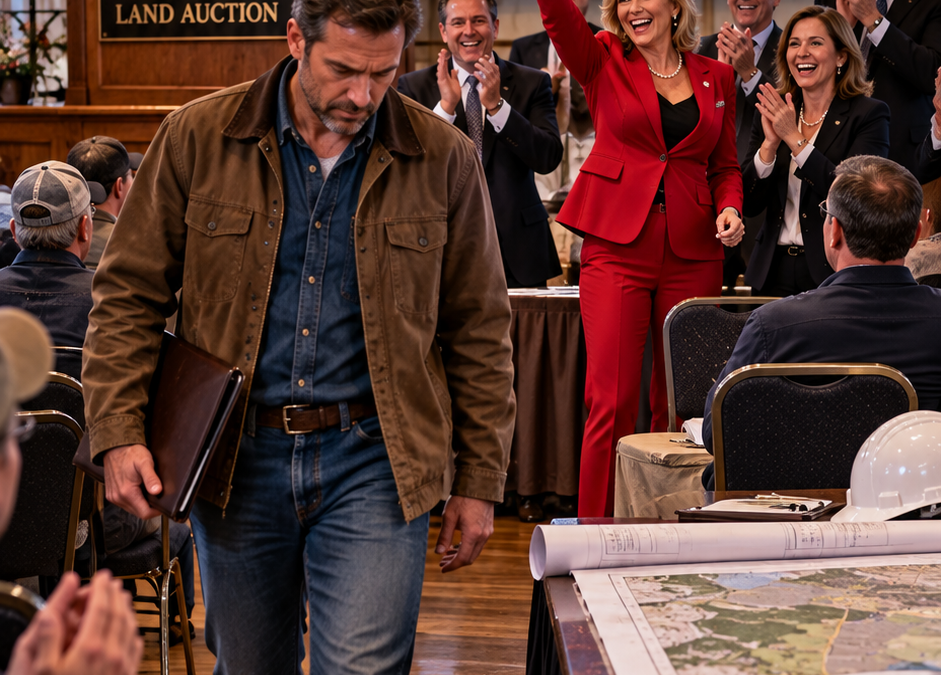
Five members of the Crest View Reserve board were already on their feet, clapping as though they had just won something far more important than eleven acres of dirt.
At the center of them stood Lenora Wickham.
She still had her bidder card raised in one hand.
The auctioneer had just accepted her offer.
Four hundred and twenty thousand dollars.
I closed the folder on my lap, lowered my own card, and stood.
Lenora looked across the room at me.
She smiled.
Not politely.
Not with relief.
It was the smile of a woman who believed a public victory mattered more if the person she had defeated stayed long enough to witness it.
A photographer from the HOA newsletter moved into the aisle and took three quick pictures.
One of the board members slapped another on the back.
Someone behind them said, “We finally got him.”
I heard that clearly.
I kept walking.
As I passed Lenora’s row, she tilted her head.
“I guess Crest View wanted it more.”
I stopped.
For months, she had sent me violation notices she had no authority to issue.
She had accused my company of damaging property values.
She had warned residents that I wanted to run industrial traffic beside their homes.
She had turned a county land auction into a personal contest between herself and me.
Now she wanted me to give her anger.
I didn’t.
I looked at her bidder card.
Then at her.
“You certainly paid more.”
That was all.
I walked out of the hall while the applause followed me through the doors.
My name is Grant Calder.
I was forty-eight years old then, and I had spent twenty-three years building Calder Grading from one used dump truck and a rented excavator into a company with nineteen employees, nearly two hundred acres of commercial property, and enough equipment to handle roadwork, drainage, demolition, and large site-preparation contracts across Black Ridge County.
People occasionally described me as successful.
I never liked the word much.
Success sounds clean when you say it quickly.
My version had diesel fuel in it.
Payroll headaches.
Bad weather.
Broken hydraulic lines.
Three a.m. phone calls from foremen.
Contracts lost because trucks arrived twenty minutes late.
My office was still inside a converted equipment shed at the western edge of the yard.
The coffee was usually burned.
The floor was always dusty.
And the brass ignition key from my first dump truck still sat in the top drawer of my desk.
I kept it because I remembered what it felt like when one broken truck could have ended the company.
That memory made me cautious with money.
It also made me pay attention to land.
Especially access.
People like Lenora looked at property and imagined buildings.
I looked at drainage.
Road geometry.
Utility corridors.
Recorded restrictions.
Truck turning radiuses.
Those things were less impressive on presentation boards, but they were usually what decided whether land was useful.
Lot 17B mattered to me because it sat directly between my main equipment yard and County Route 18.
If I owned it, I could build an engineered access road straight to the highway.
Without it, my loaded dump trailers had to travel six extra miles, cross a narrow bridge, and pass an elementary school before reaching the same route.
That detour cost me fuel and driver time.
But fuel was not the reason I wanted the parcel badly.
Six months before the auction, my foreman, Luis Ortega, had nearly gone through a guardrail on the narrow bridge.
He was hauling stone when a landscaping truck came around the western curve from the opposite direction.
Luis stopped.
The trailer didn’t.
Its rear tires slid sideways on wet pavement and struck the rail hard enough to close one lane for four hours.
Nobody was hurt.
That mattered more than anything else.
I paid for the damaged guardrail before the insurance companies finished arguing.
A week later, Luis and I stood on the repaired bridge watching a school bus come around the same curve.
“We need another way out,” he said.
I knew he was right.
I could absorb higher fuel bills.
I could not justify sending nineteen people across a route I no longer trusted if there was a better option sitting beside my property.
That better option was Lot 17B.
The parcel had belonged to a development company that went bankrupt before completing its plans.
I tried for years to negotiate a road easement.
Then the company dissolved.
Property taxes went unpaid.
Eventually, Black Ridge County scheduled the land for public auction.
For me, the sale was a business opportunity.
For Lenora Wickham, it became something else.
Lenora had served as president of Crest View Reserve for nine years.
I knew that because her name appeared on nearly every letter the HOA sent me.
She was fifty-three, polished, intelligent, and very good at making her preferences sound like collective decisions.
To be fair, she had accomplished things.
The HOA clubhouse had been renovated under her leadership.
The ballroom looked better.
A commercial kitchen had been installed.
They had built a stone terrace overlooking the artificial lake.
Events were well attended.
Property values had risen.
A lot of residents believed Lenora was the reason.
Maybe in part she was.
That was also her problem.
She had succeeded often enough that she began treating disagreement as evidence that other people did not understand what she understood.
Six months before the auction, she unveiled a project called Crest View Grand Commons.
I saw the rendering later.
It showed an outdoor pavilion, a landscaped event lawn, sixty parking spaces, walking paths, and a row of small retail suites.
It looked expensive.
It also looked impressive.
All of it was drawn on Lot 17B.
There were only two problems.
The HOA did not own Lot 17B.
And nobody had confirmed they could legally build most of what was shown.
At the unveiling, according to people who later described the meeting to me, nearly eighty homeowners packed the clubhouse ballroom.
Lenora stood beside a display board six feet tall.
She talked about holiday markets.
Outdoor concerts.
Weddings.
Rental income.
Community pride.
Reduced dues.
Mallorie Vance, the HOA vice president, asked what would happen if someone else tried to buy the property at auction.
Lenora apparently smiled and said, “Then we outbid them.”
The room applauded.
That sentence changed everything.
Once she said it publicly, Lot 17B stopped being real estate.
It became a test of whether Lenora could deliver something she had already promised.
A week later, a letter arrived at my office asking me, in the interest of neighborhood cooperation, not to participate in the auction.
I read it twice.
Then filed it.
I did not answer.
Seven days later, Crest View sent me a violation notice.
It said my dump trucks were visible from the subdivision and ordered me to install screening vegetation.
The letter threatened daily fines.
There was a problem.
My property was not inside Crest View Reserve.
It had never been subject to the HOA declaration.
I wrote one sentence beneath the notice.
Please identify the recorded covenant granting Crest View Reserve authority over Parcel 48C.
I sent it back by certified mail.
No covenant arrived.
A noise complaint did.
Then a dust complaint.
Then a notice about my company sign.
Every letter looked official.
Every letter lacked authority.
I saved all of them.
The envelopes.
The photographs.
The delivery records.
Everything.
People sometimes believe keeping records means you expect a lawsuit.
That is not why I did it.
I kept records because memory becomes very flexible once money and embarrassment enter the room.
Lenora began telling the board I was openly defying the community.
In reality, I had never attended one of their meetings.
I had never threatened her.
I had spoken her name only once to my attorney.
Everett Boone had handled my real estate work for eleven years.
He was fifty-seven, patient, exact, and deeply suspicious of emotional decisions made around land.
When the auction notice appeared, Everett and I spent an entire morning at the county records office.
We checked zoning.
Tax status.
Utility service.
Flood zones.
Road access.
Recorded easements.
Near the center of the plat, I noticed two wide dashed lines crossing the parcel diagonally.
“What are those?”
The clerk, Delia Prescott, enlarged the map.
“Drainage easement and underground utility corridor.”
Together, they covered almost forty percent of Lot 17B.
I studied the dimensions.
The restrictions did not destroy the property’s value to me.
A properly engineered road could still cross an approved section.
But permanent structures inside the corridor were another matter.
So were large gatherings.
So were parking areas that interfered with stormwater flow or utility access.
Everett unfolded a printed copy of Crest View’s Grand Commons rendering.
The proposed pavilion sat almost directly over the utility corridor.
Most of the parking crossed restricted land.
I said nothing.
The restrictions were public.
Any serious buyer could find them.
Then I noticed another symbol on the county system.
This one was not on Lot 17B.
It was on the Crest View clubhouse parcel.
Tax certificate.
Redemption pending.
I leaned closer.
The balance due was $143,870.62.
The final redemption deadline was the same day as the auction.
I looked at Delia.
“Have they been notified?”
She opened the file.
“Six times.”
“Certified?”
“Twice.”
She pulled up the delivery record.
One receipt carried Lenora Wickham’s signature.
I remember sitting back in the chair.
The clubhouse debt had started four years earlier when Crest View converted part of the building into a commercial event venue.
That triggered a reassessment.
The HOA appealed.
While the appeal was pending, Lenora stopped paying the disputed amount.
Apparently she believed the appeal suspended collection.
It did not.
The appeal failed.
Interest accumulated.
Then penalties.
Publication expenses.
Administrative fees.
Eventually, the county sold a tax certificate and began the statutory process that could end with a tax deed if the debt remained unpaid.
I studied the certificate number.
Something about it looked familiar.
I had seen the first six digits before.
Eighteen months earlier, one of my holding companies, Black Ridge Land Recovery LLC, had purchased a portfolio of tax certificates from an investor retiring to Arizona.
There had been dozens of certificates in that package.
I had reviewed the portfolio value and risk categories, but a servicing company handled notices, deadlines, and routine administration.
I never connected any one certificate to Crest View.
Not until that morning.
Everett verified the assignment chain.
The certificate belonged to my company.
More importantly, every relevant event had begun before I acquired it.
The reassessment.
The missed payments.
The appeal.
The first delinquency notices.
All of it predated my ownership.
I did not create Crest View’s debt.
I did not choose its deadline.
I did not even know I held the certificate when Lenora started sending HOA notices to my business.
Everett closed the file.
“Do not contact them about this.”
“I wasn’t planning to.”
“Do not mention it in connection with the auction.”
“I won’t.”
“Do not threaten to use it.”
“I understand.”
He looked at me.
“If they ask directly?”
“I tell the truth.”
“Good.”
Then he tapped the Lot 17B plat.
“Now forget their clubhouse. Decide what this parcel is worth to you.”
That was exactly what I did.
Over fifteen years, direct highway access could save my company hundreds of thousands of dollars.
Fuel.
Labor.
Maintenance.
Delayed contracts.
Bridge risk.
School-zone routing.
I did not value Lot 17B as raw land.
I valued what it solved.
My accountant prepared the numbers.
I reviewed them.
Then, on the first page of my auction folder, I wrote my maximum bid.
$405,000.
I dated it.
Signed it.
Emailed a copy to Everett.
That number mattered later because Lenora would eventually accuse me of bidding purely to damage the HOA.
The file showed otherwise.
Inside Crest View, the financial discussion was very different.
I did not know the details until later.
Their treasurer, Tobias Kemp, did.
Tobias was sixty-one and had spent most of his career as a corporate accountant.
Six weeks before the auction, the HOA reserve account held $552,274.
At a closed board meeting, Tobias recommended transferring $150,000 into a restricted account immediately.
“That money protects the clubhouse,” he told them.
“Anything left after redemption can be used for Lot 17B.”
Lenora refused.
She said the county would probably extend the deadline.
Tobias asked whether she had that in writing.
She did not.
He explained that the failed tax appeal did not stop the process.
She said the penalties could be negotiated later.
Tobias answered, “Later is after four o’clock on auction day. There may not be a later.”
Mallorie asked whether the homeowners knew the clubhouse was at risk.
Lenora said disclosure would create unnecessary panic before an important acquisition.
I did not hear that sentence until months later.
When I did, it bothered me more than almost anything else in the case.
People make bad predictions.
People misunderstand deadlines.
People overestimate themselves.
But hiding a known financial danger because telling the truth might weaken support for your plan is different.
Tobias sent three written warnings.
The clearest one stated that any auction expenditure above roughly $408,000, once fees were considered, could leave Crest View unable to redeem the clubhouse.
Lenora replied with eight words.
Acquiring Lot 17B remains the board’s first priority.
At the next meeting, she asked for authority to bid up to $450,000.
The clubhouse debt did not appear in the homeowner presentation.
Five directors voted yes.
Tobias and one other voted no.
Then Lenora added money for closing expenses and signed authorization to use the reserve account.
Mallorie hesitated.
Then she signed the minutes.
I later learned that she had supported Grand Commons from the beginning.
By then, questioning the project meant admitting she might have helped sell something the board had not investigated properly.
That is how committees get into trouble.
Not everyone has to be dishonest.
Sometimes one person is certain.
Another is embarrassed.
A third is tired.
A fourth does not want to be the first voice in the room saying the leader may be wrong.
During the final week before the auction, Lenora intensified everything.
A banner appeared inside the clubhouse.
OUR LAND. OUR FUTURE.
She told residents my company planned to send heavy trucks near their back fences.
She went on local radio to talk about Grand Commons as though construction was practically approved.
She organized a petition asking the county to exclude industrial bidders.
More than one hundred residents signed it.
The county rejected the request because the auction was public.
Lenora told residents only that the county was reviewing their concerns.
I got a copy of the actual response because the petition named my company.
Everett advised me not to answer publicly.
Instead, I asked Luis to photograph the actual road alignment we intended to use if we bought the land.
It was hundreds of feet from the nearest house.
A natural rise and a line of trees separated the route from Crest View.
No trucks beside backyard fences.
No industrial road through the neighborhood.
But that image did not help Lenora’s campaign.
So residents never saw it.
The night before the auction, she emailed the board.
Tomorrow Crest View finally defeats Calder.
Tobias replied.
Please protect the clubhouse before you bid.
She never answered.
The auction began at 9:30 the next morning.
I arrived alone.
Everett sat three rows behind me.
Lenora came with Mallorie, four directors, a real estate adviser, and the HOA photographer.
Scarlet blazer.
Blue folder.
She sat near the center aisle where everybody could see her group.
Lot 17B opened at $118,000.
Two outside investors participated.
One dropped out around $210,000.
The second stopped at $265,000.
Then it was Lenora and me.
$280,000.
She answered with $300,000.
I went to $325,000.
She said $340,000.
At $360,000, people began turning around.
At $380,000, the auctioneer slowed down.
I opened my folder and checked the numbers again.
The price was far above what the dirt alone was worth.
But it was still within the documented value of the access savings to my company.
“Three ninety-five.”
Lenora turned and looked directly at me.
“Four hundred.”
The Crest View directors started whispering.
Mallorie leaned close to her.
I could not hear the words then.
Later she admitted she had asked, “Should we stop?”
Lenora kept her eyes on me.
I made one last bid.
“Four hundred five.”
The exact number in my file.
Not one dollar more.
The auctioneer repeated it.
“Four hundred and five thousand dollars.”
Lenora raised her card.
“Four hundred and twenty.”
The room went quiet.
I lowered mine.
The auctioneer looked at me.
I did nothing.
“Going once.”
Lenora held her card against her chest.
“Going twice.”
Nobody moved.
“Sold.”
That was when the cheering started.
From where I sat, the victory looked complete.
They had the land.
They had the photograph.
They had beaten me in front of everyone.
What they did not have was enough money left to save their own clubhouse.
The buyer’s premium came to $16,800.
Recording and administrative costs added roughly another $1,800.
The total cash requirement became $438,600.
After payment, the reserve balance fell to $113,674.
The clubhouse redemption amount was $143,870.62.
They were short by a little more than thirty thousand dollars.
At 10:47 that morning, Tobias put those numbers next to each other.
The deadline was four o’clock.
Five hours and thirteen minutes remained.
Lenora initially treated it like a minor cash-flow problem.
“Move money from operations.”
Tobias showed her the operating account and payroll obligations.
“Use the roof reserve.”
“The insurer requires it.”
“Call the bank.”
“I already did.”
The line of credit Lenora had spoken about in meetings had never been approved.
It had been an informal conversation.
No bank was going to deliver same-day money secured by a clubhouse already inside a tax-deed process.
For the first time that morning, according to Tobias, Lenora stopped smiling.
At 11:25, she proposed an emergency special assessment.
The bylaws required notice.
A vote.
A collection period.
There was no mechanism to pull thirty thousand dollars from homeowners before four o’clock.
At noon, the HOA photographer emailed the auction picture to the board.
Subject line:
WE DID IT.
Nobody replied.
At 12:18, Mallorie asked a question that should have been asked six weeks earlier.
“Why wasn’t the redemption deadline in the homeowner packet?”
Lenora said they needed solutions, not blame.
Tobias opened his laptop.
He showed Mallorie his three warnings.
“The solution was setting aside one hundred fifty thousand dollars.”
His voice was quiet.
“You called it panic.”
Mallorie had been copied on the emails.
She read them again.
Silence had felt easier when the plan seemed successful.
It felt different once the numbers were visible.
At 1:05, Lenora called the county treasurer demanding a forty-eight-hour extension.
Delia Prescott told her the deadline was controlled by the recorded process.
Lenora threatened litigation over inadequate notice.
Delia read the notice dates aloud.
Then she read the name on one certified receipt.
Lenora Wickham.
At 1:42, Lenora called several wealthy homeowners.
She described the problem as temporary.
She asked each for a short-term advance.
Two declined.
The third, Priscilla Doyle, was a retired attorney.
She asked Lenora one question.
“Did you know about the deadline before you spent the reserve?”
Lenora did not answer directly.
Priscilla declined.
At 2:05, my phone rang.
I was in the equipment yard beside a loader.
Lenora Wickham.
I stared at the screen before answering.
“Grant Calder.”
Her voice was controlled.
“Mr. Calder, Crest View needs a short-term bridge loan.”
“How much?”
“Forty thousand.”
“How long?”
“Forty-eight hours.”
I waited.
“We can resolve several unnecessary disputes involving your property in exchange.”
I looked across the yard at the trucks she had claimed the authority to regulate.
“Which disputes?”
Silence.
Then, “The outstanding enforcement matters.”
“Your association has no recorded authority over my land.”
Another pause.
Her voice lowered.
“Do you know what happens at four o’clock?”
Everett’s advice came back to me.
If asked directly, tell the truth.
“Yes.”
“Then you understand that thirty thousand dollars can prevent a disaster.”
“You had thirty thousand dollars this morning.”
Her voice sharpened.
“You forced the auction price higher.”
“No.”
“You kept bidding.”
“Until my maximum.”
“You knew we wanted the parcel.”
“You knew I wanted it too.”
“You made us pay more.”
“I stopped.”
I could hear her breathing.
Then I said, “Have your attorney check the recorded assignment for Certificate CR00001.”
Silence.
“Why?”
“Because Black Ridge Land Recovery owns it.”
More silence.
Finally:
“Who owns Black Ridge Land Recovery?”
“I do.”
For several seconds, there was nothing on the line.
When she spoke again, the confidence had disappeared.
“You set this up.”
“No.”
“You bought our debt.”
“I bought a portfolio eighteen months ago. Your first delinquency predates that. Your failed appeal predates that. Your notices predate that. The assignment date is public.”
“You can stop it.”
“Your board could have stopped it six weeks ago.”
“Grant—”
“Or yesterday.”
“You are going to take our clubhouse over thirty thousand dollars?”
“You had the full redemption amount before the auction.”
“That money was committed.”
“You committed it.”
“You knew what would happen if we won the land.”
“I knew what time the deadline expired.”
She went quiet again.
“Give us forty-eight hours.”
I looked at the brass key from my first truck through the open office door.
For years, I had made decisions based on what I could afford to lose.
Lenora had made hers based on what she expected other people to rescue.
“No.”
Her breath caught.
“You’d rather destroy an entire community?”
“No. I’m refusing to make a private deal in the last two hours of a statutory process.”
“You can trade us time for Lot 17B.”
“No.”
That part mattered.
I did not want a bargain tying the certificate to the auction.
It would have created exactly the story Lenora later tried to tell.
That I had used the clubhouse debt to manipulate the land sale.
“I’m not trading anything,” I said. “Call your lawyer.”
Then I hung up.
At 2:30, Crest View’s attorney confirmed my company held the certificate.
He also confirmed the assignment date.
Routine servicing records showed that notices had continued without any special direction from me.
Lenora then argued that my auction bidding had deliberately depleted the HOA reserve.
Her lawyer asked whether she had evidence of my motive.
She had none.
At 3:12, board members asked if they could undo the auction.
They could not.
The sale was final.
Payment had already been transmitted.
At 3:37, Tobias gathered every immediately available dollar.
A delayed vendor payment.
Two voluntary advances.
Every permissible cash source.
They were still short by $27,614.
At 3:55, Tobias entered the county building carrying a cashier’s check.
Delia reviewed it.
“It’s not enough.”
“Take it anyway.”
“I can’t accept partial redemption.”
“Can we wire the rest?”
“Not without the rest.”
He called Lenora.
“We are short twenty-seven thousand six hundred fourteen dollars.”
“Submit it.”
“They won’t.”
“Make them.”
At 3:59, Tobias stood at the counter watching the clock.
At four o’clock, Delia closed the file.
“The redemption period has expired.”
That was it.
No gavel.
No applause.
No dramatic announcement.
A county employee closed a file because a deadline printed on six notices had passed.
Tobias carried the unused check back to his car.
The next morning, Lenora told the board the missed deadline was probably a technical problem that could be fixed with late payment.
Their attorney disagreed.
All statutory waiting periods had run.
Required notices had been sent.
Fees paid.
Final redemption had expired.
At 9:14 a.m., the county system updated.
TAX DEED ISSUANCE APPROVED.
The clubhouse had been appraised around $1.3 million.
Crest View had allowed its redemption right to expire over less than thirty thousand dollars.
The board authorized an emergency lawsuit.
They sought an injunction.
Their claims included inadequate notice, excessive fees, unfair forfeiture, and manipulation by me.
Everett was almost pleased.
Not because he enjoyed the fight.
Because litigation meant discovery.
And discovery meant internal records.
Before the lawsuit, only a handful of people knew what Lenora had hidden.
After discovery, nobody could pretend not to know.
The first production contained more than two thousand pages.
Most were boring.
Invoices.
Meeting packets.
Vendor emails.
Insurance documents.
Then Everett found a draft slide Tobias had prepared three weeks before the auction.
It showed the clubhouse tax obligation in red.
It displayed the reserve before redemption.
Then the reserve after.
Twelve minutes after Tobias sent the slide, Lenora replied:
Remove slide 14. It will undermine confidence in the acquisition.
Tobias answered:
The obligation is material to the vote.
Lenora replied:
The board has authority to manage timing. Homeowners do not need every unfinished dispute.
I read that exchange twice.
Then a third time.
That ended any idea that the clubhouse problem had simply slipped through the cracks.
Lenora had seen the number.
She had seen it clearly enough to know that showing it to homeowners might make them less willing to support Lot 17B.
So she removed it.
Discovery revealed another problem.
Ten days before the auction, the HOA’s real estate adviser had sent Lenora a preliminary title commitment for Lot 17B.
Page seven listed the drainage easement and underground utility corridor.
Lenora forwarded only the cover page to the rest of the board.
When questioned later, she said she expected the adviser to highlight anything significant.
The adviser produced an email.
He had.
It recommended an engineering review before bidding.
Lenora’s response said the auction schedule left no time.
One warning about the clubhouse.
One warning about the land.
Two separate risks.
Two separate decisions not to slow down.
Mallorie called an emergency homeowner meeting.
More than one hundred residents came.
The ballroom could not hold everyone.
People stood in the lobby.
Others lined the terrace.
Lenora opened with a prepared statement blaming the county process and what she called an opportunistic neighboring investor.
Tobias interrupted her.
People told me later it was the first time they had ever seen him do that.
He connected his laptop to the projector.
Then he displayed the reserve ledger.
The redemption notice.
His written warnings.
Lenora’s reply.
The auction authorization.
The post-auction bank statement.
One homeowner raised his hand.
“When did you learn the clubhouse was at risk?”
Lenora said, “The situation evolved over time.”
Tobias enlarged the certified-mail receipt.
Her signature appeared on the wall behind her.
Another resident asked why the debt had not been disclosed before the board sought homeowner support for the auction.
Lenora answered, “I wanted to avoid panic.”
The room reacted immediately.
Walter Higby, a retired building inspector, stood near the back.
“You didn’t avoid panic.”
Lenora looked toward him.
“You delayed it until after the money was gone.”
That sentence ended her presentation.
Then Walter asked another question.
“Where is the engineering report for Grand Commons?”
There was none.
The board hired an independent civil engineer.
Three days later, he walked Lot 17B with utility maps, survey flags, drainage records, and the plat.
His conclusion made the $420,000 purchase look worse.
The drainage and utility restrictions covered almost forty percent of the parcel.
The Grand Commons pavilion had been drawn inside a no-build area.
The event lawn interfered with the stormwater corridor.
More than half of the proposed parking spaces overlapped utility access.
The project was not impossible.
But it could not be built as advertised.
It would require a major redesign.
Multiple approvals.
Uncertain variances.
Possibly fewer parking spaces.
Possibly no pavilion in the location residents had been shown.
The rendering that convinced them to spend nearly half a million dollars was not an engineering plan.
It was artwork.
Nine days later, we were in court.
The benches were full of Crest View residents.
Lenora wore the same scarlet blazer I remembered from the auction.
That morning, surrounded by bank statements and signed delivery notices, it looked different.
Less like authority.
More like armor.
Crest View’s attorney argued that losing a $1.3 million clubhouse over a much smaller tax obligation would impose an extreme hardship on innocent homeowners.
He challenged several fees.
Asked the judge to reopen the redemption period.
Requested an injunction preventing deed issuance until the association could tender payment.
The county presented its timeline.
Every notice.
Every date.
Every address.
Every delivery record.
The servicing company produced its log.
My LLC records established exactly when I acquired the certificate portfolio.
Then Lenora’s attorney turned to me.
His theory was simple.
I had driven up the auction price knowing Crest View needed the reserve for the clubhouse.
In other words, I had engineered their failure.
Everett stood.
He placed one page on the courtroom screen.
My valuation memorandum.
Dated before the auction.
Fuel.
Driver hours.
Bridge delays.
Maintenance.
Lost contracts.
Fifteen-year savings.
Maximum authorized bid:
$405,000.
Then Everett displayed the auction log.
My final bid.
$405,000.
Lenora’s final bid.
$420,000.
Everett looked at the judge.
“Mr. Calder did not make Crest View spend four hundred twenty thousand dollars.”
He paused.
“He made a lower offer and lost.”
The judge asked Lenora whether she knew about the redemption deadline before the auction.
She said she believed an extension was possible.
“Did the county promise one?”
“No.”
“Did your treasurer advise you to reserve the full redemption amount?”
“Yes.”
“Did homeowners receive that information before being asked to support the acquisition?”
Her attorney objected.
The judge overruled him.
Lenora’s answer came quietly.
“No.”
The court denied emergency relief.
The judge found no evidence that I had created the tax debt.
No evidence I interfered with notice.
No evidence I controlled the statutory deadline.
No evidence I forced Crest View’s final auction bid.
Other claims could continue through ordinary litigation.
But the court would not halt the deed based on accusations contradicted by Crest View’s own records.
Outside the courthouse, Lenora caught up with me on the stone steps.
Residents and reporters were moving around us.
She looked exhausted.
“You’re taking a million-dollar clubhouse over twenty-seven thousand dollars.”
I looked at her.
Not the blazer.
Not the image.
Her.
“You spent that twenty-seven thousand trying to beat me.”
Then I walked away.
By the time I reached my truck, somebody had already repeated the quote.
Lenora still refused to resign.
She proposed a $4,800 special assessment per household.
Selling Lot 17B.
Continuing litigation against me.
Raising money to repurchase the clubhouse.
But the board was no longer hers.
Mallorie called another emergency meeting.
This one took place in a hotel conference room because ownership of the clubhouse was in transition.
The location itself said enough.
Tobias presented the damage in plain numbers.
$438,600 spent acquiring Lot 17B.
More than $143,000 left unredeemed.
Legal fees approaching $40,000.
A clubhouse worth roughly $1.3 million moving through the tax-deed process.
A newly acquired parcel that could not support the development plan used to justify buying it.
Then Mallorie stood.
She made a motion to remove Lenora Wickham as president.
One by one, the directors voted.
Yes.
Yes.
Yes.
Yes.
Yes.
Yes.
Lenora voted no.
Six to one.
For nine years, she had occupied the center seat.
Now she gathered her binder in silence.
Nobody applauded.
I was not there.
I heard about it afterward.
I was glad I had not been invited.
My dispute was with documents and property.
Their reckoning had to be with each other.
The new board ordered an independent audit.
It also disclosed every major financial obligation to homeowners.
The insurer began investigating whether Lenora’s decisions had breached fiduciary duties.
Civil claims remained possible.
But the consequence that seemed to matter most came immediately.
She lost the authority she had spent years protecting.
The audit showed another uncomfortable truth.
Crest View could not simply collect one large assessment and restore everything.
The HOA had upcoming roof work.
Lake pump repairs.
Insurance renewal.
Attorney fees.
Vendor contracts.
Reserves were badly weakened.
Selling Lot 17B would recover only part of the damage.
Some residents demanded that every director who supported Lenora reimburse the association personally.
Others wanted to dissolve the HOA entirely.
A third group argued that destroying common services would punish hundreds of families who never saw the hidden financial information.
At one of the meetings, Mallorie stood before the residents and said something I respected.
“I saw Tobias’s warnings.”
The room went quiet.
“I told myself Lenora understood something I didn’t.”
She swallowed.
“That was easier than asking questions in public.”
Then she said:
“I voted yes. I was wrong.”
That did not erase her vote.
But it changed the tone of the room.
She was the first director to admit failure without blaming the county, the lawyer, me, the economy, or the deadline.
Walter Higby proposed an independent finance committee.
Priscilla Doyle offered to review governance rules at no charge.
Within a week, more than forty homeowners volunteered for work Lenora had always implied only she could manage.
That was one of the strangest lessons in the whole situation.
For years, Crest View had treated Lenora as indispensable.
The moment she was gone, the community became more involved.
The new board listed Lot 17B for sale.
The highest outside offer was $226,000.
That number surprised some residents.
It did not surprise me.
Buyers saw the easements.
The drainage restrictions.
The development limits.
They valued the actual parcel.
Not Lenora’s rendering.
I offered $235,000.
Cash.
No financing contingency.
Quick closing.
Several residents objected.
They did not want to sell the property to the man they believed had somehow benefited from the whole collapse.
Tobias gave them the answer.
“We do not have enough money to choose an emotional buyer.”
The board accepted my offer.
Less than two months after celebrating the day they outbid me, Crest View sold me Lot 17B for almost two hundred thousand dollars less than what they had paid.
Once the deed recorded, I did what I had planned from the beginning.
I hired an engineer.
We designed the road around the drainage restrictions.
Obtained approvals.
Protected the utility corridor.
Installed proper stormwater controls.
Then Calder Grading built the access route to County Route 18.
Our trucks stopped using the narrow school route.
Luis no longer had to cross that bridge with a full trailer.
I planted a thick evergreen buffer along the side facing Crest View.
The HOA had no authority to require it.
I did it anyway.
I did not need their residents looking at trucks every morning to prove I owned the land.
The trees cost less than years of unnecessary resentment.
That decision surprised people.
Lenora had spent months telling them I wanted heavy equipment against their back fences.
The road never went near those fences.
The buffer made it even less visible.
Meanwhile, the tax deed for the clubhouse eventually recorded to Black Ridge Land Recovery LLC.
The remaining challenges failed.
On paper, the outcome looked extraordinary.
I controlled the land I originally wanted.
I also controlled the building from which Lenora had tried to control me.
There were residents who expected me to lock the clubhouse.
Some were certain I would.
A few probably believed they deserved it.
I did not.
Several hundred homeowners had not hidden Tobias’s warnings.
They had not cropped title documents.
They had not bid $420,000.
They had not sent false violation notices to my business.
Punishing all of them would have given me a satisfying story and a terrible long-term relationship with the people living beside my property.
So I offered the reorganized HOA a three-year commercial lease.
The rent was based on documented market value.
Not punishment.
Part of each payment could be credited toward a future repurchase if Crest View rebuilt its reserves and met strict financial requirements.
I had three non-negotiable conditions.
First, every enforcement notice Crest View had ever issued against Calder property would be formally rescinded.
Second, the HOA would acknowledge in writing that it had no authority over my land.
Third, it would make no claim against Lot 17B or the new access road.
The board accepted unanimously.
That agreement mattered more to me than owning the clubhouse.
I did not need their ballroom.
I needed the false authority campaign to end.
Lenora sold her house within the year.
She left Crest View.
The Grand Commons banner disappeared.
The auction celebration photograph never made it into the newsletter.
Tobias remained treasurer long enough to change the financial rules.
Under the new policy, any proposed expenditure above fifty thousand dollars required certification from both the treasurer and an independent accountant that all tax, insurance, reserve, and legal obligations had been reviewed.
Residents jokingly called it the Lenora Rule.
Mallorie eventually became president.
At her first annual meeting, she refused to sit in Lenora’s old chair.
Instead, she stood beside a one-page financial dashboard projected behind the podium.
Every debt.
Every deadline.
Every restricted reserve.
Every major pending contract.
Plain language.
No hidden slide.
No polished rendering without numbers beside it.
“If the numbers frighten us,” she told the room, “hiding them will not make us safer.”
Months later, Tobias came to my office.
He carried the final recorded deed for Lot 17B.
Through the window behind my desk, we could see Calder trucks using the new access road.
No bridge.
No school buses.
No extra six-mile detour.
He placed the deed beside a copy of the old auction log.
For a while, neither of us spoke.
Then he asked me something.
“When she bid four hundred twenty thousand, did you know this was how it would end?”
I shook my head.
“No.”
“You knew about the clubhouse deadline.”
“Yes.”
“You knew you held the certificate.”
“Yes.”
“You knew she might spend too much.”
“I knew what the land was worth to me.”
I tapped the auction log.
“I knew my limit.”
Then I looked toward the tree line where the Crest View clubhouse stood beyond Lot 17B.
“And I knew what time the redemption deadline expired.”
Tobias smiled faintly.
“You lost the auction.”
“Yes.”
“And ended up with both properties.”
I opened my desk drawer and took out the bidder card I had used that morning.
I had kept it beside the brass key from my first truck.
“Winning the bid was never the same thing as winning.”
He looked at the card.
Then out the window.
I thought about that conversation for a long time afterward.
Because the part people remember is usually the dramatic part.
The applause.
The $420,000 bid.
The tax deed.
The courtroom.
Lenora losing the presidency.
Me buying the land later for $235,000.
Those are easy moments to tell.
They sound like reversals.
Like revenge.
Like the universe balancing itself.
But that is not how I remember it.
I remember a foreman named Luis standing on a narrow bridge while a school bus approached.
I remember calculating fuel and labor because I wanted a safer route for nineteen employees.
I remember asking one simple question after the HOA sent a violation notice.
Show me the recorded covenant.
I remember sitting in the county records office and finding restrictions anyone could have found.
I remember seeing Lenora’s signature on the tax notice.
I remember Everett telling me not to turn knowledge into a threat.
I remember writing $405,000 on a page before the auction and refusing to go higher.
Most of all, I remember the sound of applause as I walked out of the auction hall.
At that moment, Lenora had everything she thought victory required.
The winning bid.
The crowd.
The photographer.
The board behind her.
The land she had promised.
And me leaving.
From the outside, it looked complete.
What nobody applauding had checked was the reserve balance.
The tax deadline.
The title restrictions.
The engineering risk.
The cost of being wrong.
That was Lenora’s real mistake.
She thought winning meant forcing the world to acknowledge her confidence.
I had spent too many years in construction to believe confidence could carry a load it was not engineered to support.
Sooner or later, the ground asks for numbers.
The bank asks for numbers.
The county asks for dates.
A judge asks for records.
And paperwork does not care who received the louder applause.
Crest View survived.
That matters to me.
The community did not collapse.
Families still use the clubhouse.
People still hold weddings there.
Children still swim in the lake.
The HOA eventually rebuilt part of its reserve.
They have not yet repurchased the building, but the option remains if they meet the financial terms.
Calder Grading still uses the road across Lot 17B every workday.
Sometimes I stand outside my office in the morning and watch trucks turn toward County Route 18.
The movement is simple.
A truck leaves the yard.
Crosses the parcel.
Turns onto the highway.
No bridge.
No school.
No six-mile detour.
No drama.
That was all I wanted before Lenora ever learned my name.
The clubhouse is visible through the trees from the far end of the property.
When I see it, I do not think of it as a trophy.
I think of it as an expensive reminder.
Land does not become valuable because somebody puts a beautiful rendering on an easel.
Authority does not become real because it appears on HOA letterhead.
Debt does not disappear because discussing it would damage confidence.
And a deadline does not care whether a room full of people believes it should be extended.
Lenora was never defeated by a secret document that appeared at the last second.
Nothing important was hidden from her.
That is what makes the story harder.
The tax notices existed.
She received them.
Tobias warned her.
She read his emails.
The title commitment existed.
She received it.
The engineering concern existed.
Her adviser raised it.
The county restrictions were public.
The auction price was voluntary.
My final bid was lower than hers.
At every important point, she had a chance to slow down.
She chose not to.
I have made bad business decisions in my life.
More than I like to remember.
I have bought equipment that broke too often.
Hired people I should not have hired.
Underbid projects.
Overestimated clients.
Trusted schedules that were too tight.
But the mistakes that taught me the most all had one thing in common.
At some point before they became expensive, there had been a number, a document, or a person telling me something I did not want to hear.
Experience did not teach me how never to be wrong.
It taught me to become suspicious when I most wanted to be right.
Lenora never learned that before the auction.
Maybe she has now.
I do not know.
I have not spoken to her since she moved.
I do know what happened to the people she left behind.
They became more careful.
More involved.
Tobias stopped whispering warnings in closed meetings and started putting numbers on screens.
Mallorie learned that loyalty to a board president is not the same as responsibility to homeowners.
Residents began reading financial packets instead of assuming somebody else had.
Walter joined the finance committee.
Priscilla helped rewrite governance rules.
People who once applauded because they had been told a story started asking what documents supported it.
That was probably the healthiest thing to come from the whole mess.
Not my road.
Not the clubhouse lease.
Not even Lenora’s removal.
Questions.
What does the deed say?
What does this cost?
What happens if the deadline is missed?
Has an engineer reviewed it?
Who has authority?
Where is the recorded document?
Those questions sound boring.
That is why people skip them.
But boring questions are often the ones standing between a community and an expensive mistake.
I still have the bidder card from that morning.
Sometimes someone visiting my office notices it in the drawer beside the old truck key.
Most assume I kept it because of what happened afterward.
That is not why.
I kept it because of what happened before.
I had written my limit.
I knew why I wanted the land.
I knew what it solved.
And when the number crossed that limit, I lowered the card.
That may have been the most important decision I made in the entire story.
Lenora believed I was surrendering.
I was simply refusing to let her decision become mine.
There is a difference.
Five hours after the applause, Crest View was still short of what it needed to protect its clubhouse.
Nine days later, the court refused to save them from the consequences of records they had ignored.
Months later, I owned the land they had celebrated buying.
Eventually, my company held the clubhouse too.
But when Tobias told me I had somehow won both properties after losing the auction, I did not feel like a winner.
I felt relieved that I had not raised my card one more time.
Because if Lenora taught Crest View anything, it was that sometimes the most expensive number in a room is not the bid you lose.
It is the one you refuse to stop making.
And sometimes the cheering is loudest at the exact moment everyone should be checking the math.

