𝗙𝗨𝗟𝗟 𝗦𝗧𝗢𝗥𝗬 The Golden Retriever Crying Outside My Hospital Wouldn’t Leave the Door No Matter How Hard the Rain Fell
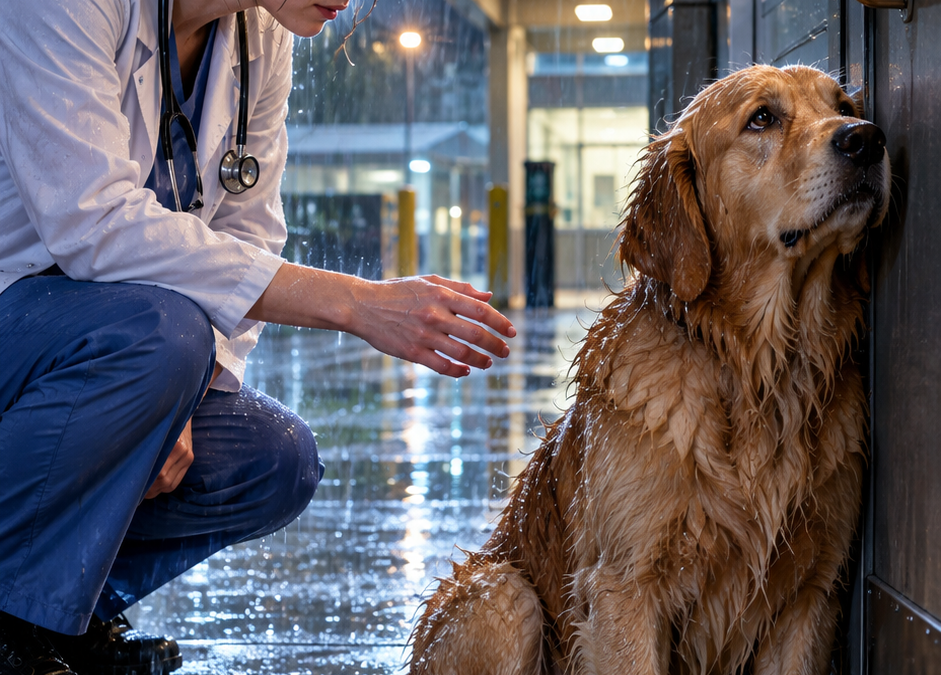
𝗙𝗨𝗟𝗟 𝗦𝗧𝗢𝗥𝗬
The sound went through me.
“Hey.”
I approached slowly.
The dog looked at me but did not move.
“It’s okay.”
I crouched several feet away.
“You’re going to freeze out here.”
No response.
Around his neck was a plain brown collar.
I reached carefully for the small metal tag.
He allowed me to touch it.
One word was engraved across the front.
MAX.
“Hello, Max.”
His ears shifted slightly.
“So that’s your name.”
He looked at me.
For one brief second, the crying stopped.
Then his eyes moved back toward the hospital door.
The sound began again.
I stood.
“All right.”
I looked around the courtyard.
No owner.
No leash.
No one calling for him.
The rain was growing heavier.
Max had started trembling.
I tried guiding him toward the covered loading area.
He planted his feet.
“Come on.”
Nothing.
I stepped behind him gently.
He resisted.
Not aggressively.
He simply would not leave his position facing the entrance.
That was when I understood.
“You’re waiting for someone.”
Max stared at the door.
“Someone inside?”
His body became still.
Maybe I was imagining meaning where there was none.
People do that with animals.
We translate posture into sentences because we want to believe they are telling us something.
But I had seen enough fear and grief to recognize waiting when I saw it.
I bent down.
“All right. I’m not leaving you here.”
Max was lighter than I expected.
I slipped one arm beneath his chest and another beneath his hind legs.
His heart was racing against me.
He did not struggle.
He twisted just enough to keep looking toward the hospital entrance while I carried him inside.
The security officer at the service desk stared.
“Doctor?”
“Long story.”
“You know we can’t have dogs wandering through the hospital.”
“He isn’t wandering.”
Max shivered against me.
The guard looked at him.
Then at the rain behind us.
“I didn’t see anything.”
“Thank you.”
I took Max upstairs to my office.
My office was hardly an office.
Desk.
Computer.
Two chairs.
Cabinet full of paperwork.
A narrow window facing the courtyard.
I found an old blanket in the staff lounge.
Nurse Margaret Ellis appeared while I was drying him.
Margaret was sixty years old and had worked in hospitals longer than I had been an adult.
She carried three charts under one arm.
She stopped in my doorway.
“That is not standard ICU equipment.”
“This is Max.”
Max looked at her.
Margaret put the charts down.
“Well, obviously his name is Max.”
She crouched.
He let her touch his head.
“Where did you find him?”
“Outside.”
“In this weather?”
“Under the walnut tree.”
Margaret’s expression changed.
“The courtyard?”
“Yes.”
She looked toward the door.
“How long?”
“I don’t know.”
I poured water into a clean bowl.
Max drank immediately.
I found several pieces of bread left from breakfast deliveries and placed them beside him.
He sniffed once.
Turned away.
“He’s not hungry,” I said.
Margaret continued watching him.
“No.”
“What?”
“That isn’t hunger.”
“How can you tell?”
She looked at me.
“I’ve worked nights around grieving families for thirty-seven years.”
Her hand moved gently along Max’s soaked back.
“I’ve seen that look before.”
I sat behind my desk.
“What are you thinking?”
Margaret became quiet.
Then she said, “We admitted an older gentleman through emergency last night.”
I waited.
“Cardiac event. Thomas Bennett. Seventy-five.”
Something in her expression made me sit straighter.
“So?”
“When they brought him in, he kept asking about his dog.”
I looked down at Max.
Margaret did too.
“What did he say?”
“I wasn’t in the emergency department the whole time. But I remember one of the paramedics saying Mr. Bennett was worried about an animal.”
“Where is he now?”
Margaret hesitated.
That pause told me enough.
“Margaret.”
“ICU.”
My department.
“What room?”
“Bed Three.”
I stood immediately.
Max raised his head.
“How bad?”
“He hasn’t regained consciousness.”
I walked quickly toward the unit.
I had seen Mr. Bennett’s chart during morning handoff preparations, but I had not yet connected the name to anything.
Seventy-five-year-old male.
Severe cardiac event.
Arrived unstable.
Emergency intervention.
Blood pressure difficult overnight.
Neurologic responsiveness limited.
The kind of chart that makes physicians cautious with every sentence.
Thomas Bennett lay beneath a light hospital blanket.
Monitors surrounded him.
Oxygen line.
IV medications.
His face was pale.
Deep lines ran across his forehead and beside his mouth.
He looked smaller than seventy-five.
Sickness does that to people.
It removes the parts of them that once filled a room.
I stood beside his bed.
“Mr. Bennett?”
No response.
I checked his monitor.
Stable enough for the moment.
I looked toward the glass wall separating his room from the corridor.
Then back at him.
“This may sound strange.”
Nothing.
“There’s a dog outside.”
The cardiac rhythm remained steady.
“Golden retriever.”
I touched his hand.
“His name is Max.”
The line on the monitor changed.
Not dramatically.
A small increase.
I stared at it.
Coincidence.
It had to be.
Heart rhythms fluctuate.
Patients respond to voices.
Medication levels shift.
I knew better than to turn one tiny movement on a screen into a miracle.
Still, I leaned closer.
“Max is here.”
Another subtle change.
I felt something cold move through me.
Not fear.
Recognition.
I left the room.
Margaret was waiting outside.
“Well?”
“I don’t know.”
“Is it his dog?”
“I don’t know.”
“You know.”
“I suspect.”
“That’s doctor language for yes.”
I looked toward my office.
Hospital policy was clear.
Animals did not simply enter critical-care units.
There were sanitation concerns.
Allergies.
Infection-control protocols.
Patient safety.
And Max was a soaked dog whose vaccination record I did not have.
Every professional instinct told me to call animal control and wait for family confirmation.
Every human instinct told me that would be wrong.
“I’m bringing him to the doorway.”
Margaret nodded.
“I already knew you would.”
“You cannot tell me you support this officially.”
“I don’t.”
“Good.”
“I support it unofficially.”
“Better.”
We dried Max as much as possible.
I found a clean towel.
Then I clipped a temporary lead to his collar.
The moment we entered the ICU corridor, his entire body changed.
He stood taller.
His nose lifted.
He began pulling.
Not randomly.
Directly toward Bed Three.
I stopped.
“Max.”
He whined.
I opened the room door.
The instant he saw Thomas Bennett, the crying stopped.
Completely.
It was so sudden that the silence felt louder than the sound had.
Max stood frozen.
His eyes locked onto the bed.
Then he walked forward.
Slowly.
No pulling now.
No panic.
He approached the bedside as if he understood exactly how fragile the man before him was.
I lowered the lead.
Max placed his front paws carefully against the mattress.
He sniffed Thomas’s hand.
Then climbed just far enough onto the edge of the bed to place his head against Thomas’s palm.
The heart monitor changed again.
Margaret inhaled sharply behind me.
I turned.
“Don’t.”
“I didn’t say anything.”
“You were going to.”
“I was going to say that monitor likes the dog.”
I looked back at Thomas.
His fingers did not move.
His eyes remained closed.
But the heart rate had increased slightly.
Not dangerously.
Just enough to make me wonder.
Max settled.
The dog that had spent the entire night crying in freezing rain became completely peaceful.
I stood beside them longer than I intended.
Finally, Margaret whispered, “Maybe he was keeping a promise.”
I looked at her.
“What promise?”
She shook her head.
“I don’t know.”
Neither did I.
Not yet.
A few hours later, a woman rushed into the ICU waiting area.
She was carrying a large leather bag, a coat, and the expression of someone who had not slept.
Dark hair pulled loosely behind her head.
Eyes red.
Early thirties.
She went directly to the nurses’ station.
“Thomas Bennett.”
I approached.
“I’m Dr. Eleanor Vence.”
“I’m his daughter. Victoria.”
She spoke quickly.
“Is he alive?”
“Yes.”
The breath left her body.
Not relief exactly.
Relief implies the fear has ended.
This was only permission to keep being afraid.
“Can I see him?”
“Yes.”
I hesitated.
“There’s something else.”
Her face tightened.
“What?”
“Do you know Max?”
She stared at me.
“Max?”
“He’s here.”
For a second, she looked as though I had spoken another language.
Then she began crying.
Not softly.
Her hand covered her mouth.
“Where?”
“With your father.”
She walked so quickly toward the room that I had to follow.
When Victoria saw Max lying beside Thomas, she stopped at the doorway.
Max lifted his head.
His tail moved against the mattress.
Victoria leaned against the wall.
“Oh, thank God.”
She crossed the room.
Max climbed down and pressed against her.
She dropped to her knees.
“You stayed.”
She buried both hands in his fur.
“You stayed, didn’t you?”
I stood near the door.
“What happened last night?”
Victoria looked toward her father.
For a while, she could not answer.
Finally, we stepped into the corridor.
She wiped her eyes.
“My father called me around eight.”
“He was home?”
“Yes.”
“He said his chest hurt?”
“He said it felt like someone was sitting on him.”
Her voice shook.
“I called emergency services because he kept saying he didn’t need an ambulance.”
“That’s unfortunately common.”
“That’s my father.”
A faint smile appeared.
“He thinks ignoring a problem is a treatment plan.”
“What happened with Max?”
Victoria looked through the glass.
“When the paramedics arrived, Max went crazy.”
“Aggressive?”
“No. Never.”
She shook her head.
“He knew something was wrong. He kept trying to stay beside Dad.”
“The paramedics wouldn’t bring him?”
“They couldn’t.”
Victoria lowered her voice.
“My father was barely conscious when they loaded him.”
She swallowed.
“But he kept asking about Max.”
“What exactly did he say?”
Victoria’s eyes filled.
“His last clear words were, ‘Don’t leave Max. Tell him to wait. I’ll come back.’”
I looked through the glass.
Max had returned to Thomas’s bedside.
“He followed the ambulance?”
“As far as he could.”
“How did he get here?”
“I don’t know.”
She shook her head.
“Dad’s house is nearly three miles away.”
The thought made my chest ache.
Three miles.
At night.
In rain.
Through traffic.
“He must have followed the ambulance.”
Victoria nodded.
“When I got here this morning, I came through the front entrance. I had no idea he was outside.”
“He was under the walnut tree behind the service entrance.”
“All night?”
“As far as we can tell.”
Victoria pressed one hand against her forehead.
“He was waiting because Dad told him to.”
Neither of us spoke.
I had spent my career surrounded by people who searched for meaning in small medical changes.
A finger moving.
A blood pressure stabilizing.
One extra breath.
We wanted patterns because uncertainty is hard to live with.
But Max did not need interpretation.
Thomas had told him to wait.
So he waited.
In the rain.
All night.
Victoria and I sat in the family consultation room.
I wanted to know more about her father.
Not because it would change treatment.
Because suddenly I needed to understand the relationship I had found beneath that walnut tree.
Victoria was thirty-three.
An architect.
She lived twenty minutes away.
Her father had been married to her mother, Margaret, for forty-six years.
Margaret died two years earlier.
Cancer.
After that, Thomas changed.
“He stopped going places,” Victoria told me.
“He stopped seeing friends?”
“Mostly.”
“Depression?”
“He would never have called it that.”
She looked down.
“He would say he was tired.”
I understood.
Grief often prefers practical words.
Tired.
Busy.
Not hungry.
Maybe tomorrow.
“What about Max?”
Victoria smiled through tears.
“Max saved him.”
“How?”
“A few months after Mom died, Dad went to a shelter.”
“Looking for a dog?”
“No.”
That surprised me.
“He was donating blankets she had bought before she died.”
Victoria shook her head.
“He came home with a puppy.”
I laughed softly.
“Sounds dangerous.”
“Dad called me from the car and said, ‘I made an administrative mistake.’”
For the first time since arriving, Victoria laughed.
Then cried again.
“Max gave him a schedule.”
Morning walks.
Feeding.
Veterinary appointments.
Trips to the park.
Someone waiting when he came home.
Someone who needed him.
“That dog has been his entire life for three years.”
We both looked toward the ICU.
“And your father is Max’s.”
Victoria nodded.
The hospital administration was less emotionally persuaded.
By noon, my supervisor wanted an explanation.
“You have an unauthorized dog in intensive care.”
“Yes.”
“Eleanor.”
“He belongs to the patient.”
“That is not an infection-control protocol.”
“I know.”
“Then why are we having this conversation?”
“Because the dog spent the night outside in freezing rain waiting for him.”
My supervisor closed his eyes.
“That is a compelling story, not hospital policy.”
“I know.”
“You keep saying you know.”
“Because I do.”
We negotiated.
Max could not wander.
He had to be cleaned properly.
A veterinarian would confirm basic health and vaccination status.
He would remain only with Thomas and Victoria.
No food-preparation areas.
No other patient rooms.
If any clinical concern arose, he would leave.
I agreed to everything.
Victoria arranged for Max’s veterinarian to send records.
By afternoon, Max had unofficially become the most carefully documented visitor in the hospital.
Thomas remained unconscious.
The first day passed.
Then the second.
His condition stabilized in some ways and worsened in others.
Every small improvement was followed by another concern.
His oxygenation improved.
Then his pressure dropped.
His cardiac rhythm steadied.
Then laboratory values shifted.
Victoria stayed beside him.
So did Max.
I began my morning rounds by finding the dog.
He usually slept at the foot of Thomas’s bed.
When nurses entered, Max lifted his head.
Watched.
Then rested again.
He never interfered.
Never barked.
Never approached equipment.
He seemed to understand that everyone in the room was trying to help the man he loved.
Staff members who initially complained began stopping by.
Respiratory therapists.
Nurses.
Residents.
One environmental-services worker brought Max a clean blanket.
Another nurse started carrying dog treats in her pocket.
Margaret became his unofficial grandmother.
“You’re getting spoiled,” I told him.
He looked at Thomas.
Only Thomas.
That devotion hurt to watch.
On the second evening, Victoria and I sat near the ICU windows.
Rain had finally stopped.
The city lights reflected against wet streets.
“What happens if he doesn’t wake up?” she asked.
It was the question I had hoped she would not ask directly.
Doctors become skilled at talking around uncertainty.
We discuss likelihood.
Response.
Indicators.
We protect families from false certainty.
Sometimes they force us to say the thing clearly.
“I don’t know.”
Victoria nodded.
“Do you think he hears us?”
“Possibly.”
“Is that a doctor answer?”
“Yes.”
“What’s your Eleanor answer?”
I looked through the glass.
Thomas lay motionless.
Max’s head rested near his ankle.
“My Eleanor answer is that I would keep talking.”
Victoria entered the room.
She sat beside her father.
Took his hand.
“Dad.”
No movement.
“Max is here.”
One ear lifted.
Victoria smiled.
“You see? Your favorite child is here.”
I stood in the hallway.
She continued.
“You’re going to wake up because I refuse to explain your ridiculous filing system by myself.”
Nothing.
“And you still owe me twenty dollars.”
Nothing.
Her voice broke.
“And because I’m not ready.”
That sentence nearly made me leave.
Not ready.
I had heard versions of it thousands of times.
Nobody is ready.
Not really.
Love makes us believe there should always be one more conversation.
One more breakfast.
One more phone call.
One more ordinary Tuesday.
Max moved closer to Thomas.
Victoria lowered her head.
The third night, I was on call.
Shortly after two in the morning, the ICU was unusually quiet.
Machines still hummed.
Monitors still beeped.
But the human noise had faded.
No visitors speaking in halls.
No transport carts.
No phones ringing.
I checked Thomas just after two.
His vital signs were slightly better than the evening before.
Not miraculous.
Better.
Victoria had fallen asleep in the family room.
Max was awake.
He sat at the foot of the bed watching me.
“You should sleep.”
His ears lifted.
“I’m a doctor. That was medical advice.”
No reaction.
I checked Thomas’s pupils.
His hand.
His monitor.
Then I noticed something.
Heart rhythm.
More regular.
I stood still.
Watched.
There are moments in medicine when you do not immediately trust improvement.
You check whether a lead has moved.
Whether the monitor is artifacting.
Whether medication timing explains it.
I went through the possibilities.
Then Max stood.
He walked toward Thomas’s hand.
Pressed his nose against the fingers.
And began licking them.
Slowly.
Once.
Twice.
Again.
“Max.”
The dog ignored me.
Thomas’s fingers moved.
I stopped breathing.
Not metaphorically.
For a second, I simply forgot.
“Mr. Bennett?”
His eyelids moved.
I stepped closer.
“Thomas?”
Max licked his hand again.
Thomas’s eyes opened slightly.
Not fully.
A narrow unfocused line.
His lips moved.
I leaned closer.
“What?”
The sound was barely there.
“Max.”
The dog froze.
Thomas swallowed.
“You’re here, boy.”
Max made a soft whimper.
His entire body began trembling.
Not fear.
Something else.
He placed his head against Thomas’s hand.
The monitor alarmed because the heart rate increased.
I had never been happier to hear that sound.
I pressed the call button.
Margaret entered first.
“What happened?”
“He opened his eyes.”
She looked at Thomas.
Then Max.
“Oh my God.”
I called Victoria.
She was asleep less than fifty feet away, but she answered as though the phone had been in her hand.
“What happened?”
“Come here.”
“Is he—”
“Come.”
She ran.
When she entered the room, Thomas’s eyes were closed again.
Her face collapsed.
“No.”
“He woke.”
“What?”
“He spoke.”
She stared at me.
“What did he say?”
I looked at Max.
Victoria followed my eyes.
“Oh.”
She covered her mouth.
Her father opened his eyes again.
This time wider.
Victoria moved to the bed.
“Dad?”
His eyes found her slowly.
“Victoria.”
She began crying.
“I’m here.”
His gaze shifted.
“Max?”
“He’s here too.”
The golden retriever stood beside the mattress.
Thomas managed the smallest smile.
“That stubborn dog.”
Victoria laughed through tears.
“You told him to wait.”
Thomas’s eyes closed briefly.
“I knew he would.”
That morning did not magically cure Thomas Bennett.
That is not how medicine works.
He did not wake, sit upright, and walk home because his dog licked his hand.
Recovery remained difficult.
He was weak.
His heart had taken significant damage.
He needed monitoring.
Medication adjustments.
Therapy.
Rest.
There were setbacks.
But something changed after he regained consciousness.
He engaged.
He followed instructions.
He ate.
He breathed more deeply when therapists worked with him.
He complained.
Complaining is an underrated sign of recovery.
By the third day after waking, he told me the hospital oatmeal was “a violation of basic human dignity.”
I smiled.
“You’re getting better.”
“That is not an answer.”
“It’s oatmeal.”
“It’s wallpaper paste.”
Max sat beside his chair.
Thomas pointed at him.
“Even the dog knows.”
“I am absolutely not allowing you to feed him hospital oatmeal just to prove your case.”
“You doctors have too much power.”
“So I’ve been told.”
Thomas became strong enough to talk for longer periods.
One afternoon, I sat beside him while Victoria went home to shower and change clothes.
Max was asleep with his head on Thomas’s foot.
“I hear you’re the woman who found him.”
“I found each of you, technically.”
Thomas smiled.
“He found you.”
“That’s probably more accurate.”
He ran his fingers across Max’s head.
“My wife wanted a dog for years.”
“Margaret?”
His face softened.
“Yes.”
“What stopped you?”
“Me.”
“At least you’re honest.”
“I said we traveled too much.”
“Did you?”
“No.”
I laughed.
“Then I said dogs were expensive.”
“Are they?”
“Yes.”
“Good argument.”
“She didn’t care.”
He looked toward the window.
“When she got sick, she mentioned it again.”
“You never got one?”
“No.”
His voice changed.
“She died before we did.”
I waited.
After all my years in critical care, I had learned something important.
Silence is often more useful than the next question.
Thomas continued when he was ready.
“After Margaret died, everyone kept telling me to stay busy.”
His mouth tightened.
“People mean well when they say stupid things.”
“Yes.”
“I had spent forty-six years being busy with her.”
He looked at me.
“Nobody understood that.”
I did.
Not because I had lost a spouse.
Because I had watched grief enough to know it changes the dimensions of ordinary life.
“Breakfast was wrong,” he said.
“The grocery store was wrong.”
He smiled sadly.
“Half the bed stayed cold. I would wake up and think she was in the bathroom.”
His eyes filled.
“Then remember.”
Max lifted his head.
Thomas rested his hand on him.
“I stopped caring.”
“About what?”
“Everything.”
He looked at the dog.
“Then I went to the shelter with Margaret’s blankets.”
He chuckled.
“There he was.”
“How old?”
“Maybe five months.”
“What made you choose him?”
Thomas thought for a moment.
“His eyes.”
“The same thing Victoria said.”
“He looked at me the way Margaret did when she knew I was pretending to be fine.”
Max’s tail moved.
“I told the shelter woman I only wanted to donate blankets.”
“What did she say?”
“She said, ‘Of course.’ Then she handed me a leash.”
I laughed.
“Professional.”
“Completely unethical.”
“You adopted him anyway.”
“I had no choice.”
Thomas looked at Max.
“He was my last connection to the world.”
That sentence stayed between us.
“What do you remember about the ambulance?”
“Not much.”
“Do you remember asking about Max?”
“Yes.”
“I was scared.”
“Of dying?”
Thomas took a long breath.
“Of leaving him.”
I did not expect that answer.
“I kept thinking if I died in that ambulance, he would believe I abandoned him.”
His fingers tightened in Max’s fur.
“So I told them to tell him to wait.”
Thomas’s eyes filled.
“Ridiculous.”
“No.”
“I don’t even know if dogs understand sentences like that.”
I looked at Max.
“He waited all night.”
Thomas closed his eyes.
Two tears moved slowly down his cheeks.
“Of course he did.”
Ten days after his admission, Thomas Bennett was discharged.
The morning was bright.
The rain that had soaked Max beneath the walnut tree felt like another season.
Spring sunlight filled the courtyard.
New leaves had appeared on the old tree.
Thomas wore a gray sweater Victoria brought from home.
He leaned lightly on a cane.
He hated it.
“I don’t need this.”
“You nearly collapsed during physical therapy yesterday.”
“That floor was uneven.”
“The floor is level.”
“Then the therapist was distracting.”
“Use the cane.”
He grumbled.
Max stood beside him wearing a new blue collar.
Victoria held the leash loosely because Max clearly had no intention of going anywhere except wherever Thomas went.
The hospital staff gathered near the doors.
Not officially.
Nobody had organized anything.
They simply appeared.
Margaret.
Several nurses.
Two residents.
A respiratory therapist.
Even the security guard who had pretended not to see me carry Max inside that first morning.
Thomas looked embarrassed by the attention.
“What is all this?”
Margaret answered.
“The dog has fans.”
“Of course he does.”
We walked toward the walnut tree.
Thomas stopped beneath it.
For several seconds, nobody spoke.
“This is where?”
“Yes,” I said.
“He sat right there.”
I pointed toward a patch of grass beside the trunk.
“All night?”
“As far as we know.”
Thomas looked down at Max.
The dog stared up at him.
The old man bent slowly.
I moved forward instinctively in case he lost balance.
Thomas put both arms around Max.
“Stubborn boy.”
Max licked his chin.
Thomas laughed.
It was the first time I heard him laugh without exhaustion behind it.
Then he looked at me.
“You heard him.”
“I almost didn’t.”
“But you did.”
“I heard a dog crying.”
“No.”
Thomas shook his head.
“You heard someone asking for help.”
I did not know what to say to that.
He extended his hand.
I took it.
“What happened here,” he said, “saved both of us.”
I glanced at Max.
“I think he deserves most of the credit.”
“He already knows.”
Victoria laughed.
Thomas squeezed my hand.
“Thank you.”
They walked toward her car.
Max stayed at Thomas’s knee.
At the curb, Thomas stopped and turned back.
“You know something, Doctor?”
“What?”
“You people should let dogs in more often.”
I smiled.
“I’ll mention it.”
He pointed his cane at me.
“I’m serious.”
“I know.”
I thought that would be the end of it.
It wasn’t.
Max had become a hospital story.
Not a public story.
Not yet.
The kind staff members told each other.
The dog beneath the walnut tree.
The patient who responded when his dog entered.
The old man who whispered Max’s name before anything else.
The story reached department leadership.
Then administration.
Then the patient-experience committee.
Normally, policy changes move through hospitals with the speed of continental drift.
This one moved faster.
Not because anyone believed dogs were medicine in some mystical sense.
We understood infection control.
Allergies.
Safety.
Clinical judgment.
But Max exposed a blind spot.
We had policies designed around risk.
We had almost no process for carefully managed exceptions when an animal represented a patient’s deepest emotional support.
Three months after Thomas left, the hospital created a pilot program.
Patients meeting specific clinical and infection-control requirements could receive visits from personal companion animals under controlled conditions.
Vaccination records.
Health screening.
Staff approval.
Designated areas.
No wandering.
No pretending every situation was safe simply because Max’s had been meaningful.
Thomas attended the announcement.
So did Victoria.
And Max.
By then, Thomas looked stronger.
He still carried the cane, though mostly because Victoria threatened him if he left it home.
The hospital also transformed the neglected courtyard beneath the walnut tree.
Flowers were planted.
A small path.
Two benches.
A water bowl station near the entrance.
The staff began calling it Max’s Garden long before the official sign appeared.
Eventually, administration surrendered.
A small plaque was installed.
It told the story simply.
A dog once waited there for his hospitalized owner.
His devotion inspired the hospital to reconsider how patients and the animals they love could remain connected during serious illness.
The language was less poetic than Thomas wanted.
He complained.
“Where’s the part about love?”
“It’s a hospital plaque.”
“Hospitals are allowed to use the word love.”
“You can file an appeal.”
“I might.”
Victoria rolled her eyes.
“He absolutely will.”
Max sniffed the flowers.
That day, children from the pediatric wing were allowed into the garden with staff.
Max became the center of attention.
He rolled onto the grass.
Accepted scratches from everyone.
Chased a soft ball twice, then apparently decided retirement suited him better.
Thomas sat on the bench.
I joined him.
“Different weather,” he said.
I looked at the walnut tree.
“Very.”
“Sometimes I think about him sitting here.”
“So do I.”
“What do you think he was feeling?”
I considered it.
“Fear.”
Thomas shook his head.
“No.”
“What then?”
“Faith.”
I smiled slightly.
“You’re asking a doctor to diagnose a dog’s emotional state.”
“You’ve done worse.”
“That is probably true.”
He watched Max with the children.
“He knew I said I’d come back.”
Thomas’s voice softened.
“He was waiting for me to keep my word.”
I did not argue.
Sometimes accuracy is not the most important thing in a conversation.
Three years later, I still remembered that morning whenever heavy rain struck the hospital windows.
I would look toward the courtyard.
Sometimes Max and Thomas were there.
Sometimes not.
Thomas attended rehabilitation regularly.
He changed his diet reluctantly.
He took his medication more consistently after Victoria threatened to move into his house.
He became a volunteer at the same animal shelter where he had found Max.
According to Victoria, he spent most adoption events telling widowers they needed dogs.
“He’s become unbearable,” she told me once.
“He was always unbearable.”
“True.”
“And Max?”
“Perfect.”
“Also true.”
The visitor-animal program remained.
Carefully controlled.
Not every request could be approved.
Some patients were too medically fragile.
Some units could not safely accommodate animals.
But the automatic answer was no longer always no.
One afternoon, almost a year after Max first appeared, I was treating a woman recovering from a serious surgical complication.
She had been hospitalized for nineteen days.
Her mood had deteriorated.
Her husband mentioned that she kept asking about their elderly terrier.
Before Max, I might have said hospital policy made a visit impossible.
Instead, I asked infection control.
We reviewed the case.
The dog’s veterinarian sent records.
A controlled visit was arranged in Max’s Garden.
I watched from an upstairs window.
The woman sat in a wheelchair beneath the walnut tree.
Her husband brought the terrier through the gate.
The dog saw her.
Pulled free enough to reach her lap.
And the woman laughed.
I had treated her for more than two weeks.
I had never heard that sound.
That was when I understood what Max had actually changed.
He had not proved that animals cure disease.
He had reminded us that patients are not collections of organs.
A heart can be stabilized.
A lung can be ventilated.
An infection can be treated.
But the person inside that body still has relationships.
Memories.
Fears.
Promises.
Reasons to want tomorrow.
Medicine works on the body.
Healing is often larger.
I had known that intellectually for years.
Max made me feel it.
Thomas once asked whether I believed the dog had saved his life.
My medical answer remains careful.
Thomas received emergency cardiac treatment from trained professionals.
Medication saved him.
Monitoring mattered.
Nurses mattered.
Rehabilitation mattered.
Timing mattered.
Modern medicine mattered.
I would never replace those facts with sentiment.
But if you ask whether Max mattered?
Absolutely.
He mattered when Thomas opened his eyes.
He mattered during recovery.
He mattered because Thomas had something beside him that represented home, Margaret, routine, responsibility, and a future beyond hospital walls.
Sometimes survival begins with the body.
Sometimes the body needs a reason to participate.
Years later, I asked Thomas a question I had avoided.
“Did you hear us while you were unconscious?”
He thought about it.
“Pieces.”
“What pieces?”
“Victoria crying.”
He smiled.
“You telling someone my blood pressure was unacceptable.”
“That sounds like me.”
“I heard Margaret once.”
I became quiet.
“In a dream?”
“Probably.”
“What about Max?”
Thomas looked toward the dog sleeping beside the garden bench.
“I felt him.”
“You felt him?”
“Warmth against my hand.”
He studied me.
“Is that medically acceptable?”
“No.”
He laughed.
“Good.”
Thomas lived several more years.
Long enough to see Victoria marry.
Long enough to meet his first granddaughter.
Long enough to complain about hospital oatmeal whenever he saw me.
Max grew older beside him.
His golden coat faded around the muzzle.
He moved more slowly.
But when Thomas stood, Max stood.
When Thomas walked, Max followed.
They had spent enough time fearing separation.
Neither seemed interested in practicing it.
The last time I saw them together in Max’s Garden, Thomas was sitting beneath the walnut tree.
Max was asleep at his feet.
I had finished rounds and went outside for coffee.
Thomas lifted one hand.
“Doctor.”
“Troublemaker.”
“I have a medical question.”
“That makes me nervous.”
“Do you think dogs know when they’ve changed someone’s life?”
I looked down at Max.
“I hope not.”
Thomas frowned.
“Why?”
“His ego would be unbearable.”
Thomas laughed loudly enough to wake him.
Max opened one eye.
Tail moved once.
Then he went back to sleep.
I sat beside them.
For several minutes, none of us said anything.
The garden smelled of wet soil and spring flowers.
Children’s voices came from the far walkway.
Hospital windows reflected sunlight above us.
I thought about the first morning.
Same tree.
Same hospital.
Same dog.
But no rain.
No crying.
No locked door between him and the person he loved.
I had spent most of my career believing my job was to recognize medical emergencies.
Chest pain.
Respiratory failure.
Sepsis.
Shock.
Cardiac arrest.
Max taught me there are other emergencies too.
The quiet ones.
Loneliness.
Separation.
Grief.
The moment someone begins believing there is no reason left to return.
Those emergencies do not always appear on monitors.
They do not trigger alarms.
Sometimes they sit beneath a walnut tree in the rain and cry until someone finally listens.
That morning, Max had no way to explain Thomas Bennett’s name to me.
He could not tell me what room his owner was in.
He could not tell me about Margaret.
Could not explain the ambulance.
Could not tell me Thomas had promised to return.
He had one thing.
His voice.
And he used it.
I nearly walked past.
I think about that more often than I admit.
I was tired.
Late.
Focused on work.
I could easily have told security to call animal control.
I could have convinced myself someone else would handle it.
Most missed moments in life are not caused by cruelty.
They happen because people are busy.
Because we assume a cry belongs to somebody else.
Because we believe stopping will cost too much time.
That morning, stopping cost me perhaps fifteen minutes.
It changed the culture of an entire hospital.
More importantly, it reunited one old man with the creature he thought he might never see again.
Thomas once told me that Max’s crying was not really grief.
It was a call.
“I’m here,” Thomas said.
“That was what he was telling me.”
He pointed toward his own chest.
“I’m still here. You stay too.”
Maybe Thomas was right.
Maybe love sometimes works that way.
Not dramatically.
Not magically.
Persistently.
Waiting outside locked doors.
Following ambulances through rain.
Refusing food because food is not the thing that matters.
Lying beside a hospital bed for three days.
Touching a hand again and again until the person on the other side finally answers.
I entered medicine because I believed knowledge could save lives.
I still believe that.
But Max taught me something my textbooks never managed to put into words.
Knowledge tells us how to keep a heart beating.
Love reminds the person carrying that heart why another beat might matter.
The plaque in Max’s Garden eventually weathered.
The lettering faded slightly.
New hospital employees joined who had never been there that rainy morning.
Some assumed the garden was simply named after a donor’s dog.
Every once in a while, a young nurse would ask me.
“Who was Max?”
I always gave the same answer.
“A patient’s dog.”
That was technically true.
Usually they looked disappointed.
They expected something bigger.
Then I would point toward the walnut tree.
“And once, before sunrise, he waited right there all night for a man who had promised he would come back.”
That was enough.
The rest belonged to the people who had seen it.
To Margaret.
Who wanted a dog but never got one.
To Thomas.
Who found Max only after losing her.
To Victoria.
Who nearly lost her father.
To Margaret the nurse, who first recognized grief in an animal’s eyes.
To every hospital employee who learned that compassion did not have to fight medicine to belong beside it.
And to me.
The doctor who almost walked past.
I never did again.
Whenever I heard something that sounded like pain, whether it came from a patient, a family member, a nurse, or an animal beneath a tree, I tried to stop long enough to ask what it meant.
Not every cry hides a miracle.
Sometimes a dog is simply cold.
Sometimes a patient does not recover.
Sometimes love is not enough to change an outcome.
I knew that better than most.
But listening still matters.
Because on one cold morning, beneath one old walnut tree, the crying I almost dismissed turned out to be a promise.
Max had been told to wait.
So he waited.
Thomas had promised to return.
So somewhere inside an unconscious body, he fought his way back.
And I happened to be standing between them when that promise needed a door opened.
Years later, when I think about Max, I do not remember him soaked beneath the rain.
I remember him in the garden.
Running between flowers.
Thomas calling his name.
His tail moving so hard that his entire body seemed to follow.
No fear in his eyes.
No desperate waiting.
Only peace.
That is how I choose to remember them.
An old man who found a reason to stay after believing his reasons were gone.
A little golden retriever who refused to accept that the door between them was permanent.
And a morning when I learned that some of the most important calls for help do not arrive through a hospital alarm.
Sometimes they come from beneath a tree.
Sometimes they sound like crying.
And sometimes all it takes to change two lives is one person who decides not to walk past.
𝗧𝗛𝗘 𝗘𝗡𝗗
The Golden Retriever Crying Outside My Hospital Wouldn’t Leave the Door No Matter How Hard the Rain Fell
At six o’clock on a cold spring morning, I heard a dog crying behind the hospital.
Not barking.
Not whining for food.
Crying.
By the time I understood who he was waiting for, the man inside my ICU had already spent an entire night unconscious, and that soaked golden retriever had refused to leave the one door separating them.
My name is Dr. Eleanor Vence.
I was thirty-five years old that spring, and I had spent nearly a decade learning how to remain calm while other people’s lives came apart in front of me.
I worked in critical care at Central City Hospital.
That meant alarms.
Ventilators.
Family members arriving with overnight bags because they were too frightened to go home.
Doctors speaking in percentages when relatives desperately wanted promises.
It meant watching people survive things no one expected them to survive.
It also meant standing beside beds when medicine had reached its limits.
You learn to control your face.
You learn not to celebrate too soon.
You learn never to promise a frightened daughter that her father will wake up just because you badly want him to.
But nothing in medical school had prepared me for Max.
I arrived at the hospital shortly before six on a Tuesday morning.
Rain had been falling since sometime after midnight.
Not a violent storm.
Just relentless cold rain that soaked everything and made the entire city look gray.
Water ran along the curbs.
The parking lot lights reflected across black pavement.
My windshield wipers were still moving when I shut off my car.
I sat there for several seconds with both hands around my coffee.
I was tired.
The night before, I had stayed late after one patient developed complications following surgery.
I had slept maybe four hours.
My shift was going to be long.
I wanted caffeine, dry shoes, and ten quiet minutes before anyone needed me.
Then I heard the sound.
At first, I thought it was a child.
That is the closest comparison I can make.
A broken little cry came from somewhere behind the hospital.
I opened my car door.
Rain struck the pavement harder than it had sounded from inside.
The noise came again.
Longer this time.
I stopped.
I knew it was an animal then.
I closed the car door and followed the sound toward the service courtyard.
Behind the hospital stood an old walnut tree.
It had probably been there before half the building existed.
Beneath it, sitting directly in the rain, was a golden retriever.
Small for the breed.
Young enough that his face had no gray.
His coat was completely soaked.
Rainwater ran from his ears.
His tail rested motionless against the pavement.
But it was his eyes that stopped me.
I had seen frightened dogs.
Injured dogs.
Excited dogs.
This was something different.
He was staring at the service entrance.
Waiting.
Then he lifted his head and cried again.
The sound went through me.
“Hey.”
I approached slowly.
The dog looked at me but did not move.
“It’s okay.”
I crouched several feet away.
“You’re going to freeze out here.”
No response.
Around his neck was a plain brown collar.
I reached carefully for the small metal tag.
He allowed me to touch it.
One word was engraved across the front.
MAX.
“Hello, Max.”
His ears shifted slightly.
“So that’s your name.”
He looked at me.
For one brief second, the crying stopped.
Then his eyes moved back toward the hospital door.
The sound began again.
I stood.
“All right.”
I looked around the courtyard.
No owner.
No leash.
No one calling for him.
The rain was growing heavier.
Max had started trembling.
I tried guiding him toward the covered loading area.
He planted his feet.
“Come on.”
Nothing.
I stepped behind him gently.
He resisted.
Not aggressively.
He simply would not leave his position facing the entrance.
That was when I understood.
“You’re waiting for someone.”
Max stared at the door.
“Someone inside?”
His body became still.
Maybe I was imagining meaning where there was none.
People do that with animals.
We translate posture into sentences because we want to believe they are telling us something.
But I had seen enough fear and grief to recognize waiting when I saw it.
I bent down.
“All right. I’m not leaving you here.”
Max was lighter than I expected.
I slipped one arm beneath his chest and another beneath his hind legs.
His heart was racing against me.
He did not struggle.
He twisted just enough to keep looking toward the hospital entrance while I carried him inside.
The security officer at the service desk stared.
“Doctor?”
“Long story.”
“You know we can’t have dogs wandering through the hospital.”
“He isn’t wandering.”
Max shivered against me.
The guard looked at him.
Then at the rain behind us.
“I didn’t see anything.”
“Thank you.”
I took Max upstairs to my office.
My office was hardly an office.
Desk.
Computer.
Two chairs.
Cabinet full of paperwork.
A narrow window facing the courtyard.
I found an old blanket in the staff lounge.
Nurse Margaret Ellis appeared while I was drying him.
Margaret was sixty years old and had worked in hospitals longer than I had been an adult.
She carried three charts under one arm.
She stopped in my doorway.
“That is not standard ICU equipment.”
“This is Max.”
Max looked at her.
Margaret put the charts down.
“Well, obviously his name is Max.”
She crouched.
He let her touch his head.
“Where did you find him?”
“Outside.”
“In this weather?”
“Under the walnut tree.”
Margaret’s expression changed.
“The courtyard?”
“Yes.”
She looked toward the door.
“How long?”
“I don’t know.”
I poured water into a clean bowl.
Max drank immediately.
I found several pieces of bread left from breakfast deliveries and placed them beside him.
He sniffed once.
Turned away.
“He’s not hungry,” I said.
Margaret continued watching him.
“No.”
“What?”
“That isn’t hunger.”
“How can you tell?”
She looked at me.
“I’ve worked nights around grieving families for thirty-seven years.”
Her hand moved gently along Max’s soaked back.
“I’ve seen that look before.”
I sat behind my desk.
“What are you thinking?”
Margaret became quiet.
Then she said, “We admitted an older gentleman through emergency last night.”
I waited.
“Cardiac event. Thomas Bennett. Seventy-five.”
Something in her expression made me sit straighter.
“So?”
“When they brought him in, he kept asking about his dog.”
I looked down at Max.
Margaret did too.
“What did he say?”
“I wasn’t in the emergency department the whole time. But I remember one of the paramedics saying Mr. Bennett was worried about an animal.”
“Where is he now?”
Margaret hesitated.
That pause told me enough.
“Margaret.”
“ICU.”
My department.
“What room?”
“Bed Three.”
I stood immediately.
Max raised his head.
“How bad?”
“He hasn’t regained consciousness.”
I walked quickly toward the unit.
I had seen Mr. Bennett’s chart during morning handoff preparations, but I had not yet connected the name to anything.
Seventy-five-year-old male.
Severe cardiac event.
Arrived unstable.
Emergency intervention.
Blood pressure difficult overnight.
Neurologic responsiveness limited.
The kind of chart that makes physicians cautious with every sentence.
Thomas Bennett lay beneath a light hospital blanket.
Monitors surrounded him.
Oxygen line.
IV medications.
His face was pale.
Deep lines ran across his forehead and beside his mouth.
He looked smaller than seventy-five.
Sickness does that to people.
It removes the parts of them that once filled a room.
I stood beside his bed.
“Mr. Bennett?”
No response.
I checked his monitor.
Stable enough for the moment.
I looked toward the glass wall separating his room from the corridor.
Then back at him.
“This may sound strange.”
Nothing.
“There’s a dog outside.”
The cardiac rhythm remained steady.
“Golden retriever.”
I touched his hand.
“His name is Max.”
The line on the monitor changed.
Not dramatically.
A small increase.
I stared at it.
Coincidence.
It had to be.
Heart rhythms fluctuate.
Patients respond to voices.
Medication levels shift.
I knew better than to turn one tiny movement on a screen into a miracle.
Still, I leaned closer.
“Max is here.”
Another subtle change.
I felt something cold move through me.
Not fear.
Recognition.
I left the room.
Margaret was waiting outside.
“Well?”
“I don’t know.”
“Is it his dog?”
“I don’t know.”
“You know.”
“I suspect.”
“That’s doctor language for yes.”
I looked toward my office.
Hospital policy was clear.
Animals did not simply enter critical-care units.
There were sanitation concerns.
Allergies.
Infection-control protocols.
Patient safety.
And Max was a soaked dog whose vaccination record I did not have.
Every professional instinct told me to call animal control and wait for family confirmation.
Every human instinct told me that would be wrong.
“I’m bringing him to the doorway.”
Margaret nodded.
“I already knew you would.”
“You cannot tell me you support this officially.”
“I don’t.”
“Good.”
“I support it unofficially.”
“Better.”
We dried Max as much as possible.
I found a clean towel.
Then I clipped a temporary lead to his collar.
The moment we entered the ICU corridor, his entire body changed.
He stood taller.
His nose lifted.
He began pulling.
Not randomly.
Directly toward Bed Three.
I stopped.
“Max.”
He whined.
I opened the room door.
The instant he saw Thomas Bennett, the crying stopped.
Completely.
It was so sudden that the silence felt louder than the sound had.
Max stood frozen.
His eyes locked onto the bed.
Then he walked forward.
Slowly.
No pulling now.
No panic.
He approached the bedside as if he understood exactly how fragile the man before him was.
I lowered the lead.
Max placed his front paws carefully against the mattress.
He sniffed Thomas’s hand.
Then climbed just far enough onto the edge of the bed to place his head against Thomas’s palm.
The heart monitor changed again.
Margaret inhaled sharply behind me.
I turned.
“Don’t.”
“I didn’t say anything.”
“You were going to.”
“I was going to say that monitor likes the dog.”
I looked back at Thomas.
His fingers did not move.
His eyes remained closed.
But the heart rate had increased slightly.
Not dangerously.
Just enough to make me wonder.
Max settled.
The dog that had spent the entire night crying in freezing rain became completely peaceful.
I stood beside them longer than I intended.
Finally, Margaret whispered, “Maybe he was keeping a promise.”
I looked at her.
“What promise?”
She shook her head.
“I don’t know.”
Neither did I.
Not yet.
A few hours later, a woman rushed into the ICU waiting area.
She was carrying a large leather bag, a coat, and the expression of someone who had not slept.
Dark hair pulled loosely behind her head.
Eyes red.
Early thirties.
She went directly to the nurses’ station.
“Thomas Bennett.”
I approached.
“I’m Dr. Eleanor Vence.”
“I’m his daughter. Victoria.”
She spoke quickly.
“Is he alive?”
“Yes.”
The breath left her body.
Not relief exactly.
Relief implies the fear has ended.
This was only permission to keep being afraid.
“Can I see him?”
“Yes.”
I hesitated.
“There’s something else.”
Her face tightened.
“What?”
“Do you know Max?”
She stared at me.
“Max?”
“He’s here.”
For a second, she looked as though I had spoken another language.
Then she began crying.
Not softly.
Her hand covered her mouth.
“Where?”
“With your father.”
She walked so quickly toward the room that I had to follow.
When Victoria saw Max lying beside Thomas, she stopped at the doorway.
Max lifted his head.
His tail moved against the mattress.
Victoria leaned against the wall.
“Oh, thank God.”
She crossed the room.
Max climbed down and pressed against her.
She dropped to her knees.
“You stayed.”
She buried both hands in his fur.
“You stayed, didn’t you?”
I stood near the door.
“What happened last night?”
Victoria looked toward her father.
For a while, she could not answer.
Finally, we stepped into the corridor.
She wiped her eyes.
“My father called me around eight.”
“He was home?”
“Yes.”
“He said his chest hurt?”
“He said it felt like someone was sitting on him.”
Her voice shook.
“I called emergency services because he kept saying he didn’t need an ambulance.”
“That’s unfortunately common.”
“That’s my father.”
A faint smile appeared.
“He thinks ignoring a problem is a treatment plan.”
“What happened with Max?”
Victoria looked through the glass.
“When the paramedics arrived, Max went crazy.”
“Aggressive?”
“No. Never.”
She shook her head.
“He knew something was wrong. He kept trying to stay beside Dad.”
“The paramedics wouldn’t bring him?”
“They couldn’t.”
Victoria lowered her voice.
“My father was barely conscious when they loaded him.”
She swallowed.
“But he kept asking about Max.”
“What exactly did he say?”
Victoria’s eyes filled.
“His last clear words were, ‘Don’t leave Max. Tell him to wait. I’ll come back.’”
I looked through the glass.
Max had returned to Thomas’s bedside.
“He followed the ambulance?”
“As far as he could.”
“How did he get here?”
“I don’t know.”
She shook her head.
“Dad’s house is nearly three miles away.”
The thought made my chest ache.
Three miles.
At night.
In rain.
Through traffic.
“He must have followed the ambulance.”
Victoria nodded.
“When I got here this morning, I came through the front entrance. I had no idea he was outside.”
“He was under the walnut tree behind the service entrance.”
“All night?”
“As far as we can tell.”
Victoria pressed one hand against her forehead.
“He was waiting because Dad told him to.”
Neither of us spoke.
I had spent my career surrounded by people who searched for meaning in small medical changes.
A finger moving.
A blood pressure stabilizing.
One extra breath.
We wanted patterns because uncertainty is hard to live with.
But Max did not need interpretation.
Thomas had told him to wait.
So he waited.
In the rain.
All night.
Victoria and I sat in the family consultation room.
I wanted to know more about her father.
Not because it would change treatment.
Because suddenly I needed to understand the relationship I had found beneath that walnut tree.
Victoria was thirty-three.
An architect.
She lived twenty minutes away.
Her father had been married to her mother, Margaret, for forty-six years.
Margaret died two years earlier.
Cancer.
After that, Thomas changed.
“He stopped going places,” Victoria told me.
“He stopped seeing friends?”
“Mostly.”
“Depression?”
“He would never have called it that.”
She looked down.
“He would say he was tired.”
I understood.
Grief often prefers practical words.
Tired.
Busy.
Not hungry.
Maybe tomorrow.
“What about Max?”
Victoria smiled through tears.
“Max saved him.”
“How?”
“A few months after Mom died, Dad went to a shelter.”
“Looking for a dog?”
“No.”
That surprised me.
“He was donating blankets she had bought before she died.”
Victoria shook her head.
“He came home with a puppy.”
I laughed softly.
“Sounds dangerous.”
“Dad called me from the car and said, ‘I made an administrative mistake.’”
For the first time since arriving, Victoria laughed.
Then cried again.
“Max gave him a schedule.”
Morning walks.
Feeding.
Veterinary appointments.
Trips to the park.
Someone waiting when he came home.
Someone who needed him.
“That dog has been his entire life for three years.”
We both looked toward the ICU.
“And your father is Max’s.”
Victoria nodded.
The hospital administration was less emotionally persuaded.
By noon, my supervisor wanted an explanation.
“You have an unauthorized dog in intensive care.”
“Yes.”
“Eleanor.”
“He belongs to the patient.”
“That is not an infection-control protocol.”
“I know.”
“Then why are we having this conversation?”
“Because the dog spent the night outside in freezing rain waiting for him.”
My supervisor closed his eyes.
“That is a compelling story, not hospital policy.”
“I know.”
“You keep saying you know.”
“Because I do.”
We negotiated.
Max could not wander.
He had to be cleaned properly.
A veterinarian would confirm basic health and vaccination status.
He would remain only with Thomas and Victoria.
No food-preparation areas.
No other patient rooms.
If any clinical concern arose, he would leave.
I agreed to everything.
Victoria arranged for Max’s veterinarian to send records.
By afternoon, Max had unofficially become the most carefully documented visitor in the hospital.
Thomas remained unconscious.
The first day passed.
Then the second.
His condition stabilized in some ways and worsened in others.
Every small improvement was followed by another concern.
His oxygenation improved.
Then his pressure dropped.
His cardiac rhythm steadied.
Then laboratory values shifted.
Victoria stayed beside him.
So did Max.
I began my morning rounds by finding the dog.
He usually slept at the foot of Thomas’s bed.
When nurses entered, Max lifted his head.
Watched.
Then rested again.
He never interfered.
Never barked.
Never approached equipment.
He seemed to understand that everyone in the room was trying to help the man he loved.
Staff members who initially complained began stopping by.
Respiratory therapists.
Nurses.
Residents.
One environmental-services worker brought Max a clean blanket.
Another nurse started carrying dog treats in her pocket.
Margaret became his unofficial grandmother.
“You’re getting spoiled,” I told him.
He looked at Thomas.
Only Thomas.
That devotion hurt to watch.
On the second evening, Victoria and I sat near the ICU windows.
Rain had finally stopped.
The city lights reflected against wet streets.
“What happens if he doesn’t wake up?” she asked.
It was the question I had hoped she would not ask directly.
Doctors become skilled at talking around uncertainty.
We discuss likelihood.
Response.
Indicators.
We protect families from false certainty.
Sometimes they force us to say the thing clearly.
“I don’t know.”
Victoria nodded.
“Do you think he hears us?”
“Possibly.”
“Is that a doctor answer?”
“Yes.”
“What’s your Eleanor answer?”
I looked through the glass.
Thomas lay motionless.
Max’s head rested near his ankle.
“My Eleanor answer is that I would keep talking.”
Victoria entered the room.
She sat beside her father.
Took his hand.
“Dad.”
No movement.
“Max is here.”
One ear lifted.
Victoria smiled.
“You see? Your favorite child is here.”
I stood in the hallway.
She continued.
“You’re going to wake up because I refuse to explain your ridiculous filing system by myself.”
Nothing.
“And you still owe me twenty dollars.”
Nothing.
Her voice broke.
“And because I’m not ready.”
That sentence nearly made me leave.
Not ready.
I had heard versions of it thousands of times.
Nobody is ready.
Not really.
Love makes us believe there should always be one more conversation.
One more breakfast.
One more phone call.
One more ordinary Tuesday.
Max moved closer to Thomas.
Victoria lowered her head.
The third night, I was on call.
Shortly after two in the morning, the ICU was unusually quiet.
Machines still hummed.
Monitors still beeped.
But the human noise had faded.
No visitors speaking in halls.
No transport carts.
No phones ringing.
I checked Thomas just after two.
His vital signs were slightly better than the evening before.
Not miraculous.
Better.
Victoria had fallen asleep in the family room.
Max was awake.
He sat at the foot of the bed watching me.
“You should sleep.”
His ears lifted.
“I’m a doctor. That was medical advice.”
No reaction.
I checked Thomas’s pupils.
His hand.
His monitor.
Then I noticed something.
Heart rhythm.
More regular.
I stood still.
Watched.
There are moments in medicine when you do not immediately trust improvement.
You check whether a lead has moved.
Whether the monitor is artifacting.
Whether medication timing explains it.
I went through the possibilities.
Then Max stood.
He walked toward Thomas’s hand.
Pressed his nose against the fingers.
And began licking them.
Slowly.
Once.
Twice.
Again.
“Max.”
The dog ignored me.
Thomas’s fingers moved.
I stopped breathing.
Not metaphorically.
For a second, I simply forgot.
“Mr. Bennett?”
His eyelids moved.
I stepped closer.
“Thomas?”
Max licked his hand again.
Thomas’s eyes opened slightly.
Not fully.
A narrow unfocused line.
His lips moved.
I leaned closer.
“What?”
The sound was barely there.
“Max.”
The dog froze.
Thomas swallowed.
“You’re here, boy.”
Max made a soft whimper.
His entire body began trembling.
Not fear.
Something else.
He placed his head against Thomas’s hand.
The monitor alarmed because the heart rate increased.
I had never been happier to hear that sound.
I pressed the call button.
Margaret entered first.
“What happened?”
“He opened his eyes.”
She looked at Thomas.
Then Max.
“Oh my God.”
I called Victoria.
She was asleep less than fifty feet away, but she answered as though the phone had been in her hand.
“What happened?”
“Come here.”
“Is he—”
“Come.”
She ran.
When she entered the room, Thomas’s eyes were closed again.
Her face collapsed.
“No.”
“He woke.”
“What?”
“He spoke.”
She stared at me.
“What did he say?”
I looked at Max.
Victoria followed my eyes.
“Oh.”
She covered her mouth.
Her father opened his eyes again.
This time wider.
Victoria moved to the bed.
“Dad?”
His eyes found her slowly.
“Victoria.”
She began crying.
“I’m here.”
His gaze shifted.
“Max?”
“He’s here too.”
The golden retriever stood beside the mattress.
Thomas managed the smallest smile.
“That stubborn dog.”
Victoria laughed through tears.
“You told him to wait.”
Thomas’s eyes closed briefly.
“I knew he would.”
That morning did not magically cure Thomas Bennett.
That is not how medicine works.
He did not wake, sit upright, and walk home because his dog licked his hand.
Recovery remained difficult.
He was weak.
His heart had taken significant damage.
He needed monitoring.
Medication adjustments.
Therapy.
Rest.
There were setbacks.
But something changed after he regained consciousness.
He engaged.
He followed instructions.
He ate.
He breathed more deeply when therapists worked with him.
He complained.
Complaining is an underrated sign of recovery.
By the third day after waking, he told me the hospital oatmeal was “a violation of basic human dignity.”
I smiled.
“You’re getting better.”
“That is not an answer.”
“It’s oatmeal.”
“It’s wallpaper paste.”
Max sat beside his chair.
Thomas pointed at him.
“Even the dog knows.”
“I am absolutely not allowing you to feed him hospital oatmeal just to prove your case.”
“You doctors have too much power.”
“So I’ve been told.”
Thomas became strong enough to talk for longer periods.
One afternoon, I sat beside him while Victoria went home to shower and change clothes.
Max was asleep with his head on Thomas’s foot.
“I hear you’re the woman who found him.”
“I found each of you, technically.”
Thomas smiled.
“He found you.”
“That’s probably more accurate.”
He ran his fingers across Max’s head.
“My wife wanted a dog for years.”
“Margaret?”
His face softened.
“Yes.”
“What stopped you?”
“Me.”
“At least you’re honest.”
“I said we traveled too much.”
“Did you?”
“No.”
I laughed.
“Then I said dogs were expensive.”
“Are they?”
“Yes.”
“Good argument.”
“She didn’t care.”
He looked toward the window.
“When she got sick, she mentioned it again.”
“You never got one?”
“No.”
His voice changed.
“She died before we did.”
I waited.
After all my years in critical care, I had learned something important.
Silence is often more useful than the next question.
Thomas continued when he was ready.
“After Margaret died, everyone kept telling me to stay busy.”
His mouth tightened.
“People mean well when they say stupid things.”
“Yes.”
“I had spent forty-six years being busy with her.”
He looked at me.
“Nobody understood that.”
I did.
Not because I had lost a spouse.
Because I had watched grief enough to know it changes the dimensions of ordinary life.
“Breakfast was wrong,” he said.
“The grocery store was wrong.”
He smiled sadly.
“Half the bed stayed cold. I would wake up and think she was in the bathroom.”
His eyes filled.
“Then remember.”
Max lifted his head.
Thomas rested his hand on him.
“I stopped caring.”
“About what?”
“Everything.”
He looked at the dog.
“Then I went to the shelter with Margaret’s blankets.”
He chuckled.
“There he was.”
“How old?”
“Maybe five months.”
“What made you choose him?”
Thomas thought for a moment.
“His eyes.”
“The same thing Victoria said.”
“He looked at me the way Margaret did when she knew I was pretending to be fine.”
Max’s tail moved.
“I told the shelter woman I only wanted to donate blankets.”
“What did she say?”
“She said, ‘Of course.’ Then she handed me a leash.”
I laughed.
“Professional.”
“Completely unethical.”
“You adopted him anyway.”
“I had no choice.”
Thomas looked at Max.
“He was my last connection to the world.”
That sentence stayed between us.
“What do you remember about the ambulance?”
“Not much.”
“Do you remember asking about Max?”
“Yes.”
“I was scared.”
“Of dying?”
Thomas took a long breath.
“Of leaving him.”
I did not expect that answer.
“I kept thinking if I died in that ambulance, he would believe I abandoned him.”
His fingers tightened in Max’s fur.
“So I told them to tell him to wait.”
Thomas’s eyes filled.
“Ridiculous.”
“No.”
“I don’t even know if dogs understand sentences like that.”
I looked at Max.
“He waited all night.”
Thomas closed his eyes.
Two tears moved slowly down his cheeks.
“Of course he did.”
Ten days after his admission, Thomas Bennett was discharged.
The morning was bright.
The rain that had soaked Max beneath the walnut tree felt like another season.
Spring sunlight filled the courtyard.
New leaves had appeared on the old tree.
Thomas wore a gray sweater Victoria brought from home.
He leaned lightly on a cane.
He hated it.
“I don’t need this.”
“You nearly collapsed during physical therapy yesterday.”
“That floor was uneven.”
“The floor is level.”
“Then the therapist was distracting.”
“Use the cane.”
He grumbled.
Max stood beside him wearing a new blue collar.
Victoria held the leash loosely because Max clearly had no intention of going anywhere except wherever Thomas went.
The hospital staff gathered near the doors.
Not officially.
Nobody had organized anything.
They simply appeared.
Margaret.
Several nurses.
Two residents.
A respiratory therapist.
Even the security guard who had pretended not to see me carry Max inside that first morning.
Thomas looked embarrassed by the attention.
“What is all this?”
Margaret answered.
“The dog has fans.”
“Of course he does.”
We walked toward the walnut tree.
Thomas stopped beneath it.
For several seconds, nobody spoke.
“This is where?”
“Yes,” I said.
“He sat right there.”
I pointed toward a patch of grass beside the trunk.
“All night?”
“As far as we know.”
Thomas looked down at Max.
The dog stared up at him.
The old man bent slowly.
I moved forward instinctively in case he lost balance.
Thomas put both arms around Max.
“Stubborn boy.”
Max licked his chin.
Thomas laughed.
It was the first time I heard him laugh without exhaustion behind it.
Then he looked at me.
“You heard him.”
“I almost didn’t.”
“But you did.”
“I heard a dog crying.”
“No.”
Thomas shook his head.
“You heard someone asking for help.”
I did not know what to say to that.
He extended his hand.
I took it.
“What happened here,” he said, “saved both of us.”
I glanced at Max.
“I think he deserves most of the credit.”
“He already knows.”
Victoria laughed.
Thomas squeezed my hand.
“Thank you.”
They walked toward her car.
Max stayed at Thomas’s knee.
At the curb, Thomas stopped and turned back.
“You know something, Doctor?”
“What?”
“You people should let dogs in more often.”
I smiled.
“I’ll mention it.”
He pointed his cane at me.
“I’m serious.”
“I know.”
I thought that would be the end of it.
It wasn’t.
Max had become a hospital story.
Not a public story.
Not yet.
The kind staff members told each other.
The dog beneath the walnut tree.
The patient who responded when his dog entered.
The old man who whispered Max’s name before anything else.
The story reached department leadership.
Then administration.
Then the patient-experience committee.
Normally, policy changes move through hospitals with the speed of continental drift.
This one moved faster.
Not because anyone believed dogs were medicine in some mystical sense.
We understood infection control.
Allergies.
Safety.
Clinical judgment.
But Max exposed a blind spot.
We had policies designed around risk.
We had almost no process for carefully managed exceptions when an animal represented a patient’s deepest emotional support.
Three months after Thomas left, the hospital created a pilot program.
Patients meeting specific clinical and infection-control requirements could receive visits from personal companion animals under controlled conditions.
Vaccination records.
Health screening.
Staff approval.
Designated areas.
No wandering.
No pretending every situation was safe simply because Max’s had been meaningful.
Thomas attended the announcement.
So did Victoria.
And Max.
By then, Thomas looked stronger.
He still carried the cane, though mostly because Victoria threatened him if he left it home.
The hospital also transformed the neglected courtyard beneath the walnut tree.
Flowers were planted.
A small path.
Two benches.
A water bowl station near the entrance.
The staff began calling it Max’s Garden long before the official sign appeared.
Eventually, administration surrendered.
A small plaque was installed.
It told the story simply.
A dog once waited there for his hospitalized owner.
His devotion inspired the hospital to reconsider how patients and the animals they love could remain connected during serious illness.
The language was less poetic than Thomas wanted.
He complained.
“Where’s the part about love?”
“It’s a hospital plaque.”
“Hospitals are allowed to use the word love.”
“You can file an appeal.”
“I might.”
Victoria rolled her eyes.
“He absolutely will.”
Max sniffed the flowers.
That day, children from the pediatric wing were allowed into the garden with staff.
Max became the center of attention.
He rolled onto the grass.
Accepted scratches from everyone.
Chased a soft ball twice, then apparently decided retirement suited him better.
Thomas sat on the bench.
I joined him.
“Different weather,” he said.
I looked at the walnut tree.
“Very.”
“Sometimes I think about him sitting here.”
“So do I.”
“What do you think he was feeling?”
I considered it.
“Fear.”
Thomas shook his head.
“No.”
“What then?”
“Faith.”
I smiled slightly.
“You’re asking a doctor to diagnose a dog’s emotional state.”
“You’ve done worse.”
“That is probably true.”
He watched Max with the children.
“He knew I said I’d come back.”
Thomas’s voice softened.
“He was waiting for me to keep my word.”
I did not argue.
Sometimes accuracy is not the most important thing in a conversation.
Three years later, I still remembered that morning whenever heavy rain struck the hospital windows.
I would look toward the courtyard.
Sometimes Max and Thomas were there.
Sometimes not.
Thomas attended rehabilitation regularly.
He changed his diet reluctantly.
He took his medication more consistently after Victoria threatened to move into his house.
He became a volunteer at the same animal shelter where he had found Max.
According to Victoria, he spent most adoption events telling widowers they needed dogs.
“He’s become unbearable,” she told me once.
“He was always unbearable.”
“True.”
“And Max?”
“Perfect.”
“Also true.”
The visitor-animal program remained.
Carefully controlled.
Not every request could be approved.
Some patients were too medically fragile.
Some units could not safely accommodate animals.
But the automatic answer was no longer always no.
One afternoon, almost a year after Max first appeared, I was treating a woman recovering from a serious surgical complication.
She had been hospitalized for nineteen days.
Her mood had deteriorated.
Her husband mentioned that she kept asking about their elderly terrier.
Before Max, I might have said hospital policy made a visit impossible.
Instead, I asked infection control.
We reviewed the case.
The dog’s veterinarian sent records.
A controlled visit was arranged in Max’s Garden.
I watched from an upstairs window.
The woman sat in a wheelchair beneath the walnut tree.
Her husband brought the terrier through the gate.
The dog saw her.
Pulled free enough to reach her lap.
And the woman laughed.
I had treated her for more than two weeks.
I had never heard that sound.
That was when I understood what Max had actually changed.
He had not proved that animals cure disease.
He had reminded us that patients are not collections of organs.
A heart can be stabilized.
A lung can be ventilated.
An infection can be treated.
But the person inside that body still has relationships.
Memories.
Fears.
Promises.
Reasons to want tomorrow.
Medicine works on the body.
Healing is often larger.
I had known that intellectually for years.
Max made me feel it.
Thomas once asked whether I believed the dog had saved his life.
My medical answer remains careful.
Thomas received emergency cardiac treatment from trained professionals.
Medication saved him.
Monitoring mattered.
Nurses mattered.
Rehabilitation mattered.
Timing mattered.
Modern medicine mattered.
I would never replace those facts with sentiment.
But if you ask whether Max mattered?
Absolutely.
He mattered when Thomas opened his eyes.
He mattered during recovery.
He mattered because Thomas had something beside him that represented home, Margaret, routine, responsibility, and a future beyond hospital walls.
Sometimes survival begins with the body.
Sometimes the body needs a reason to participate.
Years later, I asked Thomas a question I had avoided.
“Did you hear us while you were unconscious?”
He thought about it.
“Pieces.”
“What pieces?”
“Victoria crying.”
He smiled.
“You telling someone my blood pressure was unacceptable.”
“That sounds like me.”
“I heard Margaret once.”
I became quiet.
“In a dream?”
“Probably.”
“What about Max?”
Thomas looked toward the dog sleeping beside the garden bench.
“I felt him.”
“You felt him?”
“Warmth against my hand.”
He studied me.
“Is that medically acceptable?”
“No.”
He laughed.
“Good.”
Thomas lived several more years.
Long enough to see Victoria marry.
Long enough to meet his first granddaughter.
Long enough to complain about hospital oatmeal whenever he saw me.
Max grew older beside him.
His golden coat faded around the muzzle.
He moved more slowly.
But when Thomas stood, Max stood.
When Thomas walked, Max followed.
They had spent enough time fearing separation.
Neither seemed interested in practicing it.
The last time I saw them together in Max’s Garden, Thomas was sitting beneath the walnut tree.
Max was asleep at his feet.
I had finished rounds and went outside for coffee.
Thomas lifted one hand.
“Doctor.”
“Troublemaker.”
“I have a medical question.”
“That makes me nervous.”
“Do you think dogs know when they’ve changed someone’s life?”
I looked down at Max.
“I hope not.”
Thomas frowned.
“Why?”
“His ego would be unbearable.”
Thomas laughed loudly enough to wake him.
Max opened one eye.
Tail moved once.
Then he went back to sleep.
I sat beside them.
For several minutes, none of us said anything.
The garden smelled of wet soil and spring flowers.
Children’s voices came from the far walkway.
Hospital windows reflected sunlight above us.
I thought about the first morning.
Same tree.
Same hospital.
Same dog.
But no rain.
No crying.
No locked door between him and the person he loved.
I had spent most of my career believing my job was to recognize medical emergencies.
Chest pain.
Respiratory failure.
Sepsis.
Shock.
Cardiac arrest.
Max taught me there are other emergencies too.
The quiet ones.
Loneliness.
Separation.
Grief.
The moment someone begins believing there is no reason left to return.
Those emergencies do not always appear on monitors.
They do not trigger alarms.
Sometimes they sit beneath a walnut tree in the rain and cry until someone finally listens.
That morning, Max had no way to explain Thomas Bennett’s name to me.
He could not tell me what room his owner was in.
He could not tell me about Margaret.
Could not explain the ambulance.
Could not tell me Thomas had promised to return.
He had one thing.
His voice.
And he used it.
I nearly walked past.
I think about that more often than I admit.
I was tired.
Late.
Focused on work.
I could easily have told security to call animal control.
I could have convinced myself someone else would handle it.
Most missed moments in life are not caused by cruelty.
They happen because people are busy.
Because we assume a cry belongs to somebody else.
Because we believe stopping will cost too much time.
That morning, stopping cost me perhaps fifteen minutes.
It changed the culture of an entire hospital.
More importantly, it reunited one old man with the creature he thought he might never see again.
Thomas once told me that Max’s crying was not really grief.
It was a call.
“I’m here,” Thomas said.
“That was what he was telling me.”
He pointed toward his own chest.
“I’m still here. You stay too.”
Maybe Thomas was right.
Maybe love sometimes works that way.
Not dramatically.
Not magically.
Persistently.
Waiting outside locked doors.
Following ambulances through rain.
Refusing food because food is not the thing that matters.
Lying beside a hospital bed for three days.
Touching a hand again and again until the person on the other side finally answers.
I entered medicine because I believed knowledge could save lives.
I still believe that.
But Max taught me something my textbooks never managed to put into words.
Knowledge tells us how to keep a heart beating.
Love reminds the person carrying that heart why another beat might matter.
The plaque in Max’s Garden eventually weathered.
The lettering faded slightly.
New hospital employees joined who had never been there that rainy morning.
Some assumed the garden was simply named after a donor’s dog.
Every once in a while, a young nurse would ask me.
“Who was Max?”
I always gave the same answer.
“A patient’s dog.”
That was technically true.
Usually they looked disappointed.
They expected something bigger.
Then I would point toward the walnut tree.
“And once, before sunrise, he waited right there all night for a man who had promised he would come back.”
That was enough.
The rest belonged to the people who had seen it.
To Margaret.
Who wanted a dog but never got one.
To Thomas.
Who found Max only after losing her.
To Victoria.
Who nearly lost her father.
To Margaret the nurse, who first recognized grief in an animal’s eyes.
To every hospital employee who learned that compassion did not have to fight medicine to belong beside it.
And to me.
The doctor who almost walked past.
I never did again.
Whenever I heard something that sounded like pain, whether it came from a patient, a family member, a nurse, or an animal beneath a tree, I tried to stop long enough to ask what it meant.
Not every cry hides a miracle.
Sometimes a dog is simply cold.
Sometimes a patient does not recover.
Sometimes love is not enough to change an outcome.
I knew that better than most.
But listening still matters.
Because on one cold morning, beneath one old walnut tree, the crying I almost dismissed turned out to be a promise.
Max had been told to wait.
So he waited.
Thomas had promised to return.
So somewhere inside an unconscious body, he fought his way back.
And I happened to be standing between them when that promise needed a door opened.
Years later, when I think about Max, I do not remember him soaked beneath the rain.
I remember him in the garden.
Running between flowers.
Thomas calling his name.
His tail moving so hard that his entire body seemed to follow.
No fear in his eyes.
No desperate waiting.
Only peace.
That is how I choose to remember them.
An old man who found a reason to stay after believing his reasons were gone.
A little golden retriever who refused to accept that the door between them was permanent.
And a morning when I learned that some of the most important calls for help do not arrive through a hospital alarm.
Sometimes they come from beneath a tree.
Sometimes they sound like crying.
And sometimes all it takes to change two lives is one person who decides not to walk past.

