𝗙𝗨𝗟𝗟 𝗦𝗧𝗢𝗥𝗬 The Gate on Earl’s Bridge Was Never Really About Keeping Anyone Safe
𝗙𝗨𝗟𝗟 𝗦𝗧𝗢𝗥𝗬
“None.”
“Recorded access agreement?”
“Not that I know of.”
“Any history of regular Creekside traffic?”
“Dad occasionally let residents cross. Mostly walkers. During road work, sometimes vehicles.”
“Did he charge them?”
“No.”
“Written permissions?”
“Some.”
Gerald paused.
“Send me every photograph.”
“They gave me fourteen days.”
“They can print any number they like on a piece of paper.”
I smiled despite myself.
“Do not touch the gate,” he said.
“I know.”
“I mean it.”
“I know.”
“I’ll pull the deed, plat, title history, association filings, and anything recorded against your parcel.”
Then he said the sentence that became the method for everything afterward.
“Let’s find out what the records say.”
The next morning, I called Dale Whitmore.
Dale was a licensed surveyor and had worked in that part of the county long enough to remember Creekside Meadows before the first basement was excavated.
Two days later, his crew found the monuments.
They ran the line.
The result was not close.
The new gate stood fifty-three feet inside my parcel.
Both bridge abutments were mine.
The entire deck was mine.
The approaches were mine.
Dale looked at the creek.
“Any chance the channel migration matters?” I asked.
“No.”
“Why?”
“Your deed uses fixed calls and monuments. Not creek centerline.”
He pointed toward the orange markings on the oak deck.
“What do you think those are?”
He crouched.
Paint marks near beam locations.
Several small arrows.
“Not gate inspection.”
“Then what?”
“If I had to guess? Centerline and lift points.”
I stared across the bridge.
“For what?”
Dale stood.
“To pick steel.”
That was the second detail that bothered me.
Gerald sent Creekside a preservation notice the same afternoon.
It attached my deed.
Dale’s survey.
The subdivision plat.
The letter demanded removal of the gate within seven days.
More importantly, it instructed the association not to alter, relocate, damage, dismantle, or perform work on Earl’s Bridge while ownership remained disputed.
Three days later, Renata responded.
Four pages.
Confident tone.
No deed.
No easement.
No recorded license.
No transfer.
No dedication.
Creekside claimed a prescriptive right created through continuous community use.
The association also asserted authority to protect “common emergency infrastructure.”
Gerald called me.
“She is trying to turn permission into ownership.”
“Can she?”
“Not by writing four pages about it.”
He explained that a prescriptive claim required specific facts.
Open use.
Continuous use.
Use hostile to the owner’s rights for the statutory period.
Permission could defeat that theory.
“But,” Gerald said, “I am not predicting the final result until we have the full history.”
Then he asked something I had not asked myself.
“Why does an HOA east of you suddenly care this much about controlling a bridge that goes deeper into your ranch?”
I had no answer.
Howard Briggs did.
Howard owned forty acres north of me.
Retired high-school teacher.
Attended county meetings recreationally, which I had always considered a mild psychological defect.
He came to my house carrying a folded planning notice.
“Creekside is expanding.”
I opened the document.
Thirty-eight homes.
The old Mercer tract southeast of the existing subdivision.
Creekside Meadows Phase Two.
A planning hearing was scheduled for November 9.
Near the bottom, one condition appeared in bold.
FINAL APPROVAL REQUIRES DOCUMENTATION OF A COMPLIANT SECONDARY EMERGENCY ACCESS ROUTE.
Howard tapped it.
“Their original secondary route went south.”
“Where?”
“Old logging road.”
“That crosses wetlands.”
“Exactly.”
“When did that die?”
“August.”
I looked at him.
“How do you know all this?”
“I read agendas when I can’t sleep.”
The following morning, Gerald and I went to the county planning office.
Phase Two’s submission package was public.
Site plan.
Traffic analysis.
Drainage.
Fire review.
Emergency access.
Sheet C7 showed a dashed route leaving the proposed development.
It crossed the old fence line.
Entered my south pasture road.
Continued north.
And crossed Earl’s Bridge.
I read the label twice.
EXISTING HOA-CONTROLLED EMERGENCY BRIDGE.
Below that was a certification signed by Renata Voss as Director of Community Standards.
She certified that Creekside Meadows possessed enough operational control over the crossing to guarantee emergency access.
The certification was six weeks old.
Six weeks before the gate appeared.
I looked at Gerald.
“The gate isn’t security.”
“No.”
“It’s evidence.”
“Attempted evidence.”
Renata needed something physical.
A gate.
A lock.
A photograph.
Something that made her claim look like an existing reality instead of an unsupported sentence on a development plan.
Then I looked at the dates.
Her fourteen-day compliance deadline ended two days before the planning hearing.
Gerald saw it too.
“Interesting.”
The rest of the file made it clearer.
County planning staff had already asked for the recorded easement.
Renata responded that access rights were “being formalized through existing association authority.”
No easement followed.
I had spent two decades reading engineering memos.
Phrases like “being formalized” are useful when somebody wants an absence to sound temporary.
The developer, North Pine Residential, had a purchase contract that expired December 15 unless preliminary approval was secured.
Projected completed value?
More than seven million dollars.
Now Renata’s urgency made sense.
She was not protecting a historic evacuation route.
She was manufacturing one before a deadline.
Gerald sent planning staff the survey.
Deed.
Plat.
Gate photographs.
Preservation notice.
He did not accuse Renata of fraud.
He did not speculate about motives.
He wrote one paragraph stating that the proposed emergency route crossed private land without any known deed, easement, license, or owner authorization.
The county responded the next business day.
Phase Two’s emergency-access certification was marked unresolved.
The November meeting could proceed for discussion.
No final approval until legal access was documented.
That was the first result that did not depend on my opinion.
Renata learned about it before sunset.
My phone rang at 5:42.
“You contacted planning staff.”
“I corrected their property information.”
“You interfered with a community-safety project.”
“Your project crosses my ranch.”
“Thirty-eight families could lose housing.”
“There are no families yet, Renata.”
Silence.
“There is a developer, a purchase agreement, and a deadline.”
Her tone changed.
“The association is prepared to offer a license fee.”
“How much?”
“One dollar per year.”
I almost laughed.
“For a permanent emergency route.”
“A cooperative access arrangement.”
“Send it to Gerald.”
“If lawyers become necessary, the offer will change.”
“Lawyers became necessary when you poured concrete into my approach road.”
She hung up.
The written agreement arrived that night.
It was not a simple license.
It demanded a perpetual easement.
Twenty-four-hour access.
The right to widen the bridge.
The right to relocate it.
The right to extend those privileges to contractors, developers, successors, and assigns.
My compensation?
One dollar per year.
Then Gerald found the indemnification clause.
Under their language, I would bear certain liability arising from use of the route.
He circled the paragraph.
“They want your land.”
Another circle.
“Your bridge.”
Third.
“And your liability insurance.”
“Very generous.”
“Decline it.”
We did.
Two days later, Creekside issued a violation.
My bridge was twelve feet wide.
The HOA’s new emergency-road standard required twenty feet.
Daily fine after fourteen days?
Five hundred dollars.
I was outside Creekside.
The standard had been adopted that summer.
And the permanent easement Renata wanted gave the HOA the right to widen Earl’s Bridge.
She had invented a violation that only surrendering my property rights could cure.
I had seen similar tactics in public construction disputes.
Define an emergency.
Control the standard.
Then present your preferred solution as inevitable.
But associations leave records.
Minutes.
Newsletters.
Budgets.
Emails.
Howard found one first.
A 2007 Creekside newsletter.
The headline thanked my father, Raymond Calhoun, for granting “temporary access across the Calhoun farm bridge while the primary neighborhood entrance was resurfaced.”
Temporary permission.
Dates included.
May 14 through May 28.
Gerald read it twice.
“Their own publication identifies your father as the owner granting permission.”
We found more.
County road photographs from 2008 showed Creekside traffic using another entrance while Earl’s Bridge was closed.
My farm log documented a 2014 closure.
An HOA email from that year requested permission for two utility carts.
I granted one.
Refused the second.
That was not continuous hostile use.
It was repeated permission.
Repeated requests.
Repeated acknowledgment.
Then came the October 26 board meeting.
Howard came with me.
About forty residents filled the clubhouse.
Renata sat beside board president Mark Vale.
Mark was a homebuilder.
He also had financial interests in three Phase Two lots.
Most residents, I learned quickly, believed Creekside owned Earl’s Bridge.
Why wouldn’t they?
Their newsletter showed photographs of the gate.
Renata referred to it as “our emergency crossing.”
The association map colored it the same way as HOA roads.
Mark opened the agenda item.
“We’re addressing an unfortunate misunderstanding with an adjacent landowner.”
I waited for public comment.
Then I stood.
“My name is Thomas Calhoun.”
People turned.
“The bridge shown on your Phase Two plan is fifty-three feet inside Parcel 0411722.”
I held up Dale’s survey.
“I own Parcel 0411722.”
I put down my deed.
“No easement is recorded across it.”
Then a photograph of the gate.
“Your association installed this on my property without permission.”
Then Sheet C7.
“And represented to Itasca County that you control the crossing.”
Murmurs moved through the room.
Renata leaned toward her microphone.
“Mr. Calhoun is presenting one side of a complicated property matter.”
“Then show the other side.”
She looked at me.
“Show everyone the recorded easement.”
Mark intervened.
“The board will not debate pending legal issues.”
At the far end of the board table, Treasurer Carl Dennis lifted his hand.
“I asked for that easement before Resolution 2023-14.”
The room quieted.
Carl continued.
“I was told counsel had reviewed it.”
Renata’s face stayed controlled.
Mark’s did not.
“The matter was reviewed.”
Carl turned toward her.
“By whom?”
Mark hit the gavel.
“We are not waiving attorney-client privilege in an open meeting.”
Formal-sounding answer.
But not an answer.
I held up the 2007 newsletter.
“Your association thanked my father for temporary permission to use the bridge.”
Now the room became completely quiet.
“One of your own records recognized that the crossing belonged to him.”
A woman in the second row asked whether HOA dues were paying legal expenses related to Phase Two.
Someone else asked why Mark’s financial interest had not been highlighted.
Another homeowner asked the question I thought mattered most.
“If we don’t own the bridge, who is liable if you send an emergency vehicle over it?”
Renata ended the discussion.
“The gate will remain while rights are adjudicated.”
I looked at her.
“And the five-hundred-dollar fines?”
“They continue to accrue.”
That was a terrible answer.
It was also useful.
Forty homeowners heard it.
Afterward, Carl caught Gerald and me in the parking lot.
He looked back toward the clubhouse.
“I voted against that resolution.”
“What?”
“The minutes say unanimous.”
Gerald’s posture changed.
“You have the draft?”
Carl nodded.
“We record meetings to prepare minutes.”
“Audio?”
“Yes.”
“Preserve both.”
Carl lowered his voice.
“There was never a vote to claim ownership of Calhoun’s bridge.”
“What did you vote on?”
“Access-control procedures for common amenities.”
“Property already owned by the HOA?”
“Yes.”
Carl rubbed his forehead.
“Renata put the Calhoun crossing into the implementation memo later.”
The next morning, Gerald filed suit in Itasca County District Court.
Twenty-nine days after the gate appeared.
We asked for a declaration of ownership.
Temporary injunction requiring removal of the gate.
Trespass damages.
Restoration of my approach.
And an order preventing Creekside from asserting control or altering Earl’s Bridge during the litigation.
Our evidence was not dramatic.
Deed.
Plat.
Survey.
Photographs.
Planning file.
Newsletter.
Maintenance records.
Violation notices.
That was enough to schedule an expedited injunction hearing.
The court allowed narrow discovery.
Ownership.
Authority.
Threatened construction.
Two days before Renata’s deposition, Creekside finally produced the legal opinion it had relied on.
Six sentences.
A lawyer had been asked whether the HOA board could regulate access to common amenities.
The lawyer wrote yes.
Assuming those amenities were owned by or legally dedicated to the association.
Then the final sentence:
“This opinion does not address title, easement rights, or property outside the recorded community.”
Renata had forwarded that email to the board with a summary.
“Counsel confirms authority to control the Calhoun crossing.”
I read it three times.
In engineering, summaries matter.
A missing qualification can distort an answer.
But this was not omission.
It replaced the lawyer’s limitation with the exact conclusion the lawyer had refused to give.
At deposition, Gerald put both documents in front of Renata.
“Where does counsel say Creekside owns or controls Mr. Calhoun’s bridge?”
“The opinion confirms procedural authority.”
“That was not my question.”
She folded her hands.
“The bridge functioned as a community amenity for many years.”
“Did you order a title search?”
“I relied on institutional history.”
“Did you read the 2007 newsletter thanking Raymond Calhoun for temporary permission?”
“I do not recall every historical newsletter.”
“Did Creekside possess a recorded easement when you certified operational control to the county?”
Her attorney objected.
Renata still had to answer.
“The rights were being formalized.”
“Was there a recorded easement?”
“No recorded instrument had been located at that time.”
Careful answer.
More damaging than denial.
Gerald showed her the North Pine contract.
“You knew the developer’s purchase deadline was December 15.”
“I was aware of the schedule.”
“You knew Mark Vale held interests in three Phase Two lots.”
“Mr. Vale disclosed his interest.”
“When?”
Her attorney shifted.
Gerald repeated it.
“Before or after the county requested proof of access?”
After a pause:
“After.”
Outside the room, Gerald closed his folder.
“This is no longer only about an aggressive HOA interpretation.”
“What is it about?”
“Whether association authority was used to protect a development deadline tied to private financial interests.”
The injunction hearing lasted ninety minutes.
Judge Miriam Alden had read everything.
Creekside’s attorney argued historic reliance.
Safety.
Emergency planning.
Potential prescriptive rights.
Then Judge Alden asked one question.
“What recorded instrument gives the association a present right to control this parcel?”
The attorney discussed historic use.
“That is not an instrument.”
He mentioned the pending prescriptive claim.
“That is not an instrument either.”
She looked at him.
“Where is the deed?”
None.
“Easement?”
None produced.
“Recorded dedication?”
No.
“License?”
No.
The judge granted our temporary injunction from the bench.
Creekside had seventy-two hours to remove the gate.
Chain.
Hinge post.
Signage.
Fresh concrete.
Restore the gravel approach.
Then she addressed the bridge.
Her written order prohibited the association, officers, employees, contractors, and agents from removing, relocating, modifying, damaging, dismantling, or entering upon Earl’s Bridge except where strictly necessary to remove the unauthorized gate under an agreed work plan.
Gerald had requested that language because Dale had seen those orange lift marks.
Creekside’s attorney agreed to send the gate-removal plan before anyone returned.
Outside the courthouse, Renata stood beside Mark.
She saw me.
“You may have delayed thirty-eight homes.”
“Your certification delayed them.”
“That bridge will never carry the traffic the county requires.”
“Then your project never had a bridge.”
Her eyes moved toward Gerald.
Something changed.
Maybe she finally understood that we were not arguing about whether the bridge was suitable for her development.
We were arguing about whether she had any right to make it part of the development in the first place.
That evening, Creekside’s attorney emailed a one-page removal plan.
Two workers.
Compact loader only.
Cut concrete around new post.
Remove gate.
Fill hole.
Rake gravel.
Three hours.
Friday morning came.
Nobody arrived.
At noon, Gerald contacted opposing counsel.
Contractor rescheduled for Sunday morning.
Still inside the seventy-two-hour deadline.
At four that afternoon, Howard called.
“There are flatbeds behind the Phase Two fence.”
“What kind?”
“And the yellow excavator is back.”
I walked the boundary with my camera.
Through leafless trees, I saw a tracked excavator.
A mobile crane.
Two heavy trailers.
Bracken Site Services.
Same company on the reflective vests worn by the men measuring my bridge when Renata installed the gate.
I sent the photographs to Gerald.
He immediately emailed Creekside’s lawyer.
Observed equipment inconsistent with agreed gate-removal plan.
No heavy equipment authorized.
No equipment permitted onto Calhoun property or bridge.
At 6:11, opposing counsel replied.
“My client confirms only gate removal has been authorized.”
That should have settled it.
It did not.
A fast November front arrived after midnight.
Sleet blew across the ridge.
Wind moved through bare branches.
My house sat nearly three-quarters of a mile from Earl’s Bridge with a wooded rise between us.
At 1:18 a.m., my trail camera sent one image.
Two white work lights through the trees.
The next image never came.
I put on my coat.
Drove.
The north approach was blocked by a Bracken pickup parked sideways.
Nobody inside.
Beyond it, work lights cut through sleet.
Diesel engines.
Steel chain striking steel.
I called the sheriff’s non-emergency line.
Then Gerald.
A deputy arrived twenty-three minutes later.
By then the unauthorized gate was gone.
So was the hinge post.
But two sections of my oak deck were also gone.
A crane cable was attached to the first railroad beam.
The site supervisor walked toward us.
Owen Pike.
He held a tablet.
“The association says this is court-authorized removal.”
I stared at him.
“Removal of what?”
“The crossing.”
Gerald was already on my phone.
“Ask him to read the work order.”
Owen did.
“Remove association gate and obsolete crossing structure. Recover reusable steel. Prepare banks for relocated twenty-foot emergency bridge.”
Gerald’s voice came through speaker.
“There is a court injunction expressly prohibiting removal or modification of the bridge.”
“I have authorization.”
“You have now been given actual notice of the injunction.”
Owen looked at me.
“Our paperwork says the HOA owns the structure.”
“Your paperwork is false.”
The deputy kept his tone neutral.
“I’m not interpreting a civil injunction at two in the morning.”
Fair.
“But now that you’ve been informed of the order, continuing could create substantial liability.”
Owen stepped away and called someone.
He returned.
Jaw tight.
“All lifting stops.”
He told the crew to secure the deck.
For several minutes, I thought that ended it.
Then Mark Vale arrived.
Truck headlights swept across the creek.
He stepped out holding a printed copy of Judge Alden’s order.
Owen walked toward him.
Mark pointed at the paper.
“The court ordered restoration of the approach. The bridge is part of the approach system.”
The deputy held out his hand.
“Show me where it says remove the bridge.”
Mark indicated one paragraph.
Then I pointed to the next.
“That paragraph says you cannot remove or modify the bridge.”
“That refers to the replacement structure.”
“There is no replacement structure.”
The order identified Earl’s Bridge by survey coordinates.
Existing steel-and-oak structure.
No ambiguity.
Mark was not confused.
He was trying to create enough uncertainty for the contractor to act first and let lawyers argue afterward.
Owen refused.
At 2:37 a.m., the engines shut down.
Two removed deck sections were stacked beside the creek.
The first steel beam had been lifted about half an inch off its bearing plate.
The bridge was unusable.
But still standing.
Mark left without speaking to me.
Renata never appeared.
By sunrise, Gerald filed an emergency contempt motion.
Judge Alden scheduled a Monday hearing.
She also ordered every party to preserve all texts, emails, contracts, work orders, photographs, invoices, and electronic records related to the attempted removal.
Bracken produced its file almost immediately.
Their supervisor had been honest.
Renata signed the work order Thursday afternoon.
After the injunction hearing.
Mark approved it at 7:06 that night.
The work order falsely stated the court had directed complete removal of the crossing.
It also stated Creekside owned all recoverable steel.
Then Gerald saw the price.
$74,700.
Creekside’s bylaws required a recorded board vote for any unbudgeted contract over $25,000.
Renata had divided the work.
Mobilization and deck removal:
$24,900.
Beam recovery:
$24,900.
Grading and replacement preparation:
$24,900.
Each one exactly one hundred dollars below the board-approval threshold.
I stared at the three numbers.
That was the moment everything changed for me.
Until then, some part of me still allowed for incompetence.
Aggressive people make reckless assumptions.
Board presidents convince themselves that a title gives them more power than it does.
People under financial pressure make bad decisions.
But this required calculation.
Someone had looked at the bylaws.
Found the approval limit.
Then built three contracts one hundred dollars below it.
They had misstated ownership.
Mobilized a crane.
Promised the lawyers only gate removal.
Then sent workers onto my land after midnight to disable my bridge.
The question was no longer whether Renata had made a mistake.
The question was how many deliberate decisions it took to build that mistake.
Carl answered part of it Sunday.
He gave Gerald the original board-meeting audio and the draft minutes.
The recording confirmed Carl voted no on the relevant resolution.
Another director abstained.
The published minutes called the vote unanimous.
Then Carl produced an email Renata had sent after the injunction hearing.
Gerald read it aloud in my kitchen.
“Mark wants the crossing issue finished before North Pine’s deadline. Once the old structure is removed, Calhoun will have to negotiate over the replacement alignment. Do not circulate this outside the executive group.”
I said nothing.
Gerald read it again.
The strategy was finally written plainly.
The gate had never been the end goal.
Even ownership of Earl’s Bridge was not the end goal.
They needed me dependent.
If my bridge became unusable, I could not efficiently reach one hundred eighty acres.
Then Creekside could offer a solution.
A new twenty-foot bridge approximately sixty feet downstream.
Aligned directly with Phase Two.
All I would have to do was sign their permanent easement.
The gate had been pressure.
The demolition was leverage.
And the court order was something they apparently believed they could reinterpret after the damage was irreversible.
Monday morning, the courtroom was full.
Creekside homeowners occupied two rows.
North Pine Residential sent regional counsel.
Bracken sent Owen and an insurance attorney.
Renata sat beside the HOA lawyer.
Mark sat behind them.
Gerald began with Judge Alden’s injunction.
He read the prohibition slowly.
No removal.
No relocation.
No modification.
No damage.
Then he showed the agreed gate-removal plan.
Creekside’s Friday assurance that only gate work had been authorized.
Photographs of the crane.
Bracken work order.
Renata’s signature.
Mark’s approval.
Owen testified.
“Ms. Voss told us the court wanted the entire crossing removed before Monday.”
“Did that match the original estimate you had prepared?”
“No.”
“What did you do?”
“I asked for written confirmation.”
“And you received?”
He identified the signed work order.
“Why did you stop?”
“Mr. Calhoun gave us the actual court order.”
“What happened after that?”
“Our attorney reviewed it and told us not to remove another bolt.”
Creekside’s attorney argued Renata believed Earl’s Bridge posed a safety risk.
Then he addressed the three invoices.
Separate accounting categories.
Not an attempt to avoid board approval.
Judge Alden looked down.
“Each category cost exactly twenty-four thousand nine hundred dollars?”
“That was the contractor’s allocation.”
Owen’s insurance attorney stood.
“Your Honor, Bracken submitted one estimate.”
He held it up.
“Seventy-four thousand seven hundred dollars.”
The judge looked at Creekside’s attorney.
“Your client created the three divisions?”
The attorney requested a recess.
That was the first time I saw Renata lose control without anyone raising their voice.
Before that morning, she had always defined the problem.
Her deadline.
Her rule.
Her emergency.
Her remedy.
Now each answer she offered caused somebody else to produce another document.
After the recess, Renata testified.
Gerald showed her the email to Carl.
“What did you mean when you wrote that Mr. Calhoun would have to negotiate after the bridge was removed?”
“The existing crossing could not satisfy emergency-road requirements.”
“That was not my question.”
“A replacement crossing would benefit both properties.”
“Did Mr. Calhoun authorize you to disable his bridge?”
“No.”
“Did the board vote to disable it?”
“The executive group authorized the work.”
Gerald paused.
“Where in Creekside’s bylaws is an executive group defined?”
Renata looked toward Mark.
“Not by that name.”
“Did the official minutes record a vote approving $74,700 for bridge demolition?”
“No.”
“You signed a contractor work order stating Creekside owned the bridge.”
“Based on our claim of operational control.”
“Ownership and claimed control are not the same thing.”
Her attorney objected.
Judge Alden overruled him.
Gerald repeated it.
“Are ownership and disputed operational control the same legal concept?”
Finally:
“No.”
The judge found Creekside Meadows in civil contempt.
She found Renata and Mark had actual notice of the injunction.
The language was clear.
The attempted removal was intentional.
She ordered immediate stabilization under a structural engineer selected by me.
Renata and Mark were prohibited from entering my property.
Creekside had to deposit $150,000 with the court as security toward restoration and contempt-related costs.
Final damages would be determined later.
I did not cheer.
Nobody did.
Real courtrooms rarely feel like the ending of anything.
The ruling meant we could stop the immediate damage.
The rest still had to be repaired.
The forensic production ordered by the court revealed something else.
North Pine had never told Creekside to seize my bridge.
The developer’s internal emails showed nearly the opposite.
Its land-use manager repeatedly warned Mark that emergency access could not be represented as controlled unless a recorded easement existed.
When the county challenged the route, North Pine offered to extend the purchase deadline sixty days so Creekside could negotiate with me properly.
Mark did not share the entire message.
He forwarded the page discussing the emergency-access condition.
He omitted the page offering the extension.
Then he told board members the transaction would collapse if they failed to act before December 15.
Why?
Three Phase Two lots were tied to option agreements that paid Mark a bonus if preliminary approval came before the original deadline.
An extension erased the bonus.
Renata had her own incentive.
If Phase Two entered construction, she was slated to become executive administrator.
Higher salary.
Expanded authority.
Promotion.
That did not make what they did less wrong.
But it made the story more disturbing.
Renata did not wake up one morning obsessed with my grandfather’s bridge.
She wanted a development approved.
The development needed access.
Access required a bridge.
She lacked rights to the bridge.
Instead of treating that fact as a constraint, she treated it as an inconvenience her title could overcome.
Each decision made the next one easier.
Call it community infrastructure.
Install a gate.
Create a violation.
Offer a one-dollar easement.
Change meeting minutes.
Misstate legal advice.
Split contracts.
Send a crane.
By then, reality had become something to manage rather than respect.
Creekside residents reacted quickly once the documents became public.
Twenty-three homeowners petitioned for a special meeting.
Carl distributed the authentic recording and both versions of the minutes.
Mark called the changes “clerical corrections.”
A woman in the second row asked:
“How does a no vote become a yes because of formatting?”
Mark had no useful answer.
The membership removed him by the margin required under its bylaws.
Two directors resigned.
Carl refused the presidency.
He agreed to serve temporarily while an independent management company reviewed association contracts and records.
Renata was put on leave.
Three weeks later, she was terminated.
Reasons listed:
Exceeding purchasing authority.
Altering official records.
Directing work contrary to a court order.
The daily fines against me disappeared.
Every Creekside map identifying Earl’s Bridge as HOA infrastructure was corrected.
Resident materials were amended.
Emergency plans removed my parcel.
Creekside issued a written notice acknowledging that Earl’s Bridge was private and residents had no right to use it without my permission.
Meanwhile, I still had a damaged bridge.
Warren Pruitt inspected it.
Warren and I had worked together years earlier.
He was a structural engineer who disliked vague verbs.
He would not say something was “affected.”
He would tell you which bearing moved, how far, and what failed first.
He spent an afternoon measuring Earl’s Bridge.
The first steel beam had twisted near its bearing.
Several oak planks had split around bolts.
The crane lift damaged the connection at the north abutment.
Excavation for Renata’s gate post undermined part of the approach edge.
The structure could be restored.
But not by simply dropping the beam back into position.
Warren designed a full repair.
Original three-beam configuration preserved.
New bearing plates.
Concrete repair.
White-oak deck.
Environmental protection below.
Temporary agricultural access during construction.
Estimated cost:
$126,000.
By then, the remaining civil case was no longer headed toward some theatrical trial.
Once the contempt finding, altered records, split invoices, and emails entered the record, the insurers and new board requested mediation.
Gerald and I went in with four conditions.
First:
Earl’s Bridge would be restored to Warren’s design at no cost to me.
Second:
Creekside Meadows would record a declaration confirming Parcel 0411722 was outside the association and carried no HOA easement.
Third:
The association would pay documented agricultural-use losses and recoverable legal and expert costs created by the contempt proceedings.
Fourth:
Nothing in the settlement could prevent me from discussing the recorded history, public proceedings, or documents relating to the dispute.
The mediation lasted eleven hours.
Creekside accepted.
Bracken’s insurer paid part of the repair.
Association reserves and management-liability coverage covered other portions.
My documented agricultural-use losses totaled $18,400.
Recoverable legal and expert costs came to about $68,000.
Final bridge stabilization and reconstruction cost $128,600.
Those numbers were real.
They did not need to become larger for the lesson to matter.
There remained one problem.
Phase Two still needed a secondary emergency route.
North Pine redesigned it.
The developer bought a narrow strip along the southeast edge of the Mercer tract from a willing landowner.
It built an all-weather connection to Township Road 44.
It probably cost more than negotiating honestly with me would have cost.
But there was one critical difference.
Nobody had to steal it.
At the next county planning hearing, North Pine’s land-use manager formally withdrew every drawing that crossed my parcel.
The revised emergency road was approved subject to normal wetland and fire review.
After the hearing, the land-use manager approached me in the hallway.
“For whatever it is worth, we were told your easement was already approved.”
“By me?”
“No. We were told the association had authority to finish it.”
I looked at him.
“Authority is one of those words people use when they don’t want you to ask for the document.”
He gave a tired smile.
“We ask for the document now.”
That may have been one of the more useful outcomes of the whole thing.
Winter arrived before the permanent bridge work could begin.
Warren’s contractor installed a temporary rated crossing so I could move feed and equipment.
Permanent construction started in March after Mineral Creek ice cleared.
I stood there when the repaired first beam was lifted back onto Earl’s concrete abutment.
Howard stood beside me.
Hands deep in his coat pockets.
Carl came down from Creekside carrying a thermos.
He had no obligation to be there.
But he had been the first board member willing to say the published minutes were false.
He watched the crane settle the beam.
“Your grandfather poured those abutments?”
“Three weekends in 1971.”
Carl looked at the environmental mats.
The bearing plates.
Hard hats.
Inspection equipment.
“Think Earl would approve of all this engineering?”
“He would complain about the invoice.”
Howard laughed.
“Then?”
“He’d check every bolt.”
By late April, the white-oak deck was complete.
Twelve feet wide.
Exactly as before.
Not twenty.
Not a subdivision road.
A private agricultural bridge.
At the north approach, I installed a gate of my own.
Not on the bridge itself.
Several yards back.
Plain steel.
No HOA logo.
No laminated compliance notice.
One small sign:
PRIVATE FARM ACCESS
EMERGENCY ENTRY BY COUNTY AUTHORIZATION
I gave the local fire district a revocable license for actual emergencies.
Wildfire.
Rescue.
Life safety.
No benefit to Creekside’s development.
No permanent public route.
No right transferable to a future developer.
A few people asked why I allowed emergency access after Creekside had abused the same argument.
The answer was simple.
Renata using “safety” dishonestly did not make safety unimportant.
Protecting property rights does not require becoming unreasonable.
It requires knowing the difference between permission you choose to grant and a right someone else tries to manufacture.
On the evening after final inspection, I started my father’s old tractor.
The engine had a rough idle it had possessed since somewhere around 1998.
I drove slowly across Earl’s Bridge.
The restored steel settled against the new bearings.
There was a faint metallic sound beneath the oak.
I remembered that sound from childhood.
Below me, Mineral Creek carried the last snowmelt through the limestone channel.
I reached the south side.
Stopped.
Looked back.
For months, Creekside had described the conflict as an argument over safety.
An old bridge.
One stubborn landowner.
Thirty-eight future homes.
The documents told a less dramatic and much more important story.
The deed showed ownership.
Dale’s survey showed geography.
The newsletter showed permission.
County planning records showed the development deadline.
The legal email showed exactly what counsel had not approved.
The altered minutes showed how authority was manufactured inside the association.
The split work orders showed planning.
The email to Carl showed purpose.
No single piece of paper won everything.
Each document simply removed one more place where a false claim could hide.
That was familiar to me.
Engineering works the same way.
You rarely prove a complicated failure with one dramatic observation.
You compare measurements.
Drawings.
Loads.
Material.
Sequence.
The truth appears where independent facts agree.
What bothered me most about Renata was never that she was confident.
Confidence is not illegal.
It was not that she wanted Phase Two approved.
Development is not inherently wrong.
Thirty-eight homes were eventually built.
People live there now.
Their children ride bicycles on streets that did not exist when my grandfather bought the farm.
That is life.
Land changes.
Communities grow.
People negotiate.
What mattered was the assumption that somebody else’s rights became flexible because her deadline was important.
That idea almost cost me my bridge.
And it cost Creekside far more than a fair easement negotiation ever would have.
The new board changed how it operated.
Full meeting audio was posted alongside minutes.
Large contracts required multiple approvals.
Property claims had to be supported by recorded documents before appearing on association maps.
Carl stayed involved for a while.
He still visits occasionally.
Usually coffee.
Usually no agenda.
Howard continues reading county planning packets for pleasure.
I still believe that requires professional help.
Mark sold his Phase Two options.
He did not receive his original approval bonus.
Renata moved away the following summer.
I never spoke with either of them again.
I kept one piece of the damaged bridge.
A section of white oak the crane crew had removed that night.
The wood was split around one bolt hole.
Orange lift paint still stained one edge.
I cut it square.
Sanded one face.
Then mounted Creekside’s original brass padlock to it.
It hangs in my workshop beneath a copy of Dale’s survey.
Not as a trophy.
I do not need one.
It hangs there because objects have a way of making abstract lessons difficult to forget.
That lock was heavy.
The gate looked permanent.
The HOA logo looked official.
The violation notices sounded authoritative.
The fourteen-day deadline felt urgent.
The lawyers’ language sounded complicated.
The $7 million project made the situation feel bigger than one old farmer and one private bridge.
But none of those things moved the boundary fifty-three feet.
None created an easement.
None changed who owned Earl’s Bridge.
And none changed the meaning of the injunction the night the crane arrived.
The line on the survey never moved.
Neither did the truth.
Sometimes now, when I cross the bridge at dusk, I slow halfway across.
Mineral Creek is usually quiet.
The southern pasture opens beyond the trees.
In summer, cattle gather near the shade.
In autumn, hay wagons cross one at a time.
There is nothing impressive about the bridge from a distance.
Three steel beams.
Concrete.
Oak.
A structure my grandfather built because he needed to get a tractor across water.
That may be why I value it more now.
Creekside spent months trying to turn it into something else.
Community infrastructure.
Emergency corridor.
Phase Two access.
A bargaining chip.
A liability.
An obstacle.
A future twenty-foot road.
To my grandfather, it had been simpler.
A bridge was the place where land stopped on one side of a creek and started again on the other.
You built it carefully.
You maintained it.
You crossed it when you had work to do.
After everything that happened, that definition still suits me best.
And every time my tractor reaches the southern abutment, I remember the morning Renata stood beside her new gate and told me the bridge was under association control.
She had a laminated notice.
A resolution number.
A deadline.
A steel lock.
A development plan.
Everything she needed to look official.
Everything except the one thing that mattered.
The right to be there.
What do you think of this story? Please leave a like and share your thoughts in the comments. Your support means a lot to us and inspires us to keep writing more meaningful and powerful stories. Thank you! 👍
𝗧𝗛𝗘 𝗘𝗡𝗗
The Gate on Earl’s Bridge Was Never Really About Keeping Anyone Safe
The first thing Creekside Meadows took from me was not my bridge.
It was the assumption that a property line meant anything to people who believed urgency could replace ownership.
By the time I understood what they actually wanted, a seven-million-dollar development, a court order, and forty-two feet of steel were all hanging over the same creek.
My name is Thomas Calhoun.
I was sixty-one years old that October, retired after twenty-two years as a civil engineer for Itasca County, and living on land my grandfather Earl bought in 1961.
In engineering, the failures that cost the most money rarely begin with dramatic mistakes.
They begin with assumptions.
Someone assumes a soil layer is stronger than it is.
Someone assumes a drawing matches what was actually built.
Someone assumes another department checked the number.
Someone assumes ownership because no one has challenged them yet.
Then years pass.
Concrete gets poured over the assumption.
Steel gets bolted to it.
Money gets committed.
And eventually somebody discovers that the entire structure depends on something nobody bothered to verify.
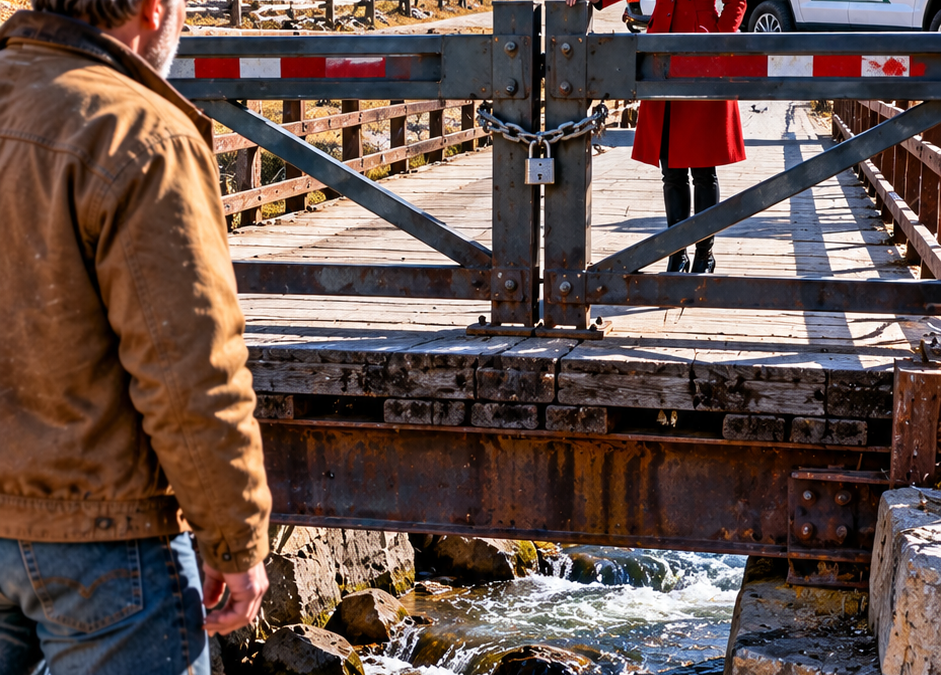
Renata Voss was standing on one of those assumptions the morning I found her at Earl’s Bridge.
She wore a scarlet wool coat.
One gloved hand rested on a brand-new steel gate bolted across the north approach.
A white SUV idled behind her with the Creekside Meadows logo printed on both front doors.
I stopped my truck fifty feet away.
For several seconds, I said nothing.
I looked at the steel gate.
Then the new concrete around the hinge post.
Then the chain.
Then the orange paint sprayed across the white-oak bridge deck.
My father and I had laid those boards five years earlier.
“What is this?”
Renata turned.
“Mr. Calhoun.”
“You put a gate on my bridge.”
“That is your interpretation.”
“No. It is the county recorder’s interpretation.”
Her smile narrowed slightly.
“The crossing is now under association control.”
I got out of the truck.
Mineral Creek moved quietly beneath us, dark water winding through limestone and fallen leaves.
Earl’s Bridge was forty-two feet long.
Three salvaged railroad beams.
Concrete abutments.
White-oak deck.
Twelve feet wide.
My grandfather had built the first version in 1971 with two friends, a borrowed welder, a rented concrete mixer, and the absolute confidence of a man who had never met a project he thought required an engineer.
My father maintained it.
I rebuilt the decking in 2019.
That bridge carried every tractor, hay wagon, stock trailer, feed truck, and piece of equipment serving the one hundred eighty acres south of Mineral Creek.
My house and barn were north of the creek.
Without the bridge, my southern acreage was effectively cut off from normal agricultural access.
Creekside Meadows lay to the east.
Its recorded boundary followed an old fence line roughly forty feet east of the bridge.
The subdivision owned its internal roads.
Its clubhouse.
Its landscaped ponds.
Its private lots.
It did not own Mineral Creek.
It did not own my approach road.
And according to every document recorded in Itasca County, it did not own one bolt in Earl’s Bridge.
Renata handed me a laminated notice.
I read the heading.
CREEKSIDE MEADOWS ASSOCIATION
COMMUNITY EMERGENCY INFRASTRUCTURE COMPLIANCE NOTICE
It cited Resolution 2023-14.
According to the notice, Earl’s Bridge was now designated “community emergency infrastructure.”
The new gate, it said, was required to prevent unauthorized traffic from compromising Creekside’s evacuation route.
I looked at Renata.
“Who has the key?”
“Authorized association personnel.”
“I need the bridge to reach my south pasture.”
“You may submit an access request.”
I actually thought I had misheard her.
“An access request.”
“Yes.”
“For my own bridge.”
“The association is implementing an emergency-management policy.”
“There is a particular kind of arrogance involved in telling a man to request permission to reach his own land.”
Renata did not react.
“You have fourteen days to bring the crossing into compliance.”
“Compliance with what?”
“The association’s emergency road standards.”
“My land is not in your association.”
“The bridge functions as part of a community evacuation corridor.”
“That is not ownership.”
“We’re not going to debate title beside the creek.”
“Good. Then show me the recorded document.”
She held my gaze.
“After fourteen days, the board will take whatever corrective action it considers necessary.”
That sentence mattered.
I just did not know how much yet.
Two men in reflective jackets stood near the southern end of the bridge.
One held a measuring wheel.
The other had marking paint.
I raised my phone and began taking photographs.
Gate.
Lock.
Concrete.
Notice.
Renata.
SUV.
Orange marks.
The men.
Renata watched me.
“They’re conducting a safety assessment.”
“Whose authority?”
“The board’s.”
“That was not my question.”
She turned toward her vehicle.
“Fourteen days, Mr. Calhoun.”
As she drove away, the younger worker looked back at Earl’s Bridge.
He did not look like a man inspecting a gate.
He looked like a man calculating lift points.
That was the first thing I wrote in my notebook.
I did not cut the lock.
I wanted to.
A bolt cutter was less than five minutes away in my shop.
I could have removed that chain, dropped the gate into the grass, and driven my tractor across before Renata reached the clubhouse.
But thirty seconds of satisfaction can create six months of explanations.
The gate was trespass.
It was also evidence.
I walked home and called Gerald Fitch.
Gerald had practiced real-estate law in northern Minnesota for thirty-one years.
He had handled the transfer after my father died.
He knew our title history.
He also possessed the useful personality trait of becoming calmer when everyone else became angry.
He listened to the whole story.
“Prior notice?”
“None.”
“Recorded access agreement?”
“Not that I know of.”
“Any history of regular Creekside traffic?”
“Dad occasionally let residents cross. Mostly walkers. During road work, sometimes vehicles.”
“Did he charge them?”
“No.”
“Written permissions?”
“Some.”
Gerald paused.
“Send me every photograph.”
“They gave me fourteen days.”
“They can print any number they like on a piece of paper.”
I smiled despite myself.
“Do not touch the gate,” he said.
“I know.”
“I mean it.”
“I know.”
“I’ll pull the deed, plat, title history, association filings, and anything recorded against your parcel.”
Then he said the sentence that became the method for everything afterward.
“Let’s find out what the records say.”
The next morning, I called Dale Whitmore.
Dale was a licensed surveyor and had worked in that part of the county long enough to remember Creekside Meadows before the first basement was excavated.
Two days later, his crew found the monuments.
They ran the line.
The result was not close.
The new gate stood fifty-three feet inside my parcel.
Both bridge abutments were mine.
The entire deck was mine.
The approaches were mine.
Dale looked at the creek.
“Any chance the channel migration matters?” I asked.
“No.”
“Why?”
“Your deed uses fixed calls and monuments. Not creek centerline.”
He pointed toward the orange markings on the oak deck.
“What do you think those are?”
He crouched.
Paint marks near beam locations.
Several small arrows.
“Not gate inspection.”
“Then what?”
“If I had to guess? Centerline and lift points.”
I stared across the bridge.
“For what?”
Dale stood.
“To pick steel.”
That was the second detail that bothered me.
Gerald sent Creekside a preservation notice the same afternoon.
It attached my deed.
Dale’s survey.
The subdivision plat.
The letter demanded removal of the gate within seven days.
More importantly, it instructed the association not to alter, relocate, damage, dismantle, or perform work on Earl’s Bridge while ownership remained disputed.
Three days later, Renata responded.
Four pages.
Confident tone.
No deed.
No easement.
No recorded license.
No transfer.
No dedication.
Creekside claimed a prescriptive right created through continuous community use.
The association also asserted authority to protect “common emergency infrastructure.”
Gerald called me.
“She is trying to turn permission into ownership.”
“Can she?”
“Not by writing four pages about it.”
He explained that a prescriptive claim required specific facts.
Open use.
Continuous use.
Use hostile to the owner’s rights for the statutory period.
Permission could defeat that theory.
“But,” Gerald said, “I am not predicting the final result until we have the full history.”
Then he asked something I had not asked myself.
“Why does an HOA east of you suddenly care this much about controlling a bridge that goes deeper into your ranch?”
I had no answer.
Howard Briggs did.
Howard owned forty acres north of me.
Retired high-school teacher.
Attended county meetings recreationally, which I had always considered a mild psychological defect.
He came to my house carrying a folded planning notice.
“Creekside is expanding.”
I opened the document.
Thirty-eight homes.
The old Mercer tract southeast of the existing subdivision.
Creekside Meadows Phase Two.
A planning hearing was scheduled for November 9.
Near the bottom, one condition appeared in bold.
FINAL APPROVAL REQUIRES DOCUMENTATION OF A COMPLIANT SECONDARY EMERGENCY ACCESS ROUTE.
Howard tapped it.
“Their original secondary route went south.”
“Where?”
“Old logging road.”
“That crosses wetlands.”
“Exactly.”
“When did that die?”
“August.”
I looked at him.
“How do you know all this?”
“I read agendas when I can’t sleep.”
The following morning, Gerald and I went to the county planning office.
Phase Two’s submission package was public.
Site plan.
Traffic analysis.
Drainage.
Fire review.
Emergency access.
Sheet C7 showed a dashed route leaving the proposed development.
It crossed the old fence line.
Entered my south pasture road.
Continued north.
And crossed Earl’s Bridge.
I read the label twice.
EXISTING HOA-CONTROLLED EMERGENCY BRIDGE.
Below that was a certification signed by Renata Voss as Director of Community Standards.
She certified that Creekside Meadows possessed enough operational control over the crossing to guarantee emergency access.
The certification was six weeks old.
Six weeks before the gate appeared.
I looked at Gerald.
“The gate isn’t security.”
“No.”
“It’s evidence.”
“Attempted evidence.”
Renata needed something physical.
A gate.
A lock.
A photograph.
Something that made her claim look like an existing reality instead of an unsupported sentence on a development plan.
Then I looked at the dates.
Her fourteen-day compliance deadline ended two days before the planning hearing.
Gerald saw it too.
“Interesting.”
The rest of the file made it clearer.
County planning staff had already asked for the recorded easement.
Renata responded that access rights were “being formalized through existing association authority.”
No easement followed.
I had spent two decades reading engineering memos.
Phrases like “being formalized” are useful when somebody wants an absence to sound temporary.
The developer, North Pine Residential, had a purchase contract that expired December 15 unless preliminary approval was secured.
Projected completed value?
More than seven million dollars.
Now Renata’s urgency made sense.
She was not protecting a historic evacuation route.
She was manufacturing one before a deadline.
Gerald sent planning staff the survey.
Deed.
Plat.
Gate photographs.
Preservation notice.
He did not accuse Renata of fraud.
He did not speculate about motives.
He wrote one paragraph stating that the proposed emergency route crossed private land without any known deed, easement, license, or owner authorization.
The county responded the next business day.
Phase Two’s emergency-access certification was marked unresolved.
The November meeting could proceed for discussion.
No final approval until legal access was documented.
That was the first result that did not depend on my opinion.
Renata learned about it before sunset.
My phone rang at 5:42.
“You contacted planning staff.”
“I corrected their property information.”
“You interfered with a community-safety project.”
“Your project crosses my ranch.”
“Thirty-eight families could lose housing.”
“There are no families yet, Renata.”
Silence.
“There is a developer, a purchase agreement, and a deadline.”
Her tone changed.
“The association is prepared to offer a license fee.”
“How much?”
“One dollar per year.”
I almost laughed.
“For a permanent emergency route.”
“A cooperative access arrangement.”
“Send it to Gerald.”
“If lawyers become necessary, the offer will change.”
“Lawyers became necessary when you poured concrete into my approach road.”
She hung up.
The written agreement arrived that night.
It was not a simple license.
It demanded a perpetual easement.
Twenty-four-hour access.
The right to widen the bridge.
The right to relocate it.
The right to extend those privileges to contractors, developers, successors, and assigns.
My compensation?
One dollar per year.
Then Gerald found the indemnification clause.
Under their language, I would bear certain liability arising from use of the route.
He circled the paragraph.
“They want your land.”
Another circle.
“Your bridge.”
Third.
“And your liability insurance.”
“Very generous.”
“Decline it.”
We did.
Two days later, Creekside issued a violation.
My bridge was twelve feet wide.
The HOA’s new emergency-road standard required twenty feet.
Daily fine after fourteen days?
Five hundred dollars.
I was outside Creekside.
The standard had been adopted that summer.
And the permanent easement Renata wanted gave the HOA the right to widen Earl’s Bridge.
She had invented a violation that only surrendering my property rights could cure.
I had seen similar tactics in public construction disputes.
Define an emergency.
Control the standard.
Then present your preferred solution as inevitable.
But associations leave records.
Minutes.
Newsletters.
Budgets.
Emails.
Howard found one first.
A 2007 Creekside newsletter.
The headline thanked my father, Raymond Calhoun, for granting “temporary access across the Calhoun farm bridge while the primary neighborhood entrance was resurfaced.”
Temporary permission.
Dates included.
May 14 through May 28.
Gerald read it twice.
“Their own publication identifies your father as the owner granting permission.”
We found more.
County road photographs from 2008 showed Creekside traffic using another entrance while Earl’s Bridge was closed.
My farm log documented a 2014 closure.
An HOA email from that year requested permission for two utility carts.
I granted one.
Refused the second.
That was not continuous hostile use.
It was repeated permission.
Repeated requests.
Repeated acknowledgment.
Then came the October 26 board meeting.
Howard came with me.
About forty residents filled the clubhouse.
Renata sat beside board president Mark Vale.
Mark was a homebuilder.
He also had financial interests in three Phase Two lots.
Most residents, I learned quickly, believed Creekside owned Earl’s Bridge.
Why wouldn’t they?
Their newsletter showed photographs of the gate.
Renata referred to it as “our emergency crossing.”
The association map colored it the same way as HOA roads.
Mark opened the agenda item.
“We’re addressing an unfortunate misunderstanding with an adjacent landowner.”
I waited for public comment.
Then I stood.
“My name is Thomas Calhoun.”
People turned.
“The bridge shown on your Phase Two plan is fifty-three feet inside Parcel 0411722.”
I held up Dale’s survey.
“I own Parcel 0411722.”
I put down my deed.
“No easement is recorded across it.”
Then a photograph of the gate.
“Your association installed this on my property without permission.”
Then Sheet C7.
“And represented to Itasca County that you control the crossing.”
Murmurs moved through the room.
Renata leaned toward her microphone.
“Mr. Calhoun is presenting one side of a complicated property matter.”
“Then show the other side.”
She looked at me.
“Show everyone the recorded easement.”
Mark intervened.
“The board will not debate pending legal issues.”
At the far end of the board table, Treasurer Carl Dennis lifted his hand.
“I asked for that easement before Resolution 2023-14.”
The room quieted.
Carl continued.
“I was told counsel had reviewed it.”
Renata’s face stayed controlled.
Mark’s did not.
“The matter was reviewed.”
Carl turned toward her.
“By whom?”
Mark hit the gavel.
“We are not waiving attorney-client privilege in an open meeting.”
Formal-sounding answer.
But not an answer.
I held up the 2007 newsletter.
“Your association thanked my father for temporary permission to use the bridge.”
Now the room became completely quiet.
“One of your own records recognized that the crossing belonged to him.”
A woman in the second row asked whether HOA dues were paying legal expenses related to Phase Two.
Someone else asked why Mark’s financial interest had not been highlighted.
Another homeowner asked the question I thought mattered most.
“If we don’t own the bridge, who is liable if you send an emergency vehicle over it?”
Renata ended the discussion.
“The gate will remain while rights are adjudicated.”
I looked at her.
“And the five-hundred-dollar fines?”
“They continue to accrue.”
That was a terrible answer.
It was also useful.
Forty homeowners heard it.
Afterward, Carl caught Gerald and me in the parking lot.
He looked back toward the clubhouse.
“I voted against that resolution.”
“What?”
“The minutes say unanimous.”
Gerald’s posture changed.
“You have the draft?”
Carl nodded.
“We record meetings to prepare minutes.”
“Audio?”
“Yes.”
“Preserve both.”
Carl lowered his voice.
“There was never a vote to claim ownership of Calhoun’s bridge.”
“What did you vote on?”
“Access-control procedures for common amenities.”
“Property already owned by the HOA?”
“Yes.”
Carl rubbed his forehead.
“Renata put the Calhoun crossing into the implementation memo later.”
The next morning, Gerald filed suit in Itasca County District Court.
Twenty-nine days after the gate appeared.
We asked for a declaration of ownership.
Temporary injunction requiring removal of the gate.
Trespass damages.
Restoration of my approach.
And an order preventing Creekside from asserting control or altering Earl’s Bridge during the litigation.
Our evidence was not dramatic.
Deed.
Plat.
Survey.
Photographs.
Planning file.
Newsletter.
Maintenance records.
Violation notices.
That was enough to schedule an expedited injunction hearing.
The court allowed narrow discovery.
Ownership.
Authority.
Threatened construction.
Two days before Renata’s deposition, Creekside finally produced the legal opinion it had relied on.
Six sentences.
A lawyer had been asked whether the HOA board could regulate access to common amenities.
The lawyer wrote yes.
Assuming those amenities were owned by or legally dedicated to the association.
Then the final sentence:
“This opinion does not address title, easement rights, or property outside the recorded community.”
Renata had forwarded that email to the board with a summary.
“Counsel confirms authority to control the Calhoun crossing.”
I read it three times.
In engineering, summaries matter.
A missing qualification can distort an answer.
But this was not omission.
It replaced the lawyer’s limitation with the exact conclusion the lawyer had refused to give.
At deposition, Gerald put both documents in front of Renata.
“Where does counsel say Creekside owns or controls Mr. Calhoun’s bridge?”
“The opinion confirms procedural authority.”
“That was not my question.”
She folded her hands.
“The bridge functioned as a community amenity for many years.”
“Did you order a title search?”
“I relied on institutional history.”
“Did you read the 2007 newsletter thanking Raymond Calhoun for temporary permission?”
“I do not recall every historical newsletter.”
“Did Creekside possess a recorded easement when you certified operational control to the county?”
Her attorney objected.
Renata still had to answer.
“The rights were being formalized.”
“Was there a recorded easement?”
“No recorded instrument had been located at that time.”
Careful answer.
More damaging than denial.
Gerald showed her the North Pine contract.
“You knew the developer’s purchase deadline was December 15.”
“I was aware of the schedule.”
“You knew Mark Vale held interests in three Phase Two lots.”
“Mr. Vale disclosed his interest.”
“When?”
Her attorney shifted.
Gerald repeated it.
“Before or after the county requested proof of access?”
After a pause:
“After.”
Outside the room, Gerald closed his folder.
“This is no longer only about an aggressive HOA interpretation.”
“What is it about?”
“Whether association authority was used to protect a development deadline tied to private financial interests.”
The injunction hearing lasted ninety minutes.
Judge Miriam Alden had read everything.
Creekside’s attorney argued historic reliance.
Safety.
Emergency planning.
Potential prescriptive rights.
Then Judge Alden asked one question.
“What recorded instrument gives the association a present right to control this parcel?”
The attorney discussed historic use.
“That is not an instrument.”
He mentioned the pending prescriptive claim.
“That is not an instrument either.”
She looked at him.
“Where is the deed?”
None.
“Easement?”
None produced.
“Recorded dedication?”
No.
“License?”
No.
The judge granted our temporary injunction from the bench.
Creekside had seventy-two hours to remove the gate.
Chain.
Hinge post.
Signage.
Fresh concrete.
Restore the gravel approach.
Then she addressed the bridge.
Her written order prohibited the association, officers, employees, contractors, and agents from removing, relocating, modifying, damaging, dismantling, or entering upon Earl’s Bridge except where strictly necessary to remove the unauthorized gate under an agreed work plan.
Gerald had requested that language because Dale had seen those orange lift marks.
Creekside’s attorney agreed to send the gate-removal plan before anyone returned.
Outside the courthouse, Renata stood beside Mark.
She saw me.
“You may have delayed thirty-eight homes.”
“Your certification delayed them.”
“That bridge will never carry the traffic the county requires.”
“Then your project never had a bridge.”
Her eyes moved toward Gerald.
Something changed.
Maybe she finally understood that we were not arguing about whether the bridge was suitable for her development.
We were arguing about whether she had any right to make it part of the development in the first place.
That evening, Creekside’s attorney emailed a one-page removal plan.
Two workers.
Compact loader only.
Cut concrete around new post.
Remove gate.
Fill hole.
Rake gravel.
Three hours.
Friday morning came.
Nobody arrived.
At noon, Gerald contacted opposing counsel.
Contractor rescheduled for Sunday morning.
Still inside the seventy-two-hour deadline.
At four that afternoon, Howard called.
“There are flatbeds behind the Phase Two fence.”
“What kind?”
“And the yellow excavator is back.”
I walked the boundary with my camera.
Through leafless trees, I saw a tracked excavator.
A mobile crane.
Two heavy trailers.
Bracken Site Services.
Same company on the reflective vests worn by the men measuring my bridge when Renata installed the gate.
I sent the photographs to Gerald.
He immediately emailed Creekside’s lawyer.
Observed equipment inconsistent with agreed gate-removal plan.
No heavy equipment authorized.
No equipment permitted onto Calhoun property or bridge.
At 6:11, opposing counsel replied.
“My client confirms only gate removal has been authorized.”
That should have settled it.
It did not.
A fast November front arrived after midnight.
Sleet blew across the ridge.
Wind moved through bare branches.
My house sat nearly three-quarters of a mile from Earl’s Bridge with a wooded rise between us.
At 1:18 a.m., my trail camera sent one image.
Two white work lights through the trees.
The next image never came.
I put on my coat.
Drove.
The north approach was blocked by a Bracken pickup parked sideways.
Nobody inside.
Beyond it, work lights cut through sleet.
Diesel engines.
Steel chain striking steel.
I called the sheriff’s non-emergency line.
Then Gerald.
A deputy arrived twenty-three minutes later.
By then the unauthorized gate was gone.
So was the hinge post.
But two sections of my oak deck were also gone.
A crane cable was attached to the first railroad beam.
The site supervisor walked toward us.
Owen Pike.
He held a tablet.
“The association says this is court-authorized removal.”
I stared at him.
“Removal of what?”
“The crossing.”
Gerald was already on my phone.
“Ask him to read the work order.”
Owen did.
“Remove association gate and obsolete crossing structure. Recover reusable steel. Prepare banks for relocated twenty-foot emergency bridge.”
Gerald’s voice came through speaker.
“There is a court injunction expressly prohibiting removal or modification of the bridge.”
“I have authorization.”
“You have now been given actual notice of the injunction.”
Owen looked at me.
“Our paperwork says the HOA owns the structure.”
“Your paperwork is false.”
The deputy kept his tone neutral.
“I’m not interpreting a civil injunction at two in the morning.”
Fair.
“But now that you’ve been informed of the order, continuing could create substantial liability.”
Owen stepped away and called someone.
He returned.
Jaw tight.
“All lifting stops.”
He told the crew to secure the deck.
For several minutes, I thought that ended it.
Then Mark Vale arrived.
Truck headlights swept across the creek.
He stepped out holding a printed copy of Judge Alden’s order.
Owen walked toward him.
Mark pointed at the paper.
“The court ordered restoration of the approach. The bridge is part of the approach system.”
The deputy held out his hand.
“Show me where it says remove the bridge.”
Mark indicated one paragraph.
Then I pointed to the next.
“That paragraph says you cannot remove or modify the bridge.”
“That refers to the replacement structure.”
“There is no replacement structure.”
The order identified Earl’s Bridge by survey coordinates.
Existing steel-and-oak structure.
No ambiguity.
Mark was not confused.
He was trying to create enough uncertainty for the contractor to act first and let lawyers argue afterward.
Owen refused.
At 2:37 a.m., the engines shut down.
Two removed deck sections were stacked beside the creek.
The first steel beam had been lifted about half an inch off its bearing plate.
The bridge was unusable.
But still standing.
Mark left without speaking to me.
Renata never appeared.
By sunrise, Gerald filed an emergency contempt motion.
Judge Alden scheduled a Monday hearing.
She also ordered every party to preserve all texts, emails, contracts, work orders, photographs, invoices, and electronic records related to the attempted removal.
Bracken produced its file almost immediately.
Their supervisor had been honest.
Renata signed the work order Thursday afternoon.
After the injunction hearing.
Mark approved it at 7:06 that night.
The work order falsely stated the court had directed complete removal of the crossing.
It also stated Creekside owned all recoverable steel.
Then Gerald saw the price.
$74,700.
Creekside’s bylaws required a recorded board vote for any unbudgeted contract over $25,000.
Renata had divided the work.
Mobilization and deck removal:
$24,900.
Beam recovery:
$24,900.
Grading and replacement preparation:
$24,900.
Each one exactly one hundred dollars below the board-approval threshold.
I stared at the three numbers.
That was the moment everything changed for me.
Until then, some part of me still allowed for incompetence.
Aggressive people make reckless assumptions.
Board presidents convince themselves that a title gives them more power than it does.
People under financial pressure make bad decisions.
But this required calculation.
Someone had looked at the bylaws.
Found the approval limit.
Then built three contracts one hundred dollars below it.
They had misstated ownership.
Mobilized a crane.
Promised the lawyers only gate removal.
Then sent workers onto my land after midnight to disable my bridge.
The question was no longer whether Renata had made a mistake.
The question was how many deliberate decisions it took to build that mistake.
Carl answered part of it Sunday.
He gave Gerald the original board-meeting audio and the draft minutes.
The recording confirmed Carl voted no on the relevant resolution.
Another director abstained.
The published minutes called the vote unanimous.
Then Carl produced an email Renata had sent after the injunction hearing.
Gerald read it aloud in my kitchen.
“Mark wants the crossing issue finished before North Pine’s deadline. Once the old structure is removed, Calhoun will have to negotiate over the replacement alignment. Do not circulate this outside the executive group.”
I said nothing.
Gerald read it again.
The strategy was finally written plainly.
The gate had never been the end goal.
Even ownership of Earl’s Bridge was not the end goal.
They needed me dependent.
If my bridge became unusable, I could not efficiently reach one hundred eighty acres.
Then Creekside could offer a solution.
A new twenty-foot bridge approximately sixty feet downstream.
Aligned directly with Phase Two.
All I would have to do was sign their permanent easement.
The gate had been pressure.
The demolition was leverage.
And the court order was something they apparently believed they could reinterpret after the damage was irreversible.
Monday morning, the courtroom was full.
Creekside homeowners occupied two rows.
North Pine Residential sent regional counsel.
Bracken sent Owen and an insurance attorney.
Renata sat beside the HOA lawyer.
Mark sat behind them.
Gerald began with Judge Alden’s injunction.
He read the prohibition slowly.
No removal.
No relocation.
No modification.
No damage.
Then he showed the agreed gate-removal plan.
Creekside’s Friday assurance that only gate work had been authorized.
Photographs of the crane.
Bracken work order.
Renata’s signature.
Mark’s approval.
Owen testified.
“Ms. Voss told us the court wanted the entire crossing removed before Monday.”
“Did that match the original estimate you had prepared?”
“No.”
“What did you do?”
“I asked for written confirmation.”
“And you received?”
He identified the signed work order.
“Why did you stop?”
“Mr. Calhoun gave us the actual court order.”
“What happened after that?”
“Our attorney reviewed it and told us not to remove another bolt.”
Creekside’s attorney argued Renata believed Earl’s Bridge posed a safety risk.
Then he addressed the three invoices.
Separate accounting categories.
Not an attempt to avoid board approval.
Judge Alden looked down.
“Each category cost exactly twenty-four thousand nine hundred dollars?”
“That was the contractor’s allocation.”
Owen’s insurance attorney stood.
“Your Honor, Bracken submitted one estimate.”
He held it up.
“Seventy-four thousand seven hundred dollars.”
The judge looked at Creekside’s attorney.
“Your client created the three divisions?”
The attorney requested a recess.
That was the first time I saw Renata lose control without anyone raising their voice.
Before that morning, she had always defined the problem.
Her deadline.
Her rule.
Her emergency.
Her remedy.
Now each answer she offered caused somebody else to produce another document.
After the recess, Renata testified.
Gerald showed her the email to Carl.
“What did you mean when you wrote that Mr. Calhoun would have to negotiate after the bridge was removed?”
“The existing crossing could not satisfy emergency-road requirements.”
“That was not my question.”
“A replacement crossing would benefit both properties.”
“Did Mr. Calhoun authorize you to disable his bridge?”
“No.”
“Did the board vote to disable it?”
“The executive group authorized the work.”
Gerald paused.
“Where in Creekside’s bylaws is an executive group defined?”
Renata looked toward Mark.
“Not by that name.”
“Did the official minutes record a vote approving $74,700 for bridge demolition?”
“No.”
“You signed a contractor work order stating Creekside owned the bridge.”
“Based on our claim of operational control.”
“Ownership and claimed control are not the same thing.”
Her attorney objected.
Judge Alden overruled him.
Gerald repeated it.
“Are ownership and disputed operational control the same legal concept?”
Finally:
“No.”
The judge found Creekside Meadows in civil contempt.
She found Renata and Mark had actual notice of the injunction.
The language was clear.
The attempted removal was intentional.
She ordered immediate stabilization under a structural engineer selected by me.
Renata and Mark were prohibited from entering my property.
Creekside had to deposit $150,000 with the court as security toward restoration and contempt-related costs.
Final damages would be determined later.
I did not cheer.
Nobody did.
Real courtrooms rarely feel like the ending of anything.
The ruling meant we could stop the immediate damage.
The rest still had to be repaired.
The forensic production ordered by the court revealed something else.
North Pine had never told Creekside to seize my bridge.
The developer’s internal emails showed nearly the opposite.
Its land-use manager repeatedly warned Mark that emergency access could not be represented as controlled unless a recorded easement existed.
When the county challenged the route, North Pine offered to extend the purchase deadline sixty days so Creekside could negotiate with me properly.
Mark did not share the entire message.
He forwarded the page discussing the emergency-access condition.
He omitted the page offering the extension.
Then he told board members the transaction would collapse if they failed to act before December 15.
Why?
Three Phase Two lots were tied to option agreements that paid Mark a bonus if preliminary approval came before the original deadline.
An extension erased the bonus.
Renata had her own incentive.
If Phase Two entered construction, she was slated to become executive administrator.
Higher salary.
Expanded authority.
Promotion.
That did not make what they did less wrong.
But it made the story more disturbing.
Renata did not wake up one morning obsessed with my grandfather’s bridge.
She wanted a development approved.
The development needed access.
Access required a bridge.
She lacked rights to the bridge.
Instead of treating that fact as a constraint, she treated it as an inconvenience her title could overcome.
Each decision made the next one easier.
Call it community infrastructure.
Install a gate.
Create a violation.
Offer a one-dollar easement.
Change meeting minutes.
Misstate legal advice.
Split contracts.
Send a crane.
By then, reality had become something to manage rather than respect.
Creekside residents reacted quickly once the documents became public.
Twenty-three homeowners petitioned for a special meeting.
Carl distributed the authentic recording and both versions of the minutes.
Mark called the changes “clerical corrections.”
A woman in the second row asked:
“How does a no vote become a yes because of formatting?”
Mark had no useful answer.
The membership removed him by the margin required under its bylaws.
Two directors resigned.
Carl refused the presidency.
He agreed to serve temporarily while an independent management company reviewed association contracts and records.
Renata was put on leave.
Three weeks later, she was terminated.
Reasons listed:
Exceeding purchasing authority.
Altering official records.
Directing work contrary to a court order.
The daily fines against me disappeared.
Every Creekside map identifying Earl’s Bridge as HOA infrastructure was corrected.
Resident materials were amended.
Emergency plans removed my parcel.
Creekside issued a written notice acknowledging that Earl’s Bridge was private and residents had no right to use it without my permission.
Meanwhile, I still had a damaged bridge.
Warren Pruitt inspected it.
Warren and I had worked together years earlier.
He was a structural engineer who disliked vague verbs.
He would not say something was “affected.”
He would tell you which bearing moved, how far, and what failed first.
He spent an afternoon measuring Earl’s Bridge.
The first steel beam had twisted near its bearing.
Several oak planks had split around bolts.
The crane lift damaged the connection at the north abutment.
Excavation for Renata’s gate post undermined part of the approach edge.
The structure could be restored.
But not by simply dropping the beam back into position.
Warren designed a full repair.
Original three-beam configuration preserved.
New bearing plates.
Concrete repair.
White-oak deck.
Environmental protection below.
Temporary agricultural access during construction.
Estimated cost:
$126,000.
By then, the remaining civil case was no longer headed toward some theatrical trial.
Once the contempt finding, altered records, split invoices, and emails entered the record, the insurers and new board requested mediation.
Gerald and I went in with four conditions.
First:
Earl’s Bridge would be restored to Warren’s design at no cost to me.
Second:
Creekside Meadows would record a declaration confirming Parcel 0411722 was outside the association and carried no HOA easement.
Third:
The association would pay documented agricultural-use losses and recoverable legal and expert costs created by the contempt proceedings.
Fourth:
Nothing in the settlement could prevent me from discussing the recorded history, public proceedings, or documents relating to the dispute.
The mediation lasted eleven hours.
Creekside accepted.
Bracken’s insurer paid part of the repair.
Association reserves and management-liability coverage covered other portions.
My documented agricultural-use losses totaled $18,400.
Recoverable legal and expert costs came to about $68,000.
Final bridge stabilization and reconstruction cost $128,600.
Those numbers were real.
They did not need to become larger for the lesson to matter.
There remained one problem.
Phase Two still needed a secondary emergency route.
North Pine redesigned it.
The developer bought a narrow strip along the southeast edge of the Mercer tract from a willing landowner.
It built an all-weather connection to Township Road 44.
It probably cost more than negotiating honestly with me would have cost.
But there was one critical difference.
Nobody had to steal it.
At the next county planning hearing, North Pine’s land-use manager formally withdrew every drawing that crossed my parcel.
The revised emergency road was approved subject to normal wetland and fire review.
After the hearing, the land-use manager approached me in the hallway.
“For whatever it is worth, we were told your easement was already approved.”
“By me?”
“No. We were told the association had authority to finish it.”
I looked at him.
“Authority is one of those words people use when they don’t want you to ask for the document.”
He gave a tired smile.
“We ask for the document now.”
That may have been one of the more useful outcomes of the whole thing.
Winter arrived before the permanent bridge work could begin.
Warren’s contractor installed a temporary rated crossing so I could move feed and equipment.
Permanent construction started in March after Mineral Creek ice cleared.
I stood there when the repaired first beam was lifted back onto Earl’s concrete abutment.
Howard stood beside me.
Hands deep in his coat pockets.
Carl came down from Creekside carrying a thermos.
He had no obligation to be there.
But he had been the first board member willing to say the published minutes were false.
He watched the crane settle the beam.
“Your grandfather poured those abutments?”
“Three weekends in 1971.”
Carl looked at the environmental mats.
The bearing plates.
Hard hats.
Inspection equipment.
“Think Earl would approve of all this engineering?”
“He would complain about the invoice.”
Howard laughed.
“Then?”
“He’d check every bolt.”
By late April, the white-oak deck was complete.
Twelve feet wide.
Exactly as before.
Not twenty.
Not a subdivision road.
A private agricultural bridge.
At the north approach, I installed a gate of my own.
Not on the bridge itself.
Several yards back.
Plain steel.
No HOA logo.
No laminated compliance notice.
One small sign:
PRIVATE FARM ACCESS
EMERGENCY ENTRY BY COUNTY AUTHORIZATION
I gave the local fire district a revocable license for actual emergencies.
Wildfire.
Rescue.
Life safety.
No benefit to Creekside’s development.
No permanent public route.
No right transferable to a future developer.
A few people asked why I allowed emergency access after Creekside had abused the same argument.
The answer was simple.
Renata using “safety” dishonestly did not make safety unimportant.
Protecting property rights does not require becoming unreasonable.
It requires knowing the difference between permission you choose to grant and a right someone else tries to manufacture.
On the evening after final inspection, I started my father’s old tractor.
The engine had a rough idle it had possessed since somewhere around 1998.
I drove slowly across Earl’s Bridge.
The restored steel settled against the new bearings.
There was a faint metallic sound beneath the oak.
I remembered that sound from childhood.
Below me, Mineral Creek carried the last snowmelt through the limestone channel.
I reached the south side.
Stopped.
Looked back.
For months, Creekside had described the conflict as an argument over safety.
An old bridge.
One stubborn landowner.
Thirty-eight future homes.
The documents told a less dramatic and much more important story.
The deed showed ownership.
Dale’s survey showed geography.
The newsletter showed permission.
County planning records showed the development deadline.
The legal email showed exactly what counsel had not approved.
The altered minutes showed how authority was manufactured inside the association.
The split work orders showed planning.
The email to Carl showed purpose.
No single piece of paper won everything.
Each document simply removed one more place where a false claim could hide.
That was familiar to me.
Engineering works the same way.
You rarely prove a complicated failure with one dramatic observation.
You compare measurements.
Drawings.
Loads.
Material.
Sequence.
The truth appears where independent facts agree.
What bothered me most about Renata was never that she was confident.
Confidence is not illegal.
It was not that she wanted Phase Two approved.
Development is not inherently wrong.
Thirty-eight homes were eventually built.
People live there now.
Their children ride bicycles on streets that did not exist when my grandfather bought the farm.
That is life.
Land changes.
Communities grow.
People negotiate.
What mattered was the assumption that somebody else’s rights became flexible because her deadline was important.
That idea almost cost me my bridge.
And it cost Creekside far more than a fair easement negotiation ever would have.
The new board changed how it operated.
Full meeting audio was posted alongside minutes.
Large contracts required multiple approvals.
Property claims had to be supported by recorded documents before appearing on association maps.
Carl stayed involved for a while.
He still visits occasionally.
Usually coffee.
Usually no agenda.
Howard continues reading county planning packets for pleasure.
I still believe that requires professional help.
Mark sold his Phase Two options.
He did not receive his original approval bonus.
Renata moved away the following summer.
I never spoke with either of them again.
I kept one piece of the damaged bridge.
A section of white oak the crane crew had removed that night.
The wood was split around one bolt hole.
Orange lift paint still stained one edge.
I cut it square.
Sanded one face.
Then mounted Creekside’s original brass padlock to it.
It hangs in my workshop beneath a copy of Dale’s survey.
Not as a trophy.
I do not need one.
It hangs there because objects have a way of making abstract lessons difficult to forget.
That lock was heavy.
The gate looked permanent.
The HOA logo looked official.
The violation notices sounded authoritative.
The fourteen-day deadline felt urgent.
The lawyers’ language sounded complicated.
The $7 million project made the situation feel bigger than one old farmer and one private bridge.
But none of those things moved the boundary fifty-three feet.
None created an easement.
None changed who owned Earl’s Bridge.
And none changed the meaning of the injunction the night the crane arrived.
The line on the survey never moved.
Neither did the truth.
Sometimes now, when I cross the bridge at dusk, I slow halfway across.
Mineral Creek is usually quiet.
The southern pasture opens beyond the trees.
In summer, cattle gather near the shade.
In autumn, hay wagons cross one at a time.
There is nothing impressive about the bridge from a distance.
Three steel beams.
Concrete.
Oak.
A structure my grandfather built because he needed to get a tractor across water.
That may be why I value it more now.
Creekside spent months trying to turn it into something else.
Community infrastructure.
Emergency corridor.
Phase Two access.
A bargaining chip.
A liability.
An obstacle.
A future twenty-foot road.
To my grandfather, it had been simpler.
A bridge was the place where land stopped on one side of a creek and started again on the other.
You built it carefully.
You maintained it.
You crossed it when you had work to do.
After everything that happened, that definition still suits me best.
And every time my tractor reaches the southern abutment, I remember the morning Renata stood beside her new gate and told me the bridge was under association control.
She had a laminated notice.
A resolution number.
A deadline.
A steel lock.
A development plan.
Everything she needed to look official.
Everything except the one thing that mattered.
The right to be there.

