𝗙𝗨𝗟𝗟 𝗦𝗧𝗢𝗥𝗬 The Gate Across My Family Road Was Built to Force One Signature They Couldn’t Get Any Other Way
𝗙𝗨𝗟𝗟 𝗦𝗧𝗢𝗥𝗬
I told her no again.
Clare did not even sit down that time.
Lenora looked between us.
“The road is already partially subject to Cedar Hollow access rights.”
“For emergency vehicles,” I said.
“You may want to review your deed before making this expensive for yourself.”
Then she smiled.
That smile stayed with me.
Not because it was threatening.
Because it was confident.
Ten days later, Cedar Hollow’s attorney mailed us what he called a 1998 easement amendment.
According to the photocopy, the original emergency access had been expanded into a permanent right-of-way for residents, guests, contractors, utility providers, and any future development phase connected to Cedar Hollow.
At first glance, the document looked official.
Signatures.
Notary seal.
County recording stamp.
Legal language.
But three things bothered me.
The typeface did not match the original easement packet.
My father’s middle initial was wrong.
And the parcel number listed in the legal description belonged to land on the opposite side of the county.
I did not call Lenora and accuse her of forgery.
Evidence is strongest before the other side knows what you noticed.
Clare and I hired Dana Holt, a property attorney, and Everett Shaw, a licensed surveyor with thirty years of experience.
Dana requested a certified copy of the alleged amendment directly from the county recorder.
Everett began retracing our boundary and the original twelve-foot emergency strip.
Before either could finish, I had to leave for a scheduled federal assignment.
Clare stayed behind.
She could not simply abandon the property.
She ran a small wildlife rehabilitation operation out of one of our barns.
At the time, she had two injured owls and a pair of orphaned fox kits that needed feeding and medication.
That Tuesday morning, at 6:17, she drove toward town to buy medical supplies.
Two black SUVs blocked Mercer Ridge Road.
A steel arm had been drilled across both lanes.
A camera mounted on a new post rotated toward her windshield.
A white sign read:
CEDAR HOLLOW HOA
AUTHORIZED ACCESS ONLY
Clare started recording before lowering her window.
A security supervisor named Travis Boone walked toward her truck.
“Morning,” he said. “You’ll need an access card.”
“I don’t have one.”
“Then you need to turn around.”
“I live down this road.”
“You’re not listed as a Cedar Hollow resident.”
“I’m not a Cedar Hollow resident.”
He looked confused.
“I own this road.”
Travis glanced toward the camera above him.
“Not according to the documents we were given.”
Clare called Lenora.
Seven minutes later, Lenora arrived in a silver sedan.
That was one of the details I kept returning to.
Seven minutes.
She was close.
Maybe waiting.
Maybe expecting the confrontation.
She stepped from the sedan wearing another red suit.
Clare kept her phone pointed toward her.
Lenora looked directly into the camera.
“The board has activated its access rights.”
“On my road?”
“Your husband can discuss compensation when he comes home.”
“Move your equipment.”
“Clare.”
“Move it off my property.”
Lenora turned slightly.
“Travis, remove her from the controlled area.”
Controlled area.
Those two words would matter later.
Clare reached toward the padlock on the barrier.
Not to cut it.
Not to damage it.
To inspect it.
Travis stepped between her and the gate.
“Don’t touch me,” she said.
He grabbed her forearm.
She pulled back.
He shoved her.
Hard.
Her right foot slipped off the pavement.
Her knee hit gravel.
Her phone flew from her hand.
The camera kept recording.
Lenora walked past without checking whether Clare was hurt.
“Change the lock,” she told Travis. “And document her attempted trespass.”
Then Clare called me.
A sheriff’s deputy arrived about forty minutes later.
He photographed the gate.
Photographed Clare’s knee.
Took her statement.
Travis produced the photocopied amendment.
Because both parties claimed legal rights to the road, the deputy told Clare the access dispute would likely require a civil ruling.
He did, however, warn Travis that no easement granted authority to assault anybody.
He also told the security crew they could not stop Clare from walking across land she claimed and appeared to own.
That was not the dramatic resolution people imagine police can provide.
Real property disputes rarely work that way.
A uniform can stop violence.
It cannot rewrite a deed beside the road.
Dana filed for a temporary restraining order that afternoon.
The emergency hearing was set ten days later.
That gave Lenora ten days to prove her easement.
It also gave her ten days to make the lie look permanent.
I arrived home the following evening.
The checkpoint had grown.
Portable guard booth.
Four additional cameras.
Concrete bases.
Another sign.
Rather than walk into a confrontation, Clare met me at a service trail behind our pasture.
We carried my bag nearly half a mile to the house.
In the kitchen, she showed me the video.
I watched Travis shove her once.
Then again.
Then I increased the volume.
Behind Lenora’s voice, a radio crackled.
A man said, “Construction convoy is two minutes out.”
I looked at Clare.
“Play that again.”
She did.
“Construction convoy is two minutes out.”
The gate had not been installed merely to keep us from using the road.
It had been installed to allow somebody else to use it.
At 5:40 the next morning, we heard engines.
Three dump trucks and a concrete pump rolled through the checkpoint.
Clare filmed them from behind our fence.
The last truck cut the corner too tightly.
Its rear tire clipped an old timber post.
The edge of our culvert cracked.
Water immediately began cutting a brown channel through the gravel shoulder.
I called the sheriff.
Added property damage to the report.
Dana sent Cedar Hollow a preservation demand and formal notice to cease all non-emergency use.
Lenora responded with an $18,500 “security interference assessment.”
We were not Cedar Hollow members.
She had no more authority to fine us than I had to fine the governor.
But the notice gave us something useful.
At the bottom was the contractor operating the checkpoint.
Vance Community Security LLC.
Clare searched the state business registry.
The company had been formed four months earlier.
Its mailing address was a post office box less than two miles from Lenora’s home.
The listed manager was Nolan Price.
I knew the name.
Six months earlier, my fugitive task force had helped locate a financial broker wanted in another state.
Nolan Price was not our fugitive.
But his name had appeared repeatedly among shell-company contacts in the financial records.
That did not mean he committed a crime.
Recognition is not evidence.
Patterns are not conclusions.
That distinction was exactly why I called my supervisor before doing anything else.
I disclosed everything.
My ownership of the road.
Clare’s assault.
The HOA dispute.
Our financial interest.
Nolan Price’s name.
My supervisor did not hesitate.
“You’re recused.”
“Understood.”
“Do not access the old case.”
“I won’t.”
“Do not contact Price.”
“I won’t.”
“Send public records through counsel.”
That recusal protected me more than it restricted me.
If anything criminal was happening, the case had to survive without my fingerprints on it.
Dana forwarded the public information through the proper federal intake process.
After that, I received no privileged updates.
I focused on the civil case.
Everett arrived with a robotic total station, field notes, county monument records, and the patience of a man who had spent decades watching people discover that fences were opinions and recorded boundaries were not.
He recovered the original iron pins.
Then he measured Lenora’s checkpoint.
He checked twice.
“Forty-one feet.”
Clare folded her arms.
“Forty-one feet what?”
“Inside your parcel.”
She stared toward the barrier.
Everett adjusted his glasses.
“And the emergency easement begins farther east.”
“So the gate isn’t even inside the easement?”
“No.”
Clare almost laughed.
“That is a remarkable mistake.”
Everett looked toward her.
“Mistakes usually wander a few inches.”
He pointed at the instrument.
“Forty-one feet is a decision.”
Then he showed us something more important.
The recording stamp printed on Lenora’s amendment contained an instrument number.
Everett entered the number into the county index.
The number existed.
It just did not belong to an easement.
It belonged to a sewer-release document filed for a shopping center nine miles away.
Somebody had taken a real recording stamp from an unrelated county document and placed it onto the supposed amendment.
The paper Cedar Hollow was using to seize our road had never been recorded.
That did not prove Lenora personally created it.
But it proved the document was not what she claimed.
Two days later, Cedar Hollow held a special board meeting.
Lenora invited every homeowner.
The road dispute was first on the agenda.
Dana advised us to attend and speak as little as possible.
The restraining-order hearing was seven days away.
Anything said in anger could become evidence.
The clubhouse was packed.
Lenora stood beneath a projected map.
Mercer Ridge Road glowed green.
Travis guarded the entrance.
Several homeowners wore blue lanyards holding their new access cards.
Lenora spoke about wildfire evacuation.
Safety.
Home values.
Secondary access.
She described Clare and me as outsiders obstructing a community improvement.
It was effective.
Nobody wants to oppose an evacuation route when children live behind the gate.
Then she announced the fee.
Two thousand four hundred dollars per household.
Cedar Hollow had 255 homes.
That meant $612,000.
I looked toward Dana.
She had already written the number down.
Residents were being charged more than half a million dollars to “convert” a road Cedar Hollow did not own.
When Lenora opened questions, an older woman raised her hand.
Gray hair.
Straight posture.
Ruth Calder.
“Has the board received an independent title opinion confirming permanent access?”
Lenora smiled.
“Our counsel has reviewed the matter.”
Ruth did not move.
“That was not my question.”
The room became quieter.
Lenora called on someone else.
Then she invited Clare to the front.
A document waited on the table.
ACKNOWLEDGMENT OF EXISTING EASEMENT.
“There’s no need for this conflict,” Lenora said. “Sign the acknowledgement and we can resolve compensation privately.”
Clare kept her hands away from the pen.
“If the easement already exists, why do you need me to acknowledge it?”
“It is routine.”
“For whom?”
“Clare.”
“For whom?”
Lenora leaned closer.
“For people with enough money to make this very painful for you.”
That was her second serious mistake.
Not a legal argument.
A threat.
I stepped forward for the first time.
“Is Phase Two financing contingent on our signature?”
Lenora looked at me.
Just half a second.
But sometimes half a second is enough.
She turned to the room.
“The Mercers are willing to jeopardize emergency access for every family here because they believe one private road matters more than this community.”
I wanted to answer.
Dana touched my arm.
No.
Clare did something better.
She pointed to the projected map.
“Show everyone where the twelve-foot emergency easement actually sits.”
Lenora stared at the map.
“Everyone can see—”
“No. Show them the recorded strip.”
Her green overlay covered the entire road.
Including the checkpoint.
Including forty-one feet of land outside the easement.
People began whispering.
Lenora ended the meeting early.
As we left, Ruth slipped a folded note into Clare’s hand.
Five words.
CHECK THE FEBRUARY BOARD PACKET.
The next morning, we met Ruth at a diner.
She had served as Cedar Hollow’s volunteer treasurer for eight years before Lenora removed her from the finance committee.
Ruth brought the February packet.
Page forty-seven contained a preliminary traffic study.
It confirmed what we already knew.
The existing Cedar Hollow entrance did not meet projected two-way construction requirements.
Investors would not release the next financing round until the project secured verified secondary access.
Then Ruth showed us the vendor schedule.
Vance Community Security.
$153,000 at checkpoint installation.
Another $153,000 after thirty days.
Remaining balance after Mercer access acknowledgement.
The road assessment was not mainly about pavement.
Half the money would go to Lenora’s security company.
And the final payment depended on our signature.
Ruth had something else.
The name of Cedar Hollow’s original developer.
Martin Weller.
Eighty-four.
Living in Arizona.
Dana contacted him.
Martin remembered my father.
More importantly, he remembered the access negotiation.
“Your father refused a permanent entrance,” Martin told us during the video call.
He held up an old closing binder.
“That is why the agreement says emergency vehicles only.”
Inside was a signed letter from Cedar Hollow’s original development company.
It stated that Mercer Ridge Road would remain private.
Neither the HOA nor any future development phase would gain residential or construction access without a new written agreement from the Mercer family.
Martin agreed to send the original to Dana.
He also agreed to testify.
By then, three different types of evidence told the same story.
Everett’s survey established the physical boundary.
The county index showed Lenora’s amendment had never been recorded.
Martin’s closing documents established the original intent.
I trusted those three boring pieces of evidence more than any dramatic accusation I could make.
Lenora sensed the shift.
The following night, someone removed two of Everett’s survey stakes near the culvert.
Our trail camera recorded a Cedar Hollow security SUV arriving at 1:13 a.m.
The driver wore a Cedar Hollow jacket but kept his face turned away.
Removing a survey stake does not move a property boundary.
It simply creates another report.
Everett reset them the next morning.
Documented the disturbance.
Dana added the footage to our filing.
The sheriff opened a vandalism report.
Lenora responded by announcing Cedar Hollow would pave Mercer Ridge Road forty-eight hours before our hearing.
That was not random.
Once the road was widened and paved, physical evidence could be altered.
Drainage damaged.
Shoulders removed.
And the court would face a completed project instead of a proposed one.
Dana requested an immediate preservation order.
Before the judge ruled, one Cedar Hollow resident posted a question to the community forum.
Why are we spending $612,000 on a road before proving we own it?
Thirty-seven residents demanded an emergency vote.
Lenora deleted the thread.
Screenshots spread faster than she could erase it.
That evening, Travis came to our back fence alone.
His SUV remained on Cedar Hollow land.
His hands were visible.
“I need to talk.”
I raised my phone.
“I’m recording.”
He nodded.
“I thought the easement was real.”
“You still shoved my wife.”
His eyes dropped.
“I know.”
Clare stood beside me.
“Why did you do it?”
“Lenora told me to clear you before the convoy arrived.”
“What convoy?”
“The trucks.”
“We know about the trucks.”
Travis swallowed.
“She said once construction traffic used the road continuously, you would understand fighting was pointless.”
I stared at him.
“She thought actual use would improve her legal position?”
“That’s what she said.”
“And pressure us into selling?”
He nodded.
Clare asked, “Do you have that instruction?”
Travis glanced toward the trees.
“The company phones back everything up automatically.”
“Voice messages?”
“Yes.”
“Where?”
“Nolan controls the account.”
Nolan Price again.
I asked nothing else about him.
Travis looked at me.
“I came to apologize. I’m not trying to get buried with her.”
I felt no sympathy.
But I understood the instinct.
“Then tell the truth to people with authority.”
I did not promise him protection.
I had no authority to do that.
Dana documented the conversation and forwarded it to the sheriff and federal intake contact.
The next morning, the judge entered a short emergency order.
Cedar Hollow could not alter Mercer Ridge Road until the full hearing.
The ruling did not determine ownership.
It preserved the status quo.
At 6:05, two pavers and a milling machine stopped at Lenora’s checkpoint.
Lenora stood beside them in a red coat.
The crew supervisor read the court order Dana had posted.
Lenora told him it was fraudulent.
He called his office.
Then every machine turned around.
For the first time, Cedar Hollow residents watched Lenora issue an order and saw people refuse to obey.
She escalated again.
She emailed the community claiming we had fabricated the survey, endangered emergency access, and manipulated a local judge.
She demanded immediate payment of the road assessment.
Late fees would follow.
Collections would begin.
That email traveled through the HOA’s interstate management platform.
The assessments were processed through a bank service located outside the state.
Those facts did not magically transform bad HOA behavior into a federal offense.
Federal cases require evidence of intent, jurisdiction, transactions, and a scheme that can survive scrutiny.
Lenora kept creating those things.
Two days before the hearing, Dana received the county recorder’s certified response.
No 1998 easement amendment had ever been filed.
The instrument number belonged to the shopping-center sewer release.
Exactly as Everett discovered.
Then came the additional detail.
Three weeks earlier, a woman identifying herself as an employee of Cedar Hollow management attempted to file a “corrected” copy of the amendment.
The clerk rejected it.
Defective acknowledgment.
Wrong parcel description.
The attempted filing occurred five days after I rejected Lenora’s seventy-five-thousand-dollar offer.
I sat at Dana’s conference table reading the certification.
“So this wasn’t something they found.”
Dana shook her head.
“Not if the recorder’s timeline is accurate.”
“Somebody tried to create the public record after we said no.”
“Yes.”
Our property dispute was becoming something larger.
The morning before the civil hearing, Dana called us into her office.
Two people waited inside.
Special Agent Lena Ortiz from the FBI.
Postal Inspector Marcus Bell.
Agent Ortiz began by looking directly at me.
“Mr. Mercer, because you and your wife are victims and because you have a financial interest in this property, you will have no role in our investigation.”
“Understood.”
“You will not request internal information through your employment.”
“Understood.”
“You will not contact subjects on our behalf.”
“I won’t.”
Then they interviewed Clare.
Ruth.
Everett.
They collected certified copies from original sources instead of relying on ours.
They obtained Clare’s original video with metadata.
Documented the transfer.
Postal Inspector Bell asked about mailed notices.
Agent Ortiz asked about electronic assessments, vendor transfers, shell companies, and investor communications.
Before leaving, she asked us one question.
“Have either of you heard the name Brier Glenn?”
“No,” Clare said.
I shook my head.
Ortiz closed her notebook.
“Then don’t search it.”
That told me enough.
Mercer Ridge Road might not be the first.
The civil hearing began at nine the next morning.
Lenora arrived with two attorneys and a binder thick enough to look convincing from across a courtroom.
She was not wearing red.
Gray suit.
Neutral.
Controlled.
Cedar Hollow’s attorney argued that the HOA relied in good faith on an amendment located in archived management records.
He said residents had occasionally used the road in previous years.
The checkpoint merely formalized a preexisting right.
Dana began with geography.
Everett displayed the recorded plat.
Original pins.
Twelve-foot emergency strip.
Culvert.
Our boundary.
Then the checkpoint.
Forty-one feet inside our property.
The county recorder’s custodian testified next.
No permanent amendment existed in the official index.
The stamp had been copied from another instrument.
Martin Weller appeared by video.
He identified his signature and the original developer letter.
“My agreement with Mr. Mercer’s father was emergency access only,” he said. “He specifically rejected a subdivision entrance.”
Then Dana played Clare’s video.
The courtroom heard Lenora say “controlled area.”
It heard the construction convoy approaching.
It watched Travis grab Clare.
Watched her hit the gravel.
Heard Lenora tell him to change the lock.
Lenora’s attorney requested a recess.
During that recess, Ruth entered the hallway carrying one more document.
A current board member had emailed it to her that morning after watching the testimony.
It was the private term sheet for the sixty-two-home expansion.
The investors had promised a consulting success fee.
$1.8 million.
Payable to an entity controlled by Lenora if she delivered verified permanent access through Mercer Ridge Road before the end of the month.
Not to Cedar Hollow.
Not to the HOA.
To Lenora’s company.
Twenty-four times the highest amount she had offered us.
The term sheet contained another important sentence.
Investors would not close based solely on the disputed 1998 amendment.
They required either fresh owner consent or a final judicial ruling.
Our signature was not housekeeping.
It was the key to Lenora’s payout.
That was why the “acknowledgment” waited on the table.
That was why she needed Clare to sign.
When the hearing resumed, Cedar Hollow’s attorney looked different.
He asked to withdraw reliance on the amendment pending internal review.
Dana objected.
The document had already been used.
A gate installed.
Fees imposed.
Assessments collected.
Construction vehicles sent through.
Force used against Clare.
The judge issued a preliminary injunction.
Cedar Hollow, its residents, contractors, and agents were prohibited from using Mercer Ridge Road except for the narrow emergency purpose stated in the original easement.
The checkpoint had to be removed within seventy-two hours.
The road assessment could not be collected or spent.
All related records had to be preserved.
Our road was restored legally that morning.
Lenora’s problems were just beginning.
At 6:30 the next day, Clare and I stood beside the damaged culvert waiting for the court-approved removal crew.
Travis was gone.
Two unfamiliar guards unlocked the barrier.
Then black federal vehicles passed Mercer Ridge Road.
They did not turn toward us.
They continued through Cedar Hollow’s main entrance.
I stayed beside Clare.
That may disappoint people who imagine law enforcement as a personal weapon.
It is not.
Sometimes the most important thing an officer can do is remove himself completely from a case.
If I had taken part, Lenora’s lawyers could have spent years arguing the investigation was revenge.
I gave them no such argument.
Agent Ortiz’s team entered the management office under federal warrant.
Postal inspectors secured mailed assessment records and vendor documents.
Another team searched Vance Community Security.
State investigators served warrants related to the attempted land filing and Clare’s assault.
Cedar Hollow residents stood outside filming.
Nobody cheered.
Most looked embarrassed.
Some looked afraid.
For weeks, they had been told Clare and I were threatening their safety.
Now agents were carrying boxes out of the office that had issued those warnings.
At 7:12, the removal crew cut the barrier bolts from our pavement.
Clare watched the steel arm rise.
“That thing looked bigger when it belonged to them.”
I looked at her.
“It never belonged to them.”
The cameras came down.
Posts.
Guard booth.
Electrical boxes.
Everett documented every hole.
The insurer would later pay for restoration while damages were litigated.
For the first time in eleven days, Clare drove from our house to the county road without asking a stranger for permission.
She came back twenty minutes later carrying coffee.
Nothing dramatic.
Just coffee.
But I remember watching her truck pass the place where the gate had been.
That simple trip felt better than anything I could have shouted at Lenora.
The federal investigation continued for weeks.
Servers were copied.
Transfers traced.
Board members interviewed.
Document metadata compared.
Then Dana received notice that a criminal complaint had been unsealed.
Lenora Vance and Nolan Price were charged in an alleged scheme involving electronic payments, mailed demands, forged access documents, and shell companies.
The charges still had to be proved.
Travis faced state charges connected to Clare’s assault and evidence tampering.
He began cooperating.
That cooperation explained Brier Glenn.
Brier Glenn was another subdivision eighty miles north.
Two years earlier, its management company had claimed unrestricted use of a widow’s farm road.
The supporting amendment used the same fake notary seal.
The widow’s name was Evelyn Hart.
She could not afford a prolonged legal fight.
She accepted twelve thousand dollars and signed a new access agreement.
That access later became worth more than two hundred thousand to the neighboring development.
Nolan Price had consulted for that management company.
Investigators reportedly found versions of the same template on his computer.
Names changed.
Parcel descriptions changed.
Dates changed.
Several formatting errors remained identical.
The fake recording stamps came from legitimate public documents downloaded from county databases.
The method was simple.
Create an official-looking amendment.
Present it as old.
Threaten expensive litigation.
Then offer the landowner a fraction of the value in exchange for a real signature.
Some sold.
Some moved.
Most never knew the tactic had been used elsewhere.
Lenora had not invented the scheme.
But according to investigators, she adopted it eagerly.
Nolan provided the document.
Created Vance Community Security.
Helped route assessments through related companies.
Lenora provided the target.
The HOA authority.
The pressure.
Mercer Ridge Road was supposed to be the largest transaction yet.
The $1.8 million success fee would be divided through several entities after the expansion financing closed.
Then investigators found an email sent five days before Clare encountered the checkpoint.
Subject:
MERC SIGNATURE
Lenora wrote:
If Clare will not sign voluntarily, daily access pressure should make the property impossible for them to use. Once trucks establish the route, they will take the 75.
Nolan replied:
Do not create video.
Lenora answered:
Security controls the cameras.
She had thought about her cameras.
She forgot Clare’s phone.
That was the third mistake she could never undo.
The video did more than show the shove.
It captured timing.
The construction convoy.
Lenora’s authority over Travis.
The words “controlled area.”
Her instruction to document Clare as a trespasser.
Combined with the email, the checkpoint looked less like a safety measure and more like a mechanism designed to make our property impossible to use until we surrendered.
Cedar Hollow’s attorney who sent the original demand letter eventually produced his file.
He said Lenora gave him the amendment as an already-recorded instrument.
When he later requested a certified copy, she told him the county index was temporarily incomplete.
He withdrew from representing Cedar Hollow after the hearing.
Several directors said they had never seen the term sheet.
They had never seen the full payment schedule to Vance Community Security.
Some meeting minutes had been edited after votes.
Ruth’s printed packets differed from electronic versions stored on the HOA server.
That was another reason her habit of keeping paper copies mattered.
Digital records can disappear with a few clicks.
A dated board packet sitting in a retired treasurer’s kitchen drawer is harder to rewrite.
A civil court appointed an independent receiver to protect Cedar Hollow’s finances.
Payments to Lenora-linked companies were frozen.
The road assessment stopped.
Residents who had already paid were scheduled to receive refunds after the audit.
I did not blame every person in Cedar Hollow.
Some had repeated Lenora’s accusations.
Some had used the checkpoint.
A few drove on our road despite knowing we objected.
But many were shown official-looking paperwork by people they trusted.
They were assessed thousands of dollars for a project they were told was necessary for safety.
They were manipulated too.
Abusive boards do not survive because every resident is cruel.
They survive because decent people are convinced questioning authority will hurt the community.
Ruth organized a recall.
Before the vote, the remaining board members resigned.
Cedar Hollow hired an independent management company.
New rules required two board signatures for major contracts.
Vendor payments were published monthly.
Conflicts of interest had to be disclosed.
The sixty-two-home expansion missed its financing deadline.
That did not permanently prevent development.
It forced the developer to solve its own access problem.
The revised plan required a new second entrance across land the developer actually controlled.
Longer road.
Additional drainage.
County review.
Higher cost.
In other words, Cedar Hollow finally had to pay the real price of its own project instead of transferring that cost to Clare and me.
Months later, Lenora entered a guilty plea to federal conspiracy and wire-fraud charges.
Nolan continued contesting his case.
Other property owners pursued separate claims.
Travis pleaded to state offenses.
As part of his cooperation, he testified about the security operation.
He apologized to Clare in court.
She listened.
She did not tell him she forgave him.
I respected that.
An apology can acknowledge what happened.
It does not erase it.
Our civil case ended with a permanent order.
Cedar Hollow had no residential, construction, commercial, or routine right to Mercer Ridge Road.
The original emergency provision remained exactly as intended.
Fire.
Medical.
Rescue.
Real emergencies.
Cedar Hollow’s insurer paid for the culvert repair.
The fence.
The pavement drilled for Lenora’s checkpoint.
Everett returned one cool morning and installed two protected boundary monuments beside the road.
Ruth came to watch.
Martin Weller joined us by video from Arizona.
The final truck hauled away what remained of the guard booth.
Clare stood beside me.
“Should we put up a bigger gate?”
I looked along the road.
Oak branches leaned over the same bend.
Fresh asphalt covered the bolt holes.
The wildlife barn was quiet except for one owl that apparently objected to everything.
“No.”
“Why not?”
“I don’t want Lenora deciding what our home looks like after she’s gone.”
So we installed one modest sign where my father’s old sign used to stand.
PRIVATE ROAD
EMERGENCY ACCESS ONLY
Nothing angry.
Nothing triumphant.
Six words.
The truth.
Clare’s knee healed before the road did.
The bruise faded.
The cut disappeared.
But for several weeks, whenever she drove toward the curve where Travis shoved her, she slowed.
Sometimes only slightly.
Sometimes enough that I noticed from the passenger seat.
One morning, months later, we were headed into town.
She approached the curve.
Did not touch the brake.
Just drove.
I looked over at her.
She did not notice.
That was the moment I understood that the property had finally been restored in the way that mattered.
Not merely through a survey.
Not through a court order.
Not through an indictment.
In her own mind.
Lenora once stood in front of Cedar Hollow and said one private road should not matter more than an entire community.
She was right about one thing.
The road was never more important than people.
But neither was her expansion.
No community becomes safer by allowing one person to invent rights, collect money under false pretenses, and shove an owner off her own property.
Sometimes I think about how close Lenora came.
If Clare had stopped recording when her phone hit the gravel, we would have lost the clearest evidence of the confrontation.
If Everett had trusted the printed recording stamp, we might have spent months arguing over a document that never legally existed.
If Ruth had thrown away the February packet, the money trail would have been harder to reconstruct.
If Martin had discarded his old closing binder, Lenora could have argued nobody remembered the original intent.
If Travis had never spoken, we might not have known why the convoy timing mattered.
No single piece won the case.
The video showed what happened.
The survey showed where it happened.
The county record showed the amendment did not exist.
The board packet showed where residents’ money was going.
Martin’s letter showed what the original parties intended.
The term sheet explained why our signatures mattered.
And Lenora’s own email explained the pressure.
That was what finally destroyed her story.
Not my badge.
I never used it.
Not one dramatic raid.
Not one magical document.
Ordinary people kept ordinary records.
They asked precise questions.
They stopped accepting confidence as proof.
Today, Mercer Ridge Road is quiet again.
Emergency vehicles may cross when there is an actual emergency.
Exactly as my father agreed.
Cedar Hollow residents use their own entrance.
Future development will build access on land it owns.
Sometimes Clare and I drive the full length of the road around sunset.
The oak shadows stretch across the pavement.
Gravel sits along the shoulders.
The old culvert carries water under the road again.
There is no steel arm.
No guard booth.
No camera tracking our license plate.
Only the small sign.
PRIVATE ROAD.
EMERGENCY ACCESS ONLY.
Lenora believed putting up a gate would make her claim feel permanent.
Instead, the gate marked the exact place where everything she had built around that claim began to fall apart.
The last physical scar disappeared when the road crew patched the final bolt hole.
I stood there longer than I needed to.
My grandfather had cut the first track through those trees because he wanted a way home.
My father improved it because he wanted the road to survive him.
I had spent most of the case thinking my responsibility was to defend what they left.
But by the end, I understood something else.
Property is not valuable only because you can keep people out.
Sometimes it matters because it gives a family one place where they do not need permission to belong.
Clare had been forced to stand on that road while a stranger called her a trespasser.
For eleven days, she had to take a service trail to reach her own home.
No settlement could make that unhappen.
No criminal plea could erase the moment her knee hit the gravel.
But the road could become ordinary again.
That was what we wanted.
Not revenge.
Ordinary.
One evening, months after everything ended, Clare and I came back from town just before dark.
She was driving.
When we reached the curve near the old checkpoint, she slowed.
Not because she was afraid.
There was a deer near the shoulder.
We waited.
It crossed.
Then Clare smiled.
“Remember when there were six security guards here?”
“I try not to.”
“And the camera?”
“Which one?”
“The one that followed every license plate.”
“Also trying not to.”
She laughed.
Then we drove on.
No gate opened for us.
Nothing needed to.
Because it was our road.
And it had been all along.
𝗧𝗛𝗘 𝗘𝗡𝗗
The Gate Across My Family Road Was Built to Force One Signature They Couldn’t Get Any Other Way
My wife called me from the road my grandfather built and told me strangers were ordering her off our own land.
By sunset, an HOA had drilled a steel gate forty-one feet inside our property line and begun charging hundreds of families for access to something it did not own.
What I did not understand yet was why its president needed our signatures badly enough to risk exposing everything behind the gate.
My name is Grant Mercer.
The first thing Clare said when she called me was not that a man had shoved her.
It was not that her knee was bleeding.
It was not even that two black SUVs were blocking the road to our house.
She said, “Grant, they put a gate across our road.”
I was three states away at the time, standing beside a prisoner transport van outside a federal courthouse.
A defendant was being moved inside.
Two deputy marshals were checking restraints.
Traffic rolled past behind me.
For a second, none of that registered.
All I heard was gravel crunching beneath Clare’s shoes and a man in the background telling her to step away from what he called HOA property.
There was only one problem.
Mercer Ridge Road had belonged to my family for seventy-three years.
“Are you hurt?” I asked.
“My knee is bleeding.”
“What happened?”
“One of their guards shoved me.”
Every muscle in my body tightened.
“Are you safe now?”
“I’m standing beside my truck.”
“Did you record it?”
There was a short pause.
Then she said, “Every second.”
That answer mattered more than either of us understood.
At that moment, I wanted to tell her to tear the gate down.
I wanted to get into the nearest government vehicle, drive straight through the night, and remove every bolt myself.
But I had spent enough years in federal law enforcement to know what anger does when you hand it authority.
It stops gathering facts and starts choosing outcomes.
So I forced myself to slow down.
“Call the sheriff.”
“They’re saying the road belongs to Cedar Hollow.”
“Don’t argue.”
“It doesn’t belong to them.”
“I know.”
“I’m standing on my own land and they’re calling me a trespasser.”
“I know.”
Her voice cracked for the first time.
“What do you want me to do?”
“Photograph your knee. Save the video in more than one place. Touch nothing they installed. Let the deputy see everything exactly as it is.”
She breathed out.
“Okay.”
“Clare.”
“What?”
“Do not give them anything they can use to make this look like a fight we started.”
That was harder advice to give than it sounds.
Because Mercer Ridge Road was not just property to me.
My grandfather cut the original track after returning from Korea.
He did most of it with an old tractor, a chain, and more stubbornness than equipment.
My father later paved the steepest section and rebuilt the drainage culvert by hand after a spring flood tore out half the shoulder.
By the time the road reached my generation, nearly every bend carried some trace of one of them.
A drainage ditch my father deepened.
An oak my grandfather refused to cut.
A stone retaining edge I helped rebuild when I was fourteen.
To outsiders, Mercer Ridge Road was a narrow private lane winding through trees.
To me, it was one of the last places where three generations of my family had physically touched the same ground.
Clare and I owned thirty-eight acres west of Cedar Hollow Estates.
Our house sat beyond a wooded ridge.
Mercer Ridge Road was the only vehicle route to our front door.
Cedar Hollow came decades later.
When the subdivision was first approved, its developer negotiated one limited easement over part of our road.
Emergency access only.
If Cedar Hollow’s main entrance became blocked during a fire, medical emergency, or rescue event, emergency vehicles could use a narrow section of Mercer Ridge Road.
That was it.
No daily residential access.
No contractor access.
No deliveries.
No future expansion rights.
No construction traffic.
For fifteen years, nobody disputed the language.
Then Lenora Vance became president of the Cedar Hollow HOA.
Lenora did not begin by acting like a criminal.
That matters.
People trying to take something valuable rarely introduce themselves by announcing the theft.
They show up with a reasonable voice.
Good clothes.
Professional folders.
Maps printed in color.
And an offer designed to make refusal look irrational.
Three months before Clare found the gate, Lenora came to our house.
She wore a bright red suit and carried plans for a sixty-two-home expansion behind Cedar Hollow.
The investors wanted a second phase.
Their problem was access.
Cedar Hollow’s main entrance was not wide enough to handle the projected construction traffic and permanent two-way volume after the new homes were occupied.
The county would not approve the final traffic plan without a second usable route.
Lenora spread a map across our kitchen table.
Mercer Ridge Road was colored green.
“This benefits everyone,” she said.
Clare stood beside me.
“How?”
“Cedar Hollow would pave the remaining gravel section, improve drainage, install lighting, and assume maintenance.”
“For whose traffic?” I asked.
“Residents. Construction. Emergency services.”
“How many vehicle trips per day?”
Lenora looked down at her folder.
“That number is still being refined.”
It was not.
I had already seen the preliminary traffic study through the county planning portal.
Three hundred eighty vehicle trips per day after completion.
That did not include the construction phase.
Concrete trucks.
Dump trucks.
Utility vehicles.
Delivery crews.
Earthmovers.
All of them crossing an aging culvert and passing within sixty yards of our bedroom.
“What’s the offer?” I asked.
“Forty-five thousand dollars for permanent access.”
“No.”
Her expression barely changed.
“Perhaps you should discuss it before deciding.”
“I just did.”
Two weeks later, she returned with seventy-five thousand.
I told her no again.
Clare did not even sit down that time.
Lenora looked between us.
“The road is already partially subject to Cedar Hollow access rights.”
“For emergency vehicles,” I said.
“You may want to review your deed before making this expensive for yourself.”
Then she smiled.
That smile stayed with me.
Not because it was threatening.
Because it was confident.
Ten days later, Cedar Hollow’s attorney mailed us what he called a 1998 easement amendment.
According to the photocopy, the original emergency access had been expanded into a permanent right-of-way for residents, guests, contractors, utility providers, and any future development phase connected to Cedar Hollow.
At first glance, the document looked official.
Signatures.
Notary seal.
County recording stamp.
Legal language.
But three things bothered me.
The typeface did not match the original easement packet.
My father’s middle initial was wrong.
And the parcel number listed in the legal description belonged to land on the opposite side of the county.
I did not call Lenora and accuse her of forgery.
Evidence is strongest before the other side knows what you noticed.
Clare and I hired Dana Holt, a property attorney, and Everett Shaw, a licensed surveyor with thirty years of experience.
Dana requested a certified copy of the alleged amendment directly from the county recorder.
Everett began retracing our boundary and the original twelve-foot emergency strip.
Before either could finish, I had to leave for a scheduled federal assignment.
Clare stayed behind.
She could not simply abandon the property.
She ran a small wildlife rehabilitation operation out of one of our barns.
At the time, she had two injured owls and a pair of orphaned fox kits that needed feeding and medication.
That Tuesday morning, at 6:17, she drove toward town to buy medical supplies.
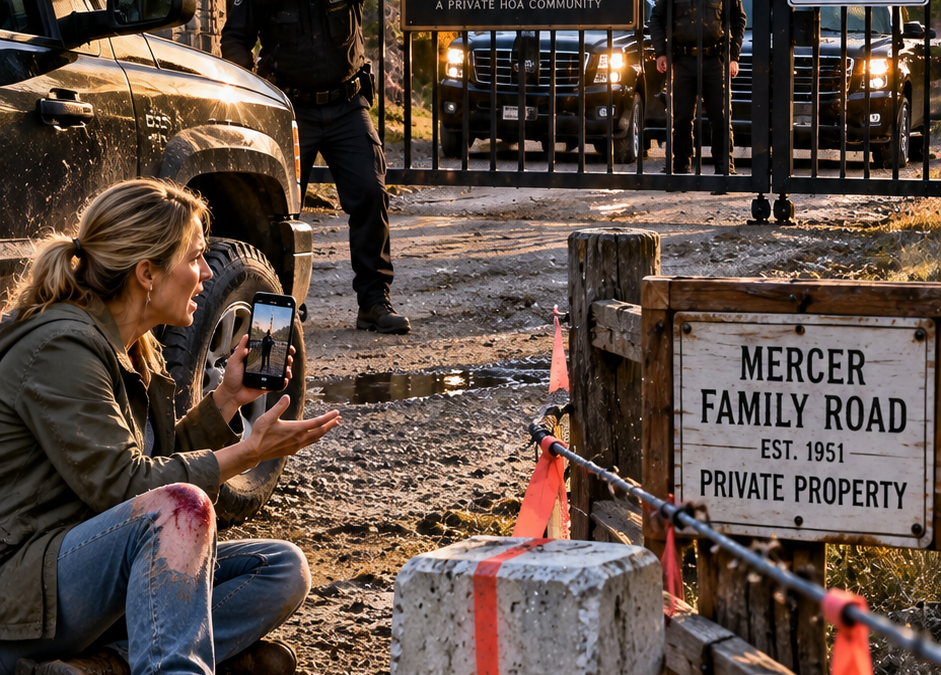
Two black SUVs blocked Mercer Ridge Road.
A steel arm had been drilled across both lanes.
A camera mounted on a new post rotated toward her windshield.
A white sign read:
CEDAR HOLLOW HOA
AUTHORIZED ACCESS ONLY
Clare started recording before lowering her window.
A security supervisor named Travis Boone walked toward her truck.
“Morning,” he said. “You’ll need an access card.”
“I don’t have one.”
“Then you need to turn around.”
“I live down this road.”
“You’re not listed as a Cedar Hollow resident.”
“I’m not a Cedar Hollow resident.”
He looked confused.
“I own this road.”
Travis glanced toward the camera above him.
“Not according to the documents we were given.”
Clare called Lenora.
Seven minutes later, Lenora arrived in a silver sedan.
That was one of the details I kept returning to.
Seven minutes.
She was close.
Maybe waiting.
Maybe expecting the confrontation.
She stepped from the sedan wearing another red suit.
Clare kept her phone pointed toward her.
Lenora looked directly into the camera.
“The board has activated its access rights.”
“On my road?”
“Your husband can discuss compensation when he comes home.”
“Move your equipment.”
“Clare.”
“Move it off my property.”
Lenora turned slightly.
“Travis, remove her from the controlled area.”
Controlled area.
Those two words would matter later.
Clare reached toward the padlock on the barrier.
Not to cut it.
Not to damage it.
To inspect it.
Travis stepped between her and the gate.
“Don’t touch me,” she said.
He grabbed her forearm.
She pulled back.
He shoved her.
Hard.
Her right foot slipped off the pavement.
Her knee hit gravel.
Her phone flew from her hand.
The camera kept recording.
Lenora walked past without checking whether Clare was hurt.
“Change the lock,” she told Travis. “And document her attempted trespass.”
Then Clare called me.
A sheriff’s deputy arrived about forty minutes later.
He photographed the gate.
Photographed Clare’s knee.
Took her statement.
Travis produced the photocopied amendment.
Because both parties claimed legal rights to the road, the deputy told Clare the access dispute would likely require a civil ruling.
He did, however, warn Travis that no easement granted authority to assault anybody.
He also told the security crew they could not stop Clare from walking across land she claimed and appeared to own.
That was not the dramatic resolution people imagine police can provide.
Real property disputes rarely work that way.
A uniform can stop violence.
It cannot rewrite a deed beside the road.
Dana filed for a temporary restraining order that afternoon.
The emergency hearing was set ten days later.
That gave Lenora ten days to prove her easement.
It also gave her ten days to make the lie look permanent.
I arrived home the following evening.
The checkpoint had grown.
Portable guard booth.
Four additional cameras.
Concrete bases.
Another sign.
Rather than walk into a confrontation, Clare met me at a service trail behind our pasture.
We carried my bag nearly half a mile to the house.
In the kitchen, she showed me the video.
I watched Travis shove her once.
Then again.
Then I increased the volume.
Behind Lenora’s voice, a radio crackled.
A man said, “Construction convoy is two minutes out.”
I looked at Clare.
“Play that again.”
She did.
“Construction convoy is two minutes out.”
The gate had not been installed merely to keep us from using the road.
It had been installed to allow somebody else to use it.
At 5:40 the next morning, we heard engines.
Three dump trucks and a concrete pump rolled through the checkpoint.
Clare filmed them from behind our fence.
The last truck cut the corner too tightly.
Its rear tire clipped an old timber post.
The edge of our culvert cracked.
Water immediately began cutting a brown channel through the gravel shoulder.
I called the sheriff.
Added property damage to the report.
Dana sent Cedar Hollow a preservation demand and formal notice to cease all non-emergency use.
Lenora responded with an $18,500 “security interference assessment.”
We were not Cedar Hollow members.
She had no more authority to fine us than I had to fine the governor.
But the notice gave us something useful.
At the bottom was the contractor operating the checkpoint.
Vance Community Security LLC.
Clare searched the state business registry.
The company had been formed four months earlier.
Its mailing address was a post office box less than two miles from Lenora’s home.
The listed manager was Nolan Price.
I knew the name.
Six months earlier, my fugitive task force had helped locate a financial broker wanted in another state.
Nolan Price was not our fugitive.
But his name had appeared repeatedly among shell-company contacts in the financial records.
That did not mean he committed a crime.
Recognition is not evidence.
Patterns are not conclusions.
That distinction was exactly why I called my supervisor before doing anything else.
I disclosed everything.
My ownership of the road.
Clare’s assault.
The HOA dispute.
Our financial interest.
Nolan Price’s name.
My supervisor did not hesitate.
“You’re recused.”
“Understood.”
“Do not access the old case.”
“I won’t.”
“Do not contact Price.”
“I won’t.”
“Send public records through counsel.”
That recusal protected me more than it restricted me.
If anything criminal was happening, the case had to survive without my fingerprints on it.
Dana forwarded the public information through the proper federal intake process.
After that, I received no privileged updates.
I focused on the civil case.
Everett arrived with a robotic total station, field notes, county monument records, and the patience of a man who had spent decades watching people discover that fences were opinions and recorded boundaries were not.
He recovered the original iron pins.
Then he measured Lenora’s checkpoint.
He checked twice.
“Forty-one feet.”
Clare folded her arms.
“Forty-one feet what?”
“Inside your parcel.”
She stared toward the barrier.
Everett adjusted his glasses.
“And the emergency easement begins farther east.”
“So the gate isn’t even inside the easement?”
“No.”
Clare almost laughed.
“That is a remarkable mistake.”
Everett looked toward her.
“Mistakes usually wander a few inches.”
He pointed at the instrument.
“Forty-one feet is a decision.”
Then he showed us something more important.
The recording stamp printed on Lenora’s amendment contained an instrument number.
Everett entered the number into the county index.
The number existed.
It just did not belong to an easement.
It belonged to a sewer-release document filed for a shopping center nine miles away.
Somebody had taken a real recording stamp from an unrelated county document and placed it onto the supposed amendment.
The paper Cedar Hollow was using to seize our road had never been recorded.
That did not prove Lenora personally created it.
But it proved the document was not what she claimed.
Two days later, Cedar Hollow held a special board meeting.
Lenora invited every homeowner.
The road dispute was first on the agenda.
Dana advised us to attend and speak as little as possible.
The restraining-order hearing was seven days away.
Anything said in anger could become evidence.
The clubhouse was packed.
Lenora stood beneath a projected map.
Mercer Ridge Road glowed green.
Travis guarded the entrance.
Several homeowners wore blue lanyards holding their new access cards.
Lenora spoke about wildfire evacuation.
Safety.
Home values.
Secondary access.
She described Clare and me as outsiders obstructing a community improvement.
It was effective.
Nobody wants to oppose an evacuation route when children live behind the gate.
Then she announced the fee.
Two thousand four hundred dollars per household.
Cedar Hollow had 255 homes.
That meant $612,000.
I looked toward Dana.
She had already written the number down.
Residents were being charged more than half a million dollars to “convert” a road Cedar Hollow did not own.
When Lenora opened questions, an older woman raised her hand.
Gray hair.
Straight posture.
Ruth Calder.
“Has the board received an independent title opinion confirming permanent access?”
Lenora smiled.
“Our counsel has reviewed the matter.”
Ruth did not move.
“That was not my question.”
The room became quieter.
Lenora called on someone else.
Then she invited Clare to the front.
A document waited on the table.
ACKNOWLEDGMENT OF EXISTING EASEMENT.
“There’s no need for this conflict,” Lenora said. “Sign the acknowledgement and we can resolve compensation privately.”
Clare kept her hands away from the pen.
“If the easement already exists, why do you need me to acknowledge it?”
“It is routine.”
“For whom?”
“Clare.”
“For whom?”
Lenora leaned closer.
“For people with enough money to make this very painful for you.”
That was her second serious mistake.
Not a legal argument.
A threat.
I stepped forward for the first time.
“Is Phase Two financing contingent on our signature?”
Lenora looked at me.
Just half a second.
But sometimes half a second is enough.
She turned to the room.
“The Mercers are willing to jeopardize emergency access for every family here because they believe one private road matters more than this community.”
I wanted to answer.
Dana touched my arm.
No.
Clare did something better.
She pointed to the projected map.
“Show everyone where the twelve-foot emergency easement actually sits.”
Lenora stared at the map.
“Everyone can see—”
“No. Show them the recorded strip.”
Her green overlay covered the entire road.
Including the checkpoint.
Including forty-one feet of land outside the easement.
People began whispering.
Lenora ended the meeting early.
As we left, Ruth slipped a folded note into Clare’s hand.
Five words.
CHECK THE FEBRUARY BOARD PACKET.
The next morning, we met Ruth at a diner.
She had served as Cedar Hollow’s volunteer treasurer for eight years before Lenora removed her from the finance committee.
Ruth brought the February packet.
Page forty-seven contained a preliminary traffic study.
It confirmed what we already knew.
The existing Cedar Hollow entrance did not meet projected two-way construction requirements.
Investors would not release the next financing round until the project secured verified secondary access.
Then Ruth showed us the vendor schedule.
Vance Community Security.
$153,000 at checkpoint installation.
Another $153,000 after thirty days.
Remaining balance after Mercer access acknowledgement.
The road assessment was not mainly about pavement.
Half the money would go to Lenora’s security company.
And the final payment depended on our signature.
Ruth had something else.
The name of Cedar Hollow’s original developer.
Martin Weller.
Eighty-four.
Living in Arizona.
Dana contacted him.
Martin remembered my father.
More importantly, he remembered the access negotiation.
“Your father refused a permanent entrance,” Martin told us during the video call.
He held up an old closing binder.
“That is why the agreement says emergency vehicles only.”
Inside was a signed letter from Cedar Hollow’s original development company.
It stated that Mercer Ridge Road would remain private.
Neither the HOA nor any future development phase would gain residential or construction access without a new written agreement from the Mercer family.
Martin agreed to send the original to Dana.
He also agreed to testify.
By then, three different types of evidence told the same story.
Everett’s survey established the physical boundary.
The county index showed Lenora’s amendment had never been recorded.
Martin’s closing documents established the original intent.
I trusted those three boring pieces of evidence more than any dramatic accusation I could make.
Lenora sensed the shift.
The following night, someone removed two of Everett’s survey stakes near the culvert.
Our trail camera recorded a Cedar Hollow security SUV arriving at 1:13 a.m.
The driver wore a Cedar Hollow jacket but kept his face turned away.
Removing a survey stake does not move a property boundary.
It simply creates another report.
Everett reset them the next morning.
Documented the disturbance.
Dana added the footage to our filing.
The sheriff opened a vandalism report.
Lenora responded by announcing Cedar Hollow would pave Mercer Ridge Road forty-eight hours before our hearing.
That was not random.
Once the road was widened and paved, physical evidence could be altered.
Drainage damaged.
Shoulders removed.
And the court would face a completed project instead of a proposed one.
Dana requested an immediate preservation order.
Before the judge ruled, one Cedar Hollow resident posted a question to the community forum.
Why are we spending $612,000 on a road before proving we own it?
Thirty-seven residents demanded an emergency vote.
Lenora deleted the thread.
Screenshots spread faster than she could erase it.
That evening, Travis came to our back fence alone.
His SUV remained on Cedar Hollow land.
His hands were visible.
“I need to talk.”
I raised my phone.
“I’m recording.”
He nodded.
“I thought the easement was real.”
“You still shoved my wife.”
His eyes dropped.
“I know.”
Clare stood beside me.
“Why did you do it?”
“Lenora told me to clear you before the convoy arrived.”
“What convoy?”
“The trucks.”
“We know about the trucks.”
Travis swallowed.
“She said once construction traffic used the road continuously, you would understand fighting was pointless.”
I stared at him.
“She thought actual use would improve her legal position?”
“That’s what she said.”
“And pressure us into selling?”
He nodded.
Clare asked, “Do you have that instruction?”
Travis glanced toward the trees.
“The company phones back everything up automatically.”
“Voice messages?”
“Yes.”
“Where?”
“Nolan controls the account.”
Nolan Price again.
I asked nothing else about him.
Travis looked at me.
“I came to apologize. I’m not trying to get buried with her.”
I felt no sympathy.
But I understood the instinct.
“Then tell the truth to people with authority.”
I did not promise him protection.
I had no authority to do that.
Dana documented the conversation and forwarded it to the sheriff and federal intake contact.
The next morning, the judge entered a short emergency order.
Cedar Hollow could not alter Mercer Ridge Road until the full hearing.
The ruling did not determine ownership.
It preserved the status quo.
At 6:05, two pavers and a milling machine stopped at Lenora’s checkpoint.
Lenora stood beside them in a red coat.
The crew supervisor read the court order Dana had posted.
Lenora told him it was fraudulent.
He called his office.
Then every machine turned around.
For the first time, Cedar Hollow residents watched Lenora issue an order and saw people refuse to obey.
She escalated again.
She emailed the community claiming we had fabricated the survey, endangered emergency access, and manipulated a local judge.
She demanded immediate payment of the road assessment.
Late fees would follow.
Collections would begin.
That email traveled through the HOA’s interstate management platform.
The assessments were processed through a bank service located outside the state.
Those facts did not magically transform bad HOA behavior into a federal offense.
Federal cases require evidence of intent, jurisdiction, transactions, and a scheme that can survive scrutiny.
Lenora kept creating those things.
Two days before the hearing, Dana received the county recorder’s certified response.
No 1998 easement amendment had ever been filed.
The instrument number belonged to the shopping-center sewer release.
Exactly as Everett discovered.
Then came the additional detail.
Three weeks earlier, a woman identifying herself as an employee of Cedar Hollow management attempted to file a “corrected” copy of the amendment.
The clerk rejected it.
Defective acknowledgment.
Wrong parcel description.
The attempted filing occurred five days after I rejected Lenora’s seventy-five-thousand-dollar offer.
I sat at Dana’s conference table reading the certification.
“So this wasn’t something they found.”
Dana shook her head.
“Not if the recorder’s timeline is accurate.”
“Somebody tried to create the public record after we said no.”
“Yes.”
Our property dispute was becoming something larger.
The morning before the civil hearing, Dana called us into her office.
Two people waited inside.
Special Agent Lena Ortiz from the FBI.
Postal Inspector Marcus Bell.
Agent Ortiz began by looking directly at me.
“Mr. Mercer, because you and your wife are victims and because you have a financial interest in this property, you will have no role in our investigation.”
“Understood.”
“You will not request internal information through your employment.”
“Understood.”
“You will not contact subjects on our behalf.”
“I won’t.”
Then they interviewed Clare.
Ruth.
Everett.
They collected certified copies from original sources instead of relying on ours.
They obtained Clare’s original video with metadata.
Documented the transfer.
Postal Inspector Bell asked about mailed notices.
Agent Ortiz asked about electronic assessments, vendor transfers, shell companies, and investor communications.
Before leaving, she asked us one question.
“Have either of you heard the name Brier Glenn?”
“No,” Clare said.
I shook my head.
Ortiz closed her notebook.
“Then don’t search it.”
That told me enough.
Mercer Ridge Road might not be the first.
The civil hearing began at nine the next morning.
Lenora arrived with two attorneys and a binder thick enough to look convincing from across a courtroom.
She was not wearing red.
Gray suit.
Neutral.
Controlled.
Cedar Hollow’s attorney argued that the HOA relied in good faith on an amendment located in archived management records.
He said residents had occasionally used the road in previous years.
The checkpoint merely formalized a preexisting right.
Dana began with geography.
Everett displayed the recorded plat.
Original pins.
Twelve-foot emergency strip.
Culvert.
Our boundary.
Then the checkpoint.
Forty-one feet inside our property.
The county recorder’s custodian testified next.
No permanent amendment existed in the official index.
The stamp had been copied from another instrument.
Martin Weller appeared by video.
He identified his signature and the original developer letter.
“My agreement with Mr. Mercer’s father was emergency access only,” he said. “He specifically rejected a subdivision entrance.”
Then Dana played Clare’s video.
The courtroom heard Lenora say “controlled area.”
It heard the construction convoy approaching.
It watched Travis grab Clare.
Watched her hit the gravel.
Heard Lenora tell him to change the lock.
Lenora’s attorney requested a recess.
During that recess, Ruth entered the hallway carrying one more document.
A current board member had emailed it to her that morning after watching the testimony.
It was the private term sheet for the sixty-two-home expansion.
The investors had promised a consulting success fee.
$1.8 million.
Payable to an entity controlled by Lenora if she delivered verified permanent access through Mercer Ridge Road before the end of the month.
Not to Cedar Hollow.
Not to the HOA.
To Lenora’s company.
Twenty-four times the highest amount she had offered us.
The term sheet contained another important sentence.
Investors would not close based solely on the disputed 1998 amendment.
They required either fresh owner consent or a final judicial ruling.
Our signature was not housekeeping.
It was the key to Lenora’s payout.
That was why the “acknowledgment” waited on the table.
That was why she needed Clare to sign.
When the hearing resumed, Cedar Hollow’s attorney looked different.
He asked to withdraw reliance on the amendment pending internal review.
Dana objected.
The document had already been used.
A gate installed.
Fees imposed.
Assessments collected.
Construction vehicles sent through.
Force used against Clare.
The judge issued a preliminary injunction.
Cedar Hollow, its residents, contractors, and agents were prohibited from using Mercer Ridge Road except for the narrow emergency purpose stated in the original easement.
The checkpoint had to be removed within seventy-two hours.
The road assessment could not be collected or spent.
All related records had to be preserved.
Our road was restored legally that morning.
Lenora’s problems were just beginning.
At 6:30 the next day, Clare and I stood beside the damaged culvert waiting for the court-approved removal crew.
Travis was gone.
Two unfamiliar guards unlocked the barrier.
Then black federal vehicles passed Mercer Ridge Road.
They did not turn toward us.
They continued through Cedar Hollow’s main entrance.
I stayed beside Clare.
That may disappoint people who imagine law enforcement as a personal weapon.
It is not.
Sometimes the most important thing an officer can do is remove himself completely from a case.
If I had taken part, Lenora’s lawyers could have spent years arguing the investigation was revenge.
I gave them no such argument.
Agent Ortiz’s team entered the management office under federal warrant.
Postal inspectors secured mailed assessment records and vendor documents.
Another team searched Vance Community Security.
State investigators served warrants related to the attempted land filing and Clare’s assault.
Cedar Hollow residents stood outside filming.
Nobody cheered.
Most looked embarrassed.
Some looked afraid.
For weeks, they had been told Clare and I were threatening their safety.
Now agents were carrying boxes out of the office that had issued those warnings.
At 7:12, the removal crew cut the barrier bolts from our pavement.
Clare watched the steel arm rise.
“That thing looked bigger when it belonged to them.”
I looked at her.
“It never belonged to them.”
The cameras came down.
Posts.
Guard booth.
Electrical boxes.
Everett documented every hole.
The insurer would later pay for restoration while damages were litigated.
For the first time in eleven days, Clare drove from our house to the county road without asking a stranger for permission.
She came back twenty minutes later carrying coffee.
Nothing dramatic.
Just coffee.
But I remember watching her truck pass the place where the gate had been.
That simple trip felt better than anything I could have shouted at Lenora.
The federal investigation continued for weeks.
Servers were copied.
Transfers traced.
Board members interviewed.
Document metadata compared.
Then Dana received notice that a criminal complaint had been unsealed.
Lenora Vance and Nolan Price were charged in an alleged scheme involving electronic payments, mailed demands, forged access documents, and shell companies.
The charges still had to be proved.
Travis faced state charges connected to Clare’s assault and evidence tampering.
He began cooperating.
That cooperation explained Brier Glenn.
Brier Glenn was another subdivision eighty miles north.
Two years earlier, its management company had claimed unrestricted use of a widow’s farm road.
The supporting amendment used the same fake notary seal.
The widow’s name was Evelyn Hart.
She could not afford a prolonged legal fight.
She accepted twelve thousand dollars and signed a new access agreement.
That access later became worth more than two hundred thousand to the neighboring development.
Nolan Price had consulted for that management company.
Investigators reportedly found versions of the same template on his computer.
Names changed.
Parcel descriptions changed.
Dates changed.
Several formatting errors remained identical.
The fake recording stamps came from legitimate public documents downloaded from county databases.
The method was simple.
Create an official-looking amendment.
Present it as old.
Threaten expensive litigation.
Then offer the landowner a fraction of the value in exchange for a real signature.
Some sold.
Some moved.
Most never knew the tactic had been used elsewhere.
Lenora had not invented the scheme.
But according to investigators, she adopted it eagerly.
Nolan provided the document.
Created Vance Community Security.
Helped route assessments through related companies.
Lenora provided the target.
The HOA authority.
The pressure.
Mercer Ridge Road was supposed to be the largest transaction yet.
The $1.8 million success fee would be divided through several entities after the expansion financing closed.
Then investigators found an email sent five days before Clare encountered the checkpoint.
Subject:
MERC SIGNATURE
Lenora wrote:
If Clare will not sign voluntarily, daily access pressure should make the property impossible for them to use. Once trucks establish the route, they will take the 75.
Nolan replied:
Do not create video.
Lenora answered:
Security controls the cameras.
She had thought about her cameras.
She forgot Clare’s phone.
That was the third mistake she could never undo.
The video did more than show the shove.
It captured timing.
The construction convoy.
Lenora’s authority over Travis.
The words “controlled area.”
Her instruction to document Clare as a trespasser.
Combined with the email, the checkpoint looked less like a safety measure and more like a mechanism designed to make our property impossible to use until we surrendered.
Cedar Hollow’s attorney who sent the original demand letter eventually produced his file.
He said Lenora gave him the amendment as an already-recorded instrument.
When he later requested a certified copy, she told him the county index was temporarily incomplete.
He withdrew from representing Cedar Hollow after the hearing.
Several directors said they had never seen the term sheet.
They had never seen the full payment schedule to Vance Community Security.
Some meeting minutes had been edited after votes.
Ruth’s printed packets differed from electronic versions stored on the HOA server.
That was another reason her habit of keeping paper copies mattered.
Digital records can disappear with a few clicks.
A dated board packet sitting in a retired treasurer’s kitchen drawer is harder to rewrite.
A civil court appointed an independent receiver to protect Cedar Hollow’s finances.
Payments to Lenora-linked companies were frozen.
The road assessment stopped.
Residents who had already paid were scheduled to receive refunds after the audit.
I did not blame every person in Cedar Hollow.
Some had repeated Lenora’s accusations.
Some had used the checkpoint.
A few drove on our road despite knowing we objected.
But many were shown official-looking paperwork by people they trusted.
They were assessed thousands of dollars for a project they were told was necessary for safety.
They were manipulated too.
Abusive boards do not survive because every resident is cruel.
They survive because decent people are convinced questioning authority will hurt the community.
Ruth organized a recall.
Before the vote, the remaining board members resigned.
Cedar Hollow hired an independent management company.
New rules required two board signatures for major contracts.
Vendor payments were published monthly.
Conflicts of interest had to be disclosed.
The sixty-two-home expansion missed its financing deadline.
That did not permanently prevent development.
It forced the developer to solve its own access problem.
The revised plan required a new second entrance across land the developer actually controlled.
Longer road.
Additional drainage.
County review.
Higher cost.
In other words, Cedar Hollow finally had to pay the real price of its own project instead of transferring that cost to Clare and me.
Months later, Lenora entered a guilty plea to federal conspiracy and wire-fraud charges.
Nolan continued contesting his case.
Other property owners pursued separate claims.
Travis pleaded to state offenses.
As part of his cooperation, he testified about the security operation.
He apologized to Clare in court.
She listened.
She did not tell him she forgave him.
I respected that.
An apology can acknowledge what happened.
It does not erase it.
Our civil case ended with a permanent order.
Cedar Hollow had no residential, construction, commercial, or routine right to Mercer Ridge Road.
The original emergency provision remained exactly as intended.
Fire.
Medical.
Rescue.
Real emergencies.
Cedar Hollow’s insurer paid for the culvert repair.
The fence.
The pavement drilled for Lenora’s checkpoint.
Everett returned one cool morning and installed two protected boundary monuments beside the road.
Ruth came to watch.
Martin Weller joined us by video from Arizona.
The final truck hauled away what remained of the guard booth.
Clare stood beside me.
“Should we put up a bigger gate?”
I looked along the road.
Oak branches leaned over the same bend.
Fresh asphalt covered the bolt holes.
The wildlife barn was quiet except for one owl that apparently objected to everything.
“No.”
“Why not?”
“I don’t want Lenora deciding what our home looks like after she’s gone.”
So we installed one modest sign where my father’s old sign used to stand.
PRIVATE ROAD
EMERGENCY ACCESS ONLY
Nothing angry.
Nothing triumphant.
Six words.
The truth.
Clare’s knee healed before the road did.
The bruise faded.
The cut disappeared.
But for several weeks, whenever she drove toward the curve where Travis shoved her, she slowed.
Sometimes only slightly.
Sometimes enough that I noticed from the passenger seat.
One morning, months later, we were headed into town.
She approached the curve.
Did not touch the brake.
Just drove.
I looked over at her.
She did not notice.
That was the moment I understood that the property had finally been restored in the way that mattered.
Not merely through a survey.
Not through a court order.
Not through an indictment.
In her own mind.
Lenora once stood in front of Cedar Hollow and said one private road should not matter more than an entire community.
She was right about one thing.
The road was never more important than people.
But neither was her expansion.
No community becomes safer by allowing one person to invent rights, collect money under false pretenses, and shove an owner off her own property.
Sometimes I think about how close Lenora came.
If Clare had stopped recording when her phone hit the gravel, we would have lost the clearest evidence of the confrontation.
If Everett had trusted the printed recording stamp, we might have spent months arguing over a document that never legally existed.
If Ruth had thrown away the February packet, the money trail would have been harder to reconstruct.
If Martin had discarded his old closing binder, Lenora could have argued nobody remembered the original intent.
If Travis had never spoken, we might not have known why the convoy timing mattered.
No single piece won the case.
The video showed what happened.
The survey showed where it happened.
The county record showed the amendment did not exist.
The board packet showed where residents’ money was going.
Martin’s letter showed what the original parties intended.
The term sheet explained why our signatures mattered.
And Lenora’s own email explained the pressure.
That was what finally destroyed her story.
Not my badge.
I never used it.
Not one dramatic raid.
Not one magical document.
Ordinary people kept ordinary records.
They asked precise questions.
They stopped accepting confidence as proof.
Today, Mercer Ridge Road is quiet again.
Emergency vehicles may cross when there is an actual emergency.
Exactly as my father agreed.
Cedar Hollow residents use their own entrance.
Future development will build access on land it owns.
Sometimes Clare and I drive the full length of the road around sunset.
The oak shadows stretch across the pavement.
Gravel sits along the shoulders.
The old culvert carries water under the road again.
There is no steel arm.
No guard booth.
No camera tracking our license plate.
Only the small sign.
PRIVATE ROAD.
EMERGENCY ACCESS ONLY.
Lenora believed putting up a gate would make her claim feel permanent.
Instead, the gate marked the exact place where everything she had built around that claim began to fall apart.
The last physical scar disappeared when the road crew patched the final bolt hole.
I stood there longer than I needed to.
My grandfather had cut the first track through those trees because he wanted a way home.
My father improved it because he wanted the road to survive him.
I had spent most of the case thinking my responsibility was to defend what they left.
But by the end, I understood something else.
Property is not valuable only because you can keep people out.
Sometimes it matters because it gives a family one place where they do not need permission to belong.
Clare had been forced to stand on that road while a stranger called her a trespasser.
For eleven days, she had to take a service trail to reach her own home.
No settlement could make that unhappen.
No criminal plea could erase the moment her knee hit the gravel.
But the road could become ordinary again.
That was what we wanted.
Not revenge.
Ordinary.
One evening, months after everything ended, Clare and I came back from town just before dark.
She was driving.
When we reached the curve near the old checkpoint, she slowed.
Not because she was afraid.
There was a deer near the shoulder.
We waited.
It crossed.
Then Clare smiled.
“Remember when there were six security guards here?”
“I try not to.”
“And the camera?”
“Which one?”
“The one that followed every license plate.”
“Also trying not to.”
She laughed.
Then we drove on.
No gate opened for us.
Nothing needed to.
Because it was our road.
And it had been all along.

