fThe Gate Across Lake Road Wasn’t the First Thing Cedar Ridge Had Failed to Check
𝗙𝗨𝗟𝗟 𝗦𝗧𝗢𝗥𝗬
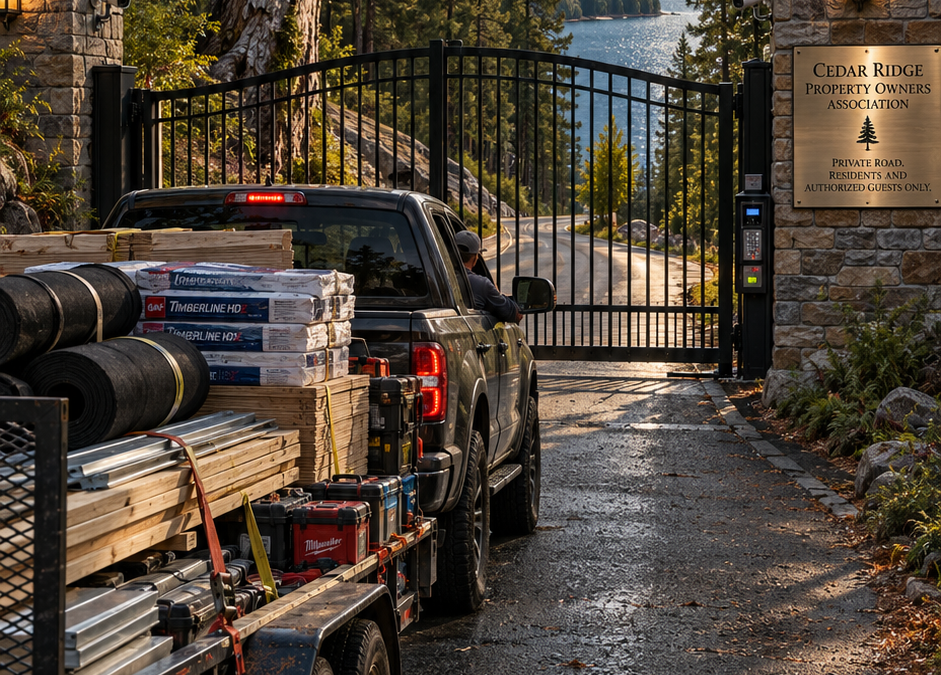
On the left, the drainage ditch dropped steeply enough that I would have high-centered the truck trying to drive around.
On the right, a new retaining wall blocked the shoulder.
Whoever had designed the entrance had made sure no vehicle could bypass it.
That was when I noticed a laminated notice attached to one of the stone columns.
Effective immediately, access through Cedar Ridge was restricted to association members, approved contractors, emergency services, and registered guests.
At the bottom was the name of the management company.
I took pictures.
The gate.
The keypad.
The cameras.
The signs.
The landscaping.
The ditch.
My truck.
The trailer.
Then I called the number.
A man named Trevor answered.
I explained who I was.
What bothered me was that he did not sound surprised.
“Oh,” he said. “The lake cabin.”
I looked through the gate.
“What do you mean, ‘the lake cabin’?”
“The board discussed your property during the security review.”
“Why was my property part of your security review?”
“Because you’ve historically been using association roads.”
“Historically?”
“That’s correct.”
“It’s the only road to my property.”
“I understand your concern.”
I hate that phrase.
People use it when they want credit for listening without accepting responsibility for doing anything.
I took a breath.
“Then open the gate.”
“I’m not authorized to do that.”
“Was I notified before the HOA cut off vehicle access to my land?”
“Cedar Ridge was not required to notify non-members regarding changes to private association property.”
“You’re calling Lake Road private association property?”
“Yes.”
“Since when?”
“I can give you the board president’s email.”
“That wasn’t my question.”
“I don’t have anything else I can tell you.”
He gave me the email address.
I hung up.
For maybe thirty seconds, I stood there looking at that gate and thinking about all the fast ways a man with a truck, tools, and a bad temper could make his point.
I could have cut something.
I could have pulled something.
My friend Marcus owned an excavation company. I could have called him and asked how much force those stone columns were designed to withstand.
Instead, I took three more photographs.
Then I backed the trailer down Lake Road until I found a place wide enough to turn around.
Forty minutes later, I was home.
Somewhere in my house was the deed to the cabin.
I remembered one sentence from it.
I just couldn’t remember exactly what the sentence said.
The cabin had belonged to my grandfather.
He bought the property in 1972, back when Blackwater Lake was surrounded by fishing camps, farms, forest, and roads that became mud every spring.
My mother inherited it after he died.
Years later, it came to me.
That cabin was the first place my grandfather ever let me bait my own hook.
It was where my father taught me to clean a fish without wasting half of it.
When I was twelve, Dad let me drive the final stretch of Lake Road with both his hands hovering above the steering wheel and his foot nervous over the brake.
I had gone there after my mother died.
I had gone there when my marriage fell apart.
I had spent nights on that dock without turning on a single light inside the cabin because sometimes darkness felt easier than conversation.
It was not a valuable property in the way developers used that word.
The cabin was old.
The dock leaned slightly to one side.
The kitchen floor squeaked.
There were places in the wall paneling where you could still see nail holes from photographs my grandfather had taken down thirty years ago.
But it was mine.
More than that, it was ours.
That night I opened an old metal file box and found the deed.
Most of the legal description was useless to me.
Coordinates.
Reference points.
Parcel numbers.
Measurements.
Then I found the sentence I had remembered.
Access was described as being “by way of Lake Road.”
I read it three times.
That sounded good.
But “by way of Lake Road” did not say who owned Lake Road.
It did not say public.
It did not say easement.
It did not say Daniel Mercer has the unquestioned right to drive past any future HOA gate installed by people who have decided landscaping equals jurisdiction.
I went online and pulled up the county GIS map.
Lake Road ran through Cedar Ridge before continuing toward my property.
On the modern parcel layer, the old road visually blended into the subdivision streets.
That was not helpful.
Then I found Cedar Ridge’s recorded subdivision plat.
The development had been built in phases starting in the late 1990s.
My cabin was older.
Lake Road was older.
But I knew enough to understand that “older” was not the same thing as “legally protected.”
The next morning, I emailed the HOA.
I identified myself.
I gave them my parcel number.
I explained that Lake Road was the only established vehicle route to my land and requested that vehicle access be restored while the legal status of the road was reviewed.
Three hours later, Patricia Voss replied.
She was the Cedar Ridge HOA president.
Her email was calm.
Professional.
Polite.
That somehow made it worse.
She wrote that Cedar Ridge residents had complained for years about unauthorized vehicles traveling toward the lake.
There had also been several garage thefts.
The board had therefore voted to secure the neighborhood.
Then came the sentence I would remember long after everything else was over.
“Your continued historical use of the road does not create HOA membership rights.”
I stared at it.
Then I typed back.
“I am not requesting HOA membership rights. I am requesting access to my property.”
Her response came twenty minutes later.
“You may wish to investigate alternate access from the western side of your parcel.”
That was when I knew this was not a misunderstanding.
They understood exactly what the gate had done.
The western side of my land was wooded hillside.
There had once been an old logging trail in that direction, but it dropped toward a creek and disappeared into brush long before reaching any public road.
Turning that into an actual driveway would mean clearing trees, grading a slope, engineering drainage, crossing difficult terrain, and almost certainly negotiating access over land I did not own.
Patricia’s solution was simple.
Cedar Ridge wanted a gate.
Therefore I should build another road.
I called Marcus.
“They locked you out?”
“Pretty much.”
He laughed once.
Not because anything was funny.
It was the kind of laugh people make when a situation is so ridiculous they need their body to do something.
“They can’t just lock you out.”
“That was my reaction.”
“What does your deed say?”
“Access by Lake Road.”
“Then open the gate.”
“With what?”
“A reciprocating saw.”
“I’m not cutting their gate.”
He went quiet.
Then he said, “Good.”
“You sound disappointed.”
“I know you.”
“I’m fifty-four years old.”
“You were forty-eight when you pulled somebody’s fence post out with my skid steer.”
“It was on my property.”
“That was not my point.”
He was right.
So instead of cutting anything, I documented everything.
That decision probably saved me.
Monday morning, I went to the county recorder’s office.
A clerk named Elaine Parker helped me.
Elaine had worked there for twenty-seven years. She had the expression of a woman who had seen thousands of people arrive convinced that one piece of paper would solve every problem they had.
I put my deed in front of her.
“I need to know what Lake Road legally is.”
She searched the county system.
Not much came up.
Then she asked, “How far back does your property ownership go?”
“My grandfather bought it in 1972.”
She nodded.
“Then we may have to go downstairs.”
The basement archive smelled like old paper, dust, and concrete.
There were oversized deed books stacked on metal shelving.
Elaine started with my deed.
Then my mother’s.
Then my grandfather’s.
Then the owner before him.
Harold Price.
His deed was dated 1951.
Elaine read it silently.
Then her finger stopped.
“What?”
She turned the book toward me.
The deed described access using the words “existing county lake access road.”
I looked at her.
“County?”
She raised one hand.
“Don’t get excited yet.”
“I’m not excited.”
“You look excited.”
“What does it mean?”
“It means we keep looking.”
A 1938 deed used similar language.
Then Elaine found a reference to an old county road book.
She disappeared through a heavy door.
When she came back, she was carrying a thick volume with a cracked brown cover.
The pages were handwritten.
Bridge petitions.
Drainage work.
Road repairs.
Maintenance approvals.
Names of families who had been dead longer than I had been alive.
Elaine ran one finger down the index.
Then stopped.
“Lake Road.”
The entry was dated 1932.
Ninety-four years earlier, the county commissioners had accepted a petition establishing a route from the old mill road to Blackwater Lake.
Its stated purpose was access to several farms and the lake landing.
The route in the description followed the same general alignment as the road I had used my whole life.
I felt something loosen in my chest.
“So it’s public.”
Elaine shook her head immediately.
“No.”
I stared at her.
“This proves the county accepted a public road in 1932.”
“Right.”
“It does not prove nothing happened to that road afterward.”
“What could have happened?”
“Abandonment. Vacation. Relocation. Transfer. Any number of things.”
“So we need to know whether the county ever gave it up.”
“Exactly.”
We searched.
No vacation order.
No abandonment record.
No formal relocation.
No recorded transfer in the archive we checked.
Elaine made certified copies of eleven pages.
“Take these to Public Works.”
I left the courthouse carrying them like they were something fragile.
Halfway to my truck, my phone rang.
Patricia Voss.
I had never given her my number.
Trevor must have.
“Mr. Mercer,” she said, “I understand you’ve been contacting county offices regarding Cedar Ridge property.”
“I’ve been researching Lake Road.”
“The board would prefer communication go through management.”
“That’s fine.”
“We’ve reviewed your deed.”
“Good.”
“Our attorney believes your deed does not grant rights over privately maintained association streets.”
“I found a county road record from 1932.”
Silence.
Only a second or two.
But I heard it.
Then she said, “There are many historical records that no longer reflect modern ownership.”
“That’s possible.”
“I would caution you against treating an obsolete document as proof.”
“I’m not. I’m taking it to Public Works.”
Her voice changed.
Not much.
Just enough.
“Cedar Ridge homeowners have paid to maintain those roads for more than twenty years.”
“I understand.”
“Your property has contributed nothing.”
“I’ve also never asked your HOA to pave my road.”
“That isn’t the point.”
I hung up wondering if maybe it was.
Cedar Ridge had maintained the road.
They had paved near it.
Landscaped near it.
Built houses around it.
To them, those actions seemed to have become ownership.
Maybe the law agreed.
Maybe it didn’t.
But maintaining something and owning it were not automatically the same question.
The next day, I met Aaron Bell from County Public Works.
He was an engineer.
Before I even sat down, he warned me.
“I can tell you what county records show. I cannot give you private legal advice.”
“Fine.”
We spread everything across his conference table.
The 1932 road record.
My deed.
Historic maps.
The modern Cedar Ridge subdivision plat.
Aaron traced Lake Road with his finger.
The farms were gone.
The lake landing had mostly disappeared beneath brush.
Cedar Ridge now occupied most of the land around the route.
But the road itself was easy to recognize.
Then Aaron pulled archived maintenance maps.
Lake Road appeared there too.
Then a route number.
Then drainage notes.
Then he pulled the 1998 Cedar Ridge subdivision plat.
He leaned closer.
“What?”
He pointed.
A narrow strip passed through the development.
Beside it were three words.
EXISTING RIGHT OF WAY.
I leaned over the table.
“Right of way?”
“Looks like it.”
“And the gate?”
Aaron put a transparent overlay on the map.
The gate location sat directly across that strip.
He leaned back.
“That’s worth reviewing.”
“Is it public?”
“I need to know if the county ever vacated it.”
“And if they didn’t?”
He looked at me.
“Then the HOA may have a problem.”
That was enough for me.
I hired an attorney.
Rachel Kim specialized in local property disputes.
What I liked immediately was that she was unimpressed by drama.
She did not tell me we had a great case.
She did not promise we would crush anybody.
She read everything.
Then she read it again.
Finally, she sat back.
“This is promising.”
“How promising?”
“Promising enough that I would not spend money building a driveway on the west side of your land.”
That was the first good news I had trusted since the gate went up.
Rachel sent Cedar Ridge a formal letter.
It identified my property, challenged the HOA’s authority to block Lake Road, attached the historical records, and demanded temporary access while the county reviewed the right of way.
The HOA attorney answered four days later.
His position was that even if Lake Road had once been public, subsequent subdivision development and private maintenance demonstrated that the relevant section had become private.
Rachel disagreed.
More importantly, nobody had produced a document showing how or when the county had surrendered the road.
The gate remained locked.
That was when the argument stopped being about maps.
The roof still needed repair.
I found an old utility path where I could park and reach the cabin on foot.
Nearly a mile.
Wet ground.
Tools on my back.
Supplies carried in by hand.
I did what I could.
Then another storm hit.
Water got under the temporary patch.
When I reached the cabin the next morning, I could smell wet wood before I even opened the door.
The back bedroom ceiling had partially collapsed.
Insulation hung down in gray, soaked clumps.
Water had run across the wall where an old photograph of my grandfather used to hang.
I stood in that room for a long time.
That was probably the moment I came closest to losing control.
Not at the gate.
Not during the calls.
Not reading Patricia’s emails.
Standing beneath that broken ceiling.
Because I could have fixed it.
The materials had been sitting on my trailer.
The tools had been sitting in my truck.
The cabin had not been unreachable because of a landslide.
Or fire.
Or fallen trees.
It had been unreachable because somebody had typed a policy, installed a keypad, and decided that their board authority extended two miles beyond the facts they had verified.
I photographed the damage.
Then I sent the pictures to Patricia.
Her response was one sentence.
“Cedar Ridge is not responsible for maintenance issues occurring on non-association property.”
I almost answered.
Rachel stopped me.
“Don’t.”
“They caused this.”
“We will save the email.”
“That’s it?”
“That’s it.”
I hated how calm she was.
Later, I understood why.
Marcus tried next.
I hired him to get a proper tarp over the damaged roof.
He drove his work truck to the gate and called me ten minutes later.
“They won’t let me through.”
“Ask them to put the refusal in writing.”
“You sound like your lawyer.”
“That’s becoming an insult.”
He did.
The management company emailed him.
Contractor access was limited to work performed for Cedar Ridge residents or approved association projects.
We saved that too.
A few mornings later, I drove back to photograph the gate.
There was a new sign.
NO TRESPASSING.
PRIVATE ASSOCIATION PROPERTY.
Beside it was a towing notice.
I called Trevor.
“Why is there a tow sign on Lake Road?”
“To prevent unauthorized parking near the entrance.”
“If I park there because you won’t let me drive to my cabin, are you going to tow me?”
“You would be parking on private property.”
“According to who?”
“The association.”
“Has the county finished reviewing the road?”
“No.”
“Then why are you escalating?”
“We are enforcing current policy.”
That evening, Rachel sent another letter.
Afterward she said, “They’re trying to make the facts on the ground look settled before the records are.”
Two days later, a tow truck actually arrived while my pickup was parked near the gate.
I was standing beside it.
The driver climbed out, looked at my truck, then at me.
“You Daniel?”
“Yes.”
He sighed.
“I’m not touching this.”
Apparently dispatch had warned him there was an active dispute.
He took a picture and left.
I took a picture of him leaving.
Then another of the gate.
Cedar Ridge had wanted a show of authority.
Instead, I had another dated photograph.
As I was getting back into my truck, a gray SUV stopped on the other side of the gate.
The driver lowered his window.
“Are you Mercer?”
“Yes.”
“I’m Greg Lawson. I live up the hill.”
I nodded.
He looked toward the towing sign.
“The board told us you were trying to get access to our amenities.”
I stared at him.
“Your amenities?”
“The clubhouse. Pool. Roads.”
“I’m trying to get to my cabin.”
“That’s not what they told us.”
“I don’t want your pool.”
He smiled slightly.
“I figured that out.”
I gave him Rachel’s office email.
“The county is reviewing Lake Road.”
Greg looked at the gate for a few seconds.
Then he said, “Interesting.”
At the time, I did not know how important that conversation would become.
Three weeks after the dispute started, Cedar Ridge held a board meeting.
Greg sent me the audio recording.
That was how I learned what Patricia had been telling the homeowners.
She described me as a non-member attempting to establish unrestricted passage through a secured residential community.
She talked about garage thefts.
Unknown vehicles.
Liability.
Children.
Property values.
Security.
Then one board member asked about the 1932 county record.
Patricia said their attorney considered it obsolete.
A resident asked, “Has anyone found the document showing the county abandoned it?”
There was a pause.
Then Patricia said, “We have no reason to believe the county retains an interest.”
I replayed that sentence.
Then again.
She had not said they had an abandonment order.
She had not said they had a transfer.
She had not said they had a county resolution.
Only that they had no reason to believe.
I sent the audio to Rachel.
Her response came five minutes later.
“Neither do they, apparently.”
A week later, I received a certified envelope.
Inside was Cedar Ridge’s compromise.
At first glance, it seemed almost reasonable.
A permanent gate remote.
Two registered vehicles.
Approved contractor access.
Guest access with advance notice.
They were even willing to waive the application fee.
Then I turned to page three.
SPECIAL ACCESS LICENSE.
Annual fee: $3,000.
I called Rachel.
“Please tell me I’m reading this wrong.”
“You aren’t.”
“They want three thousand dollars a year to let me use Lake Road.”
“That isn’t the important part.”
“It feels important.”
“Read Section Seven.”
I found it.
The license stated that access existed solely by permission of Cedar Ridge Property Owners Association.
That permission could be suspended if I violated HOA security policies.
Then Rachel told me to read Section Nine.
My stomach tightened before I even finished.
By signing, I would acknowledge Cedar Ridge’s ownership and control of the roadway.
I stopped.
“They want me to admit the road is theirs.”
“Yes.”
“In exchange for a remote.”
“Yes.”
For a few seconds, neither of us spoke.
Rachel said, “Daniel, if you sign that, they can show the agreement to their insurer, residents, county officials, anybody. They can say the outside parcel owner himself recognizes Cedar Ridge’s authority over the road.”
“So the remote isn’t the deal.”
“No.”
“My signature is.”
“Exactly.”
That changed the way I saw the entire dispute.
Until then, I had been willing to believe Cedar Ridge might genuinely think it owned the road.
Maybe their board had inherited bad records.
Maybe management had made assumptions.
Maybe nobody had asked the right question when the gate project was approved.
But now they wanted my signature on a document that would convert uncertainty into consent.
They were not merely defending their interpretation.
They were asking me to help create evidence for it.
I refused.
Patricia emailed me personally.
She called the agreement a “significant accommodation.”
Rachel answered for me.
We would not purchase a revocable license to reach my own property while the county was still determining whether Cedar Ridge had any authority to control the road.
The HOA withdrew the offer.
Then they upgraded the gate.
Until then, emergency vehicles had reportedly been able to use a shared entry system.
After the upgrade, management sent residents a notice saying emergency access would now be coordinated through remote dispatch.
Greg forwarded it to me.
Rachel called Public Works and the county fire marshal’s office that same day.
Nobody accused Cedar Ridge of trying to block emergency responders.
That was not the issue.
The question was simpler.
If Lake Road served property outside Cedar Ridge, who had authorized an HOA-controlled electronic gate across it?
Two days later, Aaron Bell called.
“I found something.”
I was at his office within the hour.
Three folders sat on the conference table.
Aaron opened the first.
“The 1932 road acceptance.”
I nodded.
The second.
“Maintenance ledger.”
I leaned forward.
County crews had performed work on Lake Road through 1996.
Much later than anything we had previously found.
Then he opened the third folder.
“This is Cedar Ridge’s 1998 subdivision approval.”
A planning condition was highlighted.
The developer had been permitted to construct private subdivision streets branching from existing Lake Road.
However, any work affecting the existing public right of way required separate county approval.
I looked at Aaron.
“Did they get one?”
“We haven’t found one.”
Then he showed me the plat.
Tiny print near the bottom said that the filing did not vacate any existing public rights of way unless those rights were specifically identified in a separate county action.
Lake Road was not identified.
I could hear the air conditioner humming.
“That means it stayed public.”
Aaron was careful.
“Public Works’ current position is that we have found no record showing this right of way was ever vacated.”
That sentence mattered more than anything I had said in two months.
The county attorney reviewed the file.
Then Cedar Ridge received formal notice.
The gate appeared to obstruct an existing public right of way.
The association was ordered either to provide documentation authorizing the obstruction or remove it.
They had fifteen days.
After that, Patricia stopped calling me.
The HOA attorney handled everything.
For nearly a week, nothing happened.
Then I drove toward the lake and saw workers near the gate.
For one second, I thought they were dismantling it.
They were installing another camera.
That afternoon, Cedar Ridge sent its residents a notice saying the association intended to “vigorously defend privately funded infrastructure.”
That was Patricia’s escalation.
No shouting.
No dramatic threat.
They simply dug themselves deeper.
And this time they did it in writing to every homeowner paying dues.
Their legal response arrived just before the deadline.
The argument had changed again.
Cedar Ridge now claimed that even if the public right of way technically remained on paper, the county had effectively abandoned the route through non-use because the HOA had maintained the surface for years.
The county attorney did not accept that an HOA could create abandonment merely by acting as if abandonment had occurred.
But by then, the dispute was no longer Daniel Mercer versus Cedar Ridge.
The county was involved.
Then Public Works discovered something nobody expected.
While tracing Lake Road past my cabin, the engineers found that the historical route continued farther toward a narrow strip of county-owned land along Blackwater Lake.
Today, that strip was mostly trees and brush.
In 1932, it had been the lake landing.
That explained the language Elaine and I had seen in the old road book.
Public access to Blackwater Lake.
Lake Road had not been established for my cabin.
The cabin barely existed then.
The route had been created so local farms and members of the public could reach the lake.
That changed everything inside Cedar Ridge.
For almost two months, homeowners had been told one outside cabin owner wanted to force his way through their private neighborhood.
Now county records suggested their gate had been placed across a road historically established for public passage.
The next board meeting filled the clubhouse.
Rachel told me not to attend.
“There’s nothing you can improve by sitting in that room.”
So I stayed home.
Greg sent the recording the next morning.
The audio began with normal board business.
Budget questions.
Landscaping.
A drainage complaint.
Then Greg spoke.
“Did the board verify ownership of Lake Road before approving the gate?”
Patricia responded that the board relied on subdivision maintenance history and management records.
Greg repeated the question.
“That wasn’t what I asked. Did anyone verify that Cedar Ridge actually owns the road?”
The HOA attorney interrupted.
He began explaining historical use and maintenance obligations.
Then another resident asked how much the gate had cost.
Silence.
Some papers shuffled.
Finally, somebody said the number.
Just over $42,000.
That included the stone columns.
Electrical service.
Cameras.
Control equipment.
Installation.
Landscaping.
The room got loud.
Then Greg asked the question that changed the meeting.
“If this turns out to be a county right of way, did we spend forty-two thousand dollars putting a private gate across a public road?”
Nobody gave him a straight answer.
I sat at my kitchen table listening to the recording.
For weeks, I had been the outsider causing trouble.
The irresponsible non-member.
The security problem.
The man who supposedly wanted Cedar Ridge amenities without paying dues.
Now the board had to explain to its own homeowners why their money may have funded a gate the HOA had no authority to lock.
That was the moment the conflict turned.
The following Monday, Patricia called me.
She sounded different.
Not angry.
Tired.
“Daniel, I think this situation has become unnecessarily adversarial.”
I looked out my kitchen window.
“You locked the only road to my property.”
“We believed we were acting within our rights.”
“The gate is still locked.”
“We’re trying to find a practical resolution.”
“What does practical mean?”
She offered another deal.
Permanent remote.
No annual fee.
No contractor restrictions.
Registered guests.
Full access.
“All we would need,” she said, “is an agreement acknowledging Cedar Ridge’s continued control of the roadway and your commitment not to challenge the gate in the future.”
I almost laughed.
Same strategy.
Different price.
The remote was free now.
My signature was still expensive.
“I’ll send it to Rachel.”
Rachel needed less than two minutes.
“No.”
That was the entire conversation.
The county deadline expired.
Cedar Ridge had failed to produce a vacation order.
An abandonment resolution.
A transfer.
County approval for the gate.
Anything showing that Lake Road had legally become theirs.
Public Works issued its final administrative position based on the records available.
Lake Road remained part of an existing public right of way.
Private obstruction required authorization.
Cedar Ridge had none.
The HOA could challenge the county through the courts if it wanted.
But unless and until it succeeded, the gate could not remain locked across the route.
Cedar Ridge now had two options.
Fight the county.
Or move the gate.
For several days, I heard nothing.
Then one Wednesday morning, I drove toward the lake.
Construction trucks were parked near the entrance.
A crew had cut into the asphalt around one of the stone columns.
I pulled over.
One of the workers looked at me.
“You the cabin guy?”
“I guess so.”
He pointed uphill.
“We’re moving it.”
“How far?”
“About six hundred feet.”
I looked past him.
Six hundred feet farther inside Cedar Ridge was where the subdivision streets branched away from Lake Road.
Their private roads began there.
They could install a gate there.
They could protect their clubhouse.
Their pool.
Their houses.
Their private streets.
They could screen whoever they wanted entering Cedar Ridge itself.
They just could not block the road leading to my cabin and the old lake landing.
Which was exactly what someone should have verified before spending forty-two thousand dollars.
I stood beside my truck while the workers removed the first stone column.
I had imagined that moment more than once.
I thought I would feel victorious.
I didn’t.
Mostly, I felt tired.
For almost two months, I had parked outside that gate.
Carried tools across wet ground.
Watched water enter a cabin my family had cared for more than fifty years.
Listened to people tell me I had no right to use a road because their HOA paved it.
Maintained it.
Landscaped beside it.
Installed cameras over it.
Those things had changed Lake Road.
They had made it smoother.
Cleaner.
More expensive.
But appearance was not ownership.
And control was not something you could manufacture with stone columns and a keypad.
When the opening was finally wide enough, I got back into my truck.
Nobody gave me a remote.
Nobody entered my license plate.
Nobody asked whether I was a resident.
Nobody pressed a button.
I simply drove.
Lake Road.
The same road.
The sycamore appeared around the bend.
Then the pines.
Then the first flash of Blackwater Lake.
Marcus followed behind me with his work truck.
For the first time in weeks, we drove all the way to the cabin.
We repaired the roof before the next storm.
That afternoon, we sat at the end of the dock.
Marcus drank coffee from a scratched metal thermos.
For a while, neither of us said anything.
Then he looked at me.
“So what are you going to do to them?”
“Who?”
“The HOA.”
“Nothing.”
He frowned.
“You spent two months fighting them.”
I looked toward the trees where Lake Road disappeared uphill.
“No.”
“What do you mean, no?”
“I spent two months getting home.”
He smiled.
“No revenge?”
“The road is open.”
“That’s enough?”
I looked at the cabin behind us.
The patched roof.
The old dock.
The lake where my grandfather had taught me to fish.
“Yeah.”
It was enough.
I had never wanted the Cedar Ridge clubhouse.
Or their pool.
Or their voting rights.
Or a gate remote.
I had wanted what my grandfather had when he bought the cabin in 1972.
Turn off the county road.
Drive through the woods.
Reach the lake.
A month later, Aaron Bell emailed me.
The subject line said:
ONE MORE RECORD.
Attached was a scan of an older survey that had been filed with the original 1932 road petition.
The paper was yellowed.
The lines were hand-drawn.
It showed the farms.
The creek.
Blackwater Lake.
And Lake Road running toward the water.
At the bottom was a handwritten dedication.
Several landowners had signed it.
They agreed to provide the route for public passage.
I read the names.
One surname stood out.
The family had once owned most of the acreage where Cedar Ridge was eventually built.
I sat staring at the screen.
For two months, the HOA had treated me as an outsider trying to force my way across their land.
Ninety-four years earlier, the owners of that same land had signed a document helping create the route so other people could pass through.
I printed the map.
Then I had it framed.
It hangs in the cabin now.
Not as a trophy.
Not because I wanted to remember beating Cedar Ridge.
I didn’t beat anybody.
The map reminds me how easily certainty can be manufactured when people stop asking the right questions.
Stone columns can make authority look permanent.
Cameras can make control look official.
A polished sign can make a claim feel like a fact.
Twenty years of maintenance can make people forget to ask who owned something before they started maintaining it.
And sometimes a road can pass through ninety-four years of development, pavement, landscaping, subdivisions, lawyers, dues, board meetings, and security systems without becoming what somebody assumes it became.
Cedar Ridge still has its gate.
It sits about six hundred feet farther inside the subdivision now, where the private streets actually begin.
Their neighborhood is secure.
My road remains open.
Sometimes I drive toward the cabin around sunset and slow down near the two rectangular patches in the asphalt where the original stone columns once stood.
Then I pass the lightning-scarred sycamore.
The road narrows.
The houses disappear behind me.
The pines close in.
And eventually Blackwater Lake appears between the trees.
Every time it does, I think about Patricia’s first email.
“Your continued historical use of the road does not create HOA membership rights.”
She had been right about one thing.
I never needed HOA rights.
I never wanted them.
Lake Road existed long before Cedar Ridge.
Long before Patricia.
Long before me.
And when the county finally opened the old books, the association discovered the one thing nobody on the board had bothered to verify before installing cameras, stone columns, signs, and forty-two thousand dollars’ worth of certainty across my way home.
The road had never been theirs.
What do you think of this story? Please leave a like and share your thoughts in the comments. Your support means a lot to us and inspires us to keep writing more meaningful and powerful stories. Thank you! 👍𝗧𝗛𝗘 𝗘𝗡𝗗
𝗧𝗛𝗘 𝗘𝗡𝗗
The Gate Across Lake Road Wasn’t the First Thing Cedar Ridge Had Failed to Check
The first time the new gate refused to open, I assumed somebody had made a mistake.
I had owned the cabin at Blackwater Lake for almost eleven years, but my family had been using Lake Road since before I was born. I knew every curve in it. Every pothole. Every drainage ditch that filled too fast after a summer storm.
There was a lightning-scarred sycamore near the last bend, split down one side but still alive somehow.
About half a mile beyond it, the trees opened just enough for Blackwater Lake to flash blue between the pines.
That view had always meant the same thing to me.
I was almost home.
But that Friday afternoon, I came around the bend and hit the brakes.
A black steel gate stretched across the road.
Not a chain.
Not orange construction fencing.
A permanent motorized gate mounted between two stone columns.
There were cameras on both sides.
A keypad.
An intercom.
Fresh landscaping around the columns.
Even the mulch looked expensive.
A polished metal sign was bolted to the right-hand pillar.
CEDAR RIDGE PROPERTY OWNERS ASSOCIATION.
Beneath that, in smaller lettering:
PRIVATE ROAD. RESIDENTS AND AUTHORIZED GUESTS ONLY.
I stopped my truck about ten feet away.
For a second, I honestly checked my mirrors.
It was one of those stupid things your brain does when reality does not fit what you know.
Maybe I had missed a turn.
Maybe road work had redirected traffic.
Maybe I had somehow ended up at another entrance.
Then I looked toward the sycamore.
Same tree.
Same ditch.
Same road.
My road.
Or at least the road my grandfather had driven since 1972.
Behind my truck was a utility trailer loaded with plywood, roofing felt, flashing, fasteners, two bundles of shingles, and enough lumber to repair storm damage at the cabin.
Three nights earlier, wind had torn part of the roof covering loose.
More rain was coming Sunday.
My cabin was less than two miles beyond that gate.
Everything I needed to keep water out of it was sitting behind me.
I rolled down the window and pressed the call button.
Nothing.
I pressed it again.
A speaker clicked.
A woman answered.
“Cedar Ridge gate.”
“Hi. My name is Daniel Mercer. I own the cabin at the end of Lake Road. The gate isn’t opening.”
There was a pause.
“Are you a Cedar Ridge resident?”
“No.”
Another pause.
Then she said, “Then you don’t have gate access.”
I actually thought I had misheard her.
“I don’t need access to Cedar Ridge. I need access to my property.”
“I understand, sir.”
“No. I don’t think you do. My cabin is down this road.”
“Only residents and authorized guests are allowed through the gate.”
“My family has used this road my entire life.”
“You’ll need to contact the HOA board.”
“Can you open the gate?”
“No, sir.”
“My roof is damaged.”
“I’m sorry.”
“I have a trailer full of materials right here.”
“You’ll need to contact the HOA board.”
Then the speaker went dead.
I sat there with one hand still near the button.
Through the steel bars, Lake Road continued exactly as it always had.
That was the strangest part.
The asphalt hadn’t moved.
The trees hadn’t moved.
The lake hadn’t moved.
Nothing about the road itself had changed.
Only who was claiming the authority to decide whether I could use it.
I got out of the truck.
There was no pedestrian opening beside the gate.
On the left, the drainage ditch dropped steeply enough that I would have high-centered the truck trying to drive around.
On the right, a new retaining wall blocked the shoulder.
Whoever had designed the entrance had made sure no vehicle could bypass it.
That was when I noticed a laminated notice attached to one of the stone columns.
Effective immediately, access through Cedar Ridge was restricted to association members, approved contractors, emergency services, and registered guests.
At the bottom was the name of the management company.
I took pictures.
The gate.
The keypad.
The cameras.
The signs.
The landscaping.
The ditch.
My truck.
The trailer.
Then I called the number.
A man named Trevor answered.
I explained who I was.
What bothered me was that he did not sound surprised.
“Oh,” he said. “The lake cabin.”
I looked through the gate.
“What do you mean, ‘the lake cabin’?”
“The board discussed your property during the security review.”
“Why was my property part of your security review?”
“Because you’ve historically been using association roads.”
“Historically?”
“That’s correct.”
“It’s the only road to my property.”
“I understand your concern.”
I hate that phrase.
People use it when they want credit for listening without accepting responsibility for doing anything.
I took a breath.
“Then open the gate.”
“I’m not authorized to do that.”
“Was I notified before the HOA cut off vehicle access to my land?”
“Cedar Ridge was not required to notify non-members regarding changes to private association property.”
“You’re calling Lake Road private association property?”
“Yes.”
“Since when?”
“I can give you the board president’s email.”
“That wasn’t my question.”
“I don’t have anything else I can tell you.”
He gave me the email address.
I hung up.
For maybe thirty seconds, I stood there looking at that gate and thinking about all the fast ways a man with a truck, tools, and a bad temper could make his point.
I could have cut something.
I could have pulled something.
My friend Marcus owned an excavation company. I could have called him and asked how much force those stone columns were designed to withstand.
Instead, I took three more photographs.
Then I backed the trailer down Lake Road until I found a place wide enough to turn around.
Forty minutes later, I was home.
Somewhere in my house was the deed to the cabin.
I remembered one sentence from it.
I just couldn’t remember exactly what the sentence said.
The cabin had belonged to my grandfather.
He bought the property in 1972, back when Blackwater Lake was surrounded by fishing camps, farms, forest, and roads that became mud every spring.
My mother inherited it after he died.
Years later, it came to me.
That cabin was the first place my grandfather ever let me bait my own hook.
It was where my father taught me to clean a fish without wasting half of it.
When I was twelve, Dad let me drive the final stretch of Lake Road with both his hands hovering above the steering wheel and his foot nervous over the brake.
I had gone there after my mother died.
I had gone there when my marriage fell apart.
I had spent nights on that dock without turning on a single light inside the cabin because sometimes darkness felt easier than conversation.
It was not a valuable property in the way developers used that word.
The cabin was old.
The dock leaned slightly to one side.
The kitchen floor squeaked.
There were places in the wall paneling where you could still see nail holes from photographs my grandfather had taken down thirty years ago.
But it was mine.
More than that, it was ours.
That night I opened an old metal file box and found the deed.
Most of the legal description was useless to me.
Coordinates.
Reference points.
Parcel numbers.
Measurements.
Then I found the sentence I had remembered.
Access was described as being “by way of Lake Road.”
I read it three times.
That sounded good.
But “by way of Lake Road” did not say who owned Lake Road.
It did not say public.
It did not say easement.
It did not say Daniel Mercer has the unquestioned right to drive past any future HOA gate installed by people who have decided landscaping equals jurisdiction.
I went online and pulled up the county GIS map.
Lake Road ran through Cedar Ridge before continuing toward my property.
On the modern parcel layer, the old road visually blended into the subdivision streets.
That was not helpful.
Then I found Cedar Ridge’s recorded subdivision plat.
The development had been built in phases starting in the late 1990s.
My cabin was older.
Lake Road was older.
But I knew enough to understand that “older” was not the same thing as “legally protected.”
The next morning, I emailed the HOA.
I identified myself.
I gave them my parcel number.
I explained that Lake Road was the only established vehicle route to my land and requested that vehicle access be restored while the legal status of the road was reviewed.
Three hours later, Patricia Voss replied.
She was the Cedar Ridge HOA president.
Her email was calm.
Professional.
Polite.
That somehow made it worse.
She wrote that Cedar Ridge residents had complained for years about unauthorized vehicles traveling toward the lake.
There had also been several garage thefts.
The board had therefore voted to secure the neighborhood.
Then came the sentence I would remember long after everything else was over.
“Your continued historical use of the road does not create HOA membership rights.”
I stared at it.
Then I typed back.
“I am not requesting HOA membership rights. I am requesting access to my property.”
Her response came twenty minutes later.
“You may wish to investigate alternate access from the western side of your parcel.”
That was when I knew this was not a misunderstanding.
They understood exactly what the gate had done.
The western side of my land was wooded hillside.
There had once been an old logging trail in that direction, but it dropped toward a creek and disappeared into brush long before reaching any public road.
Turning that into an actual driveway would mean clearing trees, grading a slope, engineering drainage, crossing difficult terrain, and almost certainly negotiating access over land I did not own.
Patricia’s solution was simple.
Cedar Ridge wanted a gate.
Therefore I should build another road.
I called Marcus.
“They locked you out?”
“Pretty much.”
He laughed once.
Not because anything was funny.
It was the kind of laugh people make when a situation is so ridiculous they need their body to do something.
“They can’t just lock you out.”
“That was my reaction.”
“What does your deed say?”
“Access by Lake Road.”
“Then open the gate.”
“With what?”
“A reciprocating saw.”
“I’m not cutting their gate.”
He went quiet.
Then he said, “Good.”
“You sound disappointed.”
“I know you.”
“I’m fifty-four years old.”
“You were forty-eight when you pulled somebody’s fence post out with my skid steer.”
“It was on my property.”
“That was not my point.”
He was right.
So instead of cutting anything, I documented everything.
That decision probably saved me.
Monday morning, I went to the county recorder’s office.
A clerk named Elaine Parker helped me.
Elaine had worked there for twenty-seven years. She had the expression of a woman who had seen thousands of people arrive convinced that one piece of paper would solve every problem they had.
I put my deed in front of her.
“I need to know what Lake Road legally is.”
She searched the county system.
Not much came up.
Then she asked, “How far back does your property ownership go?”
“My grandfather bought it in 1972.”
She nodded.
“Then we may have to go downstairs.”
The basement archive smelled like old paper, dust, and concrete.
There were oversized deed books stacked on metal shelving.
Elaine started with my deed.
Then my mother’s.
Then my grandfather’s.
Then the owner before him.
Harold Price.
His deed was dated 1951.
Elaine read it silently.
Then her finger stopped.
“What?”
She turned the book toward me.
The deed described access using the words “existing county lake access road.”
I looked at her.
“County?”
She raised one hand.
“Don’t get excited yet.”
“I’m not excited.”
“You look excited.”
“What does it mean?”
“It means we keep looking.”
A 1938 deed used similar language.
Then Elaine found a reference to an old county road book.
She disappeared through a heavy door.
When she came back, she was carrying a thick volume with a cracked brown cover.
The pages were handwritten.
Bridge petitions.
Drainage work.
Road repairs.
Maintenance approvals.
Names of families who had been dead longer than I had been alive.
Elaine ran one finger down the index.
Then stopped.
“Lake Road.”
The entry was dated 1932.
Ninety-four years earlier, the county commissioners had accepted a petition establishing a route from the old mill road to Blackwater Lake.
Its stated purpose was access to several farms and the lake landing.
The route in the description followed the same general alignment as the road I had used my whole life.
I felt something loosen in my chest.
“So it’s public.”
Elaine shook her head immediately.
“No.”
I stared at her.
“This proves the county accepted a public road in 1932.”
“Right.”
“It does not prove nothing happened to that road afterward.”
“What could have happened?”
“Abandonment. Vacation. Relocation. Transfer. Any number of things.”
“So we need to know whether the county ever gave it up.”
“Exactly.”
We searched.
No vacation order.
No abandonment record.
No formal relocation.
No recorded transfer in the archive we checked.
Elaine made certified copies of eleven pages.
“Take these to Public Works.”
I left the courthouse carrying them like they were something fragile.
Halfway to my truck, my phone rang.
Patricia Voss.
I had never given her my number.
Trevor must have.
“Mr. Mercer,” she said, “I understand you’ve been contacting county offices regarding Cedar Ridge property.”
“I’ve been researching Lake Road.”
“The board would prefer communication go through management.”
“That’s fine.”
“We’ve reviewed your deed.”
“Good.”
“Our attorney believes your deed does not grant rights over privately maintained association streets.”
“I found a county road record from 1932.”
Silence.
Only a second or two.
But I heard it.
Then she said, “There are many historical records that no longer reflect modern ownership.”
“That’s possible.”
“I would caution you against treating an obsolete document as proof.”
“I’m not. I’m taking it to Public Works.”
Her voice changed.
Not much.
Just enough.
“Cedar Ridge homeowners have paid to maintain those roads for more than twenty years.”
“I understand.”
“Your property has contributed nothing.”
“I’ve also never asked your HOA to pave my road.”
“That isn’t the point.”
I hung up wondering if maybe it was.
Cedar Ridge had maintained the road.
They had paved near it.
Landscaped near it.
Built houses around it.
To them, those actions seemed to have become ownership.
Maybe the law agreed.
Maybe it didn’t.
But maintaining something and owning it were not automatically the same question.
The next day, I met Aaron Bell from County Public Works.
He was an engineer.
Before I even sat down, he warned me.
“I can tell you what county records show. I cannot give you private legal advice.”
“Fine.”
We spread everything across his conference table.
The 1932 road record.
My deed.
Historic maps.
The modern Cedar Ridge subdivision plat.
Aaron traced Lake Road with his finger.
The farms were gone.
The lake landing had mostly disappeared beneath brush.
Cedar Ridge now occupied most of the land around the route.
But the road itself was easy to recognize.
Then Aaron pulled archived maintenance maps.
Lake Road appeared there too.
Then a route number.
Then drainage notes.
Then he pulled the 1998 Cedar Ridge subdivision plat.
He leaned closer.
“What?”
He pointed.
A narrow strip passed through the development.
Beside it were three words.
EXISTING RIGHT OF WAY.
I leaned over the table.
“Right of way?”
“Looks like it.”
“And the gate?”
Aaron put a transparent overlay on the map.
The gate location sat directly across that strip.
He leaned back.
“That’s worth reviewing.”
“Is it public?”
“I need to know if the county ever vacated it.”
“And if they didn’t?”
He looked at me.
“Then the HOA may have a problem.”
That was enough for me.
I hired an attorney.
Rachel Kim specialized in local property disputes.
What I liked immediately was that she was unimpressed by drama.
She did not tell me we had a great case.
She did not promise we would crush anybody.
She read everything.
Then she read it again.
Finally, she sat back.
“This is promising.”
“How promising?”
“Promising enough that I would not spend money building a driveway on the west side of your land.”
That was the first good news I had trusted since the gate went up.
Rachel sent Cedar Ridge a formal letter.
It identified my property, challenged the HOA’s authority to block Lake Road, attached the historical records, and demanded temporary access while the county reviewed the right of way.
The HOA attorney answered four days later.
His position was that even if Lake Road had once been public, subsequent subdivision development and private maintenance demonstrated that the relevant section had become private.
Rachel disagreed.
More importantly, nobody had produced a document showing how or when the county had surrendered the road.
The gate remained locked.
That was when the argument stopped being about maps.
The roof still needed repair.
I found an old utility path where I could park and reach the cabin on foot.
Nearly a mile.
Wet ground.
Tools on my back.
Supplies carried in by hand.
I did what I could.
Then another storm hit.
Water got under the temporary patch.
When I reached the cabin the next morning, I could smell wet wood before I even opened the door.
The back bedroom ceiling had partially collapsed.
Insulation hung down in gray, soaked clumps.
Water had run across the wall where an old photograph of my grandfather used to hang.
I stood in that room for a long time.
That was probably the moment I came closest to losing control.
Not at the gate.
Not during the calls.
Not reading Patricia’s emails.
Standing beneath that broken ceiling.
Because I could have fixed it.
The materials had been sitting on my trailer.
The tools had been sitting in my truck.
The cabin had not been unreachable because of a landslide.
Or fire.
Or fallen trees.
It had been unreachable because somebody had typed a policy, installed a keypad, and decided that their board authority extended two miles beyond the facts they had verified.
I photographed the damage.
Then I sent the pictures to Patricia.
Her response was one sentence.
“Cedar Ridge is not responsible for maintenance issues occurring on non-association property.”
I almost answered.
Rachel stopped me.
“Don’t.”
“They caused this.”
“We will save the email.”
“That’s it?”
“That’s it.”
I hated how calm she was.
Later, I understood why.
Marcus tried next.
I hired him to get a proper tarp over the damaged roof.
He drove his work truck to the gate and called me ten minutes later.
“They won’t let me through.”
“Ask them to put the refusal in writing.”
“You sound like your lawyer.”
“That’s becoming an insult.”
He did.
The management company emailed him.
Contractor access was limited to work performed for Cedar Ridge residents or approved association projects.
We saved that too.
A few mornings later, I drove back to photograph the gate.
There was a new sign.
NO TRESPASSING.
PRIVATE ASSOCIATION PROPERTY.
Beside it was a towing notice.
I called Trevor.
“Why is there a tow sign on Lake Road?”
“To prevent unauthorized parking near the entrance.”
“If I park there because you won’t let me drive to my cabin, are you going to tow me?”
“You would be parking on private property.”
“According to who?”
“The association.”
“Has the county finished reviewing the road?”
“No.”
“Then why are you escalating?”
“We are enforcing current policy.”
That evening, Rachel sent another letter.
Afterward she said, “They’re trying to make the facts on the ground look settled before the records are.”
Two days later, a tow truck actually arrived while my pickup was parked near the gate.
I was standing beside it.
The driver climbed out, looked at my truck, then at me.
“You Daniel?”
“Yes.”
He sighed.
“I’m not touching this.”
Apparently dispatch had warned him there was an active dispute.
He took a picture and left.
I took a picture of him leaving.
Then another of the gate.
Cedar Ridge had wanted a show of authority.
Instead, I had another dated photograph.
As I was getting back into my truck, a gray SUV stopped on the other side of the gate.
The driver lowered his window.
“Are you Mercer?”
“Yes.”
“I’m Greg Lawson. I live up the hill.”
I nodded.
He looked toward the towing sign.
“The board told us you were trying to get access to our amenities.”
I stared at him.
“Your amenities?”
“The clubhouse. Pool. Roads.”
“I’m trying to get to my cabin.”
“That’s not what they told us.”
“I don’t want your pool.”
He smiled slightly.
“I figured that out.”
I gave him Rachel’s office email.
“The county is reviewing Lake Road.”
Greg looked at the gate for a few seconds.
Then he said, “Interesting.”
At the time, I did not know how important that conversation would become.
Three weeks after the dispute started, Cedar Ridge held a board meeting.
Greg sent me the audio recording.
That was how I learned what Patricia had been telling the homeowners.
She described me as a non-member attempting to establish unrestricted passage through a secured residential community.
She talked about garage thefts.
Unknown vehicles.
Liability.
Children.
Property values.
Security.
Then one board member asked about the 1932 county record.
Patricia said their attorney considered it obsolete.
A resident asked, “Has anyone found the document showing the county abandoned it?”
There was a pause.
Then Patricia said, “We have no reason to believe the county retains an interest.”
I replayed that sentence.
Then again.
She had not said they had an abandonment order.
She had not said they had a transfer.
She had not said they had a county resolution.
Only that they had no reason to believe.
I sent the audio to Rachel.
Her response came five minutes later.
“Neither do they, apparently.”
A week later, I received a certified envelope.
Inside was Cedar Ridge’s compromise.
At first glance, it seemed almost reasonable.
A permanent gate remote.
Two registered vehicles.
Approved contractor access.
Guest access with advance notice.
They were even willing to waive the application fee.
Then I turned to page three.
SPECIAL ACCESS LICENSE.
Annual fee: $3,000.
I called Rachel.
“Please tell me I’m reading this wrong.”
“You aren’t.”
“They want three thousand dollars a year to let me use Lake Road.”
“That isn’t the important part.”
“It feels important.”
“Read Section Seven.”
I found it.
The license stated that access existed solely by permission of Cedar Ridge Property Owners Association.
That permission could be suspended if I violated HOA security policies.
Then Rachel told me to read Section Nine.
My stomach tightened before I even finished.
By signing, I would acknowledge Cedar Ridge’s ownership and control of the roadway.
I stopped.
“They want me to admit the road is theirs.”
“Yes.”
“In exchange for a remote.”
“Yes.”
For a few seconds, neither of us spoke.
Rachel said, “Daniel, if you sign that, they can show the agreement to their insurer, residents, county officials, anybody. They can say the outside parcel owner himself recognizes Cedar Ridge’s authority over the road.”
“So the remote isn’t the deal.”
“No.”
“My signature is.”
“Exactly.”
That changed the way I saw the entire dispute.
Until then, I had been willing to believe Cedar Ridge might genuinely think it owned the road.
Maybe their board had inherited bad records.
Maybe management had made assumptions.
Maybe nobody had asked the right question when the gate project was approved.
But now they wanted my signature on a document that would convert uncertainty into consent.
They were not merely defending their interpretation.
They were asking me to help create evidence for it.
I refused.
Patricia emailed me personally.
She called the agreement a “significant accommodation.”
Rachel answered for me.
We would not purchase a revocable license to reach my own property while the county was still determining whether Cedar Ridge had any authority to control the road.
The HOA withdrew the offer.
Then they upgraded the gate.
Until then, emergency vehicles had reportedly been able to use a shared entry system.
After the upgrade, management sent residents a notice saying emergency access would now be coordinated through remote dispatch.
Greg forwarded it to me.
Rachel called Public Works and the county fire marshal’s office that same day.
Nobody accused Cedar Ridge of trying to block emergency responders.
That was not the issue.
The question was simpler.
If Lake Road served property outside Cedar Ridge, who had authorized an HOA-controlled electronic gate across it?
Two days later, Aaron Bell called.
“I found something.”
I was at his office within the hour.
Three folders sat on the conference table.
Aaron opened the first.
“The 1932 road acceptance.”
I nodded.
The second.
“Maintenance ledger.”
I leaned forward.
County crews had performed work on Lake Road through 1996.
Much later than anything we had previously found.
Then he opened the third folder.
“This is Cedar Ridge’s 1998 subdivision approval.”
A planning condition was highlighted.
The developer had been permitted to construct private subdivision streets branching from existing Lake Road.
However, any work affecting the existing public right of way required separate county approval.
I looked at Aaron.
“Did they get one?”
“We haven’t found one.”
Then he showed me the plat.
Tiny print near the bottom said that the filing did not vacate any existing public rights of way unless those rights were specifically identified in a separate county action.
Lake Road was not identified.
I could hear the air conditioner humming.
“That means it stayed public.”
Aaron was careful.
“Public Works’ current position is that we have found no record showing this right of way was ever vacated.”
That sentence mattered more than anything I had said in two months.
The county attorney reviewed the file.
Then Cedar Ridge received formal notice.
The gate appeared to obstruct an existing public right of way.
The association was ordered either to provide documentation authorizing the obstruction or remove it.
They had fifteen days.
After that, Patricia stopped calling me.
The HOA attorney handled everything.
For nearly a week, nothing happened.
Then I drove toward the lake and saw workers near the gate.
For one second, I thought they were dismantling it.
They were installing another camera.
That afternoon, Cedar Ridge sent its residents a notice saying the association intended to “vigorously defend privately funded infrastructure.”
That was Patricia’s escalation.
No shouting.
No dramatic threat.
They simply dug themselves deeper.
And this time they did it in writing to every homeowner paying dues.
Their legal response arrived just before the deadline.
The argument had changed again.
Cedar Ridge now claimed that even if the public right of way technically remained on paper, the county had effectively abandoned the route through non-use because the HOA had maintained the surface for years.
The county attorney did not accept that an HOA could create abandonment merely by acting as if abandonment had occurred.
But by then, the dispute was no longer Daniel Mercer versus Cedar Ridge.
The county was involved.
Then Public Works discovered something nobody expected.
While tracing Lake Road past my cabin, the engineers found that the historical route continued farther toward a narrow strip of county-owned land along Blackwater Lake.
Today, that strip was mostly trees and brush.
In 1932, it had been the lake landing.
That explained the language Elaine and I had seen in the old road book.
Public access to Blackwater Lake.
Lake Road had not been established for my cabin.
The cabin barely existed then.
The route had been created so local farms and members of the public could reach the lake.
That changed everything inside Cedar Ridge.
For almost two months, homeowners had been told one outside cabin owner wanted to force his way through their private neighborhood.
Now county records suggested their gate had been placed across a road historically established for public passage.
The next board meeting filled the clubhouse.
Rachel told me not to attend.
“There’s nothing you can improve by sitting in that room.”
So I stayed home.
Greg sent the recording the next morning.
The audio began with normal board business.
Budget questions.
Landscaping.
A drainage complaint.
Then Greg spoke.
“Did the board verify ownership of Lake Road before approving the gate?”
Patricia responded that the board relied on subdivision maintenance history and management records.
Greg repeated the question.
“That wasn’t what I asked. Did anyone verify that Cedar Ridge actually owns the road?”
The HOA attorney interrupted.
He began explaining historical use and maintenance obligations.
Then another resident asked how much the gate had cost.
Silence.
Some papers shuffled.
Finally, somebody said the number.
Just over $42,000.
That included the stone columns.
Electrical service.
Cameras.
Control equipment.
Installation.
Landscaping.
The room got loud.
Then Greg asked the question that changed the meeting.
“If this turns out to be a county right of way, did we spend forty-two thousand dollars putting a private gate across a public road?”
Nobody gave him a straight answer.
I sat at my kitchen table listening to the recording.
For weeks, I had been the outsider causing trouble.
The irresponsible non-member.
The security problem.
The man who supposedly wanted Cedar Ridge amenities without paying dues.
Now the board had to explain to its own homeowners why their money may have funded a gate the HOA had no authority to lock.
That was the moment the conflict turned.
The following Monday, Patricia called me.
She sounded different.
Not angry.
Tired.
“Daniel, I think this situation has become unnecessarily adversarial.”
I looked out my kitchen window.
“You locked the only road to my property.”
“We believed we were acting within our rights.”
“The gate is still locked.”
“We’re trying to find a practical resolution.”
“What does practical mean?”
She offered another deal.
Permanent remote.
No annual fee.
No contractor restrictions.
Registered guests.
Full access.
“All we would need,” she said, “is an agreement acknowledging Cedar Ridge’s continued control of the roadway and your commitment not to challenge the gate in the future.”
I almost laughed.
Same strategy.
Different price.
The remote was free now.
My signature was still expensive.
“I’ll send it to Rachel.”
Rachel needed less than two minutes.
“No.”
That was the entire conversation.
The county deadline expired.
Cedar Ridge had failed to produce a vacation order.
An abandonment resolution.
A transfer.
County approval for the gate.
Anything showing that Lake Road had legally become theirs.
Public Works issued its final administrative position based on the records available.
Lake Road remained part of an existing public right of way.
Private obstruction required authorization.
Cedar Ridge had none.
The HOA could challenge the county through the courts if it wanted.
But unless and until it succeeded, the gate could not remain locked across the route.
Cedar Ridge now had two options.
Fight the county.
Or move the gate.
For several days, I heard nothing.
Then one Wednesday morning, I drove toward the lake.
Construction trucks were parked near the entrance.
A crew had cut into the asphalt around one of the stone columns.
I pulled over.
One of the workers looked at me.
“You the cabin guy?”
“I guess so.”
He pointed uphill.
“We’re moving it.”
“How far?”
“About six hundred feet.”
I looked past him.
Six hundred feet farther inside Cedar Ridge was where the subdivision streets branched away from Lake Road.
Their private roads began there.
They could install a gate there.
They could protect their clubhouse.
Their pool.
Their houses.
Their private streets.
They could screen whoever they wanted entering Cedar Ridge itself.
They just could not block the road leading to my cabin and the old lake landing.
Which was exactly what someone should have verified before spending forty-two thousand dollars.
I stood beside my truck while the workers removed the first stone column.
I had imagined that moment more than once.
I thought I would feel victorious.
I didn’t.
Mostly, I felt tired.
For almost two months, I had parked outside that gate.
Carried tools across wet ground.
Watched water enter a cabin my family had cared for more than fifty years.
Listened to people tell me I had no right to use a road because their HOA paved it.
Maintained it.
Landscaped beside it.
Installed cameras over it.
Those things had changed Lake Road.
They had made it smoother.
Cleaner.
More expensive.
But appearance was not ownership.
And control was not something you could manufacture with stone columns and a keypad.
When the opening was finally wide enough, I got back into my truck.
Nobody gave me a remote.
Nobody entered my license plate.
Nobody asked whether I was a resident.
Nobody pressed a button.
I simply drove.
Lake Road.
The same road.
The sycamore appeared around the bend.
Then the pines.
Then the first flash of Blackwater Lake.
Marcus followed behind me with his work truck.
For the first time in weeks, we drove all the way to the cabin.
We repaired the roof before the next storm.
That afternoon, we sat at the end of the dock.
Marcus drank coffee from a scratched metal thermos.
For a while, neither of us said anything.
Then he looked at me.
“So what are you going to do to them?”
“Who?”
“The HOA.”
“Nothing.”
He frowned.
“You spent two months fighting them.”
I looked toward the trees where Lake Road disappeared uphill.
“No.”
“What do you mean, no?”
“I spent two months getting home.”
He smiled.
“No revenge?”
“The road is open.”
“That’s enough?”
I looked at the cabin behind us.
The patched roof.
The old dock.
The lake where my grandfather had taught me to fish.
“Yeah.”
It was enough.
I had never wanted the Cedar Ridge clubhouse.
Or their pool.
Or their voting rights.
Or a gate remote.
I had wanted what my grandfather had when he bought the cabin in 1972.
Turn off the county road.
Drive through the woods.
Reach the lake.
A month later, Aaron Bell emailed me.
The subject line said:
ONE MORE RECORD.
Attached was a scan of an older survey that had been filed with the original 1932 road petition.
The paper was yellowed.
The lines were hand-drawn.
It showed the farms.
The creek.
Blackwater Lake.
And Lake Road running toward the water.
At the bottom was a handwritten dedication.
Several landowners had signed it.
They agreed to provide the route for public passage.
I read the names.
One surname stood out.
The family had once owned most of the acreage where Cedar Ridge was eventually built.
I sat staring at the screen.
For two months, the HOA had treated me as an outsider trying to force my way across their land.
Ninety-four years earlier, the owners of that same land had signed a document helping create the route so other people could pass through.
I printed the map.
Then I had it framed.
It hangs in the cabin now.
Not as a trophy.
Not because I wanted to remember beating Cedar Ridge.
I didn’t beat anybody.
The map reminds me how easily certainty can be manufactured when people stop asking the right questions.
Stone columns can make authority look permanent.
Cameras can make control look official.
A polished sign can make a claim feel like a fact.
Twenty years of maintenance can make people forget to ask who owned something before they started maintaining it.
And sometimes a road can pass through ninety-four years of development, pavement, landscaping, subdivisions, lawyers, dues, board meetings, and security systems without becoming what somebody assumes it became.
Cedar Ridge still has its gate.
It sits about six hundred feet farther inside the subdivision now, where the private streets actually begin.
Their neighborhood is secure.
My road remains open.
Sometimes I drive toward the cabin around sunset and slow down near the two rectangular patches in the asphalt where the original stone columns once stood.
Then I pass the lightning-scarred sycamore.
The road narrows.
The houses disappear behind me.
The pines close in.
And eventually Blackwater Lake appears between the trees.
Every time it does, I think about Patricia’s first email.
“Your continued historical use of the road does not create HOA membership rights.”
She had been right about one thing.
I never needed HOA rights.
I never wanted them.
Lake Road existed long before Cedar Ridge.
Long before Patricia.
Long before me.
And when the county finally opened the old books, the association discovered the one thing nobody on the board had bothered to verify before installing cameras, stone columns, signs, and forty-two thousand dollars’ worth of certainty across my way home.
The road had never been theirs.

