The Four Words I Said to a Bleeding Marine Were Never Meant to Be Heard by My Family
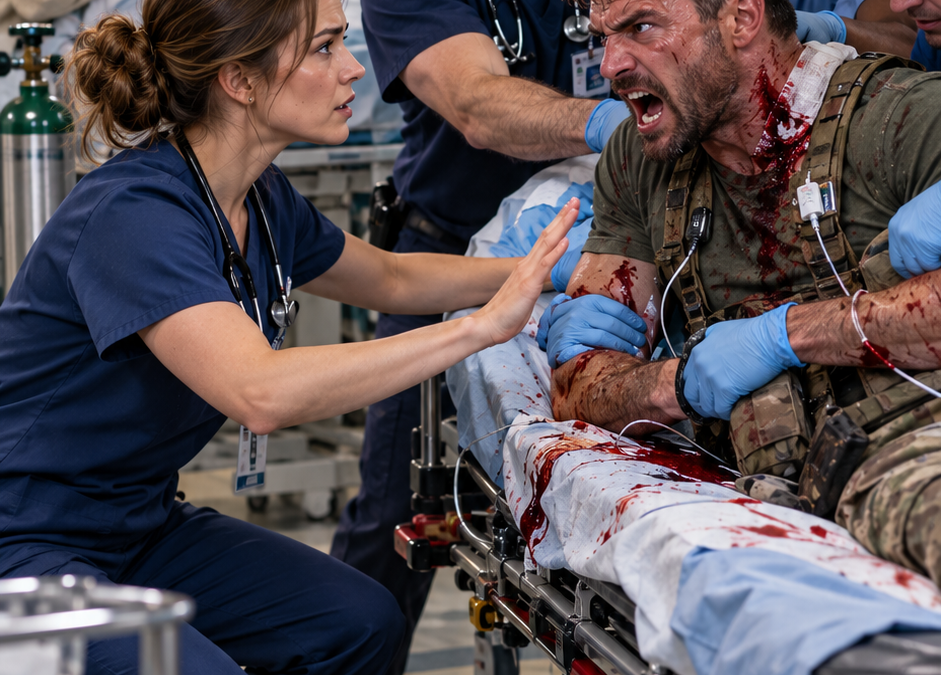
The Four Words I Said to a Bleeding Marine Were Never Meant to Be Heard by My Family
My father looked straight at me from a hospital gurney and said he would rather die than let me touch him.
My mother slapped my hand away from his oxygen mask while my younger sister watched with the same hatred she had carried since our brother came home beneath a folded flag.
Then a wounded Marine in the next trauma bay heard four words I had sworn never to use again, and everything my family believed about me began to come apart.
My name is Ava Mercer.
I was thirty-two years old when my past finally caught up with me beneath the fluorescent lights of Cedar Ridge Medical Center.
To everyone there, I was simply Nurse Mercer.
Night shift.
Quiet.
Reliable.
The nurse who volunteered for difficult patients, took extra shifts without complaining, and rarely talked about her life outside the hospital.
Nobody knew that before I wore navy-blue scrubs, I had worn an Air Force uniform.
Nobody knew what I had done in that uniform.
Nobody knew why I had left.
And until that night, I wanted it that way.
Eighteen months earlier, my younger brother Noah had died overseas.
My family received a casualty notification, a folded flag, and a heavily redacted report containing one sentence they never forgot.
Close air support authorized by Staff Sergeant Ava Mercer immediately preceded Sergeant Noah Mercer’s fatal injuries.
That sentence destroyed us.
My parents did not receive the full operational picture.
They did not know what happened before the strike.
They did not know what happened afterward.
And because the mission remained classified, I could not tell them.
So grief filled the empty spaces.
Then anger gave grief a target.
Me.
My mother, Margaret, told relatives I had chosen mission success over my brother.
My father stopped answering most of my calls.
My younger sister Claire posted vague messages online about people hiding behind classified excuses.
At Christmas, my name disappeared from the invitation list.
At Thanksgiving, nobody called.
When I attended Noah’s funeral, I stood beside the grave in silence because I had already cried myself empty in bathrooms, transport terminals, and locked rooms where nobody could see me.
My family interpreted that silence as proof.
Ava did not cry.
Ava had authorized the strike.
Ava had survived.
Therefore Ava must be guilty.
The cruelest part was that after long enough, I began wondering if maybe they were right.
I had replayed those thirteen seconds thousands of times.
The voices over the radio.
The coordinates.
The aircraft holding overhead.
The enemy movement.
Noah’s position.
His voice.
My decision.
I knew what procedure said.
I knew what the review board eventually concluded.
But procedure does not sit beside you at three in the morning asking whether your younger brother would still be alive if you had hesitated for five more seconds.
That night at Cedar Ridge, my father arrived with crushing chest pain.
Claire brought him to the emergency department without realizing I was working.
I entered his bay carrying a blood-pressure cuff.
Mom saw me first.
Her face hardened instantly.
“You stay away from him.”
I stopped.
“His pressure is dropping.”
“We have doctors.”
“I’m his nurse.”
“You stopped being our daughter when Noah came home in a coffin.”
The sentence still found the exact place to hurt.
Even after eighteen months.
Dad turned his head toward me.
“Ava.”
Hope rose before I could stop it.
For one stupid second, I thought maybe fear had changed something.
Then he said, “Leave.”
I stepped back.
Dr. Jason Hale pushed through the curtain.
Jason was an emergency physician in his late thirties, competent, impatient, and usually able to make three decisions while the rest of us were still finding a chart.
He looked at Dad’s monitor.
“Mrs. Mercer, your husband may be having an acute coronary event. I need everyone calm.”
Mom pointed at me.
“Then get her out.”
Jason looked at me.
He knew almost nothing about my family.
Nobody at Cedar Ridge did.
“Mercer?”
“I’ll switch assignments.”
Claire laughed bitterly.
“Finally.”
I turned toward the curtain.
Then something crashed in Trauma Bay Four.
A man roared.
Someone shouted for security.
Another impact shook the medication cabinet.
Jason and I both turned.
“What the hell?”
We ran.
Behind me, Claire called, “Of course. Run away again. You’re good at that.”
I kept moving.
Five people were trying to control the patient in Bay Four.
They were losing.
His chart identified him as Luke Grant, thirty-seven, former Marine scout sniper.
He had collapsed outside a veterans’ support center.
An old gunshot scar ran from below his left ear toward the base of his throat.
The scar had reopened.
Blood streaked his neck.
But that was not the most dangerous thing happening.
Luke was not seeing the hospital.
His eyes were open, but he was somewhere else.
“Get down!”
An orderly named Marcus caught his arm.
Luke turned with terrifying speed, broke the hold instinctively, and nearly threw Marcus into the wall.
“Restraints!” Jason shouted.
“No.”
Everyone looked at me.
Jason stared.
“What?”
“Don’t restrain him.”
“He almost broke Marcus’s arm.”
“He doesn’t know where he is.”
“That is exactly why—”
“He thinks you’re the enemy.”
Luke ripped the IV from his hand.
Blood scattered across the sheet.
Jason stepped toward him.
I caught his sleeve.
“Don’t surround him.”
“Ava.”
“I know what I’m looking at.”
Luke turned toward me.
His fist tightened.
My heart hammered.
Not because I feared him.
Because I recognized his eyes.
I had seen that look under red emergency lighting.
Inside aircraft.
In smoke.
In dust.
In men whose bodies had returned from one moment while their minds remained somewhere else.
My mother and Claire had followed us.
I could feel them behind me.
Of course they had.
Luke took one step toward me.
I took one toward him.
Then I said the four words I had sworn never to use again.
“Ghost Six-One. Eyes on me.”
Luke froze.
So did everyone else.
His fist remained raised.
I lowered my voice.
“Ghost Six-One, this is Wraith. Hospital is secure. No hostiles. You copy?”
Something drained from his face.
Not immediately.
The aggression faded slowly.
Confusion replaced it.
Then recognition.
His hand lowered.
“No.”
His voice cracked.
He stared at me.
“No way.”
“Sit down, Marine.”
Luke sat.
Five grown men had tried to overpower him.
Four words had reached him.
Jason looked at me as though the person standing beside him had suddenly been replaced.
“How do you know his call sign?”
I ignored the question.
I pressed gauze against Luke’s neck.
His hand caught my wrist.
Not aggressively.
Desperately.
“You’re Wraith.”
My mother spoke behind me.
“What did he call you?”
Luke looked toward her.
Then Claire.
Then through the open curtain where my father’s gurney remained visible.
His gaze returned to me.
“Mercer.”
His expression changed.
“Ava Mercer.”
My stomach dropped.
“Luke.”
He stared harder.
Then something worse than recognition crossed his face.
Memory.
“You’re Noah’s sister.”
Claire stepped closer.
“You knew Noah?”
Luke looked at her.
Then Mom.
Then Dad.
His face hardened.
“You’re his family?”
Mom’s voice trembled.
“Yes.”
Luke turned toward me.
“You never told them?”
“I couldn’t.”
“Told us what?” Claire demanded.
“Luke.”
But eighteen months of silence had apparently become too much for him.
Mom stepped forward.
“My son died because of her.”
Luke stared at her.
Three seconds.
Nobody breathed.
Then he said quietly, “No, ma’am.”
His eyes filled.
“Your son died saving me.”
He pointed at me.
“And she’s the reason the rest of us came home.”
Mom sat down.
Not gracefully.
Her knees simply stopped holding her.
Claire caught her shoulder.
“What did you say?”
Luke looked at me.
I shook my head.
There were details he could not discuss.
He understood.
But he was also clearly finished allowing my family to believe the version that had destroyed us.
“That report you got,” he said, “wasn’t the whole story.”
Mom’s face turned white.
“You were there?”
“Yes.”
“With Noah?”
Luke swallowed.
“Yes, ma’am.”
Claire stepped toward him.
“Then tell us how he died.”
“I can’t discuss operational details.”
She laughed without humor.
“Convenient.”
“Claire,” I warned.
She spun toward me.
“Don’t defend him. We buried Noah while you stood there like a statue.”
“I wasn’t—”
“You didn’t even cry.”
That hurt because it was true.
Not the meaning she attached to it.
The fact.
I had spent twelve days crying before the funeral.
By the time Noah was lowered into the ground, my body had nothing left.
Luke stared at Claire.
“You think she didn’t care?”
“You don’t know her.”
Luke gave a humorless laugh.
“Lady, I know what her voice sounded like while eighteen people were shooting at us.”
The room went still.
Jason finally recovered enough to remember he had a patient.
“This conversation is over until Sergeant Grant is stabilized.”
Luke looked at him.
“Sergeant.”
Jason blinked.
Then nodded.
“Sergeant Grant.”
That tiny correction changed Luke’s expression.
Respect matters when a person feels surrounded.
We cleaned the wound on his neck.
The bleeding was superficial, but the scar tissue looked inflamed.
Luke watched me the entire time.
Finally he asked, “How long have you been pretending to be only a nurse?”
“I’m not pretending.”
“You know what I mean.”
“My badge says nurse. That’s what I am.”
He almost smiled.
“Your badge leaves out chapters.”
Mom heard him.
“What did you do in the Air Force?”
My hands stopped for half a second.
Claire whispered, “She told us communications.”
“I worked communications.”
Luke snorted.
“That’s one description.”
“Enough.”
He looked almost amused.
“You’re still stubborn, Wraith.”
The nickname made my chest hurt.
Then Dad’s cardiac monitor alarm sounded from the next bay.
I moved before anyone else.
Jason was beside me.
By the time we reached Dad, his skin had turned gray.
The ECG showed changes I recognized even before Jason swore.
“Cardiology. Now.”
Mom grabbed my arm.
It was the first time she had willingly touched me since Noah died.
“Is he dying?”
I wanted to lie.
Medicine teaches you quickly that comforting lies are still lies.
“He is in danger.”
Her grip tightened.
“Save him.”
An hour earlier she had slapped my hand away.
Now terror had stripped away anger.
“I’m not his doctor,” I said. “But everybody here is going to do everything possible.”
Dad was rushed upstairs for emergency cardiac catheterization.
Mom and Claire followed.
Neither asked me to come.
Luke remained under observation.
At three in the morning, I found him awake staring at the ceiling.
“You shouldn’t have said that.”
He didn’t look at me.
“Which part?”
“You know.”
“That Noah saved me?”
“Yes.”
“It’s true.”
“It creates questions.”
“Maybe those questions should’ve existed eighteen months ago.”
“You think I don’t know that?”
He turned his head.
“No. I think you decided letting your family punish you was easier than fighting people who already made up their minds.”
That landed too accurately.
“I was under review.”
“You were cleared.”
“Eventually.”
“That isn’t what I heard.”
I stared at him.
Luke lowered his voice.
“Guys talked. The review never found your call was wrong.”
He paused.
“They left the report vague because somebody higher up didn’t want responsibility for putting Noah’s team where they were.”
“You don’t know that.”
“I know more than you think.”
“You were unconscious during extraction.”
“I woke up later.”
I turned away.
Then Luke said, “Noah talked to me before we moved.”
My body went cold.
“When?”
“After the strike.”
I looked back.
“That’s impossible.”
“No.”
“The report said—”
“The report said what they needed it to say.”
He pushed himself higher against the pillow.
“He was alive afterward.”
Every sound in the hospital disappeared.
For eighteen months, I had believed the aircraft I authorized was the last thing my brother experienced.
Luke watched my face carefully.
“He knew what you did.”
“What did he say?”
Before Luke could answer, his monitor screamed.
His hands flew to his throat.
His eyes widened.
He tried to inhale.
Nothing happened.
“Luke?”
The scar along his neck began swelling beneath my fingers.
Jason ran into the bay.
“Epinephrine.”
“No.”
He stared.
“What?”
“This isn’t an allergic reaction.”
Luke clawed at his neck.
His oxygen saturation fell rapidly.
“The scar tissue is collapsing the airway.”
Jason called anesthesia.
I looked at Luke.
Then at the clock.
We did not have enough time.
Perhaps sixty seconds.
Maybe less.
Jason saw my expression.
“What do you need?”
I pulled on gloves.
“A scalpel.”
He stared at me.
“You are not credentialed for a surgical airway.”
“Then you do it.”
His eyes shifted toward Luke.
“I’ve performed one under supervision.”
“I’ve done seven.”
Silence.
Kayla Brooks, another nurse beside us, whispered, “Seven?”
“Six survived.”
Nobody asked about the seventh.
There was no time.
“Jason, stabilize his head. Kayla, suction. Six-point-zero tube.”
Jason moved.
Not because I had authority over him.
Not because hospital policy stopped existing.
Because Luke was turning blue.
I placed my fingers on his throat.
The anatomy returned instantly.
For eighteen months, I had tried to forget how natural those movements once felt.
I became a civilian nurse because I wanted clean rooms.
Bright lights.
Specialists nearby.
No sand.
No gunfire.
No aircraft circling while somebody bled into dirt.
Yet the moment my hand closed around the scalpel, my body remembered.
“Small incision.”
I cut.
Air hissed.
Kayla gasped.
“Tube.”
She put it into my hand.
I inserted it.
Connected oxygen.
Luke’s chest rose.
His saturation climbed.
Seventy-one.
Seventy-nine.
Eighty-six.
Ninety.
Ninety-four.
Only then did I realize people were staring.
Dr. Samuel Benton from the ICU had arrived during the procedure.
He looked at Luke’s neck.
Then at me.
“Who did that?”
Jason pointed.
“The nurse?”
“My name is Ava.”
Benton moved closer.
“That was a field cric.”
“It was an emergency cricothyrotomy.”
“No. The technique.”
My stomach tightened.
He knew.
“My brother was with a Special Operations Surgical Team,” Benton said. “I watched them train. A civilian nurse does not learn that during orientation.”
Luke’s eyes opened slightly.
Through the new airway, his voice barely worked.
“Told you.”
I glared at him.
He smiled.
Then my mother spoke from the doorway.
“She killed my son.”
The room froze.
Mom stood beside Claire.
They must have returned after Dad’s procedure.
I felt more exposed by those four words than by the blood on my gloves.
“Mom.”
“Your father is stable,” she said mechanically. “Two stents.”
Relief hit me.
Then her eyes went to Luke.
“You said Noah was alive after the strike.”
Luke watched her.
“Yes.”
“I want the truth.”
“I cannot discuss classified mission details.”
“Everybody says classified as if that word should matter more than my dead child.”
Her voice cracked.
For the first time, anger disappeared completely.
She was simply a mother whose son had died.
“I need to know whether I hated my daughter for something she didn’t do.”
I could not answer.
That was the cruelty.
Luke could.
“Noah’s death was not Ava’s fault.”
Mom looked at me.
“Then whose was it?”
I closed my eyes.
“That is the question I was never allowed to answer.”
Jason approached slowly.
“You need to tell hospital administration what training you have.”
“I know.”
“And maybe tell us.”
There was no hiding left.
“I served nine years in the Air Force.”
Mom stared.
“You told us six.”
“The last three included assignments I didn’t discuss at home.”
“What assignments?”
“Special tactics.”
Benton’s expression changed.
Jason whispered, “Combat control?”
“Yes.”
Claire stared as if I were someone she had never met.
I continued.
“I coordinated aircraft, fires, evacuation routes, and extraction with joint teams operating in places where ordinary support didn’t exist. We had advanced tactical trauma training because sometimes there wasn’t a doctor.”
Mom took one step backward.
“Noah knew?”
“Yes.”
“You deployed together?”
“Once.”
Her hand covered her mouth.
The lie my family had built around me cracked wider.
Before sunrise, hospital administration called me upstairs.
Dr. Helen Ward, Cedar Ridge’s chief medical officer, sat behind her desk with the expression of someone who had already spoken to legal counsel.
She reviewed my military records.
DD-214.
Training certificates.
Medical qualifications.
Deployment records with most locations redacted.
She eventually leaned back.
“You understand the liability problem.”
“Yes.”
“You performed an invasive procedure outside normal nursing scope.”
“Yes.”
“And if you hadn’t?”
“He would have died.”
She tapped her pen.
“I agree.”
Jason sat beside me.
Ward looked at him.
“You supported the decision?”
“I held his head while she saved him.”
Ward nodded.
Then turned her laptop.
A security alert had flagged our incident report because one phrase entered in the notes matched restricted military records.
Ghost Six-One.
My stomach dropped.
“Someone from the Department of Defense called,” Ward said.
“When?”
“Seven minutes ago.”
My phone vibrated.
Blocked number.
I stared.
Eighteen months of hiding.
One trauma bay.
One call sign.
One dying Marine.
And suddenly the life I buried was calling.
I answered.
“Ava Mercer.”
The voice was familiar.
“Staff Sergeant Mercer. Colonel Daniel Voss.”
My skin went cold.
“We need to discuss Operation Lantern.”
My brother’s final mission.
Then he said something I never expected.
“We reopened the investigation yesterday.”
Colonel Voss arrived the next afternoon with two investigators.
I knew him immediately.
Eighteen months earlier, he sat on the board that questioned me for nine hours after Noah’s death.
He never accused me directly.
That almost made it worse.
He simply listened as other people asked whether grief distorted my memory.
Whether I confirmed Noah’s position.
Whether I misunderstood his transmission.
Whether I called the strike too quickly.
Now he stood outside Luke’s ICU room.
“You’ve caused considerable paperwork.”
“Luke did most of that.”
One investigator moved toward the door.
“We need to interview Sergeant Grant.”
“He just had an emergency airway.”
“This concerns national security.”
“It also concerns oxygen.”
The investigator glared.
Voss lifted one hand.
“She is correct.”
Then he asked why I had used Luke’s operational call sign.
“Because he was trapped in a flashback and nothing else reached him.”
“You used your own identifier.”
“I know.”
“That name still exists in restricted systems.”
“Then maybe your restricted systems should communicate enough information so civilian hospitals don’t treat traumatized operators like violent criminals.”
The taller investigator stepped toward me.
“Watch your tone.”
I looked at him.
“I spent nine years speaking calmly while people shot at me. This is my calm tone.”
Voss almost smiled.
Then Jason emerged.
“Luke is awake. Ten minutes. One interviewer. No stress.”
The investigator started forward.
Jason blocked him.
“I said one interviewer.”
Two days earlier, Jason had helped call for restraints.
Now he was protecting Luke’s space.
People can learn quickly when they choose to.
Voss entered alone.
Mom arrived while I waited outside.
She saw the investigators.
“Is this about Noah?”
“Yes.”
“Will they finally tell us what happened?”
“I don’t know.”
“I need answers.”
“So do I.”
She looked startled.
“You don’t know?”
I laughed once.
Broken.
“You think the military gave me every answer?”
“You were there.”
“Yes.”
“Then how can you not know?”
“Because war isn’t a courtroom recording, Mom. Sometimes you hear three voices, see two heat signatures, and have ten seconds to decide whether twenty people live.”
Her eyes filled.
“Was Noah alive when you made the call?”
“Yes.”
“Did you know where he was?”
“Yes.”
Her face collapsed.
I knew what she thought.
“No.”
She stepped back.
“You knew where your brother was and authorized the strike.”
“Because Noah ordered me to.”
She froze.
“What?”
I had crossed a line.
A classified operational detail.
But I could not take it back.
“Our team was pinned below a ridge. Enemy fighters were moving toward the extraction route. Noah’s element was forward.”
Mom stared.
“I had aircraft overhead. One window.”
“And Noah?”
“He told me to strike.”
“He told you?”
“Three times.”
“Why?”
I stopped.
There was only so far I could go.
Mom grabbed the front of my scrub top.
“Why would my son tell his sister to drop bombs near him?”
A voice answered from behind her.
“Because he knew he wasn’t getting off that ridge.”
Luke stood in the doorway with a walker.
Jason behind him, furious.
“Luke.”
Luke ignored him.
Mom stared.
“What happened?”
“Noah was hit before Ava made the call.”
I looked at Luke.
That detail had never been clear in my report.
“How badly?”
Luke swallowed.
“Bad.”
Mom started shaking.
“I was twenty yards from him. He told us to move downhill.”
Luke looked at me.
“He said Ava would know what to do.”
My vision blurred.
“He said my name?”
Luke nodded.
“He said, ‘My sister won’t hesitate if she knows we have a chance.’”
Something inside me broke.
For eighteen months, I believed Noah’s last thought might have been betrayal.
Luke continued.
“He stayed behind with another wounded Marine because they couldn’t move fast enough. If those fighters crossed the ridge, we were all dead.”
Mom whispered, “And the strike?”
“Stopped them.”
“Did it kill Noah?”
Luke’s expression shattered.
“I don’t know.”
Neither did I.
That uncertainty had destroyed all of us.
Voss emerged from Luke’s room.
He had heard enough.
Mom turned on him.
“You knew?”
“Some.”
“And you gave us a report making it sound like Ava killed Noah.”
He said nothing.
Mom slapped him.
Hard.
The investigators moved.
Voss raised his hand.
“No.”
He touched his cheek.
Then said, “You deserved more truth than we gave you.”
Mom began sobbing.
Voss looked at me.
“We recovered something during the reopened review.”
“What?”
“A damaged audio archive.”
Luke went still.
“It includes Sergeant Noah Mercer’s final transmission.”
Mom stopped crying.
For eighteen months, our entire family had lived under one redacted sentence.
Now my dead brother had a voice.
Voss asked, “Do you want to hear it?”
Dad insisted on coming down from cardiology.
The nurses objected.
He argued until they wheeled him into the conference room beneath a hospital blanket, telemetry monitor still attached.
Claire stood behind him.
Mom sat beside me.
Luke was in a wheelchair.
Jason stayed by the door.
Colonel Voss placed a secure laptop on the table.
“This remains partially classified. You will hear an authorized edited segment.”
He pressed play.
Static.
Gunfire.
Then a voice I had not heard in eighteen months.
My brother.
“Wraith, Ghost Lead. Confirm birds are holding.”
My hand covered my mouth.
Noah sounded alive.
Calm.
Breathing hard.
Exactly as I remembered.
My recorded voice answered.
“Ghost Lead, affirmative. Thirty seconds before they have to break.”
Then Noah.
“We’re not making extraction.”
Claire started crying.
Dad lowered his head.
My voice came again.
“Negative. Luke is moving to you.”
Noah answered.
“Luke’s hit. Miller’s hit. I’m hit. Stop arguing.”
Luke closed his eyes.
Then Noah said my name.
Not Wraith.
Not rank.
“Ava.”
My brother talking to his sister.
“You know what happens if they cross us.”
My recorded breathing was fast.
“I can bring the strike farther east.”
“No.”
“Noah—”
“Do your job.”
Dad began sobbing.
I had never heard my father sob before.
Noah continued.
“You get them home.”
Gunfire cracked.
Someone shouted.
Then:
“You hear me?”
“Yes.”
“Mom’s gonna hate this.”
He laughed slightly.
Even dying, Noah making a joke because that was what Noah did when everyone else got scared.
“Tell her I volunteered.”
The recording distorted briefly.
Then:
“And Ava?”
“Yes?”
“You’re still my annoying big sister.”
My recorded voice broke.
“You’re an idiot.”
“Probably.”
Silence.
Then:
“Love you.”
“I love you too.”
After that, the voices became professional.
Coordinates.
Clearance.
Countdown.
Voss stopped the recording before impact.
Nobody moved.
For eighteen months, I remembered those words.
But memory becomes cruel when no one believes it.
Eventually, you question yourself.
Maybe Noah had not sounded calm.
Maybe he never joked.
Maybe guilt invented the part where he said he loved me.
Now the truth sat on a table where everyone heard it.
Mom turned toward me.
“Ava.”
I could not look at her.
She reached for my hand.
I pulled away.
That hurt her.
I saw it.
But eighteen months did not disappear because of one recording.
“I called you a murderer.”
“Yes.”
“I told Dad not to invite you to Christmas.”
“Yes.”
“I removed you from the family chat.”
Claire whispered, “Mom.”
Mom shook her head.
“No. She needs to hear me say it.”
She looked at me.
“I chose the easiest person to blame.”
I finally met her eyes.
“Why me?”
Her answer came immediately.
“Because you were alive.”
The words emptied the room.
“Noah was dead. The military was faceless. The people who attacked him were faceless.”
Tears ran down her cheeks.
“But you were standing in front of me.”
My voice shook.
“So you punished me for surviving.”
“Yes.”
At least she did not lie.
Claire sat down.
“I helped.”
She looked barely able to breathe.
“I told Dad you shouldn’t come to Thanksgiving. I told cousins not to answer you.”
“I know.”
“I wrote that post.”
“I saw it.”
She covered her face.
“I’m sorry.”
Then Dad raised his head.
“I was worse.”
I turned.
He stared at his hands.
“The casualty officer told me privately that the full story was more complicated.”
Mom looked at him.
“What?”
“He warned me not to assume Ava caused Noah’s death.”
Cold spread through me.
“You knew?”
“I knew enough to doubt.”
“Then why did you never defend me?”
He looked at me.
“Because your mother needed someone to blame.”
I stood.
“Ava,” Jason said quietly.
“I need air.”
Dad reached toward me.
“I was a coward.”
I stopped.
“Yes.”
No shouting.
No speech.
Just truth.
“You were.”
I left.
Luke found me twenty minutes later on Cedar Ridge’s rooftop garden.
He sat beside me.
Neither of us spoke.
Eventually he said, “Noah would hate this place.”
I laughed through tears.
“He hated flowers.”
“Said landscaping was nature wearing makeup.”
“That sounds like him.”
Then Luke’s expression changed.
“You know the strike didn’t kill him.”
I turned sharply.
“What?”
“The reopened review matched the medical evidence.”
My heart pounded.
“He had already lost too much blood.”
I stared at him.
Luke spoke gently.
“He was gone before impact.”
I covered my face.
For eighteen months, I had believed my decision ended my brother’s life.
Now grief arrived differently.
Not smaller.
Cleaner.
Separated from guilt.
“You didn’t kill Noah,” Luke said.
That was when I finally cried.
Not like the funeral.
Not quietly in a locked bathroom.
Not alone in my car.
I cried like Noah’s sister.
For the brother who had made an impossible choice.
For the family who blamed me.
For the version of myself that disappeared while trying to carry everything.
Luke sat beside me.
“You brought us home.”
Four days later, the reopened investigation formally cleared me of wrongdoing.
The new report acknowledged that the original findings used ambiguous casualty sequencing.
That was bureaucratic language for something painfully simple.
They allowed uncertainty to remain because clarity would have required admitting institutional failures.
Colonel Voss apologized.
I accepted it.
I did not pretend an apology restored eighteen months.
Some things cannot be repaired completely.
They can simply stop getting worse.
Cedar Ridge opened its own review into Luke’s emergency airway.
Dr. Helen Ward called me back into her office.
“I have legal counsel telling me six contradictory things.”
“That sounds productive.”
She smiled slightly.
“Dr. Hale says you saved Grant’s life.”
“Yes.”
“Dr. Benton agrees.”
“Yes.”
“Risk management agrees waiting for anesthesia would likely have resulted in brain injury or death.”
“Yes.”
“And apparently every nurse in the emergency department plans to resign if I fire you.”
That surprised me.
“All of them?”
“Kayla has a spreadsheet.”
I laughed.
Ward slid a document toward me.
“You are not being fired.”
A formal commendation.
“This does not make what happened normal nursing practice,” she said.
“I understand.”
“But I am also not punishing someone for using verified emergency training to prevent a death.”
I nodded.
Then she leaned back.
“We’re developing a veterans crisis-response program.”
My mind went instantly to Luke.
Five people trying to restrain him.
Everyone interpreting trauma as aggression.
My four words reaching a place force could not.
Ward continued.
“We need staff trained to recognize military trauma before escalation.”
“You want me involved.”
“I want you to help design it.”
“I’m a night-shift nurse.”
“You are also apparently a former Air Force special tactics combat controller with advanced trauma training.”
“News travels.”
“In a hospital? Faster than infection.”
I smiled.
“I’ll help.”
Then she added, “The Department of Defense also contacted me.”
I groaned.
“They’re interested in using you part-time as a medical liaison for special operations veterans moving into civilian healthcare.”
“Colonel Voss?”
“Yes.”
For eighteen months, I had made myself smaller because visibility hurt.
Maybe hiding had protected me once.
Maybe it had become another prison.
“I’ll talk to them.”
My family was harder.
Dad apologized constantly.
At first it irritated me.
Eventually I realized repetition was the only language he had for something he could not undo.
Mom asked me to come home.
I said no.
Her face fell.
“We’re trying.”
“So am I.”
“Then why won’t you let us?”
“Because trying doesn’t mean pretending the last eighteen months didn’t happen.”
“What do you need?”
“Time.”
“How much?”
“I don’t know.”
That frightened her.
I allowed it.
Not as revenge.
Because forgiveness without consequences can become permission.
Claire came to my apartment carrying a cardboard box.
Inside were photographs of Noah.
Photos she had taken from my room after his funeral.
“I thought you didn’t deserve them.”
I stared at her.
She began crying.
“I was cruel.”
“Yes.”
“I’m sorry.”
I opened the box.
One picture showed Noah at twenty-three wearing sunglasses and holding a fishing rod upside down because he was pretending not to understand how fishing worked.
I laughed.
Claire laughed too.
For one minute, we were sisters again.
Not completely.
But enough to remember how.
Luke recovered.
His throat healed.
Jason connected him with a therapist who understood military trauma instead of trying to medicate every symptom into silence.
One afternoon Luke came to the nurses’ station.
“No restraints?” I asked.
“Trying something radical.”
“What?”
“Cooperation.”
“Dangerous.”
He smiled.
“Doc says I leave Friday.”
“Good.”
He leaned against the counter.
“You taking the liaison job?”
“Probably.”
“You should.”
“Everyone keeps saying that.”
“Because we’re right.”
“That must be painful for a sniper.”
“Former sniper.”
“Still arrogant.”
“Occupational damage.”
Then he became serious.
“Noah talked about you.”
I stared.
“What?”
“All the time.”
“What did he say?”
Luke smiled.
“That his sister was the only person on earth more stubborn than him.”
“False.”
“Exactly what he said you’d say.”
My eyes burned.
Luke waited.
Then said, “I figured something out about that night in the ER.”
“What?”
“I wasn’t reliving getting shot.”
“What were you reliving?”
“The ridge.”
My breath caught.
“When you said Ghost Six-One, I remembered what came after.”
“The strike?”
“No.”
He shook his head.
“Survival.”
He touched the scar along his throat.
“For eighteen months, your call sign belonged to the worst day of my life.”
Then he looked at me.
“When you said it in that hospital, suddenly it meant somebody was coming to get me out.”
I did not know what to say.
Luke smiled faintly.
“You changed the memory.”
Maybe he had changed mine too.
Eight months later, Cedar Ridge opened the Mercer Veterans Stabilization Center.
I fought the name.
I lost.
Dr. Ward blamed the board.
Jason claimed he voted against me because watching me get irritated improved staff morale.
The program was not glamorous.
After the opening week, the cameras disappeared.
What remained were exhausted men and women sitting in quiet rooms with dimmed lights.
Nurses learned not to surround patients unnecessarily.
Military triggers were documented when patients wanted them included.
Staff learned that someone repeatedly checking exits was not automatically paranoid.
That refusing to sit with your back toward a doorway could come from years of conditioning.
That combat trauma could resemble hostility.
And that sometimes understanding worked better than control.
I worked three hospital shifts each week.
Two days as a DoD civilian medical liaison.
For the first time, I stopped pretending those identities contradicted each other.
Some nights I was Nurse Mercer searching for blankets and restarting IV pumps.
Other days I sat across from former special operators and told them, “You do not need to explain why fireworks bother you.”
Both lives mattered.
Dad recovered physically before our relationship did.
He started therapy.
Mom did too.
Claire framed Noah’s photographs instead of keeping them inside a box.
One year after the truth came out, our family went to Noah’s grave together.
Nobody argued about whether I belonged there.
Mom placed flowers beneath his name.
“I spent so long thinking anger meant I loved him.”
I listened.
“I thought stopping the blame meant his death mattered less.”
“And now?”
She looked at me.
“Now I think blaming you almost made me lose two children.”
My throat tightened.
She did not ask me to forgive her.
That helped more than asking would have.
I reached for her hand.
Briefly.
But I did.
Luke arrived later.
Jeans.
Boots.
A jacket.
No uniform.
He placed a challenge coin beneath Noah’s name.
Dad watched him.
“You were with my boy?”
“Yes, sir.”
Dad swallowed.
“Was he afraid?”
Luke thought carefully.
“Yes.”
Dad looked surprised.
Luke continued.
“Brave men are afraid all the time. That’s why courage costs something.”
Dad nodded.
“What was he thinking about?”
“His family.”
Mom covered her mouth.
Luke smiled.
“And annoying his sister.”
I groaned.
He laughed.
Then Mom did.
Then Claire.
Even Dad.
For the first time, Noah’s grave heard our family laugh.
It did not feel disrespectful.
It felt alive.
A week later, security called me about an agitated veteran in the ER.
Jason looked over.
“Want to do your magic?”
“There is no magic.”
“I’ve seen grown men listen to you faster than residents listen to me.”
“That says more about your residents.”
We entered together.
A white-haired Vietnam veteran sat in a corner breathing hard.
I did not know him.
No classified call sign.
No shared mission.
No special connection.
So I did something simpler.
I sat on the floor six feet away.
“My name is Ava.”
He watched me.
“You military?”
“Used to be.”
“What branch?”
“Air Force.”
He grunted.
“Nobody’s perfect.”
Jason covered a laugh.
I smiled.
“True.”
Several minutes passed.
His breathing slowed.
Eventually he allowed Jason to examine him.
That was when I fully understood what my past had given me.
It had not made me valuable because I knew how to fight.
It made me valuable because I knew what fear looked like before fear became violence.
I understood how silence could contain information.
How people fighting invisible wars did not always need to be controlled.
Sometimes they needed somebody willing to recognize where their minds had gone.
Near midnight, I stepped outside the emergency department with coffee.
Luke waited near the veterans center entrance.
He volunteered twice a month now.
“Ghost Six-One,” I said.
“Wraith.”
We had repeatedly been advised not to use the old identifiers casually.
We repeatedly ignored the advice when nobody official was nearby.
Luke handed me an envelope.
“What is this?”
“Something Voss cleared.”
Inside was a photocopy from Noah’s old deployment notebook.
Equipment lists.
Names.
Numbers.
A terrible sketch of a helicopter.
At the bottom, Noah had written one sentence.
If things ever go bad, Ava will get us home. She always does.
I read it once.
Then twice.
Then again.
Luke looked away to give me privacy.
I thought I would cry.
I didn’t.
I smiled.
For years, I believed healing meant somehow returning to the woman I had been before Noah died.
That woman was gone.
Healing was not returning.
It was moving forward without abandoning every piece of myself that survived.
I had been Noah’s sister.
Margaret and Thomas Mercer’s daughter.
Claire’s older sister.
A combat controller.
A nurse.
A woman blamed for something she did not do.
A woman who saved lives while believing she had failed the person she loved most.
All of those things belonged to me.
None had to erase the others.
The trauma-bay doors opened.
Jason leaned outside.
“Ava. Incoming ambulance. Forty-one-year-old veteran, severe neck injury, combative.”
Luke looked at me.
“Your kind of night.”
I folded Noah’s note carefully and placed it inside my pocket.
For a second, my hand rested over it.
Eighteen months earlier, I had left the Air Force because I thought distance could erase what happened on that ridge.
Then my family blamed me, and instead of defending myself, I disappeared further.
I accepted smaller rooms.
Shorter answers.
Silence.
I told myself I was honoring classification.
Some of that was true.
But Luke had been right too.
Part of me believed punishment was easier than being misunderstood again.
So I hid.
Then one night my father came into my emergency department believing I had killed his son.
My mother struck my hand away from him.
My sister told me running away was what I did best.
And ten minutes later, a wounded Marine reminded me that somewhere beneath eighteen months of shame, Wraith still existed.
Not as a secret operator.
Not as a weapon.
As the part of me that stayed calm when someone else needed a way home.
I looked at Luke.
“See you later.”
He nodded.
“Go.”
I walked toward the trauma doors.
Not hiding.
Not running.
Not trying to become smaller so my grief would be easier for other people to understand.
The doors opened.
Voices rose inside.
A paramedic shouted vital signs.
Somebody requested security.
Jason was already putting on gloves.
I stepped beside him.
“Let’s not crowd him.”
Jason nodded.
“Your call.”
For years, those words would have terrified me.
My call.
I had once believed one decision had killed my brother.
Now I knew the truth.
Noah had trusted me enough to place other lives in that decision.
He had not died believing his sister betrayed him.
He died believing she would do what had to be done.
He trusted me to get his men home.
And somewhere between an emergency room, a Marine who remembered my voice, a classified recording, and a family finally forced to hear the truth, I learned something Noah had apparently understood long before I did.
I had spent eighteen months trying to come home from the worst day of my life.
I simply had not realized home was not a place I could return to unchanged.
It was something I had to rebuild inside myself.
I touched the note in my pocket one final time.
Then I stepped into the trauma bay.
Ready.
What do you think of this story? Please leave a like and share your thoughts in the comments. Your support means a lot to us and inspires us to keep writing more meaningful and powerful stories. Thank you! 👍
𝗧𝗛𝗘 𝗘𝗡𝗗
The Four Words I Said to a Bleeding Marine Were Never Meant to Be Heard by My Family
My father looked straight at me from a hospital gurney and said he would rather die than let me touch him.
My mother slapped my hand away from his oxygen mask while my younger sister watched with the same hatred she had carried since our brother came home beneath a folded flag.
Then a wounded Marine in the next trauma bay heard four words I had sworn never to use again, and everything my family believed about me began to come apart.
My name is Ava Mercer.
I was thirty-two years old when my past finally caught up with me beneath the fluorescent lights of Cedar Ridge Medical Center.
To everyone there, I was simply Nurse Mercer.
Night shift.
Quiet.
Reliable.
The nurse who volunteered for difficult patients, took extra shifts without complaining, and rarely talked about her life outside the hospital.
Nobody knew that before I wore navy-blue scrubs, I had worn an Air Force uniform.
Nobody knew what I had done in that uniform.
Nobody knew why I had left.
And until that night, I wanted it that way.
Eighteen months earlier, my younger brother Noah had died overseas.
My family received a casualty notification, a folded flag, and a heavily redacted report containing one sentence they never forgot.
Close air support authorized by Staff Sergeant Ava Mercer immediately preceded Sergeant Noah Mercer’s fatal injuries.
That sentence destroyed us.
My parents did not receive the full operational picture.
They did not know what happened before the strike.
They did not know what happened afterward.
And because the mission remained classified, I could not tell them.
So grief filled the empty spaces.
Then anger gave grief a target.
Me.
My mother, Margaret, told relatives I had chosen mission success over my brother.
My father stopped answering most of my calls.
My younger sister Claire posted vague messages online about people hiding behind classified excuses.
At Christmas, my name disappeared from the invitation list.
At Thanksgiving, nobody called.
When I attended Noah’s funeral, I stood beside the grave in silence because I had already cried myself empty in bathrooms, transport terminals, and locked rooms where nobody could see me.
My family interpreted that silence as proof.
Ava did not cry.
Ava had authorized the strike.
Ava had survived.
Therefore Ava must be guilty.
The cruelest part was that after long enough, I began wondering if maybe they were right.
I had replayed those thirteen seconds thousands of times.
The voices over the radio.
The coordinates.
The aircraft holding overhead.
The enemy movement.
Noah’s position.
His voice.
My decision.
I knew what procedure said.
I knew what the review board eventually concluded.
But procedure does not sit beside you at three in the morning asking whether your younger brother would still be alive if you had hesitated for five more seconds.
That night at Cedar Ridge, my father arrived with crushing chest pain.
Claire brought him to the emergency department without realizing I was working.
I entered his bay carrying a blood-pressure cuff.
Mom saw me first.
Her face hardened instantly.
“You stay away from him.”
I stopped.
“His pressure is dropping.”
“We have doctors.”
“I’m his nurse.”
“You stopped being our daughter when Noah came home in a coffin.”
The sentence still found the exact place to hurt.
Even after eighteen months.
Dad turned his head toward me.
“Ava.”
Hope rose before I could stop it.
For one stupid second, I thought maybe fear had changed something.
Then he said, “Leave.”
I stepped back.
Dr. Jason Hale pushed through the curtain.
Jason was an emergency physician in his late thirties, competent, impatient, and usually able to make three decisions while the rest of us were still finding a chart.
He looked at Dad’s monitor.
“Mrs. Mercer, your husband may be having an acute coronary event. I need everyone calm.”
Mom pointed at me.
“Then get her out.”
Jason looked at me.
He knew almost nothing about my family.
Nobody at Cedar Ridge did.
“Mercer?”
“I’ll switch assignments.”
Claire laughed bitterly.
“Finally.”
I turned toward the curtain.
Then something crashed in Trauma Bay Four.
A man roared.
Someone shouted for security.
Another impact shook the medication cabinet.
Jason and I both turned.
“What the hell?”
We ran.
Behind me, Claire called, “Of course. Run away again. You’re good at that.”
I kept moving.
Five people were trying to control the patient in Bay Four.
They were losing.
His chart identified him as Luke Grant, thirty-seven, former Marine scout sniper.
He had collapsed outside a veterans’ support center.
An old gunshot scar ran from below his left ear toward the base of his throat.
The scar had reopened.
Blood streaked his neck.
But that was not the most dangerous thing happening.
Luke was not seeing the hospital.
His eyes were open, but he was somewhere else.
“Get down!”
An orderly named Marcus caught his arm.
Luke turned with terrifying speed, broke the hold instinctively, and nearly threw Marcus into the wall.
“Restraints!” Jason shouted.
“No.”
Everyone looked at me.
Jason stared.
“What?”
“Don’t restrain him.”
“He almost broke Marcus’s arm.”
“He doesn’t know where he is.”
“That is exactly why—”
“He thinks you’re the enemy.”
Luke ripped the IV from his hand.
Blood scattered across the sheet.
Jason stepped toward him.
I caught his sleeve.
“Don’t surround him.”
“Ava.”
“I know what I’m looking at.”
Luke turned toward me.
His fist tightened.
My heart hammered.
Not because I feared him.
Because I recognized his eyes.
I had seen that look under red emergency lighting.
Inside aircraft.
In smoke.
In dust.
In men whose bodies had returned from one moment while their minds remained somewhere else.
My mother and Claire had followed us.
I could feel them behind me.
Of course they had.
Luke took one step toward me.
I took one toward him.
Then I said the four words I had sworn never to use again.
“Ghost Six-One. Eyes on me.”
Luke froze.
So did everyone else.
His fist remained raised.
I lowered my voice.
“Ghost Six-One, this is Wraith. Hospital is secure. No hostiles. You copy?”
Something drained from his face.
Not immediately.
The aggression faded slowly.
Confusion replaced it.
Then recognition.
His hand lowered.
“No.”
His voice cracked.
He stared at me.
“No way.”
“Sit down, Marine.”
Luke sat.
Five grown men had tried to overpower him.
Four words had reached him.
Jason looked at me as though the person standing beside him had suddenly been replaced.
“How do you know his call sign?”
I ignored the question.
I pressed gauze against Luke’s neck.
His hand caught my wrist.
Not aggressively.
Desperately.
“You’re Wraith.”
My mother spoke behind me.
“What did he call you?”
Luke looked toward her.
Then Claire.
Then through the open curtain where my father’s gurney remained visible.
His gaze returned to me.
“Mercer.”
His expression changed.
“Ava Mercer.”
My stomach dropped.
“Luke.”
He stared harder.
Then something worse than recognition crossed his face.
Memory.
“You’re Noah’s sister.”
Claire stepped closer.
“You knew Noah?”
Luke looked at her.
Then Mom.
Then Dad.
His face hardened.
“You’re his family?”
Mom’s voice trembled.
“Yes.”
Luke turned toward me.
“You never told them?”
“I couldn’t.”
“Told us what?” Claire demanded.
“Luke.”
But eighteen months of silence had apparently become too much for him.
Mom stepped forward.
“My son died because of her.”
Luke stared at her.
Three seconds.
Nobody breathed.
Then he said quietly, “No, ma’am.”
His eyes filled.
“Your son died saving me.”
He pointed at me.
“And she’s the reason the rest of us came home.”
Mom sat down.
Not gracefully.
Her knees simply stopped holding her.
Claire caught her shoulder.
“What did you say?”
Luke looked at me.
I shook my head.
There were details he could not discuss.
He understood.
But he was also clearly finished allowing my family to believe the version that had destroyed us.
“That report you got,” he said, “wasn’t the whole story.”
Mom’s face turned white.
“You were there?”
“Yes.”
“With Noah?”
Luke swallowed.
“Yes, ma’am.”
Claire stepped toward him.
“Then tell us how he died.”
“I can’t discuss operational details.”
She laughed without humor.
“Convenient.”
“Claire,” I warned.
She spun toward me.
“Don’t defend him. We buried Noah while you stood there like a statue.”
“I wasn’t—”
“You didn’t even cry.”
That hurt because it was true.
Not the meaning she attached to it.
The fact.
I had spent twelve days crying before the funeral.
By the time Noah was lowered into the ground, my body had nothing left.
Luke stared at Claire.
“You think she didn’t care?”
“You don’t know her.”
Luke gave a humorless laugh.
“Lady, I know what her voice sounded like while eighteen people were shooting at us.”
The room went still.
Jason finally recovered enough to remember he had a patient.
“This conversation is over until Sergeant Grant is stabilized.”
Luke looked at him.
“Sergeant.”
Jason blinked.
Then nodded.
“Sergeant Grant.”
That tiny correction changed Luke’s expression.
Respect matters when a person feels surrounded.
We cleaned the wound on his neck.
The bleeding was superficial, but the scar tissue looked inflamed.
Luke watched me the entire time.
Finally he asked, “How long have you been pretending to be only a nurse?”
“I’m not pretending.”
“You know what I mean.”
“My badge says nurse. That’s what I am.”
He almost smiled.
“Your badge leaves out chapters.”
Mom heard him.
“What did you do in the Air Force?”
My hands stopped for half a second.
Claire whispered, “She told us communications.”
“I worked communications.”
Luke snorted.
“That’s one description.”
“Enough.”
He looked almost amused.
“You’re still stubborn, Wraith.”
The nickname made my chest hurt.
Then Dad’s cardiac monitor alarm sounded from the next bay.
I moved before anyone else.
Jason was beside me.
By the time we reached Dad, his skin had turned gray.
The ECG showed changes I recognized even before Jason swore.
“Cardiology. Now.”
Mom grabbed my arm.
It was the first time she had willingly touched me since Noah died.
“Is he dying?”
I wanted to lie.
Medicine teaches you quickly that comforting lies are still lies.
“He is in danger.”
Her grip tightened.
“Save him.”
An hour earlier she had slapped my hand away.
Now terror had stripped away anger.
“I’m not his doctor,” I said. “But everybody here is going to do everything possible.”
Dad was rushed upstairs for emergency cardiac catheterization.
Mom and Claire followed.
Neither asked me to come.
Luke remained under observation.
At three in the morning, I found him awake staring at the ceiling.
“You shouldn’t have said that.”
He didn’t look at me.
“Which part?”
“You know.”
“That Noah saved me?”
“Yes.”
“It’s true.”
“It creates questions.”
“Maybe those questions should’ve existed eighteen months ago.”
“You think I don’t know that?”
He turned his head.
“No. I think you decided letting your family punish you was easier than fighting people who already made up their minds.”
That landed too accurately.
“I was under review.”
“You were cleared.”
“Eventually.”
“That isn’t what I heard.”
I stared at him.
Luke lowered his voice.
“Guys talked. The review never found your call was wrong.”
He paused.
“They left the report vague because somebody higher up didn’t want responsibility for putting Noah’s team where they were.”
“You don’t know that.”
“I know more than you think.”
“You were unconscious during extraction.”
“I woke up later.”
I turned away.
Then Luke said, “Noah talked to me before we moved.”
My body went cold.
“When?”
“After the strike.”
I looked back.
“That’s impossible.”
“No.”
“The report said—”
“The report said what they needed it to say.”
He pushed himself higher against the pillow.
“He was alive afterward.”
Every sound in the hospital disappeared.
For eighteen months, I had believed the aircraft I authorized was the last thing my brother experienced.
Luke watched my face carefully.
“He knew what you did.”
“What did he say?”
Before Luke could answer, his monitor screamed.
His hands flew to his throat.
His eyes widened.
He tried to inhale.
Nothing happened.
“Luke?”
The scar along his neck began swelling beneath my fingers.
Jason ran into the bay.
“Epinephrine.”
“No.”
He stared.
“What?”
“This isn’t an allergic reaction.”
Luke clawed at his neck.
His oxygen saturation fell rapidly.
“The scar tissue is collapsing the airway.”
Jason called anesthesia.
I looked at Luke.
Then at the clock.
We did not have enough time.
Perhaps sixty seconds.
Maybe less.
Jason saw my expression.
“What do you need?”
I pulled on gloves.
“A scalpel.”
He stared at me.
“You are not credentialed for a surgical airway.”
“Then you do it.”
His eyes shifted toward Luke.
“I’ve performed one under supervision.”
“I’ve done seven.”
Silence.
Kayla Brooks, another nurse beside us, whispered, “Seven?”
“Six survived.”
Nobody asked about the seventh.
There was no time.
“Jason, stabilize his head. Kayla, suction. Six-point-zero tube.”
Jason moved.
Not because I had authority over him.
Not because hospital policy stopped existing.
Because Luke was turning blue.
I placed my fingers on his throat.
The anatomy returned instantly.
For eighteen months, I had tried to forget how natural those movements once felt.
I became a civilian nurse because I wanted clean rooms.
Bright lights.
Specialists nearby.
No sand.
No gunfire.
No aircraft circling while somebody bled into dirt.
Yet the moment my hand closed around the scalpel, my body remembered.
“Small incision.”
I cut.
Air hissed.
Kayla gasped.
“Tube.”
She put it into my hand.
I inserted it.
Connected oxygen.
Luke’s chest rose.
His saturation climbed.
Seventy-one.
Seventy-nine.
Eighty-six.
Ninety.
Ninety-four.
Only then did I realize people were staring.
Dr. Samuel Benton from the ICU had arrived during the procedure.
He looked at Luke’s neck.
Then at me.
“Who did that?”
Jason pointed.
“The nurse?”
“My name is Ava.”
Benton moved closer.
“That was a field cric.”
“It was an emergency cricothyrotomy.”
“No. The technique.”
My stomach tightened.
He knew.
“My brother was with a Special Operations Surgical Team,” Benton said. “I watched them train. A civilian nurse does not learn that during orientation.”
Luke’s eyes opened slightly.
Through the new airway, his voice barely worked.
“Told you.”
I glared at him.
He smiled.
Then my mother spoke from the doorway.
“She killed my son.”
The room froze.
Mom stood beside Claire.
They must have returned after Dad’s procedure.
I felt more exposed by those four words than by the blood on my gloves.
“Mom.”
“Your father is stable,” she said mechanically. “Two stents.”
Relief hit me.
Then her eyes went to Luke.
“You said Noah was alive after the strike.”
Luke watched her.
“Yes.”
“I want the truth.”
“I cannot discuss classified mission details.”
“Everybody says classified as if that word should matter more than my dead child.”
Her voice cracked.
For the first time, anger disappeared completely.
She was simply a mother whose son had died.
“I need to know whether I hated my daughter for something she didn’t do.”
I could not answer.
That was the cruelty.
Luke could.
“Noah’s death was not Ava’s fault.”
Mom looked at me.
“Then whose was it?”
I closed my eyes.
“That is the question I was never allowed to answer.”
Jason approached slowly.
“You need to tell hospital administration what training you have.”
“I know.”
“And maybe tell us.”
There was no hiding left.
“I served nine years in the Air Force.”
Mom stared.
“You told us six.”
“The last three included assignments I didn’t discuss at home.”
“What assignments?”
“Special tactics.”
Benton’s expression changed.
Jason whispered, “Combat control?”
“Yes.”
Claire stared as if I were someone she had never met.
I continued.
“I coordinated aircraft, fires, evacuation routes, and extraction with joint teams operating in places where ordinary support didn’t exist. We had advanced tactical trauma training because sometimes there wasn’t a doctor.”
Mom took one step backward.
“Noah knew?”
“Yes.”
“You deployed together?”
“Once.”
Her hand covered her mouth.
The lie my family had built around me cracked wider.
Before sunrise, hospital administration called me upstairs.
Dr. Helen Ward, Cedar Ridge’s chief medical officer, sat behind her desk with the expression of someone who had already spoken to legal counsel.
She reviewed my military records.
DD-214.
Training certificates.
Medical qualifications.
Deployment records with most locations redacted.
She eventually leaned back.
“You understand the liability problem.”
“Yes.”
“You performed an invasive procedure outside normal nursing scope.”
“Yes.”
“And if you hadn’t?”
“He would have died.”
She tapped her pen.
“I agree.”
Jason sat beside me.
Ward looked at him.
“You supported the decision?”
“I held his head while she saved him.”
Ward nodded.
Then turned her laptop.
A security alert had flagged our incident report because one phrase entered in the notes matched restricted military records.
Ghost Six-One.
My stomach dropped.
“Someone from the Department of Defense called,” Ward said.
“When?”
“Seven minutes ago.”
My phone vibrated.
Blocked number.
I stared.
Eighteen months of hiding.
One trauma bay.
One call sign.
One dying Marine.
And suddenly the life I buried was calling.
I answered.
“Ava Mercer.”
The voice was familiar.
“Staff Sergeant Mercer. Colonel Daniel Voss.”
My skin went cold.
“We need to discuss Operation Lantern.”
My brother’s final mission.
Then he said something I never expected.
“We reopened the investigation yesterday.”
Colonel Voss arrived the next afternoon with two investigators.
I knew him immediately.
Eighteen months earlier, he sat on the board that questioned me for nine hours after Noah’s death.
He never accused me directly.
That almost made it worse.
He simply listened as other people asked whether grief distorted my memory.
Whether I confirmed Noah’s position.
Whether I misunderstood his transmission.
Whether I called the strike too quickly.
Now he stood outside Luke’s ICU room.
“You’ve caused considerable paperwork.”
“Luke did most of that.”
One investigator moved toward the door.
“We need to interview Sergeant Grant.”
“He just had an emergency airway.”
“This concerns national security.”
“It also concerns oxygen.”
The investigator glared.
Voss lifted one hand.
“She is correct.”
Then he asked why I had used Luke’s operational call sign.
“Because he was trapped in a flashback and nothing else reached him.”
“You used your own identifier.”
“I know.”
“That name still exists in restricted systems.”
“Then maybe your restricted systems should communicate enough information so civilian hospitals don’t treat traumatized operators like violent criminals.”
The taller investigator stepped toward me.
“Watch your tone.”
I looked at him.
“I spent nine years speaking calmly while people shot at me. This is my calm tone.”
Voss almost smiled.
Then Jason emerged.
“Luke is awake. Ten minutes. One interviewer. No stress.”
The investigator started forward.
Jason blocked him.
“I said one interviewer.”
Two days earlier, Jason had helped call for restraints.
Now he was protecting Luke’s space.
People can learn quickly when they choose to.
Voss entered alone.
Mom arrived while I waited outside.
She saw the investigators.
“Is this about Noah?”
“Yes.”
“Will they finally tell us what happened?”
“I don’t know.”
“I need answers.”
“So do I.”
She looked startled.
“You don’t know?”
I laughed once.
Broken.
“You think the military gave me every answer?”
“You were there.”
“Yes.”
“Then how can you not know?”
“Because war isn’t a courtroom recording, Mom. Sometimes you hear three voices, see two heat signatures, and have ten seconds to decide whether twenty people live.”
Her eyes filled.
“Was Noah alive when you made the call?”
“Yes.”
“Did you know where he was?”
“Yes.”
Her face collapsed.
I knew what she thought.
“No.”
She stepped back.
“You knew where your brother was and authorized the strike.”
“Because Noah ordered me to.”
She froze.
“What?”
I had crossed a line.
A classified operational detail.
But I could not take it back.
“Our team was pinned below a ridge. Enemy fighters were moving toward the extraction route. Noah’s element was forward.”
Mom stared.
“I had aircraft overhead. One window.”
“And Noah?”
“He told me to strike.”
“He told you?”
“Three times.”
“Why?”
I stopped.
There was only so far I could go.
Mom grabbed the front of my scrub top.
“Why would my son tell his sister to drop bombs near him?”
A voice answered from behind her.
“Because he knew he wasn’t getting off that ridge.”
Luke stood in the doorway with a walker.
Jason behind him, furious.
“Luke.”
Luke ignored him.
Mom stared.
“What happened?”
“Noah was hit before Ava made the call.”
I looked at Luke.
That detail had never been clear in my report.
“How badly?”
Luke swallowed.
“Bad.”
Mom started shaking.
“I was twenty yards from him. He told us to move downhill.”
Luke looked at me.
“He said Ava would know what to do.”
My vision blurred.
“He said my name?”
Luke nodded.
“He said, ‘My sister won’t hesitate if she knows we have a chance.’”
Something inside me broke.
For eighteen months, I believed Noah’s last thought might have been betrayal.
Luke continued.
“He stayed behind with another wounded Marine because they couldn’t move fast enough. If those fighters crossed the ridge, we were all dead.”
Mom whispered, “And the strike?”
“Stopped them.”
“Did it kill Noah?”
Luke’s expression shattered.
“I don’t know.”
Neither did I.
That uncertainty had destroyed all of us.
Voss emerged from Luke’s room.
He had heard enough.
Mom turned on him.
“You knew?”
“Some.”
“And you gave us a report making it sound like Ava killed Noah.”
He said nothing.
Mom slapped him.
Hard.
The investigators moved.
Voss raised his hand.
“No.”
He touched his cheek.
Then said, “You deserved more truth than we gave you.”
Mom began sobbing.
Voss looked at me.
“We recovered something during the reopened review.”
“What?”
“A damaged audio archive.”
Luke went still.
“It includes Sergeant Noah Mercer’s final transmission.”
Mom stopped crying.
For eighteen months, our entire family had lived under one redacted sentence.
Now my dead brother had a voice.
Voss asked, “Do you want to hear it?”
Dad insisted on coming down from cardiology.
The nurses objected.
He argued until they wheeled him into the conference room beneath a hospital blanket, telemetry monitor still attached.
Claire stood behind him.
Mom sat beside me.
Luke was in a wheelchair.
Jason stayed by the door.
Colonel Voss placed a secure laptop on the table.
“This remains partially classified. You will hear an authorized edited segment.”
He pressed play.
Static.
Gunfire.
Then a voice I had not heard in eighteen months.
My brother.
“Wraith, Ghost Lead. Confirm birds are holding.”
My hand covered my mouth.
Noah sounded alive.
Calm.
Breathing hard.
Exactly as I remembered.
My recorded voice answered.
“Ghost Lead, affirmative. Thirty seconds before they have to break.”
Then Noah.
“We’re not making extraction.”
Claire started crying.
Dad lowered his head.
My voice came again.
“Negative. Luke is moving to you.”
Noah answered.
“Luke’s hit. Miller’s hit. I’m hit. Stop arguing.”
Luke closed his eyes.
Then Noah said my name.
Not Wraith.
Not rank.
“Ava.”
My brother talking to his sister.
“You know what happens if they cross us.”
My recorded breathing was fast.
“I can bring the strike farther east.”
“No.”
“Noah—”
“Do your job.”
Dad began sobbing.
I had never heard my father sob before.
Noah continued.
“You get them home.”
Gunfire cracked.
Someone shouted.
Then:
“You hear me?”
“Yes.”
“Mom’s gonna hate this.”
He laughed slightly.
Even dying, Noah making a joke because that was what Noah did when everyone else got scared.
“Tell her I volunteered.”
The recording distorted briefly.
Then:
“And Ava?”
“Yes?”
“You’re still my annoying big sister.”
My recorded voice broke.
“You’re an idiot.”
“Probably.”
Silence.
Then:
“Love you.”
“I love you too.”
After that, the voices became professional.
Coordinates.
Clearance.
Countdown.
Voss stopped the recording before impact.
Nobody moved.
For eighteen months, I remembered those words.
But memory becomes cruel when no one believes it.
Eventually, you question yourself.
Maybe Noah had not sounded calm.
Maybe he never joked.
Maybe guilt invented the part where he said he loved me.
Now the truth sat on a table where everyone heard it.
Mom turned toward me.
“Ava.”
I could not look at her.
She reached for my hand.
I pulled away.
That hurt her.
I saw it.
But eighteen months did not disappear because of one recording.
“I called you a murderer.”
“Yes.”
“I told Dad not to invite you to Christmas.”
“Yes.”
“I removed you from the family chat.”
Claire whispered, “Mom.”
Mom shook her head.
“No. She needs to hear me say it.”
She looked at me.
“I chose the easiest person to blame.”
I finally met her eyes.
“Why me?”
Her answer came immediately.
“Because you were alive.”
The words emptied the room.
“Noah was dead. The military was faceless. The people who attacked him were faceless.”
Tears ran down her cheeks.
“But you were standing in front of me.”
My voice shook.
“So you punished me for surviving.”
“Yes.”
At least she did not lie.
Claire sat down.
“I helped.”
She looked barely able to breathe.
“I told Dad you shouldn’t come to Thanksgiving. I told cousins not to answer you.”
“I know.”
“I wrote that post.”
“I saw it.”
She covered her face.
“I’m sorry.”
Then Dad raised his head.
“I was worse.”
I turned.
He stared at his hands.
“The casualty officer told me privately that the full story was more complicated.”
Mom looked at him.
“What?”
“He warned me not to assume Ava caused Noah’s death.”
Cold spread through me.
“You knew?”
“I knew enough to doubt.”
“Then why did you never defend me?”
He looked at me.
“Because your mother needed someone to blame.”
I stood.
“Ava,” Jason said quietly.
“I need air.”
Dad reached toward me.
“I was a coward.”
I stopped.
“Yes.”
No shouting.
No speech.
Just truth.
“You were.”
I left.
Luke found me twenty minutes later on Cedar Ridge’s rooftop garden.
He sat beside me.
Neither of us spoke.
Eventually he said, “Noah would hate this place.”
I laughed through tears.
“He hated flowers.”
“Said landscaping was nature wearing makeup.”
“That sounds like him.”
Then Luke’s expression changed.
“You know the strike didn’t kill him.”
I turned sharply.
“What?”
“The reopened review matched the medical evidence.”
My heart pounded.
“He had already lost too much blood.”
I stared at him.
Luke spoke gently.
“He was gone before impact.”
I covered my face.
For eighteen months, I had believed my decision ended my brother’s life.
Now grief arrived differently.
Not smaller.
Cleaner.
Separated from guilt.
“You didn’t kill Noah,” Luke said.
That was when I finally cried.
Not like the funeral.
Not quietly in a locked bathroom.
Not alone in my car.
I cried like Noah’s sister.
For the brother who had made an impossible choice.
For the family who blamed me.
For the version of myself that disappeared while trying to carry everything.
Luke sat beside me.
“You brought us home.”
Four days later, the reopened investigation formally cleared me of wrongdoing.
The new report acknowledged that the original findings used ambiguous casualty sequencing.
That was bureaucratic language for something painfully simple.
They allowed uncertainty to remain because clarity would have required admitting institutional failures.
Colonel Voss apologized.
I accepted it.
I did not pretend an apology restored eighteen months.
Some things cannot be repaired completely.
They can simply stop getting worse.
Cedar Ridge opened its own review into Luke’s emergency airway.
Dr. Helen Ward called me back into her office.
“I have legal counsel telling me six contradictory things.”
“That sounds productive.”
She smiled slightly.
“Dr. Hale says you saved Grant’s life.”
“Yes.”
“Dr. Benton agrees.”
“Yes.”
“Risk management agrees waiting for anesthesia would likely have resulted in brain injury or death.”
“Yes.”
“And apparently every nurse in the emergency department plans to resign if I fire you.”
That surprised me.
“All of them?”
“Kayla has a spreadsheet.”
I laughed.
Ward slid a document toward me.
“You are not being fired.”
A formal commendation.
“This does not make what happened normal nursing practice,” she said.
“I understand.”
“But I am also not punishing someone for using verified emergency training to prevent a death.”
I nodded.
Then she leaned back.
“We’re developing a veterans crisis-response program.”
My mind went instantly to Luke.
Five people trying to restrain him.
Everyone interpreting trauma as aggression.
My four words reaching a place force could not.
Ward continued.
“We need staff trained to recognize military trauma before escalation.”
“You want me involved.”
“I want you to help design it.”
“I’m a night-shift nurse.”
“You are also apparently a former Air Force special tactics combat controller with advanced trauma training.”
“News travels.”
“In a hospital? Faster than infection.”
I smiled.
“I’ll help.”
Then she added, “The Department of Defense also contacted me.”
I groaned.
“They’re interested in using you part-time as a medical liaison for special operations veterans moving into civilian healthcare.”
“Colonel Voss?”
“Yes.”
For eighteen months, I had made myself smaller because visibility hurt.
Maybe hiding had protected me once.
Maybe it had become another prison.
“I’ll talk to them.”
My family was harder.
Dad apologized constantly.
At first it irritated me.
Eventually I realized repetition was the only language he had for something he could not undo.
Mom asked me to come home.
I said no.
Her face fell.
“We’re trying.”
“So am I.”
“Then why won’t you let us?”
“Because trying doesn’t mean pretending the last eighteen months didn’t happen.”
“What do you need?”
“Time.”
“How much?”
“I don’t know.”
That frightened her.
I allowed it.
Not as revenge.
Because forgiveness without consequences can become permission.
Claire came to my apartment carrying a cardboard box.
Inside were photographs of Noah.
Photos she had taken from my room after his funeral.
“I thought you didn’t deserve them.”
I stared at her.
She began crying.
“I was cruel.”
“Yes.”
“I’m sorry.”
I opened the box.
One picture showed Noah at twenty-three wearing sunglasses and holding a fishing rod upside down because he was pretending not to understand how fishing worked.
I laughed.
Claire laughed too.
For one minute, we were sisters again.
Not completely.
But enough to remember how.
Luke recovered.
His throat healed.
Jason connected him with a therapist who understood military trauma instead of trying to medicate every symptom into silence.
One afternoon Luke came to the nurses’ station.
“No restraints?” I asked.
“Trying something radical.”
“What?”
“Cooperation.”
“Dangerous.”
He smiled.
“Doc says I leave Friday.”
“Good.”
He leaned against the counter.
“You taking the liaison job?”
“Probably.”
“You should.”
“Everyone keeps saying that.”
“Because we’re right.”
“That must be painful for a sniper.”
“Former sniper.”
“Still arrogant.”
“Occupational damage.”
Then he became serious.
“Noah talked about you.”
I stared.
“What?”
“All the time.”
“What did he say?”
Luke smiled.
“That his sister was the only person on earth more stubborn than him.”
“False.”
“Exactly what he said you’d say.”
My eyes burned.
Luke waited.
Then said, “I figured something out about that night in the ER.”
“What?”
“I wasn’t reliving getting shot.”
“What were you reliving?”
“The ridge.”
My breath caught.
“When you said Ghost Six-One, I remembered what came after.”
“The strike?”
“No.”
He shook his head.
“Survival.”
He touched the scar along his throat.
“For eighteen months, your call sign belonged to the worst day of my life.”
Then he looked at me.
“When you said it in that hospital, suddenly it meant somebody was coming to get me out.”
I did not know what to say.
Luke smiled faintly.
“You changed the memory.”
Maybe he had changed mine too.
Eight months later, Cedar Ridge opened the Mercer Veterans Stabilization Center.
I fought the name.
I lost.
Dr. Ward blamed the board.
Jason claimed he voted against me because watching me get irritated improved staff morale.
The program was not glamorous.
After the opening week, the cameras disappeared.
What remained were exhausted men and women sitting in quiet rooms with dimmed lights.
Nurses learned not to surround patients unnecessarily.
Military triggers were documented when patients wanted them included.
Staff learned that someone repeatedly checking exits was not automatically paranoid.
That refusing to sit with your back toward a doorway could come from years of conditioning.
That combat trauma could resemble hostility.
And that sometimes understanding worked better than control.
I worked three hospital shifts each week.
Two days as a DoD civilian medical liaison.
For the first time, I stopped pretending those identities contradicted each other.
Some nights I was Nurse Mercer searching for blankets and restarting IV pumps.
Other days I sat across from former special operators and told them, “You do not need to explain why fireworks bother you.”
Both lives mattered.
Dad recovered physically before our relationship did.
He started therapy.
Mom did too.
Claire framed Noah’s photographs instead of keeping them inside a box.
One year after the truth came out, our family went to Noah’s grave together.
Nobody argued about whether I belonged there.
Mom placed flowers beneath his name.
“I spent so long thinking anger meant I loved him.”
I listened.
“I thought stopping the blame meant his death mattered less.”
“And now?”
She looked at me.
“Now I think blaming you almost made me lose two children.”
My throat tightened.
She did not ask me to forgive her.
That helped more than asking would have.
I reached for her hand.
Briefly.
But I did.
Luke arrived later.
Jeans.
Boots.
A jacket.
No uniform.
He placed a challenge coin beneath Noah’s name.
Dad watched him.
“You were with my boy?”
“Yes, sir.”
Dad swallowed.
“Was he afraid?”
Luke thought carefully.
“Yes.”
Dad looked surprised.
Luke continued.
“Brave men are afraid all the time. That’s why courage costs something.”
Dad nodded.
“What was he thinking about?”
“His family.”
Mom covered her mouth.
Luke smiled.
“And annoying his sister.”
I groaned.
He laughed.
Then Mom did.
Then Claire.
Even Dad.
For the first time, Noah’s grave heard our family laugh.
It did not feel disrespectful.
It felt alive.
A week later, security called me about an agitated veteran in the ER.
Jason looked over.
“Want to do your magic?”
“There is no magic.”
“I’ve seen grown men listen to you faster than residents listen to me.”
“That says more about your residents.”
We entered together.
A white-haired Vietnam veteran sat in a corner breathing hard.
I did not know him.
No classified call sign.
No shared mission.
No special connection.
So I did something simpler.
I sat on the floor six feet away.
“My name is Ava.”
He watched me.
“You military?”
“Used to be.”
“What branch?”
“Air Force.”
He grunted.
“Nobody’s perfect.”
Jason covered a laugh.
I smiled.
“True.”
Several minutes passed.
His breathing slowed.
Eventually he allowed Jason to examine him.
That was when I fully understood what my past had given me.
It had not made me valuable because I knew how to fight.
It made me valuable because I knew what fear looked like before fear became violence.
I understood how silence could contain information.
How people fighting invisible wars did not always need to be controlled.
Sometimes they needed somebody willing to recognize where their minds had gone.
Near midnight, I stepped outside the emergency department with coffee.
Luke waited near the veterans center entrance.
He volunteered twice a month now.
“Ghost Six-One,” I said.
“Wraith.”
We had repeatedly been advised not to use the old identifiers casually.
We repeatedly ignored the advice when nobody official was nearby.
Luke handed me an envelope.
“What is this?”
“Something Voss cleared.”
Inside was a photocopy from Noah’s old deployment notebook.
Equipment lists.
Names.
Numbers.
A terrible sketch of a helicopter.
At the bottom, Noah had written one sentence.
If things ever go bad, Ava will get us home. She always does.
I read it once.
Then twice.
Then again.
Luke looked away to give me privacy.
I thought I would cry.
I didn’t.
I smiled.
For years, I believed healing meant somehow returning to the woman I had been before Noah died.
That woman was gone.
Healing was not returning.
It was moving forward without abandoning every piece of myself that survived.
I had been Noah’s sister.
Margaret and Thomas Mercer’s daughter.
Claire’s older sister.
A combat controller.
A nurse.
A woman blamed for something she did not do.
A woman who saved lives while believing she had failed the person she loved most.
All of those things belonged to me.
None had to erase the others.
The trauma-bay doors opened.
Jason leaned outside.
“Ava. Incoming ambulance. Forty-one-year-old veteran, severe neck injury, combative.”
Luke looked at me.
“Your kind of night.”
I folded Noah’s note carefully and placed it inside my pocket.
For a second, my hand rested over it.
Eighteen months earlier, I had left the Air Force because I thought distance could erase what happened on that ridge.
Then my family blamed me, and instead of defending myself, I disappeared further.
I accepted smaller rooms.
Shorter answers.
Silence.
I told myself I was honoring classification.
Some of that was true.
But Luke had been right too.
Part of me believed punishment was easier than being misunderstood again.
So I hid.
Then one night my father came into my emergency department believing I had killed his son.
My mother struck my hand away from him.
My sister told me running away was what I did best.
And ten minutes later, a wounded Marine reminded me that somewhere beneath eighteen months of shame, Wraith still existed.
Not as a secret operator.
Not as a weapon.
As the part of me that stayed calm when someone else needed a way home.
I looked at Luke.
“See you later.”
He nodded.
“Go.”
I walked toward the trauma doors.
Not hiding.
Not running.
Not trying to become smaller so my grief would be easier for other people to understand.
The doors opened.
Voices rose inside.
A paramedic shouted vital signs.
Somebody requested security.
Jason was already putting on gloves.
I stepped beside him.
“Let’s not crowd him.”
Jason nodded.
“Your call.”
For years, those words would have terrified me.
My call.
I had once believed one decision had killed my brother.
Now I knew the truth.
Noah had trusted me enough to place other lives in that decision.
He had not died believing his sister betrayed him.
He died believing she would do what had to be done.
He trusted me to get his men home.
And somewhere between an emergency room, a Marine who remembered my voice, a classified recording, and a family finally forced to hear the truth, I learned something Noah had apparently understood long before I did.
I had spent eighteen months trying to come home from the worst day of my life.
I simply had not realized home was not a place I could return to unchanged.
It was something I had to rebuild inside myself.
I touched the note in my pocket one final time.
Then I stepped into the trauma bay.
Ready.

