𝗙𝗨𝗟𝗟 𝗦𝗧𝗢𝗥𝗬 The Fountain Was Running Perfectly the Morning Our Irrigation Ditch Went Dry
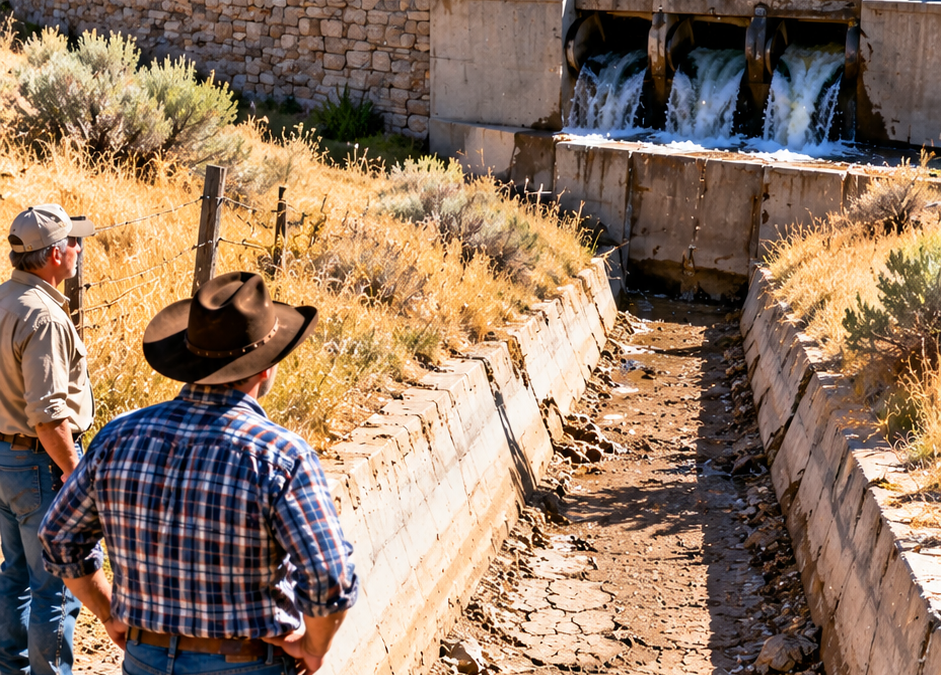
𝗙𝗨𝗟𝗟 𝗦𝗧𝗢𝗥𝗬
“Maybe.”
Then I heard it.
Splashing.
Not ditch water.
Fountain water.
The sound came from uphill.
From behind the Juniper Crown clubhouse.
Sophia looked at me.
“Tell me that isn’t what I think it is.”
I started walking.
Juniper Crown had not existed when I was young.
The bench above our farm had mostly been rabbitbrush, cedar, and hard ground that caught afternoon wind.
In 2008, a developer bought four hundred acres.
Municipal wells were drilled.
Roads appeared.
Then gates.
The original plat showed 118 homes, a clubhouse, walking paths, and one feature that mattered to every farm below it.
A preserved corridor for the Morrow North lateral.
The ditch entered the northwest edge of the subdivision.
Crossed common ground.
Then dropped toward our fields.
The developer did not own the ditch.
Neither did I.
The North Fork Mutual Ditch Company held the conveyance easement.
Shareholders held rights to scheduled portions of the water.
Six agricultural users depended on that route.
The recorded subdivision plat said it plainly.
EXISTING IRRIGATION DITCH AND MAINTENANCE ACCESS — DO NOT OBSTRUCT.
For fourteen years, nobody argued about those words.
The developer installed two wooden footbridges.
Residents walked beside the lateral.
Our ditch rider entered through a service gate each spring.
Banks were cleared.
Sediment checked.
Measuring structures maintained.
Juniper Crown itself leased four ditch shares to irrigate common landscaping.
Its turnout sat downstream from the segment serving the farms.
That mattered.
The association received water.
But it received that water at the correct location and in the correct order.
Everything worked.
Then Lydia Crane became HOA president.
Lydia had moved from Denver three years earlier after selling a commercial design company.
She was good at presentations.
Good at fundraising.
Very good at making expensive ideas sound as though they had already become inevitable.
At her first annual meeting, she referred to the open irrigation lateral as an “obsolete scar.”
At the second, she unveiled Juniper Commons.
Six pickleball courts.
Fitness pavilion.
Stone terrace.
Expanded parking.
Outdoor lighting.
Ornamental pond.
Three fountains.
The renderings looked beautiful.
Families under string lights.
Mountains reflected in the water.
Stone walls.
Fire features.
There was only one problem.
The ditch had disappeared from every image.
Leonard Pike noticed it too.
Leonard was president of North Fork Mutual.
Seventy years old.
Peach grower.
A man who trusted recorded maps more than confident people.
He sent Juniper Crown a certified letter.
How will the new development preserve the Morrow North lateral and maintenance access?
The HOA property manager answered.
The design team is evaluating an underground conveyance improvement.
Leonard called me.
“Improvement.”
“That’s what they called it.”
“That word makes me nervous.”
“Me too.”
Two mornings later, I found survey paint along the ditch bank.
I called Lydia.
She met me at the service gate.
Red coat.
White boots.
Sunglasses despite heavy cloud cover.
A rolled site plan under one arm.
“Your survey crew crossed the ditch easement,” I said.
“Our crew worked on association property.”
“Both can be true.”
She looked at me.
“The land belongs to Juniper Crown.”
“The ground does. The easement still exists.”
She unrolled part of the plan.
A thin blue line ran beneath the future terrace.
“We’re piping the old channel.”
I stared at it.
“The water will continue underground,” Lydia said. “Cleaner. Safer. More efficient.”
“What diameter?”
“That is an engineering detail.”
“It’s a water ditch. Diameter sounds relevant.”
“Our engineering team designed it.”
“Did they speak to North Fork Mutual?”
Her expression tightened.
“The HOA owns this parcel, Mr. Bennett.”
“Again, the ground and the ditch are not the same thing.”
“We do not need a neighboring farmer’s permission to improve our own property.”
“You may not need my personal permission.”
“Good.”
“You do need the easement holder’s consent before you alter the conveyance.”
She rolled the plan closed.
“The ditch has barely carried water in four years.”
“We’ve been in drought.”
“Perhaps the channel is no longer necessary.”
I stared at her.
“The delivery books say otherwise.”
“Juniper Crown cannot remain frozen in place because six agricultural users prefer an open trench.”
“And six agricultural users cannot lose irrigation because you prefer a fountain.”
That was our first real argument.
It should have been the moment everyone stopped talking and brought in engineers, water officials, and lawyers.
Instead, Lydia seemed to treat it as notice that she needed to work faster.
Nine days later, a temporary privacy fence surrounded the clubhouse area.
CONSTRUCTION AREA — AUTHORIZED PERSONNEL ONLY.
Our ditch maintenance lock was gone.
Leonard called management.
The lateral is dry, they told him.
No maintenance is scheduled until April.
Leonard looked at his calendar.
“It is April.”
Management stopped returning his calls.
Sophia flew her drone from our side of the property.
The video made the problem obvious.
An excavator had cut down both ditch banks.
The open channel was disappearing.
Stacks of white PVC pipe lay beside the trench.
Concrete forms marked the future terrace.
I paused the footage and zoomed.
Pipe markings.
10-inch SDR-26.
I stared at the screen.
“What?” Sophia asked.
“The lateral is four feet wide at the bottom.”
“So?”
“Nearly seven feet across the top.”
“And that pipe?”
“Ten inches.”
She looked back at the image.
“Can it carry the water?”
“Some water.”
“All of it?”
“Not automatically.”
An open lateral is not just a pipe lying horizontally.
It carries sediment.
Debris.
Changing flows.
It allows inspection.
Bank maintenance.
Emergency access.
A ten-inch gravity pipe might carry part of the water under ideal slope and pressure.
That did not make it an equal replacement for a ditch designed to move more than four cubic feet per second during overlapping deliveries.
And nobody had shown us a hydraulic calculation.
Leonard sent another certified letter.
Stop altering the lateral until North Fork Mutual can review and approve the design.
The contractor signed for it Tuesday.
Wednesday morning, concrete trucks arrived.
Sophia and I parked along the public road.
We recorded through gaps in the privacy mesh.
Workers lowered PVC into what used to be the ditch.
A concrete pump extended its boom over the fence.
Gray concrete flowed into forms directly above the recorded corridor.
At 11:20, the property manager walked out with a security officer.
He handed me a letter.
TRESPASS WARNING.
I looked around.
My boots were on the county shoulder.
“You understand I’m outside your gate.”
“You are interfering with an authorized capital project.”
“I’m taking pictures from a public road.”
“You’re photographing residents without consent.”
I looked through my phone.
Excavator.
Concrete truck.
Workers.
Ditch.
No residents.
I wrote the time on the notice.
Handed it to Sophia.
“Scan that.”
She did before we drove away.
Three days later, the pickleball slab was poured.
By the end of that week, 640 feet of the Morrow North lateral had disappeared beneath concrete, landscaping, courts, and a terrace wide enough for eighty people.
The construction looked good.
That was part of the danger.
Bad workmanship raises suspicion.
Polished stone makes people assume permission exists somewhere behind it.
Lydia circulated photographs to the neighborhood.
Subject:
A PROBLEM SOLVED.
The email said Juniper Crown had replaced an unsafe open drainage ditch with modern underground infrastructure at no loss of service.
She used the phrase drainage ditch three times.
Not irrigation lateral.
Not decreed water.
Not conveyance easement.
Not downstream shareholders.
Drainage ditch.
A useful word.
A smaller word.
A word that made the project sound like replacing a gutter.
The first full agricultural delivery was scheduled twelve days later.
Leonard requested an emergency review from the Division of Water Resources.
He notified every shareholder.
Then asked me to inspect the downstream segment each morning.
On the fourth day, I found white PVC shavings inside our measuring box.
On the sixth, my phone rang.
Unknown number.
A man spoke quietly.
“I work landscaping at Juniper Crown.”
“Name?”
“I’d rather not.”
“What do you need?”
“The pond pump is connected to the bypass.”
I stopped walking.
“What bypass?”
“The new line under the courts.”
“Where does the pump take water?”
There was silence.
“Inside the buried section.”
“How much have you run?”
“Twice.”
“For what?”
“Testing.”
“How much water?”
“Enough to cover the intake.”
“Where did the water come from?”
Another pause.
“The ditch.”
Then he hung up.
Sophia pulled up the state diversion records.
There had been two short test flows through the Morrow headgate that week.
Both requested by Juniper Crown’s landscape contractor under the HOA’s four leased shares.
That sounded legitimate until we looked at location.
Juniper Crown’s recorded turnout sat below our farm delivery segment.
If its pond pump had been connected upstream, the HOA had moved its point of diversion ahead of six other users.
No approval.
No structure number.
No recorded change.
Lydia had not simply modified the ditch.
She had changed where Juniper Crown took water from it.
That was something stone walls could not hide.
Then came the first real delivery.
At 5:40, Ben Russo opened the Morrow headgate.
Leonard stood beside him.
I watched.
2.8 cubic feet per second.
Entered.
Measured.
Recorded.
We drove separately toward Juniper Crown.
At the last check above the subdivision, flow looked normal.
Then I reached my upper measuring box.
Dry.
Sophia arrived behind me.
“Zero?”
“Zero.”
Then the fountain came on.
Three silver jets rose into the morning air.
I followed the sound uphill.
The new Juniper Commons terrace was already being photographed for its Saturday opening.
Landscapers stood near the pond.
A banner stretched across one fence.
JUNIPER COMMONS OPENING SATURDAY.
Lydia stood on the stone terrace wearing a scarlet blazer.
I walked behind the fountain enclosure.
Followed the pump line.
Then found a brass flow tag wired to the valve.
I knew the number stamped into it.
It belonged to North Fork Mutual’s lateral.
Lydia walked toward me.
“You’re not authorized in the equipment area.”
“What is this connected to?”
“Our private landscaping supply.”
I pointed at the brass tag.
“That number is our ditch.”
“The HOA has leased water.”
“Four shares.”
“Yes.”
“Delivered downstream.”
She crossed her arms.
“Water moves, Eli. Communities change.”
Behind her, hundreds of gallons of water that should have been flowing toward my alfalfa were falling back into a decorative pond.
“That water was decreed to farms in 1908.”
“And Juniper Crown holds valid shares.”
“At the recorded turnout.”
“You do not control this property.”
“No.”
I looked at the fountain.
“But you don’t control every gallon that crosses it.”
Sophia began recording.
One continuous video.
Fountain.
Pump.
Valve.
Brass tag.
Then down toward our dry measuring structure.
Lydia stepped between the landscaper and the controls.
“You are not authorized to inspect HOA equipment.”
“I’m inspecting missing water.”
“Your delivery may have been delayed by upstream debris.”
A voice behind me answered.
“No debris.”
Ben Russo entered through the service opening carrying his flow meter.
“I measured full flow above your property twelve minutes ago.”
Lydia glanced at his North Fork Mutual vest.
“Turn off the fountain,” Ben said.
She stiffened.
“You do not give orders to this association.”
“No.”
He looked at the pump.
“But the water commissioner does.”
He checked his phone.
“She’s on her way.”
For the first time that morning, Lydia stopped smiling.
Water Commissioner Leah Ortiz arrived at 8:18.
State truck.
Clipboard.
No speeches.
No accusations.
She measured.
Headgate record.
Flow above Juniper Crown.
Dry box below.
Pump connection.
Valve.
The HOA pump had no approved structure number.
The meter had no state seal.
The point of diversion did not match the recorded location for Juniper Crown’s turnout.
Leah asked Lydia for the authorization.
Lydia handed her a construction packet.
County building permit.
Electrical permits.
Clubhouse plumbing permits.
Nothing approving relocation of an irrigation lateral.
Nothing authorizing a new diversion structure.
Nothing moving the HOA’s turnout.
Leah handed the documents back.
“Shut down the pond pump.”
Lydia looked at her.
“Under what authority?”
“Pending review of an unapproved diversion.”
The landscaper switched it off.
The fountain jets collapsed.
Then Leah looked toward the buried section.
“I also want the headgate reduced.”
Ben frowned.
“Our users are waiting.”
“I know.”
“Why reduce it?”
“Because we don’t know what that pipe can handle.”
She pointed toward the terrace.
“If full flow enters a buried system under occupied concrete and that system backs up or ruptures, we have a different emergency.”
That was the part nobody below Juniper Crown wanted to hear.
The HOA could not take the water.
But until the buried line was proven safe, we could not send full water through it either.
Their unauthorized construction had hurt us twice.
By afternoon, my alfalfa had already started showing the pale blue-green color that comes when the upper soil begins drying.
Sophia and I walked the first pivot.
She pressed her boot into a crack beside the wheel track.
Forecast:
Four days above eighty-five.
Low humidity.
Wind.
“We can hold a few days,” I said.
“What about Rodriguez?”
I looked downhill.
Young orchard.
Shallow roots.
Less margin.
“Tanners?”
“Pasture will go faster.”
Six farms.
Three hundred twelve irrigated acres.
One buried pipe nobody had been allowed to inspect.
That evening, North Fork Mutual met inside Leonard’s packing shed.
Documents covered two folding tables.
1908 decree.
Company incorporation records.
Delivery logs.
2008 Juniper Crown plat.
Recorded easement.
Fourteen years of spring inspection photographs.
There was no single magic piece of paper.
The story rested on layers.
Century of use.
Current delivery.
Recorded corridor.
Physical measurements.
Leah’s independent finding that water entered Juniper Crown and failed to arrive below it.
Leonard called the company attorney.
Marissa Chen.
She represented irrigation companies, agricultural cooperatives, and enough neighboring land disputes that she had learned calm language outlasted angry language.
She asked four questions.
“Did North Fork Mutual consent to piping the lateral?”
“No,” Leonard said.
“Did anyone approve relocation of Juniper Crown’s turnout?”
“No.”
“Can the ditch company currently enter the full easement to inspect and repair?”
I answered.
“The courts and terrace cover it.”
“Is the water right active?”
Ben placed five years of delivery books in front of her.
Marissa nodded.
“Then we do not go into court asking a judge to punish a fountain.”
Leonard leaned back.
“What do we ask?”
“Access. Preservation of the conveyance. No unauthorized diversion. Safety before full flow.”
She looked around the table.
“We show what their work prevents you from doing.”
At nine the next morning, Juniper Crown sent its own demand.
Lydia accused North Fork Mutual of interrupting the HOA’s lawfully leased water.
She claimed the ditch company had accepted the underground improvement by failing to object during county permitting.
She demanded the headgate be reopened.
She threatened damages for landscaping losses.
Amenity delays.
Reputational harm.
Attached was a photograph of the fountain pond.
Fountains off.
Caption:
WATER DENIED BY OUTSIDE AGRICULTURAL INTERESTS.
The same phrase appeared on the resident portal.
By noon, I had eleven messages from homeowners.
Some asked reasonable questions.
Several accused farmers of stealing community water.
One explained to me that agriculture wasted more water than subdivisions.
Sophia wanted to answer all of them.
“No.”
“Dad—”
“One statement.”
“She’s lying.”
“Then don’t make the record harder to read.”
We posted one photograph.
Leah measuring the dry downstream box.
Below it:
North Fork Mutual supports delivery of every valid share, including Juniper Crown’s, through the recorded turnout and according to priority. The current interruption follows unapproved construction and is under state review.
Then we stopped.
Lydia did not.
Friday, she hosted a press walkthrough.
She told a local real estate blogger that “entrenched agricultural interests” were fighting modern infrastructure because they disliked growth.
She said Juniper Commons would open Saturday.
Fountains or no fountains.
The county stopped that plan.
Leah had forwarded her inspection notes because the buried ditch passed beneath the terrace and within twenty feet of the new fitness pavilion foundation.
The county compared the built project with the approved plans.
They were not the same.
The approved design showed a precast concrete flume.
Open top.
Removable safety grates.
Short pedestrian bridge.
Twelve-foot gravel maintenance route behind the courts.
No ten-inch PVC.
No fountain connection.
No permanent concrete across maintenance access.
The county issued a stop-use notice for the terrace and pickleball courts.
Not homes.
Not the clubhouse.
Not the entire community.
Only the new improvements built over the altered corridor.
Lydia called it bureaucratic overreach.
The contractor called it a change order.
That difference mattered.
The original design had respected the ditch.
It simply cost more.
The flume consumed twenty-six feet Lydia wanted for decorative stone seating.
Three days after our water stopped, the Rodriguez orchard began curling at the leaf edges.
We hauled two tanker loads from our well.
Enough to keep the upper block from crashing.
Not enough to replace surface irrigation.
At noon, Leonard received Lydia’s settlement proposal.
Juniper Crown would permit inspection through two access boxes.
Provide a five-year workmanship warranty.
Pay $5,000 toward emergency water hauling.
In exchange, North Fork Mutual would approve the underground alignment.
Release all claims.
And transfer two permanent ditch shares to Juniper Crown for pond evaporation and replacement water.
Leonard read it aloud.
Silence.
Then Mrs. Rodriguez looked around the packing shed.
“They blocked our water.”
Nobody answered.
“And now they want us to give them water so they’ll let us unblock it?”
That ended the discussion.
The board rejected the proposal.
Marissa filed for temporary relief that afternoon.
Narrow request.
Immediate inspection access.
No operation of the unauthorized fountain diversion.
No full flow until an engineer confirmed safety and capacity.
Preservation of project records.
The judge scheduled a Tuesday hearing.
But first, Juniper Crown was ordered to provide inspection access.
Monday at seven, Lydia unlocked the service gate.
First time in three weeks.
She stood beside the HOA manager, its lawyer, and a photographer.
North Fork Mutual brought Ben.
Leah.
Dr. Aaron Keane, a licensed civil engineer.
A pipe inspection contractor.
And me.
I carried my father’s shovel.
Lydia stared at it.
“You will not be digging on HOA property.”
“Not unless we have to.”
“The court authorized inspection, not destruction.”
Dr. Keane answered before I did.
“That’s why we inspect first.”
The first access box sat behind the fountain equipment enclosure.
The moment the lid came off, Dr. Keane stopped talking.
The original four-foot ditch narrowed abruptly.
Into ten-inch PVC.
No debris screen.
No sediment basin.
No safe overflow route if the line clogged.
Six feet downstream, a tee branched toward the pond pump.
Leah photographed everything.
The second access box sat beneath a removable planter beyond the courts.
The pipe camera went inside.
We watched the screen.
At 187 feet:
Flattened joint.
At 312:
Standing water covering almost one-third of the pipe, even with the headgate barely open.
Then 409 feet.
The camera stopped.
The operator reversed.
Tried another angle.
Stopped again.
The image showed hardened concrete grout inside the line.
A failed connection had allowed grout to enter.
The obstruction reduced the opening to less than half the original diameter.
Lydia stared at the screen.
“That can be cleaned.”
The operator shook his head.
“Not from either access box.”
“Then how?”
“We expose the joint.”
“Where?”
He checked the distance counter.
Then looked across Juniper Commons.
“Middle pickleball court.”
Nobody spoke.
Even if the pipe had been large enough on paper, the installation had failed before the first real agricultural delivery.
Dr. Keane spent hours measuring.
Slope.
Pipe length.
Elevation difference.
Access.
Historic operating range.
His preliminary conclusion was deliberately cautious.
The line could not reliably carry the lateral’s historical flow range.
It could not be practically maintained beneath permanent improvements.
The fountain connection relocated Juniper Crown’s point of diversion.
The grout created an immediate obstruction.
And forcing more water through the line was unsafe.
At Tuesday’s hearing, Juniper Crown’s lawyer argued the HOA had acted in good faith.
Temporary problems could be corrected.
The entire amenity complex did not need demolition.
Marissa did not call Lydia a liar.
She called witnesses.
Ben explained five years of deliveries.
Leah explained measured flow loss.
Dr. Keane showed three photographs.
Abrupt ten-inch entrance.
Pond-pump tee.
Grout obstruction.
Then Marissa displayed the recorded plat.
The judge asked Juniper Crown’s lawyer:
“Did North Fork Mutual consent to this alteration?”
“The association believed consent was unnecessary because it owns the underlying property.”
The judge looked at the easement label.
“Surface ownership does not resolve the issue.”
She paused.
“The question is whether the construction unreasonably interferes with an active conveyance and the rights attached to it.”
Temporary injunction.
No pond diversion.
Full access for inspection and restoration.
North Fork Mutual could install a temporary bypass around Juniper Commons.
Juniper Crown could not obstruct it.
Damages and permanent design would wait.
We left the courthouse without a final victory.
But we had access.
Access was enough to move water.
By Wednesday evening, aluminum irrigation pipe ran along Juniper Crown’s outer fence.
It crossed the service lane on a steel ramp.
Then reconnected to the North Fork lateral below the complex.
Not pretty.
Not hidden.
But measurable.
Inspectible.
Large enough.
Ben reopened the Morrow headgate slowly.
I stood beside my upper box with Sophia.
For several minutes, nothing.
Then a brown front appeared.
Pine needles.
Dust.
Old leaves.
Then clear water.
It spread through the checks.
Darkened soil around the alfalfa crowns.
At 6:23, Sophia smiled.
“There.”
I said nothing.
Just listened.
Ten minutes later, Mrs. Rodriguez called.
“The orchard turnout is running.”
For the first time in six days, every lawful user on the North Fork lateral received water in order.
I thought that might calm things down.
Instead, Lydia called an emergency HOA meeting.
Her notice said Juniper Crown faced a coordinated legal assault that might cost residents more than one million dollars.
She proposed an $8,500 special assessment per household.
Litigation reserve.
No contractor estimate.
No court order requiring that number.
No engineering bid.
Just a number large enough to frighten people.
For the first time, homeowners who had treated the situation as farmers versus fountains started asking for invoices.
Lydia refused to release them before the vote.
Attorney-client privilege, she said.
Active negotiations.
That was when Juniper Crown’s treasurer contacted Leonard.
Megan Foster.
She had approved the original Juniper Commons budget.
She had not seen the final pipe change.
We met at a diner in Delta at six the next morning.
Megan arrived with a flash drive and paper folder.
She looked exhausted.
“The board approved a precast flume.”
“How much?” Leonard asked.
“Four hundred twelve thousand.”
“For what?”
“Ditch crossing, retaining work, maintenance access.”
I looked at her.
“What did the pipe cost?”
“One eighty-six.”
Leonard leaned forward.
“Where did the rest go?”
Megan opened the folder.
Not stolen.
Reassigned.
$84,000:
Upgraded decorative stone around the fountain.
$61,000:
Imported shade structures.
$38,000:
Audio, lighting, and decorative fire features.
The rest:
Design fees.
Rush charges.
Lydia had used the money saved by shrinking the ditch infrastructure to fund the visual features highlighted in Juniper Commons advertising.
Then Megan opened an email.
Project civil engineer.
Nineteen days before construction.
Replacing the approved flume with a ten-inch pipe will reduce hydraulic capacity, eliminate practical maintenance access, and require written approval from the ditch easement holder and state water authorities.
Final sentence:
Do not place permanent concrete improvements over the revised alignment until these approvals are obtained.
Below it:
Lydia’s reply.
Seven words.
Proceed. The ditch users can adapt afterward.
I read it once.
Then again.
No hidden identity.
No dramatic confession.
No miracle document discovered behind a wall.
Just an email from the person managing the budget.
Preserved because somebody responsible for numbers kept her records.
Megan had another letter.
Juniper Crown’s property insurer had reviewed the original flume design during policy renewal.
The loss-control engineer required the association to preserve inspection access and obtain written agreements before relocating the irrigation conveyance.
Lydia had received that warning too.
That night, the clubhouse overflowed.
Residents stood along the walkway.
Fountains dark.
Yellow tape around the courts.
Beyond the fence, our temporary bypass carried water with a low metallic sound.
Lydia stood beneath a screen showing the proposed $8,500 assessment.
Scarlet blazer.
Controlled voice.
She described the injunction as temporary.
Said agricultural interests were trying to restore an unsafe open ditch through the middle of the community.
Said the board had relied on professional advice.
Megan raised her hand.
Lydia ignored her.
Megan stood.
“I’m the treasurer.”
The room quieted.
“Residents are being asked to fund litigation without access to the underlying project records.”
Lydia looked at her.
“These records are confidential.”
Megan held up the original board-approved bid.
“This was distributed to the board.”
She connected her laptop.
The first slide appeared.
Approved precast flume.
$412,000.
Then:
Pipe change.
$186,000.
Then decorative upgrades.
Residents started reading numbers aloud.
“Eighty-four thousand for stone?”
“Sixty-one for those shades?”
“Thirty-eight thousand for fire features?”
Lydia moved toward the controls.
Megan changed the slide.
The engineer’s warning filled the screen.
Do not place permanent concrete improvements over the revised alignment until these approvals are obtained.
Then:
Proceed. The ditch users can adapt afterward.
Nobody shouted.
That was worse.
Silence moved across the room.
Lydia turned toward the HOA lawyer.
He did not move.
A homeowner asked:
“Did the insurer approve the pipe?”
Megan displayed the loss-control letter.
Another resident asked:
“Why are you asking us for a million-dollar litigation reserve after ignoring two written warnings?”
Lydia finally raised her voice.
“Leadership requires decisions.”
The room stayed quiet.
“No major project can survive if every outside claimant is allowed veto power.”
I had been invited to speak for five minutes.
I used less than three.
I displayed the delivery map.
Morrow headgate.
North lateral.
Juniper Crown segment.
Six farms below.
The HOA’s four leased shares.
Its correct downstream turnout.
Then Leah’s measurements.
Dr. Keane’s pipe image.
I looked at the residents.
“Juniper Crown has four valid leased shares.”
Someone nodded.
“North Fork Mutual has always delivered them.”
Another nod.
“We are not asking your community to lose water.”
I pointed toward the turnout.
“We are asking Juniper Crown to take its water where the delivery record says it belongs, without blocking every user ahead of it.”
A woman near the front asked:
“Does that mean we have to put the ugly open ditch back?”
“No.”
The room shifted.
“The original approved flume protected the water and allowed safe crossings. Other engineered solutions may work too.”
I pointed toward the photograph of the buried pipe.
“But whatever replaces an active lateral has to carry the historic flow, remain inspectible, remain maintainable, and be approved by the people who actually hold conveyance rights.”
I looked at the screen.
“Ten inches of hidden pipe under permanent concrete did none of those things.”
Lydia attempted to move to the assessment vote.
Megan made another motion.
Suspend the assessment.
Preserve all project records.
Hire independent counsel.
Remove Lydia’s authority over Juniper Commons pending board review.
The vote passed four to one.
Lydia cast the only opposing vote.
Three days later, Juniper Crown’s insurer issued a reservation-of-rights letter.
It did not abandon the association.
It did not deny every claim.
It warned that costs tied to knowingly proceeding after written engineering and loss-control warnings might fall outside coverage.
The contractor’s insurer opened a separate claim for the failed joint and grout intrusion.
The county kept the stop-use order.
The temporary bypass continued carrying irrigation.
And once the documents became visible, the dispute became less dramatic.
More technical.
Which is another way of saying more solvable.
An independent engineering team evaluated three options.
Option one:
Restore the original open ditch.
That would require removing most of the terrace.
Option two:
Install a much larger closed pipe with access vaults.
Possible, but expensive to maintain beneath permanent improvements.
Option three:
Precast concrete flume.
Removable safety grates.
Two short bridges connecting the courts and terrace.
Full maintenance access.
Almost exactly what the original approved design had shown.
That was the option everyone chose.
The final cost was divided by documented responsibility.
No fantasy verdict.
No single check big enough to turn the case into entertainment.
The contractor’s insurer paid for removing the defective pipe.
Repairing the failed joint area.
Part of reconstruction.
Juniper Crown paid costs tied to the unauthorized redesign.
Temporary bypass engineering.
Crop protection.
North Fork Mutual contributed toward upgrades that improved the lateral beyond its original condition.
The decorative stone was carefully removed and reused at the clubhouse entrance.
The imported shade structures remained.
The fountain pond was converted into a dryland garden.
Rabbitbrush.
Penstemon.
Blue grama.
Plants that did not require permanent irrigation shares.
No one lost a house.
No innocent household received an $8,500 assessment.
The association used reserves.
Spread the remaining work across two budget years.
It hurt.
But it was manageable.
Lydia resigned before the independent review ended.
There was no arrest.
No shouting from a podium.
No dramatic confession.
She submitted a four-paragraph resignation letter saying Juniper Crown needed “leadership aligned with its next chapter.”
The same controlled language she had used from the beginning.
Only now the language no longer controlled reality.
The final settlement required Juniper Crown to withdraw the trespass warning against me.
Recognize North Fork Mutual’s easement.
Maintain a twelve-foot service route.
And receive its four leased shares only through the recorded turnout.
North Fork Mutual agreed to provide residents with annual notice before spring ditch cleaning and scheduled maintenance.
Megan became interim HOA president.
She refused to keep the job permanently.
The new board created a water and infrastructure committee.
Two resident representatives.
One ditch company representative.
Independent engineer review whenever work touched the corridor.
It sounded bureaucratic.
Sometimes bureaucracy is simply memory written down before the next confident person decides history is optional.
The permanent flume was finished in late August.
I arrived before sunrise for the first test.
Ben stood at the Morrow headgate.
Leah Ortiz was there.
Dr. Keane stood beside the first bridge.
Residents gathered behind the new safety rail.
Children leaned forward to see the channel.
Ben opened the headgate.
One cubic foot per second.
Water entered.
Clear.
Visible.
The flume carried it beneath removable grates.
No hidden tee.
No inaccessible joint.
No concrete burial.
At the downstream box, Sophia crouched beside the gauge.
Her radio crackled.
“One point zero.”
Ben looked at me.
I smiled.
“What went in came out.”
He increased the flow.
The flume handled it.
No backing.
No vibration.
No leakage.
Maintenance crews could see every section.
The bridges kept residents safely above it.
Cottonwood leaves drifted into the channel and floated beneath the court walkway.
One little boy watched them disappear under the first bridge.
“Where does the water go?”
His father pointed downhill.
“To the farms.”
That answer stayed with me.
For months, Lydia had framed Juniper Crown and agriculture as opposite interests.
Modern community versus old farmers.
Fountain versus ditch.
Growth versus resistance.
The water had never cared about that argument.
Juniper Crown’s four shares came through the same headgate as ours.
Its residents bought peaches.
Vegetables.
Hay-fed beef.
Their subdivision itself depended on recorded rights created long before the first house appeared.
The conflict had never been that farms refused to share water.
The problem was one board treating a shared system as though surface ownership gave it permission to redesign everyone else’s rights.
Our second alfalfa cutting came in nine percent lighter than the year before.
Partly heat.
Partly interrupted irrigation.
We documented what we could actually support.
The settlement covered the measured difference.
Emergency tanker costs for Rodriguez Orchard.
Nothing more.
We did not claim every yellow leaf in the valley belonged to Lydia.
Evidence works best when you let it remain honest.
That fall, Sophia installed a weatherproof map inside the pump house.
North lateral from headgate to final turnout.
Every measuring box labeled.
Share locations.
Structure numbers.
The delivery books were scanned into cloud storage.
Originals stayed in Leonard’s steel cabinet.
Then Sophia hung my father’s shovel beneath the map.
I looked at her.
“Still a museum piece?”
She stepped back.
“Operating artifact.”
“That sounds like something you learned in college.”
“It cost you money to send me there.”
“Fair.”
The next April, something happened I never expected.
Juniper Crown residents showed up for annual ditch cleaning.
Not all of them.
Enough.
They cleared tumbleweeds.
Replaced faded marker posts.
Learned why sediment matters.
Why trash racks matter.
Why maintenance access matters.
Why nobody pours concrete above a conveyance structure without talking to whoever measures the water below it.
Megan brought coffee.
Mrs. Rodriguez brought breakfast burritos.
Ben brought three times as many tools as the job required.
Near the central bridge, the new HOA board installed a small bronze plaque.
MORROW NORTH LATERAL
DECREED 1908
ACTIVE AGRICULTURAL CONVEYANCE
KEEP ACCESS CLEAR
No mention of Lydia.
No mention of court.
No mention of lawsuits.
The best markers do not celebrate old fights.
They make the next fight less likely.
That evening, Sophia and I walked the lower field.
Water moved between the first rows.
The alfalfa had come back thick.
Above us, Juniper Commons lights turned on one by one.
People played pickleball over a water channel they could now see.
Inspect.
Understand.
Sophia walked beside me quietly for a while.
Then she asked:
“You still planning to leave this place to me?”
“That depends.”
“On what?”
“Whether you promise not to bury the ditch under a fountain.”
She laughed.
Shoved my shoulder.
We stopped near the edge of the field.
The air had cooled.
Water moved steadily through the checks.
I listened.
My father had been right.
Water tells you what is happening if you give it room.
For months, Juniper Crown had tried to speak louder than the ditch.
Architectural renderings.
Stone walls.
Legal notices.
Community emails.
Construction fences.
A very expensive fountain.
But water kept its own record.
2.8 cubic feet per second entered the headgate.
Nothing came out below the courts.
When we finally opened the buried system, the explanation was not complicated.
A diversion had been added where it did not belong.
The pipe was too small.
A joint had failed.
Grout had hardened inside it.
Maintenance access had been buried beneath concrete.
All the language in the world could not change those facts.
Water had gone in.
Something had stopped it.
And once we followed the flow instead of the presentation, the truth was waiting inside the pipe.
𝗧𝗛𝗘 𝗘𝗡𝗗
The Fountain Was Running Perfectly the Morning Our Irrigation Ditch Went Dry
At 5:40 on a May morning, 2.8 cubic feet of water per second entered the North Fork lateral.
Thirty-five minutes later, not one gallon had reached my farm.
Then I heard splashing behind the Juniper Crown clubhouse.
Three silver fountain jets were rising above a brand-new ornamental pond while six farms below the ridge waited for water that had somehow disappeared underground.
My name is Elias Bennett.
Most people call me Eli.
I was fifty-five that spring, and I raised alfalfa, grass hay, and a small herd of Red Angus on sixty-four acres outside Cedar Edge on Colorado’s Western Slope.
Sixty-four acres is not a large farm by western standards.
Without dependable water, though, acreage does not mean much.
Dry ground beneath a blue sky is still dry ground.
What kept our place alive through four generations was not the size of the property.
It was twenty-two shares in the North Fork Mutual Ditch Company.
My great-grandfather bought the first forty acres in 1913.
My grandfather added the lower pasture after the war.
My father, Joseph, worked thirty-eight years repairing orchard equipment during the day and taking irrigation turns at night.
He taught me how to listen to moving water before I was old enough to drive.
Water moving against packed earth makes a steady whisper.
Water hitting exposed roots creates a pulse.
Water backing up behind weeds, branches, or sediment develops a lower sound that carries farther in the dark.
My father could walk a ditch at midnight with a shovel over one shoulder and tell you what was wrong before his flashlight found it.
He died six years before Juniper Commons was built.
I kept his shovel hanging beside the pump house door.
The wood handle had been worn smooth where his right hand rested.
My daughter Sophia used to tease me about it.
“You know that’s a tool, right?”
“It was.”
“Was?”
“Now it’s historical equipment.”
“You mean a museum piece.”
She was twenty-seven and had come home after studying agricultural business in Fort Collins.
Sophia handled crop contracts, insurance, spreadsheets, digital files, and every online system I found a way to avoid.
I handled cattle, machinery, irrigation turns, and anything involving grease.
We disagreed about plenty.
But we agreed on one principle.
If the farm was going to reach another generation, every gallon had to be accounted for.
That May morning, 2.8 cubic feet per second had been accounted for at the headgate.
It simply had not arrived where it was supposed to.
And water does not vanish.
It goes somewhere.
At 5:40, our ditch rider, Ben Russo, opened the Morrow headgate for the first full delivery of the season.
He did it slowly.
Measured.
Watched the staff gauge settle.
Then wrote the number in his notebook.
2.8 CFS.
The water entered the North Fork lateral.
From there it should have traveled south.
Crossed 1,140 feet of common ground inside Juniper Crown.
Passed through the concrete measuring box above my upper field.
Then continued toward the Rodriguez orchard, the Tanner pasture, and three other farms farther down.
At 6:15, my box was dry.
Not low.
Not delayed.
Dry.
I stood beside it looking at bare concrete where water should have been moving.
Sophia arrived in the pickup.
“What do you have?”
“Nothing.”
“Ben opened it?”
“Full delivery.”
She crouched beside the box.
“Could it be backed up above Juniper?”
“Maybe.”
Then I heard it.
Splashing.
Not ditch water.
Fountain water.
The sound came from uphill.
From behind the Juniper Crown clubhouse.
Sophia looked at me.
“Tell me that isn’t what I think it is.”
I started walking.
Juniper Crown had not existed when I was young.
The bench above our farm had mostly been rabbitbrush, cedar, and hard ground that caught afternoon wind.
In 2008, a developer bought four hundred acres.
Municipal wells were drilled.
Roads appeared.
Then gates.
The original plat showed 118 homes, a clubhouse, walking paths, and one feature that mattered to every farm below it.
A preserved corridor for the Morrow North lateral.
The ditch entered the northwest edge of the subdivision.
Crossed common ground.
Then dropped toward our fields.
The developer did not own the ditch.
Neither did I.
The North Fork Mutual Ditch Company held the conveyance easement.
Shareholders held rights to scheduled portions of the water.
Six agricultural users depended on that route.
The recorded subdivision plat said it plainly.
EXISTING IRRIGATION DITCH AND MAINTENANCE ACCESS — DO NOT OBSTRUCT.
For fourteen years, nobody argued about those words.
The developer installed two wooden footbridges.
Residents walked beside the lateral.
Our ditch rider entered through a service gate each spring.
Banks were cleared.
Sediment checked.
Measuring structures maintained.
Juniper Crown itself leased four ditch shares to irrigate common landscaping.
Its turnout sat downstream from the segment serving the farms.
That mattered.
The association received water.
But it received that water at the correct location and in the correct order.
Everything worked.
Then Lydia Crane became HOA president.
Lydia had moved from Denver three years earlier after selling a commercial design company.
She was good at presentations.
Good at fundraising.
Very good at making expensive ideas sound as though they had already become inevitable.
At her first annual meeting, she referred to the open irrigation lateral as an “obsolete scar.”
At the second, she unveiled Juniper Commons.
Six pickleball courts.
Fitness pavilion.
Stone terrace.
Expanded parking.
Outdoor lighting.
Ornamental pond.
Three fountains.
The renderings looked beautiful.
Families under string lights.
Mountains reflected in the water.
Stone walls.
Fire features.
There was only one problem.
The ditch had disappeared from every image.
Leonard Pike noticed it too.
Leonard was president of North Fork Mutual.
Seventy years old.
Peach grower.
A man who trusted recorded maps more than confident people.
He sent Juniper Crown a certified letter.
How will the new development preserve the Morrow North lateral and maintenance access?
The HOA property manager answered.
The design team is evaluating an underground conveyance improvement.
Leonard called me.
“Improvement.”
“That’s what they called it.”
“That word makes me nervous.”
“Me too.”
Two mornings later, I found survey paint along the ditch bank.
I called Lydia.
She met me at the service gate.
Red coat.
White boots.
Sunglasses despite heavy cloud cover.
A rolled site plan under one arm.
“Your survey crew crossed the ditch easement,” I said.
“Our crew worked on association property.”
“Both can be true.”
She looked at me.
“The land belongs to Juniper Crown.”
“The ground does. The easement still exists.”
She unrolled part of the plan.
A thin blue line ran beneath the future terrace.
“We’re piping the old channel.”
I stared at it.
“The water will continue underground,” Lydia said. “Cleaner. Safer. More efficient.”
“What diameter?”
“That is an engineering detail.”
“It’s a water ditch. Diameter sounds relevant.”
“Our engineering team designed it.”
“Did they speak to North Fork Mutual?”
Her expression tightened.
“The HOA owns this parcel, Mr. Bennett.”
“Again, the ground and the ditch are not the same thing.”
“We do not need a neighboring farmer’s permission to improve our own property.”
“You may not need my personal permission.”
“Good.”
“You do need the easement holder’s consent before you alter the conveyance.”
She rolled the plan closed.
“The ditch has barely carried water in four years.”
“We’ve been in drought.”
“Perhaps the channel is no longer necessary.”
I stared at her.
“The delivery books say otherwise.”
“Juniper Crown cannot remain frozen in place because six agricultural users prefer an open trench.”
“And six agricultural users cannot lose irrigation because you prefer a fountain.”
That was our first real argument.
It should have been the moment everyone stopped talking and brought in engineers, water officials, and lawyers.
Instead, Lydia seemed to treat it as notice that she needed to work faster.
Nine days later, a temporary privacy fence surrounded the clubhouse area.
CONSTRUCTION AREA — AUTHORIZED PERSONNEL ONLY.
Our ditch maintenance lock was gone.
Leonard called management.
The lateral is dry, they told him.
No maintenance is scheduled until April.
Leonard looked at his calendar.
“It is April.”
Management stopped returning his calls.
Sophia flew her drone from our side of the property.
The video made the problem obvious.
An excavator had cut down both ditch banks.
The open channel was disappearing.
Stacks of white PVC pipe lay beside the trench.
Concrete forms marked the future terrace.
I paused the footage and zoomed.
Pipe markings.
10-inch SDR-26.
I stared at the screen.
“What?” Sophia asked.
“The lateral is four feet wide at the bottom.”
“So?”
“Nearly seven feet across the top.”
“And that pipe?”
“Ten inches.”
She looked back at the image.
“Can it carry the water?”
“Some water.”
“All of it?”
“Not automatically.”
An open lateral is not just a pipe lying horizontally.
It carries sediment.
Debris.
Changing flows.
It allows inspection.
Bank maintenance.
Emergency access.
A ten-inch gravity pipe might carry part of the water under ideal slope and pressure.
That did not make it an equal replacement for a ditch designed to move more than four cubic feet per second during overlapping deliveries.
And nobody had shown us a hydraulic calculation.
Leonard sent another certified letter.
Stop altering the lateral until North Fork Mutual can review and approve the design.
The contractor signed for it Tuesday.
Wednesday morning, concrete trucks arrived.
Sophia and I parked along the public road.
We recorded through gaps in the privacy mesh.
Workers lowered PVC into what used to be the ditch.
A concrete pump extended its boom over the fence.
Gray concrete flowed into forms directly above the recorded corridor.
At 11:20, the property manager walked out with a security officer.
He handed me a letter.
TRESPASS WARNING.
I looked around.
My boots were on the county shoulder.
“You understand I’m outside your gate.”
“You are interfering with an authorized capital project.”
“I’m taking pictures from a public road.”
“You’re photographing residents without consent.”
I looked through my phone.
Excavator.
Concrete truck.
Workers.
Ditch.
No residents.
I wrote the time on the notice.
Handed it to Sophia.
“Scan that.”
She did before we drove away.
Three days later, the pickleball slab was poured.
By the end of that week, 640 feet of the Morrow North lateral had disappeared beneath concrete, landscaping, courts, and a terrace wide enough for eighty people.
The construction looked good.
That was part of the danger.
Bad workmanship raises suspicion.
Polished stone makes people assume permission exists somewhere behind it.
Lydia circulated photographs to the neighborhood.
Subject:
A PROBLEM SOLVED.
The email said Juniper Crown had replaced an unsafe open drainage ditch with modern underground infrastructure at no loss of service.
She used the phrase drainage ditch three times.
Not irrigation lateral.
Not decreed water.
Not conveyance easement.
Not downstream shareholders.
Drainage ditch.
A useful word.
A smaller word.
A word that made the project sound like replacing a gutter.
The first full agricultural delivery was scheduled twelve days later.
Leonard requested an emergency review from the Division of Water Resources.
He notified every shareholder.
Then asked me to inspect the downstream segment each morning.
On the fourth day, I found white PVC shavings inside our measuring box.
On the sixth, my phone rang.
Unknown number.
A man spoke quietly.
“I work landscaping at Juniper Crown.”
“Name?”
“I’d rather not.”
“What do you need?”
“The pond pump is connected to the bypass.”
I stopped walking.
“What bypass?”
“The new line under the courts.”
“Where does the pump take water?”
There was silence.
“Inside the buried section.”
“How much have you run?”
“Twice.”
“For what?”
“Testing.”
“How much water?”
“Enough to cover the intake.”
“Where did the water come from?”
Another pause.
“The ditch.”
Then he hung up.
Sophia pulled up the state diversion records.
There had been two short test flows through the Morrow headgate that week.
Both requested by Juniper Crown’s landscape contractor under the HOA’s four leased shares.
That sounded legitimate until we looked at location.
Juniper Crown’s recorded turnout sat below our farm delivery segment.
If its pond pump had been connected upstream, the HOA had moved its point of diversion ahead of six other users.
No approval.
No structure number.
No recorded change.
Lydia had not simply modified the ditch.
She had changed where Juniper Crown took water from it.
That was something stone walls could not hide.
Then came the first real delivery.
At 5:40, Ben Russo opened the Morrow headgate.
Leonard stood beside him.
I watched.
2.8 cubic feet per second.
Entered.
Measured.
Recorded.
We drove separately toward Juniper Crown.
At the last check above the subdivision, flow looked normal.
Then I reached my upper measuring box.
Dry.
Sophia arrived behind me.
“Zero?”
“Zero.”
Then the fountain came on.
Three silver jets rose into the morning air.
I followed the sound uphill.
The new Juniper Commons terrace was already being photographed for its Saturday opening.
Landscapers stood near the pond.
A banner stretched across one fence.
JUNIPER COMMONS OPENING SATURDAY.
Lydia stood on the stone terrace wearing a scarlet blazer.
I walked behind the fountain enclosure.
Followed the pump line.
Then found a brass flow tag wired to the valve.
I knew the number stamped into it.
It belonged to North Fork Mutual’s lateral.
Lydia walked toward me.
“You’re not authorized in the equipment area.”
“What is this connected to?”
“Our private landscaping supply.”
I pointed at the brass tag.
“That number is our ditch.”
“The HOA has leased water.”
“Four shares.”
“Yes.”
“Delivered downstream.”
She crossed her arms.
“Water moves, Eli. Communities change.”
Behind her, hundreds of gallons of water that should have been flowing toward my alfalfa were falling back into a decorative pond.
“That water was decreed to farms in 1908.”
“And Juniper Crown holds valid shares.”
“At the recorded turnout.”
“You do not control this property.”
“No.”
I looked at the fountain.
“But you don’t control every gallon that crosses it.”
Sophia began recording.
One continuous video.
Fountain.
Pump.
Valve.
Brass tag.
Then down toward our dry measuring structure.
Lydia stepped between the landscaper and the controls.
“You are not authorized to inspect HOA equipment.”
“I’m inspecting missing water.”
“Your delivery may have been delayed by upstream debris.”
A voice behind me answered.
“No debris.”
Ben Russo entered through the service opening carrying his flow meter.
“I measured full flow above your property twelve minutes ago.”
Lydia glanced at his North Fork Mutual vest.
“Turn off the fountain,” Ben said.
She stiffened.
“You do not give orders to this association.”
“No.”
He looked at the pump.
“But the water commissioner does.”
He checked his phone.
“She’s on her way.”
For the first time that morning, Lydia stopped smiling.
Water Commissioner Leah Ortiz arrived at 8:18.
State truck.
Clipboard.
No speeches.
No accusations.
She measured.
Headgate record.
Flow above Juniper Crown.
Dry box below.
Pump connection.
Valve.
The HOA pump had no approved structure number.
The meter had no state seal.
The point of diversion did not match the recorded location for Juniper Crown’s turnout.
Leah asked Lydia for the authorization.
Lydia handed her a construction packet.
County building permit.
Electrical permits.
Clubhouse plumbing permits.
Nothing approving relocation of an irrigation lateral.
Nothing authorizing a new diversion structure.
Nothing moving the HOA’s turnout.
Leah handed the documents back.
“Shut down the pond pump.”
Lydia looked at her.
“Under what authority?”
“Pending review of an unapproved diversion.”
The landscaper switched it off.
The fountain jets collapsed.
Then Leah looked toward the buried section.
“I also want the headgate reduced.”
Ben frowned.
“Our users are waiting.”
“I know.”
“Why reduce it?”
“Because we don’t know what that pipe can handle.”
She pointed toward the terrace.
“If full flow enters a buried system under occupied concrete and that system backs up or ruptures, we have a different emergency.”
That was the part nobody below Juniper Crown wanted to hear.
The HOA could not take the water.
But until the buried line was proven safe, we could not send full water through it either.
Their unauthorized construction had hurt us twice.
By afternoon, my alfalfa had already started showing the pale blue-green color that comes when the upper soil begins drying.
Sophia and I walked the first pivot.
She pressed her boot into a crack beside the wheel track.
Forecast:
Four days above eighty-five.
Low humidity.
Wind.
“We can hold a few days,” I said.
“What about Rodriguez?”
I looked downhill.
Young orchard.
Shallow roots.
Less margin.
“Tanners?”
“Pasture will go faster.”
Six farms.
Three hundred twelve irrigated acres.
One buried pipe nobody had been allowed to inspect.
That evening, North Fork Mutual met inside Leonard’s packing shed.
Documents covered two folding tables.
1908 decree.
Company incorporation records.
Delivery logs.
2008 Juniper Crown plat.
Recorded easement.
Fourteen years of spring inspection photographs.
There was no single magic piece of paper.
The story rested on layers.
Century of use.
Current delivery.
Recorded corridor.
Physical measurements.
Leah’s independent finding that water entered Juniper Crown and failed to arrive below it.
Leonard called the company attorney.
Marissa Chen.
She represented irrigation companies, agricultural cooperatives, and enough neighboring land disputes that she had learned calm language outlasted angry language.
She asked four questions.
“Did North Fork Mutual consent to piping the lateral?”
“No,” Leonard said.
“Did anyone approve relocation of Juniper Crown’s turnout?”
“No.”
“Can the ditch company currently enter the full easement to inspect and repair?”
I answered.
“The courts and terrace cover it.”
“Is the water right active?”
Ben placed five years of delivery books in front of her.
Marissa nodded.
“Then we do not go into court asking a judge to punish a fountain.”
Leonard leaned back.
“What do we ask?”
“Access. Preservation of the conveyance. No unauthorized diversion. Safety before full flow.”
She looked around the table.
“We show what their work prevents you from doing.”
At nine the next morning, Juniper Crown sent its own demand.
Lydia accused North Fork Mutual of interrupting the HOA’s lawfully leased water.
She claimed the ditch company had accepted the underground improvement by failing to object during county permitting.
She demanded the headgate be reopened.
She threatened damages for landscaping losses.
Amenity delays.
Reputational harm.
Attached was a photograph of the fountain pond.
Fountains off.
Caption:
WATER DENIED BY OUTSIDE AGRICULTURAL INTERESTS.
The same phrase appeared on the resident portal.
By noon, I had eleven messages from homeowners.
Some asked reasonable questions.
Several accused farmers of stealing community water.
One explained to me that agriculture wasted more water than subdivisions.
Sophia wanted to answer all of them.
“No.”
“Dad—”
“One statement.”
“She’s lying.”
“Then don’t make the record harder to read.”
We posted one photograph.
Leah measuring the dry downstream box.
Below it:
North Fork Mutual supports delivery of every valid share, including Juniper Crown’s, through the recorded turnout and according to priority. The current interruption follows unapproved construction and is under state review.
Then we stopped.
Lydia did not.
Friday, she hosted a press walkthrough.
She told a local real estate blogger that “entrenched agricultural interests” were fighting modern infrastructure because they disliked growth.
She said Juniper Commons would open Saturday.
Fountains or no fountains.
The county stopped that plan.
Leah had forwarded her inspection notes because the buried ditch passed beneath the terrace and within twenty feet of the new fitness pavilion foundation.
The county compared the built project with the approved plans.
They were not the same.
The approved design showed a precast concrete flume.
Open top.
Removable safety grates.
Short pedestrian bridge.
Twelve-foot gravel maintenance route behind the courts.
No ten-inch PVC.
No fountain connection.
No permanent concrete across maintenance access.
The county issued a stop-use notice for the terrace and pickleball courts.
Not homes.
Not the clubhouse.
Not the entire community.
Only the new improvements built over the altered corridor.
Lydia called it bureaucratic overreach.
The contractor called it a change order.
That difference mattered.
The original design had respected the ditch.
It simply cost more.
The flume consumed twenty-six feet Lydia wanted for decorative stone seating.
Three days after our water stopped, the Rodriguez orchard began curling at the leaf edges.
We hauled two tanker loads from our well.
Enough to keep the upper block from crashing.
Not enough to replace surface irrigation.
At noon, Leonard received Lydia’s settlement proposal.
Juniper Crown would permit inspection through two access boxes.
Provide a five-year workmanship warranty.
Pay $5,000 toward emergency water hauling.
In exchange, North Fork Mutual would approve the underground alignment.
Release all claims.
And transfer two permanent ditch shares to Juniper Crown for pond evaporation and replacement water.
Leonard read it aloud.
Silence.
Then Mrs. Rodriguez looked around the packing shed.
“They blocked our water.”
Nobody answered.
“And now they want us to give them water so they’ll let us unblock it?”
That ended the discussion.
The board rejected the proposal.
Marissa filed for temporary relief that afternoon.
Narrow request.
Immediate inspection access.
No operation of the unauthorized fountain diversion.
No full flow until an engineer confirmed safety and capacity.
Preservation of project records.
The judge scheduled a Tuesday hearing.
But first, Juniper Crown was ordered to provide inspection access.
Monday at seven, Lydia unlocked the service gate.
First time in three weeks.
She stood beside the HOA manager, its lawyer, and a photographer.
North Fork Mutual brought Ben.
Leah.
Dr. Aaron Keane, a licensed civil engineer.
A pipe inspection contractor.
And me.
I carried my father’s shovel.
Lydia stared at it.
“You will not be digging on HOA property.”
“Not unless we have to.”
“The court authorized inspection, not destruction.”
Dr. Keane answered before I did.
“That’s why we inspect first.”
The first access box sat behind the fountain equipment enclosure.
The moment the lid came off, Dr. Keane stopped talking.
The original four-foot ditch narrowed abruptly.
Into ten-inch PVC.
No debris screen.
No sediment basin.
No safe overflow route if the line clogged.
Six feet downstream, a tee branched toward the pond pump.
Leah photographed everything.
The second access box sat beneath a removable planter beyond the courts.
The pipe camera went inside.
We watched the screen.
At 187 feet:
Flattened joint.
At 312:
Standing water covering almost one-third of the pipe, even with the headgate barely open.
Then 409 feet.
The camera stopped.
The operator reversed.
Tried another angle.
Stopped again.
The image showed hardened concrete grout inside the line.
A failed connection had allowed grout to enter.
The obstruction reduced the opening to less than half the original diameter.
Lydia stared at the screen.
“That can be cleaned.”
The operator shook his head.
“Not from either access box.”
“Then how?”
“We expose the joint.”
“Where?”
He checked the distance counter.
Then looked across Juniper Commons.
“Middle pickleball court.”
Nobody spoke.
Even if the pipe had been large enough on paper, the installation had failed before the first real agricultural delivery.
Dr. Keane spent hours measuring.
Slope.
Pipe length.
Elevation difference.
Access.
Historic operating range.
His preliminary conclusion was deliberately cautious.
The line could not reliably carry the lateral’s historical flow range.
It could not be practically maintained beneath permanent improvements.
The fountain connection relocated Juniper Crown’s point of diversion.
The grout created an immediate obstruction.
And forcing more water through the line was unsafe.
At Tuesday’s hearing, Juniper Crown’s lawyer argued the HOA had acted in good faith.
Temporary problems could be corrected.
The entire amenity complex did not need demolition.
Marissa did not call Lydia a liar.
She called witnesses.
Ben explained five years of deliveries.
Leah explained measured flow loss.
Dr. Keane showed three photographs.
Abrupt ten-inch entrance.
Pond-pump tee.
Grout obstruction.
Then Marissa displayed the recorded plat.
The judge asked Juniper Crown’s lawyer:
“Did North Fork Mutual consent to this alteration?”
“The association believed consent was unnecessary because it owns the underlying property.”
The judge looked at the easement label.
“Surface ownership does not resolve the issue.”
She paused.
“The question is whether the construction unreasonably interferes with an active conveyance and the rights attached to it.”
Temporary injunction.
No pond diversion.
Full access for inspection and restoration.
North Fork Mutual could install a temporary bypass around Juniper Commons.
Juniper Crown could not obstruct it.
Damages and permanent design would wait.
We left the courthouse without a final victory.
But we had access.
Access was enough to move water.
By Wednesday evening, aluminum irrigation pipe ran along Juniper Crown’s outer fence.
It crossed the service lane on a steel ramp.
Then reconnected to the North Fork lateral below the complex.
Not pretty.
Not hidden.
But measurable.
Inspectible.
Large enough.
Ben reopened the Morrow headgate slowly.
I stood beside my upper box with Sophia.
For several minutes, nothing.
Then a brown front appeared.
Pine needles.
Dust.
Old leaves.
Then clear water.
It spread through the checks.
Darkened soil around the alfalfa crowns.
At 6:23, Sophia smiled.
“There.”
I said nothing.
Just listened.
Ten minutes later, Mrs. Rodriguez called.
“The orchard turnout is running.”
For the first time in six days, every lawful user on the North Fork lateral received water in order.
I thought that might calm things down.
Instead, Lydia called an emergency HOA meeting.
Her notice said Juniper Crown faced a coordinated legal assault that might cost residents more than one million dollars.
She proposed an $8,500 special assessment per household.
Litigation reserve.
No contractor estimate.
No court order requiring that number.
No engineering bid.
Just a number large enough to frighten people.
For the first time, homeowners who had treated the situation as farmers versus fountains started asking for invoices.
Lydia refused to release them before the vote.
Attorney-client privilege, she said.
Active negotiations.
That was when Juniper Crown’s treasurer contacted Leonard.
Megan Foster.
She had approved the original Juniper Commons budget.
She had not seen the final pipe change.
We met at a diner in Delta at six the next morning.
Megan arrived with a flash drive and paper folder.
She looked exhausted.
“The board approved a precast flume.”
“How much?” Leonard asked.
“Four hundred twelve thousand.”
“For what?”
“Ditch crossing, retaining work, maintenance access.”
I looked at her.
“What did the pipe cost?”
“One eighty-six.”
Leonard leaned forward.
“Where did the rest go?”
Megan opened the folder.
Not stolen.
Reassigned.
$84,000:
Upgraded decorative stone around the fountain.
$61,000:
Imported shade structures.
$38,000:
Audio, lighting, and decorative fire features.
The rest:
Design fees.
Rush charges.
Lydia had used the money saved by shrinking the ditch infrastructure to fund the visual features highlighted in Juniper Commons advertising.
Then Megan opened an email.
Project civil engineer.
Nineteen days before construction.
Replacing the approved flume with a ten-inch pipe will reduce hydraulic capacity, eliminate practical maintenance access, and require written approval from the ditch easement holder and state water authorities.
Final sentence:
Do not place permanent concrete improvements over the revised alignment until these approvals are obtained.
Below it:
Lydia’s reply.
Seven words.
Proceed. The ditch users can adapt afterward.
I read it once.
Then again.
No hidden identity.
No dramatic confession.
No miracle document discovered behind a wall.
Just an email from the person managing the budget.
Preserved because somebody responsible for numbers kept her records.
Megan had another letter.
Juniper Crown’s property insurer had reviewed the original flume design during policy renewal.
The loss-control engineer required the association to preserve inspection access and obtain written agreements before relocating the irrigation conveyance.
Lydia had received that warning too.
That night, the clubhouse overflowed.
Residents stood along the walkway.
Fountains dark.
Yellow tape around the courts.
Beyond the fence, our temporary bypass carried water with a low metallic sound.
Lydia stood beneath a screen showing the proposed $8,500 assessment.
Scarlet blazer.
Controlled voice.
She described the injunction as temporary.
Said agricultural interests were trying to restore an unsafe open ditch through the middle of the community.
Said the board had relied on professional advice.
Megan raised her hand.
Lydia ignored her.
Megan stood.
“I’m the treasurer.”
The room quieted.
“Residents are being asked to fund litigation without access to the underlying project records.”
Lydia looked at her.
“These records are confidential.”
Megan held up the original board-approved bid.
“This was distributed to the board.”
She connected her laptop.
The first slide appeared.
Approved precast flume.
$412,000.
Then:
Pipe change.
$186,000.
Then decorative upgrades.
Residents started reading numbers aloud.
“Eighty-four thousand for stone?”
“Sixty-one for those shades?”
“Thirty-eight thousand for fire features?”
Lydia moved toward the controls.
Megan changed the slide.
The engineer’s warning filled the screen.
Do not place permanent concrete improvements over the revised alignment until these approvals are obtained.
Then:
Proceed. The ditch users can adapt afterward.
Nobody shouted.
That was worse.
Silence moved across the room.
Lydia turned toward the HOA lawyer.
He did not move.
A homeowner asked:
“Did the insurer approve the pipe?”
Megan displayed the loss-control letter.
Another resident asked:
“Why are you asking us for a million-dollar litigation reserve after ignoring two written warnings?”
Lydia finally raised her voice.
“Leadership requires decisions.”
The room stayed quiet.
“No major project can survive if every outside claimant is allowed veto power.”
I had been invited to speak for five minutes.
I used less than three.
I displayed the delivery map.
Morrow headgate.
North lateral.
Juniper Crown segment.
Six farms below.
The HOA’s four leased shares.
Its correct downstream turnout.
Then Leah’s measurements.
Dr. Keane’s pipe image.
I looked at the residents.
“Juniper Crown has four valid leased shares.”
Someone nodded.
“North Fork Mutual has always delivered them.”
Another nod.
“We are not asking your community to lose water.”
I pointed toward the turnout.
“We are asking Juniper Crown to take its water where the delivery record says it belongs, without blocking every user ahead of it.”
A woman near the front asked:
“Does that mean we have to put the ugly open ditch back?”
“No.”
The room shifted.
“The original approved flume protected the water and allowed safe crossings. Other engineered solutions may work too.”
I pointed toward the photograph of the buried pipe.
“But whatever replaces an active lateral has to carry the historic flow, remain inspectible, remain maintainable, and be approved by the people who actually hold conveyance rights.”
I looked at the screen.
“Ten inches of hidden pipe under permanent concrete did none of those things.”
Lydia attempted to move to the assessment vote.
Megan made another motion.
Suspend the assessment.
Preserve all project records.
Hire independent counsel.
Remove Lydia’s authority over Juniper Commons pending board review.
The vote passed four to one.
Lydia cast the only opposing vote.
Three days later, Juniper Crown’s insurer issued a reservation-of-rights letter.
It did not abandon the association.
It did not deny every claim.
It warned that costs tied to knowingly proceeding after written engineering and loss-control warnings might fall outside coverage.
The contractor’s insurer opened a separate claim for the failed joint and grout intrusion.
The county kept the stop-use order.
The temporary bypass continued carrying irrigation.
And once the documents became visible, the dispute became less dramatic.
More technical.
Which is another way of saying more solvable.
An independent engineering team evaluated three options.
Option one:
Restore the original open ditch.
That would require removing most of the terrace.
Option two:
Install a much larger closed pipe with access vaults.
Possible, but expensive to maintain beneath permanent improvements.
Option three:
Precast concrete flume.
Removable safety grates.
Two short bridges connecting the courts and terrace.
Full maintenance access.
Almost exactly what the original approved design had shown.
That was the option everyone chose.
The final cost was divided by documented responsibility.
No fantasy verdict.
No single check big enough to turn the case into entertainment.
The contractor’s insurer paid for removing the defective pipe.
Repairing the failed joint area.
Part of reconstruction.
Juniper Crown paid costs tied to the unauthorized redesign.
Temporary bypass engineering.
Crop protection.
North Fork Mutual contributed toward upgrades that improved the lateral beyond its original condition.
The decorative stone was carefully removed and reused at the clubhouse entrance.
The imported shade structures remained.
The fountain pond was converted into a dryland garden.
Rabbitbrush.
Penstemon.
Blue grama.
Plants that did not require permanent irrigation shares.
No one lost a house.
No innocent household received an $8,500 assessment.
The association used reserves.
Spread the remaining work across two budget years.
It hurt.
But it was manageable.
Lydia resigned before the independent review ended.
There was no arrest.
No shouting from a podium.
No dramatic confession.
She submitted a four-paragraph resignation letter saying Juniper Crown needed “leadership aligned with its next chapter.”
The same controlled language she had used from the beginning.
Only now the language no longer controlled reality.
The final settlement required Juniper Crown to withdraw the trespass warning against me.
Recognize North Fork Mutual’s easement.
Maintain a twelve-foot service route.
And receive its four leased shares only through the recorded turnout.
North Fork Mutual agreed to provide residents with annual notice before spring ditch cleaning and scheduled maintenance.
Megan became interim HOA president.
She refused to keep the job permanently.
The new board created a water and infrastructure committee.
Two resident representatives.
One ditch company representative.
Independent engineer review whenever work touched the corridor.
It sounded bureaucratic.
Sometimes bureaucracy is simply memory written down before the next confident person decides history is optional.
The permanent flume was finished in late August.
I arrived before sunrise for the first test.
Ben stood at the Morrow headgate.
Leah Ortiz was there.
Dr. Keane stood beside the first bridge.
Residents gathered behind the new safety rail.
Children leaned forward to see the channel.
Ben opened the headgate.
One cubic foot per second.
Water entered.
Clear.
Visible.
The flume carried it beneath removable grates.
No hidden tee.
No inaccessible joint.
No concrete burial.
At the downstream box, Sophia crouched beside the gauge.
Her radio crackled.
“One point zero.”
Ben looked at me.
I smiled.
“What went in came out.”
He increased the flow.
The flume handled it.
No backing.
No vibration.
No leakage.
Maintenance crews could see every section.
The bridges kept residents safely above it.
Cottonwood leaves drifted into the channel and floated beneath the court walkway.
One little boy watched them disappear under the first bridge.
“Where does the water go?”
His father pointed downhill.
“To the farms.”
That answer stayed with me.
For months, Lydia had framed Juniper Crown and agriculture as opposite interests.
Modern community versus old farmers.
Fountain versus ditch.
Growth versus resistance.
The water had never cared about that argument.
Juniper Crown’s four shares came through the same headgate as ours.
Its residents bought peaches.
Vegetables.
Hay-fed beef.
Their subdivision itself depended on recorded rights created long before the first house appeared.
The conflict had never been that farms refused to share water.
The problem was one board treating a shared system as though surface ownership gave it permission to redesign everyone else’s rights.
Our second alfalfa cutting came in nine percent lighter than the year before.
Partly heat.
Partly interrupted irrigation.
We documented what we could actually support.
The settlement covered the measured difference.
Emergency tanker costs for Rodriguez Orchard.
Nothing more.
We did not claim every yellow leaf in the valley belonged to Lydia.
Evidence works best when you let it remain honest.
That fall, Sophia installed a weatherproof map inside the pump house.
North lateral from headgate to final turnout.
Every measuring box labeled.
Share locations.
Structure numbers.
The delivery books were scanned into cloud storage.
Originals stayed in Leonard’s steel cabinet.
Then Sophia hung my father’s shovel beneath the map.
I looked at her.
“Still a museum piece?”
She stepped back.
“Operating artifact.”
“That sounds like something you learned in college.”
“It cost you money to send me there.”
“Fair.”
The next April, something happened I never expected.
Juniper Crown residents showed up for annual ditch cleaning.
Not all of them.
Enough.
They cleared tumbleweeds.
Replaced faded marker posts.
Learned why sediment matters.
Why trash racks matter.
Why maintenance access matters.
Why nobody pours concrete above a conveyance structure without talking to whoever measures the water below it.
Megan brought coffee.
Mrs. Rodriguez brought breakfast burritos.
Ben brought three times as many tools as the job required.
Near the central bridge, the new HOA board installed a small bronze plaque.
MORROW NORTH LATERAL
DECREED 1908
ACTIVE AGRICULTURAL CONVEYANCE
KEEP ACCESS CLEAR
No mention of Lydia.
No mention of court.
No mention of lawsuits.
The best markers do not celebrate old fights.
They make the next fight less likely.
That evening, Sophia and I walked the lower field.
Water moved between the first rows.
The alfalfa had come back thick.
Above us, Juniper Commons lights turned on one by one.
People played pickleball over a water channel they could now see.
Inspect.
Understand.
Sophia walked beside me quietly for a while.
Then she asked:
“You still planning to leave this place to me?”
“That depends.”
“On what?”
“Whether you promise not to bury the ditch under a fountain.”
She laughed.
Shoved my shoulder.
We stopped near the edge of the field.
The air had cooled.
Water moved steadily through the checks.
I listened.
My father had been right.
Water tells you what is happening if you give it room.
For months, Juniper Crown had tried to speak louder than the ditch.
Architectural renderings.
Stone walls.
Legal notices.
Community emails.
Construction fences.
A very expensive fountain.
But water kept its own record.
2.8 cubic feet per second entered the headgate.
Nothing came out below the courts.
When we finally opened the buried system, the explanation was not complicated.
A diversion had been added where it did not belong.
The pipe was too small.
A joint had failed.
Grout had hardened inside it.
Maintenance access had been buried beneath concrete.
All the language in the world could not change those facts.
Water had gone in.
Something had stopped it.
And once we followed the flow instead of the presentation, the truth was waiting inside the pipe.

