The Forty-Three Seconds They Erased Told Me Who I Was Really Fighting
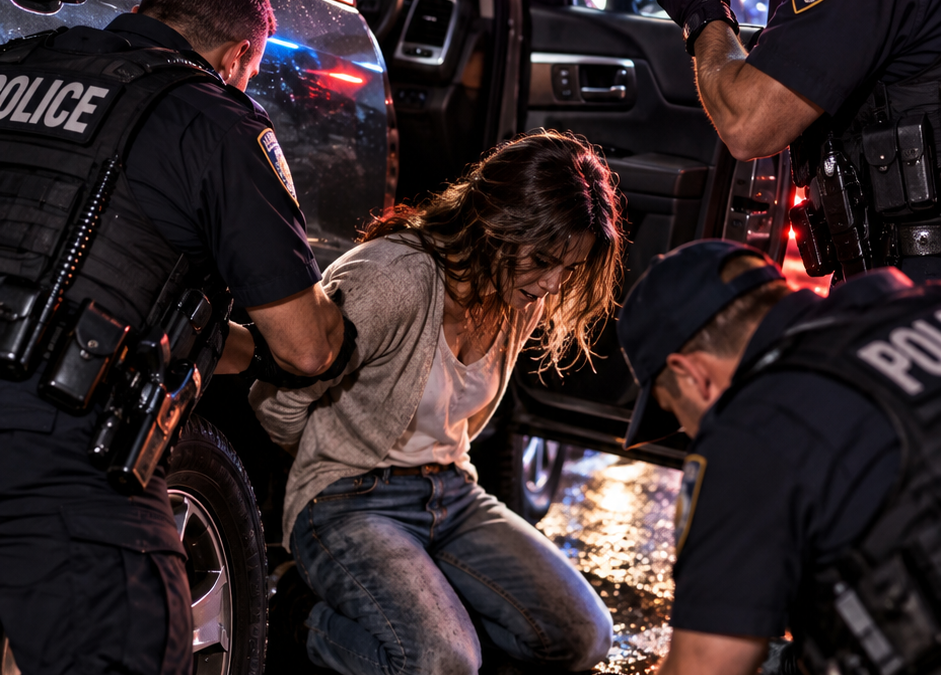
The Forty-Three Seconds They Erased Told Me Who I Was Really Fighting
I had spent most of my adult life learning how to stay calm when everything around me was falling apart.
Then, from thousands of miles away, I watched three police officers surround my wife while our six-year-old daughter screamed from the back seat of our SUV.
Before I could get home, someone had already started rewriting what happened.
The emergency alert hit my satellite phone at 02:17.
I was standing inside a secure operations room overseas when the vibration against my chest pulled my attention away from the screens in front of me.
For half a second, I assumed it was operational.
Then I saw the source.
FAMILY VEHICLE DISTRESS ALERT.
Everything inside me tightened.
Years earlier, I had installed an independent security system in our SUV. Claire had teased me relentlessly about it.
“You know normal husbands buy floor mats, right?” she had said.
“Normal husbands don’t spend half the year overseas.”
“So naturally, the solution is to turn the family car into Fort Knox?”
“Redundancy.”
“That’s your answer for everything.”
“It’s usually a good answer.”
She had laughed, kissed me, and forgotten about it.
I never did.
The system could send an encrypted alert if the vehicle experienced a violent impact, if Claire manually activated the emergency trigger, or if certain sensors detected unusual movement around an open door.
I had programmed it because I was accustomed to imagining the worst possibility in every environment.
I had just never imagined I would be on another continent when the worst possibility involved my own family.
My hands were already moving.
I opened the encrypted camera feed.
The image loaded.
And for one terrible second, I forgot how to breathe.
Claire was on the pavement.
Three uniformed officers stood over her.
The driver’s door hung open.
Our daughter Sophie was inside the SUV, both hands pressed against the window.
She was screaming.
I could not hear every word at first.
The microphone clipped with wind and traffic.
Then Sophie’s voice broke through.
“Leave my mom alone!”
Something inside me went completely silent.
Not rage.
Not yet.
Something colder.
My name is Jack Sullivan.
I was forty-four years old, and at that point in my life I led a small Naval Special Warfare team. My profession had trained me to observe before acting. To separate what I knew from what I assumed. To control adrenaline instead of letting adrenaline control me.
I had seen men make fatal mistakes because emotion moved faster than information.
I had spent years teaching younger operators that panic was contagious, but so was discipline.
None of that training prepared me to watch my wife being hurt from thousands of miles away.
On the screen, Claire stood beside the open driver’s door.
Her hands were visible.
She was frightened, but she was not fighting.
“I told you,” she said. “The cash is for my sister’s medical bill.”
One officer shoved her against the SUV.
My chair moved backward as I stood.
Another officer opened Claire’s purse.
A third stepped directly in front of the vehicle camera.
The image became a wall of dark uniform fabric.
One second.
Two.
Three.
I leaned closer.
“Move,” I whispered.
The officer finally shifted.
Claire was on one knee.
Her hair had fallen across her face.
Sophie was pounding against the rear window.
“Mommy!”
Claire looked toward her.
That was what I remember most.
Not the officers.
Not the cash.
Not even what happened next.
Claire looked toward our daughter.
Even surrounded by three armed men, even with one hand braced against the pavement, the first thing she did was try to reassure Sophie.
“I’m okay, sweetheart.”
She wasn’t.
I knew it.
She knew it.
But she said it anyway.
One officer leaned into the SUV.
When he straightened, he was holding a small bottle.
My eyes locked onto it.
I knew every object we kept in that vehicle.
That bottle did not belong to us.
Claire saw it too.
“What is that?”
The officer looked toward another man.
Then I heard him say something that changed the entire meaning of what I was watching.
“Now it looks simple.”
My breathing changed.
This was not a roadside misunderstanding.
This was not excessive force during a chaotic arrest.
They were building a story.
Claire tried to stand.
The tallest officer put both hands on her and drove her backward.
Her shoulder struck the side of the SUV.
Then her head did.
She collapsed.
For several seconds, she did not move.
My hand closed around the edge of the desk so hard my knuckles went white.
“Jack?”
I did not answer.
Mason Reed stood beside me.
Mason had worked with me long enough to know the difference between anger and the kind of silence that came before a dangerous decision.
He looked at the screen.
His face changed.
“What happened?”
I turned the monitor slightly.
He watched.
He swore under his breath.
I reached for the secure phone.
Mason caught my wrist.
“Jack.”
“Let go.”
“Call command first.”
I looked at him.
He did not move.
There were very few men alive who would have grabbed my arm at that moment.
There were even fewer I would have allowed to keep it.
Mason was one of them.
“Let go,” I said again.
“Call command. Get home the right way.”
“My wife is on the ground.”
“I know.”
“My daughter is in that car.”
“I know.”
“Then let go.”
His voice dropped.
“If you move wrong right now, you could lose access, lose clearance, lose transportation, and lose hours you don’t have.”
That reached me.
Not because I cared about my career.
At that moment, I would have burned every rank insignia I owned if it put me beside Claire faster.
But Mason was right.
Anger wanted motion.
My family needed effectiveness.
I closed my eyes.
One breath.
Then another.
When I opened them, I picked up the secure phone.
By sunrise, arrangements had been made.
I was on the first military transport home.
Those twenty-one hours were among the longest of my life.
There was no mission planning to distract me.
No objective to study.
No target package.
Just fragments of video replaying in my head.
Claire’s hands.
The bottle.
Sophie screaming.
The officer saying, “Now it looks simple.”
Claire hitting the SUV.
Every time I closed my eyes, I saw her fall.
I tried calling the hospital during every connection.
Information came slowly.
My wife was alive.
She was unconscious.
My daughter was not with family.
That last detail nearly broke whatever discipline I still had.
“Where is Sophie?”
The woman on the phone hesitated.
“She has been placed in temporary protective care.”
“Why?”
“The arrest report indicates her mother was intoxicated and behaving violently.”
For a few seconds, I could not speak.
“My wife does not drink.”
“I understand, sir, but—”
“No. You don’t understand. Claire does not drink.”
The words felt absurdly small compared with the accusation.
Claire had never liked alcohol. She hated how it made her feel. At weddings she carried sparkling water so people would stop offering her champagne.
And now a police report was being used to separate our daughter from her because three men had decided to write a different version of reality.
By the time I landed in North Carolina, exhaustion had become something physical.
I drove straight to the hospital.
I was still carrying my deployment bag when I entered the ICU.
A nurse stopped me long enough to confirm my identity.
Then she opened the door.
I had spent years around injury.
I had seen bodies damaged in ways most people should never have to imagine.
But seeing Claire in that bed was different.
Her left eye was swollen shut.
A bandage covered the injury above her eyebrow.
One shoulder was immobilized.
Dark bruises ran across her arms.
Later, a doctor would explain that she had two fractured ribs and a dislocated shoulder.
At that moment, I barely heard him.
I sat beside my wife and reached for her hand.
“Claire.”
Nothing.
Her fingers remained still.
“Baby, I’m here.”
Nothing.
The nurse stood quietly behind me.
“How long?”
“She hasn’t regained consciousness since she arrived.”
I lowered my head.
I wanted to ask a hundred questions.
Instead, the only one that came out was, “Was she intoxicated?”
The nurse was silent for a moment.
Then she said, “Her blood work was clean.”
I looked at her.
“Completely?”
“Yes.”
That was the first crack in their story.
It should have made me feel relief.
It didn’t.
It made me afraid.
Because bad police work could produce mistakes.
But the video I had seen was not a mistake.
A bottle had appeared where no bottle belonged.
A report said Claire was intoxicated when her blood showed otherwise.
Those things required choices.
Someone wanted the false story to survive.
I was still sitting beside Claire when the door opened.
A woman in plain clothes stepped inside.
Mid-forties.
Controlled posture.
Eyes that checked the room before settling on me.
“Mr. Sullivan?”
“Yes.”
“I’m Detective Evelyn Brooks.”
I stood.
“Are you investigating what happened to my wife?”
Her expression tightened.
“No.”
That answer surprised me.
“Then why are you here?”
She closed the door behind her.
“Because I saw the body-camera reports.”
Every instinct I had sharpened.
“What about them?”
“They don’t match the dispatch timestamps.”
She removed a folded sheet of paper from a file.
It contained still photographs of three officers.
“Sergeant Wade Mercer. Officer Nolan Price. Officer Curtis Bell.”
I memorized the faces without trying.
“All three state that your wife became combative and attacked first.”
“She didn’t.”
Brooks looked at me.
“You saw what happened?”
“My vehicle has an independent security system.”
Her expression changed slightly.
“How independent?”
“Remote encrypted backup.”
“Do they know that?”
“I don’t know.”
Brooks nodded slowly.
“There’s something else. A traffic camera near the stop caught part of the encounter.”
She placed another still in front of me.
Claire was standing beside the SUV.
Her hands were visible.
Brooks tapped the image.
“This is before the camera loses the angle. She appears stationary.”
I stared at the picture.
“Who supervises those officers?”
“Chief Harold Vance.”
“And what does he say?”
Brooks hesitated.
That hesitation told me more than the answer.
“He personally ordered the original footage sealed.”
My phone buzzed.
Unknown number.
I looked down.
GO HOME, COMMANDER.
YOUR FAMILY HAS SUFFERED ENOUGH.
I read it twice.
Brooks saw my face.
“What is it?”
I turned the screen toward her.
Her expression became completely still.
“That number familiar?”
“No.”
The ICU door opened before either of us could say more.
Claire’s younger brother Evan stepped inside.
He looked terrible.
Not worried.
Not tired.
Terrified.
His eyes moved from me to Brooks, then to my phone.
He saw the message.
His face drained of color.
“Jack…”
Something in his voice made me stand.
“What?”
He swallowed.
“They knew she had the five thousand because of me.”
For a moment, I thought I had heard him wrong.
The room seemed to shrink around us.
“What did you just say?”
Evan closed the door.
Claire’s monitors continued their steady rhythm behind me.
He could not look at her.
That told me everything before he spoke.
“I owed money.”
“To whom?”
He rubbed both hands over his face.
“I got in over my head.”
“That is not an answer.”
“Sports betting first. Online loans after that. Then private lenders.”
Detective Brooks crossed her arms.
“How much?”
Evan stared at the floor.
“Thirty-eight thousand.”
I felt pressure building behind my ribs.
“And Claire?”
“She thought Mom had medical bills.”
My voice became very quiet.
“Did Mom have medical bills?”
“No.”
I looked at my unconscious wife.
Claire had always been the person in her family who responded when somebody was in trouble.
Evan knew that.
He had used it.
“She gave you five thousand dollars?”
“Yes.”
“For a lie.”
His eyes filled.
“Yes.”
I stepped closer.
“Who knew she was carrying it?”
“A man named Richie Kane.”
Brooks moved immediately.
“Who is Kane?”
“He helps people settle debts.”
“What does that mean?”
Evan hesitated.
I said, “Answer her.”
“He connects people to cops.”
Brooks stared at him.
“What cops?”
“He said they make problems disappear.”
“What kind of problems?”
“I don’t know.”
“You owe thirty-eight thousand dollars to people connected to corrupt police officers, but you don’t know what kind of problems they make disappear?”
His voice broke.
“I didn’t want to know.”
I almost laughed.
Not because anything was funny.
Because cowardice often hides inside that sentence.
I didn’t want to know.
What it usually means is: I knew enough to be afraid of the answer, and I chose to continue anyway.
Evan looked at me.
“Kane asked if Claire ever drove through Mason County. I told him yes.”
My hands remained at my sides.
“What else?”
“He asked if she carried cash.”
“What else?”
“He knew you were deployed.”
“What else?”
“Jack—”
“What else?”
“I told him what day she would be driving through.”
My jaw tightened.
Claire lay six feet behind him.
Her face was bruised.
Her shoulder was dislocated.
Our daughter had watched her mother hit the ground.
And Claire’s own brother had given strangers her route.
“You sold your sister’s location for five thousand dollars.”
“No.”
“That is exactly what you did.”
“I thought they would take the money.”
“You knew criminals were going to stop her.”
His face crumpled.
“Yes.”
“You knew they wore badges.”
“Yes.”
“And you put your sister and my daughter on that road anyway.”
“I didn’t know they’d hurt her.”
I took one step toward him.
He backed into the wall.
A different version of me wanted to keep moving.
A simpler version.
A man who could stop thinking about consequences for thirty seconds and give anger exactly what it wanted.
Then I looked at Claire.
And I heard Sophie screaming in my memory.
That was the moment I understood something I would have to relearn many times over the next year.
My family did not need me to become dangerous.
They needed me to remain useful.
I pointed toward a chair.
“Sit down.”
Evan stared at me.
“Jack—”
“Sit down and tell Detective Brooks everything.”
He sat.
For the next hour, he gave her names.
Phone numbers.
Meeting places.
Payment dates.
Burner accounts.
Businesses.
Brooks recorded every word and contacted state investigators outside Chief Vance’s department.
By the end of the day, the incident involving Claire no longer looked isolated.
Mercer, Price, and Bell had made at least eleven suspicious traffic stops over eighteen months.
Several drivers had reported cash missing afterward.
Two people withdrew complaints when officers threatened them with charges.
One elderly man had been arrested for drug possession after narcotics appeared inside his vehicle. His family had insisted from the beginning that the drugs were not his.
Every complaint had quietly disappeared.
Each closure carried the same approval.
Chief Harold Vance.
Then Brooks discovered something that turned suspicion into something much harder.
Claire’s vehicle camera recording had been logged into evidence.
The copy inside the department system was forty-three seconds shorter than the version on my secure family server.
Forty-three seconds.
In most lives, forty-three seconds is nothing.
A traffic light.
A microwave countdown.
The time it takes to walk from one room to another.
In an evidence file, forty-three missing seconds can become the distance between truth and a prison sentence.
Brooks looked at me.
“You still have the original?”
“Yes.”
“Where?”
“Encrypted remote storage.”
“Has anyone modified or copied it?”
“No.”
“Good. Do not touch it.”
I understood immediately.
She continued.
“I want the state lab to image everything directly. Full certification. Full chain of custody.”
I nodded.
There was an important distinction between evidence that convinced me and evidence that could survive court.
I did not need revenge evidence.
I needed evidence a defense attorney could not dismiss.
By evening, Claire’s clean toxicology results had undermined enough of the department’s report that Sophie was released into my custody.
I waited outside a small administrative office.
The door opened.
She saw me.
For one second, she froze.
Then she ran.
“Daddy!”
I dropped to one knee and caught her.
She hit me so hard I almost lost my balance.
I wrapped both arms around her.
“I’m here.”
She buried her face against my neck.
“You came back.”
“Of course I came back.”
“They hurt Mommy.”
I closed my eyes.
“I know.”
“I told them to stop.”
“I know, baby.”
“They didn’t listen.”
There are things no father should hear from a six-year-old.
That was one of them.
I carried her to the car because she refused to let go.
That night, we sat together near Claire’s ICU room.
Sophie drew pictures on hospital paper.
Mostly houses.
Mostly the three of us holding hands.
Children have a way of drawing the world the way they need it to become again.
At one point she stopped coloring.
“Daddy?”
“Yes?”
“The police took Mommy’s necklace.”
My attention sharpened.
“What necklace?”
“The silver one.”
She touched her own chest.
“The round one you gave her.”
My pulse changed.
Claire’s locket was not valuable.
At least not in the way a thief would normally think of value.
Years earlier, after another long deployment, Claire had complained that my obsession with backups had infected the whole house.
So, partly as a joke, I gave her a small silver locket.
Inside it was a microSD card containing an emergency backup from our vehicle security system.
Nothing classified.
Nothing remotely glamorous.
But the card could contain local copies of footage before remote synchronization.
Claire had laughed when I explained it.
“You gave your wife jewelry with data storage.”
“Romantic.”
“You are unbelievable.”
“You married me.”
“My biggest operational error.”
She wore it anyway.
I found Brooks.
“Was Claire’s necklace listed in evidence?”
“What necklace?”
I explained.
She checked the property log.
Nothing.
No locket.
No silver necklace.
State investigators obtained a warrant for the department evidence room that night.
The locket was gone.
So was $4,700 of Claire’s cash.
At 11:30, Brooks called me from the hospital parking lot.
“We found another camera.”
I went downstairs.
She was standing beside an unmarked sedan with a tablet in her hand.
“A gas station across from the traffic stop had exterior surveillance.”
“Does it show the arrest?”
“Not well enough.”
“But?”
“It shows what happened afterward.”
She pressed play.
The grainy footage showed our SUV sitting where Claire had been stopped.
Patrol vehicles had already left.
Six minutes later, another vehicle arrived.
A man stepped out.
Brooks paused the image.
I recognized him from photographs.
Chief Harold Vance.
I felt something cold settle into place.
The video resumed.
Vance walked to Claire’s SUV.
He opened the door himself.
He leaned inside.
Several seconds later, he removed something from the center console.
Mercer appeared beside him.
Vance handed it over.
I watched the sequence twice.
Then a third time.
“Why does a police chief personally come to a roadside scene after the suspect has already been transported?”
Brooks looked toward the hospital.
“That’s what we’re trying to determine.”
A voice came from behind us.
“Because the cash wasn’t the real target.”
We turned.
Evan stood near the elevator entrance.
He was holding his phone in both hands.
I had not wanted him near Claire.
But Brooks had told him to remain available to investigators.
He looked smaller somehow.
“What are you talking about?” I asked.
“I remembered something Kane said.”
“Kane has apparently said a lot of things you forgot until they became useful.”
He flinched.
I did not apologize.
“What did he say?”
“He asked about Claire’s SUV.”
“We know that.”
“No. He asked whether she carried anything connected to you.”
My stomach tightened.
“What exactly?”
“He said military families carry insurance.”
Brooks frowned.
“Insurance?”
“I thought he meant emergency cash.”
I was already thinking through the contents of the vehicle.
Documents.
Registration.
Emergency gear.
First-aid kit.
Old challenge coin.
I stopped.
My phone rang.
Mason.
I answered immediately.
“Jack.”
“What?”
“I checked your stateside security inventory.”
My hand tightened around the phone.
“And?”
“One item is unaccounted for in the family storage log.”
“What item?”
“The commemorative challenge coin.”
I looked at Brooks.
Mason continued.
“The one you modified to hold the emergency contact chip.”
I closed my eyes.
Claire kept it in the center console.
The coin itself looked ordinary.
Inside it was an encrypted chip containing authenticated emergency identifiers connected to federal communication channels.
It did not contain classified operational plans.
No mission data.
No target information.
No secret identities.
But it was not harmless either.
In the wrong hands, authenticated identifiers could have value.
A criminal would not necessarily understand the limitations.
He would only need to believe that anything connected to Naval Special Warfare could be sold.
Brooks watched me.
“What is it?”
“An emergency authentication device.”
“Classified?”
“No.”
“Sensitive?”
“Yes.”
Her expression changed.
“So this wasn’t only about taking cash.”
“No.”
The realization made everything worse.
Claire had not simply driven into three corrupt officers looking for easy money.
Someone had selected her.
Someone knew who she was married to.
Someone had believed our family vehicle might contain something worth stealing.
And Chief Harold Vance himself had gone to the scene afterward looking for it.
Then the hospital intercom crackled.
A nurse’s voice came through sharply.
“Security to ICU. Security to ICU immediately.”
My entire body reacted before thought caught up.
Claire.
I ran.
Brooks was behind me.
The elevator moved too slowly.
Every second felt deliberate.
When the doors opened onto the ICU floor, a nurse was pointing down a corridor.
“He went that way!”
A man in hospital scrubs sprinted away from Claire’s room.
Something silver swung from his hand.
The locket.
I ran after him.
He cut into a service corridor and shoved a supply cart backward.
I caught it before it struck a nurse.
That cost me two seconds.
He reached the stairwell.
I caught up near the door.
He turned.
There was a metal flashlight in his hand.
He swung it at my head.
I stepped back.
The flashlight clipped my shoulder.
Pain flashed down my arm.
He came again.
There are moments when training becomes dangerous.
Not because you forget what you know.
Because you remember all of it at once.
I could have hurt him.
Badly.
The ability was there.
The anger was there.
But so were hospital cameras.
Witnesses.
Evidence.
My wife behind us.
My daughter downstairs.
So I did what the situation required.
Nothing more.
I trapped his forearm, turned his momentum into the wall, controlled his wrist, and took him to the floor.
No punches.
No rage.
Just control.
“Drop the locket.”
He struggled.
I increased pressure enough to stop the movement.
“Drop it.”
The silver chain slid from his fingers.
Brooks and hospital security arrived seconds later.
She looked down at the man.
Her face changed.
“Richie Kane.”
Evan’s bookmaker.
The man who had started with gambling debts and information.
The man who had apparently believed he could walk into a hospital and steal evidence from an unconscious woman.
His mistake broke everything open.
Kane’s phone contained communications linking him directly to Mercer, Price, Bell, and Chief Vance.
Investigators uncovered records showing that the group had been using selected traffic stops to steal cash.
Drivers they considered vulnerable were targeted.
If someone resisted, evidence could appear.
If someone complained, charges could suddenly become more serious.
Kane helped route part of the stolen money through businesses connected to him.
But Vance had pushed the scheme further.
Months earlier, through Evan, he had learned that Claire was married to someone in Naval Special Warfare.
That information had transformed my wife from an ordinary target into something potentially more profitable.
Vance apparently believed our vehicle could carry federal credentials, emergency devices, or other materials that could be sold.
He was wrong about classified secrets.
But he was right that the challenge coin contained authenticated emergency identifiers.
That was enough to change the case again.
Federal investigators became involved.
The walls around Vance’s department began closing rapidly.
The original dash-camera recording was forensically authenticated.
Every frame mattered.
It showed Claire complying.
It showed her hands visible.
It showed Mercer taking the cash.
It showed Price placing the bottle inside our SUV.
It showed Bell disabling his body camera before Claire was injured.
It captured the words I had heard overseas.
“Now it looks simple.”
Nothing about it was simple anymore.
The gas-station footage placed Chief Vance at the scene after Claire had been transported.
Kane’s phone connected Vance to the missing locket and the effort to recover it.
Financial records supported the wider theft scheme.
Complaints once dismissed as unreliable suddenly looked painfully consistent.
Within forty-eight hours, Mercer, Price, Bell, Vance, and Kane were all in custody.
People congratulated me.
I barely heard them.
Because the only person I cared about was still unconscious.
I sat beside Claire late that second night.
The hospital had become quiet.
Sophie had finally fallen asleep curled against me in another chair until a nurse helped move her to a small family room nearby.
I watched Claire breathe.
Machines measured everything.
Heart rate.
Oxygen.
Pressure.
Numbers were easier than uncertainty.
Numbers gave you something to understand.
Claire gave me nothing.
I held her hand.
“I caught the man who took your necklace.”
No response.
“You were right about the locket, by the way. Terrible anniversary gift.”
Nothing.
I smiled anyway.
“You’re supposed to tell me I’m emotionally defective.”
The monitor continued beeping.
My smile disappeared.
I lowered my forehead onto her hand.
“I’m sorry.”
The words came out before I had decided to say them.
“I’m sorry I wasn’t here.”
I knew the logic.
I had been deployed.
I had not abandoned her.
I could not teleport across an ocean.
None of that mattered emotionally.
She had been on that pavement without me.
Sophie had been screaming without me.
My profession had taught me to protect people in places most Americans would never see.
Yet when my own family needed protection, I was watching through a camera.
That contradiction hollowed me out.
“I should have been here.”
Her fingers moved.
I froze.
At first, I thought fatigue had created it.
Then her hand tightened weakly around mine.
I lifted my head.
“Claire?”
Her good eye opened.
Confusion came first.
Then recognition.
“Jack?”
My throat closed.
“I’m here.”
She stared at me.
Her lips moved.
I leaned closer.
“What?”
“Sophie?”
Of course.
Not Where am I?
Not What happened?
Not How badly am I hurt?
Her daughter.
“She’s safe.”
Claire closed her eye.
Tears slid down toward her temple.
“She saw it.”
“I know.”
“I tried…”
“I know.”
“She was scared.”
“She’s safe now.”
Claire began crying.
Quietly.
Painfully.
I rested my forehead against her hand again.
“I’m sorry I wasn’t here.”
She opened her eye.
“You came home.”
“I should have been there before.”
“You came home.”
There was nothing dramatic in the way she said it.
That made it hit harder.
I spent much of my life believing that protection meant preventing bad things from happening.
Sometimes that is impossible.
Sometimes protection is what you do after the bad thing has already happened.
You come home.
You stay.
You do not let anger make the next disaster worse.
Claire’s recovery was slow.
A dislocated shoulder becomes a sentence on paper.
Living with one is different.
So are fractured ribs.
Concussions.
Fear.
She had headaches.
Trouble sleeping.
Moments when an unexpected male voice in a hallway made her body stiffen before her mind understood why.
For weeks she refused to ride in the passenger seat of the SUV.
Eventually, we sold it.
Sophie’s wounds were harder to measure.
She began checking whether doors were locked.
Whenever headlights moved across her bedroom wall, she woke up.
For a while, she asked where I was every time I left the room.
“I’m getting water.”
“You’re coming back?”
“Yes.”
“Promise?”
“I promise.”
I never treated those questions as small.
One evening, she asked me something I still remember word for word.
“Daddy, were those bad police?”
I sat beside her bed.
I could have given her an easy answer.
Instead, I thought about what a six-year-old could carry without making the world terrifying.
“Those men did bad things,” I said.
“Are all police bad?”
“No.”
“Then how do I know?”
That question hurt more than she understood.
“You look at what people do. Not just what they wear.”
She thought about that.
“Detective Brooks is police.”
“Yes.”
“She helped Mommy.”
“She did.”
“So she’s good?”
“She did something brave when doing nothing would have been easier.”
Sophie nodded.
That answer seemed enough.
For her.
For me too.
The criminal cases took more than a year.
Mercer, Price, and Bell faced charges connected to Claire’s assault, theft, falsifying reports, evidence tampering, and conspiracy.
Vance faced additional federal charges involving corruption and obstruction.
Kane pleaded guilty after prosecutors confronted him with his communications and financial records.
Evan was charged too.
That mattered.
Blood did not erase what he had done.
He had cooperated.
He had provided information.
That cooperation earned him a reduced sentence.
Some members of Claire’s family believed that should be enough for forgiveness.
Claire did not.
Neither did I.
Months after the attack, Evan wrote her a letter from custody.
She read it once.
Then folded it.
I asked, “Do you want to answer?”
“No.”
I waited.
She ran one finger along the edge of the envelope.
“He keeps saying he didn’t know they would hurt me.”
“I know.”
“He says that like it changes the part where he gave them my route.”
I said nothing.
Claire looked toward the window.
“He didn’t choose how far they went.”
“No.”
“But he chose to open the door.”
That was the clearest explanation I ever heard.
Forgiveness was hers to give or withhold.
I never pressured her.
The department itself was placed under outside review.
Old complaints were reopened.
People who had spent years being told they were confused, dishonest, intoxicated, irresponsible, or simply angry at police were contacted again.
Some had saved receipts.
Some had photographs.
Some had witnesses.
One family had spent thousands defending a father against possession charges that now looked suspiciously similar to what had almost happened to Claire.
Their stories had been isolated before.
Now they formed a pattern.
That was what corruption depended on.
Isolation.
One victim doubts himself.
Another assumes nobody will believe her.
Another decides the legal costs are too high.
Another simply wants the nightmare to end.
Separate them, and each case looks weak.
Put them together, and the pattern speaks.
The trial process forced Claire to relive everything.
Defense lawyers questioned details.
Why had she been carrying cash?
Why had she not followed one officer’s command immediately?
Was it possible she had misunderstood?
Was it possible the bottle had already been inside the vehicle?
Was it possible her injuries happened during a lawful restraint?
I watched those questions land on her.
They made me angrier than insults would have.
But Claire surprised everyone.
Including me.
She answered slowly.
Precisely.
No speeches.
No drama.
When one attorney suggested she might have been confused because of her head injury, she looked directly at him.
“I may not remember every second after my head hit the vehicle,” she said. “Fortunately, the camera does.”
Even the prosecutor looked down to hide a reaction.
The original recording became the center of the case.
The forty-three seconds someone had tried to erase did exactly the opposite of what the person editing them intended.
Their absence drew attention.
The comparison between versions proved tampering.
The original showed conduct the altered file attempted to hide.
It was almost poetic.
Not in the beautiful sense.
In the cruel one.
They had believed removing part of the truth would make the rest easier to control.
Instead, the missing seconds became a fingerprint.
At sentencing, Claire walked into the courtroom with a cane.
She hated the cane.
Not because she needed it.
Because she believed people looked at it before they looked at her.
“You know nobody cares about the cane,” I told her that morning.
“I care.”
“That is different.”
She gave me a tired smile.
“You always sound like you’re briefing somebody.”
“I’m working on it.”
“No, you’re not.”
She was right.
Sophie held one of Claire’s hands.
I held the other.
When we entered, Mercer looked at me.
For months, I had heard through attorneys and investigators that the officers were afraid of me.
Not because I had threatened anyone.
I never had.
That frightened them more.
In their minds, I was some dangerous SEAL commander waiting for the opportunity to come after them.
They understood retaliation.
Men like that usually do.
What they did not understand was restraint.
Mercer looked at me across the courtroom.
I saw fear in his face.
Not fear that I would hurt him.
Fear because I had not.
I had handed over every recording.
Every timestamp.
Every communication.
Every witness.
Every piece of evidence.
I had allowed the system they had corrupted to be examined by people outside their control.
That was more permanent than anything anger could have accomplished in a parking lot or hospital stairwell.
After sentencing, reporters gathered outside the courthouse.
Claire did not want to speak.
I intended to walk past them.
One reporter called my name.
“Commander Sullivan!”
I kept moving.
Then he asked, “Did you ever want to take justice into your own hands?”
I stopped.
Claire looked at me.
Sophie was beside her.
I considered giving the safe answer.
The disciplined answer.
The respectable answer.
No.
Of course not.
That would have been a lie.
“Yes,” I said.
The reporter leaned forward.
“So why didn’t you?”
I looked at my daughter.
She was watching me.
I remembered her small hands hitting the SUV window.
I remembered sitting beside her bed while she asked whether all police were bad.
I remembered catching Kane in the hospital and feeling exactly how easily I could have turned control into punishment.
“Because my daughter was watching.”
Nobody asked another question for several seconds.
Six months later, I left active service.
It was not one dramatic decision.
There was no single morning when I woke and stopped loving the teams.
I still loved the work.
I loved the men.
I loved the certainty that came with being surrounded by people who had trained until communication became instinct.
But something in me had shifted.
For most of my career, home had been the place I returned to between responsibilities.
After Claire’s attack, I understood home itself was a responsibility.
We moved to a small town near the Blue Ridge Mountains.
Claire continued physical therapy.
At first, she needed the cane every day.
Then only on longer walks.
Eventually, some days passed when she never touched it.
Sophie started sleeping through the night again.
The first time headlights crossed her bedroom wall without waking her, Claire told me the next morning like we had won something.
Maybe we had.
Recovery rarely announces itself.
It comes in tiny absences.
A nightmare that does not happen.
A shoulder that hurts less.
A child who stops asking whether you are coming back every time you leave the room.
A wife who gets into a car without checking the rearview mirror ten times.
A morning when nobody mentions court.
Those are victories too.
One evening, Claire and I sat on our porch while Sophie chased fireflies across the yard.
The mountains were darkening against the sky.
She ran through the grass with a jar in one hand, laughing every time a firefly slipped between her fingers.
Claire rested her leg on a second chair.
Her cane leaned beside the porch railing.
For several minutes, neither of us spoke.
Then she asked, “Do you miss the teams?”
“Sometimes.”
“Only sometimes?”
I smiled.
“More than sometimes.”
“I knew it.”
“I miss Mason.”
“You talk to Mason every week.”
“That is different.”
“What do you miss most?”
I watched Sophie sprint across the lawn.
“The certainty.”
Claire turned toward me.
“What certainty?”
I thought about it.
“On deployment, you usually know where the danger is.”
She was quiet.
Maybe she understood immediately.
Maybe she was giving me space to finish.
“When you go into a hostile environment, you expect hostility. You study it. You prepare for it. You build contingencies.”
“And home?”
I looked toward Sophie.
“I thought home was the place where I didn’t have to do that.”
Claire rested her head against my shoulder.
For a moment, the old guilt moved through me.
Not as sharp as before.
But still there.
She felt me tense.
“You still do that,” she said.
“Do what?”
“Blame yourself.”
“I was overseas.”
“That isn’t a confession.”
“I should have protected you.”
“You did.”
“After.”
She lifted her head.
“Jack.”
I looked at her.
“You think protecting somebody means you can stop every terrible thing before it happens.”
I said nothing.
“You can’t.”
“I know.”
“No. You know it intellectually. That’s different.”
I almost smiled.
Now she sounded like the one giving a briefing.
She continued.
“You came home. You found Sophie. You stayed beside me. You didn’t let those men turn you into the person they wanted everyone to believe you were.”
I stared toward the yard.
A firefly landed briefly on Sophie’s sleeve.
She froze, delighted.
Then it disappeared again.
Claire touched my arm.
“That mattered.”
For years, people had described strength to me in terms of action.
How quickly could you move?
How much could you carry?
How long could you endure?
Could you keep going after everyone else stopped?
Could you enter danger while other people were trying to escape it?
I understood that kind of strength.
It was measurable.
There was another kind I had not respected enough.
The strength to wait when anger demands movement.
The strength to gather evidence when revenge would feel better.
The strength to look at the person who betrayed your family and choose testimony over violence.
The strength to let your daughter see that control is not weakness.
That justice and rage are not the same thing.
That power does not become honorable merely because you believe you deserve to use it.
Claire followed my gaze toward Sophie.
“And now?” she asked.
“What?”
“You said overseas you usually knew where the danger was.”
“Yeah.”
“So what do you know now?”
Sophie had finally managed to trap one firefly in her jar.
She came running toward us.
“Daddy! Mommy! Look!”
Claire laughed.
Sophie climbed onto the porch and held the jar between us like treasure.
A tiny light blinked behind the glass.
Then another.
“Can I keep it?”
“For a few minutes,” Claire said.
“Why not forever?”
“Because it belongs outside.”
Sophie considered that.
Then nodded.
She sat between us.
For several minutes, we watched the little light appear and disappear inside the jar.
Eventually, Sophie opened the lid.
The firefly rose into the evening air.
We watched until we could no longer tell which small light was hers and which belonged to the dozens moving above the grass.
Claire rested her head against me again.
I wrapped one arm around her and one around Sophie.
For most of my career, I had believed my job was to go wherever danger was and confront it.
That year changed my definition.
I still believed in action.
I still believed some moments require people willing to move toward danger.
But I had learned that action without judgment is not strength.
Sometimes it is only impulse wearing a uniform.
Those officers had uniforms.
They had authority.
They had weapons.
They had a chief willing to protect them.
For a while, they even controlled the report.
But none of those things made them strong.
They had needed lies.
They had needed missing footage.
They had needed threats.
They had needed frightened people to remain isolated.
The truth required something different.
Patience.
Records.
Witnesses.
A detective willing to notice timestamps that did not match.
A state investigator willing to examine evidence outside the department.
A child who remembered a missing necklace.
A wife who woke up and refused to let somebody else define what had happened to her.
And, for me, the discipline to understand that protecting my family was more important than satisfying my anger.
Sophie leaned against my side.
“Daddy?”
“Yeah?”
“Are you staying home tomorrow?”
I looked at her.
It was an ordinary question now.
Not frightened.
Not desperate.
Just a child asking whether her father would be around.
“Yes.”
“All day?”
“All day.”
She smiled.
“Good.”
That one word meant more to me than most decorations I had ever received.
Good.
Claire squeezed my hand.
The mountains disappeared slowly into darkness.
For the first time in a long time, headlights moved along the distant road and Sophie did not notice.
She was too busy watching fireflies.
I noticed.
So did Claire.
Neither of us said anything.
We did not need to.
I had spent years believing the most difficult moments of my life would happen somewhere overseas, surrounded by enemies I had been trained to recognize.
I was wrong.
The hardest battle I ever faced began with an emergency alert on a satellite phone, a camera feed from home, and three men wearing badges standing over my wife.
They tried to take her money.
They tried to take something connected to my career.
They tried to take the truth itself and replace it with a report that made Claire the criminal.
For forty-three seconds, they believed they had succeeded.
But truth does not always need to be louder than a lie.
Sometimes it only needs to survive long enough to be compared against it.
And that was what remained when everything else was finished.
The original recording.
The timestamps.
The witnesses.
Claire walking into court.
Sophie holding her hand.
Our family sitting together on a porch hundreds of miles from the place where someone once thought a uniform gave him permission to decide what reality would become.
I still miss the teams.
I probably always will.
But when Claire asks what I know now that I did not know before, the answer is simple.
I know exactly what I’m protecting.
𝗧𝗛𝗘 𝗘𝗡𝗗
The Forty-Three Seconds They Erased Told Me Who I Was Really Fighting
I had spent most of my adult life learning how to stay calm when everything around me was falling apart.
Then, from thousands of miles away, I watched three police officers surround my wife while our six-year-old daughter screamed from the back seat of our SUV.
Before I could get home, someone had already started rewriting what happened.
The emergency alert hit my satellite phone at 02:17.
I was standing inside a secure operations room overseas when the vibration against my chest pulled my attention away from the screens in front of me.
For half a second, I assumed it was operational.
Then I saw the source.
FAMILY VEHICLE DISTRESS ALERT.
Everything inside me tightened.
Years earlier, I had installed an independent security system in our SUV. Claire had teased me relentlessly about it.
“You know normal husbands buy floor mats, right?” she had said.
“Normal husbands don’t spend half the year overseas.”
“So naturally, the solution is to turn the family car into Fort Knox?”
“Redundancy.”
“That’s your answer for everything.”
“It’s usually a good answer.”
She had laughed, kissed me, and forgotten about it.
I never did.
The system could send an encrypted alert if the vehicle experienced a violent impact, if Claire manually activated the emergency trigger, or if certain sensors detected unusual movement around an open door.
I had programmed it because I was accustomed to imagining the worst possibility in every environment.
I had just never imagined I would be on another continent when the worst possibility involved my own family.
My hands were already moving.
I opened the encrypted camera feed.
The image loaded.
And for one terrible second, I forgot how to breathe.
Claire was on the pavement.
Three uniformed officers stood over her.
The driver’s door hung open.
Our daughter Sophie was inside the SUV, both hands pressed against the window.
She was screaming.
I could not hear every word at first.
The microphone clipped with wind and traffic.
Then Sophie’s voice broke through.
“Leave my mom alone!”
Something inside me went completely silent.
Not rage.
Not yet.
Something colder.
My name is Jack Sullivan.
I was forty-four years old, and at that point in my life I led a small Naval Special Warfare team. My profession had trained me to observe before acting. To separate what I knew from what I assumed. To control adrenaline instead of letting adrenaline control me.
I had seen men make fatal mistakes because emotion moved faster than information.
I had spent years teaching younger operators that panic was contagious, but so was discipline.
None of that training prepared me to watch my wife being hurt from thousands of miles away.
On the screen, Claire stood beside the open driver’s door.
Her hands were visible.
She was frightened, but she was not fighting.
“I told you,” she said. “The cash is for my sister’s medical bill.”
One officer shoved her against the SUV.
My chair moved backward as I stood.
Another officer opened Claire’s purse.
A third stepped directly in front of the vehicle camera.
The image became a wall of dark uniform fabric.
One second.
Two.
Three.
I leaned closer.
“Move,” I whispered.
The officer finally shifted.
Claire was on one knee.
Her hair had fallen across her face.
Sophie was pounding against the rear window.
“Mommy!”
Claire looked toward her.
That was what I remember most.
Not the officers.
Not the cash.
Not even what happened next.
Claire looked toward our daughter.
Even surrounded by three armed men, even with one hand braced against the pavement, the first thing she did was try to reassure Sophie.
“I’m okay, sweetheart.”
She wasn’t.
I knew it.
She knew it.
But she said it anyway.
One officer leaned into the SUV.
When he straightened, he was holding a small bottle.
My eyes locked onto it.
I knew every object we kept in that vehicle.
That bottle did not belong to us.
Claire saw it too.
“What is that?”
The officer looked toward another man.
Then I heard him say something that changed the entire meaning of what I was watching.
“Now it looks simple.”
My breathing changed.
This was not a roadside misunderstanding.
This was not excessive force during a chaotic arrest.
They were building a story.
Claire tried to stand.
The tallest officer put both hands on her and drove her backward.
Her shoulder struck the side of the SUV.
Then her head did.
She collapsed.
For several seconds, she did not move.
My hand closed around the edge of the desk so hard my knuckles went white.
“Jack?”
I did not answer.
Mason Reed stood beside me.
Mason had worked with me long enough to know the difference between anger and the kind of silence that came before a dangerous decision.
He looked at the screen.
His face changed.
“What happened?”
I turned the monitor slightly.
He watched.
He swore under his breath.
I reached for the secure phone.
Mason caught my wrist.
“Jack.”
“Let go.”
“Call command first.”
I looked at him.
He did not move.
There were very few men alive who would have grabbed my arm at that moment.
There were even fewer I would have allowed to keep it.
Mason was one of them.
“Let go,” I said again.
“Call command. Get home the right way.”
“My wife is on the ground.”
“I know.”
“My daughter is in that car.”
“I know.”
“Then let go.”
His voice dropped.
“If you move wrong right now, you could lose access, lose clearance, lose transportation, and lose hours you don’t have.”
That reached me.
Not because I cared about my career.
At that moment, I would have burned every rank insignia I owned if it put me beside Claire faster.
But Mason was right.
Anger wanted motion.
My family needed effectiveness.
I closed my eyes.
One breath.
Then another.
When I opened them, I picked up the secure phone.
By sunrise, arrangements had been made.
I was on the first military transport home.
Those twenty-one hours were among the longest of my life.
There was no mission planning to distract me.
No objective to study.
No target package.
Just fragments of video replaying in my head.
Claire’s hands.
The bottle.
Sophie screaming.
The officer saying, “Now it looks simple.”
Claire hitting the SUV.
Every time I closed my eyes, I saw her fall.
I tried calling the hospital during every connection.
Information came slowly.
My wife was alive.
She was unconscious.
My daughter was not with family.
That last detail nearly broke whatever discipline I still had.
“Where is Sophie?”
The woman on the phone hesitated.
“She has been placed in temporary protective care.”
“Why?”
“The arrest report indicates her mother was intoxicated and behaving violently.”
For a few seconds, I could not speak.
“My wife does not drink.”
“I understand, sir, but—”
“No. You don’t understand. Claire does not drink.”
The words felt absurdly small compared with the accusation.
Claire had never liked alcohol. She hated how it made her feel. At weddings she carried sparkling water so people would stop offering her champagne.
And now a police report was being used to separate our daughter from her because three men had decided to write a different version of reality.
By the time I landed in North Carolina, exhaustion had become something physical.
I drove straight to the hospital.
I was still carrying my deployment bag when I entered the ICU.
A nurse stopped me long enough to confirm my identity.
Then she opened the door.
I had spent years around injury.
I had seen bodies damaged in ways most people should never have to imagine.
But seeing Claire in that bed was different.
Her left eye was swollen shut.
A bandage covered the injury above her eyebrow.
One shoulder was immobilized.
Dark bruises ran across her arms.
Later, a doctor would explain that she had two fractured ribs and a dislocated shoulder.
At that moment, I barely heard him.
I sat beside my wife and reached for her hand.
“Claire.”
Nothing.
Her fingers remained still.
“Baby, I’m here.”
Nothing.
The nurse stood quietly behind me.
“How long?”
“She hasn’t regained consciousness since she arrived.”
I lowered my head.
I wanted to ask a hundred questions.
Instead, the only one that came out was, “Was she intoxicated?”
The nurse was silent for a moment.
Then she said, “Her blood work was clean.”
I looked at her.
“Completely?”
“Yes.”
That was the first crack in their story.
It should have made me feel relief.
It didn’t.
It made me afraid.
Because bad police work could produce mistakes.
But the video I had seen was not a mistake.
A bottle had appeared where no bottle belonged.
A report said Claire was intoxicated when her blood showed otherwise.
Those things required choices.
Someone wanted the false story to survive.
I was still sitting beside Claire when the door opened.
A woman in plain clothes stepped inside.
Mid-forties.
Controlled posture.
Eyes that checked the room before settling on me.
“Mr. Sullivan?”
“Yes.”
“I’m Detective Evelyn Brooks.”
I stood.
“Are you investigating what happened to my wife?”
Her expression tightened.
“No.”
That answer surprised me.
“Then why are you here?”
She closed the door behind her.
“Because I saw the body-camera reports.”
Every instinct I had sharpened.
“What about them?”
“They don’t match the dispatch timestamps.”
She removed a folded sheet of paper from a file.
It contained still photographs of three officers.
“Sergeant Wade Mercer. Officer Nolan Price. Officer Curtis Bell.”
I memorized the faces without trying.
“All three state that your wife became combative and attacked first.”
“She didn’t.”
Brooks looked at me.
“You saw what happened?”
“My vehicle has an independent security system.”
Her expression changed slightly.
“How independent?”
“Remote encrypted backup.”
“Do they know that?”
“I don’t know.”
Brooks nodded slowly.
“There’s something else. A traffic camera near the stop caught part of the encounter.”
She placed another still in front of me.
Claire was standing beside the SUV.
Her hands were visible.
Brooks tapped the image.
“This is before the camera loses the angle. She appears stationary.”
I stared at the picture.
“Who supervises those officers?”
“Chief Harold Vance.”
“And what does he say?”
Brooks hesitated.
That hesitation told me more than the answer.
“He personally ordered the original footage sealed.”
My phone buzzed.
Unknown number.
I looked down.
GO HOME, COMMANDER.
YOUR FAMILY HAS SUFFERED ENOUGH.
I read it twice.
Brooks saw my face.
“What is it?”
I turned the screen toward her.
Her expression became completely still.
“That number familiar?”
“No.”
The ICU door opened before either of us could say more.
Claire’s younger brother Evan stepped inside.
He looked terrible.
Not worried.
Not tired.
Terrified.
His eyes moved from me to Brooks, then to my phone.
He saw the message.
His face drained of color.
“Jack…”
Something in his voice made me stand.
“What?”
He swallowed.
“They knew she had the five thousand because of me.”
For a moment, I thought I had heard him wrong.
The room seemed to shrink around us.
“What did you just say?”
Evan closed the door.
Claire’s monitors continued their steady rhythm behind me.
He could not look at her.
That told me everything before he spoke.
“I owed money.”
“To whom?”
He rubbed both hands over his face.
“I got in over my head.”
“That is not an answer.”
“Sports betting first. Online loans after that. Then private lenders.”
Detective Brooks crossed her arms.
“How much?”
Evan stared at the floor.
“Thirty-eight thousand.”
I felt pressure building behind my ribs.
“And Claire?”
“She thought Mom had medical bills.”
My voice became very quiet.
“Did Mom have medical bills?”
“No.”
I looked at my unconscious wife.
Claire had always been the person in her family who responded when somebody was in trouble.
Evan knew that.
He had used it.
“She gave you five thousand dollars?”
“Yes.”
“For a lie.”
His eyes filled.
“Yes.”
I stepped closer.
“Who knew she was carrying it?”
“A man named Richie Kane.”
Brooks moved immediately.
“Who is Kane?”
“He helps people settle debts.”
“What does that mean?”
Evan hesitated.
I said, “Answer her.”
“He connects people to cops.”
Brooks stared at him.
“What cops?”
“He said they make problems disappear.”
“What kind of problems?”
“I don’t know.”
“You owe thirty-eight thousand dollars to people connected to corrupt police officers, but you don’t know what kind of problems they make disappear?”
His voice broke.
“I didn’t want to know.”
I almost laughed.
Not because anything was funny.
Because cowardice often hides inside that sentence.
I didn’t want to know.
What it usually means is: I knew enough to be afraid of the answer, and I chose to continue anyway.
Evan looked at me.
“Kane asked if Claire ever drove through Mason County. I told him yes.”
My hands remained at my sides.
“What else?”
“He asked if she carried cash.”
“What else?”
“He knew you were deployed.”
“What else?”
“Jack—”
“What else?”
“I told him what day she would be driving through.”
My jaw tightened.
Claire lay six feet behind him.
Her face was bruised.
Her shoulder was dislocated.
Our daughter had watched her mother hit the ground.
And Claire’s own brother had given strangers her route.
“You sold your sister’s location for five thousand dollars.”
“No.”
“That is exactly what you did.”
“I thought they would take the money.”
“You knew criminals were going to stop her.”
His face crumpled.
“Yes.”
“You knew they wore badges.”
“Yes.”
“And you put your sister and my daughter on that road anyway.”
“I didn’t know they’d hurt her.”
I took one step toward him.
He backed into the wall.
A different version of me wanted to keep moving.
A simpler version.
A man who could stop thinking about consequences for thirty seconds and give anger exactly what it wanted.
Then I looked at Claire.
And I heard Sophie screaming in my memory.
That was the moment I understood something I would have to relearn many times over the next year.
My family did not need me to become dangerous.
They needed me to remain useful.
I pointed toward a chair.
“Sit down.”
Evan stared at me.
“Jack—”
“Sit down and tell Detective Brooks everything.”
He sat.
For the next hour, he gave her names.
Phone numbers.
Meeting places.
Payment dates.
Burner accounts.
Businesses.
Brooks recorded every word and contacted state investigators outside Chief Vance’s department.
By the end of the day, the incident involving Claire no longer looked isolated.
Mercer, Price, and Bell had made at least eleven suspicious traffic stops over eighteen months.
Several drivers had reported cash missing afterward.
Two people withdrew complaints when officers threatened them with charges.
One elderly man had been arrested for drug possession after narcotics appeared inside his vehicle. His family had insisted from the beginning that the drugs were not his.
Every complaint had quietly disappeared.
Each closure carried the same approval.
Chief Harold Vance.
Then Brooks discovered something that turned suspicion into something much harder.
Claire’s vehicle camera recording had been logged into evidence.
The copy inside the department system was forty-three seconds shorter than the version on my secure family server.
Forty-three seconds.
In most lives, forty-three seconds is nothing.
A traffic light.
A microwave countdown.
The time it takes to walk from one room to another.
In an evidence file, forty-three missing seconds can become the distance between truth and a prison sentence.
Brooks looked at me.
“You still have the original?”
“Yes.”
“Where?”
“Encrypted remote storage.”
“Has anyone modified or copied it?”
“No.”
“Good. Do not touch it.”
I understood immediately.
She continued.
“I want the state lab to image everything directly. Full certification. Full chain of custody.”
I nodded.
There was an important distinction between evidence that convinced me and evidence that could survive court.
I did not need revenge evidence.
I needed evidence a defense attorney could not dismiss.
By evening, Claire’s clean toxicology results had undermined enough of the department’s report that Sophie was released into my custody.
I waited outside a small administrative office.
The door opened.
She saw me.
For one second, she froze.
Then she ran.
“Daddy!”
I dropped to one knee and caught her.
She hit me so hard I almost lost my balance.
I wrapped both arms around her.
“I’m here.”
She buried her face against my neck.
“You came back.”
“Of course I came back.”
“They hurt Mommy.”
I closed my eyes.
“I know.”
“I told them to stop.”
“I know, baby.”
“They didn’t listen.”
There are things no father should hear from a six-year-old.
That was one of them.
I carried her to the car because she refused to let go.
That night, we sat together near Claire’s ICU room.
Sophie drew pictures on hospital paper.
Mostly houses.
Mostly the three of us holding hands.
Children have a way of drawing the world the way they need it to become again.
At one point she stopped coloring.
“Daddy?”
“Yes?”
“The police took Mommy’s necklace.”
My attention sharpened.
“What necklace?”
“The silver one.”
She touched her own chest.
“The round one you gave her.”
My pulse changed.
Claire’s locket was not valuable.
At least not in the way a thief would normally think of value.
Years earlier, after another long deployment, Claire had complained that my obsession with backups had infected the whole house.
So, partly as a joke, I gave her a small silver locket.
Inside it was a microSD card containing an emergency backup from our vehicle security system.
Nothing classified.
Nothing remotely glamorous.
But the card could contain local copies of footage before remote synchronization.
Claire had laughed when I explained it.
“You gave your wife jewelry with data storage.”
“Romantic.”
“You are unbelievable.”
“You married me.”
“My biggest operational error.”
She wore it anyway.
I found Brooks.
“Was Claire’s necklace listed in evidence?”
“What necklace?”
I explained.
She checked the property log.
Nothing.
No locket.
No silver necklace.
State investigators obtained a warrant for the department evidence room that night.
The locket was gone.
So was $4,700 of Claire’s cash.
At 11:30, Brooks called me from the hospital parking lot.
“We found another camera.”
I went downstairs.
She was standing beside an unmarked sedan with a tablet in her hand.
“A gas station across from the traffic stop had exterior surveillance.”
“Does it show the arrest?”
“Not well enough.”
“But?”
“It shows what happened afterward.”
She pressed play.
The grainy footage showed our SUV sitting where Claire had been stopped.
Patrol vehicles had already left.
Six minutes later, another vehicle arrived.
A man stepped out.
Brooks paused the image.
I recognized him from photographs.
Chief Harold Vance.
I felt something cold settle into place.
The video resumed.
Vance walked to Claire’s SUV.
He opened the door himself.
He leaned inside.
Several seconds later, he removed something from the center console.
Mercer appeared beside him.
Vance handed it over.
I watched the sequence twice.
Then a third time.
“Why does a police chief personally come to a roadside scene after the suspect has already been transported?”
Brooks looked toward the hospital.
“That’s what we’re trying to determine.”
A voice came from behind us.
“Because the cash wasn’t the real target.”
We turned.
Evan stood near the elevator entrance.
He was holding his phone in both hands.
I had not wanted him near Claire.
But Brooks had told him to remain available to investigators.
He looked smaller somehow.
“What are you talking about?” I asked.
“I remembered something Kane said.”
“Kane has apparently said a lot of things you forgot until they became useful.”
He flinched.
I did not apologize.
“What did he say?”
“He asked about Claire’s SUV.”
“We know that.”
“No. He asked whether she carried anything connected to you.”
My stomach tightened.
“What exactly?”
“He said military families carry insurance.”
Brooks frowned.
“Insurance?”
“I thought he meant emergency cash.”
I was already thinking through the contents of the vehicle.
Documents.
Registration.
Emergency gear.
First-aid kit.
Old challenge coin.
I stopped.
My phone rang.
Mason.
I answered immediately.
“Jack.”
“What?”
“I checked your stateside security inventory.”
My hand tightened around the phone.
“And?”
“One item is unaccounted for in the family storage log.”
“What item?”
“The commemorative challenge coin.”
I looked at Brooks.
Mason continued.
“The one you modified to hold the emergency contact chip.”
I closed my eyes.
Claire kept it in the center console.
The coin itself looked ordinary.
Inside it was an encrypted chip containing authenticated emergency identifiers connected to federal communication channels.
It did not contain classified operational plans.
No mission data.
No target information.
No secret identities.
But it was not harmless either.
In the wrong hands, authenticated identifiers could have value.
A criminal would not necessarily understand the limitations.
He would only need to believe that anything connected to Naval Special Warfare could be sold.
Brooks watched me.
“What is it?”
“An emergency authentication device.”
“Classified?”
“No.”
“Sensitive?”
“Yes.”
Her expression changed.
“So this wasn’t only about taking cash.”
“No.”
The realization made everything worse.
Claire had not simply driven into three corrupt officers looking for easy money.
Someone had selected her.
Someone knew who she was married to.
Someone had believed our family vehicle might contain something worth stealing.
And Chief Harold Vance himself had gone to the scene afterward looking for it.
Then the hospital intercom crackled.
A nurse’s voice came through sharply.
“Security to ICU. Security to ICU immediately.”
My entire body reacted before thought caught up.
Claire.
I ran.
Brooks was behind me.
The elevator moved too slowly.
Every second felt deliberate.
When the doors opened onto the ICU floor, a nurse was pointing down a corridor.
“He went that way!”
A man in hospital scrubs sprinted away from Claire’s room.
Something silver swung from his hand.
The locket.
I ran after him.
He cut into a service corridor and shoved a supply cart backward.
I caught it before it struck a nurse.
That cost me two seconds.
He reached the stairwell.
I caught up near the door.
He turned.
There was a metal flashlight in his hand.
He swung it at my head.
I stepped back.
The flashlight clipped my shoulder.
Pain flashed down my arm.
He came again.
There are moments when training becomes dangerous.
Not because you forget what you know.
Because you remember all of it at once.
I could have hurt him.
Badly.
The ability was there.
The anger was there.
But so were hospital cameras.
Witnesses.
Evidence.
My wife behind us.
My daughter downstairs.
So I did what the situation required.
Nothing more.
I trapped his forearm, turned his momentum into the wall, controlled his wrist, and took him to the floor.
No punches.
No rage.
Just control.
“Drop the locket.”
He struggled.
I increased pressure enough to stop the movement.
“Drop it.”
The silver chain slid from his fingers.
Brooks and hospital security arrived seconds later.
She looked down at the man.
Her face changed.
“Richie Kane.”
Evan’s bookmaker.
The man who had started with gambling debts and information.
The man who had apparently believed he could walk into a hospital and steal evidence from an unconscious woman.
His mistake broke everything open.
Kane’s phone contained communications linking him directly to Mercer, Price, Bell, and Chief Vance.
Investigators uncovered records showing that the group had been using selected traffic stops to steal cash.
Drivers they considered vulnerable were targeted.
If someone resisted, evidence could appear.
If someone complained, charges could suddenly become more serious.
Kane helped route part of the stolen money through businesses connected to him.
But Vance had pushed the scheme further.
Months earlier, through Evan, he had learned that Claire was married to someone in Naval Special Warfare.
That information had transformed my wife from an ordinary target into something potentially more profitable.
Vance apparently believed our vehicle could carry federal credentials, emergency devices, or other materials that could be sold.
He was wrong about classified secrets.
But he was right that the challenge coin contained authenticated emergency identifiers.
That was enough to change the case again.
Federal investigators became involved.
The walls around Vance’s department began closing rapidly.
The original dash-camera recording was forensically authenticated.
Every frame mattered.
It showed Claire complying.
It showed her hands visible.
It showed Mercer taking the cash.
It showed Price placing the bottle inside our SUV.
It showed Bell disabling his body camera before Claire was injured.
It captured the words I had heard overseas.
“Now it looks simple.”
Nothing about it was simple anymore.
The gas-station footage placed Chief Vance at the scene after Claire had been transported.
Kane’s phone connected Vance to the missing locket and the effort to recover it.
Financial records supported the wider theft scheme.
Complaints once dismissed as unreliable suddenly looked painfully consistent.
Within forty-eight hours, Mercer, Price, Bell, Vance, and Kane were all in custody.
People congratulated me.
I barely heard them.
Because the only person I cared about was still unconscious.
I sat beside Claire late that second night.
The hospital had become quiet.
Sophie had finally fallen asleep curled against me in another chair until a nurse helped move her to a small family room nearby.
I watched Claire breathe.
Machines measured everything.
Heart rate.
Oxygen.
Pressure.
Numbers were easier than uncertainty.
Numbers gave you something to understand.
Claire gave me nothing.
I held her hand.
“I caught the man who took your necklace.”
No response.
“You were right about the locket, by the way. Terrible anniversary gift.”
Nothing.
I smiled anyway.
“You’re supposed to tell me I’m emotionally defective.”
The monitor continued beeping.
My smile disappeared.
I lowered my forehead onto her hand.
“I’m sorry.”
The words came out before I had decided to say them.
“I’m sorry I wasn’t here.”
I knew the logic.
I had been deployed.
I had not abandoned her.
I could not teleport across an ocean.
None of that mattered emotionally.
She had been on that pavement without me.
Sophie had been screaming without me.
My profession had taught me to protect people in places most Americans would never see.
Yet when my own family needed protection, I was watching through a camera.
That contradiction hollowed me out.
“I should have been here.”
Her fingers moved.
I froze.
At first, I thought fatigue had created it.
Then her hand tightened weakly around mine.
I lifted my head.
“Claire?”
Her good eye opened.
Confusion came first.
Then recognition.
“Jack?”
My throat closed.
“I’m here.”
She stared at me.
Her lips moved.
I leaned closer.
“What?”
“Sophie?”
Of course.
Not Where am I?
Not What happened?
Not How badly am I hurt?
Her daughter.
“She’s safe.”
Claire closed her eye.
Tears slid down toward her temple.
“She saw it.”
“I know.”
“I tried…”
“I know.”
“She was scared.”
“She’s safe now.”
Claire began crying.
Quietly.
Painfully.
I rested my forehead against her hand again.
“I’m sorry I wasn’t here.”
She opened her eye.
“You came home.”
“I should have been there before.”
“You came home.”
There was nothing dramatic in the way she said it.
That made it hit harder.
I spent much of my life believing that protection meant preventing bad things from happening.
Sometimes that is impossible.
Sometimes protection is what you do after the bad thing has already happened.
You come home.
You stay.
You do not let anger make the next disaster worse.
Claire’s recovery was slow.
A dislocated shoulder becomes a sentence on paper.
Living with one is different.
So are fractured ribs.
Concussions.
Fear.
She had headaches.
Trouble sleeping.
Moments when an unexpected male voice in a hallway made her body stiffen before her mind understood why.
For weeks she refused to ride in the passenger seat of the SUV.
Eventually, we sold it.
Sophie’s wounds were harder to measure.
She began checking whether doors were locked.
Whenever headlights moved across her bedroom wall, she woke up.
For a while, she asked where I was every time I left the room.
“I’m getting water.”
“You’re coming back?”
“Yes.”
“Promise?”
“I promise.”
I never treated those questions as small.
One evening, she asked me something I still remember word for word.
“Daddy, were those bad police?”
I sat beside her bed.
I could have given her an easy answer.
Instead, I thought about what a six-year-old could carry without making the world terrifying.
“Those men did bad things,” I said.
“Are all police bad?”
“No.”
“Then how do I know?”
That question hurt more than she understood.
“You look at what people do. Not just what they wear.”
She thought about that.
“Detective Brooks is police.”
“Yes.”
“She helped Mommy.”
“She did.”
“So she’s good?”
“She did something brave when doing nothing would have been easier.”
Sophie nodded.
That answer seemed enough.
For her.
For me too.
The criminal cases took more than a year.
Mercer, Price, and Bell faced charges connected to Claire’s assault, theft, falsifying reports, evidence tampering, and conspiracy.
Vance faced additional federal charges involving corruption and obstruction.
Kane pleaded guilty after prosecutors confronted him with his communications and financial records.
Evan was charged too.
That mattered.
Blood did not erase what he had done.
He had cooperated.
He had provided information.
That cooperation earned him a reduced sentence.
Some members of Claire’s family believed that should be enough for forgiveness.
Claire did not.
Neither did I.
Months after the attack, Evan wrote her a letter from custody.
She read it once.
Then folded it.
I asked, “Do you want to answer?”
“No.”
I waited.
She ran one finger along the edge of the envelope.
“He keeps saying he didn’t know they would hurt me.”
“I know.”
“He says that like it changes the part where he gave them my route.”
I said nothing.
Claire looked toward the window.
“He didn’t choose how far they went.”
“No.”
“But he chose to open the door.”
That was the clearest explanation I ever heard.
Forgiveness was hers to give or withhold.
I never pressured her.
The department itself was placed under outside review.
Old complaints were reopened.
People who had spent years being told they were confused, dishonest, intoxicated, irresponsible, or simply angry at police were contacted again.
Some had saved receipts.
Some had photographs.
Some had witnesses.
One family had spent thousands defending a father against possession charges that now looked suspiciously similar to what had almost happened to Claire.
Their stories had been isolated before.
Now they formed a pattern.
That was what corruption depended on.
Isolation.
One victim doubts himself.
Another assumes nobody will believe her.
Another decides the legal costs are too high.
Another simply wants the nightmare to end.
Separate them, and each case looks weak.
Put them together, and the pattern speaks.
The trial process forced Claire to relive everything.
Defense lawyers questioned details.
Why had she been carrying cash?
Why had she not followed one officer’s command immediately?
Was it possible she had misunderstood?
Was it possible the bottle had already been inside the vehicle?
Was it possible her injuries happened during a lawful restraint?
I watched those questions land on her.
They made me angrier than insults would have.
But Claire surprised everyone.
Including me.
She answered slowly.
Precisely.
No speeches.
No drama.
When one attorney suggested she might have been confused because of her head injury, she looked directly at him.
“I may not remember every second after my head hit the vehicle,” she said. “Fortunately, the camera does.”
Even the prosecutor looked down to hide a reaction.
The original recording became the center of the case.
The forty-three seconds someone had tried to erase did exactly the opposite of what the person editing them intended.
Their absence drew attention.
The comparison between versions proved tampering.
The original showed conduct the altered file attempted to hide.
It was almost poetic.
Not in the beautiful sense.
In the cruel one.
They had believed removing part of the truth would make the rest easier to control.
Instead, the missing seconds became a fingerprint.
At sentencing, Claire walked into the courtroom with a cane.
She hated the cane.
Not because she needed it.
Because she believed people looked at it before they looked at her.
“You know nobody cares about the cane,” I told her that morning.
“I care.”
“That is different.”
She gave me a tired smile.
“You always sound like you’re briefing somebody.”
“I’m working on it.”
“No, you’re not.”
She was right.
Sophie held one of Claire’s hands.
I held the other.
When we entered, Mercer looked at me.
For months, I had heard through attorneys and investigators that the officers were afraid of me.
Not because I had threatened anyone.
I never had.
That frightened them more.
In their minds, I was some dangerous SEAL commander waiting for the opportunity to come after them.
They understood retaliation.
Men like that usually do.
What they did not understand was restraint.
Mercer looked at me across the courtroom.
I saw fear in his face.
Not fear that I would hurt him.
Fear because I had not.
I had handed over every recording.
Every timestamp.
Every communication.
Every witness.
Every piece of evidence.
I had allowed the system they had corrupted to be examined by people outside their control.
That was more permanent than anything anger could have accomplished in a parking lot or hospital stairwell.
After sentencing, reporters gathered outside the courthouse.
Claire did not want to speak.
I intended to walk past them.
One reporter called my name.
“Commander Sullivan!”
I kept moving.
Then he asked, “Did you ever want to take justice into your own hands?”
I stopped.
Claire looked at me.
Sophie was beside her.
I considered giving the safe answer.
The disciplined answer.
The respectable answer.
No.
Of course not.
That would have been a lie.
“Yes,” I said.
The reporter leaned forward.
“So why didn’t you?”
I looked at my daughter.
She was watching me.
I remembered her small hands hitting the SUV window.
I remembered sitting beside her bed while she asked whether all police were bad.
I remembered catching Kane in the hospital and feeling exactly how easily I could have turned control into punishment.
“Because my daughter was watching.”
Nobody asked another question for several seconds.
Six months later, I left active service.
It was not one dramatic decision.
There was no single morning when I woke and stopped loving the teams.
I still loved the work.
I loved the men.
I loved the certainty that came with being surrounded by people who had trained until communication became instinct.
But something in me had shifted.
For most of my career, home had been the place I returned to between responsibilities.
After Claire’s attack, I understood home itself was a responsibility.
We moved to a small town near the Blue Ridge Mountains.
Claire continued physical therapy.
At first, she needed the cane every day.
Then only on longer walks.
Eventually, some days passed when she never touched it.
Sophie started sleeping through the night again.
The first time headlights crossed her bedroom wall without waking her, Claire told me the next morning like we had won something.
Maybe we had.
Recovery rarely announces itself.
It comes in tiny absences.
A nightmare that does not happen.
A shoulder that hurts less.
A child who stops asking whether you are coming back every time you leave the room.
A wife who gets into a car without checking the rearview mirror ten times.
A morning when nobody mentions court.
Those are victories too.
One evening, Claire and I sat on our porch while Sophie chased fireflies across the yard.
The mountains were darkening against the sky.
She ran through the grass with a jar in one hand, laughing every time a firefly slipped between her fingers.
Claire rested her leg on a second chair.
Her cane leaned beside the porch railing.
For several minutes, neither of us spoke.
Then she asked, “Do you miss the teams?”
“Sometimes.”
“Only sometimes?”
I smiled.
“More than sometimes.”
“I knew it.”
“I miss Mason.”
“You talk to Mason every week.”
“That is different.”
“What do you miss most?”
I watched Sophie sprint across the lawn.
“The certainty.”
Claire turned toward me.
“What certainty?”
I thought about it.
“On deployment, you usually know where the danger is.”
She was quiet.
Maybe she understood immediately.
Maybe she was giving me space to finish.
“When you go into a hostile environment, you expect hostility. You study it. You prepare for it. You build contingencies.”
“And home?”
I looked toward Sophie.
“I thought home was the place where I didn’t have to do that.”
Claire rested her head against my shoulder.
For a moment, the old guilt moved through me.
Not as sharp as before.
But still there.
She felt me tense.
“You still do that,” she said.
“Do what?”
“Blame yourself.”
“I was overseas.”
“That isn’t a confession.”
“I should have protected you.”
“You did.”
“After.”
She lifted her head.
“Jack.”
I looked at her.
“You think protecting somebody means you can stop every terrible thing before it happens.”
I said nothing.
“You can’t.”
“I know.”
“No. You know it intellectually. That’s different.”
I almost smiled.
Now she sounded like the one giving a briefing.
She continued.
“You came home. You found Sophie. You stayed beside me. You didn’t let those men turn you into the person they wanted everyone to believe you were.”
I stared toward the yard.
A firefly landed briefly on Sophie’s sleeve.
She froze, delighted.
Then it disappeared again.
Claire touched my arm.
“That mattered.”
For years, people had described strength to me in terms of action.
How quickly could you move?
How much could you carry?
How long could you endure?
Could you keep going after everyone else stopped?
Could you enter danger while other people were trying to escape it?
I understood that kind of strength.
It was measurable.
There was another kind I had not respected enough.
The strength to wait when anger demands movement.
The strength to gather evidence when revenge would feel better.
The strength to look at the person who betrayed your family and choose testimony over violence.
The strength to let your daughter see that control is not weakness.
That justice and rage are not the same thing.
That power does not become honorable merely because you believe you deserve to use it.
Claire followed my gaze toward Sophie.
“And now?” she asked.
“What?”
“You said overseas you usually knew where the danger was.”
“Yeah.”
“So what do you know now?”
Sophie had finally managed to trap one firefly in her jar.
She came running toward us.
“Daddy! Mommy! Look!”
Claire laughed.
Sophie climbed onto the porch and held the jar between us like treasure.
A tiny light blinked behind the glass.
Then another.
“Can I keep it?”
“For a few minutes,” Claire said.
“Why not forever?”
“Because it belongs outside.”
Sophie considered that.
Then nodded.
She sat between us.
For several minutes, we watched the little light appear and disappear inside the jar.
Eventually, Sophie opened the lid.
The firefly rose into the evening air.
We watched until we could no longer tell which small light was hers and which belonged to the dozens moving above the grass.
Claire rested her head against me again.
I wrapped one arm around her and one around Sophie.
For most of my career, I had believed my job was to go wherever danger was and confront it.
That year changed my definition.
I still believed in action.
I still believed some moments require people willing to move toward danger.
But I had learned that action without judgment is not strength.
Sometimes it is only impulse wearing a uniform.
Those officers had uniforms.
They had authority.
They had weapons.
They had a chief willing to protect them.
For a while, they even controlled the report.
But none of those things made them strong.
They had needed lies.
They had needed missing footage.
They had needed threats.
They had needed frightened people to remain isolated.
The truth required something different.
Patience.
Records.
Witnesses.
A detective willing to notice timestamps that did not match.
A state investigator willing to examine evidence outside the department.
A child who remembered a missing necklace.
A wife who woke up and refused to let somebody else define what had happened to her.
And, for me, the discipline to understand that protecting my family was more important than satisfying my anger.
Sophie leaned against my side.
“Daddy?”
“Yeah?”
“Are you staying home tomorrow?”
I looked at her.
It was an ordinary question now.
Not frightened.
Not desperate.
Just a child asking whether her father would be around.
“Yes.”
“All day?”
“All day.”
She smiled.
“Good.”
That one word meant more to me than most decorations I had ever received.
Good.
Claire squeezed my hand.
The mountains disappeared slowly into darkness.
For the first time in a long time, headlights moved along the distant road and Sophie did not notice.
She was too busy watching fireflies.
I noticed.
So did Claire.
Neither of us said anything.
We did not need to.
I had spent years believing the most difficult moments of my life would happen somewhere overseas, surrounded by enemies I had been trained to recognize.
I was wrong.
The hardest battle I ever faced began with an emergency alert on a satellite phone, a camera feed from home, and three men wearing badges standing over my wife.
They tried to take her money.
They tried to take something connected to my career.
They tried to take the truth itself and replace it with a report that made Claire the criminal.
For forty-three seconds, they believed they had succeeded.
But truth does not always need to be louder than a lie.
Sometimes it only needs to survive long enough to be compared against it.
And that was what remained when everything else was finished.
The original recording.
The timestamps.
The witnesses.
Claire walking into court.
Sophie holding her hand.
Our family sitting together on a porch hundreds of miles from the place where someone once thought a uniform gave him permission to decide what reality would become.
I still miss the teams.
I probably always will.
But when Claire asks what I know now that I did not know before, the answer is simple.
I know exactly what I’m protecting.

