𝗙𝗨𝗟𝗟 𝗦𝗧𝗢𝗥𝗬 The Firebreak Looked Empty Until Eleven Mansions Were Planned Across It
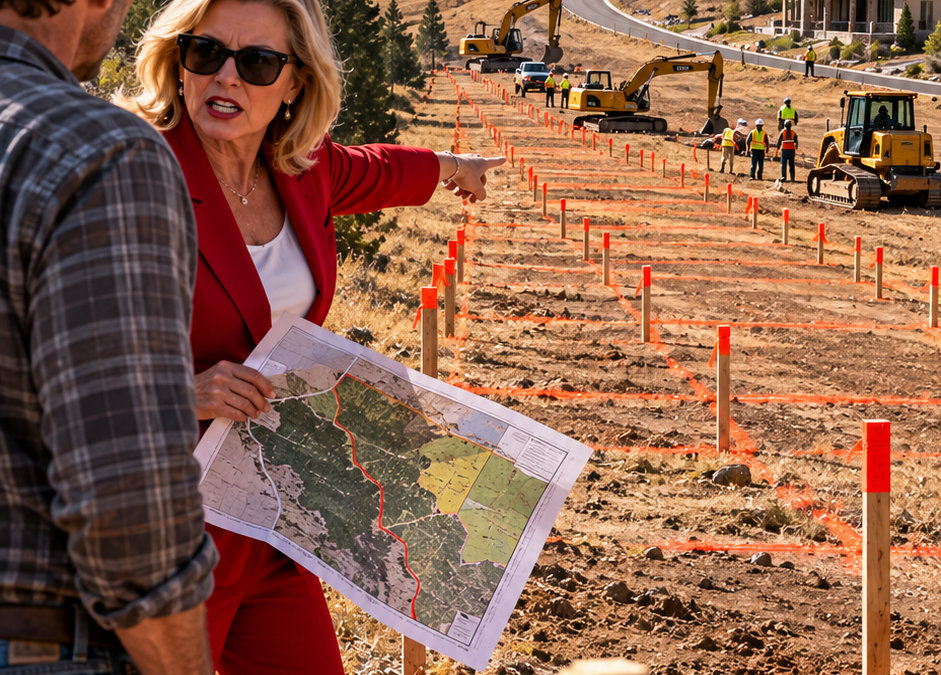
𝗙𝗨𝗟𝗟 𝗦𝗧𝗢𝗥𝗬
The old hazard map.
Photographs.
My maintenance records.
Daniel studied everything.
Then he said, “Ethan, I need something tying the restriction to a mapped location.”
“That map existed.”
“I believe you.”
“Then stop them.”
He shook his head.
“I can’t stop a multi-million-dollar permitted project because you remember a missing exhibit.”
The sentence made me furious.
But he was right.
Government does not work by memory.
Evidence has to exist somewhere the law can see it.
Daniel issued a request for additional records.
Construction continued.
Then, one Friday afternoon, the county archivist called.
Her name was Norah Feld.
“Mr. Mercer?”
“Yes.”
“I think I found something you should see.”
I drove to the archives before she finished explaining.
Before digital records, oversized exhibits were sometimes stored separately.
Plat maps.
Utility diagrams.
Subdivision plans.
Some had been copied onto microfilm.
The online index did not always show them.
Norah had found a handwritten notation beside my covenant number.
MAP CABINET 12
REEL C
We loaded the reel.
Frame after frame passed across the screen.
Utility easements.
Drainage plans.
Old road maps.
Then Norah stopped.
A black rectangle filled the display.
Three pale words appeared across the top.
EXHIBIT F – FIRE CORRIDOR.
I stopped breathing for a second.
The map showed all eighteen acres.
The average two-hundred-foot width.
The maintenance lane.
The same survey references as the covenant.
And, in the lower corner, the same recording stamp.
A note stated that the restrictions ran with the land.
I leaned back in the chair.
Norah looked at me.
“This what you were looking for?”
“Yes.”
My voice came out quieter than I expected.
Vanessa had been right about one thing.
The title company should have found it.
It had not.
I ordered certified copies.
That afternoon, I delivered one to Daniel Ruiz.
Another went to Crown Pine Development.
Daniel issued a temporary stop-work order covering portions of seven lots that clearly overlapped the mapped corridor.
Four foundations outside the disputed area were allowed to continue separately.
Vanessa called an emergency board meeting.
She invited me to explain what she called my position.
The Crown Pine clubhouse conference room was full.
Homeowners.
Contractors.
Sales staff.
Attorneys.
Project engineers.
Vanessa stood at the front beneath a rendering of the completed expansion.
Another red suit.
Another perfect presentation.
She opened the meeting.
“Mr. Mercer has located an old planning exhibit.”
Old planning exhibit.
Not recorded covenant.
Not fire-safety restriction.
A planning exhibit.
“That does not mean,” she continued, “that an outdated mitigation concept should prevent Crown Pine from meeting modern housing demand.”
I walked to the display board.
Placed the certified Exhibit F beside the current site plan.
“You are not modernizing the corridor.”
I pointed to the eleven lots.
“You are building on top of it.”
Her attorney stood.
He argued that ignition-resistant roofing, hydrant spacing, residential sprinklers, and modern building materials offered protection that had not existed in 1974.
That argument was not ridiculous.
I said so.
Modern homes can survive conditions that destroy older construction.
But buildings were only part of the issue.
The new design also created continuous fencing.
Dense ornamental plantings.
Backyard structures.
Narrow private lanes.
Occupied homes in ground firefighters once expected to be open.
Then Vanessa produced her counterattack.
Crown Pine Development had filed a request asking the county to modify the old covenant.
Attached was a consultant summary.
I saw the name.
Dr. Karen Mitchell.
My stomach tightened.
Karen was one of the most respected fire-behavior consultants in the region.
I had cited her work in reports.
If Karen believed the corridor could be eliminated safely, Vanessa had more than a marketing argument.
Vanessa knew I recognized the name.
She smiled.
“We are not ignoring science, Ethan.”
She turned toward the room.
“We are replacing old science with current science.”
The board voted to support the modification.
The next morning, Crown Pine’s attorney invited me to a private meeting.
Vanessa was waiting in a conference room at the resort.
No nameplate.
No board packet.
Only a purchase agreement.
She slid it across the table.
Crown Pine offered $1.8 million for my remaining twelve acres.
Nearly twice the county assessment.
The contract included a confidentiality clause.
A full release of every right associated with the old covenant.
A requirement that I withdraw my objections within forty-eight hours.
Vanessa leaned back.
“You said you don’t want to control Crown Pine.”
“I don’t.”
“This lets you walk away.”
I turned to the final page.
The buyer was not Crown Pine Development.
It was a newly formed LLC.
Same business address.
No obvious connection to the HOA.
“Why use another company?”
“Tax planning.”
“Or because you don’t want residents to know Crown Pine is buying the property that holds enforcement rights under the covenant.”
Her expression did not change.
“You are assigning motives to a normal transaction.”
Maybe she was right.
It could have been ordinary tax planning.
But the forty-eight-hour deadline ended one day before Karen Mitchell’s consultant summary was due at the county.
That timing bothered me.
The deal was not about my twelve acres.
It was about removing a signature.
Mine.
I closed the contract.
“No.”
Vanessa’s jaw tightened.
“Ethan, that is considerably above market value.”
“I know.”
“Then what exactly do you want?”
“The corridor left functional.”
“You would turn down almost two million dollars over empty ground?”
“It is not empty to me.”
She slid the agreement back into its folder.
“Then don’t tell people we gave you no reasonable way out.”
That sentence clarified everything.
She saw the firebreak as an obstacle with a price.
I saw it as a promise with a purpose.
We were no longer arguing about land value.
We were arguing about whether money should be allowed to erase risk.
Three days later, Karen Mitchell called me.
I answered immediately.
“Karen?”
“I did not write that conclusion.”
I stood.
“What?”
“The summary Crown Pine filed. I did not approve it as a standalone conclusion.”
Karen had evaluated Crown Pine eighteen months earlier.
Her full report did allow selective thinning.
It recommended reducing the width of low-fuel space in two limited areas where paved roads provided additional separation.
It did not recommend eliminating the corridor.
In fact, it warned specifically against creating continuous combustible connections from native forest toward residential structures.
“How long is your actual report?”
“Forty-three pages.”
“The county has six.”
“I know.”
Karen emailed the complete report.
The missing sections were worse than I expected.
Warnings had been removed.
Separate recommendations had been placed beside each other in a way that changed their meaning.
Most importantly, Karen’s original transmittal email showed Crown Pine Development had received all forty-three pages before submitting its expansion plan.
I sent everything to Daniel.
The county expanded the stop-work order to all eleven lots while the modification request was reviewed.
That should have stopped the physical changes.
It didn’t.
Four mornings later, I heard equipment on the slope before sunrise.
I drove to public land below Crown Pine.
Landscaping crews were planting six-foot cedar and pine trees along the rear lot lines.
No foundations.
No concrete.
Crown Pine called the work erosion control and site stabilization.
By noon, mulch and decorative rock covered three of the old boundary markers.
That evening, a landscaping supervisor approached me near the lower gate.
His name was Caleb Ross.
Forty-seven.
Broad shoulders.
Sun-darkened skin.
The exhausted look of a man being asked to choose between his paycheck and his conscience.
“They moved the planting schedule ahead.”
“Ahead of what?”
“The inspection.”
“Who?”
He looked toward the security camera above the gate.
“I can’t answer that while I work here.”
“Tell the county.”
“And if they decide it’s nothing?”
He lowered his voice.
“Vanessa makes one phone call and every large landscaping contractor in the valley knows my name.”
I understood.
It is easy to demand bravery when you are not the person who will miss a mortgage payment.
“What can you tell me?”
Caleb looked at the road.
“Remember change order 17-C.”
“Why?”
“And remember today’s date.”
Then he walked away.
The county scheduled a formal hearing for September.
Crown Pine appealed the stop-work order.
They claimed construction delays were costing more than eighty thousand dollars a week.
Buyers threatened to walk.
Contractors demanded compensation.
Vanessa began telling residents that I was using an obsolete family document to attack their property values.
For a while, it worked.
Cars slowed near my mailbox.
Anonymous messages called me selfish.
Someone posted a photograph of the old firebreak online with the caption:
ETHAN’S DIRT MUSEUM.
One afternoon at a grocery store, a Crown Pine resident confronted me beside the dairy aisle.
“Why should one man control eighteen acres he doesn’t own?”
The question was fair.
“I don’t own it.”
“Exactly.”
“But the property was sold with a recorded obligation.”
“That still gives you control.”
“No. It gives the land a condition.”
He stared at me.
I continued.
“There is a difference between ownership and obligation.”
He walked away unconvinced.
I understood why.
Obligations are invisible.
A house is obvious.
A fence is obvious.
A swimming pool is obvious.
A promise written into a deed looks like nothing until somebody tries to erase it.
The county hearing produced a compromise I hated.
Five foundations outside the clearly mapped center area could resume.
No occupancy permits would be issued until the covenant dispute was resolved.
Vanessa publicly described the ruling as a victory.
Construction accelerated.
Over the next ten months, stone walls climbed the upper slope.
Pools appeared.
Wood privacy fences connected lots.
Ornamental pines were planted close enough that their branches would eventually touch.
The golf-cart path curved through the old firebreak like a ribbon tied around a mistake.
An independent fire reviewer recommended preserving at least one hundred sixty feet of low-fuel separation.
He also recommended widening the emergency lane.
Crown Pine appealed again.
During the delay, a new county administrator approved a revised mitigation agreement based on modern roofs, residential sprinklers, hydrant upgrades, and annual landscape inspection.
The old private covenant was never formally extinguished.
That left everyone in a legal gray area.
Was the county’s revised mitigation approval the written consent required by the original covenant?
My attorney said no.
Crown Pine said yes.
The argument continued.
Meanwhile, five houses were nearly finished.
They received conditional occupancy.
Then six more.
By the second summer, all eleven premium houses were occupied.
One of them belonged to Laura Bennett.
She was forty-four.
A widow.
She moved into Lot 8 with her sixteen-year-old son, Mason, and her seventy-two-year-old mother, Evelyn.
Laura did not know me when she bought the house.
She trusted the Crown Pine brochure.
It described the upper section as professionally engineered for wildfire conditions.
She trusted the disclosure packet.
It stated that the development exceeded current mitigation standards.
Why wouldn’t she?
The house was new.
The road was paved.
The roofs were rated.
Hydrants were visible from the street.
The landscaping looked expensive and deliberate.
Everything appeared controlled.
Mason noticed the problem first.
He liked drones.
He flew a small one from legal public areas and photographed Black Ridge through different seasons.
Older aerial images showed a pale strip beneath the forest.
Open ground.
New images showed roofs.
Fences.
Pergolas.
Trees.
Pools.
Guest structures.
Mason used the clubhouse roof, the boulevard, and the ridgeline as fixed points.
Then he overlaid the images.
The before-and-after result was simple enough for anyone to understand.
The only empty space between the forest and his bedroom had disappeared.
Laura called me after her insurance company requested exact measurements of defensible space and continuous vegetation.
Her closing file referred to a wildfire engineering attachment.
She could not find it.
She asked Crown Pine for a copy.
Management sent her a two-page safety guide.
Clean gutters.
Register for alerts.
Keep emergency bags ready.
She brought it to my house.
“Is this what they were supposed to give me?”
“No.”
“What is it?”
“Household preparedness.”
“That sounds reasonable.”
“It is.”
I tapped the document.
“But it does not explain why your house was built inside the old corridor.”
She looked at Mason’s overlay on my kitchen table.
“Did they know?”
“Karen’s email proves the developer received the full report.”
Laura looked at me.
“That’s not what I asked.”
She was right.
Receiving a report and knowingly misleading a buyer were not automatically the same thing.
“I don’t know what sales staff told you.”
She nodded.
That mattered.
Laura did not want my anger.
She wanted facts.
She started organizing her purchase documents by date.
Contract.
Hazard disclosure.
Insurance questionnaire.
Marketing brochure.
Landscape plans.
What she found was subtle.
The earliest marketing brochure showed a wide strip of low vegetation behind the premium houses.
A later brochure replaced most of that strip with a narrow walking path.
The remaining area was labeled:
MANAGED GREEN SPACE.
The houses had not moved.
The meaning of the empty ground had.
That was how the firebreak disappeared.
Not all at once.
First it became outdated.
Then flexible.
Then landscaped.
Then managed green space.
Eventually, buyers no longer knew what had been removed.
Two fire seasons passed without a major wildfire.
Nothing happened.
That became Vanessa’s strongest argument.
Property values rose.
Luxury magazines photographed Crown Pine.
The HOA hosted wine dinners.
Private tours.
Tennis weekends.
Nobody’s house burned.
Vanessa said the quiet proved modern mitigation worked.
That is the cruelest thing about wildfire prevention.
When it succeeds, there is nothing to photograph.
Nobody celebrates a road that stayed open.
A house that never ignited.
A fire engine that had enough room to turn around.
A neighborhood that evacuated before smoke became flame.
Prevention looks like wasted money right up until the day you discover why it existed.
I kept measuring fuel.
Moisture.
Vegetation growth.
Wind patterns.
Mason kept his drone archive.
Laura saved every document.
Karen kept her original emails.
None of us wanted a fire.
That mattered to me.
I did not want Black Ridge to burn so I could say I was right.
I wanted the evidence to become strong enough that nobody needed a fire to prove anything.
Then Laura’s insurer refused to renew her policy.
The letter gave her sixty days.
Two other premium homeowners received similar notices.
Crown Pine told them the problem was part of a statewide retreat from wildfire insurance.
That was partly true.
The company referred owners to a surplus-lines broker.
Premiums were nearly triple.
Laura asked the HOA to certify the defensible-space measurements promised in her purchase documents.
Management refused.
At the next board meeting, Laura stood holding her nonrenewal letter.
Vanessa sat at the front.
“Your brochure says our section exceeds current wildfire standards.”
Vanessa nodded.
“Our community has extensive mitigation systems.”
Laura held up the letter.
“Then certify that in writing.”
Vanessa looked down at her agenda.
“No responsible HOA board guarantees an insurer’s underwriting decision.”
“I didn’t ask you to guarantee the insurer.”
Laura’s voice remained calm.
“I asked you to repeat your own statement in writing.”
The room went quiet.
Vanessa moved to the next agenda item.
That moment changed Crown Pine more than any argument I had made.
Homeowners had ignored my covenant dispute.
A legal document between a developer and a neighboring landowner felt remote.
Insurance did not.
Insurance had a renewal date.
A price.
A mortgage consequence.
Three premium owners requested the full wildfire report.
Management sent all three the same six-page summary.
Laura forwarded the emails to Karen.
Karen responded directly.
The summary was incomplete.
She had never approved it as a standalone assessment.
For the first time, I was no longer the only person asking questions.
People who had trusted Crown Pine were beginning to ask what exactly they had purchased.
Caleb Ross stayed silent until the spring of the third year.
Then one morning, he appeared at my house carrying a waterproof document case.
His landscaping company had lost its Crown Pine contract.
“Why?”
“I refused another cedar row.”
“Where?”
“Across a marked apparatus turnout.”
He placed the case on my kitchen table.
Inside were daily work logs.
Photographs.
Change orders.
The number he had told me years earlier.
17-C.
The signed instruction read:
RECOVER ALL UNUSED BUFFER LAND FOR PREMIUM VISUAL SCREENING AFTER FINAL LANDSCAPE INSPECTION.
Vanessa’s signature appeared beneath it.
I checked the date.
Nine days after Karen’s complete report arrived.
Three days after the county’s landscaping inspection.
The extra plantings had been added after review.
Caleb had something else.
Photographs of the emergency lane markers.
Before.
After.
Two markers had been moved inward before masonry walls were built.
The original twenty-foot lane narrowed to eleven feet six inches at one bend.
A landscaping truck could get through.
Two fire engines approaching from opposite directions could not.
Daniel Ruiz reopened the county review.
Fire officials scheduled a joint inspection for late August.
Vanessa responded by announcing Crown Pine’s biggest sales event of the year for the same weekend.
Luxury brokers.
Investors.
Prospective buyers.
Caterers.
Model-home tours.
She told residents the county inspection was routine.
Then, six days before the inspection, lightning struck west of Black Ridge.
The first report described a three-acre timber fire.
Several miles away.
Crews responded quickly.
For most Crown Pine residents, the fire was smoke on the horizon.
For me, the location was wrong in exactly the right way.
The fire sat below a steep drainage.
The weather forecast showed east winds.
If the fire entered that drainage, terrain could accelerate it toward the crest.
And once it crossed Black Ridge, gravity, wind, and dry fuel all pointed toward Crown Pine.
I sent everything to county fire command.
Coordinates.
Historic maps.
Current images.
Mason’s latest overlay.
Chief Aaron Walker called twenty minutes later.
“How current are those drone images?”
“Twelve days.”
“The county pre-plan still shows open ground behind the upper homes.”
“That ground is gone.”
“How gone?”
“Eleven houses. Continuous fencing. Ornamental pines. Pools. Guest structures. Emergency lane narrowed to eleven and a half feet.”
Silence.
Then Aaron said, “I’m sending someone.”
A division supervisor inspected the access routes before the fire reached the ridge.
That inspection exposed the problem none of us expected.
The secondary emergency gate was locked.
Electronic access had replaced the old chain system.
The fire-department code stored in the county database did not work.
Crown Pine security could not reach the property manager who had changed it.
The manual override box was empty.
Meanwhile, catering vans and display vehicles were arriving for Vanessa’s sales event.
Golf carts crowded the main boulevard.
Prospective buyers parked near model homes.
Aaron ordered sheriff’s deputies to cut the chain behind the electronic gate.
Caleb, who had come for the inspection, helped move two maintenance trailers narrowing the approach.
I showed crews where the original apparatus turnout had been.
A cedar privacy screen now hid part of it.
A decorative wall occupied the rest.
The division supervisor measured the lane.
Eleven feet six inches.
Vanessa arrived in a golf cart.
Red blazer.
White event clothes.
Perfect hair.
She stared at the cut gate.
“You cannot destroy private security equipment without authorization.”
The division supervisor held up the chain.
“Ma’am, this is a recorded emergency-access lane.”
He pointed toward the approaching fire vehicles.
“This is the authorization.”
For the first time in all the years I had known Vanessa, she had no prepared answer.
By noon, the wildfire had grown past nine hundred acres.
Aircraft slowed one flank.
But the head continued toward the drainage.
Aaron recommended voluntary evacuation of Crown Pine’s upper section while both exits were still clear.
Laura left immediately.
She did not wait for smoke.
Evelyn had medications, identification, and insurance documents packed in one travel case.
Mason took his laptop and two external drives containing his drone archive.
Laura knocked on doors.
Called elderly neighbors.
Checked on people living alone.
Vanessa did not cancel the sales event.
She also did not directly tell anyone to ignore the warning.
That would have been too obvious.
Instead, Crown Pine sent a message saying the event would continue while management monitored conditions in coordination with local authorities.
They were not coordinating.
They were receiving alerts.
That difference sounds small until lives depend on it.
At 1:30, smoke thickened above the western crest.
At 2:10, ash began falling near the tennis courts.
At 2:23, Aaron ordered mandatory evacuation of the upper section.
Deputies took control of both gates.
Guests abandoned drinks beside display boards.
Catering employees loaded whatever they could.
Two golf carts blocked a narrow intersection until a maintenance worker pushed them onto a lawn.
Vanessa stayed inside the clubhouse directing staff to move computer equipment and sales records.
A deputy entered.
“You need to leave.”
“These files contain confidential buyer information.”
He looked at her.
“This building contains a person delaying an evacuation.”
“That person is you.”
She left.
Because Laura and several others had evacuated early, traffic was lighter than expected.
Because Caleb had opened the secondary lane, vehicles split between exits.
Because Aaron acted before residents could see flames, fire engines entered while civilians were still leaving.
That sequence mattered more than any dramatic moment later.
People like to imagine survival comes from one heroic decision.
Usually it comes from several ordinary decisions made before heroism becomes necessary.
By early evening, every resident had been accounted for.
Then Black Ridge ignited.
I watched from the county command area.
At first, the fire appeared as a thin orange line near the crest.
Then the line widened.
Wind pushed embers beyond the main front.
Timber brightened through smoke.
Disappeared.
Brightened again farther downhill.
Aaron moved the primary defense to the broad lower boulevard.
That road had hydrants.
Pavement.
Turning room.
Older county plans assumed firefighters could operate in the open firebreak above it.
Mason’s photographs had already shown that ground no longer existed.
The first ornamental pines ignited behind Lot 3.
Fire entered a cedar privacy screen.
The cedar carried flame into a wooden fence.
The fence ran toward a pergola.
The pergola connected to a pool house.
On the neighboring property, shrubs ignited and carried flame toward a rear deck.
The houses looked separate on sales maps.
Under wildfire conditions, the landscaping behaved like one system.
One connected line.
Exactly what Karen’s full report had warned against.
I had imagined that moment for years.
Usually at night.
Usually while wondering whether I had become an old man defending an old idea because I could not accept change.
Watching the fire take the route we had warned about gave me no satisfaction.
Being right felt nothing like winning.
Crews could not defend every backyard.
They cut sections of burning fence.
Protected intersections.
Held the lower boulevard.
The early evacuation gave them empty roads.
That meant commanders could choose defensive positions based on fire behavior instead of trapped residents.
Several garages burned.
Pool houses were destroyed.
Four rear decks failed.
Embers entered attic vents in two houses before crews stopped interior spread.
Cars parked beside combustible fencing burned while vehicles only yards away survived behind masonry and open pavement.
Vanessa’s own showcase home stood in one of the narrowest surviving sections of the original corridor.
The guest house burned first.
Then the cedar screen.
Then the pool shelter.
Flame entered the rear wing of the main house.
Firefighters held the front masonry section from the driveway.
The clubhouse also suffered serious damage along its upper wing after ornamental landscaping carried flame to exterior features.
Crews protected the central structure.
They prevented the fire from spreading into the lower resort.
At three in the morning, the wind weakened.
By sunrise, the main front had moved beyond Crown Pine.
Thirty-seven mansions had been threatened.
The heaviest structural damage clustered in and immediately below the eleven premium lots.
No resident died.
No firefighter had to abandon a defensive position to rescue someone who waited too long.
That was what mattered.
Crown Pine lost buildings.
Vehicles.
Landscaping.
Parts of homes.
And one very expensive illusion.
Vanessa spoke to reporters before homeowners were allowed to return.
She called the fire unprecedented.
She said no community design could reasonably have prevented an event of that magnitude.
That statement created another problem for her.
Because the fire had left a map of its own.
Mason did not fly his drone during active operations.
He gave investigators his dated pre-fire archive.
Once the county authorized post-fire aerial documentation, investigators compared those images with his overlays.
The damage pattern was visible.
Not perfect.
Not absolute.
Wildfires never produce neat courtroom diagrams.
But the strongest connected spread followed the same band where low-fuel ground had been replaced by landscaping, fences, accessory buildings, and premium houses.
The investigators were careful.
They did not say Crown Pine caused the wildfire.
Lightning caused it miles away.
They did not say preserving the original firebreak would have made every home invulnerable.
No responsible fire professional would promise that.
Their preliminary conclusion was narrower.
And more damaging.
Removal of the low-fuel area and addition of continuous combustible features materially reduced defensive space, complicated apparatus access, and contributed to fire spread inside the upper development.
That was enough.
Credible evidence rarely says everything angry people want.
It says exactly what can be supported.
Karen supplied her complete forty-three-page report.
And the email proving Crown Pine had received it.
Caleb supplied the signed change order.
And the photographs showing the narrowed emergency lane.
Laura supplied her brochures.
Disclosures.
Insurance correspondence.
Sales materials.
Mason supplied the visual timeline.
I supplied the recorded covenant.
Maintenance history.
GPS photographs.
Old hazard maps.
Six separate evidence trails pointed toward the same decisions.
Then investigators found the document that changed the case again.
During the emergency, Vanessa had ordered staff to save files from the clubhouse.
Some were damaged by water.
A county investigator reviewing them found a red folder.
MITIGATION REVISION.
Inside was an internal title-company exception notice dated three years earlier.
The notice identified the wildfire mitigation and emergency-access covenant by recording number.
It stated that Exhibit F appeared to be absent from the digital copy.
It recommended a manual archive search before any premium-lot closing.
Across the top, somebody had written in blue ink:
DO NOT DELAY SALES.
COUNTY REVISION WILL SUPERSEDE.
Beside those words were two initials.
V.C.
Vanessa Cole.
I read the copy in Daniel’s office.
For several seconds, neither of us spoke.
The first time Vanessa challenged me, she said the title company would have found the covenant if it mattered.
The truth was worse.
The title company had found the problem.
It had told her the digital file might be incomplete.
It had recommended the same manual archive search that eventually led me to Exhibit F.
And somebody had decided not to wait.
The county froze Crown Pine’s next development phase.
Officials reviewed the conditional occupancy decisions.
Fire authorities documented the failed gate code.
The empty override box.
The narrowed lane.
The missing turnaround.
Insurance investigators compared policy applications against risk information given to buyers.
Laura and eight other homeowners filed a civil action.
Their claims focused on the developer.
The developer-controlled HOA.
Title issues.
Disclosures.
Altered landscaping.
They did not blame me.
They did not blame residents who bought homes in good faith.
They focused on the people and records that shaped the decision.
Vanessa made one last attempt to defend herself at a special board meeting.
I attended because several homeowners asked me to.
She stood at the front.
No red blazer this time.
Dark gray.
She looked smaller.
Not physically.
Institutionally.
For years, she had controlled the order in which information entered the room.
That power was gone.
She pointed to the permits.
The inspections.
Modern roofs.
Sprinklers.
Hydrants.
The county’s revised mitigation agreement.
Some of those facts were true.
That was what made her defense stronger than a simple lie.
Then Karen Mitchell stood.
“You hired me to identify wildfire risk.”
Vanessa looked at her.
Karen continued.
“You did not hire me to make it disappear.”
Caleb placed Change Order 17-C on the table.
“You ordered extra combustible screening after inspection.”
Laura held up the title exception notice.
“You sold us homes after being warned the property record was incomplete.”
Vanessa looked toward Crown Pine Development’s attorney.
He did not interrupt.
The homeowner representatives voted to remove her as HOA president.
The development company terminated her operational role the following week.
Her removal did not repair a house.
It did not replace Laura’s insurance.
It did not rebuild burned decks.
But it ended Vanessa’s ability to control communications and reconstruction decisions.
The civil cases continued.
Eleven months passed.
Document exchange.
Engineering reviews.
Title analysis.
Insurance adjustment.
Mediation.
Some residents became frustrated.
They wanted instant justice.
I understood.
But property disputes that end overnight usually end only in stories.
Real solutions require surveys.
Money.
Permits.
Signatures.
Insurers.
People arguing about language nobody wants to read.
The old covenant mattered because it ran with the land.
The premium parcels had been sold subject to a restriction that should have been disclosed and resolved.
The county’s later mitigation agreement had approved specific construction conditions.
But it had never formally released the original private covenant.
And it had never erased the emergency-access rights.
Eventually, the developer, title insurer, affected owners, HOA insurers, county representatives, and my family reached a coordinated settlement.
The developer agreed to repurchase seven parcels occupying the core of the original corridor.
Owners of four partially affected homes received options.
Relocation.
Or reconstruction under stricter setbacks and noncombustible design requirements.
The settlement funded temporary housing.
Uninsured losses.
Removal of structures that could not remain inside the restored corridor.
The county did not simply ban rebuilding.
That would have punished owners who had relied on the approvals they were given.
Instead, officials used the post-fire hazard review to redesign the area.
The developer.
Title insurer.
Affected owners.
County.
And my family signed a new permanent conservation and emergency-access easement.
This one was not buried on a microfilm reel.
Every map was attached correctly.
Every page indexed.
The restored corridor averaged two hundred twenty feet.
Low-growing vegetation only.
Two engine turnouts.
A twenty-four-foot all-weather emergency lane.
Visible markers.
Annual inspection.
Future permits tied directly to maintenance compliance.
No guest houses.
No cedar privacy screens.
No pool shelters.
No ornamental tree rows inside the core area.
Damaged foundations were removed where practical.
Continuous fences were broken up.
Replacement sections farther downhill used noncombustible materials.
Hydrant access was improved.
Emergency gate codes became part of annual drills instead of numbers trusted inside a database.
Laura stayed in Crown Pine.
So did Mason and Evelyn.
They moved to a rebuilt home below the boulevard.
Laura received compensation for relocation costs and the difference in property value.
Later, she joined an owner-elected safety committee.
The first time we met, somebody referred to it as the Wildfire Task Force.
Laura raised one hand.
“No.”
Everyone looked at her.
She said, “Nothing gets called a task force unless it has an actual task and a deadline.”
I laughed harder than I expected.
Mason kept flying his drone.
But now his images documented something different.
Vegetation growth.
Lane clearance.
Boundary markers.
Whether contractors respected the restored corridor.
Caleb took a job with a wildfire mitigation contractor.
His experience made him unusually good at recognizing when landscaping plans crossed from aesthetics into hazard.
Karen helped the county revise its disclosure checklist.
Future development approvals in high-risk areas now had to identify complete consultant reports, not only executive summaries selected by applicants.
I was offered a seat on the HOA safety board.
I declined.
I had spent enough years sitting in rooms where people discussed landscaping like foreign policy.
I did agree to help design Crown Pine’s annual inspection and evacuation drill.
One year after the Black Ridge fire, I returned to the overlook.
The eleven premium homes were gone from the core strip.
Low grass covered the slope.
Wide access lanes crossed the open ground.
Permanent markers stood where those orange survey stakes had once climbed toward the timber.
From a luxury-development perspective, the mountain edge looked unfinished.
From a firefighter’s perspective, it finally made sense.
I stood there for a long time.
Vanessa’s sentence came back to me.
Empty land has no value.
In 1974, empty land gave my father’s family distance from a fire.
During the Black Ridge incident, the fragments of open ground that survived gave firefighters places to reposition.
Restoring the corridor gave the next generation something eleven additional mansions never could.
Time.
Distance.
Space.
I did not celebrate Vanessa losing her position.
I did not feel vindicated by burned houses.
If your warning becomes meaningful only because families suffer, that is not victory.
Victory is what changes before the next fire.
The dangerous lots disappeared.
Owners received compensation.
Emergency access returned.
The covenant became visible.
Every resident survived.
That last fact mattered more than everything else.
Sometimes people ask whether I blame Vanessa for the fire.
No.
Lightning started the wildfire.
Dry timber fed it.
Wind moved it.
No honest person should rewrite those facts.
What Vanessa and Crown Pine did was different.
They changed the conditions the fire encountered when it arrived.
That distinction matters.
It is also harder to explain than a simple villain story.
Vanessa did not wake up one morning wanting houses to burn.
She believed expensive development could coexist with risk if enough modern systems were added.
She trusted permits.
Sprinklers.
Hydrants.
Ignition-resistant materials.
Some of those systems worked.
Several houses survived because of them.
Firefighters used the hydrants.
Masonry walls protected vehicles.
Modern roofs reduced ember ignition.
The problem was not that every modern mitigation measure failed.
The problem was believing those measures made the old layers unnecessary.
Wildfire safety is not one thing.
It is layers.
Structure.
Vegetation.
Distance.
Access.
Evacuation.
Water.
Maintenance.
Communication.
Remove enough layers and eventually the remaining ones are asked to do jobs they were never designed to do alone.
Crown Pine had spent years removing one layer because that layer looked empty.
I thought often about the documents afterward.
Exhibit F.
Karen’s missing pages.
Caleb’s change order.
Mason’s photographs.
The title exception notice.
None of them were dramatic by themselves.
A map.
A report.
A teenager’s drone folder.
A landscaping instruction.
A note in a red file.
Yet together, they told the story.
That may be what stayed with me most.
There was no secret hero carrying one perfect piece of evidence.
The truth survived because ordinary people kept copies.
Norah searched a forgotten reel.
Karen kept her email.
Caleb saved work logs.
Laura organized her closing documents.
Mason backed up photographs.
My father kept a paper covenant in a file cabinet long after everyone else trusted computers.
The mountain did not care about any of that.
The legal system did.
The insurance companies did.
The county did.
The homeowners did.
And because the records survived, what happened after the fire was not decided only by whoever spoke most confidently.
Two years after the fire, I drove through Crown Pine during the annual evacuation drill.
The secondary gate opened with the county code.
A fire engine entered without stopping.
The new lane gave it twenty-four feet.
At the first turnout, another engine passed in the opposite direction.
No one celebrated.
Nobody took photographs.
Most residents probably barely noticed.
That was exactly how it should be.
Safety is often invisible when it works.
I parked near the lower boulevard.
Laura walked over.
Mason was farther uphill launching his drone under the supervision of a county observer.
Evelyn sat beneath a shade tent with several other residents.
Laura looked toward the open corridor.
“It’s strange.”
“What is?”
“When we bought the house, that empty strip would have looked unfinished to me.”
“And now?”
She watched the engine turn around.
“Now I see what was supposed to be there.”
Nothing.
That was the point.
My father understood it in 1998.
My grandfather understood it after the fire in 1974.
It took me most of my career to understand how difficult that idea is to defend.
People naturally assign value to what they can use directly.
A bedroom.
A pool.
A shop.
A parking space.
A view.
Open ground has to justify itself by something that might never happen.
A fire that may not come.
A flood that may not rise.
An evacuation that may never be ordered.
That is why those spaces are always vulnerable to someone saying they could be put to better use.
Sometimes they can.
Sometimes old rules really are outdated.
Sometimes technology allows us to build safely where earlier generations could not.
I am not against change.
I spent my entire career updating mitigation plans as science improved.
But modernizing a safety system is not the same as deleting the part you find inconvenient.
You have to understand what that part was doing first.
Vanessa never did.
Or maybe she did, but believed the risk could be transferred into other systems.
Either way, once sales deadlines and reputation became attached to the expansion, every warning started to look like opposition.
That is a dangerous moment in any organization.
When bad news becomes disloyalty, risk stops being measured honestly.
One autumn afternoon, I found my father’s original copy of the covenant again.
The paper had yellowed slightly.
His handwriting remained beside the recording number.
EXHIBIT F – KEEP WITH MAP FILE.
I smiled when I saw the note.
He had written it because he knew the map mattered.
Then somewhere over the years, the page still went missing from his folder.
That used to bother me.
Now I think about it differently.
Records are fragile.
People move.
Files get separated.
Scanners skip pages.
Indexes fail.
Buildings flood.
Hard drives die.
The answer is not to assume one perfect record system will never break.
The answer is redundancy.
Independent copies.
Visible markers.
Annual inspections.
Multiple people who understand why something exists.
That was one of the lessons Crown Pine finally adopted.
The new corridor is not protected by one forgotten page anymore.
It exists on county maps.
Subdivision maps.
HOA records.
Emergency pre-plans.
Insurance files.
Property disclosures.
Physical signs.
No future president should be able to say nobody knew.
A few years later, I met Daniel Ruiz at the corridor during an inspection.
He had more gray in his hair.
So did I.
He looked across the grass.
“You hated me that first summer.”
“I did.”
“You wanted me to shut the whole project down.”
“I did.”
“You know I couldn’t.”
“I know.”
He smiled.
“Took you long enough.”
I looked at the lane.
“No. Took me long enough to forgive you for being right.”
Daniel had taught me something I already knew professionally but forgot personally.
Institutions move on evidence.
That can feel cruel when danger seems obvious to you.
But the alternative is giving officials the power to stop projects because somebody with experience says, trust me.
That creates different dangers.
The real failure was not that Daniel required proof.
The failure was that the proof had been allowed to disappear from the system in the first place.
Then warning after warning was treated as an inconvenience.
When I think about Black Ridge now, I do not remember Vanessa’s red blazer first.
I remember Laura’s insurance letter.
Mason’s overlay.
Caleb whispering a change-order number beside a security camera.
Karen saying, “I did not write that conclusion.”
Norah turning the microfilm reel.
Aaron asking how gone the corridor was.
The deputy telling Vanessa she was the person delaying evacuation.
And, finally, the open slope one year later.
No mansions.
No cedar screens.
No golf carts.
Just grass.
Access lanes.
Distance.
The kind of landscape people call empty until the day they need what the emptiness gives them.
I still inspect the corridor every spring.
I do not have to.
The county has a schedule now.
So does the HOA.
But I walk it anyway.
Old habit.
I check the markers.
Look for volunteer trees.
Watch drainage.
Measure growth near the edges.
Sometimes Mason joins me when he is home from college.
He is studying environmental engineering now.
He claims the fire had nothing to do with that decision.
I do not believe him.
One spring morning, we stopped near the upper marker.
He launched the drone.
It climbed until the corridor became visible as a pale band below Black Ridge.
For the first time in years, it looked almost like the old photographs.
He handed me the controller.
“See it?”
I did.
Thirty-seven homes below.
Forest above.
And between them, space.
Nothing.
Everything.
I thought again about Vanessa.
Empty land has no value.
She had been wrong.
But not in the simple way I once believed.
Empty land does not always have value.
Sometimes it is just empty land.
The responsibility is knowing when it is something more.
A floodplain.
A drainage path.
A wildlife corridor.
A utility easement.
A firebreak.
A road firefighters need before anyone else understands why.
The value may not appear in a sales brochure.
It may never increase a property appraisal.
It may sit unused for decades.
That does not mean it is worthless.
Sometimes the thing you do not build is the thing that protects everything you did.
That is what Black Ridge taught Crown Pine.
And it is what my family had been trying to remember since 1974.
What do you think of this story? Please leave a like and share your thoughts in the comments. Your support means a lot to us and inspires us to keep writing more meaningful and powerful stories. Thank you! 👍

