𝗙𝗨𝗟𝗟 𝗦𝗧𝗢𝗥𝗬 The Face Pressed Against My Window at 7 A.M. Was Only the Beginning of What the HOA Had Planned for Max
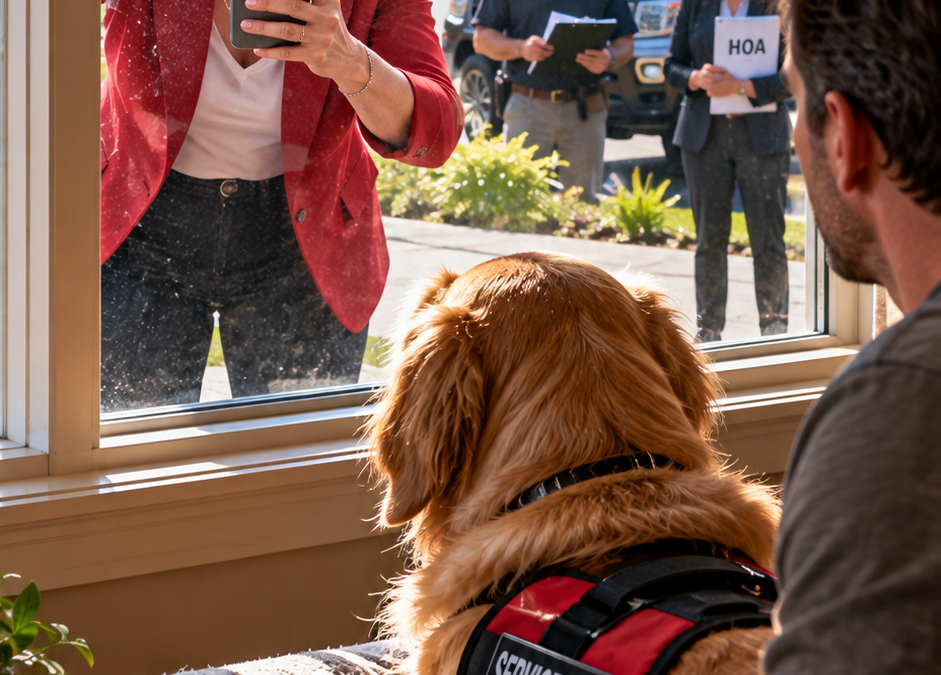
𝗙𝗨𝗟𝗟 𝗦𝗧𝗢𝗥𝗬
Sometimes he interrupted episodes before they became severe.
Other times, he gave me something physical and steady to focus on while the symptoms passed.
Warm fur.
Weight against my knee.
His nose beneath my palm.
A living reminder that the room was still the room.
The floor was still beneath me.
Nothing was chasing me.
I was still here.
By the time I moved into the neighborhood, Max was not some optional comfort in my life.
He was part of how I functioned.
Most neighbors liked him.
Children asked before petting him.
The older couple across from me kept treats they never gave him without permission.
Even people who did not understand what a service dog actually did understood one basic thing.
He was working.
Karen understood it too.
That became obvious later.
At first, I assumed she was simply ignorant.
That assumption did not survive long.
I had slept badly the night before she appeared at my window.
Around four in the morning, I woke from a dream I could not remember with my heart racing.
Max climbed beside the couch and pressed his head into my chest until my breathing slowed.
I eventually fell asleep there.
When morning came, sunlight reached through the blinds.
I opened my eyes.
And saw a face outside.
For a fraction of a second, my brain could not process it.
A woman.
Close enough that her forehead almost touched the glass.
Phone raised.
Camera pointed inside.
Then I recognized the blond hair.
Karen.
Adrenaline hit me like electricity.
I stood so quickly that the blanket fell around my feet.
My chest tightened immediately.
Max was awake before I was fully upright.
He moved against my left leg.
Steady.
Warm.
Present.
I could hear my own pulse.
I walked to the front door.
Max followed.
I opened it only far enough to step partially outside while keeping him behind my leg.
“Can I help you?”
My voice was sharper than I intended.
Karen flinched slightly.
Then the smile appeared.
Clipboard lifted.
“I’m conducting an inspection.”
“At my window?”
“We’ve had complaints.”
“About what?”
She looked past me.
“Your dog.”
“My service dog.”
“That animal exceeds the community weight limit.”
I stared at her.
“There is no pet weight restriction that applies to Max.”
“Our rules prohibit dogs over twenty-five pounds.”
“Max isn’t a pet.”
“That’s what you’ve claimed.”
The words landed harder than I expected.
Not because they were loud.
Because they were casual.
“What does that mean?”
“It means the board needs to verify that your service claim is legitimate.”
Something in me went cold.
She was standing on my front walkway after filming through my living room window, telling me my medical need required her verification.
“No.”
Her smile tightened.
“No?”
“You don’t get to verify my disability by looking through my window.”
“We have a responsibility to enforce community rules consistently.”
“You have no responsibility to film inside my house.”
“Ethan, if this is legitimate, there should be no reason for you to be defensive.”
There are sentences designed to trap people.
If you are innocent, why are you upset?
If you have nothing to hide, why do you want privacy?
If your condition is real, why not prove it however I demand?
I recognized what she was doing.
That did not stop my hands from shaking.
Max pressed harder into my leg.
Karen noticed.
Her eyes dropped to him.
“I need to inspect the animal.”
“No.”
“I need documentation.”
“I’ll provide what I’m legally required to provide.”
“I need to see his certification.”
“That isn’t how this works.”
She stepped forward.
Actually stepped toward my open door.
I moved into the opening.
“Do not enter my home.”
Her smile disappeared.
“If you refuse inspection, fines begin today.”
“Leave.”
“And I’ll recommend the board initiate removal proceedings.”
I thought I misheard her.
“Removal of what?”
“The unauthorized animal.”
Max looked up at me.
His mouth was slightly open.
Tail relaxed.
He had no understanding that the woman six feet away was threatening to remove him from the only home he knew.
To Karen, he was an item on a compliance list.
To me, he was the reason I could attend work meetings without choosing the chair closest to the exit.
The reason I had been able to fly to my sister’s wedding.
The reason I sometimes slept through the night.
The reason I no longer kept grocery lists short because I was afraid I would need to escape the store.
My chest tightened again.
Max leaned into me.
Karen saw the entire thing.
And smirked.
“We’ll see how long that mutt lasts.”
That was the moment the conversation stopped being a disagreement.
“Leave my property.”
She raised her phone again.
I stepped backward and closed the door.
My hands were shaking badly enough that I missed the lock the first time.
Max pressed his body against my knees.
I sat on the floor.
He immediately lowered himself beside me.
I put one hand on his back.
Counted breaths.
Four in.
Hold.
Six out.
Again.
Through the window, I could hear Karen narrating into her phone.
“Resident refused inspection…”
Her voice faded as she walked away.
I stayed on the floor for almost twenty minutes.
By that evening, the violation notice arrived.
UNAUTHORIZED ANIMAL EXCEEDING COMMUNITY WEIGHT LIMIT.
FAILURE TO COOPERATE WITH BOARD INSPECTION.
DAILY FINE EFFECTIVE IMMEDIATELY.
I read it while Max slept under my desk.
My first instinct was to fire back.
Instead, I waited until my breathing was steady.
Then I wrote a measured email.
Max is a trained service dog assisting me with a disability. He is not a pet and should not be treated under ordinary pet restrictions. I am willing to provide documentation permitted by applicable law. I will not provide unrestricted private medical records or permit unannounced entry into my home.
I attached a letter from my physician confirming my need for the service animal.
I also asked that Karen be instructed not to enter my property or film through my windows again.
I sent the message to the entire board.
No response.
Not that day.
Not the next morning.
Nothing.
The fine notice remained active in the HOA portal.
So I attended the next board meeting.
Max wore his working vest.
The clubhouse smelled like burnt coffee and carpet cleaner.
Folding chairs formed rows facing a long plastic table where the board sat.
Karen was in the center.
Clipboard beside her.
Before the meeting began, I knew something was wrong.
One board member looked at me, then immediately looked down.
Another pretended to read something on his tablet.
A woman I had known for two years gave Max a nervous smile but said nothing.
Karen looked directly at me.
She seemed almost pleased.
Max settled under my chair.
Perfectly still.
During open comments, I stood.
My palms were damp.
My voice was steady.
“I’m here regarding the violation issued for my service dog.”
Karen leaned toward her microphone.
“You have three minutes.”
“The violation applies the pet weight limit to a trained service animal. I provided the board with documentation. I’m asking that the violation and fines be withdrawn.”
Karen slapped one palm against the table.
“You are out of order.”
I stared at her.
“I’m speaking during open comments.”
“You are mischaracterizing the board’s position.”
“What position?”
“We have received numerous complaints regarding an oversized unauthorized animal.”
I looked down.
Max was asleep.
“He literally spends most of his life lying down.”
A few people laughed.
Someone coughed into a fist to hide it.
Karen’s face tightened.
“All animals in this community must be inspected and approved.”
A board member at the far end spoke.
His name was Michael.
He rarely said much.
“I’m not sure that policy can be applied to a service animal.”
Karen turned toward him instantly.
“You want to be responsible?”
Michael blinked.
“For what?”
“When every resident claims an emotional need for whatever animal they want and we end up with a zoo?”
The room went quiet.
I felt the heat rise in my face.
“Max isn’t an emotional support pet.”
Karen ignored me.
“This board has a responsibility to prevent abuse.”
I looked around the room.
People I had waved to.
People who had stopped to talk with me and Max on evening walks.
People who had told me he was beautiful.
Almost everyone looked down.
A few met my eyes.
Their expressions said the same thing.
I’m sorry.
I don’t want trouble.
That was the moment I understood that nobody in that room was going to stop Karen for me.
Not because everyone agreed with her.
Most probably did not.
But disagreement costs nothing until speaking does.
Karen had spent four years teaching the neighborhood that challenging her meant becoming her next project.
Nobody wanted that.
I finished my statement.
She moved to the next agenda item.
That was it.
No vote.
No discussion.
No cancellation.
When I got home, I removed Max’s vest.
Sat on the living room floor.
He climbed into my lap even though he was far too large.
I buried my face against his neck.
And cried.
Not soft grief.
Angry tears.
The kind that come when exhaustion and humiliation finally find the same place.
“You’re not going anywhere.”
Max licked my wrist.
I held him tighter.
“She picked the wrong person.”
I meant it.
Not because I was fearless.
I was terrified.
That mattered.
People sometimes tell stories about standing up for yourself as if courage arrives cleanly.
It did not for me.
I was still afraid of Karen.
Afraid of losing my housing.
Afraid of fines growing into something larger.
Afraid of being forced into legal proceedings I could not afford.
Afraid that every trip outside would become another confrontation.
Afraid of what would happen to my mental health if Max were somehow removed.
I simply reached a point where doing nothing frightened me more.
The next morning, I stopped arguing with the HOA.
I started researching.
Housing law.
Disability protections.
Service animal rules.
Federal complaint procedures.
State resources.
Retaliation.
Reasonable accommodation.
What documentation could be requested.
What could not.
I read until the legal language stopped looking foreign.
I learned quickly that Karen had been relying on something powerful.
Not law.
Uncertainty.
She assumed I would not know the difference between an HOA rule and a lawful requirement.
She assumed the board’s confidence would sound official enough that I would comply.
The more I read, the more the shape of the problem became clear.
Max could not simply be treated as an ordinary pet because the HOA preferred its weight limit.
My disability did not become subject to a neighborhood inspection because Karen put the word “verification” on a clipboard.
The board could not convert private medical information into a condition of allowing me to live with the animal assisting me.
And Karen filming through my window, attempting to enter my home, threatening removal, and escalating fines after I objected created a much larger record than one badly interpreted pet rule.
I did not post online.
I did not confront her again.
I did not send an angry message.
I built a file.
The doorbell footage came first.
I had forgotten the camera captured part of the front window area.
There she was.
7:01 a.m.
Walking onto my property.
Stopping beside the window.
Raising her phone.
Leaning toward the glass.
The timestamp was clear.
I exported the original file.
Backed it up.
Then printed every HOA notice.
Dates.
Amounts.
Descriptions.
I printed my email to the board.
The physician’s letter.
Delivery confirmation.
Their silence.
I saved Karen’s follow-up reminders.
One message said:
Continued refusal to cooperate will be treated as intentional noncompliance.
Another:
Board retains authority to verify all animal exemptions.
Another:
Failure to arrange inspection may result in further action regarding occupancy compliance.
Then neighbors began contacting me privately.
The first was Mrs. Collins from two buildings over.
She called rather than text.
“I’m sorry I didn’t say anything at the meeting.”
“You don’t owe me an explanation.”
“I do.”
Her voice lowered.
“Linda’s been talking about you for weeks.”
“What has she been saying?”
“That she thinks you’re faking.”
My stomach tightened.
“Faking what?”
“Your disability.”
“How would she know anything about it?”
“She said you seem fine when you walk Max.”
I closed my eyes.
That sentence.
You seem fine.
As if disability had to perform visibly for strangers.
As if the fact that Max helped me function was evidence I did not need him.
“Would you be willing to write down what she told you?”
Mrs. Collins hesitated.
“I don’t want my name involved publicly.”
“I understand.”
After a long silence, she agreed to send a short written statement for investigators if necessary.
Another neighbor contacted me two days later.
Same story.
Karen had questioned whether Max was legitimate.
Suggested I had learned the right language to “get around the pet rule.”
She had been constructing the accusation before she appeared at my window.
That changed how I understood the encounter.
Karen had not arrived to investigate.
She arrived to confirm a conclusion she had already reached.
Then she slipped a handwritten note beneath my door.
I heard the paper move.
Max walked over.
Picked it up gently.
Brought it to me.
I unfolded it.
You’re making this harder on yourself.
No signature.
None needed.
I photographed it.
Placed the original inside a clear sleeve.
Added it to the file.
The complaint I submitted was not dramatic.
That was deliberate.
I did not write that Karen was evil.
I did not call the board corrupt.
I did not speculate about motives.
I described events.
Dates.
Statements.
Fines.
Threats.
The attempted entry.
The window filming.
The service dog documentation.
The board meeting.
The neighbors’ accounts.
Then I attached the evidence.
When I clicked submit, I expected to feel powerful.
I did not.
I felt sick.
Because once you formally report someone, the situation becomes real in a different way.
There is no pretending it was just a bad meeting.
No hoping the person will suddenly become reasonable.
You have admitted to yourself that the conflict is serious enough to require outside intervention.
That night, I barely slept.
Every sound outside made me look toward the window.
Max stayed close.
The next week, Karen behaved as though nothing had changed.
Violation reminders continued.
The fines increased inside the HOA portal.
She passed me near the mailbox once.
“Still ignoring the board?”
“I’ve responded.”
“Not adequately.”
“I have nothing else to discuss with you.”
She smiled.
“That attitude is expensive.”
I walked away.
My hands shook for ten minutes afterward.
But I walked away.
Days passed.
Then weeks.
I began wondering whether the complaint had disappeared into some administrative system nobody would ever look at.
Karen seemed more confident.
At the next HOA meeting, she announced that the board would “strengthen verification procedures for animal exemptions.”
Michael objected again.
“This seems targeted.”
Karen responded, “Rules only feel targeted to people who refuse to follow them.”
Several residents looked toward me.
I said nothing.
That silence bothered her.
I could tell.
She expected arguments.
Arguments let her perform authority.
I stopped giving her the stage.
Then, on an ordinary sunny afternoon, two official-looking cars entered the neighborhood.
No flashing lights.
No uniforms.
Two people wearing business clothes got out near the HOA office.
Another person followed carrying a folder.
They walked directly toward the clubhouse office beside the pool.
Thirty seconds later, my phone buzzed.
A message from a neighbor.
Dude. I think the feds are at the HOA office.
I looked through the blinds.
People were already finding excuses to go outside.
Mailboxes suddenly became fascinating.
Dogs that had been walked an hour earlier needed another walk.
A man across the street stood beside his car polishing a spot that had probably never been dirty.
Nobody wanted to admit they were watching.
Everybody was watching.
About fifteen minutes later, the office door opened.
Karen stepped outside.
Her arms were crossed.
Her face was red.
No clipboard.
One of the officials pointed toward my unit.
They started walking in my direction.
My heart accelerated.
Immediately.
Max stood.
He crossed the room and pressed his nose into my palm.
Warm.
Steady.
Breathe.
I put my hand on his head.
Four breaths.
Then opened the door before anyone knocked.
The lead investigator introduced himself.
His voice was neutral.
“We’re following up regarding a disability discrimination complaint associated with your housing.”
“Yes.”
“Are you comfortable speaking now?”
Before I could answer, Karen came up behind them.
“This is all a misunderstanding.”
The investigator did not turn.
“Our bylaws clearly—”
He raised one hand.
“We’ll speak with you after we finish with the complainant.”
Karen stopped.
I will remember her face for the rest of my life.
Not because she looked humiliated.
Because for the first time since I had known her, she looked powerless.
Someone had told her to wait.
And her title did not change the answer.
The investigators came inside.
Max greeted them.
One sat at my kitchen table.
The other asked whether Max could be nearby.
“He’ll probably insist.”
Max placed his head on the lead investigator’s knee within three minutes.
The man scratched behind his ears.
“So this is the dangerous animal.”
I smiled for the first time that afternoon.
“Terrifying.”
Then we went through everything.
The morning at the window.
The attempted entry.
Karen’s comments.
The service-dog status.
The violation.
The physician letter.
The lack of response.
The HOA meeting.
The fines.
The removal threats.
The handwritten note.
The neighbor statements.
They watched the video.
Not once.
Twice.
They paused at the moment Karen leaned toward the glass.
“Did you give permission for her to film inside?”
“No.”
“Had the board notified you of an inspection?”
“No.”
“Did anyone request an appointment?”
“No.”
They reviewed the HOA notices.
Asked whether I had paid any fines.
“No.”
“Any threat of collection?”
“Repeatedly.”
“Any threat affecting your tenancy or ownership?”
“They used the phrase removal proceedings.”
“Of the dog?”
“That’s how it began.”
I showed them the occupancy-compliance language.
They exchanged a look.
Not dramatic.
Just professional.
One investigator asked about my disability.
He was careful.
He did not ask me to prove every detail of my diagnosis.
He asked enough to understand the accommodation and Max’s role.
I explained the panic episodes.
The task work.
The pressure behavior.
Interruption.
Grounding.
How he helped me regain function.
Max remained asleep against the investigator’s shoe.
When we finished, nearly an hour had passed.
The lead investigator closed the folder.
“Thank you for being organized.”
I nodded.
“I didn’t know what would matter.”
“Dates matter. Original records matter. Consistency matters.”
He looked toward Max.
“And you were right to preserve everything.”
They returned to the HOA office.
The office had wide front windows.
Half the neighborhood could see inside.
I did not stand outside filming.
I stayed in my home.
But I could see enough through the blinds.
Karen talked with her hands.
Fast at first.
Pointing toward papers.
Toward the neighborhood.
Toward my unit.
The investigators sat.
She kept talking.
Then less.
At one point, she sat down.
Later, she put both hands against her forehead.
That night, at 8:17, every resident received an email.
The sender was not Karen.
It came from the HOA attorney.
The message was short.
The board had misapplied community animal policies in relation to a disability accommodation.
All violations issued against me were withdrawn.
All fines canceled.
The board would undertake mandatory compliance training regarding disability accommodation requirements.
Then came the final line.
Effective immediately, Linda Harper is stepping down from her role as board president pending further review.
I read the sentence twice.
Then closed the laptop.
I expected some burst of satisfaction.
Instead, I sat quietly.
Max slept beside the couch.
The neighborhood Facebook group exploded.
I did not participate.
A friend sent me screenshots anyway.
Someone had photographed Karen outside the office during the investigation.
The caption read:
WHEN YOU THINK HOA BYLAWS OVERRIDE FEDERAL LAW.
Comments multiplied.
Imagine losing your position over a golden retriever.
She really thought she was the government.
This is what happens when your personality becomes enforcement.
Some comments were funny.
Some were cruel.
I stopped reading.
I had not filed the complaint to turn Karen into neighborhood entertainment.
I filed it because she threatened to remove something I depended on.
Because she entered my property.
Because she treated my disability like a lie she had the right to expose.
Because the board had allowed her to do it.
The next morning, I took Max for our usual walk.
No working vest.
Just leash.
Sunlight warmed the sidewalk.
He trotted beside me.
At the first corner, Mrs. Collins smiled.
“Good for you, honey.”
I nodded.
“Thank you.”
A man I barely knew stopped near his driveway.
“About time somebody stopped her.”
I kept walking.
Then we reached Karen’s house.
Perfect shrubs.
Small decorative stones around the mailbox.
Two ceramic garden figures near the porch.
Her car sat in the driveway.
Through the kitchen window, I could see her sitting at the table.
Laptop open.
She looked smaller somehow.
Not physically.
Just ordinary.
For four years, her title had magnified her.
Now she was simply a woman sitting inside a house.
She looked up.
Saw me.
Saw Max.
I did not stop.
Did not wave.
Did not smile.
I kept walking.
That mattered more to me than I expected.
For months, my body had treated every encounter with Karen like a threat.
Now I passed her house.
My chest stayed quiet.
Max glanced up.
Tail moving.
We continued.
Later that afternoon, Michael—the board member who had questioned Karen at the meeting—came to my door.
He was serving as acting president.
“I owe you an apology.”
“You weren’t the one outside my window.”
“I was sitting at that table.”
I said nothing.
He looked uncomfortable.
“I knew the policy didn’t sound right.”
“But you didn’t stop it.”
“No.”
He took a breath.
“I should have.”
I respected him more for saying it plainly.
“What can the board do now?”
“Make sure it never happens to someone else.”
“We’re scheduling training.”
“That’s a start.”
“We’re reviewing every accommodation policy.”
“Good.”
He hesitated.
“Would you be willing to help us understand what went wrong?”
I looked down.
Max was lying between us.
“I’m willing to explain what happened.”
“Thank you.”
“But I’m not becoming your unpaid compliance department.”
Michael almost smiled.
“Fair.”
Over the following weeks, the board rewrote its procedures.
Ordinary pet restrictions were separated from disability accommodation requests.
No individual director could conduct “inspections” of a resident’s disability.
No board member could enter a private walkway or film inside a residence for enforcement purposes without lawful authority.
Accommodation requests would be handled confidentially.
Fines required review before issuance.
Retaliatory enforcement was prohibited.
The neighborhood also began changing in quieter ways.
People spoke more openly.
Ruth from Building Six told me Karen had threatened her with landscaping fines after she questioned a vendor contract.
Another resident said Karen once photographed his patio furniture from behind a hedge.
Someone else admitted she had been afraid to challenge a fence violation because Karen had warned that “additional review” might uncover other problems.
The service-dog conflict had not created Karen’s behavior.
It exposed it.
That realization complicated my feelings.
I had spent weeks believing the entire neighborhood silently agreed that I was lying.
Many had not.
They were simply afraid.
Fear can look very similar to agreement when everyone stays quiet.
That does not excuse silence.
But I understood it better afterward.
The federal review continued beyond Karen stepping down.
The board attorney communicated with investigators.
Training was documented.
Policies were corrected.
The complaint resolution focused on compliance, withdrawal of penalties, and preventing recurrence.
There was no dramatic courtroom scene.
No handcuffs.
No television crews.
I was glad.
I did not need Karen destroyed.
I needed the behavior stopped.
For a while, I still struggled every time someone approached my window.
Delivery drivers.
Landscapers.
A child chasing a ball.
My body reacted before I could remind myself the situation was different.
Max noticed every time.
He would come to me.
Press against my leg.
Wait.
Healing is frustrating that way.
The event can end before the reaction does.
I thought that because I had won the dispute, the fear would immediately disappear.
It did not.
One Saturday morning, almost a month later, I woke on the couch.
Sunlight came through the same living room window.
Max was lying in the exact patch of light where Karen had filmed him.
For a second, the memory returned.
Her face against the glass.
Phone raised.
The spike of adrenaline.
Then Max rolled onto his back.
One paw in the air.
Completely ridiculous.
I laughed.
He opened one eye.
I sat beside him.
“You know this was all your fault.”
His tail thumped once.
“If you were twenty-four pounds, none of this happens.”
Another thump.
“You could’ve been a Chihuahua.”
He sneezed.
“Exactly.”
I rubbed his chest.
Something loosened inside me.
That window stopped belonging to the memory of Karen.
It became Max’s sunny spot again.
That mattered.
The neighborhood developed a joke afterward.
When someone saw Max near the pool or on the sidewalk, they would say, “Careful. That’s the federal dog.”
The first time I heard it, I laughed despite myself.
Max had no idea what anyone meant.
He simply accepted the attention.
But I never forgot what the joke covered.
There had been a morning when the sight of someone outside my window sent me straight into panic.
There had been a meeting where people I knew looked down because they were too afraid to speak.
There had been a night when I held Max on the floor and wondered whether an HOA president could actually take him away from me.
That fear had been real.
So was the work required to challenge it.
Months later, I saw Karen at the grocery store.
We turned into the same aisle from opposite ends.
She saw me.
Stopped.
For one strange moment, neither of us moved.
Max was with me, vested and working.
Karen looked at him.
Then at me.
I expected anger.
Maybe resentment.
Instead, she looked tired.
“I hope you’re happy.”
The sentence surprised me.
Not because it was cruel.
Because it sounded small.
I considered several responses.
I could have reminded her that she created the situation.
Could have listed what she did.
Could have told her she deserved the consequences.
Instead, I said, “I’m doing better.”
Then I moved aside so she could pass.
She did.
No argument.
No clipboard.
No threat.
Just two people in a grocery aisle.
Max pressed briefly against my knee.
I looked down.
“I’m fine.”
He kept walking.
That was another moment I understood something.
Winning was not making Karen feel powerless.
Winning was reaching the point where I no longer needed her to.
The acting board eventually held new elections.
Michael became president officially.
Two previous members resigned.
New residents joined.
Meetings became noticeably duller.
That was an improvement.
Budgets.
Roof maintenance.
Pool resurfacing.
Tree trimming.
Actual HOA work.
One evening, Michael asked me to speak briefly before a training session.
I almost refused.
Then I remembered the room where nobody met my eyes.
I agreed.
I stood in the same clubhouse.
Same folding chairs.
Same bad coffee.
Max beneath my feet.
I looked around.
Several people who had stayed silent that first night were there.
“I’m not here to teach anyone disability law,” I began.
“I’m here to explain what it feels like when a housing rule becomes personal.”
The room stayed quiet.
“When Karen came to my window, she did not ask what accommodation I needed. She arrived believing I was lying.”
I looked toward the back row.
“That difference matters.”
Mrs. Collins nodded.
“A rule can be enforced firmly without humiliating someone. A board can ask lawful questions without treating somebody’s medical life as community property.”
Max shifted beneath the table.
“And when a resident says a rule is affecting a disability accommodation, the answer cannot be, ‘The bylaws say so.’”
Michael looked down.
I continued.
“Bylaws are not permission to stop thinking.”
No applause.
I did not want any.
Afterward, a woman named Teresa waited near the door.
Her teenage son used a wheelchair.
She said, “I’ve been afraid to ask for a ramp adjustment.”
“Why?”
“Didn’t want to become a problem.”
That sentence stayed with me.
Become a problem.
That was what Karen had done to me.
She had taken a person asking for accommodation and converted him into an enforcement problem.
I gave Teresa the contact information for the new accommodation process.
Two months later, a small ramp modification appeared at her unit.
Nobody called it special treatment.
Nobody filmed through her window.
Nobody demanded she prove her son deserved to enter his own home.
That may have been the best outcome of everything.
Not Karen stepping down.
Not the fines disappearing.
Not the jokes about Max.
The fact that the next person did not have to fight the same battle.
My own panic episodes did not disappear.
Max did not cure me.
That was never what service meant.
I still had difficult days.
Sometimes the trigger made sense.
Sometimes it did not.
There were mornings when getting out of the house required more effort than I wanted anyone to know.
Crowded rooms could still make my breathing change.
Unexpected knocking could still send adrenaline through me.
But I stopped treating those moments like proof that I was failing.
Max helped with that too.
He never judged whether an episode was reasonable.
He responded to what was happening.
No lecture.
No skepticism.
No demand that I justify the reaction.
Just presence.
There is something powerful about being supported without having to perform your suffering correctly.
Karen never understood that.
To her, disability needed to look convincing.
It needed to satisfy her expectations.
If I could walk Max around the neighborhood, I must be fine.
If I could attend meetings, I must be fine.
If I smiled, worked, grocery shopped, or spoke calmly, I must be fine.
She saw functioning and assumed absence of disability.
She never understood that Max was part of the reason she saw me functioning.
That contradiction became the center of everything.
The better he did his job, the easier it was for someone like Karen to claim I did not need him.
I think about that sometimes when strangers say, “You don’t look disabled.”
Most mean no harm.
Still, the sentence carries something uncomfortable.
What would you prefer I look like?
How much suffering is enough to qualify?
How visibly broken must a person appear before privacy becomes acceptable?
I no longer feel obligated to answer those questions for everyone.
That is another thing I learned.
Standing up for your rights does not mean surrendering every private detail to prove you deserve them.
The complaint taught me documentation.
The aftermath taught me boundaries.
Karen had spent years using rules as leverage because most residents did not know where her authority stopped.
Once I learned that boundary, something changed in me.
I became less afraid of titles.
President.
Board member.
Compliance chair.
Manager.
Inspector.
Titles matter when they come with lawful authority.
They do not create authority by themselves.
That lesson extended beyond the HOA.
I became better at asking precise questions.
What rule?
Where is it written?
Who authorized this?
What information are you legally entitled to?
Is this a request or a requirement?
Who reviews the decision?
The answers are often less intimidating than the tone used to deliver the demand.
About a year after Karen stepped down, I replaced the curtains in the living room.
The old blinds had been there since I moved in.
I almost chose something heavier.
Something that would block the window completely.
Then I changed my mind.
I installed lighter curtains.
During the afternoon, sunlight still crossed the floor.
Max still slept there.
One day, I stood outside on the walkway and looked toward the glass.
For the first time, I understood how close Karen had actually stood.
Her face had been inches from where Max slept.
I felt the familiar tension begin in my chest.
Then Max appeared on the other side of the window.
He saw me.
Tail started wagging.
I laughed.
The tension passed.
That became the final piece of the memory.
Not Karen’s face.
Max’s.
The neighborhood looks almost identical now.
Same lawns.
Same mailboxes.
Same pool.
Same clubhouse.
Different board.
Less fear.
Karen sold her unit eventually.
I heard about it from Mrs. Collins.
I did not ask why.
I did not watch the moving truck.
When she left, nobody held a celebration.
Life simply moved on.
That seemed appropriate.
Power can feel enormous while someone holds it.
Then the title changes.
A new person sits in the chair.
The neighborhood still needs its grass cut.
The pool still needs chlorine.
Bills still need paying.
The world continues.
Max is older now.
A little gray around his muzzle.
He rises more slowly after long naps.
Still watches me.
Still notices before most people do when my breathing shifts.
Sometimes, when he is asleep in that patch of sunlight, I think about the morning everything started.
Karen thought she was documenting an unauthorized dog.
What she actually documented was herself.
She recorded her own decision to invade a resident’s privacy.
Her own assumption that she could decide whether a disability was legitimate.
Her own belief that a volunteer title placed her above boundaries that applied to everyone else.
And every action afterward created another record.
The violation.
The fines.
The emails.
The meeting.
The removal threat.
The note beneath my door.
She kept writing the evidence herself.
All I had to do was preserve it.
That is what stays with me.
I did not defeat Karen because I shouted louder.
I did not become fearless.
I did not suddenly transform into someone who enjoyed confrontation.
I was still the man whose hands shook when she approached him.
Still the man who went home from the board meeting and cried into his dog’s fur.
Still the man who checked his email too often because he was afraid another threat would arrive.
Courage was not the absence of any of that.
It was building the file anyway.
Submitting the complaint anyway.
Opening the door when investigators arrived.
Speaking honestly.
Keeping Max beside me.
The morning after the new board finished its final compliance training, Michael sent me a short email.
No legal language.
No policy references.
It said:
Thank you for forcing us to become better than we were.
I read it twice.
Then closed it.
I appreciated the message.
But I did not save it in the evidence folder.
That file had done its job.
I moved the folder into a cabinet.
Not deleted.
Not forgotten.
Just finished.
That afternoon, I sat on the couch.
Max climbed onto the rug beside the window.
Sunlight fell across his back.
A neighbor passed outside and waved.
Max lifted his head.
Then went back to sleep.
No one filmed him.
No one measured him.
No one asked whether he was legitimate.
He was simply a dog doing the work he had always done.
Keeping me steady.
Keeping me present.
Keeping my life larger than my fear.
And after everything Karen tried to turn him into—a violation, a problem, a loophole, an unauthorized animal—that ordinary afternoon felt like the clearest answer either of us ever needed.
𝗧𝗛𝗘 𝗘𝗡𝗗
The Face Pressed Against My Window at 7 A.M. Was Only the Beginning of What the HOA Had Planned for Max
At seven o’clock on a Tuesday morning, I opened my eyes and saw a woman’s face pressed against my living room window.
She was filming through the glass.
Her phone was pointed directly at Max, my service dog, as if she had already decided there was something inside my home she was entitled to prove.
Before that morning ended, she would threaten fines, question my disability, and make it clear that the one thing helping me keep my life together had become the HOA president’s newest target.
My name is Ethan Parker.
I lived in a neighborhood where people noticed everything.
Trash cans left outside an hour too long.
Grass growing slightly higher than the approved length.
A bicycle leaning against the wrong side of a garage.
A wreath remaining on a front door three days after the holiday it belonged to.
It was not a bad place.
Most of the lawns were maintained.
The houses were clean.
Children rode bikes along the sidewalks in the evening.
Neighbors waved while collecting mail.
There was a pool, a small clubhouse, a row of maple trees along the entrance road, and enough neighborhood rules to make everyone feel as though somebody was paying attention.
Sometimes that felt reassuring.
Other times, it felt like living inside a place where everyone had been given a ruler.
At the top of that system was Linda Harper.
Almost nobody called her Linda.
Behind closed doors, most residents called her Karen.
She had been HOA president for four consecutive years.
Short blond bob.
Clipboard usually pressed against one arm.
Perfectly ironed blouses.
A smile so practiced it seemed to appear before she decided whether she actually liked you.
She knew the bylaws better than most people knew their own phone numbers.
She could quote fence-height restrictions while walking.
She knew which shade of exterior paint required approval and which one did not.
She could tell you how many days a holiday decoration was allowed to remain on display.
That knowledge could have made her useful.
Instead, she treated it like rank.
Karen did not act like someone volunteering to help manage a neighborhood.
She acted like someone who believed the neighborhood belonged to her.
For the first two years I lived there, we barely interacted.
She sent one warning when my recycling container remained visible beside my garage.
I moved it.
Another time she mentioned that Max’s leash should not extend across a common walkway while I spoke to a neighbor.
I shortened it.
I was not looking for conflict.
By then, avoiding unnecessary conflict had become part of how I managed my life.
Max was a large golden retriever.
Almost seventy pounds.
Soft ears.
Big paws.
The kind of face that made strangers assume he wanted to be everyone’s best friend.
He usually did.
But that was not why he was with me.
Max was trained to help me manage severe panic episodes.
People use the word panic casually.
They say they panicked because they misplaced their keys.
Because they sent a text to the wrong person.
Because traffic made them late.
What happens to me is different.
My body can decide I am in danger before my mind understands what triggered it.
My chest tightens.
My heart accelerates so hard that I can sometimes feel the pulse behind my eyes.
My hands lose sensation.
The room becomes too bright.
Sound changes.
My breathing becomes shallow.
And the worst part is the certainty.
For several minutes, sometimes longer, every signal inside me insists that something catastrophic is happening.
Reason becomes very far away.
Before Max, I built my days around avoiding that possibility.
I stopped going places where I felt trapped.
Restaurants if they were crowded.
Movie theaters.
Long lines.
Busy stores.
Certain meetings.
Airports if I could avoid them.
Sometimes even the grocery store.
I would walk inside, feel the pressure beginning in my chest, abandon half a cart of food, and sit in my car trying to convince my body that I was not dying.
It was humiliating.
Not because I believed anyone with anxiety should feel ashamed.
I simply hated losing control of ordinary things.
Max changed that.
He was trained to recognize changes in my breathing, posture, and movement.
If my hands began shaking, he noticed.
If my breathing became irregular, he pressed against my leg.
If I woke in the middle of the night disoriented and spiraling, he was there before I understood what was happening.
Sometimes he interrupted episodes before they became severe.
Other times, he gave me something physical and steady to focus on while the symptoms passed.
Warm fur.
Weight against my knee.
His nose beneath my palm.
A living reminder that the room was still the room.
The floor was still beneath me.
Nothing was chasing me.
I was still here.
By the time I moved into the neighborhood, Max was not some optional comfort in my life.
He was part of how I functioned.
Most neighbors liked him.
Children asked before petting him.
The older couple across from me kept treats they never gave him without permission.
Even people who did not understand what a service dog actually did understood one basic thing.
He was working.
Karen understood it too.
That became obvious later.
At first, I assumed she was simply ignorant.
That assumption did not survive long.
I had slept badly the night before she appeared at my window.
Around four in the morning, I woke from a dream I could not remember with my heart racing.
Max climbed beside the couch and pressed his head into my chest until my breathing slowed.
I eventually fell asleep there.
When morning came, sunlight reached through the blinds.
I opened my eyes.
And saw a face outside.
For a fraction of a second, my brain could not process it.
A woman.
Close enough that her forehead almost touched the glass.
Phone raised.
Camera pointed inside.
Then I recognized the blond hair.
Karen.
Adrenaline hit me like electricity.
I stood so quickly that the blanket fell around my feet.
My chest tightened immediately.
Max was awake before I was fully upright.
He moved against my left leg.
Steady.
Warm.
Present.
I could hear my own pulse.
I walked to the front door.
Max followed.
I opened it only far enough to step partially outside while keeping him behind my leg.
“Can I help you?”
My voice was sharper than I intended.
Karen flinched slightly.
Then the smile appeared.
Clipboard lifted.
“I’m conducting an inspection.”
“At my window?”
“We’ve had complaints.”
“About what?”
She looked past me.
“Your dog.”
“My service dog.”
“That animal exceeds the community weight limit.”
I stared at her.
“There is no pet weight restriction that applies to Max.”
“Our rules prohibit dogs over twenty-five pounds.”
“Max isn’t a pet.”
“That’s what you’ve claimed.”
The words landed harder than I expected.
Not because they were loud.
Because they were casual.
“What does that mean?”
“It means the board needs to verify that your service claim is legitimate.”
Something in me went cold.
She was standing on my front walkway after filming through my living room window, telling me my medical need required her verification.
“No.”
Her smile tightened.
“No?”
“You don’t get to verify my disability by looking through my window.”
“We have a responsibility to enforce community rules consistently.”
“You have no responsibility to film inside my house.”
“Ethan, if this is legitimate, there should be no reason for you to be defensive.”
There are sentences designed to trap people.
If you are innocent, why are you upset?
If you have nothing to hide, why do you want privacy?
If your condition is real, why not prove it however I demand?
I recognized what she was doing.
That did not stop my hands from shaking.
Max pressed harder into my leg.
Karen noticed.
Her eyes dropped to him.
“I need to inspect the animal.”
“No.”
“I need documentation.”
“I’ll provide what I’m legally required to provide.”
“I need to see his certification.”
“That isn’t how this works.”
She stepped forward.
Actually stepped toward my open door.
I moved into the opening.
“Do not enter my home.”
Her smile disappeared.
“If you refuse inspection, fines begin today.”
“Leave.”
“And I’ll recommend the board initiate removal proceedings.”
I thought I misheard her.
“Removal of what?”
“The unauthorized animal.”
Max looked up at me.
His mouth was slightly open.
Tail relaxed.
He had no understanding that the woman six feet away was threatening to remove him from the only home he knew.
To Karen, he was an item on a compliance list.
To me, he was the reason I could attend work meetings without choosing the chair closest to the exit.
The reason I had been able to fly to my sister’s wedding.
The reason I sometimes slept through the night.
The reason I no longer kept grocery lists short because I was afraid I would need to escape the store.
My chest tightened again.
Max leaned into me.
Karen saw the entire thing.
And smirked.
“We’ll see how long that mutt lasts.”
That was the moment the conversation stopped being a disagreement.
“Leave my property.”
She raised her phone again.
I stepped backward and closed the door.
My hands were shaking badly enough that I missed the lock the first time.
Max pressed his body against my knees.
I sat on the floor.
He immediately lowered himself beside me.
I put one hand on his back.
Counted breaths.
Four in.
Hold.
Six out.
Again.
Through the window, I could hear Karen narrating into her phone.
“Resident refused inspection…”
Her voice faded as she walked away.
I stayed on the floor for almost twenty minutes.
By that evening, the violation notice arrived.
UNAUTHORIZED ANIMAL EXCEEDING COMMUNITY WEIGHT LIMIT.
FAILURE TO COOPERATE WITH BOARD INSPECTION.
DAILY FINE EFFECTIVE IMMEDIATELY.
I read it while Max slept under my desk.
My first instinct was to fire back.
Instead, I waited until my breathing was steady.
Then I wrote a measured email.
Max is a trained service dog assisting me with a disability. He is not a pet and should not be treated under ordinary pet restrictions. I am willing to provide documentation permitted by applicable law. I will not provide unrestricted private medical records or permit unannounced entry into my home.
I attached a letter from my physician confirming my need for the service animal.
I also asked that Karen be instructed not to enter my property or film through my windows again.
I sent the message to the entire board.
No response.
Not that day.
Not the next morning.
Nothing.
The fine notice remained active in the HOA portal.
So I attended the next board meeting.
Max wore his working vest.
The clubhouse smelled like burnt coffee and carpet cleaner.
Folding chairs formed rows facing a long plastic table where the board sat.
Karen was in the center.
Clipboard beside her.
Before the meeting began, I knew something was wrong.
One board member looked at me, then immediately looked down.
Another pretended to read something on his tablet.
A woman I had known for two years gave Max a nervous smile but said nothing.
Karen looked directly at me.
She seemed almost pleased.
Max settled under my chair.
Perfectly still.
During open comments, I stood.
My palms were damp.
My voice was steady.
“I’m here regarding the violation issued for my service dog.”
Karen leaned toward her microphone.
“You have three minutes.”
“The violation applies the pet weight limit to a trained service animal. I provided the board with documentation. I’m asking that the violation and fines be withdrawn.”
Karen slapped one palm against the table.
“You are out of order.”
I stared at her.
“I’m speaking during open comments.”
“You are mischaracterizing the board’s position.”
“What position?”
“We have received numerous complaints regarding an oversized unauthorized animal.”
I looked down.
Max was asleep.
“He literally spends most of his life lying down.”
A few people laughed.
Someone coughed into a fist to hide it.
Karen’s face tightened.
“All animals in this community must be inspected and approved.”
A board member at the far end spoke.
His name was Michael.
He rarely said much.
“I’m not sure that policy can be applied to a service animal.”
Karen turned toward him instantly.
“You want to be responsible?”
Michael blinked.
“For what?”
“When every resident claims an emotional need for whatever animal they want and we end up with a zoo?”
The room went quiet.
I felt the heat rise in my face.
“Max isn’t an emotional support pet.”
Karen ignored me.
“This board has a responsibility to prevent abuse.”
I looked around the room.
People I had waved to.
People who had stopped to talk with me and Max on evening walks.
People who had told me he was beautiful.
Almost everyone looked down.
A few met my eyes.
Their expressions said the same thing.
I’m sorry.
I don’t want trouble.
That was the moment I understood that nobody in that room was going to stop Karen for me.
Not because everyone agreed with her.
Most probably did not.
But disagreement costs nothing until speaking does.
Karen had spent four years teaching the neighborhood that challenging her meant becoming her next project.
Nobody wanted that.
I finished my statement.
She moved to the next agenda item.
That was it.
No vote.
No discussion.
No cancellation.
When I got home, I removed Max’s vest.
Sat on the living room floor.
He climbed into my lap even though he was far too large.
I buried my face against his neck.
And cried.
Not soft grief.
Angry tears.
The kind that come when exhaustion and humiliation finally find the same place.
“You’re not going anywhere.”
Max licked my wrist.
I held him tighter.
“She picked the wrong person.”
I meant it.
Not because I was fearless.
I was terrified.
That mattered.
People sometimes tell stories about standing up for yourself as if courage arrives cleanly.
It did not for me.
I was still afraid of Karen.
Afraid of losing my housing.
Afraid of fines growing into something larger.
Afraid of being forced into legal proceedings I could not afford.
Afraid that every trip outside would become another confrontation.
Afraid of what would happen to my mental health if Max were somehow removed.
I simply reached a point where doing nothing frightened me more.
The next morning, I stopped arguing with the HOA.
I started researching.
Housing law.
Disability protections.
Service animal rules.
Federal complaint procedures.
State resources.
Retaliation.
Reasonable accommodation.
What documentation could be requested.
What could not.
I read until the legal language stopped looking foreign.
I learned quickly that Karen had been relying on something powerful.
Not law.
Uncertainty.
She assumed I would not know the difference between an HOA rule and a lawful requirement.
She assumed the board’s confidence would sound official enough that I would comply.
The more I read, the more the shape of the problem became clear.
Max could not simply be treated as an ordinary pet because the HOA preferred its weight limit.
My disability did not become subject to a neighborhood inspection because Karen put the word “verification” on a clipboard.
The board could not convert private medical information into a condition of allowing me to live with the animal assisting me.
And Karen filming through my window, attempting to enter my home, threatening removal, and escalating fines after I objected created a much larger record than one badly interpreted pet rule.
I did not post online.
I did not confront her again.
I did not send an angry message.
I built a file.
The doorbell footage came first.
I had forgotten the camera captured part of the front window area.
There she was.
7:01 a.m.
Walking onto my property.
Stopping beside the window.
Raising her phone.
Leaning toward the glass.
The timestamp was clear.
I exported the original file.
Backed it up.
Then printed every HOA notice.
Dates.
Amounts.
Descriptions.
I printed my email to the board.
The physician’s letter.
Delivery confirmation.
Their silence.
I saved Karen’s follow-up reminders.
One message said:
Continued refusal to cooperate will be treated as intentional noncompliance.
Another:
Board retains authority to verify all animal exemptions.
Another:
Failure to arrange inspection may result in further action regarding occupancy compliance.
Then neighbors began contacting me privately.
The first was Mrs. Collins from two buildings over.
She called rather than text.
“I’m sorry I didn’t say anything at the meeting.”
“You don’t owe me an explanation.”
“I do.”
Her voice lowered.
“Linda’s been talking about you for weeks.”
“What has she been saying?”
“That she thinks you’re faking.”
My stomach tightened.
“Faking what?”
“Your disability.”
“How would she know anything about it?”
“She said you seem fine when you walk Max.”
I closed my eyes.
That sentence.
You seem fine.
As if disability had to perform visibly for strangers.
As if the fact that Max helped me function was evidence I did not need him.
“Would you be willing to write down what she told you?”
Mrs. Collins hesitated.
“I don’t want my name involved publicly.”
“I understand.”
After a long silence, she agreed to send a short written statement for investigators if necessary.
Another neighbor contacted me two days later.
Same story.
Karen had questioned whether Max was legitimate.
Suggested I had learned the right language to “get around the pet rule.”
She had been constructing the accusation before she appeared at my window.
That changed how I understood the encounter.
Karen had not arrived to investigate.
She arrived to confirm a conclusion she had already reached.
Then she slipped a handwritten note beneath my door.
I heard the paper move.
Max walked over.
Picked it up gently.
Brought it to me.
I unfolded it.
You’re making this harder on yourself.
No signature.
None needed.
I photographed it.
Placed the original inside a clear sleeve.
Added it to the file.
The complaint I submitted was not dramatic.
That was deliberate.
I did not write that Karen was evil.
I did not call the board corrupt.
I did not speculate about motives.
I described events.
Dates.
Statements.
Fines.
Threats.
The attempted entry.
The window filming.
The service dog documentation.
The board meeting.
The neighbors’ accounts.
Then I attached the evidence.
When I clicked submit, I expected to feel powerful.
I did not.
I felt sick.
Because once you formally report someone, the situation becomes real in a different way.
There is no pretending it was just a bad meeting.
No hoping the person will suddenly become reasonable.
You have admitted to yourself that the conflict is serious enough to require outside intervention.
That night, I barely slept.
Every sound outside made me look toward the window.
Max stayed close.
The next week, Karen behaved as though nothing had changed.
Violation reminders continued.
The fines increased inside the HOA portal.
She passed me near the mailbox once.
“Still ignoring the board?”
“I’ve responded.”
“Not adequately.”
“I have nothing else to discuss with you.”
She smiled.
“That attitude is expensive.”
I walked away.
My hands shook for ten minutes afterward.
But I walked away.
Days passed.
Then weeks.
I began wondering whether the complaint had disappeared into some administrative system nobody would ever look at.
Karen seemed more confident.
At the next HOA meeting, she announced that the board would “strengthen verification procedures for animal exemptions.”
Michael objected again.
“This seems targeted.”
Karen responded, “Rules only feel targeted to people who refuse to follow them.”
Several residents looked toward me.
I said nothing.
That silence bothered her.
I could tell.
She expected arguments.
Arguments let her perform authority.
I stopped giving her the stage.
Then, on an ordinary sunny afternoon, two official-looking cars entered the neighborhood.
No flashing lights.
No uniforms.
Two people wearing business clothes got out near the HOA office.
Another person followed carrying a folder.
They walked directly toward the clubhouse office beside the pool.
Thirty seconds later, my phone buzzed.
A message from a neighbor.
Dude. I think the feds are at the HOA office.
I looked through the blinds.
People were already finding excuses to go outside.
Mailboxes suddenly became fascinating.
Dogs that had been walked an hour earlier needed another walk.
A man across the street stood beside his car polishing a spot that had probably never been dirty.
Nobody wanted to admit they were watching.
Everybody was watching.
About fifteen minutes later, the office door opened.
Karen stepped outside.
Her arms were crossed.
Her face was red.
No clipboard.
One of the officials pointed toward my unit.
They started walking in my direction.
My heart accelerated.
Immediately.
Max stood.
He crossed the room and pressed his nose into my palm.
Warm.
Steady.
Breathe.
I put my hand on his head.
Four breaths.
Then opened the door before anyone knocked.
The lead investigator introduced himself.
His voice was neutral.
“We’re following up regarding a disability discrimination complaint associated with your housing.”
“Yes.”
“Are you comfortable speaking now?”
Before I could answer, Karen came up behind them.
“This is all a misunderstanding.”
The investigator did not turn.
“Our bylaws clearly—”
He raised one hand.
“We’ll speak with you after we finish with the complainant.”
Karen stopped.
I will remember her face for the rest of my life.
Not because she looked humiliated.
Because for the first time since I had known her, she looked powerless.
Someone had told her to wait.
And her title did not change the answer.
The investigators came inside.
Max greeted them.
One sat at my kitchen table.
The other asked whether Max could be nearby.
“He’ll probably insist.”
Max placed his head on the lead investigator’s knee within three minutes.
The man scratched behind his ears.
“So this is the dangerous animal.”
I smiled for the first time that afternoon.
“Terrifying.”
Then we went through everything.
The morning at the window.
The attempted entry.
Karen’s comments.
The service-dog status.
The violation.
The physician letter.
The lack of response.
The HOA meeting.
The fines.
The removal threats.
The handwritten note.
The neighbor statements.
They watched the video.
Not once.
Twice.
They paused at the moment Karen leaned toward the glass.
“Did you give permission for her to film inside?”
“No.”
“Had the board notified you of an inspection?”
“No.”
“Did anyone request an appointment?”
“No.”
They reviewed the HOA notices.
Asked whether I had paid any fines.
“No.”
“Any threat of collection?”
“Repeatedly.”
“Any threat affecting your tenancy or ownership?”
“They used the phrase removal proceedings.”
“Of the dog?”
“That’s how it began.”
I showed them the occupancy-compliance language.
They exchanged a look.
Not dramatic.
Just professional.
One investigator asked about my disability.
He was careful.
He did not ask me to prove every detail of my diagnosis.
He asked enough to understand the accommodation and Max’s role.
I explained the panic episodes.
The task work.
The pressure behavior.
Interruption.
Grounding.
How he helped me regain function.
Max remained asleep against the investigator’s shoe.
When we finished, nearly an hour had passed.
The lead investigator closed the folder.
“Thank you for being organized.”
I nodded.
“I didn’t know what would matter.”
“Dates matter. Original records matter. Consistency matters.”
He looked toward Max.
“And you were right to preserve everything.”
They returned to the HOA office.
The office had wide front windows.
Half the neighborhood could see inside.
I did not stand outside filming.
I stayed in my home.
But I could see enough through the blinds.
Karen talked with her hands.
Fast at first.
Pointing toward papers.
Toward the neighborhood.
Toward my unit.
The investigators sat.
She kept talking.
Then less.
At one point, she sat down.
Later, she put both hands against her forehead.
That night, at 8:17, every resident received an email.
The sender was not Karen.
It came from the HOA attorney.
The message was short.
The board had misapplied community animal policies in relation to a disability accommodation.
All violations issued against me were withdrawn.
All fines canceled.
The board would undertake mandatory compliance training regarding disability accommodation requirements.
Then came the final line.
Effective immediately, Linda Harper is stepping down from her role as board president pending further review.
I read the sentence twice.
Then closed the laptop.
I expected some burst of satisfaction.
Instead, I sat quietly.
Max slept beside the couch.
The neighborhood Facebook group exploded.
I did not participate.
A friend sent me screenshots anyway.
Someone had photographed Karen outside the office during the investigation.
The caption read:
WHEN YOU THINK HOA BYLAWS OVERRIDE FEDERAL LAW.
Comments multiplied.
Imagine losing your position over a golden retriever.
She really thought she was the government.
This is what happens when your personality becomes enforcement.
Some comments were funny.
Some were cruel.
I stopped reading.
I had not filed the complaint to turn Karen into neighborhood entertainment.
I filed it because she threatened to remove something I depended on.
Because she entered my property.
Because she treated my disability like a lie she had the right to expose.
Because the board had allowed her to do it.
The next morning, I took Max for our usual walk.
No working vest.
Just leash.
Sunlight warmed the sidewalk.
He trotted beside me.
At the first corner, Mrs. Collins smiled.
“Good for you, honey.”
I nodded.
“Thank you.”
A man I barely knew stopped near his driveway.
“About time somebody stopped her.”
I kept walking.
Then we reached Karen’s house.
Perfect shrubs.
Small decorative stones around the mailbox.
Two ceramic garden figures near the porch.
Her car sat in the driveway.
Through the kitchen window, I could see her sitting at the table.
Laptop open.
She looked smaller somehow.
Not physically.
Just ordinary.
For four years, her title had magnified her.
Now she was simply a woman sitting inside a house.
She looked up.
Saw me.
Saw Max.
I did not stop.
Did not wave.
Did not smile.
I kept walking.
That mattered more to me than I expected.
For months, my body had treated every encounter with Karen like a threat.
Now I passed her house.
My chest stayed quiet.
Max glanced up.
Tail moving.
We continued.
Later that afternoon, Michael—the board member who had questioned Karen at the meeting—came to my door.
He was serving as acting president.
“I owe you an apology.”
“You weren’t the one outside my window.”
“I was sitting at that table.”
I said nothing.
He looked uncomfortable.
“I knew the policy didn’t sound right.”
“But you didn’t stop it.”
“No.”
He took a breath.
“I should have.”
I respected him more for saying it plainly.
“What can the board do now?”
“Make sure it never happens to someone else.”
“We’re scheduling training.”
“That’s a start.”
“We’re reviewing every accommodation policy.”
“Good.”
He hesitated.
“Would you be willing to help us understand what went wrong?”
I looked down.
Max was lying between us.
“I’m willing to explain what happened.”
“Thank you.”
“But I’m not becoming your unpaid compliance department.”
Michael almost smiled.
“Fair.”
Over the following weeks, the board rewrote its procedures.
Ordinary pet restrictions were separated from disability accommodation requests.
No individual director could conduct “inspections” of a resident’s disability.
No board member could enter a private walkway or film inside a residence for enforcement purposes without lawful authority.
Accommodation requests would be handled confidentially.
Fines required review before issuance.
Retaliatory enforcement was prohibited.
The neighborhood also began changing in quieter ways.
People spoke more openly.
Ruth from Building Six told me Karen had threatened her with landscaping fines after she questioned a vendor contract.
Another resident said Karen once photographed his patio furniture from behind a hedge.
Someone else admitted she had been afraid to challenge a fence violation because Karen had warned that “additional review” might uncover other problems.
The service-dog conflict had not created Karen’s behavior.
It exposed it.
That realization complicated my feelings.
I had spent weeks believing the entire neighborhood silently agreed that I was lying.
Many had not.
They were simply afraid.
Fear can look very similar to agreement when everyone stays quiet.
That does not excuse silence.
But I understood it better afterward.
The federal review continued beyond Karen stepping down.
The board attorney communicated with investigators.
Training was documented.
Policies were corrected.
The complaint resolution focused on compliance, withdrawal of penalties, and preventing recurrence.
There was no dramatic courtroom scene.
No handcuffs.
No television crews.
I was glad.
I did not need Karen destroyed.
I needed the behavior stopped.
For a while, I still struggled every time someone approached my window.
Delivery drivers.
Landscapers.
A child chasing a ball.
My body reacted before I could remind myself the situation was different.
Max noticed every time.
He would come to me.
Press against my leg.
Wait.
Healing is frustrating that way.
The event can end before the reaction does.
I thought that because I had won the dispute, the fear would immediately disappear.
It did not.
One Saturday morning, almost a month later, I woke on the couch.
Sunlight came through the same living room window.
Max was lying in the exact patch of light where Karen had filmed him.
For a second, the memory returned.
Her face against the glass.
Phone raised.
The spike of adrenaline.
Then Max rolled onto his back.
One paw in the air.
Completely ridiculous.
I laughed.
He opened one eye.
I sat beside him.
“You know this was all your fault.”
His tail thumped once.
“If you were twenty-four pounds, none of this happens.”
Another thump.
“You could’ve been a Chihuahua.”
He sneezed.
“Exactly.”
I rubbed his chest.
Something loosened inside me.
That window stopped belonging to the memory of Karen.
It became Max’s sunny spot again.
That mattered.
The neighborhood developed a joke afterward.
When someone saw Max near the pool or on the sidewalk, they would say, “Careful. That’s the federal dog.”
The first time I heard it, I laughed despite myself.
Max had no idea what anyone meant.
He simply accepted the attention.
But I never forgot what the joke covered.
There had been a morning when the sight of someone outside my window sent me straight into panic.
There had been a meeting where people I knew looked down because they were too afraid to speak.
There had been a night when I held Max on the floor and wondered whether an HOA president could actually take him away from me.
That fear had been real.
So was the work required to challenge it.
Months later, I saw Karen at the grocery store.
We turned into the same aisle from opposite ends.
She saw me.
Stopped.
For one strange moment, neither of us moved.
Max was with me, vested and working.
Karen looked at him.
Then at me.
I expected anger.
Maybe resentment.
Instead, she looked tired.
“I hope you’re happy.”
The sentence surprised me.
Not because it was cruel.
Because it sounded small.
I considered several responses.
I could have reminded her that she created the situation.
Could have listed what she did.
Could have told her she deserved the consequences.
Instead, I said, “I’m doing better.”
Then I moved aside so she could pass.
She did.
No argument.
No clipboard.
No threat.
Just two people in a grocery aisle.
Max pressed briefly against my knee.
I looked down.
“I’m fine.”
He kept walking.
That was another moment I understood something.
Winning was not making Karen feel powerless.
Winning was reaching the point where I no longer needed her to.
The acting board eventually held new elections.
Michael became president officially.
Two previous members resigned.
New residents joined.
Meetings became noticeably duller.
That was an improvement.
Budgets.
Roof maintenance.
Pool resurfacing.
Tree trimming.
Actual HOA work.
One evening, Michael asked me to speak briefly before a training session.
I almost refused.
Then I remembered the room where nobody met my eyes.
I agreed.
I stood in the same clubhouse.
Same folding chairs.
Same bad coffee.
Max beneath my feet.
I looked around.
Several people who had stayed silent that first night were there.
“I’m not here to teach anyone disability law,” I began.
“I’m here to explain what it feels like when a housing rule becomes personal.”
The room stayed quiet.
“When Karen came to my window, she did not ask what accommodation I needed. She arrived believing I was lying.”
I looked toward the back row.
“That difference matters.”
Mrs. Collins nodded.
“A rule can be enforced firmly without humiliating someone. A board can ask lawful questions without treating somebody’s medical life as community property.”
Max shifted beneath the table.
“And when a resident says a rule is affecting a disability accommodation, the answer cannot be, ‘The bylaws say so.’”
Michael looked down.
I continued.
“Bylaws are not permission to stop thinking.”
No applause.
I did not want any.
Afterward, a woman named Teresa waited near the door.
Her teenage son used a wheelchair.
She said, “I’ve been afraid to ask for a ramp adjustment.”
“Why?”
“Didn’t want to become a problem.”
That sentence stayed with me.
Become a problem.
That was what Karen had done to me.
She had taken a person asking for accommodation and converted him into an enforcement problem.
I gave Teresa the contact information for the new accommodation process.
Two months later, a small ramp modification appeared at her unit.
Nobody called it special treatment.
Nobody filmed through her window.
Nobody demanded she prove her son deserved to enter his own home.
That may have been the best outcome of everything.
Not Karen stepping down.
Not the fines disappearing.
Not the jokes about Max.
The fact that the next person did not have to fight the same battle.
My own panic episodes did not disappear.
Max did not cure me.
That was never what service meant.
I still had difficult days.
Sometimes the trigger made sense.
Sometimes it did not.
There were mornings when getting out of the house required more effort than I wanted anyone to know.
Crowded rooms could still make my breathing change.
Unexpected knocking could still send adrenaline through me.
But I stopped treating those moments like proof that I was failing.
Max helped with that too.
He never judged whether an episode was reasonable.
He responded to what was happening.
No lecture.
No skepticism.
No demand that I justify the reaction.
Just presence.
There is something powerful about being supported without having to perform your suffering correctly.
Karen never understood that.
To her, disability needed to look convincing.
It needed to satisfy her expectations.
If I could walk Max around the neighborhood, I must be fine.
If I could attend meetings, I must be fine.
If I smiled, worked, grocery shopped, or spoke calmly, I must be fine.
She saw functioning and assumed absence of disability.
She never understood that Max was part of the reason she saw me functioning.
That contradiction became the center of everything.
The better he did his job, the easier it was for someone like Karen to claim I did not need him.
I think about that sometimes when strangers say, “You don’t look disabled.”
Most mean no harm.
Still, the sentence carries something uncomfortable.
What would you prefer I look like?
How much suffering is enough to qualify?
How visibly broken must a person appear before privacy becomes acceptable?
I no longer feel obligated to answer those questions for everyone.
That is another thing I learned.
Standing up for your rights does not mean surrendering every private detail to prove you deserve them.
The complaint taught me documentation.
The aftermath taught me boundaries.
Karen had spent years using rules as leverage because most residents did not know where her authority stopped.
Once I learned that boundary, something changed in me.
I became less afraid of titles.
President.
Board member.
Compliance chair.
Manager.
Inspector.
Titles matter when they come with lawful authority.
They do not create authority by themselves.
That lesson extended beyond the HOA.
I became better at asking precise questions.
What rule?
Where is it written?
Who authorized this?
What information are you legally entitled to?
Is this a request or a requirement?
Who reviews the decision?
The answers are often less intimidating than the tone used to deliver the demand.
About a year after Karen stepped down, I replaced the curtains in the living room.
The old blinds had been there since I moved in.
I almost chose something heavier.
Something that would block the window completely.
Then I changed my mind.
I installed lighter curtains.
During the afternoon, sunlight still crossed the floor.
Max still slept there.
One day, I stood outside on the walkway and looked toward the glass.
For the first time, I understood how close Karen had actually stood.
Her face had been inches from where Max slept.
I felt the familiar tension begin in my chest.
Then Max appeared on the other side of the window.
He saw me.
Tail started wagging.
I laughed.
The tension passed.
That became the final piece of the memory.
Not Karen’s face.
Max’s.
The neighborhood looks almost identical now.
Same lawns.
Same mailboxes.
Same pool.
Same clubhouse.
Different board.
Less fear.
Karen sold her unit eventually.
I heard about it from Mrs. Collins.
I did not ask why.
I did not watch the moving truck.
When she left, nobody held a celebration.
Life simply moved on.
That seemed appropriate.
Power can feel enormous while someone holds it.
Then the title changes.
A new person sits in the chair.
The neighborhood still needs its grass cut.
The pool still needs chlorine.
Bills still need paying.
The world continues.
Max is older now.
A little gray around his muzzle.
He rises more slowly after long naps.
Still watches me.
Still notices before most people do when my breathing shifts.
Sometimes, when he is asleep in that patch of sunlight, I think about the morning everything started.
Karen thought she was documenting an unauthorized dog.
What she actually documented was herself.
She recorded her own decision to invade a resident’s privacy.
Her own assumption that she could decide whether a disability was legitimate.
Her own belief that a volunteer title placed her above boundaries that applied to everyone else.
And every action afterward created another record.
The violation.
The fines.
The emails.
The meeting.
The removal threat.
The note beneath my door.
She kept writing the evidence herself.
All I had to do was preserve it.
That is what stays with me.
I did not defeat Karen because I shouted louder.
I did not become fearless.
I did not suddenly transform into someone who enjoyed confrontation.
I was still the man whose hands shook when she approached him.
Still the man who went home from the board meeting and cried into his dog’s fur.
Still the man who checked his email too often because he was afraid another threat would arrive.
Courage was not the absence of any of that.
It was building the file anyway.
Submitting the complaint anyway.
Opening the door when investigators arrived.
Speaking honestly.
Keeping Max beside me.
The morning after the new board finished its final compliance training, Michael sent me a short email.
No legal language.
No policy references.
It said:
Thank you for forcing us to become better than we were.
I read it twice.
Then closed it.
I appreciated the message.
But I did not save it in the evidence folder.
That file had done its job.
I moved the folder into a cabinet.
Not deleted.
Not forgotten.
Just finished.
That afternoon, I sat on the couch.
Max climbed onto the rug beside the window.
Sunlight fell across his back.
A neighbor passed outside and waved.
Max lifted his head.
Then went back to sleep.
No one filmed him.
No one measured him.
No one asked whether he was legitimate.
He was simply a dog doing the work he had always done.
Keeping me steady.
Keeping me present.
Keeping my life larger than my fear.
And after everything Karen tried to turn him into—a violation, a problem, a loophole, an unauthorized animal—that ordinary afternoon felt like the clearest answer either of us ever needed.

