𝗙𝗨𝗟𝗟 𝗦𝗧𝗢𝗥𝗬 The Dog Refused to Leave the Burning Hallway, and When He Scratched the Same Locked Door Again, I Knew We Had Missed Someone
𝗙𝗨𝗟𝗟 𝗦𝗧𝗢𝗥𝗬
Like walking into an oven where the air itself has gained weight.
The stairwell was dark except for our helmet lights.
Smoke had descended almost to the floor.
We stayed low.
“Third floor,” I said.
My mask amplified my breathing.
In.
Out.
In.
Out.
The sound becomes part of your world in a fire.
Your breath.
Your partner’s breath.
Radio traffic.
Cracking timber.
Water hitting heated surfaces.
Occasionally glass breaking somewhere you cannot see.
At the second-floor landing, flames were pushing from an apartment doorway.
The attack crew had water on them.
“Keep moving!” one firefighter yelled.
We continued up.
At the third floor, everything changed.
Visibility disappeared.
The smoke was so dense that even the thermal camera struggled to give clean images.
I could see walls.
Heat signatures.
Door frames.
Then static-like shapes when smoke and steam interfered.
“Stay on me,” I said.
The hallway was narrow.
I swept one hand along the wall.
My other hand held the camera.
Apartment doors appeared as darker rectangles.
We checked the first.
Empty.
Second.
Empty.
Third.
An elderly couple was inside near the bathroom floor.
Both conscious but disoriented.
“Got two!”
Daniel came up behind us.
He and Michael helped move them toward the stairs.
I kept going.
People sometimes ask how you decide to continue deeper.
You don’t think of it dramatically.
You count.
Rooms.
Doors.
Minutes.
Air.
Heat.
You turn the building into a series of immediate problems.
Door.
Search.
Clear.
Move.
Door.
Search.
Clear.
Move.
If you think about the entire building at once, fear becomes too large.
So you reduce it.
One step.
One room.
One breath.
We reached a bend in the corridor.
The temperature increased.
Flames were beginning to creep through the ceiling farther ahead.
I checked the thermal camera.
“Conditions worsening.”
My radio answered with the operations coordinator.
“Copy. You have approximately six minutes before we reassess third-floor viability.”
“Understood.”
Six minutes.
Sometimes six minutes is a long time.
Sometimes it’s nothing.
I moved farther.
That’s when I heard it.
At first I thought it was falling debris.
Tap.
Tap.
Tap.
Pause.
Then again.
Tap.
Tap.
Tap.
Not random.
Same rhythm.
“Hold.”
Michael stopped behind me.
“What?”
I raised one hand.
Tap.
Tap.
Tap.
“There.”
“What?”
“Listen.”
The fire roared above us.
Something collapsed in a nearby apartment.
But beneath all that noise came the scratching.
Tap.
Tap.
Tap.
A short pause.
Then again.
It was coming from the far end of the hallway.
“Possible occupant.”
I moved toward it.
Michael followed.
The smoke thickened.
I could barely see my own gloves.
Every step found something.
Broken furniture.
Plaster.
A chair lying on its side.
An overturned table.
I counted almost unconsciously.
Seven steps.
Ten.
Fourteen.
Then my boot touched something soft.
I stopped.
Whatever it was moved.
I lowered the thermal camera.
There was a heat shape at my feet.
Small.
Alive.
I crouched.
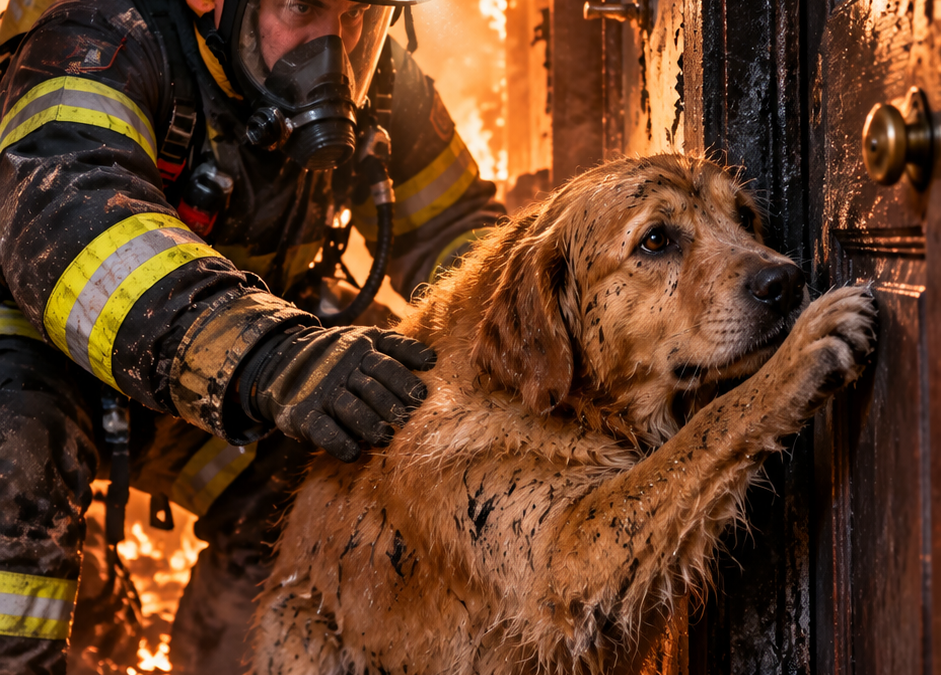
A dog stared back at me.
A golden retriever.
Young.
Maybe two years old.
Medium-sized.
His fur had been singed along one side.
Several patches near his shoulder had curled from heat.
His eyes were red from smoke.
His breathing was fast.
His tongue hung from his mouth.
He should have been running.
Most animals in fire conditions are frantic.
They hide.
Bolt.
Bite.
Panic.
This dog did none of those things.
He looked at me.
Then turned away.
Walked three feet.
And scratched a closed door.
Tap.
Tap.
Tap.
The sound.
I stared.
“Hey.”
The dog scratched again.
“Come here.”
I reached for his collar.
He moved away from my hand.
Not aggressively.
Deliberately.
Then returned to the door.
Scratch.
Scratch.
Scratch.
His nose pressed against the bottom gap.
He sniffed.
Whined.
Then scratched harder.
Michael crouched beside me.
“What the hell is he doing?”
“I think someone’s inside.”
I touched the door.
Hot.
But not dangerously hot.
That mattered.
A door can tell you something.
If fire is raging directly behind it, heat transfers.
Not perfectly.
Not always.
But enough to warn you.
This door was hot from the hallway environment.
Not the furnace heat of direct flame.
I leaned close.
“Fire department!”
Nothing.
I pounded with my fist.
“Anyone inside?”
Silence.
The dog became frantic.
Scratch.
Scratch.
Whine.
He looked at me.
Back to the door.
Then he lifted one front paw.
Placed it against the handle.
Pressed.
It slipped.
Again.
I stared at him.
He wasn’t simply trapped beside this door.
He wanted it open.
“Michael.”
“I see it.”
I hit the door again.
“Fire department! If you can hear me, make a sound!”
Nothing.
The ceiling above us cracked.
A glowing line appeared through a seam.
Our time was shrinking.
The dog whined.
He pressed his nose against the gap.
Then barked.
Once.
Twice.
He stopped.
For half a second, everything behind the door seemed silent.
Then—
Tap.
Tap.
Faint.
Almost impossible to hear.
But there.
A response.
I looked at Michael.
“Someone’s alive.”
I keyed my radio.
“Command, Wright. Confirmed trapped occupant, third floor, north corridor, last bedroom. Door secured. Need forcible entry tools immediately.”
“Copy. Conditions deteriorating. You have four minutes.”
“Understood.”
I looked at the dog.
“All right, buddy.”
He was shaking now.
Whether from smoke, fear, heat, I couldn’t tell.
“We heard him.”
The dog’s eyes stayed on the handle.
“We’re going to get him.”
I tried to take his collar again.
He twisted away.
“Come on. You have to move.”
Nothing.
The dog planted himself in front of the door.
I pulled harder.
He lowered his body.
Refused.
I could have dragged him.
I almost did.
Then I understood.
He wasn’t leaving that door.
Not while whoever was behind it remained there.
I knelt beside him.
“Okay.”
I put one arm around his chest.
“Then stay with me.”
The dog leaned against my gear.
For one second, his head pressed against my shoulder.
Then he licked my glove.
Such a small gesture.
Almost absurd inside a burning building.
But I remember it more clearly than I remember half the fire.
“Good boy.”
The dog looked at me.
“We’re helping him.”
Daniel arrived carrying the hydraulic spreader and a Halligan tool.
“Where?”
I pointed.
“Here.”
The dog moved aside only when we positioned the tool.
Michael kept one hand near his collar.
“Ready?”
“Go.”
Daniel drove the Halligan into the frame.
The first strike shook the entire door.
The dog barked.
“Again.”
Second strike.
The frame cracked.
Smoke shifted around us.
Somewhere overhead, flames pushed into the corridor.
My radio shouted:
“Wright, fire extension entering third-floor north hall. You need to accelerate.”
“Copy.”
Third strike.
The lock started to fail.
“Spread it.”
Daniel inserted the hydraulic tool.
The frame groaned.
Wood split.
The door opened several inches.
Smoke pulled toward the opening.
I checked heat.
Still survivable.
“Open!”
The door broke inward.
The dog shot through before I could stop him.
“Charlie!”
A voice.
Weak.
Hoarse.
But unmistakably human.
The dog disappeared toward the far side of the room.
We entered.
The bedroom had two beds.
One near the door.
Another beneath an open window.
That window had probably saved the man inside.
Smoke had vented partially through it instead of filling the room completely.
Still, the heat was severe.
A man lay on the floor near the second bed.
Forties.
Maybe forty-five.
One arm stretched toward the door.
He was conscious.
Barely.
The dog reached him.
Everything about him changed.
Until that moment, he’d been focused.
Silent.
Determined.
Now he exploded with emotion.
He barked.
Whined.
Licked the man’s face.
Pushed against his chest.
“Charlie.”
The man lifted one hand.
His fingers touched the dog’s head.
“Charlie…”
His voice sounded scraped raw.
“I thought you ran.”
Charlie licked him again.
“How did you…”
The man’s eyes moved toward us.
“Sir, fire department.”
He tried to sit.
“Don’t move.”
“I couldn’t…”
His breathing was shallow.
“My chest.”
“Stay down.”
Daniel and Michael moved immediately.
We checked him quickly.
Responsive.
Weak pulse.
Smoke exposure.
Possible cardiac event.
He tried to reach Charlie again.
“Dog.”
“I’ve got him.”
“No.”
His fingers closed weakly around my sleeve.
“Don’t leave him.”
“I won’t.”
That was all he needed to hear.
His hand relaxed.
Daniel and Michael unfolded the evacuation stretcher.
I lifted Charlie.
This time, he didn’t resist.
Not even slightly.
He looked at his owner.
Then at me.
Whatever argument we’d been having in the hallway was over.
He had made his point.
We had listened.
“Let’s go!”
The fire was now pushing through the corridor ceiling.
We moved.
Michael and Daniel carried the stretcher.
I followed holding Charlie against my chest.
The dog twisted repeatedly to keep his owner in sight.
“He’s there.”
Charlie struggled.
“Easy.”
His heart hammered against my arm.
“He’s there.”
We reached the stairwell.
Heat behind us increased.
A section of ceiling collapsed where we’d been standing less than a minute earlier.
I didn’t look back.
“Move!”
Down one flight.
Then another.
At the second floor, water from the attack lines had turned the stairs slick.
We slowed enough not to lose footing.
Charlie stayed against me.
His eyes never left the stretcher.
When we reached the ground floor, fresh air began pushing through the entrance.
We crossed the lobby.
Outside, paramedics were waiting.
I looked at my watch.
12:23 a.m.
Thirty-six minutes after the first dispatch.
It felt like six hours.
The paramedics moved the man immediately onto a medical cot.
Charlie fought my arms for the first time.
“Okay.”
I lowered him.
He ran toward the ambulance.
A paramedic tried to block him.
“Dog can’t—”
“Let him stay close.”
The paramedic looked at me.
“Owner is unstable.”
“He’s the reason we found him.”
That ended the argument.
Charlie stood beside the cot.
His owner turned his head.
“Charlie.”
The dog’s tail moved so hard his entire body shook.
The man reached down.
His fingers barely brushed Charlie’s ear.
Then the paramedics loaded him.
Charlie tried to follow.
I held his collar.
“Not yet.”
He whined.
The ambulance doors closed.
Charlie stared at them.
The vehicle drove away.
This time, he tried to run after it.
I caught him.
“Hey.”
He pulled.
“Charlie.”
He pulled harder.
“I know.”
I crouched.
His fur smelled like smoke.
His whiskers had curled from heat.
His eyes were red.
There was a small burn near one shoulder.
But he was alive.
And so was the man.
A paramedic from another unit examined Charlie quickly while we waited for animal rescue.
“Smoke inhalation risk. Needs veterinary assessment.”
“I’ll take him.”
Thomas walked toward us, helmet under one arm.
“Building’s clear.”
“Everyone?”
“All accounted for.”
“Count?”
“Eleven residents rescued. No fatalities.”
I exhaled.
That is the moment firefighters never celebrate loudly.
Not at the scene.
Not while smoke still rises.
But something inside you loosens.
Eleven people.
No one dead.
“Good work.”
Thomas looked at Charlie.
“This him?”
“Yeah.”
“He found the last guy?”
“He wouldn’t leave the door.”
Thomas crouched.
Charlie barely acknowledged him.
His attention remained fixed down the street where the ambulance had disappeared.
“Whoever owns him owes him.”
I looked at the dog.
“I think he knows.”
The owner’s name was Mark Thompson.
Forty-three years old.
Single father.
That detail came from his emergency contact records, though his daughter was currently staying with her mother elsewhere.
He had a cardiac condition diagnosed two years earlier.
Apparently, he woke because of the smoke and tried to reach the hallway.
When he stood, the stress triggered severe chest pain and weakness.
He made it only a few feet.
Then collapsed.
The bedroom door had swung shut behind Charlie.
Whether the dog had been inside initially or escaped into the hall before the door closed, we never fully determined.
What mattered was what happened afterward.
Charlie could have fled.
The window was open.
A fire ladder had been placed along the building exterior.
There were routes away from danger.
Instead, he stayed at the bedroom threshold.
Scratching.
Barking.
Waiting.
Calling for someone who could open what he couldn’t.
Sometimes survival means running.
Sometimes loyalty makes running impossible.
Charlie spent that night at an emergency veterinary clinic.
His burns were superficial.
Smoke irritation.
No major lung damage.
When I called the next morning, the veterinarian said, “He’ll be uncomfortable for a few days, but he’s going to be fine.”
“And the owner?”
“I don’t know.”
I did.
Because I called the hospital.
Mark was alive.
Stable.
Under observation for smoke inhalation and cardiac stress.
I expected relief.
Instead, I felt something stranger.
Responsibility.
Once you have carried someone’s dog from a burning building while that dog watches his owner being loaded into an ambulance, you don’t simply forget them when your shift ends.
Three days later, I went to the hospital.
Not officially.
My wife told me I was ridiculous.
“You’ve been checking on that dog every six hours.”
“Not every six hours.”
“James.”
“Fine.”
She handed me my coat.
“Take them something.”
“What?”
“I don’t know. Dogs like treats.”
“He’s in a hospital.”
“For the man, then.”
“What does the man like?”
“You’re asking me?”
In the end, I brought a bag of decent coffee for Mark when he got home and a soft chew toy for Charlie.
The hospital allowed Charlie to visit because Mark’s physician believed the reunion would help and because someone from his family arranged the paperwork.
When I entered the room, Charlie was already there.
He lay beside the bed with his chin resting on the mattress.
One front paw stretched toward Mark’s hand.
Mark was pale.
There were wires on his chest.
An oxygen cannula beneath his nose.
But he was awake.
When Charlie saw me, his head lifted.
For several seconds, he stared.
Then his tail moved.
Slowly.
Once.
Twice.
Recognition.
“Hey.”
I crouched.
“You remember me?”
Charlie stood and walked over.
He sniffed my pants.
Then my hands.
I held out the toy.
He ignored it completely.
Mark laughed.
“That sounds about right.”
His voice was still rough.
“He doesn’t care about toys if people are around.”
I stood.
“How are you?”
“Better.”
“Doctors say?”
“Smoke inhalation was manageable.”
He touched his chest.
“Heart didn’t appreciate the excitement.”
“I imagine not.”
Mark looked at Charlie.
“He saved me.”
I didn’t answer immediately.
“Yes.”
He swallowed.
“I thought he’d run.”
“From the building?”
“Yeah.”
Mark’s eyes filled.
“When I woke up, smoke was already in the room. I opened the window.”
He paused.
“Charlie was panicking.”
“Understandable.”
“I tried to get to the door.”
His hand moved over Charlie’s head.
“I don’t remember falling.”
“What do you remember?”
“Hearing him bark.”
He stared toward the window.
“I could hear him on the other side.”
My chest tightened.
“The door must have shut.”
“Yeah.”
“I tried calling him.”
Mark looked down.
“Then I didn’t have enough air.”
Charlie pressed closer.
“I remember thinking at least he’d gotten out.”
His fingers moved slowly through the golden fur.
“I thought that was the one good thing.”
“He didn’t get out.”
“No.”
Mark smiled faintly.
“Stubborn idiot.”
Charlie looked up.
“I thought I’d lost everything.”
Mark’s voice became quieter.
“My apartment.”
“Things can be replaced.”
“I know.”
He looked at the dog.
“But not him.”
Charlie licked his wrist.
Mark closed his eyes.
For a minute, neither of us spoke.
Hospital machines beeped quietly.
A cart rolled past in the corridor.
Then Mark said, “You know what’s strange?”
“What?”
“Charlie is afraid of vacuum cleaners.”
I laughed.
“Seriously?”
“Terrified.”
“He stood in a burning hallway.”
“Vacuum cleaner comes out and he hides behind my couch.”
Charlie looked between us.
Mark smiled.
“He’s afraid of plastic bags too.”
“Maybe he has priorities.”
“Apparently fire isn’t one of them.”
We both laughed.
Then Mark winced and touched his chest.
“Easy.”
“I’m fine.”
Charlie immediately stood.
His ears rose.
Mark rubbed his neck.
“See?”
“He’s watching you.”
“Always.”
I sat in the chair beside the bed.
“How long have you had him?”
“Since he was twelve weeks old.”
“Only two years?”
“Two and a half.”
“He came from a breeder?”
Mark shook his head.
“Rescue.”
That surprised me.
“He and his litter were found behind a warehouse.”
Mark smiled.
“My daughter picked him.”
“How old is she?”
“Nine.”
“Where was she the night of the fire?”
“With her mother.”
He exhaled.
“Thank God.”
His voice changed.
“I don’t know what I would have done if she had been there.”
I understood.
Firefighters hear that sentence often.
What if.
What if the child had been home?
What if I had gone back upstairs?
What if the smoke alarm hadn’t worked?
What if the door had opened?
What if the window had been closed?
People torture themselves with alternate versions of disasters.
Sometimes survival produces gratitude.
Sometimes guilt.
Often both.
“She’s okay.”
I said it firmly.
“You’re okay.”
Mark looked at Charlie.
“And he’s okay.”
“Yes.”
“That’s the version you get.”
He nodded.
“That’s the version I get.”
A few days later, the fire investigation concluded the cause was accidental.
A cooking fire in a second-floor apartment.
Wind conditions and old construction accelerated spread.
Mark’s apartment was severely damaged.
Not everything burned.
Smoke and water destroyed almost as much as flame.
He couldn’t return.
For the next several weeks, he stayed with his sister while insurance and housing arrangements were handled.
Charlie never left him.
I know because I kept hearing updates.
At first from Mark.
Then, somehow, he started sending photographs.
Charlie asleep beside the temporary bed.
Charlie watching through a window.
Charlie refusing to take medication for his burned skin unless Mark personally gave it to him.
One picture showed Charlie wearing a ridiculous inflatable collar to stop him licking the burn.
I replied:
He fought a building fire but lost to a donut.
Mark responded:
The donut is undefeated.
I didn’t expect us to become friends.
But rescue work does that sometimes.
You meet people on the worst day of their lives.
Most disappear from your world afterward.
That’s healthy.
We’re firefighters, not permanent participants in every emergency.
But occasionally, someone stays.
Mark stayed.
Maybe because Charlie insisted.
About two months after the fire, Mark found a new apartment.
Ground floor.
Small balcony.
Two bedrooms.
Close to a park.
The first time I visited, boxes were everywhere.
Charlie ran toward me as soon as the door opened.
Tail high.
Entire body moving.
“Hey, hero.”
He jumped against me.
Mark appeared from the kitchen.
“He’s not supposed to jump.”
“Good training.”
“He listens to me when he feels like it.”
“Golden retriever.”
“Exactly.”
Mark looked stronger.
Color had returned to his face.
He was still on medication.
Still attending cardiac appointments.
But the exhausted man I’d seen in the hospital had begun to disappear.
His daughter, Lily, was there too.
She came running from the hallway.
“You’re the firefighter!”
I looked at Mark.
He smiled apologetically.
“You’re famous.”
“Apparently.”
Lily stared at me.
“Did Charlie really save Dad?”
Children ask direct questions adults usually soften.
I crouched so we were eye level.
“Charlie helped us find your dad.”
“But would you have found him without Charlie?”
Mark became quiet.
I considered lying.
Didn’t.
“I don’t know.”
Lily looked at Charlie.
He sat beside her.
“So he did save him.”
“Yes.”
She hugged his neck.
Charlie accepted this with the exhausted patience of a dog accustomed to children.
“I told Mom he’s smarter than everybody.”
Mark cleared his throat.
“Let’s not get carried away.”
“He is.”
“He eats socks.”
“Smart dogs can eat socks.”
Mark looked at me.
“You see what I deal with.”
I smiled.
The new apartment slowly became a home.
Not the same home.
That distinction mattered.
People told Mark he was lucky.
And he was.
But “lucky” can be difficult to hear when you’ve lost almost everything familiar.
Photographs.
Furniture.
Clothes.
Letters.
A watch from his father.
Lily’s childhood drawings.
Objects are replaceable, people say.
Yes.
But objects carry memory.
Replacing a sofa is easy.
Replacing the corner of a sofa where your child fell asleep against you five years ago is impossible.
Mark struggled with that.
One evening, several months after the fire, we met at the park.
Charlie ran through wet grass.
Mark sat beside me on a bench.
“Everyone keeps saying I should move on.”
“Who?”
“Insurance people. Friends. People at work.”
He shrugged.
“They mean well.”
“Probably.”
“But sometimes I miss stupid things.”
“Like?”
“A coffee mug.”
I looked at him.
“Blue. Cracked handle.”
He smiled embarrassedly.
“Lily painted it when she was four.”
“That’s not stupid.”
“I know.”
He watched Charlie.
“I miss my hallway.”
“Your hallway?”
“Yeah.”
“That’s a strange thing to miss.”
“I know.”
He laughed.
“Charlie used to sleep there at night.”
His expression changed.
“Right outside my door.”
I thought about that burning hallway.
Different hallway.
Same dog.
“Now where does he sleep?”
“Inside my room.”
“Understandable.”
“I tried putting his bed outside.”
“And?”
“He stared at me like I was insane.”
“Also understandable.”
Mark became quiet.
“He doesn’t like closed doors anymore.”
That hit me.
“Since the fire?”
“Yeah.”
“If I close the bedroom door, he scratches.”
I could hear that sound again.
Tap.
Tap.
Tap.
“Do you leave it open?”
“Every night.”
“Good.”
Mark looked at me.
“Do dogs get trauma?”
“Absolutely.”
“You’ve seen it?”
“Plenty.”
“Will it go away?”
“Maybe some of it.”
I paused.
“But perhaps not all.”
Charlie ran back toward us.
“He doesn’t need to forget it.”
Mark looked at me.
“What does he need?”
“Enough good nights afterward.”
Mark considered that.
“Enough good nights.”
Charlie reached us.
Mark scratched behind his ears.
“Think we can manage that?”
Charlie’s tail answered.
The anniversary of the fire came faster than I expected.
November 15.
At 11:47 p.m., I was at the station.
Different shift configuration.
Same weather.
Cold.
Wet.
I noticed the clock and stopped.
Thomas saw me.
“You thinking about Tib Street?”
“Yeah.”
“The dog?”
“Yeah.”
Thomas smiled.
“Still see him?”
“All the time.”
“Of course you do.”
At 11:52, my phone buzzed.
Message from Mark.
A photograph.
Charlie asleep on the couch.
Lily’s legs stretched beside him.
Caption:
One year. Everyone where they’re supposed to be.
I stared at it for a long time.
Then replied:
Keep it that way.
Mark sent back:
That’s the plan.
A firefighter learns quickly that plans have limited authority over life.
But hope needs a language.
Sometimes plans are that language.
Over the following years, I saw Charlie and Mark often.
At the park.
Outside a café.
Once at the fire station during an open house.
Charlie became something of a celebrity among my crew.
Daniel crouched beside him.
“There’s my colleague.”
Michael said, “Technically, he did the search and you took credit.”
Charlie accepted three biscuits.
Thomas added, “Should probably make him captain.”
“Absolutely not.”
Everyone laughed.
Mark stood nearby.
He still became quiet whenever we joked about that night.
Not uncomfortable.
Reverent, maybe.
Some events remain serious even when time softens their edges.
Lily had made Charlie a red bandanna.
On it she’d written HERO in black marker.
Charlie wore it proudly until he tried to eat the corner.
“Heroes are complicated,” Mark said.
That sentence stayed with me.
So are rescue stories.
People like them simple.
Fire.
Dog.
Door.
Man trapped.
Firefighter opens door.
Everyone survives.
The end.
But life before and after the moment is what gives it meaning.
Charlie didn’t become loyal that night.
He had practiced loyalty every day beforehand.
Waiting outside the bathroom.
Following Mark through the kitchen.
Sleeping in the hallway.
Watching Lily leave for school.
Greeting her when she returned.
Choosing the same people over and over until choosing them during a fire was simply an extension of everything he already knew.
Stay near your people.
That was Charlie’s entire philosophy.
Humans make love far more complicated.
We argue over worthiness.
Responsibility.
Sacrifice.
Pride.
Fear.
Dogs often reduce everything to distance.
Are you near me?
Good.
Are you far?
I will find you.
Are you behind a door?
I will scratch.
Are you in danger?
I will stay until someone notices.
I thought about that often.
Especially because firefighters are taught the opposite instinct in certain moments.
Know when to leave.
Fire does not care about bravery.
Buildings collapse on heroes just as easily as cowards.
If conditions become unsurvivable, you get out.
We teach discipline because emotion gets people killed.
Charlie had no such training.
He had one rule.
Mark is there.
So he stayed.
I don’t romanticize that recklessness.
Charlie could have died.
If the fire reached that corridor thirty seconds earlier, we might have found neither dog nor man alive.
But love is not always wise.
Sometimes it is simply absolute.
Years later, Mark told me something he had never mentioned before.
We were walking near the canal.
Charlie had slowed with age.
His golden coat had begun turning pale around the muzzle.
“There’s something about that night I didn’t tell you.”
“What?”
Mark watched Charlie sniff the grass.
“Before I passed out, I heard him scratching.”
“I know.”
“No.”
He shook his head.
“Earlier.”
I waited.
“When the alarm went off, Charlie was beside my bed.”
“The bedroom door was open?”
“Yes.”
“I tried standing.”
He took a breath.
“Chest pain hit me.”
Charlie looked back at us.
“I told him to go.”
Mark’s voice tightened.
“I pointed at the hallway.”
“What happened?”
“He wouldn’t.”
Of course.
“I yelled.”
Mark looked ashamed.
“‘Go, Charlie! Go!'”
His eyes filled.
“I threw a pillow toward the doorway.”
“You were trying to save him.”
“I know.”
“He must have gone into the hall.”
“Yeah.”
“And then the door closed.”
“That’s what I think.”
We walked in silence.
Mark continued.
“When I heard him scratching, I knew he hadn’t left.”
“Did you try to reach the door?”
“I couldn’t.”
His jaw tightened.
“I remember being angry.”
“At Charlie?”
“Yes.”
That surprised me.
“I was thinking, you stupid dog.”
He laughed weakly.
“I wanted him gone.”
“Because you thought you were dying.”
“Yes.”
Charlie wandered back and leaned against Mark’s leg.
Mark placed a hand on his head.
“I spent years calling that loyalty.”
“What do you call it now?”
He looked at me.
“Love that refused permission.”
I didn’t answer.
There was nothing better to say.
As Charlie aged, Mark became protective in ways that bordered on ridiculous.
Orthopedic bed.
Supplements.
A special ramp for the car.
A pet camera for when he was away.
“Lily says I’ve become insane,” Mark told me.
“She’s correct.”
“The vet recommended the ramp.”
“The pet camera has two-way audio.”
“So?”
“You talk to him during work?”
“Sometimes.”
“Mark.”
“He likes it.”
Charlie looked bored.
“Does he?”
“You’re judgmental.”
I laughed.
But beneath the humor was something more serious.
Mark knew what it felt like to believe Charlie might disappear from his life.
He had come closer to that loss than most people ever do.
So he noticed every gray hair.
Every slower step.
Every longer nap.
He loved the dog with a kind of gratitude that carried fear inside it.
One evening, I found them at the park.
Charlie lay beside the bench instead of chasing a ball.
“He’s okay?”
“Arthritis.”
Mark nodded.
“Vet says manageable.”
Charlie lifted his head when I approached.
Tail.
Slow but definite.
“Hey, partner.”
I sat.
Mark smiled.
“He still remembers you.”
“I gave him three biscuits at the station.”
“That’ll do it.”
We watched people walk past.
A young golden retriever ran across the field.
Charlie watched.
Did not get up.
Mark noticed too.
“Hard, isn’t it?”
“What?”
“Watching them get old.”
I knew he wasn’t really asking.
“Yeah.”
“He was two when the fire happened.”
“Feels like yesterday.”
“For you.”
Mark scratched Charlie’s ears.
“For me too.”
Charlie closed his eyes.
Mark whispered, “You stayed for me. Least I can do is stay for you.”
I looked away.
Not because it was sentimental.
Because it was true.
Charlie had once refused to leave a burning threshold.
Now Mark was learning a different kind of staying.
Vet appointments.
Slow walks.
Medication.
Patience.
Lifting an older dog into the car.
Waking at three in the morning when joints hurt.
Love changes form as bodies change.
The commitment doesn’t have to.
On the fifth anniversary of the fire, Lily was fourteen.
She convinced Mark to visit the rebuilt Tib Street property.
The original building had been repaired extensively, though some sections were reconstructed.
Mark asked whether I would come.
I almost said no.
Then agreed.
Charlie came too.
He was seven then.
Still healthy.
As we approached the building, something happened.
Charlie slowed.
Mark noticed.
“Hey.”
The dog stopped.
He stared at the entrance.
His ears went back.
“No.”
Mark crouched.
“You remember.”
Charlie stood rigid.
I felt a chill unrelated to weather.
Dogs remember smell.
Place.
Fear.
Maybe not as a story the way we do.
But bodies remember.
Charlie backed up one step.
Mark immediately moved with him.
“We don’t have to.”
Lily stood quietly.
“Maybe we should leave.”
Mark looked at me.
“What do you think?”
“Let Charlie decide.”
We waited.
No pulling.
No encouragement.
After maybe thirty seconds, Charlie stepped forward.
One step.
Then another.
Mark stayed beside him.
They reached the entrance.
Charlie sniffed.
His breathing quickened.
Mark knelt.
“I’m here.”
Those two words.
I had heard them thousands of times in rescue work.
Spoken to children.
Victims.
Animals.
Coworkers.
I’m here.
Sometimes there is no more powerful sentence.
Charlie looked at Mark.
Then walked through the doorway.
We didn’t go upstairs.
There was no need.
We stood in the lobby.
Charlie sniffed for several minutes.
Then his posture relaxed.
Lily touched his back.
“Good boy.”
Mark cried quietly.
No one mentioned it.
On the way out, Charlie walked ahead.
He didn’t look back at the building.
Maybe closure is too human a word.
But something had shifted.
Mark later said, “I spent years thinking I owed it to him to never make him remember.”
“What changed?”
“I realized avoiding memory isn’t the same as healing.”
He looked at Charlie.
“He needed to know we could leave that place together.”
That distinction mattered.
The fire no longer ended with a closed door.
Now the memory contained an exit.
Years passed.
I was promoted.
Thomas retired.
Michael transferred stations.
Daniel became captain of another crew.
Tib Street became one call among hundreds.
But Charlie remained different.
Not because he had done something heroic.
Because he had exposed something essential.
Firefighting trains you to look for signs.
A shoe near a staircase.
An open window.
A wheelchair in a hallway.
A child’s toy beside a bedroom.
Evidence that someone might be where smoke tells you no one could survive.
Charlie taught me to look at behavior the same way.
Why is the animal staying here?
Why is it returning to one place?
What does it know that I don’t?
That lesson mattered later.
At another fire, years afterward, we found a cat repeatedly running toward a basement door.
We searched.
Found an elderly woman unconscious downstairs.
Would we have checked anyway?
Yes.
Eventually.
But the animal changed our priority.
Seconds matter.
I thought about Charlie afterward.
Animals don’t understand our command systems.
They don’t use radios.
They don’t know building plans.
But they know their people.
Sometimes that makes them the first witness we should believe.
Mark and I talked about that once.
“So Charlie trained the fire department?”
“Don’t tell him.”
“He’ll ask for a pension.”
“He’s already expensive.”
Charlie slept between us.
Mark looked at him.
“Worth it.”
Always.
When Charlie turned ten, his health began declining more noticeably.
Kidneys.
Arthritis.
Hearing.
Nothing catastrophic at first.
Just age collecting its small debts.
Mark adjusted everything.
Shorter walks.
More rugs so Charlie wouldn’t slip.
Water bowls in multiple rooms.
Night lights because his vision had weakened.
Open doors.
Always open doors.
That detail never changed.
Even years after the fire, Mark never closed the bedroom door while Charlie slept nearby.
“I tried once,” he admitted.
“What happened?”
“He scratched.”
I knew the sound without hearing it.
“So?”
“I opened it.”
“Immediately?”
“Immediately.”
Good.
Some scars do not need to be challenged.
Sometimes accommodation is kindness.
One winter evening, Mark called me.
“James.”
His voice told me immediately.
“What happened?”
“Charlie collapsed.”
My stomach tightened.
“Where are you?”
“Emergency vet.”
“I’m coming.”
“You don’t have to.”
“I know.”
That phrase had become part of our friendship.
I arrived thirty minutes later.
Charlie lay on a blanket in a quiet room.
IV line.
Mark sat on the floor beside him.
Lily, nineteen now, sat on the other side.
The veterinarian believed it was cardiac-related.
Manageable.
For now.
Charlie opened his eyes when I entered.
His tail moved.
Barely.
“Hey, partner.”
I knelt.
“You scared everybody.”
His eyes closed again.
Mark looked exhausted.
“I hate hospitals.”
“Understandable.”
“Human or animal.”
“Also understandable.”
He touched Charlie’s paw.
“Do you remember what I said after the fire?”
“You said you’d lost everything.”
“I was wrong.”
I waited.
“If I’d lost him, that would’ve been everything.”
Lily looked down.
Mark corrected himself.
“No.”
He took her hand.
“Not everything.”
She leaned against him.
Charlie recovered.
Slowly.
He came home two days later.
His life became smaller afterward.
But as Mr. Harrison—no, wrong story. Need Mark. Good catch. Must ensure no accidental cross contamination. Continue.
His world narrowed, but not unhappily.
Living room.
Kitchen.
Balcony.
Park on good days.
Mark’s bedroom at night.
Lily’s visits.
My occasional appearance with contraband treats.
Sometimes small worlds are enough when they’re full of familiar people.
One evening, years after the fire, I sat with Mark on his balcony.
Charlie slept inside near the open sliding door.
“He still won’t sleep if he can’t see me,” Mark said.
“Can you blame him?”
“No.”
Then he smiled.
“I can’t sleep if I can’t hear him.”
Fair.
The dependency had become mutual.
Perhaps it always had been.
People often think pets depend on us.
Food.
Shelter.
Vet care.
Exercise.
But dependence runs in both directions.
Routine.
Company.
Purpose.
Someone waiting when you come home.
Someone whose breathing marks the nighttime.
Someone who asks nothing about your failures.
Mark had lost his home once.
Charlie had taught him that home was not primarily a building.
The proof had stood outside a locked bedroom door while that building burned.
“Do you think he knew I was alive?” Mark asked.
“That night?”
“Yeah.”
“Probably smelled you.”
“He couldn’t hear me much.”
“Didn’t need to.”
Mark looked at him.
“What if I’d already died?”
I hated the question.
“So many years later and you’re still doing what-ifs.”
“I know.”
I considered.
“He probably would’ve stayed anyway.”
Mark nodded.
“That’s what scares me.”
“Why?”
“Because love doesn’t always know when to leave.”
True.
He looked at me.
“Humans tell ourselves letting go is mature.”
“Sometimes.”
“Dogs don’t understand that.”
“Maybe they understand it differently.”
Charlie woke.
Looked toward us.
Satisfied that Mark remained there, he put his head down again.
That became our answer.
Presence.
Again.
Always.
When Charlie was twelve, we held a small event at the fire station.
Not for him originally.
It was a community safety day.
Lily brought him.
Someone remembered the Tib Street story.
Before I knew it, Charlie had a crowd around him.
Children.
Firefighters.
Parents.
Phones.
Charlie tolerated the attention with old-man dignity.
One child asked me, “Was he scared?”
I looked at Charlie.
“Yes.”
The boy seemed surprised.
“But he was brave.”
“Those aren’t opposites.”
“What?”
“Being brave doesn’t mean you aren’t scared.”
I crouched beside him.
“It means something matters enough that you stay or act even while you’re scared.”
The boy considered that.
“Charlie was scared but he stayed because his person was inside?”
“Exactly.”
Mark heard.
His eyes became wet.
Later, he said, “That’s the first time anyone described it right.”
“What?”
“People say he wasn’t afraid.”
“He was.”
“Of course he was.”
Mark stroked Charlie’s head.
“He was terrified.”
I remembered red eyes.
Burned fur.
Fast breathing.
A dog pressing itself against a closed door.
Yes.
Terrified.
That’s why it mattered.
Loyalty isn’t impressive when nothing tests it.
Courage isn’t impressive without fear.
Charlie had both.
As he aged, I stopped calling him hero.
Not because it wasn’t true.
Because he was more than the fire.
He was a dog who liked chicken.
Hated vacuum cleaners.
Stole socks.
Slept in sunbeams.
Snored.
Refused rain if it was too heavy.
Loved Lily.
Loved Mark.
Recognized me even when years had changed my face.
The fire was one night.
His life was thousands of others.
That matters.
Animals shouldn’t become only symbols of what they survived.
Neither should people.
Mark built a life after Tib Street.
Changed jobs.
Helped Lily prepare for university.
Started volunteering occasionally with a cardiac support group.
He dated once.
That ended badly.
Charlie disliked the woman immediately.
“I should have listened to him,” Mark told me afterward.
“What did he do?”
“Wouldn’t sit near her.”
“Scientific.”
“He was right.”
“Coincidence.”
“No.”
We argued about that for months.
Eventually, the inevitable arrived.
Charlie was fourteen.
Very old for a golden retriever.
His legs had weakened.
Hearing nearly gone.
Eyes cloudy.
But his nose still worked.
His memory of people still worked.
Mark called me one Saturday morning.
“Can you come by?”
No explanation.
I knew.
When I arrived, Charlie lay on his bed near the open bedroom doorway.
Mark sat beside him.
Lily had driven home from university.
The vet had been there earlier.
Charlie was not dying that minute.
But the conversation had started.
Quality of life.
Pain.
Mobility.
Appetite.
Good days.
Bad days.
Those brutal calculations people make when love becomes responsible for mercy.
Mark looked wrecked.
“I told him I’d never leave him again.”
“You haven’t.”
“What if…”
He couldn’t say it.
I understood.
Choosing euthanasia can feel like leaving.
Especially after their history.
I sat on the floor.
“Mark.”
He looked at me.
“That promise was never that he would live forever.”
His face tightened.
“It was that he wouldn’t face what came next alone.”
Charlie breathed slowly.
I continued.
“You kept it.”
Mark put his hand over his mouth.
Lily began crying.
“He stayed at that door because you were behind it.”
I said.
“When the time comes, you stay beside him.”
Mark looked at Charlie.
“Until the end.”
“Until the end.”
That day was not the day.
Charlie gave them three more months.
Three months of warm mornings.
Slow meals.
Car rides with windows cracked.
Lily sitting on the floor doing assignments beside him.
Mark sleeping downstairs because Charlie could no longer manage the hallway comfortably.
Three months of ordinary life.
Then one morning, Mark called again.
No words at first.
Only breathing.
“It’s today.”
I closed my eyes.
“Do you want me there?”
“Please.”
The vet came to the apartment.
Charlie lay on his favorite blanket.
Bedroom door open.
Mark on one side.
Lily on the other.
I sat near his feet.
Charlie smelled each of us.
When his nose reached me, his tail moved once.
I laughed through tears.
“You still remember.”
Mark stroked his head.
“Of course he does.”
The veterinarian explained everything.
Mark listened.
Signed.
Then stopped.
“I need a minute.”
No one rushed him.
He lowered himself beside Charlie.
Fourteen years of life between them.
“Hey, buddy.”
Charlie’s cloudy eyes moved toward him.
“You remember when I told you to run?”
Mark’s voice broke.
“Stubborn dog.”
Charlie breathed.
“You didn’t listen.”
Mark pressed his forehead against his.
“Best thing you ever did.”
Lily cried silently.
Mark continued.
“I don’t need you to stay at any more doors.”
I looked away.
“You don’t have to wait for me.”
Charlie exhaled.
“You already got me out.”
His voice collapsed.
“You already did your job.”
The medication was administered.
Charlie relaxed gradually.
No fear.
No scratching.
No closed door.
Mark’s hands never left him.
Neither did Lily’s.
When Charlie’s breathing stopped, the room became impossibly quiet.
Mark remained beside him.
A long time.
Finally, he whispered, “I stayed.”
I put my hand on his shoulder.
“Yes.”
That was the end of Charlie’s life.
But not the end of what he changed.
Mark kept the collar.
So did the fire station, in a way.
Years earlier, Lily had made that red HERO bandanna.
After Charlie died, Mark gave it to me.
“I want you to keep this at the station.”
“Are you sure?”
“He belongs there a little.”
I understood.
We placed the bandanna in a simple frame.
Not in some grand memorial.
Just on the wall near the crew room.
Beneath it is a small brass plate.
CHARLIE
Stayed When It Mattered
New firefighters ask about him.
Someone tells the story.
Usually Thomas’s version.
Sometimes mine.
We always end the same way.
The dog did not run.
He stayed at the door.
He made enough noise.
We listened.
Mark eventually adopted another dog.
Not immediately.
Almost two years passed.
Then Lily called me.
“Dad went to the shelter.”
“Seriously?”
“He says he’s just looking.”
“That’s how it starts.”
He came home with a three-legged mutt named Cooper.
I laughed for five full minutes when he sent the photo.
“What?”
Mark sounded offended.
“You went looking.”
“I did.”
“And accidentally acquired a dog.”
“He needed someone.”
“Of course.”
“Charlie would’ve liked him.”
“Probably.”
Cooper was nothing like Charlie.
Hyperactive.
Suspicious of bicycles.
Obsessed with cheese.
Slept under tables.
And, most importantly, did not need to be Charlie.
Mark understood that.
People sometimes avoid loving again because they think new love insults old love.
It doesn’t.
Charlie had taught Mark to stay.
Cooper gave him another chance to practice.
One evening, Mark and I walked through the park.
Cooper pulled ahead on his three legs like he had six.
“Different,” Mark said.
“Very.”
“He doesn’t listen.”
“Charlie didn’t either.”
“Charlie listened selectively.”
“That is not listening.”
Mark laughed.
Then we passed a closed bedroom furniture store with a dark green door in the display.
Mark stopped.
I noticed.
Still.
After all those years.
Memory can live inside color.
“You okay?”
“Yeah.”
He looked at the door.
“Just thought about him.”
“You always will.”
“I hope so.”
We continued.
That’s something else I’ve learned through rescue work.
Survival is not the absence of memory.
You don’t honor what happened by pretending it stopped hurting.
You carry it differently.
The fire at Tib Street became part of Mark.
Part of me.
Part of our department.
But it did not remain only terror.
It became Charlie scratching.
The faint reply behind the door.
A stretcher moving through smoke.
A man reaching for his dog.
A dog refusing to leave.
Then years of parks.
Coffee.
Hospital visits.
Open doors.
Gray fur.
The ordinary life that came afterward.
That is the part I think about most now.
When we rescue someone from a building, everyone focuses on the moment they come outside.
Cameras capture it.
Reports record it.
People cheer.
But rescue means very little if you imagine that the rest of life disappears.
The point of getting someone out is so they can have all the boring days that follow.
Arguments.
Laundry.
Work.
Breakfast.
A child’s birthday.
A dog asleep near the couch.
Ten thousand unremarkable moments.
Charlie stayed at that door so Mark could have those moments.
Mark eventually understood that.
So did I.
I am older now.
Close to retirement.
My knees complain after stairs.
Younger firefighters move faster than I do.
Sometimes I see myself in them.
Confident.
Afraid.
Trying to hide the second part.
When I train recruits, I tell them about Tib Street.
Not because it was our biggest fire.
It wasn’t.
Not because the technical rescue was extraordinary.
It wasn’t.
We forced a door.
Removed one victim.
Carried a dog.
Standard operations, in many ways.
I tell them because of what happened before we opened the door.
We almost passed the dog.
Smoke.
Noise.
Heat.
Limited time.
He was small in a building full of danger.
Easy to treat as one more thing to evacuate.
But Charlie wasn’t simply a victim.
He was information.
He knew something we didn’t.
“There will be moments,” I tell recruits, “when the scene is telling you something outside the obvious.”
A dog refusing to move.
A child pointing back toward a room.
A neighbor insisting someone is still inside.
A strange silence where there should be noise.
“Don’t let procedure make you deaf.”
Procedure matters.
Training matters.
Command matters.
But attention matters too.
Listen.
That lesson came from a golden retriever with burned fur and smoke-red eyes.
Every November 15, around 11:47 at night, I still think about him.
If I’m awake, I picture Tib Street.
The orange sky.
The third-floor corridor.
The thermal camera struggling through smoke.
Tap.
Tap.
Tap.
A dog standing before a dark green door.
I remember trying to pull him away.
Come on, buddy. We have to go.
He refused.
Thank God he refused.
Behind that door was Mark.
Weak.
Barely conscious.
Still alive.
And Charlie knew.
Not because he understood cardiac conditions.
Not because he understood fire behavior.
He knew because his person was there.
That was enough.
A few months ago, I met Mark at the park again.
Cooper was chasing leaves.
Mark’s hair had turned gray.
Mine too.
We sat on the same bench we’d used years earlier.
“You ever wish you hadn’t gone into that hallway?” he asked.
I looked at him.
“Why would I?”
“I don’t know.”
He smiled.
“Firefighters probably have memories they’d rather lose.”
“Some.”
“That one?”
I thought about it.
“No.”
“Even with Charlie?”
“Especially because of Charlie.”
He looked surprised.
“Why?”
“Because if I forgot the fire, I’d have to forget everything that came after.”
Mark watched Cooper.
“Fair.”
He became quiet.
Then said, “Sometimes I still hear him scratching.”
“So do I.”
He turned toward me.
“Really?”
“Yeah.”
For a long moment, we said nothing.
Then Mark smiled.
“Different sound now, isn’t it?”
“What do you mean?”
“Back then it meant someone was trapped.”
He looked toward the path.
“Now when I remember it…”
He paused.
“It sounds like someone refusing to give up.”
I had never thought of it that way.
But he was right.
The meaning of a memory can change without the facts changing.
Tap.
Tap.
Tap.
At first, danger.
Then desperation.
Then loyalty.
Now, after all these years, I hear persistence.
Stay.
Listen.
Someone is still here.
That is Charlie’s legacy to me.
Not the word hero.
Not the framed bandanna.
Not the newspaper clipping Lily once saved.
A sound.
A closed door.
And the knowledge that sometimes the person who saves a life is not the one strong enough to break the door.
Sometimes it is the one stubborn enough to keep pointing at it.
I broke the door.
Daniel and Michael carried Mark.
Our crew got everyone out.
Those were our jobs.
Charlie did something none of us could have done.
He knew where love was trapped.
And he stayed there until the rest of us understood.
Years later, when I visited Mark’s new apartment for the first time, he told me something I still carry.
He said, “That night, I thought Charlie was waiting for you.”
I looked at him.
“What do you mean?”
“He was scratching because he knew someone would come.”
“Maybe.”
Mark shook his head.
“No.”
He smiled.
“I don’t think he knew firefighters were coming.”
“What did he know?”
“Only that leaving me wasn’t an option.”
That is probably the simplest truth.
Charlie did not know rescue was coming.
He did not know I was twenty feet down the hall.
He did not know we had tools.
He did not know the window had bought Mark extra time.
He did not know the building would remain standing long enough.
He simply refused to make safety his only priority.
He stayed.
And by staying, he made rescue possible.
I would never advise a person to copy that instinct inside a fire.
People should evacuate.
Leave.
Close doors behind them.
Call emergency services.
Never go back into a burning structure.
That is the professional truth.
But emotional truth is different.
Charlie’s story was never really about fire safety.
It was about loyalty.
About presence.
About refusing to let someone disappear unnoticed behind a closed door.
Most of us will never face a burning building.
But all of us encounter closed doors.
A friend who stops calling.
A parent growing quiet.
A neighbor nobody checks on.
A person whose pain is hidden behind ordinary words.
We cannot break every door.
We cannot save everyone.
But we can notice.
We can listen for the scratching.
We can ask again when silence doesn’t feel right.
That’s what Charlie taught me.
And maybe that’s why I still tell his story.
The night of November 15 began as another call.
Another address.
Another old building.
Another fire.
By 12:23, we had rescued eleven people.
No fatalities.
That should have been the whole report.
Eleven residents evacuated.
Fire contained.
One victim transported.
One dog treated for smoke exposure.
But reports don’t record everything that matters.
They don’t say that a dog stood in smoke while his fur burned and refused to leave a door.
They don’t say he tried to press the handle with one paw.
They don’t say he looked at me as if demanding I understand.
They don’t say the faint answer from behind the door came only after Charlie barked.
They don’t say Mark’s face changed when he saw him.
They don’t say Charlie’s entire body shook with relief.
They don’t say that years later, Mark still slept with his bedroom door open.
Some truths don’t fit inside incident forms.
They live in memory instead.
Today, Mark is doing well.
Lily is grown.
Cooper has taken over the apartment with the confidence of a dog who never knew Charlie but somehow inherited everything he helped preserve.
I still see them.
Less often now.
Life moves.
People age.
Jobs change.
But every once in a while, Mark sends me an old photograph.
Charlie at the beach.
Charlie beside Lily.
Charlie sleeping with one paw touching Mark’s shoe.
He sent one recently that I had never seen.
It was taken about six months before the fire.
Mark was asleep on the couch.
Charlie lay on the floor beside him.
One front paw rested on Mark’s foot.
The caption read:
He was already keeping watch.
I stared at that photograph for a long time.
That was the answer.
The fire did not create Charlie’s loyalty.
It revealed it.
On ordinary days, loyalty looked like a paw on a foot.
On the worst night, it looked like burned fur beside a locked door.
Same love.
Different circumstances.
Maybe that’s true for all of us.
You don’t suddenly become the person you are during a crisis.
A crisis often strips everything down until what was already there becomes visible.
Charlie was loyal before the flames.
Mark loved him before the rescue.
My crew trusted one another before the hallway filled with smoke.
That night simply exposed those truths.
When I retire, I’ll probably take a copy of Charlie’s photograph home.
The bandanna belongs to the station.
The story belongs there too.
But I want the picture of him before the fire.
Golden fur clean.
Eyes bright.
No burns.
No smoke.
Just a young dog beside the person he loved.
Because that is who he was.
Not a hero waiting for tragedy.
A dog living an ordinary life.
And maybe that’s why his courage mattered so much.
He had no idea anyone would ever tell his story.
He wasn’t performing.
He wasn’t choosing between glory and fear.
He was simply doing the only thing love made sense of.
Stay.
Scratch.
Wait.
Try again.
Tap.
Tap.
Tap.
Until someone hears.
That night, I was the one who heard.
I followed the sound.
I found Charlie.
Then Charlie showed me the door.
And behind it was a man who still had a life to live.
For years, people thanked me for saving Mark.
Mark thanked me.
Lily thanked me.
My department once included the rescue in a commendation.
But whenever anyone gives me too much credit, I think back to the smoke.
I remember reaching for Charlie’s collar.
I remember him pulling away.
I remember him turning straight back to that door.
And I know the truth.
I wasn’t the first rescuer in that hallway.
Charlie was.
I was just the one who finally understood what he was trying to say.
And if you had been there at 11:58 that night, in a corridor so dark we could barely see our own hands, with the ceiling beginning to burn above us, you would have heard it too.
Not words.
Not a command.
Just the stubborn sound of one small life refusing to abandon another.
Tap.
Tap.
Tap.
Again.
Again.
Again.
Until the door opened.

