𝗙𝗨𝗟𝗟 𝗦𝗧𝗢𝗥𝗬 The Dog on the Roof Kept Crying Toward the Far End of the Bridge, and I Was the First Person Who Understood Why
𝗙𝗨𝗟𝗟 𝗦𝗧𝗢𝗥𝗬
The dog would sit with his head slightly tilted, watching Edward’s hands move across the strings.
I had passed them so often that they became part of the city for me.
Like the bridge itself.
Like the traffic lights.
Like the bakery on Elm Avenue that opened before sunrise.
I knew very little about Edward then.
That embarrasses me now.
I knew his name because I had once spoken to him.
I knew the dog was Max because Edward had called him.
I knew they were homeless, or close to it.
I knew they slept around Quiet Park when the shelters were full.
I knew Edward played beautifully.
I knew Max never wandered far.
That was all.
I never asked why they lived outside.
Never asked whether Edward had family.
Never asked whether he was sick.
I saw them.
But seeing someone is not the same as knowing them.
Sometimes I gave him money.
Sometimes I rolled down my window at the traffic light and listened.
Once, around Christmas, I handed him a twenty-dollar bill.
Edward had looked shocked.
“That’s too much.”
“It’s Christmas.”
He smiled.
“Christmas doesn’t make twenty dollars less than twenty dollars.”
Max had been sitting beside him.
I scratched the dog’s head.
Edward laughed.
“He likes you.”
“I have that effect.”
“On dogs?”
“Mostly.”
That was the longest conversation we had ever had.
Yet that morning on the bridge, when Max looked at me, I understood immediately that something was wrong.
I had not seen Edward for several days.
I had noticed.
But not enough.
Three mornings without the violin.
Three mornings without Max sitting beside him.
I had assumed the weather drove them somewhere else.
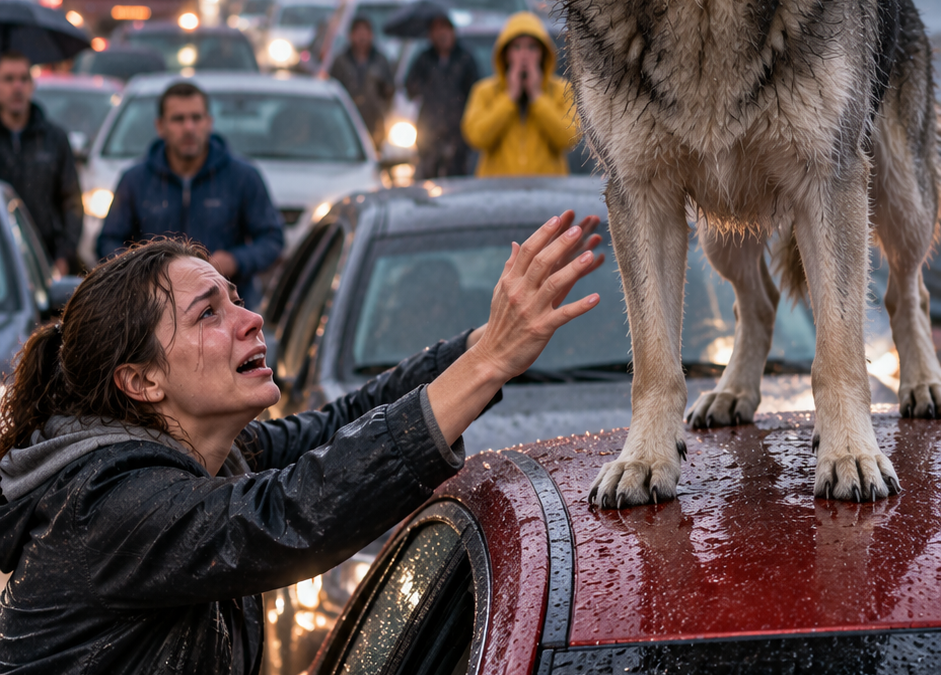
Now Max was alone.
On a car roof.
Crying toward downtown.
The old man in the blue jacket asked, “Where’s his owner?”
“I don’t know.”
I looked at Max.
“When did anyone last see Edward?”
No one answered.
The teenage girl had taken out her phone.
“What’s his last name?”
“I don’t know.”
“Great.”
She started typing anyway.
“What are you doing?”
“Looking.”
The woman in the yellow car said, “Maybe animal control can help.”
Max heard the word or the tone and began pacing on the roof.
“No.”
I raised a hand.
“Let’s not call anyone to take him away yet.”
The owner of the red sedan had finally gotten out.
He stared at the scratches on his roof.
“Is he going to jump?”
“I don’t know.”
Max looked at me.
“Come here, boy.”
I stepped closer.
“Max.”
He moved toward the edge.
The teenage girl said, “Careful.”
“I’ve met him.”
That was technically true.
Once.
Max lowered himself.
I held out both hands.
“Come on.”
He hesitated.
Then jumped.
He was heavier than I expected.
His front paws struck my chest, and I nearly fell backward.
The man in the blue jacket caught my shoulder.
Max hit the pavement and immediately turned toward the east side of the bridge.
He pulled away.
“Easy.”
I grabbed gently at his collar.
There was no leash attached.
He tried moving again.
“Max.”
He whined.
Then pulled.
Not randomly.
Forward.
Toward Quiet Park.
The teenager stared.
“He wants to go somewhere.”
“I think he wants Edward.”
The dog began trembling.
That was when the first raindrops fell.
One hit my glasses.
Then another.
Max lifted his face toward the sky and gave that terrible cry again.
Something about it silenced everyone around us.
For a moment, there were no irritated drivers.
No commuters.
No strangers.
Just people standing in the road, listening to a dog begging us to understand.
I crouched beside him.
“Okay.”
Max stared into my face.
“I hear you.”
I didn’t yet know how much that promise would change.
The teenage girl introduced herself as Lily.
She looked about seventeen.
Maybe eighteen.
She was wearing a school jacket and holding her phone like it was a professional investigation tool.
“We should call hospitals.”
The man in the blue jacket said, “On what information?”
“Edward. Older man. Homeless. Violinist. Came in recently.”
“That could be dozens of people.”
Lily shrugged.
“Then we make dozens of calls.”
I liked her immediately.
The woman from the yellow car approached us.
“I’m Sarah.”
She looked at Max.
“I’m a nurse.”
That got my attention.
“Can you tell if he’s been outside long?”
She crouched.
Max allowed her near.
“He’s wet, but not soaked. Paws are dirty.”
She checked gently.
“No obvious injuries.”
“Could he have been wandering for days?”
“Possible.”
Lily said, “If Edward disappeared three days ago, Max might have been looking ever since.”
The thought tightened my chest.
The older man introduced himself as Henry.
He had retired from teaching, as we learned in the next few minutes, and had a talent for speaking calmly in a way that made everyone else calmer too.
Henry said, “First problem is the dog.”
“Meaning?” I asked.
“He can’t stay in the middle of traffic.”
“Agreed.”
“Second problem is the owner.”
“Agreed.”
“Third problem is all of us are blocking Hope Street Bridge.”
Several horns sounded behind us as if on cue.
I looked at Max.
He stared toward downtown.
“Max, where’s Edward?”
The dog pulled again.
Lily said, “Maybe follow him.”
“In traffic?”
“Not on foot.”
Henry pointed toward his SUV.
“My car’s large enough.”
Sarah shook her head.
“We still don’t know where Edward is.”
“Then let’s find out.”
She already had her phone out.
What happened next remains one of the strangest examples of spontaneous cooperation I have ever witnessed.
Ten minutes earlier, none of us knew one another.
Now we were dividing tasks.
Lily called hospitals.
Sarah contacted a colleague at a local medical clinic who might know where emergency patients had been taken.
Henry called a physician friend.
I called Quiet Park security, then the police non-emergency number.
The first hospital gave Lily nothing.
The second couldn’t confirm anyone without more information.
The third placed her on hold.
Max stood beside me.
Every time I said Edward’s name, he looked at me.
“You know exactly what we’re doing, don’t you?”
His tail moved weakly.
I began asking other people standing nearby whether they had seen the musician recently.
A delivery driver said, “Three or four days ago.”
Another commuter remembered an ambulance near Quiet Park late in the evening.
That changed everything.
“What day?”
“Sunday, maybe.”
It was Wednesday.
“Near the benches?”
“I think so.”
My pulse quickened.
I called emergency dispatch again and explained.
This time they connected me with an officer who confirmed that an elderly man had been transported from Quiet Park three nights earlier.
No name was released to me.
But the description fit.
Lily shouted from several feet away.
“I found him!”
Everyone turned.
Even Max.
She held the phone against one ear.
“Yes. Edward. Older man. Violinist. Yes.”
She listened.
Then looked at us.
“St. Mary’s.”
Max began whining.
She covered the phone.
“He was admitted three nights ago.”
Sarah stepped closer.
“For what?”
Lily listened again.
“They won’t tell me.”
“Of course they won’t.”
“But he’s there.”
I looked down at Max.
“Edward’s at St. Mary’s.”
He stared at me.
I said the name again.
“Edward.”
His tail began moving.
Not the uncertain twitch from before.
A real wag.
Henry laughed.
“He knows.”
Max pulled toward the car.
Sarah shook her head in disbelief.
“This dog has been trying to get someone’s attention.”
I looked back at the red sedan.
At the bridge.
At the hundreds of cars.
“He chose an effective location.”
The owner of the red car called after us.
“Tell the old man his dog owes me a paint job.”
Then he smiled.
We got Max into Henry’s SUV.
I offered to drive because St. Mary’s was closer to my office and I knew the side streets well.
Henry took the passenger seat.
Lily and Sarah climbed into the back with Max.
The dog stood for the first several minutes.
He pressed his nose to the window.
His breathing came quickly.
“Sit down, sweetheart,” Sarah whispered.
Max ignored her.
He seemed afraid the hospital might disappear if he stopped watching.
Lily finally patted her lap.
“Max.”
He turned.
“Come here.”
Slowly, he lowered himself.
Then he placed his head on her knees.
Lily froze.
Her expression softened.
“He’s exhausted.”
Sarah stroked his back.
“Probably hasn’t slept properly.”
I looked in the mirror.
Max’s eyes were still open.
“What happened Sunday night?” Henry asked.
“We don’t know yet.”
“If Edward was taken by ambulance, someone must have found him.”
“Maybe we can ask at the park later.”
Lily looked down at Max.
“He didn’t know where Edward went.”
“No.”
“And nobody took the dog?”
Sarah sighed.
“Emergency crews sometimes can’t.”
“That’s terrible.”
“It isn’t always simple.”
Lily looked unconvinced.
I understood her anger.
But I also understood the other side.
Cities are full of situations where responsibility belongs to everyone and therefore sometimes belongs to no one.
An ambulance removes the patient.
A dog remains.
A shelter worker arrives too late.
A passerby assumes someone else will handle it.
Small gaps become disasters.
Max had fallen into one of those gaps.
He had spent three days searching.
The thought stayed with me.
At St. Mary’s, we encountered the next problem.
Dogs were not allowed inside.
The receptionist looked at Max.
Then at the four of us.
“No.”
I said, “Please.”
“I’m sorry.”
“He belongs to a patient.”
“We have policies.”
Sarah stepped forward.
“I’m a nurse.”
“At this hospital?”
“No.”
“Then you know why we have policies.”
Sarah took a breath.
“Is Edward stable?”
“I cannot discuss a patient’s condition.”
“Can you contact his physician?”
The receptionist studied us.
Lily said, “His dog found us.”
The woman blinked.
“What?”
“He stood on a car roof in the middle of Hope Street Bridge until people stopped.”
“That’s not…”
“He has been looking for Edward for three days.”
I could hear desperation entering Lily’s voice.
“He doesn’t understand why his person disappeared.”
The receptionist’s expression softened slightly.
“I still cannot—”
A doctor walking behind the desk slowed.
“What’s going on?”
The receptionist explained.
The doctor looked at Max.
Then at us.
His badge read MARTIN.
“Edward?”
I asked.
“Are you his doctor?”
He hesitated.
“Possibly.”
“I’m James Whitfield.”
No reaction.
“I know Edward from Hope Street.”
That was generous.
I knew of him.
But the distinction felt cruel at that moment.
“This is Max.”
Doctor Martin looked down at the dog.
Recognition appeared.
“Oh.”
That single syllable told us everything.
“You know about him?” Sarah asked.
“Edward has been asking about his dog.”
Max’s ears rose when he heard Edward.
Lily covered her mouth.
I said, “Then please let them see each other.”
Doctor Martin looked toward the receptionist.
Then at Max.
“The patient is in a private room.”
“Is he all right?”
“I can’t give details without authorization.”
He paused.
“But his condition is stable.”
Relief moved through our group.
“He came in with a serious infection and high fever.”
Sarah nodded.
“That could explain the collapse.”
“He was dehydrated and physically exhausted as well.”
I looked down.
Max was staring at the doctor.
“Will he recover?”
“We expect improvement.”
Doctor Martin sighed.
“Give me five minutes.”
Lily whispered, “That means yes.”
Sarah smiled.
“It means he’s trying not to say yes.”
Max paced while we waited.
He moved from the hallway door to me.
Back to the door.
Back again.
“Soon.”
I touched his head.
“Soon.”
Doctor Martin returned.
“All right.”
Lily nearly cheered.
“One person can bring the dog in.”
We all stared.
“Only one.”
Henry pointed at me.
“James.”
“Why me?”
“Max recognized you first.”
Lily nodded.
“He trusts you.”
I looked at Sarah.
She shrugged.
“Go.”
So I did.
Doctor Martin led us through a side entrance and down a quiet corridor.
Max’s claws clicked against the floor.
Every few feet, he stopped.
Sniffed.
Listened.
Then continued.
At the elevator, he became nervous.
I crouched.
“It’s okay.”
The doors opened.
He refused.
“Max.”
He backed away.
Doctor Martin said, “We can use the stairs.”
Four floors.
I was fifty-five and had not exercised properly in months.
But I looked at Max.
“Stairs.”
By the third floor, I was breathing harder than the dog.
“You’re enjoying this.”
Max kept climbing.
At the fourth-floor corridor, something changed.
His nose lifted.
He stopped.
Doctor Martin looked at me.
“What?”
“I don’t know.”
Max inhaled.
Then pulled forward.
“Wait.”
He began whining.
Not loudly.
Quick little sounds.
Urgent.
“He smells him.”
Doctor Martin opened another door.
Max pulled harder.
“Easy!”
We passed two rooms.
Three.
Then Max stopped outside one.
He began scratching at the door.
Doctor Martin stared.
“That’s Edward’s room.”
I felt goose bumps rise along my arms.
The doctor opened the door.
Edward lay on a hospital bed.
He looked smaller than I remembered.
Without the coat and violin, he seemed fragile.
His cheeks were hollow.
An IV line ran into his arm.
His beard had been trimmed.
He was staring at the ceiling.
His face carried the strange emptiness of someone who had survived something but had not yet discovered what waiting beyond survival might look like.
Then Max made a sound.
Edward’s head turned.
For one second, nothing happened.
Recognition arrived slowly.
Then all at once.
“Max?”
The dog exploded forward.
I lost the leash.
Max reached the bed.
His front paws rose onto the mattress.
Edward lifted both arms.
“Max!”
His voice broke.
Max whined.
Licked his hands.
His face.
His beard.
Everywhere he could reach.
Edward laughed.
Then cried.
Not quietly.
He buried both hands in the gray fur.
“My boy.”
Max’s tail struck the side of the bed.
“Where have you been?”
I stood near the door.
I wanted to say, He has been looking for you.
But I couldn’t speak yet.
Edward pressed his forehead against Max’s.
“I’m sorry.”
The dog whined.
“I’m sorry.”
Doctor Martin looked away.
Edward stroked Max’s face as though checking every inch.
“You’re okay.”
Max licked him again.
“I thought I lost you.”
That finally made me speak.
“He thought he lost you too.”
Edward looked up.
For a second, I wasn’t sure he recognized me.
Then his eyes narrowed.
“You’re…”
“James.”
“The bridge.”
“Yes.”
“You drive the black sedan.”
I smiled.
“You remember?”
“You complain about traffic with your face.”
I laughed.
Even Doctor Martin laughed.
Edward’s eyes returned to Max.
“How did you find him?”
I pulled a chair closer.
“Actually, he found us.”
Edward looked confused.
“He was standing on top of a car in the middle of Hope Street Bridge.”
“What?”
“He climbed onto a roof.”
Edward stared at Max.
“You climbed onto a car?”
Max licked his wrist.
“That’s not an answer.”
I told him what happened.
The traffic.
The crying.
How Max pointed toward the end of the bridge.
How people gathered.
How I recognized him.
How Lily called hospitals.
How Sarah and Henry helped.
As I spoke, Edward’s eyes filled again.
“He did all that?”
“I think he had been retracing your usual route.”
Edward looked down.
“We cross that bridge every morning.”
“I know.”
“I play there sometimes.”
“I know.”
“He must have thought…”
His voice disappeared.
He held Max closer.
“I told him to stay in the park.”
“What happened?”
Edward closed his eyes.
“Sunday night.”
He took a slow breath.
“I felt sick all day.”
“Why didn’t you get help?”
He smiled weakly.
“With what insurance?”
Doctor Martin frowned but said nothing.
Edward continued.
“I thought it was a cold.”
“Apparently not.”
“No.”
“My hands were shaking worse than usual. I couldn’t play.”
He stroked Max.
“We stayed near the park.”
His eyes darkened.
“Late that night, I tried to stand up.”
He swallowed.
“I couldn’t.”
I imagined it.
Cold pavement.
Fever.
No one beside him except a dog.
“What did Max do?”
Edward gave a small laugh.
“What do you think?”
I remembered the cry on the bridge.
“He made noise.”
“He screamed.”
Edward looked at me.
“Wouldn’t stop.”
Residents from a nearby building later filled in the rest.
Max had howled until lights came on.
People opened windows.
Then doors.
A woman named Mrs. Alvarez found Edward collapsed beside a bench.
Another man called emergency services.
Paramedics came.
They took Edward.
Max tried to follow the stretcher.
But in the confusion, no one knew what to do with him.
A neighbor brought water.
Someone assumed animal services had been called.
Someone else thought Max belonged to another man in the park.
By morning, the dog was gone.
He had started searching.
Edward did not know any of that.
All he knew was that he woke at St. Mary’s without Max.
“I kept asking.”
He looked toward Doctor Martin.
“I remember.”
The doctor nodded.
Edward continued.
“They said they would try to find him.”
His fingers tightened in Max’s fur.
“But I thought…”
He stopped.
I understood.
When you own almost nothing, losing the one living thing that belongs with you does not feel like one loss.
It feels like the collapse of your entire world.
Edward’s violin had been recovered and stored.
His coat was in a hospital bag.
Everything else he owned could probably fit into one backpack.
Max was not part of his possessions.
Max was his family.
I looked at the old man and felt ashamed of every morning I had driven past.
Not because I had done something wrong exactly.
Because I had done almost nothing.
There is a kind of blindness comfortable people develop.
We notice suffering as scenery.
A man sleeps under an awning.
A woman holds a cardboard sign.
An old musician plays beside a bridge.
We say we see them.
But often what we really mean is that we registered their presence.
Edward had been part of my commute.
Not part of my life.
Until Max stood on a car roof and refused to let us keep driving.
After twenty minutes, Doctor Martin said Max needed to leave.
Edward’s expression changed instantly.
“No.”
“It’s temporary.”
“No.”
“Edward.”
Max sensed the shift.
He pressed closer.
Doctor Martin spoke gently.
“We made an exception.”
“He can stay under the bed.”
“I’m sorry.”
Edward looked at me.
That look was unbearable.
“I’ll take him.”
The words came out before I thought.
Edward stared.
“To where?”
“My house.”
I surprised myself.
“I’ll keep him until you’re discharged.”
Max looked at me.
Edward hesitated.
“You barely know me.”
“I know him.”
That wasn’t true either.
But somehow it was becoming true.
Edward stroked the dog’s ear.
“He doesn’t like thunder.”
“Good to know.”
“He won’t eat dry food unless you mix something into it.”
“Manipulative.”
“He is.”
For the first time, Edward smiled fully.
“And don’t let him sleep on the bed.”
“Understood.”
“He’ll try.”
“I’m stronger than I look.”
Edward’s smile became almost mischievous.
“We’ll see.”
I should mention that Max slept on my bed that night.
Not because I allowed it.
Because at two in the morning, I woke to find seventy pounds of gray dog occupying the lower half of the mattress.
I stared at him.
“No.”
Max opened one eye.
“Absolutely not.”
His eye closed.
“You have a blanket.”
Nothing.
“This is why Edward warned me.”
His tail moved once.
I sighed.
“Fine.”
My apartment had not housed a dog in fifteen years.
By morning, Max had located the kitchen, discovered the sofa, rejected the dog food I bought on the way home, and learned that I kept cheese in the refrigerator.
But the moment he heard my keys, he panicked.
I understood.
He thought I might disappear too.
So I sat.
“I’m not leaving you.”
Max paced.
“I mean, eventually I have to go to work.”
He whined.
“Bad choice of words.”
I called my office.
“I’m working from home.”
My assistant, Carla, was silent.
“You hate working from home.”
“I have a dog.”
Another silence.
“You have a what?”
“It’s temporary.”
Carla laughed so loudly I had to move the phone.
“What?”
“Nothing.”
“Why is that funny?”
“You once said animals belong outside your furniture.”
“That was before this dog climbed onto a car.”
“That sentence requires explanation.”
“I’ll explain later.”
Working from home turned out to be impossible.
Max followed me everywhere.
Conference call?
Max rested his head on my thigh.
Drafting plans?
Max nudged my hand.
Coffee?
Max appeared.
Bathroom?
Max waited outside.
But beneath the humor was something sadder.
He watched the front door constantly.
Every elevator sound in the hallway made him stand.
Every voice outside made him listen.
Edward had been found.
Max had seen him.
But the reunion had not solved his fear.
He still did not know why they were separated.
All he knew was that people disappeared.
That evening, I took him back to St. Mary’s.
Doctor Martin allowed another brief visit.
Edward looked better.
Color had returned to his face.
Max almost pulled me off my feet when he smelled the room.
For the next several days, a routine formed.
Max stayed with me.
I visited Edward.
Lily, Sarah, and Henry remained involved too.
That surprised me.
I had assumed our little group would dissolve after the hospital visit.
Instead, Lily created a group chat.
She named it MAX MISSION.
Henry objected.
“I’m seventy-one years old. I refuse to be part of something called Max Mission.”
Lily replied:
Too late.
Sarah sent a laughing emoji.
I had not used group chats much before.
Within a week, my phone was vibrating constantly.
Hospital updates.
Photos of Max.
Offers to walk him.
Questions about Edward.
That was how we discovered the larger problem.
Edward was improving medically.
But discharge would put him back on the street.
I learned this from Doctor Martin.
He did not violate privacy.
Edward told us himself.
“I’ll go back to Quiet Park.”
We were sitting in his room.
Max lay beside the bed.
“No,” Sarah said immediately.
Edward looked amused.
“No?”
“You’re still recovering.”
“I’ve recovered outside before.”
“That is not the point.”
“I’ve slept outside for years.”
“Also not helping your argument.”
Lily was sitting by the window.
“What about a shelter?”
Edward shook his head.
“Most won’t take Max.”
That ended the conversation for him.
I understood.
He would rather sleep outside with Max than inside without him.
Henry asked, “Any housing assistance?”
Edward laughed.
“A waiting list.”
“How long?”
“Long enough that I stopped asking.”
I looked at him.
“How did you become homeless?”
The room went quiet.
It was the question everyone wonders and almost no one asks.
Edward looked at me.
I almost apologized.
Then he said, “My wife died.”
That was not the answer I expected.
He looked toward Max.
“Cancer.”
“I’m sorry.”
“Thank you.”
He folded his hands.
“I stopped working to take care of her.”
“What did you do?”
“Music teacher.”
That explained the violin.
“Private lessons. Schools. Whatever paid.”
He smiled.
“Not much.”
After his wife died, bills remained.
Then rent increased.
Edward developed health problems.
Work became inconsistent.
One missed payment became two.
Then three.
A friend let him stay on a couch.
The friend moved.
Shelters followed.
Then streets.
“I didn’t wake up one morning and decide to become homeless.”
He said it without bitterness.
“That’s what people don’t understand.”
Max lifted his head.
Edward scratched him.
“This guy showed up later.”
“How?”
“Animal rescue event.”
He smiled.
“I told them I had no business adopting a dog.”
“What happened?”
“Max disagreed.”
Lily laughed.
Edward continued.
“He sat on my shoes for twenty minutes.”
“So you adopted him?”
“Eventually.”
“You were already homeless?”
“Mostly.”
Sarah stared.
“They let you?”
“The rescue worker knew me.”
Edward shrugged.
“Max had behavioral issues. Nobody wanted him.”
I looked down at the dog sleeping peacefully.
“What issues?”
“He didn’t trust men.”
That hit me.
“What changed?”
“Nothing at first.”
Edward smiled.
“I fed him.”
“Powerful therapy.”
“Very.”
“He started following me.”
“And that was it?”
“More or less.”
Edward’s expression softened.
“I needed him as much as he needed me.”
That sentence stayed with me.
Lily looked toward all of us.
“We need to get them housing.”
Edward shook his head.
“No.”
“Why not?”
“Because I’m not becoming a project.”
“You’re not.”
“I know how this works.”
His voice hardened slightly.
“People feel sorry for someone. They post something. Everyone gets emotional for a week.”
He looked at Max.
“Then they move on.”
No one answered.
Because he wasn’t wrong.
We live in a culture skilled at temporary compassion.
A video goes viral.
A stranger cries.
Money appears.
Then attention shifts.
Edward knew that.
Maybe too well.
But Lily was seventeen.
Seventeen-year-olds are dangerous because they have not yet accepted all the things older people call realistic.
That night, she started a fundraiser.
Without telling Edward.
She used the photograph someone had taken that morning on Hope Street Bridge.
Max standing on the red sedan.
Rain beginning to fall.
Head raised.
Eyes fixed toward downtown.
The image was striking.
She wrote the story carefully.
Not pity.
Not spectacle.
She described Edward as a musician who had spent years playing for commuters.
She described Max searching for him.
She explained that Edward was recovering but had no stable place to live.
She mentioned medical expenses.
Housing.
Food.
The violin.
Then she posted it.
By morning, the fundraiser had passed three thousand pounds.
By noon, five thousand.
By evening, local news stations were calling.
I was at my office when Lily phoned.
“James!”
“What happened?”
“Ten thousand.”
I leaned back.
“What?”
“Ten thousand.”
“For Edward?”
“Yes!”
“Does he know?”
Silence.
“Lily.”
“He knows now.”
“How angry?”
“Moderately.”
“What does moderately mean?”
“He said several words I’m not going to repeat.”
I laughed.
“Sounds promising.”
But money alone was not housing.
That became my task.
I was an architect.
I knew people at the city.
Not powerful people exactly.
But planners.
Housing officers.
Developers.
People who understood forms.
Rules.
Applications.
The invisible machinery that determines who gets a key and who keeps waiting.
I started calling.
At first, nothing.
Emergency housing full.
Assisted living inappropriate.
Long-term programs had waiting lists.
Short-term units would not accept dogs.
That last condition nearly ended every possibility.
“No pets.”
Again.
“No animals.”
Again.
“Service animals only.”
Again.
I remember hanging up after the sixth call and staring at Max.
He was under my desk.
“You are making this difficult.”
His tail moved.
“You seem unconcerned.”
He slept.
Then Henry gave me an idea.
“There’s a residential building near Quiet Park.”
“Which one?”
“The old Mason House.”
I knew it.
Converted years earlier into small supported units.
“City managed?”
“Partly.”
I called.
One room had recently become vacant.
Normally the waiting list would decide everything.
But because Edward was medically vulnerable and currently hospitalized, he qualified for an emergency review.
The dog was still a problem.
I asked for an exception.
“No.”
I asked again.
“No.”
I called someone I knew on the housing board.
“No.”
I emailed photographs.
No response.
Finally, I requested an in-person meeting.
A woman named Margaret Simmons sat across from me at city offices.
She was professional, tired, and unimpressed by emotional arguments.
“Mr. Whitfield, we cannot rewrite rules for every unusual case.”
“I’m not asking you to.”
“You are literally asking for an exception.”
“Yes.”
“That is rewriting the rule.”
“No. It is using the exception process that already exists.”
She studied me.
Architects argue for a living.
We just call it design review.
I continued.
“Edward is sixty-eight, recovering from a serious infection, and has no stable housing.”
“We know.”
“He meets emergency criteria.”
“The animal complicates placement.”
“The animal is his only consistent support.”
“That is not a legal classification.”
“Maybe it should be.”
She sighed.
“Mr. Whitfield.”
“Margaret.”
“You are very persistent.”
“So is Max.”
She looked at the photograph on her desk.
The dog on the car roof.
“You’re really going to keep calling.”
“Yes.”
“How long?”
“As long as necessary.”
She stared at me.
Then said, “Let me make one more call.”
Two days later, the exception was approved.
Small room.
Private bath.
Shared kitchen.
Ground floor.
Near Quiet Park.
Max allowed.
I read the email three times.
Then I shouted.
Carla rushed into my office.
“What?”
“We got it.”
“What?”
“Edward’s room.”
She smiled.
“That dog ruined you.”
I looked under the desk.
Max was sleeping.
“Yes.”
“He absolutely did.”
Edward was discharged the following week.
We did not tell him everything.
Lily insisted.
“It should be a surprise.”
“I’m sixty-eight,” Edward told her over the phone. “I don’t need surprises.”
“Everyone needs surprises.”
“That is something young people say.”
“You’ll survive.”
“I recently almost didn’t.”
Lily became silent.
Edward laughed.
“I’m teasing.”
“You’re terrible.”
“So I’m told.”
On discharge morning, Max knew something was happening.
He paced in my apartment before sunrise.
I put on his collar.
“You’re going back to Edward.”
His tail began moving.
“Yes.”
I scratched his neck.
“And you are leaving my bed.”
No reaction.
“My sheets will finally be mine.”
He sneezed.
“Rude.”
When we arrived at St. Mary’s, everyone was already there.
Henry.
Sarah.
Lily.
Several commuters from the bridge.
The woman with the yellow car.
The owner of the red sedan.
Even the man who had complained about the scratches.
Edward came through the hospital doors in a wheelchair, protesting immediately.
“I can walk.”
The orderly ignored him.
Max pulled so hard I nearly dropped the leash.
“Go.”
I released him.
Max ran.
Edward barely had time to lean forward.
The dog jumped against him.
“Easy!”
Edward laughed.
“My boy.”
Max covered his face with kisses.
People clapped.
Edward looked around.
“What is all this?”
Lily stepped forward holding an envelope.
“You’re famous.”
Edward frowned.
“I was afraid of that.”
“Open this.”
“What is it?”
“Open it.”
He did.
Inside was a key.
Edward stared.
Then looked at Lily.
“What is this?”
She smiled.
“Home.”
He said nothing.
I had never seen a face change the way his did.
Confusion first.
Then suspicion.
Then understanding.
Then fear.
People assume receiving help is easy.
It isn’t.
Help can feel like debt.
Like exposure.
Like loss of dignity.
Edward’s hand closed around the key.
“I can’t accept this.”
“Yes, you can.”
“No.”
I stepped closer.
“The room is through an emergency housing program.”
He looked at me.
“James.”
“You qualify.”
“You did this?”
“We did.”
He looked at everyone.
“What did you do?”
Lily said, “The fundraiser covered the initial costs and some medical expenses.”
“What fundraiser?”
Sarah whispered, “Here we go.”
Edward looked horrified.
“You put me on the internet?”
Lily lifted her chin.
“Yes.”
“You put my face online?”
“Mostly Max’s.”
“That is not better.”
The crowd laughed.
Edward did too.
Against his will.
Then he looked at the key again.
His eyes filled.
“Where?”
“Two blocks from Quiet Park.”
That was when he cried.
Quietly.
No dramatic sobbing.
Just tears gathering and slipping into his beard.
“Max is allowed?”
I nodded.
“He’s on the paperwork.”
Edward covered his mouth.
Max sat beside the wheelchair.
Tail moving.
Edward looked down at him.
“Do you hear that?”
Max tilted his head.
“We have a home.”
The words nearly destroyed me.
We drove there together.
The room was modest.
Very modest.
A bed.
Small table.
Window overlooking a narrow courtyard.
Closet.
Bathroom.
A radiator that rattled when it turned on.
But it was warm.
And it had a door.
A door Edward could lock.
A door Max could sleep behind without worrying that his person might vanish into an ambulance.
Edward entered slowly.
Max went first.
He sniffed every corner.
Under the bed.
Window.
Bathroom.
Then returned to Edward.
“Well?” Edward asked.
Max wagged his tail.
“I think he approves.”
Lily placed the violin case on the bed.
Edward froze.
“My violin.”
“The hospital had it.”
He touched the case.
Then sat.
For several minutes, he said nothing.
Finally he opened it.
The violin was old.
Scratched.
Beautiful.
He lifted it carefully.
“Play,” Henry said.
Edward looked at his hands.
“They’re still weak.”
“Then one note.”
Edward raised the violin.
The first note shook.
So did his fingers.
The second was steadier.
Then a melody appeared.
Quiet.
Simple.
I had heard him play it before on the bridge.
Max walked over.
Sat at his feet.
Head tilted.
Exactly as he had every morning.
Something in the room changed.
We were no longer watching a homeless man accept charity.
We were listening to a musician.
That distinction mattered.
When Edward finished, nobody applauded immediately.
It was too intimate.
Then Lily started.
We joined.
Edward shook his head.
“You people are ridiculous.”
Sarah smiled.
“You like us.”
“I tolerate some of you.”
“Which ones?”
“Max.”
We laughed.
Edward looked at me.
“And maybe James.”
“Generous.”
“You kept my dog alive.”
“Your dog terrorized my mattress.”
“He likes comfort.”
“He likes stealing blankets.”
“Also comfort.”
For the next several months, I continued seeing them.
Not because I felt obligated.
Because they had become part of my life.
I still crossed Hope Street Bridge each morning.
But now Edward and Max were not always there.
Some mornings, Edward played.
Other mornings, he slept in.
The first time I didn’t see him after his recovery, panic hit me unexpectedly.
I drove to his building after work.
He opened the door wearing slippers.
“What happened?”
“What do you mean?”
“You weren’t at the bridge.”
“I had a cold.”
“You couldn’t call?”
Edward stared.
“James, I am not your child.”
“No.”
“You are hovering.”
“I am not.”
“You drove here because I missed one morning.”
“That’s not hovering.”
Max appeared behind him.
Edward pointed.
“Tell him.”
Max wagged.
“Traitor.”
Edward invited me inside.
His room already looked lived in.
Music sheets.
Secondhand lamp.
Photographs.
A framed copy of the Max-on-the-car photograph that Lily had given him.
Max’s bed sat near the radiator.
The dog rarely used it.
He preferred Edward’s.
We drank coffee.
Edward told me he had begun teaching violin again.
“Two students.”
“That’s great.”
“One is terrible.”
“Edward.”
“What?”
“He’s learning.”
“He’s committing violence against Mozart.”
I laughed.
“You missed teaching.”
He looked at the violin.
“Yes.”
The fundraiser had done more than pay bills.
People had contacted him.
Former students.
Local musicians.
A community center.
A church.
Someone donated a better bow.
Another person repaired his violin.
But the most important change was not money.
It was continuity.
Edward no longer woke wondering where he would sleep that night.
That security gave him enough space to become more than a person surviving.
He became Edward again.
Teacher.
Musician.
Friend.
Grumpy critic of everyone’s coffee.
Max changed too.
The dog who had once stood on a car roof and screamed at strangers became lazy.
Ridiculously lazy.
When I visited, he sometimes acknowledged me with one tail movement and refused to stand.
“You crossed half the city looking for this man.”
I pointed at Edward.
“And now you can’t walk six feet to greet me?”
Max sighed.
Edward smiled.
“He has priorities.”
“So do I. I’m leaving.”
Max immediately stood.
I looked at him.
“Manipulative.”
Some mornings I stopped near the bridge before work.
Edward would be playing.
Commuters slowed.
People dropped coins.
Not because he needed rescue anymore.
Because the music was worth hearing.
That mattered to him.
One morning I asked, “Why still play here?”
Edward lowered the violin.
“Why wouldn’t I?”
“You have housing now.”
He looked genuinely confused.
“James, homelessness was not what made me a musician.”
I felt embarrassed.
“I didn’t mean—”
“I know.”
He smiled.
“This bridge is where people know us.”
Max sat beside him.
Edward scratched the dog’s ear.
“And where this idiot apparently launched his public career.”
I laughed.
“What did you think when they told you?”
“That he was insane.”
“He probably was.”
“Then I thought…”
Edward stopped.
“What?”
He looked toward the bridge.
“I thought maybe he knew what he was doing.”
I remembered Max standing above traffic.
“Maybe.”
Edward nodded.
“Dogs don’t understand systems.”
“What?”
“Hospitals. Ambulances. housing applications.”
He gestured toward the city.
“They don’t understand why people disappear behind doors.”
“No.”
“But they understand absence.”
His hand rested on Max’s head.
“And they understand finding.”
I thought about that for a long time.
Lily graduated high school that spring.
Edward played violin at the ceremony reception.
She pretended not to cry.
Then cried anyway.
Henry started volunteering twice a week at a housing charity.
Sarah helped Edward navigate medical appointments.
The owner of the red sedan eventually brought Max a bag of treats.
“I’m forgiving the roof.”
Max accepted immediately.
I said, “That’s cheap forgiveness.”
The man shrugged.
“Dog’s got charisma.”
He wasn’t wrong.
But the story people told about Max often became too simple.
“A heroic dog saved his homeless owner.”
It made a good headline.
It was also incomplete.
Max did not know Edward was in St. Mary’s.
He did not lead us directly to a hospital.
He was not performing some supernatural act.
What he did was simpler.
And, to me, more remarkable.
He refused to stop asking for help.
He used the only language he had.
Movement.
Sound.
Memory.
He followed the path he knew.
He reached the bridge.
He climbed high enough to be seen.
Then he cried until someone listened.
The miracle, if there was one, was not that Max spoke.
It was that enough people finally stopped to hear him.
Years have passed since that morning.
Hope Street Bridge still jams every weekday.
Drivers still complain.
Coffee still gets cold.
People still stare at traffic lights as though hatred can make them change faster.
Edward is older.
So am I.
His beard is completely white now.
His hands shake more than they used to.
He plays slower pieces.
He complains that modern music is mostly noise.
Lily, now in college, argues with him about that whenever she visits.
Sarah still checks on his medication.
Henry still pretends not to care about the Max Mission group chat, which somehow still exists.
And Max?
Max’s muzzle is nearly white.
His back legs are stiff.
He sleeps more.
But every morning he can, he walks beside Edward.
Not far.
Just from their building to the bridge.
Edward carries the violin.
Max carries nothing.
He never needed much.
Some mornings, when the traffic light turns red near their corner, I roll down my window.
Edward sees me.
Raises the bow.
Max looks over.
His tail moves.
I usually shout, “Stay off the cars!”
Edward replies, “No promises!”
Then the light changes.
And I drive on.
There was a time when Edward and Max were part of my commute.
Something I passed.
Something I noticed without truly seeing.
Now I know better.
I know Edward takes his coffee black.
I know he once taught middle-school orchestra and hated recorders.
I know he keeps a photograph of his wife beside the bed.
I know Max hates baths, loves cheese, and still becomes anxious around ambulance sirens.
I know Lily calls Edward when she is homesick.
I know Sarah brings too much food whenever she visits.
I know Henry secretly donated the armchair in Edward’s room and refuses to admit it.
I know one morning can change the distance between strangers.
That may be the part I think about most.
Hundreds of people were trapped on that bridge.
Most of us were irritated.
Late.
Busy.
Thinking about ourselves.
Then one dog made a sound.
People got out of their cars.
A teenager started calling hospitals.
A retired teacher offered his vehicle.
A nurse helped.
A tired architect remembered a musician he had spent two years driving past.
None of us did anything extraordinary alone.
Together, we became enough.
I once asked Edward whether he remembered the last thing he said to Max before the ambulance took him.
He became quiet.
We were sitting in his room.
Rain tapped against the window.
Max was asleep beside the radiator.
“I told him to stay.”
“That’s all?”
Edward shook his head.
“I said, ‘Stay here, boy. I’ll come back.’”
My chest tightened.
“Did you?”
“No.”
He looked at Max.
“And he came looking.”
The similarity to the bridge nearly hurt.
“You think that’s why?”
“I don’t know what dogs think.”
Edward smiled.
“But I know Max.”
He leaned down and touched the dog gently.
“If I say I’m coming back, he believes me.”
“What if you can’t?”
Edward looked at me.
“Then I hope someone tells him where I went.”
Neither of us spoke for a while.
That conversation changed how I understand loyalty.
We often praise dogs because they are faithful.
But faithfulness sounds easy when we describe it from the outside.
For Max, loyalty meant confusion.
Fear.
Three nights without the man who was his entire world.
Walking the same streets.
Searching the same route.
Reaching the bridge.
Crying until strangers finally understood that something was missing.
There was pain inside that loyalty.
Risk.
Persistence.
Hope.
Maybe that is why the sound of his crying has never left me.
Not because it was sad.
Because it demanded an answer.
I remember standing beneath that red car.
Rain beginning.
Commuters gathering.
Max staring toward the far end of Hope Street Bridge.
At that moment, I had no idea what he wanted.
I only knew he refused to stop asking.
And because he refused, Edward did not leave the hospital believing his only friend had vanished.
Because he refused, a group of strangers became connected.
Because he refused, a man who expected to return to a park bench received a key.
That does not mean love solves every problem.
It doesn’t.
Edward still has health problems.
Money is still tight.
Housing systems remain difficult.
People still fall through gaps.
Dogs still end up separated from owners they love.
Life did not transform into a perfect story simply because Max found Edward.
But something became possible that had not been possible the day before.
People noticed.
They stayed.
They acted.
Sometimes that is all change requires at first.
Someone refusing to look away.
One winter morning, years after the bridge incident, I arrived earlier than usual.
Snow had fallen overnight.
The city was almost quiet.
Edward stood near his usual place, violin beneath his chin.
Max sat beside him wearing an absurd red coat Lily had bought.
“You look ridiculous,” I told the dog.
Edward stopped playing.
“He likes it.”
“No dog likes that.”
Max wagged.
“Betrayal.”
Edward laughed.
I handed him coffee.
He took it.
“For me?”
“No. For Max.”
“Good. I hate coffee.”
“You drink it every morning.”
“I tolerate it.”
We stood together watching the river below.
Cars moved slowly across the bridge.
After a while, Edward said, “You know, I don’t remember much about the hospital.”
“No?”
“Fever.”
He shrugged.
“Most of it is blurry.”
He looked at Max.
“But I remember that door opening.”
I knew exactly what he meant.
“I remember hearing his nails.”
His voice softened.
“Before I saw him.”
Max looked up.
Edward smiled.
“I thought I was imagining it.”
I said nothing.
“Then he came through.”
Edward swallowed.
“I had lost almost everything by then.”
His home.
His wife.
His work.
His health.
“Then that fool came running into the room.”
Max leaned against his leg.
Edward continued.
“And I thought, maybe not everything.”
My eyes burned.
I looked toward the river so he wouldn’t see.
He saw anyway.
“You’re getting sentimental.”
“Cold wind.”
“Of course.”
“Shut up.”
He laughed.
The traffic light changed.
I should have left.
Instead, I stayed another minute.
Edward raised the violin.
“What are you playing?”
“Something appropriate.”
“For what?”
He began.
I recognized the melody.
The same piece he had played the first day in his new room.
Slow.
Simple.
Beautiful.
Max sat beside him.
Snow gathered lightly on the dog’s red coat.
People passed.
Some stopped.
Most didn’t.
And for once, I did not care whether the entire city understood what it was seeing.
I did.
An old man.
An old dog.
A violin.
A bridge.
Home waiting only a few blocks away.
That was enough.
Eventually, I walked back toward my car.
Before opening the door, I looked behind me.
Max was watching.
For one strange second, I saw him as he had been that first morning.
High above us on the roof of a red sedan.
Wet fur.
Desperate eyes.
Paw reaching toward the far side of the bridge.
Trying to tell us something.
At the time, I thought the message was:
Find Edward.
Now I think it was larger.
Listen.
Not only to me.
To what is happening in front of you.
To the person you pass every morning.
To the old man playing music.
To the animal that refuses to leave his side.
To the stranger who needs one thing you might be able to give.
A phone call.
A ride.
A contact.
A room.
A few minutes.
Attention.
People like to believe great changes begin with great acts.
I don’t anymore.
Sometimes they begin with stopped traffic.
A dog standing where a dog has no business standing.
And one person saying:
I know him.
That morning, Max’s voice reached hundreds of people.
Most eventually drove away.
Some probably forgot.
But a few of us didn’t.
I never did.
Because whenever I cross Hope Street Bridge and see Edward walking beside Max, I remember the morning the entire city seemed too busy to stop—
until one dog climbed high enough to make himself impossible to ignore.
And somewhere beneath the horns, the rain, the engines, and the impatience, we finally heard what he had been trying to tell us all along.
Someone I love is missing.
Please help me find him.
We did.
And in the process, more than one of us found something we hadn’t realized we were missing too.

