𝗙𝗨𝗟𝗟 𝗦𝗧𝗢𝗥𝗬 The Dog Kept Tapping Three Times Inside the Collapsed Wall, and Something on the Other Side Tapped Back
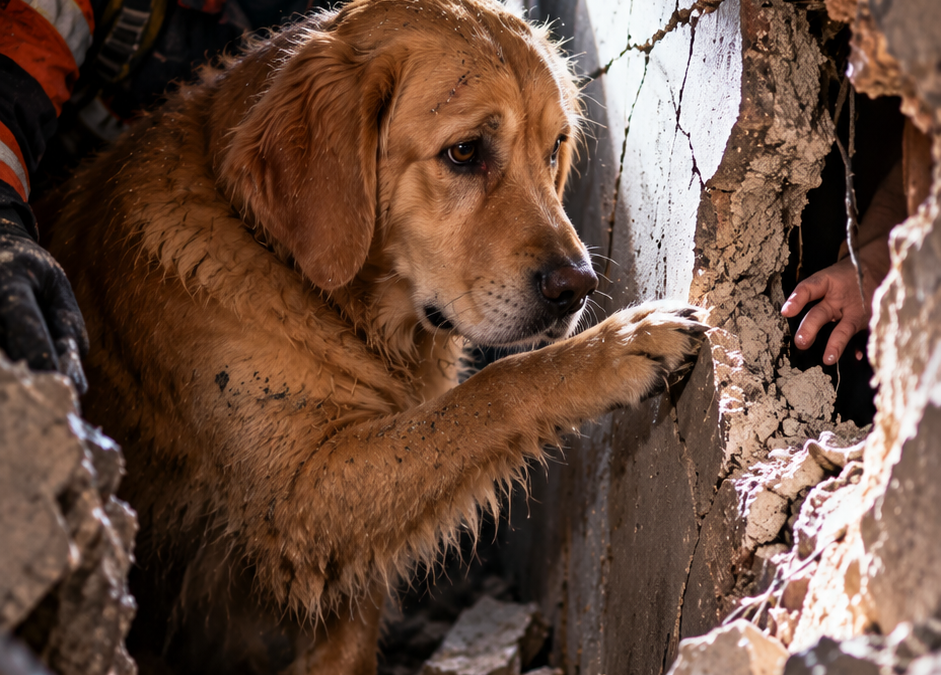
𝗙𝗨𝗟𝗟 𝗦𝗧𝗢𝗥𝗬
I was removing my outer gear when we heard barking.
One bark.
Then another.
Faint.
From somewhere beneath or behind the wall.
Mark turned.
“You hear that?”
“Yeah.”
The barking stopped.
Then came scratching.
David shined his light through the broken vent.
“I’ve got movement.”
Something golden appeared in the darkness.
A small dog’s face.
Dust covered his muzzle.
His fur was gray with debris.
One ear seemed darker from moisture.
“Benji,” I said.
The dog’s eyes locked onto me.
For one second, he stayed completely still.
Then he disappeared.
“That’s their dog,” I said.
Mark looked into the opening.
“If he’s moving through there, there may be a void.”
“Exactly.”
We enlarged the exterior cover just enough for me to get through.
Sarah grabbed my arm before I entered.
“James.”
I looked at her.
“That channel may not be stable.”
“I know.”
“No, listen to me. The foundation is still settling. If the wall moves—”
“I know.”
She stared at me.
“Keep your radio open.”
“I will.”
I clipped a smaller light to my helmet.
Removed anything that would snag.
Then slid feet-first into the old ventilation passage.
It was worse than I expected.
The opening narrowed immediately.
Dust coated everything.
Metal edges protruded from the walls.
I had to turn partly onto one shoulder just to move.
“How is it?” Mark called from behind me.
“Terrible.”
“Useful description.”
“You want the technical version?”
“Later.”
I crawled forward.
Ten feet.
Maybe fifteen.
Then the passage opened slightly.
My light caught the golden dog.
Benji stood ahead of me.
He had been waiting.
The moment he saw me, he turned and trotted farther into the darkness.
“Okay,” I whispered. “I’m coming.”
He stopped.
Looked back.
Then continued.
That behavior struck me immediately.
He wasn’t frightened of me.
He wasn’t trying to escape.
He was leading.
I radioed the team.
“The dog is guiding me deeper.”
Mark answered immediately.
“Do not outrun your exit route.”
“Copy.”
Benji moved ahead.
Stopped.
Looked back.
Waited.
Then moved again.
He seemed to understand that I was slower.
The duct wasn’t a straight tunnel.
It twisted around older sections of foundation and masonry.
Several times, I had to squeeze beneath corroded braces.
At one point, the space became so tight that my helmet scraped the ceiling.
Dust fell across my face.
I stopped.
Listened.
Nothing.
Then Benji appeared again.
Ten feet ahead.
He stared at me.
“You’re asking a lot, buddy.”
His tail didn’t move.
He turned.
Kept going.
I followed.
Eventually we reached a section where the old duct widened enough for me to crouch.
That was when I felt it.
Warm air.
Very faint.
Coming from somewhere to my right.
I raised my hand.
There was a crack in the masonry.
Barely visible.
Maybe an inch wide in places.
Warm air escaped through it.
Benji went straight to the wall.
Then he did something I will remember for the rest of my life.
He lifted one paw.
Tapped the wall three times.
Tap.
Tap.
Tap.
Then waited.
I stared at him.
“What are you doing?”
Silence.
Then, from the other side:
Tap.
Tap.
Tap.
I stopped breathing.
For a second, every sound inside that building vanished.
I leaned toward the wall.
“Hello!”
No answer.
Benji tapped again.
Three times.
Pause.
Three taps came back.
My heart slammed against my chest.
“Team, I have contact.”
Mark’s voice snapped through my radio.
“Repeat.”
“I have contact. Someone is behind this wall.”
“Voice contact?”
“Not yet. They’re responding to tapping.”
Sarah came on.
“Exact location?”
I checked my reference markers.
“Approximately eighteen feet east of vent entry, then six feet north through the secondary section.”
“That makes no sense.”
“Tell the building.”
“I’m looking at the plans now. There’s no channel there.”
“Plans are wrong.”
Benji scratched lightly along the bottom edge of the wall.
Not frantically.
Almost carefully.
He removed loose dust and tiny pieces of mortar.
I leaned closer to the crack.
“Can you hear me?”
Nothing.
I knocked three times with my knuckles.
Three knocks answered.
“Okay.”
I felt an adrenaline surge so strong my fingers started trembling.
They were alive.
That changed everything.
Until that moment, we had been searching for a location.
Now we had one.
“Mark, David, get to the rear vent.”
“Already moving.”
“Bring the hydraulic cutter and compact saw.”
Sarah cut in.
“Nobody cuts anything until I see that wall.”
“Understood.”
I turned toward Benji.
He was still staring at the crack.
“You found them.”
He scratched again.
Then the entire building moved.
Not much.
Maybe half an inch.
Maybe less.
But inside a damaged structure, movement doesn’t have to be dramatic.
The wall groaned.
Dust dropped from overhead.
Something cracked behind me.
Benji jumped backward.
I flattened myself against the floor.
“Movement!” I shouted into the radio.
Outside, someone answered, but the sound was swallowed by grinding metal.
Then everything stopped.
I stayed motionless for several seconds.
“James?”
“I’m here.”
“You okay?”
“Yeah.”
“The passage?”
“Still open.”
Sarah’s voice came next.
“Get out until we reassess.”
I looked at Benji.
He had already returned to the wall.
Three taps.
Pause.
Three taps back.
I couldn’t leave.
Not yet.
“Sarah.”
“James, no.”
“I’ve got live victims directly behind this partition.”
“You don’t know what that wall is carrying.”
“Then come tell me.”
Silence.
Finally:
“Give me five minutes.”
Benji stared at me.
“I know.”
I moved toward the crack again.
This time, I put my mouth close to it.
“My name is James. I’m with rescue. If you can hear me, answer.”
For several seconds, nothing.
Then a faint voice.
So weak I almost mistook it for air moving through the wall.
“Yes.”
I closed my eyes for half a second.
“How many of you?”
“Three.”
“Adults?”
“Two adults. One child.”
The original report was correct.
“Names?”
“Thomas.”
A pause.
“Emily.”
Then another voice.
Tiny.
“Lily.”
The dog’s entire body changed.
His ears went up.
He began whining softly.
The little voice came through the crack again.
“Benji?”
The dog pressed his nose against the wall.
“Lily,” I said, “Benji is right here.”
She started crying.
Not screaming.
Just crying quietly.
“My Benji?”
“Yeah.”
“Is he okay?”
I looked at his paws.
They were scraped.
One pad was bleeding slightly.
“He looks pretty tough.”
“Tell him I love him.”
I swallowed.
“I think he already knows.”
Benji struck the wall three times.
Tap.
Tap.
Tap.
Lily answered.
Tap.
Tap.
Tap.
That’s when I understood.
This wasn’t the first time.
They had been doing this before I arrived.
Maybe for minutes.
Maybe for hours.
Benji had somehow found a route out of the trapped space.
He had moved through the old duct.
Gone back.
Returned.
And when he couldn’t stay with them, he used those taps.
A simple signal.
I’m here.
You’re not alone.
I put my hand against the wall.
“Thomas, anyone badly injured?”
“My ankle hurts.”
“Can you move it?”
“Some.”
“Emily?”
“I’m okay.”
“Lily?”
“She’s scared.”
“I’m not scared,” Lily immediately protested.
Even through a wall, I almost smiled.
“Understood.”
Then she added in a smaller voice,
“Maybe a little.”
“That’s allowed.”
Behind me came the sound of equipment scraping through the duct.
Sarah appeared first.
She looked furious.
Which meant she had been worried.
“Move.”
I shifted aside.
She inspected the masonry.
Touched the crack.
Checked the metal lining around it.
Used a small light to study the upper seam.
Benji watched her intensely.
After about thirty seconds, she exhaled.
“Good news.”
“What?”
“This isn’t load-bearing.”
I almost laughed from relief.
“What is it?”
“Outer skin around the old ventilation channel. Probably abandoned during renovation.”
“Can we cut it?”
“Carefully.”
“How long?”
“If nothing shifts again, ten minutes.”
Ten minutes.
When people are trapped, ten minutes is both nothing and forever.
Mark and David reached us with the tools.
Getting equipment through the passage had been a nightmare, but they managed.
Sarah marked the safest cuts.
“Don’t go wider than this.”
“Why?”
“There’s masonry above it that’s partially unsupported.”
“How much opening?”
“Enough for one person at a time.”
Benji remained directly beside the wall.
I touched his side.
“Back up, buddy.”
He didn’t.
“Seriously.”
Nothing.
Mark looked at me.
“Excellent command presence.”
“He’s not in my chain of command.”
Benji scratched again.
Sarah shook her head.
“Move him.”
I gently guided him several feet back.
He resisted at first.
Then sat.
But his eyes never left the wall.
Sarah started the saw.
The sound inside the duct was brutal.
Metal screamed.
Dust filled the narrow space.
Benji crouched but didn’t run.
One cut.
Then another.
Slow.
Precise.
We couldn’t afford to shake the wall.
Every few minutes, I called through the crack.
“Thomas?”
“Here.”
“Emily?”
“Here.”
“Lily?”
“I’m here.”
Benji would respond with three taps whenever the saw stopped.
And every time, Lily answered.
Tap.
Tap.
Tap.
I had been in rescue work for years.
I’d seen people survive because of training.
Engineering.
Luck.
Good equipment.
Pure stubbornness.
I’d never seen hope maintained by a dog tapping on a wall.
Sarah was halfway through the final cut when the building shifted again.
A dull vibration moved beneath us.
The blade stopped.
“Everybody freeze.”
We froze.
A chunk of mortar broke loose near the opening.
Benji jumped.
David covered his head instinctively.
The vibration faded.
Sarah looked at me.
“We need to finish now.”
“Agreed.”
She restarted the saw.
Thirty seconds.
Another cut.
Then she switched it off.
“Done.”
Mark and I pulled carefully.
The metal section resisted.
David inserted a pry tool.
Slow pressure.
Nothing.
“Again.”
The panel moved.
Dust spilled outward.
Behind it was darkness.
Then a face.
Thomas.
Gray with dust.
Eyes red.
Alive.
“Oh, thank God,” he whispered.
“Don’t move yet.”
I widened the opening by hand, clearing loose debris.
Then I saw Emily behind him.
She was sitting against broken masonry.
Her arms were wrapped around a little girl.
Lily.
All three were squeezed into a cavity created when bricks and portions of the old ventilation structure shifted around them.
It was barely large enough to hold them.
Later, Sarah would call it a freak survival void.
At that moment, it looked like the smallest room in the world.
Lily stared through the opening.
Then she saw Benji.
“BENJI!”
The dog exploded forward.
Before I could stop him, he slipped through the opening.
He went straight into Lily’s arms.
She buried her face against his neck.
Benji licked her cheeks.
Her hands.
Her forehead.
Every part of her he could reach.
She was crying.
He was whining.
Emily covered her mouth.
Thomas turned his face away.
I don’t think any of us pretended not to be affected.
Lily kept repeating,
“I knew you’d come back.”
Benji’s tail beat against the debris.
“I knew it.”
I looked at Thomas.
“You said he left the cavity?”
Thomas nodded.
His voice shook.
“When everything came down, we ended up here.”
“How did Benji get out?”
“There was a gap behind us.”
“He found it?”
“We didn’t even know it went anywhere.”
Emily wiped tears from her face.
“He disappeared.”
“How long?”
“I don’t know. Maybe twenty minutes.”
Thomas shook his head.
“Then we heard him outside the wall.”
“Knocking?”
“Scratching first.”
He looked at the dog.
“Then the three taps.”
“Whose idea was that?”
“Lily’s.”
I looked at her.
She was still holding Benji.
She said,
“He scratches my bedroom door three times when he wants in.”
Of course.
Not some mysterious code.
Something simpler.
A family habit.
A little girl and her dog.
Three scratches at a bedroom door.
In the dark, inside a collapsed building, it became a lifeline.
Thomas continued.
“Whenever he came back, he tapped.”
“And you answered.”
“Every time.”
His eyes filled.
“We didn’t know if anyone else was coming.”
He looked toward Benji.
“But we knew he was still there.”
That was enough talking.
We needed them out.
“Thomas, you’re first.”
He shook his head.
“Take Lily.”
“You’re closest to the opening.”
“My daughter—”
“Listen to me.”
He did.
“We need space inside the void. You come out, then Emily, then Lily. Benji stays with Lily until her turn.”
Thomas looked at his daughter.
Lily nodded.
“I’m okay, Dad.”
He kissed her forehead.
Then began crawling.
His ankle slowed him.
Mark reached through and helped guide his shoulders.
I grabbed his forearm.
“Easy.”
He pulled himself through.
When he finally cleared the opening, his face changed.
Relief.
Shock.
Exhaustion.
All at once.
He sat against the duct wall.
“Two hours,” he whispered.
“What?”
“We’ve been in there almost two hours.”
He looked back toward his family.
“Get them out.”
Emily came next.
She moved carefully.
Once through, she tried to stand too quickly.
Her knees buckled.
David caught her.
“Easy.”
“I’m fine.”
“You’re not standing yet.”
“My daughter.”
“She’s coming.”
Lily was last.
That was when we had a problem.
She wouldn’t release Benji.
“Lily,” I called through the opening.
“You need both hands to crawl.”
“No.”
“You can hold him again in one minute.”
“No.”
Benji seemed to understand better than she did.
He wriggled free.
Then crawled through the opening on his own.
Lily gasped.
“Benji!”
“He’ll wait right here.”
The dog stood beside me.
I put one hand against his chest.
“See?”
Lily stared at him.
Then crawled.
Small hands.
Dust-covered sleeves.
One knee.
Then the other.
I reached for her.
“Almost there.”
The moment she cleared the opening, Benji pushed past me.
Lily grabbed him.
This time, I let her.
We moved out of the duct immediately.
The structure was too unstable to celebrate inside.
The journey back felt longer.
Thomas crawled with difficulty.
Emily followed.
Lily stayed near me.
Benji moved beside her.
Every few feet, he stopped.
Looked back.
Counted us.
At least that’s what it felt like.
Thomas.
Emily.
Lily.
Me.
Then forward again.
When we finally saw the night air through the exterior vent, I heard Mark behind me say,
“Best view I’ve had all week.”
One by one, we climbed outside.
The moment Lily appeared, the waiting crowd reacted.
Somebody shouted.
Then another person started crying.
The grandmother behind the barricade screamed Lily’s name.
Paramedics moved in.
Thomas was placed on a stretcher.
Possible ankle injury.
Emily was checked for dehydration, bruising, and shock.
Lily had scratches across one forearm.
Otherwise, she was remarkably well.
Benji refused to leave her.
A medic tried to examine Lily’s hand.
Benji moved closer.
Not aggressive.
Just watchful.
Lily put one arm around him.
“It’s okay.”
Only then did he relax.
I crouched beside them.
“Can somebody check the dog too?”
One of the paramedics looked down.
His paws were worse than I’d realized.
Pads scraped raw.
Small cuts between the toes.
Dried blood.
Dust packed into the fur.
For two hours, he had been moving through broken metal, brick, and concrete.
Scratching.
Running.
Returning.
Trying to find a way.
Lily noticed the blood.
Her face crumpled.
“Benji’s hurt.”
“He’s okay,” I said.
“He’s bleeding.”
“We’ll take care of him.”
She hugged him.
“I’m sorry.”
Benji licked her chin.
I had to look away for a second.
Eventually a local veterinarian was contacted.
Benji’s injuries were superficial.
Painful.
But nothing permanent.
He needed his paws cleaned, bandaged, and several days of rest.
The dog apparently disagreed with the rest portion.
He kept trying to follow Lily.
When everything settled enough for me to sit down, I dropped onto the curb.
My arms were shaking from exertion.
Adrenaline wears off strangely.
One minute you’re crawling through unstable concrete without thinking.
The next, holding a bottle of water feels complicated.
Benji approached.
His paws had temporary bandages.
He stopped in front of me.
Then lowered himself.
His head landed across my knee.
I rested a hand on him.
“You’re a hell of a rescue dog.”
His tail moved once.
One slow thump.
“No training.”
Another thump.
“No helmet.”
Nothing.
“No radio.”
He closed his eyes.
“Still showed us where to go.”
For a minute, we stayed that way.
Then Lily called him.
His head came up instantly.
“Go.”
Benji stood.
Limped toward her.
I smiled.
“Yeah. I know who your real team is.”
The following morning, inspectors closed the entire building.
No residents were allowed back inside.
Engineers began a full structural assessment.
That’s when we learned more about the passage Benji had discovered.
The old building originally contained a ventilation system dating to the 1930s.
Most of it had been sealed or replaced over decades of renovation.
Some sections were removed from later plans.
Others were simply forgotten.
The passage behind the rear wall had survived.
When the building shifted, pressure and movement around that old ventilation structure created a narrow cavity.
Not designed as protection.
Not predictable.
Just enough space.
Thomas, Emily, and Lily had been in exactly the right place when the wall moved.
A few feet in either direction could have changed everything.
Benji had found the opening connecting that cavity to the old duct.
Then he had found his way through.
More importantly, he kept returning.
Sarah showed me the old drawings later.
She spread them across a table.
“Look.”
I leaned over.
Modern plans showed nothing.
Then she placed an old archival plan beside them.
A faint ventilation line ran through the exact area we’d used.
“Nobody transferred this section into later plans,” she said.
“So if Benji hadn’t gone inside—”
“We probably would’ve continued searching from above.”
“How long?”
She didn’t answer.
She didn’t need to.
That afternoon, I visited the family at the hospital.
Thomas had a badly sprained ankle but no fracture.
Emily had bruising and mild dehydration.
Lily was sitting in bed eating pudding.
Benji was beside her.
His front paws were wrapped.
The moment I entered, Lily smiled.
“James!”
Benji looked at me.
Tail wag.
Thomas extended a hand.
I shook it.
“How are you?”
“Better than yesterday.”
“Low bar.”
He laughed.
Then became serious.
“I never thanked you.”
“You don’t need to.”
“I do.”
He looked toward the dog.
“And him.”
“Especially him.”
Emily smiled.
“You know what Lily told us?”
“What?”
“She said Benji went to get his coworkers.”
Lily corrected her.
“His rescue team.”
I looked at Benji.
“Seems accurate.”
Lily stroked his head.
“He knew you’d follow him.”
“I don’t know about that.”
“He did.”
Children have a way of stating beliefs as facts.
I didn’t argue.
Thomas asked,
“Did you know about that vent?”
“No.”
“You had no idea?”
“None.”
He looked at Benji.
“So he really found it.”
“Yes.”
Thomas’s eyes watered.
He looked away.
“We kept hearing him.”
“Behind the wall?”
“Yeah.”
His voice became quieter.
“At first, when he disappeared, I thought we’d lost him too.”
Emily reached for his hand.
“Then we heard scratching.”
Thomas continued.
“Then the taps.”
He smiled faintly.
“Lily tapped back.”
I looked at her.
“Three times.”
She nodded.
“That’s what he does at my door.”
“Every night?”
“When he wants to sleep in my room.”
Emily laughed.
“Which is every night.”
Lily looked offended.
“He gets lonely.”
Thomas shook his head.
“Apparently.”
I asked how long Benji had been part of the family.
Four years.
They had adopted him from a shelter.
He had been small.
Nervous.
Nothing unusual in his history.
No search training.
No special obedience certifications.
No working-dog background.
“He doesn’t even come when I call him half the time,” Thomas said.
Lily immediately defended him.
“He comes when I call.”
“Exactly,” Thomas said. “That’s the problem.”
I laughed.
That made the story better somehow.
Benji wasn’t a trained hero.
He was a family dog.
He knew Lily’s voice.
He knew their routines.
He knew something was wrong.
And he kept working the only problem that mattered to him until somebody followed.
A week later, Lily sent our station a drawing.
It showed a building.
A little golden dog.
Four firefighters.
And what I assumed was me crawling through a very large tunnel.
Above us she had written in uneven letters:
BENJI’S RESCUE TEAM
Mark taped it to the wall in our operations room.
Nobody objected.
For months afterward, new team members asked about it.
Someone would point at me.
“Ask James.”
So I told the story.
Not the dramatic version.
The real one.
How we had spent nearly two hours searching.
How the plans had failed us.
How a forgotten piece of 1930s construction remained hidden inside the building.
How a family survived in a narrow void.
How a frightened little girl and her dog used three taps to tell each other they were still there.
And how sometimes the best information at a rescue scene doesn’t arrive through a radio.
Months later, I saw Benji again at a community safety event.
Lily came running toward our truck.
Benji followed.
His paws had healed completely.
He looked healthier.
Very pleased with himself.
Lily brought him over.
“Do you remember James?”
Benji sniffed my hand.
Then leaned against my leg.
“I think he does.”
She smiled.
“He sleeps in my room now.”
“Every night?”
“Mom stopped arguing.”
Emily, standing several feet away, called,
“That’s not exactly what happened.”
Lily ignored her.
I scratched Benji behind the ears.
“You taking good care of everybody?”
His tail wagged.
Lily answered for him.
“Yes.”
Of course.
Years in rescue work teach you not to romanticize danger.
People survive because of building design.
Training.
Protective equipment.
Communication.
Engineering.
Good decisions.
Sometimes luck.
And sometimes something you cannot put neatly into an incident report.
The official report from that night was pages long.
Times.
Locations.
Equipment.
Personnel.
Structural observations.
Victim conditions.
Medical transport.
Nowhere did it fully capture the moment I crouched in darkness beside a dog and heard three taps return through a wall.
Reports aren’t built for things like that.
They don’t explain what hope sounds like.
I know now.
Sometimes it sounds like a siren.
Sometimes a human voice.
Sometimes a rescuer shouting that they’ve found a survivor.
And sometimes, in complete darkness, it sounds like this:
Tap.
Tap.
Tap.
Pause.
Tap.
Tap.
Tap.
A dog telling his family:
I’m still here.
And a little girl answering:
So are we.
That night, Benji didn’t understand engineering.
He didn’t understand structural collapse.
He didn’t know what a rescue operation was.
He had no radio.
No thermal camera.
No specialized training.
He knew only one thing.
His family was trapped.
And leaving them behind wasn’t an option.
We brought Thomas, Emily, and Lily out of that building.
But Benji was the one who found the path.
And whenever someone calls him a hero, I remember the way he rested his head on my knee afterward, exhausted, paws bleeding, tail moving once as Lily called his name.
I don’t think he believed he’d done anything extraordinary.
He had simply done what love had required of him.
Sometimes that’s where courage starts.
𝗧𝗛𝗘 𝗘𝗡𝗗
The Dog Kept Tapping Three Times Inside the Collapsed Wall, and Something on the Other Side Tapped Back
For nearly two hours, my rescue team had searched a damaged apartment building without finding the missing family, until a small golden dog disappeared into an air vent that wasn’t shown on a single set of plans.
I crawled after him into a passage barely wide enough for my shoulders, knowing another shift in the structure could trap both of us inside.
Then the dog raised one paw, struck the wall three times, and after a long pause, someone in the darkness answered with the exact same pattern.
My name is James Carter, and I’ve been part of an urban search-and-rescue team long enough to know that collapsed buildings don’t behave the way people expect them to.
From the outside, damage can look simple.
A cracked wall.
A buckled floor.
A section of brickwork pushed outward.
But inside, everything is connected.
One damaged beam transfers weight to another. A wall that appears solid can be carrying forces it was never designed to support. A gap wide enough to crawl through can disappear after one vibration.
That’s why we train.
That’s why we move slowly.
And that’s why, when someone tells you there are people trapped inside, every instinct to rush has to be controlled.
That evening, control was becoming harder by the minute.
The call came shortly after sunset.
Partial structural collapse at an old residential building on the east side.
Possible occupants trapped.
We arrived within minutes.
The building was a three-story brick structure built sometime in the 1930s, renovated so many times that nobody seemed to know which parts were original anymore.
The front looked deceptively intact.
A few broken windows.
Dust pouring from cracks.
A damaged entrance.
The real problem was along the rear and eastern side.
A portion of the foundation had shifted.
Brickwork had separated.
Part of the first floor had dropped several inches.
A utility failure inside had apparently created additional pressure in an old ventilation system, though we didn’t know that yet.
Neighbors crowded behind the police perimeter.
One woman kept shouting that a family was still inside.
“Three people!” she yelled.
I went to her.
“Who?”
“Thomas and Emily. Their daughter too.”
“How old is the daughter?”
“Seven. Lily.”
“Which apartment?”
“Ground floor. Rear side.”
“Anyone else?”
She shook her head.
“I don’t think so.”
Then she grabbed my sleeve.
“They have a dog.”
That detail barely registered at first.
During rescue operations, you collect facts.
Number of occupants.
Last known location.
Medical concerns.
Pets.
Entrances.
Structural changes.
Anything that might matter later.
“What kind?”
“Small. Golden. Benji.”
I wrote it down.
At the time, he was just another line in my notes.
I had no idea that within two hours, that dog would understand the building better than any of us.
Our initial entry team approached from the front.
The stairwell was unstable but passable.
We called out continuously.
“Fire and rescue! If you can hear us, make noise!”
Nothing.
We checked the visible ground-floor rooms.
Empty.
Part of the hallway had collapsed.
Furniture had been shoved into walls by shifting masonry.
A water line had ruptured somewhere inside, making the floors slick.
Our thermal camera picked up heat signatures in several areas, but most came from damaged pipes and trapped warm air.
No clear human shapes.
Mark, one of our most experienced rescuers, came up beside me.
“Rear bedroom is inaccessible from here.”
“Can we go through the neighboring unit?”
“Not safely.”
“What about exterior access?”
“David’s checking.”
We continued searching.
Twenty minutes.
Forty.
An hour.
No voices.
No movement.
No family.
Outside, the girl’s grandmother had arrived.
I didn’t know who she was until I saw another firefighter holding her back from the barricade.
“Please!” she kept saying. “Lily is in there!”
I forced myself not to look at her again.
You learn that early.
Families deserve information.
But during the search, you cannot carry their fear into the building with you.
Fear makes you hurry.
Hurrying gets rescuers killed.
At roughly an hour and fifteen minutes, David radioed from the rear.
“James, I’ve got what looks like an old service opening.”
“Usable?”
“Too small.”
“Location?”
“Northwest corner near the foundation.”
I made my way outside.
The opening was barely noticeable behind weeds and broken masonry.
A rusted metal vent cover sat low against the building.
Part of it had been pulled loose.
Sarah, our structural engineer, crouched beside it.
“This isn’t on the renovation drawings.”
“Original?”
“Could be.”
“Can a person fit?”
She looked at me.
“Not comfortably.”
“That’s not what I asked.”
She sighed.
“Maybe.”
I was removing my outer gear when we heard barking.
One bark.
Then another.
Faint.
From somewhere beneath or behind the wall.
Mark turned.
“You hear that?”
“Yeah.”
The barking stopped.
Then came scratching.
David shined his light through the broken vent.
“I’ve got movement.”
Something golden appeared in the darkness.
A small dog’s face.
Dust covered his muzzle.
His fur was gray with debris.
One ear seemed darker from moisture.
“Benji,” I said.
The dog’s eyes locked onto me.
For one second, he stayed completely still.
Then he disappeared.
“That’s their dog,” I said.
Mark looked into the opening.
“If he’s moving through there, there may be a void.”
“Exactly.”
We enlarged the exterior cover just enough for me to get through.
Sarah grabbed my arm before I entered.
“James.”
I looked at her.
“That channel may not be stable.”
“I know.”
“No, listen to me. The foundation is still settling. If the wall moves—”
“I know.”
She stared at me.
“Keep your radio open.”
“I will.”
I clipped a smaller light to my helmet.
Removed anything that would snag.
Then slid feet-first into the old ventilation passage.
It was worse than I expected.
The opening narrowed immediately.
Dust coated everything.
Metal edges protruded from the walls.
I had to turn partly onto one shoulder just to move.
“How is it?” Mark called from behind me.
“Terrible.”
“Useful description.”
“You want the technical version?”
“Later.”
I crawled forward.
Ten feet.
Maybe fifteen.
Then the passage opened slightly.
My light caught the golden dog.
Benji stood ahead of me.
He had been waiting.
The moment he saw me, he turned and trotted farther into the darkness.
“Okay,” I whispered. “I’m coming.”
He stopped.
Looked back.
Then continued.
That behavior struck me immediately.
He wasn’t frightened of me.
He wasn’t trying to escape.
He was leading.
I radioed the team.
“The dog is guiding me deeper.”
Mark answered immediately.
“Do not outrun your exit route.”
“Copy.”
Benji moved ahead.
Stopped.
Looked back.
Waited.
Then moved again.
He seemed to understand that I was slower.
The duct wasn’t a straight tunnel.
It twisted around older sections of foundation and masonry.
Several times, I had to squeeze beneath corroded braces.
At one point, the space became so tight that my helmet scraped the ceiling.
Dust fell across my face.
I stopped.
Listened.
Nothing.
Then Benji appeared again.
Ten feet ahead.
He stared at me.
“You’re asking a lot, buddy.”
His tail didn’t move.
He turned.
Kept going.
I followed.
Eventually we reached a section where the old duct widened enough for me to crouch.
That was when I felt it.
Warm air.
Very faint.
Coming from somewhere to my right.
I raised my hand.
There was a crack in the masonry.
Barely visible.
Maybe an inch wide in places.
Warm air escaped through it.
Benji went straight to the wall.
Then he did something I will remember for the rest of my life.
He lifted one paw.
Tapped the wall three times.
Tap.
Tap.
Tap.
Then waited.
I stared at him.
“What are you doing?”
Silence.
Then, from the other side:
Tap.
Tap.
Tap.
I stopped breathing.
For a second, every sound inside that building vanished.
I leaned toward the wall.
“Hello!”
No answer.
Benji tapped again.
Three times.
Pause.
Three taps came back.
My heart slammed against my chest.
“Team, I have contact.”
Mark’s voice snapped through my radio.
“Repeat.”
“I have contact. Someone is behind this wall.”
“Voice contact?”
“Not yet. They’re responding to tapping.”
Sarah came on.
“Exact location?”
I checked my reference markers.
“Approximately eighteen feet east of vent entry, then six feet north through the secondary section.”
“That makes no sense.”
“Tell the building.”
“I’m looking at the plans now. There’s no channel there.”
“Plans are wrong.”
Benji scratched lightly along the bottom edge of the wall.
Not frantically.
Almost carefully.
He removed loose dust and tiny pieces of mortar.
I leaned closer to the crack.
“Can you hear me?”
Nothing.
I knocked three times with my knuckles.
Three knocks answered.
“Okay.”
I felt an adrenaline surge so strong my fingers started trembling.
They were alive.
That changed everything.
Until that moment, we had been searching for a location.
Now we had one.
“Mark, David, get to the rear vent.”
“Already moving.”
“Bring the hydraulic cutter and compact saw.”
Sarah cut in.
“Nobody cuts anything until I see that wall.”
“Understood.”
I turned toward Benji.
He was still staring at the crack.
“You found them.”
He scratched again.
Then the entire building moved.
Not much.
Maybe half an inch.
Maybe less.
But inside a damaged structure, movement doesn’t have to be dramatic.
The wall groaned.
Dust dropped from overhead.
Something cracked behind me.
Benji jumped backward.
I flattened myself against the floor.
“Movement!” I shouted into the radio.
Outside, someone answered, but the sound was swallowed by grinding metal.
Then everything stopped.
I stayed motionless for several seconds.
“James?”
“I’m here.”
“You okay?”
“Yeah.”
“The passage?”
“Still open.”
Sarah’s voice came next.
“Get out until we reassess.”
I looked at Benji.
He had already returned to the wall.
Three taps.
Pause.
Three taps back.
I couldn’t leave.
Not yet.
“Sarah.”
“James, no.”
“I’ve got live victims directly behind this partition.”
“You don’t know what that wall is carrying.”
“Then come tell me.”
Silence.
Finally:
“Give me five minutes.”
Benji stared at me.
“I know.”
I moved toward the crack again.
This time, I put my mouth close to it.
“My name is James. I’m with rescue. If you can hear me, answer.”
For several seconds, nothing.
Then a faint voice.
So weak I almost mistook it for air moving through the wall.
“Yes.”
I closed my eyes for half a second.
“How many of you?”
“Three.”
“Adults?”
“Two adults. One child.”
The original report was correct.
“Names?”
“Thomas.”
A pause.
“Emily.”
Then another voice.
Tiny.
“Lily.”
The dog’s entire body changed.
His ears went up.
He began whining softly.
The little voice came through the crack again.
“Benji?”
The dog pressed his nose against the wall.
“Lily,” I said, “Benji is right here.”
She started crying.
Not screaming.
Just crying quietly.
“My Benji?”
“Yeah.”
“Is he okay?”
I looked at his paws.
They were scraped.
One pad was bleeding slightly.
“He looks pretty tough.”
“Tell him I love him.”
I swallowed.
“I think he already knows.”
Benji struck the wall three times.
Tap.
Tap.
Tap.
Lily answered.
Tap.
Tap.
Tap.
That’s when I understood.
This wasn’t the first time.
They had been doing this before I arrived.
Maybe for minutes.
Maybe for hours.
Benji had somehow found a route out of the trapped space.
He had moved through the old duct.
Gone back.
Returned.
And when he couldn’t stay with them, he used those taps.
A simple signal.
I’m here.
You’re not alone.
I put my hand against the wall.
“Thomas, anyone badly injured?”
“My ankle hurts.”
“Can you move it?”
“Some.”
“Emily?”
“I’m okay.”
“Lily?”
“She’s scared.”
“I’m not scared,” Lily immediately protested.
Even through a wall, I almost smiled.
“Understood.”
Then she added in a smaller voice,
“Maybe a little.”
“That’s allowed.”
Behind me came the sound of equipment scraping through the duct.
Sarah appeared first.
She looked furious.
Which meant she had been worried.
“Move.”
I shifted aside.
She inspected the masonry.
Touched the crack.
Checked the metal lining around it.
Used a small light to study the upper seam.
Benji watched her intensely.
After about thirty seconds, she exhaled.
“Good news.”
“What?”
“This isn’t load-bearing.”
I almost laughed from relief.
“What is it?”
“Outer skin around the old ventilation channel. Probably abandoned during renovation.”
“Can we cut it?”
“Carefully.”
“How long?”
“If nothing shifts again, ten minutes.”
Ten minutes.
When people are trapped, ten minutes is both nothing and forever.
Mark and David reached us with the tools.
Getting equipment through the passage had been a nightmare, but they managed.
Sarah marked the safest cuts.
“Don’t go wider than this.”
“Why?”
“There’s masonry above it that’s partially unsupported.”
“How much opening?”
“Enough for one person at a time.”
Benji remained directly beside the wall.
I touched his side.
“Back up, buddy.”
He didn’t.
“Seriously.”
Nothing.
Mark looked at me.
“Excellent command presence.”
“He’s not in my chain of command.”
Benji scratched again.
Sarah shook her head.
“Move him.”
I gently guided him several feet back.
He resisted at first.
Then sat.
But his eyes never left the wall.
Sarah started the saw.
The sound inside the duct was brutal.
Metal screamed.
Dust filled the narrow space.
Benji crouched but didn’t run.
One cut.
Then another.
Slow.
Precise.
We couldn’t afford to shake the wall.
Every few minutes, I called through the crack.
“Thomas?”
“Here.”
“Emily?”
“Here.”
“Lily?”
“I’m here.”
Benji would respond with three taps whenever the saw stopped.
And every time, Lily answered.
Tap.
Tap.
Tap.
I had been in rescue work for years.
I’d seen people survive because of training.
Engineering.
Luck.
Good equipment.
Pure stubbornness.
I’d never seen hope maintained by a dog tapping on a wall.
Sarah was halfway through the final cut when the building shifted again.
A dull vibration moved beneath us.
The blade stopped.
“Everybody freeze.”
We froze.
A chunk of mortar broke loose near the opening.
Benji jumped.
David covered his head instinctively.
The vibration faded.
Sarah looked at me.
“We need to finish now.”
“Agreed.”
She restarted the saw.
Thirty seconds.
Another cut.
Then she switched it off.
“Done.”
Mark and I pulled carefully.
The metal section resisted.
David inserted a pry tool.
Slow pressure.
Nothing.
“Again.”
The panel moved.
Dust spilled outward.
Behind it was darkness.
Then a face.
Thomas.
Gray with dust.
Eyes red.
Alive.
“Oh, thank God,” he whispered.
“Don’t move yet.”
I widened the opening by hand, clearing loose debris.
Then I saw Emily behind him.
She was sitting against broken masonry.
Her arms were wrapped around a little girl.
Lily.
All three were squeezed into a cavity created when bricks and portions of the old ventilation structure shifted around them.
It was barely large enough to hold them.
Later, Sarah would call it a freak survival void.
At that moment, it looked like the smallest room in the world.
Lily stared through the opening.
Then she saw Benji.
“BENJI!”
The dog exploded forward.
Before I could stop him, he slipped through the opening.
He went straight into Lily’s arms.
She buried her face against his neck.
Benji licked her cheeks.
Her hands.
Her forehead.
Every part of her he could reach.
She was crying.
He was whining.
Emily covered her mouth.
Thomas turned his face away.
I don’t think any of us pretended not to be affected.
Lily kept repeating,
“I knew you’d come back.”
Benji’s tail beat against the debris.
“I knew it.”
I looked at Thomas.
“You said he left the cavity?”
Thomas nodded.
His voice shook.
“When everything came down, we ended up here.”
“How did Benji get out?”
“There was a gap behind us.”
“He found it?”
“We didn’t even know it went anywhere.”
Emily wiped tears from her face.
“He disappeared.”
“How long?”
“I don’t know. Maybe twenty minutes.”
Thomas shook his head.
“Then we heard him outside the wall.”
“Knocking?”
“Scratching first.”
He looked at the dog.
“Then the three taps.”
“Whose idea was that?”
“Lily’s.”
I looked at her.
She was still holding Benji.
She said,
“He scratches my bedroom door three times when he wants in.”
Of course.
Not some mysterious code.
Something simpler.
A family habit.
A little girl and her dog.
Three scratches at a bedroom door.
In the dark, inside a collapsed building, it became a lifeline.
Thomas continued.
“Whenever he came back, he tapped.”
“And you answered.”
“Every time.”
His eyes filled.
“We didn’t know if anyone else was coming.”
He looked toward Benji.
“But we knew he was still there.”
That was enough talking.
We needed them out.
“Thomas, you’re first.”
He shook his head.
“Take Lily.”
“You’re closest to the opening.”
“My daughter—”
“Listen to me.”
He did.
“We need space inside the void. You come out, then Emily, then Lily. Benji stays with Lily until her turn.”
Thomas looked at his daughter.
Lily nodded.
“I’m okay, Dad.”
He kissed her forehead.
Then began crawling.
His ankle slowed him.
Mark reached through and helped guide his shoulders.
I grabbed his forearm.
“Easy.”
He pulled himself through.
When he finally cleared the opening, his face changed.
Relief.
Shock.
Exhaustion.
All at once.
He sat against the duct wall.
“Two hours,” he whispered.
“What?”
“We’ve been in there almost two hours.”
He looked back toward his family.
“Get them out.”
Emily came next.
She moved carefully.
Once through, she tried to stand too quickly.
Her knees buckled.
David caught her.
“Easy.”
“I’m fine.”
“You’re not standing yet.”
“My daughter.”
“She’s coming.”
Lily was last.
That was when we had a problem.
She wouldn’t release Benji.
“Lily,” I called through the opening.
“You need both hands to crawl.”
“No.”
“You can hold him again in one minute.”
“No.”
Benji seemed to understand better than she did.
He wriggled free.
Then crawled through the opening on his own.
Lily gasped.
“Benji!”
“He’ll wait right here.”
The dog stood beside me.
I put one hand against his chest.
“See?”
Lily stared at him.
Then crawled.
Small hands.
Dust-covered sleeves.
One knee.
Then the other.
I reached for her.
“Almost there.”
The moment she cleared the opening, Benji pushed past me.
Lily grabbed him.
This time, I let her.
We moved out of the duct immediately.
The structure was too unstable to celebrate inside.
The journey back felt longer.
Thomas crawled with difficulty.
Emily followed.
Lily stayed near me.
Benji moved beside her.
Every few feet, he stopped.
Looked back.
Counted us.
At least that’s what it felt like.
Thomas.
Emily.
Lily.
Me.
Then forward again.
When we finally saw the night air through the exterior vent, I heard Mark behind me say,
“Best view I’ve had all week.”
One by one, we climbed outside.
The moment Lily appeared, the waiting crowd reacted.
Somebody shouted.
Then another person started crying.
The grandmother behind the barricade screamed Lily’s name.
Paramedics moved in.
Thomas was placed on a stretcher.
Possible ankle injury.
Emily was checked for dehydration, bruising, and shock.
Lily had scratches across one forearm.
Otherwise, she was remarkably well.
Benji refused to leave her.
A medic tried to examine Lily’s hand.
Benji moved closer.
Not aggressive.
Just watchful.
Lily put one arm around him.
“It’s okay.”
Only then did he relax.
I crouched beside them.
“Can somebody check the dog too?”
One of the paramedics looked down.
His paws were worse than I’d realized.
Pads scraped raw.
Small cuts between the toes.
Dried blood.
Dust packed into the fur.
For two hours, he had been moving through broken metal, brick, and concrete.
Scratching.
Running.
Returning.
Trying to find a way.
Lily noticed the blood.
Her face crumpled.
“Benji’s hurt.”
“He’s okay,” I said.
“He’s bleeding.”
“We’ll take care of him.”
She hugged him.
“I’m sorry.”
Benji licked her chin.
I had to look away for a second.
Eventually a local veterinarian was contacted.
Benji’s injuries were superficial.
Painful.
But nothing permanent.
He needed his paws cleaned, bandaged, and several days of rest.
The dog apparently disagreed with the rest portion.
He kept trying to follow Lily.
When everything settled enough for me to sit down, I dropped onto the curb.
My arms were shaking from exertion.
Adrenaline wears off strangely.
One minute you’re crawling through unstable concrete without thinking.
The next, holding a bottle of water feels complicated.
Benji approached.
His paws had temporary bandages.
He stopped in front of me.
Then lowered himself.
His head landed across my knee.
I rested a hand on him.
“You’re a hell of a rescue dog.”
His tail moved once.
One slow thump.
“No training.”
Another thump.
“No helmet.”
Nothing.
“No radio.”
He closed his eyes.
“Still showed us where to go.”
For a minute, we stayed that way.
Then Lily called him.
His head came up instantly.
“Go.”
Benji stood.
Limped toward her.
I smiled.
“Yeah. I know who your real team is.”
The following morning, inspectors closed the entire building.
No residents were allowed back inside.
Engineers began a full structural assessment.
That’s when we learned more about the passage Benji had discovered.
The old building originally contained a ventilation system dating to the 1930s.
Most of it had been sealed or replaced over decades of renovation.
Some sections were removed from later plans.
Others were simply forgotten.
The passage behind the rear wall had survived.
When the building shifted, pressure and movement around that old ventilation structure created a narrow cavity.
Not designed as protection.
Not predictable.
Just enough space.
Thomas, Emily, and Lily had been in exactly the right place when the wall moved.
A few feet in either direction could have changed everything.
Benji had found the opening connecting that cavity to the old duct.
Then he had found his way through.
More importantly, he kept returning.
Sarah showed me the old drawings later.
She spread them across a table.
“Look.”
I leaned over.
Modern plans showed nothing.
Then she placed an old archival plan beside them.
A faint ventilation line ran through the exact area we’d used.
“Nobody transferred this section into later plans,” she said.
“So if Benji hadn’t gone inside—”
“We probably would’ve continued searching from above.”
“How long?”
She didn’t answer.
She didn’t need to.
That afternoon, I visited the family at the hospital.
Thomas had a badly sprained ankle but no fracture.
Emily had bruising and mild dehydration.
Lily was sitting in bed eating pudding.
Benji was beside her.
His front paws were wrapped.
The moment I entered, Lily smiled.
“James!”
Benji looked at me.
Tail wag.
Thomas extended a hand.
I shook it.
“How are you?”
“Better than yesterday.”
“Low bar.”
He laughed.
Then became serious.
“I never thanked you.”
“You don’t need to.”
“I do.”
He looked toward the dog.
“And him.”
“Especially him.”
Emily smiled.
“You know what Lily told us?”
“What?”
“She said Benji went to get his coworkers.”
Lily corrected her.
“His rescue team.”
I looked at Benji.
“Seems accurate.”
Lily stroked his head.
“He knew you’d follow him.”
“I don’t know about that.”
“He did.”
Children have a way of stating beliefs as facts.
I didn’t argue.
Thomas asked,
“Did you know about that vent?”
“No.”
“You had no idea?”
“None.”
He looked at Benji.
“So he really found it.”
“Yes.”
Thomas’s eyes watered.
He looked away.
“We kept hearing him.”
“Behind the wall?”
“Yeah.”
His voice became quieter.
“At first, when he disappeared, I thought we’d lost him too.”
Emily reached for his hand.
“Then we heard scratching.”
Thomas continued.
“Then the taps.”
He smiled faintly.
“Lily tapped back.”
I looked at her.
“Three times.”
She nodded.
“That’s what he does at my door.”
“Every night?”
“When he wants to sleep in my room.”
Emily laughed.
“Which is every night.”
Lily looked offended.
“He gets lonely.”
Thomas shook his head.
“Apparently.”
I asked how long Benji had been part of the family.
Four years.
They had adopted him from a shelter.
He had been small.
Nervous.
Nothing unusual in his history.
No search training.
No special obedience certifications.
No working-dog background.
“He doesn’t even come when I call him half the time,” Thomas said.
Lily immediately defended him.
“He comes when I call.”
“Exactly,” Thomas said. “That’s the problem.”
I laughed.
That made the story better somehow.
Benji wasn’t a trained hero.
He was a family dog.
He knew Lily’s voice.
He knew their routines.
He knew something was wrong.
And he kept working the only problem that mattered to him until somebody followed.
A week later, Lily sent our station a drawing.
It showed a building.
A little golden dog.
Four firefighters.
And what I assumed was me crawling through a very large tunnel.
Above us she had written in uneven letters:
BENJI’S RESCUE TEAM
Mark taped it to the wall in our operations room.
Nobody objected.
For months afterward, new team members asked about it.
Someone would point at me.
“Ask James.”
So I told the story.
Not the dramatic version.
The real one.
How we had spent nearly two hours searching.
How the plans had failed us.
How a forgotten piece of 1930s construction remained hidden inside the building.
How a family survived in a narrow void.
How a frightened little girl and her dog used three taps to tell each other they were still there.
And how sometimes the best information at a rescue scene doesn’t arrive through a radio.
Months later, I saw Benji again at a community safety event.
Lily came running toward our truck.
Benji followed.
His paws had healed completely.
He looked healthier.
Very pleased with himself.
Lily brought him over.
“Do you remember James?”
Benji sniffed my hand.
Then leaned against my leg.
“I think he does.”
She smiled.
“He sleeps in my room now.”
“Every night?”
“Mom stopped arguing.”
Emily, standing several feet away, called,
“That’s not exactly what happened.”
Lily ignored her.
I scratched Benji behind the ears.
“You taking good care of everybody?”
His tail wagged.
Lily answered for him.
“Yes.”
Of course.
Years in rescue work teach you not to romanticize danger.
People survive because of building design.
Training.
Protective equipment.
Communication.
Engineering.
Good decisions.
Sometimes luck.
And sometimes something you cannot put neatly into an incident report.
The official report from that night was pages long.
Times.
Locations.
Equipment.
Personnel.
Structural observations.
Victim conditions.
Medical transport.
Nowhere did it fully capture the moment I crouched in darkness beside a dog and heard three taps return through a wall.
Reports aren’t built for things like that.
They don’t explain what hope sounds like.
I know now.
Sometimes it sounds like a siren.
Sometimes a human voice.
Sometimes a rescuer shouting that they’ve found a survivor.
And sometimes, in complete darkness, it sounds like this:
Tap.
Tap.
Tap.
Pause.
Tap.
Tap.
Tap.
A dog telling his family:
I’m still here.
And a little girl answering:
So are we.
That night, Benji didn’t understand engineering.
He didn’t understand structural collapse.
He didn’t know what a rescue operation was.
He had no radio.
No thermal camera.
No specialized training.
He knew only one thing.
His family was trapped.
And leaving them behind wasn’t an option.
We brought Thomas, Emily, and Lily out of that building.
But Benji was the one who found the path.
And whenever someone calls him a hero, I remember the way he rested his head on my knee afterward, exhausted, paws bleeding, tail moving once as Lily called his name.
I don’t think he believed he’d done anything extraordinary.
He had simply done what love had required of him.
Sometimes that’s where courage starts.

