𝗙𝗨𝗟𝗟 𝗦𝗧𝗢𝗥𝗬 The Dog in the Last Kennel Looked at Me With Eyes I Had Spent Three Years Trying to Forget
𝗙𝗨𝗟𝗟 𝗦𝗧𝗢𝗥𝗬
He stopped.
Rex lifted his head.
I immediately lowered my voice.
“I’m sorry.”
David sat across from me.
“I’m not trying to take him from you.”
“I know.”
“You can see him whenever you want.”
That sentence should have comforted me.
Instead, it made everything feel worse.
Whenever you want.
As though there would be some easy friendship after a divorce.
As though I would casually knock on the door of my former home and say, I’m here to borrow the dog.
I looked down at Rex.
His eyes moved between us.
“What’s best for him?” I asked.
David did not answer immediately.
That was one of the reasons I still respected him.
He didn’t pretend.
Finally he said, “Stability.”
My apartment would be small.
I would be commuting forty-five minutes each way.
Some days I worked ten hours.
David wrote technical manuals from home.
He could take Rex outside.
Feed him.
Stay with him as he aged.
It was obvious.
It was also unbearable.
I knelt beside Rex.
He immediately placed his chin on my knee.
“Oh, buddy.”
His tail moved.
I ran my hands through the fur behind his ears.
I knew every part of him.
The small scar above his left eye where he had run into a fence as a puppy.
The darker patch of hair along his spine.
The way his right ear folded when he was tired.
“I guess you’re staying with Dad.”
David looked away.
That almost broke me.
Rex wagged his tail because I was touching him.
He had no idea what was happening.
I pressed my face against his neck.
“Be good.”
He licked my cheek.
“Take care of him.”
I didn’t know whether I was talking to Rex or David.
Maybe both.
David said quietly, “I will.”
I stood.
Picked up the suitcase.
Walked toward the door.
Rex followed.
Of course he did.
David caught his collar gently.
“Rex.”
The dog stopped.
I opened the door.
He whined.
I almost turned around.
Almost.
Instead, I walked outside.
The last thing I heard before closing the car door was Rex barking from inside the house.
I cried for the first twenty miles.
For several months after the divorce, David and I exchanged occasional messages.
Practical things.
Insurance.
Mail.
A bank account we had forgotten to close.
Once, I asked about Rex.
David sent me a photograph.
Rex was sleeping on the couch with one paw over his face.
The caption read:
Still takes up more space than a human.
I stared at the photograph for a long time.
Then typed:
Tell him I miss him.
David replied:
He misses you too.
That should have made me reach out again.
Instead, I stopped.
Not because I stopped loving Rex.
Because everything connected to that house hurt.
David never pushed.
I didn’t either.
Months became a year.
A year became two.
Then three.
I built a different life.
New apartment.
New job position.
New friends.
I changed my hair.
Bought furniture that David would have hated.
Learned to cook for one.
Got used to sleeping diagonally across the bed.
For a while, I dated.
Nothing serious.
When people asked about my marriage, I said, “We grew apart.”
That phrase was convenient because it sounded finished.
Clean.
Nobody asked questions.
But there were nights when I thought about Rex.
Usually when I heard a dog collar jingling in the hallway.
Or saw a golden retriever at the park.
Sometimes I searched through old photographs.
There was one of Rex asleep with his head on my stomach.
One of David holding him in a lake.
One of all three of us at Christmas.
I never deleted those.
I also never contacted David.
Pride had little to do with it.
Shame did.
The longer I stayed silent, the harder it became to break that silence.
What would I say after two years?
How’s the dog I promised I loved and then never asked about?
Eventually, I convinced myself that not interfering was kinder.
David had Rex.
They were happy.
I was a closed chapter.
Then, one winter morning three years after the divorce, I woke to an apartment so quiet that I could hear the refrigerator humming from the bedroom.
I lay there staring at the ceiling.
Something felt wrong.
Not tragic.
Just empty.
I had felt it before.
That morning, I finally admitted what it was.
I missed having a dog.
I missed footsteps following me into the kitchen.
I missed talking to someone who could not answer.
I missed going outside because another living creature needed me to.
Most of all, I missed the uncomplicated presence of an animal who did not care whether my life looked impressive.
My friend Emily had been telling me for months to adopt.
“You keep looking at dogs online.”
“That proves nothing.”
“You saved twenty-seven shelter listings.”
“That proves I have poor impulse control.”
“You showed me pictures of the same beagle three times.”
“He has an excellent face.”
“Linda.”
“What?”
“Go adopt a dog.”
So I finally did.
Sunny Paws Rescue occupied an old converted farmhouse outside the city.
The morning I drove there, clouds hung low over the road.
I almost turned around twice.
Adoption suddenly felt disloyal.
Not to David.
To Rex.
Which was absurd.
Rex had probably forgotten me.
He was living a good life.
He had David.
I was allowed to have another dog.
Still, when I parked, I sat inside the car for five minutes.
Then I said out loud, “This is ridiculous.”
I went inside.
The shelter smelled like wet earth, disinfectant, dog food, and old wood.
Barking came from somewhere behind the front desk.
A young employee greeted me.
“Looking to adopt?”
“I think so.”
“That sounded confident.”
I smiled.
“I’m working on it.”
He introduced himself as Michael.
Probably in his mid-twenties.
Kind eyes.
Tattoo of a paw print near his wrist.
He asked about my apartment, schedule, experience with dogs.
Then he walked me through the kennel area.
I saw puppies.
Terriers.
A shepherd mix who leaned his entire body against the gate.
A nervous black dog hiding beneath a blanket.
A three-legged husky who wanted nothing more than to play.
I stopped several times.
But nothing felt right.
I started wondering whether I had made a mistake.
Then we reached the last row.
One kennel sat partly in shadow.
A dog was inside.
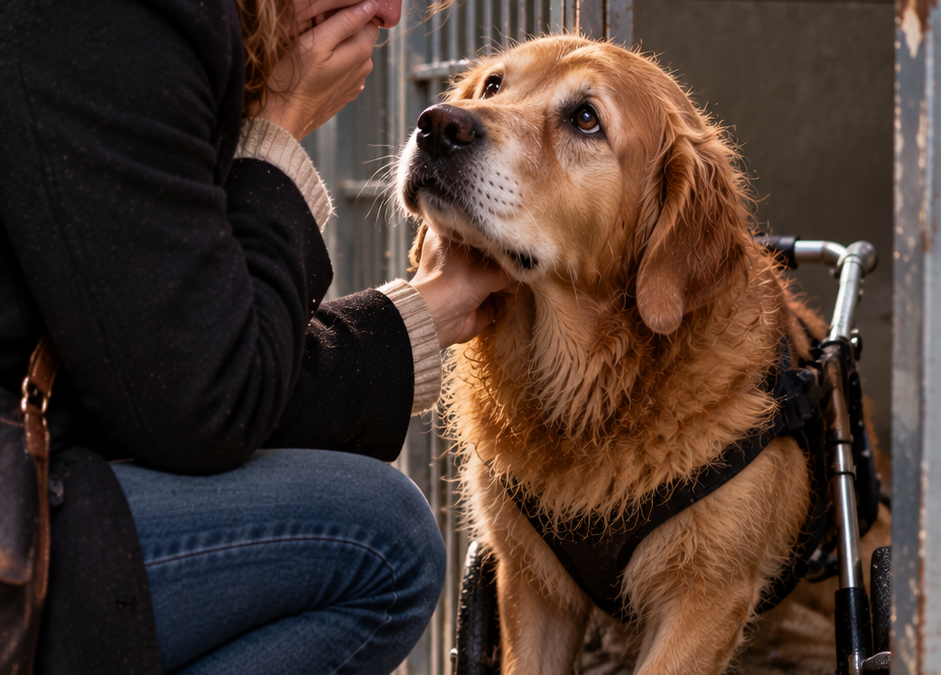
He was positioned in a small mobility cart.
Two wheels supported his hindquarters.
His back legs hung motionless.
His golden coat had faded almost cream around the face.
He looked older than the Rex in my memories.
Smaller somehow.
Life had narrowed his body.
I would have walked past.
Then he looked up.
The world stopped.
There are moments when recognition is not thought.
It is physical.
My skin went cold.
My chest tightened.
My knees weakened.
Those eyes.
I knew them.
“Rex?”
The dog’s head lifted.
His ears moved.
His tail struck the floor.
Michael stopped beside me.
“What did you say?”
I couldn’t answer.
I moved closer to the gate.
“Rex.”
The tail moved faster.
Then the dog started making a sound.
A low, breathless whine.
His front legs pushed against the floor.
The wheels behind him rattled.
He rolled toward me.
I covered my mouth.
“No.”
Michael looked from me to the dog.
“Do you know him?”
I knelt.
My hands shook so badly I could barely touch the bars.
Rex pressed his nose through them.
I put my fingers against his face.
He licked them.
Once.
Then again.
I started crying.
Not graceful tears.
Not the kind you can wipe away and keep talking.
My entire body shook.
“Oh my God.”
Rex whined.
His tail slammed against the floor.
“Rex.”
I put both hands through the gate.
He pushed his face against them.
“You remember me.”
Michael crouched nearby.
“Ma’am?”
“Linda.”
“Linda. Are you sure?”
I looked at him.
“This is my dog.”
Then I corrected myself.
“He was my dog.”
Michael’s expression changed.
“How long ago?”
“Three years.”
I looked back at Rex.
“What happened to you?”
That was when I noticed the back legs fully.
They did not move.
Not at all.
I stared at the small cart.
At the straps supporting his hips.
At scars near his right side.
My grief turned into fear.
“If Rex is here…”
Michael waited.
I whispered, “Where is David?”
He helped me into a small consultation room.
I barely remember walking there.
My legs felt numb.
Someone brought tea.
I held the cup but never drank.
The walls were covered with adoption photographs.
Dogs on couches.
Cats in windows.
Smiling families.
Rex was allowed into the room.
His cart made a soft metallic rattle over the floor.
That sound still exists in my memory.
Click.
Roll.
Click.
Roll.
The dog who once raced me up stairs now needed wheels.
He came to me.
I moved from the chair to the floor.
Rex pressed his face into my lap.
I wrapped my arms around him.
“You remember.”
He sighed.
I buried my face in his fur.
He smelled different.
Shelter shampoo.
Medicine.
Dog.
But beneath all of it, somehow, Rex.
My Rex.
Our Rex.
Michael sat across from me.
“When was the last time you saw him?”
“Three years ago.”
My voice cracked.
“My ex-husband kept him after our divorce.”
“David?”
I froze.
“You know his name?”
Michael nodded carefully.
My stomach turned.
“What happened?”
He hesitated.
“Linda, this might be difficult.”
“I found my dog paralyzed in a shelter.”
I looked directly at him.
“I’m already having a difficult day.”
Michael nodded.
“About seven months ago, David and Rex were involved in a car accident.”
Every thought in my head stopped.
“When?”
“Late at night. According to what we were told, David was driving home.”
I pictured the old car.
Rex in the passenger seat.
He always sat there when it was just the two of them.
Even though we had told him a hundred times to stay in the back.
Michael continued.
“Another vehicle hit them at an intersection.”
My hand tightened around Rex’s fur.
“David?”
“Seriously injured.”
“Alive?”
“Yes.”
The relief came so quickly it almost made me dizzy.
“He’s alive?”
“Yes.”
“Where?”
“A rehabilitation hospital, last we heard.”
I looked down.
Rex rested his head against my thigh.
“And Rex?”
“The impact threw him from the vehicle.”
I closed my eyes.
“No.”
“He suffered a spinal injury.”
I could not stop imagining it.
Glass.
Metal.
Dark road.
Rex alone on pavement.
David unconscious somewhere nearby.
“Was he…”
My voice failed.
“Was he conscious?”
“We don’t know.”
Michael leaned forward.
“The emergency veterinarian saved him.”
I opened my eyes.
“Why can’t he walk?”
“The spinal damage left his hind legs paralyzed.”
I looked at the cart.
Permanent.
The word didn’t need to be spoken.
I knew.
Michael continued carefully.
“They eventually fitted him for the mobility cart.”
“Who took care of him?”
“David’s sister, Sarah, initially.”
I knew Sarah.
Barely.
We had never been close.
She lived several hours away.
“She took Rex while David was in treatment?”
“For a while.”
“What happened?”
“She couldn’t maintain it long-term.”
I nodded slowly.
Sarah had two children.
A job.
A small apartment.
Rex needed therapy.
Bladder care.
Mobility support.
Medical appointments.
“And she brought him here.”
“About four months ago.”
Four months.
I looked around the shelter.
Rex had been here four months.
“How long has David been hospitalized?”
“Most of the last seven months, between acute care and rehabilitation.”
I stared at Michael.
“And nobody called me?”
The question sounded accusing.
Michael had nothing to do with it.
He knew that.
So did I.
He answered gently.
“We only had the contacts given to us.”
I looked down at my hands.
“No.”
“What?”
“I shouldn’t be asking why nobody called me.”
My throat tightened.
“I should be asking why no one knew to.”
Michael said nothing.
Three years.
No messages.
No phone calls.
No birthday text.
No “How is Rex?”
Nothing.
I had vanished so completely that when catastrophe happened, I was not even on the list of people who might care.
The realization was brutal.
“I could have called.”
Michael spoke quietly.
“You couldn’t know about the accident.”
“I could have known about Rex.”
“You thought he was being cared for.”
“I didn’t even check.”
Rex lifted his head.
I looked at him.
“You were right there.”
I started crying again.
“And I never asked.”
Rex pushed his nose into my hand.
That made it worse.
Dogs do not understand guilt.
Maybe that is one of their greatest gifts.
They don’t make us serve sentences for mistakes we already regret.
They only understand whether we are there now.
I spent nearly three hours at the shelter that day.
I learned how Rex’s cart worked.
How to support his hips when transferring him.
How the staff prevented pressure sores.
What exercises he needed.
When he tired.
Which medications he took.
Which side he preferred sleeping on.
Every answer made the three missing years feel heavier.
Before I left, I knelt beside him.
“I’m coming back.”
Rex watched me.
This time the promise terrified me.
I had already left him once.
“I mean it.”
His tail moved.
I drove directly to my apartment.
Then sat in the parking lot and searched for David’s rehabilitation facility.
It took six calls.
Two wrong numbers.
One conversation with Sarah.
She answered after the fifth ring.
“Hello?”
“Sarah?”
Pause.
“Linda?”
My name sounded strange in her voice.
“Yes.”
“Oh.”
A long silence.
“I found Rex.”
Sarah began crying immediately.
Not loudly.
Just one sharp breath, then silence.
“You found him?”
“At Sunny Paws.”
“I’m sorry.”
“For what?”
“For everything.”
“Where’s David?”
She gave me the name of the rehabilitation center.
Then said, “He asked about you.”
I closed my eyes.
“When?”
“After the accident.”
“Why didn’t you call?”
Another silence.
“I didn’t know if I should.”
“Sarah.”
“I know.”
There was exhaustion in her voice.
“David had your old number. I didn’t know if it still worked. He told me not to drag you into it.”
“He said that?”
“He said you had your own life.”
I laughed bitterly.
“Of course he did.”
“That wasn’t meant to hurt you.”
“I know.”
Sarah continued.
“He was in bad shape, Linda.”
“What happened?”
“Broken pelvis. Leg injuries. Shoulder. Head trauma.”
I pressed my hand over my mouth.
“And he lived.”
“Yes.”
“He’s walking?”
“With help.”
“Does he know Rex is in the shelter?”
Sarah went quiet.
“Yes.”
The guilt in her voice told me everything.
“He hates it.”
“So why…”
“I tried.”
She started crying harder.
“I tried keeping Rex.”
“I’m not blaming you.”
“I know what you’re thinking.”
“No.”
“Linda, I have stairs. Two kids. I work ten-hour shifts.”
“I said I’m not blaming you.”
“I couldn’t lift him correctly. He got a sore. The vet said he needed more care.”
Her voice broke.
“I thought the shelter could find a foster family.”
I stared through the windshield.
“You did what you could.”
“I abandoned David’s dog.”
“No.”
The words came firmly.
“You made the only choice you thought would keep him safe.”
For some reason, saying that to Sarah made me realize I needed to extend some of the same mercy to myself.
Not absolution.
Mercy.
“Can I see David?”
She hesitated.
“Yes.”
The next morning, I went.
The rehabilitation hospital was an hour away.
I almost turned around when I reached the parking lot.
Seeing Rex had already torn open three years of carefully packed memories.
Seeing David felt even more dangerous.
I stood outside his room for nearly a minute.
Then knocked.
“Come in.”
His voice was different.
Thinner.
I opened the door.
David sat near a window.
Crutches leaned against the wall.
He had lost weight.
A lot.
His hair was shorter than I remembered and threaded with more gray.
There was a scar near his temple.
One leg was braced.
He looked older.
So did I, probably.
For a few seconds, neither of us spoke.
Then David smiled.
That same crooked smile I had loved for almost fifteen years.
“Linda.”
My throat tightened.
“Hi.”
“You’re here.”
“I am.”
His eyes moved over my face.
“How?”
“I went to adopt a dog.”
David’s expression changed immediately.
“Sunny Paws?”
I nodded.
He closed his eyes.
“You found Rex.”
“I found Rex.”
His hand tightened around the armrest.
“How is he?”
I stared at him.
“You know how he is.”
“I mean…”
David swallowed.
“How did he look?”
“Older.”
A faint smile.
“Yeah.”
“Still handsome.”
“Obviously.”
“Still manipulative.”
“Very.”
We both laughed.
Then the laughter disappeared.
“Why didn’t you call me?”
David looked out the window.
“I almost did.”
“When?”
“After I woke up.”
“Then why didn’t you?”
“Because we hadn’t spoken in three years.”
“That’s a terrible reason.”
“I know.”
“Rex was mine too.”
“I know.”
My voice rose.
“You had no right to decide whether I cared.”
“I know.”
The repeated answer made me angrier.
“Stop saying that.”
David looked at me.
“What do you want me to say?”
“I don’t know.”
My eyes burned.
“Something that makes this less awful.”
He lowered his head.
“I can’t.”
Silence.
Finally he said, “I thought you had moved on.”
“I did.”
“That was the point.”
“Moving on doesn’t mean forgetting.”
“No.”
“I didn’t stop loving Rex.”
“I know.”
“There it is again.”
He almost smiled.
Then pain tightened his face when he shifted position.
Instinctively, I stepped forward.
He noticed.
So did I.
We both froze.
Old habits survive marriages.
I sat across from him.
“What happened?”
David looked at the window.
“It was raining.”
Of course.
He always hated driving at night in rain.
“I left work late.”
“Why was Rex with you?”
“Vet appointment.”
That made sense.
“He’d been slowing down.”
“Arthritis?”
“We thought so.”
David took a breath.
“I was taking him home.”
His eyes unfocused.
“I remember the light turning green.”
Then nothing.
He had woken in an intensive care unit two days later.
His first coherent question had been about Rex.
Nobody knew.
The police report mentioned a dog at the accident scene, but Rex had been transported separately to an emergency veterinary hospital.
It took David’s sister almost a day to locate him.
“When Sarah told me…”
David’s voice broke.
“She said he was alive.”
He rubbed his face.
“I thought that meant everything was okay.”
I knew the terrible difference.
Alive does not always mean okay.
“The vet came to the hospital.”
“To you?”
“I insisted.”
David looked at me.
“He told me Rex might never use his back legs again.”
I pictured David lying injured, unable to stand himself, being told his dog was also broken.
“I couldn’t even go see him.”
His voice shook.
“I couldn’t move.”
I said nothing.
“They sent me a video.”
David laughed once, painfully.
“Do you know Rex’s first reaction when he got the cart?”
“What?”
“He tried to bite the wheel.”
Despite everything, I smiled.
“That sounds like him.”
“He hated it.”
“How long?”
“Three days.”
“Then?”
“He figured out it made him fast.”
I laughed through tears.
David smiled.
“For a while Sarah brought him to see me.”
“Here?”
“At the earlier facility.”
He looked down.
“Then she couldn’t keep doing it.”
“You know she feels terrible.”
“She shouldn’t.”
“So do I.”
David looked at me.
“Maybe you shouldn’t either.”
I almost snapped at him.
Then stopped.
“What?”
“You couldn’t know.”
“I could have called.”
“Yes.”
His honesty hurt.
Then he continued.
“So could I.”
We sat with that.
There it was.
The real failure.
Not the divorce.
Not leaving Rex with David.
Not Sarah using the shelter.
Silence.
Three adults who cared about each other enough to avoid causing pain had stayed so far apart that when life shattered, none of us knew how to reach across the distance.
David said softly, “We did the divorce well.”
I laughed.
“That sounds ridiculous.”
“We did.”
“No fighting.”
“No lawyers trying to destroy each other.”
“No revenge.”
“We congratulated ourselves.”
“We did.”
His smile faded.
“But we confused being respectful with disappearing.”
I nodded.
“We never had to become strangers.”
“No.”
For several minutes, we said nothing.
Then David asked, “Why did you go to the shelter?”
“I wanted a dog.”
His eyebrows rose.
“You?”
“What does that mean?”
“You said after Rex you’d never get another one because no dog could compare.”
“That was twelve years ago.”
“You remember saying it?”
“I remember everything stupid I said during our marriage.”
“Impressive memory.”
I smiled.
He did too.
Then he asked, “Are you still adopting?”
“Yes.”
“What kind?”
I looked directly at him.
“Rex.”
David stopped breathing.
“What?”
“I’m taking Rex.”
His face went still.
“Linda.”
“I already spoke with Michael.”
“No.”
“No?”
“You don’t know what you’re agreeing to.”
“I do.”
“He’s paralyzed.”
“I noticed.”
“He needs help going to the bathroom sometimes.”
“I know.”
“Skin checks.”
“Yes.”
“Physical therapy.”
“Yes.”
“Cart maintenance.”
“David.”
“He wakes up some nights because his legs spasm.”
My chest tightened.
Michael had not mentioned that.
David continued.
“He gets frustrated when he can’t turn around quickly.”
“Then I’ll learn.”
“He’s not the same dog you remember.”
The sentence hit me.
I leaned forward.
“Neither are we.”
David looked at me.
“I don’t need him to be the same.”
My voice softened.
“I just need him to be Rex.”
His eyes filled.
I continued.
“You need to recover.”
“That could take months.”
“Then take months.”
“And afterward?”
“We figure it out.”
“He was supposed to stay with me.”
“He did.”
“I failed him.”
“No.”
“I put him in that car.”
“David.”
“If I had left him home—”
“If I had called you two years ago.”
He stopped.
“If Sarah had bigger stairs.”
I shook my head.
“If Rex had been sitting six inches farther back.”
His face tightened.
“We can destroy ourselves forever with if.”
Silence.
“Or we can deal with what’s true now.”
David looked at me.
“What’s true?”
“Rex needs a home.”
He swallowed.
“You need rehabilitation.”
“And you?”
I smiled sadly.
“I apparently need an old disabled golden retriever who takes up too much space.”
David laughed.
Then covered his eyes.
For a moment, his shoulders shook.
I moved beside him.
Not as his wife.
Not as someone returning to a marriage that had already ended honestly.
As a person who had once loved him and still cared whether he broke.
“I thought I lost both of you,” he whispered.
“You didn’t.”
He lowered his hand.
“No?”
“No.”
I thought about that sentence for a long time afterward.
One week later, I signed Rex’s adoption papers.
The shelter technically treated it as a new adoption.
Emotionally, it felt like correcting a sentence I had abandoned halfway through.
Michael spent almost two hours training me.
First, the cart.
“You support him here.”
“Okay.”
“Never pull by the rear legs.”
“Obviously.”
“You’d be surprised.”
I learned how to position the harness.
How to check his skin where straps rubbed.
How to lift his hindquarters safely.
How to massage the muscles that no longer worked properly.
How to notice urinary problems.
How to prevent injury.
Rex watched the entire lesson with the expression of a man bored by his own medical conference.
“Do you understand any of this?” I asked.
Tail wag.
“Good. Explain it to me later.”
Michael smiled.
“He knows more than we do.”
I believed that.
Before leaving, I walked through the kennel row one last time.
Rex rolled beside me.
The wheels made that little clicking sound.
At the door, he stopped.
He looked back.
I wondered what he understood.
Four months there.
People feeding him.
Cleaning him.
Helping him.
Dogs barking around him.
Waiting.
Then I opened the outside door.
Sunlight spilled across the floor.
“Come on.”
Rex rolled forward.
The first challenge was the car.
I had purchased a ramp.
Rex examined it.
Then looked at me.
“No.”
He remained still.
“Michael said you know how to use ramps.”
Rex sat.
Technically, he was always sitting.
But somehow he communicated stubbornness.
“Don’t do this.”
He looked away.
A volunteer came outside.
“He prefers being lifted.”
“Of course he does.”
I crouched.
“Rex, I am not twenty-eight anymore.”
Tail wag.
I lifted him.
Seventy pounds of retriever reminded me instantly that my gym membership had mostly been decorative.
“Oh my God.”
The volunteer laughed.
Rex licked my ear.
“You’re not helping.”
I got him into the back seat.
The cart went into the trunk.
Then I sat behind the wheel.
For several seconds, I didn’t start the engine.
Rex looked at me.
Three years collapsed.
I remembered the day I drove away from him.
Now he was in my car.
Older.
Injured.
Still here.
“Okay.”
I wiped my eyes.
“Let’s go home.”
His new life required changing mine.
I removed a coffee table.
Added rugs because hardwood was difficult for his front paws.
Built a padded resting area near the window.
Bought ramps.
Waterproof covers.
Medical supplies.
A ridiculous orthopedic mattress more expensive than my own.
The first evening, Rex explored slowly.
He rolled into the bedroom.
Kitchen.
Living room.
Then stopped near the front door.
For a moment, he looked uncertain.
My heart tightened.
“Do you remember me but not this place?”
Of course he had never lived there.
This was my post-divorce apartment.
No familiar smells.
No David.
No old couch.
Just me.
Rex turned.
Rolled toward the bed I had prepared.
Then stopped beside me instead.
I sat on the floor.
He placed his head in my lap.
“Okay.”
I stroked his ears.
“We’ll learn it together.”
That first night, I removed his cart and helped him onto his mattress.
He immediately tried dragging himself toward my bed.
“No.”
He continued.
“Rex.”
Front legs pulled.
Back legs followed uselessly behind.
The sight hurt so much that I almost cried again.
But Rex did not seem ashamed.
Only determined.
“Fine.”
I spread a blanket beside my bed.
“That’s as close as you’re getting.”
He settled.
At two in the morning, I woke to soft panting.
Rex was awake.
His rear legs twitched.
Small involuntary spasms.
I remembered David’s warning.
I got onto the floor.
“Hey.”
Rex looked at me.
I put my hand on his shoulder.
“You’re okay.”
The spasms passed.
But I stayed.
Eventually I lay down beside him.
He rested his head against my arm.
I whispered the same thing until he slept.
“You’re home.”
Again.
“You’re home.”
And again.
“You’re home, Rex.”
Maybe I needed to hear it too.
The first month exhausted me.
Love is not always photogenic.
Sometimes love is waking at five because a disabled dog needs help.
Sometimes it is cleaning accidents.
Sometimes it is learning how much pressure is safe during a massage.
Sometimes it is calling a veterinarian because a patch of skin looks slightly red.
Sometimes it is crying in the laundry room because you are tired, then washing another blanket.
I never regretted taking him.
But I would be lying if I said it was easy.
The hardest moment came about two weeks in.
I had slept badly.
Work had been awful.
Rex refused his dinner.
Then he had an accident after I had just cleaned the floor.
I stood in the kitchen.
“I can’t do this.”
The words slipped out.
Rex looked at me.
Immediately shame crushed me.
“No.”
I knelt.
“I didn’t mean you.”
His ears lowered.
“Oh, God.”
I sat on the floor.
“I didn’t mean you.”
Rex rolled closer.
He placed his head against my chest.
That was when I realized something.
Rex had no idea I was supposed to be strong.
He did not need perfect care.
He needed consistent care.
Those were different things.
I could be frustrated.
Tired.
Scared.
I could make mistakes.
Then correct them.
What I could not do was disappear.
So I built routines.
Routine saved us.
Six thirty: outside.
Seven: food and medication.
Evening: exercises.
Twice-weekly physiotherapy.
Skin check before bed.
Weekend walks on smoother trails.
The therapist’s name was Anna.
She had endless patience.
The first time she worked with Rex, she said, “Our goal is not necessarily to make him walk.”
I knew that.
Still, hearing it hurt.
“What is the goal?”
“Strength.”
She touched his shoulders.
“Comfort.”
Then his spine.
“Mobility.”
She smiled.
“Confidence.”
Rex licked her hand.
“And apparently snacks.”
Anna taught me exercises to keep his front legs strong.
Controlled movement.
Stretching.
Hydrotherapy when possible.
Rex hated the water treadmill for exactly eleven minutes.
Then discovered there were treats involved.
After that, he became a professional athlete.
I sent David videos.
At first, our communication remained careful.
Rex walked twelve feet today.
Rex ate well.
The vet likes his weight.
David replied:
Good.
Then:
Tell him I’m proud of him.
After a while, the messages changed.
He still hates carrots.
I know. He always spit them behind the couch.
He tried to steal my sandwich.
That means he’s feeling better.
Then photographs.
Old jokes.
Small fragments of a friendship we had abandoned when the marriage ended.
David progressed too.
Crutches became one crutch.
One crutch became a cane.
The first time he walked twenty feet unsupported, a therapist filmed it.
He sent the video.
I watched twice.
Then showed Rex.
“Look.”
Rex stared at the phone.
“That’s David.”
At the sound of his name, Rex’s ears lifted.
I played the video again.
David’s voice came from the speaker.
“Come on. One more.”
Rex began whining.
I called David.
He answered immediately.
“What happened?”
“Nothing.”
“Then why are you calling?”
“Talk.”
“What?”
“To Rex.”
A pause.
Then David’s voice softened.
“Hey, buddy.”
Rex froze.
His head tilted.
“Rex.”
The dog started barking.
Loud.
Excited.
His cart rattled as he tried turning in circles.
David laughed through the phone.
“Oh, buddy.”
I held the phone closer.
Rex licked the screen.
“That’s disgusting.”
David was crying.
I could hear it.
“I miss you too.”
Rex barked again.
I turned away because suddenly I was crying too.
The call lasted fourteen minutes.
David spent twelve talking to the dog.
I didn’t mind.
Two months after I brought Rex home, David was discharged.
He did not tell me the exact day at first.
He wanted to surprise Rex.
I told him that was a terrible idea.
He did it anyway.
It was a Saturday afternoon.
I heard a knock.
Rex was resting without his cart on his mattress.
His head lifted.
Another knock.
I walked toward the door.
Rex began whining.
That surprised me.
“You don’t even know who it is.”
I opened the door.
David stood there.
No crutches.
A cane in one hand.
He leaned slightly to protect his injured leg.
But he was standing.
For a moment, neither of us spoke.
Then Rex barked.
A sound so loud it filled the apartment.
David’s face collapsed.
“Hey, buddy.”
Rex tried to move.
Without the cart, he dragged his body toward the door.
“Wait.”
I ran for the cart.
David lowered himself slowly to the floor.
“Rex.”
The dog pulled harder.
“Come here.”
I decided the cart could wait.
I helped support Rex’s hindquarters just enough.
He crossed the room.
The moment he reached David, everything broke open.
Rex climbed against him as far as his front legs allowed.
David wrapped both arms around the dog.
He buried his face in Rex’s neck.
“Oh, God.”
Rex licked his hands.
Face.
Chin.
He whined continuously.
David was crying.
Not quietly.
“I’m sorry.”
Rex pushed closer.
“I’m so sorry.”
I stood near the door.
My own vision blurred.
“There wasn’t anything you could do.”
David looked up.
“I left him.”
“You were unconscious.”
“Then I couldn’t bring him home.”
“You were learning to walk.”
Rex licked his face again.
David laughed.
“He doesn’t seem angry.”
“Dogs are inconvenient that way.”
David rested his forehead against Rex’s.
For several minutes, I let them have the moment.
Then I brought the cart.
David watched while I strapped Rex in.
“You’re good at that.”
“I’ve had practice.”
Rex immediately rolled back to David.
The wheels clicked across the floor.
David smiled through tears.
“I hated that thing.”
“The cart?”
“First time I saw him in it.”
“Why?”
“It made everything real.”
I understood.
Paralysis was an abstract word.
Wheels were visible.
Permanent.
“But look at him.”
Rex was trying to climb over David’s cane.
“He likes it now.”
“He likes movement.”
I nodded.
David scratched his neck.
“He’s happy.”
“Yes.”
He looked at me.
“You gave him that.”
“No.”
“Yes.”
“David.”
“You did.”
I sat across from him.
“We both did.”
His eyes filled again.
Then he said the sentence I had not expected.
“He’s yours now.”
I stared.
“What?”
“Rex.”
David looked down.
“He’s yours.”
“That isn’t how this works.”
“It is.”
“No.”
“You gave him a home.”
“So did you for ten years.”
“Linda.”
“When you’re stronger—”
He shook his head.
“Listen.”
His voice was gentle.
“I’ve thought about this every day.”
I stopped.
“I love him.”
“I know.”
“I want him with me.”
“I know.”
“But wanting something isn’t the same as being able to give it what it needs.”
I felt the old divorce conversation echo between us.
Stability.
What is best for him?
David continued.
“My apartment has stairs.”
“We can solve that.”
“I’m returning to work.”
“Eventually.”
“I still have therapy.”
“We can share—”
“Linda.”
I stopped.
“He’s settled here.”
Rex rested beside us.
“He trusts this place.”
David smiled.
“And look at him with you.”
My throat tightened.
“He always loved me.”
“I know.”
“But you were his person after I left.”
“And now you are.”
I hated how much the sentence hurt both of us.
David touched Rex’s collar.
“I don’t want to take another home from him.”
I looked away.
After a moment, I said, “You’re not losing him.”
“I know.”
“You come whenever you want.”
A sad smile.
“Sounds familiar.”
The words landed between us.
Three years earlier, David had said the same thing to me.
You can see him whenever you want.
This time, we both understood the danger in leaving that sentence vague.
So I said, “No.”
He looked at me.
“Not whenever.”
“What?”
“Tuesday and Saturday.”
He blinked.
“Excuse me?”
“You visit Tuesday evenings and Saturday mornings.”
“What if I have plans?”
“Then we reschedule.”
He smiled.
“You’re making me a custody schedule?”
“Yes.”
“For a dog?”
“Yes.”
“Who legally belongs to you?”
“Yes.”
David laughed.
Then covered his face with one hand.
“I missed you.”
The room went quiet.
Not romantic.
Not an invitation.
Something simpler.
“I missed you too.”
We looked at each other.
For the first time since the divorce, those words did not feel dangerous.
We could miss what we had been without needing to become it again.
That was new.
So Tuesdays became David days.
He arrived with treats even though I told him not to.
Rex learned the schedule faster than either of us.
Every Tuesday around five thirty, he waited near the door.
The first time, I thought it was coincidence.
The second, suspicious.
The third, obvious.
“You have an internal calendar.”
Tail wag.
David arrived at six.
Rex barked.
“You spoil him.”
David handed me a bag of treats.
“You’re welcome.”
“I said stop bringing these.”
“I brought the healthy kind.”
I read the label.
“Bacon flavor.”
“Healthy bacon.”
“That is not a thing.”
Rex stared at the bag.
David smiled.
“Someone disagrees.”
Saturday mornings became walks.
At first, we moved slowly.
David with his cane.
Rex in his cart.
Me beside them.
People stared.
I noticed.
David noticed too.
“Quite a group.”
“What?”
“One man learning to walk. One dog who can’t. One woman supervising both.”
“I’m clearly the important one.”
Rex accelerated.
His wheels rattled.
David laughed.
“He disagrees.”
Those walks became easier.
David’s limp improved.
Eventually the cane disappeared.
Rex learned how to maneuver curbs.
He became surprisingly fast.
Once he chased a squirrel.
The squirrel escaped easily.
Rex did not care.
His entire body seemed alive.
Children often asked about the wheels.
“What happened to him?”
I learned to answer simply.
“He hurt his back.”
“Will he get better?”
“He probably won’t use his back legs again.”
The children would look sad.
Then Rex would roll over demanding attention.
I would add, “But he doesn’t know he’s supposed to feel sorry for himself.”
One little boy crouched beside him.
“Is he sad?”
Rex licked the boy’s face.
The child laughed.
I smiled.
“What do you think?”
“He’s happy.”
“Yes.”
That became my answer.
Rex is happy.
Not despite what happened.
Not because suffering made him noble.
He was simply happy because his life still contained things worth enjoying.
Food.
Sunlight.
Grass.
David.
Me.
A stuffed rabbit he carried everywhere by one ear.
Dogs have an extraordinary refusal to turn injury into identity.
Humans could learn from that.
Months passed.
The three of us developed something I could never have predicted.
We were not a married couple again.
Neither David nor I wanted that.
The problems that ended our marriage had not magically disappeared.
But we became family.
Different family.
He came for dinner sometimes.
We talked about work.
His recovery.
My terrible dating stories.
He occasionally repaired things in the apartment.
I reminded him we were divorced whenever he criticized my tools.
“You’re using the wrong screwdriver.”
“You lost the right to comment on my screwdrivers in the settlement.”
“That was not in the settlement.”
“It should have been.”
Rex lay between us.
One evening, while David adjusted a loose wheel on the cart, he said, “You know what I regret?”
I expected something heavy.
“The marriage?”
“No.”
I looked at him.
“You don’t regret marrying me?”
“No.”
He tightened a bolt.
“Do you regret marrying me?”
I thought.
“No.”
“Good.”
“What do you regret?”
“The three years after.”
I understood immediately.
“Me too.”
“We tried so hard to prove we were okay separately.”
“Yes.”
“That we acted like caring meant we hadn’t moved on.”
I nodded.
Rex rested his chin on David’s foot.
David continued.
“That was stupid.”
“Very.”
“We could have been friends.”
“Maybe.”
“Or at least not strangers.”
“Yes.”
He looked at Rex.
“He paid for that too.”
My throat tightened.
“Don’t.”
“It’s true.”
“He was happy with you.”
“I know.”
“And now he’s happy with me.”
“I know.”
“We cannot rewrite those years.”
“No.”
I looked down at Rex.
“But we can stop wasting new ones.”
David smiled.
“Agreed.”
Spring arrived.
Then summer.
Rex turned thirteen, according to our best estimate.
We celebrated with a small cake made from dog-safe ingredients.
David bought him a new harness.
I bought him a padded travel bed.
Emily brought a ridiculous birthday hat.
Rex tolerated the hat for four seconds.
Then tried to eat it.
“That’s my boy,” David said.
I looked around the room.
Friends.
David.
Rex.
Laughter.
It struck me how far we had come from the shelter.
There had been a moment when I found Rex in that dark kennel and believed I was looking at everything I had failed to protect.
Now I saw something else.
Continuation.
His life had not ended with the accident.
David’s had not ended with rehabilitation.
My connection to them had not ended with divorce.
We were changed.
Not destroyed.
One night, nearly a year after I found Rex, he woke me by nudging my hand.
I looked at the clock.
3:12 a.m.
“What?”
He whined.
I got up.
Something was wrong.
His breathing seemed different.
Fast.
I checked him.
His abdomen felt tense.
Panic hit.
I called the emergency vet.
Then David.
He answered instantly.
“Linda?”
“Something’s wrong with Rex.”
“I’m coming.”
“You don’t have to.”
“I’m already getting dressed.”
Twenty minutes later, we were driving to the emergency clinic.
I sat in the back with Rex.
David drove.
That role reversal did not escape either of us.
The previous accident hung silently in the car.
At one stoplight, David’s hands tightened on the wheel.
“You okay?”
“Yes.”
“You’re not.”
“I’m fine.”
“David.”
He took a breath.
“I hate driving him at night.”
I reached forward and touched his shoulder.
“I know.”
He looked at me in the mirror.
“But we’re going to get there.”
“Yes.”
“We’re not back there.”
“No.”
Sometimes trauma is not about believing the same thing will happen again.
It is the body remembering before the mind can say it is safe.
We arrived.
The veterinarian examined Rex.
Not another spinal issue.
A gastrointestinal problem.
Painful but treatable.
By dawn, he was stable.
David and I sat in plastic chairs drinking terrible coffee.
Neither of us had slept.
“This tastes like engine oil,” I said.
David sipped.
“Worse.”
For a while, we sat quietly.
Then he said, “I thought I was losing him.”
“So did I.”
“I’m not ready.”
“Neither am I.”
We both knew Rex was old.
That knowledge had existed since the shelter.
Maybe even before.
But knowing life is finite does not make you eager to accept the ending.
Rex came home that afternoon.
He was tired.
Medicated.
But alive.
We placed him on his bed.
David lay on one side.
I lay on the other.
Rex slept between us.
I thought about our wedding day.
The promises.
The house.
The divorce.
The accident.
The shelter.
And how life rarely respects the shape we expect relationships to take.
David and I had once promised forever and failed to remain married.
But there we were, years later, on a floor beside an old dog.
Not husband and wife.
Still present.
Maybe some promises survive by changing form.
Rex slowed with age.
The cart could not solve everything.
His shoulders became arthritic from carrying so much of his weight.
Walks shortened.
We changed routes.
More grass.
Fewer hills.
The therapist adjusted exercises.
Sometimes Rex simply sat outside and watched.
At first, that made me sad.
Then I noticed how content he looked.
Maybe I was the one obsessed with movement.
Rex was fine feeling sunlight.
Sniffing air.
Listening.
One evening, I sat beside him on the porch.
David had just left.
Rex watched his car disappear.
“You love him.”
Tail movement.
“I know.”
Then Rex looked at me.
“You love me too.”
He leaned against my leg.
I smiled.
“Good answer.”
That was what Rex had given us.
Freedom from the idea that love had to belong to one category.
David was not my husband.
He was someone I loved differently now.
Rex was not his dog or my dog in the simple sense.
He was ours.
Not ownership.
History.
Responsibility.
Presence.
I once thought divorce required cutting a life in half.
Mine.
Yours.
My furniture.
Your books.
My accounts.
Your dog.
But some things resist division.
Memory does.
Care does.
Love does.
Rex certainly did.
Years earlier, I had stood at the door and believed I was giving him up forever.
I was wrong.
I was simply leaving one chapter.
When Rex’s fourteenth birthday approached, David asked what we should do.
“Nothing big.”
“He deserves big.”
“He hates crowds.”
“He likes cake.”
“He likes anything edible.”
“So cake.”
We took him to the park where we used to walk when David and I were married.
I had not been there in years.
The path looked smaller than I remembered.
Trees taller.
Benches replaced.
But the lake was the same.
Rex rolled along in his cart.
Slowly.
At one point, we reached the hill where he used to run ahead as a young dog.
David stopped.
“Remember?”
“Yes.”
Rex looked up.
David laughed softly.
“You were impossible.”
Rex wagged.
“You’d run down there and pretend you couldn’t hear.”
I smiled.
“He could hear.”
“Oh, definitely.”
We sat beneath a tree.
I had brought chicken.
David had brought a small cupcake made for dogs.
Rex ate both.
Then slept between us.
I looked at David.
“Do you ever wish we’d done things differently?”
He considered.
“Some things.”
“Like what?”
“Stayed in touch.”
“Besides that.”
He looked toward the lake.
“I wish we had stopped trying to make the marriage work sooner.”
I was surprised.
“Really?”
“Yes.”
“Why?”
“We hurt each other more pretending.”
I nodded.
“We did.”
“But I don’t wish we had never been together.”
“Neither do I.”
He smiled.
“We got him.”
I looked at Rex.
“Yes.”
That alone made the entire history impossible to regret.
By the time Rex was fifteen, he needed more help.
The cart was still useful, but his front legs tired.
We bought a stroller for longer outings.
David objected.
“He’ll hate it.”
Rex loved it.
I took photographs.
David looked offended.
“He looks like royalty.”
“He thinks he is.”
We pushed him through the park while Rex sat upright, staring at everyone.
People smiled.
Some recognized him from years of seeing the cart.
One woman said, “He’s still going!”
I looked down.
“Yes.”
Still going.
That phrase became precious.
His life was narrowing physically.
But not emotionally.
He still barked at delivery drivers.
Still demanded food.
Still recognized David’s car.
Still woke me by touching my wrist with one front paw.
Still going.
One autumn afternoon, I returned from work and found Rex asleep near the window.
I called his name.
No response.
My heart stopped.
“Rex.”
Nothing.
I dropped my bag.
Ran.
Touched him.
His chest moved.
He opened one eye.
I sat on the floor so suddenly my knees hurt.
“You horrible animal.”
His tail tapped weakly.
“I thought you were dead.”
He sighed.
I cried anyway.
That evening, I called David.
“He’s getting old.”
“I know.”
“I mean really old.”
“I know.”
“I hate this.”
“I know.”
Silence.
Then David said, “Do you want me to come over?”
“Yes.”
He arrived with dinner.
We ate on the floor beside Rex.
Nobody said what both of us were thinking.
Not yet.
The veterinarian eventually said it for us.
Rex’s heart was weakening.
His kidneys were not ideal.
His arthritis had progressed.
There was no immediate crisis.
But we were approaching a stage where the question could no longer be, How do we keep him longer?
It had to become, Is he still comfortable?
I hated that question.
Love wants quantity.
One more day.
One more week.
One more birthday.
But responsibility asks about quality.
Does he hurt?
Can he rest?
Does he still enjoy food?
Does he seek affection?
Are there more good days than bad?
David and I made a rule.
We would be honest with each other.
No keeping Rex for ourselves.
No pretending.
No making him endure pain because we could not bear grief.
For several months, the good days still won.
Rex ate.
Enjoyed sunlight.
Barked when David arrived.
Rolled short distances.
Demanded treats.
Then winter came.
He had more bad mornings.
One Friday, he refused food.
Even chicken.
That frightened me.
I called David.
He arrived twenty-five minutes later.
Rex lifted his head when he heard him.
Tail movement.
Still there.
We sat on either side.
David rubbed Rex’s ears.
“Hey, buddy.”
Rex closed his eyes.
The veterinarian came to the apartment.
She examined him.
We already knew.
Not that he was dying that minute.
That his body was tired.
There were treatments.
Fluids.
Medication changes.
Maybe more weeks.
Maybe months.
But no path back to strength.
“What would you do if he were yours?” I asked.
Veterinarians hate that question.
I saw it in her face.
But she answered.
“I would watch what Rex tells you.”
I looked down.
“How?”
“You know him.”
She touched his head.
“Look for joy.”
After she left, David and I sat quietly.
Rex slept.
“I don’t want to make the decision too early,” I whispered.
David nodded.
“I don’t want to make it too late.”
That was the unbearable space.
Love had brought us to the point where eventually loving him would mean letting him go.
But not that day.
Rex ate dinner later.
Half a piece of chicken.
Then another.
David laughed.
“Manipulative old man.”
Rex’s tail moved.
We had more time.
Three weeks.
Good weeks.
Not perfect.
But good.
We took photographs.
Not because we wanted to document an ending.
Because suddenly we understood how sacred ordinary moments were.
Rex sleeping.
Rex looking out the window.
Rex licking David’s hand.
Rex resting with his head in my lap.
One night, I whispered, “I’m sorry I left you.”
Rex opened his eyes.
I had carried that guilt for years.
“I know it was right then.”
I stroked his face.
“But I’m still sorry.”
He licked my wrist.
That was all.
I laughed through tears.
“You’re terrible at holding grudges.”
Dogs forgive differently than humans.
Maybe they don’t forgive at all because they don’t keep moral ledgers.
They remember fear.
Safety.
Pain.
Love.
Who is present.
Who leaves.
Who returns.
Perhaps that is enough.
Rex’s final bad day came quietly.
No emergency.
No dramatic collapse.
He simply woke and did not want to move.
He refused water.
His breathing was shallow.
I called David.
He arrived without asking questions.
We sat beside Rex.
David touched his forehead to the dog’s.
“I think he’s tired.”
I cried.
“I know.”
The veterinarian came that afternoon.
We chose home.
Rex’s bed.
His blanket.
David on one side.
Me on the other.
I had imagined that moment many times.
I had always thought I would panic.
Beg for more time.
Change my mind.
Instead, when I looked at Rex, I felt something strange beneath the grief.
Clarity.
He had done enough.
Fifteen years.
A marriage.
A divorce.
An accident.
Paralysis.
A shelter.
A reunion.
Two homes.
Three people who loved him.
He did not owe us another day.
I put my hand beneath his face.
“You’re home.”
The same words I had said his first night back with me.
David stroked his shoulder.
“Good boy.”
Rex’s breathing slowed.
His eyes moved toward David.
Then me.
His tail moved once.
The veterinarian gave the medication.
I whispered his name.
David did too.
Rex relaxed.
Then he was gone.
For a long time, none of us moved.
David began crying first.
I leaned against him.
We held each other over the dog who had once been the center of our marriage and later became the bridge into an entirely different kind of family.
“I’m glad you found him,” David whispered.
“So am I.”
“I’m glad it was you.”
I looked at Rex.
“Me too.”
Afterward, the apartment felt impossibly quiet.
Again.
But different from before.
Three years earlier, silence had felt like emptiness.
After Rex, silence was full of memory.
Clicking wheels.
Claws on the floor.
Barking.
Panting.
The sound of his cart bumping into furniture.
David continued visiting.
At first, out of habit.
Tuesday evening came.
At six, someone knocked.
I opened the door.
David held a bag of takeout.
We both realized the same thing.
There was no Rex.
For a moment, grief filled the doorway.
Then David said, “I didn’t know what else to do.”
I stepped aside.
“Come in.”
So Tuesday stayed.
Not every Tuesday.
But enough.
We ate.
Talked.
Remembered.
Eventually laughed.
Months later, I returned to Sunny Paws Rescue.
Michael recognized me.
“Linda.”
“Hi.”
He looked past me automatically.
Then remembered.
His expression softened.
“I’m sorry about Rex.”
“Thank you.”
“What brings you here?”
I looked toward the kennels.
“I think I’m ready.”
His eyebrows rose.
“For another dog?”
I nodded.
Then added, “Maybe.”
Michael smiled.
“That’s usually how it starts.”
We walked through the same corridor.
I felt Rex everywhere.
Not literally.
But in what he had taught me.
I no longer looked for a replacement.
That had been my mistake the first time.
No animal replaces another.
Love does not function by substitution.
It accumulates.
We reached a kennel where an older black dog sat quietly.
White muzzle.
One cloudy eye.
Michael said, “Her name is Maggie.”
I crouched.
Maggie looked at me.
Did not move.
“History?”
“Owner died.”
My chest tightened.
“How old?”
“About nine.”
“Medical issues?”
“Some.”
Michael smiled knowingly.
“You always choose easy dogs.”
I laughed.
“Apparently.”
Maggie approached the gate.
Slowly.
Pressed her head against my fingers.
I closed my eyes.
Not Rex.
Never Rex.
Something new.
That was okay.
I adopted Maggie two weeks later.
David was the first person I called.
“You did it?”
“Yes.”
“What’s she like?”
“Judgmental.”
“Perfect for you.”
“Shut up.”
He laughed.
“Can I meet her?”
“Tuesday.”
“Of course.”
That Tuesday, David arrived with treats.
I opened the door.
Maggie barked.
He froze.
I laughed.
“Welcome back.”
He crouched.
Maggie approached cautiously.
Then took the treat.
“Traitor,” I said.
David scratched her head.
“Dogs like me.”
“Rex liked everyone.”
“No, he had standards.”
We both became quiet.
Then smiled.
Years have passed since I walked into Sunny Paws looking for a dog and found the one I thought belonged only to my past.
Sometimes I still think about the improbability of it.
If I had chosen another shelter.
Another day.
Another hour.
If Rex had already been adopted.
If I had walked past that last kennel without looking.
But I did look.
And he looked back.
People sometimes speak about second chances as though they erase the first failure.
They don’t.
I was still absent for three years.
David and I still allowed pride, awkwardness, and misplaced kindness to turn us into strangers.
Rex still spent months in a shelter.
The accident still happened.
His legs never worked again.
Nothing erased those facts.
A second chance does something more valuable.
It asks:
What will you do now?
I could not change the years I missed.
I could show up afterward.
David could not undo the accident.
He could recover and remain part of Rex’s life.
Sarah could not care for a disabled dog indefinitely.
She could choose the safest place she knew.
None of us were perfect.
But eventually, we were present.
That became enough.
I once believed love ended when relationships ended.
Divorce proved otherwise.
David stopped being my husband.
He did not stop being someone whose suffering mattered to me.
Rex stopped living with me.
He did not stop being part of my heart.
Rex lost the use of half his body.
He did not stop being whole.
That may be the most important thing he taught me.
Wholeness is not the absence of damage.
It is not getting everything back.
Sometimes wholeness is learning how to live honestly with what cannot be repaired.
David still has a slight limp.
I still regret those silent years.
Rex never walked on four legs again.
None of that meant our story remained broken.
We built something around the scars.
Not the marriage we once had.
Something quieter.
More honest.
A family without conventional labels.
When I think of Rex now, I rarely picture the accident.
I don’t picture the shelter cage.
I don’t even picture the cart first.
I picture a Saturday morning.
Sunlight.
A park path.
David walking beside me.
Rex rolling ahead too fast because he had spotted a squirrel.
His golden tail moving wildly behind the cart.
David shouting, “Rex!”
Me laughing.
Rex ignoring both of us.
Alive.
Completely alive.
That is the memory I choose.
The last kennel at Sunny Paws did not return my old life to me.
I wouldn’t have wanted it to.
David and I had been right to divorce.
Some relationships should end.
But we had been wrong about one thing.
We thought ending the marriage meant closing every door behind it.
Rex opened one again.
Not so we could go backward.
So we could meet each other differently.
Today, a photograph of Rex sits on my shelf.
Not one from before the accident.
One from after.
He is in his cart.
Head high.
Tongue out.
David stands on one side.
I stand on the other.
None of us looks the way we did when our family began.
That is precisely why I love it.
Because that photograph tells the truth.
We were not restored.
We were rebuilt.
And sometimes rebuilding is the deeper kind of healing.
At night, Maggie sleeps near my bed.
Sometimes she touches my hand when she wants to go outside.
The first time she did it, I cried.
Not because she reminded me of Rex.
Because she reminded me that love had not ended with him.
There was still more to give.
More mornings.
More walks.
More animals who needed someone to show up.
And whenever guilt about the past returns, I remember the day Rex recognized me through the shelter gate.
He did not ask where I had been.
He did not demand an explanation.
He simply rolled toward me.
Tail moving.
Eyes bright.
Happy that I was there.
Perhaps that is the only question that matters after enough time has been lost.
Not:
Why weren’t you here before?
But:
Are you here now?
For Rex, eventually, the answer was yes.
David was there.
I was there.
He was home.
And in the end, that was enough.

