𝗙𝗨𝗟𝗟 𝗦𝗧𝗢𝗥𝗬 The Dog Beside the Stranger Looked at Me Like Ten Years Had Never Happened
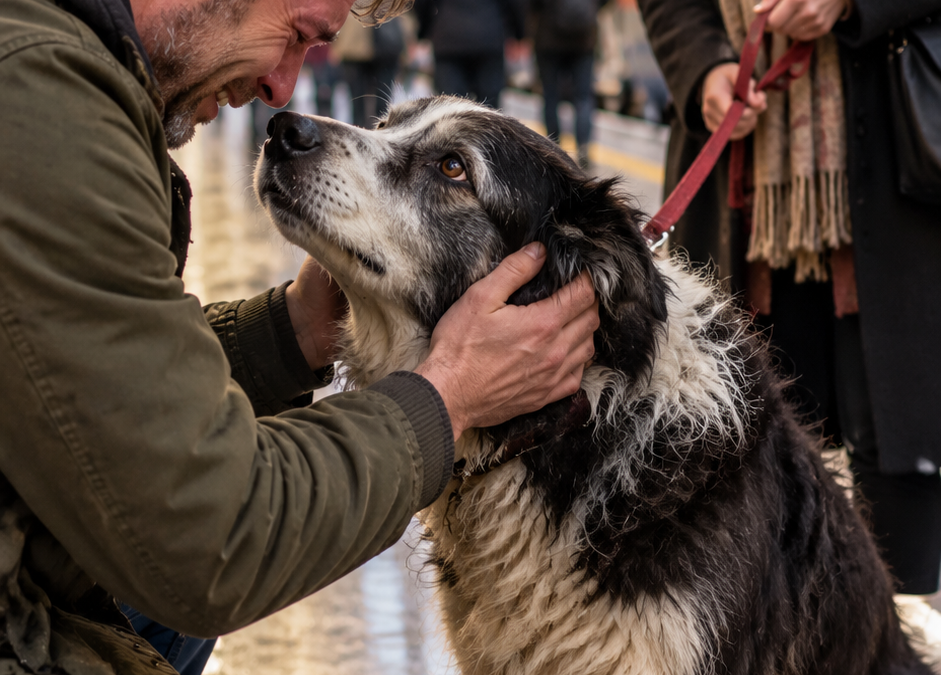
𝗙𝗨𝗟𝗟 𝗦𝗧𝗢𝗥𝗬
She studied me.
Charlie whined again.
His tail had begun moving.
Slowly at first.
Then faster.
The woman looked down.
“Ryan.”
He barely acknowledged her.
His eyes remained on me.
Something broke open inside my chest.
Ten years.
Ten years of wondering whether he was alive.
Ten years of imagining possibilities because certainty had been worse.
Hit by a car.
Sold.
Abandoned.
Locked in somebody’s yard.
Dead alone somewhere.
I had trained myself not to think about those possibilities.
But grief does not disappear when you refuse to name it.
It simply waits.
The woman looked from Charlie to me.
Then she nodded toward a bench.
“All right.”
She sat.
I sat at the opposite end.
Charlie immediately lowered himself between us.
But he did not lie the way dogs usually settle beside strangers.
He placed his body near her knees.
His eyes stayed on me.
The London Underground continued around us.
People rushed past.
A train arrived.
Doors opened.
A hundred private lives moved around us for thirty seconds and disappeared.
Another train left.
The platform shook.
But sitting on that bench, I felt as though the world had narrowed to three living beings.
Me.
The woman.
And the dog I had buried in my heart without ever knowing whether he was actually dead.
“My name is James.”
She said nothing.
“I had a dog ten years ago.”
Her fingers tightened slightly around the leash.
“He disappeared.”
She looked toward the tracks.
“I’m sorry.”
“He looked exactly like him.”
She turned back.
“A lot of border collies look alike.”
“I know.”
“I’ve had people stop me before.”
That surprised me.
“What?”
“People saying he looks like a dog they knew.”
She gave a small, defensive laugh.
“Someone once swore he belonged to her cousin.”
“I’m not saying that because of his coat.”
Her expression hardened again.
“Then why?”
I looked at Charlie.
“There’s a small scar inside his right ear.”
The woman stopped breathing for a moment.
“It’s shaped like a crescent.”
She said nothing.
“He got it when he was a puppy.”
My voice shook.
“A cat at my parents’ place cornered him behind a flowerpot. Charlie thought every living thing wanted to be his friend.”
The woman stared at me.
I continued.
“He’s afraid of sudden metallic noises. Not thunder as much as something crashing indoors. Drop a cooking pan and he’ll look for somewhere low to hide.”
Her lips parted.
“He hates apples.”
Now she looked genuinely frightened.
“But bananas…”
I smiled despite the pressure in my chest.
“He loses his mind.”
The woman’s eyes filled.
“How do you know that?”
I looked directly at her.
“Because I named him Charlie.”
Her hand moved to her mouth.
I kept going because if I stopped, I knew I might not be able to begin again.
“I got him for my eighteenth birthday.”
“You were given him?”
“No.”
I smiled faintly.
“I gave him to myself.”
That memory was so clear.
A wet road in Wales.
A little farm.
A litter of collie puppies rolling over each other inside an old wooden pen.
I had gone intending only to look.
That is the lie people tell themselves before buying animals.
Charlie had been the smallest male.
Not weak.
Just smaller.
He came toward me before the others.
Bit my shoelace.
Then fell asleep against my boot.
The elderly couple selling the litter told me he was the last one without a home.
I spent money I should have saved for university.
My father told me I was irresponsible.
He was probably right.
I did not care.
“I drove to a farm in Wales,” I told the woman. “An older couple had one puppy left.”
Charlie’s ears moved at the sound of my voice.
“He was so small I could hold him against my chest with one arm.”
The woman’s tears spilled.
I could see the answer forming before she spoke.
I did not expect the words she actually used.
“My name is Emilie.”
Her voice was almost inaudible.
She looked down at Charlie.
Then at me.
“And I’m the one who took him.”
Everything inside me stopped.
Not slowed.
Stopped.
For a second, there was no station.
No bench.
No dog.
Only one sentence.
I’m the one who took him.
“What?”
Emilie closed her eyes.
“I took him.”
My hands curled.
Ten years of searching compressed into a single instant.
Flyers.
Phone calls.
Shelters.
Online posts.
Walking streets after midnight.
Driving miles because someone saw a black-and-white dog near a motorway.
The months when every bark outside made me stand.
The years when I still checked lost-dog pages even though everyone else had accepted the obvious.
All of it.
And the person sitting beside me had simply taken him.
“You stole my dog.”
She nodded.
“Yes.”
Anger arrived late.
That made it worse.
My chest burned.
I stood.
Charlie lifted his head.
Emilie flinched.
I stepped away from the bench because I did not trust what might come out of my mouth.
“You stole him.”
“Yes.”
“You knew he belonged to someone.”
“I—”
“He had a collar.”
“Yes.”
“My phone number was on it.”
She looked down.
“The tag was damaged.”
“That doesn’t make him yours.”
“I know.”
“You know now.”
“Yes.”
“What did you know then?”
She wiped tears from her face.
“I knew I was taking a dog that wasn’t mine.”
The honesty hit harder than an excuse would have.
I laughed once.
There was no humor in it.
“Ten years.”
“I know.”
“No, you don’t.”
Charlie stood.
He moved toward me.
Emilie let the leash slide through her hand.
He reached my leg.
Sniffed my trousers.
Then pressed his head against my knee.
I stopped breathing.
My hand hovered above him.
I was afraid to touch him.
That sounds ridiculous.
I had imagined finding Charlie thousands of times.
In every version, I grabbed him.
Held him.
Cried.
Took him home.
Reality was different.
The dog leaning against me was Charlie.
But he was also someone I did not completely know anymore.
Ten years of his life existed without me.
Slowly, I placed my hand between his ears.
His eyes closed.
And the sound that came from me was not a word.
I crouched.
Charlie pushed closer.
I buried my face against his neck.
His fur smelled like rain, fabric, and dog.
Not the puppy smell I remembered.
Something older.
Warmer.
Familiar in a way that made my chest hurt.
“Hey, buddy.”
His tail struck the bench.
Again.
Again.
I laughed and cried at the same time.
“You remember me?”
He licked my cheek.
That destroyed what little control I had left.
I held him.
Ten years late.
I held him.
When I finally looked up, Emilie was crying too.
She had both hands over her mouth.
My anger returned.
“What happened?”
She lowered her hands.
“I was seventeen.”
“I was nineteen.”
“I know.”
“No, you don’t know anything about who I was.”
“You’re right.”
“Then explain.”
She nodded.
And she did.
Ten years earlier, Emilie had been seventeen and running from a home she described only as somewhere she could no longer survive.
She did not give me every detail.
I did not ask.
There are some stories you recognize without needing photographs.
A controlling stepfather.
A mother too frightened to intervene.
Years of shouting.
Things thrown.
Doors locked.
Money taken.
Fear becoming ordinary.
One night, she left.
A backpack.
A few pounds.
A change of clothes.
No real destination.
“I thought I could stay with a friend.”
“What happened?”
“Her father said no.”
“So you were on the street?”
She nodded.
“For a while.”
That afternoon, she had been standing near the row of terraced houses where I was temporarily staying.
Charlie was tied outside.
I remembered the day immediately.
I had gone into a small shop.
I was inside for less than five minutes.
When I came out, the leash remained.
Charlie did not.
I had assumed somebody cut it.
Emilie remembered differently.
“He was tied to a post.”
“A mailbox.”
She nodded.
“It was raining.”
My jaw tightened.
“I was gone for four minutes.”
“I didn’t know that.”
“You could have waited.”
“I know.”
“You could have asked someone.”
“I know.”
“You could have taken him to a shelter.”
“I know.”
Her voice broke.
“I know all of that now.”
Charlie moved back toward her.
He pressed his shoulder against her knee.
She rested her hand on him.
“I had been standing in the rain for almost an hour.”
She stared at the floor.
“I didn’t know where I was sleeping.”
Her fingers moved through his fur.
“Then he looked at me.”
I said nothing.
“It sounds stupid.”
“It doesn’t.”
She looked surprised.
Charlie had always looked at people that way.
Directly.
Like he had already forgiven them for whatever they thought they needed to hide.
“He came toward me,” Emilie said. “The leash was long enough.”
A faint smile moved across her face.
“He put both paws on my coat.”
That was Charlie.
Of course he did.
“I sat beside him.”
She swallowed.
“He licked my face.”
For a moment she stopped speaking.
“We were both wet.”
She gave a small laugh through tears.
“I told him I didn’t have anywhere to go.”
My anger had not disappeared.
But something else had entered beside it.
Understanding.
Dangerous understanding.
Emilie continued.
“I stayed there a long time.”
“How long?”
“I don’t know. Maybe twenty minutes.”
That contradicted my memory.
Or hers.
Ten years does strange things to time.
Maybe she had seen Charlie earlier.
Maybe I had been gone longer than I remembered.
It did not matter enough to fight over.
“Then I untied him.”
Her voice dropped.
“And I walked away.”
I looked at Charlie.
“You knew someone would come back.”
“Yes.”
“And you still took him.”
“Yes.”
No excuse.
No attempt to make theft sound like rescue.
Just yes.
That mattered.
“We slept in a railway station that night,” Emilie said.
“You and Charlie?”
“I called him Ryan by then.”
My chest tightened again.
“Ryan.”
She looked almost apologetic.
“I didn’t know his name.”
“Why Ryan?”
She smiled sadly.
“It meant something to me at seventeen.”
“What?”
“Light.”
Charlie sat between us.
“To me, he was light.”
She told me about that first night.
A sandwich bought with nearly the last of her money.
Half for her.
Half for Charlie.
He slept with his head across her shoes.
When security moved them along, Charlie stayed beside her.
When men approached too closely, he stood between them and Emilie.
When she cried, he leaned against her.
“He saved me, James.”
She did not say it dramatically.
That was why I believed her.
“I know that doesn’t excuse what I did.”
“No.”
“It doesn’t.”
“No.”
“I stole him.”
“Yes.”
“But that night…”
She looked at Charlie.
“I don’t know what I would have done without him.”
I sat again.
My anger had nowhere clean to go.
I wanted Emilie to be a villain.
Someone selfish.
Someone cruel.
Someone who stole a dog because she wanted one.
That would have made everything easier.
I could demand Charlie back.
Hate her.
Walk away feeling righteous.
Instead, I was sitting beside a woman who had done something wrong at seventeen while terrified and homeless, then spent ten years loving the dog she stole.
Pain is inconvenient when it belongs to someone who hurt you.
It refuses to fit where you want to put it.
“You said you went back.”
Emilie nodded quickly.
“The next morning.”
“Why?”
“Because I knew.”
“Knew what?”
“That someone might be looking for him.”
“Someone was.”
“I know.”
She wiped her face.
“I went back to the street.”
I remembered where I lived then.
A room rented from a friend’s older brother.
Not home.
Temporary.
I had moved the evening Charlie disappeared.
Not because of Charlie.
A housing problem.
The landlord was selling.
I spent that night searching instead of packing.
By morning, most of my belongings were already in a friend’s car.
Emilie had returned after I left.
“I asked a woman nearby,” she said. “She said a young man had been staying there.”
“That was me.”
“She said you’d moved.”
“I had.”
“I looked for posters.”
“They went up later.”
“I checked shelters.”
“Which ones?”
She named two.
I had contacted both.
Our searches had missed each other by days.
“I thought maybe he had run away before.”
“He didn’t.”
“I know.”
“You thought I abandoned him.”
Emilie looked ashamed.
“I convinced myself.”
“Why?”
“Because I needed to.”
That answer made me angry again.
“You needed me to be a bad owner.”
“Yes.”
“So you could keep him.”
“Yes.”
At least she knew.
“I told myself that if somebody really loved him, there would be posters everywhere immediately.”
“I was nineteen years old.”
“I know.”
“I didn’t have money for hundreds of flyers.”
“I know.”
“I walked until my feet bled looking for him.”
She started crying harder.
“I know.”
“No, you know now.”
“Yes.”
I leaned forward.
“I searched shelters for years.”
“I’m sorry.”
“I followed fake sightings.”
“I’m sorry.”
“One man told me there was a dead collie beside a highway eighty miles away.”
Emilie closed her eyes.
“I drove there.”
Charlie put his head against my leg.
“It wasn’t him.”
I looked down.
“For years, every time I saw a black-and-white dog, my heart stopped.”
Emilie whispered:
“I’m sorry.”
The words were not enough.
No words could be.
But sometimes an apology is not meant to erase the damage.
Sometimes it is simply the only honest thing left.
“I believe you.”
Her eyes opened.
“I’m still angry.”
“You should be.”
“I don’t know if I can forgive you.”
“You don’t have to.”
Charlie suddenly stood.
He came to me.
Placed one paw on my knee.
Then turned.
Walked to Emilie.
Placed one paw against her leg.
I laughed through tears.
Emilie did too.
“He does that.”
“He always did.”
“When?”
“Whenever two people were arguing.”
She looked at me.
“He still does.”
Charlie looked between us.
Tail moving.
He had never liked tension.
As a puppy, if my parents argued, he would bring them a toy.
Apparently age had made him subtler.
“He remembers you,” Emilie said.
I looked at Charlie.
“How can you know?”
“He doesn’t approach strangers.”
“He approached you.”
“That was different.”
I almost smiled.
She continued.
“He’s friendly, but cautious. Especially with men.”
Charlie leaned against me again.
“When you said his name…”
Emilie’s voice broke.
“I’ve never seen him move like that.”
I pressed my hand against his chest.
His heartbeat was slower than I remembered.
Age again.
“He waited.”
“For what?”
“You.”
I closed my eyes.
That sentence hurt too much.
We stayed on the bench until the crowd thinned.
Eventually, I asked Emilie the question I had been afraid to ask.
“What happens now?”
She looked at me.
“I don’t know.”
Legally, perhaps there were answers.
Dogs are property under many legal systems.
Ownership records matter.
Microchips.
Purchase receipts.
Theft.
Time.
But sitting there, none of those things felt large enough.
I could probably prove Charlie had originally belonged to me.
I still had old photographs.
Veterinary records.
Purchase paperwork somewhere.
Maybe the original microchip record if it had not been changed.
But Charlie was not a bicycle someone stole and repainted.
He was alive.
He had memories.
Attachments.
Routine.
An old body.
A woman who had spent ten years being his family.
“I don’t want to take him away from you.”
Emilie stared at me.
“What?”
The sentence surprised me too.
“I don’t want to take him away.”
“But he’s yours.”
“He was.”
“No.”
She shook her head.
“He still is.”
I looked at her.
“And he’s yours.”
Her mouth trembled.
“I stole him.”
“Yes.”
“You should hate me.”
“Part of me does.”
She flinched.
“I’m sorry.”
“I’m not saying that to hurt you.”
“I know.”
“I’m saying it because I don’t want to pretend this suddenly became beautiful.”
She nodded.
“It didn’t.”
“No.”
Charlie lay down again.
I rested my forearms against my knees.
“You gave him a home.”
Emilie said nothing.
“You took care of him.”
“Yes.”
“Vet?”
“Every year.”
“Health problems?”
“Arthritis now.”
I nodded.
“I noticed.”
“And a heart murmur.”
That frightened me immediately.
“How bad?”
“Managed.”
“What medication?”
She told me.
The names meant nothing.
I memorized them anyway.
“He had surgery six years ago.”
“For what?”
“A blockage.”
My stomach twisted.
“Was he okay?”
“He almost died.”
Her eyes filled again.
“I slept on the floor beside him for three nights.”
There it was.
Ten years of a life I had not witnessed.
Illness.
Walks.
Birthdays.
Vet appointments.
Sea trips.
Rain.
Nights.
Food.
Fear.
Love.
My grief had frozen Charlie at two years old.
Emilie had lived the years that came after.
“You gave him what I couldn’t.”
She looked at me.
“I took the chance from you.”
“Yes.”
“But you gave it to him.”
Her face collapsed.
I reached across the space between us.
Not to hug her.
Not yet.
I put my hand over hers.
“You gave him a family.”
She cried silently.
“So did you.”
Maybe that was when something began changing between us.
Not forgiveness.
Something more practical.
Recognition.
Two people sitting on opposite sides of the same dog.
Each carrying a different wound.
Each convinced for years that Charlie belonged inside a story only they understood.
“Where do you live?” Emilie asked.
“In London.”
Her eyebrows lifted.
“So do I.”
“How far?”
“Ten minutes from here.”
I laughed.
Ten years apart.
Ten minutes away.
Life has a cruel sense of proportion.
“What do you do?” I asked.
“I’m a nurse.”
That somehow did not surprise me.
“Hospital?”
She nodded.
“I finished school seven years ago.”
“You went back to school after…”
“Everything.”
She looked at Charlie.
“Because of him.”
“How?”
“When I was seventeen, I thought my life was over.”
Her hand rested on his back.
“Then I had this creature depending on me.”
Charlie sighed.
“I had to feed him.”
She smiled faintly.
“Then I needed somewhere warm because he needed somewhere warm.”
She found temporary housing.
Then work.
Then stable housing.
Finished school.
Applied for nursing training.
Worked nights.
Studied.
Charlie remained beside her through all of it.
“He gave me routine,” she said.
I understood.
Dogs are good at saving people in ways that do not look dramatic.
Wake up.
Go outside.
Eat.
Come home.
Someone is waiting.
Repeat.
Sometimes survival is only that.
A series of small obligations that carry you far enough away from the night you thought you could not survive.
“What about you?” Emilie asked.
“What about me?”
“The last ten years.”
I looked toward the tunnel.
“I lived.”
“That sounded convincing.”
I smiled.
“I tried.”
I had relationships.
Jobs.
Moved apartments.
Lost my father.
Changed careers.
Built a life.
But somewhere inside it remained a small unfinished room containing Charlie.
I rarely entered it anymore.
Finding him had opened the door.
“I never got another dog.”
Emilie looked surprised.
“Why?”
“I told people I was too busy.”
“And really?”
“I think part of me felt like I’d be replacing him.”
She stroked Charlie.
“You never stopped loving him.”
“No.”
Charlie opened one eye.
“Apparently neither did he.”
We sat until the station lights changed.
Evening arriving.
Eventually Emilie said:
“I have an idea.”
I looked at her.
“You might hate it.”
“Go ahead.”
“We share him.”
I stared.
She hurried on.
“I know that sounds ridiculous.”
“A little.”
“You live here.”
“Yes.”
“I live here.”
“Yes.”
“He remembers you.”
Apparently.
“He loves me.”
Clearly.
She took a breath.
“So why do we decide one of us has to lose him?”
I looked at Charlie.
He looked deeply uninterested in the legal and emotional complexity of his situation.
“You mean visits?”
“Walks.”
“Visits.”
“Weekends sometimes.”
“Emilie.”
“I’m serious.”
She leaned closer.
“I stole ten years from you.”
I looked away.
“I can’t return them.”
“No.”
“But I can stop stealing the rest.”
That sentence changed everything.
I looked at her.
She extended her hand.
“Let him have both of us.”
My vision blurred.
Charlie stood before I could answer.
His tail began hitting the bench.
Emilie laughed.
“He votes yes.”
I took her hand.
“All right.”
“All right?”
“All right.”
Charlie barked.
One short, bright bark.
Several people on the platform turned.
A child smiled.
For the first time since recognizing him, I felt something besides grief, anger, or disbelief.
Hope.
The following Saturday, we met in Hyde Park.
I arrived fifteen minutes early.
I pretended I had simply misjudged the train.
Emilie pretended to believe me.
Charlie did not pretend anything.
The moment he saw me, he pulled the leash from her hand.
He ran.
Not fast.
His old legs could not manage fast anymore.
But determined.
He reached me.
I crouched.
“Hey, buddy.”
He pushed into my arms.
Emilie stood several yards away smiling.
That became our first walk.
Charlie moved ahead.
Then stopped.
Looked back.
Waited until we were both beside him.
Then continued.
Every few minutes, he checked again.
“He does that now,” Emilie said.
“Did he before?”
“No.”
I looked at Charlie.
“Controlling.”
“Definitely.”
We talked.
Not about the theft at first.
About Charlie.
His habits.
His health.
What food he could eat.
Which veterinarian he saw.
His favorite park.
The blanket he refused to sleep without.
How he still hated apples.
How he had once stolen six bananas from a grocery bag and hidden three behind a sofa cushion.
“That sounds like him.”
“You taught him this.”
“I did not teach him theft.”
Emilie raised an eyebrow.
We both froze.
The joke had appeared before either of us could stop it.
Then Emilie laughed.
I did too.
It was uncomfortable.
Then freeing.
Healing sometimes begins in places too awkward to qualify as profound.
A week later, Emilie invited me to her apartment.
I almost said no.
Then I realized I wanted to see Charlie’s life.
The apartment was small.
Warm.
Plants near the windows.
Books stacked beside the sofa.
Dog bed near the radiator.
And photographs.
Charlie everywhere.
As a young dog beside Emilie on a beach.
Charlie wearing a ridiculous birthday hat.
Charlie asleep beneath a Christmas tree.
Charlie after surgery with his side shaved.
Charlie in the snow.
Charlie beside Emilie on the day she graduated from nursing school.
I stopped in front of that one.
She wore a dark graduation gown.
Charlie sat beside her.
His muzzle only beginning to gray.
“You brought him?”
“He waited outside with a friend.”
“You look happy.”
“I was.”
I studied the photographs.
Ten years I had lost.
But not ten wasted years.
That difference mattered.
“You gave him a beautiful life.”
Emilie stood beside me.
“No.”
She looked at Charlie.
“He gave me one.”
Our arrangement became routine.
I walked Charlie on Wednesdays.
Longer visits Saturdays.
Sometimes Emilie came.
Sometimes she worked hospital shifts and I had him alone.
The first time she left him at my apartment, both of us were nervous.
“You have the medication schedule?”
“Yes.”
“Food?”
“Yes.”
“No stairs if you can avoid it.”
“I know.”
“And if he starts coughing—”
“Call you.”
“And the vet.”
“Emilie.”
“What?”
“I can take care of a dog.”
She went quiet.
The sentence had landed badly.
“I’m sorry.”
“No, I…”
She looked away.
“I know.”
I touched her shoulder.
“You took care of him for ten years.”
She looked at me.
“I know that too.”
That became part of our relationship.
Learning not to weaponize the past accidentally.
Sometimes I resented her.
Sometimes she drowned in guilt.
Sometimes I would learn a story about Charlie’s life and feel jealousy so sharp I had to leave the room.
Once she mentioned his seventh birthday.
A camping trip.
Charlie slept inside the tent.
I suddenly became furious.
Not because she had done anything wrong that year.
Because I should have been there.
I walked onto her balcony.
She followed.
“You’re angry.”
“Yes.”
“At me?”
“Yes.”
She nodded.
“Okay.”
That surprised me.
“You’re not going to defend yourself?”
“No.”
“Why?”
“Because you missed that birthday because of me.”
I leaned against the railing.
“You were seventeen.”
“Then.”
“You’re thirty-five now.”
“Yes.”
“You were a scared kid.”
“Yes.”
“You still stole him.”
“Yes.”
I closed my eyes.
“I hate that both things can be true.”
“So do I.”
She stood beside me.
“I’m not asking you to make what I did okay.”
“I know.”
“Because it wasn’t.”
That honesty made forgiveness possible in ways excuses never could.
Months passed.
Charlie adapted instantly.
He had two beds.
Two food bowls.
Two sets of medications.
Two humans who argued about whether he was gaining weight.
Emilie called him Ryan.
I called him Charlie.
At first I thought that might confuse him.
It did not.
Dogs are less obsessed with names than humans.
He knew tone.
Hands.
Footsteps.
Smell.
He knew us.
Sometimes Emilie tried calling him Charlie.
I tried Ryan once.
It felt wrong.
She laughed.
“Don’t.”
“I agree.”
So he remained both.
Charlie to me.
Ryan to her.
A dog with two names and one life.
Our friendship grew around him.
Slowly.
Carefully.
I learned why Emilie became a nurse.
She wanted to become the kind of person she had needed at seventeen.
Someone who entered frightened rooms and did not make fear worse.
She learned why I had never married.
Not because of Charlie.
Life simply went that way.
There had been people.
Nothing stayed.
“You’re difficult,” she told me once.
“You stole my dog.”
“That was seventeen-year-old me.”
“You’re still difficult.”
“True.”
Charlie looked between us.
“Don’t start,” we said together.
He wagged his tail.
Years of friendship developed from that impossible morning underground.
There were birthdays.
Christmas walks.
Vet appointments.
Rainy afternoons.
Summer picnics.
Charlie became slower.
His muzzle turned completely white.
The heart murmur worsened.
Arthritis medication increased.
He could no longer jump into a car.
I bought a ramp.
Emilie mocked me because I spent three days researching ramps.
“You are aware he weighs twenty-three kilos, not two hundred?”
“It needs proper load capacity.”
“It is a dog ramp.”
“Exactly.”
Charlie refused to use it.
We stood in a parking lot for twenty minutes.
Emilie looked at me.
“Excellent engineering.”
“Give him time.”
She placed a piece of banana at the top.
Charlie immediately walked up.
I stared.
She smiled.
“Ten years.”
I pointed at her.
“Do not.”
We laughed until people looked at us.
One evening, five years after we reunited, Charlie collapsed during a walk.
Emilie called me from the emergency veterinary clinic.
I arrived before she finished speaking to reception.
His heart condition had progressed.
There were options.
Medication.
Monitoring.
Time.
But not unlimited time.
Charlie came home.
Our routine changed.
Short walks.
More rest.
Fewer stairs.
More ridiculous dietary negotiations.
We stopped thinking in years.
Then months.
Then good days.
That is another thing animals teach you.
Humans live almost entirely in imagined futures.
Dogs live in this afternoon.
Sunlight on carpet.
Food.
Someone you love nearby.
Maybe that is why their shorter lives destroy us.
They understand time better.
One Sunday, Emilie and I took Charlie to Hyde Park.
The same route as our first shared walk.
He could not walk far.
We brought a small wagon.
He hated it initially.
Then realized it required no effort.
Royalty suited him.
We sat beneath a tree.
Charlie lay between us.
Emilie stroked his white muzzle.
“Do you ever think about that day?”
“The station?”
“No.”
She looked toward him.
“The day I took him.”
“All the time.”
“Still?”
“Yes.”
She nodded.
“I do too.”
Silence.
Then she asked:
“Do you forgive me?”
I had known that question would come eventually.
Maybe she had been waiting years.
I looked at Charlie.
My answer surprised me with how simple it had become.
“Yes.”
Emilie’s eyes filled.
“I don’t mean what you did was okay.”
“I know.”
“I don’t mean I’m glad I lost him.”
“I know.”
“I’m not grateful for those ten years.”
“You shouldn’t be.”
I looked at her.
“But I forgive you.”
She cried.
Quietly.
Charlie opened one eye.
“Look what you did,” I told her.
She laughed through tears.
“He’s judging me.”
“He has always been judgmental.”
Emilie rested her head against my shoulder.
For a while, we watched people cross the grass.
Then I said something I had avoided for years.
“Maybe he did save you.”
She looked at me.
“I know he did.”
“No.”
I touched Charlie’s back.
“I mean maybe I can finally be glad that part happened.”
Her face changed.
Not relief.
Something deeper.
“I’m sorry it cost you so much.”
“I know.”
Charlie died the following winter.
Not suddenly.
I almost wish it had been.
There is mercy in not watching a body slowly become too tired for the life inside it.
But there is mercy in choosing the ending too.
The vet told us when the time had come.
Emilie called me.
I already knew from her voice.
We took him to her apartment because that had been his primary home for most of his life.
His blanket was near the radiator.
I sat on the floor.
Emilie sat beside me.
Charlie lay across both our legs.
He was tired.
So tired.
But calm.
I brought a banana.
Of course.
He ate three small pieces.
Refused the fourth.
“That’s how we know,” Emilie whispered.
I nodded.
The veterinarian arrived.
She explained everything.
I barely heard.
I held Charlie’s head.
Emilie held his paw.
“I love you, Ryan,” she whispered.
I pressed my forehead against his.
“I love you, Charlie.”
His eyes moved between us.
For one second, I imagined that station again.
The bench.
The trains.
His paw touching my knee.
Then Emilie’s.
Both of us.
His family.
“Good boy.”
His breathing slowed.
Then stopped.
No revelation.
No miracle.
Just silence.
Emilie collapsed against me.
I held her.
We cried over the dog she had stolen from me.
The dog who had saved her.
The dog I had found again.
The dog who somehow transformed the worst thing she had ever done into the reason the three of us eventually became a family.
Afterward, we divided nothing.
That mattered.
No fight over ashes.
No argument about collar.
No question about whose grief mattered more.
We had him cremated.
Half the ashes went with Emilie.
Half with me.
His old collar remained in her apartment.
I kept the original puppy photograph from Wales.
We scattered a small amount of his ashes in Hyde Park.
Another small amount near the coast where Emilie had taken him years earlier.
The rest stayed with us.
Weeks later, I went to Emilie’s apartment.
The dog bed was still beside the radiator.
Empty.
I stood in the doorway staring at it.
“I can move it,” she said.
“Not because of me.”
“I can’t move it because of me.”
“I understand.”
We sat on the floor.
Exactly where we had sat with Charlie.
“Ten years ago,” Emilie said, “I thought stealing him saved my life.”
I looked at her.
“It probably did.”
“I hated myself for that after I met you.”
“I know.”
“I kept thinking I had built my entire life on something cruel.”
“You built your life after doing something wrong.”
“Is that different?”
“Yes.”
“How?”
“Because people aren’t only the worst thing they’ve done.”
She looked at me.
“That sounds like something a nurse should say.”
“I had a good teacher.”
Months passed.
Our weekly walks continued.
At first without meaning to.
One Saturday, Emilie called.
“You doing anything?”
“No.”
“Hyde Park?”
I hesitated.
“Without him?”
“Yes.”
So we went.
The first walk was unbearable.
Every dog looked like Charlie.
Every black-and-white coat turned my head.
We followed the same path.
At the place where he used to stop and check whether we were both behind him, Emilie started crying.
I did too.
We kept walking.
That became our new ritual.
Not every week.
But often.
Charlie had spent years ensuring neither of us disappeared from the group.
Apparently death did not change his ability to organize people.
Today, Emilie is still one of my closest friends.
People sometimes ask how we met.
We never know how to answer.
“She stole my dog” makes dinner parties uncomfortable.
“I found my missing dog with her ten years later” creates too many questions.
So usually Emilie says:
“Charlie introduced us.”
That is true enough.
I still have moments when the old anger returns.
Less often.
Usually unexpectedly.
A lost-dog poster.
A leash tied outside a shop.
Someone saying, “It’s only a dog.”
Those words still make something cold move through me.
It was never only a dog.
Charlie was part of the person I became.
Then he was part of the person Emilie became.
For ten years, I believed losing him meant his story had been stolen from mine.
I was wrong about that.
His story became larger than me.
That does not make the theft right.
I need that distinction.
Loss does not become good simply because something meaningful grows afterward.
Pain does not become necessary because people eventually survive it.
Emilie did something wrong.
I suffered because of it.
She knows that.
I know that.
Forgiveness did not require us to rewrite history.
It required us to stop letting history decide every future moment.
That is what Charlie understood without understanding anything.
When he found us on opposite sides of that bench, he did not choose.
He came to me.
Returned to Emilie.
Touched both of us.
Then lay between us.
Humans want love to behave like ownership.
Mine.
Yours.
Rightful.
Stolen.
Returned.
Dogs make those categories look small.
Charlie loved me.
Charlie loved Emilie.
One truth did not erase the other.
I spent years imagining that finding him would give me back what I lost.
It did not.
I could never get those ten years back.
I never saw his middle-aged face become gray.
Never sat beside him after surgery.
Never watched him become Emilie’s companion through nursing school.
I lost those things.
That remains true.
But finding him gave me something I had never imagined.
I got to know who he became.
I got to see the photographs.
Hear the stories.
Learn his medications.
Walk beside him again.
Hold him at the end.
I got to tell him goodbye.
For ten years, that was the thing grief had denied me most.
An ending.
Now I had one.
Not the ending I would have chosen.
A real one.
Sometimes I still dream about the station.
Not exactly as it happened.
In the dream, Charlie is young again.
No gray muzzle.
No arthritis.
He stands at the far end of the platform.
Emilie is beside me.
The train doors open.
Charlie runs toward us.
Always us.
Never only me.
When I wake, the first emotion is sadness.
Then gratitude.
On my desk there is a photograph Emilie gave me after Charlie died.
It was taken about a year after our reunion.
Hyde Park.
Charlie in the middle.
Me on one side.
Emilie on the other.
He is looking at the camera.
We are looking at him.
That feels appropriate.
On the back Emilie wrote:
Two names. Two homes. One very stubborn dog.
Underneath, I added:
Worth waiting ten years for.
I used to believe family was created by blood, marriage, ownership, or history.
Now I think sometimes family is simply whoever keeps showing up after they are given every reason to leave.
Emilie could have disappeared when I recognized Charlie.
She did not.
I could have taken him and made her loss repayment for mine.
I did not.
Charlie could have forgotten me.
He did not.
None of us received the story we would have chosen.
But for the years we had left, we chose what happened next.
That has become enough.
Ten years after Charlie disappeared, I found him beside a stranger in an underground station.
I thought I was about to reclaim something stolen from me.
Instead, I discovered that love had been living an entire life without my permission.
It had kept a frightened seventeen-year-old girl alive.
Helped her become a nurse.
Carried an old dog safely into his final years.
And somehow, impossibly, found its way back to me.
Charlie had spent ten years belonging to two stories.
In the end, neither of us had to destroy the other story to keep loving him.
We simply made room.
And when I think of him now, I no longer see the empty leash I found ten years earlier.
I see an old border collie standing between two people on a London platform, touching one knee and then the other, impatiently waiting for the humans to understand what he already knew.
There was enough love for both of us.
𝗧𝗛𝗘 𝗘𝗡𝗗
The Dog Beside the Stranger Looked at Me Like Ten Years Had Never Happened
The dog beside the stranger lifted his head when I whispered a name no one in that station should have known.
Ten years had passed since he disappeared from my life, long enough for everyone around me to stop believing I would ever find him.
But when those familiar brown eyes met mine across a crowded London platform, every year between us seemed to vanish at once.
“Charlie?”
I barely said it.
The station was loud enough that I should have disappeared beneath the noise.
A train was approaching somewhere inside the tunnel. Shoes struck tile. An announcement crackled through the speakers. Someone dragged a suitcase behind me.
But the dog heard me.
His ears lifted.
His whole body went still.
The woman holding his leash looked down at him.
Then he stood.
For one strange second, neither of us moved.
He had changed.
Of course he had.
The young border collie I remembered had been all energy and bright eyes, black-and-white fur constantly in motion, legs too fast for the rest of him.
The dog in front of me was old.
White had spread across his muzzle.
His shoulders were narrower.
His movements carried the caution of age.
There was stiffness in his back legs when he shifted his weight.
But I knew him.
There are things time cannot disguise from someone who loved them.
The small white patch above his left eye.
The slight bend in the tip of one ear.
The habit of holding his head a little to the right when he was confused.
My throat closed.
“Charlie.”
This time I said it louder.
The leash snapped tight.
He pulled toward me.
The woman nearly lost her balance.
“Ryan!”
She tightened her grip.
The dog whined.
Not barked.
Whined.
It was a sound I had not heard in ten years.
A sound that had once greeted me every evening when I came home.
My knees almost gave out.
“Charlie.”
He pulled harder.
The woman stared at me.
“Do you know my dog?”
I looked at her.
Then at him.
My dog.
Her dog.
Those two thoughts collided so violently inside me that for several seconds I could not answer.
Charlie strained toward me again.
The woman shortened the leash.
“Sir?”
I stepped forward.
She stepped back.
That stopped me immediately.
I raised both hands.
“I’m sorry.”
Her face had changed.
Fear.
Suspicion.
Something protective.
“I don’t want to frighten you.”
“Then why are you calling my dog Charlie?”
Because he is Charlie.
The words rose into my mouth.
I almost said them.
Then I looked at her properly.
Mid-thirties.
Thin face.
Dark coat.
Hair pulled loosely behind her head.
There were shadows beneath her eyes, the kind people carry after too many long hospital shifts or too many nights spent worrying.
But it was not exhaustion that made me stop.
It was the way she looked at the dog.
Her hand had gone instinctively to his shoulder.
Her thumb moved slowly through his fur.
Not ownership.
Love.
Real love.
I knew that kind of touch.
I had done it myself thousands of times.
I swallowed.
“Please.”
My voice came out quieter than I intended.
“Can I explain something?”
She studied me.
Charlie whined again.
His tail had begun moving.
Slowly at first.
Then faster.
The woman looked down.
“Ryan.”
He barely acknowledged her.
His eyes remained on me.
Something broke open inside my chest.
Ten years.
Ten years of wondering whether he was alive.
Ten years of imagining possibilities because certainty had been worse.
Hit by a car.
Sold.
Abandoned.
Locked in somebody’s yard.
Dead alone somewhere.
I had trained myself not to think about those possibilities.
But grief does not disappear when you refuse to name it.
It simply waits.
The woman looked from Charlie to me.
Then she nodded toward a bench.
“All right.”
She sat.
I sat at the opposite end.
Charlie immediately lowered himself between us.
But he did not lie the way dogs usually settle beside strangers.
He placed his body near her knees.
His eyes stayed on me.
The London Underground continued around us.
People rushed past.
A train arrived.
Doors opened.
A hundred private lives moved around us for thirty seconds and disappeared.
Another train left.
The platform shook.
But sitting on that bench, I felt as though the world had narrowed to three living beings.
Me.
The woman.
And the dog I had buried in my heart without ever knowing whether he was actually dead.
“My name is James.”
She said nothing.
“I had a dog ten years ago.”
Her fingers tightened slightly around the leash.
“He disappeared.”
She looked toward the tracks.
“I’m sorry.”
“He looked exactly like him.”
She turned back.
“A lot of border collies look alike.”
“I know.”
“I’ve had people stop me before.”
That surprised me.
“What?”
“People saying he looks like a dog they knew.”
She gave a small, defensive laugh.
“Someone once swore he belonged to her cousin.”
“I’m not saying that because of his coat.”
Her expression hardened again.
“Then why?”
I looked at Charlie.
“There’s a small scar inside his right ear.”
The woman stopped breathing for a moment.
“It’s shaped like a crescent.”
She said nothing.
“He got it when he was a puppy.”
My voice shook.
“A cat at my parents’ place cornered him behind a flowerpot. Charlie thought every living thing wanted to be his friend.”
The woman stared at me.
I continued.
“He’s afraid of sudden metallic noises. Not thunder as much as something crashing indoors. Drop a cooking pan and he’ll look for somewhere low to hide.”
Her lips parted.
“He hates apples.”
Now she looked genuinely frightened.
“But bananas…”
I smiled despite the pressure in my chest.
“He loses his mind.”
The woman’s eyes filled.
“How do you know that?”
I looked directly at her.
“Because I named him Charlie.”
Her hand moved to her mouth.
I kept going because if I stopped, I knew I might not be able to begin again.
“I got him for my eighteenth birthday.”
“You were given him?”
“No.”
I smiled faintly.
“I gave him to myself.”
That memory was so clear.
A wet road in Wales.
A little farm.
A litter of collie puppies rolling over each other inside an old wooden pen.
I had gone intending only to look.
That is the lie people tell themselves before buying animals.
Charlie had been the smallest male.
Not weak.
Just smaller.
He came toward me before the others.
Bit my shoelace.
Then fell asleep against my boot.
The elderly couple selling the litter told me he was the last one without a home.
I spent money I should have saved for university.
My father told me I was irresponsible.
He was probably right.
I did not care.
“I drove to a farm in Wales,” I told the woman. “An older couple had one puppy left.”
Charlie’s ears moved at the sound of my voice.
“He was so small I could hold him against my chest with one arm.”
The woman’s tears spilled.
I could see the answer forming before she spoke.
I did not expect the words she actually used.
“My name is Emilie.”
Her voice was almost inaudible.
She looked down at Charlie.
Then at me.
“And I’m the one who took him.”
Everything inside me stopped.
Not slowed.
Stopped.
For a second, there was no station.
No bench.
No dog.
Only one sentence.
I’m the one who took him.
“What?”
Emilie closed her eyes.
“I took him.”
My hands curled.
Ten years of searching compressed into a single instant.
Flyers.
Phone calls.
Shelters.
Online posts.
Walking streets after midnight.
Driving miles because someone saw a black-and-white dog near a motorway.
The months when every bark outside made me stand.
The years when I still checked lost-dog pages even though everyone else had accepted the obvious.
All of it.
And the person sitting beside me had simply taken him.
“You stole my dog.”
She nodded.
“Yes.”
Anger arrived late.
That made it worse.
My chest burned.
I stood.
Charlie lifted his head.
Emilie flinched.
I stepped away from the bench because I did not trust what might come out of my mouth.
“You stole him.”
“Yes.”
“You knew he belonged to someone.”
“I—”
“He had a collar.”
“Yes.”
“My phone number was on it.”
She looked down.
“The tag was damaged.”
“That doesn’t make him yours.”
“I know.”
“You know now.”
“Yes.”
“What did you know then?”
She wiped tears from her face.
“I knew I was taking a dog that wasn’t mine.”
The honesty hit harder than an excuse would have.
I laughed once.
There was no humor in it.
“Ten years.”
“I know.”
“No, you don’t.”
Charlie stood.
He moved toward me.
Emilie let the leash slide through her hand.
He reached my leg.
Sniffed my trousers.
Then pressed his head against my knee.
I stopped breathing.
My hand hovered above him.
I was afraid to touch him.
That sounds ridiculous.
I had imagined finding Charlie thousands of times.
In every version, I grabbed him.
Held him.
Cried.
Took him home.
Reality was different.
The dog leaning against me was Charlie.
But he was also someone I did not completely know anymore.
Ten years of his life existed without me.
Slowly, I placed my hand between his ears.
His eyes closed.
And the sound that came from me was not a word.
I crouched.
Charlie pushed closer.
I buried my face against his neck.
His fur smelled like rain, fabric, and dog.
Not the puppy smell I remembered.
Something older.
Warmer.
Familiar in a way that made my chest hurt.
“Hey, buddy.”
His tail struck the bench.
Again.
Again.
I laughed and cried at the same time.
“You remember me?”
He licked my cheek.
That destroyed what little control I had left.
I held him.
Ten years late.
I held him.
When I finally looked up, Emilie was crying too.
She had both hands over her mouth.
My anger returned.
“What happened?”
She lowered her hands.
“I was seventeen.”
“I was nineteen.”
“I know.”
“No, you don’t know anything about who I was.”
“You’re right.”
“Then explain.”
She nodded.
And she did.
Ten years earlier, Emilie had been seventeen and running from a home she described only as somewhere she could no longer survive.
She did not give me every detail.
I did not ask.
There are some stories you recognize without needing photographs.
A controlling stepfather.
A mother too frightened to intervene.
Years of shouting.
Things thrown.
Doors locked.
Money taken.
Fear becoming ordinary.
One night, she left.
A backpack.
A few pounds.
A change of clothes.
No real destination.
“I thought I could stay with a friend.”
“What happened?”
“Her father said no.”
“So you were on the street?”
She nodded.
“For a while.”
That afternoon, she had been standing near the row of terraced houses where I was temporarily staying.
Charlie was tied outside.
I remembered the day immediately.
I had gone into a small shop.
I was inside for less than five minutes.
When I came out, the leash remained.
Charlie did not.
I had assumed somebody cut it.
Emilie remembered differently.
“He was tied to a post.”
“A mailbox.”
She nodded.
“It was raining.”
My jaw tightened.
“I was gone for four minutes.”
“I didn’t know that.”
“You could have waited.”
“I know.”
“You could have asked someone.”
“I know.”
“You could have taken him to a shelter.”
“I know.”
Her voice broke.
“I know all of that now.”
Charlie moved back toward her.
He pressed his shoulder against her knee.
She rested her hand on him.
“I had been standing in the rain for almost an hour.”
She stared at the floor.
“I didn’t know where I was sleeping.”
Her fingers moved through his fur.
“Then he looked at me.”
I said nothing.
“It sounds stupid.”
“It doesn’t.”
She looked surprised.
Charlie had always looked at people that way.
Directly.
Like he had already forgiven them for whatever they thought they needed to hide.
“He came toward me,” Emilie said. “The leash was long enough.”
A faint smile moved across her face.
“He put both paws on my coat.”
That was Charlie.
Of course he did.
“I sat beside him.”
She swallowed.
“He licked my face.”
For a moment she stopped speaking.
“We were both wet.”
She gave a small laugh through tears.
“I told him I didn’t have anywhere to go.”
My anger had not disappeared.
But something else had entered beside it.
Understanding.
Dangerous understanding.
Emilie continued.
“I stayed there a long time.”
“How long?”
“I don’t know. Maybe twenty minutes.”
That contradicted my memory.
Or hers.
Ten years does strange things to time.
Maybe she had seen Charlie earlier.
Maybe I had been gone longer than I remembered.
It did not matter enough to fight over.
“Then I untied him.”
Her voice dropped.
“And I walked away.”
I looked at Charlie.
“You knew someone would come back.”
“Yes.”
“And you still took him.”
“Yes.”
No excuse.
No attempt to make theft sound like rescue.
Just yes.
That mattered.
“We slept in a railway station that night,” Emilie said.
“You and Charlie?”
“I called him Ryan by then.”
My chest tightened again.
“Ryan.”
She looked almost apologetic.
“I didn’t know his name.”
“Why Ryan?”
She smiled sadly.
“It meant something to me at seventeen.”
“What?”
“Light.”
Charlie sat between us.
“To me, he was light.”
She told me about that first night.
A sandwich bought with nearly the last of her money.
Half for her.
Half for Charlie.
He slept with his head across her shoes.
When security moved them along, Charlie stayed beside her.
When men approached too closely, he stood between them and Emilie.
When she cried, he leaned against her.
“He saved me, James.”
She did not say it dramatically.
That was why I believed her.
“I know that doesn’t excuse what I did.”
“No.”
“It doesn’t.”
“No.”
“I stole him.”
“Yes.”
“But that night…”
She looked at Charlie.
“I don’t know what I would have done without him.”
I sat again.
My anger had nowhere clean to go.
I wanted Emilie to be a villain.
Someone selfish.
Someone cruel.
Someone who stole a dog because she wanted one.
That would have made everything easier.
I could demand Charlie back.
Hate her.
Walk away feeling righteous.
Instead, I was sitting beside a woman who had done something wrong at seventeen while terrified and homeless, then spent ten years loving the dog she stole.
Pain is inconvenient when it belongs to someone who hurt you.
It refuses to fit where you want to put it.
“You said you went back.”
Emilie nodded quickly.
“The next morning.”
“Why?”
“Because I knew.”
“Knew what?”
“That someone might be looking for him.”
“Someone was.”
“I know.”
She wiped her face.
“I went back to the street.”
I remembered where I lived then.
A room rented from a friend’s older brother.
Not home.
Temporary.
I had moved the evening Charlie disappeared.
Not because of Charlie.
A housing problem.
The landlord was selling.
I spent that night searching instead of packing.
By morning, most of my belongings were already in a friend’s car.
Emilie had returned after I left.
“I asked a woman nearby,” she said. “She said a young man had been staying there.”
“That was me.”
“She said you’d moved.”
“I had.”
“I looked for posters.”
“They went up later.”
“I checked shelters.”
“Which ones?”
She named two.
I had contacted both.
Our searches had missed each other by days.
“I thought maybe he had run away before.”
“He didn’t.”
“I know.”
“You thought I abandoned him.”
Emilie looked ashamed.
“I convinced myself.”
“Why?”
“Because I needed to.”
That answer made me angry again.
“You needed me to be a bad owner.”
“Yes.”
“So you could keep him.”
“Yes.”
At least she knew.
“I told myself that if somebody really loved him, there would be posters everywhere immediately.”
“I was nineteen years old.”
“I know.”
“I didn’t have money for hundreds of flyers.”
“I know.”
“I walked until my feet bled looking for him.”
She started crying harder.
“I know.”
“No, you know now.”
“Yes.”
I leaned forward.
“I searched shelters for years.”
“I’m sorry.”
“I followed fake sightings.”
“I’m sorry.”
“One man told me there was a dead collie beside a highway eighty miles away.”
Emilie closed her eyes.
“I drove there.”
Charlie put his head against my leg.
“It wasn’t him.”
I looked down.
“For years, every time I saw a black-and-white dog, my heart stopped.”
Emilie whispered:
“I’m sorry.”
The words were not enough.
No words could be.
But sometimes an apology is not meant to erase the damage.
Sometimes it is simply the only honest thing left.
“I believe you.”
Her eyes opened.
“I’m still angry.”
“You should be.”
“I don’t know if I can forgive you.”
“You don’t have to.”
Charlie suddenly stood.
He came to me.
Placed one paw on my knee.
Then turned.
Walked to Emilie.
Placed one paw against her leg.
I laughed through tears.
Emilie did too.
“He does that.”
“He always did.”
“When?”
“Whenever two people were arguing.”
She looked at me.
“He still does.”
Charlie looked between us.
Tail moving.
He had never liked tension.
As a puppy, if my parents argued, he would bring them a toy.
Apparently age had made him subtler.
“He remembers you,” Emilie said.
I looked at Charlie.
“How can you know?”
“He doesn’t approach strangers.”
“He approached you.”
“That was different.”
I almost smiled.
She continued.
“He’s friendly, but cautious. Especially with men.”
Charlie leaned against me again.
“When you said his name…”
Emilie’s voice broke.
“I’ve never seen him move like that.”
I pressed my hand against his chest.
His heartbeat was slower than I remembered.
Age again.
“He waited.”
“For what?”
“You.”
I closed my eyes.
That sentence hurt too much.
We stayed on the bench until the crowd thinned.
Eventually, I asked Emilie the question I had been afraid to ask.
“What happens now?”
She looked at me.
“I don’t know.”
Legally, perhaps there were answers.
Dogs are property under many legal systems.
Ownership records matter.
Microchips.
Purchase receipts.
Theft.
Time.
But sitting there, none of those things felt large enough.
I could probably prove Charlie had originally belonged to me.
I still had old photographs.
Veterinary records.
Purchase paperwork somewhere.
Maybe the original microchip record if it had not been changed.
But Charlie was not a bicycle someone stole and repainted.
He was alive.
He had memories.
Attachments.
Routine.
An old body.
A woman who had spent ten years being his family.
“I don’t want to take him away from you.”
Emilie stared at me.
“What?”
The sentence surprised me too.
“I don’t want to take him away.”
“But he’s yours.”
“He was.”
“No.”
She shook her head.
“He still is.”
I looked at her.
“And he’s yours.”
Her mouth trembled.
“I stole him.”
“Yes.”
“You should hate me.”
“Part of me does.”
She flinched.
“I’m sorry.”
“I’m not saying that to hurt you.”
“I know.”
“I’m saying it because I don’t want to pretend this suddenly became beautiful.”
She nodded.
“It didn’t.”
“No.”
Charlie lay down again.
I rested my forearms against my knees.
“You gave him a home.”
Emilie said nothing.
“You took care of him.”
“Yes.”
“Vet?”
“Every year.”
“Health problems?”
“Arthritis now.”
I nodded.
“I noticed.”
“And a heart murmur.”
That frightened me immediately.
“How bad?”
“Managed.”
“What medication?”
She told me.
The names meant nothing.
I memorized them anyway.
“He had surgery six years ago.”
“For what?”
“A blockage.”
My stomach twisted.
“Was he okay?”
“He almost died.”
Her eyes filled again.
“I slept on the floor beside him for three nights.”
There it was.
Ten years of a life I had not witnessed.
Illness.
Walks.
Birthdays.
Vet appointments.
Sea trips.
Rain.
Nights.
Food.
Fear.
Love.
My grief had frozen Charlie at two years old.
Emilie had lived the years that came after.
“You gave him what I couldn’t.”
She looked at me.
“I took the chance from you.”
“Yes.”
“But you gave it to him.”
Her face collapsed.
I reached across the space between us.
Not to hug her.
Not yet.
I put my hand over hers.
“You gave him a family.”
She cried silently.
“So did you.”
Maybe that was when something began changing between us.
Not forgiveness.
Something more practical.
Recognition.
Two people sitting on opposite sides of the same dog.
Each carrying a different wound.
Each convinced for years that Charlie belonged inside a story only they understood.
“Where do you live?” Emilie asked.
“In London.”
Her eyebrows lifted.
“So do I.”
“How far?”
“Ten minutes from here.”
I laughed.
Ten years apart.
Ten minutes away.
Life has a cruel sense of proportion.
“What do you do?” I asked.
“I’m a nurse.”
That somehow did not surprise me.
“Hospital?”
She nodded.
“I finished school seven years ago.”
“You went back to school after…”
“Everything.”
She looked at Charlie.
“Because of him.”
“How?”
“When I was seventeen, I thought my life was over.”
Her hand rested on his back.
“Then I had this creature depending on me.”
Charlie sighed.
“I had to feed him.”
She smiled faintly.
“Then I needed somewhere warm because he needed somewhere warm.”
She found temporary housing.
Then work.
Then stable housing.
Finished school.
Applied for nursing training.
Worked nights.
Studied.
Charlie remained beside her through all of it.
“He gave me routine,” she said.
I understood.
Dogs are good at saving people in ways that do not look dramatic.
Wake up.
Go outside.
Eat.
Come home.
Someone is waiting.
Repeat.
Sometimes survival is only that.
A series of small obligations that carry you far enough away from the night you thought you could not survive.
“What about you?” Emilie asked.
“What about me?”
“The last ten years.”
I looked toward the tunnel.
“I lived.”
“That sounded convincing.”
I smiled.
“I tried.”
I had relationships.
Jobs.
Moved apartments.
Lost my father.
Changed careers.
Built a life.
But somewhere inside it remained a small unfinished room containing Charlie.
I rarely entered it anymore.
Finding him had opened the door.
“I never got another dog.”
Emilie looked surprised.
“Why?”
“I told people I was too busy.”
“And really?”
“I think part of me felt like I’d be replacing him.”
She stroked Charlie.
“You never stopped loving him.”
“No.”
Charlie opened one eye.
“Apparently neither did he.”
We sat until the station lights changed.
Evening arriving.
Eventually Emilie said:
“I have an idea.”
I looked at her.
“You might hate it.”
“Go ahead.”
“We share him.”
I stared.
She hurried on.
“I know that sounds ridiculous.”
“A little.”
“You live here.”
“Yes.”
“I live here.”
“Yes.”
“He remembers you.”
Apparently.
“He loves me.”
Clearly.
She took a breath.
“So why do we decide one of us has to lose him?”
I looked at Charlie.
He looked deeply uninterested in the legal and emotional complexity of his situation.
“You mean visits?”
“Walks.”
“Visits.”
“Weekends sometimes.”
“Emilie.”
“I’m serious.”
She leaned closer.
“I stole ten years from you.”
I looked away.
“I can’t return them.”
“No.”
“But I can stop stealing the rest.”
That sentence changed everything.
I looked at her.
She extended her hand.
“Let him have both of us.”
My vision blurred.
Charlie stood before I could answer.
His tail began hitting the bench.
Emilie laughed.
“He votes yes.”
I took her hand.
“All right.”
“All right?”
“All right.”
Charlie barked.
One short, bright bark.
Several people on the platform turned.
A child smiled.
For the first time since recognizing him, I felt something besides grief, anger, or disbelief.
Hope.
The following Saturday, we met in Hyde Park.
I arrived fifteen minutes early.
I pretended I had simply misjudged the train.
Emilie pretended to believe me.
Charlie did not pretend anything.
The moment he saw me, he pulled the leash from her hand.
He ran.
Not fast.
His old legs could not manage fast anymore.
But determined.
He reached me.
I crouched.
“Hey, buddy.”
He pushed into my arms.
Emilie stood several yards away smiling.
That became our first walk.
Charlie moved ahead.
Then stopped.
Looked back.
Waited until we were both beside him.
Then continued.
Every few minutes, he checked again.
“He does that now,” Emilie said.
“Did he before?”
“No.”
I looked at Charlie.
“Controlling.”
“Definitely.”
We talked.
Not about the theft at first.
About Charlie.
His habits.
His health.
What food he could eat.
Which veterinarian he saw.
His favorite park.
The blanket he refused to sleep without.
How he still hated apples.
How he had once stolen six bananas from a grocery bag and hidden three behind a sofa cushion.
“That sounds like him.”
“You taught him this.”
“I did not teach him theft.”
Emilie raised an eyebrow.
We both froze.
The joke had appeared before either of us could stop it.
Then Emilie laughed.
I did too.
It was uncomfortable.
Then freeing.
Healing sometimes begins in places too awkward to qualify as profound.
A week later, Emilie invited me to her apartment.
I almost said no.
Then I realized I wanted to see Charlie’s life.
The apartment was small.
Warm.
Plants near the windows.
Books stacked beside the sofa.
Dog bed near the radiator.
And photographs.
Charlie everywhere.
As a young dog beside Emilie on a beach.
Charlie wearing a ridiculous birthday hat.
Charlie asleep beneath a Christmas tree.
Charlie after surgery with his side shaved.
Charlie in the snow.
Charlie beside Emilie on the day she graduated from nursing school.
I stopped in front of that one.
She wore a dark graduation gown.
Charlie sat beside her.
His muzzle only beginning to gray.
“You brought him?”
“He waited outside with a friend.”
“You look happy.”
“I was.”
I studied the photographs.
Ten years I had lost.
But not ten wasted years.
That difference mattered.
“You gave him a beautiful life.”
Emilie stood beside me.
“No.”
She looked at Charlie.
“He gave me one.”
Our arrangement became routine.
I walked Charlie on Wednesdays.
Longer visits Saturdays.
Sometimes Emilie came.
Sometimes she worked hospital shifts and I had him alone.
The first time she left him at my apartment, both of us were nervous.
“You have the medication schedule?”
“Yes.”
“Food?”
“Yes.”
“No stairs if you can avoid it.”
“I know.”
“And if he starts coughing—”
“Call you.”
“And the vet.”
“Emilie.”
“What?”
“I can take care of a dog.”
She went quiet.
The sentence had landed badly.
“I’m sorry.”
“No, I…”
She looked away.
“I know.”
I touched her shoulder.
“You took care of him for ten years.”
She looked at me.
“I know that too.”
That became part of our relationship.
Learning not to weaponize the past accidentally.
Sometimes I resented her.
Sometimes she drowned in guilt.
Sometimes I would learn a story about Charlie’s life and feel jealousy so sharp I had to leave the room.
Once she mentioned his seventh birthday.
A camping trip.
Charlie slept inside the tent.
I suddenly became furious.
Not because she had done anything wrong that year.
Because I should have been there.
I walked onto her balcony.
She followed.
“You’re angry.”
“Yes.”
“At me?”
“Yes.”
She nodded.
“Okay.”
That surprised me.
“You’re not going to defend yourself?”
“No.”
“Why?”
“Because you missed that birthday because of me.”
I leaned against the railing.
“You were seventeen.”
“Then.”
“You’re thirty-five now.”
“Yes.”
“You were a scared kid.”
“Yes.”
“You still stole him.”
“Yes.”
I closed my eyes.
“I hate that both things can be true.”
“So do I.”
She stood beside me.
“I’m not asking you to make what I did okay.”
“I know.”
“Because it wasn’t.”
That honesty made forgiveness possible in ways excuses never could.
Months passed.
Charlie adapted instantly.
He had two beds.
Two food bowls.
Two sets of medications.
Two humans who argued about whether he was gaining weight.
Emilie called him Ryan.
I called him Charlie.
At first I thought that might confuse him.
It did not.
Dogs are less obsessed with names than humans.
He knew tone.
Hands.
Footsteps.
Smell.
He knew us.
Sometimes Emilie tried calling him Charlie.
I tried Ryan once.
It felt wrong.
She laughed.
“Don’t.”
“I agree.”
So he remained both.
Charlie to me.
Ryan to her.
A dog with two names and one life.
Our friendship grew around him.
Slowly.
Carefully.
I learned why Emilie became a nurse.
She wanted to become the kind of person she had needed at seventeen.
Someone who entered frightened rooms and did not make fear worse.
She learned why I had never married.
Not because of Charlie.
Life simply went that way.
There had been people.
Nothing stayed.
“You’re difficult,” she told me once.
“You stole my dog.”
“That was seventeen-year-old me.”
“You’re still difficult.”
“True.”
Charlie looked between us.
“Don’t start,” we said together.
He wagged his tail.
Years of friendship developed from that impossible morning underground.
There were birthdays.
Christmas walks.
Vet appointments.
Rainy afternoons.
Summer picnics.
Charlie became slower.
His muzzle turned completely white.
The heart murmur worsened.
Arthritis medication increased.
He could no longer jump into a car.
I bought a ramp.
Emilie mocked me because I spent three days researching ramps.
“You are aware he weighs twenty-three kilos, not two hundred?”
“It needs proper load capacity.”
“It is a dog ramp.”
“Exactly.”
Charlie refused to use it.
We stood in a parking lot for twenty minutes.
Emilie looked at me.
“Excellent engineering.”
“Give him time.”
She placed a piece of banana at the top.
Charlie immediately walked up.
I stared.
She smiled.
“Ten years.”
I pointed at her.
“Do not.”
We laughed until people looked at us.
One evening, five years after we reunited, Charlie collapsed during a walk.
Emilie called me from the emergency veterinary clinic.
I arrived before she finished speaking to reception.
His heart condition had progressed.
There were options.
Medication.
Monitoring.
Time.
But not unlimited time.
Charlie came home.
Our routine changed.
Short walks.
More rest.
Fewer stairs.
More ridiculous dietary negotiations.
We stopped thinking in years.
Then months.
Then good days.
That is another thing animals teach you.
Humans live almost entirely in imagined futures.
Dogs live in this afternoon.
Sunlight on carpet.
Food.
Someone you love nearby.
Maybe that is why their shorter lives destroy us.
They understand time better.
One Sunday, Emilie and I took Charlie to Hyde Park.
The same route as our first shared walk.
He could not walk far.
We brought a small wagon.
He hated it initially.
Then realized it required no effort.
Royalty suited him.
We sat beneath a tree.
Charlie lay between us.
Emilie stroked his white muzzle.
“Do you ever think about that day?”
“The station?”
“No.”
She looked toward him.
“The day I took him.”
“All the time.”
“Still?”
“Yes.”
She nodded.
“I do too.”
Silence.
Then she asked:
“Do you forgive me?”
I had known that question would come eventually.
Maybe she had been waiting years.
I looked at Charlie.
My answer surprised me with how simple it had become.
“Yes.”
Emilie’s eyes filled.
“I don’t mean what you did was okay.”
“I know.”
“I don’t mean I’m glad I lost him.”
“I know.”
“I’m not grateful for those ten years.”
“You shouldn’t be.”
I looked at her.
“But I forgive you.”
She cried.
Quietly.
Charlie opened one eye.
“Look what you did,” I told her.
She laughed through tears.
“He’s judging me.”
“He has always been judgmental.”
Emilie rested her head against my shoulder.
For a while, we watched people cross the grass.
Then I said something I had avoided for years.
“Maybe he did save you.”
She looked at me.
“I know he did.”
“No.”
I touched Charlie’s back.
“I mean maybe I can finally be glad that part happened.”
Her face changed.
Not relief.
Something deeper.
“I’m sorry it cost you so much.”
“I know.”
Charlie died the following winter.
Not suddenly.
I almost wish it had been.
There is mercy in not watching a body slowly become too tired for the life inside it.
But there is mercy in choosing the ending too.
The vet told us when the time had come.
Emilie called me.
I already knew from her voice.
We took him to her apartment because that had been his primary home for most of his life.
His blanket was near the radiator.
I sat on the floor.
Emilie sat beside me.
Charlie lay across both our legs.
He was tired.
So tired.
But calm.
I brought a banana.
Of course.
He ate three small pieces.
Refused the fourth.
“That’s how we know,” Emilie whispered.
I nodded.
The veterinarian arrived.
She explained everything.
I barely heard.
I held Charlie’s head.
Emilie held his paw.
“I love you, Ryan,” she whispered.
I pressed my forehead against his.
“I love you, Charlie.”
His eyes moved between us.
For one second, I imagined that station again.
The bench.
The trains.
His paw touching my knee.
Then Emilie’s.
Both of us.
His family.
“Good boy.”
His breathing slowed.
Then stopped.
No revelation.
No miracle.
Just silence.
Emilie collapsed against me.
I held her.
We cried over the dog she had stolen from me.
The dog who had saved her.
The dog I had found again.
The dog who somehow transformed the worst thing she had ever done into the reason the three of us eventually became a family.
Afterward, we divided nothing.
That mattered.
No fight over ashes.
No argument about collar.
No question about whose grief mattered more.
We had him cremated.
Half the ashes went with Emilie.
Half with me.
His old collar remained in her apartment.
I kept the original puppy photograph from Wales.
We scattered a small amount of his ashes in Hyde Park.
Another small amount near the coast where Emilie had taken him years earlier.
The rest stayed with us.
Weeks later, I went to Emilie’s apartment.
The dog bed was still beside the radiator.
Empty.
I stood in the doorway staring at it.
“I can move it,” she said.
“Not because of me.”
“I can’t move it because of me.”
“I understand.”
We sat on the floor.
Exactly where we had sat with Charlie.
“Ten years ago,” Emilie said, “I thought stealing him saved my life.”
I looked at her.
“It probably did.”
“I hated myself for that after I met you.”
“I know.”
“I kept thinking I had built my entire life on something cruel.”
“You built your life after doing something wrong.”
“Is that different?”
“Yes.”
“How?”
“Because people aren’t only the worst thing they’ve done.”
She looked at me.
“That sounds like something a nurse should say.”
“I had a good teacher.”
Months passed.
Our weekly walks continued.
At first without meaning to.
One Saturday, Emilie called.
“You doing anything?”
“No.”
“Hyde Park?”
I hesitated.
“Without him?”
“Yes.”
So we went.
The first walk was unbearable.
Every dog looked like Charlie.
Every black-and-white coat turned my head.
We followed the same path.
At the place where he used to stop and check whether we were both behind him, Emilie started crying.
I did too.
We kept walking.
That became our new ritual.
Not every week.
But often.
Charlie had spent years ensuring neither of us disappeared from the group.
Apparently death did not change his ability to organize people.
Today, Emilie is still one of my closest friends.
People sometimes ask how we met.
We never know how to answer.
“She stole my dog” makes dinner parties uncomfortable.
“I found my missing dog with her ten years later” creates too many questions.
So usually Emilie says:
“Charlie introduced us.”
That is true enough.
I still have moments when the old anger returns.
Less often.
Usually unexpectedly.
A lost-dog poster.
A leash tied outside a shop.
Someone saying, “It’s only a dog.”
Those words still make something cold move through me.
It was never only a dog.
Charlie was part of the person I became.
Then he was part of the person Emilie became.
For ten years, I believed losing him meant his story had been stolen from mine.
I was wrong about that.
His story became larger than me.
That does not make the theft right.
I need that distinction.
Loss does not become good simply because something meaningful grows afterward.
Pain does not become necessary because people eventually survive it.
Emilie did something wrong.
I suffered because of it.
She knows that.
I know that.
Forgiveness did not require us to rewrite history.
It required us to stop letting history decide every future moment.
That is what Charlie understood without understanding anything.
When he found us on opposite sides of that bench, he did not choose.
He came to me.
Returned to Emilie.
Touched both of us.
Then lay between us.
Humans want love to behave like ownership.
Mine.
Yours.
Rightful.
Stolen.
Returned.
Dogs make those categories look small.
Charlie loved me.
Charlie loved Emilie.
One truth did not erase the other.
I spent years imagining that finding him would give me back what I lost.
It did not.
I could never get those ten years back.
I never saw his middle-aged face become gray.
Never sat beside him after surgery.
Never watched him become Emilie’s companion through nursing school.
I lost those things.
That remains true.
But finding him gave me something I had never imagined.
I got to know who he became.
I got to see the photographs.
Hear the stories.
Learn his medications.
Walk beside him again.
Hold him at the end.
I got to tell him goodbye.
For ten years, that was the thing grief had denied me most.
An ending.
Now I had one.
Not the ending I would have chosen.
A real one.
Sometimes I still dream about the station.
Not exactly as it happened.
In the dream, Charlie is young again.
No gray muzzle.
No arthritis.
He stands at the far end of the platform.
Emilie is beside me.
The train doors open.
Charlie runs toward us.
Always us.
Never only me.
When I wake, the first emotion is sadness.
Then gratitude.
On my desk there is a photograph Emilie gave me after Charlie died.
It was taken about a year after our reunion.
Hyde Park.
Charlie in the middle.
Me on one side.
Emilie on the other.
He is looking at the camera.
We are looking at him.
That feels appropriate.
On the back Emilie wrote:
Two names. Two homes. One very stubborn dog.
Underneath, I added:
Worth waiting ten years for.
I used to believe family was created by blood, marriage, ownership, or history.
Now I think sometimes family is simply whoever keeps showing up after they are given every reason to leave.
Emilie could have disappeared when I recognized Charlie.
She did not.
I could have taken him and made her loss repayment for mine.
I did not.
Charlie could have forgotten me.
He did not.
None of us received the story we would have chosen.
But for the years we had left, we chose what happened next.
That has become enough.
Ten years after Charlie disappeared, I found him beside a stranger in an underground station.
I thought I was about to reclaim something stolen from me.
Instead, I discovered that love had been living an entire life without my permission.
It had kept a frightened seventeen-year-old girl alive.
Helped her become a nurse.
Carried an old dog safely into his final years.
And somehow, impossibly, found its way back to me.
Charlie had spent ten years belonging to two stories.
In the end, neither of us had to destroy the other story to keep loving him.
We simply made room.
And when I think of him now, I no longer see the empty leash I found ten years earlier.
I see an old border collie standing between two people on a London platform, touching one knee and then the other, impatiently waiting for the humans to understand what he already knew.
There was enough love for both of us.

