𝗙𝗨𝗟𝗟 𝗦𝗧𝗢𝗥𝗬 The Dog at the End of the Shelter Had Stopped Looking at the Door Long Before I Arrived
𝗙𝗨𝗟𝗟 𝗦𝗧𝗢𝗥𝗬
Something in my voice must have made her stop.
Not authority.
I have never had much use for authority.
Certainty, perhaps.
She stared at me.
Then slowly reached for the phone.
“All right.”
She dialed.
I turned my chair slightly while she spoke.
The shelter was louder beyond reception.
Dogs barking.
Nails scratching at kennel doors.
An excited yelp.
A deep warning bark.
A volunteer speaking gently to an animal somewhere down the hall.
Then I heard Sarah say, “Virginia? Sorry to bother you. I have a gentleman here asking to speak with you.”
Pause.
“Yes.”
Another pause.
“Frank Harrison.”
The change was immediate.
Sarah straightened.
Her eyes went to me.
“Yes,” she said.
Then, “Right.”
Another pause.
“All right. I’ll tell him.”
She hung up slowly.
“What did she say?”
Sarah seemed almost embarrassed.
“She said not to let you leave.”
I smiled.
“That sounds like Virginia.”
“You know her?”
“Not personally.”
“She said she’s coming here herself.”
“How long?”
“About twenty minutes.”
I nodded.
“Thank you.”
Sarah continued looking at me.
“What?”
“I’m trying to figure out who you are.”
“Frank Harrison.”
“You know what I mean.”
I smiled.
“I probably do.”
She shuffled the papers in front of her.
It gave her something to do with her hands.
“You’ve adopted from shelters before?”
“Yes.”
“From this one?”
“Not directly.”
She seemed about to ask another question when a bark erupted from behind us.
Then another.
Suddenly three dogs joined in.
Sarah glanced toward the kennels.
“That happens whenever someone new comes inside.”
“Do all of them bark?”
“Most.”
“Most?”
She looked toward the far end of the building.
“No.”
I followed her gaze.
There was a long row of kennels beyond a glass partition.
Some dogs were standing.
Some pacing.
One jumping repeatedly against the gate.
But at the farthest end, in the last enclosure near the wall, a large gray dog lay with his head between his paws.
He hadn’t moved.
Not when I entered.
Not when the barking started.
Not even when a volunteer passed.
My chest tightened.
“Is that him?”
Sarah looked at me.
“Who?”
“The dog I came for.”
Her face changed.
“How do you know?”
“I’ve seen his picture.”
She became quiet.
I rolled toward the glass.
The dog remained exactly where he was.
Gray around the muzzle.
Broad shoulders.
Large body.
A shepherd mix, perhaps.
He looked older than the photograph I had seen online.
That made sense.
The photograph was old.
Very old.
I knew because I had first seen it three and a half years earlier.
“What’s his name?” I asked, though I already knew.
Sarah answered softly.
“Duke.”
I stopped a few feet from his enclosure.
He lifted his eyes.
Not his head.
Only his eyes.
He looked at me for perhaps two seconds.
Then closed them again.
That hurt.
People think abandoned dogs are always desperate for affection.
They imagine paws against kennel doors.
Whining.
Tails beating wildly when someone approaches.
Sometimes that is true.
But there is another stage.
A quieter one.
The stage after hope has failed too many times.
The dog stops asking.
Not because he no longer wants anything.
Because wanting has become painful.
“How long?” I asked.
Sarah knew exactly what I meant.
“Three and a half years.”
I swallowed.
“Exactly?”
“About that.”
“How old is he?”
“Ten and a half.”
“He came here at seven?”
“Yes.”
“What happened?”
Sarah moved closer.
“His owners were an elderly couple. They loved him.”
“Then why surrender him?”
“The husband died.”
I looked at Duke.
“The wife tried to keep him, but her health declined. Eventually she moved into assisted living.”
“Couldn’t family take him?”
“They tried.”
“That doesn’t sound convincing.”
Sarah sighed.
“No. It doesn’t.”
She leaned against the wall.
“He’s large. He sheds. He was already considered old. One relative had young children. Another rented an apartment that didn’t allow dogs. Someone else had cats.”
“And eventually?”
“He came here.”
I looked through the glass.
“How many people have considered him?”
“A lot.”
“How many seriously?”
She hesitated.
“Not many.”
“Why?”
“You can see him.”
I glanced at her.
“Yes.”
“I mean…”
“I know what you mean.”
She looked at Duke.
“He doesn’t perform.”
“Perform?”
“That’s what we call it sometimes.”
Sarah gave a sad smile.
“Visitors come in and want the dogs to show them something. Wag. Jump. Lick their hands. Make them feel chosen.”
“And Duke?”
“He stopped doing that.”
“How long ago?”
“I don’t know.”
Her voice became quieter.
“Maybe two years.”
I looked back at him.
He still had not moved.
“People ask about puppies,” Sarah continued. “Young dogs. Smaller dogs. Cute dogs. Dogs that look happy.”
“And an old gray dog lying in the corner?”
“Gets ignored.”
“Even if he’s gentle?”
“He’s extremely gentle.”
“House-trained?”
“Yes.”
“Good with other dogs?”
“Yes.”
“Medical problems?”
“Arthritis. Nothing unusual for his age.”
“So his biggest problem is that he’s old.”
Sarah folded her arms.
“And that he no longer knows how to sell himself.”
I hated how accurate that was.
I rolled closer.
Duke’s eyes opened again.
This time he raised his head.
Only slightly.
“Hello, Duke.”
His ears shifted.
Nothing else.
“I’ve been watching you for a long time.”
Sarah looked at me.
“What do you mean?”
I kept my eyes on Duke.
“His photo has been on the shelter website for years.”
“Yes.”
“I first saw it shortly after he arrived.”
She stared.
“You’ve known about him for three and a half years?”
“Yes.”
“Then why didn’t you come?”
That was a fair question.
Painfully fair.
I lowered my eyes.
“Because I already had dogs who needed me.”
Sarah waited.
“And because I wasn’t ready.”
“For Duke?”
“For what Duke reminded me of.”
She said nothing.
I watched his slow breathing.
“Nineteen years ago, I could walk.”
Sarah’s expression changed.
I rarely told the story anymore.
People tended to treat tragedy like a door.
Once you open it, they walk through and start rearranging the furniture.
But Sarah had earned some context.
“I was twenty-one,” I said. “Young enough to think the future had signed a contract with me.”
“What happened?”
“Car accident.”
“I’m sorry.”
“I know.”
I had heard those words thousands of times.
“I woke up in a hospital unable to feel my legs.”
Sarah remained quiet.
“That part wasn’t the worst.”
“What was?”
“The way everyone looked at me afterward.”
Her eyes dropped.
Perhaps she remembered how she had looked at me ten minutes earlier.
“My friends tried at first,” I continued. “They visited. Called. Brought food. Told jokes.”
I smiled faintly.
“Then life kept moving.”
“And yours didn’t.”
“That’s what it felt like.”
I looked at Duke.
“One friend stopped calling because the hospital made him uncomfortable. Another said we should hang out when things got ‘normal again.’”
Sarah winced.
“The woman I was dating stayed six months.”
“What happened?”
“She told me she loved me.”
I laughed once.
“That was the beginning of the breakup.”
Sarah said nothing.
“She sat beside my bed and said she couldn’t build a life around ‘all this.’”
I tapped the wheel of my chair.
“She apologized for almost an hour.”
“That must have been awful.”
“It was clarifying.”
I looked through the glass again.
“For about a year, I waited.”
“For what?”
“My old life.”
Sarah nodded slowly.
“I thought maybe doctors would discover something new. Maybe therapy would change everything. Maybe my friends would come back. Maybe she would come back.”
“And?”
“Eventually, I realized I wasn’t waiting for recovery.”
I paused.
“I was waiting for permission to exist again.”
Duke shifted one paw.
Tiny movement.
Still, I noticed.
“Then Oliver showed up.”
“Oliver?”
“My first dog.”
A smile came before I could stop it.
“He wandered into my yard during a storm.”
“Your dog was a stray?”
“Yes.”
“What kind?”
“Impossible to determine. Mostly stubborn.”
Sarah smiled.
“He was old. Thin. One ear torn. Smelled terrible.”
“Charming.”
“Absolutely.”
“I fed him.”
“And he stayed?”
“No.”
I laughed.
“He ate my food, insulted me with his expression, and left.”
Sarah laughed too.
“Then what?”
“He came back the next day.”
“And the next?”
“For two weeks.”
“When did you adopt him?”
“I didn’t.”
She looked confused.
“Oliver adopted me.”
That was the truth.
“He started sleeping near the back door. Eventually I let him inside.”
I paused.
“The first night he slept beside my bed was the first night in months I didn’t take sleeping medication.”
Sarah’s face softened.
“He helped you.”
“He annoyed me into living.”
That was even more accurate.
“After Oliver came, I started leaving the house more. Then I volunteered with senior-dog rescues. Later I adopted Roscoe. Then Mabel.”
“And Duke?”
“Duke was different.”
“Why?”
I looked at him.
“Because when I first saw his photograph, I recognized his face.”
Sarah glanced between us.
“You’d never met him.”
“I didn’t need to.”
I touched one hand to my chest.
“I knew that look.”
The look of someone who had waited too long.
The look of someone who had stopped expecting the door to open for them.
The shelter entrance opened behind us.
Sarah turned.
A woman walked in quickly.
Mid-fifties.
Dark hair tied back.
Sharp eyes.
Purposeful stride.
She didn’t stop at the reception desk.
She came directly toward me.
“Frank Harrison.”
“Virginia Bartlett.”
She extended her hand.
I took it.
“I’ve wanted to meet you.”
“I’ve been avoiding management for years.”
She smiled.
“I’ve read about you.”
“That’s rarely a good beginning.”
“The Last Hope Door program.”
I nodded.
“You adopted through them.”
“Yes.”
“Roscoe.”
“Yes.”
“And Mabel.”
“Yes.”
“She was nine?”
“Almost ten.”
“And nearly blind.”
“Mostly blind.”
Virginia looked down at my chair.
Unlike Sarah, she did not look embarrassed when I caught her.
“I’m going to ask questions you probably hate.”
“Ask.”
“How independently do you manage your dogs?”
“Completely.”
“Daily walks?”
“Yes.”
“Veterinary appointments?”
“Yes.”
“Feeding?”
“Yes.”
“Medication?”
“Yes.”
“What happens if Duke falls and you need to lift him?”
“I have a ramp system and neighbors who help when necessary.”
“Your house?”
“Single story.”
“Yard?”
“Fenced.”
“Other dogs?”
“Three.”
“Temperaments?”
“Stable. Senior. Social.”
Virginia nodded.
She was efficient.
I liked that.
No pity.
No soft voice.
No pretending the chair was irrelevant.
My disability was relevant.
It simply wasn’t the whole answer.
“You understand why I have to ask.”
“Yes.”
“Good.”
She turned toward Duke’s kennel.
“Sarah told me what you asked for.”
“I asked for Duke.”
“You asked for the dog nobody wanted.”
“Yes.”
Virginia looked at him for a long time.
“That phrase bothers me.”
“Why?”
“Because we want him.”
“I know.”
“We’ve wanted him every day.”
“I know that too.”
“He’s not unloved.”
“No.”
“He’s unchosen.”
That was better.
More precise.
I nodded.
“Then I came for the dog nobody has chosen.”
Virginia crossed her arms.
“Why Duke?”
I told her the truth.
“Because I’ve thought about him for three and a half years.”
She turned sharply.
“You knew?”
“I saw his intake post.”
“Three and a half years ago?”
“Yes.”
“And you followed his listing?”
“Yes.”
Virginia stared.
“Every time we updated his profile?”
“I saw it.”
“The Christmas photos?”
“Yes.”
“The senior adoption campaign?”
“Yes.”
“The video last summer?”
“Yes.”
Her voice softened.
“You watched all that and never contacted us?”
“Not until today.”
“Why today?”
I looked toward Duke.
“Because Oliver died two months ago.”
Virginia’s expression changed.
I swallowed.
Even saying the name still hurt.
“He was almost sixteen.”
“I’m sorry.”
“Thank you.”
“For nineteen years, Oliver had been connected to nearly every good change in my life.”
I laughed softly.
“Which is impressive considering he spent most of his time asleep.”
Virginia smiled.
“When he died, the house changed.”
“How?”
“It became too quiet.”
I looked at Duke.
“My other dogs grieved too. Roscoe stopped sleeping by the back door. Mabel started waiting outside my bedroom.”
I took a breath.
“Then one night, I opened Duke’s profile again.”
Virginia said nothing.
“The shelter had posted another update.”
I remembered every word.
Still waiting.
Gentle senior.
Needs quiet home.
Good with dogs.
No adoption applications.
“I looked at the photo and thought, what am I waiting for?”
I turned back to Virginia.
“I have room.”
“In your house?”
“In my life.”
That silenced all three of us.
Virginia looked at Duke again.
“Frank, I have to be honest.”
“Please.”
“He may not be easy.”
“I’m not easy.”
“He’s ten and a half.”
“I noticed.”
“He has arthritis.”
“So do I.”
Sarah covered a laugh.
Virginia tried not to smile.
“He’s heavy.”
“So am I.”
“That is not helping your application.”
“It should. We understand each other.”
Virginia finally laughed.
Then her expression became serious again.
“He doesn’t attach quickly anymore.”
“I don’t need him to.”
“He may take weeks.”
“Fine.”
“Months.”
“Fine.”
“He may never become the dog you imagine.”
“I’m not imagining one.”
She studied me.
“What do you want from him?”
“Nothing.”
“That’s impossible.”
“No.”
I shook my head.
“I want to give him somewhere else to sleep.”
Virginia’s eyes filled.
I continued before my own voice broke.
“If he wants affection, I’ll give it.”
I looked at the old gray dog.
“If he wants distance, he can have that too.”
My throat tightened.
“But I don’t want him dying in a kennel because everyone kept waiting for a younger dog.”
Sarah turned away.
Virginia inhaled slowly.
“Open the kennel.”
Sarah looked back.
“What?”
Virginia nodded toward the gate.
“Open it.”
“Virginia, protocol says—”
“I know what protocol says.”
“We’re supposed to do a formal introduction first.”
“We are doing one.”
“Inside?”
Virginia glanced at me.
“Frank stays outside the kennel. Duke chooses.”
That word mattered.
Chooses.
Not performs.
Not proves.
Chooses.
Sarah retrieved the key.
The closer she came to Duke’s enclosure, the slower she moved.
The other dogs barked as metal rattled.
Duke lifted his head.
The lock turned.
The gate opened.
He did not move.
Sarah stepped back.
“Duke?”
Nothing.
Virginia crouched.
“Come on, old man.”
Duke looked at the open doorway.
Then rested his head down again.
Sarah’s face tightened.
“You see?”
I did.
“He doesn’t think the door is for him.”
Neither woman answered.
I rolled forward.
Not inside.
Just close enough that Duke could see me.
Then I stopped.
For years, doors had opened around him.
People entered.
People left.
Dogs were taken away.
Volunteers came inside.
Veterinarians examined him.
The gate opening had stopped meaning freedom.
I understood that better than anyone in the building.
Hospitals had doors too.
So did rehabilitation centers.
For months, people pushed me through them.
Room to room.
Therapy to therapy.
Test to test.
Every door supposedly led toward progress.
Eventually, you stop expecting anything important on the other side.
“Hey, Duke.”
One ear moved.
“That door’s open.”
His eyes lifted.
“No one’s going to pull you through it.”
I placed my hands in my lap.
“You don’t know me.”
Duke watched.
“That’s fair.”
I smiled.
“I don’t know you either.”
His nose moved.
“You’ve probably met a lot of people who said hello.”
One paw shifted.
“Maybe they touched your head.”
Another pause.
“Maybe they told you what a good boy you were.”
Duke raised his head.
“And then they left.”
Sarah covered her mouth.
Virginia looked at the floor.
I kept speaking softly.
“I know what that does to you.”
Duke stood.
Slowly.
His hind legs were stiff.
He stretched carefully.
Then froze.
My heart began pounding.
He was still inside the kennel.
I did not reach toward him.
“Take your time.”
He sniffed.
One step.
Then stopped.
Another.
His front paws reached the threshold.
His back legs remained inside.
I wanted to move forward.
Every instinct told me to encourage him.
Instead, I stayed still.
Duke looked at the open space.
Then at me.
Then behind him.
He stepped backward.
Sarah exhaled.
“It’s okay,” she whispered.
I nodded.
“Absolutely.”
Duke lay down again.
Virginia touched my shoulder.
“We can try again later.”
“No.”
Her hand stopped.
“No?”
“We are trying now.”
I looked at Duke.
“He doesn’t have to come out for this to count.”
I stayed there.
Five minutes.
Ten.
The shelter continued around us.
Phones rang.
Dogs barked.
Someone carried food bowls down the opposite aisle.
A family arrived near reception.
A puppy squealed.
Duke watched everything.
Then watched me.
I told him about Oliver.
I don’t know why.
Maybe because I needed something to say that wasn’t come here.
“Oliver hated thunder.”
Duke’s ears moved.
“Terrified of it.”
I smiled.
“He used to crawl beneath my bed even though he was too big.”
Sarah sat on a bench behind me.
“I’d find half a dog sticking out.”
Duke blinked.
“He also stole bread.”
Another pause.
“Constantly.”
I leaned closer.
“You look like a bread thief.”
Sarah laughed quietly.
Duke’s nose twitched.
“You are, aren’t you?”
He stood again.
This time, I said nothing.
One step.
Pause.
Second step.
Front paws crossed the threshold.
My hands began trembling.
Not from fear.
From the effort not to reach.
Duke took another step.
Then another.
He was outside the kennel.
Sarah began crying.
Virginia whispered, “My God.”
Duke stopped three feet from me.
He lowered his nose.
Sniffed.
I extended one hand.
Palm open.
Low.
No sudden movement.
He stared at it.
I saw the conflict in his face.
Interest battling memory.
Wanting battling caution.
I knew that fight.
I had lived it.
Every time someone invited me somewhere after the accident.
Every time a woman smiled at me and I wondered whether she saw a man or a tragedy.
Every time someone offered help and I had to decide whether accepting it meant trust or dependence.
Duke took one step.
His nose touched my fingers.
Cold.
Wet.
Brief.
Then he pulled away.
I did nothing.
He sniffed again.
Longer.
His whiskers brushed my palm.
“Hello,” I whispered.
Duke looked at my face.
I saw something change.
Not trust.
Trust is too large a word for first meetings.
Permission.
He was giving himself permission to stay one second longer.
Then his tongue touched my hand.
Sarah made a sound behind me.
Duke took another step.
His shoulder reached my knee.
He hesitated.
Then, slowly, with a weight that seemed to include every exhausted year of his life, he lowered his head onto my lap.
I stopped breathing.
He was heavy.
Warm.
His fur rough beneath my fingers.
For several seconds, I was twenty-one again.
Lying in a hospital bed.
Angry.
Terrified.
Waiting for someone to tell me my life still belonged to me.
Then I was twenty-two, sitting in my backyard while an ugly old stray ate bread from my hand.
Then thirty.
Then forty.
All the versions of myself I had thought were lost seemed to gather around that one tired dog.
I placed my hand on Duke’s head.
His eyes closed.
No excitement.
No dramatic tail wag.
He simply rested.
That broke me more deeply than joy would have.
Sarah was crying openly now.
Virginia turned away and wiped her face.
I scratched slowly behind Duke’s ear.
“You’re tired, huh?”
His body leaned harder against my chair.
“I know.”
Virginia crouched beside us.
“I’ve never seen him do that with a visitor.”
“Never?”
“Not like this.”
I swallowed.
“Then don’t make it bigger than it is.”
She stared at me.
“What?”
“He’s resting.”
I kept stroking Duke’s head.
“He doesn’t owe us a miracle.”
Virginia’s expression softened.
“No.”
“He just needs a home.”
“Yes.”
I looked at her.
“I want to take him today.”
Sarah immediately glanced at Virginia.
Virginia remained quiet.
“Today?” she asked.
“Yes.”
“We need paperwork.”
“I’ll fill it out.”
“Home verification.”
“You’ve already done one through the senior rescue program.”
“That was years ago.”
“Call my veterinarian.”
“I will.”
“Call my neighbors.”
“That would be unusual.”
“They’d enjoy it.”
Virginia smiled.
I continued.
“I brought vaccination records for my dogs.”
Sarah blinked.
“You planned this.”
“For three and a half years.”
That stopped her.
I opened the small bag attached to the side of my chair.
Documents.
Veterinary records.
Home insurance.
Fenced-yard information.
References.
Copies of previous adoption paperwork.
Virginia stared at the folder.
“You really did come for Duke.”
“Yes.”
Not any dog.
Duke.
She stood.
“All right.”
Sarah looked surprised.
“All right?”
Virginia nodded.
“We do the compatibility meeting first.”
“Agreed.”
“If that goes well, we finish the paperwork.”
“Agreed.”
“And if Duke shows significant distress—”
“We stop.”
Virginia looked at me for another moment.
Then extended her hand.
“Deal.”
I shook it.
The introduction with my dogs took nearly an hour.
A neighbor had agreed to bring them.
Roscoe came first.
Twelve years old.
Brown-and-white.
More dignity than intelligence.
He approached Duke carefully.
One sniff.
Two.
Duke stiffened.
Roscoe sneezed directly in his face.
Sarah gasped.
I laughed.
Duke blinked.
Then turned away.
“Excellent,” Virginia said.
“That’s excellent?”
“They both chose disengagement.”
“Roscoe chooses disengagement from most responsibilities.”
Next came Mabel.
Small.
Nearly blind.
Ten years old and convinced that the universe had been created to inconvenience her personally.
She walked toward Duke, sniffed one front leg, then barked once.
Duke took half a step backward.
“Mabel,” I warned.
She ignored me.
Of course.
Then she turned and walked toward my chair.
“She approves,” I said.
“How can you tell?”
“She didn’t bite him.”
Sarah laughed.
Finally came Oliver.
My oldest companion.
The dog who had appeared in my yard all those years before.
Age had reduced him.
His muzzle almost completely white.
His legs slow.
Eyes cloudy.
But he still carried himself like he owned every room he entered.
When he saw Duke, he stopped.
Duke stopped too.
Two old dogs.
Two bodies shaped by time.
Oliver approached.
No barking.
No excitement.
He sniffed Duke’s muzzle.
Duke sniffed his.
Then Oliver did something I will remember for the rest of my life.
He sat beside Duke.
That was all.
No play bow.
No tail frenzy.
He simply sat.
Duke looked at him.
Then sat too.
Virginia whispered, “That’s good.”
I smiled.
“Oliver doesn’t waste energy.”
After a moment, Duke leaned slightly against him.
My throat tightened.
Virginia stood.
“I think we can complete the adoption.”
Sarah clapped both hands over her mouth.
I looked down at Duke.
“Did you hear that?”
He looked up.
“You’re leaving.”
His tail moved once.
Only once.
A slow sweep against the floor.
I had never seen anything more beautiful.
The paperwork took almost an hour.
Sarah sat across from me.
The same woman who had initially hesitated to let me meet him now read each line carefully and asked questions without once glancing at my wheelchair.
Emergency contact.
Veterinarian.
Medication.
Exercise plan.
Feeding.
Senior-dog needs.
Arthritis management.
She paused at one form.
“I owe you an apology.”
“No.”
“Yes.”
“You were doing your job.”
“I assumed you couldn’t handle him because of the chair.”
I looked at her.
“That part wasn’t your job.”
She lowered her eyes.
“No.”
I appreciated the honesty.
“Then remember today.”
“I will.”
I signed.
Virginia brought Duke’s medical file.
“He takes anti-inflammatory medication in the morning.”
“Fine.”
“He sleeps a lot.”
“So do I.”
“He sometimes struggles with stairs.”
“So do I.”
“You don’t have stairs.”
“Exactly. Good planning.”
She laughed.
Then became serious.
“There’s one more thing.”
“What?”
“Don’t expect too much tonight.”
“I won’t.”
“He may pace.”
“Fine.”
“Refuse food.”
“Fine.”
“Hide.”
“I have places.”
“He might seem like a different dog once he realizes everything has changed.”
I nodded.
“I know.”
Virginia touched Duke’s collar.
“He’s had people leave him before.”
“I know.”
Her voice broke.
“Please don’t.”
I stared at her.
That request contained three and a half years of caring for him.
Three and a half years of feeding him.
Cleaning his kennel.
Taking him to medical appointments.
Photographing him for adoption campaigns.
Watching people choose another dog.
“I won’t.”
She held my eyes.
“Promise?”
“Yes.”
I looked at Duke.
“I’m not taking him for a trial.”
Virginia nodded.
“Good.”
When the final signature was complete, Sarah removed Duke’s shelter identification tag.
The tiny metal sound nearly broke me.
A new tag waited in her hand.
DUKE HARRISON.
My address.
My phone number.
Sarah attached it.
“There.”
Duke shook his head.
The tags jingled.
A different sound.
A home sound.
Virginia helped pack his medication and food.
Then we reached the front entrance.
Duke stopped.
Of course he did.
That door was different from his kennel gate.
Bigger.
Outside waited cars.
Wind.
Unknown smells.
An entire world.
He stared through the glass.
I rolled beside him.
“No rush.”
Virginia stood behind us.
Sarah held the door.
Duke did not move.
“Frank,” Sarah said softly, “should I—”
“No.”
She stopped.
“Let him decide.”
Thirty seconds.
A minute.
People waited.
Duke looked at me.
I rolled forward.
Only a foot.
Then stopped.
He followed.
One step.
I moved another foot.
He followed again.
And that was how we left.
Not triumphantly.
Not dramatically.
No music.
No cheering.
Just an old man in a wheelchair and an old dog taking small turns toward a life neither of us fully understood yet.
Outside, sunlight had broken through the clouds.
The pavement shone from the earlier rain.
Duke lifted his head and sniffed the air.
Then he looked back at the shelter.
My chest tightened.
“You can remember it.”
His ears moved.
“You don’t have to hate where you came from.”
Virginia stood in the doorway.
Sarah beside her.
Both crying.
I raised one hand.
Virginia waved.
Duke turned toward me.
Then we continued.
On the way home, I stopped at a park.
Maybe I shouldn’t have.
Maybe it was too much stimulation.
But I needed a moment.
So did Duke.
The sun had dropped lower, turning the clouds orange and pink.
Families walked along the path.
Someone threw a ball for a Labrador.
A child laughed near the swings.
Duke sat beside my wheelchair.
For the first time, I saw him looking at the world instead of withdrawing from it.
I watched him.
His gray muzzle.
Old eyes.
Thick coat.
Large paws.
A body that had spent thousands of nights on concrete.
“Pretty good out here, huh?”
Duke looked at me.
I smiled.
“I know.”
The truth was, I didn’t know what he was thinking.
People put too many human thoughts into dogs.
Maybe he wasn’t thinking anything profound.
Maybe he smelled food.
Maybe the grass was interesting.
Maybe he was tired.
That was enough.
I looked toward the sunset.
Years earlier, shortly after the accident, I had hated sunsets.
That sounds ridiculous now.
But I did.
Every evening seemed like evidence that another day had passed without my old life returning.
I would sit near the hospital window and watch the sky change.
Orange.
Red.
Dark.
Then repeat.
I measured grief in sunsets.
Later, after Oliver came into my life, evenings changed.
We sat outside together.
He didn’t care about my legs.
He didn’t know who I had been before.
He didn’t compare me to anyone.
To Oliver, I wasn’t a tragedy.
I was simply the man with food.
Eventually, something inside me loosened.
The chair stopped being the end of my identity.
It became transportation.
Important.
Sometimes frustrating.
Often inconvenient.
But not the definition of my future.
Duke lowered himself onto the grass.
Slowly.
Carefully.
I watched his stiff hips.
“You and me,” I said.
He sighed.
“We’re going to understand each other.”
When we reached home, my other dogs were waiting.
Oliver first.
Roscoe behind him.
Mabel weaving between both like a tiny security officer.
Duke froze at the doorway.
I rolled inside.
The others approached.
Lots of sniffing.
Circling.
A few tense seconds.
Then Oliver walked toward his bed near the fireplace.
Duke watched him.
Oliver turned once.
Lay down.
And, without looking back, left enough space beside him for another dog.
Duke stayed near the door.
I put away his medications.
Filled a water bowl.
Placed food in a quiet corner.
No pressure.
No celebration.
Eventually, Duke crossed the room.
He did not lie beside Oliver.
Not yet.
Instead, he chose the space next to my wheelchair.
He lowered himself carefully.
His back touched one wheel.
I looked down.
“You know I move around, right?”
His eyes closed.
“Fine.”
That night, I went to bed surrounded by four dogs.
Oliver near the door.
Roscoe beneath the window.
Mabel buried under a blanket despite having perfectly good fur.
Duke on the floor near my chair.
At two in the morning, I woke.
I didn’t know why.
The room was dark.
For a moment, I forgot Duke was there.
Then I heard breathing.
Slow.
Deep.
Peaceful.
I reached down.
My fingers touched his fur.
His eyes opened.
“Just checking.”
He moved closer.
I rested my hand on his head.
For the first time in three and a half years, no metal bars surrounded him.
No kennel door.
No concrete floor beyond the rug.
No strangers passing.
No dogs leaving while he stayed.
Only a dark bedroom.
Four old dogs.
One tired man.
And a quiet house.
I fell asleep with my hand still resting on him.
The next morning, Duke woke me.
Not barking.
Not whining.
Breathing.
Warm breath directly against my face.
I opened my eyes.
Two enormous brown eyes stared at me.
“Good morning.”
His tail tapped the floor.
Once.
I laughed.
“You’re still here.”
He tilted his head.
“Yeah.”
I stroked his cheek.
“So am I.”
The first week was not easy.
That matters.
I do not like rescue stories that pretend love solves trauma overnight.
Love is not anesthesia.
Duke paced whenever I left the room.
The first time I went into the bathroom and closed the door, he scratched at it.
When I returned, he stood three feet away pretending he had not been concerned.
The second night, he refused dinner.
On the third, he woke twice and walked through the house as if checking exits.
A delivery driver frightened him badly.
A dropped metal pan made him hide behind my chair.
He watched the front door obsessively.
Every time someone opened it, his entire body stiffened.
He had learned one rule in the shelter.
Open doors mean someone leaves.
So I began narrating my movements.
“I’m getting the mail.”
Duke watched.
“I’ll be back.”
Of course he didn’t understand the words.
Not at first.
But patterns teach better than vocabulary.
I rolled outside.
Thirty seconds later, I returned.
Duke stood near the entrance.
“There.”
I repeated it.
Again.
Again.
Again.
Short absence.
Return.
Short absence.
Return.
Within weeks, he stopped standing at the door.
Within months, he stopped waking every time I moved.
He learned the sound of my wheelchair.
He could tell which room I was in based on the wheels crossing different floors.
Kitchen tile.
Hallway wood.
Bedroom carpet.
He learned medication time.
Meal time.
Nap time.
He also learned that Mabel was insane.
Everyone eventually learned that.
His first real friendship was with Oliver.
That did not surprise me.
Old dogs speak a language younger animals have not yet learned.
Silence.
Patience.
The dignity of shared discomfort.
They rarely played.
They simply occupied the same spaces.
Sunlight near the window.
Grass beneath the tree.
Two beds placed side by side.
Sometimes Oliver rested his head across Duke’s paws.
Sometimes Duke leaned against Oliver.
Nothing dramatic.
Companionship does not need drama.
Sarah visited after a month.
She brought treats and pretended they were for all the dogs.
They were mostly for Duke.
He barked when she knocked.
One deep bark.
Sarah froze outside.
“Was that him?”
I opened the door.
“Yes.”
“He barked.”
“He does that now.”
Duke came forward.
Sarah crouched.
“Hey, handsome.”
His tail began moving.
She looked at me.
“He remembers me.”
“Of course.”
Duke approached and placed his muzzle against her hand.
Sarah started crying.
I sighed.
“What is it with shelter employees?”
“Shut up.”
She hugged Duke around the neck.
He allowed it for about three seconds before walking away.
“Still has boundaries,” I said.
Sarah wiped her eyes.
“He looks younger.”
“He steals food.”
“That means he’s comfortable.”
“That means he’s a criminal.”
She laughed.
Virginia visited later.
When Duke heard her voice, he walked directly to the door.
No fear.
No retreat.
Virginia knelt.
Duke rested his head against her chest.
She closed her eyes.
Neither of us spoke.
After a while, she whispered, “I used to sit beside his kennel after closing.”
“I know.”
“How?”
“Sarah told me.”
Virginia stroked Duke’s back.
“I kept telling him somebody would come.”
Her voice trembled.
“After two years, I stopped saying it.”
I understood.
“Didn’t want to lie?”
She nodded.
I looked at Duke.
“Maybe you weren’t lying.”
“I was just early.”
“Three and a half years early.”
She laughed.
Duke eventually became part of the neighborhood.
People learned his name.
Children learned to approach slowly.
My neighbors brought biscuits.
He developed an embarrassing obsession with the mail carrier.
Every morning, he waited by the window.
Not to bark.
To receive a treat.
“Corruption,” I told the mail carrier.
“Relationship building,” he said.
Duke gained a little weight.
His coat improved.
His arthritis remained.
Age remained.
Love does not reverse time either.
But he moved more.
Some mornings, he walked beside my wheelchair through the park.
Other days, we took shorter routes.
When he was tired, we went home.
No proving anything.
That was another lesson disability had taught me.
A life does not become valuable because you force yourself to look strong.
Rest is not surrender.
Help is not defeat.
Slow is still movement.
One afternoon, months after Duke came home, I rolled toward the same park where we had stopped on adoption day.
Duke walked beside me.
A young man approached with a puppy.
The puppy pulled toward Duke.
“Can they say hello?” the man asked.
“Let Duke decide.”
We stopped.
The puppy bounced.
Duke looked exhausted just watching him.
Then, slowly, he stepped forward.
The puppy sniffed.
Duke sniffed back.
The little dog jumped sideways.
Duke’s tail moved.
Then something extraordinary happened.
He lowered his front legs.
A play bow.
I stared.
“Duke?”
The puppy bounced again.
Duke gave a short chase.
Only a few steps.
His old legs could not do much more.
But he tried.
I laughed.
Actually laughed.
Loud enough that people turned.
The young man smiled.
“Looks like he’s still got it.”
“Yes.”
My throat tightened.
“Yes, he does.”
That evening, I called Virginia.
“You’re not going to believe this.”
She immediately sounded worried.
“What happened?”
“Duke played.”
Silence.
“With another dog.”
Still silence.
“Virginia?”
“I’m here.”
“You crying?”
“No.”
“You’re a terrible liar.”
“I hate you.”
“I know.”
She came over the next afternoon just to see him.
He did not perform.
Of course.
He slept the entire visit.
We laughed about it.
Months turned into a year.
Then another.
Duke slowed.
There was no tragedy in that.
Only time.
His muzzle became whiter.
The medication increased.
Walks shortened.
He began sleeping closer to me.
Eventually, he claimed the space beside my bed.
Oliver had once occupied that place.
By then Oliver was gone.
He died peacefully one winter morning.
Duke stayed beside him until the end.
Afterward, Duke searched the house for three days.
I did too, in my own way.
Grief makes people and animals perform the same impossible task.
Looking for something we already know is gone.
One night, Duke lay beside my wheelchair while I stared at Oliver’s empty bed.
“I thought I rescued him,” I said.
Duke lifted his head.
“I used to tell people that.”
I laughed quietly.
“What arrogance.”
Duke sighed.
“He found me when I was waiting for my old life.”
I scratched behind Duke’s ear.
“And you found me when I forgot that waiting can kill something inside you.”
His head returned to my lap.
I realized then that rescue had never been a straight line.
Not human saves dog.
Not dog saves human.
It was movement.
Back and forth.
One life carrying another for a while.
Then switching places.
Years after I first rolled through that shelter door, people still asked me why I chose senior dogs.
The question always bothered me.
I did not choose them because they were sad.
Pity is a terrible foundation for family.
I chose them because old dogs know things.
They know comfort is more valuable than excitement.
They know silence can be company.
They know a slow walk is still a good walk.
They know home is not a building.
Home is the place where someone notices when your breathing changes.
Duke taught me that more clearly than any dog before him.
One spring morning, I woke to his warm breath against my cheek.
Exactly like that first morning.
His eyes were cloudy now.
His body thinner.
But his tail tapped when I said his name.
“Morning, old man.”
Tap.
“You hungry?”
Tap.
“You lying?”
Tap.
I laughed.
He rested his chin near my hand.
Sunlight came through the window.
Soft.
Warm.
The kind of morning that promises nothing dramatic.
And maybe that is why I loved it.
Nineteen years earlier, I thought losing the use of my legs meant the end of movement.
I was wrong.
Some of the greatest distances I traveled afterward required no walking at all.
From bitterness to acceptance.
From isolation to family.
From being stared at to being known.
From believing I had become less to understanding I had simply become different.
And Duke had traveled too.
From a kennel door he no longer watched.
To an open gate he was afraid to cross.
To my living room.
My neighborhood.
The park.
My bedside.
Home.
I put both hands around his large gray face.
He leaned into them.
“You know something?”
His tail moved.
“I almost waited too long.”
Duke blinked.
“I watched your picture for three and a half years.”
Another tap.
“I kept telling myself somebody else would come.”
His eyes stayed on me.
“But nobody did.”
I rubbed my thumb across his cheek.
“Maybe that was the point.”
Of course, there was no point.
Life is not arranged so neatly.
Duke had simply been unlucky.
Then lucky.
So had I.
But meaning does not have to be planned to be real.
I thought back to Sarah behind the reception desk.
The look she gave my wheelchair.
The wall that rose between us before she knew me.
Then I thought about Duke.
Ten and a half years old.
Large.
Gray.
Arthritic.
Lying in the farthest kennel while people looked at younger dogs.
We had both been reduced by appearances.
Me to a chair.
Duke to an age.
People saw what might be difficult.
They did not always ask what might still be possible.
That does not make people cruel.
Usually it makes them afraid.
Afraid of responsibility.
Afraid of limitations.
Afraid they will choose something hard when something easier is available.
But easy is not always the same as right.
Sometimes the thing that asks more of you gives more back.
Not because suffering is noble.
It isn’t.
Because attention changes what we notice.
Duke taught me to notice.
To notice the difference between a dog that does not care and one that has stopped expecting.
To notice that patience is an action.
To notice that old bodies still contain joy.
To notice that family often begins with two living things quietly deciding not to leave.
That morning, Duke eventually stood.
Slowly.
His legs shook.
I waited.
He steadied himself.
Then he walked toward the kitchen.
I followed in my wheelchair.
Mabel waited near the food bowls.
Roscoe slept beneath the window.
Sunlight spread across the floor.
Duke stopped in the middle of it.
For a moment, he closed his eyes.
Just stood there.
Warm.
Safe.
Home.
I remembered the shelter.
The gray concrete.
The metal gate.
Sarah saying they could not simply give me the dog nobody wanted.
Virginia arriving.
The kennel opening.
Duke refusing to move.
Then one step.
Another.
His nose against my palm.
His head on my knees.
That first tiny decision to believe again.
I had thought the important moment was when I signed the adoption papers.
It wasn’t.
It was earlier.
The moment Duke stepped across the threshold of the kennel even though nothing in his life had taught him that an open door could finally mean freedom.
That was courage.
Not fearlessness.
Courage is fear moving anyway.
People had called me brave after my accident.
I hated it.
They called me brave for leaving the house.
Brave for driving.
Brave for living alone.
Brave for having dogs.
I was not brave because I used a wheelchair.
Duke was not brave because he survived a shelter.
We became brave only when we risked trusting life again.
That is different.
I rolled beside him.
Duke looked up.
“Breakfast?”
His tail moved harder.
“Finally, something we agree on.”
I filled his bowl.
He began eating.
No bars.
No strangers walking past.
No one deciding he was too old before meeting him.
Just Duke.
My dog.
Years earlier, when my legs stopped working, I thought the most important steps of my life were behind me.
I know better now.
Some steps have nothing to do with feet.
Some are made when you call a shelter after three and a half years of waiting.
Some are made when you challenge a stranger’s assumptions without hating them for having those assumptions.
Some are made when you open a kennel gate and refuse to drag the frightened animal through it.
Some are made when an old dog who has stopped hoping stands anyway.
And some happen much later, in an ordinary kitchen filled with morning light, when you realize that neither of you is waiting anymore.
I reached down and rested my hand on Duke’s back.
He kept eating.
I smiled.
“Yeah.”
He glanced up.
“We made it.”
His tail struck the cabinet.
Once.
Twice.
Then again.
And that was enough.
More than enough.
Because Duke had spent three and a half years waiting for someone to choose him.
I had spent nineteen years learning that a different life could still be a full one.
When we finally found each other, neither of us needed saving in the way people like to imagine.
We needed something quieter.
A door left open long enough.
A hand that did not force.
A place where age, scars, wheels, weakness, and fear were not treated as reasons to turn away.
We needed home.
And in the end, that was what we gave each other.
𝗧𝗛𝗘 𝗘𝗡𝗗
The Dog at the End of the Shelter Had Stopped Looking at the Door Long Before I Arrived
The woman at the front desk thought my wheelchair was the reason I had come to the wrong place.
The dog at the far end of the shelter had already stopped believing anyone would ever come for him.
Neither of them knew that I had been thinking about that dog for three and a half years.
My name is Frank Harrison, and I have been in a wheelchair for nineteen years.
That sentence used to be difficult for me to say.
Not because I was ashamed of the chair.
Because for a long time, the chair became the first thing other people knew about me.
Sometimes it was the only thing.
They saw the wheels before they saw my face.
They saw what I could not do before they ever asked what I could.
Eventually, I learned to live with that.
Not accept it.
There is a difference.
Acceptance means surrendering your right to challenge an assumption.
Living with it means understanding that people often make decisions before they know you and deciding not to let their decisions become your limits.
That was what I reminded myself the morning I entered the animal shelter alone.
It was early spring.
The sidewalks were still damp from rain, and cold air followed me through the doorway when I pushed it open.
Immediately, I smelled wet fur, disinfectant, old wood, metal bowls, dog food, and something harder to describe.
Hope, maybe.
Not the bright kind.
Shelter hope is different.
It is patient.
Quiet.
A little desperate.
It lives in cages and waits for footsteps to stop in front of the right door.
The woman behind the reception desk looked up.
She was probably in her forties.
Brown hair pulled loosely behind her head.
Kind face.
Tired eyes.
A shelter worker’s eyes.
You can recognize them after a while.
People who work around abandoned animals learn to smile while carrying things inside themselves they rarely talk about.
“Good morning,” she said.
“Morning.”
I rolled closer.
Her eyes moved briefly toward my wheelchair.
Then back to me.
It happened quickly.
Most people believed I didn’t notice when they did that.
I always noticed.
“My name is Sarah,” she said. “How can I help you?”
“I’d like to adopt a dog.”
Her smile widened.
“That’s wonderful.”
She reached for a stack of folders.
“We have several dogs available right now. Do you have a size preference? Age? Breed?”
“No.”
She paused.
“Temperament?”
“No preference.”
“Do you have other pets?”
“Yes.”
“How many?”
“Three.”
That made her look at me more carefully.
“Three dogs?”
“At the moment.”
She smiled.
“All right. Then you probably know what you’re doing.”
“I try.”
She opened a folder.
“We have a very sweet two-year-old mix named Charlie. Medium-sized, very friendly. He’s good with other dogs. Then there’s Daisy, who’s smaller and—”
“I don’t want to choose that way.”
Sarah stopped.
“I’m sorry?”
“I want the dog no one else wants.”
Her fingers remained on the folder.
“I don’t understand.”
“The oldest one. The one people keep walking past. The one who has been here longest.”
For a moment, she seemed to think I was joking.
When I didn’t smile, her expression changed.
“Mr…?”
“Harrison. Frank Harrison.”
“Mr. Harrison, we don’t really handle adoptions like that.”
“I know.”
“We match dogs with homes based on compatibility.”
“I know.”
“And because you already have three dogs, we would need to consider their personalities too.”
“Of course.”
She hesitated.
Then her eyes moved toward my chair again.
Only for half a second.
But there it was.
“And we would also need to make sure the dog was appropriate for your… situation.”
“My situation?”
She immediately looked uncomfortable.
“I didn’t mean—”
“My wheelchair?”
Silence.
I wasn’t angry.
I had been angry about those looks for years.
Anger had exhausted itself long ago.
Now I preferred clarity.
Sarah lowered her voice.
“I’m just trying to make sure any adoption is safe.”
“For me?”
“For everyone.”
“The dog too?”
“Especially the dog.”
“Good.”
That surprised her.
I leaned back slightly.
“Then we agree.”
Sarah blinked.
“I’m sorry?”
“You should make sure I can care for him.”
“Him?”
“The dog nobody wants.”
“You don’t even know which dog that is.”
“I think I do.”
Her expression tightened.
I could almost hear the thoughts forming.
Wheelchair.
Older man.
Already owns three dogs.
Asking for the most difficult animal.
Liability.
Risk.
Rules.
She closed the folder.
“Mr. Harrison, I’m afraid I can’t simply take you to the longest-term dog and let you adopt him.”
“I didn’t ask you to.”
“You said—”
“I asked to meet him.”
“That’s still something I’d need approval for.”
“Then get approval.”
Sarah drew a quiet breath.
I could tell she was trying to remain polite.
“Mr. Harrison—”
“Please call your director.”
Now she looked annoyed.
Not rude.
Just defensive.
“Virginia is not here right now.”
“Call her.”
“Sir—”
“Tell her Frank Harrison is asking to speak with her.”
Something in my voice must have made her stop.
Not authority.
I have never had much use for authority.
Certainty, perhaps.
She stared at me.
Then slowly reached for the phone.
“All right.”
She dialed.
I turned my chair slightly while she spoke.
The shelter was louder beyond reception.
Dogs barking.
Nails scratching at kennel doors.
An excited yelp.
A deep warning bark.
A volunteer speaking gently to an animal somewhere down the hall.
Then I heard Sarah say, “Virginia? Sorry to bother you. I have a gentleman here asking to speak with you.”
Pause.
“Yes.”
Another pause.
“Frank Harrison.”
The change was immediate.
Sarah straightened.
Her eyes went to me.
“Yes,” she said.
Then, “Right.”
Another pause.
“All right. I’ll tell him.”
She hung up slowly.
“What did she say?”
Sarah seemed almost embarrassed.
“She said not to let you leave.”
I smiled.
“That sounds like Virginia.”
“You know her?”
“Not personally.”
“She said she’s coming here herself.”
“How long?”
“About twenty minutes.”
I nodded.
“Thank you.”
Sarah continued looking at me.
“What?”
“I’m trying to figure out who you are.”
“Frank Harrison.”
“You know what I mean.”
I smiled.
“I probably do.”
She shuffled the papers in front of her.
It gave her something to do with her hands.
“You’ve adopted from shelters before?”
“Yes.”
“From this one?”
“Not directly.”
She seemed about to ask another question when a bark erupted from behind us.
Then another.
Suddenly three dogs joined in.
Sarah glanced toward the kennels.
“That happens whenever someone new comes inside.”
“Do all of them bark?”
“Most.”
“Most?”
She looked toward the far end of the building.
“No.”
I followed her gaze.
There was a long row of kennels beyond a glass partition.
Some dogs were standing.
Some pacing.
One jumping repeatedly against the gate.
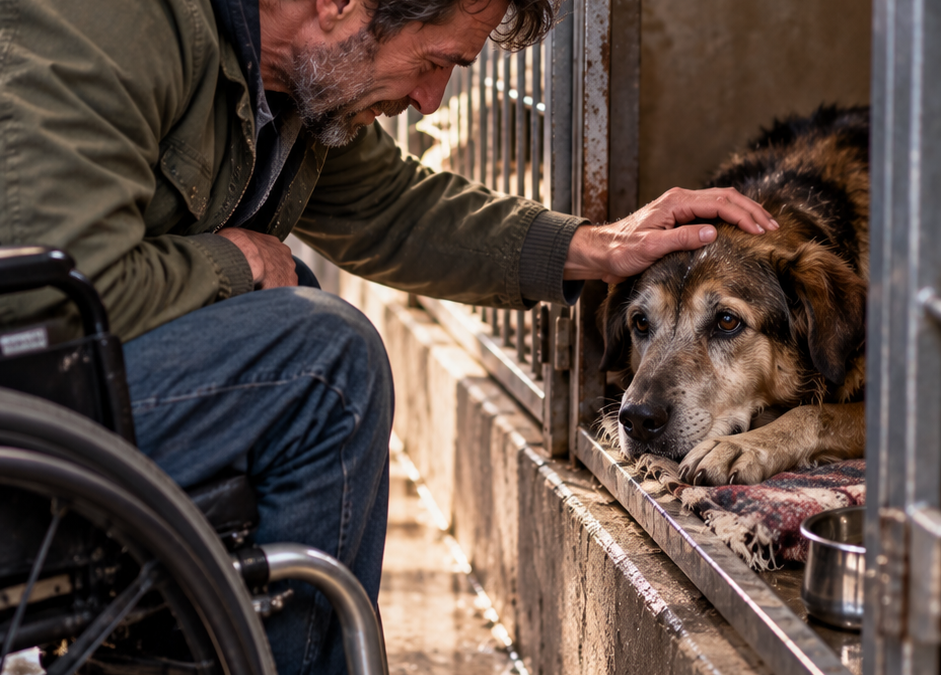
But at the farthest end, in the last enclosure near the wall, a large gray dog lay with his head between his paws.
He hadn’t moved.
Not when I entered.
Not when the barking started.
Not even when a volunteer passed.
My chest tightened.
“Is that him?”
Sarah looked at me.
“Who?”
“The dog I came for.”
Her face changed.
“How do you know?”
“I’ve seen his picture.”
She became quiet.
I rolled toward the glass.
The dog remained exactly where he was.
Gray around the muzzle.
Broad shoulders.
Large body.
A shepherd mix, perhaps.
He looked older than the photograph I had seen online.
That made sense.
The photograph was old.
Very old.
I knew because I had first seen it three and a half years earlier.
“What’s his name?” I asked, though I already knew.
Sarah answered softly.
“Duke.”
I stopped a few feet from his enclosure.
He lifted his eyes.
Not his head.
Only his eyes.
He looked at me for perhaps two seconds.
Then closed them again.
That hurt.
People think abandoned dogs are always desperate for affection.
They imagine paws against kennel doors.
Whining.
Tails beating wildly when someone approaches.
Sometimes that is true.
But there is another stage.
A quieter one.
The stage after hope has failed too many times.
The dog stops asking.
Not because he no longer wants anything.
Because wanting has become painful.
“How long?” I asked.
Sarah knew exactly what I meant.
“Three and a half years.”
I swallowed.
“Exactly?”
“About that.”
“How old is he?”
“Ten and a half.”
“He came here at seven?”
“Yes.”
“What happened?”
Sarah moved closer.
“His owners were an elderly couple. They loved him.”
“Then why surrender him?”
“The husband died.”
I looked at Duke.
“The wife tried to keep him, but her health declined. Eventually she moved into assisted living.”
“Couldn’t family take him?”
“They tried.”
“That doesn’t sound convincing.”
Sarah sighed.
“No. It doesn’t.”
She leaned against the wall.
“He’s large. He sheds. He was already considered old. One relative had young children. Another rented an apartment that didn’t allow dogs. Someone else had cats.”
“And eventually?”
“He came here.”
I looked through the glass.
“How many people have considered him?”
“A lot.”
“How many seriously?”
She hesitated.
“Not many.”
“Why?”
“You can see him.”
I glanced at her.
“Yes.”
“I mean…”
“I know what you mean.”
She looked at Duke.
“He doesn’t perform.”
“Perform?”
“That’s what we call it sometimes.”
Sarah gave a sad smile.
“Visitors come in and want the dogs to show them something. Wag. Jump. Lick their hands. Make them feel chosen.”
“And Duke?”
“He stopped doing that.”
“How long ago?”
“I don’t know.”
Her voice became quieter.
“Maybe two years.”
I looked back at him.
He still had not moved.
“People ask about puppies,” Sarah continued. “Young dogs. Smaller dogs. Cute dogs. Dogs that look happy.”
“And an old gray dog lying in the corner?”
“Gets ignored.”
“Even if he’s gentle?”
“He’s extremely gentle.”
“House-trained?”
“Yes.”
“Good with other dogs?”
“Yes.”
“Medical problems?”
“Arthritis. Nothing unusual for his age.”
“So his biggest problem is that he’s old.”
Sarah folded her arms.
“And that he no longer knows how to sell himself.”
I hated how accurate that was.
I rolled closer.
Duke’s eyes opened again.
This time he raised his head.
Only slightly.
“Hello, Duke.”
His ears shifted.
Nothing else.
“I’ve been watching you for a long time.”
Sarah looked at me.
“What do you mean?”
I kept my eyes on Duke.
“His photo has been on the shelter website for years.”
“Yes.”
“I first saw it shortly after he arrived.”
She stared.
“You’ve known about him for three and a half years?”
“Yes.”
“Then why didn’t you come?”
That was a fair question.
Painfully fair.
I lowered my eyes.
“Because I already had dogs who needed me.”
Sarah waited.
“And because I wasn’t ready.”
“For Duke?”
“For what Duke reminded me of.”
She said nothing.
I watched his slow breathing.
“Nineteen years ago, I could walk.”
Sarah’s expression changed.
I rarely told the story anymore.
People tended to treat tragedy like a door.
Once you open it, they walk through and start rearranging the furniture.
But Sarah had earned some context.
“I was twenty-one,” I said. “Young enough to think the future had signed a contract with me.”
“What happened?”
“Car accident.”
“I’m sorry.”
“I know.”
I had heard those words thousands of times.
“I woke up in a hospital unable to feel my legs.”
Sarah remained quiet.
“That part wasn’t the worst.”
“What was?”
“The way everyone looked at me afterward.”
Her eyes dropped.
Perhaps she remembered how she had looked at me ten minutes earlier.
“My friends tried at first,” I continued. “They visited. Called. Brought food. Told jokes.”
I smiled faintly.
“Then life kept moving.”
“And yours didn’t.”
“That’s what it felt like.”
I looked at Duke.
“One friend stopped calling because the hospital made him uncomfortable. Another said we should hang out when things got ‘normal again.’”
Sarah winced.
“The woman I was dating stayed six months.”
“What happened?”
“She told me she loved me.”
I laughed once.
“That was the beginning of the breakup.”
Sarah said nothing.
“She sat beside my bed and said she couldn’t build a life around ‘all this.’”
I tapped the wheel of my chair.
“She apologized for almost an hour.”
“That must have been awful.”
“It was clarifying.”
I looked through the glass again.
“For about a year, I waited.”
“For what?”
“My old life.”
Sarah nodded slowly.
“I thought maybe doctors would discover something new. Maybe therapy would change everything. Maybe my friends would come back. Maybe she would come back.”
“And?”
“Eventually, I realized I wasn’t waiting for recovery.”
I paused.
“I was waiting for permission to exist again.”
Duke shifted one paw.
Tiny movement.
Still, I noticed.
“Then Oliver showed up.”
“Oliver?”
“My first dog.”
A smile came before I could stop it.
“He wandered into my yard during a storm.”
“Your dog was a stray?”
“Yes.”
“What kind?”
“Impossible to determine. Mostly stubborn.”
Sarah smiled.
“He was old. Thin. One ear torn. Smelled terrible.”
“Charming.”
“Absolutely.”
“I fed him.”
“And he stayed?”
“No.”
I laughed.
“He ate my food, insulted me with his expression, and left.”
Sarah laughed too.
“Then what?”
“He came back the next day.”
“And the next?”
“For two weeks.”
“When did you adopt him?”
“I didn’t.”
She looked confused.
“Oliver adopted me.”
That was the truth.
“He started sleeping near the back door. Eventually I let him inside.”
I paused.
“The first night he slept beside my bed was the first night in months I didn’t take sleeping medication.”
Sarah’s face softened.
“He helped you.”
“He annoyed me into living.”
That was even more accurate.
“After Oliver came, I started leaving the house more. Then I volunteered with senior-dog rescues. Later I adopted Roscoe. Then Mabel.”
“And Duke?”
“Duke was different.”
“Why?”
I looked at him.
“Because when I first saw his photograph, I recognized his face.”
Sarah glanced between us.
“You’d never met him.”
“I didn’t need to.”
I touched one hand to my chest.
“I knew that look.”
The look of someone who had waited too long.
The look of someone who had stopped expecting the door to open for them.
The shelter entrance opened behind us.
Sarah turned.
A woman walked in quickly.
Mid-fifties.
Dark hair tied back.
Sharp eyes.
Purposeful stride.
She didn’t stop at the reception desk.
She came directly toward me.
“Frank Harrison.”
“Virginia Bartlett.”
She extended her hand.
I took it.
“I’ve wanted to meet you.”
“I’ve been avoiding management for years.”
She smiled.
“I’ve read about you.”
“That’s rarely a good beginning.”
“The Last Hope Door program.”
I nodded.
“You adopted through them.”
“Yes.”
“Roscoe.”
“Yes.”
“And Mabel.”
“Yes.”
“She was nine?”
“Almost ten.”
“And nearly blind.”
“Mostly blind.”
Virginia looked down at my chair.
Unlike Sarah, she did not look embarrassed when I caught her.
“I’m going to ask questions you probably hate.”
“Ask.”
“How independently do you manage your dogs?”
“Completely.”
“Daily walks?”
“Yes.”
“Veterinary appointments?”
“Yes.”
“Feeding?”
“Yes.”
“Medication?”
“Yes.”
“What happens if Duke falls and you need to lift him?”
“I have a ramp system and neighbors who help when necessary.”
“Your house?”
“Single story.”
“Yard?”
“Fenced.”
“Other dogs?”
“Three.”
“Temperaments?”
“Stable. Senior. Social.”
Virginia nodded.
She was efficient.
I liked that.
No pity.
No soft voice.
No pretending the chair was irrelevant.
My disability was relevant.
It simply wasn’t the whole answer.
“You understand why I have to ask.”
“Yes.”
“Good.”
She turned toward Duke’s kennel.
“Sarah told me what you asked for.”
“I asked for Duke.”
“You asked for the dog nobody wanted.”
“Yes.”
Virginia looked at him for a long time.
“That phrase bothers me.”
“Why?”
“Because we want him.”
“I know.”
“We’ve wanted him every day.”
“I know that too.”
“He’s not unloved.”
“No.”
“He’s unchosen.”
That was better.
More precise.
I nodded.
“Then I came for the dog nobody has chosen.”
Virginia crossed her arms.
“Why Duke?”
I told her the truth.
“Because I’ve thought about him for three and a half years.”
She turned sharply.
“You knew?”
“I saw his intake post.”
“Three and a half years ago?”
“Yes.”
“And you followed his listing?”
“Yes.”
Virginia stared.
“Every time we updated his profile?”
“I saw it.”
“The Christmas photos?”
“Yes.”
“The senior adoption campaign?”
“Yes.”
“The video last summer?”
“Yes.”
Her voice softened.
“You watched all that and never contacted us?”
“Not until today.”
“Why today?”
I looked toward Duke.
“Because Oliver died two months ago.”
Virginia’s expression changed.
I swallowed.
Even saying the name still hurt.
“He was almost sixteen.”
“I’m sorry.”
“Thank you.”
“For nineteen years, Oliver had been connected to nearly every good change in my life.”
I laughed softly.
“Which is impressive considering he spent most of his time asleep.”
Virginia smiled.
“When he died, the house changed.”
“How?”
“It became too quiet.”
I looked at Duke.
“My other dogs grieved too. Roscoe stopped sleeping by the back door. Mabel started waiting outside my bedroom.”
I took a breath.
“Then one night, I opened Duke’s profile again.”
Virginia said nothing.
“The shelter had posted another update.”
I remembered every word.
Still waiting.
Gentle senior.
Needs quiet home.
Good with dogs.
No adoption applications.
“I looked at the photo and thought, what am I waiting for?”
I turned back to Virginia.
“I have room.”
“In your house?”
“In my life.”
That silenced all three of us.
Virginia looked at Duke again.
“Frank, I have to be honest.”
“Please.”
“He may not be easy.”
“I’m not easy.”
“He’s ten and a half.”
“I noticed.”
“He has arthritis.”
“So do I.”
Sarah covered a laugh.
Virginia tried not to smile.
“He’s heavy.”
“So am I.”
“That is not helping your application.”
“It should. We understand each other.”
Virginia finally laughed.
Then her expression became serious again.
“He doesn’t attach quickly anymore.”
“I don’t need him to.”
“He may take weeks.”
“Fine.”
“Months.”
“Fine.”
“He may never become the dog you imagine.”
“I’m not imagining one.”
She studied me.
“What do you want from him?”
“Nothing.”
“That’s impossible.”
“No.”
I shook my head.
“I want to give him somewhere else to sleep.”
Virginia’s eyes filled.
I continued before my own voice broke.
“If he wants affection, I’ll give it.”
I looked at the old gray dog.
“If he wants distance, he can have that too.”
My throat tightened.
“But I don’t want him dying in a kennel because everyone kept waiting for a younger dog.”
Sarah turned away.
Virginia inhaled slowly.
“Open the kennel.”
Sarah looked back.
“What?”
Virginia nodded toward the gate.
“Open it.”
“Virginia, protocol says—”
“I know what protocol says.”
“We’re supposed to do a formal introduction first.”
“We are doing one.”
“Inside?”
Virginia glanced at me.
“Frank stays outside the kennel. Duke chooses.”
That word mattered.
Chooses.
Not performs.
Not proves.
Chooses.
Sarah retrieved the key.
The closer she came to Duke’s enclosure, the slower she moved.
The other dogs barked as metal rattled.
Duke lifted his head.
The lock turned.
The gate opened.
He did not move.
Sarah stepped back.
“Duke?”
Nothing.
Virginia crouched.
“Come on, old man.”
Duke looked at the open doorway.
Then rested his head down again.
Sarah’s face tightened.
“You see?”
I did.
“He doesn’t think the door is for him.”
Neither woman answered.
I rolled forward.
Not inside.
Just close enough that Duke could see me.
Then I stopped.
For years, doors had opened around him.
People entered.
People left.
Dogs were taken away.
Volunteers came inside.
Veterinarians examined him.
The gate opening had stopped meaning freedom.
I understood that better than anyone in the building.
Hospitals had doors too.
So did rehabilitation centers.
For months, people pushed me through them.
Room to room.
Therapy to therapy.
Test to test.
Every door supposedly led toward progress.
Eventually, you stop expecting anything important on the other side.
“Hey, Duke.”
One ear moved.
“That door’s open.”
His eyes lifted.
“No one’s going to pull you through it.”
I placed my hands in my lap.
“You don’t know me.”
Duke watched.
“That’s fair.”
I smiled.
“I don’t know you either.”
His nose moved.
“You’ve probably met a lot of people who said hello.”
One paw shifted.
“Maybe they touched your head.”
Another pause.
“Maybe they told you what a good boy you were.”
Duke raised his head.
“And then they left.”
Sarah covered her mouth.
Virginia looked at the floor.
I kept speaking softly.
“I know what that does to you.”
Duke stood.
Slowly.
His hind legs were stiff.
He stretched carefully.
Then froze.
My heart began pounding.
He was still inside the kennel.
I did not reach toward him.
“Take your time.”
He sniffed.
One step.
Then stopped.
Another.
His front paws reached the threshold.
His back legs remained inside.
I wanted to move forward.
Every instinct told me to encourage him.
Instead, I stayed still.
Duke looked at the open space.
Then at me.
Then behind him.
He stepped backward.
Sarah exhaled.
“It’s okay,” she whispered.
I nodded.
“Absolutely.”
Duke lay down again.
Virginia touched my shoulder.
“We can try again later.”
“No.”
Her hand stopped.
“No?”
“We are trying now.”
I looked at Duke.
“He doesn’t have to come out for this to count.”
I stayed there.
Five minutes.
Ten.
The shelter continued around us.
Phones rang.
Dogs barked.
Someone carried food bowls down the opposite aisle.
A family arrived near reception.
A puppy squealed.
Duke watched everything.
Then watched me.
I told him about Oliver.
I don’t know why.
Maybe because I needed something to say that wasn’t come here.
“Oliver hated thunder.”
Duke’s ears moved.
“Terrified of it.”
I smiled.
“He used to crawl beneath my bed even though he was too big.”
Sarah sat on a bench behind me.
“I’d find half a dog sticking out.”
Duke blinked.
“He also stole bread.”
Another pause.
“Constantly.”
I leaned closer.
“You look like a bread thief.”
Sarah laughed quietly.
Duke’s nose twitched.
“You are, aren’t you?”
He stood again.
This time, I said nothing.
One step.
Pause.
Second step.
Front paws crossed the threshold.
My hands began trembling.
Not from fear.
From the effort not to reach.
Duke took another step.
Then another.
He was outside the kennel.
Sarah began crying.
Virginia whispered, “My God.”
Duke stopped three feet from me.
He lowered his nose.
Sniffed.
I extended one hand.
Palm open.
Low.
No sudden movement.
He stared at it.
I saw the conflict in his face.
Interest battling memory.
Wanting battling caution.
I knew that fight.
I had lived it.
Every time someone invited me somewhere after the accident.
Every time a woman smiled at me and I wondered whether she saw a man or a tragedy.
Every time someone offered help and I had to decide whether accepting it meant trust or dependence.
Duke took one step.
His nose touched my fingers.
Cold.
Wet.
Brief.
Then he pulled away.
I did nothing.
He sniffed again.
Longer.
His whiskers brushed my palm.
“Hello,” I whispered.
Duke looked at my face.
I saw something change.
Not trust.
Trust is too large a word for first meetings.
Permission.
He was giving himself permission to stay one second longer.
Then his tongue touched my hand.
Sarah made a sound behind me.
Duke took another step.
His shoulder reached my knee.
He hesitated.
Then, slowly, with a weight that seemed to include every exhausted year of his life, he lowered his head onto my lap.
I stopped breathing.
He was heavy.
Warm.
His fur rough beneath my fingers.
For several seconds, I was twenty-one again.
Lying in a hospital bed.
Angry.
Terrified.
Waiting for someone to tell me my life still belonged to me.
Then I was twenty-two, sitting in my backyard while an ugly old stray ate bread from my hand.
Then thirty.
Then forty.
All the versions of myself I had thought were lost seemed to gather around that one tired dog.
I placed my hand on Duke’s head.
His eyes closed.
No excitement.
No dramatic tail wag.
He simply rested.
That broke me more deeply than joy would have.
Sarah was crying openly now.
Virginia turned away and wiped her face.
I scratched slowly behind Duke’s ear.
“You’re tired, huh?”
His body leaned harder against my chair.
“I know.”
Virginia crouched beside us.
“I’ve never seen him do that with a visitor.”
“Never?”
“Not like this.”
I swallowed.
“Then don’t make it bigger than it is.”
She stared at me.
“What?”
“He’s resting.”
I kept stroking Duke’s head.
“He doesn’t owe us a miracle.”
Virginia’s expression softened.
“No.”
“He just needs a home.”
“Yes.”
I looked at her.
“I want to take him today.”
Sarah immediately glanced at Virginia.
Virginia remained quiet.
“Today?” she asked.
“Yes.”
“We need paperwork.”
“I’ll fill it out.”
“Home verification.”
“You’ve already done one through the senior rescue program.”
“That was years ago.”
“Call my veterinarian.”
“I will.”
“Call my neighbors.”
“That would be unusual.”
“They’d enjoy it.”
Virginia smiled.
I continued.
“I brought vaccination records for my dogs.”
Sarah blinked.
“You planned this.”
“For three and a half years.”
That stopped her.
I opened the small bag attached to the side of my chair.
Documents.
Veterinary records.
Home insurance.
Fenced-yard information.
References.
Copies of previous adoption paperwork.
Virginia stared at the folder.
“You really did come for Duke.”
“Yes.”
Not any dog.
Duke.
She stood.
“All right.”
Sarah looked surprised.
“All right?”
Virginia nodded.
“We do the compatibility meeting first.”
“Agreed.”
“If that goes well, we finish the paperwork.”
“Agreed.”
“And if Duke shows significant distress—”
“We stop.”
Virginia looked at me for another moment.
Then extended her hand.
“Deal.”
I shook it.
The introduction with my dogs took nearly an hour.
A neighbor had agreed to bring them.
Roscoe came first.
Twelve years old.
Brown-and-white.
More dignity than intelligence.
He approached Duke carefully.
One sniff.
Two.
Duke stiffened.
Roscoe sneezed directly in his face.
Sarah gasped.
I laughed.
Duke blinked.
Then turned away.
“Excellent,” Virginia said.
“That’s excellent?”
“They both chose disengagement.”
“Roscoe chooses disengagement from most responsibilities.”
Next came Mabel.
Small.
Nearly blind.
Ten years old and convinced that the universe had been created to inconvenience her personally.
She walked toward Duke, sniffed one front leg, then barked once.
Duke took half a step backward.
“Mabel,” I warned.
She ignored me.
Of course.
Then she turned and walked toward my chair.
“She approves,” I said.
“How can you tell?”
“She didn’t bite him.”
Sarah laughed.
Finally came Oliver.
My oldest companion.
The dog who had appeared in my yard all those years before.
Age had reduced him.
His muzzle almost completely white.
His legs slow.
Eyes cloudy.
But he still carried himself like he owned every room he entered.
When he saw Duke, he stopped.
Duke stopped too.
Two old dogs.
Two bodies shaped by time.
Oliver approached.
No barking.
No excitement.
He sniffed Duke’s muzzle.
Duke sniffed his.
Then Oliver did something I will remember for the rest of my life.
He sat beside Duke.
That was all.
No play bow.
No tail frenzy.
He simply sat.
Duke looked at him.
Then sat too.
Virginia whispered, “That’s good.”
I smiled.
“Oliver doesn’t waste energy.”
After a moment, Duke leaned slightly against him.
My throat tightened.
Virginia stood.
“I think we can complete the adoption.”
Sarah clapped both hands over her mouth.
I looked down at Duke.
“Did you hear that?”
He looked up.
“You’re leaving.”
His tail moved once.
Only once.
A slow sweep against the floor.
I had never seen anything more beautiful.
The paperwork took almost an hour.
Sarah sat across from me.
The same woman who had initially hesitated to let me meet him now read each line carefully and asked questions without once glancing at my wheelchair.
Emergency contact.
Veterinarian.
Medication.
Exercise plan.
Feeding.
Senior-dog needs.
Arthritis management.
She paused at one form.
“I owe you an apology.”
“No.”
“Yes.”
“You were doing your job.”
“I assumed you couldn’t handle him because of the chair.”
I looked at her.
“That part wasn’t your job.”
She lowered her eyes.
“No.”
I appreciated the honesty.
“Then remember today.”
“I will.”
I signed.
Virginia brought Duke’s medical file.
“He takes anti-inflammatory medication in the morning.”
“Fine.”
“He sleeps a lot.”
“So do I.”
“He sometimes struggles with stairs.”
“So do I.”
“You don’t have stairs.”
“Exactly. Good planning.”
She laughed.
Then became serious.
“There’s one more thing.”
“What?”
“Don’t expect too much tonight.”
“I won’t.”
“He may pace.”
“Fine.”
“Refuse food.”
“Fine.”
“Hide.”
“I have places.”
“He might seem like a different dog once he realizes everything has changed.”
I nodded.
“I know.”
Virginia touched Duke’s collar.
“He’s had people leave him before.”
“I know.”
Her voice broke.
“Please don’t.”
I stared at her.
That request contained three and a half years of caring for him.
Three and a half years of feeding him.
Cleaning his kennel.
Taking him to medical appointments.
Photographing him for adoption campaigns.
Watching people choose another dog.
“I won’t.”
She held my eyes.
“Promise?”
“Yes.”
I looked at Duke.
“I’m not taking him for a trial.”
Virginia nodded.
“Good.”
When the final signature was complete, Sarah removed Duke’s shelter identification tag.
The tiny metal sound nearly broke me.
A new tag waited in her hand.
DUKE HARRISON.
My address.
My phone number.
Sarah attached it.
“There.”
Duke shook his head.
The tags jingled.
A different sound.
A home sound.
Virginia helped pack his medication and food.
Then we reached the front entrance.
Duke stopped.
Of course he did.
That door was different from his kennel gate.
Bigger.
Outside waited cars.
Wind.
Unknown smells.
An entire world.
He stared through the glass.
I rolled beside him.
“No rush.”
Virginia stood behind us.
Sarah held the door.
Duke did not move.
“Frank,” Sarah said softly, “should I—”
“No.”
She stopped.
“Let him decide.”
Thirty seconds.
A minute.
People waited.
Duke looked at me.
I rolled forward.
Only a foot.
Then stopped.
He followed.
One step.
I moved another foot.
He followed again.
And that was how we left.
Not triumphantly.
Not dramatically.
No music.
No cheering.
Just an old man in a wheelchair and an old dog taking small turns toward a life neither of us fully understood yet.
Outside, sunlight had broken through the clouds.
The pavement shone from the earlier rain.
Duke lifted his head and sniffed the air.
Then he looked back at the shelter.
My chest tightened.
“You can remember it.”
His ears moved.
“You don’t have to hate where you came from.”
Virginia stood in the doorway.
Sarah beside her.
Both crying.
I raised one hand.
Virginia waved.
Duke turned toward me.
Then we continued.
On the way home, I stopped at a park.
Maybe I shouldn’t have.
Maybe it was too much stimulation.
But I needed a moment.
So did Duke.
The sun had dropped lower, turning the clouds orange and pink.
Families walked along the path.
Someone threw a ball for a Labrador.
A child laughed near the swings.
Duke sat beside my wheelchair.
For the first time, I saw him looking at the world instead of withdrawing from it.
I watched him.
His gray muzzle.
Old eyes.
Thick coat.
Large paws.
A body that had spent thousands of nights on concrete.
“Pretty good out here, huh?”
Duke looked at me.
I smiled.
“I know.”
The truth was, I didn’t know what he was thinking.
People put too many human thoughts into dogs.
Maybe he wasn’t thinking anything profound.
Maybe he smelled food.
Maybe the grass was interesting.
Maybe he was tired.
That was enough.
I looked toward the sunset.
Years earlier, shortly after the accident, I had hated sunsets.
That sounds ridiculous now.
But I did.
Every evening seemed like evidence that another day had passed without my old life returning.
I would sit near the hospital window and watch the sky change.
Orange.
Red.
Dark.
Then repeat.
I measured grief in sunsets.
Later, after Oliver came into my life, evenings changed.
We sat outside together.
He didn’t care about my legs.
He didn’t know who I had been before.
He didn’t compare me to anyone.
To Oliver, I wasn’t a tragedy.
I was simply the man with food.
Eventually, something inside me loosened.
The chair stopped being the end of my identity.
It became transportation.
Important.
Sometimes frustrating.
Often inconvenient.
But not the definition of my future.
Duke lowered himself onto the grass.
Slowly.
Carefully.
I watched his stiff hips.
“You and me,” I said.
He sighed.
“We’re going to understand each other.”
When we reached home, my other dogs were waiting.
Oliver first.
Roscoe behind him.
Mabel weaving between both like a tiny security officer.
Duke froze at the doorway.
I rolled inside.
The others approached.
Lots of sniffing.
Circling.
A few tense seconds.
Then Oliver walked toward his bed near the fireplace.
Duke watched him.
Oliver turned once.
Lay down.
And, without looking back, left enough space beside him for another dog.
Duke stayed near the door.
I put away his medications.
Filled a water bowl.
Placed food in a quiet corner.
No pressure.
No celebration.
Eventually, Duke crossed the room.
He did not lie beside Oliver.
Not yet.
Instead, he chose the space next to my wheelchair.
He lowered himself carefully.
His back touched one wheel.
I looked down.
“You know I move around, right?”
His eyes closed.
“Fine.”
That night, I went to bed surrounded by four dogs.
Oliver near the door.
Roscoe beneath the window.
Mabel buried under a blanket despite having perfectly good fur.
Duke on the floor near my chair.
At two in the morning, I woke.
I didn’t know why.
The room was dark.
For a moment, I forgot Duke was there.
Then I heard breathing.
Slow.
Deep.
Peaceful.
I reached down.
My fingers touched his fur.
His eyes opened.
“Just checking.”
He moved closer.
I rested my hand on his head.
For the first time in three and a half years, no metal bars surrounded him.
No kennel door.
No concrete floor beyond the rug.
No strangers passing.
No dogs leaving while he stayed.
Only a dark bedroom.
Four old dogs.
One tired man.
And a quiet house.
I fell asleep with my hand still resting on him.
The next morning, Duke woke me.
Not barking.
Not whining.
Breathing.
Warm breath directly against my face.
I opened my eyes.
Two enormous brown eyes stared at me.
“Good morning.”
His tail tapped the floor.
Once.
I laughed.
“You’re still here.”
He tilted his head.
“Yeah.”
I stroked his cheek.
“So am I.”
The first week was not easy.
That matters.
I do not like rescue stories that pretend love solves trauma overnight.
Love is not anesthesia.
Duke paced whenever I left the room.
The first time I went into the bathroom and closed the door, he scratched at it.
When I returned, he stood three feet away pretending he had not been concerned.
The second night, he refused dinner.
On the third, he woke twice and walked through the house as if checking exits.
A delivery driver frightened him badly.
A dropped metal pan made him hide behind my chair.
He watched the front door obsessively.
Every time someone opened it, his entire body stiffened.
He had learned one rule in the shelter.
Open doors mean someone leaves.
So I began narrating my movements.
“I’m getting the mail.”
Duke watched.
“I’ll be back.”
Of course he didn’t understand the words.
Not at first.
But patterns teach better than vocabulary.
I rolled outside.
Thirty seconds later, I returned.
Duke stood near the entrance.
“There.”
I repeated it.
Again.
Again.
Again.
Short absence.
Return.
Short absence.
Return.
Within weeks, he stopped standing at the door.
Within months, he stopped waking every time I moved.
He learned the sound of my wheelchair.
He could tell which room I was in based on the wheels crossing different floors.
Kitchen tile.
Hallway wood.
Bedroom carpet.
He learned medication time.
Meal time.
Nap time.
He also learned that Mabel was insane.
Everyone eventually learned that.
His first real friendship was with Oliver.
That did not surprise me.
Old dogs speak a language younger animals have not yet learned.
Silence.
Patience.
The dignity of shared discomfort.
They rarely played.
They simply occupied the same spaces.
Sunlight near the window.
Grass beneath the tree.
Two beds placed side by side.
Sometimes Oliver rested his head across Duke’s paws.
Sometimes Duke leaned against Oliver.
Nothing dramatic.
Companionship does not need drama.
Sarah visited after a month.
She brought treats and pretended they were for all the dogs.
They were mostly for Duke.
He barked when she knocked.
One deep bark.
Sarah froze outside.
“Was that him?”
I opened the door.
“Yes.”
“He barked.”
“He does that now.”
Duke came forward.
Sarah crouched.
“Hey, handsome.”
His tail began moving.
She looked at me.
“He remembers me.”
“Of course.”
Duke approached and placed his muzzle against her hand.
Sarah started crying.
I sighed.
“What is it with shelter employees?”
“Shut up.”
She hugged Duke around the neck.
He allowed it for about three seconds before walking away.
“Still has boundaries,” I said.
Sarah wiped her eyes.
“He looks younger.”
“He steals food.”
“That means he’s comfortable.”
“That means he’s a criminal.”
She laughed.
Virginia visited later.
When Duke heard her voice, he walked directly to the door.
No fear.
No retreat.
Virginia knelt.
Duke rested his head against her chest.
She closed her eyes.
Neither of us spoke.
After a while, she whispered, “I used to sit beside his kennel after closing.”
“I know.”
“How?”
“Sarah told me.”
Virginia stroked Duke’s back.
“I kept telling him somebody would come.”
Her voice trembled.
“After two years, I stopped saying it.”
I understood.
“Didn’t want to lie?”
She nodded.
I looked at Duke.
“Maybe you weren’t lying.”
“I was just early.”
“Three and a half years early.”
She laughed.
Duke eventually became part of the neighborhood.
People learned his name.
Children learned to approach slowly.
My neighbors brought biscuits.
He developed an embarrassing obsession with the mail carrier.
Every morning, he waited by the window.
Not to bark.
To receive a treat.
“Corruption,” I told the mail carrier.
“Relationship building,” he said.
Duke gained a little weight.
His coat improved.
His arthritis remained.
Age remained.
Love does not reverse time either.
But he moved more.
Some mornings, he walked beside my wheelchair through the park.
Other days, we took shorter routes.
When he was tired, we went home.
No proving anything.
That was another lesson disability had taught me.
A life does not become valuable because you force yourself to look strong.
Rest is not surrender.
Help is not defeat.
Slow is still movement.
One afternoon, months after Duke came home, I rolled toward the same park where we had stopped on adoption day.
Duke walked beside me.
A young man approached with a puppy.
The puppy pulled toward Duke.
“Can they say hello?” the man asked.
“Let Duke decide.”
We stopped.
The puppy bounced.
Duke looked exhausted just watching him.
Then, slowly, he stepped forward.
The puppy sniffed.
Duke sniffed back.
The little dog jumped sideways.
Duke’s tail moved.
Then something extraordinary happened.
He lowered his front legs.
A play bow.
I stared.
“Duke?”
The puppy bounced again.
Duke gave a short chase.
Only a few steps.
His old legs could not do much more.
But he tried.
I laughed.
Actually laughed.
Loud enough that people turned.
The young man smiled.
“Looks like he’s still got it.”
“Yes.”
My throat tightened.
“Yes, he does.”
That evening, I called Virginia.
“You’re not going to believe this.”
She immediately sounded worried.
“What happened?”
“Duke played.”
Silence.
“With another dog.”
Still silence.
“Virginia?”
“I’m here.”
“You crying?”
“No.”
“You’re a terrible liar.”
“I hate you.”
“I know.”
She came over the next afternoon just to see him.
He did not perform.
Of course.
He slept the entire visit.
We laughed about it.
Months turned into a year.
Then another.
Duke slowed.
There was no tragedy in that.
Only time.
His muzzle became whiter.
The medication increased.
Walks shortened.
He began sleeping closer to me.
Eventually, he claimed the space beside my bed.
Oliver had once occupied that place.
By then Oliver was gone.
He died peacefully one winter morning.
Duke stayed beside him until the end.
Afterward, Duke searched the house for three days.
I did too, in my own way.
Grief makes people and animals perform the same impossible task.
Looking for something we already know is gone.
One night, Duke lay beside my wheelchair while I stared at Oliver’s empty bed.
“I thought I rescued him,” I said.
Duke lifted his head.
“I used to tell people that.”
I laughed quietly.
“What arrogance.”
Duke sighed.
“He found me when I was waiting for my old life.”
I scratched behind Duke’s ear.
“And you found me when I forgot that waiting can kill something inside you.”
His head returned to my lap.
I realized then that rescue had never been a straight line.
Not human saves dog.
Not dog saves human.
It was movement.
Back and forth.
One life carrying another for a while.
Then switching places.
Years after I first rolled through that shelter door, people still asked me why I chose senior dogs.
The question always bothered me.
I did not choose them because they were sad.
Pity is a terrible foundation for family.
I chose them because old dogs know things.
They know comfort is more valuable than excitement.
They know silence can be company.
They know a slow walk is still a good walk.
They know home is not a building.
Home is the place where someone notices when your breathing changes.
Duke taught me that more clearly than any dog before him.
One spring morning, I woke to his warm breath against my cheek.
Exactly like that first morning.
His eyes were cloudy now.
His body thinner.
But his tail tapped when I said his name.
“Morning, old man.”
Tap.
“You hungry?”
Tap.
“You lying?”
Tap.
I laughed.
He rested his chin near my hand.
Sunlight came through the window.
Soft.
Warm.
The kind of morning that promises nothing dramatic.
And maybe that is why I loved it.
Nineteen years earlier, I thought losing the use of my legs meant the end of movement.
I was wrong.
Some of the greatest distances I traveled afterward required no walking at all.
From bitterness to acceptance.
From isolation to family.
From being stared at to being known.
From believing I had become less to understanding I had simply become different.
And Duke had traveled too.
From a kennel door he no longer watched.
To an open gate he was afraid to cross.
To my living room.
My neighborhood.
The park.
My bedside.
Home.
I put both hands around his large gray face.
He leaned into them.
“You know something?”
His tail moved.
“I almost waited too long.”
Duke blinked.
“I watched your picture for three and a half years.”
Another tap.
“I kept telling myself somebody else would come.”
His eyes stayed on me.
“But nobody did.”
I rubbed my thumb across his cheek.
“Maybe that was the point.”
Of course, there was no point.
Life is not arranged so neatly.
Duke had simply been unlucky.
Then lucky.
So had I.
But meaning does not have to be planned to be real.
I thought back to Sarah behind the reception desk.
The look she gave my wheelchair.
The wall that rose between us before she knew me.
Then I thought about Duke.
Ten and a half years old.
Large.
Gray.
Arthritic.
Lying in the farthest kennel while people looked at younger dogs.
We had both been reduced by appearances.
Me to a chair.
Duke to an age.
People saw what might be difficult.
They did not always ask what might still be possible.
That does not make people cruel.
Usually it makes them afraid.
Afraid of responsibility.
Afraid of limitations.
Afraid they will choose something hard when something easier is available.
But easy is not always the same as right.
Sometimes the thing that asks more of you gives more back.
Not because suffering is noble.
It isn’t.
Because attention changes what we notice.
Duke taught me to notice.
To notice the difference between a dog that does not care and one that has stopped expecting.
To notice that patience is an action.
To notice that old bodies still contain joy.
To notice that family often begins with two living things quietly deciding not to leave.
That morning, Duke eventually stood.
Slowly.
His legs shook.
I waited.
He steadied himself.
Then he walked toward the kitchen.
I followed in my wheelchair.
Mabel waited near the food bowls.
Roscoe slept beneath the window.
Sunlight spread across the floor.
Duke stopped in the middle of it.
For a moment, he closed his eyes.
Just stood there.
Warm.
Safe.
Home.
I remembered the shelter.
The gray concrete.
The metal gate.
Sarah saying they could not simply give me the dog nobody wanted.
Virginia arriving.
The kennel opening.
Duke refusing to move.
Then one step.
Another.
His nose against my palm.
His head on my knees.
That first tiny decision to believe again.
I had thought the important moment was when I signed the adoption papers.
It wasn’t.
It was earlier.
The moment Duke stepped across the threshold of the kennel even though nothing in his life had taught him that an open door could finally mean freedom.
That was courage.
Not fearlessness.
Courage is fear moving anyway.
People had called me brave after my accident.
I hated it.
They called me brave for leaving the house.
Brave for driving.
Brave for living alone.
Brave for having dogs.
I was not brave because I used a wheelchair.
Duke was not brave because he survived a shelter.
We became brave only when we risked trusting life again.
That is different.
I rolled beside him.
Duke looked up.
“Breakfast?”
His tail moved harder.
“Finally, something we agree on.”
I filled his bowl.
He began eating.
No bars.
No strangers walking past.
No one deciding he was too old before meeting him.
Just Duke.
My dog.
Years earlier, when my legs stopped working, I thought the most important steps of my life were behind me.
I know better now.
Some steps have nothing to do with feet.
Some are made when you call a shelter after three and a half years of waiting.
Some are made when you challenge a stranger’s assumptions without hating them for having those assumptions.
Some are made when you open a kennel gate and refuse to drag the frightened animal through it.
Some are made when an old dog who has stopped hoping stands anyway.
And some happen much later, in an ordinary kitchen filled with morning light, when you realize that neither of you is waiting anymore.
I reached down and rested my hand on Duke’s back.
He kept eating.
I smiled.
“Yeah.”
He glanced up.
“We made it.”
His tail struck the cabinet.
Once.
Twice.
Then again.
And that was enough.
More than enough.
Because Duke had spent three and a half years waiting for someone to choose him.
I had spent nineteen years learning that a different life could still be a full one.
When we finally found each other, neither of us needed saving in the way people like to imagine.
We needed something quieter.
A door left open long enough.
A hand that did not force.
A place where age, scars, wheels, weakness, and fear were not treated as reasons to turn away.
We needed home.
And in the end, that was what we gave each other.

