𝗙𝗨𝗟𝗟 𝗦𝗧𝗢𝗥𝗬 The Dock Vanessa Wanted Gone Was Hiding the One Thing Her Marina Couldn’t Survive
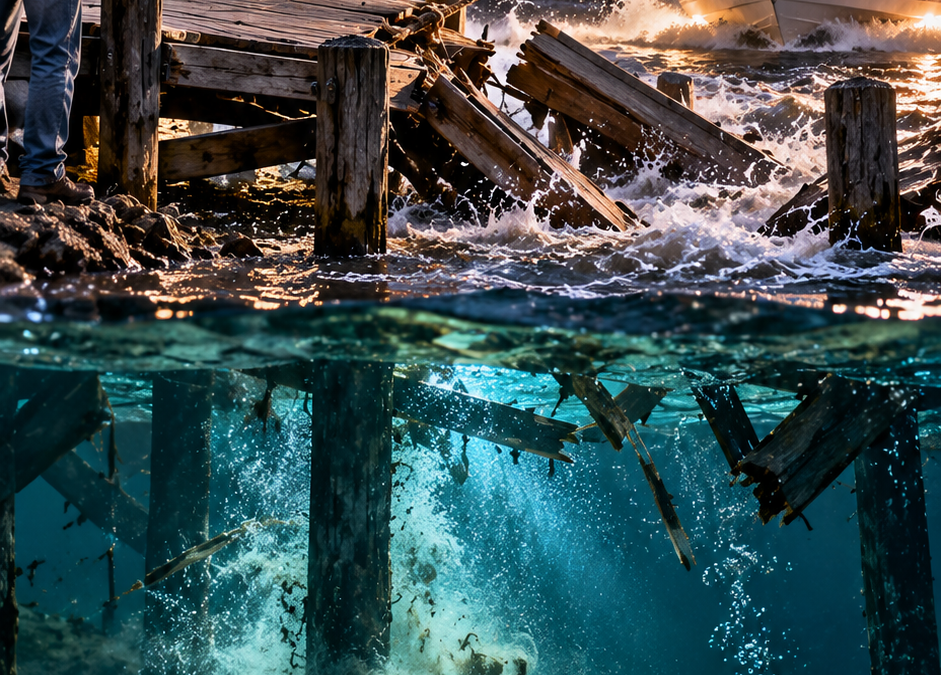
𝗙𝗨𝗟𝗟 𝗦𝗧𝗢𝗥𝗬
The dock was different.
Out there, the emptiness became part of something larger.
Water.
Wind.
Fog.
Birds.
Most mornings, I carried coffee to the end platform and sat where Mara had wanted those two chairs.
There was one place beneath the lake-facing handrail where she had carved our initials with the tip of my old pocketknife.
Small.
Almost invisible.
She had made me promise not to sand them out.
I never did.
That dock was not only wood.
But the most important thing beneath it had nothing to do with Mara.
In 1998, years before I owned the property, a brush fire burned two cabins on the western ridge.
The nearest municipal hydrant was more than six miles away.
Volunteer crews lost precious time shuttling tanker trucks along a narrow county road.
Afterward, the county established an emergency water easement across the lower portion of what later became my land.
My predecessor agreed to host a permanent dry-hydrant system.
The setup was simple.
A screened intake sat approximately twelve feet below the water beneath the center platform of the dock.
A six-inch pipe ran underground from that intake toward a red standpipe beside my driveway.
A fire engine could connect there and draft water directly from the lake.
The recorded corridor extended beyond the intake so fire crews and service boats could reach it when necessary.
The fire district held access rights.
The land stayed private.
The dock stayed private.
When Mara and I rebuilt the dock, the county reviewed the plans because of that intake.
The center platform was positioned so the structure actually protected the equipment below from anchors, propellers, and ice.
For years, almost nobody cared.
Then Clear View Shores arrived.
At first, it was forty vacation homes across the lake.
Then came Phase Two.
Then Phase Three.
The development wrapped around the north shore and reached Granite Point, immediately east of my cove.
Within five years, Clear View had become eighty-four homes, two swimming pools, a large clubhouse, landscaped walking paths, and a private marina less than two hundred yards from my dock.
Most of the residents were normal people.
Families.
Retired couples.
People from Milwaukee or Madison who wanted weekends near water.
They waved from boats.
Bought bait at the same store I did.
Complained about mosquitoes.
Then Vanessa Pike became board president.
Vanessa was forty-eight and had spent most of her career in commercial real estate.
She wore fitted red jackets to board meetings and spoke in careful sentences.
She almost never raised her voice.
She did not need to.
When Vanessa wanted a room quiet, she lowered her voice until everyone else leaned forward.
She understood pressure.
That was what made her dangerous.
That summer, Vanessa’s obsession was the Silver Pine Independence Regatta.
Clear View had sold sponsorships.
Booked a floating concert stage.
Arranged a catered reception.
Invited local press.
And planned a Fourth of July boat parade led by Vanessa’s new forty-six-foot Marlow cruiser.
The Resolute.
It was a beautiful boat.
Navy hull.
Bright stainless rails.
Twin engines.
Large enough to look ridiculous on Silver Pine Lake.
But it photographed well beside the clubhouse.
There was only one problem.
The west side of the planned parade route narrowed near my cove.
Small boats could make the turn easily.
Vanessa’s yacht could not.
My dock sat completely within my deeded shoreline area, but its outer platform forced a vessel that size to slow down, reverse, and pivot.
It ruined the clean promotional loop Vanessa wanted.
Three months before the regatta, she came to my house.
Red blazer.
Black heels.
Leather folder.
Her shoes sank slightly into my gravel drive.
“Mr. Ward,” she said, “I would like to solve a geometry problem.”
She opened a glossy site plan across the hood of my truck.
A curved route passed through my cove.
My dock had been colored yellow.
“Clear View will purchase twenty-eight feet of your shoreline and relocate the dock at our expense.”
“How much?”
“Seventy-five thousand dollars.”
I stared at her.
She smiled.
“Plus lifetime social membership at the clubhouse.”
“I don’t use your clubhouse.”
“You might.”
“No.”
She tapped the plan.
“This is generous compensation.”
I traced the proposed route with one finger.
“You crossed the fire easement.”
“Our engineers consider that infrastructure obsolete.”
“Which engineers?”
“Our consultant.”
“Did your consultant speak to the fire district?”
The corner of her smile changed.
“The district has tanker trucks now.”
“That wasn’t my question.”
She closed the folder halfway.
“Seventy-five thousand dollars is generous for shoreline you are not using.”
I pointed toward the red standpipe near my workshop.
“That shoreline supplies emergency water to your side of the lake.”
Her expression hardened.
“You are protecting an old pipe because you do not want change.”
“I’m protecting my land because it is mine.”
She folded the map carefully.
“The regatta has already been announced.”
“Then you should have planned a route before announcing it.”
“A private dock will not be allowed to compromise a community event.”
“You designed the event around the private dock.”
She left without shaking my hand.
Four days later, I received my first Clear View violation letter.
It accused my dock lights of creating excessive glare visible from association property.
The amber lights had existed eighteen years.
The second letter claimed my rescue boat was an unregistered commercial vessel.
It was not.
The third said my cedar decking violated the approved shoreline color palette.
I was not a member of Clear View Shores.
My property predated the HOA by fifty-seven years.
Their architectural standards had exactly as much authority over me as my workshop rules had over their clubhouse.
I replied once.
I attached my deed.
Shoreline permit.
Dock drawings.
Electrical inspection.
The letters continued.
Then my boundary buoys started moving.
I kept two white buoys outside the dock to keep unfamiliar boaters away from the intake area.
One Monday, the eastern buoy had shifted thirty feet.
I moved it back.
Wednesday, it moved again.
Friday, both buoys had been positioned so that from the lake it looked as though an open channel ran directly through my cove.
I replaced the ropes with locking shackles.
The next morning, both shackles had clean cuts through them.
That was when I installed cameras.
A visible camera under the workshop eave.
And a small solar trail camera hidden behind a louvered vent in the old fish house.
The second camera covered almost the entire cove.
Vanessa eventually noticed the workshop camera.
She never saw the other one.
Two weeks later, county zoning inspector Paul Danner arrived.
Someone had reported that I had illegally expanded my dock.
Paul measured it twice.
“Ninety feet.”
“Same as always.”
He opened an old digital plan.
“Same as the 2006 permit.”
He checked the setback.
Electrical certification.
Pilings.
Everything matched.
“Who complained?”
Paul gave me the bureaucratic expression that meant he knew but would rather I request the record formally.
“The filing identifies the complainant as a lake safety representative.”
“Clear View?”
“You can request the record.”
Before he left, he walked toward the red standpipe.
“That dry hydrant still active?”
“Tested last fall.”
He nodded.
“Keep the paperwork close.”
“Why?”
“The county updated wildfire response mapping in March.”
He looked toward the dry pines above the west shore.
“That intake matters more than it used to.”
I remembered that sentence later.
I wish I had understood it sooner.
Two weeks before the Fourth, Vanessa returned by water.
The Resolute idled beyond my buoys.
She stood on the upper deck beside a man wearing a Northwoods Marine Works polo.
“Caleb.”
I walked to the end of the dock.
“This is our final attempt to avoid formal action.”
“Your first attempt involved money. Everything since then has looked more like harassment.”
The contractor avoided my eyes.
Vanessa held a document inside a plastic sleeve.
“Our attorney has determined this dock obstructs a customary navigation lane.”
“There is no navigation lane through my property.”
“There will be during the regatta.”
“That is not how property works.”
She leaned against the rail.
“Property works exactly as well as someone can afford to defend it.”
For a second, I said nothing.
It was the first completely honest thing she had told me.
I photographed Vanessa.
The yacht.
The contractor.
The paper in her hand.
Then I called the fire district.
I asked for the latest intake inspection.
The receptionist found it.
“West Lake Draft Point Four passed flow testing in October.”
“Can someone inspect it sooner than September?”
“Do you see damage?”
“No.”
A pause.
“If that changes, contact emergency management immediately.”
I should have pushed harder.
I didn’t.
On June 27, a process server came to my house.
Clear View Shores had filed a petition.
They claimed my dock created an unreasonable hazard to invited boat traffic and asked a judge to authorize temporary removal of the outer platform.
My attorney, Hannah Brooks, read the filing at my kitchen table.
Hannah was fifty-five and hated dramatic language almost as much as she hated badly drafted contracts.
She handled shoreline disputes all over the county.
“They don’t have a recorded navigation right through your cove.”
“They have twelve affidavits.”
She looked at them.
“All twelve use the same three sentences.”
“Vanessa wrote them.”
“Probably.”
“So we’re done?”
“Proving it takes longer than saying it.”
The hearing was scheduled for July 3.
One day before the regatta.
That gave Vanessa six days to make my dock look dangerous.
The storm came two nights later.
Rain started shortly after midnight.
At 2:07, my phone vibrated.
Motion alert.
Workshop camera.
I opened the feed.
Black.
No signal.
Then I realized somebody had switched off the exterior breaker.
I pulled on jeans and boots.
Grabbed a flashlight.
The rain came sideways through the pines.
At first, all I saw on the lake was a single white stern light.
Then deck lamps came on.
The Resolute.
Twenty yards from my dock.
Two men stood on the stern feeding a steel tow cable around the outer support frame.
A smaller workboat floated near the pilings.
Vanessa stood beneath the covered helm wearing a red raincoat.
I ran toward the shoreline.
“Take that cable off my dock!”
One of the men stopped.
Vanessa didn’t.
“We have authority to clear a navigational hazard.”
“No, you don’t!”
I stepped onto the wet first section.
“The hearing hasn’t happened.”
“The storm loosened the structure.”
“The dock hasn’t moved!”
“We’re preventing an accident.”
I reached for my phone.
Vanessa looked toward the operator.
“Take up the slack.”
The cable lifted from the water.
I moved closer.
“There is a fire intake under that platform!”
She heard me.
I know she heard me because she looked toward the red standpipe near my driveway.
Then back at the dock.
“You pull this structure, you could rupture the intake line!”
“The association’s plan shows no active infrastructure.”
“Your plan is wrong.”
She looked at the operator.
“Proceed.”
The engines deepened.
For three seconds, nothing happened.
Then the outer platform twisted.
Cedar boards lifted.
One anchor post bent.
Held.
Then tore loose from the granite with a crack like a rifle shot.
“Stop!”
The cable tightened again.
The center section folded.
And the lake-facing handrail disappeared beneath black water.
Mara’s handrail.
For half a second, that was all I could see.
Not the yacht.
Not Vanessa.
Not the cable.
The place where two letters had been carved underneath cedar eighteen years earlier.
Amber lights blinked once beneath the water.
Then went dark.
One of the contractors shouted.
“Stop! Something else is attached.”
Vanessa stepped onto the aft deck.
“Keep pulling.”
The man stared at her.
“What?”
“I want the whole channel clear before sunrise.”
The engines roared again.
The remaining anchor frame tore loose.
A boil of water erupted beside the destroyed platform.
Then came bubbles.
A line of them moving toward shore.
My stomach dropped.
I knew what that meant.
The intake system had opened below the surface.
The smaller boat began towing pieces of my dock toward the Clear View side.
The Resolute reversed.
Vanessa looked at me through the rain.
“You should have accepted the offer.”
Then the yacht’s deck lights went dark.
Deputy Mark Ellis arrived at 2:46.
The main camera had power again.
The yacht was gone.
I showed him the broken anchor points.
The severed electrical conduit.
Floating boards.
Damage along the shoreline.
“Did you record it?”
“My camera was disabled.”
“Witnesses?”
“Me.”
He wrote Vanessa’s name.
Then he said something that made me realize how quickly she worked.
“She already called.”
“What?”
“She says your dock broke loose during the storm and hit her vessel while they were trying to move it out of the navigation area.”
I stared at him.
“She put the cable on it.”
He nodded.
“She ordered them to pull.”
“I’m writing what you’re telling me.”
“She knew about the intake.”
“Any video?”
I looked toward the black workshop camera.
“Not from that one.”
Mark looked at the lake.
“Without video or another witness, intent gets difficult.”
I hated hearing it.
Not because he was wrong.
Because I knew he wasn’t.
At 8:12 that morning, Hannah forwarded me a demand letter from Vanessa’s attorney.
Sixty-three thousand dollars.
The letter claimed my negligently maintained dock had broken free in the storm and gouged the Resolute’s hull, damaged one stabilizer, and required an emergency tow operation.
By noon, Clear View filed an amended petition asking the court to prohibit me from rebuilding until a full navigation review could occur.
At 4:55, the temporary order arrived.
I could secure debris.
Preserve evidence.
Protect the shoreline.
But I could not install new pilings or perform underwater repairs.
Vanessa had destroyed my dock.
Blamed me for damaging her yacht.
Then used the destruction as evidence that my dock was unsafe.
For several hours, I thought she had planned everything perfectly.
Then I remembered the fish house.
I climbed the old ladder with my laptop.
The solar trail camera sat behind the vent.
Its battery had nothing to do with the workshop breaker.
I pulled the memory card.
First clip.
1:58 a.m.
The Resolute entering my cove.
Second clip.
2:04.
Workboat.
Third clip.
A man stepped onto my dock carrying a flashlight and tool bag.
He disappeared beneath the center platform.
Six minutes.
Then he climbed out and gave Vanessa a thumbs-up.
My pulse slowed.
Not because I was calm.
Because when something finally becomes evidence, anger changes shape.
Then the towing began.
The hidden camera had audio.
Vanessa’s voice was clear through the rain.
“Keep pulling. I want the whole channel clear before sunrise.”
I copied everything to three drives.
One went to Hannah.
One into my workshop safe.
One into my truck.
Then I called Deputy Ellis.
He watched the footage twice.
When the second viewing ended, he leaned back.
“This is not a loose-dock complaint anymore.”
“What was the contractor doing underneath?”
“That’s what I want to know.”
The court order stopped me from sending down my own diver.
Hannah filed an emergency motion for a joint inspection.
She attached the video.
The 1998 emergency easement.
The latest fire-district inspection.
Clear View opposed the request within forty minutes.
Their attorney argued that underwater work might disturb evidence.
Hannah read that sentence aloud at my kitchen table.
“They destroy the dock and now want to protect the scene from you.”
“Can they stop the fire district?”
She looked out the window at the standpipe.
“Not if it’s an active emergency system.”
I called the county emergency number Paul Danner had given me.
Fire Marshal Elena Ruiz arrived before sunset.
She was compact, gray-haired, and calm in the way firefighters and trauma nurses often are.
She brought a district engine, two firefighters, and a portable flow gauge.
They connected a hard suction hose to the red standpipe.
The engine pump started.
The gauge rose for half a second.
Then collapsed.
Zero.
The engine sucked air.
Elena shut it down immediately.
“When was this last tested?”
“October.”
I gave her the report.
She checked the county seal.
Signature.
Date.
Then she walked to the shoreline.
Bubbles still surfaced where the center platform had been.
“The line’s open.”
“What does that mean?”
“Pipe separation, damaged fitting, or the intake assembly has been displaced.”
“I warned Vanessa before she ordered the tow.”
“Do you have that recorded?”
“Yes.”
She watched the video.
Once.
Then again.
Her expression barely moved.
Afterward, she called dispatch.
“Mark West Lake Draft Point Four out of service. Notify Pine Ridge Volunteer, county emergency management, and permitting.”
She paused.
“Until a certified water source is restored, no operational permit for fireworks or open flame events along the affected western shoreline.”
The regatta was four days away.
The failed flow test was the first thing Vanessa could not explain away.
The next morning, the fire district conducted its underwater inspection.
A commercial diver named Owen Blake entered at seven.
Helmet camera.
Surface communication.
Elena watched on a monitor beside the rescue truck.
Hannah stood next to me.
Across the lake, Clear View residents lined the marina.
Owen followed the six-inch pipe.
He found one broken coupling.
The metal flange had been twisted sideways.
“That could be tow damage,” he said over the radio.
He continued.
The intake cage should have been a three-foot stainless structure bolted to a concrete pad.
Instead, it lay on its side six feet away.
Owen moved closer.
Two mounting brackets were bent.
The other two looked different.
Clean grooves.
Fresh exposed metal.
“Those aren’t fractures.”
Elena leaned toward the screen.
“What are they?”
“Cuts.”
My skin went cold.
“Can you identify the tool?”
“Portable abrasive saw, likely. Recent. No oxidation in the kerf.”
Then his hand entered the video.
He lifted something from the mud.
Half of a cutting wheel.
The yacht had ruptured the pipe.
But somebody had cut the intake cage before the towing started.
The six minutes on the hidden camera suddenly made sense.
This had not been a reckless improvisation during bad weather.
Somebody had prepared the emergency intake to come loose.
Owen documented everything.
Cut brackets.
Cable marks.
Damaged couplings.
Anchor scars.
Near the former dock frame, he found blue paint flakes.
Navy blue.
The Resolute was navy.
Then he found a strand of braided steel cable with a green identification thread.
The tow cable on my video had the same green thread woven through it.
At 9:25, Elena issued an official impairment notice.
At 10:10, the county suspended Clear View’s fireworks authorization.
At 10:32, Vanessa emailed every homeowner.
She blamed me.
Her message accused “a hostile neighboring property owner” of sabotaging an obsolete hydrant in order to disrupt the community’s holiday event.
She claimed Clear View had attempted only a good-faith emergency tow after my dock failed during the storm.
No mention of the hidden camera.
No mention of the cuts.
No mention of me shouting that there was an active fire intake beneath the platform.
By lunch, six Clear View residents had driven to my gate.
Two yelled.
One accused me of putting children at risk.
A woman named Lisa Grant remained after the others left.
Lisa lived near the clubhouse.
She was Clear View’s volunteer treasurer.
She held a printed copy of Vanessa’s email.
“Did she know the hydrant was there?”
I opened the video on my phone.
Played the section where I yelled about the fire intake.
Then Vanessa’s reply.
“The association’s plan shows no active infrastructure.”
Lisa listened again.
“That’s strange.”
“Why?”
“We paid Northwoods Marine Works forty-two thousand dollars this year for a shoreline safety upgrade.”
“What kind of upgrade?”
“Vanessa told the board part of the work involved relocating old emergency equipment.”
“Relocating it where?”
Lisa’s face changed.
“She never said.”
“Did your board approve work on my property?”
“We approved work on association-controlled shoreline.”
“My shoreline isn’t association controlled.”
“I know that now.”
“Did Vanessa tell you the HOA had rights here?”
“She said Clear View had acquired all necessary access.”
“It didn’t.”
Lisa folded the email.
“I need to see the invoices.”
That was the second crack.
The first came from underwater.
The next came from the HOA’s own books.
That afternoon, Hannah got a call from an attorney representing Northwoods Marine Works.
The man caught on camera was twenty-nine-year-old Dylan Kerr.
Dylan had seen the video after local news reported the canceled fireworks permit.
He wanted a lawyer before talking to investigators.
He also wanted to correct the story Vanessa had given his company.
According to Dylan, Northwoods was hired to remove “abandoned dock hardware” inside an HOA-controlled navigation corridor.
Vanessa gave them a site diagram.
My outer platform was outlined in red.
The fire intake was labeled DECOMMISSIONED.
She told the crew written owner consent was on file.
No owner name appeared on the work order.
Two nights before the towing, Dylan and another worker entered my cove around dusk.
They cut two brackets on the intake cage because Vanessa’s project manager told them the structure could snag when the dock was pulled.
They stopped when another fishing boat approached.
Then came the storm.
Vanessa ordered them back.
Dylan had messages.
The first read:
Weather gives us cover. Complete West Cove removal tonight.
Another:
Do not contact owner. Legal has it handled.
Then, after my dock broke apart:
Invoice as emergency debris recovery.
Northwoods had not yet received its final eighteen-thousand-dollar payment.
The company preserved the messages.
Work orders.
GPS data.
And the green-thread towing cable.
Deputy Ellis referred the matter to a county detective.
That evening, the HOA attorney withdrew the $63,000 demand.
For approximately one hour, I thought Vanessa might finally stop.
She didn’t.
She changed strategy.
At an emergency board meeting, she told residents a rogue contractor had exceeded instructions.
She said she authorized only a safety inspection.
Not removal.
Not towing.
When Lisa asked about Vanessa’s messages, she called them “out of context.”
Then she produced a document.
A county decommissioning letter.
According to the letter, West Lake Draft Point Four had been removed from active service in March.
County logo.
Typed signature.
Permit number.
For several minutes, according to Lisa, the room shifted back toward Vanessa.
If the intake was officially retired, she could argue that she and Northwoods believed they were removing abandoned infrastructure.
It would not justify destroying my dock.
But it could weaken the public-safety case.
Lisa photographed the letter.
Sent it to Hannah.
Hannah sent it to Elena.
Twenty minutes later, Elena called me.
“That permit number is real.”
My stomach tightened.
Then she continued.
“But it belongs to a retaining-wall repair in Douglas County.”
I said nothing.
“The logo is three years outdated. The employee whose name appears as signer retired in 2021.”
“And Draft Point Four?”
“Never decommissioned.”
Somebody had created a false county document.
And put it in Clear View’s project file.
Vanessa had moved beyond aggressive interpretation.
Now she was standing on paper someone could trace.
The county scheduled a full inspection for July 3.
The same morning our original dock hearing had been set.
Vanessa asked the judge to postpone.
Hannah objected.
Instead, the judge converted the hearing into an evidence-preservation conference.
All boats.
Phones.
Emails.
Project files.
Contractor records.
Relevant physical equipment.
Everything had to remain available.
That order trapped the Resolute in Clear View’s marina.
Vanessa could not repair the gouges in the hull.
Could not replace the damaged stabilizer.
Investigators documented the navy paint.
Compared it to paint recovered near my dock.
They matched the cable.
But the county investigation uncovered something larger.
The Fourth of July regatta was not really about a parade.
It was a sales presentation.
Clear View’s developer still owned nine undeveloped lakefront lots near the marina.
Vanessa had entered a private consulting agreement.
If the HOA approved twelve new boat slips and helped market the remaining lots as suitable for larger vessels, Vanessa would receive a success fee.
The marina expansion needed a turning basin.
The turning basin needed the western route.
And the western route needed my dock to disappear.
The glossy map Vanessa had spread across the hood of my truck three months earlier had not been drawn for one holiday event.
It was Phase One of a marina expansion worth millions.
Lisa found Vanessa’s consulting agreement attached to a reimbursement request in the HOA’s cloud storage.
The file was labeled:
COMMUNITY OUTREACH SERVICES.
Only one other board member appeared to know about the agreement.
He owned one of the undeveloped lakefront lots through a family company.
Now the pressure made sense.
The violation letters.
Buoys.
Survey complaints.
The $75,000 offer.
The $42,000 shoreline contract.
The midnight tow.
And the urgency surrounding the fire intake.
During its inspection, the county overlaid the marina plan with the 1998 emergency easement.
Three existing Clear View slips already crossed into the service corridor.
All twelve proposed slips intruded into it.
The marina had been expanding across emergency-access space for two years.
Vanessa did not simply need my dock removed.
She needed the fire intake declared obsolete.
If the county acknowledged it remained active, the entire expansion could be blocked.
The dock was visible.
The pipe twelve feet beneath it was the real target.
On July 3, county vehicles filled my gravel drive.
Elena brought an engineer.
Survey crew.
Diver.
Paul Danner came from zoning.
Detective Sarah Kim arrived with Deputy Ellis.
Across the lake, the Resolute sat behind temporary evidence tape.
Vanessa arrived wearing a red suit.
Two attorneys walked beside her.
She came down my shoreline as though she were entering a boardroom she still controlled.
“Before this becomes more disruptive,” she said, “Clear View is prepared to fund complete replacement of your dock at a mutually acceptable location.”
“The approved location is where it was.”
“That location is inconsistent with modern lake use.”
Elena stepped beside me.
“Modern lake use still includes fire suppression.”
One attorney held out the supposed decommissioning letter.
“Our client relied on this county authorization.”
Elena did not take it.
“Your client relied on a document using a permit number assigned to another county project, an obsolete logo, and the name of a retired employee.”
Vanessa looked at her attorney.
He lowered the page.
Paul Danner began placing orange flags.
The easement started at the county road.
Followed my driveway.
Reached the standpipe.
Continued directly into the lake beneath the missing dock.
The survey team marked its outer limits.
Three HOA slips crossed the eastern boundary by between six and eleven feet.
Vanessa watched.
“Those slips were permitted in 2022.”
Paul opened a plan tube.
“These are the slips permitted in 2022.”
He unrolled the stamped drawing on my fish-cleaning table.
Eight slips.
All outside the corridor.
Then he put down a current aerial photograph.
“There are eleven now.”
Vanessa said nothing.
“Three were added without shoreline approval.”
“The marina expansion was designed by our consultant.”
Paul produced another drawing.
“Your consultant filed a different survey with the county.”
Silence.
The plan shown to investors did not match the plan submitted to regulators.
Detective Kim asked Vanessa who created the decommissioning letter.
Vanessa folded her arms.
“All communication will go through counsel.”
She had every right to say that.
It was also the first time I had ever seen Vanessa refuse to explain why she was right.
Owen Blake entered the lake again.
Thirty minutes later, he surfaced holding a small aluminum tag.
It had been wired to the intake cage before the cage was cut.
The date stamped on it matched the successful October flow test.
Beside the date were the initials of the fire-district technician.
Any person who removed that cage would have seen it.
Vanessa’s claim that the equipment appeared abandoned collapsed immediately.
Then Owen found something else.
One of the cut brackets had a smear of yellow survey paint beneath the fresh metal dust.
Yellow paint also appeared on the marina expansion drawing.
It marked the proposed turning basin centerline.
The intake had not been struck by random work.
Someone had marked where removal needed to occur.
By noon, Elena issued a county emergency order.
Before Clear View could host any event involving fireworks, open-flame cooking, or more than two hundred guests, the HOA would need to provide a certified alternate emergency water source.
Twenty-four hours before July Fourth, that was impossible.
The regatta was canceled.
The floating stage was turned around on the highway.
The fireworks company removed its trailers.
Sponsor banners came down.
Visiting boaters received cancellation notices.
Vanessa tried one final time to describe the outcome as revenge by a hostile neighbor.
It did not work.
Lisa released board minutes.
Invoices.
Both versions of the marina plan.
Northwoods confirmed that its workers had received written instructions.
The fire district released the failed flow test and a map of the homes dependent on Draft Point Four.
For the first time, Clear View residents could see the entire problem laid out at once.
My dock had never threatened their safety.
Vanessa’s marina expansion had.
Clear View held an emergency meeting that evening.
I stayed home.
Hannah advised me not to turn their internal reckoning into my spectacle.
Lisa called afterward.
Fifty-nine residents voted to remove Vanessa as president.
One voted against.
The other board member connected to the developer resigned before the vote finished.
The new temporary committee froze the marina project.
Hired independent counsel.
Ordered a financial review.
Vanessa did not scream.
Did not give a dramatic confession.
Did not collapse in the parking lot.
She simply lost control of the organization she had spent months using as leverage.
That was enough for one night.
The legal process lasted months.
Real consequences usually do.
The district attorney reviewed the property damage.
False county letter.
Contractor messages.
Financial documents.
Northwoods Marine Works cooperated.
The company agreed to replace damaged intake components at cost and surrendered its remaining invoice.
Dylan Kerr admitted cutting the brackets.
His attorney documented the false maps and fake decommissioning paperwork he had been given.
His cooperation mattered.
Vanessa eventually faced charges involving criminal property damage and use of a fraudulent document.
The following spring, her attorneys negotiated a plea.
She pleaded on the document charge.
Paid restitution.
Received probation and community-service requirements.
The property-damage count was resolved as part of the agreement.
No one went to prison for decades.
There were no federal agents storming the clubhouse.
No cinematic courtroom confession.
The punishment was narrower than people like to imagine justice should be.
But it was real.
Recorded.
Supported by evidence.
The civil cases took another route.
Clear View’s insurer covered portions of the emergency restoration but disputed coverage for deliberate acts.
The HOA’s new counsel pursued Vanessa and the developer for expenditures beyond board authority.
The developer settled rather than expose more sales documents during litigation.
The final agreement paid for reconstruction of my dock on its original permitted footprint.
Replacement of the dry-hydrant system.
My attorney fees.
Shoreline restoration.
Removal of the three unauthorized marina slips.
And a permanent recorded notice acknowledging the emergency easement.
The proposed twelve-slip expansion died.
I had one condition.
The new dock would not look like a resort.
No glass rails.
No polished chrome.
No designer lighting.
Cedar.
Square posts.
Low amber lamps.
The same wide platform Mara had drawn on the back of a grocery receipt.
The contractor salvaged what he could.
Most of the outer decking was ruined.
Some boards had split completely.
One handrail survived.
The tow cable had scarred the wood badly.
But when I turned it over, I saw them.
Mara’s initials.
Still there.
Protected underneath.
I sat on an overturned bucket holding that piece of cedar longer than I care to admit.
The carpenter eventually asked, “You want us to clean this up?”
“No.”
“Sand the cable marks?”
“No.”
“Leave it exactly like this?”
“Exactly.”
We installed that rail on the lake-facing side of the rebuilt platform.
The scars remained visible.
The initials stayed underneath.
The fire district upgraded the intake.
Heavier cage.
Monitoring sensor.
Locked service panel.
Annual inspection schedule.
No future HOA board could quietly declare it obsolete and hope nobody checked.
A small metal plaque now stands beside the red pipe.
WEST LAKE EMERGENCY WATER SOURCE.
KEEP ACCESS CLEAR.
Nothing decorative about it.
But then, there is nothing decorative about a fire engine either.
The following Fourth of July, Clear View held a smaller community picnic.
No yacht procession.
No floating concert stage.
No fireworks over dry pine forest.
Families carried folding chairs to the public beach.
The volunteer fire district parked an engine near the food tents.
Children climbed through the cab.
Lisa invited me.
I declined the renewed offer of a clubhouse membership.
But I brought smoked trout.
Stayed awhile.
Watched the new board present the fire department with a maintenance donation.
Vanessa sold her house later that summer.
The Resolute left before she did.
Because of the hull and stabilizer damage, it was hauled down the county road behind a tractor instead of leaving by water.
I happened to be in my truck near the end of the driveway when it passed.
For months, that yacht had represented everything Vanessa thought made her untouchable.
Money.
Size.
Authority.
Appearance.
Now it was fiberglass and steel strapped to a trailer.
I did not feel triumphant.
I watched it disappear between the trees.
Then I went back to work.
Most mornings now, I still carry coffee to the end of the dock.
The cedar was pale after reconstruction.
It has started turning gray.
Mara would approve.
My rescue boat hangs beneath the lift.
Twelve feet below me, the intake waits in cold lake water.
Most days it does absolutely nothing.
That is exactly what emergency equipment is supposed to do.
Wait.
Be maintained.
Be forgotten without being neglected.
Then work when somebody’s life depends on it.
People occasionally ask whether I regret refusing Vanessa’s original $75,000 offer.
I never have.
Because I understand now what that money was really buying.
It was not twenty-eight feet of shoreline.
It was silence.
Access.
Consent.
Permission to erase something inconvenient before the people relying on it understood what was being removed.
Vanessa looked at my dock and saw an old structure blocking a yacht.
She looked at the intake and saw an obsolete pipe blocking a marina expansion.
She looked at me and saw a widower living alone on fourteen acres.
Somebody she could fine.
Pressure.
Outspend.
Isolate.
She planned everything around the assumption that the most visible obstacle was the only thing that mattered.
She never bothered to understand what the dock was protecting.
That was the mistake that pulled everything else into daylight.
And sometimes, early in the morning, when the lake is completely still, I run my hand along the scarred cedar rail at the end platform.
I can feel where the steel cable dragged across it.
Then I reach underneath.
Two small carved initials.
Still there.
Eighteen years of weather.
One cancer diagnosis.
Four years of grief.
A midnight storm.
A forty-six-foot yacht.
A steel cable.
None of it erased them.
I sit down with my coffee.
Mist rises from Silver Pine Lake.
Somewhere beneath my feet, the emergency intake waits in twelve feet of cold water.
And for the first time in a long time, nothing on that shoreline needs defending.
What do you think of this story? Please leave a like and share your thoughts in the comments. Your support means a lot to us and inspires us to keep writing more meaningful and powerful stories. Thank you! 👍
𝗧𝗛𝗘 𝗘𝗡𝗗
The Dock Vanessa Wanted Gone Was Hiding the One Thing Her Marina Couldn’t Survive
At 2:13 in the morning, Vanessa Pike wrapped a steel tow cable around my private dock and ordered a forty-six-foot yacht to pull.
She knew I was standing on the shoreline when the first cedar platform folded into the lake, and she heard me tell her there was an emergency fire intake underneath it.
By breakfast, she was blaming me for the destruction and demanding $63,000, convinced she had finally cleared the last obstacle between her marina and the future she had already sold to everyone else.
My name is Caleb Ward.
I was sixty-one years old that summer, and I owned fourteen wooded acres along the western shore of Silver Pine Lake in northern Wisconsin.
The property sat about forty minutes south of Eagle River, far enough from the busiest tourist roads that summer mornings still began with loons instead of traffic.
I had spent thirty-four years working as a marine electrician.
Fishing boats.
Cabin cruisers.
Dock power.
Lift motors.
Bilge systems.
Navigation lights.
Half-frozen shore-power pedestals that had survived three winters longer than they should have.
Water taught me something early.
It exposes shortcuts.
A bad connection can hide inside a clean electrical panel for months.
A cracked seal can stay invisible through an entire season.
A lie can sit quietly beneath polished metal and fresh paint.
Then a storm arrives.
Pressure changes.
Something gets wet.
And suddenly the truth starts smoking.
People are not much different.
My property had three hundred ten feet of shoreline, a weathered gray house, a detached workshop, and a ninety-foot cedar dock that extended from a shallow cove into roughly nine feet of water.
The dock was not impressive.
No marble.
No stainless-steel cocktail rail.
No expensive lighting system.
Just square posts, low amber lamps, a fish-cleaning table, and a covered lift for my aluminum rescue boat.
To me, it was perfect.
My wife, Mara, had designed the original layout with me eighteen years earlier.
She drew the first version on the back of a grocery receipt while we sat at our kitchen table.
I still remembered her pushing the receipt toward me with one finger.
“Wide platform here.”
“How wide?”
“Wide enough for two chairs.”
“That is not an engineering measurement.”
“It is the only measurement that matters.”
I laughed.
She pointed again.
“And the blue cooler.”
“The cooler gets its own design requirement?”
“That cooler has survived three camping trips, your truck rolling backward over one corner, and your brother using it as a step stool. It has earned waterfront rights.”
I built the dock.
She chose the cedar.
“Why cedar?” I asked her.
“Because gray wood looks honest beside a northern lake.”
That was Mara.
She trusted things that aged visibly.
Wood.
Leather.
Cast iron.
People who admitted when they were tired.
She never liked anything designed to look new forever.
Four years before Vanessa Pike came into my life, ovarian cancer took Mara from me.
Afterward, the house became difficult.
Grief behaves differently in enclosed rooms.
Inside a house, every empty chair feels intentional.
Every cabinet contains something the other person touched.
Every silence has shape.
The dock was different.
Out there, the emptiness became part of something larger.
Water.
Wind.
Fog.
Birds.
Most mornings, I carried coffee to the end platform and sat where Mara had wanted those two chairs.
There was one place beneath the lake-facing handrail where she had carved our initials with the tip of my old pocketknife.
Small.
Almost invisible.
She had made me promise not to sand them out.
I never did.
That dock was not only wood.
But the most important thing beneath it had nothing to do with Mara.
In 1998, years before I owned the property, a brush fire burned two cabins on the western ridge.
The nearest municipal hydrant was more than six miles away.
Volunteer crews lost precious time shuttling tanker trucks along a narrow county road.
Afterward, the county established an emergency water easement across the lower portion of what later became my land.
My predecessor agreed to host a permanent dry-hydrant system.
The setup was simple.
A screened intake sat approximately twelve feet below the water beneath the center platform of the dock.
A six-inch pipe ran underground from that intake toward a red standpipe beside my driveway.
A fire engine could connect there and draft water directly from the lake.
The recorded corridor extended beyond the intake so fire crews and service boats could reach it when necessary.
The fire district held access rights.
The land stayed private.
The dock stayed private.
When Mara and I rebuilt the dock, the county reviewed the plans because of that intake.
The center platform was positioned so the structure actually protected the equipment below from anchors, propellers, and ice.
For years, almost nobody cared.
Then Clear View Shores arrived.
At first, it was forty vacation homes across the lake.
Then came Phase Two.
Then Phase Three.
The development wrapped around the north shore and reached Granite Point, immediately east of my cove.
Within five years, Clear View had become eighty-four homes, two swimming pools, a large clubhouse, landscaped walking paths, and a private marina less than two hundred yards from my dock.
Most of the residents were normal people.
Families.
Retired couples.
People from Milwaukee or Madison who wanted weekends near water.
They waved from boats.
Bought bait at the same store I did.
Complained about mosquitoes.
Then Vanessa Pike became board president.
Vanessa was forty-eight and had spent most of her career in commercial real estate.
She wore fitted red jackets to board meetings and spoke in careful sentences.
She almost never raised her voice.
She did not need to.
When Vanessa wanted a room quiet, she lowered her voice until everyone else leaned forward.
She understood pressure.
That was what made her dangerous.
That summer, Vanessa’s obsession was the Silver Pine Independence Regatta.
Clear View had sold sponsorships.
Booked a floating concert stage.
Arranged a catered reception.
Invited local press.
And planned a Fourth of July boat parade led by Vanessa’s new forty-six-foot Marlow cruiser.
The Resolute.
It was a beautiful boat.
Navy hull.
Bright stainless rails.
Twin engines.
Large enough to look ridiculous on Silver Pine Lake.
But it photographed well beside the clubhouse.
There was only one problem.
The west side of the planned parade route narrowed near my cove.
Small boats could make the turn easily.
Vanessa’s yacht could not.
My dock sat completely within my deeded shoreline area, but its outer platform forced a vessel that size to slow down, reverse, and pivot.
It ruined the clean promotional loop Vanessa wanted.
Three months before the regatta, she came to my house.
Red blazer.
Black heels.
Leather folder.
Her shoes sank slightly into my gravel drive.
“Mr. Ward,” she said, “I would like to solve a geometry problem.”
She opened a glossy site plan across the hood of my truck.
A curved route passed through my cove.
My dock had been colored yellow.
“Clear View will purchase twenty-eight feet of your shoreline and relocate the dock at our expense.”
“How much?”
“Seventy-five thousand dollars.”
I stared at her.
She smiled.
“Plus lifetime social membership at the clubhouse.”
“I don’t use your clubhouse.”
“You might.”
“No.”
She tapped the plan.
“This is generous compensation.”
I traced the proposed route with one finger.
“You crossed the fire easement.”
“Our engineers consider that infrastructure obsolete.”
“Which engineers?”
“Our consultant.”
“Did your consultant speak to the fire district?”
The corner of her smile changed.
“The district has tanker trucks now.”
“That wasn’t my question.”
She closed the folder halfway.
“Seventy-five thousand dollars is generous for shoreline you are not using.”
I pointed toward the red standpipe near my workshop.
“That shoreline supplies emergency water to your side of the lake.”
Her expression hardened.
“You are protecting an old pipe because you do not want change.”
“I’m protecting my land because it is mine.”
She folded the map carefully.
“The regatta has already been announced.”
“Then you should have planned a route before announcing it.”
“A private dock will not be allowed to compromise a community event.”
“You designed the event around the private dock.”
She left without shaking my hand.
Four days later, I received my first Clear View violation letter.
It accused my dock lights of creating excessive glare visible from association property.
The amber lights had existed eighteen years.
The second letter claimed my rescue boat was an unregistered commercial vessel.
It was not.
The third said my cedar decking violated the approved shoreline color palette.
I was not a member of Clear View Shores.
My property predated the HOA by fifty-seven years.
Their architectural standards had exactly as much authority over me as my workshop rules had over their clubhouse.
I replied once.
I attached my deed.
Shoreline permit.
Dock drawings.
Electrical inspection.
The letters continued.
Then my boundary buoys started moving.
I kept two white buoys outside the dock to keep unfamiliar boaters away from the intake area.
One Monday, the eastern buoy had shifted thirty feet.
I moved it back.
Wednesday, it moved again.
Friday, both buoys had been positioned so that from the lake it looked as though an open channel ran directly through my cove.
I replaced the ropes with locking shackles.
The next morning, both shackles had clean cuts through them.
That was when I installed cameras.
A visible camera under the workshop eave.
And a small solar trail camera hidden behind a louvered vent in the old fish house.
The second camera covered almost the entire cove.
Vanessa eventually noticed the workshop camera.
She never saw the other one.
Two weeks later, county zoning inspector Paul Danner arrived.
Someone had reported that I had illegally expanded my dock.
Paul measured it twice.
“Ninety feet.”
“Same as always.”
He opened an old digital plan.
“Same as the 2006 permit.”
He checked the setback.
Electrical certification.
Pilings.
Everything matched.
“Who complained?”
Paul gave me the bureaucratic expression that meant he knew but would rather I request the record formally.
“The filing identifies the complainant as a lake safety representative.”
“Clear View?”
“You can request the record.”
Before he left, he walked toward the red standpipe.
“That dry hydrant still active?”
“Tested last fall.”
He nodded.
“Keep the paperwork close.”
“Why?”
“The county updated wildfire response mapping in March.”
He looked toward the dry pines above the west shore.
“That intake matters more than it used to.”
I remembered that sentence later.
I wish I had understood it sooner.
Two weeks before the Fourth, Vanessa returned by water.
The Resolute idled beyond my buoys.
She stood on the upper deck beside a man wearing a Northwoods Marine Works polo.
“Caleb.”
I walked to the end of the dock.
“This is our final attempt to avoid formal action.”
“Your first attempt involved money. Everything since then has looked more like harassment.”
The contractor avoided my eyes.
Vanessa held a document inside a plastic sleeve.
“Our attorney has determined this dock obstructs a customary navigation lane.”
“There is no navigation lane through my property.”
“There will be during the regatta.”
“That is not how property works.”
She leaned against the rail.
“Property works exactly as well as someone can afford to defend it.”
For a second, I said nothing.
It was the first completely honest thing she had told me.
I photographed Vanessa.
The yacht.
The contractor.
The paper in her hand.
Then I called the fire district.
I asked for the latest intake inspection.
The receptionist found it.
“West Lake Draft Point Four passed flow testing in October.”
“Can someone inspect it sooner than September?”
“Do you see damage?”
“No.”
A pause.
“If that changes, contact emergency management immediately.”
I should have pushed harder.
I didn’t.
On June 27, a process server came to my house.
Clear View Shores had filed a petition.
They claimed my dock created an unreasonable hazard to invited boat traffic and asked a judge to authorize temporary removal of the outer platform.
My attorney, Hannah Brooks, read the filing at my kitchen table.
Hannah was fifty-five and hated dramatic language almost as much as she hated badly drafted contracts.
She handled shoreline disputes all over the county.
“They don’t have a recorded navigation right through your cove.”
“They have twelve affidavits.”
She looked at them.
“All twelve use the same three sentences.”
“Vanessa wrote them.”
“Probably.”
“So we’re done?”
“Proving it takes longer than saying it.”
The hearing was scheduled for July 3.
One day before the regatta.
That gave Vanessa six days to make my dock look dangerous.
The storm came two nights later.
Rain started shortly after midnight.
At 2:07, my phone vibrated.
Motion alert.
Workshop camera.
I opened the feed.
Black.
No signal.
Then I realized somebody had switched off the exterior breaker.
I pulled on jeans and boots.
Grabbed a flashlight.
The rain came sideways through the pines.
At first, all I saw on the lake was a single white stern light.
Then deck lamps came on.
The Resolute.
Twenty yards from my dock.
Two men stood on the stern feeding a steel tow cable around the outer support frame.
A smaller workboat floated near the pilings.
Vanessa stood beneath the covered helm wearing a red raincoat.
I ran toward the shoreline.
“Take that cable off my dock!”
One of the men stopped.
Vanessa didn’t.
“We have authority to clear a navigational hazard.”
“No, you don’t!”
I stepped onto the wet first section.
“The hearing hasn’t happened.”
“The storm loosened the structure.”
“The dock hasn’t moved!”
“We’re preventing an accident.”
I reached for my phone.
Vanessa looked toward the operator.
“Take up the slack.”
The cable lifted from the water.
I moved closer.
“There is a fire intake under that platform!”
She heard me.
I know she heard me because she looked toward the red standpipe near my driveway.
Then back at the dock.
“You pull this structure, you could rupture the intake line!”
“The association’s plan shows no active infrastructure.”
“Your plan is wrong.”
She looked at the operator.
“Proceed.”
The engines deepened.
For three seconds, nothing happened.
Then the outer platform twisted.
Cedar boards lifted.
One anchor post bent.
Held.
Then tore loose from the granite with a crack like a rifle shot.
“Stop!”
The cable tightened again.
The center section folded.
And the lake-facing handrail disappeared beneath black water.
Mara’s handrail.
For half a second, that was all I could see.
Not the yacht.
Not Vanessa.
Not the cable.
The place where two letters had been carved underneath cedar eighteen years earlier.
Amber lights blinked once beneath the water.
Then went dark.
One of the contractors shouted.
“Stop! Something else is attached.”
Vanessa stepped onto the aft deck.
“Keep pulling.”
The man stared at her.
“What?”
“I want the whole channel clear before sunrise.”
The engines roared again.
The remaining anchor frame tore loose.
A boil of water erupted beside the destroyed platform.
Then came bubbles.
A line of them moving toward shore.
My stomach dropped.
I knew what that meant.
The intake system had opened below the surface.
The smaller boat began towing pieces of my dock toward the Clear View side.
The Resolute reversed.
Vanessa looked at me through the rain.
“You should have accepted the offer.”
Then the yacht’s deck lights went dark.
Deputy Mark Ellis arrived at 2:46.
The main camera had power again.
The yacht was gone.
I showed him the broken anchor points.
The severed electrical conduit.
Floating boards.
Damage along the shoreline.
“Did you record it?”
“My camera was disabled.”
“Witnesses?”
“Me.”
He wrote Vanessa’s name.
Then he said something that made me realize how quickly she worked.
“She already called.”
“What?”
“She says your dock broke loose during the storm and hit her vessel while they were trying to move it out of the navigation area.”
I stared at him.
“She put the cable on it.”
He nodded.
“She ordered them to pull.”
“I’m writing what you’re telling me.”
“She knew about the intake.”
“Any video?”
I looked toward the black workshop camera.
“Not from that one.”
Mark looked at the lake.
“Without video or another witness, intent gets difficult.”
I hated hearing it.
Not because he was wrong.
Because I knew he wasn’t.
At 8:12 that morning, Hannah forwarded me a demand letter from Vanessa’s attorney.
Sixty-three thousand dollars.
The letter claimed my negligently maintained dock had broken free in the storm and gouged the Resolute’s hull, damaged one stabilizer, and required an emergency tow operation.
By noon, Clear View filed an amended petition asking the court to prohibit me from rebuilding until a full navigation review could occur.
At 4:55, the temporary order arrived.
I could secure debris.
Preserve evidence.
Protect the shoreline.
But I could not install new pilings or perform underwater repairs.
Vanessa had destroyed my dock.
Blamed me for damaging her yacht.
Then used the destruction as evidence that my dock was unsafe.
For several hours, I thought she had planned everything perfectly.
Then I remembered the fish house.
I climbed the old ladder with my laptop.
The solar trail camera sat behind the vent.
Its battery had nothing to do with the workshop breaker.
I pulled the memory card.
First clip.
1:58 a.m.
The Resolute entering my cove.
Second clip.
2:04.
Workboat.
Third clip.
A man stepped onto my dock carrying a flashlight and tool bag.
He disappeared beneath the center platform.
Six minutes.
Then he climbed out and gave Vanessa a thumbs-up.
My pulse slowed.
Not because I was calm.
Because when something finally becomes evidence, anger changes shape.
Then the towing began.
The hidden camera had audio.
Vanessa’s voice was clear through the rain.
“Keep pulling. I want the whole channel clear before sunrise.”
I copied everything to three drives.
One went to Hannah.
One into my workshop safe.
One into my truck.
Then I called Deputy Ellis.
He watched the footage twice.
When the second viewing ended, he leaned back.
“This is not a loose-dock complaint anymore.”
“What was the contractor doing underneath?”
“That’s what I want to know.”
The court order stopped me from sending down my own diver.
Hannah filed an emergency motion for a joint inspection.
She attached the video.
The 1998 emergency easement.
The latest fire-district inspection.
Clear View opposed the request within forty minutes.
Their attorney argued that underwater work might disturb evidence.
Hannah read that sentence aloud at my kitchen table.
“They destroy the dock and now want to protect the scene from you.”
“Can they stop the fire district?”
She looked out the window at the standpipe.
“Not if it’s an active emergency system.”
I called the county emergency number Paul Danner had given me.
Fire Marshal Elena Ruiz arrived before sunset.
She was compact, gray-haired, and calm in the way firefighters and trauma nurses often are.
She brought a district engine, two firefighters, and a portable flow gauge.
They connected a hard suction hose to the red standpipe.
The engine pump started.
The gauge rose for half a second.
Then collapsed.
Zero.
The engine sucked air.
Elena shut it down immediately.
“When was this last tested?”
“October.”
I gave her the report.
She checked the county seal.
Signature.
Date.
Then she walked to the shoreline.
Bubbles still surfaced where the center platform had been.
“The line’s open.”
“What does that mean?”
“Pipe separation, damaged fitting, or the intake assembly has been displaced.”
“I warned Vanessa before she ordered the tow.”
“Do you have that recorded?”
“Yes.”
She watched the video.
Once.
Then again.
Her expression barely moved.
Afterward, she called dispatch.
“Mark West Lake Draft Point Four out of service. Notify Pine Ridge Volunteer, county emergency management, and permitting.”
She paused.
“Until a certified water source is restored, no operational permit for fireworks or open flame events along the affected western shoreline.”
The regatta was four days away.
The failed flow test was the first thing Vanessa could not explain away.
The next morning, the fire district conducted its underwater inspection.
A commercial diver named Owen Blake entered at seven.
Helmet camera.
Surface communication.
Elena watched on a monitor beside the rescue truck.
Hannah stood next to me.
Across the lake, Clear View residents lined the marina.
Owen followed the six-inch pipe.
He found one broken coupling.
The metal flange had been twisted sideways.
“That could be tow damage,” he said over the radio.
He continued.
The intake cage should have been a three-foot stainless structure bolted to a concrete pad.
Instead, it lay on its side six feet away.
Owen moved closer.
Two mounting brackets were bent.
The other two looked different.
Clean grooves.
Fresh exposed metal.
“Those aren’t fractures.”
Elena leaned toward the screen.
“What are they?”
“Cuts.”
My skin went cold.
“Can you identify the tool?”
“Portable abrasive saw, likely. Recent. No oxidation in the kerf.”
Then his hand entered the video.
He lifted something from the mud.
Half of a cutting wheel.
The yacht had ruptured the pipe.
But somebody had cut the intake cage before the towing started.
The six minutes on the hidden camera suddenly made sense.
This had not been a reckless improvisation during bad weather.
Somebody had prepared the emergency intake to come loose.
Owen documented everything.
Cut brackets.
Cable marks.
Damaged couplings.
Anchor scars.
Near the former dock frame, he found blue paint flakes.
Navy blue.
The Resolute was navy.
Then he found a strand of braided steel cable with a green identification thread.
The tow cable on my video had the same green thread woven through it.
At 9:25, Elena issued an official impairment notice.
At 10:10, the county suspended Clear View’s fireworks authorization.
At 10:32, Vanessa emailed every homeowner.
She blamed me.
Her message accused “a hostile neighboring property owner” of sabotaging an obsolete hydrant in order to disrupt the community’s holiday event.
She claimed Clear View had attempted only a good-faith emergency tow after my dock failed during the storm.
No mention of the hidden camera.
No mention of the cuts.
No mention of me shouting that there was an active fire intake beneath the platform.
By lunch, six Clear View residents had driven to my gate.
Two yelled.
One accused me of putting children at risk.
A woman named Lisa Grant remained after the others left.
Lisa lived near the clubhouse.
She was Clear View’s volunteer treasurer.
She held a printed copy of Vanessa’s email.
“Did she know the hydrant was there?”
I opened the video on my phone.
Played the section where I yelled about the fire intake.
Then Vanessa’s reply.
“The association’s plan shows no active infrastructure.”
Lisa listened again.
“That’s strange.”
“Why?”
“We paid Northwoods Marine Works forty-two thousand dollars this year for a shoreline safety upgrade.”
“What kind of upgrade?”
“Vanessa told the board part of the work involved relocating old emergency equipment.”
“Relocating it where?”
Lisa’s face changed.
“She never said.”
“Did your board approve work on my property?”
“We approved work on association-controlled shoreline.”
“My shoreline isn’t association controlled.”
“I know that now.”
“Did Vanessa tell you the HOA had rights here?”
“She said Clear View had acquired all necessary access.”
“It didn’t.”
Lisa folded the email.
“I need to see the invoices.”
That was the second crack.
The first came from underwater.
The next came from the HOA’s own books.
That afternoon, Hannah got a call from an attorney representing Northwoods Marine Works.
The man caught on camera was twenty-nine-year-old Dylan Kerr.
Dylan had seen the video after local news reported the canceled fireworks permit.
He wanted a lawyer before talking to investigators.
He also wanted to correct the story Vanessa had given his company.
According to Dylan, Northwoods was hired to remove “abandoned dock hardware” inside an HOA-controlled navigation corridor.
Vanessa gave them a site diagram.
My outer platform was outlined in red.
The fire intake was labeled DECOMMISSIONED.
She told the crew written owner consent was on file.
No owner name appeared on the work order.
Two nights before the towing, Dylan and another worker entered my cove around dusk.
They cut two brackets on the intake cage because Vanessa’s project manager told them the structure could snag when the dock was pulled.
They stopped when another fishing boat approached.
Then came the storm.
Vanessa ordered them back.
Dylan had messages.
The first read:
Weather gives us cover. Complete West Cove removal tonight.
Another:
Do not contact owner. Legal has it handled.
Then, after my dock broke apart:
Invoice as emergency debris recovery.
Northwoods had not yet received its final eighteen-thousand-dollar payment.
The company preserved the messages.
Work orders.
GPS data.
And the green-thread towing cable.
Deputy Ellis referred the matter to a county detective.
That evening, the HOA attorney withdrew the $63,000 demand.
For approximately one hour, I thought Vanessa might finally stop.
She didn’t.
She changed strategy.
At an emergency board meeting, she told residents a rogue contractor had exceeded instructions.
She said she authorized only a safety inspection.
Not removal.
Not towing.
When Lisa asked about Vanessa’s messages, she called them “out of context.”
Then she produced a document.
A county decommissioning letter.
According to the letter, West Lake Draft Point Four had been removed from active service in March.
County logo.
Typed signature.
Permit number.
For several minutes, according to Lisa, the room shifted back toward Vanessa.
If the intake was officially retired, she could argue that she and Northwoods believed they were removing abandoned infrastructure.
It would not justify destroying my dock.
But it could weaken the public-safety case.
Lisa photographed the letter.
Sent it to Hannah.
Hannah sent it to Elena.
Twenty minutes later, Elena called me.
“That permit number is real.”
My stomach tightened.
Then she continued.
“But it belongs to a retaining-wall repair in Douglas County.”
I said nothing.
“The logo is three years outdated. The employee whose name appears as signer retired in 2021.”
“And Draft Point Four?”
“Never decommissioned.”
Somebody had created a false county document.
And put it in Clear View’s project file.
Vanessa had moved beyond aggressive interpretation.
Now she was standing on paper someone could trace.
The county scheduled a full inspection for July 3.
The same morning our original dock hearing had been set.
Vanessa asked the judge to postpone.
Hannah objected.
Instead, the judge converted the hearing into an evidence-preservation conference.
All boats.
Phones.
Emails.
Project files.
Contractor records.
Relevant physical equipment.
Everything had to remain available.
That order trapped the Resolute in Clear View’s marina.
Vanessa could not repair the gouges in the hull.
Could not replace the damaged stabilizer.
Investigators documented the navy paint.
Compared it to paint recovered near my dock.
They matched the cable.
But the county investigation uncovered something larger.
The Fourth of July regatta was not really about a parade.
It was a sales presentation.
Clear View’s developer still owned nine undeveloped lakefront lots near the marina.
Vanessa had entered a private consulting agreement.
If the HOA approved twelve new boat slips and helped market the remaining lots as suitable for larger vessels, Vanessa would receive a success fee.
The marina expansion needed a turning basin.
The turning basin needed the western route.
And the western route needed my dock to disappear.
The glossy map Vanessa had spread across the hood of my truck three months earlier had not been drawn for one holiday event.
It was Phase One of a marina expansion worth millions.
Lisa found Vanessa’s consulting agreement attached to a reimbursement request in the HOA’s cloud storage.
The file was labeled:
COMMUNITY OUTREACH SERVICES.
Only one other board member appeared to know about the agreement.
He owned one of the undeveloped lakefront lots through a family company.
Now the pressure made sense.
The violation letters.
Buoys.
Survey complaints.
The $75,000 offer.
The $42,000 shoreline contract.
The midnight tow.
And the urgency surrounding the fire intake.
During its inspection, the county overlaid the marina plan with the 1998 emergency easement.
Three existing Clear View slips already crossed into the service corridor.
All twelve proposed slips intruded into it.
The marina had been expanding across emergency-access space for two years.
Vanessa did not simply need my dock removed.
She needed the fire intake declared obsolete.
If the county acknowledged it remained active, the entire expansion could be blocked.
The dock was visible.
The pipe twelve feet beneath it was the real target.
On July 3, county vehicles filled my gravel drive.
Elena brought an engineer.
Survey crew.
Diver.
Paul Danner came from zoning.
Detective Sarah Kim arrived with Deputy Ellis.
Across the lake, the Resolute sat behind temporary evidence tape.
Vanessa arrived wearing a red suit.
Two attorneys walked beside her.
She came down my shoreline as though she were entering a boardroom she still controlled.
“Before this becomes more disruptive,” she said, “Clear View is prepared to fund complete replacement of your dock at a mutually acceptable location.”
“The approved location is where it was.”
“That location is inconsistent with modern lake use.”
Elena stepped beside me.
“Modern lake use still includes fire suppression.”
One attorney held out the supposed decommissioning letter.
“Our client relied on this county authorization.”
Elena did not take it.
“Your client relied on a document using a permit number assigned to another county project, an obsolete logo, and the name of a retired employee.”
Vanessa looked at her attorney.
He lowered the page.
Paul Danner began placing orange flags.
The easement started at the county road.
Followed my driveway.
Reached the standpipe.
Continued directly into the lake beneath the missing dock.
The survey team marked its outer limits.
Three HOA slips crossed the eastern boundary by between six and eleven feet.
Vanessa watched.
“Those slips were permitted in 2022.”
Paul opened a plan tube.
“These are the slips permitted in 2022.”
He unrolled the stamped drawing on my fish-cleaning table.
Eight slips.
All outside the corridor.
Then he put down a current aerial photograph.
“There are eleven now.”
Vanessa said nothing.
“Three were added without shoreline approval.”
“The marina expansion was designed by our consultant.”
Paul produced another drawing.
“Your consultant filed a different survey with the county.”
Silence.
The plan shown to investors did not match the plan submitted to regulators.
Detective Kim asked Vanessa who created the decommissioning letter.
Vanessa folded her arms.
“All communication will go through counsel.”
She had every right to say that.
It was also the first time I had ever seen Vanessa refuse to explain why she was right.
Owen Blake entered the lake again.
Thirty minutes later, he surfaced holding a small aluminum tag.
It had been wired to the intake cage before the cage was cut.
The date stamped on it matched the successful October flow test.
Beside the date were the initials of the fire-district technician.
Any person who removed that cage would have seen it.
Vanessa’s claim that the equipment appeared abandoned collapsed immediately.
Then Owen found something else.
One of the cut brackets had a smear of yellow survey paint beneath the fresh metal dust.
Yellow paint also appeared on the marina expansion drawing.
It marked the proposed turning basin centerline.
The intake had not been struck by random work.
Someone had marked where removal needed to occur.
By noon, Elena issued a county emergency order.
Before Clear View could host any event involving fireworks, open-flame cooking, or more than two hundred guests, the HOA would need to provide a certified alternate emergency water source.
Twenty-four hours before July Fourth, that was impossible.
The regatta was canceled.
The floating stage was turned around on the highway.
The fireworks company removed its trailers.
Sponsor banners came down.
Visiting boaters received cancellation notices.
Vanessa tried one final time to describe the outcome as revenge by a hostile neighbor.
It did not work.
Lisa released board minutes.
Invoices.
Both versions of the marina plan.
Northwoods confirmed that its workers had received written instructions.
The fire district released the failed flow test and a map of the homes dependent on Draft Point Four.
For the first time, Clear View residents could see the entire problem laid out at once.
My dock had never threatened their safety.
Vanessa’s marina expansion had.
Clear View held an emergency meeting that evening.
I stayed home.
Hannah advised me not to turn their internal reckoning into my spectacle.
Lisa called afterward.
Fifty-nine residents voted to remove Vanessa as president.
One voted against.
The other board member connected to the developer resigned before the vote finished.
The new temporary committee froze the marina project.
Hired independent counsel.
Ordered a financial review.
Vanessa did not scream.
Did not give a dramatic confession.
Did not collapse in the parking lot.
She simply lost control of the organization she had spent months using as leverage.
That was enough for one night.
The legal process lasted months.
Real consequences usually do.
The district attorney reviewed the property damage.
False county letter.
Contractor messages.
Financial documents.
Northwoods Marine Works cooperated.
The company agreed to replace damaged intake components at cost and surrendered its remaining invoice.
Dylan Kerr admitted cutting the brackets.
His attorney documented the false maps and fake decommissioning paperwork he had been given.
His cooperation mattered.
Vanessa eventually faced charges involving criminal property damage and use of a fraudulent document.
The following spring, her attorneys negotiated a plea.
She pleaded on the document charge.
Paid restitution.
Received probation and community-service requirements.
The property-damage count was resolved as part of the agreement.
No one went to prison for decades.
There were no federal agents storming the clubhouse.
No cinematic courtroom confession.
The punishment was narrower than people like to imagine justice should be.
But it was real.
Recorded.
Supported by evidence.
The civil cases took another route.
Clear View’s insurer covered portions of the emergency restoration but disputed coverage for deliberate acts.
The HOA’s new counsel pursued Vanessa and the developer for expenditures beyond board authority.
The developer settled rather than expose more sales documents during litigation.
The final agreement paid for reconstruction of my dock on its original permitted footprint.
Replacement of the dry-hydrant system.
My attorney fees.
Shoreline restoration.
Removal of the three unauthorized marina slips.
And a permanent recorded notice acknowledging the emergency easement.
The proposed twelve-slip expansion died.
I had one condition.
The new dock would not look like a resort.
No glass rails.
No polished chrome.
No designer lighting.
Cedar.
Square posts.
Low amber lamps.
The same wide platform Mara had drawn on the back of a grocery receipt.
The contractor salvaged what he could.
Most of the outer decking was ruined.
Some boards had split completely.
One handrail survived.
The tow cable had scarred the wood badly.
But when I turned it over, I saw them.
Mara’s initials.
Still there.
Protected underneath.
I sat on an overturned bucket holding that piece of cedar longer than I care to admit.
The carpenter eventually asked, “You want us to clean this up?”
“No.”
“Sand the cable marks?”
“No.”
“Leave it exactly like this?”
“Exactly.”
We installed that rail on the lake-facing side of the rebuilt platform.
The scars remained visible.
The initials stayed underneath.
The fire district upgraded the intake.
Heavier cage.
Monitoring sensor.
Locked service panel.
Annual inspection schedule.
No future HOA board could quietly declare it obsolete and hope nobody checked.
A small metal plaque now stands beside the red pipe.
WEST LAKE EMERGENCY WATER SOURCE.
KEEP ACCESS CLEAR.
Nothing decorative about it.
But then, there is nothing decorative about a fire engine either.
The following Fourth of July, Clear View held a smaller community picnic.
No yacht procession.
No floating concert stage.
No fireworks over dry pine forest.
Families carried folding chairs to the public beach.
The volunteer fire district parked an engine near the food tents.
Children climbed through the cab.
Lisa invited me.
I declined the renewed offer of a clubhouse membership.
But I brought smoked trout.
Stayed awhile.
Watched the new board present the fire department with a maintenance donation.
Vanessa sold her house later that summer.
The Resolute left before she did.
Because of the hull and stabilizer damage, it was hauled down the county road behind a tractor instead of leaving by water.
I happened to be in my truck near the end of the driveway when it passed.
For months, that yacht had represented everything Vanessa thought made her untouchable.
Money.
Size.
Authority.
Appearance.
Now it was fiberglass and steel strapped to a trailer.
I did not feel triumphant.
I watched it disappear between the trees.
Then I went back to work.
Most mornings now, I still carry coffee to the end of the dock.
The cedar was pale after reconstruction.
It has started turning gray.
Mara would approve.
My rescue boat hangs beneath the lift.
Twelve feet below me, the intake waits in cold lake water.
Most days it does absolutely nothing.
That is exactly what emergency equipment is supposed to do.
Wait.
Be maintained.
Be forgotten without being neglected.
Then work when somebody’s life depends on it.
People occasionally ask whether I regret refusing Vanessa’s original $75,000 offer.
I never have.
Because I understand now what that money was really buying.
It was not twenty-eight feet of shoreline.
It was silence.
Access.
Consent.
Permission to erase something inconvenient before the people relying on it understood what was being removed.
Vanessa looked at my dock and saw an old structure blocking a yacht.
She looked at the intake and saw an obsolete pipe blocking a marina expansion.
She looked at me and saw a widower living alone on fourteen acres.
Somebody she could fine.
Pressure.
Outspend.
Isolate.
She planned everything around the assumption that the most visible obstacle was the only thing that mattered.
She never bothered to understand what the dock was protecting.
That was the mistake that pulled everything else into daylight.
And sometimes, early in the morning, when the lake is completely still, I run my hand along the scarred cedar rail at the end platform.
I can feel where the steel cable dragged across it.
Then I reach underneath.
Two small carved initials.
Still there.
Eighteen years of weather.
One cancer diagnosis.
Four years of grief.
A midnight storm.
A forty-six-foot yacht.
A steel cable.
None of it erased them.
I sit down with my coffee.
Mist rises from Silver Pine Lake.
Somewhere beneath my feet, the emergency intake waits in twelve feet of cold water.
And for the first time in a long time, nothing on that shoreline needs defending.

