𝗙𝗨𝗟𝗟 𝗦𝗧𝗢𝗥𝗬 The Debt in My Mailbox Belonged to an Agreement I Had Never Made
𝗙𝗨𝗟𝗟 𝗦𝗧𝗢𝗥𝗬
She nodded.
That was the end of the conversation.
We had no reason to believe otherwise.
The association did not send us bills.
It did not inspect our property.
It did not fine us.
It did not send architectural forms when we replaced exterior lights.
When I painted the shutters, nobody cared.
When we changed landscaping, nobody asked for approval.
When a section of fence needed replacement, I called a contractor, not a committee.
Twenty years passed that way.
Eventually, we paid off the mortgage.
I still remember the day the final payment cleared.
My wife stood beside me at the kitchen counter while I looked at the confirmation.
“That’s it?” she asked.
“That’s it.”
“No more mortgage?”
“No more mortgage.”
She smiled.
It was not dramatic.
No champagne.
No big dinner.
But that evening, we sat on the porch longer than usual.
The house was finally ours free and clear.
We had spent two decades building toward that feeling.
Then came a Tuesday morning in March.
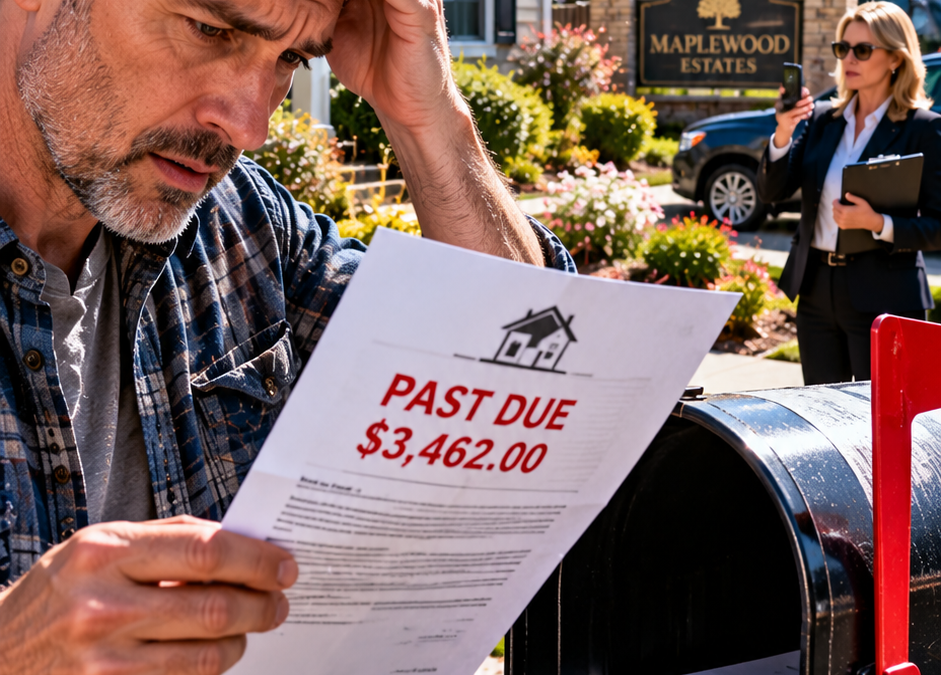
I walked to the mailbox expecting the usual collection of advertising flyers, utility bills, and whatever catalog had somehow found my address that month.
Instead, I found a thick envelope.
Official-looking.
My full name typed across the front.
Return address:
Maplewood Estates Homeowners Association.
My first reaction was confusion.
I stood beside the mailbox and opened it.
Inside was a formal notice.
According to the letter, because I lived within Maplewood Estates, I was a mandatory member of the homeowners association.
According to the same letter, I had failed to pay assessments.
Not one month.
Not one quarter.
Two years.
The notice warned that continued failure to pay could result in additional fees, collection activity, and legal action involving my property.
At the bottom, printed in bold:
AMOUNT DUE: $4,200.
I read it.
Then read it again.
Then a third time.
And I laughed.
Not because it was funny.
Because my brain rejected the possibility that the letter could actually be intended for me.
Four thousand two hundred dollars?
For an HOA I had never joined?
I checked the address.
Correct.
My name.
Correct.
Parcel reference.
Correct.
I went inside.
My wife was at the kitchen table.
“What is it?”
“Apparently we owe the HOA forty-two hundred dollars.”
She looked up.
“What HOA?”
“Exactly.”
I handed her the letter.
She read more slowly than I had.
Then she looked at me.
“We’re not members.”
“I know.”
“Did we miss something?”
“Twenty years?”
She frowned.
“What are you going to do?”
“Call them.”
The number was printed at the bottom.
I expected a clerical explanation.
Wrong database.
Automatic mailing.
New management software.
Maybe someone had imported every street address without checking which properties were actually subject to the association.
I was calm when I called.
A woman answered.
“Maplewood Estates management.”
I gave her my name.
Address.
Account number from the notice.
“I think there has been a mistake.”
She pulled up the record.
“I have your account.”
“I’ve never had an account.”
“You’re listed as an owner in Maplewood Estates.”
“Yes, I own the house.”
“Then this is the correct account.”
“No. I’ve never joined the HOA.”
There was a short pause.
Then she said something I remember exactly.
“Sir, membership is automatic.”
I leaned against the kitchen counter.
“Automatic based on what?”
“You live in the neighborhood.”
“My wife and I bought this property in 2003.”
“All owners within Maplewood Estates are members.”
“Our deed doesn’t say that.”
“I can’t interpret your deed.”
“Neither can I apparently, but I’ve had it for twenty years and your association has never billed me.”
“That does not change the obligation.”
“What obligation?”
“Association membership.”
“Where did I agree to it?”
“Sir, you don’t have to sign a separate agreement.”
“Then show me what binds my property.”
“You’ll need to address that with the board or legal department.”
“So right now your position is simply that because my house is geographically near your association, I owe you forty-two hundred dollars?”
“It isn’t simply geographic proximity.”
“Then what is it?”
She repeated:
“You live in Maplewood Estates.”
I remember looking at my wife.
She was standing in the kitchen doorway listening.
I said, “I bought here before your organization ever contacted me.”
“That doesn’t exempt you from current community obligations.”
I took a breath.
“Please send me whatever recorded document you believe makes my property part of your association.”
“I can note your dispute.”
“Please do.”
“Collection activity may continue while the account is disputed.”
That sentence ended the conversation for me.
“Fine.”
I hung up.
My wife looked worried.
“You’re not paying it?”
“No.”
“What if they’re right?”
“Then they should be able to show us why.”
I believed that.
Maybe too confidently.
I thought someone higher in the organization would eventually look at the file, compare dates, see the obvious problem, and correct it.
I did not immediately hire a lawyer.
I did not send a certified legal response.
I simply refused to write a check for an obligation I did not recognize.
Looking back, ignoring a demand like that was not the best possible response.
But emotionally, the letter still felt absurd.
Twenty years of silence had given me confidence.
Surely no organization could appear two decades after I bought my home and simply announce that I had been a member all along.
Sixty days later, another envelope arrived.
This one did not make me laugh.
It stated that Maplewood Estates had recorded a lien against my property.
Unpaid assessments.
Late charges.
Administrative expenses.
Collection costs.
New total:
$6,800.
I stood in the kitchen holding the paper.
The house was paid off.
No mortgage.
No bank claim.
No overdue taxes.
Nothing.
And now an organization we had never joined had placed a lien against it.
My wife read the letter.
Her face changed.
“What does this mean?”
I did not answer immediately.
I knew enough to know a lien was not simply an angry bill.
It attached a claimed debt to the property.
It could complicate a sale.
A refinance.
A title search.
Potentially much more depending on the law and the type of claim involved.
My wife sat down.
“They can do that?”
“They did.”
“No, I mean legally.”
“I don’t know.”
That was the first time I admitted those words.
I don’t know.
Until then, I had been operating on common sense.
I never signed.
Therefore I do not owe.
But legal disputes are not always built around the common-sense version of events.
I looked at our house differently that afternoon.
The same living room.
Same kitchen.
Same photographs on the walls.
But suddenly there was paperwork in a county record claiming somebody else had rights connected to it.
My wife started crying.
Not dramatically.
Quietly.
Which was worse.
“We paid this place off.”
“I know.”
“Twenty years.”
“I know.”
“We didn’t do anything.”
“No.”
“What happens if they try to take it?”
That question stayed in the room.
I sat beside her.
“They’re not taking the house.”
“You don’t know that.”
She was right.
I didn’t.
And that frightened me more than the amount.
Six thousand eight hundred dollars was painful but survivable.
The idea that someone could leverage paperwork against our home was different.
That was when anger stopped feeling hot.
It became cold.
Focused.
I called a real estate attorney the next morning.
I told him everything.
2003 purchase.
No active HOA.
Twenty years without contact.
First demand.
Phone call.
Lien.
$6,800.
He listened without interrupting.
When I finished, he asked:
“Do you have your original deed?”
“Yes.”
“I want it.”
“Okay.”
“And every covenant document you can find connected to the subdivision.”
“I don’t have any.”
“Then we’ll obtain them.”
“What exactly are you looking for?”
He paused.
“Dates.”
“Dates?”
“And recording references.”
I expected him to ask whether we had used HOA amenities.
Whether we had received newsletters.
Whether our mailbox looked like everyone else’s.
Instead, he wanted paperwork.
“Send me the deed first.”
That afternoon, I found the closing file we had kept all those years.
It had moved from one filing cabinet to another.
Then into a plastic storage bin.
Then back into my office after we paid off the house.
The folder smelled faintly like old paper and basement dust.
There was our deed.
Our names.
Legal description.
Recording information.
I scanned every page.
Sent it.
The HOA escalated while my attorney reviewed the records.
Another formal notice arrived.
Cease-and-desist language.
Legal threats.
Warnings about noncompliance.
They were prepared, the letter said, to enforce the association’s rights in court.
I remember reading that sentence and feeling my stomach turn.
Court.
Until then, this had been letters and phone calls.
Now there was a possibility that my wife and I would sit in a courtroom defending our own house against an organization that had never spoken to us for two decades.
Two days after receiving my deed, my attorney called.
His voice sounded different.
Not excited.
Lawyers rarely sound excited when the thing they find is useful.
He sounded careful.
“Are you somewhere you can talk?”
“Yes.”
“I’ve reviewed your deed.”
“Okay.”
“And the recorded declaration the association is relying on.”
“And?”
“Your deed contains no reference to their declaration.”
I leaned back.
“I told you.”
“Yes. But now I can tell you something else.”
“What?”
“The association’s declaration was recorded in 2009.”
I stared at the wall.
“We bought in 2003.”
“Exactly.”
“Six years earlier.”
“Yes.”
I waited.
“So what does that mean?”
He explained the structure as it appeared in our records.
When residential property is made subject to restrictive covenants, the obligation ordinarily comes through recorded instruments affecting the property.
The HOA’s legal theory depended on a declaration of covenants, conditions, and restrictions.
Its own document carried a county recording date.
My deed:
And my deed contained no reference to that later declaration.
Nothing.
No HOA.
No mandatory assessments.
No covenant incorporating future association control.
The organization was relying on paperwork filed six years after we already owned the property.
I asked the only question I cared about.
“Can they bind us retroactively?”
“Based on the documents I’ve reviewed, I don’t see the basis for what they’re claiming.”
I felt something loosen in my chest.
“Then this is over.”
“Not necessarily.”
I hated that answer.
“Why?”
“Because they still have to agree.”
“Their own document proves it.”
“That doesn’t mean they’ll concede.”
“What happens now?”
“I respond formally.”
He did.
His letter was not angry.
That surprised me.
If I had written it, it would have contained twenty years of frustration.
His did not.
He listed dates.
Our deed.
No HOA covenant reference.
Association declaration.
Recorded 2009.
He challenged the lien.
Demanded its removal.
Invited Maplewood Estates to withdraw the claim without further litigation.
I remember asking him:
“Shouldn’t we tell them how outrageous this is?”
“They already know you disagree.”
“But they’ve put a lien on my house.”
“And anger will not change the recording date.”
That sentence stayed with me.
Anger will not change the recording date.
Maplewood Estates refused to back down.
Their lawyer responded.
They maintained that we lived within the broader planned community.
They cited neighborhood expectations.
Community standards.
Uniform obligations.
Implied membership.
They believed residence within Maplewood Estates subjected us to association responsibilities.
My attorney called me.
“They want to proceed.”
“To court?”
“Yes.”
I was stunned.
“After seeing the dates?”
“Yes.”
“Why?”
“I can’t tell you what their internal reasoning is.”
“Do they have another document?”
“Nothing they’ve produced changes what we’ve discussed.”
My wife heard most of the conversation.
Afterward she sat across from me at the dining room table.
For a long time neither of us spoke.
Finally, she asked:
“What if the judge agrees with them?”
I wanted to answer immediately.
He won’t.
But I stopped.
Because I had spent enough months being confident.
“I don’t know.”
Her eyes filled.
“I hate that answer.”
“So do I.”
“We’ve never even been to one of their meetings.”
“I know.”
“I don’t know who their board members are.”
“I know.”
“They never asked us to vote.”
“I know.”
“And somehow we’re the ones going to court.”
I reached across the table.
“I know.”
The house had become quiet during those months.
Not peaceful.
Quiet.
There is a difference.
Every new envelope made both of us tense.
Every unknown number on my phone made me wonder whether the HOA had escalated again.
When a car slowed near our house, I sometimes looked through the window longer than necessary.
Nothing dramatic happened.
No sheriff came.
No foreclosure notice appeared.
But once you believe someone may be trying to establish authority over your home, normal things begin to feel less normal.
I started rereading the deed myself.
Not because I suddenly understood property law.
Because I wanted to see the page our attorney kept talking about.
There it was.
Our names.
Our purchase.
Our legal description.
No Maplewood Estates Homeowners Association.
No assessment obligation.
No later covenant incorporation that I could see.
Then I looked at the HOA’s declaration.
Six years.
The entire dispute seemed to live inside those six years.
The hearing was scheduled for a Thursday.
I barely slept Wednesday night.
My wife pretended to.
At around three in the morning, I went downstairs.
The old maple tree outside the front window was moving in the wind.
It had been tiny when we bought the place.
Now its branches extended over half the yard.
I thought about all the time between those two versions of that tree.
Twenty years.
We had paid taxes.
Repaired siding.
Replaced appliances.
Paid off the mortgage.
Watched neighbors come and go.
Never once had an HOA representative stood on our porch saying:
You’re one of us.
Yet somehow a lien existed.
I kept thinking about the woman on the phone.
Membership is automatic.
It sounded so simple when she said it.
Automatic.
As if a word could replace a signature.
A deed.
A recording date.
A legal instrument.
At seven that morning, my wife came downstairs.
“You didn’t sleep.”
“Neither did you.”
She sat beside me.
“I keep imagining that judge looking at us like we’re the difficult ones.”
“So do I.”
“Are we?”
“No.”
She looked at me.
“How do you know?”
“Because I finally read everything.”
She nodded.
Then she took my hand.
“All right.”
The courthouse looked exactly like every government building that has ever made an important day feel ordinary.
Security line.
Fluorescent lighting.
Hard benches.
People carrying folders.
Lawyers walking quickly.
My wife and I sat behind our attorney.
Across the aisle sat two Maplewood board members.
I recognized neither of them.
That struck me.
Two people representing an organization claiming power over my home.
And I could not remember ever meeting either one.
Their attorney wore a sharp suit.
He looked comfortable.
Not arrogant exactly.
More like a man who believed the issue in front of him was familiar.
Routine.
Maybe it had been routine for other homeowners.
For us, nothing about it felt routine.
The judge entered.
Everyone stood.
Then sat.
A few procedural matters were addressed.
Papers arranged.
Names stated.
Then the judge looked toward the HOA’s attorney.
“Counsel.”
“Yes, Your Honor.”
“Can you show me where in the defendants’ original deed they agreed to be bound by your association covenants?”
The lawyer did not answer with a page number.
Instead, he began explaining the neighborhood.
Maplewood Estates had developed as a planned residential community.
Shared community interests existed.
Later residents had relied upon consistent standards.
Association governance benefited the neighborhood.
Properties within the development enjoyed the value created by those standards.
Living within the same planned area, he argued, carried implied obligations.
He spoke well.
Confidently.
Smoothly.
For about two minutes, I felt every fear my wife had described the night before.
Because confident language sounds powerful in a courtroom.
Especially when you are not the lawyer.
I looked at our attorney.
He did not appear worried.
The judge let Maplewood’s attorney finish.
Then he picked up the HOA declaration.
Looked at it.
Then picked up our deed.
Looked at that.
He put the documents side by side.
The room became very quiet.
He checked something again.
Then looked over his glasses.
“You filed this declaration in 2009.”
The HOA attorney shifted slightly.
“Yes, Your Honor, but—”
“The defendants purchased their property in 2003.”
“Yes, but the community—”
“Where is the recorded instrument binding their parcel at purchase?”
The lawyer began again.
“Your Honor, the association’s position is that the planned nature of the neighborhood, together with subsequent community governance—”
The judge raised one hand.
Not dramatically.
Enough.
“I asked where the obligation appears.”
Silence.
Our attorney did not interrupt.
The judge looked down again.
For months, I had imagined what I wanted someone in authority to say.
I had imagined speeches.
Anger.
Maybe condemnation.
The actual moment was much simpler.
The judge looked at Maplewood’s attorney.
“You’re asking this court to enforce an obligation that did not exist when these defendants signed their deed.”
Nobody moved.
He tapped the papers.
“These covenants were recorded six years later.”
Then came the sentence I will remember for the rest of my life.
“Counsel, I’ve read the covenants. Your clients have no case.”
No case.
Two words.
That was all.
The courtroom went completely still.
Then the judge made a sound somewhere between a scoff and a short, disbelieving laugh.
He shook his head.
Not enough to mock anyone.
More like he genuinely could not understand why the dispute had reached his courtroom.
The case was dismissed.
The lien had to be removed.
Maplewood Estates was ordered to pay our attorney’s fees.
For a few seconds, I did not feel anything.
That surprised me.
I had imagined relief arriving like a wave.
Instead, I sat there looking at the judge’s bench while my mind tried to catch up with what had just happened.
My wife grabbed my hand.
Hard.
I looked at her.
She was crying.
But this time she was smiling.
“Is that it?” she whispered.
Our attorney leaned back.
“That issue is over.”
I breathed out.
I had not realized how tightly I had been holding my chest.
Across the aisle, the HOA attorney closed his folder.
One of the board members whispered something to the other.
I never heard what.
I did not care.
Outside the courtroom, my wife stopped near a hallway window.
For several seconds, she just stood there.
Then she laughed.
It was the first unguarded laugh I had heard from her since the lien arrived.
“Six years.”
“What?”
“The dates.”
I nodded.
“Six years.”
“All of this because nobody looked at the dates.”
“Somebody probably looked.”
She turned toward me.
“You know what I mean.”
I did.
The paperwork that defeated the claim had existed the entire time.
Nothing dramatic had been hidden.
No secret witness.
No recording discovered at the last minute.
No mysterious former board member arriving with a confession.
Our deed had been sitting in our own files for twenty years.
The association’s declaration had been sitting in county records since 2009.
The truth was not hidden.
It had simply been buried beneath confidence.
Membership is automatic.
You live in the neighborhood.
You owe the dues.
Pay now.
Then:
Late fees.
Administrative charges.
Lien.
Court.
Each step made the previous claim feel more legitimate.
That was what frightened me most after everything ended.
The association did not need to prove itself at the beginning.
It only needed to sound certain enough that I might pay.
Had the first letter demanded two hundred dollars instead of forty-two hundred, maybe I would have.
Had my wife said, “Just send them the money so we don’t have trouble,” maybe I would have.
Had we still owed a large mortgage and feared any problem appearing in a title search, perhaps I would have written a check without calling anyone.
And once I paid?
I do not know what would have happened.
Maybe that payment would have encouraged them to treat us like members permanently.
Maybe we would have spent years paying dues on an obligation that did not appear in our deed.
Maybe we would eventually have accepted architectural rules and fines simply because the first demand had sounded official.
That possibility bothered me almost as much as the lien.
A few weeks after court, we received confirmation that the lien had been removed.
I checked the record myself.
Then checked again.
Gone.
For the first time in months, the house felt like our house again.
That sounds strange.
It had never physically changed.
Nobody had entered.
Nobody had moved a fence.
Nobody had painted our door.
Nothing visible happened.
But ownership is partly confidence.
Confidence that the documents beneath your life say what you believe they say.
For months, that confidence had been shaken.
The first Saturday after everything cleared, I went outside and worked in the yard.
Nothing important.
Trimmed branches.
Cleaned the gutter.
Repaired one loose board along the side fence.
My wife brought coffee onto the porch.
She watched me for a while.
“You know you don’t have to fix everything today.”
“I know.”
“You’re acting like the house survived a hurricane.”
I looked up.
“It felt like one.”
She smiled.
“Fair.”
I climbed down from the ladder.
The maple tree cast shade across most of the front yard now.
I remembered how thin it had been when we bought the house.
That tree had been growing for six years before Maplewood’s declaration was recorded.
Something about that amused me.
“What?” my wife asked.
“Nothing.”
“You’re smiling.”
“I was thinking that tree predates their HOA paperwork.”
She laughed.
“Don’t tell them. They might send it back dues.”
That was the first time we joked about it.
For a while, I wanted to stay angry.
Part of me felt we had earned anger.
We had spent money.
Lost sleep.
Watched a lien attach to property we owned outright.
Sat in court defending an obligation we had never accepted.
My wife had cried over the possibility that someone could threaten the home we had spent twenty years paying for.
Anger seemed reasonable.
But eventually, anger became less useful than understanding what had happened.
The association had authority over some properties.
That part mattered.
HOAs are not imaginary organizations.
When covenants legitimately bind property, those documents can create real obligations.
Dues.
Rules.
Restrictions.
Enforcement rights.
The mistake Maplewood made was treating that authority as something that naturally expanded to every house associated with the neighborhood name.
Our address became the argument.
You live here.
Therefore you belong.
But geography alone was not what our documents said.
The paperwork mattered.
Dates mattered.
Recorded instruments mattered.
Our deed mattered.
That experience changed how I looked at every official letter afterward.
Not with paranoia.
With questions.
What exactly are you claiming?
What document creates that right?
When was it recorded?
Does it actually apply to this property?
What does the complete document say, not just the first page somebody attached to a demand?
Before the lien, I would have thought those questions belonged to lawyers.
Afterward, I understood that they belonged first to owners.
A lawyer may explain the answer.
But you should know where the question begins.
I also stopped assuming official-looking correspondence had already survived meaningful review.
The first Maplewood envelope had everything designed to make a person comply.
Logo.
Formal language.
Account number.
Due date.
Bold total.
Warnings.
Nothing on the page looked uncertain.
The letter did not say:
We think you may owe us money.
It said:
You owe us money.
That difference matters psychologically.
Most people have jobs.
Families.
Medical appointments.
Car repairs.
School schedules.
A thousand responsibilities.
When a professional-looking demand arrives asking for money, paying can seem cheaper than investigating.
Organizations know that.
Sometimes intentionally.
Sometimes simply because systems are built around the assumption that records are correct until someone challenges them.
Either way, the burden lands on the person receiving the envelope.
I sometimes wondered what happened inside Maplewood after the case.
Did anyone review the list of properties they had been billing?
Did the board ask how our address had been added?
Did the management company change procedures?
I never found out.
By then, I wanted distance.
The court had answered the question that mattered to us.
Our property was not bound by the 2009 covenants based on the claim Maplewood had brought.
The lien was gone.
The fees were covered.
We went back to our lives.
For the first few months, every time I opened the mailbox and saw a thick envelope, my stomach still tightened.
Then that reaction faded.
Spring became summer.
The neighborhood lawns turned green.
Children rode bicycles past the house.
New owners moved into a home two doors down.
Life returned to the ordinary rhythm it had before that first Tuesday morning.
One evening, my wife and I sat on the porch.
Same porch where we had celebrated paying off the mortgage.
She looked down the street.
“Do you think we would have fought this twenty years ago?”
“What do you mean?”
“When we first bought the house.”
I thought about it.
Back then, money was tighter.
We were younger.
More nervous about everything related to homeownership.
The idea of hiring a lawyer would have frightened us.
“Maybe not.”
She nodded.
“That bothers me.”
“Me too.”
“If they’d sent that letter in 2004 asking for a few hundred dollars…”
“I might have paid it.”
“Exactly.”
We sat quietly.
Then she said:
“So what made the difference?”
I looked at the house.
“The fact that we kept the paperwork.”
She smiled.
“You mean the paperwork I wanted to throw away three times?”
“Yes.”
“I’d like that entered into the official record.”
“Noted.”
But it was true.
The old closing folder mattered.
The deed mattered.
The county filing dates mattered.
Twenty years of boring documentation mattered.
There is a reason people lose patience with paperwork.
Most of it does nothing exciting.
You keep it for years.
Move it from one cabinet to another.
Forget it exists.
Then one day someone sends you a letter claiming power over your home, and an old page with a recording stamp becomes more valuable than anything you could say in an argument.
I thought about the courtroom often.
Not the judge’s laugh.
That became the detail everyone else liked when we told the story.
The part I remembered was the first question.
“Can you show me where in the original deed this defendant agreed to be bound by your covenants?”
Everything else followed from that.
Not:
Does the HOA improve the neighborhood?
Not:
Do most residents pay dues?
Not:
Would uniform rules benefit property values?
Not:
Did Maplewood consider us part of its community?
Where is the obligation?
Show me.
That was the question we should have asked more firmly the day the first letter arrived.
Show me.
Not tell me.
Not assure me.
Not explain community expectations.
Show me the document.
The original deed had been quiet for twenty years.
It never sent threats.
Never made phone calls.
Never charged late fees.
Never raised its voice.
But when the argument finally reached a place where documents mattered more than confidence, the deed did exactly what it was supposed to do.
It showed what we bought.
And just as importantly, what we had never agreed to.
Years earlier, my wife and I had walked into a closing room thinking we were signing paperwork so we could get the keys to a modest three-bedroom house.
We did not understand every line.
Almost nobody does.
We trusted professionals.
Signed where we were shown.
Then put the papers away and built a life.
Twenty years later, those same pages stood between us and thousands of dollars in charges attached to an organization that had entered our lives long after the purchase.
That changed the way I thought about ownership.
Owning a home is not only living there.
It is not only paying the mortgage.
Mowing the lawn.
Replacing the furnace.
Fixing gutters.
Ownership also exists in the records nobody sees when they drive past.
Deeds.
Legal descriptions.
Recording dates.
Restrictions.
Releases.
Liens.
For most of your life, those documents sit quietly behind everything.
Until somebody challenges what you believe is yours.
Then they become the foundation.
Maplewood’s mistake was not simply asking for money.
It was assuming certainty could substitute for that foundation.
They had a board.
A management company.
An attorney.
Formal letters.
A lien.
They even had covenants.
What they did not have was the one thing the judge asked for.
A document showing that our property had been bound by those covenants when we bought it.
Once that question was asked directly, twenty years of intimidation collapsed into two dates.
Six years.
That was the distance between their claim and our deed.
And in the end, six years mattered more than every warning they had sent.
Sometimes I think about the first phone call.
The woman saying:
“Membership is automatic.”
At the time, those words made me angry.
Later, they almost became funny.
Not because HOA membership can never be mandatory.
It can be.
Not because associations never have power.
They do.
The sentence became funny because of how completely it skipped the only important question.
Automatic because of what?
That was the missing piece.
If the answer is a valid recorded covenant binding the property, then the document should exist.
If the answer is an agreement, show the agreement.
If the answer is a deed restriction, show the deed restriction.
If the answer is simply:
Because we say so—
then eventually somebody may ask for more.
Our attorney did.
The judge did.
And once they did, Maplewood had nowhere else to go.
The lien was removed.
The case was dismissed.
Our legal fees were ordered paid.
But the most important thing we got back was not money.
It was certainty.
The certainty we had possessed for the first twenty years without appreciating it.
Our home was ours under the documents we had actually signed.
A later organization could not simply rewrite those documents by sending a bill.
That night, after we received final confirmation that the property record was clear, my wife and I sat at the kitchen table.
The same table where she had cried when the lien notice arrived.
The same table where we had spread the attorney’s letters and compared recording dates.
There was no paperwork on it now.
Just two mugs of coffee.
She looked at me.
“Do you know what I hated most?”
“The lien?”
“No.”
“The money?”
“No.”
“What?”
“That they made me feel stupid for not knowing.”
I understood immediately.
Every letter had been written as though the question was already settled.
Every response made our confusion seem like our failure.
We should have known we were members.
We should have paid.
We should have accepted the board’s authority.
The certainty of their language made us doubt twenty years of our own experience.
My wife continued.
“I kept thinking maybe we missed something.”
“So did I.”
“Maybe we signed something.”
“I know.”
“Maybe we were wrong.”
I reached across the table.
“We weren’t.”
She smiled.
“I know that now.”
That was what the documents gave us.
Not a dramatic victory.
Not revenge.
An answer.
A clear one.
For twenty years, our house had been the place where life happened quietly.
Then for one year, a stack of paperwork tried to turn it into a legal problem.
When the problem ended, the house returned to what it had always been.
A three-bedroom home on a corner lot.
A maple tree shading the porch.
A loose basement window latch.
A fence that always needed another coat of stain.
The place my wife and I chose in 2003.
Nothing about it became more valuable because a judge dismissed an HOA claim.
But I valued it differently afterward.
Because I finally understood how much of ownership depends on remembering that a confident claim is still only a claim until someone can point to the instrument beneath it.
Maplewood believed the neighborhood name was enough.
Then the dues notice was enough.
Then the lien was enough.
Then the threat of court was enough.
Each escalation was supposed to make resistance feel more expensive than compliance.
For a while, it did.
But escalation does not repair a missing document.
A larger number does not create an agreement.
A lien does not rewrite an older deed merely because it was successfully recorded as a claim.
And a lawyer’s confidence does not move a date six years backward.
In the end, the judge did not need to understand twenty years of our life in that house.
He did not need photographs of our mortgage payments.
He did not need to know how many Saturdays I spent repairing the fence.
He did not need to hear my wife explain how frightened she had been.
He needed two documents.
Our deed.
Their covenants.
Then he compared the dates.
For months, the dispute had felt enormous.
It occupied our kitchen.
Our sleep.
Our finances.
Our conversations.
Our imagination.
In court, it became very small.
No case.
I still keep the original closing file.
It is no longer in a plastic bin.
It sits in the fireproof box with the documents I never intend to lose.
Sometimes when I open that box for something else, I see the deed.
I think about that Tuesday morning.
The thick envelope.
The $4,200 demand.
The phone call.
The $6,800 lien.
My wife’s tears.
The courthouse.
The judge looking at two dates.
Then I close the box.
Because there is nothing left to argue.
The house is quiet again.
And now, when I say it belongs to us, I know exactly which piece of paper proves it.
𝗧𝗛𝗘 𝗘𝗡𝗗
The Debt in My Mailbox Belonged to an Agreement I Had Never Made
For twenty years, nobody from a homeowners association had ever asked me for a dollar.
Then one Tuesday morning, an envelope arrived claiming I owed thousands of dollars to an organization I had never joined.
Sixty days later, that organization had placed a legal claim against the home my wife and I had spent two decades paying off.
My wife and I bought our house in 2003.
It was not the kind of home anyone would put on the cover of a magazine.
Three bedrooms.
Two bathrooms.
A modest corner lot.
A narrow front porch.
A maple tree that was barely taller than the roof when we moved in.
The neighborhood was still being developed then.
Some lots were empty.
Others had foundations surrounded by red dirt and construction fencing.
On weekday mornings, concrete trucks and framing crews came through before sunrise.
By late afternoon, everything became quiet again.
We liked that.
We were not looking for a private club.
We were not looking for gates, tennis courts, swimming pools, community centers, or committees deciding whether our shutters matched somebody else’s idea of tasteful.
We wanted a house we could afford in a peaceful neighborhood where we could build a life.
That was what we bought.
The closing was ordinary.
We sat across from a stack of paperwork with a pen moving from signature line to signature line.
Mortgage documents.
Title papers.
Tax disclosures.
Insurance requirements.
The deed.
Nothing in those papers told us we were members of a homeowners association.
Nothing required monthly dues.
Nothing referred to an HOA board.
No covenant packet was placed in front of us.
No set of community rules was attached.
No representative explained that an association could fine us, assess us, or place a lien against our house.
Because at the time, there was no active HOA controlling our property.
The developer had laid out the lots, sold homes individually, and gradually moved on.
We bought our property.
We moved in.
And life began.
For the first few years, the neighborhood still felt unfinished.
New houses went up at the end of the street.
Fresh sod appeared where mud had been the week before.
Moving trucks came and went.
We learned our neighbors slowly.
Some stayed.
Some moved after only a few years.
Children grew old enough to ride bicycles past our driveway.
The little maple tree in our front yard became tall enough to shade the porch.
My wife planted flowers along the walkway.
I replaced the original builder-grade mailbox after a snowplow finally clipped it.
We painted the living room twice.
Replaced the water heater.
Repaired the roof.
Changed jobs.
Lost relatives.
Celebrated anniversaries.
Paid bills.
And every month, we sent money toward the mortgage.
That house became more than property.
It became the place where the years accumulated.
There is something strange about homeownership when you have been in one place long enough.
Eventually, you stop remembering what the house looked like when it belonged to somebody else.
You know which floorboard complains in winter.
You know which basement window needs an extra push before the latch catches.
You know exactly where afternoon sunlight lands on the kitchen wall in October.
You know which section of gutter will clog first after a storm.
The house becomes part structure and part memory.
For twenty years, that was our life.
Quiet.
Ordinary.
Ours.
Somewhere during those years, Maplewood Estates Homeowners Association came into existence.
I cannot tell you the exact day because it happened around us rather than with us.
Newer homeowners began talking about board elections.
A management company appeared.
There were discussions about common standards.
Rules were written.
Dues were established.
We occasionally saw notices posted near other streets.
None came to us.
Nobody invited us to a meeting.
Nobody asked us to vote.
Nobody asked us to sign anything.
Nobody mailed us a membership agreement.
I remember my wife asking once, maybe ten years after we moved in, whether we needed to look into it.
“I don’t think it applies to us,” I said.
“Are you sure?”
“Our deed doesn’t have an HOA.”
She nodded.
That was the end of the conversation.
We had no reason to believe otherwise.
The association did not send us bills.
It did not inspect our property.
It did not fine us.
It did not send architectural forms when we replaced exterior lights.
When I painted the shutters, nobody cared.
When we changed landscaping, nobody asked for approval.
When a section of fence needed replacement, I called a contractor, not a committee.
Twenty years passed that way.
Eventually, we paid off the mortgage.
I still remember the day the final payment cleared.
My wife stood beside me at the kitchen counter while I looked at the confirmation.
“That’s it?” she asked.
“That’s it.”
“No more mortgage?”
“No more mortgage.”
She smiled.
It was not dramatic.
No champagne.
No big dinner.
But that evening, we sat on the porch longer than usual.
The house was finally ours free and clear.
We had spent two decades building toward that feeling.
Then came a Tuesday morning in March.
I walked to the mailbox expecting the usual collection of advertising flyers, utility bills, and whatever catalog had somehow found my address that month.
Instead, I found a thick envelope.
Official-looking.
My full name typed across the front.
Return address:
Maplewood Estates Homeowners Association.
My first reaction was confusion.
I stood beside the mailbox and opened it.
Inside was a formal notice.
According to the letter, because I lived within Maplewood Estates, I was a mandatory member of the homeowners association.
According to the same letter, I had failed to pay assessments.
Not one month.
Not one quarter.
Two years.
The notice warned that continued failure to pay could result in additional fees, collection activity, and legal action involving my property.
At the bottom, printed in bold:
AMOUNT DUE: $4,200.
I read it.
Then read it again.
Then a third time.
And I laughed.
Not because it was funny.
Because my brain rejected the possibility that the letter could actually be intended for me.
Four thousand two hundred dollars?
For an HOA I had never joined?
I checked the address.
Correct.
My name.
Correct.
Parcel reference.
Correct.
I went inside.
My wife was at the kitchen table.
“What is it?”
“Apparently we owe the HOA forty-two hundred dollars.”
She looked up.
“What HOA?”
“Exactly.”
I handed her the letter.
She read more slowly than I had.
Then she looked at me.
“We’re not members.”
“I know.”
“Did we miss something?”
“Twenty years?”
She frowned.
“What are you going to do?”
“Call them.”
The number was printed at the bottom.
I expected a clerical explanation.
Wrong database.
Automatic mailing.
New management software.
Maybe someone had imported every street address without checking which properties were actually subject to the association.
I was calm when I called.
A woman answered.
“Maplewood Estates management.”
I gave her my name.
Address.
Account number from the notice.
“I think there has been a mistake.”
She pulled up the record.
“I have your account.”
“I’ve never had an account.”
“You’re listed as an owner in Maplewood Estates.”
“Yes, I own the house.”
“Then this is the correct account.”
“No. I’ve never joined the HOA.”
There was a short pause.
Then she said something I remember exactly.
“Sir, membership is automatic.”
I leaned against the kitchen counter.
“Automatic based on what?”
“You live in the neighborhood.”
“My wife and I bought this property in 2003.”
“All owners within Maplewood Estates are members.”
“Our deed doesn’t say that.”
“I can’t interpret your deed.”
“Neither can I apparently, but I’ve had it for twenty years and your association has never billed me.”
“That does not change the obligation.”
“What obligation?”
“Association membership.”
“Where did I agree to it?”
“Sir, you don’t have to sign a separate agreement.”
“Then show me what binds my property.”
“You’ll need to address that with the board or legal department.”
“So right now your position is simply that because my house is geographically near your association, I owe you forty-two hundred dollars?”
“It isn’t simply geographic proximity.”
“Then what is it?”
She repeated:
“You live in Maplewood Estates.”
I remember looking at my wife.
She was standing in the kitchen doorway listening.
I said, “I bought here before your organization ever contacted me.”
“That doesn’t exempt you from current community obligations.”
I took a breath.
“Please send me whatever recorded document you believe makes my property part of your association.”
“I can note your dispute.”
“Please do.”
“Collection activity may continue while the account is disputed.”
That sentence ended the conversation for me.
“Fine.”
I hung up.
My wife looked worried.
“You’re not paying it?”
“No.”
“What if they’re right?”
“Then they should be able to show us why.”
I believed that.
Maybe too confidently.
I thought someone higher in the organization would eventually look at the file, compare dates, see the obvious problem, and correct it.
I did not immediately hire a lawyer.
I did not send a certified legal response.
I simply refused to write a check for an obligation I did not recognize.
Looking back, ignoring a demand like that was not the best possible response.
But emotionally, the letter still felt absurd.
Twenty years of silence had given me confidence.
Surely no organization could appear two decades after I bought my home and simply announce that I had been a member all along.
Sixty days later, another envelope arrived.
This one did not make me laugh.
It stated that Maplewood Estates had recorded a lien against my property.
Unpaid assessments.
Late charges.
Administrative expenses.
Collection costs.
New total:
$6,800.
I stood in the kitchen holding the paper.
The house was paid off.
No mortgage.
No bank claim.
No overdue taxes.
Nothing.
And now an organization we had never joined had placed a lien against it.
My wife read the letter.
Her face changed.
“What does this mean?”
I did not answer immediately.
I knew enough to know a lien was not simply an angry bill.
It attached a claimed debt to the property.
It could complicate a sale.
A refinance.
A title search.
Potentially much more depending on the law and the type of claim involved.
My wife sat down.
“They can do that?”
“They did.”
“No, I mean legally.”
“I don’t know.”
That was the first time I admitted those words.
I don’t know.
Until then, I had been operating on common sense.
I never signed.
Therefore I do not owe.
But legal disputes are not always built around the common-sense version of events.
I looked at our house differently that afternoon.
The same living room.
Same kitchen.
Same photographs on the walls.
But suddenly there was paperwork in a county record claiming somebody else had rights connected to it.
My wife started crying.
Not dramatically.
Quietly.
Which was worse.
“We paid this place off.”
“I know.”
“Twenty years.”
“I know.”
“We didn’t do anything.”
“No.”
“What happens if they try to take it?”
That question stayed in the room.
I sat beside her.
“They’re not taking the house.”
“You don’t know that.”
She was right.
I didn’t.
And that frightened me more than the amount.
Six thousand eight hundred dollars was painful but survivable.
The idea that someone could leverage paperwork against our home was different.
That was when anger stopped feeling hot.
It became cold.
Focused.
I called a real estate attorney the next morning.
I told him everything.
2003 purchase.
No active HOA.
Twenty years without contact.
First demand.
Phone call.
Lien.
$6,800.
He listened without interrupting.
When I finished, he asked:
“Do you have your original deed?”
“Yes.”
“I want it.”
“Okay.”
“And every covenant document you can find connected to the subdivision.”
“I don’t have any.”
“Then we’ll obtain them.”
“What exactly are you looking for?”
He paused.
“Dates.”
“Dates?”
“And recording references.”
I expected him to ask whether we had used HOA amenities.
Whether we had received newsletters.
Whether our mailbox looked like everyone else’s.
Instead, he wanted paperwork.
“Send me the deed first.”
That afternoon, I found the closing file we had kept all those years.
It had moved from one filing cabinet to another.
Then into a plastic storage bin.
Then back into my office after we paid off the house.
The folder smelled faintly like old paper and basement dust.
There was our deed.
Our names.
Legal description.
Recording information.
I scanned every page.
Sent it.
The HOA escalated while my attorney reviewed the records.
Another formal notice arrived.
Cease-and-desist language.
Legal threats.
Warnings about noncompliance.
They were prepared, the letter said, to enforce the association’s rights in court.
I remember reading that sentence and feeling my stomach turn.
Court.
Until then, this had been letters and phone calls.
Now there was a possibility that my wife and I would sit in a courtroom defending our own house against an organization that had never spoken to us for two decades.
Two days after receiving my deed, my attorney called.
His voice sounded different.
Not excited.
Lawyers rarely sound excited when the thing they find is useful.
He sounded careful.
“Are you somewhere you can talk?”
“Yes.”
“I’ve reviewed your deed.”
“Okay.”
“And the recorded declaration the association is relying on.”
“And?”
“Your deed contains no reference to their declaration.”
I leaned back.
“I told you.”
“Yes. But now I can tell you something else.”
“What?”
“The association’s declaration was recorded in 2009.”
I stared at the wall.
“We bought in 2003.”
“Exactly.”
“Six years earlier.”
“Yes.”
I waited.
“So what does that mean?”
He explained the structure as it appeared in our records.
When residential property is made subject to restrictive covenants, the obligation ordinarily comes through recorded instruments affecting the property.
The HOA’s legal theory depended on a declaration of covenants, conditions, and restrictions.
Its own document carried a county recording date.
My deed:
And my deed contained no reference to that later declaration.
Nothing.
No HOA.
No mandatory assessments.
No covenant incorporating future association control.
The organization was relying on paperwork filed six years after we already owned the property.
I asked the only question I cared about.
“Can they bind us retroactively?”
“Based on the documents I’ve reviewed, I don’t see the basis for what they’re claiming.”
I felt something loosen in my chest.
“Then this is over.”
“Not necessarily.”
I hated that answer.
“Why?”
“Because they still have to agree.”
“Their own document proves it.”
“That doesn’t mean they’ll concede.”
“What happens now?”
“I respond formally.”
He did.
His letter was not angry.
That surprised me.
If I had written it, it would have contained twenty years of frustration.
His did not.
He listed dates.
Our deed.
No HOA covenant reference.
Association declaration.
Recorded 2009.
He challenged the lien.
Demanded its removal.
Invited Maplewood Estates to withdraw the claim without further litigation.
I remember asking him:
“Shouldn’t we tell them how outrageous this is?”
“They already know you disagree.”
“But they’ve put a lien on my house.”
“And anger will not change the recording date.”
That sentence stayed with me.
Anger will not change the recording date.
Maplewood Estates refused to back down.
Their lawyer responded.
They maintained that we lived within the broader planned community.
They cited neighborhood expectations.
Community standards.
Uniform obligations.
Implied membership.
They believed residence within Maplewood Estates subjected us to association responsibilities.
My attorney called me.
“They want to proceed.”
“To court?”
“Yes.”
I was stunned.
“After seeing the dates?”
“Yes.”
“Why?”
“I can’t tell you what their internal reasoning is.”
“Do they have another document?”
“Nothing they’ve produced changes what we’ve discussed.”
My wife heard most of the conversation.
Afterward she sat across from me at the dining room table.
For a long time neither of us spoke.
Finally, she asked:
“What if the judge agrees with them?”
I wanted to answer immediately.
He won’t.
But I stopped.
Because I had spent enough months being confident.
“I don’t know.”
Her eyes filled.
“I hate that answer.”
“So do I.”
“We’ve never even been to one of their meetings.”
“I know.”
“I don’t know who their board members are.”
“I know.”
“They never asked us to vote.”
“I know.”
“And somehow we’re the ones going to court.”
I reached across the table.
“I know.”
The house had become quiet during those months.
Not peaceful.
Quiet.
There is a difference.
Every new envelope made both of us tense.
Every unknown number on my phone made me wonder whether the HOA had escalated again.
When a car slowed near our house, I sometimes looked through the window longer than necessary.
Nothing dramatic happened.
No sheriff came.
No foreclosure notice appeared.
But once you believe someone may be trying to establish authority over your home, normal things begin to feel less normal.
I started rereading the deed myself.
Not because I suddenly understood property law.
Because I wanted to see the page our attorney kept talking about.
There it was.
Our names.
Our purchase.
Our legal description.
No Maplewood Estates Homeowners Association.
No assessment obligation.
No later covenant incorporation that I could see.
Then I looked at the HOA’s declaration.
Six years.
The entire dispute seemed to live inside those six years.
The hearing was scheduled for a Thursday.
I barely slept Wednesday night.
My wife pretended to.
At around three in the morning, I went downstairs.
The old maple tree outside the front window was moving in the wind.
It had been tiny when we bought the place.
Now its branches extended over half the yard.
I thought about all the time between those two versions of that tree.
Twenty years.
We had paid taxes.
Repaired siding.
Replaced appliances.
Paid off the mortgage.
Watched neighbors come and go.
Never once had an HOA representative stood on our porch saying:
You’re one of us.
Yet somehow a lien existed.
I kept thinking about the woman on the phone.
Membership is automatic.
It sounded so simple when she said it.
Automatic.
As if a word could replace a signature.
A deed.
A recording date.
A legal instrument.
At seven that morning, my wife came downstairs.
“You didn’t sleep.”
“Neither did you.”
She sat beside me.
“I keep imagining that judge looking at us like we’re the difficult ones.”
“So do I.”
“Are we?”
“No.”
She looked at me.
“How do you know?”
“Because I finally read everything.”
She nodded.
Then she took my hand.
“All right.”
The courthouse looked exactly like every government building that has ever made an important day feel ordinary.
Security line.
Fluorescent lighting.
Hard benches.
People carrying folders.
Lawyers walking quickly.
My wife and I sat behind our attorney.
Across the aisle sat two Maplewood board members.
I recognized neither of them.
That struck me.
Two people representing an organization claiming power over my home.
And I could not remember ever meeting either one.
Their attorney wore a sharp suit.
He looked comfortable.
Not arrogant exactly.
More like a man who believed the issue in front of him was familiar.
Routine.
Maybe it had been routine for other homeowners.
For us, nothing about it felt routine.
The judge entered.
Everyone stood.
Then sat.
A few procedural matters were addressed.
Papers arranged.
Names stated.
Then the judge looked toward the HOA’s attorney.
“Counsel.”
“Yes, Your Honor.”
“Can you show me where in the defendants’ original deed they agreed to be bound by your association covenants?”
The lawyer did not answer with a page number.
Instead, he began explaining the neighborhood.
Maplewood Estates had developed as a planned residential community.
Shared community interests existed.
Later residents had relied upon consistent standards.
Association governance benefited the neighborhood.
Properties within the development enjoyed the value created by those standards.
Living within the same planned area, he argued, carried implied obligations.
He spoke well.
Confidently.
Smoothly.
For about two minutes, I felt every fear my wife had described the night before.
Because confident language sounds powerful in a courtroom.
Especially when you are not the lawyer.
I looked at our attorney.
He did not appear worried.
The judge let Maplewood’s attorney finish.
Then he picked up the HOA declaration.
Looked at it.
Then picked up our deed.
Looked at that.
He put the documents side by side.
The room became very quiet.
He checked something again.
Then looked over his glasses.
“You filed this declaration in 2009.”
The HOA attorney shifted slightly.
“Yes, Your Honor, but—”
“The defendants purchased their property in 2003.”
“Yes, but the community—”
“Where is the recorded instrument binding their parcel at purchase?”
The lawyer began again.
“Your Honor, the association’s position is that the planned nature of the neighborhood, together with subsequent community governance—”
The judge raised one hand.
Not dramatically.
Enough.
“I asked where the obligation appears.”
Silence.
Our attorney did not interrupt.
The judge looked down again.
For months, I had imagined what I wanted someone in authority to say.
I had imagined speeches.
Anger.
Maybe condemnation.
The actual moment was much simpler.
The judge looked at Maplewood’s attorney.
“You’re asking this court to enforce an obligation that did not exist when these defendants signed their deed.”
Nobody moved.
He tapped the papers.
“These covenants were recorded six years later.”
Then came the sentence I will remember for the rest of my life.
“Counsel, I’ve read the covenants. Your clients have no case.”
No case.
Two words.
That was all.
The courtroom went completely still.
Then the judge made a sound somewhere between a scoff and a short, disbelieving laugh.
He shook his head.
Not enough to mock anyone.
More like he genuinely could not understand why the dispute had reached his courtroom.
The case was dismissed.
The lien had to be removed.
Maplewood Estates was ordered to pay our attorney’s fees.
For a few seconds, I did not feel anything.
That surprised me.
I had imagined relief arriving like a wave.
Instead, I sat there looking at the judge’s bench while my mind tried to catch up with what had just happened.
My wife grabbed my hand.
Hard.
I looked at her.
She was crying.
But this time she was smiling.
“Is that it?” she whispered.
Our attorney leaned back.
“That issue is over.”
I breathed out.
I had not realized how tightly I had been holding my chest.
Across the aisle, the HOA attorney closed his folder.
One of the board members whispered something to the other.
I never heard what.
I did not care.
Outside the courtroom, my wife stopped near a hallway window.
For several seconds, she just stood there.
Then she laughed.
It was the first unguarded laugh I had heard from her since the lien arrived.
“Six years.”
“What?”
“The dates.”
I nodded.
“Six years.”
“All of this because nobody looked at the dates.”
“Somebody probably looked.”
She turned toward me.
“You know what I mean.”
I did.
The paperwork that defeated the claim had existed the entire time.
Nothing dramatic had been hidden.
No secret witness.
No recording discovered at the last minute.
No mysterious former board member arriving with a confession.
Our deed had been sitting in our own files for twenty years.
The association’s declaration had been sitting in county records since 2009.
The truth was not hidden.
It had simply been buried beneath confidence.
Membership is automatic.
You live in the neighborhood.
You owe the dues.
Pay now.
Then:
Late fees.
Administrative charges.
Lien.
Court.
Each step made the previous claim feel more legitimate.
That was what frightened me most after everything ended.
The association did not need to prove itself at the beginning.
It only needed to sound certain enough that I might pay.
Had the first letter demanded two hundred dollars instead of forty-two hundred, maybe I would have.
Had my wife said, “Just send them the money so we don’t have trouble,” maybe I would have.
Had we still owed a large mortgage and feared any problem appearing in a title search, perhaps I would have written a check without calling anyone.
And once I paid?
I do not know what would have happened.
Maybe that payment would have encouraged them to treat us like members permanently.
Maybe we would have spent years paying dues on an obligation that did not appear in our deed.
Maybe we would eventually have accepted architectural rules and fines simply because the first demand had sounded official.
That possibility bothered me almost as much as the lien.
A few weeks after court, we received confirmation that the lien had been removed.
I checked the record myself.
Then checked again.
Gone.
For the first time in months, the house felt like our house again.
That sounds strange.
It had never physically changed.
Nobody had entered.
Nobody had moved a fence.
Nobody had painted our door.
Nothing visible happened.
But ownership is partly confidence.
Confidence that the documents beneath your life say what you believe they say.
For months, that confidence had been shaken.
The first Saturday after everything cleared, I went outside and worked in the yard.
Nothing important.
Trimmed branches.
Cleaned the gutter.
Repaired one loose board along the side fence.
My wife brought coffee onto the porch.
She watched me for a while.
“You know you don’t have to fix everything today.”
“I know.”
“You’re acting like the house survived a hurricane.”
I looked up.
“It felt like one.”
She smiled.
“Fair.”
I climbed down from the ladder.
The maple tree cast shade across most of the front yard now.
I remembered how thin it had been when we bought the house.
That tree had been growing for six years before Maplewood’s declaration was recorded.
Something about that amused me.
“What?” my wife asked.
“Nothing.”
“You’re smiling.”
“I was thinking that tree predates their HOA paperwork.”
She laughed.
“Don’t tell them. They might send it back dues.”
That was the first time we joked about it.
For a while, I wanted to stay angry.
Part of me felt we had earned anger.
We had spent money.
Lost sleep.
Watched a lien attach to property we owned outright.
Sat in court defending an obligation we had never accepted.
My wife had cried over the possibility that someone could threaten the home we had spent twenty years paying for.
Anger seemed reasonable.
But eventually, anger became less useful than understanding what had happened.
The association had authority over some properties.
That part mattered.
HOAs are not imaginary organizations.
When covenants legitimately bind property, those documents can create real obligations.
Dues.
Rules.
Restrictions.
Enforcement rights.
The mistake Maplewood made was treating that authority as something that naturally expanded to every house associated with the neighborhood name.
Our address became the argument.
You live here.
Therefore you belong.
But geography alone was not what our documents said.
The paperwork mattered.
Dates mattered.
Recorded instruments mattered.
Our deed mattered.
That experience changed how I looked at every official letter afterward.
Not with paranoia.
With questions.
What exactly are you claiming?
What document creates that right?
When was it recorded?
Does it actually apply to this property?
What does the complete document say, not just the first page somebody attached to a demand?
Before the lien, I would have thought those questions belonged to lawyers.
Afterward, I understood that they belonged first to owners.
A lawyer may explain the answer.
But you should know where the question begins.
I also stopped assuming official-looking correspondence had already survived meaningful review.
The first Maplewood envelope had everything designed to make a person comply.
Logo.
Formal language.
Account number.
Due date.
Bold total.
Warnings.
Nothing on the page looked uncertain.
The letter did not say:
We think you may owe us money.
It said:
You owe us money.
That difference matters psychologically.
Most people have jobs.
Families.
Medical appointments.
Car repairs.
School schedules.
A thousand responsibilities.
When a professional-looking demand arrives asking for money, paying can seem cheaper than investigating.
Organizations know that.
Sometimes intentionally.
Sometimes simply because systems are built around the assumption that records are correct until someone challenges them.
Either way, the burden lands on the person receiving the envelope.
I sometimes wondered what happened inside Maplewood after the case.
Did anyone review the list of properties they had been billing?
Did the board ask how our address had been added?
Did the management company change procedures?
I never found out.
By then, I wanted distance.
The court had answered the question that mattered to us.
Our property was not bound by the 2009 covenants based on the claim Maplewood had brought.
The lien was gone.
The fees were covered.
We went back to our lives.
For the first few months, every time I opened the mailbox and saw a thick envelope, my stomach still tightened.
Then that reaction faded.
Spring became summer.
The neighborhood lawns turned green.
Children rode bicycles past the house.
New owners moved into a home two doors down.
Life returned to the ordinary rhythm it had before that first Tuesday morning.
One evening, my wife and I sat on the porch.
Same porch where we had celebrated paying off the mortgage.
She looked down the street.
“Do you think we would have fought this twenty years ago?”
“What do you mean?”
“When we first bought the house.”
I thought about it.
Back then, money was tighter.
We were younger.
More nervous about everything related to homeownership.
The idea of hiring a lawyer would have frightened us.
“Maybe not.”
She nodded.
“That bothers me.”
“Me too.”
“If they’d sent that letter in 2004 asking for a few hundred dollars…”
“I might have paid it.”
“Exactly.”
We sat quietly.
Then she said:
“So what made the difference?”
I looked at the house.
“The fact that we kept the paperwork.”
She smiled.
“You mean the paperwork I wanted to throw away three times?”
“Yes.”
“I’d like that entered into the official record.”
“Noted.”
But it was true.
The old closing folder mattered.
The deed mattered.
The county filing dates mattered.
Twenty years of boring documentation mattered.
There is a reason people lose patience with paperwork.
Most of it does nothing exciting.
You keep it for years.
Move it from one cabinet to another.
Forget it exists.
Then one day someone sends you a letter claiming power over your home, and an old page with a recording stamp becomes more valuable than anything you could say in an argument.
I thought about the courtroom often.
Not the judge’s laugh.
That became the detail everyone else liked when we told the story.
The part I remembered was the first question.
“Can you show me where in the original deed this defendant agreed to be bound by your covenants?”
Everything else followed from that.
Not:
Does the HOA improve the neighborhood?
Not:
Do most residents pay dues?
Not:
Would uniform rules benefit property values?
Not:
Did Maplewood consider us part of its community?
Where is the obligation?
Show me.
That was the question we should have asked more firmly the day the first letter arrived.
Show me.
Not tell me.
Not assure me.
Not explain community expectations.
Show me the document.
The original deed had been quiet for twenty years.
It never sent threats.
Never made phone calls.
Never charged late fees.
Never raised its voice.
But when the argument finally reached a place where documents mattered more than confidence, the deed did exactly what it was supposed to do.
It showed what we bought.
And just as importantly, what we had never agreed to.
Years earlier, my wife and I had walked into a closing room thinking we were signing paperwork so we could get the keys to a modest three-bedroom house.
We did not understand every line.
Almost nobody does.
We trusted professionals.
Signed where we were shown.
Then put the papers away and built a life.
Twenty years later, those same pages stood between us and thousands of dollars in charges attached to an organization that had entered our lives long after the purchase.
That changed the way I thought about ownership.
Owning a home is not only living there.
It is not only paying the mortgage.
Mowing the lawn.
Replacing the furnace.
Fixing gutters.
Ownership also exists in the records nobody sees when they drive past.
Deeds.
Legal descriptions.
Recording dates.
Restrictions.
Releases.
Liens.
For most of your life, those documents sit quietly behind everything.
Until somebody challenges what you believe is yours.
Then they become the foundation.
Maplewood’s mistake was not simply asking for money.
It was assuming certainty could substitute for that foundation.
They had a board.
A management company.
An attorney.
Formal letters.
A lien.
They even had covenants.
What they did not have was the one thing the judge asked for.
A document showing that our property had been bound by those covenants when we bought it.
Once that question was asked directly, twenty years of intimidation collapsed into two dates.
Six years.
That was the distance between their claim and our deed.
And in the end, six years mattered more than every warning they had sent.
Sometimes I think about the first phone call.
The woman saying:
“Membership is automatic.”
At the time, those words made me angry.
Later, they almost became funny.
Not because HOA membership can never be mandatory.
It can be.
Not because associations never have power.
They do.
The sentence became funny because of how completely it skipped the only important question.
Automatic because of what?
That was the missing piece.
If the answer is a valid recorded covenant binding the property, then the document should exist.
If the answer is an agreement, show the agreement.
If the answer is a deed restriction, show the deed restriction.
If the answer is simply:
Because we say so—
then eventually somebody may ask for more.
Our attorney did.
The judge did.
And once they did, Maplewood had nowhere else to go.
The lien was removed.
The case was dismissed.
Our legal fees were ordered paid.
But the most important thing we got back was not money.
It was certainty.
The certainty we had possessed for the first twenty years without appreciating it.
Our home was ours under the documents we had actually signed.
A later organization could not simply rewrite those documents by sending a bill.
That night, after we received final confirmation that the property record was clear, my wife and I sat at the kitchen table.
The same table where she had cried when the lien notice arrived.
The same table where we had spread the attorney’s letters and compared recording dates.
There was no paperwork on it now.
Just two mugs of coffee.
She looked at me.
“Do you know what I hated most?”
“The lien?”
“No.”
“The money?”
“No.”
“What?”
“That they made me feel stupid for not knowing.”
I understood immediately.
Every letter had been written as though the question was already settled.
Every response made our confusion seem like our failure.
We should have known we were members.
We should have paid.
We should have accepted the board’s authority.
The certainty of their language made us doubt twenty years of our own experience.
My wife continued.
“I kept thinking maybe we missed something.”
“So did I.”
“Maybe we signed something.”
“I know.”
“Maybe we were wrong.”
I reached across the table.
“We weren’t.”
She smiled.
“I know that now.”
That was what the documents gave us.
Not a dramatic victory.
Not revenge.
An answer.
A clear one.
For twenty years, our house had been the place where life happened quietly.
Then for one year, a stack of paperwork tried to turn it into a legal problem.
When the problem ended, the house returned to what it had always been.
A three-bedroom home on a corner lot.
A maple tree shading the porch.
A loose basement window latch.
A fence that always needed another coat of stain.
The place my wife and I chose in 2003.
Nothing about it became more valuable because a judge dismissed an HOA claim.
But I valued it differently afterward.
Because I finally understood how much of ownership depends on remembering that a confident claim is still only a claim until someone can point to the instrument beneath it.
Maplewood believed the neighborhood name was enough.
Then the dues notice was enough.
Then the lien was enough.
Then the threat of court was enough.
Each escalation was supposed to make resistance feel more expensive than compliance.
For a while, it did.
But escalation does not repair a missing document.
A larger number does not create an agreement.
A lien does not rewrite an older deed merely because it was successfully recorded as a claim.
And a lawyer’s confidence does not move a date six years backward.
In the end, the judge did not need to understand twenty years of our life in that house.
He did not need photographs of our mortgage payments.
He did not need to know how many Saturdays I spent repairing the fence.
He did not need to hear my wife explain how frightened she had been.
He needed two documents.
Our deed.
Their covenants.
Then he compared the dates.
For months, the dispute had felt enormous.
It occupied our kitchen.
Our sleep.
Our finances.
Our conversations.
Our imagination.
In court, it became very small.
No case.
I still keep the original closing file.
It is no longer in a plastic bin.
It sits in the fireproof box with the documents I never intend to lose.
Sometimes when I open that box for something else, I see the deed.
I think about that Tuesday morning.
The thick envelope.
The $4,200 demand.
The phone call.
The $6,800 lien.
My wife’s tears.
The courthouse.
The judge looking at two dates.
Then I close the box.
Because there is nothing left to argue.
The house is quiet again.
And now, when I say it belongs to us, I know exactly which piece of paper proves it.

