The Contract on the Christmas Table Was Never Really About Whether Noah Married Me
The Contract on the Christmas Table Was Never Really About Whether Noah Married Me
Victor Kingsley thought forcing his son to sign one document would make me disappear from the family before midnight.
What he did not know was that I had spent twenty-six years learning to recognize the difference between protection and control.
By the time his older son put his hands on me, I understood that the contract was hiding something far more dangerous than their hatred of me.
“Sign it now.”
Victor Kingsley’s voice cut across the Christmas dinner table with the kind of authority that had probably worked on everyone in his family for decades.
His hand closed around his youngest son’s wrist.
The silver pen hovered less than an inch above the signature line.
Noah looked at me.
For half a second, neither of us moved.
Then I slammed the leather folder shut.
The sound cracked through the dining room.
Every crystal glass on the table jumped.
Diane Kingsley gasped.
Brooke froze with her phone halfway to her wineglass.
And Victor slowly turned his head toward me.
“Rachel,” Noah said softly.
There was warning in his voice.
Not because he was angry with me.
Because he knew his family.
Unfortunately, so did I by then.
Mason, Noah’s older brother, pushed back his chair.
He had always been the fastest Kingsley to confuse intimidation with leadership.
“You don’t touch family documents.”
I stayed seated.
“Then perhaps the family shouldn’t put my name inside them.”
His eyes narrowed.
“Move.”
“No.”
That was enough for him.
Mason came around the table, reached behind my chair, and grabbed the back of the worn brown wool coat I was still wearing.
He yanked.
The chair scraped hard against the floor.
I moved with him rather than against him.
His mistake was assuming surprise meant helplessness.
I had been grabbed from behind before.
Different countries.
Different rooms.
Different stakes.
The mechanics never changed.
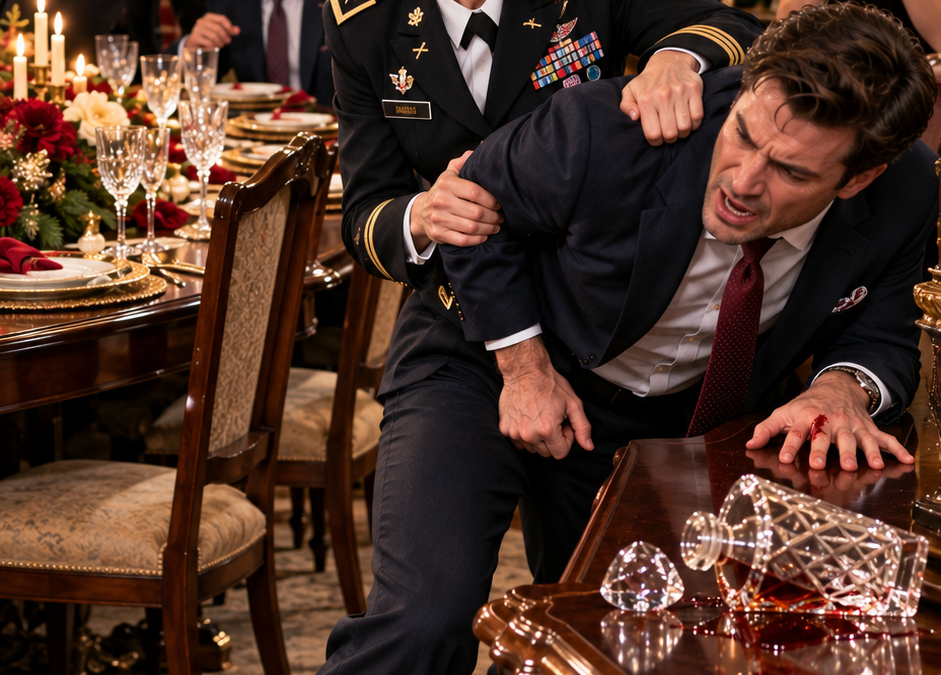
I pivoted, trapped his wrist against my shoulder, stepped through his momentum, and redirected him toward the mahogany sideboard.
He hit it chest-first.
A heavy crystal decanter rocked dangerously.
Mason caught it before it fell, but the stopper slipped and sliced a thin line across his palm.
He stared at the blood.
Then at me.
The room went silent.
I released him immediately.
“You put your hands on the wrong woman,” I said.
My name is Rachel Lawson.
I was forty-five years old that Christmas, and I had served twenty-six years in the United States Army.
The two silver stars on my uniform identified me as a major general.
At the time, I oversaw joint logistics planning, readiness policy, and transportation systems responsible for keeping American forces supplied across multiple regions.
Noah knew I served.
He knew I worked in federal logistics.
He knew there were parts of my career I could not discuss.
He did not know my rank.
That had been my choice.
And before that Christmas was over, I would have to admit that choice had hurt him more than I intended.
But his family knew even less.
They thought I was a midlevel government clerk with an old car, an ordinary apartment, and no useful connections.
For six months, I let them believe it.
Not because I enjoyed deceiving them.
Because I had learned something during a lifetime around rank.
People behave differently when they know what you can do for them.
The moment they see stars on your shoulders, some become deferential.
Others become strategic.
Suddenly they remember your birthday.
They ask whether you have “a minute” to discuss their nephew’s application.
They laugh too hard at ordinary jokes.
They start placing value on proximity.
I hated that.
By the time I met Noah, I had spent so many years being addressed by rank that hearing someone say “Rachel” without hesitation felt almost intimate.
We met at a logistics conference in Denver.
Not a glamorous one.
Half the room was filled with people discussing warehousing failures, rail capacity, inland port congestion, and military freight policy.
Noah Kingsley was representing a private logistics firm.
Not the family company.
That interested me immediately.
Kingsley Defense Freight was one of the largest transportation contractors in the region.
Noah could have walked into an executive title without earning anything.
Instead, he worked for a smaller independent company.
I asked him why over coffee.
He smiled.
“Because I like knowing whether I’m competent without my father’s name on the building.”
That answer stayed with me.
We started talking.
Then having dinner.
Then finding reasons to be in the same cities.
Three months later, I told him I was Army.
He already suspected.
“You fold hotel towels too neatly,” he said.
“That is not military evidence.”
“You wake up before every alarm.”
“Still circumstantial.”
“You once described a traffic jam as a mobility failure.”
“That proves nothing.”
He laughed.
Eventually, I told him I worked in senior federal logistics.
He asked what that meant.
I gave him the parts I legally could.
He never pushed.
Then one evening, sitting on my couch with takeout containers between us, I said something I had rehearsed several times.
“There are things about my work I need to keep private for now.”
He looked at me.
“Classified?”
“Some.”
“Dangerous?”
“Not in the way you mean.”
“Do you want me to know?”
“Eventually.”
He nodded.
“Then eventually is fine.”
“Don’t research me.”
That was the part that surprised him.
“Seriously?”
“Yes.”
“You know that telling someone not to Google you makes Googling you feel mandatory.”
“I know.”
He studied my face.
Then placed his phone on the table.
“All right.”
“You’re not going to ask why?”
“You’ll tell me when you’re ready.”
That was Noah.
He respected boundaries even when he did not understand them.
His family respected almost nothing they could not price.
Victor Kingsley owned steel mills, freight terminals, real estate, and Kingsley Defense Freight.
He had built much of the family fortune himself.
That fact was important to him.
So important that he seemed to believe creating wealth gave him permanent authority over everyone who benefited from it.
His wife, Diane, rarely raised her voice.
She did not need to.
Her judgments arrived through small things.
The pause before she complimented your dress.
The way she asked what neighborhood you lived in.
The tiny lift of one eyebrow when you named a public university instead of a private one.
Mason was more direct.
He wore expensive watches like military decorations.
His wife, Brooke, documented almost everything online.
Restaurants.
Vacations.
Charity events.
Private flights.
People.
Especially people who increased the perceived value of the room.
I never did.
My twelve-year-old Ford offended them more than I expected.
The first time I drove to the Kingsley estate, Brooke looked through the window.
“That’s yours?”
“Yes.”
She blinked.
“Does the government reimburse mileage?”
I smiled.
“Sometimes.”
Mason asked why Noah had not bought me something safer.
I told him the Ford was safe.
Victor asked what my pension would eventually look like.
I told him I was not discussing retirement finances at dinner.
That ended the conversation, but not the evaluation.
By the third family gathering, I knew their conclusion.
Government employee.
Respectable enough.
Not wealthy.
No family name they recognized.
No property they cared about.
No strategic value.
Noah would eventually outgrow me.
I could live with that.
What I struggled with was watching them talk to Noah as if his life remained an extension of Victor’s balance sheet.
Noah owned voting shares in Kingsley Defense Freight.
He was also entitled to deferred compensation and several family trust distributions.
He rarely discussed them.
But Victor did.
Whenever Noah made a decision his father disliked, money appeared in the conversation.
Not explicitly as a threat.
At first.
More like weather.
Always present.
Always capable of turning.
Christmas was supposed to be different.
Noah told me that morning he planned to announce our engagement formally.
We had become engaged six days earlier.
No elaborate restaurant.
No photographer.
No family consultation.
We were at my apartment after dinner when he reached into his coat.
“This is going to sound ridiculous.”
“That is a strong beginning.”
He held out a simple ring.
“I had a speech.”
“What happened?”
“I forgot it.”
“Good.”
“Good?”
“I dislike speeches.”
He laughed.
Then grew serious.
“Rachel Lawson, will you marry me?”
I looked at the man who had spent six months respecting every boundary I placed between us.
“Yes.”
That was all.
No audience.
No conditions.
No board approval.
Christmas dinner would simply make it public.
I almost did not attend in uniform.
That morning, I had been at a memorial event at the Pentagon honoring military transportation personnel lost during overseas operations.
My Army Green Service Uniform was already pressed.
The schedule between Washington and Pittsburgh was tight.
I could have changed.
Instead, I covered the uniform with an old brown wool coat I had purchased years earlier from a thrift shop near Fort Leavenworth.
It was warm.
Comfortable.
And ugly enough that Brooke hated it immediately.
She touched the frayed cuff when I entered the Kingsley mansion.
“Vintage?”
“Secondhand.”
Her smile sharpened.
“How brave.”
I took the words exactly as intended and refused to give them weight.
Noah kissed my cheek.
“You made it.”
“Barely.”
“You look tired.”
“I spent four hours listening to generals give speeches.”
“Your favorite activity.”
“Cruel.”
He smiled.
For the first hour, Christmas remained almost normal.
Diane had decorated the house beautifully.
White lights.
Garland along the staircase.
Fresh pine.
The dining room table could have belonged in a magazine.
Crystal.
Silver.
Candles.
The kind of formal place setting that requires experience to know which fork is decorative and which fork someone will silently judge you for using incorrectly.
We ate.
Brooke asked Noah whether we had discussed houses.
Victor asked whether I intended to stay in government service after marriage.
Mason asked if public pensions could be inherited by spouses.
I finally looked at him.
“You ask remarkably romantic questions.”
Noah nearly choked on his wine.
Mason did not laugh.
Dessert arrived.
Then Victor placed a leather folder beside Noah’s plate.
The atmosphere changed immediately.
Noah looked at it.
“What is this?”
“Routine shareholder protection.”
“On Christmas?”
“Timing is irrelevant.”
Noah opened the folder.
I watched Victor.
Not the papers.
Him.
His attention was too focused.
Mason stopped drinking.
Diane looked down at her plate.
Brooke became unusually quiet.
That told me the document was not routine.
Noah scanned the first page.
“What exactly am I signing?”
“Standard governance protections now that your personal circumstances have changed.”
Personal circumstances.
Me.
Noah continued reading.
I could see part of the text upside down.
By page two, I had questions.
By page four, I understood the trap.
If Noah married without formal approval from the Kingsley board, his voting shares would automatically move into an irrevocable family trust.
He would waive claims to deferred compensation.
Lose direct access to internal financial records.
Accept a lifetime nondisclosure clause extending far beyond legitimate proprietary information.
Then I saw the attached schedule.
My name.
RACHEL LAWSON.
A provision specifically prohibiting me from receiving any direct or indirect benefit connected to Kingsley assets.
I felt no embarrassment.
Only clarity.
This was not a prenuptial agreement.
It was an exit mechanism.
“Noah,” I said.
He looked up.
“What?”
“Do not sign that.”
Victor’s eyes moved to me.
“This is a family matter.”
“Then why is my name in Exhibit C?”
Mason laughed.
“Because people like you see a wealthy boyfriend and start planning retirement.”
Noah pushed back his chair.
“Apologize.”
Mason shrugged.
“She needs reality, not an apology.”
Victor remained focused on Noah.
“Your brother is crude, but the concern is legitimate.”
Noah stared at him.
“You think Rachel is marrying me for money?”
“I think wealth attracts opportunists.”
I looked at Victor.
“Then your first concern should be the people already inside the company.”
His expression hardened.
“What is that supposed to mean?”
“Nothing yet.”
I looked at Noah.
“Read the waiver carefully.”
Victor reached across the table.
“We have lawyers who read it.”
“That is not the same thing as lawyers who represent Noah.”
“Noah is represented by the family counsel.”
“No.”
I held Victor’s gaze.
“The family is represented by family counsel.”
That distinction irritated him.
Noah turned another page.
His expression changed.
“Why would I waive access to internal records?”
“To protect confidential operations.”
“I’m a shareholder.”
“You are also emotionally compromised.”
“By getting engaged?”
“By allowing someone outside this family to influence you.”
Noah’s jaw tightened.
“I made my own decision.”
Victor pushed the silver pen toward him.
“Then prove you are still capable of making responsible ones.”
That was the moment everything became clearer.
The contract was not asking Noah to protect family assets.
It was asking him to surrender power.
He lifted the pen.
Not because he intended to sign.
I realized later he had been about to mark a clause.
Victor did not wait.
His hand closed over Noah’s wrist.
“Sign it now.”
The pen moved toward the paper.
I slammed the folder shut.
Mason grabbed my coat.
Seconds later, he was against the sideboard with blood on his hand.
Victor stared at me.
“Get out.”
Noah stood.
“Dad—”
Victor pointed toward the door.
“You brought a violent woman into my home.”
“Mason grabbed me.”
“He was removing you from a private family discussion.”
“He assaulted me.”
Mason wrapped his palm in a linen napkin.
“You think anyone here is going to call that assault after what you did?”
I looked at him.
“You should.”
His face flushed.
Victor’s attention returned to me.
“You are a minor government employee with no standing in this house.”
That was when I realized hiding had stopped serving any useful purpose.
Not because my rank gave me standing in his house.
It did not.
But because Noah was standing between the truth and a false version of me I had helped create through silence.
I owed him better.
“You’re right about one thing,” I said.
Victor’s expression shifted.
“I should have introduced myself properly.”
I unbuttoned the old coat.
The room became quiet.
I let it slide from my shoulders.
The dark-green uniform beneath it caught the chandelier light.
Ribbons across my chest.
Gold insignia.
Service identification.
And on each shoulder, two silver stars.
Nobody moved.
Brooke’s phone lowered.
Diane stared.
Mason forgot about the cut on his palm.
Victor’s face emptied.
Noah looked at me.
Not impressed.
Not proud.
Hurt.
That was the only reaction that mattered.
“Two stars?” he asked.
Before I could answer, my phone rang on the table.
I looked at the screen.
Official call.
I answered.
“Lawson.”
A woman’s voice came through.
“Major General Lawson, the independent Inspector General has approved suspension notices involving three Kingsley Defense Freight contracts. Please confirm your recusal remains active.”
Every person at the table heard her.
I switched to speaker.
“My recusal remains in effect.”
“Understood, General. The deputy inspector general requests confirmation that you will continue receiving no investigative materials.”
“Correct. Proceed without me. Route future communication through the designated ethics counsel.”
“Yes, ma’am.”
The call ended.
Silence.
Victor stared at my phone as though it had become an explosive device.
Mason spoke first.
“You investigated us while sleeping with my brother?”
“No.”
The word came out sharper than I intended.
I placed my phone facedown.
“Four months ago, a Kingsley subsidiary appeared in an oversight briefing involving transportation billing. The moment I recognized the company, I disclosed my relationship with Noah and recused myself.”
Victor laughed once.
“Convenient.”
“Documented.”
“You expect me to believe you knew nothing?”
“I was removed from every discussion, record, witness contact, recommendation, and decision.”
Mason pointed at my uniform.
“You oversee logistics.”
“Yes.”
“So you had access.”
“Authority and access are not the same thing as using either improperly.”
Victor’s mouth tightened.
“This sounds rehearsed.”
“It is called ethics compliance.”
Then I looked at Noah.
He had barely moved.
His eyes stayed on my shoulders.
“Two stars,” he said again.
The hurt in his voice reached me far more deeply than anything his family had said.
“Yes.”
“You’re a major general.”
“Yes.”
“And you never told me.”
“I should have.”
He looked away.
“Noah.”
“When?”
“What?”
“When were you planning to tell me?”
“Tonight.”
He almost smiled.
Not because anything was funny.
“Tonight?”
“Yes.”
“Before or after dessert?”
“Before your father produced the agreement.”
His eyes came back to me.
“Why didn’t you tell me months ago?”
I could have defended myself.
Operational discretion.
Privacy.
Years of people treating rank as identity.
All true.
None sufficient.
“I wanted to know whether we could build something untouched by my rank.”
He absorbed that.
“So you tested me.”
“No.”
“It feels like a test.”
“You’re right.”
That was difficult to say.
“I told myself I was protecting something real. I did not consider enough what it would feel like for you to discover this in front of your family.”
Mason stepped closer to the table.
“This is unbelievable.”
I looked at him.
“Stay where you are.”
He smiled bitterly.
“You don’t command me.”
“No. But I am warning you.”
His eyes moved toward my phone.
Then he lunged.
He reached for it.
I caught his forearm.
He drove forward anyway.
His shoulder struck Noah.
Noah stumbled backward.
His head hit the stone edge of the fireplace mantel.
The sound changed the room.
“NOAH!”
He dropped to one knee.
Blood appeared immediately above his eyebrow.
Something inside me went cold.
Mason was still fighting for the phone.
I rotated his arm behind him, stepped across his center of balance, and pressed him chest-first onto the dining table.
Plates slid.
Silverware scattered.
Brooke screamed and lifted her phone.
“Drop the phone,” I told her.
She stared.
“What?”
“This is not content.”
She lowered it.
Noah stood slowly, one hand pressed above his eyebrow.
Blood ran between his fingers.
I looked at him.
“You okay?”
“I’m fine.”
“You need stitches.”
“I said I’m fine.”
He stepped between Mason and Victor.
“Nobody touches her again.”
Victor looked at his youngest son.
Something hardened in his face.
“Choose carefully.”
Noah stared at him.
“What?”
“If you walk out with Rachel tonight, you lose everything.”
Diane whispered, “Victor.”
He ignored her.
“Every share. Every trust distribution. Every future position. Every place in this family.”
Noah stood perfectly still.
For the first time since I had known him, I saw not the son who disliked his father’s control.
I saw the son who finally understood the control had no limit.
He picked up the leather folder.
The agreement was still unsigned.
“You’re not protecting the company.”
Victor said nothing.
Noah flipped to the financial-record provision.
“You’re trying to stop me from seeing something.”
Mason stopped struggling beneath my hand.
I felt it immediately.
That tiny change.
Fear.
I released him slowly.
Noah reached into his pocket.
Pulled out a small black USB drive.
“Five months ago, I found duplicate freight invoices.”
Victor’s face changed.
Noah continued.
“Shell carriers. Maintenance charges for trucks that don’t exist. Fuel reimbursements on routes our vehicles never ran.”
Mason looked at him.
“You went into restricted accounting files?”
“I’m a voting shareholder.”
“You had no business—”
“I had every business.”
Noah turned toward his father.
“I reported it through the federal contractor hotline.”
The room became still.
Even I stopped breathing for a second.
Noah held up the drive.
“I reported it before I ever met Rachel.”
A designation flashed through my memory from the briefing I had recused myself from.
Source Lantern.
A senior internal witness.
Documentation across five subsidiaries.
Accounting records strong enough to trigger independent review.
I looked at him.
“You’re Source Lantern?”
He frowned.
“That means something to you?”
“Only from the recusal notice.”
“You knew about me?”
“No.”
I shook my head.
“The source identity was withheld. I was removed before investigative details were circulated.”
Noah stared at me.
Then laughed softly.
It was disbelief, not humor.
“So your rank didn’t bring federal investigators into this house.”
“No.”
He looked toward Victor.
“I did.”
There it was.
The truth none of them had expected.
Victor had treated Noah like the weak son.
The emotional son.
The one who needed family money enough to be controlled by it.
Yet Noah’s conscience had opened the door federal auditors were now walking through.
Mason reached for the USB.
Diane stepped between them.
“Enough.”
Her voice was not loud.
That made everyone stop.
Victor looked at her.
“Stay out of this.”
For the first time that night, she did not obey.
“Mason asked me to witness an electronic transfer last week.”
Noah looked at her.
“What transfer?”
Diane’s hands trembled.
“He said you had already approved it.”
“Approved what?”
“Your voting shares.”
Noah went still.
Victor spoke quickly.
“A temporary protective measure.”
“I never signed anything.”
Diane walked to the sideboard.
She opened a drawer.
Removed a red folder.
Victor’s face lost color.
“Diane.”
She did not look at him.
“I should have asked questions.”
She handed the folder to Noah.
Inside was a printed authorization.
Transfer of Noah’s voting shares.
A digital signature appeared at the bottom.
His name.
His authorization.
His approval timestamp.
Noah stared.
“I was in Washington that night.”
I remembered.
He had been with me.
Dinner near Dupont Circle.
A terrible little Italian restaurant I had chosen because I trusted the online reviews more than I should have.
He had been nowhere near Pennsylvania.
Mason’s name appeared as the submitting officer.
Brooke lowered her phone completely.
Noah slowly looked at his father.
“The agreement on this table wasn’t meant to take my shares.”
Victor’s jaw tightened.
Noah held up the forged authorization.
“You had already taken them.”
“Noah—”
“This contract was meant to make me surrender afterward.”
Victor said nothing.
That silence was confession enough.
Noah looked at me.
Then at Diane.
Then at Mason.
Finally back at Victor.
“How long?”
Victor remained composed.
“I did what was necessary.”
“That is not an answer.”
“You were preparing to make an emotional decision with consequences for generations of this family.”
“You mean marry Rachel.”
“I mean placing family control at risk.”
I stepped forward.
“You forged your son’s authorization.”
Victor looked at me.
“You concealed your identity from him.”
The accusation struck because part of it was true.
I refused to hide behind my stars.
“I owe Noah an apology.”
Victor seemed surprised.
I continued.
“You still do not own his future.”
His eyes hardened.
“This family built something you cannot understand.”
“I understand logistics networks better than almost anyone in this room.”
“That is not what I mean.”
“No.”
I looked at Noah.
“You mean obedience.”
Diane pulled more pages from the red folder.
Emails.
Victor.
Mason.
Corporate counsel.
Discussions about Noah’s shares.
The audit.
Pressure strategies.
One email referred to me specifically.
THE USEFUL REASON.
I read the sentence twice.
Use Lawson relationship as useful reason to accelerate Noah separation before auditors request full shareholder records.
Noah stared at the page.
I watched something inside him break.
Not loudly.
No shouting.
No tears.
Just the slow destruction of whatever belief he still carried that his father’s control contained love somewhere beneath it.
“I was useful,” I said.
Victor remained silent.
“A convenient outsider.”
Nothing.
“If Noah resisted, you blamed me.”
Diane whispered, “Victor…”
Noah took the red folder and sat down.
His hands were shaking.
I wanted to touch him.
I did not.
Not yet.
He needed control over his own space.
He removed the USB drive.
Connected it to his laptop.
Copied the emails.
Then called someone.
“Lydia? It’s Noah.”
A woman answered.
He put the call on speaker.
“I have additional documents.”
“Where are you?”
“My parents’ house.”
“Do not access company systems.”
“I won’t.”
“Do not surrender original documents.”
“Understood.”
“Do not sign anything.”
Noah looked at the leather agreement.
“I won’t.”
“Leave if you can do so safely.”
He looked at me.
“Yes.”
He disconnected.
Victor stood.
“You have no idea what you are doing.”
Noah picked up the unsigned agreement.
“I think this is the first time I do.”
He tore the signature page in half.
Victor’s certainty finally cracked.
“You walk away tonight and there is no coming back.”
Noah placed the torn pages on the table.
“Keep the inheritance.”
Diane covered her mouth.
Victor stared.
Noah’s voice remained steady.
“I will not keep my place in this family by surrendering the truth.”
“You think you can build a life without us?”
“Yes.”
“You don’t know what anything costs.”
Noah smiled sadly.
“I think I’m finally learning.”
We left together.
Outside, snow had started falling.
Not heavily.
Just enough to soften the stone driveway and quiet the grounds.
I put my old brown coat back on.
The stars disappeared.
This time, not because I was hiding from Noah.
Because it was cold.
We reached my Ford.
Noah stopped.
He touched the bandage Diane had placed above his eyebrow.
I turned toward him.
“We should go to an emergency room.”
“In a minute.”
He looked at my coat.
Then at me.
“Major general.”
I nodded.
“I’m sorry.”
He laughed once.
“You keep saying that.”
“Because I am.”
“I don’t know what to do with this.”
“You don’t have to know tonight.”
He looked toward the mansion.
Christmas lights glowed across every window.
From outside, it still looked perfect.
That was the danger of houses like that.
Money can decorate dysfunction beautifully.
Noah leaned against the car.
“You knew an investigation existed.”
“Yes.”
“You knew it involved Kingsley Defense Freight.”
“Yes.”
“And you stayed with me.”
“Yes.”
“Why?”
“Because you were not the company.”
“How could you know that?”
“I didn’t.”
He looked hurt again.
I continued before he misunderstood.
“I knew who you were becoming with me. I did not know every choice you had made before we met.”
He looked at the USB in his hand.
“And now?”
“Now I know you reported your own family before you had any reason to impress me.”
He lowered his eyes.
“That should probably make me feel better.”
“It will eventually.”
He looked up.
“Did you really plan to tell me tonight?”
“Yes.”
“Why tonight?”
“Because we were engaged.”
“Not before?”
“I was afraid.”
That surprised him.
“You?”
“Yes.”
“Of what?”
I took a long breath.
“Being loved differently.”
He frowned.
I had never said the fear aloud before.
“When people discover my rank, some become smaller around me. Some become more interested. Some become careful. Some become ambitious.”
“Noah, I wanted one relationship where someone met Rachel before they met Major General Lawson.”
“And you got that.”
“Yes.”
“At my expense.”
The words landed cleanly.
I nodded.
“Yes.”
He looked away.
For several seconds, snow collected on his shoulders.
“I need the truth from now on.”
“You have it.”
“No.”
He looked back at me.
“I need the woman. Not only the version of herself she decides is safe.”
That sentence followed me for weeks.
At the hospital, Noah needed four stitches.
I sat beside him.
Neither of us spoke much.
We returned to Washington the next day separately.
Not because we were ending our engagement.
Because both of us needed room.
The Kingsley investigation did not explode overnight.
Real investigations rarely do.
There were no dramatic raids the next morning.
No headlines announcing guilt.
No instant punishment.
There were auditors.
Subpoenas.
Preservation notices.
Financial reviews.
Interviews.
Quiet meetings between lawyers.
Three Kingsley Defense Freight contracts were suspended pending review.
Because I had recused myself months earlier, my own conduct was examined separately.
That was appropriate.
I welcomed it.
Investigators confirmed I had not accessed evidence.
I had not received witness identities.
I had not spoken to anyone involved in the case.
I had not influenced a suspension.
My recusal held.
Noah’s documents became more important.
The duplicate invoices traced payments through related carriers.
Some carriers existed only on paper.
Maintenance costs had been billed for trucks that were never part of the active fleet.
Freight charges had been inflated.
Internal money moved between subsidiaries in ways that concealed losses and enriched connected entities.
Then investigators examined the forged share authorization.
That changed the family side of the case.
The board suspended Victor and Mason from management pending independent review.
Kingsley Defense Freight entered a monitored remediation process.
Several contracts remained paused.
Federal prosecutors reviewed potential fraud, false certifications, obstruction, and the falsified corporate authorization.
Through all of it, I stayed outside.
Completely.
That frustrated people who expected rank to become a weapon.
It did not.
I had spent too long believing in systems of accountability to abandon them simply because the people under scrutiny had insulted me.
Noah relinquished any immediate claim to executive control.
He preserved his rights as a minority shareholder and whistleblower but refused to participate in the fight over leadership.
“I don’t want the chair,” he told me.
We were sitting in my kitchen two weeks after Christmas.
He had returned for the first conversation about us.
“What chair?”
“My father’s.”
“I never thought you did.”
“I used to.”
That surprised me.
He looked down at his coffee.
“When I was younger, I thought if I became good enough, he’d stop controlling me.”
I understood that kind of trap.
“And?”
“I became good enough.”
He smiled bitterly.
“He just found bigger things to control.”
I reached across the table.
Stopped before touching his hand.
He noticed.
Then turned his palm upward.
I placed my hand in his.
“I love you,” he said.
My chest tightened.
“But?”
“But I need to know you.”
“You do.”
“No.”
His thumb moved across my fingers.
“I know the Rachel who reads three newspapers before breakfast. The Rachel who hates scented candles. The Rachel who thinks vacations need spreadsheets.”
“Vacations benefit from structure.”
“Do not ruin my point.”
I almost smiled.
He continued.
“I know the woman who drives an ancient Ford even though apparently she could have someone assign her a government car.”
“I cannot use a government vehicle for personal errands.”
“Again. Not the point.”
“Sorry.”
He took a breath.
“I know you. But there is a whole part of your life you decided I didn’t get to see.”
“You’re right.”
“I don’t need classified details.”
“I know.”
“I need context. I need to understand what made you this way.”
That hurt because it was fair.
So I told him.
Everything I legally could.
Promotions.
Deployments.
Commands.
The first soldier I lost under my authority.
The time a logistics failure I had warned about still happened because I had not argued hard enough.
The nights I woke remembering aircraft manifests and casualty lists.
The years of being the only woman in rooms where some men assumed I was administrative support until I began speaking.
The first general officer promotion I nearly declined.
Why I did not.
Why I hated people changing around me when they learned my position.
Why privacy had slowly become armor.
At one point Noah asked, “Do the stars make it lonely?”
I looked at him.
“Sometimes.”
That was the most honest answer I had given anyone in years.
Then he told me his story.
Growing up Kingsley.
Being taught that family loyalty meant agreement.
Watching Mason become more like Victor each year.
Being offered money whenever he considered building something independent.
Knowing he could always return to the company and therefore never knowing whether anything he accomplished elsewhere was fully his.
“People think money makes you free,” he said.
“Sometimes it does.”
“And sometimes?”
“It gives someone more expensive chains.”
He looked at me.
“That sounds like something you’ve been waiting to say.”
“Possibly.”
We talked until after midnight.
We did not solve everything.
That mattered.
Stories often make reconciliation look like one perfect conversation.
Real trust is rarely that efficient.
For the next several months, Noah asked questions.
Sometimes I answered.
Sometimes I had to say I could not.
The difference was that I no longer used “I can’t discuss that” to hide things I merely feared discussing.
He learned where secrecy ended and vulnerability began.
So did I.
Noah accepted a position with an independent logistics company in Colorado.
No Kingsley name on the building.
No father on the board.
No inherited authority.
He started lower than he could have elsewhere.
He loved it.
Three months after Christmas, he came to my apartment carrying the torn agreement.
I recognized the leather folder immediately.
“What is that doing here?”
“Evidence was released to counsel after imaging.”
“Why bring it to my kitchen?”
“Because I have a proposal.”
“That sentence is concerning.”
He placed the torn signature page on the table.
Then set a small ring box beside it.
I stared at him.
“Noah.”
“No trusts.”
He opened the box.
“No board approval.”
I started laughing.
“No conditions.”
My eyes filled.
He came around the table.
“Rachel Lawson, will you build an ordinary life with me?”
I looked at him.
“Ordinary?”
“As ordinary as possible considering one of us is a major general and the other accidentally became a federal whistleblower against his own family.”
“That is an ambitious definition of ordinary.”
“I’m flexible.”
He took my hand.
“Will you?”
I thought about the first proposal.
How simple it had been.
How much had happened between then and now.
The deception.
The contract.
The stars.
The blood above his eyebrow.
The truth neither of us expected.
“Yes.”
His shoulders dropped.
“You made me nervous.”
“You should be nervous.”
“That is not romantic.”
“I warned you.”
We married later that year.
Small lodge in Colorado.
Thirty-two guests.
No press.
No military ceremony.
No Kingsley board.
No conditions.
I wore a simple dress.
No uniform.
No stars.
My old thrift-store coat hung beside the entrance.
Noah noticed it before the ceremony.
“You wore that thing?”
“It’s warm.”
“It looks older than the lodge.”
“It may be.”
He touched the frayed cuff.
“Brooke called this brave.”
“I remember.”
“Do you still hate it?”
“I never hated the coat.”
“What does it mean now?”
I looked toward the room where our guests were gathering.
“It reminds me how clearly people reveal themselves when they think you have nothing to offer.”
Noah smiled.
“That’s annoyingly profound.”
“I’m a general. We practice.”
Diane came to the wedding.
Not Victor.
Not Mason.
Diane had moved out of the Kingsley estate months earlier.
She had cooperated fully with investigators.
Turned over original emails.
Financial records.
Corporate correspondence.
The red folder.
Before the wedding she called me.
“I owe you an apology.”
“You don’t need to apologize for your husband.”
“I’m not.”
That surprised me.
“I’m apologizing for myself.”
I stayed quiet.
“I watched Victor treat people according to what they could give us.”
Her voice trembled.
“I did it too.”
“Yes.”
“I knew better.”
“Yes.”
She almost laughed through tears.
“You don’t make this easy.”
“You did not call for easy.”
“No.”
Then she said, “I’m sorry I treated you as though having less money meant having less value.”
I accepted the apology.
Not immediate trust.
Those are different things.
Trust returned slowly.
On the wedding day, she hugged Noah for a long time.
Then looked at me.
“Take care of him.”
I smiled.
“He takes care of himself.”
Something shifted in her expression.
Maybe that was a lesson the Kingsleys had needed for generations.
Love is not ownership.
Protection is not control.
Family does not mean deciding another adult’s life because you believe your money entitles you to veto power.
Victor struggled longest with that truth.
The board investigation eventually confirmed significant financial misconduct inside parts of Kingsley Defense Freight.
Some business divisions were healthy.
Others had been used to conceal improper transactions.
The company survived after restructuring.
That pleased Noah more than he expected because thousands of employees had done nothing wrong.
Victor and Mason lost control over management.
Legal proceedings continued separately.
Noah rarely discussed them.
His relationship with Mason remained almost nonexistent.
His father sent occasional messages.
Most began with some variation of:
When you understand what you gave up…
Noah stopped reading them.
One evening, nearly a year after that Christmas, we sat on the porch of our house in Colorado.
Nothing enormous.
Nothing designed to impress anyone.
A three-bedroom home with mountain views if you stood in exactly the right place near the kitchen window.
Noah liked telling people we had “partial majestic vistas.”
I told him that was real-estate fraud.
He said I had become too cynical.
That evening he brought two mugs outside.
I had retired from active service three months earlier.
For the first time in almost three decades, nobody could legally call me General Lawson and expect me to appear somewhere at six in the morning.
Noah sat beside me.
“Do you miss it?”
“What?”
“The Army.”
“Yes.”
He waited.
“I thought retirement would feel like relief.”
“And?”
“It does.”
“That sounded convincing.”
I smiled.
“I miss being useful.”
He looked at me.
“You are still useful.”
“That is something civilians say.”
“I have been a civilian my entire life.”
“Exactly.”
He laughed.
Then grew quiet.
“Do you regret not telling me sooner?”
“Yes.”
I answered immediately.
That surprised him.
“No defense?”
“No.”
“Nothing about operational privacy?”
“That was real.”
“But?”
“But I used a legitimate boundary to hide an emotional fear.”
He nodded.
“And you?”
“What?”
“Do you regret trusting me without researching me?”
“No.”
“Really?”
“Yes.”
“Even after learning I withheld two stars?”
He smiled.
“Especially then.”
“That makes no sense.”
“It does to me.”
He leaned back.
“If I had searched you, I would have learned what everyone else learns first.”
“The rank.”
“The position. The official biography. The commands.”
He looked at me.
“I got to meet the woman who buys terrible coats.”
“This coat is excellent.”
“It is a public-safety concern.”
I laughed.
Then he said something quieter.
“I’m glad I met Rachel first.”
That was all I had wanted from the beginning.
The difference was that now he knew the whole woman.
Not every classified mission.
Not every file.
But the shape of my life.
The failures.
The pride.
The fear.
The rank.
The person beneath it.
Christmas became strange for us after that.
We stopped attending large formal family dinners.
Instead, we cooked badly.
Invited friends.
Sometimes Diane joined us.
One year Noah burned the turkey so badly we ordered pizza.
He called it an innovative supply-chain pivot.
I threatened divorce.
He reminded me that would require paperwork.
The old contract remained in a drawer.
Not as a trophy.
As a reminder.
The first time I considered throwing it away, Noah stopped me.
“Keep it.”
“Why?”
“So when I start complaining about our mortgage, you can remind me what financial freedom looks like.”
That was not why I kept it.
I kept it because of one sentence buried inside.
Rachel Lawson shall have no right, claim, expectation, or beneficial interest in any Kingsley-controlled asset.
They had written my name into a legal document as though I were contamination.
Something to isolate.
Remove.
Prevent.
At the time, Victor believed the most frightening thing I could do was gain access to his family’s wealth.
He never understood that I did not want it.
The thing I wanted was far more threatening to men like him.
For Noah to choose freely.
That was what Victor could not tolerate.
Money had always been his strongest language.
He paid.
Rewarded.
Withheld.
Transferred.
Threatened.
Structured.
He believed every difficult human choice eventually became financial if the number was large enough.
Noah proved him wrong.
Not because Noah rejected money itself.
That would have been childish.
Money matters.
Security matters.
Ownership matters.
But he rejected the idea that wealth gave someone else authority over his conscience.
That was the real break in the Kingsley family.
Not our engagement.
Not my rank.
Not the federal investigation.
Noah stopped being purchasable.
Once that happened, Victor had lost something no contract could restore.
People later assumed revealing my stars had won the confrontation.
It did not.
The stars changed the room.
They shocked people.
They forced Victor to recalculate me.
But rank did not save Noah.
Rank did not expose the duplicate freight invoices.
Rank did not preserve the internal evidence.
Rank did not stop Noah from signing.
Noah did those things.
His conscience did.
The USB drive mattered more than my uniform.
That is something I make clear whenever the story is retold.
The easy version says a wealthy family humiliated a supposedly poor woman until discovering she was a two-star general.
That version is satisfying.
It is also shallow.
If I had actually been a government clerk, Mason still would have been wrong to grab me.
Victor still would have been wrong to coerce Noah.
The forged share transfer still would have been wrong.
The contract still would have been manipulation.
My stars did not create my dignity.
They only forced the Kingsleys to see something they should have understood without them.
That distinction mattered to me.
Especially after twenty-six years in institutions where insignia changes how people behave.
A corporal deserves respect before you learn whether her father is a senator.
A civilian contractor deserves boundaries before you learn whether he knows the commanding general.
A waitress deserves dignity even if she never becomes anyone “important.”
And a forty-five-year-old woman in a thrift-store coat does not need two silver stars before wealthy people should keep their hands off her.
That lesson became more valuable to me after retirement than most leadership seminars I ever attended.
Several years later, Noah and I were cleaning the garage.
We found the coat inside an old storage box.
He held it up.
“You still have this thing?”
“Obviously.”
“Why?”
“It survived a Kingsley Christmas.”
“Barely.”
He slipped it on.
The sleeves were too short.
I laughed.
He looked ridiculous.
“Respect the coat,” I said.
“This coat witnessed federal history.”
“This coat witnessed you getting blood on your family sideboard.”
“That was Mason’s blood.”
“Technically the stopper’s fault.”
He became quiet.
Then looked at me.
“Were you scared that night?”
The question surprised me.
“Of Mason?”
“No.”
“Of Victor?”
“No.”
“Then what?”
I knew immediately.
“You.”
He frowned.
“I was afraid I had lost you before I even explained myself.”
His expression softened.
“I was angry.”
“I know.”
“Very angry.”
“I know.”
“But I wasn’t leaving because you were a general.”
“I know that now.”
He sat on a box.
“What if I had?”
I thought about it.
“Then I would have deserved part of it.”
He shook his head.
“No.”
“Yes.”
“Rachel—”
“I asked you to trust me while withholding information that materially changed your understanding of my life.”
“For legitimate reasons.”
“Partly.”
He studied me.
“You really never let yourself off easily.”
“It is an occupational problem.”
“Retired occupation.”
“Apparently permanent.”
He folded the coat carefully.
Then handed it to me.
“You know what I think?”
“That it should be burned?”
“Yes, but besides that.”
I waited.
“I think both of us spent years hiding behind versions of ourselves.”
“What version were you hiding behind?”
“The son who didn’t care about the money.”
I looked at him.
“I cared.”
He continued.
“I told myself I didn’t because admitting I cared meant admitting Dad could control me.”
“That makes sense.”
“I wanted the inheritance.”
He said it plainly.
“The shares. Security. The idea that I would never have to worry.”
I nodded.
“That does not make you weak.”
“I know.”
He smiled.
“Now.”
That was how our marriage worked.
Not through perfect honesty from the beginning.
Through honesty becoming safer over time.
We learned that secrets and privacy are different.
Privacy protects what belongs to you.
Secrets sometimes protect what you are afraid to face.
I had confused them.
So had Noah.
And both of us had learned that love does not require total access to another person’s history.
But it does require enough truth to let them understand who they are choosing.
Victor never understood choice that way.
Years after the investigation began, he sent Noah a handwritten letter.
No threat.
No accusation.
Just four pages.
Noah read it alone.
Then gave it to me.
“You want me to read this?”
“Yes.”
Victor admitted very little directly.
Men like him often apologize through architecture rather than language.
He wrote about building Kingsley Defense Freight from one warehouse and four trucks.
About losing sleep over payroll.
About learning never to trust partners.
About believing family control was the only defense against outsiders.
Then one sentence stood out.
I spent so long protecting what I built that I stopped seeing the people I claimed I was building it for.
I read that twice.
“What do you think?” Noah asked.
“I think he understands more than he did.”
“Is that forgiveness?”
“No.”
“Progress?”
“Maybe.”
Noah folded the letter.
He did eventually see his father again.
Not because Victor demanded it.
Because Noah chose it.
That distinction was everything.
Their relationship never returned to what it had been.
That was probably healthy.
They spoke occasionally.
Victor learned to ask instead of order.
Not always.
But enough for Noah to notice.
Diane rebuilt relationships separately.
Mason did not.
Some endings remain incomplete.
I stopped believing every family conflict needed reconciliation.
Sometimes accountability creates distance.
Sometimes distance is the healthy outcome.
I never asked Noah to repair relationships for my sake.
And he never asked me to forgive behavior simply because the people responsible were family.
That freedom became one of the strongest parts of our marriage.
On our fifth anniversary, Noah took me back to the lodge where we married.
He had the old torn signature page framed.
I stared at it.
“You did not.”
“I did.”
“This is horrifying interior design.”
“Read the plaque.”
Below the document was a small brass plate.
NO BOARD APPROVAL REQUIRED.
I laughed so hard I cried.
“You’re impossible.”
“You married me.”
“Against my better judgment.”
“No. Against the Kingsley board’s.”
We sat near the fireplace later that night.
My old coat hung beside the door again.
The same coat Brooke once touched with two fingers as though poverty might be contagious.
The same coat Mason grabbed when he tried to remove me from the dinner table.
The same coat that had concealed two stars.
I looked at it differently now.
For years, uniforms taught me that visible symbols carry power.
Rank.
Ribbons.
Badges.
Insignia.
They tell people something important before you speak.
But the coat had taught me the opposite lesson.
What happens when people cannot see your power?
What happens when they think you have none?
That Christmas, the Kingsleys answered.
Brooke became condescending.
Mason became aggressive.
Victor became openly coercive.
Diane remained silent until the consequences became impossible to ignore.
And Noah?
Noah defended me before he knew the rank.
Before he saw the stars.
Before the Inspector General called.
Before he knew my position could frighten his family.
He stood up when Mason insulted me.
He told him to apologize.
He challenged the contract.
He chose me while still believing I was exactly the ordinary government employee his family despised.
That mattered more than anything.
The stars did not reveal Noah’s character.
The coat did.
That is why I kept it.
Not as evidence of how badly they underestimated me.
As evidence of who Noah was before there was anything impressive to gain.
Years later, when young officers asked me about leadership, I sometimes told them a sanitized version of that Christmas.
Not the family details.
Not the investigation.
Just the lesson.
“Never judge people based on what you think they can do for you.”
Most nodded politely.
So I made it sharper.
“If your respect increases when someone reveals rank, money, or connections, then what you were showing before was not respect.”
That usually made them uncomfortable.
Good.
Leadership should occasionally make people uncomfortable.
One captain once asked me, “But doesn’t status matter in organizations?”
“Of course.”
“Then how do you separate the two?”
“Authority is role-specific. Dignity is not.”
I watched him write it down.
I almost told him not to.
Some lessons are better lived than quoted.
But perhaps that was age making me cynical.
I never regretted revealing the stars that night.
I did regret waiting so long to tell Noah.
Both truths can exist.
That became another lesson.
You can be justified and still wrong someone.
You can have reasons and still owe an apology.
I had legitimate professional reasons to limit what I disclosed.
I also had emotional reasons I refused to examine.
The first protected national-security boundaries.
The second protected me from vulnerability.
I had treated them as the same thing.
Noah taught me the difference.
He never asked me to stop being private.
He asked me to stop making decisions for both of us about which truths he could handle.
Victor made decisions for Noah because he believed wealth gave him that right.
I had done something much smaller but structurally similar.
I had decided ignorance was better for Noah because I was afraid of how truth might change him.
Recognizing that was uncomfortable.
Necessary too.
Our marriage became stronger when I stopped confusing control with protection.
Maybe that was why the Christmas contract ultimately mattered.
It showed us both the kind of relationship we did not want.
One where love comes with signatures.
Approval.
Conditions.
Financial threats.
Information strategically withheld.
Identity performed according to what keeps the peace.
We chose something harder.
Freedom.
Freedom is less tidy than control.
It requires trusting another person with enough truth to disappoint you honestly.
It requires letting them make choices you cannot guarantee.
It requires accepting that love offered freely can also leave freely.
Victor feared that.
For most of his life, he built systems designed to make leaving expensive.
Noah walked anyway.
And I learned that if I wanted Noah’s love freely, I had to give him the freedom to know me completely enough to choose.
The night before our wedding, I took the two-star insignia off my uniform and placed it in a drawer.
Noah saw me.
“You’re not wearing uniform tomorrow?”
“No.”
“Why?”
“Because I’m not marrying you as Major General Lawson.”
He leaned against the doorway.
“Who are you marrying me as?”
I looked at him.
“Rachel.”
He smiled.
“I like her.”
“She is difficult.”
“I noticed.”
“Opinionated.”
“Very.”
“Bad at vacations.”
“Catastrophic.”
I pointed at him.
“Careful.”
He laughed.
Then he crossed the room and kissed my forehead.
“I’m marrying all of you.”
That sentence healed something I did not know was still wounded.
Not the rank.
Not the ordinary woman.
Not the protected version.
All of me.
The years passed.
My hair turned grayer.
Noah became annoyingly good at making bread.
I learned retirement did not kill me.
Kingsley Defense Freight survived without being controlled by Victor.
Hundreds of employees kept their jobs.
Independent compliance officers replaced several family positions.
Noah remained a minority shareholder but never returned to management.
His work in Colorado became his own.
The first time he was promoted there, he came home holding the letter.
“No Kingsley signature.”
I hugged him.
“I’m proud of you.”
“Because of the promotion?”
“No.”
“Then why?”
“Because you checked.”
He laughed.
But he understood.
He had spent half his life wondering whether success belonged to him or his surname.
Now he knew.
One Christmas, long after the mansion stopped being part of our lives, we hosted dinner for friends.
Nothing matched.
Someone brought cheap wine.
A neighbor’s dog knocked over a chair.
Noah burned one side of the ham.
At dessert, he tapped a spoon against his glass.
I narrowed my eyes.
“If you produce a leather folder, I’m leaving.”
Everyone laughed except two guests who did not know the story.
Noah held up both hands.
“No contracts.”
“Good.”
He looked around the table.
“I just wanted to say something.”
I groaned.
“Speech.”
“It’s Christmas. I’m allowed.”
He looked at me.
“Years ago, I thought family was something you protected by holding onto it.”
The room quieted.
“My father taught me that.”
He paused.
“Rachel taught me something else.”
I gave him a warning look.
He ignored it.
“Family is what remains when everyone is free to leave and chooses to stay.”
That sentence stayed with me.
Because it was exactly what Victor never understood.
And exactly what I had almost failed to understand in another way.
Noah did not stay because of my stars.
He did not stay because of money.
He did not stay because a contract made leaving painful.
He stayed after seeing the things I had hidden.
I stayed after seeing the fear beneath his relationship with wealth.
Neither of us had leverage over the other.
That was what made the relationship valuable.
Years earlier, Victor had placed my name in Exhibit C because he wanted to erase me from Noah’s future.
He thought legal language could define belonging.
Rachel Lawson shall have no right, claim, expectation, or beneficial interest…
I remember those words.
But he was right about one thing without realizing it.
I never wanted beneficial interest in Kingsley assets.
I wanted no trust.
No shares.
No terminal.
No steel mill.
No inheritance.
I wanted the man sitting beside me on our porch asking whether we had enough coffee.
I wanted arguments about vacations.
Burned dinners.
Colorado winters.
Ordinary mornings.
A life no board could approve or cancel.
That was what we built.
And that was why the contract failed before Noah ever tore the signature page.
It misunderstood what both of us valued.
Victor believed threatening wealth would separate us.
Instead, the threat finally forced Noah to decide whether money owned him.
It did not.
My rank did not save us.
My authority did not save us.
The federal audit did not save us.
What saved us was much less dramatic.
Noah chose truth when lying would have preserved his inheritance.
I admitted that privacy had become an excuse for fear.
We both walked away from systems that demanded obedience as proof of love.
Then we built something without permission.
Sometimes I still wear the old brown coat.
Noah complains every time.
“You are retired. You can buy another coat.”
“I own other coats.”
“Then why this one?”
I usually give him the simple answer.
“It’s warm.”
The real answer is longer.
The coat reminds me that appearances are useful tests.
Not because everyone who judges poorly is evil.
We all make assumptions.
But when people believe you have no status, no money, no influence, and no ability to help or hurt them, you sometimes see the purest version of how they treat human beings.
That Christmas, Victor saw an insignificant government employee.
Mason saw a woman he could physically move.
Brooke saw someone beneath her socially.
Diane saw a threat she was initially too afraid to defend.
Noah saw the woman he loved.
And when the coat came off, the two silver stars did not transform me.
They transformed everyone else’s calculations.
That difference has never left me.
So when people ask what I learned from twenty-six years in uniform, they expect battlefield lessons.
Planning.
Readiness.
Leadership under pressure.
Those things matter.
But one of the clearest lessons of my life came from a Christmas dinner in a mansion outside Pittsburgh.
Never confuse what someone possesses with what they are worth.
Never confuse protecting someone with deciding for them.
Never confuse silence with consent.
And never build a relationship that needs leverage to survive.
Victor Kingsley spent a lifetime believing control kept his family together.
In the end, control was the very thing that drove his youngest son away.
Noah and I built the opposite.
No guarantees.
No board.
No contract.
Just the difficult freedom to know each other honestly and choose again every day.
That turned out to be enough.
More than enough.
And whenever I see the old torn agreement in our kitchen drawer, I remember Victor’s hand forcing the pen toward Noah’s signature.
I remember Mason grabbing my coat.
I remember the shock on their faces when the wool fell away and the stars caught the chandelier light.
But that is not the moment I remember most.
I remember Noah standing there with blood above his eyebrow, holding the unsigned contract in one hand and the USB drive in the other.
His father offered him wealth.
Power.
Security.
Belonging.
All he had to do was surrender the truth.
Noah tore the page in half.
That was the moment I knew what kind of man I was going to marry.
Not because he chose me over money.
Because he finally chose himself over fear.
Everything after that was simply us learning how to do the same for each other.
What do you think of this story? Please leave a like and share your thoughts in the comments. Your support means a lot to us and inspires us to keep writing more meaningful and powerful stories. Thank you! 👍

