The Colonel Told Me I Had No Authority Seconds Before the Entire Base Went Dark
The Colonel Told Me I Had No Authority Seconds Before the Entire Base Went Dark
“STOP BRAVO COMPANY! NOW!”
My voice cut across the operations floor so sharply that every conversation died at once.
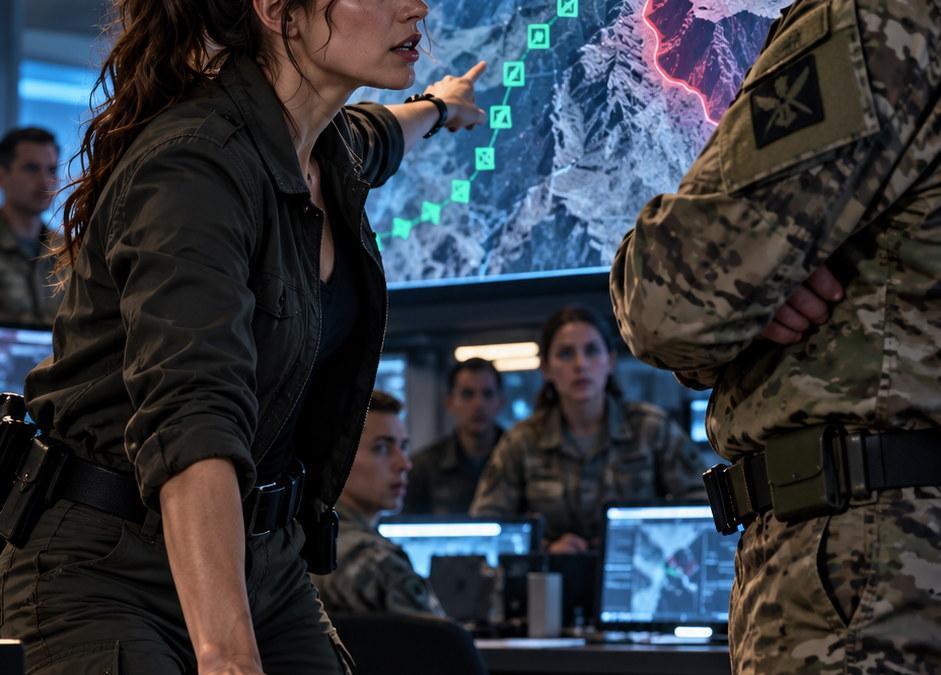
Twelve green icons were moving across the wall display.
Bravo Company.
Forty-two soldiers.
And every one of them was turning east.
Straight toward Red Basin.
I felt the blood drain from my face.
Red Basin was not part of their authorized route. It was a narrow, rock-walled corridor carved between two ridgelines on the eastern edge of Fort Harrow’s training area. From the operations center, it looked like nothing more than a dark crease on the digital terrain map.
I knew better.
There was one reliable entrance.
One reliable exit.
High ground on both sides.
And almost no room to maneuver once a unit was inside.
It was the kind of terrain that looked harmless until someone wanted to trap you there.
Colonel Grant Holloway spun away from the command table.
He had been speaking with two majors when I shouted. Now his expression hardened as though the interruption itself offended him more than what I was pointing at.
“Who authorized that route change?”
“No one,” I said.
I crossed the room and pointed toward the screen.
“That’s the problem.”
The operations floor at Fort Harrow had been noisy ten seconds earlier. Radios crackled. Analysts spoke over one another. Keyboards clicked beneath fluorescent lights. Officers leaned across workstations while live feeds from the training area shifted across six large displays.
Now almost everyone was looking at me.
That was not unusual.
For three days, people at Fort Harrow had been looking at me.
Most of them just had not been looking very carefully.
My name is Mara Vance.
According to the paperwork handed to Fort Harrow, I was a civilian weapons evaluator attached to a defense testing program. I had arrived with two rifle cases, a hardened equipment kit, and enough technical documentation to make anyone’s eyes glaze over before reaching page six.
My assignment, according to the official version, was simple.
Evaluate a precision rifle package.
Observe communications between field units.
Document performance.
Leave.
That story had been designed to make me forgettable.
A contractor with specialized knowledge.
Useful when needed.
Easy to ignore otherwise.
Colonel Holloway had done an excellent job of ignoring me.
He stepped toward the display.
“Bravo is following authenticated IFF guidance.”
“I know what they’re following.”
“Then why are you yelling across my operations center?”
“Because the authentication is fake.”
His head turned slowly.
Several officers exchanged glances.
A captain near the radio station actually laughed under his breath.
Holloway did not.
“That system is isolated.”
“So it should be impossible to spoof from outside.”
“Correct.”
I held his stare.
“Which means whoever is doing this is already inside the boundary.”
The room became quieter.
That got their attention.
Holloway folded his arms.
“You’re making a serious accusation.”
“I’m describing what the data says.”
“The data says Bravo Company is receiving authenticated route guidance.”
“The display says that. The packet timing says something else.”
I moved toward an analyst station.
Holloway stepped into my path.
“You are here to evaluate rifles, Ms. Vance.”
“And right now I’m telling you that forty-two soldiers are being directed into a canyon they were never supposed to enter.”
His expression did not change.
I had met commanders like him before.
Not incompetent.
Not careless.
That would have been easier.
Holloway was experienced, disciplined, and deeply accustomed to being the final authority in every room he entered.
Men like that were often excellent leaders until the moment information arrived from someone they had already decided did not matter.
Then experience could become a wall.
“I want Bravo’s navigation feed on the main screen,” I said.
Holloway stared at me.
“You don’t give orders here.”
“Then consider it a request.”
“I have officers monitoring the exercise.”
“And they’re watching twelve friendly icons follow forged instructions.”
One of those officers shifted uncomfortably.
Holloway heard it.
That made him angrier.
He jabbed a finger toward the display.
“Those identifiers passed authentication.”
I stepped around him and pulled up the packet trace I had been studying.
Lines of data filled the monitor.
“Look here.”
He did not move.
“Colonel.”
“I know how IFF works.”
“Then you know legitimate beacons refresh at a fixed interval.”
His eyes finally dropped toward the screen.
I pointed.
“These don’t.”
The differences were tiny.
Almost elegant.
The first signal arrived on time.
So did the second.
The third drifted slightly.
The fourth corrected.
Then the pattern repeated.
Most people watching live traffic would never have noticed it.
But I had been staring at the system since before sunrise.
“Thirty-one milliseconds,” I said.
“What?”
“The cloned handshake is drifting thirty-one milliseconds outside the expected refresh pattern before it corrects itself.”
A communications captain leaned closer.
“That could be network delay.”
“Not on an isolated tactical environment this small.”
Holloway looked at him.
The captain hesitated.
Then he quietly said, “She’s right about that.”
I watched Holloway’s jaw tighten.
For one moment I thought that might be enough.
It wasn’t.
He looked back at me.
“If someone were spoofing the system from inside the installation, my cyber team would have detected the intrusion.”
“Unless the intrusion was built to look like approved equipment.”
“What approved equipment?”
“That’s what I’m trying to determine.”
Holloway took another step toward me.
His voice dropped.
“This exercise has been planned for four months. Bravo Company knows the terrain. My communications people know their network. You arrived three days ago.”
There it was.
Not evidence.
Hierarchy.
I understood the message perfectly.
You are new.
You are outside the chain.
You are not one of us.
Behind me, Sergeant Luke Rainer spoke quietly.
“Colonel…”
Holloway turned.
“Not a word, Sergeant.”
Luke stopped.
He was a communications NCO with fifteen years in uniform and the exhausted eyes of a man who had spent too much of his adult life looking at machines that only became important when they failed.
He was also the only person at Fort Harrow who had listened when I asked about irregular beacon traffic on my first day.
Not because he knew who I really was.
He did not.
Luke thought I was exactly what my paperwork said—a civilian evaluator who knew an unusual amount about tactical communications.
But unlike Holloway, he had not confused curiosity with insubordination.
The previous night, Luke and I had spent nearly two hours comparing beacon records.
He had found three anomalies.
I had found five more.
Individually, none were enough to trigger an alarm.
Together, they looked like someone testing the edges of the system.
Seeing what Fort Harrow would notice.
Seeing what it would ignore.
Now Luke was staring at a secondary monitor.
The color disappeared from his face.
“Mara.”
Something in his voice changed me instantly.
“What?”
“Bravo just lost primary communications.”
My stomach tightened.
“Backup?”
He touched another control.
His eyes moved across the readout.
“Jammed.”
The room erupted.
Operators grabbed headsets.
Holloway seized the command handset.
“Bravo Six, this is Harrow Actual. Halt movement. Acknowledge.”
Static.
He tried again.
“Bravo Six, Harrow Actual. Halt movement immediately.”
Nothing.
Then came three sharp cracks through the speakers.
Gunshots.
Every person in the room froze.
A burst of shouting followed.
Distant.
Broken.
Real.
The exercise disappeared from everyone’s face.
This was no longer training.
Holloway pressed the handset harder against his ear.
“Bravo Six, report!”
Static swallowed his voice.
I moved.
Years of discipline reduced the room to simple pieces.
Distance.
Threat.
Communication.
Terrain.
People.
I reached for the handset.
Holloway grabbed my wrist.
“Give me that.”
“Your people are in contact.”
“You do not touch command equipment.”
“Then use it!”
“I said back away.”
His grip tightened.
For three days he had thought I was intrusive.
Now he thought I was dangerous.
The irony almost made me laugh.
Instead I twisted my wrist free.
His other hand caught the strap of my vest and jerked me backward.
My lower back struck the edge of the console.
Pain flashed through my ribs.
I had taken worse hits in worse places, but the shock of it stopped me for half a second.
Luke stepped forward.
“Sir, back off.”
Holloway shoved him in the chest.
Luke crashed against a rolling chair.
The chair shot backward and struck another console.
Luke caught himself.
His fists closed.
I saw the moment fifteen years of obedience collided with what he knew he had just witnessed.
Before anyone could move again, the radio crackled.
“—Bravo Six—movement on ridge—”
The transmission vanished.
I turned toward the console.
That fragment was enough.
Movement on ridge.
Bravo was below.
Someone else was above them.
I hit the emergency routing key.
Holloway shouted something behind me.
I ignored him.
Red Basin expanded across the main display.
For a fraction of a second there was nothing.
Then four new symbols appeared.
Unknown IFF signatures.
High on the eastern ridge.
A second later there were eight.
Then twelve.
They were moving toward Bravo.
The operations floor became completely silent.
Holloway stared at the display.
“What the hell is that?”
I looked at him.
“The reason I told you to stop them.”
His face changed.
Not much.
But enough.
The certainty was gone.
He turned immediately.
“Lock down the network.”
The operations chief began typing.
A red message appeared.
ACCESS DENIED.
He blinked.
Typed again.
ACCESS DENIED.
“That’s impossible.”
Luke was already moving to a second terminal.
“Try the secondary authentication server.”
“I am.”
ACCESS DENIED.
Luke swore under his breath.
“Sir.”
Holloway looked at him.
“Somebody already locked us out.”
That was the moment fear entered the room.
Not panic.
Not yet.
Fear is quieter than panic.
It changes breathing.
It changes posture.
It makes experienced people suddenly aware of doors.
Holloway looked at me.
For the first time since I had arrived at Fort Harrow, there was no irritation in his eyes.
No dismissal.
No contempt.
Only the realization that whatever was happening had begun before any of us noticed it.
I reached inside my jacket.
Two military police officers near the doorway immediately raised their rifles.
“Hands where I can see them!”
I stopped.
Slowly, I pulled out a black credential wallet.
I placed it on the command table.
Holloway glanced down.
I watched recognition reach him in stages.
First confusion.
Then disbelief.
Then something close to dread.
The gold seal inside meant nothing to most of the junior personnel in the room.
It meant something to him.
His eyes lifted to mine.
“No,” he whispered.
I had spent three days letting him underestimate me.
I had expected annoyance when the truth came out.
Maybe anger.
I had not expected to reveal myself while forty-two soldiers were under fire.
“Yes,” I said.
Then every monitor in the operations center went black.
The lights died.
Someone inhaled sharply.
In the darkness behind me, a pistol fired.
The muzzle flash came first.
White-orange.
Violent.
Close.
The bullet struck the console inches from my head, throwing sparks across the darkness.
Luke hit me from the side.
We crashed to the floor.
“Down!”
A second shot cracked through the room.
Someone yelled.
I smelled burned wiring.
Gunpowder.
Then the emergency lights flickered on.
Red light flooded the operations floor.
People were crouched behind desks.
One of the MPs was on his knee, gripping his upper arm.
Blood ran between his fingers.
Captain Owen Kessler stood near the rear exit with a pistol in his hand.
He was Holloway’s operations officer.
Quiet.
Efficient.
Forgettable in exactly the way good staff officers often were.
He pointed toward the hallway.
“Shooter went that way!”
For half a second, almost everyone looked.
I didn’t.
I looked at the console.
The first bullet had hit the terminal where I had displayed the packet trace.
Not the wall behind me.
Not the center of my body.
The evidence.
I got to one knee.
“Kessler.”
His head turned.
“Drop the weapon.”
His eyes found mine.
Something passed through them.
Too fast to name.
Holloway stepped between us.
“Vance, enough.”
I opened the credential wallet beneath the red emergency lights.
There was no reason to hide anymore.
“My full name is Lieutenant Colonel Mara Vance, United States Army.”
Nobody moved.
“I’m assigned to the Joint Threat Exploitation Cell under a Pentagon special-access directive. Fort Harrow is operating under compromise protocol Black Lantern. My presence on this installation was classified because we had evidence suggesting an internal vulnerability.”
Holloway stared at me.
I continued.
“The moment hostile manipulation of tactical systems was confirmed, the directive transferred incident security authority to me.”
The silence afterward felt heavier than the gunshots.
Holloway looked down at the credential again.
“You’re a lieutenant colonel?”
“Yes.”
His face tightened.
“You came onto my installation under false pretenses.”
“I came onto your installation under orders.”
“You said you were a weapons evaluator.”
“I am.”
That stopped him.
I nodded toward the rifle evaluation documentation still scattered across a nearby desk.
“I spent seven years as a sniper before moving into threat exploitation. The rifle program was real. So was the evaluation.”
“Then what was the cover?”
I looked toward the black monitors.
“The idea that evaluating rifles was the only reason I was here.”
Holloway said nothing.
“That cover got me onto your range without warning whoever I came here to find.”
Captain Kessler slowly lowered his pistol.
I noticed.
So did Luke.
I pointed toward the wounded MP.
“Get him medical attention.”
Then I turned to Luke.
“Sergeant Rainer, with me.”
Finally, Holloway found his voice.
“Where are you going?”
“Communications annex.”
“This is still my installation.”
I turned back toward him.
“And someone inside it just redirected forty-two soldiers into a kill zone, locked you out of your own network, jammed their radios, and fired into the console containing evidence of how they did it.”
His mouth tightened.
“I need you to physically isolate every external connection that can be isolated. Freeze nonessential traffic. Nobody leaves a secure area without verification. Digital IFF is no longer trusted.”
“You don’t know the shooter was targeting evidence.”
“I do.”
“How?”
“Because I was standing six inches to the left of the terminal, Colonel.”
That silenced him.
I looked toward the damaged screen.
“If the shooter wanted me dead, he missed an easy shot. If he wanted the packet trace destroyed, he nearly succeeded.”
Holloway looked at Kessler.
Kessler’s face showed concern.
Nothing else.
He was good.
“Lock it down,” Holloway ordered.
That was the first time he listened to me.
Luke and I moved.
The communications annex sat behind two secured doors off the western corridor. The electronic lock was dead after the blackout, so Luke pulled open a recessed panel and reached for the mechanical release.
His hands were shaking.
Barely.
I noticed anyway.
“You all right?”
He gave me a look.
“You’ve been a lieutenant colonel for how long?”
“Luke.”
“Right. Later.”
He pulled the release.
The door opened.
Server racks filled the room.
Cooling fans hummed on backup power.
Small green and amber lights blinked in the darkness like a city seen from the air.
Luke connected a hardened tablet to an isolated diagnostic port.
I stood behind him, listening to the muffled movement in the corridor.
Security teams were running.
Orders echoed through the building.
Somewhere, Bravo Company was still pinned inside Red Basin.
That knowledge sat inside my chest like a weight.
Forty-two people had followed instructions because soldiers were trained to trust authenticated systems.
Someone had weaponized that trust.
“Come on,” Luke muttered.
Data populated the tablet.
His face changed.
I knew before he said anything.
“What?”
He didn’t answer.
“Luke.”
He turned the screen toward me.
“The forged IFF packets originated through an approved device bridge.”
“Which one?”
He hesitated.
Then pointed.
My evaluator kit.
For a second, the room seemed to narrow around me.
“No.”
“I checked the identifier twice.”
“That kit was sealed when I arrived.”
“I know.”
“You watched me open it.”
“I know.”
I stepped closer.
There it was.
Hardware ID.
Authorization chain.
My temporary access signature.
Perfect.
Too perfect.
I felt something colder than fear.
Understanding.
This was no opportunistic intrusion.
Whoever had planned this had known I was coming.
They had known what equipment I would bring.
They had known enough to turn my own presence into camouflage.
Luke opened another log.
A command string appeared.
My access credential was attached.
“If Holloway sees this,” Luke said quietly, “he’s going to think you’re the insider.”
“He might.”
“Mara, this doesn’t just look suspicious.”
“I know what it looks like.”
“It looks complete.”
That was the point.
Good framing did not depend on one piece of evidence.
It built a story.
I arrived unexpectedly.
My equipment created the bridge.
My credentials appeared in the logs.
I challenged the commander.
Then the network collapsed.
If someone found only those facts, they would not need much imagination to decide what had happened.
I stared at the data.
“Whoever did this knew about my assignment before I arrived.”
Luke’s face tightened.
“How many people knew?”
“Enough.”
“How many on this base?”
“That’s what I need to find out.”
A door slammed behind us.
Luke turned.
Captain Kessler stood in the entrance.
His pistol was raised.
This time he was pointing it directly at us.
No confusion.
No performance.
Just the weapon.
Luke slowly lifted his hands.
I did not move.
Kessler smiled faintly.
“I was hoping you’d find that.”
The last uncertainty disappeared.
“You planted my signature.”
“I planted several things.”
“Bravo Company?”
He shrugged.
“Still alive, mostly.”
Something inside me went still.
There are moments when anger is too large to feel like anger.
It becomes clarity.
Forty-two soldiers were trapped beneath armed men because the person standing in front of me had needed a distraction.
Three gunshots over a radio had been enough for him to talk about them as pieces on a board.
“Why?” I asked.
“You’re supposed to be the threat expert.”
“Humor me.”
His smile widened.
“You people always think a breach is about stealing a file.”
Luke glanced toward me.
Kessler continued.
“Sometimes the file is useless. Sometimes what matters is making the system react.”
He took one step into the room.
“Route a company into the wrong place. Jam communications. Create contact. What happens?”
“Emergency protocols,” Luke said.
Kessler looked pleased.
“Exactly.”
My stomach tightened.
He had not trapped Bravo because Bravo itself was the target.
He had trapped them because Fort Harrow would react.
Secure routes would change.
Keys would rotate.
Emergency channels would activate.
Networks designed to remain separated under ordinary conditions would briefly synchronize so commanders could recover control.
For a few minutes, systems that normally never spoke to one another would have to communicate.
Kessler had manufactured the crisis to create that window.
“You used the ambush to force a network reset,” Luke said.
“Three minutes,” Kessler replied. “That’s all we needed.”
“We?”
His expression changed slightly.
I caught it.
There were people beyond Fort Harrow.
A radio on his belt crackled.
“Package moving. South relay.”
Kessler reached for it.
I moved.
He fired.
The shot struck the metal frame beside my head.
I drove into him before he could realign the weapon.
My left hand caught his wrist.
My shoulder hit his chest.
We slammed into the side of a server rack.
Pain exploded through the ribs Holloway had already bruised.
Kessler was stronger than he looked.
He twisted and drove an elbow into my side.
Air left my lungs.
He shoved me away.
The pistol swung toward Luke.
Luke caught Kessler’s forearm with both hands.
They crashed into a cabinet.
Metal doors rattled.
I forced myself upright.
Kessler drove his knee into Luke’s thigh.
Luke lost his footing.
The muzzle started to turn toward him.
I hooked Kessler’s weapon arm from behind.
He jerked violently.
The pistol fell.
Luke kicked it beneath a rack.
Kessler slammed the back of his head into my face.
White light burst across my vision.
For a second I tasted blood.
He tore free.
By the time my vision cleared, he was running.
Luke grabbed my arm.
“You good?”
Blood was already running from a cut along my cheek.
“No.”
I shoved myself toward the doorway.
“Move.”
We chased him.
Alarms were pulsing through the corridor now.
Security personnel appeared at intersections.
Holloway’s voice came over the speakers.
“Security teams to South Relay. Bravo Company has regained partial communications.”
Relief tried to rise inside me.
I did not let it.
Not yet.
Then every monitor along the corridor changed.
A message appeared.
COMMAND AUTHORITY ACCEPTED.
Luke stopped so abruptly I nearly ran into him.
“What?”
He pointed.
“That’s Colonel Holloway’s command certificate.”
A second line appeared.
SOUTH RELAY PURGE APPROVED.
My pulse jumped.
A purge would wipe the audit trail.
More importantly, it would trigger the emergency satellite process Kessler needed.
Only one person on Fort Harrow possessed command authority high enough to approve it.
Colonel Grant Holloway.
We ran back toward operations.
The room was half-lit by emergency power when we entered.
Holloway stood over the central table.
His face was pale with fury.
“I did not issue that order.”
I drew my sidearm.
Every soldier near us went still.
Holloway looked at the weapon.
Then at me.
“Are you serious?”
“Step away from the console.”
“Mara—”
“Step away.”
His eyes flashed.
For three days he had resented the possibility that I knew something he did not.
Now his own credentials had authorized an action that could destroy our evidence.
I could see the humiliation in his face.
But humiliation did not matter anymore.
He stepped back.
Luke rushed to the console.
I kept my weapon lowered but ready.
“Check the authorization source.”
He typed.
The log appeared.
Holloway’s certificate.
Valid.
Biometric confirmation.
Valid.
Issued thirty seconds earlier.
Source location:
Operations center.
The same room we were standing in.
Holloway stared.
“That’s impossible.”
“Apparently not,” I said.
“I haven’t touched the biometric reader since—”
He stopped.
Luke looked up.
“Since when?”
Holloway’s eyes shifted toward the command station.
“Earlier today.”
Luke dropped to his knees beside the console.
“What are you doing?” Holloway demanded.
“Looking for a reason your fingerprint just issued an order without you.”
He ran his fingers beneath the metal lip.
Stopped.
Then slowly pulled out a wafer-thin device.
It was barely larger than a coin.
Holloway stared at it.
“What is that?”
“Biometric relay.”
Luke turned it beneath the red emergency lights.
“It captures a valid confirmation, stores it, then replays it when triggered.”
Holloway looked almost sick.
“I inspected this station this morning.”
“Who else did?” I asked.
His answer came immediately.
“Kessler.”
Silence.
“He inspected the command consoles before the exercise.”
The entire operation finally came into focus.
I saw it all.
Not as separate failures.
As one design.
Kessler knew I was coming.
He compromised my evaluator kit and used it as a hidden communications bridge because unfamiliar hardware attached to an evaluator would attract less suspicion.
He copied my temporary credentials so the intrusion could be traced back to me.
He installed a relay beneath Holloway’s console and captured the commander’s biometric confirmation.
Then he waited.
When Bravo Company moved into the field, Kessler injected false IFF signals.
The soldiers trusted the authenticated navigation.
Why wouldn’t they?
The system existed so they would not have to question every route update during an exercise.
He led them into Red Basin.
Then he jammed their communications.
Armed contacts appeared on the ridges.
The installation went into crisis.
Exactly as Kessler knew it would.
Emergency systems activated.
Protected networks synchronized.
Channels opened.
Keys rotated.
And for a few precious minutes, information that was normally locked behind separate systems began moving through the same emergency architecture.
That was the real objective.
Not Bravo.
Not Red Basin.
Not even Fort Harrow.
The reaction.
Kessler had turned forty-two soldiers into bait for the network itself.
Holloway understood it at the same time I did.
“The ambush wasn’t the mission,” he said.
“No.”
His eyes stayed on the screen.
“We were.”
“Our response was.”
He looked at me.
For the first time, I saw not a colonel protecting his authority but a man realizing how thoroughly someone had studied him.
Kessler had predicted his procedures.
His systems.
His people.
Even his habits.
Maybe his pride.
“Can we stop the purge?” Holloway asked.
Luke checked.
“Not remotely.”
“How long?”
“I don’t know. South Relay is already processing the command.”
Holloway looked at me.
“What do you need?”
Three hours earlier, he had told me I had no authority in his operations center.
Now forty-two soldiers were still in danger and a hostile data package was moving toward an uplink.
I had no satisfaction left for irony.
“Your people.”
He waited.
“And this time, Colonel, when someone gives you evidence you don’t like, listen before deciding whether you respect the person giving it.”
His jaw tightened.
For one second, I thought we were about to lose time arguing again.
Then Holloway nodded.
“No argument.”
I keyed my radio.
“All security elements, Captain Owen Kessler is the confirmed hostile insider. Repeat, Captain Kessler is hostile. Do not trust digital IFF until verbally authenticated. South Relay is priority.”
Static answered first.
Then a weak voice.
“Vance… Bravo Six.”
I stopped breathing.
“This is Vance. Report.”
The response broke apart twice before becoming clear.
“Three wounded. No fatalities. We’re pinned below east ridge.”
I closed my eyes for half a second.
No fatalities.
Forty-two had gone into Red Basin.
Forty-two were still alive.
“Hold your position,” I said. “Ignore every navigation beacon, even if it shows authenticated friendly guidance.”
“Copy.”
“Sergeant Rainer is going to give you a clean voice route.”
Luke was already moving to an isolated radio.
“Bravo Six, this is Rainer. Authenticate Sierra-Nine.”
The reply came.
Correct.
Luke began walking them through terrain markers that could not be digitally altered.
Rock formations.
Grid references.
Elevation changes.
Old-fashioned information.
Human voices.
I watched him for a moment.
Kessler had nearly destroyed an entire operation by exploiting trust in machines.
Luke was going to help bring those soldiers home by making them trust another person.
Holloway touched my shoulder.
“South Relay.”
We moved.
The relay building sat several hundred yards from the main operations structure, across a service yard surrounded by low concrete barriers.
By the time we arrived, two security teams had established positions around it.
Nobody had entered.
A sergeant hurried toward us.
“Captain Kessler barricaded himself inside.”
“Alone?”
“No, ma’am. Civilian technician is inside with him.”
My stomach tightened.
“Hostage?”
“Yes.”
Through reinforced glass I could see them.
Kessler stood behind the technician.
One arm was locked around her upper body.
His pistol was pressed against her side.
She looked young.
Maybe twenty-five.
Her face had gone completely white.
Behind them, a terminal glowed.
A progress bar crawled across the screen.
TRANSMISSION: 71%.
Luke crouched beside an exterior access panel.
“Can you kill the uplink?” I asked.
He opened the panel.
His expression told me the answer before he spoke.
“Hard line’s been cut.”
“Backup?”
“Inside.”
I looked at the progress bar.
Seventy-three percent.
Holloway stepped toward the door.
“Kessler!”
A gunshot shattered the glass.
I grabbed Holloway as his body twisted.
We fell behind the concrete wall.
He grunted.
Blood spread across his shoulder.
“You hit?”
“Grazed.”
“That’s not what I asked.”
“I can move.”
Luke crouched beside him.
“Stay down, sir.”
Holloway pressed his hand over the wound.
His face had gone gray.
“Get that transmission stopped.”
I looked across the yard.
Seventy-eight percent.
Security could breach.
But Kessler had a hostage.
The doorway was narrow.
The glass gave him visibility.
A frontal entry would make the technician the first person in the line of fire.
We needed another option.
My eyes moved across the service yard.
Then I saw the evaluation truck.
My truck.
The one piece of my cover that had never been false.
The rifle case was still inside.
I ran.
“Mara!”
Gunfire cracked behind me.
A round struck concrete to my left.
Another hit the ground near the rear tire.
I reached the truck and dropped behind it.
The case was secured in the storage compartment.
My fingers found the latch.
For the first time that day, my hands felt completely steady.
I opened the case.
The precision rifle lay inside exactly as I had left it.
Holloway watched from cover as I lifted it.
Despite the blood on his shoulder, something like disbelief crossed his face.
“You really are a sniper.”
I checked the rifle.
“Seven years before they gave me a desk.”
I moved into position behind the truck.
Through the optic, South Relay became a different world.
Breathing slowed.
Noise narrowed.
Distance became mathematics.
Movement became timing.
I found Kessler.
He had positioned himself well.
The technician was between him and every obvious line of fire.
Her body covered his torso.
His head appeared occasionally, but never long enough for a responsible shot.
I could have tried.
Years earlier, I might have been tempted.
Experience teaches you that confidence and recklessness often feel identical until after the trigger breaks.
I did not have a clean shot.
So I stopped looking at him.
The progress bar reached eighty-three percent.
I scanned the building.
Window.
Frame.
Antenna routing.
External feed.
Then I found it.
A compact uplink assembly mounted beside the window.
The shot angle was narrow.
But clear.
“Luke.”
“I’m here.”
“If I destroy the external feed, does transmission terminate or reroute?”
He leaned around cover just enough to see where I was aiming.
“If you hit the primary assembly, it should fail.”
“Should?”
“It wasn’t designed for someone to shoot it.”
“Neither was today.”
Eighty-seven percent.
Kessler shouted from inside.
“You’re too late!”
I barely heard him.
The world inside the optic had become quiet.
I remembered my first instructor years earlier telling me that the hardest shots were rarely the longest.
Distance was honest.
Wind was measurable.
The hardest shots were the ones carrying consequences you could not calculate.
Miss a target on a range and someone records the score.
Miss here and Kessler might kill the technician.
Damage the wrong component and the transfer might continue.
Wait too long and the stolen package would leave Fort Harrow.
Eighty-nine percent.
Luke shouted, “Mara!”
I exhaled.
Paused at the bottom of the breath.
Pressed.
The rifle cracked.
The external feed assembly exploded into metal fragments and sparks.
Inside South Relay, the terminal flashed.
The progress bar vanished.
A new message filled the screen.
TRANSMISSION FAILED.
For one second, nobody moved.
Then Kessler screamed.
Not in pain.
In rage.
He shoved the technician aside.
She fell behind a workstation.
Kessler ran for the side door.
“Movement!” someone shouted.
He burst outside.
Holloway moved before I could stop him.
The wounded colonel tackled Kessler at the waist.
Both men slammed onto the concrete.
Kessler punched Holloway directly in the injured shoulder.
Holloway cried out.
Kessler rolled on top of him and reached toward his pistol.
I was already moving.
I reached them as his fingers touched the grip.
I kicked his wrist away.
He grabbed my vest and pulled.
I lost balance.
We hit the ground.
His forehead smashed into my cheek.
The cut near my eye opened again.
Warm blood ran down my face.
Kessler drove his weight forward.
“You have no idea what you interrupted,” he hissed.
I locked my arm against his.
“You talk too much.”
He tried to reach his pistol again.
I drove my elbow down onto his forearm.
He cursed.
Luke arrived from the other side and pinned Kessler’s left arm.
Together we forced him flat.
Security officers rushed in.
Hands grabbed Kessler.
His weapon was pulled away.
Metal cuffs closed around his wrists.
For the first time since I had shouted across the operations floor, I allowed myself to breathe.
Kessler turned his face toward me from the ground.
Blood ran from the corner of his mouth.
He smiled.
“You think you stopped anything?”
I wiped blood from my cheek.
“No.”
His smile widened.
I continued.
“I think we stopped you.”
His expression changed.
“The investigation stops the rest.”
Security pulled him upright and took him away.
I watched until he disappeared.
Only then did I turn toward the relay building.
The civilian technician was being helped outside.
Shaken.
Alive.
Holloway sat against the concrete wall while a medic cut away the fabric around his shoulder.
Luke was already asking someone for a status update on Bravo.
The sky over Fort Harrow had begun changing.
The harsh afternoon light was fading behind the New Mexico ridges.
For the first time all day, the base looked quiet.
It wasn’t.
Inside operations, analysts were preserving drives.
Military police were securing workspaces.
Investigators were isolating equipment.
Every person who had touched a command system was being documented.
Every access record was being copied.
Every electronic assumption was being treated as suspect.
The machinery of accountability had begun.
But I only cared about one radio.
Luke found me near the operations entrance almost an hour later.
His face was exhausted.
I stood before he said anything.
“Bravo?”
A smile appeared.
Small.
But real.
“They’re moving.”
“All of them?”
“All forty-two.”
I looked away.
The emotion hit harder than I expected.
For years I had learned to control what appeared on my face.
A sniper cannot let fear dictate the trigger.
An intelligence officer cannot let surprise tell the room what she knows.
A leader cannot collapse every time the consequences become personal.
But there are moments when control becomes unnecessary.
I lowered my head.
Luke pretended not to notice.
“Three wounded,” he said. “All stable.”
“No fatalities?”
“None.”
I nodded.
Once.
Then again.
Forty-two.
It was only a number on a screen when the day began.
Forty-two green icons.
Now I imagined forty-two people.
Forty-two families.
Forty-two doors that would not receive the knock every military family fears.
Forty-two beds that would not remain permanently empty.
Forty-two lives Kessler had been willing to risk for three minutes of network access.
That was the part I could not forgive.
By midnight, Bravo Company was back inside the wire.
I stood near the edge of the staging area as their vehicles returned.
Dust covered them.
One windshield was cracked.
There were dark marks along the side of another vehicle.
The soldiers who climbed out looked exhausted, angry, and confused.
Some had no idea why their navigation had betrayed them.
Some knew only that the radio stopped working and people began shooting from the ridge.
A medic vehicle carried the wounded toward the clinic.
All three were conscious.
I stayed back.
They did not need to know my name.
They did not need a speech.
They needed showers, medical evaluations, food, sleep, and eventually answers.
Luke joined me.
“You could tell them.”
“Tell them what?”
“Who you are.”
I looked at the soldiers embracing friends near the staging area.
“They’ll find out enough tomorrow.”
“You saved them.”
“No.”
He looked at me.
“We caught the problem before Kessler finished what he started. Bravo kept themselves alive in that canyon. You got communications back. Security closed the relay. A lot of people did their jobs.”
Luke smiled.
“That sounds very lieutenant-colonel of you.”
“And you sound too comfortable now that you know my rank.”
“I shoved my commanding officer over you this afternoon.”
“You did not shove him.”
“I considered it.”
“You clenched your fists.”
“Very aggressively.”
Despite everything, I laughed.
It hurt my ribs.
It hurt my cheek.
I laughed anyway.
Later, Luke recovered enough of Kessler’s deleted records to confirm the breach had connections beyond Fort Harrow.
The failed transmission had contained protected network data collected during the emergency synchronization.
It never completed.
What remained in the logs was enough to begin tracing the external network associated with the operation.
That investigation would continue far beyond Fort Harrow.
Names would be examined.
Money would be followed.
Access histories would be reconstructed.
My assignment, which had begun as a quiet internal security review, had become something much larger.
But the immediate crisis was over.
Just before dawn, I returned to the operations center.
The damaged console was still there.
A black bullet mark scarred its casing.
Technicians had placed evidence markers around the area.
The room smelled like coffee, overheated electronics, and the kind of exhaustion that settles into a place after nobody has slept.
I stood before the main display.
Red Basin was empty now.
No moving green icons.
No unknown contacts.
Nothing.
“Lieutenant Colonel.”
Holloway’s voice came from behind me.
I turned.
His shoulder was bandaged beneath a clean uniform shirt.
He looked ten years older than he had the previous morning.
“Colonel.”
He walked toward me slowly.
For once, neither of us seemed interested in who controlled the room.
He stopped beside the command table.
“I owe you an apology.”
I looked at him.
He waited.
Maybe he expected me to accept it.
Maybe part of me wanted to.
But apologies are strange things.
Sometimes they heal.
Sometimes they become a shortcut people use to move past consequences before understanding them.
“You owe your soldiers better than an apology to me.”
He absorbed that without flinching.
“I know.”
“Yesterday, I gave you evidence.”
“I dismissed it.”
“You dismissed me.”
His eyes lowered.
“Yes.”
“If I had been wrong, you could have dealt with me afterward.”
“I know.”
“But once Bravo entered Red Basin, we didn’t have the luxury of protecting anyone’s pride.”
He nodded.
The silence between us stretched.
Finally he said, “I’ve commanded soldiers for twenty-six years.”
“I know.”
“I’ve made decisions under fire. I’ve buried people. I’ve had to tell families why someone wasn’t coming home.”
His voice changed slightly.
“I thought that experience meant I could recognize the threat in the room.”
I looked at the bullet-damaged console.
“Kessler counted on that.”
Holloway followed my gaze.
“He counted on me not listening to you.”
“Yes.”
That answer hurt him more than anything else I could have said.
Because it was true.
Kessler had understood the network.
But more dangerously, he had understood the people controlling it.
He knew Holloway would trust authenticated systems.
He knew officers would hesitate before challenging established procedures.
He knew an outsider raising concerns could be dismissed.
He knew my cover made me easy to underestimate.
The exploit had not only been technical.
It had been human.
Holloway looked toward the main display.
“I keep replaying the moment you told me to stop Bravo.”
“So do I.”
“If I had listened immediately…”
“Don’t.”
He looked at me.
“You won’t learn anything useful by inventing versions of yesterday you can’t change.”
“Three men were wounded because I waited.”
“Three men were wounded because Kessler created an ambush.”
“I helped give him time.”
I did not answer.
He needed to carry the part that belonged to him.
Not more.
Not less.
Eventually he reached out his hand.
The gesture surprised me.
Not because commanders did not shake hands.
Because the man standing before me no longer seemed to be doing it as a colonel acknowledging another lieutenant colonel.
He was doing it as one professional admitting that another had been right when it mattered.
I looked at his hand.
Then I took it.
His grip was firm despite the wound.
“I was wrong about you,” he said.
“You weren’t supposed to know who I was.”
“That’s not what I mean.”
I understood.
He had looked at civilian paperwork and decided how much my voice should weigh.
Rank had changed his perception in seconds.
But rank had not made my evidence more accurate.
The packet drift had been thirty-one milliseconds whether I was Mara Vance, civilian evaluator, or Lieutenant Colonel Mara Vance.
Bravo Company had been moving toward danger regardless of the insignia hidden beneath my cover.
That lesson mattered more than my identity.
I released his hand.
“What happens now?” Holloway asked.
“My cover is finished.”
“And Kessler?”
“He talks, or the evidence talks for him.”
“You think there are others?”
“I know there are others.”
“Here?”
“I don’t know yet.”
He nodded.
It was a different kind of answer than he would have accepted from me the day before.
No certainty manufactured for comfort.
No pretending we understood more than the evidence proved.
Just the truth.
I walked toward the exit.
At the doorway, Holloway called my name.
“Mara.”
I turned.
He glanced at the dark mark where the bullet had struck the console.
“When you reached for that credential yesterday… what would you have done if I still refused to listen?”
I thought about it.
The honest answer was not dramatic.
“I would have kept trying.”
He almost smiled.
“Even after I told you that you had no authority?”
“Colonel, authority is useful.”
I looked through the glass toward the staging area where the last vehicles from Bravo Company sat beneath the pale morning sky.
“But people staying alive is more important.”
I walked outside.
Dawn was spreading across Fort Harrow.
The mountains in the distance were beginning to catch the first light.
The base looked different than it had three days earlier.
Or maybe I did.
When I arrived, I had been carrying two identities.
The visible one was simple.
Civilian evaluator.
Technical specialist.
The woman with the rifle cases.
The hidden one was harder.
Lieutenant colonel.
Former sniper.
Threat exploitation officer.
The person sent to discover whether someone inside Fort Harrow was compromising protected systems.
By sunrise, both identities had collapsed into something simpler.
I had seen twelve green icons turn the wrong direction.
I had spoken.
Someone more powerful had told me to be quiet.
And I had refused.
Not because I needed him to know my rank.
Not because I wanted to prove him wrong.
Not because I wanted the room to respect me.
Forty-two soldiers were moving toward a place they should never have been sent.
That was enough.
People often imagine courage as something loud.
A weapon fired.
A door kicked open.
A person charging toward danger.
Sometimes it is.
But sometimes courage is much less impressive from the outside.
Sometimes it is being the one person in a room willing to say that the trusted system is wrong.
Sometimes it is asking one more question after everyone is tired of hearing you.
Sometimes it is admitting that the person you dismissed understood something you did not.
Luke had done that.
Holloway, eventually, had done it too.
And that was why Fort Harrow survived what Kessler tried to do.
Not because one rank outranked another.
Not because my credential carried a gold seal.
Not even because of the shot I took at South Relay.
Evidence mattered.
Trust mattered.
People willing to challenge what looked official mattered.
And perhaps most of all, the ability to admit a mistake before pride turned it into a catastrophe mattered.
I stopped near the edge of the staging area.
Bravo Company was there.
Forty-two soldiers.
Some limping.
Some laughing from exhaustion.
Some sitting quietly beside their equipment.
Alive.
My cheek was swollen.
My ribs hurt every time I breathed deeply.
My cover was gone.
The quiet assignment I had expected was gone with it.
By the end of the day, people across Fort Harrow would know exactly who Mara Vance was.
That should have bothered me.
For years, being unknown had been part of how I worked.
But standing there in the early morning light, I realized I did not care.
I had spent much of my career being identified by things printed on paper.
Sniper.
Evaluator.
Officer.
Investigator.
Lieutenant colonel.
Those titles mattered when the job required them.
But they were not what stayed with me as I watched Bravo Company come home.
Forty-two people had entered Red Basin.
Forty-two had returned.
And after everything that had happened, that was the only identity I needed to carry away from Fort Harrow.
𝗧𝗛𝗘 𝗘𝗡𝗗
The Colonel Told Me I Had No Authority Seconds Before the Entire Base Went Dark
“STOP BRAVO COMPANY! NOW!”
My voice cut across the operations floor so sharply that every conversation died at once.
Twelve green icons were moving across the wall display.
Bravo Company.
Forty-two soldiers.
And every one of them was turning east.
Straight toward Red Basin.
I felt the blood drain from my face.
Red Basin was not part of their authorized route. It was a narrow, rock-walled corridor carved between two ridgelines on the eastern edge of Fort Harrow’s training area. From the operations center, it looked like nothing more than a dark crease on the digital terrain map.
I knew better.
There was one reliable entrance.
One reliable exit.
High ground on both sides.
And almost no room to maneuver once a unit was inside.
It was the kind of terrain that looked harmless until someone wanted to trap you there.
Colonel Grant Holloway spun away from the command table.
He had been speaking with two majors when I shouted. Now his expression hardened as though the interruption itself offended him more than what I was pointing at.
“Who authorized that route change?”
“No one,” I said.
I crossed the room and pointed toward the screen.
“That’s the problem.”
The operations floor at Fort Harrow had been noisy ten seconds earlier. Radios crackled. Analysts spoke over one another. Keyboards clicked beneath fluorescent lights. Officers leaned across workstations while live feeds from the training area shifted across six large displays.
Now almost everyone was looking at me.
That was not unusual.
For three days, people at Fort Harrow had been looking at me.
Most of them just had not been looking very carefully.
My name is Mara Vance.
According to the paperwork handed to Fort Harrow, I was a civilian weapons evaluator attached to a defense testing program. I had arrived with two rifle cases, a hardened equipment kit, and enough technical documentation to make anyone’s eyes glaze over before reaching page six.
My assignment, according to the official version, was simple.
Evaluate a precision rifle package.
Observe communications between field units.
Document performance.
Leave.
That story had been designed to make me forgettable.
A contractor with specialized knowledge.
Useful when needed.
Easy to ignore otherwise.
Colonel Holloway had done an excellent job of ignoring me.
He stepped toward the display.
“Bravo is following authenticated IFF guidance.”
“I know what they’re following.”
“Then why are you yelling across my operations center?”
“Because the authentication is fake.”
His head turned slowly.
Several officers exchanged glances.
A captain near the radio station actually laughed under his breath.
Holloway did not.
“That system is isolated.”
“So it should be impossible to spoof from outside.”
“Correct.”
I held his stare.
“Which means whoever is doing this is already inside the boundary.”
The room became quieter.
That got their attention.
Holloway folded his arms.
“You’re making a serious accusation.”
“I’m describing what the data says.”
“The data says Bravo Company is receiving authenticated route guidance.”
“The display says that. The packet timing says something else.”
I moved toward an analyst station.
Holloway stepped into my path.
“You are here to evaluate rifles, Ms. Vance.”
“And right now I’m telling you that forty-two soldiers are being directed into a canyon they were never supposed to enter.”
His expression did not change.
I had met commanders like him before.
Not incompetent.
Not careless.
That would have been easier.
Holloway was experienced, disciplined, and deeply accustomed to being the final authority in every room he entered.
Men like that were often excellent leaders until the moment information arrived from someone they had already decided did not matter.
Then experience could become a wall.
“I want Bravo’s navigation feed on the main screen,” I said.
Holloway stared at me.
“You don’t give orders here.”
“Then consider it a request.”
“I have officers monitoring the exercise.”
“And they’re watching twelve friendly icons follow forged instructions.”
One of those officers shifted uncomfortably.
Holloway heard it.
That made him angrier.
He jabbed a finger toward the display.
“Those identifiers passed authentication.”
I stepped around him and pulled up the packet trace I had been studying.
Lines of data filled the monitor.
“Look here.”
He did not move.
“Colonel.”
“I know how IFF works.”
“Then you know legitimate beacons refresh at a fixed interval.”
His eyes finally dropped toward the screen.
I pointed.
“These don’t.”
The differences were tiny.
Almost elegant.
The first signal arrived on time.
So did the second.
The third drifted slightly.
The fourth corrected.
Then the pattern repeated.
Most people watching live traffic would never have noticed it.
But I had been staring at the system since before sunrise.
“Thirty-one milliseconds,” I said.
“What?”
“The cloned handshake is drifting thirty-one milliseconds outside the expected refresh pattern before it corrects itself.”
A communications captain leaned closer.
“That could be network delay.”
“Not on an isolated tactical environment this small.”
Holloway looked at him.
The captain hesitated.
Then he quietly said, “She’s right about that.”
I watched Holloway’s jaw tighten.
For one moment I thought that might be enough.
It wasn’t.
He looked back at me.
“If someone were spoofing the system from inside the installation, my cyber team would have detected the intrusion.”
“Unless the intrusion was built to look like approved equipment.”
“What approved equipment?”
“That’s what I’m trying to determine.”
Holloway took another step toward me.
His voice dropped.
“This exercise has been planned for four months. Bravo Company knows the terrain. My communications people know their network. You arrived three days ago.”
There it was.
Not evidence.
Hierarchy.
I understood the message perfectly.
You are new.
You are outside the chain.
You are not one of us.
Behind me, Sergeant Luke Rainer spoke quietly.
“Colonel…”
Holloway turned.
“Not a word, Sergeant.”
Luke stopped.
He was a communications NCO with fifteen years in uniform and the exhausted eyes of a man who had spent too much of his adult life looking at machines that only became important when they failed.
He was also the only person at Fort Harrow who had listened when I asked about irregular beacon traffic on my first day.
Not because he knew who I really was.
He did not.
Luke thought I was exactly what my paperwork said—a civilian evaluator who knew an unusual amount about tactical communications.
But unlike Holloway, he had not confused curiosity with insubordination.
The previous night, Luke and I had spent nearly two hours comparing beacon records.
He had found three anomalies.
I had found five more.
Individually, none were enough to trigger an alarm.
Together, they looked like someone testing the edges of the system.
Seeing what Fort Harrow would notice.
Seeing what it would ignore.
Now Luke was staring at a secondary monitor.
The color disappeared from his face.
“Mara.”
Something in his voice changed me instantly.
“What?”
“Bravo just lost primary communications.”
My stomach tightened.
“Backup?”
He touched another control.
His eyes moved across the readout.
“Jammed.”
The room erupted.
Operators grabbed headsets.
Holloway seized the command handset.
“Bravo Six, this is Harrow Actual. Halt movement. Acknowledge.”
Static.
He tried again.
“Bravo Six, Harrow Actual. Halt movement immediately.”
Nothing.
Then came three sharp cracks through the speakers.
Gunshots.
Every person in the room froze.
A burst of shouting followed.
Distant.
Broken.
Real.
The exercise disappeared from everyone’s face.
This was no longer training.
Holloway pressed the handset harder against his ear.
“Bravo Six, report!”
Static swallowed his voice.
I moved.
Years of discipline reduced the room to simple pieces.
Distance.
Threat.
Communication.
Terrain.
People.
I reached for the handset.
Holloway grabbed my wrist.
“Give me that.”
“Your people are in contact.”
“You do not touch command equipment.”
“Then use it!”
“I said back away.”
His grip tightened.
For three days he had thought I was intrusive.
Now he thought I was dangerous.
The irony almost made me laugh.
Instead I twisted my wrist free.
His other hand caught the strap of my vest and jerked me backward.
My lower back struck the edge of the console.
Pain flashed through my ribs.
I had taken worse hits in worse places, but the shock of it stopped me for half a second.
Luke stepped forward.
“Sir, back off.”
Holloway shoved him in the chest.
Luke crashed against a rolling chair.
The chair shot backward and struck another console.
Luke caught himself.
His fists closed.
I saw the moment fifteen years of obedience collided with what he knew he had just witnessed.
Before anyone could move again, the radio crackled.
“—Bravo Six—movement on ridge—”
The transmission vanished.
I turned toward the console.
That fragment was enough.
Movement on ridge.
Bravo was below.
Someone else was above them.
I hit the emergency routing key.
Holloway shouted something behind me.
I ignored him.
Red Basin expanded across the main display.
For a fraction of a second there was nothing.
Then four new symbols appeared.
Unknown IFF signatures.
High on the eastern ridge.
A second later there were eight.
Then twelve.
They were moving toward Bravo.
The operations floor became completely silent.
Holloway stared at the display.
“What the hell is that?”
I looked at him.
“The reason I told you to stop them.”
His face changed.
Not much.
But enough.
The certainty was gone.
He turned immediately.
“Lock down the network.”
The operations chief began typing.
A red message appeared.
ACCESS DENIED.
He blinked.
Typed again.
ACCESS DENIED.
“That’s impossible.”
Luke was already moving to a second terminal.
“Try the secondary authentication server.”
“I am.”
ACCESS DENIED.
Luke swore under his breath.
“Sir.”
Holloway looked at him.
“Somebody already locked us out.”
That was the moment fear entered the room.
Not panic.
Not yet.
Fear is quieter than panic.
It changes breathing.
It changes posture.
It makes experienced people suddenly aware of doors.
Holloway looked at me.
For the first time since I had arrived at Fort Harrow, there was no irritation in his eyes.
No dismissal.
No contempt.
Only the realization that whatever was happening had begun before any of us noticed it.
I reached inside my jacket.
Two military police officers near the doorway immediately raised their rifles.
“Hands where I can see them!”
I stopped.
Slowly, I pulled out a black credential wallet.
I placed it on the command table.
Holloway glanced down.
I watched recognition reach him in stages.
First confusion.
Then disbelief.
Then something close to dread.
The gold seal inside meant nothing to most of the junior personnel in the room.
It meant something to him.
His eyes lifted to mine.
“No,” he whispered.
I had spent three days letting him underestimate me.
I had expected annoyance when the truth came out.
Maybe anger.
I had not expected to reveal myself while forty-two soldiers were under fire.
“Yes,” I said.
Then every monitor in the operations center went black.
The lights died.
Someone inhaled sharply.
In the darkness behind me, a pistol fired.
The muzzle flash came first.
White-orange.
Violent.
Close.
The bullet struck the console inches from my head, throwing sparks across the darkness.
Luke hit me from the side.
We crashed to the floor.
“Down!”
A second shot cracked through the room.
Someone yelled.
I smelled burned wiring.
Gunpowder.
Then the emergency lights flickered on.
Red light flooded the operations floor.
People were crouched behind desks.
One of the MPs was on his knee, gripping his upper arm.
Blood ran between his fingers.
Captain Owen Kessler stood near the rear exit with a pistol in his hand.
He was Holloway’s operations officer.
Quiet.
Efficient.
Forgettable in exactly the way good staff officers often were.
He pointed toward the hallway.
“Shooter went that way!”
For half a second, almost everyone looked.
I didn’t.
I looked at the console.
The first bullet had hit the terminal where I had displayed the packet trace.
Not the wall behind me.
Not the center of my body.
The evidence.
I got to one knee.
“Kessler.”
His head turned.
“Drop the weapon.”
His eyes found mine.
Something passed through them.
Too fast to name.
Holloway stepped between us.
“Vance, enough.”
I opened the credential wallet beneath the red emergency lights.
There was no reason to hide anymore.
“My full name is Lieutenant Colonel Mara Vance, United States Army.”
Nobody moved.
“I’m assigned to the Joint Threat Exploitation Cell under a Pentagon special-access directive. Fort Harrow is operating under compromise protocol Black Lantern. My presence on this installation was classified because we had evidence suggesting an internal vulnerability.”
Holloway stared at me.
I continued.
“The moment hostile manipulation of tactical systems was confirmed, the directive transferred incident security authority to me.”
The silence afterward felt heavier than the gunshots.
Holloway looked down at the credential again.
“You’re a lieutenant colonel?”
“Yes.”
His face tightened.
“You came onto my installation under false pretenses.”
“I came onto your installation under orders.”
“You said you were a weapons evaluator.”
“I am.”
That stopped him.
I nodded toward the rifle evaluation documentation still scattered across a nearby desk.
“I spent seven years as a sniper before moving into threat exploitation. The rifle program was real. So was the evaluation.”
“Then what was the cover?”
I looked toward the black monitors.
“The idea that evaluating rifles was the only reason I was here.”
Holloway said nothing.
“That cover got me onto your range without warning whoever I came here to find.”
Captain Kessler slowly lowered his pistol.
I noticed.
So did Luke.
I pointed toward the wounded MP.
“Get him medical attention.”
Then I turned to Luke.
“Sergeant Rainer, with me.”
Finally, Holloway found his voice.
“Where are you going?”
“Communications annex.”
“This is still my installation.”
I turned back toward him.
“And someone inside it just redirected forty-two soldiers into a kill zone, locked you out of your own network, jammed their radios, and fired into the console containing evidence of how they did it.”
His mouth tightened.
“I need you to physically isolate every external connection that can be isolated. Freeze nonessential traffic. Nobody leaves a secure area without verification. Digital IFF is no longer trusted.”
“You don’t know the shooter was targeting evidence.”
“I do.”
“How?”
“Because I was standing six inches to the left of the terminal, Colonel.”
That silenced him.
I looked toward the damaged screen.
“If the shooter wanted me dead, he missed an easy shot. If he wanted the packet trace destroyed, he nearly succeeded.”
Holloway looked at Kessler.
Kessler’s face showed concern.
Nothing else.
He was good.
“Lock it down,” Holloway ordered.
That was the first time he listened to me.
Luke and I moved.
The communications annex sat behind two secured doors off the western corridor. The electronic lock was dead after the blackout, so Luke pulled open a recessed panel and reached for the mechanical release.
His hands were shaking.
Barely.
I noticed anyway.
“You all right?”
He gave me a look.
“You’ve been a lieutenant colonel for how long?”
“Luke.”
“Right. Later.”
He pulled the release.
The door opened.
Server racks filled the room.
Cooling fans hummed on backup power.
Small green and amber lights blinked in the darkness like a city seen from the air.
Luke connected a hardened tablet to an isolated diagnostic port.
I stood behind him, listening to the muffled movement in the corridor.
Security teams were running.
Orders echoed through the building.
Somewhere, Bravo Company was still pinned inside Red Basin.
That knowledge sat inside my chest like a weight.
Forty-two people had followed instructions because soldiers were trained to trust authenticated systems.
Someone had weaponized that trust.
“Come on,” Luke muttered.
Data populated the tablet.
His face changed.
I knew before he said anything.
“What?”
He didn’t answer.
“Luke.”
He turned the screen toward me.
“The forged IFF packets originated through an approved device bridge.”
“Which one?”
He hesitated.
Then pointed.
My evaluator kit.
For a second, the room seemed to narrow around me.
“No.”
“I checked the identifier twice.”
“That kit was sealed when I arrived.”
“I know.”
“You watched me open it.”
“I know.”
I stepped closer.
There it was.
Hardware ID.
Authorization chain.
My temporary access signature.
Perfect.
Too perfect.
I felt something colder than fear.
Understanding.
This was no opportunistic intrusion.
Whoever had planned this had known I was coming.
They had known what equipment I would bring.
They had known enough to turn my own presence into camouflage.
Luke opened another log.
A command string appeared.
My access credential was attached.
“If Holloway sees this,” Luke said quietly, “he’s going to think you’re the insider.”
“He might.”
“Mara, this doesn’t just look suspicious.”
“I know what it looks like.”
“It looks complete.”
That was the point.
Good framing did not depend on one piece of evidence.
It built a story.
I arrived unexpectedly.
My equipment created the bridge.
My credentials appeared in the logs.
I challenged the commander.
Then the network collapsed.
If someone found only those facts, they would not need much imagination to decide what had happened.
I stared at the data.
“Whoever did this knew about my assignment before I arrived.”
Luke’s face tightened.
“How many people knew?”
“Enough.”
“How many on this base?”
“That’s what I need to find out.”
A door slammed behind us.
Luke turned.
Captain Kessler stood in the entrance.
His pistol was raised.
This time he was pointing it directly at us.
No confusion.
No performance.
Just the weapon.
Luke slowly lifted his hands.
I did not move.
Kessler smiled faintly.
“I was hoping you’d find that.”
The last uncertainty disappeared.
“You planted my signature.”
“I planted several things.”
“Bravo Company?”
He shrugged.
“Still alive, mostly.”
Something inside me went still.
There are moments when anger is too large to feel like anger.
It becomes clarity.
Forty-two soldiers were trapped beneath armed men because the person standing in front of me had needed a distraction.
Three gunshots over a radio had been enough for him to talk about them as pieces on a board.
“Why?” I asked.
“You’re supposed to be the threat expert.”
“Humor me.”
His smile widened.
“You people always think a breach is about stealing a file.”
Luke glanced toward me.
Kessler continued.
“Sometimes the file is useless. Sometimes what matters is making the system react.”
He took one step into the room.
“Route a company into the wrong place. Jam communications. Create contact. What happens?”
“Emergency protocols,” Luke said.
Kessler looked pleased.
“Exactly.”
My stomach tightened.
He had not trapped Bravo because Bravo itself was the target.
He had trapped them because Fort Harrow would react.
Secure routes would change.
Keys would rotate.
Emergency channels would activate.
Networks designed to remain separated under ordinary conditions would briefly synchronize so commanders could recover control.
For a few minutes, systems that normally never spoke to one another would have to communicate.
Kessler had manufactured the crisis to create that window.
“You used the ambush to force a network reset,” Luke said.
“Three minutes,” Kessler replied. “That’s all we needed.”
“We?”
His expression changed slightly.
I caught it.
There were people beyond Fort Harrow.
A radio on his belt crackled.
“Package moving. South relay.”
Kessler reached for it.
I moved.
He fired.
The shot struck the metal frame beside my head.
I drove into him before he could realign the weapon.
My left hand caught his wrist.
My shoulder hit his chest.
We slammed into the side of a server rack.
Pain exploded through the ribs Holloway had already bruised.
Kessler was stronger than he looked.
He twisted and drove an elbow into my side.
Air left my lungs.
He shoved me away.
The pistol swung toward Luke.
Luke caught Kessler’s forearm with both hands.
They crashed into a cabinet.
Metal doors rattled.
I forced myself upright.
Kessler drove his knee into Luke’s thigh.
Luke lost his footing.
The muzzle started to turn toward him.
I hooked Kessler’s weapon arm from behind.
He jerked violently.
The pistol fell.
Luke kicked it beneath a rack.
Kessler slammed the back of his head into my face.
White light burst across my vision.
For a second I tasted blood.
He tore free.
By the time my vision cleared, he was running.
Luke grabbed my arm.
“You good?”
Blood was already running from a cut along my cheek.
“No.”
I shoved myself toward the doorway.
“Move.”
We chased him.
Alarms were pulsing through the corridor now.
Security personnel appeared at intersections.
Holloway’s voice came over the speakers.
“Security teams to South Relay. Bravo Company has regained partial communications.”
Relief tried to rise inside me.
I did not let it.
Not yet.
Then every monitor along the corridor changed.
A message appeared.
COMMAND AUTHORITY ACCEPTED.
Luke stopped so abruptly I nearly ran into him.
“What?”
He pointed.
“That’s Colonel Holloway’s command certificate.”
A second line appeared.
SOUTH RELAY PURGE APPROVED.
My pulse jumped.
A purge would wipe the audit trail.
More importantly, it would trigger the emergency satellite process Kessler needed.
Only one person on Fort Harrow possessed command authority high enough to approve it.
Colonel Grant Holloway.
We ran back toward operations.
The room was half-lit by emergency power when we entered.
Holloway stood over the central table.
His face was pale with fury.
“I did not issue that order.”
I drew my sidearm.
Every soldier near us went still.
Holloway looked at the weapon.
Then at me.
“Are you serious?”
“Step away from the console.”
“Mara—”
“Step away.”
His eyes flashed.
For three days he had resented the possibility that I knew something he did not.
Now his own credentials had authorized an action that could destroy our evidence.
I could see the humiliation in his face.
But humiliation did not matter anymore.
He stepped back.
Luke rushed to the console.
I kept my weapon lowered but ready.
“Check the authorization source.”
He typed.
The log appeared.
Holloway’s certificate.
Valid.
Biometric confirmation.
Valid.
Issued thirty seconds earlier.
Source location:
Operations center.
The same room we were standing in.
Holloway stared.
“That’s impossible.”
“Apparently not,” I said.
“I haven’t touched the biometric reader since—”
He stopped.
Luke looked up.
“Since when?”
Holloway’s eyes shifted toward the command station.
“Earlier today.”
Luke dropped to his knees beside the console.
“What are you doing?” Holloway demanded.
“Looking for a reason your fingerprint just issued an order without you.”
He ran his fingers beneath the metal lip.
Stopped.
Then slowly pulled out a wafer-thin device.
It was barely larger than a coin.
Holloway stared at it.
“What is that?”
“Biometric relay.”
Luke turned it beneath the red emergency lights.
“It captures a valid confirmation, stores it, then replays it when triggered.”
Holloway looked almost sick.
“I inspected this station this morning.”
“Who else did?” I asked.
His answer came immediately.
“Kessler.”
Silence.
“He inspected the command consoles before the exercise.”
The entire operation finally came into focus.
I saw it all.
Not as separate failures.
As one design.
Kessler knew I was coming.
He compromised my evaluator kit and used it as a hidden communications bridge because unfamiliar hardware attached to an evaluator would attract less suspicion.
He copied my temporary credentials so the intrusion could be traced back to me.
He installed a relay beneath Holloway’s console and captured the commander’s biometric confirmation.
Then he waited.
When Bravo Company moved into the field, Kessler injected false IFF signals.
The soldiers trusted the authenticated navigation.
Why wouldn’t they?
The system existed so they would not have to question every route update during an exercise.
He led them into Red Basin.
Then he jammed their communications.
Armed contacts appeared on the ridges.
The installation went into crisis.
Exactly as Kessler knew it would.
Emergency systems activated.
Protected networks synchronized.
Channels opened.
Keys rotated.
And for a few precious minutes, information that was normally locked behind separate systems began moving through the same emergency architecture.
That was the real objective.
Not Bravo.
Not Red Basin.
Not even Fort Harrow.
The reaction.
Kessler had turned forty-two soldiers into bait for the network itself.
Holloway understood it at the same time I did.
“The ambush wasn’t the mission,” he said.
“No.”
His eyes stayed on the screen.
“We were.”
“Our response was.”
He looked at me.
For the first time, I saw not a colonel protecting his authority but a man realizing how thoroughly someone had studied him.
Kessler had predicted his procedures.
His systems.
His people.
Even his habits.
Maybe his pride.
“Can we stop the purge?” Holloway asked.
Luke checked.
“Not remotely.”
“How long?”
“I don’t know. South Relay is already processing the command.”
Holloway looked at me.
“What do you need?”
Three hours earlier, he had told me I had no authority in his operations center.
Now forty-two soldiers were still in danger and a hostile data package was moving toward an uplink.
I had no satisfaction left for irony.
“Your people.”
He waited.
“And this time, Colonel, when someone gives you evidence you don’t like, listen before deciding whether you respect the person giving it.”
His jaw tightened.
For one second, I thought we were about to lose time arguing again.
Then Holloway nodded.
“No argument.”
I keyed my radio.
“All security elements, Captain Owen Kessler is the confirmed hostile insider. Repeat, Captain Kessler is hostile. Do not trust digital IFF until verbally authenticated. South Relay is priority.”
Static answered first.
Then a weak voice.
“Vance… Bravo Six.”
I stopped breathing.
“This is Vance. Report.”
The response broke apart twice before becoming clear.
“Three wounded. No fatalities. We’re pinned below east ridge.”
I closed my eyes for half a second.
No fatalities.
Forty-two had gone into Red Basin.
Forty-two were still alive.
“Hold your position,” I said. “Ignore every navigation beacon, even if it shows authenticated friendly guidance.”
“Copy.”
“Sergeant Rainer is going to give you a clean voice route.”
Luke was already moving to an isolated radio.
“Bravo Six, this is Rainer. Authenticate Sierra-Nine.”
The reply came.
Correct.
Luke began walking them through terrain markers that could not be digitally altered.
Rock formations.
Grid references.
Elevation changes.
Old-fashioned information.
Human voices.
I watched him for a moment.
Kessler had nearly destroyed an entire operation by exploiting trust in machines.
Luke was going to help bring those soldiers home by making them trust another person.
Holloway touched my shoulder.
“South Relay.”
We moved.
The relay building sat several hundred yards from the main operations structure, across a service yard surrounded by low concrete barriers.
By the time we arrived, two security teams had established positions around it.
Nobody had entered.
A sergeant hurried toward us.
“Captain Kessler barricaded himself inside.”
“Alone?”
“No, ma’am. Civilian technician is inside with him.”
My stomach tightened.
“Hostage?”
“Yes.”
Through reinforced glass I could see them.
Kessler stood behind the technician.
One arm was locked around her upper body.
His pistol was pressed against her side.
She looked young.
Maybe twenty-five.
Her face had gone completely white.
Behind them, a terminal glowed.
A progress bar crawled across the screen.
TRANSMISSION: 71%.
Luke crouched beside an exterior access panel.
“Can you kill the uplink?” I asked.
He opened the panel.
His expression told me the answer before he spoke.
“Hard line’s been cut.”
“Backup?”
“Inside.”
I looked at the progress bar.
Seventy-three percent.
Holloway stepped toward the door.
“Kessler!”
A gunshot shattered the glass.
I grabbed Holloway as his body twisted.
We fell behind the concrete wall.
He grunted.
Blood spread across his shoulder.
“You hit?”
“Grazed.”
“That’s not what I asked.”
“I can move.”
Luke crouched beside him.
“Stay down, sir.”
Holloway pressed his hand over the wound.
His face had gone gray.
“Get that transmission stopped.”
I looked across the yard.
Seventy-eight percent.
Security could breach.
But Kessler had a hostage.
The doorway was narrow.
The glass gave him visibility.
A frontal entry would make the technician the first person in the line of fire.
We needed another option.
My eyes moved across the service yard.
Then I saw the evaluation truck.
My truck.
The one piece of my cover that had never been false.
The rifle case was still inside.
I ran.
“Mara!”
Gunfire cracked behind me.
A round struck concrete to my left.
Another hit the ground near the rear tire.
I reached the truck and dropped behind it.
The case was secured in the storage compartment.
My fingers found the latch.
For the first time that day, my hands felt completely steady.
I opened the case.
The precision rifle lay inside exactly as I had left it.
Holloway watched from cover as I lifted it.
Despite the blood on his shoulder, something like disbelief crossed his face.
“You really are a sniper.”
I checked the rifle.
“Seven years before they gave me a desk.”
I moved into position behind the truck.
Through the optic, South Relay became a different world.
Breathing slowed.
Noise narrowed.
Distance became mathematics.
Movement became timing.
I found Kessler.
He had positioned himself well.
The technician was between him and every obvious line of fire.
Her body covered his torso.
His head appeared occasionally, but never long enough for a responsible shot.
I could have tried.
Years earlier, I might have been tempted.
Experience teaches you that confidence and recklessness often feel identical until after the trigger breaks.
I did not have a clean shot.
So I stopped looking at him.
The progress bar reached eighty-three percent.
I scanned the building.
Window.
Frame.
Antenna routing.
External feed.
Then I found it.
A compact uplink assembly mounted beside the window.
The shot angle was narrow.
But clear.
“Luke.”
“I’m here.”
“If I destroy the external feed, does transmission terminate or reroute?”
He leaned around cover just enough to see where I was aiming.
“If you hit the primary assembly, it should fail.”
“Should?”
“It wasn’t designed for someone to shoot it.”
“Neither was today.”
Eighty-seven percent.
Kessler shouted from inside.
“You’re too late!”
I barely heard him.
The world inside the optic had become quiet.
I remembered my first instructor years earlier telling me that the hardest shots were rarely the longest.
Distance was honest.
Wind was measurable.
The hardest shots were the ones carrying consequences you could not calculate.
Miss a target on a range and someone records the score.
Miss here and Kessler might kill the technician.
Damage the wrong component and the transfer might continue.
Wait too long and the stolen package would leave Fort Harrow.
Eighty-nine percent.
Luke shouted, “Mara!”
I exhaled.
Paused at the bottom of the breath.
Pressed.
The rifle cracked.
The external feed assembly exploded into metal fragments and sparks.
Inside South Relay, the terminal flashed.
The progress bar vanished.
A new message filled the screen.
TRANSMISSION FAILED.
For one second, nobody moved.
Then Kessler screamed.
Not in pain.
In rage.
He shoved the technician aside.
She fell behind a workstation.
Kessler ran for the side door.
“Movement!” someone shouted.
He burst outside.
Holloway moved before I could stop him.
The wounded colonel tackled Kessler at the waist.
Both men slammed onto the concrete.
Kessler punched Holloway directly in the injured shoulder.
Holloway cried out.
Kessler rolled on top of him and reached toward his pistol.
I was already moving.
I reached them as his fingers touched the grip.
I kicked his wrist away.
He grabbed my vest and pulled.
I lost balance.
We hit the ground.
His forehead smashed into my cheek.
The cut near my eye opened again.
Warm blood ran down my face.
Kessler drove his weight forward.
“You have no idea what you interrupted,” he hissed.
I locked my arm against his.
“You talk too much.”
He tried to reach his pistol again.
I drove my elbow down onto his forearm.
He cursed.
Luke arrived from the other side and pinned Kessler’s left arm.
Together we forced him flat.
Security officers rushed in.
Hands grabbed Kessler.
His weapon was pulled away.
Metal cuffs closed around his wrists.
For the first time since I had shouted across the operations floor, I allowed myself to breathe.
Kessler turned his face toward me from the ground.
Blood ran from the corner of his mouth.
He smiled.
“You think you stopped anything?”
I wiped blood from my cheek.
“No.”
His smile widened.
I continued.
“I think we stopped you.”
His expression changed.
“The investigation stops the rest.”
Security pulled him upright and took him away.
I watched until he disappeared.
Only then did I turn toward the relay building.
The civilian technician was being helped outside.
Shaken.
Alive.
Holloway sat against the concrete wall while a medic cut away the fabric around his shoulder.
Luke was already asking someone for a status update on Bravo.
The sky over Fort Harrow had begun changing.
The harsh afternoon light was fading behind the New Mexico ridges.
For the first time all day, the base looked quiet.
It wasn’t.
Inside operations, analysts were preserving drives.
Military police were securing workspaces.
Investigators were isolating equipment.
Every person who had touched a command system was being documented.
Every access record was being copied.
Every electronic assumption was being treated as suspect.
The machinery of accountability had begun.
But I only cared about one radio.
Luke found me near the operations entrance almost an hour later.
His face was exhausted.
I stood before he said anything.
“Bravo?”
A smile appeared.
Small.
But real.
“They’re moving.”
“All of them?”
“All forty-two.”
I looked away.
The emotion hit harder than I expected.
For years I had learned to control what appeared on my face.
A sniper cannot let fear dictate the trigger.
An intelligence officer cannot let surprise tell the room what she knows.
A leader cannot collapse every time the consequences become personal.
But there are moments when control becomes unnecessary.
I lowered my head.
Luke pretended not to notice.
“Three wounded,” he said. “All stable.”
“No fatalities?”
“None.”
I nodded.
Once.
Then again.
Forty-two.
It was only a number on a screen when the day began.
Forty-two green icons.
Now I imagined forty-two people.
Forty-two families.
Forty-two doors that would not receive the knock every military family fears.
Forty-two beds that would not remain permanently empty.
Forty-two lives Kessler had been willing to risk for three minutes of network access.
That was the part I could not forgive.
By midnight, Bravo Company was back inside the wire.
I stood near the edge of the staging area as their vehicles returned.
Dust covered them.
One windshield was cracked.
There were dark marks along the side of another vehicle.
The soldiers who climbed out looked exhausted, angry, and confused.
Some had no idea why their navigation had betrayed them.
Some knew only that the radio stopped working and people began shooting from the ridge.
A medic vehicle carried the wounded toward the clinic.
All three were conscious.
I stayed back.
They did not need to know my name.
They did not need a speech.
They needed showers, medical evaluations, food, sleep, and eventually answers.
Luke joined me.
“You could tell them.”
“Tell them what?”
“Who you are.”
I looked at the soldiers embracing friends near the staging area.
“They’ll find out enough tomorrow.”
“You saved them.”
“No.”
He looked at me.
“We caught the problem before Kessler finished what he started. Bravo kept themselves alive in that canyon. You got communications back. Security closed the relay. A lot of people did their jobs.”
Luke smiled.
“That sounds very lieutenant-colonel of you.”
“And you sound too comfortable now that you know my rank.”
“I shoved my commanding officer over you this afternoon.”
“You did not shove him.”
“I considered it.”
“You clenched your fists.”
“Very aggressively.”
Despite everything, I laughed.
It hurt my ribs.
It hurt my cheek.
I laughed anyway.
Later, Luke recovered enough of Kessler’s deleted records to confirm the breach had connections beyond Fort Harrow.
The failed transmission had contained protected network data collected during the emergency synchronization.
It never completed.
What remained in the logs was enough to begin tracing the external network associated with the operation.
That investigation would continue far beyond Fort Harrow.
Names would be examined.
Money would be followed.
Access histories would be reconstructed.
My assignment, which had begun as a quiet internal security review, had become something much larger.
But the immediate crisis was over.
Just before dawn, I returned to the operations center.
The damaged console was still there.
A black bullet mark scarred its casing.
Technicians had placed evidence markers around the area.
The room smelled like coffee, overheated electronics, and the kind of exhaustion that settles into a place after nobody has slept.
I stood before the main display.
Red Basin was empty now.
No moving green icons.
No unknown contacts.
Nothing.
“Lieutenant Colonel.”
Holloway’s voice came from behind me.
I turned.
His shoulder was bandaged beneath a clean uniform shirt.
He looked ten years older than he had the previous morning.
“Colonel.”
He walked toward me slowly.
For once, neither of us seemed interested in who controlled the room.
He stopped beside the command table.
“I owe you an apology.”
I looked at him.
He waited.
Maybe he expected me to accept it.
Maybe part of me wanted to.
But apologies are strange things.
Sometimes they heal.
Sometimes they become a shortcut people use to move past consequences before understanding them.
“You owe your soldiers better than an apology to me.”
He absorbed that without flinching.
“I know.”
“Yesterday, I gave you evidence.”
“I dismissed it.”
“You dismissed me.”
His eyes lowered.
“Yes.”
“If I had been wrong, you could have dealt with me afterward.”
“I know.”
“But once Bravo entered Red Basin, we didn’t have the luxury of protecting anyone’s pride.”
He nodded.
The silence between us stretched.
Finally he said, “I’ve commanded soldiers for twenty-six years.”
“I know.”
“I’ve made decisions under fire. I’ve buried people. I’ve had to tell families why someone wasn’t coming home.”
His voice changed slightly.
“I thought that experience meant I could recognize the threat in the room.”
I looked at the bullet-damaged console.
“Kessler counted on that.”
Holloway followed my gaze.
“He counted on me not listening to you.”
“Yes.”
That answer hurt him more than anything else I could have said.
Because it was true.
Kessler had understood the network.
But more dangerously, he had understood the people controlling it.
He knew Holloway would trust authenticated systems.
He knew officers would hesitate before challenging established procedures.
He knew an outsider raising concerns could be dismissed.
He knew my cover made me easy to underestimate.
The exploit had not only been technical.
It had been human.
Holloway looked toward the main display.
“I keep replaying the moment you told me to stop Bravo.”
“So do I.”
“If I had listened immediately…”
“Don’t.”
He looked at me.
“You won’t learn anything useful by inventing versions of yesterday you can’t change.”
“Three men were wounded because I waited.”
“Three men were wounded because Kessler created an ambush.”
“I helped give him time.”
I did not answer.
He needed to carry the part that belonged to him.
Not more.
Not less.
Eventually he reached out his hand.
The gesture surprised me.
Not because commanders did not shake hands.
Because the man standing before me no longer seemed to be doing it as a colonel acknowledging another lieutenant colonel.
He was doing it as one professional admitting that another had been right when it mattered.
I looked at his hand.
Then I took it.
His grip was firm despite the wound.
“I was wrong about you,” he said.
“You weren’t supposed to know who I was.”
“That’s not what I mean.”
I understood.
He had looked at civilian paperwork and decided how much my voice should weigh.
Rank had changed his perception in seconds.
But rank had not made my evidence more accurate.
The packet drift had been thirty-one milliseconds whether I was Mara Vance, civilian evaluator, or Lieutenant Colonel Mara Vance.
Bravo Company had been moving toward danger regardless of the insignia hidden beneath my cover.
That lesson mattered more than my identity.
I released his hand.
“What happens now?” Holloway asked.
“My cover is finished.”
“And Kessler?”
“He talks, or the evidence talks for him.”
“You think there are others?”
“I know there are others.”
“Here?”
“I don’t know yet.”
He nodded.
It was a different kind of answer than he would have accepted from me the day before.
No certainty manufactured for comfort.
No pretending we understood more than the evidence proved.
Just the truth.
I walked toward the exit.
At the doorway, Holloway called my name.
“Mara.”
I turned.
He glanced at the dark mark where the bullet had struck the console.
“When you reached for that credential yesterday… what would you have done if I still refused to listen?”
I thought about it.
The honest answer was not dramatic.
“I would have kept trying.”
He almost smiled.
“Even after I told you that you had no authority?”
“Colonel, authority is useful.”
I looked through the glass toward the staging area where the last vehicles from Bravo Company sat beneath the pale morning sky.
“But people staying alive is more important.”
I walked outside.
Dawn was spreading across Fort Harrow.
The mountains in the distance were beginning to catch the first light.
The base looked different than it had three days earlier.
Or maybe I did.
When I arrived, I had been carrying two identities.
The visible one was simple.
Civilian evaluator.
Technical specialist.
The woman with the rifle cases.
The hidden one was harder.
Lieutenant colonel.
Former sniper.
Threat exploitation officer.
The person sent to discover whether someone inside Fort Harrow was compromising protected systems.
By sunrise, both identities had collapsed into something simpler.
I had seen twelve green icons turn the wrong direction.
I had spoken.
Someone more powerful had told me to be quiet.
And I had refused.
Not because I needed him to know my rank.
Not because I wanted to prove him wrong.
Not because I wanted the room to respect me.
Forty-two soldiers were moving toward a place they should never have been sent.
That was enough.
People often imagine courage as something loud.
A weapon fired.
A door kicked open.
A person charging toward danger.
Sometimes it is.
But sometimes courage is much less impressive from the outside.
Sometimes it is being the one person in a room willing to say that the trusted system is wrong.
Sometimes it is asking one more question after everyone is tired of hearing you.
Sometimes it is admitting that the person you dismissed understood something you did not.
Luke had done that.
Holloway, eventually, had done it too.
And that was why Fort Harrow survived what Kessler tried to do.
Not because one rank outranked another.
Not because my credential carried a gold seal.
Not even because of the shot I took at South Relay.
Evidence mattered.
Trust mattered.
People willing to challenge what looked official mattered.
And perhaps most of all, the ability to admit a mistake before pride turned it into a catastrophe mattered.
I stopped near the edge of the staging area.
Bravo Company was there.
Forty-two soldiers.
Some limping.
Some laughing from exhaustion.
Some sitting quietly beside their equipment.
Alive.
My cheek was swollen.
My ribs hurt every time I breathed deeply.
My cover was gone.
The quiet assignment I had expected was gone with it.
By the end of the day, people across Fort Harrow would know exactly who Mara Vance was.
That should have bothered me.
For years, being unknown had been part of how I worked.
But standing there in the early morning light, I realized I did not care.
I had spent much of my career being identified by things printed on paper.
Sniper.
Evaluator.
Officer.
Investigator.
Lieutenant colonel.
Those titles mattered when the job required them.
But they were not what stayed with me as I watched Bravo Company come home.
Forty-two people had entered Red Basin.
Forty-two had returned.
And after everything that had happened, that was the only identity I needed to carry away from Fort Harrow.

