The Colonel Had No Idea What He Was Forcing Me to Reveal
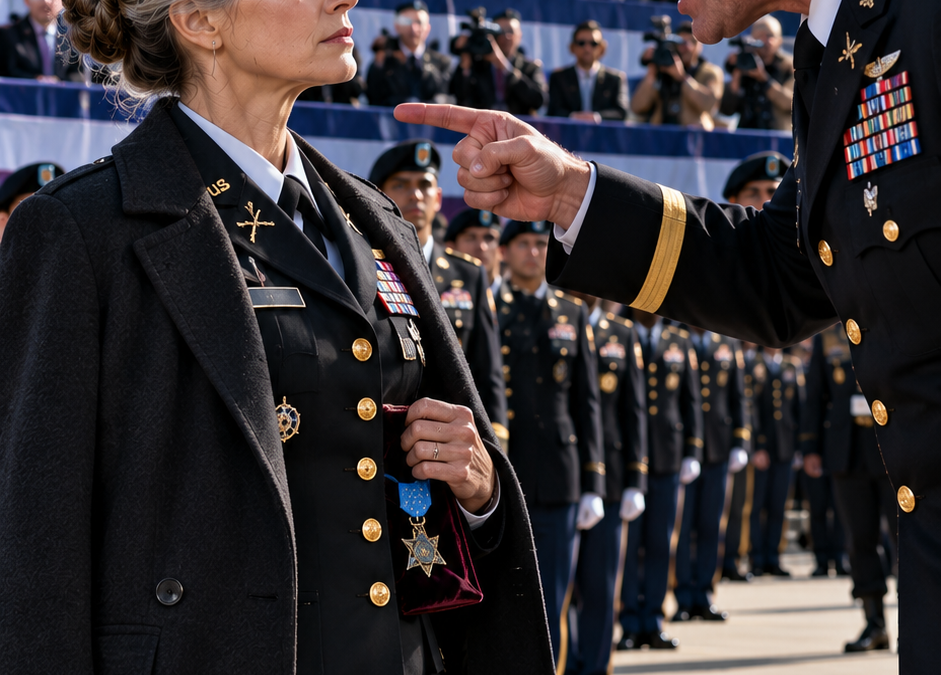
The Colonel Had No Idea What He Was Forcing Me to Reveal
The first time Colonel Richard Hayes called me a fraud, he did it loudly enough for an entire military base to hear.
The second time, he looked directly into my eyes as though thirty-one years of my life could be erased by the confidence in his voice.
By then, I already knew the accusation was not really about my uniform.
“You are a fraud.”
The words carried across the parade field with astonishing clarity.
Thousands of people seemed to stop breathing at once.
Soldiers standing in formation.
Officers gathered near the reviewing platform.
Young recruits craning their necks from behind their commanders.
Families sitting beneath temporary shade structures.
Cameras turned toward us.
And me.
Claire Morgan.
Sixty-one years old.
Thirty-one years of military service behind me.
Three months into retirement.
Standing in the middle of Fort Harrison wearing a dark civilian coat over the dress uniform Colonel Hayes had just publicly suggested I had no right to wear.
The wind moved across the open field.
I could hear flags snapping above us.
Camera shutters clicked.
A few people whispered.
But what hurt most was not the accusation.
It was Hayes’s smile.
He looked pleased.
Not cautious.
Not concerned that he might be making a terrible mistake.
Pleased.
As if he had been waiting for an audience large enough to finally destroy me.
“Remove the insignia,” he ordered.
I did not move.
His expression hardened.
“Did you hear me?”
“Yes.”
“Then remove it.”
I looked at him.
For several seconds, neither of us spoke.
He stood less than ten feet away in a perfectly fitted command uniform covered in decorations.
Everything about him communicated authority.
Years of rank.
Experience.
Confidence.
Habitual obedience from the people around him.
I had known men like him throughout my career.
Some carried authority with care.
Others wore it like armor.
Hayes belonged to the second group.
I slowly looked down at the edge of my coat.
Beneath it, hidden close to my chest, was a small silver pin attached near an old velvet pouch.
Almost nobody on that field knew what was inside.
That was intentional.
For fifteen years, I had kept one particular decoration out of sight.
Not because I was ashamed of it.
Because whenever I looked at it, I remembered the people who had paid far more than I had.
The medal had never felt like mine alone.
And I had promised myself I would never use it as proof of my worth.
Real service, I had learned, does not need applause.
Real sacrifice rarely announces itself.
But Colonel Hayes was not interested in truth.
He was interested in humiliation.
And he believed I was too old, too isolated, and too unknown to stop him.
That assumption was the first thing he got wrong.
My name is Claire Morgan.
For most of my career, I was content to be known simply as another soldier.
Not because nothing happened during those years.
Quite the opposite.
I served overseas.
Worked in places I still do not discuss in detail.
Trained younger soldiers.
Led missions that never appeared in newspapers.
Watched friends come home injured.
Watched other friends come home under flags.
There were commendations.
Evaluations.
Assignments that never became public.
Reports with sections blacked out.
Files available only to people with the right clearance.
I never resented that.
Some service is supposed to remain quiet.
After thirty-one years, I retired the same way I had served.
Quietly.
No large retirement ceremony.
No press.
No speech about sacrifice.
I packed my belongings, folded my uniforms, drove back to Colorado, and began learning what ordinary mornings felt like.
For the first time in decades, my calendar did not belong to anyone else.
I thought that chapter of my life was finished.
Then a letter arrived.
It came three months after I retired.
Official stationery.
Fort Harrison.
The message was short.
All retired personnel connected to the old command division were invited to attend an anniversary ceremony honoring the unit’s history.
At first, I intended to throw it away.
Ceremonies had never been my favorite part of military life.
Then I saw the signature.
General Alexander Whitmore.
My former commanding officer.
The man who had known me before most of the people currently serving at Fort Harrison had entered the military.
The man who had once stood beside me on one of the worst days of my career.
The man who knew what the medal inside that velvet pouch meant.
So I went.
I arrived in a dark coat over my old dress uniform.
No visible decorations.
No chest full of medals.
No attempt to make anyone recognize me.
I was there because Whitmore had apparently asked me to come.
That should have been enough.
The moment I crossed onto the parade field, I noticed people looking.
At first, I ignored it.
An older woman in an old uniform attracts curiosity on a modern base.
That was not offensive.
Then I heard a young soldier whisper behind me.
“Is she lost?”
Another voice answered.
“Maybe she was someone’s assistant years ago.”
I kept walking.
I had spent my career being underestimated for reasons far more serious than age.
Then Colonel Hayes approached.
I did not know him personally.
I knew the name.
Late fifties.
Senior command position.
Strong reputation on paper.
Several connections in defense and training circles.
His uniform was immaculate.
His posture was deliberate.
He stopped directly in my path.
“Interesting.”
I paused.
“Excuse me?”
His eyes moved over me.
“You’re wearing military identification.”
“Yes.”
“May I see your credentials?”
The request itself did not bother me.
Security mattered.
Retired personnel still had to verify access.
I reached into my bag and handed him my retired service identification.
He studied it.
Then looked at me.
“Claire Morgan?”
“Yes.”
He turned slightly toward the officers near him.
“Does anyone here know this woman?”
A few shook their heads.
Others stayed silent.
He smiled.
“There it is.”
I frowned.
“There is what?”
“The problem.”
He lifted my identification between two fingers.
“You expect people here to accept a document from decades ago without question?”
I stared at him.
“My identification is current.”
“I’m not talking about the card.”
“What are you talking about?”
“Your service.”
Something cold settled in my chest.
“Are you questioning my military record?”
“I’m questioning whether you earned what you’re pretending to have earned.”
Several conversations nearby stopped.
I saw soldiers turn toward us.
That was when I knew this was not a security check.
It was theater.
“Colonel,” I said quietly, “you should be very careful with accusations like that.”
His smile widened.
“Or what?”
That told me everything.
He wanted a reaction.
Anger.
Threats.
Something he could point to afterward and call proof that I was unstable.
I gave him nothing.
He stepped closer.
“I reviewed your file.”
That surprised me.
“My file?”
“Yes.”
“And according to what I found, your history is full of inconsistencies.”
I remained silent.
“Classified assignments.”
He counted them almost mockingly.
“Limited photographs.”
Another finger.
“Minimal public recognition.”
Another.
“Large gaps in material available to junior personnel.”
Then he looked directly at me.
“Do you know what that looks like?”
“What?”
“A person inventing a military career.”
Murmurs spread behind us.
Someone whispered, “She lied?”
Another voice answered, “I knew something seemed strange.”
I cannot explain how deeply that hurt.
Not because strangers doubted me.
Because thirty-one years of sacrifice were suddenly being treated as suspicious precisely because much of that sacrifice had required silence.
I remembered long nights overseas.
Letters I never sent.
Funerals.
Names carved into memorials.
Friends whose children grew up without them.
And now a man who had never been beside me in those places was demanding that the absence of public evidence prove I had never been there.
I looked at Hayes.
“You reviewed my file and still decided to accuse me publicly?”
“If you are legitimate, you have nothing to hide.”
I almost laughed.
That phrase has been used by weak investigators for generations.
Nothing to hide.
As though privacy proves guilt.
As though restricted service proves deception.
As though secrecy and dishonor are the same thing.
I reached toward my coat.
Hayes noticed.
“Finally.”
He turned slightly toward the audience.
“Let’s see what she has been hiding.”
I opened the coat.
The old dress uniform became visible.
Not everything.
The velvet pouch remained partly concealed near my chest.
His eyes went directly to it.
His expression changed.
“What is that?”
I said nothing.
He reached toward me.
“Hand it over.”
I stepped back.
“No.”
The field went quiet again.
His face tightened.
“You refuse a direct order?”
“You are not my commanding officer.”
A few soldiers reacted visibly.
Hayes’s jaw clenched.
“Remove the item.”
Before I answered, a voice came from behind the reviewing platform.
“Colonel Hayes.”
Every person near us froze.
I knew the voice before I turned.
General Alexander Whitmore walked toward us.
Four stars.
Older than when I last saw him.
Silver hair now.
Same measured stride.
Same presence that never required volume.
The man whose signature had brought me back.
Or so I believed.
The man who had personally placed the medal inside that velvet pouch fifteen years earlier.
His eyes landed on the small piece of fabric visible beneath my coat.
He stopped.
Recognition moved across his face.
“Where did you get that medal?”
I looked at him.
Then at Hayes.
And quietly answered.
“You gave it to me, General.”
The silence afterward felt heavier than anything Hayes had said.
Whitmore came closer.
“Claire Morgan.”
Hearing my full name from him after so long pulled years out of me at once.
Smoke.
Radio static.
Darkness.
Men calling for help.
Helicopters leaving.
Promises made when I had no idea whether I could keep them.
“You kept it hidden all these years?”
“Yes, sir.”
“Why?”
I looked down.
For fifteen years, I had avoided answering that question publicly.
“I didn’t hide it because I was ashamed.”
I paused.
“I hid it because the people who earned it with me aren’t standing here.”
Whitmore’s expression softened.
He understood immediately.
Hayes did not.
And that difference mattered.
Hayes saw a retired woman.
An old uniform.
A medal he could not identify.
Whitmore saw names.
Faces.
The exact place.
The exact night.
The people we had lost.
Hayes spoke again.
“Even if the medal is authentic, it doesn’t explain the inconsistencies in her service history.”
Whitmore turned slowly.
“Inconsistencies?”
“I reviewed the available records.”
Whitmore repeated the phrase.
“Available records.”
Several senior officers near us exchanged glances.
“You reviewed publicly accessible material and assumed it represented her entire career?”
Hayes swallowed.
“Sir, I was trying to protect the integrity of the base.”
“No.”
Whitmore’s voice remained calm.
“You were protecting an assumption.”
Hayes stiffened.
“Sir—”
“Do you know why certain records are restricted?”
Hayes did not answer.
Whitmore looked across the formations.
“Because some people serve in places where recognition creates danger.”
Then he looked at me.
“Claire Morgan was never someone who chased attention.”
He paused.
“She was the soldier we sent when failure was not an option.”
Whispers moved through the crowd.
Not the ugly kind from before.
Curiosity now.
Uncertainty.
Respect beginning to replace suspicion.
Whitmore extended his hand.
“May I?”
I removed the velvet pouch and gave it to him.
He opened it.
Inside was a dark metal medal bearing a design unfamiliar to most people present.
Hayes leaned forward.
His expression changed.
He recognized enough.
Whitmore stared at it.
Then closed his eyes briefly.
“I remember this day.”
“June fourteenth,” he said.
“Yes, sir.”
“The extraction mission.”
I felt my hands tighten.
“Twenty-six personnel were trapped behind hostile lines,” Whitmore said.
“Weather eliminated air support. Communications failed. Withdrawal became necessary.”
He looked at me.
“And Claire volunteered to go back.”
Someone behind us whispered, “She went back?”
Whitmore nodded.
“She went back after everyone else had been ordered to withdraw.”
Memory opened inside me.
The smell of smoke.
Dust sticking to sweat.
The sharp snap of distant fire.
A damaged radio.
The darkness.
The silence after aircraft disappeared.
Two soldiers lying where they had been left because there was no safe route back.
One conscious.
One barely.
I remembered dragging one.
Carrying another.
Telling a wounded man, “You’re going home,” when I did not know whether either of us would.
“I did what anyone else would have done,” I said.
Whitmore answered immediately.
“No.”
I looked at him.
“Most people would have followed the withdrawal order.”
His voice softened.
“You followed your conscience.”
Then he turned toward Hayes.
“And you called her a fraud.”
Hayes went pale.
“Sir, I apologize if—”
“No.”
Whitmore stopped him.
“An apology phrased like that means you’re still protecting yourself.”
Hayes looked uncomfortable.
“I believed I was acting appropriately.”
“Then your judgment was worse than your investigation.”
The words landed harder than shouting would have.
Near the front, a young female recruit had tears in her eyes.
I did not know why.
Maybe she had been dismissed before.
Maybe she had spent years watching louder people receive credit for work she did quietly.
Maybe she simply understood what it feels like to be judged before being known.
But Hayes was not embarrassed.
Not really.
He was angry.
I saw it.
That was when my instincts changed.
If this had merely been a misunderstanding, Whitmore’s confirmation should have ended it.
Instead, Hayes looked like a man whose plan was unraveling.
Whitmore noticed too.
He turned to me.
“Claire.”
“Yes, sir?”
“Why did you come to Fort Harrison today?”
“I received your invitation.”
His expression changed.
“My invitation?”
“The anniversary ceremony.”
“I never sent you an invitation.”
The air seemed to leave my lungs.
“What?”
Whitmore looked toward his aide.
“I did not authorize any invitation to Claire Morgan.”
The field felt suddenly much colder.
I reached into my coat.
The letter was still there.
I handed it over.
Whitmore read the signature.
His signature.
Perfect enough to convince me.
But he had not written it.
Then he looked toward Hayes.
For one second, Hayes looked away.
Only one second.
It was enough.
Whitmore saw it.
So did I.
The public accusation suddenly looked different.
Someone had wanted me there.
Someone had used Whitmore’s name to lure me back.
Someone had expected me to arrive in uniform.
Someone had prepared an accusation before I ever stepped onto the field.
This was not spontaneous.
It was planned.
Whitmore folded the letter.
“Claire, there’s something you need to know.”
“What?”
“The reason someone wanted you here has nothing to do with whether you served.”
My heartbeat shifted.
“Then what?”
He glanced toward Hayes.
“It has to do with what happened fifteen years ago.”
That night.
The medal.
The report I had never discussed.
The people who never made it home.
I looked at Hayes differently now.
“What does he have to do with it?”
Whitmore hesitated.
That was answer enough.
Hayes stepped forward.
“General, this has gone far enough.”
His voice had changed.
Sharper.
Less controlled.
“This woman has manipulated an entire base with an old decoration and a dramatic story.”
Whitmore turned.
“Are you finished?”
“I’m saying emotion should not override facts.”
“Facts?”
Whitmore looked at his aide.
“Bring the archived mission file.”
Hayes’s face changed.
Fear.
Real fear.
The aide left.
No one dismissed the formations.
No one seemed willing to move.
A few minutes later, a sealed black folder arrived.
Whitmore opened it.
Documents.
Photographs.
After-action reports.
Names.
Then one page.
He looked at me.
“Do you remember Sergeant Daniel Brooks?”
My throat tightened.
Of course I remembered.
Everyone from that night still existed somewhere inside me.
“Yes.”
“He was the reason you went back.”
I closed my eyes.
The memory arrived.
An explosion.
Smoke.
A broken radio.
The retreat order.
Brooks’s voice.
“Leave me.”
I had refused.
“No one gets left behind.”
Whitmore looked toward the soldiers.
“Sergeant Brooks was critically wounded. The official report stated that he was recovered through coordinated extraction.”
He paused.
“That report was incomplete.”
His eyes returned to me.
“The truth is Claire returned alone.”
The field went still.
“She entered an active danger zone without backup and moved Brooks nearly two miles before support reached them.”
I looked down.
Praise has always felt strange when attached to the worst night of someone else’s life.
“The helicopter came too late,” I said.
Whitmore looked at me.
“Yes.”
“We lost three others.”
The meaning of the medal changed for everyone listening.
It was no longer a piece of metal.
It became absence.
Names.
Three families.
Three empty chairs.
Whitmore closed the file.
“That is why the award documentation was restricted.”
Then he looked at Hayes.
“And why you had no basis for publicly questioning her service.”
Hayes smiled.
Small.
Bitter.
I recognized the expression immediately.
He still believed he had something left.
“Before everyone decides I am the villain,” he said, “perhaps we should discuss why Captain Morgan never told anyone the full story.”
Whitmore hardened.
“Be careful.”
Hayes continued.
“Maybe she stayed silent because the complete version doesn’t make her look as heroic.”
I was tired now.
Not frightened.
Tired.
Tired of grief being used as a weapon.
Tired of men who needed every story to have one hero and one villain because complexity made them uncomfortable.
“Colonel,” I said.
He looked at me.
“You should stop.”
“Why?”
“Because you do not know what you’re talking about.”
“Then explain.”
The field was silent.
Fifteen years.
I had kept part of that night private for fifteen years.
Not for myself.
For someone else.
I looked at Whitmore.
He knew I was about to cross a line I had once refused to cross.
But enough of the truth now needed to be said.
“Sergeant Brooks was not the only person trapped.”
Hayes waited.
“There was another soldier.”
Whitmore looked at me.
He knew something existed.
He did not know this.
“A private named Thomas Ellis.”
Several officers exchanged looks.
I continued.
“Nineteen years old. First deployment.”
My voice tightened despite my effort.
“We found him unconscious.”
I could still see his face.
Far too young.
Blood near his temple.
One boot missing.
When he woke briefly, he apologized.
Not for being hurt.
For failing.
“I told him he hadn’t failed.”
My voice became quieter.
“I told him we were going home.”
Hayes crossed his arms.
“And?”
“And I carried him out too.”
Silence.
Whitmore stared at me.
“The report only mentions Brooks.”
“Yes.”
“Why?”
“Thomas asked me not to use his name.”
“Why?”
“Because he was ashamed.”
I looked toward the younger soldiers.
“He believed his family would remember him as the boy who needed to be rescued.”
My voice strengthened.
“So I protected his dignity.”
Whitmore closed his eyes briefly.
“You kept his identity out of the story for fifteen years.”
“Yes.”
“He deserved that.”
At that moment, Hayes looked small.
Not physically.
Morally.
He had spent the day trying to expose what he assumed was a lie.
Instead, he had forced everyone to see the difference between wearing a uniform and understanding what the uniform asks from you.
Whitmore turned toward the formations.
“Attention.”
Every soldier straightened.
“Today you witnessed something important.”
His voice carried across the field.
“You witnessed what happens when service is judged without understanding sacrifice.”
He looked at me.
“Captain Claire Morgan served with honor.”
A pause.
“Not because of a medal.”
Another.
“Not because of rank.”
Then:
“Because when people needed her, she went back.”
One soldier saluted.
Then another.
Then dozens.
Then hundreds.
I stood still.
For most of my life, I had avoided moments exactly like this.
Recognition.
Public emotion.
People looking at me as though survival made me different from them.
I had never needed to be called a hero.
I only needed the truth to survive.
Then Whitmore’s phone vibrated.
He read the message.
His expression changed again.
Concern.
He stepped toward me.
“Claire.”
“Yes?”
“The preliminary inquiry into Hayes uncovered something.”
“What?”
“Today was not the first attempt to discredit you.”
He showed me the screen.
A complaint.
Filed six months earlier.
My name at the top.
Fraudulent military service claims.
Then the signature.
Daniel Morgan.
My younger brother.
My stomach dropped.
Daniel had not spoken to me in six years.
We had never been close.
Even before that.
He spent much of our adulthood convinced the military had stolen me from the family.
He called my work secretive.
Dramatic.
Self-important.
Once, during an argument, he said my entire career was “a fantasy you built because you need everyone to think you’re special.”
I never forgot it.
Now his name sat beneath a complaint accusing me of inventing that career.
“Why?” I whispered.
Whitmore looked at me.
“We’re still investigating.”
Hayes immediately stepped forward.
“You see?”
Every eye turned toward him.
“Even her own family questioned her story.”
Whitmore stared at him.
“You are still speaking?”
Hayes ignored the warning.
“Maybe my investigation was justified.”
I looked at him.
For the first time all day, I felt pity.
He still thought the question was whether he had been right to doubt me.
He had no idea the issue was becoming conspiracy.
Whitmore handed me the phone.
“Did Daniel have access to your military records?”
“No.”
“Any legitimate reason to see restricted material?”
“No.”
Whitmore nodded.
“Then someone helped him.”
The words settled over us.
My eyes moved toward Hayes.
This time, he did not look away.
That was when I knew.
The complaint.
The forged invitation.
The public accusation.
The carefully staged confrontation.
Someone wanted my reputation destroyed.
The question was why.
Whitmore’s aide returned with another folder.
“Sir. Investigators found financial records.”
Whitmore read the first page.
His expression went hard.
“Claire.”
“What?”
“Your brother did not file the complaint because he believed it.”
I frowned.
“Then why?”
“Someone paid him.”
The field went silent again.
“Who?”
Whitmore looked toward Hayes.
Hayes’s face changed instantly.
“No.”
It was the first time I heard fear in his voice.
Whitmore continued.
“Six months ago, Daniel Morgan received a substantial payment from an account linked to a private military consulting firm.”
I understood before anyone finished explaining.
Hayes had relationships in private defense contracting.
Everyone knew that.
No one had apparently asked enough questions.
“Why involve Daniel?”
Whitmore handed me another document.
A proposal.
Contract language.
Training transition plans.
My old unit’s training program was being prepared for transfer to a private company.
Owner:
Richard Hayes.
My stomach turned.
“He wasn’t trying to prove I was a fraud.”
“No,” Whitmore said.
“He was trying to remove you as a credible witness.”
The answer came into focus.
Years earlier, before retirement, I had testified during an internal investigation involving military contracting.
Nothing dramatic publicly.
No headlines.
But I had documented officers who were allowing private financial interests to influence training decisions and procurement.
One of the officers implicated in that investigation had connections to Hayes.
Now Hayes had positioned himself to profit from the transfer of training work once handled inside the military.
And I was a problem.
Not because I held current command authority.
Because my name still had credibility with people who remembered the earlier investigation.
If I objected publicly, questions might follow.
So he intended to discredit me first.
A fake veteran.
An unstable older woman.
A fraud exaggerating a classified career.
Once that idea existed, anything I said later could be dismissed as bitterness.
I looked at him.
“So this was never about my medal.”
He did not answer.
“It was about making people doubt me.”
Silence.
Whitmore stepped forward.
“Colonel Richard Hayes.”
The field became utterly still.
“You are relieved of command pending full investigation.”
Hayes looked at him.
Then at me.
For the first time that day, he appeared defeated.
Not because of the rank.
Because he had lost control of the story.
Two officers approached.
Nobody cheered.
Nobody celebrated.
That mattered to me.
Accountability should not become entertainment.
Hayes had tried to turn my humiliation into a spectacle.
I would not do the same to him.
He walked away between the officers.
Three weeks later, I returned to Fort Harrison.
The investigation had moved quickly.
My name was formally cleared.
The complaint against me was dismissed.
The private company connected to Hayes was under federal review.
Several contracts were frozen.
Other people were being questioned.
Daniel finally called.
I stared at his name on my phone for nearly ten seconds before answering.
“Claire.”
His voice sounded smaller than I remembered.
“Daniel.”
“I know you probably hate me.”
“I don’t.”
Silence.
“Then why do you sound like that?”
“Because not hating you doesn’t mean what you did didn’t matter.”
He exhaled.
“I needed money.”
“That is not an explanation.”
“I was in trouble.”
“Still not an explanation.”
“They told me it was just paperwork.”
I closed my eyes.
“Who told you?”
“A man who worked with Hayes.”
“And you believed him?”
“He said they were checking inconsistencies.”
“You knew you were accusing your own sister of lying about thirty-one years of service.”
“I was angry at you.”
“That I believe.”
He was quiet.
“Why did you never tell us?”
I knew what he meant.
The medal.
The missions.
Why parts of my life always seemed hidden.
“Because I was not serving so you would admire me.”
He said nothing.
“I was serving because people needed me.”
His breathing changed.
“I was wrong.”
Maybe.
Maybe he was sorry.
Maybe fear of prosecution had made him reflective.
Maybe both could be true.
“I don’t know if I can forgive you,” I said.
“I understand.”
“No, Daniel. You don’t.”
His voice cracked.
“You’re right.”
That answer was better than another excuse.
“I hope someday I can.”
“Do you?”
“Yes.”
“Why?”
I looked out the window of my Colorado home.
Mountains in the distance.
Quiet street.
No formations.
No uniforms.
“Because I don’t want what you did living inside me longer than it has to.”
Forgiveness is often misunderstood.
People think it means declaring the injury harmless.
It does not.
Sometimes forgiveness is simply the decision that another person will not control the rest of your emotional life.
Whether Daniel and I would ever become siblings again, I did not know.
Closure is not always reunion.
A month later, Whitmore called.
“One last ceremony.”
“No.”
“You have not even heard what it is.”
“Still no.”
“Claire.”
“General.”
“I outrank you.”
“I’m retired.”
“That was unnecessary.”
“Accurate, though.”
He laughed.
Then his tone softened.
“Come.”
I almost refused again.
Recognition had never been why I served.
But something in his voice made me agree.
When I arrived, hundreds of soldiers had gathered.
Recruits.
Veterans.
Officers.
Families.
Not as many as the anniversary ceremony.
Enough.
Whitmore stepped onto the stage.
“Today we recognize someone who spent decades believing service mattered more than recognition.”
I felt uncomfortable immediately.
He looked toward me.
“Captain Claire Morgan.”
Applause rose.
I walked forward.
This time, nobody whispered that I was lost.
Nobody asked whether I belonged there.
But strangely, I cared less about their approval than I would have imagined.
Whitmore held the same medal I had kept hidden for fifteen years.
He did not pin it onto me.
He handed it to me.
“Claire, this medal was never intended to remind people what you achieved.”
I looked at him.
“It was intended to remind people what kind of person you chose to be.”
I looked down at the metal in my palm.
For decades, I had treated awards as records.
Proof that something happened.
Nothing more.
But standing there, I understood why he had insisted on the ceremony.
The medal was not proof that I mattered.
My actions were.
The years were.
The soldiers I brought home.
The ones I could not.
The people I protected even when nobody would ever know their names.
Thomas Ellis.
Daniel Brooks.
Three others who never made it back.
That was the real record.
Not metal.
Not title.
Not applause.
After the ceremony, the young female recruit I had noticed during the confrontation approached.
“Captain Morgan?”
“Yes?”
She looked nervous.
“I wanted to ask you something.”
“Go ahead.”
“Why didn’t you just show Colonel Hayes the medal immediately?”
I smiled slightly.
“Because it shouldn’t have been necessary.”
She thought about that.
“But wouldn’t that have ended it faster?”
“Maybe.”
“Then why not?”
I looked toward the parade field.
“Because if I needed a medal to prove my worth, then I had already forgotten why I served.”
She nodded slowly.
I could tell she was trying to understand.
So I added something I wish more young soldiers had been told early.
“Your record matters. Your rank matters. Standards matter. But never confuse those things with your value as a person.”
She listened carefully.
“People will sometimes decide what you are before they know you. You cannot spend your life performing your identity for every person who doubts it.”
“What do you do instead?”
“The work.”
I looked at her.
“You keep doing the work.”
Years later, younger soldiers still asked me about that day.
Most knew the dramatic version.
The colonel accusing the retired officer.
The four-star general walking onto the field.
The hidden medal.
The revelation.
Those details made the story memorable.
But they were not what mattered most.
What mattered was how easily people believed something because authority said it confidently.
Hayes had no evidence that I had fabricated my career.
He had gaps.
And instead of investigating those gaps honestly, he turned them into accusations because the accusation served him.
That lesson stayed with me.
Truth does not become weaker because people whisper about it.
A life does not become smaller because the evidence is classified.
Sacrifice does not disappear because nobody posts photographs.
And character does not need an audience.
For a long time, I wondered whether keeping my medal hidden had been a mistake.
Maybe silence had allowed people like Hayes to create whatever version of me they wanted.
Maybe I should have spoken more.
Told my family more.
Let people know enough that Daniel could never believe the worst.
But that line of thinking eventually became another way of blaming myself for choices other people made.
My brother had chosen resentment.
Hayes had chosen corruption.
Neither choice became mine simply because I lived quietly.
I still keep the medal in the same velvet pouch.
Not framed.
Not displayed.
It sits inside a wooden box with photographs.
There is one picture of Sergeant Brooks after recovery.
One of Thomas Ellis years later with his wife and children.
He contacted me after the Fort Harrison incident became known internally.
For fifteen years, we had never discussed what happened.
Then one afternoon my phone rang.
“Captain?”
I knew the voice before he said his name.
“Thomas.”
He laughed nervously.
“You remember me.”
“I carried you two miles. I remember you.”
He became quiet.
“I saw what happened.”
I knew what he meant.
“I’m sorry my name came into it.”
“Your name didn’t.”
“That’s why I’m calling.”
Silence.
“Thank you.”
“For what?”
“For keeping your promise.”
I sat down.
“I told you I would.”
“I was nineteen.”
“I remember.”
“I thought needing help made me weak.”
“You were injured.”
“I know that now.”
His voice trembled.
“I spent years ashamed of that night.”
“Thomas.”
“Yes?”
“You survived the night.”
He was quiet.
“That is not something to be ashamed of.”
He cried.
So did I.
Not dramatically.
Just two people separated by fifteen years finally admitting what the silence had cost us.
Before ending the call, he said something I never forgot.
“You know what’s strange?”
“What?”
“My son wants to join the military.”
“That is not strange.”
“It terrifies me.”
“That is normal.”
He laughed.
“I told him there was one officer I wanted him to know about.”
I closed my eyes.
“Thomas—”
“Not because of the medal.”
That stopped me.
“Because you came back.”
For all the applause at Fort Harrison, that sentence meant more.
You came back.
That was the only part of my service I ever wanted to matter.
Not whether people knew.
Not whether they saluted.
Whether, when someone needed me, I came back.
General Whitmore retired the following year.
At his retirement reception, we stood away from the crowd for a few minutes.
He looked older.
Relieved.
Almost lighter without command waiting on his shoulders.
“You know,” he said, “I still feel responsible for what happened at the anniversary ceremony.”
“You did not send the invitation.”
“My office was used.”
“That is different.”
“I should have caught it.”
“You are allowed to not control everything.”
He raised an eyebrow.
“That sounds suspiciously healthy.”
“Retirement changed me.”
“Clearly.”
We both smiled.
Then he looked serious.
“Why did you really come that day?”
“Because I thought you asked.”
“That simple?”
“Yes.”
“No suspicion?”
“I trusted your name.”
He looked away.
“That bothers me.”
“Why?”
“Because Hayes used my credibility against you.”
I thought about that.
“Then remember what happened next.”
He looked at me.
“Your credibility was also part of what exposed him.”
That seemed to ease something.
He nodded.
“I suppose.”
Then he asked, “Do you regret opening the coat?”
I looked toward the crowd.
“No.”
“Even though it brought everything back?”
“Yes.”
“Why?”
“Because truth does not always stay private just because privacy is easier.”
That answer surprised even me.
I had spent years believing silence was strength.
Sometimes it was.
Other times, silence simply left space for someone else to write the story.
The hard part was learning the difference.
I still do not believe every sacrifice needs to become public.
Thomas deserved his privacy.
The dead deserved more than being turned into inspirational anecdotes.
Classified missions do not become less meaningful because nobody knows them.
But when silence becomes a weapon someone else uses against the innocent, sometimes truth has to step forward.
Not for applause.
For correction.
That was what happened at Fort Harrison.
The truth stood up.
Not because I wanted a stage.
Because someone had built a stage for a lie.
And once that happened, walking away would have given him the only version anyone heard.
I sometimes think about the second before Whitmore arrived.
Hayes demanding the medal.
Me refusing.
The entire field watching.
If the general had been five minutes later, what would I have done?
I know the answer.
I would have kept standing there.
I would have refused to hand Hayes anything I was not legally required to surrender.
He probably would have escalated.
Maybe security would have been called.
Maybe I would have been removed from the ceremony.
Maybe the humiliation he planned would have worked temporarily.
That possibility no longer frightens me.
Because truth is not always immediate.
That is another lesson age taught me.
Sometimes lies win the first hour.
Sometimes the first day.
Sometimes longer.
But lies require maintenance.
Truth requires only evidence and time.
Hayes had forged an invitation.
Paid my brother.
Arranged a complaint.
Planned a public confrontation.
Used restricted gaps in my record as proof of deception.
Built a private contracting scheme.
Connected himself to people already under ethical scrutiny.
He needed layer after layer after layer.
I needed one archived file.
One general who remembered.
One payment record.
One contract.
One truth.
That difference matters.
Years after Fort Harrison, when younger officers asked me how to protect their reputations, they usually expected practical advice.
Document everything.
Save emails.
Know policy.
Those are good habits.
But I always gave them something else too.
“Do not build a life that depends entirely on being believed immediately.”
They usually looked confused.
“What does that mean?”
“It means your integrity has to exist before anyone confirms it.”
A reputation can be attacked.
Records can be delayed.
People can gossip.
Someone with rank can stand on a field and call you a fraud.
You cannot control all of that.
What you can control is whether there is a real life underneath the accusation.
Mine existed.
Thirty-one years of it.
That is why Hayes ultimately failed.
Not because I had a more powerful friend.
Not because I had a rare medal.
Because beneath everything he said there was a record strong enough to survive scrutiny.
That is what I tell young soldiers now.
Do the work so the truth has somewhere to stand.
I never became comfortable with being called heroic.
I still correct people when they use the word.
Heroes belong in stories.
Real people are messier.
On June fourteenth, I was afraid.
I was angry.
I disobeyed an order.
I made decisions that could have killed me.
I failed to bring everyone home.
Those facts exist beside the medal.
That is why the medal never became the thing I was proudest of.
The thing I remain proudest of is simpler.
When Brooks told me to leave him, I did not.
When Ellis thought he had failed, I told him he had not.
When Daniel betrayed me, I did not let betrayal make me cruel.
When Hayes tried to turn accountability into revenge, I did not celebrate his humiliation.
Those choices matter more to me now.
Character rarely reveals itself in ceremonies.
It reveals itself in moments where nobody knows what you will choose.
Fifteen years after that mission, Hayes thought he could rewrite my life because he controlled the microphone.
He stood in front of thousands of people and called me a fraud.
For a few minutes, some believed him.
That is the part people always find hardest to understand.
“Didn’t it hurt?”
Yes.
More than I expected.
Thirty-one years of discipline did not make me immune to humiliation.
I heard the whispers.
Saw the faces.
Felt the judgment.
A person can know who she is and still feel pain when strangers decide she is lying.
Strength does not erase that.
Strength only decides what you do with it.
I did not shout.
I did not beg anyone to believe me.
I did not list my deployments.
I did not tear open the pouch and hold the medal above my head.
I stood there.
And eventually the truth reached the field.
That is the version I remember.
Not the salutes.
Not Hayes being removed.
Not Whitmore’s speech.
The waiting.
The few minutes when the lie was louder.
Because that was the test.
Not whether I had served.
Whether I still knew who I was when people said I had not.
I did.
And that was enough.
Today the medal remains in its wooden box.
Sometimes I take it out.
Usually on June fourteenth.
I sit with it for a few minutes.
I think of Brooks.
Ellis.
The three we lost.
The people whose names never became part of public stories.
Then I put it away.
I do not need it on the wall.
I do not need strangers to see it.
But I no longer hide it from myself either.
There is a difference.
For years, I thought refusing recognition honored the dead.
Now I understand memory can honor them too.
So when someone asks what happened, I tell enough.
Not everything.
Some stories still belong to the people who lived them.
But I say this:
There was a night when people needed help.
I went back.
Some came home.
Some did not.
I carried both outcomes for years.
And one day, long after I thought the story was over, a man tried to use my silence to erase me.
He failed.
Not because a medal saved my reputation.
Because the truth existed before he ever opened his mouth.
And truth has a way of standing up eventually.
Even when it arrives quietly.
Even when it has waited fifteen years.
Even when it has been hidden beneath a plain dark coat.
That is what Colonel Richard Hayes never understood.
He believed power came from controlling what other people saw.
I had learned something different.
Power can control a room.
Rank can command silence.
A loud voice can make people doubt what they thought they knew.
But none of those things can permanently change what actually happened.
The mission happened.
The men existed.
The lives mattered.
The service was real.
And when General Whitmore looked across that field and recognized the medal beneath my coat, he was not giving me a history.
He was confirming one that had already been lived.
I never needed the medal to make me real.
I never needed Hayes to approve of me.
And I certainly never needed an entire base to salute.
But I am glad the truth came out.
Because somewhere in the formation that day stood young soldiers still deciding what kind of leaders they would become.
Some of them had watched Hayes use rank to humiliate someone he believed powerless.
Then they watched facts overtake arrogance.
Maybe that lesson stayed with them.
Maybe years later, one of them faced a subordinate with an unusual record or a story that did not fit neatly into a database.
Maybe they remembered not to confuse missing information with deception.
Maybe they asked questions before making accusations.
Maybe they understood that leadership is not proven by how easily you can embarrass someone beneath your rank.
If even one of them learned that, then the day was worth surviving.
And if anyone ever asks me why I did not reveal who I was sooner, the answer is still the same.
I was never serving so people would admire me.
I served because people needed me.
That was enough on the battlefield.
It was enough in retirement.
And it was enough when a colonel stood in front of an entire base and told the world I was nothing I claimed to be.
Because he could challenge my reputation.
He could question my record.
He could forge letters, buy accusations, and build a stage for humiliation.
But there was one thing he could never manufacture.
The thirty-one years I had already lived.
Those belonged to me.
And no accusation, no matter how loudly spoken, could take them away.
What do you think of this story? Please leave a like and share your thoughts in the comments. Your support means a lot to us and inspires us to keep writing more meaningful and powerful stories. Thank you! 👍
𝗧𝗛𝗘 𝗘𝗡𝗗
The Colonel Had No Idea What He Was Forcing Me to Reveal
The first time Colonel Richard Hayes called me a fraud, he did it loudly enough for an entire military base to hear.
The second time, he looked directly into my eyes as though thirty-one years of my life could be erased by the confidence in his voice.
By then, I already knew the accusation was not really about my uniform.
“You are a fraud.”
The words carried across the parade field with astonishing clarity.
Thousands of people seemed to stop breathing at once.
Soldiers standing in formation.
Officers gathered near the reviewing platform.
Young recruits craning their necks from behind their commanders.
Families sitting beneath temporary shade structures.
Cameras turned toward us.
And me.
Claire Morgan.
Sixty-one years old.
Thirty-one years of military service behind me.
Three months into retirement.
Standing in the middle of Fort Harrison wearing a dark civilian coat over the dress uniform Colonel Hayes had just publicly suggested I had no right to wear.
The wind moved across the open field.
I could hear flags snapping above us.
Camera shutters clicked.
A few people whispered.
But what hurt most was not the accusation.
It was Hayes’s smile.
He looked pleased.
Not cautious.
Not concerned that he might be making a terrible mistake.
Pleased.
As if he had been waiting for an audience large enough to finally destroy me.
“Remove the insignia,” he ordered.
I did not move.
His expression hardened.
“Did you hear me?”
“Yes.”
“Then remove it.”
I looked at him.
For several seconds, neither of us spoke.
He stood less than ten feet away in a perfectly fitted command uniform covered in decorations.
Everything about him communicated authority.
Years of rank.
Experience.
Confidence.
Habitual obedience from the people around him.
I had known men like him throughout my career.
Some carried authority with care.
Others wore it like armor.
Hayes belonged to the second group.
I slowly looked down at the edge of my coat.
Beneath it, hidden close to my chest, was a small silver pin attached near an old velvet pouch.
Almost nobody on that field knew what was inside.
That was intentional.
For fifteen years, I had kept one particular decoration out of sight.
Not because I was ashamed of it.
Because whenever I looked at it, I remembered the people who had paid far more than I had.
The medal had never felt like mine alone.
And I had promised myself I would never use it as proof of my worth.
Real service, I had learned, does not need applause.
Real sacrifice rarely announces itself.
But Colonel Hayes was not interested in truth.
He was interested in humiliation.
And he believed I was too old, too isolated, and too unknown to stop him.
That assumption was the first thing he got wrong.
My name is Claire Morgan.
For most of my career, I was content to be known simply as another soldier.
Not because nothing happened during those years.
Quite the opposite.
I served overseas.
Worked in places I still do not discuss in detail.
Trained younger soldiers.
Led missions that never appeared in newspapers.
Watched friends come home injured.
Watched other friends come home under flags.
There were commendations.
Evaluations.
Assignments that never became public.
Reports with sections blacked out.
Files available only to people with the right clearance.
I never resented that.
Some service is supposed to remain quiet.
After thirty-one years, I retired the same way I had served.
Quietly.
No large retirement ceremony.
No press.
No speech about sacrifice.
I packed my belongings, folded my uniforms, drove back to Colorado, and began learning what ordinary mornings felt like.
For the first time in decades, my calendar did not belong to anyone else.
I thought that chapter of my life was finished.
Then a letter arrived.
It came three months after I retired.
Official stationery.
Fort Harrison.
The message was short.
All retired personnel connected to the old command division were invited to attend an anniversary ceremony honoring the unit’s history.
At first, I intended to throw it away.
Ceremonies had never been my favorite part of military life.
Then I saw the signature.
General Alexander Whitmore.
My former commanding officer.
The man who had known me before most of the people currently serving at Fort Harrison had entered the military.
The man who had once stood beside me on one of the worst days of my career.
The man who knew what the medal inside that velvet pouch meant.
So I went.
I arrived in a dark coat over my old dress uniform.
No visible decorations.
No chest full of medals.
No attempt to make anyone recognize me.
I was there because Whitmore had apparently asked me to come.
That should have been enough.
The moment I crossed onto the parade field, I noticed people looking.
At first, I ignored it.
An older woman in an old uniform attracts curiosity on a modern base.
That was not offensive.
Then I heard a young soldier whisper behind me.
“Is she lost?”
Another voice answered.
“Maybe she was someone’s assistant years ago.”
I kept walking.
I had spent my career being underestimated for reasons far more serious than age.
Then Colonel Hayes approached.
I did not know him personally.
I knew the name.
Late fifties.
Senior command position.
Strong reputation on paper.
Several connections in defense and training circles.
His uniform was immaculate.
His posture was deliberate.
He stopped directly in my path.
“Interesting.”
I paused.
“Excuse me?”
His eyes moved over me.
“You’re wearing military identification.”
“Yes.”
“May I see your credentials?”
The request itself did not bother me.
Security mattered.
Retired personnel still had to verify access.
I reached into my bag and handed him my retired service identification.
He studied it.
Then looked at me.
“Claire Morgan?”
“Yes.”
He turned slightly toward the officers near him.
“Does anyone here know this woman?”
A few shook their heads.
Others stayed silent.
He smiled.
“There it is.”
I frowned.
“There is what?”
“The problem.”
He lifted my identification between two fingers.
“You expect people here to accept a document from decades ago without question?”
I stared at him.
“My identification is current.”
“I’m not talking about the card.”
“What are you talking about?”
“Your service.”
Something cold settled in my chest.
“Are you questioning my military record?”
“I’m questioning whether you earned what you’re pretending to have earned.”
Several conversations nearby stopped.
I saw soldiers turn toward us.
That was when I knew this was not a security check.
It was theater.
“Colonel,” I said quietly, “you should be very careful with accusations like that.”
His smile widened.
“Or what?”
That told me everything.
He wanted a reaction.
Anger.
Threats.
Something he could point to afterward and call proof that I was unstable.
I gave him nothing.
He stepped closer.
“I reviewed your file.”
That surprised me.
“My file?”
“Yes.”
“And according to what I found, your history is full of inconsistencies.”
I remained silent.
“Classified assignments.”
He counted them almost mockingly.
“Limited photographs.”
Another finger.
“Minimal public recognition.”
Another.
“Large gaps in material available to junior personnel.”
Then he looked directly at me.
“Do you know what that looks like?”
“What?”
“A person inventing a military career.”
Murmurs spread behind us.
Someone whispered, “She lied?”
Another voice answered, “I knew something seemed strange.”
I cannot explain how deeply that hurt.
Not because strangers doubted me.
Because thirty-one years of sacrifice were suddenly being treated as suspicious precisely because much of that sacrifice had required silence.
I remembered long nights overseas.
Letters I never sent.
Funerals.
Names carved into memorials.
Friends whose children grew up without them.
And now a man who had never been beside me in those places was demanding that the absence of public evidence prove I had never been there.
I looked at Hayes.
“You reviewed my file and still decided to accuse me publicly?”
“If you are legitimate, you have nothing to hide.”
I almost laughed.
That phrase has been used by weak investigators for generations.
Nothing to hide.
As though privacy proves guilt.
As though restricted service proves deception.
As though secrecy and dishonor are the same thing.
I reached toward my coat.
Hayes noticed.
“Finally.”
He turned slightly toward the audience.
“Let’s see what she has been hiding.”
I opened the coat.
The old dress uniform became visible.
Not everything.
The velvet pouch remained partly concealed near my chest.
His eyes went directly to it.
His expression changed.
“What is that?”
I said nothing.
He reached toward me.
“Hand it over.”
I stepped back.
“No.”
The field went quiet again.
His face tightened.
“You refuse a direct order?”
“You are not my commanding officer.”
A few soldiers reacted visibly.
Hayes’s jaw clenched.
“Remove the item.”
Before I answered, a voice came from behind the reviewing platform.
“Colonel Hayes.”
Every person near us froze.
I knew the voice before I turned.
General Alexander Whitmore walked toward us.
Four stars.
Older than when I last saw him.
Silver hair now.
Same measured stride.
Same presence that never required volume.
The man whose signature had brought me back.
Or so I believed.
The man who had personally placed the medal inside that velvet pouch fifteen years earlier.
His eyes landed on the small piece of fabric visible beneath my coat.
He stopped.
Recognition moved across his face.
“Where did you get that medal?”
I looked at him.
Then at Hayes.
And quietly answered.
“You gave it to me, General.”
The silence afterward felt heavier than anything Hayes had said.
Whitmore came closer.
“Claire Morgan.”
Hearing my full name from him after so long pulled years out of me at once.
Smoke.
Radio static.
Darkness.
Men calling for help.
Helicopters leaving.
Promises made when I had no idea whether I could keep them.
“You kept it hidden all these years?”
“Yes, sir.”
“Why?”
I looked down.
For fifteen years, I had avoided answering that question publicly.
“I didn’t hide it because I was ashamed.”
I paused.
“I hid it because the people who earned it with me aren’t standing here.”
Whitmore’s expression softened.
He understood immediately.
Hayes did not.
And that difference mattered.
Hayes saw a retired woman.
An old uniform.
A medal he could not identify.
Whitmore saw names.
Faces.
The exact place.
The exact night.
The people we had lost.
Hayes spoke again.
“Even if the medal is authentic, it doesn’t explain the inconsistencies in her service history.”
Whitmore turned slowly.
“Inconsistencies?”
“I reviewed the available records.”
Whitmore repeated the phrase.
“Available records.”
Several senior officers near us exchanged glances.
“You reviewed publicly accessible material and assumed it represented her entire career?”
Hayes swallowed.
“Sir, I was trying to protect the integrity of the base.”
“No.”
Whitmore’s voice remained calm.
“You were protecting an assumption.”
Hayes stiffened.
“Sir—”
“Do you know why certain records are restricted?”
Hayes did not answer.
Whitmore looked across the formations.
“Because some people serve in places where recognition creates danger.”
Then he looked at me.
“Claire Morgan was never someone who chased attention.”
He paused.
“She was the soldier we sent when failure was not an option.”
Whispers moved through the crowd.
Not the ugly kind from before.
Curiosity now.
Uncertainty.
Respect beginning to replace suspicion.
Whitmore extended his hand.
“May I?”
I removed the velvet pouch and gave it to him.
He opened it.
Inside was a dark metal medal bearing a design unfamiliar to most people present.
Hayes leaned forward.
His expression changed.
He recognized enough.
Whitmore stared at it.
Then closed his eyes briefly.
“I remember this day.”
“June fourteenth,” he said.
“Yes, sir.”
“The extraction mission.”
I felt my hands tighten.
“Twenty-six personnel were trapped behind hostile lines,” Whitmore said.
“Weather eliminated air support. Communications failed. Withdrawal became necessary.”
He looked at me.
“And Claire volunteered to go back.”
Someone behind us whispered, “She went back?”
Whitmore nodded.
“She went back after everyone else had been ordered to withdraw.”
Memory opened inside me.
The smell of smoke.
Dust sticking to sweat.
The sharp snap of distant fire.
A damaged radio.
The darkness.
The silence after aircraft disappeared.
Two soldiers lying where they had been left because there was no safe route back.
One conscious.
One barely.
I remembered dragging one.
Carrying another.
Telling a wounded man, “You’re going home,” when I did not know whether either of us would.
“I did what anyone else would have done,” I said.
Whitmore answered immediately.
“No.”
I looked at him.
“Most people would have followed the withdrawal order.”
His voice softened.
“You followed your conscience.”
Then he turned toward Hayes.
“And you called her a fraud.”
Hayes went pale.
“Sir, I apologize if—”
“No.”
Whitmore stopped him.
“An apology phrased like that means you’re still protecting yourself.”
Hayes looked uncomfortable.
“I believed I was acting appropriately.”
“Then your judgment was worse than your investigation.”
The words landed harder than shouting would have.
Near the front, a young female recruit had tears in her eyes.
I did not know why.
Maybe she had been dismissed before.
Maybe she had spent years watching louder people receive credit for work she did quietly.
Maybe she simply understood what it feels like to be judged before being known.
But Hayes was not embarrassed.
Not really.
He was angry.
I saw it.
That was when my instincts changed.
If this had merely been a misunderstanding, Whitmore’s confirmation should have ended it.
Instead, Hayes looked like a man whose plan was unraveling.
Whitmore noticed too.
He turned to me.
“Claire.”
“Yes, sir?”
“Why did you come to Fort Harrison today?”
“I received your invitation.”
His expression changed.
“My invitation?”
“The anniversary ceremony.”
“I never sent you an invitation.”
The air seemed to leave my lungs.
“What?”
Whitmore looked toward his aide.
“I did not authorize any invitation to Claire Morgan.”
The field felt suddenly much colder.
I reached into my coat.
The letter was still there.
I handed it over.
Whitmore read the signature.
His signature.
Perfect enough to convince me.
But he had not written it.
Then he looked toward Hayes.
For one second, Hayes looked away.
Only one second.
It was enough.
Whitmore saw it.
So did I.
The public accusation suddenly looked different.
Someone had wanted me there.
Someone had used Whitmore’s name to lure me back.
Someone had expected me to arrive in uniform.
Someone had prepared an accusation before I ever stepped onto the field.
This was not spontaneous.
It was planned.
Whitmore folded the letter.
“Claire, there’s something you need to know.”
“What?”
“The reason someone wanted you here has nothing to do with whether you served.”
My heartbeat shifted.
“Then what?”
He glanced toward Hayes.
“It has to do with what happened fifteen years ago.”
That night.
The medal.
The report I had never discussed.
The people who never made it home.
I looked at Hayes differently now.
“What does he have to do with it?”
Whitmore hesitated.
That was answer enough.
Hayes stepped forward.
“General, this has gone far enough.”
His voice had changed.
Sharper.
Less controlled.
“This woman has manipulated an entire base with an old decoration and a dramatic story.”
Whitmore turned.
“Are you finished?”
“I’m saying emotion should not override facts.”
“Facts?”
Whitmore looked at his aide.
“Bring the archived mission file.”
Hayes’s face changed.
Fear.
Real fear.
The aide left.
No one dismissed the formations.
No one seemed willing to move.
A few minutes later, a sealed black folder arrived.
Whitmore opened it.
Documents.
Photographs.
After-action reports.
Names.
Then one page.
He looked at me.
“Do you remember Sergeant Daniel Brooks?”
My throat tightened.
Of course I remembered.
Everyone from that night still existed somewhere inside me.
“Yes.”
“He was the reason you went back.”
I closed my eyes.
The memory arrived.
An explosion.
Smoke.
A broken radio.
The retreat order.
Brooks’s voice.
“Leave me.”
I had refused.
“No one gets left behind.”
Whitmore looked toward the soldiers.
“Sergeant Brooks was critically wounded. The official report stated that he was recovered through coordinated extraction.”
He paused.
“That report was incomplete.”
His eyes returned to me.
“The truth is Claire returned alone.”
The field went still.
“She entered an active danger zone without backup and moved Brooks nearly two miles before support reached them.”
I looked down.
Praise has always felt strange when attached to the worst night of someone else’s life.
“The helicopter came too late,” I said.
Whitmore looked at me.
“Yes.”
“We lost three others.”
The meaning of the medal changed for everyone listening.
It was no longer a piece of metal.
It became absence.
Names.
Three families.
Three empty chairs.
Whitmore closed the file.
“That is why the award documentation was restricted.”
Then he looked at Hayes.
“And why you had no basis for publicly questioning her service.”
Hayes smiled.
Small.
Bitter.
I recognized the expression immediately.
He still believed he had something left.
“Before everyone decides I am the villain,” he said, “perhaps we should discuss why Captain Morgan never told anyone the full story.”
Whitmore hardened.
“Be careful.”
Hayes continued.
“Maybe she stayed silent because the complete version doesn’t make her look as heroic.”
I was tired now.
Not frightened.
Tired.
Tired of grief being used as a weapon.
Tired of men who needed every story to have one hero and one villain because complexity made them uncomfortable.
“Colonel,” I said.
He looked at me.
“You should stop.”
“Why?”
“Because you do not know what you’re talking about.”
“Then explain.”
The field was silent.
Fifteen years.
I had kept part of that night private for fifteen years.
Not for myself.
For someone else.
I looked at Whitmore.
He knew I was about to cross a line I had once refused to cross.
But enough of the truth now needed to be said.
“Sergeant Brooks was not the only person trapped.”
Hayes waited.
“There was another soldier.”
Whitmore looked at me.
He knew something existed.
He did not know this.
“A private named Thomas Ellis.”
Several officers exchanged looks.
I continued.
“Nineteen years old. First deployment.”
My voice tightened despite my effort.
“We found him unconscious.”
I could still see his face.
Far too young.
Blood near his temple.
One boot missing.
When he woke briefly, he apologized.
Not for being hurt.
For failing.
“I told him he hadn’t failed.”
My voice became quieter.
“I told him we were going home.”
Hayes crossed his arms.
“And?”
“And I carried him out too.”
Silence.
Whitmore stared at me.
“The report only mentions Brooks.”
“Yes.”
“Why?”
“Thomas asked me not to use his name.”
“Why?”
“Because he was ashamed.”
I looked toward the younger soldiers.
“He believed his family would remember him as the boy who needed to be rescued.”
My voice strengthened.
“So I protected his dignity.”
Whitmore closed his eyes briefly.
“You kept his identity out of the story for fifteen years.”
“Yes.”
“He deserved that.”
At that moment, Hayes looked small.
Not physically.
Morally.
He had spent the day trying to expose what he assumed was a lie.
Instead, he had forced everyone to see the difference between wearing a uniform and understanding what the uniform asks from you.
Whitmore turned toward the formations.
“Attention.”
Every soldier straightened.
“Today you witnessed something important.”
His voice carried across the field.
“You witnessed what happens when service is judged without understanding sacrifice.”
He looked at me.
“Captain Claire Morgan served with honor.”
A pause.
“Not because of a medal.”
Another.
“Not because of rank.”
Then:
“Because when people needed her, she went back.”
One soldier saluted.
Then another.
Then dozens.
Then hundreds.
I stood still.
For most of my life, I had avoided moments exactly like this.
Recognition.
Public emotion.
People looking at me as though survival made me different from them.
I had never needed to be called a hero.
I only needed the truth to survive.
Then Whitmore’s phone vibrated.
He read the message.
His expression changed again.
Concern.
He stepped toward me.
“Claire.”
“Yes?”
“The preliminary inquiry into Hayes uncovered something.”
“What?”
“Today was not the first attempt to discredit you.”
He showed me the screen.
A complaint.
Filed six months earlier.
My name at the top.
Fraudulent military service claims.
Then the signature.
Daniel Morgan.
My younger brother.
My stomach dropped.
Daniel had not spoken to me in six years.
We had never been close.
Even before that.
He spent much of our adulthood convinced the military had stolen me from the family.
He called my work secretive.
Dramatic.
Self-important.
Once, during an argument, he said my entire career was “a fantasy you built because you need everyone to think you’re special.”
I never forgot it.
Now his name sat beneath a complaint accusing me of inventing that career.
“Why?” I whispered.
Whitmore looked at me.
“We’re still investigating.”
Hayes immediately stepped forward.
“You see?”
Every eye turned toward him.
“Even her own family questioned her story.”
Whitmore stared at him.
“You are still speaking?”
Hayes ignored the warning.
“Maybe my investigation was justified.”
I looked at him.
For the first time all day, I felt pity.
He still thought the question was whether he had been right to doubt me.
He had no idea the issue was becoming conspiracy.
Whitmore handed me the phone.
“Did Daniel have access to your military records?”
“No.”
“Any legitimate reason to see restricted material?”
“No.”
Whitmore nodded.
“Then someone helped him.”
The words settled over us.
My eyes moved toward Hayes.
This time, he did not look away.
That was when I knew.
The complaint.
The forged invitation.
The public accusation.
The carefully staged confrontation.
Someone wanted my reputation destroyed.
The question was why.
Whitmore’s aide returned with another folder.
“Sir. Investigators found financial records.”
Whitmore read the first page.
His expression went hard.
“Claire.”
“What?”
“Your brother did not file the complaint because he believed it.”
I frowned.
“Then why?”
“Someone paid him.”
The field went silent again.
“Who?”
Whitmore looked toward Hayes.
Hayes’s face changed instantly.
“No.”
It was the first time I heard fear in his voice.
Whitmore continued.
“Six months ago, Daniel Morgan received a substantial payment from an account linked to a private military consulting firm.”
I understood before anyone finished explaining.
Hayes had relationships in private defense contracting.
Everyone knew that.
No one had apparently asked enough questions.
“Why involve Daniel?”
Whitmore handed me another document.
A proposal.
Contract language.
Training transition plans.
My old unit’s training program was being prepared for transfer to a private company.
Owner:
Richard Hayes.
My stomach turned.
“He wasn’t trying to prove I was a fraud.”
“No,” Whitmore said.
“He was trying to remove you as a credible witness.”
The answer came into focus.
Years earlier, before retirement, I had testified during an internal investigation involving military contracting.
Nothing dramatic publicly.
No headlines.
But I had documented officers who were allowing private financial interests to influence training decisions and procurement.
One of the officers implicated in that investigation had connections to Hayes.
Now Hayes had positioned himself to profit from the transfer of training work once handled inside the military.
And I was a problem.
Not because I held current command authority.
Because my name still had credibility with people who remembered the earlier investigation.
If I objected publicly, questions might follow.
So he intended to discredit me first.
A fake veteran.
An unstable older woman.
A fraud exaggerating a classified career.
Once that idea existed, anything I said later could be dismissed as bitterness.
I looked at him.
“So this was never about my medal.”
He did not answer.
“It was about making people doubt me.”
Silence.
Whitmore stepped forward.
“Colonel Richard Hayes.”
The field became utterly still.
“You are relieved of command pending full investigation.”
Hayes looked at him.
Then at me.
For the first time that day, he appeared defeated.
Not because of the rank.
Because he had lost control of the story.
Two officers approached.
Nobody cheered.
Nobody celebrated.
That mattered to me.
Accountability should not become entertainment.
Hayes had tried to turn my humiliation into a spectacle.
I would not do the same to him.
He walked away between the officers.
Three weeks later, I returned to Fort Harrison.
The investigation had moved quickly.
My name was formally cleared.
The complaint against me was dismissed.
The private company connected to Hayes was under federal review.
Several contracts were frozen.
Other people were being questioned.
Daniel finally called.
I stared at his name on my phone for nearly ten seconds before answering.
“Claire.”
His voice sounded smaller than I remembered.
“Daniel.”
“I know you probably hate me.”
“I don’t.”
Silence.
“Then why do you sound like that?”
“Because not hating you doesn’t mean what you did didn’t matter.”
He exhaled.
“I needed money.”
“That is not an explanation.”
“I was in trouble.”
“Still not an explanation.”
“They told me it was just paperwork.”
I closed my eyes.
“Who told you?”
“A man who worked with Hayes.”
“And you believed him?”
“He said they were checking inconsistencies.”
“You knew you were accusing your own sister of lying about thirty-one years of service.”
“I was angry at you.”
“That I believe.”
He was quiet.
“Why did you never tell us?”
I knew what he meant.
The medal.
The missions.
Why parts of my life always seemed hidden.
“Because I was not serving so you would admire me.”
He said nothing.
“I was serving because people needed me.”
His breathing changed.
“I was wrong.”
Maybe.
Maybe he was sorry.
Maybe fear of prosecution had made him reflective.
Maybe both could be true.
“I don’t know if I can forgive you,” I said.
“I understand.”
“No, Daniel. You don’t.”
His voice cracked.
“You’re right.”
That answer was better than another excuse.
“I hope someday I can.”
“Do you?”
“Yes.”
“Why?”
I looked out the window of my Colorado home.
Mountains in the distance.
Quiet street.
No formations.
No uniforms.
“Because I don’t want what you did living inside me longer than it has to.”
Forgiveness is often misunderstood.
People think it means declaring the injury harmless.
It does not.
Sometimes forgiveness is simply the decision that another person will not control the rest of your emotional life.
Whether Daniel and I would ever become siblings again, I did not know.
Closure is not always reunion.
A month later, Whitmore called.
“One last ceremony.”
“No.”
“You have not even heard what it is.”
“Still no.”
“Claire.”
“General.”
“I outrank you.”
“I’m retired.”
“That was unnecessary.”
“Accurate, though.”
He laughed.
Then his tone softened.
“Come.”
I almost refused again.
Recognition had never been why I served.
But something in his voice made me agree.
When I arrived, hundreds of soldiers had gathered.
Recruits.
Veterans.
Officers.
Families.
Not as many as the anniversary ceremony.
Enough.
Whitmore stepped onto the stage.
“Today we recognize someone who spent decades believing service mattered more than recognition.”
I felt uncomfortable immediately.
He looked toward me.
“Captain Claire Morgan.”
Applause rose.
I walked forward.
This time, nobody whispered that I was lost.
Nobody asked whether I belonged there.
But strangely, I cared less about their approval than I would have imagined.
Whitmore held the same medal I had kept hidden for fifteen years.
He did not pin it onto me.
He handed it to me.
“Claire, this medal was never intended to remind people what you achieved.”
I looked at him.
“It was intended to remind people what kind of person you chose to be.”
I looked down at the metal in my palm.
For decades, I had treated awards as records.
Proof that something happened.
Nothing more.
But standing there, I understood why he had insisted on the ceremony.
The medal was not proof that I mattered.
My actions were.
The years were.
The soldiers I brought home.
The ones I could not.
The people I protected even when nobody would ever know their names.
Thomas Ellis.
Daniel Brooks.
Three others who never made it back.
That was the real record.
Not metal.
Not title.
Not applause.
After the ceremony, the young female recruit I had noticed during the confrontation approached.
“Captain Morgan?”
“Yes?”
She looked nervous.
“I wanted to ask you something.”
“Go ahead.”
“Why didn’t you just show Colonel Hayes the medal immediately?”
I smiled slightly.
“Because it shouldn’t have been necessary.”
She thought about that.
“But wouldn’t that have ended it faster?”
“Maybe.”
“Then why not?”
I looked toward the parade field.
“Because if I needed a medal to prove my worth, then I had already forgotten why I served.”
She nodded slowly.
I could tell she was trying to understand.
So I added something I wish more young soldiers had been told early.
“Your record matters. Your rank matters. Standards matter. But never confuse those things with your value as a person.”
She listened carefully.
“People will sometimes decide what you are before they know you. You cannot spend your life performing your identity for every person who doubts it.”
“What do you do instead?”
“The work.”
I looked at her.
“You keep doing the work.”
Years later, younger soldiers still asked me about that day.
Most knew the dramatic version.
The colonel accusing the retired officer.
The four-star general walking onto the field.
The hidden medal.
The revelation.
Those details made the story memorable.
But they were not what mattered most.
What mattered was how easily people believed something because authority said it confidently.
Hayes had no evidence that I had fabricated my career.
He had gaps.
And instead of investigating those gaps honestly, he turned them into accusations because the accusation served him.
That lesson stayed with me.
Truth does not become weaker because people whisper about it.
A life does not become smaller because the evidence is classified.
Sacrifice does not disappear because nobody posts photographs.
And character does not need an audience.
For a long time, I wondered whether keeping my medal hidden had been a mistake.
Maybe silence had allowed people like Hayes to create whatever version of me they wanted.
Maybe I should have spoken more.
Told my family more.
Let people know enough that Daniel could never believe the worst.
But that line of thinking eventually became another way of blaming myself for choices other people made.
My brother had chosen resentment.
Hayes had chosen corruption.
Neither choice became mine simply because I lived quietly.
I still keep the medal in the same velvet pouch.
Not framed.
Not displayed.
It sits inside a wooden box with photographs.
There is one picture of Sergeant Brooks after recovery.
One of Thomas Ellis years later with his wife and children.
He contacted me after the Fort Harrison incident became known internally.
For fifteen years, we had never discussed what happened.
Then one afternoon my phone rang.
“Captain?”
I knew the voice before he said his name.
“Thomas.”
He laughed nervously.
“You remember me.”
“I carried you two miles. I remember you.”
He became quiet.
“I saw what happened.”
I knew what he meant.
“I’m sorry my name came into it.”
“Your name didn’t.”
“That’s why I’m calling.”
Silence.
“Thank you.”
“For what?”
“For keeping your promise.”
I sat down.
“I told you I would.”
“I was nineteen.”
“I remember.”
“I thought needing help made me weak.”
“You were injured.”
“I know that now.”
His voice trembled.
“I spent years ashamed of that night.”
“Thomas.”
“Yes?”
“You survived the night.”
He was quiet.
“That is not something to be ashamed of.”
He cried.
So did I.
Not dramatically.
Just two people separated by fifteen years finally admitting what the silence had cost us.
Before ending the call, he said something I never forgot.
“You know what’s strange?”
“What?”
“My son wants to join the military.”
“That is not strange.”
“It terrifies me.”
“That is normal.”
He laughed.
“I told him there was one officer I wanted him to know about.”
I closed my eyes.
“Thomas—”
“Not because of the medal.”
That stopped me.
“Because you came back.”
For all the applause at Fort Harrison, that sentence meant more.
You came back.
That was the only part of my service I ever wanted to matter.
Not whether people knew.
Not whether they saluted.
Whether, when someone needed me, I came back.
General Whitmore retired the following year.
At his retirement reception, we stood away from the crowd for a few minutes.
He looked older.
Relieved.
Almost lighter without command waiting on his shoulders.
“You know,” he said, “I still feel responsible for what happened at the anniversary ceremony.”
“You did not send the invitation.”
“My office was used.”
“That is different.”
“I should have caught it.”
“You are allowed to not control everything.”
He raised an eyebrow.
“That sounds suspiciously healthy.”
“Retirement changed me.”
“Clearly.”
We both smiled.
Then he looked serious.
“Why did you really come that day?”
“Because I thought you asked.”
“That simple?”
“Yes.”
“No suspicion?”
“I trusted your name.”
He looked away.
“That bothers me.”
“Why?”
“Because Hayes used my credibility against you.”
I thought about that.
“Then remember what happened next.”
He looked at me.
“Your credibility was also part of what exposed him.”
That seemed to ease something.
He nodded.
“I suppose.”
Then he asked, “Do you regret opening the coat?”
I looked toward the crowd.
“No.”
“Even though it brought everything back?”
“Yes.”
“Why?”
“Because truth does not always stay private just because privacy is easier.”
That answer surprised even me.
I had spent years believing silence was strength.
Sometimes it was.
Other times, silence simply left space for someone else to write the story.
The hard part was learning the difference.
I still do not believe every sacrifice needs to become public.
Thomas deserved his privacy.
The dead deserved more than being turned into inspirational anecdotes.
Classified missions do not become less meaningful because nobody knows them.
But when silence becomes a weapon someone else uses against the innocent, sometimes truth has to step forward.
Not for applause.
For correction.
That was what happened at Fort Harrison.
The truth stood up.
Not because I wanted a stage.
Because someone had built a stage for a lie.
And once that happened, walking away would have given him the only version anyone heard.
I sometimes think about the second before Whitmore arrived.
Hayes demanding the medal.
Me refusing.
The entire field watching.
If the general had been five minutes later, what would I have done?
I know the answer.
I would have kept standing there.
I would have refused to hand Hayes anything I was not legally required to surrender.
He probably would have escalated.
Maybe security would have been called.
Maybe I would have been removed from the ceremony.
Maybe the humiliation he planned would have worked temporarily.
That possibility no longer frightens me.
Because truth is not always immediate.
That is another lesson age taught me.
Sometimes lies win the first hour.
Sometimes the first day.
Sometimes longer.
But lies require maintenance.
Truth requires only evidence and time.
Hayes had forged an invitation.
Paid my brother.
Arranged a complaint.
Planned a public confrontation.
Used restricted gaps in my record as proof of deception.
Built a private contracting scheme.
Connected himself to people already under ethical scrutiny.
He needed layer after layer after layer.
I needed one archived file.
One general who remembered.
One payment record.
One contract.
One truth.
That difference matters.
Years after Fort Harrison, when younger officers asked me how to protect their reputations, they usually expected practical advice.
Document everything.
Save emails.
Know policy.
Those are good habits.
But I always gave them something else too.
“Do not build a life that depends entirely on being believed immediately.”
They usually looked confused.
“What does that mean?”
“It means your integrity has to exist before anyone confirms it.”
A reputation can be attacked.
Records can be delayed.
People can gossip.
Someone with rank can stand on a field and call you a fraud.
You cannot control all of that.
What you can control is whether there is a real life underneath the accusation.
Mine existed.
Thirty-one years of it.
That is why Hayes ultimately failed.
Not because I had a more powerful friend.
Not because I had a rare medal.
Because beneath everything he said there was a record strong enough to survive scrutiny.
That is what I tell young soldiers now.
Do the work so the truth has somewhere to stand.
I never became comfortable with being called heroic.
I still correct people when they use the word.
Heroes belong in stories.
Real people are messier.
On June fourteenth, I was afraid.
I was angry.
I disobeyed an order.
I made decisions that could have killed me.
I failed to bring everyone home.
Those facts exist beside the medal.
That is why the medal never became the thing I was proudest of.
The thing I remain proudest of is simpler.
When Brooks told me to leave him, I did not.
When Ellis thought he had failed, I told him he had not.
When Daniel betrayed me, I did not let betrayal make me cruel.
When Hayes tried to turn accountability into revenge, I did not celebrate his humiliation.
Those choices matter more to me now.
Character rarely reveals itself in ceremonies.
It reveals itself in moments where nobody knows what you will choose.
Fifteen years after that mission, Hayes thought he could rewrite my life because he controlled the microphone.
He stood in front of thousands of people and called me a fraud.
For a few minutes, some believed him.
That is the part people always find hardest to understand.
“Didn’t it hurt?”
Yes.
More than I expected.
Thirty-one years of discipline did not make me immune to humiliation.
I heard the whispers.
Saw the faces.
Felt the judgment.
A person can know who she is and still feel pain when strangers decide she is lying.
Strength does not erase that.
Strength only decides what you do with it.
I did not shout.
I did not beg anyone to believe me.
I did not list my deployments.
I did not tear open the pouch and hold the medal above my head.
I stood there.
And eventually the truth reached the field.
That is the version I remember.
Not the salutes.
Not Hayes being removed.
Not Whitmore’s speech.
The waiting.
The few minutes when the lie was louder.
Because that was the test.
Not whether I had served.
Whether I still knew who I was when people said I had not.
I did.
And that was enough.
Today the medal remains in its wooden box.
Sometimes I take it out.
Usually on June fourteenth.
I sit with it for a few minutes.
I think of Brooks.
Ellis.
The three we lost.
The people whose names never became part of public stories.
Then I put it away.
I do not need it on the wall.
I do not need strangers to see it.
But I no longer hide it from myself either.
There is a difference.
For years, I thought refusing recognition honored the dead.
Now I understand memory can honor them too.
So when someone asks what happened, I tell enough.
Not everything.
Some stories still belong to the people who lived them.
But I say this:
There was a night when people needed help.
I went back.
Some came home.
Some did not.
I carried both outcomes for years.
And one day, long after I thought the story was over, a man tried to use my silence to erase me.
He failed.
Not because a medal saved my reputation.
Because the truth existed before he ever opened his mouth.
And truth has a way of standing up eventually.
Even when it arrives quietly.
Even when it has waited fifteen years.
Even when it has been hidden beneath a plain dark coat.
That is what Colonel Richard Hayes never understood.
He believed power came from controlling what other people saw.
I had learned something different.
Power can control a room.
Rank can command silence.
A loud voice can make people doubt what they thought they knew.
But none of those things can permanently change what actually happened.
The mission happened.
The men existed.
The lives mattered.
The service was real.
And when General Whitmore looked across that field and recognized the medal beneath my coat, he was not giving me a history.
He was confirming one that had already been lived.
I never needed the medal to make me real.
I never needed Hayes to approve of me.
And I certainly never needed an entire base to salute.
But I am glad the truth came out.
Because somewhere in the formation that day stood young soldiers still deciding what kind of leaders they would become.
Some of them had watched Hayes use rank to humiliate someone he believed powerless.
Then they watched facts overtake arrogance.
Maybe that lesson stayed with them.
Maybe years later, one of them faced a subordinate with an unusual record or a story that did not fit neatly into a database.
Maybe they remembered not to confuse missing information with deception.
Maybe they asked questions before making accusations.
Maybe they understood that leadership is not proven by how easily you can embarrass someone beneath your rank.
If even one of them learned that, then the day was worth surviving.
And if anyone ever asks me why I did not reveal who I was sooner, the answer is still the same.
I was never serving so people would admire me.
I served because people needed me.
That was enough on the battlefield.
It was enough in retirement.
And it was enough when a colonel stood in front of an entire base and told the world I was nothing I claimed to be.
Because he could challenge my reputation.
He could question my record.
He could forge letters, buy accusations, and build a stage for humiliation.
But there was one thing he could never manufacture.
The thirty-one years I had already lived.
Those belonged to me.
And no accusation, no matter how loudly spoken, could take them away.

