𝗙𝗨𝗟𝗟 𝗦𝗧𝗢𝗥𝗬 The Cold Air Beneath Court Three Told Me the HOA Had Buried Something They Never Wanted Found
𝗙𝗨𝗟𝗟 𝗦𝗧𝗢𝗥𝗬
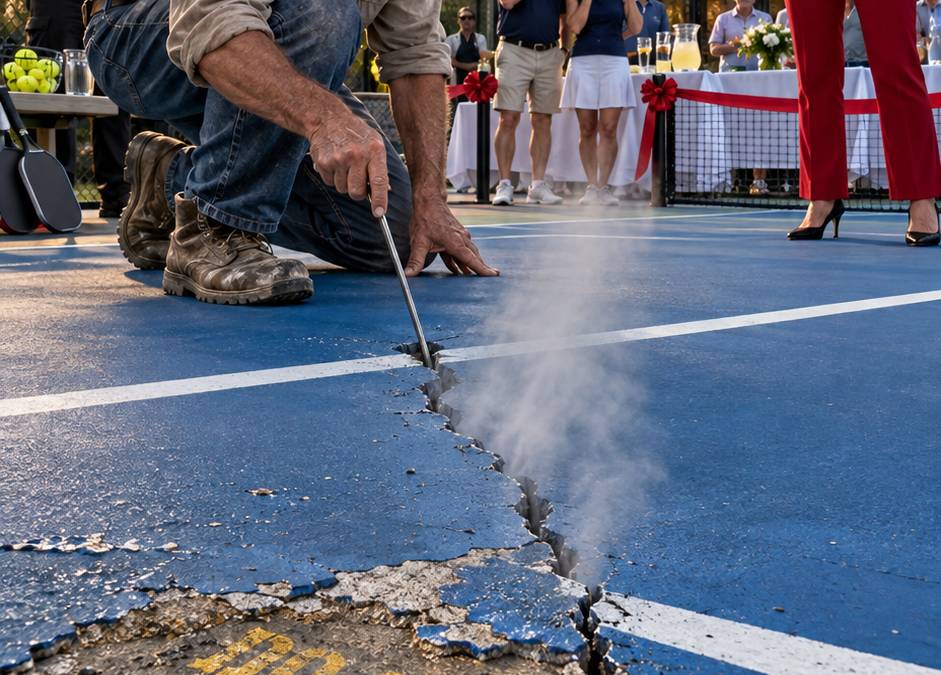
Another faint crack sounded beneath my boots.
The fracture widened several inches across the paint.
I looked down at it, then back at Vanessa.
I knew she was lying.
What I did not yet know was how far she had gone to make the lie permanent.
Long before Willow Trace existed, the land belonged to the Merritt family. In 1974, a tornado destroyed two barns and nearly killed the owner’s brother. After that, the family excavated a reinforced storm shelter deep into a limestone ridge.
They had built it well.
Three access routes.
Two independent ventilation shafts.
Reinforced concrete walls.
Bench space for almost one hundred people.
Decades later, when a developer purchased the property and built Willow Trace, the shelter was not demolished. The developer incorporated it into the subdivision’s emergency planning.
One entrance opened onto land that eventually became my six-acre parcel.
A second was a vertical emergency escape shaft.
A third connected through a service corridor beneath the clubhouse.
The recorded plat also preserved a forty-foot access corridor so residents and emergency personnel could reach the shelter.
Most people in Willow Trace barely knew it existed.
I did.
I had bought my parcel eleven years earlier, after my wife Miriam died during a tornado.
There are moments grief preserves with a cruelty memory normally cannot manage.
I can still remember the smell of rain on Miriam’s jacket that morning.
I remember her standing in our kitchen with coffee in one hand, telling me not to worry because she would leave work early if the storms developed.
I remember the final text she sent.
Going to shelter now. Love you.
She reached it.
That was the part that haunted me.
She did everything right.
The public shelter’s main door jammed after flying debris struck the frame. People inside could not reopen it. Emergency crews eventually entered through a secondary access point.
By then Miriam was gone.
For years, people told me no one could blame me.
They misunderstood.
I never blamed myself for the tornado.
I blamed every neglected hinge, every delayed repair, every inspection report someone had signed because fixing a problem would have cost money.
Weather had not ignored the damaged frame.
A person had.
After Miriam died, I left my company.
I moved to Red Valley.
Then I began restoring the old Merritt shelter.
I replaced corroded hardware.
Cleaned drains.
Rebuilt sections of the manual ventilation system.
Rewired emergency lighting.
Removed rust from the doors.
Tested seals.
Repaired benches.
Installed radios.
I never charged Willow Trace residents to use it.
I never called it mine when storms came.
If the National Weather Service issued a tornado watch, I unlocked the western entrance and switched on the lights.
For years, that arrangement caused no trouble.
Then Vanessa Crowe became HOA president.
Vanessa understood one thing extraordinarily well.
If you called control an improvement, people often thanked you for it.
She promised rising property values, cleaner common spaces, stricter enforcement, better amenities, and what she repeatedly called “a more cohesive community identity.”
Her biggest project was the recreation pavilion.
Four pickleball courts.
Shaded seating.
An equipment building.
New landscaping.
Decorative lighting.
The cost eventually approached nine hundred thousand dollars after change orders, though homeowners had originally been given lower figures.
Every household was assessed seventy-five hundred dollars.
Some residents paid immediately.
Others borrowed.
A few arranged payment plans.
Vanessa told them construction would occur entirely on HOA land.
I knew that was false the morning I saw the survey stakes.
The eastern boundary had been marked roughly eleven feet inside my property.
Worse, Court Three crossed the location of the shelter’s emergency escape shaft.
The equipment building covered one of the two ventilation lines.
I sent Vanessa copies of my deed.
The recorded plat.
Historical site diagrams.
A letter explaining the shelter infrastructure.
The old access-easement reference.
She never acknowledged receiving any of it.
Two weeks later, several boundary stakes disappeared.
Three days after that, concrete trucks arrived before sunrise.
By the time I reached the site, the pour had already begun.
Vanessa told me the contractor had verified the plans.
The contractor told me to speak with the HOA.
The HOA attorney told me all communication should go through counsel.
And now, weeks later, Vanessa stood on top of the finished court telling fifty residents that nothing existed beneath us.
I could have shouted.
I could have accused her.
I could have told everyone exactly what I thought of the folder she was holding.
Instead, I walked to my truck.
Arguments gave Vanessa a stage.
Evidence would give her a problem.
I called Mara Singh.
Mara was a licensed surveyor from Red Valley. She had spent two decades settling boundary disputes between ranchers, developers, municipalities, and neighbors who had mistaken fences for law.
“How soon can you locate three missing corners?” I asked.
“Tomorrow afternoon.”
I looked west.
Thin cirrus clouds were beginning to feather across the sky.
“I need you tomorrow morning.”
There was a pause.
“What happened?”
“Somebody poured a pickleball court over an emergency shelter.”
Another pause.
“I’ll be there at seven.”
Mara arrived at exactly seven the next morning with a robotic total station, county benchmark information, and the expression of someone for whom property arguments had long stopped being surprising.
Vanessa arrived eight minutes later.
So did the security guard.
“This is private HOA property,” Vanessa said.
Mara didn’t even look up from her equipment.
“I’m standing on Mr. Mercer’s parcel with his permission.”
“According to our community map, his boundary ends at the cedar fence.”
Mara finally raised her head.
“A community map is not a recorded survey.”
Vanessa handed her a laminated plan.
It showed all four courts neatly positioned inside a green shape labeled HOA RECREATION TRACT.
It looked impressive.
It also had no county recording number, no surveyor’s seal, and no legal description.
Mara examined it.
“Who prepared this?”
“The developer.”
“When?”
“It came from the archive.”
“Who certified it?”
“Our attorney reviewed everything.”
Mara handed it back.
“That wasn’t what I asked.”
Vanessa’s jaw tightened.
By ten o’clock, Mara had recovered one original iron pin beneath six inches of soil.
The second had been bent flat and covered with gravel.
The third was missing, but she reconstructed its location from permanent county monuments.
Then she placed bright orange flags along the legal boundary.
No speech was necessary.
The eastern fence was wrong.
The equipment building crossed onto my land by roughly six feet.
Court Three crossed it by eleven feet at the widest point.
And the shelter escape shaft sat almost directly beneath the painted service box.
Several residents had gathered.
Denise Holloway stood near the barrier holding her eight-year-old son’s hand.
She stared at the flags.
“Are you saying we spent nine hundred thousand dollars building on somebody else’s property?”
Vanessa answered before Mara could.
“No. We are saying an outdated metal pin conflicts with the approved master plan.”
That was Vanessa’s gift.
She could shape uncertainty until it sounded like authority.
I nodded toward the laminated drawing.
“Where did that map come from?”
“I already answered that.”
“No, you didn’t. Who prepared it?”
“The developer.”
“Which engineer?”
“Our attorney—”
“Which surveyor?”
Her eyes hardened.
Mara began photographing the line.
Before leaving, she handed me a preliminary sketch.
“There’s something else,” she said quietly.
“What?”
“The county plat index references an emergency access exhibit. It isn’t attached to the digital copy.”
“Missing?”
“Maybe misindexed. I’ll request the paper volume.”
When Mara drove away, Denise approached me.
She looked embarrassed.
“Vanessa told us you were trying to stop the project because you wanted the HOA to buy your land.”
“I never offered it for sale.”
“She said you demanded two hundred thousand dollars.”
I looked toward Vanessa.
She was speaking with the security guard beside the clubhouse.
“No.”
Denise’s grip tightened around her son’s hand.
“My assessment is on a payment plan. A lot of us couldn’t afford this project. If they have to tear part of it out, what happens to our money?”
There was fear behind the question.
Not greed.
People had trusted the board.
Now she was wondering whether their money had been poured into something illegal.
I looked at her son.
For a moment I remembered the hallway outside the emergency shelter where I had last seen Miriam’s body.
“I don’t want your money,” I said. “I want to know why they built over an emergency exit after being warned.”
That afternoon, the HOA sent an email to every household.
The subject line read: DELIBERATE INTERFERENCE WITH COMMUNITY IMPROVEMENTS.
It accused me of trespassing, intimidating residents, misrepresenting property lines, and spreading false claims regarding what it called “an unsafe underground structure.”
Then it announced an emergency board meeting to consider legal action against me.
An hour later, the HOA’s security contractor chained the service lane leading to my shelter entrance.
A yellow notice warned me that cutting the chain would result in a five-hundred-dollar fine.
I stood there staring at it.
That was the moment the dispute stopped being about concrete.
If storms arrived, residents could need that road.
The HOA had just placed a chain between them and the shelter.
The email contained one sentence in bold.
THERE IS NO CERTIFIED COMMUNITY SHELTER BENEATH THE RACQUET PAVILION.
I read it twice.
Vanessa was being careful now.
She had not said there was no shelter.
She had said there was no certified community shelter.
Legal language designed to sound like a physical fact.
I walked to the steel utility cabinet beside my barn where the backup ventilation controls were housed.
The padlock had been cut.
Inside, two alarm wires had been severed.
Clean cuts.
Matching angles.
Not weather.
Not rodents.
Not construction vibration.
Someone had opened the cabinet, cut the alarm circuit, closed the door, and left.
Without that alarm, I would receive no fault signal if the second ventilation shaft stopped functioning.
Which explained something that had bothered me since the grand opening.
I should have known sooner that the shaft was blocked.
Someone had made sure I didn’t.
I photographed everything and called the sheriff’s non-emergency line.
A deputy arrived, documented the cut lock, photographed tire tracks, took my statement, and gave me a report number.
People sometimes imagine evidence begins dramatically.
It usually doesn’t.
It begins with timestamps.
Photographs.
Receipts.
A name written correctly.
A report number saved somewhere safe.
That night, Vanessa used the deputy’s restraint against me.
“The sheriff’s office found no evidence linking anyone associated with Willow Trace to alleged damage on Mr. Mercer’s property,” she told approximately forty residents during the emergency HOA meeting.
I sat in the back with a manila folder on my knees.
Behind Vanessa, a projector displayed the same laminated developer map.
She referred to the shelter as an “unpermitted private structure.”
She warned that recognizing it as a community facility might expose Willow Trace to liability.
Then she offered her solution.
The HOA would take operational control of the shelter.
They would commission their own inspection.
They would control access.
And I would sign an agreement transferring exclusive operational authority to the association.
In return, the board would “consider an amicable resolution” of the boundary dispute.
I almost laughed.
For three weeks, Vanessa had insisted the shelter was irrelevant, unsafe, imaginary, or private depending on which description helped her most.
Now she wanted it.
When public comments opened, I stood.
“If the shelter is unsafe and imaginary,” I asked, “why do you need me to transfer it?”
Nobody answered.
I held up the county plat index.
“This references an emergency easement recorded when the subdivision was created. Until the county produces the attached exhibit, nobody should build over, lock, sell, transfer, or obstruct anything associated with that corridor.”
Vanessa reached for the projector control.
“Your three minutes are over.”
The screen went black.
After the meeting, Walter Bell waited beside my truck.
Walter was the HOA treasurer.
He was a quiet man, probably ten years younger than me, and he lived across from the courts.
“You said somebody cut wires?”
“That’s what it looks like.”
He held out a memory card.
“I installed cameras after some tools disappeared from my garage.”
I looked at him.
“What did you get?”
“At two seventeen in the morning before the concrete pour, a utility truck came through the service gate. Headlights off.”
We watched the footage in my truck.
A white pickup moved beneath a streetlight.
The HOA crest was visible on the door.
Two people got out carrying a ladder and tool bags.
They walked toward my property.
Forty-three minutes later, they returned.
The camera was too far away to identify faces.
But the truck number was readable.
Unit Four.
The next morning, I called the HOA’s maintenance contractor.
The company owner denied sending anyone.
“Unit Four was at our yard all night,” he said.
“Then report it stolen.”
“What?”
“Because I have video of it entering Willow Trace at two seventeen in the morning.”
Silence.
“Send me the clip.”
Twenty minutes after I did, Vanessa called.
Her voice was controlled, but her words came quickly.
“You are contacting HOA vendors without authorization.”
“I contacted the owner of a truck recorded beside my cut lock.”
“You are creating unnecessary panic.”
“Then tell me who used the truck.”
“Our counsel will respond.”
She hung up.
I stared at the phone.
I had never told her the truck number was visible.
She already knew exactly which vendor I had called.
By noon, Mara returned from the county archive carrying a cardboard tube.
She spread an old drawing across my dining table.
“There it is.”
The missing exhibit had not been lost.
It had been filed under the original Merritt ranch name instead of Willow Trace.
The shelter appeared in precise detail.
Entrance A was the sloped passage opening onto my parcel.
Entrance B was the vertical escape shaft beneath Court Three.
Entrance C connected to the clubhouse.
Two ventilation shafts were marked in red.
One beside my barn.
The other exactly where the new equipment building stood.
Running through the entire system was a forty-foot emergency access easement.
The language was direct.
Subdivision residents and emergency personnel had rights of passage for inspection, maintenance, and emergency use.
Then I found the sentence that mattered most.
No permanent obstruction could be placed over either emergency exit without written approval from county emergency management.
Vanessa had not merely built on questionable land.
She had built over protected life-safety infrastructure.
I called Aaron Pike, the Red Valley County emergency manager.
He arrived that afternoon with a building inspector and an air-monitoring technician.
Aaron walked the main tunnel slowly, touching the reinforced ribs, examining the old plates, checking ventilation.
The shelter itself remained sound.
The access system did not.
The clubhouse corridor had been sealed behind a steel door during a renovation eighteen months earlier.
Shelving had been installed in front of it.
Court Three covered the emergency escape shaft.
The equipment building had compressed the second ventilation duct beneath its slab.
Three entrances had effectively become one.
Two ventilation paths had become one.
Then Aaron tested my main entrance.
The electric actuator hesitated.
Stopped.
Restarted.
My stomach tightened.
Aaron looked at me.
“How long has it been doing that?”
“Twice during winter drills.”
“You replace the controller?”
I hated the answer before I said it.
“No. I ordered one, then delayed it because the manual wheel still worked.”
Aaron made a note.
“Then I don’t count this entrance as fully reliable.”
Vanessa stood nearby with her attorney.
I could feel her watching me.
I could have defended myself.
I could have explained supply delays.
I could have said the mechanism had passed every actual emergency test.
Instead, I looked at the actuator.
“I should have replaced it the first time it stuttered.”
For the first time since the dispute began, part of the failure belonged to me.
Vanessa had buried two routes.
But I had allowed the last remaining route to become less reliable than it should have been.
Aaron looked more closely at one of the reinforcement plates.
My old inspection stamp was faintly visible.
“Mercer,” he said. “Were you with Mercer Structural after the Bridge Creek outbreak?”
“For nine years.”
He turned toward me.
“You wrote the retrofit standard we use on West County shelters.”
“I wrote the load-path section. A team wrote the standard.”
Vanessa folded her arms.
“So Mr. Mercer inspected his own structure. That sounds like a conflict.”
“I did not certify this shelter after I purchased the property,” I said. “I repaired it.”
I pointed toward the blocked shaft.
“Your contractor buried two exits and a ventilation path. You don’t need my résumé to measure concrete.”
Aaron agreed.
He issued a written order requiring restoration of safe emergency access before the shelter could be relied upon in the county response plan.
Vanessa’s attorney asked whether that meant the courts had to be demolished immediately.
Aaron checked the weather bulletin on his phone.
“It means safe access must be restored.”
He looked toward the darkening western sky.
“How your client created the obstruction is your problem. How quickly she removes it may become mine.”
Something shifted after that.
Walter Bell asked to inspect the recorded plat.
Vanessa snapped the folder shut.
“The board will review this privately.”
Walter looked at her.
Not defensively.
Not guiltily.
Surprised.
That expression told me something.
The full board had not seen everything Vanessa had seen.
By Friday evening, the weather forecast had worsened.
Warm, humid air surged north out of Texas.
A powerful upper-level system approached from the west.
Meteorologists were careful with their language, but anyone who had lived long enough in Oklahoma understood what they were saying.
The atmosphere was becoming dangerous.
Less than twenty-four hours remained.
Vanessa sent residents another email.
She called the shelter dispute “administrative” and told homeowners the clubhouse interior restroom could serve as an approved alternative.
It could not.
The room had an exterior wall.
No reinforced ceiling.
And windows less than twenty feet away.
I forwarded the message to Aaron.
His reply contained six words.
I did not approve that statement.
At eight forty that night, someone knocked on my back door.
Denise Holloway stood outside carrying a grocery bag filled with papers.
“My son is with my sister,” she said. “Can we talk?”
We sat at my kitchen table.
She removed two copies of the same HOA meeting minutes.
“I was recording secretary until March.”
“I thought you resigned because you were moving.”
“That’s what Vanessa told everyone.”
“You weren’t moving?”
“No.”
The first document was a draft from five months earlier.
Under a section titled RACQUET PAVILION SITE REVIEW, the project engineer had written a warning.
Existing subsurface shelter and access easement require field verification. No slab placement above Exit B or Ventilation Shaft Two pending county review.
The final approved minutes reduced that entire warning to:
Site conditions discussed. Contractor to proceed.
I looked at Denise.
“Who changed it?”
“Vanessa sent me the revision.”
“Did the board vote on it?”
“No.”
She handed me an email.
Vanessa had written to the contractor:
Opening date cannot move. Pour first. We can settle any ownership issue afterward.
I read it twice.
Attached was the revised site plan.
The same unrecorded map she had been waving around for days.
But another attachment made my throat tighten.
Mercer Structural Safety Group — Preliminary Hazard Review.
My old firm.
Now I understood the envelope at the ribbon cutting.
“The company sent this to her?”
Denise nodded.
“I think so.”
I called the firm’s current director.
Because Vanessa was the client, he could not send me the report.
But he confirmed one fact.
The report had been delivered six weeks before the concrete pour.
It specifically warned against placing structural load over the emergency escape hatch without an approved protection design.
So Vanessa had known.
She had not discovered the shelter after construction.
She had not been confused by conflicting maps.
She had received a professional warning and built over it anyway.
The only question left was why.
Denise reached into her bag.
“This might explain it.”
The first document was a reserve ledger.
One hundred eighty-six thousand dollars had been moved from the HOA emergency repair account into pavilion change orders without a recorded board vote.
The project budget assumed the special assessment would replenish the money after opening.
The second document was a three-year proposal from Hearthstone Residential, a property-management company.
If the pavilion opened before the annual election, Hearthstone would take over management of Willow Trace.
Vanessa would be hired as a paid transition consultant.
Twelve thousand dollars immediately.
A larger annual contract afterward.
If construction stopped before opening, Hearthstone could withdraw and require an independent financial audit before reconsidering.
I leaned back.
The courts were not just Vanessa’s vanity project.
They were protecting a financial decision she had not disclosed.
Her future job.
Her board majority.
Possibly the disappearance of emergency reserve money.
At ten twelve that night, Aaron called me.
The severe-weather risk corridor had shifted toward Red Valley.
He was activating the county operations room at dawn.
“I need that second exit exposed,” he said.
“Vanessa won’t authorize the contractor.”
“Then tomorrow we find somebody who understands that concrete is cheaper than people.”
Saturday morning arrived unnaturally warm.
The air felt thick.
Low clouds raced north at one level while treetops barely moved below.
At eight, a county inspector arrived at Willow Trace.
A concrete-cutting crew parked beside Court Three.
The owner refused to unload until someone accepted responsibility for damage to the HOA slab.
Vanessa arrived carrying another agreement.
She asked me to meet inside the clubhouse.
Her attorney sat beside her.
Vanessa pushed the document across the table.
It granted the HOA permanent ownership and operational control of the shelter.
I would accept liability for all past maintenance and repairs.
In return, Willow Trace would authorize removal of part of Court Three and dismiss its threatened legal action against me.
“Sign it,” she said, “and the crew starts immediately.”
I read the document once.
Then I looked at her.
“You want me to give you the shelter before you stop blocking its exit.”
“The community paid for the improvements above it.”
“The community paid because you used the wrong map.”
“That remains disputed.”
“No. The boundary is disputed by you. The survey isn’t confused.”
Her attorney shifted.
Vanessa leaned forward.
“Caleb, listen carefully. If the storm arrives and that shelter remains inaccessible, residents will know you could have opened it with one signature.”
The sentence was quiet.
That made it worse.
For eleven years, I had replayed the night Miriam died.
What if someone had repaired the frame earlier?
What if I had checked the shelter myself?
What if she had left five minutes sooner?
What if?
Grief can turn every memory into a courtroom where you are both witness and defendant.
Vanessa was trying to put me back there.
Trying to make me believe that refusing her demand would make me responsible for the danger she created.
But grief had taught me something she did not understand.
Responsibility and coercion are not the same thing.
“The shelter is open,” I said. “You blocked the exits.”
I pushed the agreement back.
“No.”
Outside, Mara was waiting beside Aaron with the recorded easement.
The county attorney had reviewed it.
During a declared local emergency, county personnel had authority to enter the access corridor and remove life-threatening obstructions.
At 9:26 a.m., the county issued an emergency access directive.
The crew unloaded.
Their foreman marked a square around the buried hatch.
I stopped him before he lowered the diamond blade.
“Don’t cut that.”
He frowned.
“That’s the perimeter.”
“The shaft transfers load through narrow sidewalls. If you cut both sides at once, the slab can release into the tunnel.”
I took his marking paint.
“Two shallow relief cuts here. Temporary anchors through the center. Then alternate the deep cuts along the load path.”
Aaron compared my marks with the original drawing.
“That’s the county retrofit sequence.”
“I wrote that section after Bridge Creek.”
The foreman erased his square.
“Your sequence it is.”
The saw screamed into the blue court.
Water sprayed across the painted lines.
Residents stood in driveways watching their expensive new amenity being cut apart.
Vanessa stood near the fencing filming.
“This destruction is occurring over formal HOA objection,” she announced toward her phone.
Nobody argued with her.
The first concrete section lifted.
Then everyone became silent.
The hatch was not simply covered.
Its steel frame had been filled with concrete.
Rebar passed through the opening.
Someone had removed the upper hatch plate, placed reinforcement through the shaft, and poured directly into it.
That could not have happened accidentally.
No worker could expose a steel emergency hatch, remove its cover, install reinforcement through it, and honestly claim he had never seen it.
Aaron crouched beside the opening.
“Who approved this detail?”
The site superintendent looked toward Vanessa.
Vanessa looked toward her attorney.
Her attorney looked at the concrete.
Walter stepped forward.
“The board approved a slab. We never approved filling a tunnel.”
I examined the exposed reinforcement.
A metal tag was wired to one bar.
REVISION C — FIELD CONDITION.
“There’s another drawing,” I said.
Mara immediately began searching the contractor’s online permit folder.
By early afternoon, the weather clock was accelerating.
A tornado watch covered the region.
Storms were forming southwest of Red Valley.
The crew estimated four hours to remove the plug safely.
They could move faster.
But if several tons of concrete dropped down the shaft, it could destroy the lower door or injure someone inside.
I climbed down through Entrance A with two workers.
We installed temporary bracing.
Anchors were lowered from above.
At some point the power flickered.
Minutes later, the HOA entrance gate stopped in the closed position.
Vanessa blamed the utility company.
Walter checked his camera feed.
Then he came running.
“One of the maintenance guys shut the gate breaker off.”
The employee admitted Vanessa had told him to prevent unauthorized construction vehicles from entering.
That gate controlled the main road leading from Willow Trace to my shelter lane.
Aaron ordered it opened manually.
The emergency crank was missing.
I walked to my tractor.
Vanessa followed.
“You damage that gate and the HOA will hold you financially responsible.”
I climbed into the cab.
“Send me an invoice.”
I pulled the gate arm from its track without damaging the columns.
By then, nobody was listening to Vanessa anyway.
Residents were arriving with water bottles, flashlights, pet carriers, helmets, medications, blankets, and small bags.
Denise began writing down names.
Walter entered the clubhouse corridor.
Ten minutes later, he called me inside.
The steel shelter access door was behind shelving.
Not movable shelves.
Shelving bolted to the floor.
I stared at it.
Another obstruction.
Another deliberate decision disguised as renovation.
At 1:07, Mara found Revision C.
The drawing showed the escape shaft filled and the ventilation line relocated.
The engineer-of-record approval box was blank.
The only electronic signature belonged to Vanessa Crowe.
She had approved the field change herself.
At 1:34, the first tornado warning was issued two counties southwest.
The storm was moving northeast.
The cutting crew removed another section.
Cold air rushed upward.
For the first time in months, the escape shaft was breathing.
Then I heard a grinding sound from below.
I knew that sound.
The main entrance actuator.
I ran down the passage.
The door had stalled midway through a test cycle.
The voltage fluctuations had finished what months of neglect had started.
The controller was failing.
I stood there with my hand against the motor housing.
This one was mine.
Not Vanessa’s.
Mine.
I had watched it hesitate during winter drills.
I had ordered a replacement.
Then I postponed installing it because the manual override worked.
Because something else seemed more urgent.
Because next week always sounds safe until it disappears.
The manual wheel could still operate the door.
But it required two people and nearly three minutes.
Three minutes is a long time when people are running toward you.
And if debris struck the outer frame, even the manual wheel might not matter.
At 2:11 p.m., every phone in Willow Trace screamed.
Tornado warning.
Strong rotation west of Red Valley.
Take cover immediately.
The crew had cleared most of the escape shaft, but a wedge of concrete still pinned the lower door.
They estimated twenty minutes.
We did not have twenty minutes.
“Everybody underground,” I shouted.
Denise checked names as residents moved down Entrance A.
Children carried backpacks.
Parents carried toddlers.
Dogs barked inside carriers.
An elderly man came down wearing a bicycle helmet.
Walter and the security guard helped residents on the ramp.
Hail began striking the equipment-building roof.
The sound grew from scattered taps to a continuous pounding.
I looked toward the clubhouse.
Vanessa was inside.
She was loading boxes onto a rolling cart.
Walter yelled from the corridor.
“Leave them!”
“These are financial records!”
“Then let the paper get wet!”
She tried pushing the cart toward the hallway.
A wheel jammed against the threshold.
Then a window shattered.
Vanessa abandoned the boxes.
At 2:18, the warning changed.
Tornado emergency.
A large and destructive tornado was on the ground.
I counted heads.
Eighty-one.
Two missing.
Vanessa.
The security guard.
I could have ordered the main door closed.
Nobody underground would have blamed me.
But the shelter was not a courtroom.
The storm did not care who lied.
I ran back outside.
Rain was moving horizontally.
The western sky had become a wall of gray-green cloud.
Pieces of insulation spun hundreds of feet above the subdivision.
The security guard emerged from behind the clubhouse carrying Vanessa.
She had fallen on broken glass.
Blood ran down her lower leg.
I grabbed her other arm.
Together we moved toward the shelter.
Vanessa looked at me once.
No argument.
No threat.
No legal language.
Only fear.
We reached Entrance A.
Behind us, the clubhouse doors slammed simultaneously as pressure changed.
Walter and another resident began turning the manual wheel.
The outer door moved slowly.
Then a cottonwood tree snapped.
I heard the crack before I saw it.
The upper trunk struck the concrete canopy above the entrance.
The shelter held.
The outer frame shifted.
The door stopped sixteen inches from closed.
Wind screamed through the opening.
Walter leaned into the wheel.
I joined him.
Nothing.
“Reverse it!”
We tried.
Nothing.
The door was trapped.
Not open enough for safe access.
Not closed enough to seal.
For eleven years I had feared a shelter door failing again.
Now I was standing beside one.
I looked toward the far end of the tunnel.
Court Three.
The emergency shaft.
“Spreaders,” I said.
A worker handed me a hydraulic spreader from the tool rack.
I climbed the internal ladder toward the buried escape door.
Two workers followed.
Dust drifted through cracks overhead.
I seated the spreader between the lower steel door and its frame.
Pumped once.
Twice.
Steel groaned.
Below me, children were crying.
Denise started counting backward from one hundred.
Other voices joined her.
“Ninety-nine.”
“Ninety-eight.”
“Ninety-seven.”
The emergency lights flickered.
Then switched to battery power.
I pumped again.
The concrete wedge cracked.
The door opened three inches.
Then six.
One worker squeezed an arm through and attached a chain to the broken plug.
Above us, the excavation crew connected it to the machine.
“Lift!”
The chunk shifted.
For one terrible second, nothing happened.
Then the concrete tore free.
Daylight burst through the shaft.
Rain came with it.
Cold air rushed down.
We had ventilation.
We had a second exit.
Seconds later, the tornado reached Willow Trace.
People compare tornadoes to freight trains.
I never liked that comparison.
A train has rhythm.
Direction.
Something recognizable.
A tornado is mechanical violence without order.
Wood.
Glass.
Roofing.
Metal.
Impacts from objects you cannot identify.
Pressure that seems to enter your bones.
The shelter lights went out completely.
Concrete vibrated beneath my hands.
Dust fell from the ceiling joints.
Somebody prayed.
Somebody else whispered a child’s name.
I stayed beneath the opened shaft until the worst of the noise passed.
Across the chamber, Vanessa sat against the wall with a towel tied around her injured leg.
Phone lights illuminated faces around her.
She looked upward at the escape route we had spent two days fighting to uncover.
For the first time since I met her, Vanessa Crowe had nothing to say.
The worst noise lasted less than four minutes.
Inside the shelter, four minutes felt like an hour.
When silence returned, I did not let anyone leave.
Tornado-producing storms sometimes cycle.
Aaron contacted us by radio and told us to remain underground while crews checked gas lines and debris.
Walter sat across from Vanessa.
“You told us the engineer approved the site.”
Vanessa pressed the towel against her leg.
“The contractor was responsible for construction methods.”
“Your signature is on Revision C.”
“It was an administrative acknowledgment.”
Denise spoke from several benches away.
“And the paragraph you removed from the minutes?”
Vanessa turned.
Denise had carried her document bag underground.
“Those were drafts,” Vanessa said. “The final minutes are the official record.”
Denise stared at her.
“The original warning went to the insurance company too.”
The room changed.
Months earlier, Willow Trace had applied for a reduced property-insurance premium.
The application listed the Merritt shelter as a functioning community safety asset.
Three available access routes.
Two independent ventilation paths.
Active maintenance.
The insurer had requested documentation.
Denise had uploaded the original engineering warning as part of the package.
The insurer’s system retained the timestamp.
And the confirmation email had gone directly to Vanessa.
I understood immediately.
To residents, the shelter had been private and unreliable.
To the county, Vanessa claimed it was not a certified community facility.
To the insurer, it had been represented as fully operational so the HOA could save money.
Three versions of reality.
One email account connecting them.
Vanessa closed her eyes.
I looked at her injured leg.
I expected to feel satisfaction.
I didn’t.
I handed her another clean towel.
Three hours earlier, I wanted her removed from office.
I still did.
But I did not need her bleeding to prove I had been right.
At 3:06, firefighters reached the damaged main entrance.
People exited in small groups.
I was among the last.
The subdivision looked as though something enormous had dragged a blade diagonally across it.
Roofs on the northwest side were torn open.
Two garages had collapsed.
Trees were stripped.
The clubhouse windows were gone.
Sections of court fencing lay twisted across the parking lot.
Court Three was cracked, cut apart, and partly excavated.
In the middle of it stood the open emergency shaft.
Eighty-three people had entered the shelter.
All eighty-three walked out alive.
The security guard suffered a broken wrist.
Vanessa needed stitches.
Three residents were treated for minor injuries.
No one died.
Two days later, the National Weather Service survey rated the tornado EF3 at its strongest point southwest of Willow Trace.
Damage inside the subdivision ranged from EF1 to EF2.
The shelter had done exactly what it had been built to do.
It had protected people.
Even the woman who tried to bury it.
Monday morning, Mara placed her signed survey beside the county permit documents.
The findings were no longer preliminary.
Court Three encroached onto my parcel.
The equipment building interfered with a protected ventilation route.
Revision C had never received engineering approval.
The county closed the affected court until access could be restored.
Then other records began surfacing.
The insurer requested the original meeting minutes.
The reserve ledger was demanded.
The maintenance contractor produced dispatch records.
Unit Four—the truck recorded near my cut alarm cabinet—had been released to the Willow Trace property manager on the night of the damage.
Hearthstone withdrew its management proposal.
Vanessa’s consulting agreement disappeared with it.
Three weeks after the tornado, Willow Trace held a special membership meeting in a rented church hall.
More residents attended than had voted in the previous four HOA elections combined.
Vanessa sat at the front table.
No red suit.
Her attorney did most of the talking.
Walter presented the financial timeline.
Denise presented the altered minutes.
Mara displayed the recorded boundary.
Aaron explained why the shelter had three access points and why no HOA officer had authority to erase them from an emergency system simply because they interfered with landscaping or construction.
Then I was asked to speak.
I stood at the front of the room holding no presentation.
No legal folder.
No photographs.
Everyone had already seen the evidence.
“I’m not asking the HOA to destroy the entire recreation project,” I said. “I’m asking that the encroaching section be removed, the equipment building be relocated, the escape shaft be permanently restored, and the emergency corridor be protected in writing.”
Someone asked who would control the shelter.
“Not me alone,” I said. “And not the HOA president alone. A resident safety committee should oversee access and drills with county review.”
Denise raised her hand.
I nodded.
She looked almost angry when she asked the question.
“Why?”
I waited.
She continued.
“Why let us use it after everything the board did to you? They built on your property. They cut your equipment. They threatened you. Why not lock the shelter and tell Willow Trace to build its own?”
I looked at her son sitting beside her.
Then I looked around the room.
Some residents had supported Vanessa.
Some had believed I was lying.
Some had repeated the story that I wanted two hundred thousand dollars.
Some had watched silently while the HOA chained my road.
But they had also sat beside one another underground while a tornado tore roofs away.
“The board isn’t the community,” I said.
The room became quiet.
“A board can fail. An engineer can fail. A homeowner can fail. I delayed replacing a controller I should have replaced months earlier. That almost mattered when the tree hit the entrance.”
I took a breath.
“The point of an emergency system is not to decide who deserves the door. The point is that the door opens.”
Vanessa looked down at the table.
The vote followed.
Members removed her and two directors who had supported proceeding after the warnings.
Walter remained temporarily to assist with the financial audit, subject to a new election sixty days later.
The vote was not unanimous.
It did not have to be.
Over the next four months, lawyers, insurers, engineers, contractors, and accountants untangled the cost.
The design consultants and contractor’s insurer paid substantial portions of the reconstruction.
Willow Trace used reserve funds and canceled several cosmetic projects.
The financial audit documented transfers that had never been properly approved.
Vanessa lost her board position.
Hearthstone did not return.
The county referred portions of the record for further review.
I stayed out of that process unless someone needed documents or technical testimony.
Local television stations called me.
I declined.
One reporter left a message asking whether I considered myself “the man who defeated an HOA president during a tornado.”
I deleted it.
I had not defeated anyone.
A survey pin had stayed where the law said it belonged.
A camera had recorded a truck.
An old plat had survived in a county archive.
An insurance server had preserved an email.
A steel hatch had remained under concrete long enough for us to uncover it.
Facts did the work.
I wanted the shelter repaired before the next storm.
By early autumn, new roofs had replaced the damaged ones.
The broken cottonwood beside Entrance A was gone.
The main shelter door received a reinforced replacement frame, a new actuator, an independent battery controller, and a redesigned manual override that one person could operate.
I personally tested it until everyone around me was tired of watching.
Then I tested it again.
The clubhouse corridor was cleared permanently.
Illuminated signs marked the access route.
Nothing could be stored within it.
The secondary escape shaft rose through a protected concrete enclosure at the edge of the recreation area.
It could be opened from inside without electricity.
The exterior was painted bright yellow.
Nobody could mistake it for landscaping.
Nobody could pretend they did not know what it was.
Court Three was rebuilt nine feet narrower and shifted completely onto HOA land.
It was less symmetrical than Vanessa’s design.
Nobody complained.
The new emergency agreement required annual inspections, public maintenance logs, two drills every year, and documented county review of any construction near the shelter.
A resident safety committee held the access keys.
I retained ownership of my land and the underlying structure.
The first drill took place on a cool evening in September.
Eighty-seven residents participated.
Denise managed the roster.
Walter tested the radios and backup cameras.
Parents followed marked routes.
Children knew which colored line led to which entrance.
People entered through all three access points in less than six minutes.
I stood beside the western entrance and watched.
For eleven years, every heavy steel door had reminded me of Miriam.
I had told myself restoring the Merritt shelter was simply something I needed to do.
Private grief disguised as maintenance.
Replace a hinge.
Clean a drain.
Inspect a weld.
Test a fan.
Keep moving.
Do not think about the text message.
Do not think about the jammed frame.
Do not think about the fact that she reached safety and still did not come home.
But standing there that evening, watching families move smoothly underground, I understood something I had missed.
I had not spent eleven years trying to repair the door that failed Miriam.
That door was gone.
That night was gone.
Nothing I built could reach backward and save her.
What I could do was make sure another husband did not sit in a parking lot waiting for rescuers to say his wife’s name.
I could make sure another child did not reach a locked entrance.
I could make sure “next week” did not become the final excuse attached to a failed mechanism.
Near Entrance A, the residents installed a small bronze plaque.
They wanted to put my name on it.
I refused.
They wanted to call me a hero.
I refused that too.
Eventually Denise asked what I would accept.
I gave her Miriam’s name.
Nothing else.
Several weeks later, the plaque appeared beside the door.
MIRIAM MERCER
A warning matters only if someone leaves the door open.
I stood in front of it longer than I expected.
Then I touched the edge of the bronze and went home.
On warm evenings, I can still hear pickleballs striking paddles across the ridge.
The court lights shut off at ten.
Families laugh behind the fencing.
Sometimes teenagers sit on the benches long after they finish playing.
Court Three is smaller now.
The bright yellow escape enclosure stands beyond its eastern side.
You can see it from almost anywhere in the recreation area.
You can also see it from my porch.
That became the final irony.
Vanessa had treated visible safety infrastructure as an embarrassment.
Something ugly.
Something old.
Something that interfered with the polished image she wanted people to buy.
She buried it because she wanted the project to look finished.
Now the yellow escape door is the first thing residents point out to new families.
Not because it is attractive.
Not because it raises property values.
Not because it belongs in a brochure.
They point to it because they remember the afternoon the sky turned black.
They remember the sound of concrete being cut apart.
They remember counting backward in the dark.
They remember the main door jamming after the tree fell.
And they remember cold daylight bursting through the shaft above us seconds before the tornado arrived.
Sometimes, when a storm watch is issued, I walk down to the shelter early.
I test the new controller.
I open the manual override.
I listen to both ventilation fans.
Then I stand beneath the yellow shaft and feel air moving through it.
That sound means something different to me now.
For years, I thought safety meant building something strong enough to survive disaster.
I was wrong.
Strength matters.
Engineering matters.
Concrete thickness matters.
Steel matters.
But none of it means anything if a warning is ignored because it is expensive, inconvenient, embarrassing, or politically dangerous.
The night Miriam died, a damaged door turned a shelter into a trap.
At Willow Trace, a buried door almost did the same thing.
The difference was not luck.
It was that this time, the warning was still there when somebody finally chose to listen.
And whenever cold air rises through that yellow escape shaft now, I no longer smell wet limestone and old steel.
I remember Miriam.
Then I look at the open door.
And I know exactly why it has to stay that way.
What do you think of this story? Please leave a like and share your thoughts in the comments. Your support means a lot to us and inspires us to keep writing more meaningful and powerful stories. Thank you! 👍

