The Champagne Cork I Heard From My Living Room Told Me My Family Had Been Lying to Survive
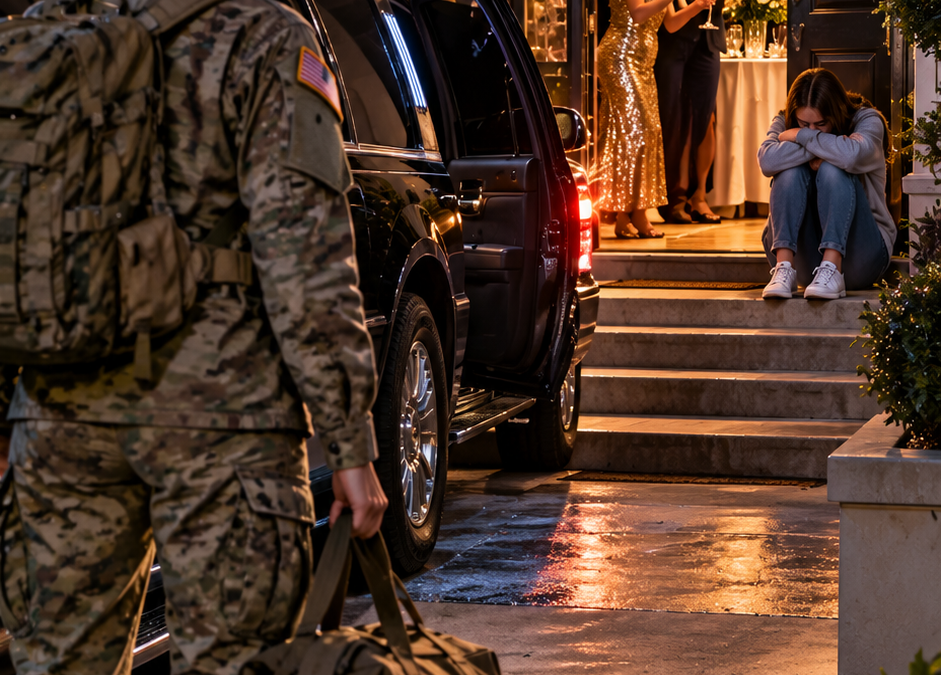
The Champagne Cork I Heard From My Living Room Told Me My Family Had Been Lying to Survive
The limousine in my driveway was the first thing that felt wrong.
The champagne cork popping inside my house was the second.
But nothing prepared me for the moment my seventeen-year-old daughter looked at me with hollow eyes and whispered, “Mom, Grandma said telling you the truth could get you killed.”
I had been home from Kuwait for less than three minutes.
Three minutes was all it took for the life I thought I had protected from six thousand miles away to collapse in front of me.
My name is Sarah Walker.
I was a Staff Sergeant in the United States Army, a wife, a mother, and for six months I had convinced myself that every miserable day I spent overseas had a purpose.
My husband, Mark, had been paralyzed after an accident that changed our family in a matter of seconds.
Before the accident, he had been the kind of man who could never sit still.
He repaired everything himself.
Changed his own oil.
Built shelves instead of buying them.
Mowed our lawn in perfect overlapping lines because he said crooked stripes made the whole yard look tired.
If something broke in our house, Mark treated it like a personal challenge.
Then came the accident.
A truck crossed into his lane on a rain-slick highway.
I received the call while I was on duty.
T11 spinal cord injury.
Those words divided our marriage into two different lives.
The life before.
And the life after.
Mark survived, and I thanked God for that every day.
But survival was only the beginning.
There were surgeries.
Hospital stays.
Rehabilitation.
Pressure sores.
Muscle spasms.
Equipment adjustments.
Medication schedules.
Insurance fights.
VA paperwork.
Physical therapy.
Home modifications.
Appointments with specialists whose names I learned faster than I wanted to.
And underneath all of it was Mark’s grief.
He never said much about it.
That was Mark.
He could admit pain before he could admit helplessness.
Some nights I woke to find him staring at the ceiling.
Other nights I heard him crying quietly in the bathroom because he thought the running faucet would cover the sound.
I never told him I heard.
There are moments in marriage when love means stepping closer.
There are other moments when love means pretending you didn’t see the person you love struggling to preserve the last piece of dignity they think they have left.
Our daughter Chloe was seventeen.
She had her father’s stubbornness, my temper, and the kindest heart of anyone I had ever known.
When Mark came home from the hospital, she learned more about spinal cord injuries than any teenager should have needed to know.
She knew how to position his wheelchair.
She knew where we kept emergency supplies.
She understood that some days he needed help and other days he needed everyone to stop helping for five minutes so he could feel like himself again.
But I was determined about one thing.
Chloe was his daughter.
Not his nurse.
Not his caregiver.
Not his physical therapist.
His daughter.
She had school.
Friends.
College applications.
A life waiting for her.
Mark and I agreed that whatever happened to us, we would not sacrifice her future to our crisis.
That was why I accepted the deployment.
People who have never lived paycheck to paycheck beside a stack of medical bills imagine decisions like that are simple.
They are not.
I did not want to leave.
Mark did not want me to go.
Chloe definitely did not want me to go.
But the hazard pay mattered.
Every extra dollar mattered.
Mark needed consistent physical therapy.
We needed home nursing assistance.
His wheelchair required expensive maintenance.
Chloe would be applying to colleges within the year, and I had promised myself that she would not begin adulthood carrying the financial wreckage of her father’s accident.
So when the opportunity came, I took it.
Six months.
That was what I told myself.
Six months of separation.
Six months of terrible sleep.
Six months of video calls.
Six months of sending nearly every dollar I could home.
Then I would return to a family that had survived the hardest season of our lives.
At least that was what I believed.
The person I trusted to keep everything stable was Mark’s mother.
Brenda.
For years, our relationship had been difficult without being openly hostile.
She had always found ways to remind me that Mark had belonged to her first.
When we bought our house, she criticized the neighborhood.
When Chloe was born, she criticized the pediatrician.
When I made Staff Sergeant, she asked whether the promotion would make me “even more married to the Army.”
But after Mark’s accident, something seemed to change.
She became attentive.
Helpful.
Present.
She visited the hospital.
She brought meals.
She sat with Mark during appointments.
She held my hand once in the hospital cafeteria and said, “Sarah, you’re not carrying this alone.”
I believed her.
Maybe that was the part that hurt most later.
I believed her.
Before deployment, I gave Brenda a General Power of Attorney broad enough to handle household expenses, communicate with providers, and make sure Mark’s home care continued while I was gone.
I went through the accounts with her at our dining room table.
Mortgage.
Utilities.
Medical costs.
Caregiver schedule.
VA contacts.
Emergency numbers.
I showed her exactly where the money was going.
She nodded through everything.
“I’ll protect them,” she told me.
I remember that sentence because I needed to hear it.
I’ll protect them.
I hugged Chloe goodbye at the airport until she complained she couldn’t breathe.
Then I crouched beside Mark’s wheelchair.
“You call me if anything feels wrong.”
He smiled.
“Sarah, you’re going overseas, not to another planet.”
“Promise me.”
“I promise.”
I looked at Brenda.
She pressed one hand to her chest.
“For heaven’s sake, Sarah. Go do your job. I’ve got my son and granddaughter.”
Those were the last words I heard from her before security swallowed me into the airport crowd.
For the next five months, everything appeared normal.
That is the most frightening part of deception.
From far enough away, neglect can look exactly like routine.
Video calls were short.
Mark often said he was tired.
Chloe seemed distracted.
Brenda always had an explanation.
Physical therapy had been exhausting.
Chloe had exams.
The Wi-Fi was acting up.
A nurse had just left.
Mark had fallen asleep.
Chloe was at school.
Whenever I asked to speak to them longer, Brenda found a reason it was inconvenient.
At first, I accepted it.
Then I started noticing things.
Mark lost weight.
Not enough to alarm me through a screen.
Enough to make me ask.
“You eating?”
He smiled.
“Too much hospital food ruined my standards.”
Chloe laughed when he said it.
But her laugh sounded wrong.
Forced.
Thin.
Once, during a call, I heard something crash in the background.
“What was that?”
“Nothing,” Chloe said too quickly.
I frowned.
“You okay?”
“Yeah.”
“Let me see your face.”
“Mom.”
“Chloe.”
She moved closer to the camera.
Her cheeks looked thinner.
“You’ve lost weight.”
“I’m stressed about school.”
I stared at her.
Something in me tightened.
Before I could ask more, Brenda appeared behind her.
“Sarah, honey, she’s seventeen. Everything is a crisis at seventeen.”
Chloe looked down.
I remember that now.
She looked down.
But I was exhausted.
I had slept four hours in the previous two days.
We had been dealing with repeated threat alerts.
My brain was divided between my family and the men and women around me whose lives depended on all of us staying focused.
So I accepted the explanation.
That became one of the things I had to forgive myself for later.
Not because I was responsible for what Brenda did.
I wasn’t.
But guilt does not care about logic.
Guilt asks why you didn’t hear the silence between words.
Why you didn’t notice your daughter’s eyes.
Why you didn’t insist.
Three weeks before my scheduled return, our rotation shifted.
I was given the opportunity to come home early.
I decided not to tell anyone.
I wanted to surprise them.
For the first time in months, I let myself imagine something joyful.
Chloe screaming when she saw me.
Mark pretending he wasn’t crying.
The three of us ordering terrible pizza and sitting in the living room together.
Normal.
I wanted normal so badly I could taste it.
My flight landed after nearly twenty hours of travel.
I took an Uber from the airport.
The closer we got to home, the more nervous I became.
Not frightened.
Excited.
The kind of nervous energy that makes you check the same bag pocket three times.
Then the Uber turned onto my street.
And I saw the limousine.
Long.
Black.
Polished.
Parked directly in front of my house.
The driver was standing beside it checking his phone.
I stared through the window.
“Everything okay?” my Uber driver asked.
“I don’t know.”
He pulled into the driveway.
I stepped out wearing boots, carrying my duffel, still smelling faintly of aircraft cabin air and desert dust.
The front door was unlocked.
That was wrong too.
Mark was obsessive about locked doors after the accident.
I reached for the handle.
Before I opened it, I heard laughter.
Then a champagne cork popped.
Someone cheered.
Music was playing inside.
Caribbean music.
Bright.
Loud.
Celebratory.
I pushed open the door.
The air hit me first.
Hot.
Stale.
Too warm for August with Mark’s condition.
Then I saw four enormous brand-new suitcases lined up beside the living room wall.
Designer luggage.
Tags still attached.
Brenda stood beside the sofa wearing a silk dress I had never seen before.
Her sister Karen was holding a champagne glass.
Boxes from expensive department stores were stacked on the coffee table.
Shoes.
Sunglasses.
Clothes.
A wide-brimmed hat with a ridiculous blue ribbon.
Brenda was laughing.
“I deserve this cruise,” she said.
Karen raised her glass.
“You’ve earned it.”
“Exactly. People have no idea how exhausting taking care of someone like Mark is. Even from a distance.”
She laughed again.
“The Caribbean is going to be fabulous.”
I stepped into the room.
“Is that right, Brenda?”
The champagne glass slipped from her hand.
It shattered.
For one second, nobody moved.
Brenda’s face lost all color.
Karen’s mouth fell open.
The music kept playing.
Some cheerful voice sang about sunshine while champagne spread across my hardwood floor.
“Sarah?”
Brenda whispered my name like she was seeing a ghost.
Then louder.
“Sarah!”
I dropped my duffel.
“You weren’t supposed to be back until next month.”
That sentence answered questions I had not asked yet.
Not hello.
Not thank God you’re safe.
Not Mark will be so happy.
You weren’t supposed to be back.
I looked at the luggage.
Then the champagne.
Then Brenda.
“Where is my husband?”
Her mouth opened.
Nothing came out.
“Where is Mark?”
“Sarah, you should sit down. You don’t understand—”
I was already moving.
The hallway smelled wrong.
I noticed it halfway to the bedroom.
Urine.
Sweat.
Stale sheets.
Human neglect has a smell.
Anyone who has worked around hospitals, field conditions, or disaster sites knows it.
It is not one thing.
It is several failures collecting in the same air.
My heart began pounding.
“Mark?”
No answer.
I reached our bedroom.
The door was mostly closed.
I pushed it open.
And the world stopped.
My husband was lying on a bare mattress.
No fitted sheet.
No proper bedding.
A thin blanket covered his legs.
The window was open despite the heat outside, and the vent above the bed was blasting cold air hard enough to make the curtains move.
Mark was shivering.
His face looked gray.
His beard was overgrown.
His arms were thinner than I remembered.
In the corner, his custom wheelchair sat crooked against the wall.
One wheel looked damaged.
The cushion was missing.
Beside the bed was a plastic water bottle with barely an inch left inside.
Then I saw Chloe.
She was on her knees beside the bathroom doorway.
Scrubbing the floor.
For a second, my brain refused to connect the girl in front of me to my daughter.
Her hair was tied back carelessly.
Her T-shirt hung loose across her shoulders.
Her face had narrowed.
Dark circles bruised the skin under her eyes.
She looked smaller.
Not physically smaller.
Reduced.
Like fear had been shaving pieces away from her every day.
She turned.
The scrub brush slipped from her hand.
“Mom?”
Her voice cracked.
I will hear that sound for the rest of my life.
“Mom?”
Then she ran.
I barely got my arms open before she crashed into me.
She was crying so hard she could not speak.
I wrapped myself around her.
“I’m here.”
Her hands clutched the back of my shirt.
“You’re home.”
“I’m here.”
“You’re really home.”
“Yes.”
I looked over her shoulder at Mark.
He had turned his face toward the wall.
“Baby,” I whispered to Chloe. “What happened?”
She shook her head.
“It’s okay.”
Another shake.
“Chloe. Look at me.”
She raised her face.
“What happened to the nurses?”
Her lips trembled.
“Grandma fired them.”
Everything inside me went still.
“When?”
“The week you left.”
I stared at her.
“The first week?”
She nodded.
“She said we couldn’t afford them anymore.”
I looked at Mark.
“Mark?”
He still wouldn’t face me.
“Why didn’t you tell me?”
His voice was barely audible.
“Sarah…”
I walked to the bed.
He tried to pull the blanket higher.
That broke something inside me.
My husband was trying to hide from his wife.
I sat beside him.
“Look at me.”
Nothing.
“Mark.”
Slowly, he turned.
I had seen wounded soldiers ashamed of needing help.
I knew that look.
I hated seeing it on him.
“Why didn’t you tell me?”
He swallowed.
“Brenda said you were under enough pressure.”
My skin went cold.
“What else did she say?”
Chloe answered from behind me.
“She said if we stressed you out, you could get distracted.”
I turned.
Her face crumpled.
“She said you could die.”
For several seconds, I could hear nothing.
Not the music.
Not Brenda somewhere in the living room.
Not the air conditioner.
Nothing.
“She told you that?”
Chloe nodded rapidly.
“She said if I complained, you’d think Dad wasn’t safe and you’d stop paying attention overseas. She said soldiers get killed when they worry about home.”
“Oh, baby.”
“I didn’t want you to die.”
I crossed the room and pulled her into me again.
She buried her face against my shoulder.
“I thought I was helping.”
“You were surviving.”
“I should’ve told you.”
“No.”
I held her face in both hands.
“Listen to me. You did nothing wrong.”
She cried harder.
“You did nothing wrong.”
Behind me, Mark whispered, “Sarah.”
I turned.
Tears had gathered in his eyes.
“She made Chloe do everything.”
The shame in his voice was unbearable.
“Cleaning. Food. Transfers when she could manage them.”
He shut his eyes.
“She hurt her back twice trying to move me.”
Chloe shook her head.
“Dad.”
“No,” Mark said. “She needs to know.”
His voice broke.
“I couldn’t stop it.”
I went back to him and took his hand.
“This is not your shame.”
He looked at me.
It was the first time since I entered the room that he held my gaze.
“This is not your shame,” I repeated.
Then I stood.
I had spent years learning how to function while angry.
Anger in uniform is dangerous because it feels productive.
It tells you speed is strength.
It tells you fury is clarity.
Usually, it lies.
So I did what training had taught me.
I slowed down.
I checked Mark’s skin.
His hydration.
His breathing.
His temperature.
I called a trusted EMT I knew through another military family and told him I needed help immediately.
Then I called the VA emergency care line.
Then I turned toward the hallway.
“Mom?” Chloe whispered.
I stopped.
“Stay with Dad.”
Something in my voice made her nod.
I walked back into the living room.
Brenda was dragging one of the suitcases toward the door.
Karen had disappeared.
Apparently loyalty had a boarding time.
“Put the bag down.”
Brenda froze.
“Sarah, this has been misunderstood.”
“Put it down.”
She let go of the handle.
“I was doing my best.”
I looked at her silk dress.
The luggage.
The jewelry boxes.
The limousine still visible through the window.
“My husband is lying on a bare mattress.”
“He’s difficult.”
My hands curled at my sides.
“My daughter has lost fifteen pounds.”
“Teenage girls lose weight.”
“You fired the nurses.”
“We could not afford them.”
I stared at her.
“Where is the money?”
Her expression changed.
There it was.
Fear.
Not guilt.
Fear.
“What money?”
“My pay.”
“Sarah—”
“The money I sent home.”
“I paid bills.”
“Which bills?”
She folded her arms.
“You are not going to interrogate me.”
I almost laughed.
“You used my Power of Attorney.”
“I had legal authority.”
“To care for my family.”
“I did.”
I stepped closer.
“No.”
For the first time, my voice shook.
“You kept them alive just enough to keep them quiet.”
Her eyes hardened.
“You have no idea what I’ve sacrificed.”
“What you sacrificed?”
“My life. My time. My emotional health.”
“You fired the nurses.”
“They were expensive.”
“You told Chloe I would die if she called me.”
“She was hysterical. I needed to control the situation.”
The sentence hung between us.
Control the situation.
My daughter had been terrified, exhausted, isolated, and forced into adult caregiving.
And Brenda called that control.
She reached for the luggage again.
“I don’t have time for this. The car is waiting.”
I stepped between her and the door.
“You are not taking anything out of this house until I know what was purchased with our money.”
“This is my property.”
“No.”
She grabbed the suitcase.
“This is my money!”
“No, Brenda.”
“I deserve compensation!”
“For what?”
“For emotional distress!”
Something almost surreal moved through me.
Behind the wall, my husband was dehydrated.
My daughter was crying.
And this woman was standing in my living room explaining that she deserved a Caribbean cruise because neglecting them had been emotionally difficult.
She tried to push past me.
I caught the suitcase instead.
Not her.
The bag tipped over.
It fell open.
New clothes spilled across the floor.
Resort dresses.
Sandals.
Boxes.
Jewelry.
And cash.
Bundles of cash.
We both looked down.
Then at each other.
Brenda’s face changed completely.
I pulled out my phone.
I photographed everything.
“Sarah—”
“Don’t touch it.”
“This is ridiculous.”
“No. Ridiculous was champagne.”
I looked toward the hallway.
“This is evidence.”
Her confidence cracked.
“You wouldn’t.”
I looked at her.
“You should have known me better.”
The EMT arrived twenty minutes later.
By then Brenda had left with Karen.
Not for the cruise.
Not yet.
She left because once a medical professional stepped into that bedroom and saw Mark, even she understood the situation had moved beyond a family argument.
The EMT’s name was David.
He had served as a medic before going civilian.
The moment he saw Mark, his face tightened.
He checked vitals.
Hydration.
Skin.
Medication.
“Sarah,” he said quietly, “he needs a full evaluation.”
“I know.”
Mark reached for my wrist.
“No hospital.”
“Mark.”
“No.”
“Please.”
He looked toward Chloe.
“I’ve had enough people deciding things about my body.”
That stopped me.
So we compromised.
David stayed.
A home-care nurse was arranged on an emergency basis.
The VA physician was contacted.
Mark was medically stabilized at home under professional supervision with strict instructions that any worsening meant immediate transport.
Then I went to the bank.
I was still wearing the same clothes I had traveled home in.
My eyes felt full of sand.
I had not showered.
I had barely eaten.
But exhaustion had become irrelevant.
The branch manager looked startled when I placed my military identification, marriage documentation, and Power of Attorney paperwork on the desk.
“I need her authority revoked wherever possible immediately.”
He typed.
“I also need every card frozen that touches our accounts.”
More typing.
Then he stopped.
His eyes changed.
People think professionals can hide surprise.
They usually can’t.
“What?”
He looked at me.
“Mrs. Walker…”
“What?”
“The checking account is nearly empty.”
My fingers went numb.
“How empty?”
He turned the monitor slightly.
Months of transactions.
Withdrawals.
Charges.
Transfers.
Then one number reached out and grabbed me by the throat.
Thirty-five thousand dollars.
Travel agency.
I stared.
“Thirty-five?”
“Yes.”
“For what?”
He clicked.
“It appears to be a group travel booking.”
I thought about the four suitcases.
Karen.
The limousine.
Brenda laughing about the Caribbean.
“How many people?”
“I can’t see that from here.”
More charges followed.
Clothing.
Restaurants.
Cash withdrawals.
Another ten thousand.
The money I had earned while sleeping in body armor during alerts.
The money I had sent home for therapy.
For care.
For Chloe.
Gone.
I sat back.
For a moment, I let myself feel it.
Not the amount.
The conversion.
Every hour of danger had been converted into something else.
A cocktail.
A hotel upgrade.
A designer dress.
A cruise cabin.
Then I leaned forward.
“Freeze everything.”
The manager nodded.
“Every card.”
“Yes.”
“If somebody is standing on a cruise ship trying to buy champagne with my money, I want the machine to say declined.”
That afternoon, I called the VA.
What I learned was worse.
Brenda had not simply stopped paying the caregivers.
She had redirected Mark’s caregiver-related payments.
Signatures had been submitted.
Mark’s signatures.
Except Mark had not signed them.
The representative became careful once I said the word forgery.
Very careful.
Dates were reviewed.
Forms identified.
Payments traced.
A referral process began.
When I ended the call, Mark was sitting in his repaired temporary chair near the kitchen.
I placed the documents on the table.
“Did you sign any forms changing the deposit information?”
“No.”
“Did your mother ever ask you to?”
He stared at the paper.
“No.”
His face changed.
“Sarah.”
“I know.”
“No.”
He pushed the document away.
“She forged me?”
I did not answer immediately.
Because sometimes silence is the only honest answer.
He pressed his fists against his thighs.
“My own mother.”
Chloe came into the room carrying her phone.
“Mom?”
Her voice was uncertain.
“I think I need to show you something.”
She unlocked the screen.
Messages.
Supposedly from me.
Sarah: You need to help your father. I can’t risk command finding out things aren’t being handled at home.
Sarah: Stop complaining to Grandma.
Sarah: If the Army thinks family problems are affecting me, I could get in serious trouble.
Sarah: Do what Brenda tells you until I’m home.
I read them twice.
Then a third time.
“I didn’t send these.”
Chloe started crying.
“I know that now.”
“Baby, I never sent these.”
“She said you had a different number overseas.”
“She lied.”
“I thought you were mad at me.”
My throat closed.
“For what?”
“For not being able to do everything.”
I stood and wrapped my arms around her.
She was trembling.
“I thought if I couldn’t take care of Dad right, they’d punish you.”
I shut my eyes.
There are kinds of cruelty that leave bruises.
There are other kinds that rearrange a person’s understanding of love.
Brenda had taken my daughter’s love for me and used it as a weapon against her.
That was the moment my anger changed.
Before, I wanted answers.
After that, I wanted documentation.
Not revenge.
Not screaming.
Not humiliation.
Evidence.
Everything became evidence.
Bank statements.
Messages.
VA records.
Photographs of Mark’s condition.
Medical assessments.
The broken wheelchair.
Receipts.
Travel charges.
Chloe’s physical condition.
Statements from care providers.
Brenda’s access to our accounts.
I changed the locks.
Then that evening, someone tried to kick the new one in.
The pounding shook the front windows.
Chloe froze on the sofa.
Mark’s face drained.
I held one finger up.
Stay.
I checked the camera.
Ray.
Brenda’s younger brother.
He stood on my porch with his face flushed and one hand curled into a fist.
I opened the door only far enough to speak through the chain.
“What do you want?”
“Unfreeze the cards.”
I stared at him.
“What?”
“Brenda called me from the Bahamas.”
My pulse slowed.
Not accelerated.
Slowed.
The way it did when something finally confirmed exactly what I needed to know.
“She made it onto the cruise?”
“Yeah, and now you’ve got everybody’s accounts screwed up.”
“My accounts.”
“Don’t play games.”
“Leave.”
“Sarah.”
“Leave.”
He stepped closer.
“The cruise line froze their onboard privileges. They’re threatening to lock them out of cabins unless the card gets fixed.”
“Sounds inconvenient.”
“You think this is funny?”
“No.”
“You humiliated my sister.”
“Your sister left her paralyzed son in a bed without proper care.”
“She took care of him for months.”
“No. My daughter did.”
He jabbed one finger toward me.
“You don’t know what Brenda sacrificed.”
I almost smiled.
The same line.
Same family vocabulary.
Sacrifice meant taking.
Care meant control.
Love meant debt.
“Get off my property.”
He grabbed the outer door.
“Unfreeze the cards.”
“No.”
“Then I’m coming inside.”
“No.”
He kicked the door.
Chloe screamed behind me.
That sound ended the conversation.
I shut the door.
Locked it.
Called the police.
And stood there while Ray continued pounding and shouting until he finally heard the dispatcher through my speakerphone.
Then he went quiet.
Before he left, he yelled one last thing.
“You think the money’s all she took? Check your damn mail!”
His truck disappeared down the street.
I wish I could say I dismissed it.
I didn’t.
I went directly to the pile of mail.
Most of it was ordinary.
Utilities.
Advertisements.
Medical correspondence.
Then I found an envelope from a credit card company.
I opened it.
Chloe’s name was printed at the top.
My daughter was seventeen.
She did not have a credit card.
My hands started shaking.
I called the company.
The representative asked verification questions.
I answered what I could.
Then I heard the number.
Nearly fifty thousand dollars in high-interest debt associated with accounts opened using Chloe’s identity.
For a second, I forgot how to breathe.
I looked across the room.
Chloe was sleeping on the sofa beside Mark.
Her head rested against the cushion.
One hand was curled under her cheek.
She looked younger asleep.
Not seventeen.
Seven.
I remembered her missing front tooth.
Her first day of school.
The pink rain boots she wore for six months after she outgrew them because she refused to give them up.
And someone who called herself grandmother had stolen that child’s identity before she was even old enough to vote.
I went outside.
Closed the door behind me.
And cried.
Quietly.
Hard.
I had not cried when I deployed.
I had not cried during threat alarms.
I had not cried on the airplane home.
I cried sitting on the front steps of my own house because for the first time I understood the scale of what had happened while I was gone.
This was not irresponsibility.
Not selfishness.
Not one bad decision.
It was a system.
Brenda had isolated Mark.
Controlled Chloe.
Manipulated communication.
Redirected benefits.
Drained accounts.
Forged signatures.
Opened fraudulent credit.
And she had done it confidently enough to book a luxury vacation before I returned.
She believed I would not discover it.
Or worse.
She believed that if I did, I would be too overwhelmed to fight back.
The next morning, I called Rachel Morgan.
Rachel and I had met years earlier through military legal circles.
She had once served as a military prosecutor before moving into civilian practice.
She was not loud.
She did not need to be.
The first time I watched her question someone, I learned that calm can be much more frightening than anger.
She arrived at my house that afternoon.
I gave her everything.
She read for nearly two hours.
No dramatic reactions.
No speeches.
She organized documents into piles.
Banking.
VA.
Chloe.
Medical.
Electronic messages.
Property.
When she finished, she looked at me.
“How much of this can you prove?”
“Most of it.”
“How much can independent witnesses prove?”
That question mattered more.
We started there.
The original VA nurse, Tasha, answered my call.
The moment I said Brenda’s name, she became quiet.
“She told me Mark’s family had decided to discontinue services.”
“Did Mark tell you that?”
“No.”
“Did you speak with him?”
“She wouldn’t let me.”
My grip tightened around the phone.
“Would you provide a statement?”
A long pause.
“Yes.”
Our next-door neighbor, Howard, had security cameras.
He had footage.
Brenda loading luggage.
Delivery drivers.
Long stretches without medical staff arriving.
Vehicles connected to the travel preparations.
He also remembered seeing Chloe taking trash out late at night and once struggling with Mark’s wheelchair ramp alone.
“I thought you people had care,” he said.
“So did I.”
Rachel moved quickly.
Police report.
Fraud reports.
Credit disputes.
VA Office of Inspector General notification.
Bank affidavits.
Identity theft documentation for Chloe.
And all the while, Mark and Chloe began recovering.
Not quickly.
Recovery from neglect is humiliating because healing requires people to examine exactly how badly you were neglected.
Mark hated it.
He hated nurses checking his skin.
He hated being weighed.
He hated admitting how often he had gone without proper care.
One night, after Chloe went upstairs, he asked me to sit beside him.
“I failed her.”
“No.”
“I let my daughter become my caregiver.”
“You didn’t let anything.”
“I should’ve stopped it.”
“How?”
He looked away.
“I don’t know.”
“Exactly.”
His eyes filled.
“I was her father.”
“You still are.”
“What kind of father lets his daughter clean him?”
“A trapped one.”
He clenched his jaw.
I moved closer.
“Mark, listen to me. Brenda controlled the money. She controlled communication. She convinced Chloe my life depended on silence. She used your injury to make you feel powerless.”
He shook his head.
“I should’ve been stronger.”
“You think strength means legs?”
He looked at me.
“You think being able to stand would have made you immune to manipulation?”
He said nothing.
“You survived it.”
I took his hand.
“And now Chloe needs her father back, not his shame.”
That hit him.
The next morning, I found him at the kitchen table helping Chloe with a college essay.
It was the first normal thing I had seen since coming home.
I stood in the doorway without interrupting.
Rachel called me five days after my return.
“They’re coming back.”
“How do you know?”
“Brenda has been calling everyone she can think of.”
“What happened?”
Rachel almost sounded amused.
“Turns out a luxury cruise is less enjoyable when your cards stop working.”
Brenda’s group had run into payment problems almost immediately.
Onboard charges failed.
Accounts were restricted.
Travel arrangements turned chaotic.
Eventually, they scraped together emergency transportation home.
I expected Brenda to hide.
I underestimated her.
Two minivans pulled into my driveway that afternoon.
I was sitting on the porch with coffee.
Not because I wanted to be dramatic.
Because Rachel told me not to meet them alone, and the arrangements inside were already in place.
Brenda climbed out first.
She looked nothing like the woman who had been drinking champagne.
Her expensive clothes were wrinkled.
Her hair was flattened.
Her face was red with fury.
Karen followed.
Then several relatives who suddenly seemed far less confident than they had when vacation was involved.
Brenda slammed the van door.
“You.”
I sipped my coffee.
“Hello, Brenda.”
“You vindictive little bitch.”
I set the mug down.
“Careful.”
“You froze my cards.”
“My cards.”
“You embarrassed me in front of everyone.”
“You did that yourself.”
She stormed toward the porch.
“You ruined my vacation.”
Somewhere inside the house, I heard movement.
I stayed seated.
“That must have been difficult.”
Her face twisted.
“I am suing you.”
“For what?”
“Everything.”
She pointed at the house.
“I have Power of Attorney. I have legal authority. Mark is my son. This house—”
“Would you like to come inside and discuss it?”
That stopped her.
She narrowed her eyes.
Then pride made the decision for her.
“Yes.”
She walked past me.
The moment she entered the living room, she stopped.
Rachel was sitting at the dining table.
Two police officers stood near the wall.
Mark sat in his repaired wheelchair beside them.
Chloe was upstairs with a friend.
I had refused to let her witness what came next.
Brenda stared at Mark.
For one second, the performance disappeared.
“Sweetheart.”
Mark’s face was calm.
“Mom.”
“What is this?”
“You know what it is.”
Her eyes moved toward Rachel.
“Who are you?”
“My attorney,” I said from behind her.
Brenda turned.
“You’re insane.”
One officer stepped forward.
“Brenda Higgins?”
She looked at him.
“Yes?”
He asked her to place her hands where he could see them.
Her face changed.
“No.”
“Ma’am.”
“No. This is a family dispute.”
The officer remained calm.
“You are being arrested in connection with identity theft and fraud allegations. Additional matters involving federal benefits are under investigation.”
Brenda turned toward Mark.
“Tell them.”
He did not move.
“Mark, tell them this is ridiculous.”
Silence.
“I am your mother.”
“I know.”
“I took care of you.”
Mark’s expression changed.
“No.”
She stepped closer.
The officer blocked her.
“I protected you.”
“No.”
“Mark!”
His voice stayed quiet.
“You fired my nurses.”
Brenda’s mouth opened.
“You left me without proper care.”
“I was doing what I had to—”
“You made Chloe take care of me.”
“She needed responsibility.”
“She was seventeen.”
“She lives in the house!”
“You told her Sarah would die if she asked for help.”
Brenda looked at me.
“That is not what I said.”
“We have the messages,” I said.
Her face went pale.
Mark continued.
“You forged my signature.”
“No.”
“You stole my benefits.”
“I managed them.”
“You stole from my wife.”
“I was entitled—”
“You stole my daughter’s identity.”
That ended her performance.
Not because she became remorseful.
Because she became angry.
Real anger.
The mask came off.
“You have no idea what I gave up for this family!”
Mark stared at her.
Then he said the sentence I think he had been trying to find his whole life.
“You gave up nothing that belonged to you.”
Brenda froze.
He swallowed.
“You took.”
Her eyes widened.
“You took Sarah’s money.”
“Mark—”
“You took Chloe’s childhood.”
“Stop.”
“You took my dignity.”
“Stop!”
“And then you called it sacrifice.”
The room went completely silent.
Mark’s hands trembled on the wheels of his chair.
But his voice did not.
“You used my broken back to pay for a vacation.”
Brenda started crying.
Not quietly.
Not with grief.
With fury.
“You would choose her over me?”
Mark looked at me.
Then back at his mother.
“This is not about choosing Sarah.”
He paused.
“This is about finally choosing my family.”
The officer stepped behind Brenda.
She pulled away.
“No!”
“Ma’am, do not resist.”
“This is insane!”
The handcuffs closed.
Brenda screamed.
She called me violent.
Called Mark ungrateful.
Called Rachel corrupt.
Called the police incompetent.
Then she turned to the relatives still standing outside.
“Do something!”
Nobody moved.
That part mattered.
For months, those people had benefited from Brenda’s confidence.
Some had accepted a cruise funded by money they apparently never bothered to question.
Some had listened to her stories about how difficult caring for Mark had become.
Some had helped her believe she was the victim.
But the moment consequences walked into the room wearing uniforms and carrying paperwork, her audience disappeared.
One by one, they stepped backward.
Brenda saw it.
And for the first time, I think she understood something.
Control built on money lasts only as long as the money does.
She was taken outside.
The door closed behind her.
And the house became silent.
I expected relief.
Instead, I felt empty.
Mark looked down at his lap.
Rachel began gathering documents.
One officer asked whether I needed anything else.
I shook my head.
When everyone finally left, I sat on the sofa.
Mark rolled beside me.
Neither of us spoke.
Then he reached for my hand.
“I am sorry.”
“For what?”
“For not telling you.”
I turned toward him.
“I am done hearing apologies from people who were being abused.”
His face tightened.
“Sarah.”
“No.”
I squeezed his hand.
“Not from you. Not from Chloe.”
He lowered his eyes.
“We survived something.”
“Yes.”
“But you were gone.”
The words hurt.
Not because he blamed me.
Because he didn’t.
I leaned my forehead against his.
“I know.”
For the first time since I came home, I let myself cry in front of him.
Not Staff Sergeant Walker.
Not the person making calls.
Not the person collecting evidence.
Not the person freezing accounts.
Just Sarah.
His wife.
Chloe came downstairs later.
She saw my face and stopped halfway down.
“Is it over?”
I looked at Mark.
He looked at me.
“No,” I said.
Her shoulders fell.
I held out my hand.
“But the part where we stay quiet is.”
She came to us.
The three of us sat there together.
There was no dramatic music.
No perfect speech.
No sudden healing.
Just three damaged people on a sofa trying to remember what safety felt like.
The criminal case took months.
Real justice usually does.
It is paperwork.
Interviews.
Statements.
Waiting rooms.
Phone calls.
Evidence requests.
Continuances.
Arguments about jurisdiction.
Questions asked more than once because investigators need to know whether the answer changes.
Chloe had to explain how her grandmother obtained her personal information.
Mark had to describe things he would rather have forgotten.
I had to review financial records that turned six months of my life into a ledger of theft.
The credit accounts under Chloe’s identity were eventually proven fraudulent and removed.
The caregiver payments were restored.
Back payments helped us repair and upgrade Mark’s equipment.
Professional care resumed.
Physical therapy resumed.
The legal case against Brenda ended with a federal prison sentence.
Five years.
When I heard the number, I felt almost nothing.
People expect justice to feel like fireworks.
Sometimes it feels like exhaling.
The money mattered.
The sentence mattered.
The records being corrected mattered.
But none of it returned the nights Chloe had spent afraid.
None of it gave Mark back the dignity Brenda had stripped from him.
None of it gave me back the six months when I thought my family was safe.
We rebuilt anyway.
Chloe gained weight gradually.
Her appetite came back before her laughter did.
Then one evening I heard her laughing upstairs with a friend.
I was standing in the kitchen.
The sound stopped me.
I closed my eyes.
For months, that house had contained fear.
Now my daughter was laughing in it again.
Mark’s recovery was slower.
He started assisted standing work with his therapists.
The first time I watched him strapped into the equipment, sweat running down his face, I saw the man he had been before the accident and the man he was becoming after it.
Different.
Not less.
Different.
He still had bad days.
Days when his body felt like an enemy.
Days when he hated needing help.
But the shame faded.
He started telling Chloe to leave the dishes.
Started asking about college applications.
Started arguing with me about thermostat settings.
Normal marriage things.
Beautifully irritating things.
One Saturday morning, I came downstairs and found him criticizing the way I had organized the garage.
I nearly kissed him.
“What?” he asked.
“Nothing.”
“You put extension cords in the wrong bin.”
“I missed you too.”
He rolled his eyes.
Chloe eventually submitted her college applications.
The night she finished the last one, she closed her laptop and stared at the screen.
“That’s it.”
“That’s it?”
She nodded.
Then she looked at me.
“Mom?”
“Yeah?”
“What if I leave and something happens?”
I knew immediately what she meant.
To Dad.
To me.
To the house.
Fear had taught her that leaving meant people you loved became vulnerable.
I sat beside her.
“Something will happen.”
Her eyes widened.
“Life will happen.”
I took her hand.
“Your father and I will have good days and bad days. Things will break. Bills will come. People will disappoint us. But none of that makes you responsible for staying here.”
She looked down.
“Grandma said family doesn’t abandon family.”
I felt my jaw tighten.
Then I let the anger go.
“She was right about the words.”
Chloe looked at me.
“She just never understood what they meant.”
I brushed hair from her face.
“Leaving for college is not abandonment. Building your own life is not betrayal. Loving us does not require sacrificing yourself.”
Tears filled her eyes.
“You promise?”
“Yes.”
That was the promise Brenda had never understood.
Love without control.
Care without ownership.
Family without debt.
A year earlier, I thought protecting my family meant earning enough money.
Finding enough care.
Making enough plans.
I believed if I could organize every risk, I could keep disaster outside our front door.
I was wrong.
The worst damage came from someone we had invited inside.
Someone we trusted.
Someone who used the language of sacrifice while feeding herself from our vulnerability.
For a long time afterward, that realization made me suspicious.
I checked every account.
Verified every appointment.
Read every document twice.
Asked questions I once would have considered excessive.
Maybe some of that was trauma.
Maybe some of it was wisdom.
I learned the difference slowly.
Boundaries were not anger.
They were not punishment.
They were architecture.
Doors.
Locks.
Lines.
The things that tell people where love ends and control begins.
I no longer gave access to anyone merely because they were family.
Trust had requirements now.
Transparency.
Consistency.
Respect.
And if that sounded cold to some people, I could live with that.
Because I had seen what happened when love was treated as unlimited permission.
Months after Brenda’s sentencing, I was sitting on the back porch with Mark.
Chloe had gone out with friends.
The evening was warm.
Somewhere down the street, somebody was grilling.
Mark was watching the trees move in the breeze.
“You know what I keep thinking about?” he said.
“What?”
“The day you left.”
I waited.
“My mother told you she’d protect us.”
“I remember.”
“I believed her too.”
I reached for his hand.
“I know.”
He looked at me.
“Does that make us stupid?”
“No.”
“Naive?”
“Maybe.”
He smiled slightly.
I smiled too.
Then I looked toward the house.
Through the kitchen window, I could see Chloe’s college acceptance letter stuck to the refrigerator with a magnet.
Mark’s upgraded wheelchair sat beside the back door.
The home-care schedule was clipped neatly to the wall.
There were groceries in the refrigerator.
Fresh sheets on our bed.
Heat when we wanted heat.
Cool air when we wanted cool air.
Small things.
Ordinary things.
Things I would never again mistake for insignificant.
“No,” I said.
“It made us people who trusted someone who should have been trustworthy.”
Mark squeezed my fingers.
For years, I had believed strength meant being the person who could carry more.
The Army had reinforced that instinct.
Carry the equipment.
Carry responsibility.
Carry fear without showing it.
Carry your people when they cannot carry themselves.
But my family taught me something harder.
Strength also means refusing to carry what belongs to someone else.
Their guilt.
Their manipulation.
Their excuses.
Their claim that blood gives them permission to destroy your peace.
I stopped carrying Brenda long before the prison doors closed behind her.
That was the real ending.
Not the arrest.
Not the frozen credit cards.
Not the courtroom.
Not even the sentence.
It was the moment my husband stopped calling himself weak.
The moment my daughter stopped believing love meant silence.
The moment I finally understood that protecting my family did not require destroying myself.
Sometimes I still remember the champagne cork.
That ridiculous little sound.
Bright.
Celebratory.
Careless.
The sound that greeted me when I returned from six months overseas.
For a long time, I hated that memory.
Now I think of it differently.
Because that sound did not mark the moment my family fell apart.
My family had already been hurting.
The champagne cork was simply the sound that finally made the truth impossible to ignore.
And once I saw the truth, Brenda never controlled our house again.
Today, Chloe is planning her future instead of fearing it.
Mark is rebuilding his independence instead of apologizing for his body.
And I no longer confuse keeping the peace with keeping people safe.
Our house is warm again.
Not because nothing bad ever happened there.
Because the people who live inside it finally know that love should never require fear.
And because now, when someone tells me they are protecting my family, I know exactly what protection is supposed to look like.
It looks like truth.
It looks like dignity.
It looks like giving a frightened seventeen-year-old permission to be a daughter again.
It looks like helping a wounded husband remember that needing care does not make him a burden.
And sometimes it looks like standing in your own living room, looking directly at the person who mistook your trust for weakness, and making one decision they never believed you would make.
Enough.
𝗧𝗛𝗘 𝗘𝗡𝗗
The Champagne Cork I Heard From My Living Room Told Me My Family Had Been Lying to Survive
The limousine in my driveway was the first thing that felt wrong.
The champagne cork popping inside my house was the second.
But nothing prepared me for the moment my seventeen-year-old daughter looked at me with hollow eyes and whispered, “Mom, Grandma said telling you the truth could get you killed.”
I had been home from Kuwait for less than three minutes.
Three minutes was all it took for the life I thought I had protected from six thousand miles away to collapse in front of me.
My name is Sarah Walker.
I was a Staff Sergeant in the United States Army, a wife, a mother, and for six months I had convinced myself that every miserable day I spent overseas had a purpose.
My husband, Mark, had been paralyzed after an accident that changed our family in a matter of seconds.
Before the accident, he had been the kind of man who could never sit still.
He repaired everything himself.
Changed his own oil.
Built shelves instead of buying them.
Mowed our lawn in perfect overlapping lines because he said crooked stripes made the whole yard look tired.
If something broke in our house, Mark treated it like a personal challenge.
Then came the accident.
A truck crossed into his lane on a rain-slick highway.
I received the call while I was on duty.
T11 spinal cord injury.
Those words divided our marriage into two different lives.
The life before.
And the life after.
Mark survived, and I thanked God for that every day.
But survival was only the beginning.
There were surgeries.
Hospital stays.
Rehabilitation.
Pressure sores.
Muscle spasms.
Equipment adjustments.
Medication schedules.
Insurance fights.
VA paperwork.
Physical therapy.
Home modifications.
Appointments with specialists whose names I learned faster than I wanted to.
And underneath all of it was Mark’s grief.
He never said much about it.
That was Mark.
He could admit pain before he could admit helplessness.
Some nights I woke to find him staring at the ceiling.
Other nights I heard him crying quietly in the bathroom because he thought the running faucet would cover the sound.
I never told him I heard.
There are moments in marriage when love means stepping closer.
There are other moments when love means pretending you didn’t see the person you love struggling to preserve the last piece of dignity they think they have left.
Our daughter Chloe was seventeen.
She had her father’s stubbornness, my temper, and the kindest heart of anyone I had ever known.
When Mark came home from the hospital, she learned more about spinal cord injuries than any teenager should have needed to know.
She knew how to position his wheelchair.
She knew where we kept emergency supplies.
She understood that some days he needed help and other days he needed everyone to stop helping for five minutes so he could feel like himself again.
But I was determined about one thing.
Chloe was his daughter.
Not his nurse.
Not his caregiver.
Not his physical therapist.
His daughter.
She had school.
Friends.
College applications.
A life waiting for her.
Mark and I agreed that whatever happened to us, we would not sacrifice her future to our crisis.
That was why I accepted the deployment.
People who have never lived paycheck to paycheck beside a stack of medical bills imagine decisions like that are simple.
They are not.
I did not want to leave.
Mark did not want me to go.
Chloe definitely did not want me to go.
But the hazard pay mattered.
Every extra dollar mattered.
Mark needed consistent physical therapy.
We needed home nursing assistance.
His wheelchair required expensive maintenance.
Chloe would be applying to colleges within the year, and I had promised myself that she would not begin adulthood carrying the financial wreckage of her father’s accident.
So when the opportunity came, I took it.
Six months.
That was what I told myself.
Six months of separation.
Six months of terrible sleep.
Six months of video calls.
Six months of sending nearly every dollar I could home.
Then I would return to a family that had survived the hardest season of our lives.
At least that was what I believed.
The person I trusted to keep everything stable was Mark’s mother.
Brenda.
For years, our relationship had been difficult without being openly hostile.
She had always found ways to remind me that Mark had belonged to her first.
When we bought our house, she criticized the neighborhood.
When Chloe was born, she criticized the pediatrician.
When I made Staff Sergeant, she asked whether the promotion would make me “even more married to the Army.”
But after Mark’s accident, something seemed to change.
She became attentive.
Helpful.
Present.
She visited the hospital.
She brought meals.
She sat with Mark during appointments.
She held my hand once in the hospital cafeteria and said, “Sarah, you’re not carrying this alone.”
I believed her.
Maybe that was the part that hurt most later.
I believed her.
Before deployment, I gave Brenda a General Power of Attorney broad enough to handle household expenses, communicate with providers, and make sure Mark’s home care continued while I was gone.
I went through the accounts with her at our dining room table.
Mortgage.
Utilities.
Medical costs.
Caregiver schedule.
VA contacts.
Emergency numbers.
I showed her exactly where the money was going.
She nodded through everything.
“I’ll protect them,” she told me.
I remember that sentence because I needed to hear it.
I’ll protect them.
I hugged Chloe goodbye at the airport until she complained she couldn’t breathe.
Then I crouched beside Mark’s wheelchair.
“You call me if anything feels wrong.”
He smiled.
“Sarah, you’re going overseas, not to another planet.”
“Promise me.”
“I promise.”
I looked at Brenda.
She pressed one hand to her chest.
“For heaven’s sake, Sarah. Go do your job. I’ve got my son and granddaughter.”
Those were the last words I heard from her before security swallowed me into the airport crowd.
For the next five months, everything appeared normal.
That is the most frightening part of deception.
From far enough away, neglect can look exactly like routine.
Video calls were short.
Mark often said he was tired.
Chloe seemed distracted.
Brenda always had an explanation.
Physical therapy had been exhausting.
Chloe had exams.
The Wi-Fi was acting up.
A nurse had just left.
Mark had fallen asleep.
Chloe was at school.
Whenever I asked to speak to them longer, Brenda found a reason it was inconvenient.
At first, I accepted it.
Then I started noticing things.
Mark lost weight.
Not enough to alarm me through a screen.
Enough to make me ask.
“You eating?”
He smiled.
“Too much hospital food ruined my standards.”
Chloe laughed when he said it.
But her laugh sounded wrong.
Forced.
Thin.
Once, during a call, I heard something crash in the background.
“What was that?”
“Nothing,” Chloe said too quickly.
I frowned.
“You okay?”
“Yeah.”
“Let me see your face.”
“Mom.”
“Chloe.”
She moved closer to the camera.
Her cheeks looked thinner.
“You’ve lost weight.”
“I’m stressed about school.”
I stared at her.
Something in me tightened.
Before I could ask more, Brenda appeared behind her.
“Sarah, honey, she’s seventeen. Everything is a crisis at seventeen.”
Chloe looked down.
I remember that now.
She looked down.
But I was exhausted.
I had slept four hours in the previous two days.
We had been dealing with repeated threat alerts.
My brain was divided between my family and the men and women around me whose lives depended on all of us staying focused.
So I accepted the explanation.
That became one of the things I had to forgive myself for later.
Not because I was responsible for what Brenda did.
I wasn’t.
But guilt does not care about logic.
Guilt asks why you didn’t hear the silence between words.
Why you didn’t notice your daughter’s eyes.
Why you didn’t insist.
Three weeks before my scheduled return, our rotation shifted.
I was given the opportunity to come home early.
I decided not to tell anyone.
I wanted to surprise them.
For the first time in months, I let myself imagine something joyful.
Chloe screaming when she saw me.
Mark pretending he wasn’t crying.
The three of us ordering terrible pizza and sitting in the living room together.
Normal.
I wanted normal so badly I could taste it.
My flight landed after nearly twenty hours of travel.
I took an Uber from the airport.
The closer we got to home, the more nervous I became.
Not frightened.
Excited.
The kind of nervous energy that makes you check the same bag pocket three times.
Then the Uber turned onto my street.
And I saw the limousine.
Long.
Black.
Polished.
Parked directly in front of my house.
The driver was standing beside it checking his phone.
I stared through the window.
“Everything okay?” my Uber driver asked.
“I don’t know.”
He pulled into the driveway.
I stepped out wearing boots, carrying my duffel, still smelling faintly of aircraft cabin air and desert dust.
The front door was unlocked.
That was wrong too.
Mark was obsessive about locked doors after the accident.
I reached for the handle.
Before I opened it, I heard laughter.
Then a champagne cork popped.
Someone cheered.
Music was playing inside.
Caribbean music.
Bright.
Loud.
Celebratory.
I pushed open the door.
The air hit me first.
Hot.
Stale.
Too warm for August with Mark’s condition.
Then I saw four enormous brand-new suitcases lined up beside the living room wall.
Designer luggage.
Tags still attached.
Brenda stood beside the sofa wearing a silk dress I had never seen before.
Her sister Karen was holding a champagne glass.
Boxes from expensive department stores were stacked on the coffee table.
Shoes.
Sunglasses.
Clothes.
A wide-brimmed hat with a ridiculous blue ribbon.
Brenda was laughing.
“I deserve this cruise,” she said.
Karen raised her glass.
“You’ve earned it.”
“Exactly. People have no idea how exhausting taking care of someone like Mark is. Even from a distance.”
She laughed again.
“The Caribbean is going to be fabulous.”
I stepped into the room.
“Is that right, Brenda?”
The champagne glass slipped from her hand.
It shattered.
For one second, nobody moved.
Brenda’s face lost all color.
Karen’s mouth fell open.
The music kept playing.
Some cheerful voice sang about sunshine while champagne spread across my hardwood floor.
“Sarah?”
Brenda whispered my name like she was seeing a ghost.
Then louder.
“Sarah!”
I dropped my duffel.
“You weren’t supposed to be back until next month.”
That sentence answered questions I had not asked yet.
Not hello.
Not thank God you’re safe.
Not Mark will be so happy.
You weren’t supposed to be back.
I looked at the luggage.
Then the champagne.
Then Brenda.
“Where is my husband?”
Her mouth opened.
Nothing came out.
“Where is Mark?”
“Sarah, you should sit down. You don’t understand—”
I was already moving.
The hallway smelled wrong.
I noticed it halfway to the bedroom.
Urine.
Sweat.
Stale sheets.
Human neglect has a smell.
Anyone who has worked around hospitals, field conditions, or disaster sites knows it.
It is not one thing.
It is several failures collecting in the same air.
My heart began pounding.
“Mark?”
No answer.
I reached our bedroom.
The door was mostly closed.
I pushed it open.
And the world stopped.
My husband was lying on a bare mattress.
No fitted sheet.
No proper bedding.
A thin blanket covered his legs.
The window was open despite the heat outside, and the vent above the bed was blasting cold air hard enough to make the curtains move.
Mark was shivering.
His face looked gray.
His beard was overgrown.
His arms were thinner than I remembered.
In the corner, his custom wheelchair sat crooked against the wall.
One wheel looked damaged.
The cushion was missing.
Beside the bed was a plastic water bottle with barely an inch left inside.
Then I saw Chloe.
She was on her knees beside the bathroom doorway.
Scrubbing the floor.
For a second, my brain refused to connect the girl in front of me to my daughter.
Her hair was tied back carelessly.
Her T-shirt hung loose across her shoulders.
Her face had narrowed.
Dark circles bruised the skin under her eyes.
She looked smaller.
Not physically smaller.
Reduced.
Like fear had been shaving pieces away from her every day.
She turned.
The scrub brush slipped from her hand.
“Mom?”
Her voice cracked.
I will hear that sound for the rest of my life.
“Mom?”
Then she ran.
I barely got my arms open before she crashed into me.
She was crying so hard she could not speak.
I wrapped myself around her.
“I’m here.”
Her hands clutched the back of my shirt.
“You’re home.”
“I’m here.”
“You’re really home.”
“Yes.”
I looked over her shoulder at Mark.
He had turned his face toward the wall.
“Baby,” I whispered to Chloe. “What happened?”
She shook her head.
“It’s okay.”
Another shake.
“Chloe. Look at me.”
She raised her face.
“What happened to the nurses?”
Her lips trembled.
“Grandma fired them.”
Everything inside me went still.
“When?”
“The week you left.”
I stared at her.
“The first week?”
She nodded.
“She said we couldn’t afford them anymore.”
I looked at Mark.
“Mark?”
He still wouldn’t face me.
“Why didn’t you tell me?”
His voice was barely audible.
“Sarah…”
I walked to the bed.
He tried to pull the blanket higher.
That broke something inside me.
My husband was trying to hide from his wife.
I sat beside him.
“Look at me.”
Nothing.
“Mark.”
Slowly, he turned.
I had seen wounded soldiers ashamed of needing help.
I knew that look.
I hated seeing it on him.
“Why didn’t you tell me?”
He swallowed.
“Brenda said you were under enough pressure.”
My skin went cold.
“What else did she say?”
Chloe answered from behind me.
“She said if we stressed you out, you could get distracted.”
I turned.
Her face crumpled.
“She said you could die.”
For several seconds, I could hear nothing.
Not the music.
Not Brenda somewhere in the living room.
Not the air conditioner.
Nothing.
“She told you that?”
Chloe nodded rapidly.
“She said if I complained, you’d think Dad wasn’t safe and you’d stop paying attention overseas. She said soldiers get killed when they worry about home.”
“Oh, baby.”
“I didn’t want you to die.”
I crossed the room and pulled her into me again.
She buried her face against my shoulder.
“I thought I was helping.”
“You were surviving.”
“I should’ve told you.”
“No.”
I held her face in both hands.
“Listen to me. You did nothing wrong.”
She cried harder.
“You did nothing wrong.”
Behind me, Mark whispered, “Sarah.”
I turned.
Tears had gathered in his eyes.
“She made Chloe do everything.”
The shame in his voice was unbearable.
“Cleaning. Food. Transfers when she could manage them.”
He shut his eyes.
“She hurt her back twice trying to move me.”
Chloe shook her head.
“Dad.”
“No,” Mark said. “She needs to know.”
His voice broke.
“I couldn’t stop it.”
I went back to him and took his hand.
“This is not your shame.”
He looked at me.
It was the first time since I entered the room that he held my gaze.
“This is not your shame,” I repeated.
Then I stood.
I had spent years learning how to function while angry.
Anger in uniform is dangerous because it feels productive.
It tells you speed is strength.
It tells you fury is clarity.
Usually, it lies.
So I did what training had taught me.
I slowed down.
I checked Mark’s skin.
His hydration.
His breathing.
His temperature.
I called a trusted EMT I knew through another military family and told him I needed help immediately.
Then I called the VA emergency care line.
Then I turned toward the hallway.
“Mom?” Chloe whispered.
I stopped.
“Stay with Dad.”
Something in my voice made her nod.
I walked back into the living room.
Brenda was dragging one of the suitcases toward the door.
Karen had disappeared.
Apparently loyalty had a boarding time.
“Put the bag down.”
Brenda froze.
“Sarah, this has been misunderstood.”
“Put it down.”
She let go of the handle.
“I was doing my best.”
I looked at her silk dress.
The luggage.
The jewelry boxes.
The limousine still visible through the window.
“My husband is lying on a bare mattress.”
“He’s difficult.”
My hands curled at my sides.
“My daughter has lost fifteen pounds.”
“Teenage girls lose weight.”
“You fired the nurses.”
“We could not afford them.”
I stared at her.
“Where is the money?”
Her expression changed.
There it was.
Fear.
Not guilt.
Fear.
“What money?”
“My pay.”
“Sarah—”
“The money I sent home.”
“I paid bills.”
“Which bills?”
She folded her arms.
“You are not going to interrogate me.”
I almost laughed.
“You used my Power of Attorney.”
“I had legal authority.”
“To care for my family.”
“I did.”
I stepped closer.
“No.”
For the first time, my voice shook.
“You kept them alive just enough to keep them quiet.”
Her eyes hardened.
“You have no idea what I’ve sacrificed.”
“What you sacrificed?”
“My life. My time. My emotional health.”
“You fired the nurses.”
“They were expensive.”
“You told Chloe I would die if she called me.”
“She was hysterical. I needed to control the situation.”
The sentence hung between us.
Control the situation.
My daughter had been terrified, exhausted, isolated, and forced into adult caregiving.
And Brenda called that control.
She reached for the luggage again.
“I don’t have time for this. The car is waiting.”
I stepped between her and the door.
“You are not taking anything out of this house until I know what was purchased with our money.”
“This is my property.”
“No.”
She grabbed the suitcase.
“This is my money!”
“No, Brenda.”
“I deserve compensation!”
“For what?”
“For emotional distress!”
Something almost surreal moved through me.
Behind the wall, my husband was dehydrated.
My daughter was crying.
And this woman was standing in my living room explaining that she deserved a Caribbean cruise because neglecting them had been emotionally difficult.
She tried to push past me.
I caught the suitcase instead.
Not her.
The bag tipped over.
It fell open.
New clothes spilled across the floor.
Resort dresses.
Sandals.
Boxes.
Jewelry.
And cash.
Bundles of cash.
We both looked down.
Then at each other.
Brenda’s face changed completely.
I pulled out my phone.
I photographed everything.
“Sarah—”
“Don’t touch it.”
“This is ridiculous.”
“No. Ridiculous was champagne.”
I looked toward the hallway.
“This is evidence.”
Her confidence cracked.
“You wouldn’t.”
I looked at her.
“You should have known me better.”
The EMT arrived twenty minutes later.
By then Brenda had left with Karen.
Not for the cruise.
Not yet.
She left because once a medical professional stepped into that bedroom and saw Mark, even she understood the situation had moved beyond a family argument.
The EMT’s name was David.
He had served as a medic before going civilian.
The moment he saw Mark, his face tightened.
He checked vitals.
Hydration.
Skin.
Medication.
“Sarah,” he said quietly, “he needs a full evaluation.”
“I know.”
Mark reached for my wrist.
“No hospital.”
“Mark.”
“No.”
“Please.”
He looked toward Chloe.
“I’ve had enough people deciding things about my body.”
That stopped me.
So we compromised.
David stayed.
A home-care nurse was arranged on an emergency basis.
The VA physician was contacted.
Mark was medically stabilized at home under professional supervision with strict instructions that any worsening meant immediate transport.
Then I went to the bank.
I was still wearing the same clothes I had traveled home in.
My eyes felt full of sand.
I had not showered.
I had barely eaten.
But exhaustion had become irrelevant.
The branch manager looked startled when I placed my military identification, marriage documentation, and Power of Attorney paperwork on the desk.
“I need her authority revoked wherever possible immediately.”
He typed.
“I also need every card frozen that touches our accounts.”
More typing.
Then he stopped.
His eyes changed.
People think professionals can hide surprise.
They usually can’t.
“What?”
He looked at me.
“Mrs. Walker…”
“What?”
“The checking account is nearly empty.”
My fingers went numb.
“How empty?”
He turned the monitor slightly.
Months of transactions.
Withdrawals.
Charges.
Transfers.
Then one number reached out and grabbed me by the throat.
Thirty-five thousand dollars.
Travel agency.
I stared.
“Thirty-five?”
“Yes.”
“For what?”
He clicked.
“It appears to be a group travel booking.”
I thought about the four suitcases.
Karen.
The limousine.
Brenda laughing about the Caribbean.
“How many people?”
“I can’t see that from here.”
More charges followed.
Clothing.
Restaurants.
Cash withdrawals.
Another ten thousand.
The money I had earned while sleeping in body armor during alerts.
The money I had sent home for therapy.
For care.
For Chloe.
Gone.
I sat back.
For a moment, I let myself feel it.
Not the amount.
The conversion.
Every hour of danger had been converted into something else.
A cocktail.
A hotel upgrade.
A designer dress.
A cruise cabin.
Then I leaned forward.
“Freeze everything.”
The manager nodded.
“Every card.”
“Yes.”
“If somebody is standing on a cruise ship trying to buy champagne with my money, I want the machine to say declined.”
That afternoon, I called the VA.
What I learned was worse.
Brenda had not simply stopped paying the caregivers.
She had redirected Mark’s caregiver-related payments.
Signatures had been submitted.
Mark’s signatures.
Except Mark had not signed them.
The representative became careful once I said the word forgery.
Very careful.
Dates were reviewed.
Forms identified.
Payments traced.
A referral process began.
When I ended the call, Mark was sitting in his repaired temporary chair near the kitchen.
I placed the documents on the table.
“Did you sign any forms changing the deposit information?”
“No.”
“Did your mother ever ask you to?”
He stared at the paper.
“No.”
His face changed.
“Sarah.”
“I know.”
“No.”
He pushed the document away.
“She forged me?”
I did not answer immediately.
Because sometimes silence is the only honest answer.
He pressed his fists against his thighs.
“My own mother.”
Chloe came into the room carrying her phone.
“Mom?”
Her voice was uncertain.
“I think I need to show you something.”
She unlocked the screen.
Messages.
Supposedly from me.
Sarah: You need to help your father. I can’t risk command finding out things aren’t being handled at home.
Sarah: Stop complaining to Grandma.
Sarah: If the Army thinks family problems are affecting me, I could get in serious trouble.
Sarah: Do what Brenda tells you until I’m home.
I read them twice.
Then a third time.
“I didn’t send these.”
Chloe started crying.
“I know that now.”
“Baby, I never sent these.”
“She said you had a different number overseas.”
“She lied.”
“I thought you were mad at me.”
My throat closed.
“For what?”
“For not being able to do everything.”
I stood and wrapped my arms around her.
She was trembling.
“I thought if I couldn’t take care of Dad right, they’d punish you.”
I shut my eyes.
There are kinds of cruelty that leave bruises.
There are other kinds that rearrange a person’s understanding of love.
Brenda had taken my daughter’s love for me and used it as a weapon against her.
That was the moment my anger changed.
Before, I wanted answers.
After that, I wanted documentation.
Not revenge.
Not screaming.
Not humiliation.
Evidence.
Everything became evidence.
Bank statements.
Messages.
VA records.
Photographs of Mark’s condition.
Medical assessments.
The broken wheelchair.
Receipts.
Travel charges.
Chloe’s physical condition.
Statements from care providers.
Brenda’s access to our accounts.
I changed the locks.
Then that evening, someone tried to kick the new one in.
The pounding shook the front windows.
Chloe froze on the sofa.
Mark’s face drained.
I held one finger up.
Stay.
I checked the camera.
Ray.
Brenda’s younger brother.
He stood on my porch with his face flushed and one hand curled into a fist.
I opened the door only far enough to speak through the chain.
“What do you want?”
“Unfreeze the cards.”
I stared at him.
“What?”
“Brenda called me from the Bahamas.”
My pulse slowed.
Not accelerated.
Slowed.
The way it did when something finally confirmed exactly what I needed to know.
“She made it onto the cruise?”
“Yeah, and now you’ve got everybody’s accounts screwed up.”
“My accounts.”
“Don’t play games.”
“Leave.”
“Sarah.”
“Leave.”
He stepped closer.
“The cruise line froze their onboard privileges. They’re threatening to lock them out of cabins unless the card gets fixed.”
“Sounds inconvenient.”
“You think this is funny?”
“No.”
“You humiliated my sister.”
“Your sister left her paralyzed son in a bed without proper care.”
“She took care of him for months.”
“No. My daughter did.”
He jabbed one finger toward me.
“You don’t know what Brenda sacrificed.”
I almost smiled.
The same line.
Same family vocabulary.
Sacrifice meant taking.
Care meant control.
Love meant debt.
“Get off my property.”
He grabbed the outer door.
“Unfreeze the cards.”
“No.”
“Then I’m coming inside.”
“No.”
He kicked the door.
Chloe screamed behind me.
That sound ended the conversation.
I shut the door.
Locked it.
Called the police.
And stood there while Ray continued pounding and shouting until he finally heard the dispatcher through my speakerphone.
Then he went quiet.
Before he left, he yelled one last thing.
“You think the money’s all she took? Check your damn mail!”
His truck disappeared down the street.
I wish I could say I dismissed it.
I didn’t.
I went directly to the pile of mail.
Most of it was ordinary.
Utilities.
Advertisements.
Medical correspondence.
Then I found an envelope from a credit card company.
I opened it.
Chloe’s name was printed at the top.
My daughter was seventeen.
She did not have a credit card.
My hands started shaking.
I called the company.
The representative asked verification questions.
I answered what I could.
Then I heard the number.
Nearly fifty thousand dollars in high-interest debt associated with accounts opened using Chloe’s identity.
For a second, I forgot how to breathe.
I looked across the room.
Chloe was sleeping on the sofa beside Mark.
Her head rested against the cushion.
One hand was curled under her cheek.
She looked younger asleep.
Not seventeen.
Seven.
I remembered her missing front tooth.
Her first day of school.
The pink rain boots she wore for six months after she outgrew them because she refused to give them up.
And someone who called herself grandmother had stolen that child’s identity before she was even old enough to vote.
I went outside.
Closed the door behind me.
And cried.
Quietly.
Hard.
I had not cried when I deployed.
I had not cried during threat alarms.
I had not cried on the airplane home.
I cried sitting on the front steps of my own house because for the first time I understood the scale of what had happened while I was gone.
This was not irresponsibility.
Not selfishness.
Not one bad decision.
It was a system.
Brenda had isolated Mark.
Controlled Chloe.
Manipulated communication.
Redirected benefits.
Drained accounts.
Forged signatures.
Opened fraudulent credit.
And she had done it confidently enough to book a luxury vacation before I returned.
She believed I would not discover it.
Or worse.
She believed that if I did, I would be too overwhelmed to fight back.
The next morning, I called Rachel Morgan.
Rachel and I had met years earlier through military legal circles.
She had once served as a military prosecutor before moving into civilian practice.
She was not loud.
She did not need to be.
The first time I watched her question someone, I learned that calm can be much more frightening than anger.
She arrived at my house that afternoon.
I gave her everything.
She read for nearly two hours.
No dramatic reactions.
No speeches.
She organized documents into piles.
Banking.
VA.
Chloe.
Medical.
Electronic messages.
Property.
When she finished, she looked at me.
“How much of this can you prove?”
“Most of it.”
“How much can independent witnesses prove?”
That question mattered more.
We started there.
The original VA nurse, Tasha, answered my call.
The moment I said Brenda’s name, she became quiet.
“She told me Mark’s family had decided to discontinue services.”
“Did Mark tell you that?”
“No.”
“Did you speak with him?”
“She wouldn’t let me.”
My grip tightened around the phone.
“Would you provide a statement?”
A long pause.
“Yes.”
Our next-door neighbor, Howard, had security cameras.
He had footage.
Brenda loading luggage.
Delivery drivers.
Long stretches without medical staff arriving.
Vehicles connected to the travel preparations.
He also remembered seeing Chloe taking trash out late at night and once struggling with Mark’s wheelchair ramp alone.
“I thought you people had care,” he said.
“So did I.”
Rachel moved quickly.
Police report.
Fraud reports.
Credit disputes.
VA Office of Inspector General notification.
Bank affidavits.
Identity theft documentation for Chloe.
And all the while, Mark and Chloe began recovering.
Not quickly.
Recovery from neglect is humiliating because healing requires people to examine exactly how badly you were neglected.
Mark hated it.
He hated nurses checking his skin.
He hated being weighed.
He hated admitting how often he had gone without proper care.
One night, after Chloe went upstairs, he asked me to sit beside him.
“I failed her.”
“No.”
“I let my daughter become my caregiver.”
“You didn’t let anything.”
“I should’ve stopped it.”
“How?”
He looked away.
“I don’t know.”
“Exactly.”
His eyes filled.
“I was her father.”
“You still are.”
“What kind of father lets his daughter clean him?”
“A trapped one.”
He clenched his jaw.
I moved closer.
“Mark, listen to me. Brenda controlled the money. She controlled communication. She convinced Chloe my life depended on silence. She used your injury to make you feel powerless.”
He shook his head.
“I should’ve been stronger.”
“You think strength means legs?”
He looked at me.
“You think being able to stand would have made you immune to manipulation?”
He said nothing.
“You survived it.”
I took his hand.
“And now Chloe needs her father back, not his shame.”
That hit him.
The next morning, I found him at the kitchen table helping Chloe with a college essay.
It was the first normal thing I had seen since coming home.
I stood in the doorway without interrupting.
Rachel called me five days after my return.
“They’re coming back.”
“How do you know?”
“Brenda has been calling everyone she can think of.”
“What happened?”
Rachel almost sounded amused.
“Turns out a luxury cruise is less enjoyable when your cards stop working.”
Brenda’s group had run into payment problems almost immediately.
Onboard charges failed.
Accounts were restricted.
Travel arrangements turned chaotic.
Eventually, they scraped together emergency transportation home.
I expected Brenda to hide.
I underestimated her.
Two minivans pulled into my driveway that afternoon.
I was sitting on the porch with coffee.
Not because I wanted to be dramatic.
Because Rachel told me not to meet them alone, and the arrangements inside were already in place.
Brenda climbed out first.
She looked nothing like the woman who had been drinking champagne.
Her expensive clothes were wrinkled.
Her hair was flattened.
Her face was red with fury.
Karen followed.
Then several relatives who suddenly seemed far less confident than they had when vacation was involved.
Brenda slammed the van door.
“You.”
I sipped my coffee.
“Hello, Brenda.”
“You vindictive little bitch.”
I set the mug down.
“Careful.”
“You froze my cards.”
“My cards.”
“You embarrassed me in front of everyone.”
“You did that yourself.”
She stormed toward the porch.
“You ruined my vacation.”
Somewhere inside the house, I heard movement.
I stayed seated.
“That must have been difficult.”
Her face twisted.
“I am suing you.”
“For what?”
“Everything.”
She pointed at the house.
“I have Power of Attorney. I have legal authority. Mark is my son. This house—”
“Would you like to come inside and discuss it?”
That stopped her.
She narrowed her eyes.
Then pride made the decision for her.
“Yes.”
She walked past me.
The moment she entered the living room, she stopped.
Rachel was sitting at the dining table.
Two police officers stood near the wall.
Mark sat in his repaired wheelchair beside them.
Chloe was upstairs with a friend.
I had refused to let her witness what came next.
Brenda stared at Mark.
For one second, the performance disappeared.
“Sweetheart.”
Mark’s face was calm.
“Mom.”
“What is this?”
“You know what it is.”
Her eyes moved toward Rachel.
“Who are you?”
“My attorney,” I said from behind her.
Brenda turned.
“You’re insane.”
One officer stepped forward.
“Brenda Higgins?”
She looked at him.
“Yes?”
He asked her to place her hands where he could see them.
Her face changed.
“No.”
“Ma’am.”
“No. This is a family dispute.”
The officer remained calm.
“You are being arrested in connection with identity theft and fraud allegations. Additional matters involving federal benefits are under investigation.”
Brenda turned toward Mark.
“Tell them.”
He did not move.
“Mark, tell them this is ridiculous.”
Silence.
“I am your mother.”
“I know.”
“I took care of you.”
Mark’s expression changed.
“No.”
She stepped closer.
The officer blocked her.
“I protected you.”
“No.”
“Mark!”
His voice stayed quiet.
“You fired my nurses.”
Brenda’s mouth opened.
“You left me without proper care.”
“I was doing what I had to—”
“You made Chloe take care of me.”
“She needed responsibility.”
“She was seventeen.”
“She lives in the house!”
“You told her Sarah would die if she asked for help.”
Brenda looked at me.
“That is not what I said.”
“We have the messages,” I said.
Her face went pale.
Mark continued.
“You forged my signature.”
“No.”
“You stole my benefits.”
“I managed them.”
“You stole from my wife.”
“I was entitled—”
“You stole my daughter’s identity.”
That ended her performance.
Not because she became remorseful.
Because she became angry.
Real anger.
The mask came off.
“You have no idea what I gave up for this family!”
Mark stared at her.
Then he said the sentence I think he had been trying to find his whole life.
“You gave up nothing that belonged to you.”
Brenda froze.
He swallowed.
“You took.”
Her eyes widened.
“You took Sarah’s money.”
“Mark—”
“You took Chloe’s childhood.”
“Stop.”
“You took my dignity.”
“Stop!”
“And then you called it sacrifice.”
The room went completely silent.
Mark’s hands trembled on the wheels of his chair.
But his voice did not.
“You used my broken back to pay for a vacation.”
Brenda started crying.
Not quietly.
Not with grief.
With fury.
“You would choose her over me?”
Mark looked at me.
Then back at his mother.
“This is not about choosing Sarah.”
He paused.
“This is about finally choosing my family.”
The officer stepped behind Brenda.
She pulled away.
“No!”
“Ma’am, do not resist.”
“This is insane!”
The handcuffs closed.
Brenda screamed.
She called me violent.
Called Mark ungrateful.
Called Rachel corrupt.
Called the police incompetent.
Then she turned to the relatives still standing outside.
“Do something!”
Nobody moved.
That part mattered.
For months, those people had benefited from Brenda’s confidence.
Some had accepted a cruise funded by money they apparently never bothered to question.
Some had listened to her stories about how difficult caring for Mark had become.
Some had helped her believe she was the victim.
But the moment consequences walked into the room wearing uniforms and carrying paperwork, her audience disappeared.
One by one, they stepped backward.
Brenda saw it.
And for the first time, I think she understood something.
Control built on money lasts only as long as the money does.
She was taken outside.
The door closed behind her.
And the house became silent.
I expected relief.
Instead, I felt empty.
Mark looked down at his lap.
Rachel began gathering documents.
One officer asked whether I needed anything else.
I shook my head.
When everyone finally left, I sat on the sofa.
Mark rolled beside me.
Neither of us spoke.
Then he reached for my hand.
“I am sorry.”
“For what?”
“For not telling you.”
I turned toward him.
“I am done hearing apologies from people who were being abused.”
His face tightened.
“Sarah.”
“No.”
I squeezed his hand.
“Not from you. Not from Chloe.”
He lowered his eyes.
“We survived something.”
“Yes.”
“But you were gone.”
The words hurt.
Not because he blamed me.
Because he didn’t.
I leaned my forehead against his.
“I know.”
For the first time since I came home, I let myself cry in front of him.
Not Staff Sergeant Walker.
Not the person making calls.
Not the person collecting evidence.
Not the person freezing accounts.
Just Sarah.
His wife.
Chloe came downstairs later.
She saw my face and stopped halfway down.
“Is it over?”
I looked at Mark.
He looked at me.
“No,” I said.
Her shoulders fell.
I held out my hand.
“But the part where we stay quiet is.”
She came to us.
The three of us sat there together.
There was no dramatic music.
No perfect speech.
No sudden healing.
Just three damaged people on a sofa trying to remember what safety felt like.
The criminal case took months.
Real justice usually does.
It is paperwork.
Interviews.
Statements.
Waiting rooms.
Phone calls.
Evidence requests.
Continuances.
Arguments about jurisdiction.
Questions asked more than once because investigators need to know whether the answer changes.
Chloe had to explain how her grandmother obtained her personal information.
Mark had to describe things he would rather have forgotten.
I had to review financial records that turned six months of my life into a ledger of theft.
The credit accounts under Chloe’s identity were eventually proven fraudulent and removed.
The caregiver payments were restored.
Back payments helped us repair and upgrade Mark’s equipment.
Professional care resumed.
Physical therapy resumed.
The legal case against Brenda ended with a federal prison sentence.
Five years.
When I heard the number, I felt almost nothing.
People expect justice to feel like fireworks.
Sometimes it feels like exhaling.
The money mattered.
The sentence mattered.
The records being corrected mattered.
But none of it returned the nights Chloe had spent afraid.
None of it gave Mark back the dignity Brenda had stripped from him.
None of it gave me back the six months when I thought my family was safe.
We rebuilt anyway.
Chloe gained weight gradually.
Her appetite came back before her laughter did.
Then one evening I heard her laughing upstairs with a friend.
I was standing in the kitchen.
The sound stopped me.
I closed my eyes.
For months, that house had contained fear.
Now my daughter was laughing in it again.
Mark’s recovery was slower.
He started assisted standing work with his therapists.
The first time I watched him strapped into the equipment, sweat running down his face, I saw the man he had been before the accident and the man he was becoming after it.
Different.
Not less.
Different.
He still had bad days.
Days when his body felt like an enemy.
Days when he hated needing help.
But the shame faded.
He started telling Chloe to leave the dishes.
Started asking about college applications.
Started arguing with me about thermostat settings.
Normal marriage things.
Beautifully irritating things.
One Saturday morning, I came downstairs and found him criticizing the way I had organized the garage.
I nearly kissed him.
“What?” he asked.
“Nothing.”
“You put extension cords in the wrong bin.”
“I missed you too.”
He rolled his eyes.
Chloe eventually submitted her college applications.
The night she finished the last one, she closed her laptop and stared at the screen.
“That’s it.”
“That’s it?”
She nodded.
Then she looked at me.
“Mom?”
“Yeah?”
“What if I leave and something happens?”
I knew immediately what she meant.
To Dad.
To me.
To the house.
Fear had taught her that leaving meant people you loved became vulnerable.
I sat beside her.
“Something will happen.”
Her eyes widened.
“Life will happen.”
I took her hand.
“Your father and I will have good days and bad days. Things will break. Bills will come. People will disappoint us. But none of that makes you responsible for staying here.”
She looked down.
“Grandma said family doesn’t abandon family.”
I felt my jaw tighten.
Then I let the anger go.
“She was right about the words.”
Chloe looked at me.
“She just never understood what they meant.”
I brushed hair from her face.
“Leaving for college is not abandonment. Building your own life is not betrayal. Loving us does not require sacrificing yourself.”
Tears filled her eyes.
“You promise?”
“Yes.”
That was the promise Brenda had never understood.
Love without control.
Care without ownership.
Family without debt.
A year earlier, I thought protecting my family meant earning enough money.
Finding enough care.
Making enough plans.
I believed if I could organize every risk, I could keep disaster outside our front door.
I was wrong.
The worst damage came from someone we had invited inside.
Someone we trusted.
Someone who used the language of sacrifice while feeding herself from our vulnerability.
For a long time afterward, that realization made me suspicious.
I checked every account.
Verified every appointment.
Read every document twice.
Asked questions I once would have considered excessive.
Maybe some of that was trauma.
Maybe some of it was wisdom.
I learned the difference slowly.
Boundaries were not anger.
They were not punishment.
They were architecture.
Doors.
Locks.
Lines.
The things that tell people where love ends and control begins.
I no longer gave access to anyone merely because they were family.
Trust had requirements now.
Transparency.
Consistency.
Respect.
And if that sounded cold to some people, I could live with that.
Because I had seen what happened when love was treated as unlimited permission.
Months after Brenda’s sentencing, I was sitting on the back porch with Mark.
Chloe had gone out with friends.
The evening was warm.
Somewhere down the street, somebody was grilling.
Mark was watching the trees move in the breeze.
“You know what I keep thinking about?” he said.
“What?”
“The day you left.”
I waited.
“My mother told you she’d protect us.”
“I remember.”
“I believed her too.”
I reached for his hand.
“I know.”
He looked at me.
“Does that make us stupid?”
“No.”
“Naive?”
“Maybe.”
He smiled slightly.
I smiled too.
Then I looked toward the house.
Through the kitchen window, I could see Chloe’s college acceptance letter stuck to the refrigerator with a magnet.
Mark’s upgraded wheelchair sat beside the back door.
The home-care schedule was clipped neatly to the wall.
There were groceries in the refrigerator.
Fresh sheets on our bed.
Heat when we wanted heat.
Cool air when we wanted cool air.
Small things.
Ordinary things.
Things I would never again mistake for insignificant.
“No,” I said.
“It made us people who trusted someone who should have been trustworthy.”
Mark squeezed my fingers.
For years, I had believed strength meant being the person who could carry more.
The Army had reinforced that instinct.
Carry the equipment.
Carry responsibility.
Carry fear without showing it.
Carry your people when they cannot carry themselves.
But my family taught me something harder.
Strength also means refusing to carry what belongs to someone else.
Their guilt.
Their manipulation.
Their excuses.
Their claim that blood gives them permission to destroy your peace.
I stopped carrying Brenda long before the prison doors closed behind her.
That was the real ending.
Not the arrest.
Not the frozen credit cards.
Not the courtroom.
Not even the sentence.
It was the moment my husband stopped calling himself weak.
The moment my daughter stopped believing love meant silence.
The moment I finally understood that protecting my family did not require destroying myself.
Sometimes I still remember the champagne cork.
That ridiculous little sound.
Bright.
Celebratory.
Careless.
The sound that greeted me when I returned from six months overseas.
For a long time, I hated that memory.
Now I think of it differently.
Because that sound did not mark the moment my family fell apart.
My family had already been hurting.
The champagne cork was simply the sound that finally made the truth impossible to ignore.
And once I saw the truth, Brenda never controlled our house again.
Today, Chloe is planning her future instead of fearing it.
Mark is rebuilding his independence instead of apologizing for his body.
And I no longer confuse keeping the peace with keeping people safe.
Our house is warm again.
Not because nothing bad ever happened there.
Because the people who live inside it finally know that love should never require fear.
And because now, when someone tells me they are protecting my family, I know exactly what protection is supposed to look like.
It looks like truth.
It looks like dignity.
It looks like giving a frightened seventeen-year-old permission to be a daughter again.
It looks like helping a wounded husband remember that needing care does not make him a burden.
And sometimes it looks like standing in your own living room, looking directly at the person who mistook your trust for weakness, and making one decision they never believed you would make.
Enough.

