𝗙𝗨𝗟𝗟 𝗦𝗧𝗢𝗥𝗬 The Business Card in My Door Was the First Sign Someone Had Decided My Father’s Land Belonged to Them
𝗙𝗨𝗟𝗟 𝗦𝗧𝗢𝗥𝗬
The first HOA letter arrived in early spring.
Three pages.
Official header.
Reference number.
A paragraph explaining Maplewood Ridge’s commitment to “preserving visual continuity throughout the community perimeter.”
Then my workshop.
The workshop sat near my eastern tree line.
My father had built the original structure in the early 1980s.
I expanded it after I inherited the property.
It was practical.
Gray siding.
Metal roof.
Double doors wide enough for equipment.
A lean-to along the back.
Nothing beautiful.
Nothing unsafe.
Nothing unusual for land that had been rural long before Maplewood Ridge existed.
But the subdivision walking path ran near the eastern edge of its property.
From one section of that path, residents could see my workshop between the trees.
Gloria’s letter described it as “inconsistent with community aesthetic standards.”
She included photographs.
I remember that irritating me more than the language.
She had stood on the walking path and deliberately photographed my property through the trees.
One photograph showed the west wall.
Another showed stacked lumber beside the lean-to.
A third showed my tractor parked outside.
Then came the recommended remedies.
Repaint the building in an approved neutral color.
Install a privacy screen.
Relocate visible equipment storage.
Reduce exterior lighting.
I read the packet twice.
Then I wrote one paragraph.
My property is not part of Maplewood Ridge HOA, has never been enrolled in Maplewood Ridge HOA, and is not subject to Maplewood Ridge standards, guidelines, or enforcement.
I added the parcel number.
Signed my name.
Wished her a good day.
Apparently Gloria did not have one.
Another notice came two weeks later.
Drainage.
Then fence height.
Then exterior lighting allegedly affecting “community ambience.”
Each letter sounded more formal than the last.
The first had been a request disguised as policy.
The next sounded like warnings.
The fourth referenced “continuing noncompliance.”
Noncompliance with rules that did not apply to me.
I showed one of the letters to my neighbor, Frank Mercer, while we were standing beside my driveway one afternoon.
He read the first page.
Then looked toward Maplewood Ridge.
“You join their HOA when I wasn’t looking?”
“No.”
“They buy your land?”
“No.”
“They move the county line?”
“Not that I heard.”
He handed the letter back.
“Then that’s impressive.”
“What is?”
“Writing three pages about authority you don’t have.”
I laughed.
At the time, I thought that was all it was.
Noise.
Paper.
An HOA president who had grown too comfortable seeing the word president beneath her name.
I ignored the next letter.
That may have been the one mistake I made.
Not because Gloria gained rights by being ignored.
She didn’t.
But silence gave her room to convince herself that escalation was progress.
Gloria lawyered up.
Richard Holay came on a Tuesday afternoon.
I noticed the silver sedan from my kitchen window.
Clean enough to reflect the trees.
He parked near the house and stepped out carrying a leather portfolio.
Maybe fifty.
Dark suit.
Expensive shoes.
The sort of haircut that probably required an appointment instead of a chair opening up.
He walked toward my porch with the calm expression of a man accustomed to arriving after everyone else had already become nervous.
“Mr. Bridger?”
“That depends.”
He smiled politely.
“Richard Holay.”
“I found your card.”
“Thank you for agreeing to speak with me.”
“I didn’t.”
He paused.
Only for a fraction of a second.
Then his smile returned.
“I appreciate your time.”
That told me something.
Richard was good.
He did not argue over small corrections.
He simply stepped around them.
I stayed on the porch.
He stayed below the first step.
“I represent the Maplewood Ridge Homeowners Association.”
“I figured.”
“I understand there has been some disagreement regarding the eastern boundary.”
“There hasn’t been disagreement from my side.”
He opened his portfolio.
“The association would prefer to resolve the issue cooperatively.”
“What issue?”
“Compliance.”
There was that word again.
“Richard, I’m not in Maplewood Ridge.”
“I understand that is your position.”
“No. It’s my address.”
His expression barely changed.
He removed a document from the portfolio.
Twelve pages.
Clipped.
Tabs along one side.
He set it on my porch railing.
“This is a formal demand.”
I looked at the first page.
The letter alleged that portions of my property—specifically the area containing my workshop and adjacent improvements—fell within the “original development envelope” recorded when Maplewood Ridge was platted.
According to the letter, my workshop violated setback requirements.
Aesthetic provisions.
Screening rules.
Possibly drainage restrictions.
It accused me of refusing “good-faith association outreach.”
That phrase almost made me smile.
Gloria had sent me repeated demands from an organization I did not belong to.
I had apparently committed bad faith by refusing to pretend otherwise.
Richard explained the theory.
The original development plat, he said, established certain boundary and buffer obligations that could affect adjacent parcels.
Maplewood Ridge believed my workshop encroached upon that regulated area.
They wanted resolution before taking “additional legal steps.”
He said all of this pleasantly.
That was what bothered me.
No accusation in his voice.
No threat.
Just quiet confidence.
The kind designed to make you feel as though the argument had already happened somewhere else and you had lost before being invited into the room.
When he finished, I looked at the twelve pages.
Then at him.
“Did you pull the original survey on my parcel?”
Richard paused.
“The association’s documentation is extensive.”
“That wasn’t my question.”
He folded his hands.
“We reviewed the relevant development materials.”
“Did you pull the original survey on my property before drafting this?”
“I personally reviewed the materials provided by my client.”
Still not an answer.
I felt something inside me become very calm.
That happened sometimes when I worked with my father.
He could spend twenty minutes arguing with a tractor.
I would get angry.
He would keep turning the same bolt until suddenly his whole manner changed.
That meant he had stopped fighting the problem and started understanding it.
“Wait here.”
Richard glanced toward his car.
“I have another appointment this afternoon.”
“This won’t take long.”
I went inside.
The filing cabinet stood in my father’s old office.
I still called it Dad’s office even though he had been gone for years.
His desk remained against the west wall.
Same scratches.
Same brass lamp.
I had changed the chair after the old one finally split, but almost everything else stayed where he left it.
The filing cabinet was olive green.
Four drawers.
Metal handles.
Small paper labels under clear plastic tabs.
PROPERTY.
TAX.
EQUIPMENT.
INSURANCE.
Dad’s handwriting.
Block letters.
I opened the property drawer.
The smell of old paper and metal came out with it.
For a moment, I just stood there.
Grief changes over time.
At first, everything reminds you that someone is gone.
Then, years later, certain things make them temporarily present.
That filing cabinet did that to me.
I could almost hear him.
“Don’t trust the copy if you still have the original.”
“Check the recording number.”
“Dates first.”
I pulled the first folder.
Original deed.
The year he built the house.
Then parcel documents.
1981 survey.
1994 survey.
Utility filings.
Drainage records.
A 2007 boundary survey.
Every section exactly where I remembered it.
Then I saw the yellow tab.
I had not opened that folder in years.
The document inside was heavy survey paper folded into quarters.
Across the front, Dad had written one word.
IMPORTANT.
I smiled.
Of course he had.
In 1983, a developer had explored expanding into our part of the county.
Nothing came of that particular project.
But Dad had distrusted vague boundary assumptions.
So he paid for an independent survey.
That survey did more than confirm his parcel.
It established the eastern boundary with fixed references.
Setback information.
And a recorded buffer zone protecting the space between our eastern line and any future development corridor.
Dad negotiated it.
Paid for the survey.
Recorded it with the county.
The stamp was right there.
Date.
Book.
Page.
Recording information.
The survey was older than Maplewood Ridge by decades.
I remembered something else.
After Gloria’s first letter, her confidence had bothered me enough that I downloaded the current Maplewood Ridge plat from the county website.
I had not done anything with it.
Just printed a copy.
That copy was sitting in another folder.
I found it.
Put the two documents together.
1983 survey.
Maplewood Ridge plat.
Then I saw the problem.
The subdivision plat appeared to treat part of the eastern corridor as though there were no preexisting buffer restriction.
Its development envelope pushed toward my tree line in a way the earlier recorded survey did not support.
If Maplewood Ridge’s plat overlapped that buffer, then the problem was not my workshop.
The problem was their assumption.
I made copies before going outside.
Dad would have approved of that.
Richard was still there.
He stood beside the porch railing checking his phone.
I carried the folder out.
“I have something you should see.”
He put the phone away.
I did not hand him everything immediately.
I walked him through it.
Dad would have done the same.
“Here is my father’s deed.”
Richard leaned closer.
“1979.”
“Yes.”
“Here are the later parcel records.”
I put them down chronologically.
“1981 survey.”
Next.
“1994.”
Next.
“2007.”
Richard’s eyes moved between the papers.
Then I unfolded the 1983 survey.
“And this is the one I think your client forgot.”
The wind caught one corner.
I put my hand over it.
Richard looked at the surveyor’s seal.
Then the recording stamp.
Then the notation along the eastern boundary.
His expression changed.
Very little.
But enough.
“What exactly am I looking at?”
“A recorded buffer.”
He bent closer.
I pointed.
“My father negotiated it when an earlier developer explored expansion.”
Richard followed the line.
“That project was never built.”
“The project doesn’t matter.”
I pointed to the recording stamp.
“The document does.”
He read the note twice.
Then I put the Maplewood Ridge plat beside it.
“This is your client’s subdivision plat.”
“I’m familiar with it.”
“Good.”
I traced the eastern development envelope.
“Then show me how this later drawing eliminates that earlier recorded buffer.”
Richard said nothing.
I continued.
“My workshop is here.”
I pointed.
“My property line is here.”
Then the buffer.
“And this existed before Maplewood Ridge.”
Richard picked up the 1983 survey.
He looked at the county stamp again.
“Do you have the complete recorded instrument?”
“Inside.”
“Any modifications?”
“None that I know of.”
“Releases?”
“None.”
“Subsequent agreement?”
“No.”
He looked at me.
“I’ll need to verify that.”
“You should.”
There was no satisfaction in my voice.
I did not want him defensive.
I wanted him careful.
That mattered more.
He looked down again.
“The association’s position is based on the development plat.”
“Then the association may have a problem with the development plat.”
“That is one possibility.”
“It’s the possibility your demand letter doesn’t mention.”
Richard’s face tightened slightly.
“I drafted the demand based on documents provided by my client.”
“I figured.”
He did not ask what that meant.
Maybe he knew.
I pointed toward his twelve-page letter.
“You accuse me of violating setback provisions inside a development envelope.”
“Yes.”
“My workshop predates Maplewood Ridge.”
“I understand.”
“My parcel predates Maplewood Ridge.”
“Yes.”
“This survey predates Maplewood Ridge.”
“Yes.”
“And this recorded buffer predates Maplewood Ridge.”
Richard looked at me.
“Yes.”
“So tell me what changed.”
He did not answer.
I think that was the exact moment the conversation stopped being about whether I would comply.
It became about what Richard had been told.
He turned to the second page of the old survey.
Then the third.
His tone was different when he spoke again.
“May I photograph these?”
“Yes.”
I handed him the copies.
“I already made a set for you.”
He looked at the folder.
Then at me.
“You anticipated that?”
“My father taught me not to hand over originals.”
For the first time, Richard almost smiled.
“That’s generally good advice.”
“He had a lot of it.”
Richard organized the copies carefully.
He placed them inside his portfolio.
Then he closed the twelve-page demand letter.
He did not withdraw it.
Not yet.
He did not say I was right.
Attorneys usually avoid declarations before verifying records.
But his language changed.
“I need to review these materials with my client.”
“Take your time.”
“I also want to confirm the recording history independently.”
“You should.”
“Until that review is complete, I don’t think further discussion here would be productive.”
“That may be the first thing we agree on.”
He nodded.
“Thank you for your time, Mr. Bridger.”
“Richard.”
He stopped.
“Next time Gloria tells you something belongs to her association, ask for the recording number.”
His expression remained professional.
“I’ll keep that in mind.”
I watched his silver sedan back down the driveway.
Then I remained on the porch for several minutes after he disappeared.
The twelve-page demand letter was still sitting on the railing.
A wind lifted the corner.
I put a coffee mug on it.
Then I went back inside.
I returned the originals to Dad’s filing cabinet.
The 1983 survey went exactly where I found it.
I stared at the word he had written in the margin.
IMPORTANT.
I could picture him at the old desk.
Yellow highlighter.
Reading glasses halfway down his nose.
Probably muttering because a county clerk had stapled something in the wrong corner.
Dad never knew Maplewood Ridge.
Never met Gloria Fitch.
Never knew Richard Holay would one day stand on my porch holding twelve pages of legal accusations.
He had not been preparing for them specifically.
That was what struck me.
He was preparing for uncertainty.
He understood that land outlives people.
Neighbors change.
Roads move.
Developers come.
Governments rewrite forms.
People die.
Children inherit.
Memories become arguments.
Records survive.
Three days later, my phone rang.
Richard Holay’s office.
A paralegal introduced herself.
“I’m calling regarding the Maplewood Ridge compliance matter.”
I waited.
“The association is pausing its review pending an internal assessment of historical boundary documentation.”
“Pausing.”
“Yes.”
“What does that mean for the demand letter?”
“No enforcement action is being taken at this time.”
“At this time.”
She hesitated.
“I’m not authorized to characterize the association’s future position.”
“Fair enough.”
“Mr. Holay asked me to confirm that we received your documents.”
“You received copies.”
“Correct.”
“Good.”
That was the last official communication I ever received from Maplewood Ridge about my workshop.
No more aesthetic notices.
No drainage demands.
No fence-height warnings.
No lighting complaints.
No references to “continuing noncompliance.”
Nothing.
For the first few weeks, I expected another letter.
Every time I saw mail from an unfamiliar return address, I checked it twice.
Every time a car slowed near the property, I wondered whether Gloria had found another attorney.
She had trained me to expect escalation.
Then a month passed.
Then two.
The workshop remained where it had always been.
Gray siding.
Metal roof.
Stacked lumber.
Tractor outside when I felt like leaving it there.
The Maplewood Ridge walking path still ran near the tree line.
Residents still passed behind the eastern woods.
Some waved when they saw me.
Some did not.
Nothing dramatic happened.
And that, I think, was what made the ending satisfying.
The land did not need to perform a victory.
It simply remained what it had always been.
I heard things through neighbors.
That there had been a closed discussion at an HOA meeting.
That Richard recommended the board stop pursuing the issue.
That Gloria argued the subdivision map gave them broader authority.
That somebody asked why legal money had been spent before anyone checked the earlier county filings.
That Gloria did not take Richard’s advice particularly well.
I cannot confirm most of that.
And eventually I stopped caring.
Rumors were not evidence.
Dad would have said that too.
What I knew was enough.
The demand stopped.
The workshop stayed.
The boundary stayed.
The buffer stayed.
One evening that fall, I took a chair onto the porch.
The sun dropped behind the western trees.
My workshop cast a long shadow across the yard.
The east fence disappeared into the woods exactly where it always had.
For twenty-two years, I had thought of the property as something my father left me.
That evening, I understood it differently.
He had not only left land.
He had left proof.
Every time he paid a surveyor.
Every time he drove to the county office.
Every time he kept an extra copy.
Every time he wrote a date on an envelope.
Every time he made me roll my eyes by saying, “Put it in the file.”
He was building protection for a future he would never see.
I remembered being young and helping him install fence posts along the eastern boundary.
I must have been fifteen or sixteen.
Hot day.
Hard ground.
I wanted to move the line a few feet around a large root because it would make digging easier.
Dad stopped me.
“The line is there.”
“I know.”
“So the post goes there.”
“It’s three feet.”
He looked at me.
“Three feet is nothing when it belongs to you.”
I laughed.
He did not.
“Three feet is everything when it belongs to somebody else.”
I had forgotten that conversation for decades.
Gloria brought it back.
That was the central mistake she made.
She looked beyond Maplewood Ridge and saw things she believed should conform to Maplewood Ridge.
My workshop was visible from their trail.
Therefore, in her mind, the HOA had an interest.
My light could be seen from their property.
Therefore, the HOA could regulate it.
My fence influenced the appearance of their perimeter.
Therefore, the HOA could dictate its height.
She confused visibility with jurisdiction.
Proximity with authority.
Preference with right.
Those are dangerous confusions when you have a board title and access to a lawyer.
What worried me later was how easily the letters could have worked on someone else.
Imagine being seventy-eight.
Your spouse gone.
Children living in another state.
You receive a twelve-page demand letter.
Attorney letterhead.
Legal citations.
Deadlines.
References to possible litigation.
Most people do not spend their days reading plats.
They do not know how to pull county records.
They do not have filing cabinets organized by a father who distrusted uncertainty.
They might assume the lawyer already checked everything.
They might repaint.
Move the fence.
Tear down the shed.
Sign an agreement.
Not because the HOA was right.
Because proving otherwise felt too expensive.
That is what official language can do.
It changes the emotional balance before it changes any legal right.
A sentence like “you are in violation” feels different from “we believe you may be in violation.”
“Required corrective action” sounds stronger than “requested change.”
“Development envelope” sounds like a technical fact even when the person using it has not checked the older survey beneath it.
People react to confidence.
Gloria understood that.
Richard understood it too, but I think in a different way.
That day on my porch, I never thought Richard was stupid.
Quite the opposite.
The moment he saw the 1983 survey, he became careful.
That told me he understood exactly what a recorded document could do to a confident argument.
He had relied on information his client gave him.
When independent evidence appeared, he adjusted.
Gloria had done the opposite.
Each time I told her my land was outside Maplewood Ridge, she increased the formality of the demand.
When a simple claim failed, she added more paper.
When more paper failed, she added a lawyer.
That is how people sometimes mistake escalation for proof.
Years earlier, Dad and I had argued about whether to keep old documents.
He had saved a utility easement after the utility company relocated the line.
I asked why.
“It’s obsolete.”
“No.”
“They moved the line.”
“That does not erase what happened.”
“What difference does it make?”
He held the paper up.
“History explains why things are where they are.”
At the time, I thought he was defending clutter.
He was defending continuity.
The 1983 survey was not valuable because the paper was old.
It was valuable because it connected present ground to a recorded decision.
My father had not merely remembered a buffer.
He had created it legally.
Surveyed.
Certified.
Recorded.
That difference mattered.
Memory says, “My father told me this was ours.”
A record says, “Here is the instrument number.”
Memory can be challenged.
Records can be challenged too.
But the person challenging them has to bring something more than confidence.
I began reviewing the whole property file after Richard’s visit.
Not because I expected another attack.
Because I finally appreciated what was there.
I found notes Dad had written after meetings.
Receipts.
A sketch of an old drainage path.
A letter from a utility company dated 1987.
A boundary correction from the 1990s.
On one survey, he had written:
CHECK THIS AGAIN IF EAST LAND EVER DEVELOPS.
I sat at his desk holding that page.
The east land had developed.
He had been dead before Maplewood Ridge’s first foundation was poured.
Still, he had anticipated the category of problem.
Not Gloria.
Not an HOA.
Just development.
Pressure.
Boundary assumptions.
He knew rural property eventually attracts people who see unused space and think unused means available.
The buffer did not look like much on the ground.
Trees.
Grass.
Fence.
No stone marker saying LEGAL PROTECTION BEGINS HERE.
That may be why Gloria underestimated it.
She saw an old workshop through the woods.
She saw empty distance between it and the subdivision trail.
She did not see recording stamps.
Most property rights are like that.
Invisible until tested.
One Saturday, I walked the eastern line from the north marker to the southern corner.
I had not done that on foot in years.
The fence was older in some places than Maplewood Ridge itself.
Several posts leaned.
One strand of wire needed tension.
Through the trees, I could see walkers on the community path.
A man pushed a stroller.
A woman jogged with headphones.
Two boys rode bicycles.
None of them looked like enemies.
That mattered to me.
The dispute had been with Gloria’s assumption of authority.
Not with families living next door.
It would have been easy to turn the whole subdivision into “them.”
That is how resentment works.
It simplifies.
But most Maplewood Ridge residents had probably never heard my name until the board mentioned the boundary dispute.
They had bought houses.
Paid dues.
Expected their board to manage common property.
They had not personally photographed my workshop.
They had not written the letters.
So I fixed the loose fence wire.
Trimmed one branch that was leaning over my side.
Then went home.
My land remained mine without requiring me to hate everybody across the line.
Months passed.
One morning, Frank Mercer stopped by.
“Still fighting the HOA?”
“No.”
“They surrender?”
“I wouldn’t call it that.”
“What would you call it?”
“They checked the paperwork.”
Frank laughed.
“That bad?”
“For them.”
He looked toward my workshop.
“You changing the paint?”
“No.”
“Moving the tractor?”
“No.”
“Dim the lights?”
“No.”
“So victory.”
I shook my head.
“It’s not victory if they never had the right to make me do it.”
Frank thought about that.
“That sounds like something your father would say.”
It probably was.
I became less angry at Richard over time.
Not because I enjoyed his visit.
But because his behavior once he saw the documents told me something important.
Legal pressure is not the same as legal truth.
A lawyer can write a demand based on a client’s version of facts.
The demand can sound certain.
It can cite statutes.
Use bold headings.
Set deadlines.
But it is still a position.
That was something Gloria seemed never to understand.
She treated every letter leaving the HOA as though the printer itself created jurisdiction.
Richard knew better.
That was why his tone changed when I showed him the survey.
He did not argue that the recording stamp was irrelevant.
He did not tell me the board had voted to override it.
He did not insist that community aesthetics somehow trumped title history.
He took the copies.
He checked.
The matter stopped.
Sometimes the most important moment in a dispute is not when somebody admits they were wrong.
It is when they stop pretending certainty exists where it does not.
I never received an apology.
Gloria never called.
No letter arrived saying Maplewood Ridge regretted the inconvenience.
I did not need one.
An apology would have been pleasant.
Silence was enough.
Years later, the workshop still stands.
The siding has faded slightly.
The roof has a few more scratches.
I replaced one door hinge.
The lumber stack moved to the other side because it stays drier there.
Not because Gloria wanted it hidden.
Because that was where it made sense.
I still turn the exterior light on when I work late.
Sometimes I imagine someone on the Maplewood Ridge walking path can see it through the trees.
That no longer bothers me.
They are allowed to see my property.
Seeing something is not owning it.
That distinction became the entire story.
Dad’s filing cabinet remains in the office.
I eventually replaced the paper labels with new ones because the plastic had yellowed.
I kept his handwriting underneath.
The 1983 survey is stored in a protective sleeve now.
The original stays in the cabinet.
There is a certified copy in another location.
And a digital scan.
Dad would probably call that excessive.
Which would be hypocritical.
One afternoon, I found the original Richard Holay business card in the kitchen junk drawer.
I had forgotten I kept it.
Cream stock.
Embossed lettering.
On the back:
We need to talk.
I carried it into Dad’s office.
For a moment, I considered throwing it away.
Instead, I slipped it into the 1983 folder.
Not because the lawyer mattered.
Because the card belonged to the history of that document now.
Dad had written IMPORTANT decades earlier.
Richard’s card proved why.
There are people who see old property and assume age means vulnerability.
An old workshop.
Old fence.
Old deed.
Old owner.
Old records.
They think newer maps carry more authority because the paper looks cleaner.
New developments come with logos.
Management companies.
Boards.
Websites.
Attorneys.
Rules printed in modern fonts.
Old land often comes with boxes of paper and people who speak less confidently.
That contrast can be deceptive.
A glossy subdivision map does not erase an older recorded boundary because it looks more professional.
A board resolution does not create jurisdiction outside the board’s property.
A photograph does not create a violation.
And twelve pages of legal language cannot move a line that was properly established decades earlier.
That was what Gloria never understood.
She believed administration could eventually become ownership if she applied enough pressure.
Send one notice.
Then another.
Add violations.
Add legal phrases.
Hire counsel.
At some point, she assumed I would stop asking whether she had authority and start asking what she wanted me to do.
That point never came.
Not because I was tougher than she expected.
Because my father had done his work.
That is the part of the story that still gets to me.
Dad had been dead for years.
Yet on the afternoon Richard Holay stood on my porch, I was not defending the property alone.
My father was there in every document.
Every recording stamp.
Every surveyor’s seal.
Every note.
Every duplicate.
When I opened that filing cabinet, he had already answered questions nobody had asked while he was alive.
Where is the boundary?
Here.
Was it surveyed?
Yes.
When?
Recorded?
Yes.
What about future development?
Protected by this buffer.
Proof?
Book.
Page.
Stamp.
There is a kind of love that looks nothing like affection while you are young enough to receive it.
Dad was not a sentimental man.
He did not write long letters.
He did not give speeches.
He did not say much about what the land meant to him.
He paid recording fees.
He hired surveyors.
He filed documents.
He maintained fences.
He showed me where markers were.
That was his version of saying:
I want this to survive me.
I finally understood.
The evening after Maplewood Ridge’s review was paused, I sat on the porch until sunset.
The workshop cast a long shadow toward the east.
The fence followed the same line it always had.
The trees stood between my property and the walking trail.
Somewhere beyond them were people eating dinner.
Children doing homework.
Dogs barking.
And probably Gloria making phone calls.
Maybe she was angry.
Maybe she believed Richard should have fought harder.
Maybe she thought another legal theory could save the claim.
None of that mattered.
The argument had not been won that afternoon.
In a way, it had been settled years before I inherited the land.
Before Maplewood Ridge.
Before Gloria.
Before Richard.
Before anyone imagined there would be a walking path overlooking my workshop.
My father had stood with a surveyor in 1983 and made sure the ground and the record agreed.
Everything after that was noise.
I sat there until the sun disappeared behind the tree line.
Then I went inside.
Before bed, I opened the filing cabinet once more.
I checked the 1983 folder.
Original survey.
Recording information.
Richard’s copies accounted for.
Everything where it belonged.
I closed the drawer.
The metal latch clicked.
And for the first time since finding that business card, I felt completely calm.
The workshop was still mine.
The fence was still mine.
The land was still mine.
Not because I had defeated a lawyer.
Not because Gloria had finally become reasonable.
Not because an HOA had done me a favor.
Because none of them had ever possessed the right they were trying to enforce.
That distinction matters.
People can pressure you into surrendering something they could never have taken lawfully.
They can make the demand look official.
Make the language complicated.
Make the deadline short.
Make resistance feel expensive.
But confidence is not title.
Letterhead is not jurisdiction.
And repetition does not turn someone else’s property into yours.
My father used to say a man who could not prove what he owned did not really own it.
I spent years thinking that was an exaggeration.
Now I think he left out one part.
Sometimes you know exactly what you own.
The real question is whether you can prove it before somebody else decides your uncertainty belongs to them.
Dad made sure I could.
That filing cabinet is still against the wall in his old office.
The workshop is still visible from Maplewood Ridge.
And the eastern boundary remains exactly where it was before Gloria Fitch ever learned my name.
Nothing moved.
Nothing had to.
The record had been waiting there the entire time.
𝗧𝗛𝗘 𝗘𝗡𝗗
The Business Card in My Door Was the First Sign Someone Had Decided My Father’s Land Belonged to Them
The card looked too expensive to be accidental.
Four handwritten words on the back told me whoever had left it expected me to be worried before we ever spoke.
What I did not understand yet was that the argument waiting outside my house had started decades before Maplewood Ridge even existed.
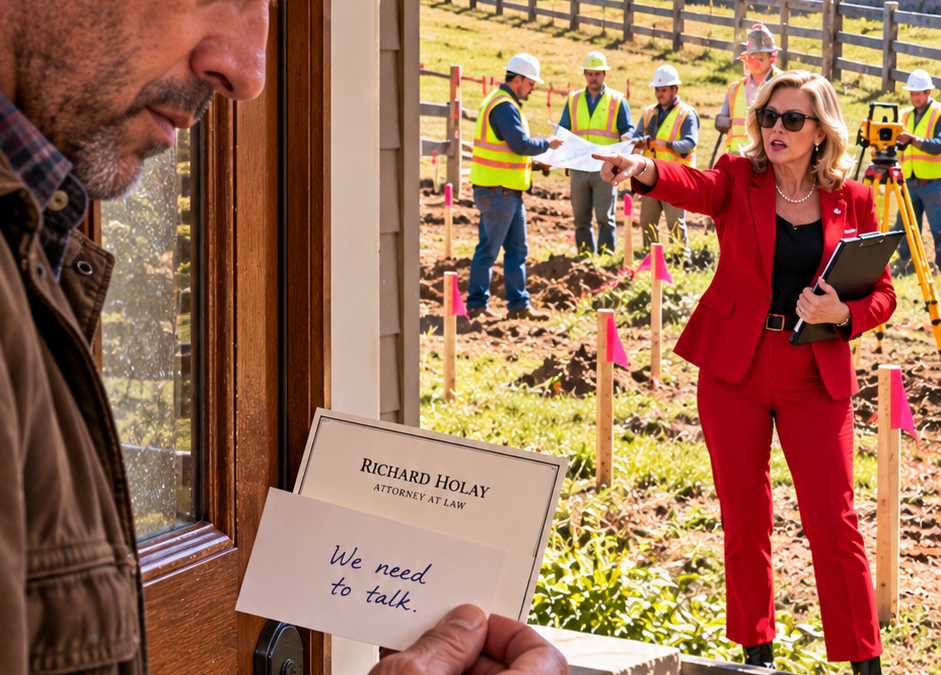
The morning I found Richard Holay’s business card wedged into my front door, I almost threw it away.
It was heavy cream-colored stock with embossed lettering and a dark blue border so subtle it was probably meant to signal money without admitting that was the point.
RICHARD HOLAY
ATTORNEY AT LAW
Underneath was the name of his firm.
On the back, written in neat blue ink, were four words.
We need to talk.
I stood on my front porch holding that card while the September wind moved through the maples east of the house.
For some reason, I thought about my father.
Not because I knew what the lawyer wanted.
Not yet.
But because Dad had distrusted expensive paper unless it came with a recording stamp.
My name is Thomas Bridger.
I had lived on that property for twenty-two years.
My father built the main house in 1979 when this part of the county was still mostly pasture, timber, gravel roads, and families who had known one another long enough to argue without needing attorneys.
After he died, he left me the house.
The workshop.
The sheds.
The acreage.
The old equipment.
And a four-drawer filing cabinet so meticulously organized that anyone else might have considered it a symptom.
Dad considered it common sense.
Every deed.
Every survey.
Every easement.
Every utility letter.
Every tax notice.
Every county receipt.
Everything went into that cabinet.
Chronological order.
Labeled folders.
Cross-references.
Duplicates when he thought something mattered enough.
He used to tell me, “A man who can’t prove what he owns doesn’t really own it.”
I thought that was the kind of sentence fathers repeat until their sons learn to nod politely.
Then Richard Holay’s business card appeared in my door.
Maplewood Ridge had been built about eight years earlier on land that once belonged to the Garrett family.
The Garretts had raised cattle.
Not on some decorative hobby farm designed to look good from the road.
Real cattle.
Mud.
Wire fences.
Hay.
Machinery.
They eventually sold out and moved west.
The developer divided their old land into clean suburban lots.
Nice houses.
Curving streets.
Brick entrance sign.
Solar lighting.
Community walking path.
Decorative landscaping that had been planned carefully enough that even the trees seemed assigned positions.
I had no problem with any of it.
People need places to live.
The Garretts had every right to sell.
The developer had every right to build what the county approved.
My land remained outside the subdivision.
That seemed simple enough.
Then Gloria Fitch became president of the Maplewood Ridge Homeowners Association.
Gloria had moved into the development about two years after it opened.
Within six months, she joined the board.
Not long after that, she became president.
I had met her twice before the letters started.
Both times, she spoke as though she were giving testimony.
She did not chat.
She established positions.
She had a habit of tilting her head slightly after asking a question, as if waiting for someone to make a statement she could use later.
If she asked whether you planned to repaint a fence, it did not sound like curiosity.
It sounded like discovery.
The first HOA letter arrived in early spring.
Three pages.
Official header.
Reference number.
A paragraph explaining Maplewood Ridge’s commitment to “preserving visual continuity throughout the community perimeter.”
Then my workshop.
The workshop sat near my eastern tree line.
My father had built the original structure in the early 1980s.
I expanded it after I inherited the property.
It was practical.
Gray siding.
Metal roof.
Double doors wide enough for equipment.
A lean-to along the back.
Nothing beautiful.
Nothing unsafe.
Nothing unusual for land that had been rural long before Maplewood Ridge existed.
But the subdivision walking path ran near the eastern edge of its property.
From one section of that path, residents could see my workshop between the trees.
Gloria’s letter described it as “inconsistent with community aesthetic standards.”
She included photographs.
I remember that irritating me more than the language.
She had stood on the walking path and deliberately photographed my property through the trees.
One photograph showed the west wall.
Another showed stacked lumber beside the lean-to.
A third showed my tractor parked outside.
Then came the recommended remedies.
Repaint the building in an approved neutral color.
Install a privacy screen.
Relocate visible equipment storage.
Reduce exterior lighting.
I read the packet twice.
Then I wrote one paragraph.
My property is not part of Maplewood Ridge HOA, has never been enrolled in Maplewood Ridge HOA, and is not subject to Maplewood Ridge standards, guidelines, or enforcement.
I added the parcel number.
Signed my name.
Wished her a good day.
Apparently Gloria did not have one.
Another notice came two weeks later.
Drainage.
Then fence height.
Then exterior lighting allegedly affecting “community ambience.”
Each letter sounded more formal than the last.
The first had been a request disguised as policy.
The next sounded like warnings.
The fourth referenced “continuing noncompliance.”
Noncompliance with rules that did not apply to me.
I showed one of the letters to my neighbor, Frank Mercer, while we were standing beside my driveway one afternoon.
He read the first page.
Then looked toward Maplewood Ridge.
“You join their HOA when I wasn’t looking?”
“No.”
“They buy your land?”
“No.”
“They move the county line?”
“Not that I heard.”
He handed the letter back.
“Then that’s impressive.”
“What is?”
“Writing three pages about authority you don’t have.”
I laughed.
At the time, I thought that was all it was.
Noise.
Paper.
An HOA president who had grown too comfortable seeing the word president beneath her name.
I ignored the next letter.
That may have been the one mistake I made.
Not because Gloria gained rights by being ignored.
She didn’t.
But silence gave her room to convince herself that escalation was progress.
Gloria lawyered up.
Richard Holay came on a Tuesday afternoon.
I noticed the silver sedan from my kitchen window.
Clean enough to reflect the trees.
He parked near the house and stepped out carrying a leather portfolio.
Maybe fifty.
Dark suit.
Expensive shoes.
The sort of haircut that probably required an appointment instead of a chair opening up.
He walked toward my porch with the calm expression of a man accustomed to arriving after everyone else had already become nervous.
“Mr. Bridger?”
“That depends.”
He smiled politely.
“Richard Holay.”
“I found your card.”
“Thank you for agreeing to speak with me.”
“I didn’t.”
He paused.
Only for a fraction of a second.
Then his smile returned.
“I appreciate your time.”
That told me something.
Richard was good.
He did not argue over small corrections.
He simply stepped around them.
I stayed on the porch.
He stayed below the first step.
“I represent the Maplewood Ridge Homeowners Association.”
“I figured.”
“I understand there has been some disagreement regarding the eastern boundary.”
“There hasn’t been disagreement from my side.”
He opened his portfolio.
“The association would prefer to resolve the issue cooperatively.”
“What issue?”
“Compliance.”
There was that word again.
“Richard, I’m not in Maplewood Ridge.”
“I understand that is your position.”
“No. It’s my address.”
His expression barely changed.
He removed a document from the portfolio.
Twelve pages.
Clipped.
Tabs along one side.
He set it on my porch railing.
“This is a formal demand.”
I looked at the first page.
The letter alleged that portions of my property—specifically the area containing my workshop and adjacent improvements—fell within the “original development envelope” recorded when Maplewood Ridge was platted.
According to the letter, my workshop violated setback requirements.
Aesthetic provisions.
Screening rules.
Possibly drainage restrictions.
It accused me of refusing “good-faith association outreach.”
That phrase almost made me smile.
Gloria had sent me repeated demands from an organization I did not belong to.
I had apparently committed bad faith by refusing to pretend otherwise.
Richard explained the theory.
The original development plat, he said, established certain boundary and buffer obligations that could affect adjacent parcels.
Maplewood Ridge believed my workshop encroached upon that regulated area.
They wanted resolution before taking “additional legal steps.”
He said all of this pleasantly.
That was what bothered me.
No accusation in his voice.
No threat.
Just quiet confidence.
The kind designed to make you feel as though the argument had already happened somewhere else and you had lost before being invited into the room.
When he finished, I looked at the twelve pages.
Then at him.
“Did you pull the original survey on my parcel?”
Richard paused.
“The association’s documentation is extensive.”
“That wasn’t my question.”
He folded his hands.
“We reviewed the relevant development materials.”
“Did you pull the original survey on my property before drafting this?”
“I personally reviewed the materials provided by my client.”
Still not an answer.
I felt something inside me become very calm.
That happened sometimes when I worked with my father.
He could spend twenty minutes arguing with a tractor.
I would get angry.
He would keep turning the same bolt until suddenly his whole manner changed.
That meant he had stopped fighting the problem and started understanding it.
“Wait here.”
Richard glanced toward his car.
“I have another appointment this afternoon.”
“This won’t take long.”
I went inside.
The filing cabinet stood in my father’s old office.
I still called it Dad’s office even though he had been gone for years.
His desk remained against the west wall.
Same scratches.
Same brass lamp.
I had changed the chair after the old one finally split, but almost everything else stayed where he left it.
The filing cabinet was olive green.
Four drawers.
Metal handles.
Small paper labels under clear plastic tabs.
PROPERTY.
TAX.
EQUIPMENT.
INSURANCE.
Dad’s handwriting.
Block letters.
I opened the property drawer.
The smell of old paper and metal came out with it.
For a moment, I just stood there.
Grief changes over time.
At first, everything reminds you that someone is gone.
Then, years later, certain things make them temporarily present.
That filing cabinet did that to me.
I could almost hear him.
“Don’t trust the copy if you still have the original.”
“Check the recording number.”
“Dates first.”
I pulled the first folder.
Original deed.
The year he built the house.
Then parcel documents.
1981 survey.
1994 survey.
Utility filings.
Drainage records.
A 2007 boundary survey.
Every section exactly where I remembered it.
Then I saw the yellow tab.
I had not opened that folder in years.
The document inside was heavy survey paper folded into quarters.
Across the front, Dad had written one word.
IMPORTANT.
I smiled.
Of course he had.
In 1983, a developer had explored expanding into our part of the county.
Nothing came of that particular project.
But Dad had distrusted vague boundary assumptions.
So he paid for an independent survey.
That survey did more than confirm his parcel.
It established the eastern boundary with fixed references.
Setback information.
And a recorded buffer zone protecting the space between our eastern line and any future development corridor.
Dad negotiated it.
Paid for the survey.
Recorded it with the county.
The stamp was right there.
Date.
Book.
Page.
Recording information.
The survey was older than Maplewood Ridge by decades.
I remembered something else.
After Gloria’s first letter, her confidence had bothered me enough that I downloaded the current Maplewood Ridge plat from the county website.
I had not done anything with it.
Just printed a copy.
That copy was sitting in another folder.
I found it.
Put the two documents together.
1983 survey.
Maplewood Ridge plat.
Then I saw the problem.
The subdivision plat appeared to treat part of the eastern corridor as though there were no preexisting buffer restriction.
Its development envelope pushed toward my tree line in a way the earlier recorded survey did not support.
If Maplewood Ridge’s plat overlapped that buffer, then the problem was not my workshop.
The problem was their assumption.
I made copies before going outside.
Dad would have approved of that.
Richard was still there.
He stood beside the porch railing checking his phone.
I carried the folder out.
“I have something you should see.”
He put the phone away.
I did not hand him everything immediately.
I walked him through it.
Dad would have done the same.
“Here is my father’s deed.”
Richard leaned closer.
“1979.”
“Yes.”
“Here are the later parcel records.”
I put them down chronologically.
“1981 survey.”
Next.
“1994.”
Next.
“2007.”
Richard’s eyes moved between the papers.
Then I unfolded the 1983 survey.
“And this is the one I think your client forgot.”
The wind caught one corner.
I put my hand over it.
Richard looked at the surveyor’s seal.
Then the recording stamp.
Then the notation along the eastern boundary.
His expression changed.
Very little.
But enough.
“What exactly am I looking at?”
“A recorded buffer.”
He bent closer.
I pointed.
“My father negotiated it when an earlier developer explored expansion.”
Richard followed the line.
“That project was never built.”
“The project doesn’t matter.”
I pointed to the recording stamp.
“The document does.”
He read the note twice.
Then I put the Maplewood Ridge plat beside it.
“This is your client’s subdivision plat.”
“I’m familiar with it.”
“Good.”
I traced the eastern development envelope.
“Then show me how this later drawing eliminates that earlier recorded buffer.”
Richard said nothing.
I continued.
“My workshop is here.”
I pointed.
“My property line is here.”
Then the buffer.
“And this existed before Maplewood Ridge.”
Richard picked up the 1983 survey.
He looked at the county stamp again.
“Do you have the complete recorded instrument?”
“Inside.”
“Any modifications?”
“None that I know of.”
“Releases?”
“None.”
“Subsequent agreement?”
“No.”
He looked at me.
“I’ll need to verify that.”
“You should.”
There was no satisfaction in my voice.
I did not want him defensive.
I wanted him careful.
That mattered more.
He looked down again.
“The association’s position is based on the development plat.”
“Then the association may have a problem with the development plat.”
“That is one possibility.”
“It’s the possibility your demand letter doesn’t mention.”
Richard’s face tightened slightly.
“I drafted the demand based on documents provided by my client.”
“I figured.”
He did not ask what that meant.
Maybe he knew.
I pointed toward his twelve-page letter.
“You accuse me of violating setback provisions inside a development envelope.”
“Yes.”
“My workshop predates Maplewood Ridge.”
“I understand.”
“My parcel predates Maplewood Ridge.”
“Yes.”
“This survey predates Maplewood Ridge.”
“Yes.”
“And this recorded buffer predates Maplewood Ridge.”
Richard looked at me.
“Yes.”
“So tell me what changed.”
He did not answer.
I think that was the exact moment the conversation stopped being about whether I would comply.
It became about what Richard had been told.
He turned to the second page of the old survey.
Then the third.
His tone was different when he spoke again.
“May I photograph these?”
“Yes.”
I handed him the copies.
“I already made a set for you.”
He looked at the folder.
Then at me.
“You anticipated that?”
“My father taught me not to hand over originals.”
For the first time, Richard almost smiled.
“That’s generally good advice.”
“He had a lot of it.”
Richard organized the copies carefully.
He placed them inside his portfolio.
Then he closed the twelve-page demand letter.
He did not withdraw it.
Not yet.
He did not say I was right.
Attorneys usually avoid declarations before verifying records.
But his language changed.
“I need to review these materials with my client.”
“Take your time.”
“I also want to confirm the recording history independently.”
“You should.”
“Until that review is complete, I don’t think further discussion here would be productive.”
“That may be the first thing we agree on.”
He nodded.
“Thank you for your time, Mr. Bridger.”
“Richard.”
He stopped.
“Next time Gloria tells you something belongs to her association, ask for the recording number.”
His expression remained professional.
“I’ll keep that in mind.”
I watched his silver sedan back down the driveway.
Then I remained on the porch for several minutes after he disappeared.
The twelve-page demand letter was still sitting on the railing.
A wind lifted the corner.
I put a coffee mug on it.
Then I went back inside.
I returned the originals to Dad’s filing cabinet.
The 1983 survey went exactly where I found it.
I stared at the word he had written in the margin.
IMPORTANT.
I could picture him at the old desk.
Yellow highlighter.
Reading glasses halfway down his nose.
Probably muttering because a county clerk had stapled something in the wrong corner.
Dad never knew Maplewood Ridge.
Never met Gloria Fitch.
Never knew Richard Holay would one day stand on my porch holding twelve pages of legal accusations.
He had not been preparing for them specifically.
That was what struck me.
He was preparing for uncertainty.
He understood that land outlives people.
Neighbors change.
Roads move.
Developers come.
Governments rewrite forms.
People die.
Children inherit.
Memories become arguments.
Records survive.
Three days later, my phone rang.
Richard Holay’s office.
A paralegal introduced herself.
“I’m calling regarding the Maplewood Ridge compliance matter.”
I waited.
“The association is pausing its review pending an internal assessment of historical boundary documentation.”
“Pausing.”
“Yes.”
“What does that mean for the demand letter?”
“No enforcement action is being taken at this time.”
“At this time.”
She hesitated.
“I’m not authorized to characterize the association’s future position.”
“Fair enough.”
“Mr. Holay asked me to confirm that we received your documents.”
“You received copies.”
“Correct.”
“Good.”
That was the last official communication I ever received from Maplewood Ridge about my workshop.
No more aesthetic notices.
No drainage demands.
No fence-height warnings.
No lighting complaints.
No references to “continuing noncompliance.”
Nothing.
For the first few weeks, I expected another letter.
Every time I saw mail from an unfamiliar return address, I checked it twice.
Every time a car slowed near the property, I wondered whether Gloria had found another attorney.
She had trained me to expect escalation.
Then a month passed.
Then two.
The workshop remained where it had always been.
Gray siding.
Metal roof.
Stacked lumber.
Tractor outside when I felt like leaving it there.
The Maplewood Ridge walking path still ran near the tree line.
Residents still passed behind the eastern woods.
Some waved when they saw me.
Some did not.
Nothing dramatic happened.
And that, I think, was what made the ending satisfying.
The land did not need to perform a victory.
It simply remained what it had always been.
I heard things through neighbors.
That there had been a closed discussion at an HOA meeting.
That Richard recommended the board stop pursuing the issue.
That Gloria argued the subdivision map gave them broader authority.
That somebody asked why legal money had been spent before anyone checked the earlier county filings.
That Gloria did not take Richard’s advice particularly well.
I cannot confirm most of that.
And eventually I stopped caring.
Rumors were not evidence.
Dad would have said that too.
What I knew was enough.
The demand stopped.
The workshop stayed.
The boundary stayed.
The buffer stayed.
One evening that fall, I took a chair onto the porch.
The sun dropped behind the western trees.
My workshop cast a long shadow across the yard.
The east fence disappeared into the woods exactly where it always had.
For twenty-two years, I had thought of the property as something my father left me.
That evening, I understood it differently.
He had not only left land.
He had left proof.
Every time he paid a surveyor.
Every time he drove to the county office.
Every time he kept an extra copy.
Every time he wrote a date on an envelope.
Every time he made me roll my eyes by saying, “Put it in the file.”
He was building protection for a future he would never see.
I remembered being young and helping him install fence posts along the eastern boundary.
I must have been fifteen or sixteen.
Hot day.
Hard ground.
I wanted to move the line a few feet around a large root because it would make digging easier.
Dad stopped me.
“The line is there.”
“I know.”
“So the post goes there.”
“It’s three feet.”
He looked at me.
“Three feet is nothing when it belongs to you.”
I laughed.
He did not.
“Three feet is everything when it belongs to somebody else.”
I had forgotten that conversation for decades.
Gloria brought it back.
That was the central mistake she made.
She looked beyond Maplewood Ridge and saw things she believed should conform to Maplewood Ridge.
My workshop was visible from their trail.
Therefore, in her mind, the HOA had an interest.
My light could be seen from their property.
Therefore, the HOA could regulate it.
My fence influenced the appearance of their perimeter.
Therefore, the HOA could dictate its height.
She confused visibility with jurisdiction.
Proximity with authority.
Preference with right.
Those are dangerous confusions when you have a board title and access to a lawyer.
What worried me later was how easily the letters could have worked on someone else.
Imagine being seventy-eight.
Your spouse gone.
Children living in another state.
You receive a twelve-page demand letter.
Attorney letterhead.
Legal citations.
Deadlines.
References to possible litigation.
Most people do not spend their days reading plats.
They do not know how to pull county records.
They do not have filing cabinets organized by a father who distrusted uncertainty.
They might assume the lawyer already checked everything.
They might repaint.
Move the fence.
Tear down the shed.
Sign an agreement.
Not because the HOA was right.
Because proving otherwise felt too expensive.
That is what official language can do.
It changes the emotional balance before it changes any legal right.
A sentence like “you are in violation” feels different from “we believe you may be in violation.”
“Required corrective action” sounds stronger than “requested change.”
“Development envelope” sounds like a technical fact even when the person using it has not checked the older survey beneath it.
People react to confidence.
Gloria understood that.
Richard understood it too, but I think in a different way.
That day on my porch, I never thought Richard was stupid.
Quite the opposite.
The moment he saw the 1983 survey, he became careful.
That told me he understood exactly what a recorded document could do to a confident argument.
He had relied on information his client gave him.
When independent evidence appeared, he adjusted.
Gloria had done the opposite.
Each time I told her my land was outside Maplewood Ridge, she increased the formality of the demand.
When a simple claim failed, she added more paper.
When more paper failed, she added a lawyer.
That is how people sometimes mistake escalation for proof.
Years earlier, Dad and I had argued about whether to keep old documents.
He had saved a utility easement after the utility company relocated the line.
I asked why.
“It’s obsolete.”
“No.”
“They moved the line.”
“That does not erase what happened.”
“What difference does it make?”
He held the paper up.
“History explains why things are where they are.”
At the time, I thought he was defending clutter.
He was defending continuity.
The 1983 survey was not valuable because the paper was old.
It was valuable because it connected present ground to a recorded decision.
My father had not merely remembered a buffer.
He had created it legally.
Surveyed.
Certified.
Recorded.
That difference mattered.
Memory says, “My father told me this was ours.”
A record says, “Here is the instrument number.”
Memory can be challenged.
Records can be challenged too.
But the person challenging them has to bring something more than confidence.
I began reviewing the whole property file after Richard’s visit.
Not because I expected another attack.
Because I finally appreciated what was there.
I found notes Dad had written after meetings.
Receipts.
A sketch of an old drainage path.
A letter from a utility company dated 1987.
A boundary correction from the 1990s.
On one survey, he had written:
CHECK THIS AGAIN IF EAST LAND EVER DEVELOPS.
I sat at his desk holding that page.
The east land had developed.
He had been dead before Maplewood Ridge’s first foundation was poured.
Still, he had anticipated the category of problem.
Not Gloria.
Not an HOA.
Just development.
Pressure.
Boundary assumptions.
He knew rural property eventually attracts people who see unused space and think unused means available.
The buffer did not look like much on the ground.
Trees.
Grass.
Fence.
No stone marker saying LEGAL PROTECTION BEGINS HERE.
That may be why Gloria underestimated it.
She saw an old workshop through the woods.
She saw empty distance between it and the subdivision trail.
She did not see recording stamps.
Most property rights are like that.
Invisible until tested.
One Saturday, I walked the eastern line from the north marker to the southern corner.
I had not done that on foot in years.
The fence was older in some places than Maplewood Ridge itself.
Several posts leaned.
One strand of wire needed tension.
Through the trees, I could see walkers on the community path.
A man pushed a stroller.
A woman jogged with headphones.
Two boys rode bicycles.
None of them looked like enemies.
That mattered to me.
The dispute had been with Gloria’s assumption of authority.
Not with families living next door.
It would have been easy to turn the whole subdivision into “them.”
That is how resentment works.
It simplifies.
But most Maplewood Ridge residents had probably never heard my name until the board mentioned the boundary dispute.
They had bought houses.
Paid dues.
Expected their board to manage common property.
They had not personally photographed my workshop.
They had not written the letters.
So I fixed the loose fence wire.
Trimmed one branch that was leaning over my side.
Then went home.
My land remained mine without requiring me to hate everybody across the line.
Months passed.
One morning, Frank Mercer stopped by.
“Still fighting the HOA?”
“No.”
“They surrender?”
“I wouldn’t call it that.”
“What would you call it?”
“They checked the paperwork.”
Frank laughed.
“That bad?”
“For them.”
He looked toward my workshop.
“You changing the paint?”
“No.”
“Moving the tractor?”
“No.”
“Dim the lights?”
“No.”
“So victory.”
I shook my head.
“It’s not victory if they never had the right to make me do it.”
Frank thought about that.
“That sounds like something your father would say.”
It probably was.
I became less angry at Richard over time.
Not because I enjoyed his visit.
But because his behavior once he saw the documents told me something important.
Legal pressure is not the same as legal truth.
A lawyer can write a demand based on a client’s version of facts.
The demand can sound certain.
It can cite statutes.
Use bold headings.
Set deadlines.
But it is still a position.
That was something Gloria seemed never to understand.
She treated every letter leaving the HOA as though the printer itself created jurisdiction.
Richard knew better.
That was why his tone changed when I showed him the survey.
He did not argue that the recording stamp was irrelevant.
He did not tell me the board had voted to override it.
He did not insist that community aesthetics somehow trumped title history.
He took the copies.
He checked.
The matter stopped.
Sometimes the most important moment in a dispute is not when somebody admits they were wrong.
It is when they stop pretending certainty exists where it does not.
I never received an apology.
Gloria never called.
No letter arrived saying Maplewood Ridge regretted the inconvenience.
I did not need one.
An apology would have been pleasant.
Silence was enough.
Years later, the workshop still stands.
The siding has faded slightly.
The roof has a few more scratches.
I replaced one door hinge.
The lumber stack moved to the other side because it stays drier there.
Not because Gloria wanted it hidden.
Because that was where it made sense.
I still turn the exterior light on when I work late.
Sometimes I imagine someone on the Maplewood Ridge walking path can see it through the trees.
That no longer bothers me.
They are allowed to see my property.
Seeing something is not owning it.
That distinction became the entire story.
Dad’s filing cabinet remains in the office.
I eventually replaced the paper labels with new ones because the plastic had yellowed.
I kept his handwriting underneath.
The 1983 survey is stored in a protective sleeve now.
The original stays in the cabinet.
There is a certified copy in another location.
And a digital scan.
Dad would probably call that excessive.
Which would be hypocritical.
One afternoon, I found the original Richard Holay business card in the kitchen junk drawer.
I had forgotten I kept it.
Cream stock.
Embossed lettering.
On the back:
We need to talk.
I carried it into Dad’s office.
For a moment, I considered throwing it away.
Instead, I slipped it into the 1983 folder.
Not because the lawyer mattered.
Because the card belonged to the history of that document now.
Dad had written IMPORTANT decades earlier.
Richard’s card proved why.
There are people who see old property and assume age means vulnerability.
An old workshop.
Old fence.
Old deed.
Old owner.
Old records.
They think newer maps carry more authority because the paper looks cleaner.
New developments come with logos.
Management companies.
Boards.
Websites.
Attorneys.
Rules printed in modern fonts.
Old land often comes with boxes of paper and people who speak less confidently.
That contrast can be deceptive.
A glossy subdivision map does not erase an older recorded boundary because it looks more professional.
A board resolution does not create jurisdiction outside the board’s property.
A photograph does not create a violation.
And twelve pages of legal language cannot move a line that was properly established decades earlier.
That was what Gloria never understood.
She believed administration could eventually become ownership if she applied enough pressure.
Send one notice.
Then another.
Add violations.
Add legal phrases.
Hire counsel.
At some point, she assumed I would stop asking whether she had authority and start asking what she wanted me to do.
That point never came.
Not because I was tougher than she expected.
Because my father had done his work.
That is the part of the story that still gets to me.
Dad had been dead for years.
Yet on the afternoon Richard Holay stood on my porch, I was not defending the property alone.
My father was there in every document.
Every recording stamp.
Every surveyor’s seal.
Every note.
Every duplicate.
When I opened that filing cabinet, he had already answered questions nobody had asked while he was alive.
Where is the boundary?
Here.
Was it surveyed?
Yes.
When?
Recorded?
Yes.
What about future development?
Protected by this buffer.
Proof?
Book.
Page.
Stamp.
There is a kind of love that looks nothing like affection while you are young enough to receive it.
Dad was not a sentimental man.
He did not write long letters.
He did not give speeches.
He did not say much about what the land meant to him.
He paid recording fees.
He hired surveyors.
He filed documents.
He maintained fences.
He showed me where markers were.
That was his version of saying:
I want this to survive me.
I finally understood.
The evening after Maplewood Ridge’s review was paused, I sat on the porch until sunset.
The workshop cast a long shadow toward the east.
The fence followed the same line it always had.
The trees stood between my property and the walking trail.
Somewhere beyond them were people eating dinner.
Children doing homework.
Dogs barking.
And probably Gloria making phone calls.
Maybe she was angry.
Maybe she believed Richard should have fought harder.
Maybe she thought another legal theory could save the claim.
None of that mattered.
The argument had not been won that afternoon.
In a way, it had been settled years before I inherited the land.
Before Maplewood Ridge.
Before Gloria.
Before Richard.
Before anyone imagined there would be a walking path overlooking my workshop.
My father had stood with a surveyor in 1983 and made sure the ground and the record agreed.
Everything after that was noise.
I sat there until the sun disappeared behind the tree line.
Then I went inside.
Before bed, I opened the filing cabinet once more.
I checked the 1983 folder.
Original survey.
Recording information.
Richard’s copies accounted for.
Everything where it belonged.
I closed the drawer.
The metal latch clicked.
And for the first time since finding that business card, I felt completely calm.
The workshop was still mine.
The fence was still mine.
The land was still mine.
Not because I had defeated a lawyer.
Not because Gloria had finally become reasonable.
Not because an HOA had done me a favor.
Because none of them had ever possessed the right they were trying to enforce.
That distinction matters.
People can pressure you into surrendering something they could never have taken lawfully.
They can make the demand look official.
Make the language complicated.
Make the deadline short.
Make resistance feel expensive.
But confidence is not title.
Letterhead is not jurisdiction.
And repetition does not turn someone else’s property into yours.
My father used to say a man who could not prove what he owned did not really own it.
I spent years thinking that was an exaggeration.
Now I think he left out one part.
Sometimes you know exactly what you own.
The real question is whether you can prove it before somebody else decides your uncertainty belongs to them.
Dad made sure I could.
That filing cabinet is still against the wall in his old office.
The workshop is still visible from Maplewood Ridge.
And the eastern boundary remains exactly where it was before Gloria Fitch ever learned my name.
Nothing moved.
Nothing had to.
The record had been waiting there the entire time.

