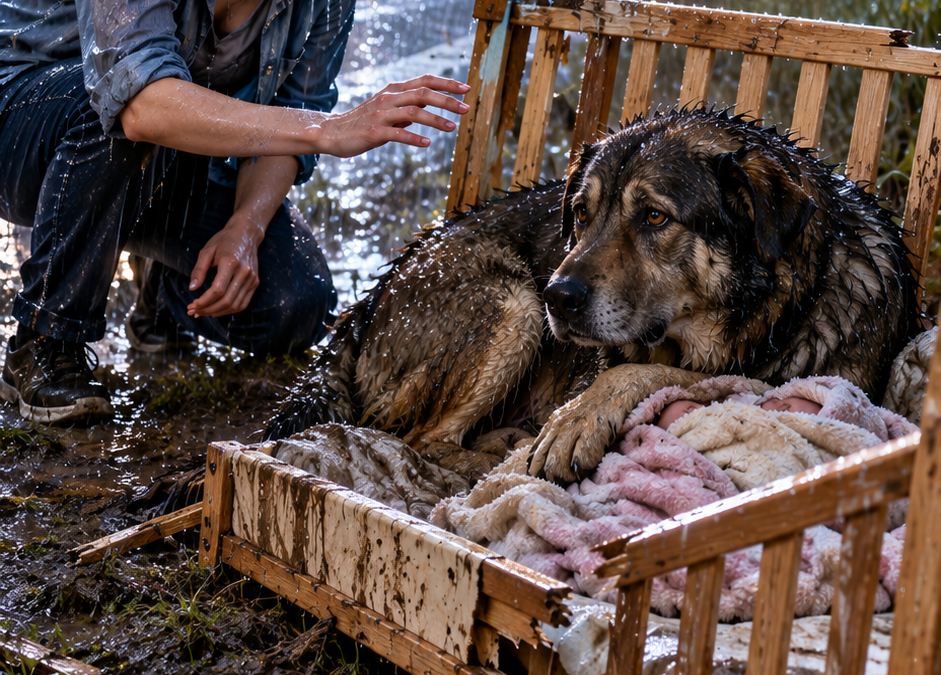
𝗙𝗨𝗟𝗟 𝗦𝗧𝗢𝗥𝗬 The Broken Crib on the Shoulder Should Have Been Empty, but a Dog Was Guarding Something Beneath the Blankets
𝗙𝗨𝗟𝗟 𝗦𝗧𝗢𝗥𝗬
The dog’s ears shifted.
“I’m not coming closer.”
He stared at me.
Cars hissed past behind us.
Rain ran off his muzzle.
There was a collar around his neck.
When he turned slightly, I saw silver letters.
BLUE.
“Blue?”
One ear lifted.
“All right, Blue.”
I raised both hands.
“I’m Jessica.”
Talking to him made me feel ridiculous.
It also seemed to make him less tense.
“I’m not going to hurt you.”
His eyes never left me.
Then something beneath the blankets inside the crib moved.
My entire body went cold.
At first, I thought it was another animal.
Then I saw a hand.
A tiny hand.
“Dear God.”
I stepped forward without thinking.
Blue moved immediately.
Not toward me.
Across my path.
He planted himself between me and the crib.
I froze.
“Okay.”
My voice shook.
“Okay, Blue.”
I looked around.
No vehicle.
No adult.
No house nearby.
Just trees, rain, ditch, road.
I pulled my phone from my pocket.
The screen was already wet.
I called 911.
“911, what is your emergency?”
“I’m on Highway 24. I don’t know the exact mile marker.”
“What happened?”
“There’s a child.”
The word came out wrong.
Too loud.
I forced myself to slow down.
“There’s a broken crib on the side of the road. There’s a dog guarding it. I can see a little girl under the blankets.”
The dispatcher’s voice changed instantly.
“Is the child conscious?”
“I think so.”
“Can you approach safely?”
“The dog is protective.”
“Do not put yourself at risk.”
“I understand.”
“Can you speak to the child?”
I looked toward the crib.
“Sweetheart?”
No answer.
The dog watched.
I lowered myself into a crouch.
“I’m not going to touch you. Can you hear me?”
A face appeared beneath the blanket.
A little girl.
Four.
Maybe five.
Pale.
Dark hair stuck to her forehead.
Eyes far too serious for someone so small.
Her eyes were open.
She was watching me.
“Hi.”
Nothing.
“My name is Jessica.”
The dog turned his head toward her, then back toward me.
“You don’t have to come to me.”
The girl moved one hand from beneath the blanket.
Something silver was clenched in her fingers.
A key.
There was also an envelope.
“Are you hurt?”
She did not answer.
“Can you tell me your name?”
Her lips moved.
I could barely hear her over the rain.
“He can’t go.”
“What?”
She looked at the dog.
“Blue can’t go.”
I swallowed.
“I’m not taking Blue anywhere.”
Her grip on the envelope relaxed slightly.
The dispatcher asked through my phone, “Ma’am, are you still there?”
“Yes.”
“Emergency crews are responding, but severe weather is causing delays. There are reports of flooding on two roads in your area.”
“How long?”
“I can’t give you an exact time.”
I looked at the child.
She was shaking.
“Okay.”
“Can you get the child into your vehicle safely without provoking the dog?”
“I don’t know.”
“Do not force it.”
I put the phone on speaker and set it inside my jacket pocket.
Then I returned my attention to Blue.
“I need to help her.”
His body stayed rigid.
“Blue.”
The girl whispered something.
The dog looked back at her.
She touched his wet neck.
“It’s okay.”
That was all.
Two words.
The dog stepped sideways.
Not away.
Just enough.
I moved toward the crib.
Every instinct told me to pick the girl up immediately.
Instead, I knelt.
“Hi.”
She watched me.
“How old are you?”
She held up four fingers.
“Four?”
A tiny nod.
“What’s your name?”
“Lily.”
“Hi, Lily.”
Her teeth were chattering.
“I’m going to get you somewhere warm.”
Her eyes went to Blue.
“He comes too.”
“Yes.”
“You promise?”
The word made me pause.
Children take promises seriously.
“Yes.”
I looked at the dog.
“Blue comes too.”
Only then did Lily allow me to touch the blanket.
It was soaked.
When I lifted one corner, something fell against the crib mattress.
A thick bundle of cash.
I stared at it.
Then at Lily.
Beside the money was a wedding ring.
Gold.
Simple.
And the envelope.
My first reaction was fear.
Not because of the money itself.
Because abandoned children on roadsides were already bad.
Abandoned children with cash and jewelry felt different.
Intentional.
Planned.
Someone had expected Lily to need money.
Someone had chosen what to leave with her.
I did not open the envelope.
Not there.
“Can you stand?”
Lily tried.
Her legs shook.
I lifted her.
Blue immediately pressed close to us.
“He’s okay,” Lily whispered.
“I know.”
I carried her to my car.
Blue jumped onto the back seat without invitation.
I wrapped Lily in my spare diner jacket and turned the heat as high as it would go.
She curled against Blue.
The dog stayed upright.
Watching the windows.
Watching me.
I returned briefly to the crib.
The money.
Ring.
Envelope.
I placed everything into a clean takeout bag from my trunk.
Then I photographed the roadside exactly as I had found it.
I did not know whether that mattered.
It felt like something I should do.
The broken crib.
The ditch.
The blankets.
The tire tracks already washing away in the mud.
Then I got back into the car.
“Lily?”
She was trembling less.
“Are you hungry?”
She nodded.
I had half a package of crackers in my purse.
I gave them to her.
She broke one in half and offered it to Blue.
He would not eat it.
He watched me instead.
“You really don’t trust me, do you?”
Lily leaned against him.
“He trusts me.”
“That’s good enough for now.”
She ate one cracker.
Then another.
“Where’s your mommy?”
Her chewing stopped.
I immediately regretted the question.
Lily looked toward the window.
“Lily?”
Nothing.
I left it alone.
The rain continued.
The dispatcher called back twice.
Emergency crews were still delayed.
A truck had jackknifed farther south.
One county road was underwater.
I thought about driving Lily directly to the hospital.
Dispatch advised me to remain where I was unless staying became unsafe.
The shoulder was wide.
We were visible.
So we waited.
After almost thirty minutes, Lily fell asleep against Blue’s side.
That was when I looked at the envelope.
Her name was written on it.
Not Lily.
The front said:
PLEASE PROTECT MY DAUGHTER.
My stomach tightened.
I knew I should probably leave it sealed for police.
But we were sitting inside a car with a four-year-old child someone had deliberately hidden beside a road.
There might be emergency information inside.
Medical condition.
Contact information.
I called dispatch again.
“I found a sealed letter with the child.”
“Does it contain medical information?”
“I don’t know.”
“Officers are still en route. If you believe it contains information immediately relevant to the child’s safety, you may read it. Preserve everything.”
I opened the envelope carefully.
Inside were two things.
A photograph.
And a handwritten letter.
The photograph showed Lily with a young woman.
Lily looked younger.
Maybe three.
A large dog stood beside them.
Blue.
The woman had dark hair and tired eyes.
On the back:
Sarah and Lily Morrison. Blue.
The letter began:
Whoever finds this, please protect my daughter.
I stopped.
Looked into the rearview mirror.
Lily slept with one fist tangled in Blue’s wet fur.
I kept reading.
My name is Sarah Morrison.
My father is Robert Morrison.
He is dangerous.
Not because he carries a gun.
Because he has money, influence, and enough secrets to make people afraid of telling the truth.
I own documents showing that several assisted-living and senior housing developments connected to his companies were built using falsified inspection reports and substituted materials.
Two residents have already been seriously injured in structural failures.
There are more problems.
There are videos.
There are payment records.
I have copies.
If something happens to me, everything needs to reach the press and the authorities.
Please keep Lily away from my father.
He will say he wants to protect her.
Do not believe him.
Blue will stay with her.
Please do not separate them.
My hands had started shaking.
I stopped reading.
This was no longer a lost child.
It was evidence.
And Lily was not simply stranded.
Someone was afraid another person might come looking for her.
I looked around through the rain.
Every vehicle suddenly felt important.
Every pair of headlights.
I locked the doors.
Blue noticed.
His head lifted.
“You knew, didn’t you?”
Of course he did not understand the question.
But he looked at me like a guard who had been waiting for reinforcements.
The remainder of the letter gave a phone number for an investigative journalist.
No explanation beyond:
If I cannot contact you myself, call him.
Tell him Sarah Morrison sent you.
There was also a small flash drive taped inside the envelope.
I did not touch it.
I put everything back exactly where I found it.
Forty-five minutes after I stopped, emergency lights finally appeared behind us.
Lily woke immediately.
Blue stood.
A paramedic approached the passenger side.
The dog growled.
Not loudly.
The paramedic froze.
“Dog friendly?”
“To her.”
“Can he be restrained?”
I looked at Lily.
“No.”
The paramedic looked at me.
“That confident?”
“No.”
He almost smiled.
“Appreciate the honesty.”
We explained everything slowly.
Lily would not leave the car without Blue.
The responding sheriff’s deputy spoke with his supervisor.
Animal control was unavailable because of the storm.
Eventually, they made the practical decision.
Blue would ride with Lily.
I would follow.
At the hospital, things became complicated immediately.
Rules.
Forms.
Security.
Police.
Child protective services.
Hospital administration.
Everyone wanted to know who I was.
“I’m nobody.”
That answer frustrated them.
I was only the person who stopped.
I gave the envelope and flash drive directly to the sheriff’s deputy, explaining that I had opened only the letter.
He documented it.
The cash was counted in front of witnesses.
The wedding ring was photographed and secured.
Lily underwent a full examination.
Mild dehydration.
Cold.
Hungry.
Exhausted.
No serious injury.
No evidence of physical abuse.
The doctor who examined her was named Dr. Renee Foster.
She was maybe forty.
Calm eyes.
Gentle voice.
Lily would not sit on the examination table unless Blue stood against her knees.
Hospital policy did not allow ordinary pets in that area.
Blue apparently had not read hospital policy.
A nurse attempted to lead him away once.
Lily screamed.
Not cried.
Screamed.
The sound came from a place deeper than fear.
Blue threw his body against the exam-room door.
Dr. Foster stopped everything.
“Leave him.”
The nurse said, “Doctor—”
“Leave him.”
“But infection control—”
“We’ll clean the room.”
She looked at Blue.
“That dog knows better than we do what this child needs right now.”
Blue returned to Lily.
The screaming stopped.
That became the arrangement.
Blue stayed.
I expected to be sent home.
I probably should have been.
Instead, Lily kept looking toward me whenever someone new entered.
When a social worker tried to interview her, Lily reached for my hand.
I stayed.
One hour became three.
Three became six.
My manager called.
“Jessica, where are you?”
“In the hospital.”
“What happened?”
I looked at Lily.
“It’s complicated.”
“Are you hurt?”
“No.”
“Then are you coming in tonight?”
I almost laughed.
“No.”
There was a pause.
“Okay.”
That was it.
No threat.
No complaint.
Maybe my voice told him enough.
The sheriff’s office took the letter seriously.
Very seriously.
A detective interviewed me before midnight.
I repeated everything from the moment I saw the crib.
Where I parked.
Where the dog was.
Where the cash was.
What I touched.
When I opened the envelope.
Then he asked me about the journalist’s phone number.
“I haven’t called it.”
“Good.”
“I thought Sarah wanted—”
“We need to establish who else is involved before evidence starts moving.”
That made sense.
I said nothing.
But around two in the morning, something happened that changed my relationship to the story.
Lily woke crying.
Not loudly.
She was curled on a hospital bed.
Blue lay beneath her hand.
I sat in the chair near the wall.
“Mommy.”
I stood.
“I’m here.”
She looked at me.
“Not you.”
“I know.”
Her lip trembled.
“I want Mommy.”
I sat beside the bed.
“I know.”
“Where is she?”
I could not lie.
“I don’t know.”
“Did he take her?”
My blood went cold.
“Who?”
Lily closed her eyes.
“Grandpa.”
That was the first time she had referred to Robert Morrison.
“What happened?”
She shook her head.
“I want Mommy.”
I stopped asking.
There are moments when adults confuse getting information with helping a child.
Lily did not need an interrogation.
She needed someone beside her until morning.
So I stayed.
The next day, the sheriff’s department confirmed that the phone number in Sarah’s letter belonged to a local investigative journalist.
He was known for reporting on construction fraud and public contracting.
Police contacted him before I did.
Later that afternoon, he came to the hospital with an attorney from his newspaper and spoke to investigators.
I sat in the waiting room.
Eventually, he came to me.
“You’re Jessica?”
“Yes.”
“Sarah trusted me.”
“You knew her?”
“A little.”
“Did you know about Lily?”
His face tightened.
“Yes.”
That answer made me angry.
“Then why was she beside a highway?”
He did not become defensive.
“I didn’t know she was running.”
“What did you know?”
“Sarah contacted me six weeks ago.”
He sat across from me.
“She said she had internal records from Morrison Development Group.”
“What kind?”
“Inspection changes. Engineering reports. Material substitutions. Emails.”
“The things in the letter?”
“Yes.”
“Why wasn’t the story published?”
“Because we were verifying.”
I stared at him.
“Six weeks?”
“Jessica, accusations involving a powerful company require evidence. Publishing too early could have exposed Sarah before we could prove anything.”
“She was already exposed.”
“I know.”
His voice dropped.
“I know that now.”
The flash drive contained copies of documents Sarah had discussed with him.
There were also videos.
He did not show me everything.
Police would not allow that.
But over the next two days, enough became clear.
Sarah Morrison was Robert Morrison’s daughter.
Robert owned or controlled a network of companies involved in retirement residences and assisted-living developments across Tennessee.
Sarah had worked briefly in the administrative side of his business.
She discovered discrepancies.
Not small mistakes.
Inspection reports that appeared to have been altered after engineers raised concerns.
Invoices showing cheaper structural materials substituted after approvals.
Internal correspondence about cracking walls and foundation settlement.
Two elderly residents had been injured in separate incidents.
One after a ceiling section collapsed.
Another after part of an exterior walkway failed.
Robert’s companies had blamed isolated contractor errors.
Sarah believed the problems were connected.
She copied records.
Then someone discovered she was asking questions.
According to the journalist, Sarah became frightened after an unknown vehicle followed her twice.
Her apartment had been entered.
Nothing obvious was stolen.
But documents were moved.
She stopped sleeping there.
Then she disappeared.
Police had not yet determined exactly what happened before Lily ended up on the roadside.
The broken crib provided one clue.
It had been transported in a pickup belonging to a man who had worked maintenance for one of Robert Morrison’s properties.
The truck was found abandoned later that evening.
That information made my skin crawl.
I remembered the rain.
The ditch.
Blue lying beside the crib.
Someone had put Lily there.
But why?
Had Sarah?
Had someone helping her?
Had the people pursuing her lost control of the situation?
No one knew yet.
Lily said very little.
Blue never left her.
Child services arranged temporary emergency placement.
Because I was not a relative, there was no simple legal reason for Lily to remain with me.
But she had attached herself to me.
And, more importantly, I think Blue had decided I was acceptable.
The social worker noticed.
“Would you be willing to stay involved temporarily?”
“What does involved mean?”
“For now? Visiting. Helping her transition.”
“Of course.”
I said it before thinking about work.
Rent.
My tiny apartment.
The fact that I did not own a child’s toothbrush.
None of that mattered in that moment.
Three days after I found Lily, Robert Morrison was arrested.
Not because Sarah’s allegations had already been fully proved.
The initial charges involved obstruction, evidence tampering, conspiracy, and conduct connected to the disappearance of records and witnesses.
More followed later.
The arrest became statewide news.
His photograph appeared everywhere.
Silver hair.
Expensive suit.
Expression of controlled irritation as deputies walked him toward a vehicle.
Residents from several Morrison properties began speaking publicly.
Former contractors contacted investigators.
Employees came forward.
One retired engineer produced copies of an inspection report that differed from the version in official company files.
Another family said they had complained about a dangerous stairwell for months before an injury.
Sarah had not been the only person who knew something was wrong.
She had been the person who finally assembled enough pieces to threaten the structure protecting it.
But Sarah herself was still missing.
That was what mattered to Lily.
Adults talked about arrests.
Charges.
Corporate records.
Search warrants.
Lily asked one question every morning.
“Did they find Mommy?”
Every morning, I had to say no.
She stopped crying when I said it.
That frightened me more.
Children should cry when something hurts.
Silence means they are learning to carry it alone.
On the fifth morning, I brought strawberry pancakes to the temporary foster home where Lily had been placed.
Blue lived there too under an emergency accommodation because separating them had become obviously impossible.
The foster mother, Denise, was kind.
Experienced.
Patient.
Lily still watched the driveway whenever a car slowed.
We sat at the kitchen table.
“Blue likes pancakes?” I asked.
“No.”
Blue stared at my plate.
“He appears to disagree.”
“He likes bacon.”
“That explains it.”
Lily tore one piece from her strip.
“Mommy says people food makes him fat.”
“Mommy is probably right.”
She froze.
Then looked down.
I wished I could retrieve the sentence.
Instead, I said, “We’re going to find her.”
Lily’s eyes lifted.
“You promised Blue could come.”
“I remember.”
“You kept it.”
“Yes.”
“Mommy promised she’d come too.”
That sentence nearly broke me.
“What exactly did she say?”
Lily looked toward the window.
“She said wait with Blue.”
“Where?”
“In the truck.”
“What truck?”
“Mr. Dean’s.”
This was new.
I tried not to react.
“Who’s Mr. Dean?”
“He works for Grandpa.”
I did not ask more.
I contacted the detective immediately.
They interviewed Lily later with a trained child specialist.
That name helped identify the maintenance worker connected to the abandoned pickup.
His name was Dean Wallace.
He was located the next day.
What investigators learned was complicated.
Dean had not been part of the plan to harm Sarah.
At least not initially.
Sarah had convinced him to help her leave one of Robert’s properties after she believed she was being watched.
Dean agreed to drive Sarah, Lily, and Blue away.
They placed a broken crib in the pickup because Sarah used it to conceal documents and supplies beneath blankets.
On the road, another vehicle began following them.
Sarah told Dean to take Lily ahead while she changed vehicles with someone else who was supposed to help her reach the journalist.
The plan collapsed.
Dean panicked.
He believed the people following them knew where he was headed.
Near Highway 24, with the storm worsening, he abandoned the truck after receiving a threatening phone call.
According to his statement, he left Lily with the cash, key, letter, and Blue near the crib because he believed staying beside a busy highway would make her easier to find by ordinary people than driving her somewhere more isolated.
It was a terrible decision.
A frightened decision.
But Lily survived it.
Blue never left.
The silver key opened a safe-deposit box.
Inside were original records Sarah had hidden months earlier.
Those records expanded the investigation dramatically.
I only learned most of this afterward.
At the time, all I knew was that people were searching.
For Sarah.
For witnesses.
For the truth.
Days passed.
Lily began talking more.
Not about her mother.
About ordinary things.
Blue’s favorite toy.
A purple cup she had left at home.
A song she hated.
A cartoon character she insisted was “annoying.”
Those conversations mattered.
Trauma makes adults hungry for the dramatic facts.
Children heal through the ordinary ones.
On day twelve, the detective called me.
I was at work.
Balancing three plates.
“Jessica?”
“Yes.”
“We found Sarah Morrison.”
I almost dropped everything.
“Alive?”
“Yes.”
My knees went weak.
I set the plates on the nearest empty table.
“Where?”
“A motel in Kentucky.”
“What happened?”
“She’s alive.”
He repeated it because I think he understood that was the only fact I could process.
“She’s being evaluated medically. We’ll know more later.”
“Does Lily know?”
“Not yet.”
I drove to Denise’s house after my shift.
The detective and social worker were already there.
Lily sat on the couch.
Blue beside her.
I stood in the doorway while the detective knelt in front of her.
“Lily.”
She watched his face.
“We found your mom.”
Nothing happened at first.
No smile.
No tears.
Then Lily looked at me.
“Alive?”
“Yes.”
“Alive alive?”
The detective smiled.
“Yes.”
Lily screamed.
Not from fear this time.
She threw herself around Blue.
Then Denise.
Then me.
Her whole body shook.
Blue began barking because everyone else was crying.
For the first time since I had found her, Lily looked four years old.
Not like a tiny person trying to survive adult secrets.
Just a child who had been told her mother was coming back.
Sarah had escaped.
The full details came slowly.
People connected to Robert had intercepted her while she was moving between safe locations.
They intended to retrieve the documents and determine who else had copies.
Sarah escaped after two days when an argument among the men holding her created an opportunity.
She reached a gas station.
Then panicked.
Instead of going directly to police, she used cash to hide at a motel under another name.
She believed Robert had people inside local systems.
Fear does strange things to judgment.
She remained there, changing rooms, until investigators traced a purchase connected to her.
When police arrived, she initially tried to run.
She thought they had been sent by her father.
Only after she saw the warrant information and spoke with the journalist did she believe Robert was actually in custody.
Two weeks after I stopped in the rain, Sarah came to see Lily.
The reunion happened at Denise’s house.
I almost did not go inside.
It felt private.
The social worker insisted Lily wanted me there.
So I stood near the kitchen doorway.
Blue heard Sarah first.
He had been asleep beside Lily.
Suddenly his head lifted.
His ears went forward.
Then he ran.
I had never seen him run that fast.
Sarah barely made it through the front door.
Blue hit her legs so hard she dropped to her knees.
“Blue.”
He whined.
Licked her face.
Spun in a circle.
Then ran back toward Lily as though he needed to connect them physically.
Lily stood in the living room.
She did not move.
Sarah looked at her.
Everything in Sarah’s face collapsed.
“Baby.”
Lily’s mouth opened.
No sound.
Sarah crawled forward on her knees.
“I’m sorry.”
Lily ran.
She hit her mother with both arms.
Sarah folded around her.
They fell onto the carpet together.
Blue pushed his way between them.
No one stopped him.
Sarah cried in a way I had never heard another person cry.
Pain.
Relief.
Guilt.
Something almost like disbelief.
“I came back.”
Lily held her neck.
“You took too long.”
“I know.”
“I waited.”
“I know.”
“Blue waited too.”
Sarah pressed her face into Lily’s hair.
“I know.”
I had to turn away.
There are moments you witness that do not belong to you.
That was one.
When Sarah finally looked up, she saw me.
She stood slowly.
Her face was swollen from crying.
“You’re Jessica?”
I nodded.
She walked toward me.
Before I could say anything, she hugged me.
Hard.
“You saved her.”
“No.”
She pulled back.
“You stopped.”
“That’s all.”
“You stopped.”
Her voice broke again.
I looked at Blue.
“He stayed.”
Sarah turned toward him.
Blue was lying with his body touching Lily’s legs.
“He always stays.”
Later, Sarah told me Blue had belonged to her husband.
Michael.
He had died the previous year after a sudden illness.
Before he died, Blue had been his dog in the technical sense.
In reality, Blue belonged to all of them.
But Michael had trained him.
Not professionally.
Just basic obedience.
Stay.
Come.
Watch Lily.
That last command had started as a family joke.
Whenever Sarah cooked dinner, Michael would point toward Lily and tell Blue:
“Watch your girl.”
Blue would sit beside her.
At playgrounds.
On the porch.
Beside her bed when she was sick.
After Michael died, Sarah sometimes whispered the same phrase.
Watch your girl.
The day she separated from Lily during her escape, she knelt beside Blue.
She held his face.
“Watch your girl.”
And he did.
Through a storm.
Beside a broken crib.
On a highway shoulder.
In a hospital.
In a foster house.
Until Sarah returned.
When I told her I had credited Blue with saving Lily, Sarah shook her head.
“Michael did.”
“What do you mean?”
“He taught him loyalty.”
I looked at the dog.
“No.”
Sarah watched me.
“Michael taught him commands.”
I pointed toward Lily.
“Blue chose what they meant.”
Sarah became quiet.
For the next several months, nothing was easy.
Movies end reunions too early.
They show the hug.
Then sunlight.
Real life continues into paperwork.
Court hearings.
Counseling.
Employment.
Housing.
Fear.
Sarah could not immediately return to her old life.
Her father’s case was expanding.
She was a witness.
She needed protection.
Lily needed routine.
Sarah had almost no money beyond the cash she had hidden.
Much of what she owned was inaccessible during the investigation.
I had my tiny apartment.
And, without really deciding how it happened, Sarah and Lily began staying there.
At first, only a few nights.
Then a week.
Then another.
Denise remained involved.
Social services remained involved.
Everything happened legally and carefully.
But my apartment changed almost overnight.
A child’s toothbrush appeared beside mine.
Blue’s water bowl blocked the kitchen cabinet.
Sarah slept on the couch.
I gave Lily my bedroom and moved onto a folding mattress in the living room.
“No,” Sarah said the first night.
“Yes.”
“You work two jobs.”
“You have a four-year-old.”
“You need sleep.”
“So do you.”
Blue climbed onto the folding mattress and circled twice.
Sarah looked at him.
“Well, he voted.”
“He’s enormous.”
“He thinks he’s furniture.”
My apartment was never designed for three people and a seventy-pound dog.
It was crowded.
Messy.
Loud.
And for the first time in years, it felt alive.
Sarah found work doing bookkeeping for a small medical supply company.
Not glamorous.
Stable.
Flexible.
She attended therapy.
Lily attended therapy too.
Blue attended nothing.
He appeared to consider himself already well adjusted.
There were difficult nights.
Lily would wake screaming.
Sarah would sit on the floor beside her bed.
Sometimes Lily became angry.
“You left me.”
Sarah never denied it.
“I did.”
“You said you would come.”
“I tried.”
“That’s not the same.”
“No.”
Those conversations hurt to overhear.
But Sarah did not defend herself by asking Lily to understand adult danger.
She apologized.
Again and again.
Not theatrically.
Specifically.
“I’m sorry you were afraid.”
“I’m sorry I left before I knew you were safe.”
“I’m sorry I asked Blue to do something that should have been my job.”
And slowly, Lily stopped asking whether Sarah might disappear.
Blue helped.
Of course he did.
If Sarah went to work, Blue stayed with Lily.
If Lily went to preschool, Blue waited near the door.
When both were home, he positioned himself where he could see them.
My apartment became a map of his responsibilities.
One afternoon, several months after Sarah returned, Lily opened the hall closet.
She dragged out something I had kept without thinking much about why.
A piece of the broken crib.
The sheriff’s office had eventually released some non-evidentiary property after the investigation.
The crib itself was destroyed.
I had asked for one small section of wood.
Maybe because it was the first thing I saw.
Maybe because it represented the moment my life changed.
Lily carried the wood into the living room.
“What’s that?” Sarah asked.
“The bed.”
Sarah went still.
The wood was about a foot long.
One edge still carried part of a carved decorative pattern.
Lily placed it on my thrift-store coffee table.
I touched the grain.
“I don’t know why I kept it.”
“Yes, you do,” Sarah said.
“Do I?”
“You keep broken things.”
I looked at my couch.
“That feels judgmental.”
She laughed.
It was good to hear.
Lily asked, “Can we make it something?”
“What?”
She shrugged.
“Not broken.”
I found a black marker in the kitchen drawer.
“What should it say?”
Lily thought.
Blue walked over and sat beside her.
Sarah touched his head.
“Guardian.”
I looked at her.
“Guardian?”
She nodded toward Blue.
“It fits.”
I wrote the word on the wood.
GUARDIAN.
Then we hung it above the apartment door.
It looked ridiculous.
A rough piece of damaged crib nailed above cheap rental molding.
I loved it immediately.
A few weeks later, the journalist who had worked with Sarah came by.
His reporting on the Morrison investigation had become statewide news.
The corporate case was much larger than any of us expected.
Multiple developments underwent emergency inspection.
Residents were temporarily relocated from two structures.
Former employees testified.
Insurance companies entered litigation.
Robert Morrison remained in custody through much of the pretrial process.
Eventually, several executives and contractors faced charges or civil actions connected to falsified records and unsafe construction.
I did not follow every detail.
The story became too large.
Too many filings.
Too many names.
Too many people who had known small pieces and convinced themselves someone else would eventually say something.
The journalist asked whether he could interview me again.
We sat at my kitchen table.
Sarah read Lily a story on the couch.
Blue’s head rested in her lap.
The journalist looked around.
“You all live here?”
“For now.”
He smiled.
“Looks crowded.”
“It is.”
“Happy?”
I watched Lily turn a page.
“Sometimes.”
He understood the answer.
He asked what I remembered most from the day I stopped.
I expected to say the rain.
Or the crib.
Or Lily’s face.
Instead, I said:
“Blue not moving.”
“What do you mean?”
“Everything around him was chaos.”
I looked toward the dog.
“Traffic. Rain. A child freezing. Whoever left them there gone.”
I paused.
“But Blue had one job.”
The journalist waited.
“He stayed.”
After the interview, he stood near the door.
His eyes went to the piece of wood.
“Guardian.”
“Lily chose it.”
He looked toward the couch.
“That seems right.”
Before he left, Lily appeared.
She handed him a small scrap of wood left from the crib section.
“What’s this?”
“For you.”
He crouched.
“Why?”
“You helped Mommy.”
He looked at Sarah.
Sarah’s eyes filled.
Lily had written one word on the little scrap in uneven letters.
GUARDIAN.
The journalist accepted it like she had handed him something precious.
Maybe she had.
That night, after everyone went to sleep, I sat alone at the kitchen table.
Rain tapped softly against the apartment window.
Nothing like the storm.
Still enough to bring it back.
I thought about how close I came to driving past.
If I had been five minutes earlier, would they have been there yet?
Five minutes later?
Would another person have stopped?
Would Blue have kept Lily warm long enough?
Would whoever was looking for Sarah’s documents have found them first?
Questions like that can become dangerous.
They make ordinary decisions feel like destiny.
I do not think I was chosen to stop.
I do not think some invisible force moved my foot onto the brake.
I think I saw something wrong.
And for once, I did not assume somebody else would handle it.
That is less magical.
It is also more useful.
Because if only special people can save someone, then most of us get to keep driving.
I was not special.
I was a tired waitress in wet shoes.
I was behind on one credit card.
I complained about bad tips.
I forgot to return phone calls.
I owned a couch somebody else had thrown away.
I stopped anyway.
Months became a year.
Sarah saved money.
Then found a small rental house not far from mine.
Two bedrooms.
A yard.
Nothing fancy.
The first night there, I helped carry boxes.
Blue inspected every room.
Lily chose the bedroom facing the backyard.
Sarah placed Michael’s wedding ring—the one I had found beside the money—inside a small wooden box near her bed.
She had cried when police returned it.
She told me she left it with Lily because if she disappeared permanently, she wanted her daughter to have something of both parents.
The silver key remained with investigators until the case resolved.
Eventually, it too came home.
The broken-cradle sign moved with them.
I pretended to object.
“That belongs over my door.”
Lily shook her head.
“It belongs with Blue.”
“Blue didn’t write it.”
“He is it.”
There was no defeating four-year-old logic.
We hung Guardian above Sarah’s new front door.
My apartment felt empty afterward.
Painfully empty.
For weeks, I would step around the place where Blue’s water bowl had been.
Then remember it was gone.
I would wake in the morning expecting Lily’s cartoon to be playing too loudly.
Nothing.
I discovered that loneliness can become invisible until companionship leaves.
Sarah noticed.
“You should come for dinner.”
“I work.”
“On Tuesday?”
“No.”
“Thursday?”
“Maybe.”
“Friday?”
“Sarah.”
She smiled.
“You stopped in the rain. You don’t get to disappear now.”
I laughed.
“I see how this works.”
“It’s legally binding.”
“Is that what the lawyers taught you?”
“Something like that.”
So I stayed part of their lives.
Dinner.
Birthdays.
School events.
Blue’s veterinary appointments when Sarah could not get off work.
Lily started calling me Jessie because Jessica felt “too grown-up.”
Years later, the Morrison case concluded.
Robert was convicted on multiple counts tied to financial fraud, obstruction, and evidence manipulation. Other matters ended through civil settlements and regulatory actions.
The exact legal ending mattered less to me than what happened to the residents.
Buildings were repaired.
Some were demolished.
Families received compensation.
New inspections revealed problems before more people were hurt.
Sarah testified.
I attended one day.
She looked terrified when she entered the courthouse.
Blue could not go inside.
I waited with Lily.
When Sarah emerged hours later, pale and exhausted, Lily ran into her arms.
“You did it?”
Sarah nodded.
“Did Grandpa yell?”
“No.”
“Good.”
That was Lily’s entire legal analysis.
On the drive home, Sarah sat silently.
Then said:
“I thought exposing him would make me feel powerful.”
“Does it?”
“No.”
“What do you feel?”
“Tired.”
I understood that better than she knew.
“Maybe tired is what happens after survival.”
She looked at me.
“You always have something depressing to say.”
“I’m a waitress. We specialize in realism.”
She laughed.
Blue, stretched across the back seat, thumped his tail once.
He was getting older by then.
Gray around the muzzle.
Slower standing up.
Still watching Lily.
Always Lily.
When she started kindergarten, Blue waited at the front window every afternoon.
At 3:18, the bus appeared.
At 3:19, he began whining.
At 3:20, Lily came through the door.
The routine never changed.
Sarah once told me she felt guilty watching him.
“Why?”
“Because I put that responsibility on him.”
“He doesn’t seem burdened.”
“He almost died protecting her.”
“He survived protecting her.”
“That’s not the same as saying it was fair.”
She was right.
I respected that.
People liked calling Blue a hero.
He was.
But heroism often sounds beautiful only because we do not talk enough about what the hero endured.
Blue spent hours beside a terrified child in freezing rain.
He did not know help would come.
He could not read Sarah’s letter.
He did not understand corporate corruption.
He knew only that Lily was his responsibility.
That was enough.
When Blue was about eleven, his hips worsened.
Stairs became difficult.
Lily was seven by then.
She would sit at the bottom of the porch steps and encourage him.
“Come on, old man.”
Blue would glare at her.
“Don’t call him old,” Sarah said.
“He is old.”
“So am I, apparently.”
“You’re not old.”
“How old is old?”
Lily thought.
“Forty.”
Sarah looked at me.
“I’m going inside.”
I laughed until my stomach hurt.
Blue lived almost three years longer than the veterinarian first predicted.
Love did not cure his joints.
Medication helped.
Rugs helped.
A ramp helped.
Lily helped most.
When he finally declined, it happened slowly.
He slept more.
Ate less.
Still dragged himself to the front window when the school bus arrived.
The final morning, Sarah called me before sunrise.
I knew before she spoke.
“It’s Blue.”
“I’m coming.”
I drove to their house.
The Guardian sign still hung above the door.
Inside, Blue lay on a blanket in the living room.
Lily was beside him.
Nine years old.
Her hand rested on his neck.
Sarah sat on the floor.
Blue lifted his eyes when I entered.
His tail moved once.
I knelt.
“Hey, boy.”
He tried to lift his head.
“Don’t.”
I touched his face.
“You’ve done enough.”
Sarah started crying.
Lily did not.
Not yet.
The veterinarian came to the house.
We had arranged it because none of us wanted Blue’s final memory to be a clinic room.
Lily lay beside him.
Sarah held his paw.
I sat near his head.
Just before the medication took effect, Lily whispered:
“You don’t have to watch me anymore.”
That sentence destroyed all of us.
She kissed his forehead.
“I’m safe.”
Blue breathed out.
Long.
Slow.
Then relaxed.
He died surrounded by the people he had kept together.
For weeks afterward, the house felt wrong.
Sarah took down his water bowl but could not put it away.
Lily slept with his collar beneath her pillow.
The Guardian sign remained above the door.
One evening, I found Lily sitting beneath it.
“Do you want to take it down?”
“No.”
“Okay.”
She looked at the word.
“Blue isn’t here.”
“No.”
“But he still did it.”
“What?”
“Guarded us.”
I sat beside her.
“Yes.”
She leaned against my shoulder.
“Does that stop because he died?”
“No.”
I knew exactly what she meant.
Some forms of protection outlive the person—or dog—who gave them.
They become habits.
Rules.
Memories.
The reason someone knows when to stop for another person.
Years have passed since that storm.
Lily is older now.
Old enough to know most of what happened.
Not every detail.
Sarah decides what she is ready for.
The broken crib story is part of our family history.
So is Blue.
So is Michael, though I never met him.
Sarah keeps his wedding ring.
Lily keeps Blue’s collar.
I keep one thing too.
A photograph.
It was taken about a year after the rainstorm.
Sarah is sitting on my old rescued couch.
Lily is asleep against her.
Blue’s head rests in my lap.
The lighting is terrible.
My apartment looks tiny.
There are toys everywhere.
One kitchen chair has laundry on it.
Nothing about the picture is beautiful in the way magazines define beautiful.
But I love it.
Because everyone in that photograph was safe.
That is the part newspapers rarely know how to photograph.
Safety.
Not the arrest.
Not the evidence.
Not the courthouse.
The ordinary evening after danger has passed.
A child asleep.
A mother reading.
A dog resting.
Someone washing dishes.
Light from a cheap lamp.
That is what Robert Morrison never understood.
He spent his life constructing buildings.
Large ones.
Expensive ones.
Places with polished lobbies and brochures showing smiling families.
Yet according to Sarah, he treated homes primarily as assets.
Numbers.
Projects.
Leverage.
Blue understood something more important without ever seeing a blueprint.
A home is the place where you do not have to wonder whether the person beside you will stay.
For Sarah, it took years to believe that again.
For Lily, maybe even longer.
For me, home changed meaning entirely.
Before them, I thought home was the place I paid rent for.
After them, I understood it could also be a person who knows where you keep the coffee.
A child who leaves crayons under your table.
A dog whose hair somehow appears on clothing you have never worn near him.
A woman who calls at midnight because she is scared and knows you will answer.
A broken piece of wood above a doorway.
Guardian.
The journalist once asked me what I thought the word meant.
I gave him a shallow answer the first time.
“Someone who protects another person.”
Years later, I would answer differently.
A guardian is not always the strongest person.
Not the richest.
Not the one with authority.
Sometimes a guardian is simply the person—or animal—who refuses to leave when leaving would be easier.
Blue stayed beside Lily.
Sarah risked everything trying to expose what she knew.
The journalist kept digging when the story became dangerous.
Investigators followed evidence instead of influence.
Denise opened her home to a frightened child.
I stopped my car.
None of us did everything.
That was the point.
Protection was passed from one person to another until Lily was safe enough not to need one person carrying all of it.
That may be why the broken crib matters so much to me.
A crib is supposed to represent safety.
That one was cracked.
Abandoned.
Half in the mud.
Useless for the purpose it was built to serve.
Yet beside it sat Blue.
A living shelter where the wooden one had failed.
Years later, Sarah asked why I really stopped.
I told her the truth.
“I don’t know.”
She laughed.
“You must know.”
“I saw the dog.”
“That’s it?”
“He looked wrong.”
“How?”
“Too still.”
She waited for something deeper.
There wasn’t anything.
I did not hear a voice.
I did not have a vision.
I did not sense destiny.
I saw a wet dog beside broken furniture and thought something might be wrong.
Then I looked closer.
That is all.
And maybe that is enough.
Because the dangerous habit is not failing to perform extraordinary acts.
It is training ourselves not to look closely.
We pass people every day.
A tired cashier.
An old man alone at a bus stop.
A child unusually quiet.
A dog waiting beside something that should be empty.
Most of the time, nothing dramatic is happening.
Sometimes it is.
We cannot save everyone.
But we can notice.
That is what I tell myself now whenever rain hits the windshield.
Notice.
Slow down.
Look again.
Not because every roadside contains a secret.
Because once in my life, one did.
And there was a little girl beneath the blankets waiting for someone to stop.
There was a dog beside her who had already decided he would stay as long as necessary.
There was a frightened mother somewhere far away trying desperately to return.
And there was me.
Wet.
Tired.
Underpaid.
Standing in the rain with absolutely no idea that when I opened my car door, I was not only bringing Lily and Blue inside.
I was opening my life.
The last time I visited Sarah and Lily, the Guardian sign was still above their door.
The letters had faded slightly.
The old crib wood had darkened with age.
Lily had added something beneath my original handwriting.
Four smaller words.
WE WATCH EACH OTHER.
I stood beneath it for a long moment.
Sarah noticed.
“She added that last month.”
“It’s better than mine.”
“Don’t tell her. She already thinks she’s smarter than us.”
“She is.”
From the kitchen, Lily shouted:
“I heard that.”
Sarah laughed.
Blue was gone.
Michael was gone.
The storm was years behind us.
Robert Morrison was no longer the shadow determining their lives.
The house smelled like soup.
Music played quietly.
Lily had homework spread across the table.
Sarah was complaining that somebody had left shoes in the hallway.
Ordinary life.
Warm life.
Home.
I touched the old piece of crib wood before leaving.
Guardian.
We watch each other.
That was the whole story in six words.
Not that one heroic person saved everyone.
Not that evil disappeared when one powerful man was arrested.
Not that suffering magically became meaningful.
Only that one life can be held by another until it is strong enough to stand again.
Blue did that for Lily.
Sarah did it for her daughter.
Other people did it for Sarah.
And, in ways I never expected, they eventually did it for me.
The rainstorm did not give me a family.
Stopping did.
And even now, whenever I think about that broken crib, I do not remember it as the place where something ended.
I remember it as the place where four strangers began becoming a home.
What do you think of this story? Please leave a like and share your thoughts in the comments. Your support means a lot to us and inspires us to keep writing more meaningful and powerful stories. Thank you! 👍

