𝗙𝗨𝗟𝗟 𝗦𝗧𝗢𝗥𝗬 The Blue Tags on My Hay Were Still There When Marissa Told Me I No Longer Controlled What Left My Own Gate
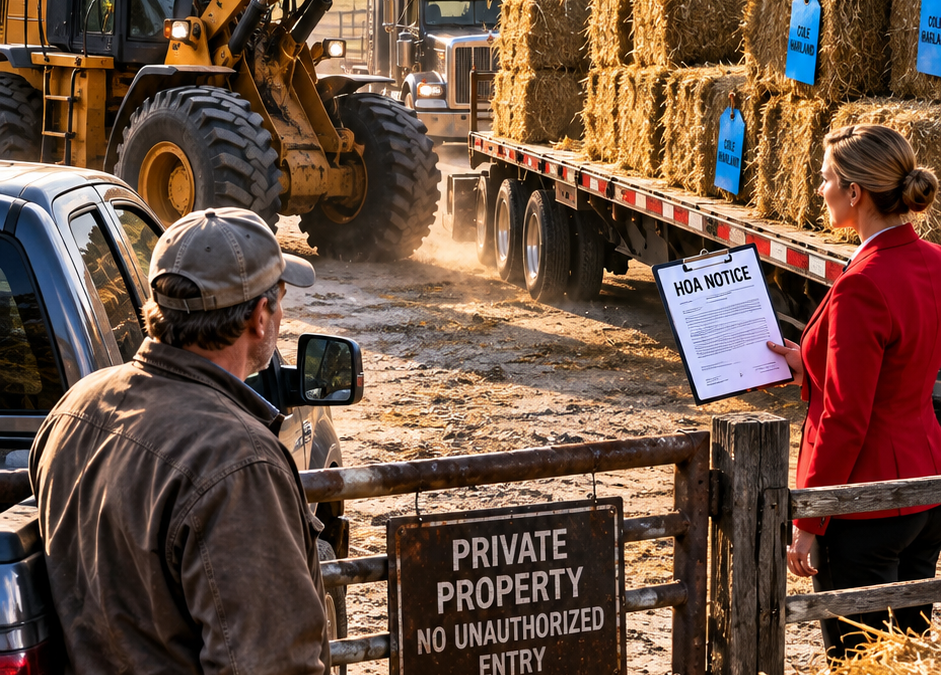
𝗙𝗨𝗟𝗟 𝗦𝗧𝗢𝗥𝗬
For the first time that morning, Marissa looked irritated rather than official.
She stepped away and made a phone call.
The loader kept moving.
I stood there counting.
Forty-eight.
Forty-seven.
Forty-six.
Every time those forks went under another bale, I felt the sale slipping further away.
Marissa returned.
“The work order stands.”
“That’s your answer?”
“Yes.”
I turned to the contractor foreman.
He had stayed mostly silent.
“Can you hold the remaining bales here while your client and I sort this out?”
He shook his head.
“My dispatcher wants the site cleared before noon.”
“Do you believe those bales belong to Silver Creek?”
“That’s not my call.”
“Do you have a county order?”
He hesitated.
“I have a dispatch instruction.”
That answer mattered.
The men moving my property were not claiming they had personally investigated anything.
They were following an order.
The real question was who had created that order and what authority had been put behind it.
The first truck pulled away.
The foreman handed me the High Ridge job number and the address of the storage yard twelve miles south.
At least he gave me that.
Marissa stood beside him.
“The board authorized protective action.”
“Then give me the written authority.”
“You have the notice.”
“No. I have a notice telling me you wanted something corrected. I’m asking for the document that says you can enter my farm, take sold inventory, and lock it behind somebody else’s fence.”
Before she answered, my phone rang.
Cole Harland.
I looked at the departing truck.
Then I answered.
“Wade?”
“Yeah.”
“Can I still get all forty-eight Thursday?”
The loader was carrying another bale toward the second flatbed.
I turned away from Marissa.
“They’re moving them.”
There was a pause.
“What do you mean, moving them?”
“Silver Creek hired a contractor. They’re taking the hay to a storage yard.”
“Can you get it back?”
“I’m trying.”
Cole exhaled.
I could hear a truck engine on his end.
“I have to make a decision by five.”
“I know.”
“If you can get them released before then, call me. Otherwise I have to buy replacement feed. I can’t gamble on those roads icing.”
“I understand.”
“I hate doing that to you, Wade.”
“You’re not doing anything to me. Feed your cattle.”
I ended the call.
Seven hours.
That was what I had.
Seven hours to recover forty-eight bales from a contractor hired by an HOA that had not yet shown me the document giving it authority to remove them.
The second flatbed idled behind Marissa.
I tried again.
“Marissa, my buyer has a deadline. Let me move the hay myself.”
“The board acted because of the emergency.”
“Then let me correct the condition.”
“It’s already being corrected.”
“By taking my property?”
“By removing combustible material from the area.”
“My covered shed is farther away.”
She folded her arms.
“The contractor is already here.”
That sentence told me more than she realized.
The decision was no longer being defended because it was the only safe option.
It was being defended because they had already started.
By noon, the gravel pad was empty.
Forty-eight bales.
Gone.
I walked the edges of the pad after the trucks left.
There were tire marks in the gravel.
One trailer had turned too sharply and caught the top wire near the gate, bending it down.
I photographed everything.
Then I downloaded the camera footage from my lane before anything could overwrite it.
At 12:47 p.m., Silver Creek management emailed me an invoice.
$3,860.
Emergency mitigation.
Two trucks.
Loader time.
Crew time.
Dispatch.
Initial storage.
More storage charges would accumulate each day.
I sat at my kitchen table and read the email twice.
Then I put the invoice beside Cole’s sales contract.
On one sheet of paper, I had promised a buyer forty-eight bales of hay.
On the other, the people preventing me from delivering them wanted me to pay for the removal.
I called High Ridge.
A dispatcher found the job number.
“Yes, sir. The material has arrived.”
“I need it released.”
“I can’t authorize that.”
“It’s mine.”
“The account is under Silver Creek.”
“I’ll pay the ordinary loading charge. I’ll bring my own truck.”
“It’s under a client-directed hold.”
“Who is the client?”
“Silver Creek.”
“Not the county?”
“No, sir.”
I sat straighter.
“Read me the service description.”
There was a pause.
“Emergency combustible material relocation.”
“Keep going.”
Another pause.
“County directed abatement per client.”
I felt something cold settle in my chest.
“Say the last part again.”
“County directed abatement per client.”
“Was a county order attached?”
“I don’t know. I’m only reading the job entry.”
“Please preserve the original job history.”
“Sir?”
“The dispatch record. The original description. Any edits. Any notes. Please do not delete anything.”
I sent an email repeating the request before I even ended the call.
I did not accuse anyone of lying.
Not yet.
I did not know who had typed those words.
I did not know when they had been entered.
But I knew the difference between a county advisory and a county order.
And I knew somebody had described my job to the contractor as county directed.
The foreman had told me I could inspect the hay after check-in, so I drove south.
The High Ridge yard sat behind chain-link fencing, surrounded by trailers, pallets, equipment, and piles of material waiting for somebody else to decide what happened to it.
My hay was less than fifty yards from the office.
All forty-eight bales were sitting on bare ground.
Uneven rows.
Two had broken twine.
One had a corner crushed hard enough that loose hay spilled beneath it.
A blue buyer tag still hung from the bale nearest the gate.
I stared at it longer than I should have.
That tag had been placed there for Cole.
Not for lawyers.
Not for an HOA.
Not for an insurance claim.
For a cattleman who had trusted me to have feed ready before a winter storm.
The yard supervisor joined me.
“I need a condition record.”
He nodded.
“We photographed intake.”
“Can I see them?”
He showed me four photographs on a tablet.
I wrote down the timestamps.
“Please preserve those.”
“We will.”
“Receiving count?”
He checked.
“Forty-eight.”
I looked through the fence.
“Can I have a release form?”
He turned the tablet around.
A box on the screen read CLIENT APPROVAL.
Blank.
“I can’t release without that.”
“I’ll pay you to load them.”
“I still need Silver Creek’s authorization.”
“I own the hay.”
“I understand.”
“No. You understand your screen. I understand the hay.”
He looked uncomfortable.
And that stopped me.
He had not come onto my farm.
He had not ordered the job.
He was a yard supervisor being asked to violate a client hold.
I lowered my voice.
“I’m not asking you to break your instructions. I’m asking you to preserve everything.”
“That I can do.”
By then, storage charges had already started ticking.
The yard could charge money to store my hay.
But it could not decide that I was allowed to touch it.
At 4:38 p.m., I sat in my truck outside the gate and called Cole.
He answered immediately.
“They won’t release it today,” I said.
He was quiet.
Then he said, “I found another load.”
I closed my eyes.
“Take it.”
“It’s more expensive.”
“Take it.”
“It’s farther out.”
“Cole.”
“Yeah?”
“Feed your cattle.”
Another pause.
“I’m sorry, Wade.”
“I know.”
Ten minutes later, his cancellation arrived by email.
There was no accusation.
No threat.
No anger.
Just one sentence explaining that the contracted load had not been available for pickup and he had been forced to secure replacement feed before the storm.
That sentence hurt worse than if he had cursed me.
Because it was true.
I had made a promise.
My hay existed.
I could see it through the fence.
And I still could not deliver it.
That evening, the forecast changed.
Freezing rain was expected sooner.
Gusty winds would arrive first.
The combination almost felt designed to make both sides of the argument worse.
Dry wind could increase fire concerns.
Rain could damage uncovered hay.
Both things could be true.
I did not need to prove wildfire danger was imaginary.
I needed to find out whether the HOA had used the authority it claimed to have before sending trucks onto my land.
I emailed the county fire office.
I attached Silver Creek’s notice.
My written response.
The High Ridge job number.
The phrase “county directed abatement.”
Then I asked three simple questions.
Had the county inspected Turner Farm before the removal?
Was there a case number?
Had any county official ordered those forty-eight bales removed?
I also demanded records from Silver Creek.
The board action.
The map sent to High Ridge.
The emergency determination.
The authority for entry.
The next morning, I carried my recorded survey to the east lane.
From the upper Silver Creek road, I could understand why residents might believe the hay sat close to them.
Perspective compressed everything.
The road.
The fence.
The loading pad.
The houses beyond it.
But standing on the ground was different.
There was the subdivision road.
The shared strip.
My fence line.
My lane.
My loading pad.
I photographed the visible survey stakes and measured toward the pad.
I wrote the numbers down.
Then I refused to rely on them.
A land dispute can become stupid very quickly when two people with tape measures decide they are surveyors.
I wanted a professional to confirm it before I made a claim.
That afternoon, Silver Creek sent its packet.
The first document was legitimate.
A seasonal wildfire advisory for the entire valley.
Dry conditions.
Vegetation concerns.
Emergency access recommendations.
Nothing about Turner Farm.
Nothing identifying my bales.
Nothing ordering removal.
The HOA resolution was more interesting.
It allowed notices and urgent corrective action when specific emergency conditions were documented.
Then came the emails.
Marissa citing county guidance.
Management contacting High Ridge.
High Ridge asking what agency basis supported the emergency classification.
And finally, a service map.
I stared at that map for a long time.
It was an aerial image.
A red box covered my loading pad.
EAST BOUNDARY HAZARD AREA.
But the image had been cropped.
The actual property line disappeared just beyond the edge.
The contractor could see where Silver Creek wanted them to go.
What the contractor could not see was whether Silver Creek controlled that location.
I forwarded the original attachment to Aaron Walsh, the property lawyer who had handled an access agreement for me years earlier.
Aaron called that evening.
“Do not edit that file.”
“I haven’t.”
“Save the original email. Save the attachment. Save the metadata if you can.”
“Already did.”
“Good. Second, we compare that map against the recorded survey.”
“I took measurements.”
“Keep them. Don’t argue them yet.”
“I think the pad is well inside my boundary.”
“Thinking is not the same as proving.”
That was why I had called Aaron.
“What do you want first?” Aaron asked.
“My hay back.”
“After that?”
“The invoice gone.”
“And after that?”
“I want to know who sent people through my gate.”
Aaron was quiet for a moment.
“Good. Keep the goals in that order.”
That night I found photographs from the Monday moisture test.
I had taken them for Cole.
One photograph showed the entire stack sitting on clean gravel.
Every blue tag.
The open travel lane.
The gate.
What had been a sales photograph was now evidence.
The county advisory talked about emergency access.
So the next morning, I stood at my gate and looked at the lane the way a firefighter would.
High Ridge’s trailer had left a rut near the shoulder.
The top fence wire was still bent.
The stack had been gone for two days, but the gate itself now opened worse than it had before the removal.
I called a volunteer fire district logistics coordinator I had known for years.
I had spent seventeen years helping that district move water, supplies, and equipment during bad seasons.
I did not ask him whether Marissa was wrong.
I did not ask him to settle a property dispute.
I asked one question.
“If the east road iced over and a tanker needed my entrance, how would you want the gate?”
“Fully open.”
“Would you use Turner’s entrance?”
“Probably. Better turning approach.”
“So I should fix this wire.”
“I would.”
That was all.
I logged the call as a practical access issue.
Not proof that my hay was safe.
That distinction mattered to me.
I did not want this fight to become a contest over who cared more about firefighters.
High Ridge sent the original map attachment later that day.
Aaron overlaid it against the recorded survey using a road bend and utility pole as fixed reference points.
Then came the call.
“The red box appears outside Silver Creek’s twenty-foot strip.”
“How far?”
“Don’t use my preliminary number.”
“So we’re right?”
“We are not done.”
Aaron’s voice sharpened.
“We need the recorded line, the original image, and a measured ground position confirmed by someone qualified. If you walk into that meeting saying a number we can’t defend, nothing else will matter.”
So I waited.
That was harder than it sounds.
When someone takes forty-eight bales from your farm and invoices you for the privilege, patience does not feel like wisdom.
It feels like surrender.
But I waited.
The county fire marshal called the following morning.
Mark Delaney.
He had reviewed what I sent.
His voice was careful.
“Our office issued the seasonal advisory.”
“Did you inspect Turner Farm?”
“I am finding no prior inspection.”
“Case number?”
“No.”
“Removal directive?”
“No county fire office directive for those bales.”
I gripped the phone.
“So Silver Creek had no authority?”
“That is not what I said.”
I almost smiled.
Delaney was doing exactly what I wished everyone else had done.
Staying inside the authority he actually had.
He continued.
“I can speak for my office. I cannot interpret the HOA covenants for you.”
“That’s enough.”
“A formal order from us would have a record.”
“Can you put that in writing?”
“Yes.”
When I hung up, I had something important.
Not a victory.
Not yet.
A boundary.
The county had issued general guidance.
The county had not inspected my hay.
The county had not ordered its removal.
Meanwhile, my property was still locked behind the High Ridge fence.
Then the rain came.
At 6:00 Thursday morning, the yard supervisor sent photographs.
They had covered the hay with tarps overnight.
Wind had lifted one edge.
Several outside bales were wet.
I was in my truck before I finished reading the message.
The road south shone black under the rain.
When I reached the yard, water had already worked under part of the first row.
The tarp had been tied down again, but two corners had been exposed.
The same bales with broken twine were worse.
I stood under the gray sky looking at the lot I had sold three days earlier.
Fresh hay does not have to become rotten to lose value.
Moisture changes what you can honestly promise.
A bale that was acceptable under one contract might not be acceptable after exposure.
“I want the affected ones separated,” I told the supervisor.
“Fine.”
“And dated photographs.”
“We can do that.”
“I want to sample moisture.”
“That’s fine too.”
“Can I take them home?”
His expression told me the answer before he spoke.
“No.”
Aaron sent an immediate demand that Silver Creek permit us to move the hay under cover even if nobody conceded liability.
High Ridge had indoor space.
But the doorway was blocked by stored equipment until Friday.
Silver Creek would not authorize a change.
Another band of rain was coming overnight.
So I had a choice.
I could leave my hay outside and later argue that Silver Creek had ruined it.
Or I could spend my own money protecting the property they had taken from me.
I paid.
Heavy tarps.
Raised pallets.
Crew time.
Restacking.
I emailed every receipt to Aaron from the yard.
The supervisor entered the work as “protection of stored material.”
No transfer.
No release.
No change in ownership.
I watched every bale move.
Not because I distrusted the crew.
Because by then I had learned what happened when the record became vague.
Friday morning, Silver Creek’s attorney, Daniel Price, approved moving the full lot under High Ridge’s roof.
His email carefully stated that the protective move did not resolve ownership, liability, entry authority, or costs.
I read it twice.
Then laughed once without humor.
The permission arrived one weather front too late.
Still, I was grateful the hay was finally under cover.
I called Cole.
He had secured replacement feed.
His cattle were covered.
The extra freight had cost him more.
“I can send the receipt,” he said.
“Keep it.”
“You don’t want it?”
“I didn’t say that. Keep it safe. But don’t buy anything else based on a promise from me until this is over.”
“You’re taking this hard.”
“I gave you my word.”
“You didn’t send those trucks.”
“But it was my hay.”
“Wade.”
I said nothing.
“My cattle got fed.”
“I know.”
“That matters too.”
It did.
It did not fix everything.
But it mattered.
Later that day, the county’s written response arrived.
No prior site inspection.
No case number.
No county fire office directive ordering removal of the hay from Turner Farm.
Aaron placed that document beside the recorded agreement between Turner Farm and Silver Creek.
The agreement gave Silver Creek limited rights inside a twenty-foot eastern strip.
Maintenance.
Access.
Certain shared concerns.
It did not automatically turn my loading pad into association property.
There was also a broader emergency clause.
That clause mattered.
It could, in some circumstances, justify urgent action outside the ordinary strip.
But it required a documented determination identifying the specific condition, its location, and why ordinary notice would not protect people in time.
Marissa’s written action summary said only:
Elevated concern along the east boundary.
No measurement.
No inspection.
No explanation of why I could not move the hay myself.
No property-specific fire determination.
Aaron still refused to promise me a legal victory.
“That gap matters,” Aaron said. “But I’m not going to tell you what a judge would do.”
“I’m not asking for a judge yet.”
“Good.”
“What I want is my property released.”
Daniel Price notified us that the $3,860 HOA invoice was suspended while the board reviewed the removal.
But the hay remained at High Ridge.
Then Saturday morning, Ruth Bell called.
Ruth lived in Silver Creek near the east road.
I knew her from volunteer fire district events.
She sounded nervous.
“Wade, can I ask you something without you getting angry?”
“Ask.”
“Was your hay blocking the emergency lane?”
“No.”
“People are sharing a picture.”
“Send it.”
A minute later, the photograph appeared.
I understood immediately.
It had been tightly cropped.
From that angle, my hay looked almost pressed against the road.
The open lane was outside the frame.
The gate was outside the frame.
Most of the gravel pad was outside the frame.
“I have the original view,” I told her.
Ruth hesitated.
“I took a picture that morning too.”
“Can you send it?”
Her photograph arrived.
Wide frame.
Open lane.
Farm gate.
Hay clearly sitting on the separate pad.
Same morning.
Same location.
Different framing.
“I really was worried,” Ruth said.
“I believe you.”
“My daughter’s bedroom faces that direction.”
“I believe that too.”
“You’re not saying there wasn’t any fire risk.”
“No. I’m saying the lane wasn’t blocked.”
The silence between us changed.
Not friendship.
Not agreement.
Something better.
A shared set of facts.
Aaron asked Ruth for permission to preserve the original photograph without publicly circulating anything that showed more of her home than necessary.
She agreed.
Sunday brought ice.
I drove slowly along the east side of the farm.
Without the hay, the pad looked almost too empty.
Then I tried the gate.
It caught.
The bent top wire pulled it sideways.
The contractor’s trailer had damaged the entrance badly enough that the gate could no longer swing fully open.
I stood there staring at it.
Silver Creek had removed my hay partly under the language of emergency access.
And the actual obstruction now affecting the entrance had been created by the removal crew.
I photographed the wire with a ruler for scale.
Then I hired a fencing crew.
No speeches.
No dramatic signs.
I wanted the gate working.
A neutral feed inspector went to High Ridge that afternoon.
We checked all forty-eight lot marks.
Forty-one bales were sound.
Five had reduced grade because of handling and exposure.
Two had elevated moisture and broken twine.
The supervisor signed the condition record.
Then, after documenting all of that, he still could not release them.
Because the computer box marked CLIENT APPROVAL was still empty.
Monday evening, Aaron and I walked into the Silver Creek clubhouse.
My hay had been gone for almost a week.
Cole had bought replacement feed.
I had paid to protect hay I was not allowed to move.
The HOA’s invoice was suspended but not fully withdrawn.
Storage was still accruing.
And five board members were about to decide whether the association would tell High Ridge to open its gate.
Board President Martin Hail sat in the center.
Four directors beside him.
Marissa was there.
The property manager.
Daniel Price, the HOA attorney.
Several residents waited outside.
One of them had complained about the fire risk.
I did not resent him.
If I believed somebody was blocking an emergency road with dry hay near my family, I would have asked questions too.
Martin began.
“We need to be clear that the board has an obligation to protect Silver Creek residents.”
“I agree,” I said.
Marissa looked at me.
Maybe she had expected a fight in the first sentence.
She presented her case.
The wildfire advisory was real.
The weather had been dry.
My farm stored combustible agricultural material near homes.
Wind had been forecast.
The association had limited access rights near the east boundary.
Waiting, she argued, might have exposed residents to unnecessary danger.
She spoke calmly.
For several minutes, I understood why someone listening without the documents might agree with her.
Then Aaron spoke.
“Can we separate the issues?”
Daniel nodded.
Aaron turned toward the board.
“Could Silver Creek warn residents about wildfire conditions?”
No one objected.
“Could Silver Creek send Mr. Turner a notice if the association believed its governing documents applied?”
Again, no real argument.
“Could a county fire agency order abatement under its own lawful authority?”
Daniel answered.
“Yes.”
Aaron nodded.
“Then the remaining question is narrower. What documented authority supported this specific entry onto Turner Farm and removal of this specific inventory?”
Marissa lifted the service map.
“The hazard area is marked.”
Aaron did not argue.
Instead, Aaron asked the property manager a question.
“Can you show the board the property line on the map that was sent to High Ridge?”
He looked down.
Turned the page.
Turned it back.
His finger moved along the eastern road.
Then stopped.
The room became quiet.
The line was not there.
The image ended before the property boundary became visible.
Aaron unfolded the recorded survey.
The full version.
Road.
Fence.
Shared strip.
Farm.
Loading pad.
Then Aaron placed the contractor map beside it.
The red box sat over my loading pad.
Not the HOA strip.
My loading pad.
Daniel looked at me.
“You took a field measurement?”
“Yes.”
“Explain how.”
I described the old survey marker near the eastern fence.
The corner.
The lane.
The pad.
The reference points.
The photographs.
Then I explained that I had not relied on my own measurement alone.
A survey professional had checked the scale against the recorded plan.
Aaron looked at me.
That was the signal.
I finally gave the number I had refused to use all week.
“The nearest corner of the gravel loading pad is ninety-six feet inside the Turner Farm boundary.”
One director looked up sharply.
I continued.
“Silver Creek’s ordinary maintenance strip extends twenty feet from the recorded line.”
Martin leaned toward the survey.
“Ninety-six feet?”
“Yes.”
“The road looks much tighter from our side.”
“It does.”
I slid Ruth’s photograph forward.
“This is a wider image taken by a Silver Creek resident that morning.”
The board studied it.
The open travel lane was obvious.
Then I placed another photograph beside it.
“This is the gate after High Ridge’s trailer struck the wire.”
Martin looked from one image to the other.
Marissa spoke.
“Distance does not eliminate a fire hazard.”
Aaron nodded immediately.
“Correct.”
Marissa seemed surprised.
Aaron continued.
“The association’s emergency clause could potentially address a dangerous condition beyond the ordinary twenty-foot strip. That is why the boundary alone does not end the analysis.”
Then Aaron placed Marissa’s one-page emergency summary on the table.
“The clause requires a documented determination identifying the condition, its location, and why ordinary notice would be inadequate.”
Marissa looked down.
Her summary contained one phrase.
Elevated concern along the east boundary.
Aaron tapped it.
“This does not identify a measured condition on the loading pad.”
“I had county guidance,” Marissa said.
Daniel Price opened the county response.
“The county issued the valleywide advisory.”
Marissa looked at him.
Daniel continued.
“The county did not inspect Turner Farm before removal and did not issue an abatement order for these bales.”
Nobody spoke.
Then Aaron opened the High Ridge dispatch audit.
That was the document I had been waiting to see.
The first service request had read:
HOA directed relocation. County wildfire guidance attached.
That was accurate enough.
Silver Creek wanted the work.
County guidance existed.
Then came a later entry.
County directed abatement per client.
A call note showed that the property manager’s office had asked whether the job could receive an emergency classification so a crew would be dispatched quickly.
The manager shifted in his chair.
“High Ridge chose that wording.”
Aaron nodded.
“The record does not establish that Ms. Cole personally typed it.”
I appreciated that.
Facts mattered even when they helped the other side.
Aaron continued.
“But dispatch wording cannot create a county order that did not exist.”
I watched one board member place the documents side by side.
County advisory.
Dispatch entry.
General guidance on one page.
Specific “county directed abatement” on another.
Somewhere between those two documents, a warning issued to an entire valley had become a work order aimed at my farm.
And the cropped map had directed the contractor to a location ninety-six feet inside my boundary without showing the boundary itself.
For the first time since the trucks entered my gate, the room stopped arguing about whether wildfire was serious.
Everybody agreed wildfire was serious.
The question had become more precise.
What had Silver Creek actually authorized?
And what proof had existed when they crossed onto my property?
Aaron closed the file.
“Whatever the board eventually decides about liability, High Ridge is holding Mr. Turner’s inventory under a Silver Creek work order. He is paying to preserve hay that he could shelter on his own property.”
Daniel looked at the board.
“I recommend you address release separately from the ultimate claim.”
Martin called a recess.
Aaron and I waited in the hall.
The building’s heating system clicked behind the walls.
I stared at the floor.
“You all right?” Aaron asked.
“No.”
“That was not a legal question.”
“I know.”
I rubbed my hands together.
“Cole already bought feed.”
“Yes.”
“I can’t fix that.”
“No.”
“My sale is gone.”
“Yes.”
I looked toward the closed doors.
“So what are we doing?”
Aaron answered without hesitation.
“Stopping the next loss.”
The doors opened.
We went back inside.
Martin read the motions slowly.
Silver Creek would authorize immediate return of all forty-eight bales after a joint inventory and independent condition record.
The $3,860 mitigation charge would be withdrawn while the damage claim was reviewed.
Marissa’s authority to approve contractor entry beyond HOA-controlled land would be suspended.
The work order audit and mapping process would be sent to the association’s insurer and outside counsel.
Each action would be entered into the minutes.
Marissa asked that the minutes also reflect her concern for resident safety.
Martin agreed.
Then he said something I remembered long after everything else was settled.
“Emergency procedures matter most when the association is acting quickly against property it does not own.”
I did not need Marissa humiliated.
I did not need anybody thrown out of the room.
I needed the gate at High Ridge opened.
The written vote finally did that.
The next morning, I stood beside the yard supervisor while every lot mark was called aloud.
One by one.
Forty-eight.
The feed inspector checked condition again.
Forty-one sound.
Five reduced grade.
Two wet enough that they could no longer be represented as the feed Cole had originally purchased.
We loaded the damaged bales separately.
I paid for the return transport under protest and saved the receipt.
When the first truck turned into Turner Farm, I stopped the driver before he entered.
“Give me a minute.”
I checked the repaired gate.
The fencing crew had straightened the damaged section.
The turn was clear.
The driver eased through without touching the wire.
For the first time in a week, my hay came through that entrance because I had authorized the movement.
We unloaded the forty-one sound bales onto the gravel pad.
The five reduced-grade bales went under separate cover.
The two damaged bales were isolated pending disposal or safe non-feed use.
I stood there after the trucks left.
I had the inventory back.
But return was not restoration.
Cole’s contract was still gone.
The storm had already passed.
The extra freight had already been paid.
The damaged hay did not become undamaged because someone finally admitted it should be released.
That afternoon, I called Ruth.
“I heard they brought the hay back,” she said.
“They did.”
“What did the survey show?”
“The loading pad is outside the shared strip. Ninety-six feet inside my boundary.”
She was quiet.
“And the county?”
“No removal order.”
Another pause.
“Are you still going to keep the lane open?”
“Yes.”
“Even after this?”
I looked toward the east gate.
“Ruth, I was keeping it open before this.”
She gave a small laugh.
“Fair.”
“Before the next cutting, if some residents want to meet me at the boundary, I’ll show you the lane from this side.”
“You would do that?”
“Yes.”
“Why?”
“Because a cropped photograph caused enough trouble.”
She said she thought people would come.
That mattered too.
Cole stopped by after the second truck returned.
He stood at the edge of the pad and looked over the bales.
“My cattle are already eating the replacement load,” he said.
“I figured.”
“You get everything back?”
“Everything physically.”
He understood the distinction.
I asked, “When you need hay again, do you want first look at the sound bales?”
“Maybe.”
“You don’t owe me anything.”
“I know.”
“If the quality works for you—”
“Wade.”
I stopped.
“I’m not going to undo a purchase just because you feel bad.”
I nodded.
“That’s fair.”
“You had a mess.”
“I still missed the delivery.”
“You did.”
That answer helped more than forgiveness would have.
The original deal had failed.
A real resolution had to acknowledge that.
It could not pretend the week had never happened.
The insurer’s adjuster came to Turner Farm the following week.
I walked her through everything.
The loading pad.
The east lane.
The repaired fence.
The gate.
The Monday moisture photographs taken before removal.
High Ridge’s intake photographs.
The neutral condition report.
Cole’s canceled contract.
The transport invoices.
The fencing bill.
The later sales.
By then, I had sold the forty-one sound bales to another buyer, but the net return was lower after the extra handling.
The five reduced-grade bales sold for less.
The two wet bales could not be sold as the original contracted feed grade.
Every figure had a corresponding document.
Aaron built the damages spreadsheet.
The adjuster challenged it.
One line counted reduced bale value.
Another counted part of the canceled transaction in a way that overlapped the same loss.
Aaron deleted the duplication.
I was glad.
I did not want the largest number we could invent.
I wanted a number we could defend.
The adjuster challenged part of the transportation claim too.
“You might have paid delivery costs on a normal sale.”
Aaron separated normal farm handling from the extra trip caused by the removal.
Another line came out.
Again, the total went down.
Again, the claim got stronger.
Cole sent his freight receipt.
He had paid more to bring replacement feed in before the ice.
That money was his loss, not mine.
We did not put it into my claim as though I had paid it.
With his written consent, Aaron arranged a separate discussion about the reasonable additional cost he had incurred.
The fencing crew supplied its dated job ticket and a photograph showing the bent wire before repair.
The adjuster accepted that damage.
For the two wet bales, the feed inspector would not certify them at the grade Cole had purchased.
Once inspection was complete, I arranged safe non-feed use.
I was not going to keep spoiled hay sealed in a corner just so it looked more dramatic in a claim.
The five reduced-grade bales were sold honestly, with their condition disclosed.
For the forty-one sound bales, I kept the later buyer’s invoice and deducted the actual resale proceeds from the interrupted transaction.
Receipts.
Photographs.
Dates.
Lot numbers.
Maps.
The paperwork was not exciting.
That was exactly why it mattered.
Three weeks later, the settlement was completed.
There was no courtroom spectacle.
No criminal prosecution.
No miraculous payout.
Silver Creek and its insurer agreed to cover the supported loss in hay value, the extra transportation and handling caused by the removal, documented fence and pad repairs, and a supported portion of the economic loss connected to the canceled sale.
Cole’s additional freight was handled separately with his consent.
The HOA’s $3,860 charge stayed withdrawn.
High Ridge waived the contested storage fees that had accumulated while Silver Creek blocked the release.
I signed the civil settlement.
Then I went back to work.
Silver Creek revised its emergency procedure.
Future contractor requests had to identify the property.
The precise location.
The authority for entry.
The specific condition being addressed.
The person approving the work.
If anybody claimed a county order existed, the actual order had to be placed in the file.
A valleywide advisory could still warn people about danger.
It could not be quietly converted into a property-specific command.
Management was also required to compare contractor maps against recorded boundaries before work crossed from HOA-controlled land onto somebody else’s property.
Marissa remained on the board.
She did not lose her house.
She was not marched out of Silver Creek.
She did not become the villain in some dramatic public downfall.
She did lose the unilateral contractor authority she had used the morning my hay disappeared.
That was enough for me.
I did not need her ruined.
I needed the next farmer, mechanic, landowner, or rancher beside Silver Creek to have something stronger protecting his property than the hope that everyone involved would remember where the boundary was.
A month later, I was loading another cutting from the same gravel pad.
The sky was clear.
No wind warnings.
No freezing rain.
The bale tester gave me numbers I liked.
A buyer’s driver backed through the gate and stopped exactly where I wanted him.
The repaired wire held straight.
I had moved one small sign so the turn was easier to see from the lane.
Nothing about that morning looked important.
That was the beauty of it.
A farm should be allowed to have ordinary mornings.
Cole drove past while I was working and pulled over.
He leaned out of his window.
“You got enough help for that last row?”
“I’m good.”
He looked toward the stack.
Then toward Silver Creek.
“Everybody know where the boundary is now?”
I smiled.
“They’ve got the full map.”
Cole laughed once.
“About time.”
Then he drove away.
I watched the loader lift another bale and place it onto the trailer.
The driver climbed out.
Checked every strap.
Handed me the load sheet.
I read it.
Then I signed.
A few minutes later, the truck rolled toward the gate.
This time, the hay left Turner Farm because a buyer had arranged to take it.
And because I had agreed to let it go.
For seventeen years with the volunteer fire district, I had watched people move fast when danger was real.
I had seen quick decisions save buildings.
Protect families.
Keep a grass fire from reaching a barn.
I had never stopped believing speed mattered.
But after those forty-eight blue tags disappeared down my driveway, I understood something else.
The faster power moves, the more precise the record behind it has to be.
A vague warning can become a specific order surprisingly quickly.
A general advisory can turn into “county directed abatement.”
A red box can appear on a cropped map.
A crew can arrive before anyone notices the property line is missing.
And once the trucks are moving, every person involved can honestly believe somebody else already checked.
That was what stayed with me.
Not the settlement.
Not the board meeting.
Not even the ninety-six feet between Silver Creek’s boundary and my loading pad.
It was the sight of those blue buyer tags dragging against the rails of a flatbed while a woman stood in my lane holding a notice that did not answer my question.
I still maintain the east strip.
I still keep the access lane open.
When wildfire warnings come, I read every one.
When the wind rises across the valley, I watch the fields just like my neighbors do.
Their houses matter.
Their safety matters.
So does the line between acting fast and acting without proof.
Because when someone decides an emergency gives them the right to cross onto another person’s land, take his property, and make the consequences his problem, the paperwork is not a technicality.
It is the line that tells everyone where authority ends.
And where my farm begins.
What do you think of this story? Please leave a like and share your thoughts in the comments. Your support means a lot to us and inspires us to keep writing more meaningful and powerful stories. Thank you! 👍
𝗧𝗛𝗘 𝗘𝗡𝗗
The Blue Tags on My Hay Were Still There When Marissa Told Me I No Longer Controlled What Left My Own Gate
Forty-eight bales of hay had been sitting on my gravel loading pad at sunrise.
By breakfast, strangers were hauling them through my gate.
And the woman who ordered it kept holding up a piece of paper that never answered the only question that mattered.
Who had given her the right to take them?
My name is Wade Turner.
I was fifty-three years old, and I had worked Turner Farm for twenty-six years when Silver Creek decided my hay had become an emergency.
The first flatbed was already through my gate when I saw the blue buyer tags swinging from the bales.
For a second, I could not make sense of what I was looking at.
An orange loader moved across my loading pad, diesel engine growling in the cold morning air. Its forks slid under one of my large square bales, lifted it, turned, and carried it toward a waiting trailer.
A woman in a red blazer stood in the lane with an HOA notice in her hand.
Marissa Cole.
She was one of the directors at Silver Creek, the residential development built along the eastern edge of my farm.
“Stay clear of the equipment,” she called.
I stopped beside my truck.
“What are you doing?”
“Emergency fire mitigation.”
The loader dropped another bale onto the trailer.
One of the blue tags scraped against the steel rail.
COLE HARLAND.
I could read the buyer’s name from where I stood.
That tag mattered.
Every one of those forty-eight bales had already been sold.
Two hundred dollars each.
Nine thousand six hundred dollars.
Cole Harland ran cattle eighteen miles away, and he was supposed to collect the entire lot on Thursday. A cold front was moving in fast. Wind first. Then freezing rain. Then ice.
He needed his feed staged before the roads became dangerous.
I had promised it would be ready.
Now I was watching someone else remove it from my property.
“Who declared the emergency?” I asked.
Marissa lifted the notice.
“The county issued wildfire guidance. We acted on it.”
“That wasn’t my question.”
Her expression tightened.
I walked closer, but I stayed clear of the loader.
“Who at the county told you to take my hay?”
She did not answer.
Instead, she raised the paper a little higher, as though the notice itself had driven the trucks through my gate.
I pulled out my phone.
I filmed the contractor’s name.
High Ridge Property Services.
I filmed the license plates.
The loader number.
The first trailer.
The gate.
The clock on my phone.
Then I pointed the camera toward the buyer tags still hanging from the hay.
Marissa watched me.
“You need to move away from the work zone.”
“I’m on my lane.”
“This work has been authorized.”
“By whom?”
“The board.”
“Show me.”
She held up the notice again.
I almost laughed.
Not because anything was funny.
Because I had already seen that notice.
It had arrived two days earlier.
It said the bales stacked near the eastern boundary of Turner Farm constituted a combustible condition and ordered me to correct it.
I had responded that same afternoon.
The hay was not abandoned brush.
It was not rotting vegetation.
It was fresh agricultural inventory stacked on a gravel loading pad.
It had a buyer.
It had a scheduled pickup.
I had asked Silver Creek to identify the exact rule they believed I had violated, the boundary they believed applied, and any property-specific fire order that required removal.
Marissa never answered those questions.
She sent a loader.
I looked past her.
The first flatbed was nearly full.
“Give me ten minutes.”
“For what?”
“I’ll move every bale into my equipment shed.”
She frowned.
“The contractor has already mobilized.”
“The shed is farther from Silver Creek than this pad. If the concern is fire exposure, that solves it.”
“The work order has already been issued.”
“Then change the work order.”
“That requires management.”
“Call management.”
For the first time that morning, Marissa looked irritated rather than official.
She stepped away and made a phone call.
The loader kept moving.
I stood there counting.
Forty-eight.
Forty-seven.
Forty-six.
Every time those forks went under another bale, I felt the sale slipping further away.
Marissa returned.
“The work order stands.”
“That’s your answer?”
“Yes.”
I turned to the contractor foreman.
He had stayed mostly silent.
“Can you hold the remaining bales here while your client and I sort this out?”
He shook his head.
“My dispatcher wants the site cleared before noon.”
“Do you believe those bales belong to Silver Creek?”
“That’s not my call.”
“Do you have a county order?”
He hesitated.
“I have a dispatch instruction.”
That answer mattered.
The men moving my property were not claiming they had personally investigated anything.
They were following an order.
The real question was who had created that order and what authority had been put behind it.
The first truck pulled away.
The foreman handed me the High Ridge job number and the address of the storage yard twelve miles south.
At least he gave me that.
Marissa stood beside him.
“The board authorized protective action.”
“Then give me the written authority.”
“You have the notice.”
“No. I have a notice telling me you wanted something corrected. I’m asking for the document that says you can enter my farm, take sold inventory, and lock it behind somebody else’s fence.”
Before she answered, my phone rang.
Cole Harland.
I looked at the departing truck.
Then I answered.
“Wade?”
“Yeah.”
“Can I still get all forty-eight Thursday?”
The loader was carrying another bale toward the second flatbed.
I turned away from Marissa.
“They’re moving them.”
There was a pause.
“What do you mean, moving them?”
“Silver Creek hired a contractor. They’re taking the hay to a storage yard.”
“Can you get it back?”
“I’m trying.”
Cole exhaled.
I could hear a truck engine on his end.
“I have to make a decision by five.”
“I know.”
“If you can get them released before then, call me. Otherwise I have to buy replacement feed. I can’t gamble on those roads icing.”
“I understand.”
“I hate doing that to you, Wade.”
“You’re not doing anything to me. Feed your cattle.”
I ended the call.
Seven hours.
That was what I had.
Seven hours to recover forty-eight bales from a contractor hired by an HOA that had not yet shown me the document giving it authority to remove them.
The second flatbed idled behind Marissa.
I tried again.
“Marissa, my buyer has a deadline. Let me move the hay myself.”
“The board acted because of the emergency.”
“Then let me correct the condition.”
“It’s already being corrected.”
“By taking my property?”
“By removing combustible material from the area.”
“My covered shed is farther away.”
She folded her arms.
“The contractor is already here.”
That sentence told me more than she realized.
The decision was no longer being defended because it was the only safe option.
It was being defended because they had already started.
By noon, the gravel pad was empty.
Forty-eight bales.
Gone.
I walked the edges of the pad after the trucks left.
There were tire marks in the gravel.
One trailer had turned too sharply and caught the top wire near the gate, bending it down.
I photographed everything.
Then I downloaded the camera footage from my lane before anything could overwrite it.
At 12:47 p.m., Silver Creek management emailed me an invoice.
$3,860.
Emergency mitigation.
Two trucks.
Loader time.
Crew time.
Dispatch.
Initial storage.
More storage charges would accumulate each day.
I sat at my kitchen table and read the email twice.
Then I put the invoice beside Cole’s sales contract.
On one sheet of paper, I had promised a buyer forty-eight bales of hay.
On the other, the people preventing me from delivering them wanted me to pay for the removal.
I called High Ridge.
A dispatcher found the job number.
“Yes, sir. The material has arrived.”
“I need it released.”
“I can’t authorize that.”
“It’s mine.”
“The account is under Silver Creek.”
“I’ll pay the ordinary loading charge. I’ll bring my own truck.”
“It’s under a client-directed hold.”
“Who is the client?”
“Silver Creek.”
“Not the county?”
“No, sir.”
I sat straighter.
“Read me the service description.”
There was a pause.
“Emergency combustible material relocation.”
“Keep going.”
Another pause.
“County directed abatement per client.”
I felt something cold settle in my chest.
“Say the last part again.”
“County directed abatement per client.”
“Was a county order attached?”
“I don’t know. I’m only reading the job entry.”
“Please preserve the original job history.”
“Sir?”
“The dispatch record. The original description. Any edits. Any notes. Please do not delete anything.”
I sent an email repeating the request before I even ended the call.
I did not accuse anyone of lying.
Not yet.
I did not know who had typed those words.
I did not know when they had been entered.
But I knew the difference between a county advisory and a county order.
And I knew somebody had described my job to the contractor as county directed.
The foreman had told me I could inspect the hay after check-in, so I drove south.
The High Ridge yard sat behind chain-link fencing, surrounded by trailers, pallets, equipment, and piles of material waiting for somebody else to decide what happened to it.
My hay was less than fifty yards from the office.
All forty-eight bales were sitting on bare ground.
Uneven rows.
Two had broken twine.
One had a corner crushed hard enough that loose hay spilled beneath it.
A blue buyer tag still hung from the bale nearest the gate.
I stared at it longer than I should have.
That tag had been placed there for Cole.
Not for lawyers.
Not for an HOA.
Not for an insurance claim.
For a cattleman who had trusted me to have feed ready before a winter storm.
The yard supervisor joined me.
“I need a condition record.”
He nodded.
“We photographed intake.”
“Can I see them?”
He showed me four photographs on a tablet.
I wrote down the timestamps.
“Please preserve those.”
“We will.”
“Receiving count?”
He checked.
“Forty-eight.”
I looked through the fence.
“Can I have a release form?”
He turned the tablet around.
A box on the screen read CLIENT APPROVAL.
Blank.
“I can’t release without that.”
“I’ll pay you to load them.”
“I still need Silver Creek’s authorization.”
“I own the hay.”
“I understand.”
“No. You understand your screen. I understand the hay.”
He looked uncomfortable.
And that stopped me.
He had not come onto my farm.
He had not ordered the job.
He was a yard supervisor being asked to violate a client hold.
I lowered my voice.
“I’m not asking you to break your instructions. I’m asking you to preserve everything.”
“That I can do.”
By then, storage charges had already started ticking.
The yard could charge money to store my hay.
But it could not decide that I was allowed to touch it.
At 4:38 p.m., I sat in my truck outside the gate and called Cole.
He answered immediately.
“They won’t release it today,” I said.
He was quiet.
Then he said, “I found another load.”
I closed my eyes.
“Take it.”
“It’s more expensive.”
“Take it.”
“It’s farther out.”
“Cole.”
“Yeah?”
“Feed your cattle.”
Another pause.
“I’m sorry, Wade.”
“I know.”
Ten minutes later, his cancellation arrived by email.
There was no accusation.
No threat.
No anger.
Just one sentence explaining that the contracted load had not been available for pickup and he had been forced to secure replacement feed before the storm.
That sentence hurt worse than if he had cursed me.
Because it was true.
I had made a promise.
My hay existed.
I could see it through the fence.
And I still could not deliver it.
That evening, the forecast changed.
Freezing rain was expected sooner.
Gusty winds would arrive first.
The combination almost felt designed to make both sides of the argument worse.
Dry wind could increase fire concerns.
Rain could damage uncovered hay.
Both things could be true.
I did not need to prove wildfire danger was imaginary.
I needed to find out whether the HOA had used the authority it claimed to have before sending trucks onto my land.
I emailed the county fire office.
I attached Silver Creek’s notice.
My written response.
The High Ridge job number.
The phrase “county directed abatement.”
Then I asked three simple questions.
Had the county inspected Turner Farm before the removal?
Was there a case number?
Had any county official ordered those forty-eight bales removed?
I also demanded records from Silver Creek.
The board action.
The map sent to High Ridge.
The emergency determination.
The authority for entry.
The next morning, I carried my recorded survey to the east lane.
From the upper Silver Creek road, I could understand why residents might believe the hay sat close to them.
Perspective compressed everything.
The road.
The fence.
The loading pad.
The houses beyond it.
But standing on the ground was different.
There was the subdivision road.
The shared strip.
My fence line.
My lane.
My loading pad.
I photographed the visible survey stakes and measured toward the pad.
I wrote the numbers down.
Then I refused to rely on them.
A land dispute can become stupid very quickly when two people with tape measures decide they are surveyors.
I wanted a professional to confirm it before I made a claim.
That afternoon, Silver Creek sent its packet.
The first document was legitimate.
A seasonal wildfire advisory for the entire valley.
Dry conditions.
Vegetation concerns.
Emergency access recommendations.
Nothing about Turner Farm.
Nothing identifying my bales.
Nothing ordering removal.
The HOA resolution was more interesting.
It allowed notices and urgent corrective action when specific emergency conditions were documented.
Then came the emails.
Marissa citing county guidance.
Management contacting High Ridge.
High Ridge asking what agency basis supported the emergency classification.
And finally, a service map.
I stared at that map for a long time.
It was an aerial image.
A red box covered my loading pad.
EAST BOUNDARY HAZARD AREA.
But the image had been cropped.
The actual property line disappeared just beyond the edge.
The contractor could see where Silver Creek wanted them to go.
What the contractor could not see was whether Silver Creek controlled that location.
I forwarded the original attachment to Aaron Walsh, the property lawyer who had handled an access agreement for me years earlier.
Aaron called that evening.
“Do not edit that file.”
“I haven’t.”
“Save the original email. Save the attachment. Save the metadata if you can.”
“Already did.”
“Good. Second, we compare that map against the recorded survey.”
“I took measurements.”
“Keep them. Don’t argue them yet.”
“I think the pad is well inside my boundary.”
“Thinking is not the same as proving.”
That was why I had called Aaron.
“What do you want first?” Aaron asked.
“My hay back.”
“After that?”
“The invoice gone.”
“And after that?”
“I want to know who sent people through my gate.”
Aaron was quiet for a moment.
“Good. Keep the goals in that order.”
That night I found photographs from the Monday moisture test.
I had taken them for Cole.
One photograph showed the entire stack sitting on clean gravel.
Every blue tag.
The open travel lane.
The gate.
What had been a sales photograph was now evidence.
The county advisory talked about emergency access.
So the next morning, I stood at my gate and looked at the lane the way a firefighter would.
High Ridge’s trailer had left a rut near the shoulder.
The top fence wire was still bent.
The stack had been gone for two days, but the gate itself now opened worse than it had before the removal.
I called a volunteer fire district logistics coordinator I had known for years.
I had spent seventeen years helping that district move water, supplies, and equipment during bad seasons.
I did not ask him whether Marissa was wrong.
I did not ask him to settle a property dispute.
I asked one question.
“If the east road iced over and a tanker needed my entrance, how would you want the gate?”
“Fully open.”
“Would you use Turner’s entrance?”
“Probably. Better turning approach.”
“So I should fix this wire.”
“I would.”
That was all.
I logged the call as a practical access issue.
Not proof that my hay was safe.
That distinction mattered to me.
I did not want this fight to become a contest over who cared more about firefighters.
High Ridge sent the original map attachment later that day.
Aaron overlaid it against the recorded survey using a road bend and utility pole as fixed reference points.
Then came the call.
“The red box appears outside Silver Creek’s twenty-foot strip.”
“How far?”
“Don’t use my preliminary number.”
“So we’re right?”
“We are not done.”
Aaron’s voice sharpened.
“We need the recorded line, the original image, and a measured ground position confirmed by someone qualified. If you walk into that meeting saying a number we can’t defend, nothing else will matter.”
So I waited.
That was harder than it sounds.
When someone takes forty-eight bales from your farm and invoices you for the privilege, patience does not feel like wisdom.
It feels like surrender.
But I waited.
The county fire marshal called the following morning.
Mark Delaney.
He had reviewed what I sent.
His voice was careful.
“Our office issued the seasonal advisory.”
“Did you inspect Turner Farm?”
“I am finding no prior inspection.”
“Case number?”
“No.”
“Removal directive?”
“No county fire office directive for those bales.”
I gripped the phone.
“So Silver Creek had no authority?”
“That is not what I said.”
I almost smiled.
Delaney was doing exactly what I wished everyone else had done.
Staying inside the authority he actually had.
He continued.
“I can speak for my office. I cannot interpret the HOA covenants for you.”
“That’s enough.”
“A formal order from us would have a record.”
“Can you put that in writing?”
“Yes.”
When I hung up, I had something important.
Not a victory.
Not yet.
A boundary.
The county had issued general guidance.
The county had not inspected my hay.
The county had not ordered its removal.
Meanwhile, my property was still locked behind the High Ridge fence.
Then the rain came.
At 6:00 Thursday morning, the yard supervisor sent photographs.
They had covered the hay with tarps overnight.
Wind had lifted one edge.
Several outside bales were wet.
I was in my truck before I finished reading the message.
The road south shone black under the rain.
When I reached the yard, water had already worked under part of the first row.
The tarp had been tied down again, but two corners had been exposed.
The same bales with broken twine were worse.
I stood under the gray sky looking at the lot I had sold three days earlier.
Fresh hay does not have to become rotten to lose value.
Moisture changes what you can honestly promise.
A bale that was acceptable under one contract might not be acceptable after exposure.
“I want the affected ones separated,” I told the supervisor.
“Fine.”
“And dated photographs.”
“We can do that.”
“I want to sample moisture.”
“That’s fine too.”
“Can I take them home?”
His expression told me the answer before he spoke.
“No.”
Aaron sent an immediate demand that Silver Creek permit us to move the hay under cover even if nobody conceded liability.
High Ridge had indoor space.
But the doorway was blocked by stored equipment until Friday.
Silver Creek would not authorize a change.
Another band of rain was coming overnight.
So I had a choice.
I could leave my hay outside and later argue that Silver Creek had ruined it.
Or I could spend my own money protecting the property they had taken from me.
I paid.
Heavy tarps.
Raised pallets.
Crew time.
Restacking.
I emailed every receipt to Aaron from the yard.
The supervisor entered the work as “protection of stored material.”
No transfer.
No release.
No change in ownership.
I watched every bale move.
Not because I distrusted the crew.
Because by then I had learned what happened when the record became vague.
Friday morning, Silver Creek’s attorney, Daniel Price, approved moving the full lot under High Ridge’s roof.
His email carefully stated that the protective move did not resolve ownership, liability, entry authority, or costs.
I read it twice.
Then laughed once without humor.
The permission arrived one weather front too late.
Still, I was grateful the hay was finally under cover.
I called Cole.
He had secured replacement feed.
His cattle were covered.
The extra freight had cost him more.
“I can send the receipt,” he said.
“Keep it.”
“You don’t want it?”
“I didn’t say that. Keep it safe. But don’t buy anything else based on a promise from me until this is over.”
“You’re taking this hard.”
“I gave you my word.”
“You didn’t send those trucks.”
“But it was my hay.”
“Wade.”
I said nothing.
“My cattle got fed.”
“I know.”
“That matters too.”
It did.
It did not fix everything.
But it mattered.
Later that day, the county’s written response arrived.
No prior site inspection.
No case number.
No county fire office directive ordering removal of the hay from Turner Farm.
Aaron placed that document beside the recorded agreement between Turner Farm and Silver Creek.
The agreement gave Silver Creek limited rights inside a twenty-foot eastern strip.
Maintenance.
Access.
Certain shared concerns.
It did not automatically turn my loading pad into association property.
There was also a broader emergency clause.
That clause mattered.
It could, in some circumstances, justify urgent action outside the ordinary strip.
But it required a documented determination identifying the specific condition, its location, and why ordinary notice would not protect people in time.
Marissa’s written action summary said only:
Elevated concern along the east boundary.
No measurement.
No inspection.
No explanation of why I could not move the hay myself.
No property-specific fire determination.
Aaron still refused to promise me a legal victory.
“That gap matters,” Aaron said. “But I’m not going to tell you what a judge would do.”
“I’m not asking for a judge yet.”
“Good.”
“What I want is my property released.”
Daniel Price notified us that the $3,860 HOA invoice was suspended while the board reviewed the removal.
But the hay remained at High Ridge.
Then Saturday morning, Ruth Bell called.
Ruth lived in Silver Creek near the east road.
I knew her from volunteer fire district events.
She sounded nervous.
“Wade, can I ask you something without you getting angry?”
“Ask.”
“Was your hay blocking the emergency lane?”
“No.”
“People are sharing a picture.”
“Send it.”
A minute later, the photograph appeared.
I understood immediately.
It had been tightly cropped.
From that angle, my hay looked almost pressed against the road.
The open lane was outside the frame.
The gate was outside the frame.
Most of the gravel pad was outside the frame.
“I have the original view,” I told her.
Ruth hesitated.
“I took a picture that morning too.”
“Can you send it?”
Her photograph arrived.
Wide frame.
Open lane.
Farm gate.
Hay clearly sitting on the separate pad.
Same morning.
Same location.
Different framing.
“I really was worried,” Ruth said.
“I believe you.”
“My daughter’s bedroom faces that direction.”
“I believe that too.”
“You’re not saying there wasn’t any fire risk.”
“No. I’m saying the lane wasn’t blocked.”
The silence between us changed.
Not friendship.
Not agreement.
Something better.
A shared set of facts.
Aaron asked Ruth for permission to preserve the original photograph without publicly circulating anything that showed more of her home than necessary.
She agreed.
Sunday brought ice.
I drove slowly along the east side of the farm.
Without the hay, the pad looked almost too empty.
Then I tried the gate.
It caught.
The bent top wire pulled it sideways.
The contractor’s trailer had damaged the entrance badly enough that the gate could no longer swing fully open.
I stood there staring at it.
Silver Creek had removed my hay partly under the language of emergency access.
And the actual obstruction now affecting the entrance had been created by the removal crew.
I photographed the wire with a ruler for scale.
Then I hired a fencing crew.
No speeches.
No dramatic signs.
I wanted the gate working.
A neutral feed inspector went to High Ridge that afternoon.
We checked all forty-eight lot marks.
Forty-one bales were sound.
Five had reduced grade because of handling and exposure.
Two had elevated moisture and broken twine.
The supervisor signed the condition record.
Then, after documenting all of that, he still could not release them.
Because the computer box marked CLIENT APPROVAL was still empty.
Monday evening, Aaron and I walked into the Silver Creek clubhouse.
My hay had been gone for almost a week.
Cole had bought replacement feed.
I had paid to protect hay I was not allowed to move.
The HOA’s invoice was suspended but not fully withdrawn.
Storage was still accruing.
And five board members were about to decide whether the association would tell High Ridge to open its gate.
Board President Martin Hail sat in the center.
Four directors beside him.
Marissa was there.
The property manager.
Daniel Price, the HOA attorney.
Several residents waited outside.
One of them had complained about the fire risk.
I did not resent him.
If I believed somebody was blocking an emergency road with dry hay near my family, I would have asked questions too.
Martin began.
“We need to be clear that the board has an obligation to protect Silver Creek residents.”
“I agree,” I said.
Marissa looked at me.
Maybe she had expected a fight in the first sentence.
She presented her case.
The wildfire advisory was real.
The weather had been dry.
My farm stored combustible agricultural material near homes.
Wind had been forecast.
The association had limited access rights near the east boundary.
Waiting, she argued, might have exposed residents to unnecessary danger.
She spoke calmly.
For several minutes, I understood why someone listening without the documents might agree with her.
Then Aaron spoke.
“Can we separate the issues?”
Daniel nodded.
Aaron turned toward the board.
“Could Silver Creek warn residents about wildfire conditions?”
No one objected.
“Could Silver Creek send Mr. Turner a notice if the association believed its governing documents applied?”
Again, no real argument.
“Could a county fire agency order abatement under its own lawful authority?”
Daniel answered.
“Yes.”
Aaron nodded.
“Then the remaining question is narrower. What documented authority supported this specific entry onto Turner Farm and removal of this specific inventory?”
Marissa lifted the service map.
“The hazard area is marked.”
Aaron did not argue.
Instead, Aaron asked the property manager a question.
“Can you show the board the property line on the map that was sent to High Ridge?”
He looked down.
Turned the page.
Turned it back.
His finger moved along the eastern road.
Then stopped.
The room became quiet.
The line was not there.
The image ended before the property boundary became visible.
Aaron unfolded the recorded survey.
The full version.
Road.
Fence.
Shared strip.
Farm.
Loading pad.
Then Aaron placed the contractor map beside it.
The red box sat over my loading pad.
Not the HOA strip.
My loading pad.
Daniel looked at me.
“You took a field measurement?”
“Yes.”
“Explain how.”
I described the old survey marker near the eastern fence.
The corner.
The lane.
The pad.
The reference points.
The photographs.
Then I explained that I had not relied on my own measurement alone.
A survey professional had checked the scale against the recorded plan.
Aaron looked at me.
That was the signal.
I finally gave the number I had refused to use all week.
“The nearest corner of the gravel loading pad is ninety-six feet inside the Turner Farm boundary.”
One director looked up sharply.
I continued.
“Silver Creek’s ordinary maintenance strip extends twenty feet from the recorded line.”
Martin leaned toward the survey.
“Ninety-six feet?”
“Yes.”
“The road looks much tighter from our side.”
“It does.”
I slid Ruth’s photograph forward.
“This is a wider image taken by a Silver Creek resident that morning.”
The board studied it.
The open travel lane was obvious.
Then I placed another photograph beside it.
“This is the gate after High Ridge’s trailer struck the wire.”
Martin looked from one image to the other.
Marissa spoke.
“Distance does not eliminate a fire hazard.”
Aaron nodded immediately.
“Correct.”
Marissa seemed surprised.
Aaron continued.
“The association’s emergency clause could potentially address a dangerous condition beyond the ordinary twenty-foot strip. That is why the boundary alone does not end the analysis.”
Then Aaron placed Marissa’s one-page emergency summary on the table.
“The clause requires a documented determination identifying the condition, its location, and why ordinary notice would be inadequate.”
Marissa looked down.
Her summary contained one phrase.
Elevated concern along the east boundary.
Aaron tapped it.
“This does not identify a measured condition on the loading pad.”
“I had county guidance,” Marissa said.
Daniel Price opened the county response.
“The county issued the valleywide advisory.”
Marissa looked at him.
Daniel continued.
“The county did not inspect Turner Farm before removal and did not issue an abatement order for these bales.”
Nobody spoke.
Then Aaron opened the High Ridge dispatch audit.
That was the document I had been waiting to see.
The first service request had read:
HOA directed relocation. County wildfire guidance attached.
That was accurate enough.
Silver Creek wanted the work.
County guidance existed.
Then came a later entry.
County directed abatement per client.
A call note showed that the property manager’s office had asked whether the job could receive an emergency classification so a crew would be dispatched quickly.
The manager shifted in his chair.
“High Ridge chose that wording.”
Aaron nodded.
“The record does not establish that Ms. Cole personally typed it.”
I appreciated that.
Facts mattered even when they helped the other side.
Aaron continued.
“But dispatch wording cannot create a county order that did not exist.”
I watched one board member place the documents side by side.
County advisory.
Dispatch entry.
General guidance on one page.
Specific “county directed abatement” on another.
Somewhere between those two documents, a warning issued to an entire valley had become a work order aimed at my farm.
And the cropped map had directed the contractor to a location ninety-six feet inside my boundary without showing the boundary itself.
For the first time since the trucks entered my gate, the room stopped arguing about whether wildfire was serious.
Everybody agreed wildfire was serious.
The question had become more precise.
What had Silver Creek actually authorized?
And what proof had existed when they crossed onto my property?
Aaron closed the file.
“Whatever the board eventually decides about liability, High Ridge is holding Mr. Turner’s inventory under a Silver Creek work order. He is paying to preserve hay that he could shelter on his own property.”
Daniel looked at the board.
“I recommend you address release separately from the ultimate claim.”
Martin called a recess.
Aaron and I waited in the hall.
The building’s heating system clicked behind the walls.
I stared at the floor.
“You all right?” Aaron asked.
“No.”
“That was not a legal question.”
“I know.”
I rubbed my hands together.
“Cole already bought feed.”
“Yes.”
“I can’t fix that.”
“No.”
“My sale is gone.”
“Yes.”
I looked toward the closed doors.
“So what are we doing?”
Aaron answered without hesitation.
“Stopping the next loss.”
The doors opened.
We went back inside.
Martin read the motions slowly.
Silver Creek would authorize immediate return of all forty-eight bales after a joint inventory and independent condition record.
The $3,860 mitigation charge would be withdrawn while the damage claim was reviewed.
Marissa’s authority to approve contractor entry beyond HOA-controlled land would be suspended.
The work order audit and mapping process would be sent to the association’s insurer and outside counsel.
Each action would be entered into the minutes.
Marissa asked that the minutes also reflect her concern for resident safety.
Martin agreed.
Then he said something I remembered long after everything else was settled.
“Emergency procedures matter most when the association is acting quickly against property it does not own.”
I did not need Marissa humiliated.
I did not need anybody thrown out of the room.
I needed the gate at High Ridge opened.
The written vote finally did that.
The next morning, I stood beside the yard supervisor while every lot mark was called aloud.
One by one.
Forty-eight.
The feed inspector checked condition again.
Forty-one sound.
Five reduced grade.
Two wet enough that they could no longer be represented as the feed Cole had originally purchased.
We loaded the damaged bales separately.
I paid for the return transport under protest and saved the receipt.
When the first truck turned into Turner Farm, I stopped the driver before he entered.
“Give me a minute.”
I checked the repaired gate.
The fencing crew had straightened the damaged section.
The turn was clear.
The driver eased through without touching the wire.
For the first time in a week, my hay came through that entrance because I had authorized the movement.
We unloaded the forty-one sound bales onto the gravel pad.
The five reduced-grade bales went under separate cover.
The two damaged bales were isolated pending disposal or safe non-feed use.
I stood there after the trucks left.
I had the inventory back.
But return was not restoration.
Cole’s contract was still gone.
The storm had already passed.
The extra freight had already been paid.
The damaged hay did not become undamaged because someone finally admitted it should be released.
That afternoon, I called Ruth.
“I heard they brought the hay back,” she said.
“They did.”
“What did the survey show?”
“The loading pad is outside the shared strip. Ninety-six feet inside my boundary.”
She was quiet.
“And the county?”
“No removal order.”
Another pause.
“Are you still going to keep the lane open?”
“Yes.”
“Even after this?”
I looked toward the east gate.
“Ruth, I was keeping it open before this.”
She gave a small laugh.
“Fair.”
“Before the next cutting, if some residents want to meet me at the boundary, I’ll show you the lane from this side.”
“You would do that?”
“Yes.”
“Why?”
“Because a cropped photograph caused enough trouble.”
She said she thought people would come.
That mattered too.
Cole stopped by after the second truck returned.
He stood at the edge of the pad and looked over the bales.
“My cattle are already eating the replacement load,” he said.
“I figured.”
“You get everything back?”
“Everything physically.”
He understood the distinction.
I asked, “When you need hay again, do you want first look at the sound bales?”
“Maybe.”
“You don’t owe me anything.”
“I know.”
“If the quality works for you—”
“Wade.”
I stopped.
“I’m not going to undo a purchase just because you feel bad.”
I nodded.
“That’s fair.”
“You had a mess.”
“I still missed the delivery.”
“You did.”
That answer helped more than forgiveness would have.
The original deal had failed.
A real resolution had to acknowledge that.
It could not pretend the week had never happened.
The insurer’s adjuster came to Turner Farm the following week.
I walked her through everything.
The loading pad.
The east lane.
The repaired fence.
The gate.
The Monday moisture photographs taken before removal.
High Ridge’s intake photographs.
The neutral condition report.
Cole’s canceled contract.
The transport invoices.
The fencing bill.
The later sales.
By then, I had sold the forty-one sound bales to another buyer, but the net return was lower after the extra handling.
The five reduced-grade bales sold for less.
The two wet bales could not be sold as the original contracted feed grade.
Every figure had a corresponding document.
Aaron built the damages spreadsheet.
The adjuster challenged it.
One line counted reduced bale value.
Another counted part of the canceled transaction in a way that overlapped the same loss.
Aaron deleted the duplication.
I was glad.
I did not want the largest number we could invent.
I wanted a number we could defend.
The adjuster challenged part of the transportation claim too.
“You might have paid delivery costs on a normal sale.”
Aaron separated normal farm handling from the extra trip caused by the removal.
Another line came out.
Again, the total went down.
Again, the claim got stronger.
Cole sent his freight receipt.
He had paid more to bring replacement feed in before the ice.
That money was his loss, not mine.
We did not put it into my claim as though I had paid it.
With his written consent, Aaron arranged a separate discussion about the reasonable additional cost he had incurred.
The fencing crew supplied its dated job ticket and a photograph showing the bent wire before repair.
The adjuster accepted that damage.
For the two wet bales, the feed inspector would not certify them at the grade Cole had purchased.
Once inspection was complete, I arranged safe non-feed use.
I was not going to keep spoiled hay sealed in a corner just so it looked more dramatic in a claim.
The five reduced-grade bales were sold honestly, with their condition disclosed.
For the forty-one sound bales, I kept the later buyer’s invoice and deducted the actual resale proceeds from the interrupted transaction.
Receipts.
Photographs.
Dates.
Lot numbers.
Maps.
The paperwork was not exciting.
That was exactly why it mattered.
Three weeks later, the settlement was completed.
There was no courtroom spectacle.
No criminal prosecution.
No miraculous payout.
Silver Creek and its insurer agreed to cover the supported loss in hay value, the extra transportation and handling caused by the removal, documented fence and pad repairs, and a supported portion of the economic loss connected to the canceled sale.
Cole’s additional freight was handled separately with his consent.
The HOA’s $3,860 charge stayed withdrawn.
High Ridge waived the contested storage fees that had accumulated while Silver Creek blocked the release.
I signed the civil settlement.
Then I went back to work.
Silver Creek revised its emergency procedure.
Future contractor requests had to identify the property.
The precise location.
The authority for entry.
The specific condition being addressed.
The person approving the work.
If anybody claimed a county order existed, the actual order had to be placed in the file.
A valleywide advisory could still warn people about danger.
It could not be quietly converted into a property-specific command.
Management was also required to compare contractor maps against recorded boundaries before work crossed from HOA-controlled land onto somebody else’s property.
Marissa remained on the board.
She did not lose her house.
She was not marched out of Silver Creek.
She did not become the villain in some dramatic public downfall.
She did lose the unilateral contractor authority she had used the morning my hay disappeared.
That was enough for me.
I did not need her ruined.
I needed the next farmer, mechanic, landowner, or rancher beside Silver Creek to have something stronger protecting his property than the hope that everyone involved would remember where the boundary was.
A month later, I was loading another cutting from the same gravel pad.
The sky was clear.
No wind warnings.
No freezing rain.
The bale tester gave me numbers I liked.
A buyer’s driver backed through the gate and stopped exactly where I wanted him.
The repaired wire held straight.
I had moved one small sign so the turn was easier to see from the lane.
Nothing about that morning looked important.
That was the beauty of it.
A farm should be allowed to have ordinary mornings.
Cole drove past while I was working and pulled over.
He leaned out of his window.
“You got enough help for that last row?”
“I’m good.”
He looked toward the stack.
Then toward Silver Creek.
“Everybody know where the boundary is now?”
I smiled.
“They’ve got the full map.”
Cole laughed once.
“About time.”
Then he drove away.
I watched the loader lift another bale and place it onto the trailer.
The driver climbed out.
Checked every strap.
Handed me the load sheet.
I read it.
Then I signed.
A few minutes later, the truck rolled toward the gate.
This time, the hay left Turner Farm because a buyer had arranged to take it.
And because I had agreed to let it go.
For seventeen years with the volunteer fire district, I had watched people move fast when danger was real.
I had seen quick decisions save buildings.
Protect families.
Keep a grass fire from reaching a barn.
I had never stopped believing speed mattered.
But after those forty-eight blue tags disappeared down my driveway, I understood something else.
The faster power moves, the more precise the record behind it has to be.
A vague warning can become a specific order surprisingly quickly.
A general advisory can turn into “county directed abatement.”
A red box can appear on a cropped map.
A crew can arrive before anyone notices the property line is missing.
And once the trucks are moving, every person involved can honestly believe somebody else already checked.
That was what stayed with me.
Not the settlement.
Not the board meeting.
Not even the ninety-six feet between Silver Creek’s boundary and my loading pad.
It was the sight of those blue buyer tags dragging against the rails of a flatbed while a woman stood in my lane holding a notice that did not answer my question.
I still maintain the east strip.
I still keep the access lane open.
When wildfire warnings come, I read every one.
When the wind rises across the valley, I watch the fields just like my neighbors do.
Their houses matter.
Their safety matters.
So does the line between acting fast and acting without proof.
Because when someone decides an emergency gives them the right to cross onto another person’s land, take his property, and make the consequences his problem, the paperwork is not a technicality.
It is the line that tells everyone where authority ends.
And where my farm begins.

