𝗙𝗨𝗟𝗟 𝗦𝗧𝗢𝗥𝗬 The Blue Preserve Sign Beneath My Deer Stand Should Never Have Been There
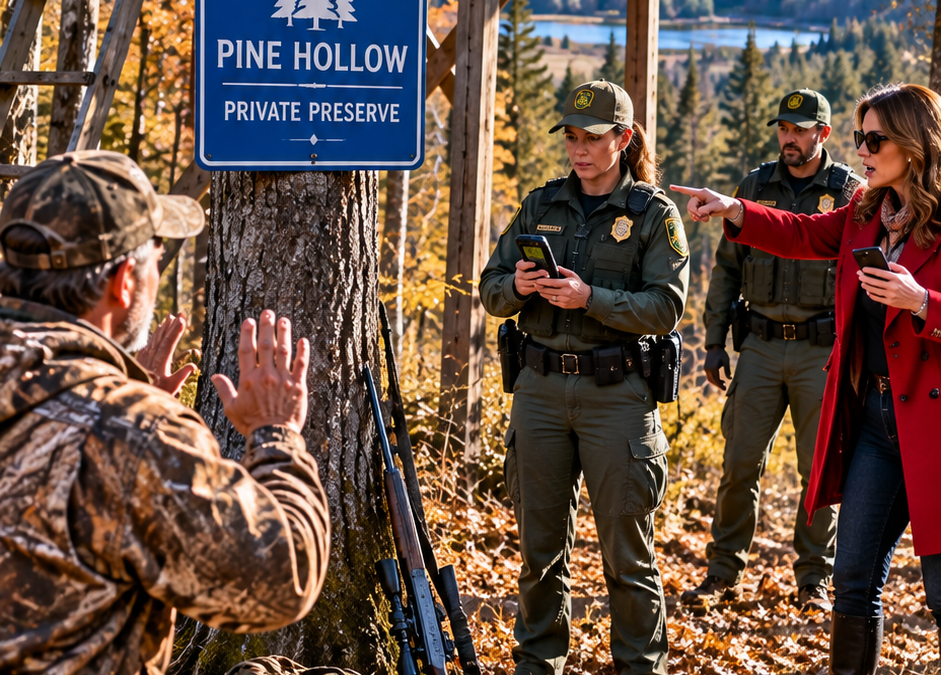
𝗙𝗨𝗟𝗟 𝗦𝗧𝗢𝗥𝗬
She smiled.
“That may feel satisfying to say, Mr. Beckett, but it isn’t a management plan.”
“It isn’t your property to manage.”
That was when her smile disappeared.
Over the next six months, Pine Hollow sent four letters.
The first asked me to stop cutting firewood where residents might see the activity from subdivision roads.
The second said my orange boundary paint conflicted with Pine Hollow’s “natural color palette.”
The third demanded advance notice before forestry equipment used my northern gravel road.
That road did not touch HOA property.
The fourth described the eastern 172 acres of Beckett Woods as a “shared conservation landscape.”
I answered each one.
Briefly.
Politely.
In writing.
Boring documents are underrated.
An argument gives people different memories.
A dated letter gives everyone the same page.
Three weeks before hunting season, I found the first blue stake.
It stood thirty-eight yards west of my southeast boundary.
Beside a white oak still carrying faded red paint my father had applied decades earlier.
A second stake appeared farther north.
Then a third.
I photographed each one.
Recorded coordinates.
Left them where they stood.
Two days later, one of my NO TRESPASSING signs disappeared.
By the end of the week, five were gone.
They had been screwed into separate posts.
The screws were missing.
The wood around them was clean.
No storm damage.
No fallen limbs.
Someone had removed them deliberately.
I replaced the signs.
Then installed two cellular cameras.
One covered my north equipment access.
The other covered a southeast gate.
Neither camera pointed toward Pine Hollow homes, backyards, or the HOA trail.
They watched only my own gates.
Vivien emailed the next afternoon.
Your new signage and surveillance equipment are unnecessarily provocative.
I read the message twice.
Then replied.
The signs contain two words. Neither one is your name.
She did not answer.
The night before opening morning, my northern camera triggered at 10:43 p.m.
The image showed a Pine Hollow maintenance utility vehicle near the tree line.
Rain streaked across the lens.
I could not see the driver clearly.
Three long blue objects rested in the vehicle’s rear rack.
At the time, I assumed they were trail markers.
I did not drive out in the dark.
At daylight, I walked to the western stand.
No vehicles.
No voices.
Nothing unusual.
Forty minutes later, a legal buck moved along the base of the ridge.
I waited until it entered the lane I had already checked.
Limestone behind it.
No movement beyond.
I fired once.
The animal dropped within thirty yards.
I immediately cleared the rifle.
I had just started down from the stand when Vivien emerged from the east.
Two Pine Hollow residents followed her.
Vivien wore a scarlet rain shell.
Clean boots.
The expression of someone arriving to collect an outcome she had already ordered.
“Put the rifle down.”
“It’s unloaded.”
“Hunting is prohibited in the preserve.”
“This isn’t a preserve.”
She pointed behind me.
That was when I saw the sign.
PINE HOLLOW PRIVATE PRESERVE.
Fresh blue posts.
Freshly disturbed soil.
I looked from the sign to Vivien.
“When did that get there?”
“Pine Hollow designated the area last night.”
I almost laughed.
Not because it was funny.
Because I needed half a second to make sure I had heard her correctly.
“You cannot designate my land while I’m asleep.”
One resident looked down.
The other stared at the deer as though he wished the animal could explain how he had ended up there.
Vivien pulled out her phone.
“Then we’ll let the state decide.”
“Good.”
Her eyes narrowed.
“Tell them exactly where you’re standing.”
She placed the call.
I listened.
That disturbed me more than the accusation itself.
Vivien did not sound confused.
She sounded deliberate.
“Armed man inside a residential preserve.”
“Rifle discharged near occupied homes.”
“Illegal hunting on HOA-controlled property.”
“Residents are afraid to approach.”
Each sentence contained just enough truth to support a larger false picture.
I had a rifle.
I had fired it.
Homes existed in the broader area.
Residents were present.
But location changed everything.
So did distance.
So did ownership.
So did direction of fire.
I stayed exactly where I was.
Did not touch the deer.
Did not remove the sign.
Did not argue with the residents.
I texted my coordinates to the conservation office.
Then called my attorney, Lydia Harrow.
I had worked with Lydia on timber contracts and a boundary issue several years earlier.
“Vivien called wardens.”
“Why?”
“She says I’m hunting inside a Pine Hollow preserve.”
Silence.
“Where are you?”
“My west stand.”
“Still on Beckett?”
“Almost a hundred yards inside.”
“Do exactly what the wardens tell you.”
“I will.”
“Record only if they permit it.”
“Understood.”
“And Nolan?”
“Yes?”
“Do not turn a hunting complaint into a personal confrontation.”
The conservation officers arrived twenty-six minutes later.
By then the two residents had retreated toward the real boundary.
Vivien remained beneath my stand.
Mara Ellison approached me first.
Cole Maddox stayed several steps to the side where he could see everyone’s hands.
I appreciated that.
They had received a report involving a firearm.
Caution was their job.
I placed the rifle where Mara directed.
Handed over my documents.
Then answered questions.
License valid.
Season correct.
Tag correct.
Stand location confirmed.
Direction west.
Limestone backstop.
One shot.
No one in the lane.
Cole inspected the site.
He walked downrange.
Looked at the ridge.
Checked the deer.
Then Mara entered my coordinates into the county parcel layer.
She frowned.
Checked them again.
I handed her my certified survey card.
She studied it.
“Cole.”
He walked east.
Twenty yards later, he kicked aside wet leaves and found the iron monument.
Photographed the cap.
Compared the number.
Then came back.
Mara turned toward Vivien.
“Can you show me the document establishing Pine Hollow’s ownership here?”
Vivien handed her a printed community map.
Most of Beckett Woods was shaded green.
PINE HOLLOW PRIVATE PRESERVE.
Mara studied it.
“Is this recorded?”
“It is the association’s official conservation plan.”
“That isn’t what I asked.”
Vivien’s jaw tightened.
“The HOA maintains the land under an existing corridor agreement.”
“Do you have the agreement?”
“Not with me.”
Cole returned and gave Mara a small nod.
Mara looked again at the coordinate display.
Then at Vivien.
“Ma’am, you told dispatch Mr. Beckett was inside the subdivision.”
“He is.”
“No.”
Vivien blinked.
“You are ninety-three yards inside his parcel.”
“That can’t be right.”
“It is what the recorded parcel data and the physical monument both indicate.”
Vivien looked toward the two residents standing farther east.
Neither spoke.
Mara continued.
“Until you produce documentation establishing an access right, you need to return to the public side of the boundary.”
“You’re removing me?”
“I’m directing you off private property while we finish investigating the hunting complaint.”
Vivien had called the state expecting officers to remove me.
Less than ten minutes after they arrived, she was the person being told to leave.
That should have ended the morning.
Instead, Cole stopped beside the blue preserve sign.
“Who installed this?”
Vivien turned back.
“Pine Hollow Maintenance.”
“Landowner permission?”
She did not answer.
I did.
“No.”
Mara photographed the sign.
Then looked north.
Blue stakes appeared through the understory.
“How many of these?”
“I don’t know.”
For the next hour, we found out.
The first stake led to a newly cut trail.
Six feet wide in places.
Young maple and hazel had been cleared.
Fresh chips still covered the ground.
The trail curved north.
Not along any drainage strip.
Not along the parcel line.
Twenty yards farther in, Cole found a small black camera strapped to a birch.
It faced the trail.
Silver inventory label.
Pine Hollow initials.
A second camera overlooked a wooden bench mounted on concrete blocks.
The third faced the wildlife pond my father had dug in 1994.
Near the pond stood a trail map.
CEDAR LOOP.
HERON WALK.
RIDGE VIEW.
All three routes crossed my land.
Ridge View continued nearly three-quarters of a mile west.
Ending near the stand where Vivien had just accused me of trespassing.
I had never seen the map before.
Mara opened a new incident entry.
She did not call it theft.
Did not call it fraud.
Did not promise arrests.
She documented.
Locations.
Objects.
Ownership dispute.
Photographs.
Measurements.
That restraint mattered.
Real investigations are rarely completed while everyone is still standing in wet leaves.
What Mara did was better.
She separated what could already be established from what still needed proof.
Before leaving, she confirmed that she found no hunting violation based on season, license, tag, location, distance, observed backstop, and firing direction.
I called Lydia.
“They put a camera over Dad’s pond.”
“I heard you.”
“I want everything out.”
“It will come out.”
“Today.”
“No.”
I stared at the camera.
“Lydia.”
“Photograph it. Survey it. Give them one written opportunity to remove their property under supervision.”
“They cut a trail through my woods.”
“And if you smash their cameras and burn their benches, what does tomorrow’s HOA email say?”
I said nothing.
“Exactly.”
That was not what my anger wanted.
But it was what my property needed.
After Mara finished, Cole helped verify the tag and recovery.
Vivien had tried to turn a lawful hunting morning into an armed emergency.
The state report reduced it to what it actually was.
One lawful deer harvest.
One unsupported HOA boundary claim.
And a collection of HOA equipment installed on private property.
By noon, I had counted fourteen blue stakes.
Three cameras.
Four directional signs.
Two benches.
Almost nine hundred feet of newly cleared trail.
At 1:15 p.m., Pine Hollow management emailed every resident.
Subject:
ARMED INCIDENT IN THE PRESERVE.
The message said an individual had discharged a rifle near a community walking route and that the HOA was working with state authorities to secure the area.
It did not say the hunting complaint had been found unfounded.
Did not say the walking route was on my property.
Did not say Vivien had been directed back across the boundary.
It ended by asking residents to avoid the eastern trails until further notice.
That sentence bothered me.
Eastern trails.
Not proposed trails.
Not future trails.
Trails residents apparently already understood as Pine Hollow amenities.
I opened the subdivision website.
The homepage showed a smiling family walking beneath red autumn maples.
Beneath the photograph:
LIVE BESIDE 172 ACRES OF PRIVATE PROTECTED WOODLAND.
Another page listed amenities.
Clubhouse.
Fishing pond.
Children’s play area.
More than four miles of resident-only nature trails.
Pine Hollow could not fit four miles of trail into its eighteen acres of common land without turning the walking loop into spaghetti.
I saved every page.
Downloaded files.
Printed brochures.
Recorded date and time.
Then searched listings for the eleven homes in Pine Hollow’s final development phase.
Nine mentioned private preserve access.
Six included the same green map Vivien had shown Mara.
One virtual tour started inside Pine Hollow’s legitimate common land.
The camera moved around the pond.
Onto the HOA loop.
Then crossed into my woods.
The narrator said:
“Residents enjoy direct access to protected acreage permanently maintained for Pine Hollow.”
I watched it twice.
The camera passed less than fifty feet from my father’s pond.
That pond was not ornamental.
After a dry summer damaged two shallow wetlands, my father dug it to hold water longer through the season.
He planted willow.
Left standing deadwood for cavity-nesting birds.
Spent three winters cutting invasive brush from the bank.
He would have happily taken a child there if the child asked.
He would not have accepted a sales agent pretending it came with a granite countertop package.
There is a difference between sharing something and having it taken.
That difference is consent.
People hear that word and think lawyers.
Forms.
Signatures.
But consent is simpler.
It is the line between being invited through a gate and someone deciding your gate was theirs all along.
Lydia arrived at four.
Scanner.
Evidence bags.
Laptop.
And considerably less patience than she had shown on the phone.
She reviewed the website.
Brochures.
Resident email.
Listings.
“This is bigger than the boundary argument.”
“How?”
“Potential disclosure problem.”
She turned another page.
“Potential insurance problem.”
I sat across from her.
“Definitely a property problem.”
“That one we already know.”
She drafted three notices.
One to Pine Hollow and its management company.
It revoked any implied permission.
Ordered all entry stopped.
Demanded preservation of emails, work orders, maps, communications, and files.
Offered supervised access for removal of HOA installations once documented.
Second notice:
Northstar Residential Partners.
The developer.
Its logo appeared on the final-phase listings.
Third:
Lake States Title.
The title company named in Pine Hollow closing materials.
Lydia did not accuse every board member of knowingly participating in a fraud.
That mattered.
She stated what we could prove.
Then asked questions.
Questions force records to move.
The next morning, a certified envelope arrived from Pine Hollow.
Vivien had prepared it before the hunt.
The letter ordered me to stop discharging firearms within the “Pine Hollow Conservation Corridor.”
Remove hunting equipment.
Recognize existing access rights.
Attached:
A 1996 drainage inspection license.
For a few minutes, it looked like something we had missed.
The document referenced the southeast corner of the land that later became Beckett Woods.
But then I read the details.
Twelve-foot strip.
Purpose:
Inspect and clear a shallow stormwater channel serving what would become the subdivision.
Entry required seventy-two hours’ written notice except during an active flood.
Routine access limited to twice each year.
Length:
Three hundred ten feet.
No transfer to residents.
No recreational access.
No ownership interest.
No public right.
And the trail Pine Hollow advertised did not follow the drainage strip.
It crossed that strip at nearly a right angle and continued deep into my forest.
Vivien had not created an entirely fake deed.
She had done something more ordinary.
She had taken a narrow maintenance right and stripped away its limits in the way she described it.
Drainage access became access.
Access became management.
Management became preserve control.
Then preserve control became something salespeople promised buyers.
Words can trespass before people do.
Once enough people repeat the expanded version, somebody eventually drives a stake into the ground.
Grant Hollis was the surveyor who had marked my eastern boundary four years earlier during a maple thinning.
He met me Tuesday morning.
Robotic total station.
Field books.
The permanent expression of a man who trusted monuments more than memory.
Grant recovered seven original markers.
Tied them to the recorded legal description.
Then mapped every Pine Hollow object.
The results were not close.
Nearest blue sign:
Thirty-eight yards inside.
Farthest camera:
Six hundred twelve yards inside.
One bench:
Less than ten feet from my father’s pond.
The newly cleared trail crossed the legitimate drainage license for only fourteen feet.
Then left it completely.
Grant installed temporary orange witness stakes along the true line.
Before leaving, he looked at Vivien’s green map.
“This isn’t a survey.”
“She calls it a conservation plan.”
Grant shrugged.
“A menu is a plan. Doesn’t tell you who owns the restaurant.”
On Wednesday, Lake States Title called.
Evelyn Shaw.
Senior counsel.
Eleven Pine Hollow files scheduled to close over the next five weeks.
Each buyer package included a community disclosure addendum describing resident access to the private preserve.
“Are you the fee owner of parcel 7214B?” she asked.
“Yes.”
“Have you granted Pine Hollow Estates, Northstar Residential, or Pine Hollow residents a recreational easement?”
“No.”
“Conservation license?”
“No.”
“Would you provide a sworn owner statement?”
“Send it to Lydia.”
Evelyn paused.
“Mr. Beckett, our current title commitments do not insure a recreational access right over your parcel.”
I leaned back.
“Then where does the preserve language exist?”
“In sales disclosures.”
“Not land records.”
“Correct.”
That was the first independent confirmation that Pine Hollow’s right existed only in paperwork it had written for itself.
Lake States did not cancel eleven home sales.
It did something more exact.
Any closing package promising guaranteed access to Beckett Woods was paused.
Buyers could still proceed after receiving corrected disclosures acknowledging that no recreational access crossed my land.
By Thursday morning, the developer had a contract problem.
Paul Rener, Northstar’s regional director, called me.
His voice had the polished calm of someone accustomed to discussing large numbers without sounding alarmed.
“We’d like to resolve a misunderstanding.”
“Whose?”
“The preserve boundaries may have been communicated imprecisely.”
“Your virtual tour walks past my pond.”
“I haven’t personally reviewed the footage.”
“You should.”
Paul proposed a meeting with the HOA.
Lydia declined until Northstar preserved its maps, designs, sales materials, contracts, and communications.
Two hours later, Vivien called me herself.
“You’re interfering with eleven families’ homes.”
“I didn’t put my property in their contracts.”
“No one is asking you to surrender ownership.”
“You sent residents onto it.”
“We’re discussing limited recreational use.”
“You installed cameras.”
“That can be corrected.”
“You removed my signs.”
“I don’t have knowledge of every maintenance decision.”
“You called conservation officers after I hunted legally on my own property.”
Her voice hardened.
“We were dealing with an armed person inside what residents understand to be community preserve.”
“Then show me the agreement.”
“You’ve seen the corridor license.”
“I’ve read it. Three hundred ten feet. Drainage inspection. Twice a year. No recreation.”
Silence.
For the first time in all the conversations we had had, Vivien seemed to run out of prepared language.
“This can still be handled privately.”
“It was private before you printed brochures.”
She hung up.
That afternoon, emails started arriving from Pine Hollow residents.
Some angry.
Some confused.
Some apologetic.
Then one from Hannah Price.
She was a nurse.
She and her husband were under contract on a final-phase home.
They had a six-year-old daughter.
Their sales agent had personally walked them through my woods in September.
He had shown the girl my father’s pond.
Told her residents helped protect nesting cranes there.
We chose Pine Hollow partly because of that trail, Hannah wrote. I need to know whether we were trespassing when they brought us there.
I stared at the message.
Then replied.
You didn’t know. The people leading you should have.
She sent twelve photographs from the sales tour.
One showed a temporary Northstar promotional sign beside the pond.
Another showed Vivien speaking to a group of buyers.
Behind her:
YOUR PRIVATE PRESERVE.
Date stamp:
Six months earlier.
The claim had not started the night before hunting season.
It had been part of sales for half a year.
Friday morning, Grant and I visited the county planning archive.
The clerk brought out Pine Hollow’s original approved plat and landscape exhibits.
One sheet was nearly four feet wide.
On the southeast edge, a heavy dashed line separated Pine Hollow from the land my father later consolidated into Beckett Woods.
Inside my parcel, in letters large enough to read from across the counter:
NOT A PART OF PINE HOLLOW.
The drainage inspection strip appeared as a thin hatched rectangle.
No recreational trail.
No preserve.
No resident access.
Grant placed Vivien’s green map beside it.
Road curves matched.
Lot lines matched.
Contours matched.
Pond position matched.
The map had clearly originated from the county exhibit.
But its right side had been cropped just inside the heavy boundary line.
The words NOT A PART OF PINE HOLLOW had disappeared.
A translucent green layer had been extended across 172 acres beyond it.
I looked at Grant.
“That’s not an accidental crop.”
He did not answer.
He did not need to.
Lydia sent both maps to Northstar.
Lake States Title.
Pine Hollow’s board.
The HOA insurer.
One question.
Who authorized the change?
Answers arrived slowly.
First, Brett Sutter called.
Sutter Grounds and Trail maintained Pine Hollow’s legitimate common areas.
His labels were on the benches and cameras in my woods.
He asked to meet at my north gate.
Brown work truck.
Folder under one arm.
He looked tired rather than defensive.
“Vivien told us Pine Hollow controlled the eastern woods.”
“What did she give you?”
“Map. Drainage license.”
Lydia stood beside me.
“Did you read the license?”
Brett looked down.
“Not until your letter.”
“Who laid out the trail?”
“She did.”
“You mean personally?”
“She marked the route with blue stakes. We followed them.”
Brett opened the folder.
Six work orders.
Brush clearing.
Trail surfacing.
Camera installation.
Benches.
Signs.
Planned observation platform near the pond.
Every one approved by Vivien as HOA president.
The most recent order was three weeks old.
REMOVE PRIVATE PROPERTY SIGNAGE FROM DESIGNATED PRESERVE ROUTES.
I felt my throat tighten.
“Where are my signs?”
Brett looked toward his truck.
“Maintenance shed.”
“All of them?”
“My crew removed nine.”
“I knew about five.”
“Four were farther south.”
“Why didn’t you throw them away?”
“One of my guys said destroying them felt wrong.”
I stared at him.
“And removing them didn’t?”
He accepted the question.
Did not argue.
“I should have verified ownership.”
That answer mattered.
He had followed a bad instruction.
But he did not pretend the instruction erased his own decision.
Lydia arranged a documented return.
No one broke into the maintenance shed.
No one seized property.
The manager photographed the nine signs.
Logged them.
Delivered them to Lydia’s office.
Screw holes matched my posts.
Two still carried strips of old red boundary paint.
Brett also provided his email thread.
In one message he warned Vivien that my property signs conflicted with her preserve map.
Vivien replied:
Remove them before the final phase tours begin.
Eight words.
The second answer came from Pine Hollow’s insurer.
Earlier that year, the HOA had added:
172-acre woodland trail system
to the policy schedule of managed common property.
The carrier had requested proof of ownership, lease, or maintenance authority.
Vivien responded with a board resolution declaring the forest a “community-controlled conservation asset.”
No parcel number.
No deed.
No signature from me.
No recorded right.
The association had written a document about itself, then used that document as evidence of authority over someone else’s property.
The insurer issued a reservation-of-rights letter.
Pine Hollow had to close the advertised trails.
Stop directing residents into the area.
Stop representing Beckett Woods as insured common property.
The insurer was not deciding title.
It was deciding whether the risk Pine Hollow had asked it to insure had been accurately described.
Then came the design firm records.
Northstar preserved its project archive.
A junior designer named Celia Marsh had created the preserve map.
Her email included two versions.
Version one retained the county boundary.
Retained the words:
NOT A PART OF PINE HOLLOW.
Celia wrote:
We cannot present the Beckett parcel as a resident amenity without a recorded easement or owner license. Please confirm legal.
Vivien replied twenty-three minutes later.
Remove the legal note from the customer version. Access will be resolved before final closings.
Paul Rener was copied.
He had not replied.
Silence is not always agreement.
But silence becomes harder to call neutral when someone supervises a project, receives a direct warning, continues sales, and collects deposits.
Northstar’s attorney contacted Lydia.
They wanted to negotiate.
Fifteen-year access license.
Existing trails.
$40,000.
Brush restoration.
Daylight use only.
Lydia slid the offer across her desk.
“They have offered you less than a year of property taxes per acre for fifteen years.”
“I’m not selling access.”
“I know.”
“Then why are you smiling?”
“Because I can still enjoy identifying a bad offer.”
I rejected it.
Northstar came back with $75,000.
Narrower route.
I rejected that too.
It was not really about price.
The trail crossed winter deer cover.
Passed my father’s pond.
Entered an active forestry operation.
And the agreement would have required me to restrict hunting across much of the eastern tract whenever residents might reasonably be present.
Pine Hollow was not purchasing a footpath.
It was asking me to reorganize the use of 214 acres around a promise I had never made.
Vivien answered in her own way.
She announced a Saturday “preserve safety walk.”
Board inspection.
Residents invited.
Purpose:
Demonstrate Pine Hollow’s continuous management of the preserve.
Lydia called me as soon as she saw the notice.
“She’s trying to create more use after receiving written revocation.”
“Can we stop it?”
“We can make the boundary impossible to misunderstand.”
Grant returned Friday.
Set witness posts.
Survey ribbons.
Small notices:
BECKETT PARCEL 7214B.
I locked chains across my two private trail entrances.
Mounted Lydia’s no-entry notice on my side where it could be read from Pine Hollow property.
Then we contacted the sheriff.
Requested a civil standby.
Not arrests.
Not a confrontation.
Most residents had been told the trail belonged to them.
Treating them like deliberate trespassers would have been unfair.
And stupid.
Saturday morning, forty-three people gathered at the clubhouse.
Some carried coffee.
Several brought children.
Orange safety vests.
They were not invaders.
They were neighbors responding to an official HOA email.
Vivien led them toward the southeast boundary.
I waited on my side.
Lydia.
Grant.
Deputy Aaron Bell.
Survey maps.
Mara Ellison also came because Vivien’s proposed route entered the same hunting area involved in the earlier complaint.
Vivien stopped at the locked chain.
Raised her voice.
“Mr. Beckett has blocked an established community trail.”
Grant calmly spread his field map across the hood of my pickup.
“The established property line is here.”
He pointed.
“The advertised trail is there.”
Vivien raised the drainage license.
“Pine Hollow has maintained this corridor for years.”
Lydia stepped closer.
“The drainage strip runs east-west for three hundred ten feet.”
Then she pointed to the green brochure.
“Your trail runs north and west for miles.”
A man near the front frowned.
“Why don’t the survey stakes match the map we got?”
Vivien answered instantly.
“Because Mr. Beckett commissioned a private survey.”
Grant did not react.
“I recovered the physical monuments referenced in the recorded plat.”
He looked at the group.
“Anyone is free to hire another licensed surveyor to independently verify them.”
Mara stepped forward.
Her uniform changed the mood more than anything Lydia or I could have said.
She addressed the residents.
“The conservation department has not designated Beckett Woods as Pine Hollow property. We investigated Mr. Beckett’s hunting activity last Saturday and found him in compliance. No one should cross this boundary today without the owner’s permission.”
The group changed.
Parents took children’s hands.
People lowered the orange vests.
Questions shifted away from me.
Toward Vivien.
Hannah Price stood near the back.
Her husband beside her.
“We were told this access was permanent.”
Vivien replied too quickly.
“It will be once the paperwork is completed.”
Lydia looked at her.
“Then it isn’t permanent now.”
That sentence did more than any speech I could have given.
For months, Vivien had spoken about the preserve in the present tense.
Private.
Protected.
Resident access.
Permanent.
Now, in front of forty-three residents, she had admitted that the right still depended on future paperwork.
No one needed to be ordered away.
The residents turned back themselves.
Vivien stayed by the chain.
“You’re humiliating this community,” she said quietly.
“I didn’t invite them here.”
“One signature could solve this.”
“One request before cutting the trail could have prevented it.”
She looked toward the trees.
“Do you understand what’s at risk?”
“My land.”
“Eleven closings.”
I said nothing.
“Family deposits.”
Still nothing.
“A community reserve contribution.”
Lydia turned her head.
“What contribution?”
Vivien immediately realized she had said too much.
“Ask Northstar.”
Then she walked away alone.
Monday morning, Evelyn Shaw sent Lydia a document Northstar had provided regarding the closing delays.
FINAL PHASE AMENITY COMPLETION AGREEMENT.
Northstar would contribute $18,000 to Pine Hollow’s reserve account for each of the eleven final-phase homes.
Total:
$198,000.
Payment depended on completion and availability of certain amenities by December 15.
One listed amenity:
PINE HOLLOW PRIVATE PRESERVE TRAIL SYSTEM.
There it was.
Vivien had not simply been protecting a popular walking route.
She had been protecting nearly two hundred thousand dollars.
Pine Hollow’s budget already assumed the contribution would arrive before year-end.
Some of the money had been committed to clubhouse roof repairs.
Some to pond dredging.
If the preserve was unavailable, Northstar could delay the contribution until an approved substitute amenity existed.
Vivien’s behavior finally had a rational shape.
Not a good one.
But a rational one.
She had promised the board the money.
Allowed the budget to depend on it.
Then decided obtaining access over my property would be easier than admitting the amenity had never been secured.
A motive does not excuse misconduct.
Sometimes it makes misconduct more dangerous.
Because the person now has a reason to continue even after the facts stop cooperating.
Lydia requested the board minutes approving the amenity agreement.
Pine Hollow’s treasurer, Denise Carver, responded through newly retained independent counsel.
The minutes showed Denise had asked whether Pine Hollow already controlled the preserve acreage.
Vivien answered yes.
She said only a routine owner acknowledgement remained.
No such acknowledgement existed.
No draft had ever been sent to me before the trails were cut.
Then Northstar’s land-acquisition archive produced the record that ended any remaining possibility that Vivien had simply misunderstood old property boundaries.
Six years earlier, when Pine Hollow was first being planned, Northstar had offered my father $310,000 for the eastern 172 acres.
He declined.
They increased the offer.
He declined again.
Northstar redesigned the subdivision to fit entirely on land it actually owned.
The file contained a memorandum.
Signed by Paul Rener.
Acknowledged by Vivien, who at the time was consulting on community sales.
BECKETT PARCEL EXCLUDED.
NO ACCESS OR AMENITY RIGHTS ACQUIRED.
ALL MARKETING MUST REMAIN WITHIN APPROVED PLAT.
Vivien had known.
Before the first Pine Hollow home was sold.
She had known the developer failed to buy the forest.
Known the subdivision was redesigned around it.
Known no recreational access had been acquired.
Years later, the warning disappeared from the marketing map.
At that point, this was no longer my memory against Vivien’s.
Her own project file answered the question.
Lake States Title scheduled a joint disclosure conference.
Not a criminal hearing.
Not an HOA disciplinary meeting.
Eleven buyers had been given contractual materials promising an amenity unsupported by land records.
That was enough for the title company to require answers.
The meeting took place in Lake States’ regional conference room.
Evelyn Shaw sat at the center.
Lydia and I on one side.
Paul Rener.
Northstar counsel.
Vivien.
Denise.
Pine Hollow independent counsel.
Insurance representative.
Hannah and two other contract buyers attended as affected parties.
Evelyn began with one question.
“Does any recorded instrument grant Pine Hollow residents recreational access across parcel 7214B?”
Silence.
Nobody said yes.
Vivien reached for the drainage license.
Grant displayed it.
Thin rectangular strip beside the subdivision.
Then he overlaid the advertised trail.
The blue trail crossed the drainage strip briefly.
Then wandered deep into my forest.
“They overlap for fourteen feet,” Grant said. “Beyond that point, the recreational route has no relationship to the licensed drainage area.”
Northstar counsel acknowledged it.
Lydia presented Brett’s work orders.
The removed property signs.
Vivien’s instruction:
Remove them before the final phase tours begin.
The insurance representative presented the resolution Vivien had submitted instead of ownership proof.
Then Evelyn placed the two maps side by side.
County version.
Heavy boundary.
NOT A PART OF PINE HOLLOW.
Customer version.
Green shading.
Warning gone.
Vivien leaned forward.
“The customer map was conceptual. It was never intended to function as a survey.”
Evelyn looked at her.
“It was included in contractual community disclosures.”
“The association expected access to be finalized.”
Lydia placed the six-year-old acquisition memorandum in front of Vivien.
“You acknowledged that no access had been acquired.”
Vivien stared at her own signature.
“And that all marketing was required to remain within the approved plat.”
Nobody spoke.
The ventilation system hummed.
Finally, Paul Rener broke the silence.
“Northstar should have stopped the preserve campaign when legal confirmation didn’t arrive.”
He looked toward me.
“We didn’t.”
It was not an apology designed to sound heroic.
It was simply the first sentence from Northstar that did not try to hide the problem inside a softer word.
Vivien shifted strategies.
Residents had used the trail openly, she argued.
Perhaps Pine Hollow had developed some kind of community right through ongoing use.
The HOA’s own independent attorney corrected her.
The use was recent.
The owner’s signs had been removed during that period.
No court had recognized an access right.
Whatever legal theory might someday be argued, Pine Hollow could not advertise it to buyers as settled ownership.
Then Hannah spoke.
She had sat quietly for nearly two hours.
She looked directly at Vivien.
“If you believed the trail was already ours, why did you still need Mr. Beckett’s signature before closing?”
Vivien looked toward Paul.
Paul looked down at the amenity agreement.
Neither answered.
That is one problem with a story built from documents.
Every page has to agree with every other page forever.
Truth needs only the original.
The conference lasted four hours.
There was no dramatic verdict.
No cheering.
No one slammed a folder shut and announced victory.
What emerged was a framework.
Northstar would issue corrected disclosures to every current buyer and homeowner who had received preserve marketing.
Contract buyers could proceed, renegotiate, or cancel according to their agreements and independent advice.
Northstar would make the full $198,000 reserve contribution without conditioning it on access to Beckett Woods.
A substitute trail and native garden would be constructed entirely within Pine Hollow’s actual common property.
Pine Hollow would remove every camera.
Bench.
Sign.
Stake.
Trail-surface material.
Grant would supervise the boundary work.
The HOA would pay documented restoration costs.
Survey costs.
My documented legal expenses.
And the final agreement prohibited Pine Hollow from claiming, advertising, insuring, licensing, or representing access across my parcel unless I later granted a written right.
I did not.
The conservation department handled Vivien’s hunting complaint through its own review process.
The sheriff documented the property warnings.
No one promised me handcuffs.
No public arrest.
No prison sentence.
Those things are not prizes a property owner gets to demand because a story would sound stronger with them.
The board asked for Vivien’s resignation after the disclosure conference.
She submitted it the next morning.
No crowded clubhouse.
No public shouting.
No applause.
Her name simply disappeared from association letterhead.
Independent counsel took control of the property records.
I thought that consequence fit what had happened.
Vivien had built most of her authority from confident statements.
Our preserve.
Our corridor.
Our trails.
Our management rights.
Our land.
As long as nobody demanded the underlying instrument, confidence carried the claim.
Once every statement required proof, the authority collapsed.
Restoration began in early December.
Brett’s crew returned.
This time they entered under my written permission.
Working from Grant’s survey.
The cameras came out first.
Then the signs.
The benches were removed carefully so the pond bank was not damaged.
Workers loosened compacted soil along the trail.
Spread native leaf litter.
Placed fallen branches across straight sections to discourage future foot traffic.
Hazel was replanted where clearing had opened the understory.
Brett personally reinstalled all nine of my property signs.
At the southeast corner, Pine Hollow built a short overlook entirely on its own eighteen acres.
From there residents could see treetops.
The marsh.
Part of the eastern ridge.
Without crossing my line.
It was smaller than what the brochure had promised.
But it was real.
Hannah and her family completed their home purchase after receiving the corrected disclosure.
A week later, she emailed me.
Her daughter still talked about my father’s pond.
Would I allow them to visit once?
With me?
I thought about it.
Then said yes.
Some people might think that made no sense after everything that had happened.
I saw it differently.
Permission did not weaken my boundary.
Permission was the reason the boundary mattered.
On a cold Saturday morning, Hannah, her husband, and their daughter met me at the north road.
The little girl carried a notebook.
She counted woodpecker cavities in standing dead trees.
Stopped to look at deer tracks.
At the pond, she pointed toward branches lying partly submerged near the bank.
“Why don’t you clean those out?”
I smiled.
“Because clean doesn’t always mean healthy.”
She frowned.
I crouched beside her.
“Some animals need places that look messy to us.”
She wrote that down.
My father would have liked her.
The following spring, I created a one-day educational access license for a county elementary forestry program.
Scheduled in advance.
Supervised.
Defined route.
Automatic expiration after the visit.
Pine Hollow received no standing right.
No permanent public trail.
No implied community access.
Some friends told me I was too generous.
After what they had done, they said, I should close the gate forever.
But protecting land does not require becoming smaller than the person who challenged it.
Ownership means deciding when the gate opens.
For whom.
And why.
By the next deer season, the blue stakes were gone.
Young hazel had started growing through the restored trail.
The camera that once watched Pine Hollow residents pass my father’s pond now faced the water.
My camera.
My purpose.
At 6:12 on opening morning, I sat in the same western stand.
Pine Hollow’s nearest lights glowed faintly through seven hundred yards of timber behind me.
Ahead, the limestone ridge gathered the first gray light.
Mara had closed the prior year’s incident file months earlier.
Grant’s monuments remained visible.
The new Pine Hollow board had mailed residents a plain map.
No green marketing layer.
No preserve label.
Just parcel lines.
Community property ended where the recorded boundary said it ended.
I sat quietly and thought about Vivien’s first accusation.
Hunting is prohibited in the Pine Hollow preserve.
In one narrow sense, she had been right.
Nobody should hunt on Pine Hollow property without authority.
The problem was simpler.
I had never been on Pine Hollow property.
Not beneath my stand.
Not beside my father’s pond.
Not anywhere within the 214 acres my father had assembled one careful parcel at a time.
Vivien believed repetition could harden into ownership.
Call something a corridor enough times, and people stop asking how wide it is.
Call a forest a preserve often enough, and buyers assume somebody owns it.
Color it green.
Put it in a brochure.
Send maintenance crews.
Install benches.
Remove the signs that contradict the story.
Then let use become expectation.
Expectation become entitlement.
And entitlement become pressure on the owner to “work something out.”
That process nearly succeeded.
Not because the records were unclear.
They were unusually clear.
It nearly succeeded because almost everyone involved assumed someone else had already checked them.
The buyers trusted the sales agent.
The sales agent trusted marketing.
Marketing trusted the project direction.
The contractor trusted the work orders.
The insurer trusted the board resolution.
Residents trusted the HOA president.
The HOA board trusted Vivien when she said only a routine owner acknowledgement remained.
All those layers of trust sat on top of one missing thing.
My consent.
My father had understood that land could be shared without being surrendered.
Neighbors hunted together.
Children crossed fields with permission.
Loggers used temporary access.
We let people fish.
Walk.
Collect firewood.
But he never confused generosity with abandonment.
A gate does not have to stay locked to prove it belongs to you.
It only has to open because you chose to open it.
As the tree line brightened that morning, I checked the lane below the ridge.
Safe.
Empty.
Quiet.
No scarlet rain shell moving through the brush.
No blue preserve sign.
No residents walking a trail they had been told was theirs.
Just the forest.
Working timber.
Wildlife habitat.
Family history.
Private property.
And enough room left inside all of those things for me to decide, on my own terms, when someone else was welcome.
This time, nobody mistook the quiet for permission.
𝗧𝗛𝗘 𝗘𝗡𝗗
The Blue Preserve Sign Beneath My Deer Stand Should Never Have Been There
At 6:12 on opening morning, Vivien Ror stood beneath my deer stand with one hand gripping her phone and the other pointed straight at my rifle.
“That’s him,” she told the two conservation wardens coming through the trees. “He’s armed. He already fired, and he refuses to leave Pine Hollow property.”
I opened the action, removed the cartridge, and placed the rifle against an oak where both officers could see it.
Then I handed over my hunting license, my tag, and the laminated survey card I always kept in a waterproof pouch.
Warden Mara Ellison checked the coordinates once.
Then again.
Her partner, Cole Maddox, walked twenty yards east, pushed wet leaves aside with his boot, and found the original iron boundary monument exactly where my survey said it would be.
Mara looked at Vivien.
“Ma’am, you told dispatch Mr. Beckett was inside Pine Hollow.”
“He is.”
“No,” Mara said. “You are ninety-three yards inside his property.”
For the first time that morning, Vivien’s expression changed.
Behind her, a new blue sign had been driven into my soil.
PINE HOLLOW PRIVATE PRESERVE.
The sign had not been there the day before.
But that sign was not the real problem.
The real problem was the map Vivien had been showing homebuyers for months.
Someone had taken the county’s approved subdivision plan, cropped away four words, shaded 172 acres of my forest green, and promised eleven families that they were buying homes beside private protected woodland reserved for residents.
The four missing words were simple.
NOT A PART OF PINE HOLLOW.
My name is Nolan Beckett.
I was fifty-four that November, and Beckett Woods covered 214 acres of hardwood ridges, cedar lowland, marshy drainage, old logging roads, and second-growth forest in north-central Wisconsin.
My father bought the first eighty acres in 1979.
He repaired logging equipment for a living, and whenever timber prices dropped hard enough that a neighboring landowner needed cash, he bought another parcel.
Not because he expected to become rich.
He liked land that could still make decisions without asking permission.
By the time the property came to me, it formed an uneven block nearly a mile deep.
County road to the north.
Limestone ridge on the west.
Wet drainage in the southeast.
Pine Hollow Estates bordered one corner.
The subdivision had seventy-eight finished homes, eleven more under contract, and a stone clubhouse designed to look older than the mortgages paying for it.
Pine Hollow actually owned eighteen acres of common land.
A pond.
A playground.
A narrow strip behind the clubhouse.
A walking loop barely half a mile long.
My forest was not part of it.
Never had been.
I worked as an independent consulting forester.
That did not make me a lawyer.
Did not make me law enforcement.
Did not give me some secret authority I could pull out whenever an HOA annoyed me.
It meant I knew timber management.
Tree health.
Habitat planning.
Access roads.
Boundary paint.
Prescribed thinning.
And the difference between managing land and simply coloring it green on a sales brochure.
I also hunted.
The stand where Vivien found me faced west toward the limestone ridge.
The closest occupied home sat more than seven hundred yards behind me, separated by thick timber and lower ground.
Before opening season, I had verified the stand location, direction of fire, season dates, county requirements, access conditions, and applicable hunting rules with the conservation office.
I still had the confirmation email in my waterproof pouch.
That mattered to me.
Ownership does not make careless behavior acceptable.
A deed gives you a boundary.
It does not give you immunity from responsibility.
I had no interest in defending lawful property rights by acting recklessly with a rifle.
Vivien knew all of this.
I had explained it to her the previous spring.
Several Pine Hollow residents had complained after hearing a shot during deer season.
The board asked me to attend a meeting.
I brought aerial photographs.
Stand locations.
Distances.
Shooting directions.
I explained where the limestone ridge created a backstop and why nobody from the subdivision had permission to enter the property while I was hunting.
Two board members listened.
Vivien did not.
She was fifty-one.
Sharp features.
Controlled voice.
Always dressed as if she expected a television camera to appear around the corner.
Before becoming Pine Hollow’s HOA president, she had spent twelve years in residential development sales.
That background mattered.
Vivien understood the emotional power of phrases like protected view, private access, preserved woodland, and permanent green space.
She also knew Pine Hollow did not own enough forest to make those promises impressive.
During our first meeting, she folded her hands across the clubhouse table.
“We’re not trying to take your land.”
“Then what are you trying to do?”
“Coordinate compatible use.”
“Compatible with what?”
“A residential community.”
“The forest was here before the residential community.”
She smiled.
“That may feel satisfying to say, Mr. Beckett, but it isn’t a management plan.”
“It isn’t your property to manage.”
That was when her smile disappeared.
Over the next six months, Pine Hollow sent four letters.
The first asked me to stop cutting firewood where residents might see the activity from subdivision roads.
The second said my orange boundary paint conflicted with Pine Hollow’s “natural color palette.”
The third demanded advance notice before forestry equipment used my northern gravel road.
That road did not touch HOA property.
The fourth described the eastern 172 acres of Beckett Woods as a “shared conservation landscape.”
I answered each one.
Briefly.
Politely.
In writing.
Boring documents are underrated.
An argument gives people different memories.
A dated letter gives everyone the same page.
Three weeks before hunting season, I found the first blue stake.
It stood thirty-eight yards west of my southeast boundary.
Beside a white oak still carrying faded red paint my father had applied decades earlier.
A second stake appeared farther north.
Then a third.
I photographed each one.
Recorded coordinates.
Left them where they stood.
Two days later, one of my NO TRESPASSING signs disappeared.
By the end of the week, five were gone.
They had been screwed into separate posts.
The screws were missing.
The wood around them was clean.
No storm damage.
No fallen limbs.
Someone had removed them deliberately.
I replaced the signs.
Then installed two cellular cameras.
One covered my north equipment access.
The other covered a southeast gate.
Neither camera pointed toward Pine Hollow homes, backyards, or the HOA trail.
They watched only my own gates.
Vivien emailed the next afternoon.
Your new signage and surveillance equipment are unnecessarily provocative.
I read the message twice.
Then replied.
The signs contain two words. Neither one is your name.
She did not answer.
The night before opening morning, my northern camera triggered at 10:43 p.m.
The image showed a Pine Hollow maintenance utility vehicle near the tree line.
Rain streaked across the lens.
I could not see the driver clearly.
Three long blue objects rested in the vehicle’s rear rack.
At the time, I assumed they were trail markers.
I did not drive out in the dark.
At daylight, I walked to the western stand.
No vehicles.
No voices.
Nothing unusual.
Forty minutes later, a legal buck moved along the base of the ridge.
I waited until it entered the lane I had already checked.
Limestone behind it.
No movement beyond.
I fired once.
The animal dropped within thirty yards.
I immediately cleared the rifle.
I had just started down from the stand when Vivien emerged from the east.
Two Pine Hollow residents followed her.
Vivien wore a scarlet rain shell.
Clean boots.
The expression of someone arriving to collect an outcome she had already ordered.
“Put the rifle down.”
“It’s unloaded.”
“Hunting is prohibited in the preserve.”
“This isn’t a preserve.”
She pointed behind me.
That was when I saw the sign.
PINE HOLLOW PRIVATE PRESERVE.
Fresh blue posts.
Freshly disturbed soil.
I looked from the sign to Vivien.
“When did that get there?”
“Pine Hollow designated the area last night.”
I almost laughed.
Not because it was funny.
Because I needed half a second to make sure I had heard her correctly.
“You cannot designate my land while I’m asleep.”
One resident looked down.
The other stared at the deer as though he wished the animal could explain how he had ended up there.
Vivien pulled out her phone.
“Then we’ll let the state decide.”
“Good.”
Her eyes narrowed.
“Tell them exactly where you’re standing.”
She placed the call.
I listened.
That disturbed me more than the accusation itself.
Vivien did not sound confused.
She sounded deliberate.
“Armed man inside a residential preserve.”
“Rifle discharged near occupied homes.”
“Illegal hunting on HOA-controlled property.”
“Residents are afraid to approach.”
Each sentence contained just enough truth to support a larger false picture.
I had a rifle.
I had fired it.
Homes existed in the broader area.
Residents were present.
But location changed everything.
So did distance.
So did ownership.
So did direction of fire.
I stayed exactly where I was.
Did not touch the deer.
Did not remove the sign.
Did not argue with the residents.
I texted my coordinates to the conservation office.
Then called my attorney, Lydia Harrow.
I had worked with Lydia on timber contracts and a boundary issue several years earlier.
“Vivien called wardens.”
“Why?”
“She says I’m hunting inside a Pine Hollow preserve.”
Silence.
“Where are you?”
“My west stand.”
“Still on Beckett?”
“Almost a hundred yards inside.”
“Do exactly what the wardens tell you.”
“I will.”
“Record only if they permit it.”
“Understood.”
“And Nolan?”
“Yes?”
“Do not turn a hunting complaint into a personal confrontation.”
The conservation officers arrived twenty-six minutes later.
By then the two residents had retreated toward the real boundary.
Vivien remained beneath my stand.
Mara Ellison approached me first.
Cole Maddox stayed several steps to the side where he could see everyone’s hands.
I appreciated that.
They had received a report involving a firearm.
Caution was their job.
I placed the rifle where Mara directed.
Handed over my documents.
Then answered questions.
License valid.
Season correct.
Tag correct.
Stand location confirmed.
Direction west.
Limestone backstop.
One shot.
No one in the lane.
Cole inspected the site.
He walked downrange.
Looked at the ridge.
Checked the deer.
Then Mara entered my coordinates into the county parcel layer.
She frowned.
Checked them again.
I handed her my certified survey card.
She studied it.
“Cole.”
He walked east.
Twenty yards later, he kicked aside wet leaves and found the iron monument.
Photographed the cap.
Compared the number.
Then came back.
Mara turned toward Vivien.
“Can you show me the document establishing Pine Hollow’s ownership here?”
Vivien handed her a printed community map.
Most of Beckett Woods was shaded green.
PINE HOLLOW PRIVATE PRESERVE.
Mara studied it.
“Is this recorded?”
“It is the association’s official conservation plan.”
“That isn’t what I asked.”
Vivien’s jaw tightened.
“The HOA maintains the land under an existing corridor agreement.”
“Do you have the agreement?”
“Not with me.”
Cole returned and gave Mara a small nod.
Mara looked again at the coordinate display.
Then at Vivien.
“Ma’am, you told dispatch Mr. Beckett was inside the subdivision.”
“He is.”
“No.”
Vivien blinked.
“You are ninety-three yards inside his parcel.”
“That can’t be right.”
“It is what the recorded parcel data and the physical monument both indicate.”
Vivien looked toward the two residents standing farther east.
Neither spoke.
Mara continued.
“Until you produce documentation establishing an access right, you need to return to the public side of the boundary.”
“You’re removing me?”
“I’m directing you off private property while we finish investigating the hunting complaint.”
Vivien had called the state expecting officers to remove me.
Less than ten minutes after they arrived, she was the person being told to leave.
That should have ended the morning.
Instead, Cole stopped beside the blue preserve sign.
“Who installed this?”
Vivien turned back.
“Pine Hollow Maintenance.”
“Landowner permission?”
She did not answer.
I did.
“No.”
Mara photographed the sign.
Then looked north.
Blue stakes appeared through the understory.
“How many of these?”
“I don’t know.”
For the next hour, we found out.
The first stake led to a newly cut trail.
Six feet wide in places.
Young maple and hazel had been cleared.
Fresh chips still covered the ground.
The trail curved north.
Not along any drainage strip.
Not along the parcel line.
Twenty yards farther in, Cole found a small black camera strapped to a birch.
It faced the trail.
Silver inventory label.
Pine Hollow initials.
A second camera overlooked a wooden bench mounted on concrete blocks.
The third faced the wildlife pond my father had dug in 1994.
Near the pond stood a trail map.
CEDAR LOOP.
HERON WALK.
RIDGE VIEW.
All three routes crossed my land.
Ridge View continued nearly three-quarters of a mile west.
Ending near the stand where Vivien had just accused me of trespassing.
I had never seen the map before.
Mara opened a new incident entry.
She did not call it theft.
Did not call it fraud.
Did not promise arrests.
She documented.
Locations.
Objects.
Ownership dispute.
Photographs.
Measurements.
That restraint mattered.
Real investigations are rarely completed while everyone is still standing in wet leaves.
What Mara did was better.
She separated what could already be established from what still needed proof.
Before leaving, she confirmed that she found no hunting violation based on season, license, tag, location, distance, observed backstop, and firing direction.
I called Lydia.
“They put a camera over Dad’s pond.”
“I heard you.”
“I want everything out.”
“It will come out.”
“Today.”
“No.”
I stared at the camera.
“Lydia.”
“Photograph it. Survey it. Give them one written opportunity to remove their property under supervision.”
“They cut a trail through my woods.”
“And if you smash their cameras and burn their benches, what does tomorrow’s HOA email say?”
I said nothing.
“Exactly.”
That was not what my anger wanted.
But it was what my property needed.
After Mara finished, Cole helped verify the tag and recovery.
Vivien had tried to turn a lawful hunting morning into an armed emergency.
The state report reduced it to what it actually was.
One lawful deer harvest.
One unsupported HOA boundary claim.
And a collection of HOA equipment installed on private property.
By noon, I had counted fourteen blue stakes.
Three cameras.
Four directional signs.
Two benches.
Almost nine hundred feet of newly cleared trail.
At 1:15 p.m., Pine Hollow management emailed every resident.
Subject:
ARMED INCIDENT IN THE PRESERVE.
The message said an individual had discharged a rifle near a community walking route and that the HOA was working with state authorities to secure the area.
It did not say the hunting complaint had been found unfounded.
Did not say the walking route was on my property.
Did not say Vivien had been directed back across the boundary.
It ended by asking residents to avoid the eastern trails until further notice.
That sentence bothered me.
Eastern trails.
Not proposed trails.
Not future trails.
Trails residents apparently already understood as Pine Hollow amenities.
I opened the subdivision website.
The homepage showed a smiling family walking beneath red autumn maples.
Beneath the photograph:
LIVE BESIDE 172 ACRES OF PRIVATE PROTECTED WOODLAND.
Another page listed amenities.
Clubhouse.
Fishing pond.
Children’s play area.
More than four miles of resident-only nature trails.
Pine Hollow could not fit four miles of trail into its eighteen acres of common land without turning the walking loop into spaghetti.
I saved every page.
Downloaded files.
Printed brochures.
Recorded date and time.
Then searched listings for the eleven homes in Pine Hollow’s final development phase.
Nine mentioned private preserve access.
Six included the same green map Vivien had shown Mara.
One virtual tour started inside Pine Hollow’s legitimate common land.
The camera moved around the pond.
Onto the HOA loop.
Then crossed into my woods.
The narrator said:
“Residents enjoy direct access to protected acreage permanently maintained for Pine Hollow.”
I watched it twice.
The camera passed less than fifty feet from my father’s pond.
That pond was not ornamental.
After a dry summer damaged two shallow wetlands, my father dug it to hold water longer through the season.
He planted willow.
Left standing deadwood for cavity-nesting birds.
Spent three winters cutting invasive brush from the bank.
He would have happily taken a child there if the child asked.
He would not have accepted a sales agent pretending it came with a granite countertop package.
There is a difference between sharing something and having it taken.
That difference is consent.
People hear that word and think lawyers.
Forms.
Signatures.
But consent is simpler.
It is the line between being invited through a gate and someone deciding your gate was theirs all along.
Lydia arrived at four.
Scanner.
Evidence bags.
Laptop.
And considerably less patience than she had shown on the phone.
She reviewed the website.
Brochures.
Resident email.
Listings.
“This is bigger than the boundary argument.”
“How?”
“Potential disclosure problem.”
She turned another page.
“Potential insurance problem.”
I sat across from her.
“Definitely a property problem.”
“That one we already know.”
She drafted three notices.
One to Pine Hollow and its management company.
It revoked any implied permission.
Ordered all entry stopped.
Demanded preservation of emails, work orders, maps, communications, and files.
Offered supervised access for removal of HOA installations once documented.
Second notice:
Northstar Residential Partners.
The developer.
Its logo appeared on the final-phase listings.
Third:
Lake States Title.
The title company named in Pine Hollow closing materials.
Lydia did not accuse every board member of knowingly participating in a fraud.
That mattered.
She stated what we could prove.
Then asked questions.
Questions force records to move.
The next morning, a certified envelope arrived from Pine Hollow.
Vivien had prepared it before the hunt.
The letter ordered me to stop discharging firearms within the “Pine Hollow Conservation Corridor.”
Remove hunting equipment.
Recognize existing access rights.
Attached:
A 1996 drainage inspection license.
For a few minutes, it looked like something we had missed.
The document referenced the southeast corner of the land that later became Beckett Woods.
But then I read the details.
Twelve-foot strip.
Purpose:
Inspect and clear a shallow stormwater channel serving what would become the subdivision.
Entry required seventy-two hours’ written notice except during an active flood.
Routine access limited to twice each year.
Length:
Three hundred ten feet.
No transfer to residents.
No recreational access.
No ownership interest.
No public right.
And the trail Pine Hollow advertised did not follow the drainage strip.
It crossed that strip at nearly a right angle and continued deep into my forest.
Vivien had not created an entirely fake deed.
She had done something more ordinary.
She had taken a narrow maintenance right and stripped away its limits in the way she described it.
Drainage access became access.
Access became management.
Management became preserve control.
Then preserve control became something salespeople promised buyers.
Words can trespass before people do.
Once enough people repeat the expanded version, somebody eventually drives a stake into the ground.
Grant Hollis was the surveyor who had marked my eastern boundary four years earlier during a maple thinning.
He met me Tuesday morning.
Robotic total station.
Field books.
The permanent expression of a man who trusted monuments more than memory.
Grant recovered seven original markers.
Tied them to the recorded legal description.
Then mapped every Pine Hollow object.
The results were not close.
Nearest blue sign:
Thirty-eight yards inside.
Farthest camera:
Six hundred twelve yards inside.
One bench:
Less than ten feet from my father’s pond.
The newly cleared trail crossed the legitimate drainage license for only fourteen feet.
Then left it completely.
Grant installed temporary orange witness stakes along the true line.
Before leaving, he looked at Vivien’s green map.
“This isn’t a survey.”
“She calls it a conservation plan.”
Grant shrugged.
“A menu is a plan. Doesn’t tell you who owns the restaurant.”
On Wednesday, Lake States Title called.
Evelyn Shaw.
Senior counsel.
Eleven Pine Hollow files scheduled to close over the next five weeks.
Each buyer package included a community disclosure addendum describing resident access to the private preserve.
“Are you the fee owner of parcel 7214B?” she asked.
“Yes.”
“Have you granted Pine Hollow Estates, Northstar Residential, or Pine Hollow residents a recreational easement?”
“No.”
“Conservation license?”
“No.”
“Would you provide a sworn owner statement?”
“Send it to Lydia.”
Evelyn paused.
“Mr. Beckett, our current title commitments do not insure a recreational access right over your parcel.”
I leaned back.
“Then where does the preserve language exist?”
“In sales disclosures.”
“Not land records.”
“Correct.”
That was the first independent confirmation that Pine Hollow’s right existed only in paperwork it had written for itself.
Lake States did not cancel eleven home sales.
It did something more exact.
Any closing package promising guaranteed access to Beckett Woods was paused.
Buyers could still proceed after receiving corrected disclosures acknowledging that no recreational access crossed my land.
By Thursday morning, the developer had a contract problem.
Paul Rener, Northstar’s regional director, called me.
His voice had the polished calm of someone accustomed to discussing large numbers without sounding alarmed.
“We’d like to resolve a misunderstanding.”
“Whose?”
“The preserve boundaries may have been communicated imprecisely.”
“Your virtual tour walks past my pond.”
“I haven’t personally reviewed the footage.”
“You should.”
Paul proposed a meeting with the HOA.
Lydia declined until Northstar preserved its maps, designs, sales materials, contracts, and communications.
Two hours later, Vivien called me herself.
“You’re interfering with eleven families’ homes.”
“I didn’t put my property in their contracts.”
“No one is asking you to surrender ownership.”
“You sent residents onto it.”
“We’re discussing limited recreational use.”
“You installed cameras.”
“That can be corrected.”
“You removed my signs.”
“I don’t have knowledge of every maintenance decision.”
“You called conservation officers after I hunted legally on my own property.”
Her voice hardened.
“We were dealing with an armed person inside what residents understand to be community preserve.”
“Then show me the agreement.”
“You’ve seen the corridor license.”
“I’ve read it. Three hundred ten feet. Drainage inspection. Twice a year. No recreation.”
Silence.
For the first time in all the conversations we had had, Vivien seemed to run out of prepared language.
“This can still be handled privately.”
“It was private before you printed brochures.”
She hung up.
That afternoon, emails started arriving from Pine Hollow residents.
Some angry.
Some confused.
Some apologetic.
Then one from Hannah Price.
She was a nurse.
She and her husband were under contract on a final-phase home.
They had a six-year-old daughter.
Their sales agent had personally walked them through my woods in September.
He had shown the girl my father’s pond.
Told her residents helped protect nesting cranes there.
We chose Pine Hollow partly because of that trail, Hannah wrote. I need to know whether we were trespassing when they brought us there.
I stared at the message.
Then replied.
You didn’t know. The people leading you should have.
She sent twelve photographs from the sales tour.
One showed a temporary Northstar promotional sign beside the pond.
Another showed Vivien speaking to a group of buyers.
Behind her:
YOUR PRIVATE PRESERVE.
Date stamp:
Six months earlier.
The claim had not started the night before hunting season.
It had been part of sales for half a year.
Friday morning, Grant and I visited the county planning archive.
The clerk brought out Pine Hollow’s original approved plat and landscape exhibits.
One sheet was nearly four feet wide.
On the southeast edge, a heavy dashed line separated Pine Hollow from the land my father later consolidated into Beckett Woods.
Inside my parcel, in letters large enough to read from across the counter:
NOT A PART OF PINE HOLLOW.
The drainage inspection strip appeared as a thin hatched rectangle.
No recreational trail.
No preserve.
No resident access.
Grant placed Vivien’s green map beside it.
Road curves matched.
Lot lines matched.
Contours matched.
Pond position matched.
The map had clearly originated from the county exhibit.
But its right side had been cropped just inside the heavy boundary line.
The words NOT A PART OF PINE HOLLOW had disappeared.
A translucent green layer had been extended across 172 acres beyond it.
I looked at Grant.
“That’s not an accidental crop.”
He did not answer.
He did not need to.
Lydia sent both maps to Northstar.
Lake States Title.
Pine Hollow’s board.
The HOA insurer.
One question.
Who authorized the change?
Answers arrived slowly.
First, Brett Sutter called.
Sutter Grounds and Trail maintained Pine Hollow’s legitimate common areas.
His labels were on the benches and cameras in my woods.
He asked to meet at my north gate.
Brown work truck.
Folder under one arm.
He looked tired rather than defensive.
“Vivien told us Pine Hollow controlled the eastern woods.”
“What did she give you?”
“Map. Drainage license.”
Lydia stood beside me.
“Did you read the license?”
Brett looked down.
“Not until your letter.”
“Who laid out the trail?”
“She did.”
“You mean personally?”
“She marked the route with blue stakes. We followed them.”
Brett opened the folder.
Six work orders.
Brush clearing.
Trail surfacing.
Camera installation.
Benches.
Signs.
Planned observation platform near the pond.
Every one approved by Vivien as HOA president.
The most recent order was three weeks old.
REMOVE PRIVATE PROPERTY SIGNAGE FROM DESIGNATED PRESERVE ROUTES.
I felt my throat tighten.
“Where are my signs?”
Brett looked toward his truck.
“Maintenance shed.”
“All of them?”
“My crew removed nine.”
“I knew about five.”
“Four were farther south.”
“Why didn’t you throw them away?”
“One of my guys said destroying them felt wrong.”
I stared at him.
“And removing them didn’t?”
He accepted the question.
Did not argue.
“I should have verified ownership.”
That answer mattered.
He had followed a bad instruction.
But he did not pretend the instruction erased his own decision.
Lydia arranged a documented return.
No one broke into the maintenance shed.
No one seized property.
The manager photographed the nine signs.
Logged them.
Delivered them to Lydia’s office.
Screw holes matched my posts.
Two still carried strips of old red boundary paint.
Brett also provided his email thread.
In one message he warned Vivien that my property signs conflicted with her preserve map.
Vivien replied:
Remove them before the final phase tours begin.
Eight words.
The second answer came from Pine Hollow’s insurer.
Earlier that year, the HOA had added:
172-acre woodland trail system
to the policy schedule of managed common property.
The carrier had requested proof of ownership, lease, or maintenance authority.
Vivien responded with a board resolution declaring the forest a “community-controlled conservation asset.”
No parcel number.
No deed.
No signature from me.
No recorded right.
The association had written a document about itself, then used that document as evidence of authority over someone else’s property.
The insurer issued a reservation-of-rights letter.
Pine Hollow had to close the advertised trails.
Stop directing residents into the area.
Stop representing Beckett Woods as insured common property.
The insurer was not deciding title.
It was deciding whether the risk Pine Hollow had asked it to insure had been accurately described.
Then came the design firm records.
Northstar preserved its project archive.
A junior designer named Celia Marsh had created the preserve map.
Her email included two versions.
Version one retained the county boundary.
Retained the words:
NOT A PART OF PINE HOLLOW.
Celia wrote:
We cannot present the Beckett parcel as a resident amenity without a recorded easement or owner license. Please confirm legal.
Vivien replied twenty-three minutes later.
Remove the legal note from the customer version. Access will be resolved before final closings.
Paul Rener was copied.
He had not replied.
Silence is not always agreement.
But silence becomes harder to call neutral when someone supervises a project, receives a direct warning, continues sales, and collects deposits.
Northstar’s attorney contacted Lydia.
They wanted to negotiate.
Fifteen-year access license.
Existing trails.
$40,000.
Brush restoration.
Daylight use only.
Lydia slid the offer across her desk.
“They have offered you less than a year of property taxes per acre for fifteen years.”
“I’m not selling access.”
“I know.”
“Then why are you smiling?”
“Because I can still enjoy identifying a bad offer.”
I rejected it.
Northstar came back with $75,000.
Narrower route.
I rejected that too.
It was not really about price.
The trail crossed winter deer cover.
Passed my father’s pond.
Entered an active forestry operation.
And the agreement would have required me to restrict hunting across much of the eastern tract whenever residents might reasonably be present.
Pine Hollow was not purchasing a footpath.
It was asking me to reorganize the use of 214 acres around a promise I had never made.
Vivien answered in her own way.
She announced a Saturday “preserve safety walk.”
Board inspection.
Residents invited.
Purpose:
Demonstrate Pine Hollow’s continuous management of the preserve.
Lydia called me as soon as she saw the notice.
“She’s trying to create more use after receiving written revocation.”
“Can we stop it?”
“We can make the boundary impossible to misunderstand.”
Grant returned Friday.
Set witness posts.
Survey ribbons.
Small notices:
BECKETT PARCEL 7214B.
I locked chains across my two private trail entrances.
Mounted Lydia’s no-entry notice on my side where it could be read from Pine Hollow property.
Then we contacted the sheriff.
Requested a civil standby.
Not arrests.
Not a confrontation.
Most residents had been told the trail belonged to them.
Treating them like deliberate trespassers would have been unfair.
And stupid.
Saturday morning, forty-three people gathered at the clubhouse.
Some carried coffee.
Several brought children.
Orange safety vests.
They were not invaders.
They were neighbors responding to an official HOA email.
Vivien led them toward the southeast boundary.
I waited on my side.
Lydia.
Grant.
Deputy Aaron Bell.
Survey maps.
Mara Ellison also came because Vivien’s proposed route entered the same hunting area involved in the earlier complaint.
Vivien stopped at the locked chain.
Raised her voice.
“Mr. Beckett has blocked an established community trail.”
Grant calmly spread his field map across the hood of my pickup.
“The established property line is here.”
He pointed.
“The advertised trail is there.”
Vivien raised the drainage license.
“Pine Hollow has maintained this corridor for years.”
Lydia stepped closer.
“The drainage strip runs east-west for three hundred ten feet.”
Then she pointed to the green brochure.
“Your trail runs north and west for miles.”
A man near the front frowned.
“Why don’t the survey stakes match the map we got?”
Vivien answered instantly.
“Because Mr. Beckett commissioned a private survey.”
Grant did not react.
“I recovered the physical monuments referenced in the recorded plat.”
He looked at the group.
“Anyone is free to hire another licensed surveyor to independently verify them.”
Mara stepped forward.
Her uniform changed the mood more than anything Lydia or I could have said.
She addressed the residents.
“The conservation department has not designated Beckett Woods as Pine Hollow property. We investigated Mr. Beckett’s hunting activity last Saturday and found him in compliance. No one should cross this boundary today without the owner’s permission.”
The group changed.
Parents took children’s hands.
People lowered the orange vests.
Questions shifted away from me.
Toward Vivien.
Hannah Price stood near the back.
Her husband beside her.
“We were told this access was permanent.”
Vivien replied too quickly.
“It will be once the paperwork is completed.”
Lydia looked at her.
“Then it isn’t permanent now.”
That sentence did more than any speech I could have given.
For months, Vivien had spoken about the preserve in the present tense.
Private.
Protected.
Resident access.
Permanent.
Now, in front of forty-three residents, she had admitted that the right still depended on future paperwork.
No one needed to be ordered away.
The residents turned back themselves.
Vivien stayed by the chain.
“You’re humiliating this community,” she said quietly.
“I didn’t invite them here.”
“One signature could solve this.”
“One request before cutting the trail could have prevented it.”
She looked toward the trees.
“Do you understand what’s at risk?”
“My land.”
“Eleven closings.”
I said nothing.
“Family deposits.”
Still nothing.
“A community reserve contribution.”
Lydia turned her head.
“What contribution?”
Vivien immediately realized she had said too much.
“Ask Northstar.”
Then she walked away alone.
Monday morning, Evelyn Shaw sent Lydia a document Northstar had provided regarding the closing delays.
FINAL PHASE AMENITY COMPLETION AGREEMENT.
Northstar would contribute $18,000 to Pine Hollow’s reserve account for each of the eleven final-phase homes.
Total:
$198,000.
Payment depended on completion and availability of certain amenities by December 15.
One listed amenity:
PINE HOLLOW PRIVATE PRESERVE TRAIL SYSTEM.
There it was.
Vivien had not simply been protecting a popular walking route.
She had been protecting nearly two hundred thousand dollars.
Pine Hollow’s budget already assumed the contribution would arrive before year-end.
Some of the money had been committed to clubhouse roof repairs.
Some to pond dredging.
If the preserve was unavailable, Northstar could delay the contribution until an approved substitute amenity existed.
Vivien’s behavior finally had a rational shape.
Not a good one.
But a rational one.
She had promised the board the money.
Allowed the budget to depend on it.
Then decided obtaining access over my property would be easier than admitting the amenity had never been secured.
A motive does not excuse misconduct.
Sometimes it makes misconduct more dangerous.
Because the person now has a reason to continue even after the facts stop cooperating.
Lydia requested the board minutes approving the amenity agreement.
Pine Hollow’s treasurer, Denise Carver, responded through newly retained independent counsel.
The minutes showed Denise had asked whether Pine Hollow already controlled the preserve acreage.
Vivien answered yes.
She said only a routine owner acknowledgement remained.
No such acknowledgement existed.
No draft had ever been sent to me before the trails were cut.
Then Northstar’s land-acquisition archive produced the record that ended any remaining possibility that Vivien had simply misunderstood old property boundaries.
Six years earlier, when Pine Hollow was first being planned, Northstar had offered my father $310,000 for the eastern 172 acres.
He declined.
They increased the offer.
He declined again.
Northstar redesigned the subdivision to fit entirely on land it actually owned.
The file contained a memorandum.
Signed by Paul Rener.
Acknowledged by Vivien, who at the time was consulting on community sales.
BECKETT PARCEL EXCLUDED.
NO ACCESS OR AMENITY RIGHTS ACQUIRED.
ALL MARKETING MUST REMAIN WITHIN APPROVED PLAT.
Vivien had known.
Before the first Pine Hollow home was sold.
She had known the developer failed to buy the forest.
Known the subdivision was redesigned around it.
Known no recreational access had been acquired.
Years later, the warning disappeared from the marketing map.
At that point, this was no longer my memory against Vivien’s.
Her own project file answered the question.
Lake States Title scheduled a joint disclosure conference.
Not a criminal hearing.
Not an HOA disciplinary meeting.
Eleven buyers had been given contractual materials promising an amenity unsupported by land records.
That was enough for the title company to require answers.
The meeting took place in Lake States’ regional conference room.
Evelyn Shaw sat at the center.
Lydia and I on one side.
Paul Rener.
Northstar counsel.
Vivien.
Denise.
Pine Hollow independent counsel.
Insurance representative.
Hannah and two other contract buyers attended as affected parties.
Evelyn began with one question.
“Does any recorded instrument grant Pine Hollow residents recreational access across parcel 7214B?”
Silence.
Nobody said yes.
Vivien reached for the drainage license.
Grant displayed it.
Thin rectangular strip beside the subdivision.
Then he overlaid the advertised trail.
The blue trail crossed the drainage strip briefly.
Then wandered deep into my forest.
“They overlap for fourteen feet,” Grant said. “Beyond that point, the recreational route has no relationship to the licensed drainage area.”
Northstar counsel acknowledged it.
Lydia presented Brett’s work orders.
The removed property signs.
Vivien’s instruction:
Remove them before the final phase tours begin.
The insurance representative presented the resolution Vivien had submitted instead of ownership proof.
Then Evelyn placed the two maps side by side.
County version.
Heavy boundary.
NOT A PART OF PINE HOLLOW.
Customer version.
Green shading.
Warning gone.
Vivien leaned forward.
“The customer map was conceptual. It was never intended to function as a survey.”
Evelyn looked at her.
“It was included in contractual community disclosures.”
“The association expected access to be finalized.”
Lydia placed the six-year-old acquisition memorandum in front of Vivien.
“You acknowledged that no access had been acquired.”
Vivien stared at her own signature.
“And that all marketing was required to remain within the approved plat.”
Nobody spoke.
The ventilation system hummed.
Finally, Paul Rener broke the silence.
“Northstar should have stopped the preserve campaign when legal confirmation didn’t arrive.”
He looked toward me.
“We didn’t.”
It was not an apology designed to sound heroic.
It was simply the first sentence from Northstar that did not try to hide the problem inside a softer word.
Vivien shifted strategies.
Residents had used the trail openly, she argued.
Perhaps Pine Hollow had developed some kind of community right through ongoing use.
The HOA’s own independent attorney corrected her.
The use was recent.
The owner’s signs had been removed during that period.
No court had recognized an access right.
Whatever legal theory might someday be argued, Pine Hollow could not advertise it to buyers as settled ownership.
Then Hannah spoke.
She had sat quietly for nearly two hours.
She looked directly at Vivien.
“If you believed the trail was already ours, why did you still need Mr. Beckett’s signature before closing?”
Vivien looked toward Paul.
Paul looked down at the amenity agreement.
Neither answered.
That is one problem with a story built from documents.
Every page has to agree with every other page forever.
Truth needs only the original.
The conference lasted four hours.
There was no dramatic verdict.
No cheering.
No one slammed a folder shut and announced victory.
What emerged was a framework.
Northstar would issue corrected disclosures to every current buyer and homeowner who had received preserve marketing.
Contract buyers could proceed, renegotiate, or cancel according to their agreements and independent advice.
Northstar would make the full $198,000 reserve contribution without conditioning it on access to Beckett Woods.
A substitute trail and native garden would be constructed entirely within Pine Hollow’s actual common property.
Pine Hollow would remove every camera.
Bench.
Sign.
Stake.
Trail-surface material.
Grant would supervise the boundary work.
The HOA would pay documented restoration costs.
Survey costs.
My documented legal expenses.
And the final agreement prohibited Pine Hollow from claiming, advertising, insuring, licensing, or representing access across my parcel unless I later granted a written right.
I did not.
The conservation department handled Vivien’s hunting complaint through its own review process.
The sheriff documented the property warnings.
No one promised me handcuffs.
No public arrest.
No prison sentence.
Those things are not prizes a property owner gets to demand because a story would sound stronger with them.
The board asked for Vivien’s resignation after the disclosure conference.
She submitted it the next morning.
No crowded clubhouse.
No public shouting.
No applause.
Her name simply disappeared from association letterhead.
Independent counsel took control of the property records.
I thought that consequence fit what had happened.
Vivien had built most of her authority from confident statements.
Our preserve.
Our corridor.
Our trails.
Our management rights.
Our land.
As long as nobody demanded the underlying instrument, confidence carried the claim.
Once every statement required proof, the authority collapsed.
Restoration began in early December.
Brett’s crew returned.
This time they entered under my written permission.
Working from Grant’s survey.
The cameras came out first.
Then the signs.
The benches were removed carefully so the pond bank was not damaged.
Workers loosened compacted soil along the trail.
Spread native leaf litter.
Placed fallen branches across straight sections to discourage future foot traffic.
Hazel was replanted where clearing had opened the understory.
Brett personally reinstalled all nine of my property signs.
At the southeast corner, Pine Hollow built a short overlook entirely on its own eighteen acres.
From there residents could see treetops.
The marsh.
Part of the eastern ridge.
Without crossing my line.
It was smaller than what the brochure had promised.
But it was real.
Hannah and her family completed their home purchase after receiving the corrected disclosure.
A week later, she emailed me.
Her daughter still talked about my father’s pond.
Would I allow them to visit once?
With me?
I thought about it.
Then said yes.
Some people might think that made no sense after everything that had happened.
I saw it differently.
Permission did not weaken my boundary.
Permission was the reason the boundary mattered.
On a cold Saturday morning, Hannah, her husband, and their daughter met me at the north road.
The little girl carried a notebook.
She counted woodpecker cavities in standing dead trees.
Stopped to look at deer tracks.
At the pond, she pointed toward branches lying partly submerged near the bank.
“Why don’t you clean those out?”
I smiled.
“Because clean doesn’t always mean healthy.”
She frowned.
I crouched beside her.
“Some animals need places that look messy to us.”
She wrote that down.
My father would have liked her.
The following spring, I created a one-day educational access license for a county elementary forestry program.
Scheduled in advance.
Supervised.
Defined route.
Automatic expiration after the visit.
Pine Hollow received no standing right.
No permanent public trail.
No implied community access.
Some friends told me I was too generous.
After what they had done, they said, I should close the gate forever.
But protecting land does not require becoming smaller than the person who challenged it.
Ownership means deciding when the gate opens.
For whom.
And why.
By the next deer season, the blue stakes were gone.
Young hazel had started growing through the restored trail.
The camera that once watched Pine Hollow residents pass my father’s pond now faced the water.
My camera.
My purpose.
At 6:12 on opening morning, I sat in the same western stand.
Pine Hollow’s nearest lights glowed faintly through seven hundred yards of timber behind me.
Ahead, the limestone ridge gathered the first gray light.
Mara had closed the prior year’s incident file months earlier.
Grant’s monuments remained visible.
The new Pine Hollow board had mailed residents a plain map.
No green marketing layer.
No preserve label.
Just parcel lines.
Community property ended where the recorded boundary said it ended.
I sat quietly and thought about Vivien’s first accusation.
Hunting is prohibited in the Pine Hollow preserve.
In one narrow sense, she had been right.
Nobody should hunt on Pine Hollow property without authority.
The problem was simpler.
I had never been on Pine Hollow property.
Not beneath my stand.
Not beside my father’s pond.
Not anywhere within the 214 acres my father had assembled one careful parcel at a time.
Vivien believed repetition could harden into ownership.
Call something a corridor enough times, and people stop asking how wide it is.
Call a forest a preserve often enough, and buyers assume somebody owns it.
Color it green.
Put it in a brochure.
Send maintenance crews.
Install benches.
Remove the signs that contradict the story.
Then let use become expectation.
Expectation become entitlement.
And entitlement become pressure on the owner to “work something out.”
That process nearly succeeded.
Not because the records were unclear.
They were unusually clear.
It nearly succeeded because almost everyone involved assumed someone else had already checked them.
The buyers trusted the sales agent.
The sales agent trusted marketing.
Marketing trusted the project direction.
The contractor trusted the work orders.
The insurer trusted the board resolution.
Residents trusted the HOA president.
The HOA board trusted Vivien when she said only a routine owner acknowledgement remained.
All those layers of trust sat on top of one missing thing.
My consent.
My father had understood that land could be shared without being surrendered.
Neighbors hunted together.
Children crossed fields with permission.
Loggers used temporary access.
We let people fish.
Walk.
Collect firewood.
But he never confused generosity with abandonment.
A gate does not have to stay locked to prove it belongs to you.
It only has to open because you chose to open it.
As the tree line brightened that morning, I checked the lane below the ridge.
Safe.
Empty.
Quiet.
No scarlet rain shell moving through the brush.
No blue preserve sign.
No residents walking a trail they had been told was theirs.
Just the forest.
Working timber.
Wildlife habitat.
Family history.
Private property.
And enough room left inside all of those things for me to decide, on my own terms, when someone else was welcome.
This time, nobody mistook the quiet for permission.

