𝗙𝗨𝗟𝗟 𝗦𝗧𝗢𝗥𝗬 The Black Asphalt on My Father’s Runway Was Hiding Something Far More Dangerous Than an HOA Permit
𝗙𝗨𝗟𝗟 𝗦𝗧𝗢𝗥𝗬
Her expression barely changed.
“By Saturday afternoon, this surface becomes part of the Silver Mesa event venue.”
“It never belonged to Silver Mesa.”
“You have until five o’clock Saturday to prove that.”
Inside my pickup, the aviation radio cracked.
“Reed Field, Cascade Medical Two-Seven conducting Saturday route check. Confirm availability for seventeen-thirty arrival.”
I turned toward the open window.
Celeste moved faster.
She reached through the window, lifted the microphone from its bracket, and switched off the radio.
It was a small gesture.
Quiet.
Controlled.
But it told me everything.
She was not confused about Reed Field.
She knew exactly what it was.
She simply needed it to stop being one before somebody with authority looked too closely.
I took the microphone from her hand and turned the radio back on.
“Cascade Two-Seven, Reed Field ground. Runway temporarily obstructed. I’ll confirm Saturday status by noon tomorrow.”
“Copy, Reed Field.”
Celeste watched me hang up.
“You repair crop dusters in a leaking barn,” she said. “You don’t decide what qualifies as an airport.”
I studied the permit in her hand.
There was a document number beneath the county seal.
Something about it bothered me.
Then I saw the name referenced beside the abandonment declaration.
Walter Reed.
My father.
I looked at Celeste.
“Maybe I don’t decide that.”
I pointed toward the paperwork.
“But my father’s signature never belonged on that application.”
For the first time that morning, she looked down.
Only for a second.
Then the grader started again behind her.
She did not tell them to stop.
That Saturday medical flight was not theoretical.
Three days earlier, I had received notice that the regional airport’s eastern runway would be temporarily restricted because firefighting aircraft were operating in the area.
Cascade Medical had placed Reed Field on its transfer route.
The aircraft scheduled for Saturday was supposed to move a patient between rural facilities before continuing toward Bend.
Silver Mesa’s management office had been copied on the county aviation notice.
Celeste knew.
She had known before the asphalt trucks arrived.
I stepped toward the grader.
Two private security guards moved between us.
Celeste did not raise her voice.
“Saturday at five, Mr. Reed. After the first guest enters, our venue contract is accepted. After that, this discussion becomes very expensive.”
Black asphalt spilled across the western threshold.
I stood there watching it cover ground my father had spent half his life maintaining.
Asphalt was not proof.
It was not law.
It was not ownership.
It was an attempt to create a physical fact faster than I could challenge the paperwork.
Reed Field had existed for forty-three years.
My father built it after a ranch hand named Samuel Ortiz was badly injured by a piece of broken machinery.
The nearest road ambulance was more than an hour away.
A helicopter tried to reach him but could not safely cross the ridge because of low cloud and wind.
Samuel survived.
Barely.
He spent six hours waiting for transport.
My father never forgot that.
Walter Reed was not sentimental about much.
He believed fences should be straight, engines should start on the first try, and people should say what they meant.
But after Samuel’s accident, he walked the western flats for two days carrying survey stakes.
Then he came into the kitchen, unfolded a topographic map, and told my mother he was building a runway.
“For crop planes?” she asked.
“For whoever needs ground.”
He built thirty-two hundred feet of compacted surface first, then extended and reinforced sections over the years.
Later, he recorded an emergency-use easement.
The strip could remain privately owned while still being available for medical, firefighting, law-enforcement, and emergency aviation.
My father never made much money from it.
That was never the point.
Once, when I was seventeen, I asked him why he kept spending money replacing lights for airplanes that might never come.
He looked down the strip and said, “Because the day somebody needs it is the wrong day to start building it.”
I remembered those words as Celeste’s contractor buried the western threshold beneath asphalt.
At 6:25, a sheriff’s deputy arrived.
I had called because workers were crossing what I believed was my boundary.
Celeste met him first.
Of course she did.
She showed him the county permit and a site plan.
On the plan, the western six hundred feet of Reed Field had been colored as an inactive utility corridor inside Silver Mesa’s event boundary.
The deputy walked the fence line with me.
He was careful.
Professional.
And clearly unhappy about being asked to settle a property dispute at sunrise.
“I can stop them if they cross an established boundary,” he said.
“They already have.”
He pointed toward the plan.
“This says they have an access license.”
“There is no access license.”
“Then I need the recorded documents.”
“She invented it.”
“I’m not saying she didn’t.”
He lowered his voice.
“But right now, she has a stamped permit and you’re telling me the stamped permit is based on false documents. That needs to be proved.”
I knew he was right.
I did not like it.
But he was right.
A badge could stop a fight.
It could not replace a survey.
The deputy convinced the contractor to pause for two hours while I went to the county.
Celeste handed me an envelope before I left.
“What is this?”
“Notice of violation.”
I opened it.
Twenty-six thousand seven hundred dollars.
Security costs.
Contractor delays.
Emergency legal assessment.
Obstruction of an approved community improvement.
I almost smiled.
“I’m not in your HOA.”
“The runway access license subjects you to limited enforcement.”
“The license you just invented?”
“The license your father signed.”
She tapped the site plan with one red fingernail.
“Saturday. Five o’clock.”
Her phone rang.
She turned away.
Not far enough.
“Tell the bank Saturday stays on schedule,” she said. “If the milestone slips, Monday’s draw freezes.”
She ended the call.
Then she looked at me as though I had heard nothing.
I drove to the county records office with that sentence in my head.
Monday’s draw freezes.
At the records desk, June Alvarez helped me pull every filing connected to Reed Field, Walter Reed, and Silver Mesa.
Two plats.
One permit packet.
One scanned declaration.
The declaration was dated eleven years earlier.
It said aviation use on the western approach had been discontinued.
At the bottom was my father’s signature.
I knew that signature.
The heavy W.
The short tail on the R.
The slight downward angle.
My father had signed checks, equipment receipts, flight logs, tax forms, and birthday cards with the same hand.
I sat there staring at it.
Walter had died nine years earlier.
During the final year of his life, heart failure and medication had changed him.
He grew tired easily.
Some days paperwork frustrated him.
It was possible he had signed something I never saw.
Possible.
And for ten minutes, that possibility hurt more than anything Celeste had done.
Had I spent years protecting something my father had already surrendered?
Had he decided Reed Field was no longer worth keeping and simply never told me?
June watched me.
“Something wrong?”
“The signature is his.”
“Then what are you looking for?”
“The page he actually signed.”
She raised an eyebrow.
I pointed to the upper left corner.
“County packets from that year used three-hole fasteners.”
The scanned declaration showed two small staple holes.
“And look at the document code.”
June enlarged the bottom of the page.
TEMP OPS 30.
I sat back.
I remembered that summer.
A windstorm had ripped roofing metal from an equipment shed and scattered nails across the western half of the strip.
Dad had temporarily closed Reed Field while we removed the contaminated gravel and replaced the surface.
Thirty days.
That was all.
The signature was genuine.
The document above it was not.
June searched the archive index.
There it was.
Temporary Operation Suspension.
Thirty days.
The attached scan was missing.
In its place sat the discontinuance declaration Silver Mesa was now using.
“Can you certify this?” I asked.
“I can certify what the database shows now.”
“When can you tell me when it changed?”
“We need the audit log.”
“How long?”
“Usually a week.”
“I have fifty-six hours.”
She printed the original index reference and initialed the retrieval time.
It was not enough to stop construction.
But it was the first crack.
Then she found something that made my stomach drop.
“Mason.”
“What?”
“Your annual emergency surface report.”
I knew what she was going to say before she finished.
“Due noon Friday.”
“I completed it.”
“It’s still marked Draft.”
I closed my eyes.
Two weeks earlier, I had inspected the surface, checked the drainage, measured loose aggregate depth, tested the radio, and entered everything into the state portal.
Then the power failed.
I closed the laptop.
The next day an irrigation pump seized.
Then a customer brought in a crop aircraft with a cracked exhaust manifold.
Then life did what it does.
I forgot to reopen the submission.
If the report expired, Reed Field would be temporarily unavailable.
Celeste’s paperwork could still be fraudulent.
Her permit could still be wrong.
But I would lose the clean operational status I needed to argue that Saturday’s flight could use the strip.
June looked at me.
“Can you submit it now?”
“Not without independent condition verification.”
“Why?”
“Because the rule requires it after a lapse.”
She stared at me.
“You wrote that rule, didn’t you?”
I folded the printout.
“Part of it.”
For the first time that day, my anger turned inward.
I had spent eighteen years with the state aeronautics division telling rural strip owners that safety documents mattered only when they were current.
A runway was not safe because somebody cared about it.
It was safe because somebody inspected it, documented it, corrected problems, and accepted accountability.
Now my own paperwork was sitting in Draft.
My father used to say a man should never ask another person to live by a standard he refused to meet himself.
I had until noon Friday.
When I returned to Reed Field, the pause was over.
Fresh asphalt covered almost two hundred feet.
Workers were unloading black steel barriers.
A temporary stage had arrived.
Fence posts blocked the service lane to my barn.
I parked by the county road and carried my records box in on foot.
Nate Doran, the contractor’s foreman, met me near the fence.
“I don’t want trouble,” he said.
“Then stop paving my runway.”
“My contract says Silver Mesa controls this zone.”
“Did your contract tell you this was a runway?”
He glanced toward the damaged centerline.
“It called it an abandoned farm road.”
“Farm roads don’t have threshold markings.”
He looked over his shoulder.
Then lowered his voice.
“Celeste told us to scrape those off before the county inspection.”
I stopped.
“When?”
“Three weeks ago.”
That mattered.
Silver Mesa had applied for the event permit only twelve days earlier.
Celeste had ordered aviation markings removed before the permit application claimed the strip was already abandoned.
“Put that in writing.”
Nate shook his head immediately.
“I’ve got four hundred thousand dollars tied up in this event.”
“And if an airplane comes in?”
“Celeste says none will.”
That answer followed me into the barn.
I opened the old metal cabinet where Dad kept runway logs.
Every emergency aircraft that used Reed Field had been recorded.
Date.
Registration.
Purpose.
Pilot signature.
The most recent entry was fourteen months old.
A medevac flight had picked up a ranch worker with a crushed pelvis during a highway closure.
Fourteen months was a long quiet period.
Long enough for Celeste to turn silence into supposed abandonment.
Then I checked the equipment inventory.
Six portable edge lights were missing.
I walked the shoulders.
Fresh rectangular patches showed where each one had been removed.
The copper leads had been cut cleanly.
At 9:10 that night, I called Tom Bell.
Tom’s hayfield overlooked the western approach.
He had installed security cameras after somebody stole diesel from his tanks.
“Your camera still covers my service road?”
“Most of it.”
“I need footage from three weeks ago.”
He hesitated.
“Mason, Celeste says this is a county project.”
“I’m not asking what Celeste says.”
Another silence.
“What are you asking?”
“What did your camera see?”
He agreed to check.
The next morning, Tom arrived with a thumb drive.
We watched the footage on my shop computer.
August seventeenth.
2:26 a.m.
A flatbed truck came through Silver Mesa’s maintenance gate.
Two men removed six runway lights and several white marker panels.
The truck door carried Doran Siteworks’ logo.
I froze the frame.
That video did more than show equipment being removed.
Its timestamp mattered.
The lights were taken eighteen days before Silver Mesa submitted a permit application describing an already unmarked, inactive strip.
I copied the footage three times.
One drive for June.
One for my attorney.
One for the steel cabinet beneath my workbench.
I did not call Celeste.
Evidence has a strange relationship with timing.
Show it too early and the person lying gets a chance to repair the lie.
Show it too late and the lie hardens into something expensive.
I had forty-four hours before the first event guest was scheduled to enter.
And barely fifteen hours before my own filing deadline.
Friday morning, a surveyor named Lydia Park arrived from Redmond.
She set a base station near the barn and walked the western approach with a GPS rod.
By noon, orange flags cut straight through Silver Mesa’s temporary stage, VIP tent, and the first row of display platforms.
The encroachment was worse than I expected.
At the widest point, Silver Mesa had crossed seventy-eight feet onto Reed Field.
Lydia overlaid the event plan on the recorded county plat.
Then she frowned.
“What?”
She rotated the screen.
“Someone rotated the base drawing one hundred eighty degrees.”
I leaned closer.
“Look at the drainage notch.”
On the recorded plat, it faced northwest.
On the permit drawing, it faced southeast.
The rotation shifted my boundary west just far enough to place the runway under supposed HOA control.
“A drafting error?”
“Not with the monument numbers copied correctly.”
She looked at me.
“Whoever did this understood what they were using.”
She marked every encroachment and signed both the boundary survey and my condition verification.
At 11:52 Friday morning, I submitted Reed Field’s emergency surface report.
Eight minutes before the deadline.
I should have felt victorious.
I didn’t.
I had corrected a mistake I never should have made.
And Lydia had been required to list every new obstruction.
Stage.
Barriers.
Fresh asphalt.
Temporary fencing.
Reed Field remained registered.
But its Saturday availability depended on clearing those objects before Cascade Medical arrived.
Under normal circumstances, the evidence should have produced a stop-work order.
But Silver Mesa had lawyers.
Their attorney argued that even if the parcel line favored me, the disputed area was controlled by an access license supposedly signed by my father.
The county planner scheduled an emergency field review for Saturday at four.
Two hours before the car event’s advertised reception.
Celeste met me in the hallway afterward.
“You’re making this expensive for your neighbors.”
“They’re not my neighbors when you send me their bill.”
“They will be when your property becomes the reason their assessments double.”
She opened a folder.
The event cancellation clause showed a potential liability of $2.8 million.
Promoter fees.
Sponsor guarantees.
Vendor losses.
“Sell the western six acres,” she said.
“How much?”
“Four hundred eighty thousand.”
I almost laughed.
“And?”
“We withdraw the fine.”
“You mean the fake one?”
“We give you lifetime access to the barn.”
I looked at her.
“You’re offering me access to my own barn.”
“I’m offering you a graceful exit.”
That was Celeste’s talent.
She could put theft inside a polished document and make refusal sound unreasonable.
I handed the contract back.
“Cancel the event.”
“No.”
“Move it.”
“There is nowhere else to put three hundred guests and eighty-seven vehicles.”
“That sounds like something you should’ve considered before paving another man’s runway.”
The smile disappeared.
“By tomorrow evening, everyone attending will see what’s really here.”
“What’s that?”
“An empty road. A rusted windsock. And a man who can’t prove an airplane still needs either one.”
She walked away.
The $2.8 million bothered me.
So did the speed.
The county had a fairground.
There was a motorsports park seventy miles south.
The regional airport had event space.
Silver Mesa had chosen the one location guaranteed to create a property fight.
Why?
That evening, I drove past the Silver Mesa sales office.
Lights illuminated a scale model behind the glass.
The current subdivision occupied the eastern half.
On the western side, exactly where Reed Field ran, eighteen small luxury villas curved around a decorative pond.
No runway.
A gold plaque read:
AVIATOR RESERVE
I took photographs through the window.
When I enlarged one, I saw a miniature hangar beside the villas.
There was even a decorative aircraft on the model.
I stood there staring at it.
Silver Mesa planned to erase the runway legally while selling future buyers the image of aviation access.
The contradiction would have been funny if it had not been so deliberate.
The next morning, I drove to High Desert Community Bank.
I did not ask for confidential loan documents.
I asked for the public financing notice tied to Silver Mesa’s expansion.
The notice referenced a $6.1 million development facility.
Part of the collateral description included a phrase that changed the entire case.
Direct adjacency to an operational private airstrip.
I read it three times.
If Reed Field was abandoned, Silver Mesa’s financing disclosure exaggerated the project’s amenities.
If Reed Field was operational, Silver Mesa’s permit application was false.
Both stories could not survive once they sat on the same table.
The branch manager would not discuss the loan.
I handed her Lydia’s certified survey, still images from Tom’s camera, and the public financing notice.
She gave me a stamped receipt.
“We’ll review whether the collateral description is accurate.”
“Before tonight?”
“I can’t promise that.”
“Someone promised your bank an active runway while promising the county there wasn’t one.”
She looked down at the notice again.
“I understand.”
At 11:30, Tom called me.
His voice sounded wrong.
“I need you to delete the camera footage.”
“No.”
“It doesn’t show what I thought.”
“It shows a truck taking my runway lights.”
“Those could have belonged to the HOA.”
“They were wired into my charging cabinet.”
Silence.
Then I looked across the flats.
A Silver Mesa SUV was parked beside Tom’s hay shed.
“What did Celeste offer you?”
“Nothing.”
“Then what did she threaten?”
He stopped talking.
Tom’s wife had undergone cancer treatment the year before.
Medical bills had pushed them behind on assessments.
I knew they were struggling.
I did not know how badly.
“Four thousand one hundred dollars,” he finally said.
“What?”
“That’s what I owe.”
“And?”
“She’ll erase it if I sign a statement.”
“Saying what?”
“That Reed Field hasn’t been used in ten years. That the lights were HOA fixtures.”
I closed my eyes.
“Don’t sign it.”
“I already did.”
“When?”
“Ten forty-seven.”
Celeste’s attorney sent the affidavit to the county before eleven.
It claimed Tom’s camera timestamp was unreliable.
It claimed the runway lights belonged to Silver Mesa.
And it claimed no aircraft had used Reed Field in more than ten years.
At 11:38, my request for an immediate administrative stop was denied pending the Saturday field inspection.
Tom’s affidavit had created just enough dispute to keep construction moving.
“Can you pay what I owe?” he asked quietly.
“No.”
“Then you don’t get to tell me what today costs.”
He hung up.
I stood there holding the phone.
I was angry.
But I understood.
That made it worse.
Celeste’s power did not come from shouting.
It came from knowing which bill each person feared most.
At one o’clock, June called.
The county audit log had arrived.
The temporary closure scan had been replaced through an external account linked to Kesler Planning Group.
Kesler had prepared Silver Mesa’s event application.
The server retained the original upload.
The substituted page.
The login history.
The approval path.
My father’s signature had been moved from a temporary thirty-day closure onto a permanent discontinuance declaration.
A dead man had become the most convenient witness in the county because he could not object.
I sent the audit trail to my attorney.
June locked the record against further alteration.
By three Saturday afternoon, Silver Mesa looked like a television set built over a crime scene.
Exotic cars stood beneath white covers.
Tall banners hid the remaining runway markers.
A catering tent blocked the eastern turnaround.
Music played from speakers beside Lydia’s orange boundary flags.
Celeste stood near the main stage with two attorneys.
Her red suit was darker than the one she wore Thursday.
A silver airplane pin rested on her lapel.
The state sent Daniel Cho from aviation safety.
Daniel carried a tablet and measuring wheel.
Celeste greeted him loudly.
“This is the man who will determine whether Mr. Reed’s dirt road qualifies as aviation infrastructure.”
Daniel looked at me.
His eyebrows lifted.
“Mason Reed.”
“Been a while.”
Celeste turned.
“You know each other?”
Daniel placed his measuring wheel down.
“Mr. Reed wrote part of the rural emergency-strip procedure we use.”
The people nearest us became quiet.
“He also trained my first inspection team.”
Celeste looked at me as though my boots had just admitted a secret.
I had worked eighteen years for the state aeronautics division.
I had inspected rural landing strips.
Reviewed obstruction zones.
Investigated surface failures.
Helped write field procedures.
After my wife died and my father’s health collapsed, I left state service and came home.
I did not hide my history.
I simply did not believe every HOA letter deserved a résumé.
Celeste recovered quickly.
“Then this inspection is compromised.”
“No,” I said. “Daniel follows the published checklist while I stand over there.”
Daniel nodded.
“And because we know each other, I’ll document every defect on Reed’s side too.”
“Fine.”
“If Reed Field fails, it fails in writing.”
A second county official observed every measurement.
Daniel found the original compacted runway base beneath the new grading.
He confirmed the emergency registration had never been canceled.
My Friday filing preserved conditional operational status.
Then he found something I had missed.
The eastern windsock light was out.
Its backup battery had failed.
“Immediate repair,” he said.
“Agreed.”
Celeste watched us.
I could almost hear what she wanted me to do.
Argue.
Demand special treatment.
Act like my past made me immune.
I did none of those things.
A standard is not a weapon you use only when it points at somebody else.
Daniel examined the missing edge-light positions.
“Removal created a maintenance deficiency,” he said. “It does not prove abandonment.”
Then he measured the approach corridor.
Silver Mesa’s stage and display platforms sat inside it.
He asked Celeste who approved them.
“The county permit.”
The county planner shook his head.
“Our permit approved an event surface represented as nonaviation property. It did not authorize obstructions inside an active approach corridor.”
Celeste pointed at me.
“He manufactured this status. There hasn’t been a landing in fourteen months.”
Daniel opened the state record.
“Frequency doesn’t determine validity.”
“Then what does?”
“Closure.”
“Then close it.”
“Owner’s application required.”
Everyone looked at me.
Celeste’s attorneys immediately asked for a private conference.
Daniel and I walked toward the western threshold.
“You should’ve called earlier,” he said.
“I needed evidence. Not favors.”
“You’ve got enough to stop the event.”
“I know.”
He looked at me.
“That doesn’t sound like relief.”
“Stopping the event doesn’t explain why she risked this much.”
At 4:30, Celeste returned with another proposal.
Silver Mesa would remove some of the western platforms and leave a forty-foot lane along the center.
In return, I would sign a statement describing Reed Field as inactive for ordinary aviation use.
Daniel rejected it before I spoke.
“Forty feet is unsafe.”
Celeste looked at him.
“For what?”
“Wing clearance.”
“There will be no airplane.”
“You don’t get to build a safety plan around that assumption.”
The county planner issued a written suspension of the event permit.
Celeste refused to accept the paper.
Then her phone rang.
She stepped away.
Listened.
Looked toward my barn.
When she came back, something had changed.
“Opening reception moves up.”
One of the event employees blinked.
“To when?”
“Five fifteen.”
“It’s scheduled for six.”
“Now it’s five fifteen.”
I understood.
She was trying to reach the contractual milestone before the suspension worked its way through vendors, security, and ticket holders.
Once the first paid guest entered, Silver Mesa could argue that the venue had been delivered.
Part of the financial risk would move to the promoter.
At 4:52, covers came off the cars.
At 5:03, gates opened.
At 5:07, Celeste’s phone lit up.
She read an email.
I watched the color leave her face.
High Desert Community Bank had frozen Silver Mesa’s next construction draw.
It should have stopped her.
It did not.
She ordered security to block my access.
Guests entered in linen jackets and sunglasses.
They took photographs of exotic cars parked across the old runway centerline.
A host welcomed them to the first annual Silver Mesa Legends Weekend.
He called the location a “transformed agricultural corridor.”
Nobody mentioned the county suspension.
My attorney was trying to reach a judge for an emergency injunction.
The law was moving.
But paperwork moves at the speed of review.
Celeste had microphones, contractors, and gates.
Then Nate Doran came through the service entrance.
He handed me his phone.
“She threatened to bill every delay to my company.”
“What am I looking at?”
“Original job file.”
An email filled the screen.
Sender: Celeste Ward.
Date: eighteen days before the permit application.
REMOVE AVIATION LIGHTS AND BURY WHITE MARKERS BEFORE INSPECTION.
Another line followed.
ONCE GUESTS ENTER OPENING DAY, OLD USE WILL BE IMPOSSIBLE TO RESTORE WITHOUT MAJOR LOSS.
I looked at Nate.
“You sent this?”
“County counsel. Full header. Attachments too.”
That email connected almost everything.
Intent.
Timing.
Physical removal.
The event milestone.
Celeste had not accidentally mistaken a runway for a road.
She had tried to make the runway look abandoned before asking the county to believe it was abandoned.
At 5:19, Tom Bell appeared near the gate.
He was holding a notarized statement.
“I lied this morning.”
I read the first lines.
Recantation.
He confirmed his camera’s location.
Confirmed the timestamp.
Confirmed the footage had not been altered.
Then he attached Celeste’s written offer to erase his HOA debt if he signed the false affidavit.
“What about your house?” I asked.
“They reinstated everything.”
“All of it?”
“And filed an expedited lien notice.”
I stared at him.
Tom swallowed.
“My wife read it.”
“What did she say?”
“She said if we saved the house with a lie, we’d spend every morning knowing who really owned it.”
He looked toward the crowd.
“Celeste made one mistake.”
“What?”
“She emailed me the offer.”
By then, I had more evidence than I had possessed at any point during the dispute.
Survey.
Audit trail.
Camera footage.
Bank contradiction.
Celeste’s instruction to remove aviation markers.
Tom’s recantation.
But Reed Field was still physically blocked.
At 5:26, my truck radio came alive.
“Reed Field. Reed Field. Cascade Medical Two-Seven. Anybody monitoring?”
I grabbed the microphone.
“Cascade Two-Seven, Reed Field ground. Go ahead.”
The pilot’s voice was controlled.
But I could hear the engine behind him.
Something was wrong.
“We have fluctuating oil pressure and rising temperature. Two crew, one medical patient. Bend is beyond safe endurance. Request immediate landing conditions Reed Field.”
I looked down the runway.
Eighty-seven vehicles.
Two stages.
A catering truck.
Steel barriers.
Nearly three hundred people.
“Cascade Two-Seven, runway obstructed. State altitude and time available.”
“Seven thousand two hundred descending. Estimate twelve minutes before engine seizure risk. Highway option appears congested.”
Twelve minutes.
Every argument we had been having changed.
For two days, Reed Field had been property.
A permit.
A financing problem.
A family inheritance.
A piece of paper.
Now it was twelve minutes of ground beneath an aircraft losing its engine.
I turned to Celeste.
She had heard the transmission through a security handset.
“Clear the runway.”
She looked toward the crowd.
“We don’t know if that call is real.”
Daniel raised his tablet.
“The aircraft is on the state traffic feed.”
Celeste said nothing.
“It’s real,” Daniel repeated.
“Send it to the regional airport.”
“It may not make it.”
The event promoter joined us.
“How much room?”
“Twenty-five hundred feet minimum clear,” I said. “More if the engine fails before touchdown.”
Celeste pointed toward the narrow center opening between the cars.
“You said it’s a runway. Let him use the middle.”
“The wingspan is fifty-two feet.”
“Then move the nearest cars.”
“Every car comes off.”
The promoter turned toward her.
“You represented this property as free of aviation restrictions.”
“It is.”
Daniel held up the state listing.
“No. It isn’t.”
Celeste looked at me.
“This is his stunt.”
I stepped closer.
I kept my voice low.
“You can investigate me when that airplane is on the ground.”
I pointed toward the southwest.
“Right now, you have eleven minutes.”
She ordered security to keep the gates closed.
That was when she lost control of the field.
I went to the event sound console.
Pulled the host’s microphone.
Connected the portable emergency transmitter mounted in my truck.
Years earlier, when I worked for the state, I helped write a requirement that any temporary event near a rural emergency strip maintain a public-address override.
Celeste had called it outdated.
Her staff left the connection port because removing it cost extra.
My voice came through every speaker.
“Attention. An aircraft carrying a medical patient has declared an emergency and is approaching Reed Field from the southwest. This is not a demonstration.”
For one second, nobody moved.
“Move every vehicle to the eastern service road. Leave keys in the ignition if you cannot move the vehicle yourself. All guests proceed behind the stone wall and remain there.”
A man near the front row looked toward the ridge.
The aircraft was visible.
Small.
Unsteady.
Then the crowd moved.
Engines started.
Staff pulled wheel chocks.
Guests dragged portable barriers toward the grass.
Nate climbed onto a loader and started moving the western stage.
Electrical cables tore loose.
Celeste ran toward him.
“If you damage that platform, your company pays for it!”
Nate never stopped.
“If I leave it there, my company gets hit by an airplane!”
The first row cleared in ninety seconds.
The second jammed at the service gate.
Silver Mesa’s access system required every vehicle tag to scan individually.
Cars backed up.
I grabbed bolt cutters.
Opened my maintenance gate.
Cut the HOA chain attached across it.
Celeste filmed me.
“You’re destroying HOA property.”
“The posts are on my survey line.”
I swung the gate aside.
Cars poured through.
Daniel and Lydia moved guests behind my barn.
Tom started his tractor and pulled the catering trailer clear.
I returned to the radio.
“Cascade Two-Seven, wind two-five-five at nine. Runway two-four. First two thousand feet clearing. Fresh asphalt western threshold. Loose debris possible midfield.”
“Copy Reed Field. Oil temperature red line.”
“Stay high until the ridge. Terrain rises north and east. Best approach southwest over Bell Field.”
“Copy.”
Eight minutes.
One silver coupe refused to start.
Its owner pressed the ignition again and again.
Four men pushed.
The transmission lock would not release.
Nate approached with the loader.
The owner stepped in front of it.
“That car is worth nine hundred thousand dollars!”
I looked at the aircraft.
Then at him.
“You want a scratched car or a destroyed airplane?”
He moved.
Nate ran padded straps beneath the front frame.
The loader dragged the coupe thirty feet into the grass.
The bumper struck a display stand and cracked.
Nobody stopped.
At midfield, we found another problem.
Stage anchors had been drilled through the runway base.
The platform moved.
Eight steel rods remained sticking out of the landing path.
I knelt beside one with a cutoff tool.
Nate brought a battery grinder.
Sparks sprayed across the new asphalt.
Five minutes.
One rod.
Two.
Three.
We moved down the line.
The aircraft crossed the distant ridge.
Lower than I wanted.
A faint blue haze trailed from the left engine.
Four rods.
Five.
Six.
People behind the wall had become silent.
Seven.
The final anchor fell.
The aircraft called three-mile final.
I walked the centerline.
Kicked a loose cable into the grass.
Checked the shoulders.
Raised the radio.
“Cascade Two-Seven, runway clear. Cleared to land at pilot’s discretion. Emergency units four minutes out.”
Static.
Then the pilot’s voice.
“Reed Field, we’ve lost the engine.”
I looked up.
The left propeller slowed.
Then stopped.
The airplane descended over Tom’s field almost silently.
Its nose moved left.
Corrected.
Dropped.
The landing gear was down.
The wings rocked in the crosswind.
For one terrible second, I thought he was going to land short.
Then the aircraft crossed the western fence.
Barely fifty feet above it.
The tires hit the fresh black asphalt.
Bounced once.
Settled.
The pilot braked hard.
The airplane rolled over the scraped white marking.
Past the place where the stage had stood.
Past the cut anchors.
Past me.
It stopped one hundred eighty feet from the catering tent.
Nobody spoke.
The only sound was the ticking metal of the failed engine.
Then the cabin door opened.
A flight nurse climbed down.
Paramedics were already running toward the aircraft.
The patient was a twelve-year-old girl being transferred for emergency cardiac treatment.
The regional airport’s temporary firefighting restrictions had changed the route.
The engine failure eliminated their remaining options.
She was frightened.
Pale.
But stable.
I did not know her name then.
I only knew Reed Field had just answered the question Celeste had spent two days trying to erase.
Did anybody still need this runway?
Yes.
Not every day.
Not every month.
But one day was enough.
Fire crews reached the aircraft.
Later, investigators found the left engine had lost most of its oil through a failed line.
The pilot could not safely have reached Bend.
That landing did not prove my property boundary.
It did not prove who altered a county file.
An emergency is not a deed.
I knew that better than anyone.
But it proved the danger created by Celeste’s lie.
As paramedics moved the girl into an ambulance, the promoter confronted Celeste.
“You told us this site had no aviation restrictions.”
“The owner staged this landing to sabotage the event.”
The pilot heard her.
He walked over holding the failed oil line in one hand.
“Ma’am.”
She turned.
“I did not destroy an engine to interfere with your car show.”
Nobody laughed.
The accusation had become too absurd.
At 6:18, my attorney called.
The emergency injunction had been granted.
At 6:24, High Desert Community Bank placed Silver Mesa’s construction financing on compliance hold.
The party ended with half the exotic cars sitting in a hayfield and a disabled medical aircraft cooling on the runway.
Three weeks later, the county held a public hearing inside the Silver Mesa clubhouse.
Celeste’s attorney tried to make the emergency landing the center of everything.
“Public emotion cannot determine ownership,” he said. “A dramatic aviation event cannot transform disputed land into an airport.”
I agreed.
So did my attorney.
That was why we did not begin with the airplane.
We began with Lydia’s survey.
Recorded monuments.
Seventy-eight feet of encroachment.
Then the original county index.
Temporary Operations Suspension.
Thirty days.
Next came the server audit.
My father’s genuine signature.
The substituted declaration.
The external planning account.
Then Tom’s camera footage.
Six lights removed in the middle of the night.
Then the bank financing notice describing Reed Field as operational.
Then Celeste’s own email.
Remove aviation lights and bury white markers before inspection.
Once guests enter opening day, old use will be impossible to restore without major loss.
Tom testified afterward.
He stood in front of people he had lived beside for years.
“I signed something false.”
Celeste’s attorney asked why.
Tom looked toward his wife.
“I was scared.”
“Of what?”
“Losing my house.”
He swallowed.
“She didn’t invent that fear. She used it.”
The room was quiet.
“What you signed was still your decision,” the attorney said.
“Yes.”
Tom nodded.
“That’s why I’m telling the truth now.”
Only after the ownership and record evidence was established did the medevac pilot testify.
He described the oil-pressure failure.
The temperature spike.
The twelve-minute estimate.
The loss of power on final.
The order mattered to me.
I did not want sympathy to replace proof.
Reed Field did not belong to me because a sick child landed there.
It belonged to me because the deed, survey, easement, and county record said it did.
The emergency simply showed what false paperwork had placed at risk.
The hearing officer voided the event permit.
My boundary was upheld.
The alteration of county records was referred for investigation.
Silver Mesa’s proposed eighteen-villa expansion was rejected.
The bank required an independent audit before releasing further construction funds.
Celeste resigned that evening.
Residents still held the recall vote.
They removed her.
Two directors closely involved in the event approvals were also voted out.
The temporary board canceled the fine Silver Mesa had tried to impose on me.
Auditors reviewed Tom’s account and found questionable legal and administrative charges mixed into his debt.
Some were reversed.
Not everything disappeared.
Residents had signed contracts through their elected board.
Restoration costs existed.
Some event cancellation expenses survived the litigation.
A smaller special assessment followed.
That was unpleasant.
But it was honest.
Bad leadership rarely vanishes without cost.
The question is whether the next dollar repairs damage or pays to preserve a lie.
After everything that happened, I could have closed Reed Field.
No one would have blamed me.
The easement allowed restrictions under certain maintenance conditions.
I could have put up a locked gate.
Canceled emergency availability.
Let Silver Mesa residents depend entirely on the regional airport.
Part of me wanted to.
For a few weeks after the hearing, every time I looked toward those houses, I remembered asphalt covering Dad’s white markers.
I remembered Tom’s voice asking whether I could pay his debt.
I remembered my father’s signature beneath words he had never agreed to.
Then I opened the old runway log.
Walter’s final entry was still there.
His handwriting had become shaky.
He recorded a wildfire support flight that landed seven months before his death.
Aircraft serviced.
Water loaded.
Pilot departed 14:32.
Below it was an empty line.
I sat at his old desk for a long time.
My father had never kept Reed Field open because he trusted every person who might use it.
He kept it open because emergencies did not ask whether people deserved help.
So I negotiated a new agreement with the county.
One page.
Plain language.
The county would maintain the emergency lighting.
It would inspect the surface annually.
Medical, firefighting, and public-safety aircraft could use Reed Field without charge.
Recreational flights still required my permission.
Silver Mesa received no ownership interest.
No scheduling authority.
No event rights.
No ability to call the runway its amenity when asking a bank for money.
Ownership stayed with me.
Responsibility was shared only where public safety justified it.
The black event asphalt was removed from the western threshold.
The compacted gravel beneath it was repaired.
Fresh white markers went down.
Six replacement edge lights returned to the shoulders.
I replaced the windsock battery before Daniel could remind me.
The steel stage anchors ended up on my workbench.
I kept one.
Not because I enjoyed remembering Celeste.
I kept it because it reminded me how easily something permanent can begin with somebody saying a temporary shortcut will not matter.
Cascade Medical Two-Seven remained in my barn for nine days.
Mechanics replaced the damaged engine.
I helped where I could.
The twelve-year-old girl reached the hospital by ambulance after landing.
Several weeks later, an envelope arrived.
Inside was a photograph of her standing beside a small model airplane.
She looked healthy.
On the back she had written:
Thank you for keeping a place to land.
I read the sentence three times.
Then I placed the photograph inside the old runway log beside my father’s final entry.
That autumn, the ground where Silver Mesa had planned its eighteen villas was reseeded with native bunch grass.
Without the model homes and promotional banners, Reed Field looked much as it had before.
Pale gravel.
White crosses.
Orange windsock moving in the high desert wind.
A barn with a roof I still had not completely stopped from leaking.
Nothing luxurious.
Nothing glamorous.
Nothing worth photographing unless you understood what you were looking at.
Sometimes people think the value of land is measured by what can be built on it.
A house.
A resort.
A row of villas.
A road.
A venue.
A loan.
My father believed some land becomes valuable by remaining open.
That was Reed Field.
Three thousand two hundred feet of usable ground.
A clear approach.
A maintained surface.
A place kept ready for somebody we might never meet.
Celeste saw six acres standing between Silver Mesa and a larger development loan.
I saw the place where my father taught me that ownership and responsibility did not have to be enemies.
The legal documents protected one truth.
The land was mine.
The choice I made afterward protected another.
Being mine did not mean I had to stop caring who might need it.
Months later, I stood at the western threshold while Daniel completed another inspection.
He walked the edge lights.
Checked the windsock.
Measured surface condition.
Then he looked toward Silver Mesa.
“You know,” he said, “after everything they did, I thought you’d close it.”
“So did I.”
“What changed your mind?”
I looked toward the barn.
Dad’s runway log sat inside.
The photograph from the girl was tucked between its pages.
“I remembered why it was built.”
Daniel nodded.
We stood there as the wind moved through the dry grass.
Then the aviation radio crackled.
A state firefighting aircraft was passing ten miles south.
No emergency.
No request to land.
Just a position call.
I answered anyway.
“Reed Field monitoring.”
The pilot acknowledged.
The radio became quiet again.
That was enough.
Reed Field did not need applause.
It did not need a luxury name.
It did not need to be full of airplanes to justify its existence.
It only needed to remain what my father intended.
Open.
Maintained.
Documented.
Ready.
And every time I walk past the new white threshold marker, I think about the morning I watched black asphalt spill over the old one.
Celeste believed that if she buried enough physical evidence quickly enough, eventually the paperwork would follow.
She almost succeeded.
But a runway is not abandoned because somebody stops seeing it.
Property does not change hands because a map is rotated.
A signature does not become permission simply because the man who wrote it is dead.
And an emergency does not wait for lawyers to finish arguing.
My father understood that before I did.
He built Reed Field because one injured man once had nowhere to land.
Forty-three years later, another aircraft came over the ridge with twelve minutes left in its engine.
This time, the ground was still there.
And so was I.
What do you think of this story? Please leave a like and share your thoughts in the comments. Your support means a lot to us and inspires us to keep writing more meaningful and powerful stories. Thank you! 👍
𝗧𝗛𝗘 𝗘𝗡𝗗
The Black Asphalt on My Father’s Runway Was Hiding Something Far More Dangerous Than an HOA Permit
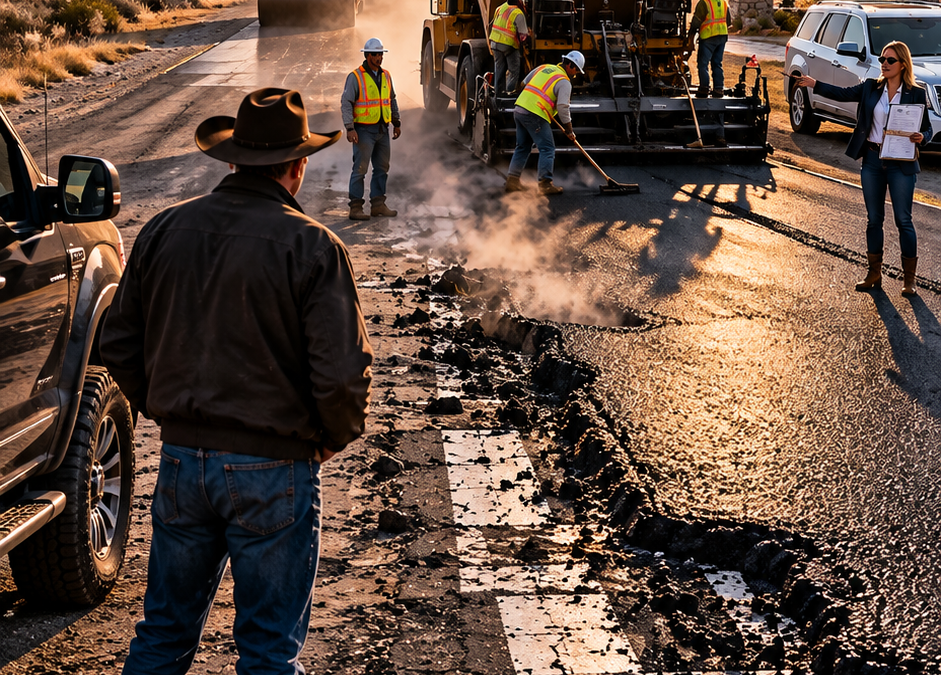
At five o’clock on a Thursday morning, I woke to diesel engines moving across land that had belonged to my family for forty-three years.
By sunrise, strangers were scraping away the white runway markings my father had painted with his own hands, and an HOA president was waving a county permit that carried his signature nine years after I buried him.
What frightened me most was not that someone wanted my land—it was that they seemed to need the truth erased before Saturday afternoon.
My name is Mason Reed.
I am fifty-eight years old, and most people who drove past Reed Field probably would not have called it an airport.
There was no terminal.
No tower.
No baggage claim.
No restaurant selling eight-dollar coffee.
There was a long strip of compacted pale gravel stretching across the Oregon high desert behind my barn, a faded windsock, six portable edge lights, a weather station bolted to a steel post, and an old maintenance shed with a roof that leaked whenever rain came sideways.
To somebody looking for luxury, it was almost nothing.
To my father, it had been a promise.
And on the morning Silver Mesa decided to pave over it, that promise was about to become the only safe place for an airplane that had nowhere else to go.
The sound that woke me came from the western end of the strip.
Not the county road.
Not the gated development east of my property.
My runway.
I pulled on jeans and boots, grabbed my jacket, and drove my pickup out behind the barn.
Two asphalt trucks were already reversing toward the centerline.
A grader had scraped through the first white threshold cross.
Men in reflective vests were driving steel stakes into the shoulders.
A portable sign stood where my father once parked his yellow Piper Pawnee.
SILVER MESA LEGENDS WEEKEND
PRIVATE AUTO EXPERIENCE
I stopped my truck directly in front of the grader.
The operator killed the engine.
A foreman climbed down.
Before he reached me, a white SUV appeared over the eastern rise.
I knew the vehicle.
I knew the woman driving it.
Celeste Ward stepped out wearing a red suit and white boots that looked as if they had never touched real dirt before that morning.
Celeste was president of the Silver Mesa Homeowners Association.
Silver Mesa had been built along the eastern boundary of my property five years earlier.
At first, the development had seemed harmless enough.
Large houses.
Stone entrance columns.
Artificial ponds.
Decorative lighting.
Then Celeste became president during its second year.
After that, every old thing near Silver Mesa became a problem that apparently required her permission to continue existing.
My barn became “visual blight.”
My windsock became “unauthorized signage.”
My equipment trailers became “nonconforming outdoor storage.”
And eventually, Reed Field became an “abandoned agricultural corridor.”
I had ignored most of her letters.
It was easier than arguing with someone who believed stationery could change ownership.
But asphalt was different.
I climbed out of my truck.
Celeste walked toward me.
“Move the truck, Mr. Reed.”
I looked past her.
A worker was already rolling black plastic over one of the remaining white runway crosses.
“You’re paving an active emergency strip.”
She held up a county permit.
“This runway was abandoned ten years ago.”
“It wasn’t.”
“County records say otherwise.”
“Then county records are wrong.”
Her expression barely changed.
“By Saturday afternoon, this surface becomes part of the Silver Mesa event venue.”
“It never belonged to Silver Mesa.”
“You have until five o’clock Saturday to prove that.”
Inside my pickup, the aviation radio cracked.
“Reed Field, Cascade Medical Two-Seven conducting Saturday route check. Confirm availability for seventeen-thirty arrival.”
I turned toward the open window.
Celeste moved faster.
She reached through the window, lifted the microphone from its bracket, and switched off the radio.
It was a small gesture.
Quiet.
Controlled.
But it told me everything.
She was not confused about Reed Field.
She knew exactly what it was.
She simply needed it to stop being one before somebody with authority looked too closely.
I took the microphone from her hand and turned the radio back on.
“Cascade Two-Seven, Reed Field ground. Runway temporarily obstructed. I’ll confirm Saturday status by noon tomorrow.”
“Copy, Reed Field.”
Celeste watched me hang up.
“You repair crop dusters in a leaking barn,” she said. “You don’t decide what qualifies as an airport.”
I studied the permit in her hand.
There was a document number beneath the county seal.
Something about it bothered me.
Then I saw the name referenced beside the abandonment declaration.
Walter Reed.
My father.
I looked at Celeste.
“Maybe I don’t decide that.”
I pointed toward the paperwork.
“But my father’s signature never belonged on that application.”
For the first time that morning, she looked down.
Only for a second.
Then the grader started again behind her.
She did not tell them to stop.
That Saturday medical flight was not theoretical.
Three days earlier, I had received notice that the regional airport’s eastern runway would be temporarily restricted because firefighting aircraft were operating in the area.
Cascade Medical had placed Reed Field on its transfer route.
The aircraft scheduled for Saturday was supposed to move a patient between rural facilities before continuing toward Bend.
Silver Mesa’s management office had been copied on the county aviation notice.
Celeste knew.
She had known before the asphalt trucks arrived.
I stepped toward the grader.
Two private security guards moved between us.
Celeste did not raise her voice.
“Saturday at five, Mr. Reed. After the first guest enters, our venue contract is accepted. After that, this discussion becomes very expensive.”
Black asphalt spilled across the western threshold.
I stood there watching it cover ground my father had spent half his life maintaining.
Asphalt was not proof.
It was not law.
It was not ownership.
It was an attempt to create a physical fact faster than I could challenge the paperwork.
Reed Field had existed for forty-three years.
My father built it after a ranch hand named Samuel Ortiz was badly injured by a piece of broken machinery.
The nearest road ambulance was more than an hour away.
A helicopter tried to reach him but could not safely cross the ridge because of low cloud and wind.
Samuel survived.
Barely.
He spent six hours waiting for transport.
My father never forgot that.
Walter Reed was not sentimental about much.
He believed fences should be straight, engines should start on the first try, and people should say what they meant.
But after Samuel’s accident, he walked the western flats for two days carrying survey stakes.
Then he came into the kitchen, unfolded a topographic map, and told my mother he was building a runway.
“For crop planes?” she asked.
“For whoever needs ground.”
He built thirty-two hundred feet of compacted surface first, then extended and reinforced sections over the years.
Later, he recorded an emergency-use easement.
The strip could remain privately owned while still being available for medical, firefighting, law-enforcement, and emergency aviation.
My father never made much money from it.
That was never the point.
Once, when I was seventeen, I asked him why he kept spending money replacing lights for airplanes that might never come.
He looked down the strip and said, “Because the day somebody needs it is the wrong day to start building it.”
I remembered those words as Celeste’s contractor buried the western threshold beneath asphalt.
At 6:25, a sheriff’s deputy arrived.
I had called because workers were crossing what I believed was my boundary.
Celeste met him first.
Of course she did.
She showed him the county permit and a site plan.
On the plan, the western six hundred feet of Reed Field had been colored as an inactive utility corridor inside Silver Mesa’s event boundary.
The deputy walked the fence line with me.
He was careful.
Professional.
And clearly unhappy about being asked to settle a property dispute at sunrise.
“I can stop them if they cross an established boundary,” he said.
“They already have.”
He pointed toward the plan.
“This says they have an access license.”
“There is no access license.”
“Then I need the recorded documents.”
“She invented it.”
“I’m not saying she didn’t.”
He lowered his voice.
“But right now, she has a stamped permit and you’re telling me the stamped permit is based on false documents. That needs to be proved.”
I knew he was right.
I did not like it.
But he was right.
A badge could stop a fight.
It could not replace a survey.
The deputy convinced the contractor to pause for two hours while I went to the county.
Celeste handed me an envelope before I left.
“What is this?”
“Notice of violation.”
I opened it.
Twenty-six thousand seven hundred dollars.
Security costs.
Contractor delays.
Emergency legal assessment.
Obstruction of an approved community improvement.
I almost smiled.
“I’m not in your HOA.”
“The runway access license subjects you to limited enforcement.”
“The license you just invented?”
“The license your father signed.”
She tapped the site plan with one red fingernail.
“Saturday. Five o’clock.”
Her phone rang.
She turned away.
Not far enough.
“Tell the bank Saturday stays on schedule,” she said. “If the milestone slips, Monday’s draw freezes.”
She ended the call.
Then she looked at me as though I had heard nothing.
I drove to the county records office with that sentence in my head.
Monday’s draw freezes.
At the records desk, June Alvarez helped me pull every filing connected to Reed Field, Walter Reed, and Silver Mesa.
Two plats.
One permit packet.
One scanned declaration.
The declaration was dated eleven years earlier.
It said aviation use on the western approach had been discontinued.
At the bottom was my father’s signature.
I knew that signature.
The heavy W.
The short tail on the R.
The slight downward angle.
My father had signed checks, equipment receipts, flight logs, tax forms, and birthday cards with the same hand.
I sat there staring at it.
Walter had died nine years earlier.
During the final year of his life, heart failure and medication had changed him.
He grew tired easily.
Some days paperwork frustrated him.
It was possible he had signed something I never saw.
Possible.
And for ten minutes, that possibility hurt more than anything Celeste had done.
Had I spent years protecting something my father had already surrendered?
Had he decided Reed Field was no longer worth keeping and simply never told me?
June watched me.
“Something wrong?”
“The signature is his.”
“Then what are you looking for?”
“The page he actually signed.”
She raised an eyebrow.
I pointed to the upper left corner.
“County packets from that year used three-hole fasteners.”
The scanned declaration showed two small staple holes.
“And look at the document code.”
June enlarged the bottom of the page.
TEMP OPS 30.
I sat back.
I remembered that summer.
A windstorm had ripped roofing metal from an equipment shed and scattered nails across the western half of the strip.
Dad had temporarily closed Reed Field while we removed the contaminated gravel and replaced the surface.
Thirty days.
That was all.
The signature was genuine.
The document above it was not.
June searched the archive index.
There it was.
Temporary Operation Suspension.
Thirty days.
The attached scan was missing.
In its place sat the discontinuance declaration Silver Mesa was now using.
“Can you certify this?” I asked.
“I can certify what the database shows now.”
“When can you tell me when it changed?”
“We need the audit log.”
“How long?”
“Usually a week.”
“I have fifty-six hours.”
She printed the original index reference and initialed the retrieval time.
It was not enough to stop construction.
But it was the first crack.
Then she found something that made my stomach drop.
“Mason.”
“What?”
“Your annual emergency surface report.”
I knew what she was going to say before she finished.
“Due noon Friday.”
“I completed it.”
“It’s still marked Draft.”
I closed my eyes.
Two weeks earlier, I had inspected the surface, checked the drainage, measured loose aggregate depth, tested the radio, and entered everything into the state portal.
Then the power failed.
I closed the laptop.
The next day an irrigation pump seized.
Then a customer brought in a crop aircraft with a cracked exhaust manifold.
Then life did what it does.
I forgot to reopen the submission.
If the report expired, Reed Field would be temporarily unavailable.
Celeste’s paperwork could still be fraudulent.
Her permit could still be wrong.
But I would lose the clean operational status I needed to argue that Saturday’s flight could use the strip.
June looked at me.
“Can you submit it now?”
“Not without independent condition verification.”
“Why?”
“Because the rule requires it after a lapse.”
She stared at me.
“You wrote that rule, didn’t you?”
I folded the printout.
“Part of it.”
For the first time that day, my anger turned inward.
I had spent eighteen years with the state aeronautics division telling rural strip owners that safety documents mattered only when they were current.
A runway was not safe because somebody cared about it.
It was safe because somebody inspected it, documented it, corrected problems, and accepted accountability.
Now my own paperwork was sitting in Draft.
My father used to say a man should never ask another person to live by a standard he refused to meet himself.
I had until noon Friday.
When I returned to Reed Field, the pause was over.
Fresh asphalt covered almost two hundred feet.
Workers were unloading black steel barriers.
A temporary stage had arrived.
Fence posts blocked the service lane to my barn.
I parked by the county road and carried my records box in on foot.
Nate Doran, the contractor’s foreman, met me near the fence.
“I don’t want trouble,” he said.
“Then stop paving my runway.”
“My contract says Silver Mesa controls this zone.”
“Did your contract tell you this was a runway?”
He glanced toward the damaged centerline.
“It called it an abandoned farm road.”
“Farm roads don’t have threshold markings.”
He looked over his shoulder.
Then lowered his voice.
“Celeste told us to scrape those off before the county inspection.”
I stopped.
“When?”
“Three weeks ago.”
That mattered.
Silver Mesa had applied for the event permit only twelve days earlier.
Celeste had ordered aviation markings removed before the permit application claimed the strip was already abandoned.
“Put that in writing.”
Nate shook his head immediately.
“I’ve got four hundred thousand dollars tied up in this event.”
“And if an airplane comes in?”
“Celeste says none will.”
That answer followed me into the barn.
I opened the old metal cabinet where Dad kept runway logs.
Every emergency aircraft that used Reed Field had been recorded.
Date.
Registration.
Purpose.
Pilot signature.
The most recent entry was fourteen months old.
A medevac flight had picked up a ranch worker with a crushed pelvis during a highway closure.
Fourteen months was a long quiet period.
Long enough for Celeste to turn silence into supposed abandonment.
Then I checked the equipment inventory.
Six portable edge lights were missing.
I walked the shoulders.
Fresh rectangular patches showed where each one had been removed.
The copper leads had been cut cleanly.
At 9:10 that night, I called Tom Bell.
Tom’s hayfield overlooked the western approach.
He had installed security cameras after somebody stole diesel from his tanks.
“Your camera still covers my service road?”
“Most of it.”
“I need footage from three weeks ago.”
He hesitated.
“Mason, Celeste says this is a county project.”
“I’m not asking what Celeste says.”
Another silence.
“What are you asking?”
“What did your camera see?”
He agreed to check.
The next morning, Tom arrived with a thumb drive.
We watched the footage on my shop computer.
August seventeenth.
2:26 a.m.
A flatbed truck came through Silver Mesa’s maintenance gate.
Two men removed six runway lights and several white marker panels.
The truck door carried Doran Siteworks’ logo.
I froze the frame.
That video did more than show equipment being removed.
Its timestamp mattered.
The lights were taken eighteen days before Silver Mesa submitted a permit application describing an already unmarked, inactive strip.
I copied the footage three times.
One drive for June.
One for my attorney.
One for the steel cabinet beneath my workbench.
I did not call Celeste.
Evidence has a strange relationship with timing.
Show it too early and the person lying gets a chance to repair the lie.
Show it too late and the lie hardens into something expensive.
I had forty-four hours before the first event guest was scheduled to enter.
And barely fifteen hours before my own filing deadline.
Friday morning, a surveyor named Lydia Park arrived from Redmond.
She set a base station near the barn and walked the western approach with a GPS rod.
By noon, orange flags cut straight through Silver Mesa’s temporary stage, VIP tent, and the first row of display platforms.
The encroachment was worse than I expected.
At the widest point, Silver Mesa had crossed seventy-eight feet onto Reed Field.
Lydia overlaid the event plan on the recorded county plat.
Then she frowned.
“What?”
She rotated the screen.
“Someone rotated the base drawing one hundred eighty degrees.”
I leaned closer.
“Look at the drainage notch.”
On the recorded plat, it faced northwest.
On the permit drawing, it faced southeast.
The rotation shifted my boundary west just far enough to place the runway under supposed HOA control.
“A drafting error?”
“Not with the monument numbers copied correctly.”
She looked at me.
“Whoever did this understood what they were using.”
She marked every encroachment and signed both the boundary survey and my condition verification.
At 11:52 Friday morning, I submitted Reed Field’s emergency surface report.
Eight minutes before the deadline.
I should have felt victorious.
I didn’t.
I had corrected a mistake I never should have made.
And Lydia had been required to list every new obstruction.
Stage.
Barriers.
Fresh asphalt.
Temporary fencing.
Reed Field remained registered.
But its Saturday availability depended on clearing those objects before Cascade Medical arrived.
Under normal circumstances, the evidence should have produced a stop-work order.
But Silver Mesa had lawyers.
Their attorney argued that even if the parcel line favored me, the disputed area was controlled by an access license supposedly signed by my father.
The county planner scheduled an emergency field review for Saturday at four.
Two hours before the car event’s advertised reception.
Celeste met me in the hallway afterward.
“You’re making this expensive for your neighbors.”
“They’re not my neighbors when you send me their bill.”
“They will be when your property becomes the reason their assessments double.”
She opened a folder.
The event cancellation clause showed a potential liability of $2.8 million.
Promoter fees.
Sponsor guarantees.
Vendor losses.
“Sell the western six acres,” she said.
“How much?”
“Four hundred eighty thousand.”
I almost laughed.
“And?”
“We withdraw the fine.”
“You mean the fake one?”
“We give you lifetime access to the barn.”
I looked at her.
“You’re offering me access to my own barn.”
“I’m offering you a graceful exit.”
That was Celeste’s talent.
She could put theft inside a polished document and make refusal sound unreasonable.
I handed the contract back.
“Cancel the event.”
“No.”
“Move it.”
“There is nowhere else to put three hundred guests and eighty-seven vehicles.”
“That sounds like something you should’ve considered before paving another man’s runway.”
The smile disappeared.
“By tomorrow evening, everyone attending will see what’s really here.”
“What’s that?”
“An empty road. A rusted windsock. And a man who can’t prove an airplane still needs either one.”
She walked away.
The $2.8 million bothered me.
So did the speed.
The county had a fairground.
There was a motorsports park seventy miles south.
The regional airport had event space.
Silver Mesa had chosen the one location guaranteed to create a property fight.
Why?
That evening, I drove past the Silver Mesa sales office.
Lights illuminated a scale model behind the glass.
The current subdivision occupied the eastern half.
On the western side, exactly where Reed Field ran, eighteen small luxury villas curved around a decorative pond.
No runway.
A gold plaque read:
AVIATOR RESERVE
I took photographs through the window.
When I enlarged one, I saw a miniature hangar beside the villas.
There was even a decorative aircraft on the model.
I stood there staring at it.
Silver Mesa planned to erase the runway legally while selling future buyers the image of aviation access.
The contradiction would have been funny if it had not been so deliberate.
The next morning, I drove to High Desert Community Bank.
I did not ask for confidential loan documents.
I asked for the public financing notice tied to Silver Mesa’s expansion.
The notice referenced a $6.1 million development facility.
Part of the collateral description included a phrase that changed the entire case.
Direct adjacency to an operational private airstrip.
I read it three times.
If Reed Field was abandoned, Silver Mesa’s financing disclosure exaggerated the project’s amenities.
If Reed Field was operational, Silver Mesa’s permit application was false.
Both stories could not survive once they sat on the same table.
The branch manager would not discuss the loan.
I handed her Lydia’s certified survey, still images from Tom’s camera, and the public financing notice.
She gave me a stamped receipt.
“We’ll review whether the collateral description is accurate.”
“Before tonight?”
“I can’t promise that.”
“Someone promised your bank an active runway while promising the county there wasn’t one.”
She looked down at the notice again.
“I understand.”
At 11:30, Tom called me.
His voice sounded wrong.
“I need you to delete the camera footage.”
“No.”
“It doesn’t show what I thought.”
“It shows a truck taking my runway lights.”
“Those could have belonged to the HOA.”
“They were wired into my charging cabinet.”
Silence.
Then I looked across the flats.
A Silver Mesa SUV was parked beside Tom’s hay shed.
“What did Celeste offer you?”
“Nothing.”
“Then what did she threaten?”
He stopped talking.
Tom’s wife had undergone cancer treatment the year before.
Medical bills had pushed them behind on assessments.
I knew they were struggling.
I did not know how badly.
“Four thousand one hundred dollars,” he finally said.
“What?”
“That’s what I owe.”
“And?”
“She’ll erase it if I sign a statement.”
“Saying what?”
“That Reed Field hasn’t been used in ten years. That the lights were HOA fixtures.”
I closed my eyes.
“Don’t sign it.”
“I already did.”
“When?”
“Ten forty-seven.”
Celeste’s attorney sent the affidavit to the county before eleven.
It claimed Tom’s camera timestamp was unreliable.
It claimed the runway lights belonged to Silver Mesa.
And it claimed no aircraft had used Reed Field in more than ten years.
At 11:38, my request for an immediate administrative stop was denied pending the Saturday field inspection.
Tom’s affidavit had created just enough dispute to keep construction moving.
“Can you pay what I owe?” he asked quietly.
“No.”
“Then you don’t get to tell me what today costs.”
He hung up.
I stood there holding the phone.
I was angry.
But I understood.
That made it worse.
Celeste’s power did not come from shouting.
It came from knowing which bill each person feared most.
At one o’clock, June called.
The county audit log had arrived.
The temporary closure scan had been replaced through an external account linked to Kesler Planning Group.
Kesler had prepared Silver Mesa’s event application.
The server retained the original upload.
The substituted page.
The login history.
The approval path.
My father’s signature had been moved from a temporary thirty-day closure onto a permanent discontinuance declaration.
A dead man had become the most convenient witness in the county because he could not object.
I sent the audit trail to my attorney.
June locked the record against further alteration.
By three Saturday afternoon, Silver Mesa looked like a television set built over a crime scene.
Exotic cars stood beneath white covers.
Tall banners hid the remaining runway markers.
A catering tent blocked the eastern turnaround.
Music played from speakers beside Lydia’s orange boundary flags.
Celeste stood near the main stage with two attorneys.
Her red suit was darker than the one she wore Thursday.
A silver airplane pin rested on her lapel.
The state sent Daniel Cho from aviation safety.
Daniel carried a tablet and measuring wheel.
Celeste greeted him loudly.
“This is the man who will determine whether Mr. Reed’s dirt road qualifies as aviation infrastructure.”
Daniel looked at me.
His eyebrows lifted.
“Mason Reed.”
“Been a while.”
Celeste turned.
“You know each other?”
Daniel placed his measuring wheel down.
“Mr. Reed wrote part of the rural emergency-strip procedure we use.”
The people nearest us became quiet.
“He also trained my first inspection team.”
Celeste looked at me as though my boots had just admitted a secret.
I had worked eighteen years for the state aeronautics division.
I had inspected rural landing strips.
Reviewed obstruction zones.
Investigated surface failures.
Helped write field procedures.
After my wife died and my father’s health collapsed, I left state service and came home.
I did not hide my history.
I simply did not believe every HOA letter deserved a résumé.
Celeste recovered quickly.
“Then this inspection is compromised.”
“No,” I said. “Daniel follows the published checklist while I stand over there.”
Daniel nodded.
“And because we know each other, I’ll document every defect on Reed’s side too.”
“Fine.”
“If Reed Field fails, it fails in writing.”
A second county official observed every measurement.
Daniel found the original compacted runway base beneath the new grading.
He confirmed the emergency registration had never been canceled.
My Friday filing preserved conditional operational status.
Then he found something I had missed.
The eastern windsock light was out.
Its backup battery had failed.
“Immediate repair,” he said.
“Agreed.”
Celeste watched us.
I could almost hear what she wanted me to do.
Argue.
Demand special treatment.
Act like my past made me immune.
I did none of those things.
A standard is not a weapon you use only when it points at somebody else.
Daniel examined the missing edge-light positions.
“Removal created a maintenance deficiency,” he said. “It does not prove abandonment.”
Then he measured the approach corridor.
Silver Mesa’s stage and display platforms sat inside it.
He asked Celeste who approved them.
“The county permit.”
The county planner shook his head.
“Our permit approved an event surface represented as nonaviation property. It did not authorize obstructions inside an active approach corridor.”
Celeste pointed at me.
“He manufactured this status. There hasn’t been a landing in fourteen months.”
Daniel opened the state record.
“Frequency doesn’t determine validity.”
“Then what does?”
“Closure.”
“Then close it.”
“Owner’s application required.”
Everyone looked at me.
Celeste’s attorneys immediately asked for a private conference.
Daniel and I walked toward the western threshold.
“You should’ve called earlier,” he said.
“I needed evidence. Not favors.”
“You’ve got enough to stop the event.”
“I know.”
He looked at me.
“That doesn’t sound like relief.”
“Stopping the event doesn’t explain why she risked this much.”
At 4:30, Celeste returned with another proposal.
Silver Mesa would remove some of the western platforms and leave a forty-foot lane along the center.
In return, I would sign a statement describing Reed Field as inactive for ordinary aviation use.
Daniel rejected it before I spoke.
“Forty feet is unsafe.”
Celeste looked at him.
“For what?”
“Wing clearance.”
“There will be no airplane.”
“You don’t get to build a safety plan around that assumption.”
The county planner issued a written suspension of the event permit.
Celeste refused to accept the paper.
Then her phone rang.
She stepped away.
Listened.
Looked toward my barn.
When she came back, something had changed.
“Opening reception moves up.”
One of the event employees blinked.
“To when?”
“Five fifteen.”
“It’s scheduled for six.”
“Now it’s five fifteen.”
I understood.
She was trying to reach the contractual milestone before the suspension worked its way through vendors, security, and ticket holders.
Once the first paid guest entered, Silver Mesa could argue that the venue had been delivered.
Part of the financial risk would move to the promoter.
At 4:52, covers came off the cars.
At 5:03, gates opened.
At 5:07, Celeste’s phone lit up.
She read an email.
I watched the color leave her face.
High Desert Community Bank had frozen Silver Mesa’s next construction draw.
It should have stopped her.
It did not.
She ordered security to block my access.
Guests entered in linen jackets and sunglasses.
They took photographs of exotic cars parked across the old runway centerline.
A host welcomed them to the first annual Silver Mesa Legends Weekend.
He called the location a “transformed agricultural corridor.”
Nobody mentioned the county suspension.
My attorney was trying to reach a judge for an emergency injunction.
The law was moving.
But paperwork moves at the speed of review.
Celeste had microphones, contractors, and gates.
Then Nate Doran came through the service entrance.
He handed me his phone.
“She threatened to bill every delay to my company.”
“What am I looking at?”
“Original job file.”
An email filled the screen.
Sender: Celeste Ward.
Date: eighteen days before the permit application.
REMOVE AVIATION LIGHTS AND BURY WHITE MARKERS BEFORE INSPECTION.
Another line followed.
ONCE GUESTS ENTER OPENING DAY, OLD USE WILL BE IMPOSSIBLE TO RESTORE WITHOUT MAJOR LOSS.
I looked at Nate.
“You sent this?”
“County counsel. Full header. Attachments too.”
That email connected almost everything.
Intent.
Timing.
Physical removal.
The event milestone.
Celeste had not accidentally mistaken a runway for a road.
She had tried to make the runway look abandoned before asking the county to believe it was abandoned.
At 5:19, Tom Bell appeared near the gate.
He was holding a notarized statement.
“I lied this morning.”
I read the first lines.
Recantation.
He confirmed his camera’s location.
Confirmed the timestamp.
Confirmed the footage had not been altered.
Then he attached Celeste’s written offer to erase his HOA debt if he signed the false affidavit.
“What about your house?” I asked.
“They reinstated everything.”
“All of it?”
“And filed an expedited lien notice.”
I stared at him.
Tom swallowed.
“My wife read it.”
“What did she say?”
“She said if we saved the house with a lie, we’d spend every morning knowing who really owned it.”
He looked toward the crowd.
“Celeste made one mistake.”
“What?”
“She emailed me the offer.”
By then, I had more evidence than I had possessed at any point during the dispute.
Survey.
Audit trail.
Camera footage.
Bank contradiction.
Celeste’s instruction to remove aviation markers.
Tom’s recantation.
But Reed Field was still physically blocked.
At 5:26, my truck radio came alive.
“Reed Field. Reed Field. Cascade Medical Two-Seven. Anybody monitoring?”
I grabbed the microphone.
“Cascade Two-Seven, Reed Field ground. Go ahead.”
The pilot’s voice was controlled.
But I could hear the engine behind him.
Something was wrong.
“We have fluctuating oil pressure and rising temperature. Two crew, one medical patient. Bend is beyond safe endurance. Request immediate landing conditions Reed Field.”
I looked down the runway.
Eighty-seven vehicles.
Two stages.
A catering truck.
Steel barriers.
Nearly three hundred people.
“Cascade Two-Seven, runway obstructed. State altitude and time available.”
“Seven thousand two hundred descending. Estimate twelve minutes before engine seizure risk. Highway option appears congested.”
Twelve minutes.
Every argument we had been having changed.
For two days, Reed Field had been property.
A permit.
A financing problem.
A family inheritance.
A piece of paper.
Now it was twelve minutes of ground beneath an aircraft losing its engine.
I turned to Celeste.
She had heard the transmission through a security handset.
“Clear the runway.”
She looked toward the crowd.
“We don’t know if that call is real.”
Daniel raised his tablet.
“The aircraft is on the state traffic feed.”
Celeste said nothing.
“It’s real,” Daniel repeated.
“Send it to the regional airport.”
“It may not make it.”
The event promoter joined us.
“How much room?”
“Twenty-five hundred feet minimum clear,” I said. “More if the engine fails before touchdown.”
Celeste pointed toward the narrow center opening between the cars.
“You said it’s a runway. Let him use the middle.”
“The wingspan is fifty-two feet.”
“Then move the nearest cars.”
“Every car comes off.”
The promoter turned toward her.
“You represented this property as free of aviation restrictions.”
“It is.”
Daniel held up the state listing.
“No. It isn’t.”
Celeste looked at me.
“This is his stunt.”
I stepped closer.
I kept my voice low.
“You can investigate me when that airplane is on the ground.”
I pointed toward the southwest.
“Right now, you have eleven minutes.”
She ordered security to keep the gates closed.
That was when she lost control of the field.
I went to the event sound console.
Pulled the host’s microphone.
Connected the portable emergency transmitter mounted in my truck.
Years earlier, when I worked for the state, I helped write a requirement that any temporary event near a rural emergency strip maintain a public-address override.
Celeste had called it outdated.
Her staff left the connection port because removing it cost extra.
My voice came through every speaker.
“Attention. An aircraft carrying a medical patient has declared an emergency and is approaching Reed Field from the southwest. This is not a demonstration.”
For one second, nobody moved.
“Move every vehicle to the eastern service road. Leave keys in the ignition if you cannot move the vehicle yourself. All guests proceed behind the stone wall and remain there.”
A man near the front row looked toward the ridge.
The aircraft was visible.
Small.
Unsteady.
Then the crowd moved.
Engines started.
Staff pulled wheel chocks.
Guests dragged portable barriers toward the grass.
Nate climbed onto a loader and started moving the western stage.
Electrical cables tore loose.
Celeste ran toward him.
“If you damage that platform, your company pays for it!”
Nate never stopped.
“If I leave it there, my company gets hit by an airplane!”
The first row cleared in ninety seconds.
The second jammed at the service gate.
Silver Mesa’s access system required every vehicle tag to scan individually.
Cars backed up.
I grabbed bolt cutters.
Opened my maintenance gate.
Cut the HOA chain attached across it.
Celeste filmed me.
“You’re destroying HOA property.”
“The posts are on my survey line.”
I swung the gate aside.
Cars poured through.
Daniel and Lydia moved guests behind my barn.
Tom started his tractor and pulled the catering trailer clear.
I returned to the radio.
“Cascade Two-Seven, wind two-five-five at nine. Runway two-four. First two thousand feet clearing. Fresh asphalt western threshold. Loose debris possible midfield.”
“Copy Reed Field. Oil temperature red line.”
“Stay high until the ridge. Terrain rises north and east. Best approach southwest over Bell Field.”
“Copy.”
Eight minutes.
One silver coupe refused to start.
Its owner pressed the ignition again and again.
Four men pushed.
The transmission lock would not release.
Nate approached with the loader.
The owner stepped in front of it.
“That car is worth nine hundred thousand dollars!”
I looked at the aircraft.
Then at him.
“You want a scratched car or a destroyed airplane?”
He moved.
Nate ran padded straps beneath the front frame.
The loader dragged the coupe thirty feet into the grass.
The bumper struck a display stand and cracked.
Nobody stopped.
At midfield, we found another problem.
Stage anchors had been drilled through the runway base.
The platform moved.
Eight steel rods remained sticking out of the landing path.
I knelt beside one with a cutoff tool.
Nate brought a battery grinder.
Sparks sprayed across the new asphalt.
Five minutes.
One rod.
Two.
Three.
We moved down the line.
The aircraft crossed the distant ridge.
Lower than I wanted.
A faint blue haze trailed from the left engine.
Four rods.
Five.
Six.
People behind the wall had become silent.
Seven.
The final anchor fell.
The aircraft called three-mile final.
I walked the centerline.
Kicked a loose cable into the grass.
Checked the shoulders.
Raised the radio.
“Cascade Two-Seven, runway clear. Cleared to land at pilot’s discretion. Emergency units four minutes out.”
Static.
Then the pilot’s voice.
“Reed Field, we’ve lost the engine.”
I looked up.
The left propeller slowed.
Then stopped.
The airplane descended over Tom’s field almost silently.
Its nose moved left.
Corrected.
Dropped.
The landing gear was down.
The wings rocked in the crosswind.
For one terrible second, I thought he was going to land short.
Then the aircraft crossed the western fence.
Barely fifty feet above it.
The tires hit the fresh black asphalt.
Bounced once.
Settled.
The pilot braked hard.
The airplane rolled over the scraped white marking.
Past the place where the stage had stood.
Past the cut anchors.
Past me.
It stopped one hundred eighty feet from the catering tent.
Nobody spoke.
The only sound was the ticking metal of the failed engine.
Then the cabin door opened.
A flight nurse climbed down.
Paramedics were already running toward the aircraft.
The patient was a twelve-year-old girl being transferred for emergency cardiac treatment.
The regional airport’s temporary firefighting restrictions had changed the route.
The engine failure eliminated their remaining options.
She was frightened.
Pale.
But stable.
I did not know her name then.
I only knew Reed Field had just answered the question Celeste had spent two days trying to erase.
Did anybody still need this runway?
Yes.
Not every day.
Not every month.
But one day was enough.
Fire crews reached the aircraft.
Later, investigators found the left engine had lost most of its oil through a failed line.
The pilot could not safely have reached Bend.
That landing did not prove my property boundary.
It did not prove who altered a county file.
An emergency is not a deed.
I knew that better than anyone.
But it proved the danger created by Celeste’s lie.
As paramedics moved the girl into an ambulance, the promoter confronted Celeste.
“You told us this site had no aviation restrictions.”
“The owner staged this landing to sabotage the event.”
The pilot heard her.
He walked over holding the failed oil line in one hand.
“Ma’am.”
She turned.
“I did not destroy an engine to interfere with your car show.”
Nobody laughed.
The accusation had become too absurd.
At 6:18, my attorney called.
The emergency injunction had been granted.
At 6:24, High Desert Community Bank placed Silver Mesa’s construction financing on compliance hold.
The party ended with half the exotic cars sitting in a hayfield and a disabled medical aircraft cooling on the runway.
Three weeks later, the county held a public hearing inside the Silver Mesa clubhouse.
Celeste’s attorney tried to make the emergency landing the center of everything.
“Public emotion cannot determine ownership,” he said. “A dramatic aviation event cannot transform disputed land into an airport.”
I agreed.
So did my attorney.
That was why we did not begin with the airplane.
We began with Lydia’s survey.
Recorded monuments.
Seventy-eight feet of encroachment.
Then the original county index.
Temporary Operations Suspension.
Thirty days.
Next came the server audit.
My father’s genuine signature.
The substituted declaration.
The external planning account.
Then Tom’s camera footage.
Six lights removed in the middle of the night.
Then the bank financing notice describing Reed Field as operational.
Then Celeste’s own email.
Remove aviation lights and bury white markers before inspection.
Once guests enter opening day, old use will be impossible to restore without major loss.
Tom testified afterward.
He stood in front of people he had lived beside for years.
“I signed something false.”
Celeste’s attorney asked why.
Tom looked toward his wife.
“I was scared.”
“Of what?”
“Losing my house.”
He swallowed.
“She didn’t invent that fear. She used it.”
The room was quiet.
“What you signed was still your decision,” the attorney said.
“Yes.”
Tom nodded.
“That’s why I’m telling the truth now.”
Only after the ownership and record evidence was established did the medevac pilot testify.
He described the oil-pressure failure.
The temperature spike.
The twelve-minute estimate.
The loss of power on final.
The order mattered to me.
I did not want sympathy to replace proof.
Reed Field did not belong to me because a sick child landed there.
It belonged to me because the deed, survey, easement, and county record said it did.
The emergency simply showed what false paperwork had placed at risk.
The hearing officer voided the event permit.
My boundary was upheld.
The alteration of county records was referred for investigation.
Silver Mesa’s proposed eighteen-villa expansion was rejected.
The bank required an independent audit before releasing further construction funds.
Celeste resigned that evening.
Residents still held the recall vote.
They removed her.
Two directors closely involved in the event approvals were also voted out.
The temporary board canceled the fine Silver Mesa had tried to impose on me.
Auditors reviewed Tom’s account and found questionable legal and administrative charges mixed into his debt.
Some were reversed.
Not everything disappeared.
Residents had signed contracts through their elected board.
Restoration costs existed.
Some event cancellation expenses survived the litigation.
A smaller special assessment followed.
That was unpleasant.
But it was honest.
Bad leadership rarely vanishes without cost.
The question is whether the next dollar repairs damage or pays to preserve a lie.
After everything that happened, I could have closed Reed Field.
No one would have blamed me.
The easement allowed restrictions under certain maintenance conditions.
I could have put up a locked gate.
Canceled emergency availability.
Let Silver Mesa residents depend entirely on the regional airport.
Part of me wanted to.
For a few weeks after the hearing, every time I looked toward those houses, I remembered asphalt covering Dad’s white markers.
I remembered Tom’s voice asking whether I could pay his debt.
I remembered my father’s signature beneath words he had never agreed to.
Then I opened the old runway log.
Walter’s final entry was still there.
His handwriting had become shaky.
He recorded a wildfire support flight that landed seven months before his death.
Aircraft serviced.
Water loaded.
Pilot departed 14:32.
Below it was an empty line.
I sat at his old desk for a long time.
My father had never kept Reed Field open because he trusted every person who might use it.
He kept it open because emergencies did not ask whether people deserved help.
So I negotiated a new agreement with the county.
One page.
Plain language.
The county would maintain the emergency lighting.
It would inspect the surface annually.
Medical, firefighting, and public-safety aircraft could use Reed Field without charge.
Recreational flights still required my permission.
Silver Mesa received no ownership interest.
No scheduling authority.
No event rights.
No ability to call the runway its amenity when asking a bank for money.
Ownership stayed with me.
Responsibility was shared only where public safety justified it.
The black event asphalt was removed from the western threshold.
The compacted gravel beneath it was repaired.
Fresh white markers went down.
Six replacement edge lights returned to the shoulders.
I replaced the windsock battery before Daniel could remind me.
The steel stage anchors ended up on my workbench.
I kept one.
Not because I enjoyed remembering Celeste.
I kept it because it reminded me how easily something permanent can begin with somebody saying a temporary shortcut will not matter.
Cascade Medical Two-Seven remained in my barn for nine days.
Mechanics replaced the damaged engine.
I helped where I could.
The twelve-year-old girl reached the hospital by ambulance after landing.
Several weeks later, an envelope arrived.
Inside was a photograph of her standing beside a small model airplane.
She looked healthy.
On the back she had written:
Thank you for keeping a place to land.
I read the sentence three times.
Then I placed the photograph inside the old runway log beside my father’s final entry.
That autumn, the ground where Silver Mesa had planned its eighteen villas was reseeded with native bunch grass.
Without the model homes and promotional banners, Reed Field looked much as it had before.
Pale gravel.
White crosses.
Orange windsock moving in the high desert wind.
A barn with a roof I still had not completely stopped from leaking.
Nothing luxurious.
Nothing glamorous.
Nothing worth photographing unless you understood what you were looking at.
Sometimes people think the value of land is measured by what can be built on it.
A house.
A resort.
A row of villas.
A road.
A venue.
A loan.
My father believed some land becomes valuable by remaining open.
That was Reed Field.
Three thousand two hundred feet of usable ground.
A clear approach.
A maintained surface.
A place kept ready for somebody we might never meet.
Celeste saw six acres standing between Silver Mesa and a larger development loan.
I saw the place where my father taught me that ownership and responsibility did not have to be enemies.
The legal documents protected one truth.
The land was mine.
The choice I made afterward protected another.
Being mine did not mean I had to stop caring who might need it.
Months later, I stood at the western threshold while Daniel completed another inspection.
He walked the edge lights.
Checked the windsock.
Measured surface condition.
Then he looked toward Silver Mesa.
“You know,” he said, “after everything they did, I thought you’d close it.”
“So did I.”
“What changed your mind?”
I looked toward the barn.
Dad’s runway log sat inside.
The photograph from the girl was tucked between its pages.
“I remembered why it was built.”
Daniel nodded.
We stood there as the wind moved through the dry grass.
Then the aviation radio crackled.
A state firefighting aircraft was passing ten miles south.
No emergency.
No request to land.
Just a position call.
I answered anyway.
“Reed Field monitoring.”
The pilot acknowledged.
The radio became quiet again.
That was enough.
Reed Field did not need applause.
It did not need a luxury name.
It did not need to be full of airplanes to justify its existence.
It only needed to remain what my father intended.
Open.
Maintained.
Documented.
Ready.
And every time I walk past the new white threshold marker, I think about the morning I watched black asphalt spill over the old one.
Celeste believed that if she buried enough physical evidence quickly enough, eventually the paperwork would follow.
She almost succeeded.
But a runway is not abandoned because somebody stops seeing it.
Property does not change hands because a map is rotated.
A signature does not become permission simply because the man who wrote it is dead.
And an emergency does not wait for lawyers to finish arguing.
My father understood that before I did.
He built Reed Field because one injured man once had nowhere to land.
Forty-three years later, another aircraft came over the ridge with twelve minutes left in its engine.
This time, the ground was still there.
And so was I.

