The Academy Supervisor Thought One Quiet No Would Be Easy to Punish
The Academy Supervisor Thought One Quiet No Would Be Easy to Punish
“I told you to move.”
The words came across the dining hall low enough to sound controlled, but hard enough that everyone near us heard them.
I did not move.
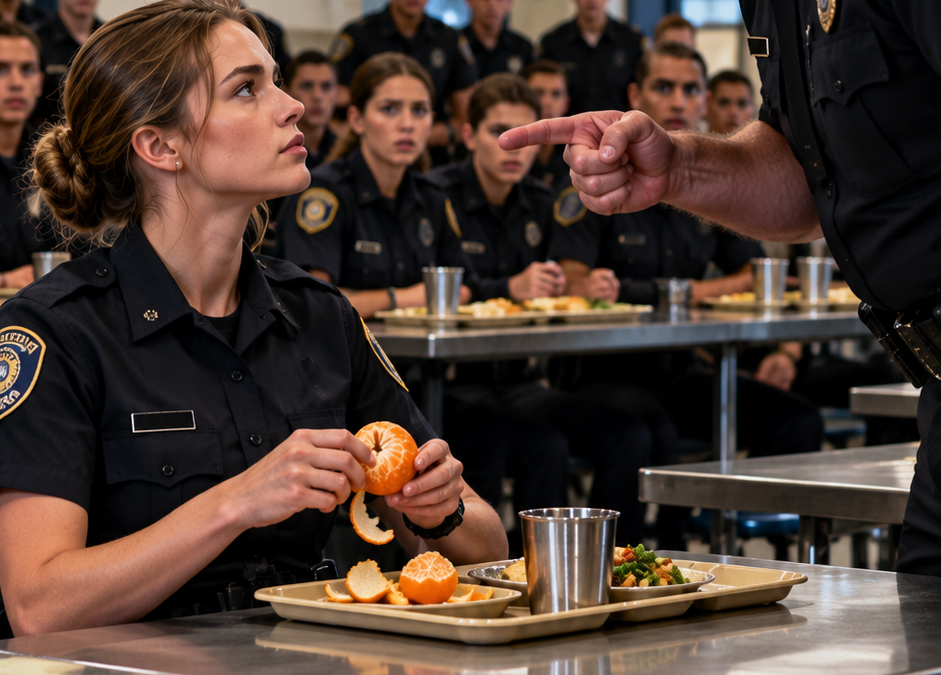
I sat at the end of a long table beneath fluorescent lights, peeling an orange one strip at a time while conversations around me faded into a silence that grew wider with every second.
Across from me stood the academy supervisor.
He was forty-eight, tall, heavily built, with close-cropped brown hair and a face that had already gone red with anger.
I had been observing him for four days.
That was why I knew the color in his face mattered.
I also knew what usually came next.
His name carried weight inside the Washington State Public Safety Academy. He had spent nearly fifteen years training recruits. His test results were excellent. Graduation numbers under his supervision were strong. Senior leadership considered him demanding but effective.
The recruits used different words.
They said people moved when he entered a room.
They stopped talking when he looked at them.
And almost everyone I had quietly observed had learned the same lesson during their first week.
Never ask him why.
Just obey.
I had written that sentence in my notebook two days earlier.
Now I was learning what happened when someone refused.
“That seat is reserved,” he said.
I separated another piece of peel from the orange.
“For whom?”
His jaw tightened.
“For senior academy staff.”
I glanced around.
Eleven other seats were empty.
“There are eleven open seats.”
“That isn’t what I said.”
I placed one orange slice neatly on my napkin.
Several recruits at the next table were now pretending not to watch.
The supervisor noticed them.
That mattered too.
His posture changed.
Not dramatically.
But enough.
His shoulders squared.
His voice grew louder.
The interaction was no longer about where I sat.
It had become an audience.
“Stand up.”
I looked at him.
“I’m eating.”
A few recruits exchanged glances.
Nobody spoke.
He leaned closer.
“You deaf?”
“No.”
“Then move.”
I raised my eyes fully.
“No.”
That single word changed the room.
I had dealt with men like him before.
People who were comfortable with anger as long as anger arrived in a form they understood.
Shouting.
Excuses.
Defensiveness.
Apologies.
Fear.
My refusal offered him none of those.
I simply did not accept that his preference gave him authority over the chair.
And I could see that irritated him more than an argument would have.
He slapped his palm against the table.
Trays jumped.
A paper cup tipped onto its side.
Someone several tables away stopped chewing.
“You think you’re proving something?”
“No.”
“Then why are you still sitting there?”
“Because I was cleared to sit here.”
“By whom?”
“The Commissioner’s office.”
For a second, something flickered in his eyes.
Then he laughed.
It was not amusement.
It was performance.
He looked toward the trainees.
Then back at me.
“The Commissioner’s office cleared you personally?”
“Yes.”
“Name?”
I said nothing.
His smile hardened.
“That’s what I thought.”
He gestured toward my clothes.
I wore an olive-green academy field shirt, utility pants, and black boots. No visible badge. No title. No nameplate that meant anything to him.
“You walk into my academy wearing field clothes, refuse to identify yourself, sit in a staff section, and expect me to believe some secret story about the Commissioner?”
“I don’t need you to believe me.”
That sentence broke his restraint.
He came around the table.
“Wrong answer.”
I looked up.
“Do not touch me.”
Several people heard me.
So did he.
And he smiled.
Then his right hand came forward.
His fingers closed around my ponytail near the base of my neck.
He yanked.
My head snapped backward.
Gasps moved through the dining hall.
A fork hit the floor.
Someone near the coffee station whispered, “What the hell?”
For one brief second, pain flashed across my scalp.
Then training replaced surprise.
My right hand came up around his wrist.
Not hard.
Not yet.
I looked directly into his face.
“Take your hand off me while you still control how this ends.”
His eyes narrowed.
“You threatening me?”
“No.”
He tightened his grip.
“You don’t get to threaten anyone in this building.”
My anger was immediate.
Deep.
Clean.
But I had learned a long time ago that anger and action were not the same thing.
I did not need to feel calm.
I needed to control what I did while I was not calm.
My grip adjusted slightly around his wrist.
If he pulled again, I would remove his hand.
If he escalated, I would stop him.
But before that happened, movement caught my eye beyond his shoulder.
The double doors at the far end of the dining hall had opened.
Every senior officer seated near the front stood at once.
Chairs scraped backward.
The sound moved through the room like a wave.
The supervisor heard it.
Too late.
The State Public Safety Commissioner had entered.
And he was staring directly at us.
“Remove your hand.”
His voice carried across the entire dining hall.
The supervisor released me instantly.
I stood slowly.
My scalp burned where he had pulled my hair.
I smoothed the back of my ponytail once.
The Commissioner crossed the floor with three senior administrators behind him.
Nobody spoke.
The supervisor recovered first.
“Commissioner, this individual refused multiple lawful directions and—”
The Commissioner stopped several feet away.
“I said nothing about her.”
The supervisor froze.
“I told you to remove your hand.”
I lowered my gaze for a moment.
Not because I was intimidated.
Because I knew what came next.
Procedure.
And procedure mattered more now than any satisfaction I might have felt.
The Commissioner turned toward me.
“Are you injured?”
“No, sir.”
“Do you need medical evaluation?”
“No.”
The supervisor stared between us.
“You know her?”
The Commissioner did not answer him.
Instead, he looked upward.
“Cameras?”
The Dining Services Director responded immediately.
“Full coverage, sir.”
“Audio?”
“Yes.”
“Preserve all footage beginning thirty minutes before this incident.”
“Yes, sir.”
The supervisor’s face changed.
“This is being blown out of proportion.”
I finally looked at him.
“You grabbed a stranger by the hair in front of a room full of witnesses.”
“You refused instruction.”
“What instruction gave you authority to put your hands on me?”
His mouth opened.
Nothing came out.
The Commissioner stepped closer.
“I would like that answer too.”
The dining hall remained silent.
No one was eating now.
I could feel hundreds of eyes on us.
I hated that.
Attention had never interested me.
I had spent eight years working inside a small state investigative office that handled sensitive oversight matters involving public corruption, internal misconduct, protective operations, and threats against critical institutions.
I did not appear in press conferences.
My name rarely showed up in public documents.
Most of my work was easier when people did not recognize me.
People behave differently when they know an investigator is watching.
My job was often to learn what happened when they believed nobody important was.
Three months earlier, the Commissioner had quietly asked my office to conduct a cultural review of the academy.
On paper, the place looked strong.
Graduation rates were high.
Testing scores were excellent.
Recruit retention was stable.
Yet anonymous complaints had increased.
Not complaints that training was too difficult.
No one expected public-safety training to be comfortable.
The complaints were about instructors.
Retaliatory assignments.
Public humiliation.
Unnecessary physical contact.
Recruits saying they had been punished for asking why a decision had been made.
Nothing we had initially received proved a systemic problem.
So I was sent in quietly.
No investigative team.
No announced inspection.
No folders carried through hallways.
Temporary academy credentials.
Limited disclosure.
Observe first.
For four days, most of what I saw reassured me.
Most instructors were demanding without being cruel.
They corrected mistakes clearly.
They understood that public-safety work required discipline because hesitation can get people hurt.
Then I began hearing the same name.
The supervisor.
Some recruits admired him.
Others lowered their voices when he passed.
Near a vending machine, one young trainee told another, “Never ask him why. Just do it.”
I wrote it down.
The next day, I heard someone say, “He doesn’t care whether you’re right. He cares whether you obeyed fast enough.”
I wrote that down too.
I had deliberately chosen the dining-hall seat because my clearance allowed me to use the space and because I wanted to watch how staff behaved when training was over.
The supervisor had seen me.
Asked me to move.
I asked why.
He escalated.
Now his hand had been around my hair in front of most of the academy.
The Commissioner could not have arrived at a more revealing moment.
The supervisor drew himself upright.
“She was sitting in a restricted staff area.”
The Commissioner glanced toward the table.
There was no sign.
No barrier.
No marking.
“Restricted under what written policy?”
The supervisor hesitated.
“Operational practice.”
“Meaning?”
“Senior personnel typically sit there.”
“Typically?”
“Yes.”
“So not restricted.”
The supervisor’s jaw tightened.
“She claimed your office authorized her.”
“It did.”
The words landed heavily.
The supervisor looked at me.
Then back at the Commissioner.
“I wasn’t informed.”
“You were not required to be.”
The Commissioner stepped closer.
“And even if she had been an ordinary visitor, you would still need to explain why a question about a chair ended with your hand in her hair.”
The entire dining hall stayed silent.
The supervisor shifted tactics.
“She was deliberately provoking me.”
I almost laughed.
“With an orange?”
A few trainees made sounds they immediately tried to hide.
The supervisor turned toward them.
The Commissioner’s voice sharpened.
“Eyes here.”
The supervisor looked back.
“You are relieved of academy duties pending review.”
His face went pale.
“Commissioner—”
“Turn over your facility access badge.”
“This is ridiculous.”
“Badge.”
He looked around the dining hall.
For what might have been the first time in years, nobody looked afraid of him.
He removed the access card.
Placed it in the Commissioner’s hand.
Then he stared at me.
“Who are you?”
The Commissioner looked toward me.
I gave a slight nod.
Enough could be said now.
“This is Senior Investigator Elena Ward from the State Public Safety Oversight Directorate.”
The room seemed to stop breathing.
The supervisor’s voice dropped.
“Oversight?”
“Yes.”
The Commissioner continued.
“She is here under my authorization.”
I added quietly, “And until ten minutes ago, this review was mostly about institutional culture.”
He stared at me.
“What is it about now?”
I looked around the dining hall.
At the recruits.
At the people who had watched his hand close around my hair.
“Evidence.”
The review began before sunset.
I did not lead it.
I could not.
Once I became directly involved, I was no longer the independent observer.
I was a witness.
Another investigative team took control.
The first piece of evidence required no interpretation.
The dining-hall recording.
The supervisor approached.
I remained seated.
I did not shout.
I did not stand aggressively.
I did not threaten him.
He struck the table.
I told him not to touch me.
He grabbed my hair.
The entire sequence lasted less than two minutes.
The physical contact lasted seconds.
But those seconds opened something the academy had spent years keeping closed.
The first trainee interviewed asked one question before saying anything else.
“Will my statement affect graduation?”
The investigator answered, “No.”
“Can my instructor see it?”
“No.”
The trainee exhaled.
Then talked for forty minutes.
He described being shoved into a locker after questioning a disciplinary order.
Not attacking an instructor.
Not refusing a safety command.
Questioning an order.
Another recruit described the supervisor grabbing the collar of her training shirt during an argument.
Another remembered him knocking a tray from someone’s hands because the trainee had spoken during a quiet study period.
One complaint became five.
Five became fourteen.
By the end of the first week, forty-one current and former academy members had agreed to interviews.
Not every story involved physical contact.
Most involved something harder to photograph.
Humiliation.
Threats.
Retaliation.
A pattern where asking for clarification became a personal challenge.
One former trainee had disputed an evaluation score.
The following week, he received the academy’s least desirable overnight assignments.
Another filed a complaint about an instructor.
The supervisor called him into an office.
“You sure you want to become known as the guy who complains?”
The recruit withdrew it.
Investigators found the withdrawal.
They also found the original complaint.
The deeper the team looked, the clearer the issue became.
The supervisor’s problem was not discipline.
Public-safety training required discipline.
Nobody disputed that.
The problem was that he had blurred the line between discipline and personal obedience.
Questioning him became disrespect.
Disagreement became insubordination.
Embarrassing him became something that required punishment.
And because his recruits produced strong test results, people tolerated it.
That was the part that disturbed me more than the pain in my scalp.
One difficult supervisor can be dealt with.
A culture that protects him because his numbers look good is harder.
I gave my formal statement on the third day.
The investigator interviewing me had known me for years.
He still followed procedure exactly.
“What did you believe his intention was when he approached you?”
“To make me move.”
“Did you know why?”
“He believed the seat belonged to senior academy personnel.”
“Did you intentionally refuse to identify your position?”
“Yes.”
“Why?”
“My assignment required limited disclosure.”
“Could you have privately shown credentials?”
“Yes.”
“Did he request them privately?”
“No.”
“What did he do?”
I thought for a moment.
“He turned the interaction into a public dominance contest.”
The investigator stopped writing.
“That is interpretation.”
He was right.
I nodded.
“Yes.”
“What observable behavior supports it?”
I appreciated the correction.
That was how investigations were supposed to work.
Not what do you think happened?
What can you support?
“He repeatedly looked toward the trainees before escalating. His tone became louder when they started watching. He ignored available alternative seating. He did not call security. He did not verify my clearance. He focused on whether I complied immediately.”
He wrote.
“What happened immediately before he grabbed you?”
“I told him not to touch me.”
“Why?”
“His posture changed. He moved into contact distance.”
“Then?”
“He grabbed my ponytail.”
“Why didn’t you respond physically?”
I considered my answer.
“I believed immediate defensive action might escalate the room unnecessarily.”
“You were capable of responding?”
“Yes.”
“How capable?”
I looked at him.
“You know the answer.”
He did.
“I’m putting down yes.”
“Good.”
He leaned back.
“One more question.”
“Go ahead.”
“Did knowing the Commissioner was about to enter influence your decision not to respond?”
“No.”
That surprised him.
“You looked past the supervisor.”
“I saw movement.”
“So if the Commissioner had not entered?”
I thought carefully.
“I would have removed his hand.”
“Forcefully?”
“If necessary.”
“Would he have been injured?”
“Only if he continued.”
The investigator closed his notebook.
“That may be the most Elena Ward answer you’ve ever given.”
I almost smiled.
The supervisor hired an attorney.
His defense centered on security.
An unidentified woman in field clothing inside a controlled training facility, the attorney argued, could reasonably concern a supervisor.
Investigators agreed.
Verifying me would have been appropriate.
Then they asked why no verification happened.
No call to security.
No request for identification in private.
No call to the Commissioner’s office.
No attempt to escort me to reception.
Nothing.
Just:
Move.
Stand up.
Final warning.
Then physical contact.
The defense shifted.
Provocation.
My refusal, they argued, created uncertainty.
The review panel rejected that logic.
A person asking why does not automatically create danger.
A seated person does not become a threat because she says no.
More damaging than the dining-hall video was the supervisor’s history.
Investigators reviewed seven years of performance complaints.
Several had been closed with nearly identical language.
Instructor style may be perceived as overly direct but remains within acceptable training standards.
That sentence appeared again.
And again.
And again.
But when the new team compared those summaries with witnesses, problems appeared.
Some complainants had never been interviewed.
Videos had not been reviewed.
One physical-contact complaint had been closed after the supervisor himself submitted a written explanation.
No independent investigation.
The Commissioner read that section of the report twice.
Then placed the pages on his desk and said something that stayed with me.
“This is bigger than him.”
It was.
The institution had taught him that results would protect his methods.
If graduates passed.
If scores remained high.
If complaints could be described as hurt feelings.
Then leadership did not have to look too closely at what produced the results.
That is how unhealthy authority survives.
Rarely because everyone approves.
Often because enough people decide the outcome is useful.
Five weeks after the dining-hall incident, the final review was presented.
The findings were clear.
The supervisor had used unnecessary physical contact.
Misrepresented a nonrestricted area as restricted.
Failed to follow visitor-verification procedures.
Violated conduct policy.
Demonstrated a pattern of retaliatory leadership inconsistent with academy standards.
He was offered reassignment outside trainee supervision while a broader personnel process continued.
He refused.
Then resigned.
Some instructors thought the outcome was excessive.
Others believed it should have happened years earlier.
I gave no public opinion.
By then, I cared more about what changed after he left.
Complaint reporting was moved outside the immediate training chain.
Physical-contact complaints required independent review.
Dining and common areas received written access rules so custom could not be turned into invented authority.
Instructor evaluations began including anonymous recruit feedback.
But the most important change was not administrative.
It was philosophical.
Leadership adopted a principle I had argued for throughout the review:
Questions are not automatically defiance.
That sounds simple until you work in an organization built around rapid compliance.
Police academies.
Fire academies.
Military training.
Emergency services.
There are moments where immediate obedience matters.
A fire does not wait for debate.
An active threat does not care whether an order was explained politely.
Training must prepare people to act fast.
But good leadership knows the difference between a person hesitating in a life-threatening emergency and someone calmly asking why a chair is supposedly restricted.
The supervisor had stopped recognizing that difference.
Maybe he once knew it.
Maybe years of authority had eroded it.
I could not answer that.
Three months later, I returned to the academy.
This time I was not working.
No olive-green field shirt.
No utility pants.
No hidden assignment.
I wore black trousers, a cream blouse, and a charcoal coat.
My younger brother had completed advanced training there.
He met me outside the administrative building.
The moment he saw me, he grinned.
“You wore normal clothes.”
“I own normal clothes.”
“I was beginning to doubt it.”
We hugged.
He stepped back.
“You know people still talk about you?”
“Unfortunately.”
“There are at least four versions.”
“How many involve me throwing the supervisor through a table?”
“Two.”
“I did not.”
“I know.”
“One says I arrested him personally.”
“That one’s popular.”
“I wasn’t even carrying restraints.”
He smiled.
“You ruin everybody’s dramatic version.”
“Good.”
We walked toward the dining hall.
My pace slowed when we reached the double doors.
He noticed.
“You okay?”
“Yes.”
“You sure?”
I looked inside.
Same fluorescent lights.
Same tables.
Same coffee station.
Different people.
Then I saw something small.
A young trainee sat at the end of a table.
A supervisor approached him.
My body reacted before my mind did.
I watched.
The supervisor pointed toward a posted sign.
“This section is reserved after one o’clock for instructor meetings.”
The trainee looked at the clock.
12:46.
“So I’ve got fourteen minutes?”
The supervisor smiled.
“You’ve got fourteen minutes.”
Then he walked away.
I smiled without realizing it.
My brother saw.
“What?”
“Nothing.”
But it was not nothing.
That ordinary exchange told me more than a hundred pages of policy.
Authority explained itself.
A question remained a question.
Nobody needed to dominate anyone.
Nobody needed to win.
During lunch, a young woman approached our table.
“Investigator Ward?”
I looked up.
“Yes?”
“Can I ask something?”
“If it is about throwing someone through a table, no.”
She laughed.
“Not that.”
“Go ahead.”
She hesitated.
“I was here that day.”
My smile disappeared.
“Where?”
“Near the coffee station.”
I nodded.
“I filed a complaint afterward.”
“About the supervisor?”
“Yes.”
“Good.”
She looked surprised by my answer.
“I had been thinking about it for months.”
“What happened?”
“He grabbed my arm during an evaluation.”
She looked at the floor.
“Hard.”
I waited.
“I thought maybe that was just how training worked.”
“It isn’t.”
“I know now.”
Her voice tightened.
“When I saw him grab you, I thought you were going to be terrified.”
“Reasonable expectation.”
“But you weren’t.”
I gave her a faint smile.
“I was angry.”
“You looked calm.”
“Those are not opposites.”
She studied me.
“How do you stay calm?”
“I don’t.”
That confused her.
“What?”
“I control what I do while I’m not calm.”
She was quiet.
“Is that different?”
“Very.”
I leaned slightly closer.
“People think composure means you feel nothing. It doesn’t. It means the feeling does not get to make the decision.”
Her expression changed.
Not dramatically.
But I could see the idea land.
“Thank you.”
Then she walked away.
My brother stared at me.
“What?”
“You actually give good advice.”
“Rarely.”
“I’m writing this date down.”
A year later, the dining-hall footage became part of academy ethics training.
I agreed on one condition.
My identity would not be revealed at the beginning of the lesson.
New trainees watched the first portion only.
A woman sitting.
A supervisor approaching.
An argument over a chair.
The woman asking why.
The supervisor escalating.
A warning.
Do not touch me.
A hand grabbing her hair.
Then the instructor stopped the recording before the Commissioner entered.
The class was asked one question.
What facts matter before you learn who either person is?
The discussions were slow at first.
The supervisor possessed institutional authority.
The woman had clearance, though the class did not know that initially.
He had options.
He did not verify her identity.
She refused.
Refusal alone did not establish a threat.
He escalated physically.
She warned him first.
Only after those facts were discussed did instructors reveal that I worked for state oversight.
By then, my title should not matter.
That was the entire point.
If trainees decided his behavior was wrong only after learning who I was, then they had missed the lesson.
I deserved boundaries before they knew my job.
So would a visitor.
A contractor.
A cafeteria employee.
A recruit.
Authority cannot become conditional respect reserved only for people powerful enough to punish abuse.
The Commissioner asked me about the incident months later.
We were sitting in his office after another review.
He closed a file.
Then looked at me.
“Do you regret staying seated?”
“No.”
“Even knowing what happened?”
“Yes.”
He smiled slightly.
“Why?”
“Because if I moved, we might not have learned anything.”
His expression changed.
“That sounds dangerously close to saying you tested him.”
“I didn’t.”
I shook my head.
“I simply did not surrender a choice I was entitled to make.”
“And he revealed himself.”
“Yes.”
The Commissioner looked out the window toward the academy grounds.
“That’s the terrifying thing about small power.”
I raised an eyebrow.
“What?”
“People imagine abuse begins when someone controls something important.”
He paused.
“Sometimes it starts over a chair.”
I smiled.
“That belongs on the wall.”
Years later, I remember surprisingly little about the physical pain.
I remember the fluorescent lights.
The smell of coffee.
Orange peel beneath my fingers.
His tray hitting the table.
The first recruit turning to watch.
The sentence that started everything.
I told you to move.
The supervisor believed the entire incident was about whether I moved from a chair.
It never was.
It was about what authority does when it hears no.
Whether questions are allowed.
Whether disagreement automatically becomes disrespect.
Whether a person with power can tolerate not being obeyed immediately without converting discomfort into punishment.
He failed that test before he touched me.
Grabbing my hair merely made the failure visible.
People remember the dramatic part.
The doors opening.
Every senior officer standing.
The Commissioner entering.
The supervisor realizing the quiet woman he had put his hands on had been authorized by the highest office in the agency.
People remember his face.
I remember something else.
The silence before the doors opened.
Dozens of people watched him grab me.
Some looked shocked.
Some looked angry.
Almost nobody moved.
Not because they agreed with him.
Because they had spent months learning that challenging him came with consequences.
That was the part I could not forget.
And that was the part the academy needed to change.
For a long time afterward, I wondered about the trainees who had watched.
How many had convinced themselves his behavior was normal because everyone else tolerated it?
How many had assumed humiliation was simply part of becoming tougher?
How many had learned to obey the person rather than understand the standard?
Those questions mattered because academies do more than teach skills.
They teach culture.
People carry that culture into the public.
A recruit trained to believe authority should never be questioned may someday become an officer who feels personally insulted when a citizen asks why.
A supervisor who teaches that compliance proves character may create officers who cannot distinguish lawful authority from personal control.
That was never a small issue.
The chair was small.
The principle was not.
I thought about the first trainee who agreed to speak during the investigation.
The one who asked whether his statement could affect graduation.
His fear explained the institution better than any anonymous survey.
He did not ask whether telling the truth was right.
He asked whether telling the truth was safe.
Those are different questions.
A healthy organization should never force people to choose between them.
Several years later, I was invited back to speak to a class of new supervisors.
I almost declined.
I do not enjoy speeches.
My work has always been easier in quiet rooms with files, evidence, interviews, and people who do not know enough about me to perform.
But I accepted.
The dining hall story had become exaggerated by then.
In one version, I had been an undercover federal agent.
In another, I had broken the supervisor’s wrist.
One rumor claimed the Commissioner had ordered his arrest in front of the entire academy.
None of that happened.
Reality was less dramatic and more important.
So I stood in front of thirty-two new supervisors and told them the truth.
“I did not win a confrontation that day.”
Several looked surprised.
“I was sitting down. A supervisor told me to move. I asked why. He could have answered the question.”
I paused.
“He could have verified my identity. He could have called security. He could have contacted the Commissioner’s office. He could have pointed to a written rule, if one existed.”
I looked around the room.
“He had choices.”
Nobody moved.
“He chose humiliation because he believed authority meant he should not have to explain himself.”
I let the silence sit.
“That is where leadership begins to fail.”
A man in the second row raised his hand.
“What if the person really is challenging authority?”
“Then determine whether the challenge affects safety, order, or the mission.”
“And if it does not?”
“Then your pride is not an emergency.”
A few people smiled.
I did not.
I meant it.
Another supervisor asked, “So leaders should explain every order?”
“No.”
That seemed to surprise them too.
“Leadership is not endless negotiation. There are situations where explanation comes later. But if you cannot tell the difference between an emergency and an inconvenience to your ego, you should not supervise people.”
The room went very quiet.
I finished with the same question the academy eventually placed into its ethics training.
“What facts matter before you know who the other person is?”
That became the lesson I cared about most.
Not who I was.
Not whether the Commissioner knew me.
Not whether I could physically defend myself.
None of those things should have been necessary.
I was entitled to basic boundaries because I was a person sitting in a dining hall.
The supervisor was entitled to ask who I was.
He was entitled to verify whether I belonged there.
He was entitled to enforce real rules.
He was not entitled to invent a rule because custom made him comfortable.
He was not entitled to turn my refusal into a personal insult.
And he was certainly not entitled to grab me by the hair.
Those distinctions matter.
They matter more in institutions where people carry badges, weapons, emergency authority, or command responsibility.
Because power magnifies character.
It does not create it from nothing.
If someone cannot handle being questioned over a chair, the public should be concerned about what happens when the stakes become larger.
I never saw the former supervisor again.
I heard fragments.
He moved away.
Worked somewhere outside trainee supervision.
I never investigated the details.
His life after the academy was not mine to manage.
For a long time, people assumed I hated him.
I did not.
Hatred requires attention.
What I felt was disappointment.
Not only in him.
In the system that had given him years of evidence that his methods were acceptable.
People had complained.
The warning signs existed.
But the academy liked his results.
So every complaint became an exception.
A misunderstanding.
A personality conflict.
An overly direct style.
Until the moment the person he grabbed happened to be someone the institution could not easily ignore.
That was an uncomfortable truth.
And I said so in the final review.
“If the institution only recognizes misconduct when the target has status,” I told the panel, “then the institution does not actually oppose misconduct. It opposes consequences.”
Nobody liked that sentence.
Good.
Oversight is not supposed to make people comfortable.
The academy improved afterward.
Not perfectly.
No institution ever becomes perfect because of one report.
But complaints moved faster.
Independent reviewers became involved earlier.
Supervisors learned that strong graduation numbers no longer insulated them from questions about methods.
Recruits became more willing to speak.
The changes were visible in small interactions.
A supervisor explaining a schedule instead of snapping at someone.
A trainee disagreeing with an evaluation without expecting punishment.
An instructor saying, “Ask me after the exercise and I’ll explain why,” instead of treating curiosity as insubordination.
Those moments mattered more to me than the original incident ever did.
Because the goal was never to punish one man.
The goal was to ensure the next person who asked why did not have to calculate whether the question was worth the consequences.
Years passed.
My hair changed.
My job changed.
The academy changed.
But occasionally someone still recognized my name.
“Are you the Elena Ward from the dining hall?”
I usually sighed.
“That depends which version you heard.”
Sometimes they laughed.
Sometimes they told me how the story inspired them.
I was never fully comfortable with that.
I did not sit in that chair to become a symbol.
I was hungry.
I had clearance.
The seat was open.
That was it.
The meaning came afterward.
One afternoon, long after the official review had ended, I returned to the academy for a meeting.
Lunch was finishing.
I walked through the dining hall alone.
The same table was there.
For a moment, I considered sitting in the same chair.
Then I noticed someone had placed a small laminated sign nearby.
Not dramatic.
Not dedicated to me.
Just a simple policy notice explaining when that section was reserved and when it was open.
I laughed quietly.
That little sign might have prevented the entire confrontation years earlier.
Clear rule.
Clear reason.
No invented authority required.
A young recruit nearby looked at me strangely.
“Everything okay, ma’am?”
“Yes.”
I smiled.
“Actually, everything is exactly where it should be.”
He nodded and went back to lunch.
I stood there for another moment.
Then I thought about how easily the story could have gone differently.
I could have moved.
The supervisor would have eaten lunch.
The recruits would have continued learning not to question him.
The old complaints would have remained buried beneath polite administrative language.
Maybe someone else would eventually force the issue.
Maybe not.
I do not tell myself I saved the academy.
That would be arrogant.
Forty-one people gave statements.
Investigators did weeks of work.
The Commissioner authorized reforms.
Recruits found the courage to describe what had happened to them.
The institution changed because many people chose truth at the same time.
My refusal only opened a door.
Others walked through it.
That is why the thing I remember most is not the Commissioner entering.
Not the sound of chairs scraping as senior officers stood.
Not even the supervisor’s hand in my hair.
It is the moment afterward when the first trainee realized he could finally speak without losing his future.
That was the real shift.
Authority had depended on silence.
Once the silence broke, the rest followed.
People sometimes ask whether I was afraid.
The truthful answer is yes.
Not when he first approached.
Not even when he slapped the table.
But the moment he grabbed my hair, fear arrived.
Small.
Immediate.
Human.
Anyone who says they feel nothing when another person suddenly puts a hand on them is either unusually detached or lying.
My body reacted.
Adrenaline.
Tension.
Anger.
Calculation.
The reason I looked calm was not because I felt calm.
I had simply spent years learning that emotion does not have to become visible movement.
That distinction matters to me.
Especially because people later turned my composure into something heroic.
It was not.
It was trained behavior.
And even trained behavior has limits.
If the Commissioner had not walked through those doors, I would have removed the supervisor’s hand.
If he had continued, I would have defended myself.
I never wanted that outcome.
I am grateful it was not necessary.
Because the strongest evidence ended up being the simplest.
A woman seated.
A supervisor demanding obedience.
A question.
A warning.
A hand in her hair.
Nothing hidden.
Nothing ambiguous.
No dramatic counterattack that could distract from what he had chosen to do.
Just his decision.
That clarity mattered.
Later, one member of the review panel asked me something I had not expected.
“Do you think he would have grabbed you if he knew who you were?”
“No.”
I answered immediately.
“Why are you so certain?”
“Because he grabbed me precisely because he believed I was nobody important.”
The room went quiet.
That was the entire problem.
Respect that appears only when status becomes visible is not respect.
It is self-protection.
Professional authority has to work differently.
You do not need to know whether the person in front of you can hurt your career before deciding whether to treat them with dignity.
You do not need to know whether a visitor has connections.
Whether a recruit has powerful parents.
Whether a cafeteria worker has an attorney.
Whether the quiet woman peeling an orange works for oversight.
The standard should exist before the identity.
That became the core of the training module years later.
The footage always stopped before the Commissioner entered.
New recruits hated that.
They wanted the reveal.
They wanted to know who I was.
The instructors made them wait.
First:
What happened?
What options existed?
What threat was present?
What authority actually existed?
What behavior escalated the situation?
Only after those questions did they learn my role.
Some trainees would say, “Oh, so he really messed up.”
The instructor would answer, “If your answer changed because she works for oversight, start over.”
That pleased me more than almost anything else.
Because one day those recruits would hold authority themselves.
And the public would not always look important.
Someone would be frightened.
Angry.
Confused.
Poorly dressed.
Uneducated.
Disrespectful.
Maybe wrong.
Maybe annoying.
Maybe completely correct.
Their status would not tell the officer how much dignity they deserved.
The standard would.
I think about that whenever people call the dining-hall incident a confrontation between me and the supervisor.
It was not really about either of us.
He just made the principle visible.
He wanted a woman to leave a chair.
I wanted to know why.
He believed his title ended the discussion.
I believed authority needed a lawful reason.
Everything else grew from that difference.
The final time I discussed the incident with the Commissioner, he was preparing to retire.
His office was half empty.
Boxes sat against the wall.
Awards had been removed from shelves.
He handed me coffee.
“You know,” he said, “I still hate that I walked in when I did.”
I looked at him.
“That is an unusual complaint.”
“I mean I hate that it happened at all.”
“So do I.”
“But part of me wonders what we would have missed if I arrived ten minutes earlier.”
I knew what he meant.
If he had entered while the supervisor was only telling me to move, the behavior might have stopped.
No physical contact.
No preserved moment that forced leadership to look deeper.
Maybe the review would still have found something.
Maybe the same recruits would still have spoken.
But certainty is rare.
The Commissioner looked toward the window.
“He thought he was correcting one person.”
“Yes.”
“He never realized the room was learning from him.”
“That was always the problem.”
He nodded.
Then he smiled.
“You kept the orange?”
I laughed.
“No.”
“You should have.”
“That would be strange.”
“It belongs in a museum.”
“Absolutely not.”
“Historic evidence.”
“It was fruit.”
He laughed.
For the first time, the memory felt almost light.
Not harmless.
Never harmless.
But no longer heavy.
That surprised me.
Trauma does not always remain trauma.
Sometimes, once the consequences have been faced and the lesson has been absorbed, memory becomes evidence of change.
I can now think about the fluorescent lights without feeling the pull at the back of my head.
I can enter the dining hall without scanning every face.
I can peel an orange without remembering his hand.
Mostly.
Memory is rarely absolute.
But it softens.
What remains is the lesson.
Authority does not prove itself by winning every small conflict.
It proves itself by knowing which conflicts do not need to exist.
A leader who cannot tolerate a calm no will eventually create a crisis where none existed.
A supervisor who believes questions are disrespect will eventually stop hearing warning signs.
An institution that rewards outcomes while ignoring methods will eventually teach good people to remain silent.
That was what almost happened at the academy.
The supervisor thought he was defending standards.
He was actually defending himself.
His pride.
His image.
His need to be obeyed in front of others.
And because nobody had forced him to separate those things from legitimate authority for years, he no longer seemed able to tell the difference.
The moment his hand closed around my hair, that confusion became impossible to ignore.
He thought I needed to remember my place.
Instead, the entire academy had to remember his limits.
And the most important sound that day was not his voice.
Not the Commissioner’s.
Not even the scrape of every senior officer standing at once.
It was the silence finally breaking afterward.
One recruit speaking.
Then another.
Then another.
Until the fear that had protected one man was no longer strong enough to protect him.
That was the real ending.
Not his resignation.
Not my title.
Not the surprise on his face when he learned who I was.
The ending was a young trainee sitting in the same dining hall months later, asking a supervisor how long he could stay at a table.
And the supervisor answering calmly:
“You’ve got fourteen minutes.”
No humiliation.
No threat.
No performance.
Just an answer.
That was all the first interaction had ever needed.
And in the end, that ordinary answer proved the academy had learned far more from one chair than anyone expected.
What do you think of this story? Please leave a like and share your thoughts in the comments. Your support means a lot to us and inspires us to keep writing more meaningful and powerful stories. Thank you! 👍
𝗧𝗛𝗘 𝗘𝗡𝗗
The Academy Supervisor Thought One Quiet No Would Be Easy to Punish
“I told you to move.”
The words came across the dining hall low enough to sound controlled, but hard enough that everyone near us heard them.
I did not move.
I sat at the end of a long table beneath fluorescent lights, peeling an orange one strip at a time while conversations around me faded into a silence that grew wider with every second.
Across from me stood the academy supervisor.
He was forty-eight, tall, heavily built, with close-cropped brown hair and a face that had already gone red with anger.
I had been observing him for four days.
That was why I knew the color in his face mattered.
I also knew what usually came next.
His name carried weight inside the Washington State Public Safety Academy. He had spent nearly fifteen years training recruits. His test results were excellent. Graduation numbers under his supervision were strong. Senior leadership considered him demanding but effective.
The recruits used different words.
They said people moved when he entered a room.
They stopped talking when he looked at them.
And almost everyone I had quietly observed had learned the same lesson during their first week.
Never ask him why.
Just obey.
I had written that sentence in my notebook two days earlier.
Now I was learning what happened when someone refused.
“That seat is reserved,” he said.
I separated another piece of peel from the orange.
“For whom?”
His jaw tightened.
“For senior academy staff.”
I glanced around.
Eleven other seats were empty.
“There are eleven open seats.”
“That isn’t what I said.”
I placed one orange slice neatly on my napkin.
Several recruits at the next table were now pretending not to watch.
The supervisor noticed them.
That mattered too.
His posture changed.
Not dramatically.
But enough.
His shoulders squared.
His voice grew louder.
The interaction was no longer about where I sat.
It had become an audience.
“Stand up.”
I looked at him.
“I’m eating.”
A few recruits exchanged glances.
Nobody spoke.
He leaned closer.
“You deaf?”
“No.”
“Then move.”
I raised my eyes fully.
“No.”
That single word changed the room.
I had dealt with men like him before.
People who were comfortable with anger as long as anger arrived in a form they understood.
Shouting.
Excuses.
Defensiveness.
Apologies.
Fear.
My refusal offered him none of those.
I simply did not accept that his preference gave him authority over the chair.
And I could see that irritated him more than an argument would have.
He slapped his palm against the table.
Trays jumped.
A paper cup tipped onto its side.
Someone several tables away stopped chewing.
“You think you’re proving something?”
“No.”
“Then why are you still sitting there?”
“Because I was cleared to sit here.”
“By whom?”
“The Commissioner’s office.”
For a second, something flickered in his eyes.
Then he laughed.
It was not amusement.
It was performance.
He looked toward the trainees.
Then back at me.
“The Commissioner’s office cleared you personally?”
“Yes.”
“Name?”
I said nothing.
His smile hardened.
“That’s what I thought.”
He gestured toward my clothes.
I wore an olive-green academy field shirt, utility pants, and black boots. No visible badge. No title. No nameplate that meant anything to him.
“You walk into my academy wearing field clothes, refuse to identify yourself, sit in a staff section, and expect me to believe some secret story about the Commissioner?”
“I don’t need you to believe me.”
That sentence broke his restraint.
He came around the table.
“Wrong answer.”
I looked up.
“Do not touch me.”
Several people heard me.
So did he.
And he smiled.
Then his right hand came forward.
His fingers closed around my ponytail near the base of my neck.
He yanked.
My head snapped backward.
Gasps moved through the dining hall.
A fork hit the floor.
Someone near the coffee station whispered, “What the hell?”
For one brief second, pain flashed across my scalp.
Then training replaced surprise.
My right hand came up around his wrist.
Not hard.
Not yet.
I looked directly into his face.
“Take your hand off me while you still control how this ends.”
His eyes narrowed.
“You threatening me?”
“No.”
He tightened his grip.
“You don’t get to threaten anyone in this building.”
My anger was immediate.
Deep.
Clean.
But I had learned a long time ago that anger and action were not the same thing.
I did not need to feel calm.
I needed to control what I did while I was not calm.
My grip adjusted slightly around his wrist.
If he pulled again, I would remove his hand.
If he escalated, I would stop him.
But before that happened, movement caught my eye beyond his shoulder.
The double doors at the far end of the dining hall had opened.
Every senior officer seated near the front stood at once.
Chairs scraped backward.
The sound moved through the room like a wave.
The supervisor heard it.
Too late.
The State Public Safety Commissioner had entered.
And he was staring directly at us.
“Remove your hand.”
His voice carried across the entire dining hall.
The supervisor released me instantly.
I stood slowly.
My scalp burned where he had pulled my hair.
I smoothed the back of my ponytail once.
The Commissioner crossed the floor with three senior administrators behind him.
Nobody spoke.
The supervisor recovered first.
“Commissioner, this individual refused multiple lawful directions and—”
The Commissioner stopped several feet away.
“I said nothing about her.”
The supervisor froze.
“I told you to remove your hand.”
I lowered my gaze for a moment.
Not because I was intimidated.
Because I knew what came next.
Procedure.
And procedure mattered more now than any satisfaction I might have felt.
The Commissioner turned toward me.
“Are you injured?”
“No, sir.”
“Do you need medical evaluation?”
“No.”
The supervisor stared between us.
“You know her?”
The Commissioner did not answer him.
Instead, he looked upward.
“Cameras?”
The Dining Services Director responded immediately.
“Full coverage, sir.”
“Audio?”
“Yes.”
“Preserve all footage beginning thirty minutes before this incident.”
“Yes, sir.”
The supervisor’s face changed.
“This is being blown out of proportion.”
I finally looked at him.
“You grabbed a stranger by the hair in front of a room full of witnesses.”
“You refused instruction.”
“What instruction gave you authority to put your hands on me?”
His mouth opened.
Nothing came out.
The Commissioner stepped closer.
“I would like that answer too.”
The dining hall remained silent.
No one was eating now.
I could feel hundreds of eyes on us.
I hated that.
Attention had never interested me.
I had spent eight years working inside a small state investigative office that handled sensitive oversight matters involving public corruption, internal misconduct, protective operations, and threats against critical institutions.
I did not appear in press conferences.
My name rarely showed up in public documents.
Most of my work was easier when people did not recognize me.
People behave differently when they know an investigator is watching.
My job was often to learn what happened when they believed nobody important was.
Three months earlier, the Commissioner had quietly asked my office to conduct a cultural review of the academy.
On paper, the place looked strong.
Graduation rates were high.
Testing scores were excellent.
Recruit retention was stable.
Yet anonymous complaints had increased.
Not complaints that training was too difficult.
No one expected public-safety training to be comfortable.
The complaints were about instructors.
Retaliatory assignments.
Public humiliation.
Unnecessary physical contact.
Recruits saying they had been punished for asking why a decision had been made.
Nothing we had initially received proved a systemic problem.
So I was sent in quietly.
No investigative team.
No announced inspection.
No folders carried through hallways.
Temporary academy credentials.
Limited disclosure.
Observe first.
For four days, most of what I saw reassured me.
Most instructors were demanding without being cruel.
They corrected mistakes clearly.
They understood that public-safety work required discipline because hesitation can get people hurt.
Then I began hearing the same name.
The supervisor.
Some recruits admired him.
Others lowered their voices when he passed.
Near a vending machine, one young trainee told another, “Never ask him why. Just do it.”
I wrote it down.
The next day, I heard someone say, “He doesn’t care whether you’re right. He cares whether you obeyed fast enough.”
I wrote that down too.
I had deliberately chosen the dining-hall seat because my clearance allowed me to use the space and because I wanted to watch how staff behaved when training was over.
The supervisor had seen me.
Asked me to move.
I asked why.
He escalated.
Now his hand had been around my hair in front of most of the academy.
The Commissioner could not have arrived at a more revealing moment.
The supervisor drew himself upright.
“She was sitting in a restricted staff area.”
The Commissioner glanced toward the table.
There was no sign.
No barrier.
No marking.
“Restricted under what written policy?”
The supervisor hesitated.
“Operational practice.”
“Meaning?”
“Senior personnel typically sit there.”
“Typically?”
“Yes.”
“So not restricted.”
The supervisor’s jaw tightened.
“She claimed your office authorized her.”
“It did.”
The words landed heavily.
The supervisor looked at me.
Then back at the Commissioner.
“I wasn’t informed.”
“You were not required to be.”
The Commissioner stepped closer.
“And even if she had been an ordinary visitor, you would still need to explain why a question about a chair ended with your hand in her hair.”
The entire dining hall stayed silent.
The supervisor shifted tactics.
“She was deliberately provoking me.”
I almost laughed.
“With an orange?”
A few trainees made sounds they immediately tried to hide.
The supervisor turned toward them.
The Commissioner’s voice sharpened.
“Eyes here.”
The supervisor looked back.
“You are relieved of academy duties pending review.”
His face went pale.
“Commissioner—”
“Turn over your facility access badge.”
“This is ridiculous.”
“Badge.”
He looked around the dining hall.
For what might have been the first time in years, nobody looked afraid of him.
He removed the access card.
Placed it in the Commissioner’s hand.
Then he stared at me.
“Who are you?”
The Commissioner looked toward me.
I gave a slight nod.
Enough could be said now.
“This is Senior Investigator Elena Ward from the State Public Safety Oversight Directorate.”
The room seemed to stop breathing.
The supervisor’s voice dropped.
“Oversight?”
“Yes.”
The Commissioner continued.
“She is here under my authorization.”
I added quietly, “And until ten minutes ago, this review was mostly about institutional culture.”
He stared at me.
“What is it about now?”
I looked around the dining hall.
At the recruits.
At the people who had watched his hand close around my hair.
“Evidence.”
The review began before sunset.
I did not lead it.
I could not.
Once I became directly involved, I was no longer the independent observer.
I was a witness.
Another investigative team took control.
The first piece of evidence required no interpretation.
The dining-hall recording.
The supervisor approached.
I remained seated.
I did not shout.
I did not stand aggressively.
I did not threaten him.
He struck the table.
I told him not to touch me.
He grabbed my hair.
The entire sequence lasted less than two minutes.
The physical contact lasted seconds.
But those seconds opened something the academy had spent years keeping closed.
The first trainee interviewed asked one question before saying anything else.
“Will my statement affect graduation?”
The investigator answered, “No.”
“Can my instructor see it?”
“No.”
The trainee exhaled.
Then talked for forty minutes.
He described being shoved into a locker after questioning a disciplinary order.
Not attacking an instructor.
Not refusing a safety command.
Questioning an order.
Another recruit described the supervisor grabbing the collar of her training shirt during an argument.
Another remembered him knocking a tray from someone’s hands because the trainee had spoken during a quiet study period.
One complaint became five.
Five became fourteen.
By the end of the first week, forty-one current and former academy members had agreed to interviews.
Not every story involved physical contact.
Most involved something harder to photograph.
Humiliation.
Threats.
Retaliation.
A pattern where asking for clarification became a personal challenge.
One former trainee had disputed an evaluation score.
The following week, he received the academy’s least desirable overnight assignments.
Another filed a complaint about an instructor.
The supervisor called him into an office.
“You sure you want to become known as the guy who complains?”
The recruit withdrew it.
Investigators found the withdrawal.
They also found the original complaint.
The deeper the team looked, the clearer the issue became.
The supervisor’s problem was not discipline.
Public-safety training required discipline.
Nobody disputed that.
The problem was that he had blurred the line between discipline and personal obedience.
Questioning him became disrespect.
Disagreement became insubordination.
Embarrassing him became something that required punishment.
And because his recruits produced strong test results, people tolerated it.
That was the part that disturbed me more than the pain in my scalp.
One difficult supervisor can be dealt with.
A culture that protects him because his numbers look good is harder.
I gave my formal statement on the third day.
The investigator interviewing me had known me for years.
He still followed procedure exactly.
“What did you believe his intention was when he approached you?”
“To make me move.”
“Did you know why?”
“He believed the seat belonged to senior academy personnel.”
“Did you intentionally refuse to identify your position?”
“Yes.”
“Why?”
“My assignment required limited disclosure.”
“Could you have privately shown credentials?”
“Yes.”
“Did he request them privately?”
“No.”
“What did he do?”
I thought for a moment.
“He turned the interaction into a public dominance contest.”
The investigator stopped writing.
“That is interpretation.”
He was right.
I nodded.
“Yes.”
“What observable behavior supports it?”
I appreciated the correction.
That was how investigations were supposed to work.
Not what do you think happened?
What can you support?
“He repeatedly looked toward the trainees before escalating. His tone became louder when they started watching. He ignored available alternative seating. He did not call security. He did not verify my clearance. He focused on whether I complied immediately.”
He wrote.
“What happened immediately before he grabbed you?”
“I told him not to touch me.”
“Why?”
“His posture changed. He moved into contact distance.”
“Then?”
“He grabbed my ponytail.”
“Why didn’t you respond physically?”
I considered my answer.
“I believed immediate defensive action might escalate the room unnecessarily.”
“You were capable of responding?”
“Yes.”
“How capable?”
I looked at him.
“You know the answer.”
He did.
“I’m putting down yes.”
“Good.”
He leaned back.
“One more question.”
“Go ahead.”
“Did knowing the Commissioner was about to enter influence your decision not to respond?”
“No.”
That surprised him.
“You looked past the supervisor.”
“I saw movement.”
“So if the Commissioner had not entered?”
I thought carefully.
“I would have removed his hand.”
“Forcefully?”
“If necessary.”
“Would he have been injured?”
“Only if he continued.”
The investigator closed his notebook.
“That may be the most Elena Ward answer you’ve ever given.”
I almost smiled.
The supervisor hired an attorney.
His defense centered on security.
An unidentified woman in field clothing inside a controlled training facility, the attorney argued, could reasonably concern a supervisor.
Investigators agreed.
Verifying me would have been appropriate.
Then they asked why no verification happened.
No call to security.
No request for identification in private.
No call to the Commissioner’s office.
No attempt to escort me to reception.
Nothing.
Just:
Move.
Stand up.
Final warning.
Then physical contact.
The defense shifted.
Provocation.
My refusal, they argued, created uncertainty.
The review panel rejected that logic.
A person asking why does not automatically create danger.
A seated person does not become a threat because she says no.
More damaging than the dining-hall video was the supervisor’s history.
Investigators reviewed seven years of performance complaints.
Several had been closed with nearly identical language.
Instructor style may be perceived as overly direct but remains within acceptable training standards.
That sentence appeared again.
And again.
And again.
But when the new team compared those summaries with witnesses, problems appeared.
Some complainants had never been interviewed.
Videos had not been reviewed.
One physical-contact complaint had been closed after the supervisor himself submitted a written explanation.
No independent investigation.
The Commissioner read that section of the report twice.
Then placed the pages on his desk and said something that stayed with me.
“This is bigger than him.”
It was.
The institution had taught him that results would protect his methods.
If graduates passed.
If scores remained high.
If complaints could be described as hurt feelings.
Then leadership did not have to look too closely at what produced the results.
That is how unhealthy authority survives.
Rarely because everyone approves.
Often because enough people decide the outcome is useful.
Five weeks after the dining-hall incident, the final review was presented.
The findings were clear.
The supervisor had used unnecessary physical contact.
Misrepresented a nonrestricted area as restricted.
Failed to follow visitor-verification procedures.
Violated conduct policy.
Demonstrated a pattern of retaliatory leadership inconsistent with academy standards.
He was offered reassignment outside trainee supervision while a broader personnel process continued.
He refused.
Then resigned.
Some instructors thought the outcome was excessive.
Others believed it should have happened years earlier.
I gave no public opinion.
By then, I cared more about what changed after he left.
Complaint reporting was moved outside the immediate training chain.
Physical-contact complaints required independent review.
Dining and common areas received written access rules so custom could not be turned into invented authority.
Instructor evaluations began including anonymous recruit feedback.
But the most important change was not administrative.
It was philosophical.
Leadership adopted a principle I had argued for throughout the review:
Questions are not automatically defiance.
That sounds simple until you work in an organization built around rapid compliance.
Police academies.
Fire academies.
Military training.
Emergency services.
There are moments where immediate obedience matters.
A fire does not wait for debate.
An active threat does not care whether an order was explained politely.
Training must prepare people to act fast.
But good leadership knows the difference between a person hesitating in a life-threatening emergency and someone calmly asking why a chair is supposedly restricted.
The supervisor had stopped recognizing that difference.
Maybe he once knew it.
Maybe years of authority had eroded it.
I could not answer that.
Three months later, I returned to the academy.
This time I was not working.
No olive-green field shirt.
No utility pants.
No hidden assignment.
I wore black trousers, a cream blouse, and a charcoal coat.
My younger brother had completed advanced training there.
He met me outside the administrative building.
The moment he saw me, he grinned.
“You wore normal clothes.”
“I own normal clothes.”
“I was beginning to doubt it.”
We hugged.
He stepped back.
“You know people still talk about you?”
“Unfortunately.”
“There are at least four versions.”
“How many involve me throwing the supervisor through a table?”
“Two.”
“I did not.”
“I know.”
“One says I arrested him personally.”
“That one’s popular.”
“I wasn’t even carrying restraints.”
He smiled.
“You ruin everybody’s dramatic version.”
“Good.”
We walked toward the dining hall.
My pace slowed when we reached the double doors.
He noticed.
“You okay?”
“Yes.”
“You sure?”
I looked inside.
Same fluorescent lights.
Same tables.
Same coffee station.
Different people.
Then I saw something small.
A young trainee sat at the end of a table.
A supervisor approached him.
My body reacted before my mind did.
I watched.
The supervisor pointed toward a posted sign.
“This section is reserved after one o’clock for instructor meetings.”
The trainee looked at the clock.
12:46.
“So I’ve got fourteen minutes?”
The supervisor smiled.
“You’ve got fourteen minutes.”
Then he walked away.
I smiled without realizing it.
My brother saw.
“What?”
“Nothing.”
But it was not nothing.
That ordinary exchange told me more than a hundred pages of policy.
Authority explained itself.
A question remained a question.
Nobody needed to dominate anyone.
Nobody needed to win.
During lunch, a young woman approached our table.
“Investigator Ward?”
I looked up.
“Yes?”
“Can I ask something?”
“If it is about throwing someone through a table, no.”
She laughed.
“Not that.”
“Go ahead.”
She hesitated.
“I was here that day.”
My smile disappeared.
“Where?”
“Near the coffee station.”
I nodded.
“I filed a complaint afterward.”
“About the supervisor?”
“Yes.”
“Good.”
She looked surprised by my answer.
“I had been thinking about it for months.”
“What happened?”
“He grabbed my arm during an evaluation.”
She looked at the floor.
“Hard.”
I waited.
“I thought maybe that was just how training worked.”
“It isn’t.”
“I know now.”
Her voice tightened.
“When I saw him grab you, I thought you were going to be terrified.”
“Reasonable expectation.”
“But you weren’t.”
I gave her a faint smile.
“I was angry.”
“You looked calm.”
“Those are not opposites.”
She studied me.
“How do you stay calm?”
“I don’t.”
That confused her.
“What?”
“I control what I do while I’m not calm.”
She was quiet.
“Is that different?”
“Very.”
I leaned slightly closer.
“People think composure means you feel nothing. It doesn’t. It means the feeling does not get to make the decision.”
Her expression changed.
Not dramatically.
But I could see the idea land.
“Thank you.”
Then she walked away.
My brother stared at me.
“What?”
“You actually give good advice.”
“Rarely.”
“I’m writing this date down.”
A year later, the dining-hall footage became part of academy ethics training.
I agreed on one condition.
My identity would not be revealed at the beginning of the lesson.
New trainees watched the first portion only.
A woman sitting.
A supervisor approaching.
An argument over a chair.
The woman asking why.
The supervisor escalating.
A warning.
Do not touch me.
A hand grabbing her hair.
Then the instructor stopped the recording before the Commissioner entered.
The class was asked one question.
What facts matter before you learn who either person is?
The discussions were slow at first.
The supervisor possessed institutional authority.
The woman had clearance, though the class did not know that initially.
He had options.
He did not verify her identity.
She refused.
Refusal alone did not establish a threat.
He escalated physically.
She warned him first.
Only after those facts were discussed did instructors reveal that I worked for state oversight.
By then, my title should not matter.
That was the entire point.
If trainees decided his behavior was wrong only after learning who I was, then they had missed the lesson.
I deserved boundaries before they knew my job.
So would a visitor.
A contractor.
A cafeteria employee.
A recruit.
Authority cannot become conditional respect reserved only for people powerful enough to punish abuse.
The Commissioner asked me about the incident months later.
We were sitting in his office after another review.
He closed a file.
Then looked at me.
“Do you regret staying seated?”
“No.”
“Even knowing what happened?”
“Yes.”
He smiled slightly.
“Why?”
“Because if I moved, we might not have learned anything.”
His expression changed.
“That sounds dangerously close to saying you tested him.”
“I didn’t.”
I shook my head.
“I simply did not surrender a choice I was entitled to make.”
“And he revealed himself.”
“Yes.”
The Commissioner looked out the window toward the academy grounds.
“That’s the terrifying thing about small power.”
I raised an eyebrow.
“What?”
“People imagine abuse begins when someone controls something important.”
He paused.
“Sometimes it starts over a chair.”
I smiled.
“That belongs on the wall.”
Years later, I remember surprisingly little about the physical pain.
I remember the fluorescent lights.
The smell of coffee.
Orange peel beneath my fingers.
His tray hitting the table.
The first recruit turning to watch.
The sentence that started everything.
I told you to move.
The supervisor believed the entire incident was about whether I moved from a chair.
It never was.
It was about what authority does when it hears no.
Whether questions are allowed.
Whether disagreement automatically becomes disrespect.
Whether a person with power can tolerate not being obeyed immediately without converting discomfort into punishment.
He failed that test before he touched me.
Grabbing my hair merely made the failure visible.
People remember the dramatic part.
The doors opening.
Every senior officer standing.
The Commissioner entering.
The supervisor realizing the quiet woman he had put his hands on had been authorized by the highest office in the agency.
People remember his face.
I remember something else.
The silence before the doors opened.
Dozens of people watched him grab me.
Some looked shocked.
Some looked angry.
Almost nobody moved.
Not because they agreed with him.
Because they had spent months learning that challenging him came with consequences.
That was the part I could not forget.
And that was the part the academy needed to change.
For a long time afterward, I wondered about the trainees who had watched.
How many had convinced themselves his behavior was normal because everyone else tolerated it?
How many had assumed humiliation was simply part of becoming tougher?
How many had learned to obey the person rather than understand the standard?
Those questions mattered because academies do more than teach skills.
They teach culture.
People carry that culture into the public.
A recruit trained to believe authority should never be questioned may someday become an officer who feels personally insulted when a citizen asks why.
A supervisor who teaches that compliance proves character may create officers who cannot distinguish lawful authority from personal control.
That was never a small issue.
The chair was small.
The principle was not.
I thought about the first trainee who agreed to speak during the investigation.
The one who asked whether his statement could affect graduation.
His fear explained the institution better than any anonymous survey.
He did not ask whether telling the truth was right.
He asked whether telling the truth was safe.
Those are different questions.
A healthy organization should never force people to choose between them.
Several years later, I was invited back to speak to a class of new supervisors.
I almost declined.
I do not enjoy speeches.
My work has always been easier in quiet rooms with files, evidence, interviews, and people who do not know enough about me to perform.
But I accepted.
The dining hall story had become exaggerated by then.
In one version, I had been an undercover federal agent.
In another, I had broken the supervisor’s wrist.
One rumor claimed the Commissioner had ordered his arrest in front of the entire academy.
None of that happened.
Reality was less dramatic and more important.
So I stood in front of thirty-two new supervisors and told them the truth.
“I did not win a confrontation that day.”
Several looked surprised.
“I was sitting down. A supervisor told me to move. I asked why. He could have answered the question.”
I paused.
“He could have verified my identity. He could have called security. He could have contacted the Commissioner’s office. He could have pointed to a written rule, if one existed.”
I looked around the room.
“He had choices.”
Nobody moved.
“He chose humiliation because he believed authority meant he should not have to explain himself.”
I let the silence sit.
“That is where leadership begins to fail.”
A man in the second row raised his hand.
“What if the person really is challenging authority?”
“Then determine whether the challenge affects safety, order, or the mission.”
“And if it does not?”
“Then your pride is not an emergency.”
A few people smiled.
I did not.
I meant it.
Another supervisor asked, “So leaders should explain every order?”
“No.”
That seemed to surprise them too.
“Leadership is not endless negotiation. There are situations where explanation comes later. But if you cannot tell the difference between an emergency and an inconvenience to your ego, you should not supervise people.”
The room went very quiet.
I finished with the same question the academy eventually placed into its ethics training.
“What facts matter before you know who the other person is?”
That became the lesson I cared about most.
Not who I was.
Not whether the Commissioner knew me.
Not whether I could physically defend myself.
None of those things should have been necessary.
I was entitled to basic boundaries because I was a person sitting in a dining hall.
The supervisor was entitled to ask who I was.
He was entitled to verify whether I belonged there.
He was entitled to enforce real rules.
He was not entitled to invent a rule because custom made him comfortable.
He was not entitled to turn my refusal into a personal insult.
And he was certainly not entitled to grab me by the hair.
Those distinctions matter.
They matter more in institutions where people carry badges, weapons, emergency authority, or command responsibility.
Because power magnifies character.
It does not create it from nothing.
If someone cannot handle being questioned over a chair, the public should be concerned about what happens when the stakes become larger.
I never saw the former supervisor again.
I heard fragments.
He moved away.
Worked somewhere outside trainee supervision.
I never investigated the details.
His life after the academy was not mine to manage.
For a long time, people assumed I hated him.
I did not.
Hatred requires attention.
What I felt was disappointment.
Not only in him.
In the system that had given him years of evidence that his methods were acceptable.
People had complained.
The warning signs existed.
But the academy liked his results.
So every complaint became an exception.
A misunderstanding.
A personality conflict.
An overly direct style.
Until the moment the person he grabbed happened to be someone the institution could not easily ignore.
That was an uncomfortable truth.
And I said so in the final review.
“If the institution only recognizes misconduct when the target has status,” I told the panel, “then the institution does not actually oppose misconduct. It opposes consequences.”
Nobody liked that sentence.
Good.
Oversight is not supposed to make people comfortable.
The academy improved afterward.
Not perfectly.
No institution ever becomes perfect because of one report.
But complaints moved faster.
Independent reviewers became involved earlier.
Supervisors learned that strong graduation numbers no longer insulated them from questions about methods.
Recruits became more willing to speak.
The changes were visible in small interactions.
A supervisor explaining a schedule instead of snapping at someone.
A trainee disagreeing with an evaluation without expecting punishment.
An instructor saying, “Ask me after the exercise and I’ll explain why,” instead of treating curiosity as insubordination.
Those moments mattered more to me than the original incident ever did.
Because the goal was never to punish one man.
The goal was to ensure the next person who asked why did not have to calculate whether the question was worth the consequences.
Years passed.
My hair changed.
My job changed.
The academy changed.
But occasionally someone still recognized my name.
“Are you the Elena Ward from the dining hall?”
I usually sighed.
“That depends which version you heard.”
Sometimes they laughed.
Sometimes they told me how the story inspired them.
I was never fully comfortable with that.
I did not sit in that chair to become a symbol.
I was hungry.
I had clearance.
The seat was open.
That was it.
The meaning came afterward.
One afternoon, long after the official review had ended, I returned to the academy for a meeting.
Lunch was finishing.
I walked through the dining hall alone.
The same table was there.
For a moment, I considered sitting in the same chair.
Then I noticed someone had placed a small laminated sign nearby.
Not dramatic.
Not dedicated to me.
Just a simple policy notice explaining when that section was reserved and when it was open.
I laughed quietly.
That little sign might have prevented the entire confrontation years earlier.
Clear rule.
Clear reason.
No invented authority required.
A young recruit nearby looked at me strangely.
“Everything okay, ma’am?”
“Yes.”
I smiled.
“Actually, everything is exactly where it should be.”
He nodded and went back to lunch.
I stood there for another moment.
Then I thought about how easily the story could have gone differently.
I could have moved.
The supervisor would have eaten lunch.
The recruits would have continued learning not to question him.
The old complaints would have remained buried beneath polite administrative language.
Maybe someone else would eventually force the issue.
Maybe not.
I do not tell myself I saved the academy.
That would be arrogant.
Forty-one people gave statements.
Investigators did weeks of work.
The Commissioner authorized reforms.
Recruits found the courage to describe what had happened to them.
The institution changed because many people chose truth at the same time.
My refusal only opened a door.
Others walked through it.
That is why the thing I remember most is not the Commissioner entering.
Not the sound of chairs scraping as senior officers stood.
Not even the supervisor’s hand in my hair.
It is the moment afterward when the first trainee realized he could finally speak without losing his future.
That was the real shift.
Authority had depended on silence.
Once the silence broke, the rest followed.
People sometimes ask whether I was afraid.
The truthful answer is yes.
Not when he first approached.
Not even when he slapped the table.
But the moment he grabbed my hair, fear arrived.
Small.
Immediate.
Human.
Anyone who says they feel nothing when another person suddenly puts a hand on them is either unusually detached or lying.
My body reacted.
Adrenaline.
Tension.
Anger.
Calculation.
The reason I looked calm was not because I felt calm.
I had simply spent years learning that emotion does not have to become visible movement.
That distinction matters to me.
Especially because people later turned my composure into something heroic.
It was not.
It was trained behavior.
And even trained behavior has limits.
If the Commissioner had not walked through those doors, I would have removed the supervisor’s hand.
If he had continued, I would have defended myself.
I never wanted that outcome.
I am grateful it was not necessary.
Because the strongest evidence ended up being the simplest.
A woman seated.
A supervisor demanding obedience.
A question.
A warning.
A hand in her hair.
Nothing hidden.
Nothing ambiguous.
No dramatic counterattack that could distract from what he had chosen to do.
Just his decision.
That clarity mattered.
Later, one member of the review panel asked me something I had not expected.
“Do you think he would have grabbed you if he knew who you were?”
“No.”
I answered immediately.
“Why are you so certain?”
“Because he grabbed me precisely because he believed I was nobody important.”
The room went quiet.
That was the entire problem.
Respect that appears only when status becomes visible is not respect.
It is self-protection.
Professional authority has to work differently.
You do not need to know whether the person in front of you can hurt your career before deciding whether to treat them with dignity.
You do not need to know whether a visitor has connections.
Whether a recruit has powerful parents.
Whether a cafeteria worker has an attorney.
Whether the quiet woman peeling an orange works for oversight.
The standard should exist before the identity.
That became the core of the training module years later.
The footage always stopped before the Commissioner entered.
New recruits hated that.
They wanted the reveal.
They wanted to know who I was.
The instructors made them wait.
First:
What happened?
What options existed?
What threat was present?
What authority actually existed?
What behavior escalated the situation?
Only after those questions did they learn my role.
Some trainees would say, “Oh, so he really messed up.”
The instructor would answer, “If your answer changed because she works for oversight, start over.”
That pleased me more than almost anything else.
Because one day those recruits would hold authority themselves.
And the public would not always look important.
Someone would be frightened.
Angry.
Confused.
Poorly dressed.
Uneducated.
Disrespectful.
Maybe wrong.
Maybe annoying.
Maybe completely correct.
Their status would not tell the officer how much dignity they deserved.
The standard would.
I think about that whenever people call the dining-hall incident a confrontation between me and the supervisor.
It was not really about either of us.
He just made the principle visible.
He wanted a woman to leave a chair.
I wanted to know why.
He believed his title ended the discussion.
I believed authority needed a lawful reason.
Everything else grew from that difference.
The final time I discussed the incident with the Commissioner, he was preparing to retire.
His office was half empty.
Boxes sat against the wall.
Awards had been removed from shelves.
He handed me coffee.
“You know,” he said, “I still hate that I walked in when I did.”
I looked at him.
“That is an unusual complaint.”
“I mean I hate that it happened at all.”
“So do I.”
“But part of me wonders what we would have missed if I arrived ten minutes earlier.”
I knew what he meant.
If he had entered while the supervisor was only telling me to move, the behavior might have stopped.
No physical contact.
No preserved moment that forced leadership to look deeper.
Maybe the review would still have found something.
Maybe the same recruits would still have spoken.
But certainty is rare.
The Commissioner looked toward the window.
“He thought he was correcting one person.”
“Yes.”
“He never realized the room was learning from him.”
“That was always the problem.”
He nodded.
Then he smiled.
“You kept the orange?”
I laughed.
“No.”
“You should have.”
“That would be strange.”
“It belongs in a museum.”
“Absolutely not.”
“Historic evidence.”
“It was fruit.”
He laughed.
For the first time, the memory felt almost light.
Not harmless.
Never harmless.
But no longer heavy.
That surprised me.
Trauma does not always remain trauma.
Sometimes, once the consequences have been faced and the lesson has been absorbed, memory becomes evidence of change.
I can now think about the fluorescent lights without feeling the pull at the back of my head.
I can enter the dining hall without scanning every face.
I can peel an orange without remembering his hand.
Mostly.
Memory is rarely absolute.
But it softens.
What remains is the lesson.
Authority does not prove itself by winning every small conflict.
It proves itself by knowing which conflicts do not need to exist.
A leader who cannot tolerate a calm no will eventually create a crisis where none existed.
A supervisor who believes questions are disrespect will eventually stop hearing warning signs.
An institution that rewards outcomes while ignoring methods will eventually teach good people to remain silent.
That was what almost happened at the academy.
The supervisor thought he was defending standards.
He was actually defending himself.
His pride.
His image.
His need to be obeyed in front of others.
And because nobody had forced him to separate those things from legitimate authority for years, he no longer seemed able to tell the difference.
The moment his hand closed around my hair, that confusion became impossible to ignore.
He thought I needed to remember my place.
Instead, the entire academy had to remember his limits.
And the most important sound that day was not his voice.
Not the Commissioner’s.
Not even the scrape of every senior officer standing at once.
It was the silence finally breaking afterward.
One recruit speaking.
Then another.
Then another.
Until the fear that had protected one man was no longer strong enough to protect him.
That was the real ending.
Not his resignation.
Not my title.
Not the surprise on his face when he learned who I was.
The ending was a young trainee sitting in the same dining hall months later, asking a supervisor how long he could stay at a table.
And the supervisor answering calmly:
“You’ve got fourteen minutes.”
No humiliation.
No threat.
No performance.
Just an answer.
That was all the first interaction had ever needed.
And in the end, that ordinary answer proved the academy had learned far more from one chair than anyone expected.

