𝗙𝗨𝗟𝗟 𝗦𝗧𝗢𝗥𝗬 The $900,000 Demand in Her Hand Contained One Charge She Never Expected Me to Recognize
𝗙𝗨𝗟𝗟 𝗦𝗧𝗢𝗥𝗬
I sat up.
“What chain?”
“New posts. New chain. Sign says construction access only.”
“Where are you?”
“At the west lane.”
“With the loader?”
“Yeah. Concrete truck’s sitting behind me.”
I was dressed and out the door in minutes.
By the time I reached the west pasture, one section of fence had been removed.
Two new posts stood on my side of the line.
A plastic sign hung between them.
CONSTRUCTION ACCESS ONLY.
Owen sat in his truck with a loaded equipment trailer.
He had a customer waiting for a loader before sunrise.
Backing out meant another hour and a much longer route.
Behind him, a concrete truck idled.
The driver walked toward me carrying a clipboard.
“Site contact sheet,” he said.
I took it.
At the bottom was a line labeled LANDOWNER APPROVAL.
Next to it:
REED CALLAWAY.
Typed.
Not signed.
Just my name placed neatly enough to look official.
“Who gave you this?”
“Office did.”
“Which office?”
“Curtis Vale Construction.”
I called the number on the sheet.
Curtis answered.
“This is Reed Callaway. I’m standing on my property looking at trucks entering under a form that says I approved access.”
There was a pause.
“All right.”
“Who told you that?”
“We have owner consent in the project package.”
“Send it.”
“I need to go through project management.”
“You can do that while your trucks wait outside my gate.”
Another pause.
Then Curtis said, “We’ll hold the delivery.”
That was the first sensible decision anyone connected with the project made.
It cost him a cancellation fee.
He later reminded me of that fact.
I did not blame him.
Drivers and laborers were not drawing blue strips across my pasture.
That afternoon, I hired Mara Ellis.
Mara was not the kind of attorney who raised her voice to sound serious.
She had a habit of narrowing every sentence until only the part she could prove remained.
At first, that irritated me.
Eventually, I understood that she was doing for language what my father had done for drainage.
She wanted to know where every claim actually went.
I also called Nolan Pierce.
He arrived with the estate survey, original field notes, and the expression of a man who had just learned somebody drove over one of his instruments.
He recovered the brass cap from the contractor’s office.
Then he located the surviving monuments.
Checked the recorded legal description.
Measured the proposed foundation corners.
Late that afternoon, he held out his tablet.
“Nearest corner is forty-one feet inside your property.”
I looked at him.
“And the far side?”
“Sixty-three feet.”
“So the whole building—”
“Is on you.”
He enlarged the overlay.
“Your fence is close. The recorded line is better. Neither version puts their pavilion on Brier Glenn property.”
“What about this 1998 easement?”
“Could exist.”
I looked at him.
“You think Lydia might be right?”
“I think dates don’t answer land questions.”
He pointed to the blue strip on the HOA plan.
“The legal description does.”
“So we need the actual instrument.”
“Exactly.”
I wanted a simple answer.
My deed.
My survey.
My land.
Nolan wanted an answer accurate enough to survive court.
There is a difference.
Mara sent Brier Glenn the survey.
Demanded the full easement.
Contacted the county permitting office.
Requested every document in the approval file.
The county confirmed there was a permit for the pavilion.
While those records were being processed, the HOA supplied an easement number and a scanned page.
At the bottom was a signature that looked like mine.
At a glance.
That phrase matters.
At a glance, the first letter resembled how I wrote my name.
But my first name leaned the wrong direction.
The final letter formed a loop I had never used.
The signature sat beneath language authorizing recreational construction and equipment access.
I stared at it.
“I never signed this.”
Mara looked at the page.
“Never?”
“Never.”
“Never saw it?”
“No.”
“Never authorized someone to sign for you?”
“No.”
She nodded.
“Then we dispute it immediately.”
“That should end it.”
“No.”
I looked at her.
“What do you mean, no?”
“Your denial matters. It doesn’t make their exhibit disappear.”
“It’s fake.”
“You believe it is fake.”
“I know I didn’t sign it.”
“Good. That’s what you testify to. But right now they have paper saying one thing and you saying another. We prove what happened.”
She filed for an early order stopping construction.
Brier Glenn opposed it.
They submitted the purported consent.
The easement page.
And a declaration saying I had agreed informally, then changed my mind after construction planning had begun.
At that first hearing, the court did not decide the final property issue.
The record was abbreviated.
The judge wanted more.
More documents.
More boundary evidence.
More information about the supposed consent.
Mara got a schedule.
I did not get the immediate stop I wanted.
I remember walking out of the courthouse feeling almost embarrassed.
I had brought a recorded survey showing the proposed pavilion on my property.
I had sworn I had never signed their consent.
I had expected somebody to look at the papers and say, obviously, stop.
Instead, construction continued.
That was the first time I learned how expensive a convincing lie can become when it arrives in a folder with numbered exhibits.
Mara filed additional requests as county records arrived.
She warned Lydia’s attorney, Graham Talbot, in writing that construction remained disputed and that continuing could increase losses if the HOA’s claimed rights failed.
Graham responded that the association understood its position and intended to proceed.
So the trucks returned.
Footings appeared.
Then posts.
Then framing.
Then cedar siding.
Then a metal roof.
Every afternoon, I stood at the same fence corner and photographed the work.
Same angle.
Same location.
Date and time preserved.
People later called that patience.
It was not patience.
It was helplessness organized into photographs.
I could see the pavilion from my kitchen window.
Every week, it looked more permanent.
There is a particular kind of anger that comes from watching something happen on your own land while professionals explain why you cannot simply stop it yourself.
I own excavation equipment.
I could have pushed those footings out before breakfast.
I could have blocked the access road with a loader.
I could have parked my bulldozer across the entire site.
I did none of those things.
Because Mara kept saying the same thing.
“Don’t create the case they wish they had against you.”
So I documented.
Paid legal bills.
Lost work.
And watched.
The blocked west lane cost my company two hauling jobs.
One customer waited as long as he could, then hired another contractor.
My cattle-lease neighbor moved his animals early because the construction opening meant the pasture could not be secured the way we had agreed.
One evening, I sat in my pickup outside the shop with two bills on the passenger seat.
One from Mara.
One for a machine repair.
I could pay both.
But only if I postponed replacing my service truck.
Again.
The sun was almost down when Lydia walked over from the construction site.
She carried a folder.
“This does not have to bankrupt anyone,” she said.
I laughed once.
“You think that’s what this is doing?”
She held out a proposed agreement.
Fifteen thousand dollars.
In return, I would confirm the pavilion’s continued use.
Grant shared access over my lane.
And provide space for future improvements.
“You still own the land,” Lydia said. “We’re only formalizing how the neighborhood uses it.”
I read the future-improvements clause twice.
“Why do you need expansion rights?”
“Standard language.”
“For what?”
“Our attorney uses standard language in property agreements.”
“You say you already have permission to build this pavilion.”
“We do.”
“Then why do you need me to grant new rights?”
She hesitated.
“Because resolving this cleanly benefits everyone.”
I handed the papers back.
“Your attorney can explain that to Mara.”
Lydia put the folder away.
“You could choose to be a good neighbor.”
I watched her walk back toward the pavilion.
That phrase stayed with me.
Good neighbor.
Apparently, a good neighbor was someone willing to let ninety people vote themselves rights over land they did not own.
After she left, I looked again at the site plan she had shown me.
Something I had missed earlier caught my eye.
Beyond the patio, a second pale gray rectangle.
Unlabeled.
A service arrow extended toward it.
That arrow crossed the only level entrance to my lower pasture.
Until then, I had believed I was fighting one pavilion.
The next morning, I called Mara.
“I want every earlier version of their site plan.”
That request changed the story.
Two weeks later, the county permitting supervisor, Ela Dorsey, called Mara.
She had found an earlier design in the permit history.
Mara called me into her office.
Two drawings lay across the table.
The first showed the pavilion where it belonged.
Inside Brier Glenn.
The second showed it in my pasture.
Same roof.
Same kitchen.
Same patio.
Different land.
“Why did they move it?” I asked.
Ela had provided the review notes.
The original location sat partly inside the subdivision’s stormwater management area.
Building there required redesign.
Drainage work.
Additional site preparation.
The contractor’s preliminary estimate for that work:
$112,000.
Then came the revised drawing.
Pavilion moved west.
Onto my higher ground.
The revision note contained four words.
OWNER APPROVED ALTERNATE CONSTRUCTION LOCATION.
I pointed at the page.
“They didn’t lose the boundary.”
Mara looked at me.
“The drawings establish that the location changed deliberately.”
“They moved it because my land was cheaper.”
“That is one possible explanation.”
“Possible?”
“We still need evidence of why they moved it and who knew what.”
I leaned back, frustrated.
“Mara, look at it.”
“I am.”
“Same project. Their original site costs them another hundred twelve thousand. Suddenly the pavilion moves onto me.”
She nodded.
“Then let’s get the records that prove the financial connection instead of assuming the judge will make it for us.”
Ela also found the original digital submission associated with the consent form.
The contact email belonged to the HOA management office.
That alone did not prove anything improper.
Management offices routinely submit documents for owners.
But behind the file was a routing email.
Use alternate site package.
Retain original site budget.
I looked at Mara.
“They moved the pavilion to my land to avoid the extra work, but they kept the original budget.”
She shook her head.
“Ask it as a question.”
I exhaled.
“Did they move the building onto my land, avoid the expensive drainage work, and still charge residents as though the expense remained?”
“Better.”
That week, Brier Glenn stopped being a faceless organization to me.
A woman named Ruth Bell came to my shop.
Ruth was a retired school office manager.
I knew her because years earlier I had pulled her husband’s car out of a ditch during a storm.
I refused payment.
She brought lemon bread the next morning and announced that the debt was settled.
This time, she carried no bread.
She held a folded newsletter.
“I voted for the pavilion.”
“All right.”
“I thought you sold them that strip.”
I looked at her.
“Why?”
She opened the newsletter.
A paragraph described a permanent recreation site secured through a negotiated land arrangement.
Below it was an architectural rendering.
And below that was a photograph.
Me shaking Lydia Fenwick’s hand.
I recognized it immediately.
Two years earlier, my company had helped clear fallen trees after a windstorm.
Brier Glenn hosted a breakfast to thank several local contractors.
There had been four of us in that photograph.
Someone had cropped out the other three.
The new caption read:
A PARTNERSHIP WITH OUR NEIGHBORS.
Ruth watched me.
“You didn’t agree to this.”
“No.”
“That picture wasn’t taken for this project.”
“No.”
She sat on a stack of unopened shop towels.
Then she said something that changed the way I thought about every Brier Glenn homeowner.
“I paid ninety-six hundred dollars.”
I stared at her.
“What?”
“That was our assessment.”
She folded the newsletter carefully.
“I took it out of what I keep for my roof.”
There it was.
Not a corporation.
Not an HOA acronym.
A retired woman who had taken almost ten thousand dollars from money reserved for her own house because she believed a photograph of me shaking Lydia’s hand meant the land problem had been solved.
I sat across from her.
“Ruth, I never sold them anything.”
“I believe you now.”
“Mara says I need to be careful what I circulate.”
“I don’t want gossip.”
“What do you want?”
“The records.”
That made me smile despite everything.
I gave her only documents Mara had approved.
Nolan’s survey.
My first written objection.
Both existed before the newsletter using my photograph.
Ruth took them.
“I’ll ask for the board minutes approving the land arrangement.”
She did.
The minutes showed a $900,000 pavilion budget.
Ninety households.
$9,600 each.
That produced $864,000.
Another $36,000 would come from reserves.
The arithmetic worked.
The description did not.
The board had approved construction of a pavilion within Brier Glenn’s existing recreation area, subject to final approvals.
Nothing in the vote authorized building on the Callaway parcel.
Nothing authorized permanent use of my equipment lane.
Nothing granted expansion rights.
At the bottom, however, someone had later added an annotation stating that the president had completed the site arrangements under delegated authority.
Ruth asked for the document supporting that annotation.
At the next meeting, Lydia told homeowners that confidential negotiations could not be circulated.
Ruth stood.
Her voice carried across the room.
“You circulated his photograph to every resident.”
Several people turned toward Lydia.
Ruth continued.
“Why can’t we see what he signed?”
Three other homeowners asked the same thing.
Lydia referred future questions to counsel.
The next day, the pavilion’s announced grand opening was moved forward by two weeks.
By then, four months had passed.
The building was complete.
Our court schedule was still moving.
The HOA appeared to be treating completion as evidence.
As though cedar posts, appliances, concrete, and ribbons could create permission simply by becoming expensive enough.
Mara went back to court.
This time she had more.
The original and revised site plans.
Ruth’s newsletter.
The cropped photograph.
The conflicting minutes.
My written objection predating the newsletter.
The court barred public use while the property dispute continued.
The order arrived the afternoon before the opening.
The caterer left.
Rental chairs disappeared.
A temporary stage came down.
But the red and white ribbons stayed tied around the entry posts.
No one bothered removing them.
For months afterward, the pavilion stood empty in my pasture with those ribbons fading in the sun.
Lydia blamed me for canceling a celebration children and grandparents had been looking forward to.
I understood why that argument worked.
An empty pavilion is visible.
A missing legal right is not.
Then Mara finally obtained the complete 1998 easement.
Brier Glenn had been producing the first page and recording reference.
The legal description exhibit had been missing from what they circulated.
Nolan entered the bearings and distances.
Checked the parcel history.
Then brought his overlay to Mara’s office.
I expected a complicated answer.
It was simple.
The easement was real.
It just wasn’t mine.
It covered an old recreation parcel almost two miles east.
It did not reach my boundary.
Did not touch my equipment lane.
Did not include my pasture.
Nolan tapped the first page.
“Real document.”
Then the legal description.
“Wrong land.”
For months, I had imagined someone forging an entire deed.
What had actually happened was more ordinary.
And maybe more effective.
A genuine first page had been separated from the exhibit that would have made the truth obvious.
Mara ordered a title review.
No recorded right authorized the pavilion on my property.
No recreational easement.
No permanent access.
No right to expand.
She submitted the complete easement, Nolan’s survey work, and the title review.
Graham asked for time to consult with his client.
When the property hearing came, Lydia wore the same red jacket she had worn the first day I walked into the management office.
She sat behind Graham with a leather folder beneath both hands.
Nolan testified.
He identified the parcels.
The true boundary.
The unrelated easement parcel.
Then Graham argued that even if the easement did not apply, the disputed consent still showed my permission.
Mara displayed the last paragraph of the HOA’s own form.
Even that document did not say what Lydia had been telling the neighborhood.
The supposed consent was limited to the attached project site and the term of construction.
It expressly stated that no permanent property right was conveyed.
So even if someone believed the signature was mine, the form did not grant the permanent recreation rights, continuing lane access, and expansion Lydia had been describing.
The court did not decide everything in one dramatic afternoon.
There were additional submissions.
More testimony.
A written decision.
Days where I checked my phone every hour and pretended I wasn’t.
Then Mara called.
“The court rejected their claimed right to keep the pavilion on your parcel.”
I sat down at my desk.
“What happens now?”
“They have thirty days to remove it under specified conditions.”
“And if they don’t?”
“You can arrange removal under the court-approved plan.”
I closed my eyes.
For almost a year, I had imagined hearing that sentence.
It felt quieter than expected.
Mara continued.
“Utilities have to be documented before disconnection. Salvageable property has to be protected. Notice requirements still apply.”
“What about damages?”
“Separate issue.”
“So I can take it down.”
“You can carry out the order.”
“Same thing.”
“No.”
Her voice sharpened.
“Read it again.”
I did.
“This is permission to execute the court’s order,” Mara said. “It is not permission to do whatever feels fair.”
I understood what she meant.
There had been nights when I imagined putting the blade of my bulldozer against one corner and pushing until the whole building folded.
That would have been emotionally satisfying.
For approximately thirty seconds.
Then I would have spent years defending whatever damage exceeded the order.
Brier Glenn requested a stay.
The request was denied.
No stay existed when the thirty-day deadline expired.
For thirty days, the pavilion sat untouched.
On day twenty-six, Graham sent a demand.
Nine hundred thousand dollars.
The association asserted that removal would destroy an asset worth the full approved project amount.
It accused me of rejecting reasonable accommodation.
Warned I could become responsible for unnecessary demolition losses.
Mara responded with the order.
Asked them to identify any specific problem with the approved removal plan.
They proposed no workable alternative.
Did not arrange to relocate the structure.
Did not schedule collection.
Did not provide a different lawful plan.
So we proceeded carefully.
Final notice.
Licensed electrician.
Documented power disconnection.
Plumbing isolated.
Removal contractor.
Independent observer.
Inventory.
Opportunity for the HOA to attend.
I brought my bulldozer because I owned it and could perform the authorized groundwork.
The roof and unstable framing belonged to the removal crew.
The foreman looked me directly in the eye before work began.
“You don’t get to save money by making this exciting.”
I still think that may have been the best advice anyone gave me throughout the entire dispute.
Then Lydia arrived.
She parked her SUV across the entrance.
Red jacket.
Graham beside her.
A deputy stood near the work area with the court order.
Lydia got out carrying a packet.
“Stop.”
I shut down the bulldozer enough to hear her.
“This building cost our community nine hundred thousand dollars.”
I looked past her at the pavilion.
The ribbons still hung from the posts.
Faded almost pink.
“That doesn’t give it a right to stay on my land.”
“We are reserving our damage claim.”
Graham spoke to the deputy.
The association objected to the scope.
The deputy reviewed the order.
Confirmed through counsel that no stay existed.
Then he told Lydia to move her SUV outside the authorized work zone.
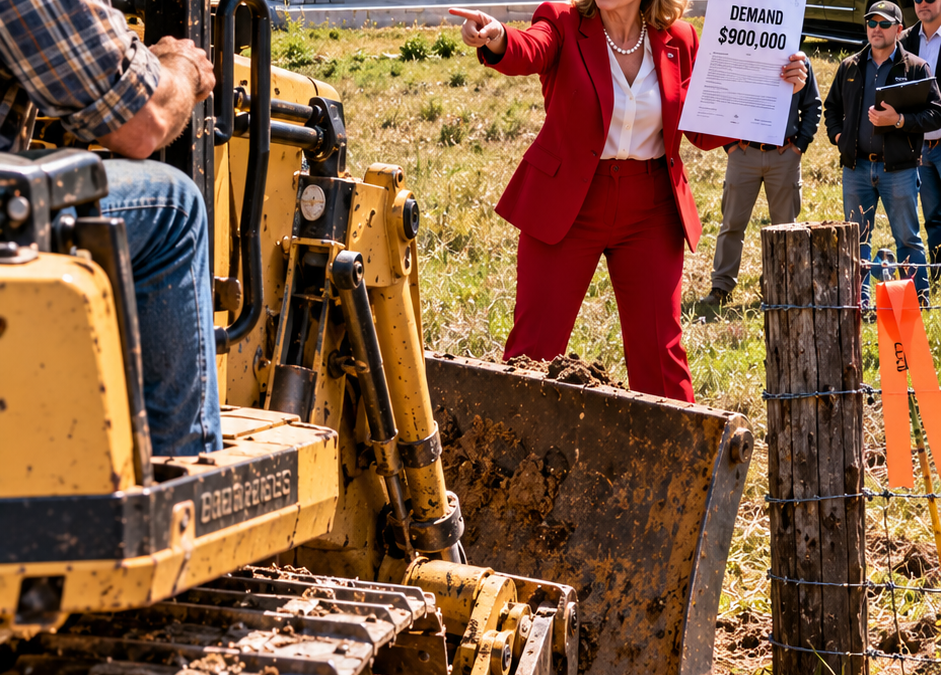
That was when she shoved the damages schedule toward me.
“Read it.”
I took the packet.
Nine hundred thousand dollars.
Line after line.
Construction.
Coordination.
Site preparation.
Infrastructure.
Then I reached page two.
ACCESS PREPARATION AND HEAVY EQUIPMENT MOBILIZATION INFRASTRUCTURE.
$68,000.
Attached was a photograph.
My west lane.
The gravel road my father and I had built eleven years earlier.
The crooked oak at the bend was visible in the background.
I stared at the image.
Lydia smiled.
She thought I had finally understood the size of her claim.
In a way, I had.
I shut off the engine completely.
Pulled out my phone.
Called Mara.
“Forget the total for a second.”
“What happened?”
“They’re charging sixty-eight thousand dollars for road access.”
“All right.”
“It’s my road.”
Pause.
“I built it eleven years ago.”
Another pause.
“With my father.”
Mara’s voice changed.
“Photograph every page.”
“Already starting.”
“Then ask one question.”
“I know.”
“Do you?”
I looked directly at Lydia.
“Who got paid for my road?”
The smile disappeared.
That was the beginning of the part Lydia never expected us to examine.
The removal continued.
Slowly.
Nothing like the ten-second video that later circulated online.
Fixtures came out first.
Appliances labeled.
Photographed.
Stored.
Roofing panels lowered.
Recoverable beams stacked.
Materials inventoried.
Only after the foreman cleared the remaining structure did I use the bulldozer for the work assigned to me.
The first post broke with a crack that echoed across the pasture.
Lydia flinched.
So did I.
I build things for a living.
Even excavation usually exists because something else is going to be built afterward.
Watching a usable structure come apart did not give me the satisfaction I had imagined during sleepless nights.
It felt wasteful.
Expensive.
Completely avoidable.
My relief came when I could finally see the west lane again.
Before lunch, a video appeared online.
Ten seconds.
My bulldozer beside a collapsed wall.
Caption:
LOCAL LANDOWNER DESTROYS $900,000 COMMUNITY PAVILION.
No court order.
No inventory.
No electrician.
No salvage.
No months of litigation.
Just ten seconds arranged to make anger easy.
Owen wanted to post everything we had.
Mara said no.
She issued a short factual statement.
Court-ordered removal.
Property claims adjudicated.
Financial issues still disputed.
Then we let the case record do the rest.
I went back to my shop.
Pulled open an old metal filing cabinet.
Found the road folder.
Aggregate receipts.
Diesel logs.
Equipment hours.
Final job summary.
And photographs.
My father standing beside the lane.
Eleven years younger.
Canvas work shirt.
Hand resting on a shovel.
One picture showed us spreading the final load of gravel.
The crooked oak from Lydia’s photograph stood behind him.
Same road.
Same bend.
Same tree.
Eleven years before Brier Glenn approved its pavilion.
I sent everything to Mara.
Nolan confirmed the photograph in the HOA’s damages schedule showed the same lane.
The sixty-eight-thousand-dollar road charge was not automatically proof of a broader fraud.
Mara made sure I understood that.
It was, however, something we could test independently.
Who performed the work?
What invoice supported it?
What was the date?
What had supposedly been built?
The answers were revealing.
There was no contractor invoice for constructing my road.
No aggregate delivery supporting sixty-eight thousand dollars.
No road-building subcontract.
Instead, there was a consulting allocation.
That phrase opened a door.
Brier Glenn’s nine-hundred-thousand-dollar project schedule contained three major categories.
Curtis Vale Construction:
$314,700.
Separately supported electrical work, landscaping, furnishings, and related legitimate project expenses:
$99,300.
Total supported physical project costs:
$414,000.
The remaining:
$486,000.
Paid to Fenwick Development Consulting.
I read the name twice.
“Fenwick?”
Mara nodded.
The sixty-eight-thousand-dollar road charge sat inside that $486,000 consulting amount.
So did entries labeled:
Site acquisition.
Coordination.
Drainage avoidance planning.
Procurement services.
Project risk management.
I stared at the last line.
“They charged homeowners to manage the risk of building something on land whose owner had already told them to stop.”
Mara looked at me.
“That’s one interpretation.”
“What’s yours?”
“I want to see the deliverables.”
An independent cost consultant reviewed the records.
Her preliminary conclusion was careful.
The physical pavilion project she could document was broadly consistent with the $414,000 in supported expenses.
That did not mean no legitimate consulting services could exist.
The question was what services justified the additional $486,000.
That question proved much harder to answer.
Graham objected to some of Mara’s financial requests.
Mara tied each request to Brier Glenn’s own nine-hundred-thousand-dollar valuation and damage claim.
If the association wanted me to pay nine hundred thousand dollars, she argued, we were entitled to examine how the figure had been built.
The court allowed relevant production, with limits protecting unrelated financial material.
It took weeks.
And more legal bills.
That is one of the things people leave out when they tell property disputes as revenge stories.
Evidence does not assemble itself.
Every deposition costs money.
Every subpoena costs money.
Every hour a lawyer spends comparing two versions of a resolution appears somewhere on an invoice.
I paid another bill before seeing the first useful bank statement.
Then the ownership records arrived.
Fenwick Development Consulting had two members.
Lydia Fenwick.
And her brother, Martin.
Lydia had signed the company’s account-opening papers.
HOA funds flowed into that account.
That connection alone did not prove the services were fake.
Related-party businesses can perform real work.
So Mara requested the conflict disclosure.
Competing bids.
Scopes of work.
Board authorization.
Time records.
Deliverables.
Brier Glenn produced a resolution approving professional project support.
One sentence stood out.
The president may select affiliated providers when appropriate to facilitate project completion.
I called Mara.
“So the board approved it?”
“Maybe.”
“What do you mean?”
“Ruth has a different copy.”
Ruth had downloaded the board packet the morning after the meeting.
Her copy did not contain the sentence about affiliated providers.
For two days, I wanted to call it another forged document.
Mara stopped me.
“We don’t know which version was adopted.”
“It’s different.”
“Yes.”
“So somebody changed it.”
“Probably. But we need to know when.”
The management company’s retained email archive answered that.
The additional sentence appeared in a revision Lydia sent after the meeting.
Her cover email called it:
A clarification for the permanent record.
No later board vote approving that revision appeared in the minutes.
Suddenly the directors themselves had a problem.
Several had been defending a payment authorization they had never voted on in that form.
Lydia requested an emergency closed meeting.
Instead, the board retained independent counsel.
Graham continued handling the property litigation for Brier Glenn.
Lydia hired a separate lawyer for her individual interests.
For the first time, the association’s interests and Lydia’s interests were being treated as potentially different.
Ruth called me.
“They keep saying everything is complicated.”
“Some of it is.”
“I understand complicated.”
I smiled.
“You do?”
“I ran school payroll through three software conversions.”
I laughed.
It was the first time I had laughed that week.
Then her voice changed.
“I just want the receipts.”
That was exactly right.
Then she asked:
“If the association loses, do we have to pay you too?”
I went quiet.
Months earlier, I would have answered angrily.
I might have said Lydia should pay everything.
That nobody else should lose a dollar.
But I did not know that.
And by then, I understood Brier Glenn was not one woman with one bank account.
It was ninety households.
Some had trusted Lydia.
Some had barely paid attention.
Some, like Ruth, had sacrificed real savings.
“The association is responsible for what it did,” I said. “Where the association gets money, and what it recovers from other people, is another issue.”
Ruth was quiet.
“I thought so.”
After that conversation, winning changed shape for me.
I still wanted my losses paid.
But I stopped imagining that every dollar would fall neatly on the person I blamed most.
Lydia had placed ninety households between her decisions and their consequences.
The next important witness was Curtis Vale.
Brier Glenn’s new independent attorney requested his final accounting.
His construction contract totaled $314,700.
Most progress payments had been made.
A retainage balance remained.
That explained the apparent mismatch between some invoices and his bank deposits.
It also meant Curtis had kept unusually careful records.
At his deposition, he brought his project journal.
Daily logs.
Email attachments.
And something I had never seen.
An email he had sent before the first concrete pour.
He attached a photograph of the brass boundary cap.
His message said the proposed pavilion corners appeared to fall outside the subdivision.
He recommended stopping work until landowner authorization was confirmed.
Lydia answered.
Her email attached the disputed consent package.
She wrote that my objection concerned compensation and that counsel had confirmed the association’s right to proceed.
Mara later compared that claim against Graham’s correspondence.
Graham had requested the complete easement.
Requested the original consent.
He had not issued the blanket authorization Lydia attributed to him.
Curtis sat very still when Mara placed the messages side by side.
“You resumed work because you were told the land issue had been resolved?”
“Yes.”
“Did you verify that yourself?”
He shook his head.
“I should have.”
Then Mara asked about my road.
“Did your company build the west access lane?”
“No.”
“Improve it?”
“We spread some repair gravel at the entrance after heavy deliveries.”
“How much?”
He checked the daily log.
“Eight hundred forty dollars.”
“Was that already included in your contract accounting?”
“Yes.”
“Did you invoice sixty-eight thousand dollars for road construction or access infrastructure?”
“No.”
“Were you ever asked to sign such an invoice?”
“No.”
He looked uncomfortable.
“I wouldn’t have.”
There it was.
A documented $840 repair.
Already accounted for once.
Expanded elsewhere into a $68,000 consulting allocation.
Lydia’s lawyer argued that the larger amount reflected logistics and coordination, not literal road construction.
Mara asked for the supporting time records.
The written scope.
The work product.
What arrived did not explain sixty-eight thousand dollars.
But Curtis had something more important than the road receipt.
He had preserved an email from the management office before the owner-consent package was released.
Subject:
PENDING LANDOWNER APPROVAL.
The message stated that Reed Callaway’s approval had not been received and that the alternate site submission should remain on hold.
Later that same day, Lydia replied.
Release the alternate package.
I will handle the owner directly.
The consent bearing my supposed signature was uploaded the following morning.
There was no intervening email from me.
No original wet-ink document.
No meeting.
No record of me agreeing.
That did not prove who physically created the signature.
Mara refused to say it did.
What it established was sequence.
Management knew approval had not been received.
Lydia ordered the package released anyway.
The next morning, a consent appeared.
Mara added my sworn denial.
The original files.
A document examiner’s report identifying significant inconsistencies in the signature.
No single timestamp had to carry the entire argument.
The pieces worked together.
At Lydia’s deposition, Mara stayed with documents.
“Did you personally witness Mr. Callaway sign the consent?”
“No.”
“Did you receive an email directly from him granting approval?”
“Not directly.”
“Who told you he approved?”
“There was an understanding through project administration that the matter could be resolved.”
Mara placed my first email in front of her.
“This is Mr. Callaway’s written response after your first meeting?”
“Yes.”
“Does this email authorize construction?”
“It reflects a negotiating position.”
“It says he authorizes nothing.”
Lydia looked down.
Mara asked:
“What words in this email authorize construction?”
There was a long pause.
Her attorney reminded her to answer if she understood.
Lydia finally said:
“Those words aren’t in the email.”
Then Mara displayed the original site plan beside the revised plan.
“Why was the pavilion moved?”
“The alternate location was more practical.”
“For whom?”
“For the project.”
I was sitting at the far end of the conference table.
Lydia turned a pen slowly between two fingers.
For the project.
Not for Ruth.
Not for the homeowners.
Not for me.
Not for the land.
The project had become its own justification.
Whatever kept it moving became reasonable.
Mara moved to the nine-hundred-thousand-dollar demand.
“Was that figure based on an independent appraisal of the pavilion immediately before removal?”
“It represented the approved project investment.”
“Those are not the same question.”
Silence.
“Was there an independent appraisal?”
“Not that I am aware of.”
That answer did not erase legitimate project costs.
But it destroyed the idea that every dollar spent or allocated automatically became a dollar of property value I had wrongfully demolished.
Finally, Mara asked:
“Fenwick Development Consulting billed for site acquisition.”
“Yes.”
“What property interest did Brier Glenn acquire in exchange?”
Lydia pointed toward the disputed consent and easement.
Mara placed the court’s property decision beside them.
“What property interest did Brier Glenn acquire?”
Lydia stared at the pages.
Then said she would have to review the accounting.
When the first concrete trucks entered my land, I wanted an apology.
By the time I sat in that deposition, I understood I might never get one.
But something else had become possible.
A record that could not change depending on the audience.
The monetary hearing came later.
By then, Brier Glenn’s board had received enough independent legal advice to stop describing my boundary claim as hostility toward the neighborhood.
Graham narrowed the remaining argument.
The HOA still claimed my removal might have exceeded what was necessary.
It questioned whether materials had been adequately protected.
That was why Mara had insisted on everything I had considered excessive on demolition morning.
Licensed electrician.
Photographs.
Inventory.
Independent observer.
Salvage records.
Notice.
Storage.
The removal foreman testified.
The observer authenticated photographs.
The electrician confirmed disconnection.
Records showed the HOA had been given opportunities to retrieve salvaged fixtures and usable materials.
Then the judge compared what we did against the signed removal order.
I thought about all the nights I had imagined driving the bulldozer straight through the pavilion.
If I had done that, the hearing would have looked very different.
Instead, we had followed the order.
The court found no proved departure sufficient to support the HOA’s demolition damages.
The nine-hundred-thousand-dollar claim was rejected.
I did not cheer.
Mara did not smile dramatically.
The judge moved on.
Some financial issues involving Lydia and the association remained for separate review.
Some allegations belonged to the HOA’s own recovery efforts.
Some questions concerning the consent submission were referred elsewhere.
Mara had warned me from the beginning not to confuse exposing evidence with resolving every proceeding that evidence might create.
For my case, the central issue was finally clear.
The pavilion had no authorized place on my land.
Its removal complied with the court’s order.
And Brier Glenn could not convert its disputed project budget into a nine-hundred-thousand-dollar judgment against me.
Outside the courtroom, Graham approached Mara.
He asked whether my remaining claims could be resolved without another round of hearings.
They could.
This time, Brier Glenn’s independent attorney handled the negotiation.
We worked from receipts.
Not revenge numbers.
Fence replacement.
Survey costs.
Ground restoration.
Removal costs.
Documented losses.
Legal expenses subject to negotiation.
The final agreement paid $68,420 toward removal, restoration, fencing, surveys, and a negotiated share of legal costs.
It did not reimburse every lost hour.
It did not bring back the customer who hired another excavation company when my lane was blocked.
It did not pay me for every night I sat at my kitchen table looking at a pavilion that should never have been there.
But it was supported.
Documented.
Something I could sign without pretending.
The property judgment and related filings made clear that Brier Glenn had no right to keep a pavilion on my property.
No right to use my equipment lane as permanent community access.
No right to expand onto the disputed parcel.
Mara completed the filings necessary to preserve that result in the property record.
Then I signed.
Lydia lost the Brier Glenn presidency in a member vote.
The new board ordered an independent audit.
It began pursuing recovery of disputed consulting payments.
The consent records were sent to the appropriate authorities for review.
I did not predict arrests.
Did not post online that anyone was going to prison.
Those decisions belonged to institutions with authority to make them.
When homeowners asked whether they would receive refunds, the new board finally gave them an answer that sounded more like accounting than public relations.
Recoveries were pending.
Supported project costs were identified.
Disputed payments were listed.
Missing explanations were not described as recovered money.
Curtis received his verified remaining contract balance.
The salvaged pavilion materials were returned to the association with documented condition.
There was no victory parade.
No cheering crowd at my gate.
Just checks.
Signatures.
Trucks.
Auditors.
Lawyers.
Homeowners trying to understand what had happened to money they believed was buying them something legitimate.
In some ways, that ending felt more just than a dramatic collapse.
Ruth and the other eighty-nine households had not forged my signature.
They had not moved my boundary monument.
Most had never seen the alternate site drawings.
They had trusted people elected or hired to check those things.
The consequences did not magically disappear for them.
But at least the record finally separated what was supported from what was not.
Restoration of my pasture took several weeks.
The remaining slab came out under the approved plan.
We repaired drainage.
Brought in clean topsoil.
Rebuilt the west fence on Nolan’s marked boundary.
I reopened the equipment lane.
Renewed the cattle lease.
One Saturday morning, I was hanging a new gate when Ruth pulled into the shop.
She got out carrying a loaf wrapped in foil.
I laughed.
“Lemon bread?”
“You remembered.”
“You settled your debt with that once.”
She smiled.
“Maybe I have another debt.”
She set the bread on my toolbox.
“I think I owe you an apology.”
I put down the wrench.
“For what?”
“I voted for the project.”
“So did a lot of people.”
“I believed Lydia.”
“So did a lot of people.”
“I believed the photograph.”
I looked across the pasture.
The pavilion was gone.
The ground where it had stood was still lighter than the surrounding grass.
“You asked for records when you realized something was wrong.”
“I should have asked sooner.”
“Everybody thinks
𝗧𝗛𝗘 𝗘𝗡𝗗
The $900,000 Demand in Her Hand Contained One Charge She Never Expected Me to Recognize
The woman who built a pavilion in my pasture parked her SUV in front of my bulldozer and demanded nine hundred thousand dollars to stop me from taking it down.
Behind her, the pavilion still wore faded ribbons from an opening ceremony that had never happened.
Then I turned to the second page of her demand and saw a sixty-eight-thousand-dollar charge for building a road I had constructed with my father eleven years earlier.
My name is Reed Callaway.
I run a small excavation company in the Northern California foothills.
Three employees.
Two loaders.
One bulldozer old enough to qualify for retirement if machines had pensions.
My family owns one hundred eighty-four acres beside a gated subdivision called Brier Glenn.
People hear that number and sometimes picture wealth.
One hundred eighty-four acres sounds impressive if you imagine manicured vineyards, investment property, or a man sitting on a porch watching land values rise.
Most of my wealth is dirt.
Dirt, old equipment, fuel bills, receivables from customers who promise payment next Friday, and machines that seem to know exactly when cash is tight enough to break something expensive.
A neighbor leases part of the lower pasture for cattle.
The gravel lane along the western edge of my property lets me move equipment between the road and the shop without dragging heavy trailers through the main barnyard.
My father laid that lane out with me.
It was one of the last big jobs we did together.
By then, his knees were bad enough that climbing into a loader took planning.
But after every hard rain, he would still walk that ditch with a shovel over one shoulder.
He believed drainage told the truth about construction.
“Water doesn’t care what you meant,” he used to say. “It goes where you actually sent it.”
I thought about that sentence often after he died.
Intentions were one thing.
Results were another.
Look at what somebody did.
Then follow where it went.
It took me too long to realize that lesson applied just as well to money as it did to water.
The first warning came ten months before the morning I sat in my bulldozer staring at Lydia Fenwick’s nine-hundred-thousand-dollar demand.
I found a brass survey cap in a plastic bucket.
A contractor’s pickup was parked beside my west fence.
A young laborer was carrying orange stakes through an opening in the wire.
I recognized the stamped number on the cap immediately.
Nolan Pierce, the surveyor who handled the property work after my father’s death, had pointed it out when we settled the estate.
It was one of the monuments tied to my western boundary.
I walked over to the worker.
“Where did that come from?”
He looked at the cap.
“Boss said it was obsolete.”
“Your boss is wrong.”
He stopped.
“Who told you to remove it?”
He pointed toward Brier Glenn.
“The lady running the pavilion job.”
I should tell you something about how I reacted.
I did not scream.
I did not block the truck.
I did not call the sheriff.
For years afterward, I wondered whether I should have.
Maybe if I had made enough noise in those first five minutes, someone would have slowed down.
Maybe one angry scene could have saved ten months of litigation.
But at that moment, I still believed I was looking at a mistake.
I took photographs.
The cap in the bucket.
The truck.
The license plate.
The worker.
The opening in my fence.
Then I told him, “Don’t move anything else until this is checked.”
He nodded.
I drove to the Brier Glenn management office.
Lydia Fenwick met me near a glass display case full of landscaping awards.
She was wearing a red jacket over a white blouse.
Reading glasses hung from a thin chain around her neck.
She knew my name before I introduced myself.
“Mr. Callaway.”
“We were planning to contact you.”
I looked at her.
“Before or after you removed my survey monument?”
She blinked.
Then frowned as though the problem was not the missing marker but the question itself.
“The contractor is correcting an outdated layout.”
“My boundary isn’t a layout.”
“Your fence doesn’t match our recreation plan.”
“A recreation plan isn’t a survey.”
Lydia unfolded a colored drawing on the counter.
A blue strip crossed the western edge of my pasture.
Inside it sat a pavilion.
A patio.
Landscaping.
An arrow labeled COMMUNITY ACCESS.
That arrow followed my gravel equipment lane.
“There is a recreational easement,” she said.
“Where?”
“Recorded in 1998.”
“Show me the instrument.”
“Our attorney has it.”
“Then send me the recorded document and legal description.”
Lydia placed one polished fingernail on the drawing.
“Ninety households have already contributed to this project.”
I remember that sentence clearly.
It was the first time she tried to make somebody else’s spending sound like my permission.
I folded my arms.
“Until somebody shows me a recorded right over my land, keep your contractors off it.”
“We’re already mobilized.”
“That changes nothing.”
“You should understand there are substantial community interests involved.”
“I understand there’s a survey cap in a contractor’s bucket.”
Her mouth tightened.
I gave her my email address.
Then I went back to my truck.
Before I even left the parking lot, I typed a summary of the conversation and sent it to her.
No insults.
No threats.
Just facts.
Survey monument removed.
Work disputed.
Easement requested.
No authorization granted.
I did not know then how important that email would become.
At 5:17 the next morning, my equipment driver Owen called.
“Reed.”
His voice told me immediately something was wrong.
“What?”
“There’s a chain across the west lane.”
I sat up.
“What chain?”
“New posts. New chain. Sign says construction access only.”
“Where are you?”
“At the west lane.”
“With the loader?”
“Yeah. Concrete truck’s sitting behind me.”
I was dressed and out the door in minutes.
By the time I reached the west pasture, one section of fence had been removed.
Two new posts stood on my side of the line.
A plastic sign hung between them.
CONSTRUCTION ACCESS ONLY.
Owen sat in his truck with a loaded equipment trailer.
He had a customer waiting for a loader before sunrise.
Backing out meant another hour and a much longer route.
Behind him, a concrete truck idled.
The driver walked toward me carrying a clipboard.
“Site contact sheet,” he said.
I took it.
At the bottom was a line labeled LANDOWNER APPROVAL.
Next to it:
REED CALLAWAY.
Typed.
Not signed.
Just my name placed neatly enough to look official.
“Who gave you this?”
“Office did.”
“Which office?”
“Curtis Vale Construction.”
I called the number on the sheet.
Curtis answered.
“This is Reed Callaway. I’m standing on my property looking at trucks entering under a form that says I approved access.”
There was a pause.
“All right.”
“Who told you that?”
“We have owner consent in the project package.”
“Send it.”
“I need to go through project management.”
“You can do that while your trucks wait outside my gate.”
Another pause.
Then Curtis said, “We’ll hold the delivery.”
That was the first sensible decision anyone connected with the project made.
It cost him a cancellation fee.
He later reminded me of that fact.
I did not blame him.
Drivers and laborers were not drawing blue strips across my pasture.
That afternoon, I hired Mara Ellis.
Mara was not the kind of attorney who raised her voice to sound serious.
She had a habit of narrowing every sentence until only the part she could prove remained.
At first, that irritated me.
Eventually, I understood that she was doing for language what my father had done for drainage.
She wanted to know where every claim actually went.
I also called Nolan Pierce.
He arrived with the estate survey, original field notes, and the expression of a man who had just learned somebody drove over one of his instruments.
He recovered the brass cap from the contractor’s office.
Then he located the surviving monuments.
Checked the recorded legal description.
Measured the proposed foundation corners.
Late that afternoon, he held out his tablet.
“Nearest corner is forty-one feet inside your property.”
I looked at him.
“And the far side?”
“Sixty-three feet.”
“So the whole building—”
“Is on you.”
He enlarged the overlay.
“Your fence is close. The recorded line is better. Neither version puts their pavilion on Brier Glenn property.”
“What about this 1998 easement?”
“Could exist.”
I looked at him.
“You think Lydia might be right?”
“I think dates don’t answer land questions.”
He pointed to the blue strip on the HOA plan.
“The legal description does.”
“So we need the actual instrument.”
“Exactly.”
I wanted a simple answer.
My deed.
My survey.
My land.
Nolan wanted an answer accurate enough to survive court.
There is a difference.
Mara sent Brier Glenn the survey.
Demanded the full easement.
Contacted the county permitting office.
Requested every document in the approval file.
The county confirmed there was a permit for the pavilion.
While those records were being processed, the HOA supplied an easement number and a scanned page.
At the bottom was a signature that looked like mine.
At a glance.
That phrase matters.
At a glance, the first letter resembled how I wrote my name.
But my first name leaned the wrong direction.
The final letter formed a loop I had never used.
The signature sat beneath language authorizing recreational construction and equipment access.
I stared at it.
“I never signed this.”
Mara looked at the page.
“Never?”
“Never.”
“Never saw it?”
“No.”
“Never authorized someone to sign for you?”
“No.”
She nodded.
“Then we dispute it immediately.”
“That should end it.”
“No.”
I looked at her.
“What do you mean, no?”
“Your denial matters. It doesn’t make their exhibit disappear.”
“It’s fake.”
“You believe it is fake.”
“I know I didn’t sign it.”
“Good. That’s what you testify to. But right now they have paper saying one thing and you saying another. We prove what happened.”
She filed for an early order stopping construction.
Brier Glenn opposed it.
They submitted the purported consent.
The easement page.
And a declaration saying I had agreed informally, then changed my mind after construction planning had begun.
At that first hearing, the court did not decide the final property issue.
The record was abbreviated.
The judge wanted more.
More documents.
More boundary evidence.
More information about the supposed consent.
Mara got a schedule.
I did not get the immediate stop I wanted.
I remember walking out of the courthouse feeling almost embarrassed.
I had brought a recorded survey showing the proposed pavilion on my property.
I had sworn I had never signed their consent.
I had expected somebody to look at the papers and say, obviously, stop.
Instead, construction continued.
That was the first time I learned how expensive a convincing lie can become when it arrives in a folder with numbered exhibits.
Mara filed additional requests as county records arrived.
She warned Lydia’s attorney, Graham Talbot, in writing that construction remained disputed and that continuing could increase losses if the HOA’s claimed rights failed.
Graham responded that the association understood its position and intended to proceed.
So the trucks returned.
Footings appeared.
Then posts.
Then framing.
Then cedar siding.
Then a metal roof.
Every afternoon, I stood at the same fence corner and photographed the work.
Same angle.
Same location.
Date and time preserved.
People later called that patience.
It was not patience.
It was helplessness organized into photographs.
I could see the pavilion from my kitchen window.
Every week, it looked more permanent.
There is a particular kind of anger that comes from watching something happen on your own land while professionals explain why you cannot simply stop it yourself.
I own excavation equipment.
I could have pushed those footings out before breakfast.
I could have blocked the access road with a loader.
I could have parked my bulldozer across the entire site.
I did none of those things.
Because Mara kept saying the same thing.
“Don’t create the case they wish they had against you.”
So I documented.
Paid legal bills.
Lost work.
And watched.
The blocked west lane cost my company two hauling jobs.
One customer waited as long as he could, then hired another contractor.
My cattle-lease neighbor moved his animals early because the construction opening meant the pasture could not be secured the way we had agreed.
One evening, I sat in my pickup outside the shop with two bills on the passenger seat.
One from Mara.
One for a machine repair.
I could pay both.
But only if I postponed replacing my service truck.
Again.
The sun was almost down when Lydia walked over from the construction site.
She carried a folder.
“This does not have to bankrupt anyone,” she said.
I laughed once.
“You think that’s what this is doing?”
She held out a proposed agreement.
Fifteen thousand dollars.
In return, I would confirm the pavilion’s continued use.
Grant shared access over my lane.
And provide space for future improvements.
“You still own the land,” Lydia said. “We’re only formalizing how the neighborhood uses it.”
I read the future-improvements clause twice.
“Why do you need expansion rights?”
“Standard language.”
“For what?”
“Our attorney uses standard language in property agreements.”
“You say you already have permission to build this pavilion.”
“We do.”
“Then why do you need me to grant new rights?”
She hesitated.
“Because resolving this cleanly benefits everyone.”
I handed the papers back.
“Your attorney can explain that to Mara.”
Lydia put the folder away.
“You could choose to be a good neighbor.”
I watched her walk back toward the pavilion.
That phrase stayed with me.
Good neighbor.
Apparently, a good neighbor was someone willing to let ninety people vote themselves rights over land they did not own.
After she left, I looked again at the site plan she had shown me.
Something I had missed earlier caught my eye.
Beyond the patio, a second pale gray rectangle.
Unlabeled.
A service arrow extended toward it.
That arrow crossed the only level entrance to my lower pasture.
Until then, I had believed I was fighting one pavilion.
The next morning, I called Mara.
“I want every earlier version of their site plan.”
That request changed the story.
Two weeks later, the county permitting supervisor, Ela Dorsey, called Mara.
She had found an earlier design in the permit history.
Mara called me into her office.
Two drawings lay across the table.
The first showed the pavilion where it belonged.
Inside Brier Glenn.
The second showed it in my pasture.
Same roof.
Same kitchen.
Same patio.
Different land.
“Why did they move it?” I asked.
Ela had provided the review notes.
The original location sat partly inside the subdivision’s stormwater management area.
Building there required redesign.
Drainage work.
Additional site preparation.
The contractor’s preliminary estimate for that work:
$112,000.
Then came the revised drawing.
Pavilion moved west.
Onto my higher ground.
The revision note contained four words.
OWNER APPROVED ALTERNATE CONSTRUCTION LOCATION.
I pointed at the page.
“They didn’t lose the boundary.”
Mara looked at me.
“The drawings establish that the location changed deliberately.”
“They moved it because my land was cheaper.”
“That is one possible explanation.”
“Possible?”
“We still need evidence of why they moved it and who knew what.”
I leaned back, frustrated.
“Mara, look at it.”
“I am.”
“Same project. Their original site costs them another hundred twelve thousand. Suddenly the pavilion moves onto me.”
She nodded.
“Then let’s get the records that prove the financial connection instead of assuming the judge will make it for us.”
Ela also found the original digital submission associated with the consent form.
The contact email belonged to the HOA management office.
That alone did not prove anything improper.
Management offices routinely submit documents for owners.
But behind the file was a routing email.
Use alternate site package.
Retain original site budget.
I looked at Mara.
“They moved the pavilion to my land to avoid the extra work, but they kept the original budget.”
She shook her head.
“Ask it as a question.”
I exhaled.
“Did they move the building onto my land, avoid the expensive drainage work, and still charge residents as though the expense remained?”
“Better.”
That week, Brier Glenn stopped being a faceless organization to me.
A woman named Ruth Bell came to my shop.
Ruth was a retired school office manager.
I knew her because years earlier I had pulled her husband’s car out of a ditch during a storm.
I refused payment.
She brought lemon bread the next morning and announced that the debt was settled.
This time, she carried no bread.
She held a folded newsletter.
“I voted for the pavilion.”
“All right.”
“I thought you sold them that strip.”
I looked at her.
“Why?”
She opened the newsletter.
A paragraph described a permanent recreation site secured through a negotiated land arrangement.
Below it was an architectural rendering.
And below that was a photograph.
Me shaking Lydia Fenwick’s hand.
I recognized it immediately.
Two years earlier, my company had helped clear fallen trees after a windstorm.
Brier Glenn hosted a breakfast to thank several local contractors.
There had been four of us in that photograph.
Someone had cropped out the other three.
The new caption read:
A PARTNERSHIP WITH OUR NEIGHBORS.
Ruth watched me.
“You didn’t agree to this.”
“No.”
“That picture wasn’t taken for this project.”
“No.”
She sat on a stack of unopened shop towels.
Then she said something that changed the way I thought about every Brier Glenn homeowner.
“I paid ninety-six hundred dollars.”
I stared at her.
“What?”
“That was our assessment.”
She folded the newsletter carefully.
“I took it out of what I keep for my roof.”
There it was.
Not a corporation.
Not an HOA acronym.
A retired woman who had taken almost ten thousand dollars from money reserved for her own house because she believed a photograph of me shaking Lydia’s hand meant the land problem had been solved.
I sat across from her.
“Ruth, I never sold them anything.”
“I believe you now.”
“Mara says I need to be careful what I circulate.”
“I don’t want gossip.”
“What do you want?”
“The records.”
That made me smile despite everything.
I gave her only documents Mara had approved.
Nolan’s survey.
My first written objection.
Both existed before the newsletter using my photograph.
Ruth took them.
“I’ll ask for the board minutes approving the land arrangement.”
She did.
The minutes showed a $900,000 pavilion budget.
Ninety households.
$9,600 each.
That produced $864,000.
Another $36,000 would come from reserves.
The arithmetic worked.
The description did not.
The board had approved construction of a pavilion within Brier Glenn’s existing recreation area, subject to final approvals.
Nothing in the vote authorized building on the Callaway parcel.
Nothing authorized permanent use of my equipment lane.
Nothing granted expansion rights.
At the bottom, however, someone had later added an annotation stating that the president had completed the site arrangements under delegated authority.
Ruth asked for the document supporting that annotation.
At the next meeting, Lydia told homeowners that confidential negotiations could not be circulated.
Ruth stood.
Her voice carried across the room.
“You circulated his photograph to every resident.”
Several people turned toward Lydia.
Ruth continued.
“Why can’t we see what he signed?”
Three other homeowners asked the same thing.
Lydia referred future questions to counsel.
The next day, the pavilion’s announced grand opening was moved forward by two weeks.
By then, four months had passed.
The building was complete.
Our court schedule was still moving.
The HOA appeared to be treating completion as evidence.
As though cedar posts, appliances, concrete, and ribbons could create permission simply by becoming expensive enough.
Mara went back to court.
This time she had more.
The original and revised site plans.
Ruth’s newsletter.
The cropped photograph.
The conflicting minutes.
My written objection predating the newsletter.
The court barred public use while the property dispute continued.
The order arrived the afternoon before the opening.
The caterer left.
Rental chairs disappeared.
A temporary stage came down.
But the red and white ribbons stayed tied around the entry posts.
No one bothered removing them.
For months afterward, the pavilion stood empty in my pasture with those ribbons fading in the sun.
Lydia blamed me for canceling a celebration children and grandparents had been looking forward to.
I understood why that argument worked.
An empty pavilion is visible.
A missing legal right is not.
Then Mara finally obtained the complete 1998 easement.
Brier Glenn had been producing the first page and recording reference.
The legal description exhibit had been missing from what they circulated.
Nolan entered the bearings and distances.
Checked the parcel history.
Then brought his overlay to Mara’s office.
I expected a complicated answer.
It was simple.
The easement was real.
It just wasn’t mine.
It covered an old recreation parcel almost two miles east.
It did not reach my boundary.
Did not touch my equipment lane.
Did not include my pasture.
Nolan tapped the first page.
“Real document.”
Then the legal description.
“Wrong land.”
For months, I had imagined someone forging an entire deed.
What had actually happened was more ordinary.
And maybe more effective.
A genuine first page had been separated from the exhibit that would have made the truth obvious.
Mara ordered a title review.
No recorded right authorized the pavilion on my property.
No recreational easement.
No permanent access.
No right to expand.
She submitted the complete easement, Nolan’s survey work, and the title review.
Graham asked for time to consult with his client.
When the property hearing came, Lydia wore the same red jacket she had worn the first day I walked into the management office.
She sat behind Graham with a leather folder beneath both hands.
Nolan testified.
He identified the parcels.
The true boundary.
The unrelated easement parcel.
Then Graham argued that even if the easement did not apply, the disputed consent still showed my permission.
Mara displayed the last paragraph of the HOA’s own form.
Even that document did not say what Lydia had been telling the neighborhood.
The supposed consent was limited to the attached project site and the term of construction.
It expressly stated that no permanent property right was conveyed.
So even if someone believed the signature was mine, the form did not grant the permanent recreation rights, continuing lane access, and expansion Lydia had been describing.
The court did not decide everything in one dramatic afternoon.
There were additional submissions.
More testimony.
A written decision.
Days where I checked my phone every hour and pretended I wasn’t.
Then Mara called.
“The court rejected their claimed right to keep the pavilion on your parcel.”
I sat down at my desk.
“What happens now?”
“They have thirty days to remove it under specified conditions.”
“And if they don’t?”
“You can arrange removal under the court-approved plan.”
I closed my eyes.
For almost a year, I had imagined hearing that sentence.
It felt quieter than expected.
Mara continued.
“Utilities have to be documented before disconnection. Salvageable property has to be protected. Notice requirements still apply.”
“What about damages?”
“Separate issue.”
“So I can take it down.”
“You can carry out the order.”
“Same thing.”
“No.”
Her voice sharpened.
“Read it again.”
I did.
“This is permission to execute the court’s order,” Mara said. “It is not permission to do whatever feels fair.”
I understood what she meant.
There had been nights when I imagined putting the blade of my bulldozer against one corner and pushing until the whole building folded.
That would have been emotionally satisfying.
For approximately thirty seconds.
Then I would have spent years defending whatever damage exceeded the order.
Brier Glenn requested a stay.
The request was denied.
No stay existed when the thirty-day deadline expired.
For thirty days, the pavilion sat untouched.
On day twenty-six, Graham sent a demand.
Nine hundred thousand dollars.
The association asserted that removal would destroy an asset worth the full approved project amount.
It accused me of rejecting reasonable accommodation.
Warned I could become responsible for unnecessary demolition losses.
Mara responded with the order.
Asked them to identify any specific problem with the approved removal plan.
They proposed no workable alternative.
Did not arrange to relocate the structure.
Did not schedule collection.
Did not provide a different lawful plan.
So we proceeded carefully.
Final notice.
Licensed electrician.
Documented power disconnection.
Plumbing isolated.
Removal contractor.
Independent observer.
Inventory.
Opportunity for the HOA to attend.
I brought my bulldozer because I owned it and could perform the authorized groundwork.
The roof and unstable framing belonged to the removal crew.
The foreman looked me directly in the eye before work began.
“You don’t get to save money by making this exciting.”
I still think that may have been the best advice anyone gave me throughout the entire dispute.
Then Lydia arrived.
She parked her SUV across the entrance.
Red jacket.
Graham beside her.
A deputy stood near the work area with the court order.
Lydia got out carrying a packet.
“Stop.”
I shut down the bulldozer enough to hear her.
“This building cost our community nine hundred thousand dollars.”
I looked past her at the pavilion.
The ribbons still hung from the posts.
Faded almost pink.
“That doesn’t give it a right to stay on my land.”
“We are reserving our damage claim.”
Graham spoke to the deputy.
The association objected to the scope.
The deputy reviewed the order.
Confirmed through counsel that no stay existed.
Then he told Lydia to move her SUV outside the authorized work zone.
That was when she shoved the damages schedule toward me.
“Read it.”
I took the packet.
Nine hundred thousand dollars.
Line after line.
Construction.
Coordination.
Site preparation.
Infrastructure.
Then I reached page two.
ACCESS PREPARATION AND HEAVY EQUIPMENT MOBILIZATION INFRASTRUCTURE.
$68,000.
Attached was a photograph.
My west lane.
The gravel road my father and I had built eleven years earlier.
The crooked oak at the bend was visible in the background.
I stared at the image.
Lydia smiled.
She thought I had finally understood the size of her claim.
In a way, I had.
I shut off the engine completely.
Pulled out my phone.
Called Mara.
“Forget the total for a second.”
“What happened?”
“They’re charging sixty-eight thousand dollars for road access.”
“All right.”
“It’s my road.”
Pause.
“I built it eleven years ago.”
Another pause.
“With my father.”
Mara’s voice changed.
“Photograph every page.”
“Already starting.”
“Then ask one question.”
“I know.”
“Do you?”
I looked directly at Lydia.
“Who got paid for my road?”
The smile disappeared.
That was the beginning of the part Lydia never expected us to examine.
The removal continued.
Slowly.
Nothing like the ten-second video that later circulated online.
Fixtures came out first.
Appliances labeled.
Photographed.
Stored.
Roofing panels lowered.
Recoverable beams stacked.
Materials inventoried.
Only after the foreman cleared the remaining structure did I use the bulldozer for the work assigned to me.
The first post broke with a crack that echoed across the pasture.
Lydia flinched.
So did I.
I build things for a living.
Even excavation usually exists because something else is going to be built afterward.
Watching a usable structure come apart did not give me the satisfaction I had imagined during sleepless nights.
It felt wasteful.
Expensive.
Completely avoidable.
My relief came when I could finally see the west lane again.
Before lunch, a video appeared online.
Ten seconds.
My bulldozer beside a collapsed wall.
Caption:
LOCAL LANDOWNER DESTROYS $900,000 COMMUNITY PAVILION.
No court order.
No inventory.
No electrician.
No salvage.
No months of litigation.
Just ten seconds arranged to make anger easy.
Owen wanted to post everything we had.
Mara said no.
She issued a short factual statement.
Court-ordered removal.
Property claims adjudicated.
Financial issues still disputed.
Then we let the case record do the rest.
I went back to my shop.
Pulled open an old metal filing cabinet.
Found the road folder.
Aggregate receipts.
Diesel logs.
Equipment hours.
Final job summary.
And photographs.
My father standing beside the lane.
Eleven years younger.
Canvas work shirt.
Hand resting on a shovel.
One picture showed us spreading the final load of gravel.
The crooked oak from Lydia’s photograph stood behind him.
Same road.
Same bend.
Same tree.
Eleven years before Brier Glenn approved its pavilion.
I sent everything to Mara.
Nolan confirmed the photograph in the HOA’s damages schedule showed the same lane.
The sixty-eight-thousand-dollar road charge was not automatically proof of a broader fraud.
Mara made sure I understood that.
It was, however, something we could test independently.
Who performed the work?
What invoice supported it?
What was the date?
What had supposedly been built?
The answers were revealing.
There was no contractor invoice for constructing my road.
No aggregate delivery supporting sixty-eight thousand dollars.
No road-building subcontract.
Instead, there was a consulting allocation.
That phrase opened a door.
Brier Glenn’s nine-hundred-thousand-dollar project schedule contained three major categories.
Curtis Vale Construction:
$314,700.
Separately supported electrical work, landscaping, furnishings, and related legitimate project expenses:
$99,300.
Total supported physical project costs:
$414,000.
The remaining:
$486,000.
Paid to Fenwick Development Consulting.
I read the name twice.
“Fenwick?”
Mara nodded.
The sixty-eight-thousand-dollar road charge sat inside that $486,000 consulting amount.
So did entries labeled:
Site acquisition.
Coordination.
Drainage avoidance planning.
Procurement services.
Project risk management.
I stared at the last line.
“They charged homeowners to manage the risk of building something on land whose owner had already told them to stop.”
Mara looked at me.
“That’s one interpretation.”
“What’s yours?”
“I want to see the deliverables.”
An independent cost consultant reviewed the records.
Her preliminary conclusion was careful.
The physical pavilion project she could document was broadly consistent with the $414,000 in supported expenses.
That did not mean no legitimate consulting services could exist.
The question was what services justified the additional $486,000.
That question proved much harder to answer.
Graham objected to some of Mara’s financial requests.
Mara tied each request to Brier Glenn’s own nine-hundred-thousand-dollar valuation and damage claim.
If the association wanted me to pay nine hundred thousand dollars, she argued, we were entitled to examine how the figure had been built.
The court allowed relevant production, with limits protecting unrelated financial material.
It took weeks.
And more legal bills.
That is one of the things people leave out when they tell property disputes as revenge stories.
Evidence does not assemble itself.
Every deposition costs money.
Every subpoena costs money.
Every hour a lawyer spends comparing two versions of a resolution appears somewhere on an invoice.
I paid another bill before seeing the first useful bank statement.
Then the ownership records arrived.
Fenwick Development Consulting had two members.
Lydia Fenwick.
And her brother, Martin.
Lydia had signed the company’s account-opening papers.
HOA funds flowed into that account.
That connection alone did not prove the services were fake.
Related-party businesses can perform real work.
So Mara requested the conflict disclosure.
Competing bids.
Scopes of work.
Board authorization.
Time records.
Deliverables.
Brier Glenn produced a resolution approving professional project support.
One sentence stood out.
The president may select affiliated providers when appropriate to facilitate project completion.
I called Mara.
“So the board approved it?”
“Maybe.”
“What do you mean?”
“Ruth has a different copy.”
Ruth had downloaded the board packet the morning after the meeting.
Her copy did not contain the sentence about affiliated providers.
For two days, I wanted to call it another forged document.
Mara stopped me.
“We don’t know which version was adopted.”
“It’s different.”
“Yes.”
“So somebody changed it.”
“Probably. But we need to know when.”
The management company’s retained email archive answered that.
The additional sentence appeared in a revision Lydia sent after the meeting.
Her cover email called it:
A clarification for the permanent record.
No later board vote approving that revision appeared in the minutes.
Suddenly the directors themselves had a problem.
Several had been defending a payment authorization they had never voted on in that form.
Lydia requested an emergency closed meeting.
Instead, the board retained independent counsel.
Graham continued handling the property litigation for Brier Glenn.
Lydia hired a separate lawyer for her individual interests.
For the first time, the association’s interests and Lydia’s interests were being treated as potentially different.
Ruth called me.
“They keep saying everything is complicated.”
“Some of it is.”
“I understand complicated.”
I smiled.
“You do?”
“I ran school payroll through three software conversions.”
I laughed.
It was the first time I had laughed that week.
Then her voice changed.
“I just want the receipts.”
That was exactly right.
Then she asked:
“If the association loses, do we have to pay you too?”
I went quiet.
Months earlier, I would have answered angrily.
I might have said Lydia should pay everything.
That nobody else should lose a dollar.
But I did not know that.
And by then, I understood Brier Glenn was not one woman with one bank account.
It was ninety households.
Some had trusted Lydia.
Some had barely paid attention.
Some, like Ruth, had sacrificed real savings.
“The association is responsible for what it did,” I said. “Where the association gets money, and what it recovers from other people, is another issue.”
Ruth was quiet.
“I thought so.”
After that conversation, winning changed shape for me.
I still wanted my losses paid.
But I stopped imagining that every dollar would fall neatly on the person I blamed most.
Lydia had placed ninety households between her decisions and their consequences.
The next important witness was Curtis Vale.
Brier Glenn’s new independent attorney requested his final accounting.
His construction contract totaled $314,700.
Most progress payments had been made.
A retainage balance remained.
That explained the apparent mismatch between some invoices and his bank deposits.
It also meant Curtis had kept unusually careful records.
At his deposition, he brought his project journal.
Daily logs.
Email attachments.
And something I had never seen.
An email he had sent before the first concrete pour.
He attached a photograph of the brass boundary cap.
His message said the proposed pavilion corners appeared to fall outside the subdivision.
He recommended stopping work until landowner authorization was confirmed.
Lydia answered.
Her email attached the disputed consent package.
She wrote that my objection concerned compensation and that counsel had confirmed the association’s right to proceed.
Mara later compared that claim against Graham’s correspondence.
Graham had requested the complete easement.
Requested the original consent.
He had not issued the blanket authorization Lydia attributed to him.
Curtis sat very still when Mara placed the messages side by side.
“You resumed work because you were told the land issue had been resolved?”
“Yes.”
“Did you verify that yourself?”
He shook his head.
“I should have.”
Then Mara asked about my road.
“Did your company build the west access lane?”
“No.”
“Improve it?”
“We spread some repair gravel at the entrance after heavy deliveries.”
“How much?”
He checked the daily log.
“Eight hundred forty dollars.”
“Was that already included in your contract accounting?”
“Yes.”
“Did you invoice sixty-eight thousand dollars for road construction or access infrastructure?”
“No.”
“Were you ever asked to sign such an invoice?”
“No.”
He looked uncomfortable.
“I wouldn’t have.”
There it was.
A documented $840 repair.
Already accounted for once.
Expanded elsewhere into a $68,000 consulting allocation.
Lydia’s lawyer argued that the larger amount reflected logistics and coordination, not literal road construction.
Mara asked for the supporting time records.
The written scope.
The work product.
What arrived did not explain sixty-eight thousand dollars.
But Curtis had something more important than the road receipt.
He had preserved an email from the management office before the owner-consent package was released.
Subject:
PENDING LANDOWNER APPROVAL.
The message stated that Reed Callaway’s approval had not been received and that the alternate site submission should remain on hold.
Later that same day, Lydia replied.
Release the alternate package.
I will handle the owner directly.
The consent bearing my supposed signature was uploaded the following morning.
There was no intervening email from me.
No original wet-ink document.
No meeting.
No record of me agreeing.
That did not prove who physically created the signature.
Mara refused to say it did.
What it established was sequence.
Management knew approval had not been received.
Lydia ordered the package released anyway.
The next morning, a consent appeared.
Mara added my sworn denial.
The original files.
A document examiner’s report identifying significant inconsistencies in the signature.
No single timestamp had to carry the entire argument.
The pieces worked together.
At Lydia’s deposition, Mara stayed with documents.
“Did you personally witness Mr. Callaway sign the consent?”
“No.”
“Did you receive an email directly from him granting approval?”
“Not directly.”
“Who told you he approved?”
“There was an understanding through project administration that the matter could be resolved.”
Mara placed my first email in front of her.
“This is Mr. Callaway’s written response after your first meeting?”
“Yes.”
“Does this email authorize construction?”
“It reflects a negotiating position.”
“It says he authorizes nothing.”
Lydia looked down.
Mara asked:
“What words in this email authorize construction?”
There was a long pause.
Her attorney reminded her to answer if she understood.
Lydia finally said:
“Those words aren’t in the email.”
Then Mara displayed the original site plan beside the revised plan.
“Why was the pavilion moved?”
“The alternate location was more practical.”
“For whom?”
“For the project.”
I was sitting at the far end of the conference table.
Lydia turned a pen slowly between two fingers.
For the project.
Not for Ruth.
Not for the homeowners.
Not for me.
Not for the land.
The project had become its own justification.
Whatever kept it moving became reasonable.
Mara moved to the nine-hundred-thousand-dollar demand.
“Was that figure based on an independent appraisal of the pavilion immediately before removal?”
“It represented the approved project investment.”
“Those are not the same question.”
Silence.
“Was there an independent appraisal?”
“Not that I am aware of.”
That answer did not erase legitimate project costs.
But it destroyed the idea that every dollar spent or allocated automatically became a dollar of property value I had wrongfully demolished.
Finally, Mara asked:
“Fenwick Development Consulting billed for site acquisition.”
“Yes.”
“What property interest did Brier Glenn acquire in exchange?”
Lydia pointed toward the disputed consent and easement.
Mara placed the court’s property decision beside them.
“What property interest did Brier Glenn acquire?”
Lydia stared at the pages.
Then said she would have to review the accounting.
When the first concrete trucks entered my land, I wanted an apology.
By the time I sat in that deposition, I understood I might never get one.
But something else had become possible.
A record that could not change depending on the audience.
The monetary hearing came later.
By then, Brier Glenn’s board had received enough independent legal advice to stop describing my boundary claim as hostility toward the neighborhood.
Graham narrowed the remaining argument.
The HOA still claimed my removal might have exceeded what was necessary.
It questioned whether materials had been adequately protected.
That was why Mara had insisted on everything I had considered excessive on demolition morning.
Licensed electrician.
Photographs.
Inventory.
Independent observer.
Salvage records.
Notice.
Storage.
The removal foreman testified.
The observer authenticated photographs.
The electrician confirmed disconnection.
Records showed the HOA had been given opportunities to retrieve salvaged fixtures and usable materials.
Then the judge compared what we did against the signed removal order.
I thought about all the nights I had imagined driving the bulldozer straight through the pavilion.
If I had done that, the hearing would have looked very different.
Instead, we had followed the order.
The court found no proved departure sufficient to support the HOA’s demolition damages.
The nine-hundred-thousand-dollar claim was rejected.
I did not cheer.
Mara did not smile dramatically.
The judge moved on.
Some financial issues involving Lydia and the association remained for separate review.
Some allegations belonged to the HOA’s own recovery efforts.
Some questions concerning the consent submission were referred elsewhere.
Mara had warned me from the beginning not to confuse exposing evidence with resolving every proceeding that evidence might create.
For my case, the central issue was finally clear.
The pavilion had no authorized place on my land.
Its removal complied with the court’s order.
And Brier Glenn could not convert its disputed project budget into a nine-hundred-thousand-dollar judgment against me.
Outside the courtroom, Graham approached Mara.
He asked whether my remaining claims could be resolved without another round of hearings.
They could.
This time, Brier Glenn’s independent attorney handled the negotiation.
We worked from receipts.
Not revenge numbers.
Fence replacement.
Survey costs.
Ground restoration.
Removal costs.
Documented losses.
Legal expenses subject to negotiation.
The final agreement paid $68,420 toward removal, restoration, fencing, surveys, and a negotiated share of legal costs.
It did not reimburse every lost hour.
It did not bring back the customer who hired another excavation company when my lane was blocked.
It did not pay me for every night I sat at my kitchen table looking at a pavilion that should never have been there.
But it was supported.
Documented.
Something I could sign without pretending.
The property judgment and related filings made clear that Brier Glenn had no right to keep a pavilion on my property.
No right to use my equipment lane as permanent community access.
No right to expand onto the disputed parcel.
Mara completed the filings necessary to preserve that result in the property record.
Then I signed.
Lydia lost the Brier Glenn presidency in a member vote.
The new board ordered an independent audit.
It began pursuing recovery of disputed consulting payments.
The consent records were sent to the appropriate authorities for review.
I did not predict arrests.
Did not post online that anyone was going to prison.
Those decisions belonged to institutions with authority to make them.
When homeowners asked whether they would receive refunds, the new board finally gave them an answer that sounded more like accounting than public relations.
Recoveries were pending.
Supported project costs were identified.
Disputed payments were listed.
Missing explanations were not described as recovered money.
Curtis received his verified remaining contract balance.
The salvaged pavilion materials were returned to the association with documented condition.
There was no victory parade.
No cheering crowd at my gate.
Just checks.
Signatures.
Trucks.
Auditors.
Lawyers.
Homeowners trying to understand what had happened to money they believed was buying them something legitimate.
In some ways, that ending felt more just than a dramatic collapse.
Ruth and the other eighty-nine households had not forged my signature.
They had not moved my boundary monument.
Most had never seen the alternate site drawings.
They had trusted people elected or hired to check those things.
The consequences did not magically disappear for them.
But at least the record finally separated what was supported from what was not.
Restoration of my pasture took several weeks.
The remaining slab came out under the approved plan.
We repaired drainage.
Brought in clean topsoil.
Rebuilt the west fence on Nolan’s marked boundary.
I reopened the equipment lane.
Renewed the cattle lease.
One Saturday morning, I was hanging a new gate when Ruth pulled into the shop.
She got out carrying a loaf wrapped in foil.
I laughed.
“Lemon bread?”
“You remembered.”
“You settled your debt with that once.”
She smiled.
“Maybe I have another debt.”
She set the bread on my toolbox.
“I think I owe you an apology.”
I put down the wrench.
“For what?”
“I voted for the project.”
“So did a lot of people.”
“I believed Lydia.”
“So did a lot of people.”
“I believed the photograph.”
I looked across the pasture.
The pavilion was gone.
The ground where it had stood was still lighter than the surrounding grass.
“You asked for records when you realized something was wrong.”
“I should have asked sooner.”
“Everybody thinks

