𝗙𝗨𝗟𝗟 𝗦𝗧𝗢𝗥𝗬 Someone Needed My Barn Gone Before the Judge Could See What Was Buried in the Paperwork
𝗙𝗨𝗟𝗟 𝗦𝗧𝗢𝗥𝗬
I looked toward her camera.
“Good. Keep recording.”
Her expression shifted.
My phone vibrated.
Dana Whitaker.
My attorney.
I answered.
“Mason?”
“I’m here.”
“Did they enter?”
“Yes.”
“How bad?”
I looked at the barn.
“Eastern wall is down.”
Dana swore under her breath.
“The judge moved us onto the nine o’clock emergency docket.”
“What time is it?”
“Six twenty-three.”
I stared at Russell.
He had begun demolishing the barn at 6:12.
Less than three hours before a judge was scheduled to review the very easement he claimed gave him permission to destroy it.
There was only one problem with that easement.
I had never signed it.
At that moment, I still believed the forged signature was the center of the case.
It wasn’t.
It was only the loose thread.
Once investigators began pulling, they found a fake county demolition order, a copied notary seal, hundreds of thousands of dollars missing from the HOA, a road contract that had never been approved, and a plan that depended on destroying my barn before anyone with actual authority could examine the documents.
Eight weeks earlier, none of that had been visible.
Ror Ranch had been quiet.
Forty-six acres along the western edge of Black Ridge Commons, outside Bellweather, Colorado.
My grandfather bought the land in 1989.
Long before Black Ridge existed.
Long before the decorative stone entrance.
Long before million-dollar houses climbed the ridge east of us.
Our deed contained no HOA declaration.
No restrictive covenants.
No obligation to follow Black Ridge rules.
The ranch simply bordered the development.
My barn stood eighty-two feet west of the HOA boundary.
It held a tractor.
Fencing tools.
Winter feed.
A welding bench.
An old drill press.
And the workbench where my grandfather taught me that almost anything mechanical could be repaired if you had patience and the correct wrench.
He died the previous spring.
His name was Earl Ror.
To everyone else, the barn was rough timber, corrugated metal, and a concrete floor.
To me, it was where Earl taught me how to work.
His dented coffee tin still sat above the workbench.
I had emptied the stale coffee years earlier.
I never moved the can.
The barn still smelled faintly of cedar, machine oil, hay dust, and his pipe tobacco.
You could replace the lumber.
You could replace roofing.
You could rebuild a wall.
But some structures become containers for memory long before anyone thinks to put a price on them.
Black Ridge Commons had a different concern.
The HOA had announced a new clubhouse project and a thirty-two-home expansion called North Crest.
The existing entrance to the subdivision followed a narrow road down toward State Route 14.
During preliminary review, the county fire authority told the developer that North Crest could not receive final occupancy approval until it had a reliable secondary emergency access route.
That requirement was real.
What Lorraine later claimed about it was not.
The cheapest route ran straight across approximately 1.7 acres of my north pasture.
It would enter beside the barn, cross my equipment yard, and connect to the county road on the west side of my property.
The alternative remained entirely on Black Ridge land.
But it curved around a rocky slope.
That meant retaining walls.
Drainage work.
A longer grade.
More blasting.
More money.
Russell knew exactly how much more.
His company expected to build the road.
Lorraine had been president of Black Ridge Commons for six years.
Residents liked her.
At least many did.
She kept the common areas clean.
Remembered names.
Sent handwritten notes when someone died.
She also controlled meeting agendas so tightly that disagreement had a way of disappearing under phrases like procedural delay, executive discretion, and board efficiency.
Her first letter to me was polite.
Black Ridge offered $85,000 for a permanent access easement.
Lorraine and Russell came to my gate two days later.
I stayed inside my fence.
Russell spread a concept plan across the hood of his SUV.
Lorraine smiled.
“We think this works for everyone.”
I studied the line.
“No.”
Her smile barely moved.
“You haven’t heard the full proposal.”
“I’ve seen the route.”
“It creates secondary emergency access for the community.”
“It cuts my working yard in half.”
Russell pointed toward the drawing.
“The road would only see regular traffic during emergencies and maintenance.”
“It’s twenty-four feet wide.”
“With shoulders.”
“Drainage?”
He paused.
“Yes.”
“Utility clearance?”
“Standard.”
“Construction staging?”
“That would be temporary.”
I tapped the plan.
“This line passes within thirty feet of the barn.”
“You have room.”
“No. That is the only safe turning area for my livestock trailer.”
Russell shrugged.
“Equipment can be moved.”
I looked at him.
“Land can’t.”
Lorraine folded her hands.
“We’re prepared to offer eighty-five thousand.”
“No.”
A week later, the offer became $110,000.
Then $140,000.
I still refused.
It was not because I wanted a fight.
I did not.
An easement is not the same as selling an acre and walking away.
A permanent road changes how the rest of the land functions forever.
People looking at a map see dirt.
The person working that land sees gates.
Snowmelt.
Drainage.
Trailer angles.
Livestock.
Equipment movement.
Future fencing.
The question is not only what one strip is worth today.
It is what the property becomes after that strip is no longer yours to control.
Three days after I rejected the $140,000 offer, the violation letters started.
The first claimed my pasture grass violated Black Ridge’s six-inch landscaping standard.
The second objected to the galvanized roof on the barn.
The third demanded removal of an “unapproved commercial vehicle.”
That was my ranch truck.
Each letter cited Black Ridge architectural rules.
None applied to my land.
I answered every one the same way.
Ror Ranch is not subject to the Black Ridge Commons declaration.
I attached the recorded plat.
Sent each response certified.
Then waited.
After the fourth letter, Lorraine came to my gate herself.
“You’re surrounded by this community.”
“Yes.”
“At some point, you have to recognize your decisions affect more than you.”
“Your houses border my ranch.”
I leaned against the fence.
“That doesn’t turn my ranch into HOA property.”
“The county wants safe access.”
“Then build it on land you own.”
For the first time, something in her expression changed.
A tightening around the mouth.
Nothing more.
“You may discover the records aren’t as simple as you think.”
She drove away before I could ask what she meant.
That night, I walked the north boundary with a flashlight.
Near the barn, two fresh orange stakes stood in the ground.
One was twenty-three feet inside my property.
The other sat beside my west gate.
Neither had a surveyor’s cap.
Neither had identification.
I photographed them.
Measured each from the recorded corner monument.
Then pulled them out.
The next morning, they were back.
This time, someone had sprayed a dashed orange line between them.
That was when I called Owen Maddox.
Owen was a licensed surveyor who had worked Bellweather County for almost twenty years.
He found the original monuments.
Checked my deed.
Ran the boundary.
Then planted blue flags.
We stood beside the barn comparing his line with the orange paint.
“How far off?”
“Twenty-one feet here.”
He walked several yards.
“Twenty-five here.”
“How long?”
“Close to six hundred feet.”
“Could it come from an old map?”
Owen shook his head.
“Not one I’ve ever seen.”
His signed boundary exhibit showed the barn.
The fence.
The true HOA boundary.
And the proposed road corridor.
I emailed it to Lorraine.
Every Black Ridge director.
The management company.
And the association’s attorney.
Two board members responded within an hour.
Both said they had never seen Russell’s road plan.
The HOA attorney gave me something even more useful.
His office had not authorized any of the violation letters sent to Ror Ranch.
Lorraine had been placing his firm’s name in the footer without permission.
That was the first confirmed crack.
Until then, she could still claim confusion.
After that, I stopped assuming this would resolve itself.
I hired Dana Whitaker.
Dana practiced property law in Bellweather County.
She read the deed.
The declaration.
The plat.
Owen’s survey.
Then she sat back.
“Black Ridge has no recorded ownership interest in your ranch.”
“That part I know.”
“Lorraine’s comment about the records bothers me.”
We searched the county index.
Nothing appeared unusual at first.
Then Dana stopped scrolling.
A document had been recorded eleven days earlier under my parcel number.
TEMPORARY EMERGENCY ACCESS EASEMENT.
My stomach dropped.
The easement supposedly granted Black Ridge Commons a thirty-foot-wide corridor across my land for emergency and construction vehicles.
The legal description ran from my northwestern boundary directly through the barnyard.
At the bottom was my name.
Mason Ror.
And beneath it was a signature that looked like mine.
Almost.
The first letter leaned too far forward.
The final stroke looked familiar.
Then I remembered.
I opened my email.
Found the certified mail receipt from one of my HOA responses.
Same final stroke.
Someone had not invented my signature.
They had copied it from my own correspondence.
The notarization bore the name April Voss.
Accounts assistant.
Prescott Civil & Grading.
Russell’s company.
“Can the recorder just accept this?” I asked.
Dana shook her head slowly.
“Recording offices usually determine whether a document meets filing requirements. They don’t conduct handwriting trials at the counter.”
“So filing it makes it legal?”
“No.”
She looked at me.
“A forged signature does not become valid because someone recorded it. But the recording creates a public claim, and that claim can create confusion until it’s corrected.”
She began preparing an affidavit immediately.
Then a civil complaint asking the court to declare the easement void.
She sent preservation notices to Black Ridge Commons, Prescott Civil & Grading, Lorraine, Russell, and April Voss.
I reported the suspected forgery to Sheriff Celia Hartwell.
Celia was careful.
She looked at the easement.
My certified mail receipt.
The stake photographs.
Owen’s survey.
Then she pushed everything into an evidence folder.
“Do not confront the notary.”
“I wasn’t planning to.”
“Keep every camera running.”
“I have one facing the barn.”
“Get more.”
That afternoon, I installed two trail cameras.
Then upgraded the main recorder so every clip uploaded off-site.
I was not being dramatic.
The orange stakes had appeared twice.
Now a forged easement existed.
That meant someone was no longer merely arguing about the land.
They were preparing to act as though the argument had already been won.
Two days later, Dana received a letter from attorney Mark Ellison.
Lorraine had retained him without informing several board members.
His letter claimed the easement was authentic.
It also warned me not to interfere with a “county-approved emergency access project.”
Dana called him.
“Send me the approval.”
He could not.
There was no road permit.
No grading permit.
No demolition permit.
The county had only made a preliminary planning comment.
North Crest would need an approved secondary emergency route before homes could receive occupancy approval.
That was all.
Lorraine had converted a future development condition into a present government order.
Bureaucratic language works well on people who are afraid of challenging authority.
Required by the county sounds a lot like ordered by the county if nobody checks.
I checked.
Dana requested an emergency temporary restraining order.
The court scheduled the hearing for Friday at nine.
Thursday afternoon, I came home and found a red notice taped to my barn.
A second copy was attached to my gate.
UNSAFE STRUCTURE.
DEMOLITION AUTHORIZED.
72-HOUR COMPLIANCE PERIOD.
The Bellweather County seal appeared at the top.
Below it was an inspector’s signature.
For ten seconds, I stood there wondering whether I had misunderstood something.
Then I photographed both notices.
Dana called the county building department.
No inspector had visited my property.
No unsafe-structure case existed.
The reference number belonged to a permit issued eight months earlier.
For a fire-damaged garage twelve miles away.
The county administrator sent written confirmation.
The notice was fraudulent.
Dana forwarded that confirmation to Sheriff Hartwell.
Mark Ellison.
Lorraine.
Russell.
The HOA manager.
Every board member.
Mark Ellison withdrew from representing Lorraine that evening.
His letter said documents had been presented to him as authentic when they were not.
At 7:20 p.m., Dana sent final written notice.
The demolition order was fake.
The easement was formally disputed.
The emergency hearing was scheduled for nine the following morning.
At 8:04, my phone rang from a blocked number.
“Mr. Ror?”
“Yes?”
“My name is Trevor Hail.”
I knew the name.
Foreman at Prescott Civil.
“I’m not supposed to contact you.”
“Then why are you?”
He took a breath.
“Russell told us to stage a dozer near your north gate before sunrise.”
I stopped moving.
“He says the county order is valid.”
“You know it isn’t.”
“I checked the permit number.”
“Are you operating the bulldozer?”
“No.”
“Who is?”
“I told him I wouldn’t cross your fence unless I heard from the county.”
Trevor’s voice dropped.
“He said he’d do it himself.”
After the call, I contacted Sheriff Hartwell.
A deputy drove past at 10:30.
Everything was quiet.
Celia could not park someone at my house all night based only on a warning.
But she put the ranch on patrol briefing.
Then she gave me one instruction.
“If equipment arrives, do not stand in front of it.”
I barely slept.
At 5:40 Friday morning, my supervisor called.
I had spent seventeen years with the United States Marshals Service.
That morning, a delayed prisoner transport had created a staffing problem in Denver.
They asked if I could cover the final transfer.
I explained that I had a threatened property demolition and a court hearing at nine.
My supervisor reassigned the duty.
That decision mattered.
At 6:12, my camera alarm sounded.
I opened the live feed.
The north gate chain snapped.
A bulldozer entered.
Russell was driving.
Lorraine’s SUV came behind him.
Two temporary laborers followed in a pickup.
They remained near the road.
I called 911.
Pulled on my boots.
Then drove from the house toward the barn.
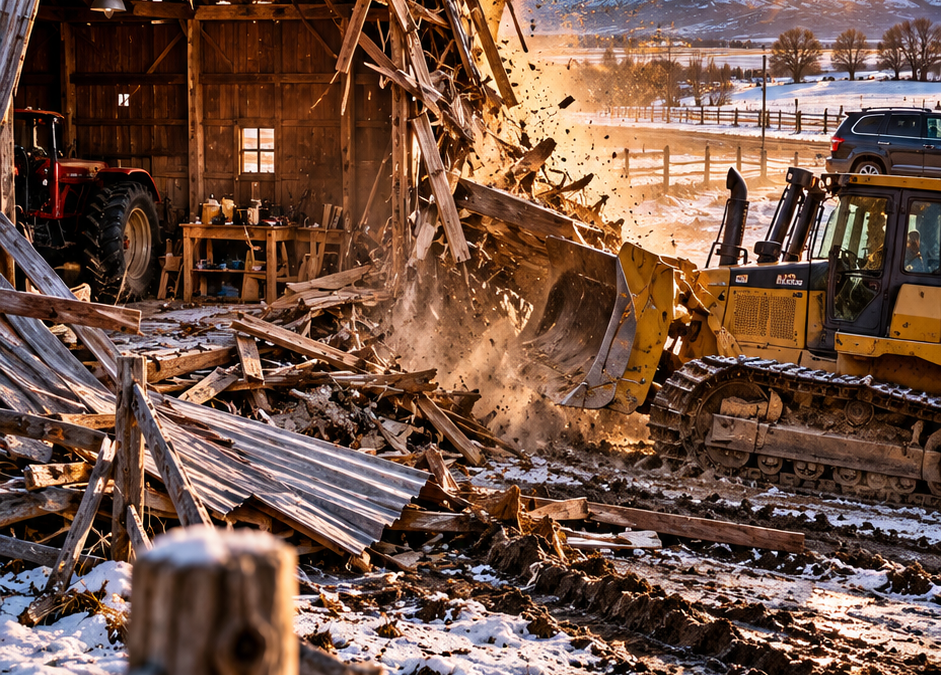
By the time I arrived, the eastern wall was already down.
That was how I ended up twenty yards from my grandfather’s broken barn while Russell stared at the badge he had not expected to see.
Sheriff Hartwell arrived eleven minutes later with two deputies.
I put my identification wallet away.
Then moved well clear of the work area.
Lorraine raised her phone.
“Deputy, this man displayed a federal badge to threaten us.”
Celia looked at me.
“Did you place anyone under arrest?”
“No.”
“Did you claim federal jurisdiction?”
“No.”
“What did you say?”
“I told them I was off duty. This was a property dispute, and your office was coming.”
Russell pointed at the red notice lying in the mud.
“We have a county demolition order.”
Celia did not argue with him.
She photographed it.
Separated everyone.
Requested individual statements.
One deputy recorded the bulldozer’s serial number.
Another interviewed the laborers.
Both men told him Russell had instructed them not to contact the county because the project was confidential.
Then Trevor arrived.
He stepped from his own truck holding a manila folder.
Russell stared at him.
“What are you doing here?”
Trevor handed the folder to Celia.
“The work packet from yesterday.”
Inside were copies of the forged demolition order.
The disputed easement.
And an internal instruction sheet.
Across the top, written in Russell’s hand, were six words:
REMOVE STRUCTURE BEFORE FRIDAY COURT REVIEW.
Russell’s face changed.
“That’s a scheduling note.”
Trevor looked directly at him.
“You told me the judge would slow everything down once Ror got in the room.”
Lorraine stepped forward.
“He’s a disgruntled employee.”
Trevor shook his head.
“Was.”
Then he looked at Russell.
“I quit this morning.”
At nine, Dana appeared remotely before a county judge.
She displayed current photographs of the demolished eastern wall.
Mark Ellison confirmed he no longer represented Lorraine.
He also confirmed that he had never independently verified execution of the easement.
The judge issued a temporary order.
Black Ridge Commons.
Lorraine.
Russell.
And their contractors were prohibited from entering my land or altering the disputed corridor.
The judge did not finally decide ownership that morning.
She preserved the property while the validity of the easement was examined.
By then, the barn was damaged.
But it was still standing.
Nobody arrested Lorraine or Russell at the scene.
Some Black Ridge residents who had gathered near the road were angry about that.
I understood.
But anger is not probable cause.
Celia seized the work packet.
The bulldozer was secured pending further investigation.
The fraudulent county notice went to a document investigator.
Russell left in Lorraine’s SUV.
Before he climbed in, he looked at me.
“You think one piece of paper is going to stop North Crest?”
I looked at the broken wall behind him.
“No.”
He almost smiled.
Then I added:
“I think all of your paper will.”
The first major break came before sunset.
April Voss called Dana.
She was crying.
“I did not notarize Mr. Ror’s signature.”
Dana put her on speaker with permission.
“You have never met him?”
“No.”
“Is there a journal entry?”
“No.”
“Did you authorize anyone to use your seal?”
“No.”
Three months earlier, April had notarized a legitimate equipment lease for Russell.
Lorraine asked an office assistant to scan the complete document.
That scan included April’s signature and notary seal.
Someone later used those elements on my supposed easement.
April only learned about it after receiving Dana’s preservation letter.
Then Russell offered her $10,000.
He called it severance.
All she had to do was sign a statement saying I had appeared before her after business hours.
She refused.
Before leaving the company, she photographed the unsigned statement.
And the check Russell placed beside it.
Dana told her to preserve everything.
Then contact Sheriff Hartwell directly.
At that point, this was no longer an aggressive HOA dispute in my mind.
Boundary errors happen.
Bad surveys happen.
People misunderstand old documents.
Copied seals and false sworn statements do not happen by accident.
The second major break came from inside Black Ridge.
Evelyn Price arrived at my ranch carrying a laptop and a banker’s box.
Evelyn was the HOA treasurer.
Sixty-four.
Quiet.
Methodical.
The kind of person Lorraine reportedly mocked because she asked too many questions.
“I should have asked more,” Evelyn told me.
Dana joined us at the kitchen table.
Two months earlier, Lorraine had presented the board with a motion approving up to $90,000 for preliminary North Crest access studies.
The meeting minutes reflected that limit.
But Black Ridge’s accounting system showed three payments totaling $286,000.
Recipient:
Front Range Infrastructure Consulting.
Evelyn had never approved those payments.
The mailing address was a private mailbox.
The listed phone number forwarded to Prescott Civil & Grading.
Russell had created Front Range fourteen months earlier.
The nominal owner was one of his operations managers.
One invoice billed the HOA $68,000 shortly before the demolition.
Another demanded $44,000 for “legal acquisition services.”
There was no attorney identified.
Then Evelyn opened a draft contract from the HOA shared drive.
Prescott Civil & Grading would receive $740,000 to construct the secondary road once the corridor was cleared.
No competitive bidding.
No final board vote.
And the signature line for Black Ridge Commons was already signed.
Lorraine Prescott.
Now the motive had a number.
This was not only about Lorraine wanting a road.
Her husband’s company stood to receive hundreds of thousands of dollars if the corridor crossed my ranch.
Dana stopped me before I could copy the files.
“You don’t handle these.”
I knew why.
I was the victim of the property damage.
I was not the investigator of Black Ridge finances.
Evelyn delivered the records to the sheriff.
The HOA’s new independent counsel received another set.
Then the case slowed down.
Not because nothing was happening.
Because real cases move quietly.
A county document examiner compared my known signatures against the easement.
Her preliminary findings showed several indicators of digital assembly.
Investigators obtained the electronic demolition notice from Trevor’s work packet.
Metadata linked it to a computer assigned to Russell’s office.
The county confirmed that the seal had been copied from the unrelated garage permit.
April surrendered the proposed false statement and the $10,000 check.
Owen installed permanent blue survey posts along the real boundary.
The court allowed me to repair the fence.
But the damaged section of the barn had to remain untouched until both sides’ experts documented it.
That part was harder than the hearings.
Every morning, I fed cattle around broken beams.
The tractor sat beneath a tarp.
Snowmelt entered the feed room.
The barn electrical line had been severed.
And every time I stepped inside, I saw the workbench my grandfather had built crushed beneath fallen framing.
People talk about property damage in numbers.
Replacement cost.
Depreciation.
Labor.
Materials.
Those numbers matter.
But they do not describe what it feels like to see the place where a dead man taught you to repair a transmission sitting open to the snow because someone wanted a cheaper road.
Lorraine had another strategy.
She began writing to Black Ridge residents.
Her newsletter described me as a federal officer abusing my position to block a life-saving emergency route.
It did not mention the forged signature.
It did not mention April’s copied notary seal.
It did not mention the fake demolition order.
The barn was described as an abandoned outbuilding.
Photographs taken days earlier showed hay, tools, and a registered tractor inside.
Then Lorraine filed a formal complaint with the United States Marshals Service.
She claimed I had flashed my badge.
Threatened Russell with federal prison.
And ordered an HOA construction crew off community property.
For the first time since the bulldozer crossed my fence, I lost my composure.
I read the complaint at my kitchen table.
My career had taken seventeen years to build.
The barn could be reconstructed.
My reputation inside the Service was something else.
My supervisor placed me on administrative duty while the allegation was reviewed.
Administrative duty was not discipline.
It was not a finding.
But Lorraine announced it to the neighborhood as though I had been suspended for misconduct.
That was when I understood exactly what she intended.
If she could not make my deed disappear, she would try to discredit the person holding it.
I gave investigators everything.
Three camera feeds.
Cloud backups.
My 911 call.
Phone location.
The footage captured Russell reaching for my phone.
It captured me showing identification.
It captured my exact words.
I’m off duty.
This is not a federal arrest.
I’m the property owner and the county sheriff is on the way.
The dispatcher recording confirmed I had requested local law enforcement.
Trevor confirmed the same account.
So did both laborers.
Seven days later, the Marshals Service closed the complaint as unsupported.
I returned to regular duty.
The written finding specifically noted that I had deferred authority to local law enforcement.
Dana suggested releasing the letter.
“No.”
She looked at me.
“No?”
“Not yet.”
“Why?”
I folded it.
“Let Lorraine repeat the lie in front of everyone.”
That opportunity came the following Thursday.
Eighteen Black Ridge homeowners had signed a petition demanding a special meeting about North Crest spending.
The HOA’s independent attorney confirmed the bylaws allowed it.
Nearly every chair in the clubhouse was filled.
Lorraine wore the same red coat she had worn while my barn came down.
Russell sat in the front row.
I sat near the back.
Jeans.
Gray work jacket.
No badge.
No uniform.
Dana sat beside me with three folders on her lap.
Lorraine opened with a prepared statement.
“Black Ridge is under attack by an outside landowner who has used federal power to obstruct emergency access and threaten residents.”
People murmured.
Evelyn Price raised her hand.
Lorraine ignored her.
Evelyn kept it raised.
Finally:
“Yes, Evelyn?”
“I move that the board display the actual boundary map.”
“This meeting concerns community safety, not technical distractions.”
Evelyn’s voice remained calm.
“The location of the community boundary is not a technical distraction.”
The map appeared.
Owen’s survey placed a thick line along the western edge of Black Ridge.
My barn sat eighty-two feet beyond it.
The proposed road crossed 1.7 acres of my ranch.
Lorraine pointed toward a shaded rectangle.
“The association has an access easement.”
Dana stood.
“Then perhaps you can explain why the notary whose seal appears on it has sworn she never witnessed Mr. Ror’s signature.”
The room went silent.
Lorraine looked at Russell.
It lasted maybe one second.
Every person in the room saw it.
Dana displayed April’s affidavit.
Then her notary journal.
No Mason Ror.
No entry matching the date.
Then came my certified mail receipt.
The legitimate signature apparently used as the source.
Russell stood.
“This is active litigation. None of these materials should be discussed publicly.”
Evelyn looked at him.
“But you were willing to discuss Mason’s federal employment review in the newsletter.”
Someone near the front turned toward me.
“Were you suspended?”
I stood.
“No.”
The room quieted.
“The complaint was reviewed and found unsupported.”
I held up the finding.
“The recordings show I expressly stated that I was off duty and had no federal jurisdiction over the incident.”
I sat down.
That was all.
Lorraine’s story did not collapse because I made a speech.
It collapsed because the documents kept removing places for it to hide.
Evelyn displayed the three payments to Front Range Infrastructure Consulting.
Then the private mailbox.
The forwarded phone number.
Then the $740,000 Prescott Civil road contract.
“Did the board approve this?” a resident asked.
Three directors answered immediately.
“No.”
“Were other companies allowed to bid?”
“No.”
Lorraine raised her hands.
“I acted under emergency authority.”
The independent HOA attorney moved to the microphone.
“The bylaws allow limited emergency maintenance.”
He paused.
“They do not authorize the unilateral acquisition of outside property, execution of a $740,000 construction contract, or large payments to a company connected to an officer’s spouse without disclosure.”
Then Evelyn displayed three annual conflict-of-interest forms.
Lorraine had not disclosed Russell’s connection to Front Range Infrastructure Consulting.
Evelyn made a formal motion.
Suspend Lorraine as president pending an independent audit.
The meeting had been properly noticed.
A quorum existed.
The bylaws permitted the action.
Every eligible director voted in favor.
None opposed.
Lorraine remained a homeowner.
She retained every legal right to defend herself.
But she was no longer HOA president.
She left the podium.
Russell followed.
Before he reached the exit, Trevor Hail stepped into the aisle.
“Tell them about the second work packet.”
Russell stopped.
Trevor held up his phone.
One week before the demolition, Russell had sent him two site plans.
The version presented to the board showed a route curving east, mostly within Black Ridge.
The field-construction version ran straight through my barn.
Under that second image was a text message.
Once the corridor is open, the board won’t pay to change it back.
There it was.
The strategy.
Russell apparently never expected the forged easement to survive years of litigation.
He did not need it to.
He needed it to survive one morning.
Clear the trees.
Break the fence.
Remove the barn.
Start the road.
Spend enough money.
Then tell everyone that changing course would be too expensive.
He was counting on sunk cost to become leverage.
People defend money already spent.
Even when spending it was wrong.
Trevor had kept both plans.
The following morning, sheriff’s investigators executed court-authorized search warrants at Prescott Civil & Grading and the private mailbox connected to Front Range Infrastructure Consulting.
They seized computers.
Contracts.
Accounting records.
The bulldozer went to an evidence yard.
No federal raid.
No dramatic swarm of black vehicles.
No conspiracy.
Just local investigators following documents directly connected to damaged property and missing HOA funds.
The audit took six weeks.
It found that $286,000 had moved from Black Ridge into Front Range.
A portion then moved into Prescott Civil.
Other funds had been used to pay unrelated equipment debts.
Several services described on invoices had never been performed.
Investigators also determined that Lorraine approved payments using another director’s electronic credentials while that director recovered from surgery.
Then they found an email.
Lorraine to Russell.
Three days before the demolition.
If the barn is still standing when the judge sees the map, we lose the straight route. Clear it first. We can negotiate damages afterward.
When I read that sentence, I stopped feeling surprised.
Some facts do that.
They do not make you angrier.
They make the previous months suddenly simpler.
The bulldozer was never an emergency response.
It was an attempt to create a permanent fact before the legal system could test the paperwork.
Several weeks later, after the normal charging review, the county prosecutor announced criminal charges.
Russell faced allegations involving criminal mischief, trespass, use of a forged instrument, and attempted witness tampering related to April.
Lorraine faced forgery-related conspiracy and financial charges tied to the easement and association funds.
Both denied wrongdoing.
Both were entitled to defend themselves.
Those were criminal cases.
Mine was civil.
They were not the same process.
At the final easement hearing, Lorraine’s new attorney made the strongest argument available to him.
Black Ridge, he said, had relied on a recorded document.
The proposed route served a legitimate emergency-access purpose.
The public would benefit.
Dana did not argue against emergency access.
She stood at the lectern and said:
“A useful road is still not a legal road.”
The judge looked up.
Dana continued.
“Public benefit does not transform a copied signature into consent.”
Owen testified about the boundary.
April authenticated her journal.
She stated under oath that she had never met me and had not notarized the easement.
The document examiner explained the digital artifacts linking my genuine certified-mail signature to the purported easement.
The county building department confirmed it never ordered my barn demolished.
The judge declared the easement void.
Then she ordered a corrective judgment recorded against my parcel.
That mattered.
Years from now, when someone performs a title search, the false easement will not simply disappear without explanation.
The record will show that it was challenged and declared invalid.
Black Ridge was permanently prohibited from entering or building on the corridor without a new valid agreement.
Then the judge addressed the argument that emergency access made the road necessary.
The county had never ordered a road across Ror Ranch.
It had required the North Crest developer to provide an approved secondary route before occupancy.
There was another route.
More expensive.
More complicated.
But entirely on land the developer controlled.
North Crest was not cancelled.
Thirty-two buyers did not lose their future homes.
The developer simply had to pay the real cost of building the project legally.
That mattered to me.
Justice did not require innocent families to suffer because Lorraine and Russell wanted a shortcut.
It required the people profiting from the expansion to stop shifting their costs onto my property.
Two months later, the civil case settled.
Black Ridge’s insurer funded covered structural losses while preserving claims against Prescott Civil.
The HOA paid documented legal and survey expenses.
Prescott Civil’s insurer covered fence damage, equipment losses, and reconstruction amounts beyond the HOA policy.
Dana slid a confidentiality clause across the table.
“They want this included.”
I read it.
It would have restricted what I could publicly say about the forged easement and boundary dispute.
“No.”
“Mason, we can negotiate the language.”
“No.”
“Why?”
“I don’t need Black Ridge humiliated.”
I pushed the clause away.
“But I need the record to stay honest.”
The clause came out.
The new Black Ridge board cancelled Russell’s contract.
They hired an independent engineer.
The legal secondary-access route would cost approximately $480,000 more than the straight road across my pasture.
Residents were angry when they saw the number.
Then the engineer explained why.
Lorraine’s cheaper number had excluded compensation for my land.
Drainage structures.
Livestock fencing.
Utility relocation.
Legal acquisition.
The straight road had never truly been cheap.
It only looked cheap because the plan assumed someone else would absorb the cost.
Evelyn Price became interim HOA president.
She refused to run for a full term.
Under her supervision, Black Ridge adopted competitive-bidding requirements.
Large payments needed dual authorization.
Vendor relationships with directors or officers had to be disclosed.
Financial records became easier for homeowners to inspect.
Trevor found work with another contractor.
April completed additional notary training before renewing her commission.
Nobody blamed her for a seal copied without her knowledge.
Mark Ellison turned over correspondence showing what Lorraine had represented to him.
His evidence was uncomfortable.
It was also useful.
The criminal cases moved slowly.
There was no dramatic confession.
Russell stepped away from day-to-day control of Prescott Civil while criminal and civil matters remained pending.
He lost eligibility to bid on future Black Ridge work.
Lorraine resigned from the board permanently.
The following spring, she listed her house for sale.
Months after the bulldozer entered my pasture, I stood inside the barn again.
The eastern wall had been rebuilt.
Where possible, the contractor reused salvageable timber.
My grandfather’s workbench returned beneath the western window.
We could have replaced it.
A new bench would have been straighter.
Cleaner.
Easier.
I did not want easier.
We repaired the old one.
The dented coffee tin went back above it.
There was one scar we could not completely remove.
A pale crescent in the concrete floor where the bulldozer track had ground against it.
The contractor asked whether I wanted the section resurfaced.
“No.”
“You’ll always see it.”
“I know.”
He nodded.
We left it.
Sheriff Hartwell came by the afternoon the new barn doors went up.
I was adjusting a hinge.
She leaned against the fence.
“You know Russell claims your badge ruined his life.”
I tightened the bolt.
“The badge didn’t forge an easement.”
Celia smiled slightly.
“That’s more or less what I told him.”
We looked east.
Construction equipment worked along the rocky slope on Black Ridge property.
The legal access road was beginning to take shape.
It was slower.
More complicated.
More expensive.
But the machines stayed on land the developer had the right to use.
I finished the hinge.
Then I went into the barn and picked up an old wooden sign.
ROR RANCH.
PRIVATE PROPERTY.
The paint was faded.
One corner had been crushed when the bulldozer hit the fence.
A new sign would have cost less than fifty dollars.
I flattened the damaged corner.
Drilled through the original holes.
Then hung it back on the door.
Celia watched.
“You could replace that.”
“I could.”
“But you’re not going to.”
“No.”
She nodded toward the scarred corner.
“Memory?”
“Evidence.”
She laughed.
“Federal marshals.”
I looked at the sign.
“No.”
I thought about my grandfather.
“Grandsons.”
Earl had lived most of his life believing that land meant responsibility before it meant value.
I did not always understand that.
When I was young, I thought the ranch represented limitation.
Fences.
Repairs.
Frozen water lines.
Calving in bad weather.
Equipment that broke exactly when you needed it.
I joined the Marshals Service partly because I wanted a life measured by something larger than acreage.
Earl never resented that.
He came to my graduation.
He kept a newspaper clipping from my first major assignment tucked inside his desk.
When I came home, he asked almost nothing about arrests.
He wanted to know whether I still changed my own oil.
The last year of his life, we talked more often.
Age had softened us both.
One afternoon, we sat inside the barn while he repaired an old gate latch.
He looked toward Black Ridge.
“Those people ever ask about buying the north pasture, don’t sell it because you feel sorry for them.”
“They haven’t asked.”
“They will.”
“Why?”
“Because that hill over there is expensive.”
I followed his eyes toward the rocky slope.
“So?”
He gave me the kind of look grandfathers reserve for grown men who have temporarily become stupid children again.
“A straight road is cheaper.”
I laughed.
He did not.
“Mason.”
“What?”
“Cheaper for one person usually means somebody else is paying.”
I remembered that after the settlement.
The straight road had been cheaper because Lorraine and Russell’s plan assigned the cost of my land to me.
My equipment yard.
My barn.
My fencing.
My memories.
My future use of the ranch.
Those things did not disappear because they were absent from Russell’s spreadsheet.
Someone still paid.
That was the pattern beneath the entire dispute.
A forged signature tried to make consent free.
A copied county seal tried to make legal authority free.
The fake easement tried to make my land free.
The undisclosed HOA payments tried to make the residents’ money feel free.
The bulldozer tried to make irreversible action cheaper than lawful negotiation.
Nothing was actually free.
The cost was merely being pushed onto someone who had not agreed to pay it.
For months after the barn was rebuilt, I would sometimes wake before dawn when my phone vibrated.
My body expected another security alert.
Another orange stake.
Another truck at the gate.
Usually it was nothing.
Weather.
Work.
A message from a colleague.
The cameras remained.
So did the permanent survey posts.
I kept the certified receipts.
Dana told me I could probably archive most of the file.
I did.
But I kept one drawer beneath my grandfather’s workbench.
Inside were copies of everything.
The first $85,000 easement offer.
Owen’s survey.
The forged easement.
April’s affidavit.
The fake demolition order.
The internal instruction:
REMOVE STRUCTURE BEFORE FRIDAY COURT REVIEW.
The Marshals Service finding.
The corrective judgment.
And a photograph of the rebuilt barn.
Not because I expected to fight Black Ridge forever.
I did not.
The new board behaved differently.
I kept them because evidence has a strange relationship with memory.
Memory simplifies.
Evidence resists simplification.
Years from now, I might remember Lorraine only as the woman in the red coat.
Russell as the man driving the bulldozer.
Myself as the person who stopped them.
That would be incomplete.
The truth was less flattering and more useful.
I did not stop the bulldozer before it damaged the barn.
I did not discover the forged easement before it was recorded.
I did not know about the fake order until someone taped it to my door.
I could not prevent Lorraine from filing a complaint that put my career under review.
I could not make criminal investigations move faster.
What I could do was preserve what happened.
The first orange stake.
The certified receipts.
The boundary coordinates.
The cameras.
The 911 call.
The timestamps.
That became enough.
Not because documentation is magical.
Because each piece went to the institution responsible for deciding that part.
The surveyor established the boundary.
Dana challenged the easement.
The sheriff investigated the forged documents.
The Marshals Service reviewed my conduct.
The HOA’s independent counsel reviewed its bylaws.
The auditor followed the money.
The prosecutor decided criminal charges.
The judge decided the validity of the easement.
That mattered to me more than the moment Russell saw my badge.
People who heard the story afterward always asked about that part.
“Did he freak out when he realized you were a marshal?”
A little.
“Did you arrest him?”
No.
“Could you have?”
Not like that.
My badge was not a deed.
It was not a court order.
It did not give me authority to decide a local property dispute simply because I happened to be standing on my own land.
The badge created one quiet moment.
The evidence created the result.
My grandfather would have understood that better than most.
He distrusted people who depended too heavily on titles.
His preferred question was always the same.
“Show me what it actually does.”
A tractor.
A wrench.
A drainage ditch.
A contract.
A person.
Titles were descriptions.
Function was proof.
The next winter, I repaired the coffee-tin shelf myself.
It did not need repair.
I think I simply wanted something ordinary to do inside the barn.
I took down the tin.
Wiped dust from the lid.
Inside, beneath a handful of screws and fence staples, I found a folded scrap of cardboard.
My grandfather’s handwriting.
One line.
If you have to force a gate, you probably don’t own what’s behind it.
I laughed so loudly that one of the cows outside lifted its head.
I do not know when Earl wrote it.
Could have been twenty years earlier.
Could have been the month before he died.
It did not matter.
I set the note inside the evidence drawer.
Then I put the coffee tin back.
Black Ridge Commons still exists.
North Crest was eventually built.
Thirty-two new homes went up.
Families moved in.
Children ride bikes on streets that did not exist when my grandfather bought the ranch.
Their emergency route runs around the rocky slope.
It includes the retaining structures and drainage features the original project always required if it stayed within land the developer controlled.
I bear those families no resentment.
They were never the enemy.
Most Black Ridge residents were not either.
Many had been told the county ordered the straight road.
Many believed the easement was legitimate because it had been recorded.
Many thought Russell’s company was simply the contractor selected to solve a safety issue.
Once they saw the documents, most reacted exactly as reasonable people should.
They asked questions.
That was all Lorraine’s system could not survive.
Questions.
Where is the board vote?
Who approved the payments?
Who witnessed Mason’s signature?
Where is the county order?
Why does the permit number belong to another property?
Why does the proposed construction plan differ from the version shown to residents?
Why is Russell’s company connected to the consultant receiving HOA money?
Why did demolition begin before the court hearing?
Why did Lorraine email that the barn needed to be gone before the judge saw the map?
A lie can withstand anger.
It can sometimes withstand accusation.
It has a much harder time surviving organized questions.
Years later, that is still what I think about when I see the pale crescent in the barn floor.
Russell believed force would settle the issue.
Lorraine believed authority could be manufactured if the paperwork looked official enough.
Both underestimated something less dramatic.
Verification.
The county seal could be checked.
The signature could be compared.
The notary journal could be opened.
The boundary could be measured.
The money could be traced.
The metadata could be examined.
The board minutes could be read.
And once those things happened, confidence stopped mattering.
One Saturday morning, I stood beside the barn with a young deputy from the sheriff’s office.
Celia had sent him out because a neighboring rancher reported suspicious stakes near a fence line.
He knew the story.
Everyone in Bellweather County did by then.
He looked at my rebuilt barn.
“That the wall?”
“Eastern side.”
He stared at the timber.
“Looks original.”
“Some of it is.”
“And that mark?”
He pointed toward the crescent in the floor.
“Bulldozer.”
He whistled.
“You kept it?”
“Couldn’t completely remove it.”
“Would you if you could?”
I thought about the question.
Then shook my head.
“No.”
“Why not?”
I looked toward the workbench.
The coffee tin.
My grandfather’s old wrench rack.
“Because scars can be useful when they stop you from forgetting what caused them.”
He nodded as if he understood.
Maybe he did.
Maybe I was becoming my grandfather.
That possibility bothered me less than it once would have.
The young deputy left.
I closed the doors.
Above them, the old Ror Ranch sign moved slightly in the wind.
One corner was still bent.
I had never straightened it completely.
I used to think protecting land meant keeping people out.
Sometimes it does.
But what happened with Black Ridge taught me something more precise.
Protecting land means protecting consent.
The right to say yes.
The right to say no.
The right to negotiate.
The right to refuse even a good offer.
The right to demand that another person prove authority before entering with equipment.
Those rights become meaningless if someone can replace them with a copied signature and enough confidence.
That was what Lorraine and Russell never understood.
The road may have benefited their development.
That did not make my consent unnecessary.
The county may have required emergency access.
That did not allow them to choose my land.
Russell’s route may have been cheaper.
That did not make the difference mine to pay.
And my job may have given me a badge.
That did not entitle me to become my own judge.
Boundaries matter because authority has boundaries too.
That was why, in the end, I never regretted refusing Lorraine’s easement.
Not because I believed all negotiation had become impossible forever.
A legitimate future proposal would still be a proposal.
I could consider it.
Reject it.
Counter it.
That is what ownership means.
But the forged document could never become the starting point for a valid agreement.
Consent obtained after someone tries to manufacture it is not really negotiation.
It is pressure wearing a suit.
The barn still stands today.
Sometimes I leave the doors open while I work.
Cold air moves through the rafters.
The tractor sits where it always did.
The repaired workbench stands beneath the western window.
And above it is my grandfather’s dented coffee tin.
When the afternoon light hits the new eastern wall, the replacement timber looks lighter than the old beams around it.
For a long time, I considered staining everything to match.
I never did.
You can see exactly where the bulldozer went through.
Exactly where the rebuilding began.
I like it that way.
The ranch did not return to what it had been before Lorraine crossed the fence.
Neither did I.
But restoration does not always mean pretending nothing happened.
Sometimes it means making something strong again without hiding the break.
Earl taught me that with machinery.
I learned it again with the barn.
And every time I walk past the old scar in the concrete, I remember the morning Russell stood in my pasture holding a fake county order and telling me I had chosen not to cooperate.
He believed the document gave him power.
Lorraine believed her title gave her authority.
For a few minutes, the bulldozer made both beliefs look real.
Then the questions started.
The survey line held.
The deed held.
The camera footage held.
April’s journal held.
The timestamps held.
The bank records held.
The real county files held.
My grandfather’s barn did not come through untouched.
But the truth did.
And in the end, that was what kept the rest of Ror Ranch mine.
What do you think of this story? Please leave a like and share your thoughts in the comments. Your support means a lot to us and inspires us to keep writing more meaningful and powerful stories. Thank you! 👍

